Cambridge IGCSE Sociology 0495 — 2013 Oct/Nov Paper 2 · Variant 3
0495/23/O/N/13 · 60 marks · ≈68 min
The question paper and its mark scheme, free to read here and free to download. This is Cambridge’s own paper, exactly as it was sat.
Question paper28 pages



Mark scheme17 pages
Answers below. Sit the paper first if you are practising.
Paper as text
Question paper, page 1
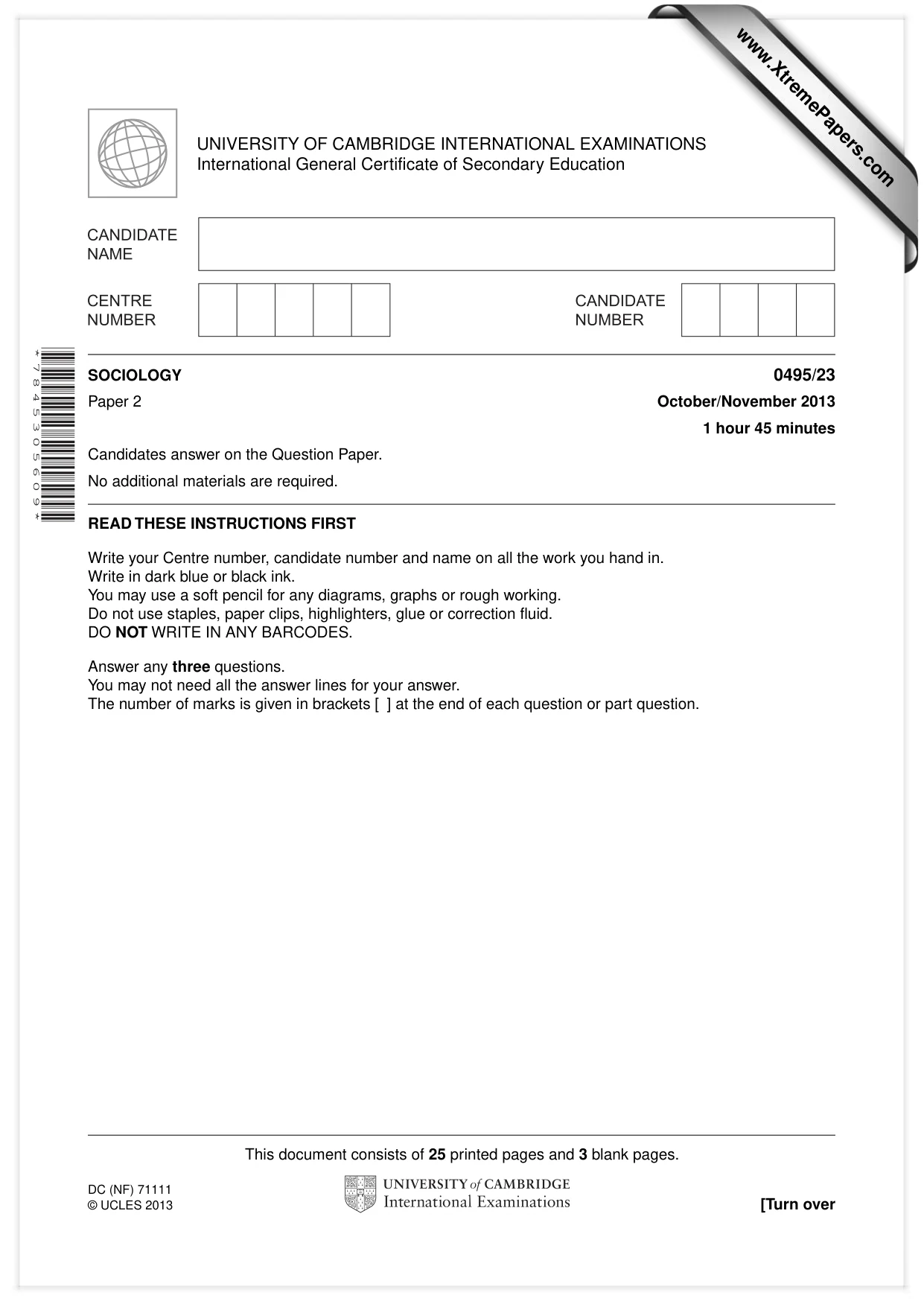
This document consists of 25 printed pages and 3 blank pages. DC (NF) 71111 © UCLES 2013 [Turn over * 7 8 4 5 3 0 5 6 0 9 * SOCIOLOGY 0495/23 Paper 2 October/November 2013 1 hour 45 minutes Candidates answer on the Question Paper. No additional materials are required. READ THESE INSTRUCTIONS FIRST Write your Centre number, candidate number and name on all the work you hand in. Write in dark blue or black ink. You may use a soft pencil for any diagrams, graphs or rough working. Do not use staples, paper clips, highlighters, glue or correction fluid. DO NOT WRITE IN ANY BARCODES. Answer any three questions. You may not need all the answer lines for your answer. The number of marks is given in brackets [ ] at the end of each question or part question. UNIVERSITY OF CAMBRIDGE INTERNATIONAL EXAMINATIONS International General Certificate of Secondary Education www.XtremePapers.com
Question paper, page 2
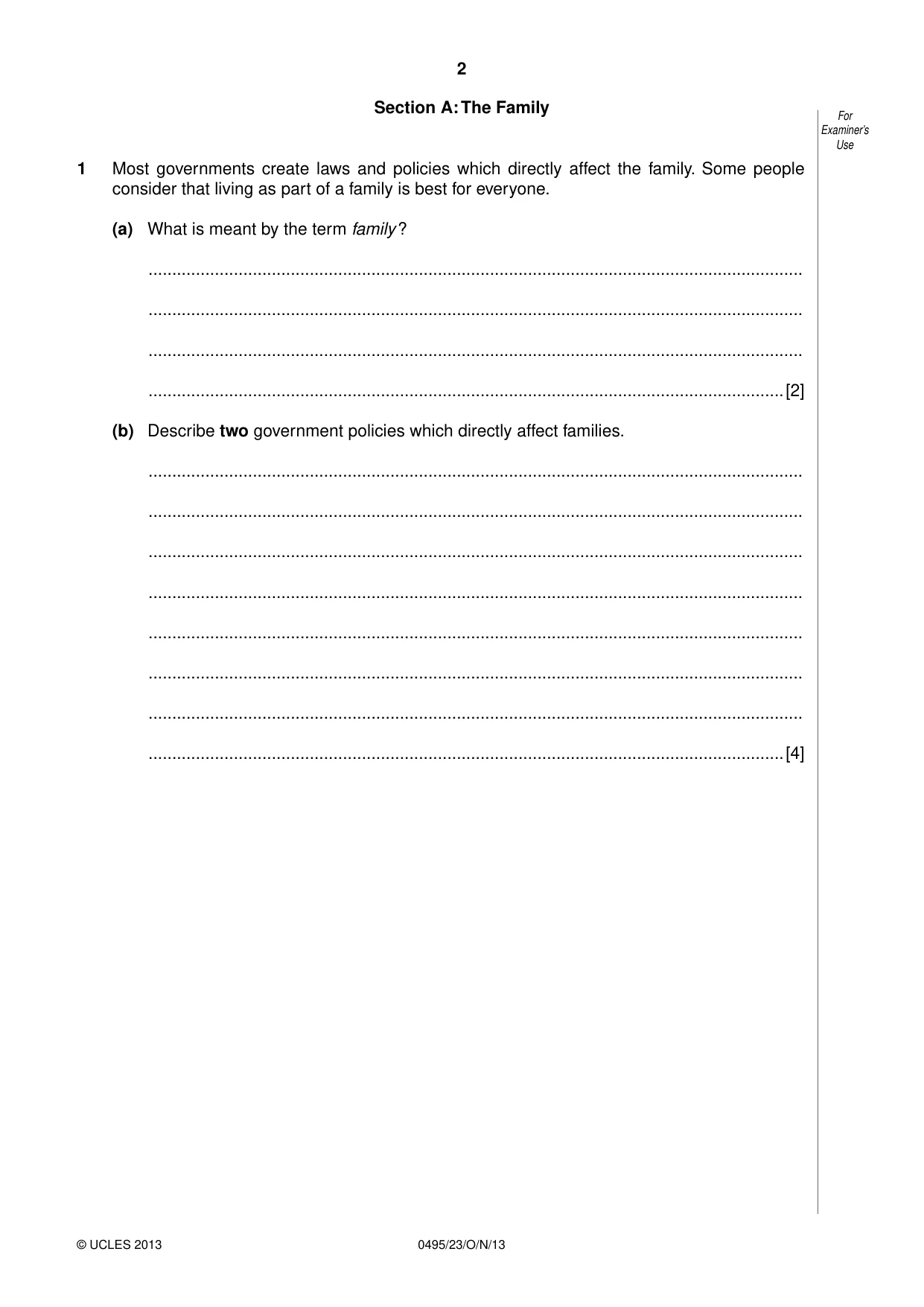
2 0495/23/O/N/13 © UCLES 2013 For Examiner’s Use Section A: The Family 1 Most governments create laws and policies which directly affect the family. Some people consider that living as part of a family is best for everyone. (a) What is meant by the term family ? … … … …[2] (b) Describe two government policies which directly affect families. … … … … … … … …[4]
Question paper, page 3
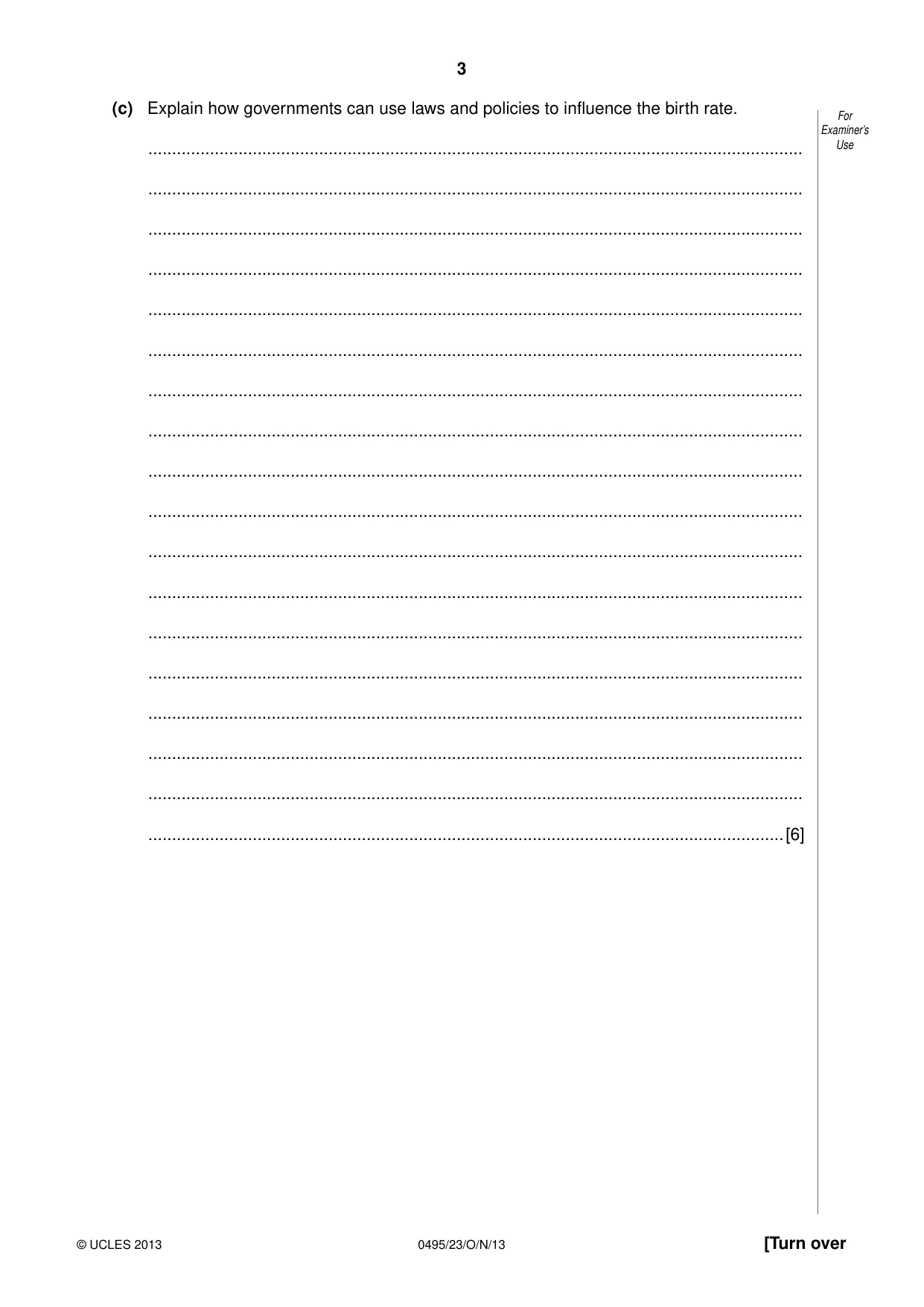
3 0495/23/O/N/13 © UCLES 2013 [Turn over For Examiner’s Use (c) Explain how governments can use laws and policies to influence the birth rate. … … … … … … … … … … … … … … … … … …[6]
Question paper, page 4
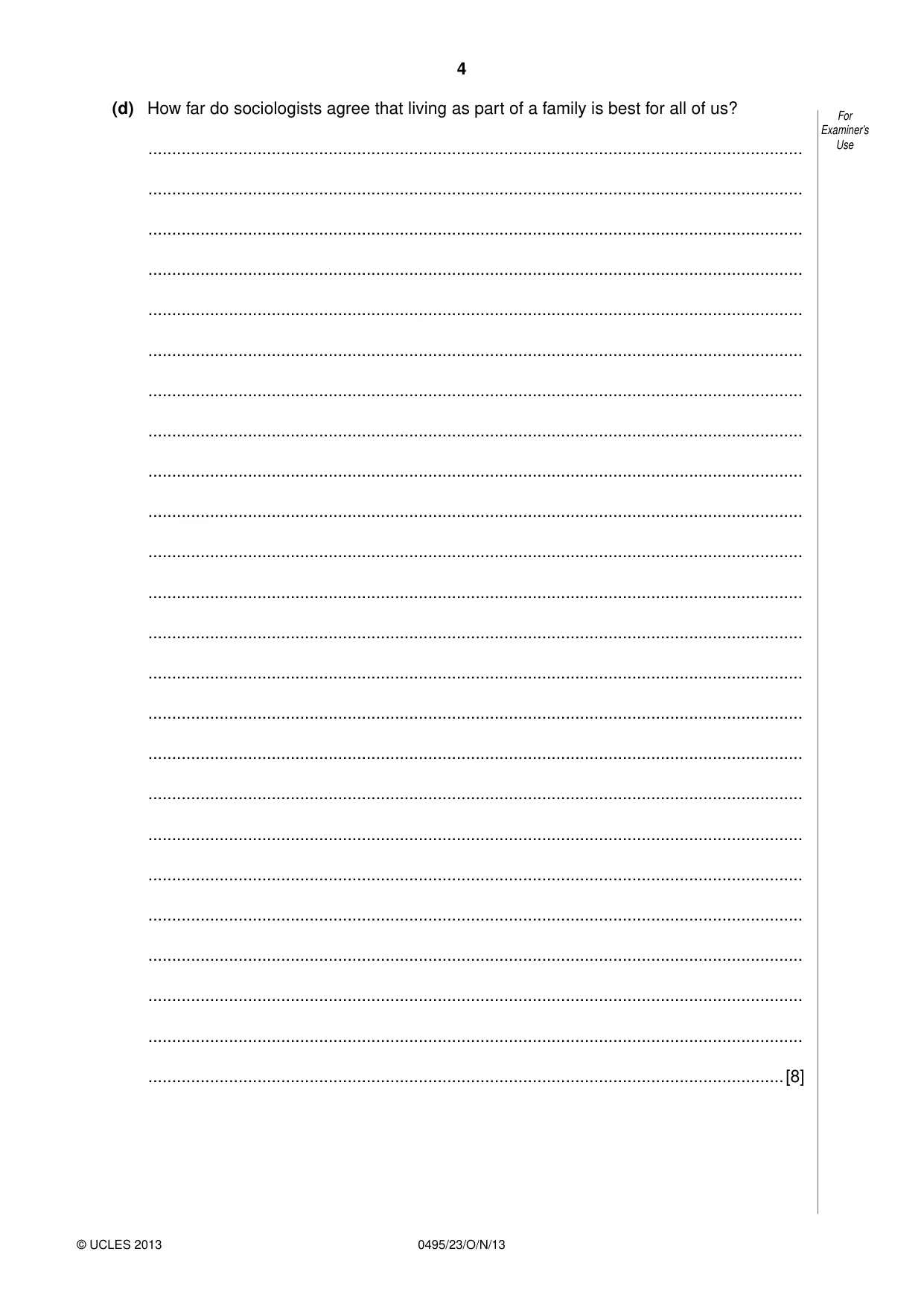
4 0495/23/O/N/13 © UCLES 2013 For Examiner’s Use (d) How far do sociologists agree that living as part of a family is best for all of us? … … … … … … … … … … … … … … … … … … … … … … … …[8]
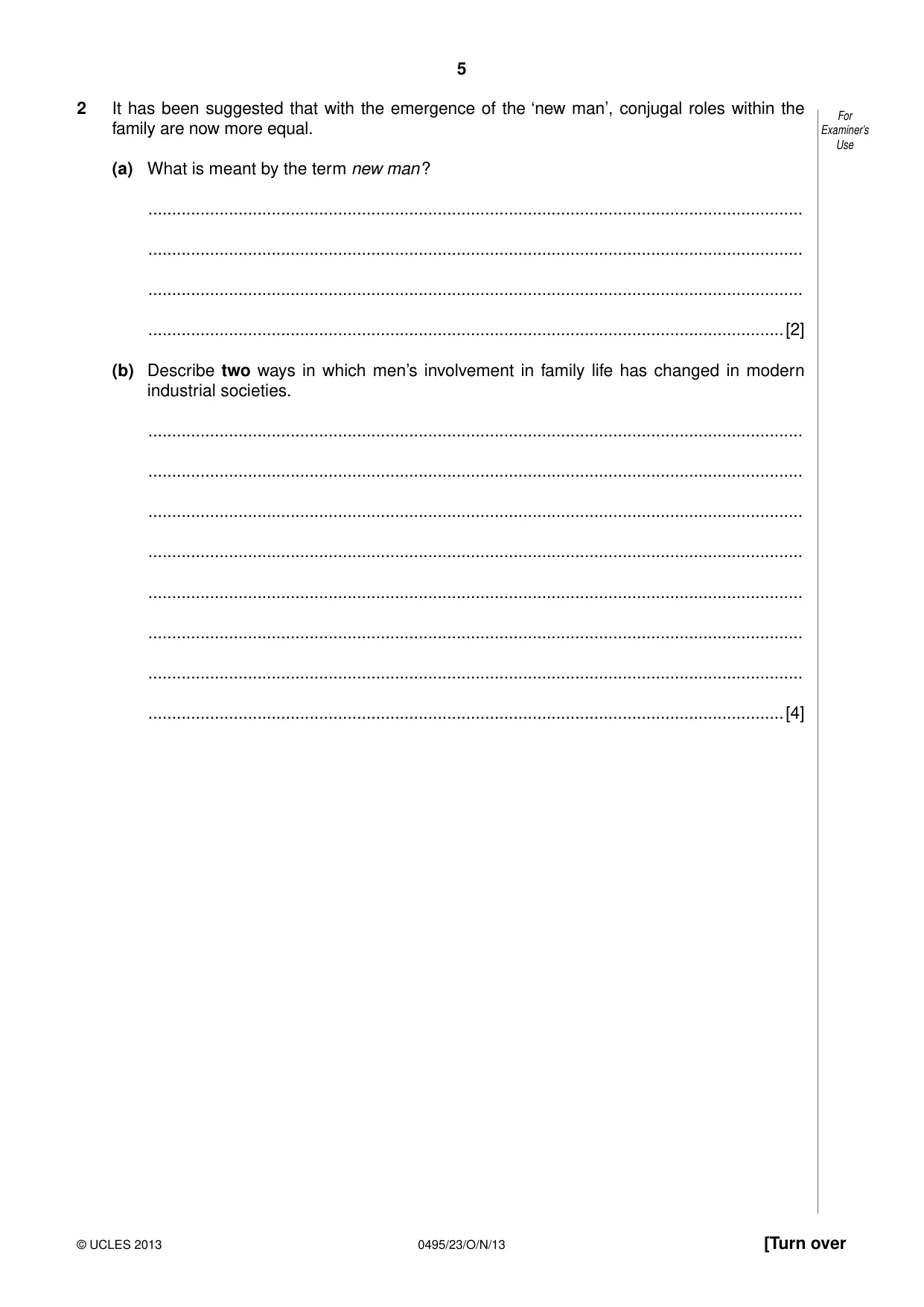
Question paper, page 5
5 0495/23/O/N/13 © UCLES 2013 [Turn over For Examiner’s Use 2 It has been suggested that with the emergence of the ‘new man’, conjugal roles within the family are now more equal. (a) What is meant by the term new man ? … … … …[2] (b) Describe two ways in which men’s involvement in family life has changed in modern industrial societies. … … … … … … … …[4]
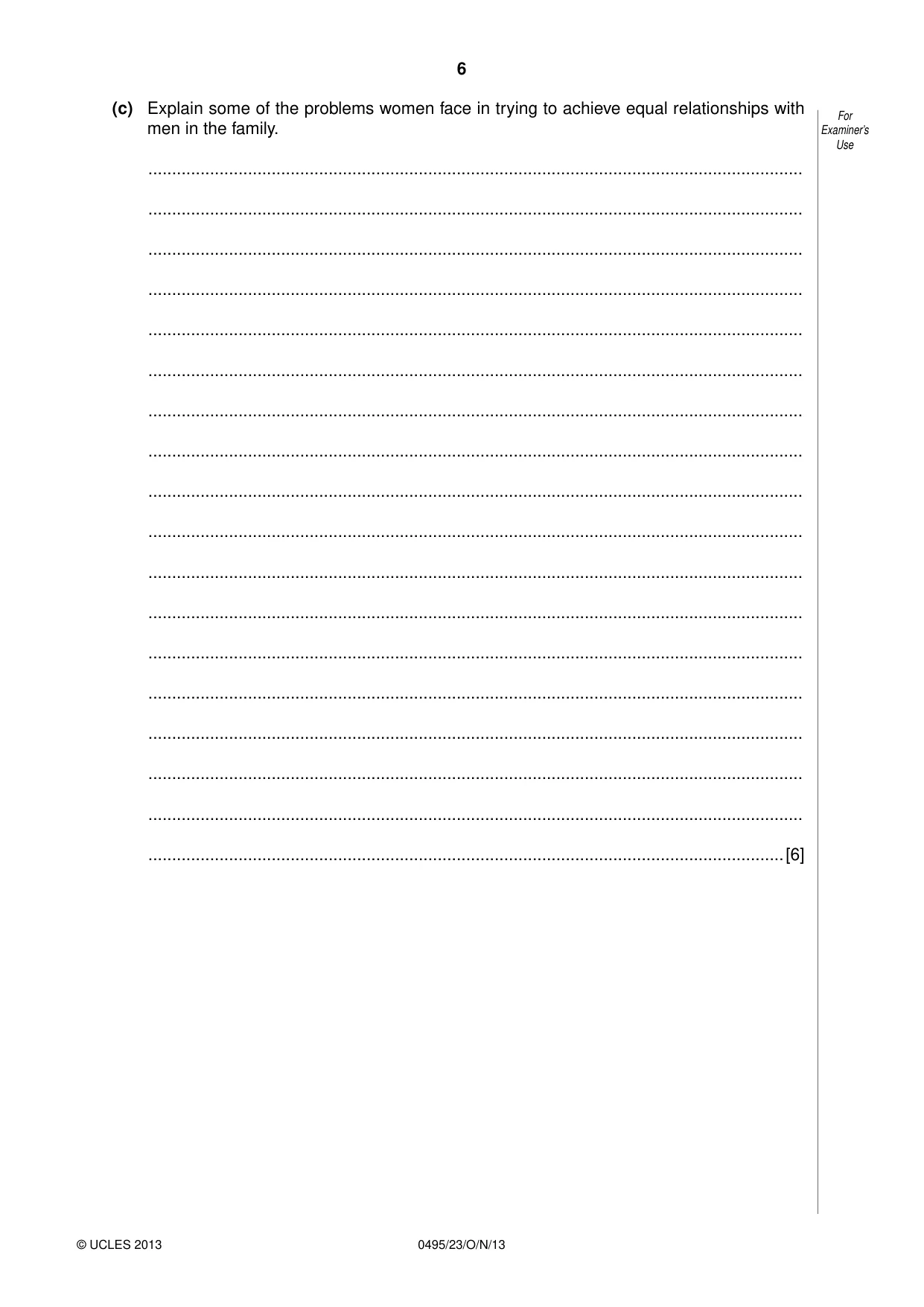
Question paper, page 6
6 0495/23/O/N/13 © UCLES 2013 For Examiner’s Use (c) Explain some of the problems women face in trying to achieve equal relationships with men in the family. … … … … … … … … … … … … … … … … … …[6]
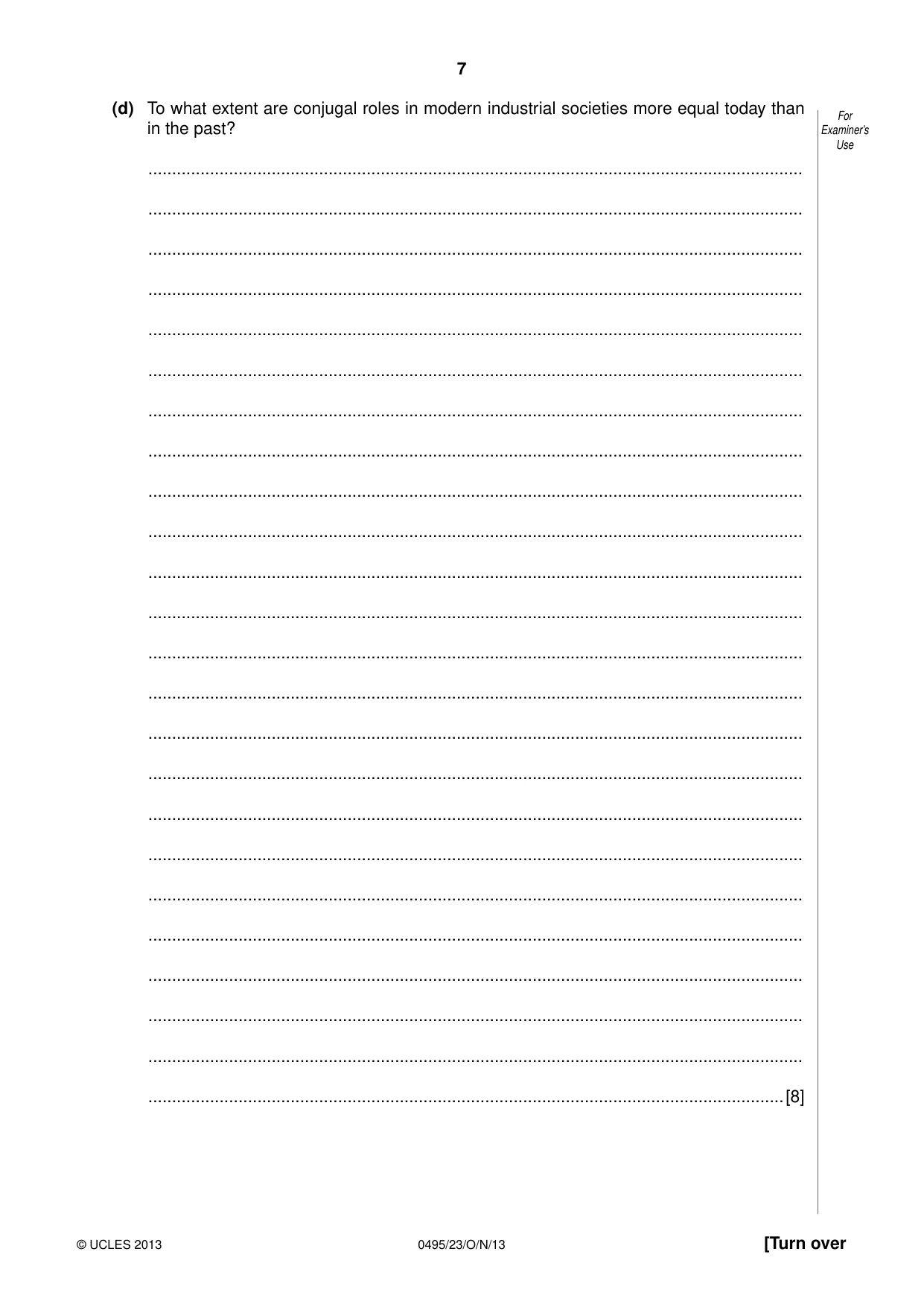
Question paper, page 7
7 0495/23/O/N/13 © UCLES 2013 [Turn over For Examiner’s Use (d) To what extent are conjugal roles in modern industrial societies more equal today than in the past? … … … … … … … … … … … … … … … … … … … … … … … …[8]
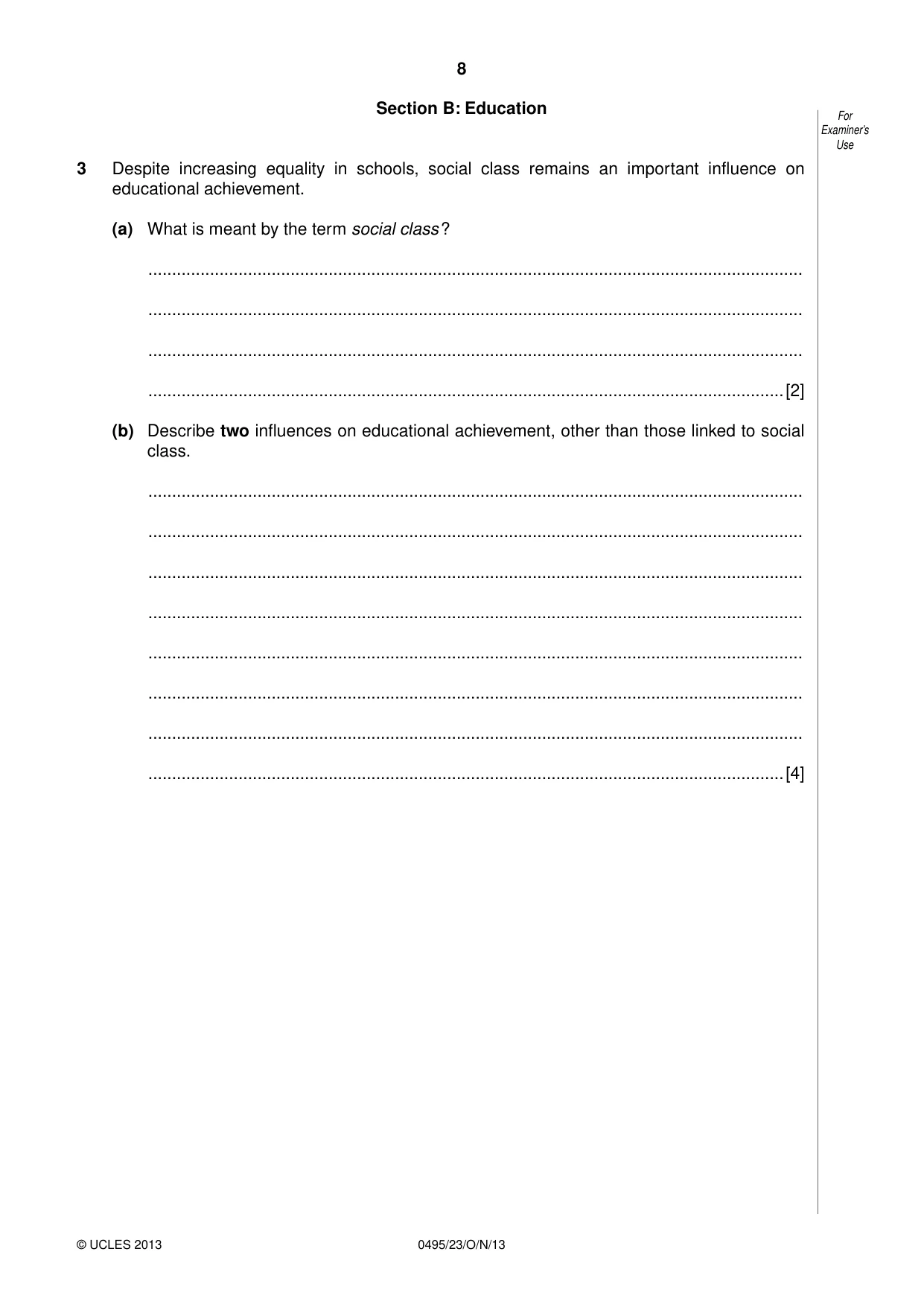
Question paper, page 8
8 0495/23/O/N/13 © UCLES 2013 For Examiner’s Use Section B: Education 3 Despite increasing equality in schools, social class remains an important influence on educational achievement. (a) What is meant by the term social class ? … … … …[2] (b) Describe two influences on educational achievement, other than those linked to social class. … … … … … … … …[4]
Question paper, page 9
9 0495/23/O/N/13 © UCLES 2013 [Turn over For Examiner’s Use (c) Explain some of the reasons why working class children may underachieve at school. … … … … … … … … … … … … … … … … … …[6]
Question paper, page 10
10 0495/23/O/N/13 © UCLES 2013 For Examiner’s Use (d) How far have government educational policies helped working class children overcome social class barriers in education? … … … … … … … … … … … … … … … … … … … … … … … …[8]
Question paper, page 11
11 0495/23/O/N/13 © UCLES 2013 [Turn over For Examiner’s Use 4 Functionalists argue that schools transmit the core values of society and this leads to social cohesion and conformity. (a) What is meant by the term social cohesion ? … … … …[2] (b) Describe two ways in which pupils are encouraged to conform to school rules. … … … … … … … …[4]
Question paper, page 12
12 0495/23/O/N/13 © UCLES 2013 For Examiner’s Use (c) Explain why some pupils do not conform to school rules. … … … … … … … … … … … … … … … … … …[6]
Question paper, page 13
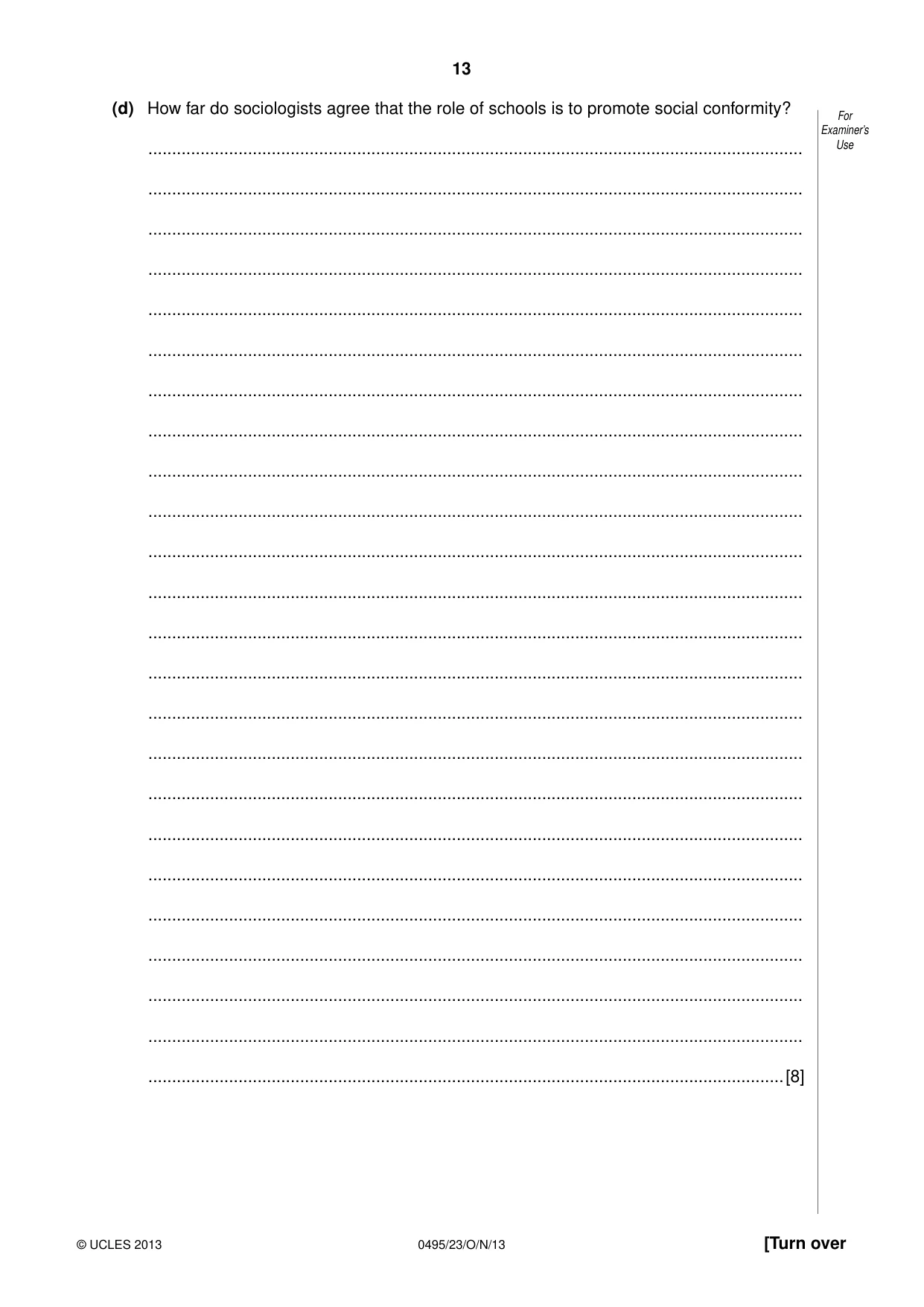
13 0495/23/O/N/13 © UCLES 2013 [Turn over For Examiner’s Use (d) How far do sociologists agree that the role of schools is to promote social conformity? … … … … … … … … … … … … … … … … … … … … … … … …[8]
Question paper, page 14
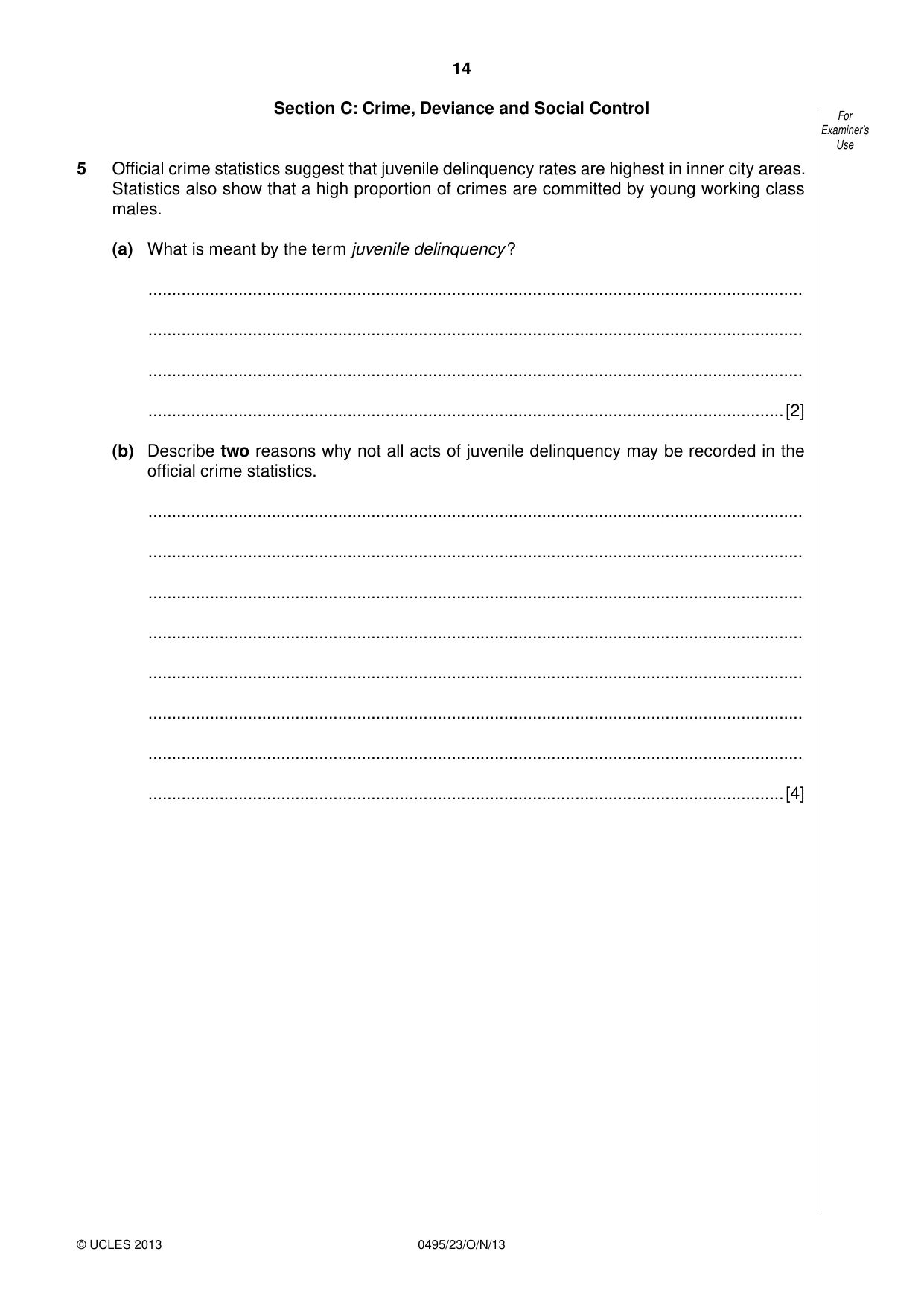
14 0495/23/O/N/13 © UCLES 2013 For Examiner’s Use Section C: Crime, Deviance and Social Control 5 Official crime statistics suggest that juvenile delinquency rates are highest in inner city areas. Statistics also show that a high proportion of crimes are committed by young working class males. (a) What is meant by the term juvenile delinquency ? … … … …[2] (b) Describe two reasons why not all acts of juvenile delinquency may be recorded in the official crime statistics. … … … … … … … …[4]
Question paper, page 15
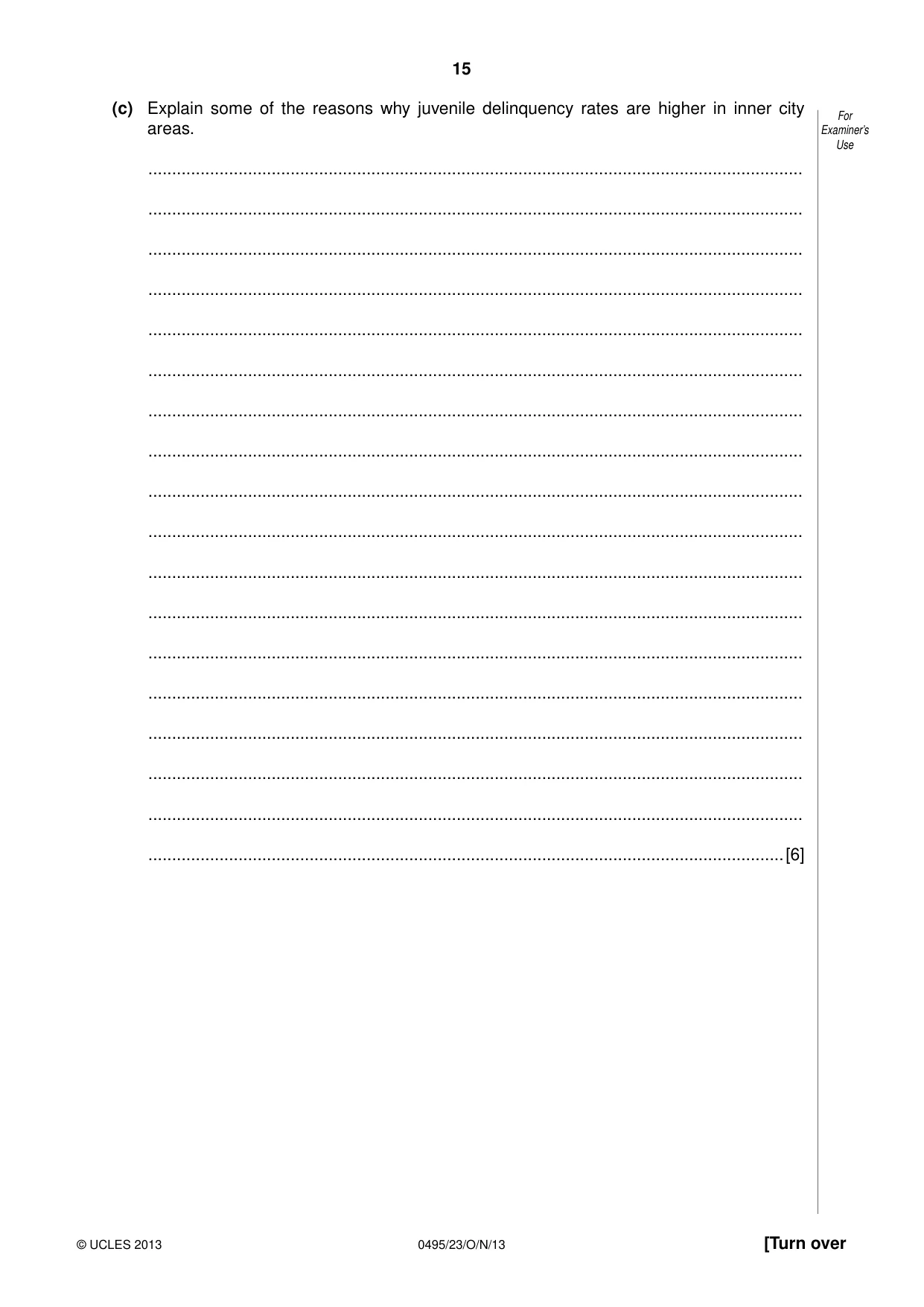
15 0495/23/O/N/13 © UCLES 2013 [Turn over For Examiner’s Use (c) Explain some of the reasons why juvenile delinquency rates are higher in inner city areas. … … … … … … … … … … … … … … … … … …[6]
Question paper, page 16
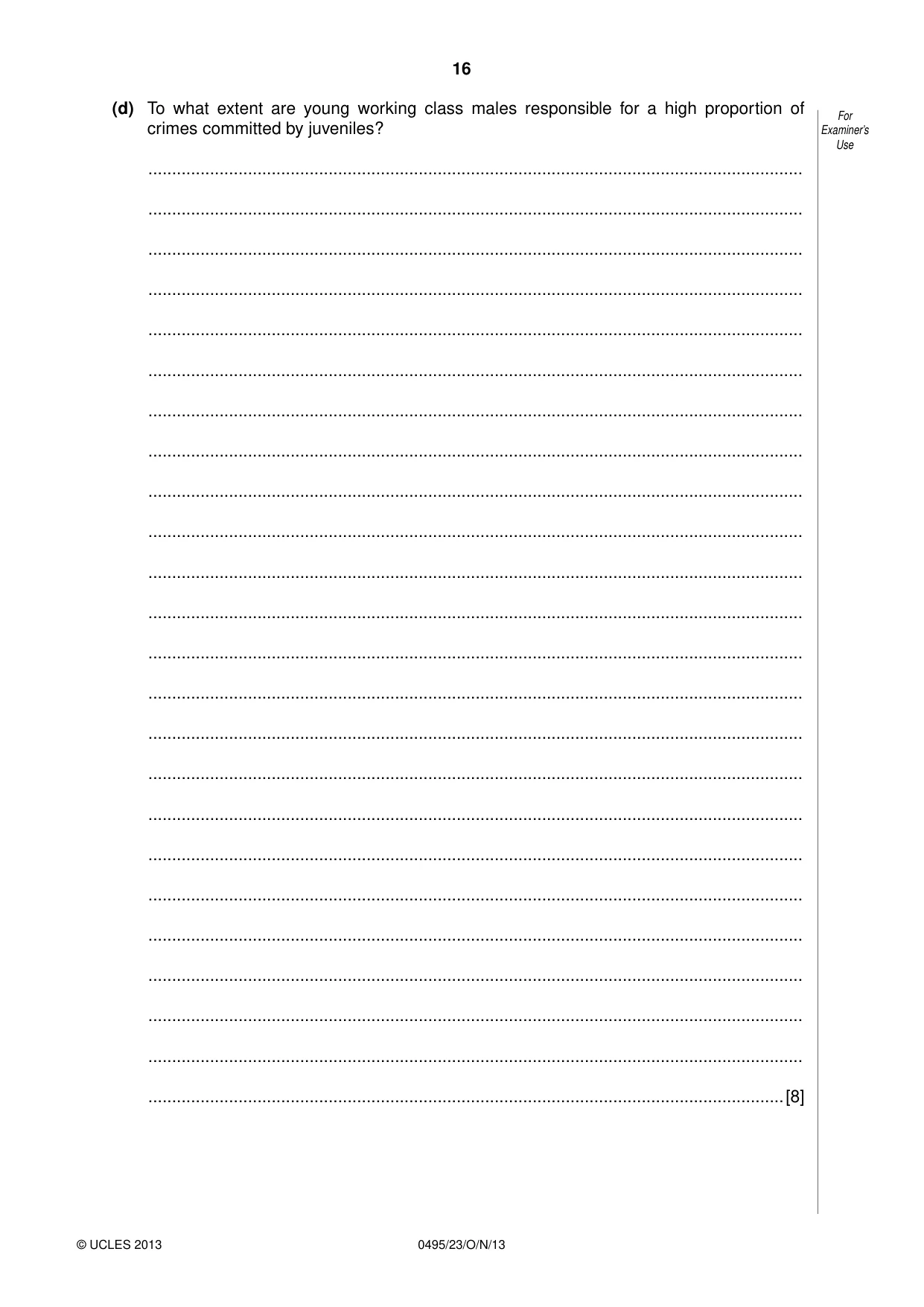
16 0495/23/O/N/13 © UCLES 2013 For Examiner’s Use (d) To what extent are young working class males responsible for a high proportion of crimes committed by juveniles? … … … … … … … … … … … … … … … … … … … … … … … …[8]
Question paper, page 17
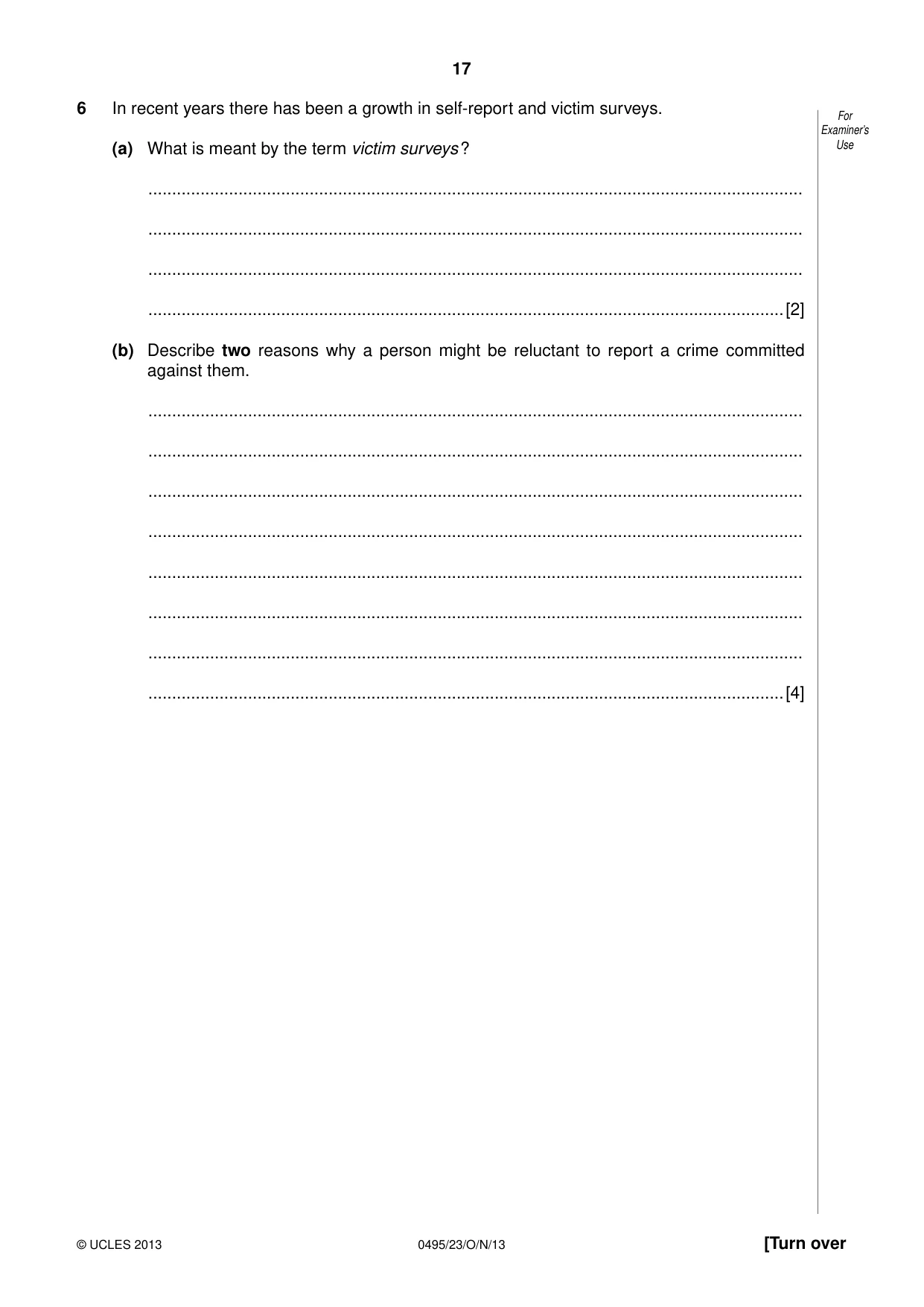
17 0495/23/O/N/13 © UCLES 2013 [Turn over For Examiner’s Use 6 In recent years there has been a growth in self-report and victim surveys. (a) What is meant by the term victim surveys ? … … … …[2] (b) Describe two reasons why a person might be reluctant to report a crime committed against them. … … … … … … … …[4]
Question paper, page 18
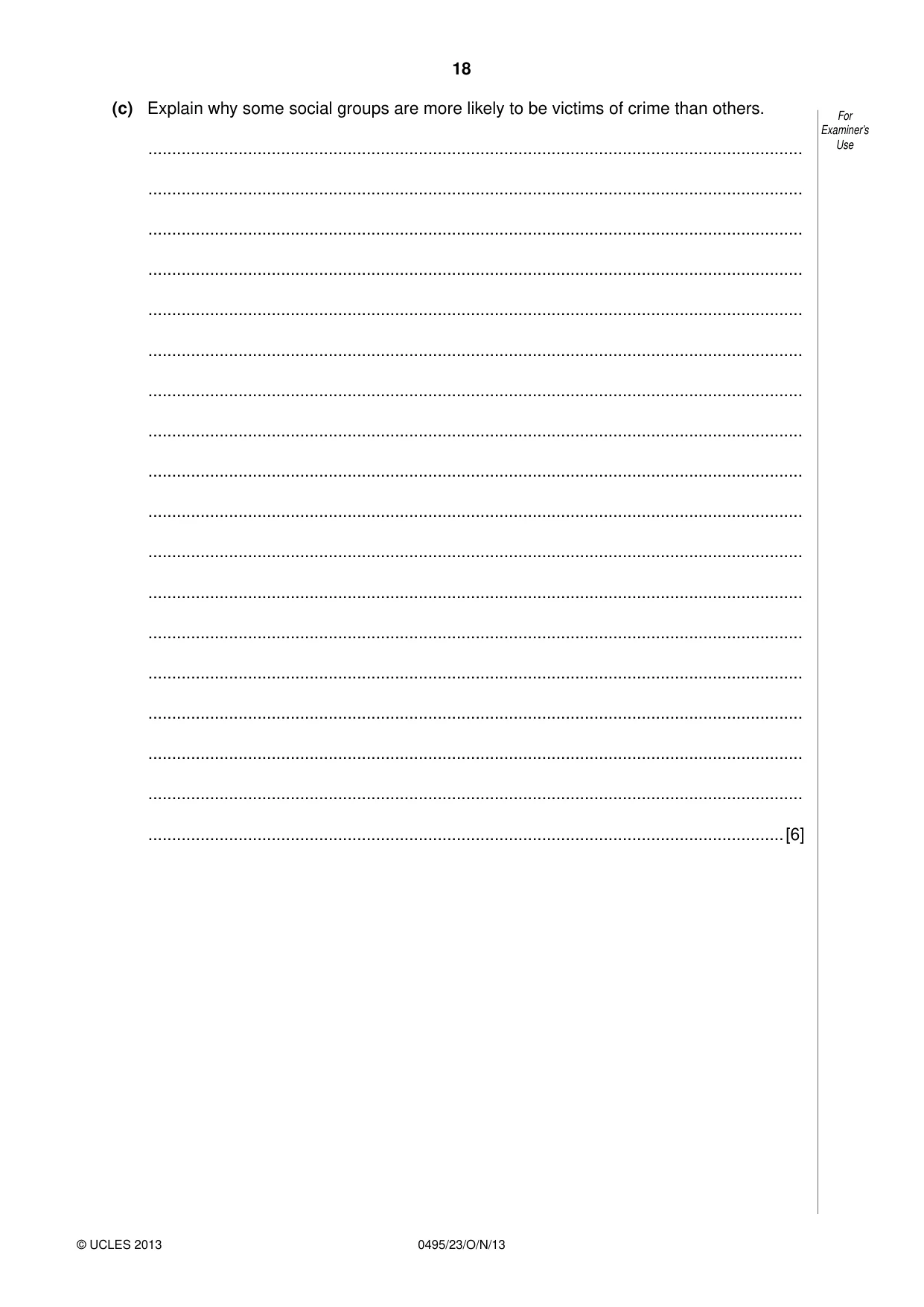
18 0495/23/O/N/13 © UCLES 2013 For Examiner’s Use (c) Explain why some social groups are more likely to be victims of crime than others. … … … … … … … … … … … … … … … … … …[6]
Question paper, page 19
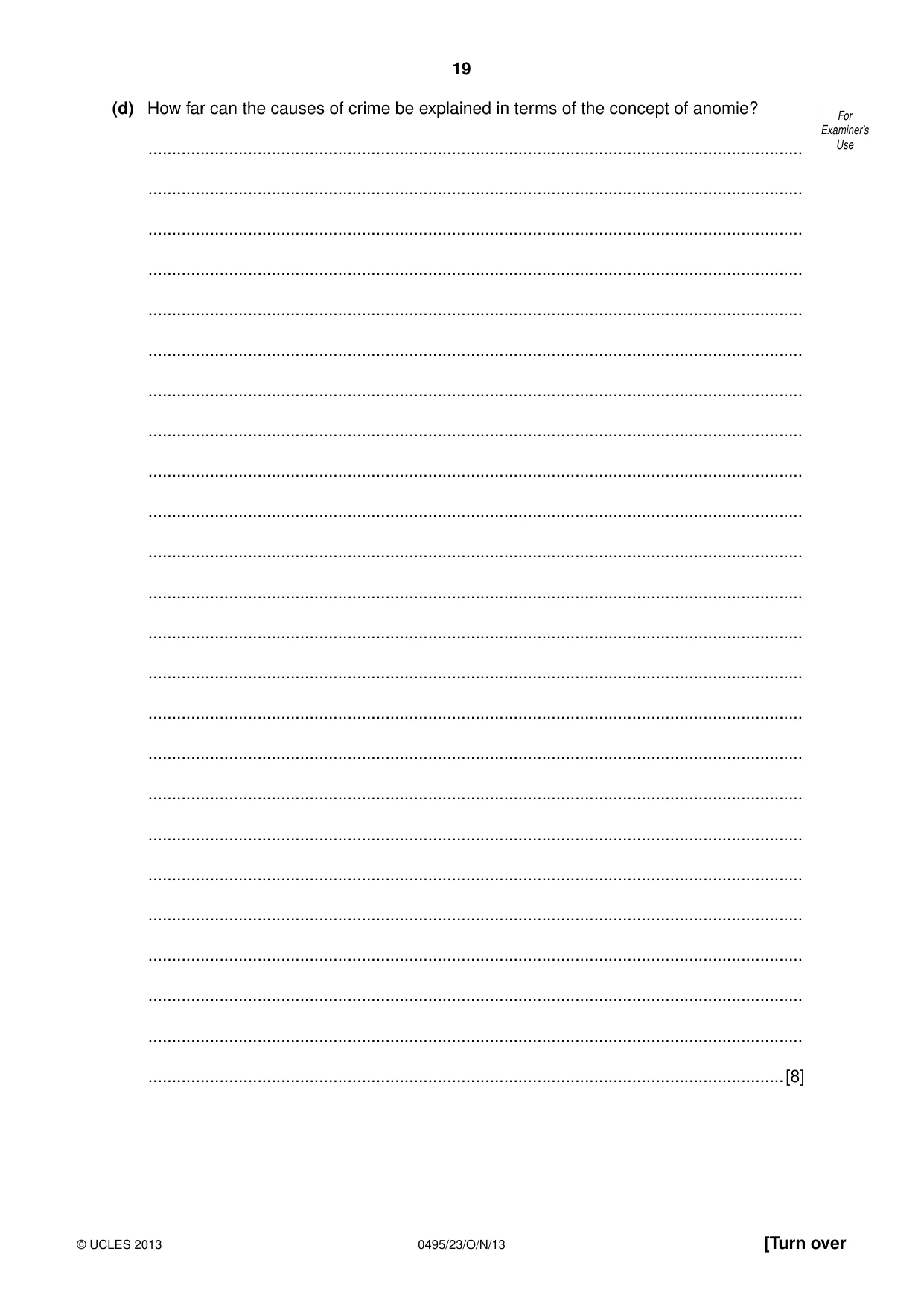
19 0495/23/O/N/13 © UCLES 2013 [Turn over For Examiner’s Use (d) How far can the causes of crime be explained in terms of the concept of anomie? … … … … … … … … … … … … … … … … … … … … … … … …[8]
Question paper, page 20
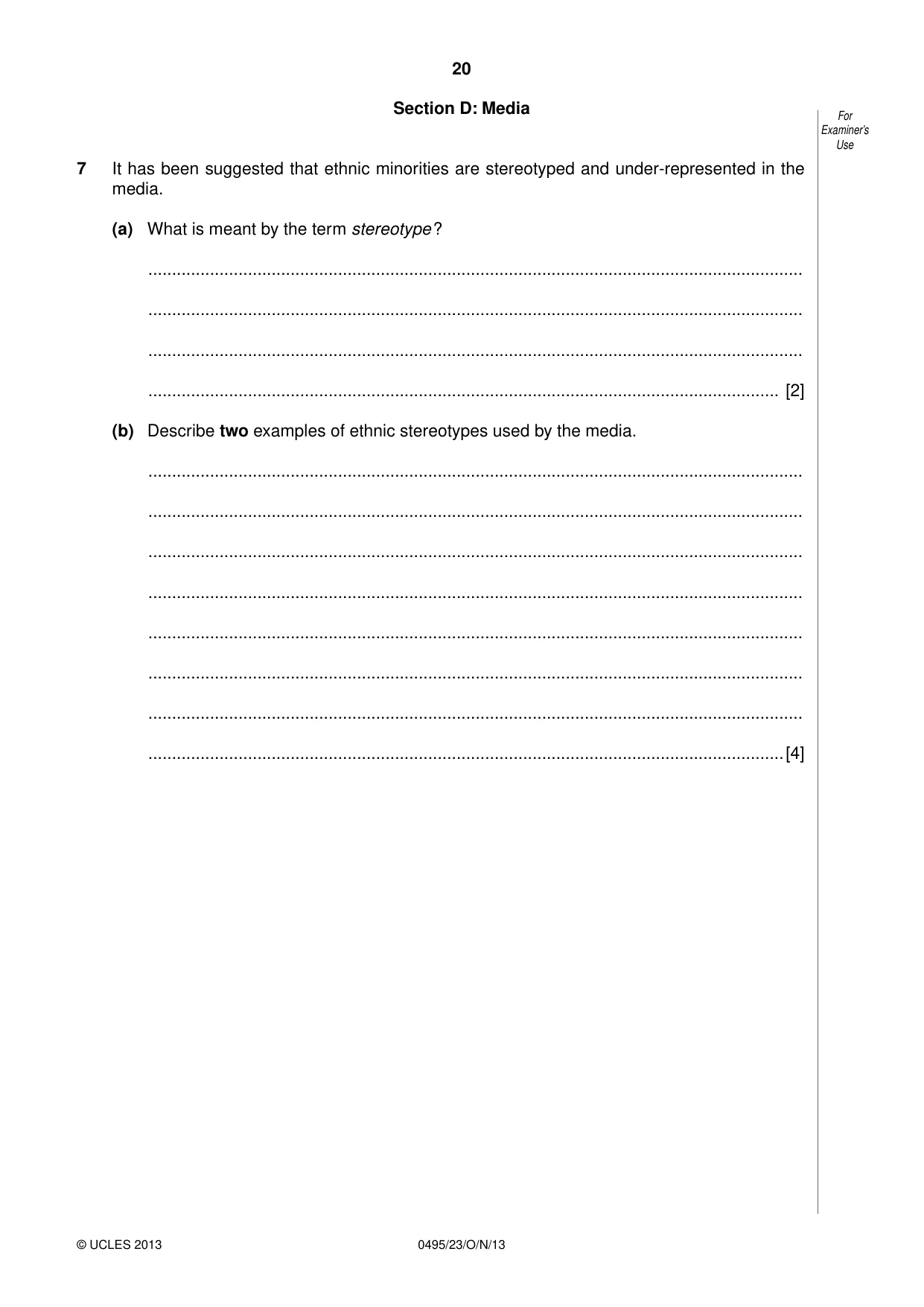
20 0495/23/O/N/13 © UCLES 2013 For Examiner’s Use Section D: Media 7 It has been suggested that ethnic minorities are stereotyped and under-represented in the media. (a) What is meant by the term stereotype ? … … … … [2] (b) Describe two examples of ethnic stereotypes used by the media. … … … … … … … …[4]
Question paper, page 21
21 0495/23/O/N/13 © UCLES 2013 [Turn over For Examiner’s Use (c) Explain why some ethnic minorities may be under-represented in the media. … … … … … … … … … … … … … … … … … … [6]
Question paper, page 22
22 0495/23/O/N/13 © UCLES 2013 For Examiner’s Use (d) To what extent may attitudes towards ethnic minorities be shaped by the media? … … … … … … … … … … … … … … … … … … … … … … … …[8]
Question paper, page 23
23 0495/23/O/N/13 © UCLES 2013 [Turn over For Examiner’s Use 8 Not everyone has access to the new media and there is a ‘digital divide’ between those who can and those who cannot afford to access it. (a) What is meant by the term new media ? … … … … [2] (b) Describe two ways in which the lives of young people may be affected by the new media. … … … … … … … …[4]
Question paper, page 24
24 0495/23/O/N/13 © UCLES 2013 For Examiner’s Use (c) Explain why some groups of people more than other groups are likely to use the new media. … … … … … … … … … … … … … … … … … …[6]
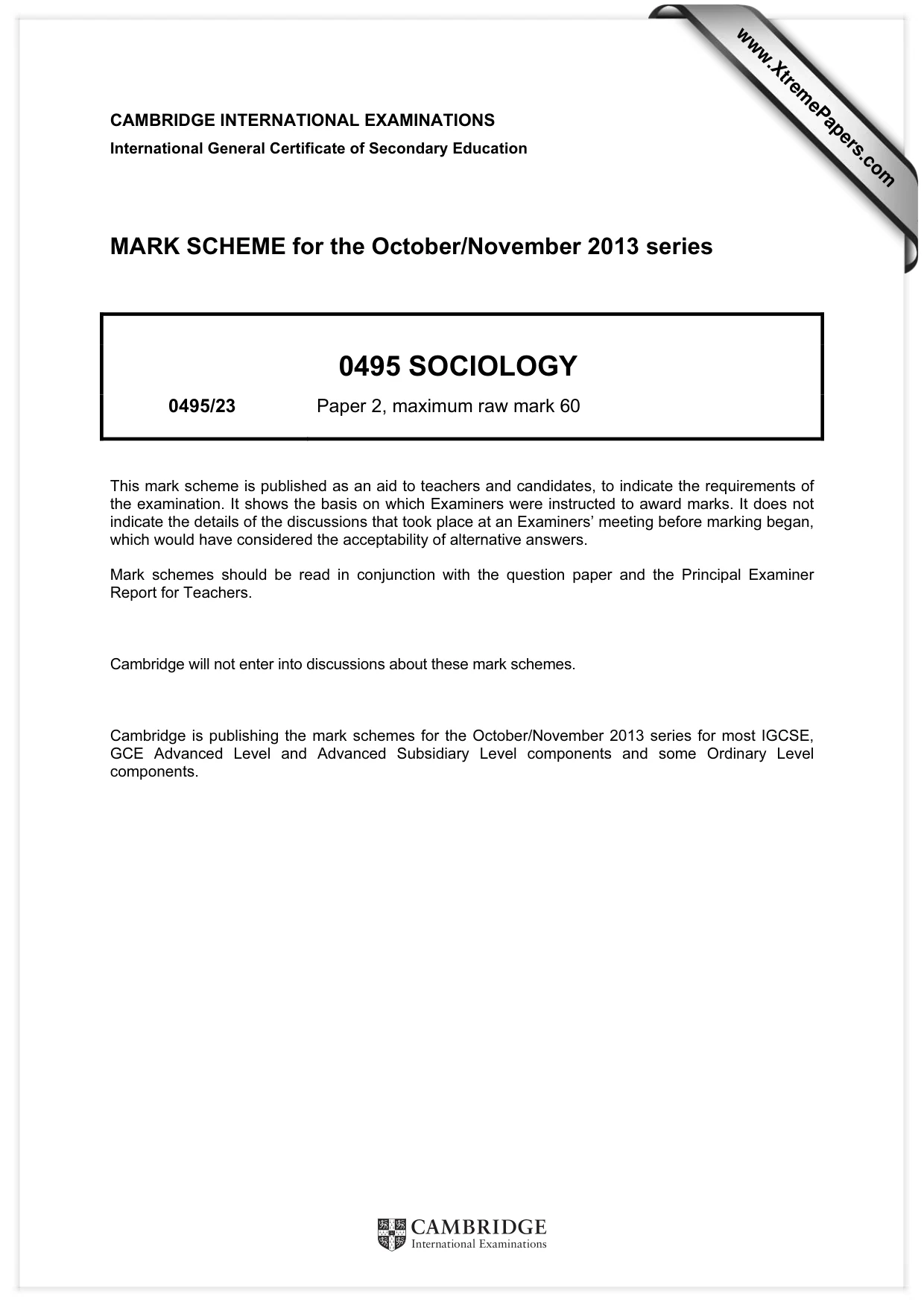
Question paper, page 25
25 0495/23/O/N/13 © UCLES 2013 For Examiner’s Use (d) How far is the use of the new media creating a global youth culture? … … … … … … … … … … … … … … … … … … … … … … … …[8]
Question paper, page 26
26 0495/23/O/N/13 © UCLES 2013 BLANK PAGE
Question paper, page 27
27 0495/23/O/N/13 © UCLES 2013 BLANK PAGE
Question paper, page 28
28 0495/23/O/N/13 © UCLES 2013 Permission to reproduce items where third-party owned material protected by copyright is included has been sought and cleared where possible. Every reasonable effort has been made by the publisher (UCLES) to trace copyright holders, but if any items requiring clearance have unwittingly been included, the publisher will be pleased to make amends at the earliest possible opportunity. University of Cambridge International Examinations is part of the Cambridge Assessment Group. Cambridge Assessment is the brand name of University of Cambridge Local Examinations Syndicate (UCLES), which is itself a department of the University of Cambridge. BLANK PAGE
Mark scheme, page 1
CAMBRIDGE INTERNATIONAL EXAMINATIONS International General Certificate of Secondary Education MARK SCHEME for the October/November 2013 series 0495 SOCIOLOGY 0495/23 Paper 2, maximum raw mark 60 This mark scheme is published as an aid to teachers and candidates, to indicate the requirements of the examination. It shows the basis on which Examiners were instructed to award marks. It does not indicate the details of the discussions that took place at an Examiners’ meeting before marking began, which would have considered the acceptability of alternative answers. Mark schemes should be read in conjunction with the question paper and the Principal Examiner Report for Teachers. Cambridge will not enter into discussions about these mark schemes. Cambridge is publishing the mark schemes for the October/November 2013 series for most IGCSE, GCE Advanced Level and Advanced Subsidiary Level components and some Ordinary Level components. www.XtremePapers.com
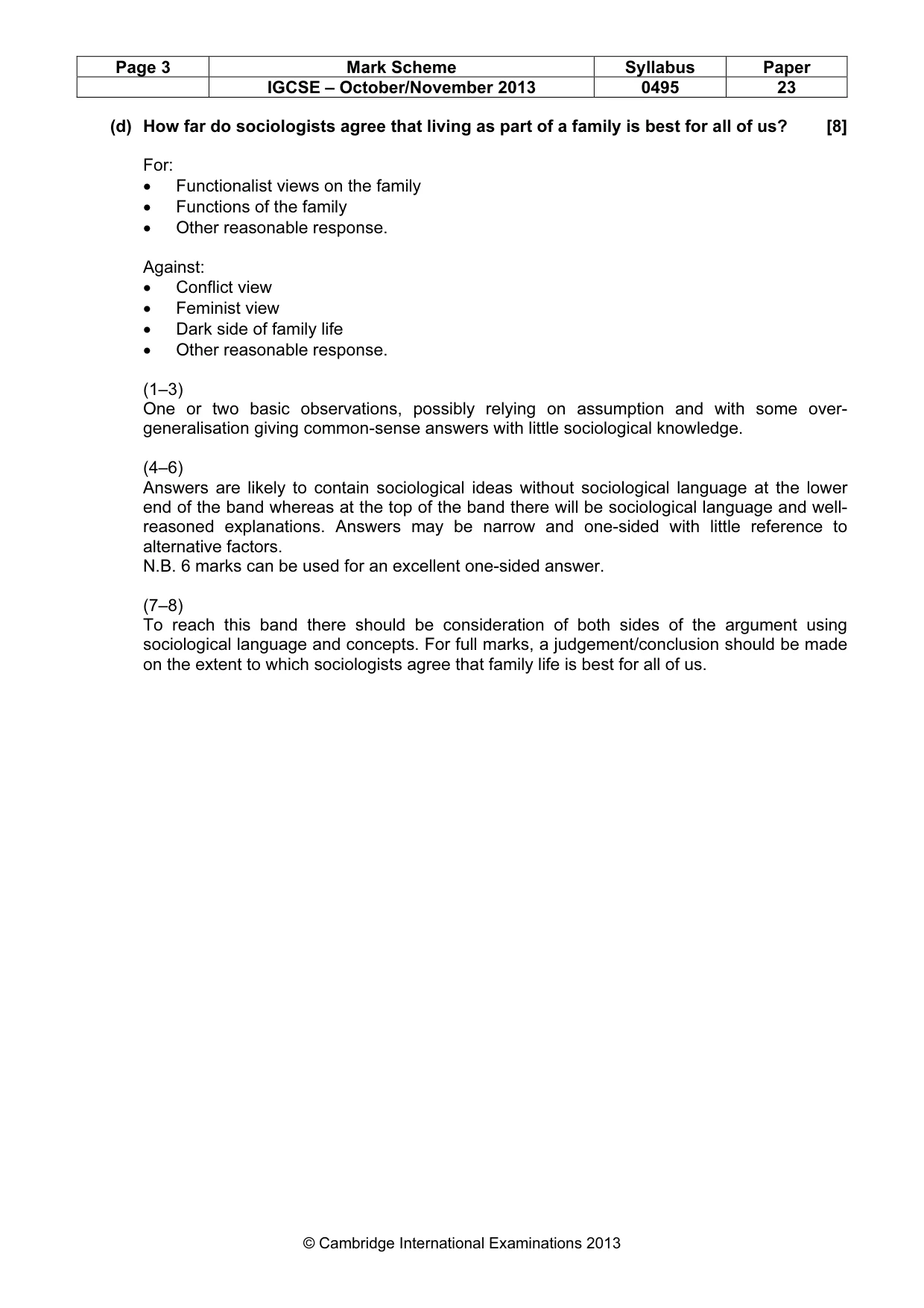
Mark scheme, page 2
Page 2 Mark Scheme Syllabus Paper IGCSE – October/November 2013 0495 23 © Cambridge International Examinations 2013 Section A: The Family 1 Most governments create laws and policies which directly affect the family. Some people consider that living as part of a family is best for everyone. (a) What is meant by the term family? [2] People related by blood, adoption or by marriage living in the same household. A clear definition along these lines = 2 marks. e.g. People related by blood or marriage living in the same household. An incomplete definition showing some understanding = 1 mark. e.g. Parents and children. (b) Describe two government policies which directly affect families. [4] • Divorce laws • Compulsory education • Laws protecting children • Laws promoting women's rights • Taxation • Abortion law • Other reasonable response. 1 mark for identification and 1 mark for description/development (2 × 2) (c) Explain how governments can use laws and policies to influence the birth rate. [6] • Laws which encourage more children e.g. child benefit, child tax credit, maternity and paternity leave • Childcare and support through nursery education • Laws which discourage more children e.g. China's one child policy • Contraceptive advice • Increased taxes for couples with more than one child • Tax benefits for couples without children • Other reasonable response. (1–3) One or two basic observations, possibly relying on assumption and with some over- generalisation, giving common sense answers with little sociological knowledge. (4–6) Clear and accurate sociological points will be made. At the lower end of the band there may be sociological ideas without sociological language or a lack of range. At the top of the band expect more than one point to be discussed using sociological language in a well-reasoned way. (In most answers one point with explanation = 4 marks and three or more with explanation = 6 marks. Alternatively, two points with very good explanations could also gain 6 marks.)
Mark scheme, page 3
Page 3 Mark Scheme Syllabus Paper IGCSE – October/November 2013 0495 23 © Cambridge International Examinations 2013 (d) How far do sociologists agree that living as part of a family is best for all of us? [8] For: • Functionalist views on the family • Functions of the family • Other reasonable response. Against: • Conflict view • Feminist view • Dark side of family life • Other reasonable response. (1–3) One or two basic observations, possibly relying on assumption and with some over- generalisation giving common-sense answers with little sociological knowledge. (4–6) Answers are likely to contain sociological ideas without sociological language at the lower end of the band whereas at the top of the band there will be sociological language and well- reasoned explanations. Answers may be narrow and one-sided with little reference to alternative factors. N.B. 6 marks can be used for an excellent one-sided answer. (7–8) To reach this band there should be consideration of both sides of the argument using sociological language and concepts. For full marks, a judgement/conclusion should be made on the extent to which sociologists agree that family life is best for all of us.
Mark scheme, page 4
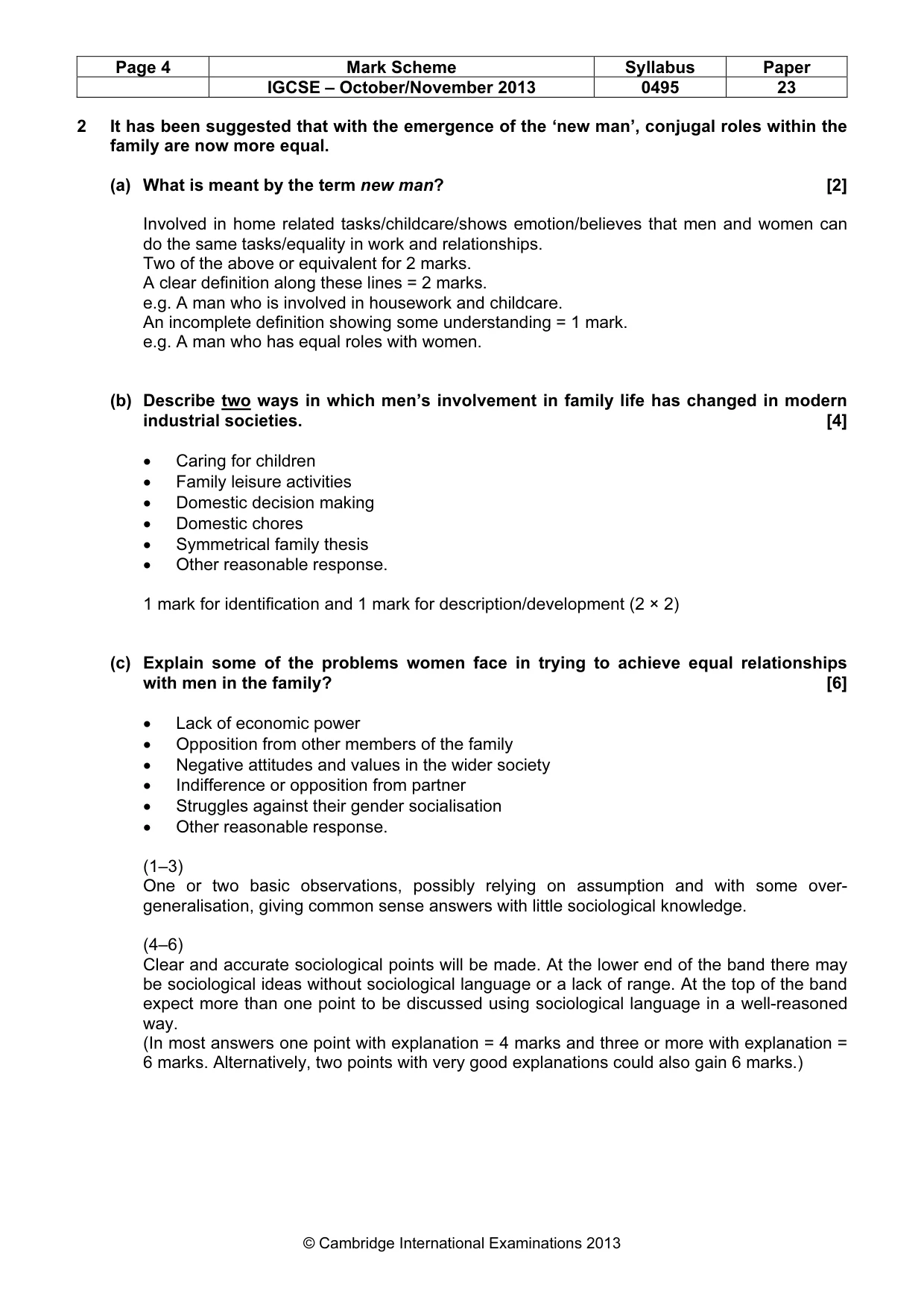
Page 4 Mark Scheme Syllabus Paper IGCSE – October/November 2013 0495 23 © Cambridge International Examinations 2013 2 It has been suggested that with the emergence of the ‘new man’, conjugal roles within the family are now more equal. (a) What is meant by the term new man? [2] Involved in home related tasks/childcare/shows emotion/believes that men and women can do the same tasks/equality in work and relationships. Two of the above or equivalent for 2 marks. A clear definition along these lines = 2 marks. e.g. A man who is involved in housework and childcare. An incomplete definition showing some understanding = 1 mark. e.g. A man who has equal roles with women. (b) Describe two ways in which men’s involvement in family life has changed in modern industrial societies. [4] • Caring for children • Family leisure activities • Domestic decision making • Domestic chores • Symmetrical family thesis • Other reasonable response. 1 mark for identification and 1 mark for description/development (2 × 2) (c) Explain some of the problems women face in trying to achieve equal relationships with men in the family? [6] • Lack of economic power • Opposition from other members of the family • Negative attitudes and values in the wider society • Indifference or opposition from partner • Struggles against their gender socialisation • Other reasonable response. (1–3) One or two basic observations, possibly relying on assumption and with some over- generalisation, giving common sense answers with little sociological knowledge. (4–6) Clear and accurate sociological points will be made. At the lower end of the band there may be sociological ideas without sociological language or a lack of range. At the top of the band expect more than one point to be discussed using sociological language in a well-reasoned way. (In most answers one point with explanation = 4 marks and three or more with explanation = 6 marks. Alternatively, two points with very good explanations could also gain 6 marks.)
Mark scheme, page 5
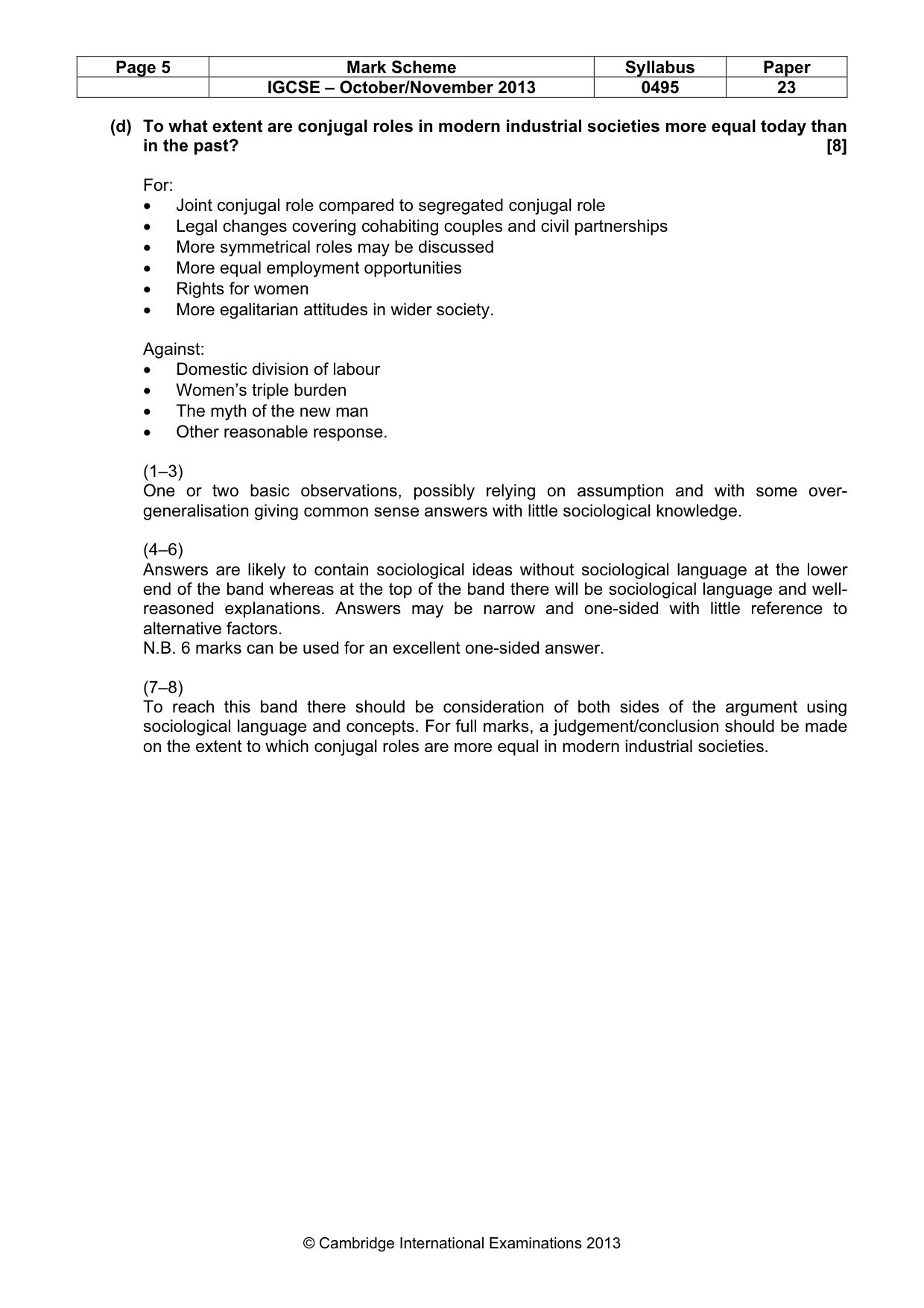
Page 5 Mark Scheme Syllabus Paper IGCSE – October/November 2013 0495 23 © Cambridge International Examinations 2013 (d) To what extent are conjugal roles in modern industrial societies more equal today than in the past? [8] For: • Joint conjugal role compared to segregated conjugal role • Legal changes covering cohabiting couples and civil partnerships • More symmetrical roles may be discussed • More equal employment opportunities • Rights for women • More egalitarian attitudes in wider society. Against: • Domestic division of labour • Women’s triple burden • The myth of the new man • Other reasonable response. (1–3) One or two basic observations, possibly relying on assumption and with some over- generalisation giving common sense answers with little sociological knowledge. (4–6) Answers are likely to contain sociological ideas without sociological language at the lower end of the band whereas at the top of the band there will be sociological language and well- reasoned explanations. Answers may be narrow and one-sided with little reference to alternative factors. N.B. 6 marks can be used for an excellent one-sided answer. (7–8) To reach this band there should be consideration of both sides of the argument using sociological language and concepts. For full marks, a judgement/conclusion should be made on the extent to which conjugal roles are more equal in modern industrial societies.
Mark scheme, page 6
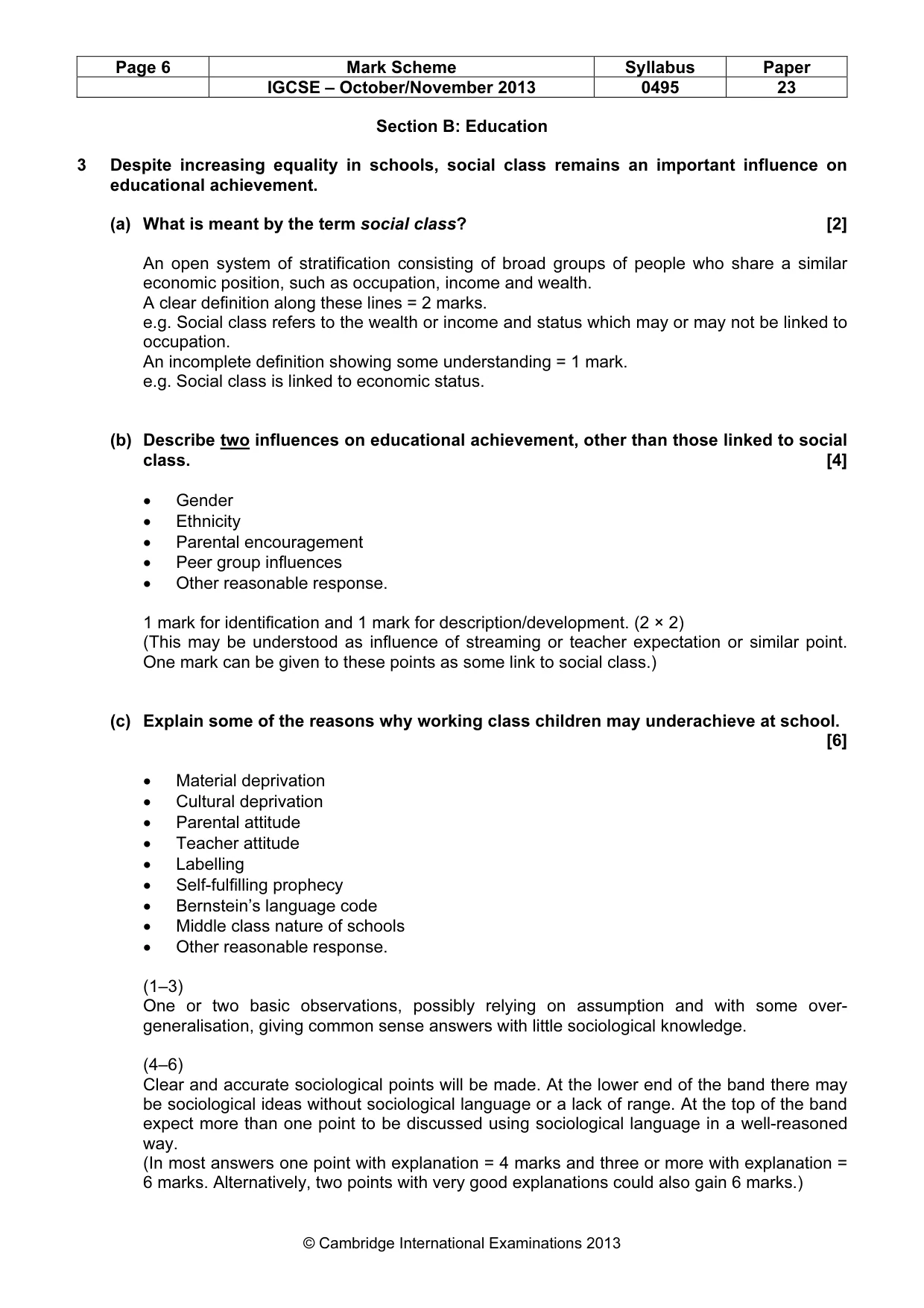
Page 6 Mark Scheme Syllabus Paper IGCSE – October/November 2013 0495 23 © Cambridge International Examinations 2013 Section B: Education 3 Despite increasing equality in schools, social class remains an important influence on educational achievement. (a) What is meant by the term social class? [2] An open system of stratification consisting of broad groups of people who share a similar economic position, such as occupation, income and wealth. A clear definition along these lines = 2 marks. e.g. Social class refers to the wealth or income and status which may or may not be linked to occupation. An incomplete definition showing some understanding = 1 mark. e.g. Social class is linked to economic status. (b) Describe two influences on educational achievement, other than those linked to social class. [4] • Gender • Ethnicity • Parental encouragement • Peer group influences • Other reasonable response. 1 mark for identification and 1 mark for description/development. (2 × 2) (This may be understood as influence of streaming or teacher expectation or similar point. One mark can be given to these points as some link to social class.) (c) Explain some of the reasons why working class children may underachieve at school. [6] • Material deprivation • Cultural deprivation • Parental attitude • Teacher attitude • Labelling • Self-fulfilling prophecy • Bernstein’s language code • Middle class nature of schools • Other reasonable response. (1–3) One or two basic observations, possibly relying on assumption and with some over- generalisation, giving common sense answers with little sociological knowledge. (4–6) Clear and accurate sociological points will be made. At the lower end of the band there may be sociological ideas without sociological language or a lack of range. At the top of the band expect more than one point to be discussed using sociological language in a well-reasoned way. (In most answers one point with explanation = 4 marks and three or more with explanation = 6 marks. Alternatively, two points with very good explanations could also gain 6 marks.)
Mark scheme, page 7
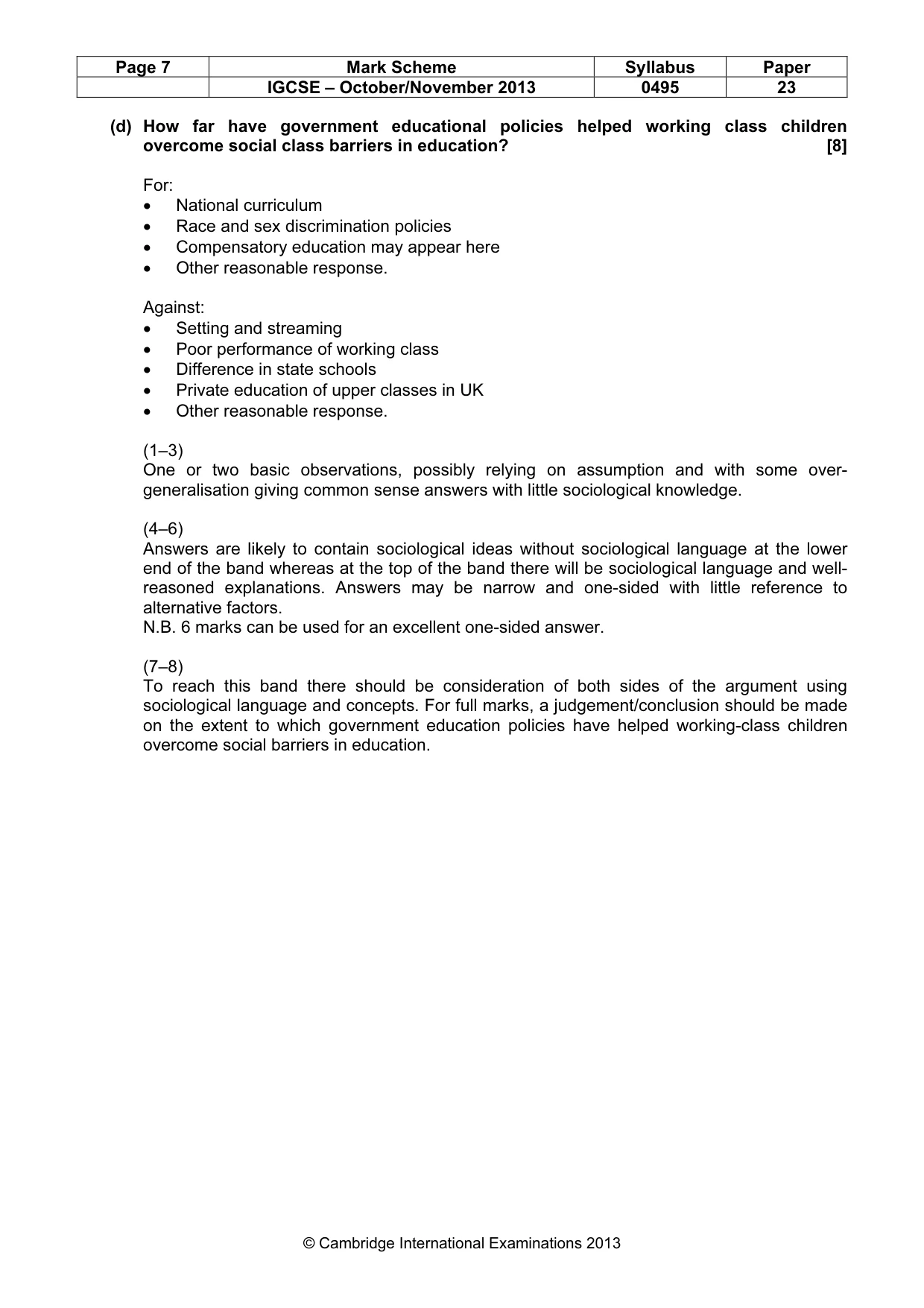
Page 7 Mark Scheme Syllabus Paper IGCSE – October/November 2013 0495 23 © Cambridge International Examinations 2013 (d) How far have government educational policies helped working class children overcome social class barriers in education? [8] For: • National curriculum • Race and sex discrimination policies • Compensatory education may appear here • Other reasonable response. Against: • Setting and streaming • Poor performance of working class • Difference in state schools • Private education of upper classes in UK • Other reasonable response. (1–3) One or two basic observations, possibly relying on assumption and with some over- generalisation giving common sense answers with little sociological knowledge. (4–6) Answers are likely to contain sociological ideas without sociological language at the lower end of the band whereas at the top of the band there will be sociological language and well- reasoned explanations. Answers may be narrow and one-sided with little reference to alternative factors. N.B. 6 marks can be used for an excellent one-sided answer. (7–8) To reach this band there should be consideration of both sides of the argument using sociological language and concepts. For full marks, a judgement/conclusion should be made on the extent to which government education policies have helped working-class children overcome social barriers in education.
Mark scheme, page 8
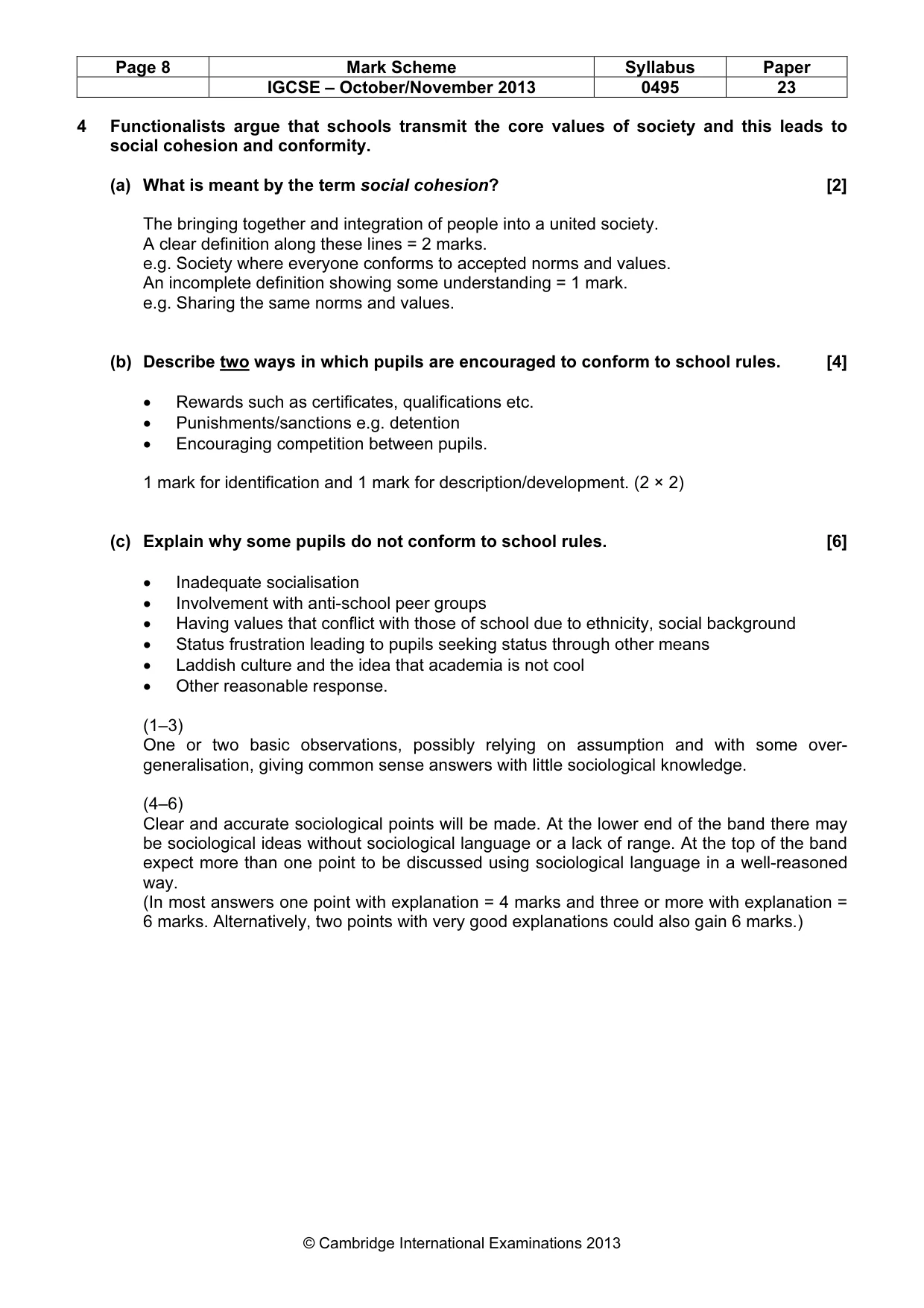
Page 8 Mark Scheme Syllabus Paper IGCSE – October/November 2013 0495 23 © Cambridge International Examinations 2013 4 Functionalists argue that schools transmit the core values of society and this leads to social cohesion and conformity. (a) What is meant by the term social cohesion? [2] The bringing together and integration of people into a united society. A clear definition along these lines = 2 marks. e.g. Society where everyone conforms to accepted norms and values. An incomplete definition showing some understanding = 1 mark. e.g. Sharing the same norms and values. (b) Describe two ways in which pupils are encouraged to conform to school rules. [4] • Rewards such as certificates, qualifications etc. • Punishments/sanctions e.g. detention • Encouraging competition between pupils. 1 mark for identification and 1 mark for description/development. (2 × 2) (c) Explain why some pupils do not conform to school rules. [6] • Inadequate socialisation • Involvement with anti-school peer groups • Having values that conflict with those of school due to ethnicity, social background • Status frustration leading to pupils seeking status through other means • Laddish culture and the idea that academia is not cool • Other reasonable response. (1–3) One or two basic observations, possibly relying on assumption and with some over- generalisation, giving common sense answers with little sociological knowledge. (4–6) Clear and accurate sociological points will be made. At the lower end of the band there may be sociological ideas without sociological language or a lack of range. At the top of the band expect more than one point to be discussed using sociological language in a well-reasoned way. (In most answers one point with explanation = 4 marks and three or more with explanation = 6 marks. Alternatively, two points with very good explanations could also gain 6 marks.)
Mark scheme, page 9
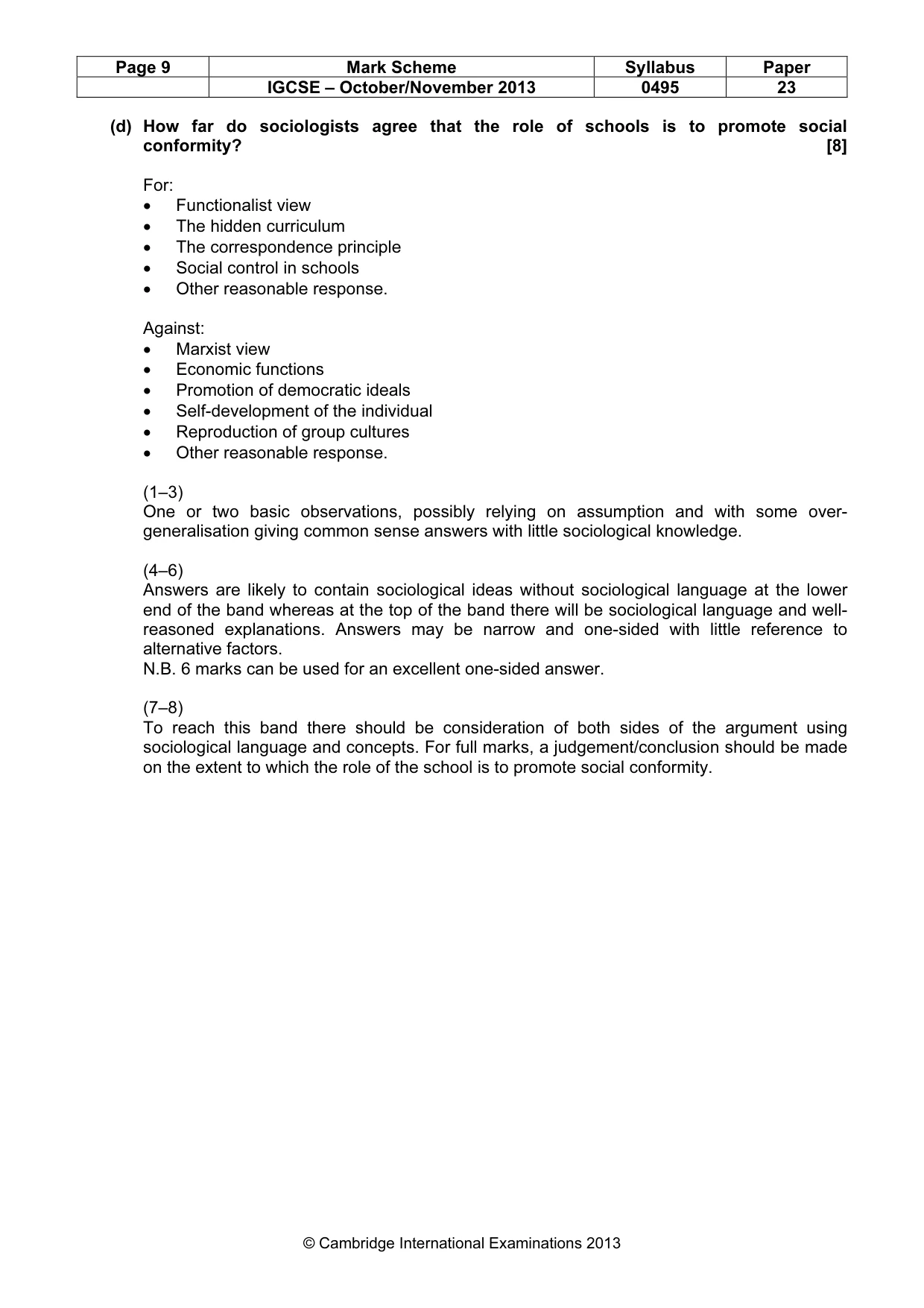
Page 9 Mark Scheme Syllabus Paper IGCSE – October/November 2013 0495 23 © Cambridge International Examinations 2013 (d) How far do sociologists agree that the role of schools is to promote social conformity? [8] For: • Functionalist view • The hidden curriculum • The correspondence principle • Social control in schools • Other reasonable response. Against: • Marxist view • Economic functions • Promotion of democratic ideals • Self-development of the individual • Reproduction of group cultures • Other reasonable response. (1–3) One or two basic observations, possibly relying on assumption and with some over- generalisation giving common sense answers with little sociological knowledge. (4–6) Answers are likely to contain sociological ideas without sociological language at the lower end of the band whereas at the top of the band there will be sociological language and well- reasoned explanations. Answers may be narrow and one-sided with little reference to alternative factors. N.B. 6 marks can be used for an excellent one-sided answer. (7–8) To reach this band there should be consideration of both sides of the argument using sociological language and concepts. For full marks, a judgement/conclusion should be made on the extent to which the role of the school is to promote social conformity.
Mark scheme, page 10
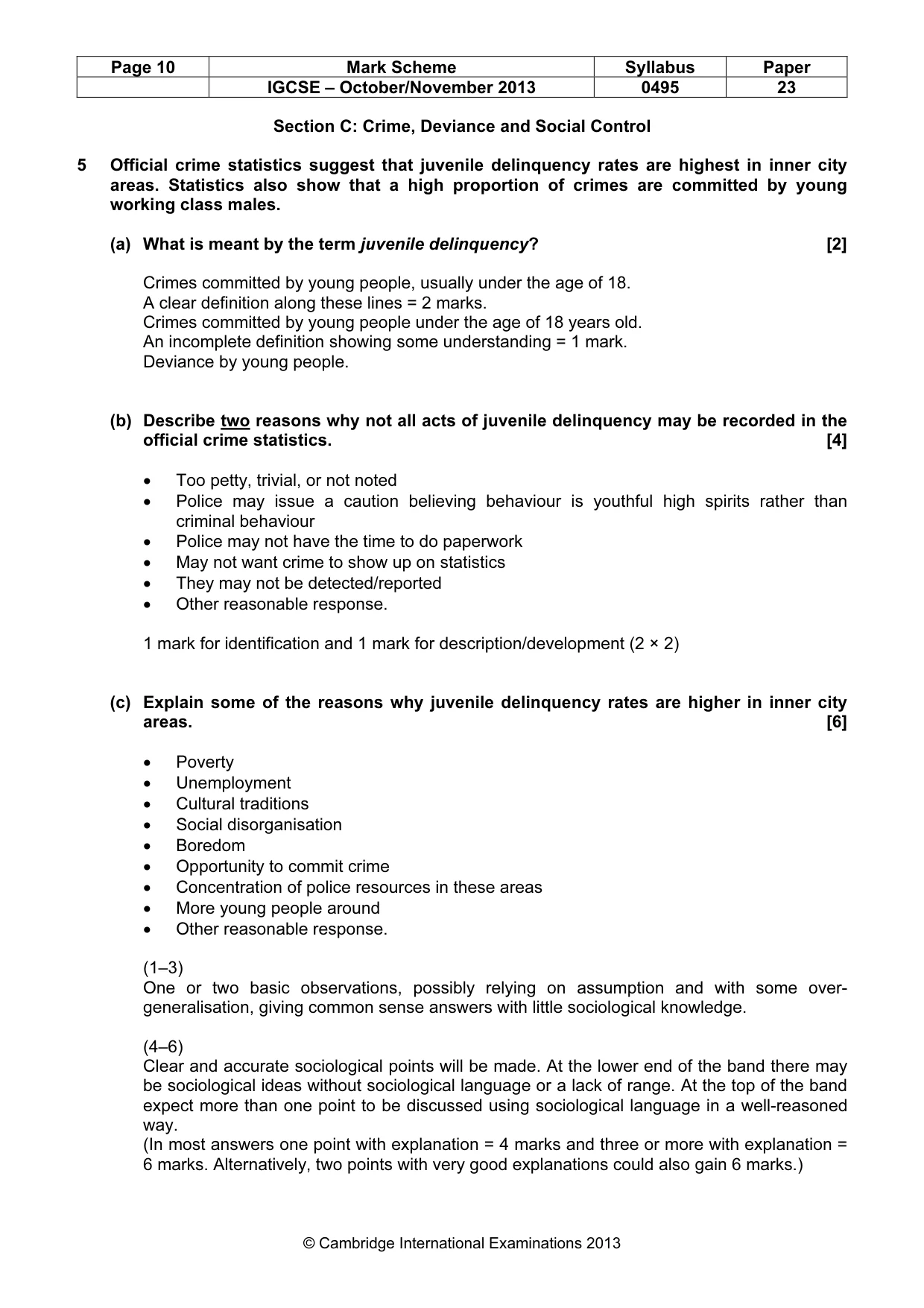
Page 10 Mark Scheme Syllabus Paper IGCSE – October/November 2013 0495 23 © Cambridge International Examinations 2013 Section C: Crime, Deviance and Social Control 5 Official crime statistics suggest that juvenile delinquency rates are highest in inner city areas. Statistics also show that a high proportion of crimes are committed by young working class males. (a) What is meant by the term juvenile delinquency? [2] Crimes committed by young people, usually under the age of 18. A clear definition along these lines = 2 marks. Crimes committed by young people under the age of 18 years old. An incomplete definition showing some understanding = 1 mark. Deviance by young people. (b) Describe two reasons why not all acts of juvenile delinquency may be recorded in the official crime statistics. [4] • Too petty, trivial, or not noted • Police may issue a caution believing behaviour is youthful high spirits rather than criminal behaviour • Police may not have the time to do paperwork • May not want crime to show up on statistics • They may not be detected/reported • Other reasonable response. 1 mark for identification and 1 mark for description/development (2 × 2) (c) Explain some of the reasons why juvenile delinquency rates are higher in inner city areas. [6] • Poverty • Unemployment • Cultural traditions • Social disorganisation • Boredom • Opportunity to commit crime • Concentration of police resources in these areas • More young people around • Other reasonable response. (1–3) One or two basic observations, possibly relying on assumption and with some over- generalisation, giving common sense answers with little sociological knowledge. (4–6) Clear and accurate sociological points will be made. At the lower end of the band there may be sociological ideas without sociological language or a lack of range. At the top of the band expect more than one point to be discussed using sociological language in a well-reasoned way. (In most answers one point with explanation = 4 marks and three or more with explanation = 6 marks. Alternatively, two points with very good explanations could also gain 6 marks.)
Mark scheme, page 11
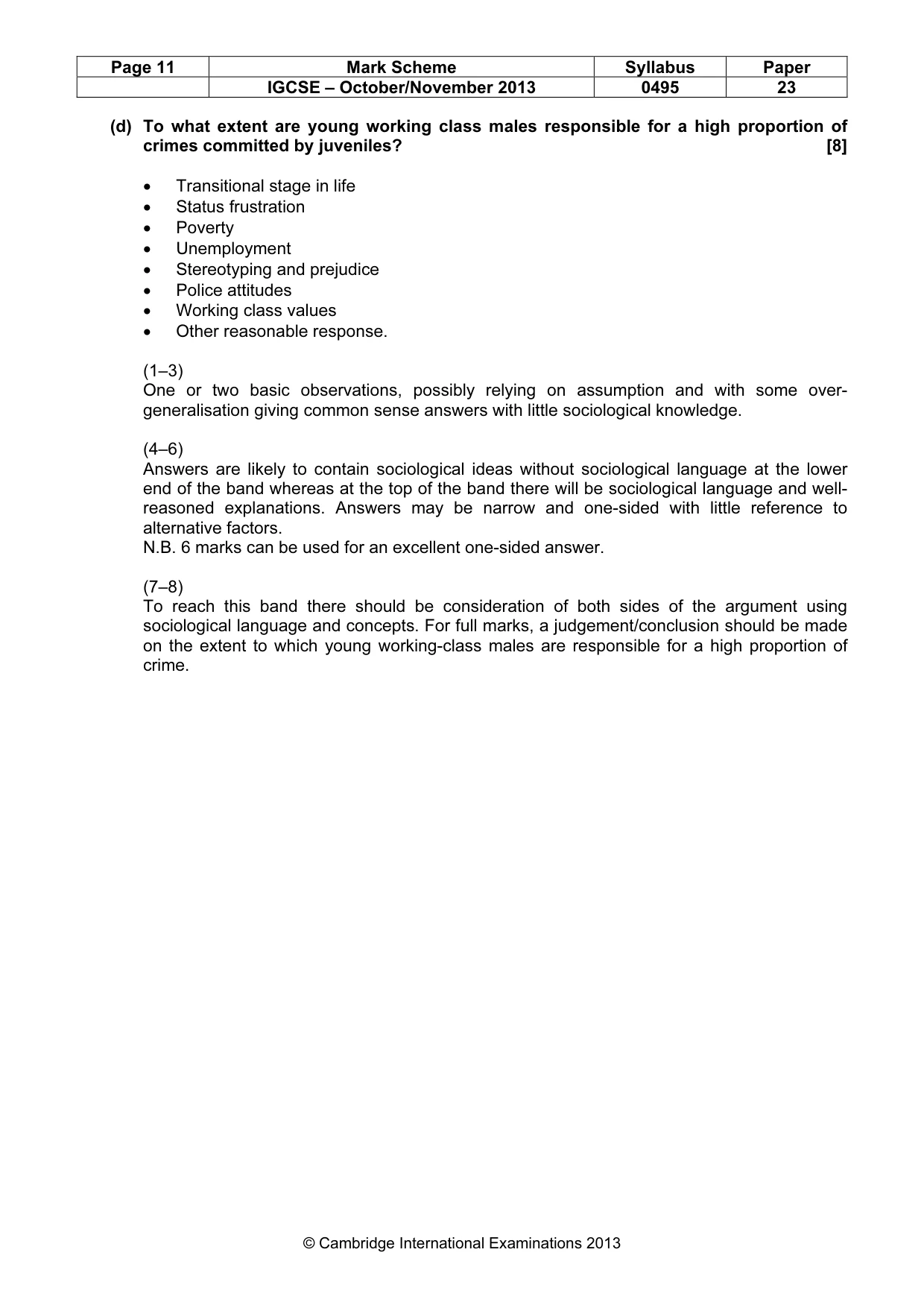
Page 11 Mark Scheme Syllabus Paper IGCSE – October/November 2013 0495 23 © Cambridge International Examinations 2013 (d) To what extent are young working class males responsible for a high proportion of crimes committed by juveniles? [8] • Transitional stage in life • Status frustration • Poverty • Unemployment • Stereotyping and prejudice • Police attitudes • Working class values • Other reasonable response. (1–3) One or two basic observations, possibly relying on assumption and with some over- generalisation giving common sense answers with little sociological knowledge. (4–6) Answers are likely to contain sociological ideas without sociological language at the lower end of the band whereas at the top of the band there will be sociological language and well- reasoned explanations. Answers may be narrow and one-sided with little reference to alternative factors. N.B. 6 marks can be used for an excellent one-sided answer. (7–8) To reach this band there should be consideration of both sides of the argument using sociological language and concepts. For full marks, a judgement/conclusion should be made on the extent to which young working-class males are responsible for a high proportion of crime.
Mark scheme, page 12
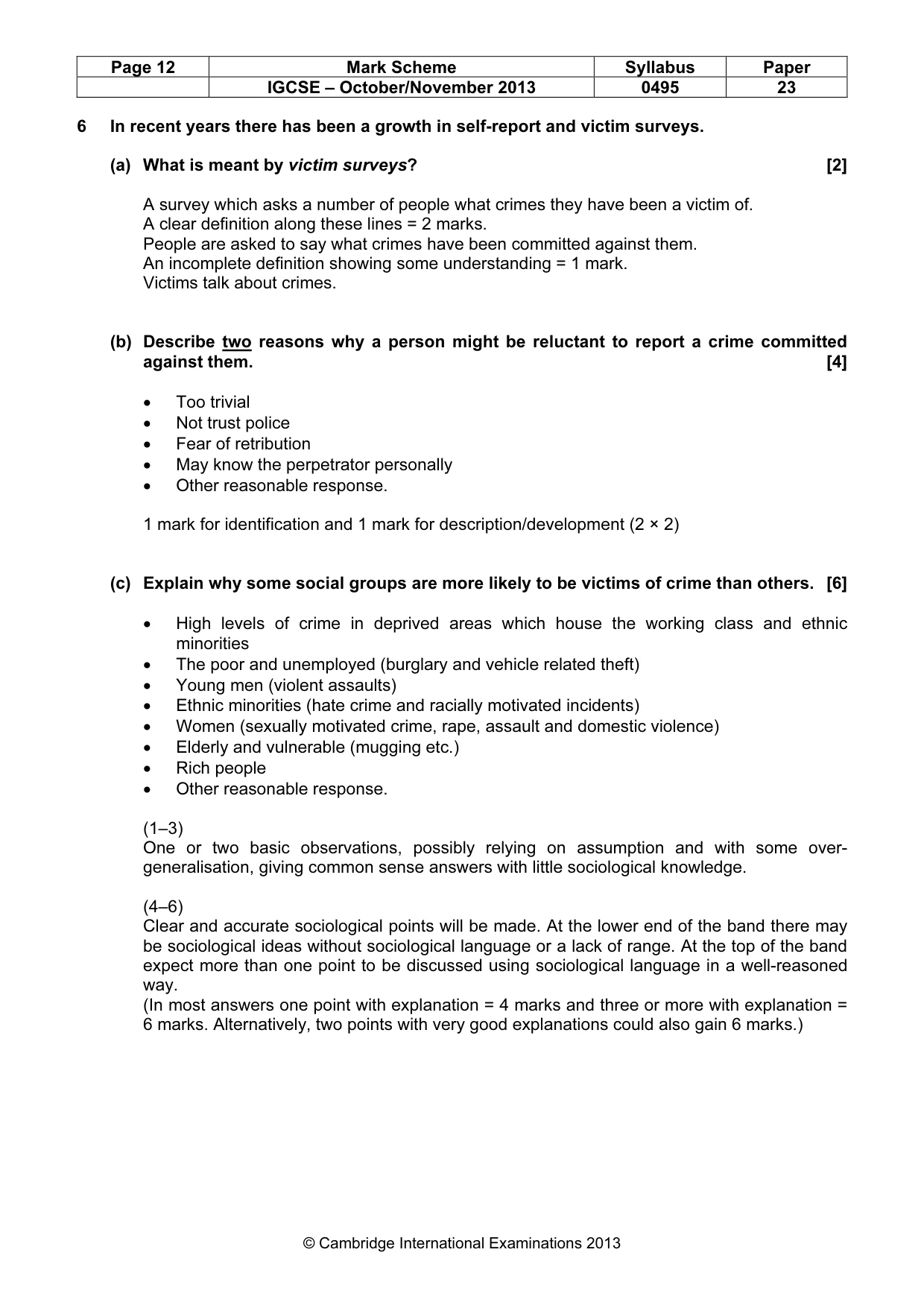
Page 12 Mark Scheme Syllabus Paper IGCSE – October/November 2013 0495 23 © Cambridge International Examinations 2013 6 In recent years there has been a growth in self-report and victim surveys. (a) What is meant by victim surveys? [2] A survey which asks a number of people what crimes they have been a victim of. A clear definition along these lines = 2 marks. People are asked to say what crimes have been committed against them. An incomplete definition showing some understanding = 1 mark. Victims talk about crimes. (b) Describe two reasons why a person might be reluctant to report a crime committed against them. [4] • Too trivial • Not trust police • Fear of retribution • May know the perpetrator personally • Other reasonable response. 1 mark for identification and 1 mark for description/development (2 × 2) (c) Explain why some social groups are more likely to be victims of crime than others. [6] • High levels of crime in deprived areas which house the working class and ethnic minorities • The poor and unemployed (burglary and vehicle related theft) • Young men (violent assaults) • Ethnic minorities (hate crime and racially motivated incidents) • Women (sexually motivated crime, rape, assault and domestic violence) • Elderly and vulnerable (mugging etc.) • Rich people • Other reasonable response. (1–3) One or two basic observations, possibly relying on assumption and with some over- generalisation, giving common sense answers with little sociological knowledge. (4–6) Clear and accurate sociological points will be made. At the lower end of the band there may be sociological ideas without sociological language or a lack of range. At the top of the band expect more than one point to be discussed using sociological language in a well-reasoned way. (In most answers one point with explanation = 4 marks and three or more with explanation = 6 marks. Alternatively, two points with very good explanations could also gain 6 marks.)
Mark scheme, page 13
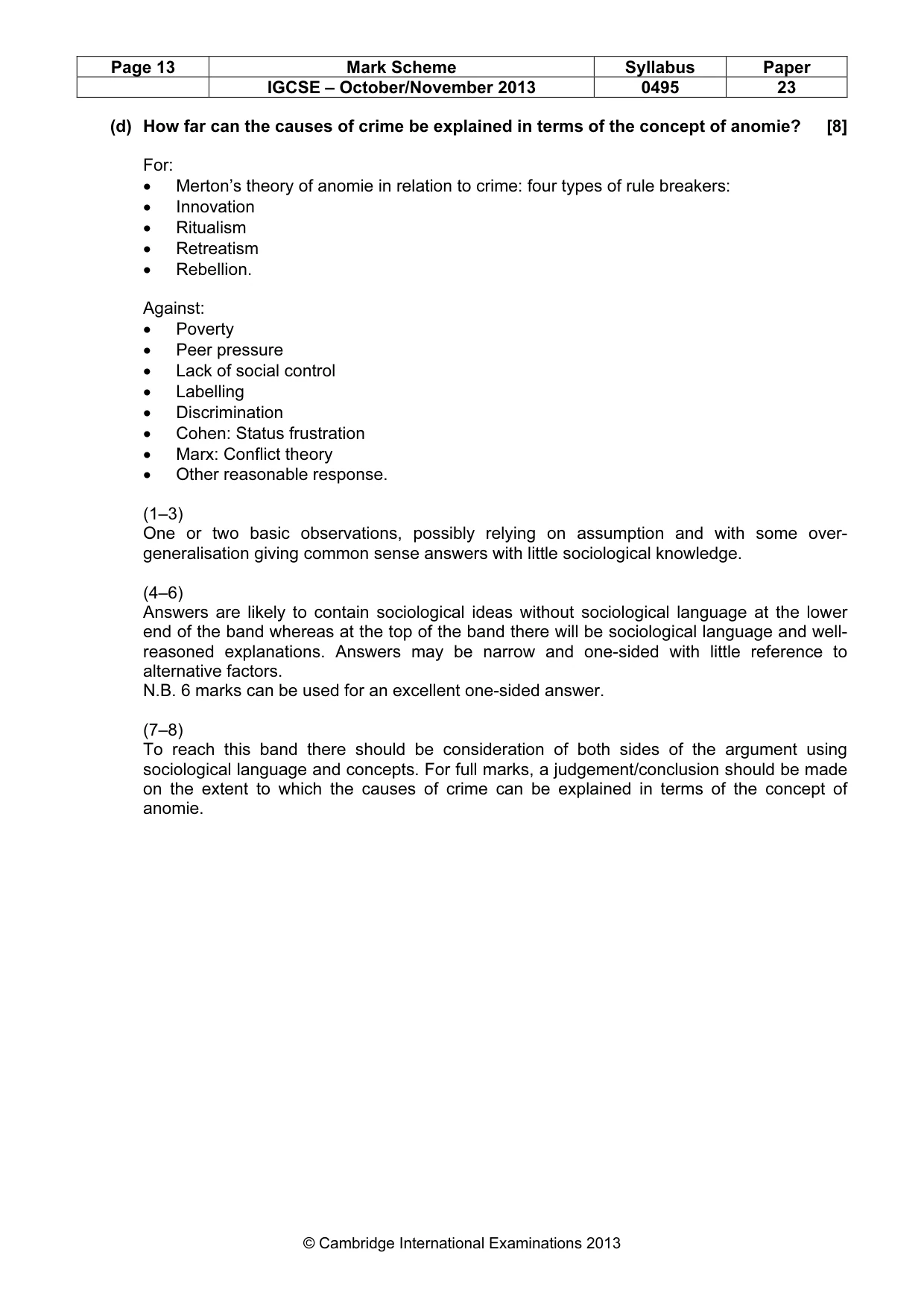
Page 13 Mark Scheme Syllabus Paper IGCSE – October/November 2013 0495 23 © Cambridge International Examinations 2013 (d) How far can the causes of crime be explained in terms of the concept of anomie? [8] For: • Merton’s theory of anomie in relation to crime: four types of rule breakers: • Innovation • Ritualism • Retreatism • Rebellion. Against: • Poverty • Peer pressure • Lack of social control • Labelling • Discrimination • Cohen: Status frustration • Marx: Conflict theory • Other reasonable response. (1–3) One or two basic observations, possibly relying on assumption and with some over- generalisation giving common sense answers with little sociological knowledge. (4–6) Answers are likely to contain sociological ideas without sociological language at the lower end of the band whereas at the top of the band there will be sociological language and well- reasoned explanations. Answers may be narrow and one-sided with little reference to alternative factors. N.B. 6 marks can be used for an excellent one-sided answer. (7–8) To reach this band there should be consideration of both sides of the argument using sociological language and concepts. For full marks, a judgement/conclusion should be made on the extent to which the causes of crime can be explained in terms of the concept of anomie.
Mark scheme, page 14
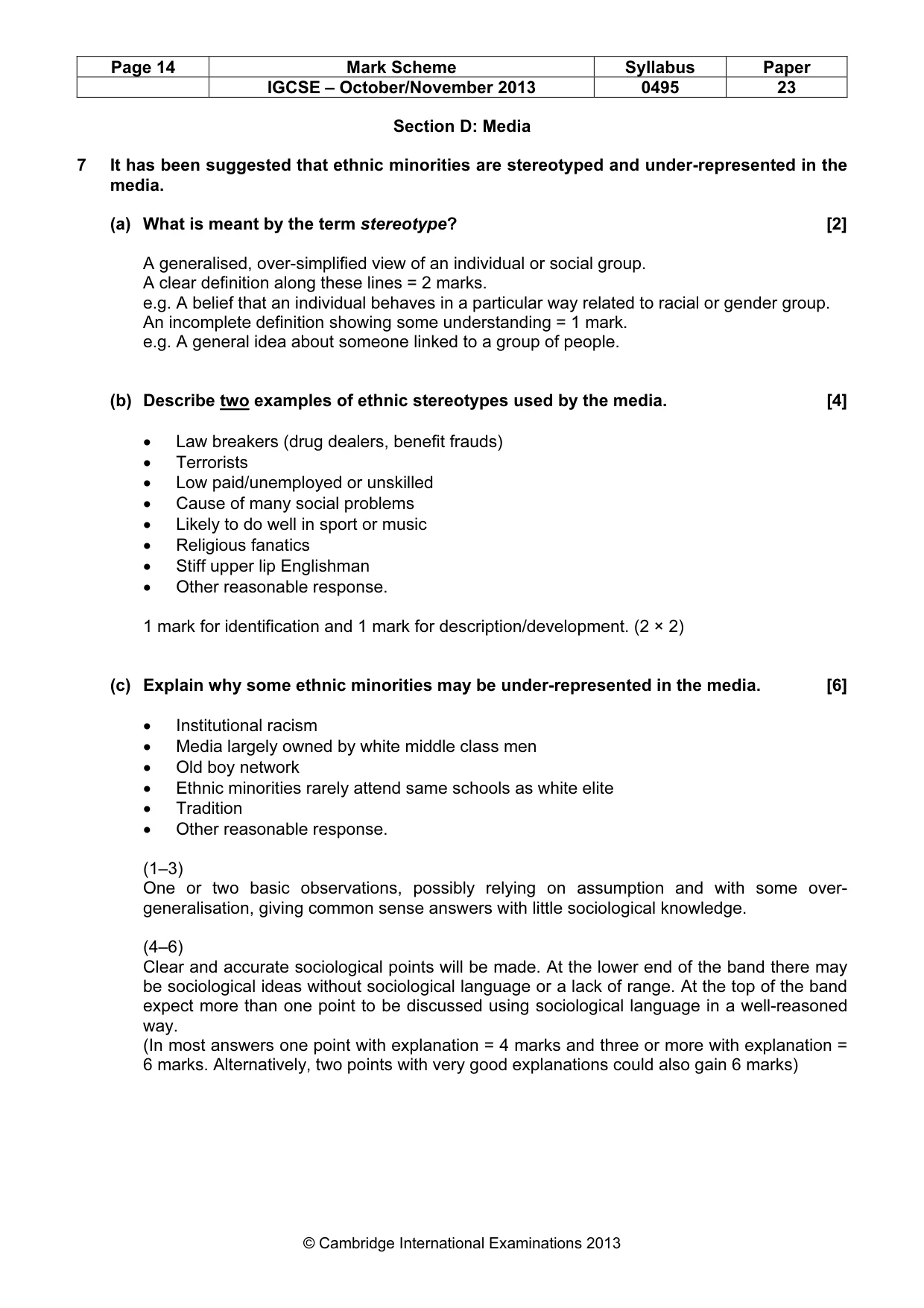
Page 14 Mark Scheme Syllabus Paper IGCSE – October/November 2013 0495 23 © Cambridge International Examinations 2013 Section D: Media 7 It has been suggested that ethnic minorities are stereotyped and under-represented in the media. (a) What is meant by the term stereotype? [2] A generalised, over-simplified view of an individual or social group. A clear definition along these lines = 2 marks. e.g. A belief that an individual behaves in a particular way related to racial or gender group. An incomplete definition showing some understanding = 1 mark. e.g. A general idea about someone linked to a group of people. (b) Describe two examples of ethnic stereotypes used by the media. [4] • Law breakers (drug dealers, benefit frauds) • Terrorists • Low paid/unemployed or unskilled • Cause of many social problems • Likely to do well in sport or music • Religious fanatics • Stiff upper lip Englishman • Other reasonable response. 1 mark for identification and 1 mark for description/development. (2 × 2) (c) Explain why some ethnic minorities may be under-represented in the media. [6] • Institutional racism • Media largely owned by white middle class men • Old boy network • Ethnic minorities rarely attend same schools as white elite • Tradition • Other reasonable response. (1–3) One or two basic observations, possibly relying on assumption and with some over- generalisation, giving common sense answers with little sociological knowledge. (4–6) Clear and accurate sociological points will be made. At the lower end of the band there may be sociological ideas without sociological language or a lack of range. At the top of the band expect more than one point to be discussed using sociological language in a well-reasoned way. (In most answers one point with explanation = 4 marks and three or more with explanation = 6 marks. Alternatively, two points with very good explanations could also gain 6 marks)
Mark scheme, page 15
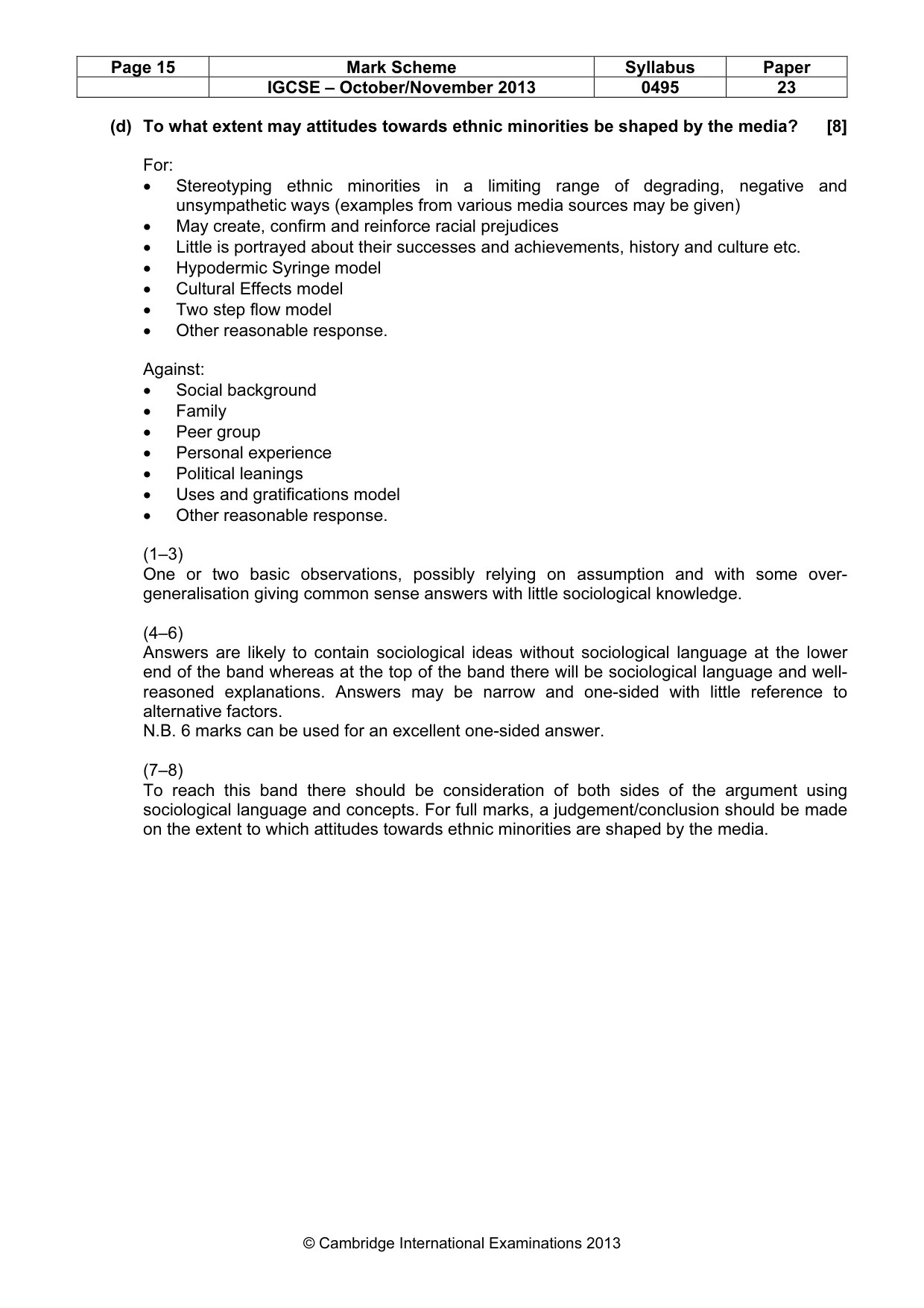
Page 15 Mark Scheme Syllabus Paper IGCSE – October/November 2013 0495 23 © Cambridge International Examinations 2013 (d) To what extent may attitudes towards ethnic minorities be shaped by the media? [8] For: • Stereotyping ethnic minorities in a limiting range of degrading, negative and unsympathetic ways (examples from various media sources may be given) • May create, confirm and reinforce racial prejudices • Little is portrayed about their successes and achievements, history and culture etc. • Hypodermic Syringe model • Cultural Effects model • Two step flow model • Other reasonable response. Against: • Social background • Family • Peer group • Personal experience • Political leanings • Uses and gratifications model • Other reasonable response. (1–3) One or two basic observations, possibly relying on assumption and with some over- generalisation giving common sense answers with little sociological knowledge. (4–6) Answers are likely to contain sociological ideas without sociological language at the lower end of the band whereas at the top of the band there will be sociological language and well- reasoned explanations. Answers may be narrow and one-sided with little reference to alternative factors. N.B. 6 marks can be used for an excellent one-sided answer. (7–8) To reach this band there should be consideration of both sides of the argument using sociological language and concepts. For full marks, a judgement/conclusion should be made on the extent to which attitudes towards ethnic minorities are shaped by the media.
Mark scheme, page 16
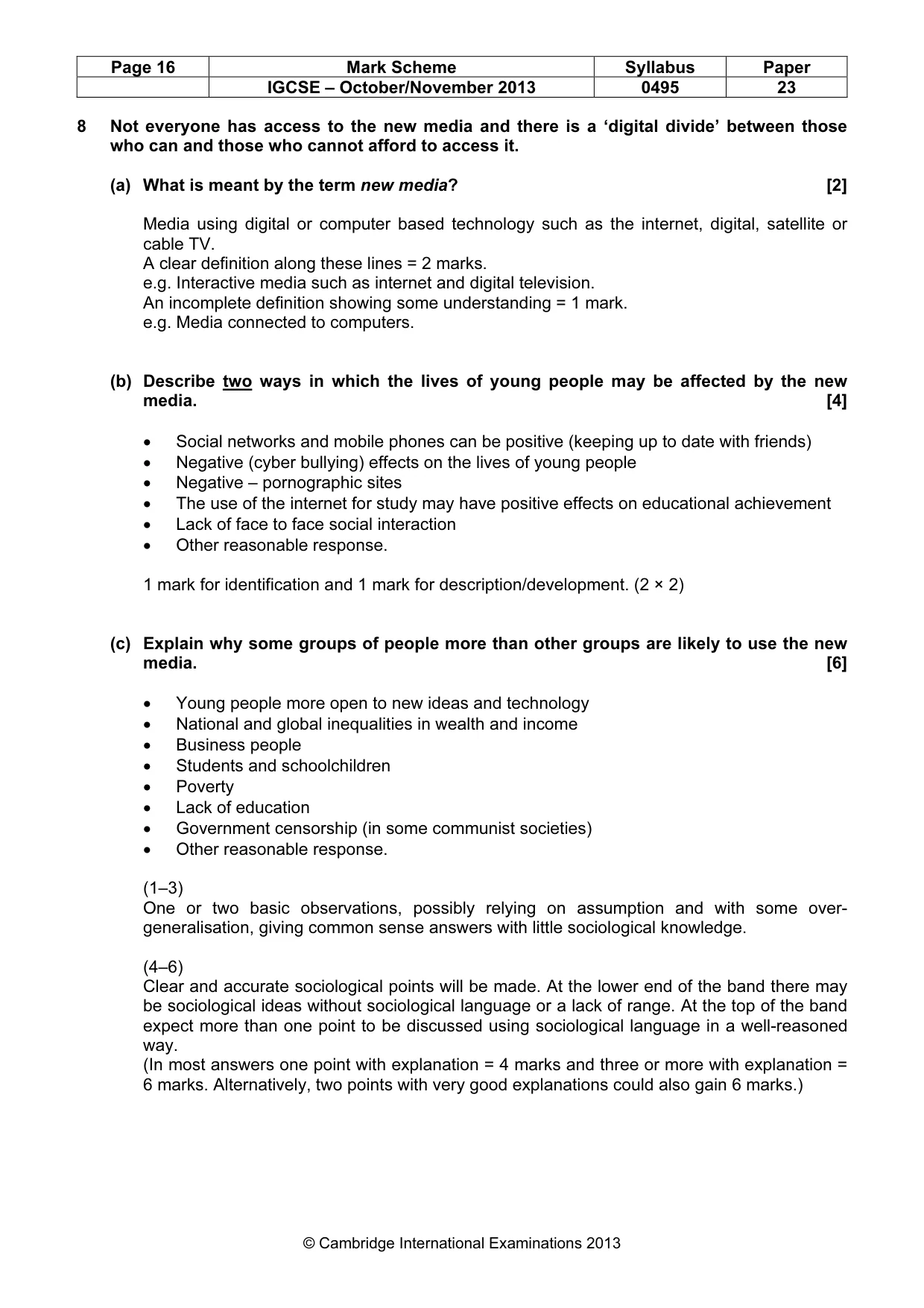
Page 16 Mark Scheme Syllabus Paper IGCSE – October/November 2013 0495 23 © Cambridge International Examinations 2013 8 Not everyone has access to the new media and there is a ‘digital divide’ between those who can and those who cannot afford to access it. (a) What is meant by the term new media? [2] Media using digital or computer based technology such as the internet, digital, satellite or cable TV. A clear definition along these lines = 2 marks. e.g. Interactive media such as internet and digital television. An incomplete definition showing some understanding = 1 mark. e.g. Media connected to computers. (b) Describe two ways in which the lives of young people may be affected by the new media. [4] • Social networks and mobile phones can be positive (keeping up to date with friends) • Negative (cyber bullying) effects on the lives of young people • Negative – pornographic sites • The use of the internet for study may have positive effects on educational achievement • Lack of face to face social interaction • Other reasonable response. 1 mark for identification and 1 mark for description/development. (2 × 2) (c) Explain why some groups of people more than other groups are likely to use the new media. [6] • Young people more open to new ideas and technology • National and global inequalities in wealth and income • Business people • Students and schoolchildren • Poverty • Lack of education • Government censorship (in some communist societies) • Other reasonable response. (1–3) One or two basic observations, possibly relying on assumption and with some over- generalisation, giving common sense answers with little sociological knowledge. (4–6) Clear and accurate sociological points will be made. At the lower end of the band there may be sociological ideas without sociological language or a lack of range. At the top of the band expect more than one point to be discussed using sociological language in a well-reasoned way. (In most answers one point with explanation = 4 marks and three or more with explanation = 6 marks. Alternatively, two points with very good explanations could also gain 6 marks.)
Mark scheme, page 17
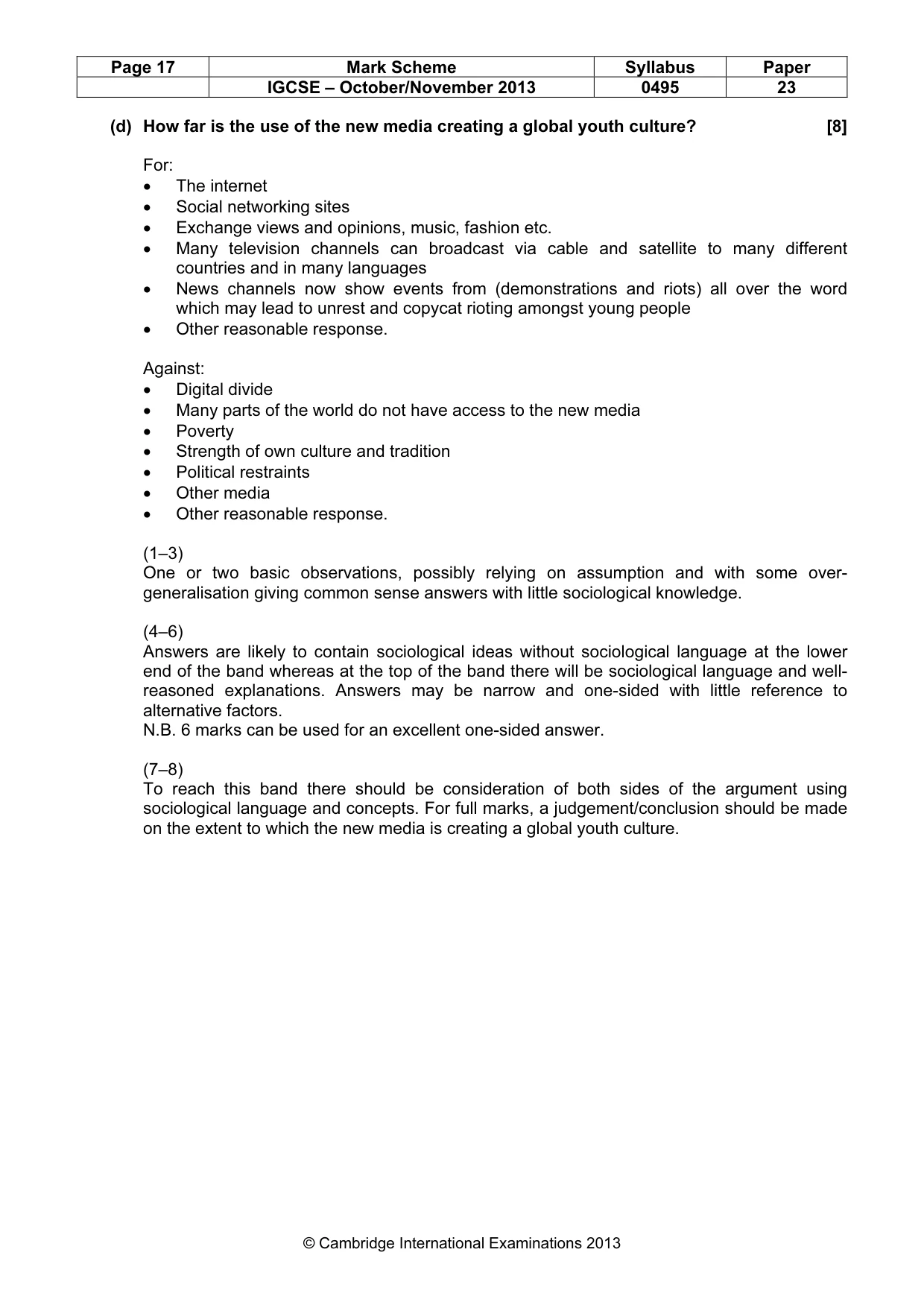
Page 17 Mark Scheme Syllabus Paper IGCSE – October/November 2013 0495 23 © Cambridge International Examinations 2013 (d) How far is the use of the new media creating a global youth culture? [8] For: • The internet • Social networking sites • Exchange views and opinions, music, fashion etc. • Many television channels can broadcast via cable and satellite to many different countries and in many languages • News channels now show events from (demonstrations and riots) all over the word which may lead to unrest and copycat rioting amongst young people • Other reasonable response. Against: • Digital divide • Many parts of the world do not have access to the new media • Poverty • Strength of own culture and tradition • Political restraints • Other media • Other reasonable response. (1–3) One or two basic observations, possibly relying on assumption and with some over- generalisation giving common sense answers with little sociological knowledge. (4–6) Answers are likely to contain sociological ideas without sociological language at the lower end of the band whereas at the top of the band there will be sociological language and well- reasoned explanations. Answers may be narrow and one-sided with little reference to alternative factors. N.B. 6 marks can be used for an excellent one-sided answer. (7–8) To reach this band there should be consideration of both sides of the argument using sociological language and concepts. For full marks, a judgement/conclusion should be made on the extent to which the new media is creating a global youth culture.
What you needed in this session
Cambridge’s own grade thresholds for 2013 Oct/Nov, Paper 2 · Variant 3. A higher threshold means an easier paper — the bar moves with how the cohort did.