Cambridge IGCSE Sociology 0495 — 2013 May/June Paper 1 · Variant 3
0495/13/M/J/13 · 90 marks · ≈101 min
The question paper and its mark scheme, free to read here and free to download. This is Cambridge’s own paper, exactly as it was sat.
Question paper28 pages





Mark scheme9 pages
Answers below. Sit the paper first if you are practising.
Paper as text
Question paper, page 1
This document consists of 28 printed pages. DC (SJF) 61312 © UCLES 2013 [Turn over UNIVERSITY OF CAMBRIDGE INTERNATIONAL EXAMINATIONS International General Certificate of Secondary Education * 7 7 1 6 5 6 3 4 6 3 * SOCIOLOGY 0495/13 Paper 1 May/June 2013 2 hours 30 minutes Candidates answer on the Question Paper. No additional materials are required. READ THESE INSTRUCTIONS FIRST Write your Centre number, candidate number and name on all the work you hand in. Write in dark blue or black ink. You may use a soft pencil for any diagrams, graphs or rough working. Do not use staples, paper clips, highlighters, glue or correction fluid. DO NOT WRITE IN ANY BARCODES. Answer Question 1 and three questions from Sections B to D. You may not need all the answer lines for your answer. The number of marks is given in brackets [ ] at the end of each question or part question. www.XtremePapers.com
Question paper, page 2
2 0495/13/M/J/13 © UCLES 2013 For Examiner’s Use Section A: Research Methods Sociologists can find evidence in many forms, both primary data and secondary data. This data may be quantitative or qualitative. Official statistics and content analysis are two forms of quantitative data. Qualitative data can include life histories and personal documents as well as evidence that the sociologist has gathered personally using interpretivist methods such as participant observation. Sometimes researchers ask people to keep diaries which can then be used alongside evidence from interviews and questionnaires. 1 (a) What is meant by the following terms: (i) Secondary data … … … … [2] (ii) Official statistics … … … … [2] (iii) Life histories. … … … … [2]
Question paper, page 3
3 0495/13/M/J/13 © UCLES 2013 [Turn over For Examiner’s Use (b) Explain two limitations of using personal documents in sociological research. … … … … … … … … [4] (c) Describe two reasons for combining different sources of data in a research study. … … … … … … … … [4] (d) Describe one strength and one limitation of covert participant observation. … … … … … … … … [4]
Question paper, page 4
4 0495/13/M/J/13 © UCLES 2013 For Examiner’s Use (e) Describe two types of interviews that may be used in sociological research. … … … … … … … … [4] (f) Describe two strengths and two limitations of using interpretivist methods in sociological research. … … … … … … … … … … … … … … … … [8]
Question paper, page 5
5 0495/13/M/J/13 © UCLES 2013 [Turn over For Examiner’s Use Section B: Culture and Socialisation 2 For feminist sociologists the most basic division in society is between men and women rather than between different classes. This division is reflected in their socialisation and gender roles. (a) What is meant by the term gender roles? … … … … [2] (b) Describe two male gender roles. … … … … … … … … [4]
Question paper, page 6
6 0495/13/M/J/13 © UCLES 2013 For Examiner’s Use (c) Explain how the socialisation process may be different for a working class child compared to a middle class child. … … … … … … … … … … … … … … … … … … … … … … … … … … … [6]
Question paper, page 7
7 0495/13/M/J/13 © UCLES 2013 [Turn over For Examiner’s Use (d) To what extent is gender more important than class in shaping the life chances of females? … … … … … … … … … … … … … … … … … … … … … … … … … … …
Question paper, page 8
8 0495/13/M/J/13 © UCLES 2013 For Examiner’s Use … … … … … … … … … … … … … … [8]
Question paper, page 9
9 0495/13/M/J/13 © UCLES 2013 [Turn over For Examiner’s Use 3 Functionalists claim that agencies of socialisation regulate people’s activities and behaviour in order to encourage social conformity. Some of these agencies are part of the process of formal social control. (a) What is meant by the term agencies of socialisation? … … … … [2] (b) Describe two agencies of formal social control. … … … … … … … … [4]
Question paper, page 10
10 0495/13/M/J/13 © UCLES 2013 For Examiner’s Use (c) Explain how informal sanctions may help to produce social conformity. … … … … … … … … … … … … … … … … … … … … … … … … … … … [6]
Question paper, page 11
11 0495/13/M/J/13 © UCLES 2013 [Turn over For Examiner’s Use (d) To what extent does formal social control achieve the regulation of behaviour? … … … … … … … … … … … … … … … … … … … … … … … … … … …
Question paper, page 12
12 0495/13/M/J/13 © UCLES 2013 For Examiner’s Use … … … … … … … … … … … … … … [8]
Question paper, page 13
13 0495/13/M/J/13 © UCLES 2013 [Turn over For Examiner’s Use Section C: Social Stratification and Inequality 4 Social status may be achieved or ascribed. Each individual has more than one social status and these may change during a lifetime. (a) What is meant by the term social status? … … … … [2] (b) Describe two statuses that are usually fixed at birth. … … … … … … … … [4]
Question paper, page 14
14 0495/13/M/J/13 © UCLES 2013 For Examiner’s Use (c) Explain the difficulties a person may encounter when trying to change their social status. … … … … … … … … … … … … … … … … … … … … … … … … … … …[6]
Question paper, page 15
15 0495/13/M/J/13 © UCLES 2013 [Turn over For Examiner’s Use (d) To what extent is achieved status more important than ascribed status in modern industrial societies? … … … … … … … … … … … … … … … … … … … … … … … … … … …
Question paper, page 16
16 0495/13/M/J/13 © UCLES 2013 For Examiner’s Use … … … … … … … … … … … … … … [8]
Question paper, page 17
17 0495/13/M/J/13 © UCLES 2013 [Turn over For Examiner’s Use 5 Many ethnic minority groups are found at the bottom of stratification systems where they often experience racial discrimination. (a) Define the term ethnic minority. … … … … [2] (b) Describe two examples of racial discrimination. … … … … … … … … [4]
Question paper, page 18
18 0495/13/M/J/13 © UCLES 2013 For Examiner’s Use (c) Explain how governments may try to reduce racial discrimination. … … … … … … … … … … … … … … … … … … … … … … … … … … … [6]
Question paper, page 19
19 0495/13/M/J/13 © UCLES 2013 [Turn over For Examiner’s Use (d) To what extent is upward social mobility possible for people from ethnic minority groups? … … … … … … … … … … … … … … … … … … … … … … … … … … …
Question paper, page 20
20 0495/13/M/J/13 © UCLES 2013 For Examiner’s Use … … … … … … … … … … … … … … [8]
Question paper, page 21
21 0495/13/M/J/13 © UCLES 2013 [Turn over For Examiner’s Use Section D: Power and Authority 6 Governments maintain authority through the exercise of power. One form of government power involves the use of coercion. (a) What is meant by the term authority? … … … … [2] (b) Describe two ways by which governments can apply coercion. … … … … … … … … [4]
Question paper, page 22
22 0495/13/M/J/13 © UCLES 2013 For Examiner’s Use (c) Explain the processes through which democratic governments achieve authority. … … … … … … … … … … … … … … … … … … … … … … … … … … … [6]
Question paper, page 23
23 0495/13/M/J/13 © UCLES 2013 [Turn over For Examiner’s Use (d) How far does government authority depend on the use of coercion? … … … … … … … … … … … … … … … … … … … … … … … … … … …
Question paper, page 24
24 0495/13/M/J/13 © UCLES 2013 For Examiner’s Use … … … … … … … … … … … … … …[8]
Question paper, page 25
25 0495/13/M/J/13 © UCLES 2013 [Turn over For Examiner’s Use 7 There is a distinction between insider and outsider pressure groups. All pressure groups may use lobbying as a way of influencing governments. New social movements have developed which differ from pressure groups. (a) What is meant by the term lobbying? … … … … [2] (b) Describe two features of new social movements. … … … … … … … … [4]
Question paper, page 26
26 0495/13/M/J/13 © UCLES 2013 For Examiner’s Use (c) Explain how outsider pressure groups try to influence governments. … … … … … … … … … … … … … … … … … … … … … … … … … … … [6]
Question paper, page 27
27 0495/13/M/J/13 © UCLES 2013 [Turn over For Examiner’s Use (d) To what extent do pressure groups reflect the interests of the public? … … … … … … … … … … … … … … … … … … … … … … … … … … …
Question paper, page 28
28 0495/13/M/J/13 © UCLES 2013 For Examiner’s Use Permission to reproduce items where third-party owned material protected by copyright is included has been sought and cleared where possible. Every reasonable effort has been made by the publisher (UCLES) to trace copyright holders, but if any items requiring clearance have unwittingly been included, the publisher will be pleased to make amends at the earliest possible opportunity. University of Cambridge International Examinations is part of the Cambridge Assessment Group. Cambridge Assessment is the brand name of University of Cambridge Local Examinations Syndicate (UCLES), which is itself a department of the University of Cambridge. … … … … … … … … … … … … … … [8]
Mark scheme, page 1
CAMBRIDGE INTERNATIONAL EXAMINATIONS International General Certificate of Secondary Education MARK SCHEME for the May/June 2013 series 0495 SOCIOLOGY 0495/13 Paper 1, maximum raw mark 90 This mark scheme is published as an aid to teachers and candidates, to indicate the requirements of the examination. It shows the basis on which Examiners were instructed to award marks. It does not indicate the details of the discussions that took place at an Examiners’ meeting before marking began, which would have considered the acceptability of alternative answers. Mark schemes should be read in conjunction with the question paper and the Principal Examiner Report for Teachers. Cambridge will not enter into discussions about these mark schemes. Cambridge is publishing the mark schemes for the May/June 2013 series for most IGCSE, GCE Advanced Level and Advanced Subsidiary Level components and some Ordinary Level components. www.XtremePapers.com
Mark scheme, page 2
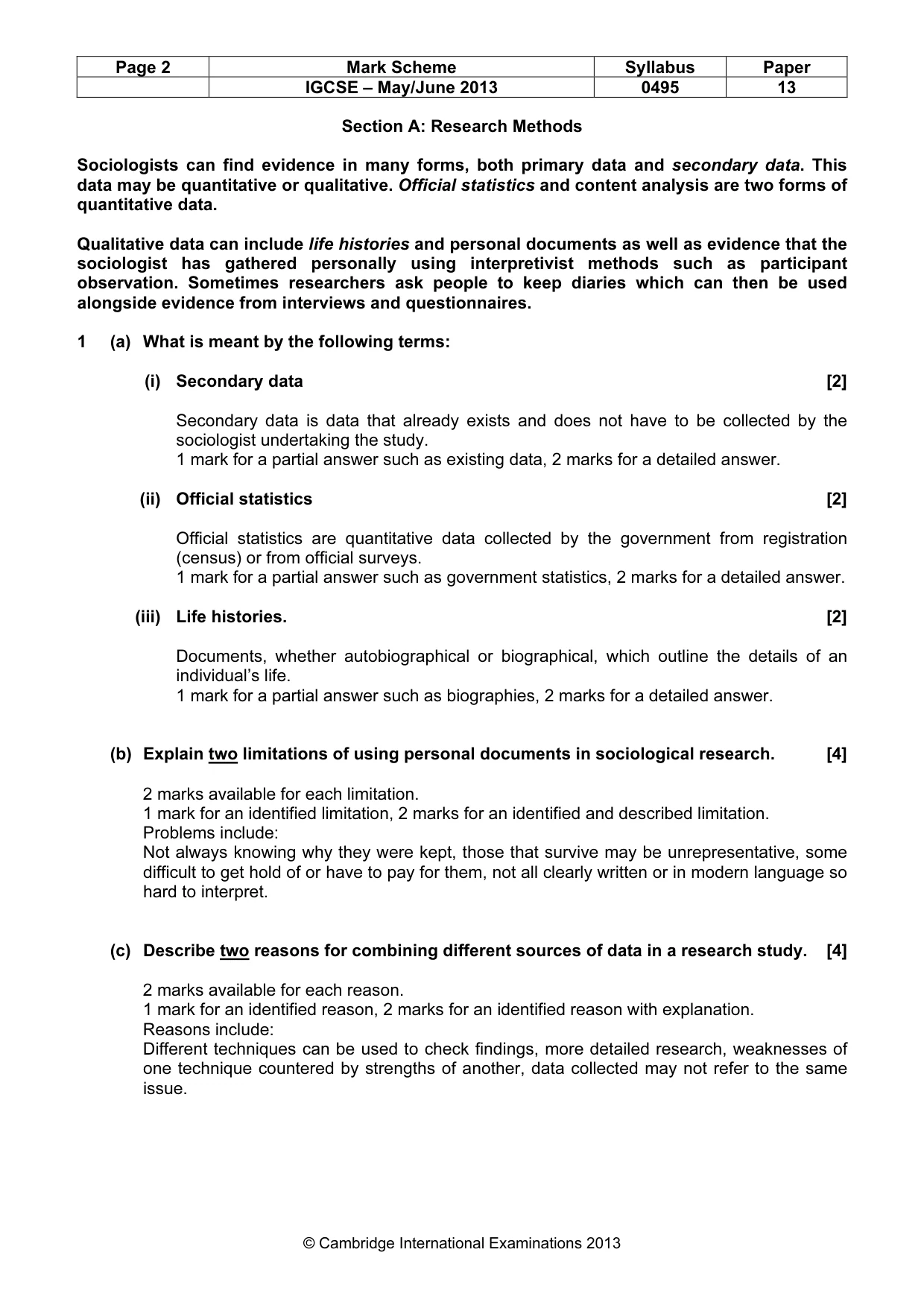
Page 2 Mark Scheme Syllabus Paper IGCSE – May/June 2013 0495 13 © Cambridge International Examinations 2013 Section A: Research Methods Sociologists can find evidence in many forms, both primary data and secondary data. This data may be quantitative or qualitative. Official statistics and content analysis are two forms of quantitative data. Qualitative data can include life histories and personal documents as well as evidence that the sociologist has gathered personally using interpretivist methods such as participant observation. Sometimes researchers ask people to keep diaries which can then be used alongside evidence from interviews and questionnaires. 1 (a) What is meant by the following terms: (i) Secondary data [2] Secondary data is data that already exists and does not have to be collected by the sociologist undertaking the study. 1 mark for a partial answer such as existing data, 2 marks for a detailed answer. (ii) Official statistics [2] Official statistics are quantitative data collected by the government from registration (census) or from official surveys. 1 mark for a partial answer such as government statistics, 2 marks for a detailed answer. (iii) Life histories. [2] Documents, whether autobiographical or biographical, which outline the details of an individual’s life. 1 mark for a partial answer such as biographies, 2 marks for a detailed answer. (b) Explain two limitations of using personal documents in sociological research. [4] 2 marks available for each limitation. 1 mark for an identified limitation, 2 marks for an identified and described limitation. Problems include: Not always knowing why they were kept, those that survive may be unrepresentative, some difficult to get hold of or have to pay for them, not all clearly written or in modern language so hard to interpret. (c) Describe two reasons for combining different sources of data in a research study. [4] 2 marks available for each reason. 1 mark for an identified reason, 2 marks for an identified reason with explanation. Reasons include: Different techniques can be used to check findings, more detailed research, weaknesses of one technique countered by strengths of another, data collected may not refer to the same issue.
Mark scheme, page 3
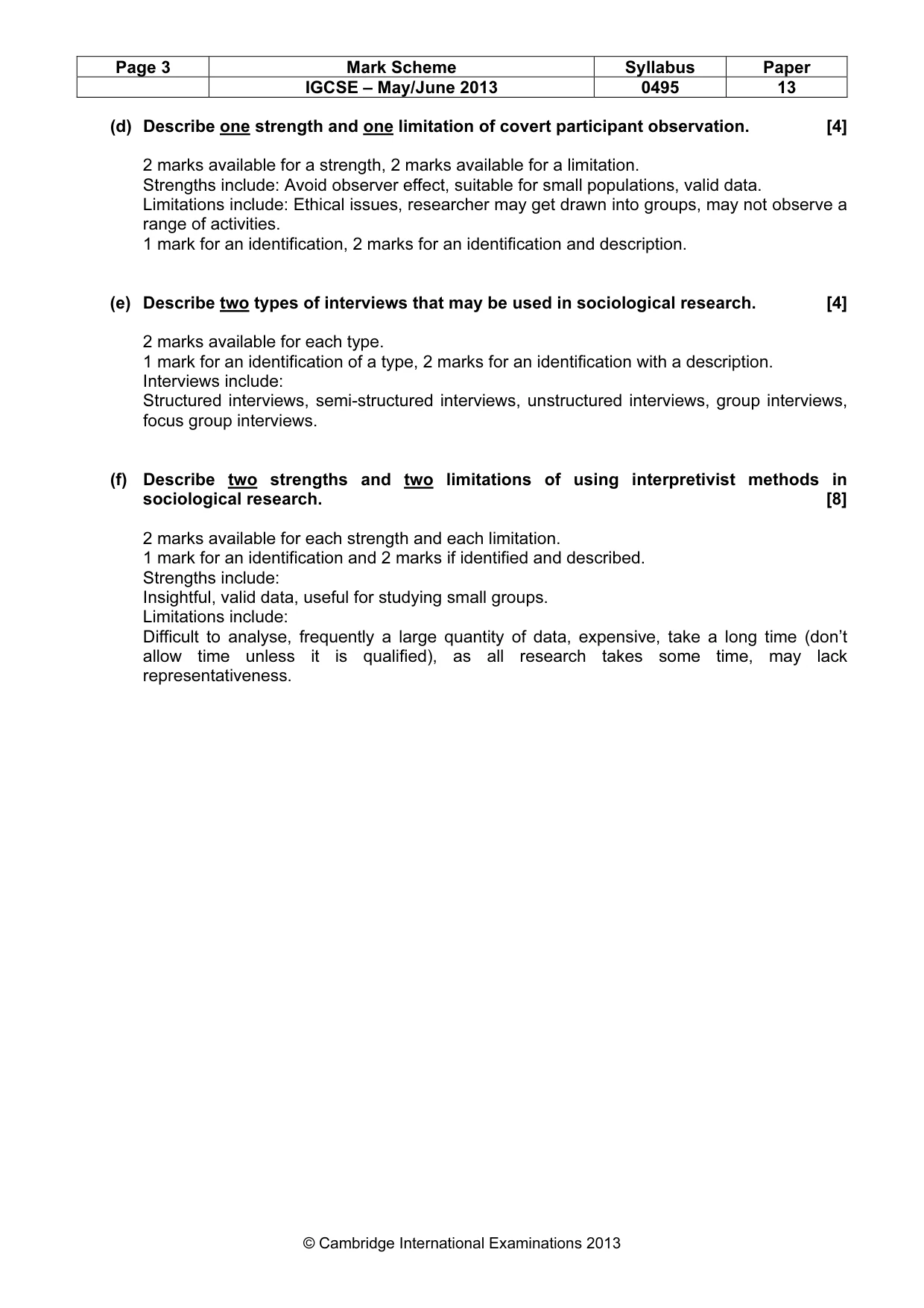
Page 3 Mark Scheme Syllabus Paper IGCSE – May/June 2013 0495 13 © Cambridge International Examinations 2013 (d) Describe one strength and one limitation of covert participant observation. [4] 2 marks available for a strength, 2 marks available for a limitation. Strengths include: Avoid observer effect, suitable for small populations, valid data. Limitations include: Ethical issues, researcher may get drawn into groups, may not observe a range of activities. 1 mark for an identification, 2 marks for an identification and description. (e) Describe two types of interviews that may be used in sociological research. [4] 2 marks available for each type. 1 mark for an identification of a type, 2 marks for an identification with a description. Interviews include: Structured interviews, semi-structured interviews, unstructured interviews, group interviews, focus group interviews. (f) Describe two strengths and two limitations of using interpretivist methods in sociological research. [8] 2 marks available for each strength and each limitation. 1 mark for an identification and 2 marks if identified and described. Strengths include: Insightful, valid data, useful for studying small groups. Limitations include: Difficult to analyse, frequently a large quantity of data, expensive, take a long time (don’t allow time unless it is qualified), as all research takes some time, may lack representativeness.
Mark scheme, page 4
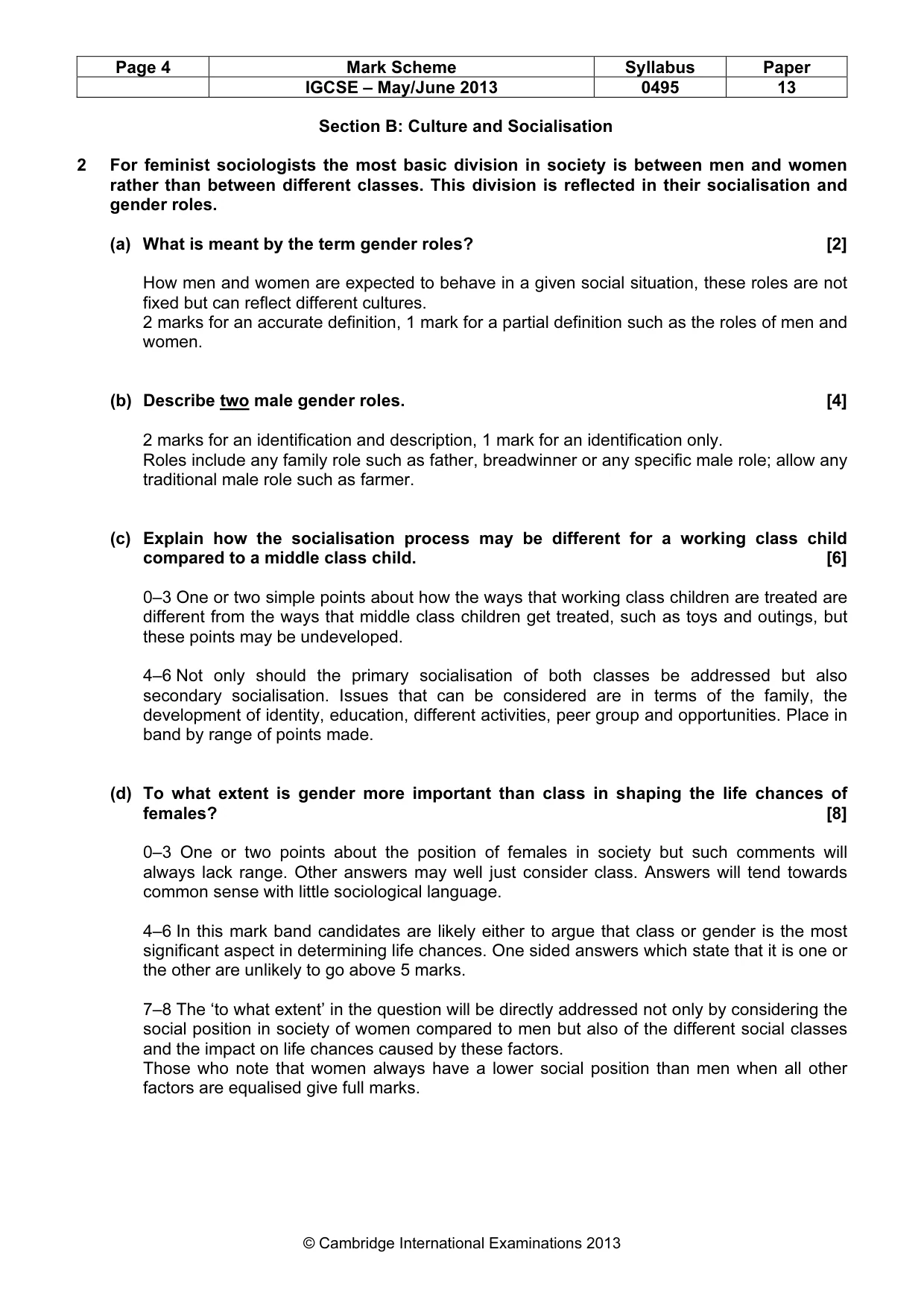
Page 4 Mark Scheme Syllabus Paper IGCSE – May/June 2013 0495 13 © Cambridge International Examinations 2013 Section B: Culture and Socialisation 2 For feminist sociologists the most basic division in society is between men and women rather than between different classes. This division is reflected in their socialisation and gender roles. (a) What is meant by the term gender roles? [2] How men and women are expected to behave in a given social situation, these roles are not fixed but can reflect different cultures. 2 marks for an accurate definition, 1 mark for a partial definition such as the roles of men and women. (b) Describe two male gender roles. [4] 2 marks for an identification and description, 1 mark for an identification only. Roles include any family role such as father, breadwinner or any specific male role; allow any traditional male role such as farmer. (c) Explain how the socialisation process may be different for a working class child compared to a middle class child. [6] 0–3 One or two simple points about how the ways that working class children are treated are different from the ways that middle class children get treated, such as toys and outings, but these points may be undeveloped. 4–6 Not only should the primary socialisation of both classes be addressed but also secondary socialisation. Issues that can be considered are in terms of the family, the development of identity, education, different activities, peer group and opportunities. Place in band by range of points made. (d) To what extent is gender more important than class in shaping the life chances of females? [8] 0–3 One or two points about the position of females in society but such comments will always lack range. Other answers may well just consider class. Answers will tend towards common sense with little sociological language. 4–6 In this mark band candidates are likely either to argue that class or gender is the most significant aspect in determining life chances. One sided answers which state that it is one or the other are unlikely to go above 5 marks. 7–8 The ‘to what extent’ in the question will be directly addressed not only by considering the social position in society of women compared to men but also of the different social classes and the impact on life chances caused by these factors. Those who note that women always have a lower social position than men when all other factors are equalised give full marks.
Mark scheme, page 5
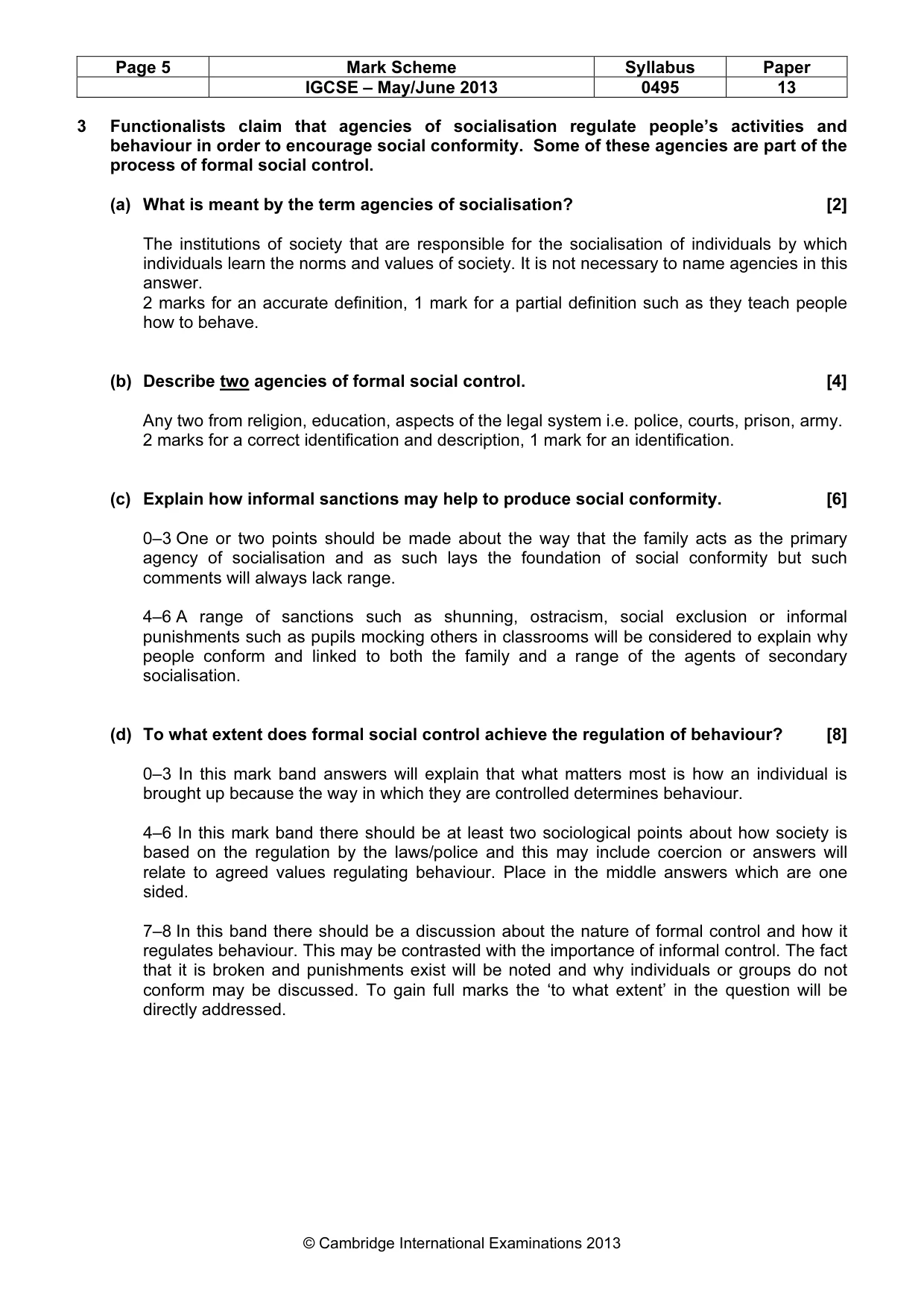
Page 5 Mark Scheme Syllabus Paper IGCSE – May/June 2013 0495 13 © Cambridge International Examinations 2013 3 Functionalists claim that agencies of socialisation regulate people’s activities and behaviour in order to encourage social conformity. Some of these agencies are part of the process of formal social control. (a) What is meant by the term agencies of socialisation? [2] The institutions of society that are responsible for the socialisation of individuals by which individuals learn the norms and values of society. It is not necessary to name agencies in this answer. 2 marks for an accurate definition, 1 mark for a partial definition such as they teach people how to behave. (b) Describe two agencies of formal social control. [4] Any two from religion, education, aspects of the legal system i.e. police, courts, prison, army. 2 marks for a correct identification and description, 1 mark for an identification. (c) Explain how informal sanctions may help to produce social conformity. [6] 0–3 One or two points should be made about the way that the family acts as the primary agency of socialisation and as such lays the foundation of social conformity but such comments will always lack range. 4–6 A range of sanctions such as shunning, ostracism, social exclusion or informal punishments such as pupils mocking others in classrooms will be considered to explain why people conform and linked to both the family and a range of the agents of secondary socialisation. (d) To what extent does formal social control achieve the regulation of behaviour? [8] 0–3 In this mark band answers will explain that what matters most is how an individual is brought up because the way in which they are controlled determines behaviour. 4–6 In this mark band there should be at least two sociological points about how society is based on the regulation by the laws/police and this may include coercion or answers will relate to agreed values regulating behaviour. Place in the middle answers which are one sided. 7–8 In this band there should be a discussion about the nature of formal control and how it regulates behaviour. This may be contrasted with the importance of informal control. The fact that it is broken and punishments exist will be noted and why individuals or groups do not conform may be discussed. To gain full marks the ‘to what extent’ in the question will be directly addressed.
Mark scheme, page 6
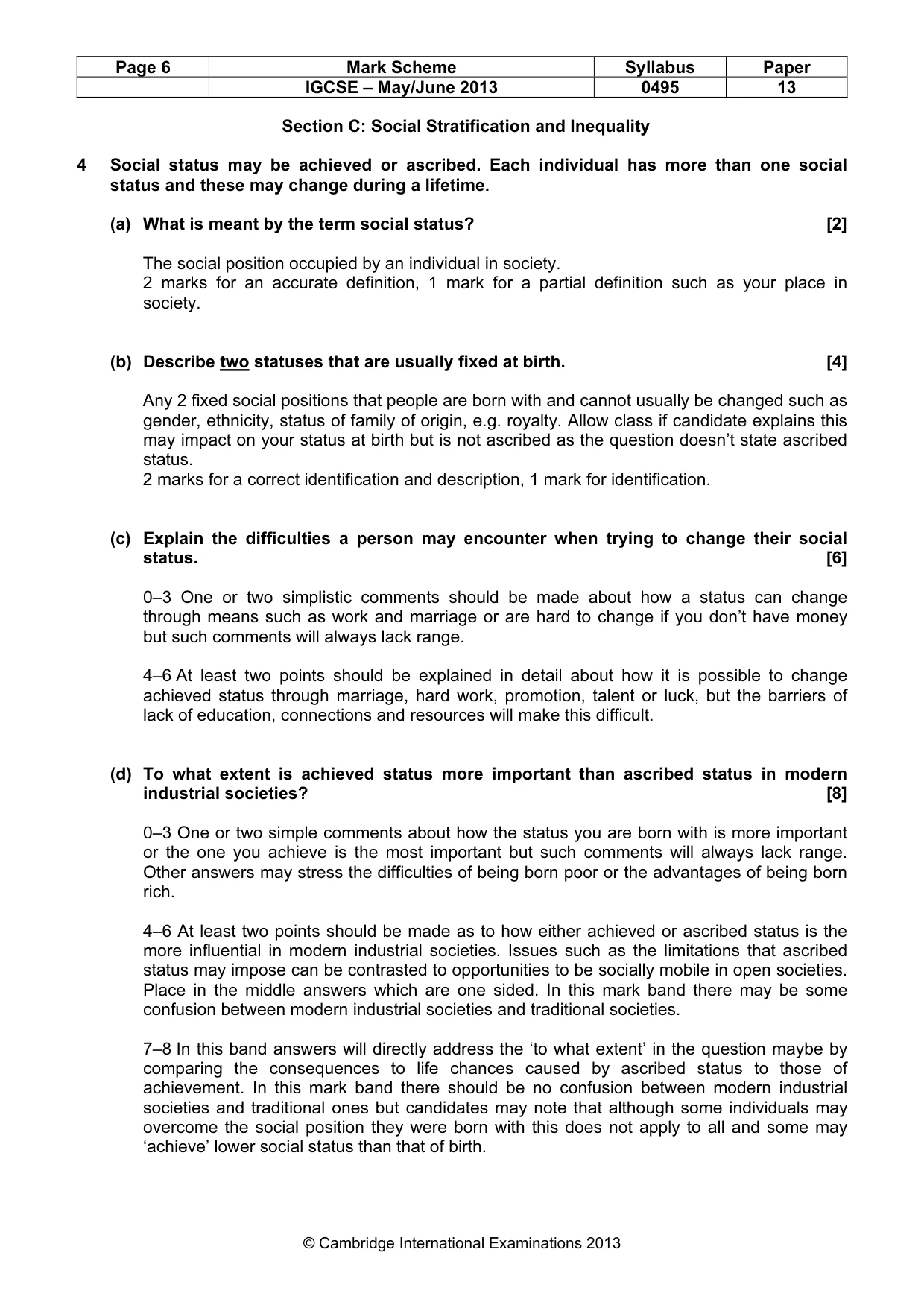
Page 6 Mark Scheme Syllabus Paper IGCSE – May/June 2013 0495 13 © Cambridge International Examinations 2013 Section C: Social Stratification and Inequality 4 Social status may be achieved or ascribed. Each individual has more than one social status and these may change during a lifetime. (a) What is meant by the term social status? [2] The social position occupied by an individual in society. 2 marks for an accurate definition, 1 mark for a partial definition such as your place in society. (b) Describe two statuses that are usually fixed at birth. [4] Any 2 fixed social positions that people are born with and cannot usually be changed such as gender, ethnicity, status of family of origin, e.g. royalty. Allow class if candidate explains this may impact on your status at birth but is not ascribed as the question doesn’t state ascribed status. 2 marks for a correct identification and description, 1 mark for identification. (c) Explain the difficulties a person may encounter when trying to change their social status. [6] 0–3 One or two simplistic comments should be made about how a status can change through means such as work and marriage or are hard to change if you don’t have money but such comments will always lack range. 4–6 At least two points should be explained in detail about how it is possible to change achieved status through marriage, hard work, promotion, talent or luck, but the barriers of lack of education, connections and resources will make this difficult. (d) To what extent is achieved status more important than ascribed status in modern industrial societies? [8] 0–3 One or two simple comments about how the status you are born with is more important or the one you achieve is the most important but such comments will always lack range. Other answers may stress the difficulties of being born poor or the advantages of being born rich. 4–6 At least two points should be made as to how either achieved or ascribed status is the more influential in modern industrial societies. Issues such as the limitations that ascribed status may impose can be contrasted to opportunities to be socially mobile in open societies. Place in the middle answers which are one sided. In this mark band there may be some confusion between modern industrial societies and traditional societies. 7–8 In this band answers will directly address the ‘to what extent’ in the question maybe by comparing the consequences to life chances caused by ascribed status to those of achievement. In this mark band there should be no confusion between modern industrial societies and traditional ones but candidates may note that although some individuals may overcome the social position they were born with this does not apply to all and some may ‘achieve’ lower social status than that of birth.
Mark scheme, page 7
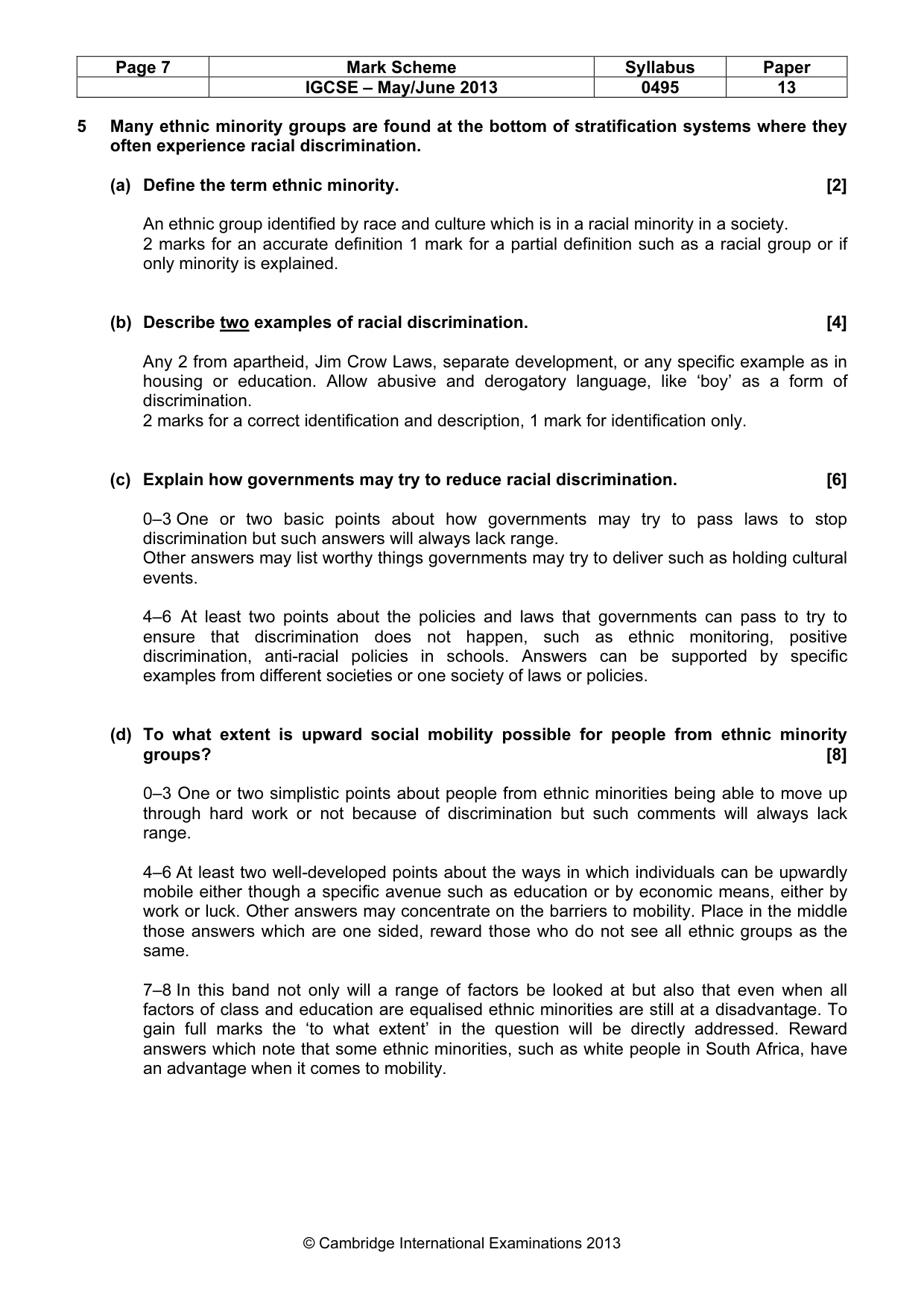
Page 7 Mark Scheme Syllabus Paper IGCSE – May/June 2013 0495 13 © Cambridge International Examinations 2013 5 Many ethnic minority groups are found at the bottom of stratification systems where they often experience racial discrimination. (a) Define the term ethnic minority. [2] An ethnic group identified by race and culture which is in a racial minority in a society. 2 marks for an accurate definition 1 mark for a partial definition such as a racial group or if only minority is explained. (b) Describe two examples of racial discrimination. [4] Any 2 from apartheid, Jim Crow Laws, separate development, or any specific example as in housing or education. Allow abusive and derogatory language, like ‘boy’ as a form of discrimination. 2 marks for a correct identification and description, 1 mark for identification only. (c) Explain how governments may try to reduce racial discrimination. [6] 0–3 One or two basic points about how governments may try to pass laws to stop discrimination but such answers will always lack range. Other answers may list worthy things governments may try to deliver such as holding cultural events. 4–6 At least two points about the policies and laws that governments can pass to try to ensure that discrimination does not happen, such as ethnic monitoring, positive discrimination, anti-racial policies in schools. Answers can be supported by specific examples from different societies or one society of laws or policies. (d) To what extent is upward social mobility possible for people from ethnic minority groups? [8] 0–3 One or two simplistic points about people from ethnic minorities being able to move up through hard work or not because of discrimination but such comments will always lack range. 4–6 At least two well-developed points about the ways in which individuals can be upwardly mobile either though a specific avenue such as education or by economic means, either by work or luck. Other answers may concentrate on the barriers to mobility. Place in the middle those answers which are one sided, reward those who do not see all ethnic groups as the same. 7–8 In this band not only will a range of factors be looked at but also that even when all factors of class and education are equalised ethnic minorities are still at a disadvantage. To gain full marks the ‘to what extent’ in the question will be directly addressed. Reward answers which note that some ethnic minorities, such as white people in South Africa, have an advantage when it comes to mobility.
Mark scheme, page 8
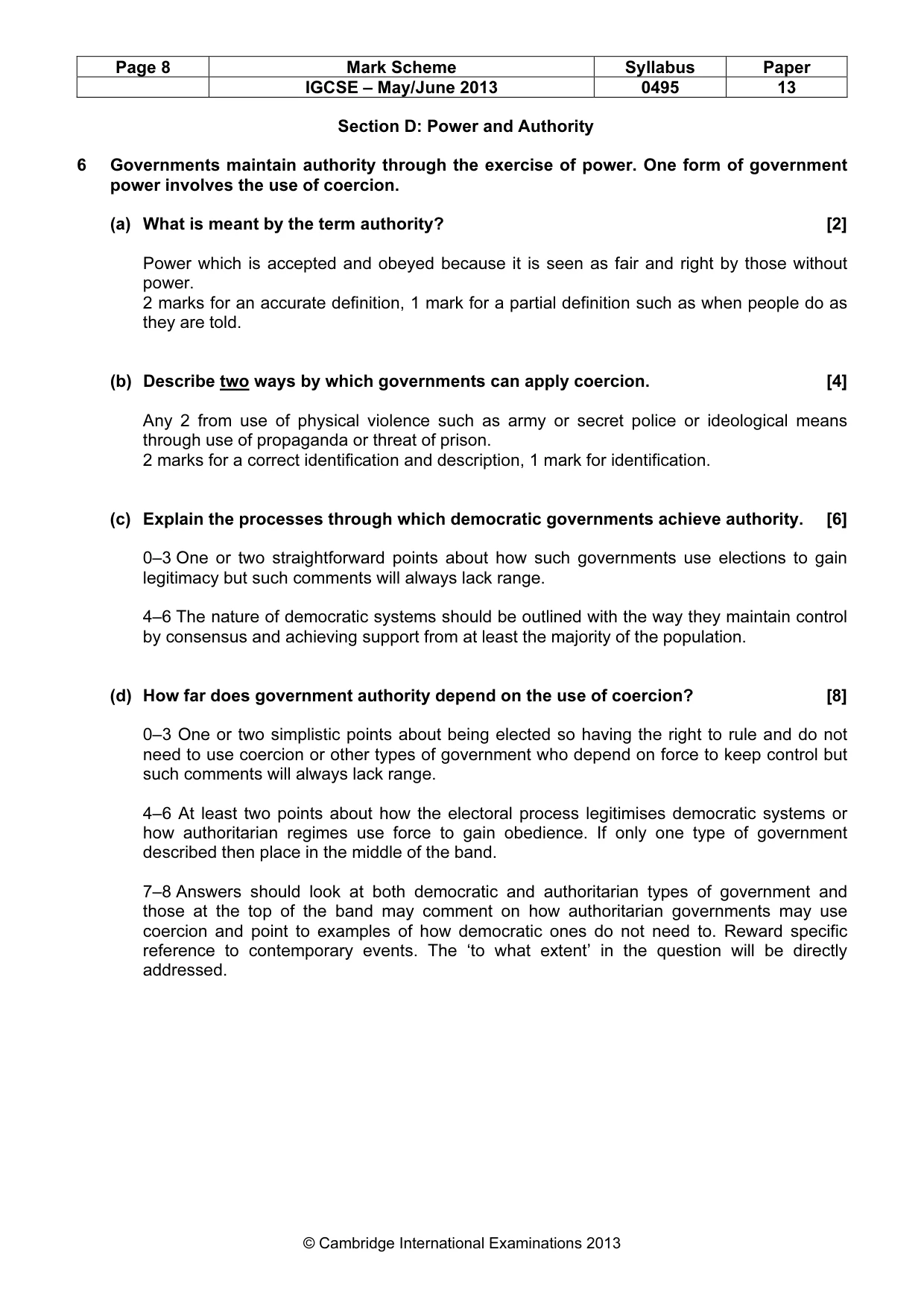
Page 8 Mark Scheme Syllabus Paper IGCSE – May/June 2013 0495 13 © Cambridge International Examinations 2013 Section D: Power and Authority 6 Governments maintain authority through the exercise of power. One form of government power involves the use of coercion. (a) What is meant by the term authority? [2] Power which is accepted and obeyed because it is seen as fair and right by those without power. 2 marks for an accurate definition, 1 mark for a partial definition such as when people do as they are told. (b) Describe two ways by which governments can apply coercion. [4] Any 2 from use of physical violence such as army or secret police or ideological means through use of propaganda or threat of prison. 2 marks for a correct identification and description, 1 mark for identification. (c) Explain the processes through which democratic governments achieve authority. [6] 0–3 One or two straightforward points about how such governments use elections to gain legitimacy but such comments will always lack range. 4–6 The nature of democratic systems should be outlined with the way they maintain control by consensus and achieving support from at least the majority of the population. (d) How far does government authority depend on the use of coercion? [8] 0–3 One or two simplistic points about being elected so having the right to rule and do not need to use coercion or other types of government who depend on force to keep control but such comments will always lack range. 4–6 At least two points about how the electoral process legitimises democratic systems or how authoritarian regimes use force to gain obedience. If only one type of government described then place in the middle of the band. 7–8 Answers should look at both democratic and authoritarian types of government and those at the top of the band may comment on how authoritarian governments may use coercion and point to examples of how democratic ones do not need to. Reward specific reference to contemporary events. The ‘to what extent’ in the question will be directly addressed.
Mark scheme, page 9
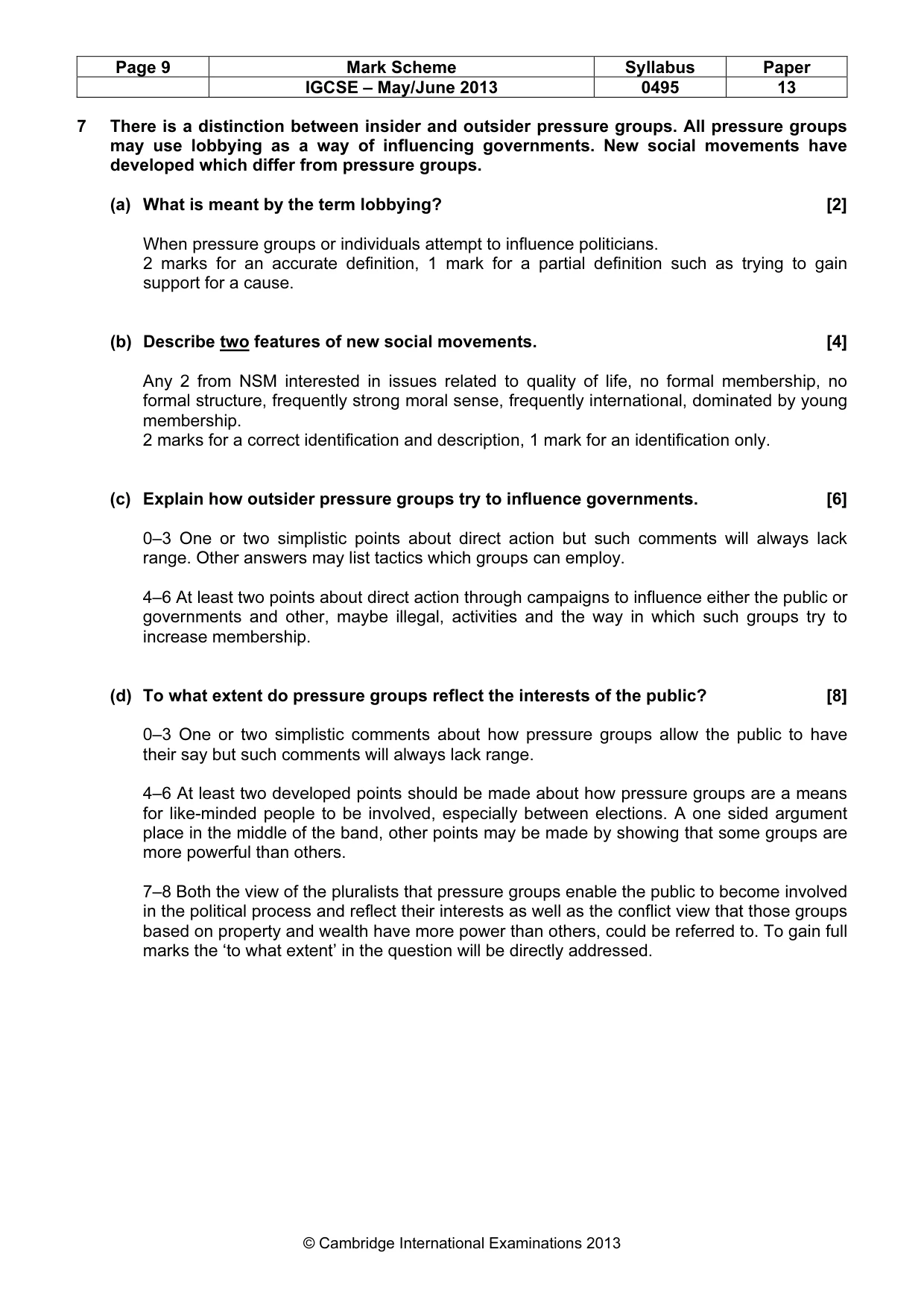
Page 9 Mark Scheme Syllabus Paper IGCSE – May/June 2013 0495 13 © Cambridge International Examinations 2013 7 There is a distinction between insider and outsider pressure groups. All pressure groups may use lobbying as a way of influencing governments. New social movements have developed which differ from pressure groups. (a) What is meant by the term lobbying? [2] When pressure groups or individuals attempt to influence politicians. 2 marks for an accurate definition, 1 mark for a partial definition such as trying to gain support for a cause. (b) Describe two features of new social movements. [4] Any 2 from NSM interested in issues related to quality of life, no formal membership, no formal structure, frequently strong moral sense, frequently international, dominated by young membership. 2 marks for a correct identification and description, 1 mark for an identification only. (c) Explain how outsider pressure groups try to influence governments. [6] 0–3 One or two simplistic points about direct action but such comments will always lack range. Other answers may list tactics which groups can employ. 4–6 At least two points about direct action through campaigns to influence either the public or governments and other, maybe illegal, activities and the way in which such groups try to increase membership. (d) To what extent do pressure groups reflect the interests of the public? [8] 0–3 One or two simplistic comments about how pressure groups allow the public to have their say but such comments will always lack range. 4–6 At least two developed points should be made about how pressure groups are a means for like-minded people to be involved, especially between elections. A one sided argument place in the middle of the band, other points may be made by showing that some groups are more powerful than others. 7–8 Both the view of the pluralists that pressure groups enable the public to become involved in the political process and reflect their interests as well as the conflict view that those groups based on property and wealth have more power than others, could be referred to. To gain full marks the ‘to what extent’ in the question will be directly addressed.
What you needed in this session
Cambridge’s own grade thresholds for 2013 May/June, Paper 1 · Variant 3. A higher threshold means an easier paper — the bar moves with how the cohort did.