Cambridge IGCSE Sociology 0495 — 2012 May/June Paper 2 · Variant 1
0495/21/M/J/12 · 60 marks · ≈68 min
The question paper and its mark scheme, free to read here and free to download. This is Cambridge’s own paper, exactly as it was sat.
Question paper36 pages


Mark scheme12 pages
Answers below. Sit the paper first if you are practising.
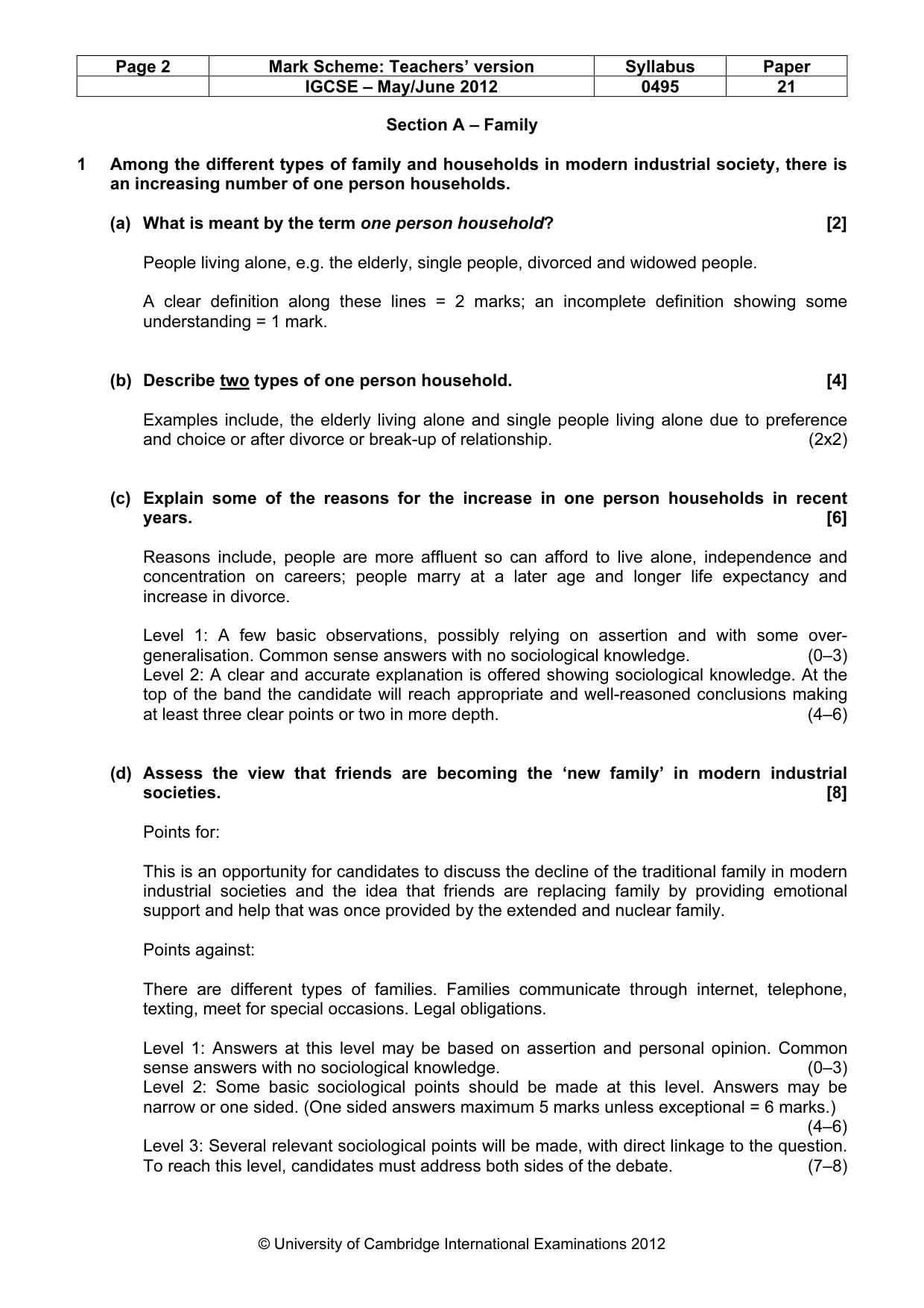
Paper as text
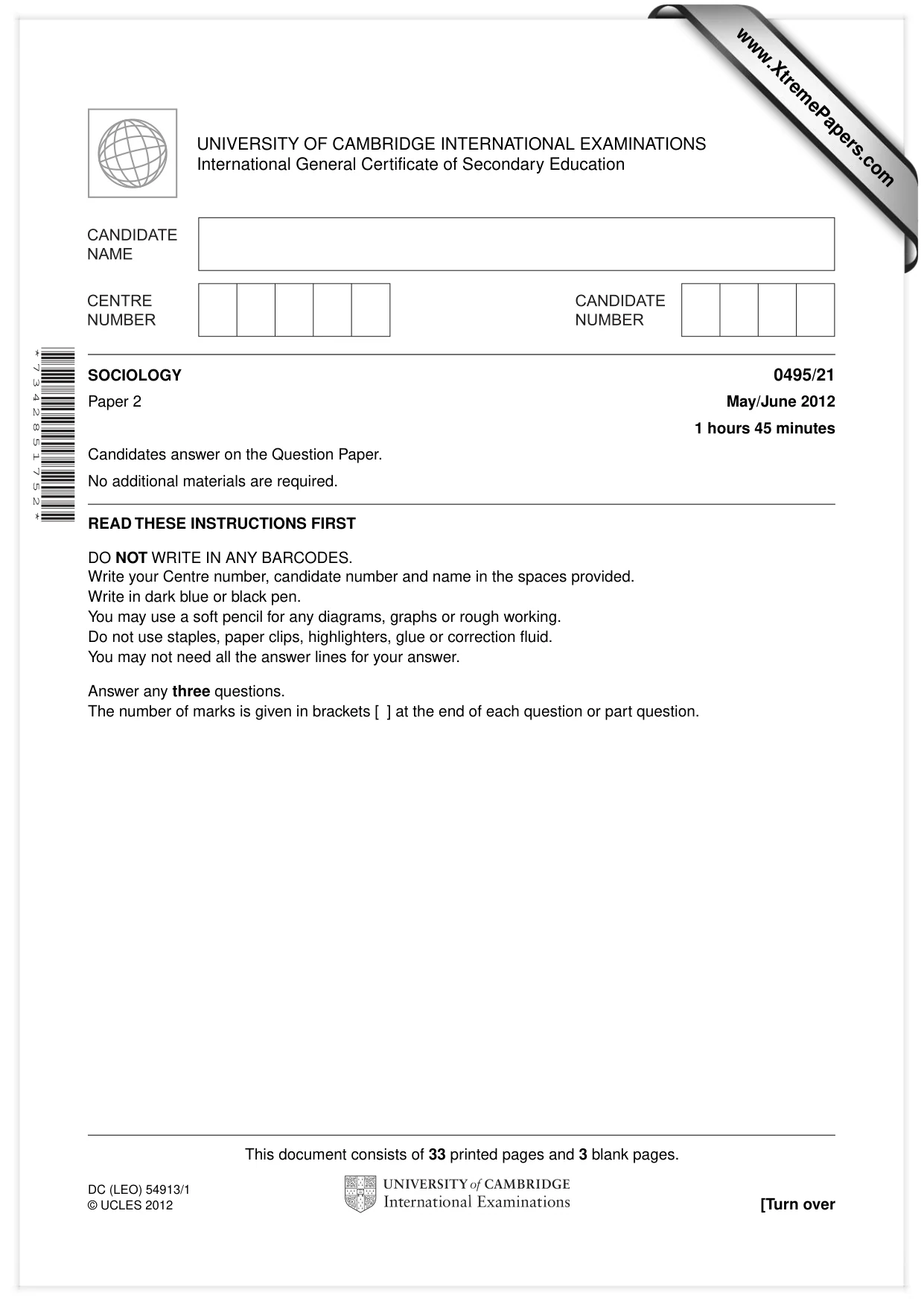
Question paper, page 1
This document consists of 33 printed pages and 3 blank pages. DC (LEO) 54913/1 © UCLES 2012 [Turn over UNIVERSITY OF CAMBRIDGE INTERNATIONAL EXAMINATIONS International General Certificate of Secondary Education * 7 3 4 2 8 5 1 7 5 2 * SOCIOLOGY 0495/21 Paper 2 May/June 2012 1 hours 45 minutes Candidates answer on the Question Paper. No additional materials are required. READ THESE INSTRUCTIONS FIRST DO NOT WRITE IN ANY BARCODES. Write your Centre number, candidate number and name in the spaces provided. Write in dark blue or black pen. You may use a soft pencil for any diagrams, graphs or rough working. Do not use staples, paper clips, highlighters, glue or correction fluid. You may not need all the answer lines for your answer. Answer any three questions. The number of marks is given in brackets [ ] at the end of each question or part question. www.XtremePapers.com
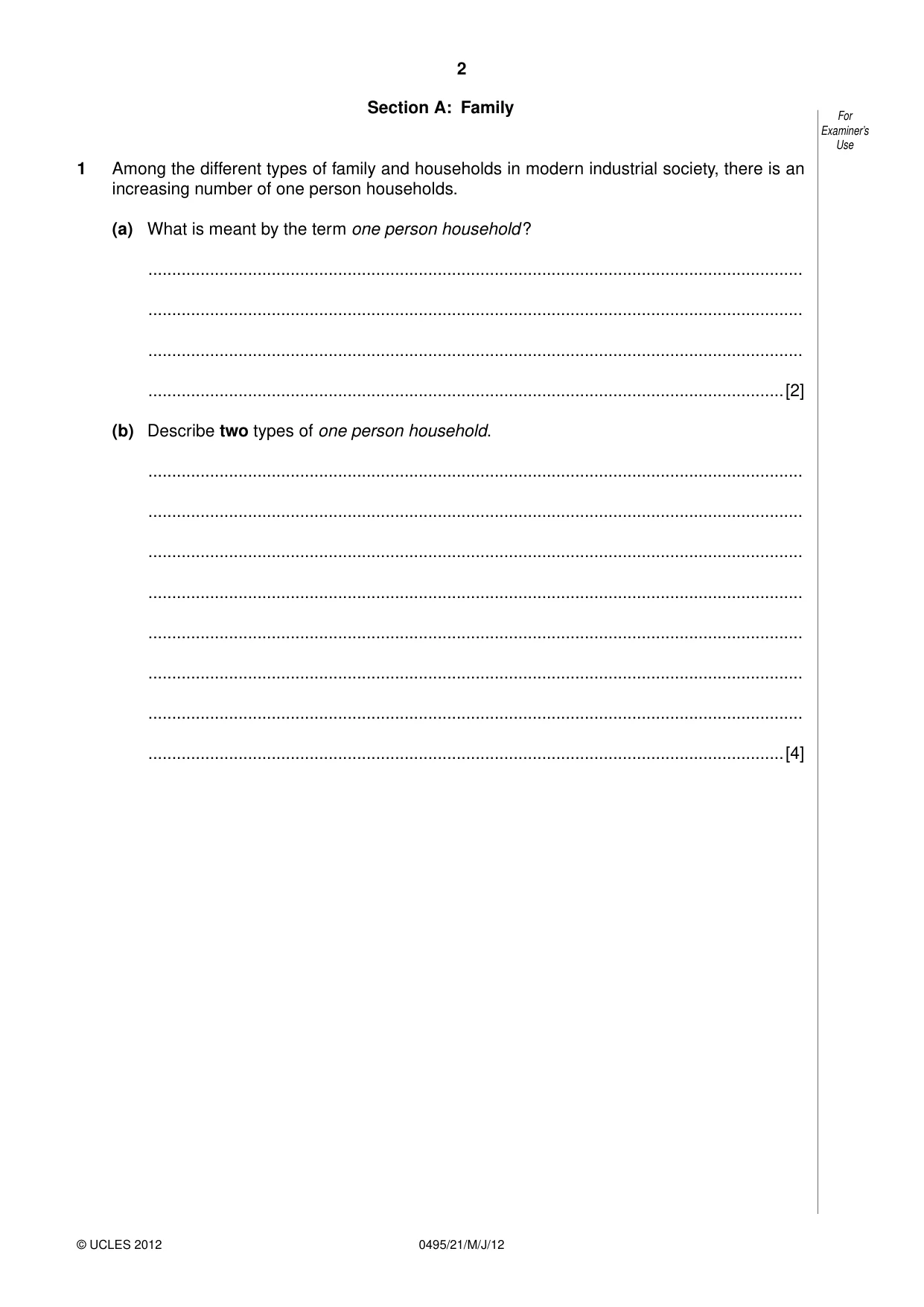
Question paper, page 2
2 0495/21/M/J/12 © UCLES 2012 For Examiner’s Use Section A: Family 1 Among the different types of family and households in modern industrial society, there is an increasing number of one person households. (a) What is meant by the term one person household ? … … … …[2] (b) Describe two types of one person household. … … … … … … … …[4]
Question paper, page 3
3 0495/21/M/J/12 © UCLES 2012 [Turn over For Examiner’s Use (c) Explain some of the reasons for the increase in one person households in recent years. … … … … … … … … … … … … … … … … … … … … … … … … … … …[6]
Question paper, page 4
4 0495/21/M/J/12 © UCLES 2012 For Examiner’s Use (d) Assess the view that friends are becoming the ‘new family’ in modern industrial societies. … … … … … … … … … … … … … … … … … … … … … … … … … … …
Question paper, page 5
5 0495/21/M/J/12 © UCLES 2012 [Turn over For Examiner’s Use … … … … … … … … … … … … … …[8]
Question paper, page 6
6 0495/21/M/J/12 © UCLES 2012 For Examiner’s Use 2 In recent years, there has been a decrease in the birth-rate and an increase in births outside of marriage in modern industrial societies. (a) What is meant by the term birth-rate ? … … … …[2] (b) Describe two reasons for the decrease in birth-rates in modern industrial societies. … … … … … … … …[4]
Question paper, page 7
7 0495/21/M/J/12 © UCLES 2012 [Turn over For Examiner’s Use (c) Explain some of the reasons for the increase in births outside of marriage in modern industrial societies. … … … … … … … … … … … … … … … … … … … … … … … … … … …[6]
Question paper, page 8
8 0495/21/M/J/12 © UCLES 2012 For Examiner’s Use (d) Assess the view that the increase in births outside of marriage is a threat to the family and society. … … … … … … … … … … … … … … … … … … … … … … … … … … …
Question paper, page 9
9 0495/21/M/J/12 © UCLES 2012 [Turn over For Examiner’s Use … … … … … … … … … … … … … …[8]
Question paper, page 10
10 0495/21/M/J/12 © UCLES 2012 For Examiner’s Use Section B: Education 3 Some sociologists argue that both material and cultural deprivation can influence a person’s educational achievement. (a) What is meant by the term material deprivation ? … … … …[2] (b) Describe two examples of material deprivation. … … … … … … … …[4]
Question paper, page 11
11 0495/21/M/J/12 © UCLES 2012 [Turn over For Examiner’s Use (c) Explain how the expectations of teachers can influence a pupil’s educational achievement. … … … … … … … … … … … … … … … … … … … … … … … … … … …[6]
Question paper, page 12
12 0495/21/M/J/12 © UCLES 2012 For Examiner’s Use (d) To what extent is cultural deprivation the main influence on a pupil’s educational achievement? … … … … … … … … … … … … … … … … … … … … … … … … … … …
Question paper, page 13
13 0495/21/M/J/12 © UCLES 2012 [Turn over For Examiner’s Use … … … … … … … … … … … … … …[8]
Question paper, page 14
14 0495/21/M/J/12 © UCLES 2012 For Examiner’s Use 4 There are two forms of education in modern industrial societies, academic education and vocational education. (a) What is meant by the term vocational education ? … … … …[2] (b) Describe two ways in which schools teach pupils to become a useful part of society. … … … … … … … …[4]
Question paper, page 15
15 0495/21/M/J/12 © UCLES 2012 [Turn over For Examiner’s Use (c) Explain why some sociologists criticise the role of schools in modern industrial societies. … … … … … … … … … … … … … … … … … … … … … … … … … … …[6]
Question paper, page 16
16 0495/21/M/J/12 © UCLES 2012 For Examiner’s Use (d) Assess the role of vocational education in modern industrial societies. … … … … … … … … … … … … … … … … … … … … … … … … … … …
Question paper, page 17
17 0495/21/M/J/12 © UCLES 2012 [Turn over For Examiner’s Use … … … … … … … … … … … … … …[8]
Question paper, page 18
18 0495/21/M/J/12 © UCLES 2012 For Examiner’s Use Section C: Crime, Deviance and Social Control 5 Sociologists explain crime and deviance in terms of social factors rather than psychological or biological factors. Status frustration is an example of a social factor. (a) What is meant by the term status frustration ? … … … …[2] (b) Describe two social factors other than status frustration that might lead to crime. … … … … … … … …[4]
Question paper, page 19
19 0495/21/M/J/12 © UCLES 2012 [Turn over For Examiner’s Use (c) Explain why some groups are more likely than other groups to be labelled criminals. … … … … … … … … … … … … … … … … … … … … … … … … … … …[6]
Question paper, page 20
20 0495/21/M/J/12 © UCLES 2012 For Examiner’s Use (d) Assess the view that labelling someone a criminal helps to create a self-fulfilling prophecy. … … … … … … … … … … … … … … … … … … … … … … … … … … …
Question paper, page 21
21 0495/21/M/J/12 © UCLES 2012 [Turn over For Examiner’s Use … … … … … … … … … … … … … …[8]
Question paper, page 22
22 0495/21/M/J/12 © UCLES 2012 For Examiner’s Use 6 Sociologists often highlight the importance of agencies of social control in maintaining social conformity. (a) What is meant by the term social conformity ? … … … …[2] (b) Describe two agencies of social control. … … … … … … … …[4]
Question paper, page 23
23 0495/21/M/J/12 © UCLES 2012 [Turn over For Examiner’s Use (c) Explain how informal processes help to keep order in society. … … … … … … … … … … … … … … … … … … … … … … … … … … …[6]
Question paper, page 24
24 0495/21/M/J/12 © UCLES 2012 For Examiner’s Use (d) How far is social order based on the power of the ruling class? … … … … … … … … … … … … … … … … … … … … … … … … … … …
Question paper, page 25
25 0495/21/M/J/12 © UCLES 2012 [Turn over For Examiner’s Use … … … … … … … … … … … … … …[8]
Question paper, page 26
26 0495/21/M/J/12 © UCLES 2012 For Examiner’s Use Section D: Mass Media 7 It is argued that the mass media play a major role in the socialisation process. (a) What is meant by the term socialisation ? … … … …[2] (b) Describe two ways in which the mass media contribute to the socialisation of children. … … … … … … … …[4]
Question paper, page 27
27 0495/21/M/J/12 © UCLES 2012 [Turn over For Examiner’s Use (c) Explain some of the ways in which children are portrayed in the mass media. … … … … … … … … … … … … … … … … … … … … … … … … … … …[6]
Question paper, page 28
28 0495/21/M/J/12 © UCLES 2012 For Examiner’s Use (d) Assess the view that the mass media are a powerful force in shaping the behaviour of children. … … … … … … … … … … … … … … … … … … … … … … … … … … …
Question paper, page 29
29 0495/21/M/J/12 © UCLES 2012 [Turn over For Examiner’s Use … … … … … … … … … … … … … …[8]
Question paper, page 30
30 0495/21/M/J/12 © UCLES 2012 For Examiner’s Use 8 In modern industrial societies, some broadcasting is publicly funded, but most is funded privately. (a) What is meant by the term publicly funded ? … … … …[2] (b) Describe two examples of broadcasting. … … … … … … … …[4]
Question paper, page 31
31 0495/21/M/J/12 © UCLES 2012 [Turn over For Examiner’s Use (c) Explain some of the ways in which technology within the mass media has developed in recent years. … … … … … … … … … … … … … … … … … … … … … … … … … … …[6]
Question paper, page 32
32 0495/21/M/J/12 © UCLES 2012 For Examiner’s Use (d) To what extent does ‘freedom of the press’ exist in modern industrial societies? … … … … … … … … … … … … … … … … … … … … … … … … … … …
Question paper, page 33
33 0495/21/M/J/12 © UCLES 2012 For Examiner’s Use … … … … … … … … … … … … … …[8]
Question paper, page 34
34 0495/21/M/J/12 © UCLES 2012 BLANK PAGE
Question paper, page 35
35 0495/21/M/J/12 © UCLES 2012 BLANK PAGE
Question paper, page 36
36 0495/21/M/J/12 © UCLES 2012 Permission to reproduce items where third-party owned material protected by copyright is included has been sought and cleared where possible. Every reasonable effort has been made by the publisher (UCLES) to trace copyright holders, but if any items requiring clearance have unwittingly been included, the publisher will be pleased to make amends at the earliest possible opportunity. University of Cambridge International Examinations is part of the Cambridge Assessment Group. Cambridge Assessment is the brand name of University of Cambridge Local Examinations Syndicate (UCLES), which is itself a department of the University of Cambridge. BLANK PAGE
Mark scheme, page 1
UNIVERSITY OF CAMBRIDGE INTERNATIONAL EXAMINATIONS International General Certificate of Secondary Education MARK SCHEME for the May/June 2012 question paper for the guidance of teachers 0495 SOCIOLOGY 0495/21 Paper 2, maximum raw mark 60 This mark scheme is published as an aid to teachers and candidates, to indicate the requirements of the examination. It shows the basis on which Examiners were instructed to award marks. It does not indicate the details of the discussions that took place at an Examiners’ meeting before marking began, which would have considered the acceptability of alternative answers. Mark schemes must be read in conjunction with the question papers and the report on the examination. • Cambridge will not enter into discussions or correspondence in connection with these mark schemes. Cambridge is publishing the mark schemes for the May/June 2012 question papers for most IGCSE, GCE Advanced Level and Advanced Subsidiary Level syllabuses and some Ordinary Level syllabuses. www.XtremePapers.com
Mark scheme, page 2
Page 2 Mark Scheme: Teachers’ version Syllabus Paper IGCSE – May/June 2012 0495 21 © University of Cambridge International Examinations 2012 Section A – Family 1 Among the different types of family and households in modern industrial society, there is an increasing number of one person households. (a) What is meant by the term one person household? [2] People living alone, e.g. the elderly, single people, divorced and widowed people. A clear definition along these lines = 2 marks; an incomplete definition showing some understanding = 1 mark. (b) Describe two types of one person household. [4] Examples include, the elderly living alone and single people living alone due to preference and choice or after divorce or break-up of relationship. (2x2) (c) Explain some of the reasons for the increase in one person households in recent years. [6] Reasons include, people are more affluent so can afford to live alone, independence and concentration on careers; people marry at a later age and longer life expectancy and increase in divorce. Level 1: A few basic observations, possibly relying on assertion and with some over- generalisation. Common sense answers with no sociological knowledge. (0–3) Level 2: A clear and accurate explanation is offered showing sociological knowledge. At the top of the band the candidate will reach appropriate and well-reasoned conclusions making at least three clear points or two in more depth. (4–6) (d) Assess the view that friends are becoming the ‘new family’ in modern industrial societies. [8] Points for: This is an opportunity for candidates to discuss the decline of the traditional family in modern industrial societies and the idea that friends are replacing family by providing emotional support and help that was once provided by the extended and nuclear family. Points against: There are different types of families. Families communicate through internet, telephone, texting, meet for special occasions. Legal obligations. Level 1: Answers at this level may be based on assertion and personal opinion. Common sense answers with no sociological knowledge. (0–3) Level 2: Some basic sociological points should be made at this level. Answers may be narrow or one sided. (One sided answers maximum 5 marks unless exceptional = 6 marks.) (4–6) Level 3: Several relevant sociological points will be made, with direct linkage to the question. To reach this level, candidates must address both sides of the debate. (7–8)
Mark scheme, page 3
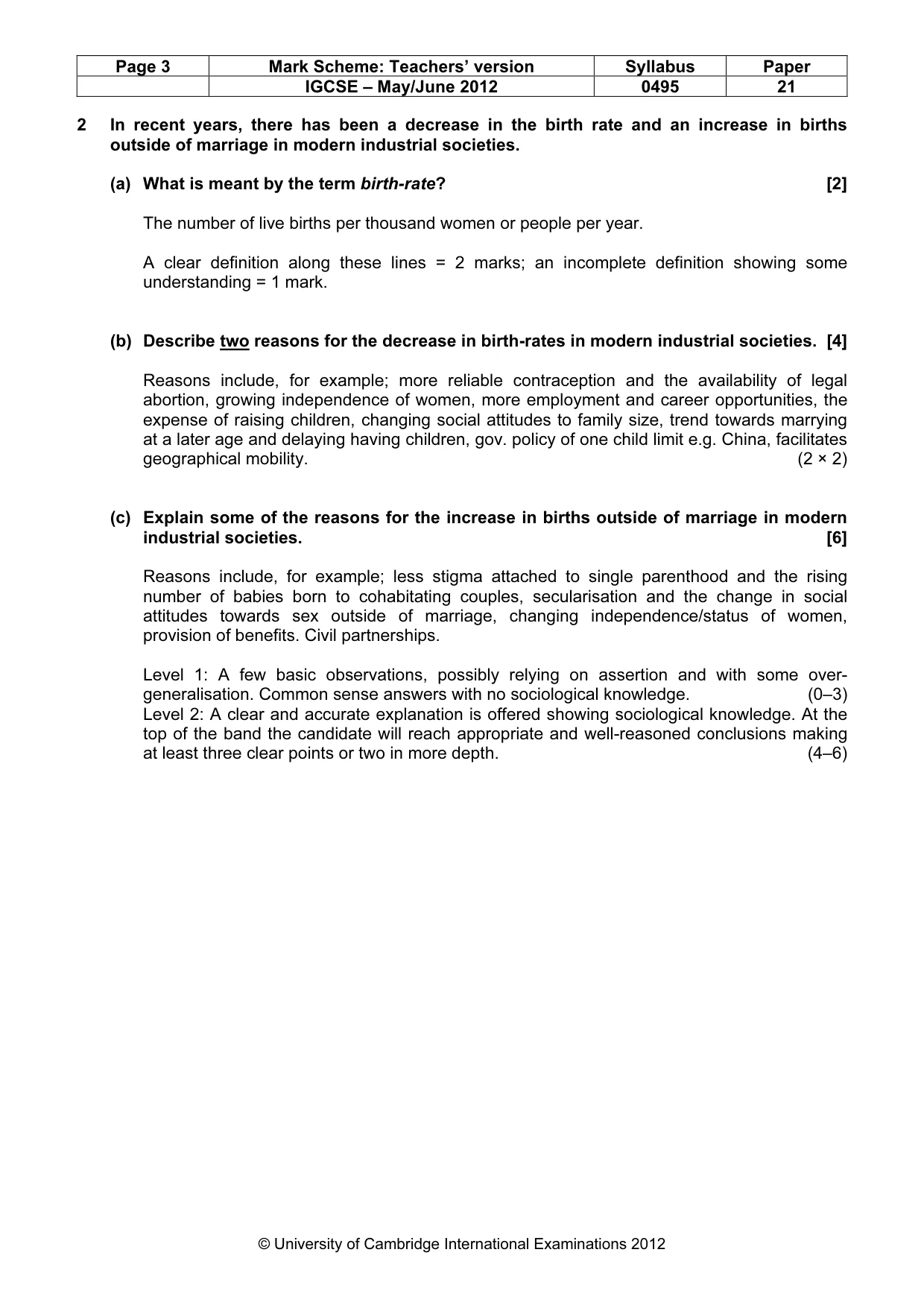
Page 3 Mark Scheme: Teachers’ version Syllabus Paper IGCSE – May/June 2012 0495 21 © University of Cambridge International Examinations 2012 2 In recent years, there has been a decrease in the birth rate and an increase in births outside of marriage in modern industrial societies. (a) What is meant by the term birth-rate? [2] The number of live births per thousand women or people per year. A clear definition along these lines = 2 marks; an incomplete definition showing some understanding = 1 mark. (b) Describe two reasons for the decrease in birth-rates in modern industrial societies. [4] Reasons include, for example; more reliable contraception and the availability of legal abortion, growing independence of women, more employment and career opportunities, the expense of raising children, changing social attitudes to family size, trend towards marrying at a later age and delaying having children, gov. policy of one child limit e.g. China, facilitates geographical mobility. (2 × 2) (c) Explain some of the reasons for the increase in births outside of marriage in modern industrial societies. [6] Reasons include, for example; less stigma attached to single parenthood and the rising number of babies born to cohabitating couples, secularisation and the change in social attitudes towards sex outside of marriage, changing independence/status of women, provision of benefits. Civil partnerships. Level 1: A few basic observations, possibly relying on assertion and with some over- generalisation. Common sense answers with no sociological knowledge. (0–3) Level 2: A clear and accurate explanation is offered showing sociological knowledge. At the top of the band the candidate will reach appropriate and well-reasoned conclusions making at least three clear points or two in more depth. (4–6)
Mark scheme, page 4
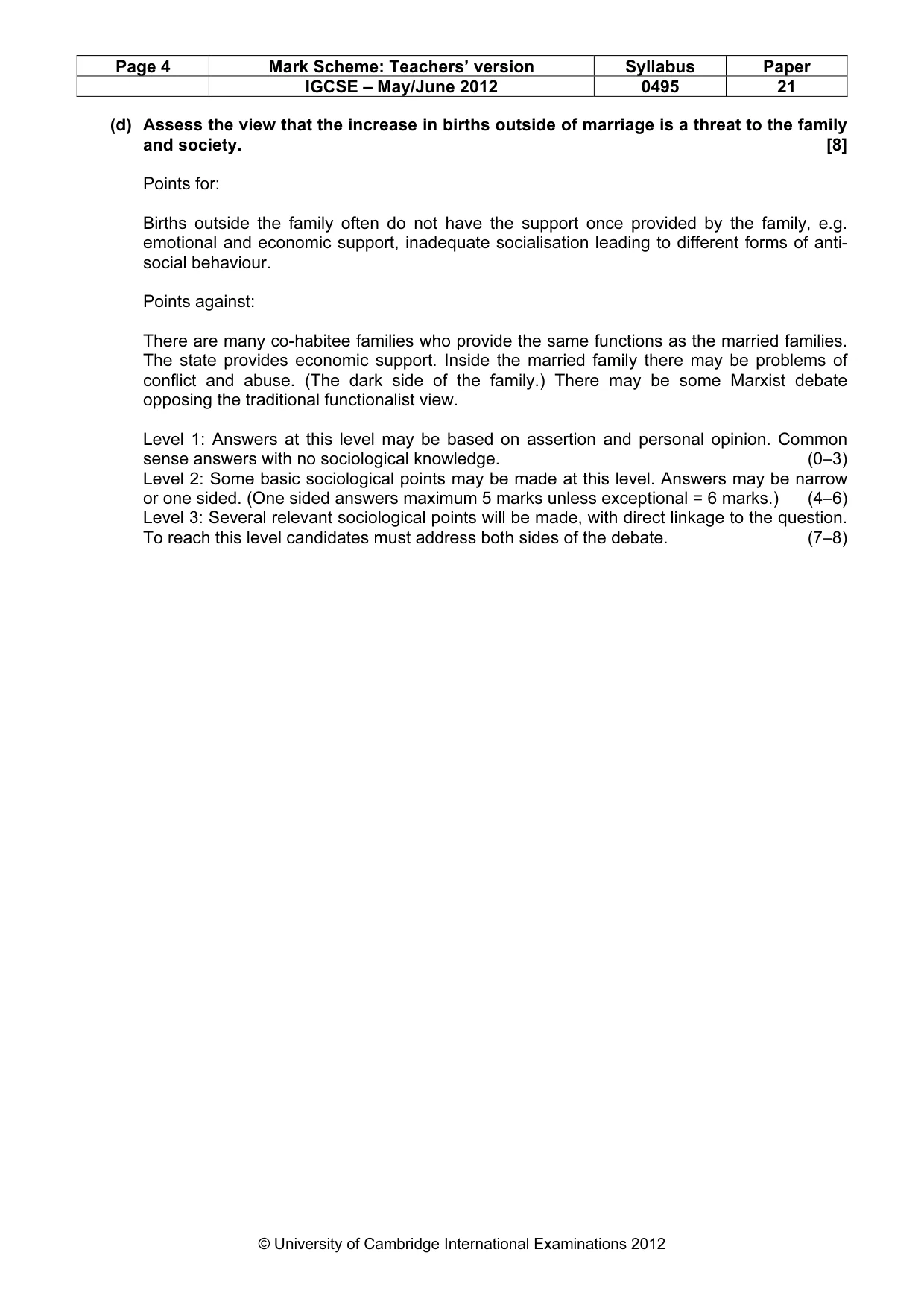
Page 4 Mark Scheme: Teachers’ version Syllabus Paper IGCSE – May/June 2012 0495 21 © University of Cambridge International Examinations 2012 (d) Assess the view that the increase in births outside of marriage is a threat to the family and society. [8] Points for: Births outside the family often do not have the support once provided by the family, e.g. emotional and economic support, inadequate socialisation leading to different forms of anti- social behaviour. Points against: There are many co-habitee families who provide the same functions as the married families. The state provides economic support. Inside the married family there may be problems of conflict and abuse. (The dark side of the family.) There may be some Marxist debate opposing the traditional functionalist view. Level 1: Answers at this level may be based on assertion and personal opinion. Common sense answers with no sociological knowledge. (0–3) Level 2: Some basic sociological points may be made at this level. Answers may be narrow or one sided. (One sided answers maximum 5 marks unless exceptional = 6 marks.) (4–6) Level 3: Several relevant sociological points will be made, with direct linkage to the question. To reach this level candidates must address both sides of the debate. (7–8)
Mark scheme, page 5
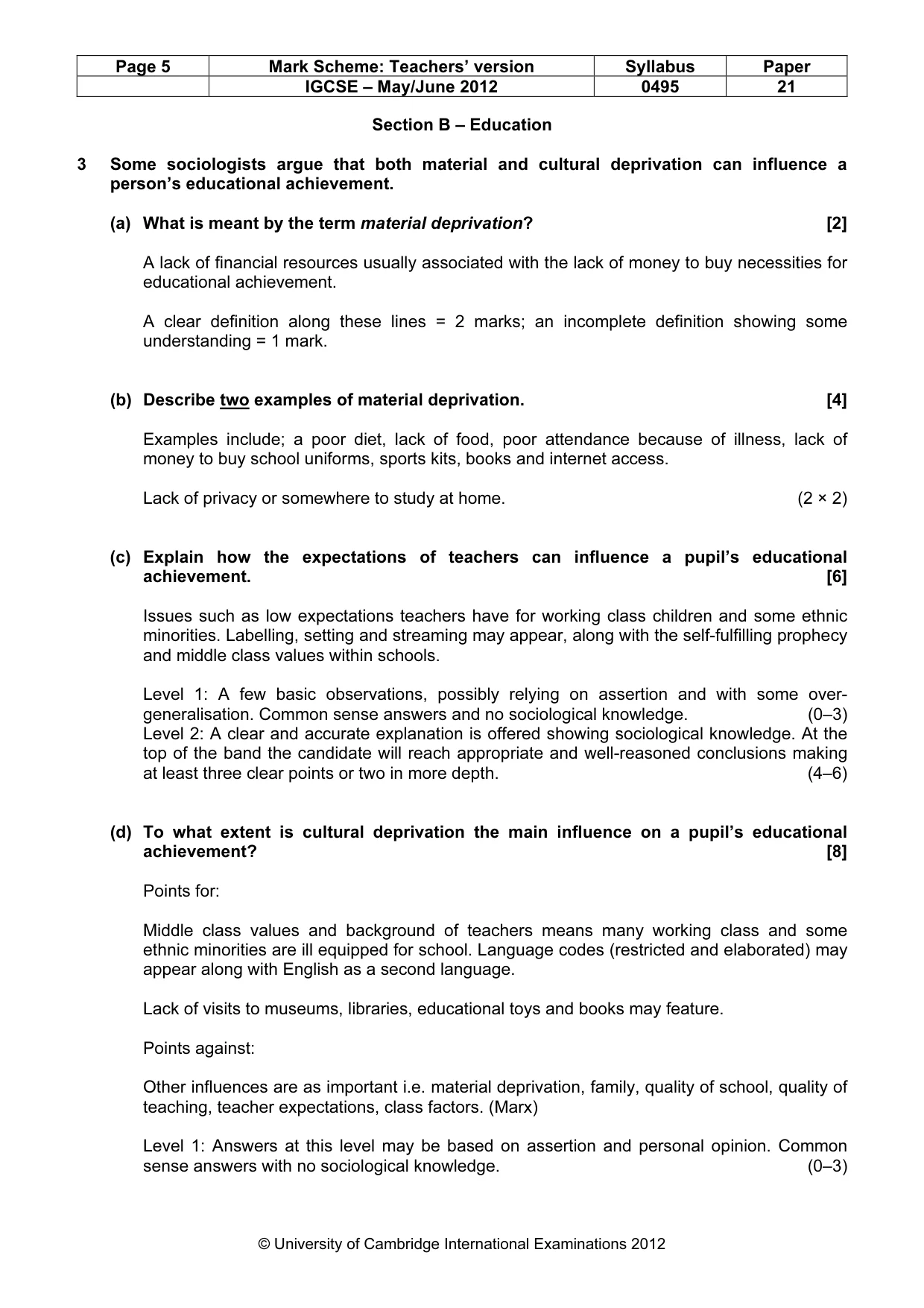
Page 5 Mark Scheme: Teachers’ version Syllabus Paper IGCSE – May/June 2012 0495 21 © University of Cambridge International Examinations 2012 Section B – Education 3 Some sociologists argue that both material and cultural deprivation can influence a person’s educational achievement. (a) What is meant by the term material deprivation? [2] A lack of financial resources usually associated with the lack of money to buy necessities for educational achievement. A clear definition along these lines = 2 marks; an incomplete definition showing some understanding = 1 mark. (b) Describe two examples of material deprivation. [4] Examples include; a poor diet, lack of food, poor attendance because of illness, lack of money to buy school uniforms, sports kits, books and internet access. Lack of privacy or somewhere to study at home. (2 × 2) (c) Explain how the expectations of teachers can influence a pupil’s educational achievement. [6] Issues such as low expectations teachers have for working class children and some ethnic minorities. Labelling, setting and streaming may appear, along with the self-fulfilling prophecy and middle class values within schools. Level 1: A few basic observations, possibly relying on assertion and with some over- generalisation. Common sense answers and no sociological knowledge. (0–3) Level 2: A clear and accurate explanation is offered showing sociological knowledge. At the top of the band the candidate will reach appropriate and well-reasoned conclusions making at least three clear points or two in more depth. (4–6) (d) To what extent is cultural deprivation the main influence on a pupil’s educational achievement? [8] Points for: Middle class values and background of teachers means many working class and some ethnic minorities are ill equipped for school. Language codes (restricted and elaborated) may appear along with English as a second language. Lack of visits to museums, libraries, educational toys and books may feature. Points against: Other influences are as important i.e. material deprivation, family, quality of school, quality of teaching, teacher expectations, class factors. (Marx) Level 1: Answers at this level may be based on assertion and personal opinion. Common sense answers with no sociological knowledge. (0–3)
Mark scheme, page 6
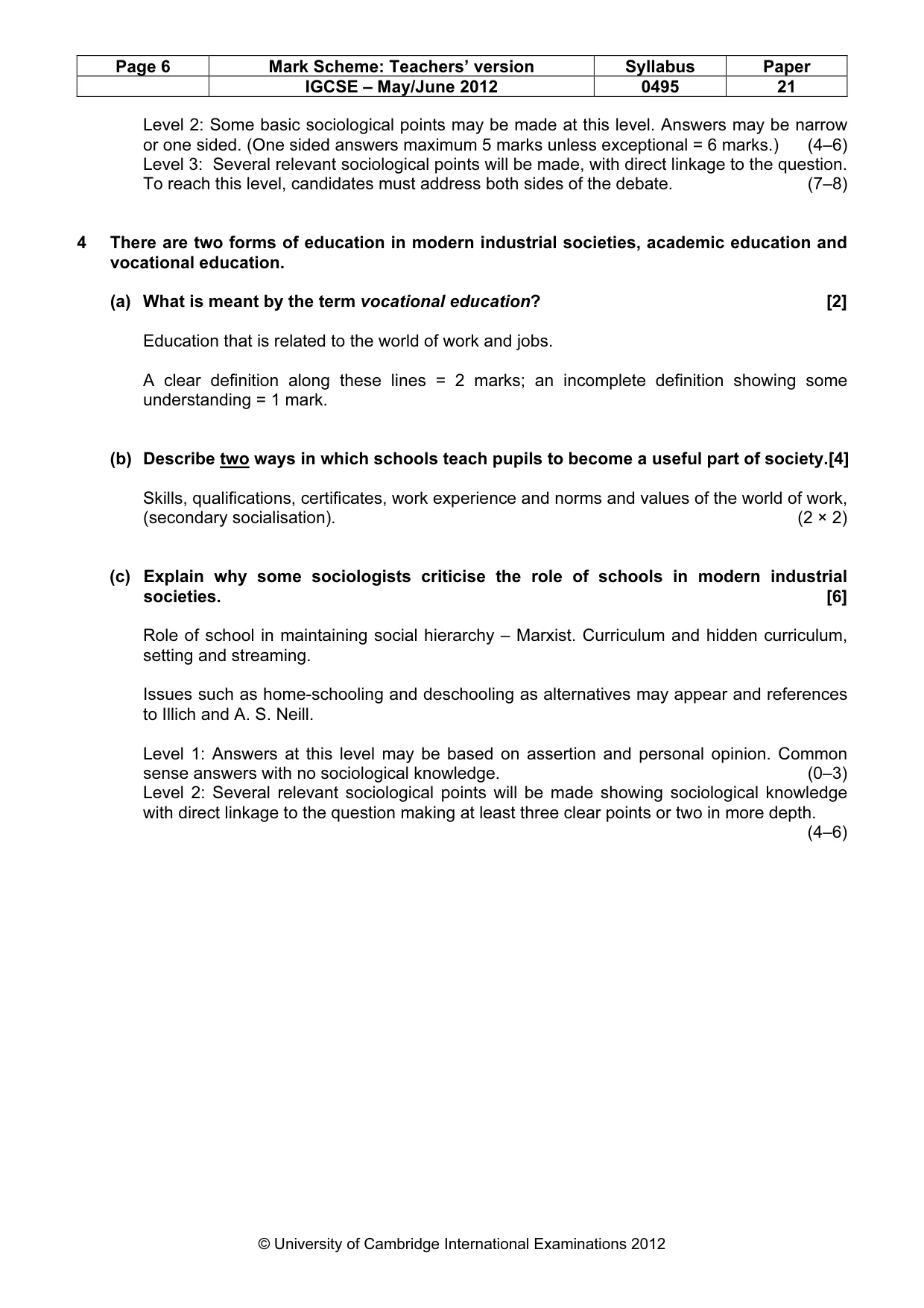
Page 6 Mark Scheme: Teachers’ version Syllabus Paper IGCSE – May/June 2012 0495 21 © University of Cambridge International Examinations 2012 Level 2: Some basic sociological points may be made at this level. Answers may be narrow or one sided. (One sided answers maximum 5 marks unless exceptional = 6 marks.) (4–6) Level 3: Several relevant sociological points will be made, with direct linkage to the question. To reach this level, candidates must address both sides of the debate. (7–8) 4 There are two forms of education in modern industrial societies, academic education and vocational education. (a) What is meant by the term vocational education? [2] Education that is related to the world of work and jobs. A clear definition along these lines = 2 marks; an incomplete definition showing some understanding = 1 mark. (b) Describe two ways in which schools teach pupils to become a useful part of society.[4] Skills, qualifications, certificates, work experience and norms and values of the world of work, (secondary socialisation). (2 × 2) (c) Explain why some sociologists criticise the role of schools in modern industrial societies. [6] Role of school in maintaining social hierarchy – Marxist. Curriculum and hidden curriculum, setting and streaming. Issues such as home-schooling and deschooling as alternatives may appear and references to Illich and A. S. Neill. Level 1: Answers at this level may be based on assertion and personal opinion. Common sense answers with no sociological knowledge. (0–3) Level 2: Several relevant sociological points will be made showing sociological knowledge with direct linkage to the question making at least three clear points or two in more depth. (4–6)
Mark scheme, page 7
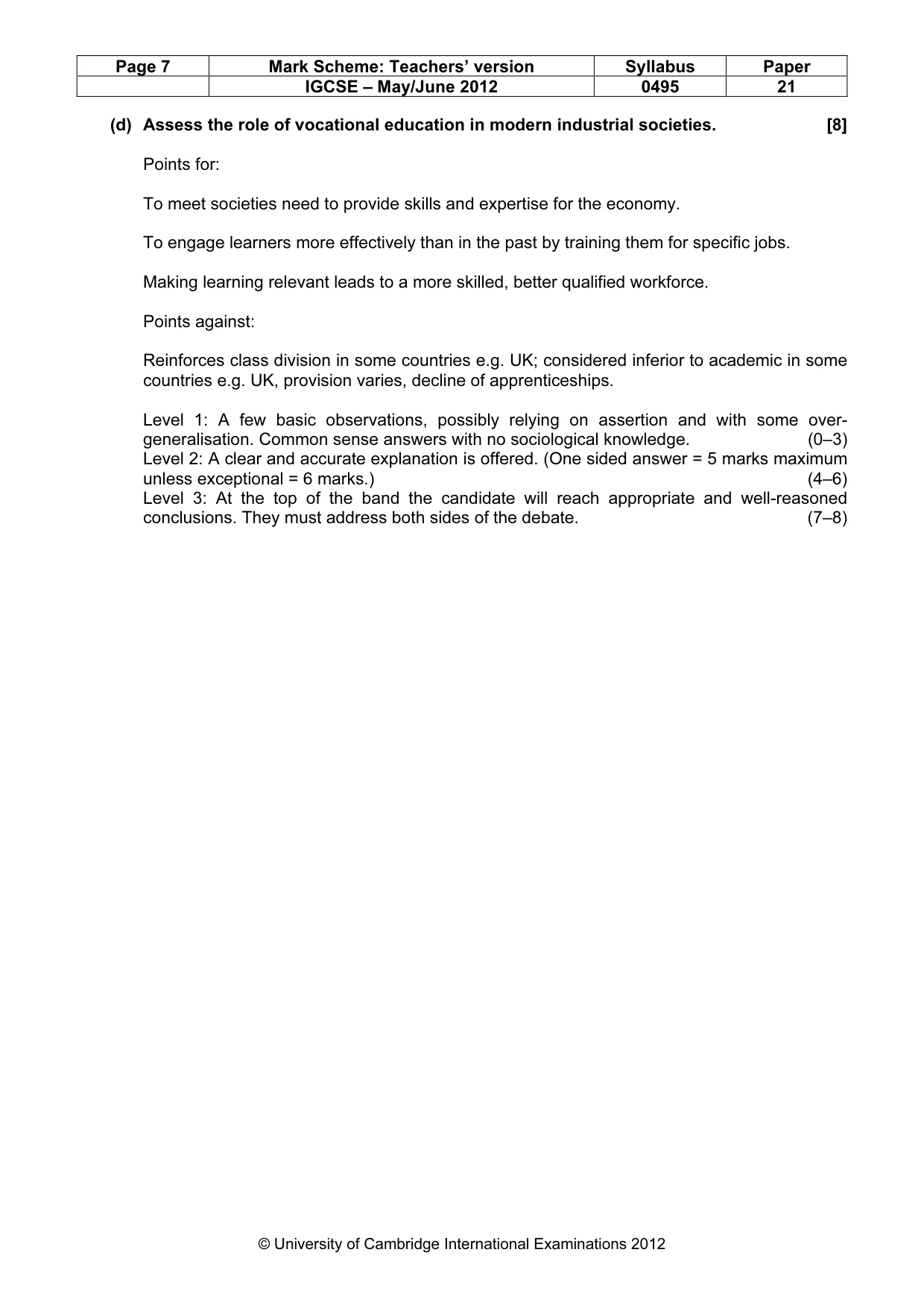
Page 7 Mark Scheme: Teachers’ version Syllabus Paper IGCSE – May/June 2012 0495 21 © University of Cambridge International Examinations 2012 (d) Assess the role of vocational education in modern industrial societies. [8] Points for: To meet societies need to provide skills and expertise for the economy. To engage learners more effectively than in the past by training them for specific jobs. Making learning relevant leads to a more skilled, better qualified workforce. Points against: Reinforces class division in some countries e.g. UK; considered inferior to academic in some countries e.g. UK, provision varies, decline of apprenticeships. Level 1: A few basic observations, possibly relying on assertion and with some over- generalisation. Common sense answers with no sociological knowledge. (0–3) Level 2: A clear and accurate explanation is offered. (One sided answer = 5 marks maximum unless exceptional = 6 marks.) (4–6) Level 3: At the top of the band the candidate will reach appropriate and well-reasoned conclusions. They must address both sides of the debate. (7–8)
Mark scheme, page 8
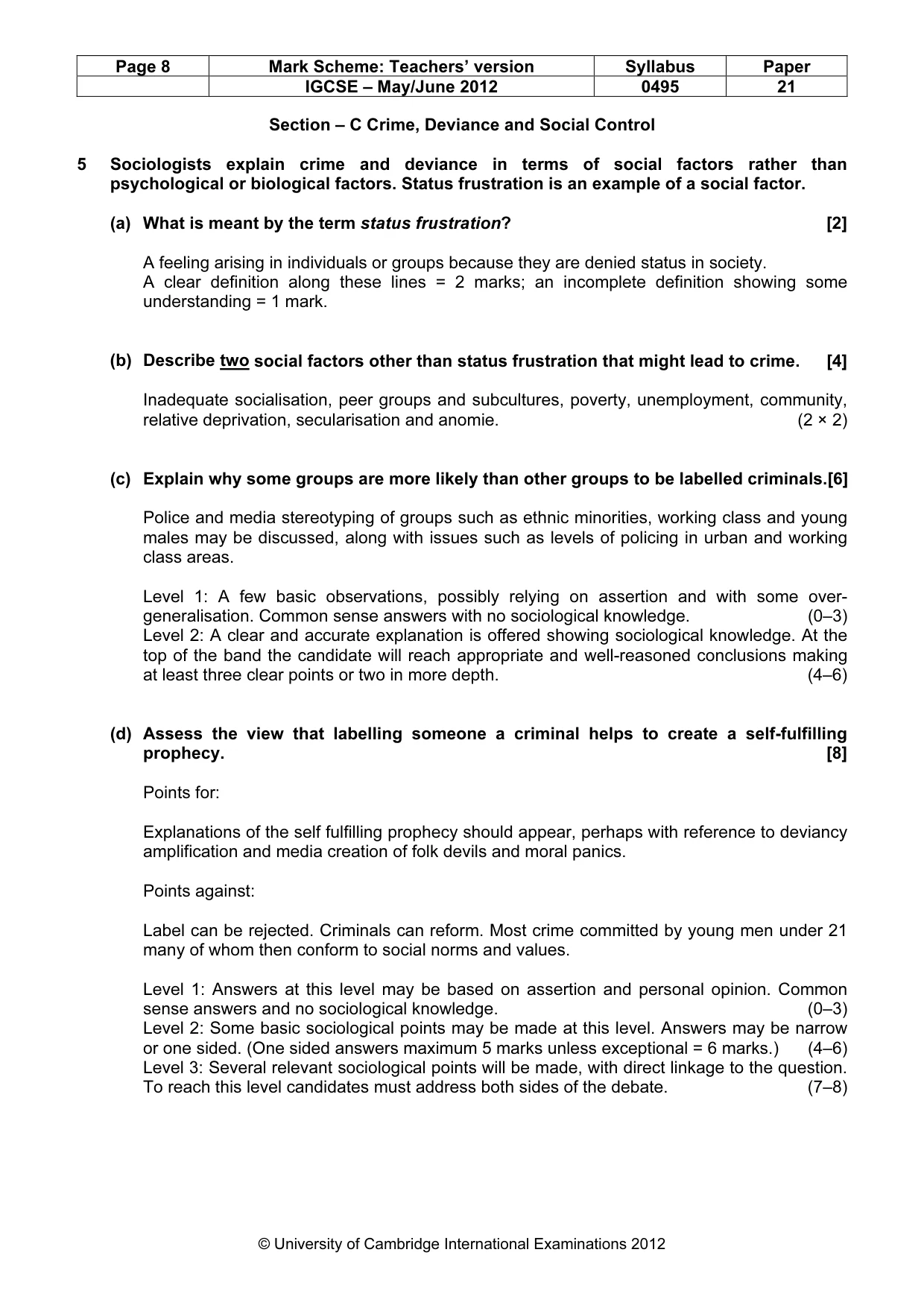
Page 8 Mark Scheme: Teachers’ version Syllabus Paper IGCSE – May/June 2012 0495 21 © University of Cambridge International Examinations 2012 Section – C Crime, Deviance and Social Control 5 Sociologists explain crime and deviance in terms of social factors rather than psychological or biological factors. Status frustration is an example of a social factor. (a) What is meant by the term status frustration? [2] A feeling arising in individuals or groups because they are denied status in society. A clear definition along these lines = 2 marks; an incomplete definition showing some understanding = 1 mark. (b) Describe two social factors other than status frustration that might lead to crime. [4] Inadequate socialisation, peer groups and subcultures, poverty, unemployment, community, relative deprivation, secularisation and anomie. (2 × 2) (c) Explain why some groups are more likely than other groups to be labelled criminals.[6] Police and media stereotyping of groups such as ethnic minorities, working class and young males may be discussed, along with issues such as levels of policing in urban and working class areas. Level 1: A few basic observations, possibly relying on assertion and with some over- generalisation. Common sense answers with no sociological knowledge. (0–3) Level 2: A clear and accurate explanation is offered showing sociological knowledge. At the top of the band the candidate will reach appropriate and well-reasoned conclusions making at least three clear points or two in more depth. (4–6) (d) Assess the view that labelling someone a criminal helps to create a self-fulfilling prophecy. [8] Points for: Explanations of the self fulfilling prophecy should appear, perhaps with reference to deviancy amplification and media creation of folk devils and moral panics. Points against: Label can be rejected. Criminals can reform. Most crime committed by young men under 21 many of whom then conform to social norms and values. Level 1: Answers at this level may be based on assertion and personal opinion. Common sense answers and no sociological knowledge. (0–3) Level 2: Some basic sociological points may be made at this level. Answers may be narrow or one sided. (One sided answers maximum 5 marks unless exceptional = 6 marks.) (4–6) Level 3: Several relevant sociological points will be made, with direct linkage to the question. To reach this level candidates must address both sides of the debate. (7–8)
Mark scheme, page 9
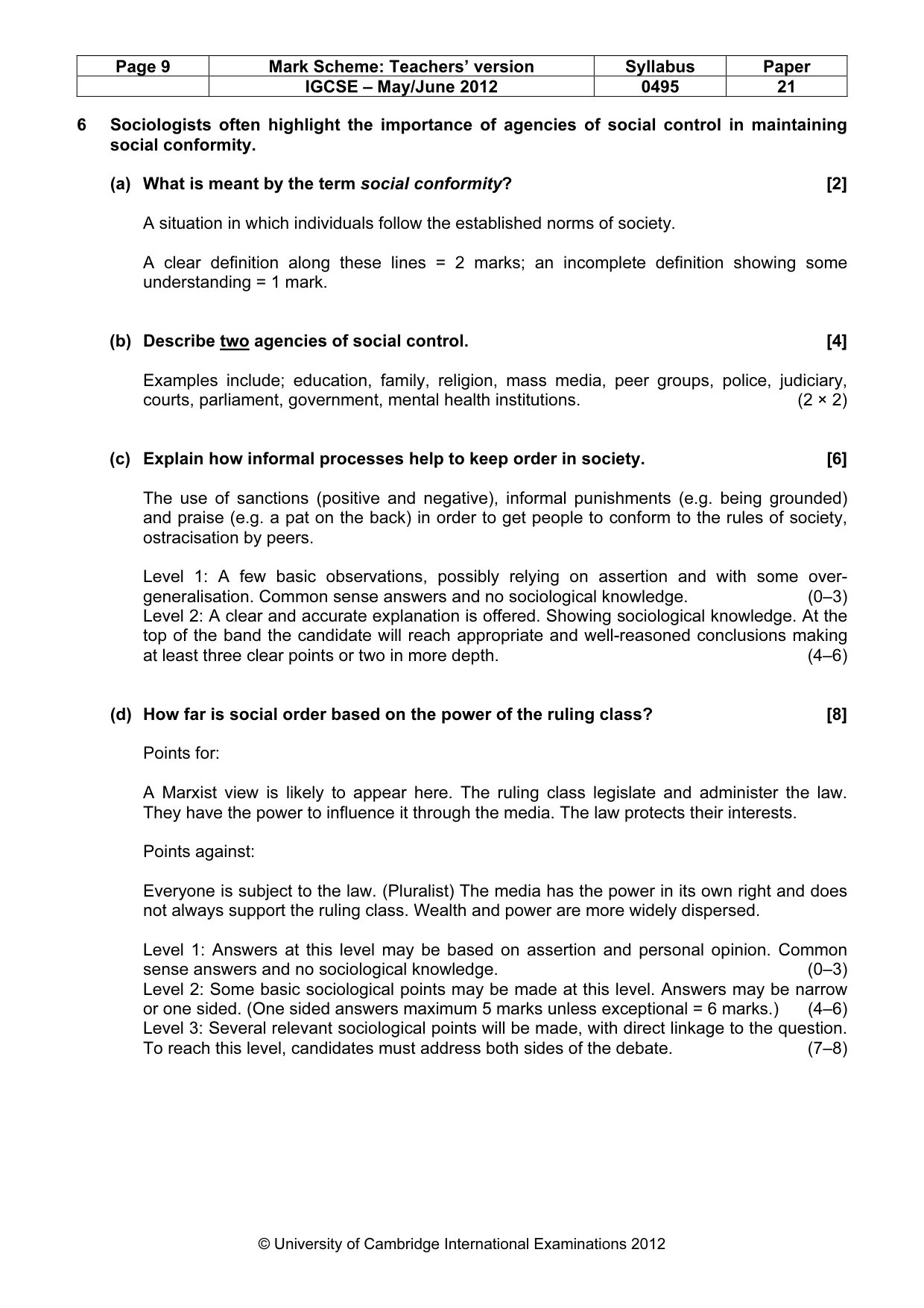
Page 9 Mark Scheme: Teachers’ version Syllabus Paper IGCSE – May/June 2012 0495 21 © University of Cambridge International Examinations 2012 6 Sociologists often highlight the importance of agencies of social control in maintaining social conformity. (a) What is meant by the term social conformity? [2] A situation in which individuals follow the established norms of society. A clear definition along these lines = 2 marks; an incomplete definition showing some understanding = 1 mark. (b) Describe two agencies of social control. [4] Examples include; education, family, religion, mass media, peer groups, police, judiciary, courts, parliament, government, mental health institutions. (2 × 2) (c) Explain how informal processes help to keep order in society. [6] The use of sanctions (positive and negative), informal punishments (e.g. being grounded) and praise (e.g. a pat on the back) in order to get people to conform to the rules of society, ostracisation by peers. Level 1: A few basic observations, possibly relying on assertion and with some over- generalisation. Common sense answers and no sociological knowledge. (0–3) Level 2: A clear and accurate explanation is offered. Showing sociological knowledge. At the top of the band the candidate will reach appropriate and well-reasoned conclusions making at least three clear points or two in more depth. (4–6) (d) How far is social order based on the power of the ruling class? [8] Points for: A Marxist view is likely to appear here. The ruling class legislate and administer the law. They have the power to influence it through the media. The law protects their interests. Points against: Everyone is subject to the law. (Pluralist) The media has the power in its own right and does not always support the ruling class. Wealth and power are more widely dispersed. Level 1: Answers at this level may be based on assertion and personal opinion. Common sense answers and no sociological knowledge. (0–3) Level 2: Some basic sociological points may be made at this level. Answers may be narrow or one sided. (One sided answers maximum 5 marks unless exceptional = 6 marks.) (4–6) Level 3: Several relevant sociological points will be made, with direct linkage to the question. To reach this level, candidates must address both sides of the debate. (7–8)
Mark scheme, page 10
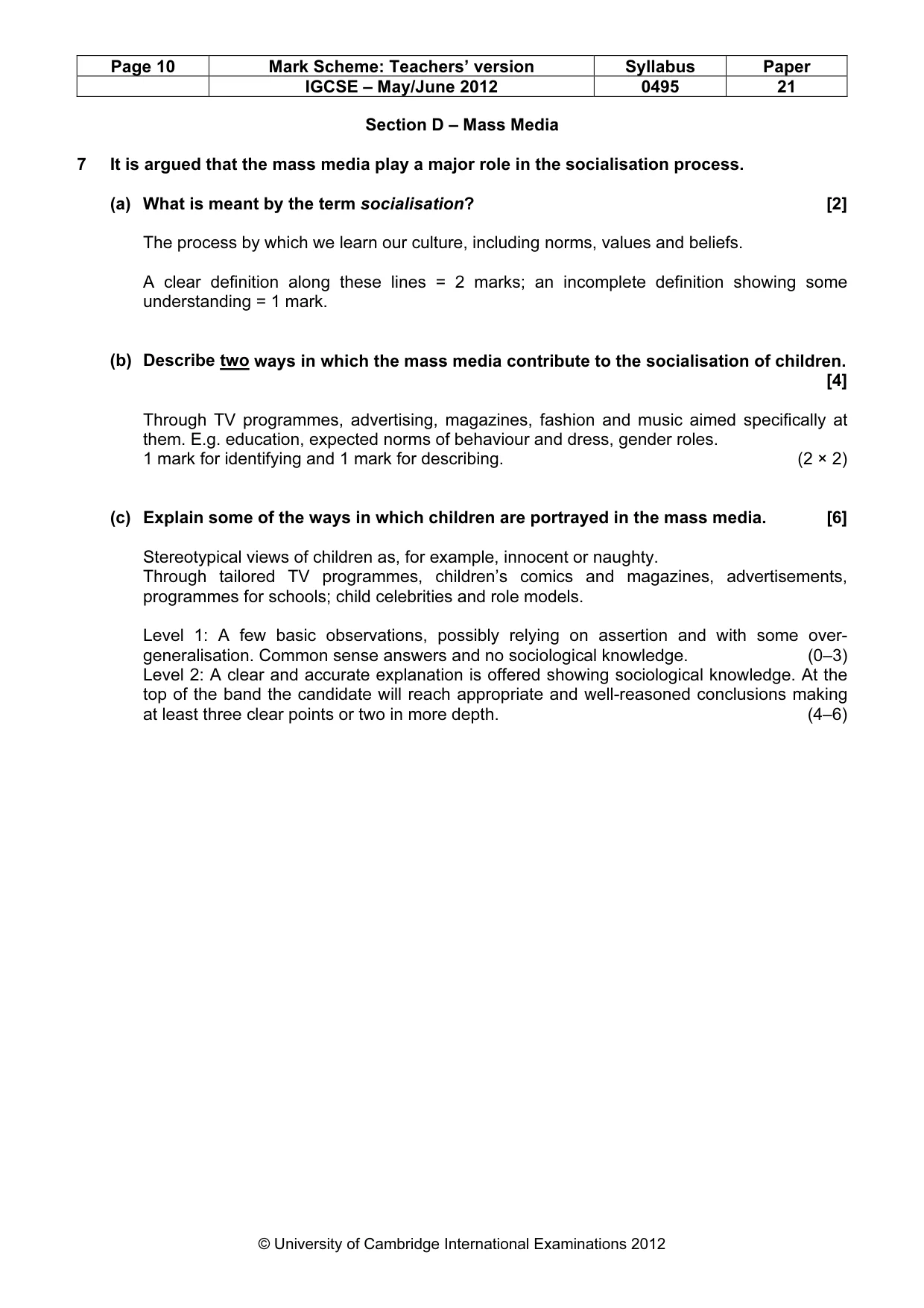
Page 10 Mark Scheme: Teachers’ version Syllabus Paper IGCSE – May/June 2012 0495 21 © University of Cambridge International Examinations 2012 Section D – Mass Media 7 It is argued that the mass media play a major role in the socialisation process. (a) What is meant by the term socialisation? [2] The process by which we learn our culture, including norms, values and beliefs. A clear definition along these lines = 2 marks; an incomplete definition showing some understanding = 1 mark. (b) Describe two ways in which the mass media contribute to the socialisation of children. [4] Through TV programmes, advertising, magazines, fashion and music aimed specifically at them. E.g. education, expected norms of behaviour and dress, gender roles. 1 mark for identifying and 1 mark for describing. (2 × 2) (c) Explain some of the ways in which children are portrayed in the mass media. [6] Stereotypical views of children as, for example, innocent or naughty. Through tailored TV programmes, children’s comics and magazines, advertisements, programmes for schools; child celebrities and role models. Level 1: A few basic observations, possibly relying on assertion and with some over- generalisation. Common sense answers and no sociological knowledge. (0–3) Level 2: A clear and accurate explanation is offered showing sociological knowledge. At the top of the band the candidate will reach appropriate and well-reasoned conclusions making at least three clear points or two in more depth. (4–6)
Mark scheme, page 11
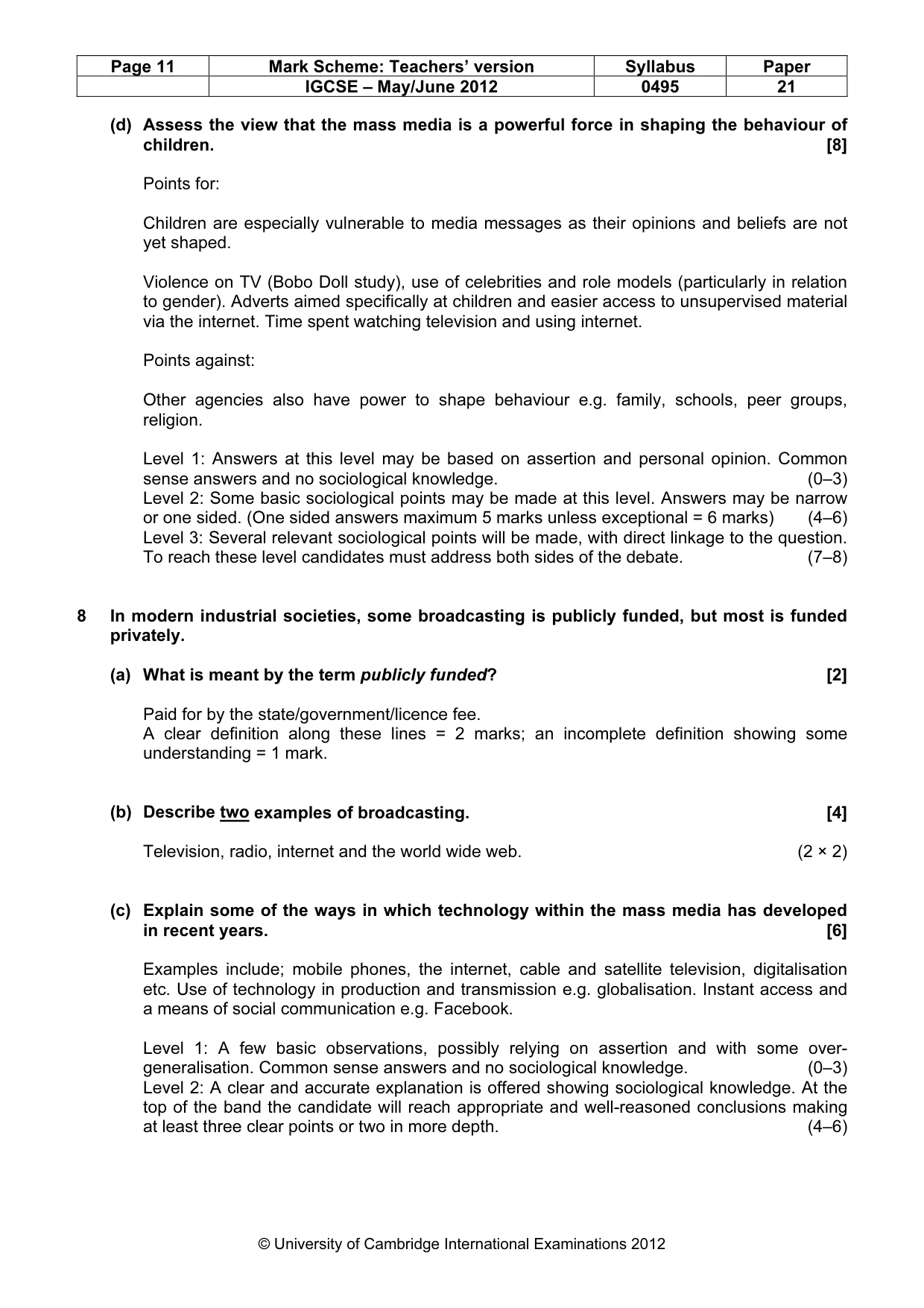
Page 11 Mark Scheme: Teachers’ version Syllabus Paper IGCSE – May/June 2012 0495 21 © University of Cambridge International Examinations 2012 (d) Assess the view that the mass media is a powerful force in shaping the behaviour of children. [8] Points for: Children are especially vulnerable to media messages as their opinions and beliefs are not yet shaped. Violence on TV (Bobo Doll study), use of celebrities and role models (particularly in relation to gender). Adverts aimed specifically at children and easier access to unsupervised material via the internet. Time spent watching television and using internet. Points against: Other agencies also have power to shape behaviour e.g. family, schools, peer groups, religion. Level 1: Answers at this level may be based on assertion and personal opinion. Common sense answers and no sociological knowledge. (0–3) Level 2: Some basic sociological points may be made at this level. Answers may be narrow or one sided. (One sided answers maximum 5 marks unless exceptional = 6 marks) (4–6) Level 3: Several relevant sociological points will be made, with direct linkage to the question. To reach these level candidates must address both sides of the debate. (7–8) 8 In modern industrial societies, some broadcasting is publicly funded, but most is funded privately. (a) What is meant by the term publicly funded? [2] Paid for by the state/government/licence fee. A clear definition along these lines = 2 marks; an incomplete definition showing some understanding = 1 mark. (b) Describe two examples of broadcasting. [4] Television, radio, internet and the world wide web. (2 × 2) (c) Explain some of the ways in which technology within the mass media has developed in recent years. [6] Examples include; mobile phones, the internet, cable and satellite television, digitalisation etc. Use of technology in production and transmission e.g. globalisation. Instant access and a means of social communication e.g. Facebook. Level 1: A few basic observations, possibly relying on assertion and with some over- generalisation. Common sense answers and no sociological knowledge. (0–3) Level 2: A clear and accurate explanation is offered showing sociological knowledge. At the top of the band the candidate will reach appropriate and well-reasoned conclusions making at least three clear points or two in more depth. (4–6)
Mark scheme, page 12
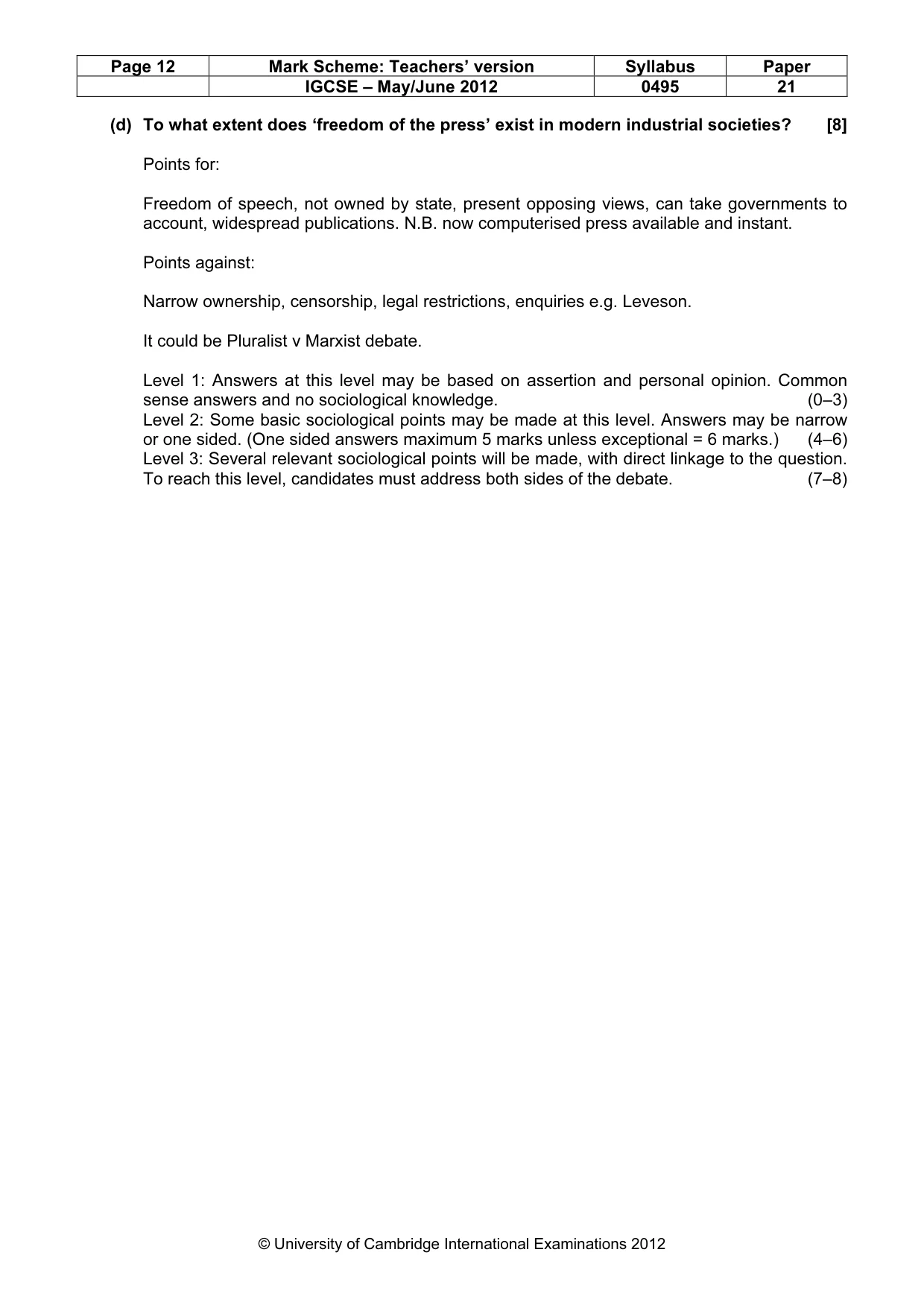
Page 12 Mark Scheme: Teachers’ version Syllabus Paper IGCSE – May/June 2012 0495 21 © University of Cambridge International Examinations 2012 (d) To what extent does ‘freedom of the press’ exist in modern industrial societies? [8] Points for: Freedom of speech, not owned by state, present opposing views, can take governments to account, widespread publications. N.B. now computerised press available and instant. Points against: Narrow ownership, censorship, legal restrictions, enquiries e.g. Leveson. It could be Pluralist v Marxist debate. Level 1: Answers at this level may be based on assertion and personal opinion. Common sense answers and no sociological knowledge. (0–3) Level 2: Some basic sociological points may be made at this level. Answers may be narrow or one sided. (One sided answers maximum 5 marks unless exceptional = 6 marks.) (4–6) Level 3: Several relevant sociological points will be made, with direct linkage to the question. To reach this level, candidates must address both sides of the debate. (7–8)
What you needed in this session
Cambridge’s own grade thresholds for 2012 May/June, Paper 2 · Variant 1. A higher threshold means an easier paper — the bar moves with how the cohort did.