Cambridge IGCSE Sociology 0495 — 2011 Oct/Nov Paper 2 · Variant 2
0495/22/O/N/11 · 60 marks · ≈68 min
The question paper and its mark scheme, free to read here and free to download. This is Cambridge’s own paper, exactly as it was sat.
Question paper28 pages

Mark scheme9 pages
Answers below. Sit the paper first if you are practising.
Paper as text
Question paper, page 1
This document consists of 25 printed pages and 3 blank pages. DC (SLM) 47735 © UCLES 2011 [Turn over UNIVERSITY OF CAMBRIDGE INTERNATIONAL EXAMINATIONS International General Certificate of Secondary Education SOCIOLOGY 0495/22 Paper 2 October/November 2011 1 hour 45 minutes Candidates answer on the Question Paper. No additional materials are required. READ THESE INSTRUCTIONS FIRST DO NOT WRITE IN ANY BARCODES. Write your Centre number, candidate number and name on all the work you hand in. Write in dark blue or black pen. You may use a soft pencil for any diagrams, graphs or rough working. Do not use staples, paper clips, highlighters, glue or correction fluid. Answer any three questions. You may not need all the answer lines for your answer. The number of marks is given in brackets [ ] at the end of each question or part question. * 3 0 0 9 9 7 9 5 0 4 * www.XtremePapers.com
Question paper, page 2
2 0495/22/O/N/11 © UCLES 2011 For Examiner’s Use Section A: Family 1 Although the nuclear family is in decline, it is still a common type of household unit in modern industrial societies. However, there are many other types of households. (a) What is meant by the term household? … … … … [2] (b) Describe two types of households other than the nuclear family. … … … … … … … … [4]
Question paper, page 3
3 0495/22/O/N/11 © UCLES 2011 [Turn over For Examiner’s Use (c) Explain why the number of nuclear families has declined in modern industrial societies. … … … … … … … … … … … … … … … … … … [6]
Question paper, page 4
4 0495/22/O/N/11 © UCLES 2011 For Examiner’s Use (d) Assess the view that the decline of the nuclear family threatens the stability of society. … … … … … … … … … … … … … … … … … … … … … … … … [8]
Question paper, page 5
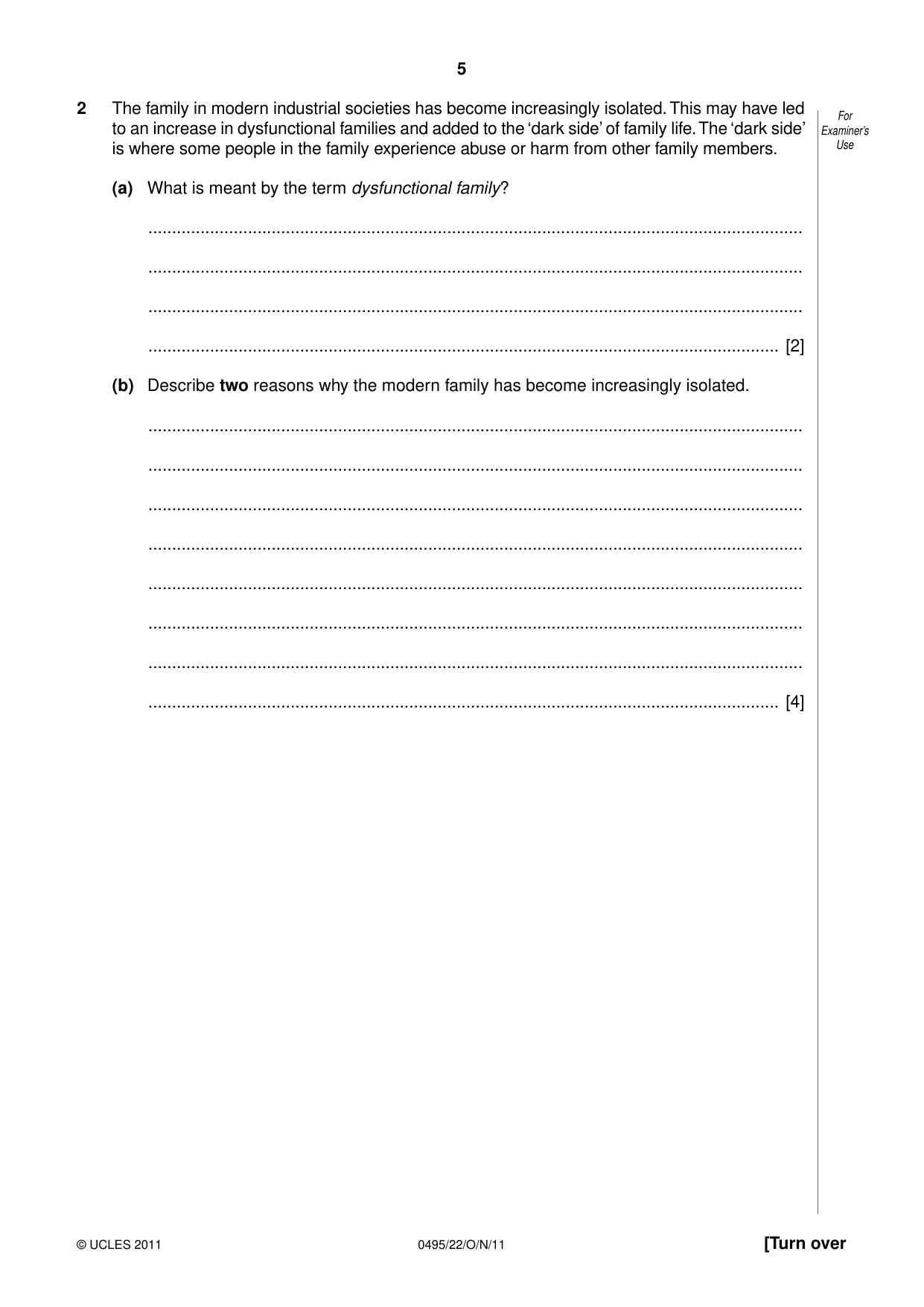
5 0495/22/O/N/11 © UCLES 2011 [Turn over For Examiner’s Use 2 The family in modern industrial societies has become increasingly isolated. This may have led to an increase in dysfunctional families and added to the ‘dark side’ of family life. The ‘dark side’ is where some people in the family experience abuse or harm from other family members. (a) What is meant by the term dysfunctional family? … … … … [2] (b) Describe two reasons why the modern family has become increasingly isolated. … … … … … … … … [4]
Question paper, page 6
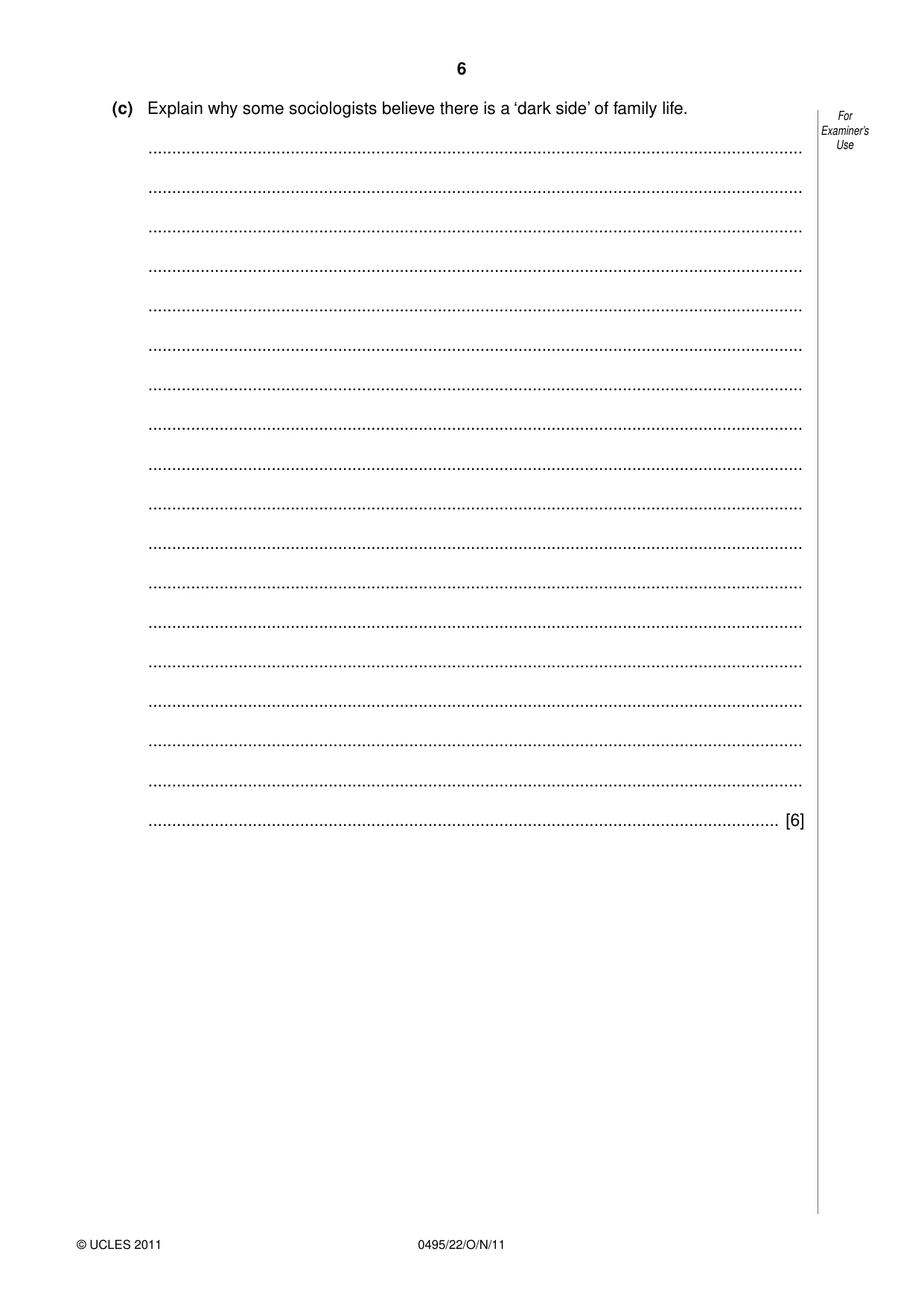
6 0495/22/O/N/11 © UCLES 2011 For Examiner’s Use (c) Explain why some sociologists believe there is a ‘dark side’ of family life. … … … … … … … … … … … … … … … … … … [6]
Question paper, page 7
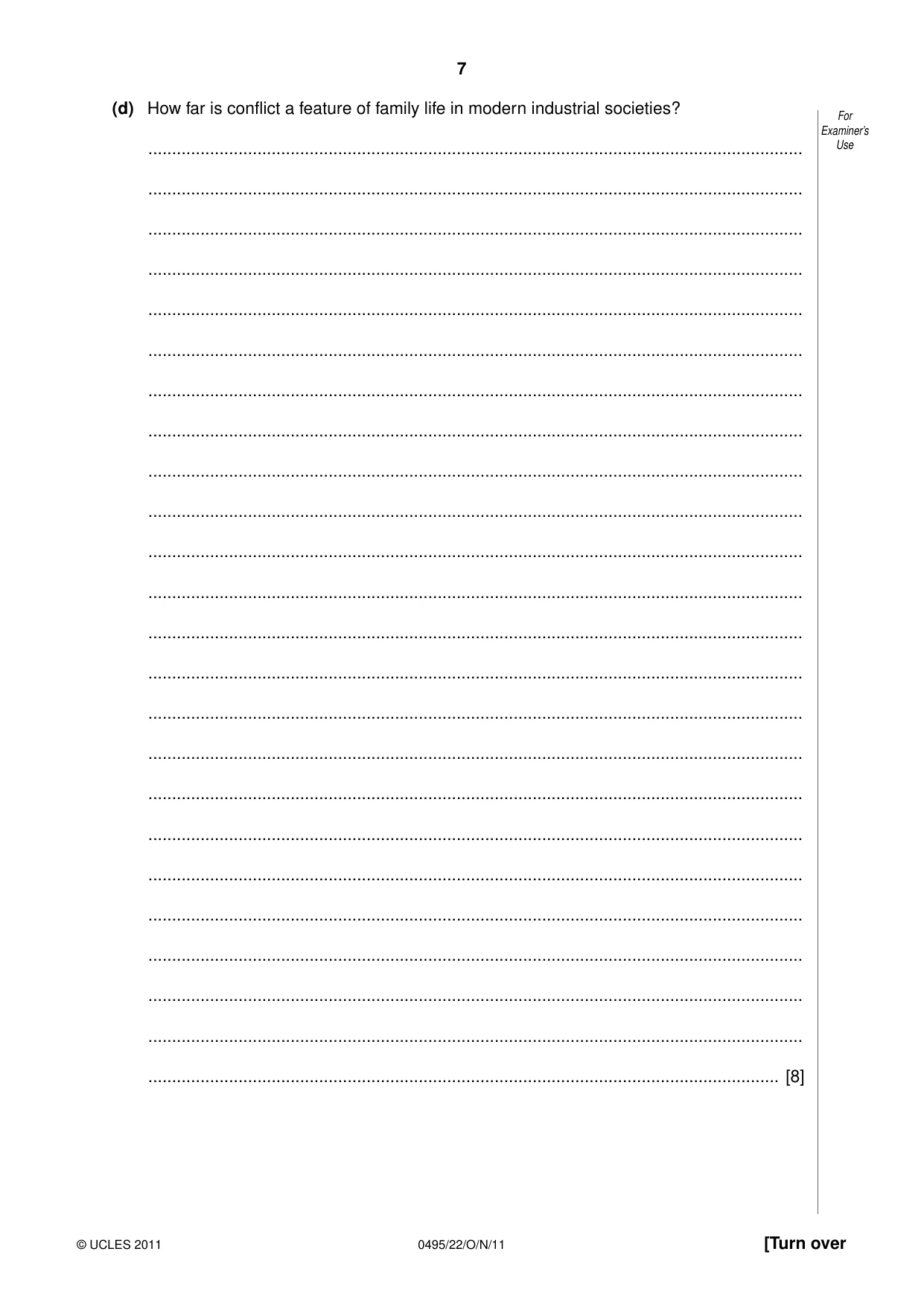
7 0495/22/O/N/11 © UCLES 2011 [Turn over For Examiner’s Use (d) How far is conflict a feature of family life in modern industrial societies? … … … … … … … … … … … … … … … … … … … … … … … … [8]
Question paper, page 8
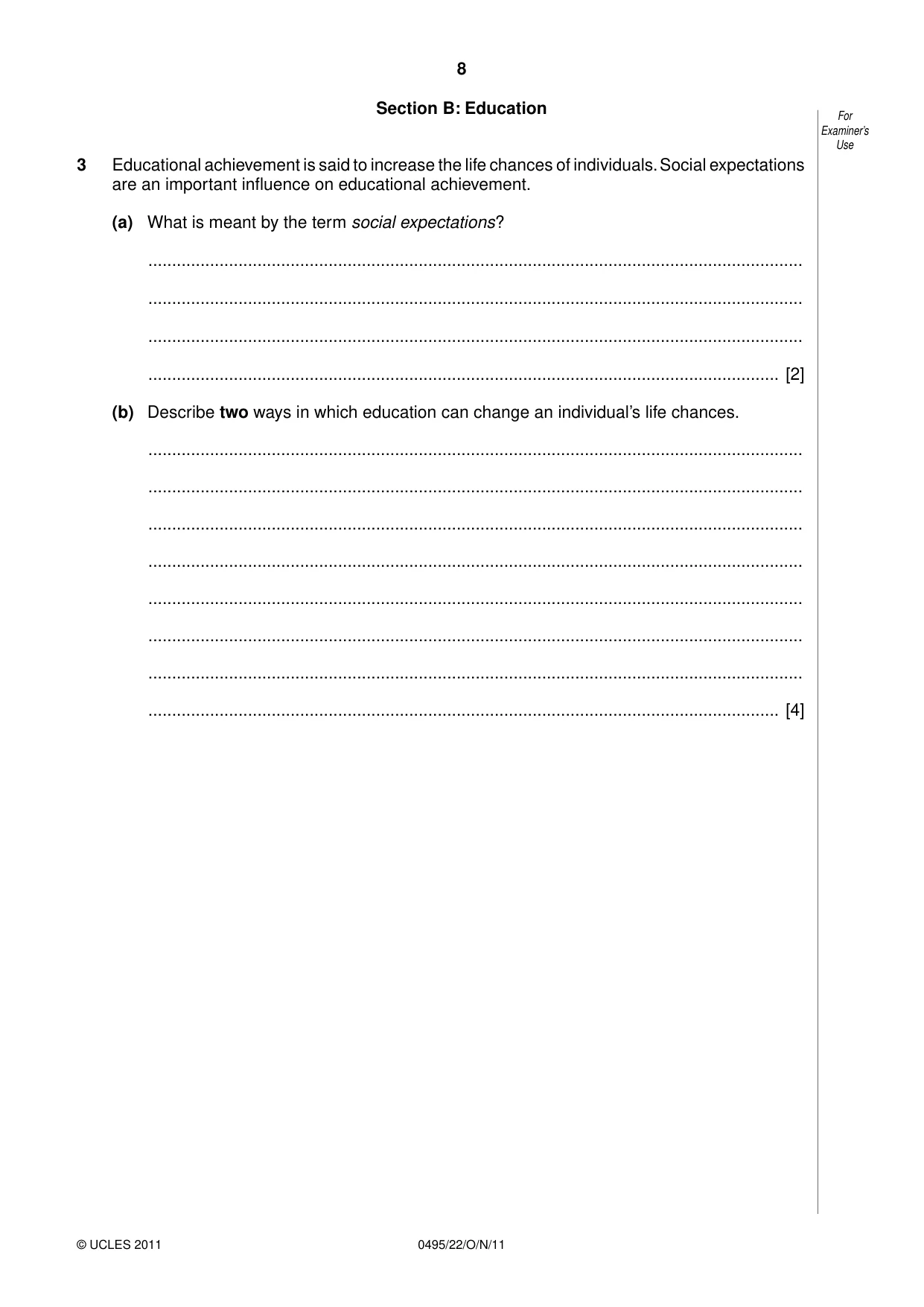
8 0495/22/O/N/11 © UCLES 2011 For Examiner’s Use Section B: Education 3 Educational achievement is said to increase the life chances of individuals. Social expectations are an important influence on educational achievement. (a) What is meant by the term social expectations? … … … … [2] (b) Describe two ways in which education can change an individual’s life chances. … … … … … … … … [4]
Question paper, page 9
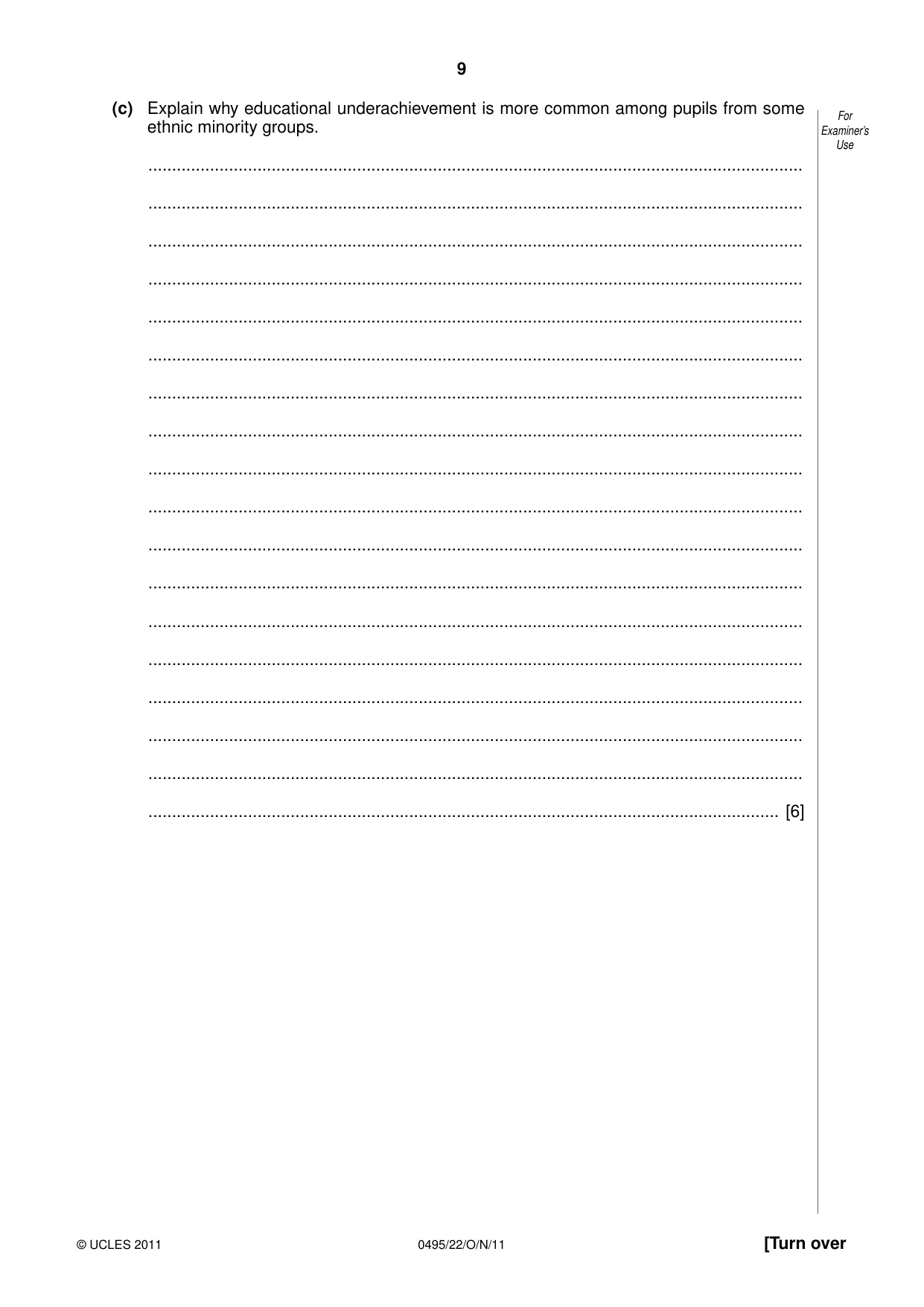
9 0495/22/O/N/11 © UCLES 2011 [Turn over For Examiner’s Use (c) Explain why educational underachievement is more common among pupils from some ethnic minority groups. … … … … … … … … … … … … … … … … … … [6]
Question paper, page 10
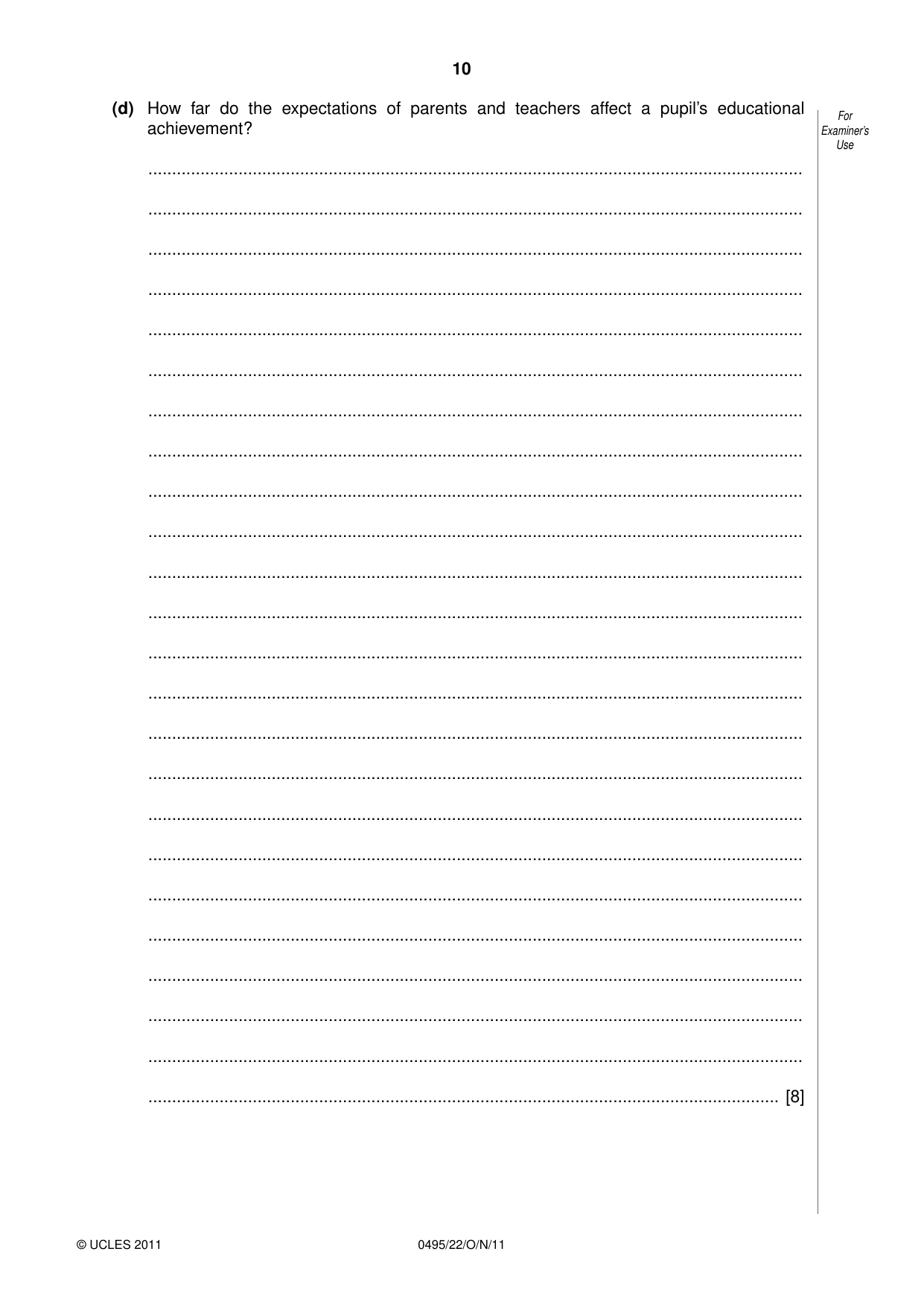
10 0495/22/O/N/11 © UCLES 2011 For Examiner’s Use (d) How far do the expectations of parents and teachers affect a pupil’s educational achievement? … … … … … … … … … … … … … … … … … … … … … … … … [8]
Question paper, page 11
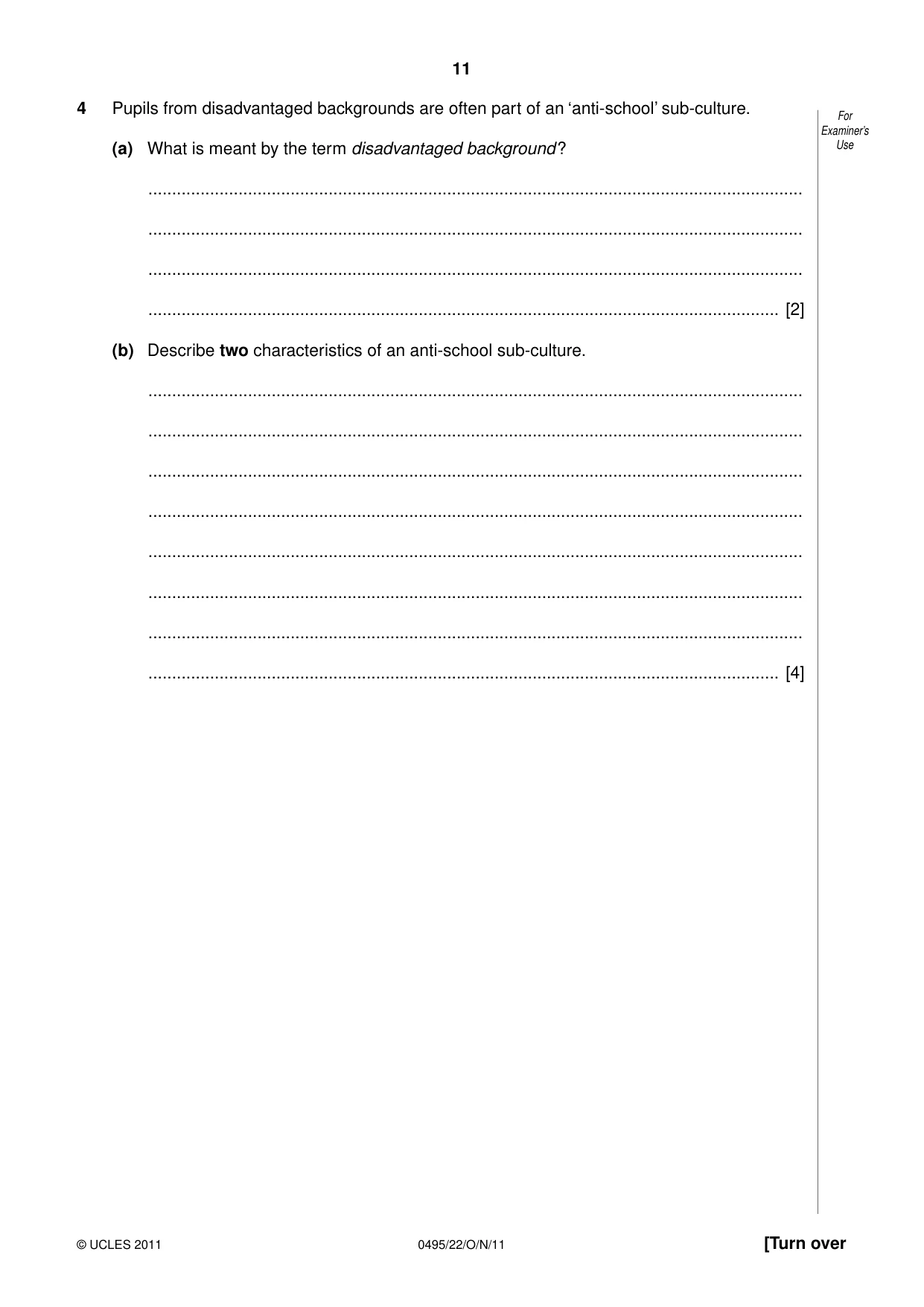
11 0495/22/O/N/11 © UCLES 2011 [Turn over For Examiner’s Use 4 Pupils from disadvantaged backgrounds are often part of an ‘anti-school’ sub-culture. (a) What is meant by the term disadvantaged background? … … … … [2] (b) Describe two characteristics of an anti-school sub-culture. … … … … … … … … [4]
Question paper, page 12
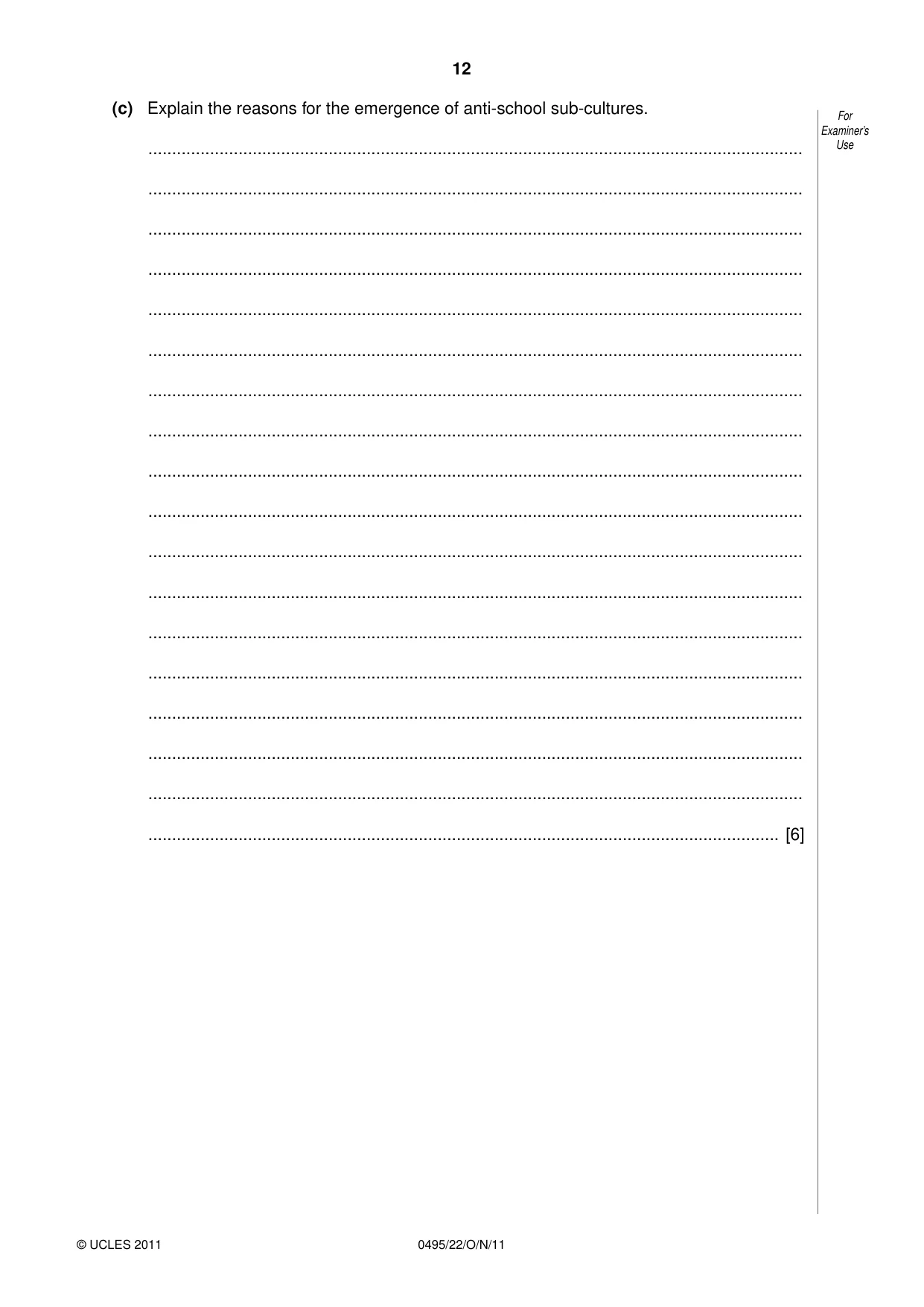
12 0495/22/O/N/11 © UCLES 2011 For Examiner’s Use (c) Explain the reasons for the emergence of anti-school sub-cultures. … … … … … … … … … … … … … … … … … … [6]
Question paper, page 13
13 0495/22/O/N/11 © UCLES 2011 [Turn over For Examiner’s Use (d) How far can the peer group influence the educational performance of pupils? … … … … … … … … … … … … … … … … … … … … … … … … [8]
Question paper, page 14
14 0495/22/O/N/11 © UCLES 2011 For Examiner’s Use Section C: Crime, Deviance and Social Control 5 Various agencies of social control exist to deter criminal behaviour. (a) What is meant by the term agencies of social control? … … … … [2] (b) Describe two agencies of social control. … … … … … … … … [4]
Question paper, page 15
15 0495/22/O/N/11 © UCLES 2011 [Turn over For Examiner’s Use (c) Explain how the mass media may influence levels of crime in society. … … … … … … … … … … … … … … … … … … [6]
Question paper, page 16
16 0495/22/O/N/11 © UCLES 2011 For Examiner’s Use (d) How far are powerful groups in society able to control what types of behaviour are defined as criminal? … … … … … … … … … … … … … … … … … … … … … … … … [8]
Question paper, page 17
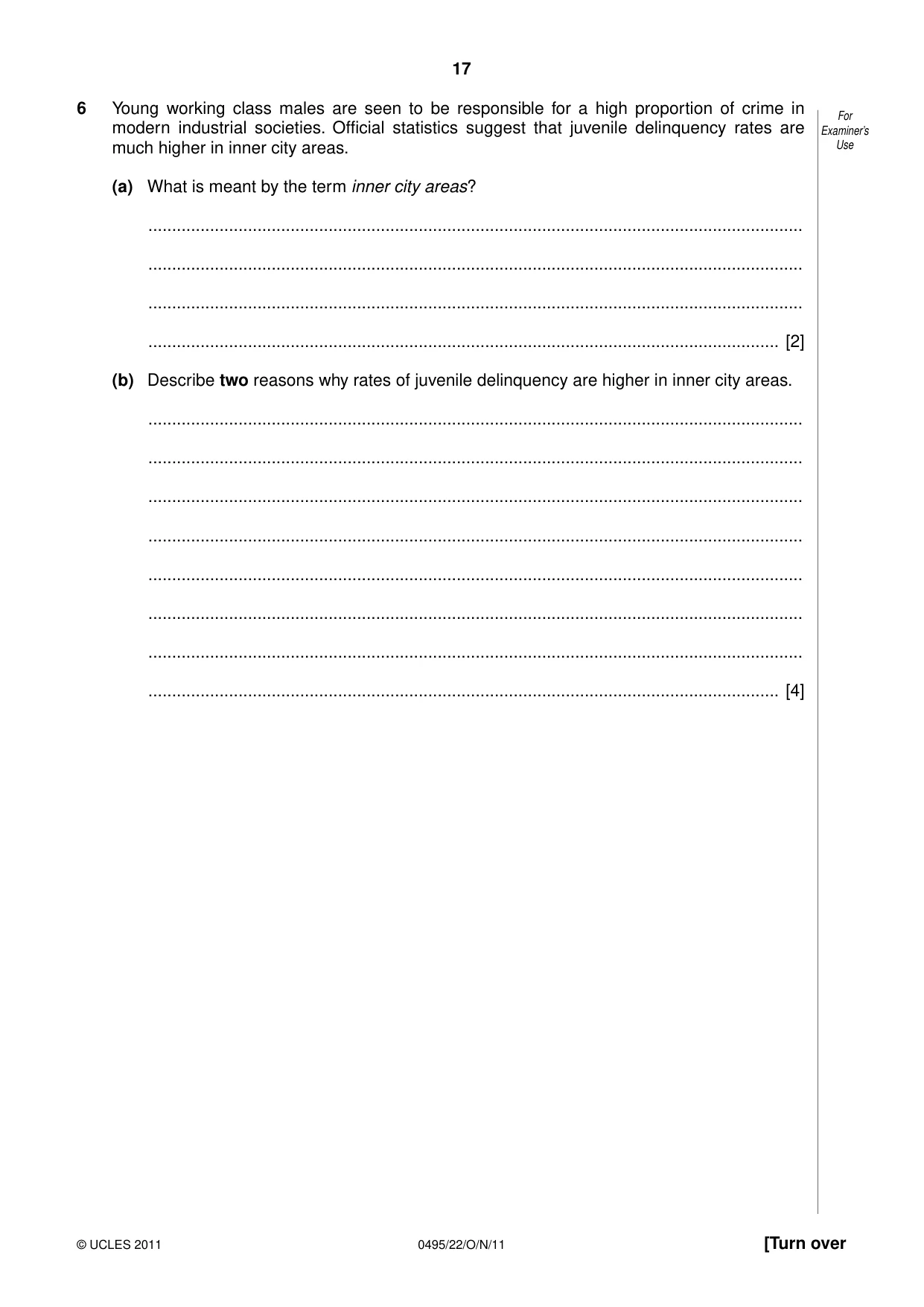
17 0495/22/O/N/11 © UCLES 2011 [Turn over For Examiner’s Use 6 Young working class males are seen to be responsible for a high proportion of crime in modern industrial societies. Official statistics suggest that juvenile delinquency rates are much higher in inner city areas. (a) What is meant by the term inner city areas? … … … … [2] (b) Describe two reasons why rates of juvenile delinquency are higher in inner city areas. … … … … … … … … [4]
Question paper, page 18
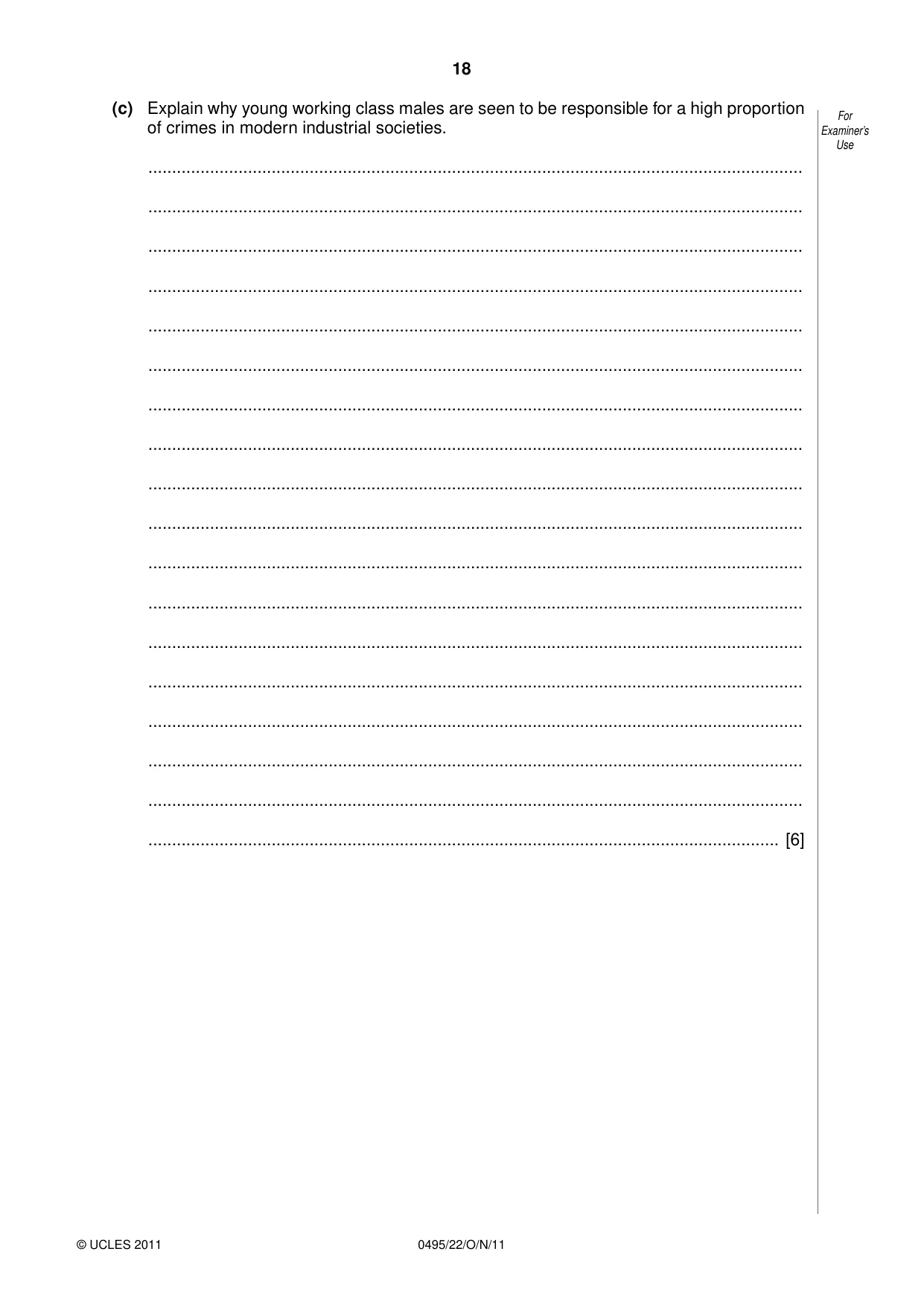
18 0495/22/O/N/11 © UCLES 2011 For Examiner’s Use (c) Explain why young working class males are seen to be responsible for a high proportion of crimes in modern industrial societies. … … … … … … … … … … … … … … … … … … [6]
Question paper, page 19
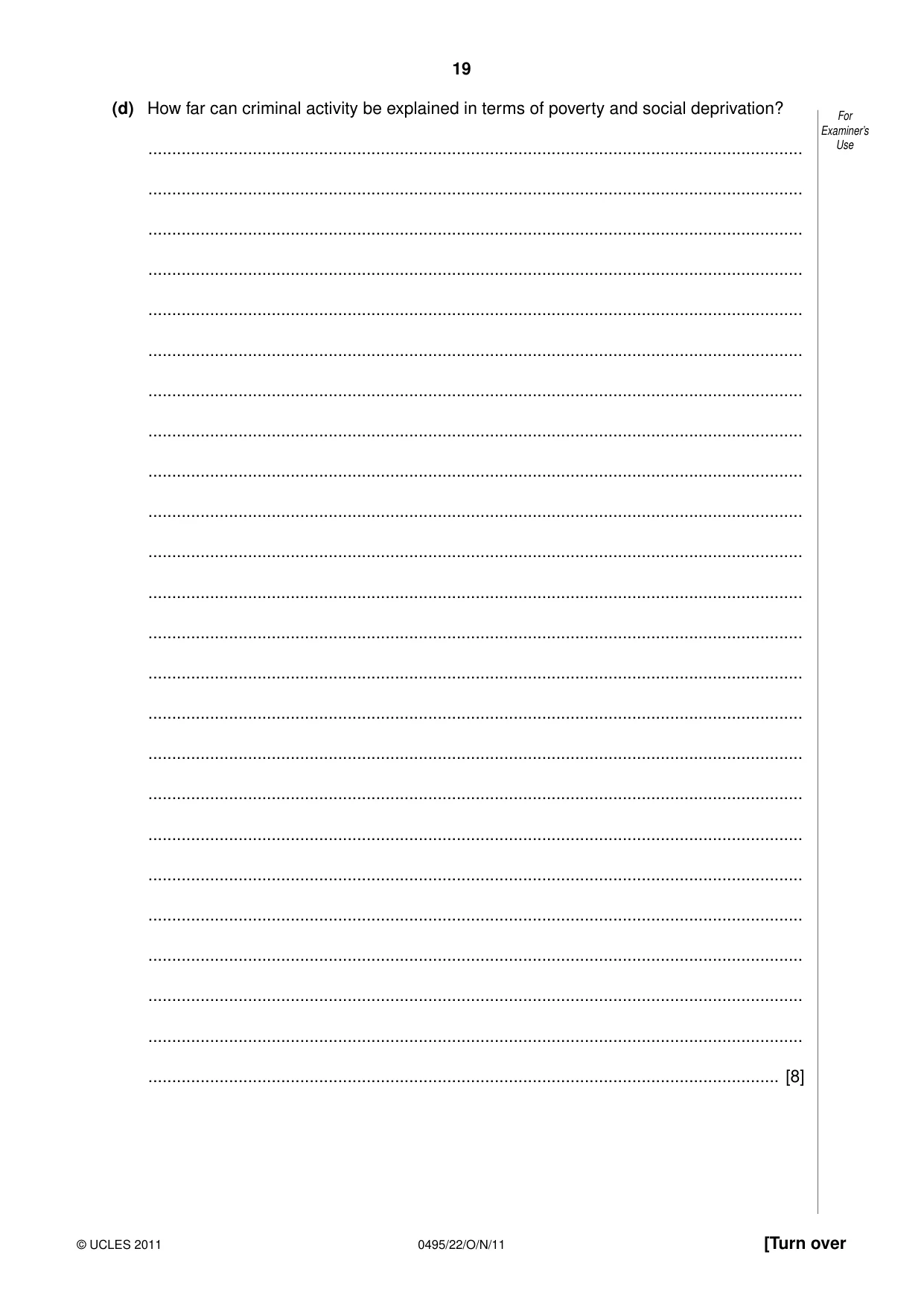
19 0495/22/O/N/11 © UCLES 2011 [Turn over For Examiner’s Use (d) How far can criminal activity be explained in terms of poverty and social deprivation? … … … … … … … … … … … … … … … … … … … … … … … … [8]
Question paper, page 20
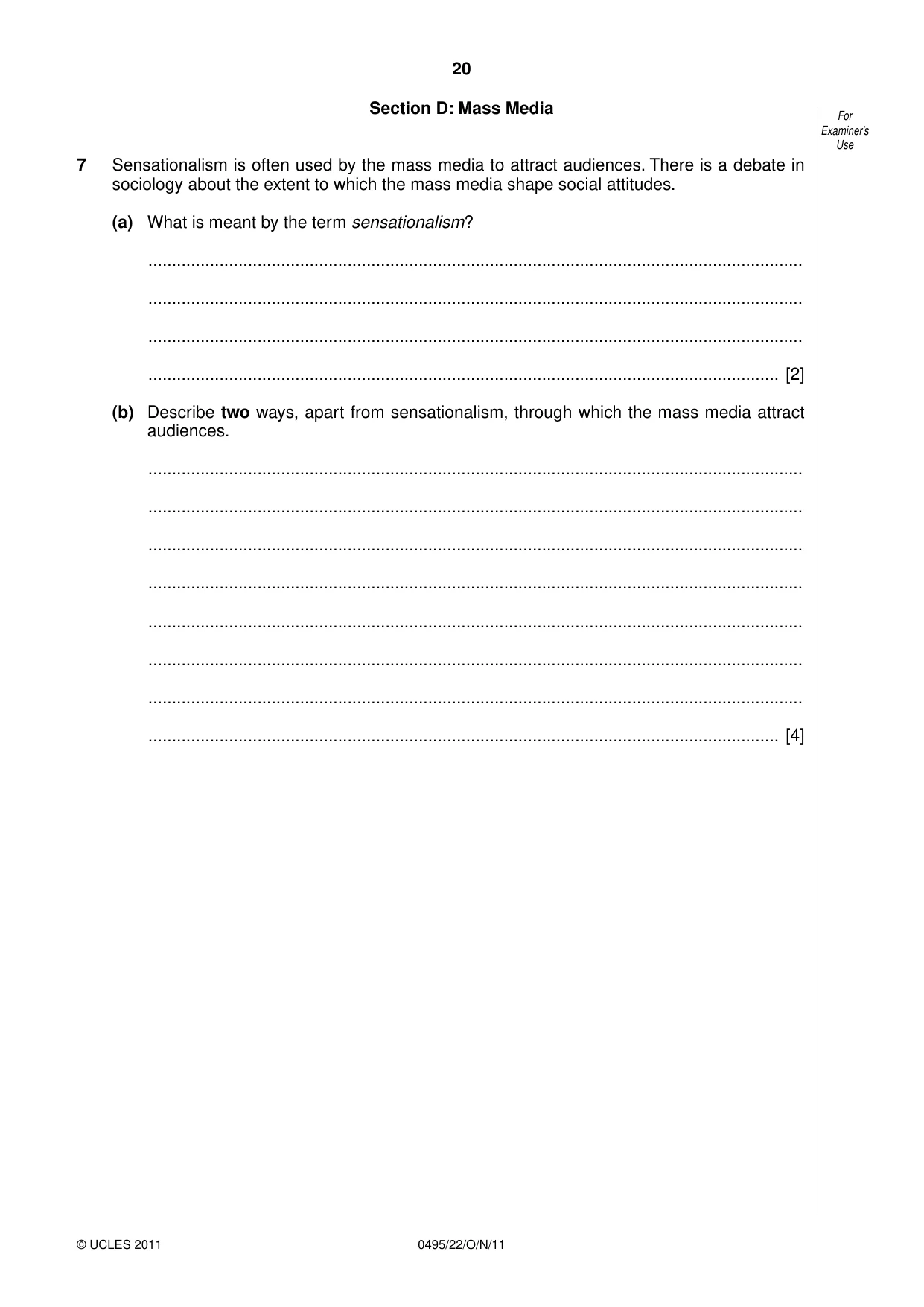
20 0495/22/O/N/11 © UCLES 2011 For Examiner’s Use Section D: Mass Media 7 Sensationalism is often used by the mass media to attract audiences. There is a debate in sociology about the extent to which the mass media shape social attitudes. (a) What is meant by the term sensationalism? … … … … [2] (b) Describe two ways, apart from sensationalism, through which the mass media attract audiences. … … … … … … … … [4]
Question paper, page 21
21 0495/22/O/N/11 © UCLES 2011 [Turn over For Examiner’s Use (c) Explain how the mass media use stereotypes to influence public opinion. … … … … … … … … … … … … … … … … … … [6]
Question paper, page 22
22 0495/22/O/N/11 © UCLES 2011 For Examiner’s Use (d) How far are social attitudes shaped by the mass media today? … … … … … … … … … … … … … … … … … … … … … … … … [8]
Question paper, page 23
23 0495/22/O/N/11 © UCLES 2011 [Turn over For Examiner’s Use 8 In modern industrial societies advertising may influence the type of goods and services that are bought. Advertising may also shape the way that people see themselves and the lifestyle choices they make. (a) What is meant by the term lifestyle? … … … … [2] (b) Describe two ways in which advertising in the mass media is used to influence what people buy. … … … … … … … … [4]
Question paper, page 24
24 0495/22/O/N/11 © UCLES 2011 For Examiner’s Use (c) Explain how the content of the mass media may be influenced by the need to attract advertisements. … … … … … … … … … … … … … … … … … … [6]
Question paper, page 25
25 0495/22/O/N/11 © UCLES 2011 For Examiner’s Use (d) Assess competing views of the role of the mass media in modern industrial societies. … … … … … … … … … … … … … … … … … … … … … … … … [8]
Question paper, page 26
26 0495/22/O/N/11 © UCLES 2011 BLANK PAGE
Question paper, page 27
27 0495/22/O/N/11 © UCLES 2011 BLANK PAGE
Question paper, page 28
28 0495/22/O/N/11 © UCLES 2011 Permission to reproduce items where third-party owned material protected by copyright is included has been sought and cleared where possible. Every reasonable effort has been made by the publisher (UCLES) to trace copyright holders, but if any items requiring clearance have unwittingly been included, the publisher will be pleased to make amends at the earliest possible opportunity. University of Cambridge International Examinations is part of the Cambridge Assessment Group. Cambridge Assessment is the brand name of University of Cambridge Local Examinations Syndicate (UCLES), which is itself a department of the University of Cambridge. BLANK PAGE
Mark scheme, page 1
UNIVERSITY OF CAMBRIDGE INTERNATIONAL EXAMINATIONS International General Certificate of Secondary Education MARK SCHEME for the October/November 2011 question paper for the guidance of teachers 0495 SOCIOLOGY 0495/22 Paper 2, maximum raw mark 60 This mark scheme is published as an aid to teachers and candidates, to indicate the requirements of the examination. It shows the basis on which Examiners were instructed to award marks. It does not indicate the details of the discussions that took place at an Examiners’ meeting before marking began, which would have considered the acceptability of alternative answers. Mark schemes must be read in conjunction with the question papers and the report on the examination. • Cambridge will not enter into discussions or correspondence in connection with these mark schemes. Cambridge is publishing the mark schemes for the October/November 2011 question papers for most IGCSE, GCE Advanced Level and Advanced Subsidiary Level syllabuses and some Ordinary Level syllabuses. www.XtremePapers.com
Mark scheme, page 2
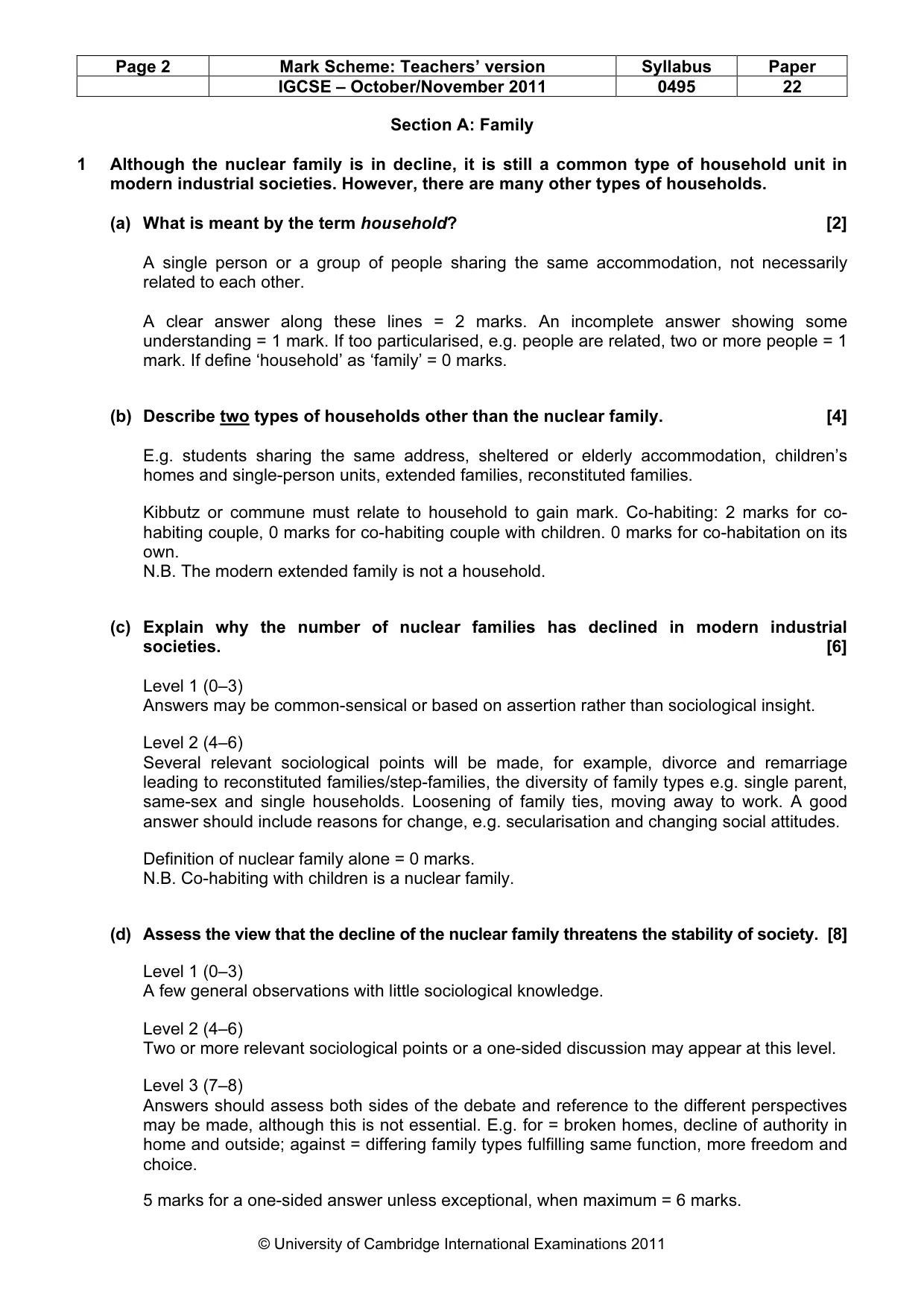
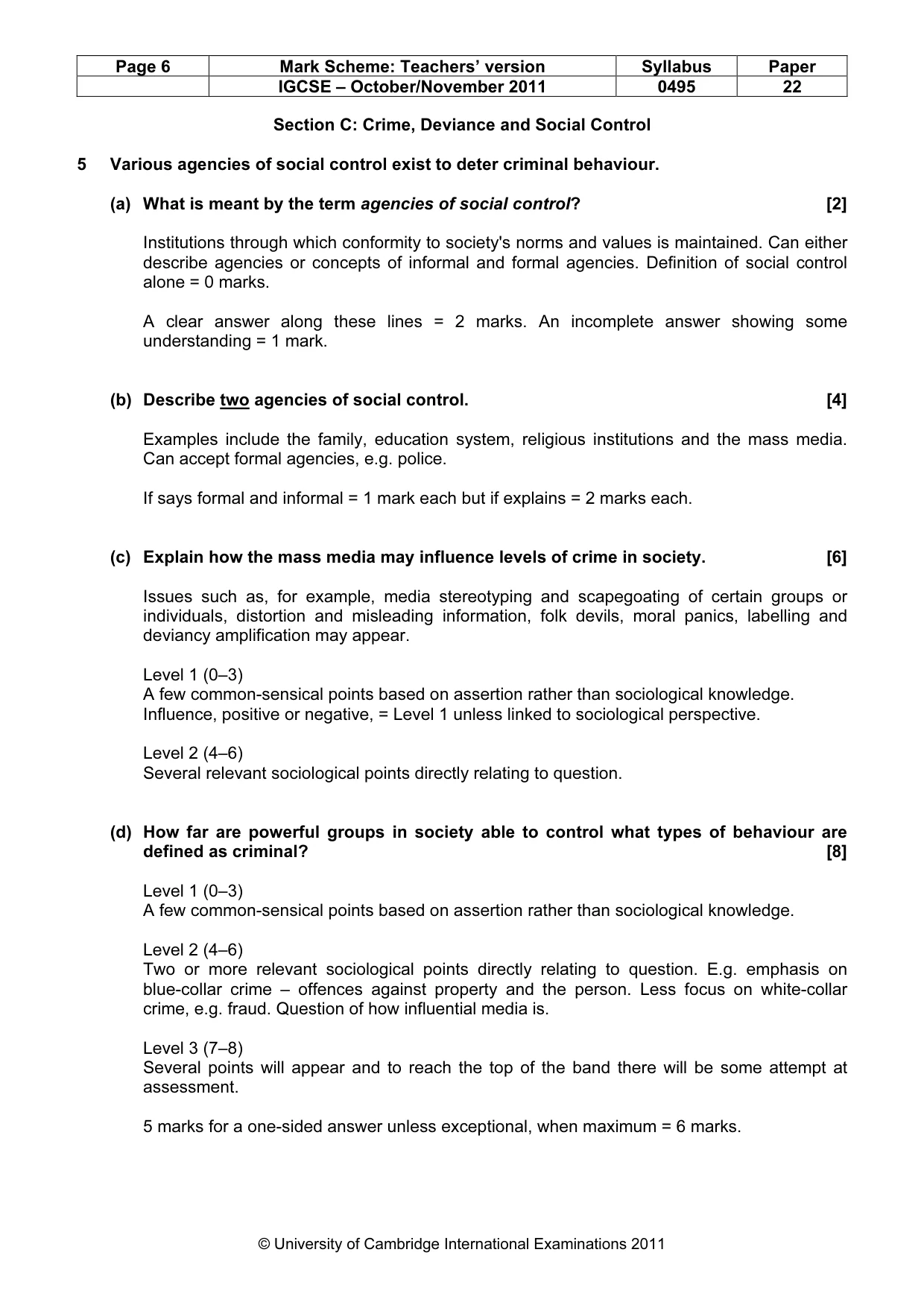
Page 2 Mark Scheme: Teachers’ version Syllabus Paper IGCSE – October/November 2011 0495 22 © University of Cambridge International Examinations 2011 Section A: Family 1 Although the nuclear family is in decline, it is still a common type of household unit in modern industrial societies. However, there are many other types of households. (a) What is meant by the term household? [2] A single person or a group of people sharing the same accommodation, not necessarily related to each other. A clear answer along these lines = 2 marks. An incomplete answer showing some understanding = 1 mark. If too particularised, e.g. people are related, two or more people = 1 mark. If define ‘household’ as ‘family’ = 0 marks. (b) Describe two types of households other than the nuclear family. [4] E.g. students sharing the same address, sheltered or elderly accommodation, children’s homes and single-person units, extended families, reconstituted families. Kibbutz or commune must relate to household to gain mark. Co-habiting: 2 marks for co- habiting couple, 0 marks for co-habiting couple with children. 0 marks for co-habitation on its own. N.B. The modern extended family is not a household. (c) Explain why the number of nuclear families has declined in modern industrial societies. [6] Level 1 (0–3) Answers may be common-sensical or based on assertion rather than sociological insight. Level 2 (4–6) Several relevant sociological points will be made, for example, divorce and remarriage leading to reconstituted families/step-families, the diversity of family types e.g. single parent, same-sex and single households. Loosening of family ties, moving away to work. A good answer should include reasons for change, e.g. secularisation and changing social attitudes. Definition of nuclear family alone = 0 marks. N.B. Co-habiting with children is a nuclear family. (d) Assess the view that the decline of the nuclear family threatens the stability of society. [8] Level 1 (0–3) A few general observations with little sociological knowledge. Level 2 (4–6) Two or more relevant sociological points or a one-sided discussion may appear at this level. Level 3 (7–8) Answers should assess both sides of the debate and reference to the different perspectives may be made, although this is not essential. E.g. for = broken homes, decline of authority in home and outside; against = differing family types fulfilling same function, more freedom and choice. 5 marks for a one-sided answer unless exceptional, when maximum = 6 marks.
Mark scheme, page 3
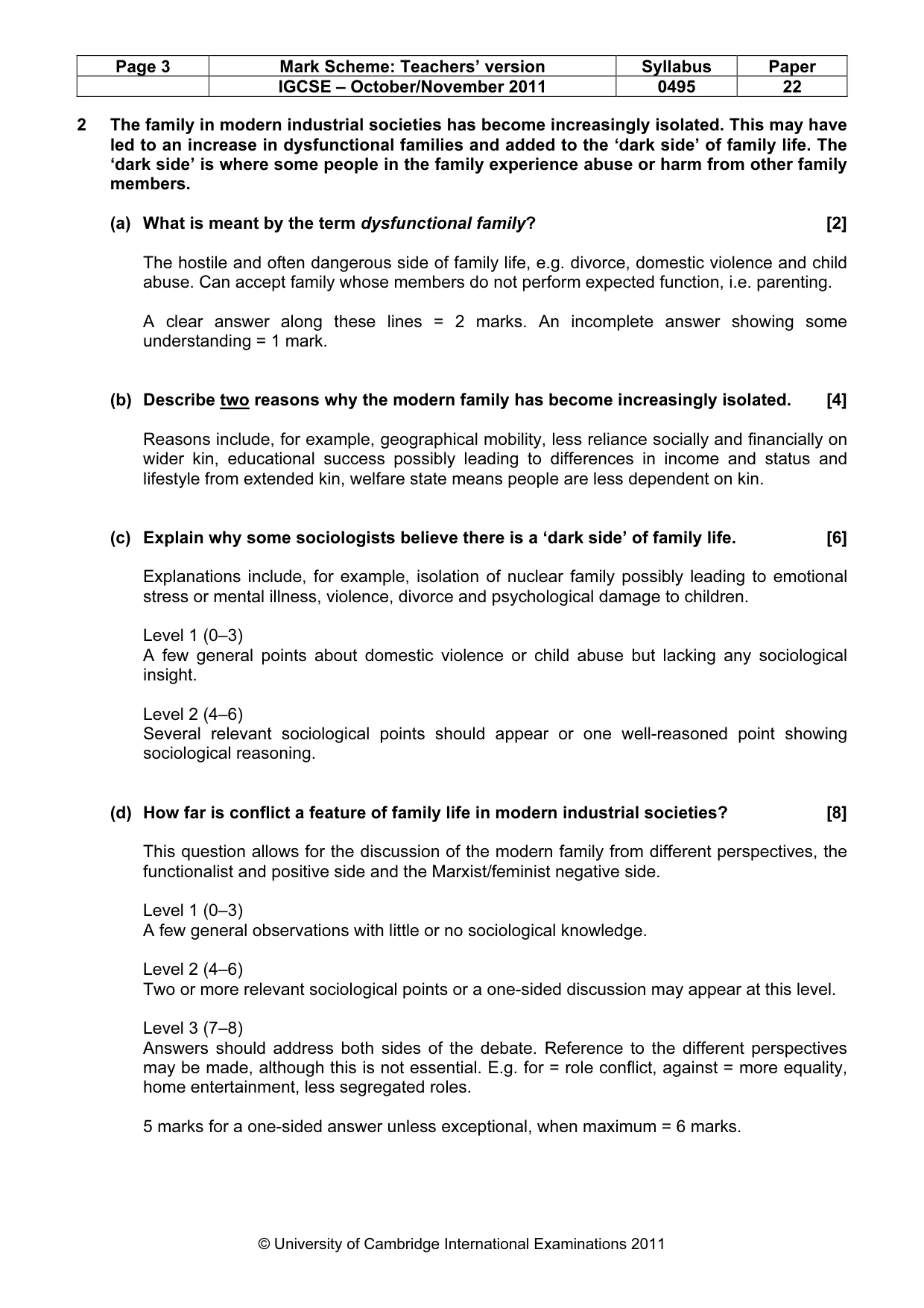
Page 3 Mark Scheme: Teachers’ version Syllabus Paper IGCSE – October/November 2011 0495 22 © University of Cambridge International Examinations 2011 2 The family in modern industrial societies has become increasingly isolated. This may have led to an increase in dysfunctional families and added to the ‘dark side’ of family life. The ‘dark side’ is where some people in the family experience abuse or harm from other family members. (a) What is meant by the term dysfunctional family? [2] The hostile and often dangerous side of family life, e.g. divorce, domestic violence and child abuse. Can accept family whose members do not perform expected function, i.e. parenting. A clear answer along these lines = 2 marks. An incomplete answer showing some understanding = 1 mark. (b) Describe two reasons why the modern family has become increasingly isolated. [4] Reasons include, for example, geographical mobility, less reliance socially and financially on wider kin, educational success possibly leading to differences in income and status and lifestyle from extended kin, welfare state means people are less dependent on kin. (c) Explain why some sociologists believe there is a ‘dark side’ of family life. [6] Explanations include, for example, isolation of nuclear family possibly leading to emotional stress or mental illness, violence, divorce and psychological damage to children. Level 1 (0–3) A few general points about domestic violence or child abuse but lacking any sociological insight. Level 2 (4–6) Several relevant sociological points should appear or one well-reasoned point showing sociological reasoning. (d) How far is conflict a feature of family life in modern industrial societies? [8] This question allows for the discussion of the modern family from different perspectives, the functionalist and positive side and the Marxist/feminist negative side. Level 1 (0–3) A few general observations with little or no sociological knowledge. Level 2 (4–6) Two or more relevant sociological points or a one-sided discussion may appear at this level. Level 3 (7–8) Answers should address both sides of the debate. Reference to the different perspectives may be made, although this is not essential. E.g. for = role conflict, against = more equality, home entertainment, less segregated roles. 5 marks for a one-sided answer unless exceptional, when maximum = 6 marks.
Mark scheme, page 4
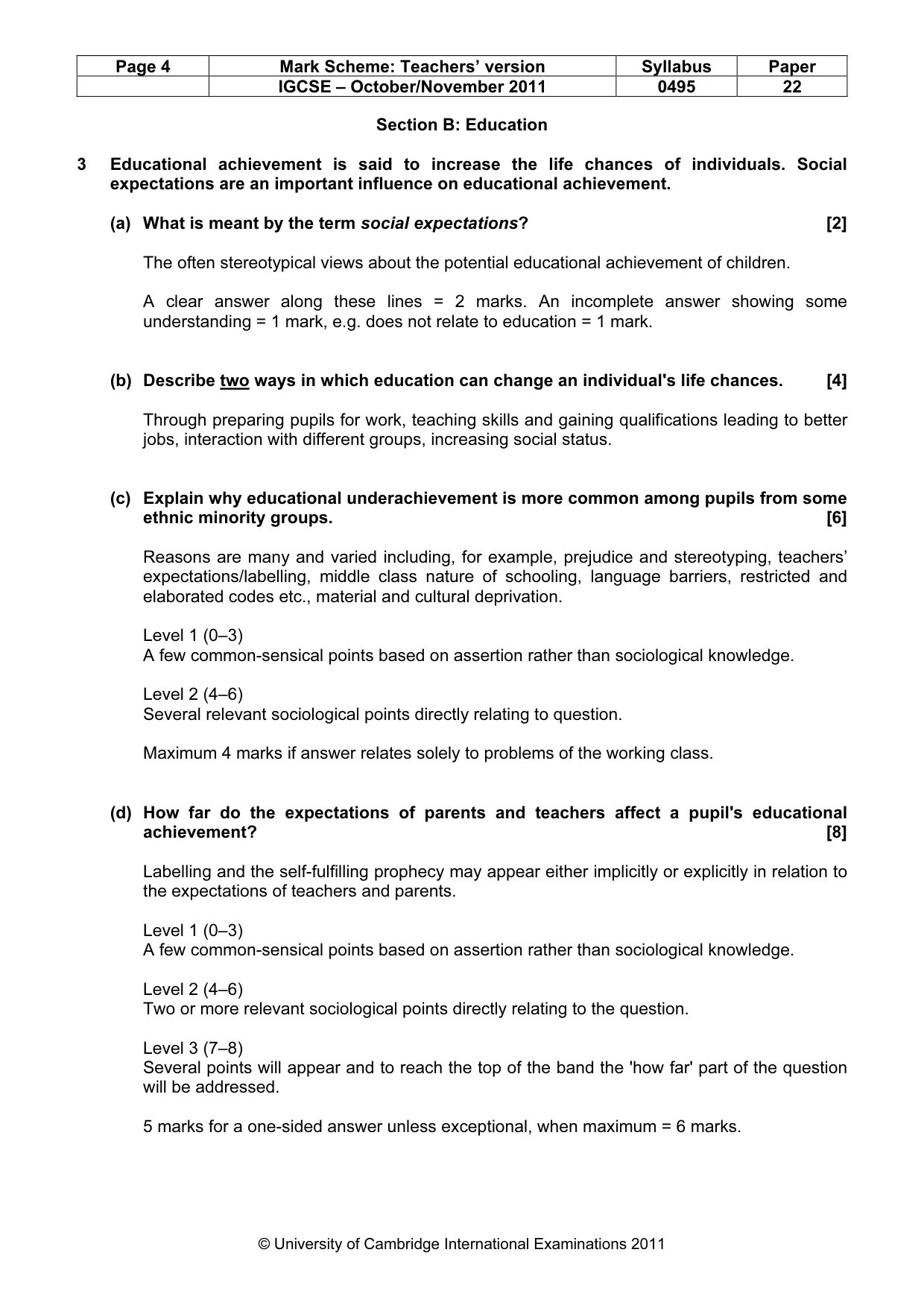
Page 4 Mark Scheme: Teachers’ version Syllabus Paper IGCSE – October/November 2011 0495 22 © University of Cambridge International Examinations 2011 Section B: Education 3 Educational achievement is said to increase the life chances of individuals. Social expectations are an important influence on educational achievement. (a) What is meant by the term social expectations? [2] The often stereotypical views about the potential educational achievement of children. A clear answer along these lines = 2 marks. An incomplete answer showing some understanding = 1 mark, e.g. does not relate to education = 1 mark. (b) Describe two ways in which education can change an individual's life chances. [4] Through preparing pupils for work, teaching skills and gaining qualifications leading to better jobs, interaction with different groups, increasing social status. (c) Explain why educational underachievement is more common among pupils from some ethnic minority groups. [6] Reasons are many and varied including, for example, prejudice and stereotyping, teachers’ expectations/labelling, middle class nature of schooling, language barriers, restricted and elaborated codes etc., material and cultural deprivation. Level 1 (0–3) A few common-sensical points based on assertion rather than sociological knowledge. Level 2 (4–6) Several relevant sociological points directly relating to question. Maximum 4 marks if answer relates solely to problems of the working class. (d) How far do the expectations of parents and teachers affect a pupil's educational achievement? [8] Labelling and the self-fulfilling prophecy may appear either implicitly or explicitly in relation to the expectations of teachers and parents. Level 1 (0–3) A few common-sensical points based on assertion rather than sociological knowledge. Level 2 (4–6) Two or more relevant sociological points directly relating to the question. Level 3 (7–8) Several points will appear and to reach the top of the band the 'how far' part of the question will be addressed. 5 marks for a one-sided answer unless exceptional, when maximum = 6 marks.
Mark scheme, page 5
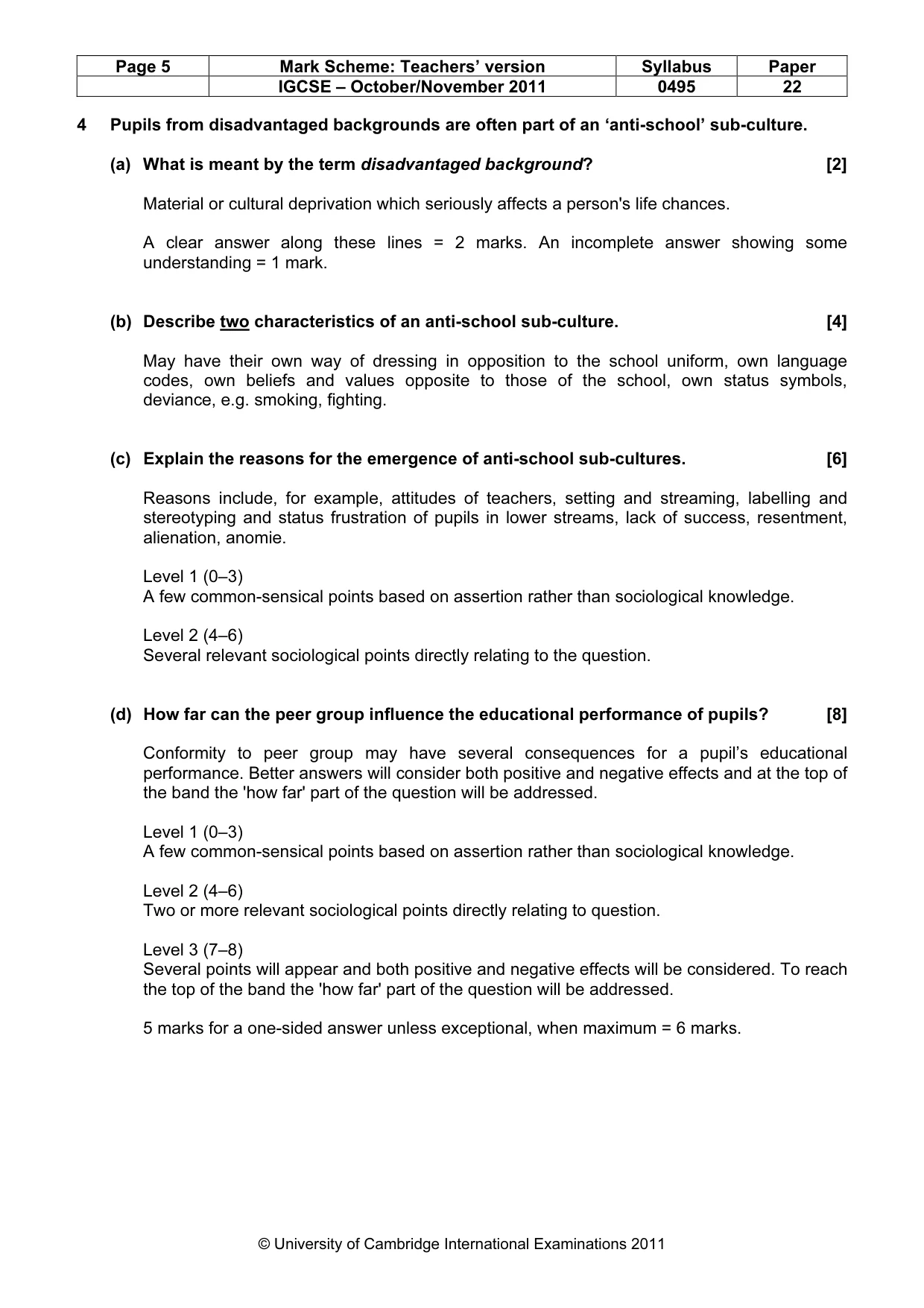
Page 5 Mark Scheme: Teachers’ version Syllabus Paper IGCSE – October/November 2011 0495 22 © University of Cambridge International Examinations 2011 4 Pupils from disadvantaged backgrounds are often part of an ‘anti-school’ sub-culture. (a) What is meant by the term disadvantaged background? [2] Material or cultural deprivation which seriously affects a person's life chances. A clear answer along these lines = 2 marks. An incomplete answer showing some understanding = 1 mark. (b) Describe two characteristics of an anti-school sub-culture. [4] May have their own way of dressing in opposition to the school uniform, own language codes, own beliefs and values opposite to those of the school, own status symbols, deviance, e.g. smoking, fighting. (c) Explain the reasons for the emergence of anti-school sub-cultures. [6] Reasons include, for example, attitudes of teachers, setting and streaming, labelling and stereotyping and status frustration of pupils in lower streams, lack of success, resentment, alienation, anomie. Level 1 (0–3) A few common-sensical points based on assertion rather than sociological knowledge. Level 2 (4–6) Several relevant sociological points directly relating to the question. (d) How far can the peer group influence the educational performance of pupils? [8] Conformity to peer group may have several consequences for a pupil’s educational performance. Better answers will consider both positive and negative effects and at the top of the band the 'how far' part of the question will be addressed. Level 1 (0–3) A few common-sensical points based on assertion rather than sociological knowledge. Level 2 (4–6) Two or more relevant sociological points directly relating to question. Level 3 (7–8) Several points will appear and both positive and negative effects will be considered. To reach the top of the band the 'how far' part of the question will be addressed. 5 marks for a one-sided answer unless exceptional, when maximum = 6 marks.
Mark scheme, page 6
Page 6 Mark Scheme: Teachers’ version Syllabus Paper IGCSE – October/November 2011 0495 22 © University of Cambridge International Examinations 2011 Section C: Crime, Deviance and Social Control 5 Various agencies of social control exist to deter criminal behaviour. (a) What is meant by the term agencies of social control? [2] Institutions through which conformity to society's norms and values is maintained. Can either describe agencies or concepts of informal and formal agencies. Definition of social control alone = 0 marks. A clear answer along these lines = 2 marks. An incomplete answer showing some understanding = 1 mark. (b) Describe two agencies of social control. [4] Examples include the family, education system, religious institutions and the mass media. Can accept formal agencies, e.g. police. If says formal and informal = 1 mark each but if explains = 2 marks each. (c) Explain how the mass media may influence levels of crime in society. [6] Issues such as, for example, media stereotyping and scapegoating of certain groups or individuals, distortion and misleading information, folk devils, moral panics, labelling and deviancy amplification may appear. Level 1 (0–3) A few common-sensical points based on assertion rather than sociological knowledge. Influence, positive or negative, = Level 1 unless linked to sociological perspective. Level 2 (4–6) Several relevant sociological points directly relating to question. (d) How far are powerful groups in society able to control what types of behaviour are defined as criminal? [8] Level 1 (0–3) A few common-sensical points based on assertion rather than sociological knowledge. Level 2 (4–6) Two or more relevant sociological points directly relating to question. E.g. emphasis on blue-collar crime – offences against property and the person. Less focus on white-collar crime, e.g. fraud. Question of how influential media is. Level 3 (7–8) Several points will appear and to reach the top of the band there will be some attempt at assessment. 5 marks for a one-sided answer unless exceptional, when maximum = 6 marks.
Mark scheme, page 7
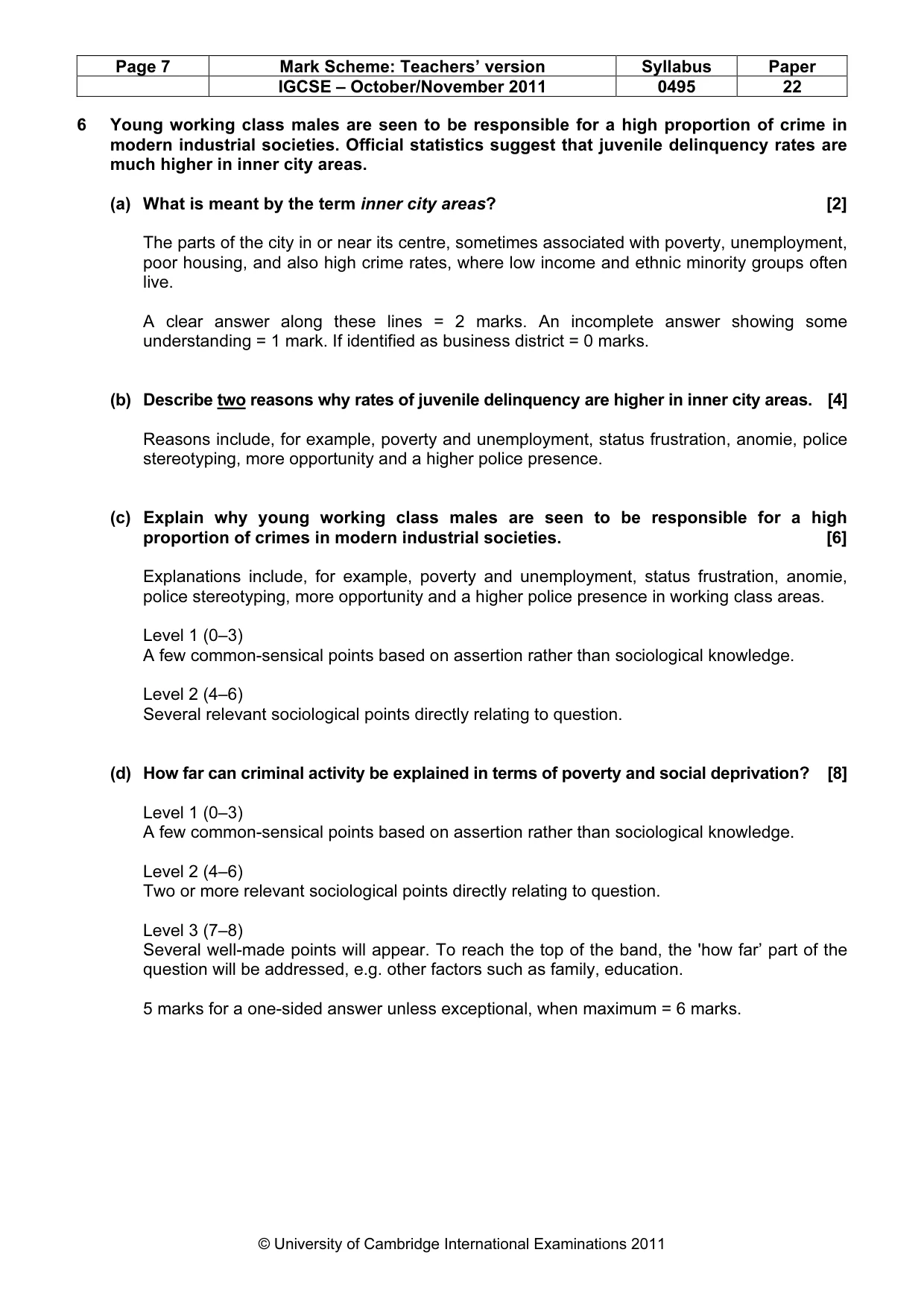
Page 7 Mark Scheme: Teachers’ version Syllabus Paper IGCSE – October/November 2011 0495 22 © University of Cambridge International Examinations 2011 6 Young working class males are seen to be responsible for a high proportion of crime in modern industrial societies. Official statistics suggest that juvenile delinquency rates are much higher in inner city areas. (a) What is meant by the term inner city areas? [2] The parts of the city in or near its centre, sometimes associated with poverty, unemployment, poor housing, and also high crime rates, where low income and ethnic minority groups often live. A clear answer along these lines = 2 marks. An incomplete answer showing some understanding = 1 mark. If identified as business district = 0 marks. (b) Describe two reasons why rates of juvenile delinquency are higher in inner city areas. [4] Reasons include, for example, poverty and unemployment, status frustration, anomie, police stereotyping, more opportunity and a higher police presence. (c) Explain why young working class males are seen to be responsible for a high proportion of crimes in modern industrial societies. [6] Explanations include, for example, poverty and unemployment, status frustration, anomie, police stereotyping, more opportunity and a higher police presence in working class areas. Level 1 (0–3) A few common-sensical points based on assertion rather than sociological knowledge. Level 2 (4–6) Several relevant sociological points directly relating to question. (d) How far can criminal activity be explained in terms of poverty and social deprivation? [8] Level 1 (0–3) A few common-sensical points based on assertion rather than sociological knowledge. Level 2 (4–6) Two or more relevant sociological points directly relating to question. Level 3 (7–8) Several well-made points will appear. To reach the top of the band, the 'how far’ part of the question will be addressed, e.g. other factors such as family, education. 5 marks for a one-sided answer unless exceptional, when maximum = 6 marks.
Mark scheme, page 8
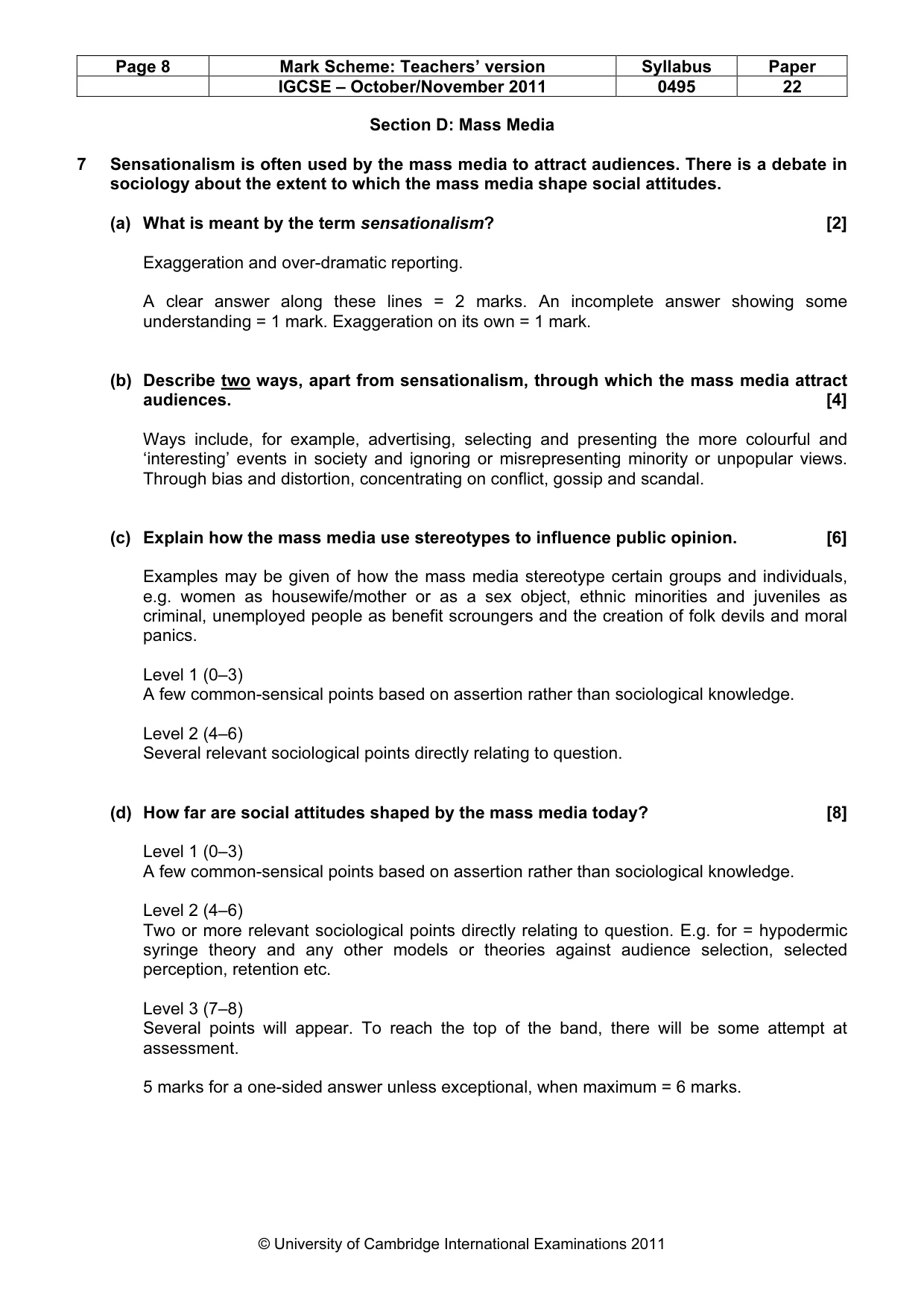
Page 8 Mark Scheme: Teachers’ version Syllabus Paper IGCSE – October/November 2011 0495 22 © University of Cambridge International Examinations 2011 Section D: Mass Media 7 Sensationalism is often used by the mass media to attract audiences. There is a debate in sociology about the extent to which the mass media shape social attitudes. (a) What is meant by the term sensationalism? [2] Exaggeration and over-dramatic reporting. A clear answer along these lines = 2 marks. An incomplete answer showing some understanding = 1 mark. Exaggeration on its own = 1 mark. (b) Describe two ways, apart from sensationalism, through which the mass media attract audiences. [4] Ways include, for example, advertising, selecting and presenting the more colourful and ‘interesting’ events in society and ignoring or misrepresenting minority or unpopular views. Through bias and distortion, concentrating on conflict, gossip and scandal. (c) Explain how the mass media use stereotypes to influence public opinion. [6] Examples may be given of how the mass media stereotype certain groups and individuals, e.g. women as housewife/mother or as a sex object, ethnic minorities and juveniles as criminal, unemployed people as benefit scroungers and the creation of folk devils and moral panics. Level 1 (0–3) A few common-sensical points based on assertion rather than sociological knowledge. Level 2 (4–6) Several relevant sociological points directly relating to question. (d) How far are social attitudes shaped by the mass media today? [8] Level 1 (0–3) A few common-sensical points based on assertion rather than sociological knowledge. Level 2 (4–6) Two or more relevant sociological points directly relating to question. E.g. for = hypodermic syringe theory and any other models or theories against audience selection, selected perception, retention etc. Level 3 (7–8) Several points will appear. To reach the top of the band, there will be some attempt at assessment. 5 marks for a one-sided answer unless exceptional, when maximum = 6 marks.
Mark scheme, page 9
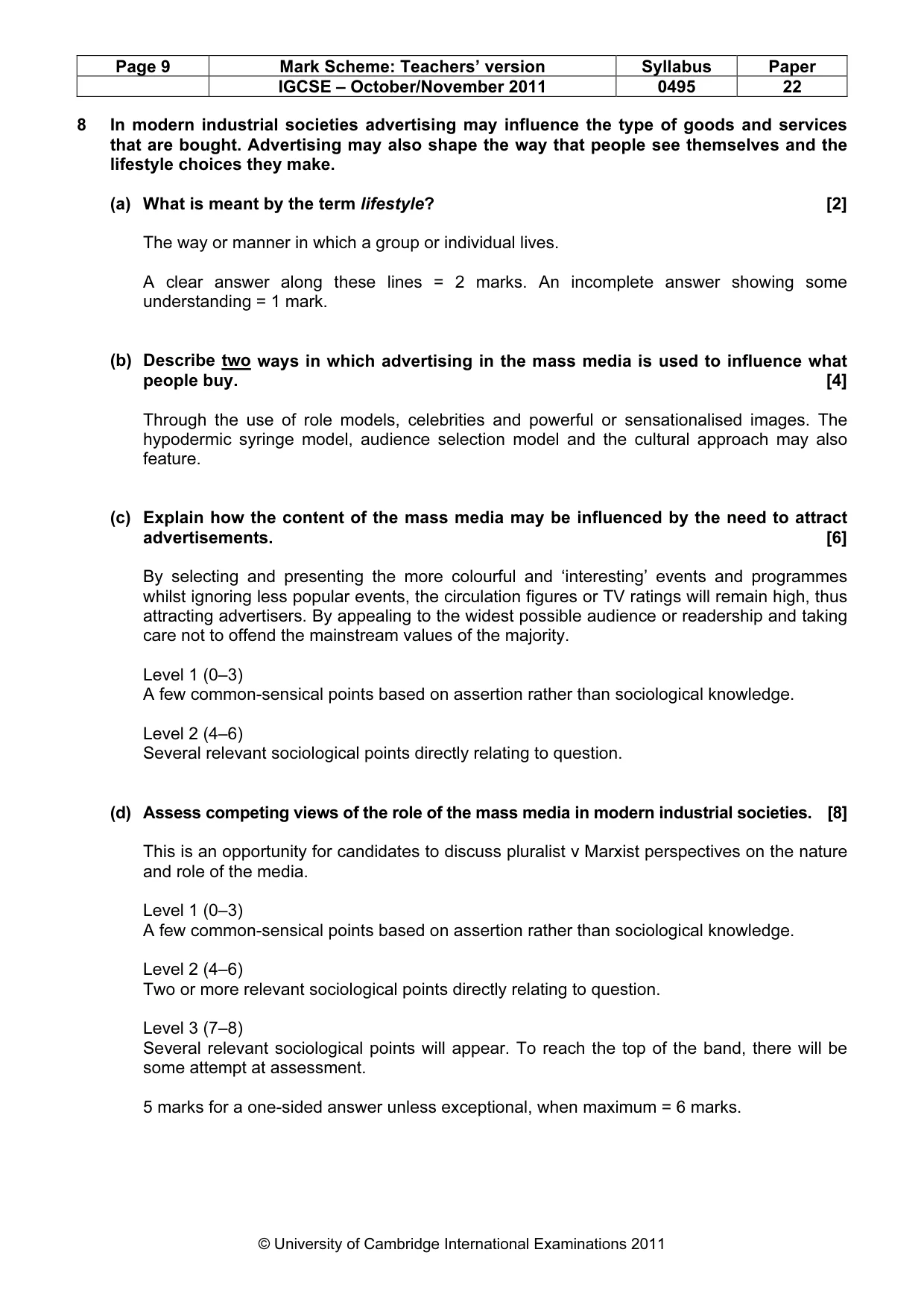
Page 9 Mark Scheme: Teachers’ version Syllabus Paper IGCSE – October/November 2011 0495 22 © University of Cambridge International Examinations 2011 8 In modern industrial societies advertising may influence the type of goods and services that are bought. Advertising may also shape the way that people see themselves and the lifestyle choices they make. (a) What is meant by the term lifestyle? [2] The way or manner in which a group or individual lives. A clear answer along these lines = 2 marks. An incomplete answer showing some understanding = 1 mark. (b) Describe two ways in which advertising in the mass media is used to influence what people buy. [4] Through the use of role models, celebrities and powerful or sensationalised images. The hypodermic syringe model, audience selection model and the cultural approach may also feature. (c) Explain how the content of the mass media may be influenced by the need to attract advertisements. [6] By selecting and presenting the more colourful and ‘interesting’ events and programmes whilst ignoring less popular events, the circulation figures or TV ratings will remain high, thus attracting advertisers. By appealing to the widest possible audience or readership and taking care not to offend the mainstream values of the majority. Level 1 (0–3) A few common-sensical points based on assertion rather than sociological knowledge. Level 2 (4–6) Several relevant sociological points directly relating to question. (d) Assess competing views of the role of the mass media in modern industrial societies. [8] This is an opportunity for candidates to discuss pluralist v Marxist perspectives on the nature and role of the media. Level 1 (0–3) A few common-sensical points based on assertion rather than sociological knowledge. Level 2 (4–6) Two or more relevant sociological points directly relating to question. Level 3 (7–8) Several relevant sociological points will appear. To reach the top of the band, there will be some attempt at assessment. 5 marks for a one-sided answer unless exceptional, when maximum = 6 marks.
What you needed in this session
Cambridge’s own grade thresholds for 2011 Oct/Nov, Paper 2 · Variant 2. A higher threshold means an easier paper — the bar moves with how the cohort did.