Cambridge IGCSE Sociology 0495 — 2011 May/June Paper 1 · Variant 2
0495/12/M/J/11 · 90 marks · ≈101 min
The question paper and its mark scheme, free to read here and free to download. This is Cambridge’s own paper, exactly as it was sat.
Question paper24 pages


Mark scheme9 pages
Answers below. Sit the paper first if you are practising.
Paper as text
Question paper, page 1
This document consists of 22 printed pages and 2 blank pages. DC (NF) 43149 © UCLES 2011 [Turn over UNIVERSITY OF CAMBRIDGE INTERNATIONAL EXAMINATIONS International General Certificate of Secondary Education * 8 0 6 6 4 1 5 0 1 9 * SOCIOLOGY 0495/12 Paper 1 May/June 2011 2 hours 30 minutes Candidates answer on the Question Paper. No additional materials are required. READ THESE INSTRUCTIONS FIRST DO NOT WRITE IN ANY BARCODES. Write your Centre number, candidate number and name on all the work you hand in. Write in dark blue or black pen. You may use a soft pencil for any diagrams, graphs or rough working. Do not use staples, paper clips, highlighters, glue or correction fluid. You may not need all the answer lines for your answer. Answer Question 1 and three questions from Sections B to D. The number of marks is given in brackets [ ] at the end of each question or part question. www.XtremePapers.com
Question paper, page 2
2 0495/12/M/J/11 © UCLES 2011 For Examiner’s Use Section A: Research Methods Questionnaires are a popular research method used in sociology. Closed or open-ended questions can be used to gain information. Respondents can fill in the questionnaire by themselves, or an interviewer may fill in the form for them. This method usually creates quantitative data which is useful in large-scale research. When a group is studied at different stages over a long period of time, it is known as a longitudinal survey. There are a number of advantages and limitations with this type of survey. In order to collect qualitative data, other methods such as participant observation may be used. Research that produces qualitative data is usually described as in-depth. 1 (a) In sociological research, what is meant by the following terms: (i) open-ended questions … … … …[2] (ii) respondents … … … …[2] (iii) participant observation. … … … …[2]
Question paper, page 3
3 0495/12/M/J/11 © UCLES 2011 [Turn over For Examiner’s Use (b) Distinguish between qualitative and quantitative data. … … … … … … … …[4] (c) Describe two problems for the researcher when carrying out a questionnaire. … … … … … … … …[4] (d) Describe one advantage and one disadvantage of using an interviewer to ask questions when conducting a questionnaire. … … … … … … … …[4]
Question paper, page 4
4 0495/12/M/J/11 © UCLES 2011 For Examiner’s Use (e) Describe one advantage and one disadvantage of using closed questions in a questionnaire. … … … … … … … …[4] (f) Describe two strengths and two limitations of using longitudinal surveys. … … … … … … … … … … … … … … … …[8]
Question paper, page 5
5 0495/12/M/J/11 © UCLES 2011 [Turn over For Examiner’s Use Section B: Culture and Socialisation 2 Sociologists believe that primary socialisation is carried out by the family. One of the main ways children learn the norms and values of society is through interaction with their parents. (a) What is meant by the term interaction? … … … …[2] (b) Describe two features of primary socialisation. … … … … … … … …[4]
Question paper, page 6
6 0495/12/M/J/11 © UCLES 2011 For Examiner’s Use (c) Explain how children learn to interact with other people once they go to school. … … … … … … … … … … … … … … … … … …[6]
Question paper, page 7
7 0495/12/M/J/11 © UCLES 2011 [Turn over For Examiner’s Use (d) How far is socialisation influential in shaping the individual’s behaviour? … … … … … … … … … … … … … … … … … … … … … … … …[8]
Question paper, page 8
8 0495/12/M/J/11 © UCLES 2011 For Examiner’s Use 3 Functionalist sociologists believe that social order is based on shared values. People are encouraged to accept these values through the processes of social control. (a) What is meant by the term social order ? … … … …[2] (b) Distinguish between formal and informal social control. … … … … … … … …[4]
Question paper, page 9
9 0495/12/M/J/11 © UCLES 2011 [Turn over For Examiner’s Use (c) Explain how governments help to maintain social order in modern industrial societies. … … … … … … … … … … … … … … … … … …[6]
Question paper, page 10
10 0495/12/M/J/11 © UCLES 2011 For Examiner’s Use (d) To what extent is social order based on shared values in modern industrial societies? … … … … … … … … … … … … … … … … … … … … … … … …[8]
Question paper, page 11
11 0495/12/M/J/11 © UCLES 2011 [Turn over For Examiner’s Use Section C: Social Stratification and Inequality 4 Sociologists claim that females and males experienced different gender socialisation in the past. This had a large impact on their life chances. However, social divisions between females and males may be disappearing today. (a) What is meant by the term social divisions? … … … …[2] (b) Describe two examples of gender socialisation. … … … … … … … …[4]
Question paper, page 12
12 0495/12/M/J/11 © UCLES 2011 For Examiner’s Use (c) Explain how women’s roles within the home may affect their opportunities in employment. … … … … … … … … … … … … … … … … … …[6]
Question paper, page 13
13 0495/12/M/J/11 © UCLES 2011 [Turn over For Examiner’s Use (d) To what extent do women still experience gender inequality in employment in modern industrial societies? … … … … … … … … … … … … … … … … … … … … … … … …[8]
Question paper, page 14
14 0495/12/M/J/11 © UCLES 2011 For Examiner’s Use 5 Opportunities for social mobility are available to all individuals in modern industrial societies. However, people from working class backgrounds and some ethnic minority groups have greater difficulty in improving their social position. (a) What is meant by the term social mobility ? … … … …[2] (b) Describe two reasons why unskilled workers may find it hard to achieve upward social mobility. … … … … … … … …[4]
Question paper, page 15
15 0495/12/M/J/11 © UCLES 2011 [Turn over For Examiner’s Use (c) Explain why some ethnic minority groups may have more opportunities for social mobility than other ethnic minority groups. … … … … … … … … … … … … … … … … … …[6]
Question paper, page 16
16 0495/12/M/J/11 © UCLES 2011 For Examiner’s Use (d) How far is it possible for individuals from a working class background to move into the middle class in modern industrial societies? … … … … … … … … … … … … … … … … … … … … … … … …[8]
Question paper, page 17
17 0495/12/M/J/11 © UCLES 2011 [Turn over For Examiner’s Use Section D: Power and Authority 6 Sociologists view power and authority as important concepts when studying political systems. (a) What is meant by the term power ? … … … …[2] (b) Describe two reasons why people accept the authority of the government in democratic societies. … … … … … … … …[4]
Question paper, page 18
18 0495/12/M/J/11 © UCLES 2011 For Examiner’s Use (c) Explain why some groups may reject the authority of the government. … … … … … … … … … … … … … … … … … …[6]
Question paper, page 19
19 0495/12/M/J/11 © UCLES 2011 [Turn over For Examiner’s Use (d) How far is government controlled by elite groups in democratic societies? … … … … … … … … … … … … … … … … … … … … … … … …[8]
Question paper, page 20
20 0495/12/M/J/11 © UCLES 2011 For Examiner’s Use 7 In democratic societies, pressure groups and the mass media play an important role in the political process. (a) What is meant by the term political process? … … … …[2] (b) Describe two features of a pressure group. … … … … … … … …[4]
Question paper, page 21
21 0495/12/M/J/11 © UCLES 2011 [Turn over For Examiner’s Use (c) Explain how pressure groups are able to influence government decisions. … … … … … … … … … … … … … … … … … …[6]
Question paper, page 22
22 0495/12/M/J/11 © UCLES 2011 For Examiner’s Use (d) How far is the political agenda controlled by the mass media in modern industrial societies? … … … … … … … … … … … … … … … … … … … … … … … …[8]
Question paper, page 23
23 0495/12/M/J/11 © UCLES 2011 BLANK PAGE
Question paper, page 24
24 0495/12/M/J/11 © UCLES 2011 BLANK PAGE Permission to reproduce items where third-party owned material protected by copyright is included has been sought and cleared where possible. Every reasonable effort has been made by the publisher (UCLES) to trace copyright holders, but if any items requiring clearance have unwittingly been included, the publisher will be pleased to make amends at the earliest possible opportunity. University of Cambridge International Examinations is part of the Cambridge Assessment Group. Cambridge Assessment is the brand name of University of Cambridge Local Examinations Syndicate (UCLES), which is itself a department of the University of Cambridge.
Mark scheme, page 1
UNIVERSITY OF CAMBRIDGE INTERNATIONAL EXAMINATIONS International General Certificate of Secondary Education MARK SCHEME for the May/June 2011 question paper for the guidance of teachers 0495 SOCIOLOGY 0495/12 Paper 1, maximum raw mark 90 This mark scheme is published as an aid to teachers and candidates, to indicate the requirements of the examination. It shows the basis on which Examiners were instructed to award marks. It does not indicate the details of the discussions that took place at an Examiners’ meeting before marking began, which would have considered the acceptability of alternative answers. Mark schemes must be read in conjunction with the question papers and the report on the examination. • Cambridge will not enter into discussions or correspondence in connection with these mark schemes. Cambridge is publishing the mark schemes for the May/June 2011 question papers for most IGCSE, GCE Advanced Level and Advanced Subsidiary Level syllabuses and some Ordinary Level syllabuses. www.XtremePapers.com
Mark scheme, page 2
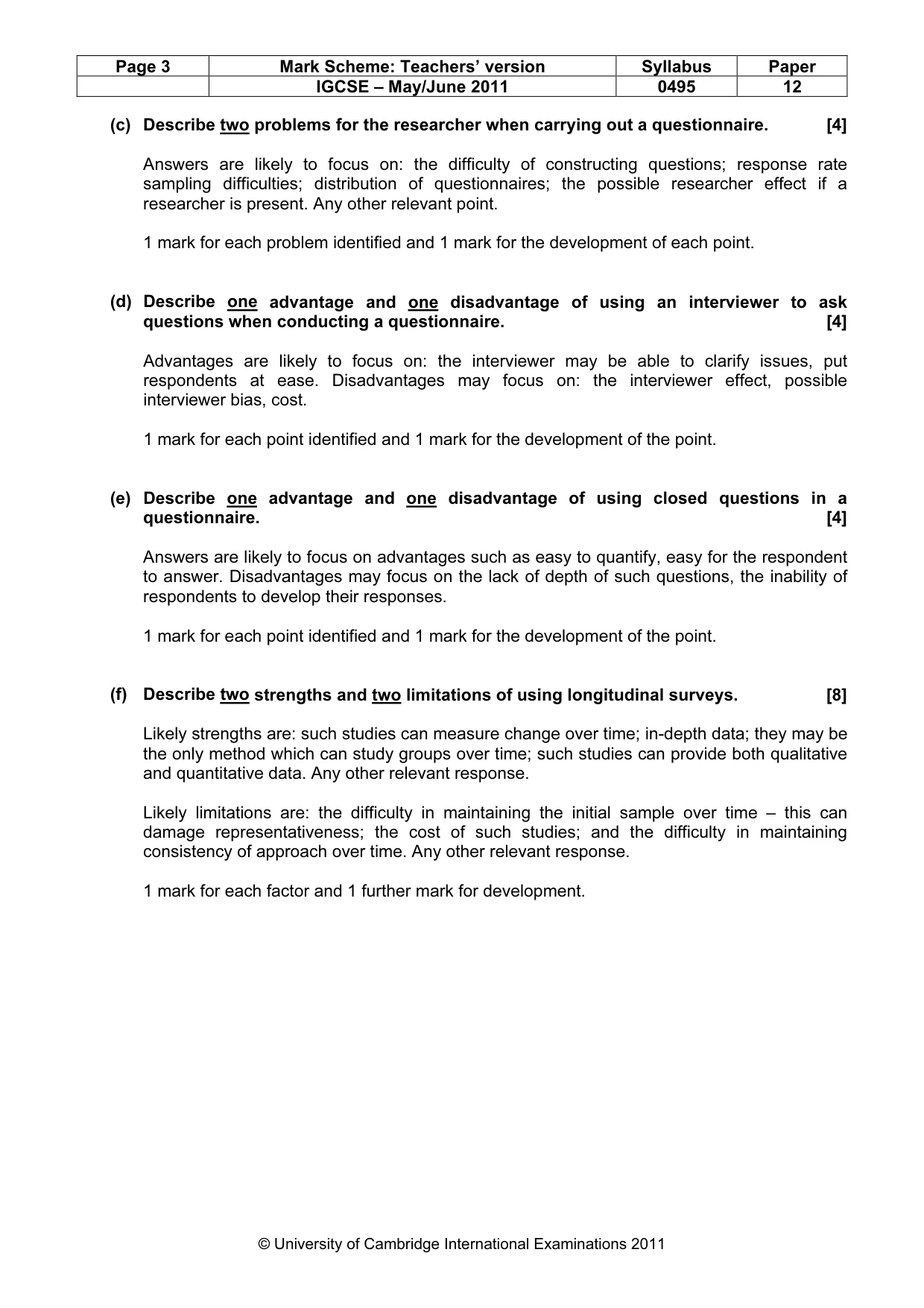
Page 2 Mark Scheme: Teachers’ version Syllabus Paper IGCSE – May/June 2011 0495 12 © University of Cambridge International Examinations 2011 Section A: Research Methods 1 Questionnaires are a popular research method used in sociology. Closed or open-ended questions can be used to gain information. Respondents can fill in the questionnaire by themselves, or an interviewer may fill in the form for them. This method usually creates quantitative data which is useful in large-scale research. When a group is studied at different stages over a long period of time, it is known as a longitudinal survey. There are a number of advantages and limitations with this type of survey. In order to collect qualitative data, other methods such as participant observation may be used. Research that produces qualitative data is usually described as in-depth. (a) In sociological research, what is meant by the following terms: (i) open-ended questions [2] Answers are likely to focus on the idea that such questions allow the respondent to be free to provide comments or opinions about a particular topic. Or answers may state that such questions do not have a fixed set of responses to consider. 1 mark for a partial definition, 2 marks for a full definition. (ii) respondents [2] Answers are likely to focus on the person answering the questionnaire or taking part in the interview. 1 mark for a partial definition, 2 marks for a full definition. (iii) participant observation [2] Answers are likely to focus on a method where the researcher joins the group under study and undertakes to record the interactions they witness. 1 mark for a partial definition, 2 marks for a full definition. (b) Distinguish between qualitative and quantitative data. [4] Quantitative data is likely to be described as statistical data collected by means of methods such questionnaires which can generate a large amount of data. Qualitative data is likely to be discussed in terns of descriptive or in-depth data, usually collected by unstructured interviews or various forms of observational studies. 1 mark for each definition identified and 1 mark for the development of the point.
Mark scheme, page 3
Page 3 Mark Scheme: Teachers’ version Syllabus Paper IGCSE – May/June 2011 0495 12 © University of Cambridge International Examinations 2011 (c) Describe two problems for the researcher when carrying out a questionnaire. [4] Answers are likely to focus on: the difficulty of constructing questions; response rate sampling difficulties; distribution of questionnaires; the possible researcher effect if a researcher is present. Any other relevant point. 1 mark for each problem identified and 1 mark for the development of each point. (d) Describe one advantage and one disadvantage of using an interviewer to ask questions when conducting a questionnaire. [4] Advantages are likely to focus on: the interviewer may be able to clarify issues, put respondents at ease. Disadvantages may focus on: the interviewer effect, possible interviewer bias, cost. 1 mark for each point identified and 1 mark for the development of the point. (e) Describe one advantage and one disadvantage of using closed questions in a questionnaire. [4] Answers are likely to focus on advantages such as easy to quantify, easy for the respondent to answer. Disadvantages may focus on the lack of depth of such questions, the inability of respondents to develop their responses. 1 mark for each point identified and 1 mark for the development of the point. (f) Describe two strengths and two limitations of using longitudinal surveys. [8] Likely strengths are: such studies can measure change over time; in-depth data; they may be the only method which can study groups over time; such studies can provide both qualitative and quantitative data. Any other relevant response. Likely limitations are: the difficulty in maintaining the initial sample over time – this can damage representativeness; the cost of such studies; and the difficulty in maintaining consistency of approach over time. Any other relevant response. 1 mark for each factor and 1 further mark for development.
Mark scheme, page 4
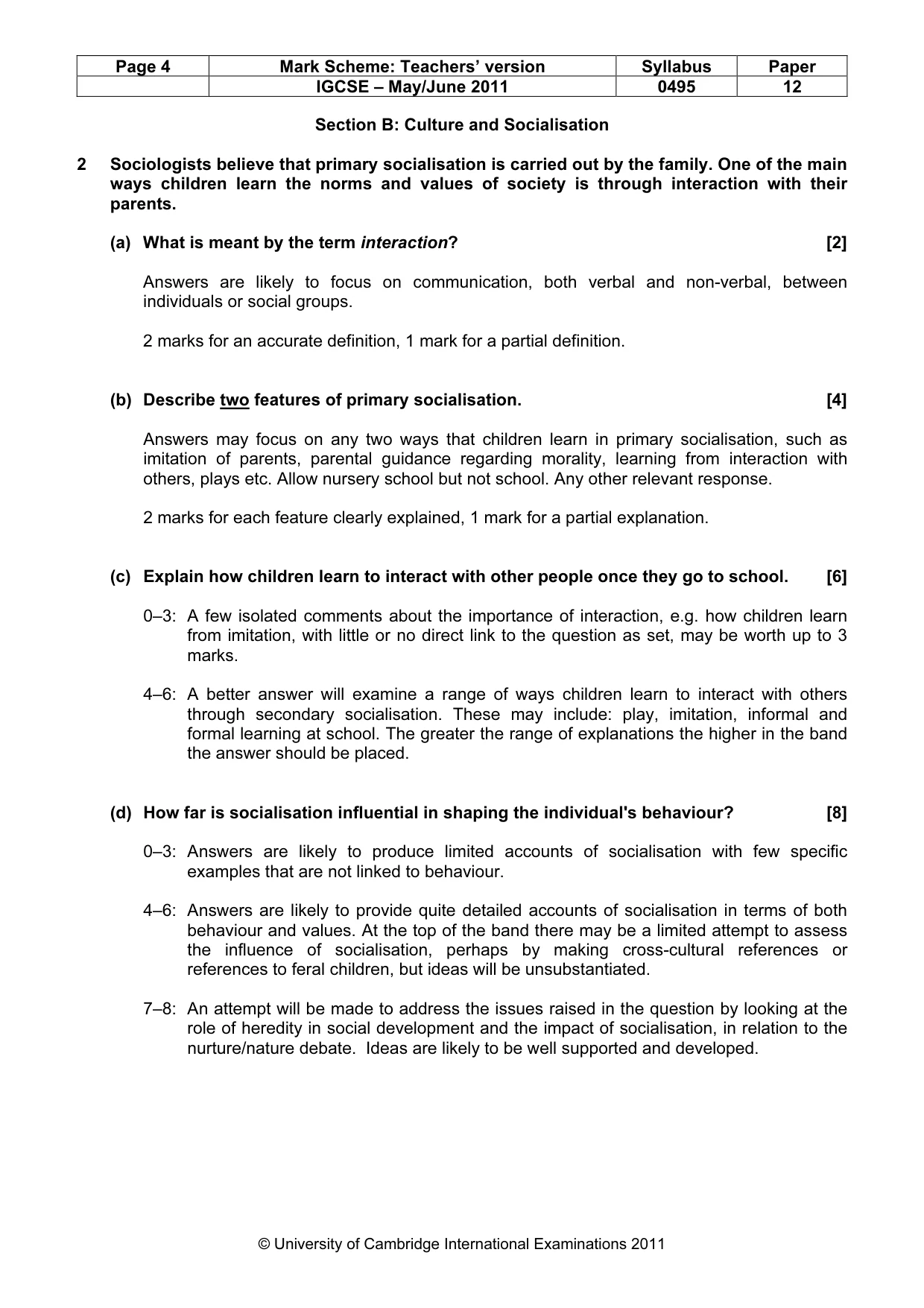
Page 4 Mark Scheme: Teachers’ version Syllabus Paper IGCSE – May/June 2011 0495 12 © University of Cambridge International Examinations 2011 Section B: Culture and Socialisation 2 Sociologists believe that primary socialisation is carried out by the family. One of the main ways children learn the norms and values of society is through interaction with their parents. (a) What is meant by the term interaction? [2] Answers are likely to focus on communication, both verbal and non-verbal, between individuals or social groups. 2 marks for an accurate definition, 1 mark for a partial definition. (b) Describe two features of primary socialisation. [4] Answers may focus on any two ways that children learn in primary socialisation, such as imitation of parents, parental guidance regarding morality, learning from interaction with others, plays etc. Allow nursery school but not school. Any other relevant response. 2 marks for each feature clearly explained, 1 mark for a partial explanation. (c) Explain how children learn to interact with other people once they go to school. [6] 0–3: A few isolated comments about the importance of interaction, e.g. how children learn from imitation, with little or no direct link to the question as set, may be worth up to 3 marks. 4–6: A better answer will examine a range of ways children learn to interact with others through secondary socialisation. These may include: play, imitation, informal and formal learning at school. The greater the range of explanations the higher in the band the answer should be placed. (d) How far is socialisation influential in shaping the individual's behaviour? [8] 0–3: Answers are likely to produce limited accounts of socialisation with few specific examples that are not linked to behaviour. 4–6: Answers are likely to provide quite detailed accounts of socialisation in terms of both behaviour and values. At the top of the band there may be a limited attempt to assess the influence of socialisation, perhaps by making cross-cultural references or references to feral children, but ideas will be unsubstantiated. 7–8: An attempt will be made to address the issues raised in the question by looking at the role of heredity in social development and the impact of socialisation, in relation to the nurture/nature debate. Ideas are likely to be well supported and developed.
Mark scheme, page 5
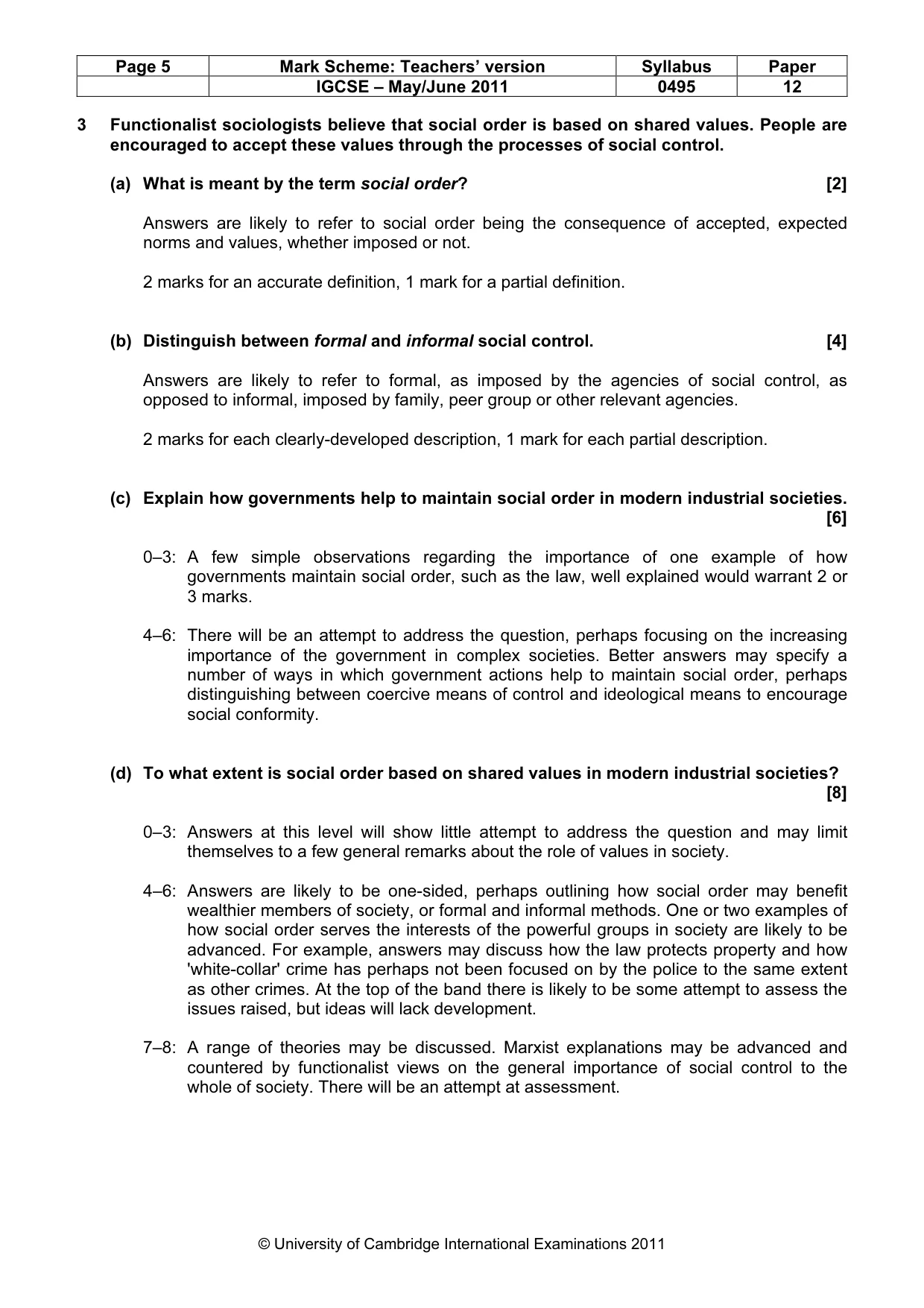
Page 5 Mark Scheme: Teachers’ version Syllabus Paper IGCSE – May/June 2011 0495 12 © University of Cambridge International Examinations 2011 3 Functionalist sociologists believe that social order is based on shared values. People are encouraged to accept these values through the processes of social control. (a) What is meant by the term social order? [2] Answers are likely to refer to social order being the consequence of accepted, expected norms and values, whether imposed or not. 2 marks for an accurate definition, 1 mark for a partial definition. (b) Distinguish between formal and informal social control. [4] Answers are likely to refer to formal, as imposed by the agencies of social control, as opposed to informal, imposed by family, peer group or other relevant agencies. 2 marks for each clearly-developed description, 1 mark for each partial description. (c) Explain how governments help to maintain social order in modern industrial societies. [6] 0–3: A few simple observations regarding the importance of one example of how governments maintain social order, such as the law, well explained would warrant 2 or 3 marks. 4–6: There will be an attempt to address the question, perhaps focusing on the increasing importance of the government in complex societies. Better answers may specify a number of ways in which government actions help to maintain social order, perhaps distinguishing between coercive means of control and ideological means to encourage social conformity. (d) To what extent is social order based on shared values in modern industrial societies? [8] 0–3: Answers at this level will show little attempt to address the question and may limit themselves to a few general remarks about the role of values in society. 4–6: Answers are likely to be one-sided, perhaps outlining how social order may benefit wealthier members of society, or formal and informal methods. One or two examples of how social order serves the interests of the powerful groups in society are likely to be advanced. For example, answers may discuss how the law protects property and how 'white-collar' crime has perhaps not been focused on by the police to the same extent as other crimes. At the top of the band there is likely to be some attempt to assess the issues raised, but ideas will lack development. 7–8: A range of theories may be discussed. Marxist explanations may be advanced and countered by functionalist views on the general importance of social control to the whole of society. There will be an attempt at assessment.
Mark scheme, page 6
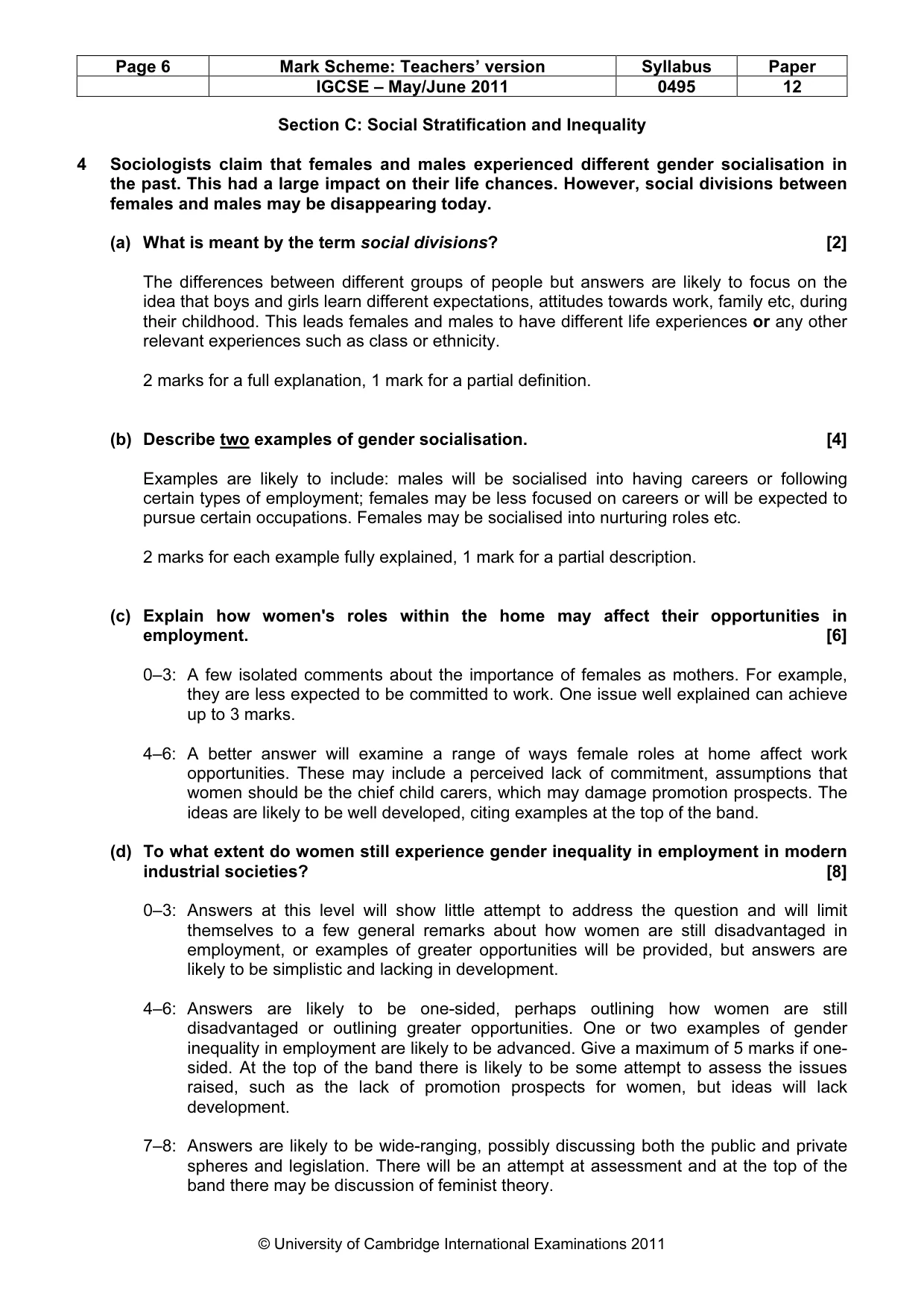
Page 6 Mark Scheme: Teachers’ version Syllabus Paper IGCSE – May/June 2011 0495 12 © University of Cambridge International Examinations 2011 Section C: Social Stratification and Inequality 4 Sociologists claim that females and males experienced different gender socialisation in the past. This had a large impact on their life chances. However, social divisions between females and males may be disappearing today. (a) What is meant by the term social divisions? [2] The differences between different groups of people but answers are likely to focus on the idea that boys and girls learn different expectations, attitudes towards work, family etc, during their childhood. This leads females and males to have different life experiences or any other relevant experiences such as class or ethnicity. 2 marks for a full explanation, 1 mark for a partial definition. (b) Describe two examples of gender socialisation. [4] Examples are likely to include: males will be socialised into having careers or following certain types of employment; females may be less focused on careers or will be expected to pursue certain occupations. Females may be socialised into nurturing roles etc. 2 marks for each example fully explained, 1 mark for a partial description. (c) Explain how women's roles within the home may affect their opportunities in employment. [6] 0–3: A few isolated comments about the importance of females as mothers. For example, they are less expected to be committed to work. One issue well explained can achieve up to 3 marks. 4–6: A better answer will examine a range of ways female roles at home affect work opportunities. These may include a perceived lack of commitment, assumptions that women should be the chief child carers, which may damage promotion prospects. The ideas are likely to be well developed, citing examples at the top of the band. (d) To what extent do women still experience gender inequality in employment in modern industrial societies? [8] 0–3: Answers at this level will show little attempt to address the question and will limit themselves to a few general remarks about how women are still disadvantaged in employment, or examples of greater opportunities will be provided, but answers are likely to be simplistic and lacking in development. 4–6: Answers are likely to be one-sided, perhaps outlining how women are still disadvantaged or outlining greater opportunities. One or two examples of gender inequality in employment are likely to be advanced. Give a maximum of 5 marks if one- sided. At the top of the band there is likely to be some attempt to assess the issues raised, such as the lack of promotion prospects for women, but ideas will lack development. 7–8: Answers are likely to be wide-ranging, possibly discussing both the public and private spheres and legislation. There will be an attempt at assessment and at the top of the band there may be discussion of feminist theory.
Mark scheme, page 7
Page 7 Mark Scheme: Teachers’ version Syllabus Paper IGCSE – May/June 2011 0495 12 © University of Cambridge International Examinations 2011 5 Opportunities for social mobility are available to all individuals in modern industrial societies. However, people from working class backgrounds and some ethnic minority groups have greater difficulty in improving their social position. (a) What is meant by the term social mobility? [2] Answers are likely to focus on the idea that individuals can move from one social class to another, up and down. 2 marks for an accurate description,1 mark for a partial definition. (b) Describe two reasons why unskilled workers may find it hard to achieve upward social mobility. [4] Answers are likely to focus on: lack of marketable skills, lack of opportunities for promotion in the occupations that feature unskilled workers, and possible prejudice against unskilled workers from other groups of workers and employers. 2 marks for a full explanation, 1 mark for a partial explanation. (c) Explain why some ethnic minority groups may have more opportunities for social mobility than other ethnic minority groups. [6] 0–3: A few isolated comments about the lack of educational opportunities or discrimination, with little or no direct link to the question as set, may be worth up to 2 marks. One explanation well explained with supporting examples may achieve 3 marks. 4–6: A better answer will examine a range of reasons why some ethnic minorities may have more social opportunities than other ethnic minority groups, such as education, language, racism, class, networking and structural reasons, or answers that identify particular groups. These may include a lack of skills, discrimination, lack of contacts etc. At the top of the band the ideas are likely to be well developed, citing examples. (d) How far is it possible for individuals from a working class background to move into the middle class in modern industrial societies? [8] 0–3: Answers at this level will show little attempt to address the question and will limit themselves to a few general remarks about how individuals from a working class background have fewer opportunities, but answers are likely to be simplistic and lacking in development. 4–6: Answers are likely to be one-sided, perhaps outlining how individuals from a working class background lack educational opportunities or may have lower aspirations etc, or outline how the working class can help themselves. Some examples of class inequality are likely to be advanced. At the top of the band there is likely to be some attempt to assess the issues raised, such as discussing mobility rates, but ideas will lack development. 7–8: Answers are likely to cover a wide range of issues. There will be an attempt at assessment and issues will be developed and supported.
Mark scheme, page 8
Page 8 Mark Scheme: Teachers’ version Syllabus Paper IGCSE – May/June 2011 0495 12 © University of Cambridge International Examinations 2011 Section D: Power and Authority 6 Sociologists view power and authority as important concepts when studying political systems. (a) What is meant by the term power? [2] Answers should describe the ability of an individual or group to influence the behaviour of others by coercion or agreement. 2 marks for an accurate definition, 1 mark for a partial definition. (b) Describe two reasons why people accept the authority of the government in democratic societies. [4] Likely answers: people see that the government has been democratically elected and therefore has the right to govern; failing to comply with government actions may lead to punishment; and individuals may accept the authority of the government because it is in society's best interests to avoid civil unrest. Any other relevant response. 2 marks for a full explanation, 1 mark for a partial explanation. (c) Explain why some groups may reject the authority of the government. [6] 0–3: A few isolated comments about political authority, with little or no direct link to the question as set, may be worth up to 2 marks. One explanation well explained with supporting examples may achieve 3 marks. 4–6: A better answer will examine a range of reasons why some groups may reject the authority of the government. Reasons might include perceived lack of opportunity for political participation, belief that the government lacks legitimacy, a sense that the government is linked to exploitation and abuse of human rights etc. At the top of the band, a range of possible explanations is likely to be discussed. (d) How far is government controlled by elite groups in democratic societies? [8] 0–3: At this level there may be a simplistic account of how elite groups maintain power, or a basic attempt to describe the power structures in society. 4–6: At this level answers will be focused on description, perhaps outlining a range of ways elite groups maintain power, perhaps focusing on the power such individuals have to dominate important aspects of society such as the political or economic spheres. Answers may also present evidence of the existence of a ruling elite. At the top of the band there is likely to be some attempt to assess the importance of an elite group but this is likely to be done in a limited way and will be unsubstantiated. 7–8: At this level answers are likely to be clearly focused and be a balanced assessment, perhaps discussing pluralist views of power in contrast to elite or Marxist theories.
Mark scheme, page 9
Page 9 Mark Scheme: Teachers’ version Syllabus Paper IGCSE – May/June 2011 0495 12 © University of Cambridge International Examinations 2011 7 In democratic societies, pressure groups and the mass media play an important role in the political process. (a) What is meant by the term political process? [2] The political process refers to the organised means for appointing a government and the way in which the government makes political decisions. 2 marks for a clear definition, 1 mark for a partial explanation. (b) Describe two features of a pressure group. [4] Answers are likely to include: organised membership, contacts with government, concentration on single issues, and use of the media in campaigning. Any other relevant response. 2 marks for each full explanation, 1 mark for each partial explanation. (c) Explain how pressure groups are able to influence government decisions. [6] 0–3: A few isolated comments about the ways pressure groups have influence, with little or no direct link to the question as set, may be worth up to 2 marks. One explanation well explained with supporting examples may achieve 3 marks. 4–6: A better answer will examine a range of ways pressure groups can influence governments. Likely issues to be discussed are direct contact with government departments, the provision of information to help formulate policies, the ability to organise and campaign, which can be supported by examples. At the top of the band there is likely to be a range of issues discussed. (d) How far is the political agenda controlled by the mass media in modern industrial societies? [8] 0–3: At this level there may be a simplistic account of how the mass media have influence, with little reference to the question. 4–6: At this level answers will be focused, but basically descriptive, perhaps outlining a range of ways the media have political influence. Higher in the band, answers will demonstrate a sound understanding of what is meant by the 'political agenda'. Different theories about how the mass media may influence political opinion could feature in good answers at this level. 7–8: At this level answers are likely to be clearly focused and present a balanced assessment. Higher in the band, answers will reach a clear conclusion about the extent to which the political agenda is controlled by the mass media. This might involve making comparisons between the relative importance of the mass media and influences on the political process, such as pressure groups, elites, and economic interests.
What you needed in this session
Cambridge’s own grade thresholds for 2011 May/June, Paper 1 · Variant 2. A higher threshold means an easier paper — the bar moves with how the cohort did.