Cambridge IGCSE Sociology 0495 — 2010 Oct/Nov Paper 2 · Variant 1
0495/21/O/N/10 · 60 marks · ≈68 min
The question paper and its mark scheme, free to read here and free to download. This is Cambridge’s own paper, exactly as it was sat.
Question paper20 pages


Mark scheme9 pages
Answers below. Sit the paper first if you are practising.
Paper as text
Question paper, page 1
This document consists of 17 printed pages and 3 blank pages. DC (EM) 33942 © UCLES 2010 [Turn over UNIVERSITY OF CAMBRIDGE INTERNATIONAL EXAMINATIONS International General Certificate of Secondary Education * 6 9 8 8 1 8 7 4 3 1 * SOCIOLOGY 0495/21 Paper 2 October/November 2010 Candidates answer on the Question Paper. 1 hour 45 minutes No Additional Materials are required. READ THESE INSTRUCTIONS FIRST Do not write in any bar codes. Write your Centre number, candidate number and name on all the work you hand in. Write in dark blue or black ink. You may use a soft pencil for any diagrams, graphs or rough working. Do not use staples, paper clips, highlighters, glue or correction fluid. Answer any three questions. The number of marks is given in brackets [ ] at the end of each question or part question. www.XtremePapers.com
Question paper, page 2
2 0495/21/O/N/10 © UCLES 2010 For Examiner’s Use Section A: Family 1 Marriage can take different forms: monogamy, serial monogamy and polygamy. In most modern industrial societies monogamy and serial monogamy are widely practised. (a) What is meant by the term serial monogamy ? … … … …[2] (b) Describe two reasons why many divorced people remarry. … … … … … … … …[4] (c) Explain why divorce rates are high in many modern industrial societies. … … … … … … … … … … … …[6]
Question paper, page 3
3 0495/21/O/N/10 © UCLES 2010 [Turn over For Examiner’s Use (d) Assess the effects on society of a high divorce rate. … … … … … … … … … … … … … … … …[8]
Question paper, page 4
4 0495/21/O/N/10 © UCLES 2010 For Examiner’s Use 2 Roles within the family have changed considerably in modern industrial society and men and women now have more equal roles in the home. (a) What is meant by the term equal roles ? … … … …[2] (b) Describe two ways in which family roles have changed as societies have modernised. … … … … … … … …[4] (c) Explain why some women may find it difficult to achieve equality within the family. … … … … … … … … … … … …[6]
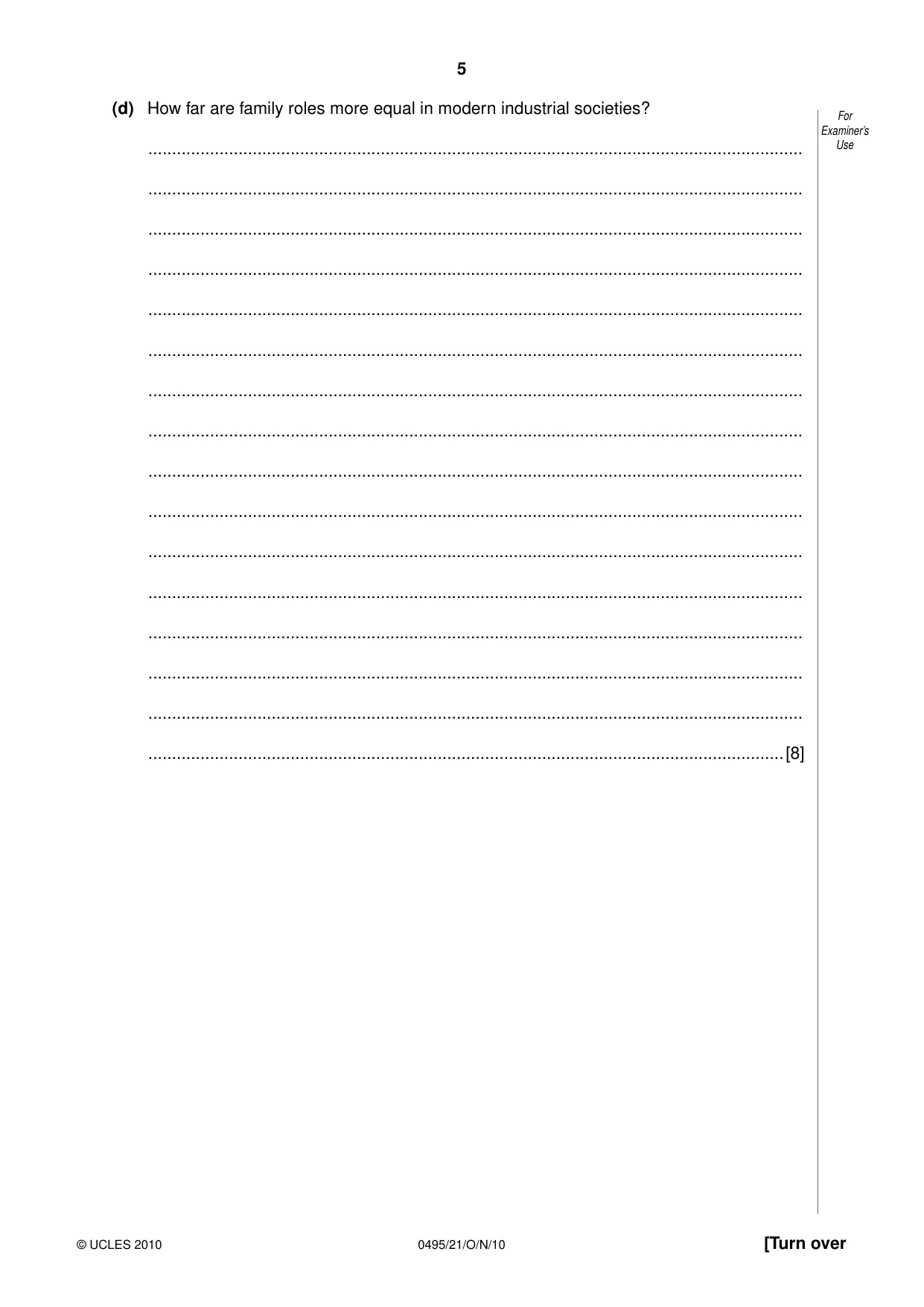
Question paper, page 5
5 0495/21/O/N/10 © UCLES 2010 [Turn over For Examiner’s Use (d) How far are family roles more equal in modern industrial societies? … … … … … … … … … … … … … … … …[8]
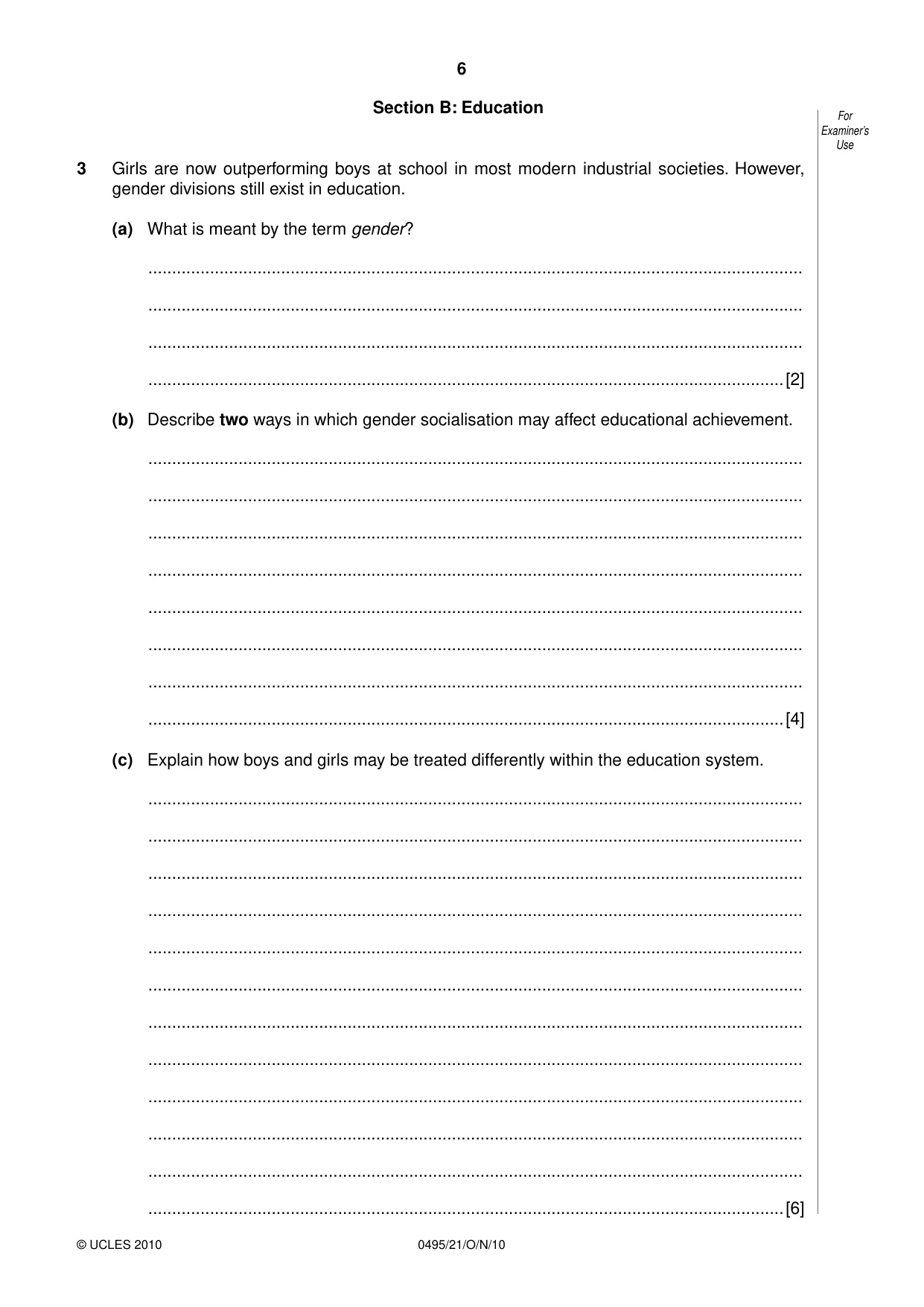
Question paper, page 6
6 0495/21/O/N/10 © UCLES 2010 For Examiner’s Use Section B: Education 3 Girls are now outperforming boys at school in most modern industrial societies. However, gender divisions still exist in education. (a) What is meant by the term gender? … … … …[2] (b) Describe two ways in which gender socialisation may affect educational achievement. … … … … … … … …[4] (c) Explain how boys and girls may be treated differently within the education system. … … … … … … … … … … … …[6]
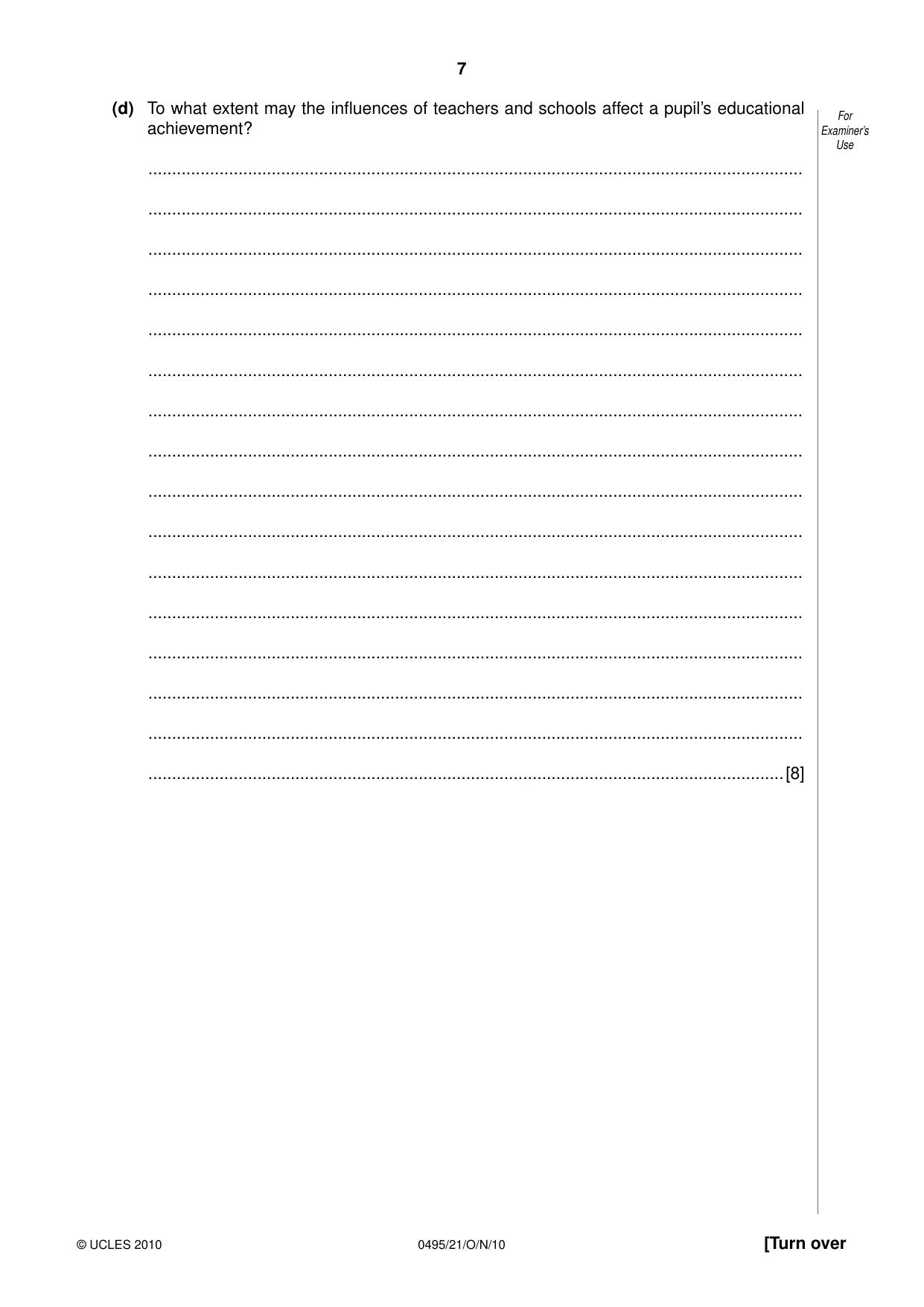
Question paper, page 7
7 0495/21/O/N/10 © UCLES 2010 [Turn over For Examiner’s Use (d) To what extent may the influences of teachers and schools affect a pupil’s educational achievement? … … … … … … … … … … … … … … … …[8]
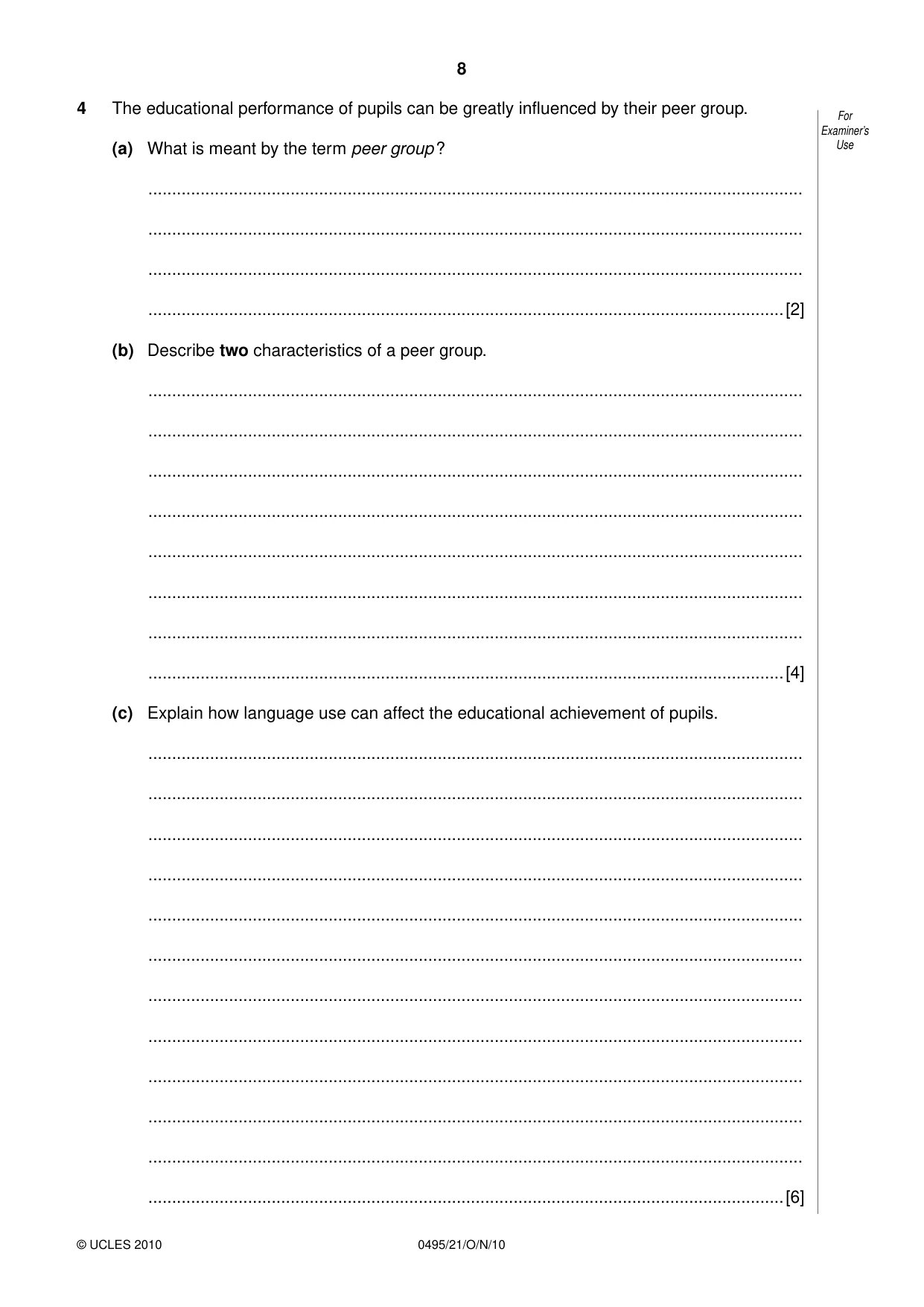
Question paper, page 8
8 0495/21/O/N/10 © UCLES 2010 For Examiner’s Use 4 The educational performance of pupils can be greatly influenced by their peer group. (a) What is meant by the term peer group ? … … … …[2] (b) Describe two characteristics of a peer group. … … … … … … … …[4] (c) Explain how language use can affect the educational achievement of pupils. … … … … … … … … … … … …[6]
Question paper, page 9
9 0495/21/O/N/10 © UCLES 2010 [Turn over For Examiner’s Use (d) How might government educational policies affect pupils’ educational performance? … … … … … … … … … … … … … … … …[8]
Question paper, page 10
10 0495/21/O/N/10 © UCLES 2010 For Examiner’s Use Section C: Crime, Deviance and Social Control 5 In society some groups are more likely to be labelled as deviant than other groups. (a) What is meant by the term labelling ? … … … …[2] (b) Describe two groups within society who are more likely to be labelled deviant than others. … … … … … … … …[4] (c) Explain how labelling may lead to an increase in recorded crime. … … … … … … … … … … … …[6]
Question paper, page 11
11 0495/21/O/N/10 © UCLES 2010 [Turn over For Examiner’s Use (d) Assess the likely consequences for a group that has been labelled deviant. … … … … … … … … … … … … … … … …[8]
Question paper, page 12
12 0495/21/O/N/10 © UCLES 2010 For Examiner’s Use 6 Police records suggest that young working class males living in the inner cities are more likely than other groups to become involved in juvenile delinquency. (a) What is meant by the term juvenile delinquency ? … … … …[2] (b) Describe two reasons why it appears that more crime is committed in inner city areas. … … … … … … … …[4] (c) Explain why women appear to commit fewer crimes than men. … … … … … … … … … … … …[6]
Question paper, page 13
13 0495/21/O/N/10 © UCLES 2010 [Turn over For Examiner’s Use (d) Assess the extent to which official crime statistics may not accurately reflect the amount of crime in society. … … … … … … … … … … … … … … … …[8]
Question paper, page 14
14 0495/21/O/N/10 © UCLES 2010 For Examiner’s Use Section D: The Mass Media 7 It is important for democracy that the mass media is not censored by the government. (a) What is meant by the term censorship? … … … …[2] (b) Describe two ways in which young people may be influenced by the messages and images presented by the mass media. … … … … … … … …[4] (c) Explain why it might be a matter of concern in a democratic society that a few powerful individuals own most newspapers and television channels. … … … … … … … … … … … …[6]
Question paper, page 15
15 0495/21/O/N/10 © UCLES 2010 [Turn over For Examiner’s Use (d) How far, and in what ways, may the mass media influence people’s behaviour? … … … … … … … … … … … … … … … …[8]
Question paper, page 16
16 0495/21/O/N/10 © UCLES 2010 For Examiner’s Use 8 Pluralists and Marxists have different views about the political influence of the mass media. However, both agree that the mass media play an increasingly important role in ‘agenda setting’. (a) What is meant by the term agenda setting? … … … …[2] (b) Describe two features of the pluralist view of the mass media. … … … … … … … …[4] (c) Explain why Marxists criticise the pluralist view of the mass media. … … … … … … … … … … … …[6]
Question paper, page 17
17 0495/21/O/N/10 © UCLES 2010 For Examiner’s Use (d) How far, and in what ways, may the mass media influence political attitudes? … … … … … … … … … … … … … … … …[8]
Question paper, page 18
18 0495/21/O/N/10 © UCLES 2010 BLANK PAGE
Question paper, page 19
19 0495/21/O/N/10 © UCLES 2010 BLANK PAGE
Question paper, page 20
20 0495/21/O/N/10 © UCLES 2010 Permission to reproduce items where third-party owned material protected by copyright is included has been sought and cleared where possible. Every reasonable effort has been made by the publisher (UCLES) to trace copyright holders, but if any items requiring clearance have unwittingly been included, the publisher will be pleased to make amends at the earliest possible opportunity. University of Cambridge International Examinations is part of the Cambridge Assessment Group. Cambridge Assessment is the brand name of University of Cambridge Local Examinations Syndicate (UCLES), which is itself a department of the University of Cambridge. BLANK PAGE
Mark scheme, page 1
UNIVERSITY OF CAMBRIDGE INTERNATIONAL EXAMINATIONS International General Certificate of Secondary Education MARK SCHEME for the October/November 2010 question paper for the guidance of teachers 0495 SOCIOLOGY 0495/21 Paper 2, maximum raw mark 60 This mark scheme is published as an aid to teachers and candidates, to indicate the requirements of the examination. It shows the basis on which Examiners were instructed to award marks. It does not indicate the details of the discussions that took place at an Examiners’ meeting before marking began, which would have considered the acceptability of alternative answers. Mark schemes must be read in conjunction with the question papers and the report on the examination. • CIE will not enter into discussions or correspondence in connection with these mark schemes. CIE is publishing the mark schemes for the October/November 2010 question papers for most IGCSE, GCE Advanced Level and Advanced Subsidiary Level syllabuses and some Ordinary Level syllabuses. www.XtremePapers.com
Mark scheme, page 2
Page 2 Mark Scheme: Teachers’ version Syllabus Paper IGCSE – October/November 2010 0495 21 © UCLES 2010 Section A: The Family 1 Marriage can take different forms: monogamy, serial monogamy and polygamy. In most modern industrial societies monogamy and serial monogamy are widely practised. (a) What is meant by the term serial monogamy? [2] A series of marriages, one man to one woman, found in Europe and the USA, where there are high rates of divorce and remarriage. 2 marks for a clear definition along these lines, 1 mark for an incomplete definition showing some understanding. (b) Describe two reasons why many divorced people remarry. [4] Examples include: romantic love and the belief that marriage to another partner will last, financial security, companionship, help with child-rearing and ideas that two-parent families are better than one-parent families. (2 × 2) (c) Explain why divorce rates are high in many modern industrial societies. [6] Relevant factors include: changes in the law making divorce easier and cheaper to obtain; growing independence of women; higher expectations of marriage, less social stigma attached to divorced people, etc. 0–3 At this level, answers will be confined to just one or two relevant factors, with little depth of understanding. 4–6 A basic review of several relevant factors would fit the bottom of this band. A more detailed answer with evidence of good sociological understanding would merit full marks. (d) Assess the effects on society of a high divorce rate. [8] Answers may include, for example: more single-parent families and single-member households, higher cost of welfare provision, high stress and ill health rates linked to divorce, changes in consumption patterns and leisure pursuits. 0–3 A few basic points based on common sense rather than sociological insight can be expected at this level. 4–6 A few relevant sociological observations may be made, but answer may be one-sided or lack depth. 6–8 The answer will consider several relevant effects and demonstrate good sociological understanding of the topic.
Mark scheme, page 3
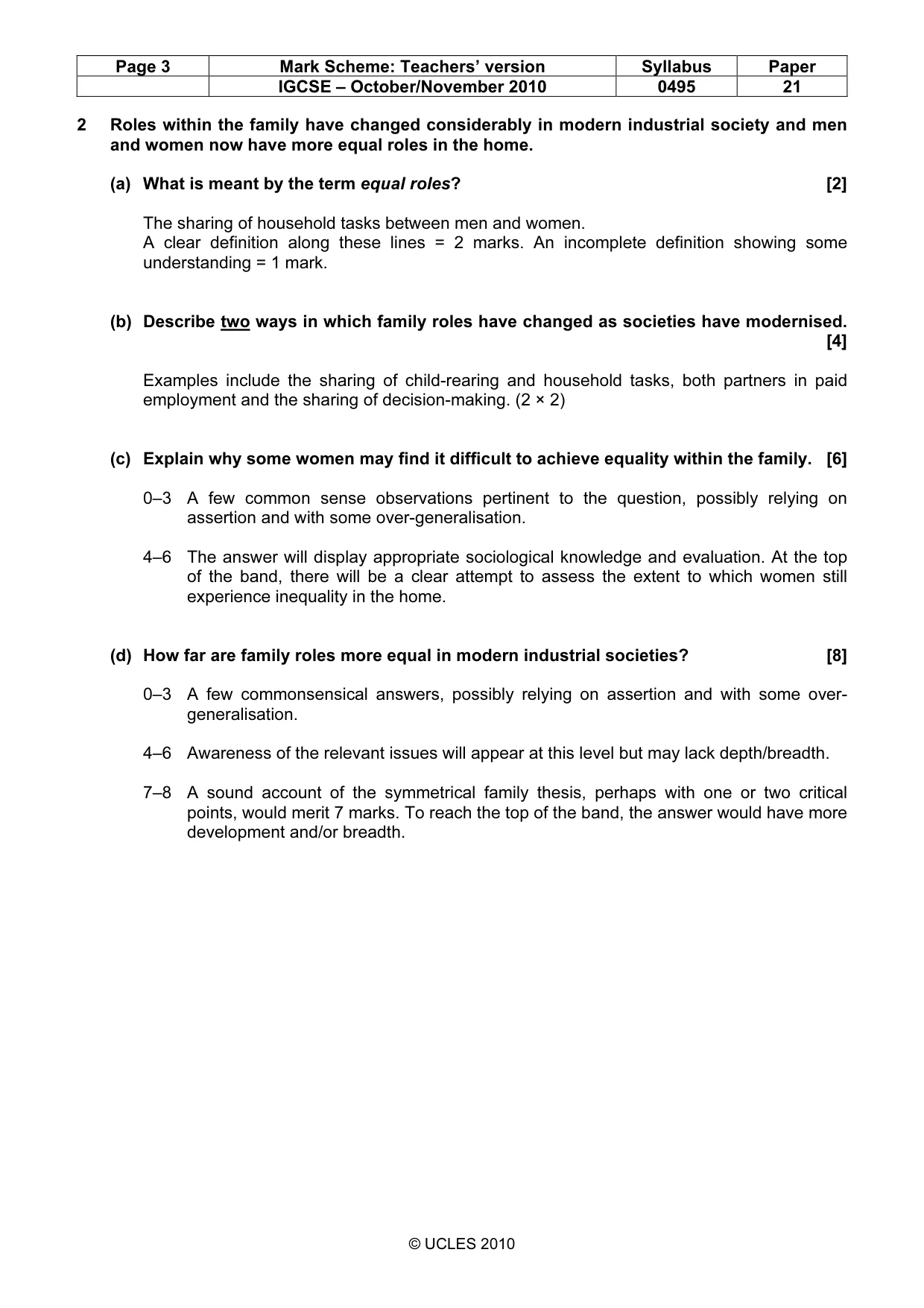
Page 3 Mark Scheme: Teachers’ version Syllabus Paper IGCSE – October/November 2010 0495 21 © UCLES 2010 2 Roles within the family have changed considerably in modern industrial society and men and women now have more equal roles in the home. (a) What is meant by the term equal roles? [2] The sharing of household tasks between men and women. A clear definition along these lines = 2 marks. An incomplete definition showing some understanding = 1 mark. (b) Describe two ways in which family roles have changed as societies have modernised. [4] Examples include the sharing of child-rearing and household tasks, both partners in paid employment and the sharing of decision-making. (2 × 2) (c) Explain why some women may find it difficult to achieve equality within the family. [6] 0–3 A few common sense observations pertinent to the question, possibly relying on assertion and with some over-generalisation. 4–6 The answer will display appropriate sociological knowledge and evaluation. At the top of the band, there will be a clear attempt to assess the extent to which women still experience inequality in the home. (d) How far are family roles more equal in modern industrial societies? [8] 0–3 A few commonsensical answers, possibly relying on assertion and with some over- generalisation. 4–6 Awareness of the relevant issues will appear at this level but may lack depth/breadth. 7–8 A sound account of the symmetrical family thesis, perhaps with one or two critical points, would merit 7 marks. To reach the top of the band, the answer would have more development and/or breadth.
Mark scheme, page 4
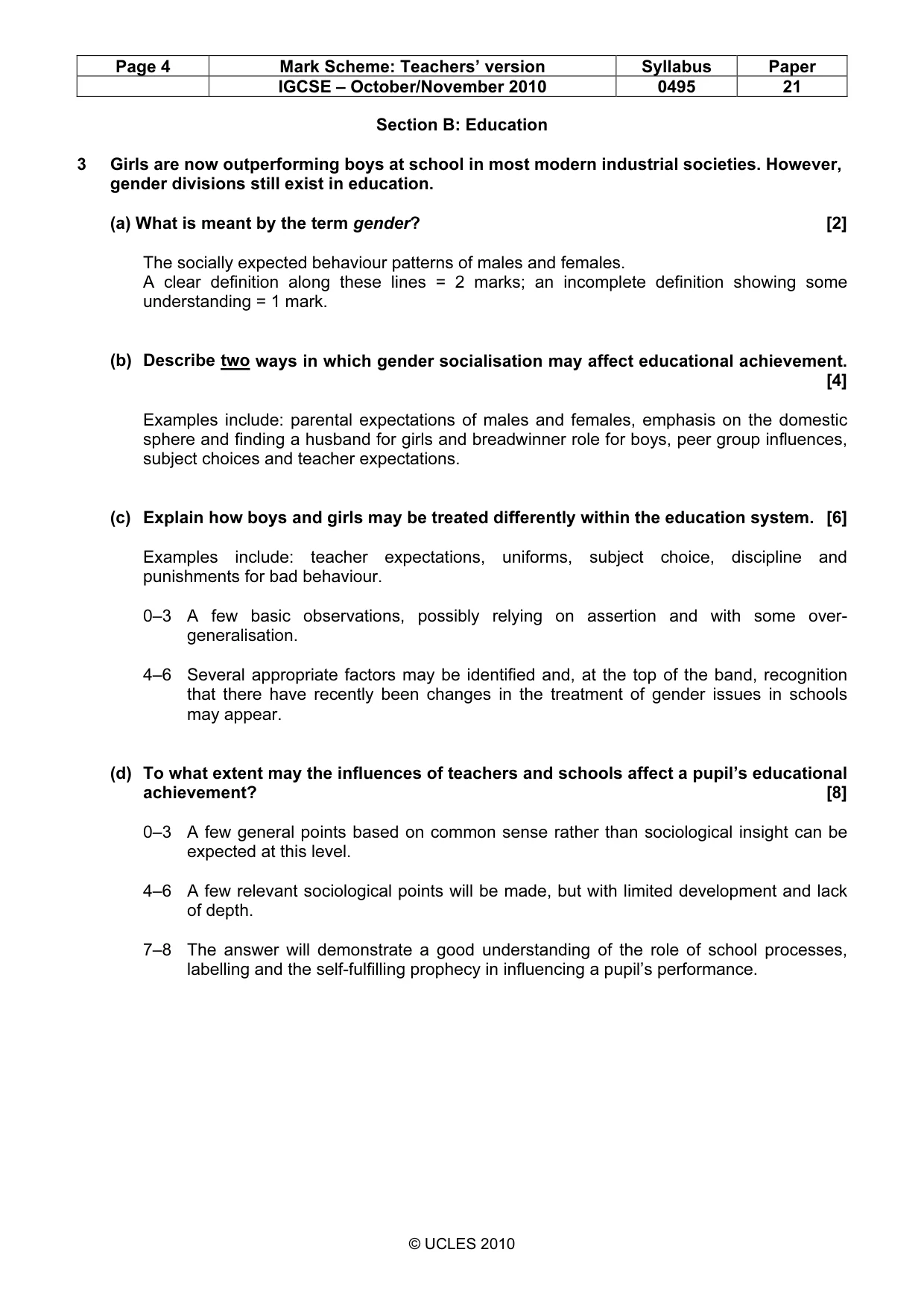
Page 4 Mark Scheme: Teachers’ version Syllabus Paper IGCSE – October/November 2010 0495 21 © UCLES 2010 Section B: Education 3 Girls are now outperforming boys at school in most modern industrial societies. However, gender divisions still exist in education. (a) What is meant by the term gender? [2] The socially expected behaviour patterns of males and females. A clear definition along these lines = 2 marks; an incomplete definition showing some understanding = 1 mark. (b) Describe two ways in which gender socialisation may affect educational achievement. [4] Examples include: parental expectations of males and females, emphasis on the domestic sphere and finding a husband for girls and breadwinner role for boys, peer group influences, subject choices and teacher expectations. (c) Explain how boys and girls may be treated differently within the education system. [6] Examples include: teacher expectations, uniforms, subject choice, discipline and punishments for bad behaviour. 0–3 A few basic observations, possibly relying on assertion and with some over- generalisation. 4–6 Several appropriate factors may be identified and, at the top of the band, recognition that there have recently been changes in the treatment of gender issues in schools may appear. (d) To what extent may the influences of teachers and schools affect a pupil’s educational achievement? [8] 0–3 A few general points based on common sense rather than sociological insight can be expected at this level. 4–6 A few relevant sociological points will be made, but with limited development and lack of depth. 7–8 The answer will demonstrate a good understanding of the role of school processes, labelling and the self-fulfilling prophecy in influencing a pupil’s performance.
Mark scheme, page 5
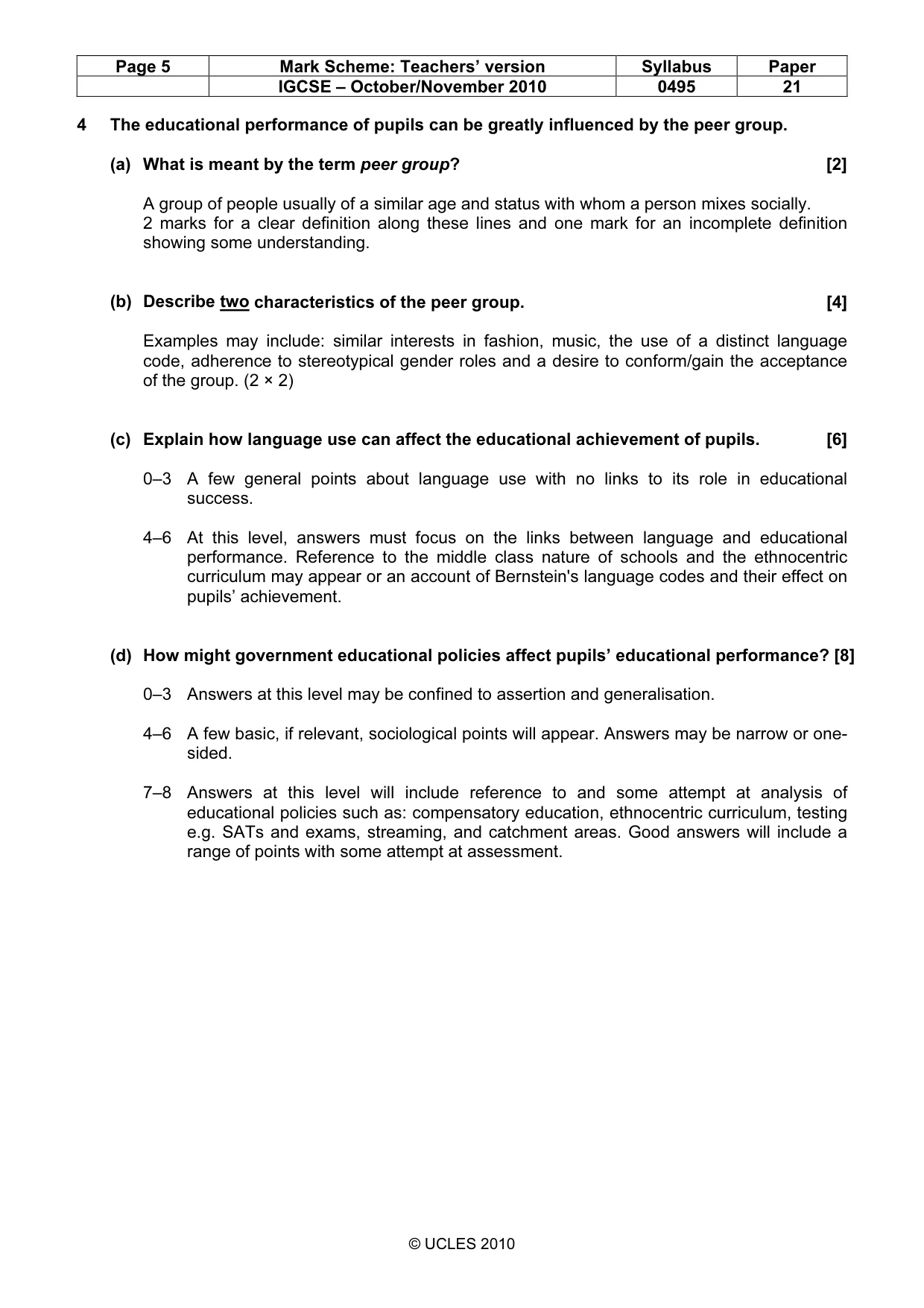
Page 5 Mark Scheme: Teachers’ version Syllabus Paper IGCSE – October/November 2010 0495 21 © UCLES 2010 4 The educational performance of pupils can be greatly influenced by the peer group. (a) What is meant by the term peer group? [2] A group of people usually of a similar age and status with whom a person mixes socially. 2 marks for a clear definition along these lines and one mark for an incomplete definition showing some understanding. (b) Describe two characteristics of the peer group. [4] Examples may include: similar interests in fashion, music, the use of a distinct language code, adherence to stereotypical gender roles and a desire to conform/gain the acceptance of the group. (2 × 2) (c) Explain how language use can affect the educational achievement of pupils. [6] 0–3 A few general points about language use with no links to its role in educational success. 4–6 At this level, answers must focus on the links between language and educational performance. Reference to the middle class nature of schools and the ethnocentric curriculum may appear or an account of Bernstein's language codes and their effect on pupils’ achievement. (d) How might government educational policies affect pupils’ educational performance? [8] 0–3 Answers at this level may be confined to assertion and generalisation. 4–6 A few basic, if relevant, sociological points will appear. Answers may be narrow or one- sided. 7–8 Answers at this level will include reference to and some attempt at analysis of educational policies such as: compensatory education, ethnocentric curriculum, testing e.g. SATs and exams, streaming, and catchment areas. Good answers will include a range of points with some attempt at assessment.
Mark scheme, page 6
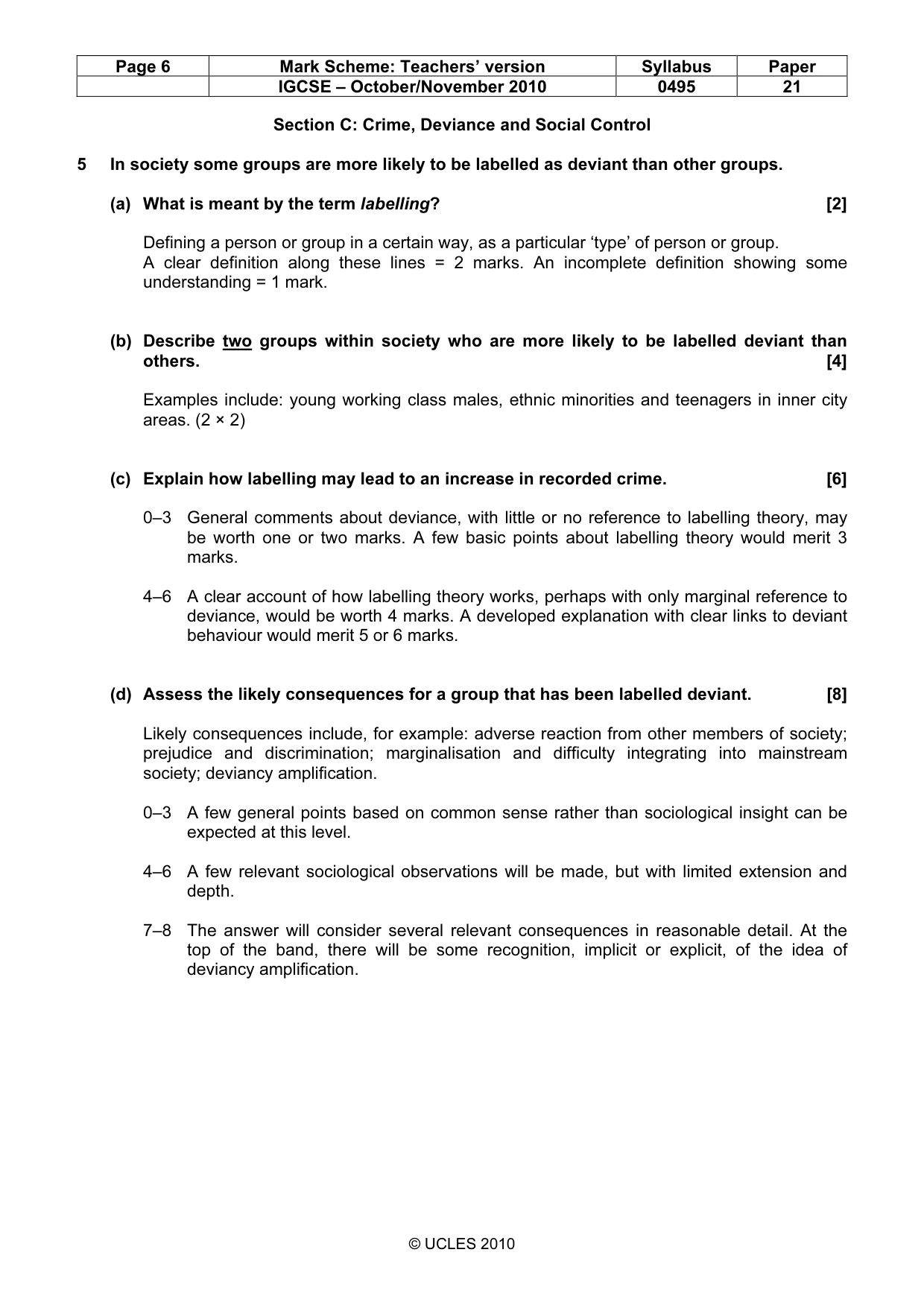
Page 6 Mark Scheme: Teachers’ version Syllabus Paper IGCSE – October/November 2010 0495 21 © UCLES 2010 Section C: Crime, Deviance and Social Control 5 In society some groups are more likely to be labelled as deviant than other groups. (a) What is meant by the term labelling? [2] Defining a person or group in a certain way, as a particular ‘type’ of person or group. A clear definition along these lines = 2 marks. An incomplete definition showing some understanding = 1 mark. (b) Describe two groups within society who are more likely to be labelled deviant than others. [4] Examples include: young working class males, ethnic minorities and teenagers in inner city areas. (2 × 2) (c) Explain how labelling may lead to an increase in recorded crime. [6] 0–3 General comments about deviance, with little or no reference to labelling theory, may be worth one or two marks. A few basic points about labelling theory would merit 3 marks. 4–6 A clear account of how labelling theory works, perhaps with only marginal reference to deviance, would be worth 4 marks. A developed explanation with clear links to deviant behaviour would merit 5 or 6 marks. (d) Assess the likely consequences for a group that has been labelled deviant. [8] Likely consequences include, for example: adverse reaction from other members of society; prejudice and discrimination; marginalisation and difficulty integrating into mainstream society; deviancy amplification. 0–3 A few general points based on common sense rather than sociological insight can be expected at this level. 4–6 A few relevant sociological observations will be made, but with limited extension and depth. 7–8 The answer will consider several relevant consequences in reasonable detail. At the top of the band, there will be some recognition, implicit or explicit, of the idea of deviancy amplification.
Mark scheme, page 7
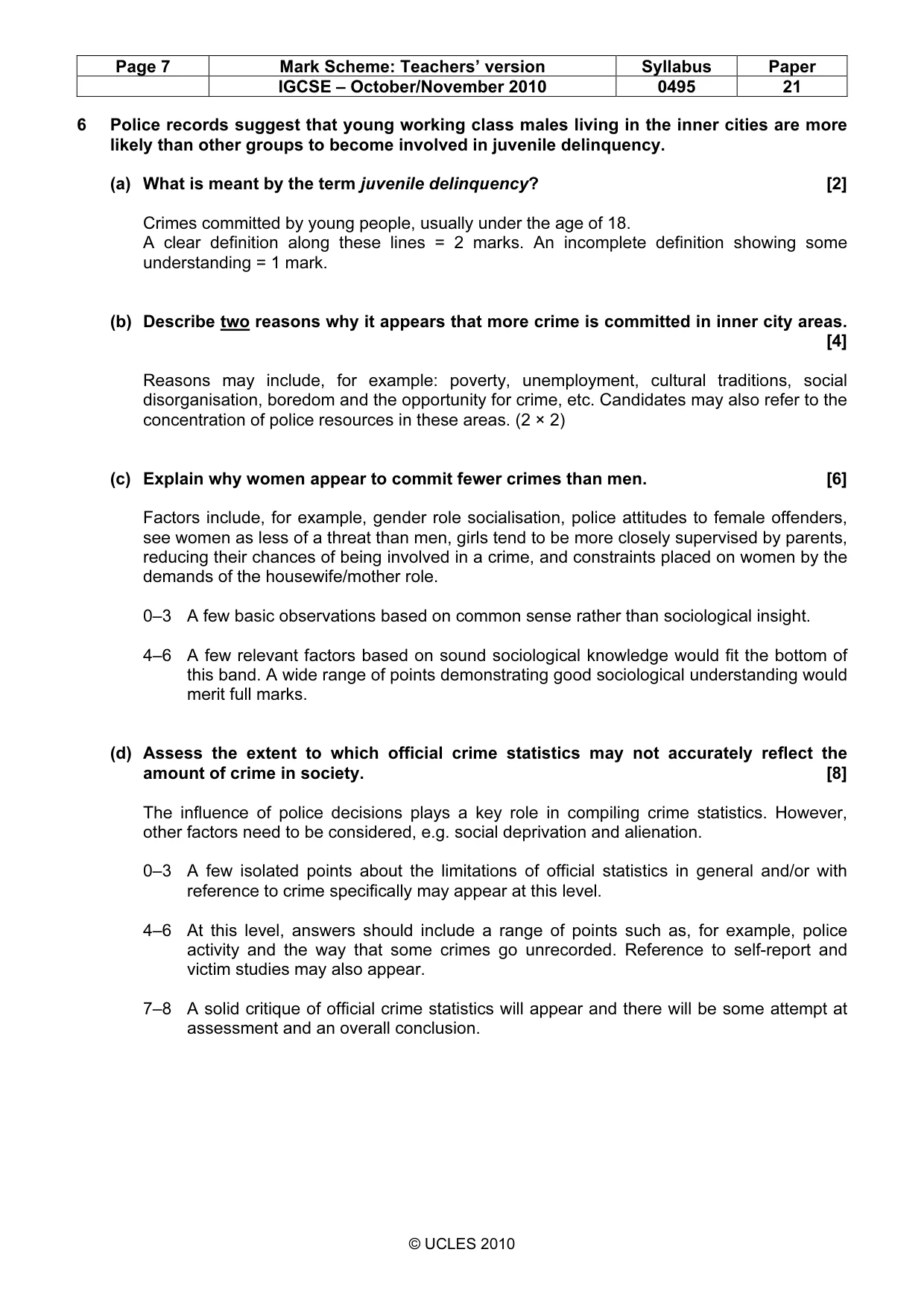
Page 7 Mark Scheme: Teachers’ version Syllabus Paper IGCSE – October/November 2010 0495 21 © UCLES 2010 6 Police records suggest that young working class males living in the inner cities are more likely than other groups to become involved in juvenile delinquency. (a) What is meant by the term juvenile delinquency? [2] Crimes committed by young people, usually under the age of 18. A clear definition along these lines = 2 marks. An incomplete definition showing some understanding = 1 mark. (b) Describe two reasons why it appears that more crime is committed in inner city areas. [4] Reasons may include, for example: poverty, unemployment, cultural traditions, social disorganisation, boredom and the opportunity for crime, etc. Candidates may also refer to the concentration of police resources in these areas. (2 × 2) (c) Explain why women appear to commit fewer crimes than men. [6] Factors include, for example, gender role socialisation, police attitudes to female offenders, see women as less of a threat than men, girls tend to be more closely supervised by parents, reducing their chances of being involved in a crime, and constraints placed on women by the demands of the housewife/mother role. 0–3 A few basic observations based on common sense rather than sociological insight. 4–6 A few relevant factors based on sound sociological knowledge would fit the bottom of this band. A wide range of points demonstrating good sociological understanding would merit full marks. (d) Assess the extent to which official crime statistics may not accurately reflect the amount of crime in society. [8] The influence of police decisions plays a key role in compiling crime statistics. However, other factors need to be considered, e.g. social deprivation and alienation. 0–3 A few isolated points about the limitations of official statistics in general and/or with reference to crime specifically may appear at this level. 4–6 At this level, answers should include a range of points such as, for example, police activity and the way that some crimes go unrecorded. Reference to self-report and victim studies may also appear. 7–8 A solid critique of official crime statistics will appear and there will be some attempt at assessment and an overall conclusion.
Mark scheme, page 8
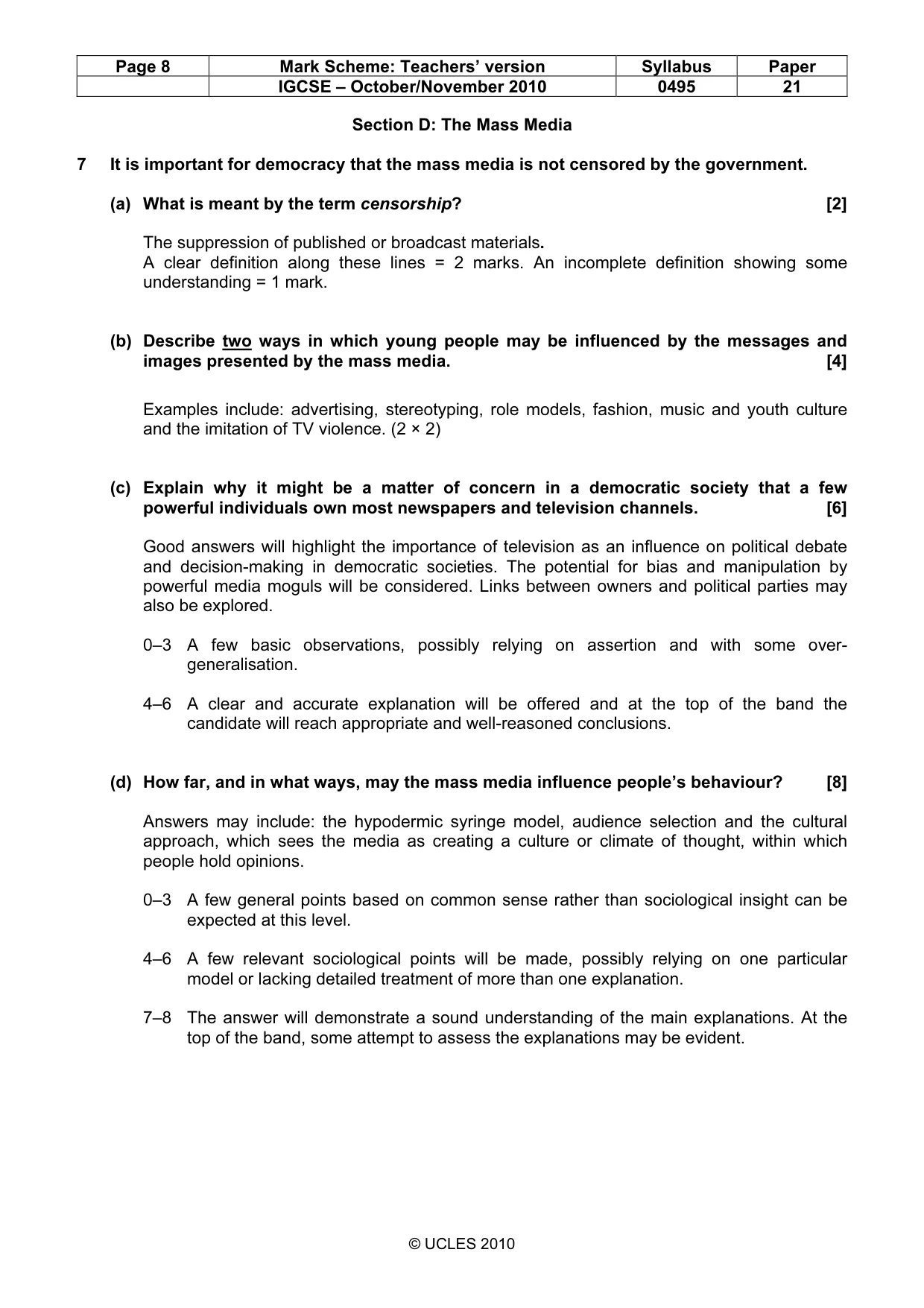
Page 8 Mark Scheme: Teachers’ version Syllabus Paper IGCSE – October/November 2010 0495 21 © UCLES 2010 Section D: The Mass Media 7 It is important for democracy that the mass media is not censored by the government. (a) What is meant by the term censorship? [2] The suppression of published or broadcast materials. A clear definition along these lines = 2 marks. An incomplete definition showing some understanding = 1 mark. (b) Describe two ways in which young people may be influenced by the messages and images presented by the mass media. [4] Examples include: advertising, stereotyping, role models, fashion, music and youth culture and the imitation of TV violence. (2 × 2) (c) Explain why it might be a matter of concern in a democratic society that a few powerful individuals own most newspapers and television channels. [6] Good answers will highlight the importance of television as an influence on political debate and decision-making in democratic societies. The potential for bias and manipulation by powerful media moguls will be considered. Links between owners and political parties may also be explored. 0–3 A few basic observations, possibly relying on assertion and with some over- generalisation. 4–6 A clear and accurate explanation will be offered and at the top of the band the candidate will reach appropriate and well-reasoned conclusions. (d) How far, and in what ways, may the mass media influence people’s behaviour? [8] Answers may include: the hypodermic syringe model, audience selection and the cultural approach, which sees the media as creating a culture or climate of thought, within which people hold opinions. 0–3 A few general points based on common sense rather than sociological insight can be expected at this level. 4–6 A few relevant sociological points will be made, possibly relying on one particular model or lacking detailed treatment of more than one explanation. 7–8 The answer will demonstrate a sound understanding of the main explanations. At the top of the band, some attempt to assess the explanations may be evident.
Mark scheme, page 9
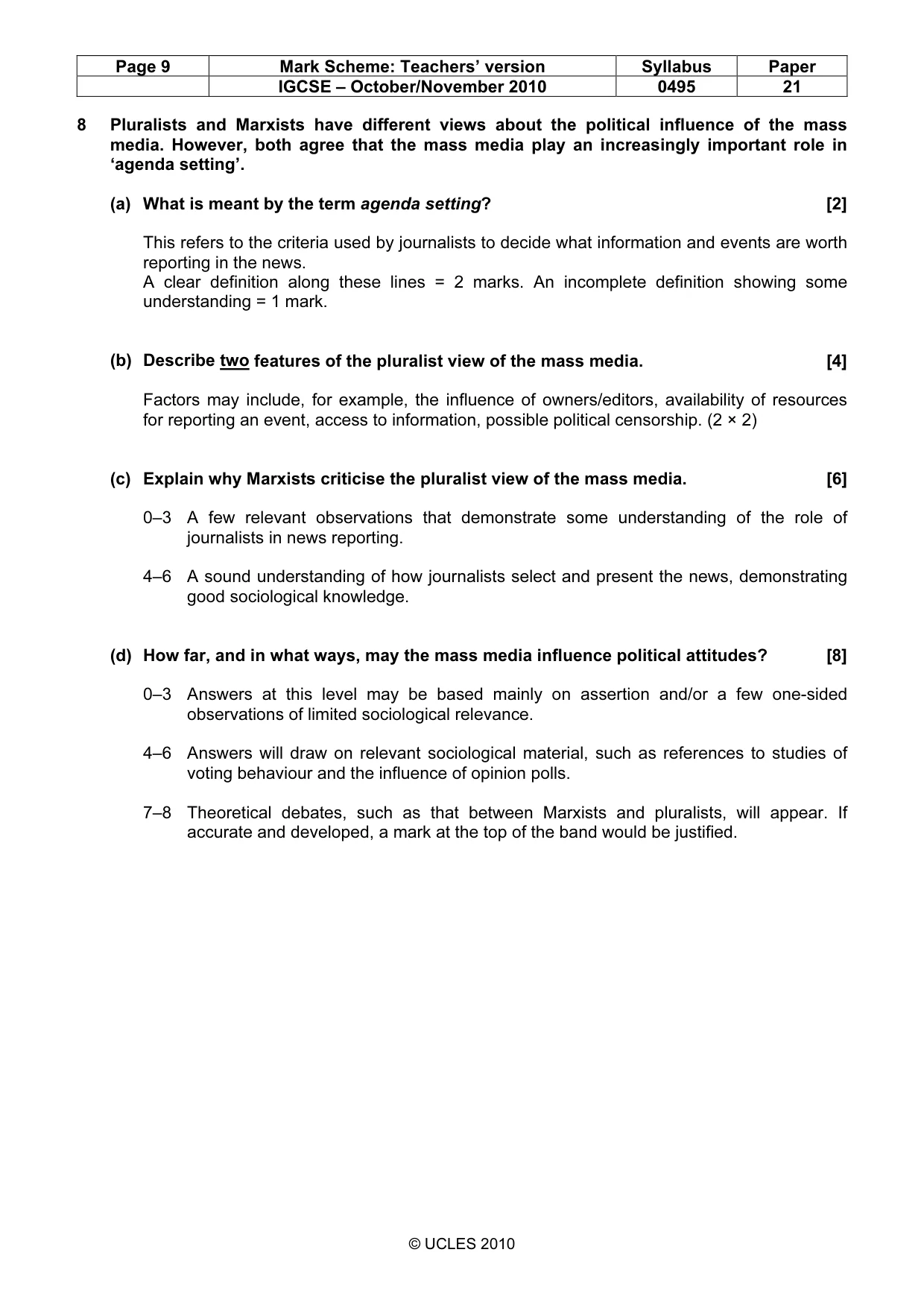
Page 9 Mark Scheme: Teachers’ version Syllabus Paper IGCSE – October/November 2010 0495 21 © UCLES 2010 8 Pluralists and Marxists have different views about the political influence of the mass media. However, both agree that the mass media play an increasingly important role in ‘agenda setting’. (a) What is meant by the term agenda setting? [2] This refers to the criteria used by journalists to decide what information and events are worth reporting in the news. A clear definition along these lines = 2 marks. An incomplete definition showing some understanding = 1 mark. (b) Describe two features of the pluralist view of the mass media. [4] Factors may include, for example, the influence of owners/editors, availability of resources for reporting an event, access to information, possible political censorship. (2 × 2) (c) Explain why Marxists criticise the pluralist view of the mass media. [6] 0–3 A few relevant observations that demonstrate some understanding of the role of journalists in news reporting. 4–6 A sound understanding of how journalists select and present the news, demonstrating good sociological knowledge. (d) How far, and in what ways, may the mass media influence political attitudes? [8] 0–3 Answers at this level may be based mainly on assertion and/or a few one-sided observations of limited sociological relevance. 4–6 Answers will draw on relevant sociological material, such as references to studies of voting behaviour and the influence of opinion polls. 7–8 Theoretical debates, such as that between Marxists and pluralists, will appear. If accurate and developed, a mark at the top of the band would be justified.
What you needed in this session
Cambridge’s own grade thresholds for 2010 Oct/Nov, Paper 2 · Variant 1. A higher threshold means an easier paper — the bar moves with how the cohort did.