Cambridge IGCSE Sociology 0495 — 2009 May/June Paper 2 · Variant 1
0495/21/M/J/09 · 60 marks · ≈68 min
The question paper and its mark scheme, free to read here and free to download. This is Cambridge’s own paper, exactly as it was sat.
Question paper4 pages
Mark scheme9 pages
Answers below. Sit the paper first if you are practising.
Paper as text
Question paper, page 1
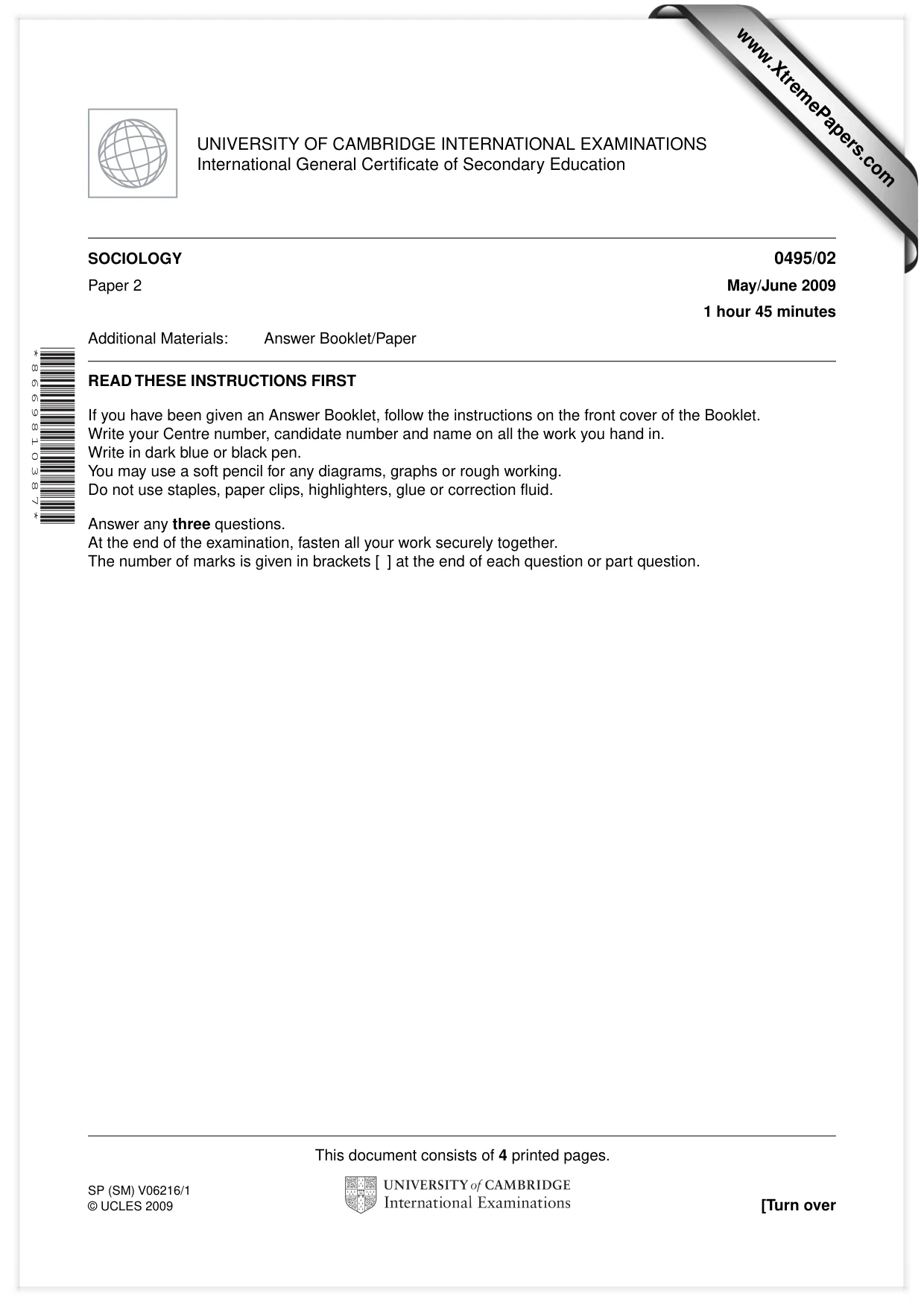
This document consists of 4 printed pages. SP (SM) V06216/1 © UCLES 2009 [Turn over UNIVERSITY OF CAMBRIDGE INTERNATIONAL EXAMINATIONS International General Certificate of Secondary Education READ THESE INSTRUCTIONS FIRST If you have been given an Answer Booklet, follow the instructions on the front cover of the Booklet. Write your Centre number, candidate number and name on all the work you hand in. Write in dark blue or black pen. You may use a soft pencil for any diagrams, graphs or rough working. Do not use staples, paper clips, highlighters, glue or correction fluid. Answer any three questions. At the end of the examination, fasten all your work securely together. The number of marks is given in brackets [ ] at the end of each question or part question. * 8 6 6 9 8 1 0 3 8 7 * SOCIOLOGY 0495/02 Paper 2 May/June 2009 1 hour 45 minutes Additional Materials: Answer Booklet/Paper www.XtremePapers.com
Question paper, page 2
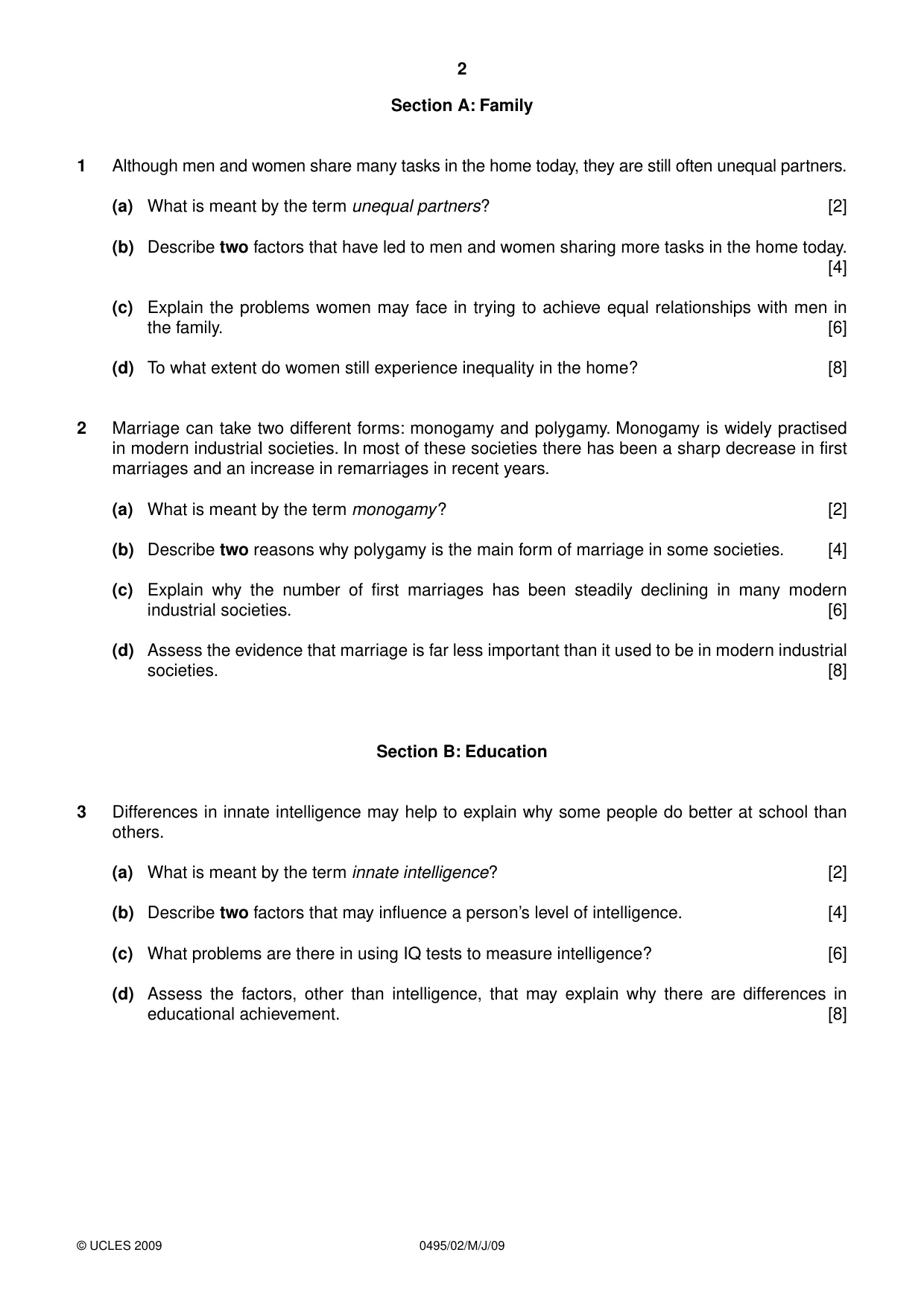
2 0495/02/M/J/09 © UCLES 2009 Section A: Family 1 Although men and women share many tasks in the home today, they are still often unequal partners. (a) What is meant by the term unequal partners? [2] (b) Describe two factors that have led to men and women sharing more tasks in the home today. [4] (c) Explain the problems women may face in trying to achieve equal relationships with men in the family. [6] (d) To what extent do women still experience inequality in the home? [8] 2 Marriage can take two different forms: monogamy and polygamy. Monogamy is widely practised in modern industrial societies. In most of these societies there has been a sharp decrease in first marriages and an increase in remarriages in recent years. (a) What is meant by the term monogamy ? [2] (b) Describe two reasons why polygamy is the main form of marriage in some societies. [4] (c) Explain why the number of first marriages has been steadily declining in many modern industrial societies. [6] (d) Assess the evidence that marriage is far less important than it used to be in modern industrial societies. [8] Section B: Education 3 Differences in innate intelligence may help to explain why some people do better at school than others. (a) What is meant by the term innate intelligence? [2] (b) Describe two factors that may influence a person’s level of intelligence. [4] (c) What problems are there in using IQ tests to measure intelligence? [6] (d) Assess the factors, other than intelligence, that may explain why there are differences in educational achievement. [8]
Question paper, page 3
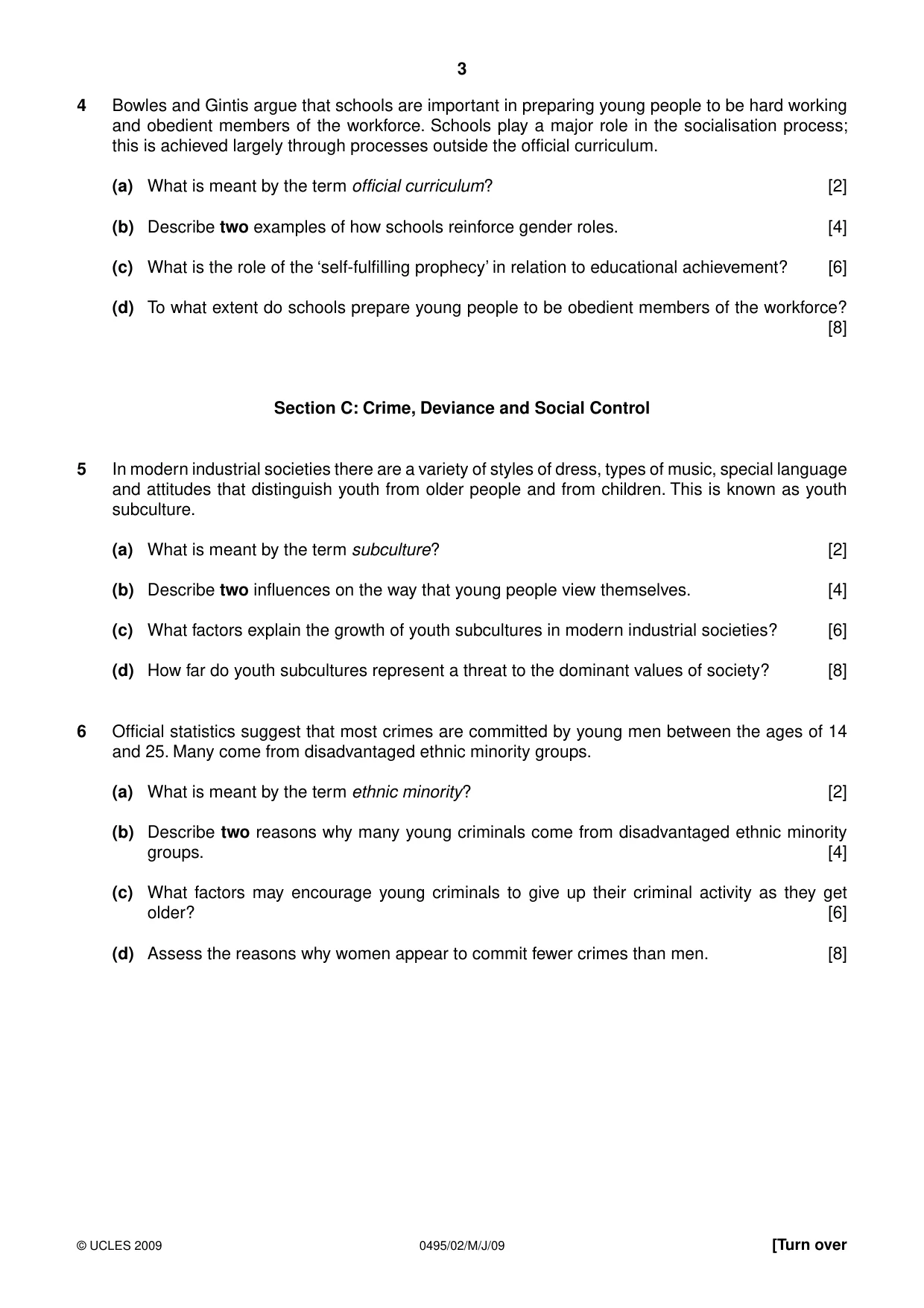
3 4 Bowles and Gintis argue that schools are important in preparing young people to be hard working and obedient members of the workforce. Schools play a major role in the socialisation process; this is achieved largely through processes outside the official curriculum. (a) What is meant by the term official curriculum? [2] (b) Describe two examples of how schools reinforce gender roles. [4] (c) What is the role of the ‘self-fulfilling prophecy’ in relation to educational achievement? [6] (d) To what extent do schools prepare young people to be obedient members of the workforce? [8] Section C: Crime, Deviance and Social Control 5 In modern industrial societies there are a variety of styles of dress, types of music, special language and attitudes that distinguish youth from older people and from children. This is known as youth subculture. (a) What is meant by the term subculture? [2] (b) Describe two influences on the way that young people view themselves. [4] (c) What factors explain the growth of youth subcultures in modern industrial societies? [6] (d) How far do youth subcultures represent a threat to the dominant values of society? [8] 6 Official statistics suggest that most crimes are committed by young men between the ages of 14 and 25. Many come from disadvantaged ethnic minority groups. (a) What is meant by the term ethnic minority? [2] (b) Describe two reasons why many young criminals come from disadvantaged ethnic minority groups. [4] (c) What factors may encourage young criminals to give up their criminal activity as they get older? [6] (d) Assess the reasons why women appear to commit fewer crimes than men. [8] [Turn over 0495/02/M/J/09 © UCLES 2009
Question paper, page 4
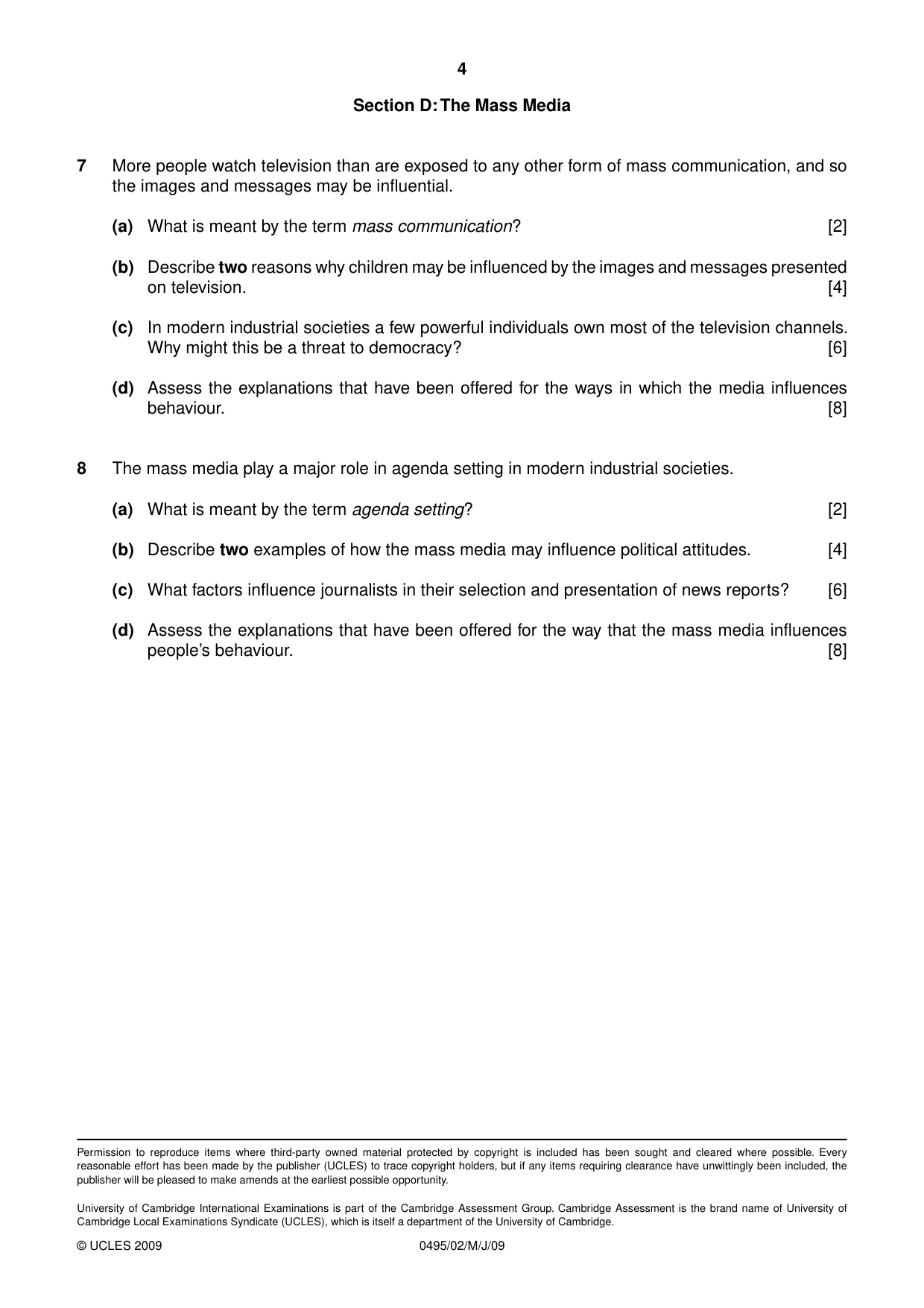
4 0495/02/M/J/09 Section D: The Mass Media 7 More people watch television than are exposed to any other form of mass communication, and so the images and messages may be influential. (a) What is meant by the term mass communication? [2] (b) Describe two reasons why children may be influenced by the images and messages presented on television. [4] (c) In modern industrial societies a few powerful individuals own most of the television channels. Why might this be a threat to democracy? [6] (d) Assess the explanations that have been offered for the ways in which the media influences behaviour. [8] 8 The mass media play a major role in agenda setting in modern industrial societies. (a) What is meant by the term agenda setting? [2] (b) Describe two examples of how the mass media may influence political attitudes. [4] (c) What factors influence journalists in their selection and presentation of news reports? [6] (d) Assess the explanations that have been offered for the way that the mass media influences people’s behaviour. [8] Permission to reproduce items where third-party owned material protected by copyright is included has been sought and cleared where possible. Every reasonable effort has been made by the publisher (UCLES) to trace copyright holders, but if any items requiring clearance have unwittingly been included, the publisher will be pleased to make amends at the earliest possible opportunity. University of Cambridge International Examinations is part of the Cambridge Assessment Group. Cambridge Assessment is the brand name of University of Cambridge Local Examinations Syndicate (UCLES), which is itself a department of the University of Cambridge. © UCLES 2009
Mark scheme, page 1
UNIVERSITY OF CAMBRIDGE INTERNATIONAL EXAMINATIONS International General Certificate of Secondary Education MARK SCHEME for the May/June 2009 question paper for the guidance of teachers 0495 SOCIOLOGY 0495/02 Paper 2, maximum raw mark 60 This mark scheme is published as an aid to teachers and candidates, to indicate the requirements of the examination. It shows the basis on which Examiners were instructed to award marks. It does not indicate the details of the discussions that took place at an Examiners’ meeting before marking began, which would have considered the acceptability of alternative answers. Mark schemes must be read in conjunction with the question papers and the report on the examination. • CIE will not enter into discussions or correspondence in connection with these mark schemes. CIE is publishing the mark schemes for the May/June 2009 question papers for most IGCSE, GCE Advanced Level and Advanced Subsidiary Level syllabuses and some Ordinary Level syllabuses. www.XtremePapers.com
Mark scheme, page 2
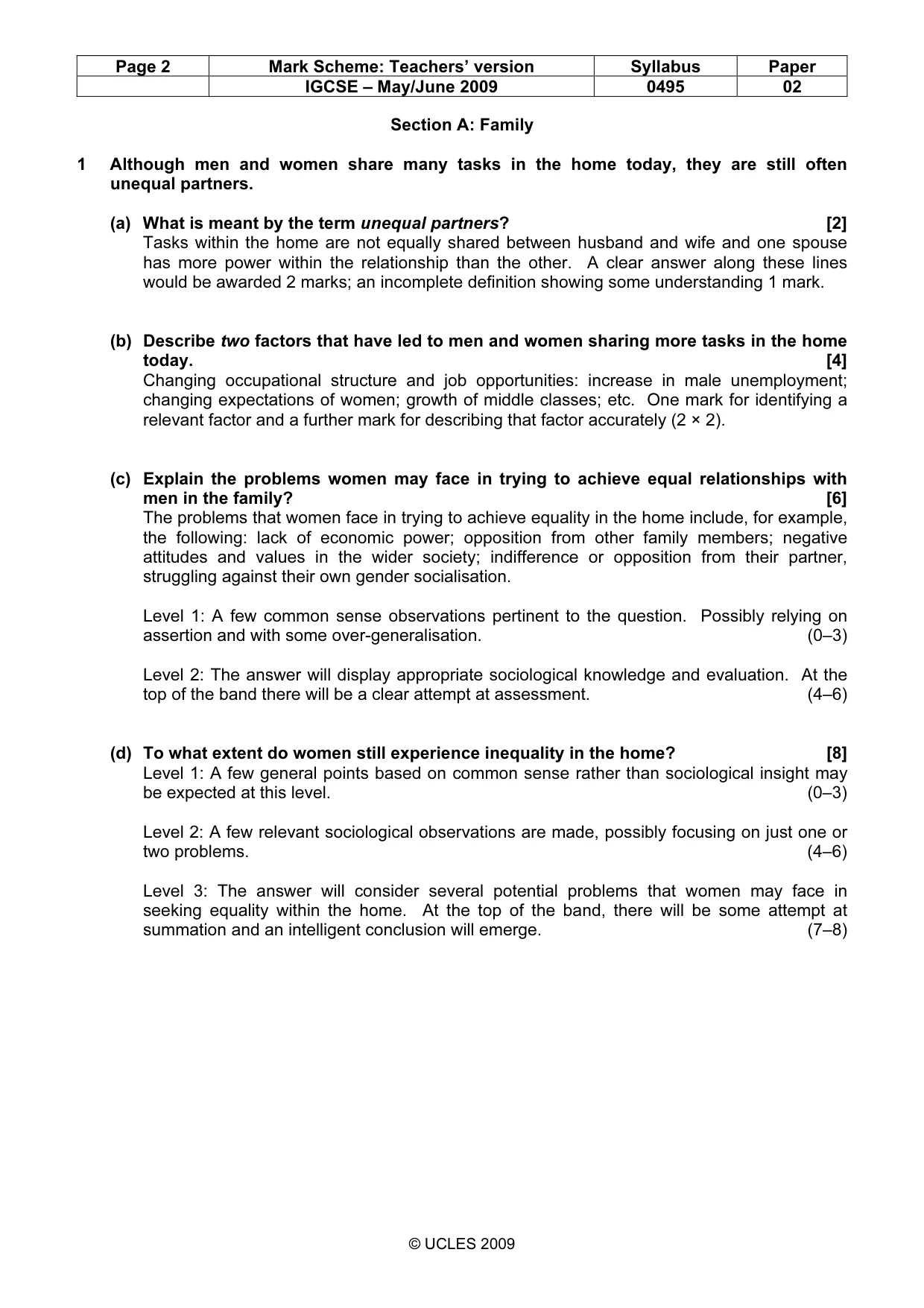
Page 2 Mark Scheme: Teachers’ version Syllabus Paper IGCSE – May/June 2009 0495 02 © UCLES 2009 Section A: Family 1 Although men and women share many tasks in the home today, they are still often unequal partners. (a) What is meant by the term unequal partners? [2] Tasks within the home are not equally shared between husband and wife and one spouse has more power within the relationship than the other. A clear answer along these lines would be awarded 2 marks; an incomplete definition showing some understanding 1 mark. (b) Describe two factors that have led to men and women sharing more tasks in the home today. [4] Changing occupational structure and job opportunities: increase in male unemployment; changing expectations of women; growth of middle classes; etc. One mark for identifying a relevant factor and a further mark for describing that factor accurately (2 × 2). (c) Explain the problems women may face in trying to achieve equal relationships with men in the family? [6] The problems that women face in trying to achieve equality in the home include, for example, the following: lack of economic power; opposition from other family members; negative attitudes and values in the wider society; indifference or opposition from their partner, struggling against their own gender socialisation. Level 1: A few common sense observations pertinent to the question. Possibly relying on assertion and with some over-generalisation. (0–3) Level 2: The answer will display appropriate sociological knowledge and evaluation. At the top of the band there will be a clear attempt at assessment. (4–6) (d) To what extent do women still experience inequality in the home? [8] Level 1: A few general points based on common sense rather than sociological insight may be expected at this level. (0–3) Level 2: A few relevant sociological observations are made, possibly focusing on just one or two problems. (4–6) Level 3: The answer will consider several potential problems that women may face in seeking equality within the home. At the top of the band, there will be some attempt at summation and an intelligent conclusion will emerge. (7–8)
Mark scheme, page 3
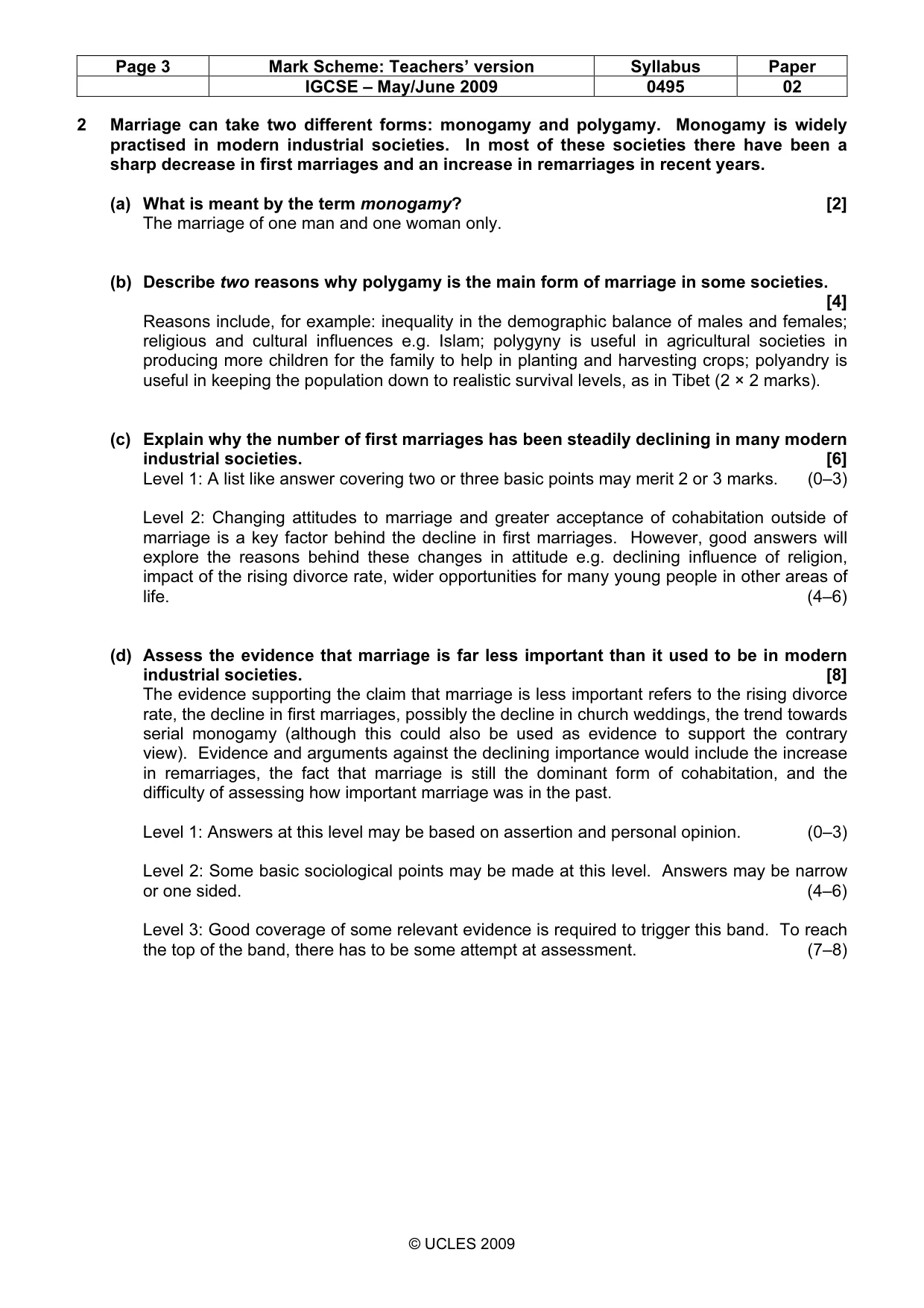
Page 3 Mark Scheme: Teachers’ version Syllabus Paper IGCSE – May/June 2009 0495 02 © UCLES 2009 2 Marriage can take two different forms: monogamy and polygamy. Monogamy is widely practised in modern industrial societies. In most of these societies there have been a sharp decrease in first marriages and an increase in remarriages in recent years. (a) What is meant by the term monogamy? [2] The marriage of one man and one woman only. (b) Describe two reasons why polygamy is the main form of marriage in some societies. [4] Reasons include, for example: inequality in the demographic balance of males and females; religious and cultural influences e.g. Islam; polygyny is useful in agricultural societies in producing more children for the family to help in planting and harvesting crops; polyandry is useful in keeping the population down to realistic survival levels, as in Tibet (2 × 2 marks). (c) Explain why the number of first marriages has been steadily declining in many modern industrial societies. [6] Level 1: A list like answer covering two or three basic points may merit 2 or 3 marks. (0–3) Level 2: Changing attitudes to marriage and greater acceptance of cohabitation outside of marriage is a key factor behind the decline in first marriages. However, good answers will explore the reasons behind these changes in attitude e.g. declining influence of religion, impact of the rising divorce rate, wider opportunities for many young people in other areas of life. (4–6) (d) Assess the evidence that marriage is far less important than it used to be in modern industrial societies. [8] The evidence supporting the claim that marriage is less important refers to the rising divorce rate, the decline in first marriages, possibly the decline in church weddings, the trend towards serial monogamy (although this could also be used as evidence to support the contrary view). Evidence and arguments against the declining importance would include the increase in remarriages, the fact that marriage is still the dominant form of cohabitation, and the difficulty of assessing how important marriage was in the past. Level 1: Answers at this level may be based on assertion and personal opinion. (0–3) Level 2: Some basic sociological points may be made at this level. Answers may be narrow or one sided. (4–6) Level 3: Good coverage of some relevant evidence is required to trigger this band. To reach the top of the band, there has to be some attempt at assessment. (7–8)
Mark scheme, page 4
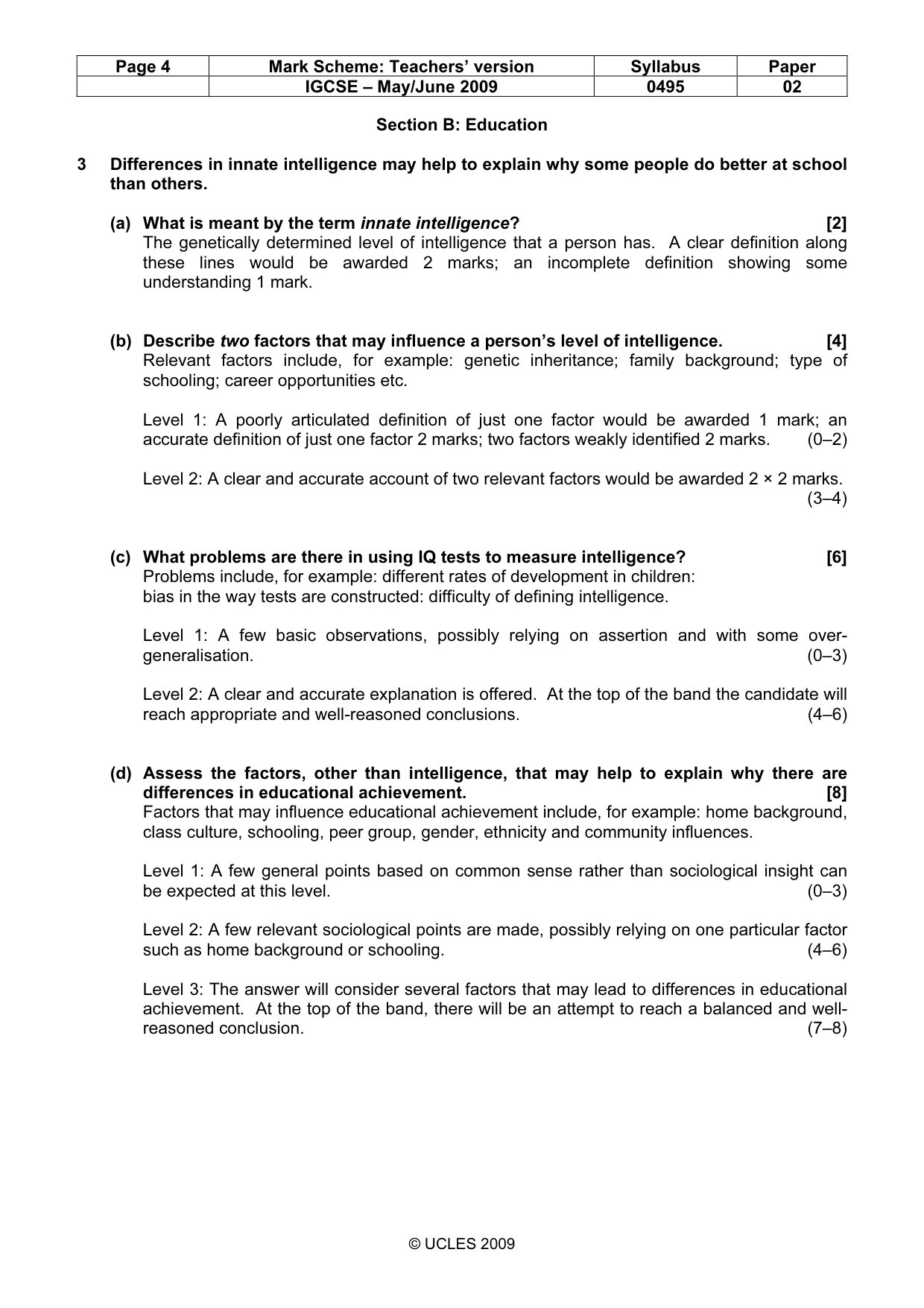
Page 4 Mark Scheme: Teachers’ version Syllabus Paper IGCSE – May/June 2009 0495 02 © UCLES 2009 Section B: Education 3 Differences in innate intelligence may help to explain why some people do better at school than others. (a) What is meant by the term innate intelligence? [2] The genetically determined level of intelligence that a person has. A clear definition along these lines would be awarded 2 marks; an incomplete definition showing some understanding 1 mark. (b) Describe two factors that may influence a person’s level of intelligence. [4] Relevant factors include, for example: genetic inheritance; family background; type of schooling; career opportunities etc. Level 1: A poorly articulated definition of just one factor would be awarded 1 mark; an accurate definition of just one factor 2 marks; two factors weakly identified 2 marks. (0–2) Level 2: A clear and accurate account of two relevant factors would be awarded 2 × 2 marks. (3–4) (c) What problems are there in using IQ tests to measure intelligence? [6] Problems include, for example: different rates of development in children: bias in the way tests are constructed: difficulty of defining intelligence. Level 1: A few basic observations, possibly relying on assertion and with some over- generalisation. (0–3) Level 2: A clear and accurate explanation is offered. At the top of the band the candidate will reach appropriate and well-reasoned conclusions. (4–6) (d) Assess the factors, other than intelligence, that may help to explain why there are differences in educational achievement. [8] Factors that may influence educational achievement include, for example: home background, class culture, schooling, peer group, gender, ethnicity and community influences. Level 1: A few general points based on common sense rather than sociological insight can be expected at this level. (0–3) Level 2: A few relevant sociological points are made, possibly relying on one particular factor such as home background or schooling. (4–6) Level 3: The answer will consider several factors that may lead to differences in educational achievement. At the top of the band, there will be an attempt to reach a balanced and well- reasoned conclusion. (7–8)
Mark scheme, page 5
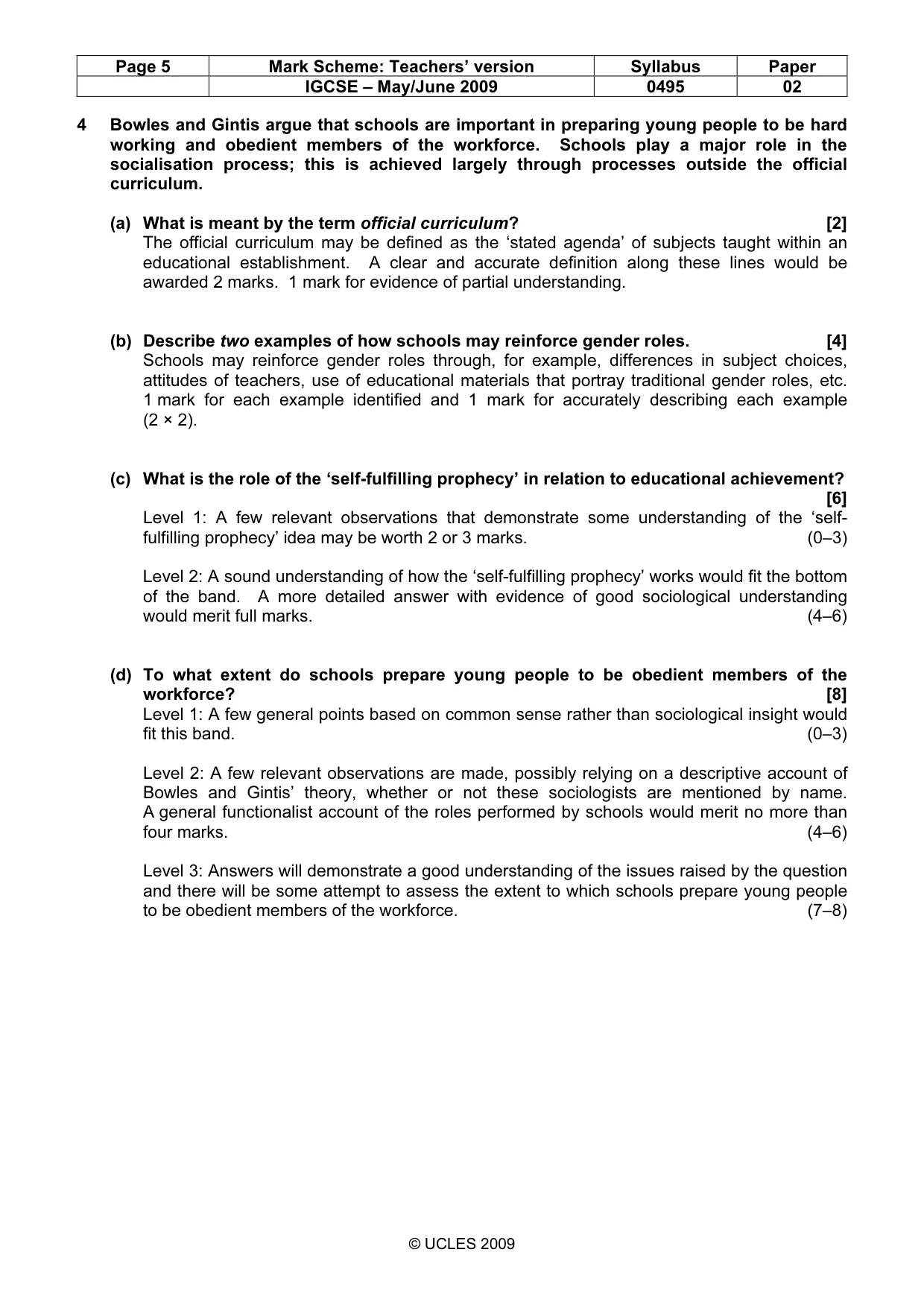
Page 5 Mark Scheme: Teachers’ version Syllabus Paper IGCSE – May/June 2009 0495 02 © UCLES 2009 4 Bowles and Gintis argue that schools are important in preparing young people to be hard working and obedient members of the workforce. Schools play a major role in the socialisation process; this is achieved largely through processes outside the official curriculum. (a) What is meant by the term official curriculum? [2] The official curriculum may be defined as the ‘stated agenda’ of subjects taught within an educational establishment. A clear and accurate definition along these lines would be awarded 2 marks. 1 mark for evidence of partial understanding. (b) Describe two examples of how schools may reinforce gender roles. [4] Schools may reinforce gender roles through, for example, differences in subject choices, attitudes of teachers, use of educational materials that portray traditional gender roles, etc. 1 mark for each example identified and 1 mark for accurately describing each example (2 × 2). (c) What is the role of the ‘self-fulfilling prophecy’ in relation to educational achievement? [6] Level 1: A few relevant observations that demonstrate some understanding of the ‘self- fulfilling prophecy’ idea may be worth 2 or 3 marks. (0–3) Level 2: A sound understanding of how the ‘self-fulfilling prophecy’ works would fit the bottom of the band. A more detailed answer with evidence of good sociological understanding would merit full marks. (4–6) (d) To what extent do schools prepare young people to be obedient members of the workforce? [8] Level 1: A few general points based on common sense rather than sociological insight would fit this band. (0–3) Level 2: A few relevant observations are made, possibly relying on a descriptive account of Bowles and Gintis’ theory, whether or not these sociologists are mentioned by name. A general functionalist account of the roles performed by schools would merit no more than four marks. (4–6) Level 3: Answers will demonstrate a good understanding of the issues raised by the question and there will be some attempt to assess the extent to which schools prepare young people to be obedient members of the workforce. (7–8)
Mark scheme, page 6
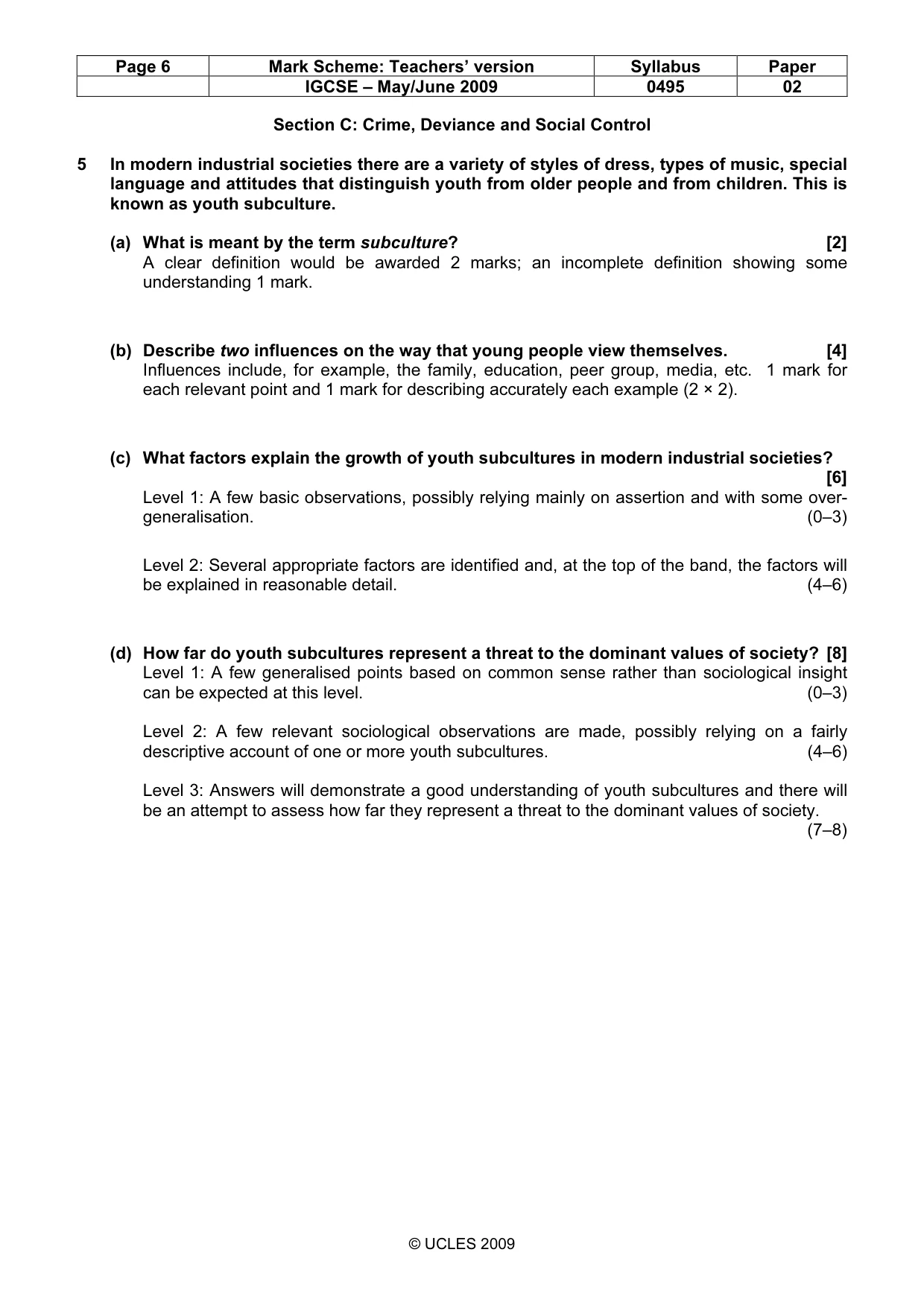
Page 6 Mark Scheme: Teachers’ version Syllabus Paper IGCSE – May/June 2009 0495 02 © UCLES 2009 Section C: Crime, Deviance and Social Control 5 In modern industrial societies there are a variety of styles of dress, types of music, special language and attitudes that distinguish youth from older people and from children. This is known as youth subculture. (a) What is meant by the term subculture? [2] A clear definition would be awarded 2 marks; an incomplete definition showing some understanding 1 mark. (b) Describe two influences on the way that young people view themselves. [4] Influences include, for example, the family, education, peer group, media, etc. 1 mark for each relevant point and 1 mark for describing accurately each example (2 × 2). (c) What factors explain the growth of youth subcultures in modern industrial societies? [6] Level 1: A few basic observations, possibly relying mainly on assertion and with some over- generalisation. (0–3) Level 2: Several appropriate factors are identified and, at the top of the band, the factors will be explained in reasonable detail. (4–6) (d) How far do youth subcultures represent a threat to the dominant values of society? [8] Level 1: A few generalised points based on common sense rather than sociological insight can be expected at this level. (0–3) Level 2: A few relevant sociological observations are made, possibly relying on a fairly descriptive account of one or more youth subcultures. (4–6) Level 3: Answers will demonstrate a good understanding of youth subcultures and there will be an attempt to assess how far they represent a threat to the dominant values of society. (7–8)
Mark scheme, page 7
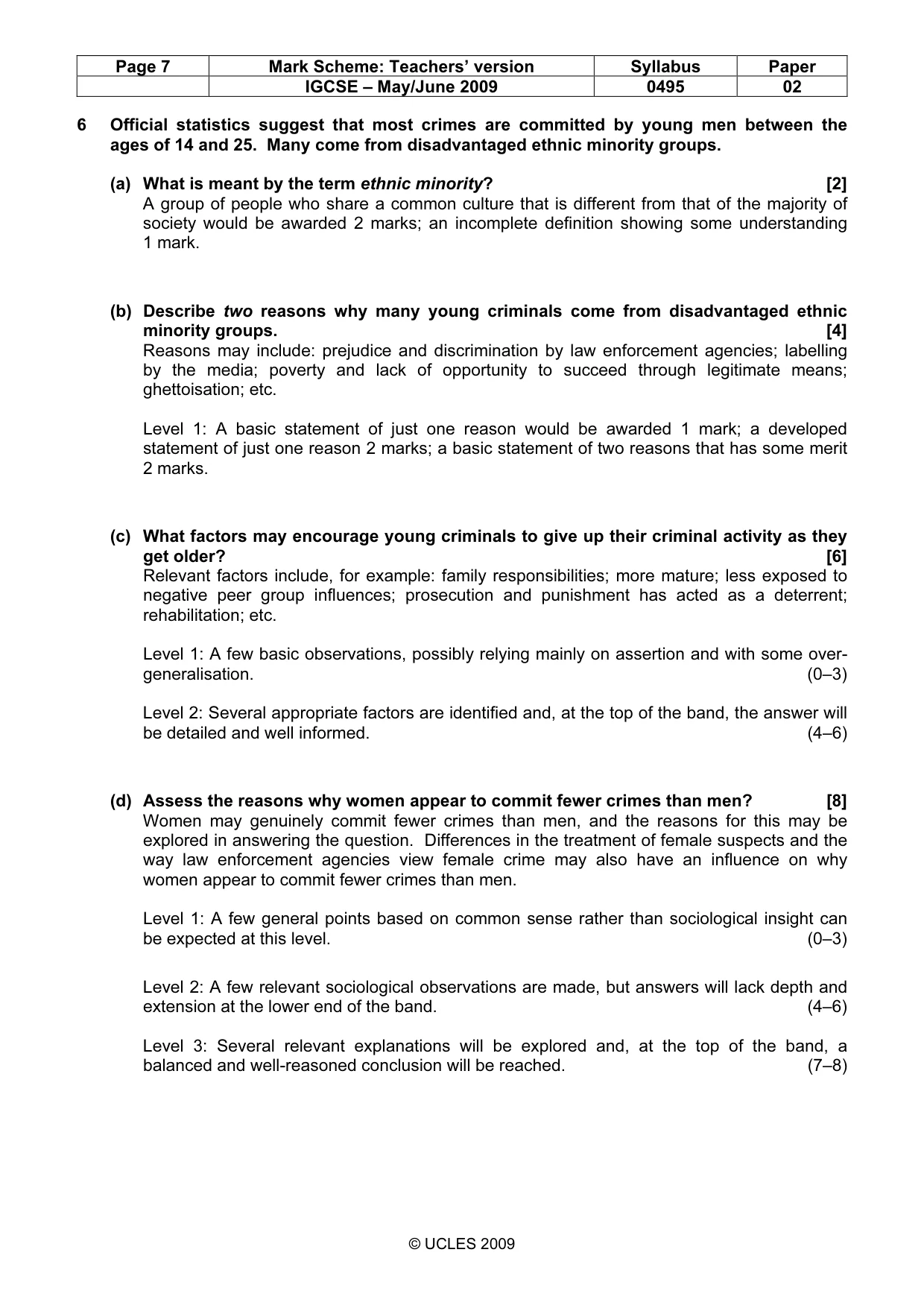
Page 7 Mark Scheme: Teachers’ version Syllabus Paper IGCSE – May/June 2009 0495 02 © UCLES 2009 6 Official statistics suggest that most crimes are committed by young men between the ages of 14 and 25. Many come from disadvantaged ethnic minority groups. (a) What is meant by the term ethnic minority? [2] A group of people who share a common culture that is different from that of the majority of society would be awarded 2 marks; an incomplete definition showing some understanding 1 mark. (b) Describe two reasons why many young criminals come from disadvantaged ethnic minority groups. [4] Reasons may include: prejudice and discrimination by law enforcement agencies; labelling by the media; poverty and lack of opportunity to succeed through legitimate means; ghettoisation; etc. Level 1: A basic statement of just one reason would be awarded 1 mark; a developed statement of just one reason 2 marks; a basic statement of two reasons that has some merit 2 marks. (c) What factors may encourage young criminals to give up their criminal activity as they get older? [6] Relevant factors include, for example: family responsibilities; more mature; less exposed to negative peer group influences; prosecution and punishment has acted as a deterrent; rehabilitation; etc. Level 1: A few basic observations, possibly relying mainly on assertion and with some over- generalisation. (0–3) Level 2: Several appropriate factors are identified and, at the top of the band, the answer will be detailed and well informed. (4–6) (d) Assess the reasons why women appear to commit fewer crimes than men? [8] Women may genuinely commit fewer crimes than men, and the reasons for this may be explored in answering the question. Differences in the treatment of female suspects and the way law enforcement agencies view female crime may also have an influence on why women appear to commit fewer crimes than men. Level 1: A few general points based on common sense rather than sociological insight can be expected at this level. (0–3) Level 2: A few relevant sociological observations are made, but answers will lack depth and extension at the lower end of the band. (4–6) Level 3: Several relevant explanations will be explored and, at the top of the band, a balanced and well-reasoned conclusion will be reached. (7–8)
Mark scheme, page 8
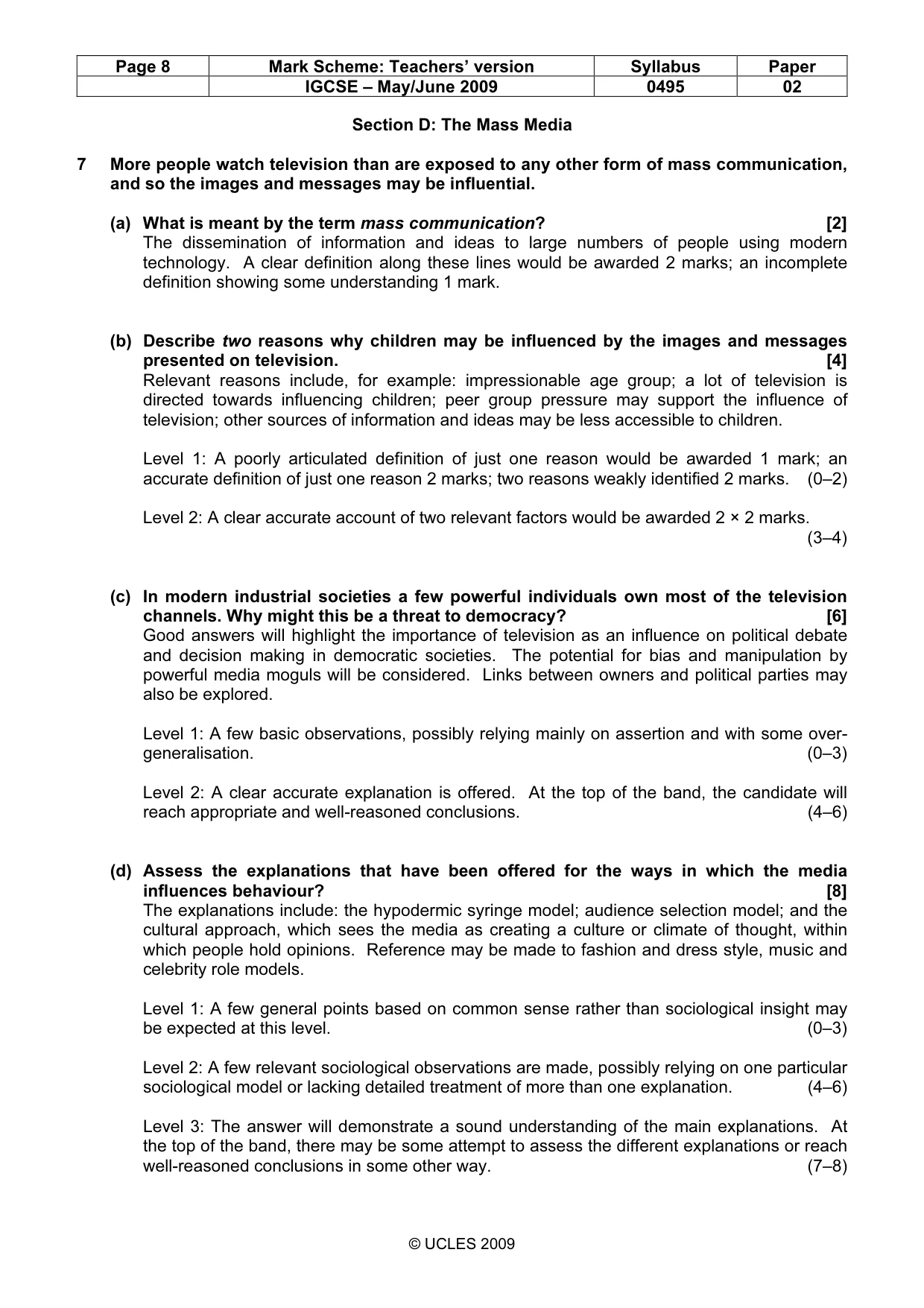
Page 8 Mark Scheme: Teachers’ version Syllabus Paper IGCSE – May/June 2009 0495 02 © UCLES 2009 Section D: The Mass Media 7 More people watch television than are exposed to any other form of mass communication, and so the images and messages may be influential. (a) What is meant by the term mass communication? [2] The dissemination of information and ideas to large numbers of people using modern technology. A clear definition along these lines would be awarded 2 marks; an incomplete definition showing some understanding 1 mark. (b) Describe two reasons why children may be influenced by the images and messages presented on television. [4] Relevant reasons include, for example: impressionable age group; a lot of television is directed towards influencing children; peer group pressure may support the influence of television; other sources of information and ideas may be less accessible to children. Level 1: A poorly articulated definition of just one reason would be awarded 1 mark; an accurate definition of just one reason 2 marks; two reasons weakly identified 2 marks. (0–2) Level 2: A clear accurate account of two relevant factors would be awarded 2 × 2 marks. (3–4) (c) In modern industrial societies a few powerful individuals own most of the television channels. Why might this be a threat to democracy? [6] Good answers will highlight the importance of television as an influence on political debate and decision making in democratic societies. The potential for bias and manipulation by powerful media moguls will be considered. Links between owners and political parties may also be explored. Level 1: A few basic observations, possibly relying mainly on assertion and with some over- generalisation. (0–3) Level 2: A clear accurate explanation is offered. At the top of the band, the candidate will reach appropriate and well-reasoned conclusions. (4–6) (d) Assess the explanations that have been offered for the ways in which the media influences behaviour? [8] The explanations include: the hypodermic syringe model; audience selection model; and the cultural approach, which sees the media as creating a culture or climate of thought, within which people hold opinions. Reference may be made to fashion and dress style, music and celebrity role models. Level 1: A few general points based on common sense rather than sociological insight may be expected at this level. (0–3) Level 2: A few relevant sociological observations are made, possibly relying on one particular sociological model or lacking detailed treatment of more than one explanation. (4–6) Level 3: The answer will demonstrate a sound understanding of the main explanations. At the top of the band, there may be some attempt to assess the different explanations or reach well-reasoned conclusions in some other way. (7–8)
Mark scheme, page 9
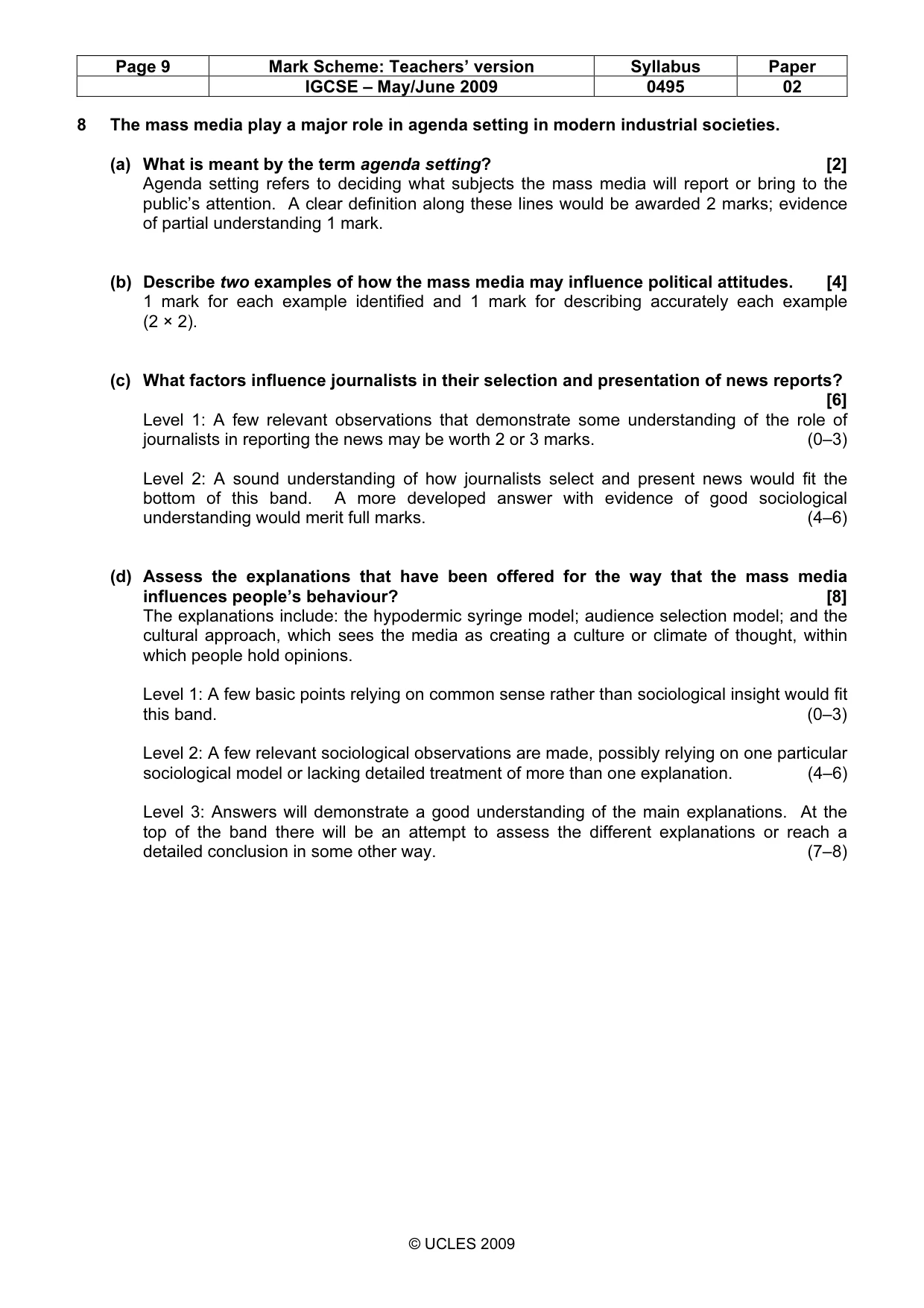
Page 9 Mark Scheme: Teachers’ version Syllabus Paper IGCSE – May/June 2009 0495 02 © UCLES 2009 8 The mass media play a major role in agenda setting in modern industrial societies. (a) What is meant by the term agenda setting? [2] Agenda setting refers to deciding what subjects the mass media will report or bring to the public’s attention. A clear definition along these lines would be awarded 2 marks; evidence of partial understanding 1 mark. (b) Describe two examples of how the mass media may influence political attitudes. [4] 1 mark for each example identified and 1 mark for describing accurately each example (2 × 2). (c) What factors influence journalists in their selection and presentation of news reports? [6] Level 1: A few relevant observations that demonstrate some understanding of the role of journalists in reporting the news may be worth 2 or 3 marks. (0–3) Level 2: A sound understanding of how journalists select and present news would fit the bottom of this band. A more developed answer with evidence of good sociological understanding would merit full marks. (4–6) (d) Assess the explanations that have been offered for the way that the mass media influences people’s behaviour? [8] The explanations include: the hypodermic syringe model; audience selection model; and the cultural approach, which sees the media as creating a culture or climate of thought, within which people hold opinions. Level 1: A few basic points relying on common sense rather than sociological insight would fit this band. (0–3) Level 2: A few relevant sociological observations are made, possibly relying on one particular sociological model or lacking detailed treatment of more than one explanation. (4–6) Level 3: Answers will demonstrate a good understanding of the main explanations. At the top of the band there will be an attempt to assess the different explanations or reach a detailed conclusion in some other way. (7–8)
What you needed in this session
Cambridge’s own grade thresholds for 2009 May/June, Paper 2 · Variant 1. A higher threshold means an easier paper — the bar moves with how the cohort did.