Cambridge IGCSE Sociology 0495 — 2008 May/June Paper 2 · Variant 1
0495/21/M/J/08 · 60 marks · ≈68 min
The question paper and its mark scheme, free to read here and free to download. This is Cambridge’s own paper, exactly as it was sat.
Question paper4 pages

Mark scheme6 pages
Answers below. Sit the paper first if you are practising.
Paper as text
Question paper, page 1
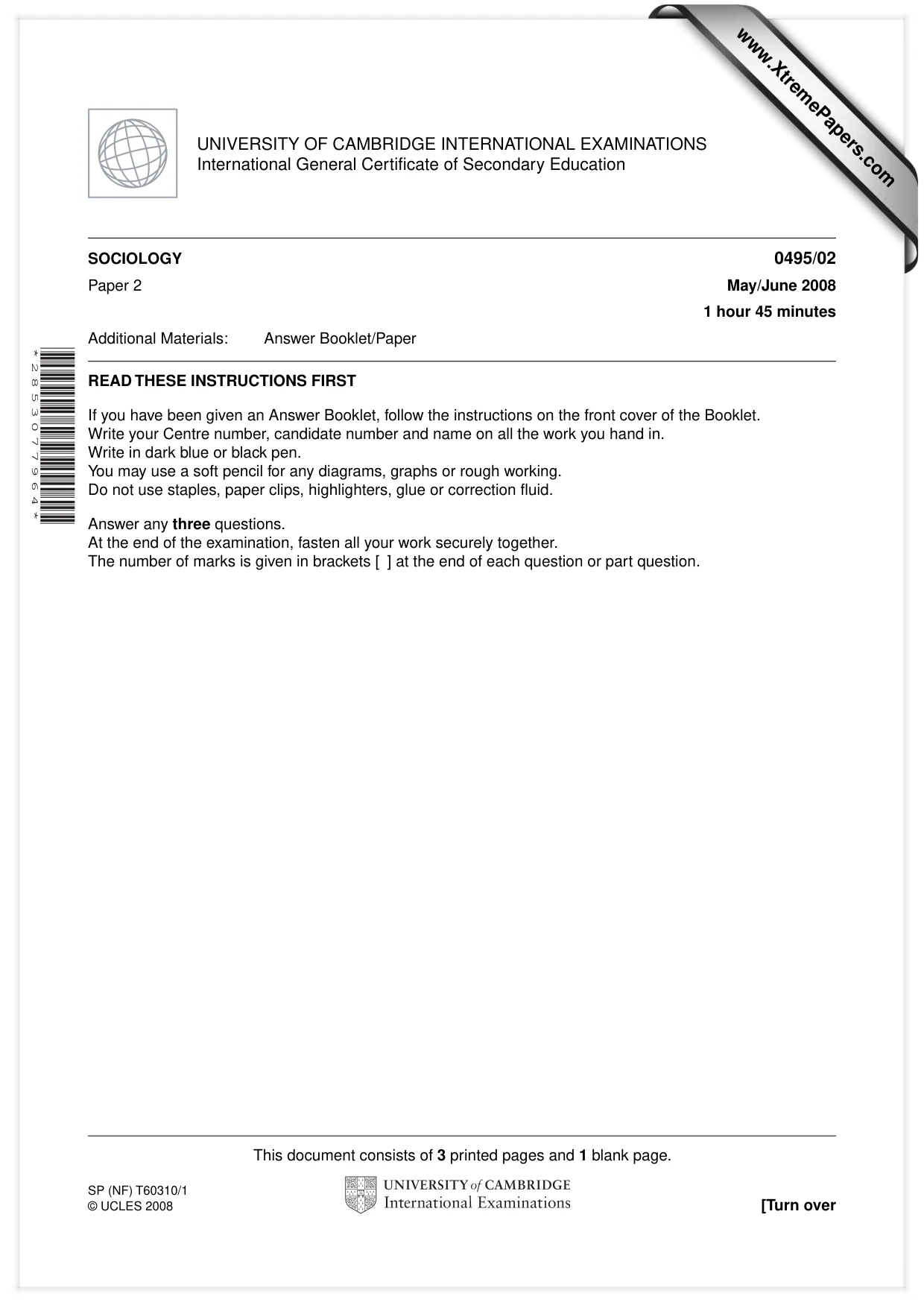
This document consists of 3 printed pages and 1 blank page. SP (NF) T60310/1 © UCLES 2008 [Turn over UNIVERSITY OF CAMBRIDGE INTERNATIONAL EXAMINATIONS International General Certificate of Secondary Education READ THESE INSTRUCTIONS FIRST If you have been given an Answer Booklet, follow the instructions on the front cover of the Booklet. Write your Centre number, candidate number and name on all the work you hand in. Write in dark blue or black pen. You may use a soft pencil for any diagrams, graphs or rough working. Do not use staples, paper clips, highlighters, glue or correction fluid. Answer any three questions. At the end of the examination, fasten all your work securely together. The number of marks is given in brackets [ ] at the end of each question or part question. * 2 8 5 3 0 7 7 9 6 4 * SOCIOLOGY 0495/02 Paper 2 May/June 2008 1 hour 45 minutes Additional Materials: Answer Booklet/Paper www.XtremePapers.com
Question paper, page 2
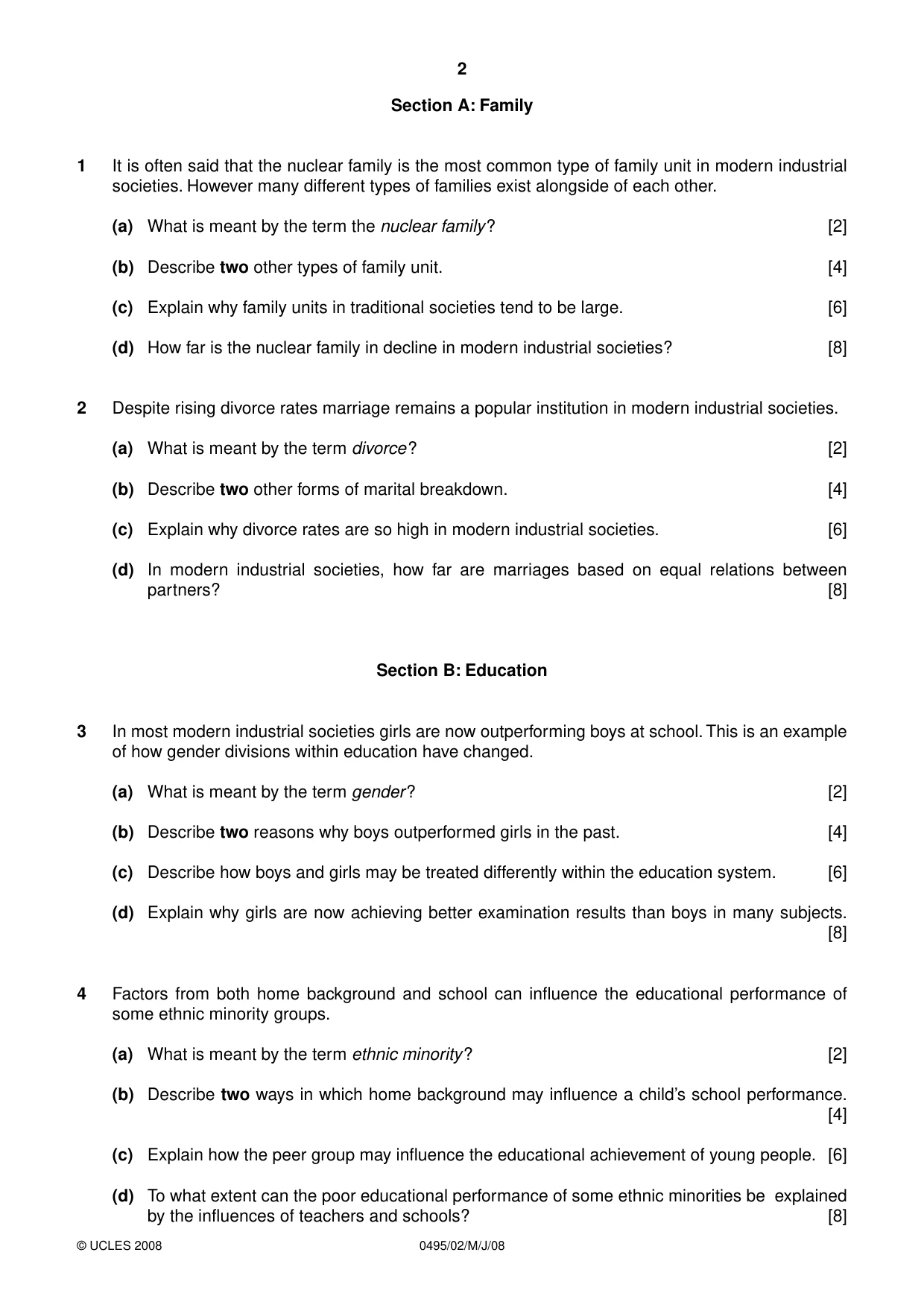
2 0495/02/M/J/08 © UCLES 2008 Section A: Family 1 It is often said that the nuclear family is the most common type of family unit in modern industrial societies. However many different types of families exist alongside of each other. (a) What is meant by the term the nuclear family ? [2] (b) Describe two other types of family unit. [4] (c) Explain why family units in traditional societies tend to be large. [6] (d) How far is the nuclear family in decline in modern industrial societies? [8] 2 Despite rising divorce rates marriage remains a popular institution in modern industrial societies. (a) What is meant by the term divorce ? [2] (b) Describe two other forms of marital breakdown. [4] (c) Explain why divorce rates are so high in modern industrial societies. [6] (d) In modern industrial societies, how far are marriages based on equal relations between partners? [8] Section B: Education 3 In most modern industrial societies girls are now outperforming boys at school. This is an example of how gender divisions within education have changed. (a) What is meant by the term gender ? [2] (b) Describe two reasons why boys outperformed girls in the past. [4] (c) Describe how boys and girls may be treated differently within the education system. [6] (d) Explain why girls are now achieving better examination results than boys in many subjects. [8] 4 Factors from both home background and school can influence the educational performance of some ethnic minority groups. (a) What is meant by the term ethnic minority ? [2] (b) Describe two ways in which home background may influence a child’s school performance. [4] (c) Explain how the peer group may influence the educational achievement of young people. [6] (d) To what extent can the poor educational performance of some ethnic minorities be explained by the influences of teachers and schools? [8]
Question paper, page 3
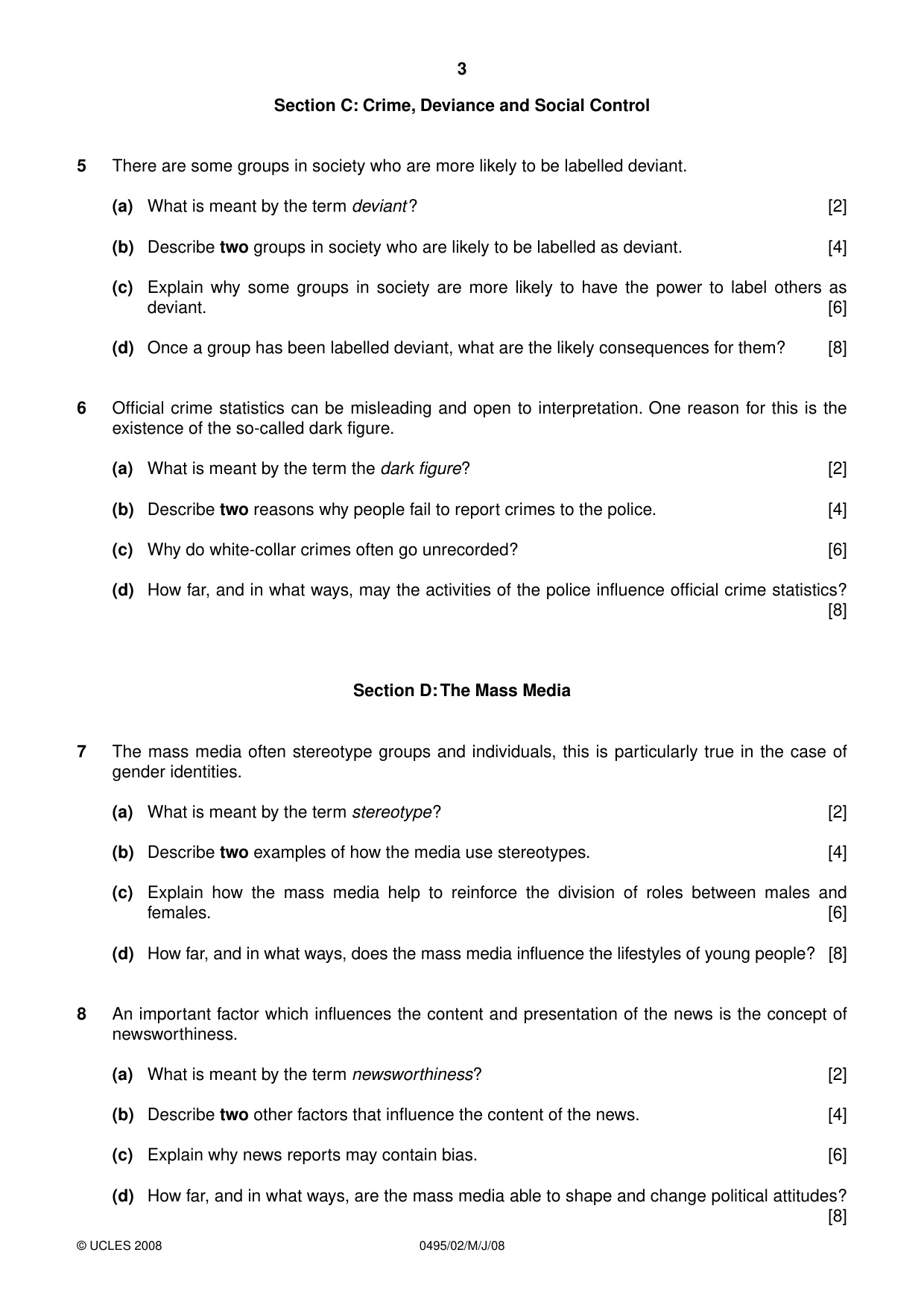
3 0495/02/M/J/08 © UCLES 2008 Section C: Crime, Deviance and Social Control 5 There are some groups in society who are more likely to be labelled deviant. (a) What is meant by the term deviant ? [2] (b) Describe two groups in society who are likely to be labelled as deviant. [4] (c) Explain why some groups in society are more likely to have the power to label others as deviant. [6] (d) Once a group has been labelled deviant, what are the likely consequences for them? [8] 6 Official crime statistics can be misleading and open to interpretation. One reason for this is the existence of the so-called dark figure. (a) What is meant by the term the dark figure? [2] (b) Describe two reasons why people fail to report crimes to the police. [4] (c) Why do white-collar crimes often go unrecorded? [6] (d) How far, and in what ways, may the activities of the police influence official crime statistics? [8] Section D: The Mass Media 7 The mass media often stereotype groups and individuals, this is particularly true in the case of gender identities. (a) What is meant by the term stereotype ? [2] (b) Describe two examples of how the media use stereotypes. [4] (c) Explain how the mass media help to reinforce the division of roles between males and females. [6] (d) How far, and in what ways, does the mass media influence the lifestyles of young people? [8] 8 An important factor which influences the content and presentation of the news is the concept of newsworthiness. (a) What is meant by the term newsworthiness? [2] (b) Describe two other factors that influence the content of the news. [4] (c) Explain why news reports may contain bias. [6] (d) How far, and in what ways, are the mass media able to shape and change political attitudes? [8]
Question paper, page 4
4 0495/02/M/J/08 BLANK PAGE Permission to reproduce items where third-party owned material protected by copyright is included has been sought and cleared where possible. Every reasonable effort has been made by the publisher (UCLES) to trace copyright holders, but if any items requiring clearance have unwittingly been included, the publisher will be pleased to make amends at the earliest possible opportunity. University of Cambridge International Examinations is part of the Cambridge Assessment Group. Cambridge Assessment is the brand name of University of Cambridge Local Examinations Syndicate (UCLES), which is itself a department of the University of Cambridge.
Mark scheme, page 1
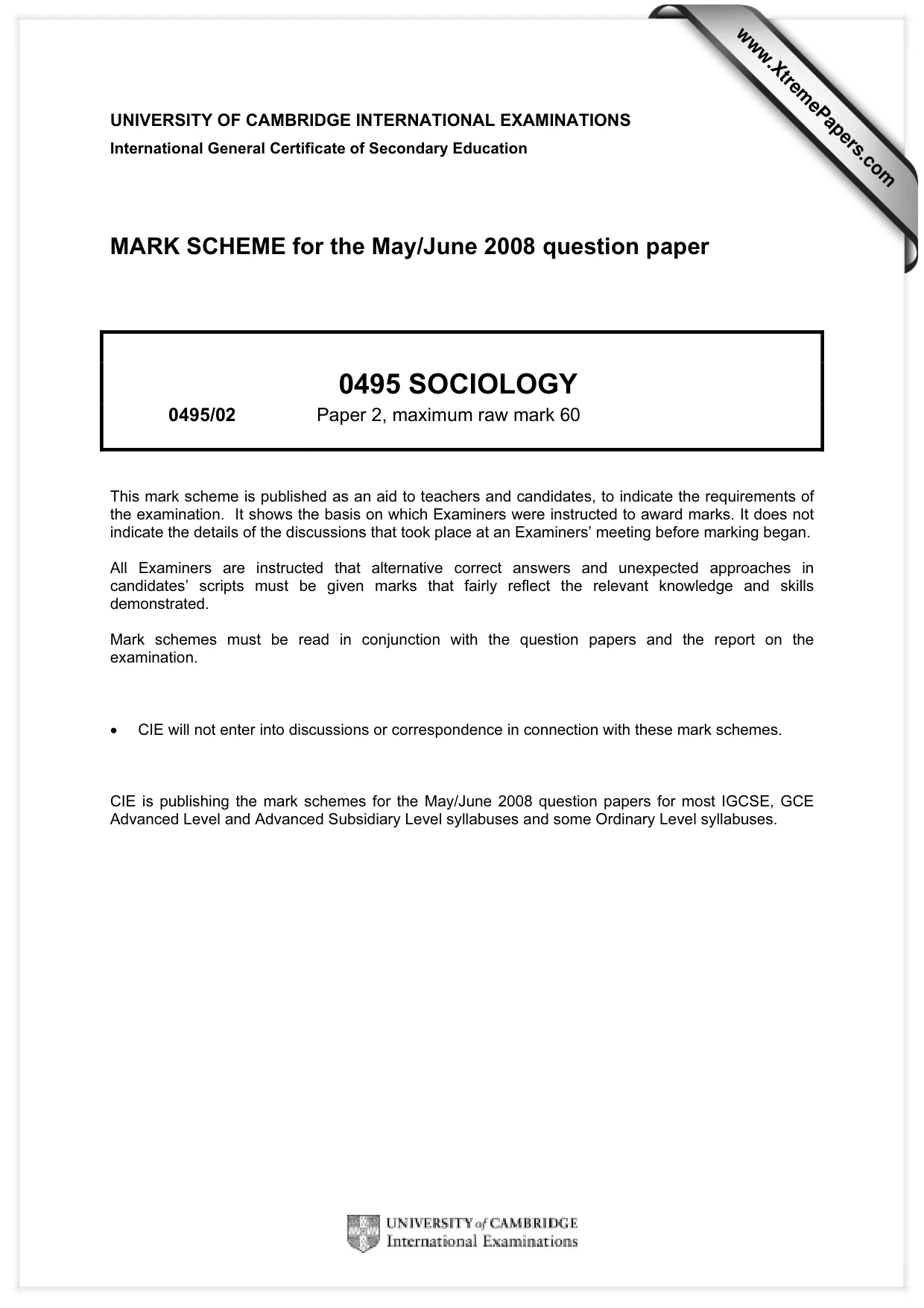
UNIVERSITY OF CAMBRIDGE INTERNATIONAL EXAMINATIONS International General Certificate of Secondary Education MARK SCHEME for the May/June 2008 question paper 0495 SOCIOLOGY 0495/02 Paper 2, maximum raw mark 60 This mark scheme is published as an aid to teachers and candidates, to indicate the requirements of the examination. It shows the basis on which Examiners were instructed to award marks. It does not indicate the details of the discussions that took place at an Examiners’ meeting before marking began. All Examiners are instructed that alternative correct answers and unexpected approaches in candidates’ scripts must be given marks that fairly reflect the relevant knowledge and skills demonstrated. Mark schemes must be read in conjunction with the question papers and the report on the examination. • CIE will not enter into discussions or correspondence in connection with these mark schemes. CIE is publishing the mark schemes for the May/June 2008 question papers for most IGCSE, GCE Advanced Level and Advanced Subsidiary Level syllabuses and some Ordinary Level syllabuses. www.XtremePapers.com
Mark scheme, page 2
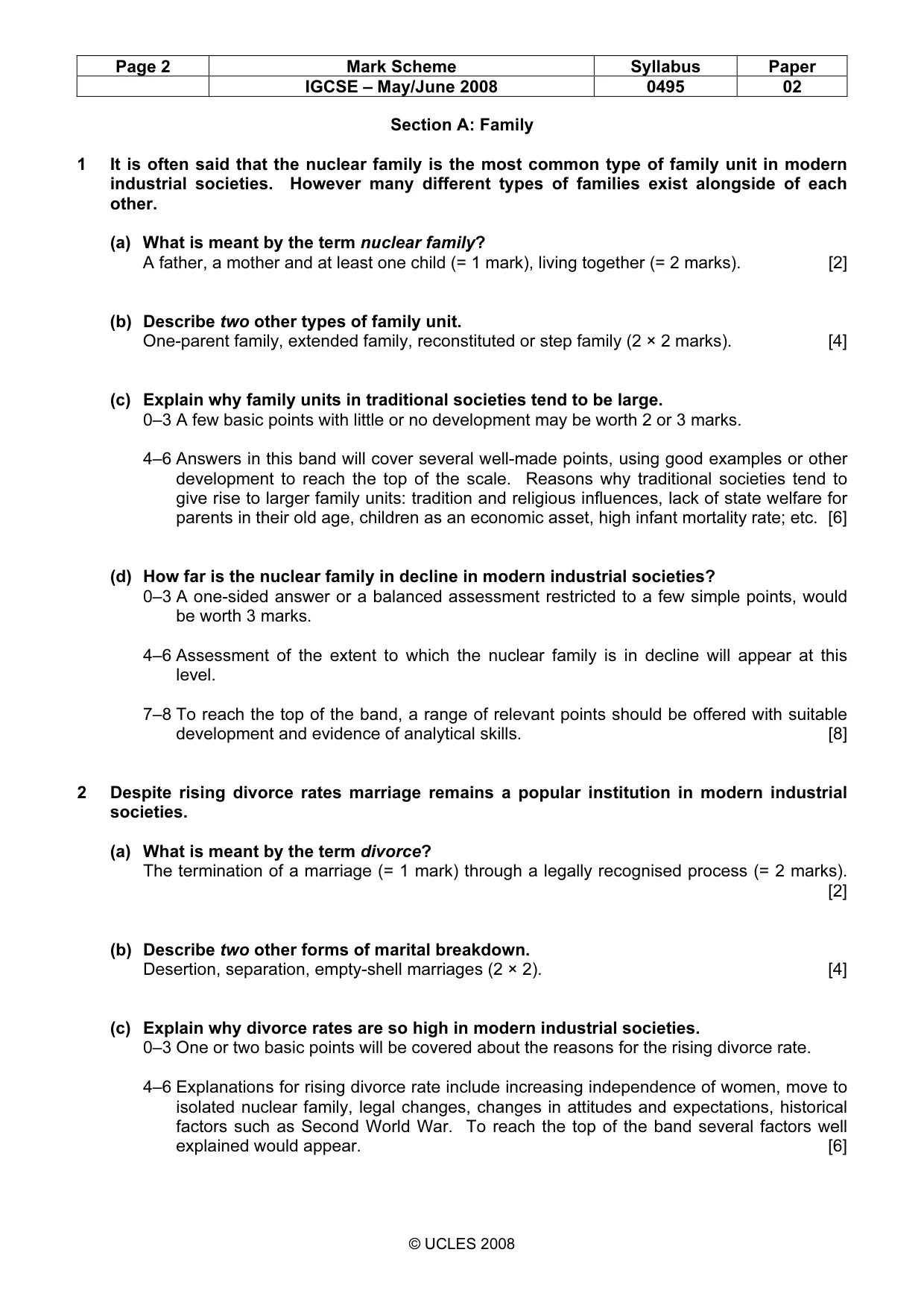
Page 2 Mark Scheme Syllabus Paper IGCSE – May/June 2008 0495 02 © UCLES 2008 Section A: Family 1 It is often said that the nuclear family is the most common type of family unit in modern industrial societies. However many different types of families exist alongside of each other. (a) What is meant by the term nuclear family? A father, a mother and at least one child (= 1 mark), living together (= 2 marks). [2] (b) Describe two other types of family unit. One-parent family, extended family, reconstituted or step family (2 × 2 marks). [4] (c) Explain why family units in traditional societies tend to be large. 0–3 A few basic points with little or no development may be worth 2 or 3 marks. 4–6 Answers in this band will cover several well-made points, using good examples or other development to reach the top of the scale. Reasons why traditional societies tend to give rise to larger family units: tradition and religious influences, lack of state welfare for parents in their old age, children as an economic asset, high infant mortality rate; etc. [6] (d) How far is the nuclear family in decline in modern industrial societies? 0–3 A one-sided answer or a balanced assessment restricted to a few simple points, would be worth 3 marks. 4–6 Assessment of the extent to which the nuclear family is in decline will appear at this level. 7–8 To reach the top of the band, a range of relevant points should be offered with suitable development and evidence of analytical skills. [8] 2 Despite rising divorce rates marriage remains a popular institution in modern industrial societies. (a) What is meant by the term divorce? The termination of a marriage (= 1 mark) through a legally recognised process (= 2 marks). [2] (b) Describe two other forms of marital breakdown. Desertion, separation, empty-shell marriages (2 × 2). [4] (c) Explain why divorce rates are so high in modern industrial societies. 0–3 One or two basic points will be covered about the reasons for the rising divorce rate. 4–6 Explanations for rising divorce rate include increasing independence of women, move to isolated nuclear family, legal changes, changes in attitudes and expectations, historical factors such as Second World War. To reach the top of the band several factors well explained would appear. [6]
Mark scheme, page 3
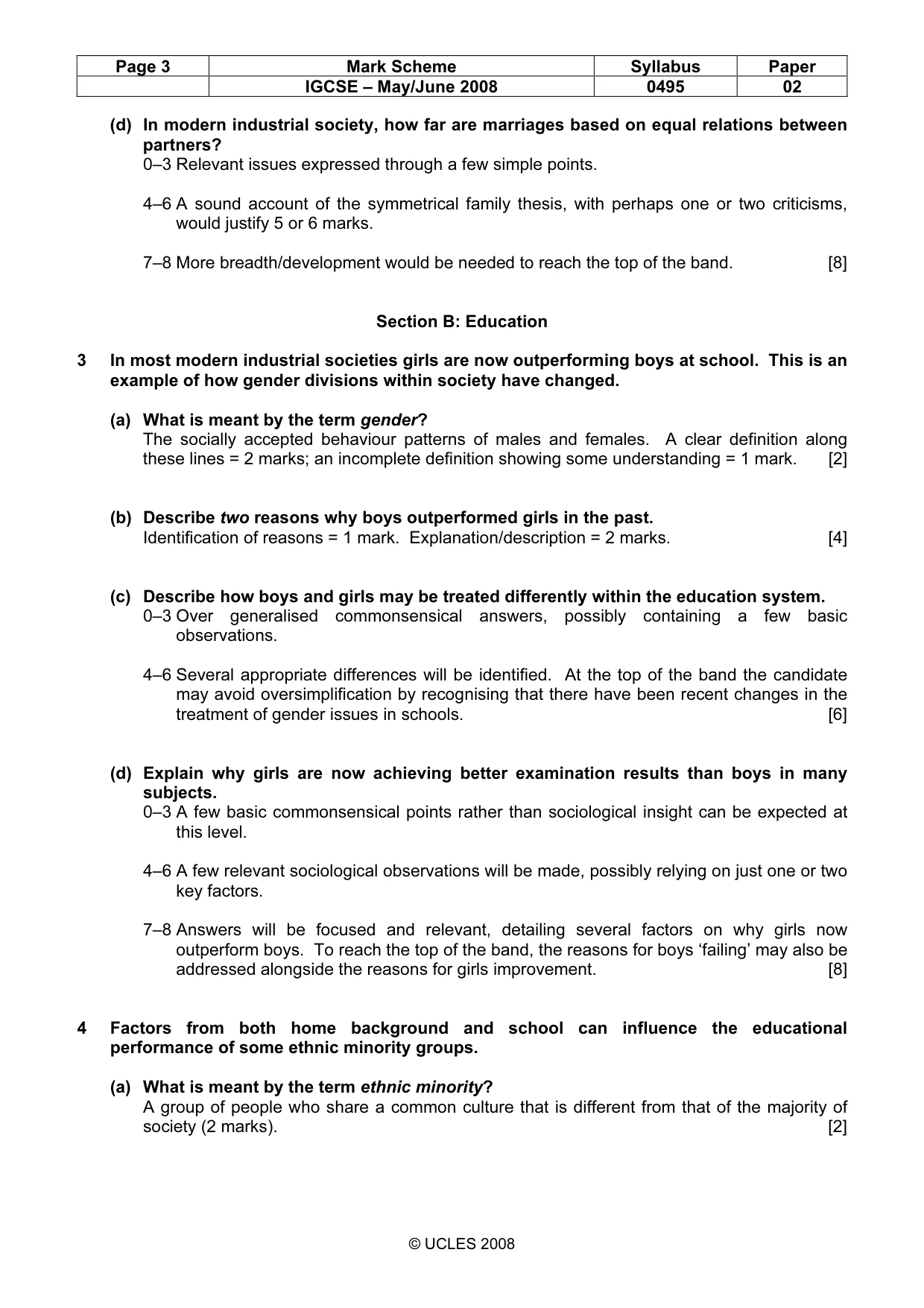
Page 3 Mark Scheme Syllabus Paper IGCSE – May/June 2008 0495 02 © UCLES 2008 (d) In modern industrial society, how far are marriages based on equal relations between partners? 0–3 Relevant issues expressed through a few simple points. 4–6 A sound account of the symmetrical family thesis, with perhaps one or two criticisms, would justify 5 or 6 marks. 7–8 More breadth/development would be needed to reach the top of the band. [8] Section B: Education 3 In most modern industrial societies girls are now outperforming boys at school. This is an example of how gender divisions within society have changed. (a) What is meant by the term gender? The socially accepted behaviour patterns of males and females. A clear definition along these lines = 2 marks; an incomplete definition showing some understanding = 1 mark. [2] (b) Describe two reasons why boys outperformed girls in the past. Identification of reasons = 1 mark. Explanation/description = 2 marks. [4] (c) Describe how boys and girls may be treated differently within the education system. 0–3 Over generalised commonsensical answers, possibly containing a few basic observations. 4–6 Several appropriate differences will be identified. At the top of the band the candidate may avoid oversimplification by recognising that there have been recent changes in the treatment of gender issues in schools. [6] (d) Explain why girls are now achieving better examination results than boys in many subjects. 0–3 A few basic commonsensical points rather than sociological insight can be expected at this level. 4–6 A few relevant sociological observations will be made, possibly relying on just one or two key factors. 7–8 Answers will be focused and relevant, detailing several factors on why girls now outperform boys. To reach the top of the band, the reasons for boys ‘failing’ may also be addressed alongside the reasons for girls improvement. [8] 4 Factors from both home background and school can influence the educational performance of some ethnic minority groups. (a) What is meant by the term ethnic minority? A group of people who share a common culture that is different from that of the majority of society (2 marks). [2]
Mark scheme, page 4
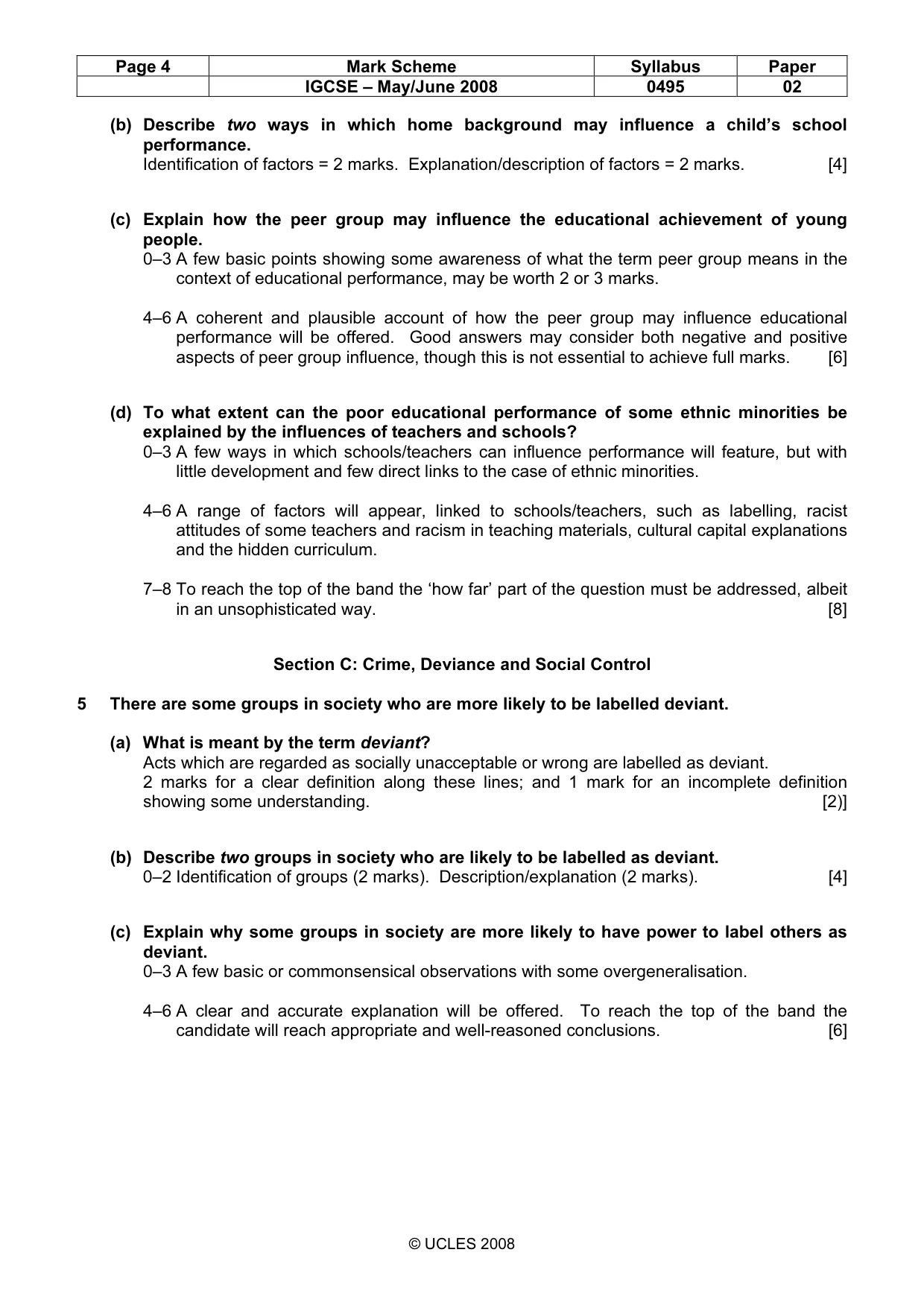
Page 4 Mark Scheme Syllabus Paper IGCSE – May/June 2008 0495 02 © UCLES 2008 (b) Describe two ways in which home background may influence a child’s school performance. Identification of factors = 2 marks. Explanation/description of factors = 2 marks. [4] (c) Explain how the peer group may influence the educational achievement of young people. 0–3 A few basic points showing some awareness of what the term peer group means in the context of educational performance, may be worth 2 or 3 marks. 4–6 A coherent and plausible account of how the peer group may influence educational performance will be offered. Good answers may consider both negative and positive aspects of peer group influence, though this is not essential to achieve full marks. [6] (d) To what extent can the poor educational performance of some ethnic minorities be explained by the influences of teachers and schools? 0–3 A few ways in which schools/teachers can influence performance will feature, but with little development and few direct links to the case of ethnic minorities. 4–6 A range of factors will appear, linked to schools/teachers, such as labelling, racist attitudes of some teachers and racism in teaching materials, cultural capital explanations and the hidden curriculum. 7–8 To reach the top of the band the ‘how far’ part of the question must be addressed, albeit in an unsophisticated way. [8] Section C: Crime, Deviance and Social Control 5 There are some groups in society who are more likely to be labelled deviant. (a) What is meant by the term deviant? Acts which are regarded as socially unacceptable or wrong are labelled as deviant. 2 marks for a clear definition along these lines; and 1 mark for an incomplete definition showing some understanding. [2)] (b) Describe two groups in society who are likely to be labelled as deviant. 0–2 Identification of groups (2 marks). Description/explanation (2 marks). [4] (c) Explain why some groups in society are more likely to have power to label others as deviant. 0–3 A few basic or commonsensical observations with some overgeneralisation. 4–6 A clear and accurate explanation will be offered. To reach the top of the band the candidate will reach appropriate and well-reasoned conclusions. [6]
Mark scheme, page 5
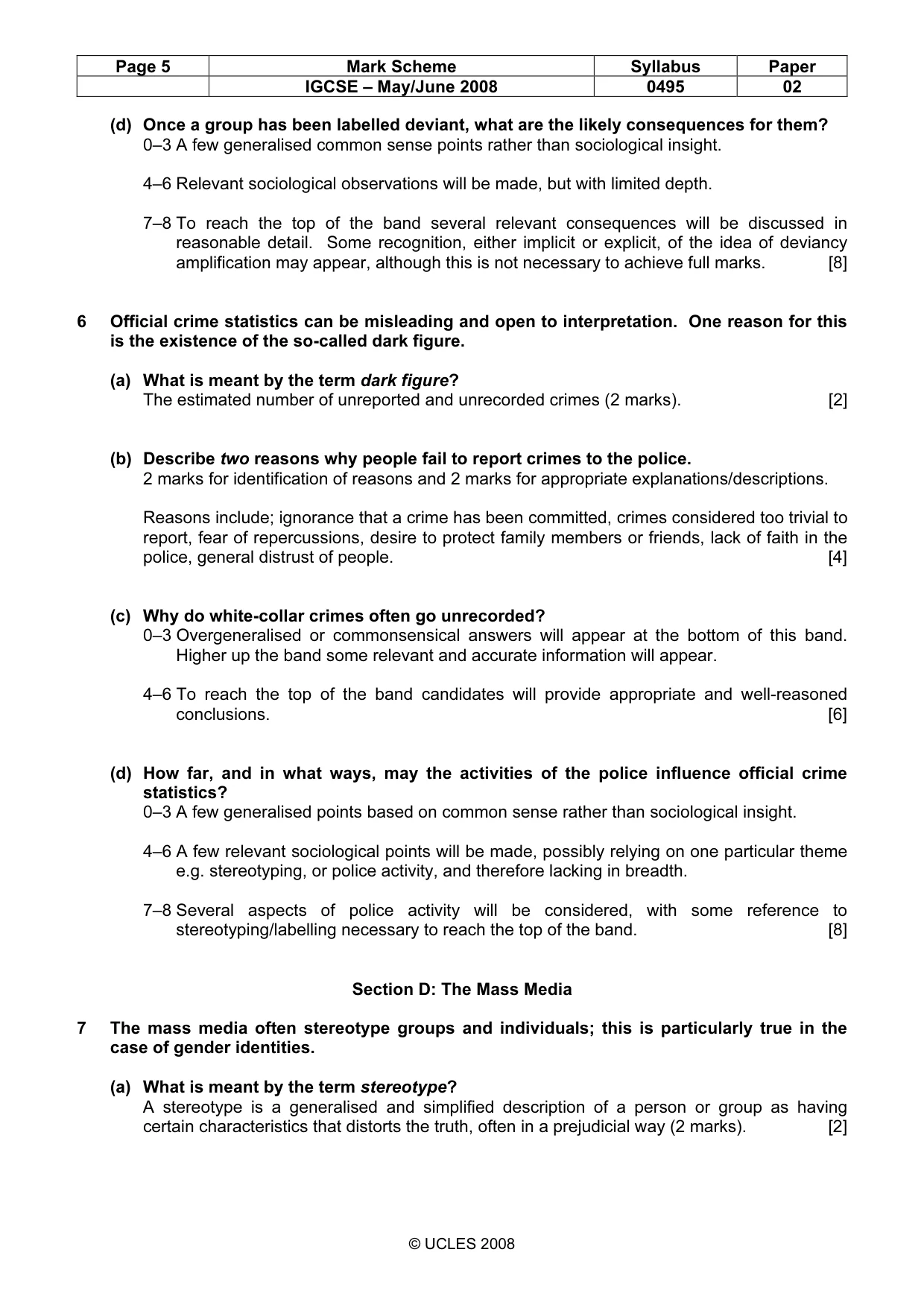
Page 5 Mark Scheme Syllabus Paper IGCSE – May/June 2008 0495 02 © UCLES 2008 (d) Once a group has been labelled deviant, what are the likely consequences for them? 0–3 A few generalised common sense points rather than sociological insight. 4–6 Relevant sociological observations will be made, but with limited depth. 7–8 To reach the top of the band several relevant consequences will be discussed in reasonable detail. Some recognition, either implicit or explicit, of the idea of deviancy amplification may appear, although this is not necessary to achieve full marks. [8] 6 Official crime statistics can be misleading and open to interpretation. One reason for this is the existence of the so-called dark figure. (a) What is meant by the term dark figure? The estimated number of unreported and unrecorded crimes (2 marks). [2] (b) Describe two reasons why people fail to report crimes to the police. 2 marks for identification of reasons and 2 marks for appropriate explanations/descriptions. Reasons include; ignorance that a crime has been committed, crimes considered too trivial to report, fear of repercussions, desire to protect family members or friends, lack of faith in the police, general distrust of people. [4] (c) Why do white-collar crimes often go unrecorded? 0–3 Overgeneralised or commonsensical answers will appear at the bottom of this band. Higher up the band some relevant and accurate information will appear. 4–6 To reach the top of the band candidates will provide appropriate and well-reasoned conclusions. [6] (d) How far, and in what ways, may the activities of the police influence official crime statistics? 0–3 A few generalised points based on common sense rather than sociological insight. 4–6 A few relevant sociological points will be made, possibly relying on one particular theme e.g. stereotyping, or police activity, and therefore lacking in breadth. 7–8 Several aspects of police activity will be considered, with some reference to stereotyping/labelling necessary to reach the top of the band. [8] Section D: The Mass Media 7 The mass media often stereotype groups and individuals; this is particularly true in the case of gender identities. (a) What is meant by the term stereotype? A stereotype is a generalised and simplified description of a person or group as having certain characteristics that distorts the truth, often in a prejudicial way (2 marks). [2]
Mark scheme, page 6
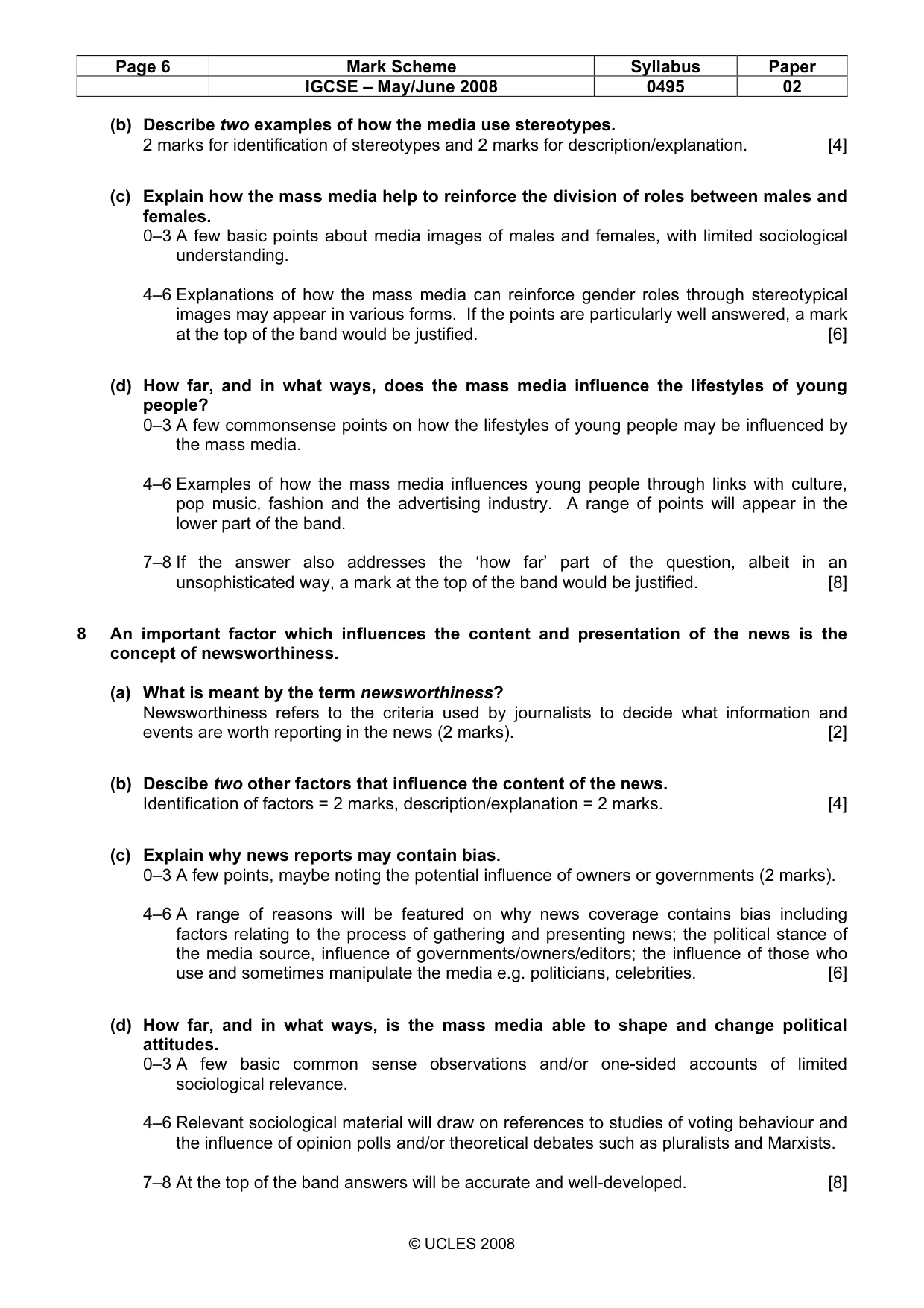
Page 6 Mark Scheme Syllabus Paper IGCSE – May/June 2008 0495 02 © UCLES 2008 (b) Describe two examples of how the media use stereotypes. 2 marks for identification of stereotypes and 2 marks for description/explanation. [4] (c) Explain how the mass media help to reinforce the division of roles between males and females. 0–3 A few basic points about media images of males and females, with limited sociological understanding. 4–6 Explanations of how the mass media can reinforce gender roles through stereotypical images may appear in various forms. If the points are particularly well answered, a mark at the top of the band would be justified. [6] (d) How far, and in what ways, does the mass media influence the lifestyles of young people? 0–3 A few commonsense points on how the lifestyles of young people may be influenced by the mass media. 4–6 Examples of how the mass media influences young people through links with culture, pop music, fashion and the advertising industry. A range of points will appear in the lower part of the band. 7–8 If the answer also addresses the ‘how far’ part of the question, albeit in an unsophisticated way, a mark at the top of the band would be justified. [8] 8 An important factor which influences the content and presentation of the news is the concept of newsworthiness. (a) What is meant by the term newsworthiness? Newsworthiness refers to the criteria used by journalists to decide what information and events are worth reporting in the news (2 marks). [2] (b) Descibe two other factors that influence the content of the news. Identification of factors = 2 marks, description/explanation = 2 marks. [4] (c) Explain why news reports may contain bias. 0–3 A few points, maybe noting the potential influence of owners or governments (2 marks). 4–6 A range of reasons will be featured on why news coverage contains bias including factors relating to the process of gathering and presenting news; the political stance of the media source, influence of governments/owners/editors; the influence of those who use and sometimes manipulate the media e.g. politicians, celebrities. [6] (d) How far, and in what ways, is the mass media able to shape and change political attitudes. 0–3 A few basic common sense observations and/or one-sided accounts of limited sociological relevance. 4–6 Relevant sociological material will draw on references to studies of voting behaviour and the influence of opinion polls and/or theoretical debates such as pluralists and Marxists. 7–8 At the top of the band answers will be accurate and well-developed. [8]
What you needed in this session
Cambridge’s own grade thresholds for 2008 May/June, Paper 2 · Variant 1. A higher threshold means an easier paper — the bar moves with how the cohort did.