Cambridge IGCSE Sociology 0495 — 2008 May/June Paper 1 · Variant 1
0495/11/M/J/08 · 90 marks · ≈101 min
The question paper and its mark scheme, free to read here and free to download. This is Cambridge’s own paper, exactly as it was sat.
Question paper4 pages
Mark scheme8 pages
Answers below. Sit the paper first if you are practising.
Paper as text
Question paper, page 1
This document consists of 4 printed pages. SP (NF) T60308/1 © UCLES 2008 [Turn over UNIVERSITY OF CAMBRIDGE INTERNATIONAL EXAMINATIONS International General Certificate of Secondary Education READ THESE INSTRUCTIONS FIRST If you have been given an Answer Booklet, follow the instructions on the front cover of the Booklet. Write your Centre number, candidate number and name on all the work you hand in. Write in dark blue or black pen. You may use a soft pencil for any diagrams, graphs or rough working. Do not use staples, paper clips, highlighters, glue or correction fluid. Answer Question 1 and three questions from Sections B to D. At the end of the examination, fasten all your work securely together. The number of marks is given in brackets [ ] at the end of each question or part question. * 7 1 1 1 4 6 4 8 6 9 * SOCIOLOGY 0495/01 Paper 1 May/June 2008 2 hours 30 minutes Additional Materials: Answer Booklet/Paper www.XtremePapers.com
Question paper, page 2
2 0495/01/M/J/08 © UCLES 2008 Section A: Research Methods In sociological research quantitative data is often collected. One of the major ways of collecting such primary data is by using questionnaires. A questionnaire is a list of questions. The questions are decided in advance and then a sample of people is selected to answer the questionnaire. Questions are of two types: closed and open-ended. Researchers will test their questions by means of a pilot study. A questionnaire is often chosen over other research methods of data collection because it produces data which is comparable. Questionnaires are also said to produce reliable data because the results obtained can be checked by other researchers using the same questions. In contrast, qualitative data is collected by sociologists who are interested in studying human interactions and the meanings individuals attach to social situations. They are likely to use unstructured interviews and various forms of observation to gather relevant data. 1 (a) In sociological research, the following terms are used. Briefly explain the meaning of each: (i) primary data [2] (ii) closed questions [2] (iii) pilot study. [2] (b) Describe one advantage and one disadvantage of using closed questions in questionnaires. [4] (c) Describe two methods of selecting a sample when conducting research. [4] (d) Describe one advantage and one disadvantage of using interviews in sociological research. [4] (e) Suggest one advantage and one disadvantage of using qualitative data in sociological research. [4] (f) Identify and explain two advantages and two disadvantages of using postal questionnaires. [8]
Question paper, page 3
3 0495/01/M/J/08 © UCLES 2008 [Turn over Section B: Culture and Socialisation 2 As children interact with others they develop a sense of identity. This is part of the process of primary socialisation. (a) What is meant by the term primary socialisation? [2] (b) Briefly describe two ways in which individuals learn about their society. [4] (c) Explain how children learn to interact effectively with other people. [6] (d) Why is socialisation important both for the individual and society? [8] 3 A person’s behaviour is influenced by formal social controls. (a) What is meant by the term formal social controls? [2] (b) Describe two examples of informal social controls that may occur within the family. [4] (c) Explain how formal social control is carried out in modern industrial societies. [6] (d) To what extent do the more powerful groups in society benefit most from social control? [8] Section C: Social Stratification and Inequality 4 Despite improvements in many aspects of women’s lives, feminists still believe that women suffer gender inequality. (a) What is meant by the term gender inequality? [2] (b) Describe two ways women may be disadvantaged by their roles within the family. [4] (c) Explain why women may still find it difficult to gain promotion at work. [6] (d) To what extent are women still disadvantaged in society compared to the past? [8] 5 Poverty still remains a feature of all societies, though less industrialised societies are more likely to experience absolute poverty. (a) What is meant by the term absolute poverty? [2] (b) Describe two reasons why absolute poverty continues to exist in less industrialised societies. [4] (c) Explain how an individual may escape from poverty. [6] (d) To what extent is poverty caused by the individual’s way of life? [8]
Question paper, page 4
4 0495/01/M/J/08 © UCLES 2008 Section D: Power and Authority 6 In democratic political systems regular elections are held. (a) What is meant by the term democratic political system? [2] (b) Describe two functions of elections. [4] (c) Explain how pressure groups influence decision-making in democratic systems. [6] (d) To what extent can individuals influence government decision-making in modern democracies? [8] 7 In modern democratic societies political socialisation occurs in a number of ways. (a) What is meant by the term political socialisation? [2] (b) Describe two ways a person might form their political views. [4] (c) Explain how a person’s social class may influence their political views. [6] (d) What factors influence a person’s voting behaviour? [8] Permission to reproduce items where third-party owned material protected by copyright is included has been sought and cleared where possible. Every reasonable effort has been made by the publisher (UCLES) to trace copyright holders, but if any items requiring clearance have unwittingly been included, the publisher will be pleased to make amends at the earliest possible opportunity. University of Cambridge International Examinations is part of the Cambridge Assessment Group. Cambridge Assessment is the brand name of University of Cambridge Local Examinations Syndicate (UCLES), which is itself a department of the University of Cambridge.
Mark scheme, page 1
UNIVERSITY OF CAMBRIDGE INTERNATIONAL EXAMINATIONS International General Certificate of Secondary Education MARK SCHEME for the May/June 2008 question paper 0495 SOCIOLOGY 0495/01 Paper 1, maximum raw mark 90 This mark scheme is published as an aid to teachers and candidates, to indicate the requirements of the examination. It shows the basis on which Examiners were instructed to award marks. It does not indicate the details of the discussions that took place at an Examiners’ meeting before marking began. All Examiners are instructed that alternative correct answers and unexpected approaches in candidates’ scripts must be given marks that fairly reflect the relevant knowledge and skills demonstrated. Mark schemes must be read in conjunction with the question papers and the report on the examination. • CIE will not enter into discussions or correspondence in connection with these mark schemes. CIE is publishing the mark schemes for the May/June 2008 question papers for most IGCSE, GCE Advanced Level and Advanced Subsidiary Level syllabuses and some Ordinary Level syllabuses. www.XtremePapers.com
Mark scheme, page 2
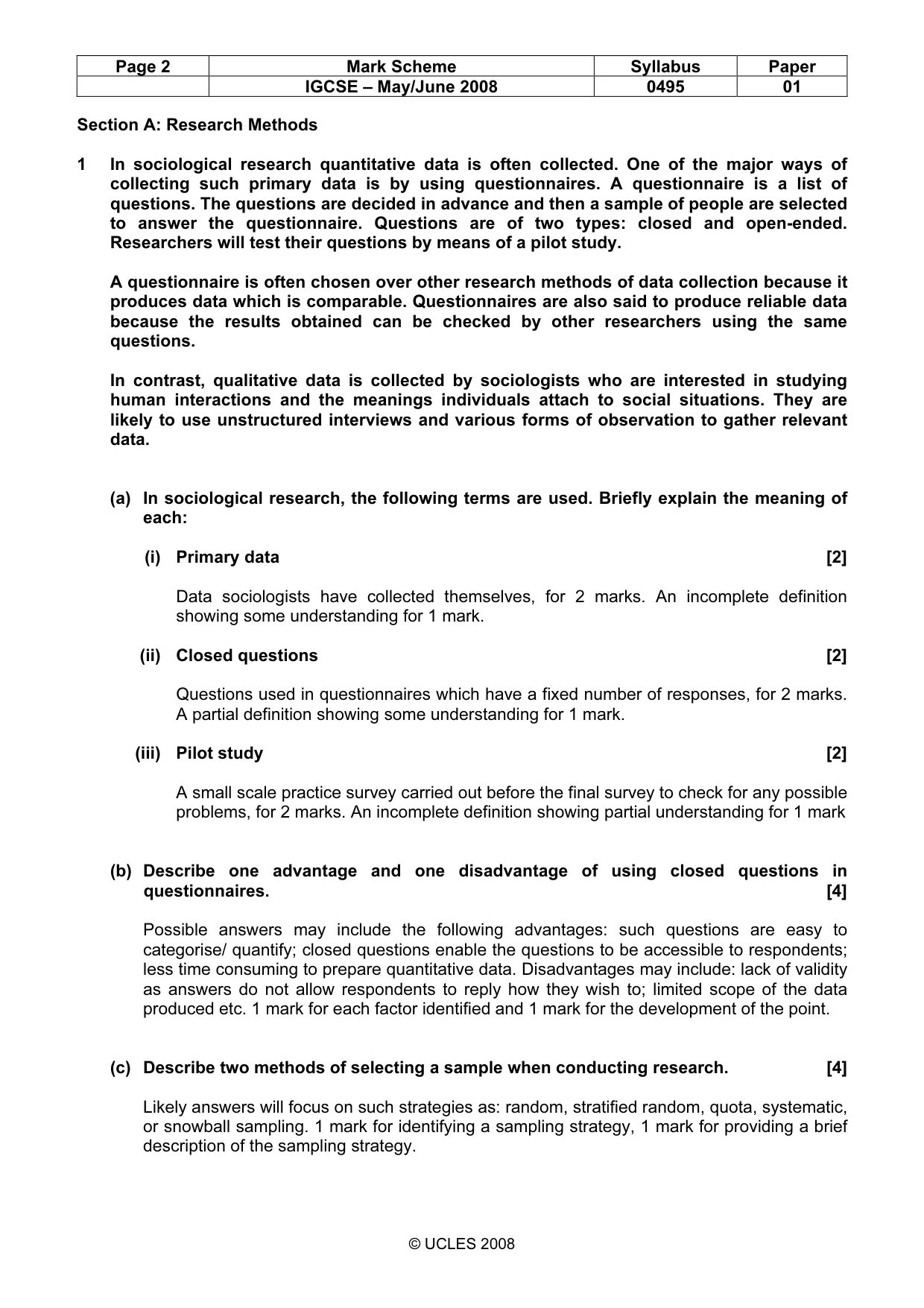
Page 2 Mark Scheme Syllabus Paper IGCSE – May/June 2008 0495 01 © UCLES 2008 Section A: Research Methods 1 In sociological research quantitative data is often collected. One of the major ways of collecting such primary data is by using questionnaires. A questionnaire is a list of questions. The questions are decided in advance and then a sample of people are selected to answer the questionnaire. Questions are of two types: closed and open-ended. Researchers will test their questions by means of a pilot study. A questionnaire is often chosen over other research methods of data collection because it produces data which is comparable. Questionnaires are also said to produce reliable data because the results obtained can be checked by other researchers using the same questions. In contrast, qualitative data is collected by sociologists who are interested in studying human interactions and the meanings individuals attach to social situations. They are likely to use unstructured interviews and various forms of observation to gather relevant data. (a) In sociological research, the following terms are used. Briefly explain the meaning of each: (i) Primary data [2] Data sociologists have collected themselves, for 2 marks. An incomplete definition showing some understanding for 1 mark. (ii) Closed questions [2] Questions used in questionnaires which have a fixed number of responses, for 2 marks. A partial definition showing some understanding for 1 mark. (iii) Pilot study [2] A small scale practice survey carried out before the final survey to check for any possible problems, for 2 marks. An incomplete definition showing partial understanding for 1 mark (b) Describe one advantage and one disadvantage of using closed questions in questionnaires. [4] Possible answers may include the following advantages: such questions are easy to categorise/ quantify; closed questions enable the questions to be accessible to respondents; less time consuming to prepare quantitative data. Disadvantages may include: lack of validity as answers do not allow respondents to reply how they wish to; limited scope of the data produced etc. 1 mark for each factor identified and 1 mark for the development of the point. (c) Describe two methods of selecting a sample when conducting research. [4] Likely answers will focus on such strategies as: random, stratified random, quota, systematic, or snowball sampling. 1 mark for identifying a sampling strategy, 1 mark for providing a brief description of the sampling strategy.
Mark scheme, page 3
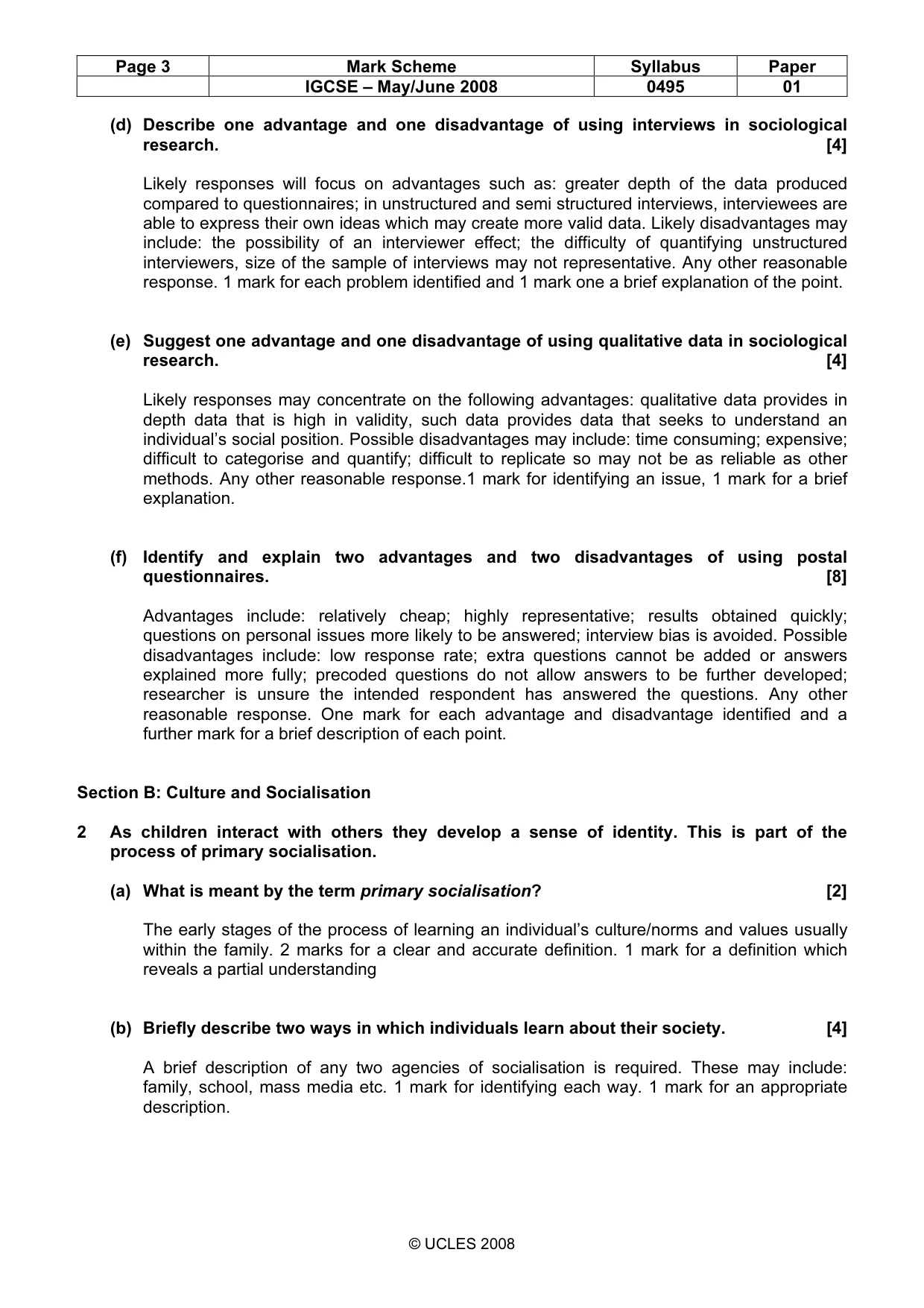
Page 3 Mark Scheme Syllabus Paper IGCSE – May/June 2008 0495 01 © UCLES 2008 (d) Describe one advantage and one disadvantage of using interviews in sociological research. [4] Likely responses will focus on advantages such as: greater depth of the data produced compared to questionnaires; in unstructured and semi structured interviews, interviewees are able to express their own ideas which may create more valid data. Likely disadvantages may include: the possibility of an interviewer effect; the difficulty of quantifying unstructured interviewers, size of the sample of interviews may not representative. Any other reasonable response. 1 mark for each problem identified and 1 mark one a brief explanation of the point. (e) Suggest one advantage and one disadvantage of using qualitative data in sociological research. [4] Likely responses may concentrate on the following advantages: qualitative data provides in depth data that is high in validity, such data provides data that seeks to understand an individual’s social position. Possible disadvantages may include: time consuming; expensive; difficult to categorise and quantify; difficult to replicate so may not be as reliable as other methods. Any other reasonable response.1 mark for identifying an issue, 1 mark for a brief explanation. (f) Identify and explain two advantages and two disadvantages of using postal questionnaires. [8] Advantages include: relatively cheap; highly representative; results obtained quickly; questions on personal issues more likely to be answered; interview bias is avoided. Possible disadvantages include: low response rate; extra questions cannot be added or answers explained more fully; precoded questions do not allow answers to be further developed; researcher is unsure the intended respondent has answered the questions. Any other reasonable response. One mark for each advantage and disadvantage identified and a further mark for a brief description of each point. Section B: Culture and Socialisation 2 As children interact with others they develop a sense of identity. This is part of the process of primary socialisation. (a) What is meant by the term primary socialisation? [2] The early stages of the process of learning an individual’s culture/norms and values usually within the family. 2 marks for a clear and accurate definition. 1 mark for a definition which reveals a partial understanding (b) Briefly describe two ways in which individuals learn about their society. [4] A brief description of any two agencies of socialisation is required. These may include: family, school, mass media etc. 1 mark for identifying each way. 1 mark for an appropriate description.
Mark scheme, page 4
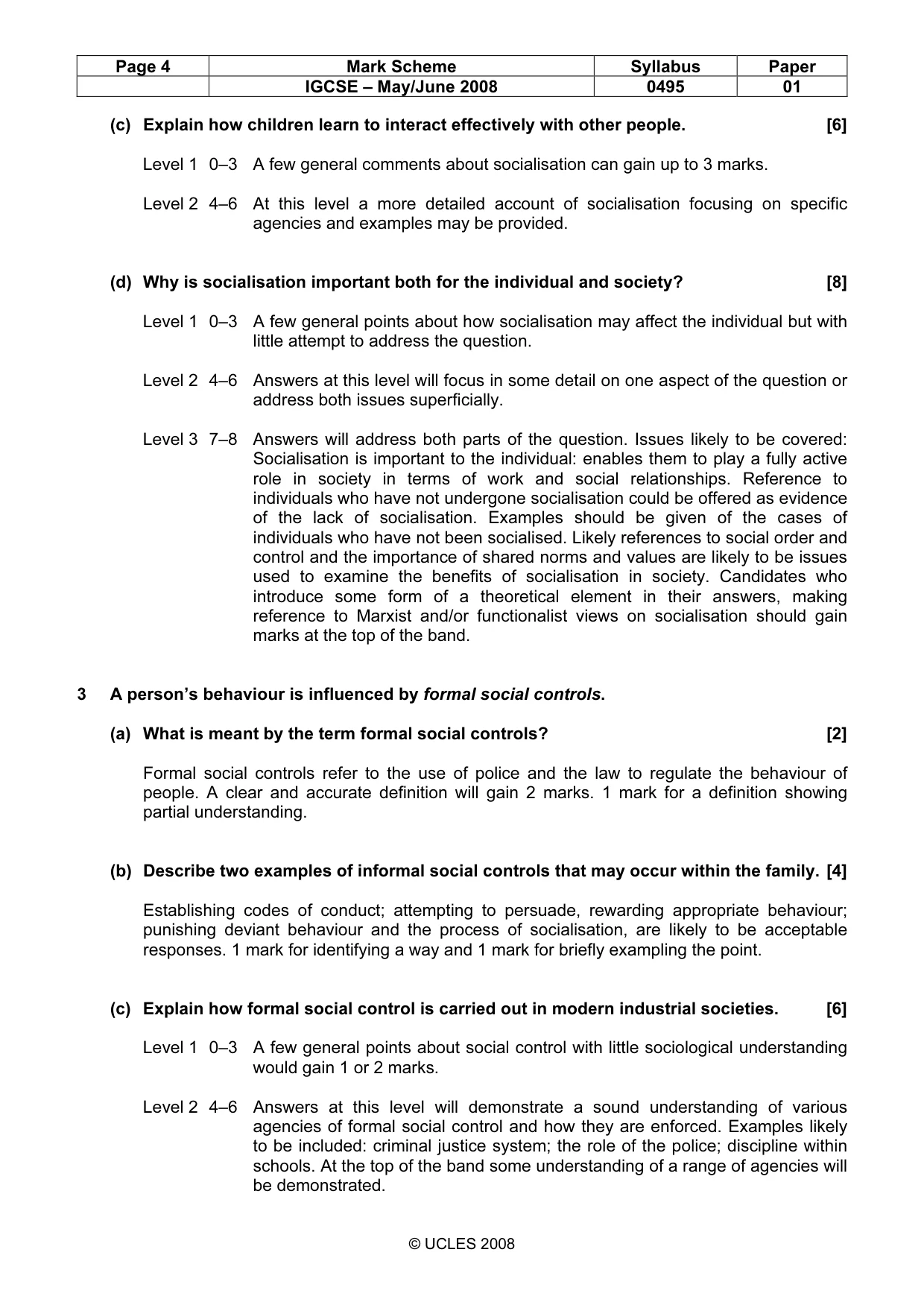
Page 4 Mark Scheme Syllabus Paper IGCSE – May/June 2008 0495 01 © UCLES 2008 (c) Explain how children learn to interact effectively with other people. [6] Level 1 0–3 A few general comments about socialisation can gain up to 3 marks. Level 2 4–6 At this level a more detailed account of socialisation focusing on specific agencies and examples may be provided. (d) Why is socialisation important both for the individual and society? [8] Level 1 0–3 A few general points about how socialisation may affect the individual but with little attempt to address the question. Level 2 4–6 Answers at this level will focus in some detail on one aspect of the question or address both issues superficially. Level 3 7–8 Answers will address both parts of the question. Issues likely to be covered: Socialisation is important to the individual: enables them to play a fully active role in society in terms of work and social relationships. Reference to individuals who have not undergone socialisation could be offered as evidence of the lack of socialisation. Examples should be given of the cases of individuals who have not been socialised. Likely references to social order and control and the importance of shared norms and values are likely to be issues used to examine the benefits of socialisation in society. Candidates who introduce some form of a theoretical element in their answers, making reference to Marxist and/or functionalist views on socialisation should gain marks at the top of the band. 3 A person’s behaviour is influenced by formal social controls. (a) What is meant by the term formal social controls? [2] Formal social controls refer to the use of police and the law to regulate the behaviour of people. A clear and accurate definition will gain 2 marks. 1 mark for a definition showing partial understanding. (b) Describe two examples of informal social controls that may occur within the family. [4] Establishing codes of conduct; attempting to persuade, rewarding appropriate behaviour; punishing deviant behaviour and the process of socialisation, are likely to be acceptable responses. 1 mark for identifying a way and 1 mark for briefly exampling the point. (c) Explain how formal social control is carried out in modern industrial societies. [6] Level 1 0–3 A few general points about social control with little sociological understanding would gain 1 or 2 marks. Level 2 4–6 Answers at this level will demonstrate a sound understanding of various agencies of formal social control and how they are enforced. Examples likely to be included: criminal justice system; the role of the police; discipline within schools. At the top of the band some understanding of a range of agencies will be demonstrated.
Mark scheme, page 5
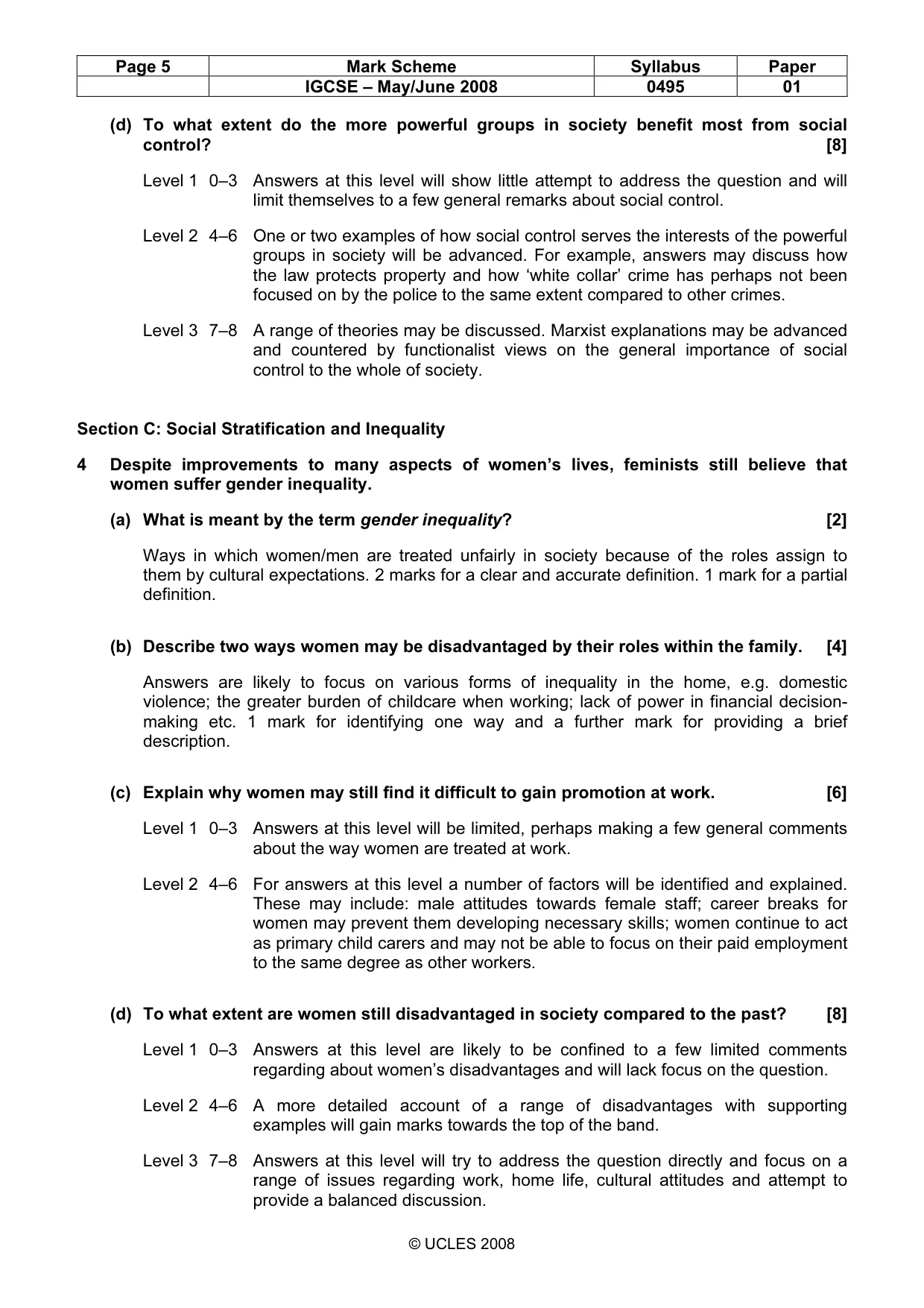
Page 5 Mark Scheme Syllabus Paper IGCSE – May/June 2008 0495 01 © UCLES 2008 (d) To what extent do the more powerful groups in society benefit most from social control? [8] Level 1 0–3 Answers at this level will show little attempt to address the question and will limit themselves to a few general remarks about social control. Level 2 4–6 One or two examples of how social control serves the interests of the powerful groups in society will be advanced. For example, answers may discuss how the law protects property and how ‘white collar’ crime has perhaps not been focused on by the police to the same extent compared to other crimes. Level 3 7–8 A range of theories may be discussed. Marxist explanations may be advanced and countered by functionalist views on the general importance of social control to the whole of society. Section C: Social Stratification and Inequality 4 Despite improvements to many aspects of women’s lives, feminists still believe that women suffer gender inequality. (a) What is meant by the term gender inequality? [2] Ways in which women/men are treated unfairly in society because of the roles assign to them by cultural expectations. 2 marks for a clear and accurate definition. 1 mark for a partial definition. (b) Describe two ways women may be disadvantaged by their roles within the family. [4] Answers are likely to focus on various forms of inequality in the home, e.g. domestic violence; the greater burden of childcare when working; lack of power in financial decision- making etc. 1 mark for identifying one way and a further mark for providing a brief description. (c) Explain why women may still find it difficult to gain promotion at work. [6] Level 1 0–3 Answers at this level will be limited, perhaps making a few general comments about the way women are treated at work. Level 2 4–6 For answers at this level a number of factors will be identified and explained. These may include: male attitudes towards female staff; career breaks for women may prevent them developing necessary skills; women continue to act as primary child carers and may not be able to focus on their paid employment to the same degree as other workers. (d) To what extent are women still disadvantaged in society compared to the past? [8] Level 1 0–3 Answers at this level are likely to be confined to a few limited comments regarding about women’s disadvantages and will lack focus on the question. Level 2 4–6 A more detailed account of a range of disadvantages with supporting examples will gain marks towards the top of the band. Level 3 7–8 Answers at this level will try to address the question directly and focus on a range of issues regarding work, home life, cultural attitudes and attempt to provide a balanced discussion.
Mark scheme, page 6
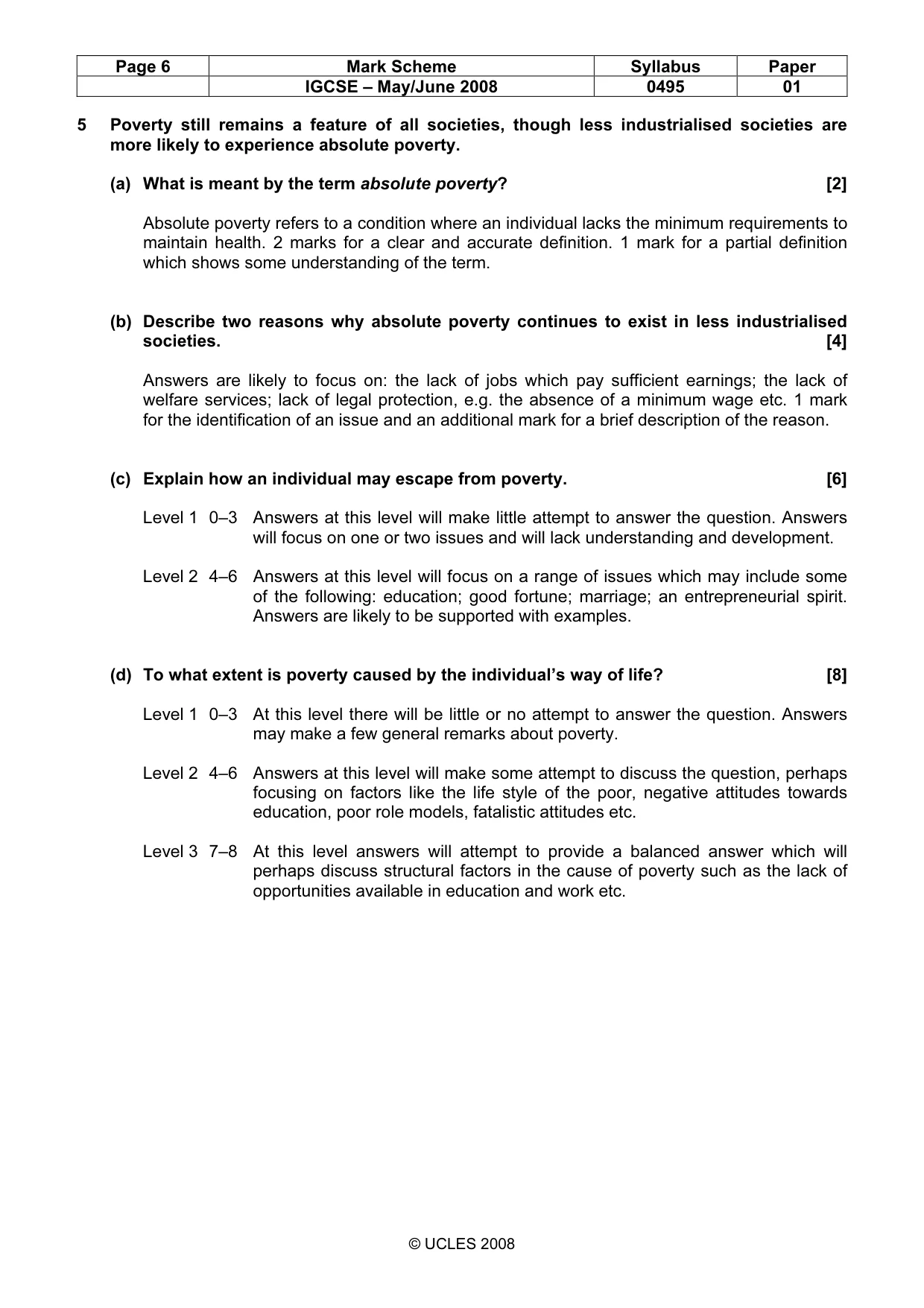
Page 6 Mark Scheme Syllabus Paper IGCSE – May/June 2008 0495 01 © UCLES 2008 5 Poverty still remains a feature of all societies, though less industrialised societies are more likely to experience absolute poverty. (a) What is meant by the term absolute poverty? [2] Absolute poverty refers to a condition where an individual lacks the minimum requirements to maintain health. 2 marks for a clear and accurate definition. 1 mark for a partial definition which shows some understanding of the term. (b) Describe two reasons why absolute poverty continues to exist in less industrialised societies. [4] Answers are likely to focus on: the lack of jobs which pay sufficient earnings; the lack of welfare services; lack of legal protection, e.g. the absence of a minimum wage etc. 1 mark for the identification of an issue and an additional mark for a brief description of the reason. (c) Explain how an individual may escape from poverty. [6] Level 1 0–3 Answers at this level will make little attempt to answer the question. Answers will focus on one or two issues and will lack understanding and development. Level 2 4–6 Answers at this level will focus on a range of issues which may include some of the following: education; good fortune; marriage; an entrepreneurial spirit. Answers are likely to be supported with examples. (d) To what extent is poverty caused by the individual’s way of life? [8] Level 1 0–3 At this level there will be little or no attempt to answer the question. Answers may make a few general remarks about poverty. Level 2 4–6 Answers at this level will make some attempt to discuss the question, perhaps focusing on factors like the life style of the poor, negative attitudes towards education, poor role models, fatalistic attitudes etc. Level 3 7–8 At this level answers will attempt to provide a balanced answer which will perhaps discuss structural factors in the cause of poverty such as the lack of opportunities available in education and work etc.
Mark scheme, page 7
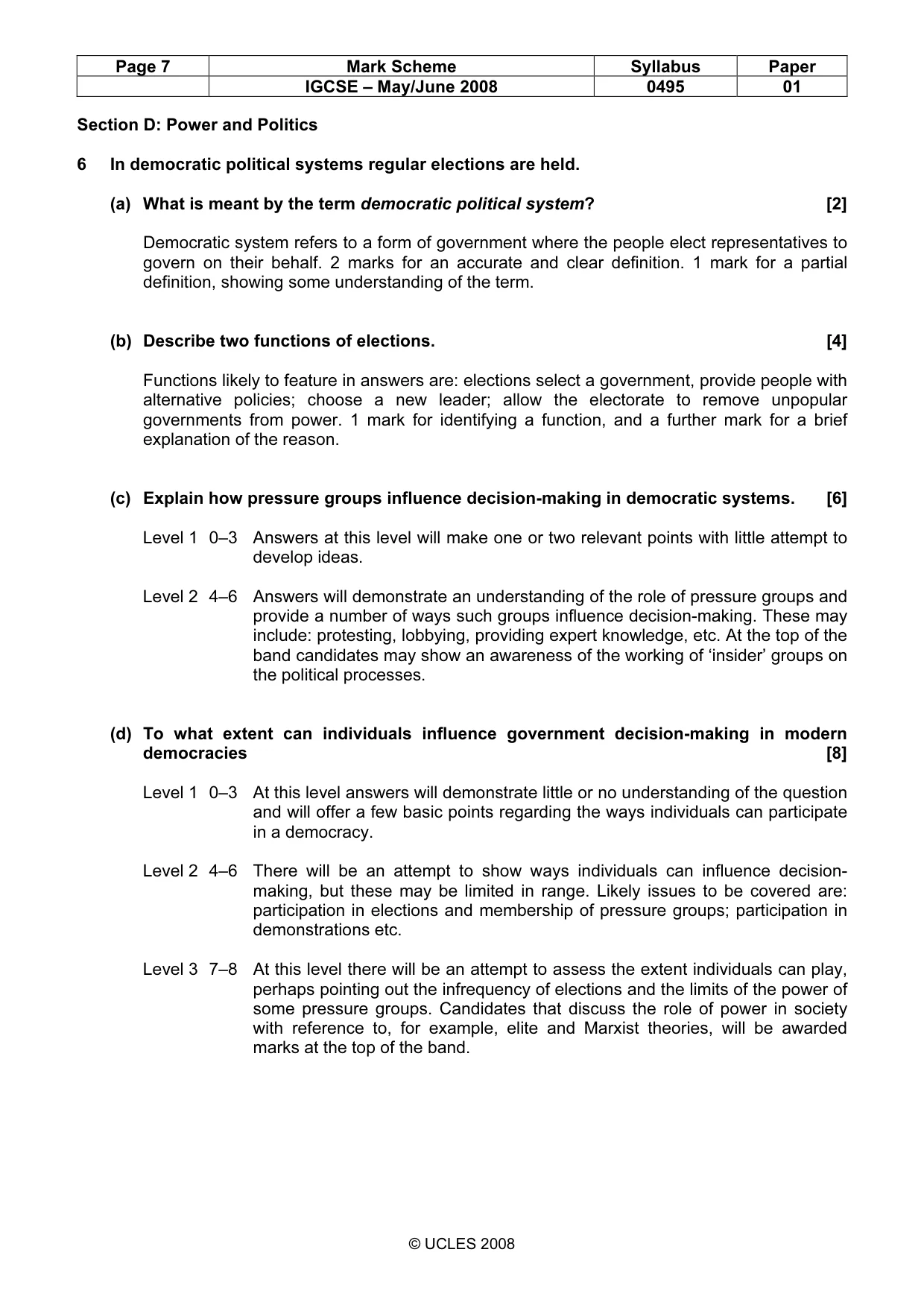
Page 7 Mark Scheme Syllabus Paper IGCSE – May/June 2008 0495 01 © UCLES 2008 Section D: Power and Politics 6 In democratic political systems regular elections are held. (a) What is meant by the term democratic political system? [2] Democratic system refers to a form of government where the people elect representatives to govern on their behalf. 2 marks for an accurate and clear definition. 1 mark for a partial definition, showing some understanding of the term. (b) Describe two functions of elections. [4] Functions likely to feature in answers are: elections select a government, provide people with alternative policies; choose a new leader; allow the electorate to remove unpopular governments from power. 1 mark for identifying a function, and a further mark for a brief explanation of the reason. (c) Explain how pressure groups influence decision-making in democratic systems. [6] Level 1 0–3 Answers at this level will make one or two relevant points with little attempt to develop ideas. Level 2 4–6 Answers will demonstrate an understanding of the role of pressure groups and provide a number of ways such groups influence decision-making. These may include: protesting, lobbying, providing expert knowledge, etc. At the top of the band candidates may show an awareness of the working of ‘insider’ groups on the political processes. (d) To what extent can individuals influence government decision-making in modern democracies [8] Level 1 0–3 At this level answers will demonstrate little or no understanding of the question and will offer a few basic points regarding the ways individuals can participate in a democracy. Level 2 4–6 There will be an attempt to show ways individuals can influence decision- making, but these may be limited in range. Likely issues to be covered are: participation in elections and membership of pressure groups; participation in demonstrations etc. Level 3 7–8 At this level there will be an attempt to assess the extent individuals can play, perhaps pointing out the infrequency of elections and the limits of the power of some pressure groups. Candidates that discuss the role of power in society with reference to, for example, elite and Marxist theories, will be awarded marks at the top of the band.
Mark scheme, page 8
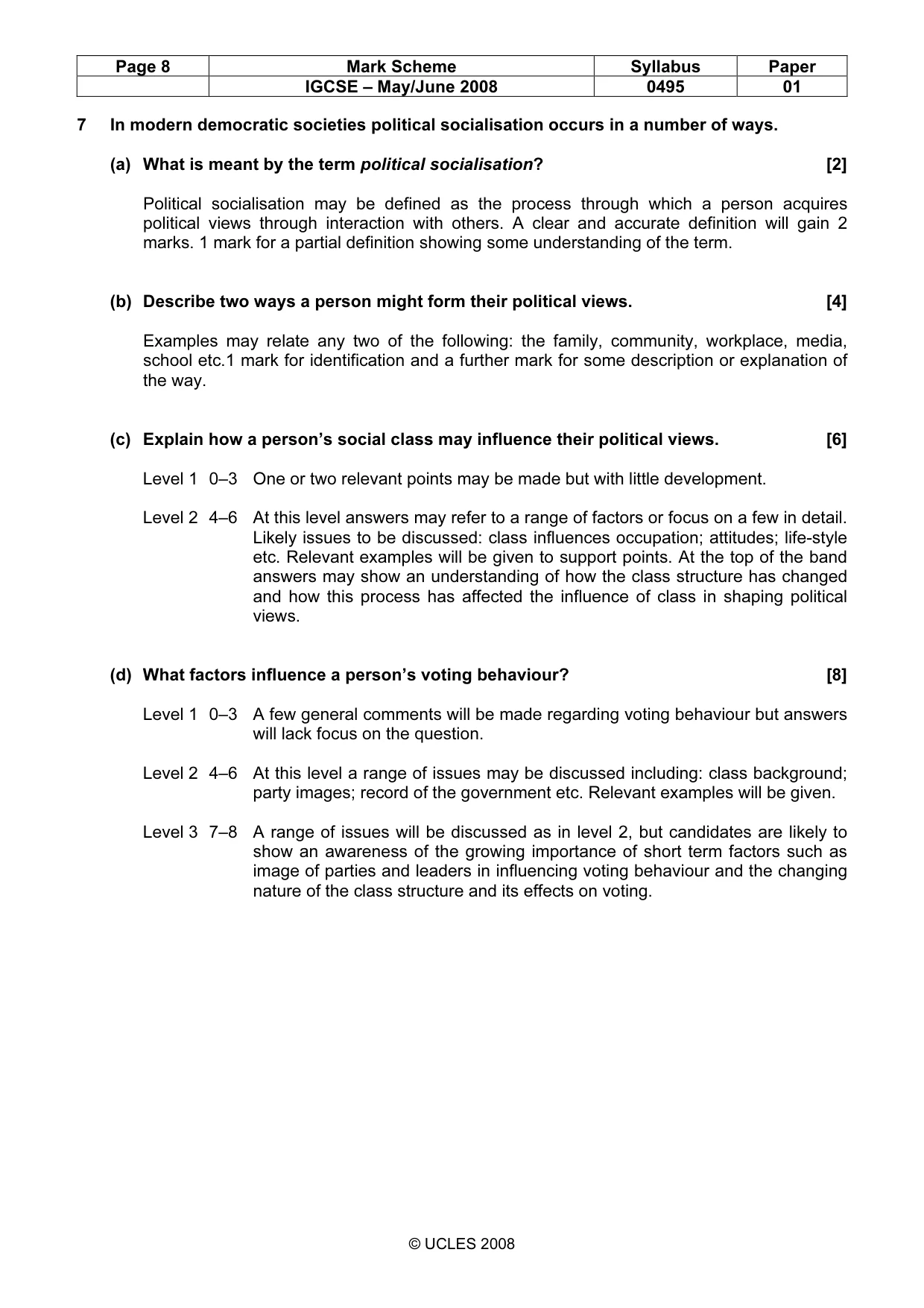
Page 8 Mark Scheme Syllabus Paper IGCSE – May/June 2008 0495 01 © UCLES 2008 7 In modern democratic societies political socialisation occurs in a number of ways. (a) What is meant by the term political socialisation? [2] Political socialisation may be defined as the process through which a person acquires political views through interaction with others. A clear and accurate definition will gain 2 marks. 1 mark for a partial definition showing some understanding of the term. (b) Describe two ways a person might form their political views. [4] Examples may relate any two of the following: the family, community, workplace, media, school etc.1 mark for identification and a further mark for some description or explanation of the way. (c) Explain how a person’s social class may influence their political views. [6] Level 1 0–3 One or two relevant points may be made but with little development. Level 2 4–6 At this level answers may refer to a range of factors or focus on a few in detail. Likely issues to be discussed: class influences occupation; attitudes; life-style etc. Relevant examples will be given to support points. At the top of the band answers may show an understanding of how the class structure has changed and how this process has affected the influence of class in shaping political views. (d) What factors influence a person’s voting behaviour? [8] Level 1 0–3 A few general comments will be made regarding voting behaviour but answers will lack focus on the question. Level 2 4–6 At this level a range of issues may be discussed including: class background; party images; record of the government etc. Relevant examples will be given. Level 3 7–8 A range of issues will be discussed as in level 2, but candidates are likely to show an awareness of the growing importance of short term factors such as image of parties and leaders in influencing voting behaviour and the changing nature of the class structure and its effects on voting.
What you needed in this session
Cambridge’s own grade thresholds for 2008 May/June, Paper 1 · Variant 1. A higher threshold means an easier paper — the bar moves with how the cohort did.