Cambridge IGCSE Sociology 0495 — 2006 May/June Paper 1 · Variant 1
0495/11/M/J/06 · 90 marks · ≈101 min
The question paper and its mark scheme, free to read here and free to download. This is Cambridge’s own paper, exactly as it was sat.
Question paper4 pages
Mark scheme8 pages
Answers below. Sit the paper first if you are practising.
Paper as text
Question paper, page 1
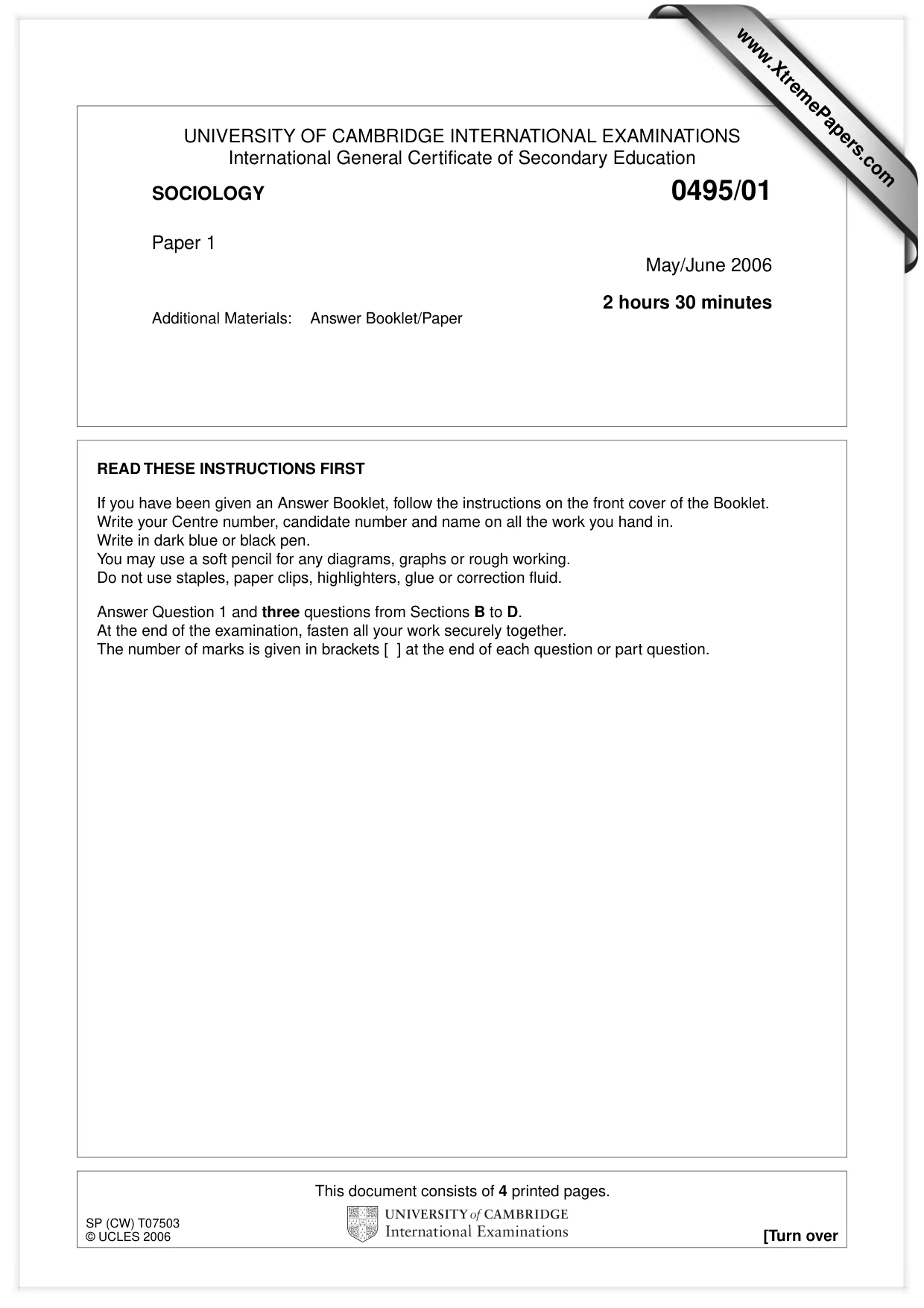
This document consists of 4 printed pages. SP (CW) T07503 © UCLES 2006 [Turn over UNIVERSITY OF CAMBRIDGE INTERNATIONAL EXAMINATIONS International General Certificate of Secondary Education SOCIOLOGY 0495/01 Paper 1 May/June 2006 2 hours 30 minutes Additional Materials: Answer Booklet/Paper READ THESE INSTRUCTIONS FIRST If you have been given an Answer Booklet, follow the instructions on the front cover of the Booklet. Write your Centre number, candidate number and name on all the work you hand in. Write in dark blue or black pen. You may use a soft pencil for any diagrams, graphs or rough working. Do not use staples, paper clips, highlighters, glue or correction fluid. Answer Question 1 and three questions from Sections B to D. At the end of the examination, fasten all your work securely together. The number of marks is given in brackets [ ] at the end of each question or part question. www.XtremePapers.com
Question paper, page 2
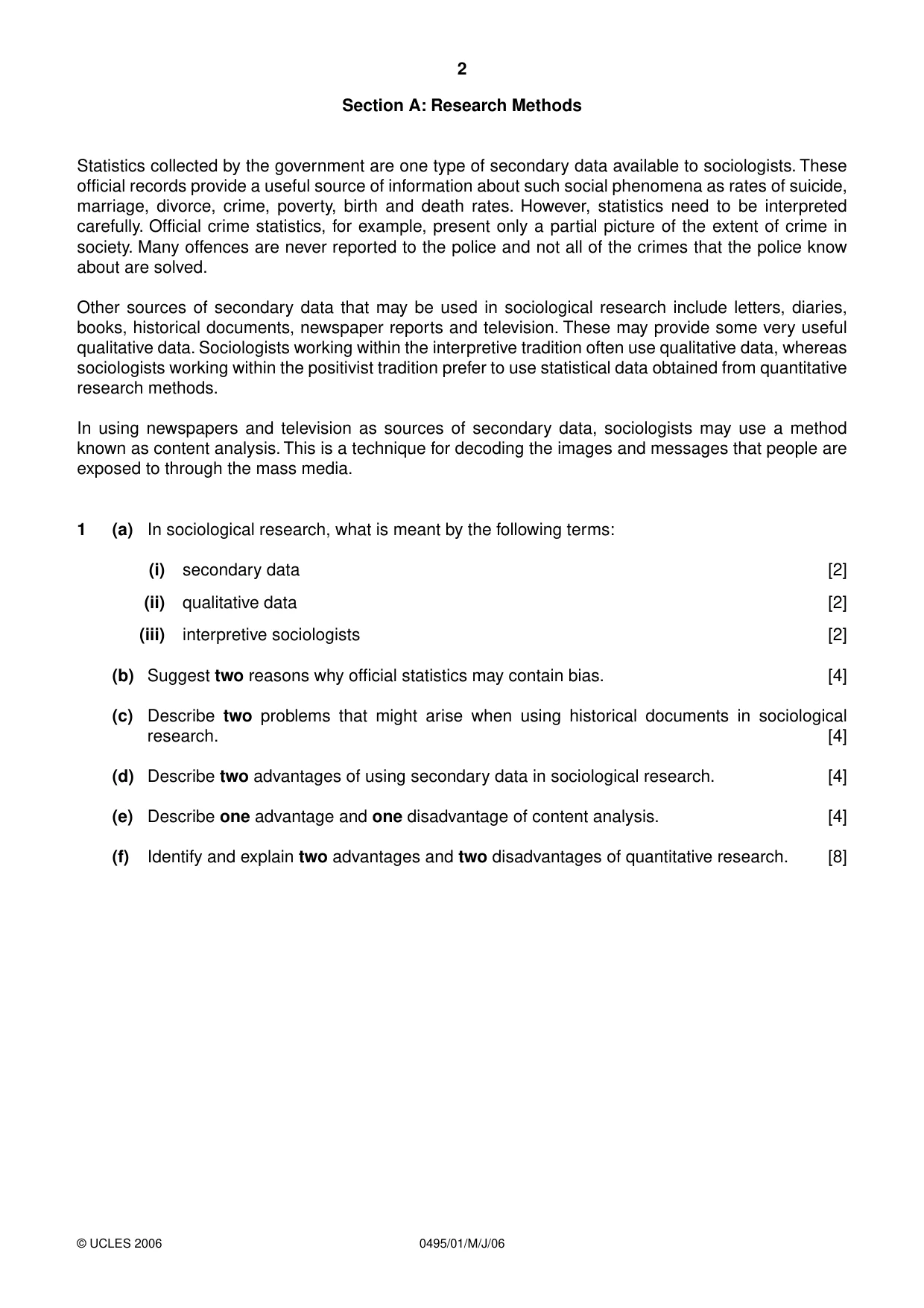
2 0495/01/M/J/06 © UCLES 2006 Section A: Research Methods Statistics collected by the government are one type of secondary data available to sociologists. These official records provide a useful source of information about such social phenomena as rates of suicide, marriage, divorce, crime, poverty, birth and death rates. However, statistics need to be interpreted carefully. Official crime statistics, for example, present only a partial picture of the extent of crime in society. Many offences are never reported to the police and not all of the crimes that the police know about are solved. Other sources of secondary data that may be used in sociological research include letters, diaries, books, historical documents, newspaper reports and television. These may provide some very useful qualitative data. Sociologists working within the interpretive tradition often use qualitative data, whereas sociologists working within the positivist tradition prefer to use statistical data obtained from quantitative research methods. In using newspapers and television as sources of secondary data, sociologists may use a method known as content analysis. This is a technique for decoding the images and messages that people are exposed to through the mass media. 1 (a) In sociological research, what is meant by the following terms: (i) secondary data [2] (ii) qualitative data [2] (iii) interpretive sociologists [2] (b) Suggest two reasons why official statistics may contain bias. [4] (c) Describe two problems that might arise when using historical documents in sociological research. [4] (d) Describe two advantages of using secondary data in sociological research. [4] (e) Describe one advantage and one disadvantage of content analysis. [4] (f) Identify and explain two advantages and two disadvantages of quantitative research. [8]
Question paper, page 3
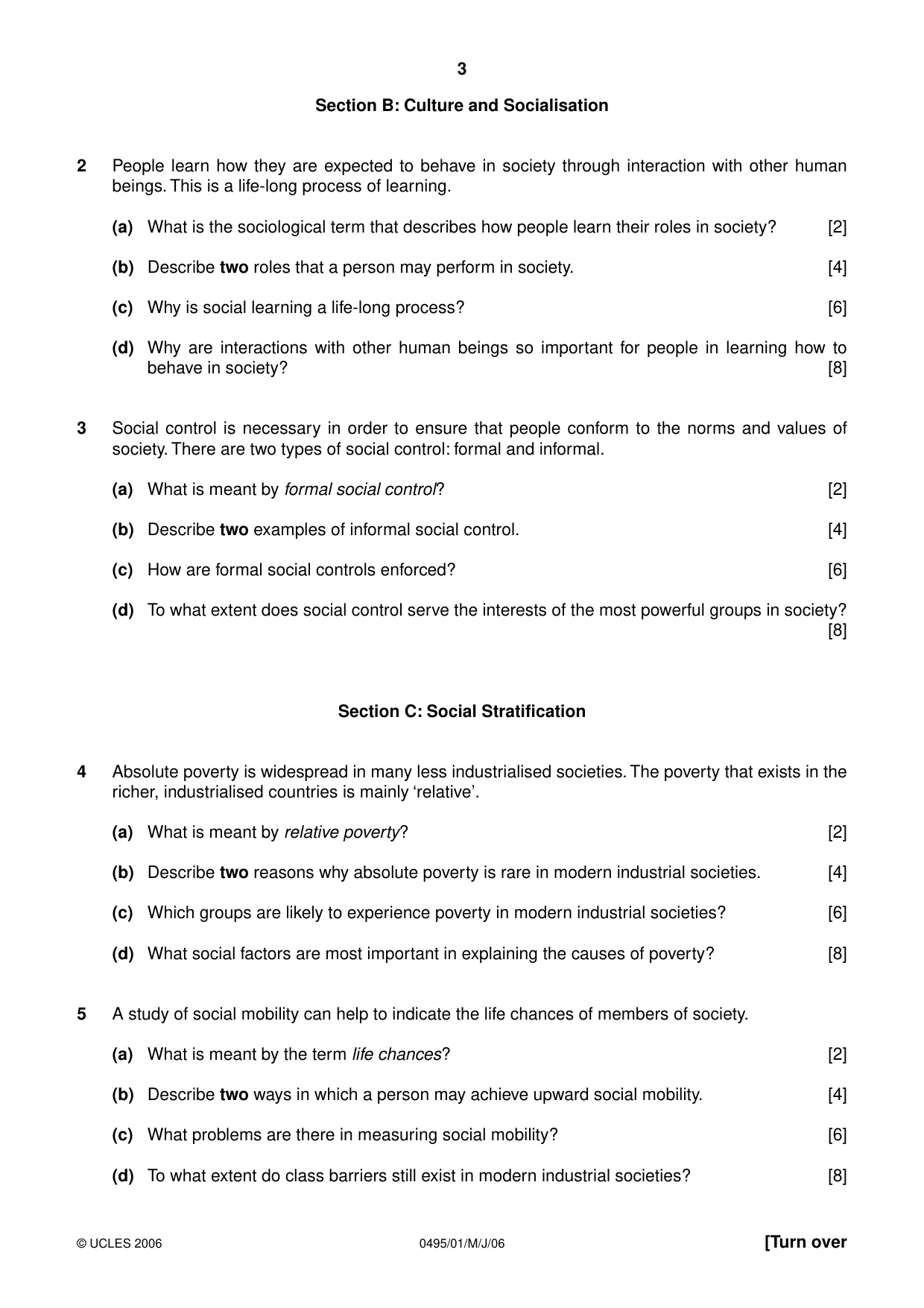
3 0495/01/M/J/06 © UCLES 2006 [Turn over Section B: Culture and Socialisation 2 People learn how they are expected to behave in society through interaction with other human beings. This is a life-long process of learning. (a) What is the sociological term that describes how people learn their roles in society? [2] (b) Describe two roles that a person may perform in society. [4] (c) Why is social learning a life-long process? [6] (d) Why are interactions with other human beings so important for people in learning how to behave in society? [8] 3 Social control is necessary in order to ensure that people conform to the norms and values of society. There are two types of social control: formal and informal. (a) What is meant by formal social control? [2] (b) Describe two examples of informal social control. [4] (c) How are formal social controls enforced? [6] (d) To what extent does social control serve the interests of the most powerful groups in society? [8] Section C: Social Stratification 4 Absolute poverty is widespread in many less industrialised societies. The poverty that exists in the richer, industrialised countries is mainly ‘relative’. (a) What is meant by relative poverty? [2] (b) Describe two reasons why absolute poverty is rare in modern industrial societies. [4] (c) Which groups are likely to experience poverty in modern industrial societies? [6] (d) What social factors are most important in explaining the causes of poverty? [8] 5 A study of social mobility can help to indicate the life chances of members of society. (a) What is meant by the term life chances? [2] (b) Describe two ways in which a person may achieve upward social mobility. [4] (c) What problems are there in measuring social mobility? [6] (d) To what extent do class barriers still exist in modern industrial societies? [8]
Question paper, page 4
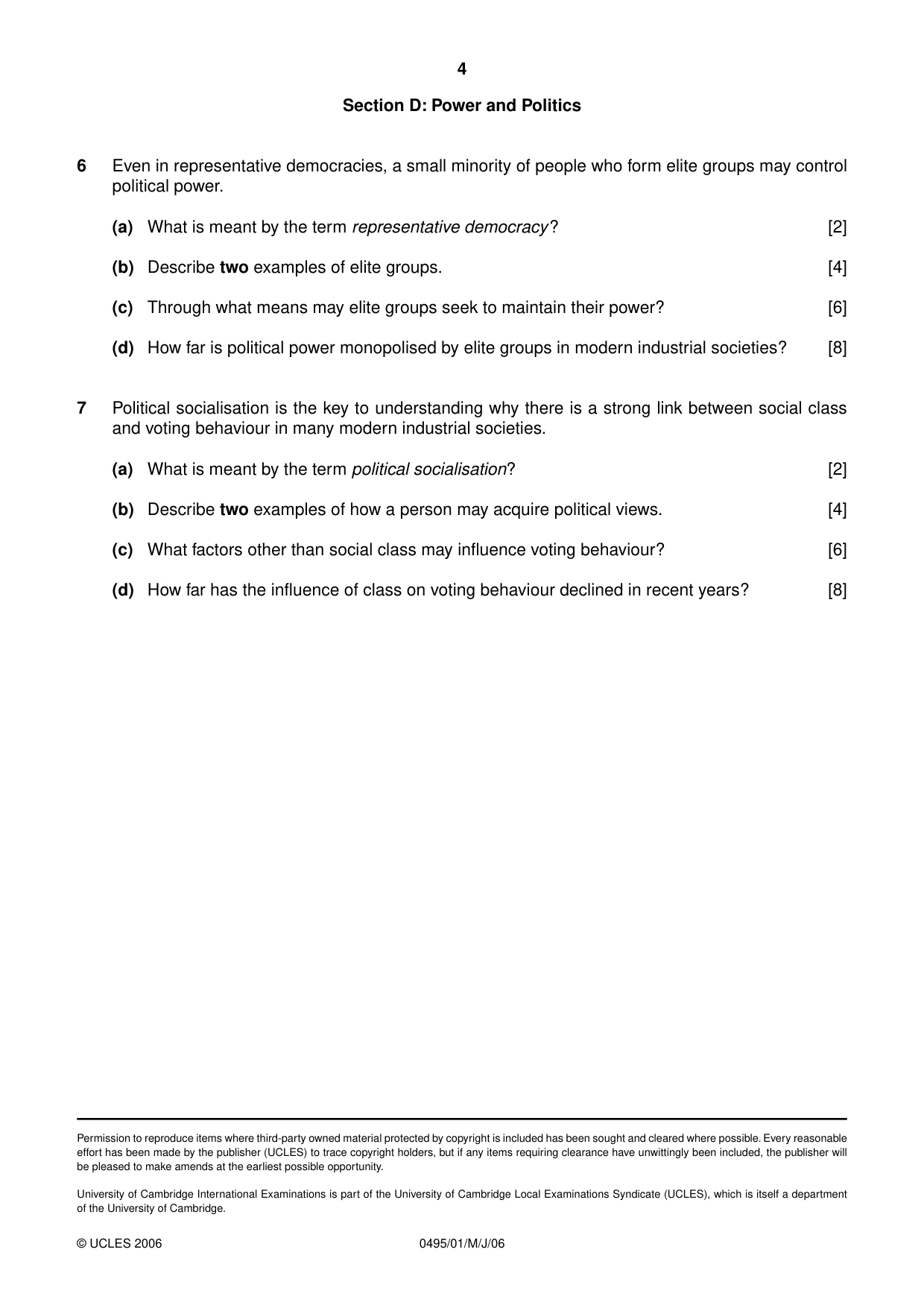
4 0495/01/M/J/06 © UCLES 2006 Section D: Power and Politics 6 Even in representative democracies, a small minority of people who form elite groups may control political power. (a) What is meant by the term representative democracy? [2] (b) Describe two examples of elite groups. [4] (c) Through what means may elite groups seek to maintain their power? [6] (d) How far is political power monopolised by elite groups in modern industrial societies? [8] 7 Political socialisation is the key to understanding why there is a strong link between social class and voting behaviour in many modern industrial societies. (a) What is meant by the term political socialisation? [2] (b) Describe two examples of how a person may acquire political views. [4] (c) What factors other than social class may influence voting behaviour? [6] (d) How far has the influence of class on voting behaviour declined in recent years? [8] Permission to reproduce items where third-party owned material protected by copyright is included has been sought and cleared where possible. Every reasonable effort has been made by the publisher (UCLES) to trace copyright holders, but if any items requiring clearance have unwittingly been included, the publisher will be pleased to make amends at the earliest possible opportunity. University of Cambridge International Examinations is part of the University of Cambridge Local Examinations Syndicate (UCLES), which is itself a department of the University of Cambridge.
Mark scheme, page 1
UNIVERSITY OF CAMBRIDGE INTERNATIONAL EXAMINATIONS International General Certificate of Secondary Education MARK SCHEME for the May/June 2006 question paper 0495 SOCIOLOGY 0495/01 Paper 1, maximum raw mark 90 These mark schemes are published as an aid to teachers and students, to indicate the requirements of the examination. They show the basis on which Examiners were initially instructed to award marks. They do not indicate the details of the discussions that took place at an Examiners’ meeting before marking began. Any substantial changes to the mark scheme that arose from these discussions will be recorded in the published Report on the Examination. All Examiners are instructed that alternative correct answers and unexpected approaches in candidates’ scripts must be given marks that fairly reflect the relevant knowledge and skills demonstrated. Mark schemes must be read in conjunction with the question papers and the Report on the Examination. The minimum marks in these components needed for various grades were previously published with these mark schemes, but are now instead included in the Report on the Examination for this session. • CIE will not enter into discussion or correspondence in connection with these mark schemes. CIE is publishing the mark schemes for the May/June 2006 question papers for most IGCSE and GCE Advanced Level and Advanced Subsidiary Level syllabuses and some Ordinary Level syllabuses. www.XtremePapers.com
Mark scheme, page 2
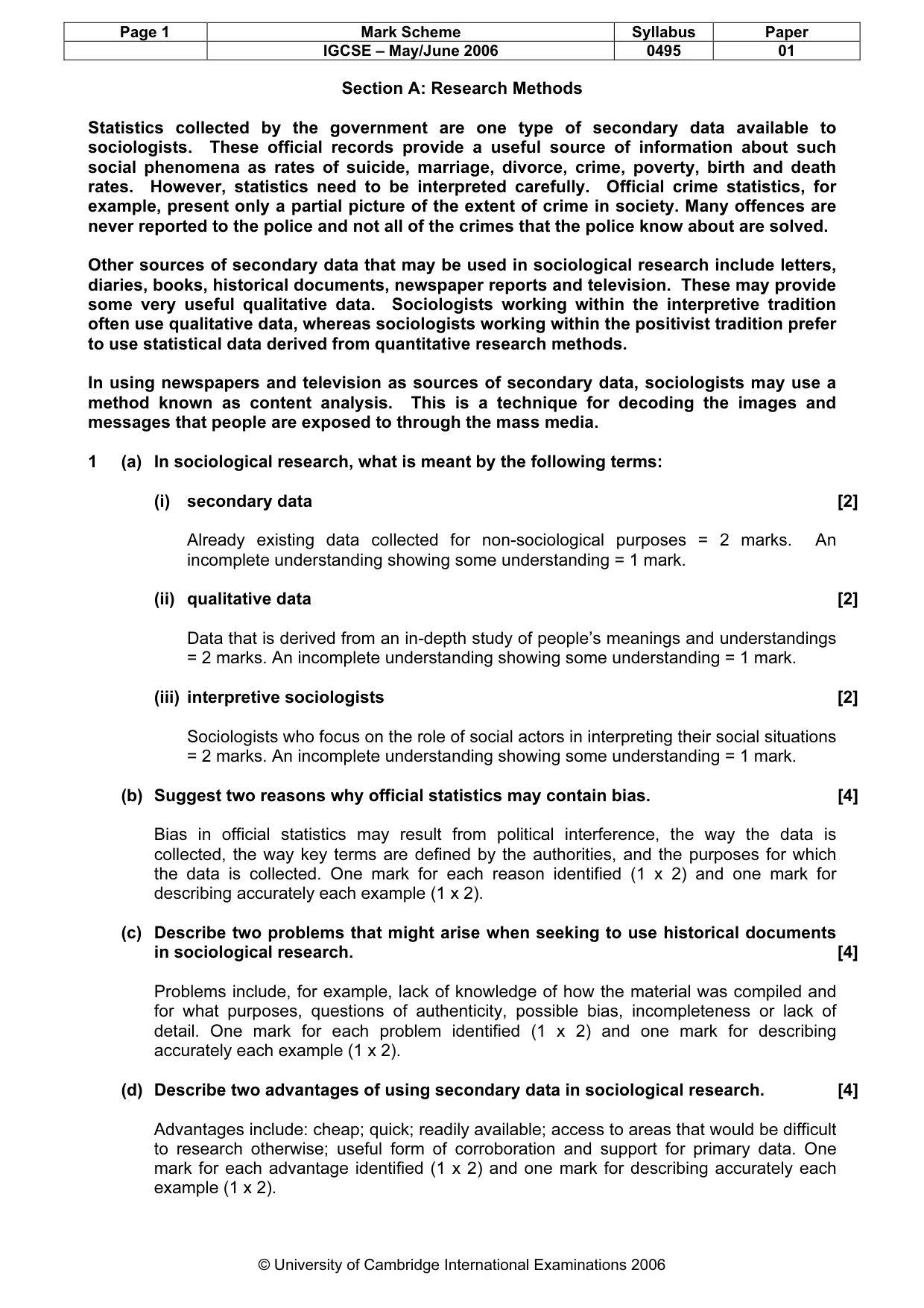
Page 1 Mark Scheme Syllabus Paper IGCSE – May/June 2006 0495 01 © University of Cambridge International Examinations 2006 Section A: Research Methods Statistics collected by the government are one type of secondary data available to sociologists. These official records provide a useful source of information about such social phenomena as rates of suicide, marriage, divorce, crime, poverty, birth and death rates. However, statistics need to be interpreted carefully. Official crime statistics, for example, present only a partial picture of the extent of crime in society. Many offences are never reported to the police and not all of the crimes that the police know about are solved. Other sources of secondary data that may be used in sociological research include letters, diaries, books, historical documents, newspaper reports and television. These may provide some very useful qualitative data. Sociologists working within the interpretive tradition often use qualitative data, whereas sociologists working within the positivist tradition prefer to use statistical data derived from quantitative research methods. In using newspapers and television as sources of secondary data, sociologists may use a method known as content analysis. This is a technique for decoding the images and messages that people are exposed to through the mass media. 1 (a) In sociological research, what is meant by the following terms: (i) secondary data [2] Already existing data collected for non-sociological purposes = 2 marks. An incomplete understanding showing some understanding = 1 mark. (ii) qualitative data [2] Data that is derived from an in-depth study of people’s meanings and understandings = 2 marks. An incomplete understanding showing some understanding = 1 mark. (iii) interpretive sociologists [2] Sociologists who focus on the role of social actors in interpreting their social situations = 2 marks. An incomplete understanding showing some understanding = 1 mark. (b) Suggest two reasons why official statistics may contain bias. [4] Bias in official statistics may result from political interference, the way the data is collected, the way key terms are defined by the authorities, and the purposes for which the data is collected. One mark for each reason identified (1 x 2) and one mark for describing accurately each example (1 x 2). (c) Describe two problems that might arise when seeking to use historical documents in sociological research. [4] Problems include, for example, lack of knowledge of how the material was compiled and for what purposes, questions of authenticity, possible bias, incompleteness or lack of detail. One mark for each problem identified (1 x 2) and one mark for describing accurately each example (1 x 2). (d) Describe two advantages of using secondary data in sociological research. [4] Advantages include: cheap; quick; readily available; access to areas that would be difficult to research otherwise; useful form of corroboration and support for primary data. One mark for each advantage identified (1 x 2) and one mark for describing accurately each example (1 x 2).
Mark scheme, page 3
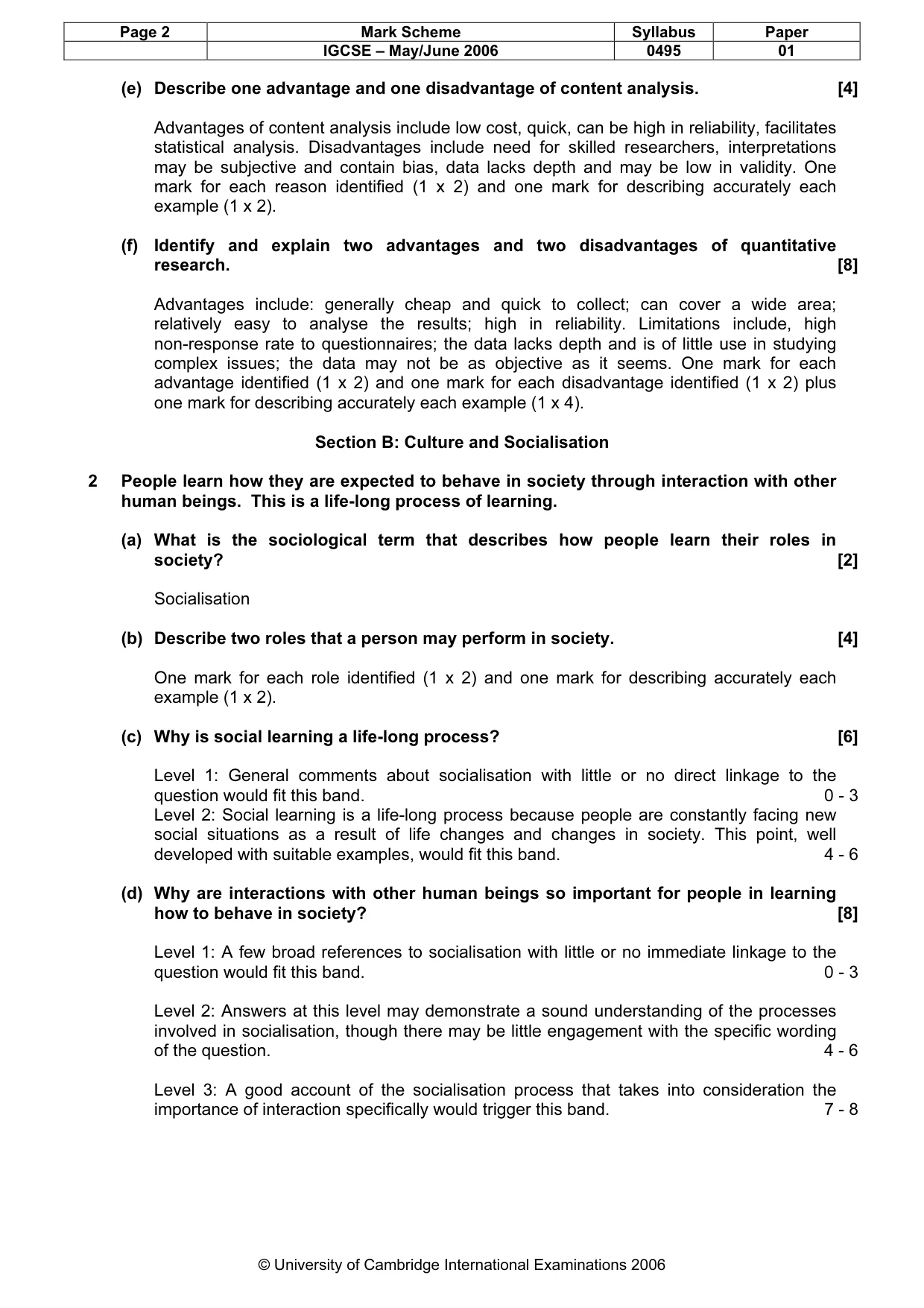
Page 2 Mark Scheme Syllabus Paper IGCSE – May/June 2006 0495 01 © University of Cambridge International Examinations 2006 (e) Describe one advantage and one disadvantage of content analysis. [4] Advantages of content analysis include low cost, quick, can be high in reliability, facilitates statistical analysis. Disadvantages include need for skilled researchers, interpretations may be subjective and contain bias, data lacks depth and may be low in validity. One mark for each reason identified (1 x 2) and one mark for describing accurately each example (1 x 2). (f) Identify and explain two advantages and two disadvantages of quantitative research. [8] Advantages include: generally cheap and quick to collect; can cover a wide area; relatively easy to analyse the results; high in reliability. Limitations include, high non-response rate to questionnaires; the data lacks depth and is of little use in studying complex issues; the data may not be as objective as it seems. One mark for each advantage identified (1 x 2) and one mark for each disadvantage identified (1 x 2) plus one mark for describing accurately each example (1 x 4). Section B: Culture and Socialisation 2 People learn how they are expected to behave in society through interaction with other human beings. This is a life-long process of learning. (a) What is the sociological term that describes how people learn their roles in society? [2] Socialisation (b) Describe two roles that a person may perform in society. [4] One mark for each role identified (1 x 2) and one mark for describing accurately each example (1 x 2). (c) Why is social learning a life-long process? [6] Level 1: General comments about socialisation with little or no direct linkage to the question would fit this band. 0 - 3 Level 2: Social learning is a life-long process because people are constantly facing new social situations as a result of life changes and changes in society. This point, well developed with suitable examples, would fit this band. 4 - 6 (d) Why are interactions with other human beings so important for people in learning how to behave in society? [8] Level 1: A few broad references to socialisation with little or no immediate linkage to the question would fit this band. 0 - 3 Level 2: Answers at this level may demonstrate a sound understanding of the processes involved in socialisation, though there may be little engagement with the specific wording of the question. 4 - 6 Level 3: A good account of the socialisation process that takes into consideration the importance of interaction specifically would trigger this band. 7 - 8
Mark scheme, page 4
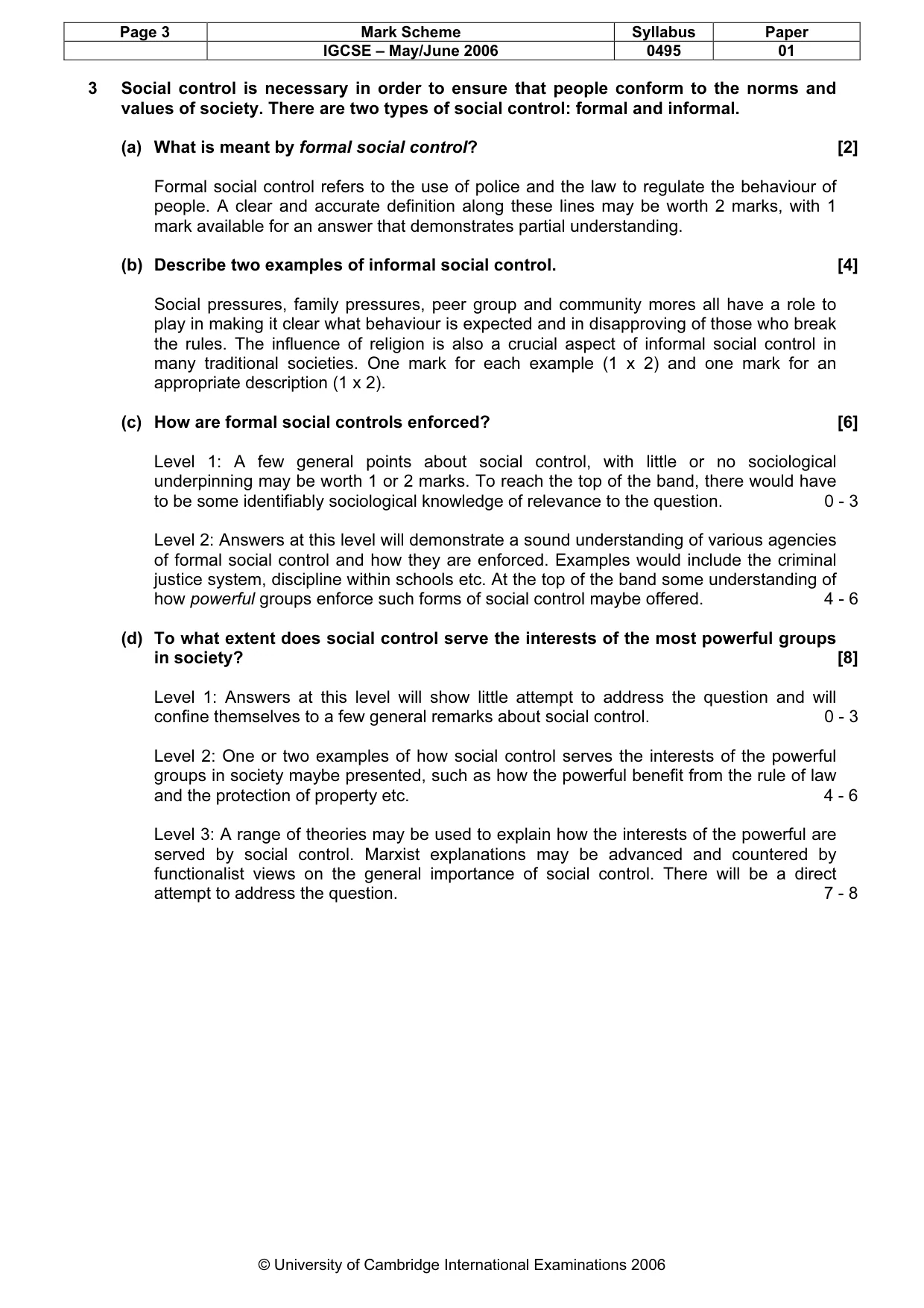
Page 3 Mark Scheme Syllabus Paper IGCSE – May/June 2006 0495 01 © University of Cambridge International Examinations 2006 3 Social control is necessary in order to ensure that people conform to the norms and values of society. There are two types of social control: formal and informal. (a) What is meant by formal social control? [2] Formal social control refers to the use of police and the law to regulate the behaviour of people. A clear and accurate definition along these lines may be worth 2 marks, with 1 mark available for an answer that demonstrates partial understanding. (b) Describe two examples of informal social control. [4] Social pressures, family pressures, peer group and community mores all have a role to play in making it clear what behaviour is expected and in disapproving of those who break the rules. The influence of religion is also a crucial aspect of informal social control in many traditional societies. One mark for each example (1 x 2) and one mark for an appropriate description (1 x 2). (c) How are formal social controls enforced? [6] Level 1: A few general points about social control, with little or no sociological underpinning may be worth 1 or 2 marks. To reach the top of the band, there would have to be some identifiably sociological knowledge of relevance to the question. 0 - 3 Level 2: Answers at this level will demonstrate a sound understanding of various agencies of formal social control and how they are enforced. Examples would include the criminal justice system, discipline within schools etc. At the top of the band some understanding of how powerful groups enforce such forms of social control maybe offered. 4 - 6 (d) To what extent does social control serve the interests of the most powerful groups in society? [8] Level 1: Answers at this level will show little attempt to address the question and will confine themselves to a few general remarks about social control. 0 - 3 Level 2: One or two examples of how social control serves the interests of the powerful groups in society maybe presented, such as how the powerful benefit from the rule of law and the protection of property etc. 4 - 6 Level 3: A range of theories may be used to explain how the interests of the powerful are served by social control. Marxist explanations may be advanced and countered by functionalist views on the general importance of social control. There will be a direct attempt to address the question. 7 - 8
Mark scheme, page 5
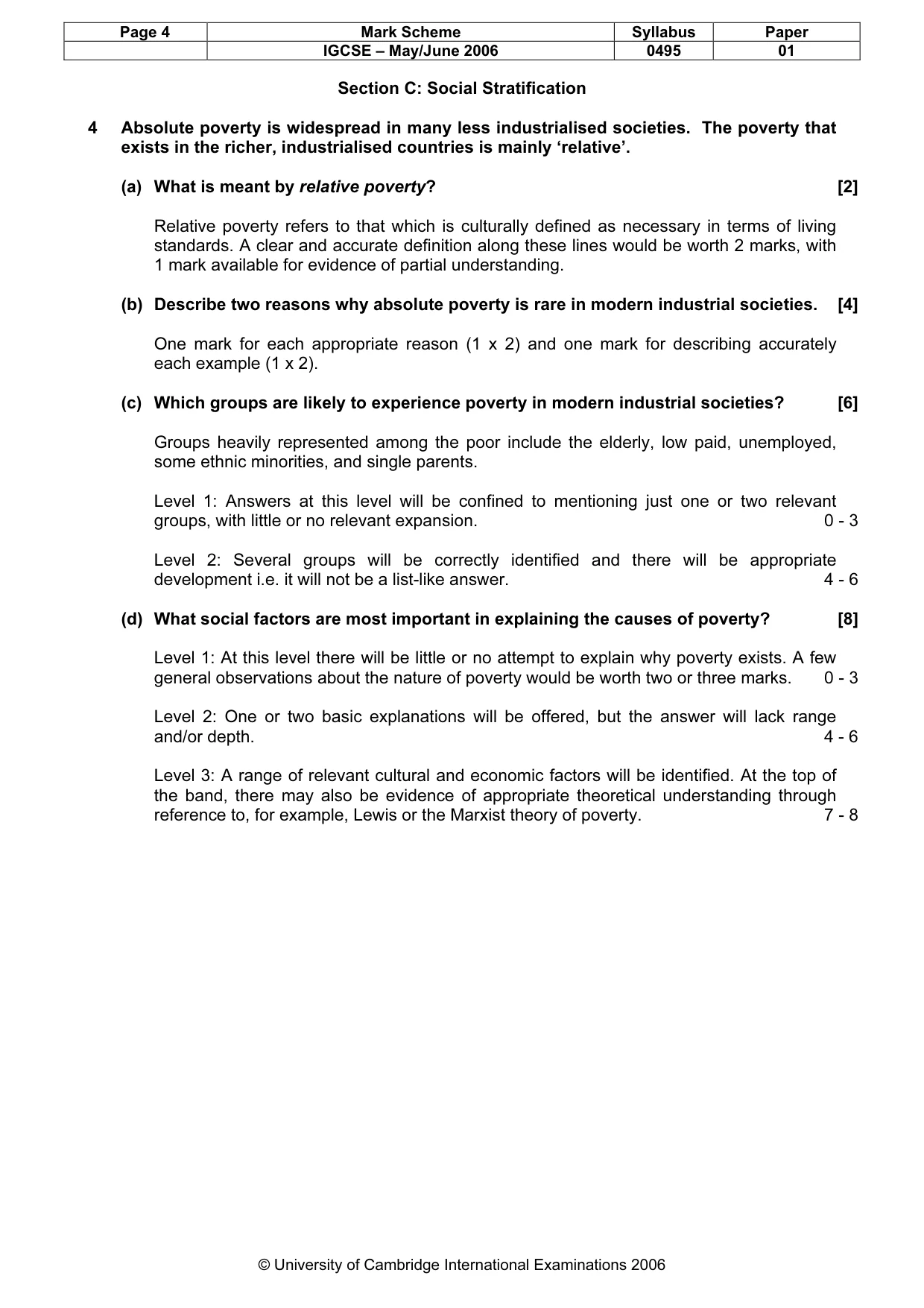
Page 4 Mark Scheme Syllabus Paper IGCSE – May/June 2006 0495 01 © University of Cambridge International Examinations 2006 Section C: Social Stratification 4 Absolute poverty is widespread in many less industrialised societies. The poverty that exists in the richer, industrialised countries is mainly ‘relative’. (a) What is meant by relative poverty? [2] Relative poverty refers to that which is culturally defined as necessary in terms of living standards. A clear and accurate definition along these lines would be worth 2 marks, with 1 mark available for evidence of partial understanding. (b) Describe two reasons why absolute poverty is rare in modern industrial societies. [4] One mark for each appropriate reason (1 x 2) and one mark for describing accurately each example (1 x 2). (c) Which groups are likely to experience poverty in modern industrial societies? [6] Groups heavily represented among the poor include the elderly, low paid, unemployed, some ethnic minorities, and single parents. Level 1: Answers at this level will be confined to mentioning just one or two relevant groups, with little or no relevant expansion. 0 - 3 Level 2: Several groups will be correctly identified and there will be appropriate development i.e. it will not be a list-like answer. 4 - 6 (d) What social factors are most important in explaining the causes of poverty? [8] Level 1: At this level there will be little or no attempt to explain why poverty exists. A few general observations about the nature of poverty would be worth two or three marks. 0 - 3 Level 2: One or two basic explanations will be offered, but the answer will lack range and/or depth. 4 - 6 Level 3: A range of relevant cultural and economic factors will be identified. At the top of the band, there may also be evidence of appropriate theoretical understanding through reference to, for example, Lewis or the Marxist theory of poverty. 7 - 8
Mark scheme, page 6
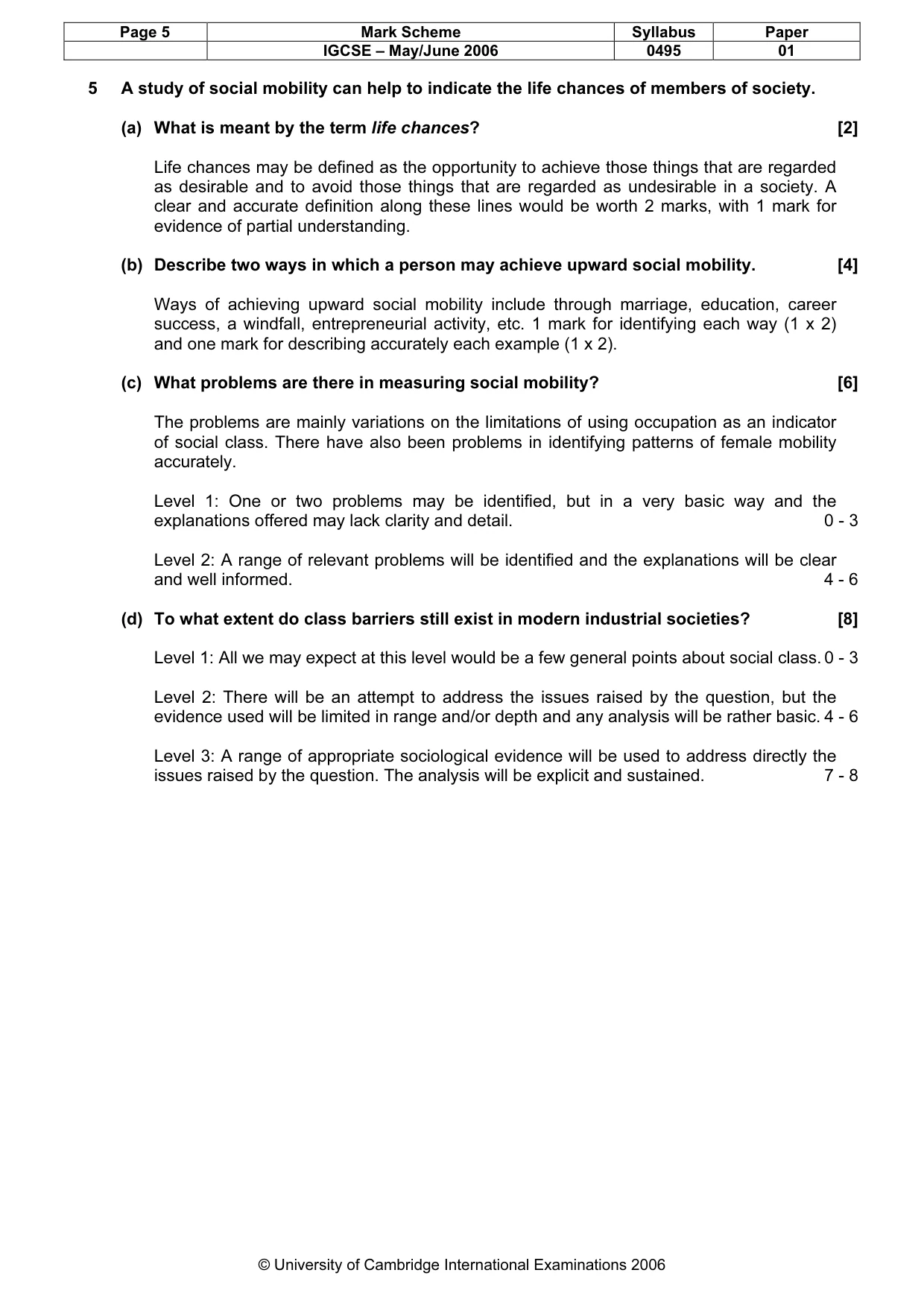
Page 5 Mark Scheme Syllabus Paper IGCSE – May/June 2006 0495 01 © University of Cambridge International Examinations 2006 5 A study of social mobility can help to indicate the life chances of members of society. (a) What is meant by the term life chances? [2] Life chances may be defined as the opportunity to achieve those things that are regarded as desirable and to avoid those things that are regarded as undesirable in a society. A clear and accurate definition along these lines would be worth 2 marks, with 1 mark for evidence of partial understanding. (b) Describe two ways in which a person may achieve upward social mobility. [4] Ways of achieving upward social mobility include through marriage, education, career success, a windfall, entrepreneurial activity, etc. 1 mark for identifying each way (1 x 2) and one mark for describing accurately each example (1 x 2). (c) What problems are there in measuring social mobility? [6] The problems are mainly variations on the limitations of using occupation as an indicator of social class. There have also been problems in identifying patterns of female mobility accurately. Level 1: One or two problems may be identified, but in a very basic way and the explanations offered may lack clarity and detail. 0 - 3 Level 2: A range of relevant problems will be identified and the explanations will be clear and well informed. 4 - 6 (d) To what extent do class barriers still exist in modern industrial societies? [8] Level 1: All we may expect at this level would be a few general points about social class. 0 - 3 Level 2: There will be an attempt to address the issues raised by the question, but the evidence used will be limited in range and/or depth and any analysis will be rather basic. 4 - 6 Level 3: A range of appropriate sociological evidence will be used to address directly the issues raised by the question. The analysis will be explicit and sustained. 7 - 8
Mark scheme, page 7
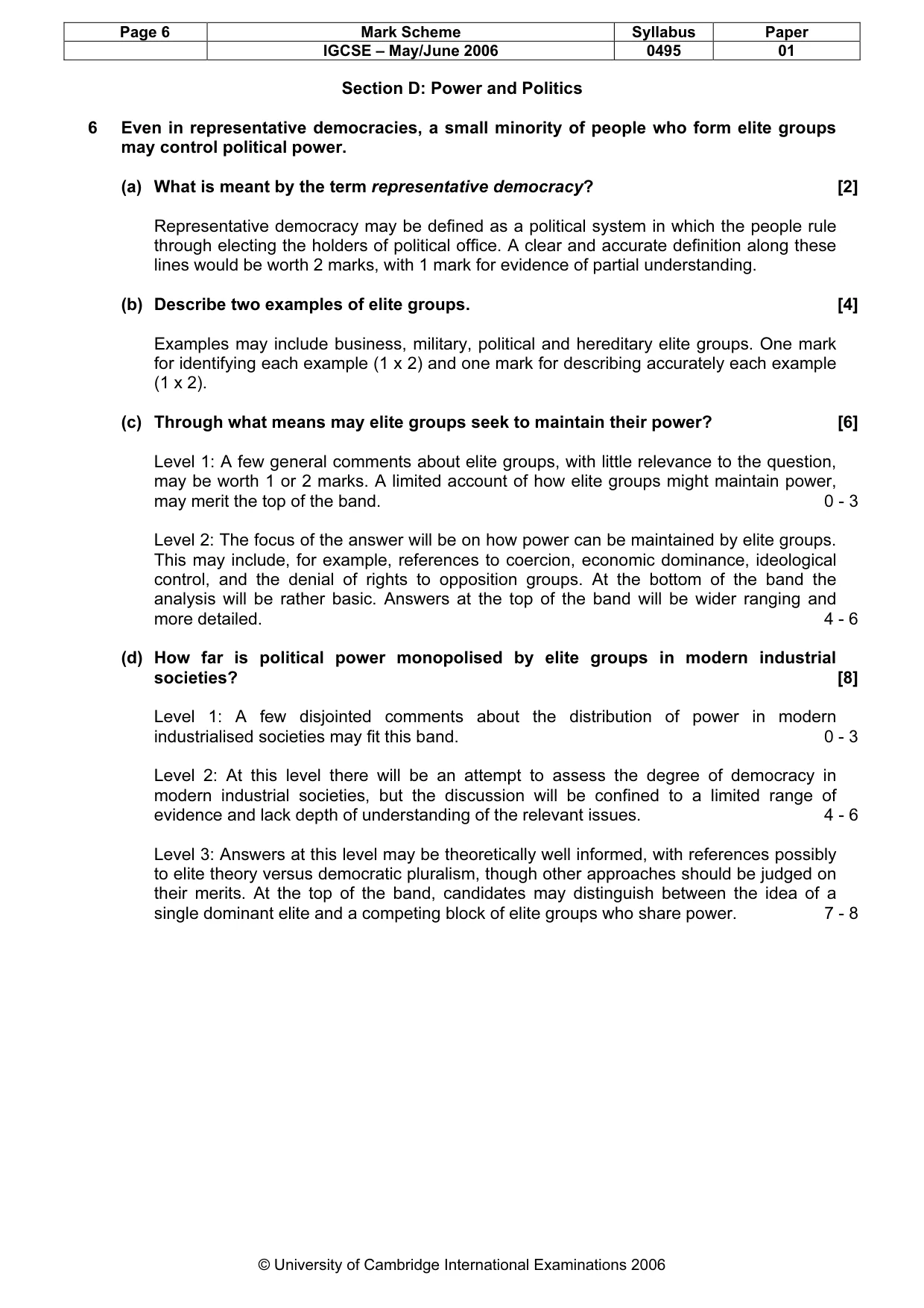
Page 6 Mark Scheme Syllabus Paper IGCSE – May/June 2006 0495 01 © University of Cambridge International Examinations 2006 Section D: Power and Politics 6 Even in representative democracies, a small minority of people who form elite groups may control political power. (a) What is meant by the term representative democracy? [2] Representative democracy may be defined as a political system in which the people rule through electing the holders of political office. A clear and accurate definition along these lines would be worth 2 marks, with 1 mark for evidence of partial understanding. (b) Describe two examples of elite groups. [4] Examples may include business, military, political and hereditary elite groups. One mark for identifying each example (1 x 2) and one mark for describing accurately each example (1 x 2). (c) Through what means may elite groups seek to maintain their power? [6] Level 1: A few general comments about elite groups, with little relevance to the question, may be worth 1 or 2 marks. A limited account of how elite groups might maintain power, may merit the top of the band. 0 - 3 Level 2: The focus of the answer will be on how power can be maintained by elite groups. This may include, for example, references to coercion, economic dominance, ideological control, and the denial of rights to opposition groups. At the bottom of the band the analysis will be rather basic. Answers at the top of the band will be wider ranging and more detailed. 4 - 6 (d) How far is political power monopolised by elite groups in modern industrial societies? [8] Level 1: A few disjointed comments about the distribution of power in modern industrialised societies may fit this band. 0 - 3 Level 2: At this level there will be an attempt to assess the degree of democracy in modern industrial societies, but the discussion will be confined to a limited range of evidence and lack depth of understanding of the relevant issues. 4 - 6 Level 3: Answers at this level may be theoretically well informed, with references possibly to elite theory versus democratic pluralism, though other approaches should be judged on their merits. At the top of the band, candidates may distinguish between the idea of a single dominant elite and a competing block of elite groups who share power. 7 - 8
Mark scheme, page 8
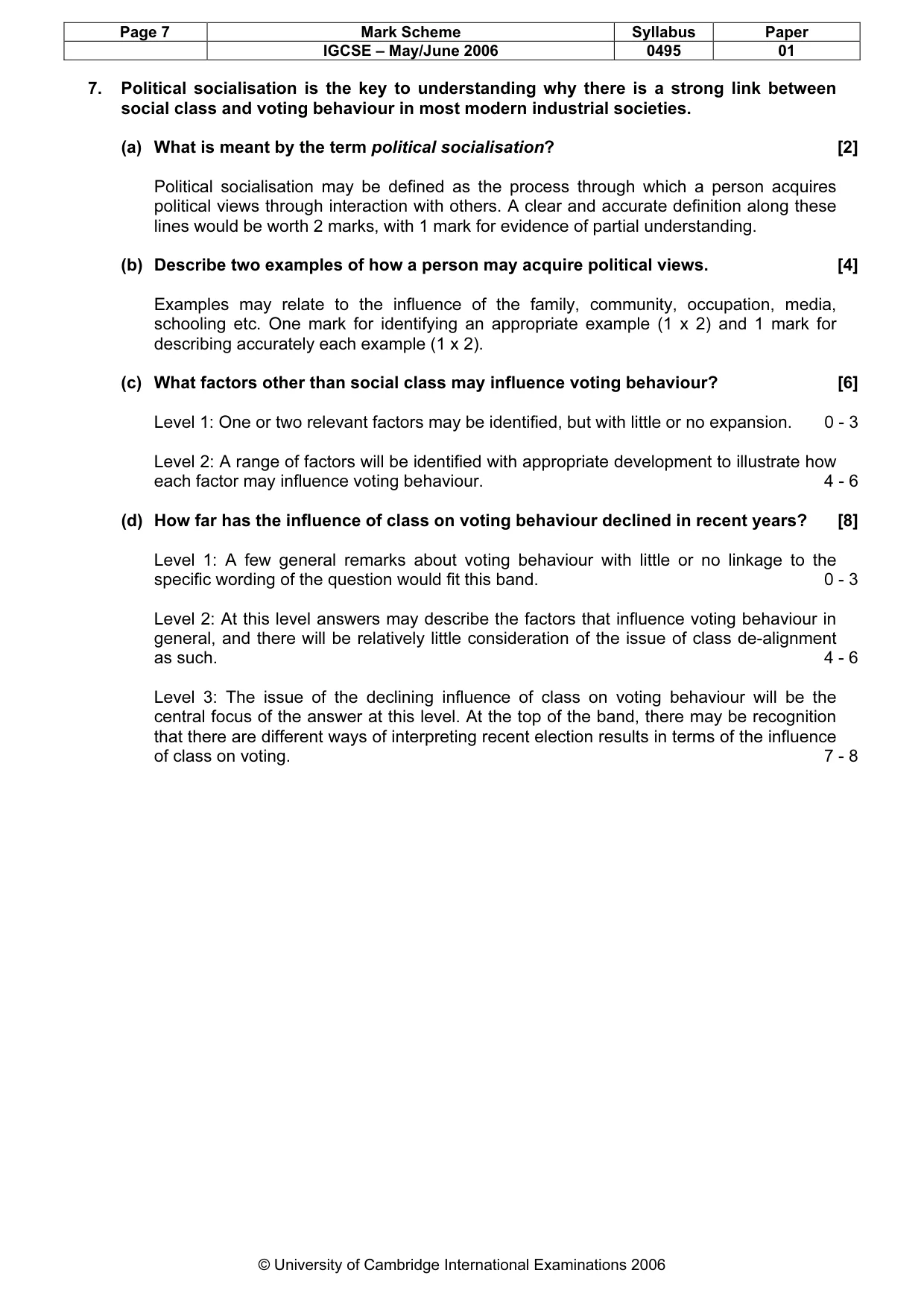
Page 7 Mark Scheme Syllabus Paper IGCSE – May/June 2006 0495 01 © University of Cambridge International Examinations 2006 7. Political socialisation is the key to understanding why there is a strong link between social class and voting behaviour in most modern industrial societies. (a) What is meant by the term political socialisation? [2] Political socialisation may be defined as the process through which a person acquires political views through interaction with others. A clear and accurate definition along these lines would be worth 2 marks, with 1 mark for evidence of partial understanding. (b) Describe two examples of how a person may acquire political views. [4] Examples may relate to the influence of the family, community, occupation, media, schooling etc. One mark for identifying an appropriate example (1 x 2) and 1 mark for describing accurately each example (1 x 2). (c) What factors other than social class may influence voting behaviour? [6] Level 1: One or two relevant factors may be identified, but with little or no expansion. 0 - 3 Level 2: A range of factors will be identified with appropriate development to illustrate how each factor may influence voting behaviour. 4 - 6 (d) How far has the influence of class on voting behaviour declined in recent years? [8] Level 1: A few general remarks about voting behaviour with little or no linkage to the specific wording of the question would fit this band. 0 - 3 Level 2: At this level answers may describe the factors that influence voting behaviour in general, and there will be relatively little consideration of the issue of class de-alignment as such. 4 - 6 Level 3: The issue of the declining influence of class on voting behaviour will be the central focus of the answer at this level. At the top of the band, there may be recognition that there are different ways of interpreting recent election results in terms of the influence of class on voting. 7 - 8
What you needed in this session
Cambridge’s own grade thresholds for 2006 May/June, Paper 1 · Variant 1. A higher threshold means an easier paper — the bar moves with how the cohort did.