Cambridge IGCSE Sociology 0495 — 2005 May/June Paper 1 · Variant 1
0495/11/M/J/05
The question paper and its mark scheme, free to read here and free to download. This is Cambridge’s own paper, exactly as it was sat.
Question paper4 pages
Mark scheme8 pages
Answers below. Sit the paper first if you are practising.
Paper as text
Question paper, page 1
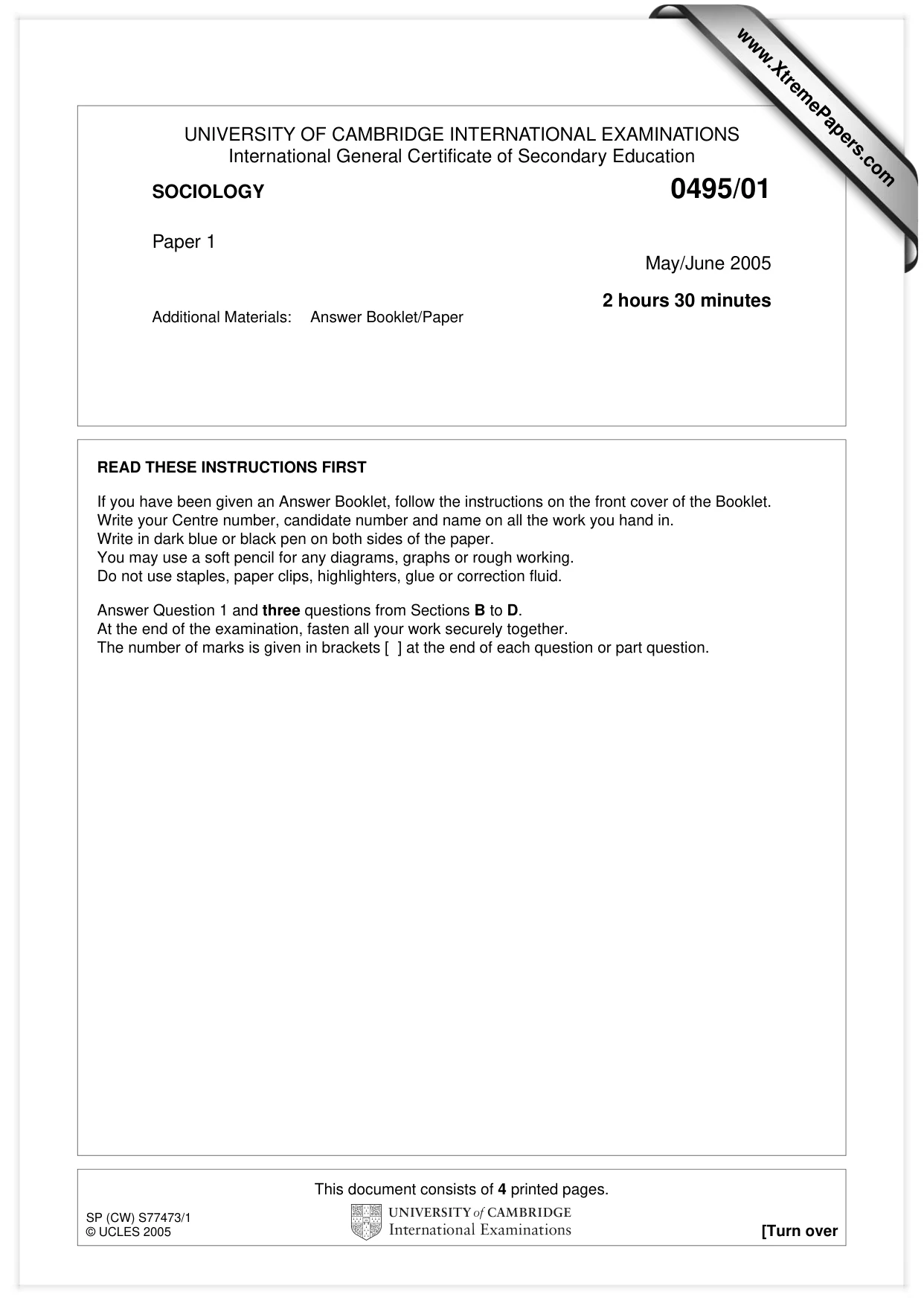
This document consists of 4 printed pages. SP (CW) S77473/1 © UCLES 2005 [Turn over UNIVERSITY OF CAMBRIDGE INTERNATIONAL EXAMINATIONS International General Certificate of Secondary Education SOCIOLOGY 0495/01 Paper 1 May/June 2005 2 hours 30 minutes Additional Materials: Answer Booklet/Paper READ THESE INSTRUCTIONS FIRST If you have been given an Answer Booklet, follow the instructions on the front cover of the Booklet. Write your Centre number, candidate number and name on all the work you hand in. Write in dark blue or black pen on both sides of the paper. You may use a soft pencil for any diagrams, graphs or rough working. Do not use staples, paper clips, highlighters, glue or correction fluid. Answer Question 1 and three questions from Sections B to D. At the end of the examination, fasten all your work securely together. The number of marks is given in brackets [ ] at the end of each question or part question. www.XtremePapers.com
Question paper, page 2
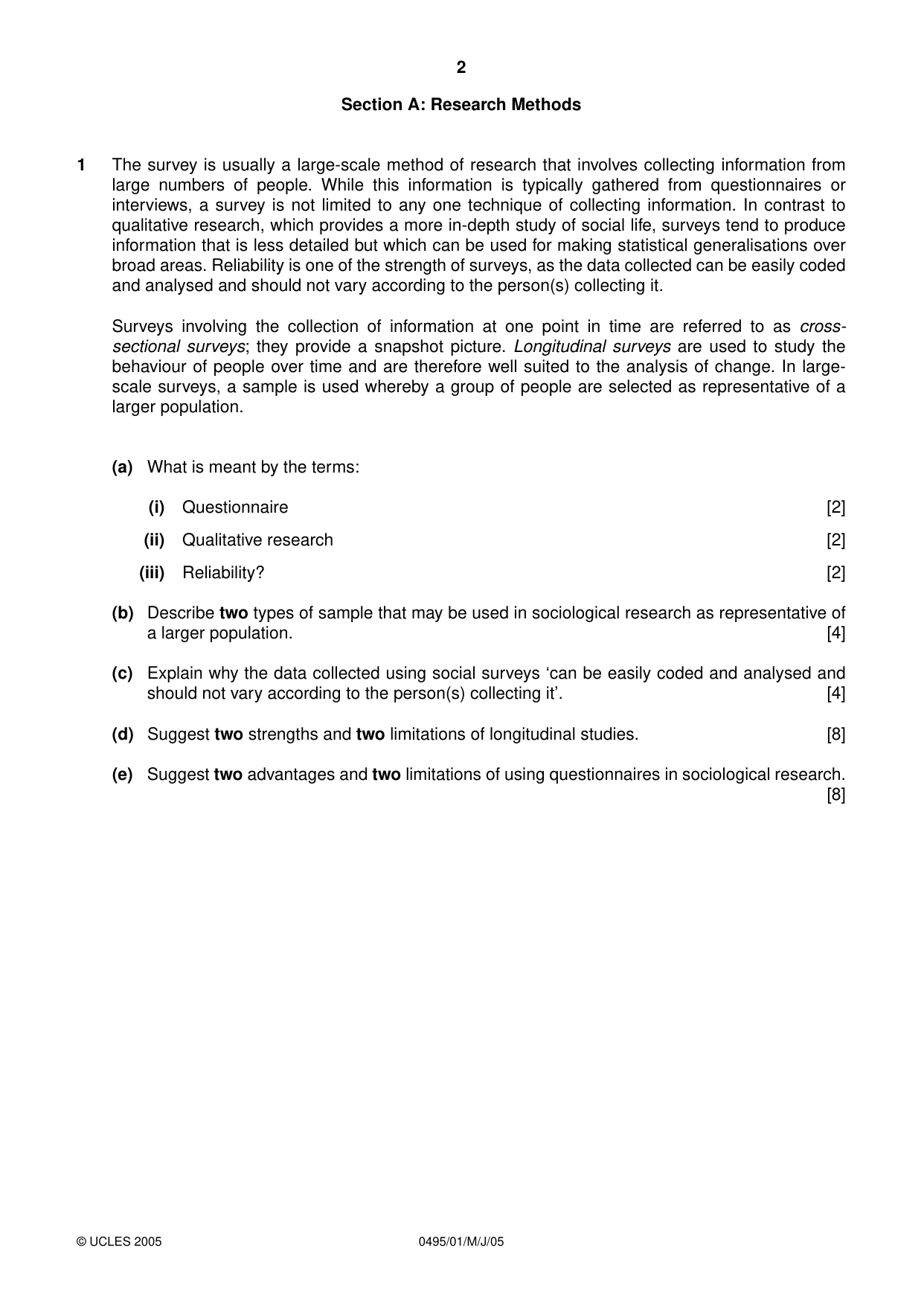
2 0495/01/M/J/05 Section A: Research Methods 1 The survey is usually a large-scale method of research that involves collecting information from large numbers of people. While this information is typically gathered from questionnaires or interviews, a survey is not limited to any one technique of collecting information. In contrast to qualitative research, which provides a more in-depth study of social life, surveys tend to produce information that is less detailed but which can be used for making statistical generalisations over broad areas. Reliability is one of the strength of surveys, as the data collected can be easily coded and analysed and should not vary according to the person(s) collecting it. Surveys involving the collection of information at one point in time are referred to as cross- sectional surveys; they provide a snapshot picture. Longitudinal surveys are used to study the behaviour of people over time and are therefore well suited to the analysis of change. In large- scale surveys, a sample is used whereby a group of people are selected as representative of a larger population. (a) What is meant by the terms: (i) Questionnaire [2] (ii) Qualitative research [2] (iii) Reliability? [2] (b) Describe two types of sample that may be used in sociological research as representative of a larger population. [4] (c) Explain why the data collected using social surveys ‘can be easily coded and analysed and should not vary according to the person(s) collecting it’. [4] (d) Suggest two strengths and two limitations of longitudinal studies. [8] (e) Suggest two advantages and two limitations of using questionnaires in sociological research. [8] © UCLES 2005
Question paper, page 3
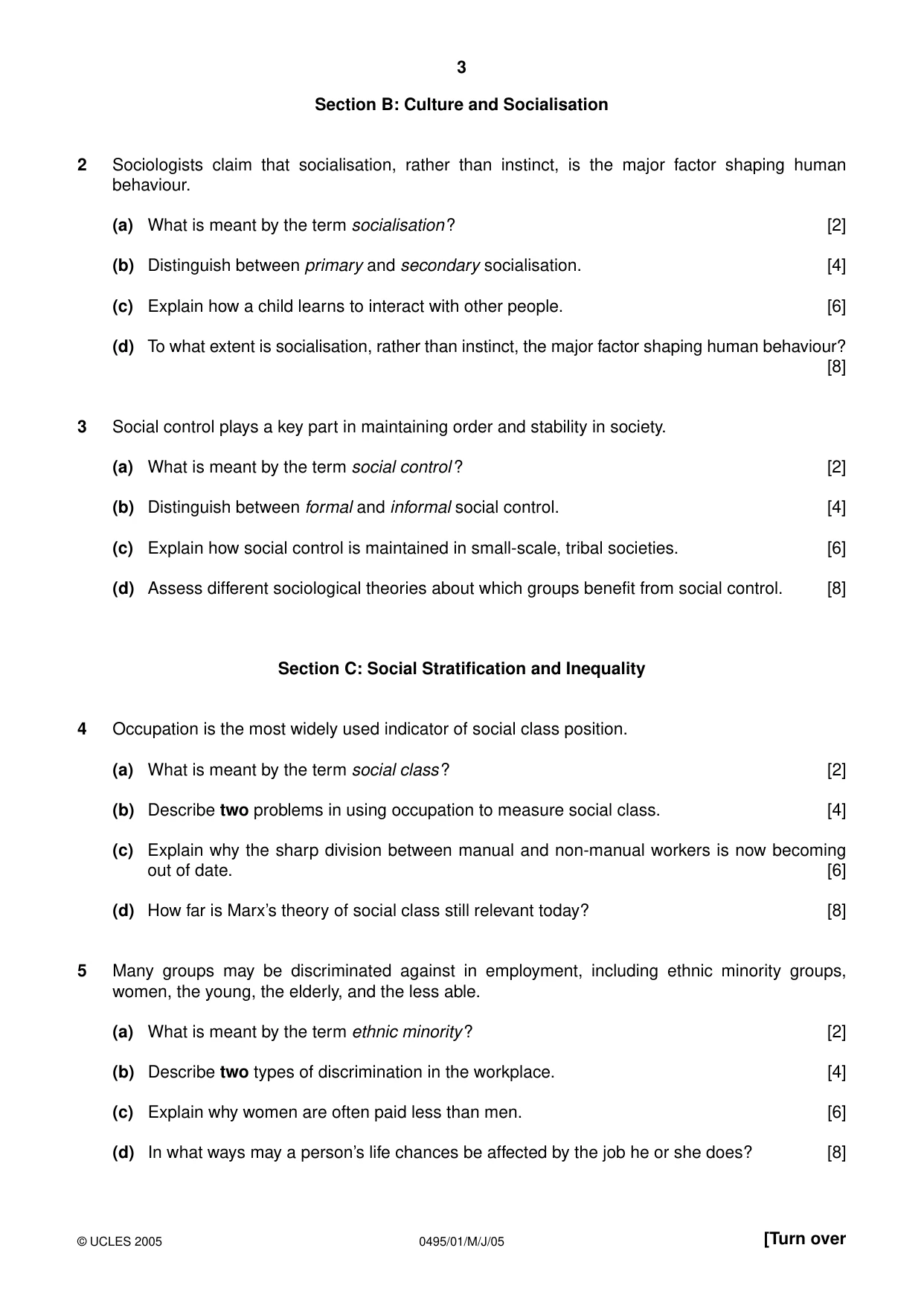
3 0495/01/M/J/05 [Turn over Section B: Culture and Socialisation 2 Sociologists claim that socialisation, rather than instinct, is the major factor shaping human behaviour. (a) What is meant by the term socialisation? [2] (b) Distinguish between primary and secondary socialisation. [4] (c) Explain how a child learns to interact with other people. [6] (d) To what extent is socialisation, rather than instinct, the major factor shaping human behaviour? [8] 3 Social control plays a key part in maintaining order and stability in society. (a) What is meant by the term social control ? [2] (b) Distinguish between formal and informal social control. [4] (c) Explain how social control is maintained in small-scale, tribal societies. [6] (d) Assess different sociological theories about which groups benefit from social control. [8] Section C: Social Stratification and Inequality 4 Occupation is the most widely used indicator of social class position. (a) What is meant by the term social class? [2] (b) Describe two problems in using occupation to measure social class. [4] (c) Explain why the sharp division between manual and non-manual workers is now becoming out of date. [6] (d) How far is Marx’s theory of social class still relevant today? [8] 5 Many groups may be discriminated against in employment, including ethnic minority groups, women, the young, the elderly, and the less able. (a) What is meant by the term ethnic minority? [2] (b) Describe two types of discrimination in the workplace. [4] (c) Explain why women are often paid less than men. [6] (d) In what ways may a person’s life chances be affected by the job he or she does? [8] © UCLES 2005
Question paper, page 4
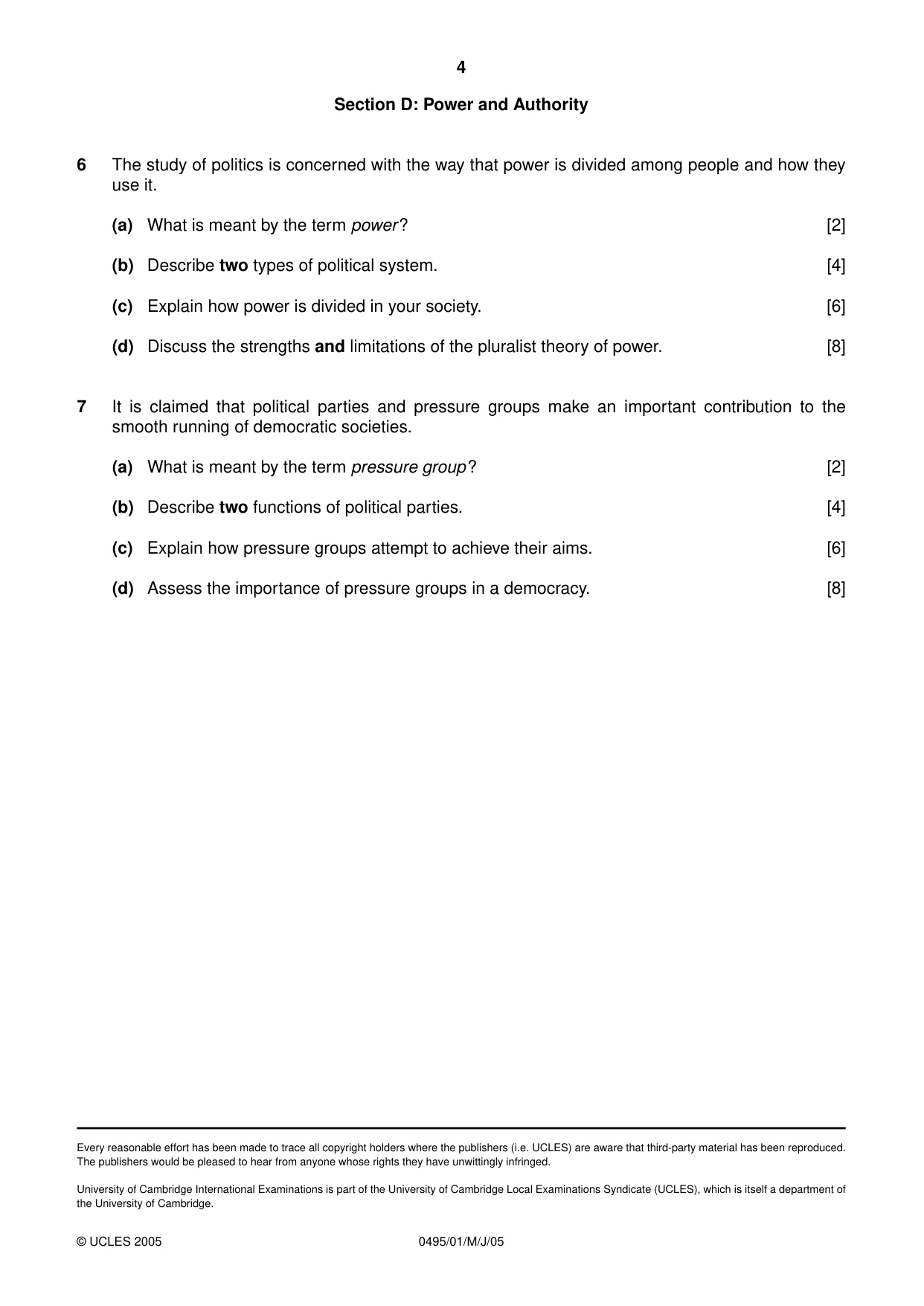
4 0495/01/M/J/05 Section D: Power and Authority 6 The study of politics is concerned with the way that power is divided among people and how they use it. (a) What is meant by the term power? [2] (b) Describe two types of political system. [4] (c) Explain how power is divided in your society. [6] (d) Discuss the strengths and limitations of the pluralist theory of power. [8] 7 It is claimed that political parties and pressure groups make an important contribution to the smooth running of democratic societies. (a) What is meant by the term pressure group? [2] (b) Describe two functions of political parties. [4] (c) Explain how pressure groups attempt to achieve their aims. [6] (d) Assess the importance of pressure groups in a democracy. [8] © UCLES 2005 Every reasonable effort has been made to trace all copyright holders where the publishers (i.e. UCLES) are aware that third-party material has been reproduced. The publishers would be pleased to hear from anyone whose rights they have unwittingly infringed. University of Cambridge International Examinations is part of the University of Cambridge Local Examinations Syndicate (UCLES), which is itself a department of the University of Cambridge.
Mark scheme, page 1
UNIVERSITY OF CAMBRIDGE INTERNATIONAL EXAMINATIONS International General Certificate of Secondary Education MARK SCHEME for the June 2005 question paper 0495 SOCIOLOGY 0495/01 Paper 1, maximum raw mark 90 This mark scheme is published as an aid to teachers and students, to indicate the requirements of the examination. It shows the basis on which Examiners were initially instructed to award marks. It does not indicate the details of the discussions that took place at an Examiners’ meeting before marking began. Any substantial changes to the mark scheme that arose from these discussions will be recorded in the published Report on the Examination. All Examiners are instructed that alternative correct answers and unexpected approaches in candidates’ scripts must be given marks that fairly reflect the relevant knowledge and skills demonstrated. Mark schemes must be read in conjunction with the question papers and the Report on the Examination. • CIE will not enter into discussion or correspondence in connection with these mark schemes. CIE is publishing the mark schemes for the June 2005 question papers for most IGCSE and GCE Advanced Level and Advanced Subsidiary Level syllabuses and some Ordinary Level syllabuses. www.XtremePapers.com
Mark scheme, page 2
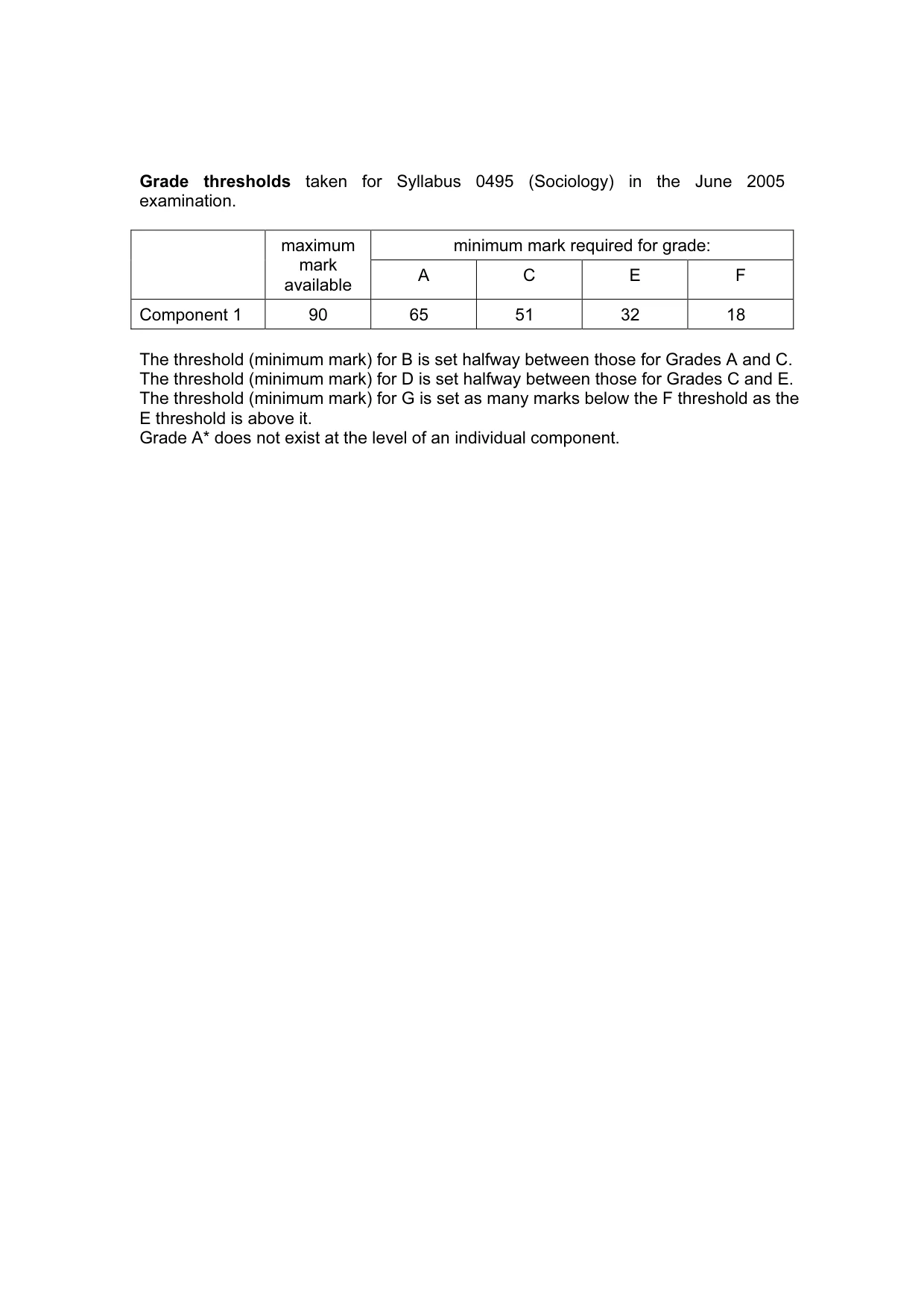
Grade thresholds taken for Syllabus 0495 (Sociology) in the June 2005 examination. minimum mark required for grade: maximum mark available A C E F Component 1 90 65 51 32 18 The threshold (minimum mark) for B is set halfway between those for Grades A and C. The threshold (minimum mark) for D is set halfway between those for Grades C and E. The threshold (minimum mark) for G is set as many marks below the F threshold as the E threshold is above it. Grade A* does not exist at the level of an individual component.
Mark scheme, page 3
June 2005 IGCSE MARK SCHEME MAXIMUM MARK: 90 SYLLABUS/COMPONENT: 0495/01 SOCIOLOGY Paper 1
Mark scheme, page 4
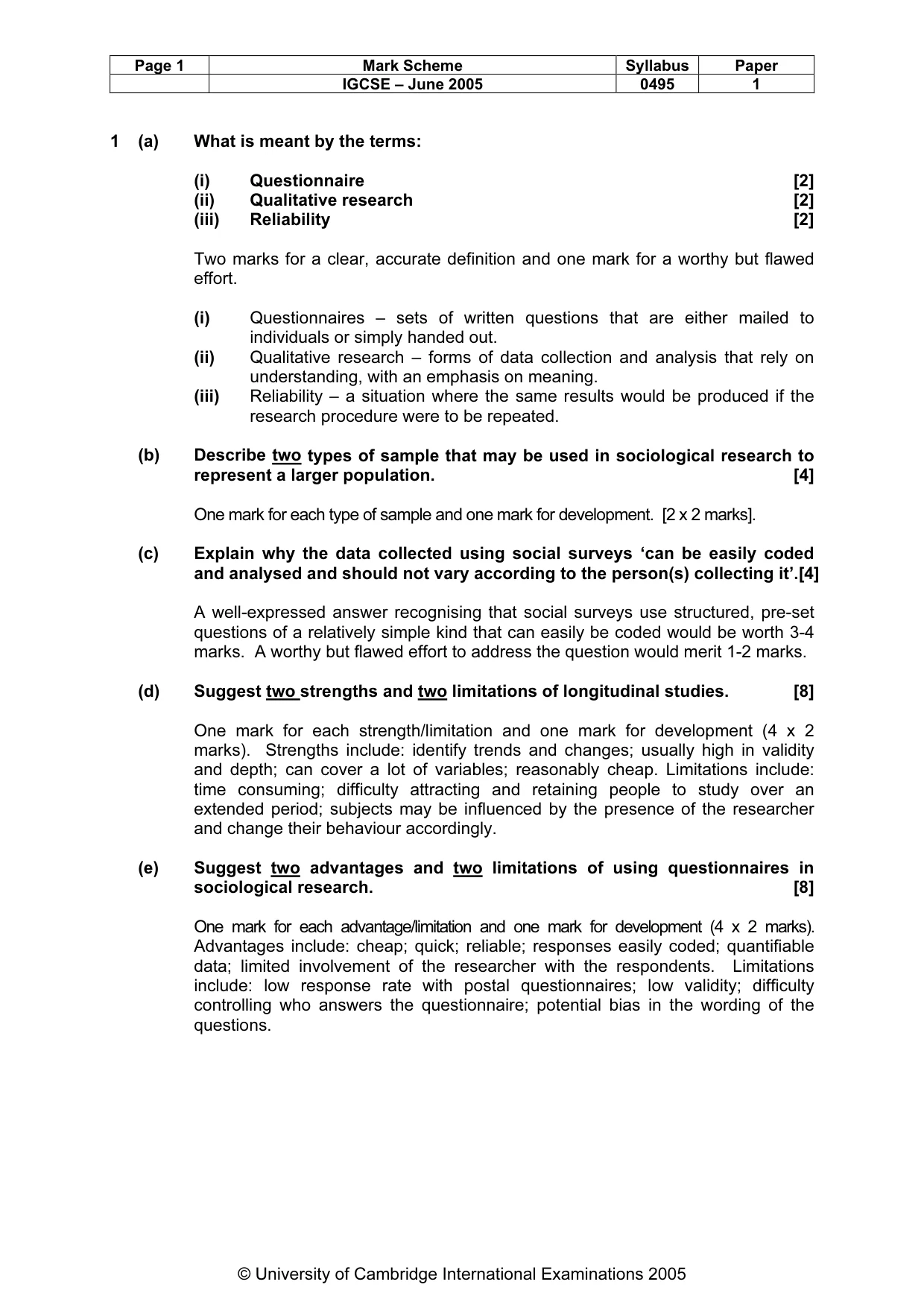
Page 1 Mark Scheme Syllabus Paper IGCSE – June 2005 0495 1 © University of Cambridge International Examinations 2005 1 (a) What is meant by the terms: (i) Questionnaire [2] (ii) Qualitative research [2] (iii) Reliability [2] Two marks for a clear, accurate definition and one mark for a worthy but flawed effort. (i) Questionnaires – sets of written questions that are either mailed to individuals or simply handed out. (ii) Qualitative research – forms of data collection and analysis that rely on understanding, with an emphasis on meaning. (iii) Reliability – a situation where the same results would be produced if the research procedure were to be repeated. (b) Describe two types of sample that may be used in sociological research to represent a larger population. [4] One mark for each type of sample and one mark for development. [2 x 2 marks]. (c) Explain why the data collected using social surveys ‘can be easily coded and analysed and should not vary according to the person(s) collecting it’.[4] A well-expressed answer recognising that social surveys use structured, pre-set questions of a relatively simple kind that can easily be coded would be worth 3-4 marks. A worthy but flawed effort to address the question would merit 1-2 marks. (d) Suggest two strengths and two limitations of longitudinal studies. [8] One mark for each strength/limitation and one mark for development (4 x 2 marks). Strengths include: identify trends and changes; usually high in validity and depth; can cover a lot of variables; reasonably cheap. Limitations include: time consuming; difficulty attracting and retaining people to study over an extended period; subjects may be influenced by the presence of the researcher and change their behaviour accordingly. (e) Suggest two advantages and two limitations of using questionnaires in sociological research. [8] One mark for each advantage/limitation and one mark for development (4 x 2 marks). Advantages include: cheap; quick; reliable; responses easily coded; quantifiable data; limited involvement of the researcher with the respondents. Limitations include: low response rate with postal questionnaires; low validity; difficulty controlling who answers the questionnaire; potential bias in the wording of the questions.
Mark scheme, page 5
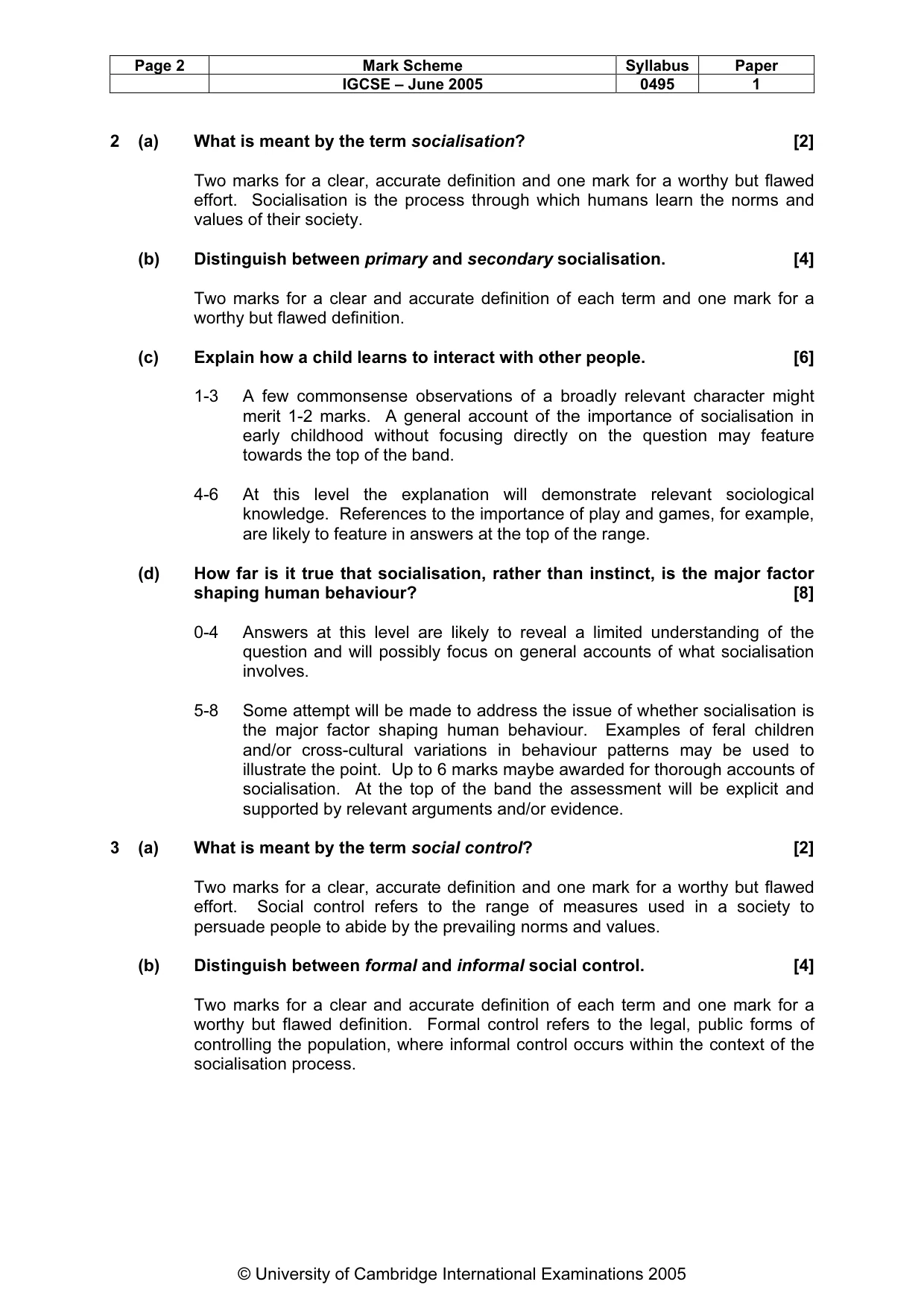
Page 2 Mark Scheme Syllabus Paper IGCSE – June 2005 0495 1 © University of Cambridge International Examinations 2005 2 (a) What is meant by the term socialisation? [2] Two marks for a clear, accurate definition and one mark for a worthy but flawed effort. Socialisation is the process through which humans learn the norms and values of their society. (b) Distinguish between primary and secondary socialisation. [4] Two marks for a clear and accurate definition of each term and one mark for a worthy but flawed definition. (c) Explain how a child learns to interact with other people. [6] 1-3 A few commonsense observations of a broadly relevant character might merit 1-2 marks. A general account of the importance of socialisation in early childhood without focusing directly on the question may feature towards the top of the band. 4-6 At this level the explanation will demonstrate relevant sociological knowledge. References to the importance of play and games, for example, are likely to feature in answers at the top of the range. (d) How far is it true that socialisation, rather than instinct, is the major factor shaping human behaviour? [8] 0-4 Answers at this level are likely to reveal a limited understanding of the question and will possibly focus on general accounts of what socialisation involves. 5-8 Some attempt will be made to address the issue of whether socialisation is the major factor shaping human behaviour. Examples of feral children and/or cross-cultural variations in behaviour patterns may be used to illustrate the point. Up to 6 marks maybe awarded for thorough accounts of socialisation. At the top of the band the assessment will be explicit and supported by relevant arguments and/or evidence. 3 (a) What is meant by the term social control? [2] Two marks for a clear, accurate definition and one mark for a worthy but flawed effort. Social control refers to the range of measures used in a society to persuade people to abide by the prevailing norms and values. (b) Distinguish between formal and informal social control. [4] Two marks for a clear and accurate definition of each term and one mark for a worthy but flawed definition. Formal control refers to the legal, public forms of controlling the population, where informal control occurs within the context of the socialisation process.
Mark scheme, page 6
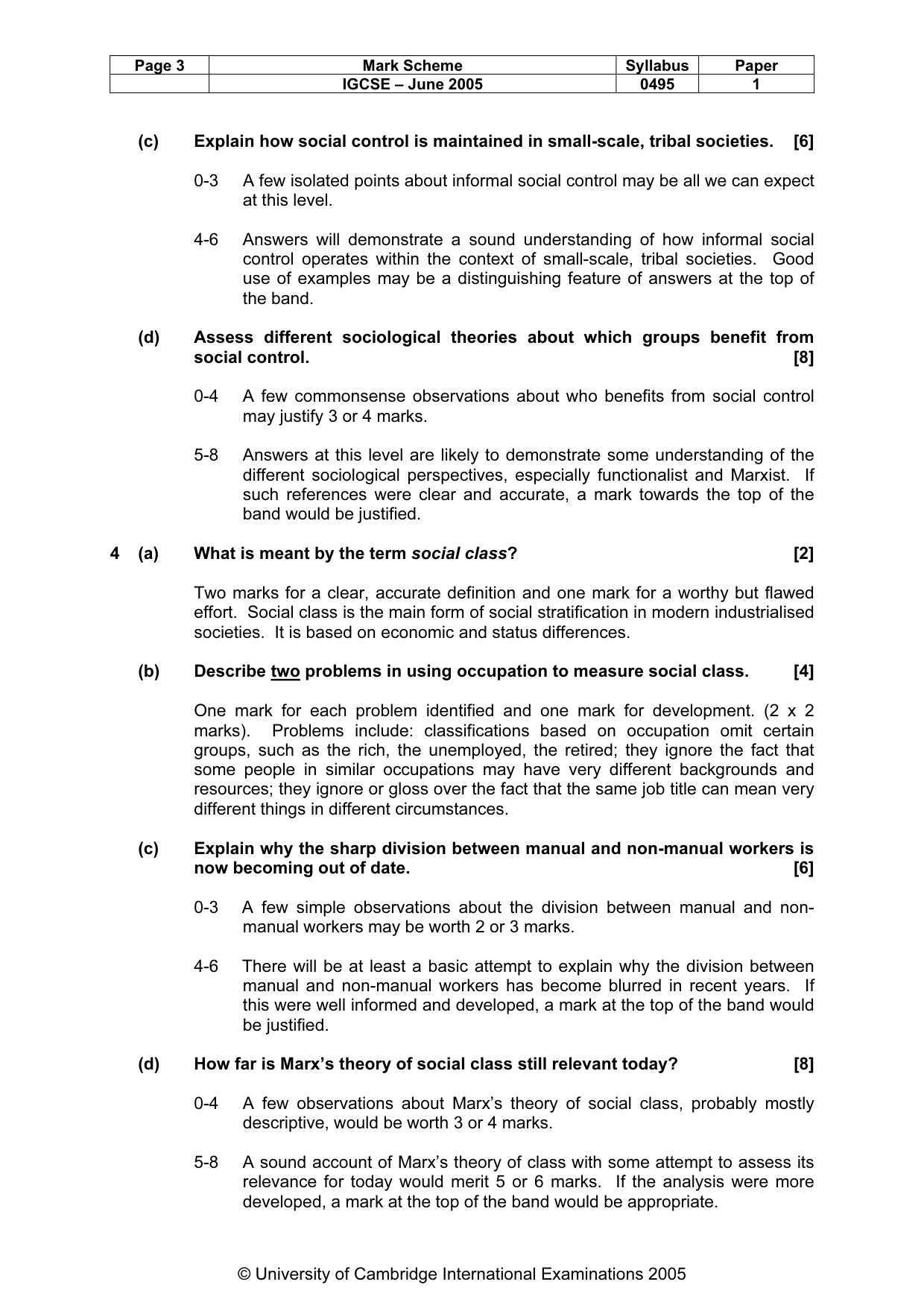
Page 3 Mark Scheme Syllabus Paper IGCSE – June 2005 0495 1 © University of Cambridge International Examinations 2005 (c) Explain how social control is maintained in small-scale, tribal societies. [6] 0-3 A few isolated points about informal social control may be all we can expect at this level. 4-6 Answers will demonstrate a sound understanding of how informal social control operates within the context of small-scale, tribal societies. Good use of examples may be a distinguishing feature of answers at the top of the band. (d) Assess different sociological theories about which groups benefit from social control. [8] 0-4 A few commonsense observations about who benefits from social control may justify 3 or 4 marks. 5-8 Answers at this level are likely to demonstrate some understanding of the different sociological perspectives, especially functionalist and Marxist. If such references were clear and accurate, a mark towards the top of the band would be justified. 4 (a) What is meant by the term social class? [2] Two marks for a clear, accurate definition and one mark for a worthy but flawed effort. Social class is the main form of social stratification in modern industrialised societies. It is based on economic and status differences. (b) Describe two problems in using occupation to measure social class. [4] One mark for each problem identified and one mark for development. (2 x 2 marks). Problems include: classifications based on occupation omit certain groups, such as the rich, the unemployed, the retired; they ignore the fact that some people in similar occupations may have very different backgrounds and resources; they ignore or gloss over the fact that the same job title can mean very different things in different circumstances. (c) Explain why the sharp division between manual and non-manual workers is now becoming out of date. [6] 0-3 A few simple observations about the division between manual and non- manual workers may be worth 2 or 3 marks. 4-6 There will be at least a basic attempt to explain why the division between manual and non-manual workers has become blurred in recent years. If this were well informed and developed, a mark at the top of the band would be justified. (d) How far is Marx’s theory of social class still relevant today? [8] 0-4 A few observations about Marx’s theory of social class, probably mostly descriptive, would be worth 3 or 4 marks. 5-8 A sound account of Marx’s theory of class with some attempt to assess its relevance for today would merit 5 or 6 marks. If the analysis were more developed, a mark at the top of the band would be appropriate.
Mark scheme, page 7
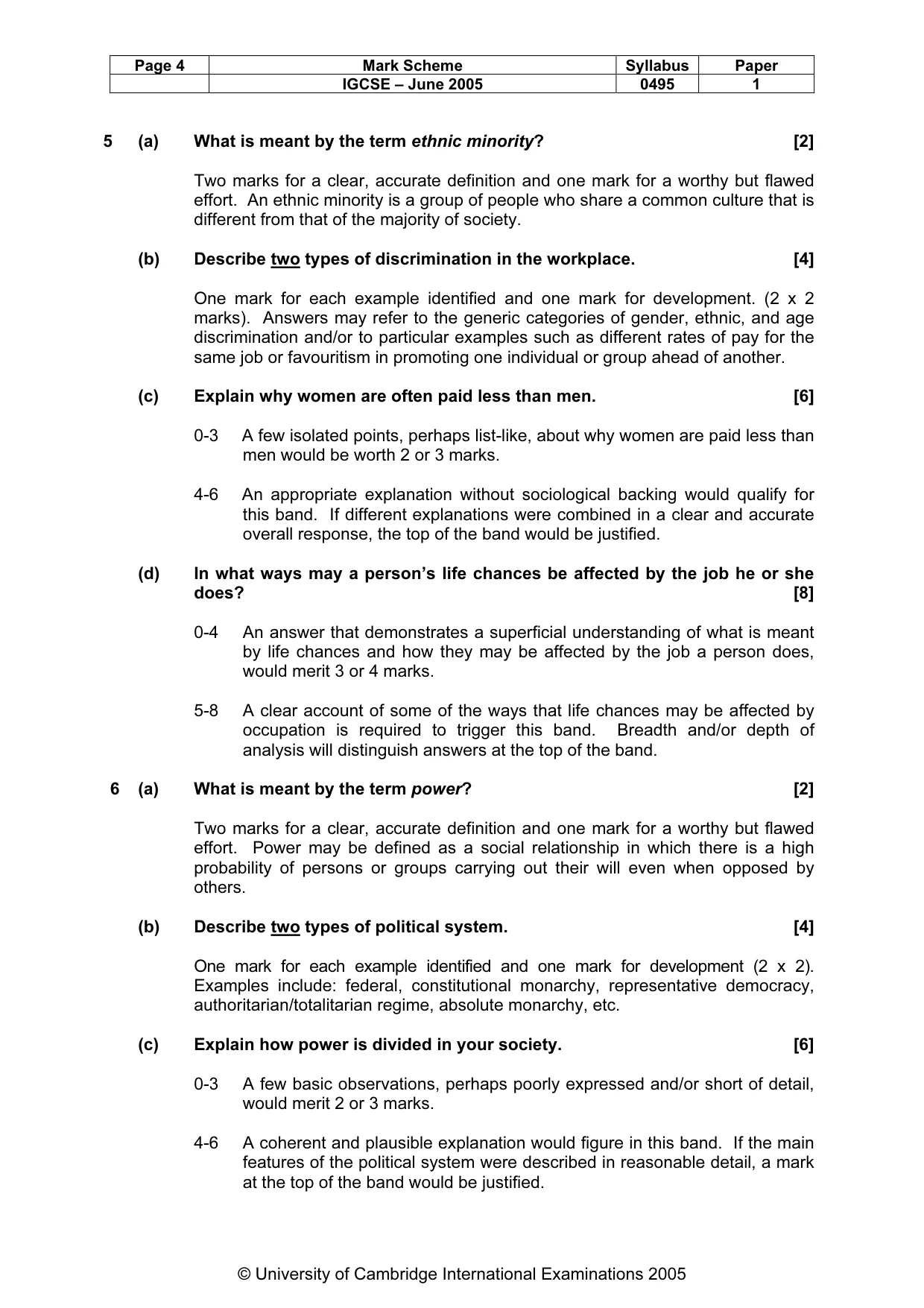
Page 4 Mark Scheme Syllabus Paper IGCSE – June 2005 0495 1 © University of Cambridge International Examinations 2005 5 (a) What is meant by the term ethnic minority? [2] Two marks for a clear, accurate definition and one mark for a worthy but flawed effort. An ethnic minority is a group of people who share a common culture that is different from that of the majority of society. (b) Describe two types of discrimination in the workplace. [4] One mark for each example identified and one mark for development. (2 x 2 marks). Answers may refer to the generic categories of gender, ethnic, and age discrimination and/or to particular examples such as different rates of pay for the same job or favouritism in promoting one individual or group ahead of another. (c) Explain why women are often paid less than men. [6] 0-3 A few isolated points, perhaps list-like, about why women are paid less than men would be worth 2 or 3 marks. 4-6 An appropriate explanation without sociological backing would qualify for this band. If different explanations were combined in a clear and accurate overall response, the top of the band would be justified. (d) In what ways may a person’s life chances be affected by the job he or she does? [8] 0-4 An answer that demonstrates a superficial understanding of what is meant by life chances and how they may be affected by the job a person does, would merit 3 or 4 marks. 5-8 A clear account of some of the ways that life chances may be affected by occupation is required to trigger this band. Breadth and/or depth of analysis will distinguish answers at the top of the band. 6 (a) What is meant by the term power? [2] Two marks for a clear, accurate definition and one mark for a worthy but flawed effort. Power may be defined as a social relationship in which there is a high probability of persons or groups carrying out their will even when opposed by others. (b) Describe two types of political system. [4] One mark for each example identified and one mark for development (2 x 2). Examples include: federal, constitutional monarchy, representative democracy, authoritarian/totalitarian regime, absolute monarchy, etc. (c) Explain how power is divided in your society. [6] 0-3 A few basic observations, perhaps poorly expressed and/or short of detail, would merit 2 or 3 marks. 4-6 A coherent and plausible explanation would figure in this band. If the main features of the political system were described in reasonable detail, a mark at the top of the band would be justified.
Mark scheme, page 8
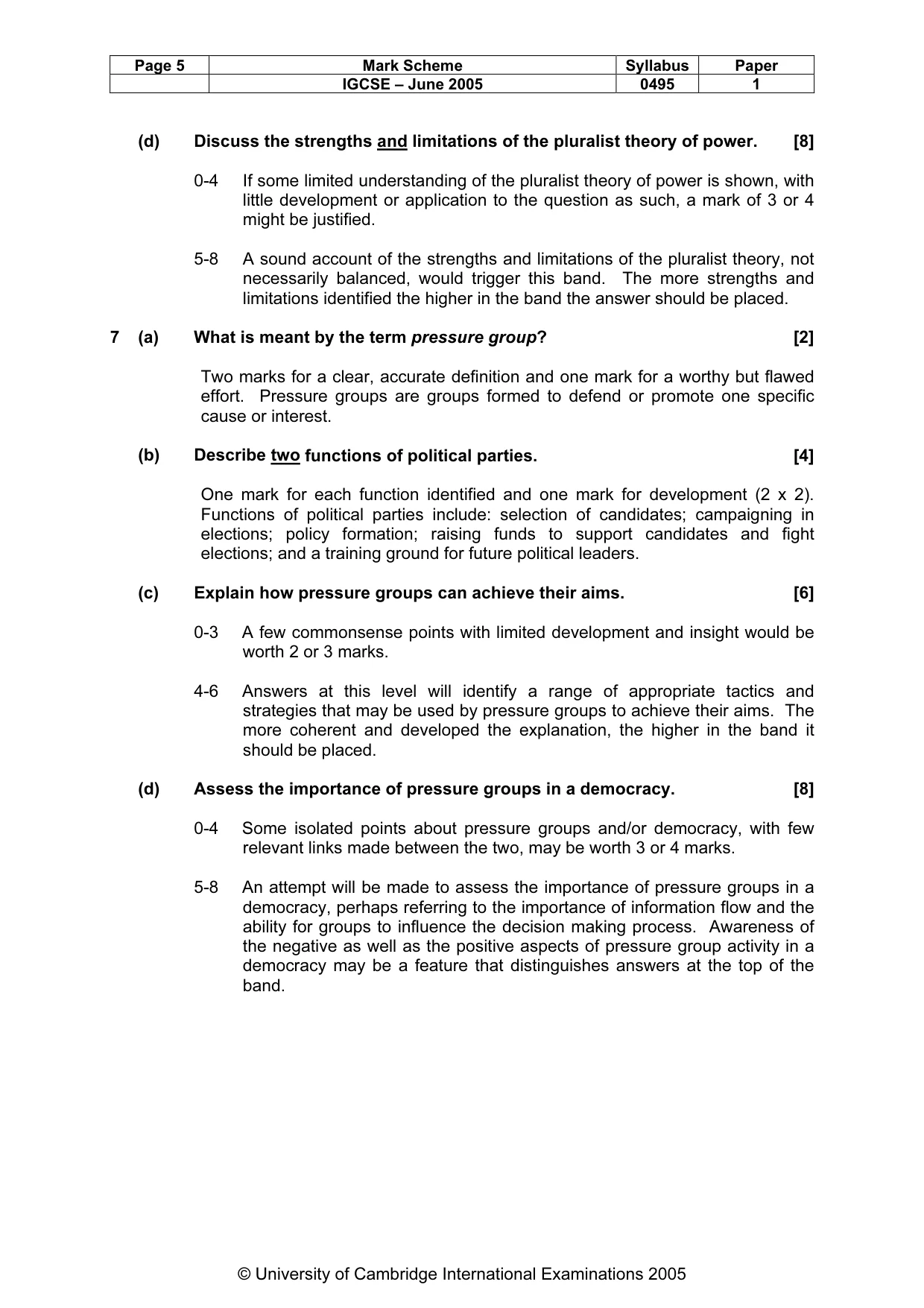
Page 5 Mark Scheme Syllabus Paper IGCSE – June 2005 0495 1 © University of Cambridge International Examinations 2005 (d) Discuss the strengths and limitations of the pluralist theory of power. [8] 0-4 If some limited understanding of the pluralist theory of power is shown, with little development or application to the question as such, a mark of 3 or 4 might be justified. 5-8 A sound account of the strengths and limitations of the pluralist theory, not necessarily balanced, would trigger this band. The more strengths and limitations identified the higher in the band the answer should be placed. 7 (a) What is meant by the term pressure group? [2] Two marks for a clear, accurate definition and one mark for a worthy but flawed effort. Pressure groups are groups formed to defend or promote one specific cause or interest. (b) Describe two functions of political parties. [4] One mark for each function identified and one mark for development (2 x 2). Functions of political parties include: selection of candidates; campaigning in elections; policy formation; raising funds to support candidates and fight elections; and a training ground for future political leaders. (c) Explain how pressure groups can achieve their aims. [6] 0-3 A few commonsense points with limited development and insight would be worth 2 or 3 marks. 4-6 Answers at this level will identify a range of appropriate tactics and strategies that may be used by pressure groups to achieve their aims. The more coherent and developed the explanation, the higher in the band it should be placed. (d) Assess the importance of pressure groups in a democracy. [8] 0-4 Some isolated points about pressure groups and/or democracy, with few relevant links made between the two, may be worth 3 or 4 marks. 5-8 An attempt will be made to assess the importance of pressure groups in a democracy, perhaps referring to the importance of information flow and the ability for groups to influence the decision making process. Awareness of the negative as well as the positive aspects of pressure group activity in a democracy may be a feature that distinguishes answers at the top of the band.