Cambridge IGCSE Sociology 0495 — 2004 Oct/Nov Paper 1 · Variant 1
0495/11/O/N/04
The question paper and its mark scheme, free to read here and free to download. This is Cambridge’s own paper, exactly as it was sat.
Question paper4 pages
Mark scheme13 pages
Answers below. Sit the paper first if you are practising.

Paper as text
Question paper, page 1
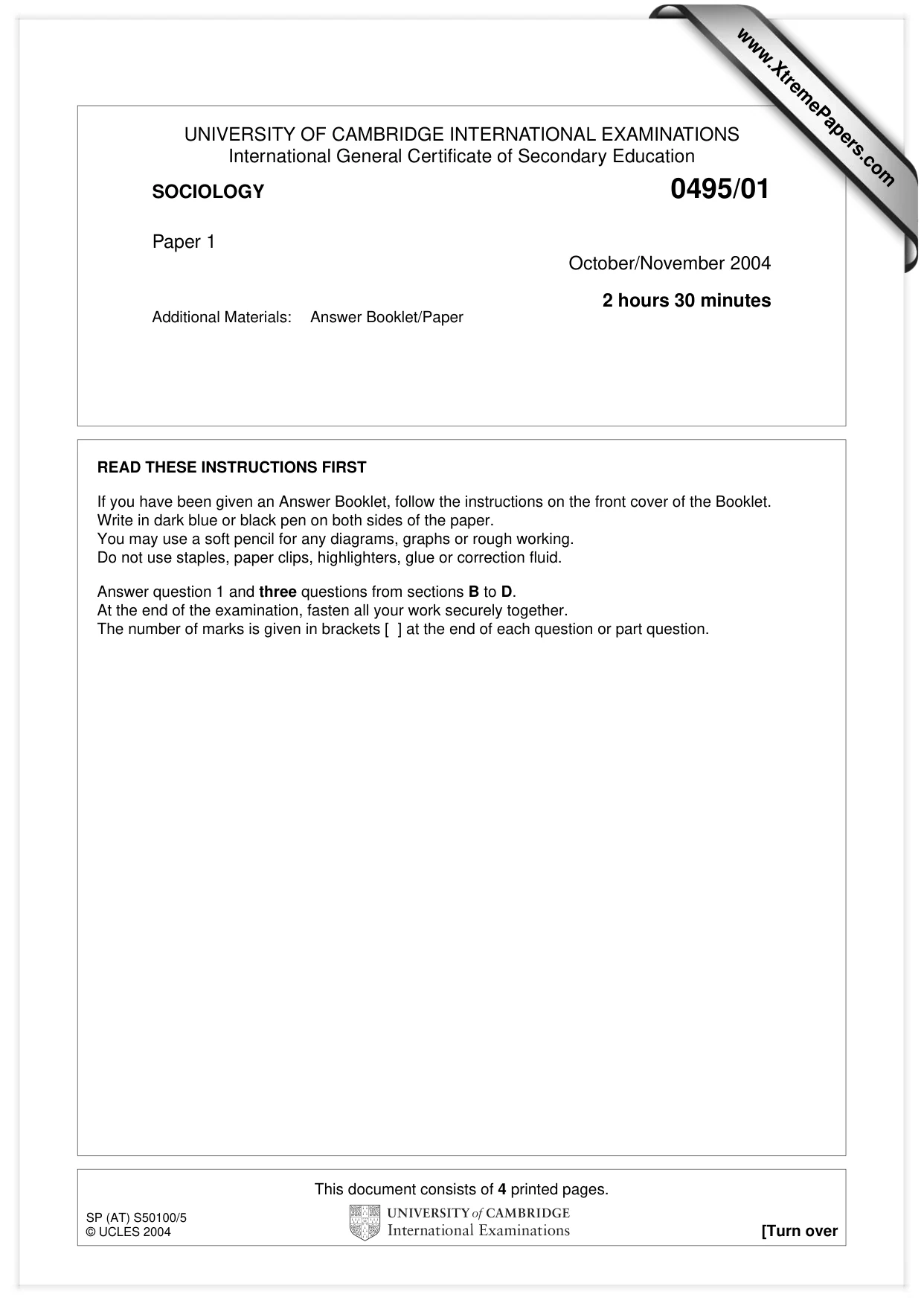
This document consists of 4 printed pages. SP (AT) S50100/5 © UCLES 2004 [Turn over UNIVERSITY OF CAMBRIDGE INTERNATIONAL EXAMINATIONS International General Certificate of Secondary Education SOCIOLOGY 0495/01 Paper 1 October/November 2004 2 hours 30 minutes Additional Materials: Answer Booklet/Paper READ THESE INSTRUCTIONS FIRST If you have been given an Answer Booklet, follow the instructions on the front cover of the Booklet. Write in dark blue or black pen on both sides of the paper. You may use a soft pencil for any diagrams, graphs or rough working. Do not use staples, paper clips, highlighters, glue or correction fluid. Answer question 1 and three questions from sections B to D. At the end of the examination, fasten all your work securely together. The number of marks is given in brackets [ ] at the end of each question or part question. www.XtremePapers.com
Question paper, page 2
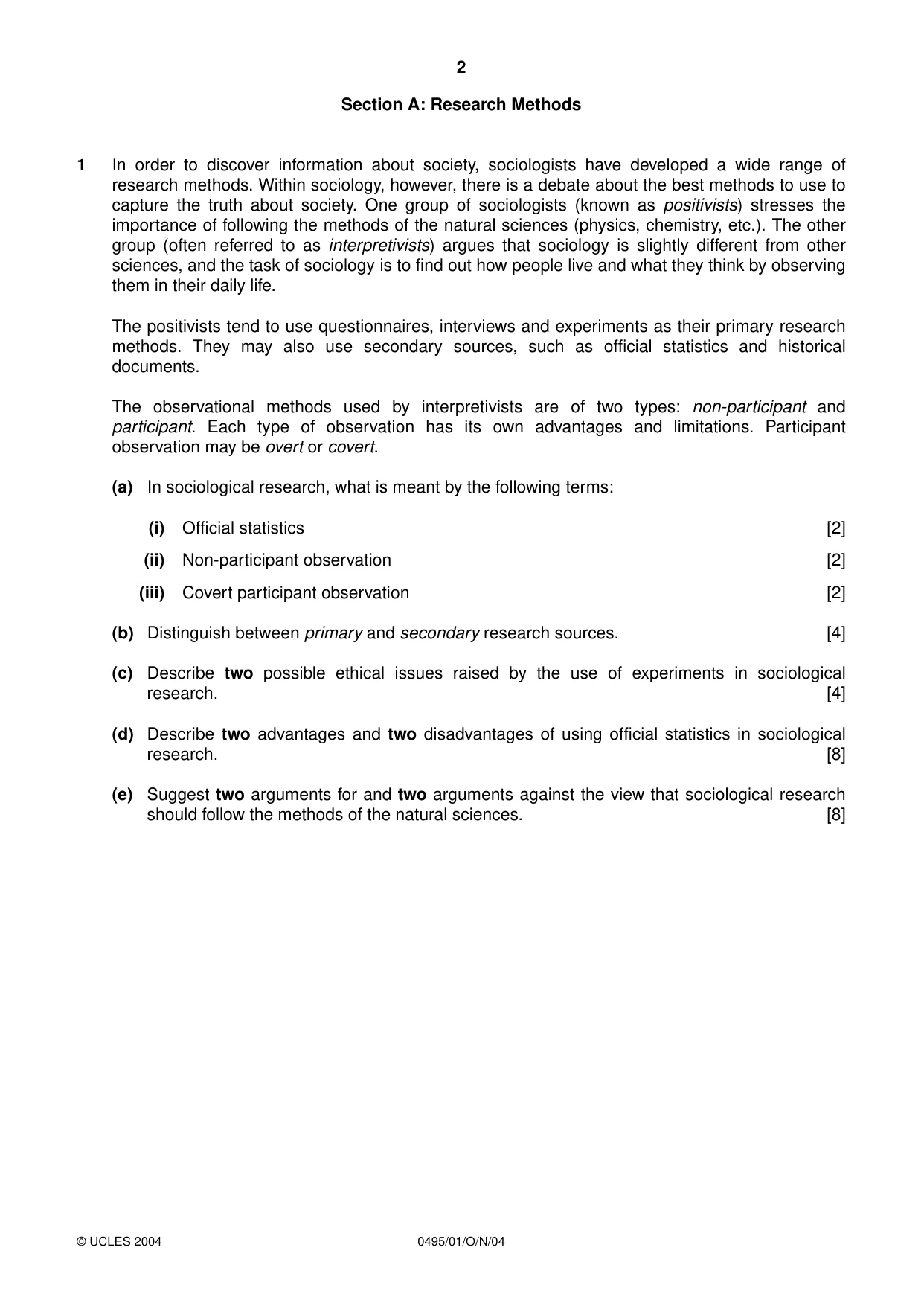
2 0495/01/O/N/04 Section A: Research Methods 1 In order to discover information about society, sociologists have developed a wide range of research methods. Within sociology, however, there is a debate about the best methods to use to capture the truth about society. One group of sociologists (known as positivists) stresses the importance of following the methods of the natural sciences (physics, chemistry, etc.). The other group (often referred to as interpretivists) argues that sociology is slightly different from other sciences, and the task of sociology is to find out how people live and what they think by observing them in their daily life. The positivists tend to use questionnaires, interviews and experiments as their primary research methods. They may also use secondary sources, such as official statistics and historical documents. The observational methods used by interpretivists are of two types: non-participant and participant. Each type of observation has its own advantages and limitations. Participant observation may be overt or covert. (a) In sociological research, what is meant by the following terms: (i) Official statistics [2] (ii) Non-participant observation [2] (iii) Covert participant observation [2] (b) Distinguish between primary and secondary research sources. [4] (c) Describe two possible ethical issues raised by the use of experiments in sociological research. [4] (d) Describe two advantages and two disadvantages of using official statistics in sociological research. [8] (e) Suggest two arguments for and two arguments against the view that sociological research should follow the methods of the natural sciences. [8] © UCLES 2004
Question paper, page 3
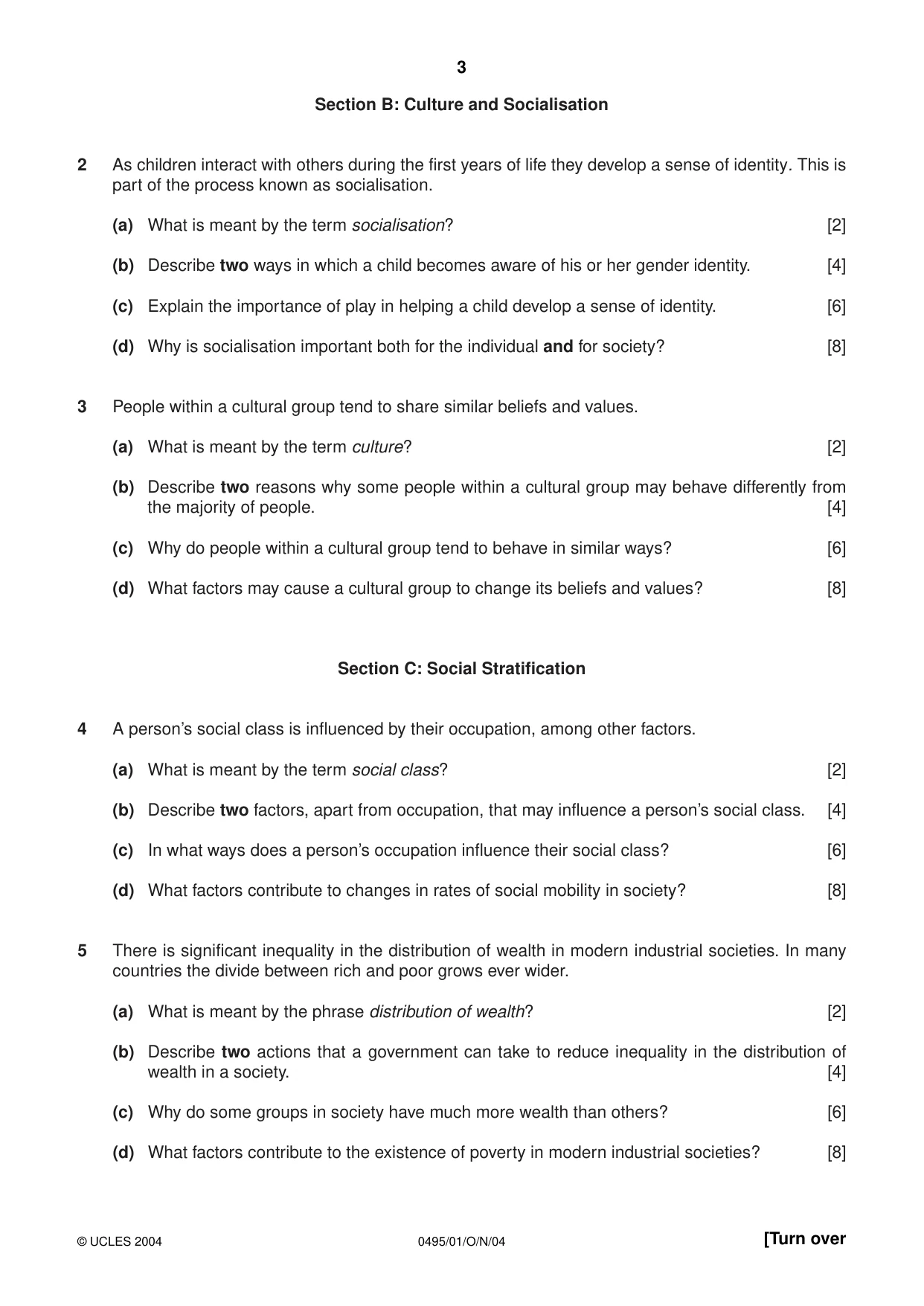
Section B: Culture and Socialisation 2 As children interact with others during the first years of life they develop a sense of identity. This is part of the process known as socialisation. (a) What is meant by the term socialisation? [2] (b) Describe two ways in which a child becomes aware of his or her gender identity. [4] (c) Explain the importance of play in helping a child develop a sense of identity. [6] (d) Why is socialisation important both for the individual and for society? [8] 3 People within a cultural group tend to share similar beliefs and values. (a) What is meant by the term culture? [2] (b) Describe two reasons why some people within a cultural group may behave differently from the majority of people. [4] (c) Why do people within a cultural group tend to behave in similar ways? [6] (d) What factors may cause a cultural group to change its beliefs and values? [8] Section C: Social Stratification 4 A person’s social class is influenced by their occupation, among other factors. (a) What is meant by the term social class? [2] (b) Describe two factors, apart from occupation, that may influence a person’s social class. [4] (c) In what ways does a person’s occupation influence their social class? [6] (d) What factors contribute to changes in rates of social mobility in society? [8] 5 There is significant inequality in the distribution of wealth in modern industrial societies. In many countries the divide between rich and poor grows ever wider. (a) What is meant by the phrase distribution of wealth? [2] (b) Describe two actions that a government can take to reduce inequality in the distribution of wealth in a society. [4] (c) Why do some groups in society have much more wealth than others? [6] (d) What factors contribute to the existence of poverty in modern industrial societies? [8] 3 0495/01/O/N/04 [Turn over © UCLES 2004
Question paper, page 4
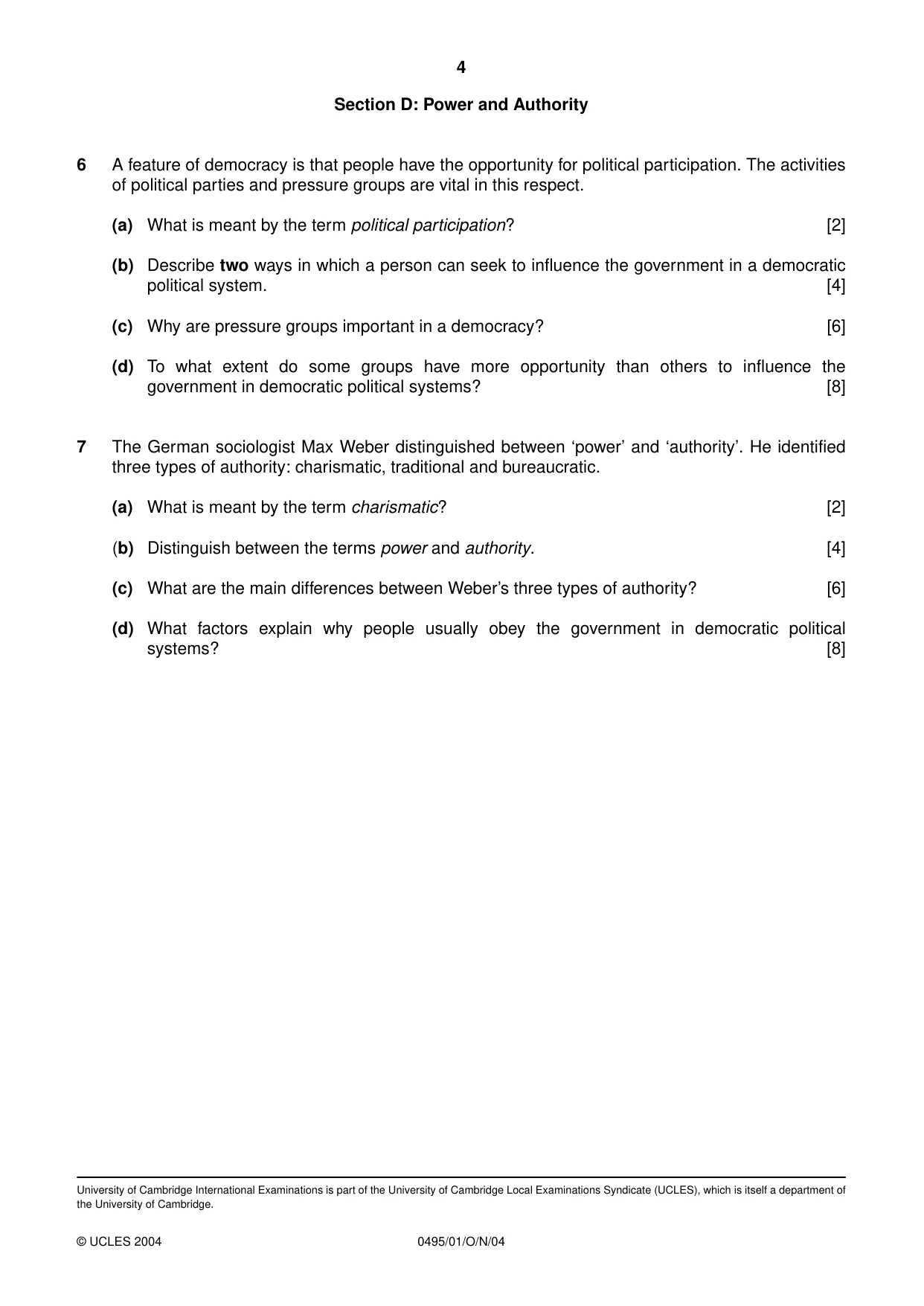
4 0495/01/O/N/04 Section D: Power and Authority 6 A feature of democracy is that people have the opportunity for political participation. The activities of political parties and pressure groups are vital in this respect. (a) What is meant by the term political participation? [2] (b) Describe two ways in which a person can seek to influence the government in a democratic political system. [4] (c) Why are pressure groups important in a democracy? [6] (d) To what extent do some groups have more opportunity than others to influence the government in democratic political systems? [8] 7 The German sociologist Max Weber distinguished between ‘power’ and ‘authority’. He identified three types of authority: charismatic, traditional and bureaucratic. (a) What is meant by the term charismatic? [2] (b) Distinguish between the terms power and authority. [4] (c) What are the main differences between Weber’s three types of authority? [6] (d) What factors explain why people usually obey the government in democratic political systems? [8] © UCLES 2004 University of Cambridge International Examinations is part of the University of Cambridge Local Examinations Syndicate (UCLES), which is itself a department of the University of Cambridge.
Mark scheme, page 1
UNIVERSITY OF CAMBRIDGE INTERNATIONAL EXAMINATIONS International General Certificate of Secondary Education MARK SCHEME for the November 2004 question paper 0495 SOCIOLOGY 0495/01 Paper 1, maximum raw mark 100 This mark scheme is published as an aid to teachers and students, to indicate the requirements of the examination. It shows the basis on which Examiners were initially instructed to award marks. It does not indicate the details of the discussions that took place at an Examiners’ meeting before marking began. Any substantial changes to the mark scheme that arose from these discussions will be recorded in the published Report on the Examination. All Examiners are instructed that alternative correct answers and unexpected approaches in candidates’ scripts must be given marks that fairly reflect the relevant knowledge and skills demonstrated. Mark schemes must be read in conjunction with the question papers and the Report on the Examination. • CIE will not enter into discussion or correspondence in connection with these mark schemes. CIE is publishing the mark schemes for the November 2004 question papers for most IGCSE and GCE Advanced Level syllabuses. www.XtremePapers.com
Mark scheme, page 2
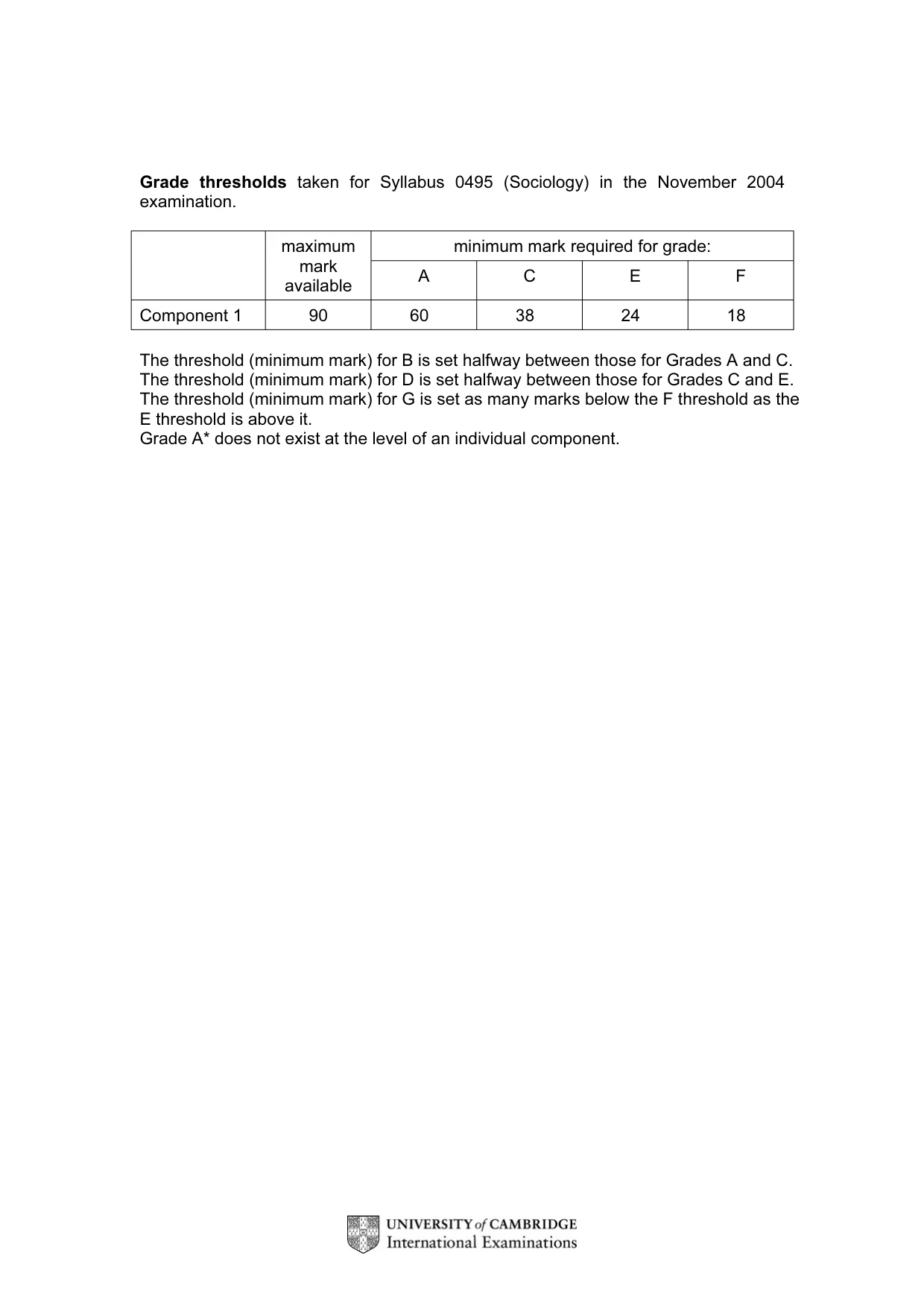
Grade thresholds taken for Syllabus 0495 (Sociology) in the November 2004 examination. minimum mark required for grade: maximum mark available A C E F Component 1 90 60 38 24 18 The threshold (minimum mark) for B is set halfway between those for Grades A and C. The threshold (minimum mark) for D is set halfway between those for Grades C and E. The threshold (minimum mark) for G is set as many marks below the F threshold as the E threshold is above it. Grade A* does not exist at the level of an individual component.
Mark scheme, page 3
November 2004 INTERNATIONAL GCSE MARK SCHEME MAXIMUM MARK: 90 SYLLABUS/COMPONENT: 0495/01 SOCIOLOGY Paper 1
Mark scheme, page 4
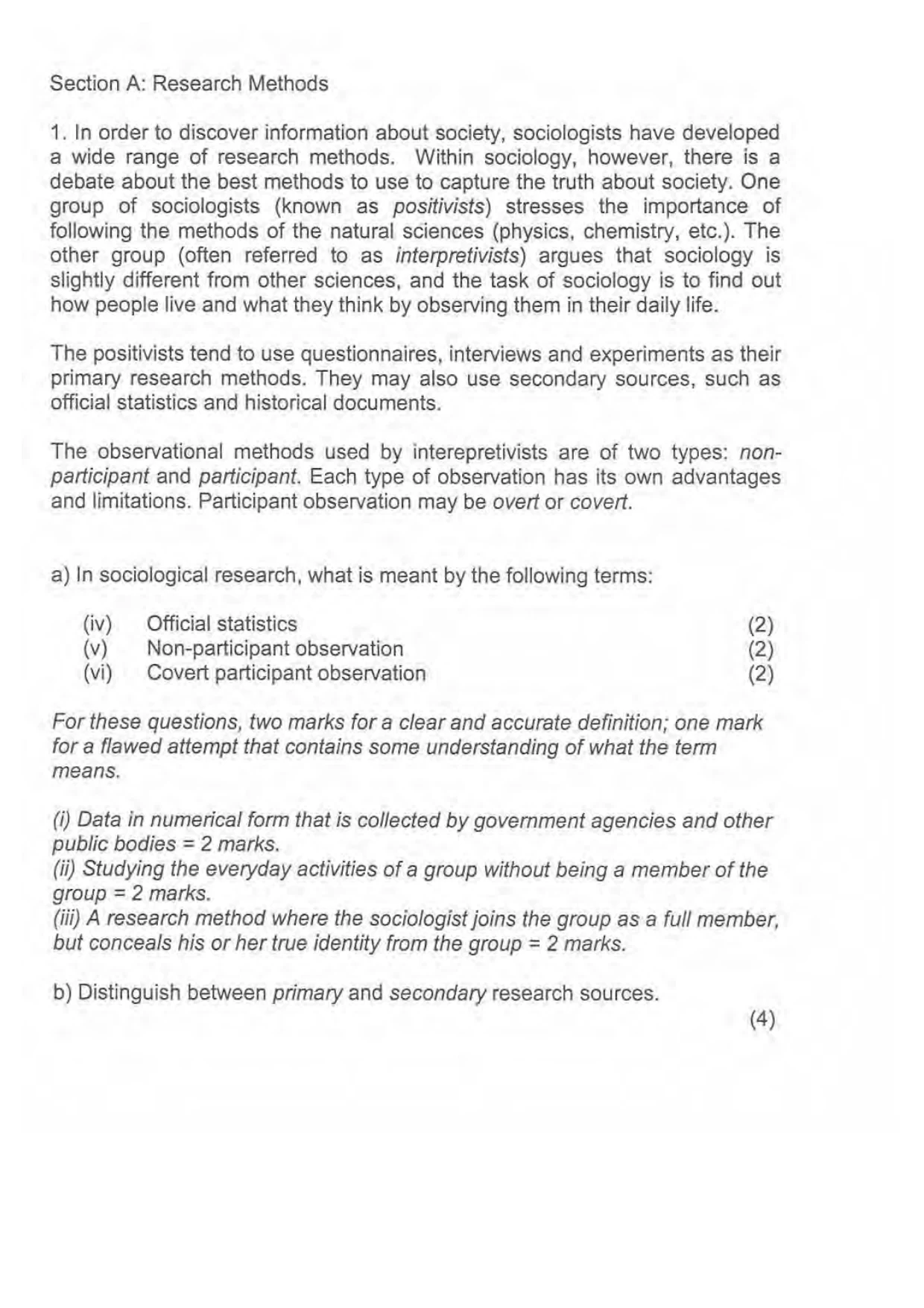
Section A: Research Methods 1. In order to discover information about society, sociologists have developed a wide range of research methods. Within sociology, however, there is a debate about the best methods to use to capture the truth about society. One group of sociologists (known as positivists) stresses the importance of following the methods of the natural sciences (physics, chemistry, etc.). The other group (often referred to as interpretivists) argues that sociology is slightly different from other sciences, and the task of sociology is to find out how people live and what they think by observing them in their daily life. The positivists tend to use questionnaires, interviews and experiments as their primary research methods. They may also use secondary sources, such as Official statistics and historical documents. The observational methods used by interepretivists are of two types: non- participant and participant. Each type of observation has its own advantages and limitations. Participant observation may be overt or covert. a) In sociological research, what is meant by the following terms: (iv) Official statistics (2) (v) Non-participant observation (2) (vi) | Covert participant observation (2) For these questions, two marks for a clear and accurate definition; one mark for a flawed attempt that contains some understanding of what the term means, (i) Data in numerical form that is collected by government agencies and other public bodies = 2 marks. (ii) Studying the everyday activities of a group without being a member of the group = 2 marks. (ii) A research method where the sociologist joins the group as a full member, but conceals his or her true identity from the group = 2 marks. b) Distinguish between primary and secondary research sources. (4)
Mark scheme, page 5
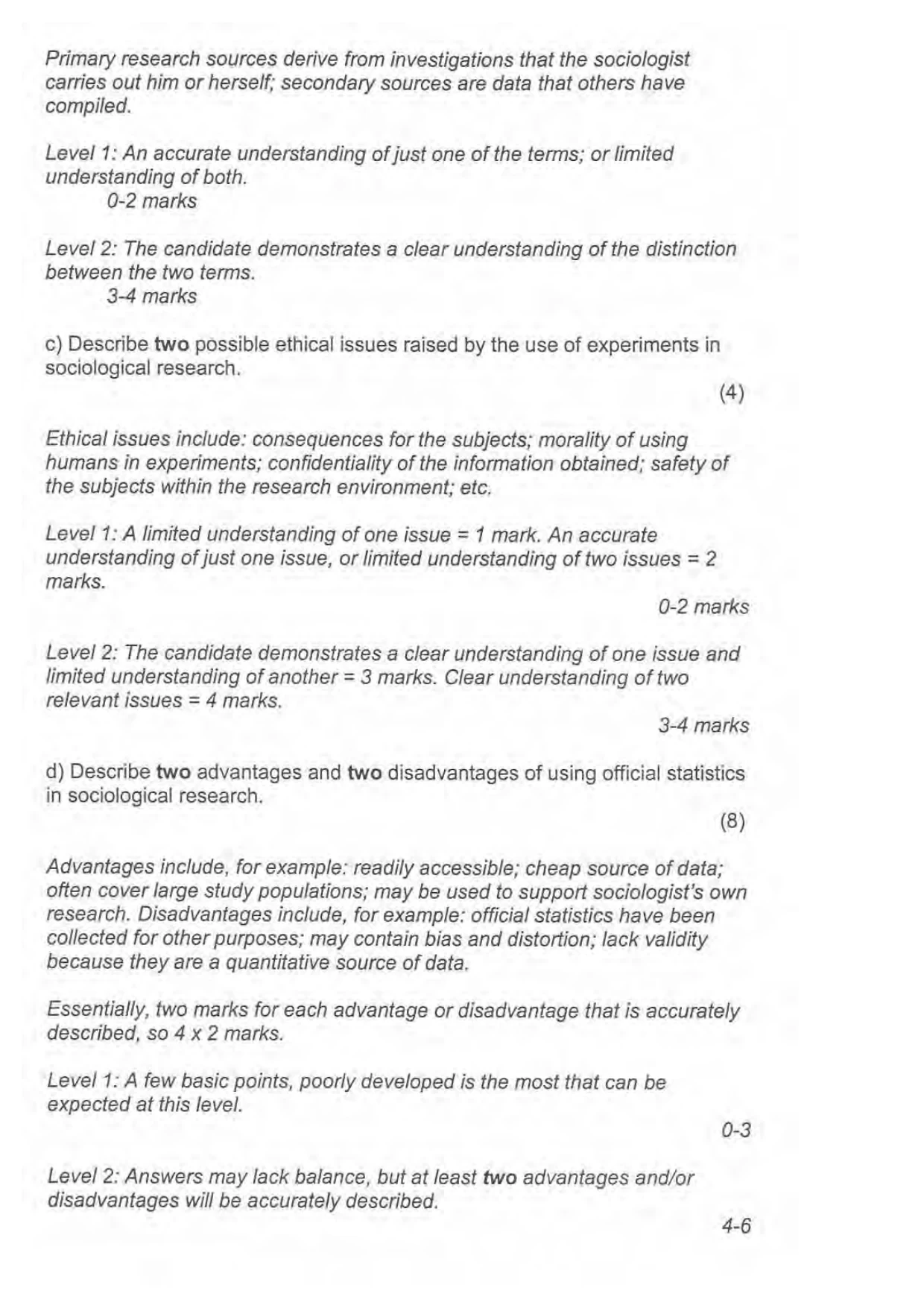
Primary research sources derive from investigations that the sociologist carries out him or herself; secondary sources are data that others have compiled. Level 1: An accurate understanding of just one of the terms; or limited understanding of both. 0-2 marks Level 2: The candidate demonstrates a clear understanding of the distinction between the two terms. 3-4 marks c) Describe two possible ethical issues raised by the use of experiments in sociological research. (4) Ethical issues include: consequences for the subjects; morality of using humans in experiments; confidentiality of the information obtained; safety of the subjects within the research environment; etc. Level 1: A limited understanding of one issue = 1 mark. An accurate understanding of just one issue, or limited understanding of two issues = 2 marks. 0-2 marks Level 2: The candidate demonstrates a clear understanding of one issue and limited understanding of another = 3 marks. Clear understanding of two relevant issues = 4 marks. 3-4 marks d) Describe two advantages and two disadvantages of using official statistics in sociological research. (8) Advantages include, for example: readily accessible; cheap source of data; often cover large study populations; may be used to support sociologist’s own research. Disadvantages include, for example: official statistics have been collected for other purposes; may contain bias and distortion; lack validity because they are a quantitative source of data. Essentially, two marks for each advantage or disadvantage that is accurately described, so 4 x 2 marks. Level 1: A few basic points, poorly developed is the most that can be expected at this level. 0-3 Level 2: Answers may lack balance, but at least two advantages and/or disadvantages will be accurately described.
Mark scheme, page 6
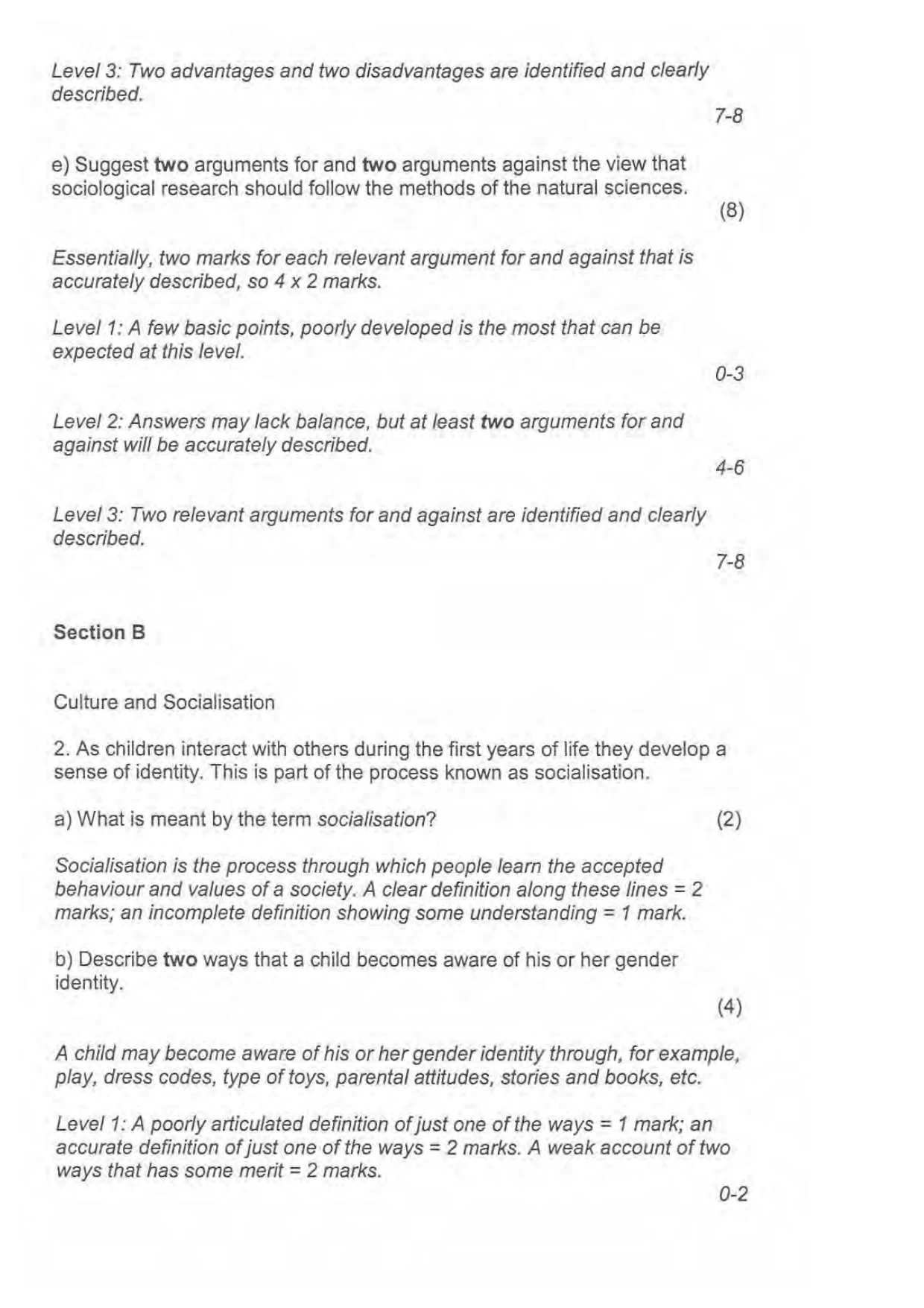
Level 3: Two advantages and two disadvantages are identified and clearly described. 7-8 e) Suggest two arguments for and two arguments against the view that sociological research should follow the methods of the natural sciences. (8) Essentially, two marks for each relevant argument for and against that is accurately described, so 4 x 2 marks. Level 1; A few basic points, poorly developed is the most that can be expected at this level. Level 2: Answers may lack balance, but at least two arguments for and against will be accurately described. 4-6 Level 3: Two relevant arguments for and against are identified and clearly described. 7-8 Section B Culture and Socialisation 2. As children interact with others during the first years of life they develop a sense of identity. This is part of the process known as socialisation. a) What is meant by the term socialisation? (2) Socialisation is the process through which people learn the accepted behaviour and values of a society. A clear definition along these lines = 2 marks; an incomplete definition showing some understanding = 1 mark. b) Describe two ways that a child becomes aware of his or her gender identity. (4) A child may become aware of his or her gender identity through, for example, play, dress codes, type of toys, parental attitudes, stories and books, etc. Level 1: A poorly articulated definition of just one of the ways = 1 mark; an accurate definition of just one of the ways = 2 marks. A weak account of two ways that has some merit = 2 marks. 0-2
Mark scheme, page 7
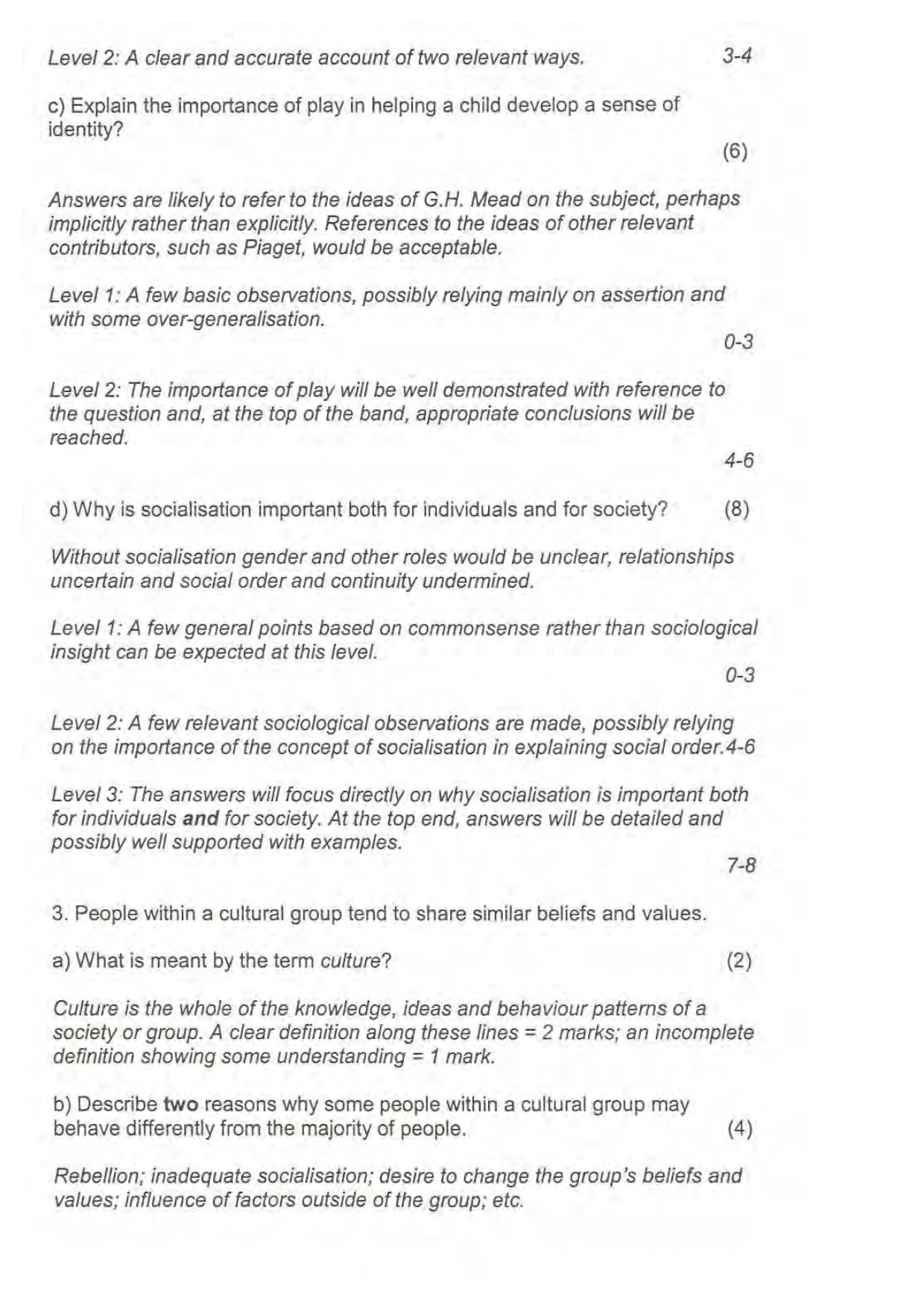
Level 2: A clear and accurate account of two relevant ways. 3-4 c) Explain the importance of play in helping a child develop a sense of identity? (6) Answers are likely to refer to the ideas of G.H. Mead on the subject, perhaps implicitly rather than explicitly. References to the ideas of other relevant contributors, such as Piaget, would be acceptable. Level 1: A few basic observations, possibly relying mainly on assertion and with some over-generalisation. 0-3 Level 2: The importance of play will be well demonstrated with reference to the question and, at the top of the band, appropriate conclusions will be reached. 4-6 d) Why is socialisation important both for individuals and for society? (8) Without socialisation gender and other roles would be unclear, relationships uncertain and social order and continuity undermined. Level 1: A few general points based on commonsense rather than sociological insight can be expected at this level. 0-3 Level 2: A few relevant sociological observations are made, possibly relying on the importance of the concept of socialisation in explaining social order.4-6 Level 3: The answers will focus directly on why socialisation is important both for individuals and for society. At the top end, answers will be detailed and possibly well supported with examples. 7-8 3. People within a cultural group tend to share similar beliefs and values. a) What is meant by the term culture? (2) Culture is the whole of the knowledge, ideas and behaviour patterns of a society or group. A clear definition along these lines = 2 marks; an incomplete definition showing some understanding = 1 mark. b) Describe two reasons why some people within a cultural group may behave differently from the majority of people. (4) Rebellion; inadequate socialisation; desire to change the group’s beliefs and values; influence of factors outside of the group; etc.
Mark scheme, page 8
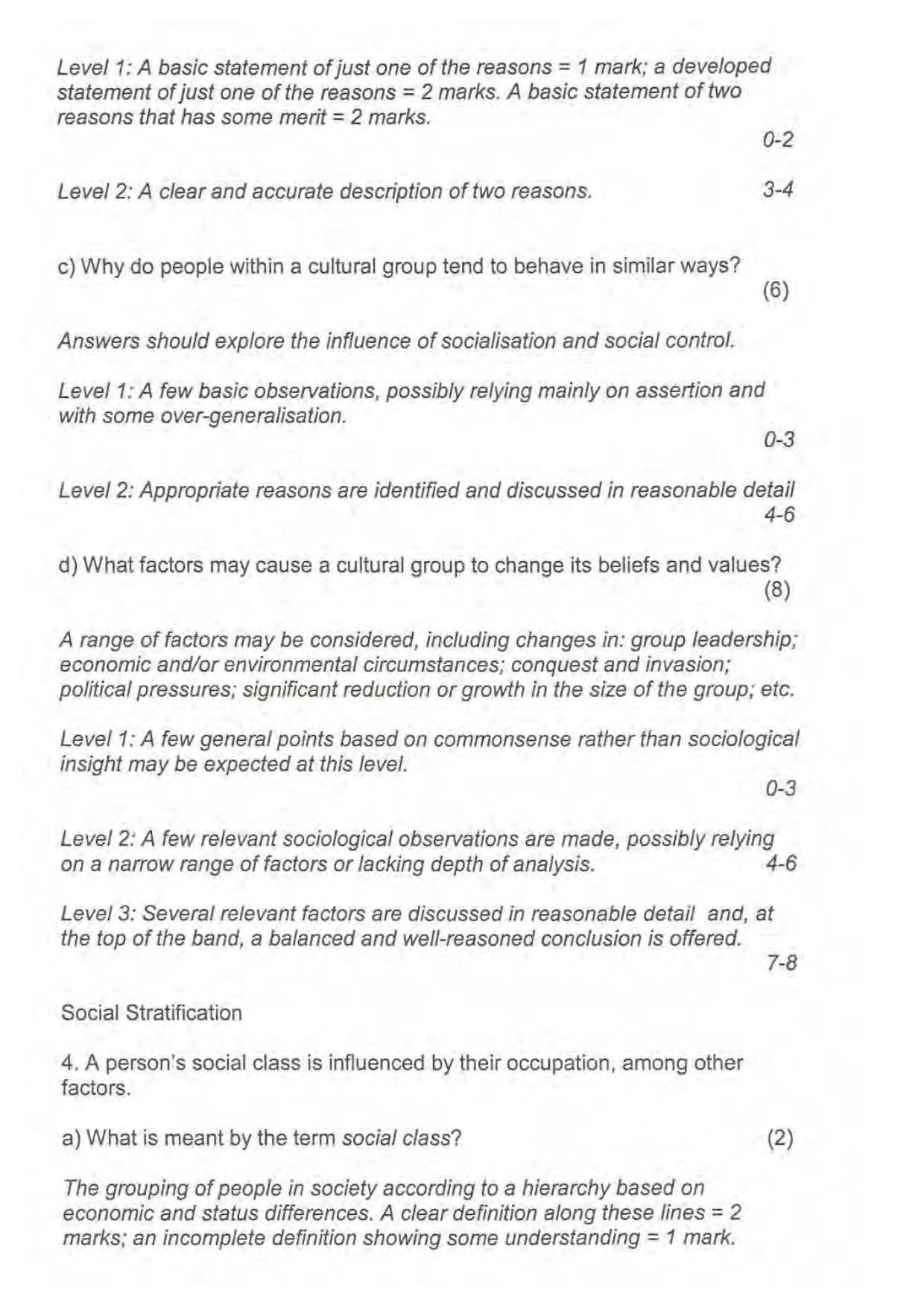
Level 1; A basic statement of just one of the reasons = 1 mark; a developed statement of just one of the reasons = 2 marks. A basic statement of two reasons that has some merit = 2 marks. 0-2 Level 2: A clear and accurate description of two reasons. 3-4 c) Why do people within a cultural group tend to behave in similar ways? (6) Answers should explore the influence of socialisation and social control. Level 1: A few basic observations, possibly relying mainly on assertion and with some over-generalisation. 0-3 Level 2: Appropriate reasons are identified and discussed in reasonable detail 4-6 d) What factors may cause a cultural group to change its beliefs and values? A range of factors may be considered, including changes in: group leadership; economic and/or environmental circumstances; conquest and invasion; political pressures; significant reduction or growth in the size of the group; etc. Level 1: A few general points based on commonsense rather than sociological insight may be expected at this level. 0-3 Level 2: A few relevant sociological observations are made, possibly relying on a narrow range of factors or lacking depth of analysis. 4-6 Level 3: Several relevant factors are discussed in reasonable detail and, at the top of the band, a balanced and well-reasoned conclusion is offered. 7-8 Social Stratification 4. A person's social class is influenced by their occupation, among other factors. a) What is meant by the term social class? (2) The grouping of people in society according to a hierarchy based on economic and status differences. A clear definition along these lines = 2 marks; an incomplete definition showing some understanding = 1 mark.
Mark scheme, page 9
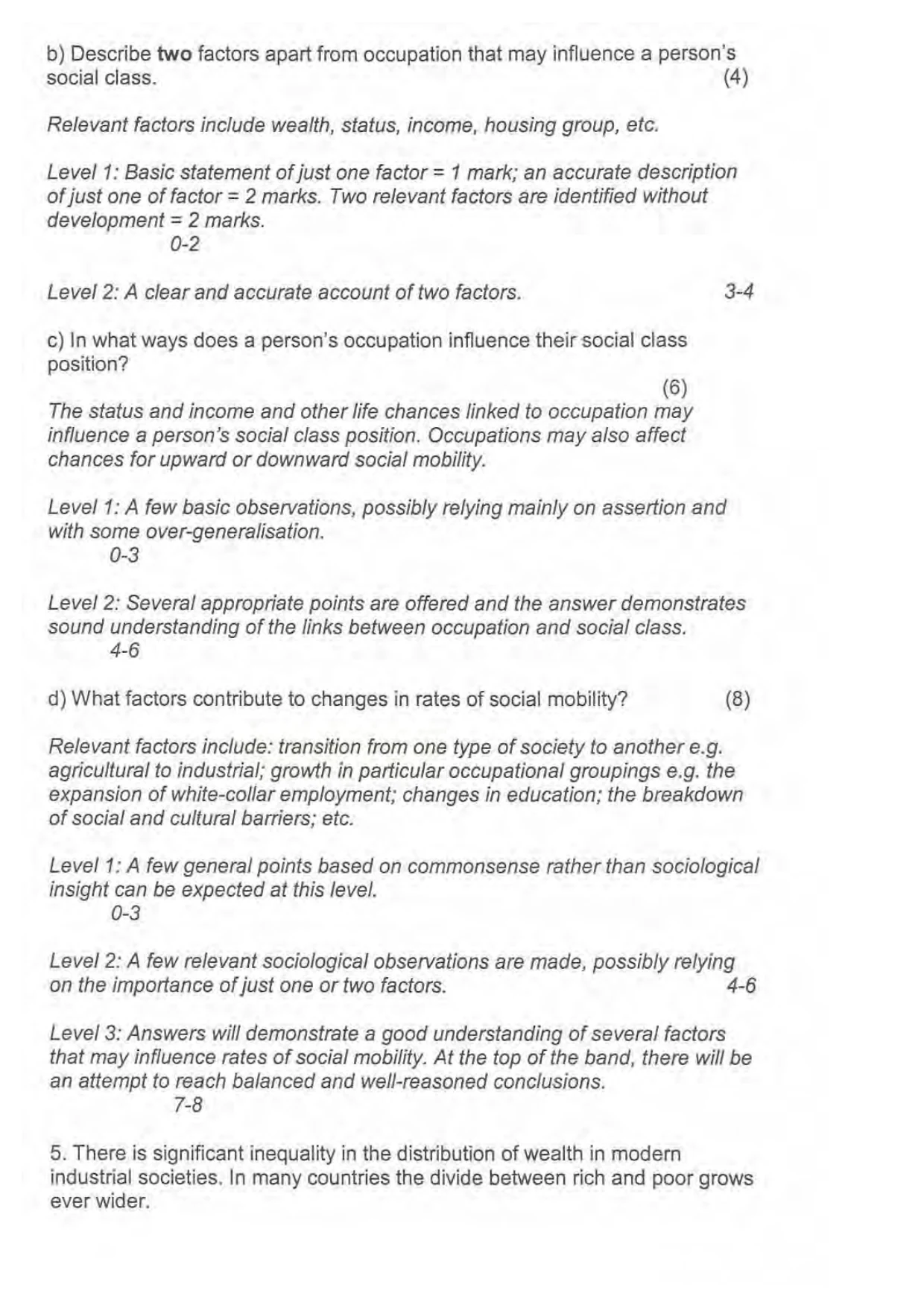
b) Describe two factors apart from occupation that may influence a person's social class. (4) Relevant factors include wealth, status, income, housing group, etc. Level 1: Basic statement of just one factor = 1 mark; an accurate description of just one of factor = 2 marks. Two relevant factors are identified without development = 2 marks. 0-2 Level 2: A clear and accurate account of two factors. 3-4 c) In what ways does a person’s occupation influence their social class position? (6) The status and income and other life chances linked to occupation may influence a person’s social class position. Occupations may also affect chances for upward or downward social mobility. Level 1: A few basic observations, possibly relying mainly on assertion and with some over-generalisation. 0-3 Level 2: Several appropriate points are offered and the answer demonstrates sound understanding of the links between occupation and social class. 4-6 d) What factors contribute to changes in rates of social mobility? (8) Relevant factors include: transition from one type of society to another e.g. agricultural to industrial; growth in particular occupational groupings e.g. the expansion of white-collar employment; changes in education; the breakdown of social and cultural barriers; etc. Level 1: A few general points based on commonsense rather than sociological insight can be expected at this level. Level 2: A few relevant sociological observations are made, possibly relying on the importance of just one or two factors. 4-6 Level 3: Answers will demonstrate a good understanding of several factors that may influence rates of social mobility. At the top of the band, there will be an attempt to reach balanced and well-reasoned conclusions. 7-8 5. There is significant inequality in the distribution of wealth in modern industrial societies. In many countries the divide between rich and poor grows ever wider.
Mark scheme, page 10
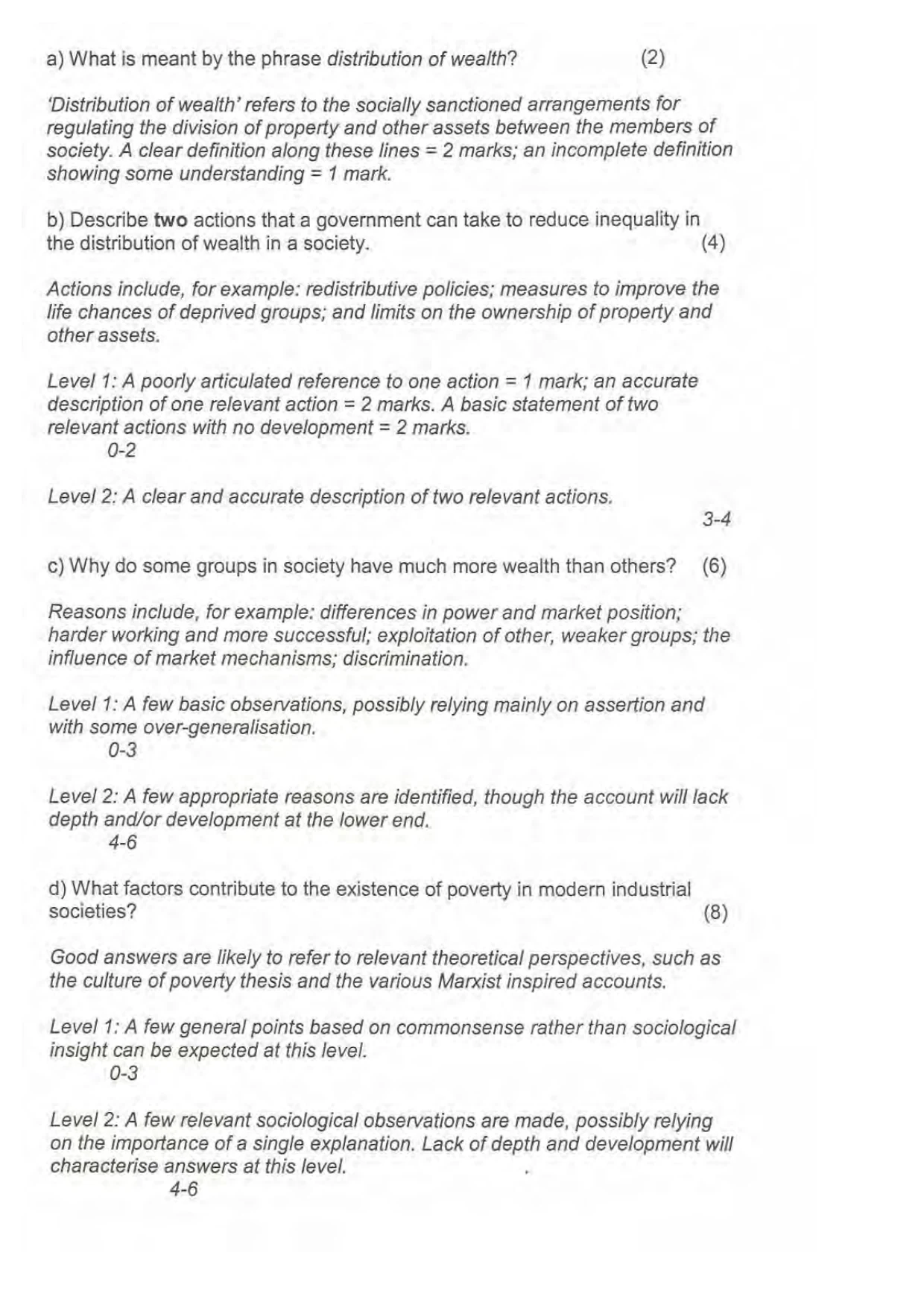
a) What is meant by the phrase distribution of wealth? (2) ‘Distribution of wealth’ refers to the socially sanctioned arrangements for regulating the division of property and other assets between the members of society. A clear definition along these lines = 2 marks; an incomplete definition showing some understanding = 1 mark. b) Describe two actions that a government can take to reduce inequality in the distribution of wealth in a society. Actions include, for example: redistributive policies; measures to improve the life chances of deprived groups; and limits on the ownership of property and other assets. Level 1: A poorly articulated reference to one action = 1 mark; an accurate description of one relevant action = 2 marks. A basic statement of two relevant actions with no development = 2 marks. 0-2 Level 2: A clear and accurate description of two relevant actions. 3-4 c) Why do some groups in society have much more wealth than others? (6) Reasons include, for example: differences in power and market position; harder working and more successful; exploitation of other, weaker groups; the influence of market mechanisms; discrimination. Level 1: A few basic observations, possibly relying mainly on assertion and with some over-generalisation. 0-3 Level 2: A few appropriate reasons are identified, though the account will lack depth and/or development at the lower end. 4-6 d) What factors contribute to the existence of poverty in modern industrial societies? (8) Good answers are likely to refer to relevant theoretical perspectives, such as the culture of poverty thesis and the various Marxist inspired accounts. Level 1: A few general points based on commonsense rather than sociological insight can be expected at this level. 0-3 Level 2: A few relevant sociological observations are made, possibly relying on the importance of a single explanation. Lack of depth and development will characterise answers at this level. 4-6
Mark scheme, page 11
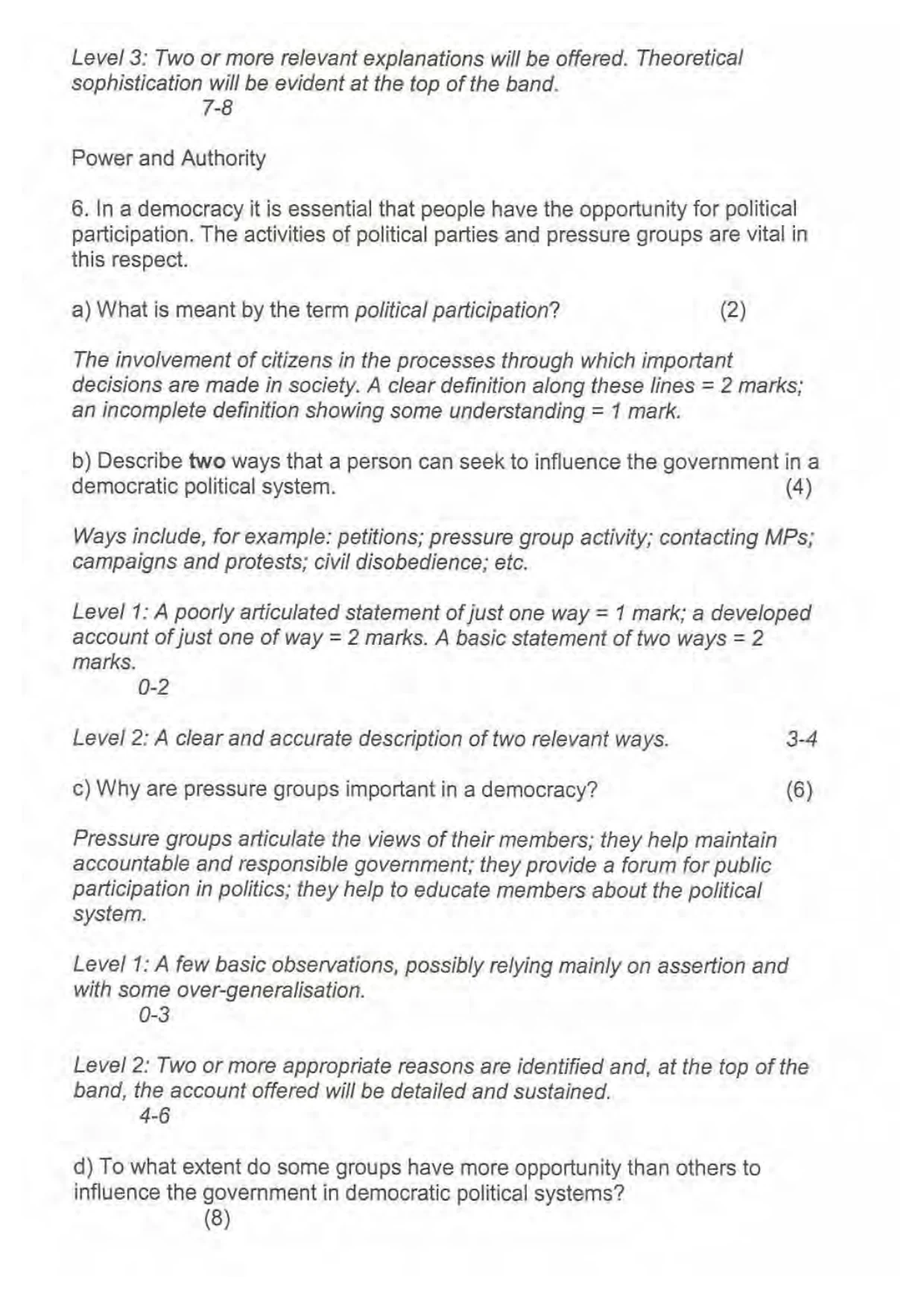
Level 3: Two or more relevant explanations will be offered. Theoretical sophistication will be evident at the top of the band. 7-8 Power and Authority 6. In a democracy it is essential that people have the opportunity for political participation. The activities of political parties and pressure groups are vital in this respect. a) What is meant by the term political participation? (2) The involvement of citizens in the processes through which important decisions are made in society. A clear definition along these lines = 2 marks; an incomplete definition showing some understanding = 1 mark. b) Describe two ways that a person can seek to influence the government in a democratic political system. (4) Ways include, for example: petitions; pressure group activity; contacting MPs; campaigns and protests; civil disobedience; etc. Level 1: A poorly articulated statement of just one way = 1 mark; a developed account of just one of way = 2 marks. A basic statement of two ways = 2 marks. 0-2 Level 2: A clear and accurate description of two relevant ways. 3-4 c) Why are pressure groups important in a democracy? (6) Pressure groups articulate the views of their members; they help maintain accountable and responsible government; they provide a forum for public participation in politics; they help to educate members about the political system. Leve! 1: A few basic observations, possibly relying mainly on assertion and with some over-generalisation. 0-3 Level 2: Two or more appropriate reasons are identified and, at the top of the band, the account offered will be detailed and sustained. 4-6 d) To what extent do some groups have more opportunity than others to influence the government in democratic political systems? (8)
Mark scheme, page 12
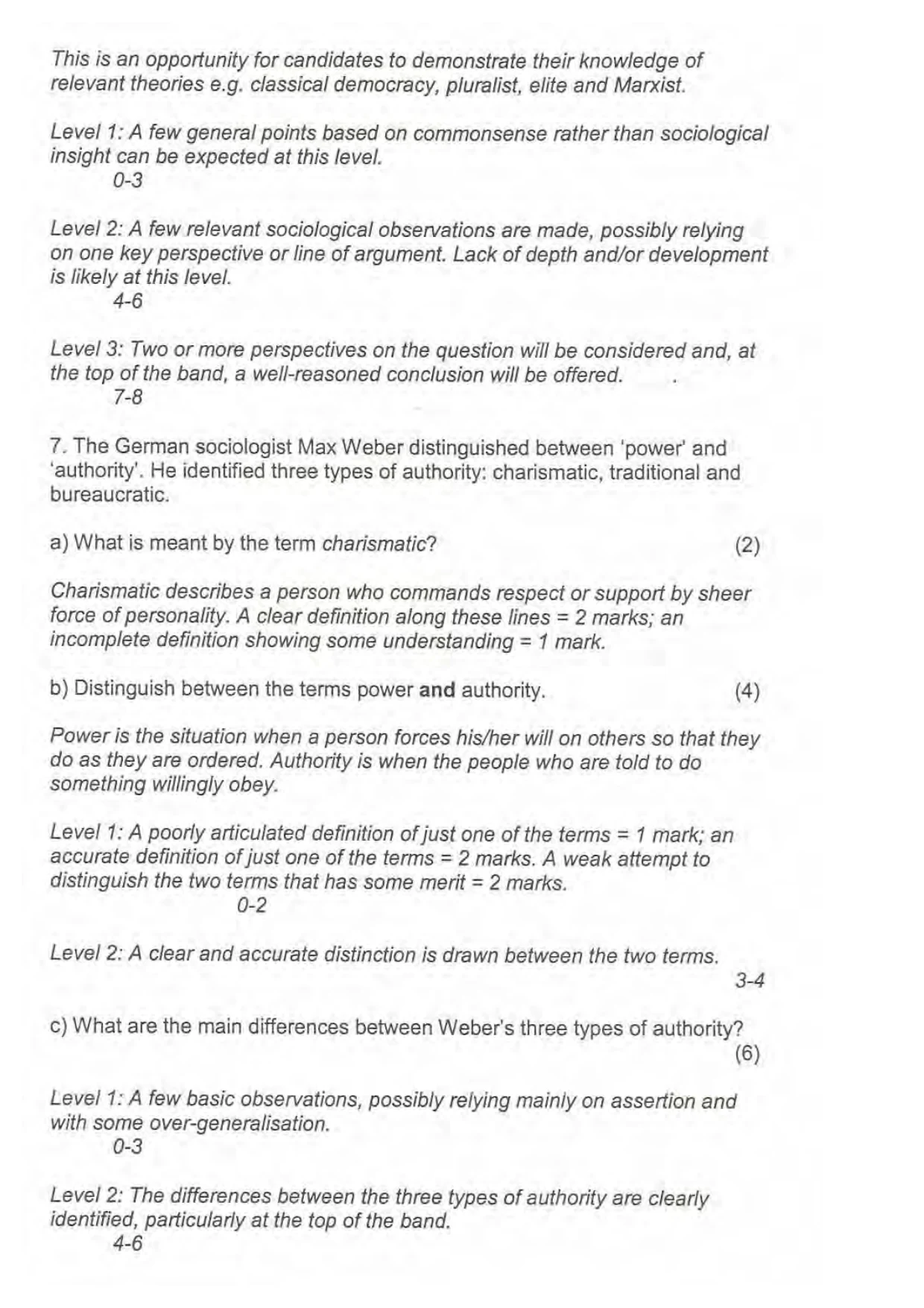
This is an opportunity for candidates to demonstrate their knowledge of relevant theories e.g. classical democracy, pluralist, elite and Marxist. Level 1: A few general points based on commonsense rather than sociological insight can be expected at this level. 0-3 Level 2: A few relevant sociological observations are made, possibly relying on one key perspective or line of argument. Lack of depth and/or development is likely at this level. 4-6 Level 3: Two or more perspectives on the question will be considered and, at the top of the band, a well-reasoned conclusion will be offered. 7-8 7. The German sociologist Max Weber distinguished between ‘power’ and ‘authority’. He identified three types of authority: charismatic, traditional and bureaucratic. a) What is meant by the term charismatic? (2) Charismatic describes a person who commands respect or support by sheer force of personality. A clear definition along these lines = 2 marks; an incomplete definition showing some understanding = 1 mark. b) Distinguish between the terms power and authority. (4) Power is the situation when a person forces his/her will on others so that they do as they are ordered. Authority is when the people who are told to do something willingly obey. Level 1: A poorly articulated definition of just one of the terms = 1 mark; an accurate definition of just one of the terms = 2 marks. A weak attempt to distinguish the two terms that has some merit = 2 marks. 0-2 Level 2: A clear and accurate distinction is drawn between the two terms. 3-4 c) What are the main differences between Weber's three types of authority? (6) Level 1: A few basic observations, possibly relying mainly on assertion and with some over-generalisation. 0-3 Level 2: The differences between the three types of authority are clearly identified, particularly at the top of the band. 4-6
Mark scheme, page 13
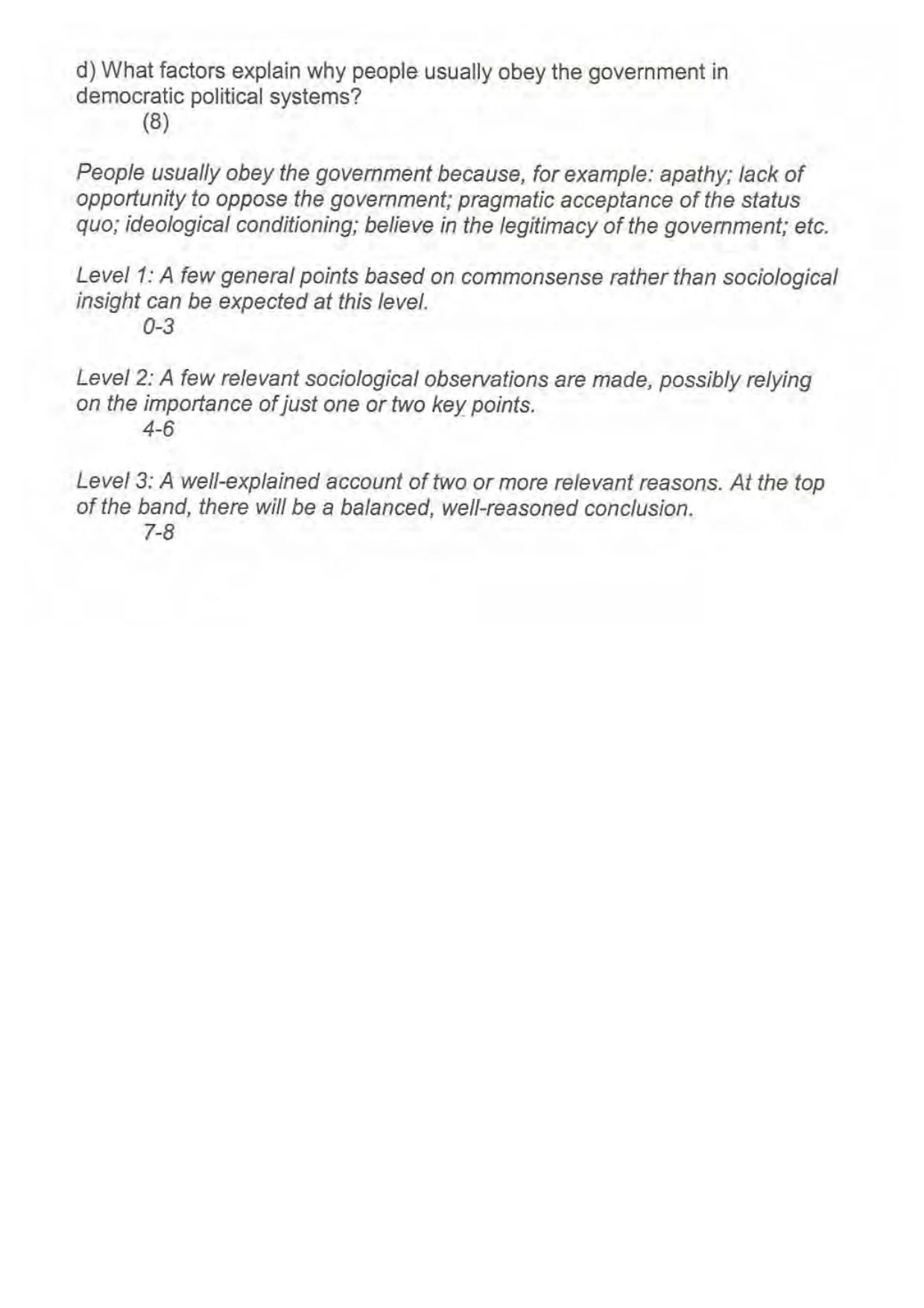
d) What factors explain why people usually obey the government in democratic political systems? (8) People usually obey the government because, for example: apathy; lack of opportunity to oppose the government; pragmatic acceptance of the status quo; ideological conditioning; believe in the legitimacy of the government; etc. Level 1: A few general points based on commonsense rather than sociological insight can be expected at this level. 0-3 Level 2: A few relevant sociological observations are made, possibly relying on the importance of just one or two key points. 4-6 Level 3: A well-explained account of two or more relevant reasons. At the top of the band, there will be a balanced, well-reasoned conclusion. 7-8