Cambridge IGCSE Sociology 0495 — 2002 Oct/Nov Paper 2 · Variant 1
0495/21/O/N/02
The question paper and its mark scheme, free to read here and free to download. This is Cambridge’s own paper, exactly as it was sat.
Question paper4 pages

Mark scheme4 pages
Answers below. Sit the paper first if you are practising.
Paper as text
Question paper, page 1
TIME 1 hour 30 minutes INSTRUCTIONS TO CANDIDATES Write your name, Centre number and candidate number in the spaces provided on the answer paper/ answer booklet. Answer all questions. Write your answers on the separate answer paper provided. If you use more than one sheet of paper, fasten the sheets together. INFORMATION FOR CANDIDATES The number of marks is given in brackets [ ] at the end of each question or part question. International General Certificate of Secondary Education UNIVERSITY OF CAMBRIDGE LOCAL EXAMINATIONS SYNDICATE SOCIOLOGY 0495/2 PAPER 2 OCTOBER/NOVEMBER SESSION 2002 1 hour 30 minutes Additional materials: Answer paper. This question paper consists of 4 printed pages. (NH) S13084 © UCLES 2002 [Turn over Registered Charity Number: 1066969 www.XtremePapers.com
Question paper, page 2
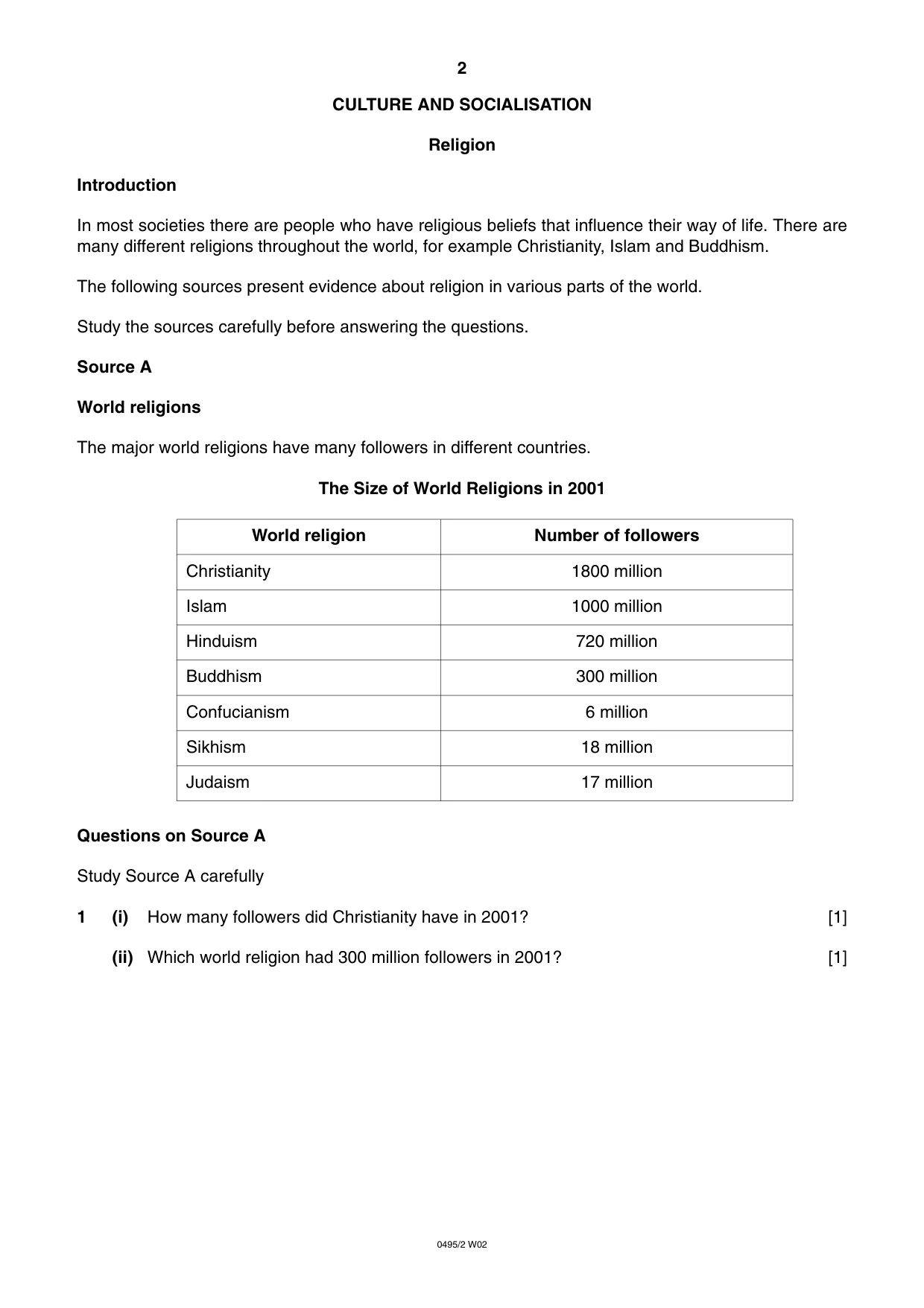
2 0495/2 W02 CULTURE AND SOCIALISATION Religion Introduction In most societies there are people who have religious beliefs that influence their way of life. There are many different religions throughout the world, for example Christianity, Islam and Buddhism. The following sources present evidence about religion in various parts of the world. Study the sources carefully before answering the questions. Source A World religions The major world religions have many followers in different countries. The Size of World Religions in 2001 Questions on Source A Study Source A carefully 1 (i) How many followers did Christianity have in 2001? [1] (ii) Which world religion had 300 million followers in 2001? [1] World religion Number of followers Christianity Islam Hinduism Buddhism Confucianism Sikhism Judaism 1800 million 1000 million 720 million 300 million 6 million 18 million 17 million
Question paper, page 3
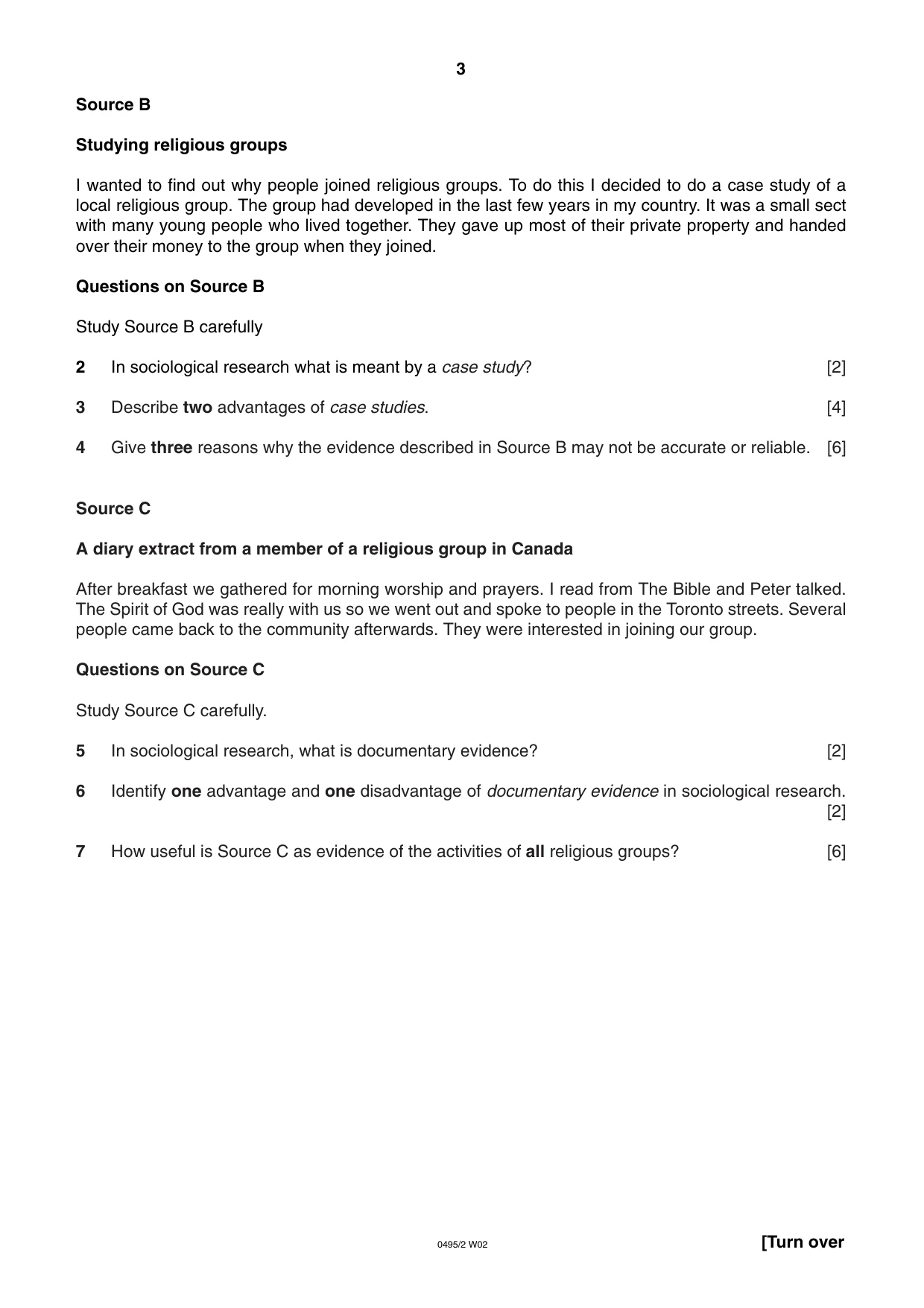
3 0495/2 W02 [Turn over Source B Studying religious groups I wanted to find out why people joined religious groups. To do this I decided to do a case study of a local religious group. The group had developed in the last few years in my country. It was a small sect with many young people who lived together. They gave up most of their private property and handed over their money to the group when they joined. Questions on Source B Study Source B carefully 2 In sociological research what is meant by a case study? [2] 3 Describe two advantages of case studies. [4] 4 Give three reasons why the evidence described in Source B may not be accurate or reliable. [6] Source C A diary extract from a member of a religious group in Canada After breakfast we gathered for morning worship and prayers. I read from The Bible and Peter talked. The Spirit of God was really with us so we went out and spoke to people in the Toronto streets. Several people came back to the community afterwards. They were interested in joining our group. Questions on Source C Study Source C carefully. 5 In sociological research, what is documentary evidence? [2] 6 Identify one advantage and one disadvantage of documentary evidence in sociological research. [2] 7 How useful is Source C as evidence of the activities of all religious groups? [6]
Question paper, page 4
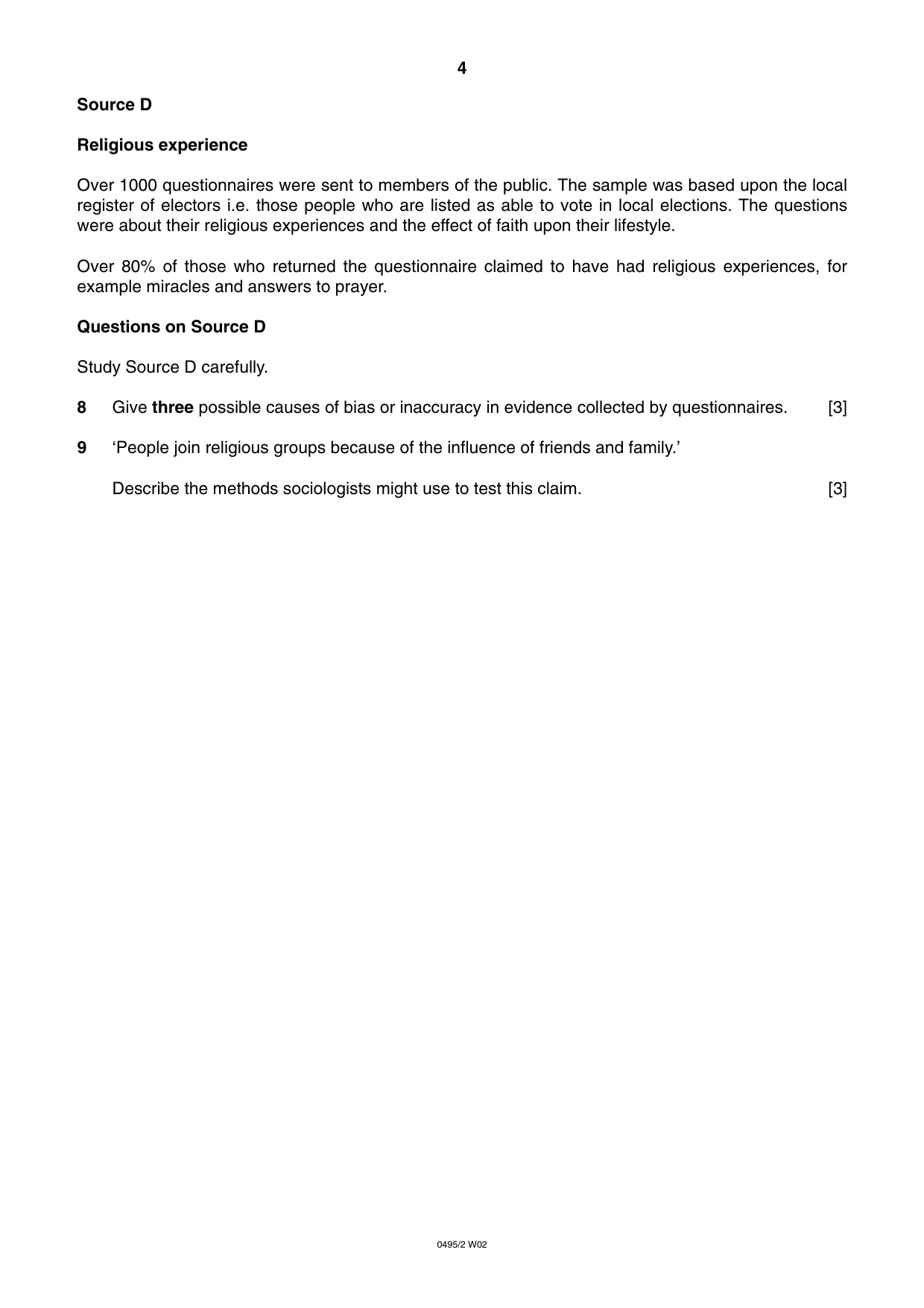
4 0495/2 W02 Source D Religious experience Over 1000 questionnaires were sent to members of the public. The sample was based upon the local register of electors i.e. those people who are listed as able to vote in local elections. The questions were about their religious experiences and the effect of faith upon their lifestyle. Over 80% of those who returned the questionnaire claimed to have had religious experiences, for example miracles and answers to prayer. Questions on Source D Study Source D carefully. 8 Give three possible causes of bias or inaccuracy in evidence collected by questionnaires. [3] 9 ‘People join religious groups because of the influence of friends and family.’ Describe the methods sociologists might use to test this claim. [3]
Mark scheme, page 1
CAMBRIDGE INTERNATIONAL EXAMINATIONS NOVEMBER 2002 INTERNATIONAL GCSE UNIVERSITY of CAMBRIDGE Local Examinations Syndicate
Mark scheme, page 2
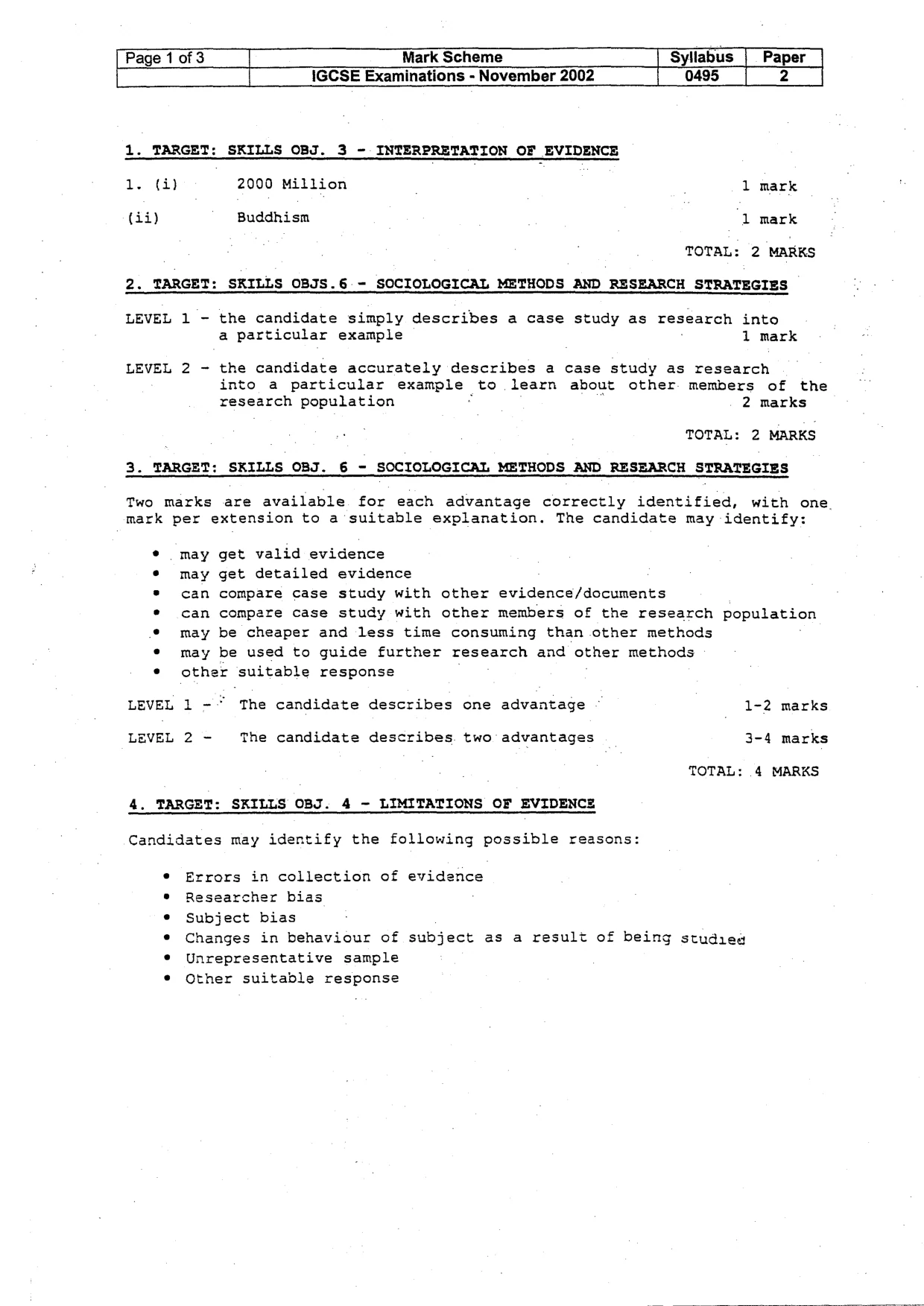
Page 1 of 3 Mark Scheme Syllabus Paper IGCSE Examinations - November 2002 0495 2 1. TARGET: SKILLS OBJ. 3 - INTERPRETATION OF EVIDENCE 1. (i) 2000 Million 1 mark (ii) Buddhism 1 mark TOTAL: 2 MARKS 2. TARGET: SKILLS OBJS.6 - SOCIOLOGICAL METHODS AND RESEARCH STRATEGIES LEVEL 1 - the candidate simply describes a case study as research into a particular example 1 mark LEVEL 2 - the candidate accurately describes a case study as research into a particular example to learn about other members of the research population ° 2 marks TOTAL: 2 MARKS 3. TARGET: SKILLS OBJ. 6 - SOCIOLOGICAL METHODS AND RESEARCH STRATEGIES Two marks are available for each advantage correctly identified, with one mark per extension to a suitable explanation. The candidate may identify: may get valid evidence may get detailed evidence can compare case study with other evidence/documents can compare case study with other members of the research population may be cheaper and less time consuming than other methods may be used to guide further research and other methods e other suitable response LEVEL 1 -* The candidate describes one advantage 1-2 marks LEVEL 2 - The candidate describes. two advantages 3-4 marks TOTAL: 4 MARKS 4, TARGET: SKILLS OBJ. 4 - LIMITATIONS OF EVIDENCE Candidates may identify the following possible reasons: ¢ Errors in collection of evidence Researcher bias Subject bias Changes in behaviour of subject as a result of being studieg Unrepresentative sample Other suitable response
Mark scheme, page 3
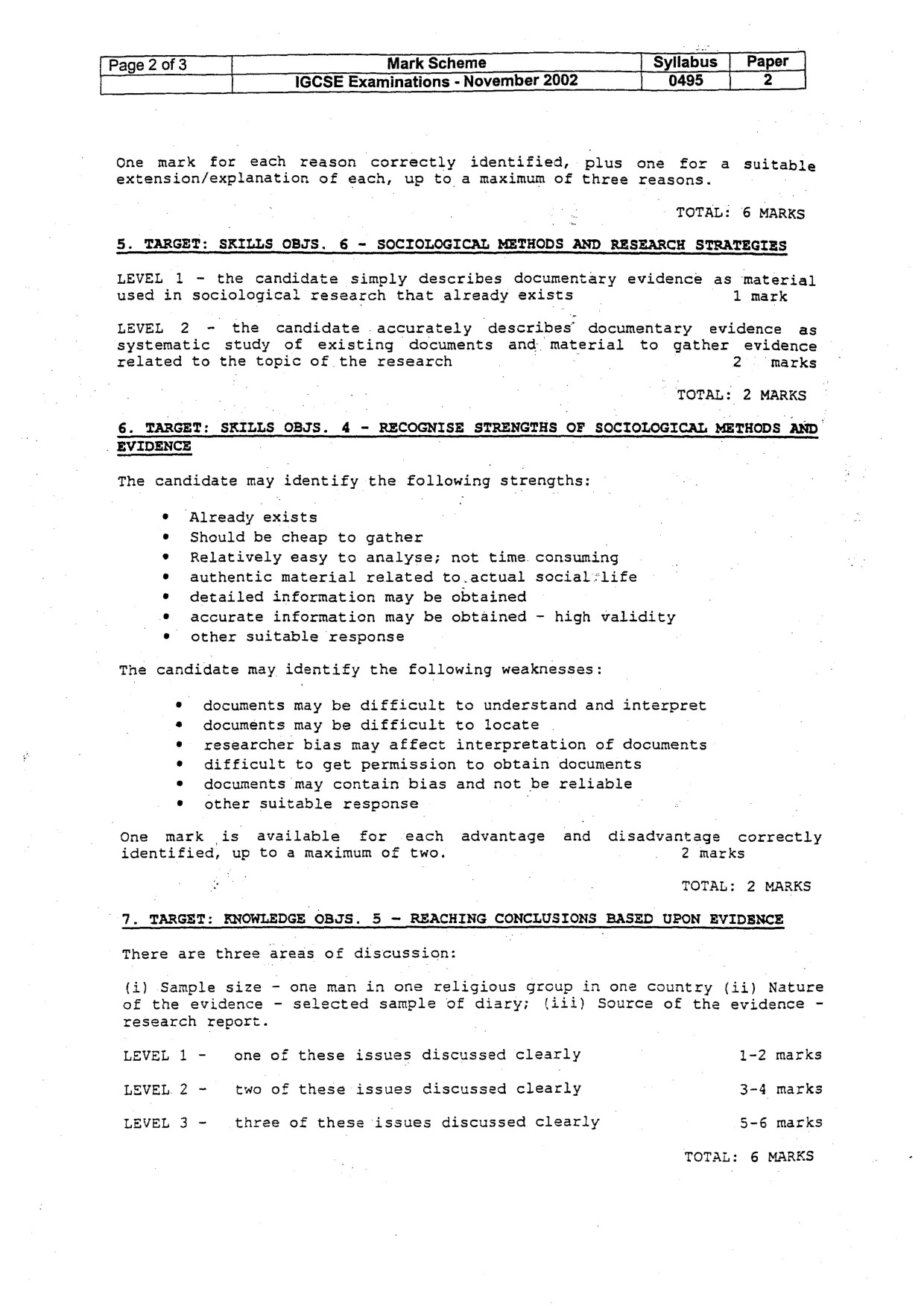
Page 2 of 3 Mark Scheme Syllabus | Paper | IGCSE Examinations - November 2002 0495 2 One mark for each reason correctly identified, plus one for a suitable extension/explanation of each, up to a maximum of three reasons. TOTAL: 6 MARKS 5. TARGET: SKILLS OBJS. 6 ~ SOCIOLOGICAL METHODS AND RESEARCH STRATEGIES LEVEL 1 - the candidate simply describes documentary evidence as material used in sociological research that already exists 1 mark LEVEL 2 - the candidate accurately describes’ documentary evidence as systematic study of existing documents and material to gather evidence related to the topic of the research 2 marks TOTAL: 2 MARKS 6. TARGET: SKILLS OBJS. 4 - RECOGNISE STRENGTHS OF SOCIOLOGICAL METHODS AND’ EVIDENCE Se The candidate may identify the following strengths: e Already exists e Should be cheap to gather ° Relatively easy to analyse; not time. consuming ¢ authentic material related to.actual social:life © detailed information may be obtained * accurate information may be obtained - high validity * other suitable response The candidate may identify the following weaknesses: * documents may be difficult to understand and interpret * documents may be difficult to locate researcher bias may affect interpretation of documents © difficult to get permission to obtain documents e documents may contain bias and not be reliable * other suitable response One mark is available for each advantage and disadvantage correctly identified, up to a maximum of two. 2 marks TOTAL: 2 MARKS 7. TARGET: KNOWLEDGE OBJS. 5 — REACHING CONCLUSIONS BASED UPON EVIDENCE There are three areas of discussion: {i) Sample size - one man in one religious group in one country (ii) Nature of the evidence - selected sample of diary; (iii) Source of the evidence - research report. LEVEL 1 - one of these issues discussed clearly 1-2 marks LEVEL. 2 ~- two of these issues discussed clearly 3-4 marks LEVEL 3 - three of these issues discussed clearly 5-6 marks TOTAL: 6 MARKS
Mark scheme, page 4
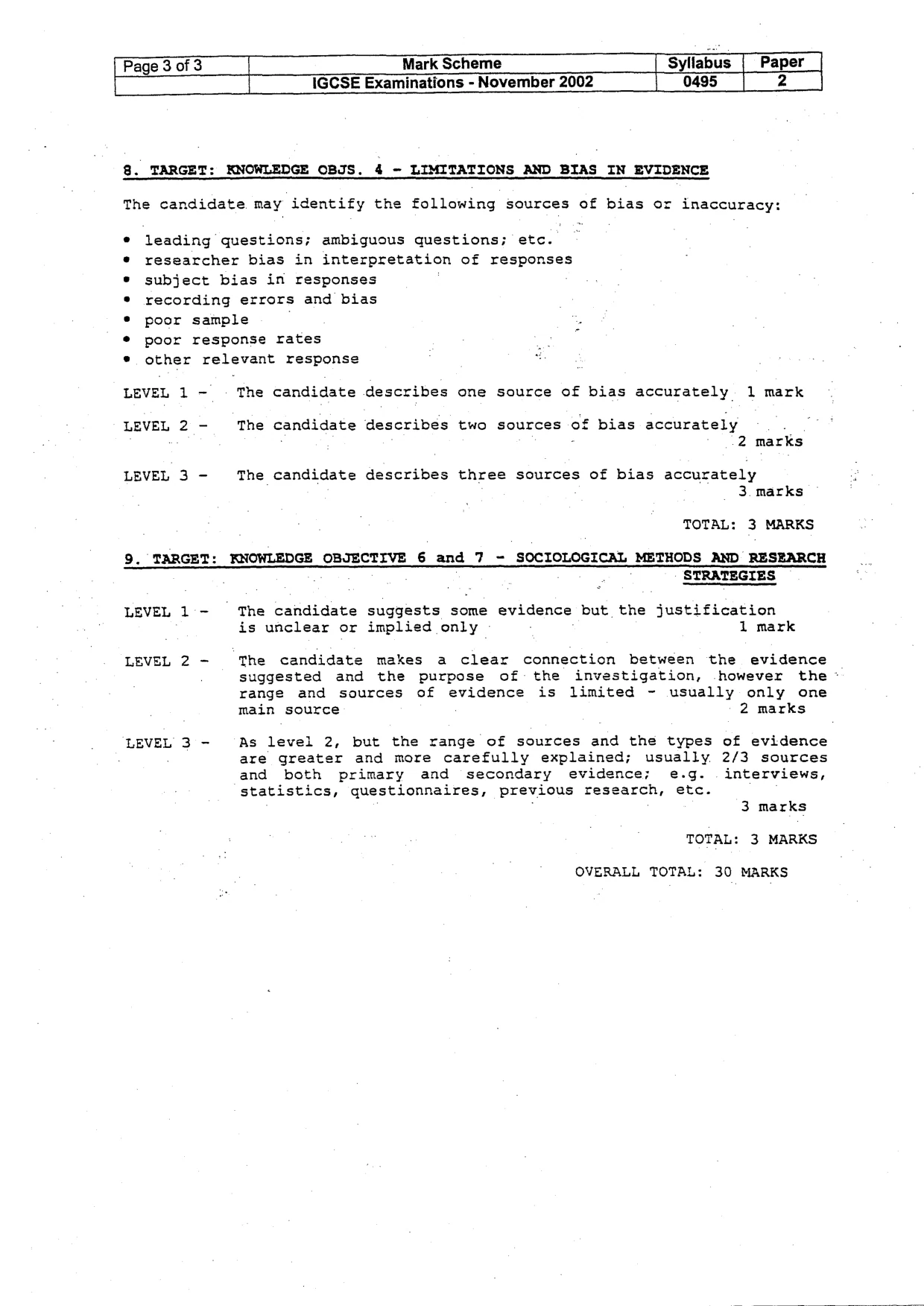
Page 3 of 3 Mark Scheme Syllabus Paper] IGCSE Examinations - November 2002 0495 2 8. TARGET: KNOWLEDGE OBJS. 4 - LIMITATIONS AND BIAS IN EVIDENCE The candidate may identify the following sources of bias or inaccuracy: e leading questions; ambiguous questions; etc. researcher bias in interpretation of responses subject bias in responses recording errors and bias poor sample poor response rates other relevant response LEVEL 1 - The candidate describes one source of bias accurately 1 mark LEVEL 2 - The candidate describes two sources of bias accurately - 2 marks LEVEL 3 - The candidate describes three sources of bias accurately 3. marks TOTAL: 3 MARKS 9. TARGET: KNOWLEDGE OBJECTIVE 6 and 7 - SOCIOLOGICAL METHODS AND RESEARCH STRATEGIES LEVEL 1 - The candidate suggests some evidence but the justification is unclear or implied only 1 mark LEVEL 2 - The candidate makes a clear connection between the evidence suggested and the purpose of the investigation, however the - range and sources of evidence is limited - usually only one main source 2 marks LEVEL 3 - As level 2, but the range of sources and the types of evidence are greater and more carefully explained; usually 2/3 sources and both primary and secondary evidence; e.g. interviews, statistics, questionnaires, previous research, etc. 3 marks TOTAL: 3 MARKS OVERALL TOTAL: 30 MARKS