Cambridge IGCSE Sociology 0495 — 2002 Oct/Nov Paper 1 · Variant 1
0495/11/O/N/02
The question paper and its mark scheme, free to read here and free to download. This is Cambridge’s own paper, exactly as it was sat.
Question paper4 pages



Mark scheme6 pages
Answers below. Sit the paper first if you are practising.



Paper as text
Question paper, page 1
TIME 1 hour 45 minutes INSTRUCTIONS TO CANDIDATES Write your name, Centre number and candidate number in the spaces provided on the answer paper/ answer booklet. Answer any three questions. Write your answers on the separate answer paper provided. If you use more than one sheet of paper, fasten the sheets together. INFORMATION FOR CANDIDATES The number of marks is given in brackets [ ] at the end of each question or part question. International General Certificate of Secondary Education CAMBRIDGE INTERNATIONAL EXAMINATIONS SOCIOLOGY 0495/1 PAPER 1 OCTOBER/NOVEMBER SESSION 2002 1 hour 45 minutes Additional materials: Answer paper. This question paper consists of 3 printed pages and 1 blank page. (NH) S16450/2 © CIE 2002 [Turn over www.XtremePapers.com
Question paper, page 2
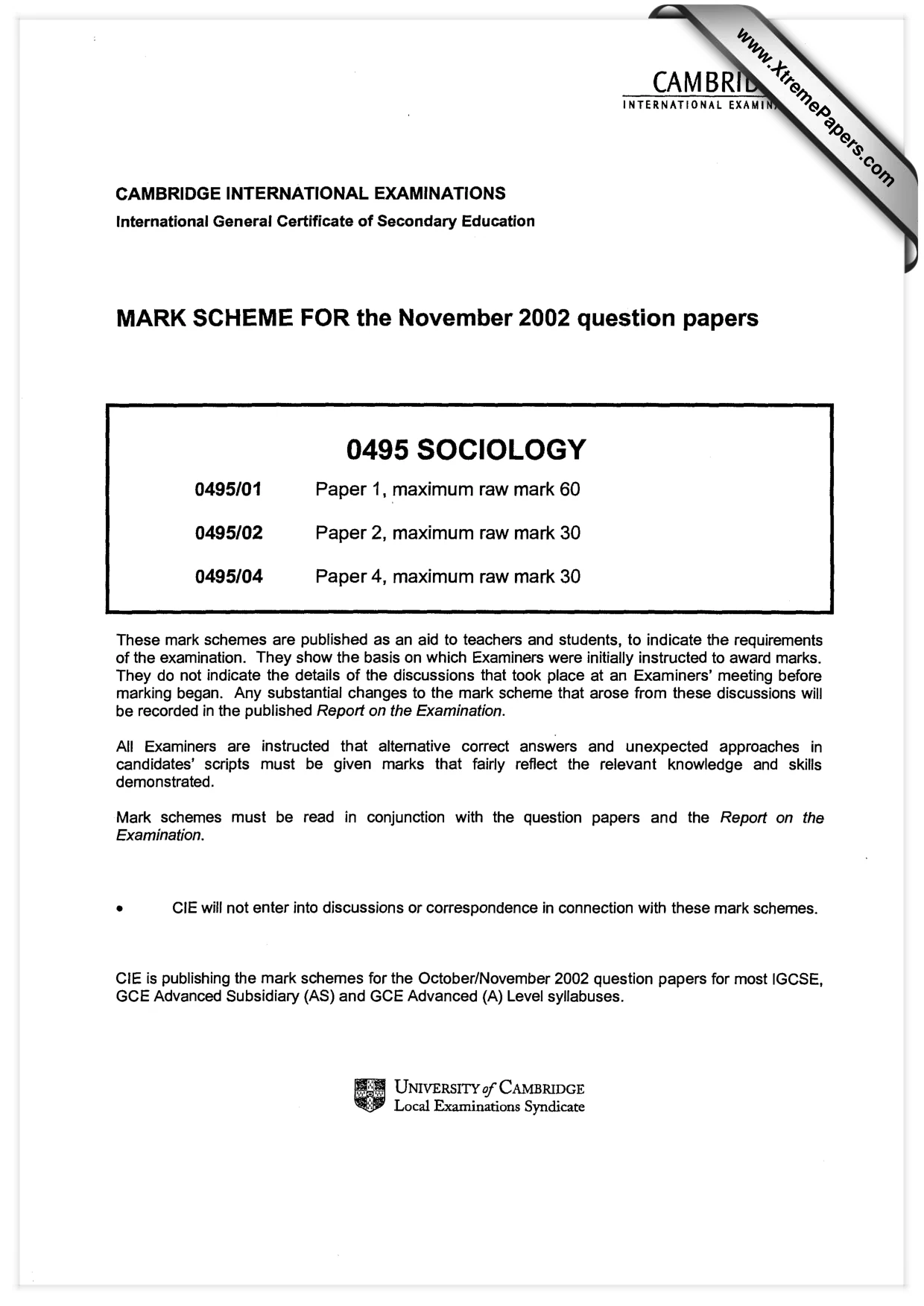
2 0495/1 W02 Answer three questions. 1 The importance of the nuclear family in modern industrialised societies has declined. There are many other types of family today. (a) What is meant by the term nuclear family? [2] (b) Describe two other types of family. [4] (c) What factors have led to the decline of the nuclear family? [7] (d) Does the decline of the nuclear family in modern industrialised societies mean that family life is less important? [7] 2 Research has shown that the higher a child’s parents are in the class structure, the greater that child’s chances of success in the formal education system. (a) What is meant by formal education? [2] (b) In what ways might home background influence a child’s chances of educational success? [6] (c) What factors within schools may encourage or discourage pupils in their studies? [6] (d) What can schools do to help children from poor families to improve their chances of educational success? [6] 3 The process of moving from agricultural to large-scale factory production is known as industrialisation. There are many differences between work in industrial and pre-industrial society. (a) What reasons have sociologists identified to explain why people work in industrialised societies? [5] (b) What are the main differences between work in pre-industrial and industrialised societies? [5] (c) To what extent may it be claimed that work was more satisfying in pre-industrial society? [5] (d) What links have been identified between work and leisure in industrialised societies? [5] 4 The official statistics on crime need to be treated with great caution. It appears that many people do not report crimes to the police and that the police sometimes do not record acts that have been reported to them. (a) Why might some crimes not be reported to the police? [5] (b) How might the activities of the police affect what types of crimes and offenders appear in the official crime statistics? [5] (c) Women appear to commit fewer crimes than men. How might this be explained? [5] (d) Apart from official statistics, what other ways are there of measuring the amount of crime in a society, and how adequate are they? [5]
Question paper, page 3
3 0495/1 W02 5 Senior politicians, military officers, industrialists and professionals tend to be drawn from a small social group. Some sociologists refer to this as a social élite. (a) What is the meaning of social élite? [2] (b) Why do senior politicians, military officers, industrialists and professionals tend to be drawn from a small social group? [6] (c) How do social élites maintain their power against challenges from other groups? [6] (d) How can the power of social élites be broken? [6]
Mark scheme, page 1
CAMBRIDGE INTERNATIONAL EXAMINATIONS International General Certificate of Secondary Education MARK SCHEME FOR the November 2002 question papers 0495 SOCIOLOGY 0495/01 Paper 1, maximum raw mark 60 0495/02 Paper 2, maximum raw mark 30 0495/04 Paper 4, maximum raw mark 30 These mark schemes are published as an aid to teachers and students, to indicate the requirements of the examination. They show the basis on which Examiners were initially instructed to award marks. They do not indicate the details of the discussions that took place at an Examiners’ meeting before marking began. Any substantial changes to the mark scheme that arose from these discussions will be recorded in the published Report on the Examination. All Examiners are instructed that alternative correct answers and unexpected approaches in candidates’ scripts must be given marks that fairly reflect the relevant knowledge and skills demonstrated. Mark schemes must be read in conjunction with the question papers and the Report on the Examination. . CIE will not enter into discussions or correspondence in connection with these mark schemes. CIE is publishing the mark schemes for the October/November 2002 question papers for most IGCSE, GCE Advanced Subsidiary (AS) and GCE Advanced (A) Level syllabuses. UNIVERSITY of CAMBRIDGE Local Examinations Syndicate
Mark scheme, page 2
CAMBRIDGE INTERNATIONAL EXAMINATIONS November 2002 INTERNATIONAL GCSE UNIVERSITY of CAMBRIDGE Local Examinations Syndicate
Mark scheme, page 3
Page 1 of 4 Mark Scheme Syllabus | Paper IGCSE Examinations - November 2002 0495 1 4. The importance of the nuclear family in modern industrialised societies has declined. There are many other types of family today. a) What is meant by the term nuclear family? (2) A unit consisting of spouses and their dependent children = 2 marks. b) Describe two other types of family (4) Options include: single parent; extended; compound; married couple only; homosexual couples with or without children; etc. (2 x 2 marks) c) What factors have led to the decline of the nuclear family? (7) Factors include: increasing divorce rates; increasingly common decision of women who become pregnant not to marry; more people remaining single or marrying at a later age; more couples choosing not to have children; etc. A basic account of one or two factors could achieve up to 4 marks. A clear and accurate account of several factors would merit 5-7 marks. d) Does the decline of the nuclear family in modern industrialised societies mean that family life is less important? (7) No, it is just different. Accept answers along these lines (3) with additional marks where there are examples or extended explanations. Also possible to answer that the family is less stable today; that nuclear families cannot cope with the demands being made on them, leading to breakdown. 2. Research has shown that the higher a child’s parents are in the class structure, the greater that child’s chances of success in the formal education system. (a) What is meant by formal education? (2) This is the academic or practical knowledge taught at school and college. (1 mark for each basic point; 2-3 marks for a developed point.) (6) In what ways might home background influence a child's chances of educational success? Important influences include: the values and behaviour of a child’s family; the form of language used in the home; and the physical condition of the home. (1 mark for each basic point; 2-3 marks for a developed point.)
Mark scheme, page 4
Page 2 of 4 Mark Scheme [Syllabus | Paper IGCSE Examinations - November 2002 | 0495 1 (c) What factors within schools may encourage or discourage pupils in their studies? (8) Relevant factors include: quality of teaching; labelling; streaming; type of school and resources it may have available; peer group; etc. (1 mark for each basic point; 2-3 marks for a developed point.) (d) What can schools do to help children from poor families to improve their chances of educational success? (6) Various initiatives possible, perhaps based around the idea of compensatory education and/or changing the attitudes and values of pupils/staff. Reward depth of discussion and/or quality of the suggestions. 3. the process of moving from agricultural to large-scale factory production is known as industrialisation. There are many differences between work in industrial and pre-industrial society. a) What reasons have sociologist identified to explain why people work in industrialised societies. (5) Extrinsic and intrinsic reason; companionship; status and sense of identity; escape from the restrictive role of housewife in the case of women; etc (1 mark for each basic point; 2-3 marks for a developed point.) b) What are the main differences between work in pre-industrial and industrialised societies? (5) - working and social lives were unified - work roles were ascribed and not achieved - the concept of work measured in time did not exist - no separate work place. c) To what extent may it be claimed that work was more satisfying in pre- industrialised societies? Good answers might consider the affects in terms of, for example, health, life chances, , leisure pursuits, community and family life, etc. Reward depth of analysis and knowledge.
Mark scheme, page 5
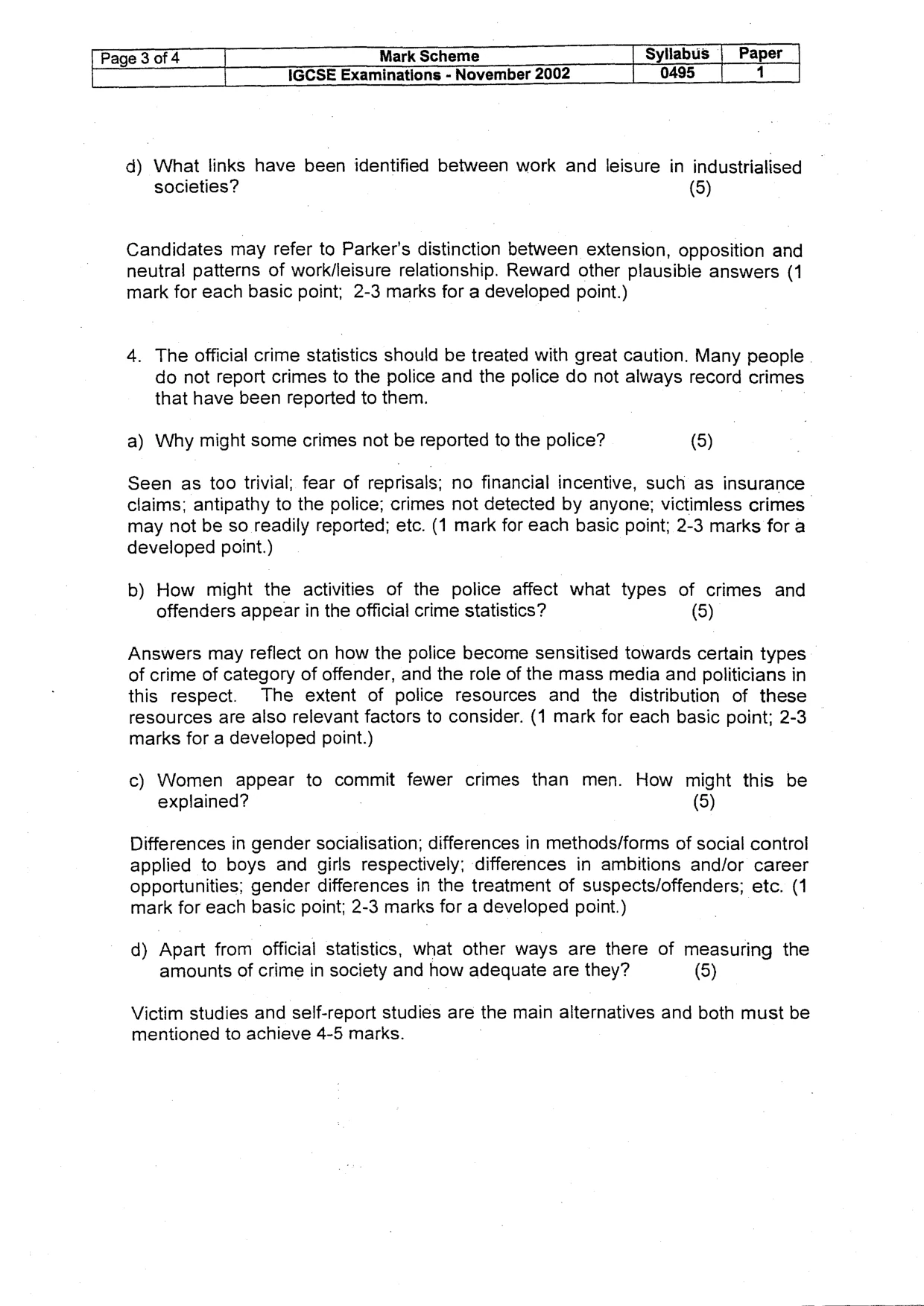
Page 3 of 4 Mark Scheme Syllabus | Paper IGCSE Examinations - November 2002 0495 1 d) What links have been identified between work and leisure in industrialised societies? (5) Candidates may refer to Parker's distinction between extension, opposition and neutral patterns of work/leisure relationship. Reward other plausible answers (1 mark for each basic point; 2-3 marks for a developed point.) 4. The official crime statistics should be treated with great caution. Many people do not report crimes to the police and the police do not always record crimes that have been reported to them. a) Why might some crimes not be reported to the police? (5) Seen as too trivial; fear of reprisals; no financial incentive, such as insurance claims; antipathy to the police; crimes not detected by anyone; victimless crimes may not be so readily reported; etc. (1 mark for each basic point; 2-3 marks for a developed point.) b) How might the activities of the police affect what types of crimes and offenders appear in the official crime statistics? (5) Answers may reflect on how the police become sensitised towards certain types of crime of category of offender, and the role of the mass media and politicians in this respect. The extent of police resources and the distribution of these resources are also relevant factors to consider. (1 mark for each basic point; 2-3 marks for a developed point.) c) Women appear to commit fewer crimes than men. How might this be explained? (5) Differences in gender socialisation; differences in methods/forms of social control applied to boys and girls respectively; differences in ambitions and/or career opportunities; gender differences in the treatment of suspects/offenders; etc. (1 mark for each basic point; 2-3 marks for a developed point.) d) Apart from official statistics, what other ways are there of measuring the amounts of crime in society and how adequate are they? (5) Victim studies and self-report studies are the main alternatives and both must be mentioned to achieve 4-5 marks.
Mark scheme, page 6
Page 4 of 4 Mark Scheme ‘Syllabus | Paper IGCSE Examinations - November 2002 0495 1 5. Senior politicians, military officers, industrialists and professionals tend to be drawn from a very wealth and privileged background. Some sociologists refer to this as social elite. a) What is the meaning of social élite? (2) A privileged high status group in society. b) Why do senior politicians, military officers, industrialists and professionals tend to be drawn from a smail social group. (6) Educational and social privilege, in UK through wealth and private education, top universities and use of contacts to get key jobs. 2 marks for basic understanding; further 4 for good analysis with examples. c) How do social élite’s maintain their power against challenges from other groups? (6) By making it hard to join (e.g. Lawyers and doctors): limited recruitment and training opportunities; need for very long apprenticeship before earnings improve; closed recruitment (i.e. outsiders find it hard to get in). Up to 3 marks for basic grasp of this; up to 3 more marks for good examples or more detailed analysis. d) How can the power of social élite’s be broken? (6) Revolution, war, gradual social change which increases economic and political power of other groups; more open opportunities, education, social mobility. Reward basic grasp of any of these with up to 3 marks; up to 3 more for detailed analysis or good examples.