Cambridge IGCSE Sciences - Co-ordinated (Double) 0654 — 2016 Oct/Nov Paper 2 · Variant 3
0654/23/O/N/16 · 120 marks · ≈135 min
The question paper and its mark scheme, free to read here and free to download. This is Cambridge’s own paper, exactly as it was sat.
Question paper28 pages
Mark scheme11 pages
Answers below. Sit the paper first if you are practising.
Paper as text
Question paper, page 1
This document consists of 28 printed pages. DC (NF/SG) 120587/5 © UCLES 2016 [Turn over Cambridge International Examinations Cambridge International General Certificate of Secondary Education * 5 2 0 6 3 0 3 0 3 0 * CO-ORDINATED SCIENCES 0654/23 Paper 2 (Core) October/November 2016 2 hours Candidates answer on the Question Paper. No Additional Materials are required. READ THESE INSTRUCTIONS FIRST Write your Centre number, candidate number and name on all the work you hand in. Write in dark blue or black pen. You may use an HB pencil for any diagrams or graphs. Do not use staples, paper clips, glue or correction fluid. DO NOT WRITE IN ANY BARCODES. Answer all questions. Electronic calculators may be used. You may lose marks if you do not show your working or if you do not use appropriate units. A copy of the Periodic Table is printed on page 28. At the end of the examination, fasten all your work securely together. The number of marks is given in brackets [ ] at the end of each question or part question.
Question paper, page 2
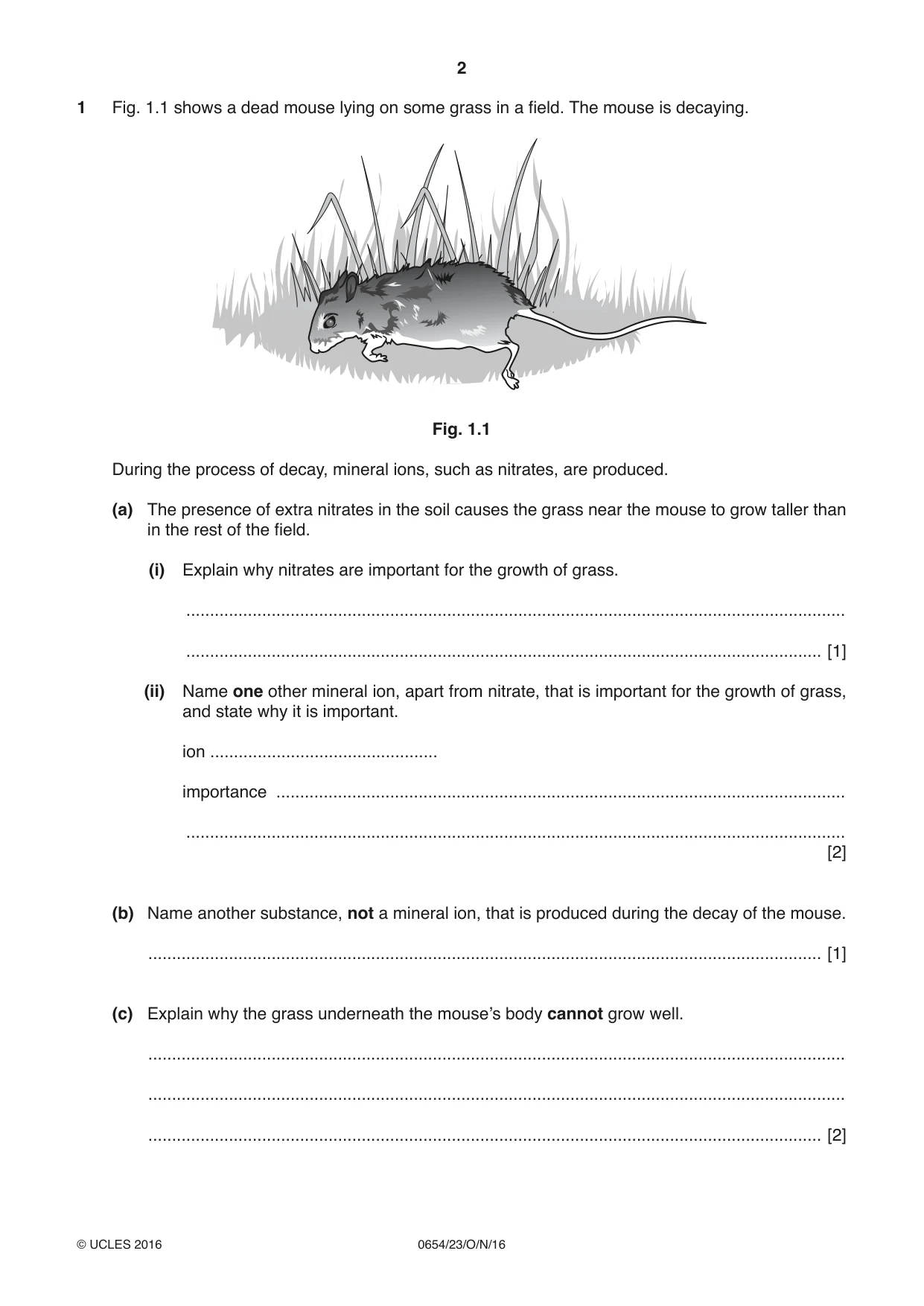
2 0654/23/O/N/16 © UCLES 2016 1 Fig. 1.1 shows a dead mouse lying on some grass in a field. The mouse is decaying. Fig. 1.1 During the process of decay, mineral ions, such as nitrates, are produced. (a) The presence of extra nitrates in the soil causes the grass near the mouse to grow taller than in the rest of the field. (i) Explain why nitrates are important for the growth of grass. … … [1] (ii) Name one other mineral ion, apart from nitrate, that is important for the growth of grass, and state why it is important. ion … importance … … [2] (b) Name another substance, not a mineral ion, that is produced during the decay of the mouse. … [1] (c) Explain why the grass underneath the mouse’s body cannot grow well. … … … [2]
Question paper, page 3
3 0654/23/O/N/16 © UCLES 2016 [Turn over (d) A living mouse feeds on grass seeds. The mouse is eaten by an owl. (i) In the space, draw a food chain to show these relationships. [2] (ii) Name the consumers in this food chain. … … [1]
Question paper, page 4
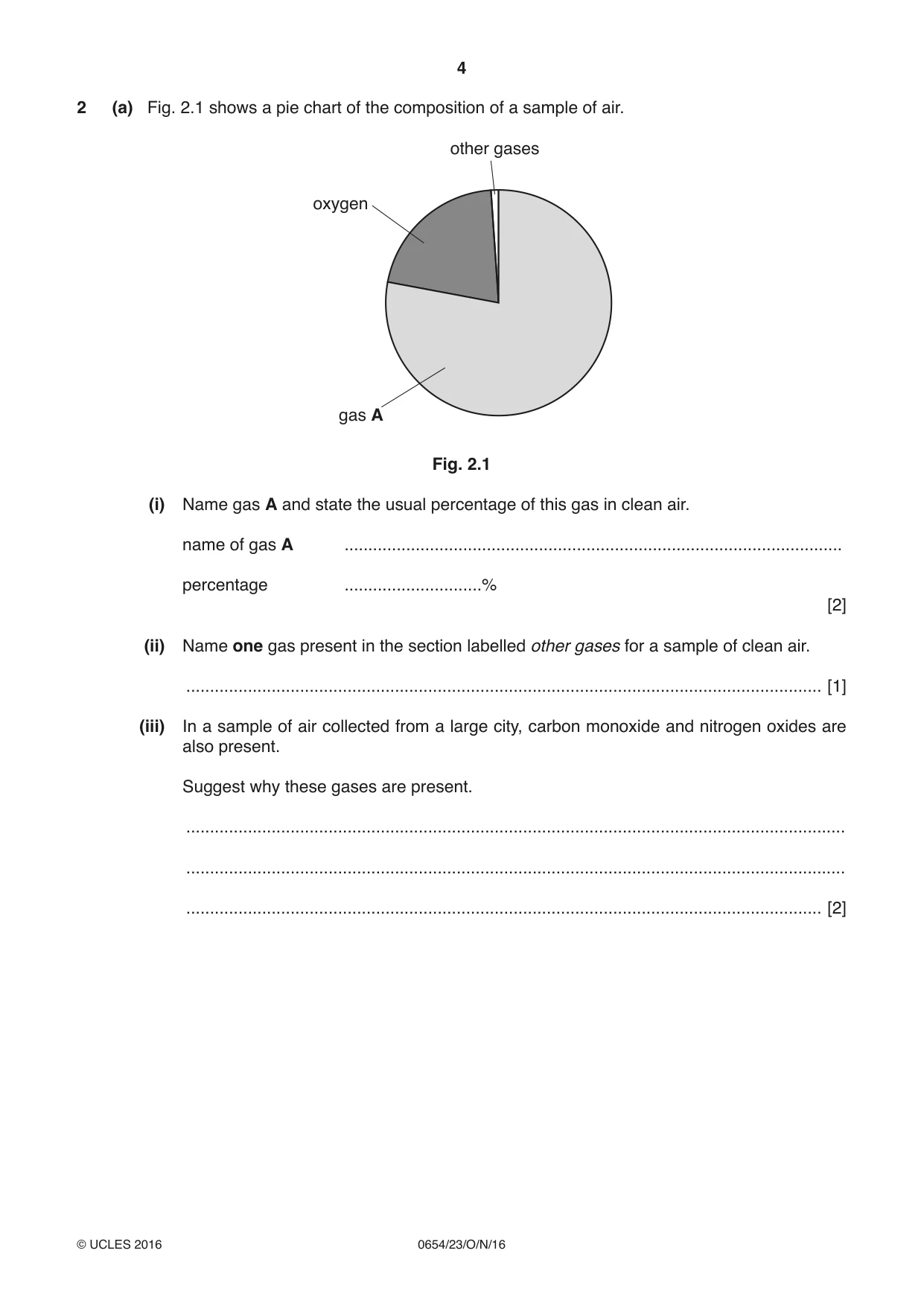
4 0654/23/O/N/16 © UCLES 2016 2 (a) Fig. 2.1 shows a pie chart of the composition of a sample of air. other gases oxygen gas A Fig. 2.1 (i) Name gas A and state the usual percentage of this gas in clean air. name of gas A … percentage …% [2] (ii) Name one gas present in the section labelled other gases for a sample of clean air. … [1] (iii) In a sample of air collected from a large city, carbon monoxide and nitrogen oxides are also present. Suggest why these gases are present. … … … [2]
Question paper, page 5
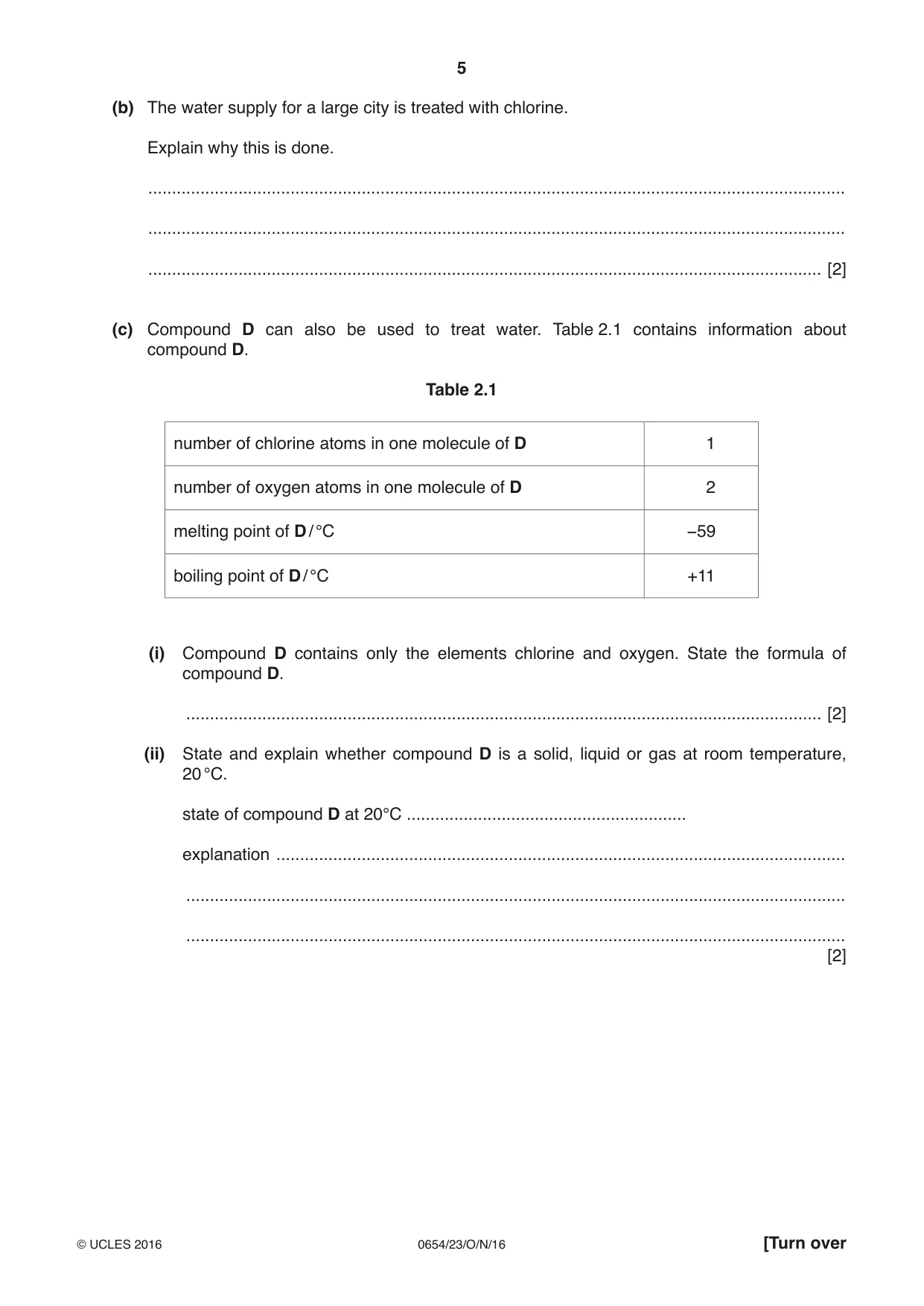
5 0654/23/O/N/16 © UCLES 2016 [Turn over (b) The water supply for a large city is treated with chlorine. Explain why this is done. … … … [2] (c) Compound D can also be used to treat water. Table 2.1 contains information about compound D. Table 2.1 number of chlorine atoms in one molecule of D 1 number of oxygen atoms in one molecule of D 2 melting point of D / °C −59 boiling point of D / °C +11 (i) Compound D contains only the elements chlorine and oxygen. State the formula of compound D. … [2] (ii) State and explain whether compound D is a solid, liquid or gas at room temperature, 20 °C. state of compound D at 20°C … explanation … … … [2]
Question paper, page 6
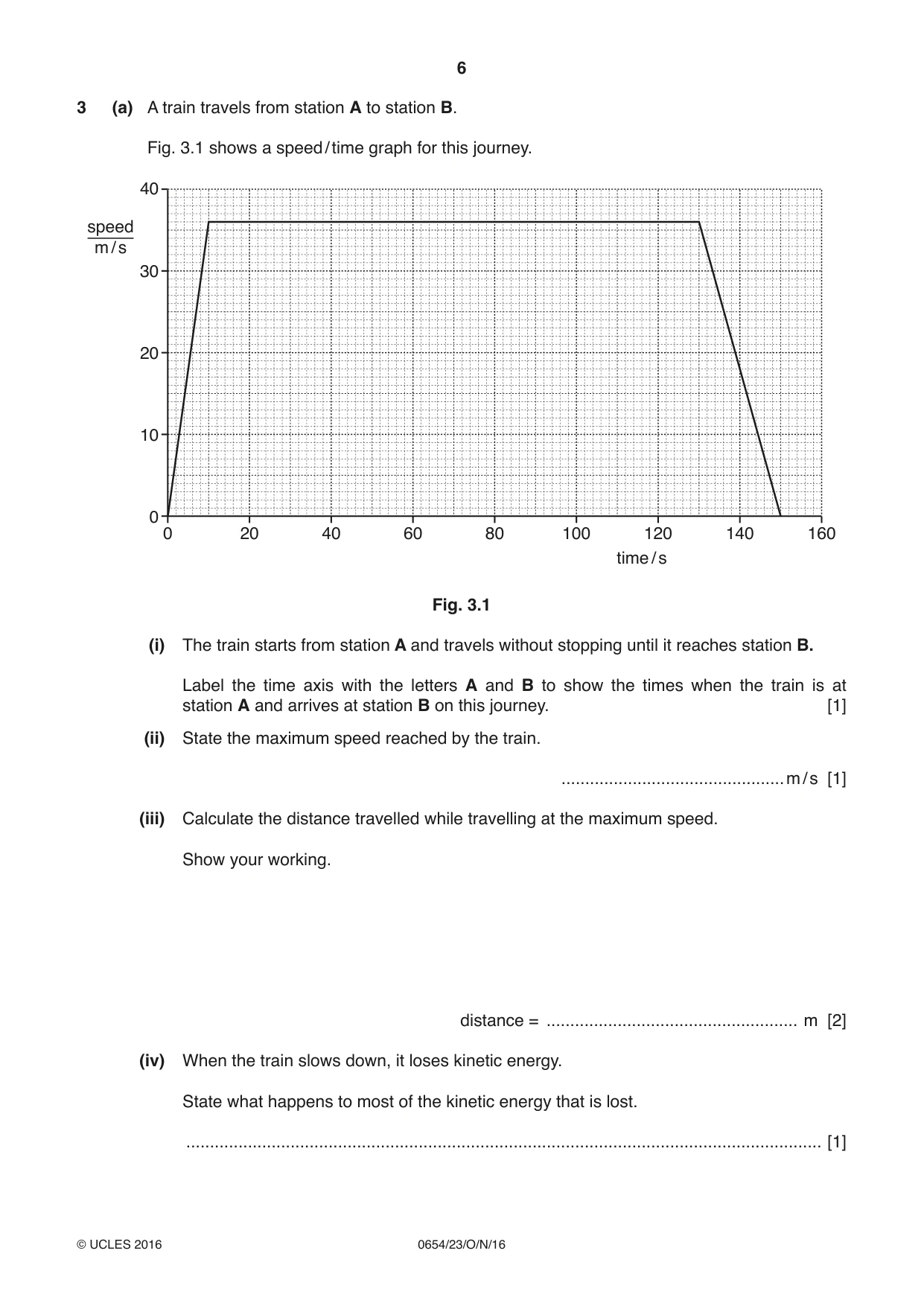
6 0654/23/O/N/16 © UCLES 2016 3 (a) A train travels from station A to station B. Fig. 3.1 shows a speed / time graph for this journey. 40 30 20 10 0 0 20 40 60 80 100 120 140 160 speed m / s time / s Fig. 3.1 (i) The train starts from station A and travels without stopping until it reaches station B. Label the time axis with the letters A and B to show the times when the train is at station A and arrives at station B on this journey. [1] (ii) State the maximum speed reached by the train. … m / s [1] (iii) Calculate the distance travelled while travelling at the maximum speed. Show your working. distance = … m [2] (iv) When the train slows down, it loses kinetic energy. State what happens to most of the kinetic energy that is lost. … [1]
Question paper, page 7
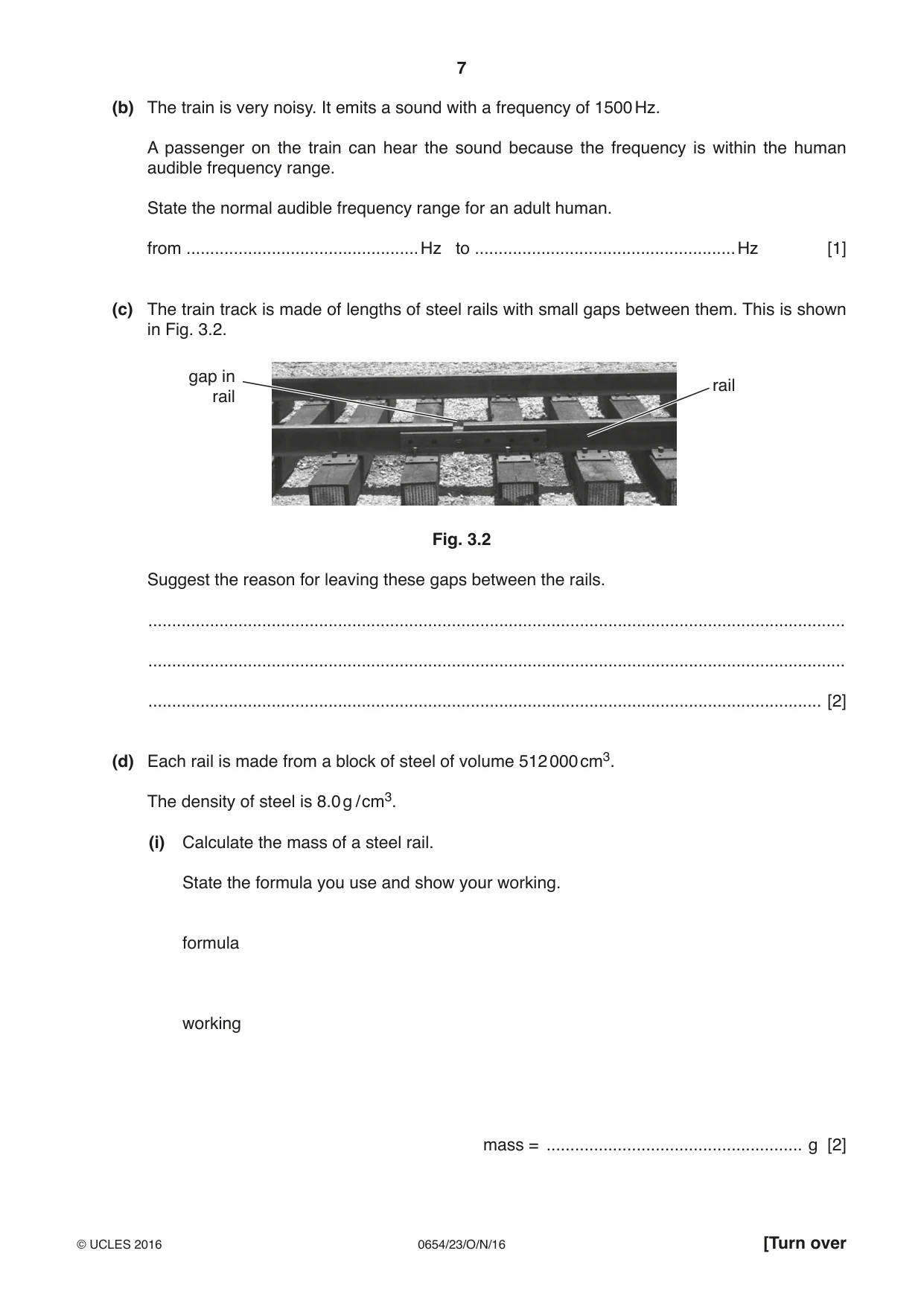
7 0654/23/O/N/16 © UCLES 2016 [Turn over (b) The train is very noisy. It emits a sound with a frequency of 1500 Hz. A passenger on the train can hear the sound because the frequency is within the human audible frequency range. State the normal audible frequency range for an adult human. from … Hz to … Hz [1] (c) The train track is made of lengths of steel rails with small gaps between them. This is shown in Fig. 3.2. gap in rail rail Fig. 3.2 Suggest the reason for leaving these gaps between the rails. … … … [2] (d) Each rail is made from a block of steel of volume 512 000 cm3. The density of steel is 8.0 g / cm3. (i) Calculate the mass of a steel rail. State the formula you use and show your working. formula working mass = … g [2]
Question paper, page 8
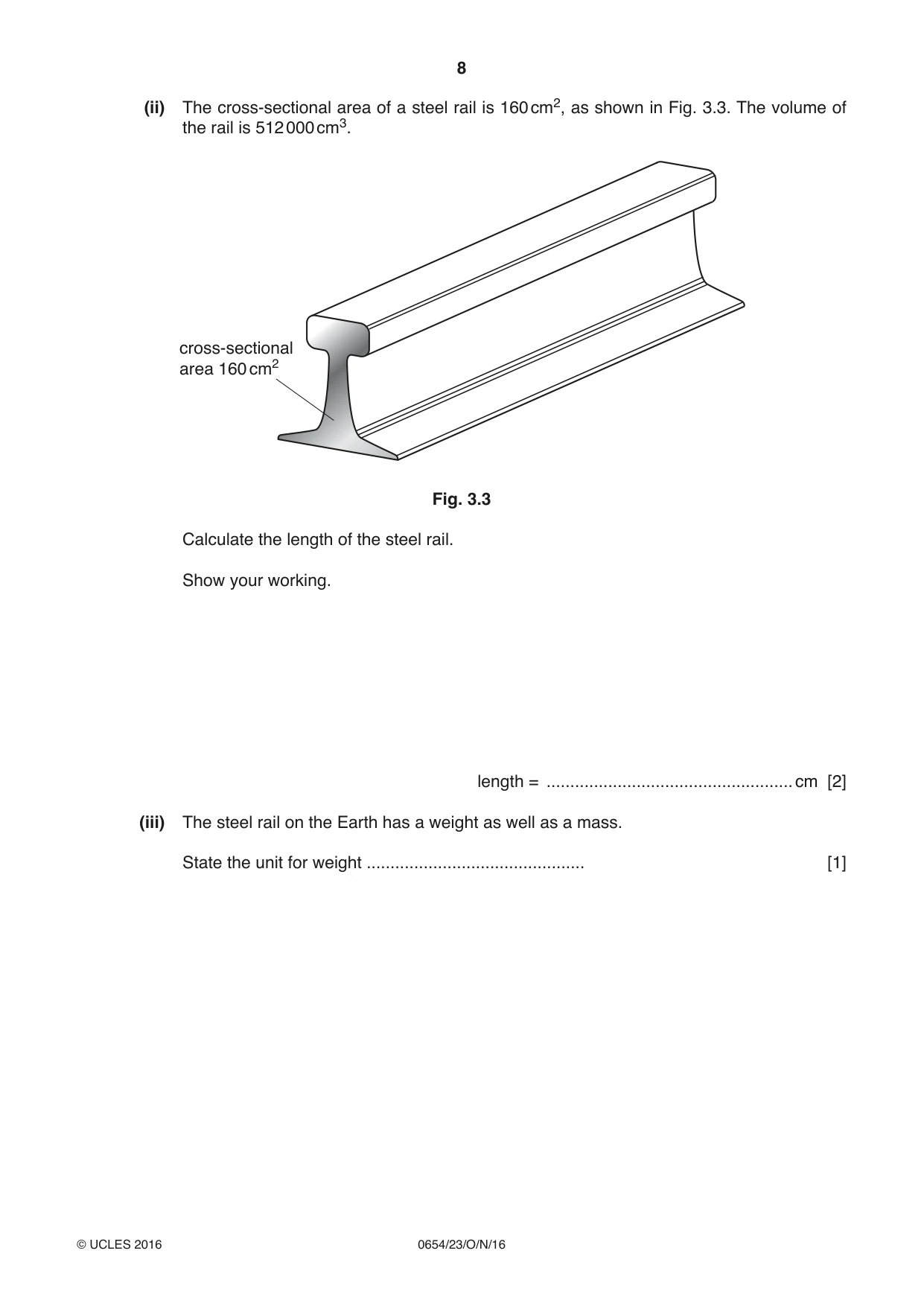
8 0654/23/O/N/16 © UCLES 2016 (ii) The cross-sectional area of a steel rail is 160 cm2, as shown in Fig. 3.3. The volume of the rail is 512 000 cm3. cross-sectional area 160 cm2 Fig. 3.3 Calculate the length of the steel rail. Show your working. length = … cm [2] (iii) The steel rail on the Earth has a weight as well as a mass. State the unit for weight … [1]
Question paper, page 9
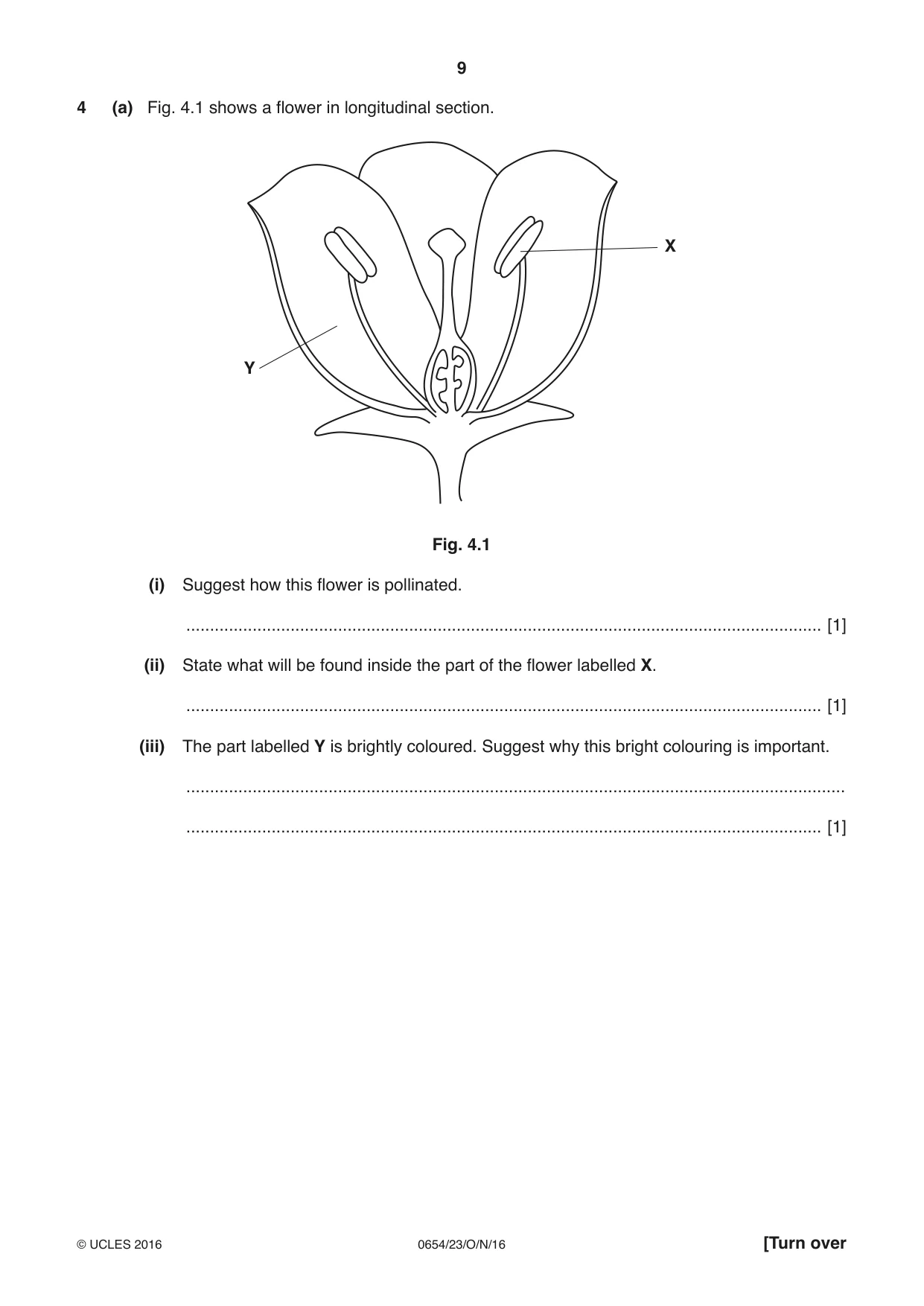
9 0654/23/O/N/16 © UCLES 2016 [Turn over 4 (a) Fig. 4.1 shows a flower in longitudinal section. X Y Fig. 4.1 (i) Suggest how this flower is pollinated. … [1] (ii) State what will be found inside the part of the flower labelled X. … [1] (iii) The part labelled Y is brightly coloured. Suggest why this bright colouring is important. … … [1]
Question paper, page 10
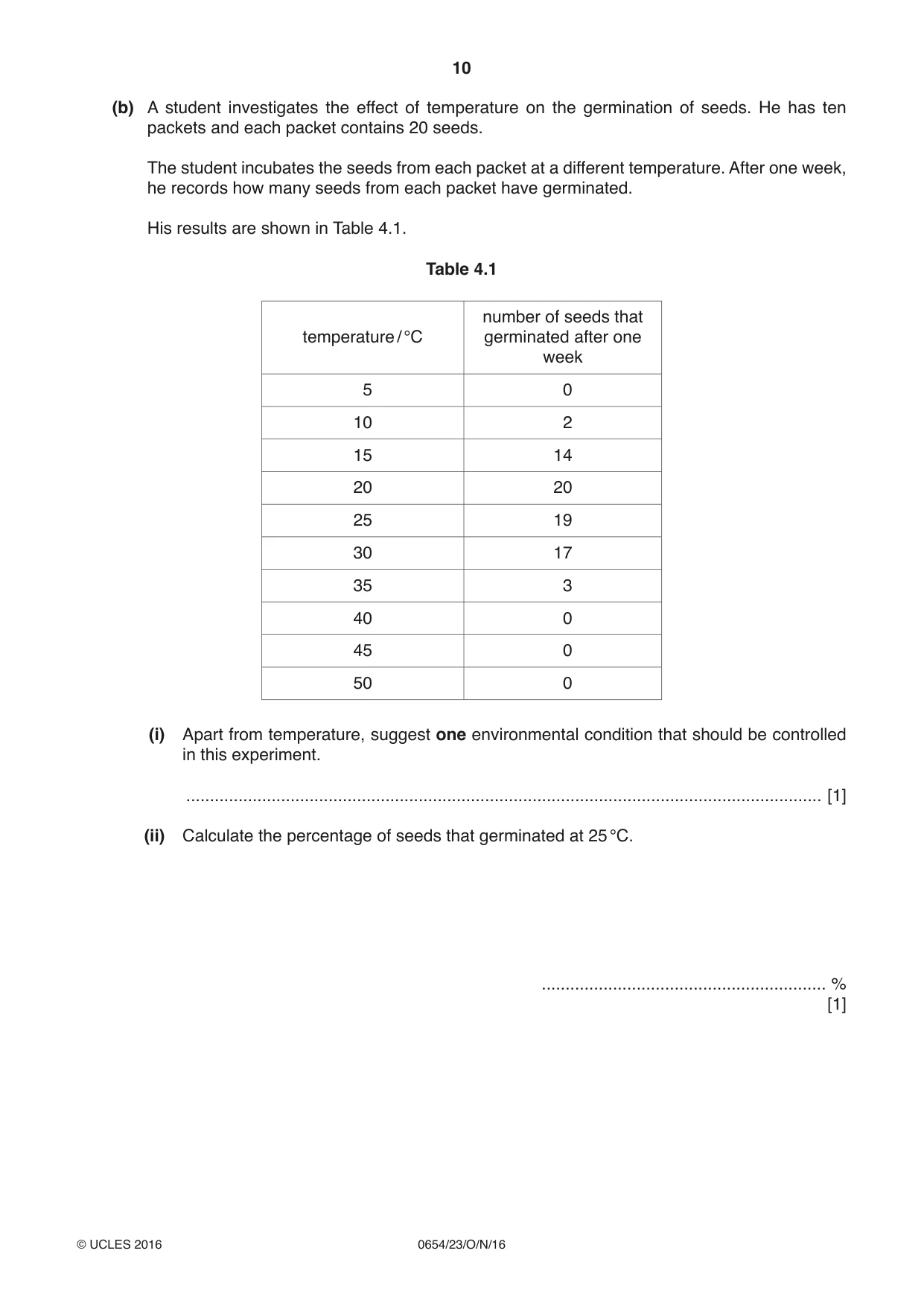
10 0654/23/O/N/16 © UCLES 2016 (b) A student investigates the effect of temperature on the germination of seeds. He has ten packets and each packet contains 20 seeds. The student incubates the seeds from each packet at a different temperature. After one week, he records how many seeds from each packet have germinated. His results are shown in Table 4.1. Table 4.1 temperature / °C number of seeds that germinated after one week 5 0 10 2 15 14 20 20 25 19 30 17 35 3 40 0 45 0 50 0 (i) Apart from temperature, suggest one environmental condition that should be controlled in this experiment. … [1] (ii) Calculate the percentage of seeds that germinated at 25 °C. … % [1]
Question paper, page 11
11 0654/23/O/N/16 © UCLES 2016 [Turn over (iii) From the results in Table 4.1, state what can be concluded about the effect of temperature on the germination of these seeds. … … … [2] (iv) Suggest one reason why temperature affects the rate of germination, as shown in Table 4.1. … … [1]
Question paper, page 12
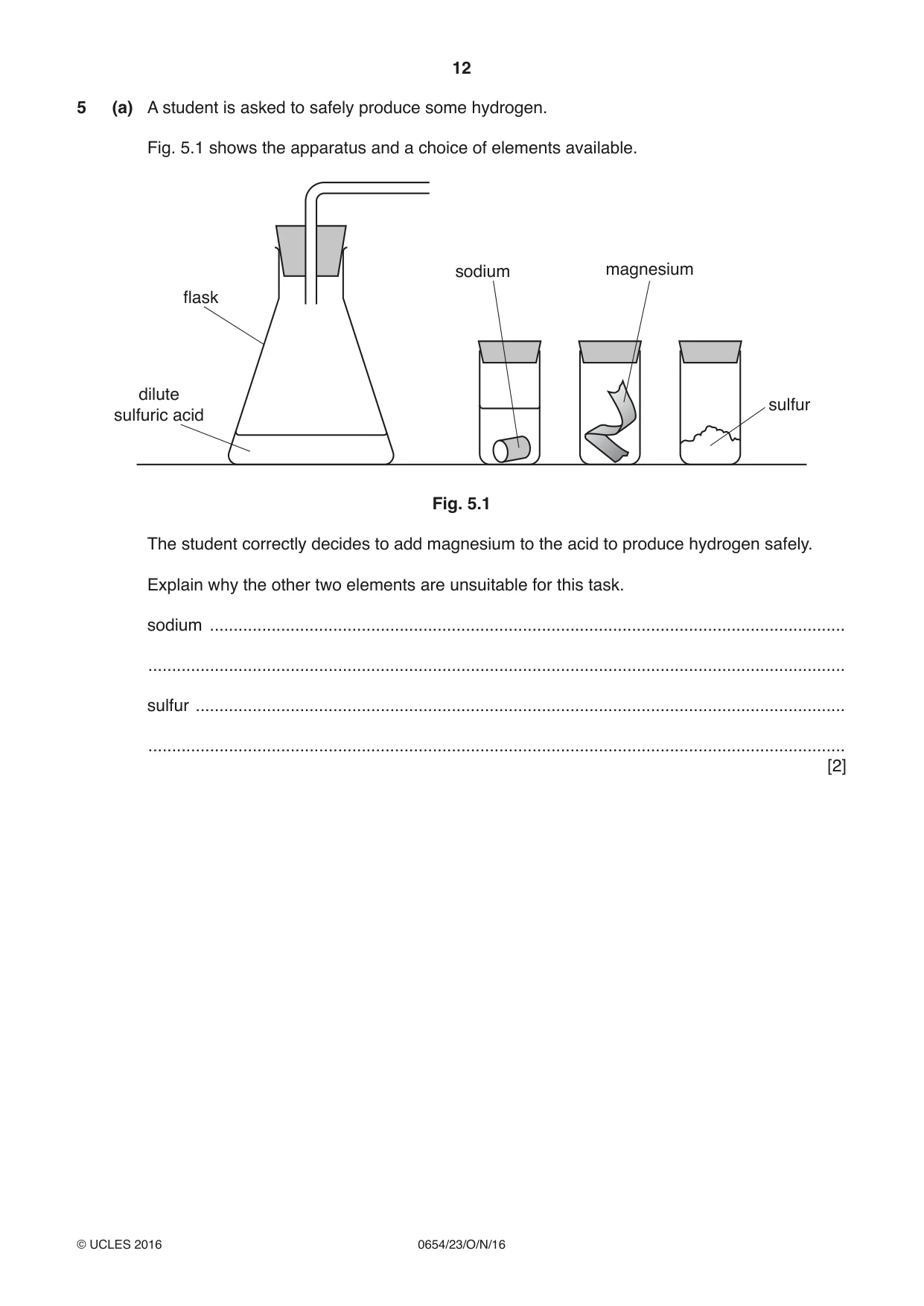
12 0654/23/O/N/16 © UCLES 2016 5 (a) A student is asked to safely produce some hydrogen. Fig. 5.1 shows the apparatus and a choice of elements available. flask dilute sulfuric acid sodium magnesium sulfur Fig. 5.1 The student correctly decides to add magnesium to the acid to produce hydrogen safely. Explain why the other two elements are unsuitable for this task. sodium … … sulfur … … [2]
Question paper, page 13
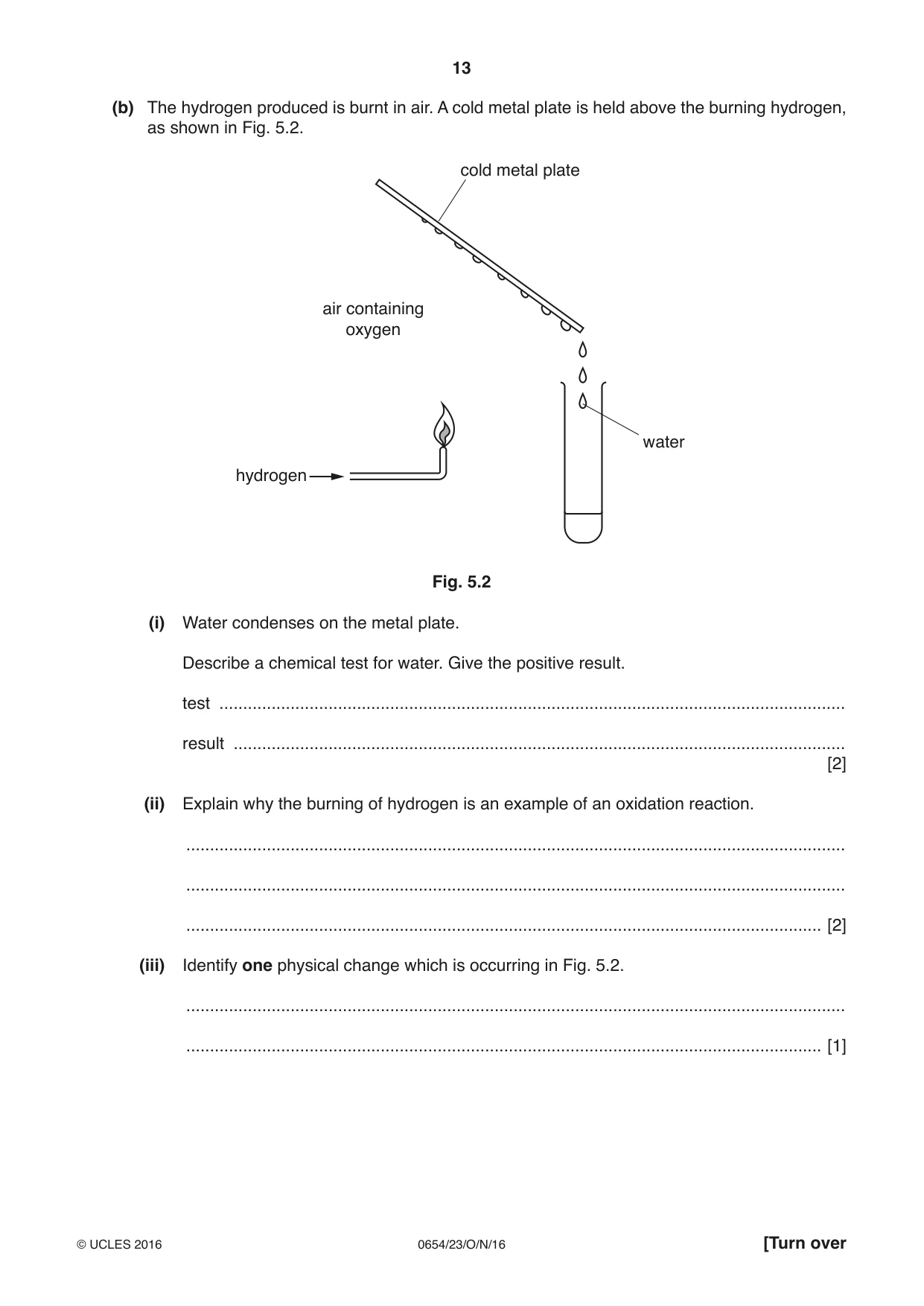
13 0654/23/O/N/16 © UCLES 2016 [Turn over (b) The hydrogen produced is burnt in air. A cold metal plate is held above the burning hydrogen, as shown in Fig. 5.2. hydrogen air containing oxygen water cold metal plate Fig. 5.2 (i) Water condenses on the metal plate. Describe a chemical test for water. Give the positive result. test … result … [2] (ii) Explain why the burning of hydrogen is an example of an oxidation reaction. … … … [2] (iii) Identify one physical change which is occurring in Fig. 5.2. … … [1]
Question paper, page 14
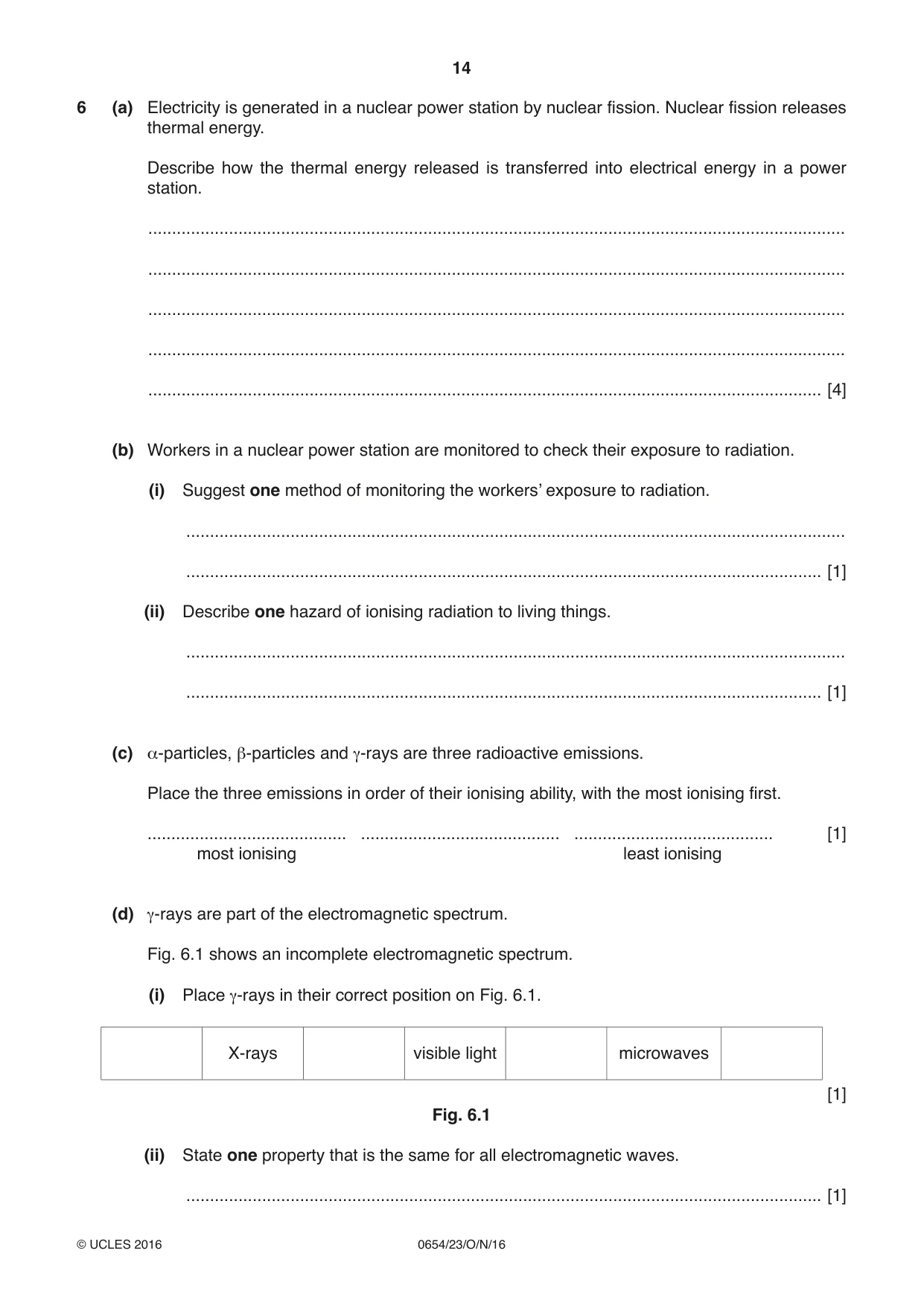
14 0654/23/O/N/16 © UCLES 2016 6 (a) Electricity is generated in a nuclear power station by nuclear fission. Nuclear fission releases thermal energy. Describe how the thermal energy released is transferred into electrical energy in a power station. … … … … … [4] (b) Workers in a nuclear power station are monitored to check their exposure to radiation. (i) Suggest one method of monitoring the workers’ exposure to radiation. … … [1] (ii) Describe one hazard of ionising radiation to living things. … … [1] (c) α-particles, β-particles and γ-rays are three radioactive emissions. Place the three emissions in order of their ionising ability, with the most ionising first. … … … [1] most ionising least ionising (d) γ-rays are part of the electromagnetic spectrum. Fig. 6.1 shows an incomplete electromagnetic spectrum. (i) Place γ-rays in their correct position on Fig. 6.1. X-rays visible light microwaves [1] Fig. 6.1 (ii) State one property that is the same for all electromagnetic waves. … [1]
Question paper, page 15
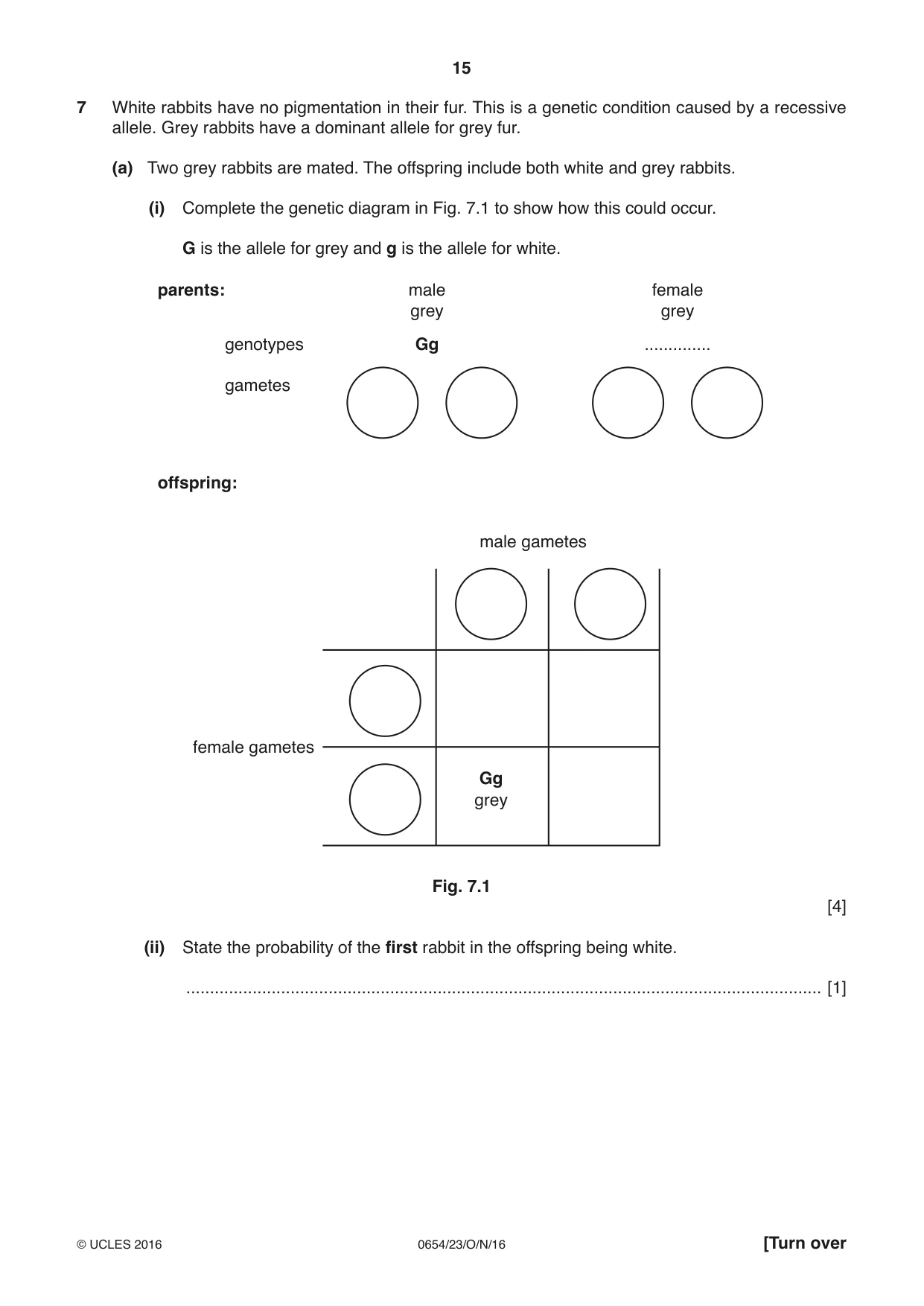
15 0654/23/O/N/16 © UCLES 2016 [Turn over 7 White rabbits have no pigmentation in their fur. This is a genetic condition caused by a recessive allele. Grey rabbits have a dominant allele for grey fur. (a) Two grey rabbits are mated. The offspring include both white and grey rabbits. (i) Complete the genetic diagram in Fig. 7.1 to show how this could occur. G is the allele for grey and g is the allele for white. parents: offspring: Gg Gg genotypes gametes female gametes male gametes male grey grey female grey … Fig. 7.1 [4] (ii) State the probability of the first rabbit in the offspring being white. … [1]
Question paper, page 16
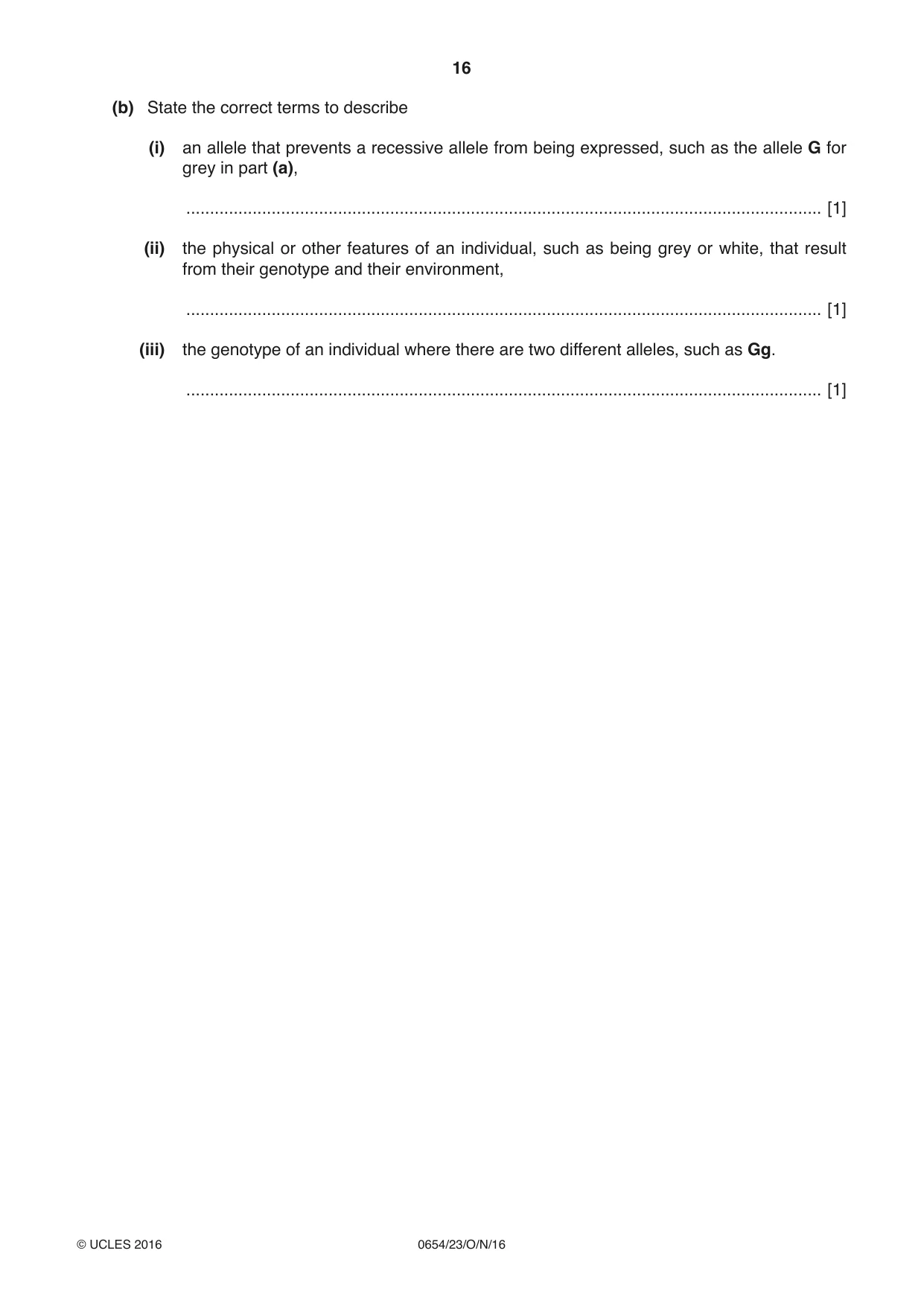
16 0654/23/O/N/16 © UCLES 2016 (b) State the correct terms to describe (i) an allele that prevents a recessive allele from being expressed, such as the allele G for grey in part (a), … [1] (ii) the physical or other features of an individual, such as being grey or white, that result from their genotype and their environment, … [1] (iii) the genotype of an individual where there are two different alleles, such as Gg. … [1]
Question paper, page 17
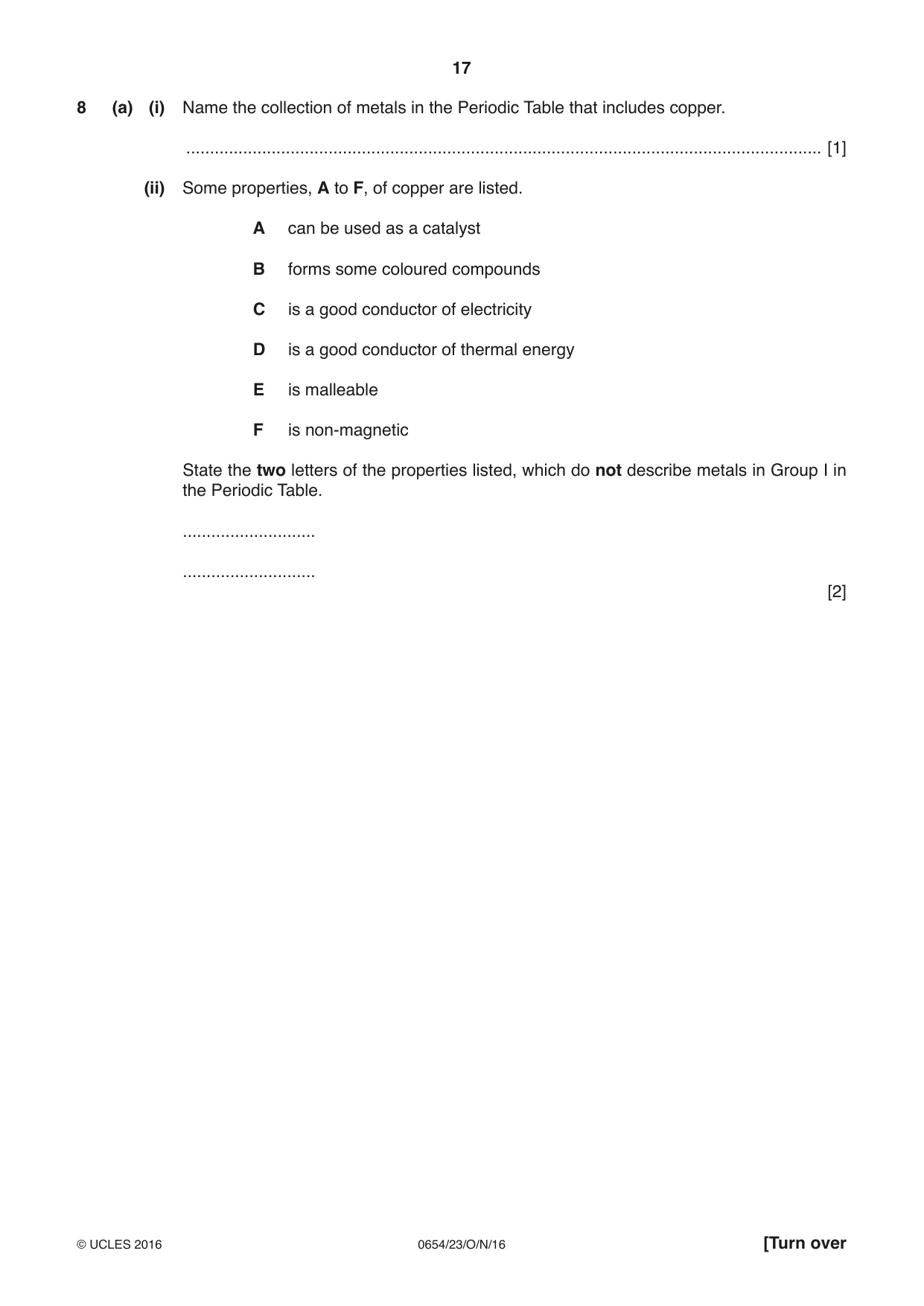
17 0654/23/O/N/16 © UCLES 2016 [Turn over 8 (a) (i) Name the collection of metals in the Periodic Table that includes copper. … [1] (ii) Some properties, A to F, of copper are listed. A can be used as a catalyst B forms some coloured compounds C is a good conductor of electricity D is a good conductor of thermal energy E is malleable F is non-magnetic State the two letters of the properties listed, which do not describe metals in Group I in the Periodic Table. … … [2]
Question paper, page 18
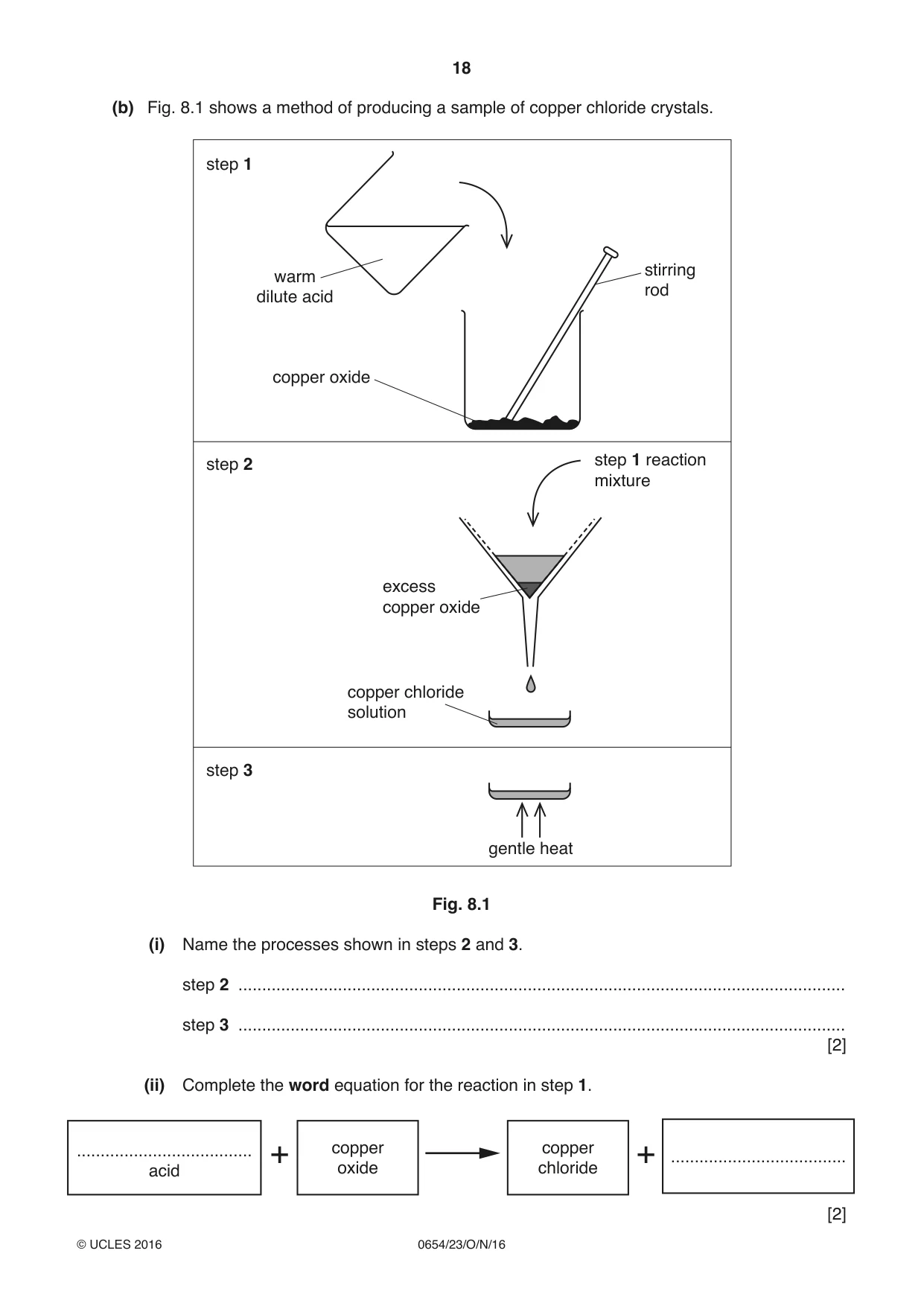
18 0654/23/O/N/16 © UCLES 2016 (b) Fig. 8.1 shows a method of producing a sample of copper chloride crystals. stirring rod warm dilute acid copper oxide step 1 step 2 step 3 gentle heat step 1 reaction mixture excess copper oxide copper chloride solution Fig. 8.1 (i) Name the processes shown in steps 2 and 3. step 2 … step 3 … [2] (ii) Complete the word equation for the reaction in step 1. … acid … copper oxide copper chloride + + [2]
Question paper, page 19
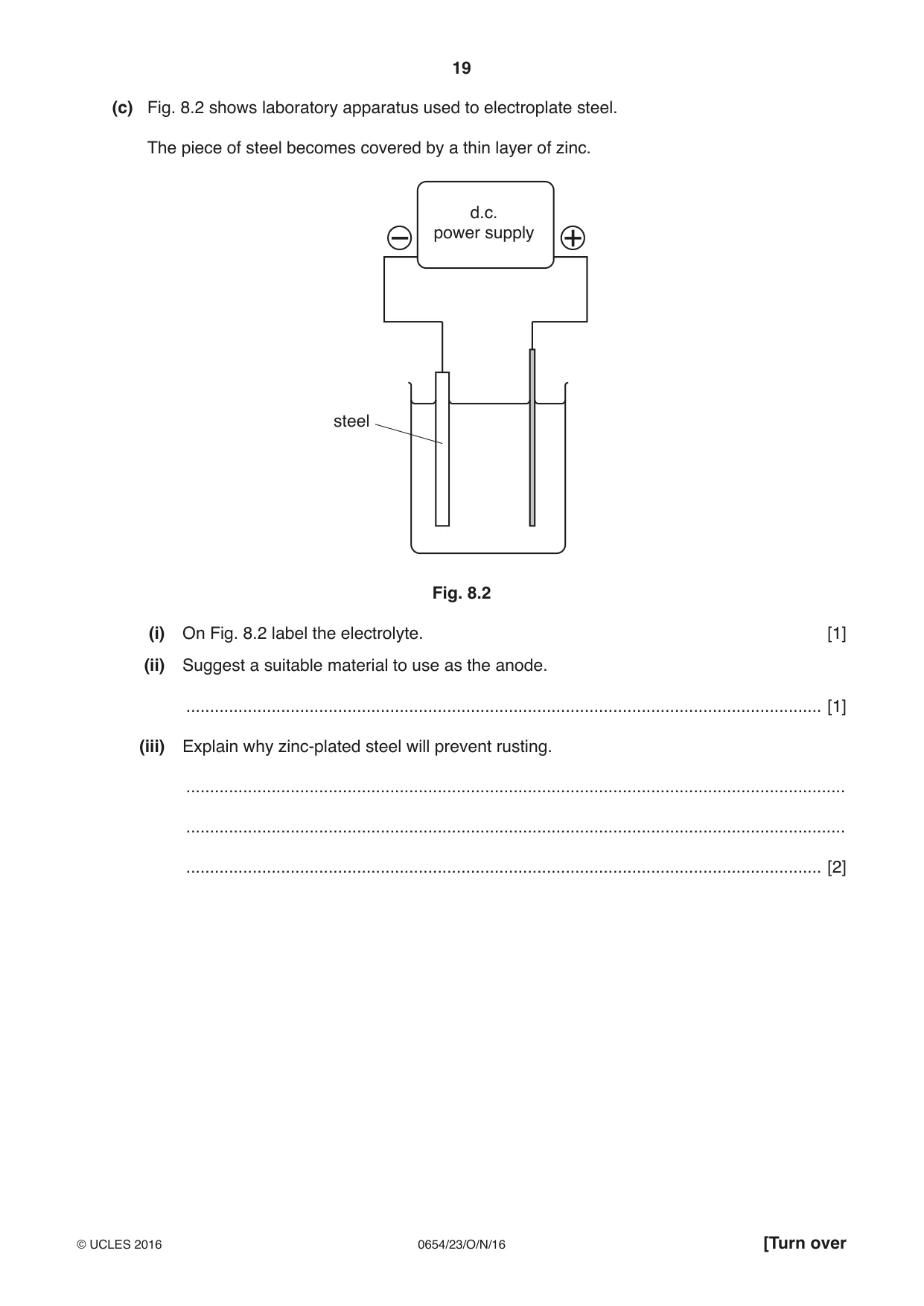
19 0654/23/O/N/16 © UCLES 2016 [Turn over (c) Fig. 8.2 shows laboratory apparatus used to electroplate steel. The piece of steel becomes covered by a thin layer of zinc. − + d.c. power supply steel Fig. 8.2 (i) On Fig. 8.2 label the electrolyte. [1] (ii) Suggest a suitable material to use as the anode. … [1] (iii) Explain why zinc-plated steel will prevent rusting. … … … [2]
Question paper, page 20
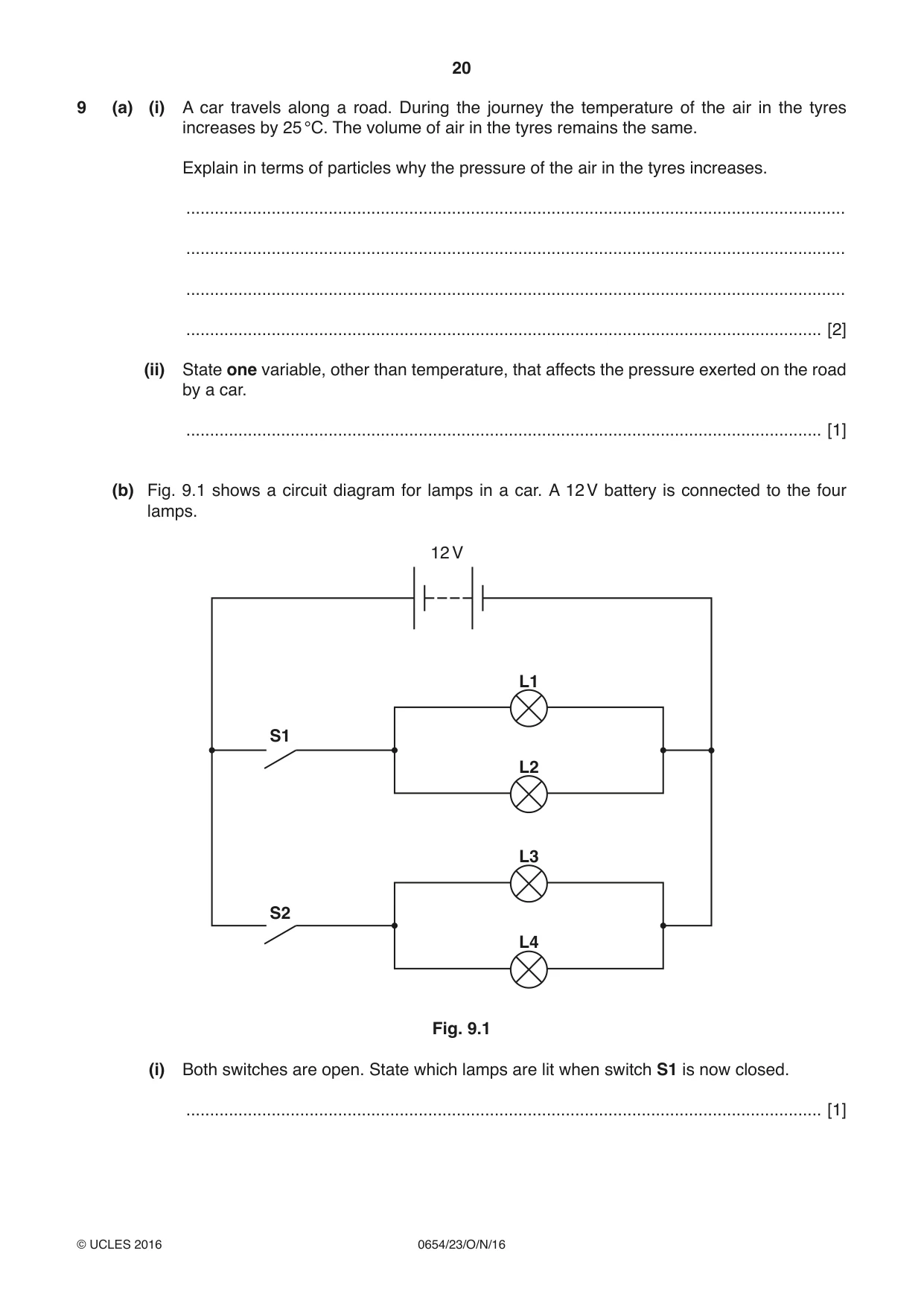
20 0654/23/O/N/16 © UCLES 2016 9 (a) (i) A car travels along a road. During the journey the temperature of the air in the tyres increases by 25 °C. The volume of air in the tyres remains the same. Explain in terms of particles why the pressure of the air in the tyres increases. … … … … [2] (ii) State one variable, other than temperature, that affects the pressure exerted on the road by a car. … [1] (b) Fig. 9.1 shows a circuit diagram for lamps in a car. A 12 V battery is connected to the four lamps. 12 V L1 S1 S2 L2 L3 L4 Fig. 9.1 (i) Both switches are open. State which lamps are lit when switch S1 is now closed. … [1]
Question paper, page 21
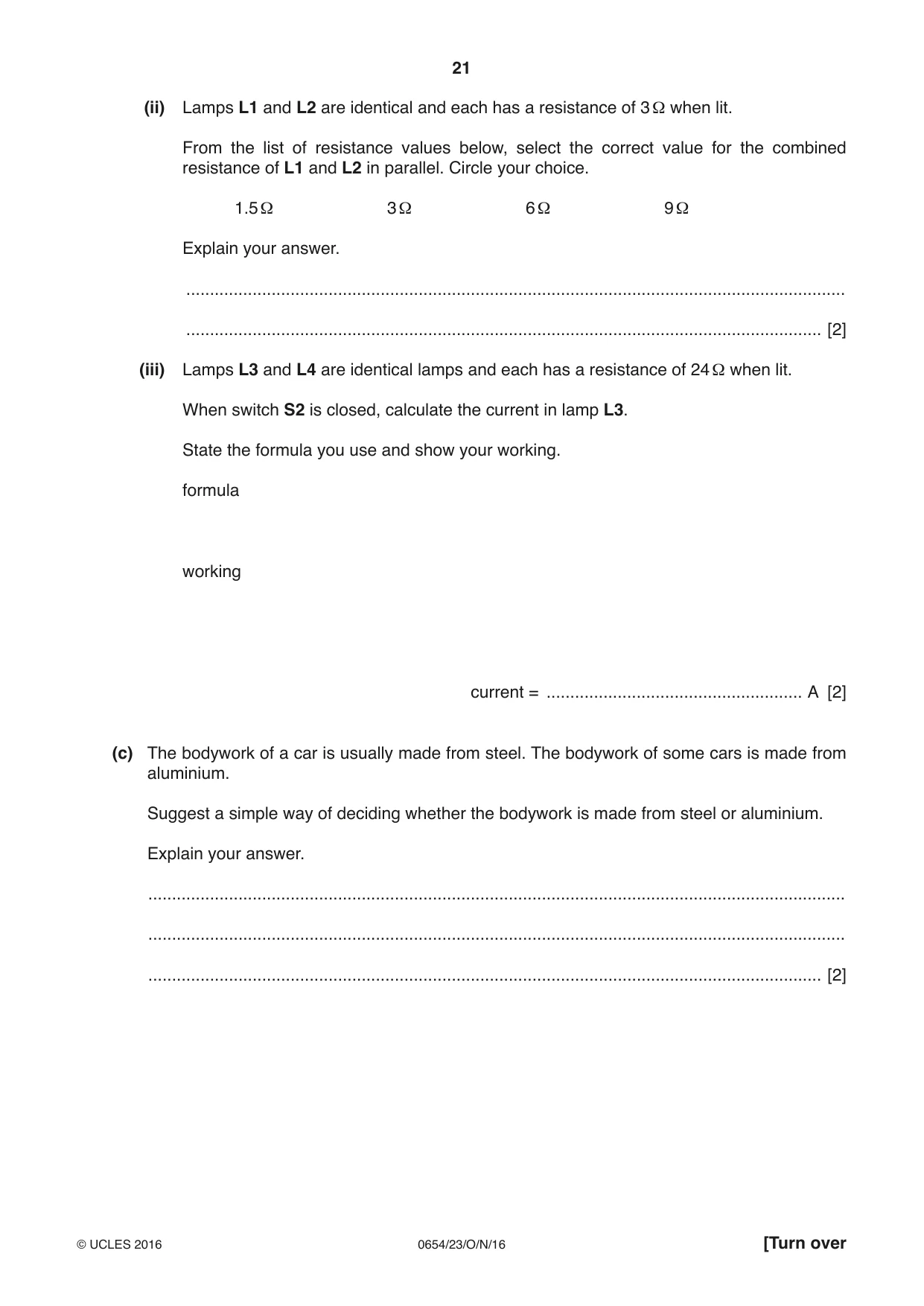
21 0654/23/O/N/16 © UCLES 2016 [Turn over (ii) Lamps L1 and L2 are identical and each has a resistance of 3 Ω when lit. From the list of resistance values below, select the correct value for the combined resistance of L1 and L2 in parallel. Circle your choice. 1.5 Ω 3 Ω 6 Ω 9 Ω Explain your answer. … … [2] (iii) Lamps L3 and L4 are identical lamps and each has a resistance of 24 Ω when lit. When switch S2 is closed, calculate the current in lamp L3. State the formula you use and show your working. formula working current = … A [2] (c) The bodywork of a car is usually made from steel. The bodywork of some cars is made from aluminium. Suggest a simple way of deciding whether the bodywork is made from steel or aluminium. Explain your answer. … … … [2]
Question paper, page 22
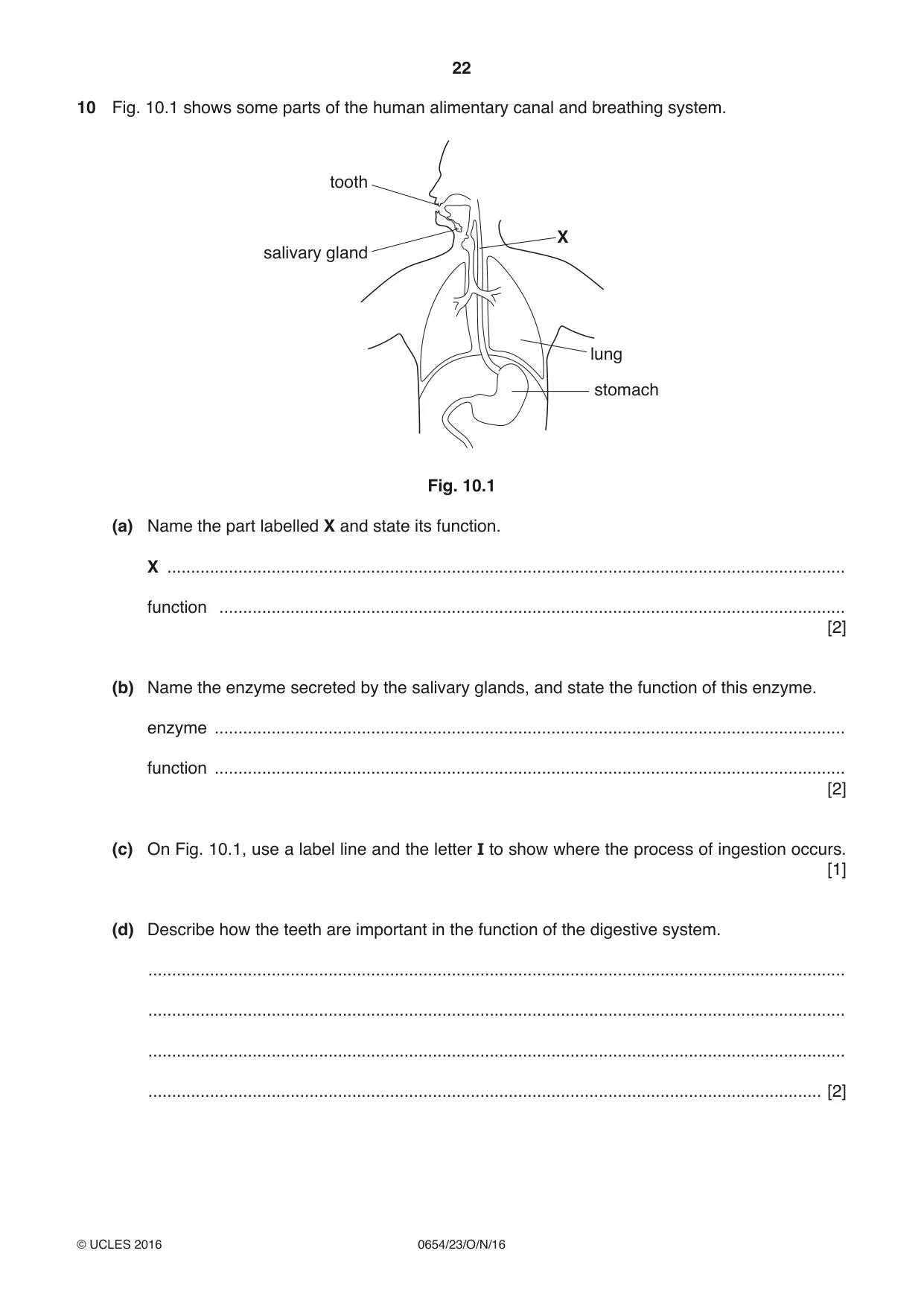
22 0654/23/O/N/16 © UCLES 2016 10 Fig. 10.1 shows some parts of the human alimentary canal and breathing system. tooth salivary gland lung stomach X Fig. 10.1 (a) Name the part labelled X and state its function. X … function … [2] (b) Name the enzyme secreted by the salivary glands, and state the function of this enzyme. enzyme … function … [2] (c) On Fig. 10.1, use a label line and the letter I to show where the process of ingestion occurs. [1] (d) Describe how the teeth are important in the function of the digestive system. … … … … [2]
Question paper, page 23
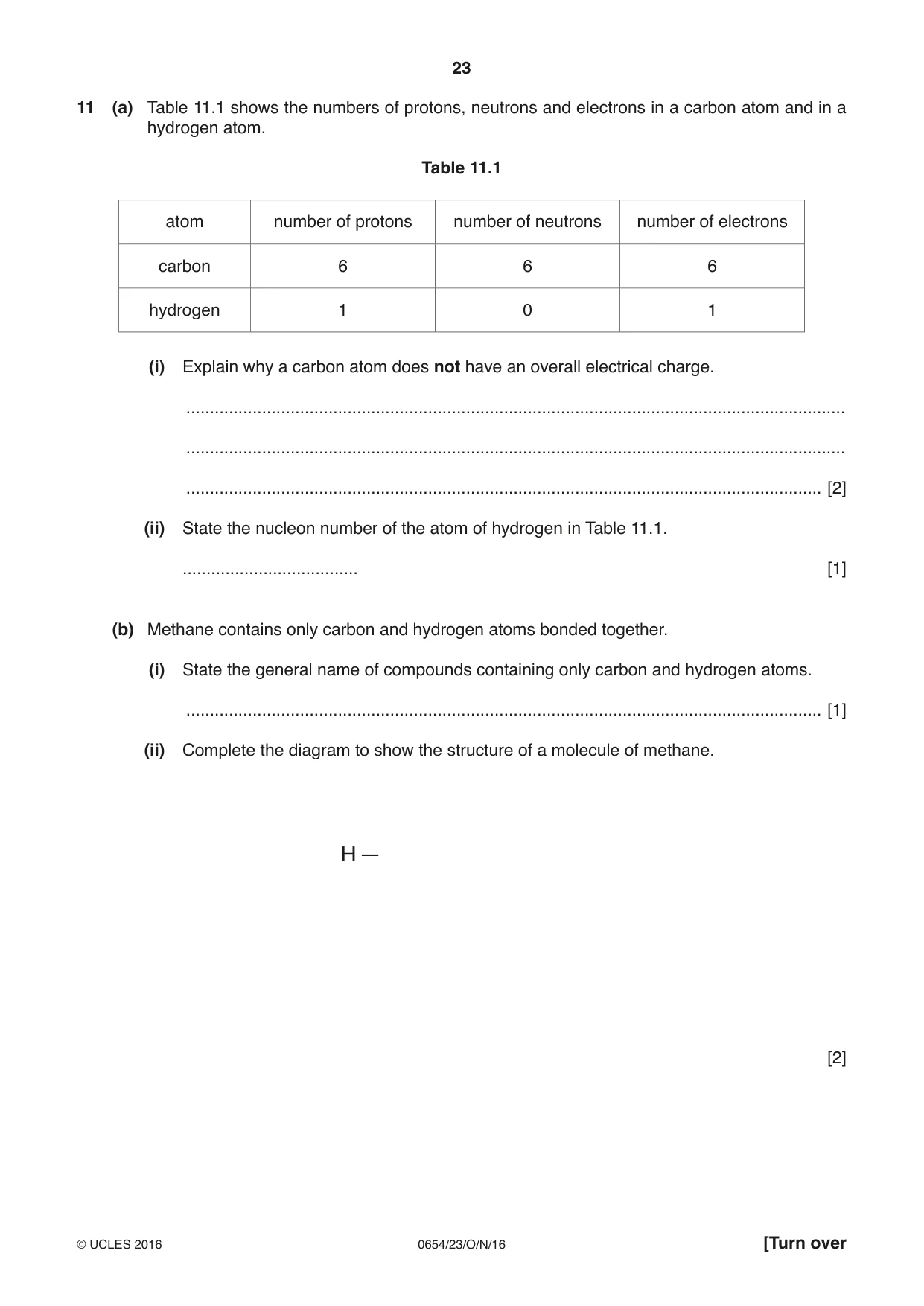
23 0654/23/O/N/16 © UCLES 2016 [Turn over 11 (a) Table 11.1 shows the numbers of protons, neutrons and electrons in a carbon atom and in a hydrogen atom. Table 11.1 atom number of protons number of neutrons number of electrons carbon 6 6 6 hydrogen 1 0 1 (i) Explain why a carbon atom does not have an overall electrical charge. … … … [2] (ii) State the nucleon number of the atom of hydrogen in Table 11.1. … [1] (b) Methane contains only carbon and hydrogen atoms bonded together. (i) State the general name of compounds containing only carbon and hydrogen atoms. … [1] (ii) Complete the diagram to show the structure of a molecule of methane. H — [2]
Question paper, page 24
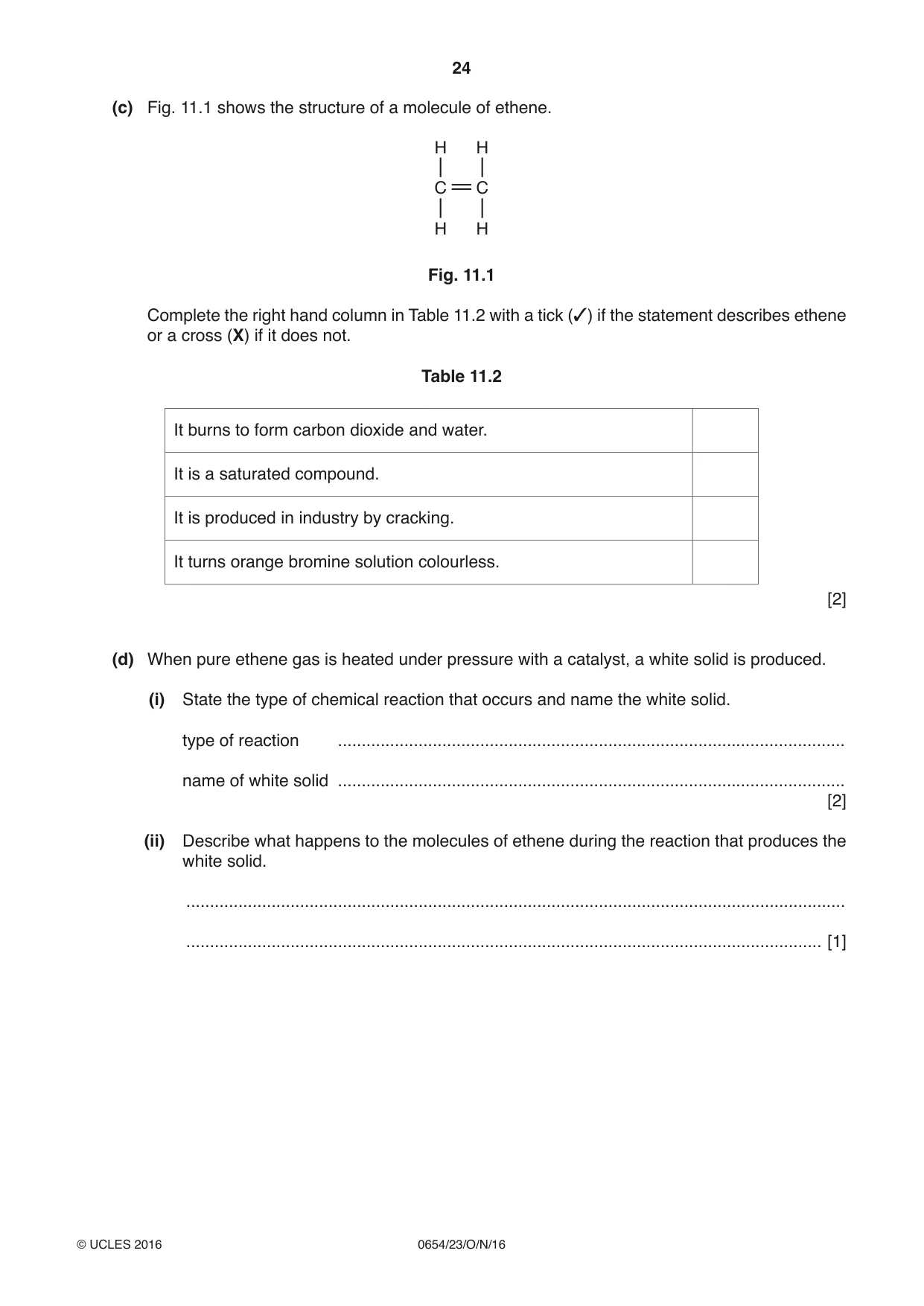
24 0654/23/O/N/16 © UCLES 2016 (c) Fig. 11.1 shows the structure of a molecule of ethene. H H H H C C Fig. 11.1 Complete the right hand column in Table 11.2 with a tick (✓) if the statement describes ethene or a cross (X) if it does not. Table 11.2 It burns to form carbon dioxide and water. It is a saturated compound. It is produced in industry by cracking. It turns orange bromine solution colourless. [2] (d) When pure ethene gas is heated under pressure with a catalyst, a white solid is produced. (i) State the type of chemical reaction that occurs and name the white solid. type of reaction … name of white solid … [2] (ii) Describe what happens to the molecules of ethene during the reaction that produces the white solid. … … [1]
Question paper, page 25
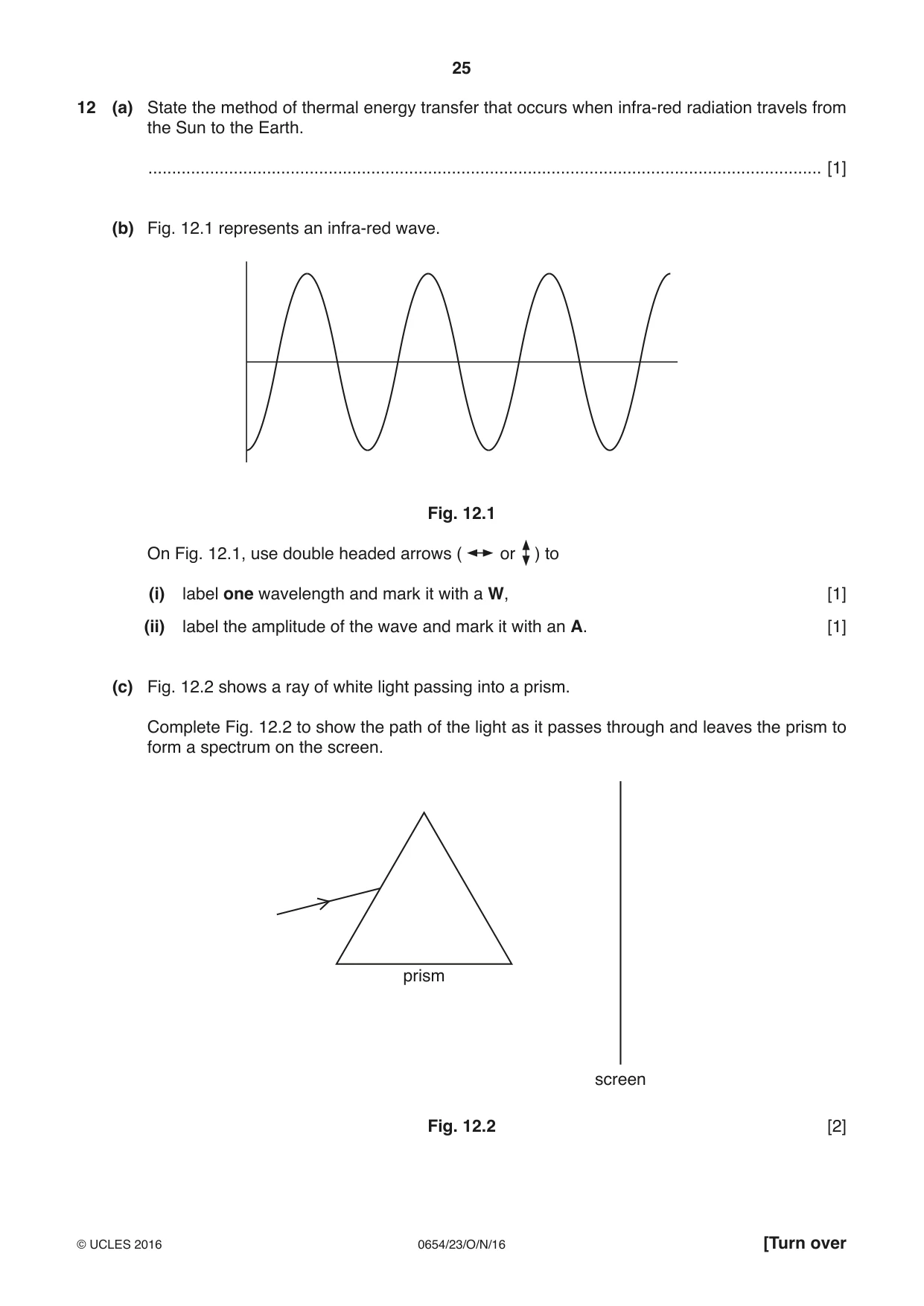
25 0654/23/O/N/16 © UCLES 2016 [Turn over 12 (a) State the method of thermal energy transfer that occurs when infra-red radiation travels from the Sun to the Earth. … [1] (b) Fig. 12.1 represents an infra-red wave. Fig. 12.1 On Fig. 12.1, use double headed arrows ( or ) to (i) label one wavelength and mark it with a W, [1] (ii) label the amplitude of the wave and mark it with an A. [1] (c) Fig. 12.2 shows a ray of white light passing into a prism. Complete Fig. 12.2 to show the path of the light as it passes through and leaves the prism to form a spectrum on the screen. prism screen Fig. 12.2 [2]
Question paper, page 26
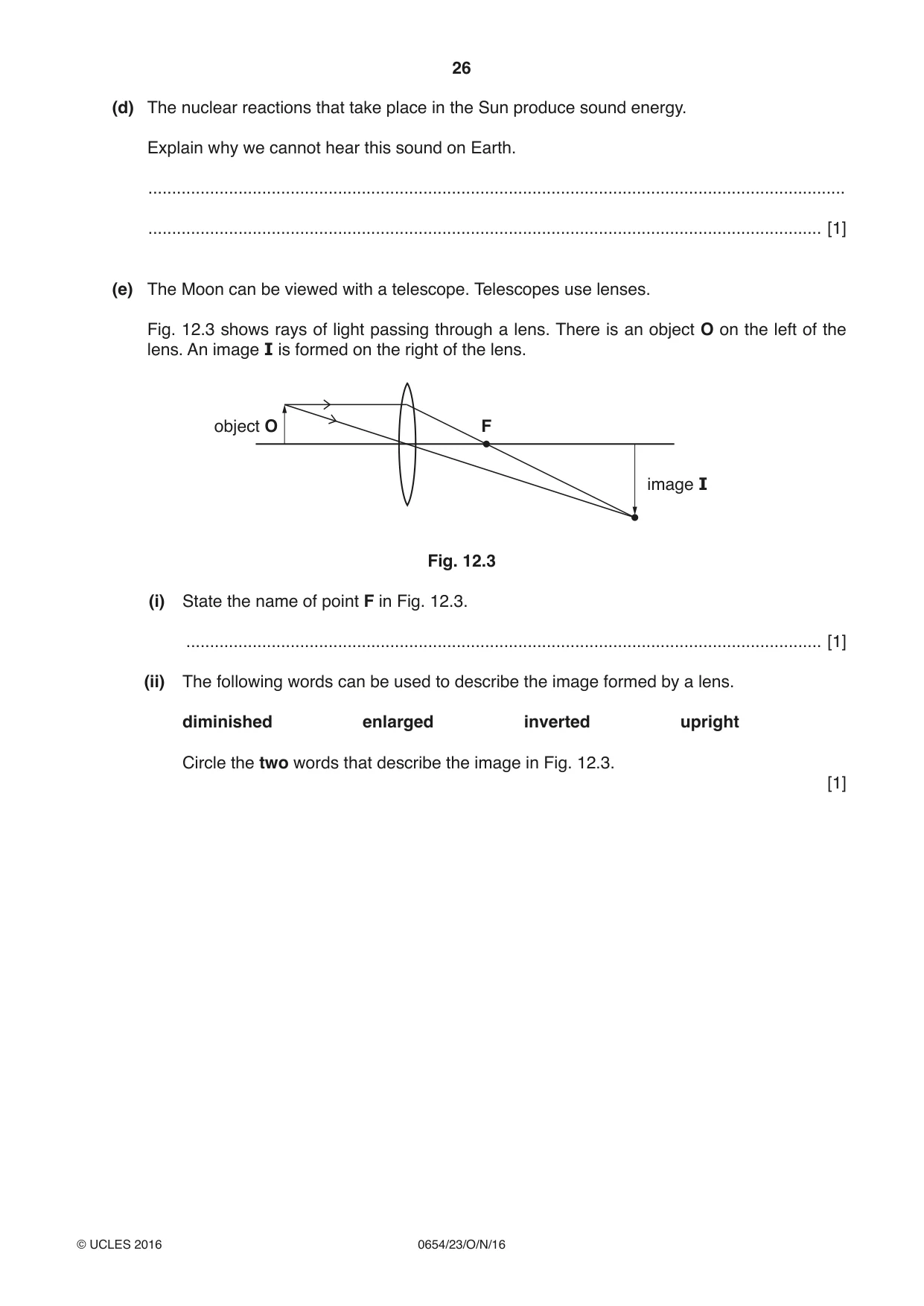
26 0654/23/O/N/16 © UCLES 2016 (d) The nuclear reactions that take place in the Sun produce sound energy. Explain why we cannot hear this sound on Earth. … … [1] (e) The Moon can be viewed with a telescope. Telescopes use lenses. Fig. 12.3 shows rays of light passing through a lens. There is an object O on the left of the lens. An image I is formed on the right of the lens. object O F image I Fig. 12.3 (i) State the name of point F in Fig. 12.3. … [1] (ii) The following words can be used to describe the image formed by a lens. diminished enlarged inverted upright Circle the two words that describe the image in Fig. 12.3. [1]
Question paper, page 27
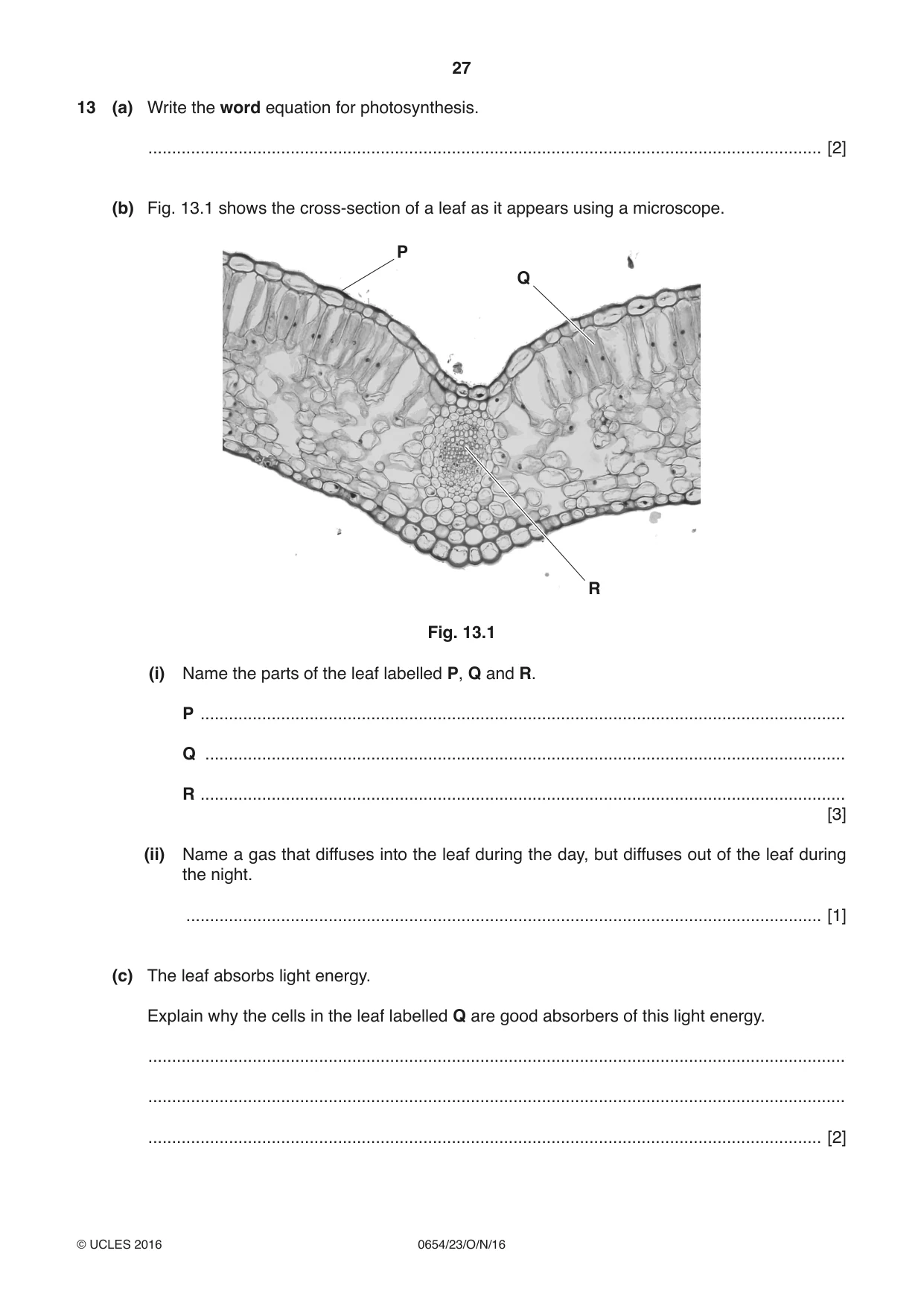
27 0654/23/O/N/16 © UCLES 2016 13 (a) Write the word equation for photosynthesis. … [2] (b) Fig. 13.1 shows the cross-section of a leaf as it appears using a microscope. P Q R Fig. 13.1 (i) Name the parts of the leaf labelled P, Q and R. P … Q … R … [3] (ii) Name a gas that diffuses into the leaf during the day, but diffuses out of the leaf during the night. … [1] (c) The leaf absorbs light energy. Explain why the cells in the leaf labelled Q are good absorbers of this light energy. … … … [2]
Question paper, page 28
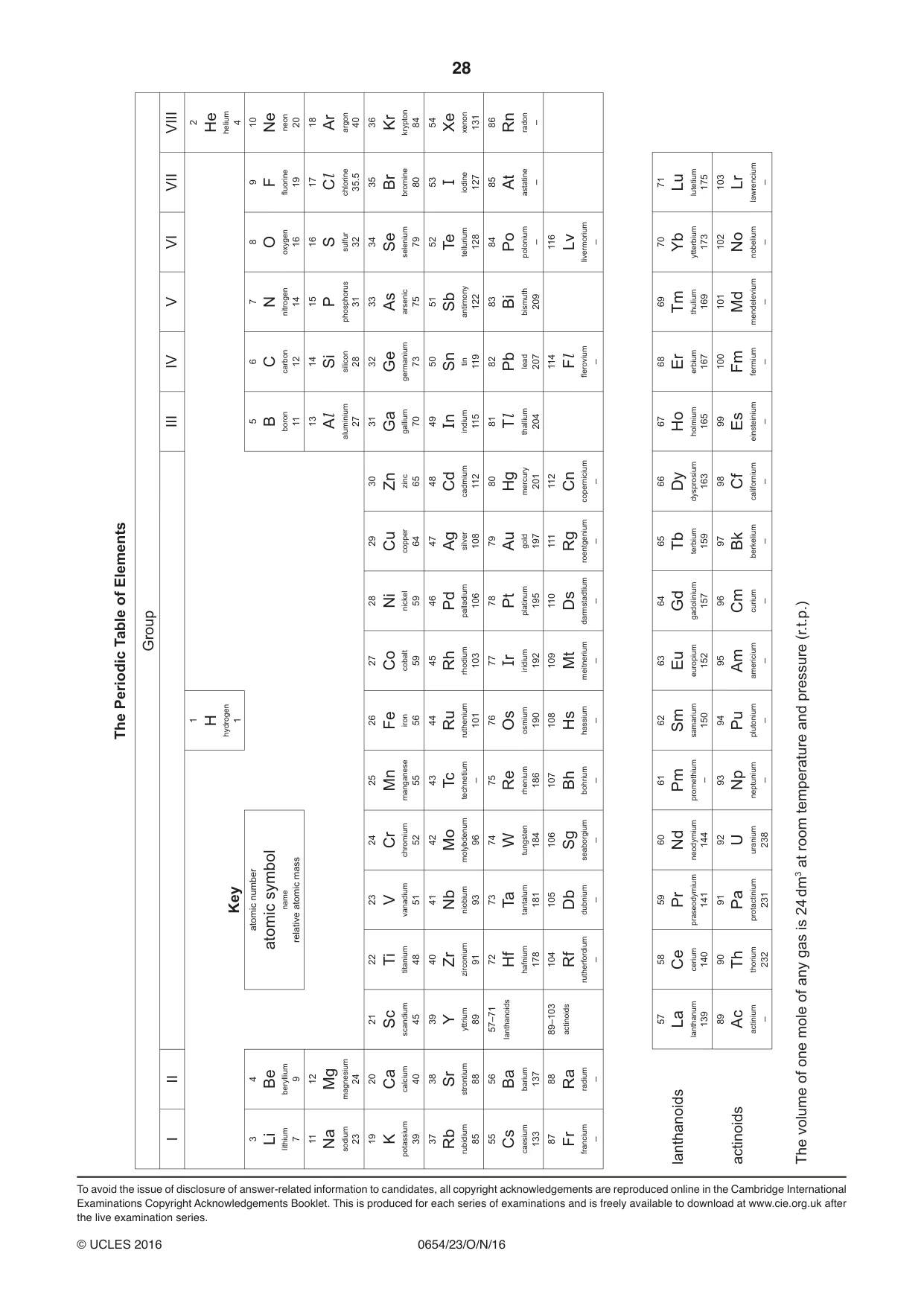
28 0654/23/O/N/16 © UCLES 2016 To avoid the issue of disclosure of answer-related information to candidates, all copyright acknowledgements are reproduced online in the Cambridge International Examinations Copyright Acknowledgements Booklet. This is produced for each series of examinations and is freely available to download at www.cie.org.uk after the live examination series. Group The Periodic Table of Elements 1 H hydrogen 1 2 He helium 4 I II III IV V VI VII VIII 3 Li lithium 7 4 Be beryllium 9 atomic number atomic symbol Key name relative atomic mass 11 Na sodium 23 12 Mg magnesium 24 19 K potassium 39 20 Ca calcium 40 37 Rb rubidium 85 38 Sr strontium 88 55 Cs caesium 133 56 Ba barium 137 87 Fr francium – 88 Ra radium – 5 B boron 11 13 Al aluminium 27 31 Ga gallium 70 49 In indium 115 81 Tl thallium 204 6 C carbon 12 14 Si silicon 28 32 Ge germanium 73 50 Sn tin 119 82 Pb lead 207 22 Ti titanium 48 40 Zr zirconium 91 72 Hf hafnium 178 104 Rf rutherfordium – 23 V vanadium 51 41 Nb niobium 93 73 Ta tantalum 181 105 Db dubnium – 24 Cr chromium 52 42 Mo molybdenum 96 74 W tungsten 184 106 Sg seaborgium – 25 Mn manganese 55 43 Tc technetium – 75 Re rhenium 186 107 Bh bohrium – 26 Fe iron 56 44 Ru ruthenium 101 76 Os osmium 190 108 Hs hassium – 27 Co cobalt 59 45 Rh rhodium 103 77 Ir iridium 192 109 Mt meitnerium – 28 Ni nickel 59 46 Pd palladium 106 78 Pt platinum 195 110 Ds darmstadtium – 29 Cu copper 64 47 Ag silver 108 79 Au gold 197 111 Rg roentgenium – 30 Zn zinc 65 48 Cd cadmium 112 80 Hg mercury 201 112 Cn copernicium – 114 Fl flerovium – 116 Lv livermorium – 7 N nitrogen 14 15 P phosphorus 31 33 As arsenic 75 51 Sb antimony 122 83 Bi bismuth 209 8 O oxygen 16 16 S sulfur 32 34 Se selenium 79 52 Te tellurium 128 84 Po polonium – 9 F fluorine 19 17 Cl chlorine 35.5 35 Br bromine 80 53 I iodine 127 85 At astatine – 10 Ne neon 20 18 Ar argon 40 36 Kr krypton 84 54 Xe xenon 131 86 Rn radon – 21 Sc scandium 45 39 Y yttrium 89 57–71 lanthanoids 89–103 actinoids 57 La lanthanum 139 89 Ac lanthanoids actinoids The volume of one mole of any gas is 24 dm3 at room temperature and pressure (r.t.p.) actinium – 58 Ce cerium 140 90 Th thorium 232 59 Pr praseodymium 141 91 Pa protactinium 231 60 Nd neodymium 144 92 U uranium 238 61 Pm promethium – 93 Np neptunium – 62 Sm samarium 150 94 Pu plutonium – 63 Eu europium 152 95 Am americium – 64 Gd gadolinium 157 96 Cm curium – 65 Tb terbium 159 97 Bk berkelium – 66 Dy dysprosium 163 98 Cf californium – 67 Ho holmium 165 99 Es einsteinium – 68 Er erbium 167 100 Fm fermium – 69 Tm thulium 169 101 Md mendelevium – 70 Yb ytterbium 173 102 No nobelium – 71 Lu lutetium 175 103 Lr lawrencium –
Mark scheme, page 1
® IGCSE is the registered trademark of Cambridge International Examinations. This document consists of 11 printed pages. © UCLES 2016 [Turn over Cambridge International Examinations Cambridge International General Certificate of Secondary Education CO-ORDINATED SCIENCES 0654/23 Paper 2 Core Theory October/November 2016 MARK SCHEME Maximum Mark: 120 Published This mark scheme is published as an aid to teachers and candidates, to indicate the requirements of the examination. It shows the basis on which Examiners were instructed to award marks. It does not indicate the details of the discussions that took place at an Examiners’ meeting before marking began, which would have considered the acceptability of alternative answers. Mark schemes should be read in conjunction with the question paper and the Principal Examiner Report for Teachers. Cambridge will not enter into discussions about these mark schemes. Cambridge is publishing the mark schemes for the October/November 2016 series for most Cambridge IGCSE®, Cambridge International A and AS Level components and some Cambridge O Level components.
Mark scheme, page 2
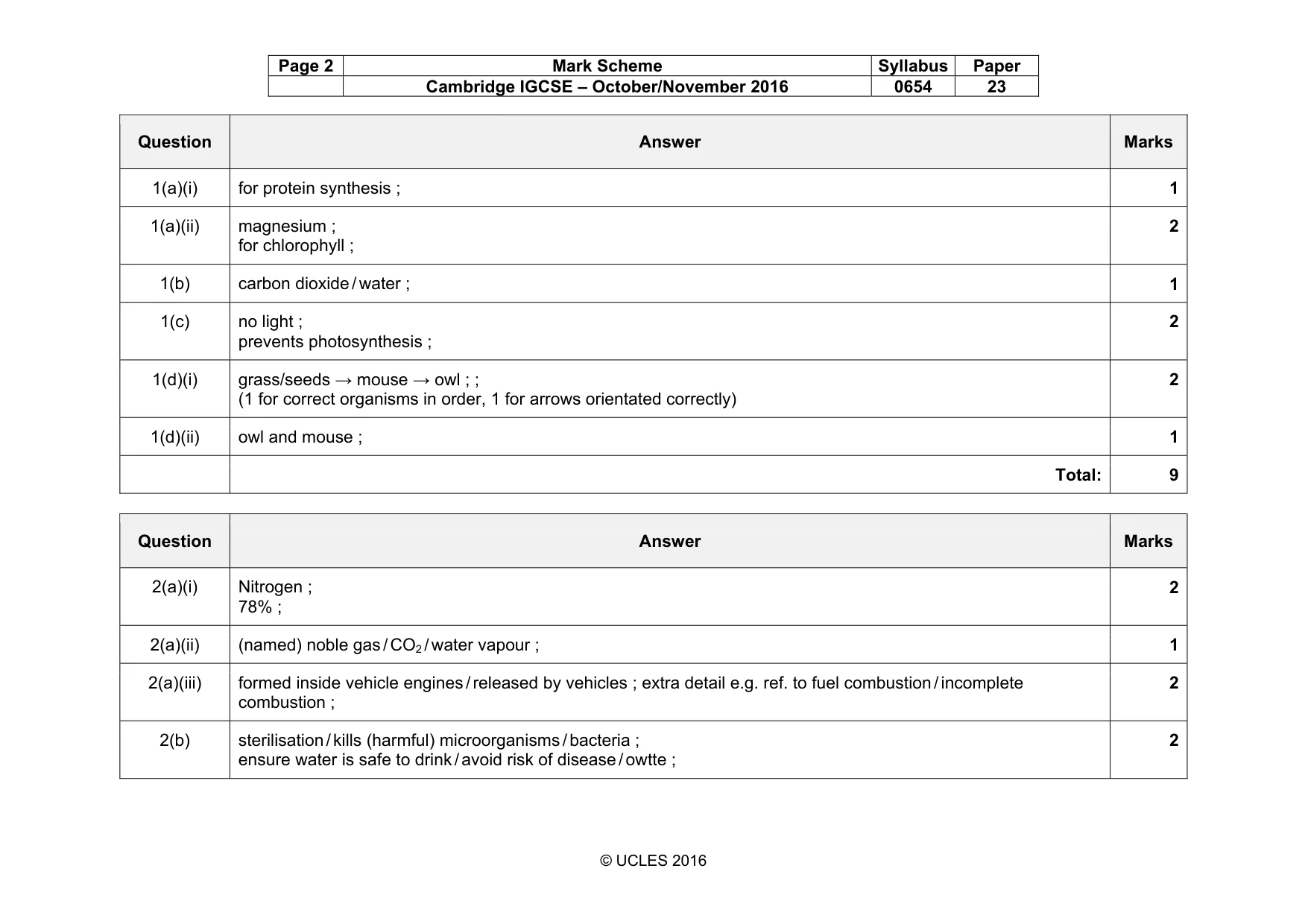
Page 2 Mark Scheme Syllabus Paper Cambridge IGCSE – October/November 2016 0654 23 © UCLES 2016 Question Answer Marks 1(a)(i) for protein synthesis ; 1 1(a)(ii) magnesium ; for chlorophyll ; 2 1(b) carbon dioxide / water ; 1 1(c) no light ; prevents photosynthesis ; 2 1(d)(i) grass/seeds → mouse → owl ; ; (1 for correct organisms in order, 1 for arrows orientated correctly) 2 1(d)(ii) owl and mouse ; 1 Total: 9 Question Answer Marks 2(a)(i) Nitrogen ; 78% ; 2 2(a)(ii) (named) noble gas / CO2 / water vapour ; 1 2(a)(iii) formed inside vehicle engines / released by vehicles ; extra detail e.g. ref. to fuel combustion / incomplete combustion ; 2 2(b) sterilisation / kills (harmful) microorganisms / bacteria ; ensure water is safe to drink / avoid risk of disease / owtte ; 2
Mark scheme, page 3
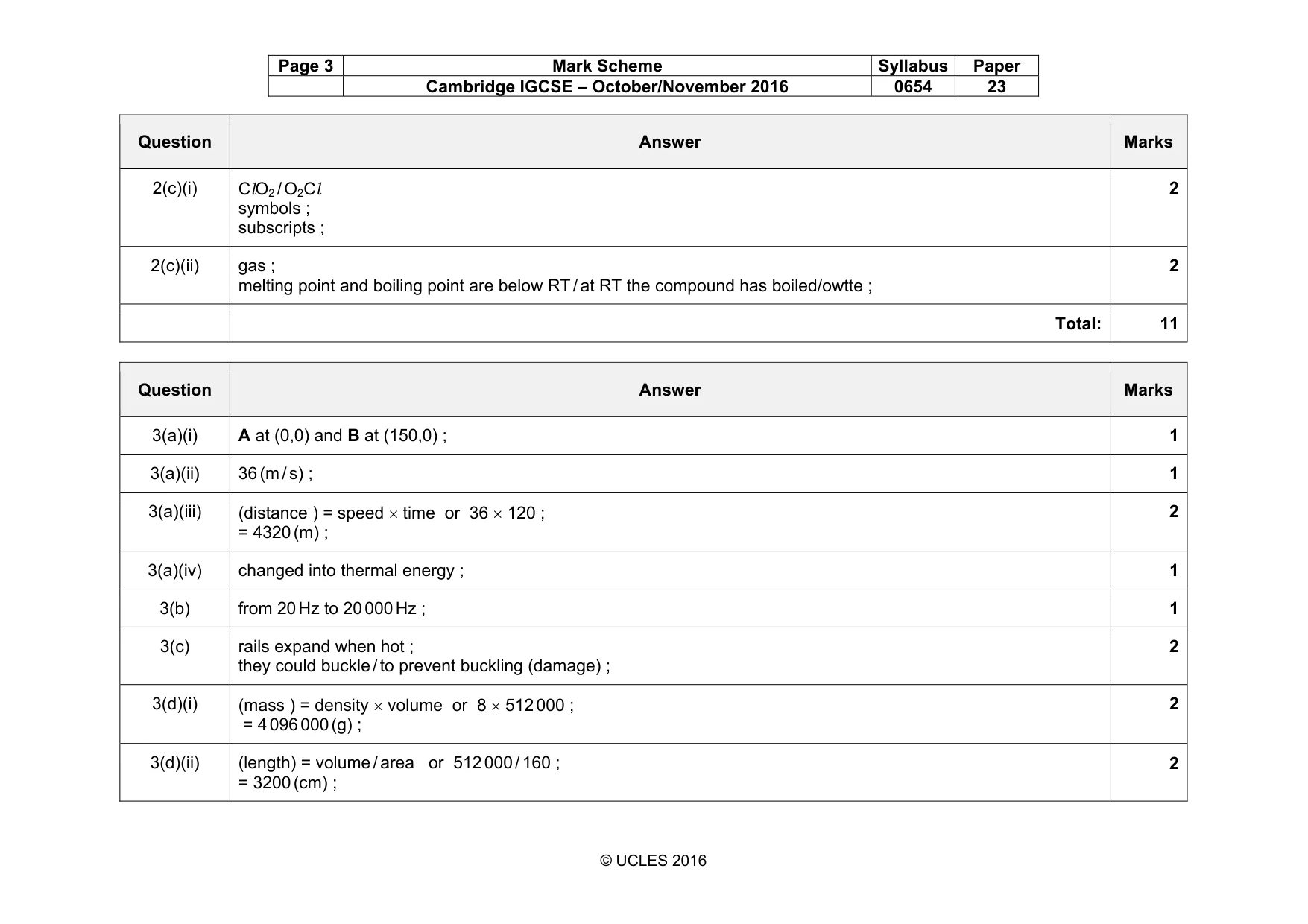
Page 3 Mark Scheme Syllabus Paper Cambridge IGCSE – October/November 2016 0654 23 © UCLES 2016 Question Answer Marks 2(c)(i) ClO2 / O2Cl symbols ; subscripts ; 2 2(c)(ii) gas ; melting point and boiling point are below RT / at RT the compound has boiled/owtte ; 2 Total: 11 Question Answer Marks 3(a)(i) A at (0,0) and B at (150,0) ; 1 3(a)(ii) 36 (m / s) ; 1 3(a)(iii) (distance ) = speed × time or 36 × 120 ; = 4320 (m) ; 2 3(a)(iv) changed into thermal energy ; 1 3(b) from 20 Hz to 20 000 Hz ; 1 3(c) rails expand when hot ; they could buckle / to prevent buckling (damage) ; 2 3(d)(i) (mass ) = density × volume or 8 × 512 000 ; = 4 096 000 (g) ; 2 3(d)(ii) (length) = volume / area or 512 000 / 160 ; = 3200 (cm) ; 2
Mark scheme, page 4
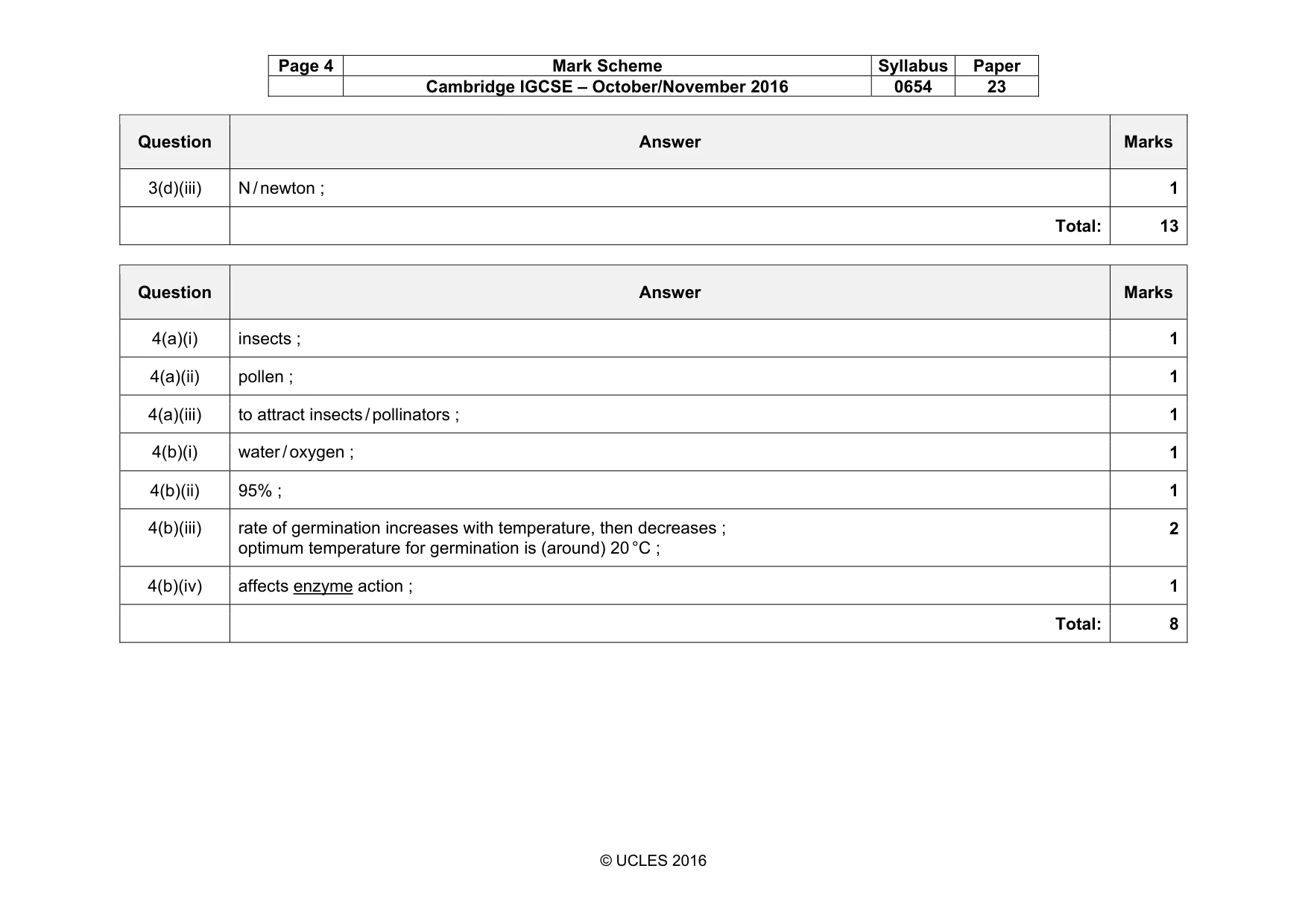
Page 4 Mark Scheme Syllabus Paper Cambridge IGCSE – October/November 2016 0654 23 © UCLES 2016 Question Answer Marks 3(d)(iii) N / newton ; 1 Total: 13 Question Answer Marks 4(a)(i) insects ; 1 4(a)(ii) pollen ; 1 4(a)(iii) to attract insects / pollinators ; 1 4(b)(i) water / oxygen ; 1 4(b)(ii) 95% ; 1 4(b)(iii) rate of germination increases with temperature, then decreases ; optimum temperature for germination is (around) 20 °C ; 2 4(b)(iv) affects enzyme action ; 1 Total: 8
Mark scheme, page 5
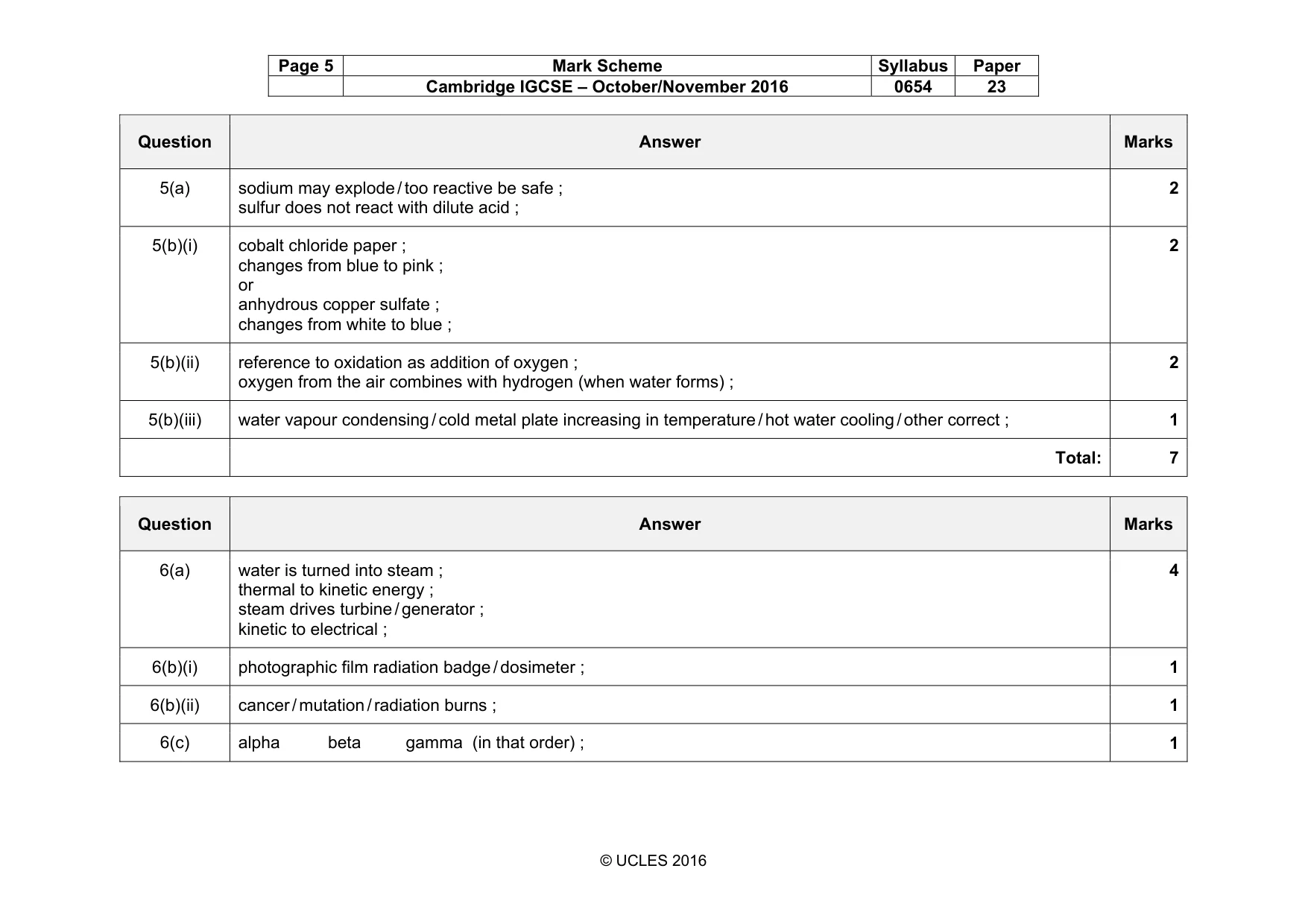
Page 5 Mark Scheme Syllabus Paper Cambridge IGCSE – October/November 2016 0654 23 © UCLES 2016 Question Answer Marks 5(a) sodium may explode / too reactive be safe ; sulfur does not react with dilute acid ; 2 5(b)(i) cobalt chloride paper ; changes from blue to pink ; or anhydrous copper sulfate ; changes from white to blue ; 2 5(b)(ii) reference to oxidation as addition of oxygen ; oxygen from the air combines with hydrogen (when water forms) ; 2 5(b)(iii) water vapour condensing / cold metal plate increasing in temperature / hot water cooling / other correct ; 1 Total: 7 Question Answer Marks 6(a) water is turned into steam ; thermal to kinetic energy ; steam drives turbine / generator ; kinetic to electrical ; 4 6(b)(i) photographic film radiation badge / dosimeter ; 1 6(b)(ii) cancer / mutation / radiation burns ; 1 6(c) alpha beta gamma (in that order) ; 1
Mark scheme, page 6
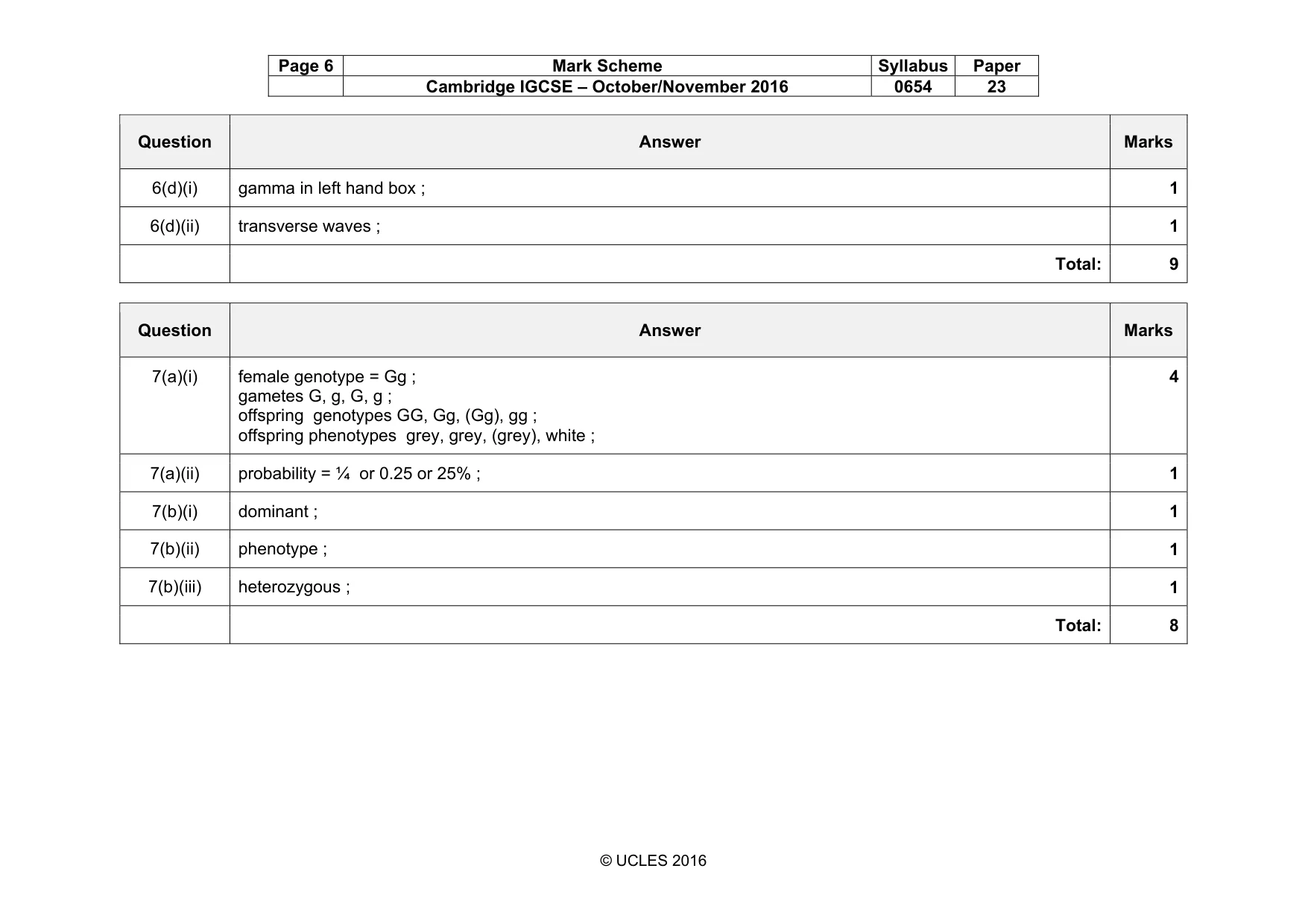
Page 6 Mark Scheme Syllabus Paper Cambridge IGCSE – October/November 2016 0654 23 © UCLES 2016 Question Answer Marks 6(d)(i) gamma in left hand box ; 1 6(d)(ii) transverse waves ; 1 Total: 9 Question Answer Marks 7(a)(i) female genotype = Gg ; gametes G, g, G, g ; offspring genotypes GG, Gg, (Gg), gg ; offspring phenotypes grey, grey, (grey), white ; 4 7(a)(ii) probability = ¼ or 0.25 or 25% ; 1 7(b)(i) dominant ; 1 7(b)(ii) phenotype ; 1 7(b)(iii) heterozygous ; 1 Total: 8
Mark scheme, page 7
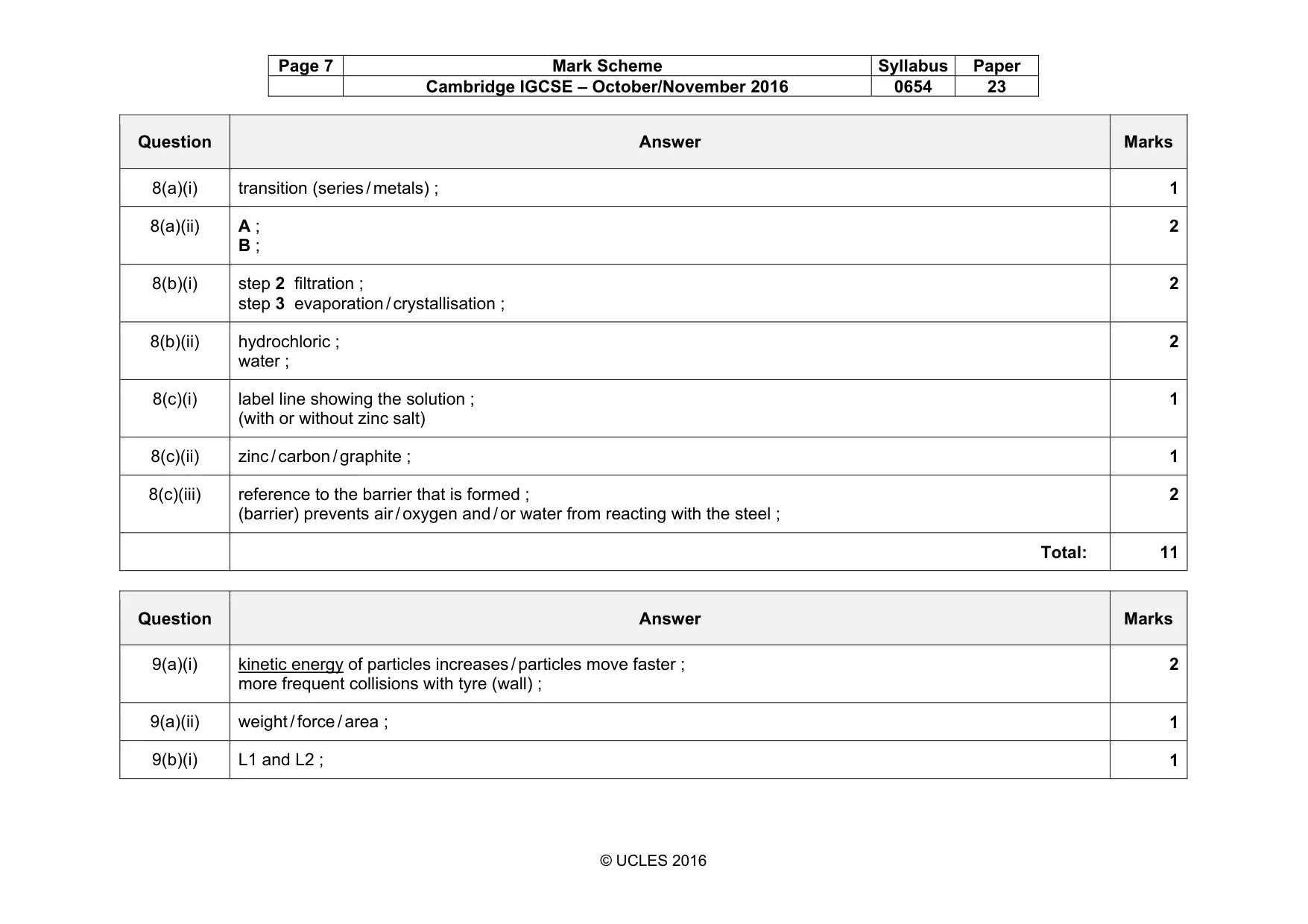
Page 7 Mark Scheme Syllabus Paper Cambridge IGCSE – October/November 2016 0654 23 © UCLES 2016 Question Answer Marks 8(a)(i) transition (series / metals) ; 1 8(a)(ii) A ; B ; 2 8(b)(i) step 2 filtration ; step 3 evaporation / crystallisation ; 2 8(b)(ii) hydrochloric ; water ; 2 8(c)(i) label line showing the solution ; (with or without zinc salt) 1 8(c)(ii) zinc / carbon / graphite ; 1 8(c)(iii) reference to the barrier that is formed ; (barrier) prevents air / oxygen and / or water from reacting with the steel ; 2 Total: 11 Question Answer Marks 9(a)(i) kinetic energy of particles increases / particles move faster ; more frequent collisions with tyre (wall) ; 2 9(a)(ii) weight / force / area ; 1 9(b)(i) L1 and L2 ; 1
Mark scheme, page 8
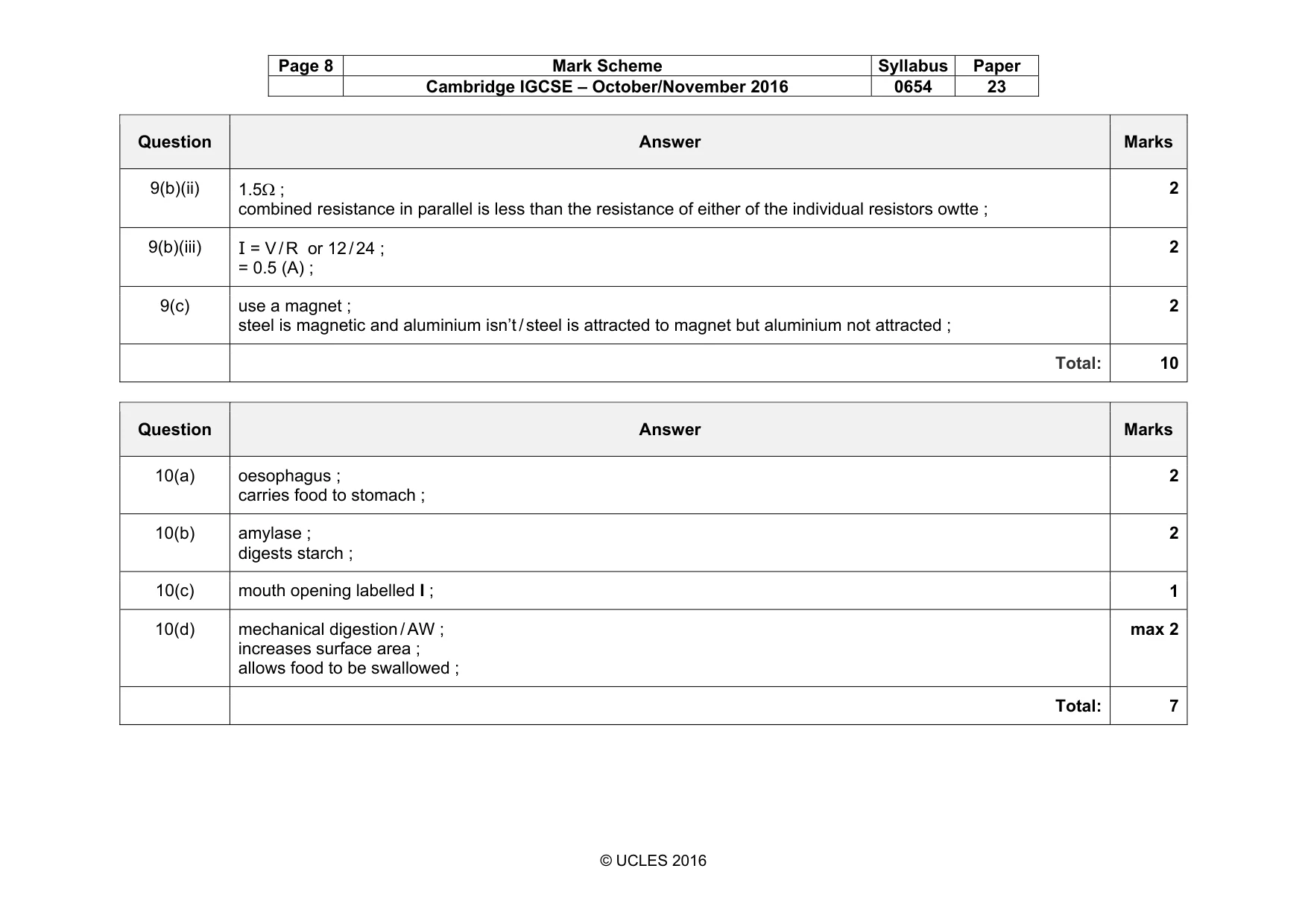
Page 8 Mark Scheme Syllabus Paper Cambridge IGCSE – October/November 2016 0654 23 © UCLES 2016 Question Answer Marks 9(b)(ii) 1.5Ω ; combined resistance in parallel is less than the resistance of either of the individual resistors owtte ; 2 9(b)(iii) I = V / R or 12 / 24 ; = 0.5 (A) ; 2 9(c) use a magnet ; steel is magnetic and aluminium isn’t / steel is attracted to magnet but aluminium not attracted ; 2 Total: 10 Question Answer Marks 10(a) oesophagus ; carries food to stomach ; 2 10(b) amylase ; digests starch ; 2 10(c) mouth opening labelled I ; 1 10(d) mechanical digestion / AW ; increases surface area ; allows food to be swallowed ; max 2 Total: 7
Mark scheme, page 9
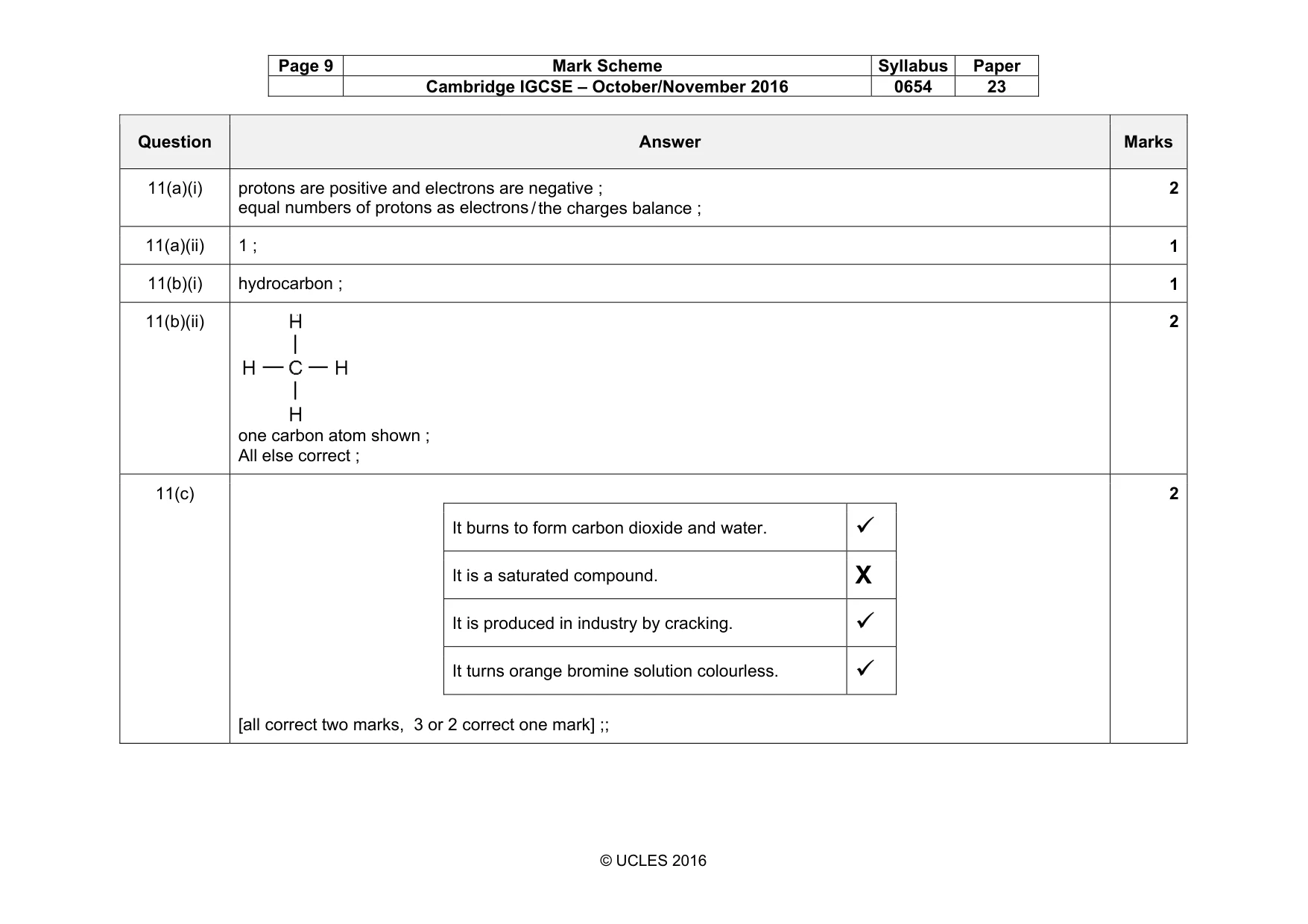
Page 9 Mark Scheme Syllabus Paper Cambridge IGCSE – October/November 2016 0654 23 © UCLES 2016 Question Answer Marks 11(a)(i) protons are positive and electrons are negative ; equal numbers of protons as electrons / the charges balance ; 2 11(a)(ii) 1 ; 1 11(b)(i) hydrocarbon ; 1 11(b)(ii) one carbon atom shown ; All else correct ; 2 11(c) It burns to form carbon dioxide and water. 9 It is a saturated compound. X It is produced in industry by cracking. 9 It turns orange bromine solution colourless. 9 [all correct two marks, 3 or 2 correct one mark] ;; 2
Mark scheme, page 10
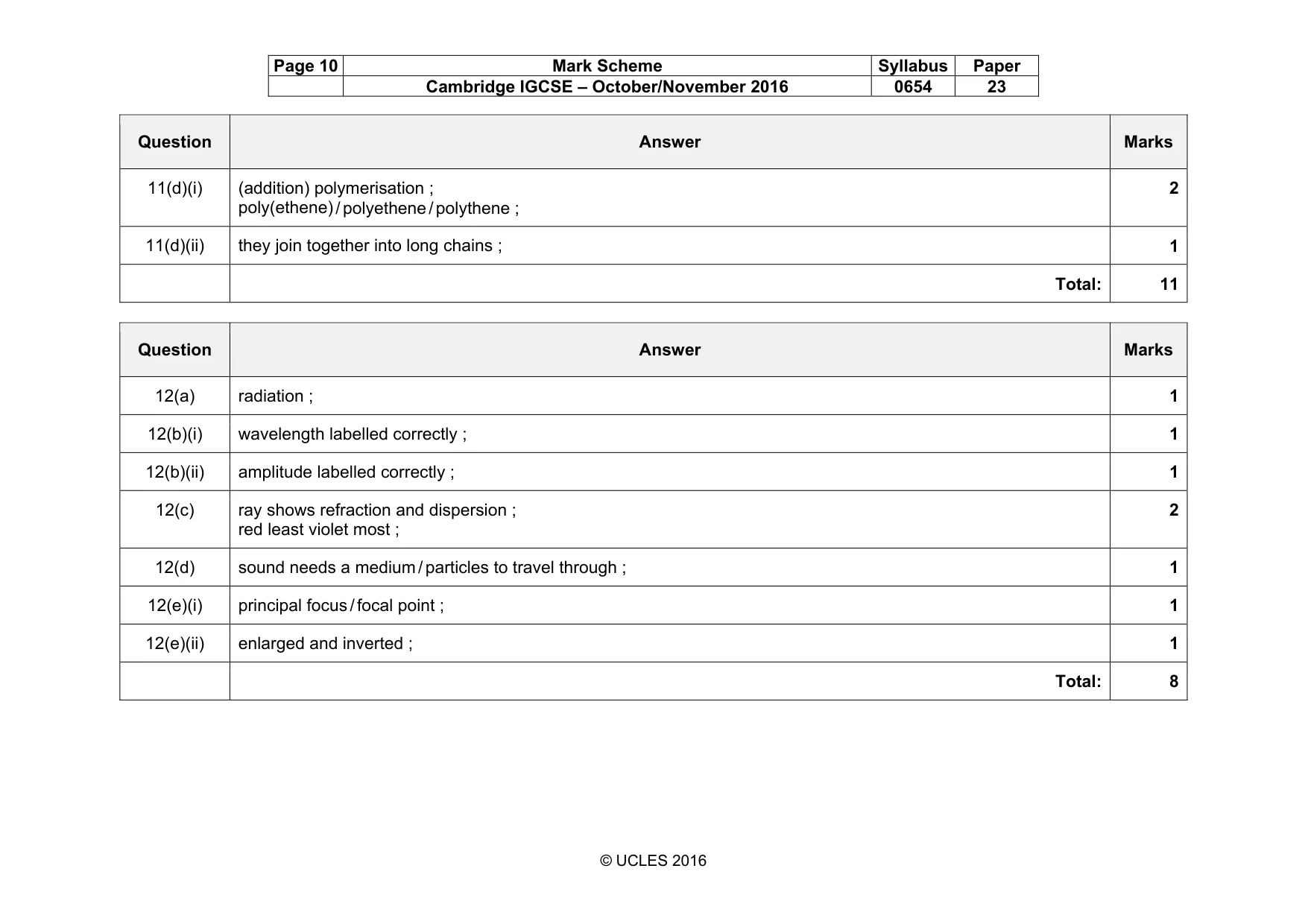
Page 10 Mark Scheme Syllabus Paper Cambridge IGCSE – October/November 2016 0654 23 © UCLES 2016 Question Answer Marks 11(d)(i) (addition) polymerisation ; poly(ethene) / polyethene / polythene ; 2 11(d)(ii) they join together into long chains ; 1 Total: 11 Question Answer Marks 12(a) radiation ; 1 12(b)(i) wavelength labelled correctly ; 1 12(b)(ii) amplitude labelled correctly ; 1 12(c) ray shows refraction and dispersion ; red least violet most ; 2 12(d) sound needs a medium / particles to travel through ; 1 12(e)(i) principal focus / focal point ; 1 12(e)(ii) enlarged and inverted ; 1 Total: 8
Mark scheme, page 11
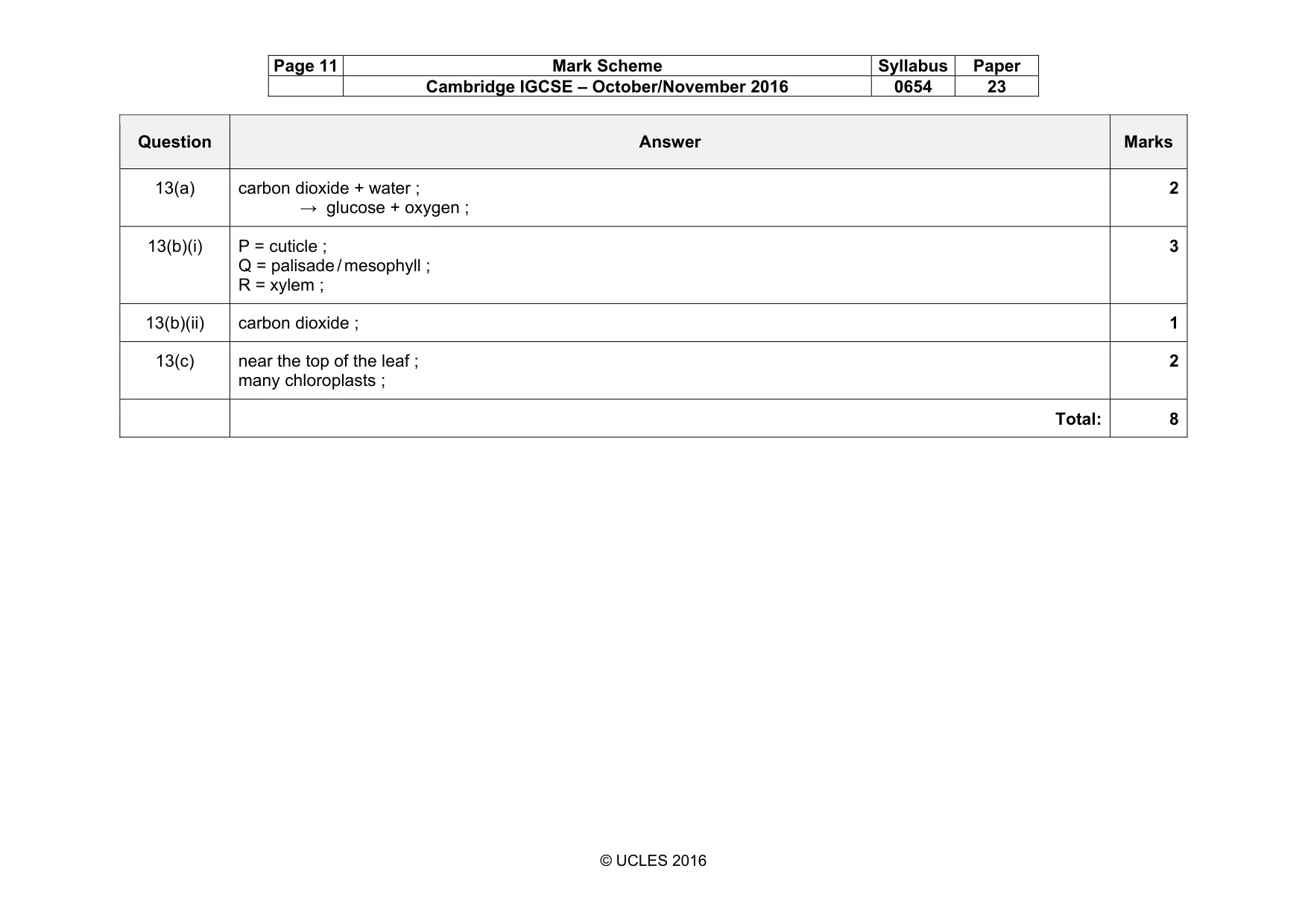
Page 11 Mark Scheme Syllabus Paper Cambridge IGCSE – October/November 2016 0654 23 © UCLES 2016 Question Answer Marks 13(a) carbon dioxide + water ; → glucose + oxygen ; 2 13(b)(i) P = cuticle ; Q = palisade / mesophyll ; R = xylem ; 3 13(b)(ii) carbon dioxide ; 1 13(c) near the top of the leaf ; many chloroplasts ; 2 Total: 8
What you needed in this session
Cambridge’s own grade thresholds for 2016 Oct/Nov, Paper 2 · Variant 3. A higher threshold means an easier paper — the bar moves with how the cohort did.