Cambridge IGCSE Sciences - Co-ordinated (Double) 0654 — 2012 May/June Paper 2 · Variant 3
0654/23/M/J/12 · 100 marks · ≈113 min
The question paper and its mark scheme, free to read here and free to download. This is Cambridge’s own paper, exactly as it was sat.
Question paper28 pages


Mark scheme8 pages
Answers below. Sit the paper first if you are practising.
Paper as text
Question paper, page 1
This document consists of 26 printed pages and 2 blank pages. IB12 06_0654_23/FP © UCLES 2012 [Turn over *2803271386* For Examiner's Use 1 2 3 4 5 6 7 8 9 10 11 12 Total UNIVERSITY OF CAMBRIDGE INTERNATIONAL EXAMINATIONS International General Certificate of Secondary Education CO-ORDINATED SCIENCES 0654/23 Paper 2 (Core) May/June 2012 2 hours Candidates answer on the Question Paper. No Additional Materials are required. READ THESE INSTRUCTIONS FIRST Write your Centre number, candidate number and name on all the work you hand in. Write in dark blue or black pen. You may use a soft pencil for any diagrams, graphs, tables or rough working. Do not use staples, paper clips, highlighters, glue or correction fluid. DO NOT WRITE IN ANY BARCODES. Answer all questions. A copy of the Periodic Table is printed on page 28. At the end of the examination, fasten all your work securely together. The number of marks is given in brackets [ ] at the end of each question or part question. www.XtremePapers.com
Question paper, page 2
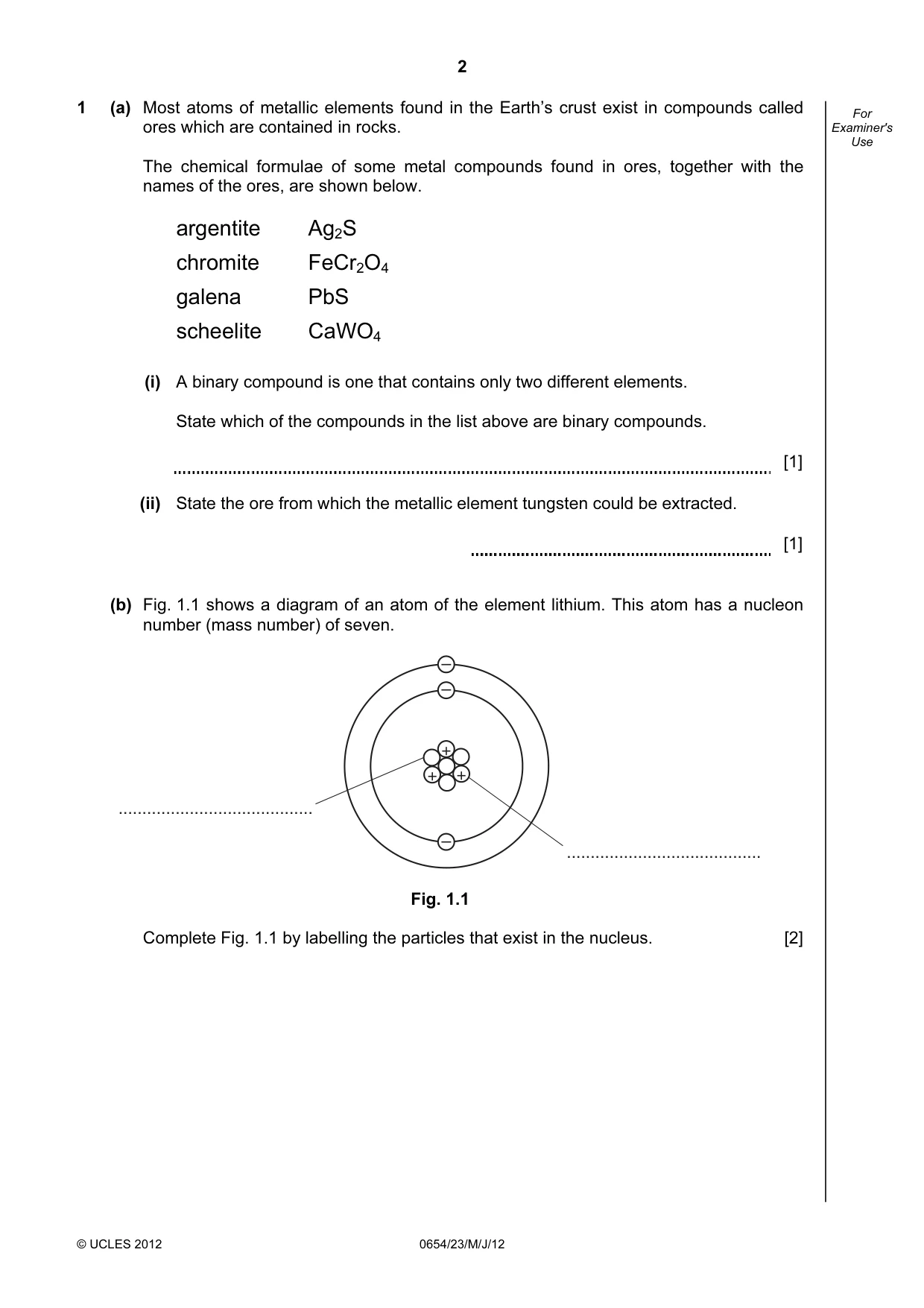
2 © UCLES 2012 0654/23/M/J/12 For Examiner's Use 1 (a) Most atoms of metallic elements found in the Earth’s crust exist in compounds called ores which are contained in rocks. The chemical formulae of some metal compounds found in ores, together with the names of the ores, are shown below. argentite Ag2S chromite FeCr2O4 galena PbS scheelite CaWO4 (i) A binary compound is one that contains only two different elements. State which of the compounds in the list above are binary compounds. [1] (ii) State the ore from which the metallic element tungsten could be extracted. [1] (b) Fig. 1.1 shows a diagram of an atom of the element lithium. This atom has a nucleon number (mass number) of seven. + + + – – – … … Fig. 1.1 Complete Fig. 1.1 by labelling the particles that exist in the nucleus. [2]
Question paper, page 3
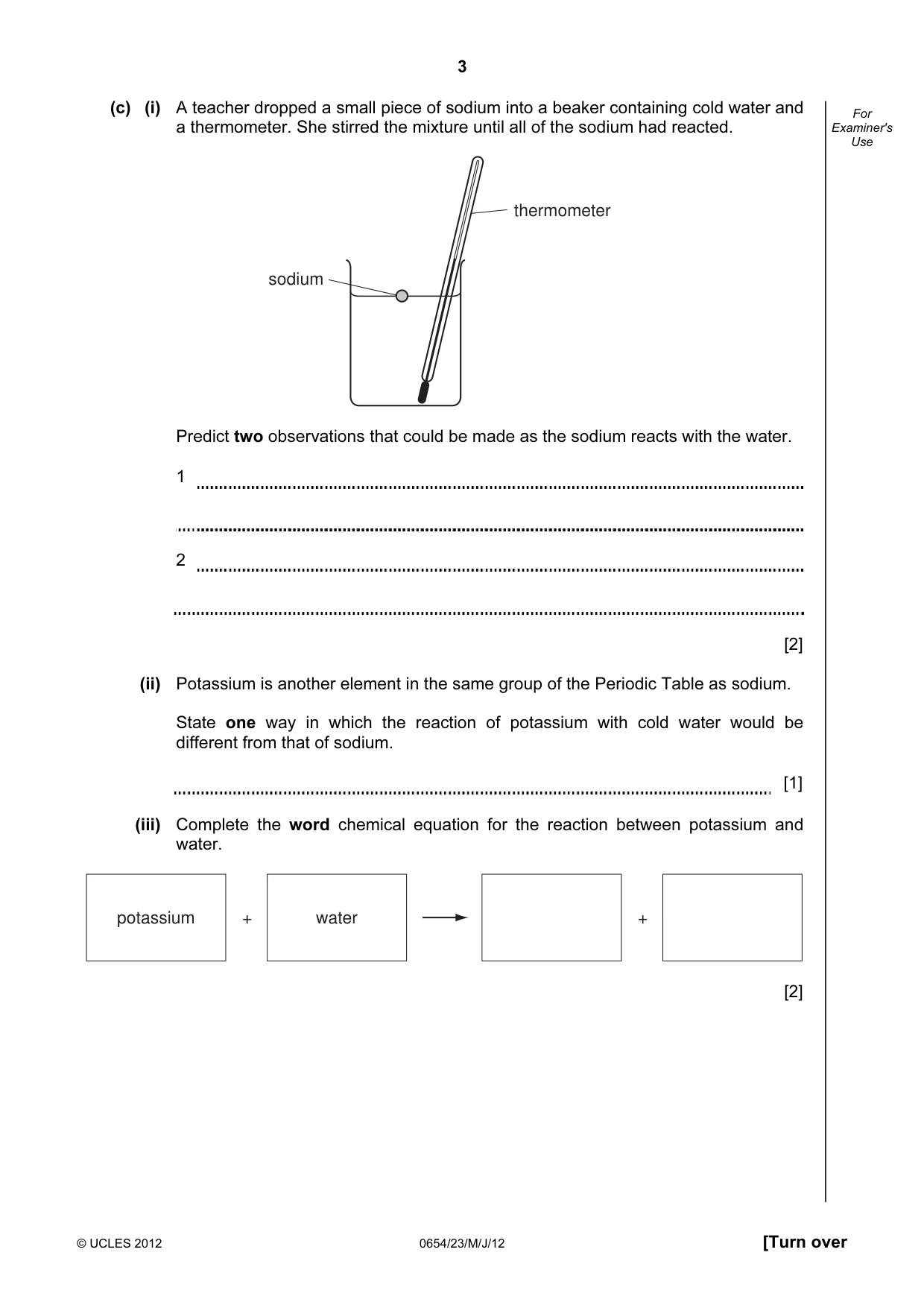
3 © UCLES 2012 0654/23/M/J/12 [Turn over For Examiner's Use (c) (i) A teacher dropped a small piece of sodium into a beaker containing cold water and a thermometer. She stirred the mixture until all of the sodium had reacted. thermometer sodium Predict two observations that could be made as the sodium reacts with the water. 1 2 [2] (ii) Potassium is another element in the same group of the Periodic Table as sodium. State one way in which the reaction of potassium with cold water would be different from that of sodium. [1] (iii) Complete the word chemical equation for the reaction between potassium and water. potassium water + + [2]
Question paper, page 4
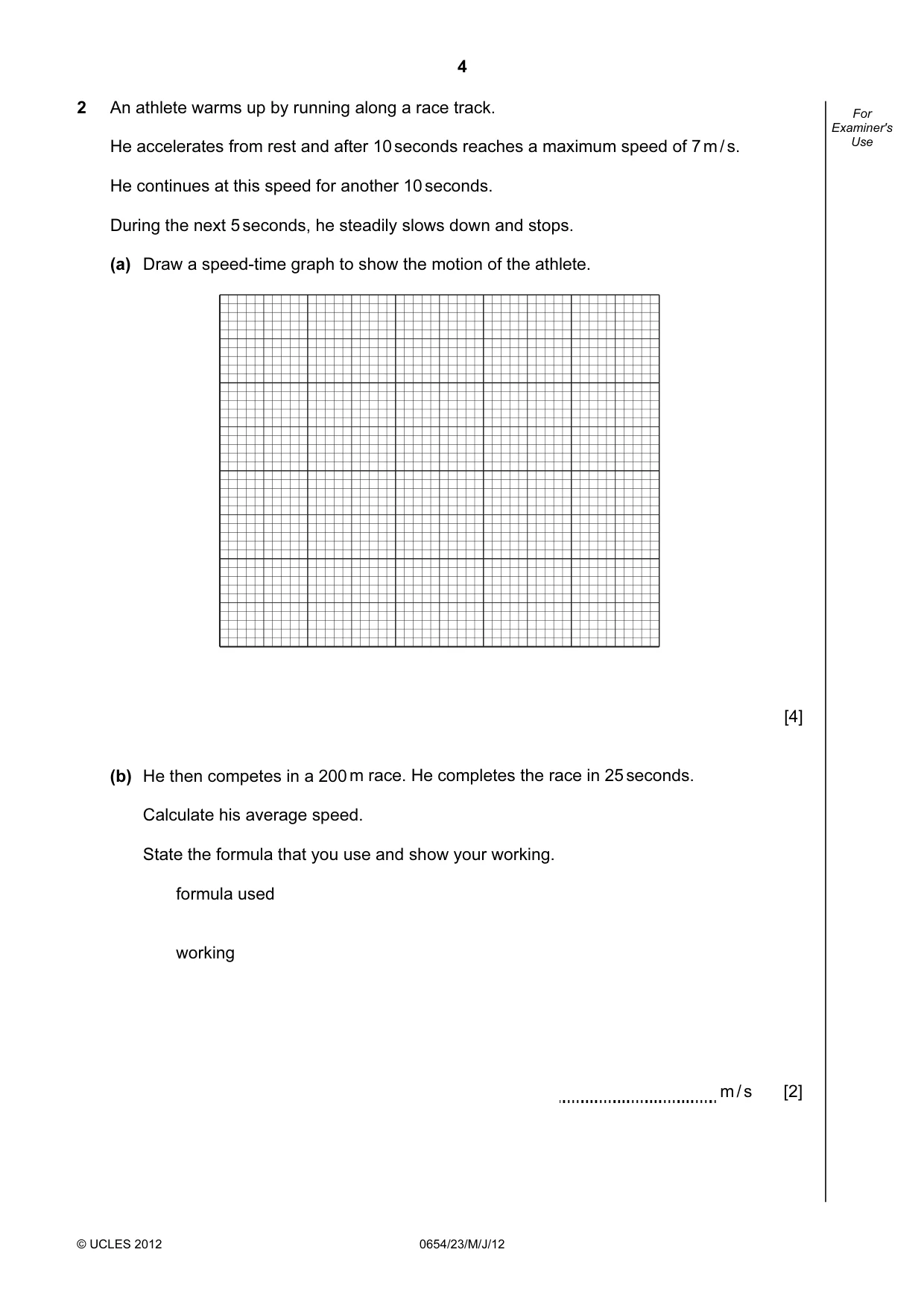
4 © UCLES 2012 0654/23/M/J/12 For Examiner's Use 2 An athlete warms up by running along a race track. He accelerates from rest and after 10 seconds reaches a maximum speed of 7 m / s. He continues at this speed for another 10 seconds. During the next 5 seconds, he steadily slows down and stops. (a) Draw a speed-time graph to show the motion of the athlete. [4] (b) He then competes in a 200 m race. He completes the race in 25 seconds. Calculate his average speed. State the formula that you use and show your working. formula used working m / s [2]
Question paper, page 5
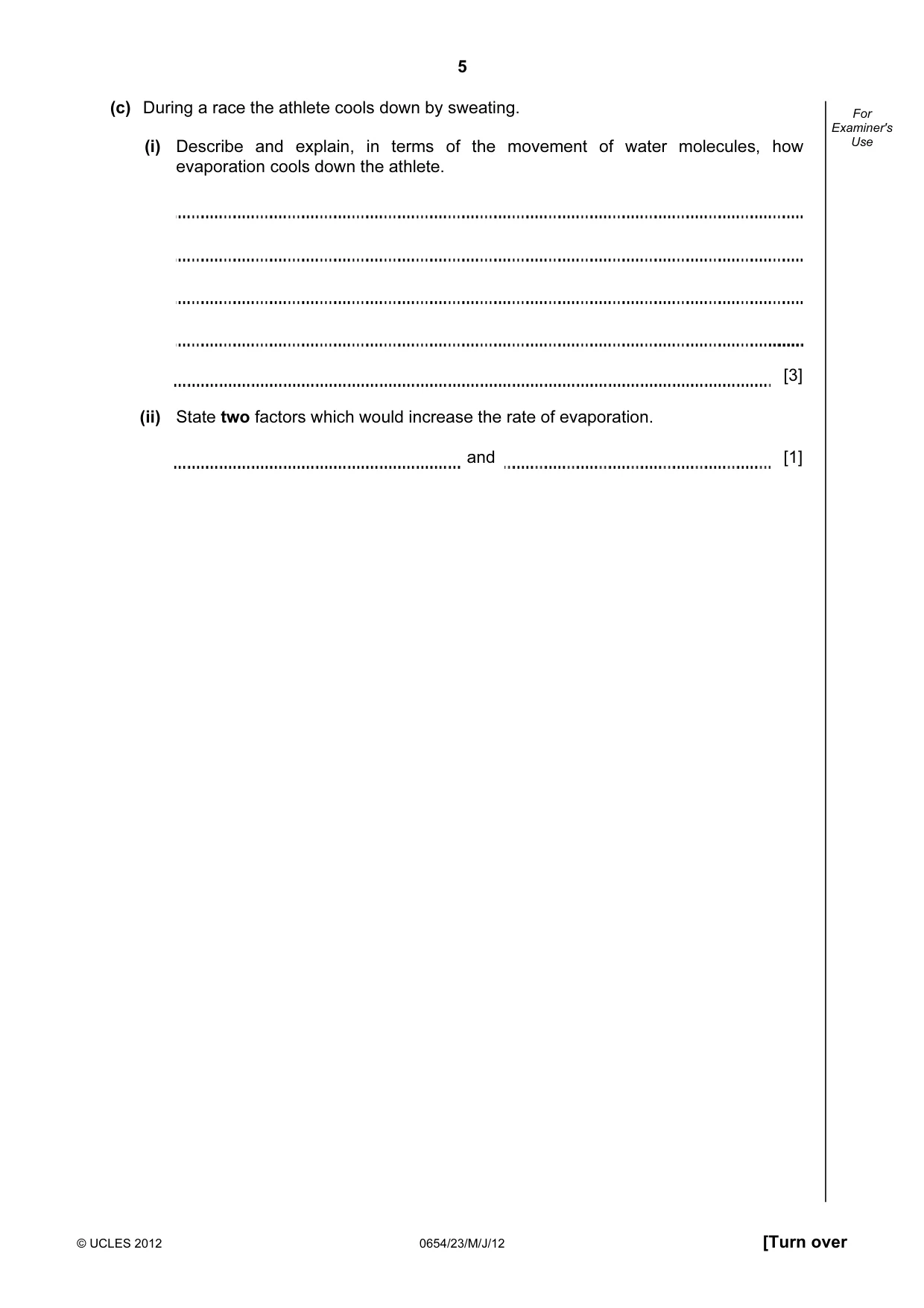
5 © UCLES 2012 0654/23/M/J/12 [Turn over For Examiner's Use (c) During a race the athlete cools down by sweating. (i) Describe and explain, in terms of the movement of water molecules, how evaporation cools down the athlete. [3] (ii) State two factors which would increase the rate of evaporation. and [1]
Question paper, page 6
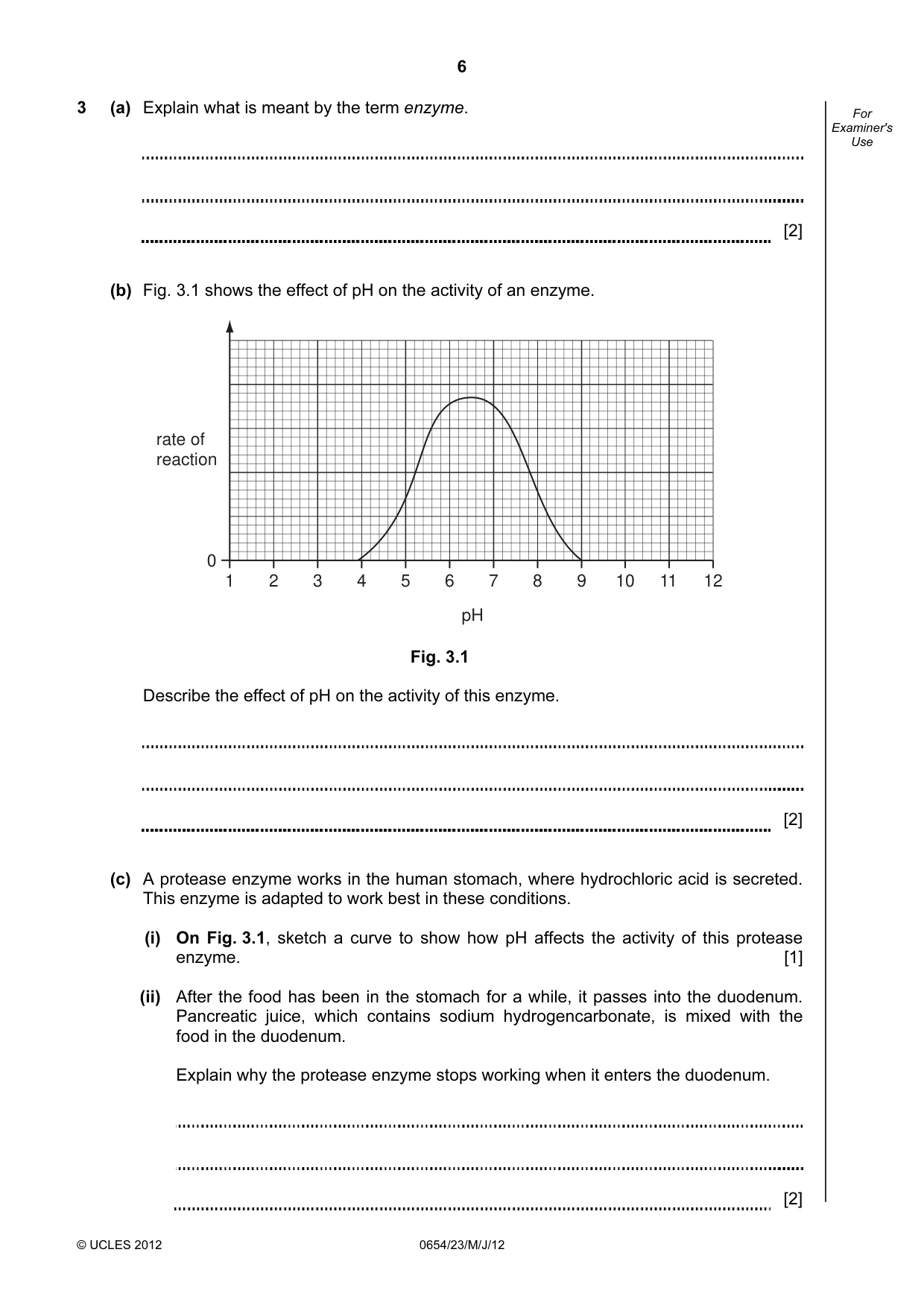
6 © UCLES 2012 0654/23/M/J/12 For Examiner's Use 3 (a) Explain what is meant by the term enzyme. [2] (b) Fig. 3.1 shows the effect of pH on the activity of an enzyme. rate of reaction 1 2 3 4 5 pH 6 7 8 9 10 11 12 0 Fig. 3.1 Describe the effect of pH on the activity of this enzyme. [2] (c) A protease enzyme works in the human stomach, where hydrochloric acid is secreted. This enzyme is adapted to work best in these conditions. (i) On Fig. 3.1, sketch a curve to show how pH affects the activity of this protease enzyme. [1] (ii) After the food has been in the stomach for a while, it passes into the duodenum. Pancreatic juice, which contains sodium hydrogencarbonate, is mixed with the food in the duodenum. Explain why the protease enzyme stops working when it enters the duodenum. [2]
Question paper, page 7
7 © UCLES 2012 0654/23/M/J/12 [Turn over For Examiner's Use (iii) Name the substrate and product of a protease enzyme. substrate product [2] (iv) Explain how the activity of this enzyme makes it possible for body cells to obtain nutrients from the food inside the digestive system. [2]
Question paper, page 8
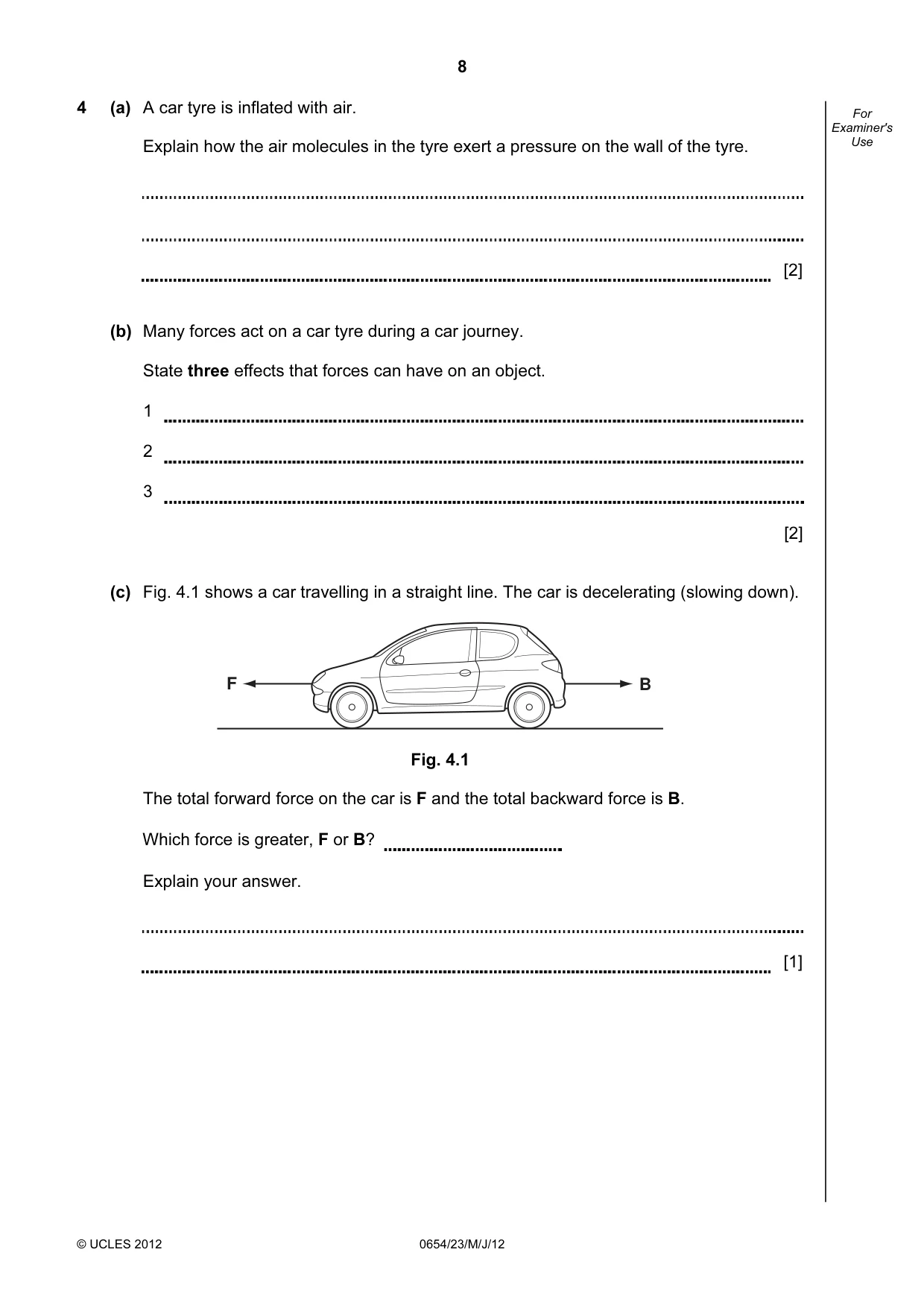
8 © UCLES 2012 0654/23/M/J/12 For Examiner's Use 4 (a) A car tyre is inflated with air. Explain how the air molecules in the tyre exert a pressure on the wall of the tyre. [2] (b) Many forces act on a car tyre during a car journey. State three effects that forces can have on an object. 1 2 3 [2] (c) Fig. 4.1 shows a car travelling in a straight line. The car is decelerating (slowing down). F B Fig. 4.1 The total forward force on the car is F and the total backward force is B. Which force is greater, F or B? Explain your answer. [1]
Question paper, page 9
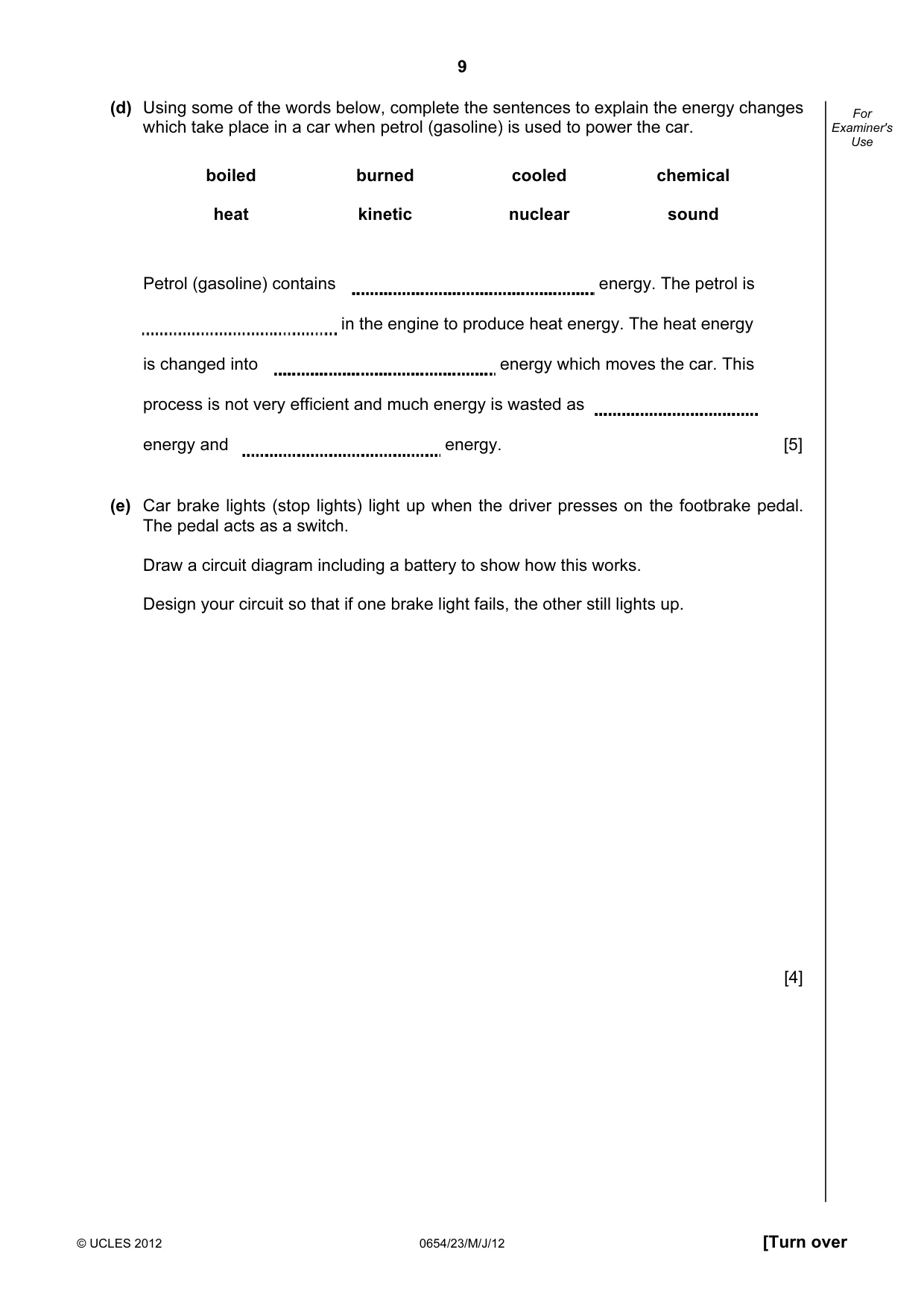
9 © UCLES 2012 0654/23/M/J/12 [Turn over For Examiner's Use (d) Using some of the words below, complete the sentences to explain the energy changes which take place in a car when petrol (gasoline) is used to power the car. boiled burned cooled chemical heat kinetic nuclear sound Petrol (gasoline) contains energy. The petrol is in the engine to produce heat energy. The heat energy is changed into energy which moves the car. This process is not very efficient and much energy is wasted as energy and energy. [5] (e) Car brake lights (stop lights) light up when the driver presses on the footbrake pedal. The pedal acts as a switch. Draw a circuit diagram including a battery to show how this works. Design your circuit so that if one brake light fails, the other still lights up. [4]
Question paper, page 10
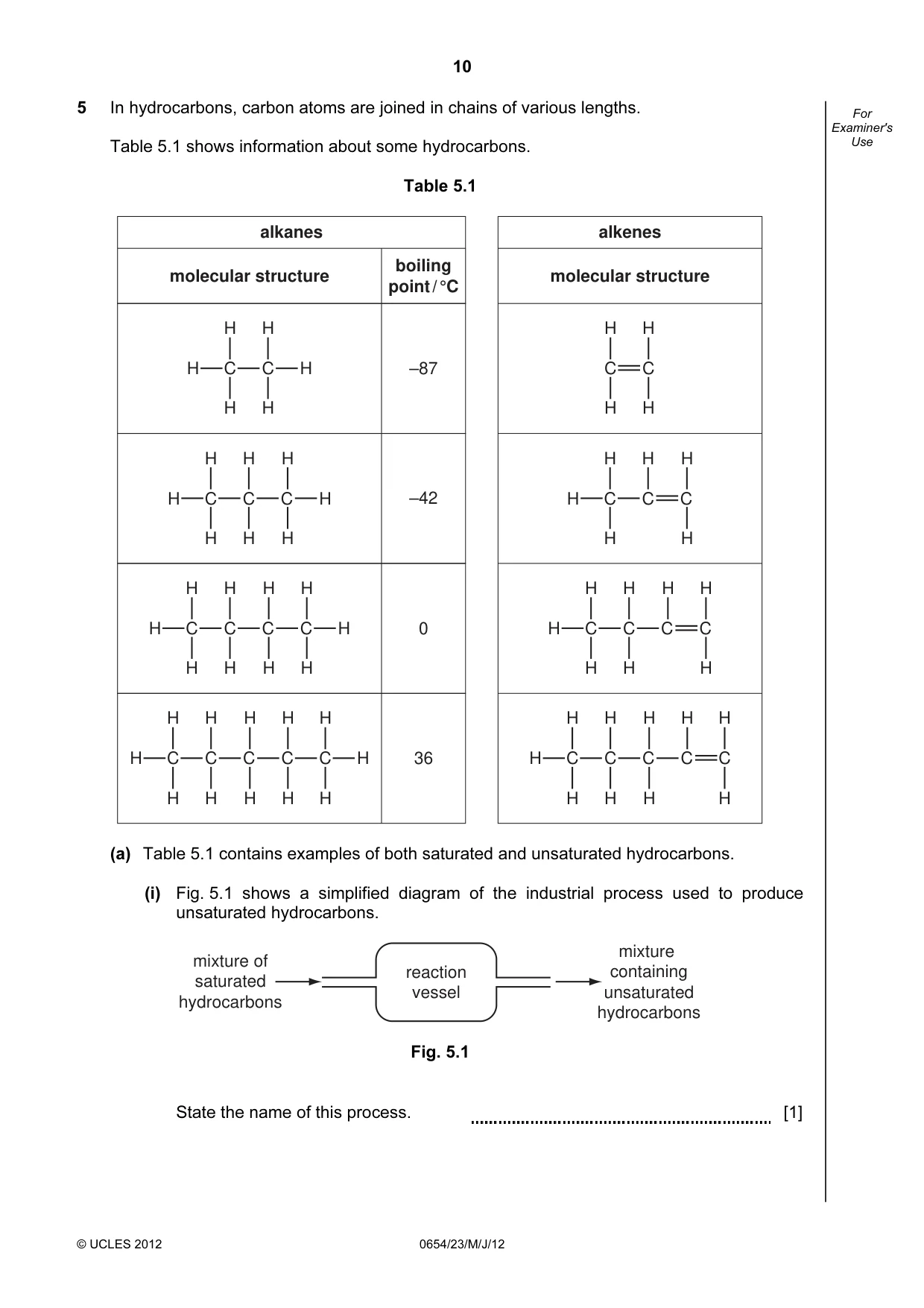
10 © UCLES 2012 0654/23/M/J/12 For Examiner's Use 5 In hydrocarbons, carbon atoms are joined in chains of various lengths. Table 5.1 shows information about some hydrocarbons. Table 5.1 alkanes molecular structure boiling point / °C C H C C C H H H C H H H H H H H H 36 C H C C H H H C H H H H H H 0 C H C H H H C H H H H –42 C H H H H C H H –87 alkenes molecular structure C H C H H C H H H C H C C H H C H H H H H C H C C C H H C H H H H H H H C H H C H H (a) Table 5.1 contains examples of both saturated and unsaturated hydrocarbons. (i) Fig. 5.1 shows a simplified diagram of the industrial process used to produce unsaturated hydrocarbons. reaction vessel mixture of saturated hydrocarbons mixture containing unsaturated hydrocarbons Fig. 5.1 State the name of this process. [1]
Question paper, page 11
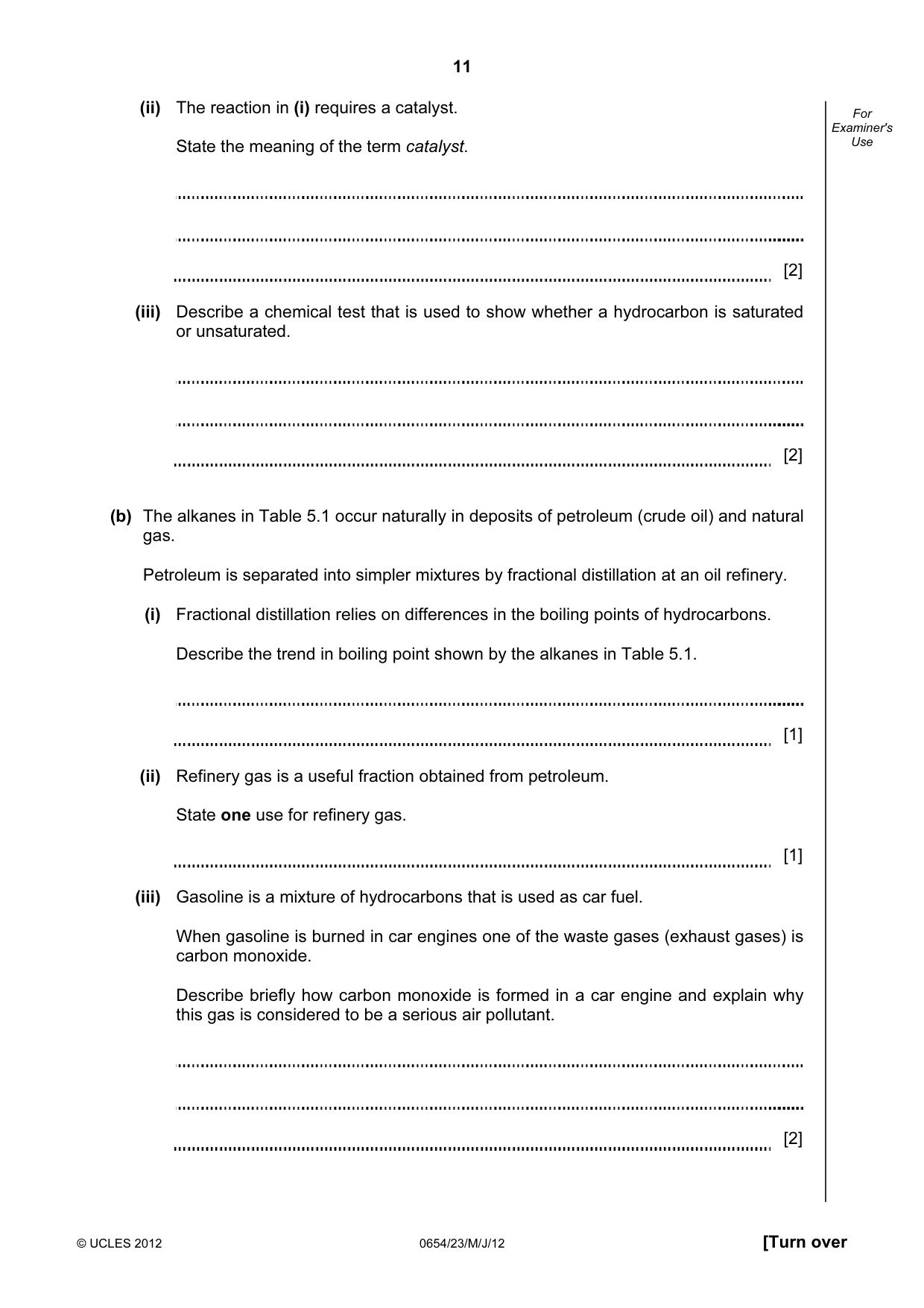
11 © UCLES 2012 0654/23/M/J/12 [Turn over For Examiner's Use (ii) The reaction in (i) requires a catalyst. State the meaning of the term catalyst. [2] (iii) Describe a chemical test that is used to show whether a hydrocarbon is saturated or unsaturated. [2] (b) The alkanes in Table 5.1 occur naturally in deposits of petroleum (crude oil) and natural gas. Petroleum is separated into simpler mixtures by fractional distillation at an oil refinery. (i) Fractional distillation relies on differences in the boiling points of hydrocarbons. Describe the trend in boiling point shown by the alkanes in Table 5.1. [1] (ii) Refinery gas is a useful fraction obtained from petroleum. State one use for refinery gas. [1] (iii) Gasoline is a mixture of hydrocarbons that is used as car fuel. When gasoline is burned in car engines one of the waste gases (exhaust gases) is carbon monoxide. Describe briefly how carbon monoxide is formed in a car engine and explain why this gas is considered to be a serious air pollutant. [2]
Question paper, page 12
12 © UCLES 2012 0654/23/M/J/12 BLANK PAGE
Question paper, page 13
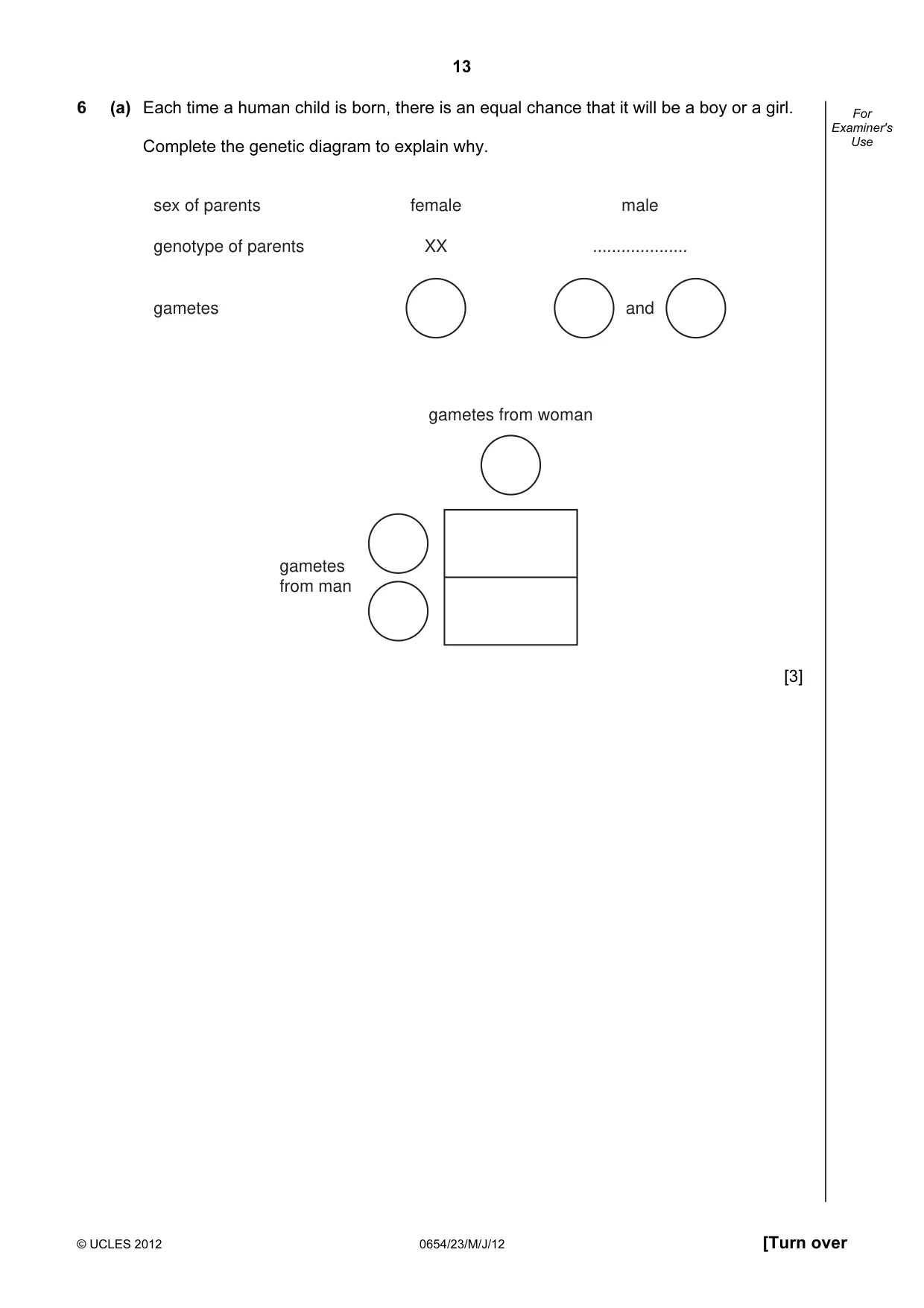
13 © UCLES 2012 0654/23/M/J/12 [Turn over For Examiner's Use 6 (a) Each time a human child is born, there is an equal chance that it will be a boy or a girl. Complete the genetic diagram to explain why. sex of parents genotype of parents gametes female XX male … and gametes from woman gametes from man [3]
Question paper, page 14
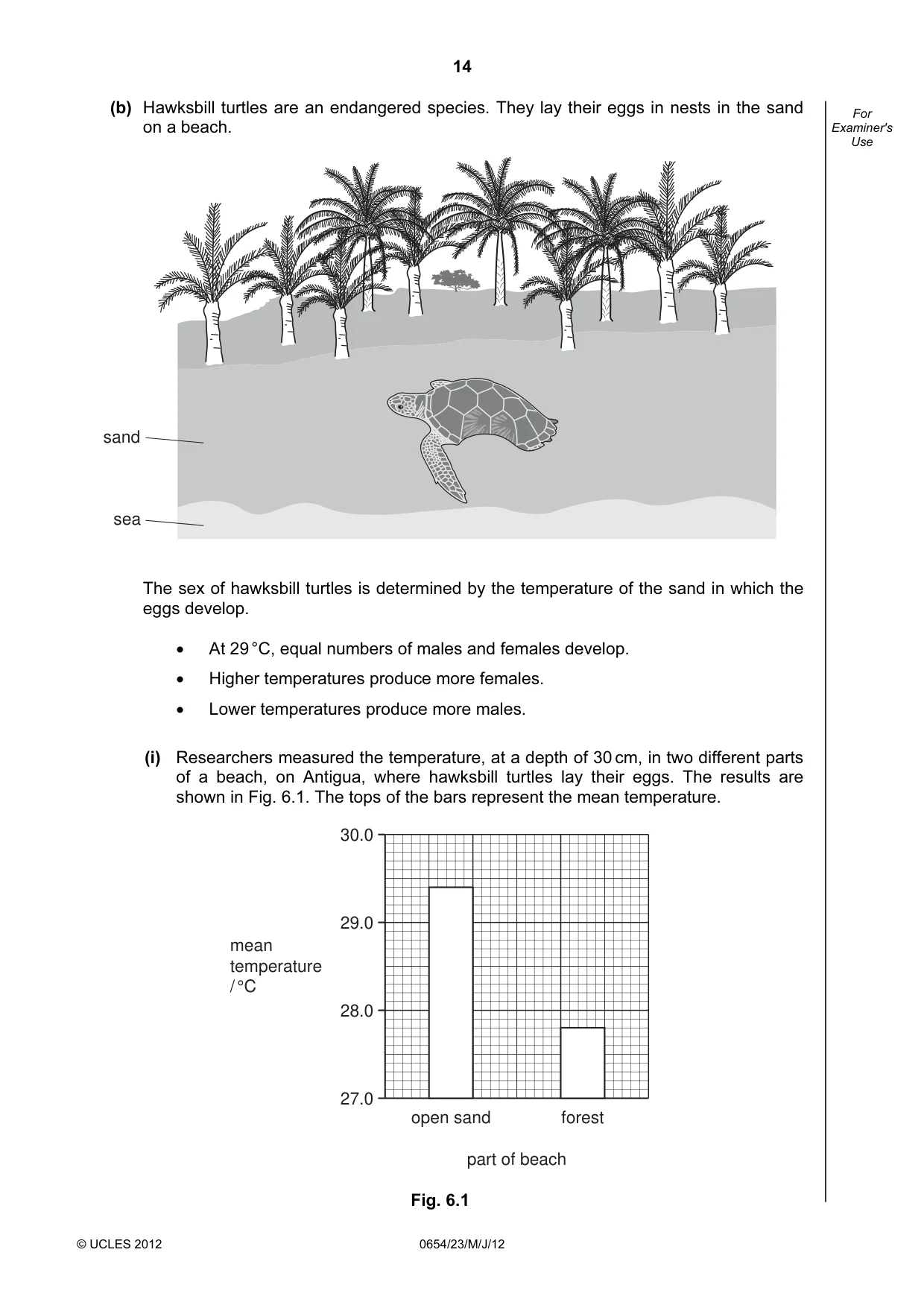
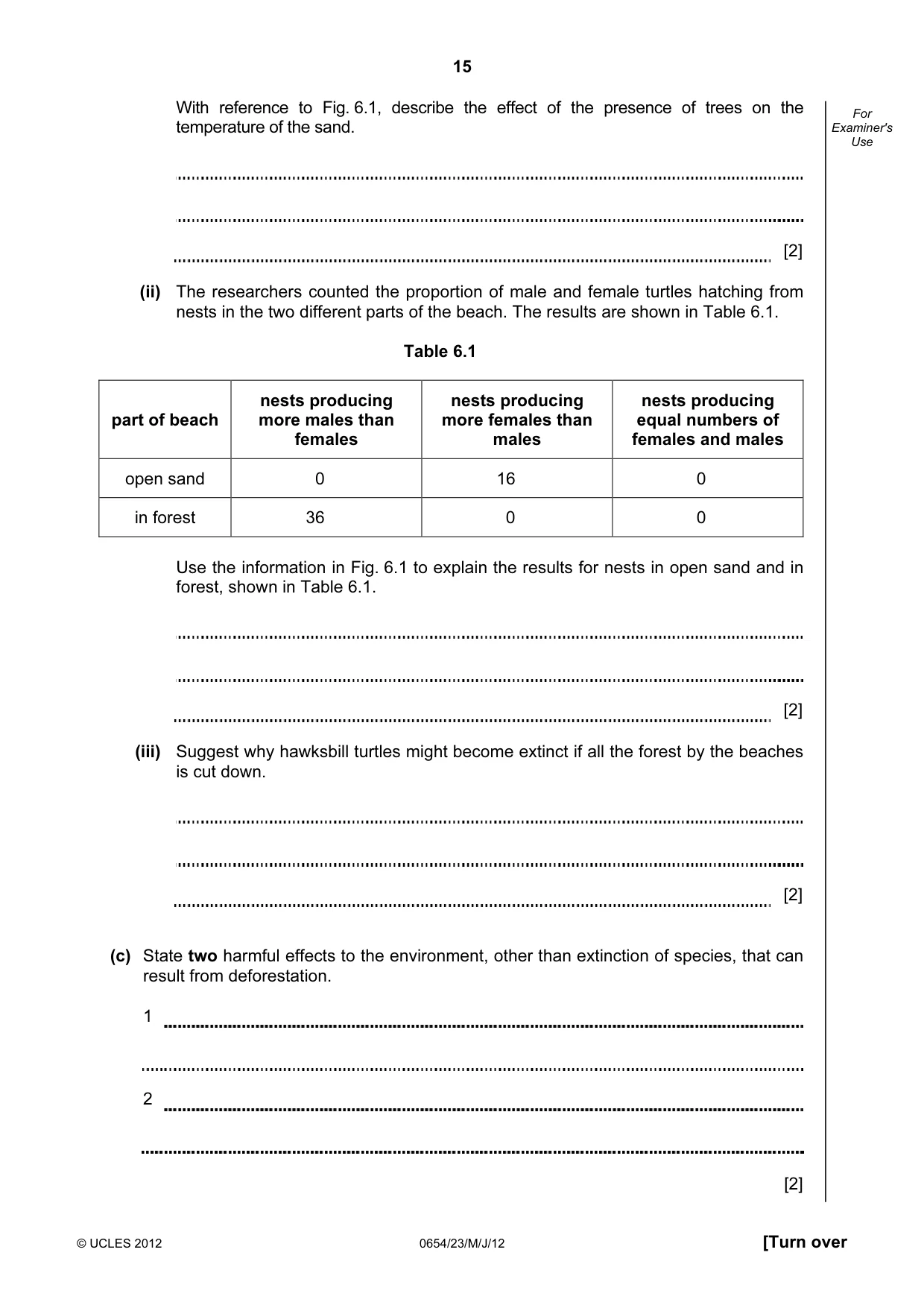
14 © UCLES 2012 0654/23/M/J/12 For Examiner's Use (b) Hawksbill turtles are an endangered species. They lay their eggs in nests in the sand on a beach. sand sea The sex of hawksbill turtles is determined by the temperature of the sand in which the eggs develop. • At 29 °C, equal numbers of males and females develop. • Higher temperatures produce more females. • Lower temperatures produce more males. (i) Researchers measured the temperature, at a depth of 30 cm, in two different parts of a beach, on Antigua, where hawksbill turtles lay their eggs. The results are shown in Fig. 6.1. The tops of the bars represent the mean temperature. 30.0 29.0 28.0 27.0 open sand part of beach forest mean temperature / °C Fig. 6.1
Question paper, page 15
15 © UCLES 2012 0654/23/M/J/12 [Turn over For Examiner's Use With reference to Fig. 6.1, describe the effect of the presence of trees on the temperature of the sand. [2] (ii) The researchers counted the proportion of male and female turtles hatching from nests in the two different parts of the beach. The results are shown in Table 6.1. Table 6.1 part of beach nests producing more males than females nests producing more females than males nests producing equal numbers of females and males open sand 0 16 0 in forest 36 0 0 Use the information in Fig. 6.1 to explain the results for nests in open sand and in forest, shown in Table 6.1. [2] (iii) Suggest why hawksbill turtles might become extinct if all the forest by the beaches is cut down. [2] (c) State two harmful effects to the environment, other than extinction of species, that can result from deforestation. 1 2 [2]
Question paper, page 16
16 © UCLES 2012 0654/23/M/J/12 For Examiner's Use 7 (a) The three types of nuclear radiation are alpha, beta and gamma. They can be identified by their different penetrating powers. Alpha radiation cannot penetrate paper. Explain how you could identify beta and gamma radiations by their penetrating powers. beta radiation gamma radiation [2] (b) Gamma radiation is an electromagnetic wave with a short wavelength. Explain the meaning of the term wavelength. You may draw a diagram if it helps your answer. [2] (c) Radon is a gas that emits alpha radiation. Explain why alpha radiation is dangerous to human beings. [2]
Question paper, page 17
17 © UCLES 2012 0654/23/M/J/12 [Turn over For Examiner's Use 8 Water supplies are often impure and have to be purified to make them safe for humans to drink. (a) State one process that is used to make water safe for humans to drink. Explain, for the process you have chosen, how this process helps to purify the water. process how it purifies [2] (b) Water is a compound which contains the elements hydrogen and oxygen. Describe one difference, other than physical state, between the compound water and a mixture of the elements hydrogen and oxygen. [2]
Question paper, page 18
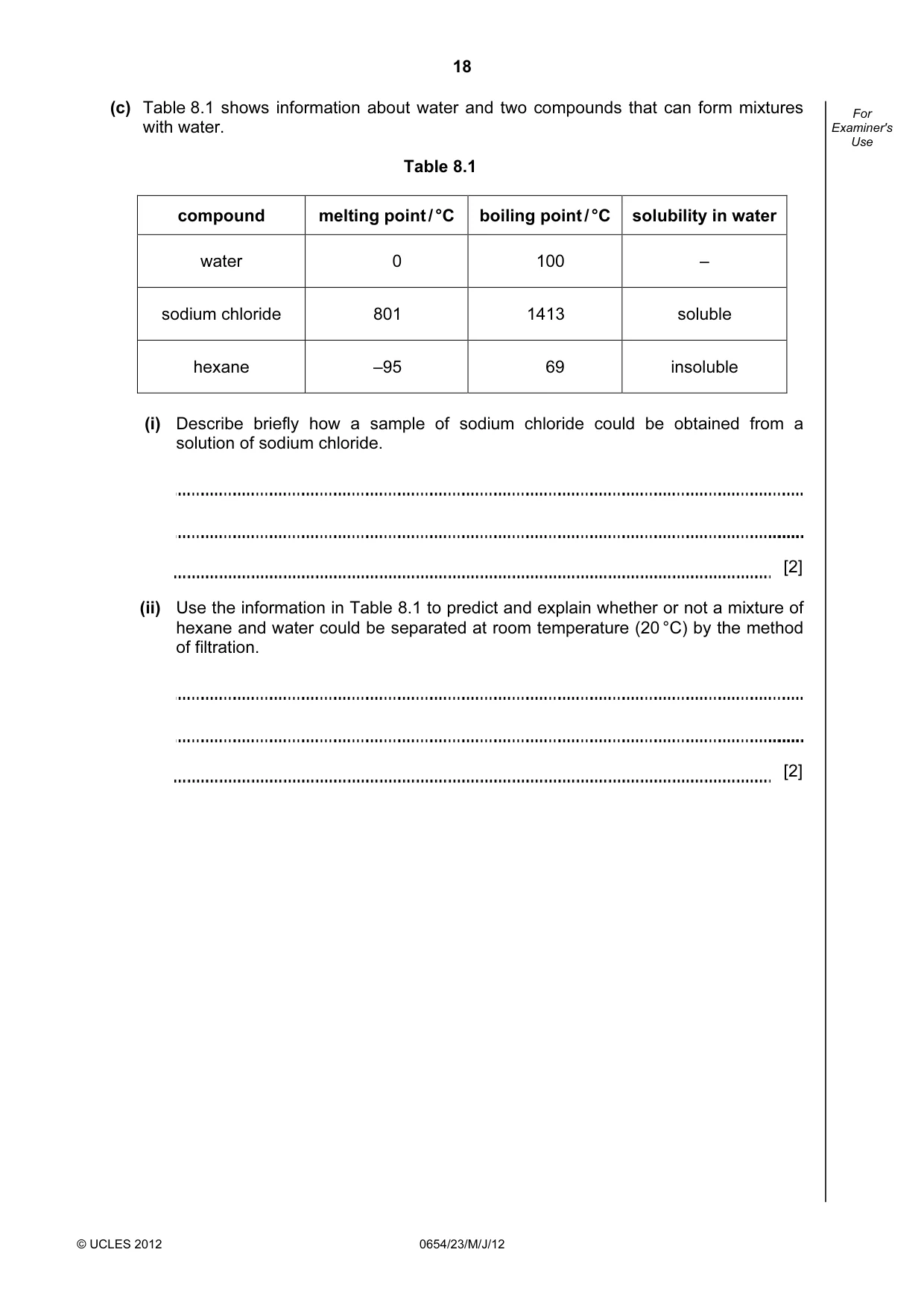
18 © UCLES 2012 0654/23/M/J/12 For Examiner's Use (c) Table 8.1 shows information about water and two compounds that can form mixtures with water. Table 8.1 compound melting point / °C boiling point / °C solubility in water water 0 100 – sodium chloride 801 1413 soluble hexane –95 69 insoluble (i) Describe briefly how a sample of sodium chloride could be obtained from a solution of sodium chloride. [2] (ii) Use the information in Table 8.1 to predict and explain whether or not a mixture of hexane and water could be separated at room temperature (20 °C) by the method of filtration. [2]
Question paper, page 19
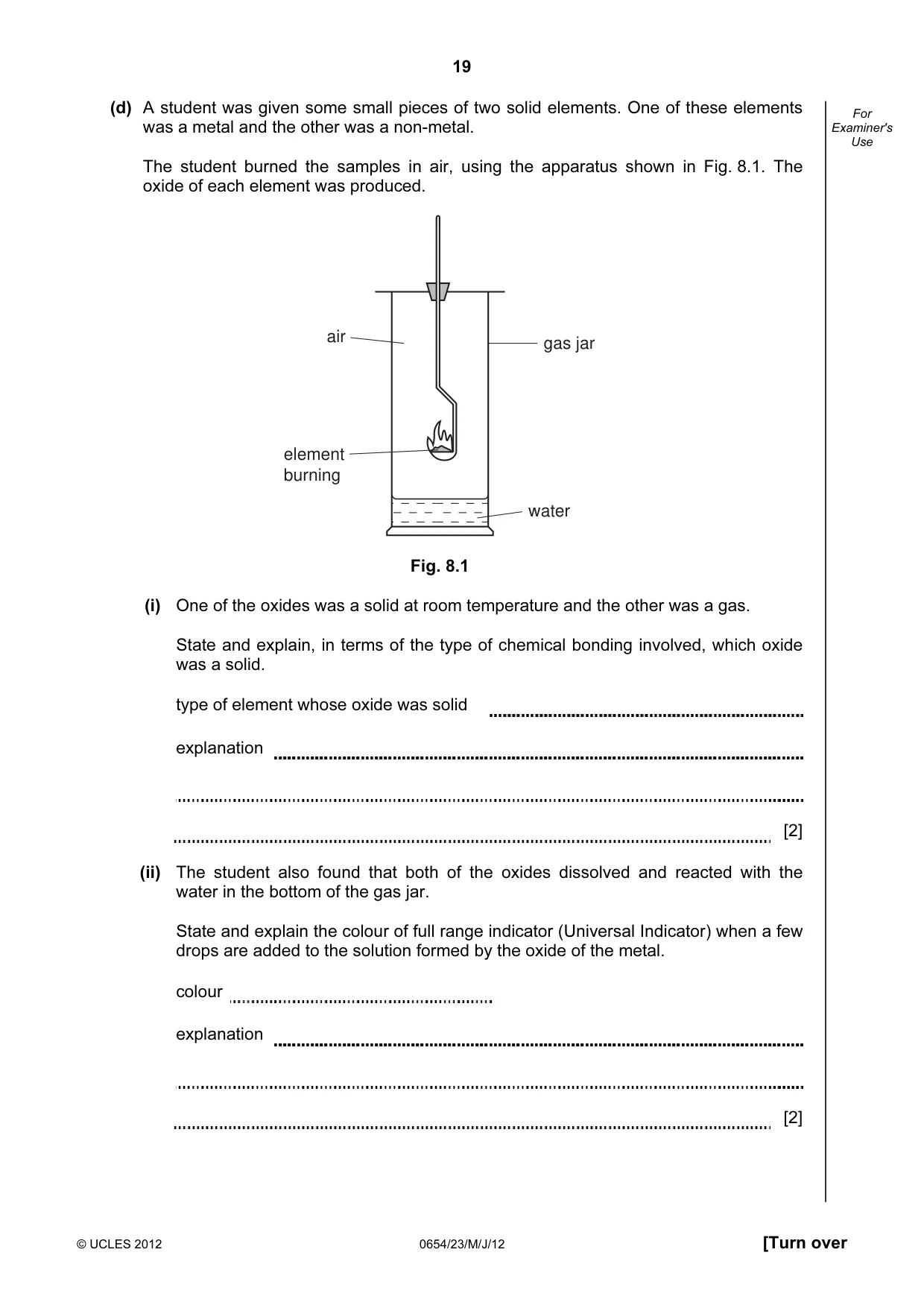
19 © UCLES 2012 0654/23/M/J/12 [Turn over For Examiner's Use (d) A student was given some small pieces of two solid elements. One of these elements was a metal and the other was a non-metal. The student burned the samples in air, using the apparatus shown in Fig. 8.1. The oxide of each element was produced. air element burning gas jar water Fig. 8.1 (i) One of the oxides was a solid at room temperature and the other was a gas. State and explain, in terms of the type of chemical bonding involved, which oxide was a solid. type of element whose oxide was solid explanation [2] (ii) The student also found that both of the oxides dissolved and reacted with the water in the bottom of the gas jar. State and explain the colour of full range indicator (Universal Indicator) when a few drops are added to the solution formed by the oxide of the metal. colour explanation [2]
Question paper, page 20
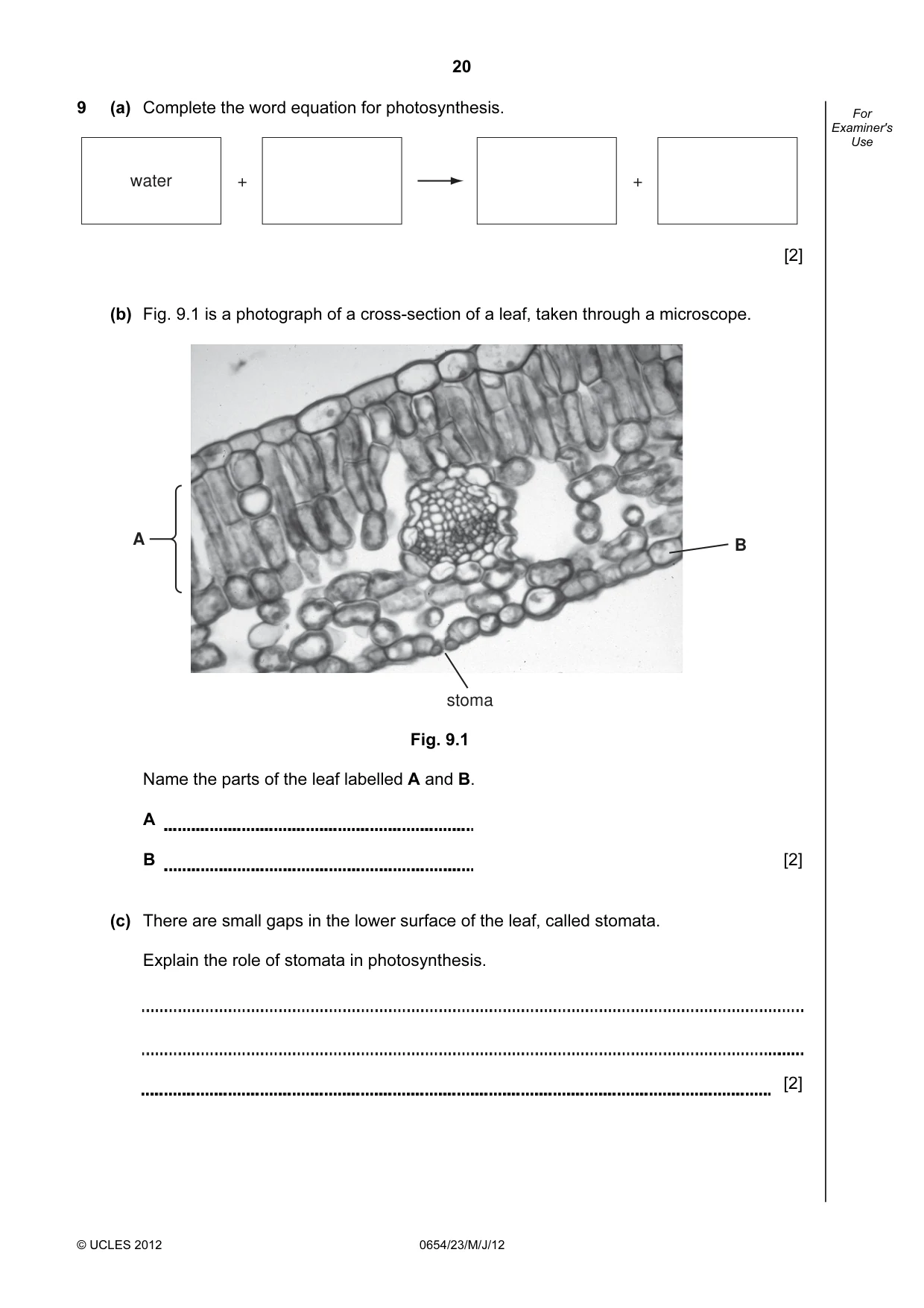
20 © UCLES 2012 0654/23/M/J/12 For Examiner's Use 9 (a) Complete the word equation for photosynthesis. water + + [2] (b) Fig. 9.1 is a photograph of a cross-section of a leaf, taken through a microscope. A B stoma Fig. 9.1 Name the parts of the leaf labelled A and B. A B [2] (c) There are small gaps in the lower surface of the leaf, called stomata. Explain the role of stomata in photosynthesis. [2]
Question paper, page 21
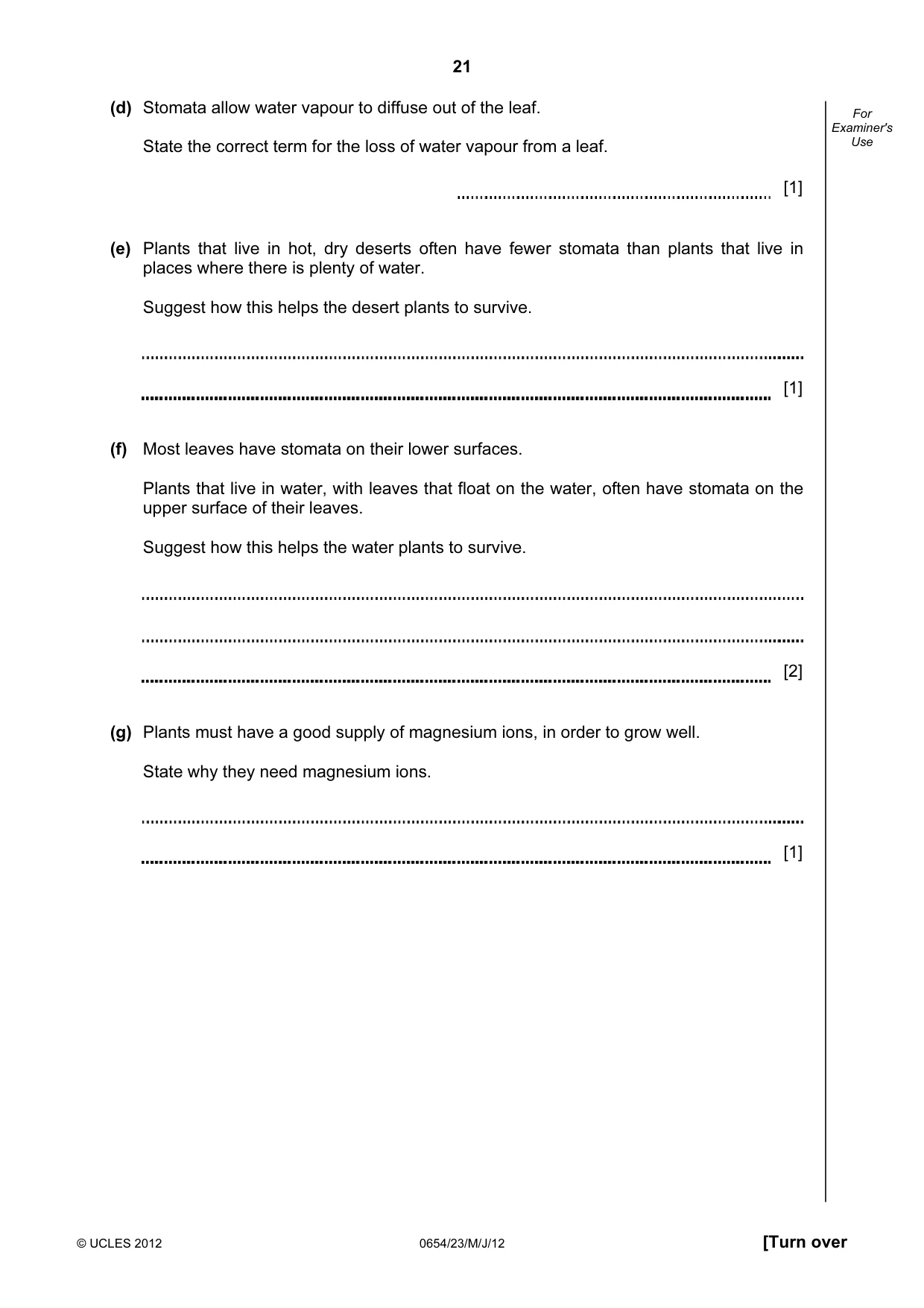
21 © UCLES 2012 0654/23/M/J/12 [Turn over For Examiner's Use (d) Stomata allow water vapour to diffuse out of the leaf. State the correct term for the loss of water vapour from a leaf. [1] (e) Plants that live in hot, dry deserts often have fewer stomata than plants that live in places where there is plenty of water. Suggest how this helps the desert plants to survive. [1] (f) Most leaves have stomata on their lower surfaces. Plants that live in water, with leaves that float on the water, often have stomata on the upper surface of their leaves. Suggest how this helps the water plants to survive. [2] (g) Plants must have a good supply of magnesium ions, in order to grow well. State why they need magnesium ions. [1]
Question paper, page 22
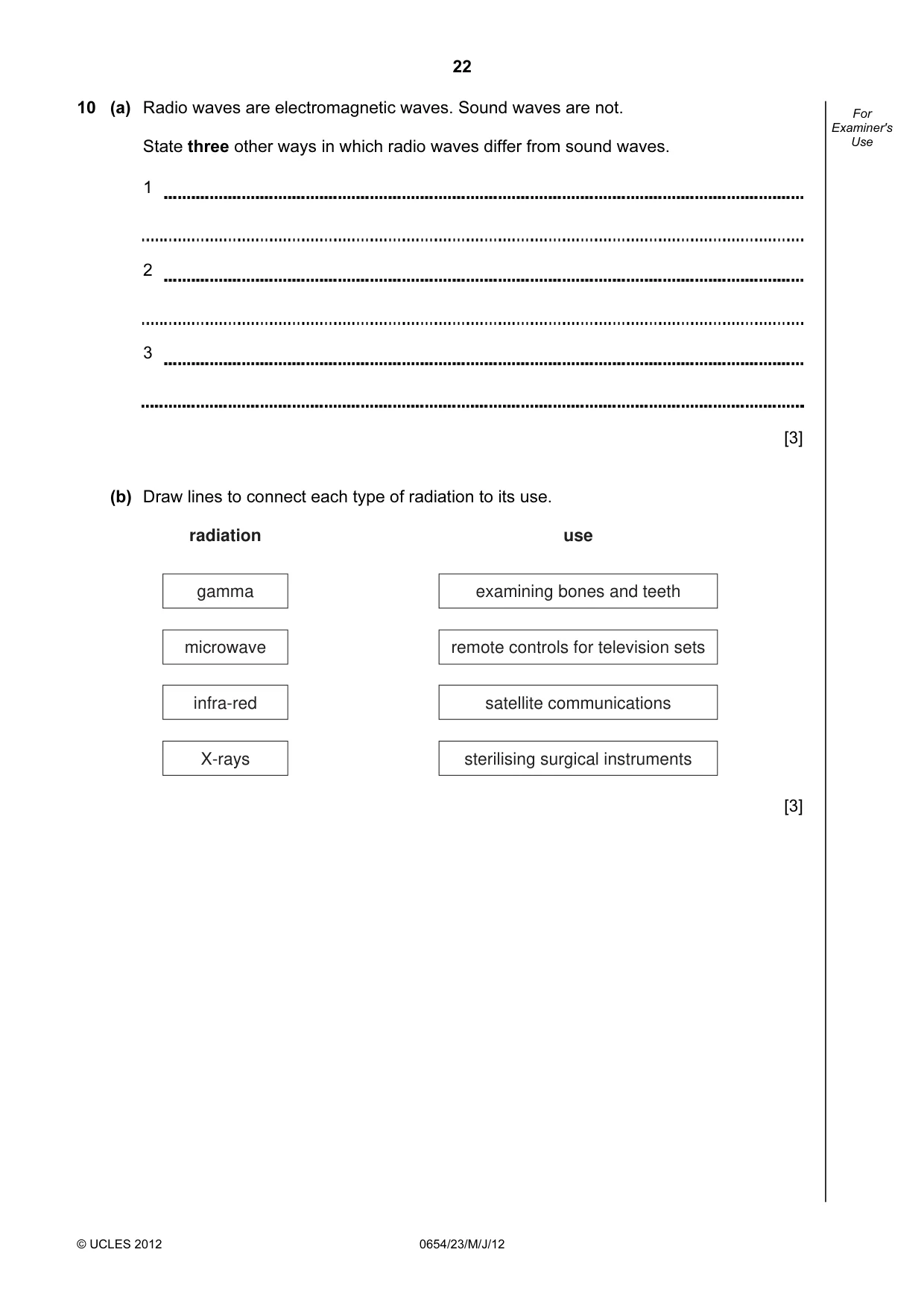
22 © UCLES 2012 0654/23/M/J/12 For Examiner's Use 10 (a) Radio waves are electromagnetic waves. Sound waves are not. State three other ways in which radio waves differ from sound waves. 1 2 3 [3] (b) Draw lines to connect each type of radiation to its use. radiation gamma microwave infra-red X-rays use examining bones and teeth remote controls for television sets satellite communications sterilising surgical instruments [3]
Question paper, page 23
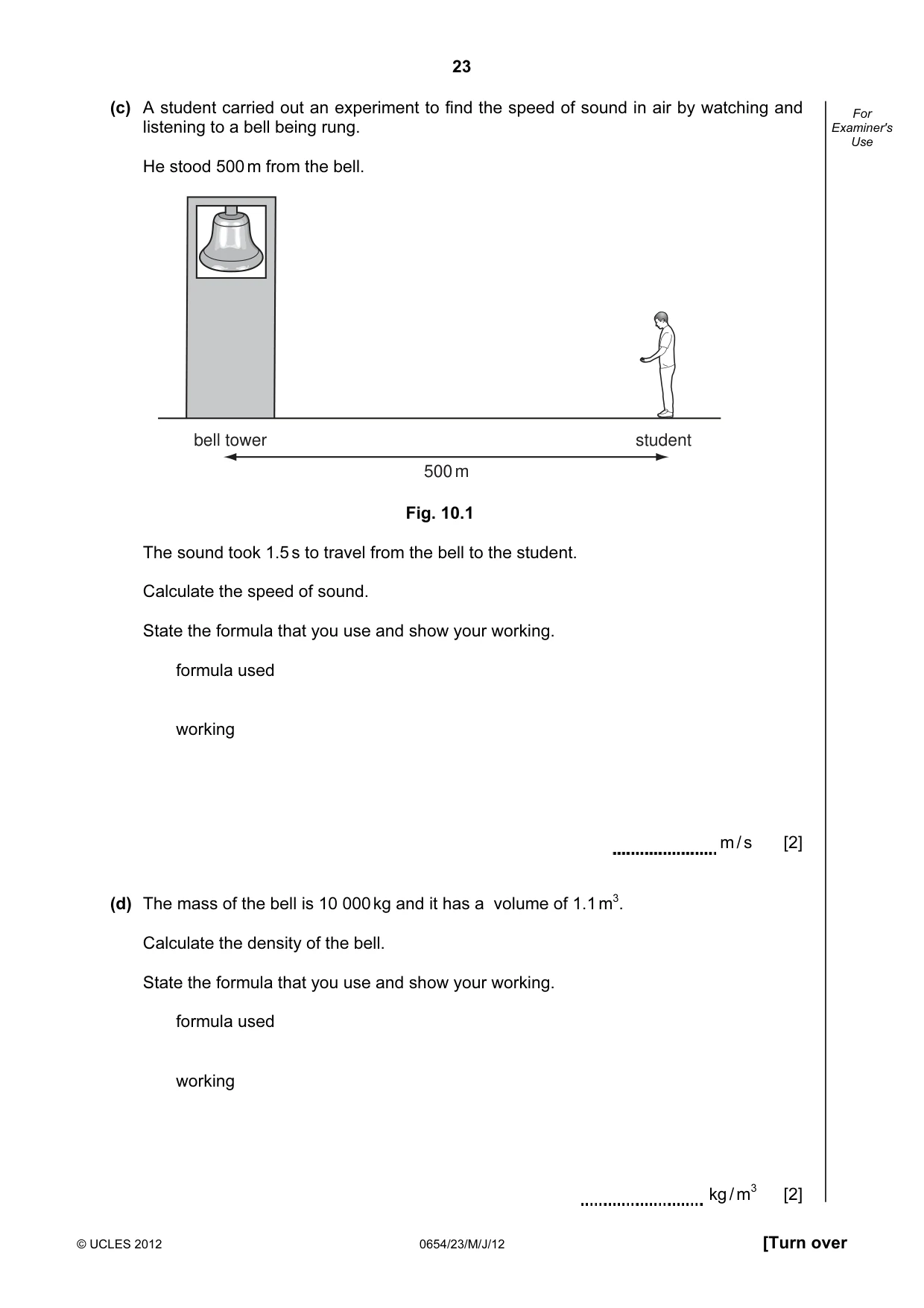
23 © UCLES 2012 0654/23/M/J/12 [Turn over For Examiner's Use (c) A student carried out an experiment to find the speed of sound in air by watching and listening to a bell being rung. He stood 500 m from the bell. bell tower student 500 m Fig. 10.1 The sound took 1.5 s to travel from the bell to the student. Calculate the speed of sound. State the formula that you use and show your working. formula used working m / s [2] (d) The mass of the bell is 10 000 kg and it has a volume of 1.1 m3. Calculate the density of the bell. State the formula that you use and show your working. formula used working kg / m3 [2]
Question paper, page 24
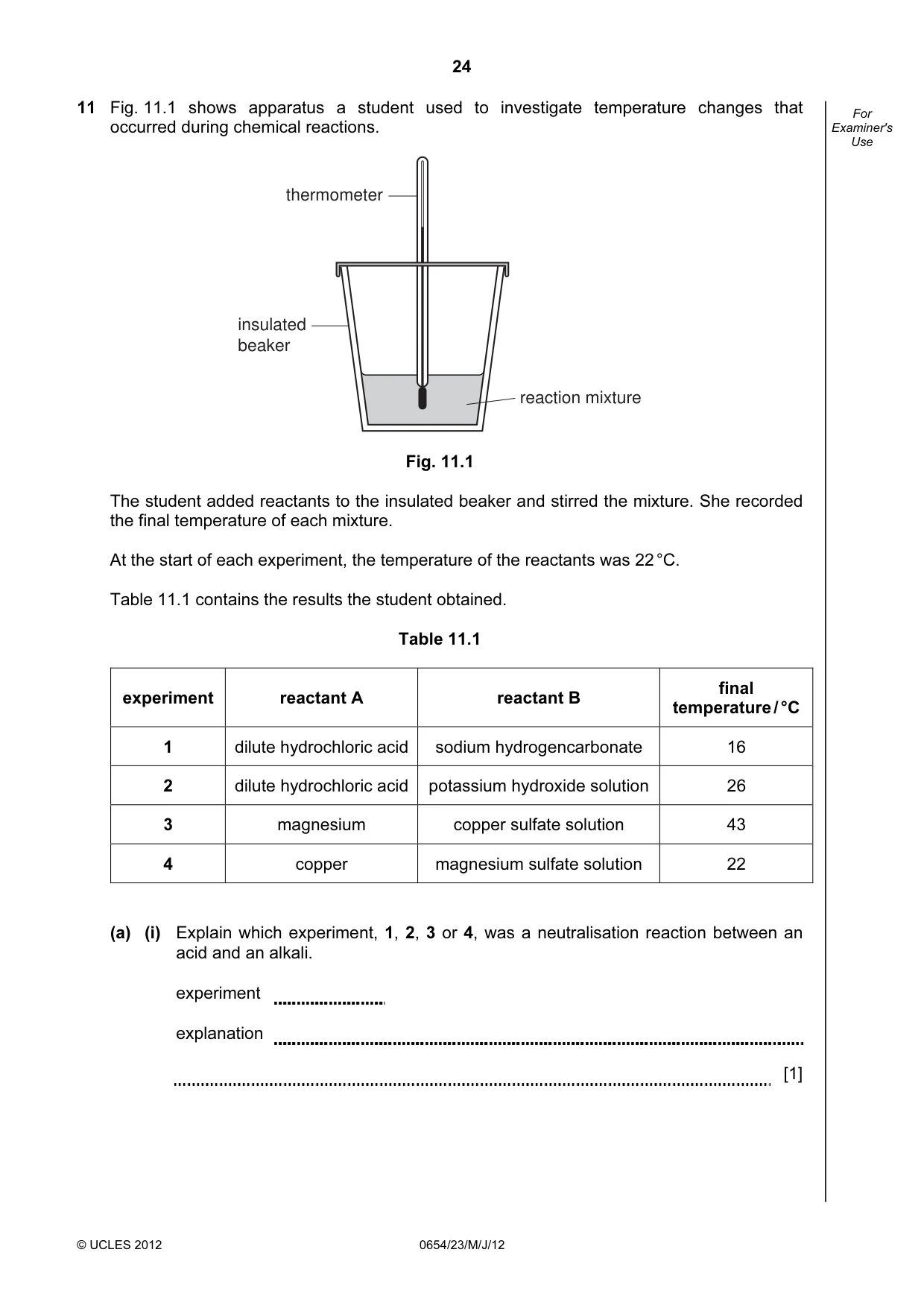
24 © UCLES 2012 0654/23/M/J/12 For Examiner's Use 11 Fig. 11.1 shows apparatus a student used to investigate temperature changes that occurred during chemical reactions. insulated beaker thermometer reaction mixture Fig. 11.1 The student added reactants to the insulated beaker and stirred the mixture. She recorded the final temperature of each mixture. At the start of each experiment, the temperature of the reactants was 22 °C. Table 11.1 contains the results the student obtained. Table 11.1 experiment reactant A reactant B final temperature / °C 1 dilute hydrochloric acid sodium hydrogencarbonate 16 2 dilute hydrochloric acid potassium hydroxide solution 26 3 magnesium copper sulfate solution 43 4 copper magnesium sulfate solution 22 (a) (i) Explain which experiment, 1, 2, 3 or 4, was a neutralisation reaction between an acid and an alkali. experiment explanation [1]
Question paper, page 25
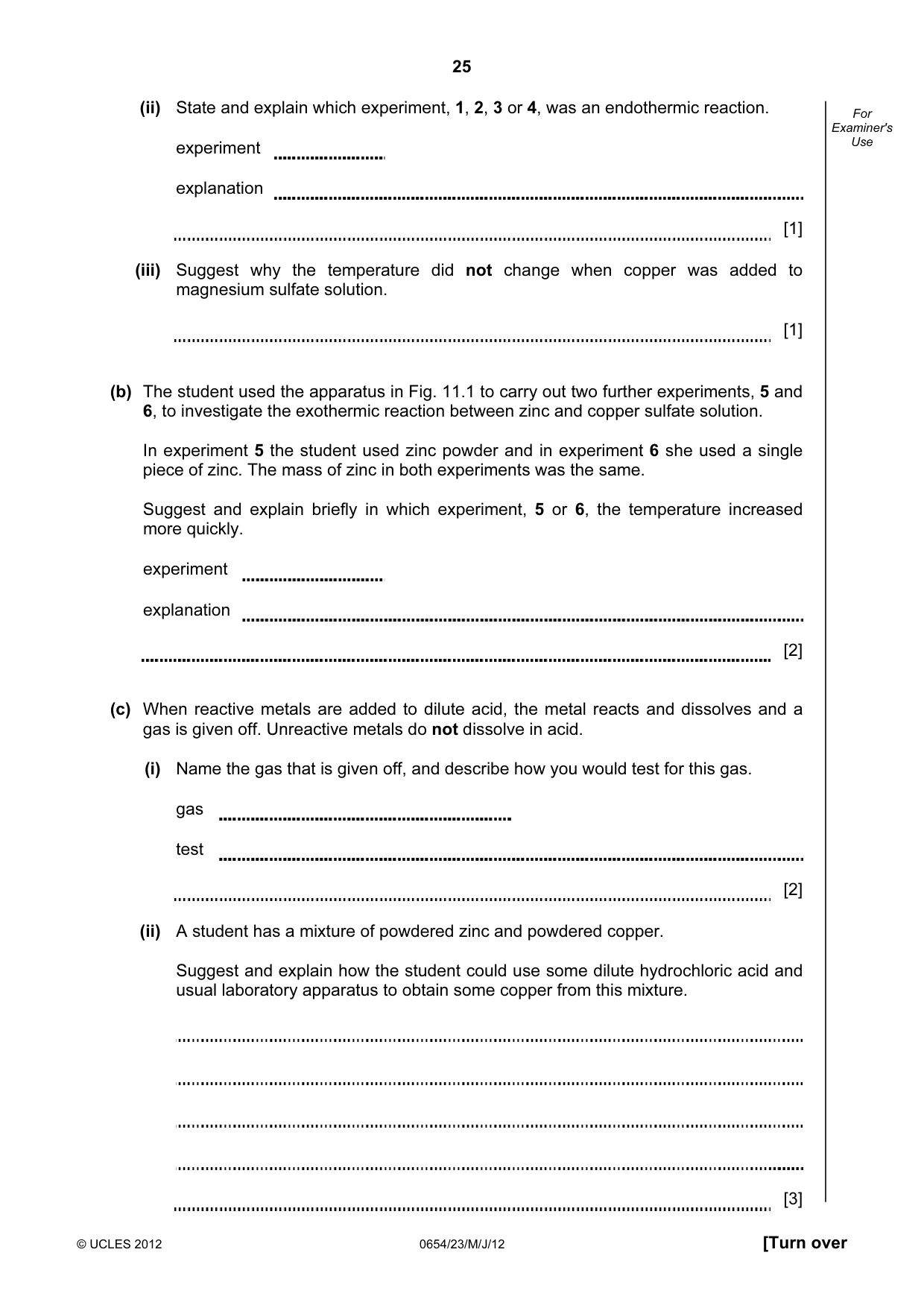
25 © UCLES 2012 0654/23/M/J/12 [Turn over For Examiner's Use (ii) State and explain which experiment, 1, 2, 3 or 4, was an endothermic reaction. experiment explanation [1] (iii) Suggest why the temperature did not change when copper was added to magnesium sulfate solution. [1] (b) The student used the apparatus in Fig. 11.1 to carry out two further experiments, 5 and 6, to investigate the exothermic reaction between zinc and copper sulfate solution. In experiment 5 the student used zinc powder and in experiment 6 she used a single piece of zinc. The mass of zinc in both experiments was the same. Suggest and explain briefly in which experiment, 5 or 6, the temperature increased more quickly. experiment explanation [2] (c) When reactive metals are added to dilute acid, the metal reacts and dissolves and a gas is given off. Unreactive metals do not dissolve in acid. (i) Name the gas that is given off, and describe how you would test for this gas. gas test [2] (ii) A student has a mixture of powdered zinc and powdered copper. Suggest and explain how the student could use some dilute hydrochloric acid and usual laboratory apparatus to obtain some copper from this mixture. [3]
Question paper, page 26
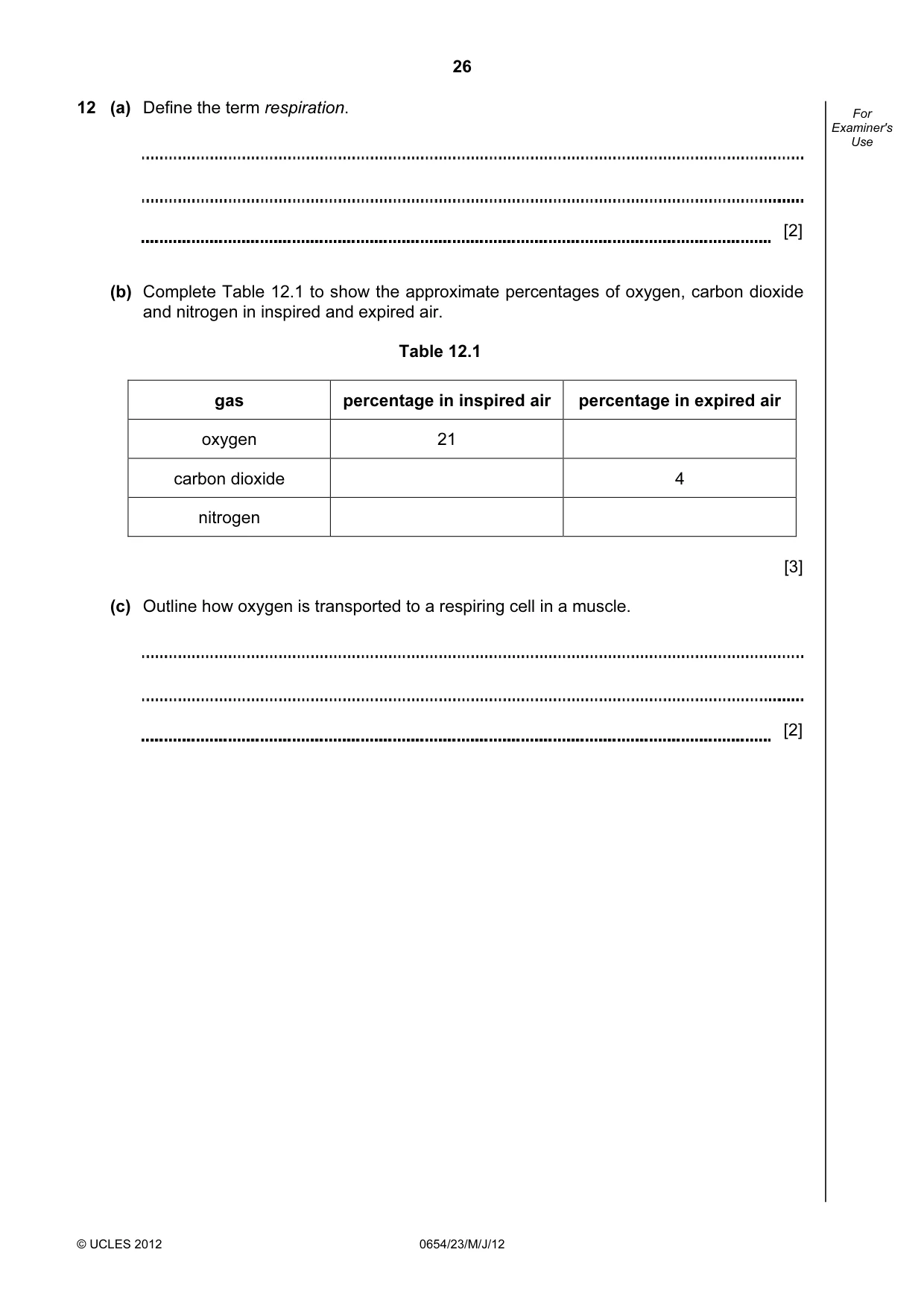
26 © UCLES 2012 0654/23/M/J/12 For Examiner's Use 12 (a) Define the term respiration. [2] (b) Complete Table 12.1 to show the approximate percentages of oxygen, carbon dioxide and nitrogen in inspired and expired air. Table 12.1 gas percentage in inspired air percentage in expired air oxygen 21 carbon dioxide 4 nitrogen [3] (c) Outline how oxygen is transported to a respiring cell in a muscle. [2]
Question paper, page 27
27 © UCLES 2012 0654/23/M/J/12 BLANK PAGE
Question paper, page 28
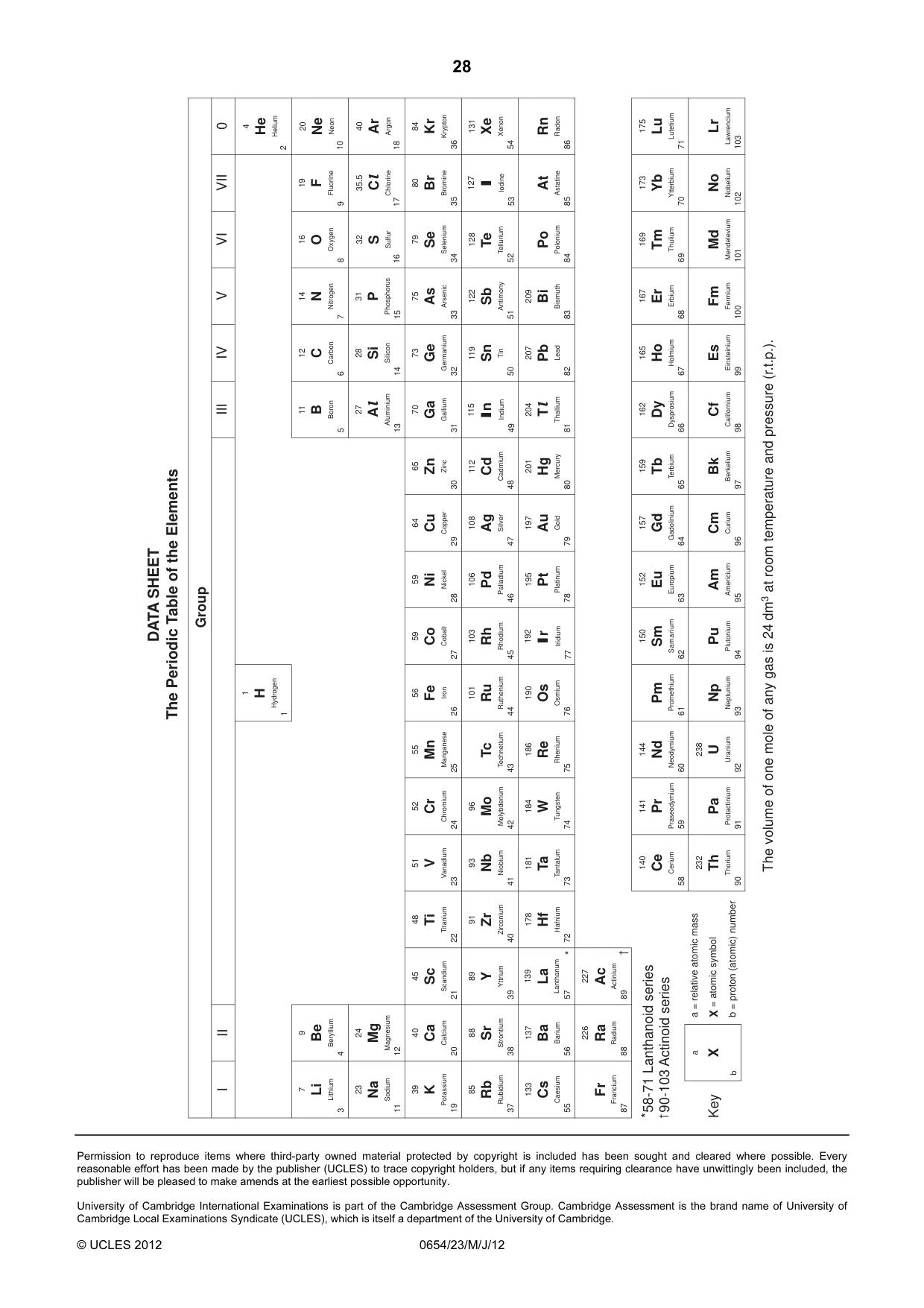
28 Permission to reproduce items where third-party owned material protected by copyright is included has been sought and cleared where possible. Every reasonable effort has been made by the publisher (UCLES) to trace copyright holders, but if any items requiring clearance have unwittingly been included, the publisher will be pleased to make amends at the earliest possible opportunity. University of Cambridge International Examinations is part of the Cambridge Assessment Group. Cambridge Assessment is the brand name of University of Cambridge Local Examinations Syndicate (UCLES), which is itself a department of the University of Cambridge. © UCLES 2012 0654/23/M/J/12 Group 140 Ce Cerium 58 141 Pr Praseodymium 59 144 Nd Neodymium 60 Pm Promethium 61 150 Sm Samarium 62 152 Eu Europium 63 157 Gd Gadolinium 64 159 Tb Terbium 65 162 Dy Dysprosium 66 165 Ho Holmium 67 167 Er Erbium 68 169 Tm Thulium 69 173 Yb Ytterbium 70 175 Lu Lutetium 71 232 Th Thorium 90 Pa Protactinium 91 238 U Uranium 92 Np Neptunium 93 Pu Plutonium 94 Am Americium 95 Cm Curium 96 Bk Berkelium 97 Cf Californium 98 Es Einsteinium 99 Fm Fermium 100 Md Mendelevium 101 No Nobelium 102 Lr Lawrencium 103 1 H Hydrogen 1 7 Li Lithium 3 23 Na Sodium 11 24 Mg Magnesium 12 40 Ca Calcium 20 45 Sc Scandium 21 48 Ti Titanium 22 51 V Vanadium 23 52 Cr Chromium 24 55 Mn Manganese 25 56 Fe Iron 26 59 Co Cobalt 27 59 Ni Nickel 28 64 Cu Copper 29 65 Zn Zinc 30 70 Ga Gallium 31 27 Al Aluminium 13 11 B Boron 5 12 C Carbon 6 14 N Nitrogen 7 16 O Oxygen 8 19 F Fluorine 9 28 Si Silicon 14 31 P Phosphorus 15 32 S Sulfur 16 35.5 Cl Chlorine 17 40 Ar Argon 18 20 Ne Neon 10 4 He Helium 2 73 Ge Germanium 32 75 As Arsenic 33 79 Se Selenium 34 80 Br Bromine 35 84 Kr Krypton 36 39 K Potassium 19 88 Sr Strontium 38 89 Y Yttrium 39 91 Zr Zirconium 40 93 Nb Niobium 41 96 Mo Molybdenum 42 Tc Technetium 43 101 Ru Ruthenium 44 103 Rh Rhodium 45 106 Pd Palladium 46 108 Ag Silver 47 112 Cd Cadmium 48 115 In Indium 49 119 Sn Tin 50 122 Sb Antimony 51 128 Te Tellurium 52 127 I Iodine 53 131 Xe Xenon 54 137 Ba Barium 56 139 La Lanthanum 57 * 178 Hf Hafnium 72 181 Ta Tantalum 73 184 W Tungsten 74 186 Re Rhenium 75 190 Os Osmium 76 192 Ir Iridium 77 195 Pt Platinum 78 197 Au Gold 79 201 Hg Mercury 80 204 Tl Thallium 81 207 Pb Lead 82 209 Bi Bismuth 83 Po Polonium 84 At Astatine 85 Rn Radon 86 Fr Francium 87 227 Ac Actinium 89 9 Be Beryllium 4 I II III IV V VI VII 0 85 Rb Rubidium 37 133 Cs Caesium 55 226 Ra Radium 88 The volume of one mole of any gas is 24 dm3 at room temperature and pressure (r.t.p.). a X b a = relative atomic mass X = atomic symbol b = proton (atomic) number Key *58-71 Lanthanoid series 90-103 Actinoid series DATA SHEET The Periodic Table of the Elements
Mark scheme, page 1
UNIVERSITY OF CAMBRIDGE INTERNATIONAL EXAMINATIONS International General Certificate of Secondary Education MARK SCHEME for the May/June 2012 question paper for the guidance of teachers 0654 CO-ORDINATED SCIENCES 0654/23 Paper 2 (Core Theory), maximum raw mark 120 This mark scheme is published as an aid to teachers and candidates, to indicate the requirements of the examination. It shows the basis on which Examiners were instructed to award marks. It does not indicate the details of the discussions that took place at an Examiners’ meeting before marking began, which would have considered the acceptability of alternative answers. Mark schemes must be read in conjunction with the question papers and the report on the examination. • Cambridge will not enter into discussions or correspondence in connection with these mark schemes. Cambridge is publishing the mark schemes for the May/June 2012 question papers for most IGCSE, GCE Advanced Level and Advanced Subsidiary Level syllabuses and some Ordinary Level syllabuses. www.XtremePapers.com
Mark scheme, page 2
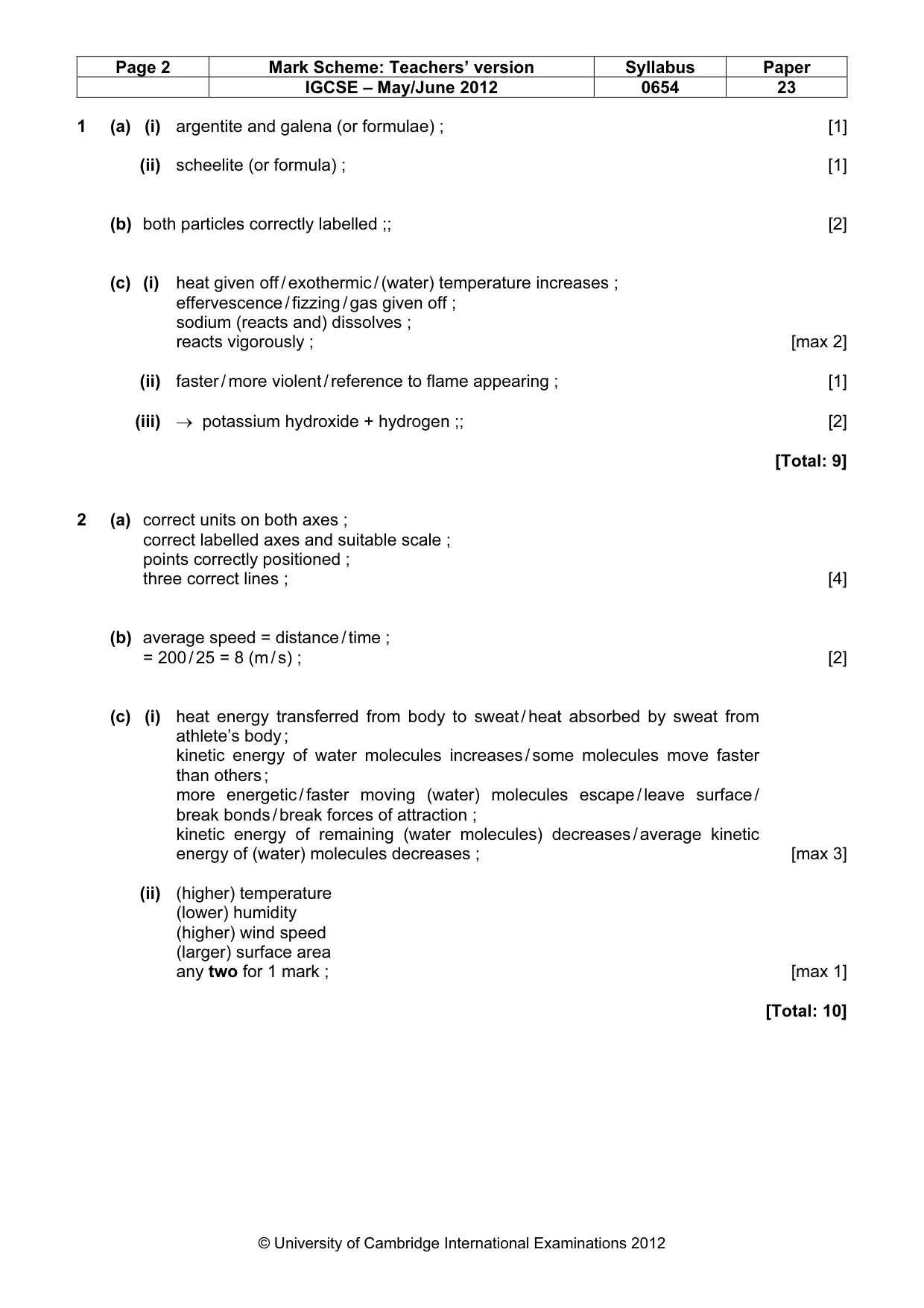
Page 2 Mark Scheme: Teachers’ version Syllabus Paper IGCSE – May/June 2012 0654 23 © University of Cambridge International Examinations 2012 1 (a) (i) argentite and galena (or formulae) ; [1] (ii) scheelite (or formula) ; [1] (b) both particles correctly labelled ;; [2] (c) (i) heat given off / exothermic / (water) temperature increases ; effervescence / fizzing / gas given off ; sodium (reacts and) dissolves ; reacts vigorously ; [max 2] (ii) faster / more violent / reference to flame appearing ; [1] (iii) → potassium hydroxide + hydrogen ;; [2] [Total: 9] 2 (a) correct units on both axes ; correct labelled axes and suitable scale ; points correctly positioned ; three correct lines ; [4] (b) average speed = distance / time ; = 200 / 25 = 8 (m / s) ; [2] (c) (i) heat energy transferred from body to sweat / heat absorbed by sweat from athlete’s body ; kinetic energy of water molecules increases / some molecules move faster than others ; more energetic / faster moving (water) molecules escape / leave surface / break bonds / break forces of attraction ; kinetic energy of remaining (water molecules) decreases / average kinetic energy of (water) molecules decreases ; [max 3] (ii) (higher) temperature (lower) humidity (higher) wind speed (larger) surface area any two for 1 mark ; [max 1] [Total: 10]
Mark scheme, page 3
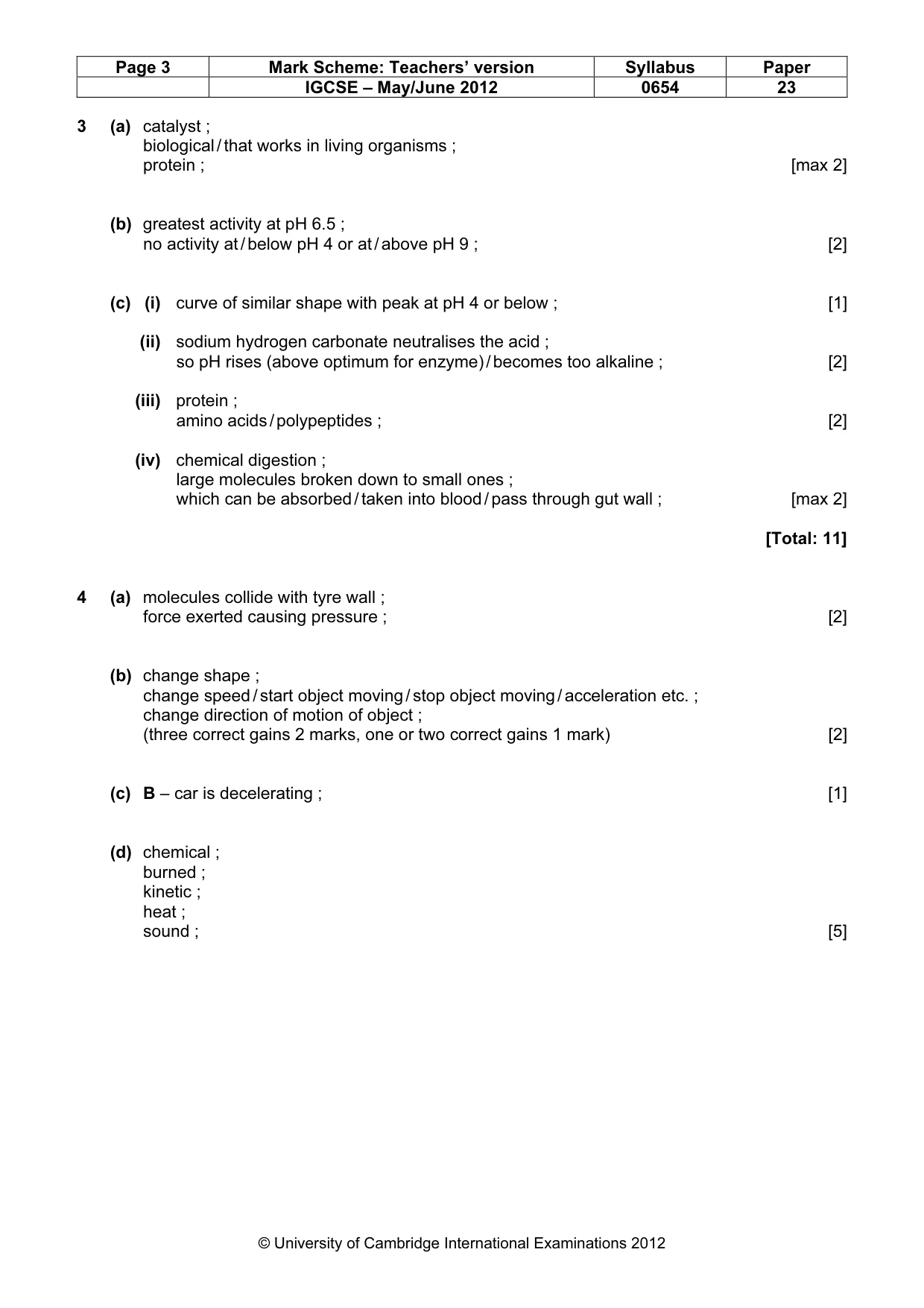
Page 3 Mark Scheme: Teachers’ version Syllabus Paper IGCSE – May/June 2012 0654 23 © University of Cambridge International Examinations 2012 3 (a) catalyst ; biological / that works in living organisms ; protein ; [max 2] (b) greatest activity at pH 6.5 ; no activity at / below pH 4 or at / above pH 9 ; [2] (c) (i) curve of similar shape with peak at pH 4 or below ; [1] (ii) sodium hydrogen carbonate neutralises the acid ; so pH rises (above optimum for enzyme) / becomes too alkaline ; [2] (iii) protein ; amino acids / polypeptides ; [2] (iv) chemical digestion ; large molecules broken down to small ones ; which can be absorbed / taken into blood / pass through gut wall ; [max 2] [Total: 11] 4 (a) molecules collide with tyre wall ; force exerted causing pressure ; [2] (b) change shape ; change speed / start object moving / stop object moving / acceleration etc. ; change direction of motion of object ; (three correct gains 2 marks, one or two correct gains 1 mark) [2] (c) B – car is decelerating ; [1] (d) chemical ; burned ; kinetic ; heat ; sound ; [5]
Mark scheme, page 4
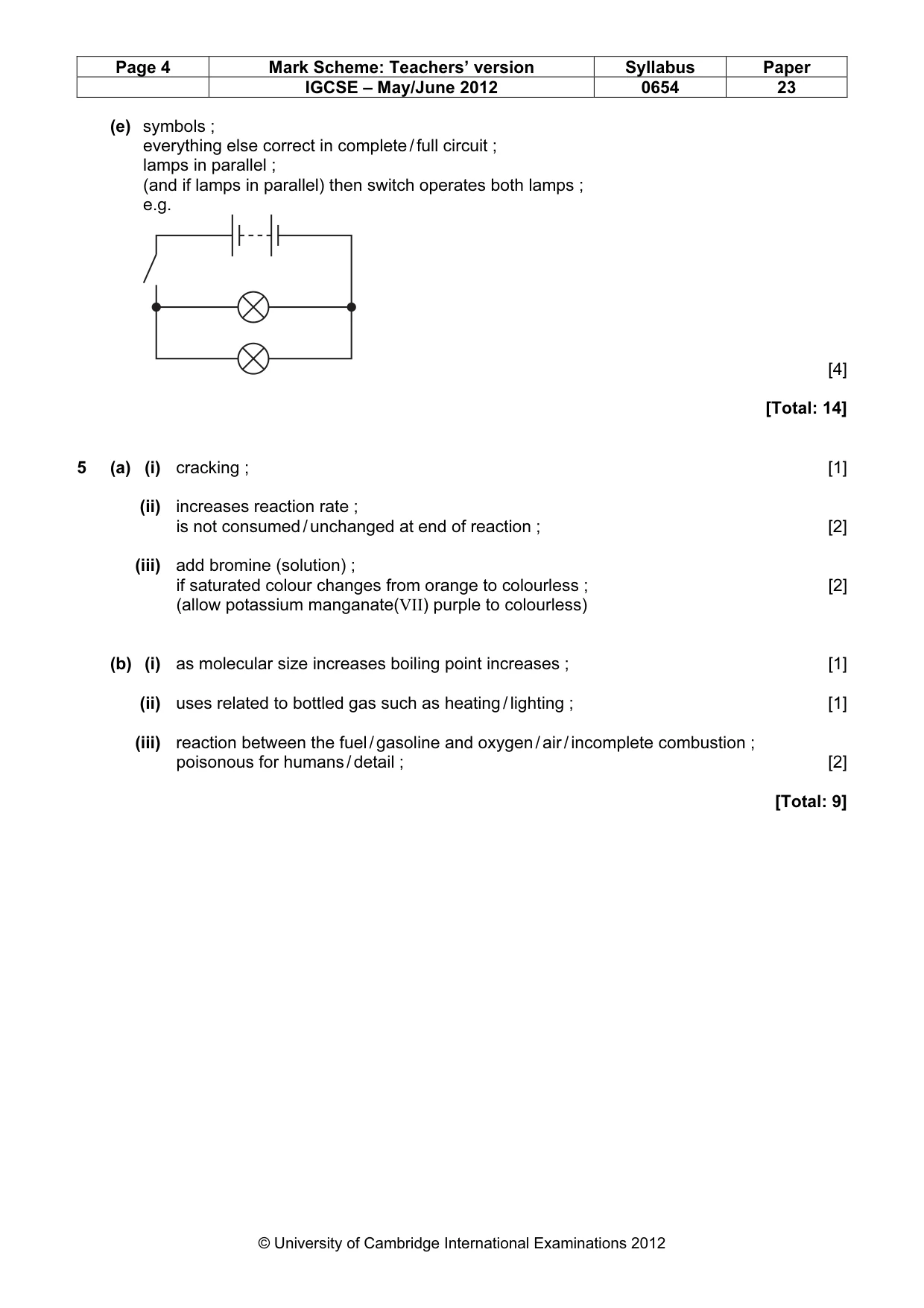
Page 4 Mark Scheme: Teachers’ version Syllabus Paper IGCSE – May/June 2012 0654 23 © University of Cambridge International Examinations 2012 (e) symbols ; everything else correct in complete / full circuit ; lamps in parallel ; (and if lamps in parallel) then switch operates both lamps ; e.g. [4] [Total: 14] 5 (a) (i) cracking ; [1] (ii) increases reaction rate ; is not consumed / unchanged at end of reaction ; [2] (iii) add bromine (solution) ; if saturated colour changes from orange to colourless ; [2] (allow potassium manganate(VII) purple to colourless) (b) (i) as molecular size increases boiling point increases ; [1] (ii) uses related to bottled gas such as heating / lighting ; [1] (iii) reaction between the fuel / gasoline and oxygen / air / incomplete combustion ; poisonous for humans / detail ; [2] [Total: 9]
Mark scheme, page 5
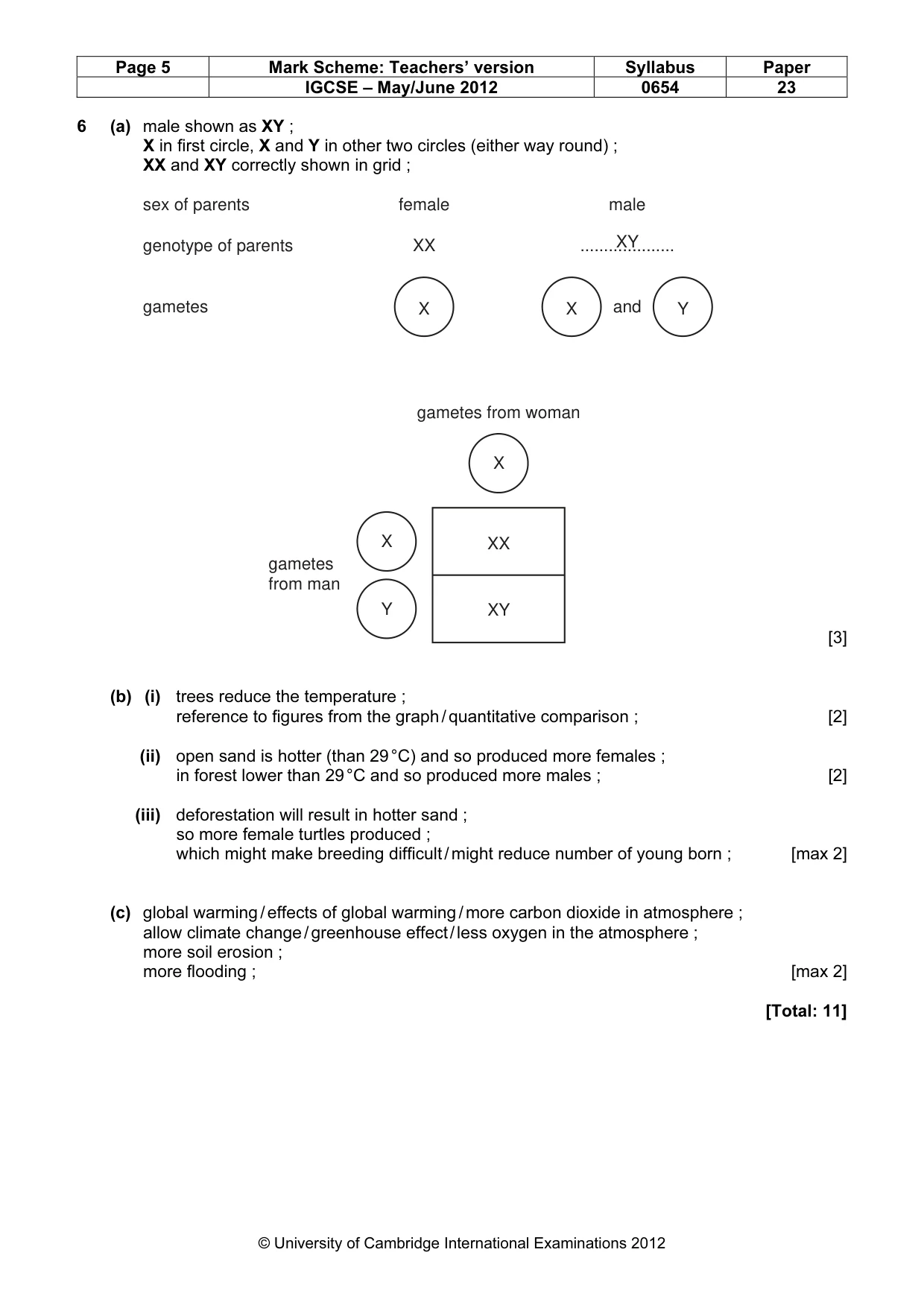
Page 5 Mark Scheme: Teachers’ version Syllabus Paper IGCSE – May/June 2012 0654 23 © University of Cambridge International Examinations 2012 6 (a) male shown as XY ; X in first circle, X and Y in other two circles (either way round) ; XX and XY correctly shown in grid ; sex of parents genotype of parents gametes female XX male … and gametes from woman gametes from man XY X X X X Y Y XX XY [3] (b) (i) trees reduce the temperature ; reference to figures from the graph / quantitative comparison ; [2] (ii) open sand is hotter (than 29 °C) and so produced more females ; in forest lower than 29 °C and so produced more males ; [2] (iii) deforestation will result in hotter sand ; so more female turtles produced ; which might make breeding difficult / might reduce number of young born ; [max 2] (c) global warming / effects of global warming / more carbon dioxide in atmosphere ; allow climate change / greenhouse effect / less oxygen in the atmosphere ; more soil erosion ; more flooding ; [max 2] [Total: 11]
Mark scheme, page 6
Page 6 Mark Scheme: Teachers’ version Syllabus Paper IGCSE – May/June 2012 0654 23 © University of Cambridge International Examinations 2012 7 (a) beta radiation passes through paper but is stopped thick aluminium or lead ; gamma radiation able to pass through aluminium and thin lead ; [2] (b) distance between two waves ; distance between identical points on two successive waves ; [2] (or shown on diagram) (c) ionizing radiation ; causes cancer etc. ; [2] [Total: 6] 8 (a) use of chlorine / ozone / ultrafiltration ; removes harmful microorganisms ; OR filtration ; removes insolubles ; [max 2] (b) in water (molecules) hydrogen (atoms) are bonded to oxygen (atoms) ; in the mixture only like atoms are bonded ; OR in water the H:O ratio is 2:1 ; in the mixture no fixed ratio ; OR water unreactive / puts out flame ; mixture burns / will react ; [max 2] (c) (i) heat the solution ; water evaporates (leaving the crystals) ; [2] (ii) (no) hexane is a liquid (at room temperature) ; so also passes through filter ; [2] (d) (i) metal ; oxide is metal bonded to non metal ; so is ionic ; ionic compounds are always solids ; [max 2] (ii) allow blue / shades of blue / shades of purple ; metal oxides are basic / has formed an alkaline solution ; [2] [Total: 12]
Mark scheme, page 7
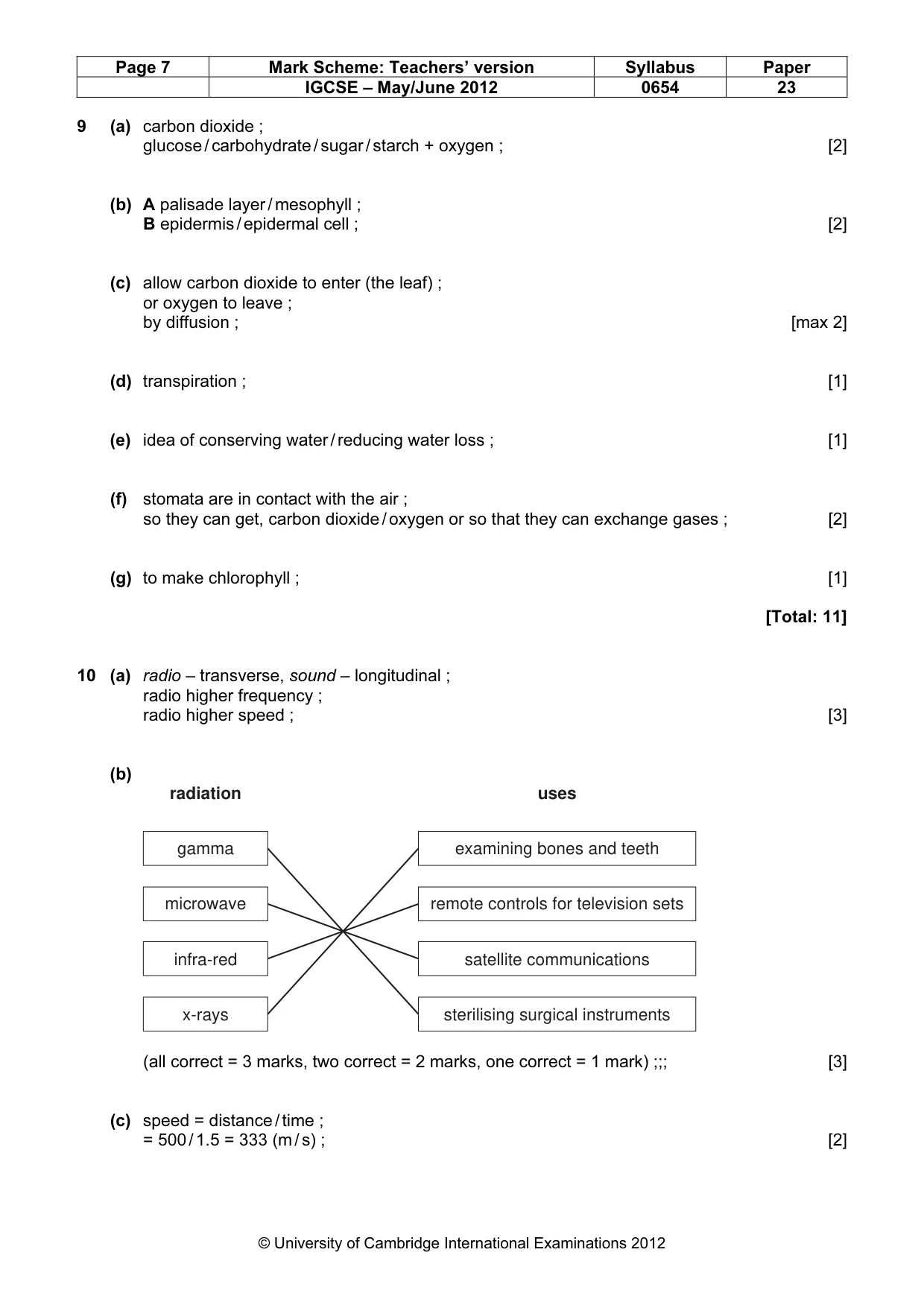
Page 7 Mark Scheme: Teachers’ version Syllabus Paper IGCSE – May/June 2012 0654 23 © University of Cambridge International Examinations 2012 9 (a) carbon dioxide ; glucose / carbohydrate / sugar / starch + oxygen ; [2] (b) A palisade layer / mesophyll ; B epidermis / epidermal cell ; [2] (c) allow carbon dioxide to enter (the leaf) ; or oxygen to leave ; by diffusion ; [max 2] (d) transpiration ; [1] (e) idea of conserving water / reducing water loss ; [1] (f) stomata are in contact with the air ; so they can get, carbon dioxide / oxygen or so that they can exchange gases ; [2] (g) to make chlorophyll ; [1] [Total: 11] 10 (a) radio – transverse, sound – longitudinal ; radio higher frequency ; radio higher speed ; [3] (b) radiation gamma microwave infra-red x-rays uses examining bones and teeth remote controls for television sets satellite communications sterilising surgical instruments (all correct = 3 marks, two correct = 2 marks, one correct = 1 mark) ;;; [3] (c) speed = distance / time ; = 500 / 1.5 = 333 (m / s) ; [2]
Mark scheme, page 8
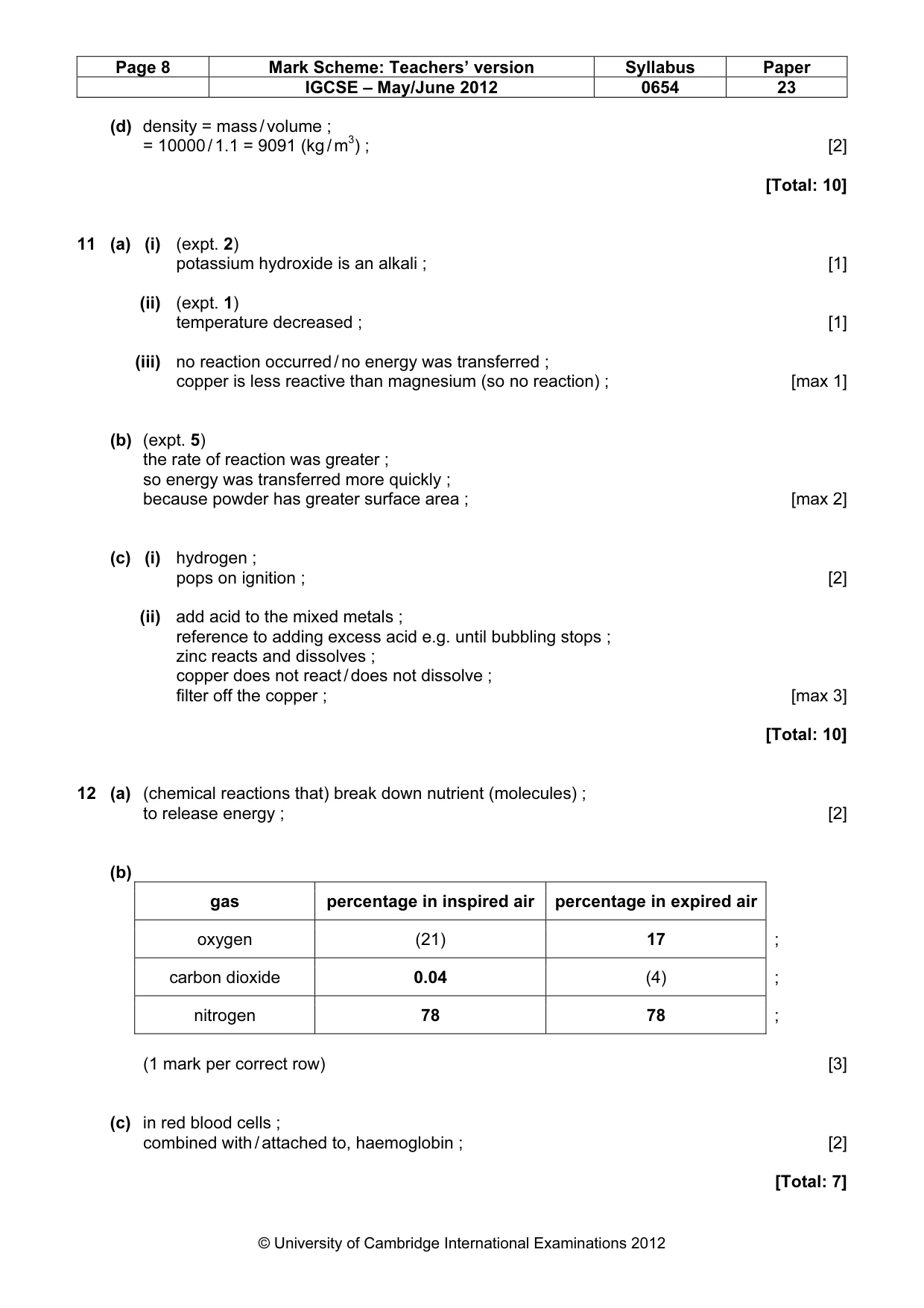
Page 8 Mark Scheme: Teachers’ version Syllabus Paper IGCSE – May/June 2012 0654 23 © University of Cambridge International Examinations 2012 (d) density = mass / volume ; = 10000 / 1.1 = 9091 (kg / m3) ; [2] [Total: 10] 11 (a) (i) (expt. 2) potassium hydroxide is an alkali ; [1] (ii) (expt. 1) temperature decreased ; [1] (iii) no reaction occurred / no energy was transferred ; copper is less reactive than magnesium (so no reaction) ; [max 1] (b) (expt. 5) the rate of reaction was greater ; so energy was transferred more quickly ; because powder has greater surface area ; [max 2] (c) (i) hydrogen ; pops on ignition ; [2] (ii) add acid to the mixed metals ; reference to adding excess acid e.g. until bubbling stops ; zinc reacts and dissolves ; copper does not react / does not dissolve ; filter off the copper ; [max 3] [Total: 10] 12 (a) (chemical reactions that) break down nutrient (molecules) ; to release energy ; [2] (b) gas percentage in inspired air percentage in expired air oxygen (21) 17 ; carbon dioxide 0.04 (4) ; nitrogen 78 78 ; (1 mark per correct row) [3] (c) in red blood cells ; combined with / attached to, haemoglobin ; [2] [Total: 7]
What you needed in this session
Cambridge’s own grade thresholds for 2012 May/June, Paper 2 · Variant 3. A higher threshold means an easier paper — the bar moves with how the cohort did.