Cambridge IGCSE Sciences - Co-ordinated (Double) 0654 — 2010 May/June Paper 6 · Variant 2
0654/62/M/J/10 · 60 marks · ≈68 min
The question paper and its mark scheme, free to read here and free to download. This is Cambridge’s own paper, exactly as it was sat.
Question paper20 pages

Mark scheme4 pages
Answers below. Sit the paper first if you are practising.
Paper as text
Question paper, page 1
This document consists of 18 printed pages and 2 blank pages. IB10 06_0654_62/FP © UCLES 2010 [Turn over *7501427800* For Examiner's Use 1 2 3 4 5 6 Total UNIVERSITY OF CAMBRIDGE INTERNATIONAL EXAMINATIONS International General Certificate of Secondary Education CO-ORDINATED SCIENCES 0654/62 Paper 6 Alternative to Practical May/June 2010 1 hour Candidates answer on the Question paper No Additional Materials are required. READ THESE INSTRUCTIONS FIRST Write your Centre number, candidate number and name on all the work you hand in. Write in dark blue or black pen. You may use a soft pencil for any diagrams, graphs, tables or rough working. Do not use staples, paper clips, highlighters, glue or correction fluid. DO NOT WRITE IN ANY BARCODES. Answer all questions. At the end of the examination, fasten all your work securely together. The number of marks is given in brackets [ ] at the end of each question or part question. www.XtremePapers.com
Question paper, page 2
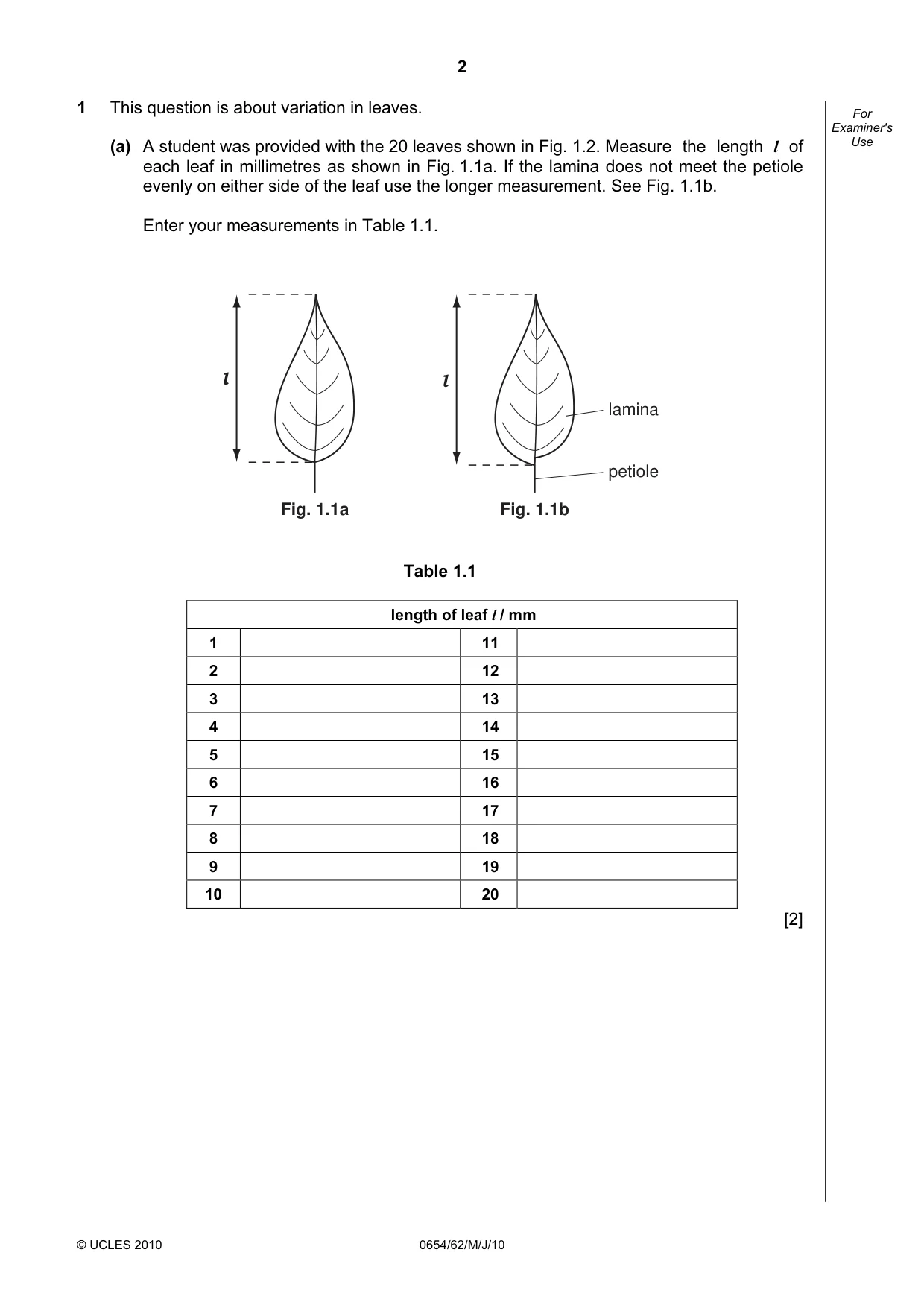
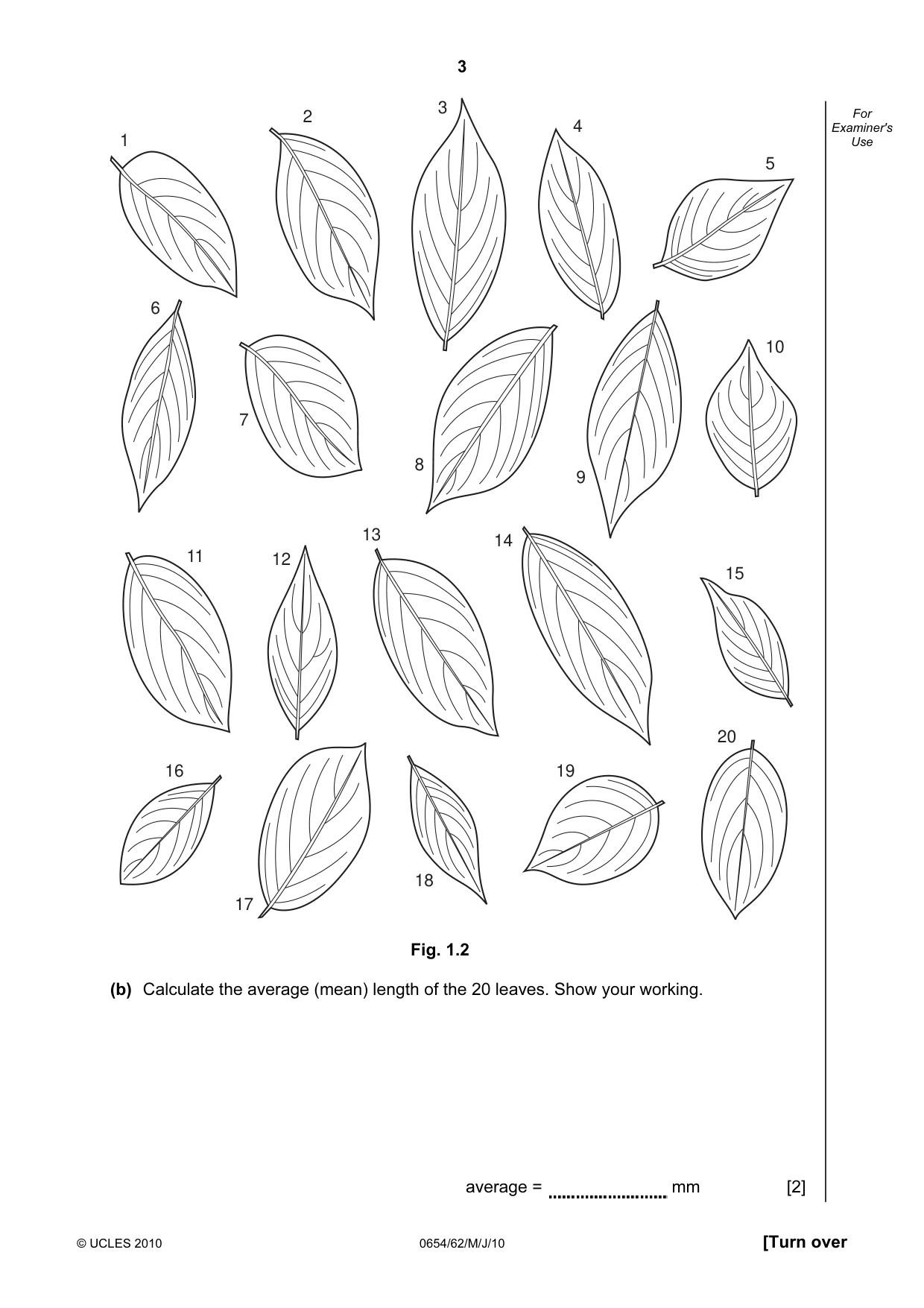
2 © UCLES 2010 0654/62/M/J/10 For Examiner's Use 1 This question is about variation in leaves. (a) A student was provided with the 20 leaves shown in Fig. 1.2. Measure the length l of each leaf in millimetres as shown in Fig. 1.1a. If the lamina does not meet the petiole evenly on either side of the leaf use the longer measurement. See Fig. 1.1b. Enter your measurements in Table 1.1. l Fig. 1.1a l Fig. 1.1b lamina petiole Table 1.1 length of leaf l / mm 1 11 2 12 3 13 4 14 5 15 6 16 7 17 8 18 9 19 10 20 [2]
Question paper, page 3
3 © UCLES 2010 0654/62/M/J/10 [Turn over For Examiner's Use 1 2 3 4 5 6 7 8 9 10 11 12 13 14 15 16 17 18 19 20 Fig. 1.2 (b) Calculate the average (mean) length of the 20 leaves. Show your working. average = mm [2]
Question paper, page 4
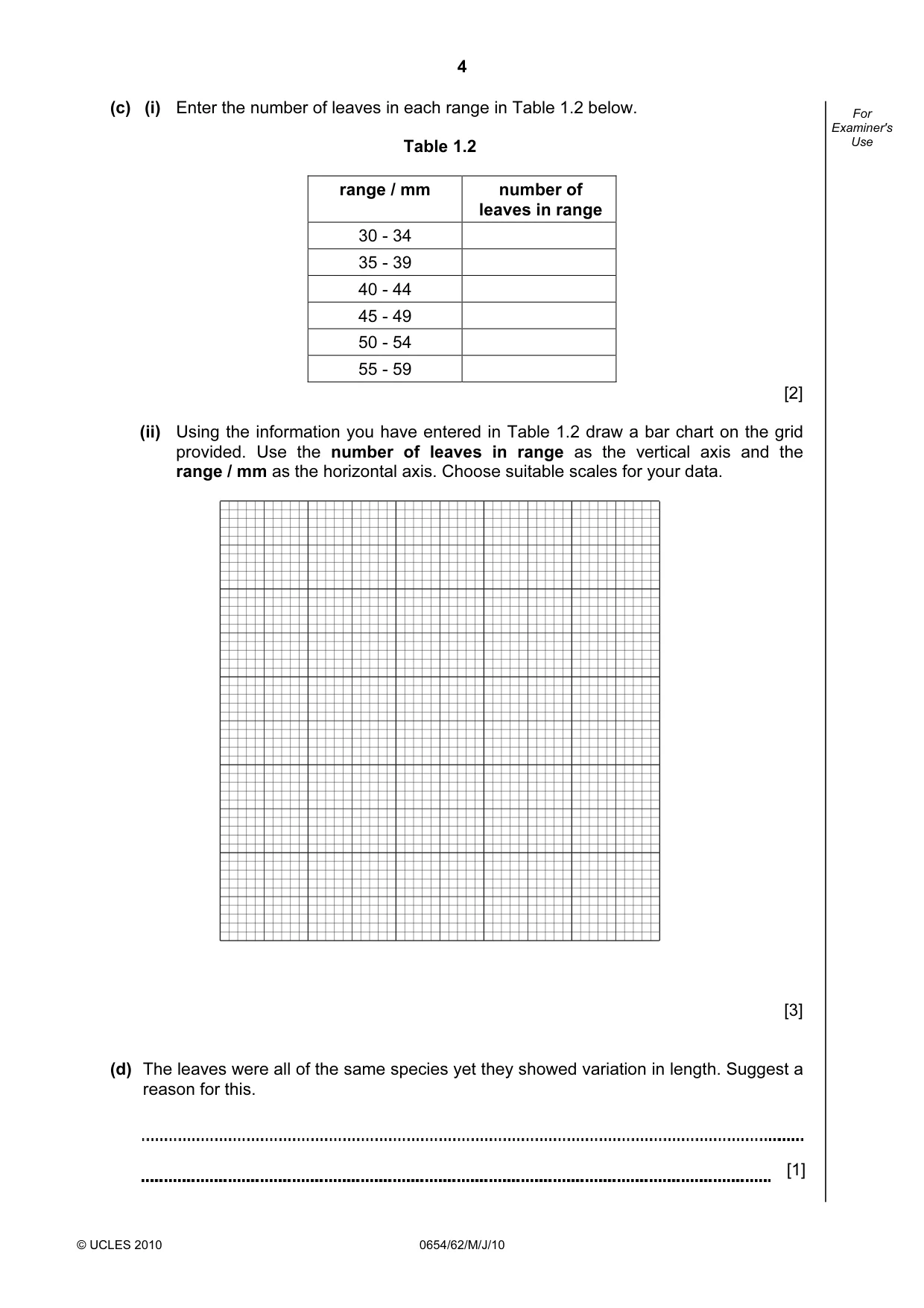
4 © UCLES 2010 0654/62/M/J/10 For Examiner's Use (c) (i) Enter the number of leaves in each range in Table 1.2 below. Table 1.2 range / mm number of leaves in range 30 - 34 35 - 39 40 - 44 45 - 49 50 - 54 55 - 59 [2] (ii) Using the information you have entered in Table 1.2 draw a bar chart on the grid provided. Use the number of leaves in range as the vertical axis and the range / mm as the horizontal axis. Choose suitable scales for your data. [3] (d) The leaves were all of the same species yet they showed variation in length. Suggest a reason for this. [1]
Question paper, page 5
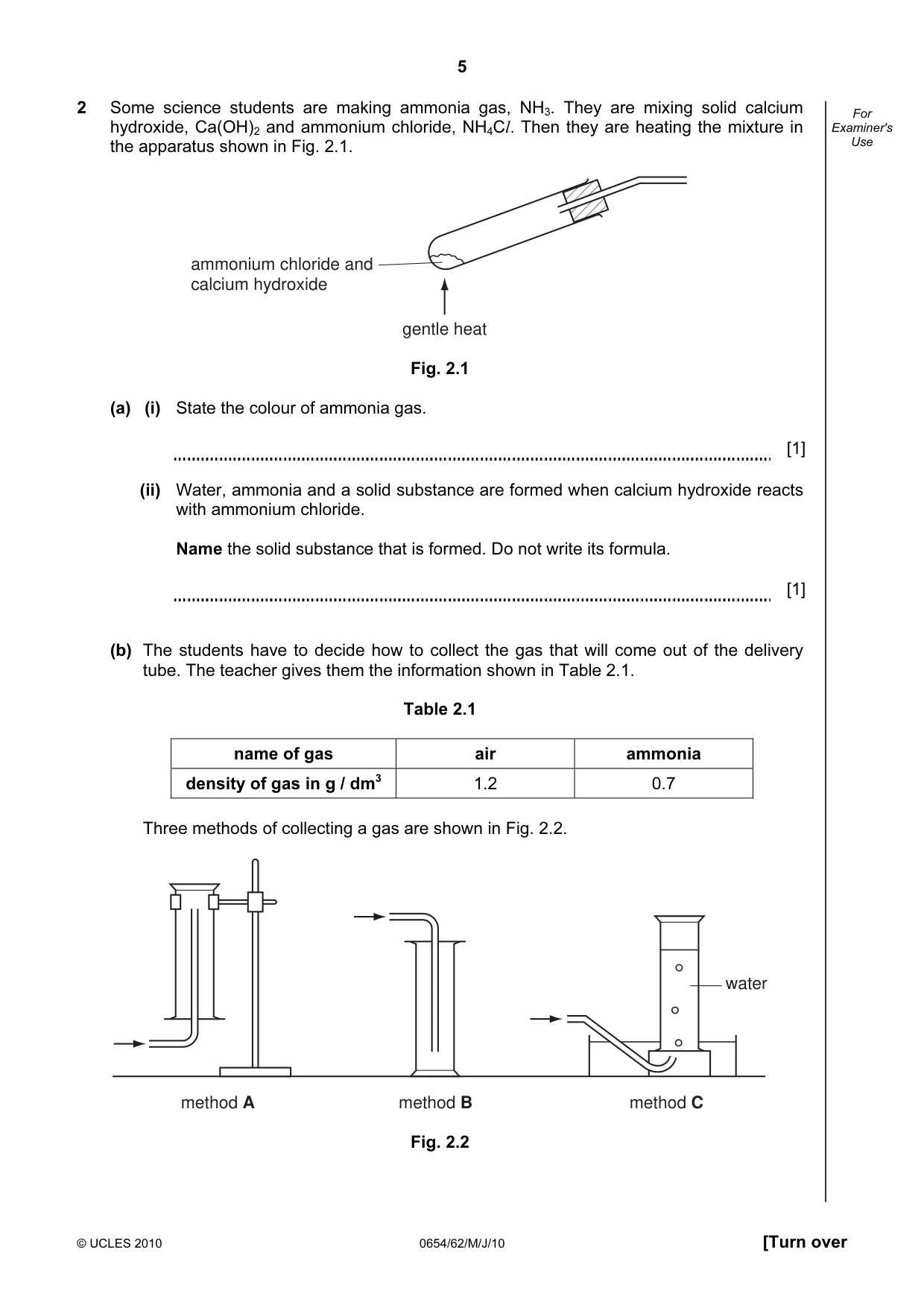
5 © UCLES 2010 0654/62/M/J/10 [Turn over For Examiner's Use 2 Some science students are making ammonia gas, NH3. They are mixing solid calcium hydroxide, Ca(OH)2 and ammonium chloride, NH4Cl. Then they are heating the mixture in the apparatus shown in Fig. 2.1. gentle heat ammonium chloride and calcium hydroxide Fig. 2.1 (a) (i) State the colour of ammonia gas. [1] (ii) Water, ammonia and a solid substance are formed when calcium hydroxide reacts with ammonium chloride. Name the solid substance that is formed. Do not write its formula. [1] (b) The students have to decide how to collect the gas that will come out of the delivery tube. The teacher gives them the information shown in Table 2.1. Table 2.1 name of gas air ammonia density of gas in g / dm3 1.2 0.7 Three methods of collecting a gas are shown in Fig. 2.2. method A method B method C water Fig. 2.2
Question paper, page 6
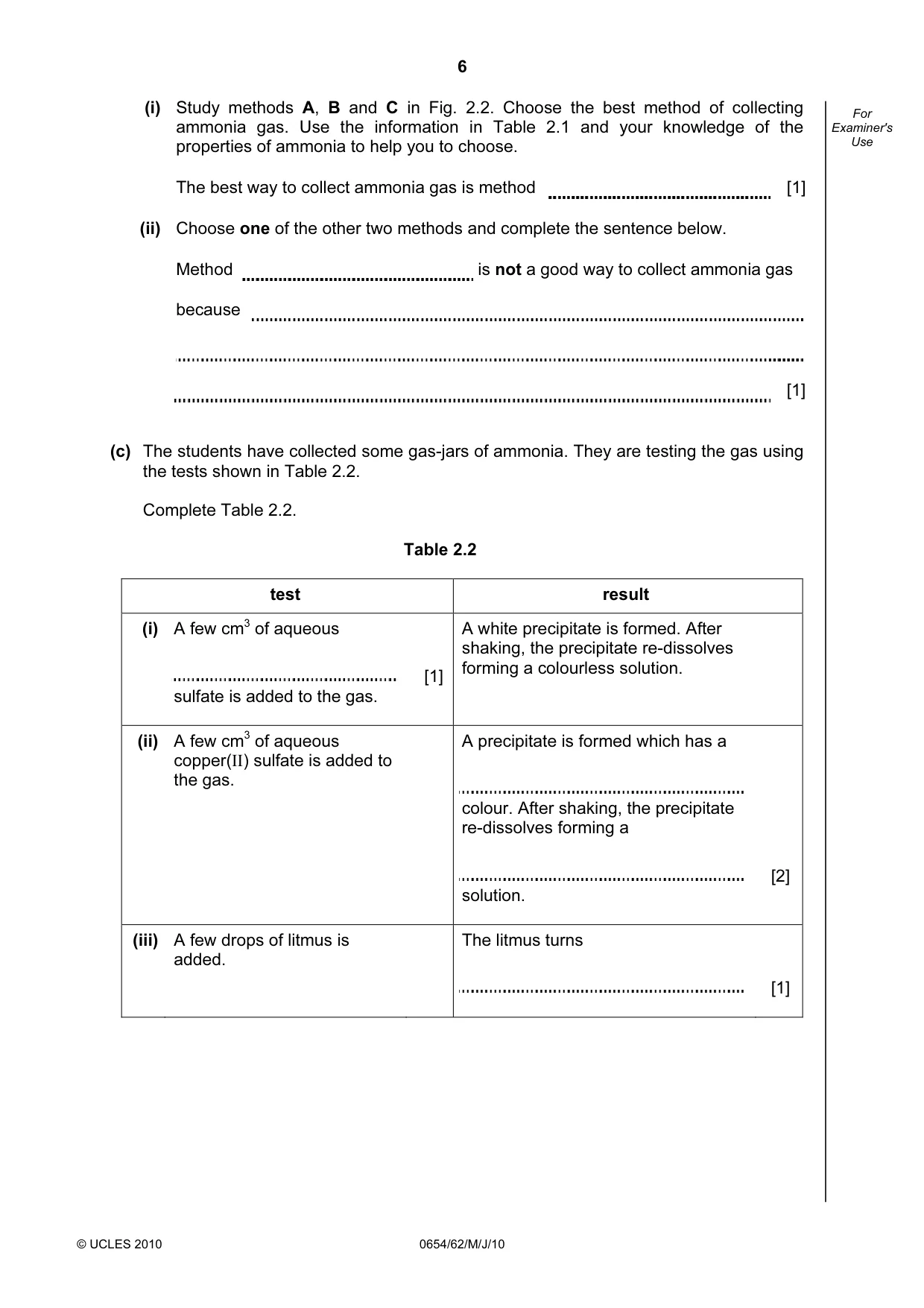
6 © UCLES 2010 0654/62/M/J/10 For Examiner's Use (i) Study methods A, B and C in Fig. 2.2. Choose the best method of collecting ammonia gas. Use the information in Table 2.1 and your knowledge of the properties of ammonia to help you to choose. The best way to collect ammonia gas is method [1] (ii) Choose one of the other two methods and complete the sentence below. Method is not a good way to collect ammonia gas because [1] (c) The students have collected some gas-jars of ammonia. They are testing the gas using the tests shown in Table 2.2. Complete Table 2.2. Table 2.2 test result (i) A few cm3 of aqueous sulfate is added to the gas. [1] A white precipitate is formed. After shaking, the precipitate re-dissolves forming a colourless solution. (ii) A few cm3 of aqueous copper(II) sulfate is added to the gas. A precipitate is formed which has a colour. After shaking, the precipitate re-dissolves forming a solution. [2] (iii) A few drops of litmus is added. The litmus turns [1]
Question paper, page 7
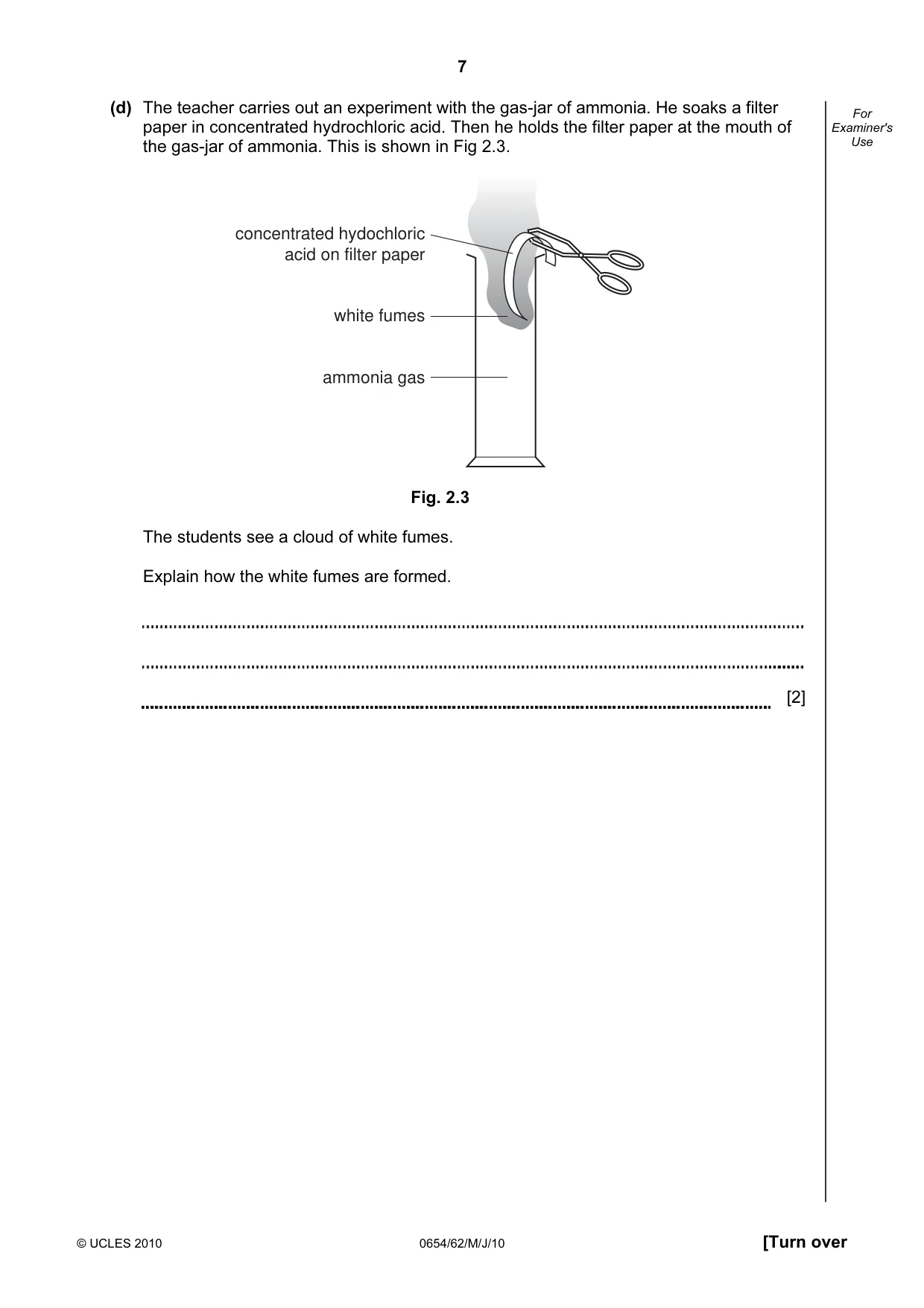
7 © UCLES 2010 0654/62/M/J/10 [Turn over For Examiner's Use (d) The teacher carries out an experiment with the gas-jar of ammonia. He soaks a filter paper in concentrated hydrochloric acid. Then he holds the filter paper at the mouth of the gas-jar of ammonia. This is shown in Fig 2.3. concentrated hydochloric acid on filter paper white fumes ammonia gas Fig. 2.3 The students see a cloud of white fumes. Explain how the white fumes are formed. [2]
Question paper, page 8
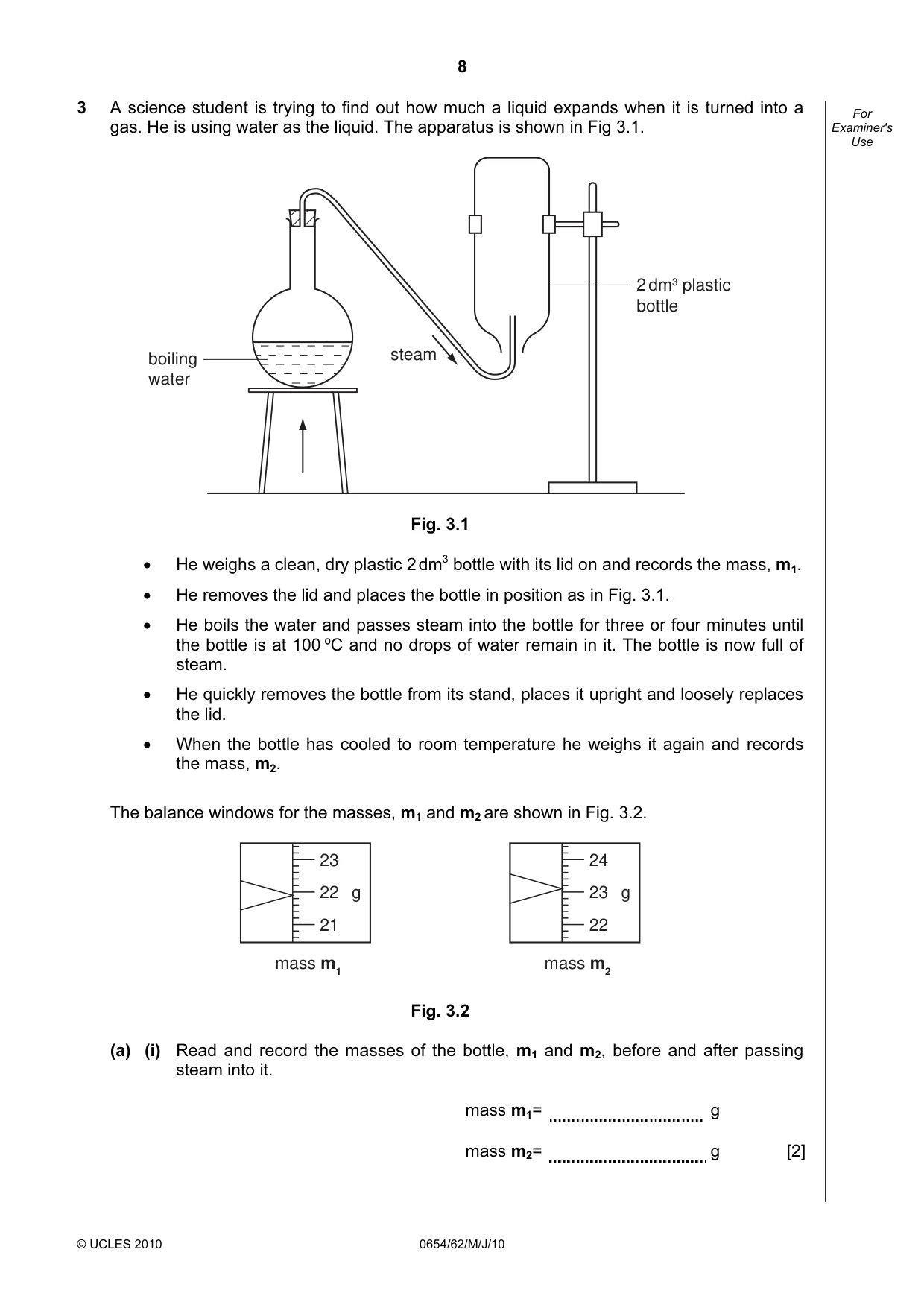
8 © UCLES 2010 0654/62/M/J/10 For Examiner's Use 3 A science student is trying to find out how much a liquid expands when it is turned into a gas. He is using water as the liquid. The apparatus is shown in Fig 3.1. boiling water steam 2 dm3 plastic bottle Fig. 3.1 • He weighs a clean, dry plastic 2 dm3 bottle with its lid on and records the mass, m1. • He removes the lid and places the bottle in position as in Fig. 3.1. • He boils the water and passes steam into the bottle for three or four minutes until the bottle is at 100 ºC and no drops of water remain in it. The bottle is now full of steam. • He quickly removes the bottle from its stand, places it upright and loosely replaces the lid. • When the bottle has cooled to room temperature he weighs it again and records the mass, m2. The balance windows for the masses, m1 and m2 are shown in Fig. 3.2. 23 22 21 g mass m1 24 23 22 g mass m2 Fig. 3.2 (a) (i) Read and record the masses of the bottle, m1 and m2, before and after passing steam into it. mass m1= g mass m2= g [2]
Question paper, page 9
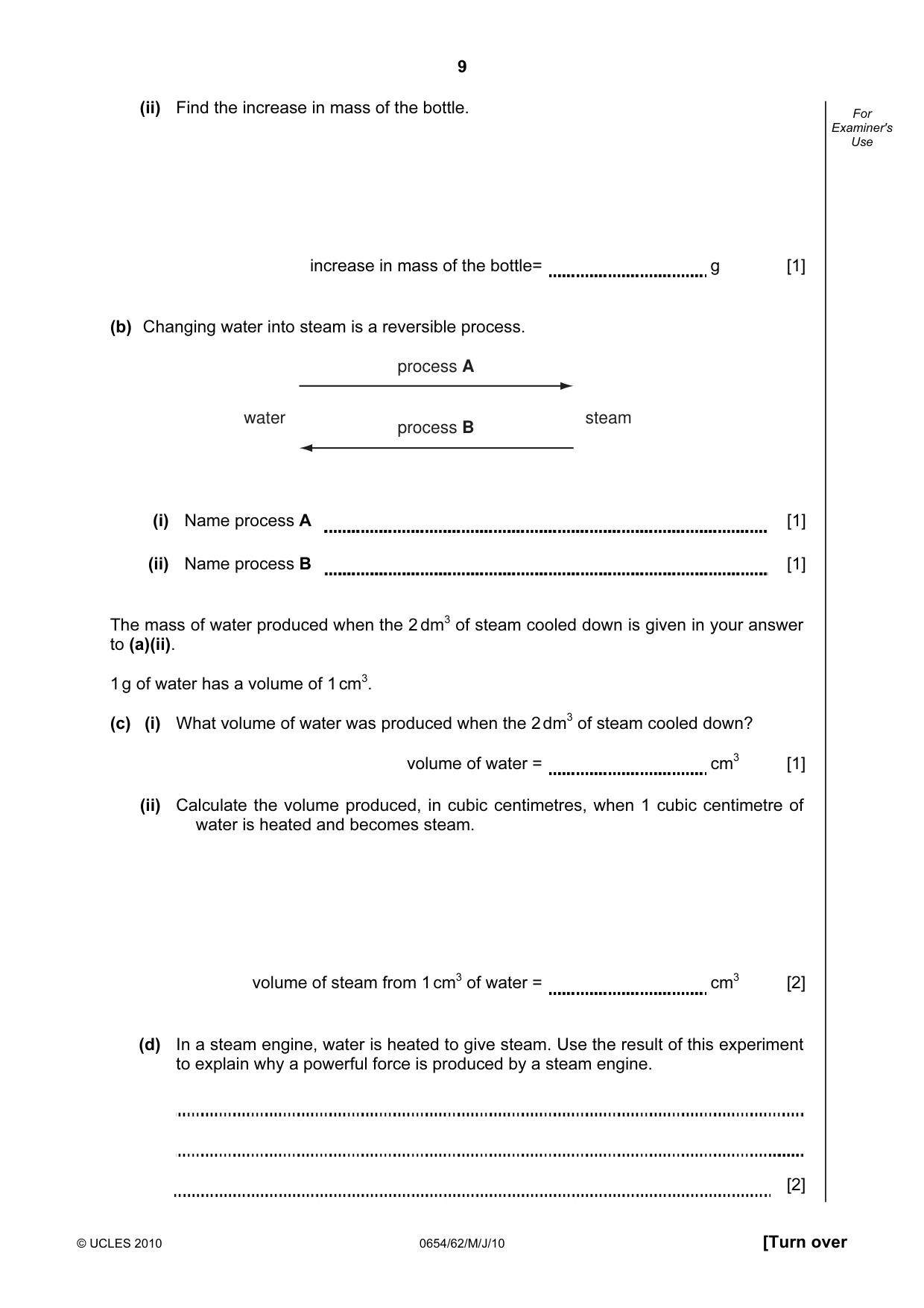
9 © UCLES 2010 0654/62/M/J/10 [Turn over For Examiner's Use (ii) Find the increase in mass of the bottle. increase in mass of the bottle= g [1] (b) Changing water into steam is a reversible process. process A process B water steam (i) Name process A [1] (ii) Name process B [1] The mass of water produced when the 2 dm3 of steam cooled down is given in your answer to (a)(ii). 1 g of water has a volume of 1 cm3. (c) (i) What volume of water was produced when the 2 dm3 of steam cooled down? volume of water = cm3 [1] (ii) Calculate the volume produced, in cubic centimetres, when 1 cubic centimetre of water is heated and becomes steam. volume of steam from 1 cm3 of water = cm3 [2] (d) In a steam engine, water is heated to give steam. Use the result of this experiment to explain why a powerful force is produced by a steam engine. [2]
Question paper, page 10
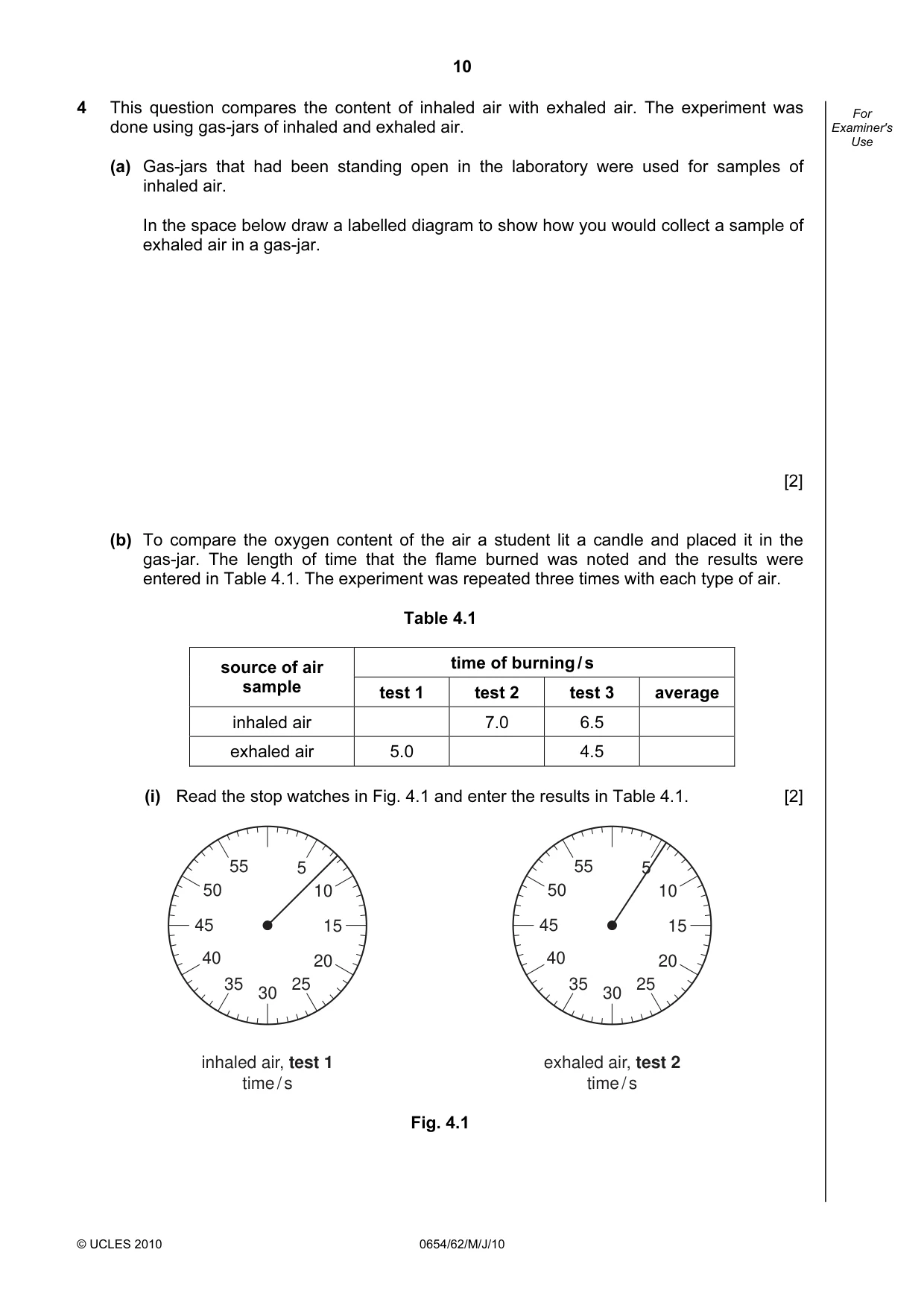
10 © UCLES 2010 0654/62/M/J/10 For Examiner's Use 4 This question compares the content of inhaled air with exhaled air. The experiment was done using gas-jars of inhaled and exhaled air. (a) Gas-jars that had been standing open in the laboratory were used for samples of inhaled air. In the space below draw a labelled diagram to show how you would collect a sample of exhaled air in a gas-jar. [2] (b) To compare the oxygen content of the air a student lit a candle and placed it in the gas-jar. The length of time that the flame burned was noted and the results were entered in Table 4.1. The experiment was repeated three times with each type of air. Table 4.1 time of burning / s source of air sample test 1 test 2 test 3 average inhaled air 7.0 6.5 exhaled air 5.0 4.5 (i) Read the stop watches in Fig. 4.1 and enter the results in Table 4.1. [2] 5 10 15 20 40 25 35 30 45 50 55 inhaled air, test 1 time / s 5 10 15 20 40 25 35 30 45 50 55 exhaled air, test 2 time / s Fig. 4.1
Question paper, page 11
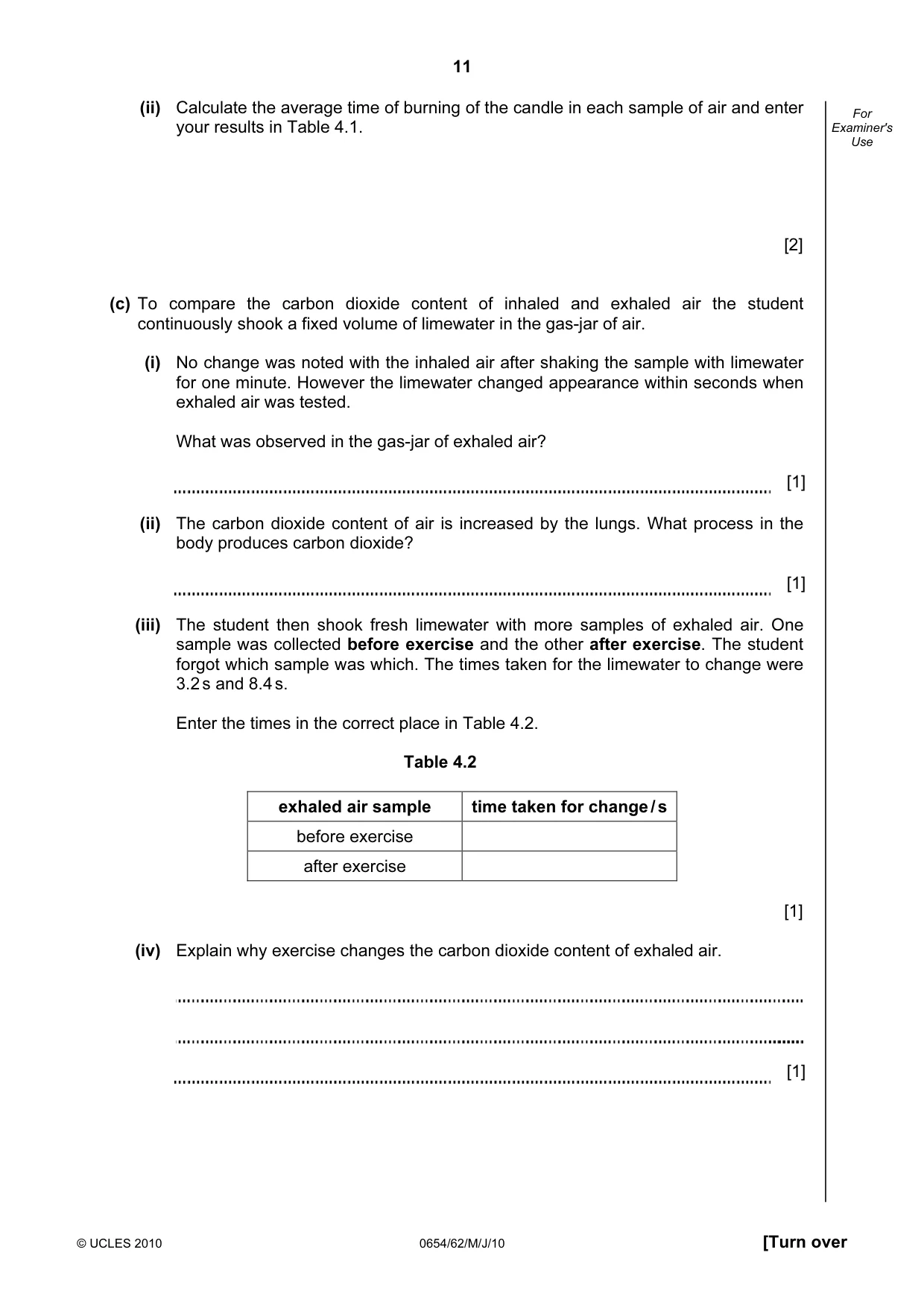
11 © UCLES 2010 0654/62/M/J/10 [Turn over For Examiner's Use (ii) Calculate the average time of burning of the candle in each sample of air and enter your results in Table 4.1. [2] (c) To compare the carbon dioxide content of inhaled and exhaled air the student continuously shook a fixed volume of limewater in the gas-jar of air. (i) No change was noted with the inhaled air after shaking the sample with limewater for one minute. However the limewater changed appearance within seconds when exhaled air was tested. What was observed in the gas-jar of exhaled air? [1] (ii) The carbon dioxide content of air is increased by the lungs. What process in the body produces carbon dioxide? [1] (iii) The student then shook fresh limewater with more samples of exhaled air. One sample was collected before exercise and the other after exercise. The student forgot which sample was which. The times taken for the limewater to change were 3.2 s and 8.4 s. Enter the times in the correct place in Table 4.2. Table 4.2 exhaled air sample time taken for change / s before exercise after exercise [1] (iv) Explain why exercise changes the carbon dioxide content of exhaled air. [1]
Question paper, page 12
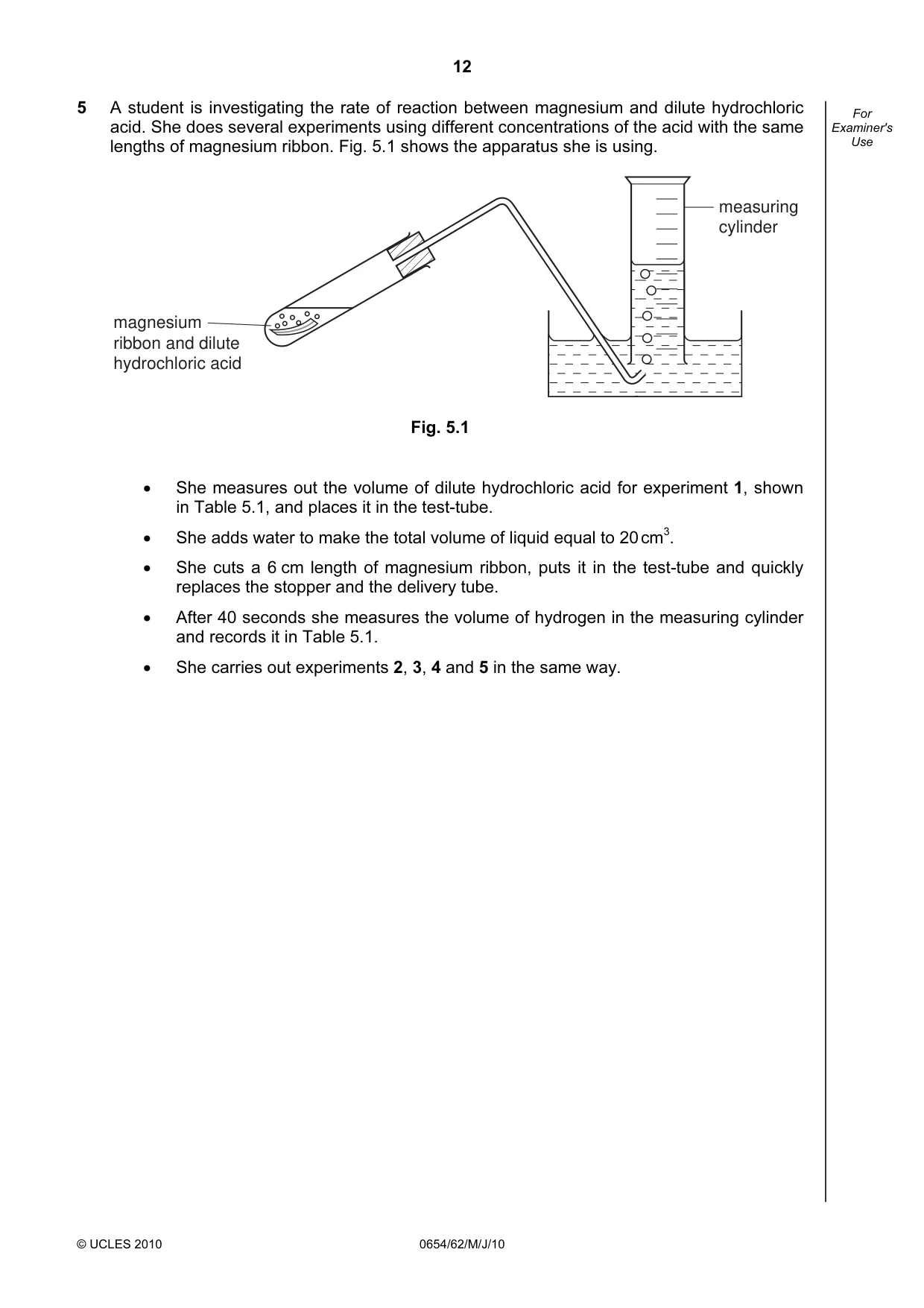
12 © UCLES 2010 0654/62/M/J/10 For Examiner's Use 5 A student is investigating the rate of reaction between magnesium and dilute hydrochloric acid. She does several experiments using different concentrations of the acid with the same lengths of magnesium ribbon. Fig. 5.1 shows the apparatus she is using. measuring cylinder magnesium ribbon and dilute hydrochloric acid Fig. 5.1 • She measures out the volume of dilute hydrochloric acid for experiment 1, shown in Table 5.1, and places it in the test-tube. • She adds water to make the total volume of liquid equal to 20 cm3. • She cuts a 6 cm length of magnesium ribbon, puts it in the test-tube and quickly replaces the stopper and the delivery tube. • After 40 seconds she measures the volume of hydrogen in the measuring cylinder and records it in Table 5.1. • She carries out experiments 2, 3, 4 and 5 in the same way.
Question paper, page 13
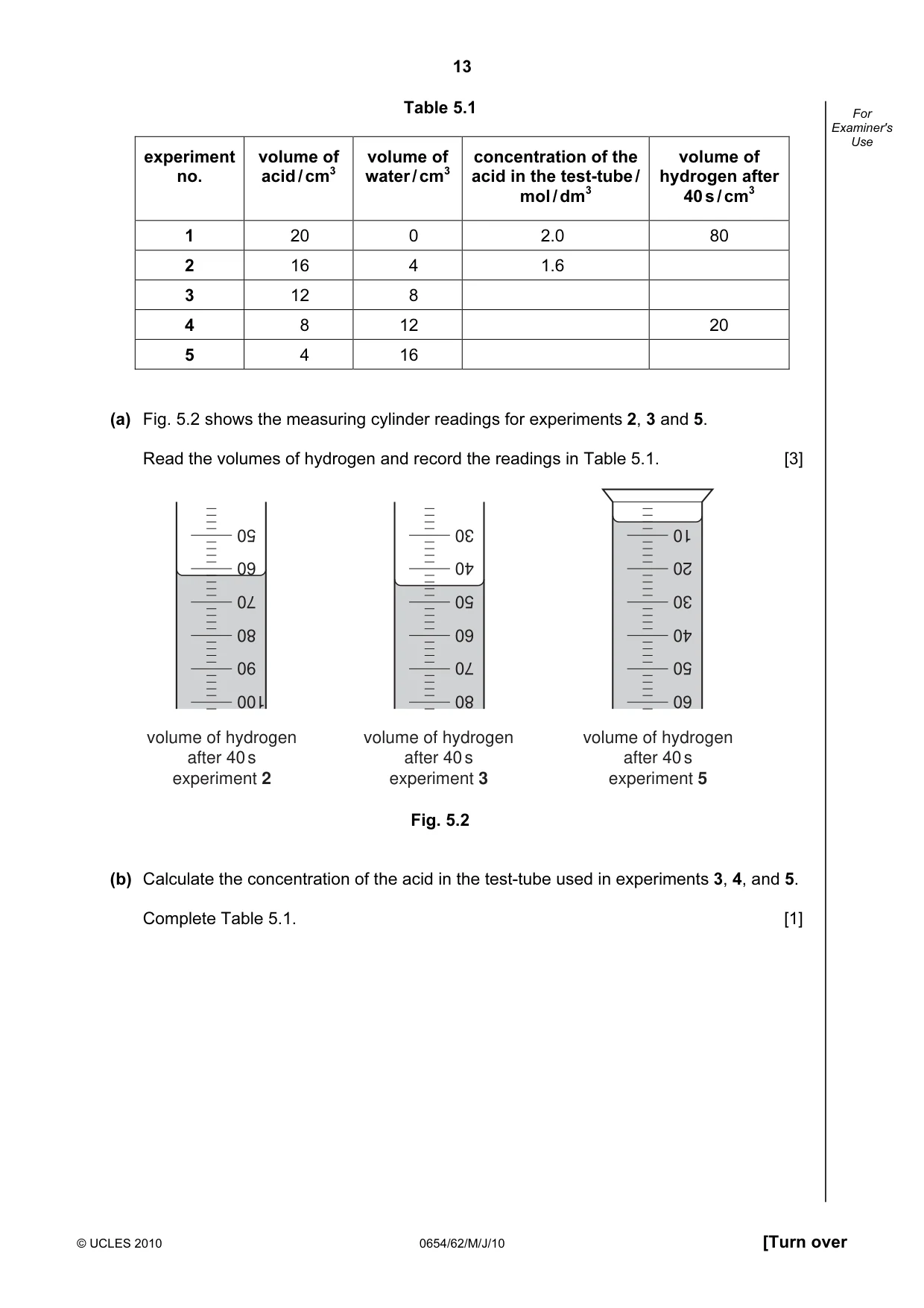
13 © UCLES 2010 0654/62/M/J/10 [Turn over For Examiner's Use Table 5.1 experiment no. volume of acid / cm3 volume of water / cm3 concentration of the acid in the test-tube / mol / dm3 volume of hydrogen after 40 s / cm3 1 20 0 2.0 80 2 16 4 1.6 3 12 8 4 8 12 20 5 4 16 (a) Fig. 5.2 shows the measuring cylinder readings for experiments 2, 3 and 5. Read the volumes of hydrogen and record the readings in Table 5.1. [3] 60 50 40 30 20 10 80 70 60 50 40 30 100 90 80 70 60 50 volume of hydrogen after 40 s experiment 5 volume of hydrogen after 40 s experiment 3 volume of hydrogen after 40 s experiment 2 Fig. 5.2 (b) Calculate the concentration of the acid in the test-tube used in experiments 3, 4, and 5. Complete Table 5.1. [1]
Question paper, page 14
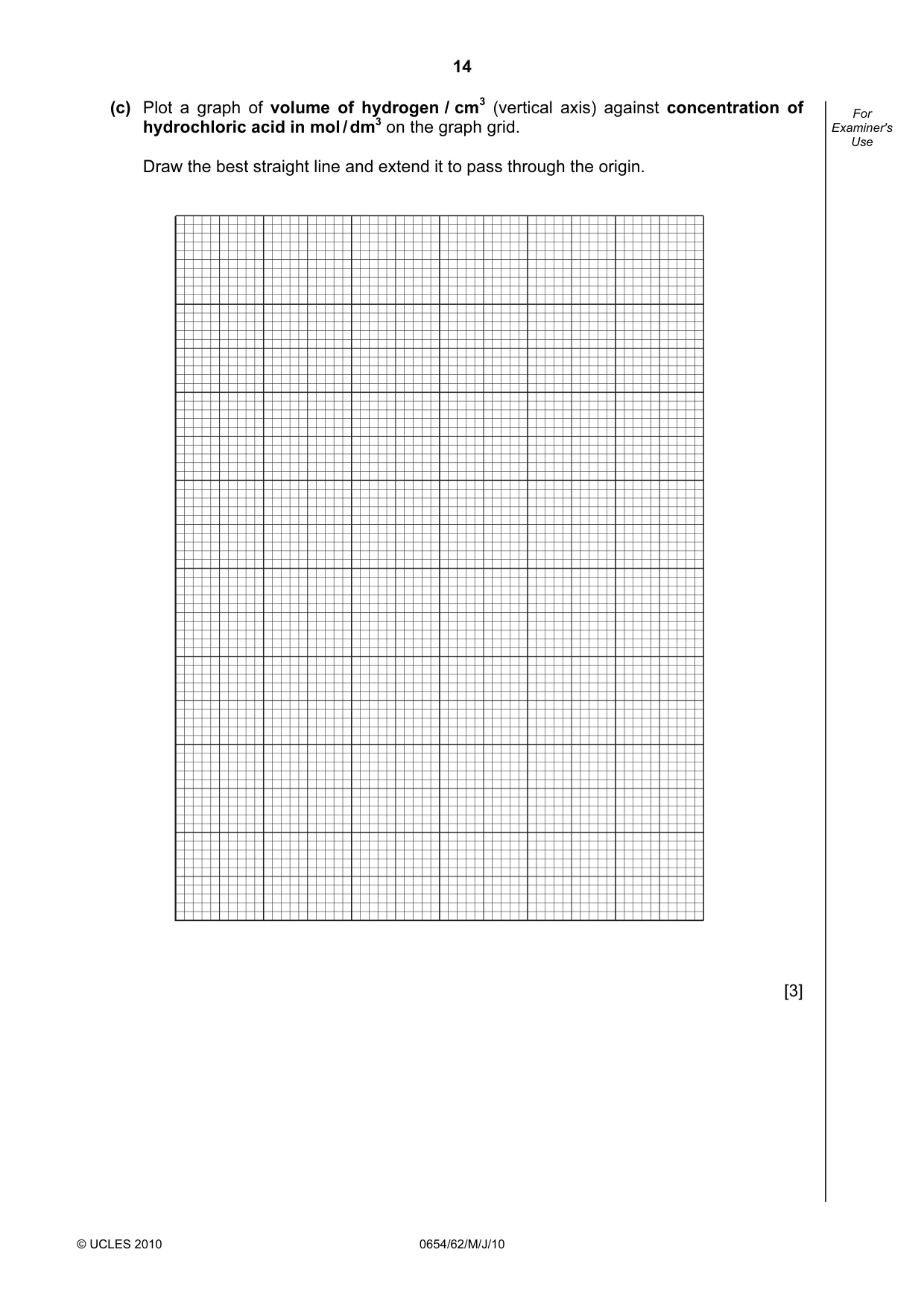
14 © UCLES 2010 0654/62/M/J/10 For Examiner's Use (c) Plot a graph of volume of hydrogen / cm3 (vertical axis) against concentration of hydrochloric acid in mol / dm3 on the graph grid. Draw the best straight line and extend it to pass through the origin. [3]
Question paper, page 15
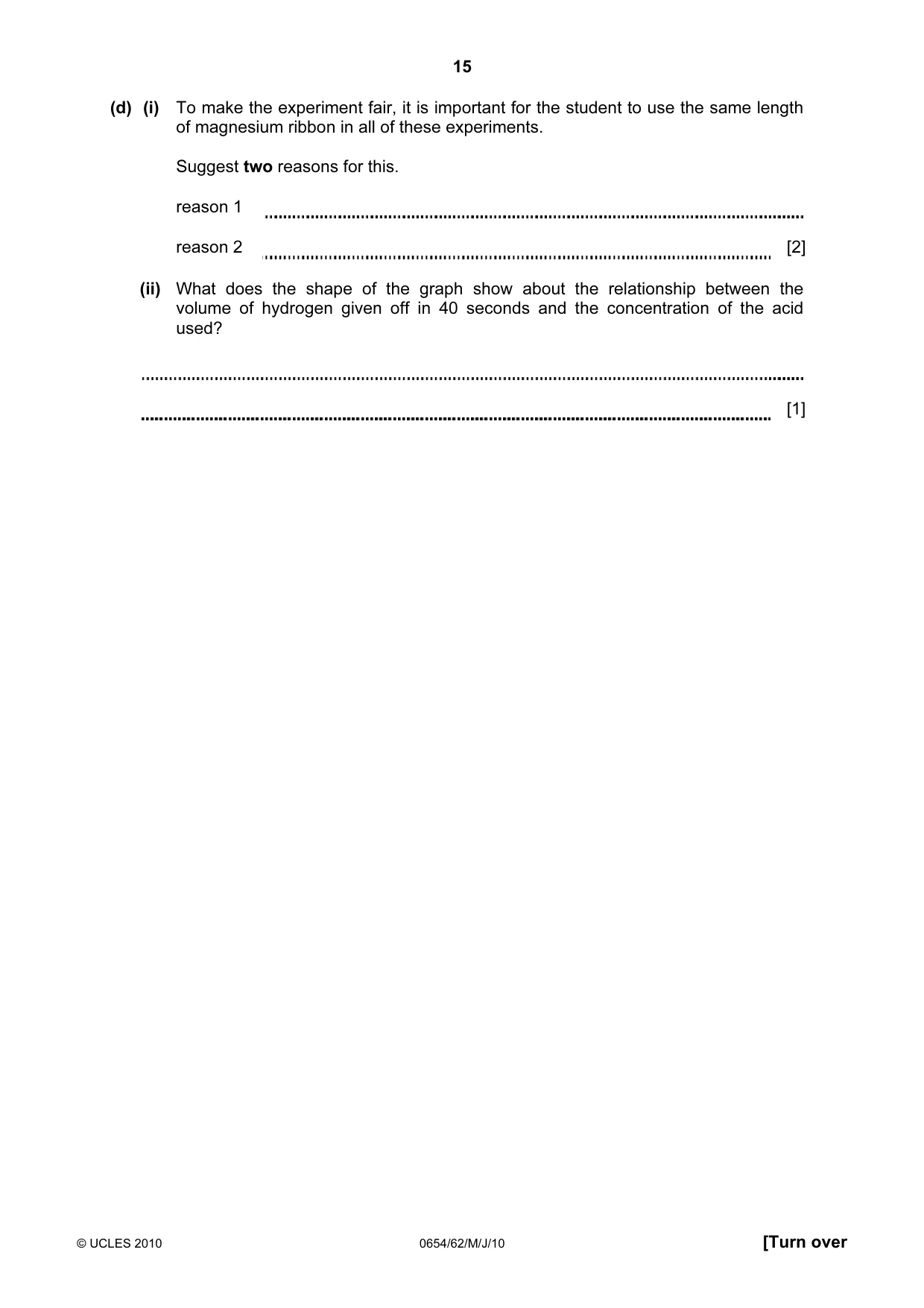
15 © UCLES 2010 0654/62/M/J/10 [Turn over (d) (i) To make the experiment fair, it is important for the student to use the same length of magnesium ribbon in all of these experiments. Suggest two reasons for this. reason 1 reason 2 [2] (ii) What does the shape of the graph show about the relationship between the volume of hydrogen given off in 40 seconds and the concentration of the acid used? [1]
Question paper, page 16
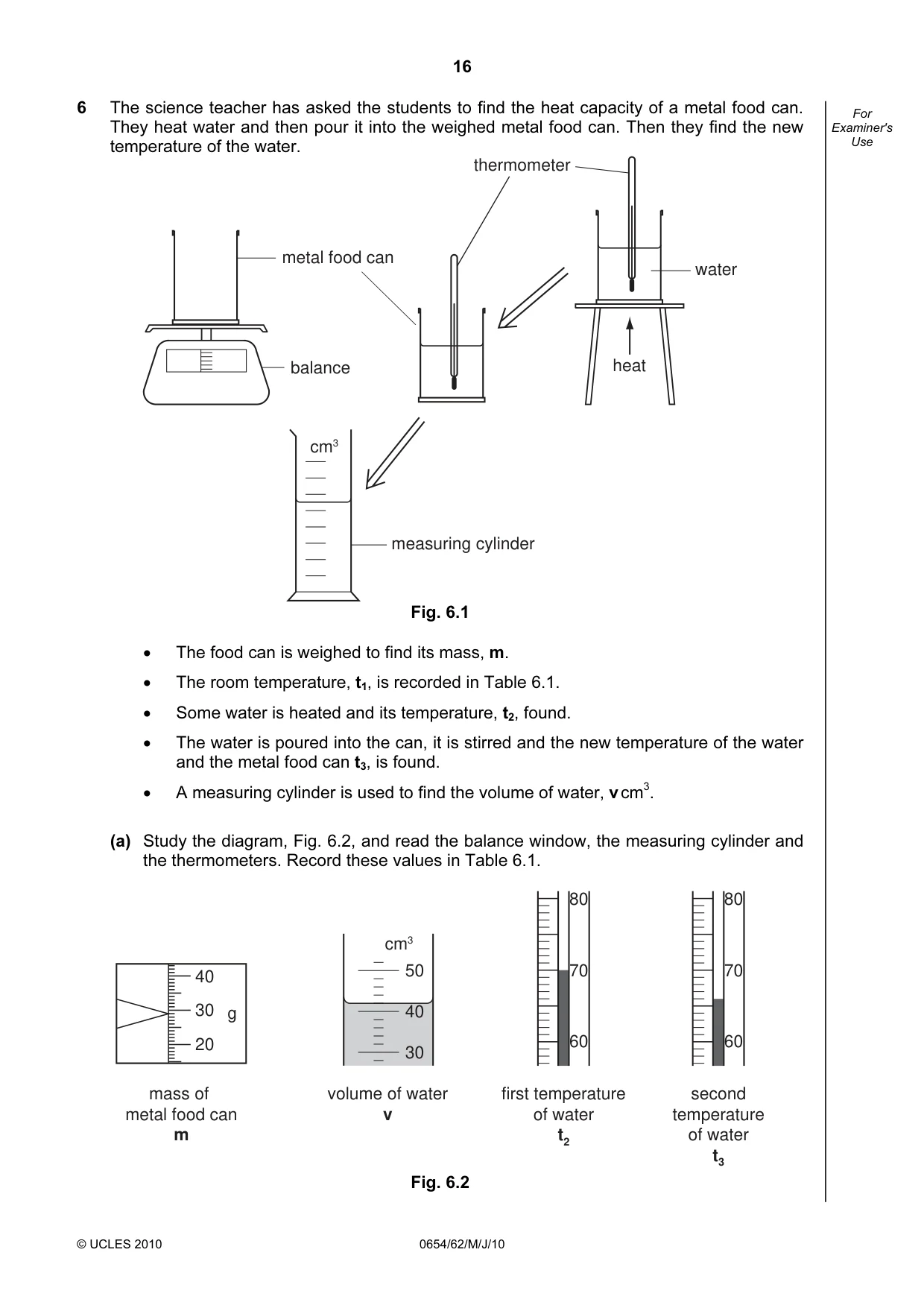
16 © UCLES 2010 0654/62/M/J/10 For Examiner's Use 6 The science teacher has asked the students to find the heat capacity of a metal food can. They heat water and then pour it into the weighed metal food can. Then they find the new temperature of the water. heat thermometer water metal food can balance cm3 measuring cylinder Fig. 6.1 • The food can is weighed to find its mass, m. • The room temperature, t1, is recorded in Table 6.1. • Some water is heated and its temperature, t2, found. • The water is poured into the can, it is stirred and the new temperature of the water and the metal food can t3, is found. • A measuring cylinder is used to find the volume of water, v cm3. (a) Study the diagram, Fig. 6.2, and read the balance window, the measuring cylinder and the thermometers. Record these values in Table 6.1. 40 30 20 g mass of metal food can m 50 40 30 80 70 60 volume of water v first temperature of water t2 cm3 80 70 60 second temperature of water t3 Fig. 6.2
Question paper, page 17
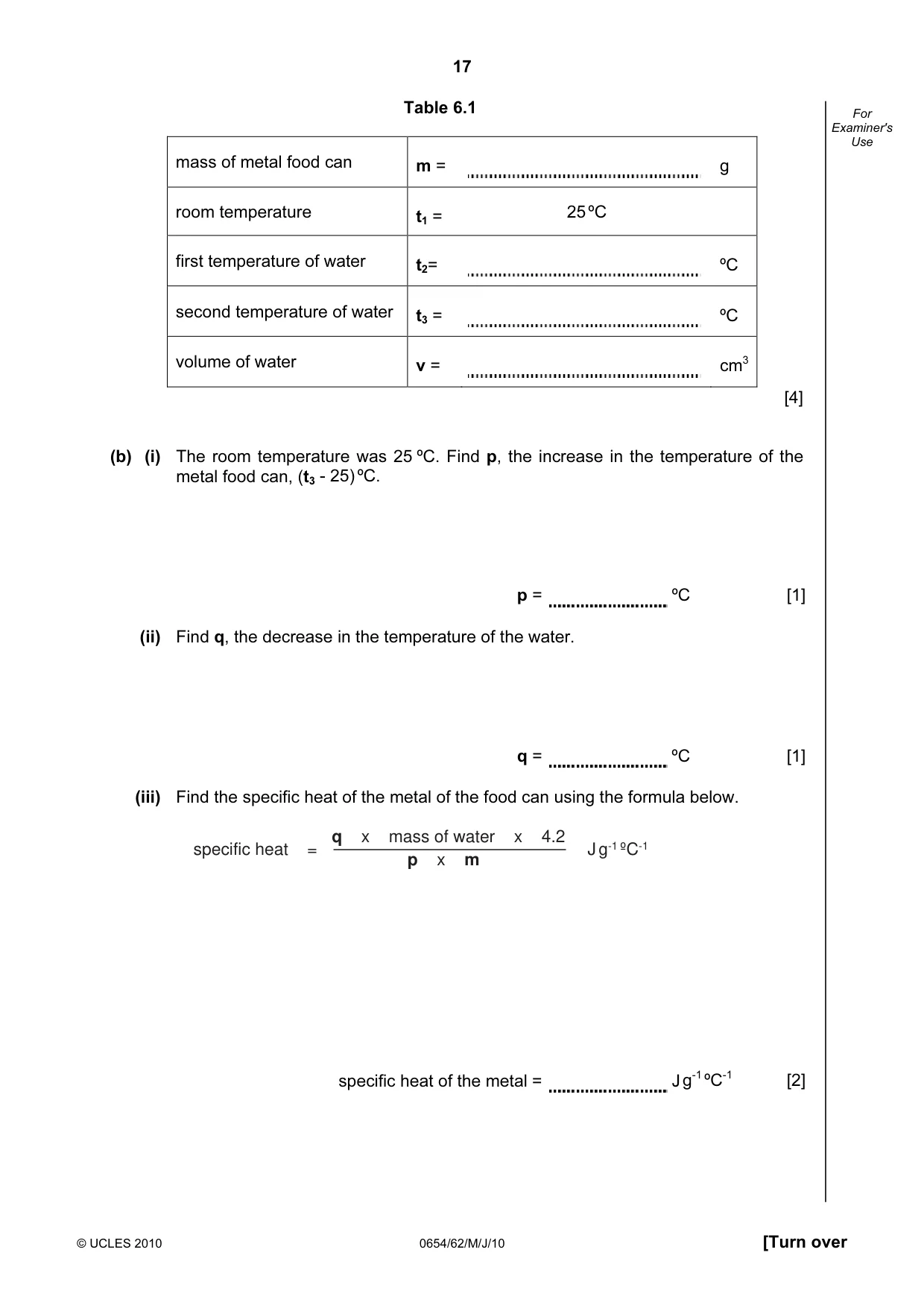
17 © UCLES 2010 0654/62/M/J/10 [Turn over For Examiner's Use Table 6.1 mass of metal food can m = g room temperature t1 = 25 ºC first temperature of water t2= ºC second temperature of water t3 = ºC volume of water v = cm3 [4] (b) (i) The room temperature was 25 ºC. Find p, the increase in the temperature of the metal food can, (t3 - 25) ºC. p = ºC [1] (ii) Find q, the decrease in the temperature of the water. q = ºC [1] (iii) Find the specific heat of the metal of the food can using the formula below. q x mass of water x 4.2 p x m specific heat = J g-1 ºC-1 specific heat of the metal = J g-1 ºC-1 [2]
Question paper, page 18
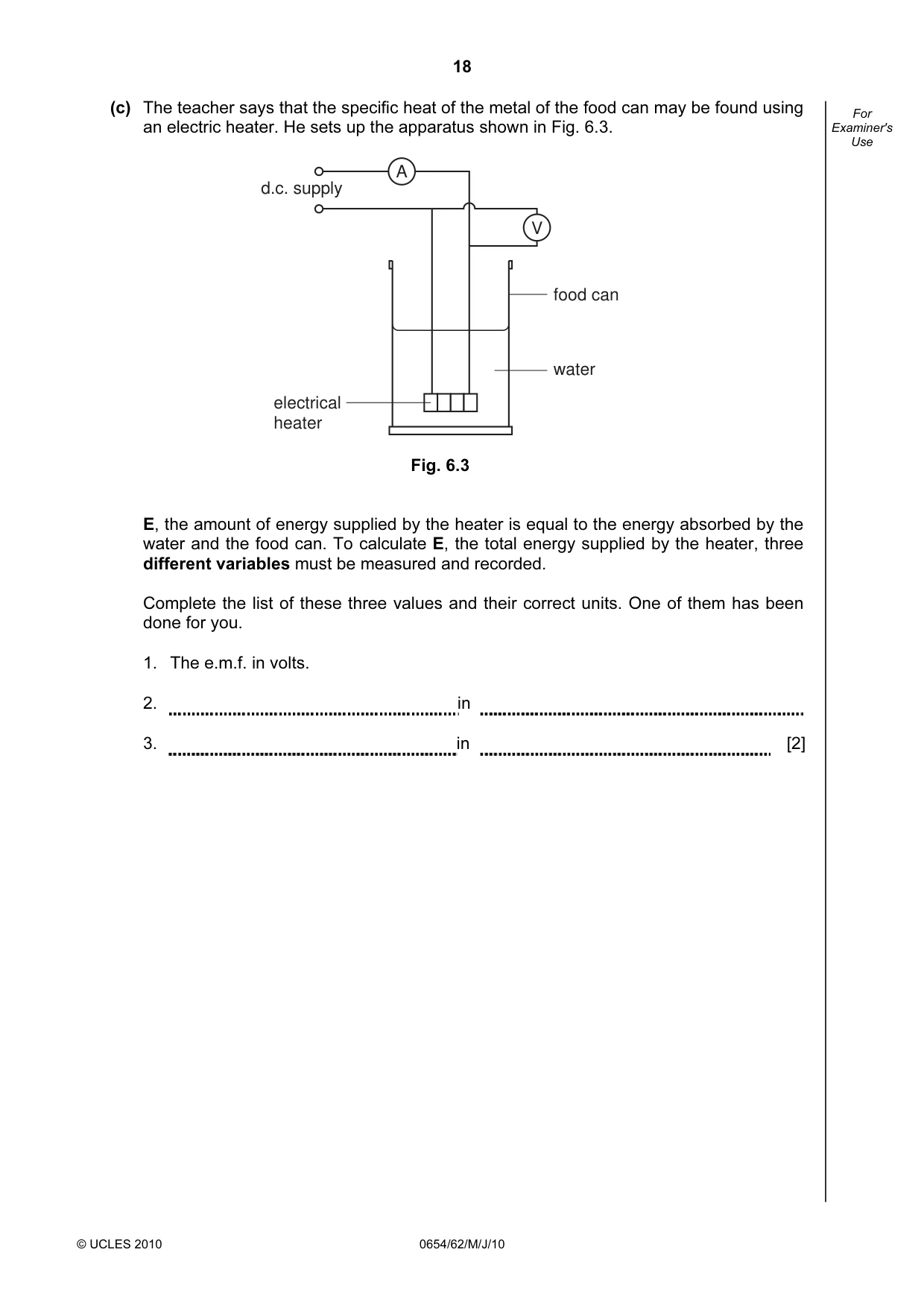
18 © UCLES 2010 0654/62/M/J/10 For Examiner's Use (c) The teacher says that the specific heat of the metal of the food can may be found using an electric heater. He sets up the apparatus shown in Fig. 6.3. d.c. supply V A food can water electrical heater Fig. 6.3 E, the amount of energy supplied by the heater is equal to the energy absorbed by the water and the food can. To calculate E, the total energy supplied by the heater, three different variables must be measured and recorded. Complete the list of these three values and their correct units. One of them has been done for you. 1. The e.m.f. in volts. 2. in 3. in [2]
Question paper, page 19
19 © UCLES 2010 0654/62/M/J/10 BLANK PAGE
Question paper, page 20
20 Permission to reproduce items where third-party owned material protected by copyright is included has been sought and cleared where possible. Every reasonable effort has been made by the publisher (UCLES) to trace copyright holders, but if any items requiring clearance have unwittingly been included, the publisher will be pleased to make amends at the earliest possible opportunity. University of Cambridge International Examinations is part of the Cambridge Assessment Group. Cambridge Assessment is the brand name of University of Cambridge Local Examinations Syndicate (UCLES), which is itself a department of the University of Cambridge. © UCLES 2010 0654/62/M/J/10 BLANK PAGE
Mark scheme, page 1
UNIVERSITY OF CAMBRIDGE INTERNATIONAL EXAMINATIONS International General Certificate of Secondary Education MARK SCHEME for the May/June 2010 question paper for the guidance of teachers 0654 CO-ORDINATED SCIENCES 0654/62 Paper 62 (Alternative to Practical), maximum raw mark 60 This mark scheme is published as an aid to teachers and candidates, to indicate the requirements of the examination. It shows the basis on which Examiners were instructed to award marks. It does not indicate the details of the discussions that took place at an Examiners’ meeting before marking began, which would have considered the acceptability of alternative answers. Mark schemes must be read in conjunction with the question papers and the report on the examination. • CIE will not enter into discussions or correspondence in connection with these mark schemes. CIE is publishing the mark schemes for the May/June 2010 question papers for most IGCSE, GCE Advanced Level and Advanced Subsidiary Level syllabuses and some Ordinary Level syllabuses. www.XtremePapers.com
Mark scheme, page 2
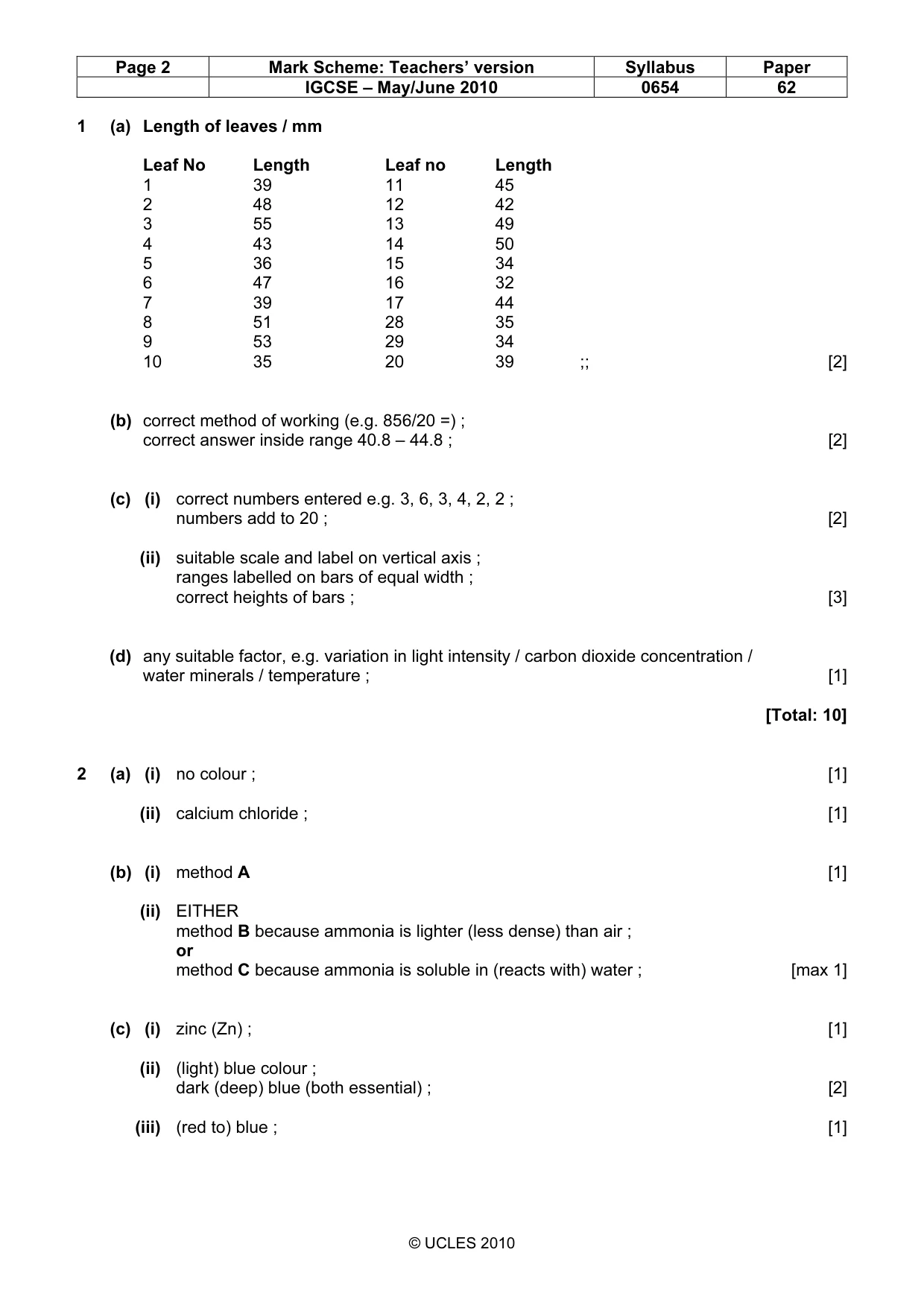
Page 2 Mark Scheme: Teachers’ version Syllabus Paper IGCSE – May/June 2010 0654 62 © UCLES 2010 1 (a) Length of leaves / mm Leaf No Length Leaf no Length 1 39 11 45 2 48 12 42 3 55 13 49 4 43 14 50 5 36 15 34 6 47 16 32 7 39 17 44 8 51 28 35 9 53 29 34 10 35 20 39 ;; [2] (b) correct method of working (e.g. 856/20 =) ; correct answer inside range 40.8 – 44.8 ; [2] (c) (i) correct numbers entered e.g. 3, 6, 3, 4, 2, 2 ; numbers add to 20 ; [2] (ii) suitable scale and label on vertical axis ; ranges labelled on bars of equal width ; correct heights of bars ; [3] (d) any suitable factor, e.g. variation in light intensity / carbon dioxide concentration / water minerals / temperature ; [1] [Total: 10] 2 (a) (i) no colour ; [1] (ii) calcium chloride ; [1] (b) (i) method A [1] (ii) EITHER method B because ammonia is lighter (less dense) than air ; or method C because ammonia is soluble in (reacts with) water ; [max 1] (c) (i) zinc (Zn) ; [1] (ii) (light) blue colour ; dark (deep) blue (both essential) ; [2] (iii) (red to) blue ; [1]
Mark scheme, page 3
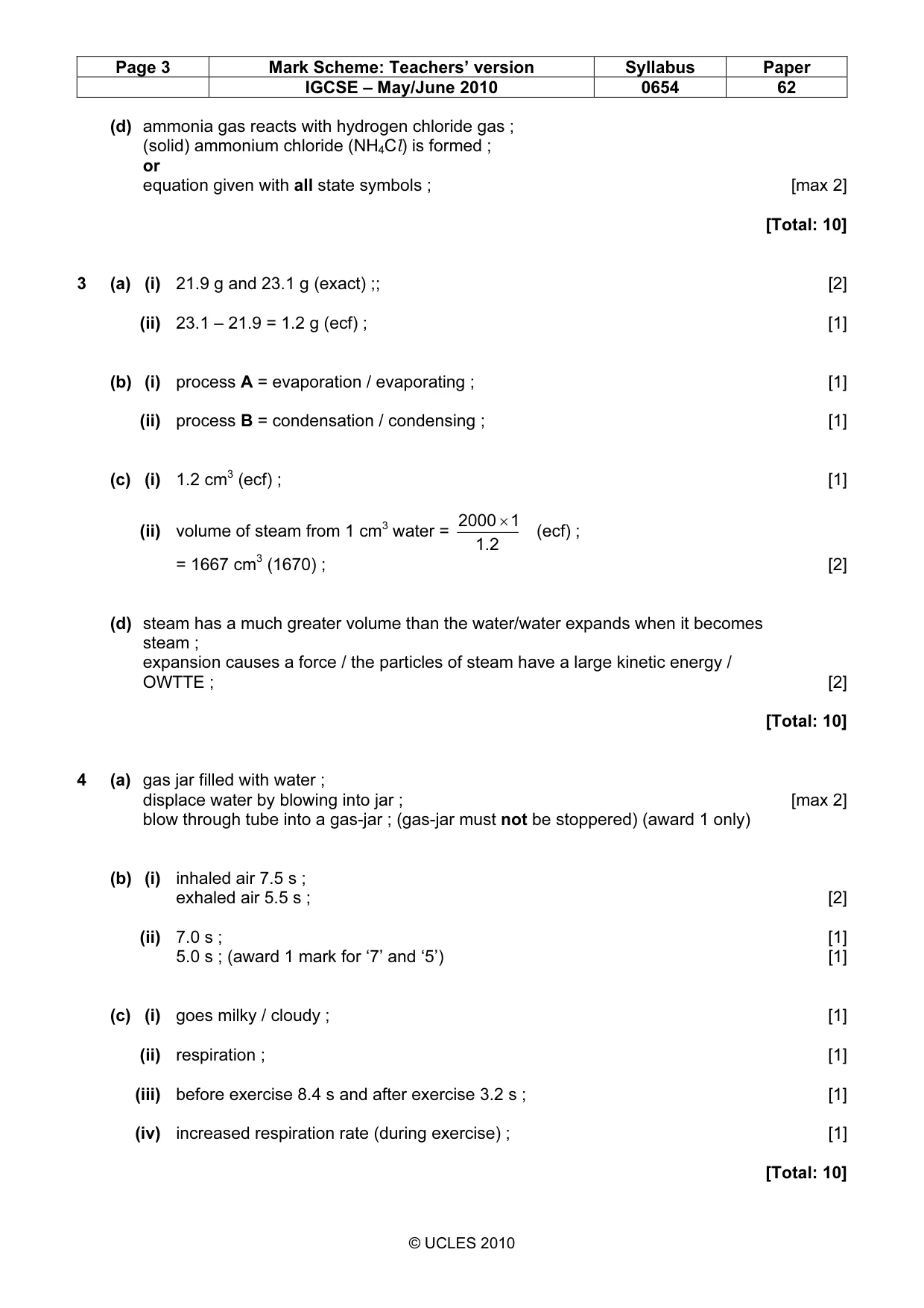
Page 3 Mark Scheme: Teachers’ version Syllabus Paper IGCSE – May/June 2010 0654 62 © UCLES 2010 (d) ammonia gas reacts with hydrogen chloride gas ; (solid) ammonium chloride (NH4Cl) is formed ; or equation given with all state symbols ; [max 2] [Total: 10] 3 (a) (i) 21.9 g and 23.1 g (exact) ;; [2] (ii) 23.1 – 21.9 = 1.2 g (ecf) ; [1] (b) (i) process A = evaporation / evaporating ; [1] (ii) process B = condensation / condensing ; [1] (c) (i) 1.2 cm3 (ecf) ; [1] (ii) volume of steam from 1 cm3 water = 1.2 1 2000 × (ecf) ; = 1667 cm3 (1670) ; [2] (d) steam has a much greater volume than the water/water expands when it becomes steam ; expansion causes a force / the particles of steam have a large kinetic energy / OWTTE ; [2] [Total: 10] 4 (a) gas jar filled with water ; displace water by blowing into jar ; [max 2] blow through tube into a gas-jar ; (gas-jar must not be stoppered) (award 1 only) (b) (i) inhaled air 7.5 s ; exhaled air 5.5 s ; [2] (ii) 7.0 s ; [1] 5.0 s ; (award 1 mark for ‘7’ and ‘5’) [1] (c) (i) goes milky / cloudy ; [1] (ii) respiration ; [1] (iii) before exercise 8.4 s and after exercise 3.2 s ; [1] (iv) increased respiration rate (during exercise) ; [1] [Total: 10]
Mark scheme, page 4
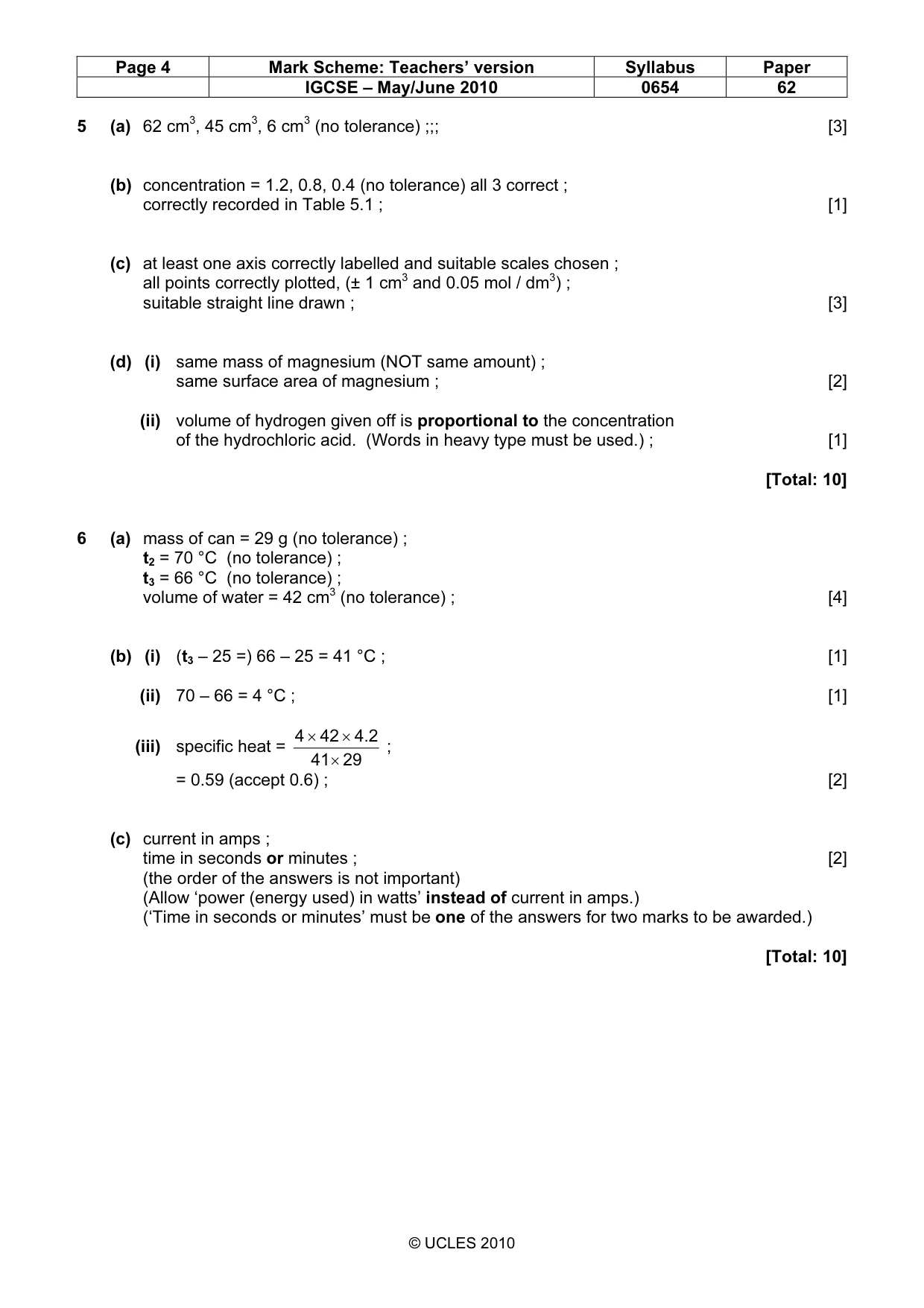
Page 4 Mark Scheme: Teachers’ version Syllabus Paper IGCSE – May/June 2010 0654 62 © UCLES 2010 5 (a) 62 cm3, 45 cm3, 6 cm3 (no tolerance) ;;; [3] (b) concentration = 1.2, 0.8, 0.4 (no tolerance) all 3 correct ; correctly recorded in Table 5.1 ; [1] (c) at least one axis correctly labelled and suitable scales chosen ; all points correctly plotted, (± 1 cm3 and 0.05 mol / dm3) ; suitable straight line drawn ; [3] (d) (i) same mass of magnesium (NOT same amount) ; same surface area of magnesium ; [2] (ii) volume of hydrogen given off is proportional to the concentration of the hydrochloric acid. (Words in heavy type must be used.) ; [1] [Total: 10] 6 (a) mass of can = 29 g (no tolerance) ; t2 = 70 °C (no tolerance) ; t3 = 66 °C (no tolerance) ; volume of water = 42 cm3 (no tolerance) ; [4] (b) (i) (t3 – 25 =) 66 – 25 = 41 °C ; [1] (ii) 70 – 66 = 4 °C ; [1] (iii) specific heat = 29 41 4.2 42 4 × × × ; = 0.59 (accept 0.6) ; [2] (c) current in amps ; time in seconds or minutes ; [2] (the order of the answers is not important) (Allow ‘power (energy used) in watts’ instead of current in amps.) (‘Time in seconds or minutes’ must be one of the answers for two marks to be awarded.) [Total: 10]
What you needed in this session
Cambridge’s own grade thresholds for 2010 May/June, Paper 6 · Variant 2. A higher threshold means an easier paper — the bar moves with how the cohort did.