Questions as text
Q1 · A spring that obeys Hooke’s law has an unstretched length of 5.0 cm 0973/21 May/June 2019
28 A spring that obeys Hooke’s law has an unstretched length of 5.0 cm. A load of weight 0.50 N is hung from the spring and the length of the spring becomes 10.0 cm. The load is replaced with a new load and the length of the spring becomes 15.0 cm. The spring has not passed its limit of proportionality. What is the weight of the new load? A 0.50 N B 0.75 N C 1.0 N D 1.5 N
1 marks
Answer: C
This question in 0973/21 May/June 2019
Q2 · A spring that obeys Hooke’s law has an unstretched length of 5.0 cm 0973/22 May/June 2019
28 A spring that obeys Hooke’s law has an unstretched length of 5.0 cm. A load of weight 0.50 N is hung from the spring and the length of the spring becomes 10.0 cm. The load is replaced with a new load and the length of the spring becomes 15.0 cm. The spring has not passed its limit of proportionality. What is the weight of the new load? A 0.50 N B 0.75 N C 1.0 N D 1.5 N
1 marks
Answer: C
This question in 0973/22 May/June 2019
Q3 · The diagram shows the two horizontal forces acting on a toy car of mass 2.0 kg that is… 0973/21 Oct/Nov 2019
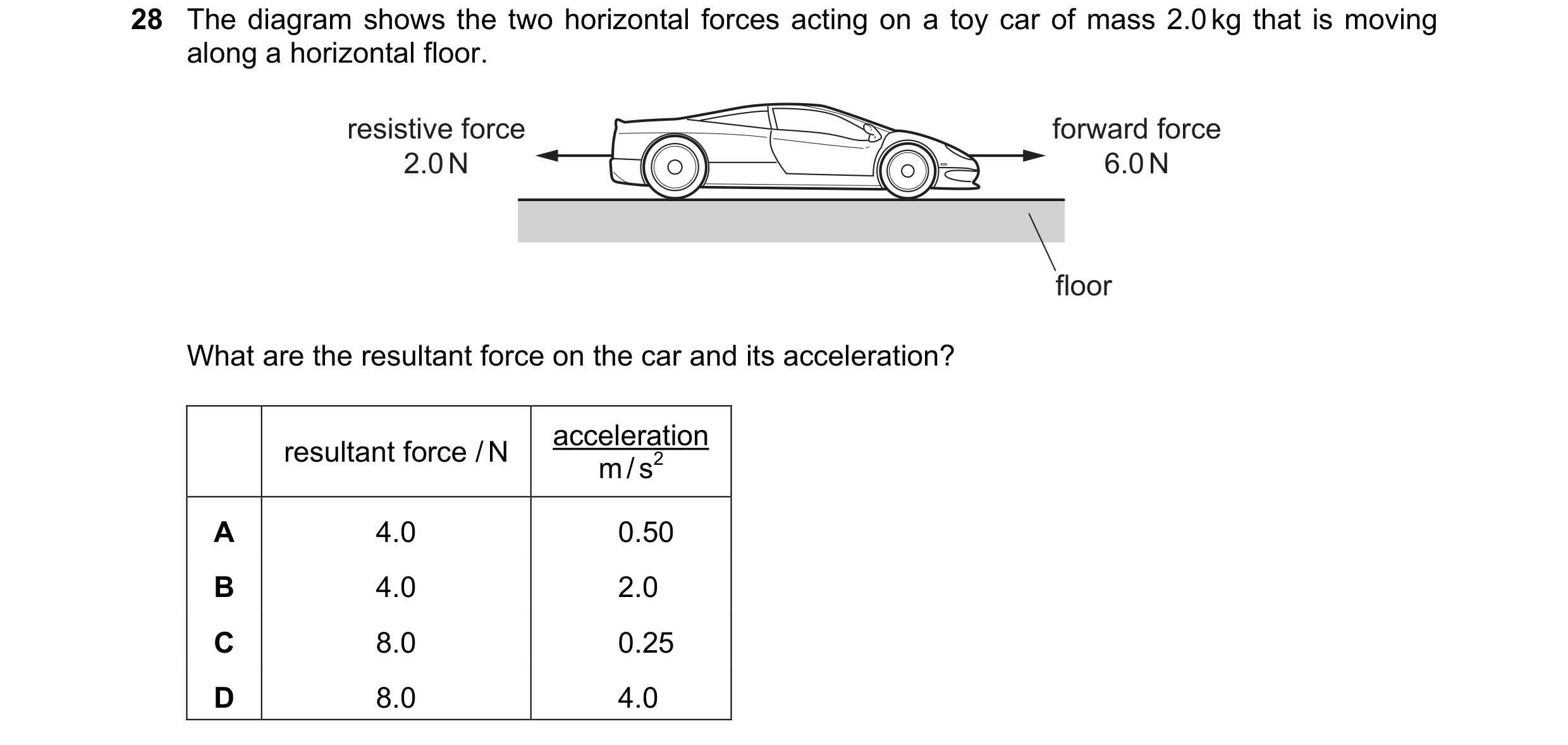
28 The diagram shows the two horizontal forces acting on a toy car of mass 2.0 kg that is moving along a horizontal floor. resistive force forward force 2.0 N 6.0 N floor What are the resultant force on the car and its acceleration? acceleration resultant force / N m / s2 A 4.0 0.50 B 4.0 2.0 C 8.0 0.25 D 8.0 4.0
1 marks
Answer: B
This question in 0973/21 Oct/Nov 2019
Q4 · A spring with its length indicated 0973/21 Oct/Nov 2019
29 Diagram 1 shows a spring with its length indicated. Diagram 2 shows the same spring with a 20 N load hung from it, and the new length of the spring. The spring obeys Hooke’s Law. 15 cm 25 cm 20 N diagram 1 diagram 2 Which graph is the extension-load graph for the spring? A B 30 30 extension / cm extension / cm 20 20 10 10 0 0 0 10 20 30 0 10 20 30 load / N load / N C D 30 30 extension / cm extension / cm 20 20 10 10 0 0 0 10 20 30 0 10 20 30 load / N load / N
1 marks
Answer: D
This question in 0973/21 Oct/Nov 2019
Q5 · The diagram shows the extension–load graph for a spring 0973/21 Oct/Nov 2020
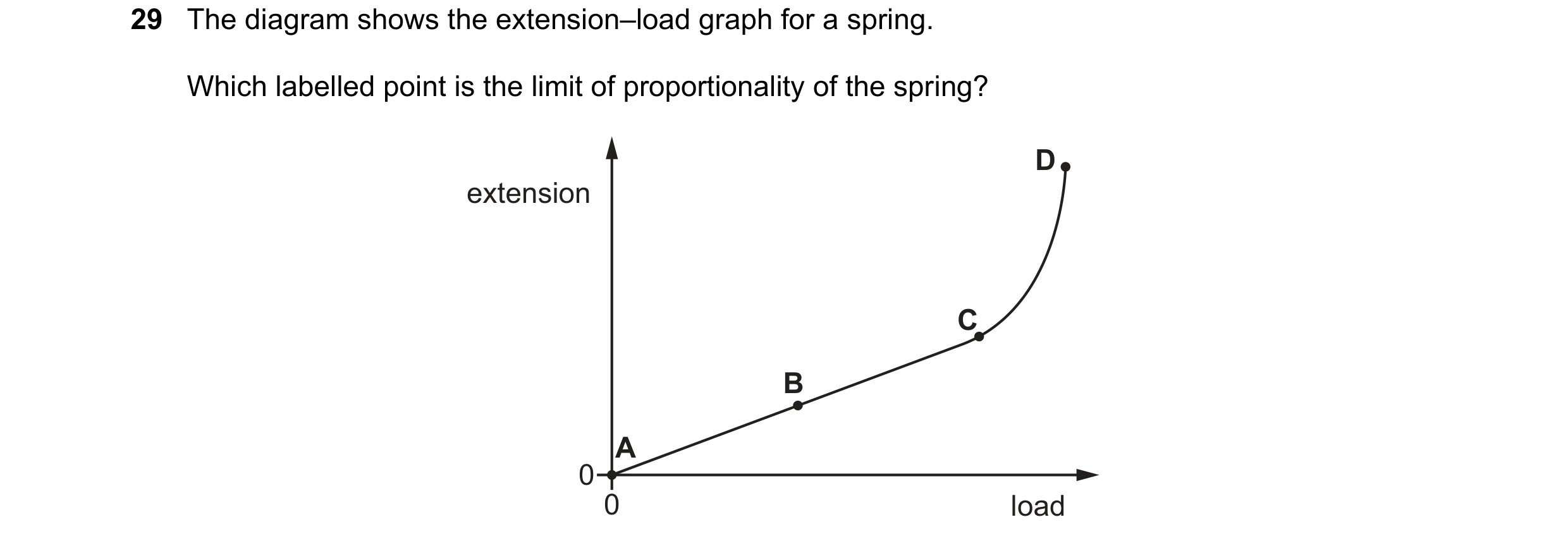
29 The diagram shows the extension–load graph for a spring. Which labelled point is the limit of proportionality of the spring? D extension C B A 0 0 load
1 marks
Answer: C
This question in 0973/21 Oct/Nov 2020
Q6 · The diagrams show uniform metre rules each pivoted at the 50 cm mark 0973/21 Oct/Nov 2020
30 The diagrams show uniform metre rules each pivoted at the 50 cm mark. Different weights are placed on the rules at different distances from the 0 cm end as shown. Which rule rotates in a clockwise direction? A B 0 20 50 60 100 cm 0 10 50 75 100 cm 4.0 N 12 N 3.0 N 5.0 N C D 0 10 50 65 100 cm 0 25 50 90 100 cm 6.0 N 8.0 N 8.0 N 4.0 N
1 marks
Answer: B
This question in 0973/21 Oct/Nov 2020
Q7 · Which two quantities can be used to calculate the acceleration of a rocket? 0973/21 May/June 2021
29 Which two quantities can be used to calculate the acceleration of a rocket? A the mass of the rocket and its speed B the mass of the rocket and its weight C the resultant force on the rocket and its mass D the resultant force on the rocket and its speed
1 marks
Answer: C
This question in 0973/21 May/June 2021
Q8 · Which statement applies to a system in equilibrium? 0973/21 May/June 2021
30 Which statement applies to a system in equilibrium? A There is a resultant force and there is a resultant turning effect on the system. B There is a resultant force but there is no resultant turning effect on the system. C There is no resultant force but there is a resultant turning effect on the system. D There is no resultant force and there is no resultant turning effect on the system.
1 marks
Answer: D
This question in 0973/21 May/June 2021
Q9 · Three objects X, Y and Z are at rest on a table 0973/22 May/June 2021
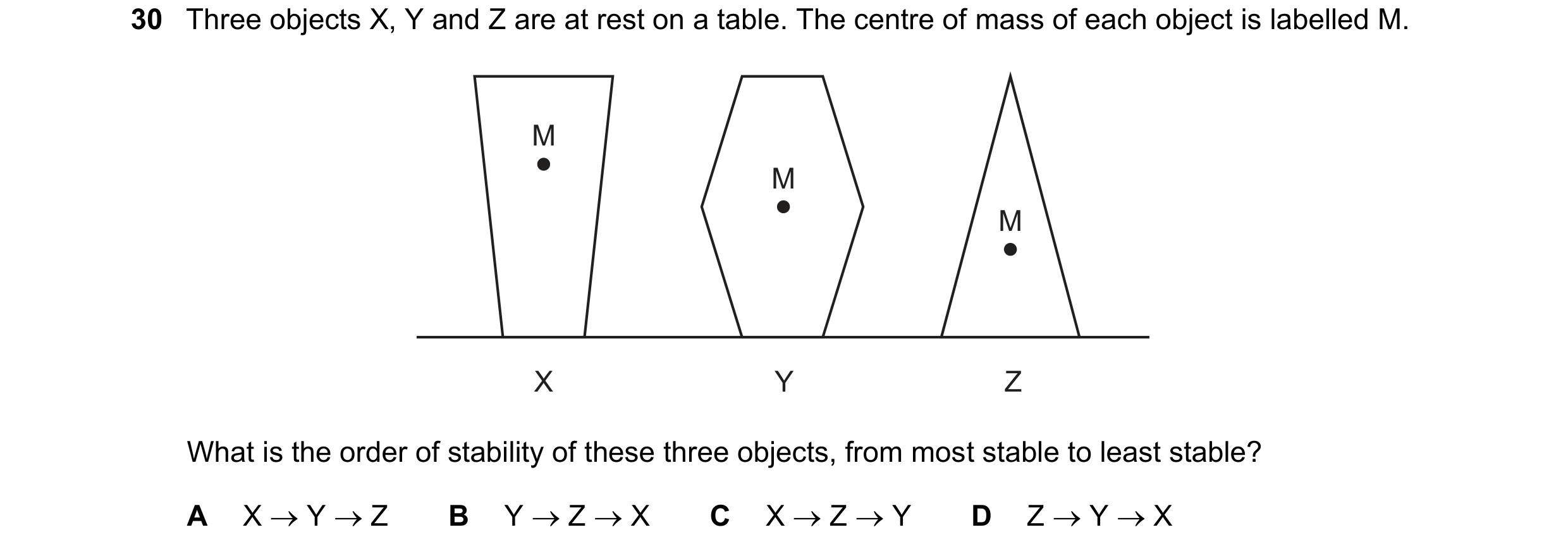
30 Three objects X, Y and Z are at rest on a table. The centre of mass of each object is labelled M. M M M X Y Z What is the order of stability of these three objects, from most stable to least stable? A X Y Z B Y Z X C X Z Y D Z Y X
1 marks
Answer: D
This question in 0973/22 May/June 2021
Q10 · A student is investigating the extension of a spring 0973/21 Oct/Nov 2021
28 A student is investigating the extension of a spring. The diagrams show the spring before and after a 0.20 N load is added. cm cm 1 1 2 2 3 3 4 4 0.20 N load 5 5 6 6 What is the spring constant of the spring? A 0.070 N / cm B 0.16 N / cm C 0.25 N / cm D 4.0 N / cm
1 marks
Answer: C
This question in 0973/21 Oct/Nov 2021
Q11 · The diagram shows a car of mass 1000 kg travelling along a straight, horizontal road 0973/21 May/June 2022
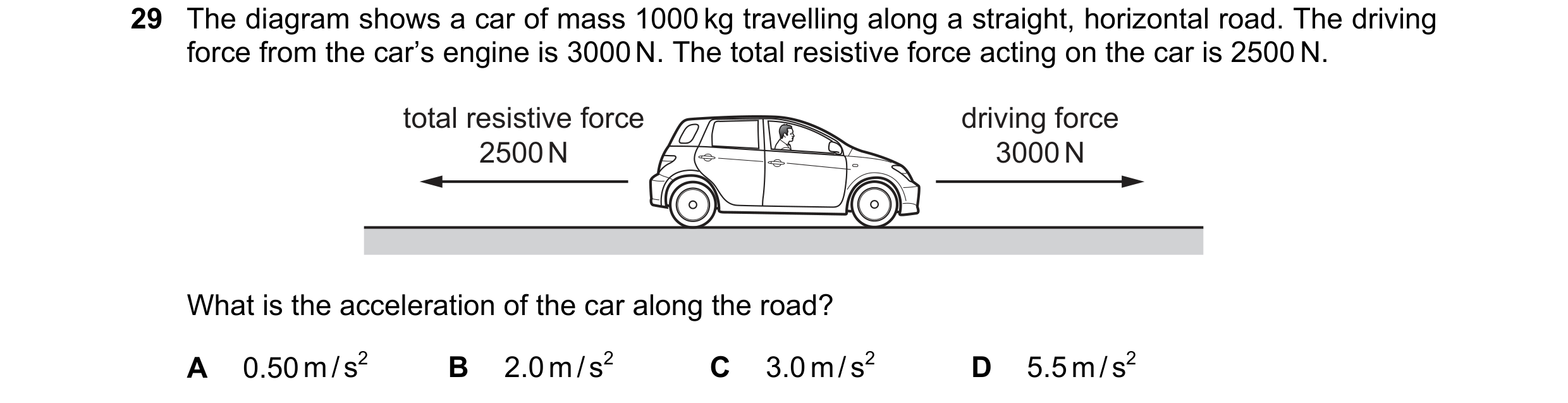
29 The diagram shows a car of mass 1000 kg travelling along a straight, horizontal road. The driving force from the car’s engine is 3000 N. The total resistive force acting on the car is 2500 N. total resistive force driving force 2500 N 3000 N What is the acceleration of the car along the road? A 0.50 m / s2 B 2.0 m / s2 C 3.0 m / s2 D 5.5 m / s2
1 marks
Answer: A
This question in 0973/21 May/June 2022
Q12 · A spring is extended by a force but the spring does not pass its limit of proportionality 0973/22 May/June 2022
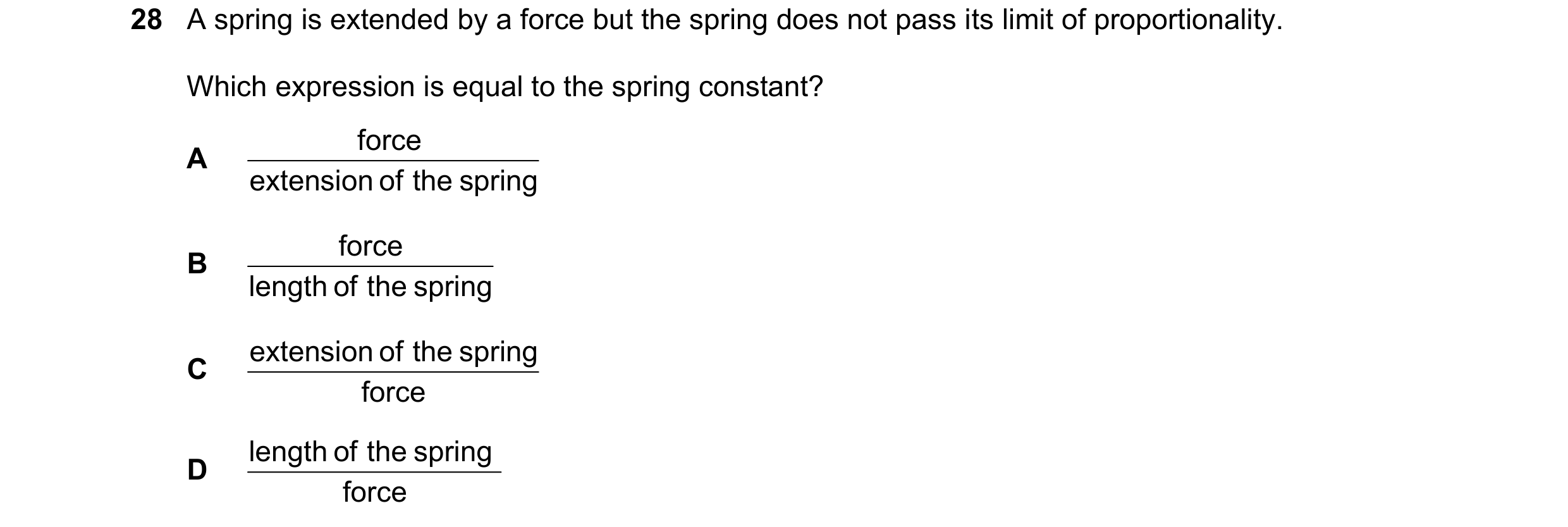
28 A spring is extended by a force but the spring does not pass its limit of proportionality. Which expression is equal to the spring constant? force A extension of the spring force B length of the spring extension of the spring C force length of the spring D force
1 marks
Answer: A
This question in 0973/22 May/June 2022
Q13 · An object of mass 2.0 kg is acted upon by a force of 3.0 N and a force of 7.0 N 0973/21 Oct/Nov 2022
30 An object of mass 2.0 kg is acted upon by a force of 3.0 N and a force of 7.0 N. The directions of the forces are shown. object 7.0 N 3.0 N What is the acceleration of the object? A 0.20 m / s2 B 0.50 m / s2 C 2.0 m / s2 D 5.0 m / s2
1 marks
Answer: C
This question in 0973/21 Oct/Nov 2022
Q14 · The diagram shows a triangular sheet of metal with sides of length 50 cm, 40 cm and 30 cm 0973/21 May/June 2023
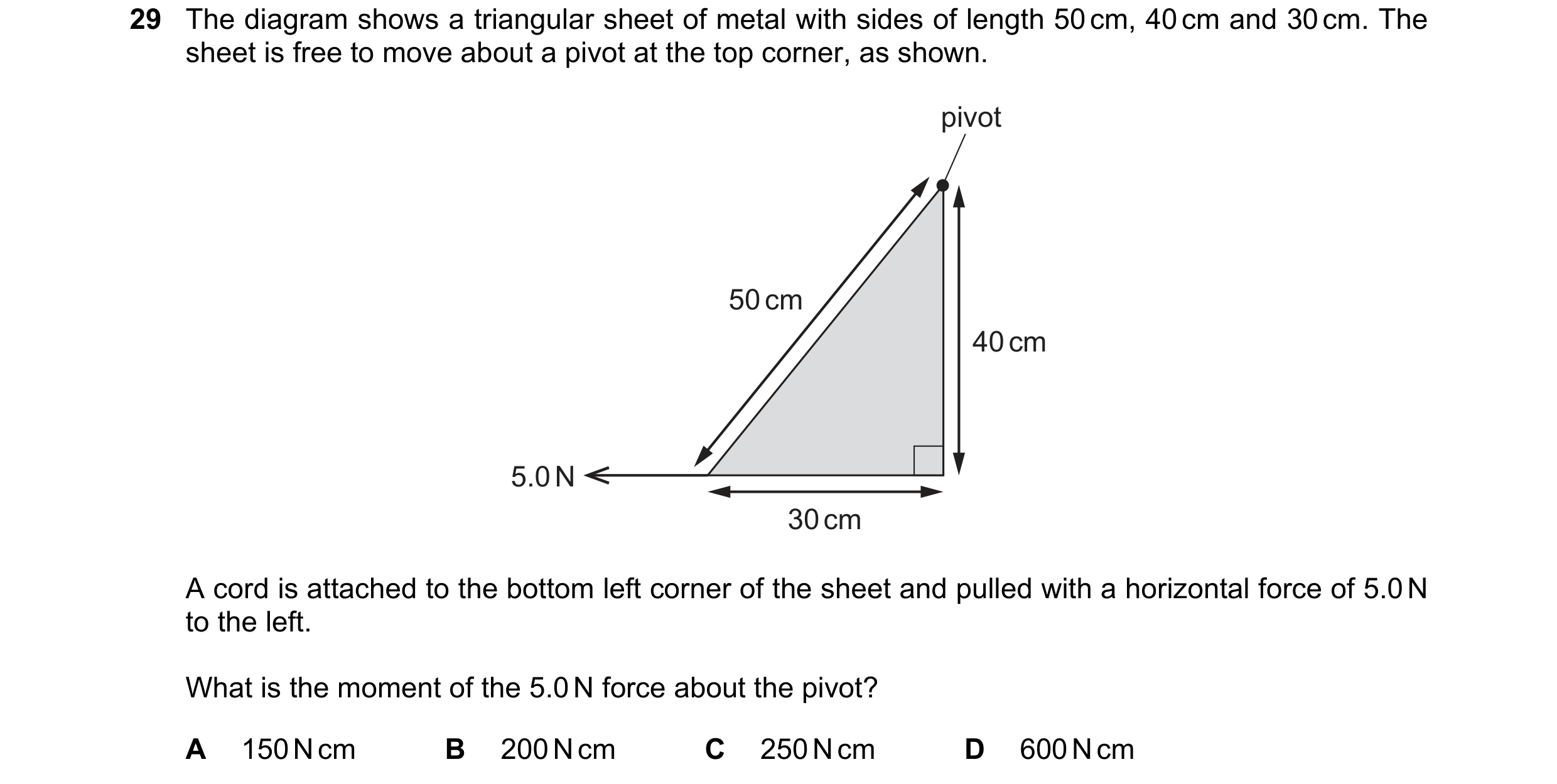
29 The diagram shows a triangular sheet of metal with sides of length 50 cm, 40 cm and 30 cm. The sheet is free to move about a pivot at the top corner, as shown. pivot 50 cm 40 cm 5.0 N 30 cm A cord is attached to the bottom left corner of the sheet and pulled with a horizontal force of 5.0 N to the left. What is the moment of the 5.0 N force about the pivot? A 150 N cm B 200 N cm C 250 N cm D 600 N cm
1 marks
Answer: B
This question in 0973/21 May/June 2023
Q15 · A uniform beam has a mass of 12 kg and a length of 4.0 m 0973/22 May/June 2023
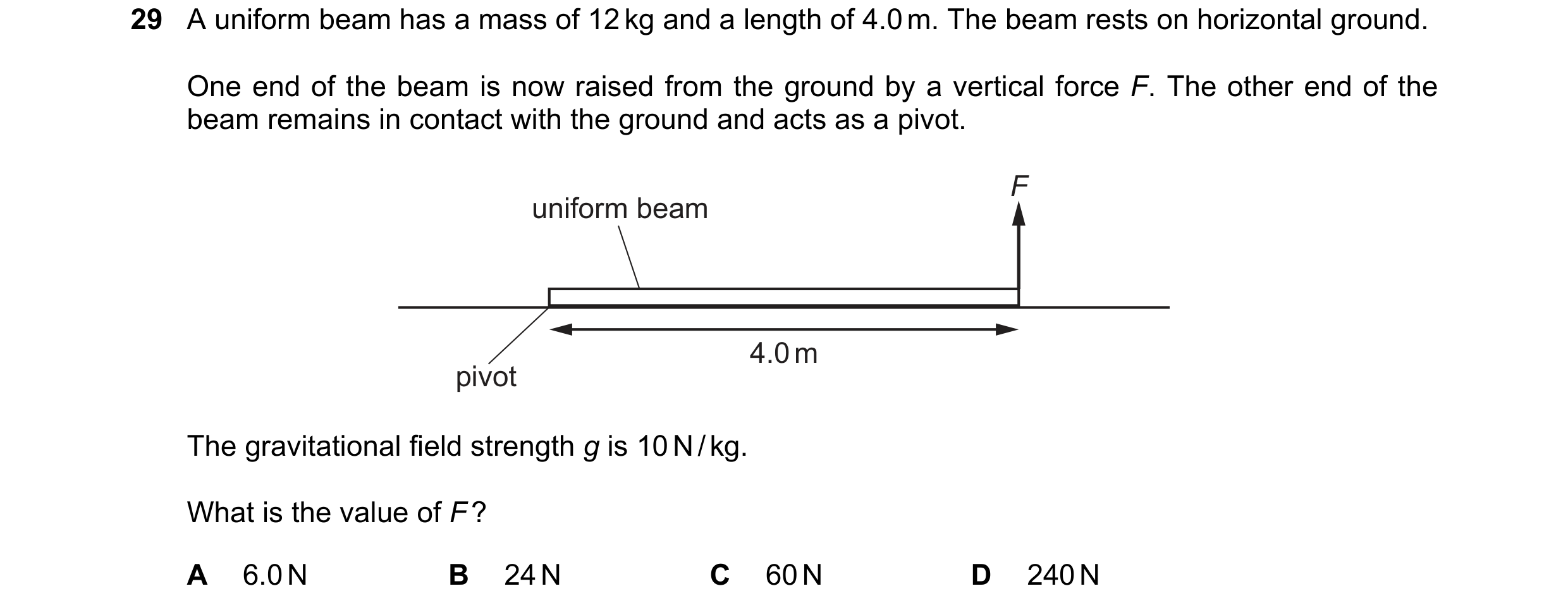
29 A uniform beam has a mass of 12 kg and a length of 4.0 m. The beam rests on horizontal ground. One end of the beam is now raised from the ground by a vertical force F. The other end of the beam remains in contact with the ground and acts as a pivot. F uniform beam 4.0 m pivot The gravitational field strength g is 10 N / kg. What is the value of F ? A 6.0 N B 24 N C 60 N D 240 N
1 marks
Answer: C
This question in 0973/22 May/June 2023
Q16 · A rocket has a mass of 300 kg 0973/21 Oct/Nov 2023
29 A rocket has a mass of 300 kg. Its motors produce a force of 12 000 N vertically upwards. The acceleration of free fall g is 10 m / s2. What is the resultant force on the rocket and what is the acceleration of the rocket? resultant acceleration force / N m / s2 A 9 000 30 B 9 000 2.7 106 C 15 000 50 D 15 000 4.5 106
1 marks
Answer: A
This question in 0973/21 Oct/Nov 2023
Q17 · A uniform metre rule rests on a pivot at the 50 cm mark 0973/21 Oct/Nov 2023
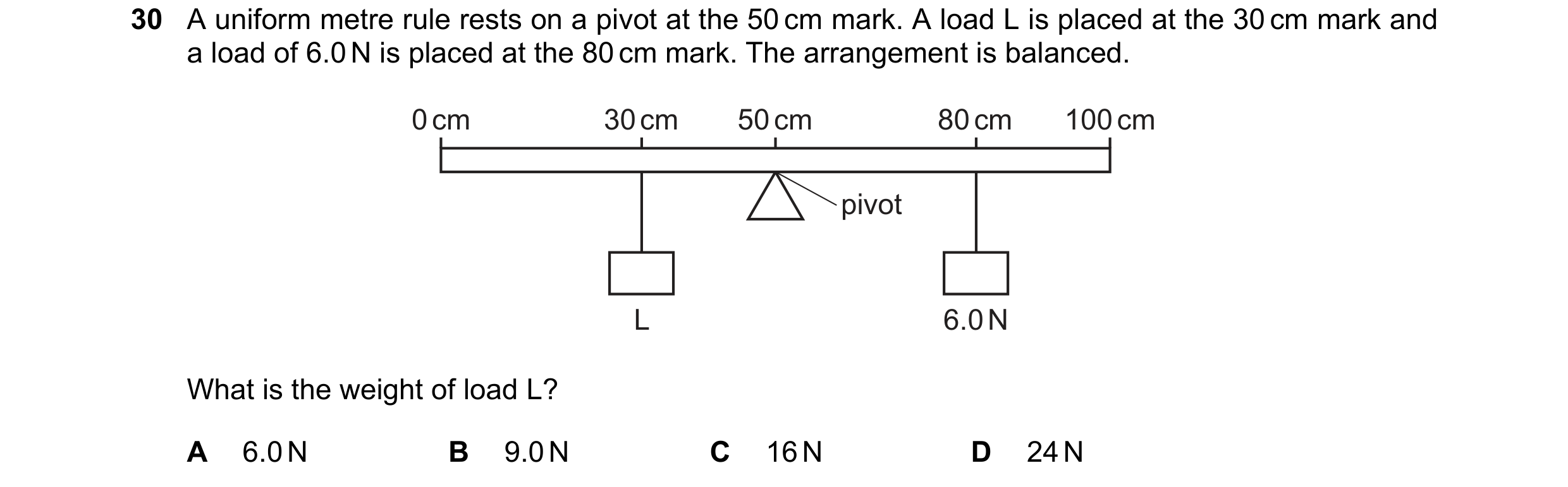
30 A uniform metre rule rests on a pivot at the 50 cm mark. A load L is placed at the 30 cm mark and a load of 6.0 N is placed at the 80 cm mark. The arrangement is balanced. 0 cm 30 cm 50 cm 80 cm 100 cm pivot L 6.0 N What is the weight of load L? A 6.0 N B 9.0 N C 16 N D 24 N
1 marks
Answer: B
This question in 0973/21 Oct/Nov 2023
Q18 · Which statement describes a system that is in equilibrium? 0973/21 May/June 2024
28 Which statement describes a system that is in equilibrium? A There is a resultant force and there is a resultant turning effect on the system. B There is a resultant force but there is no resultant turning effect on the system. C There is no resultant force but there is a resultant turning effect on the system. D There is no resultant force and there is no resultant turning effect on the system.
1 marks
Answer: D
This question in 0973/21 May/June 2024
Q19 · What is meant by the moment of a force? 0973/22 May/June 2024
29 What is meant by the moment of a force? A the speed of an object moved by a force B the time taken for a force to move an object C the turning effect of a force D the work done by a force
1 marks
Answer: C
This question in 0973/22 May/June 2024
Q20 · The length of a spring changes when a force is applied to stretch the spring 0973/21 Oct/Nov 2024
29 The length of a spring changes when a force is applied to stretch the spring. The table shows how the length of the spring depends on the force. force / N 0 1.0 2.0 3.0 4.0 5.0 length of spring / cm 22 25 28 31 35 45 What is the length of the spring when the limit of proportionality is reached? A exactly 22 cm B between 31 cm and 35 cm C exactly 35 cm D between 35 cm and 45 cm
1 marks
Answer: B
This question in 0973/21 Oct/Nov 2024
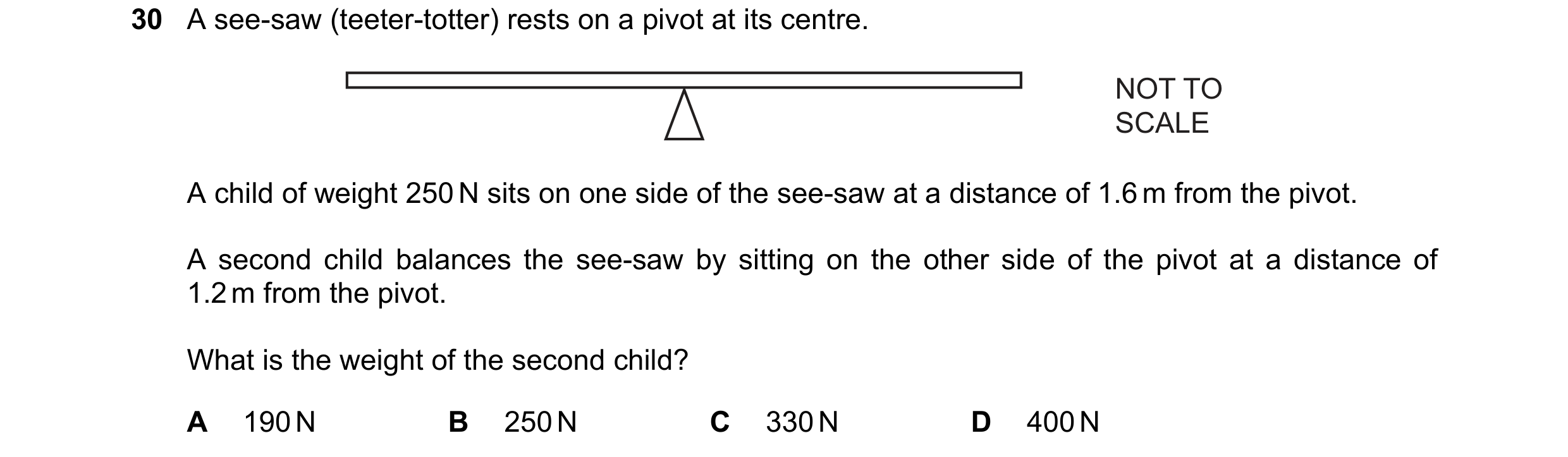
Q21 · A see-saw (teeter-totter) rests on a pivot at its centre 0973/21 Oct/Nov 2024
30 A see-saw (teeter-totter) rests on a pivot at its centre. NOT TO SCALE A child of weight 250 N sits on one side of the see-saw at a distance of 1.6 m from the pivot. A second child balances the see-saw by sitting on the other side of the pivot at a distance of 1.2 m from the pivot. What is the weight of the second child? A 190 N B 250 N C 330 N D 400 N
1 marks
Answer: C
This question in 0973/21 Oct/Nov 2024
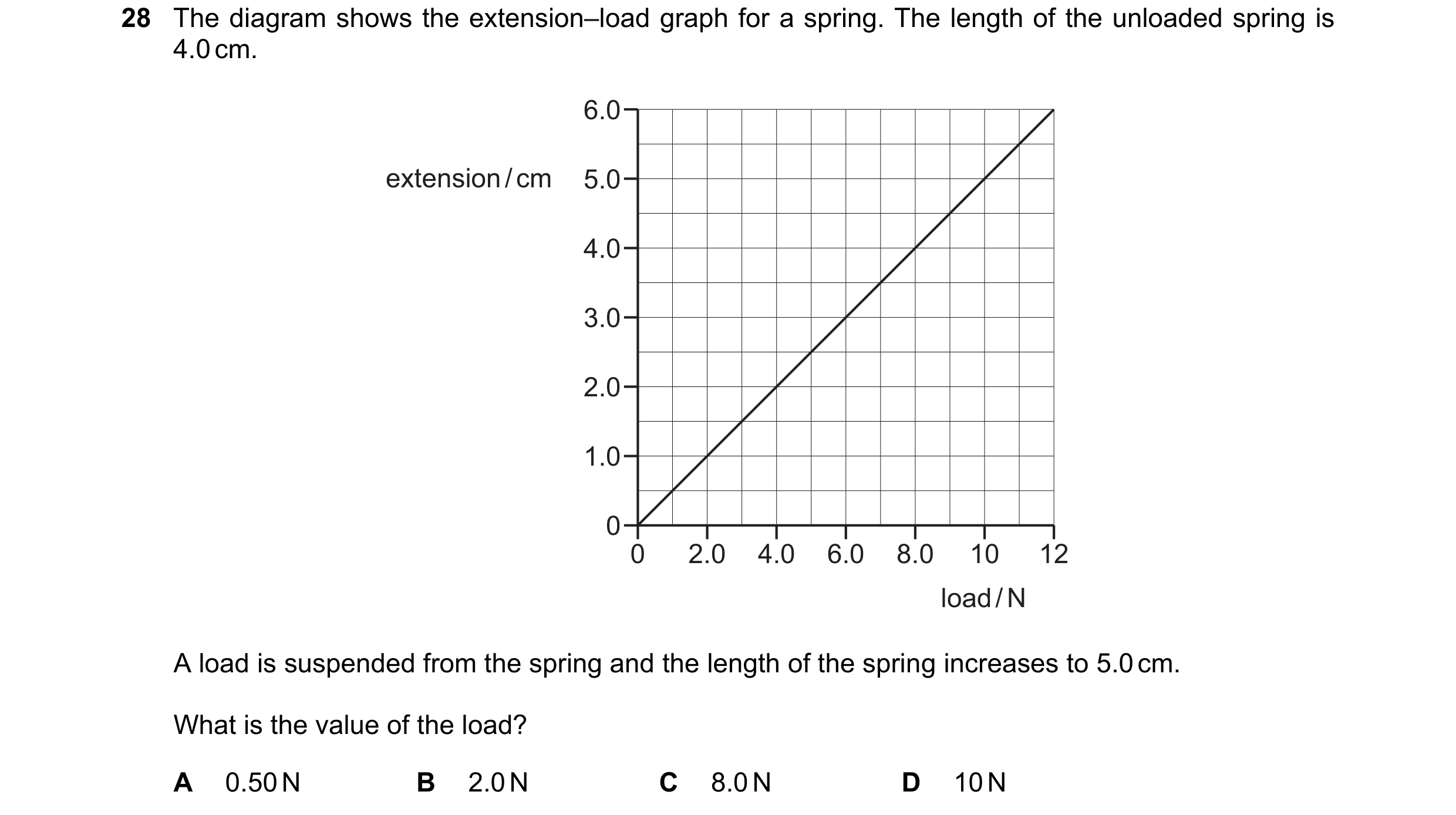
Q22 · The diagram shows the extension–load graph for a spring 0973/21 May/June 2025
28 The diagram shows the extension–load graph for a spring. The length of the unloaded spring is 4.0 cm. 6.0 extension / cm 5.0 4.0 3.0 2.0 1.0 0 0 2.0 4.0 6.0 8.0 10 12 load / N A load is suspended from the spring and the length of the spring increases to 5.0 cm. What is the value of the load? A 0.50 N B 2.0 N C 8.0 N D 10 N
1 marks
Answer: B
This question in 0973/21 May/June 2025
Q23 · The diagram shows the two vertical forces acting on an object of mass m falling through… 0973/21 Oct/Nov 2025
29 The diagram shows the two vertical forces acting on an object of mass m falling through the air. F W Which expression is equal to the magnitude of the vertical acceleration of the object? ( W – F ) ( W + F ) m m A B C F D F m m ( W – ) ( W + )
1 marks
Answer: A
This question in 0973/21 Oct/Nov 2025
 1 / 8
1 / 8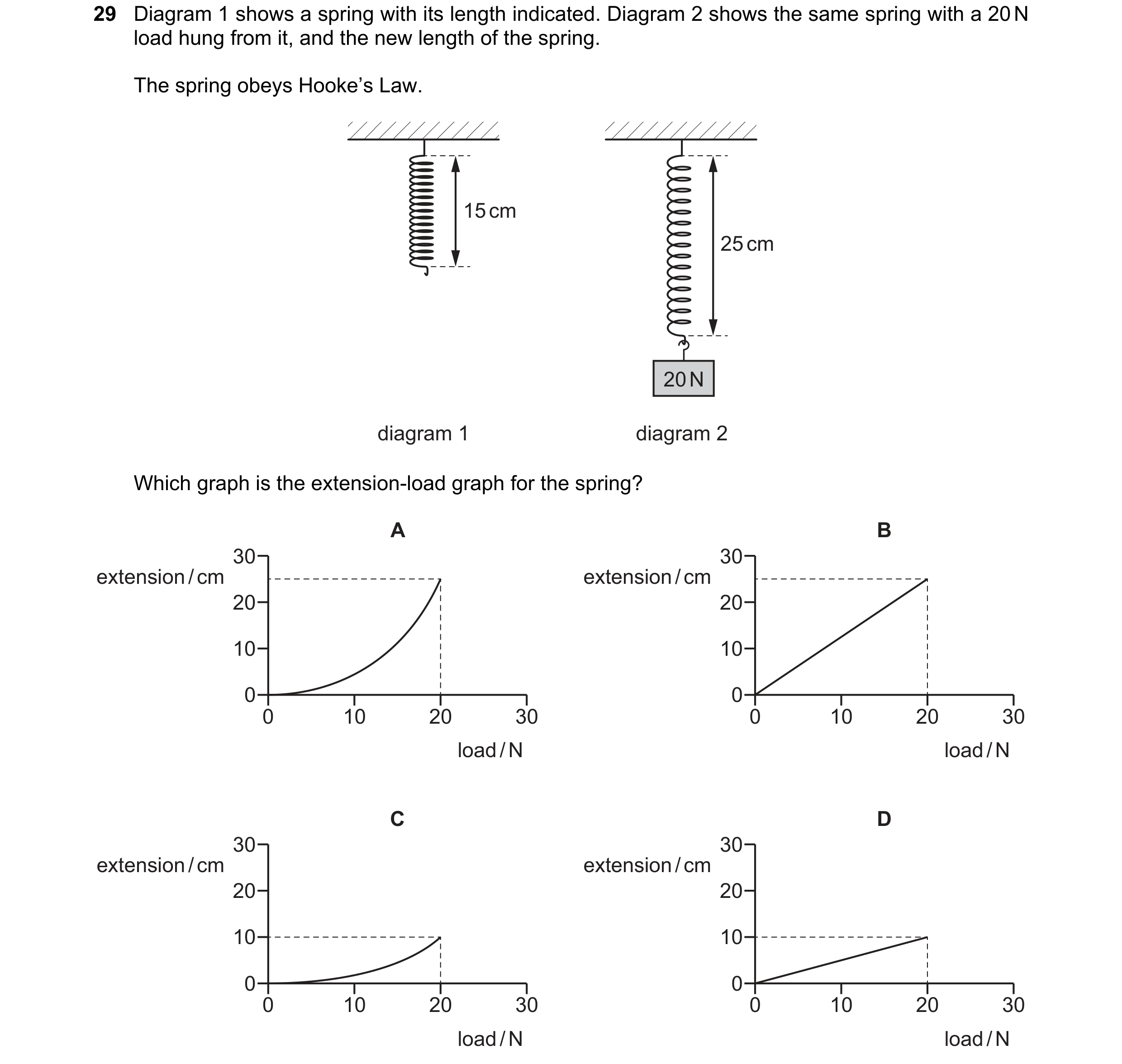
 2 / 8
2 / 8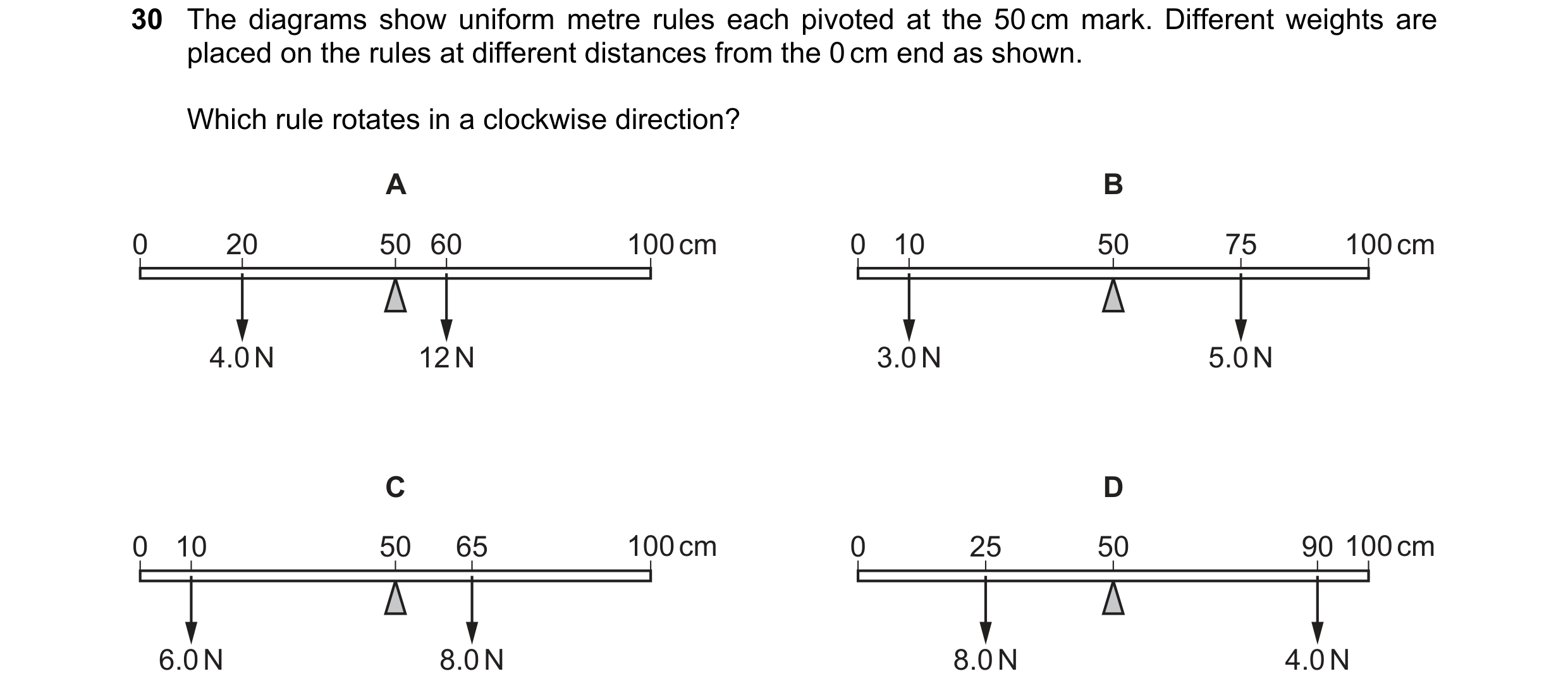


 3 / 8
3 / 8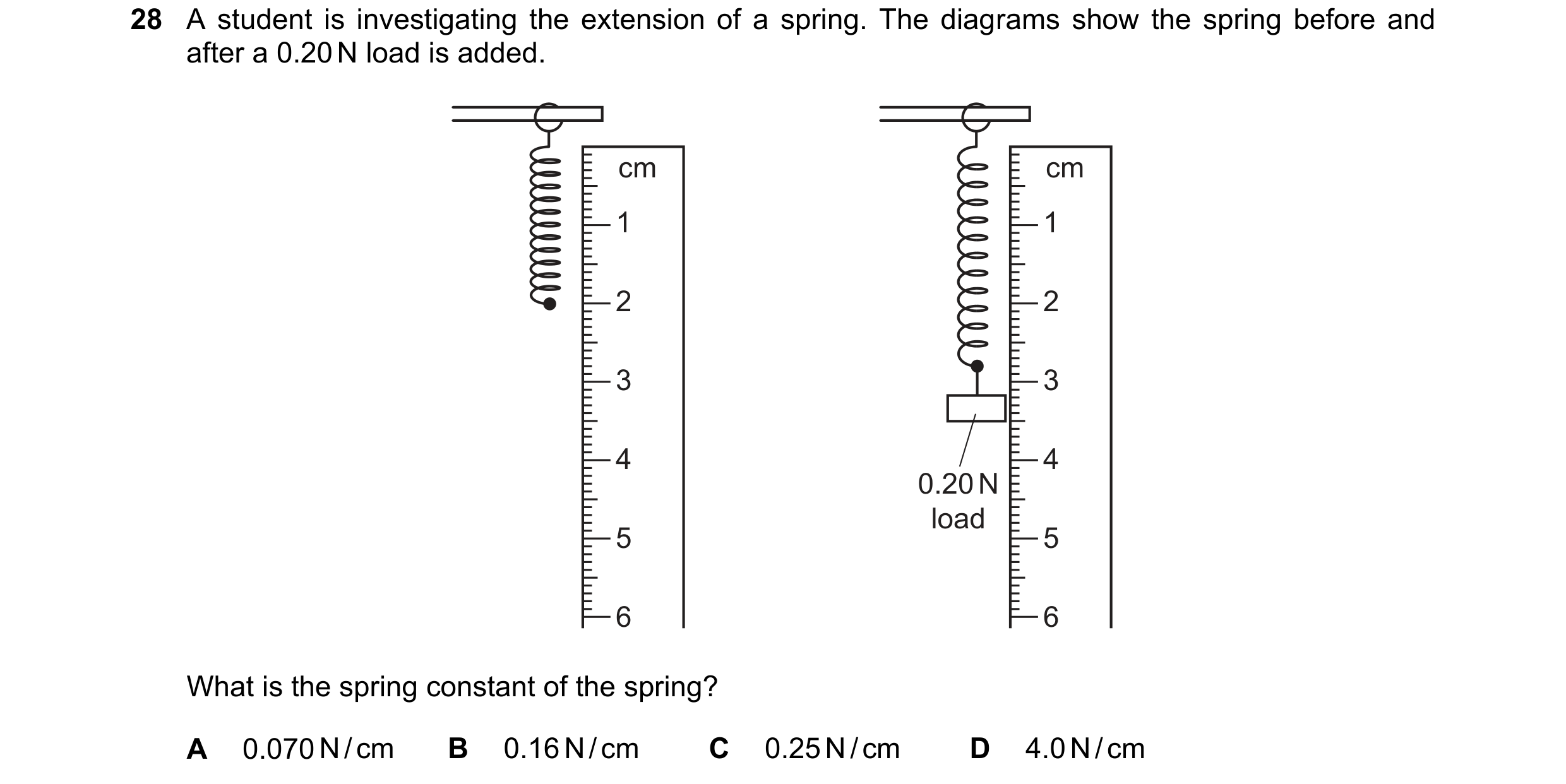
 4 / 8
4 / 8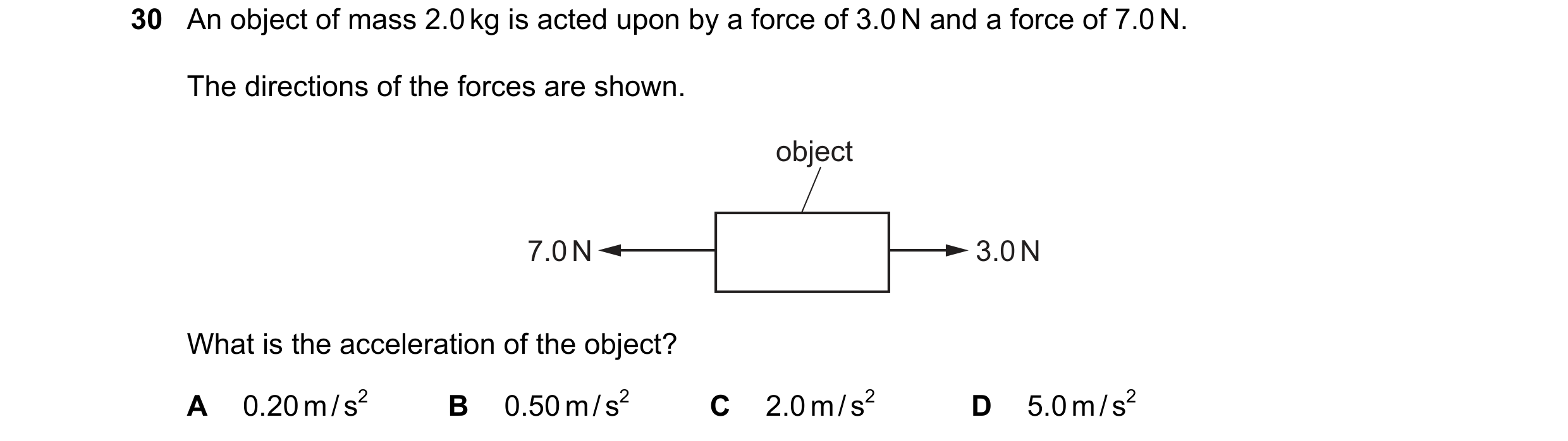
 5 / 8
5 / 8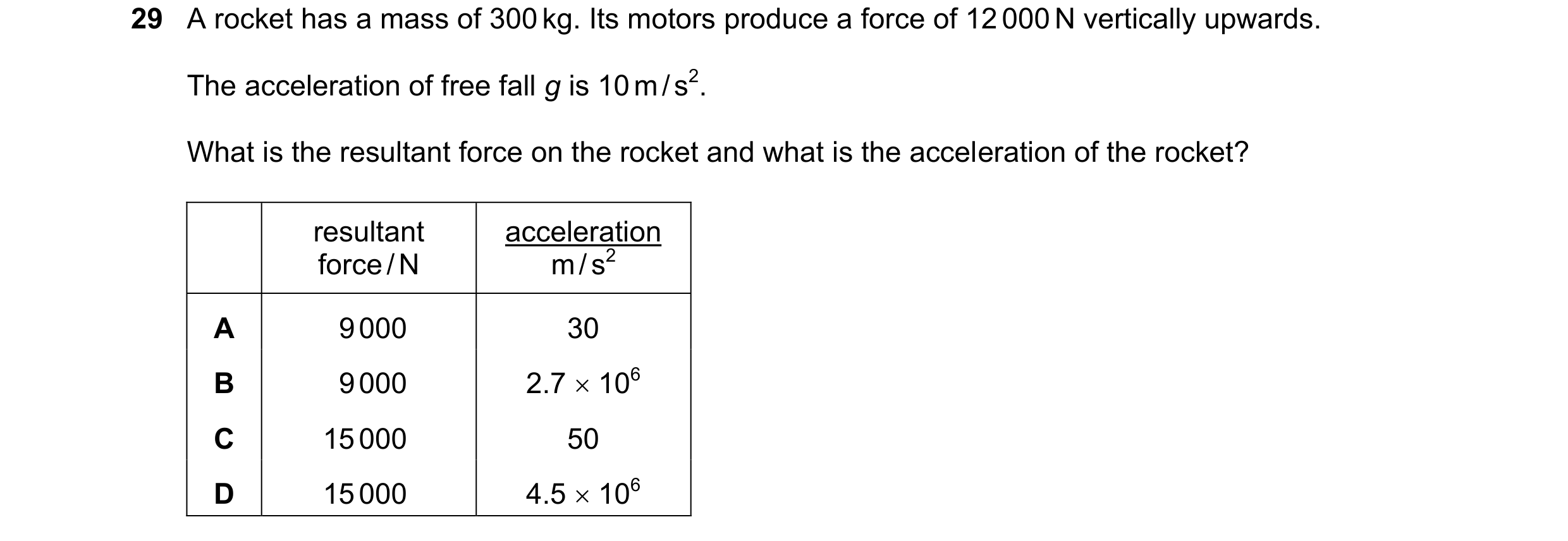

 6 / 8
6 / 8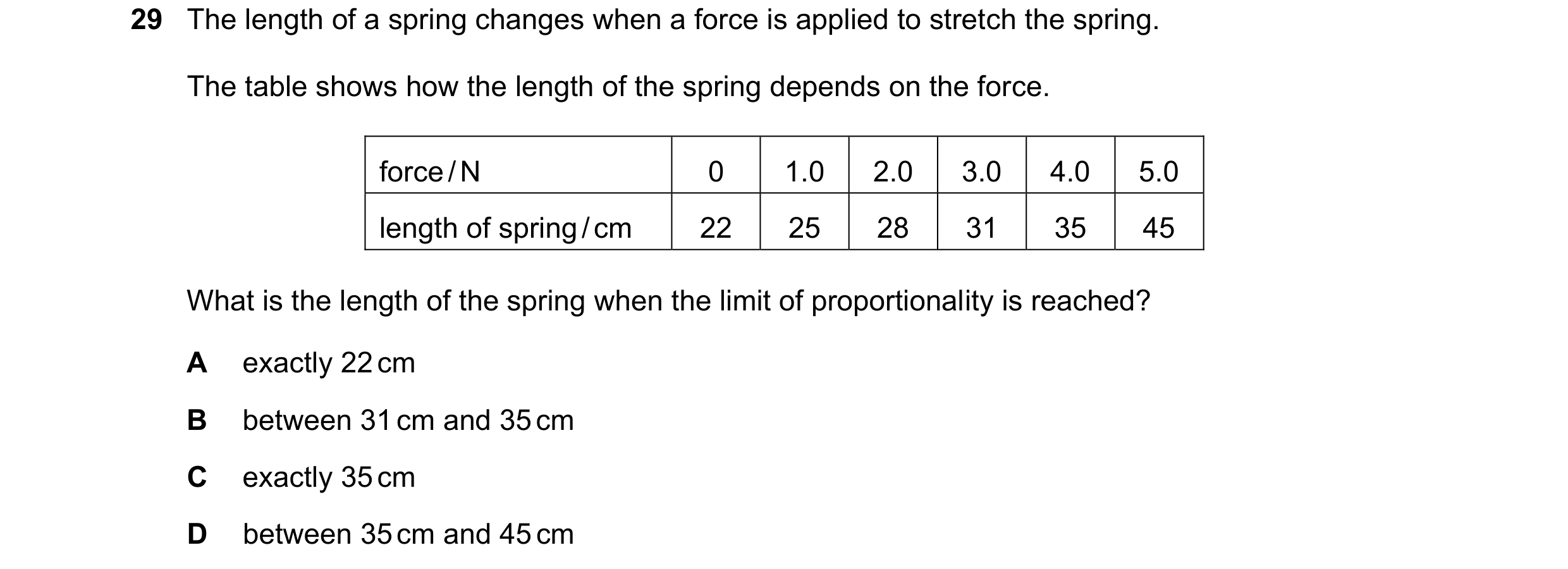
 7 / 8
7 / 8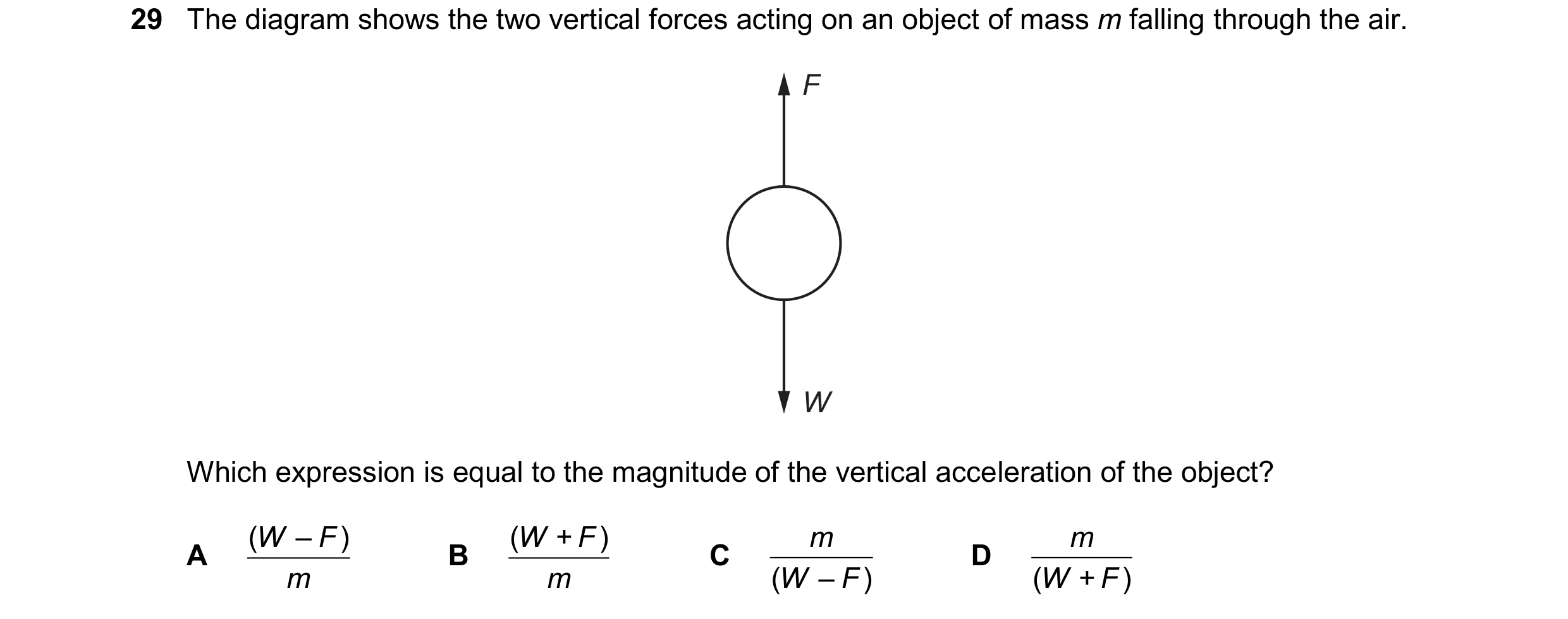 8 / 8
8 / 8