Questions as text
Q1 · What is the electrolyte that is used when a nickel spoon is electroplated with copper? 0973/21 May/June 2019
17 What is the electrolyte that is used when a nickel spoon is electroplated with copper? A copper B copper sulfate solution C nickel sulfate solution D nickel
1 marks
Answer: B
This question in 0973/21 May/June 2019
Q2 · Which row identifies the products of the electrolysis of the named electrolyte using… 0973/22 May/June 2019
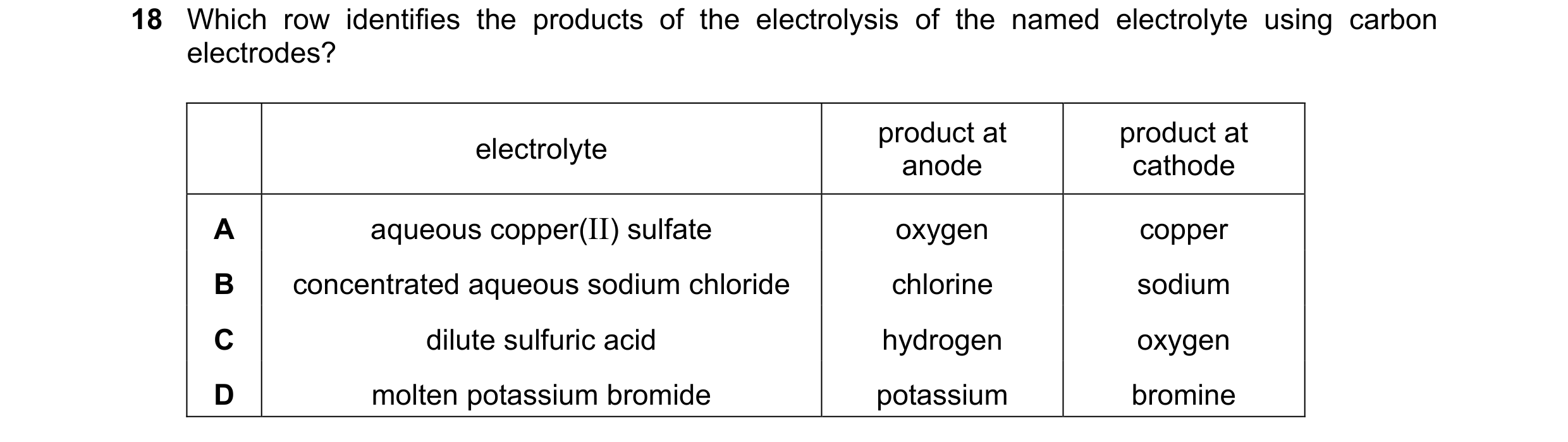
18 Which row identifies the products of the electrolysis of the named electrolyte using carbon electrodes? product at product at electrolyte anode cathode A aqueous copper(II) sulfate oxygen copper B concentrated aqueous sodium chloride chlorine sodium C dilute sulfuric acid hydrogen oxygen D molten potassium bromide potassium bromine
1 marks
Answer: A
This question in 0973/22 May/June 2019
Q3 · During the electrolysis of aluminium oxide, which ions are reduced and at which electrode… 0973/21 Oct/Nov 2019
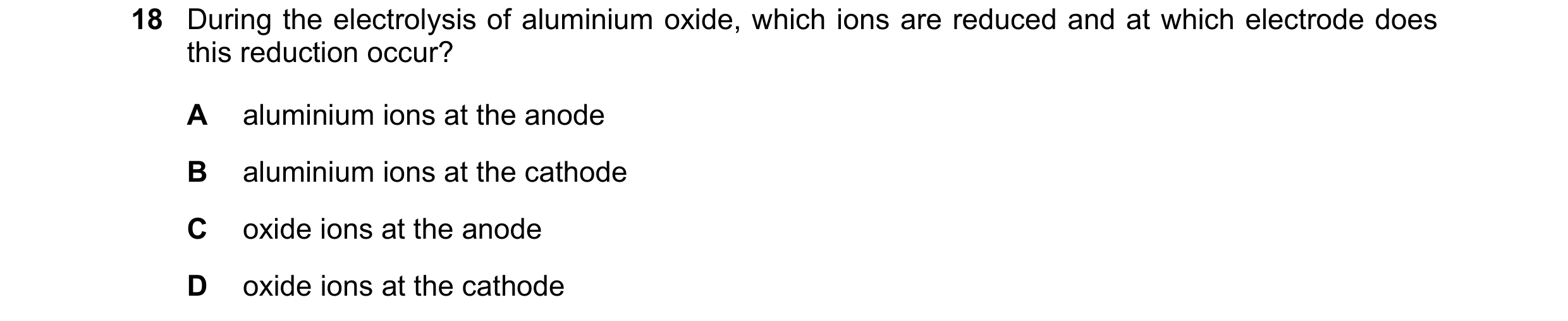
18 During the electrolysis of aluminium oxide, which ions are reduced and at which electrode does this reduction occur? A aluminium ions at the anode B aluminium ions at the cathode C oxide ions at the anode D oxide ions at the cathode
1 marks
Answer: B
This question in 0973/21 Oct/Nov 2019
Q4 · The diagram shows the electrolysis of lead(II) bromide using inert electrodes 0973/21 May/June 2020
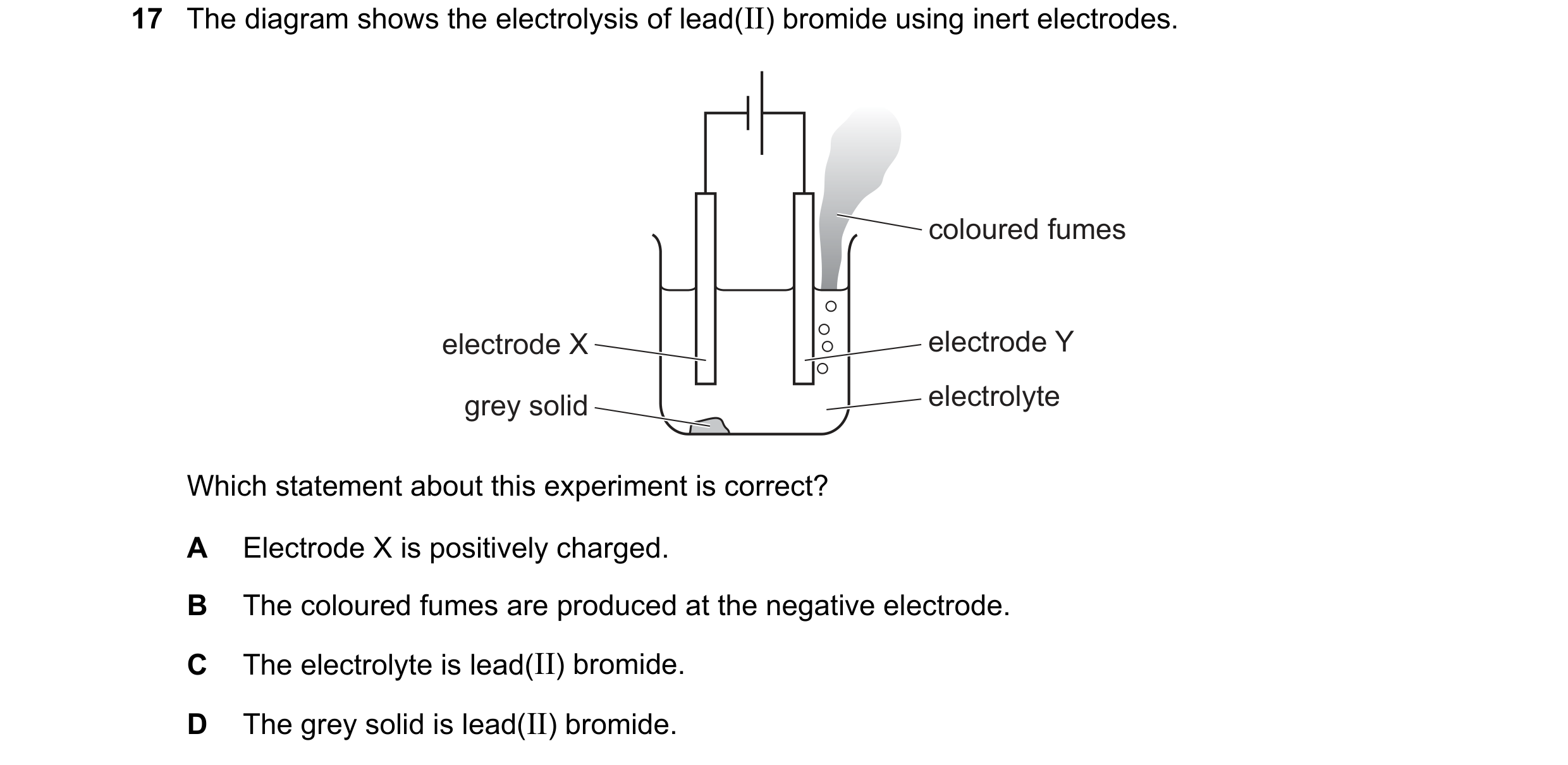
17 The diagram shows the electrolysis of lead(II) bromide using inert electrodes. coloured fumes electrode X electrode Y grey solid electrolyte Which statement about this experiment is correct? A Electrode X is positively charged. B The coloured fumes are produced at the negative electrode. C The electrolyte is lead(II) bromide. D The grey solid is lead(II) bromide.
1 marks
Answer: C
This question in 0973/21 May/June 2020
Q5 · The diagram shows the electrolysis of lead(II) bromide using inert electrodes 0973/22 May/June 2020
17 The diagram shows the electrolysis of lead(II) bromide using inert electrodes. coloured fumes electrode X electrode Y grey solid electrolyte Which statement about this experiment is correct? A Electrode X is positively charged. B The coloured fumes are produced at the negative electrode. C The electrolyte is lead(II) bromide. D The grey solid is lead(II) bromide.
1 marks
Answer: C
This question in 0973/22 May/June 2020
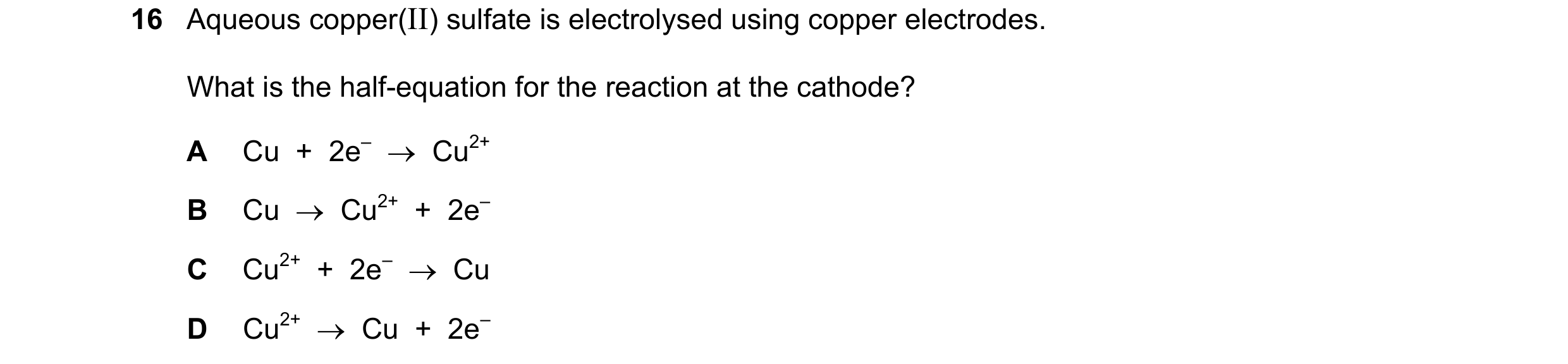
Q6 · Aqueous copper(II) sulfate is electrolysed using copper electrodes 0973/22 May/June 2021
16 Aqueous copper(II) sulfate is electrolysed using copper electrodes. What is the half-equation for the reaction at the cathode? A Cu + 2e– Cu2+ B Cu Cu2+ + 2e– C Cu2+ + 2e– Cu D Cu2+ Cu + 2e–
1 marks
Answer: C
This question in 0973/22 May/June 2021
Q7 · The diagram shows the electrolysis of a compound 0973/21 Oct/Nov 2021
16 The diagram shows the electrolysis of a compound. switch + – P Q electrolyte When the switch is closed, the solution around electrode P turns orange because a halogen is formed. The positive electrode P is called the ……1……, and the halogen is ……2…… . Which words complete gaps 1 and 2? 1 2 A anode bromine B anode chlorine C cathode bromine D cathode chlorine
1 marks
Answer: A
This question in 0973/21 Oct/Nov 2021
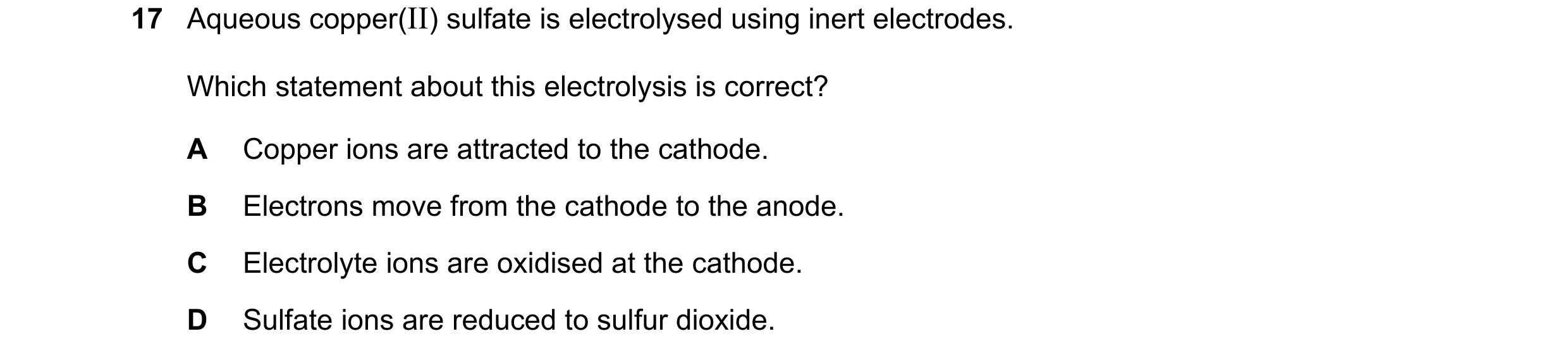
Q8 · Aqueous copper(II) sulfate is electrolysed using inert electrodes 0973/21 May/June 2022
17 Aqueous copper(II) sulfate is electrolysed using inert electrodes. Which statement about this electrolysis is correct? A Copper ions are attracted to the cathode. B Electrons move from the cathode to the anode. C Electrolyte ions are oxidised at the cathode. D Sulfate ions are reduced to sulfur dioxide.
1 marks
Answer: A
This question in 0973/21 May/June 2022
Q9 · Which statement about electrolysis is correct? 0973/22 May/June 2022
17 Which statement about electrolysis is correct? A At the anode, anions are oxidised by gaining electrons. B At the anode, cations are reduced by gaining electrons. C At the cathode, anions are oxidised by gaining electrons. D At the cathode, cations are reduced by gaining electrons.
1 marks
Answer: D
This question in 0973/22 May/June 2022
Q10 · Copper(II) sulfate can be electrolysed using either carbon electrodes or copper electrodes 0973/21 Oct/Nov 2022
18 Copper(II) sulfate can be electrolysed using either carbon electrodes or copper electrodes. What happens to the concentration of copper(II) ions in the electrolyte during electrolysis using these electrodes? using carbon using copper electrodes electrodes A decreases decreases B decreases no change C no change decreases D no change increases
1 marks
Answer: B
This question in 0973/21 Oct/Nov 2022
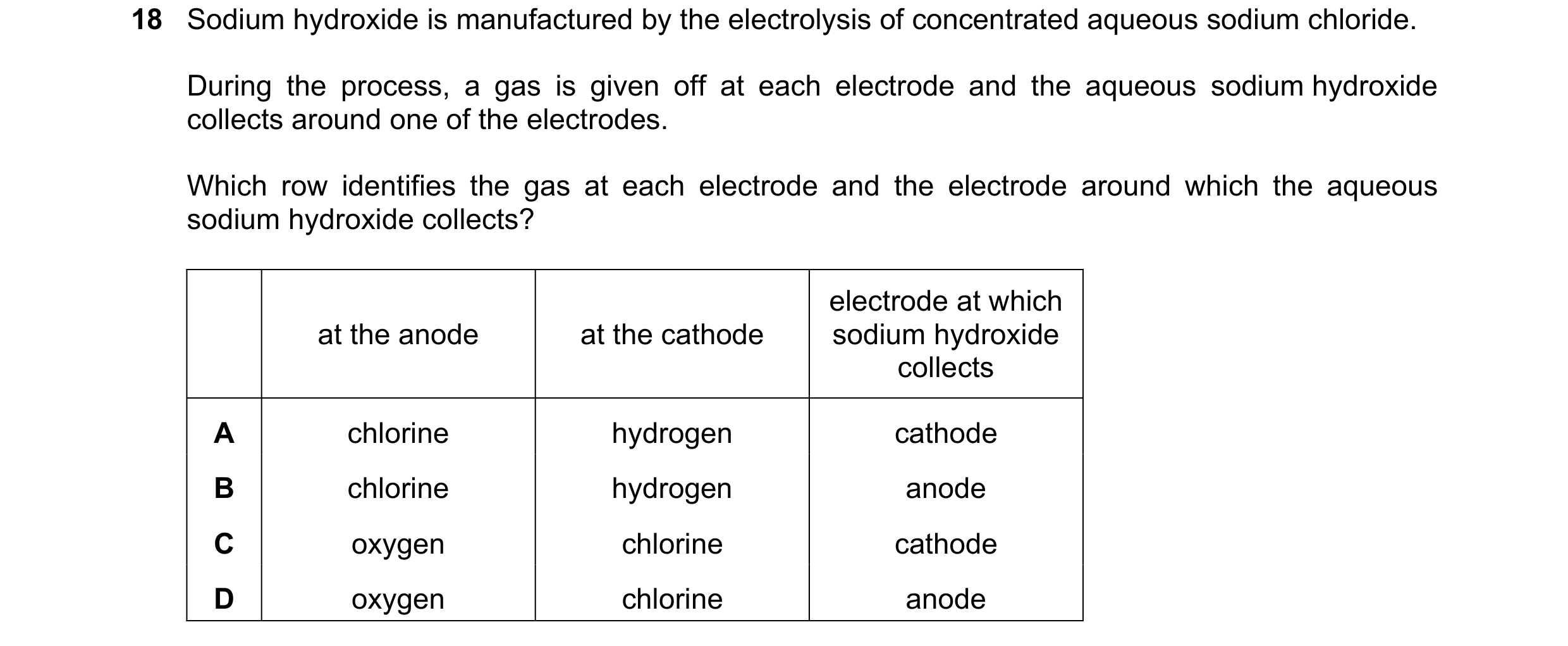
Q11 · Sodium hydroxide is manufactured by the electrolysis of concentrated aqueous sodium… 0973/21 May/June 2023
18 Sodium hydroxide is manufactured by the electrolysis of concentrated aqueous sodium chloride. During the process, a gas is given off at each electrode and the aqueous sodium hydroxide collects around one of the electrodes. Which row identifies the gas at each electrode and the electrode around which the aqueous sodium hydroxide collects? electrode at which at the anode at the cathode sodium hydroxide collects A chlorine hydrogen cathode B chlorine hydrogen anode C oxygen chlorine cathode D oxygen chlorine anode
1 marks
Answer: A
This question in 0973/21 May/June 2023
Q12 · Which statement about the extraction of aluminium from its ore by electrolysis is correct? 0973/22 May/June 2023
18 Which statement about the extraction of aluminium from its ore by electrolysis is correct? A Aluminium gains electrons from the anode. B Aluminium ions are oxidised at the cathode. C Aluminium ore is called cryolite. D Aluminium oxide is in the electrolyte.
1 marks
Answer: D
This question in 0973/22 May/June 2023
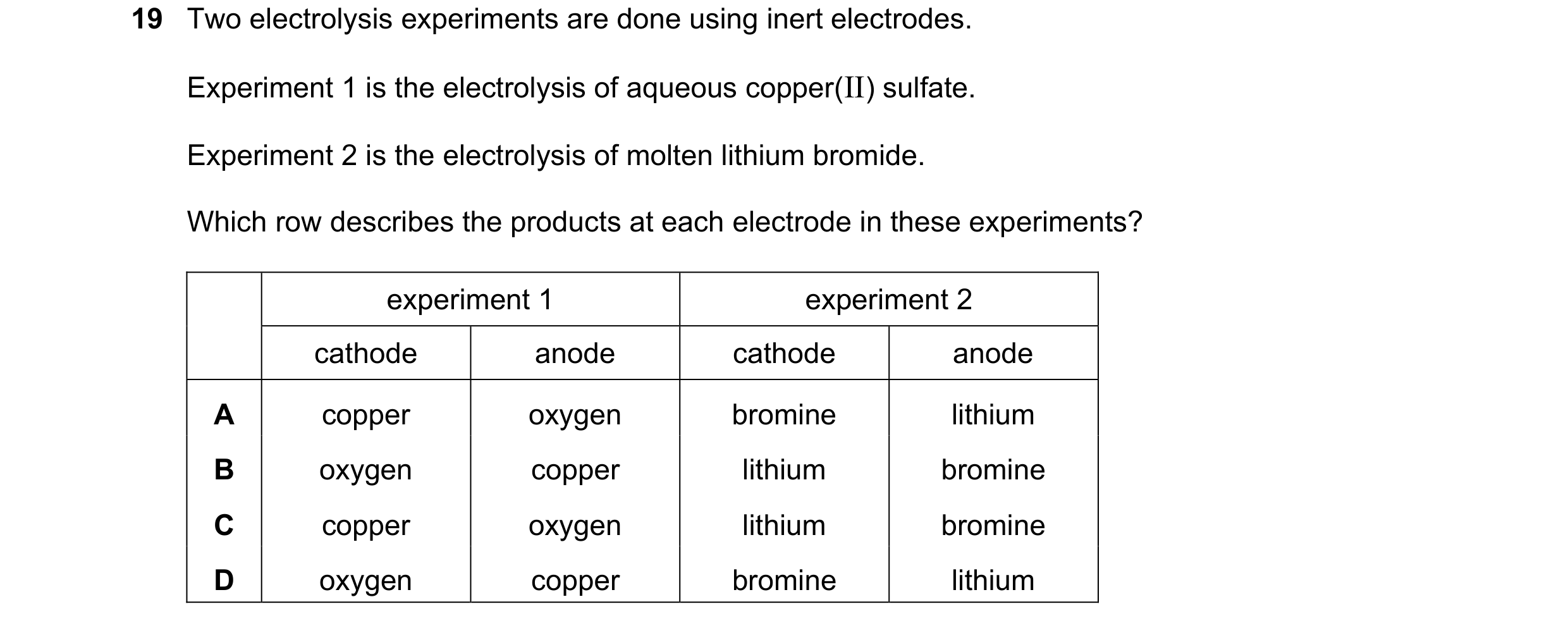
Q13 · Two electrolysis experiments are done using inert electrodes 0973/21 May/June 2024
19 Two electrolysis experiments are done using inert electrodes. Experiment 1 is the electrolysis of aqueous copper(II) sulfate. Experiment 2 is the electrolysis of molten lithium bromide. Which row describes the products at each electrode in these experiments? experiment 1 experiment 2 cathode anode cathode anode A copper oxygen bromine lithium B oxygen copper lithium bromine C copper oxygen lithium bromine D oxygen copper bromine lithium
1 marks
Answer: C
This question in 0973/21 May/June 2024
Q14 · Aqueous copper(II) sulfate is electrolysed using carbon electrodes 0973/22 May/June 2024
17 Aqueous copper(II) sulfate is electrolysed using carbon electrodes. What is the ionic half-equation for the reaction at the cathode? A Cu2+ + 2e– Cu B 2H+ + 2e– H2 C Cu Cu2+ + 2e– D 4OH– O2 + 2H2O + 4e–
1 marks
Answer: A
This question in 0973/22 May/June 2024
Q15 · Which statement describes what happens during electrolysis? 0973/21 Oct/Nov 2024
18 Which statement describes what happens during electrolysis? A Covalent compounds produce more complex substances. B Covalent compounds produce simpler substances. C Ionic compounds produce more complex substances. D Ionic compounds produce simpler substances.
1 marks
Answer: D
This question in 0973/21 Oct/Nov 2024
Q16 · Which gas is formed at the cathode during electrolysis? 0973/21 May/June 2025
21 Which gas is formed at the cathode during electrolysis? A carbon dioxide B chlorine C hydrogen D oxygen
1 marks
Answer: C
This question in 0973/21 May/June 2025
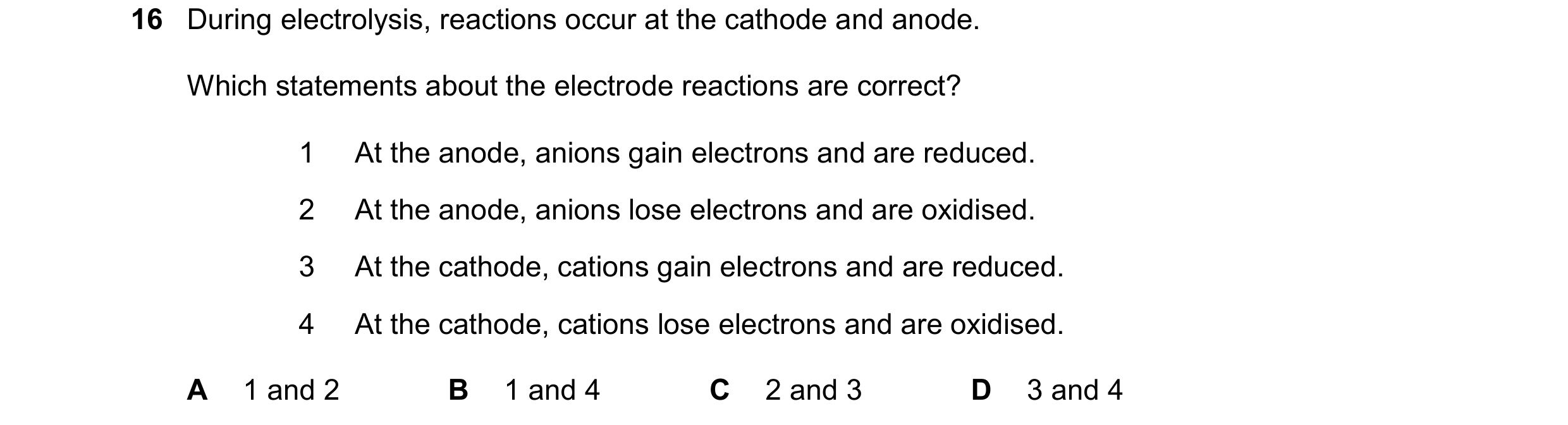
Q17 · During electrolysis, reactions occur at the cathode and anode 0973/21 Oct/Nov 2025
16 During electrolysis, reactions occur at the cathode and anode. Which statements about the electrode reactions are correct? 1 At the anode, anions gain electrons and are reduced. 2 At the anode, anions lose electrons and are oxidised. 3 At the cathode, cations gain electrons and are reduced. 4 At the cathode, cations lose electrons and are oxidised. A 1 and 2 B 1 and 4 C 2 and 3 D 3 and 4
1 marks
Answer: C
This question in 0973/21 Oct/Nov 2025

 1 / 5
1 / 5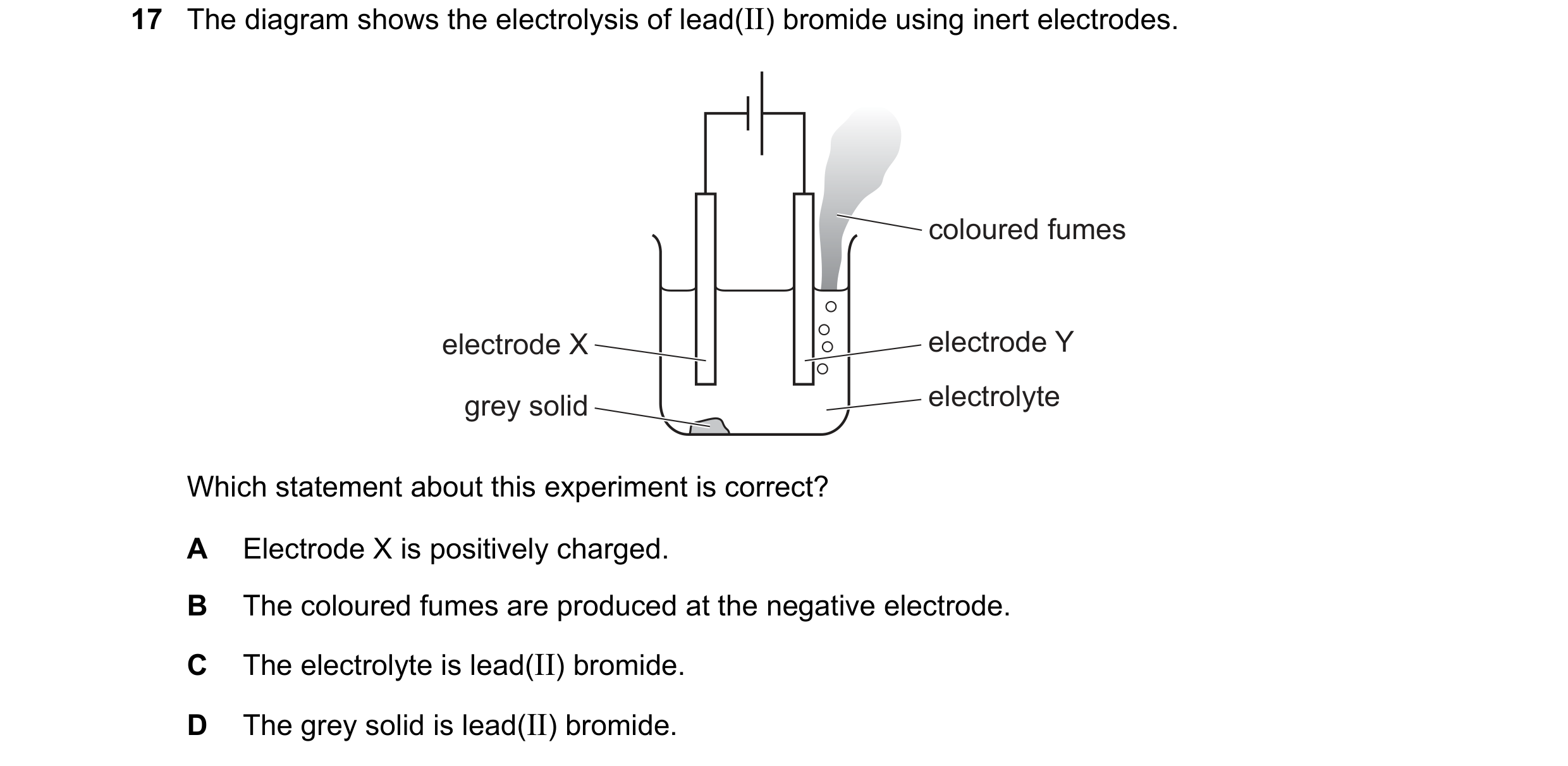
 2 / 5
2 / 5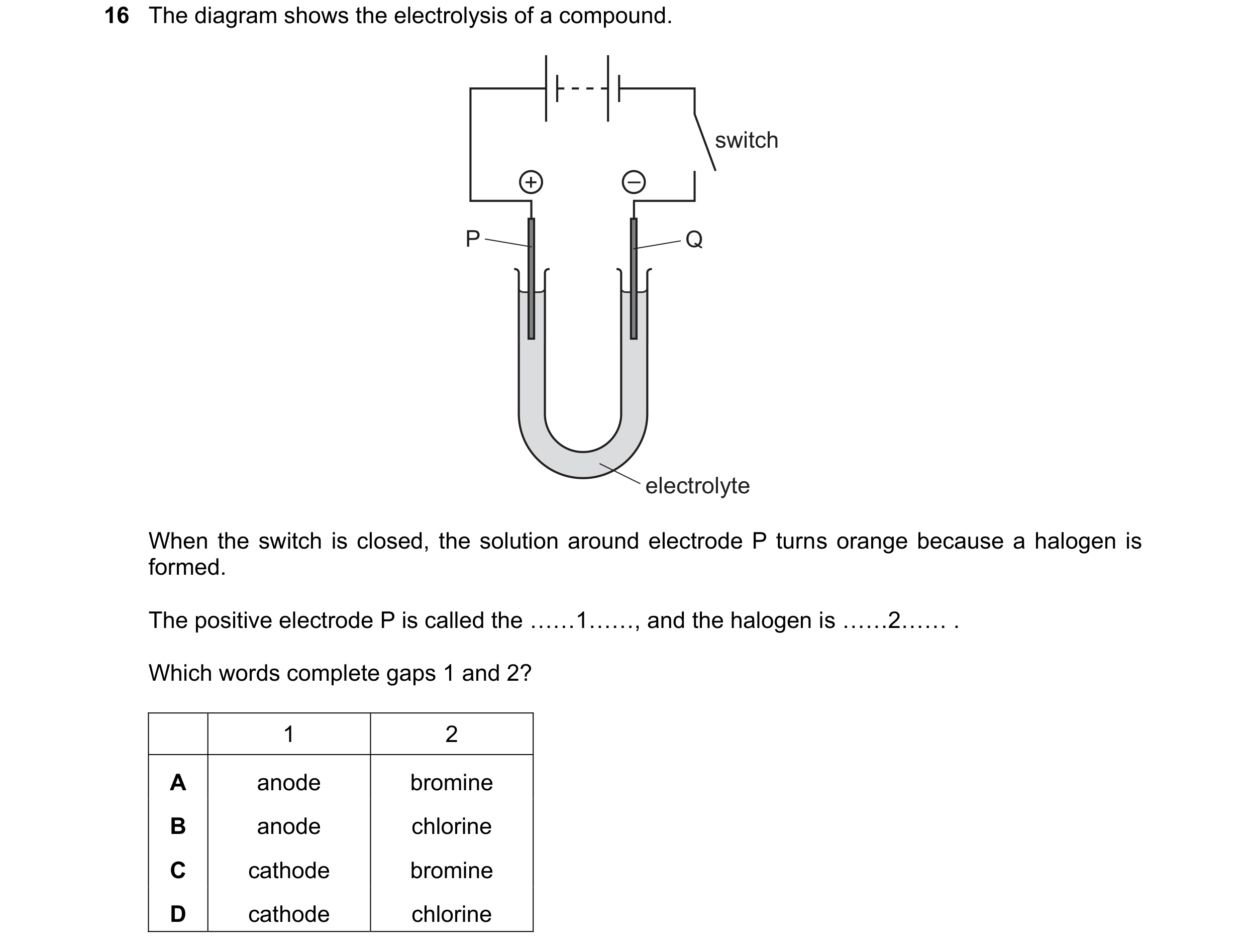
 3 / 5
3 / 5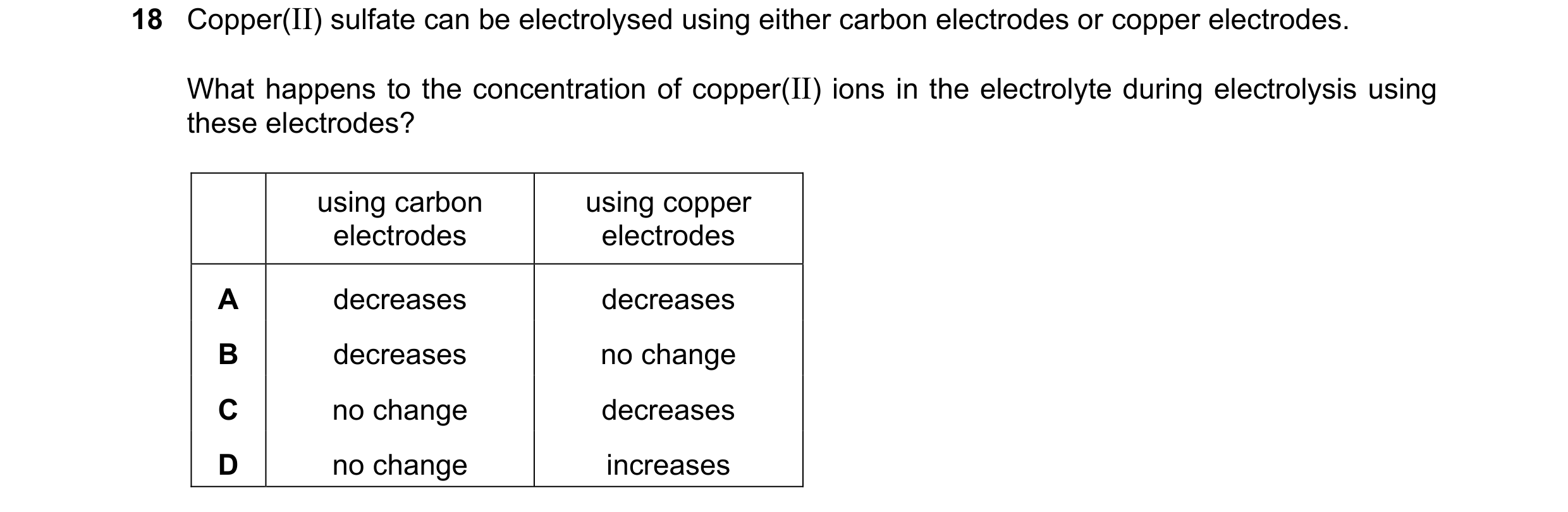

 4 / 5
4 / 5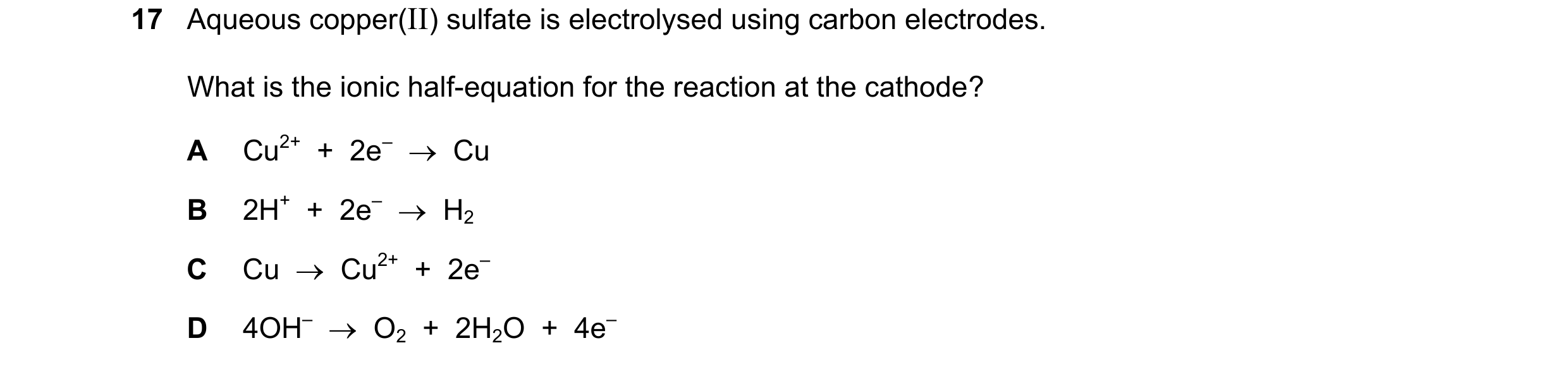


 5 / 5
5 / 5