Questions as text
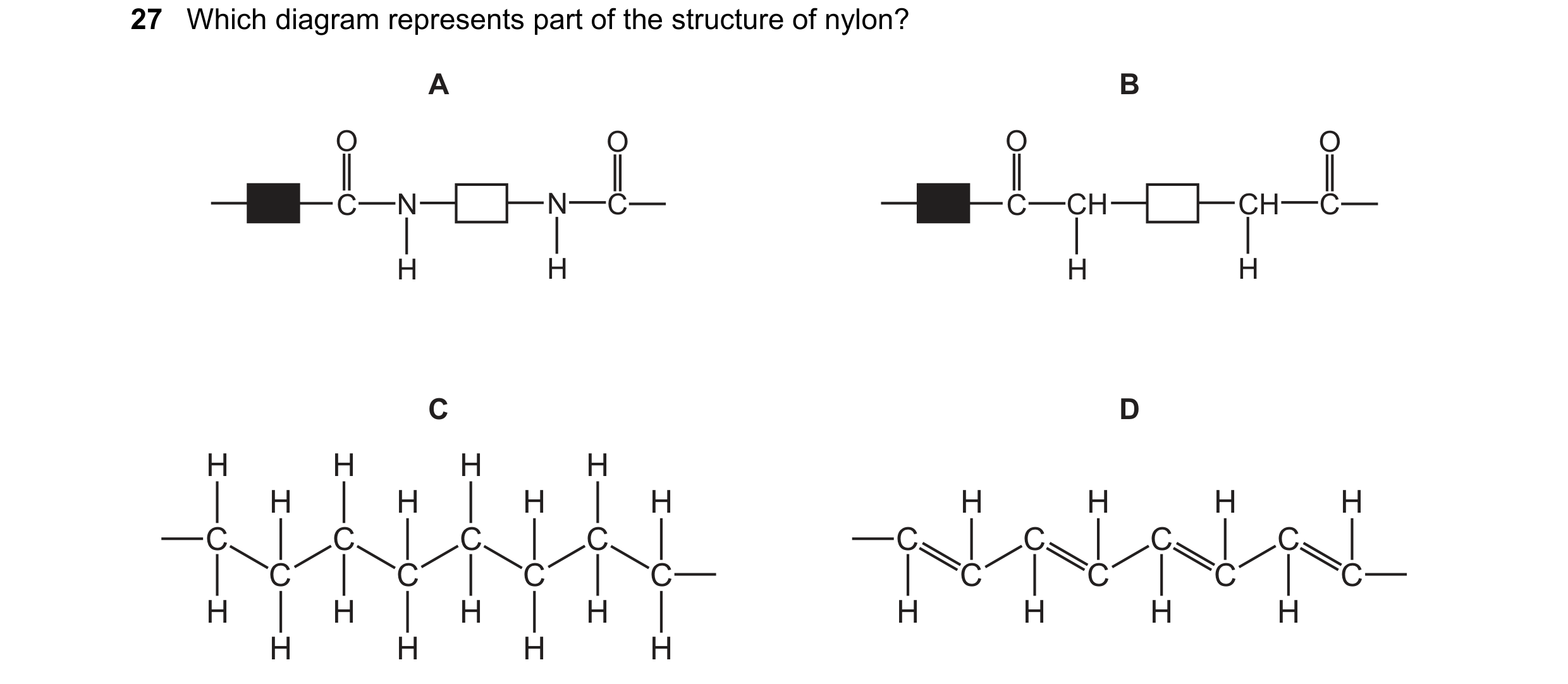
Q1 · Which diagram represents part of the structure of nylon? 0973/21 May/June 2019
27 Which diagram represents part of the structure of nylon? A B O O O O C N N C C CH CH C H H H H C D H H H H H H H H H H H H C C C C C C C C C C C C C C C C H H H H H H H H H H H H
1 marks
Answer: A
This question in 0973/21 May/June 2019
Q2 · Compound X is the monomer in an addition polymerisation reaction 0973/22 May/June 2019
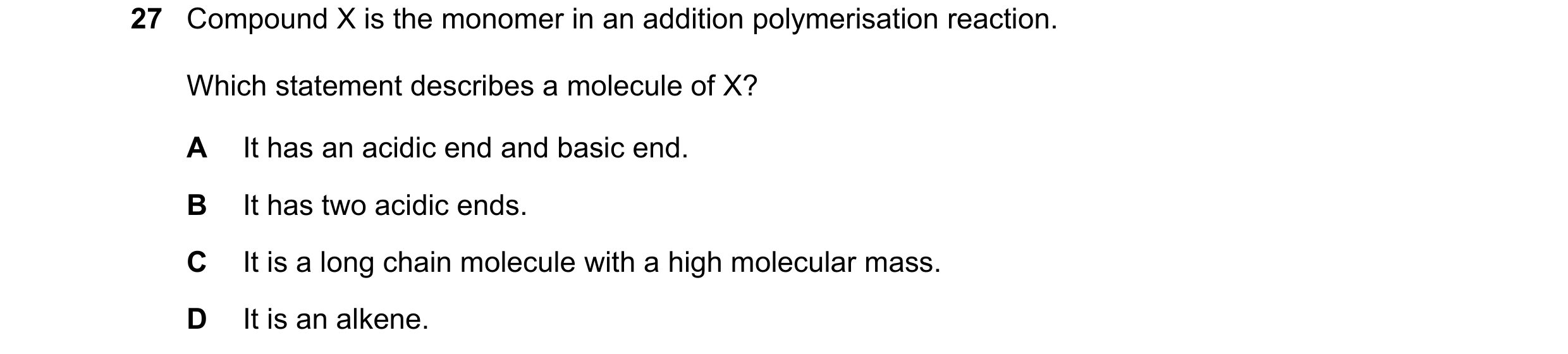
27 Compound X is the monomer in an addition polymerisation reaction. Which statement describes a molecule of X? A It has an acidic end and basic end. B It has two acidic ends. C It is a long chain molecule with a high molecular mass. D It is an alkene.
1 marks
Answer: D
This question in 0973/22 May/June 2019
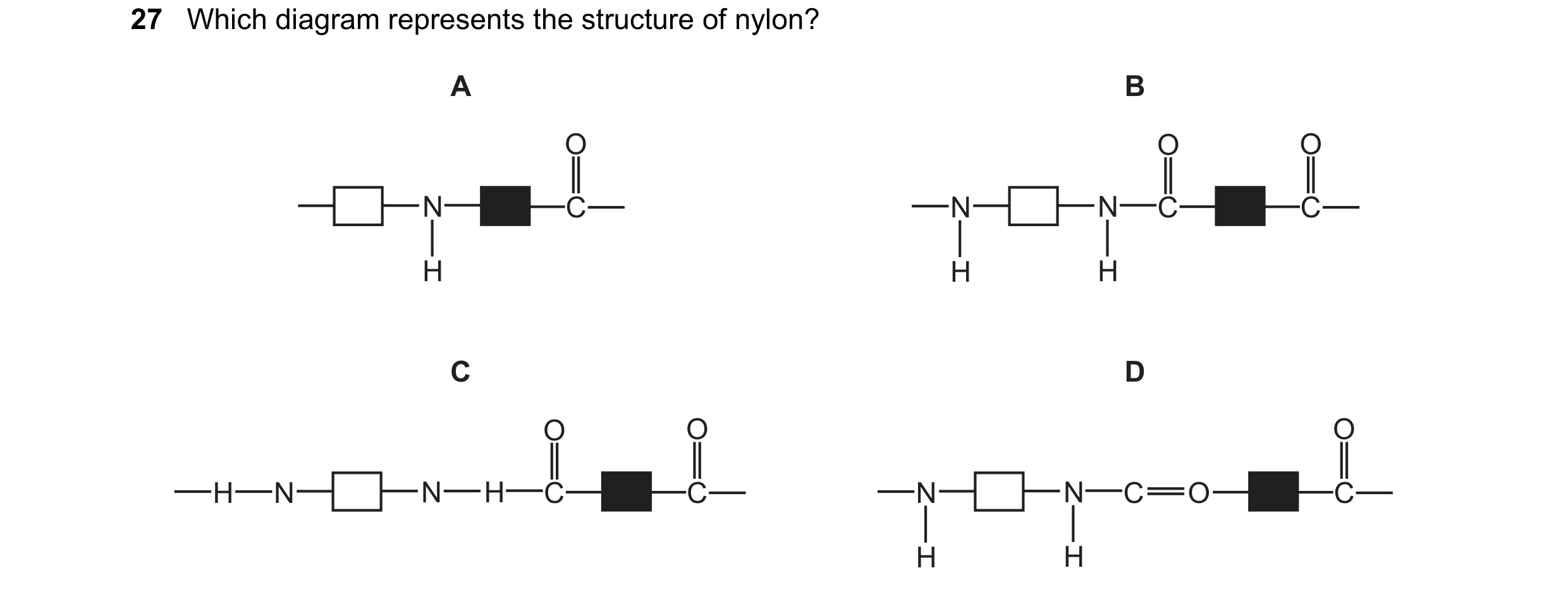
Q3 · Which diagram represents the structure of nylon? 0973/21 Oct/Nov 2019
27 Which diagram represents the structure of nylon? A B O O O N C N N C C H H H C D O O O H N N H C C N N C O C H H
1 marks
Answer: B
This question in 0973/21 Oct/Nov 2019
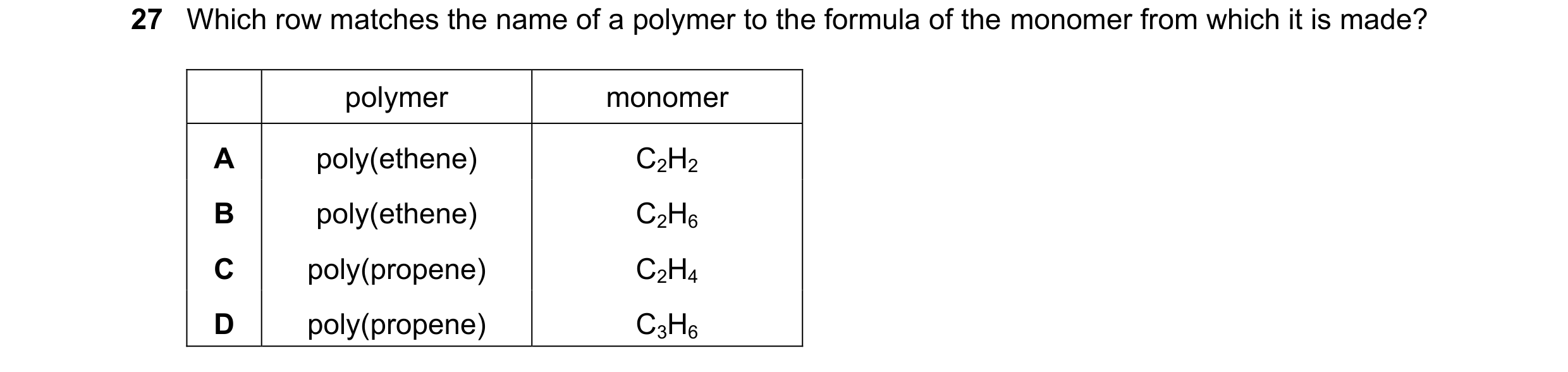
Q4 · Which row matches the name of a polymer to the formula of the monomer from which it is… 0973/21 May/June 2020
27 Which row matches the name of a polymer to the formula of the monomer from which it is made? polymer monomer A poly(ethene) C2H2 B poly(ethene) C2H6 C poly(propene) C2H4 D poly(propene) C3H6
1 marks
Answer: D
This question in 0973/21 May/June 2020
Q5 · Poly(ethene) is made from ethene by the process of addition polymerisation 0973/21 Oct/Nov 2020
27 Poly(ethene) is made from ethene by the process of addition polymerisation. Which word describes ethene in this process? A fuel B catalyst C monomer D solvent
1 marks
Answer: C
This question in 0973/21 Oct/Nov 2020
Q6 · Reactants for three chemical processes are listed 0973/22 May/June 2021
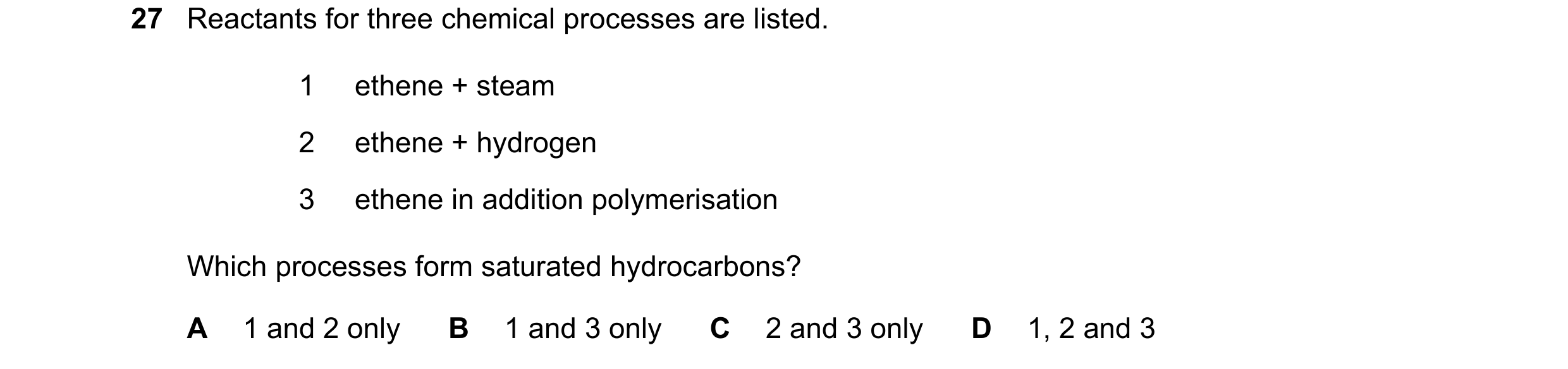
27 Reactants for three chemical processes are listed. 1 ethene + steam 2 ethene + hydrogen 3 ethene in addition polymerisation Which processes form saturated hydrocarbons? A 1 and 2 only B 1 and 3 only C 2 and 3 only D 1, 2 and 3
1 marks
Answer: C
This question in 0973/22 May/June 2021
Q7 · A section of a polymer made from two different monomers is shown 0973/21 May/June 2022
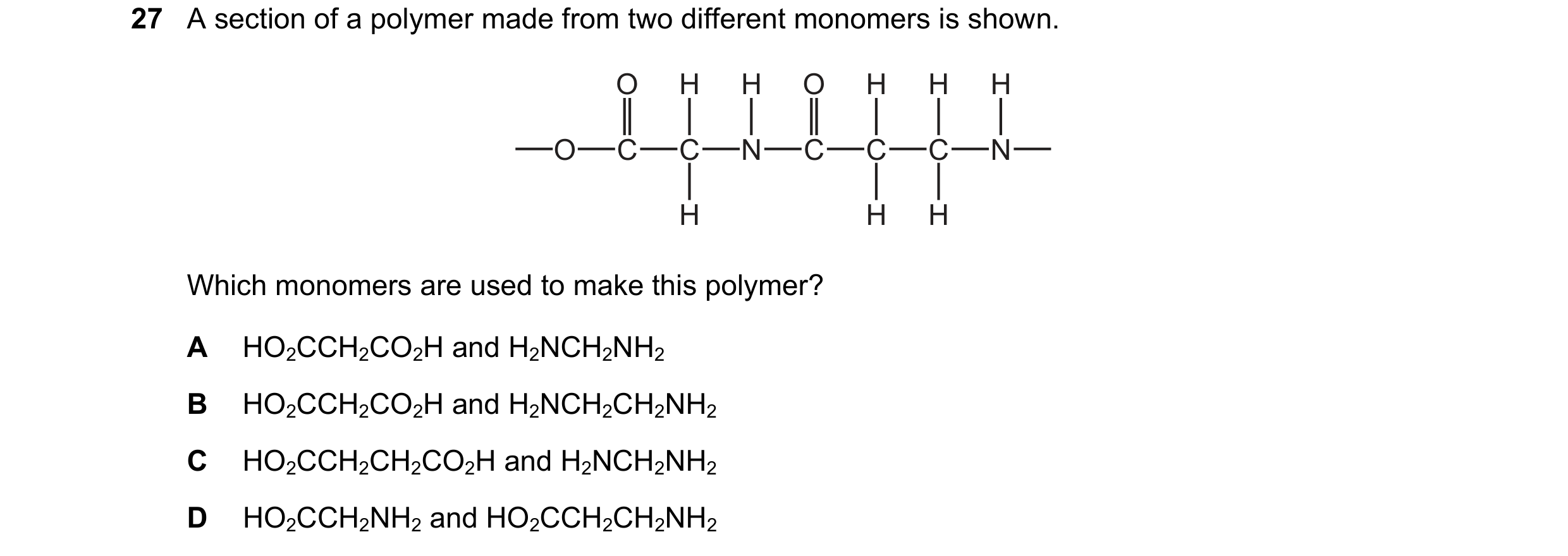
27 A section of a polymer made from two different monomers is shown. O H H O H H H O C C N C C C N H H H Which monomers are used to make this polymer? A HO2CCH2CO2H and H2NCH2NH2 B HO2CCH2CO2H and H2NCH2CH2NH2 C HO2CCH2CH2CO2H and H2NCH2NH2 D HO2CCH2NH2 and HO2CCH2CH2NH2
1 marks
Answer: D
This question in 0973/21 May/June 2022
Q8 · The structure of a monomer is shown 0973/22 May/June 2022
27 The structure of a monomer is shown. H3C CH2CH3 C C H H Which diagram represents the structure of the polymer formed from this monomer by addition polymerisation? A B H H H H H CH3 CH2CH3 CH3 CH2CH3 C C C C C C C C C H H H H H H H H H C D CH3 CH3 CH3 CH3 H CH2CH3 H CH2CH3 C C C C C C C C CH3 H CH3 H H CH3 H CH3
1 marks
Answer: B
This question in 0973/22 May/June 2022
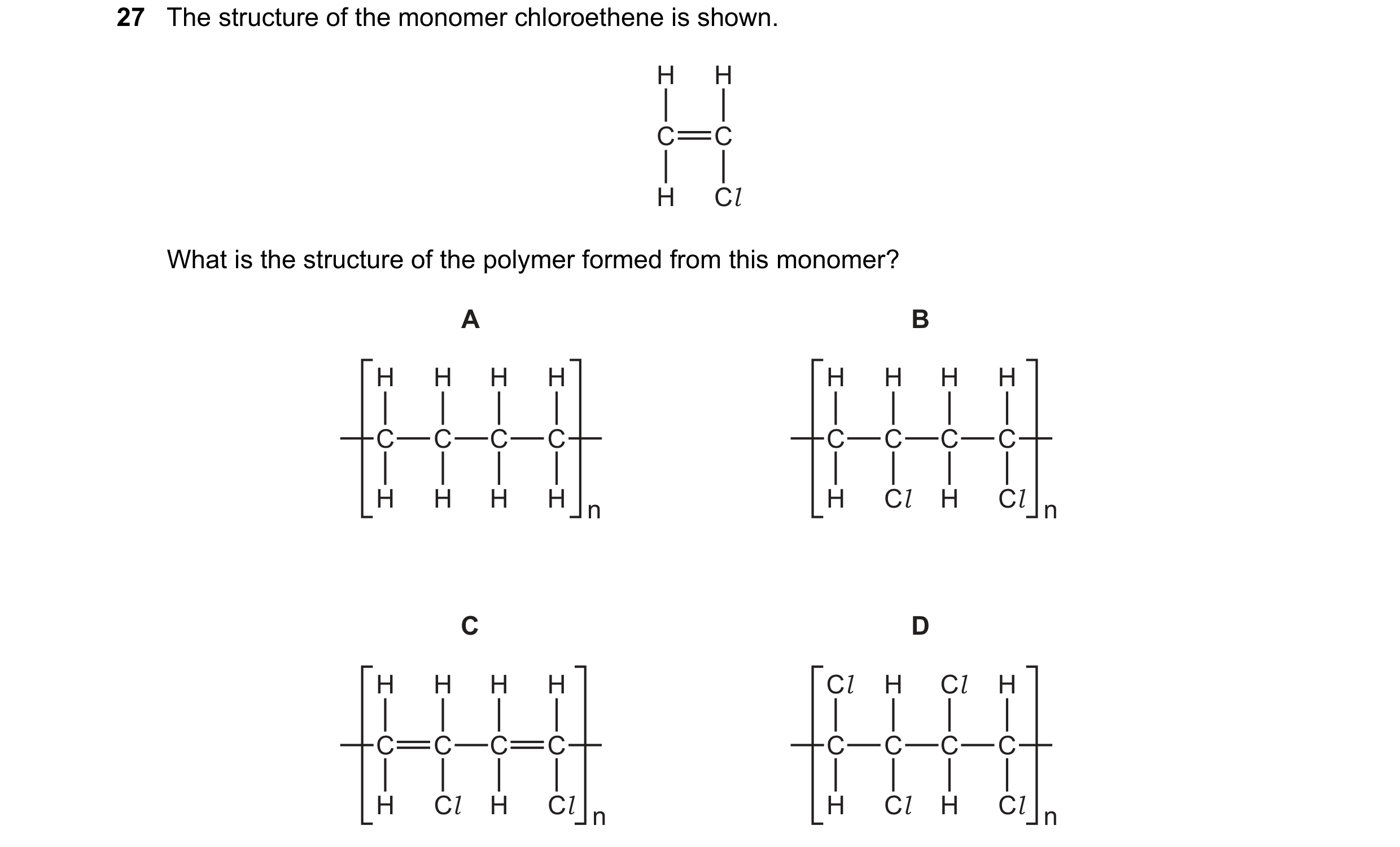
Q9 · The structure of the monomer chloroethene is shown 0973/21 Oct/Nov 2022
27 The structure of the monomer chloroethene is shown. H H C C H Cl What is the structure of the polymer formed from this monomer? A B H H H H H H H H C C C C C C C C H H H H n H Cl H Cl n C D H H H H Cl H Cl H C C C C C C C C H Cl H Cl n H Cl H Cl n
1 marks
Answer: B
This question in 0973/21 Oct/Nov 2022
Q10 · Which structure represents the addition polymer made from the monomer propene, C3H6? 0973/21 May/June 2023
27 Which structure represents the addition polymer made from the monomer propene, C3H6? A B CH3 H CH3 H H H H H C C C C C C C C H H H H H H H H C D CH3 CH3 CH3 CH3 CH3 CH3 CH3 CH3 C C C C C C C C H H H H CH3 CH3 CH3 CH3
1 marks
Answer: A
This question in 0973/21 May/June 2023
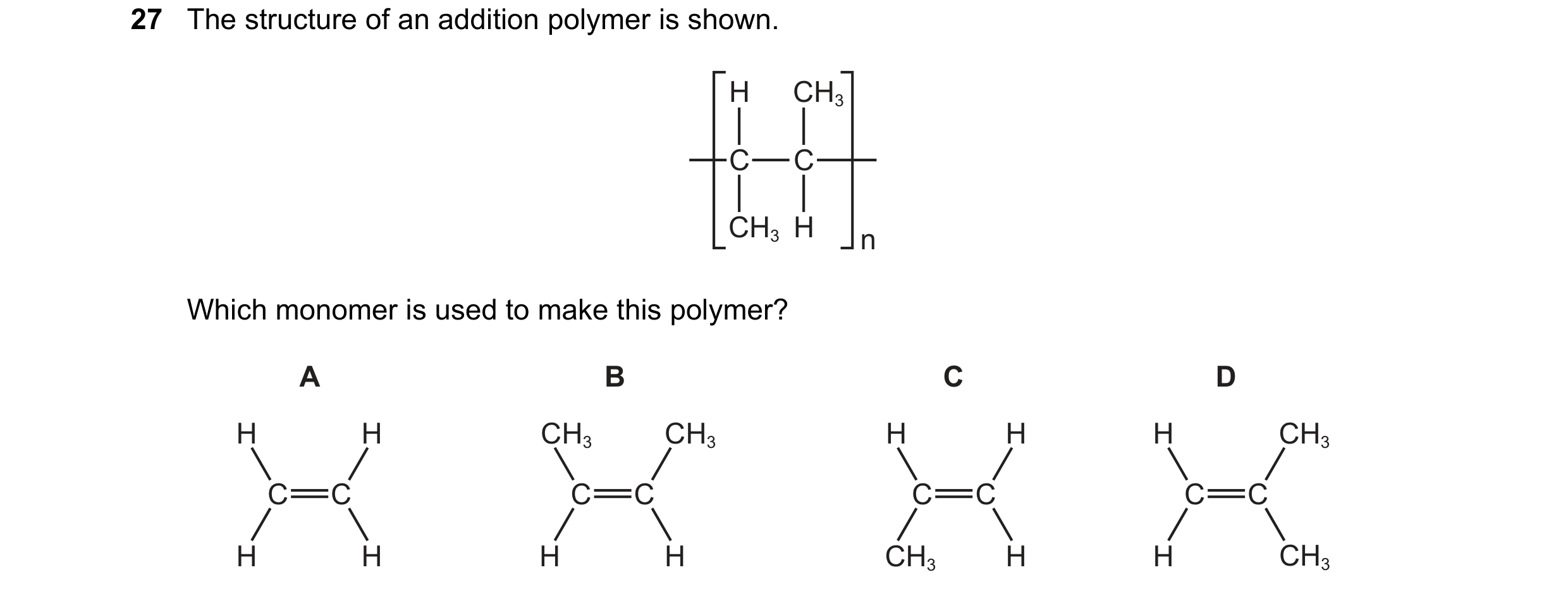
Q11 · The structure of an addition polymer is shown 0973/22 May/June 2023
27 The structure of an addition polymer is shown. H CH3 C C CH3 H n Which monomer is used to make this polymer? A B C D H H CH3 CH3 H H H CH3 C C C C C C C C H H H H CH3 H H CH3
1 marks
Answer: B
This question in 0973/22 May/June 2023
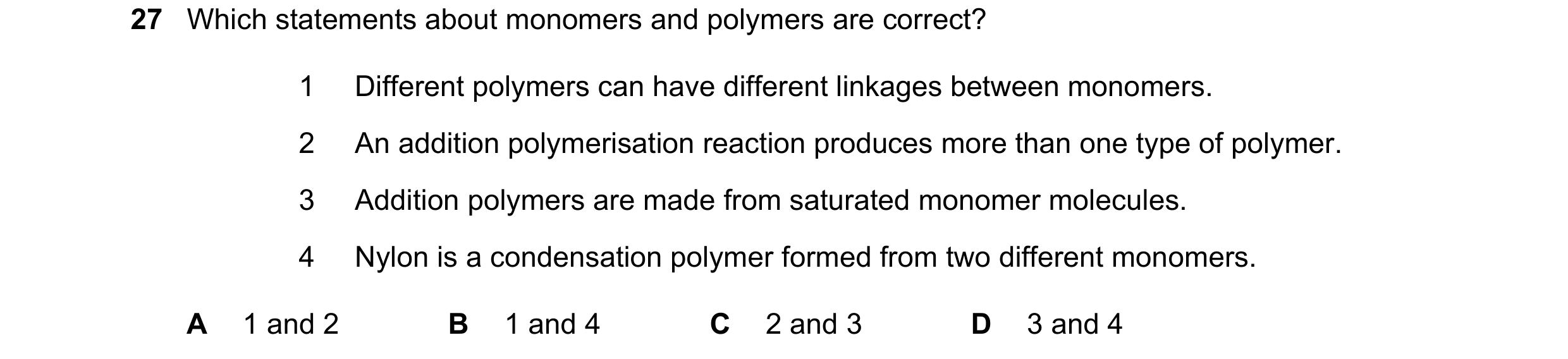
Q12 · Which statements about monomers and polymers are correct? 0973/21 Oct/Nov 2023
27 Which statements about monomers and polymers are correct? 1 Different polymers can have different linkages between monomers. 2 An addition polymerisation reaction produces more than one type of polymer. 3 Addition polymers are made from saturated monomer molecules. 4 Nylon is a condensation polymer formed from two different monomers. A 1 and 2 B 1 and 4 C 2 and 3 D 3 and 4
1 marks
Answer: B
This question in 0973/21 Oct/Nov 2023
Q13 · Which molecules can be used as monomers in polymerisation processes? 0973/21 May/June 2024
27 Which molecules can be used as monomers in polymerisation processes? 1 2 H Cl H H C C H C C O H H H H H 3 4 O H H H O H H H H O C C C C N H H O C C C C H H H H H H H H A 1 and 2 B 1 and 3 C 2 and 4 D 3 and 4
1 marks
Answer: B
This question in 0973/21 May/June 2024
Q14 · The molecule shown contains some amide linkages, N C 0973/22 May/June 2024
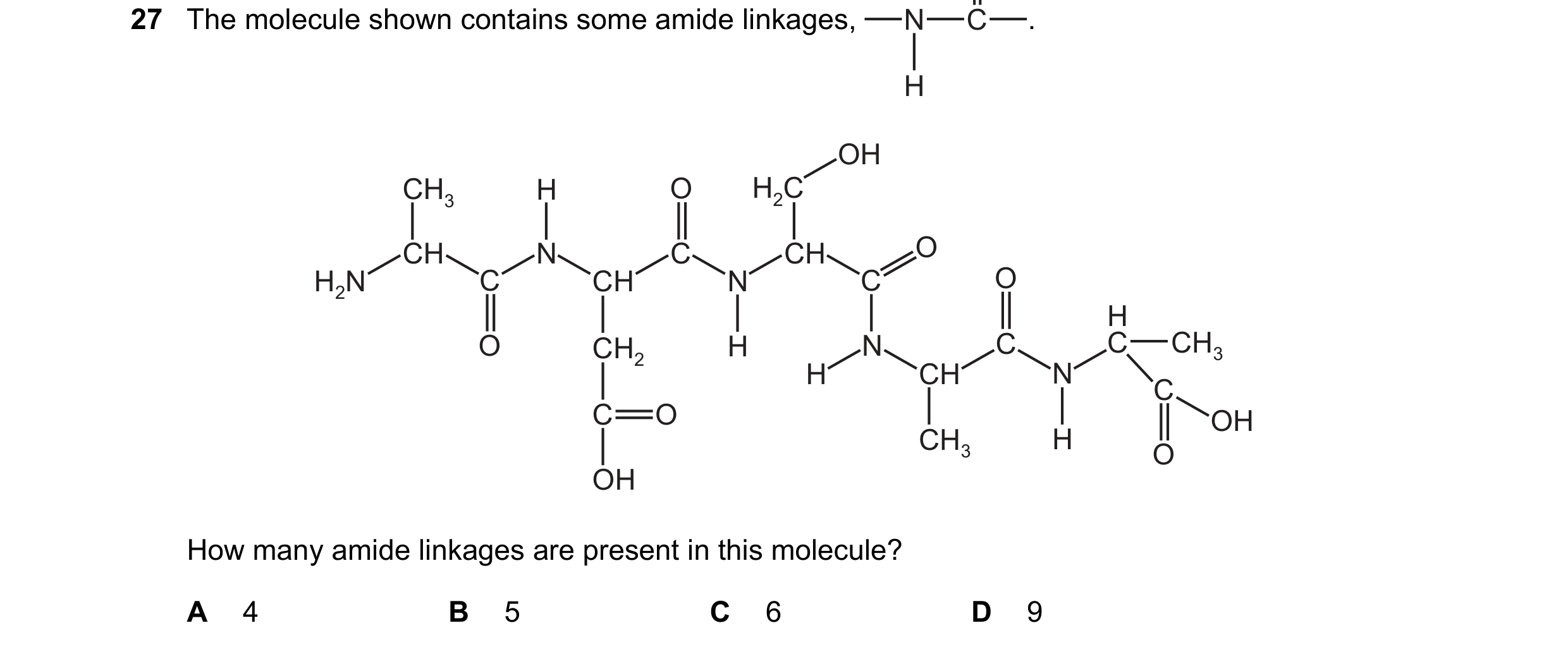
27 The molecule shown contains some amide linkages, N C . H OH CH3 H O H2C CH N C CH O H2N C CH N C O H O CH2 H N C C CH3 H CH N C C O OH CH3 H O OH How many amide linkages are present in this molecule? A 4 B 5 C 6 D 9
1 marks
Answer: A
This question in 0973/22 May/June 2024
Q15 · Poly(ethene) and nylon are two different types of polymer 0973/21 Oct/Nov 2024
27 Poly(ethene) and nylon are two different types of polymer. Which statement about these polymers is correct? A Nylon is an addition polymer. B The linkage between monomers in nylon is –CONH–. C Poly(ethene) and nylon are made from the same monomers. D Poly(ethene) and nylon have the same linkages between their monomers.
1 marks
Answer: B
This question in 0973/21 Oct/Nov 2024
Q16 · Which diagram represents the structure of nylon? 0973/22 May/June 2025
27 Which diagram represents the structure of nylon? A B H H H H O O C C C C C C N N H H H H H H C D CH3 H CH3 H O O C C C C C C N N H H H H H H
1 marks
Answer: D
This question in 0973/22 May/June 2025
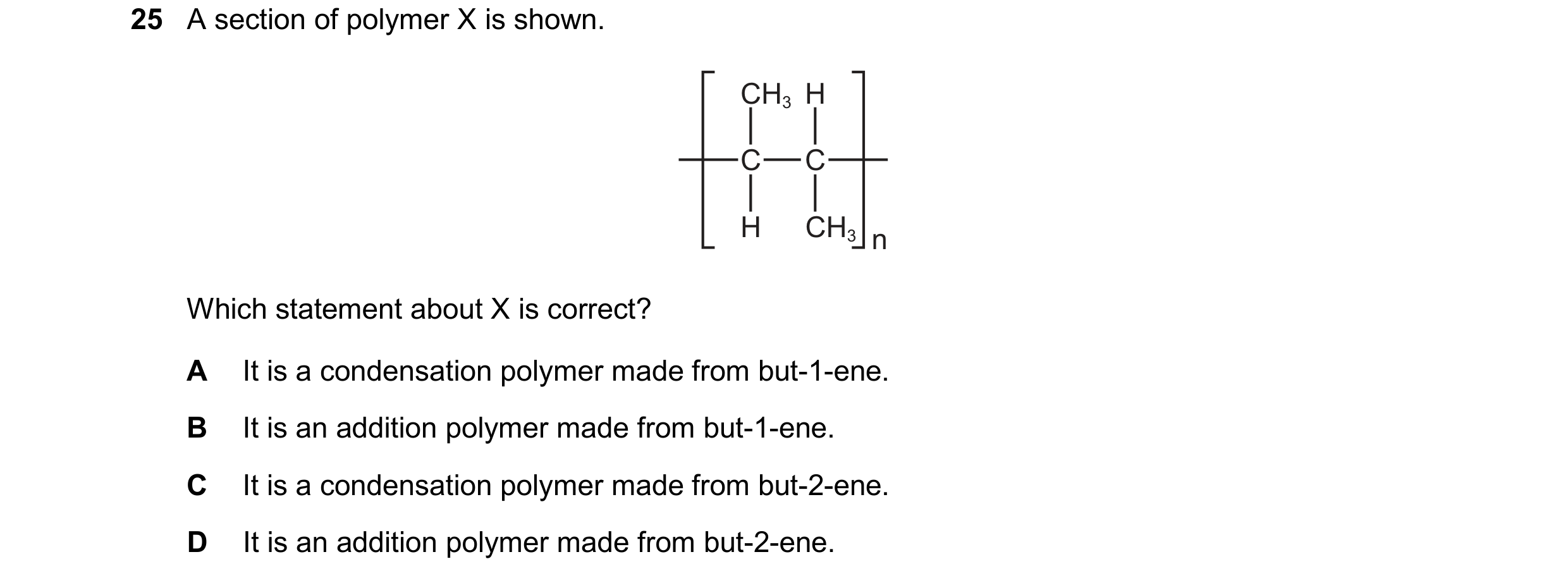
Q17 · A section of polymer X is shown 0973/21 Oct/Nov 2025
25 A section of polymer X is shown. CH3 H C C H CH3 n Which statement about X is correct? A It is a condensation polymer made from but-1-ene. B It is an addition polymer made from but-1-ene. C It is a condensation polymer made from but-2-ene. D It is an addition polymer made from but-2-ene.
1 marks
Answer: D
This question in 0973/21 Oct/Nov 2025
 1 / 6
1 / 6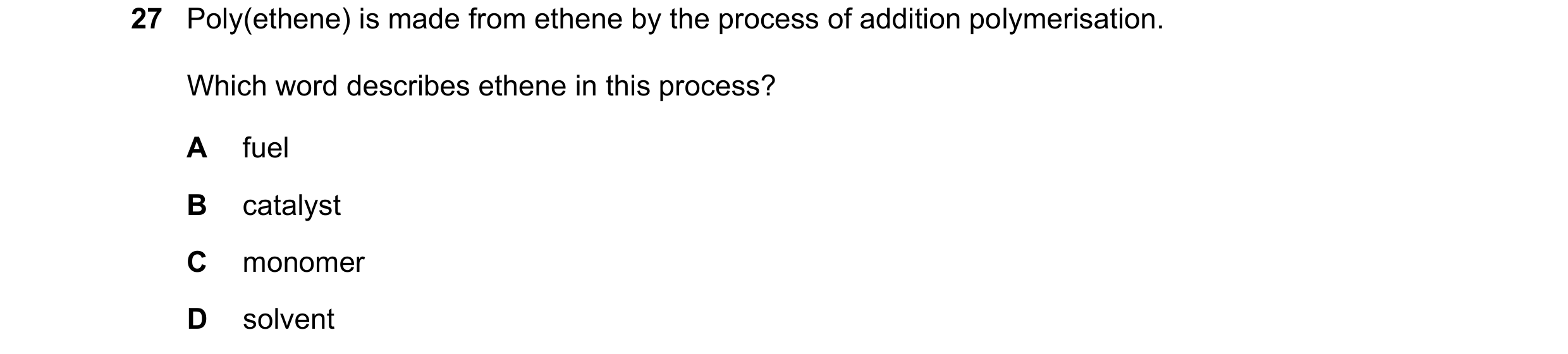
 2 / 6
2 / 6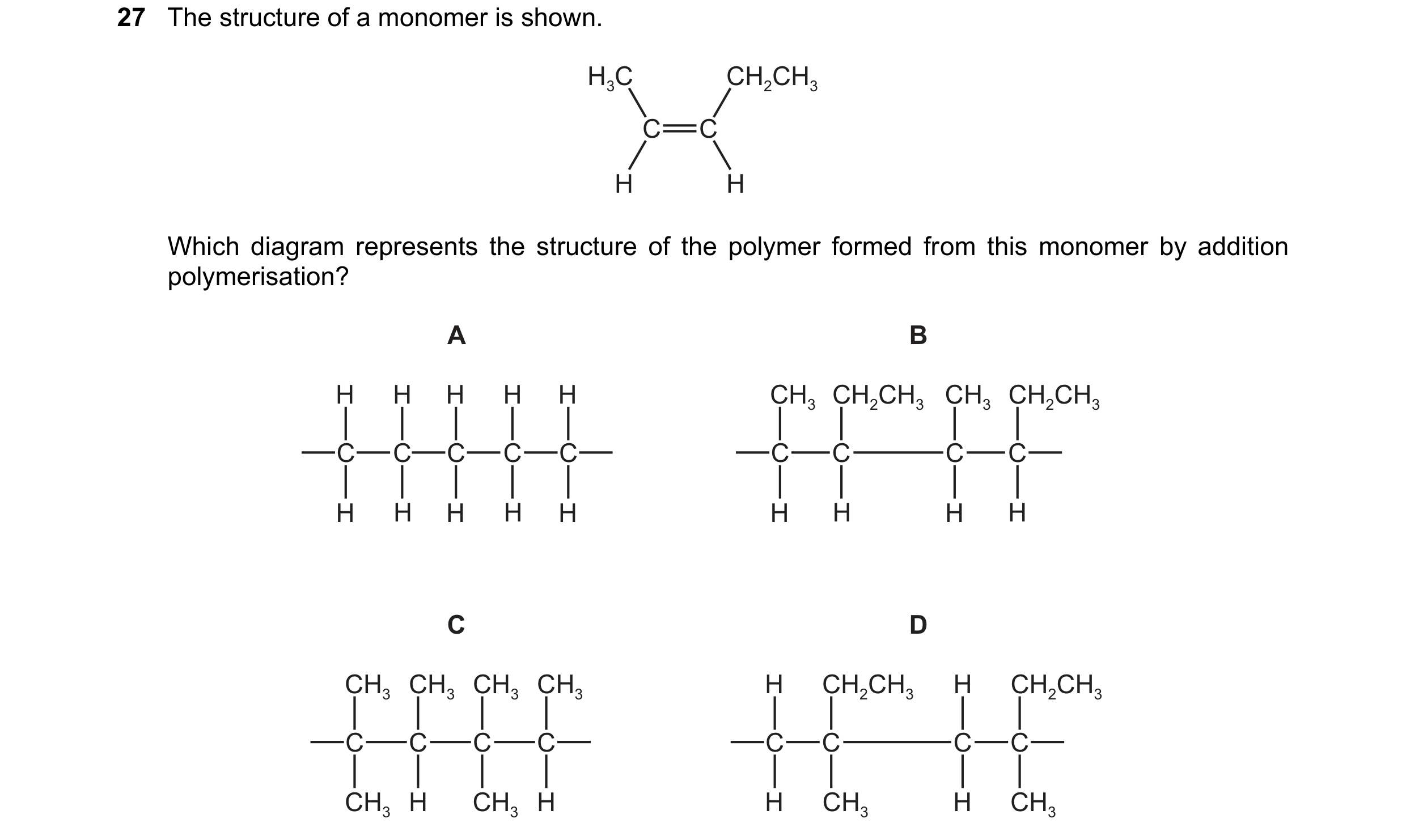
 3 / 6
3 / 6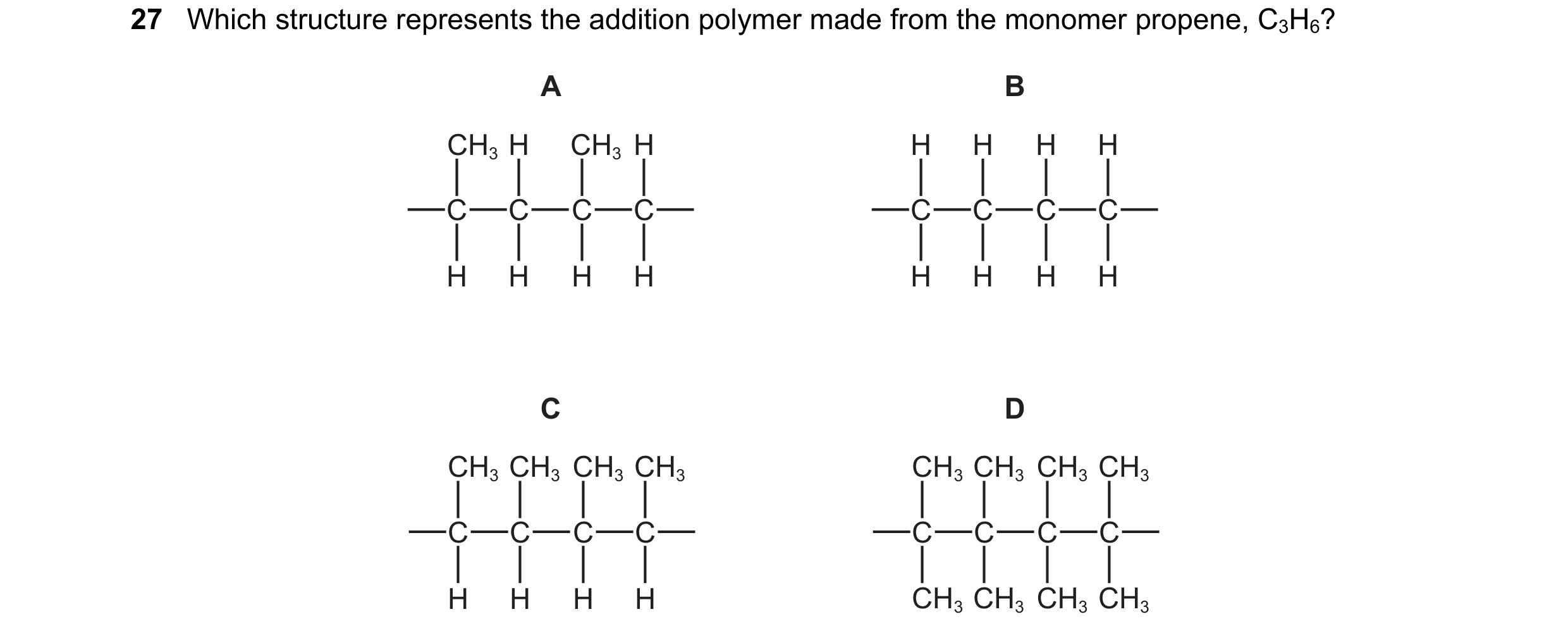
 4 / 6
4 / 6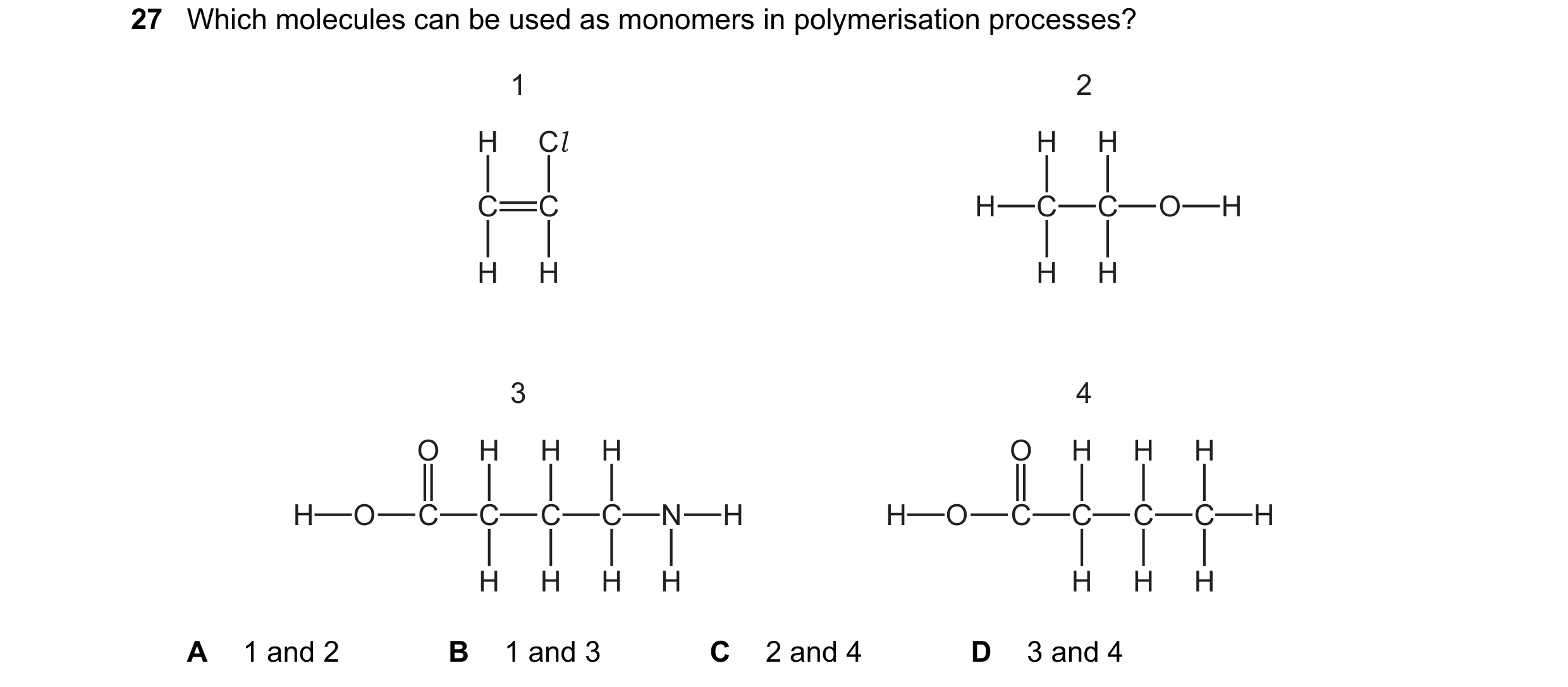
 5 / 6
5 / 6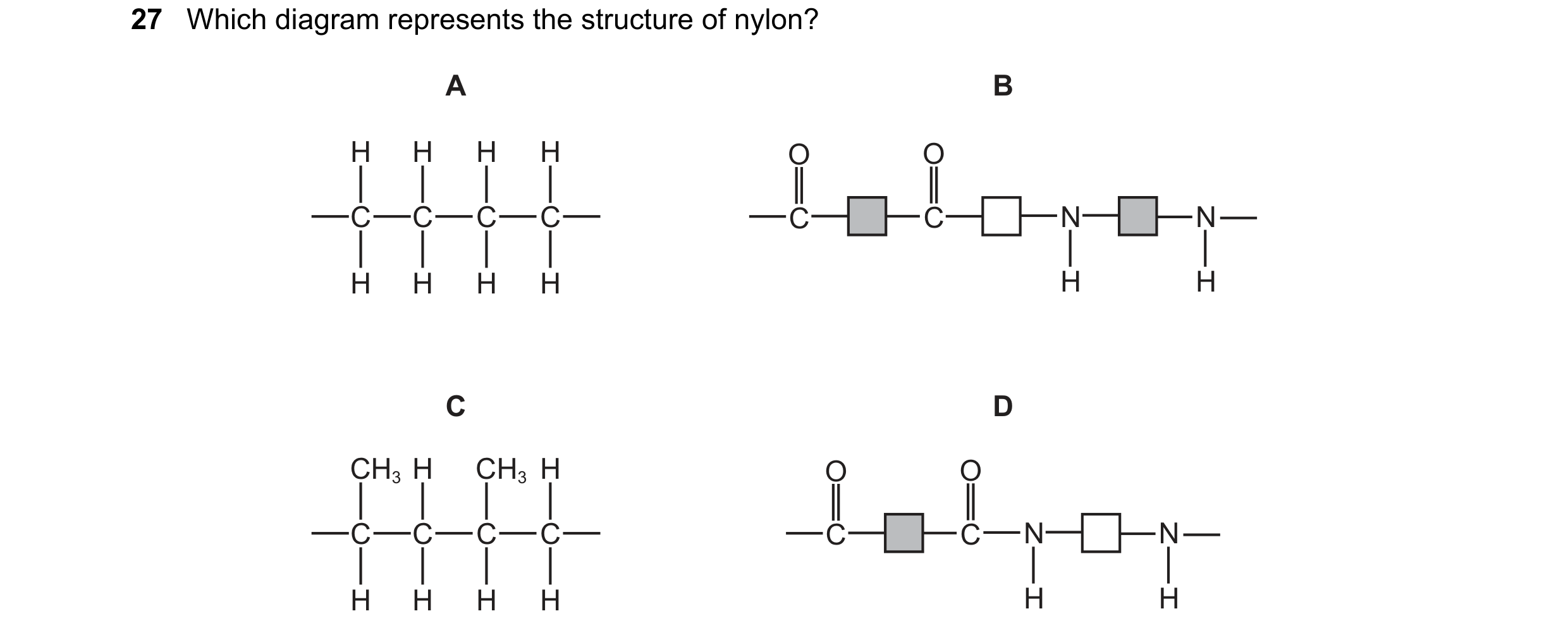
 6 / 6
6 / 6