Questions as text
Q1 · In a food chain, what do all living organisms get from their food? 0973/21 May/June 2019
12 In a food chain, what do all living organisms get from their food? A a supply of water B oxygen for respiration C protection from disease D the energy they need
1 marks
Answer: D
This question in 0973/21 May/June 2019
Q2 · The diagram shows a food web 0973/22 May/June 2019
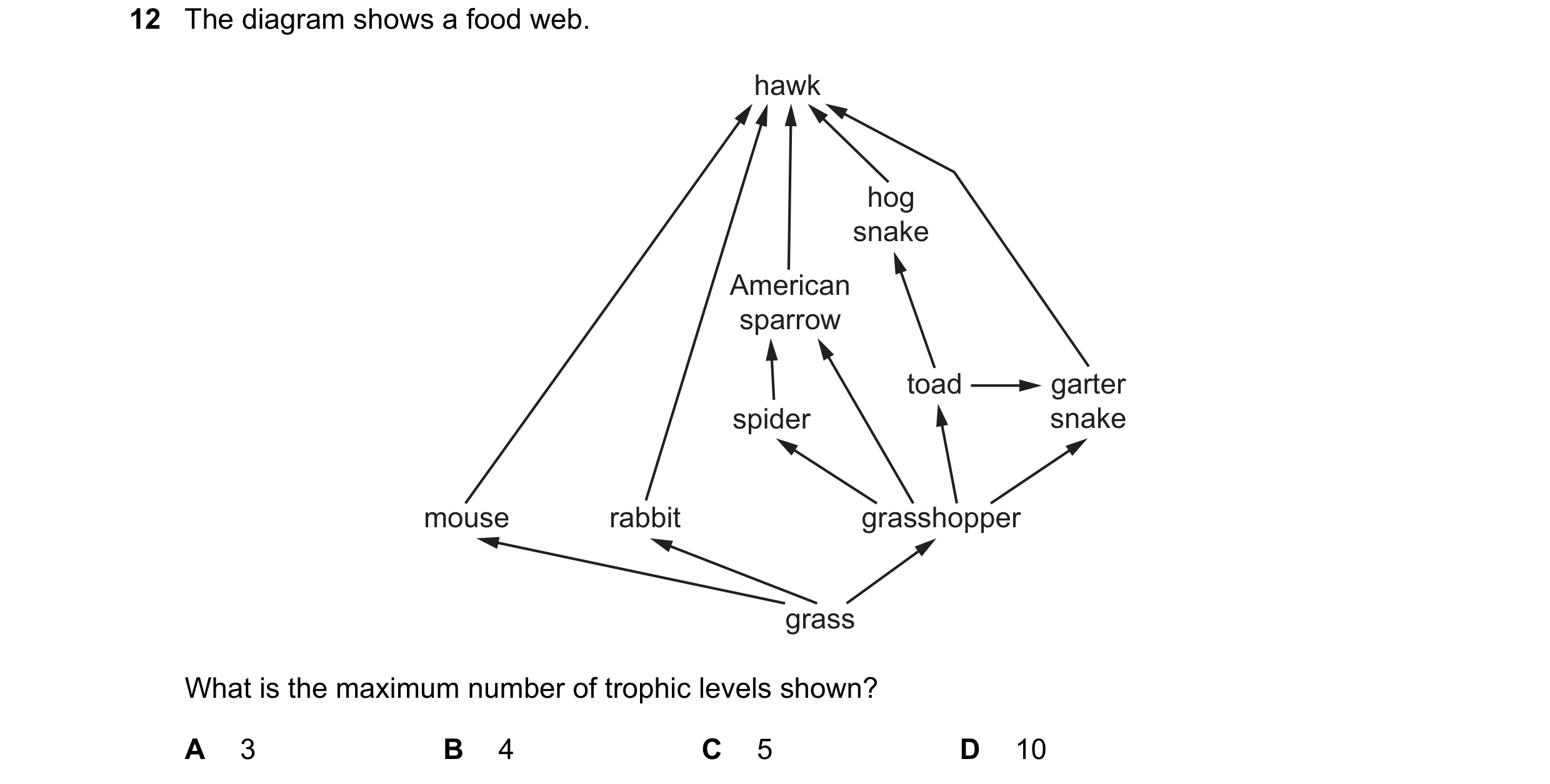
12 The diagram shows a food web. hawk hog snake American sparrow toad garter spider snake mouse rabbit grasshopper grass What is the maximum number of trophic levels shown? A 3 B 4 C 5 D 10
1 marks
Answer: C
This question in 0973/22 May/June 2019
Q3 · In the food chain shown, 10% of the energy is transferred between each trophic level 0973/21 Oct/Nov 2019
12 In the food chain shown, 10% of the energy is transferred between each trophic level. grass → grasshopper → frog → snake → buzzard For every 100 kJ of energy in the herbivore, how much energy will be transferred to the tertiary consumer? A 0.1 kJ B 1 kJ C 10 kJ D 100 kJ
1 marks
Answer: B
This question in 0973/21 Oct/Nov 2019
Q4 · The flow chart shows part of a food chain 0973/21 May/June 2020
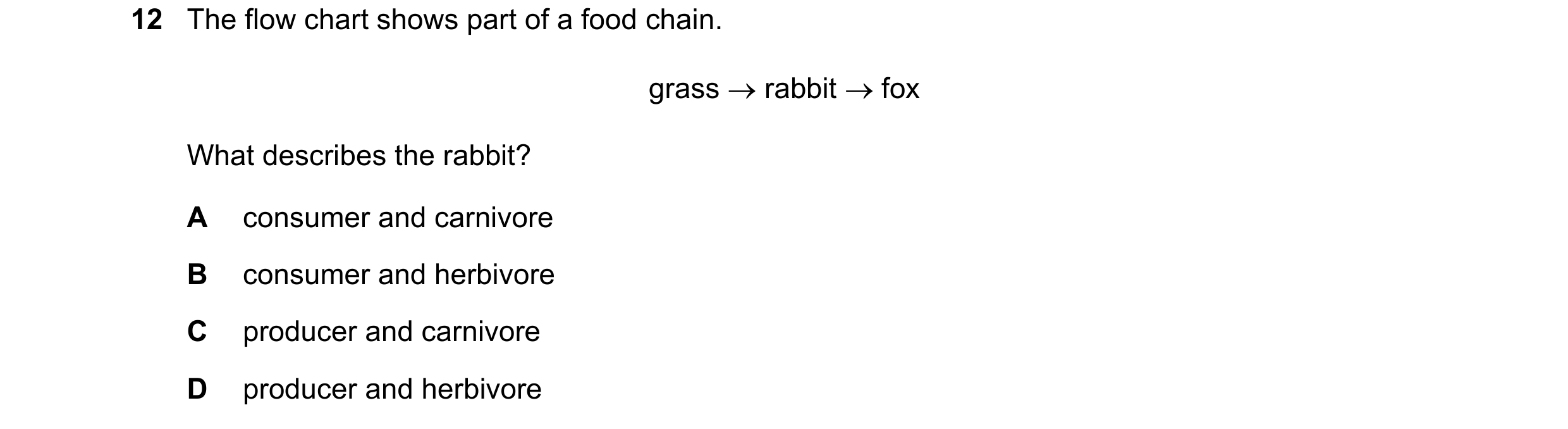
12 The flow chart shows part of a food chain. grass rabbit fox What describes the rabbit? A consumer and carnivore B consumer and herbivore C producer and carnivore D producer and herbivore
1 marks
Answer: B
This question in 0973/21 May/June 2020
Q5 · The diagram shows a food web 0973/22 May/June 2020
12 The diagram shows a food web. owl snake fox mouse frog rabbit insect plants Which statement is correct? A The fox is a secondary consumer only. B The mouse is a primary consumer only. C The owl is a tertiary consumer only. D The snake is a tertiary consumer only.
1 marks
Answer: D
This question in 0973/22 May/June 2020
Q6 · Which organism in the food web is a secondary and a tertiary consumer? 0973/21 Oct/Nov 2020
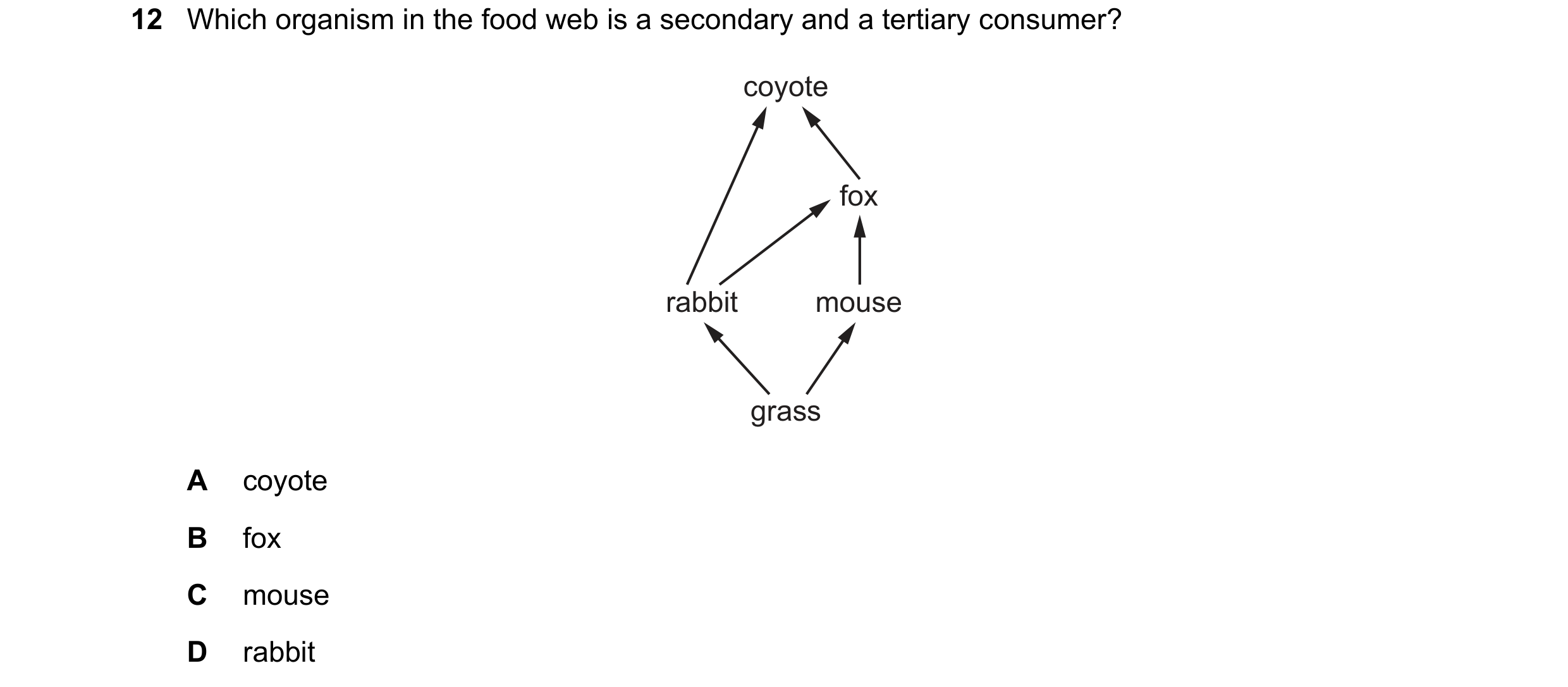
12 Which organism in the food web is a secondary and a tertiary consumer? coyote fox rabbit mouse grass A coyote B fox C mouse D rabbit
1 marks
Answer: A
This question in 0973/21 Oct/Nov 2020
Q7 · During eutrophication, what reduces the concentration of dissolved oxygen in the water? 0973/21 Oct/Nov 2020
13 During eutrophication, what reduces the concentration of dissolved oxygen in the water? A decreased photosynthesis by producers B decreased respiration by decomposers C increased photosynthesis by producers D increased respiration by decomposers
1 marks
Answer: D
This question in 0973/21 Oct/Nov 2020
Q8 · Why do food chains usually have fewer than five trophic levels? 0973/22 May/June 2021
12 Why do food chains usually have fewer than five trophic levels? A All the carnivores consume herbivores. B The energy passed on reduces from one trophic level to the next. C There is less protein in each individual higher up the chain. D There is only one producer in each chain.
1 marks
Answer: B
This question in 0973/22 May/June 2021
Q9 · What is an ecosystem? 0973/21 Oct/Nov 2021
12 What is an ecosystem? A a chart showing the flow of energy from one organism to another B a diagram giving the energy level of an organism in its environment C a network of interconnected organisms D a unit containing all of the organisms and their environment
1 marks
Answer: D
This question in 0973/21 Oct/Nov 2021
Q10 · Which organisms obtain energy directly from every trophic level? 0973/21 May/June 2022
12 Which organisms obtain energy directly from every trophic level? A carnivores B decomposers C herbivores D producers
1 marks
Answer: B
This question in 0973/21 May/June 2022
Q11 · Which organisms obtain energy directly from every trophic level? 0973/22 May/June 2022
12 Which organisms obtain energy directly from every trophic level? A carnivores B decomposers C herbivores D producers
1 marks
Answer: B
This question in 0973/22 May/June 2022
Q12 · Which type of organism gets its energy from the remains of dead organisms or other… 0973/21 Oct/Nov 2022
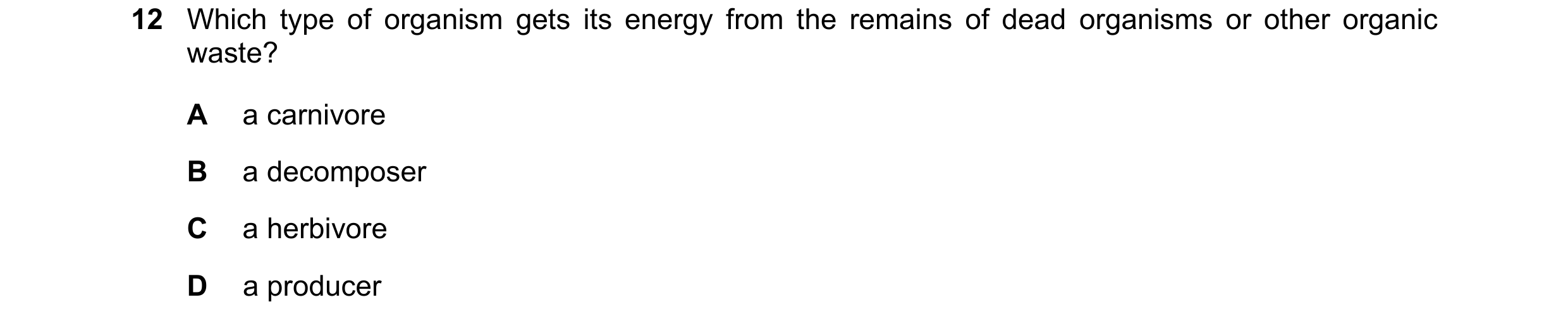
12 Which type of organism gets its energy from the remains of dead organisms or other organic waste? A a carnivore B a decomposer C a herbivore D a producer
1 marks
Answer: B
This question in 0973/21 Oct/Nov 2022
Q13 · The diagram shows a food web 0973/21 May/June 2023
12 The diagram shows a food web. kestrels wrens bank voles goldfinches aphids caterpillars grass hogweed ivy oak tree How many primary consumers, secondary consumers, tertiary consumers and quaternary consumers are present? primary secondary tertiary quaternary A 1 1 4 4 B 2 4 2 0 C 4 2 1 0 D 4 4 1 1
1 marks
Answer: C
This question in 0973/21 May/June 2023
Q14 · The diagram shows a food web 0973/22 May/June 2023
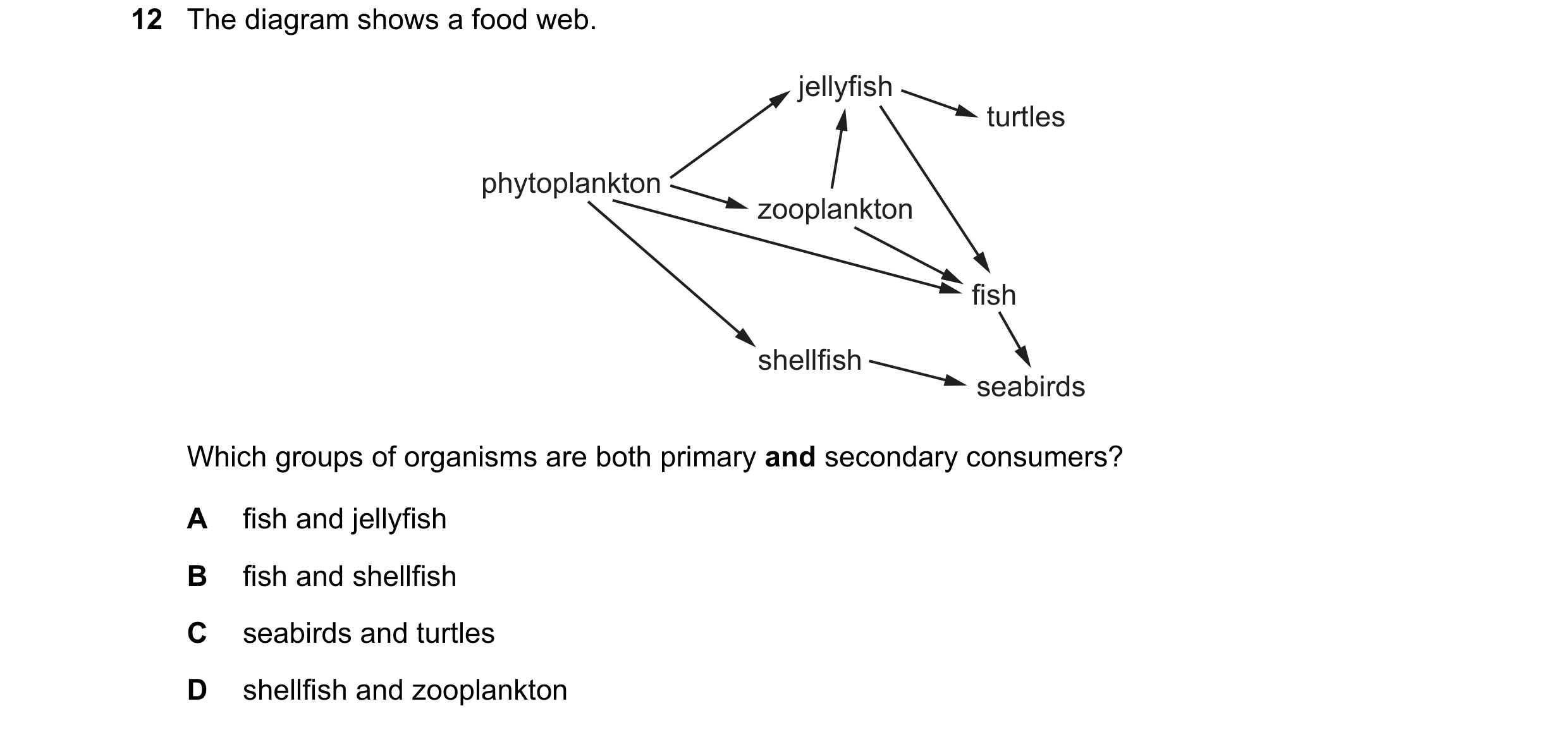
12 The diagram shows a food web. jellyfish turtles phytoplankton zooplankton fish shellfish seabirds Which groups of organisms are both primary and secondary consumers? A fish and jellyfish B fish and shellfish C seabirds and turtles D shellfish and zooplankton
1 marks
Answer: A
This question in 0973/22 May/June 2023
Q15 · How does an organism in the first trophic level gain energy? 0973/21 May/June 2024
12 How does an organism in the first trophic level gain energy? A by absorbing energy from sunlight B by breaking down dead or waste organic matter C by eating organisms in the second trophic level D by eating plants
1 marks
Answer: A
This question in 0973/21 May/June 2024
Q16 · What is an ecosystem? 0973/22 May/June 2024
12 What is an ecosystem? A a chart showing the flow of energy from one organism to another B a diagram giving the energy level of an organism in its environment C a network of interconnected food chains D a unit containing all of the organisms and their environment
1 marks
Answer: D
This question in 0973/22 May/June 2024
Q17 · What is an example of an ecosystem? 0973/21 Oct/Nov 2024
12 What is an example of an ecosystem? A a decomposing log and the organisms in it B a food chain C the network of burrows in which some rabbits live D the oak trees in a forest
1 marks
Answer: A
This question in 0973/21 Oct/Nov 2024
Q18 · In the food chain shown, 10% of the energy is transferred between each trophic level 0973/21 May/June 2025
12 In the food chain shown, 10% of the energy is transferred between each trophic level. grass grasshopper frog snake buzzard How much energy is transferred to the tertiary consumer for every 100 kJ of energy in the herbivore? A 0.1 kJ B 1 kJ C 10 kJ D 100 kJ
1 marks
Answer: B
This question in 0973/21 May/June 2025
Q19 · Information about a lake is shown 0973/22 May/June 2025
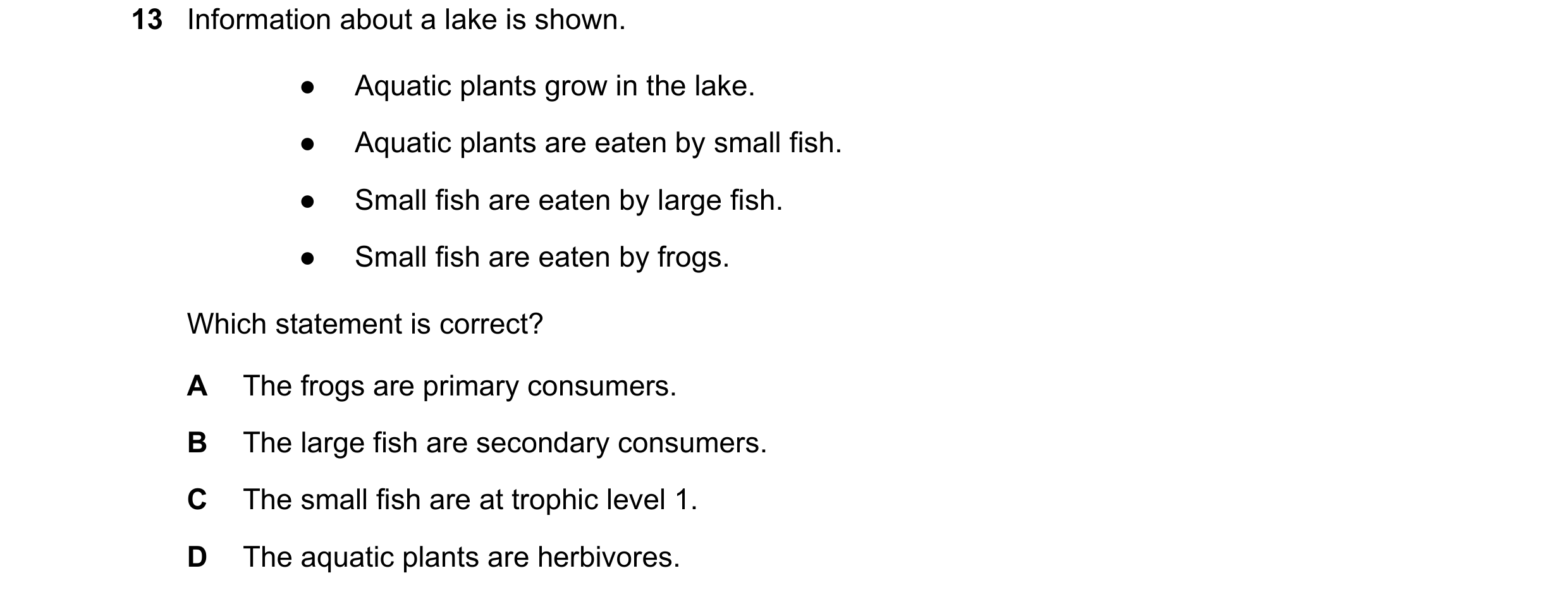
13 Information about a lake is shown. ● Aquatic plants grow in the lake. ● Aquatic plants are eaten by small fish. ● Small fish are eaten by large fish. ● Small fish are eaten by frogs. Which statement is correct? A The frogs are primary consumers. B The large fish are secondary consumers. C The small fish are at trophic level 1. D The aquatic plants are herbivores.
1 marks
Answer: B
This question in 0973/22 May/June 2025
Q20 · Which statement explains why food chains usually have fewer than five trophic levels? 0973/21 Oct/Nov 2025
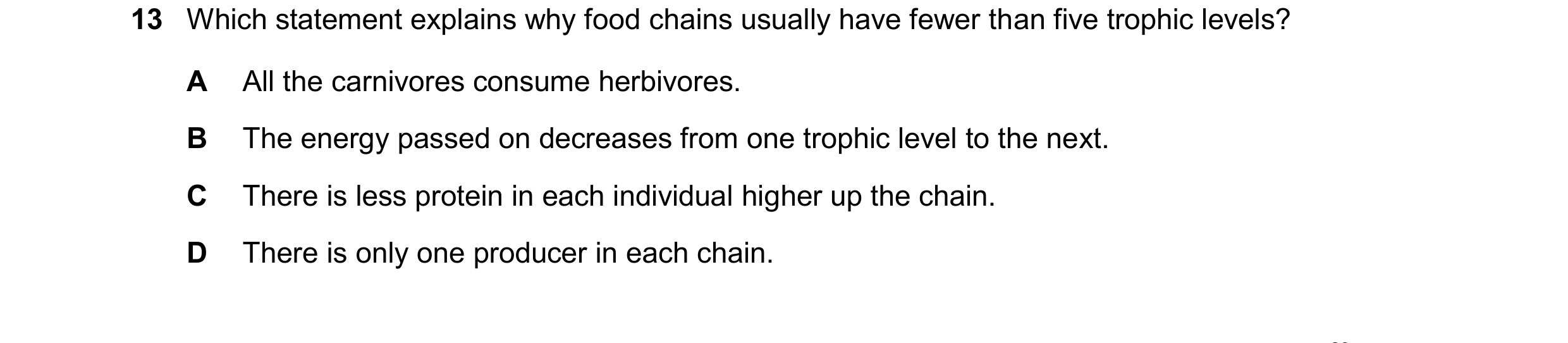
13 Which statement explains why food chains usually have fewer than five trophic levels? A All the carnivores consume herbivores. B The energy passed on decreases from one trophic level to the next. C There is less protein in each individual higher up the chain. D There is only one producer in each chain.
1 marks
Answer: B
This question in 0973/21 Oct/Nov 2025


 1 / 5
1 / 5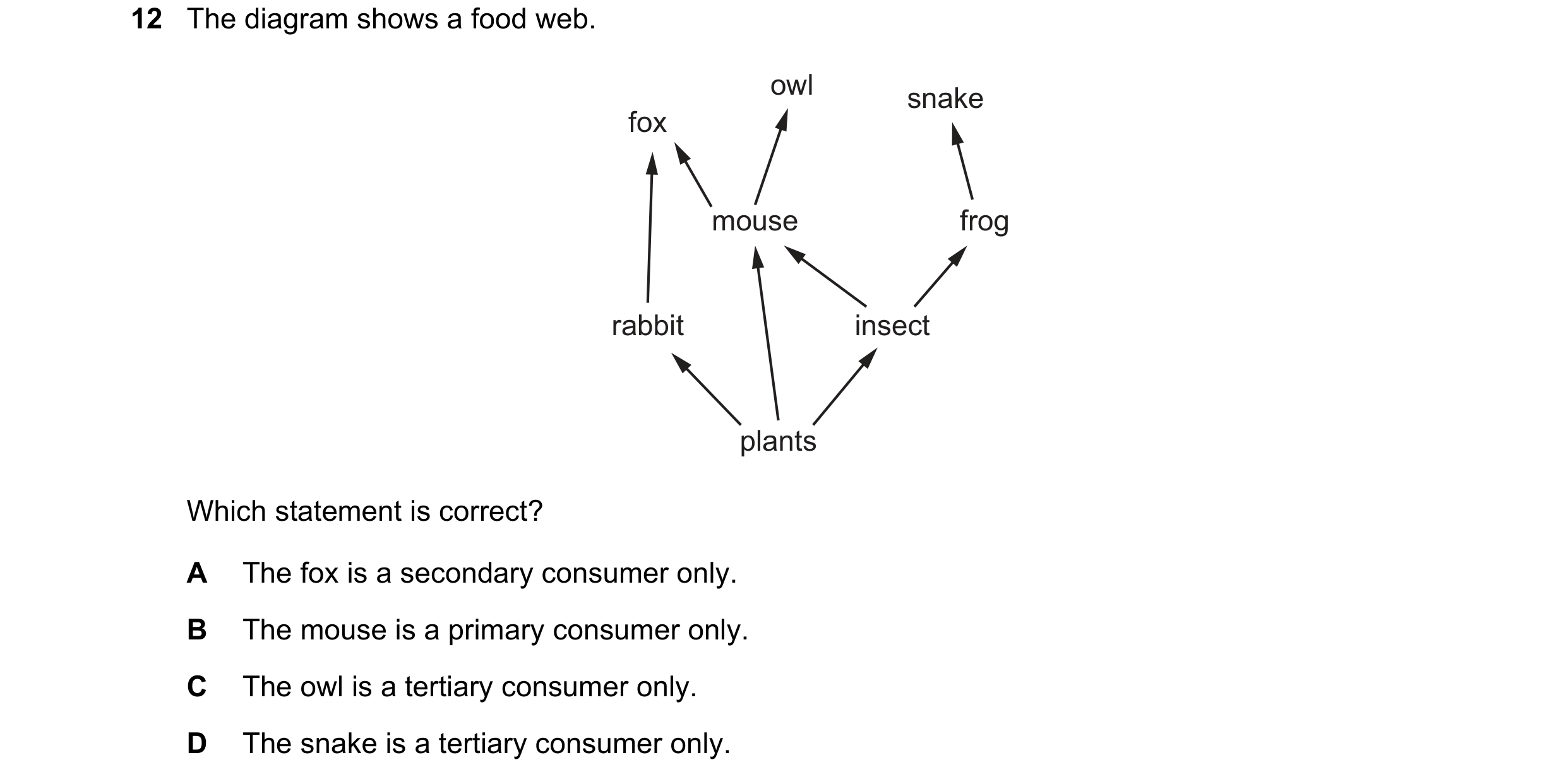

 2 / 5
2 / 5


 3 / 5
3 / 5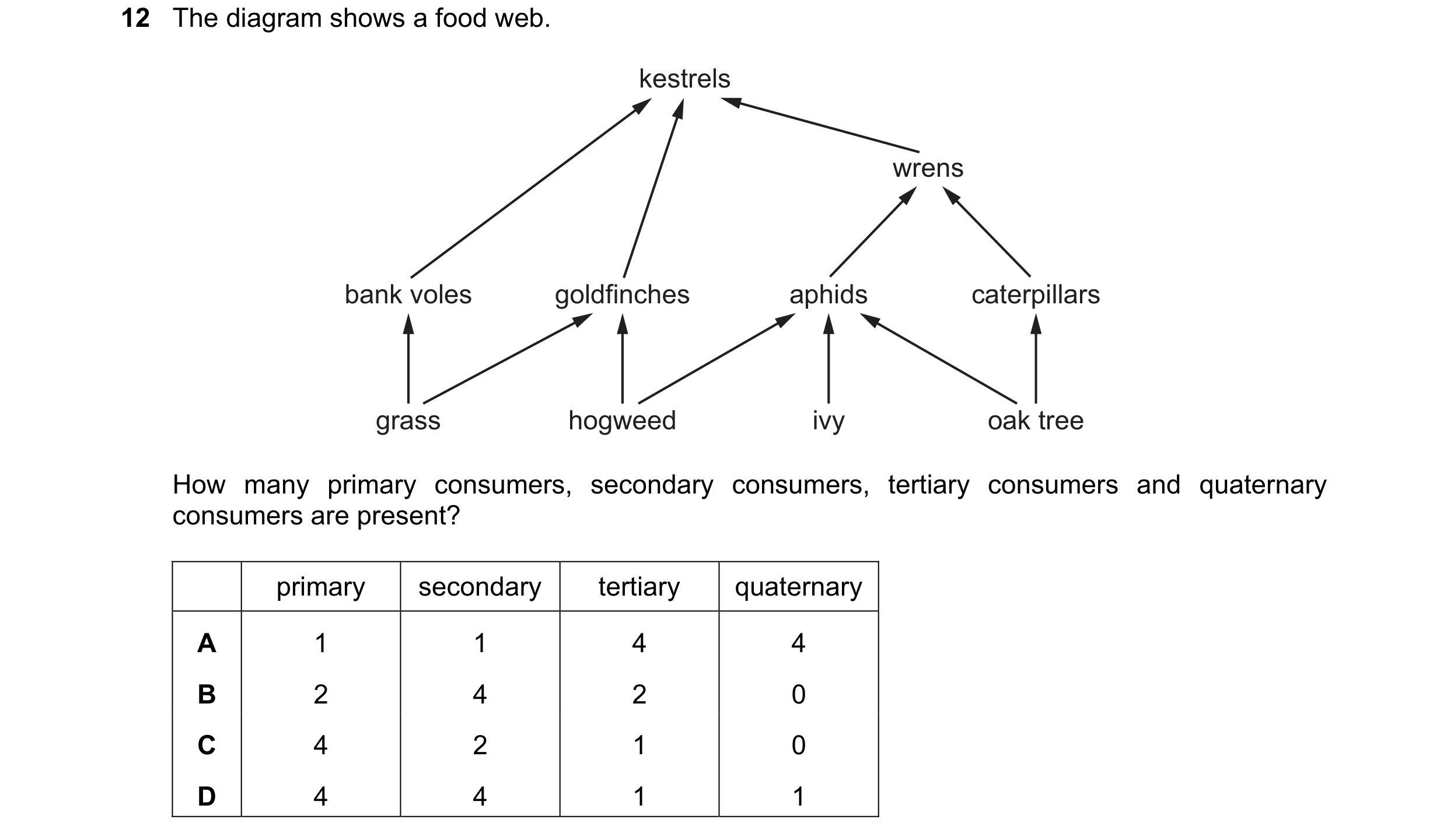
 4 / 5
4 / 5


 5 / 5
5 / 5