Cambridge IGCSE Science - Combined 0653 — 2024 Oct/Nov Paper 6 · Variant 1
0653/61/O/N/24 · 4 questions · 40 marks · ≈45 min
The question paper and its mark scheme, free to read here and free to download. This is Cambridge’s own paper, exactly as it was sat.
Question paper16 pages

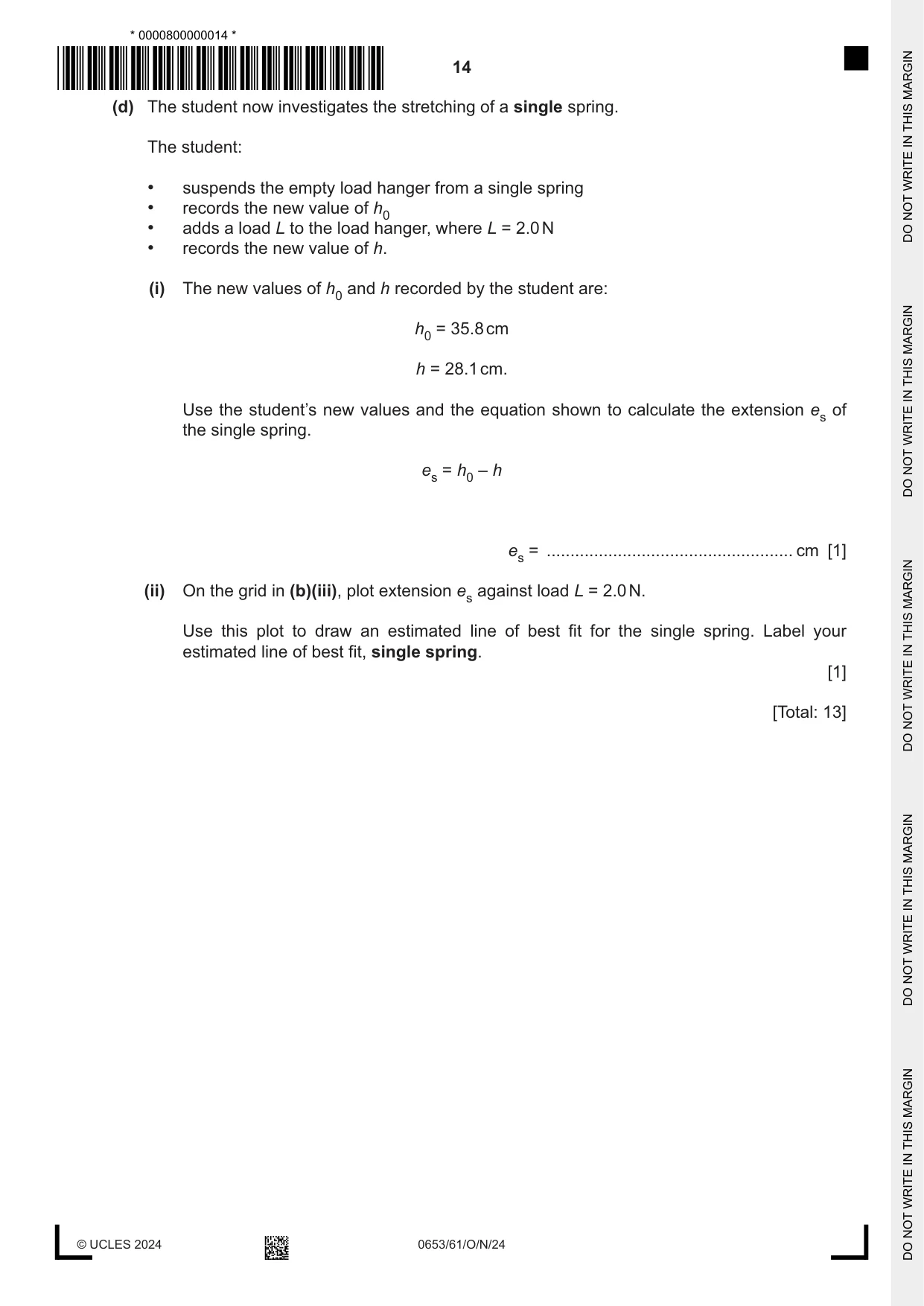

Mark scheme8 pages
Answers below. Sit the paper first if you are practising.
Questions as text
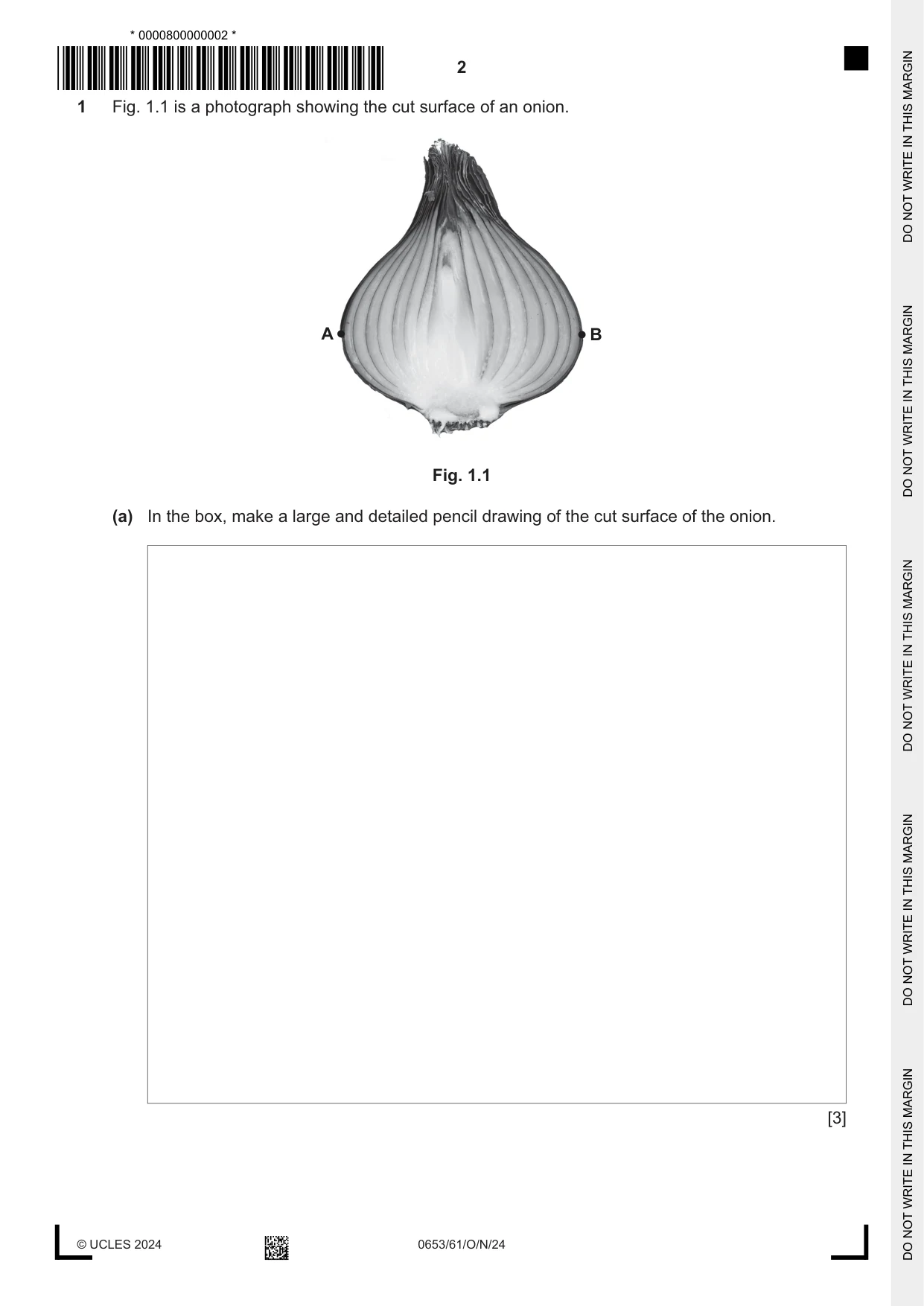
Q1 · A photograph showing the cut surface of an onion
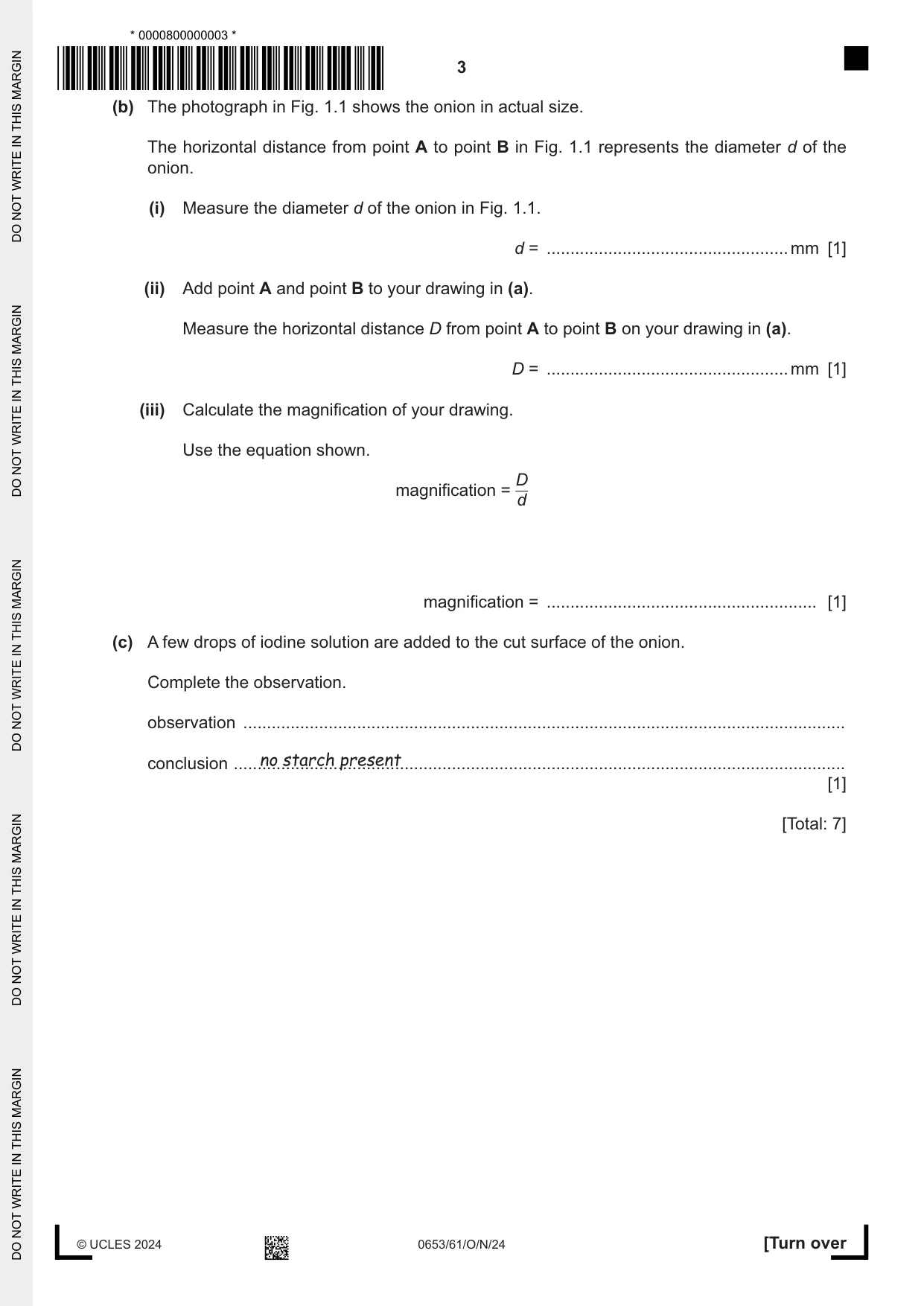
1 Fig. 1.1 is a photograph showing the cut surface of an onion. A B Fig. 1.1 (a) In the box, make a large and detailed pencil drawing of the cut surface of the onion. [3] (b) The photograph in Fig. 1.1 shows the onion in actual size. The horizontal distance from point A to point B in Fig. 1.1 represents the diameter d of the onion. (i) Measure the diameter d of the onion in Fig. 1.1. d = ................................................... mm [1] (ii) Add point A and point B to your drawing in (a). Measure the horizontal distance D from point A to point B on your drawing in (a). D = ................................................... mm [1] (iii) Calculate the magnification of your drawing. Use the equation shown. D magnification = d magnification = ......................................................... [1] (c) A few drops of iodine solution are added to the cut surface of the onion. Complete the observation. observation ............................................................................................................................... conclusion .................................................................................................................................no starch present [1] [Total: 7]
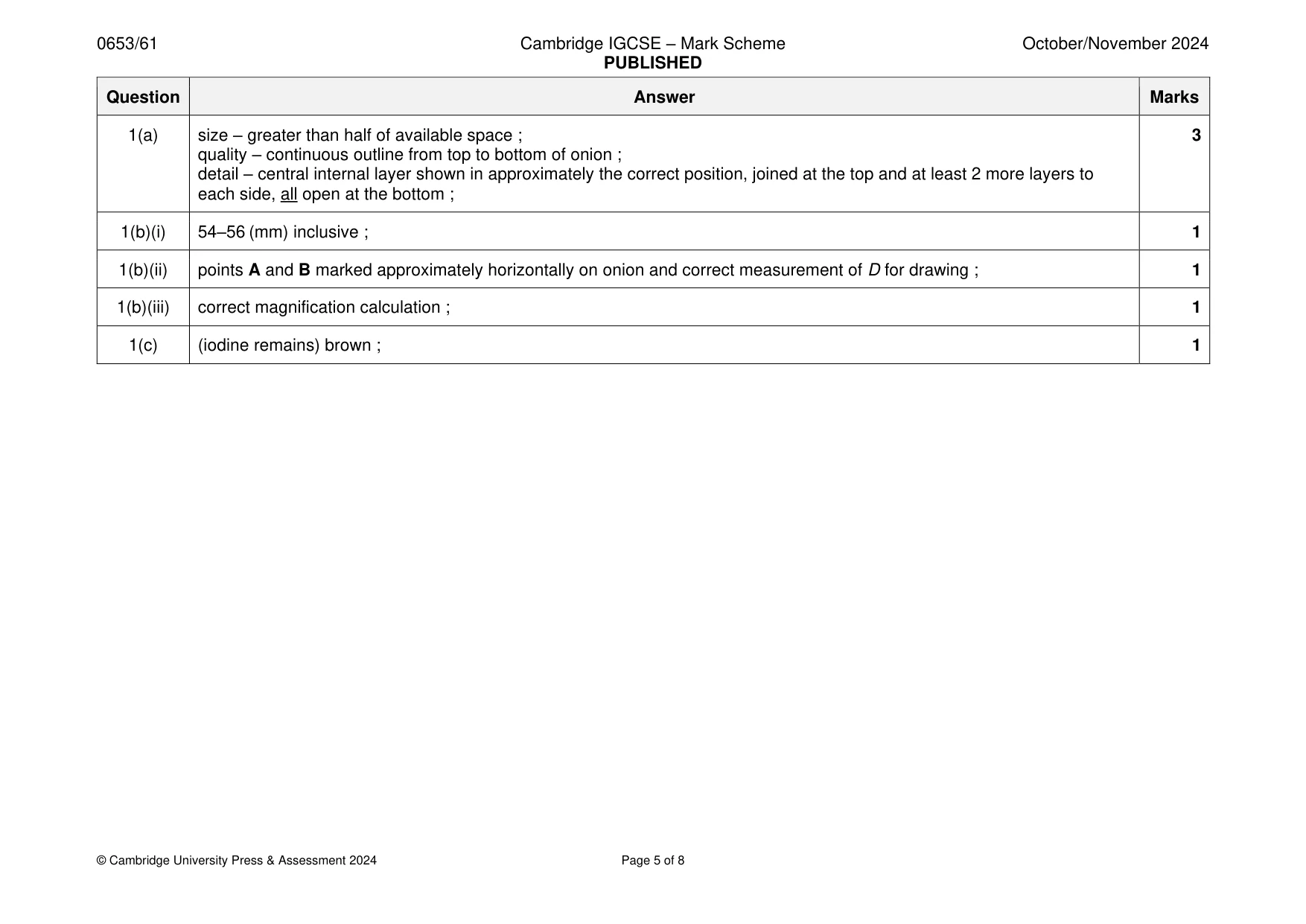
Mark scheme: Question Answer Marks 1(a) size – greater than half of available space ; 3 quality – continuous outline from top to bottom of onion ; detail – central internal layer shown in approximately the correct position, joined at the top and at least 2 more layers to each side, all open at the bottom ; 1(b)(i) 54–56 (mm) inclusive ; 1 1(b)(ii) points A and B marked approximately horizontally on onion and correct measurement of D for drawing ; 1 1(b)(iii) correct magnification calculation ; 1 1(c) (iodine remains) brown ; 1
Q2 · Plants such as onions need minerals in the soil to grow
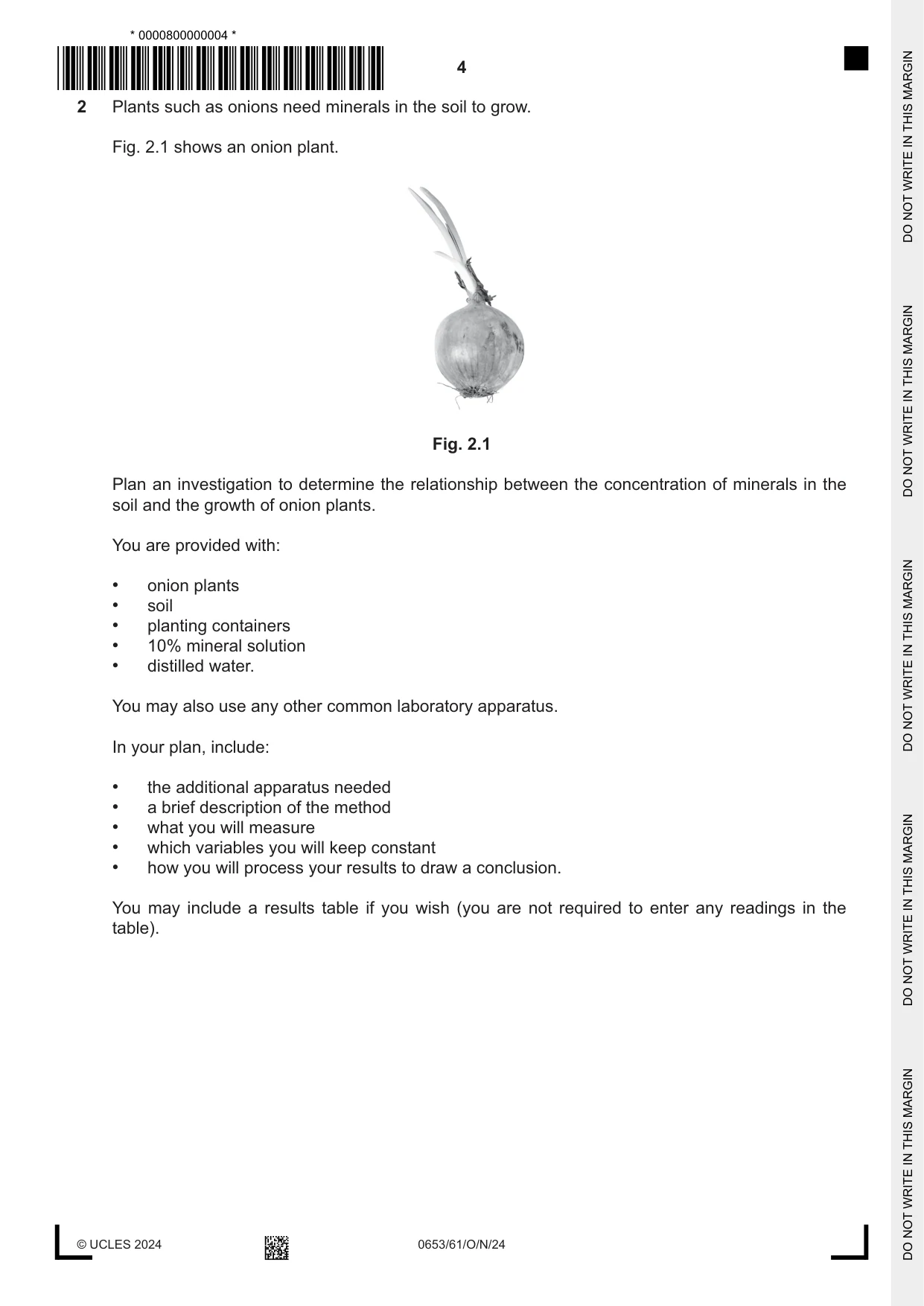
2 Plants such as onions need minerals in the soil to grow. Fig. 2.1 shows an onion plant. Fig. 2.1 Plan an investigation to determine the relationship between the concentration of minerals in the soil and the growth of onion plants. You are provided with: • onion plants • soil • planting containers • 10% mineral solution • distilled water. You may also use any other common laboratory apparatus. In your plan, include: • the additional apparatus needed • a brief description of the method • what you will measure • which variables you will keep constant • how you will process your results to draw a conclusion. You may include a results table if you wish (you are not required to enter any readings in the table). .......................................................................................................................................................... .......................................................................................................................................................... .......................................................................................................................................................... .......................................................................................................................................................... .......................................................................................................................................................... .......................................................................................................................................................... .......................................................................................................................................................... .......................................................................................................................................................... .......................................................................................................................................................... .......................................................................................................................................................... .......................................................................................................................................................... .......................................................................................................................................................... .......................................................................................................................................................... .......................................................................................................................................................... .................................................................................................................................................... [7]
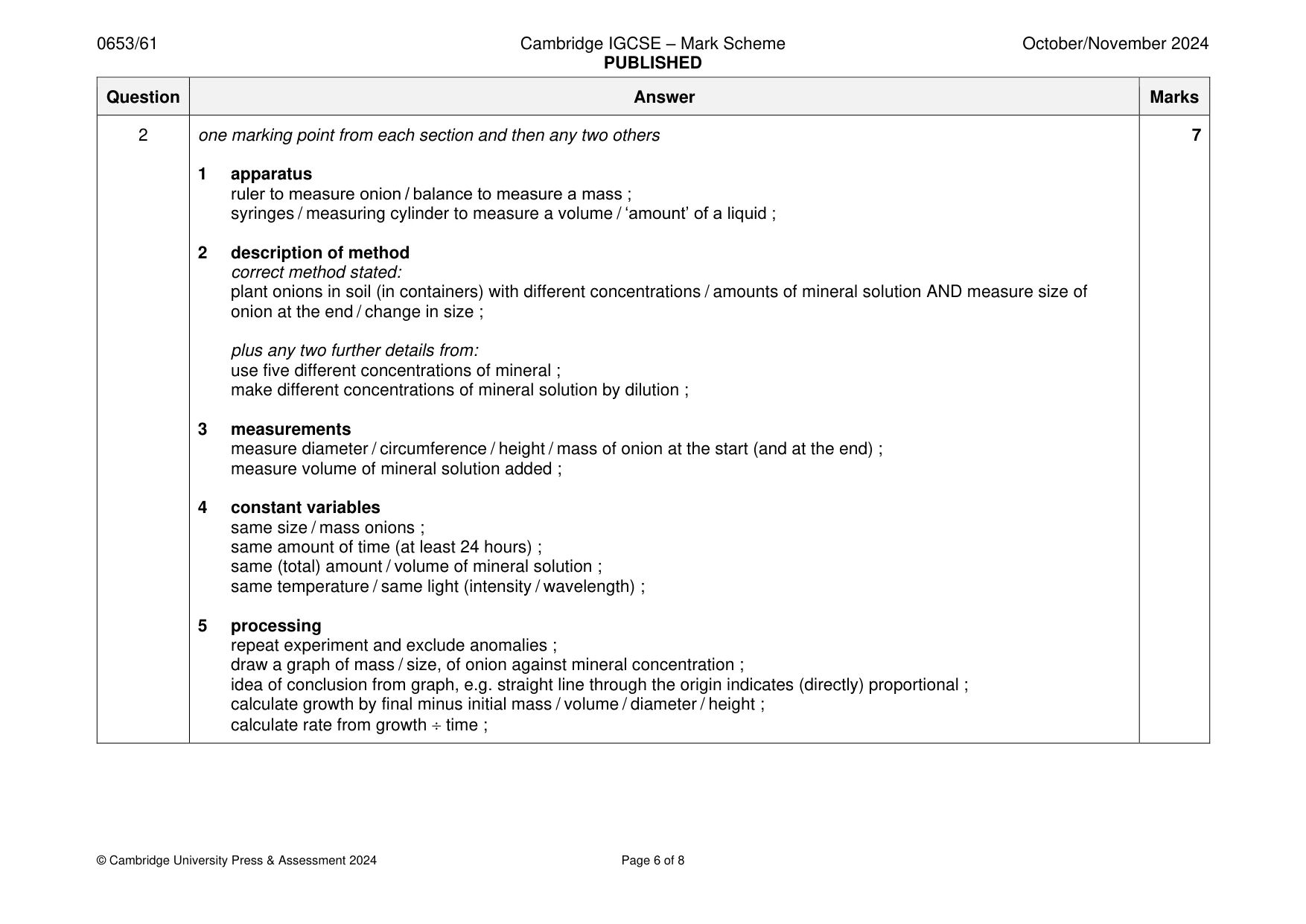
Mark scheme: 2 one marking point from each section and then any two others 7 1 apparatus ruler to measure onion / balance to measure a mass ; syringes / measuring cylinder to measure a volume / ‘amount’ of a liquid ; 2 description of method correct method stated: plant onions in soil (in containers) with different concentrations / amounts of mineral solution AND measure size of onion at the end / change in size ; plus any two further details from: use five different concentrations of mineral ; make different concentrations of mineral solution by dilution ; 3 measurements measure diameter / circumference / height / mass of onion at the start (and at the end) ; measure volume of mineral solution added ; 4 constant variables same size / mass onions ; same amount of time (at least 24 hours) ; same (total) amount / volume of mineral solution ; same temperature / same light (intensity / wavelength) ; 5 processing repeat experiment and exclude anomalies ; draw a graph of mass / size, of onion against mineral concentration ; idea of conclusion from graph, e.g. straight line through the origin indicates (directly) proportional ; calculate growth by final minus initial mass / volume / diameter / height ; calculate rate from growth time ;
Q3 · A student investigates a white solid, solid H
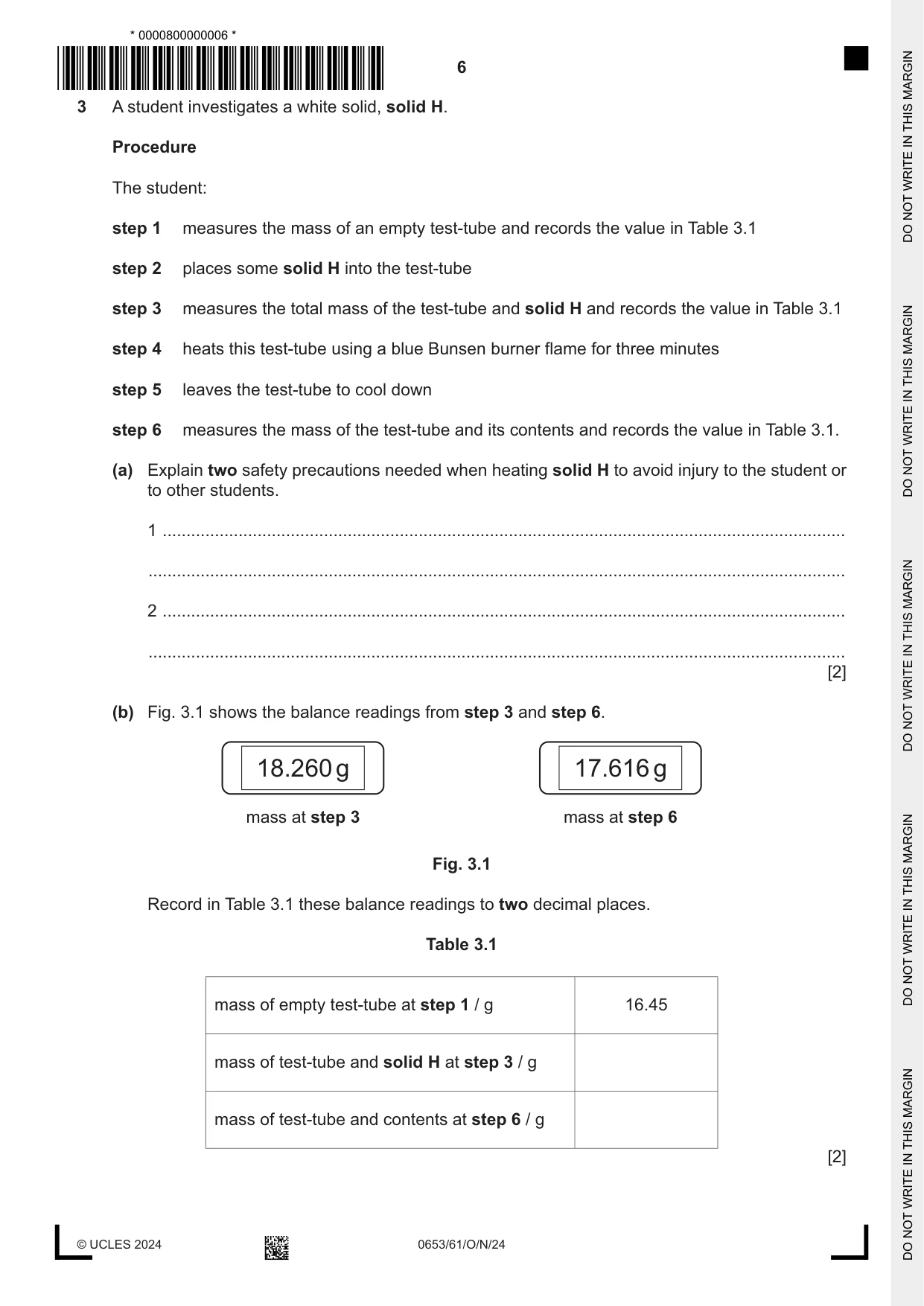
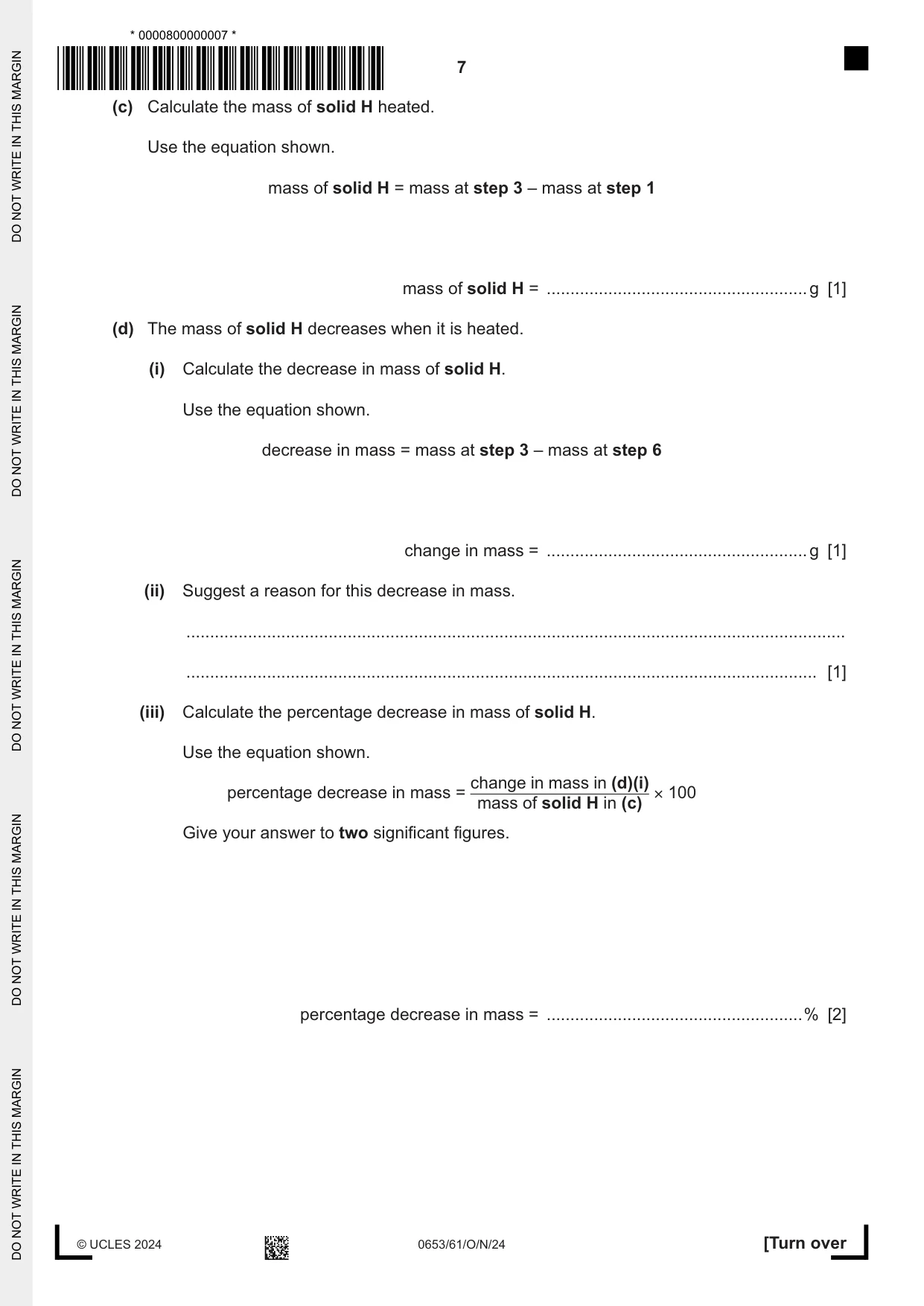
3 A student investigates a white solid, solid H. Procedure The student: step 1 measures the mass of an empty test-tube and records the value in Table 3.1 step 2 places some solid H into the test-tube step 3 measures the total mass of the test-tube and solid H and records the value in Table 3.1 step 4 heats this test-tube using a blue Bunsen burner flame for three minutes step 5 leaves the test-tube to cool down step 6 measures the mass of the test-tube and its contents and records the value in Table 3.1. (a) Explain two safety precautions needed when heating solid H to avoid injury to the student or to other students. 1 ................................................................................................................................................ ................................................................................................................................................... 2 ................................................................................................................................................ ................................................................................................................................................... [2] (b) Fig. 3.1 shows the balance readings from step 3 and step 6. 18.260 g 17.616 g mass at step 3 mass at step 6 Fig. 3.1 Record in Table 3.1 these balance readings to two decimal places. Table 3.1 mass of empty test-tube at step 1 / g 16.45 mass of test-tube and solid H at step 3 / g mass of test-tube and contents at step 6 / g [2] (c) Calculate the mass of solid H heated. Use the equation shown. mass of solid H = mass at step 3 – mass at step 1 mass of solid H = ....................................................... g [1] (d) The mass of solid H decreases when it is heated. (i) Calculate the decrease in mass of solid H. Use the equation shown. decrease in mass = mass at step 3 – mass at step 6 change in mass = ....................................................... g [1] (ii) Suggest a reason for this decrease in mass. ........................................................................................................................................... ..................................................................................................................................... [1] (iii) Calculate the percentage decrease in mass of solid H. Use the equation shown. change in mass in (d)(i) percentage decrease in mass = × 100 mass of solid H in (c) Give your answer to two significant figures. percentage decrease in mass = ......................................................% [2] (e) Explain why it is important to heat solid H with a blue Bunsen burner flame instead of a yellow flame. ................................................................................................................................................... ............................................................................................................................................. [1] (f) The teacher tells the student that the decrease in mass of solid H is smaller than expected. Describe how to improve the procedure to make sure that solid H has the maximum decrease in mass. ................................................................................................................................................... ............................................................................................................................................. [1] (g) The student adds some solid H to dilute nitric acid. A colourless solution and a colourless gas are formed. (i) The student tests the gas with limewater. A white precipitate is formed. Identify the anion (negative ion) present in solid H. ..................................................................................................................................... [1] (ii) The student adds aqueous ammonia slowly to the colourless solution in (g). A white precipitate forms. The precipitate is soluble in excess aqueous ammonia, giving a colourless solution. Identify the cation (positive ion) present in solid H. ..................................................................................................................................... [1] [Total: 13]
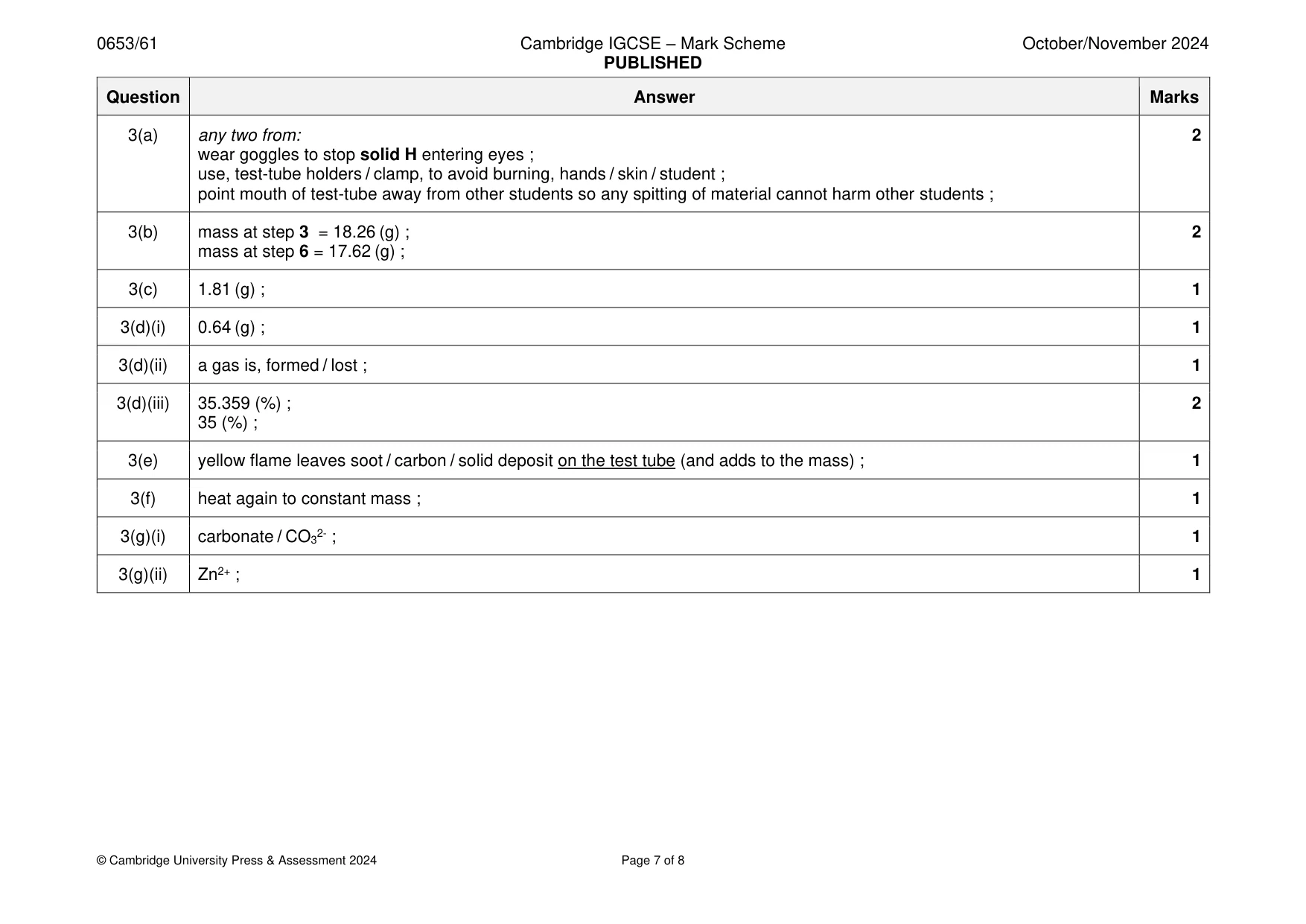
Mark scheme: 3(a) any two from: 2 wear goggles to stop solid H entering eyes ; use, test-tube holders / clamp, to avoid burning, hands / skin / student ; point mouth of test-tube away from other students so any spitting of material cannot harm other students ; 3(b) mass at step 3 = 18.26 (g) ; 2 mass at step 6 = 17.62 (g) ; 3(c) 1.81 (g) ; 1 3(d)(i) 0.64 (g) ; 1 3(d)(ii) a gas is, formed / lost ; 1 3(d)(iii) 35.359 (%) ; 2 35 (%) ; 3(e) yellow flame leaves soot / carbon / solid deposit on the test tube (and adds to the mass) ; 1 3(f) heat again to constant mass ; 1 3(g)(i) carbonate / CO32- ; 1 3(g)(ii) Zn2+ ; 1
Q4 · A student investigates the stretching of a pair of identical springs
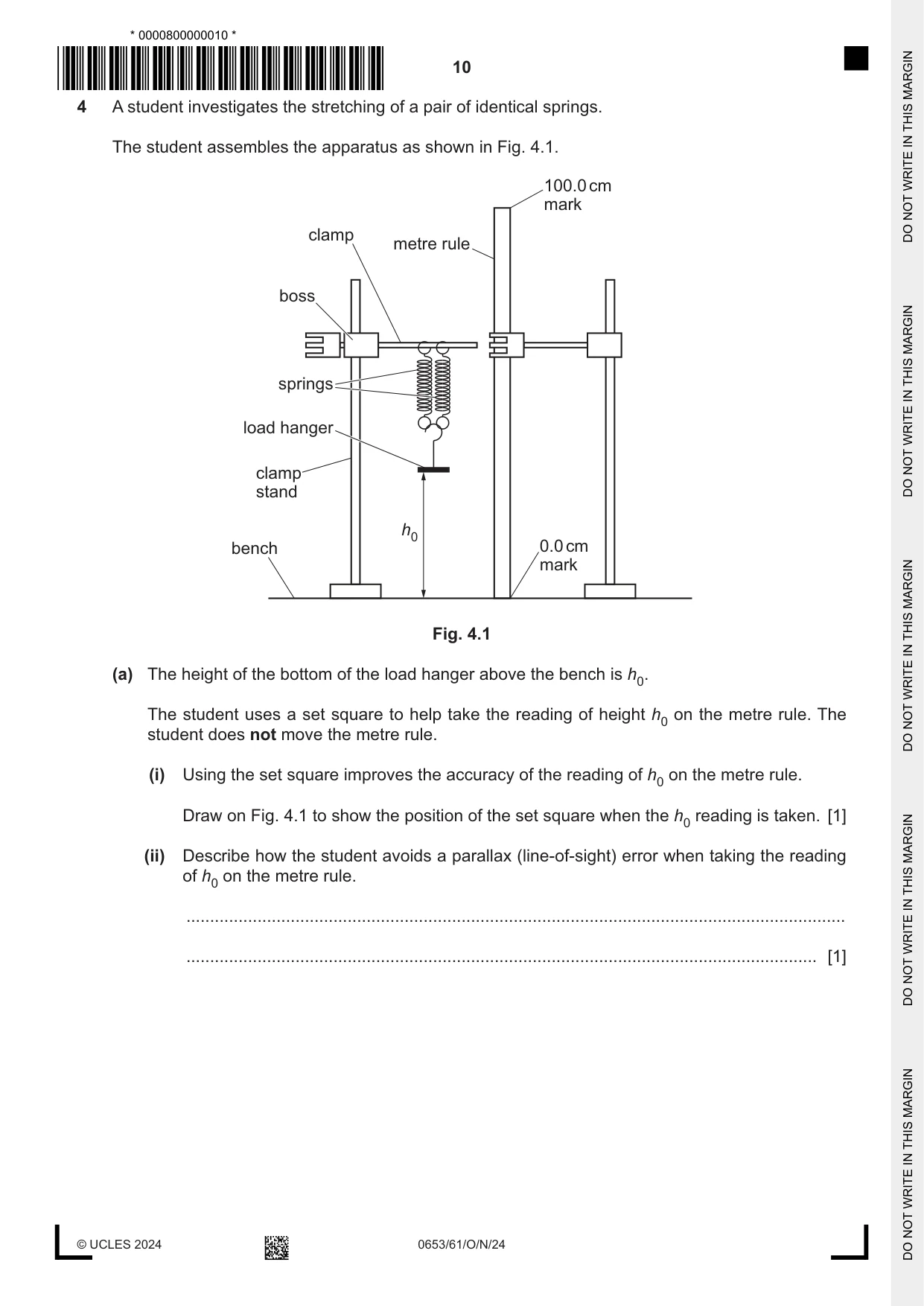
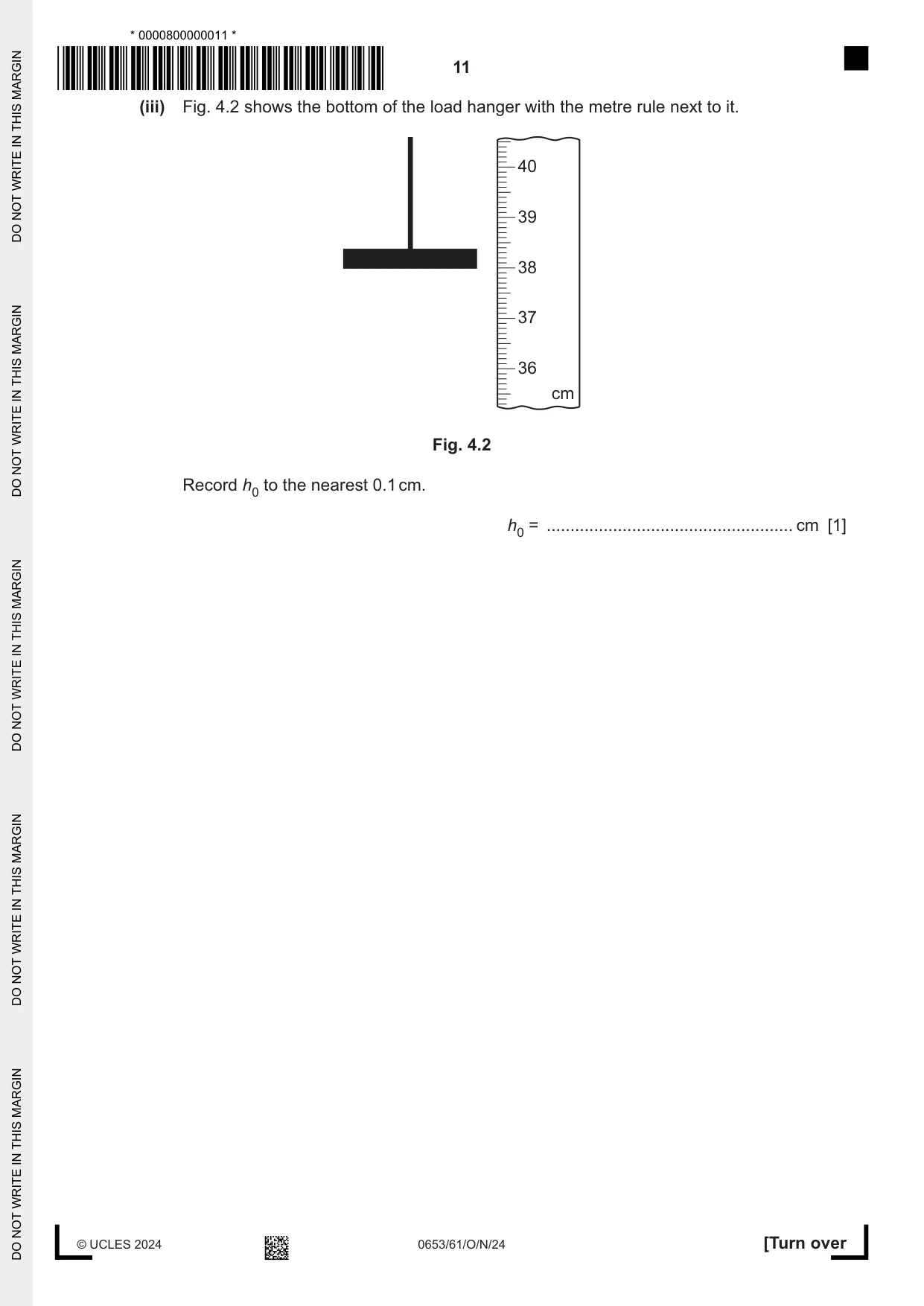
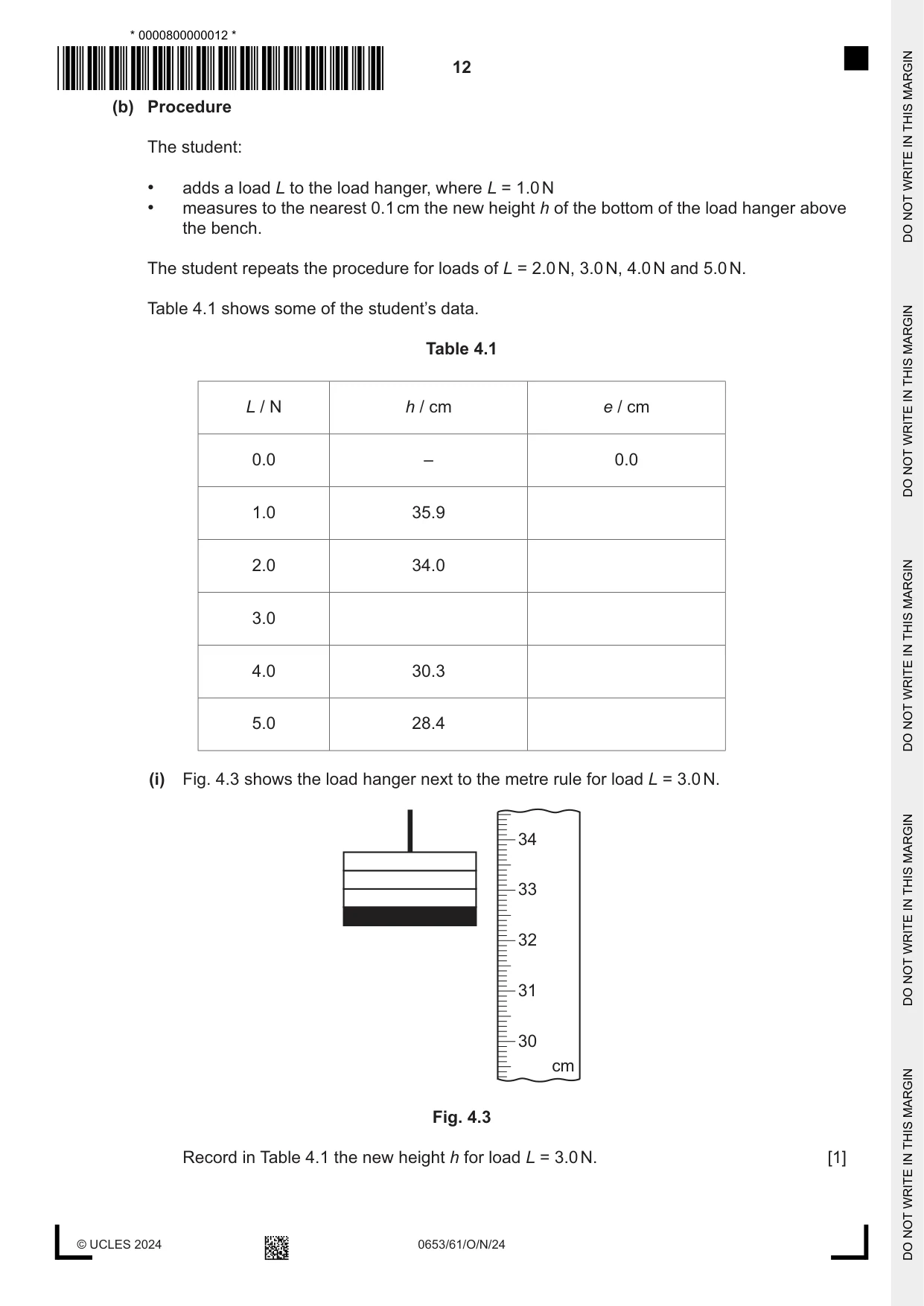
4 A student investigates the stretching of a pair of identical springs. The student assembles the apparatus as shown in Fig. 4.1. 100.0 cm mark clamp metre rule boss springs load hanger clamp stand h0 bench 0.0 cm mark Fig. 4.1 (a) The height of the bottom of the load hanger above the bench is h0. The student uses a set square to help take the reading of height h0 on the metre rule. The student does not move the metre rule. (i) Using the set square improves the accuracy of the reading of h0 on the metre rule. Draw on Fig. 4.1 to show the position of the set square when the h0 reading is taken. [1] (ii) Describe how the student avoids a parallax (line-of-sight) error when taking the reading of h0 on the metre rule. ........................................................................................................................................... ..................................................................................................................................... [1] (iii) Fig. 4.2 shows the bottom of the load hanger with the metre rule next to it. 40 39 38 37 36 cm Fig. 4.2 Record h0 to the nearest 0.1 cm. h0 = .................................................... cm [1] (b) Procedure The student: • adds a load L to the load hanger, where L = 1.0 N • measures to the nearest 0.1 cm the new height h of the bottom of the load hanger above the bench. The student repeats the procedure for loads of L = 2.0 N, 3.0 N, 4.0 N and 5.0 N. Table 4.1 shows some of the student’s data. Table 4.1 L / N h / cm e / cm 0.0 – 0.0 1.0 35.9 2.0 34.0 3.0 4.0 30.3 5.0 28.4 (i) Fig. 4.3 shows the load hanger next to the metre rule for load L = 3.0 N. 34 33 32 31 30 cm Fig. 4.3 Record in Table 4.1 the new height h for load L = 3.0 N. [1]
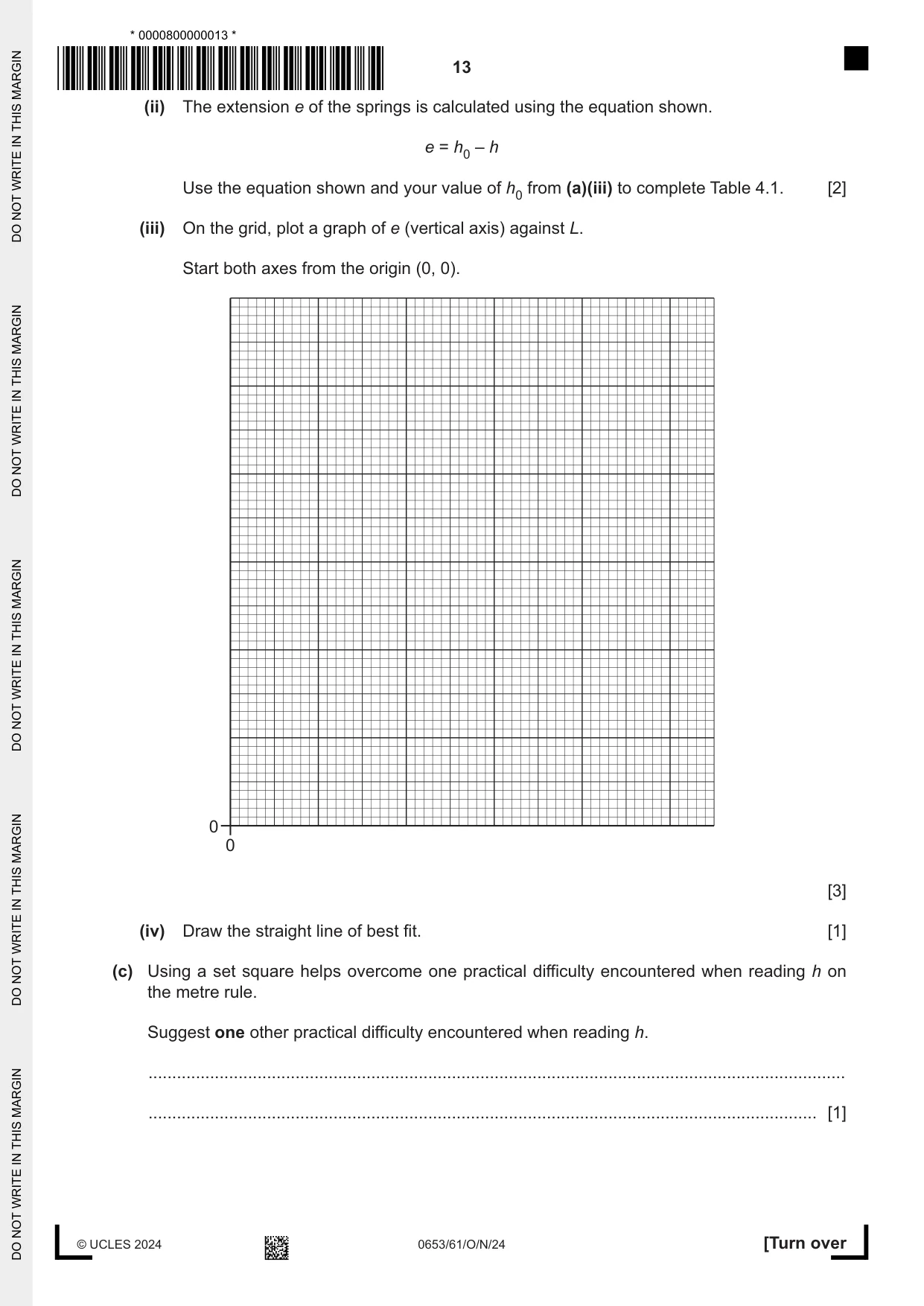
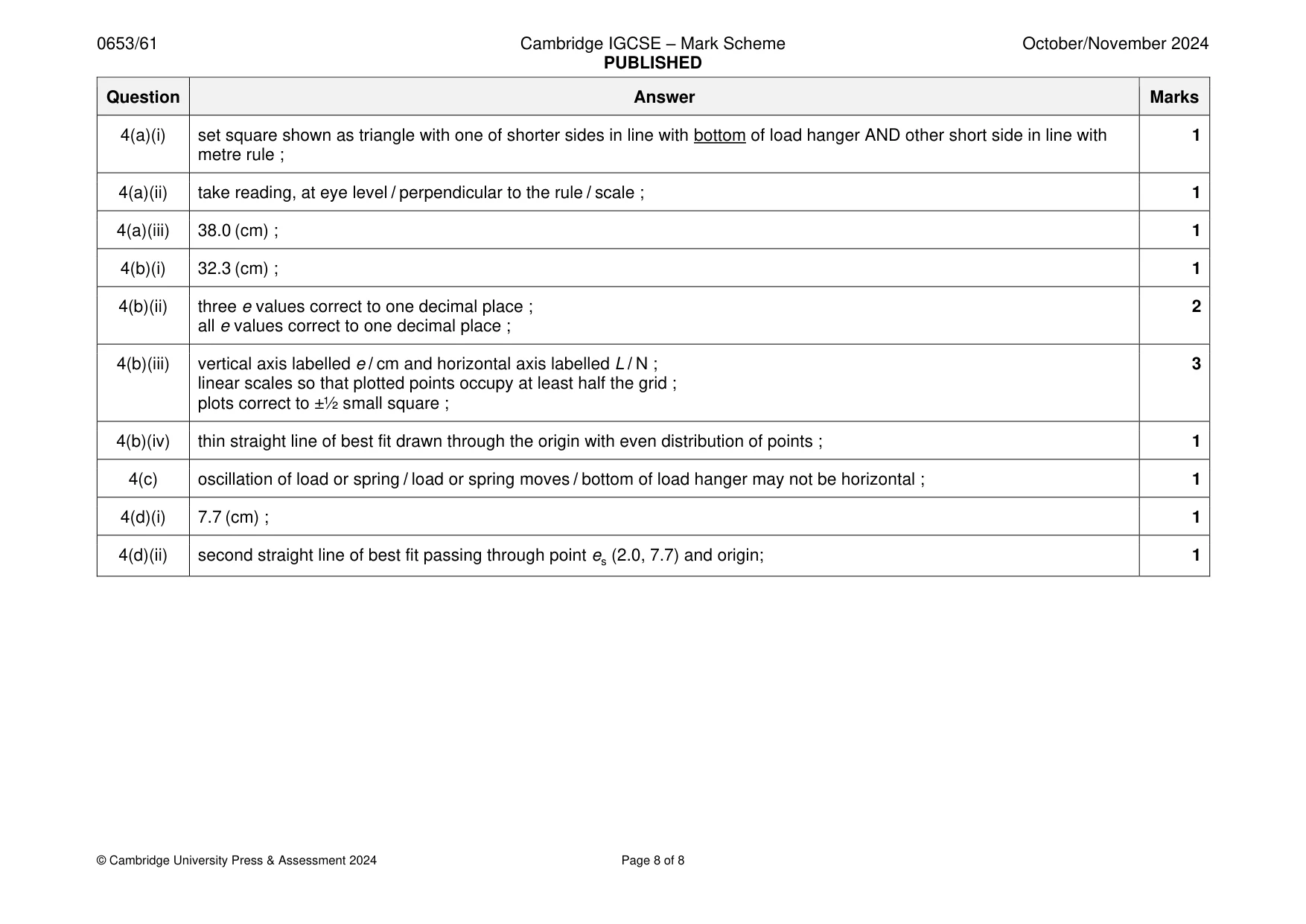
Mark scheme: 4(a)(i) set square shown as triangle with one of shorter sides in line with bottom of load hanger AND other short side in line with 1 metre rule ; 4(a)(ii) take reading, at eye level / perpendicular to the rule / scale ; 1 4(a)(iii) 38.0 (cm) ; 1 4(b)(i) 32.3 (cm) ; 1 4(b)(ii) three e values correct to one decimal place ; 2 all e values correct to one decimal place ; 4(b)(iii) vertical axis labelled e / cm and horizontal axis labelled L / N ; 3 linear scales so that plotted points occupy at least half the grid ; plots correct to ±½ small square ; 4(b)(iv) thin straight line of best fit drawn through the origin with even distribution of points ; 1 4(c) oscillation of load or spring / load or spring moves / bottom of load hanger may not be horizontal ; 1 4(d)(i) 7.7 (cm) ; 1 4(d)(ii) second straight line of best fit passing through point es (2.0, 7.7) and origin; 1
More questions on Physical quantities and measurement techniques
What was in this paper
The subtopics covered by these 4 questions, and how many questions each got. Open one in a new tab to see every Cambridge question on it.
What you needed in this session
Cambridge’s own grade thresholds for 2024 Oct/Nov, Paper 6 · Variant 1. A higher threshold means an easier paper — the bar moves with how the cohort did.