Cambridge IGCSE Science - Combined 0653 — 2023 Oct/Nov Paper 6 · Variant 1
0653/61/O/N/23 · 4 questions · 40 marks · ≈45 min
The question paper and its mark scheme, free to read here and free to download. This is Cambridge’s own paper, exactly as it was sat.
Question paper16 pages




Mark scheme8 pages
Answers below. Sit the paper first if you are practising.
Questions as text
Q1 · A student investigates the effect of an enzyme used in the large-scale production of…
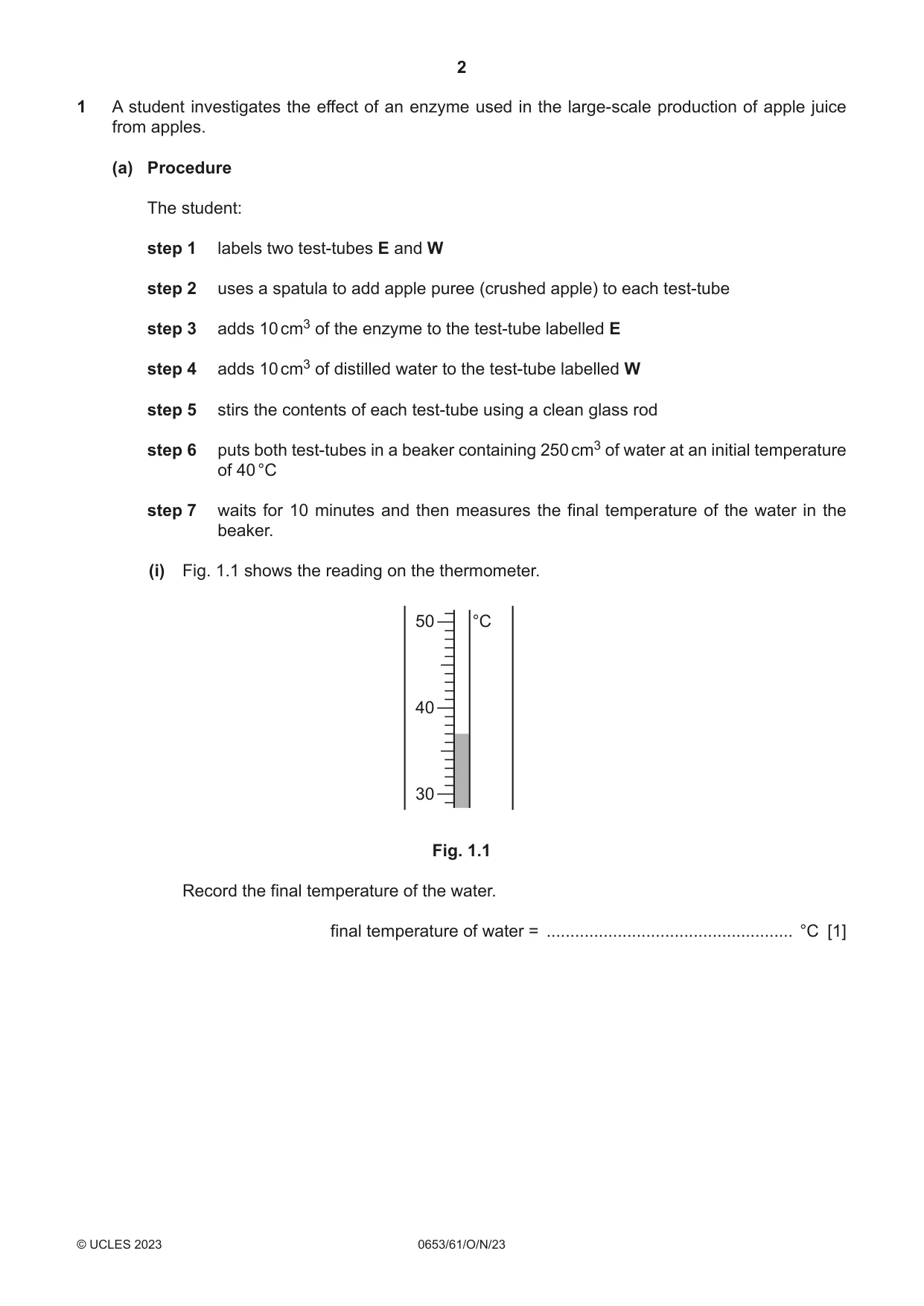
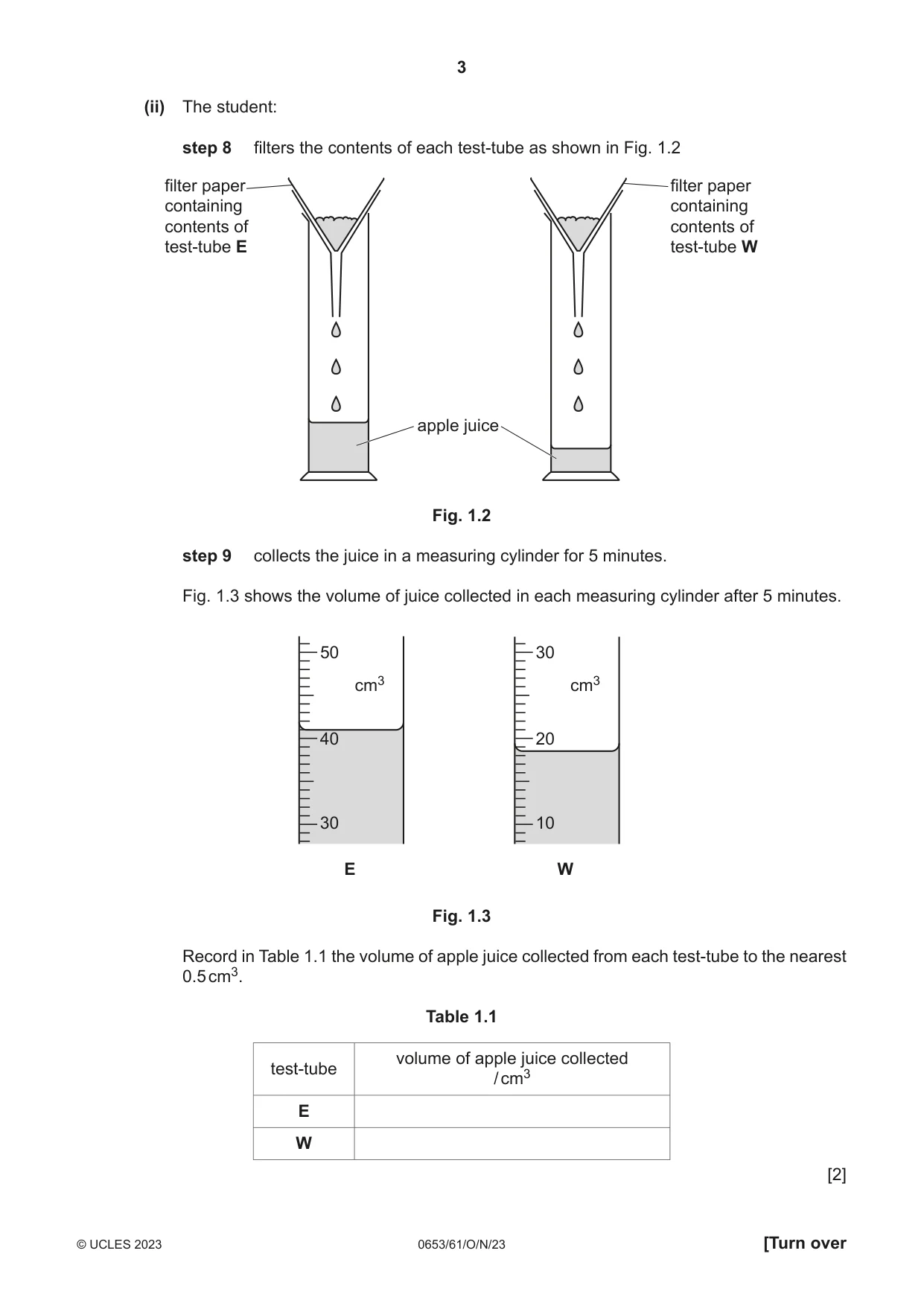
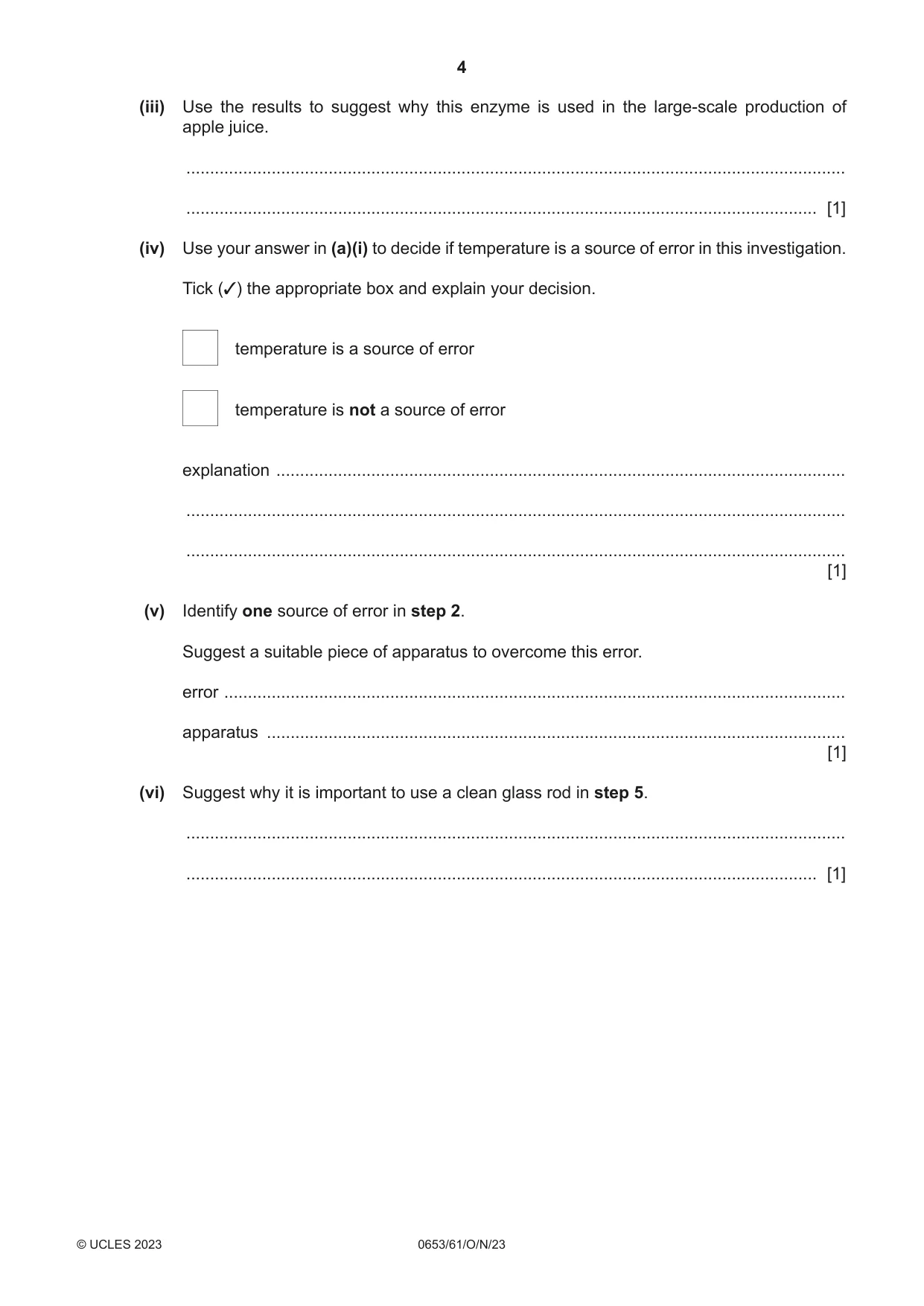
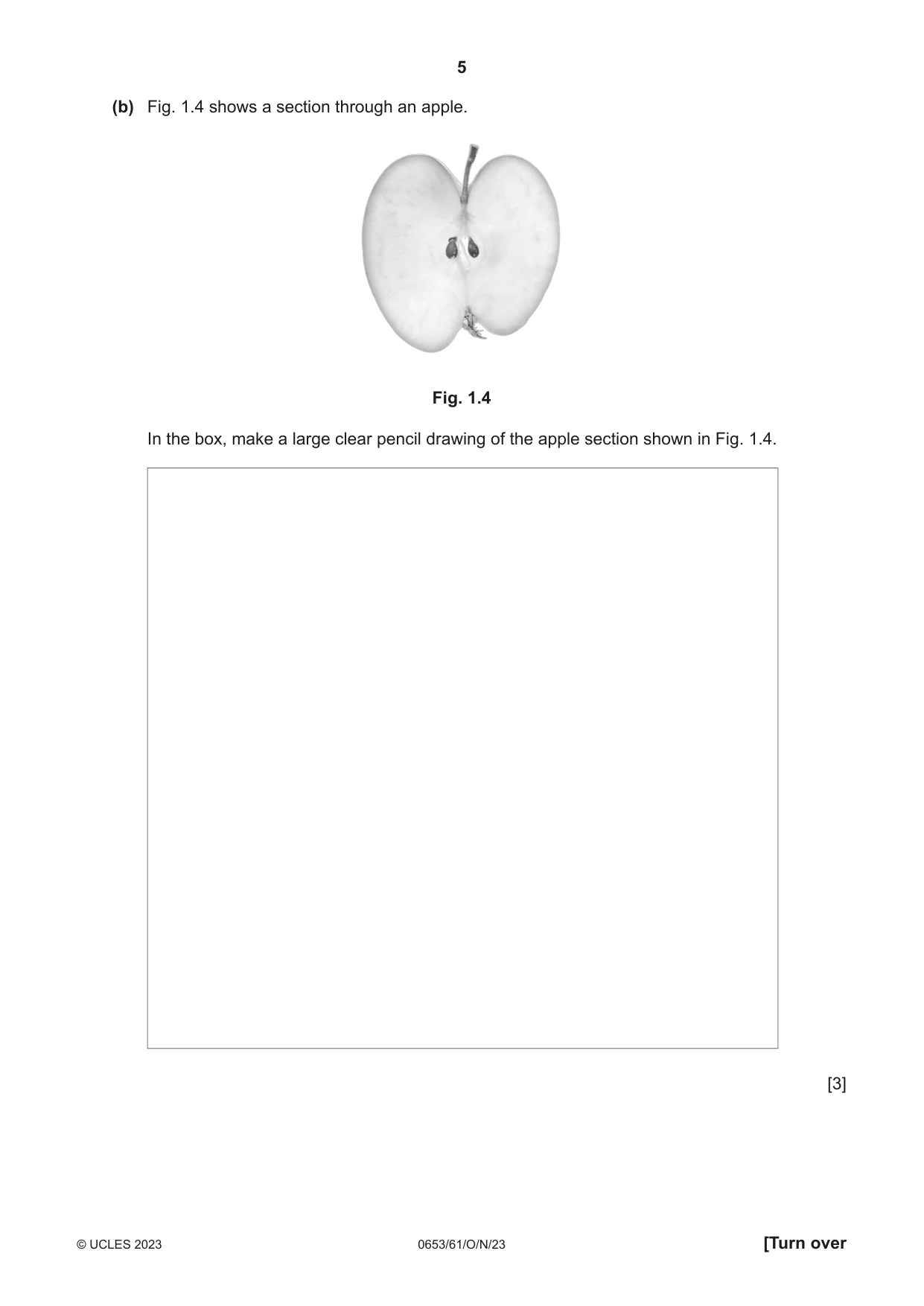
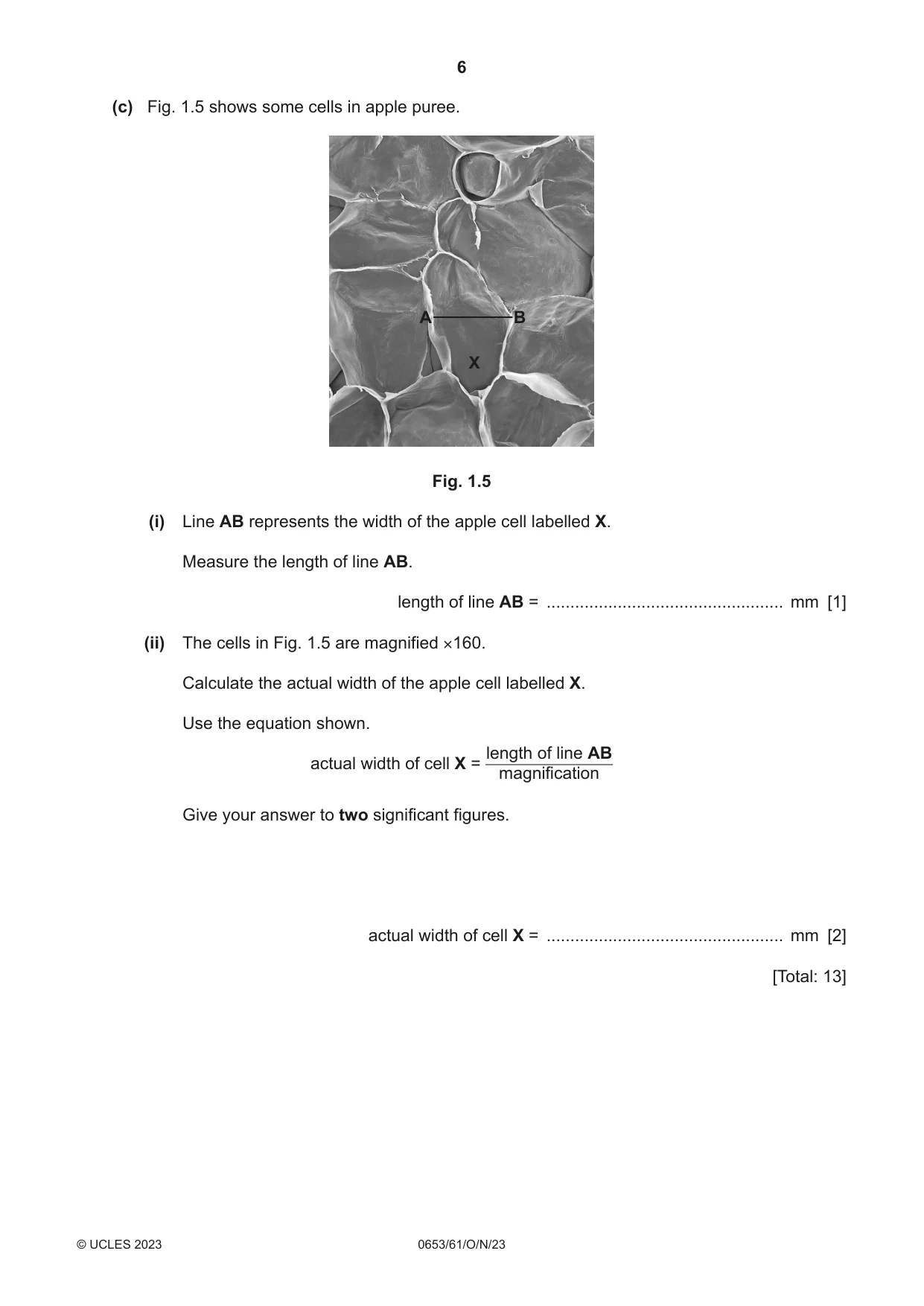
1 A student investigates the effect of an enzyme used in the large-scale production of apple juice from apples. (a) Procedure The student: step 1 labels two test-tubes E and W step 2 uses a spatula to add apple puree (crushed apple) to each test-tube step 3 adds 10 cm3 of the enzyme to the test-tube labelled E step 4 adds 10 cm3 of distilled water to the test-tube labelled W step 5 stirs the contents of each test-tube using a clean glass rod step 6 puts both test-tubes in a beaker containing 250 cm3 of water at an initial temperature of 40 °C step 7 waits for 10 minutes and then measures the final temperature of the water in the beaker. (i) Fig. 1.1 shows the reading on the thermometer. 50 °C 40 30 Fig. 1.1 Record the final temperature of the water. final temperature of water = .................................................... °C [1] (ii) The student: step 8 filters the contents of each test-tube as shown in Fig. 1.2 filter paper filter paper containing containing contents of contents of test-tube E test-tube W apple juice Fig. 1.2 step 9 collects the juice in a measuring cylinder for 5 minutes. Fig. 1.3 shows the volume of juice collected in each measuring cylinder after 5 minutes. 50 30 cm3 cm3 40 20 30 10 E W Fig. 1.3 Record in Table 1.1 the volume of apple juice collected from each test-tube to the nearest 0.5 cm3. Table 1.1 volume of apple juice collected test-tube / cm3 E W [2] (iii) Use the results to suggest why this enzyme is used in the large-scale production of apple juice. ........................................................................................................................................... ..................................................................................................................................... [1] (iv) Use your answer in (a)(i) to decide if temperature is a source of error in this investigation. Tick (✓) the appropriate box and explain your decision. temperature is a source of error temperature is not a source of error explanation ........................................................................................................................ ........................................................................................................................................... ........................................................................................................................................... [1] (v) Identify one source of error in step 2. Suggest a suitable piece of apparatus to overcome this error. error ................................................................................................................................... apparatus .......................................................................................................................... [1] (vi) Suggest why it is important to use a clean glass rod in step 5. ........................................................................................................................................... ..................................................................................................................................... [1] (b) Fig. 1.4 shows a section through an apple. Fig. 1.4 In the box, make a large clear pencil drawing of the apple section shown in Fig. 1.4. [3] (c) Fig. 1.5 shows some cells in apple puree. A B X Fig. 1.5 (i) Line AB represents the width of the apple cell labelled X. Measure the length of line AB. length of line AB = .................................................. mm [1] (ii) The cells in Fig. 1.5 are magnified ×160. Calculate the actual width of the apple cell labelled X. Use the equation shown. length of line AB actual width of cell X = magnification Give your answer to two significant figures. actual width of cell X = .................................................. mm [2] [Total: 13]
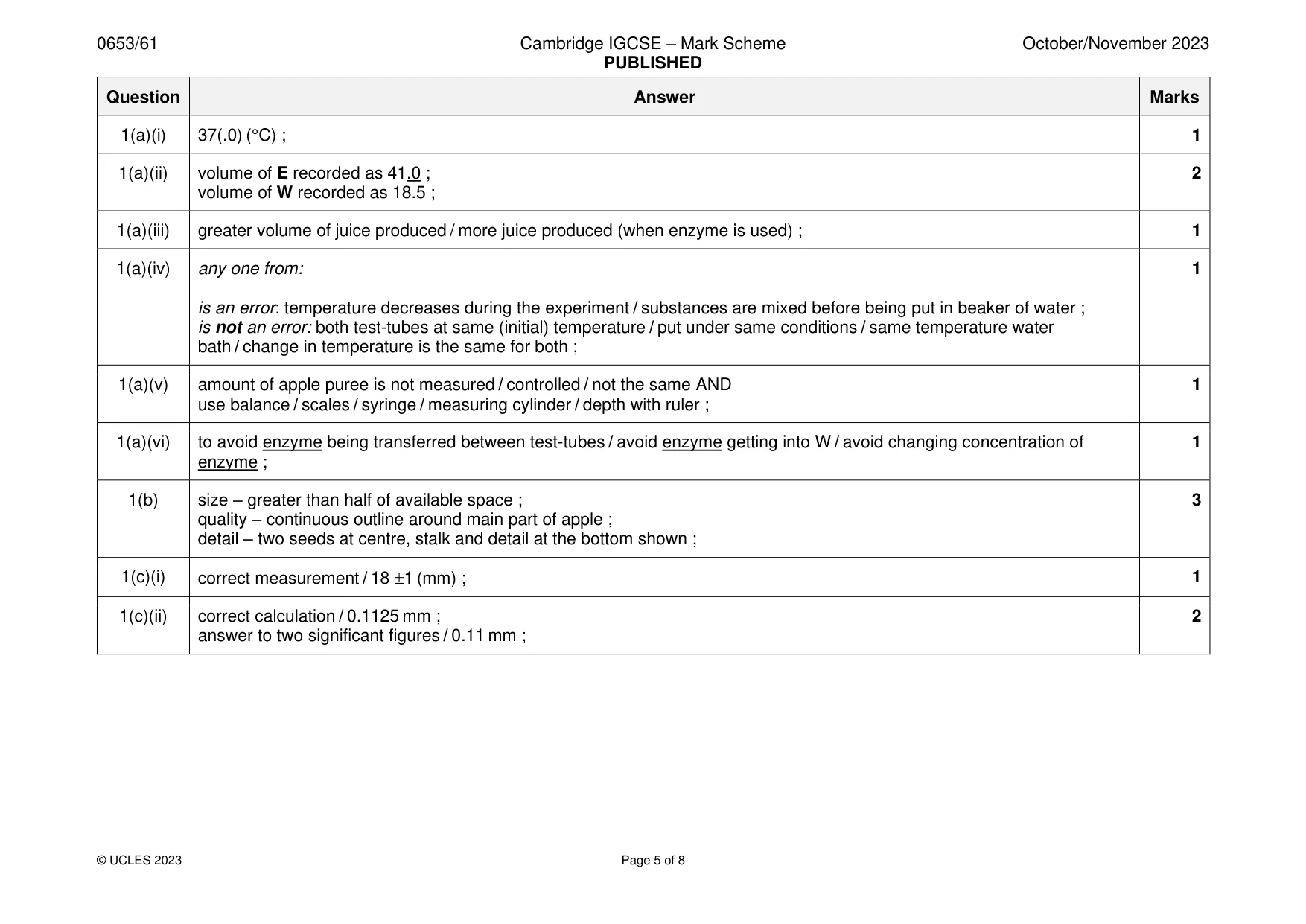
Mark scheme: Question Answer Marks 1(a)(i) 37(.0) (°C) ; 1 1(a)(ii) volume of E recorded as 41.0 ; 2 volume of W recorded as 18.5 ; 1(a)(iii) greater volume of juice produced / more juice produced (when enzyme is used) ; 1 1(a)(iv) any one from: 1 is an error: temperature decreases during the experiment / substances are mixed before being put in beaker of water ; is not an error: both test-tubes at same (initial) temperature / put under same conditions / same temperature water bath / change in temperature is the same for both ; 1(a)(v) amount of apple puree is not measured / controlled / not the same AND 1 use balance / scales / syringe / measuring cylinder / depth with ruler ; 1(a)(vi) to avoid enzyme being transferred between test-tubes / avoid enzyme getting into W / avoid changing concentration of 1 enzyme ; 1(b) size – greater than half of available space ; 3 quality – continuous outline around main part of apple ; detail – two seeds at centre, stalk and detail at the bottom shown ; 1(c)(i) correct measurement / 18 1 (mm) ; 1 1(c)(ii) correct calculation / 0.1125 mm ; 2 answer to two significant figures / 0.11 mm ;
Q2 · When magnesium ribbon is added to dilute hydrochloric acid, the mixture fizzes and makes…
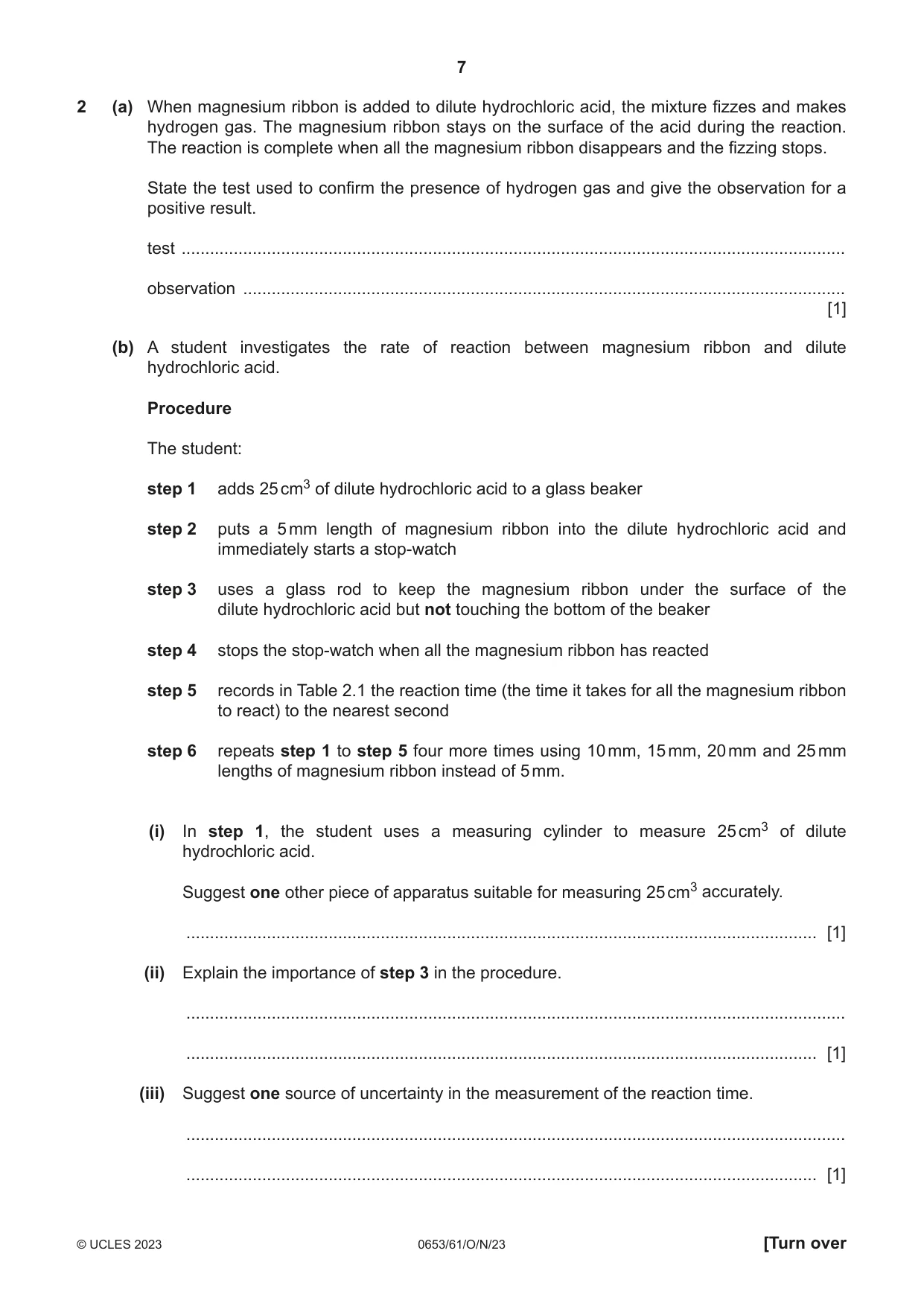
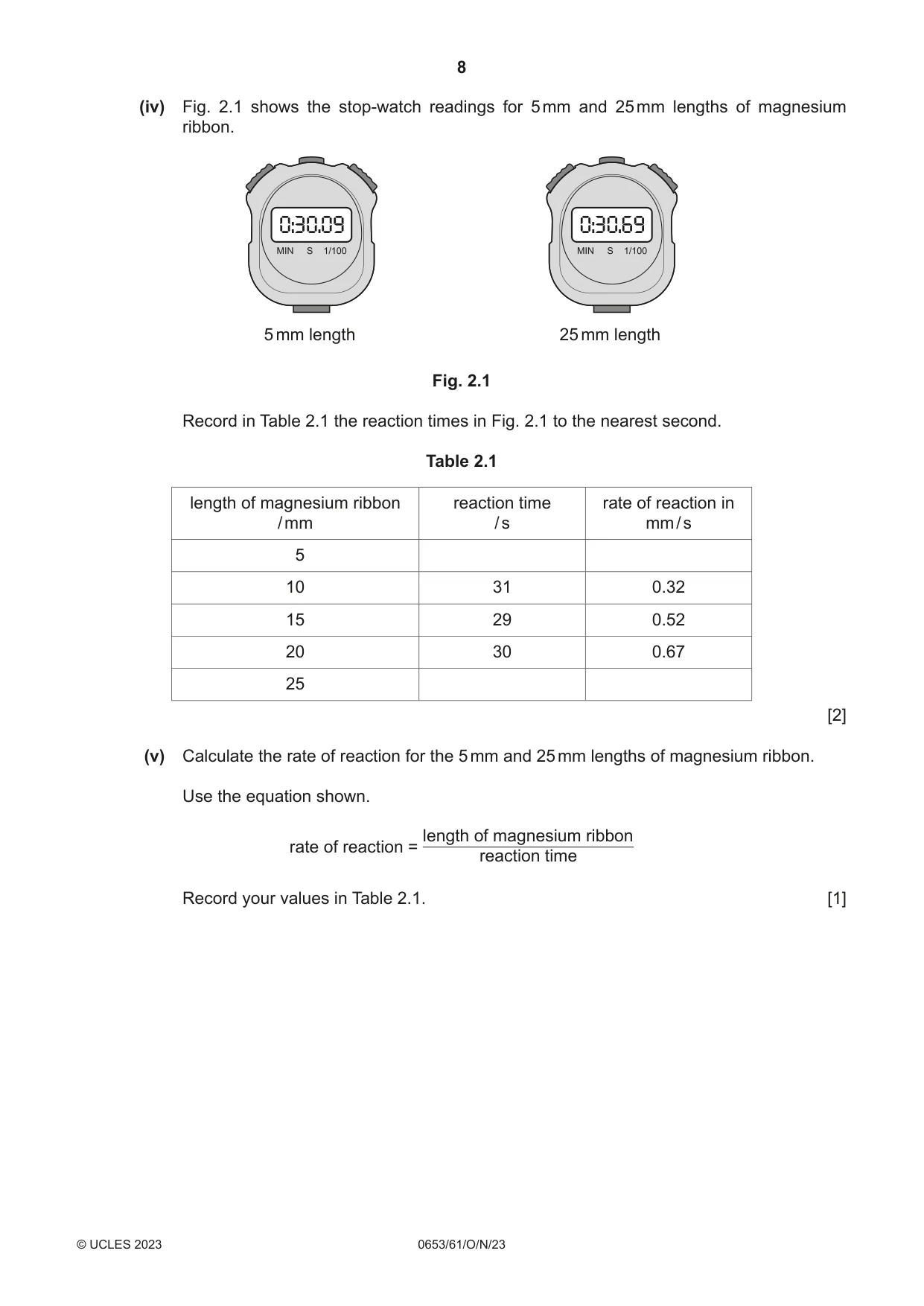
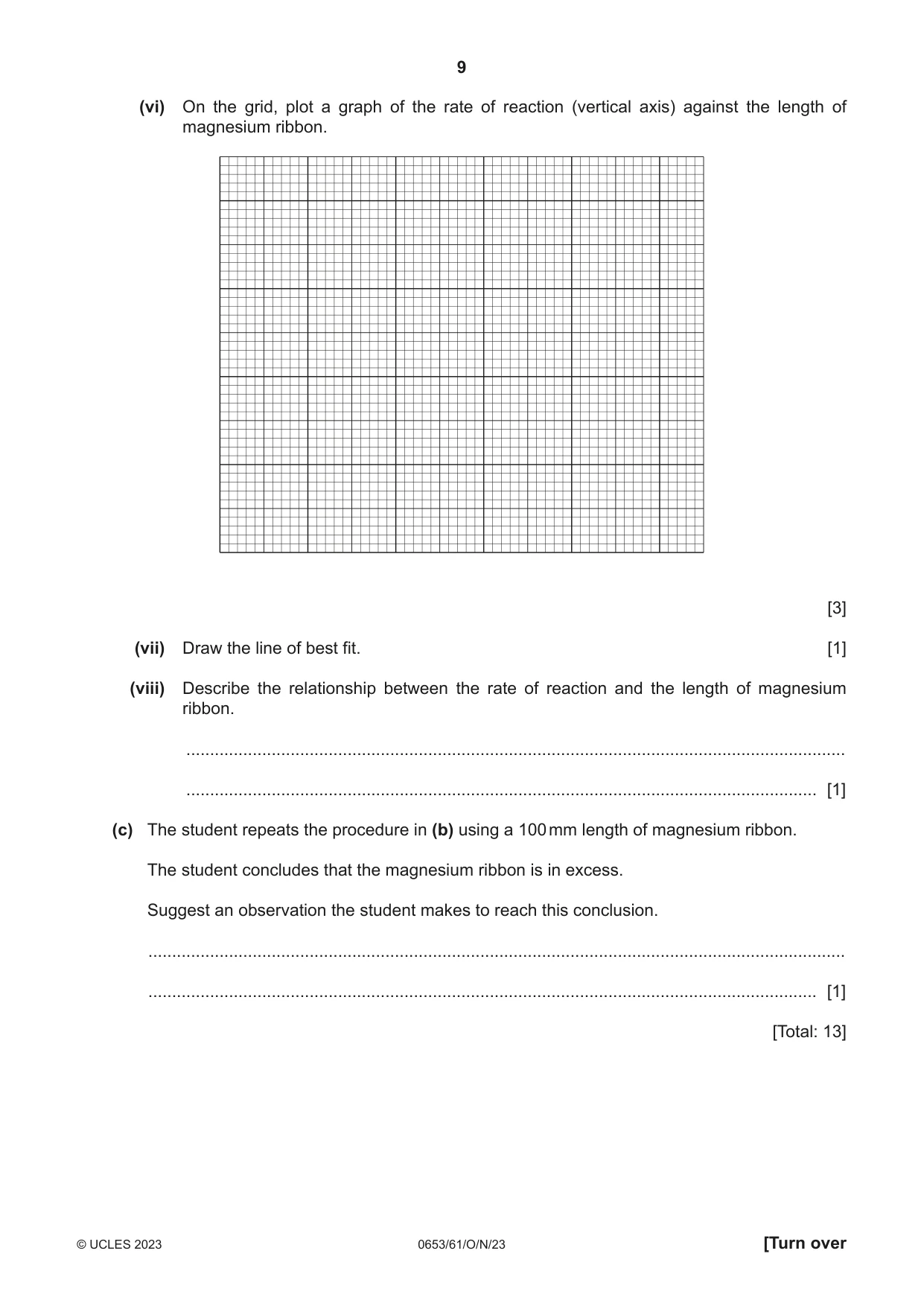
2 (a) When magnesium ribbon is added to dilute hydrochloric acid, the mixture fizzes and makes hydrogen gas. The magnesium ribbon stays on the surface of the acid during the reaction. The reaction is complete when all the magnesium ribbon disappears and the fizzing stops. State the test used to confirm the presence of hydrogen gas and give the observation for a positive result. test ............................................................................................................................................ observation ............................................................................................................................... [1] (b) A student investigates the rate of reaction between magnesium ribbon and dilute hydrochloric acid. Procedure The student: step 1 adds 25 cm3 of dilute hydrochloric acid to a glass beaker step 2 puts a 5 mm length of magnesium ribbon into the dilute hydrochloric acid and immediately starts a stop-watch step 3 uses a glass rod to keep the magnesium ribbon under the surface of the dilute hydrochloric acid but not touching the bottom of the beaker step 4 stops the stop-watch when all the magnesium ribbon has reacted step 5 records in Table 2.1 the reaction time (the time it takes for all the magnesium ribbon to react) to the nearest second step 6 repeats step 1 to step 5 four more times using 10 mm, 15 mm, 20 mm and 25 mm lengths of magnesium ribbon instead of 5 mm. (i) In step 1, the student uses a measuring cylinder to measure 25 cm3 of dilute hydrochloric acid. Suggest one other piece of apparatus suitable for measuring 25 cm3 accurately. ..................................................................................................................................... [1] (ii) Explain the importance of step 3 in the procedure. ........................................................................................................................................... ..................................................................................................................................... [1] (iii) Suggest one source of uncertainty in the measurement of the reaction time. ........................................................................................................................................... ..................................................................................................................................... [1] (iv) Fig. 2.1 shows the stop-watch readings for 5 mm and 25 mm lengths of magnesium ribbon. 0:30.09 0:30.69 5 mm length 25 mm length Fig. 2.1 Record in Table 2.1 the reaction times in Fig. 2.1 to the nearest second. Table 2.1 length of magnesium ribbon reaction time rate of reaction in / mm / s mm / s 5 10 31 0.32 15 29 0.52 20 30 0.67 25 [2] (v) Calculate the rate of reaction for the 5 mm and 25 mm lengths of magnesium ribbon. Use the equation shown. length of magnesium ribbon rate of reaction = reaction time Record your values in Table 2.1. [1] (vi) On the grid, plot a graph of the rate of reaction (vertical axis) against the length of magnesium ribbon. [3] (vii) Draw the line of best fit. [1] (viii) Describe the relationship between the rate of reaction and the length of magnesium ribbon. ........................................................................................................................................... ..................................................................................................................................... [1] (c) The student repeats the procedure in (b) using a 100 mm length of magnesium ribbon. The student concludes that the magnesium ribbon is in excess. Suggest an observation the student makes to reach this conclusion. ................................................................................................................................................... ............................................................................................................................................. [1] [Total: 13]
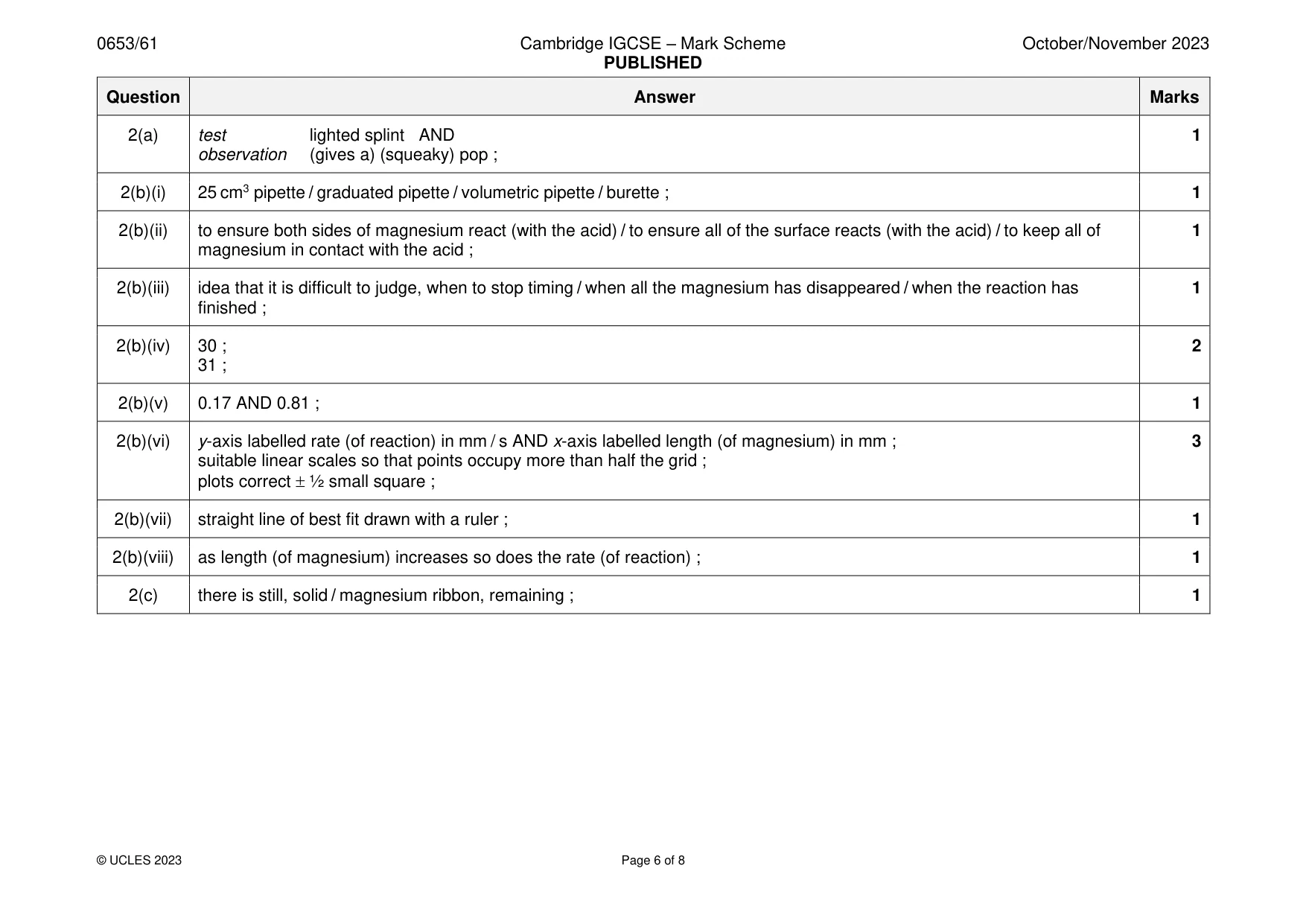
Mark scheme: 2(a) test lighted splint AND 1 observation (gives a) (squeaky) pop ; 2(b)(i) 25 cm3 pipette / graduated pipette / volumetric pipette / burette ; 1 2(b)(ii) to ensure both sides of magnesium react (with the acid) / to ensure all of the surface reacts (with the acid) / to keep all of 1 magnesium in contact with the acid ; 2(b)(iii) idea that it is difficult to judge, when to stop timing / when all the magnesium has disappeared / when the reaction has 1 finished ; 2(b)(iv) 30 ; 2 31 ; 2(b)(v) 0.17 AND 0.81 ; 1 2(b)(vi) y-axis labelled rate (of reaction) in mm / s AND x-axis labelled length (of magnesium) in mm ; 3 suitable linear scales so that points occupy more than half the grid ; plots correct ½ small square ; 2(b)(vii) straight line of best fit drawn with a ruler ; 1 2(b)(viii) as length (of magnesium) increases so does the rate (of reaction) ; 1 2(c) there is still, solid / magnesium ribbon, remaining ; 1
Q3 · A student investigates the reflection of light by a plane mirror
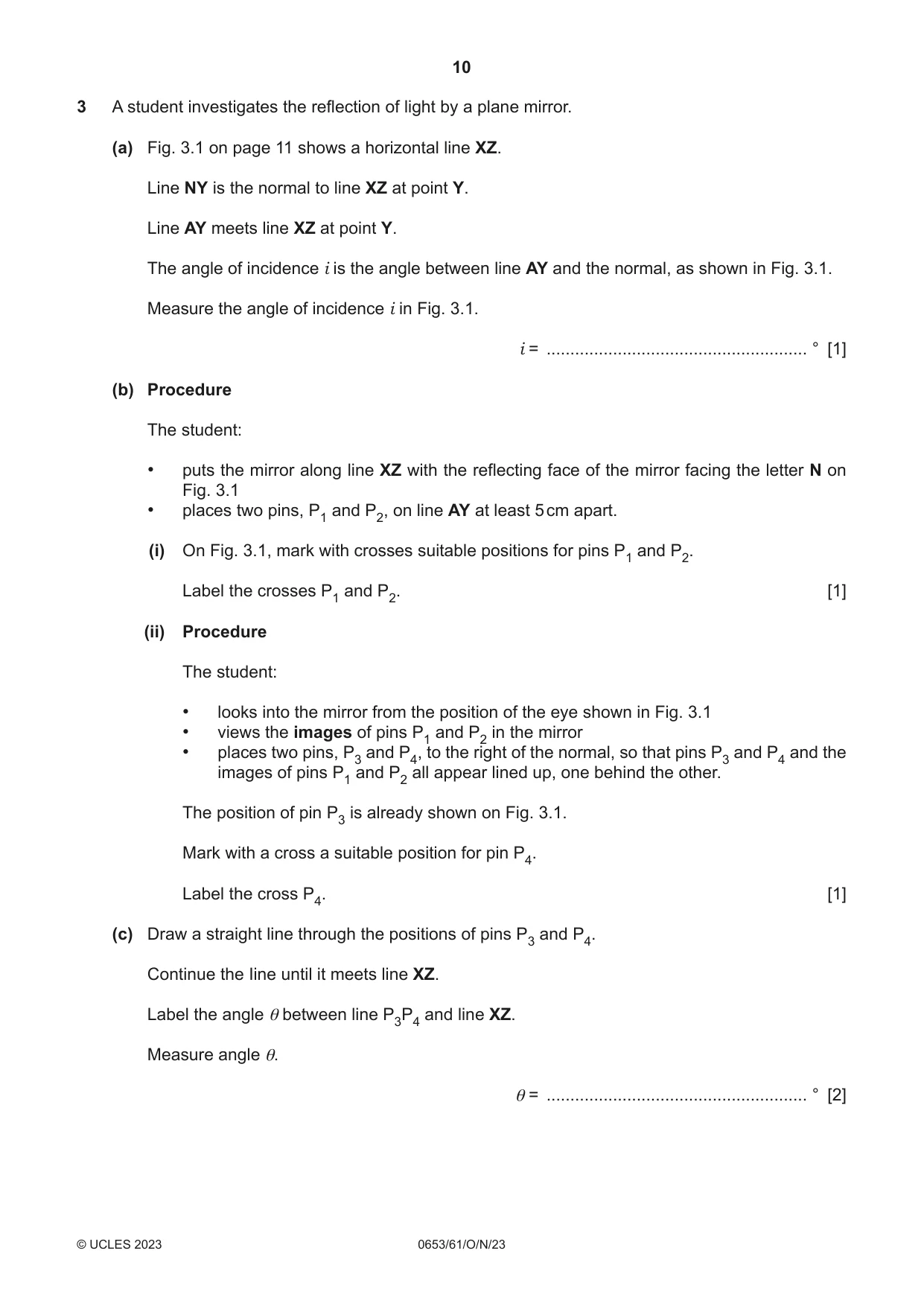
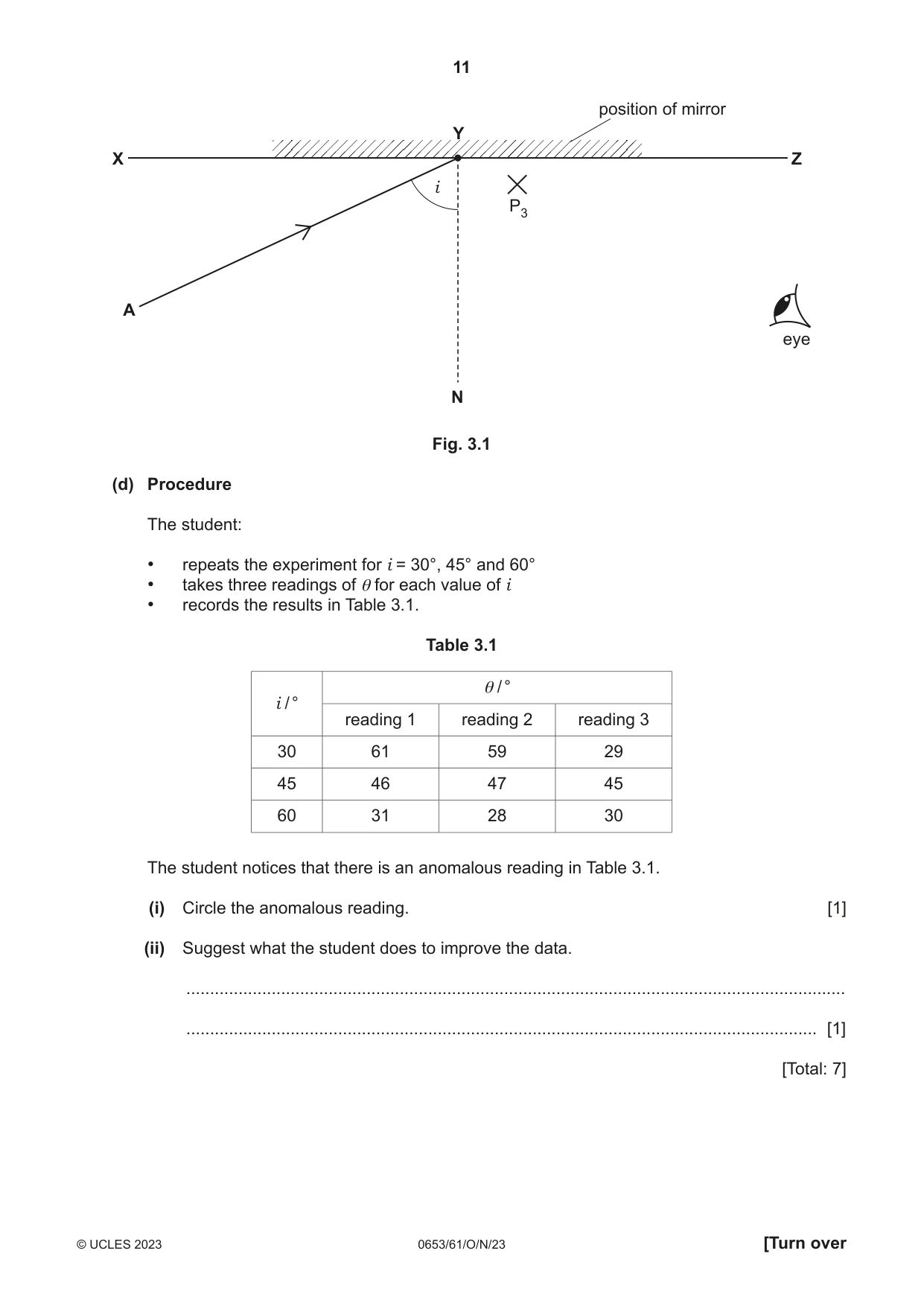
3 A student investigates the reflection of light by a plane mirror. (a) Fig. 3.1 on page 11 shows a horizontal line XZ. Line NY is the normal to line XZ at point Y. Line AY meets line XZ at point Y. The angle of incidence i is the angle between line AY and the normal, as shown in Fig. 3.1. Measure the angle of incidence i in Fig. 3.1. i = ....................................................... ° [1] (b) Procedure The student: • puts the mirror along line XZ with the reflecting face of the mirror facing the letter N on Fig. 3.1 • places two pins, P1 and P2, on line AY at least 5 cm apart. (i) On Fig. 3.1, mark with crosses suitable positions for pins P1 and P2. Label the crosses P1 and P2. [1] (ii) Procedure The student: • looks into the mirror from the position of the eye shown in Fig. 3.1 • views the images of pins P1 and P2 in the mirror • places two pins, P3 and P4, to the right of the normal, so that pins P3 and P4 and the images of pins P1 and P2 all appear lined up, one behind the other. The position of pin P3 is already shown on Fig. 3.1. Mark with a cross a suitable position for pin P4. Label the cross P4. [1] (c) Draw a straight line through the positions of pins P3 and P4. Continue the Iine until it meets line XZ. Label the angle θ between line P3P4 and line XZ. Measure angle θ. θ = ....................................................... ° [2] position of mirror Y X Z i P3 A eye N Fig. 3.1 (d) Procedure The student: • repeats the experiment for i = 30°, 45° and 60° • takes three readings of θ for each value of i • records the results in Table 3.1. Table 3.1 θ / ° i / ° reading 1 reading 2 reading 3 30 61 59 29 45 46 47 45 60 31 28 30 The student notices that there is an anomalous reading in Table 3.1. (i) Circle the anomalous reading. [1] (ii) Suggest what the student does to improve the data. ........................................................................................................................................... ..................................................................................................................................... [1] [Total: 7]
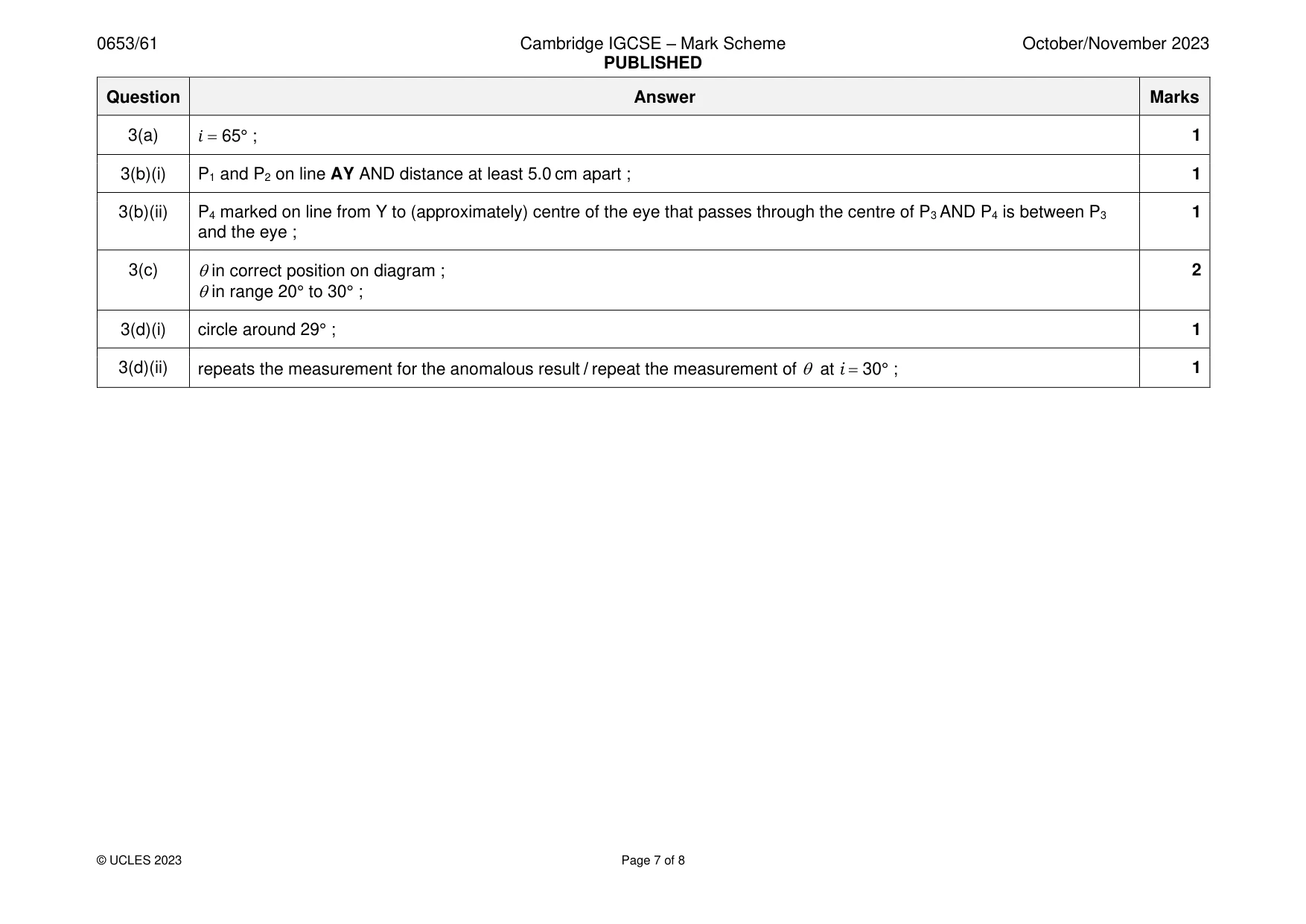
Mark scheme: 3(a) 𝑖 = 65° ; 1 3(b)(i) P1 and P2 on line AY AND distance at least 5.0 cm apart ; 1 3(b)(ii) P4 marked on line from Y to (approximately) centre of the eye that passes through the centre of P3 AND P4 is between P3 1 and the eye ; 3(c) in correct position on diagram ; 2 in range 20° to 30° ; 3(d)(i) circle around 29° ; 1 3(d)(ii) repeats the measurement for the anomalous result / repeat the measurement of at i = 30° ; 1
Q4 · Plan an investigation to determine the relationship between the temperature of apple…
4 Plan an investigation to determine the relationship between the temperature of apple juice and the time it takes for ice cubes to melt when added to it. You are provided with: • ice cubes of different shapes and sizes • a supply of apple juice • beakers. You may use any other common laboratory apparatus. In your plan, include: • any other apparatus you will need • a brief description of the method, including what you will measure and how you will make sure your measurements are accurate • the variables you will control • a results table to record your measurements (you are not required to enter any readings in the table) • how you will process your results to draw a conclusion. You may include a labelled diagram if you wish. .......................................................................................................................................................... .......................................................................................................................................................... .......................................................................................................................................................... .......................................................................................................................................................... .......................................................................................................................................................... .......................................................................................................................................................... .......................................................................................................................................................... .......................................................................................................................................................... .......................................................................................................................................................... .......................................................................................................................................................... .......................................................................................................................................................... .......................................................................................................................................................... .......................................................................................................................................................... .......................................................................................................................................................... .......................................................................................................................................................... .................................................................................................................................................... [7]
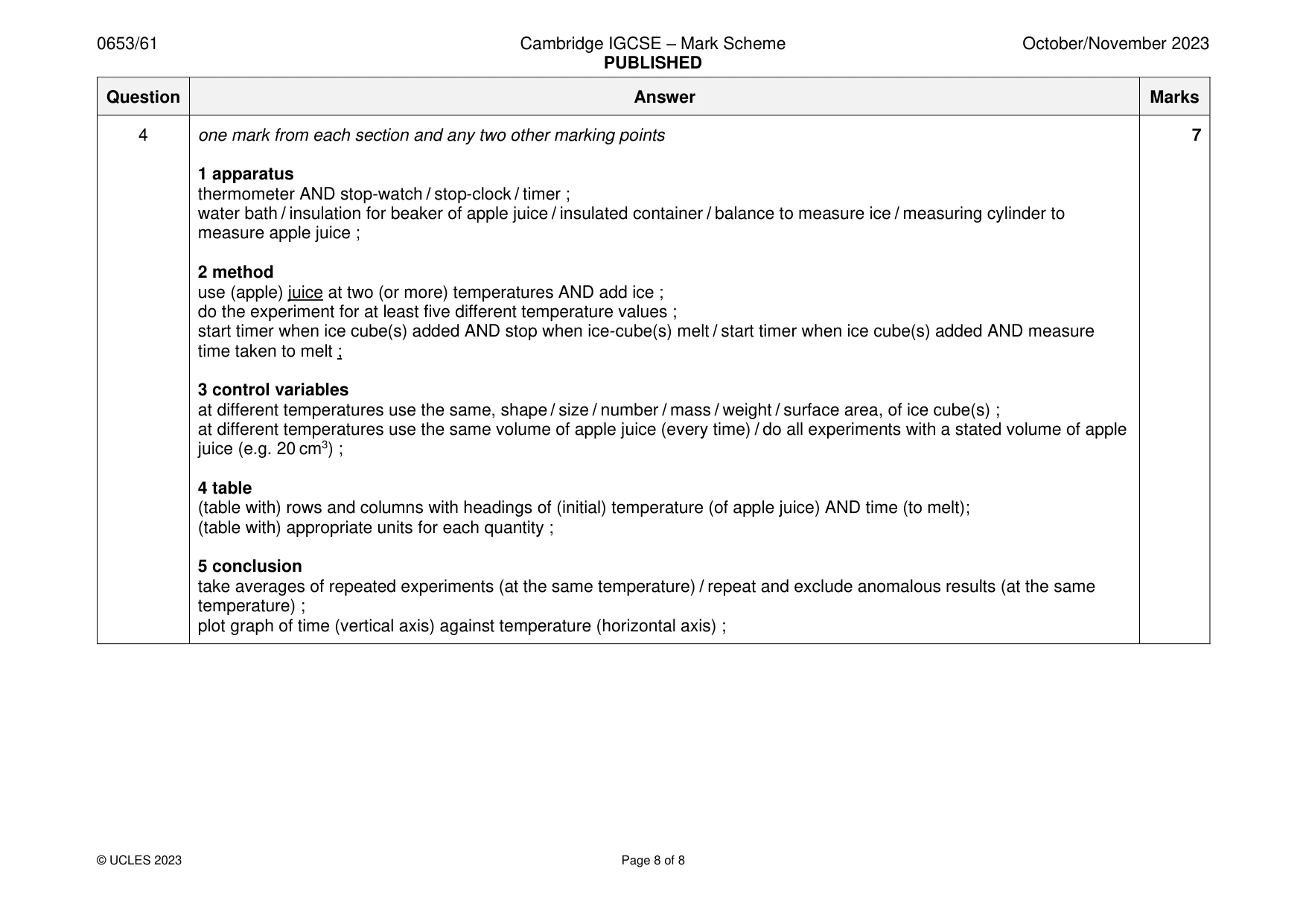
Mark scheme: 4 one mark from each section and any two other marking points 7 1 apparatus thermometer AND stop-watch / stop-clock / timer ; water bath / insulation for beaker of apple juice / insulated container / balance to measure ice / measuring cylinder to measure apple juice ; 2 method use (apple) juice at two (or more) temperatures AND add ice ; do the experiment for at least five different temperature values ; start timer when ice cube(s) added AND stop when ice-cube(s) melt / start timer when ice cube(s) added AND measure time taken to melt ; 3 control variables at different temperatures use the same, shape / size / number / mass / weight / surface area, of ice cube(s) ; at different temperatures use the same volume of apple juice (every time) / do all experiments with a stated volume of apple juice (e.g. 20 cm3) ; 4 table (table with) rows and columns with headings of (initial) temperature (of apple juice) AND time (to melt); (table with) appropriate units for each quantity ; 5 conclusion take averages of repeated experiments (at the same temperature) / repeat and exclude anomalous results (at the same temperature) ; plot graph of time (vertical axis) against temperature (horizontal axis) ;
What was in this paper
The subtopics covered by these 4 questions, and how many questions each got. Open one in a new tab to see every Cambridge question on it.
What you needed in this session
Cambridge’s own grade thresholds for 2023 Oct/Nov, Paper 6 · Variant 1. A higher threshold means an easier paper — the bar moves with how the cohort did.