Cambridge IGCSE Science - Combined 0653 — 2022 Oct/Nov Paper 6 · Variant 1
0653/61/O/N/22 · 4 questions · 40 marks · ≈45 min
The question paper and its mark scheme, free to read here and free to download. This is Cambridge’s own paper, exactly as it was sat.
Question paper16 pages

Mark scheme8 pages
Answers below. Sit the paper first if you are practising.
Questions as text
Q1 · A student investigates the effect of temperature on the rate of respiration in yeast cells
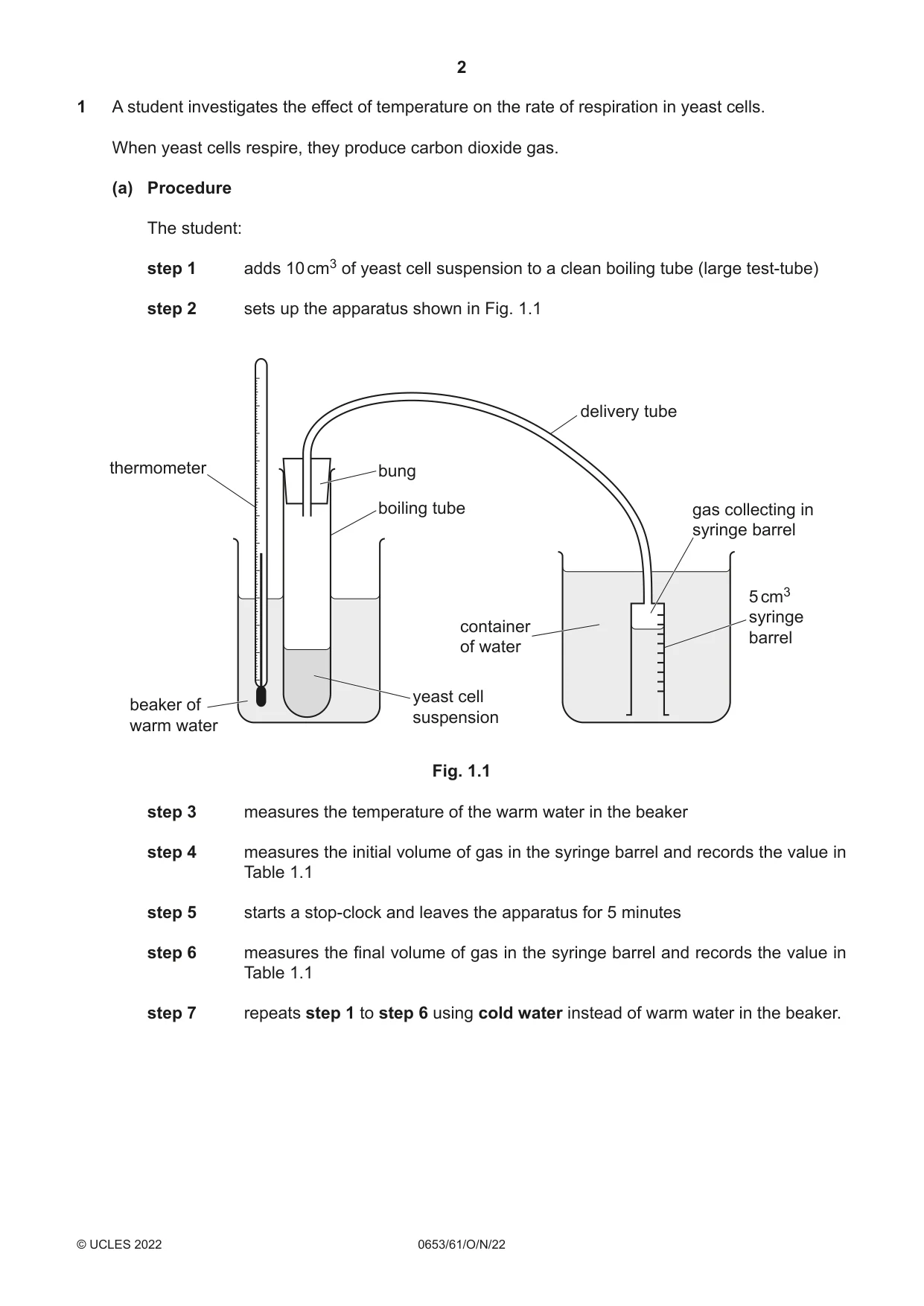
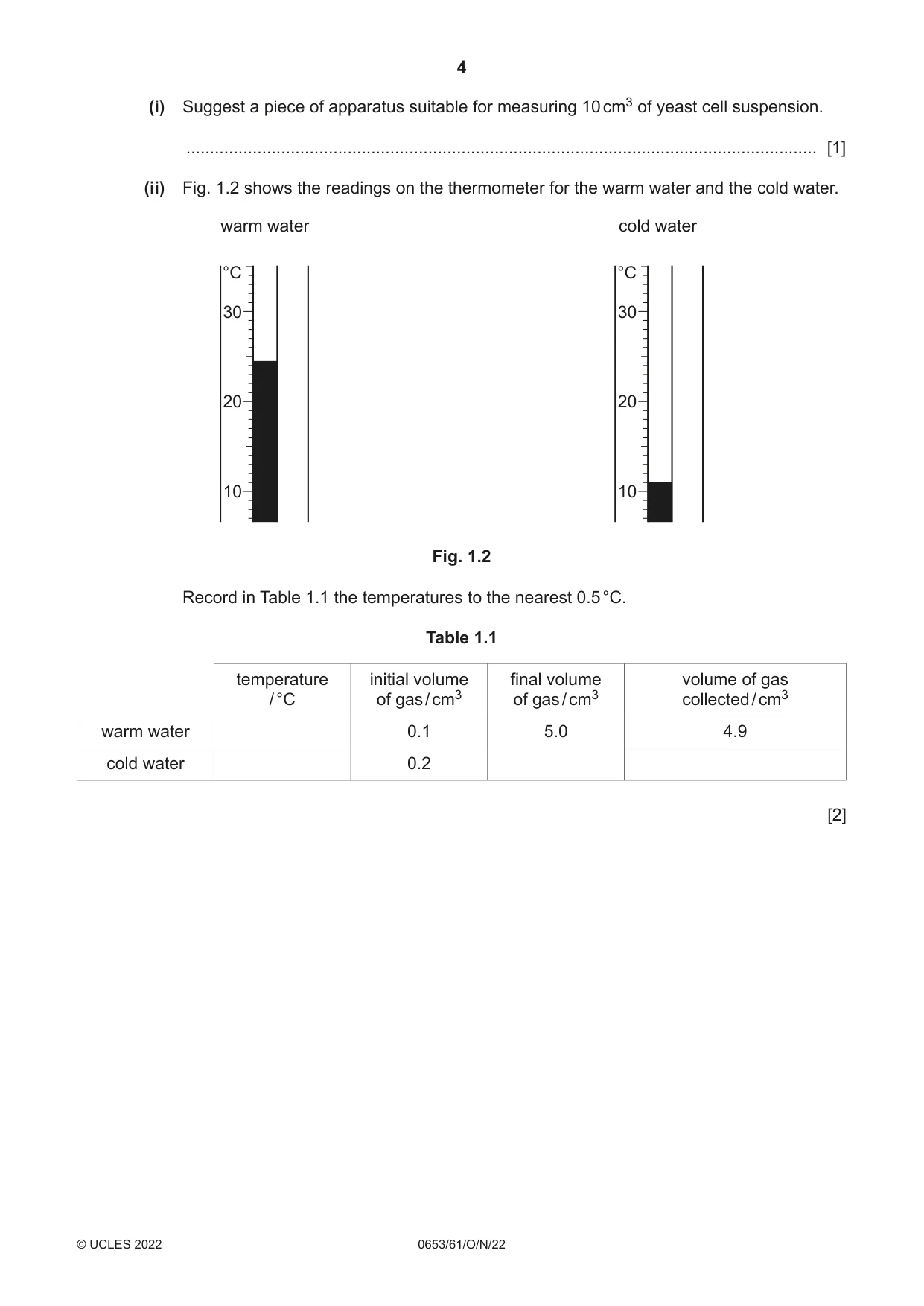
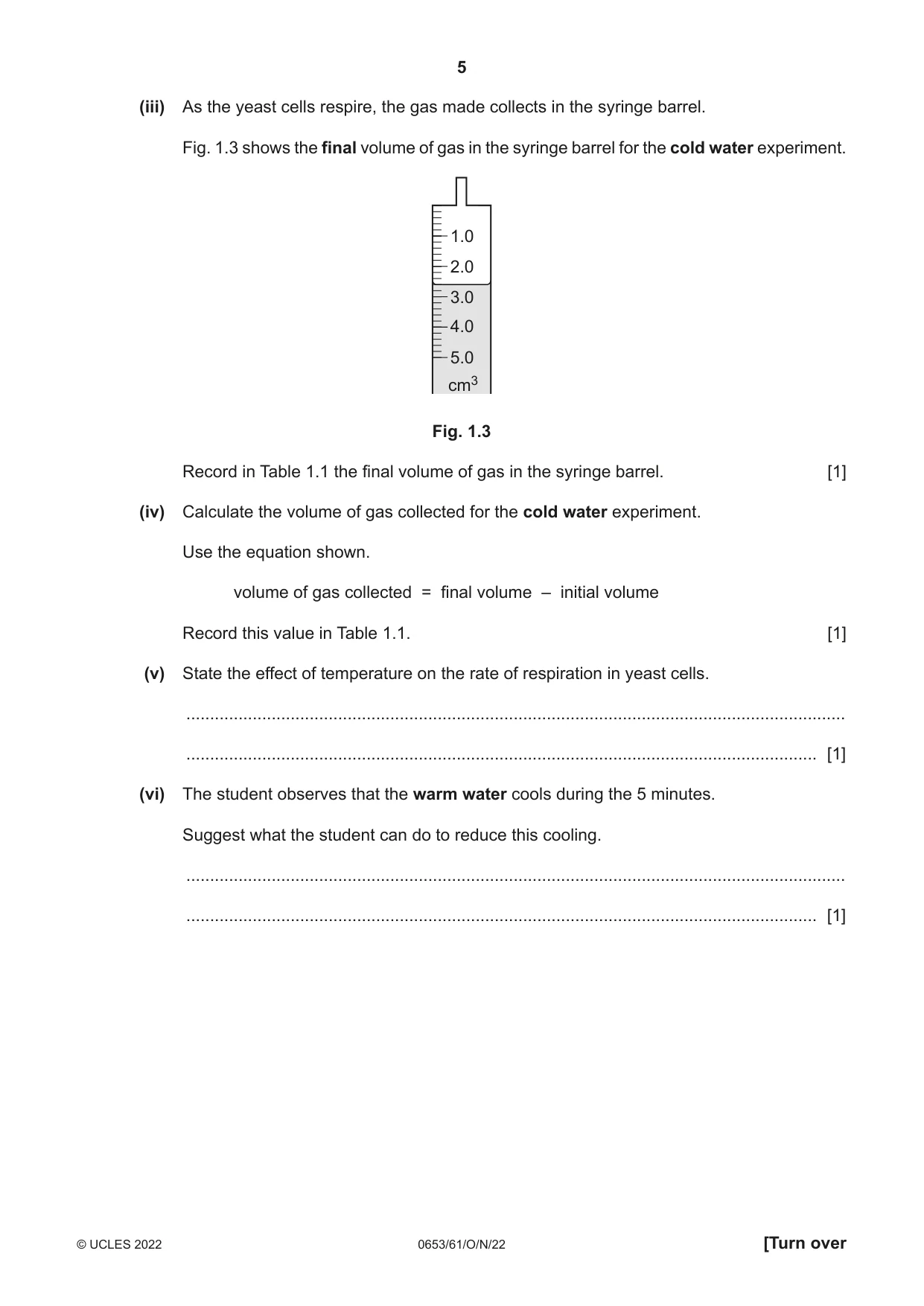
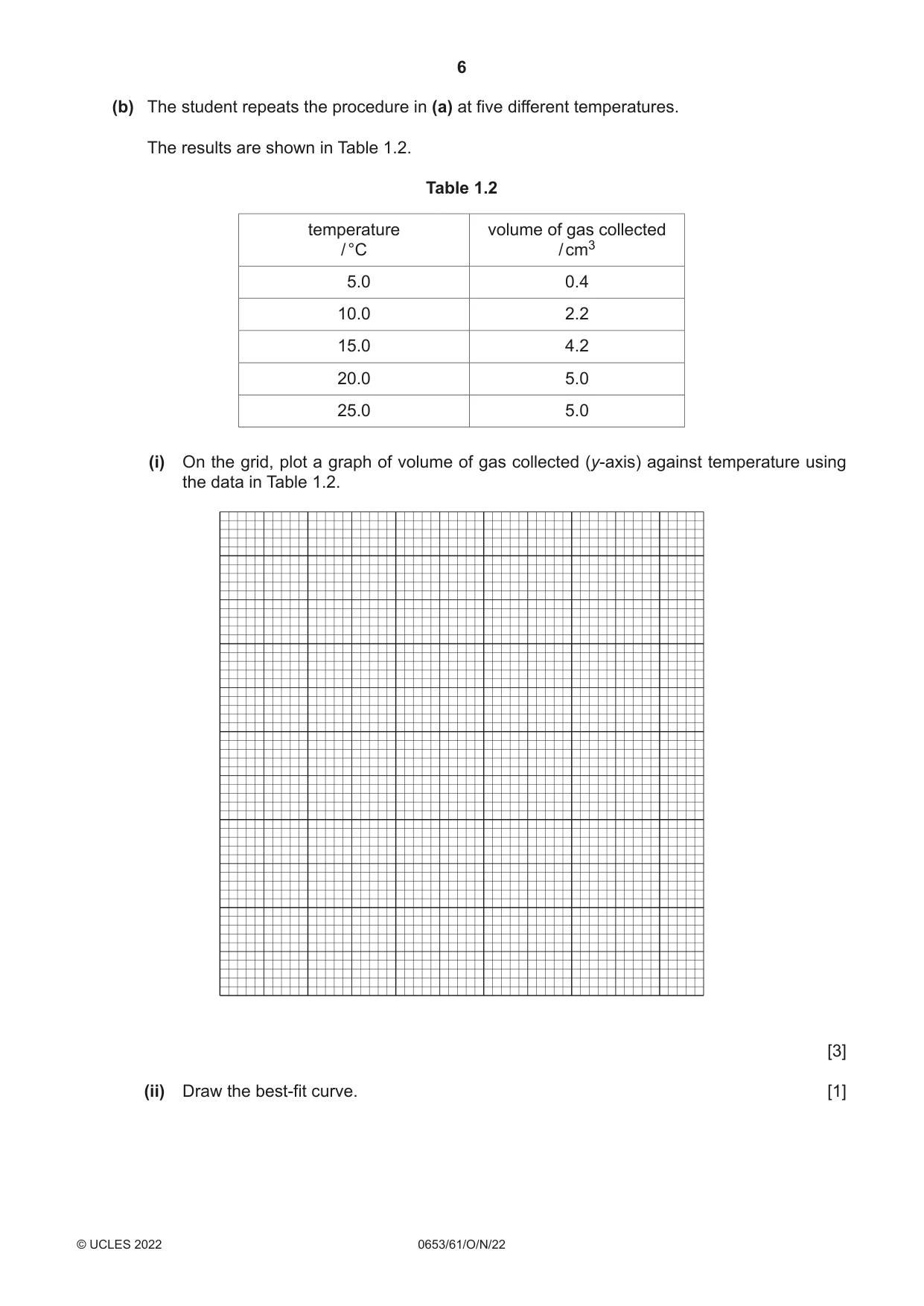
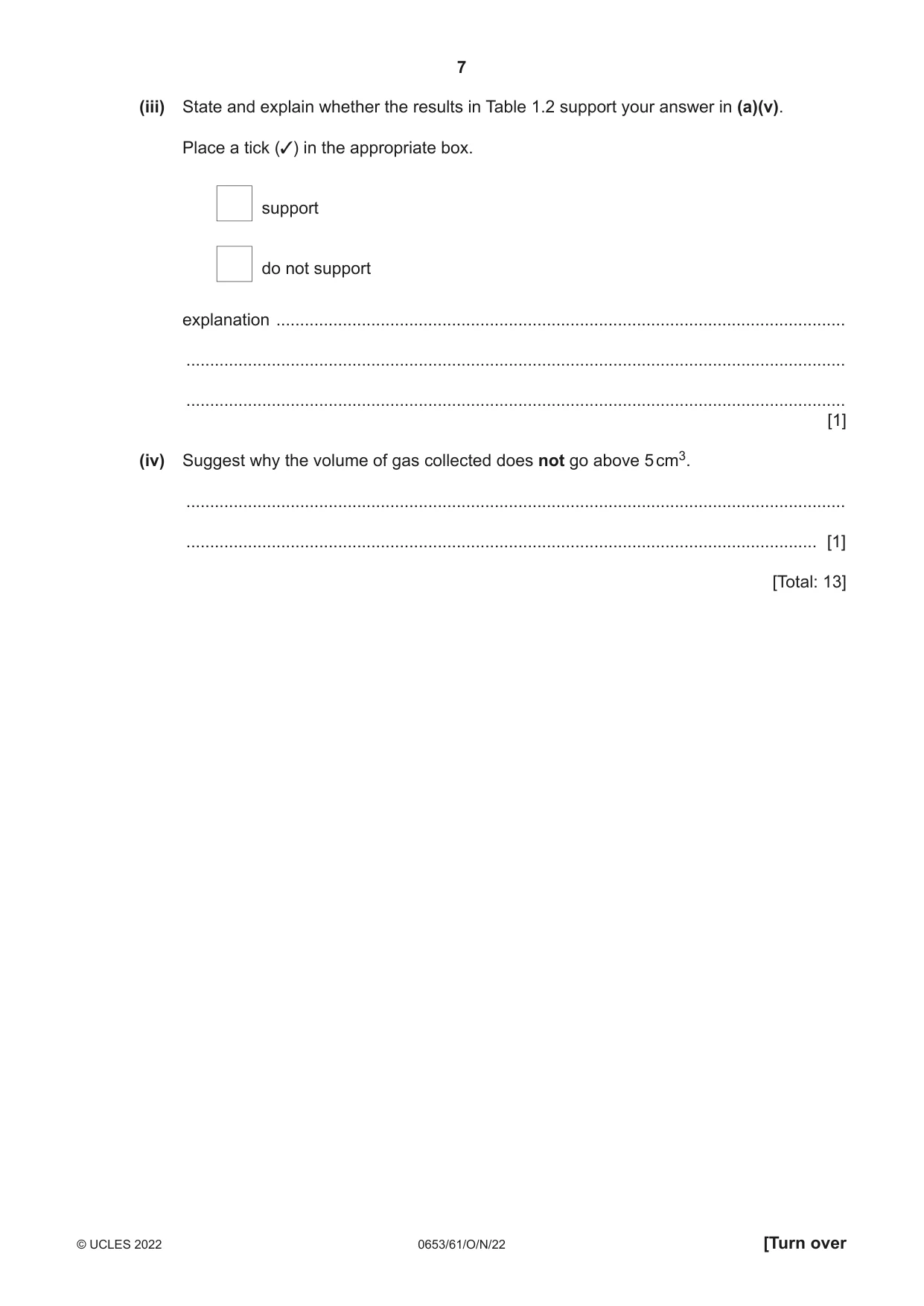
1 A student investigates the effect of temperature on the rate of respiration in yeast cells. When yeast cells respire, they produce carbon dioxide gas. (a) Procedure The student: step 1 adds 10 cm3 of yeast cell suspension to a clean boiling tube (large test-tube) step 2 sets up the apparatus shown in Fig. 1.1 delivery tube thermometer bung boiling tube gas collecting in syringe barrel 5 cm3 syringe container barrel of water yeast cell beaker of suspension warm water Fig. 1.1 step 3 measures the temperature of the warm water in the beaker step 4 measures the initial volume of gas in the syringe barrel and records the value in Table 1.1 step 5 starts a stop-clock and leaves the apparatus for 5 minutes step 6 measures the final volume of gas in the syringe barrel and records the value in Table 1.1 step 7 repeats step 1 to step 6 using cold water instead of warm water in the beaker. (i) Suggest a piece of apparatus suitable for measuring 10 cm3 of yeast cell suspension. ..................................................................................................................................... [1] (ii) Fig. 1.2 shows the readings on the thermometer for the warm water and the cold water. warm water cold water °C °C 30 30 20 20 10 10 Fig. 1.2 Record in Table 1.1 the temperatures to the nearest 0.5 °C. Table 1.1 temperature initial volume final volume volume of gas / °C of gas / cm3 of gas / cm3 collected / cm3 warm water 0.1 5.0 4.9 cold water 0.2 [2] (iii) As the yeast cells respire, the gas made collects in the syringe barrel. Fig. 1.3 shows the final volume of gas in the syringe barrel for the cold water experiment. 1.0 2.0 3.0 4.0 5.0 cm3 Fig. 1.3 Record in Table 1.1 the final volume of gas in the syringe barrel. [1] (iv) Calculate the volume of gas collected for the cold water experiment. Use the equation shown. volume of gas collected = final volume – initial volume Record this value in Table 1.1. [1] (v) State the effect of temperature on the rate of respiration in yeast cells. ........................................................................................................................................... ..................................................................................................................................... [1] (vi) The student observes that the warm water cools during the 5 minutes. Suggest what the student can do to reduce this cooling. ........................................................................................................................................... ..................................................................................................................................... [1] (b) The student repeats the procedure in (a) at five different temperatures. The results are shown in Table 1.2. Table 1.2 temperature volume of gas collected / °C / cm3 5.0 0.4 10.0 2.2 15.0 4.2 20.0 5.0 25.0 5.0 (i) On the grid, plot a graph of volume of gas collected (y-axis) against temperature using the data in Table 1.2. [3] (ii) Draw the best-fit curve. [1] (iii) State and explain whether the results in Table 1.2 support your answer in (a)(v). Place a tick (3) in the appropriate box. support do not support explanation ........................................................................................................................ ........................................................................................................................................... ........................................................................................................................................... [1] (iv) Suggest why the volume of gas collected does not go above 5 cm3. ........................................................................................................................................... ..................................................................................................................................... [1] [Total: 13]
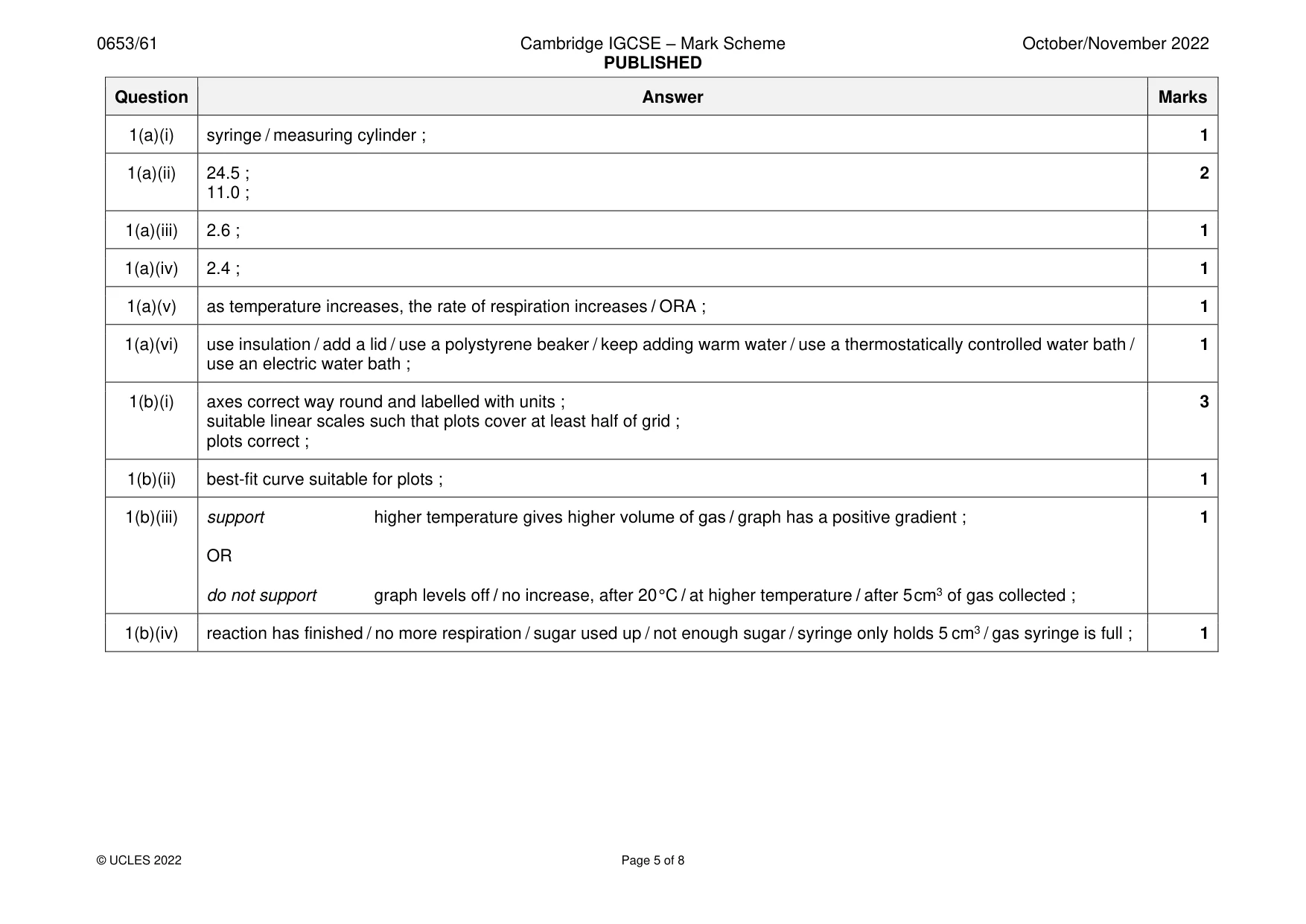
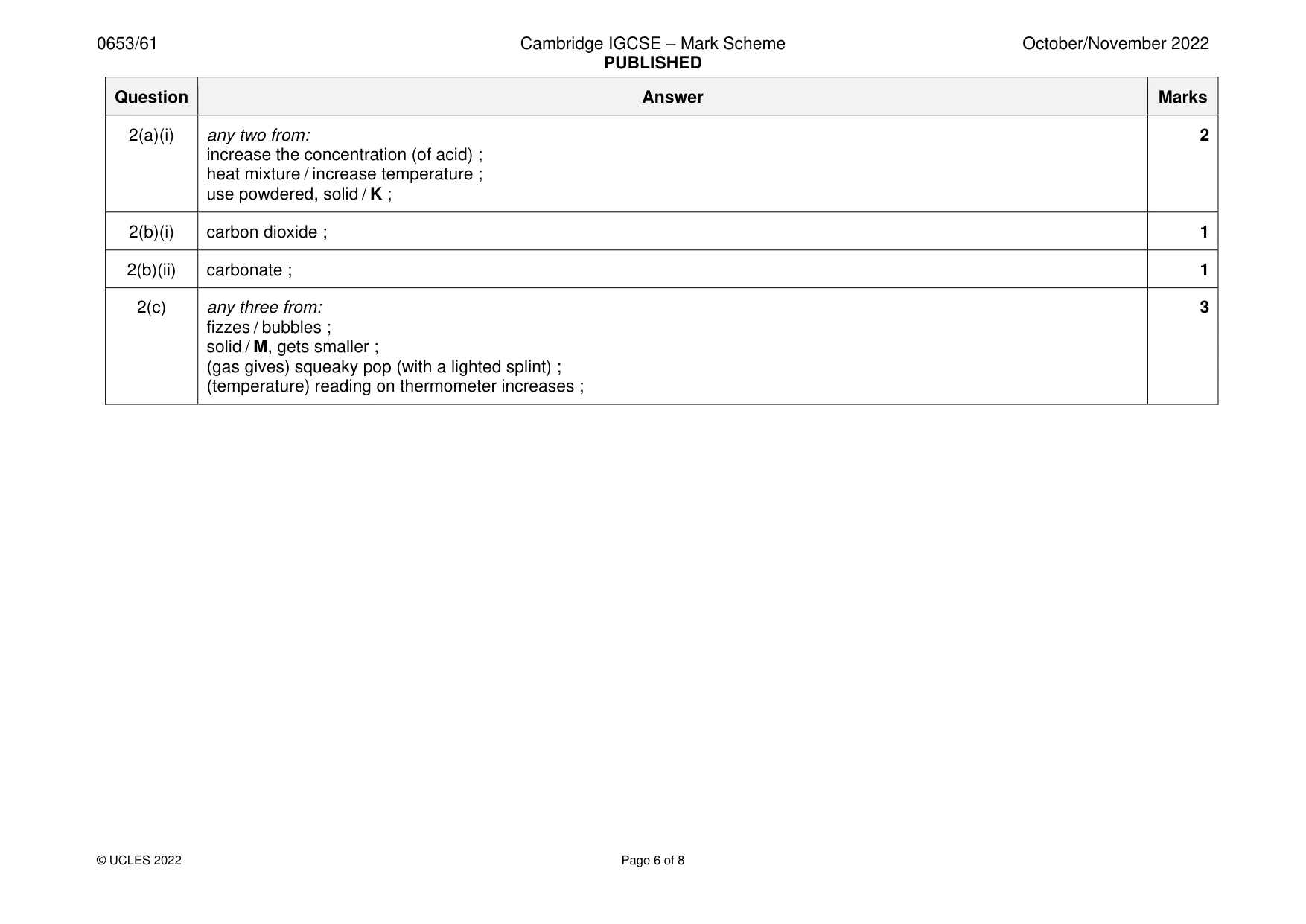
Mark scheme: Question Answer Marks 1(a)(i) syringe / measuring cylinder ; 1 1(a)(ii) 24.5 ; 2 11.0 ; 1(a)(iii) 2.6 ; 1 1(a)(iv) 2.4 ; 1 1(a)(v) as temperature increases, the rate of respiration increases / ORA ; 1 1(a)(vi) use insulation / add a lid / use a polystyrene beaker / keep adding warm water / use a thermostatically controlled water bath / 1 use an electric water bath ; 1(b)(i) axes correct way round and labelled with units ; 3 suitable linear scales such that plots cover at least half of grid ; plots correct ; 1(b)(ii) best-fit curve suitable for plots ; 1 1(b)(iii) support higher temperature gives higher volume of gas / graph has a positive gradient ; 1 OR do not support graph levels off / no increase, after 20 °C / at higher temperature / after 5 cm3 of gas collected ; 1(b)(iv) reaction has finished / no more respiration / sugar used up / not enough sugar / syringe only holds 5 cm3 / gas syringe is full ; 1
Q2 · A student investigates the reaction of dilute hydrochloric acid with three solids, K, L…
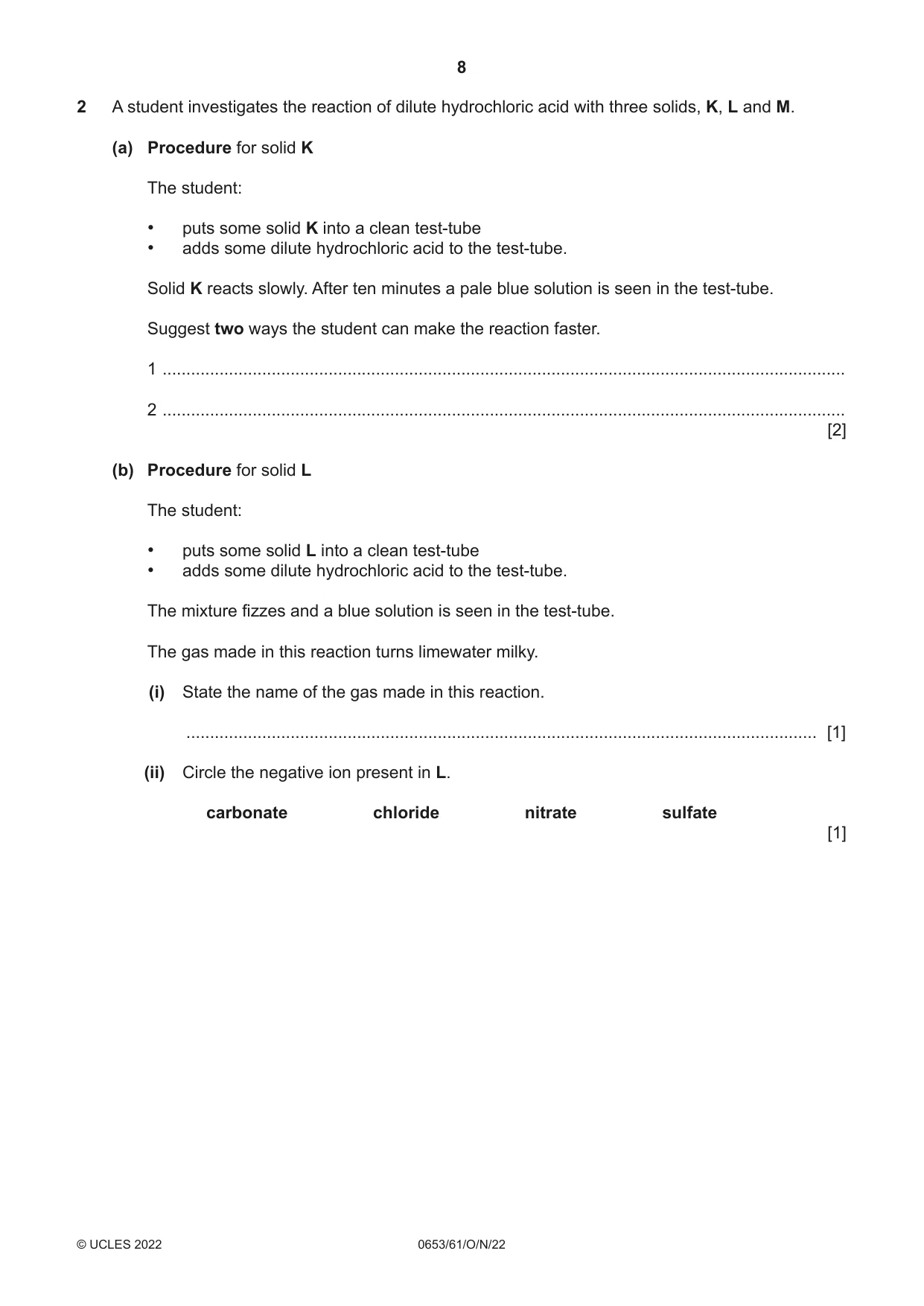
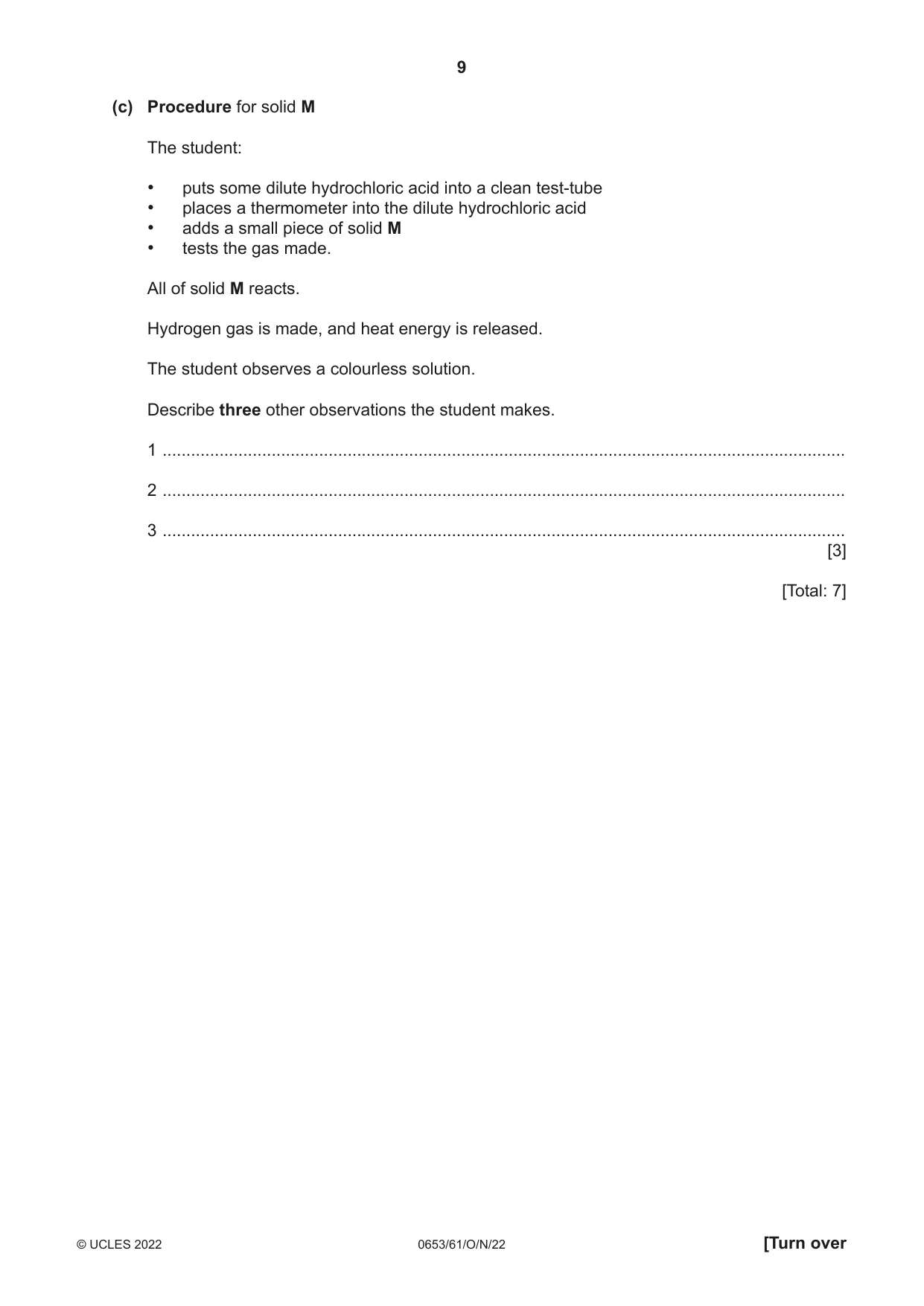
2 A student investigates the reaction of dilute hydrochloric acid with three solids, K, L and M. (a) Procedure for solid K The student: • puts some solid K into a clean test-tube • adds some dilute hydrochloric acid to the test-tube. Solid K reacts slowly. After ten minutes a pale blue solution is seen in the test-tube. Suggest two ways the student can make the reaction faster. 1 ................................................................................................................................................ 2 ................................................................................................................................................ [2] (b) Procedure for solid L The student: • puts some solid L into a clean test-tube • adds some dilute hydrochloric acid to the test-tube. The mixture fizzes and a blue solution is seen in the test-tube. The gas made in this reaction turns limewater milky. (i) State the name of the gas made in this reaction. ..................................................................................................................................... [1] (ii) Circle the negative ion present in L. carbonate chloride nitrate sulfate [1] (c) Procedure for solid M The student: • puts some dilute hydrochloric acid into a clean test-tube • places a thermometer into the dilute hydrochloric acid • adds a small piece of solid M • tests the gas made. All of solid M reacts. Hydrogen gas is made, and heat energy is released. The student observes a colourless solution. Describe three other observations the student makes. 1 ................................................................................................................................................ 2 ................................................................................................................................................ 3 ................................................................................................................................................ [3] [Total: 7]
Mark scheme: 2(a)(i) any two from: 2 increase the concentration (of acid) ; heat mixture / increase temperature ; use powdered, solid / K ; 2(b)(i) carbon dioxide ; 1 2(b)(ii) carbonate ; 1 2(c) any three from: 3 fizzes / bubbles ; solid / M, gets smaller ; (gas gives) squeaky pop (with a lighted splint) ; (temperature) reading on thermometer increases ;
Q3 · Aqueous hydrogen peroxide is a colourless solution that decomposes to make water and…
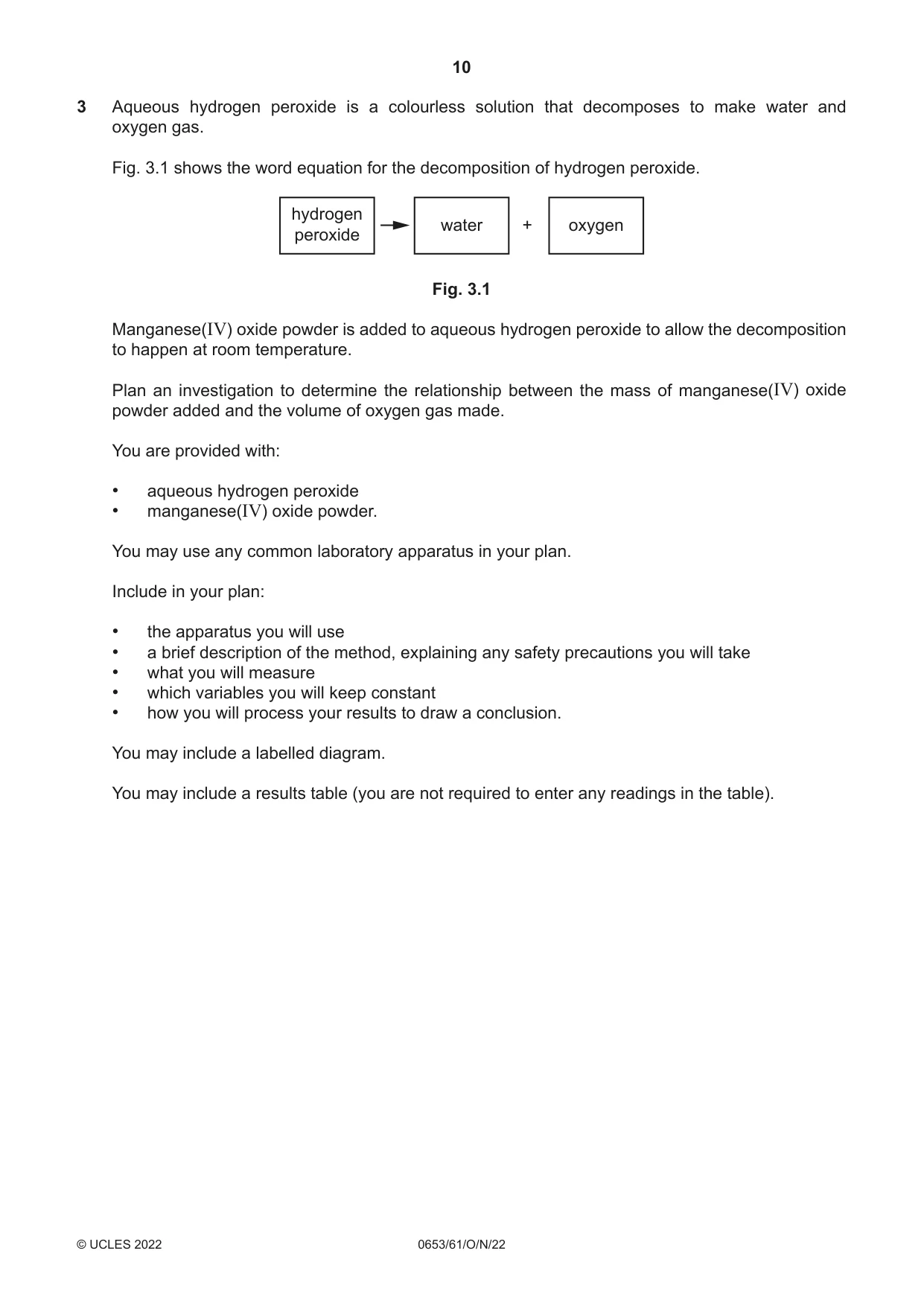
3 Aqueous hydrogen peroxide is a colourless solution that decomposes to make water and oxygen gas. Fig. 3.1 shows the word equation for the decomposition of hydrogen peroxide. hydrogen water + oxygen peroxide Fig. 3.1 Manganese(IV) oxide powder is added to aqueous hydrogen peroxide to allow the decomposition to happen at room temperature. Plan an investigation to determine the relationship between the mass of manganese(IV) oxide powder added and the volume of oxygen gas made. You are provided with: • aqueous hydrogen peroxide • manganese(IV) oxide powder. You may use any common laboratory apparatus in your plan. Include in your plan: • the apparatus you will use • a brief description of the method, explaining any safety precautions you will take • what you will measure • which variables you will keep constant • how you will process your results to draw a conclusion. You may include a labelled diagram. You may include a results table (you are not required to enter any readings in the table). .......................................................................................................................................................... .......................................................................................................................................................... .......................................................................................................................................................... .......................................................................................................................................................... .......................................................................................................................................................... .......................................................................................................................................................... .......................................................................................................................................................... .......................................................................................................................................................... .......................................................................................................................................................... .......................................................................................................................................................... .......................................................................................................................................................... .......................................................................................................................................................... .......................................................................................................................................................... .......................................................................................................................................................... .......................................................................................................................................................... .................................................................................................................................................... [7]
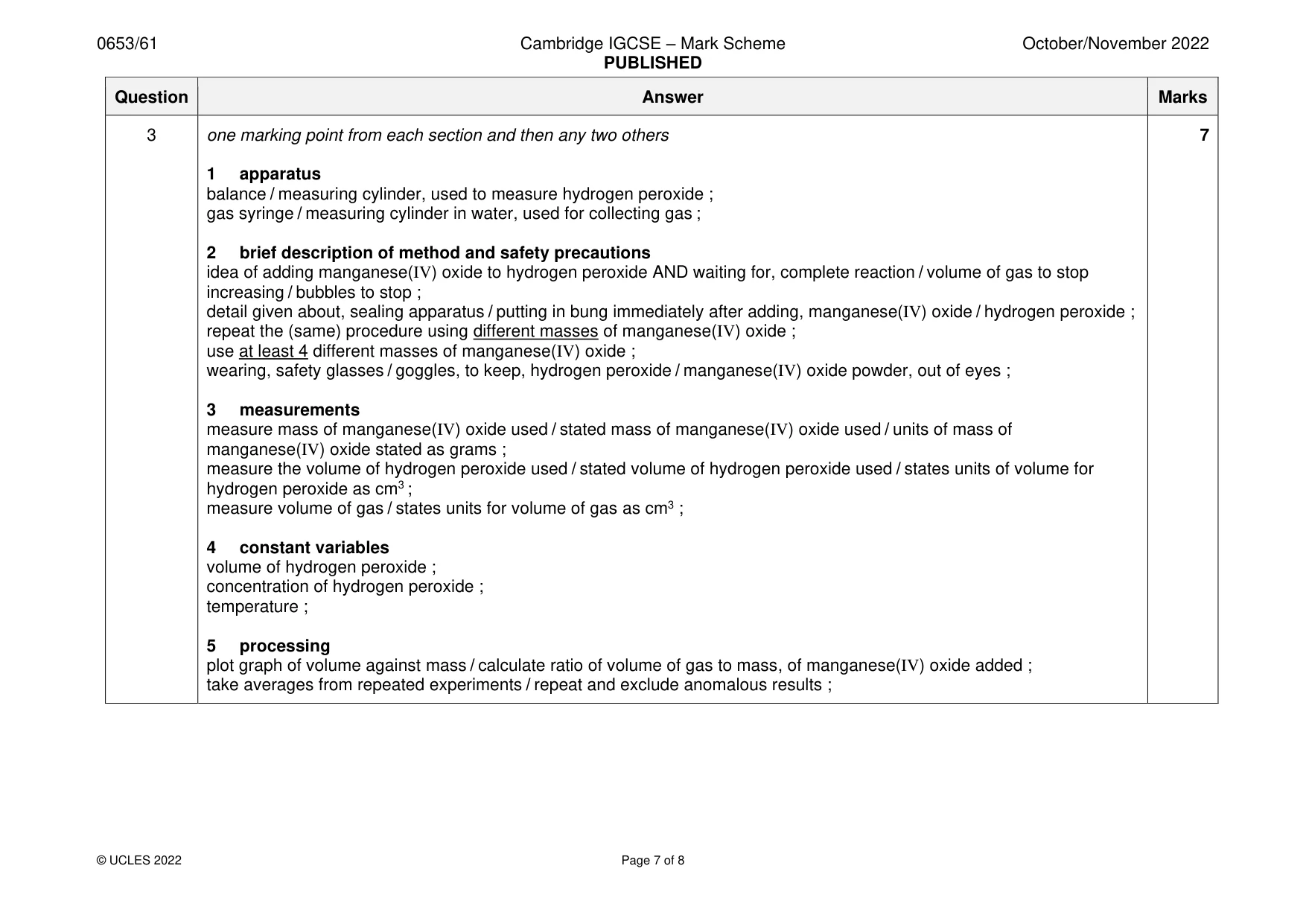
Mark scheme: 3 one marking point from each section and then any two others 7 1 apparatus balance / measuring cylinder, used to measure hydrogen peroxide ; gas syringe / measuring cylinder in water, used for collecting gas ; 2 brief description of method and safety precautions idea of adding manganese(IV) oxide to hydrogen peroxide AND waiting for, complete reaction / volume of gas to stop increasing / bubbles to stop ; detail given about, sealing apparatus / putting in bung immediately after adding, manganese(IV) oxide / hydrogen peroxide ; repeat the (same) procedure using different masses of manganese(IV) oxide ; use at least 4 different masses of manganese(IV) oxide ; wearing, safety glasses / goggles, to keep, hydrogen peroxide / manganese(IV) oxide powder, out of eyes ; 3 measurements measure mass of manganese(IV) oxide used / stated mass of manganese(IV) oxide used / units of mass of manganese(IV) oxide stated as grams ; measure the volume of hydrogen peroxide used / stated volume of hydrogen peroxide used / states units of volume for hydrogen peroxide as cm3 ; measure volume of gas / states units for volume of gas as cm3 ; 4 constant variables volume of hydrogen peroxide ; concentration of hydrogen peroxide ; temperature ; 5 processing plot graph of volume against mass / calculate ratio of volume of gas to mass, of manganese(IV) oxide added ; take averages from repeated experiments / repeat and exclude anomalous results ;
Q4 · A student uses a balancing method to determine the mass of a metre rule
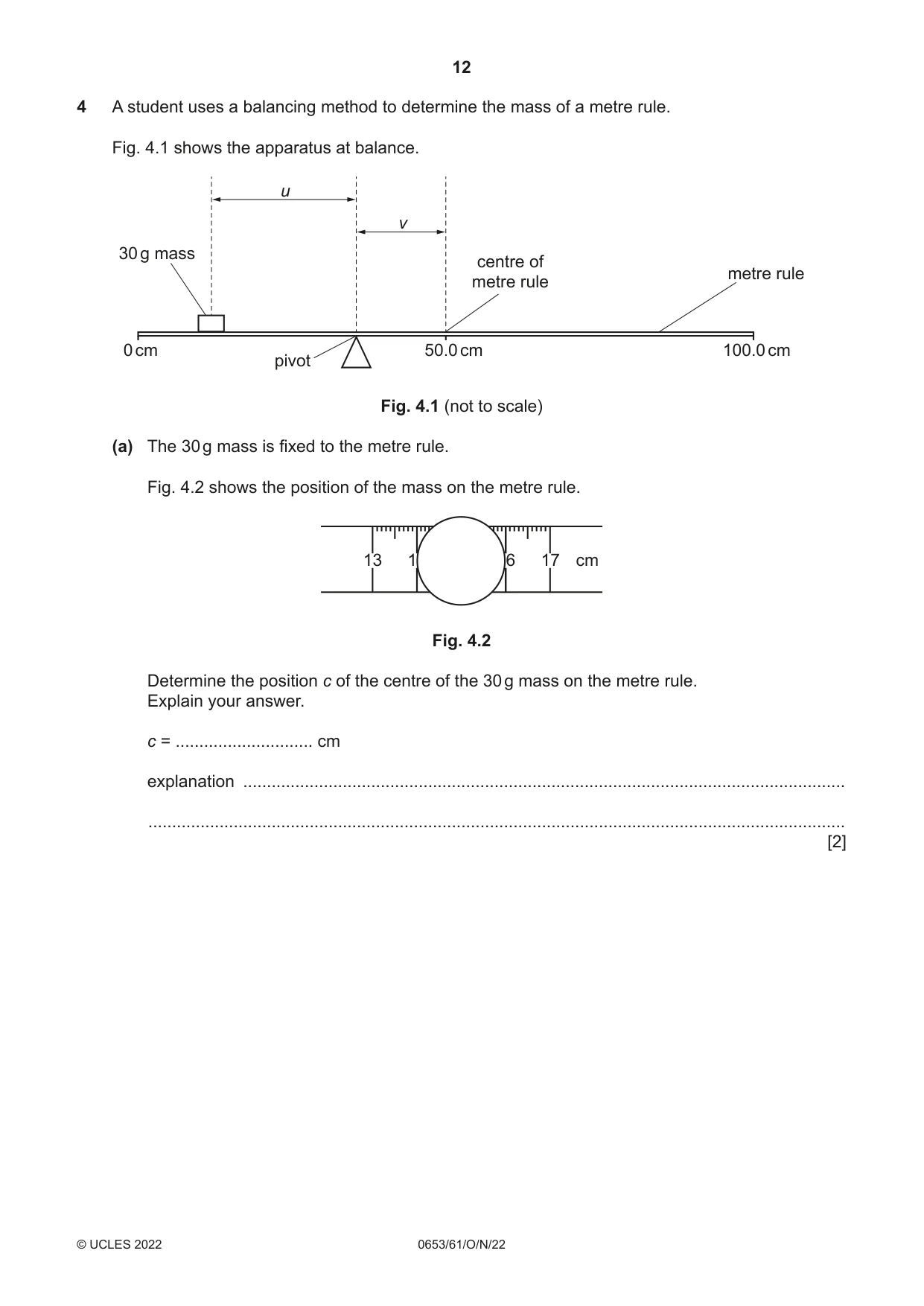
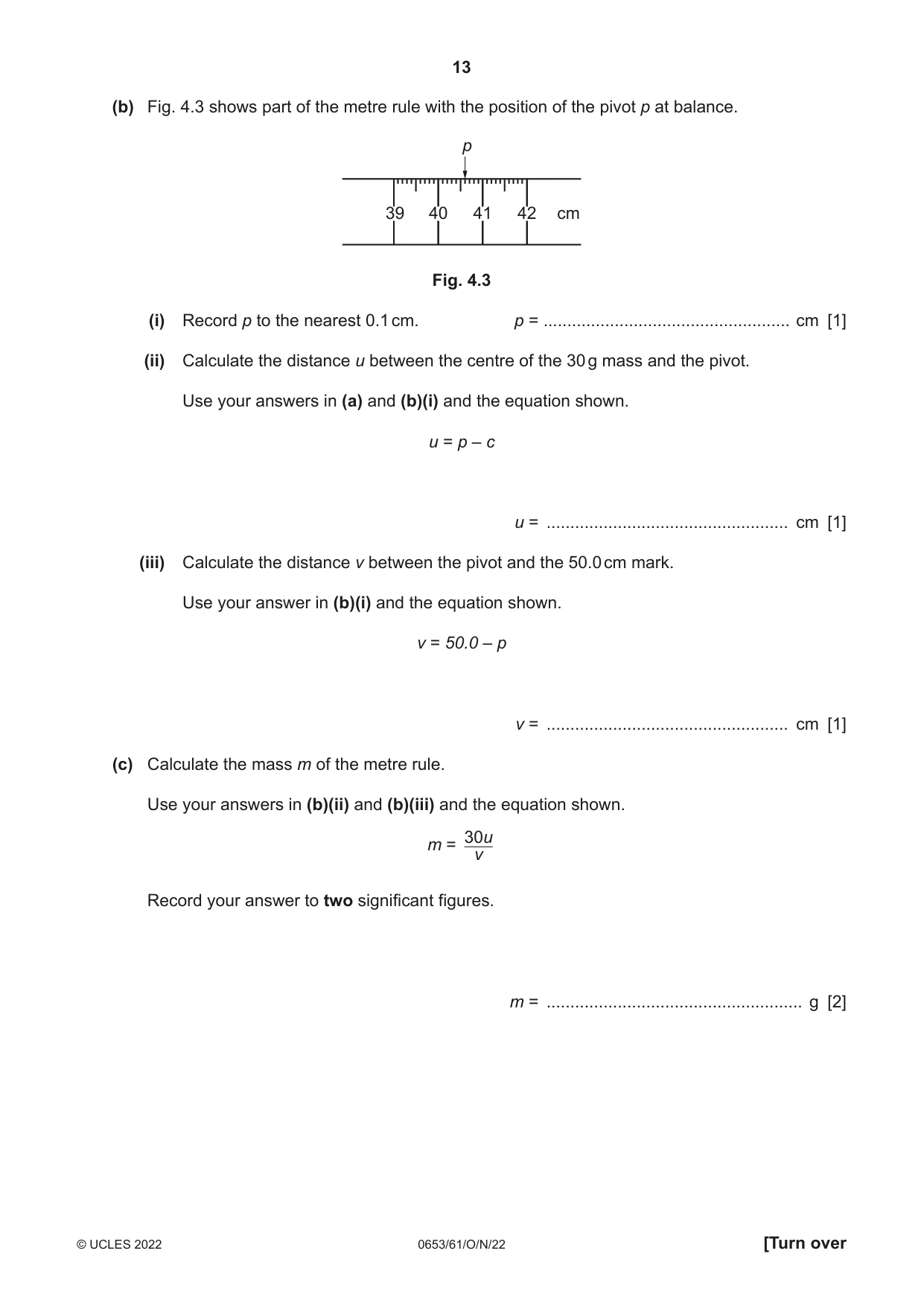
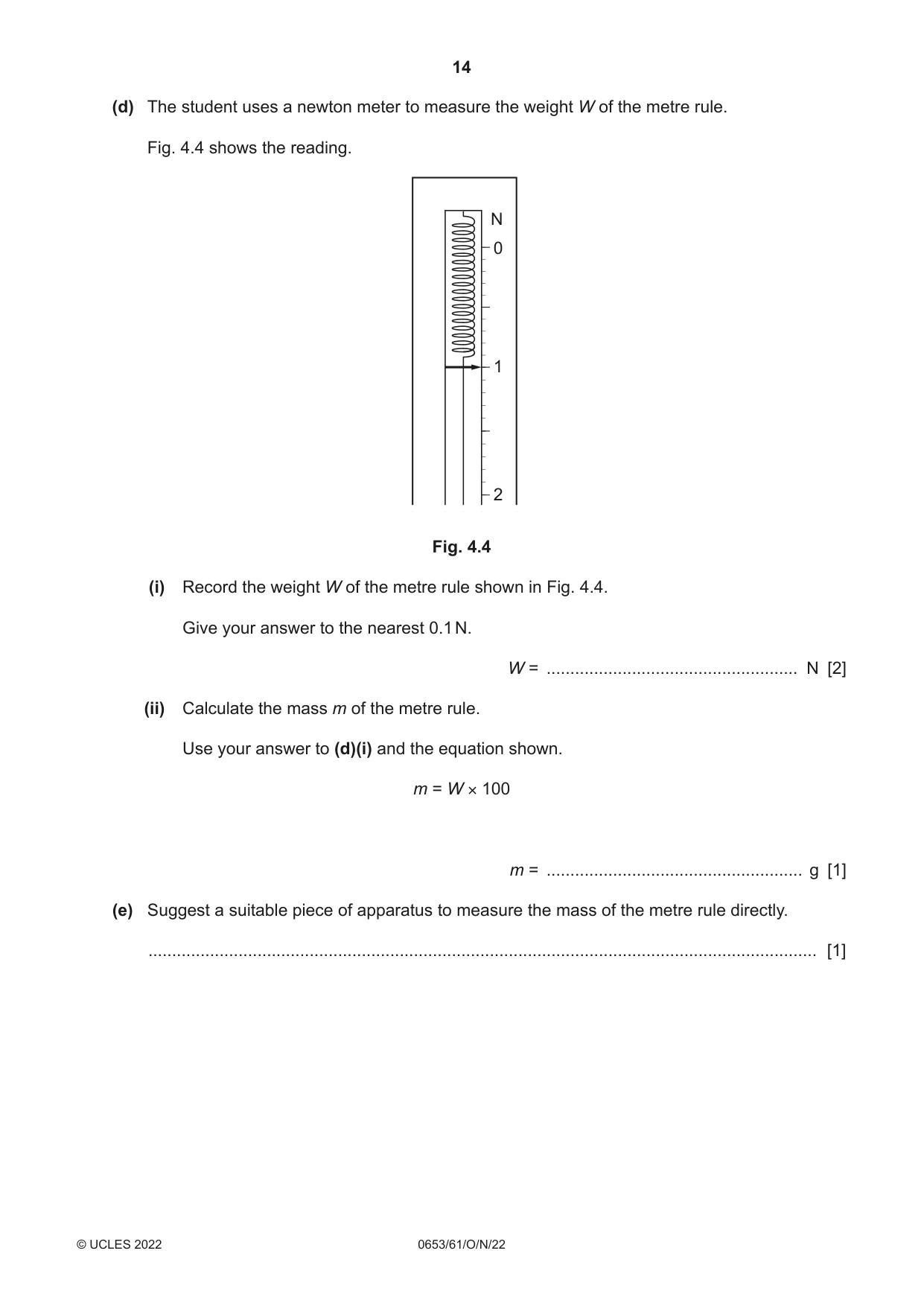
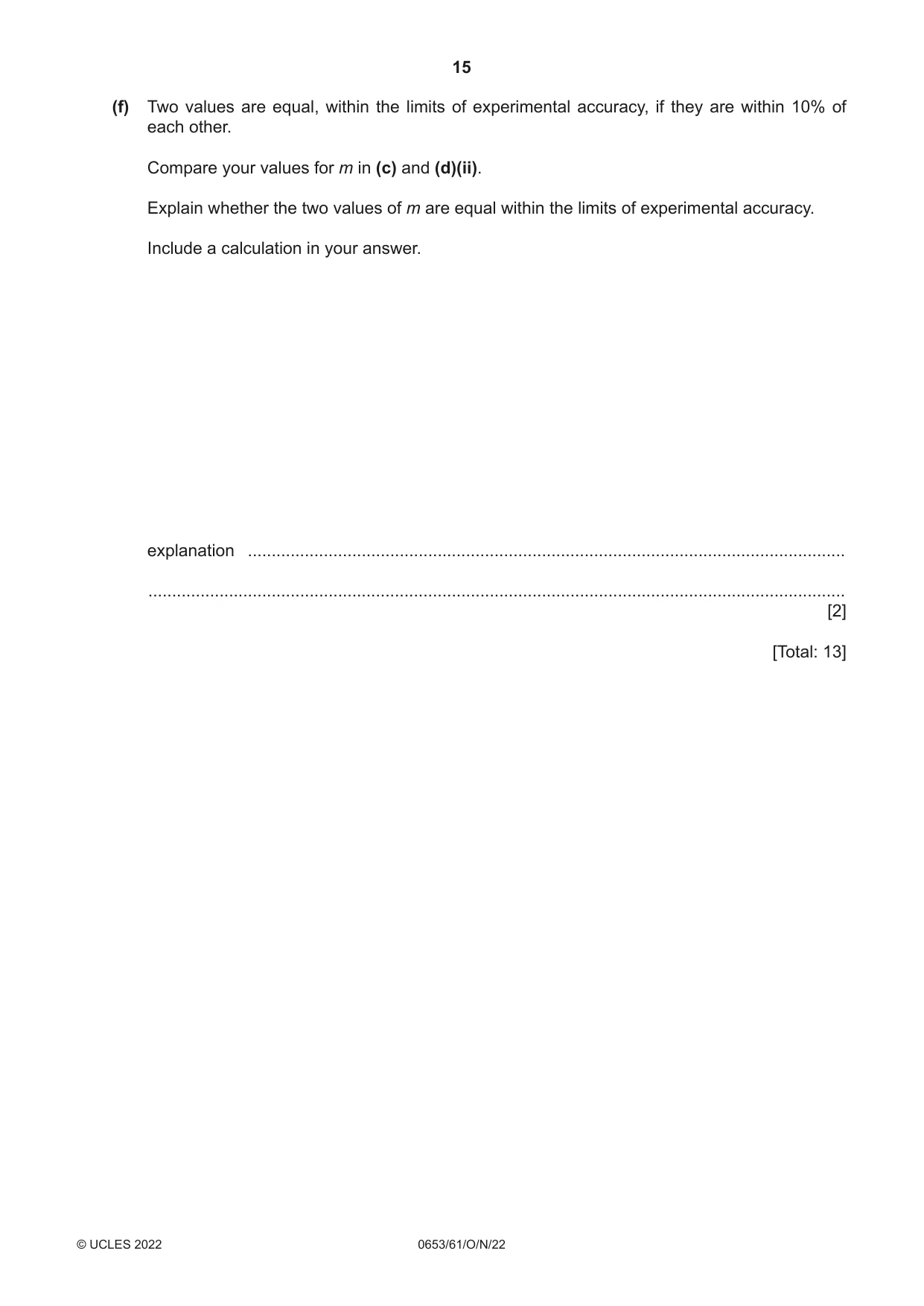
4 A student uses a balancing method to determine the mass of a metre rule. Fig. 4.1 shows the apparatus at balance. u v 30 g mass centre of metre rule metre rule 0 cm 50.0 cm 100.0 cm pivot Fig. 4.1 (not to scale) (a) The 30 g mass is fixed to the metre rule. Fig. 4.2 shows the position of the mass on the metre rule. 13 14 16 17 cm Fig. 4.2 Determine the position c of the centre of the 30 g mass on the metre rule. Explain your answer. c = ............................. cm explanation ............................................................................................................................... ................................................................................................................................................... [2] (b) Fig. 4.3 shows part of the metre rule with the position of the pivot p at balance. p 39 40 41 42 cm Fig. 4.3 (i) Record p to the nearest 0.1 cm. p = .................................................... cm [1] (ii) Calculate the distance u between the centre of the 30 g mass and the pivot. Use your answers in (a) and (b)(i) and the equation shown. u = p – c u = ................................................... cm [1] (iii) Calculate the distance v between the pivot and the 50.0 cm mark. Use your answer in (b)(i) and the equation shown. v = 50.0 – p v = ................................................... cm [1] (c) Calculate the mass m of the metre rule. Use your answers in (b)(ii) and (b)(iii) and the equation shown. 30u m = v Record your answer to two significant figures. m = ...................................................... g [2] (d) The student uses a newton meter to measure the weight W of the metre rule. Fig. 4.4 shows the reading. N 0 1 2 Fig. 4.4 (i) Record the weight W of the metre rule shown in Fig. 4.4. Give your answer to the nearest 0.1 N. W = ..................................................... N [2] (ii) Calculate the mass m of the metre rule. Use your answer to (d)(i) and the equation shown. m = W × 100 m = ...................................................... g [1] (e) Suggest a suitable piece of apparatus to measure the mass of the metre rule directly. ............................................................................................................................................. [1]
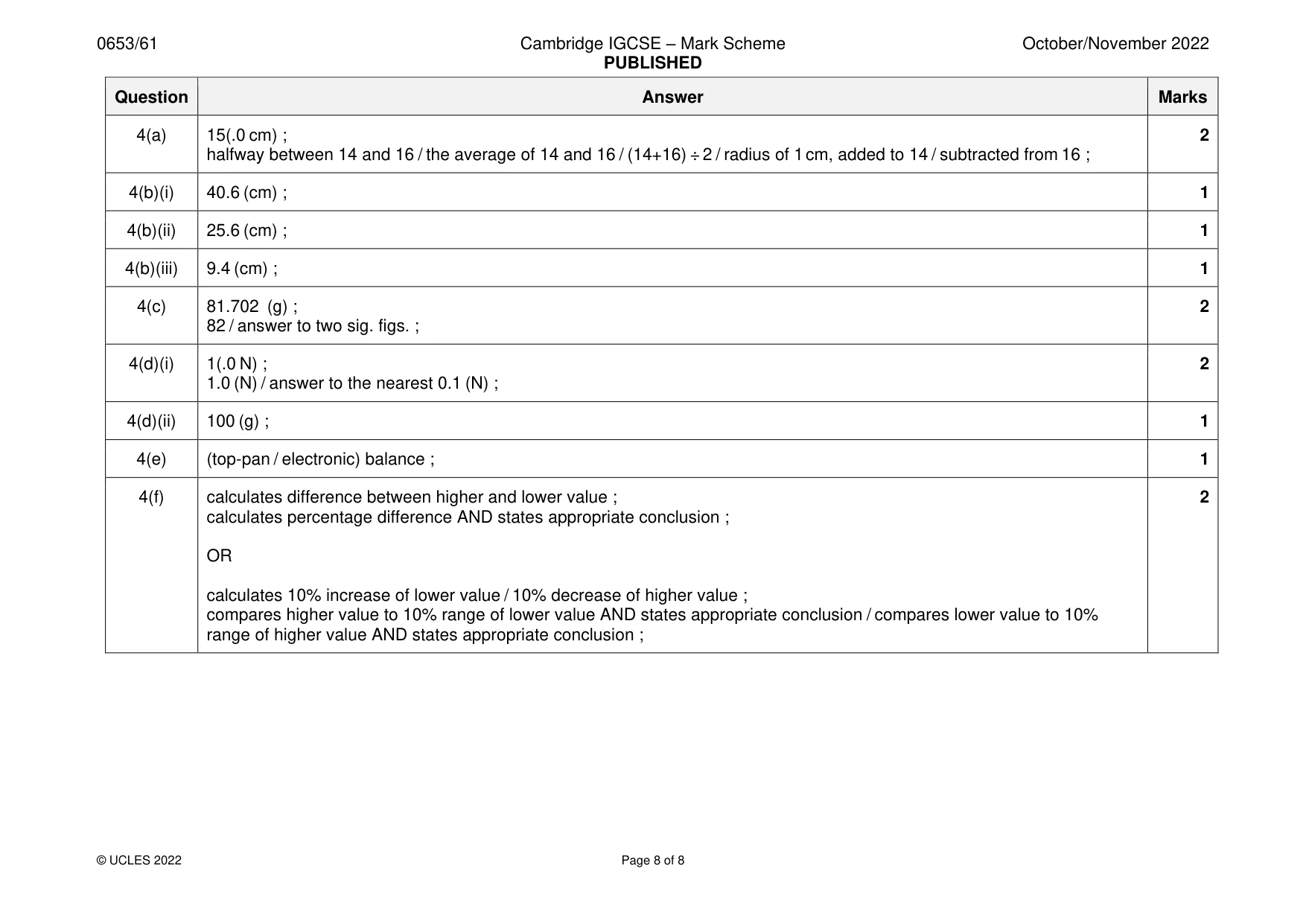
Mark scheme: 4(a) 15(.0 cm) ; 2 halfway between 14 and 16 / the average of 14 and 16 / (14+16) ÷ 2 / radius of 1 cm, added to 14 / subtracted from 16 ; 4(b)(i) 40.6 (cm) ; 1 4(b)(ii) 25.6 (cm) ; 1 4(b)(iii) 9.4 (cm) ; 1 4(c) 81.702 (g) ; 2 82 / answer to two sig. figs. ; 4(d)(i) 1(.0 N) ; 2 1.0 (N) / answer to the nearest 0.1 (N) ; 4(d)(ii) 100 (g) ; 1 4(e) (top-pan / electronic) balance ; 1 4(f) calculates difference between higher and lower value ; 2 calculates percentage difference AND states appropriate conclusion ; OR calculates 10% increase of lower value / 10% decrease of higher value ; compares higher value to 10% range of lower value AND states appropriate conclusion / compares lower value to 10% range of higher value AND states appropriate conclusion ;
More questions on Physical quantities and measurement techniques
What was in this paper
The subtopics covered by these 4 questions, and how many questions each got. Open one in a new tab to see every Cambridge question on it.
What you needed in this session
Cambridge’s own grade thresholds for 2022 Oct/Nov, Paper 6 · Variant 1. A higher threshold means an easier paper — the bar moves with how the cohort did.