Cambridge IGCSE Science - Combined 0653 — 2016 May/June Paper 3 · Variant 1
0653/31/M/J/16 · 80 marks · ≈90 min
The question paper and its mark scheme, free to read here and free to download. This is Cambridge’s own paper, exactly as it was sat.
Question paper20 pages

Mark scheme5 pages
Answers below. Sit the paper first if you are practising.
Paper as text
Question paper, page 1
This document consists of 20 printed pages. DC (LK/SW) 115952/2 © UCLES 2016 [Turn over Cambridge International Examinations Cambridge International General Certificate of Secondary Education * 9 0 3 0 8 8 6 9 0 1 * COMBINED SCIENCE 0653/31 Paper 3 (Extended) May/June 2016 1 hour 15 minutes Candidates answer on the Question Paper. No Additional Materials are required. READ THESE INSTRUCTIONS FIRST Write your Centre number, candidate number and name on all the work you hand in. Write in dark blue or black pen. You may use an HB pencil for any diagrams or graphs. Do not use staples, paper clips, glue or correction fluid. DO NOT WRITE IN ANY BARCODES. Answer all questions. Electronic calculators may be used. You may lose marks if you do not show your working or if you do not use appropriate units. A copy of the Periodic Table is printed on page 24. At the end of the examination, fasten all your work securely together. The number of marks is given in brackets [ ] at the end of each question or part question.
Question paper, page 2
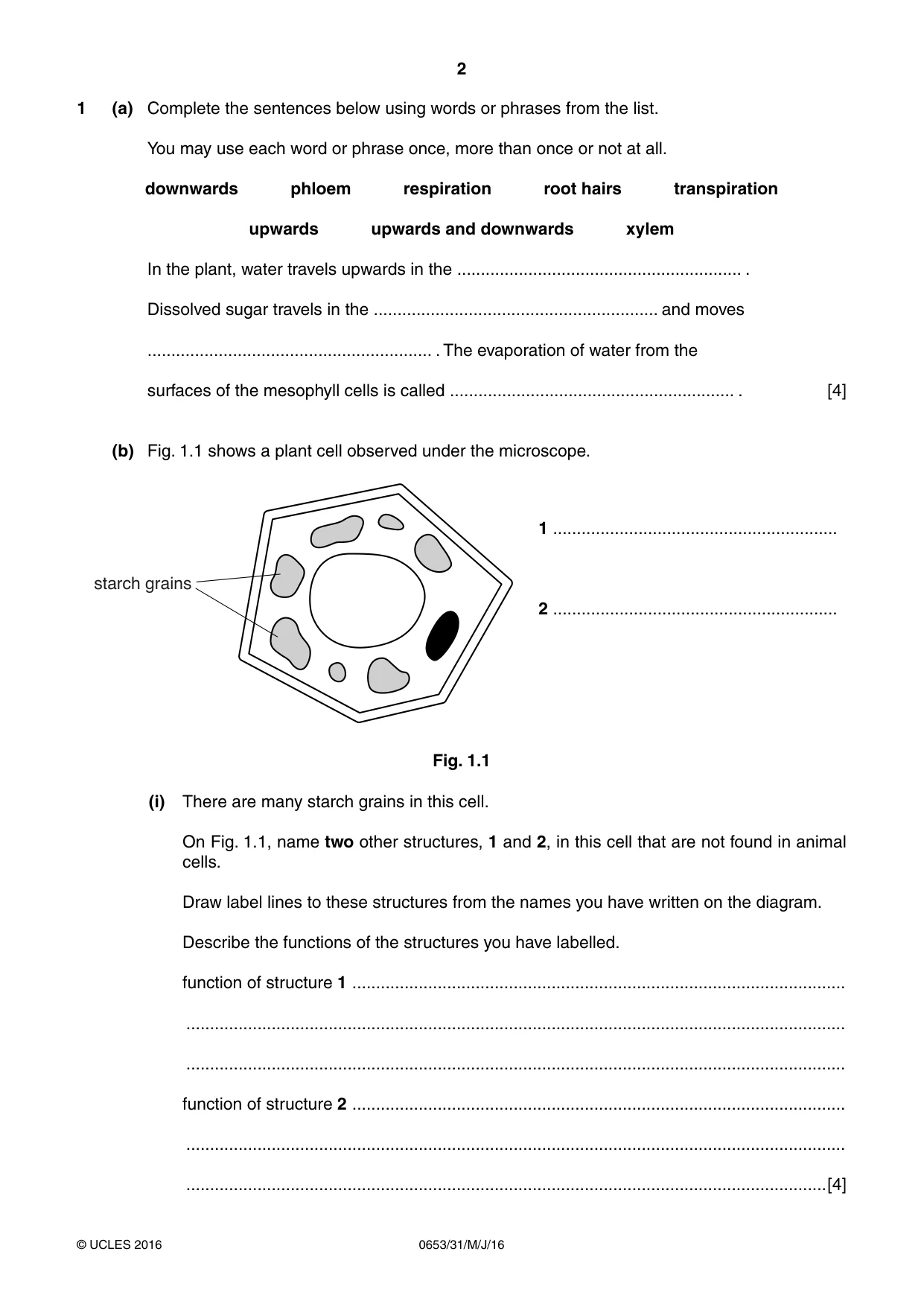
2 0653/31/M/J/16 © UCLES 2016 1 (a) Complete the sentences below using words or phrases from the list. You may use each word or phrase once, more than once or not at all. downwards phloem respiration root hairs transpiration upwards upwards and downwards xylem In the plant, water travels upwards in the … . Dissolved sugar travels in the … and moves … . The evaporation of water from the surfaces of the mesophyll cells is called … . [4] (b) Fig. 1.1 shows a plant cell observed under the microscope. starch grains 1 … 2 … Fig. 1.1 (i) There are many starch grains in this cell. On Fig. 1.1, name two other structures, 1 and 2, in this cell that are not found in animal cells. Draw label lines to these structures from the names you have written on the diagram. Describe the functions of the structures you have labelled. function of structure 1 … … … function of structure 2 … … …[4]
Question paper, page 3
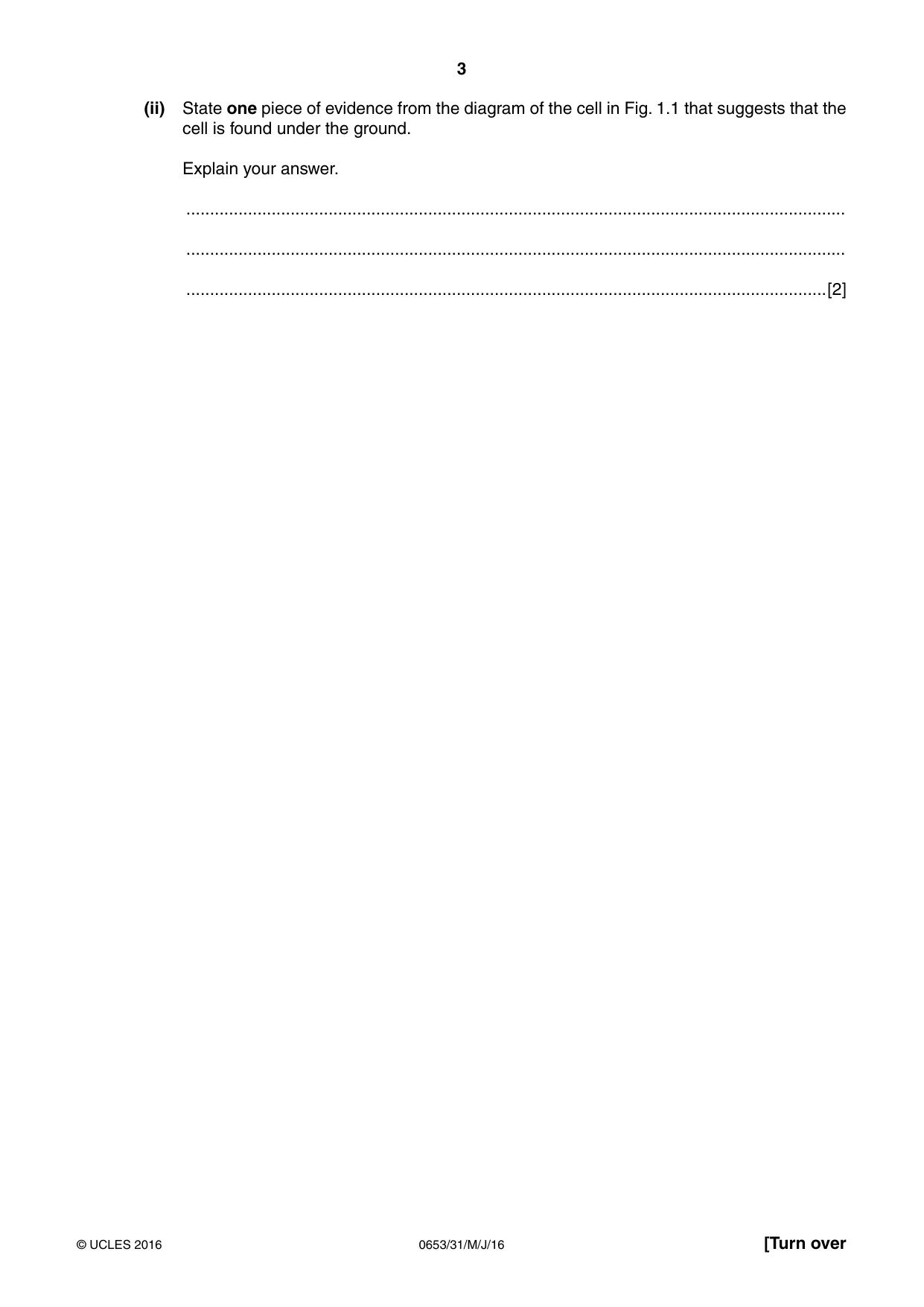
3 0653/31/M/J/16 © UCLES 2016 [Turn over (ii) State one piece of evidence from the diagram of the cell in Fig. 1.1 that suggests that the cell is found under the ground. Explain your answer. … … …[2]
Question paper, page 4
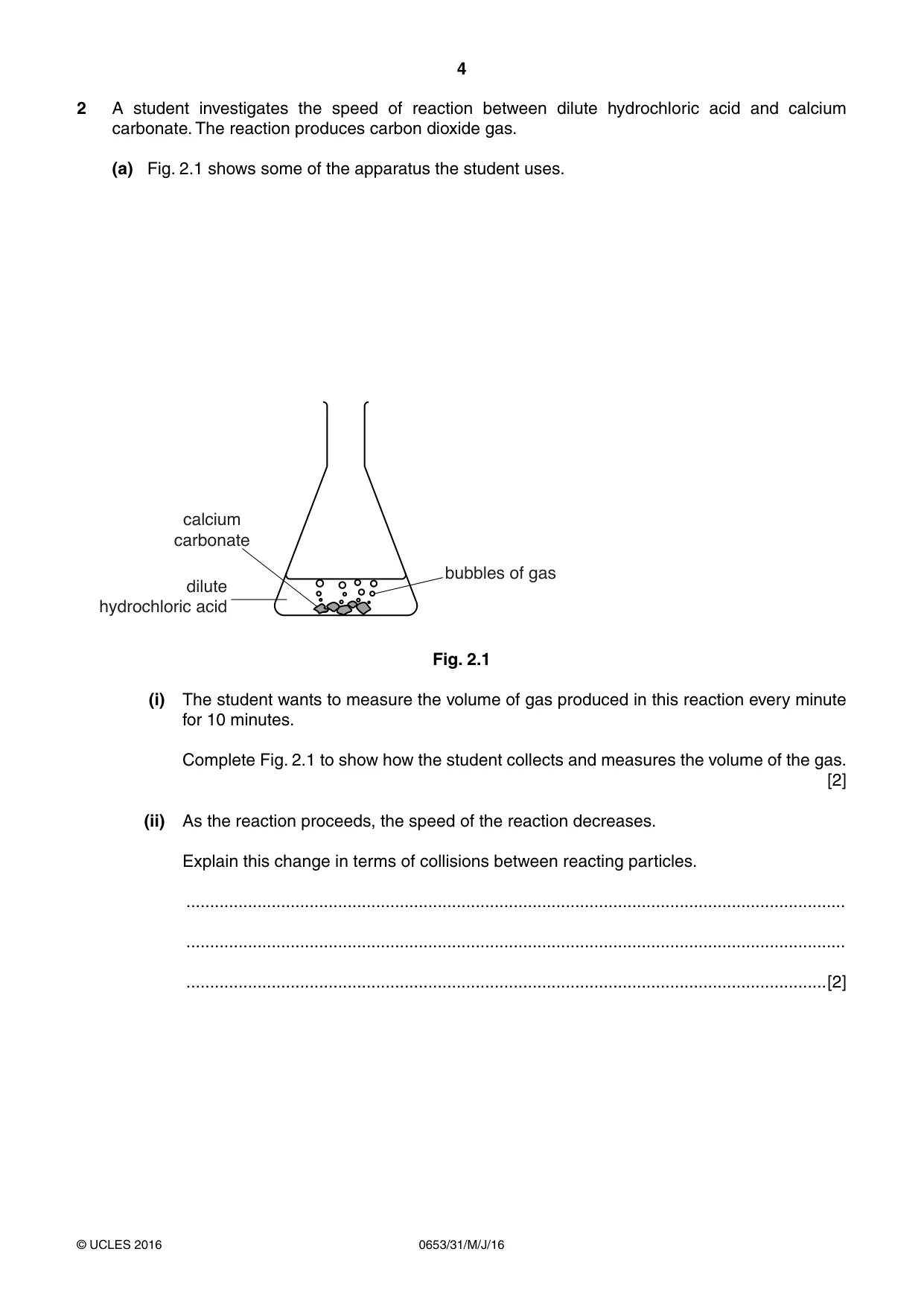
4 0653/31/M/J/16 © UCLES 2016 2 A student investigates the speed of reaction between dilute hydrochloric acid and calcium carbonate. The reaction produces carbon dioxide gas. (a) Fig. 2.1 shows some of the apparatus the student uses. bubbles of gas dilute hydrochloric acid calcium carbonate Fig. 2.1 (i) The student wants to measure the volume of gas produced in this reaction every minute for 10 minutes. Complete Fig. 2.1 to show how the student collects and measures the volume of the gas. [2] (ii) As the reaction proceeds, the speed of the reaction decreases. Explain this change in terms of collisions between reacting particles. … … …[2]
Question paper, page 5
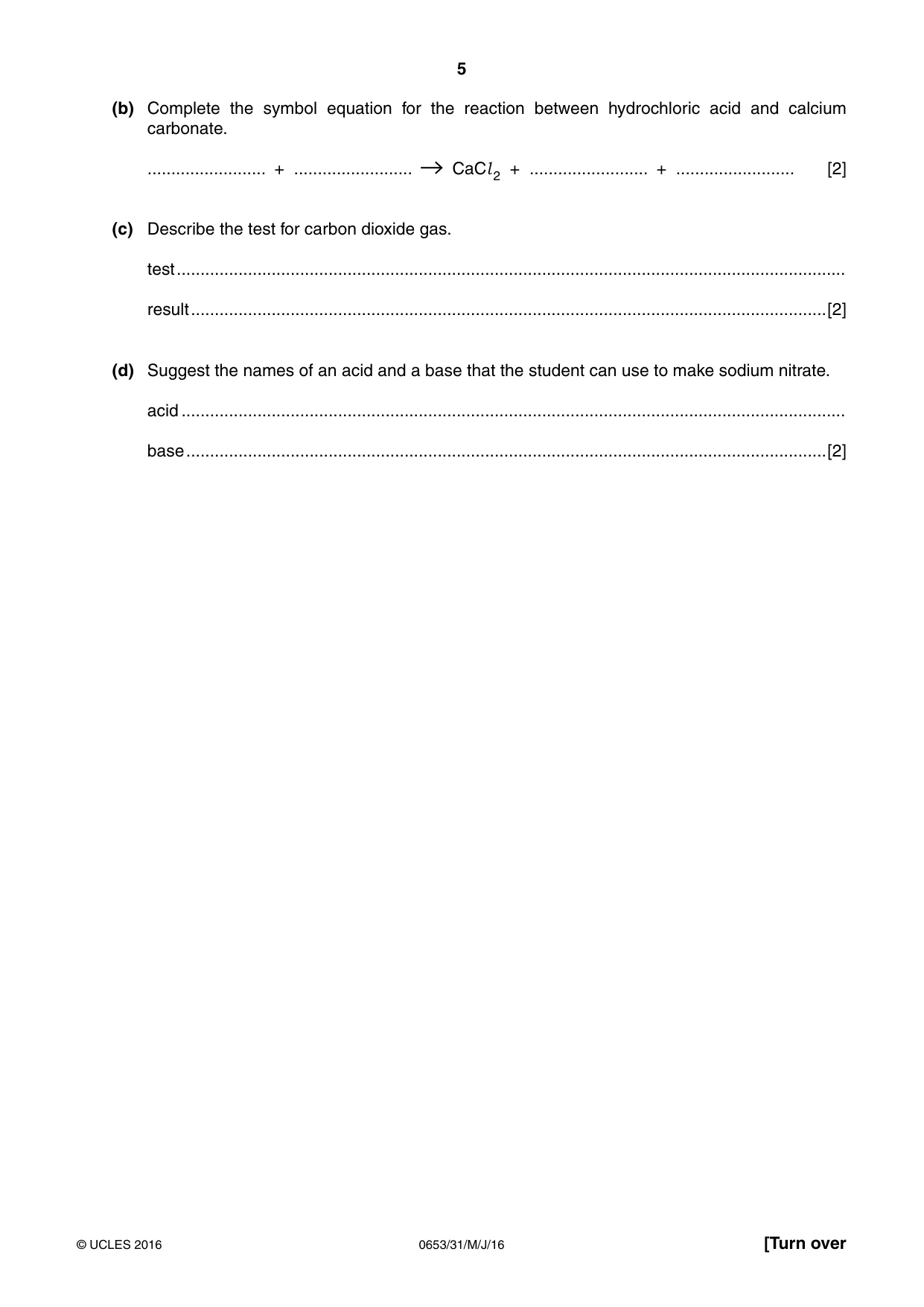
5 0653/31/M/J/16 © UCLES 2016 [Turn over (b) Complete the symbol equation for the reaction between hydrochloric acid and calcium carbonate. … + … CaCl 2 + … + … [2] (c) Describe the test for carbon dioxide gas. test … result …[2] (d) Suggest the names of an acid and a base that the student can use to make sodium nitrate. acid … base …[2]
Question paper, page 6
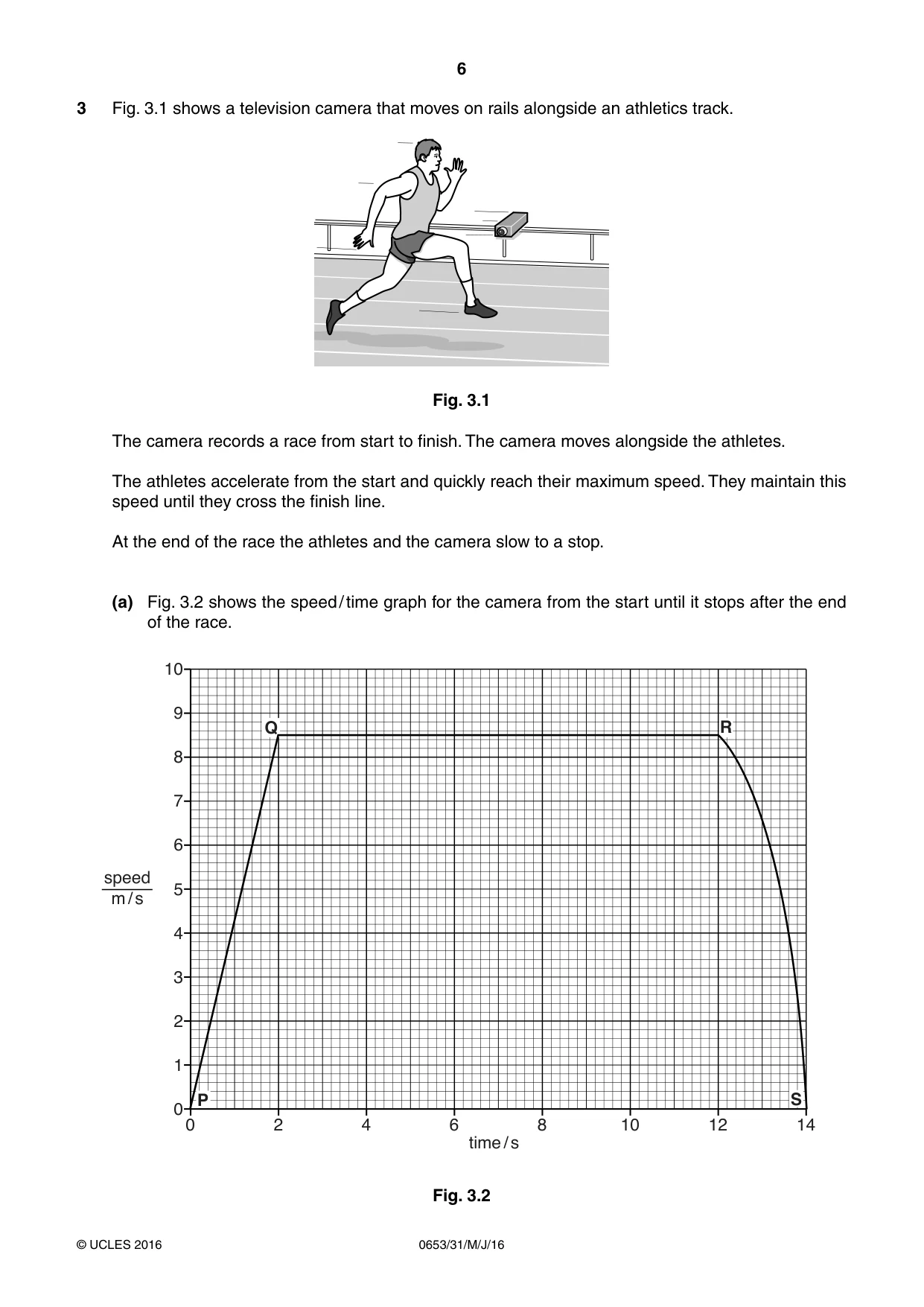
6 0653/31/M/J/16 © UCLES 2016 3 Fig. 3.1 shows a television camera that moves on rails alongside an athletics track. Fig. 3.1 The camera records a race from start to finish. The camera moves alongside the athletes. The athletes accelerate from the start and quickly reach their maximum speed. They maintain this speed until they cross the finish line. At the end of the race the athletes and the camera slow to a stop. (a) Fig. 3.2 shows the speed / time graph for the camera from the start until it stops after the end of the race. 0 0 1 2 3 4 speed m / s time / s 5 6 7 8 9 10 2 4 6 8 10 12 14 Q P R S Fig. 3.2
Question paper, page 7
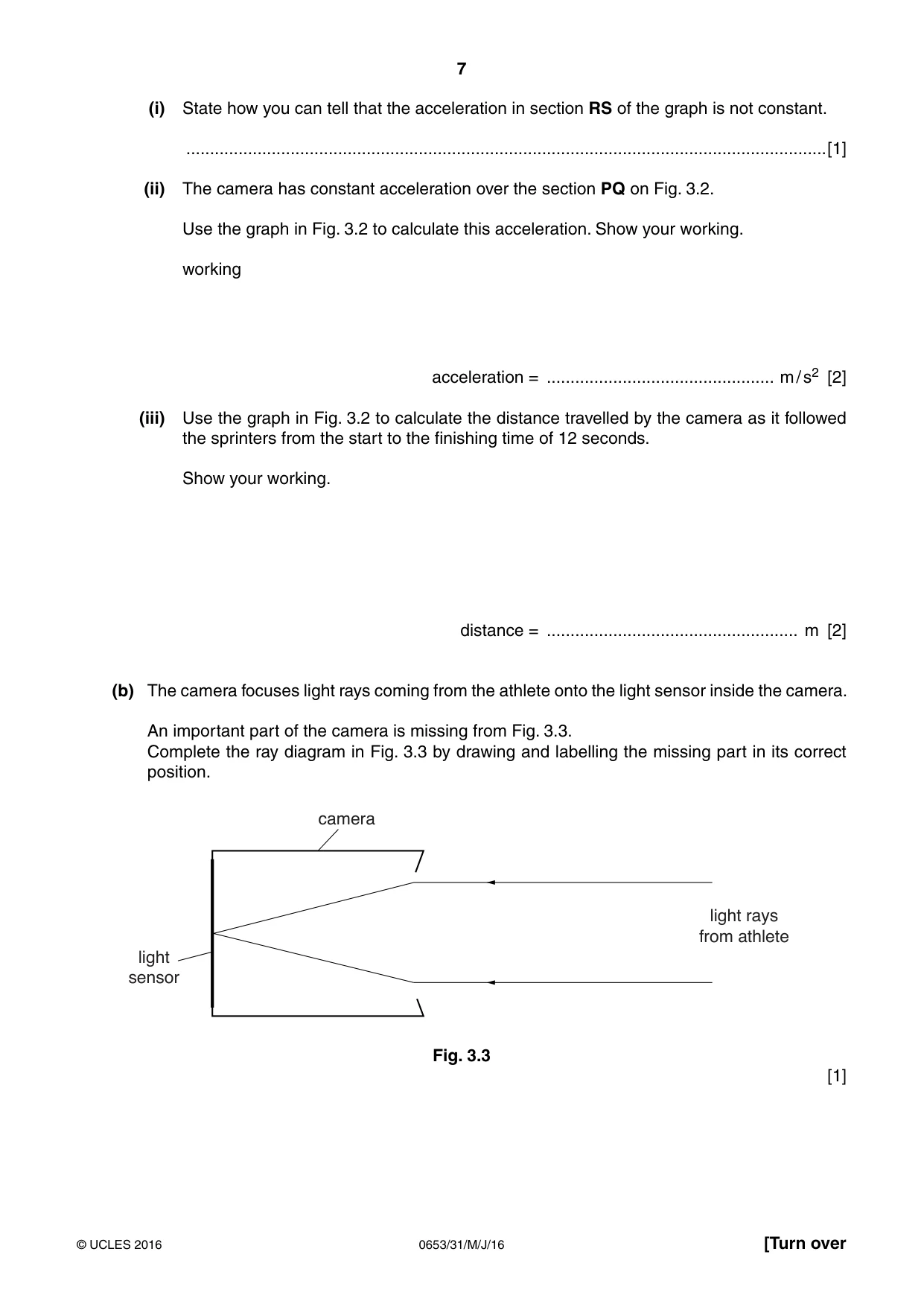
7 0653/31/M/J/16 © UCLES 2016 [Turn over (i) State how you can tell that the acceleration in section RS of the graph is not constant. …[1] (ii) The camera has constant acceleration over the section PQ on Fig. 3.2. Use the graph in Fig. 3.2 to calculate this acceleration. Show your working. working acceleration = … m / s2 [2] (iii) Use the graph in Fig. 3.2 to calculate the distance travelled by the camera as it followed the sprinters from the start to the finishing time of 12 seconds. Show your working. distance = … m [2] (b) The camera focuses light rays coming from the athlete onto the light sensor inside the camera. An important part of the camera is missing from Fig. 3.3. Complete the ray diagram in Fig. 3.3 by drawing and labelling the missing part in its correct position. camera light sensor light rays from athlete Fig. 3.3 [1]
Question paper, page 8
8 0653/31/M/J/16 © UCLES 2016 (c) The camera is moved along the rails by an electric motor powered by a battery. (i) The camera with motor and battery has a mass of 10 kg. Calculate the kinetic energy of the camera as it travels at a constant speed of 8.5 m / s. State the formula you use and show your working. formula working kinetic energy = … J [2] (ii) The kinetic energy of the moving camera is much less than the chemical energy supplied by the battery to the electric motor. Use the principle of the conservation of energy to explain why this happens. … … …[2]
Question paper, page 9
9 0653/31/M/J/16 © UCLES 2016 [Turn over Please turn over for Question 4
Question paper, page 10
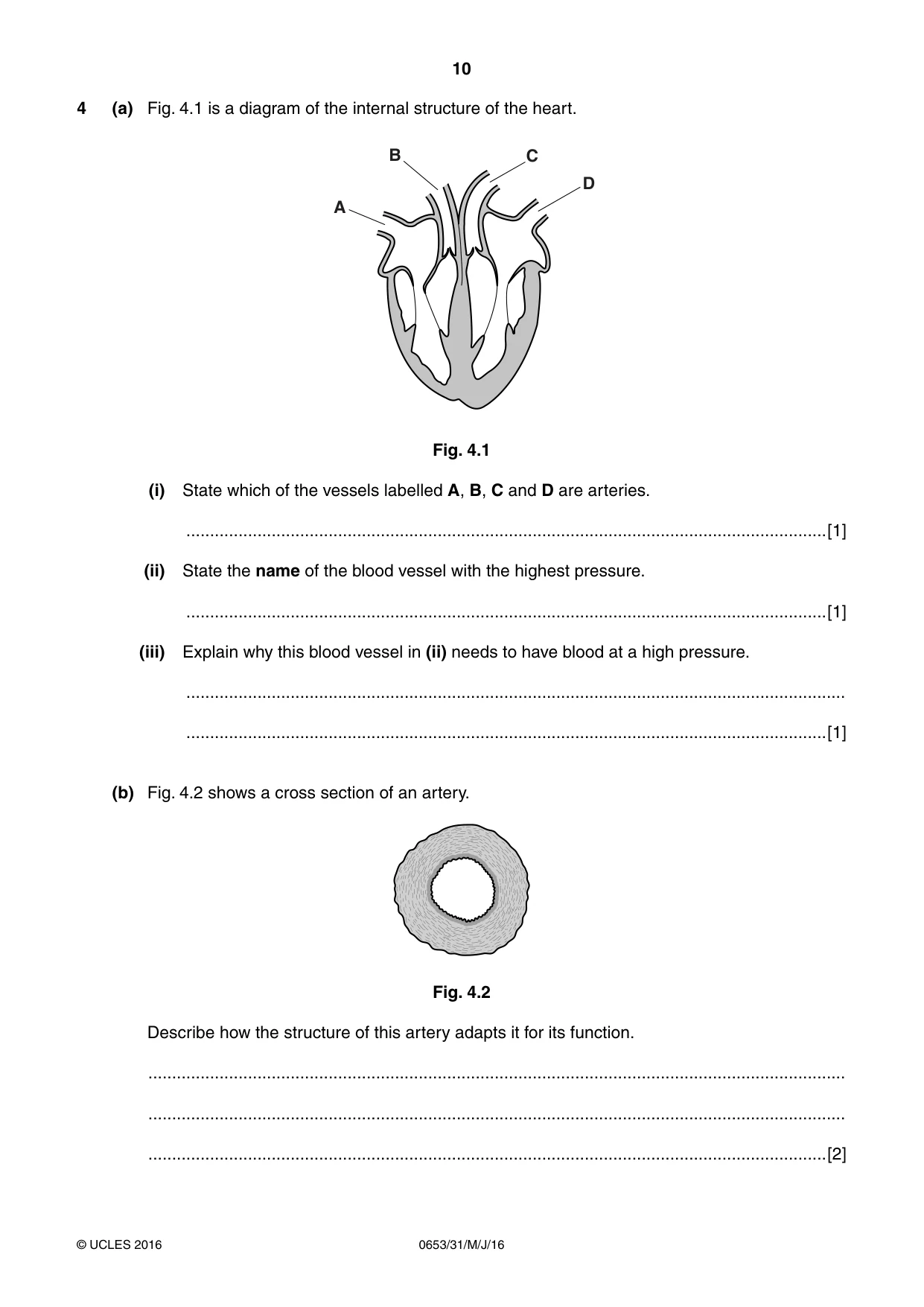
10 0653/31/M/J/16 © UCLES 2016 4 (a) Fig. 4.1 is a diagram of the internal structure of the heart. D C B A Fig. 4.1 (i) State which of the vessels labelled A, B, C and D are arteries. …[1] (ii) State the name of the blood vessel with the highest pressure. …[1] (iii) Explain why this blood vessel in (ii) needs to have blood at a high pressure. … …[1] (b) Fig. 4.2 shows a cross section of an artery. Fig. 4.2 Describe how the structure of this artery adapts it for its function. … … …[2]
Question paper, page 11
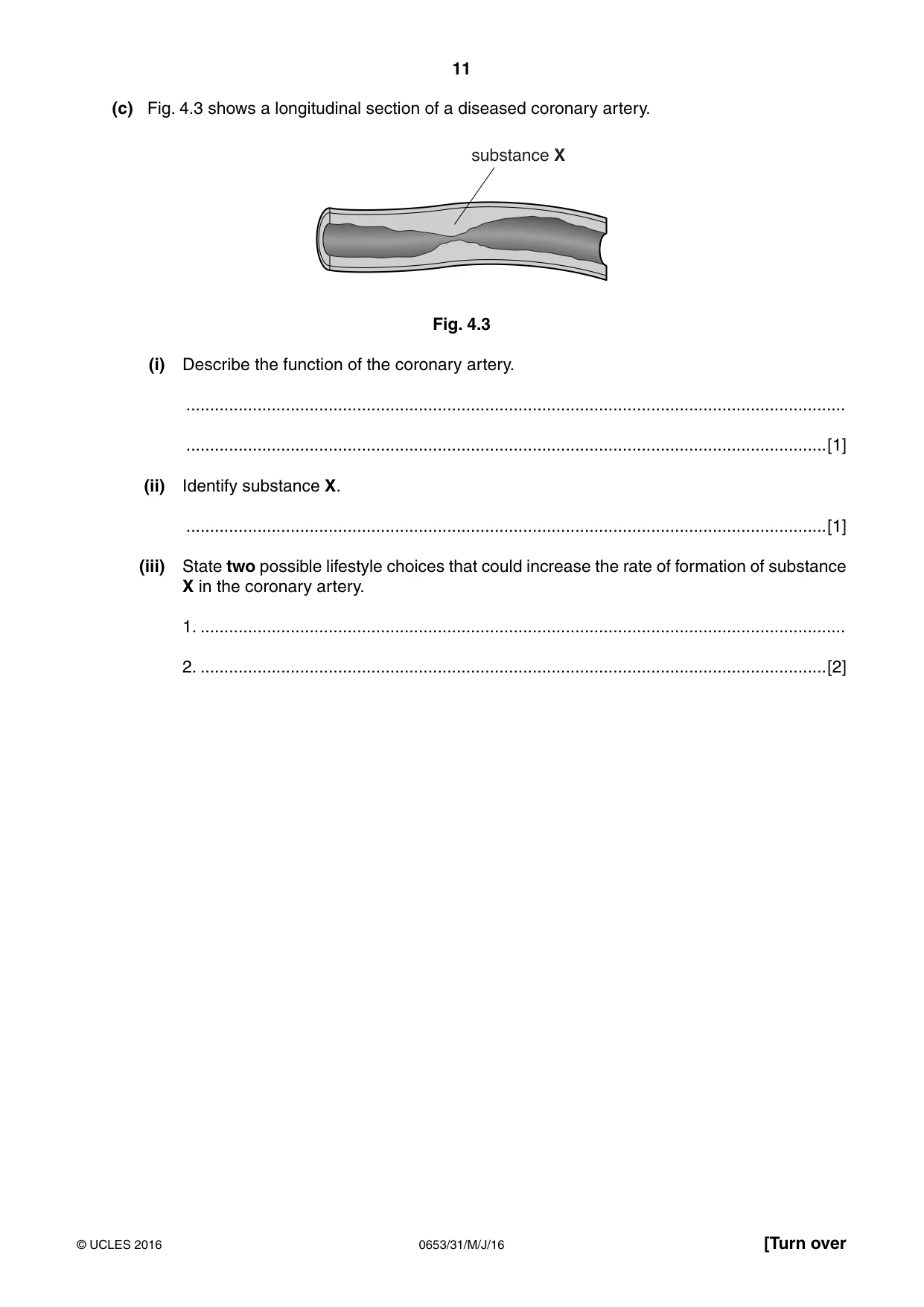
11 0653/31/M/J/16 © UCLES 2016 [Turn over (c) Fig. 4.3 shows a longitudinal section of a diseased coronary artery. substance X Fig. 4.3 (i) Describe the function of the coronary artery. … …[1] (ii) Identify substance X. …[1] (iii) State two possible lifestyle choices that could increase the rate of formation of substance X in the coronary artery. 1. … 2. …[2]
Question paper, page 12
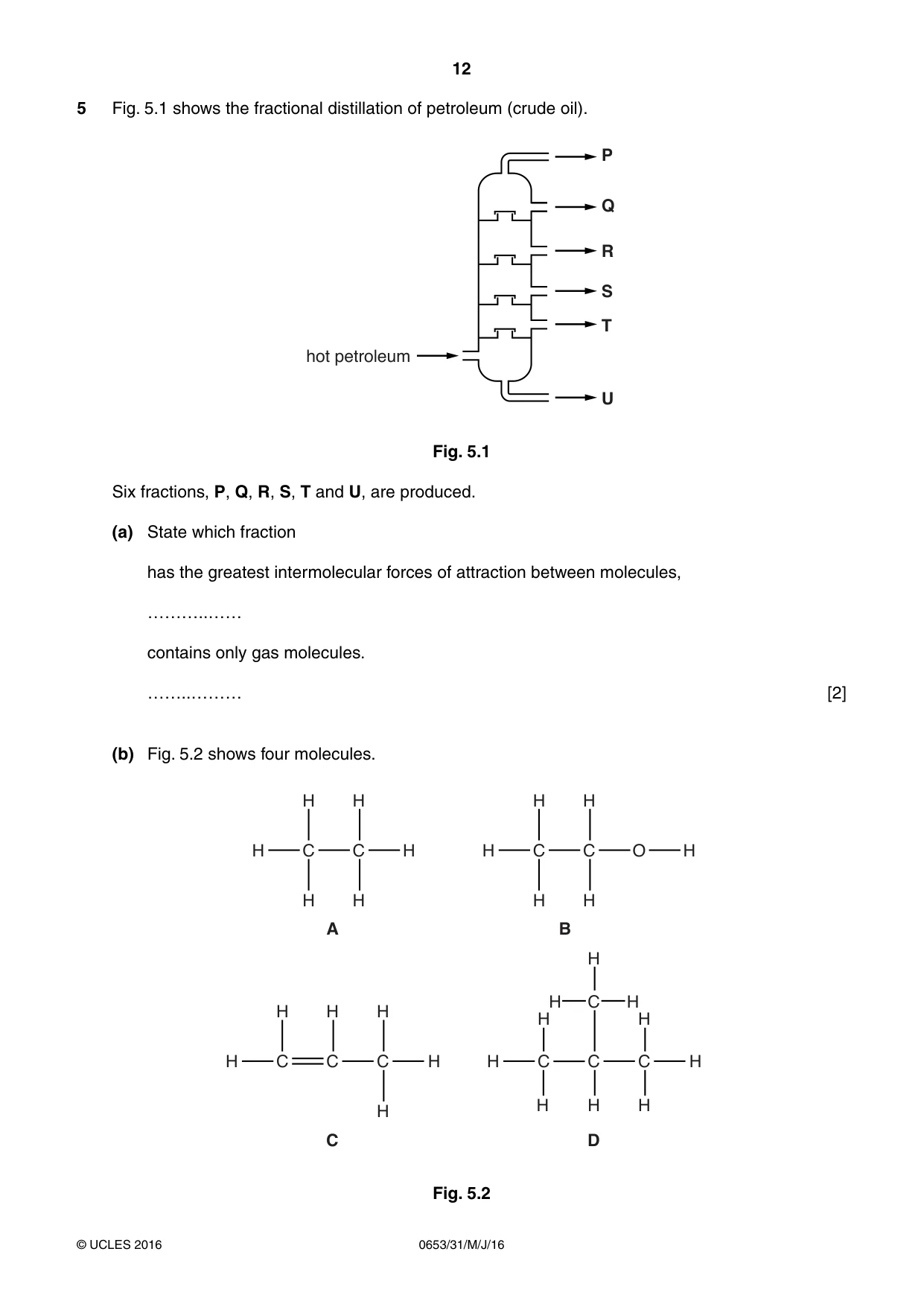
12 0653/31/M/J/16 © UCLES 2016 5 Fig. 5.1 shows the fractional distillation of petroleum (crude oil). Q P R T S U hot petroleum Fig. 5.1 Six fractions, P, Q, R, S, T and U, are produced. (a) State which fraction has the greatest intermolecular forces of attraction between molecules, ………..…… contains only gas molecules. ……..……… [2] (b) Fig. 5.2 shows four molecules. H C C H H H H H H C C H H H H O H A H C C H H C H H H C H C C H C C H H H H H H H H D B Fig. 5.2
Question paper, page 13
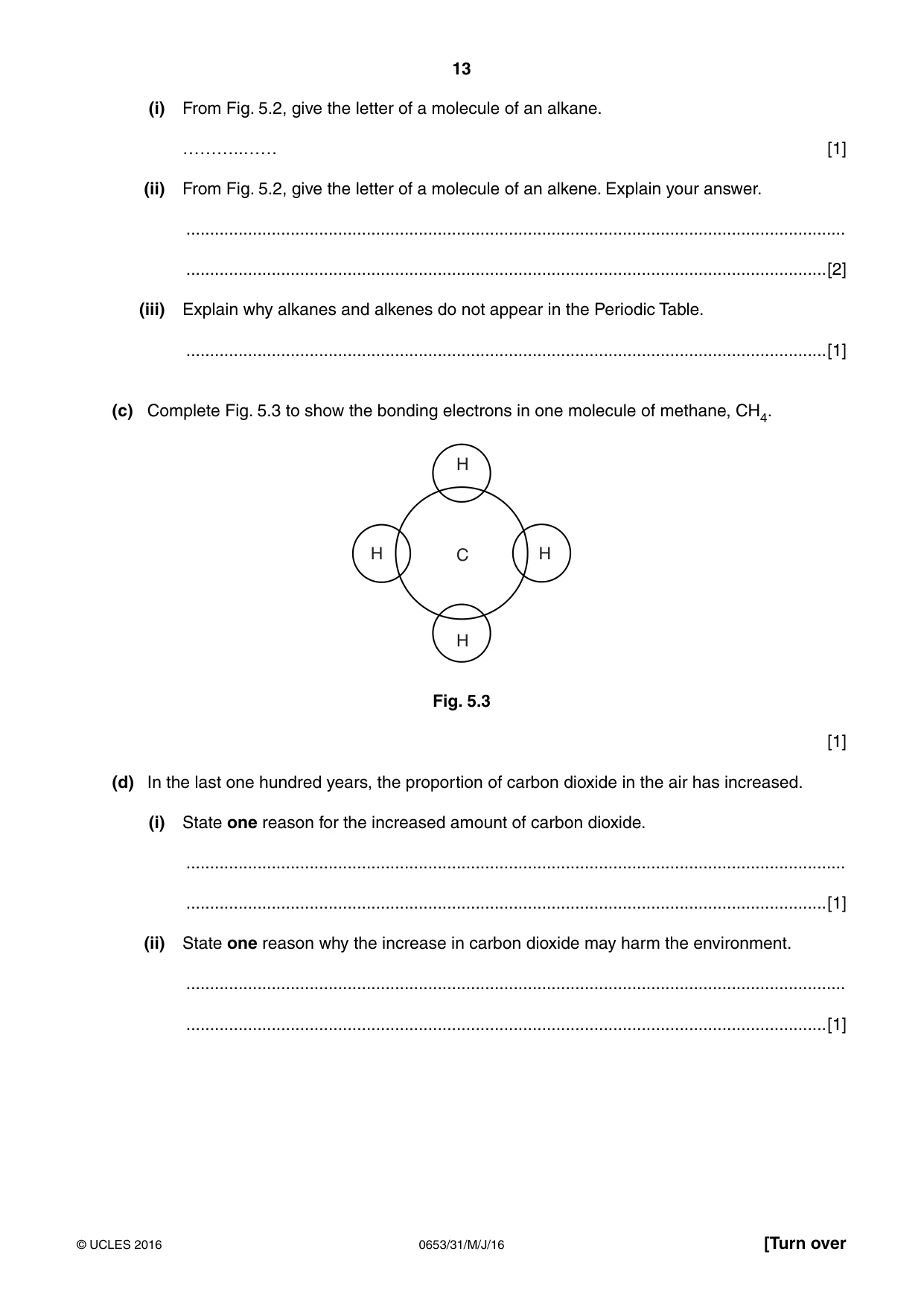
13 0653/31/M/J/16 © UCLES 2016 [Turn over (i) From Fig. 5.2, give the letter of a molecule of an alkane. ………..…… [1] (ii) From Fig. 5.2, give the letter of a molecule of an alkene. Explain your answer. … …[2] (iii) Explain why alkanes and alkenes do not appear in the Periodic Table. …[1] (c) Complete Fig. 5.3 to show the bonding electrons in one molecule of methane, CH4. C H H H H Fig. 5.3 [1] (d) In the last one hundred years, the proportion of carbon dioxide in the air has increased. (i) State one reason for the increased amount of carbon dioxide. … …[1] (ii) State one reason why the increase in carbon dioxide may harm the environment. … …[1]
Question paper, page 14
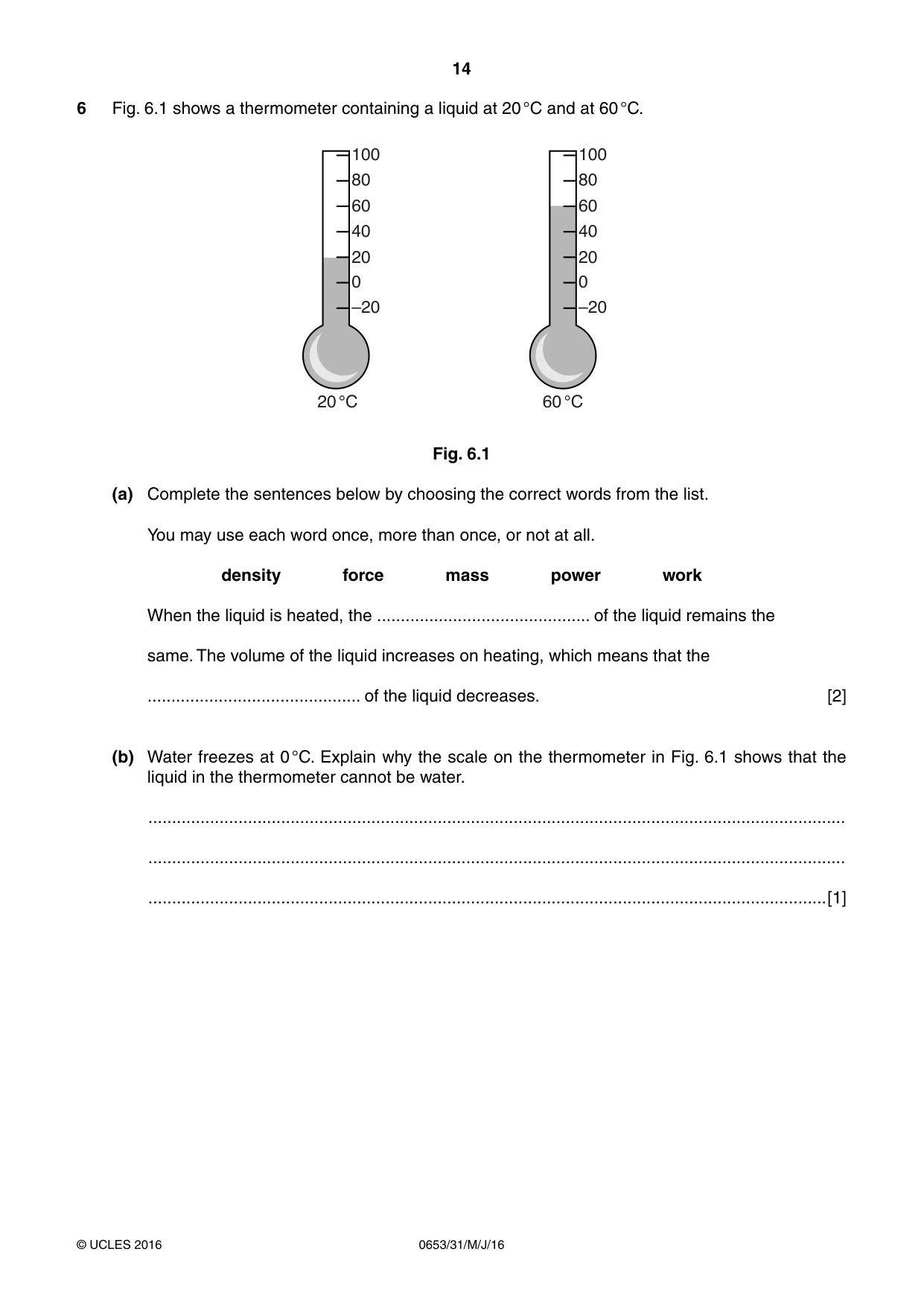
14 0653/31/M/J/16 © UCLES 2016 6 Fig. 6.1 shows a thermometer containing a liquid at 20 °C and at 60 °C. 100 80 60 40 20 0 –20 20 °C 60 °C 100 80 60 40 20 0 –20 Fig. 6.1 (a) Complete the sentences below by choosing the correct words from the list. You may use each word once, more than once, or not at all. density force mass power work When the liquid is heated, the … of the liquid remains the same. The volume of the liquid increases on heating, which means that the … of the liquid decreases. [2] (b) Water freezes at 0 °C. Explain why the scale on the thermometer in Fig. 6.1 shows that the liquid in the thermometer cannot be water. … … …[1]
Question paper, page 15
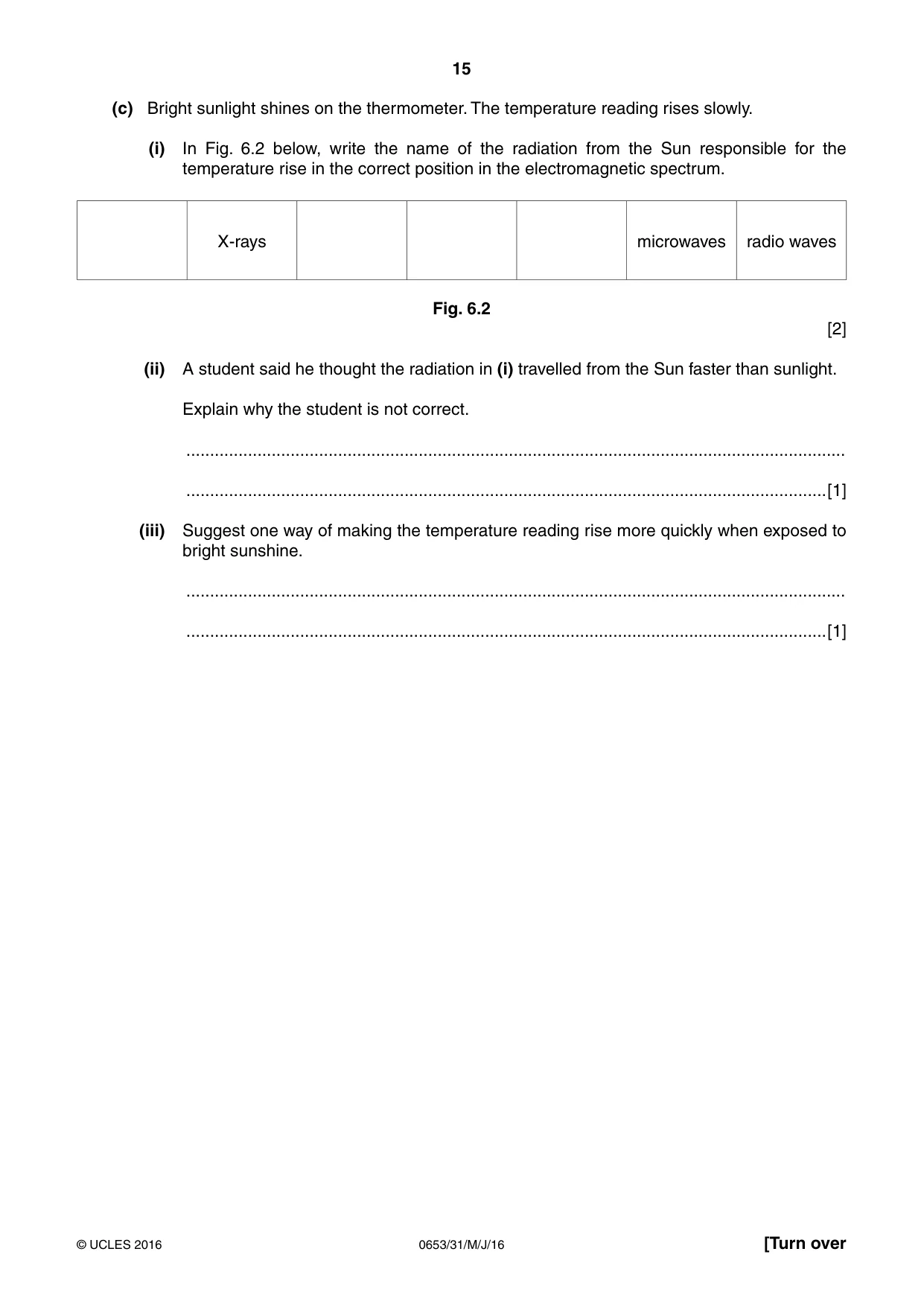
15 0653/31/M/J/16 © UCLES 2016 [Turn over (c) Bright sunlight shines on the thermometer. The temperature reading rises slowly. (i) In Fig. 6.2 below, write the name of the radiation from the Sun responsible for the temperature rise in the correct position in the electromagnetic spectrum. X-rays microwaves radio waves Fig. 6.2 [2] (ii) A student said he thought the radiation in (i) travelled from the Sun faster than sunlight. Explain why the student is not correct. … …[1] (iii) Suggest one way of making the temperature reading rise more quickly when exposed to bright sunshine. … …[1]
Question paper, page 16
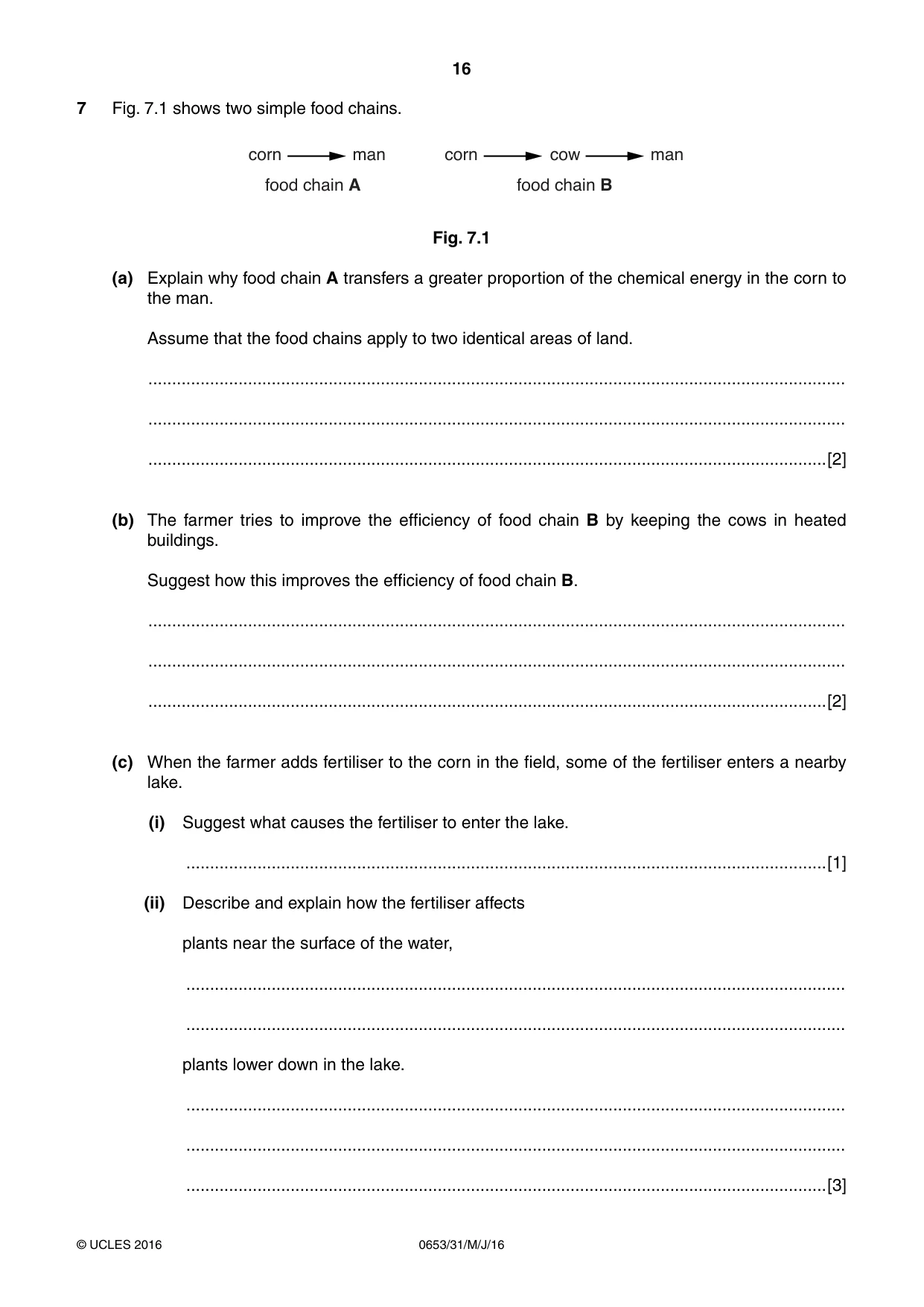
16 0653/31/M/J/16 © UCLES 2016 7 Fig. 7.1 shows two simple food chains. corn man food chain A food chain B corn cow man Fig. 7.1 (a) Explain why food chain A transfers a greater proportion of the chemical energy in the corn to the man. Assume that the food chains apply to two identical areas of land. … … …[2] (b) The farmer tries to improve the efficiency of food chain B by keeping the cows in heated buildings. Suggest how this improves the efficiency of food chain B. … … …[2] (c) When the farmer adds fertiliser to the corn in the field, some of the fertiliser enters a nearby lake. (i) Suggest what causes the fertiliser to enter the lake. …[1] (ii) Describe and explain how the fertiliser affects plants near the surface of the water, … … plants lower down in the lake. … … …[3]
Question paper, page 17
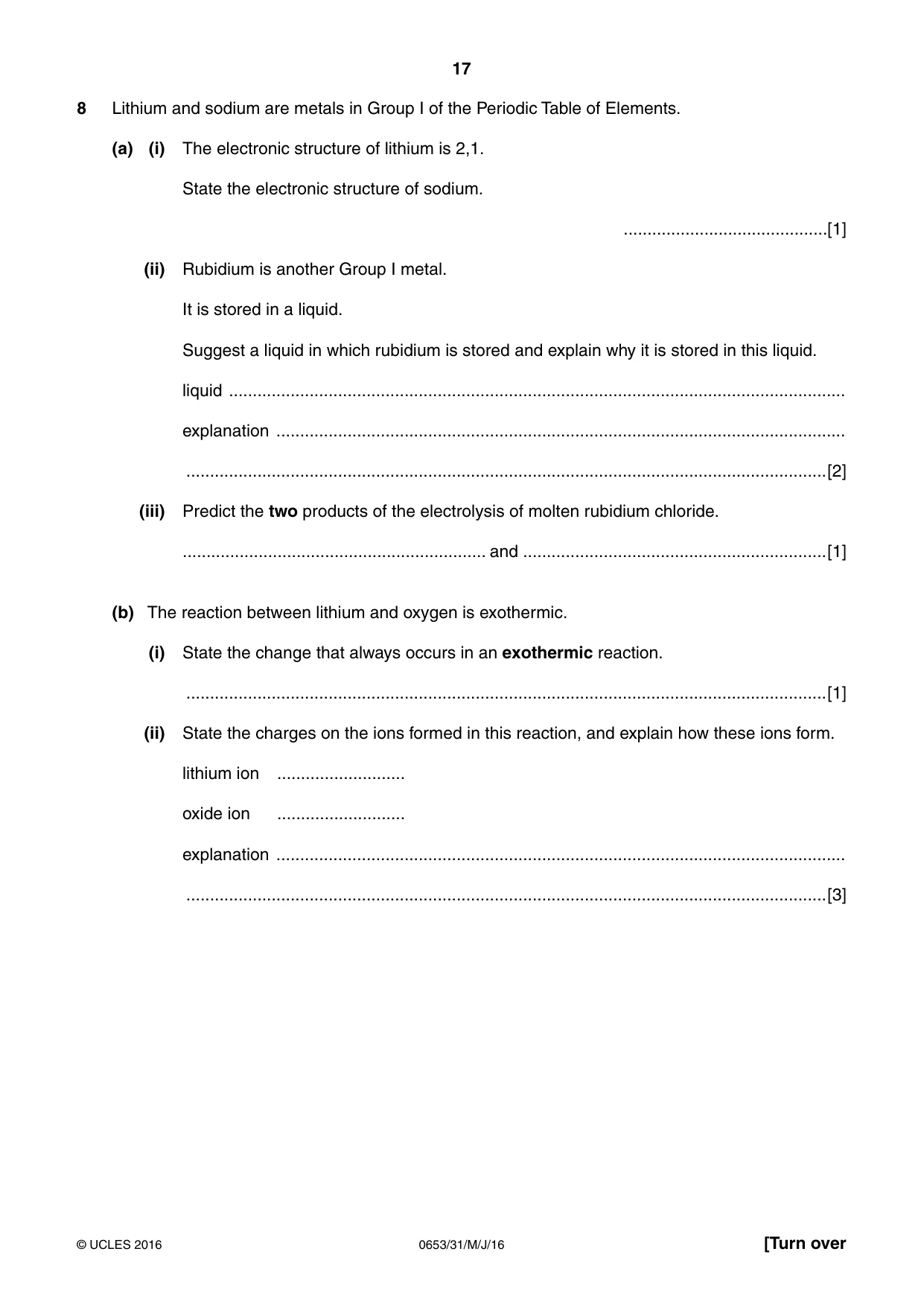
17 0653/31/M/J/16 © UCLES 2016 [Turn over 8 Lithium and sodium are metals in Group I of the Periodic Table of Elements. (a) (i) The electronic structure of lithium is 2,1. State the electronic structure of sodium. …[1] (ii) Rubidium is another Group I metal. It is stored in a liquid. Suggest a liquid in which rubidium is stored and explain why it is stored in this liquid. liquid … explanation … …[2] (iii) Predict the two products of the electrolysis of molten rubidium chloride. … and …[1] (b) The reaction between lithium and oxygen is exothermic. (i) State the change that always occurs in an exothermic reaction. …[1] (ii) State the charges on the ions formed in this reaction, and explain how these ions form. lithium ion … oxide ion … explanation … …[3]
Question paper, page 18
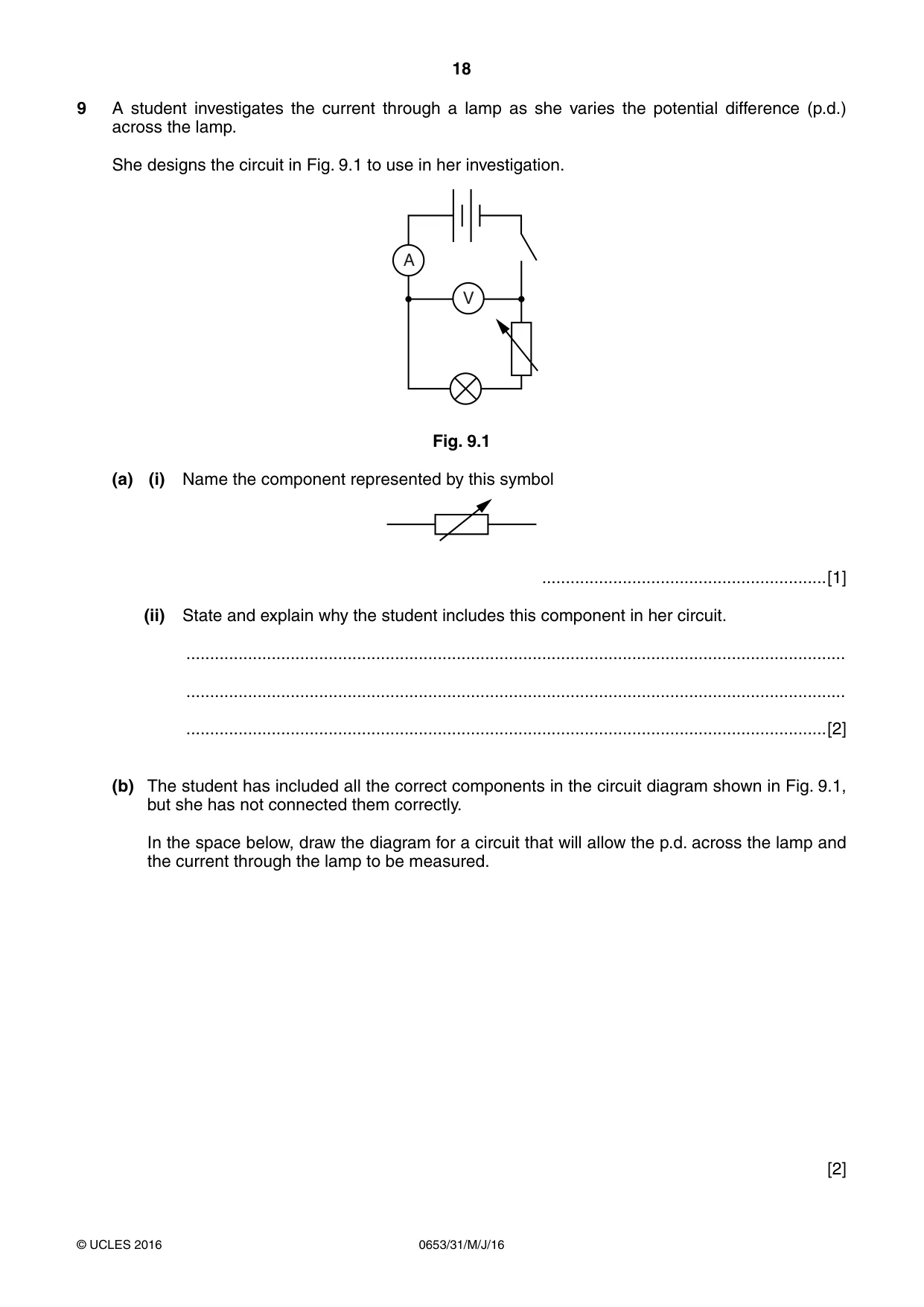
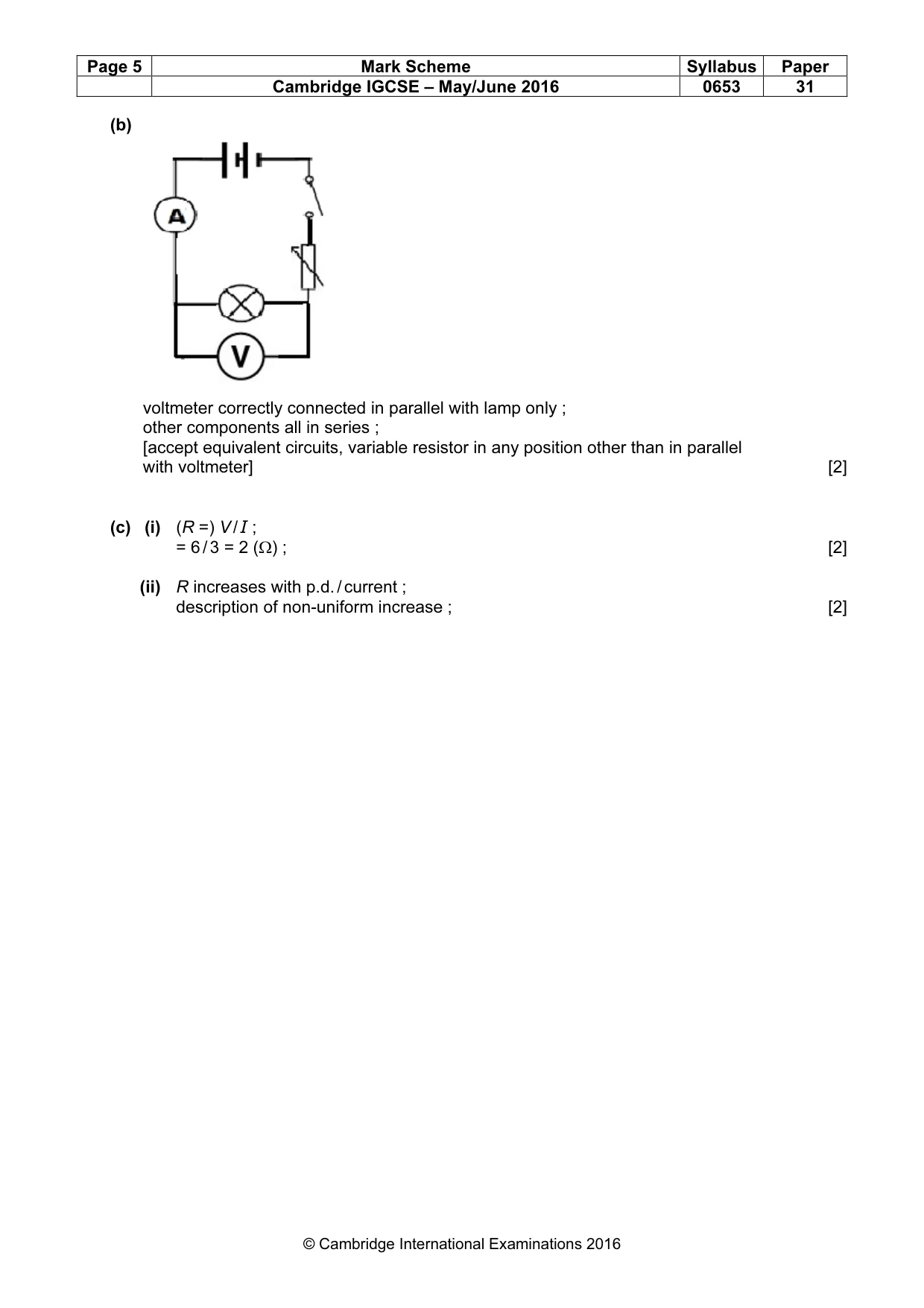
18 0653/31/M/J/16 © UCLES 2016 9 A student investigates the current through a lamp as she varies the potential difference (p.d.) across the lamp. She designs the circuit in Fig. 9.1 to use in her investigation. A V Fig. 9.1 (a) (i) Name the component represented by this symbol …[1] (ii) State and explain why the student includes this component in her circuit. … … …[2] (b) The student has included all the correct components in the circuit diagram shown in Fig. 9.1, but she has not connected them correctly. In the space below, draw the diagram for a circuit that will allow the p.d. across the lamp and the current through the lamp to be measured. [2]
Question paper, page 19
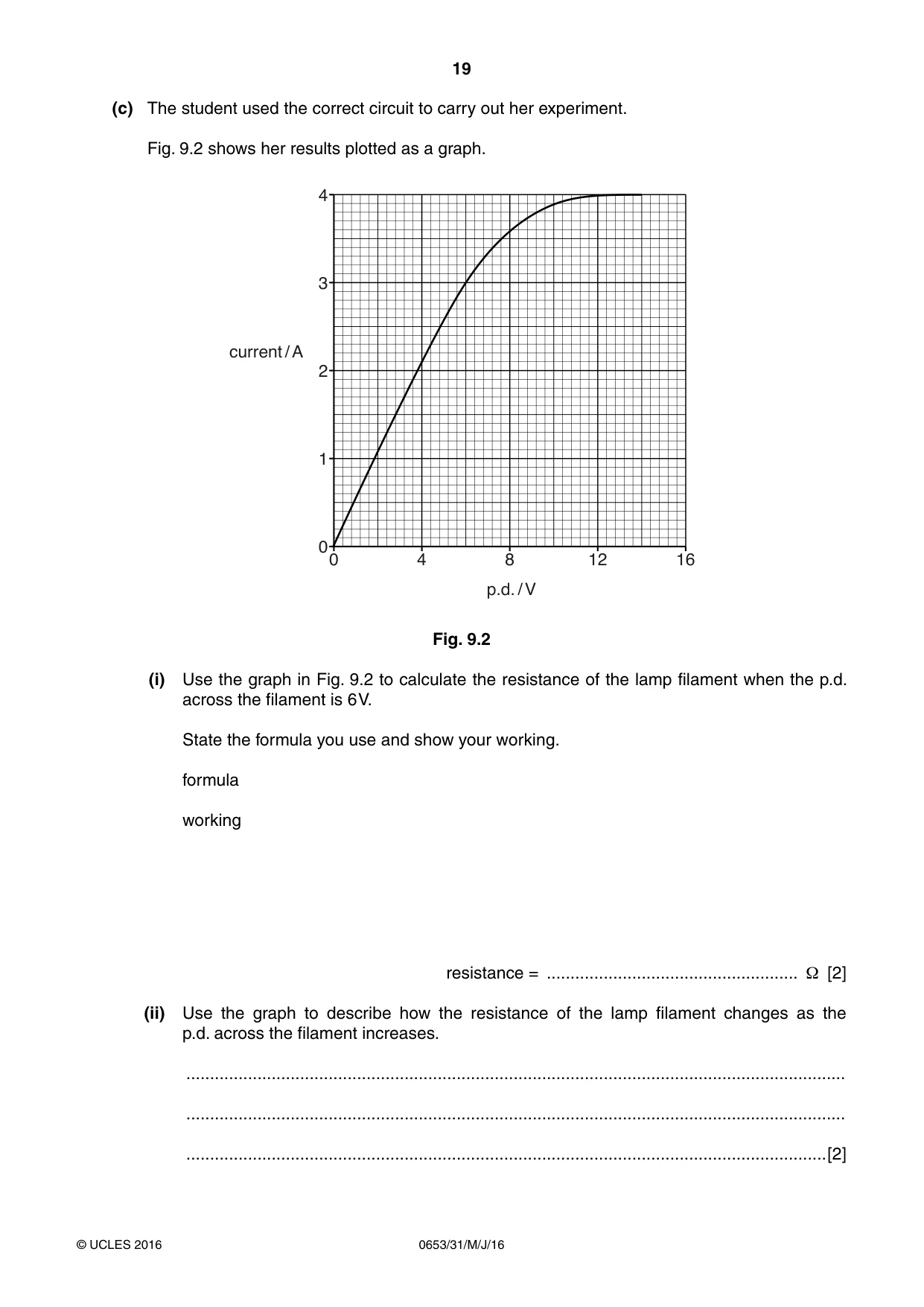
19 0653/31/M/J/16 © UCLES 2016 (c) The student used the correct circuit to carry out her experiment. Fig. 9.2 shows her results plotted as a graph. 0 0 1 2 3 current / A p.d. / V 4 4 8 12 16 Fig. 9.2 (i) Use the graph in Fig. 9.2 to calculate the resistance of the lamp filament when the p.d. across the filament is 6 V. State the formula you use and show your working. formula working resistance = … Ω [2] (ii) Use the graph to describe how the resistance of the lamp filament changes as the p.d. across the filament increases. … … …[2]
Question paper, page 20
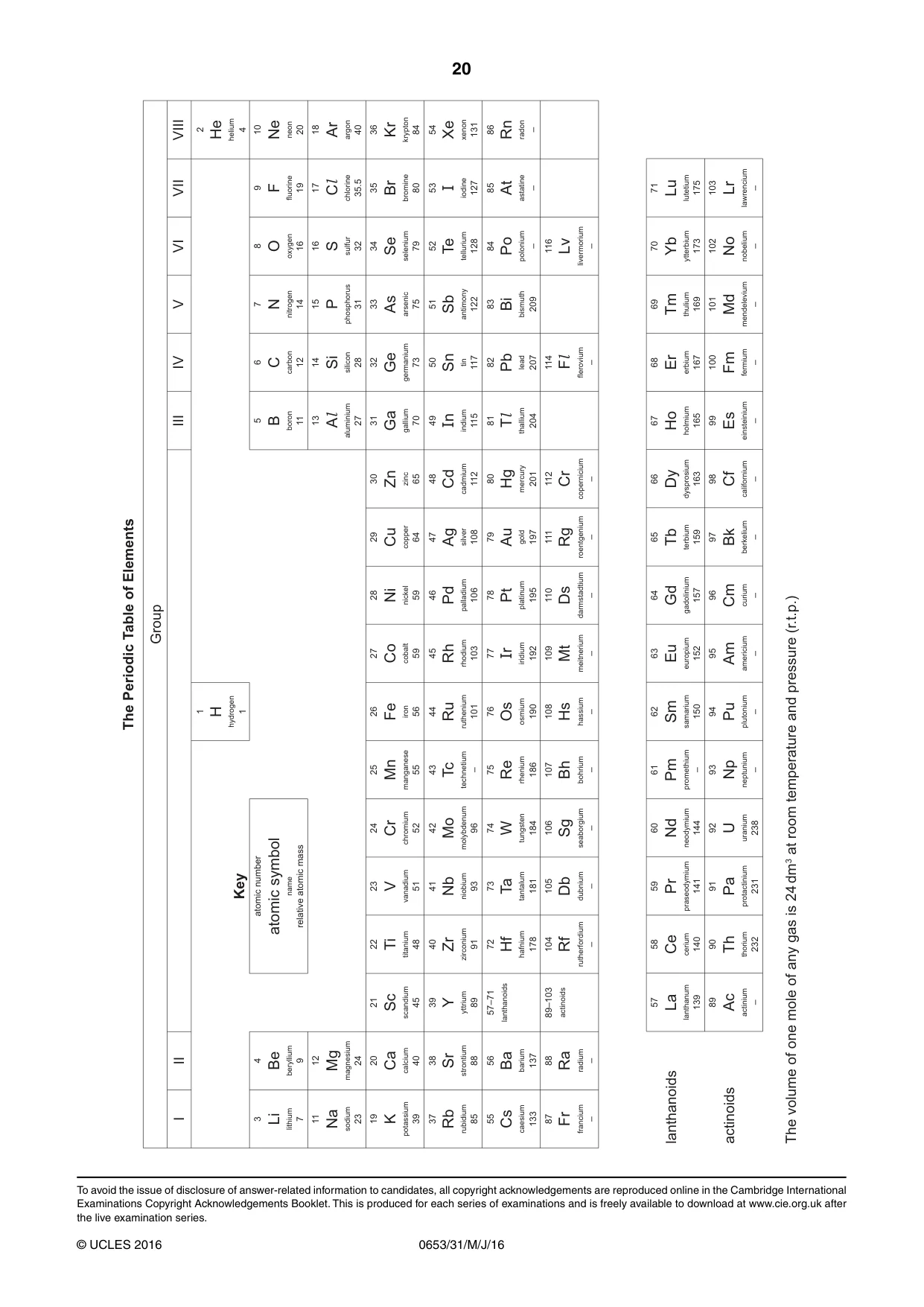
20 0653/31/M/J/16 © UCLES 2016 To avoid the issue of disclosure of answer-related information to candidates, all copyright acknowledgements are reproduced online in the Cambridge International Examinations Copyright Acknowledgements Booklet. This is produced for each series of examinations and is freely available to download at www.cie.org.uk after the live examination series. Group The Periodic Table of Elements 1 H hydrogen 1 2 He helium 4 I II III IV V VI VII VIII 3 Li lithium 7 4 Be beryllium 9 atomic number atomic symbol Key name relative atomic mass 11 Na sodium 23 12 Mg magnesium 24 19 K potassium 39 20 Ca calcium 40 37 Rb rubidium 85 38 Sr strontium 88 55 Cs caesium 133 56 Ba barium 137 87 Fr francium – 88 Ra radium – 5 B boron 11 13 Al aluminium 27 31 Ga gallium 70 49 In indium 115 81 Tl thallium 204 6 C carbon 12 14 Si silicon 28 32 Ge germanium 73 50 Sn tin 117 82 Pb lead 207 22 Ti titanium 48 40 Zr zirconium 91 72 Hf hafnium 178 104 Rf rutherfordium – 23 V vanadium 51 41 Nb niobium 93 73 Ta tantalum 181 105 Db dubnium – 24 Cr chromium 52 42 Mo molybdenum 96 74 W tungsten 184 106 Sg seaborgium – 25 Mn manganese 55 43 Tc technetium – 75 Re rhenium 186 107 Bh bohrium – 26 Fe iron 56 44 Ru ruthenium 101 76 Os osmium 190 108 Hs hassium – 27 Co cobalt 59 45 Rh rhodium 103 77 Ir iridium 192 109 Mt meitnerium – 28 Ni nickel 59 46 Pd palladium 106 78 Pt platinum 195 110 Ds darmstadtium – 29 Cu copper 64 47 Ag silver 108 79 Au gold 197 111 Rg roentgenium – 30 Zn zinc 65 48 Cd cadmium 112 80 Hg mercury 201 112 Cr copernicium – 114 Fl flerovium – 116 Lv livermorium – 7 N nitrogen 14 15 P phosphorus 31 33 As arsenic 75 51 Sb antimony 122 83 Bi bismuth 209 8 O oxygen 16 16 S sulfur 32 34 Se selenium 79 52 Te tellurium 128 84 Po polonium – 9 F fluorine 19 17 Cl chlorine 35.5 35 Br bromine 80 53 I iodine 127 85 At astatine – 10 Ne neon 20 18 Ar argon 40 36 Kr krypton 84 54 Xe xenon 131 86 Rn radon – 21 Sc scandium 45 39 Y yttrium 89 57–71 lanthanoids 89–103 actinoids 57 La lanthanum 139 89 Ac lanthanoids actinoids The volume of one mole of any gas is 24 dm3 at room temperature and pressure (r.t.p.) actinium – 58 Ce cerium 140 90 Th thorium 232 59 Pr praseodymium 141 91 Pa protactinium 231 60 Nd neodymium 144 92 U uranium 238 61 Pm promethium – 93 Np neptunium – 62 Sm samarium 150 94 Pu plutonium – 63 Eu europium 152 95 Am americium – 64 Gd gadolinium 157 96 Cm curium – 65 Tb terbium 159 97 Bk berkelium – 66 Dy dysprosium 163 98 Cf californium – 67 Ho holmium 165 99 Es einsteinium – 68 Er erbium 167 100 Fm fermium – 69 Tm thulium 169 101 Md mendelevium – 70 Yb ytterbium 173 102 No nobelium – 71 Lu lutetium 175 103 Lr lawrencium –
Mark scheme, page 1
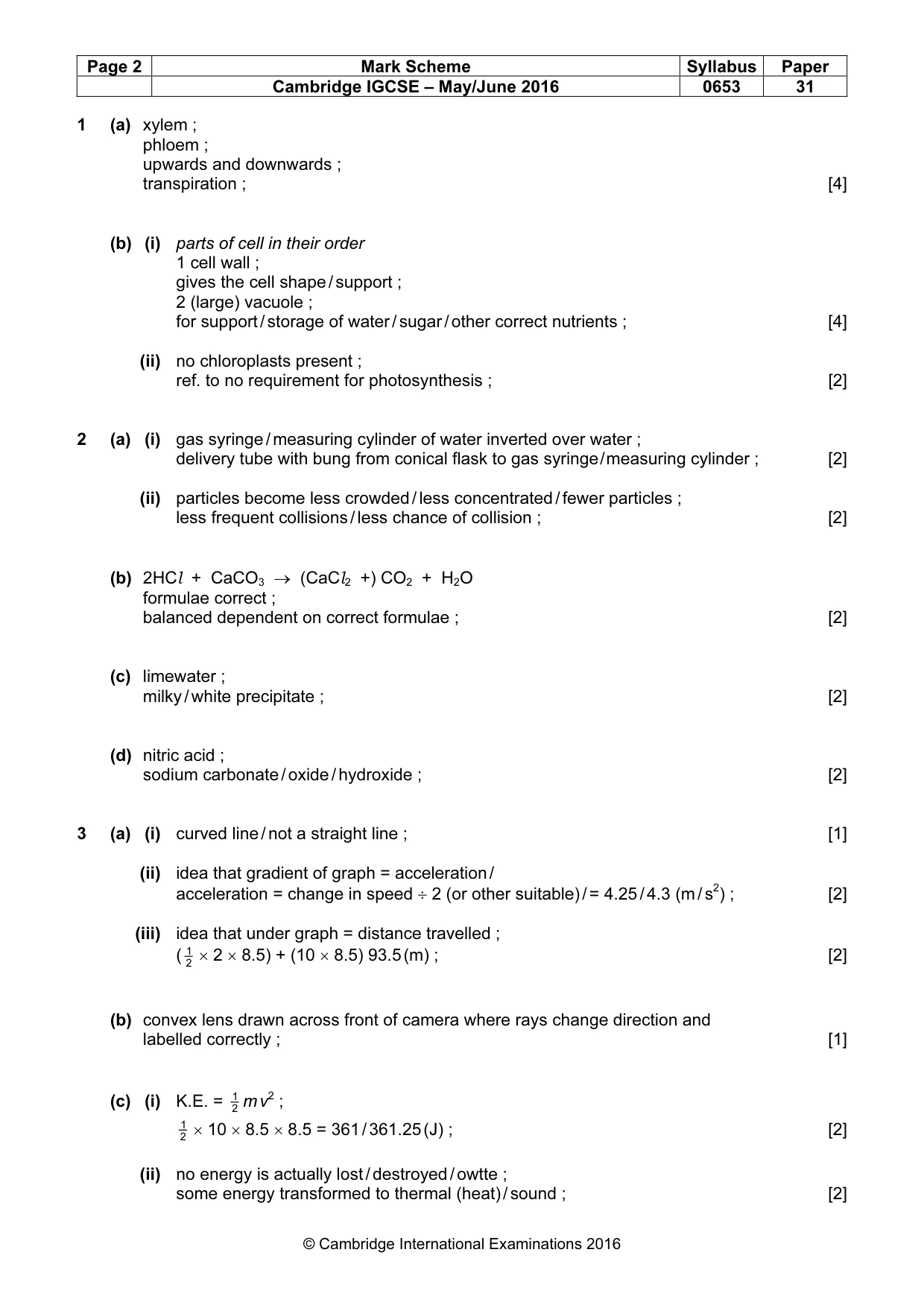
® IGCSE is the registered trademark of Cambridge International Examinations. This document consists of 5 printed pages. © UCLES 2016 [Turn over Cambridge International Examinations Cambridge International General Certificate of Secondary Education COMBINED SCIENCE 0653/31 Paper 3 Extended Theory May/June 2016 MARK SCHEME Maximum Mark: 80 Published This mark scheme is published as an aid to teachers and candidates, to indicate the requirements of the examination. It shows the basis on which Examiners were instructed to award marks. It does not indicate the details of the discussions that took place at an Examiners’ meeting before marking began, which would have considered the acceptability of alternative answers. Mark schemes should be read in conjunction with the question paper and the Principal Examiner Report for Teachers. Cambridge will not enter into discussions about these mark schemes. Cambridge is publishing the mark schemes for the May/June 2016 series for most Cambridge IGCSE®, Cambridge International A and AS Level components and some Cambridge O Level components.
Mark scheme, page 2
Page 2 Mark Scheme Syllabus Paper Cambridge IGCSE – May/June 2016 0653 31 © Cambridge International Examinations 2016 1 (a) xylem ; phloem ; upwards and downwards ; transpiration ; [4] (b) (i) parts of cell in their order 1 cell wall ; gives the cell shape / support ; 2 (large) vacuole ; for support / storage of water / sugar / other correct nutrients ; [4] (ii) no chloroplasts present ; ref. to no requirement for photosynthesis ; [2] 2 (a) (i) gas syringe / measuring cylinder of water inverted over water ; delivery tube with bung from conical flask to gas syringe / measuring cylinder ; [2] (ii) particles become less crowded / less concentrated / fewer particles ; less frequent collisions / less chance of collision ; [2] (b) 2HCl + CaCO3 → (CaCl2 +) CO2 + H2O formulae correct ; balanced dependent on correct formulae ; [2] (c) limewater ; milky / white precipitate ; [2] (d) nitric acid ; sodium carbonate / oxide / hydroxide ; [2] 3 (a) (i) curved line / not a straight line ; [1] (ii) idea that gradient of graph = acceleration / acceleration = change in speed ÷ 2 (or other suitable) / = 4.25 / 4.3 (m / s2) ; [2] (iii) idea that under graph = distance travelled ; ( 1 2 × 2 × 8.5) + (10 × 8.5) 93.5 (m) ; [2] (b) convex lens drawn across front of camera where rays change direction and labelled correctly ; [1] (c) (i) K.E. = 1 2 m v2 ; 1 2 × 10 × 8.5 × 8.5 = 361 / 361.25 (J) ; [2] (ii) no energy is actually lost / destroyed / owtte ; some energy transformed to thermal (heat) / sound ; [2]
Mark scheme, page 3
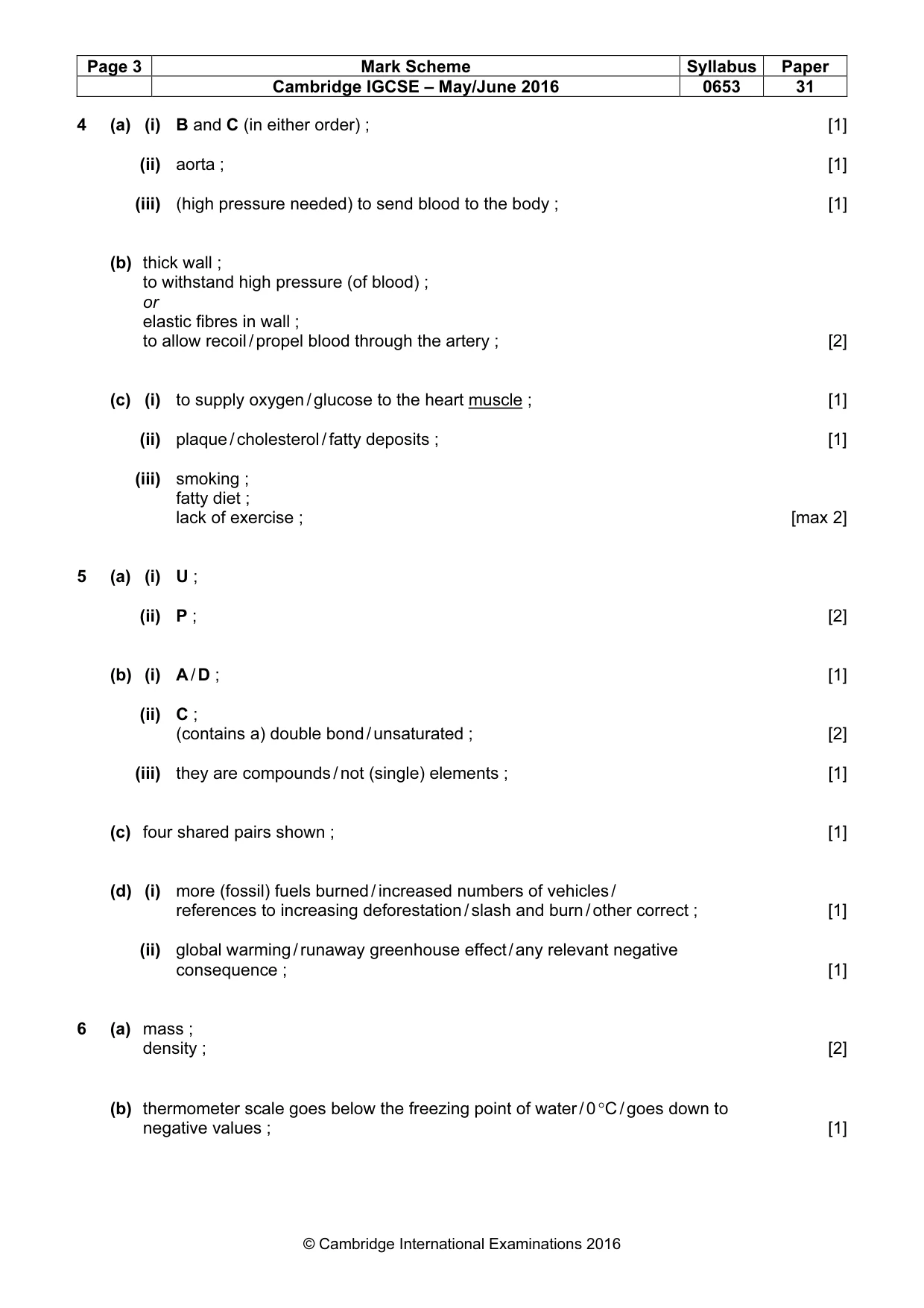
Page 3 Mark Scheme Syllabus Paper Cambridge IGCSE – May/June 2016 0653 31 © Cambridge International Examinations 2016 4 (a) (i) B and C (in either order) ; [1] (ii) aorta ; [1] (iii) (high pressure needed) to send blood to the body ; [1] (b) thick wall ; to withstand high pressure (of blood) ; or elastic fibres in wall ; to allow recoil / propel blood through the artery ; [2] (c) (i) to supply oxygen / glucose to the heart muscle ; [1] (ii) plaque / cholesterol / fatty deposits ; [1] (iii) smoking ; fatty diet ; lack of exercise ; [max 2] 5 (a) (i) U ; (ii) P ; [2] (b) (i) A / D ; [1] (ii) C ; (contains a) double bond / unsaturated ; [2] (iii) they are compounds / not (single) elements ; [1] (c) four shared pairs shown ; [1] (d) (i) more (fossil) fuels burned / increased numbers of vehicles / references to increasing deforestation / slash and burn / other correct ; [1] (ii) global warming / runaway greenhouse effect / any relevant negative consequence ; [1] 6 (a) mass ; density ; [2] (b) thermometer scale goes below the freezing point of water / 0 °C / goes down to negative values ; [1]
Mark scheme, page 4
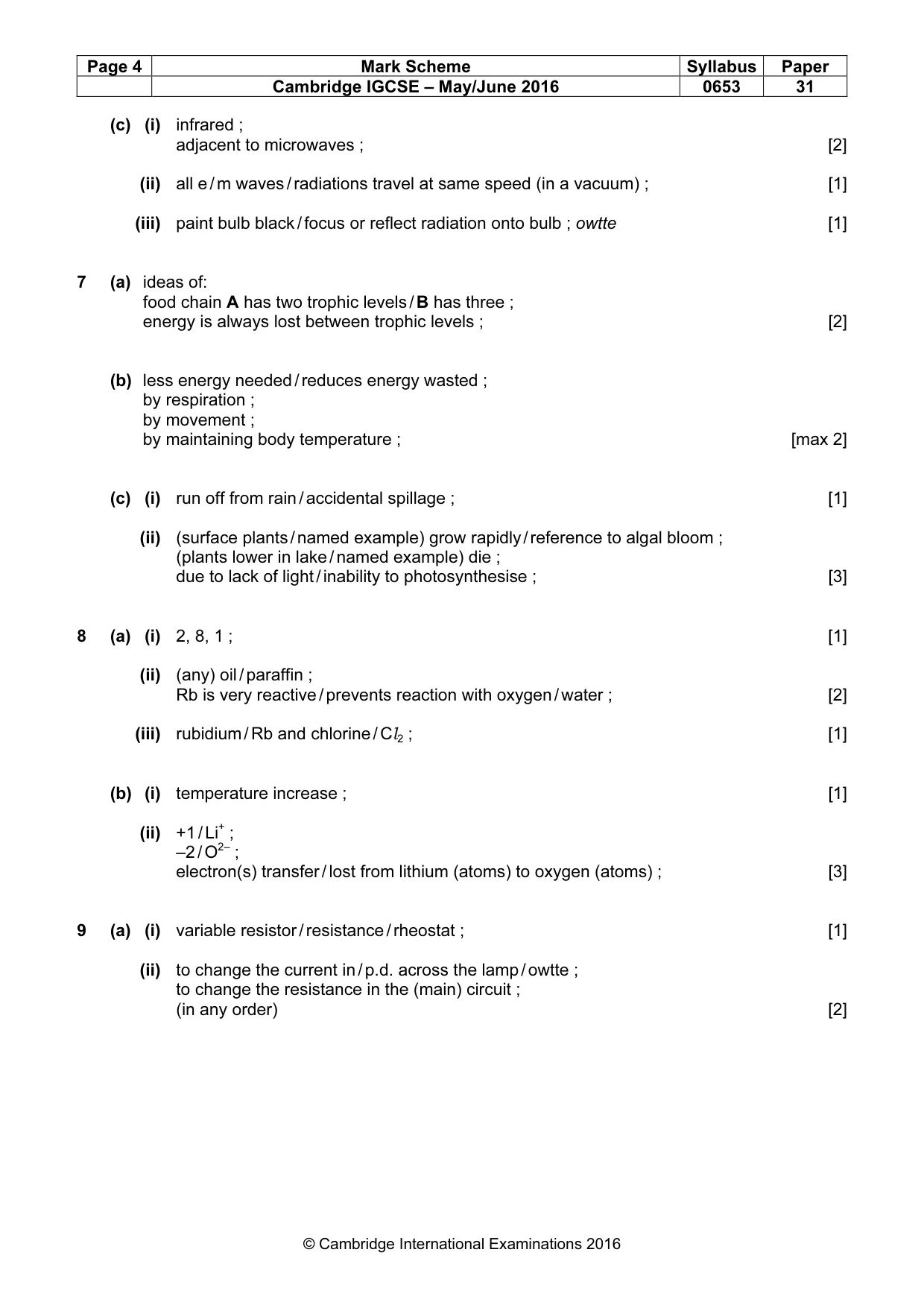
Page 4 Mark Scheme Syllabus Paper Cambridge IGCSE – May/June 2016 0653 31 © Cambridge International Examinations 2016 (c) (i) infrared ; adjacent to microwaves ; [2] (ii) all e / m waves / radiations travel at same speed (in a vacuum) ; [1] (iii) paint bulb black / focus or reflect radiation onto bulb ; owtte [1] 7 (a) ideas of: food chain A has two trophic levels / B has three ; energy is always lost between trophic levels ; [2] (b) less energy needed / reduces energy wasted ; by respiration ; by movement ; by maintaining body temperature ; [max 2] (c) (i) run off from rain / accidental spillage ; [1] (ii) (surface plants / named example) grow rapidly / reference to algal bloom ; (plants lower in lake / named example) die ; due to lack of light / inability to photosynthesise ; [3] 8 (a) (i) 2, 8, 1 ; [1] (ii) (any) oil / paraffin ; Rb is very reactive / prevents reaction with oxygen / water ; [2] (iii) rubidium / Rb and chlorine / Cl2 ; [1] (b) (i) temperature increase ; [1] (ii) +1 / Li+ ; –2 / O2– ; electron(s) transfer / lost from lithium (atoms) to oxygen (atoms) ; [3] 9 (a) (i) variable resistor / resistance / rheostat ; [1] (ii) to change the current in / p.d. across the lamp / owtte ; to change the resistance in the (main) circuit ; (in any order) [2]
Mark scheme, page 5
Page 5 Mark Scheme Syllabus Paper Cambridge IGCSE – May/June 2016 0653 31 © Cambridge International Examinations 2016 (b) voltmeter correctly connected in parallel with lamp only ; other components all in series ; [accept equivalent circuits, variable resistor in any position other than in parallel with voltmeter] [2] (c) (i) (R =) V / I ; = 6 / 3 = 2 (Ω) ; [2] (ii) R increases with p.d. / current ; description of non-uniform increase ; [2]
What you needed in this session
Cambridge’s own grade thresholds for 2016 May/June, Paper 3 · Variant 1. A higher threshold means an easier paper — the bar moves with how the cohort did.