Cambridge IGCSE Science - Combined 0653 — 2015 Oct/Nov Paper 3 · Variant 1
0653/31/O/N/15 · 80 marks · ≈90 min
The question paper and its mark scheme, free to read here and free to download. This is Cambridge’s own paper, exactly as it was sat.
Question paper24 pages



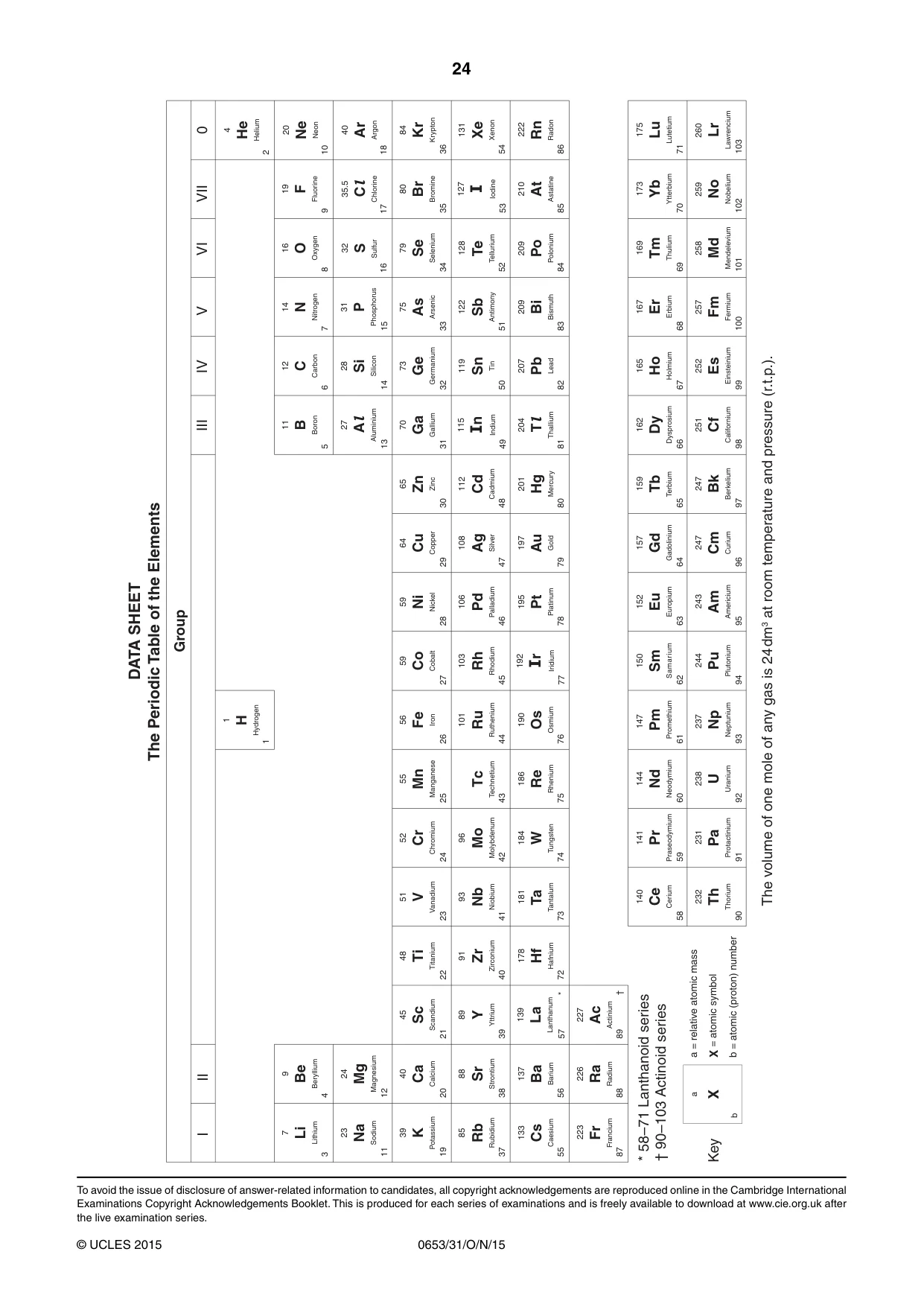
Mark scheme6 pages
Answers below. Sit the paper first if you are practising.
Paper as text
Question paper, page 1
This document consists of 22 printed pages and 2 blank pages. DC (ST/FD) 103627/2 © UCLES 2015 [Turn over Cambridge International Examinations Cambridge International General Certificate of Secondary Education * 0 8 2 9 0 9 4 6 1 3 * COMBINED SCIENCE 0653/31 Paper 3 (Extended) October/November 2015 1 hour 15 minutes Candidates answer on the Question Paper. No Additional Materials are required. READ THESE INSTRUCTIONS FIRST Write your Centre number, candidate number and name on all the work you hand in. Write in dark blue or black pen. You may use an HB pencil for any diagrams, graphs, tables or rough working. Do not use staples, paper clips, glue or correction fluid. DO NOT WRITE IN ANY BARCODES. Answer all questions. Electronic calculators may be used. You may lose marks if you do not show your working or if you do not use appropriate units. A copy of the Periodic Table is printed on page 24. At the end of the examination, fasten all your work securely together. The number of marks is given in brackets [ ] at the end of each question or part question.
Question paper, page 2
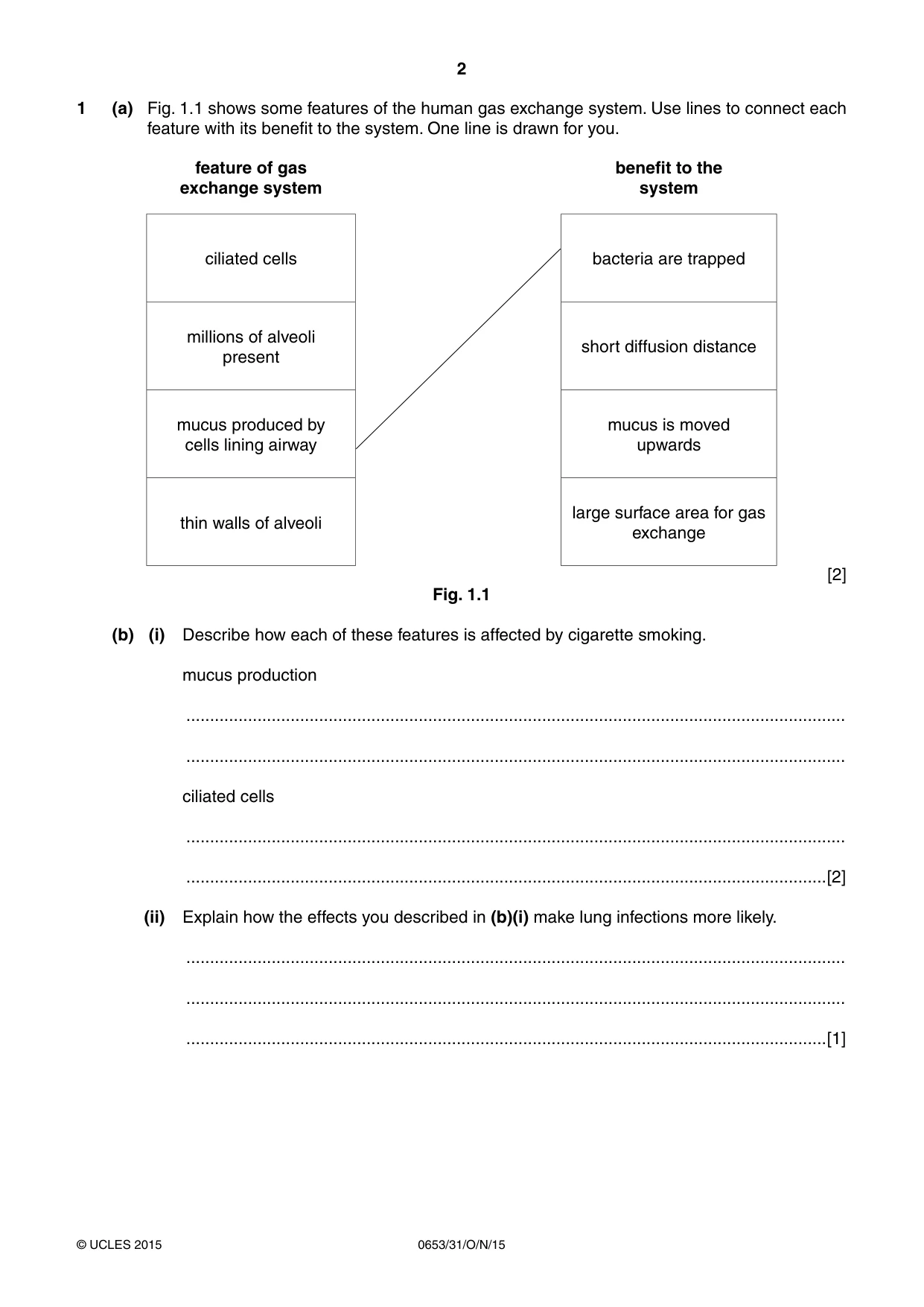
2 0653/31/O/N/15 © UCLES 2015 1 (a) Fig. 1.1 shows some features of the human gas exchange system. Use lines to connect each feature with its benefit to the system. One line is drawn for you. feature of gas exchange system benefit to the system ciliated cells bacteria are trapped millions of alveoli present short diffusion distance mucus produced by cells lining airway mucus is moved upwards thin walls of alveoli large surface area for gas exchange [2] Fig. 1.1 (b) (i) Describe how each of these features is affected by cigarette smoking. mucus production … … ciliated cells … …[2] (ii) Explain how the effects you described in (b)(i) make lung infections more likely. … … …[1]
Question paper, page 3
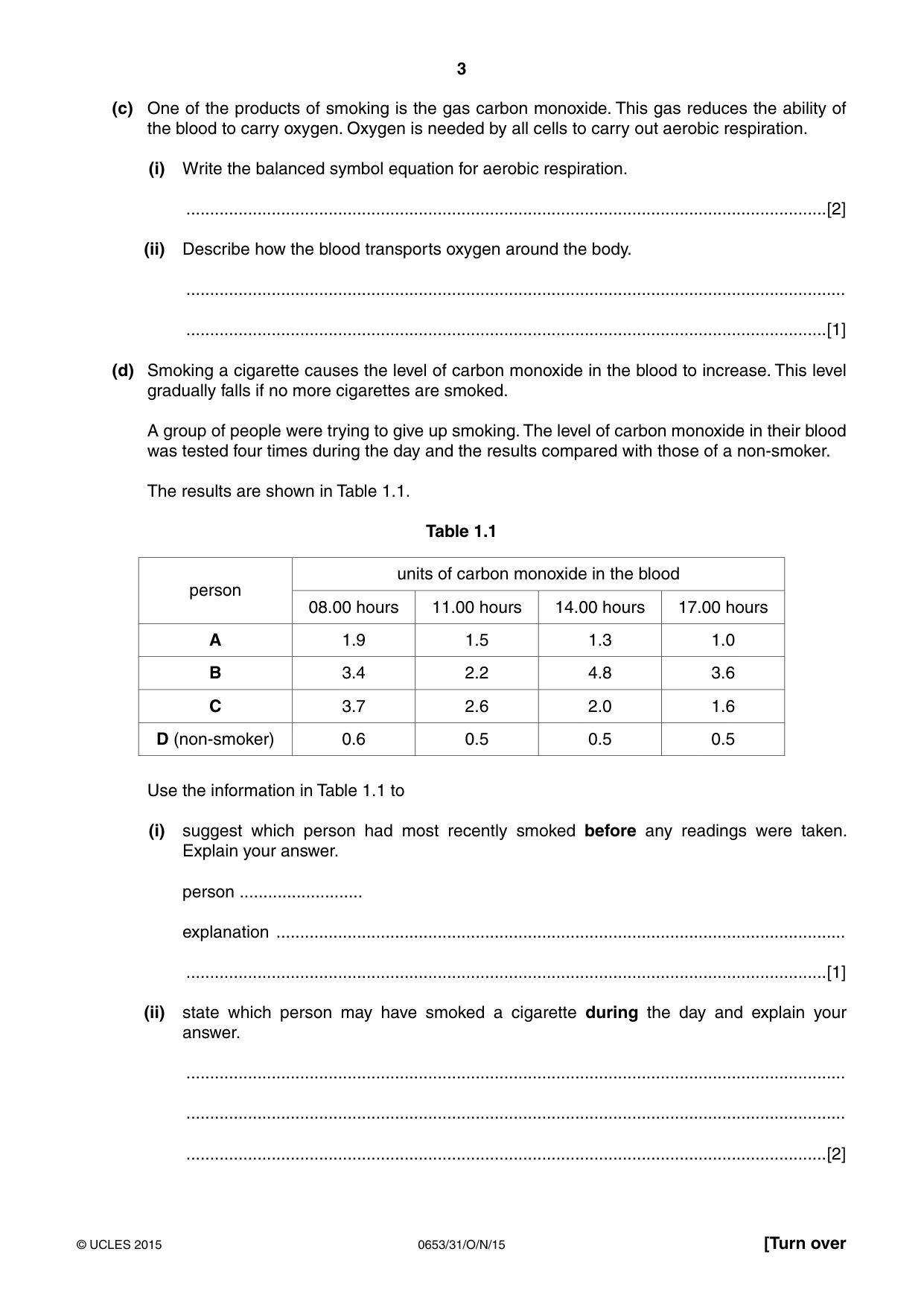
3 0653/31/O/N/15 © UCLES 2015 [Turn over (c) One of the products of smoking is the gas carbon monoxide. This gas reduces the ability of the blood to carry oxygen. Oxygen is needed by all cells to carry out aerobic respiration. (i) Write the balanced symbol equation for aerobic respiration. …[2] (ii) Describe how the blood transports oxygen around the body. … …[1] (d) Smoking a cigarette causes the level of carbon monoxide in the blood to increase. This level gradually falls if no more cigarettes are smoked. A group of people were trying to give up smoking. The level of carbon monoxide in their blood was tested four times during the day and the results compared with those of a non-smoker. The results are shown in Table 1.1. Table 1.1 person units of carbon monoxide in the blood 08.00 hours 11.00 hours 14.00 hours 17.00 hours A 1.9 1.5 1.3 1.0 B 3.4 2.2 4.8 3.6 C 3.7 2.6 2.0 1.6 D (non-smoker) 0.6 0.5 0.5 0.5 Use the information in Table 1.1 to (i) suggest which person had most recently smoked before any readings were taken. Explain your answer. person … explanation … …[1] (ii) state which person may have smoked a cigarette during the day and explain your answer. … … …[2]
Question paper, page 4
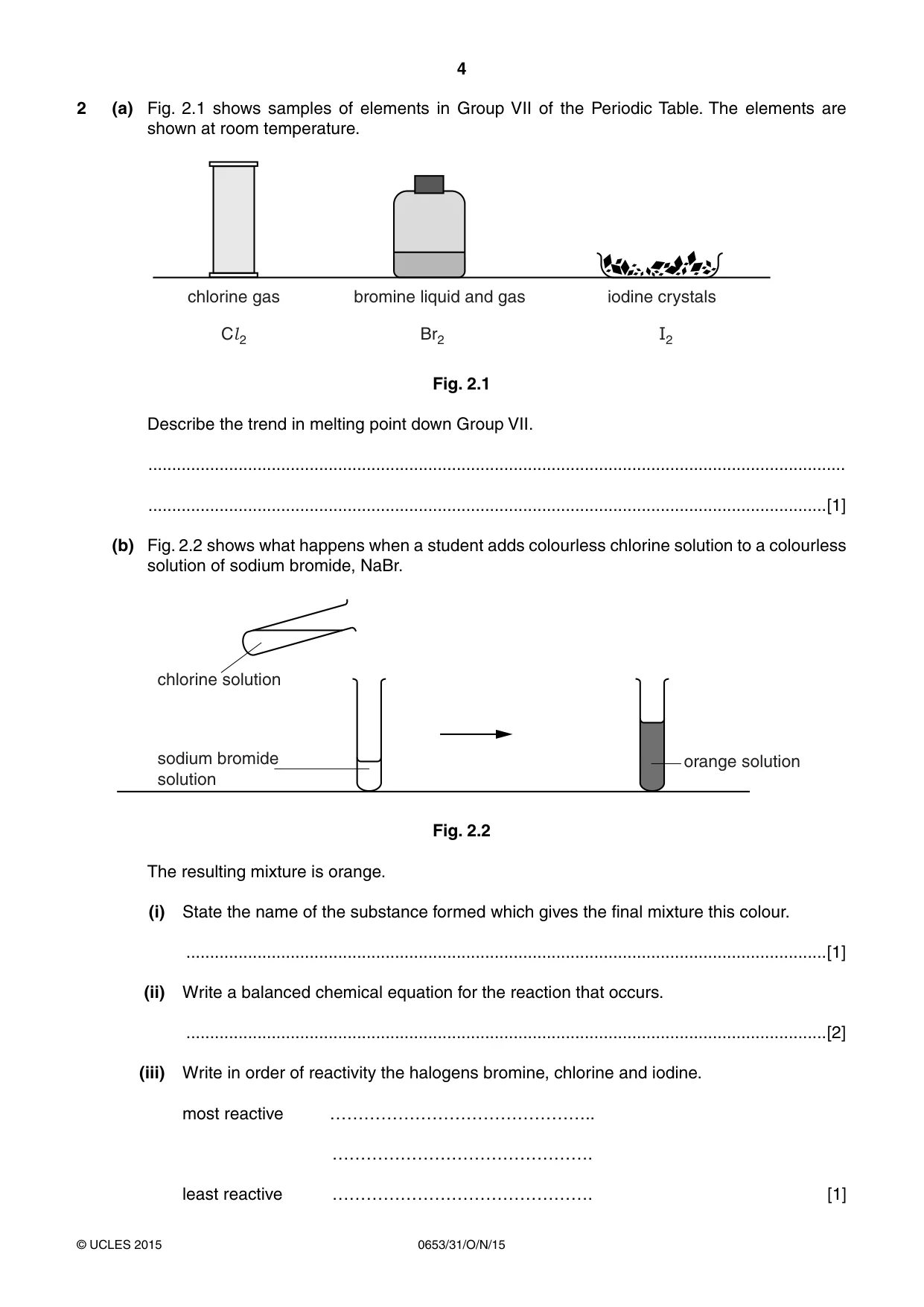
4 0653/31/O/N/15 © UCLES 2015 2 (a) Fig. 2.1 shows samples of elements in Group VII of the Periodic Table. The elements are shown at room temperature. chlorine gas Cl 2 Br2 I2 bromine liquid and gas iodine crystals Fig. 2.1 Describe the trend in melting point down Group VII. … …[1] (b) Fig. 2.2 shows what happens when a student adds colourless chlorine solution to a colourless solution of sodium bromide, NaBr. chlorine solution orange solution sodium bromide solution Fig. 2.2 The resulting mixture is orange. (i) State the name of the substance formed which gives the final mixture this colour. …[1] (ii) Write a balanced chemical equation for the reaction that occurs. …[2] (iii) Write in order of reactivity the halogens bromine, chlorine and iodine. most reactive ……………………………………….. ………………………………………. least reactive ………………………………………. [1]
Question paper, page 5
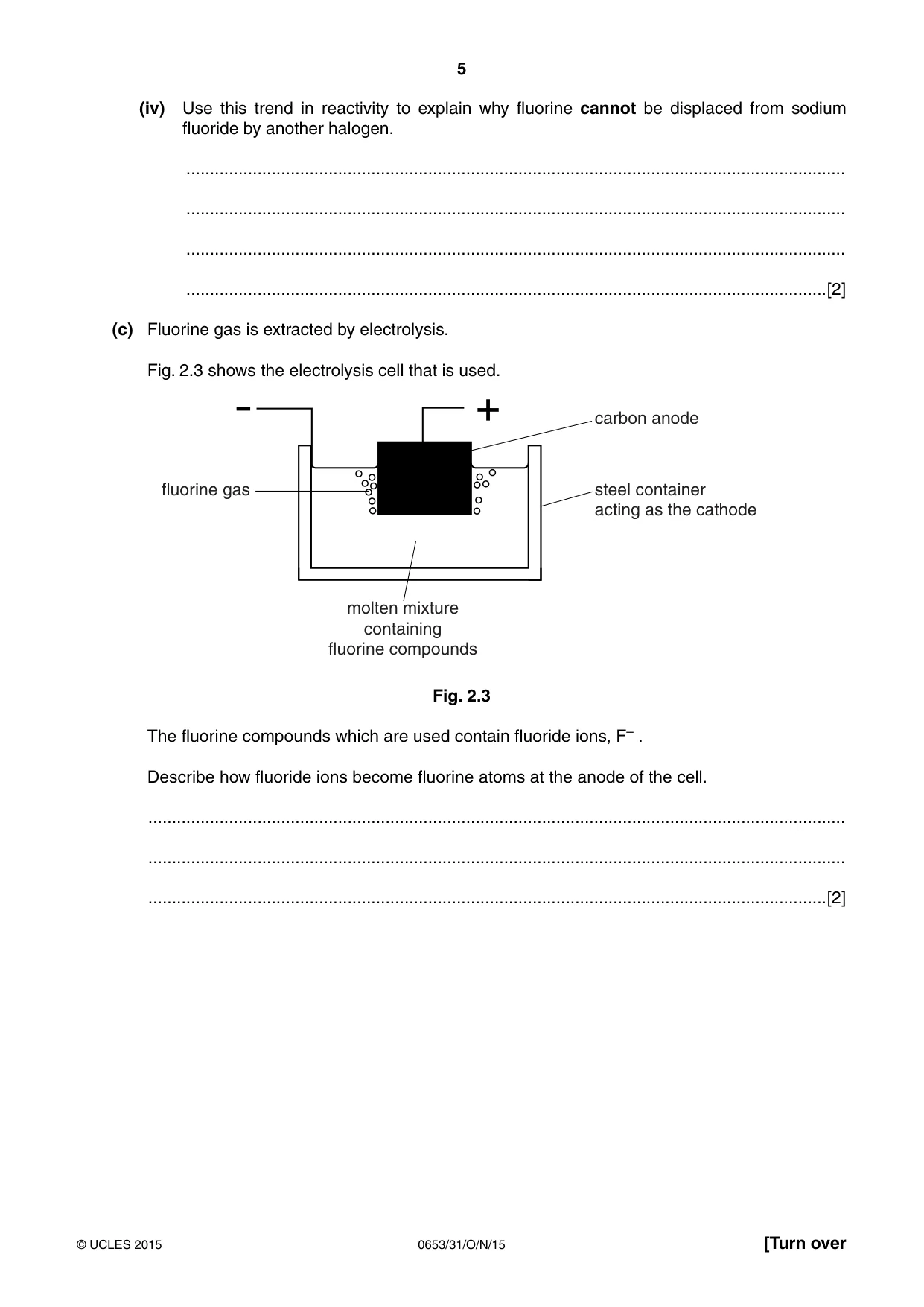
5 0653/31/O/N/15 © UCLES 2015 [Turn over (iv) Use this trend in reactivity to explain why fluorine cannot be displaced from sodium fluoride by another halogen. … … … …[2] (c) Fluorine gas is extracted by electrolysis. Fig. 2.3 shows the electrolysis cell that is used. carbon anode steel container acting as the cathode molten mixture containing fluorine compounds fluorine gas Fig. 2.3 The fluorine compounds which are used contain fluoride ions, F– . Describe how fluoride ions become fluorine atoms at the anode of the cell. … … …[2]
Question paper, page 6
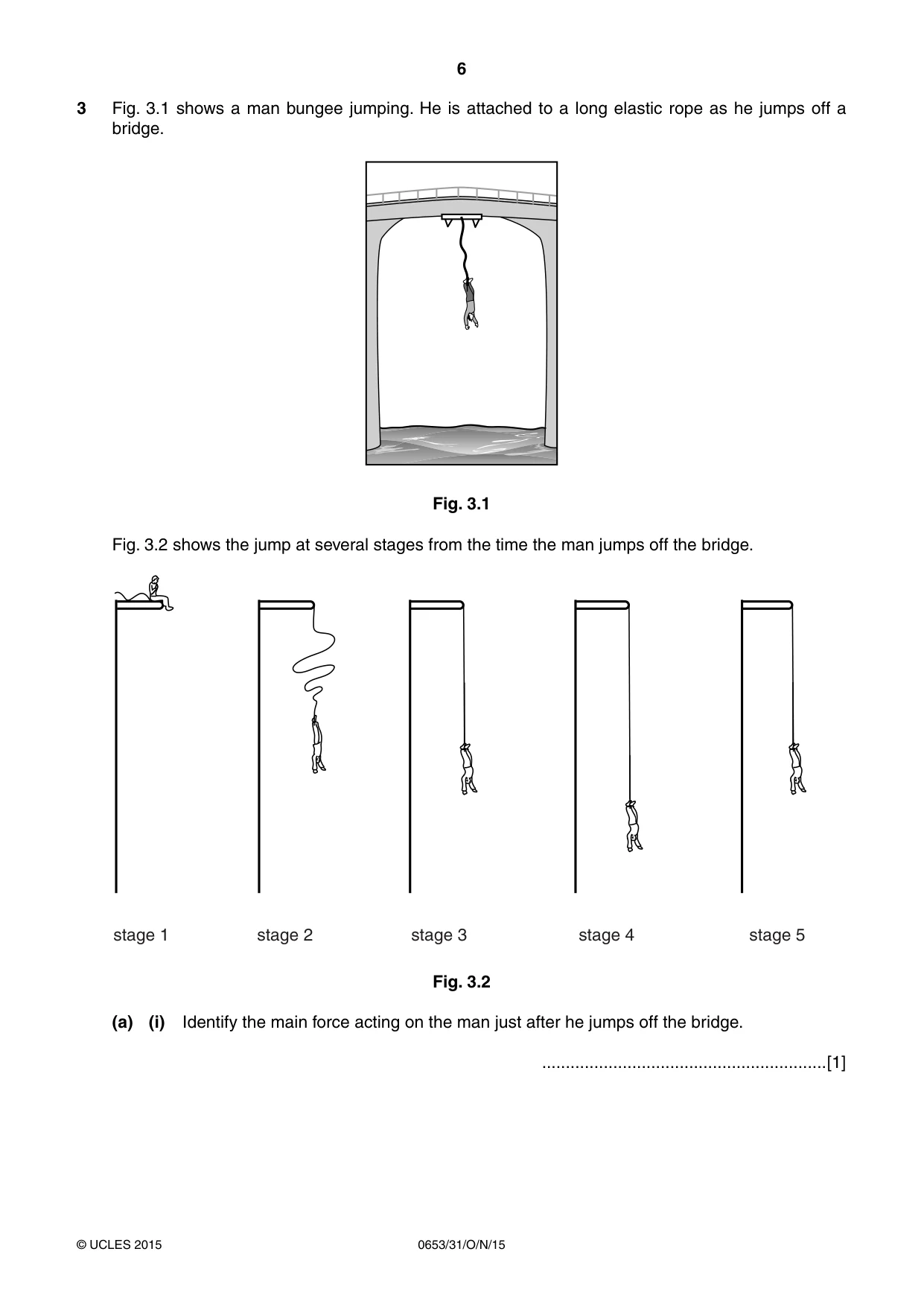
6 0653/31/O/N/15 © UCLES 2015 3 Fig. 3.1 shows a man bungee jumping. He is attached to a long elastic rope as he jumps off a bridge. Fig. 3.1 Fig. 3.2 shows the jump at several stages from the time the man jumps off the bridge. stage 1 stage 2 stage 3 stage 4 stage 5 Fig. 3.2 (a) (i) Identify the main force acting on the man just after he jumps off the bridge. …[1]
Question paper, page 7
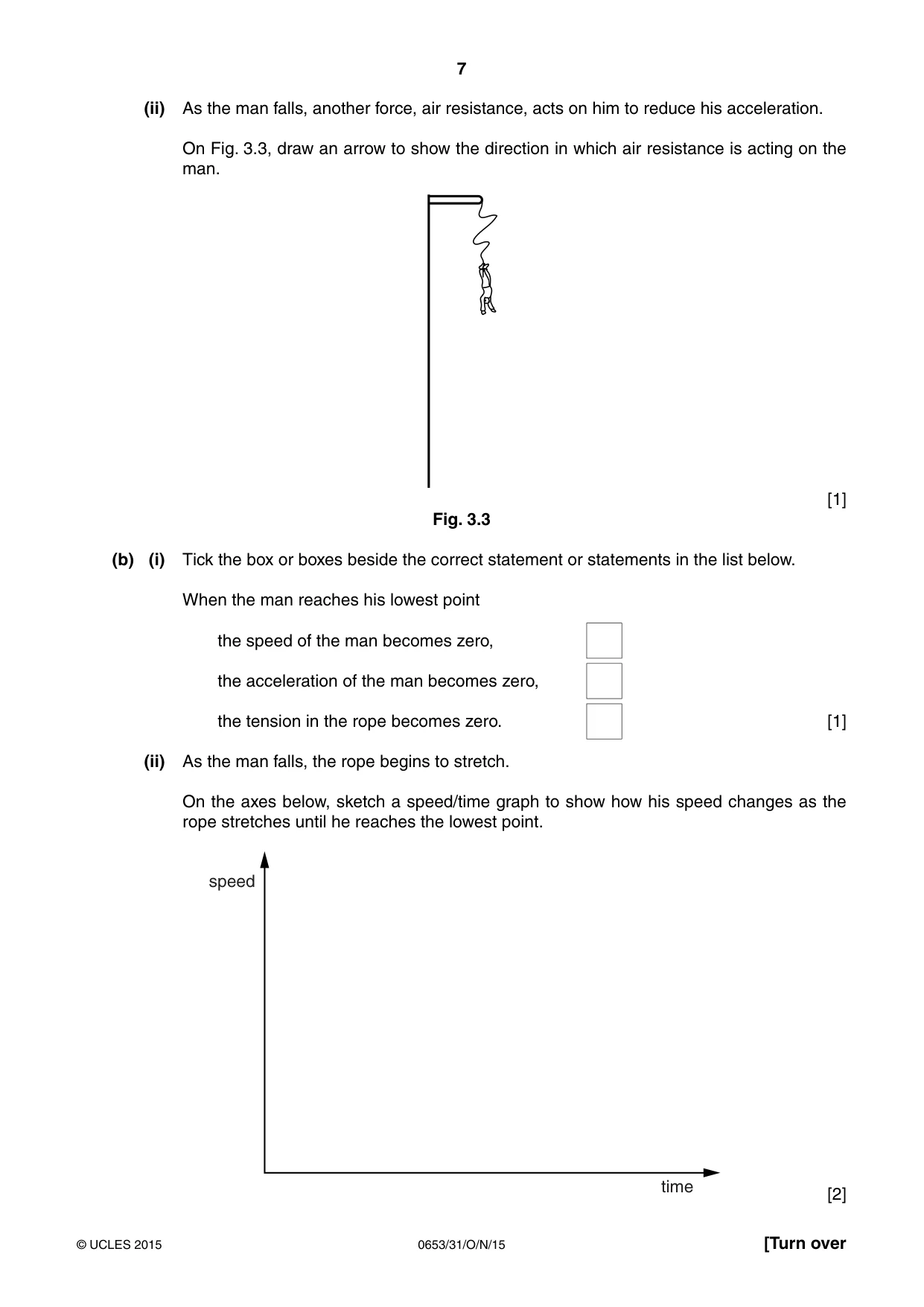
7 0653/31/O/N/15 © UCLES 2015 [Turn over (ii) As the man falls, another force, air resistance, acts on him to reduce his acceleration. On Fig. 3.3, draw an arrow to show the direction in which air resistance is acting on the man. [1] Fig. 3.3 (b) (i) Tick the box or boxes beside the correct statement or statements in the list below. When the man reaches his lowest point the speed of the man becomes zero, the acceleration of the man becomes zero, the tension in the rope becomes zero. [1] (ii) As the man falls, the rope begins to stretch. On the axes below, sketch a speed/time graph to show how his speed changes as the rope stretches until he reaches the lowest point. speed time [2]
Question paper, page 8
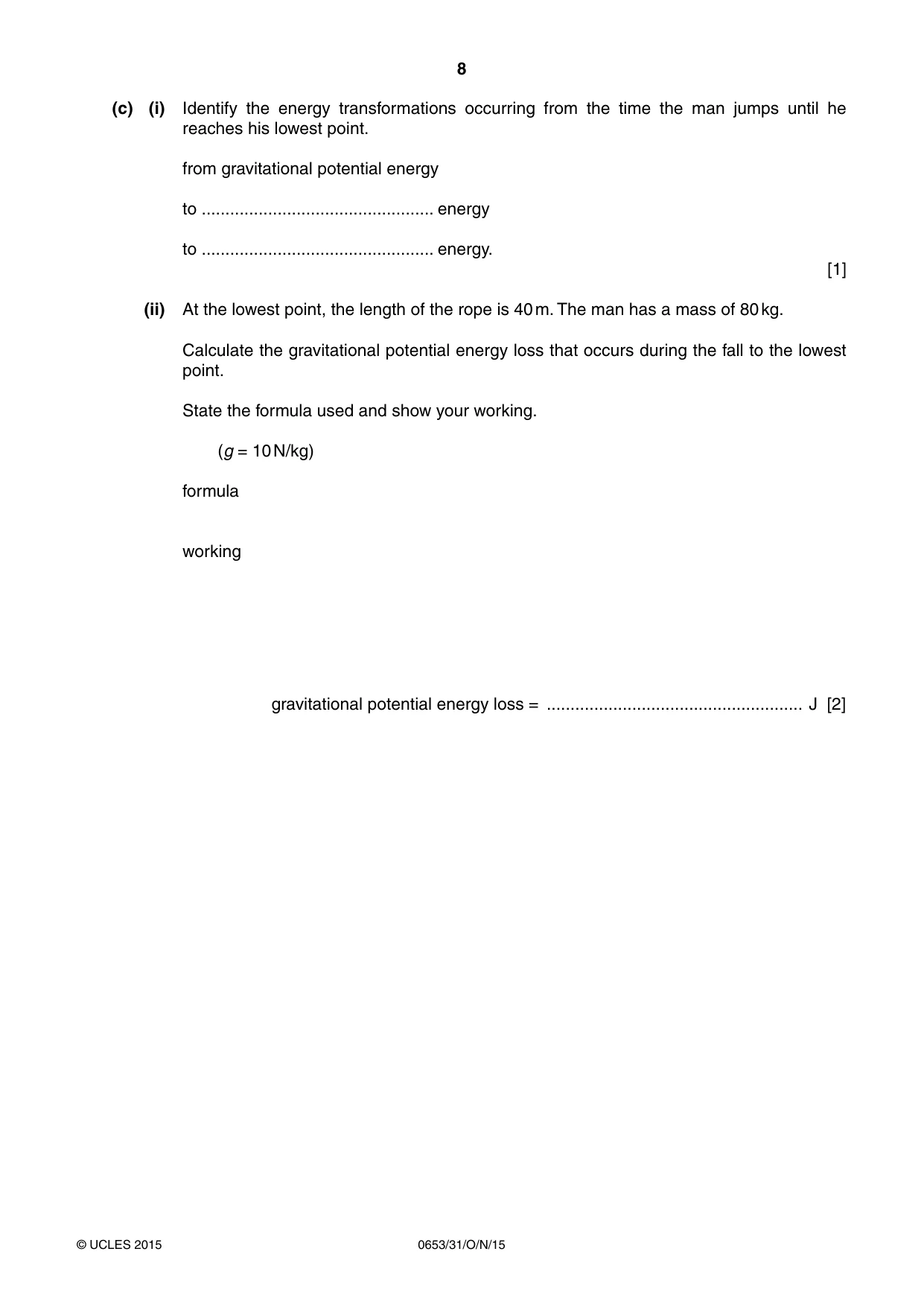
8 0653/31/O/N/15 © UCLES 2015 (c) (i) Identify the energy transformations occurring from the time the man jumps until he reaches his lowest point. from gravitational potential energy to … energy to … energy. [1] (ii) At the lowest point, the length of the rope is 40 m. The man has a mass of 80 kg. Calculate the gravitational potential energy loss that occurs during the fall to the lowest point. State the formula used and show your working. (g = 10 N/kg) formula working gravitational potential energy loss = … J [2]
Question paper, page 9
9 0653/31/O/N/15 © UCLES 2015 [Turn over Please turn over for Question 4.
Question paper, page 10
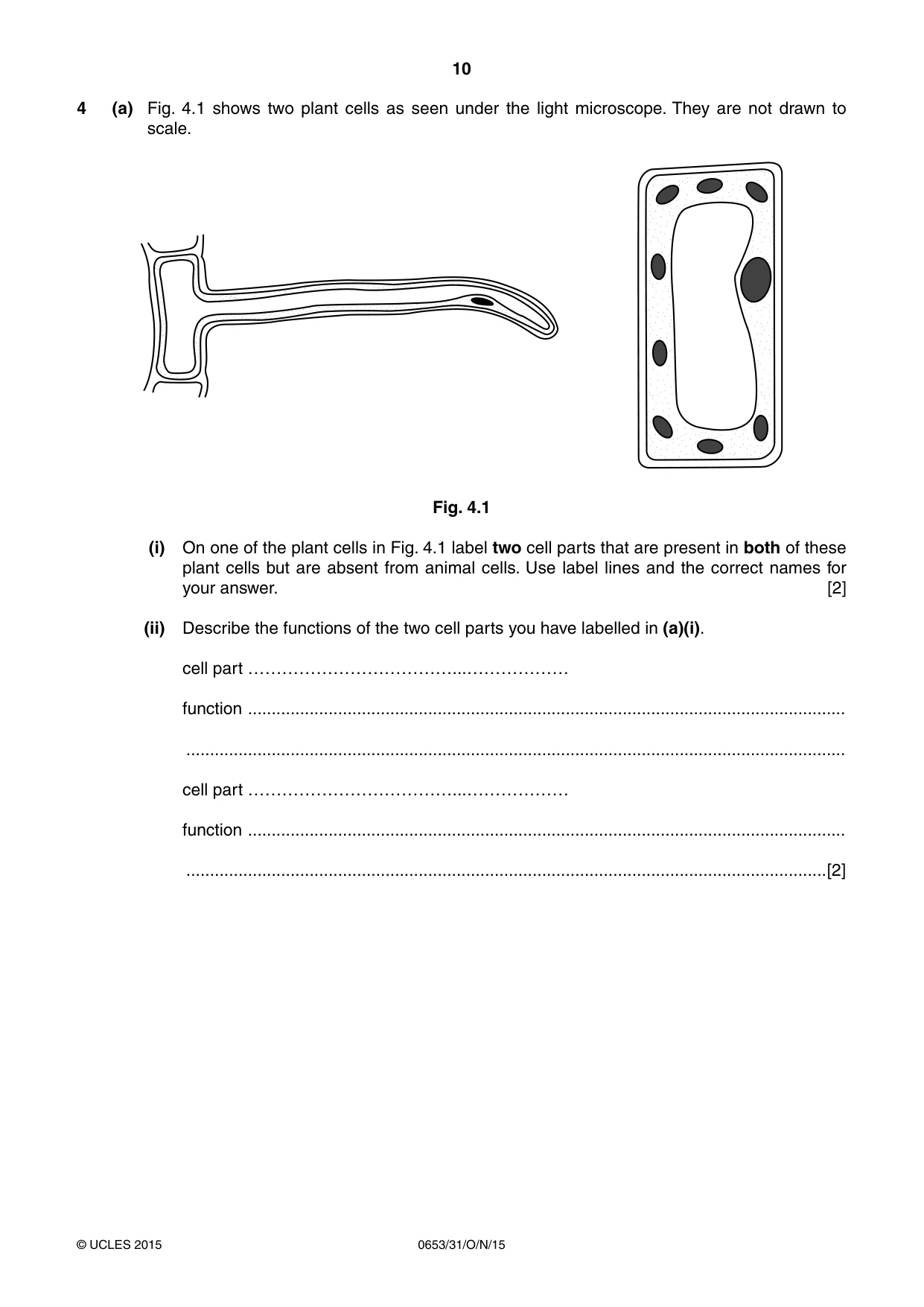
10 0653/31/O/N/15 © UCLES 2015 4 (a) Fig. 4.1 shows two plant cells as seen under the light microscope. They are not drawn to scale. Fig. 4.1 (i) On one of the plant cells in Fig. 4.1 label two cell parts that are present in both of these plant cells but are absent from animal cells. Use label lines and the correct names for your answer. [2] (ii) Describe the functions of the two cell parts you have labelled in (a)(i). cell part ………………………………...……………… function … … cell part ………………………………...……………… function … …[2]
Question paper, page 11
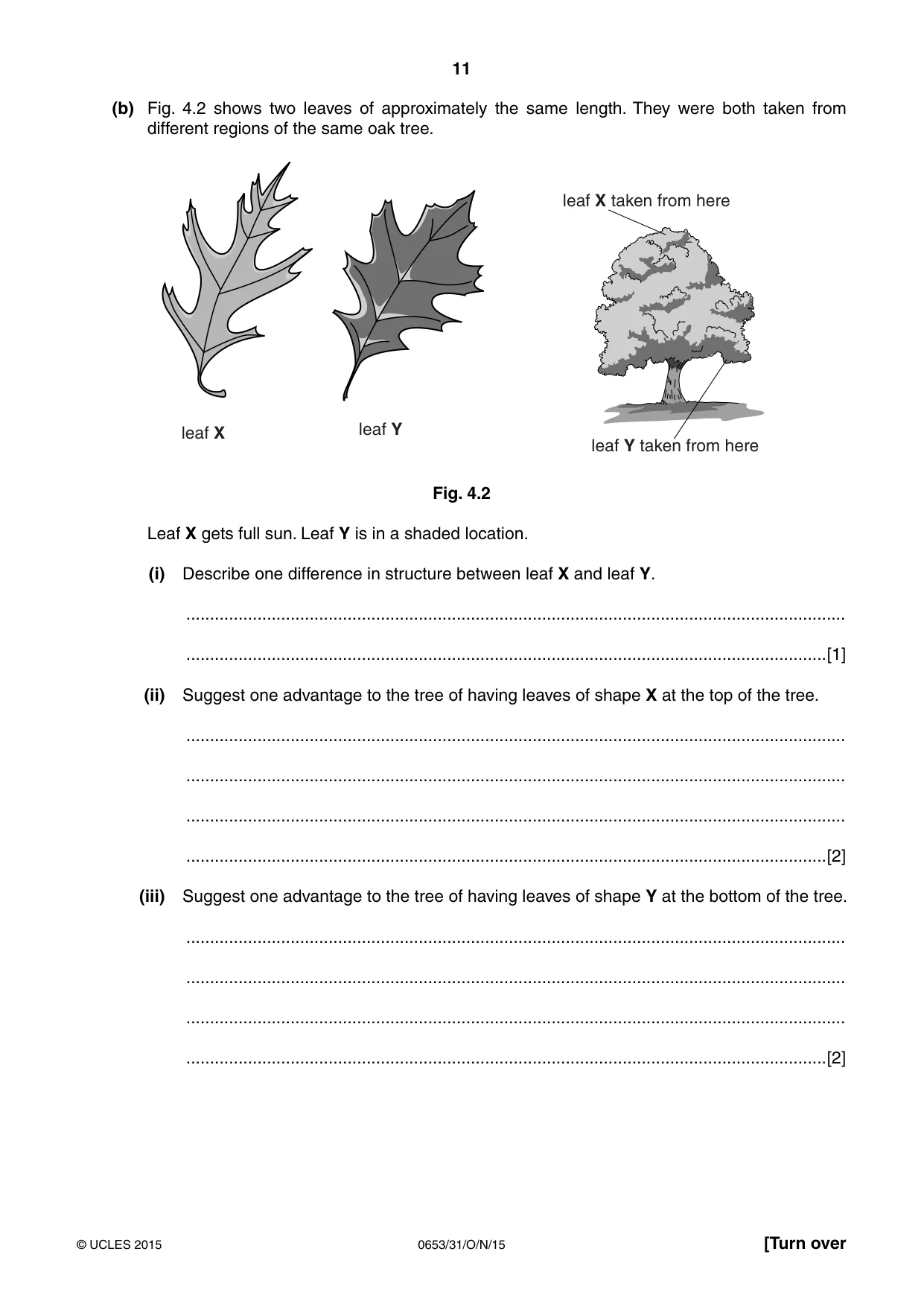
11 0653/31/O/N/15 © UCLES 2015 [Turn over (b) Fig. 4.2 shows two leaves of approximately the same length. They were both taken from different regions of the same oak tree. leaf X leaf Y leaf X taken from here leaf Y taken from here Fig. 4.2 Leaf X gets full sun. Leaf Y is in a shaded location. (i) Describe one difference in structure between leaf X and leaf Y. … …[1] (ii) Suggest one advantage to the tree of having leaves of shape X at the top of the tree. … … … …[2] (iii) Suggest one advantage to the tree of having leaves of shape Y at the bottom of the tree. … … … …[2]
Question paper, page 12
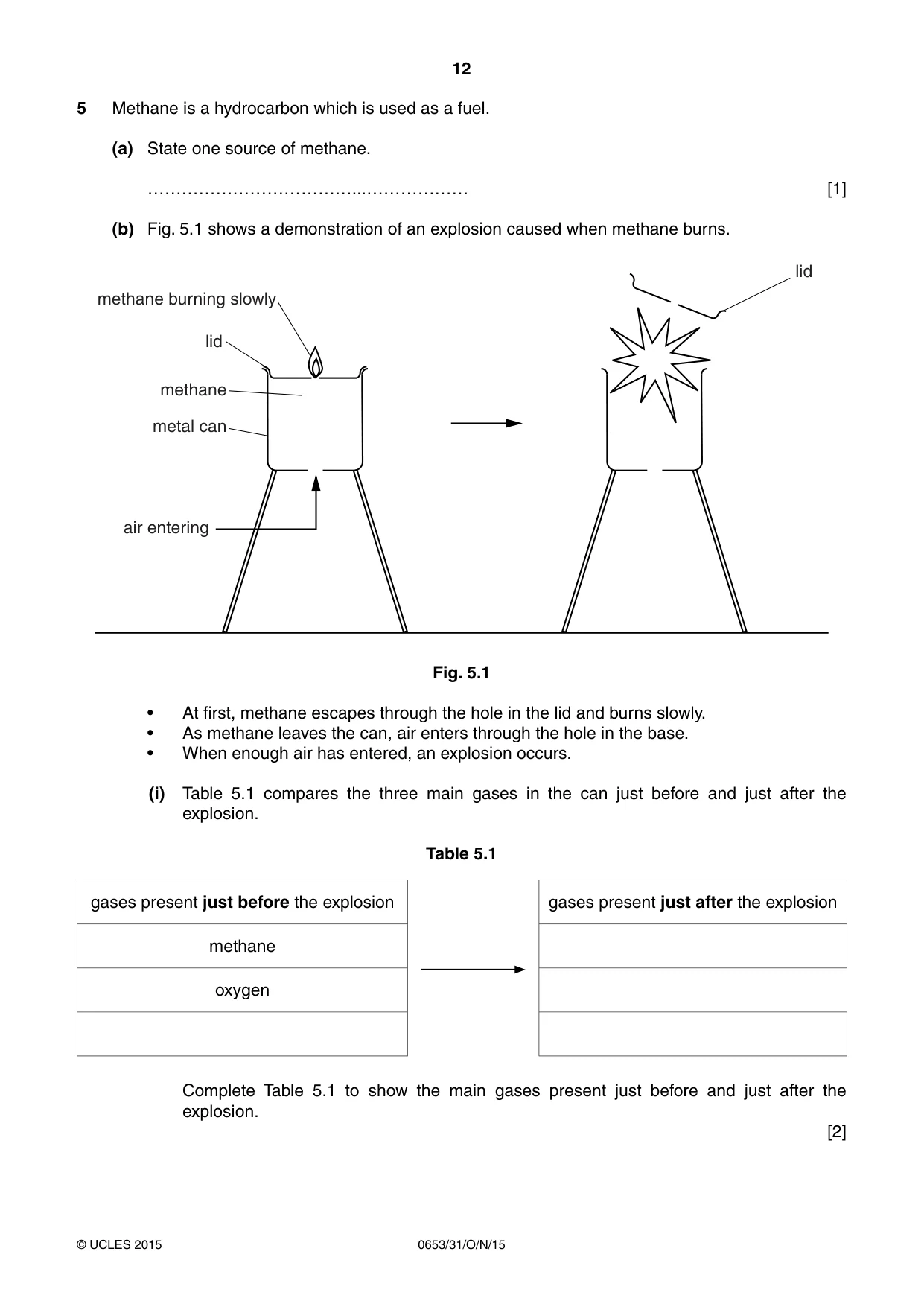
12 0653/31/O/N/15 © UCLES 2015 5 Methane is a hydrocarbon which is used as a fuel. (a) State one source of methane. ………………………………...……………… [1] (b) Fig. 5.1 shows a demonstration of an explosion caused when methane burns. methane burning slowly lid lid methane metal can air entering Fig. 5.1 • At first, methane escapes through the hole in the lid and burns slowly. • As methane leaves the can, air enters through the hole in the base. • When enough air has entered, an explosion occurs. (i) Table 5.1 compares the three main gases in the can just before and just after the explosion. Table 5.1 gases present just before the explosion gases present just after the explosion methane oxygen Complete Table 5.1 to show the main gases present just before and just after the explosion. [2]
Question paper, page 13
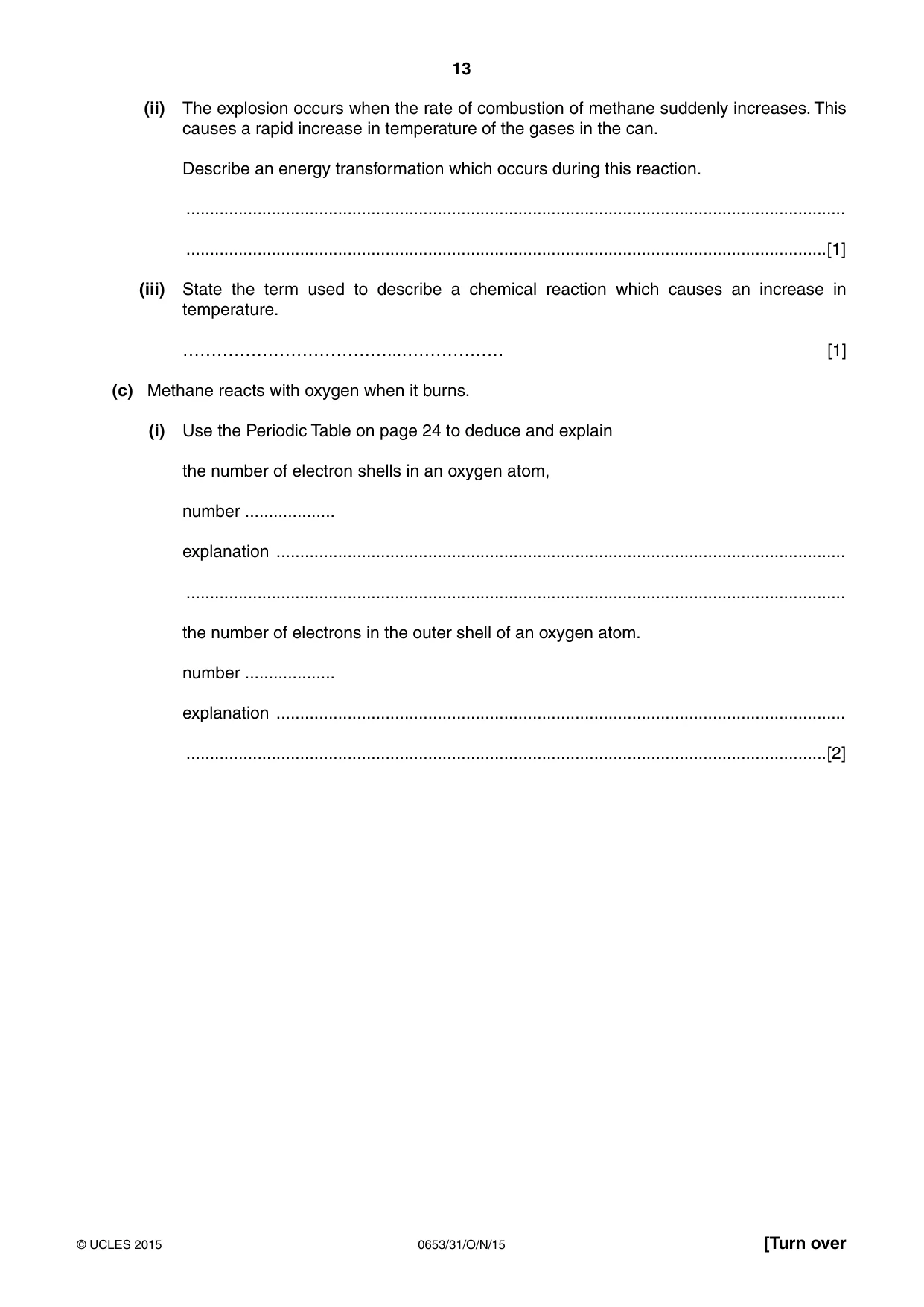
13 0653/31/O/N/15 © UCLES 2015 [Turn over (ii) The explosion occurs when the rate of combustion of methane suddenly increases. This causes a rapid increase in temperature of the gases in the can. Describe an energy transformation which occurs during this reaction. … …[1] (iii) State the term used to describe a chemical reaction which causes an increase in temperature. ………………………………...……………… [1] (c) Methane reacts with oxygen when it burns. (i) Use the Periodic Table on page 24 to deduce and explain the number of electron shells in an oxygen atom, number … explanation … … the number of electrons in the outer shell of an oxygen atom. number … explanation … …[2]
Question paper, page 14
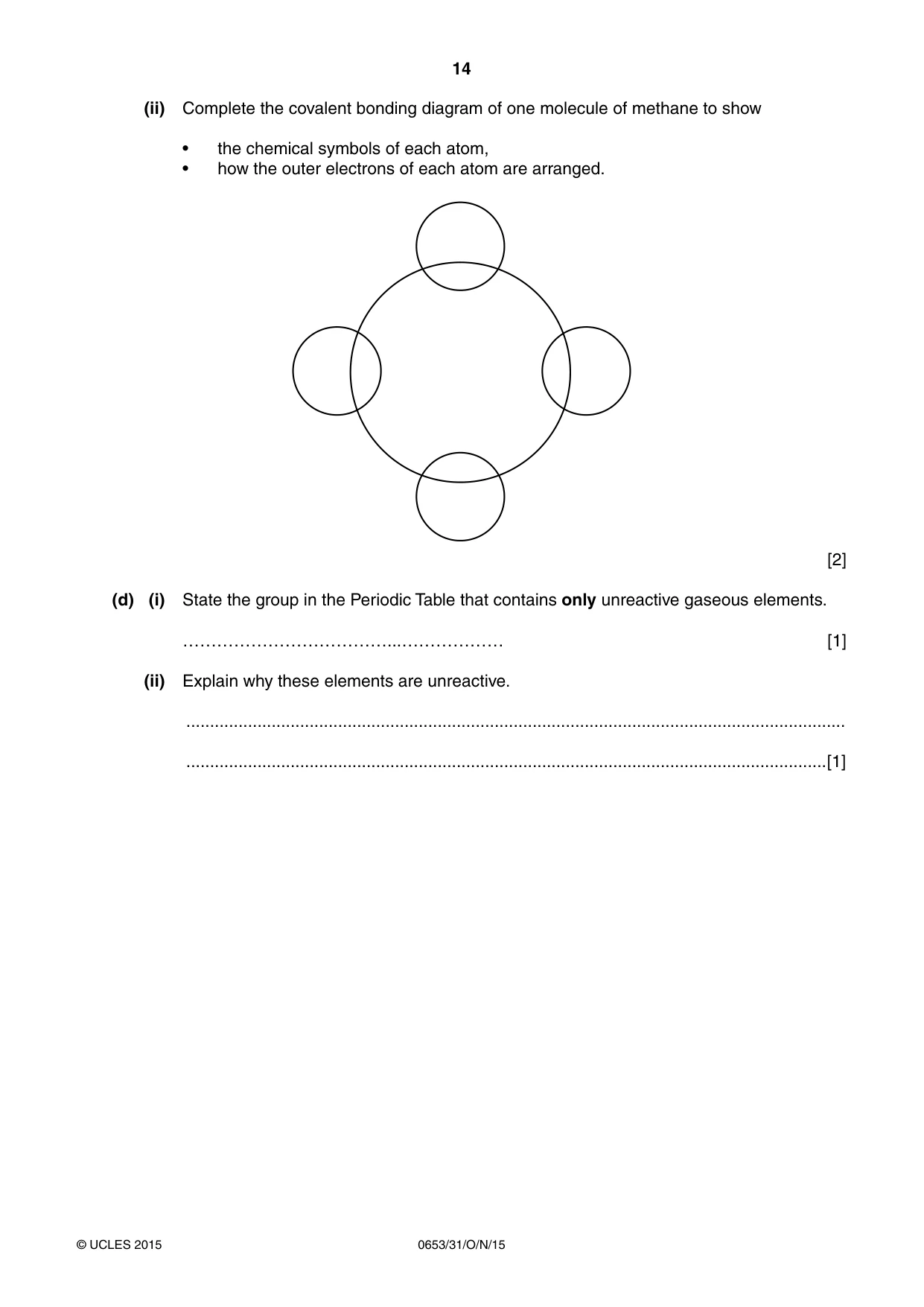
14 0653/31/O/N/15 © UCLES 2015 (ii) Complete the covalent bonding diagram of one molecule of methane to show • the chemical symbols of each atom, • how the outer electrons of each atom are arranged. [2] (d) (i) State the group in the Periodic Table that contains only unreactive gaseous elements. ………………………………...……………… [1] (ii) Explain why these elements are unreactive. … …[1]
Question paper, page 15
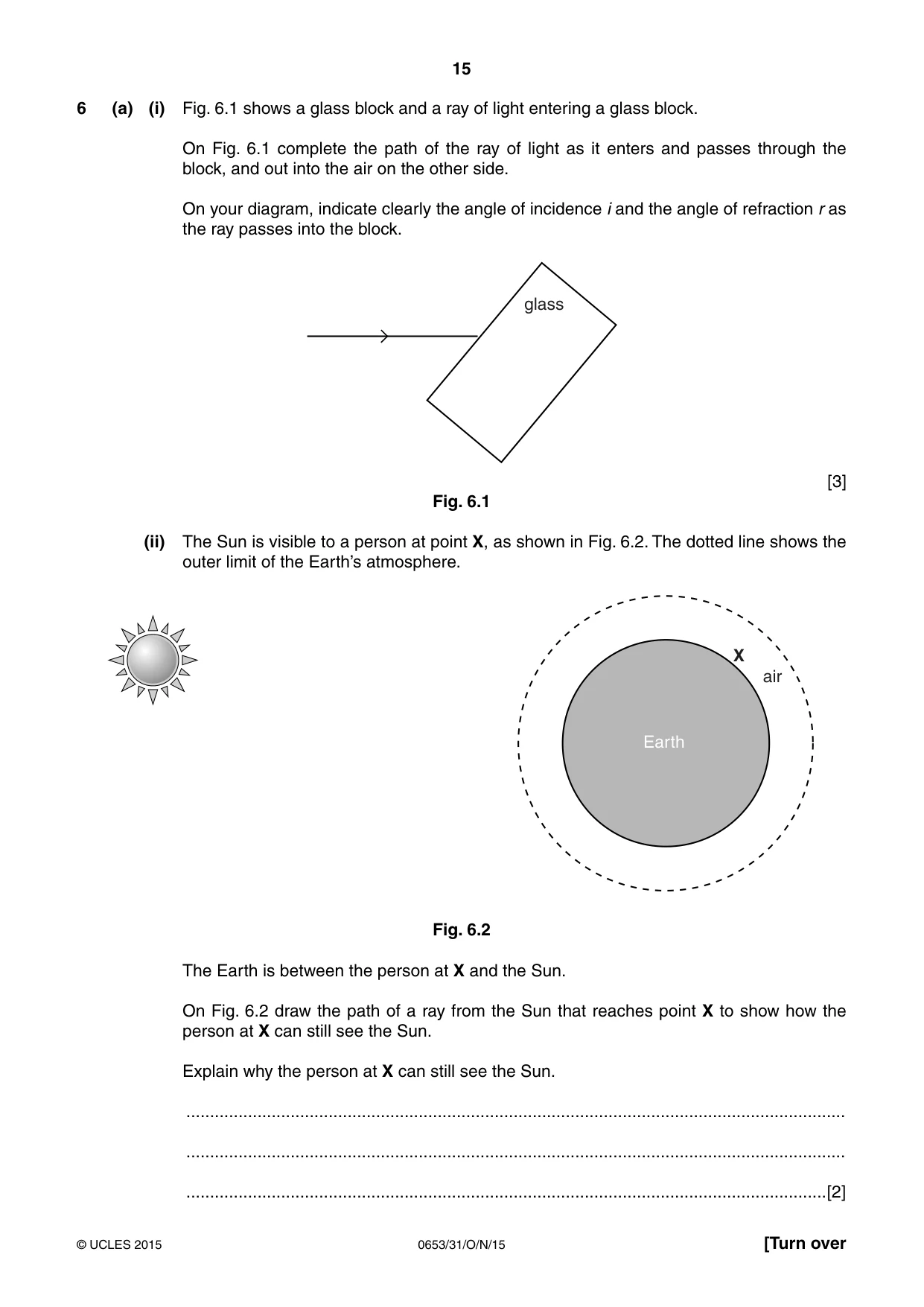
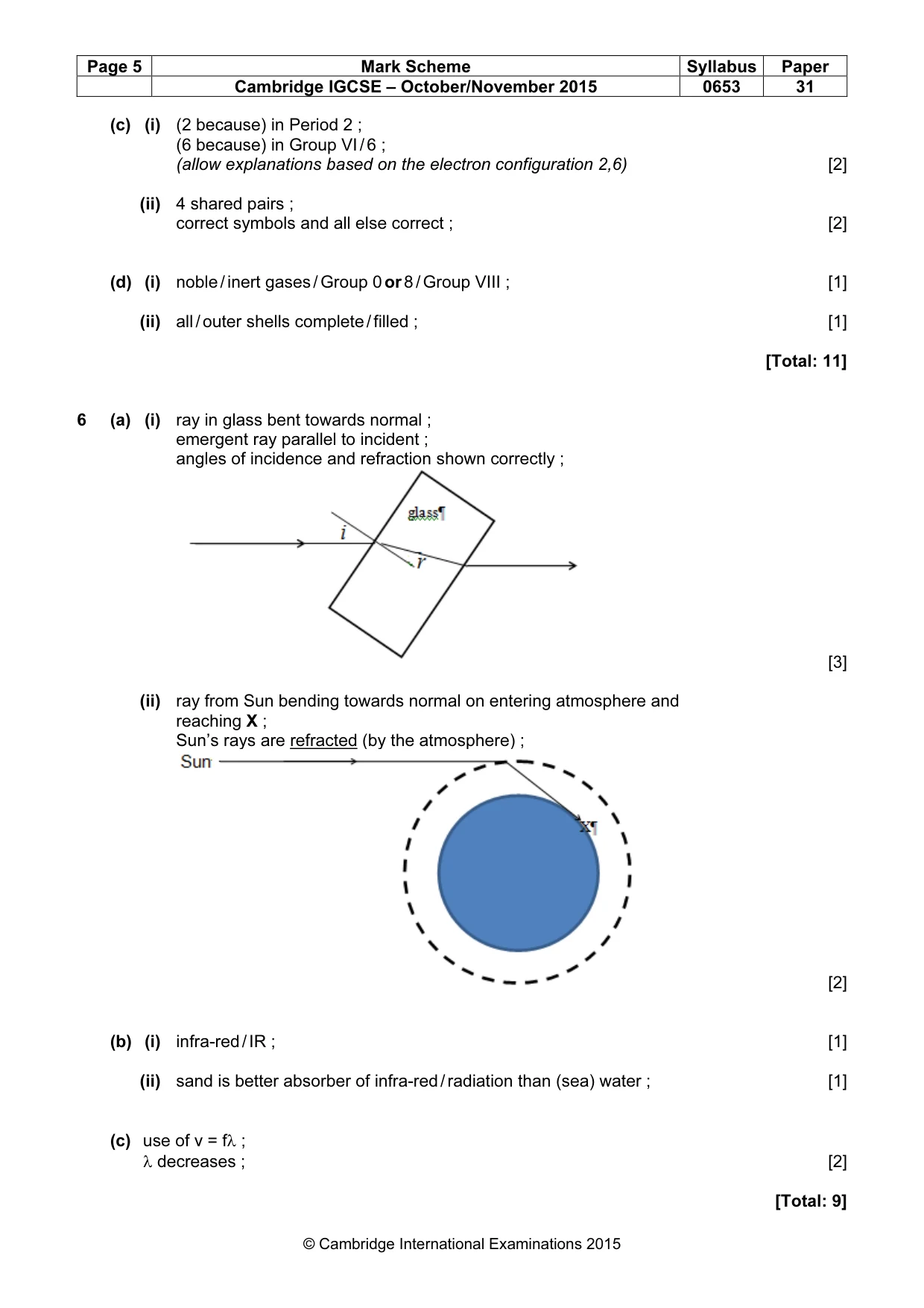
15 0653/31/O/N/15 © UCLES 2015 [Turn over 6 (a) (i) Fig. 6.1 shows a glass block and a ray of light entering a glass block. On Fig. 6.1 complete the path of the ray of light as it enters and passes through the block, and out into the air on the other side. On your diagram, indicate clearly the angle of incidence i and the angle of refraction r as the ray passes into the block. glass [3] Fig. 6.1 (ii) The Sun is visible to a person at point X, as shown in Fig. 6.2. The dotted line shows the outer limit of the Earth’s atmosphere. Earth air X Fig. 6.2 The Earth is between the person at X and the Sun. On Fig. 6.2 draw the path of a ray from the Sun that reaches point X to show how the person at X can still see the Sun. Explain why the person at X can still see the Sun. … … …[2]
Question paper, page 16
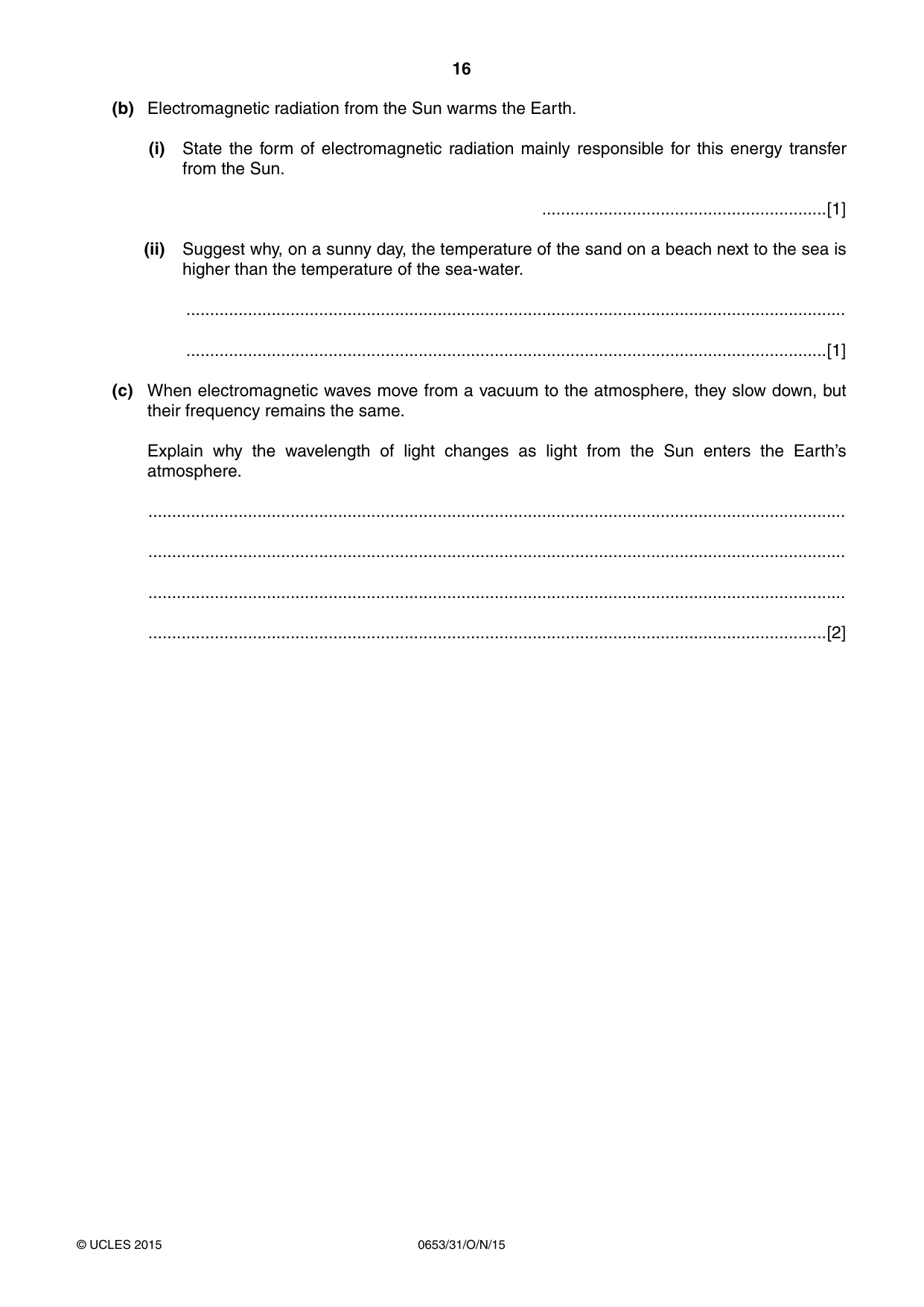
16 0653/31/O/N/15 © UCLES 2015 (b) Electromagnetic radiation from the Sun warms the Earth. (i) State the form of electromagnetic radiation mainly responsible for this energy transfer from the Sun. …[1] (ii) Suggest why, on a sunny day, the temperature of the sand on a beach next to the sea is higher than the temperature of the sea-water. … …[1] (c) When electromagnetic waves move from a vacuum to the atmosphere, they slow down, but their frequency remains the same. Explain why the wavelength of light changes as light from the Sun enters the Earth’s atmosphere. … … … …[2]
Question paper, page 17
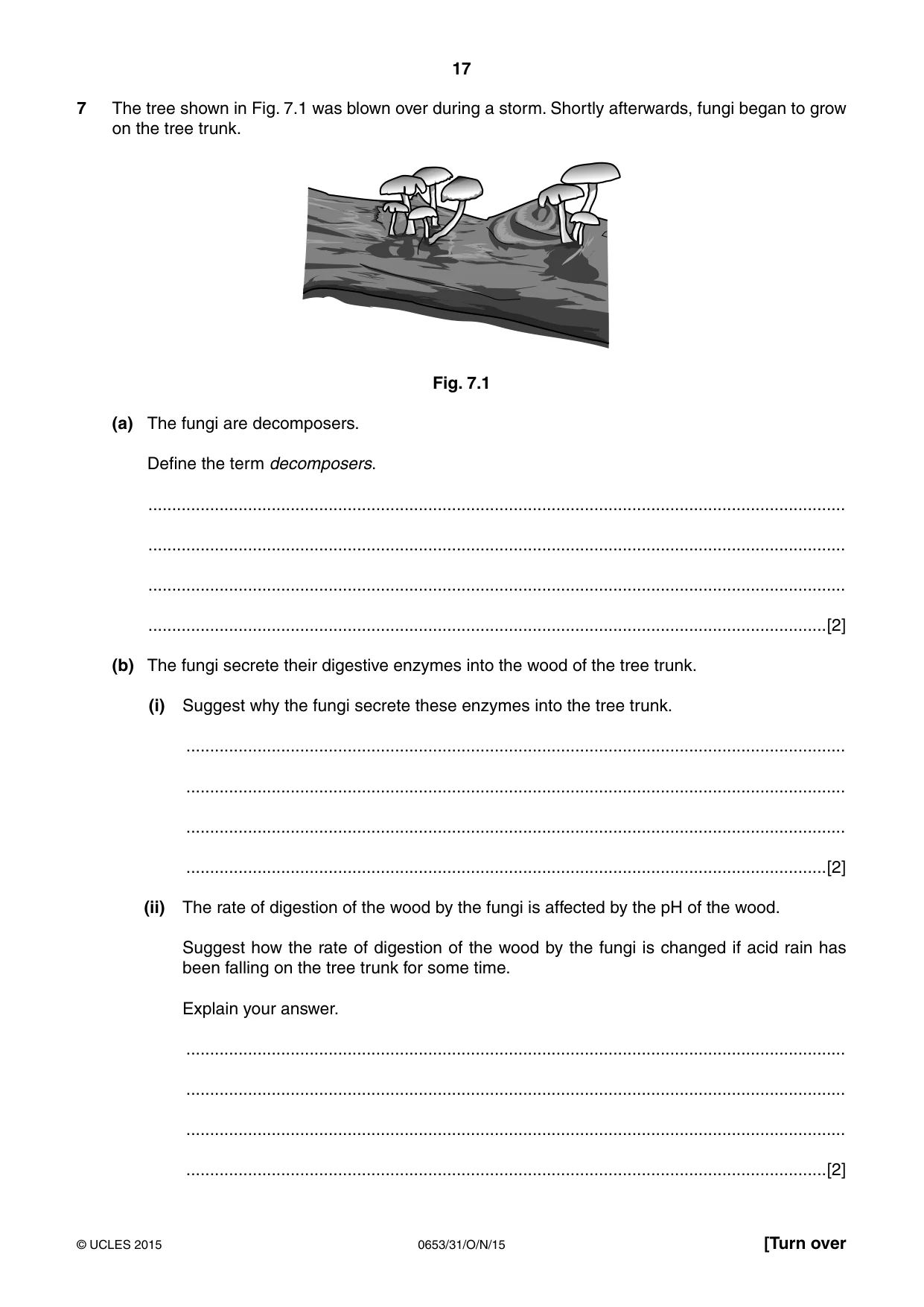
17 0653/31/O/N/15 © UCLES 2015 [Turn over 7 The tree shown in Fig. 7.1 was blown over during a storm. Shortly afterwards, fungi began to grow on the tree trunk. Fig. 7.1 (a) The fungi are decomposers. Define the term decomposers. … … … …[2] (b) The fungi secrete their digestive enzymes into the wood of the tree trunk. (i) Suggest why the fungi secrete these enzymes into the tree trunk. … … … …[2] (ii) The rate of digestion of the wood by the fungi is affected by the pH of the wood. Suggest how the rate of digestion of the wood by the fungi is changed if acid rain has been falling on the tree trunk for some time. Explain your answer. … … … …[2]
Question paper, page 18
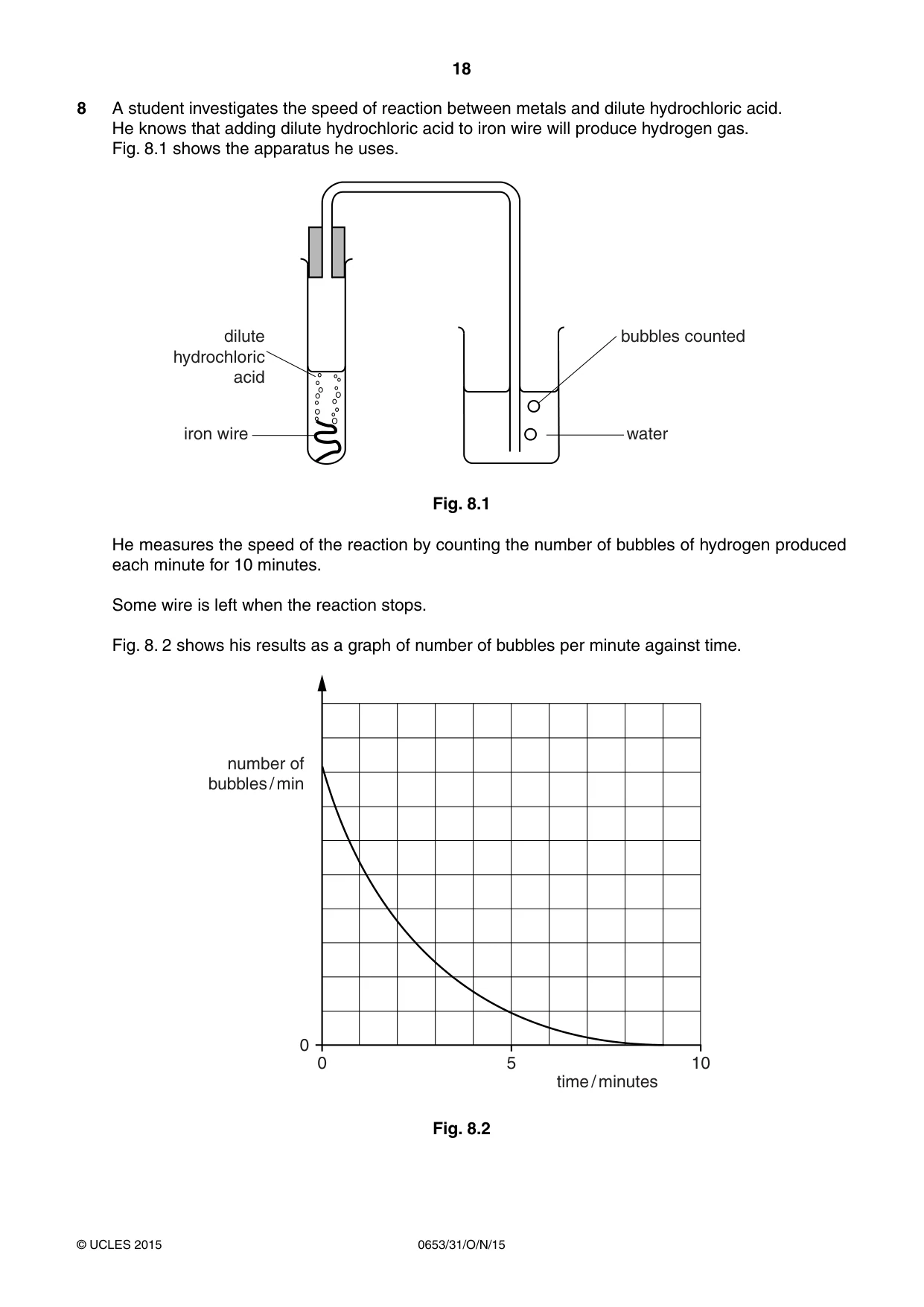
18 0653/31/O/N/15 © UCLES 2015 8 A student investigates the speed of reaction between metals and dilute hydrochloric acid. He knows that adding dilute hydrochloric acid to iron wire will produce hydrogen gas. Fig. 8.1 shows the apparatus he uses. dilute hydrochloric acid iron wire bubbles counted water Fig. 8.1 He measures the speed of the reaction by counting the number of bubbles of hydrogen produced each minute for 10 minutes. Some wire is left when the reaction stops. Fig. 8. 2 shows his results as a graph of number of bubbles per minute against time. 0 5 10 0 time / minutes number of bubbles / min Fig. 8.2
Question paper, page 19
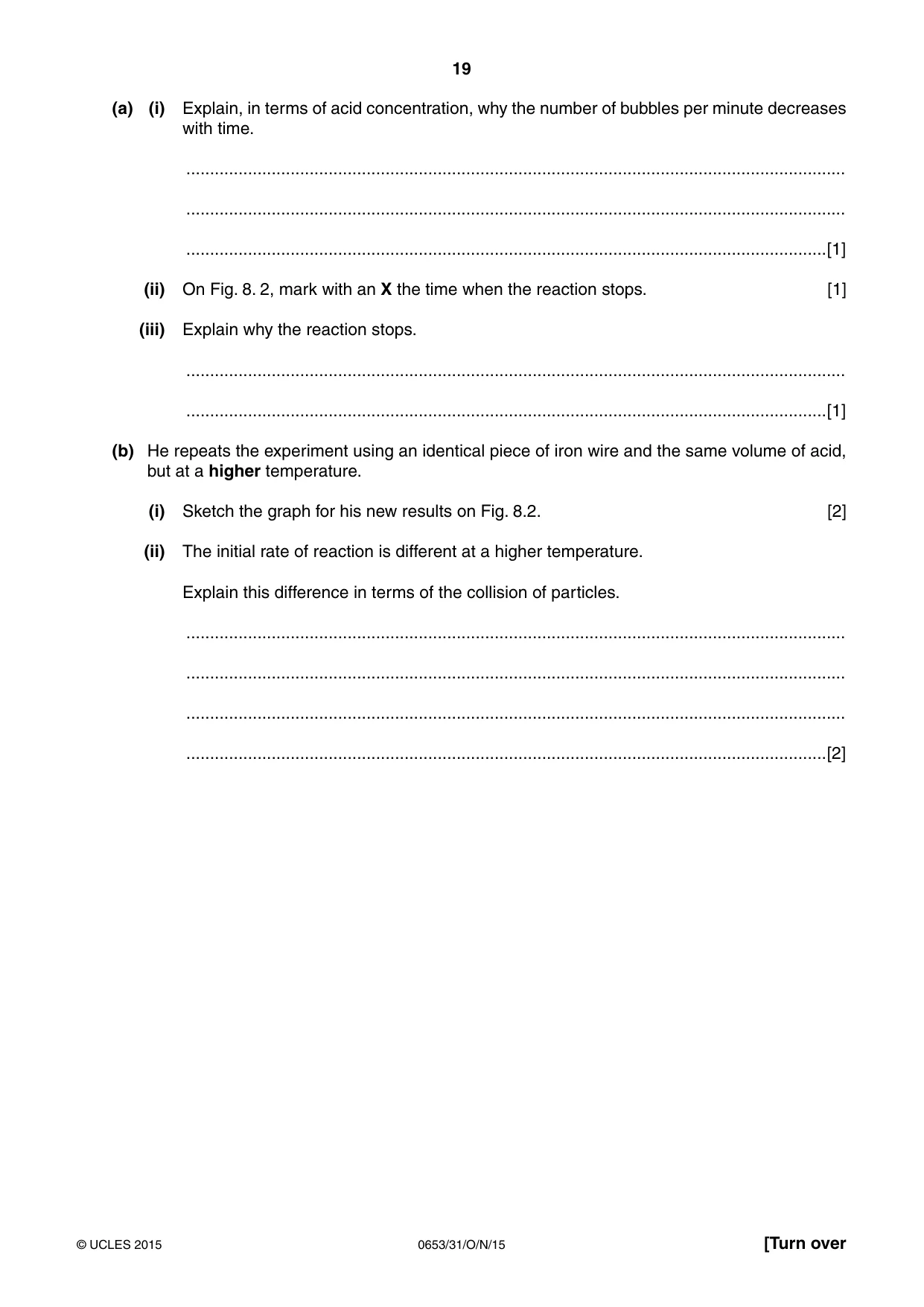
19 0653/31/O/N/15 © UCLES 2015 [Turn over (a) (i) Explain, in terms of acid concentration, why the number of bubbles per minute decreases with time. … … …[1] (ii) On Fig. 8. 2, mark with an X the time when the reaction stops. [1] (iii) Explain why the reaction stops. … …[1] (b) He repeats the experiment using an identical piece of iron wire and the same volume of acid, but at a higher temperature. (i) Sketch the graph for his new results on Fig. 8.2. [2] (ii) The initial rate of reaction is different at a higher temperature. Explain this difference in terms of the collision of particles. … … … …[2]
Question paper, page 20
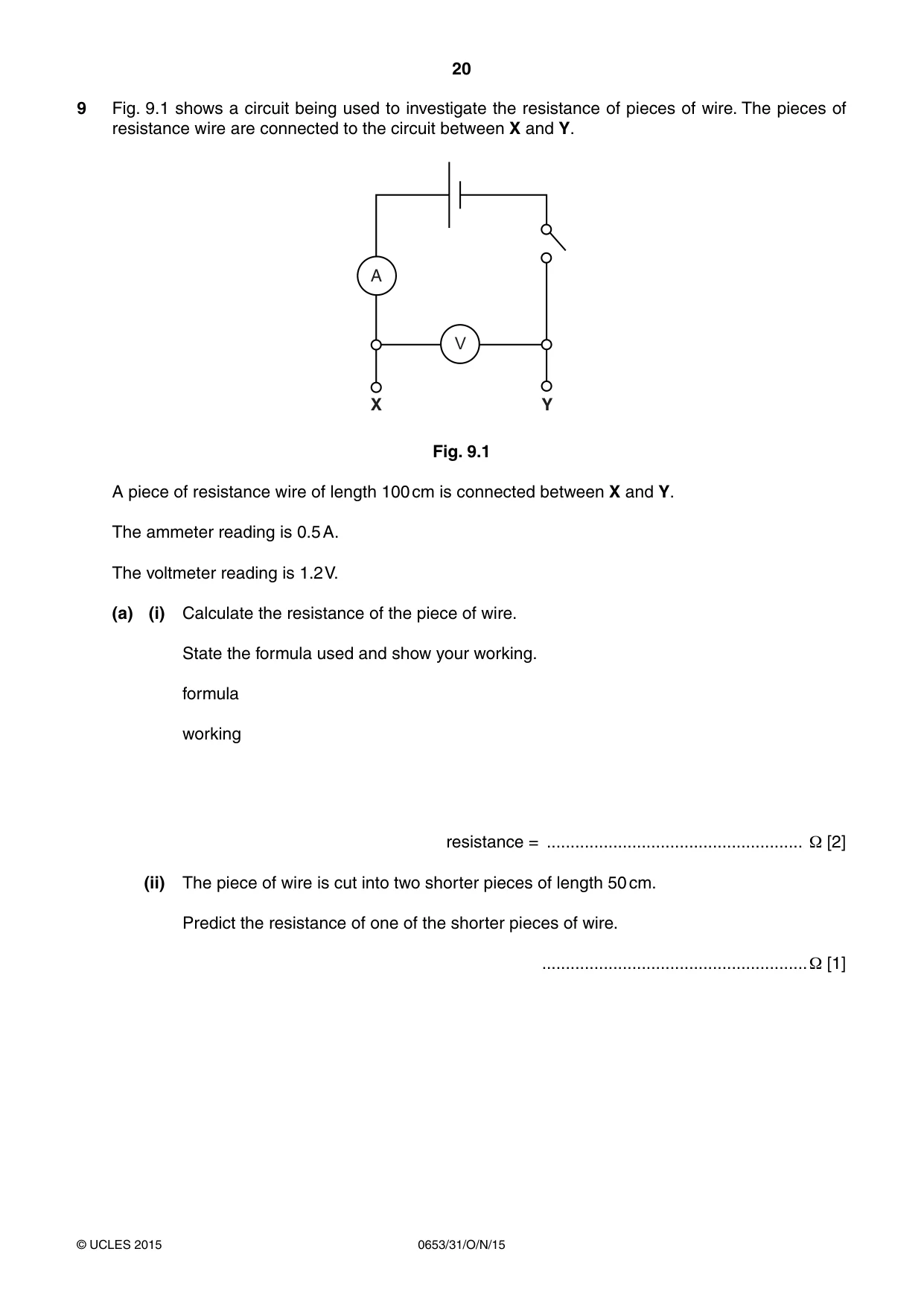
20 0653/31/O/N/15 © UCLES 2015 9 Fig. 9.1 shows a circuit being used to investigate the resistance of pieces of wire. The pieces of resistance wire are connected to the circuit between X and Y. V A X Y Fig. 9.1 A piece of resistance wire of length 100 cm is connected between X and Y. The ammeter reading is 0.5 A. The voltmeter reading is 1.2 V. (a) (i) Calculate the resistance of the piece of wire. State the formula used and show your working. formula working resistance = … Ω [2] (ii) The piece of wire is cut into two shorter pieces of length 50 cm. Predict the resistance of one of the shorter pieces of wire. …Ω [1]
Question paper, page 21
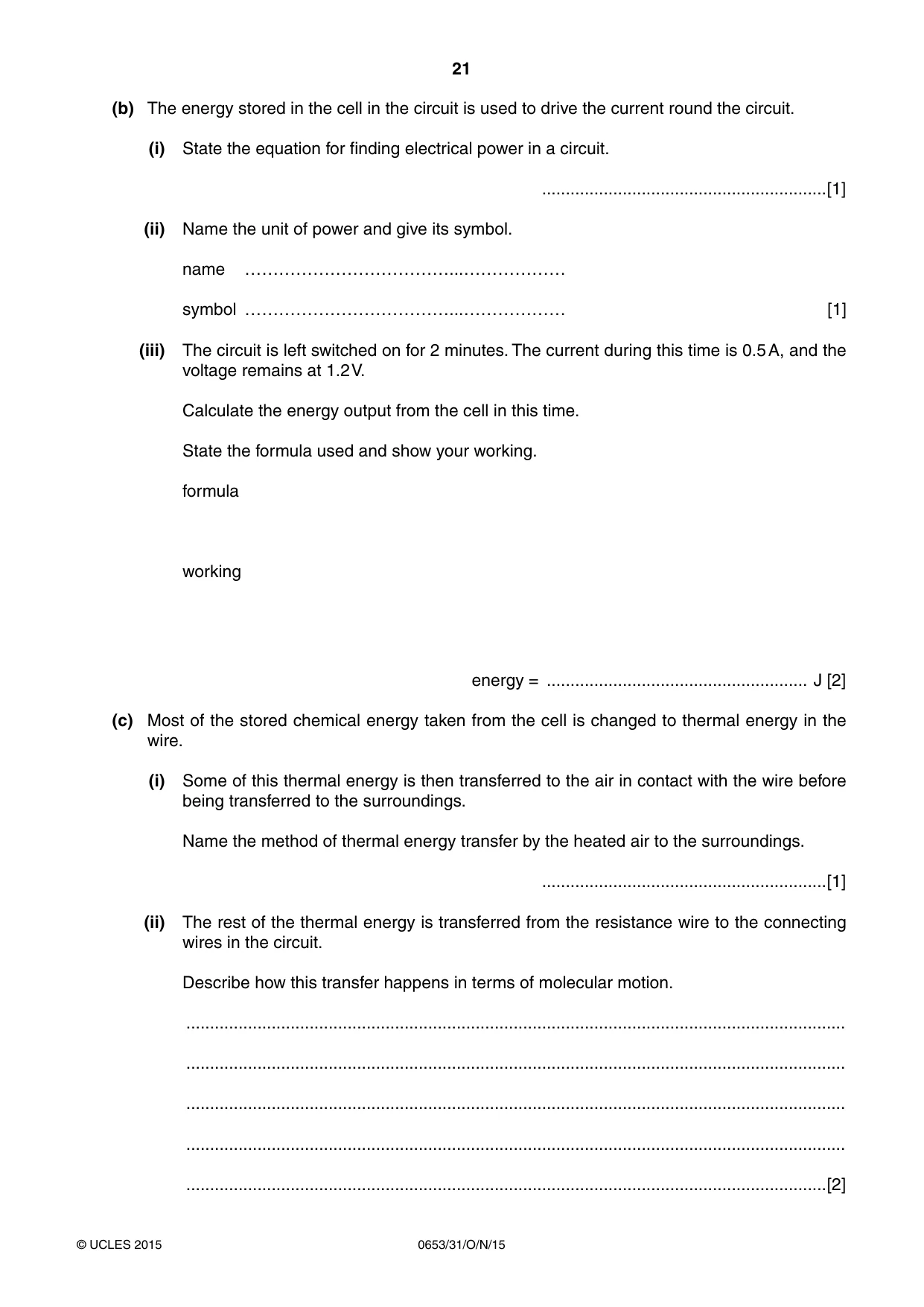
21 0653/31/O/N/15 © UCLES 2015 (b) The energy stored in the cell in the circuit is used to drive the current round the circuit. (i) State the equation for finding electrical power in a circuit. …[1] (ii) Name the unit of power and give its symbol. name ………………………………...……………… symbol ………………………………...……………… [1] (iii) The circuit is left switched on for 2 minutes. The current during this time is 0.5 A, and the voltage remains at 1.2 V. Calculate the energy output from the cell in this time. State the formula used and show your working. formula working energy = … J [2] (c) Most of the stored chemical energy taken from the cell is changed to thermal energy in the wire. (i) Some of this thermal energy is then transferred to the air in contact with the wire before being transferred to the surroundings. Name the method of thermal energy transfer by the heated air to the surroundings. …[1] (ii) The rest of the thermal energy is transferred from the resistance wire to the connecting wires in the circuit. Describe how this transfer happens in terms of molecular motion. … … … … …[2]
Question paper, page 22
22 0653/31/O/N/15 © UCLES 2015 BLANK PAGE
Question paper, page 23
23 0653/31/O/N/15 © UCLES 2015 BLANK PAGE
Question paper, page 24
24 0653/31/O/N/15 © UCLES 2015 Group The Periodic Table of the Elements 140 Ce Cerium 58 141 Pr Praseodymium 59 144 Nd Neodymium 60 Pm Promethium 61 150 Sm Samarium 62 152 Eu Europium 63 157 Gd Gadolinium 64 159 Tb Terbium 65 162 Dy Dysprosium 66 165 Ho Holmium 67 167 Er Erbium 68 169 Tm Thulium 69 173 Yb Ytterbium 70 175 Lu Lutetium 71 232 Th Thorium 90 Pa Protactinium 91 238 231 147 237 244 243 247 247 251 252 257 258 259 260 U Uranium 92 Np Neptunium 93 Pu Plutonium 94 Am Americium 95 Cm Curium 96 Bk Berkelium 97 Cf Californium 98 Es Einsteinium 99 Fm Fermium 100 Md Mendelevium 101 No Nobelium 102 Lr Lawrencium 103 1 H Hydrogen 1 7 Li Lithium 3 23 Na Sodium 11 24 Mg Magnesium 12 40 Ca Calcium 20 45 Sc Scandium 21 48 Ti Titanium 22 51 V Vanadium 23 52 Cr Chromium 24 55 Mn Manganese 25 56 Fe Iron 26 59 Co Cobalt 27 59 Ni Nickel 28 64 Cu Copper 29 65 Zn Zinc 30 70 Ga Gallium 31 27 Al Aluminium 13 11 B Boron 5 12 C Carbon 6 14 N Nitrogen 7 16 O Oxygen 8 19 F Fluorine 9 28 Si Silicon 14 31 P Phosphorus 15 32 S Sulfur 16 35.5 Cl Chlorine 17 40 Ar Argon 18 20 Ne Neon 10 4 He Helium 2 73 Ge Germanium 32 75 As Arsenic 33 79 Se Selenium 34 80 Br Bromine 35 84 Kr Krypton 36 39 K Potassium 19 88 Sr Strontium 38 89 Y Yttrium 39 91 Zr Zirconium 40 93 Nb Niobium 41 96 Mo Molybdenum 42 Tc Technetium 43 101 Ru Ruthenium 44 103 Rh Rhodium 45 106 Pd Palladium 46 108 Ag Silver 47 112 Cd Cadmium 48 115 In Indium 49 119 Sn Tin 50 122 Sb Antimony 51 128 Te Tellurium 52 127 I Iodine 53 131 Xe Xenon 54 137 Ba Barium 56 139 La Lanthanum 57 * 178 Hf Hafnium 72 181 Ta Tantalum 73 184 W Tungsten 74 186 Re Rhenium 75 190 Os Osmium 76 192 Ir Iridium 77 195 Pt Platinum 78 197 Au Gold 79 201 Hg Mercury 80 204 Tl Thallium 81 207 Pb Lead 82 209 209 210 222 Bi Bismuth 83 Po Polonium 84 At Astatine 85 Rn Radon 86 Fr Francium 87 227 Ac Actinium 89 † 9 Be Beryllium 4 I II III IV V VI VII 0 85 Rb Rubidium 37 133 Cs Caesium 55 226 223 Ra Radium 88 a X b a = relative atomic mass X = atomic symbol b = atomic (proton) number Key DATA SHEET * 58–71 Lanthanoid series † 90–103 Actinoid series The volume of one mole of any gas is 24dm3 at room temperature and pressure (r.t.p.). To avoid the issue of disclosure of answer-related information to candidates, all copyright acknowledgements are reproduced online in the Cambridge International Examinations Copyright Acknowledgements Booklet. This is produced for each series of examinations and is freely available to download at www.cie.org.uk after the live examination series.
Mark scheme, page 1
® IGCSE is the registered trademark of Cambridge International Examinations. CAMBRIDGE INTERNATIONAL EXAMINATIONS Cambridge International General Certificate of Secondary Education MARK SCHEME for the October/November 2015 series 0653 COMBINED SCIENCE 0653/31 Paper 3 (Extended Theory), maximum raw mark 80 This mark scheme is published as an aid to teachers and candidates, to indicate the requirements of the examination. It shows the basis on which Examiners were instructed to award marks. It does not indicate the details of the discussions that took place at an Examiners’ meeting before marking began, which would have considered the acceptability of alternative answers. Mark schemes should be read in conjunction with the question paper and the Principal Examiner Report for Teachers. Cambridge will not enter into discussions about these mark schemes. Cambridge is publishing the mark schemes for the October/November 2015 series for most Cambridge IGCSE®, Cambridge International A and AS Level components and some Cambridge O Level components.
Mark scheme, page 2
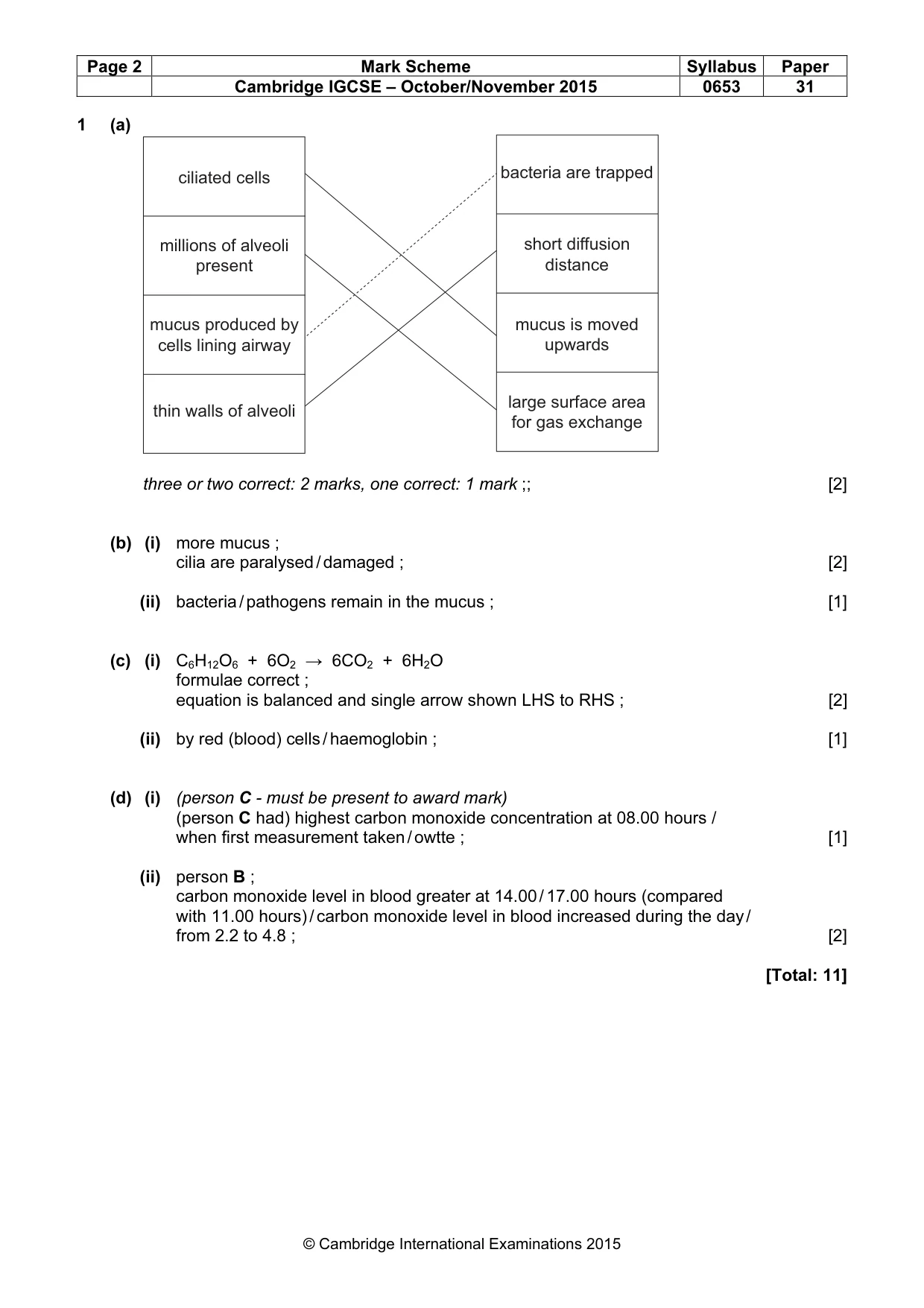
Page 2 Mark Scheme Syllabus Paper Cambridge IGCSE – October/November 2015 0653 31 © Cambridge International Examinations 2015 1 (a) three or two correct: 2 marks, one correct: 1 mark ;; [2] (b) (i) more mucus ; cilia are paralysed / damaged ; [2] (ii) bacteria / pathogens remain in the mucus ; [1] (c) (i) C6H12O6 + 6O2 → 6CO2 + 6H2O formulae correct ; equation is balanced and single arrow shown LHS to RHS ; [2] (ii) by red (blood) cells / haemoglobin ; [1] (d) (i) (person C - must be present to award mark) (person C had) highest carbon monoxide concentration at 08.00 hours / when first measurement taken / owtte ; [1] (ii) person B ; carbon monoxide level in blood greater at 14.00 / 17.00 hours (compared with 11.00 hours) / carbon monoxide level in blood increased during the day / from 2.2 to 4.8 ; [2] [Total: 11] ciliated cells millions of alveoli present bacteria are trapped short diffusion distance mucus is moved upwards large surface area for gas exchange mucus produced by cells lining airway thin walls of alveoli
Mark scheme, page 3
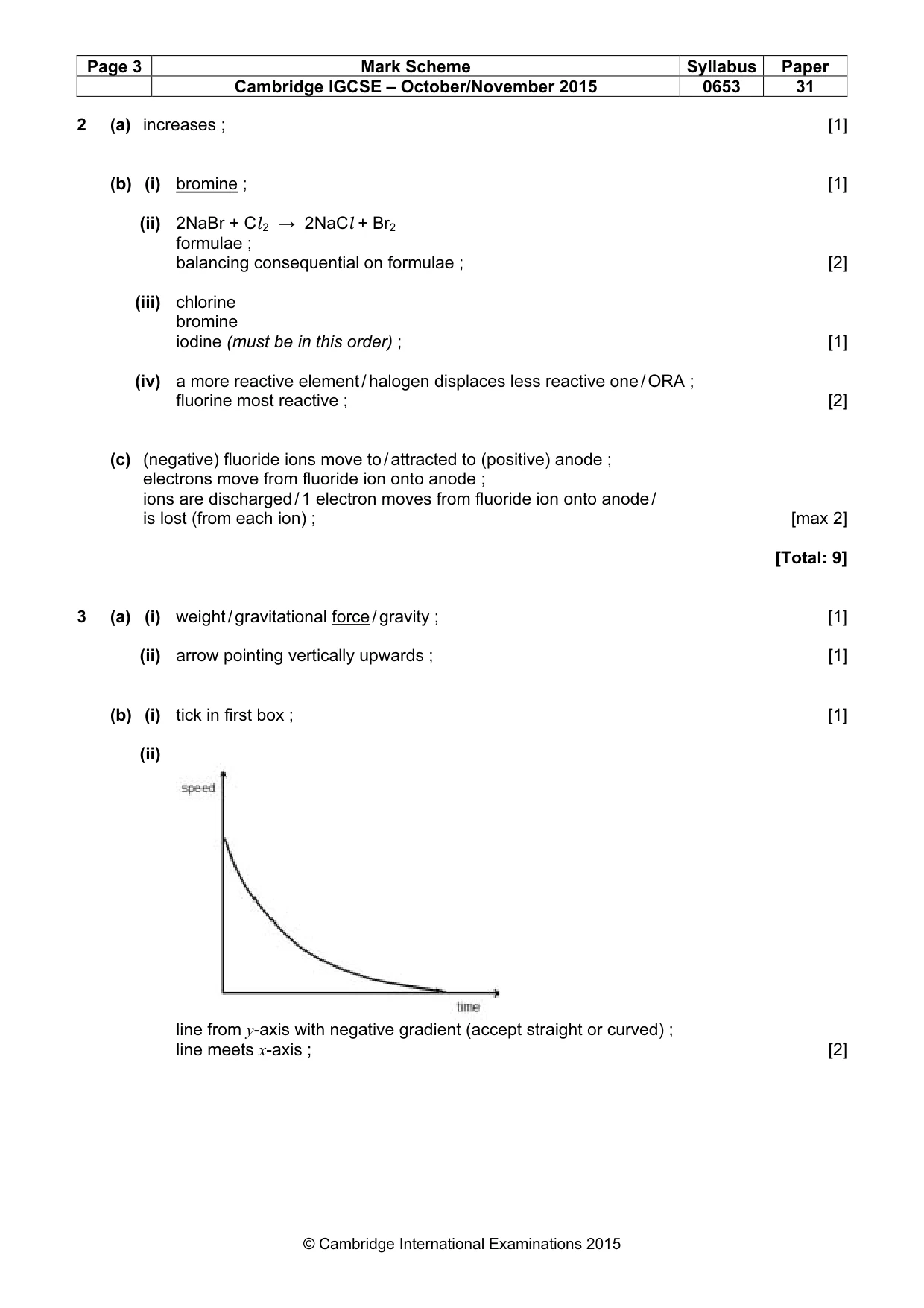
Page 3 Mark Scheme Syllabus Paper Cambridge IGCSE – October/November 2015 0653 31 © Cambridge International Examinations 2015 2 (a) increases ; [1] (b) (i) bromine ; [1] (ii) 2NaBr + Cl 2 → 2NaCl + Br2 formulae ; balancing consequential on formulae ; [2] (iii) chlorine bromine iodine (must be in this order) ; [1] (iv) a more reactive element / halogen displaces less reactive one / ORA ; fluorine most reactive ; [2] (c) (negative) fluoride ions move to / attracted to (positive) anode ; electrons move from fluoride ion onto anode ; ions are discharged / 1 electron moves from fluoride ion onto anode / is lost (from each ion) ; [max 2] [Total: 9] 3 (a) (i) weight / gravitational force / gravity ; [1] (ii) arrow pointing vertically upwards ; [1] (b) (i) tick in first box ; [1] (ii) line from y-axis with negative gradient (accept straight or curved) ; line meets x-axis ; [2]
Mark scheme, page 4
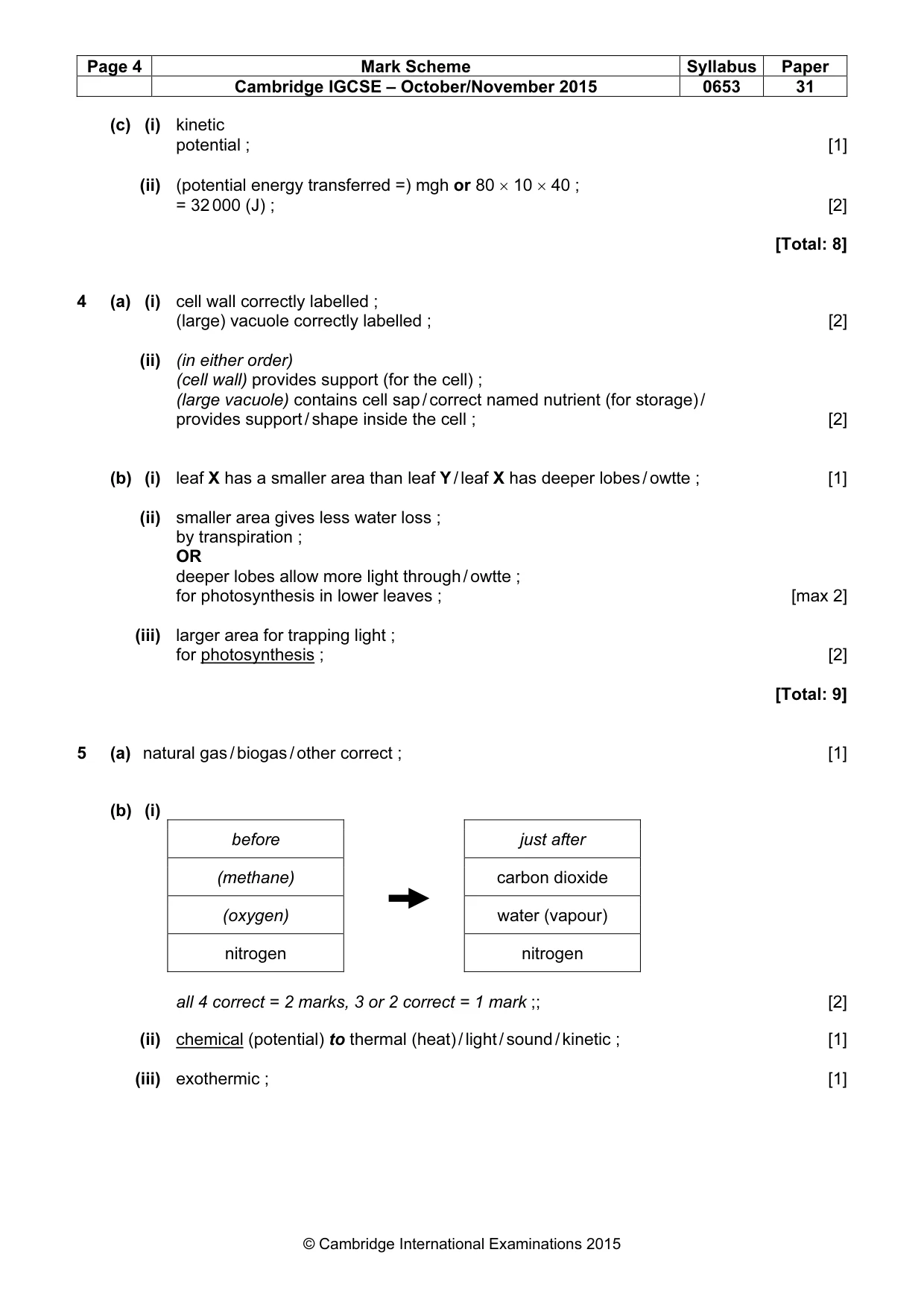
Page 4 Mark Scheme Syllabus Paper Cambridge IGCSE – October/November 2015 0653 31 © Cambridge International Examinations 2015 (c) (i) kinetic potential ; [1] (ii) (potential energy transferred =) mgh or 80 × 10 × 40 ; = 32 000 (J) ; [2] [Total: 8] 4 (a) (i) cell wall correctly labelled ; (large) vacuole correctly labelled ; [2] (ii) (in either order) (cell wall) provides support (for the cell) ; (large vacuole) contains cell sap / correct named nutrient (for storage) / provides support / shape inside the cell ; [2] (b) (i) leaf X has a smaller area than leaf Y / leaf X has deeper lobes / owtte ; [1] (ii) smaller area gives less water loss ; by transpiration ; OR deeper lobes allow more light through / owtte ; for photosynthesis in lower leaves ; [max 2] (iii) larger area for trapping light ; for photosynthesis ; [2] [Total: 9] 5 (a) natural gas / biogas / other correct ; [1] (b) (i) before just after (methane) carbon dioxide (oxygen) water (vapour) nitrogen nitrogen all 4 correct = 2 marks, 3 or 2 correct = 1 mark ;; [2] (ii) chemical (potential) to thermal (heat) / light / sound / kinetic ; [1] (iii) exothermic ; [1]
Mark scheme, page 5
Page 5 Mark Scheme Syllabus Paper Cambridge IGCSE – October/November 2015 0653 31 © Cambridge International Examinations 2015 (c) (i) (2 because) in Period 2 ; (6 because) in Group VI / 6 ; (allow explanations based on the electron configuration 2,6) [2] (ii) 4 shared pairs ; correct symbols and all else correct ; [2] (d) (i) noble / inert gases / Group 0 or 8 / Group VIII ; [1] (ii) all / outer shells complete / filled ; [1] [Total: 11] 6 (a) (i) ray in glass bent towards normal ; emergent ray parallel to incident ; angles of incidence and refraction shown correctly ; [3] (ii) ray from Sun bending towards normal on entering atmosphere and reaching X ; Sun’s rays are refracted (by the atmosphere) ; [2] (b) (i) infra-red / IR ; [1] (ii) sand is better absorber of infra-red / radiation than (sea) water ; [1] (c) use of v = fλ ; λ decreases ; [2] [Total: 9]
Mark scheme, page 6
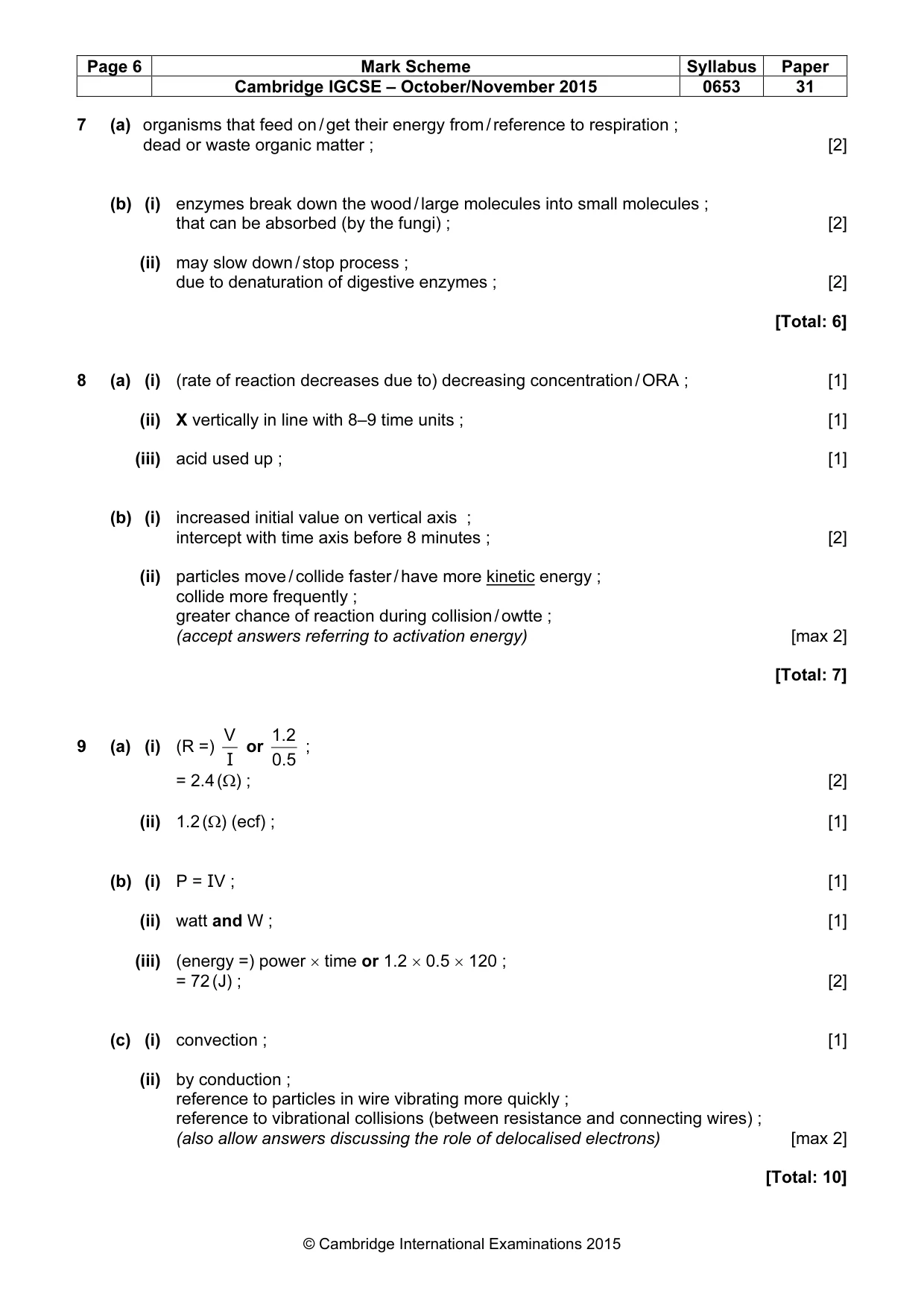
Page 6 Mark Scheme Syllabus Paper Cambridge IGCSE – October/November 2015 0653 31 © Cambridge International Examinations 2015 7 (a) organisms that feed on / get their energy from / reference to respiration ; dead or waste organic matter ; [2] (b) (i) enzymes break down the wood / large molecules into small molecules ; that can be absorbed (by the fungi) ; [2] (ii) may slow down / stop process ; due to denaturation of digestive enzymes ; [2] [Total: 6] 8 (a) (i) (rate of reaction decreases due to) decreasing concentration / ORA ; [1] (ii) X vertically in line with 8–9 time units ; [1] (iii) acid used up ; [1] (b) (i) increased initial value on vertical axis ; intercept with time axis before 8 minutes ; [2] (ii) particles move / collide faster / have more kinetic energy ; collide more frequently ; greater chance of reaction during collision / owtte ; (accept answers referring to activation energy) [max 2] [Total: 7] 9 (a) (i) (R =) I V or 0.5 1.2 ; = 2.4 (Ω) ; [2] (ii) 1.2 (Ω) (ecf) ; [1] (b) (i) P = IV ; [1] (ii) watt and W ; [1] (iii) (energy =) power × time or 1.2 × 0.5 × 120 ; = 72 (J) ; [2] (c) (i) convection ; [1] (ii) by conduction ; reference to particles in wire vibrating more quickly ; reference to vibrational collisions (between resistance and connecting wires) ; (also allow answers discussing the role of delocalised electrons) [max 2] [Total: 10]
What you needed in this session
Cambridge’s own grade thresholds for 2015 Oct/Nov, Paper 3 · Variant 1. A higher threshold means an easier paper — the bar moves with how the cohort did.