Cambridge IGCSE Science - Combined 0653 — 2015 Oct/Nov Paper 2 · Variant 1
0653/21/O/N/15 · 80 marks · ≈90 min
The question paper and its mark scheme, free to read here and free to download. This is Cambridge’s own paper, exactly as it was sat.
Question paper24 pages


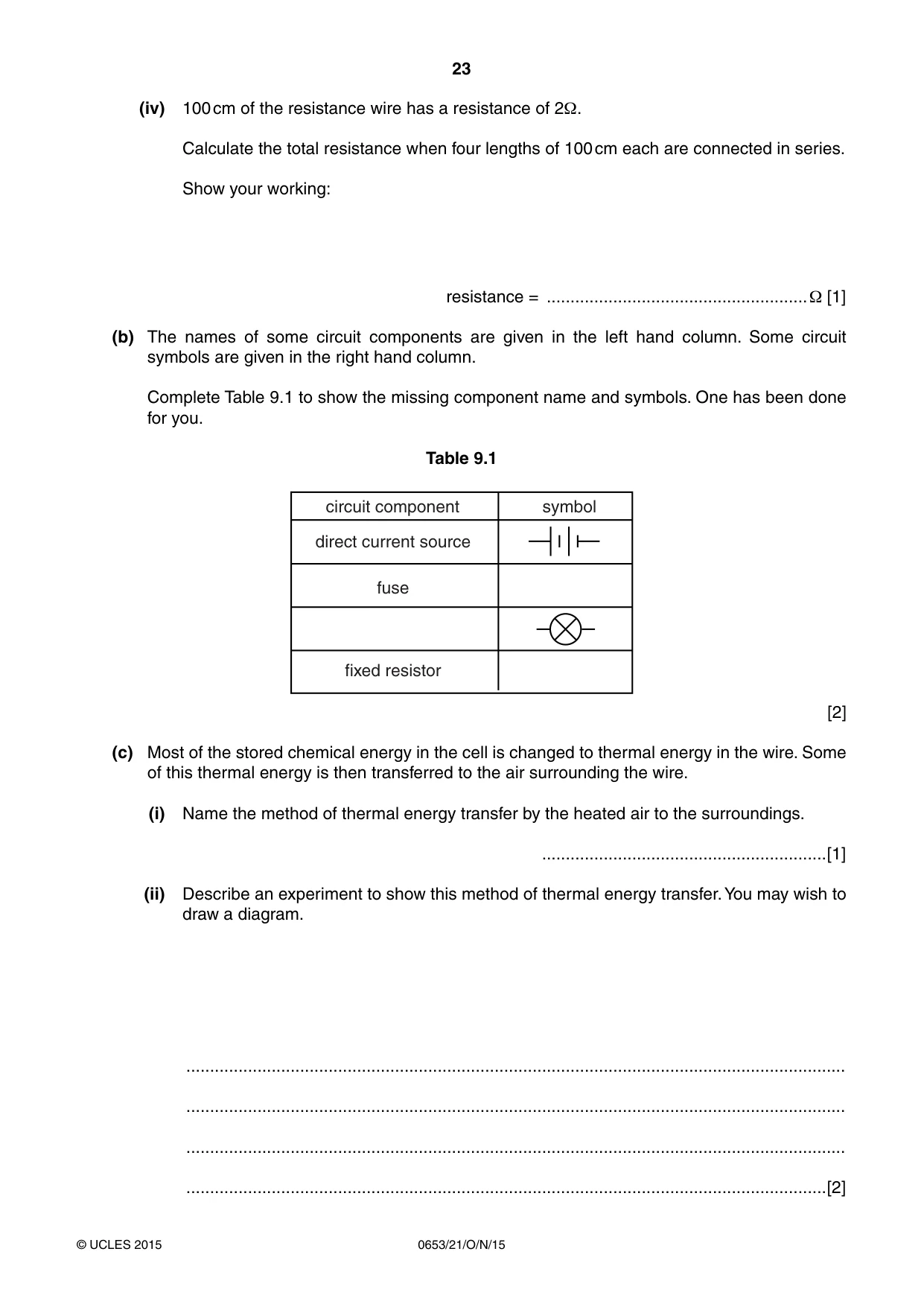
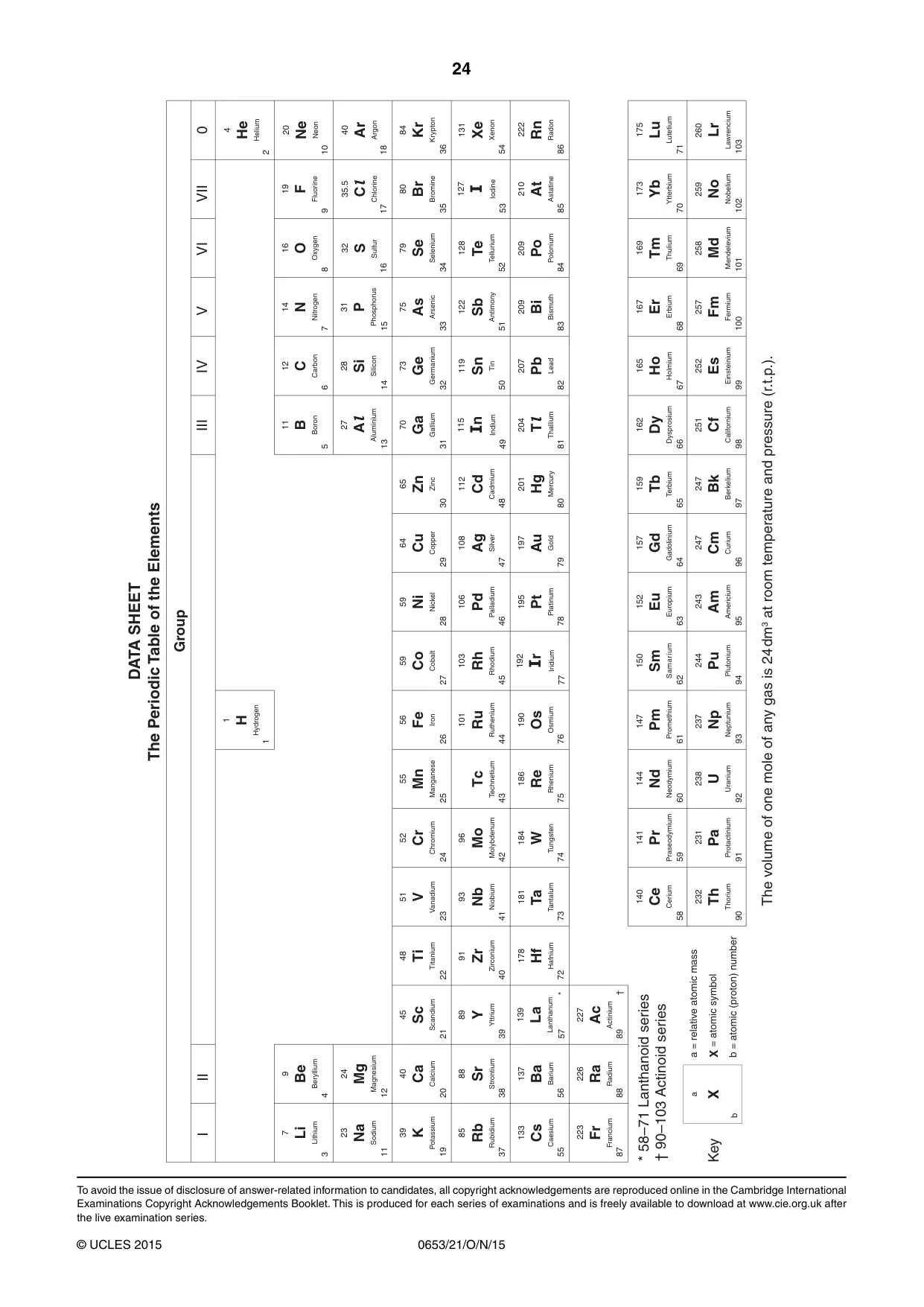
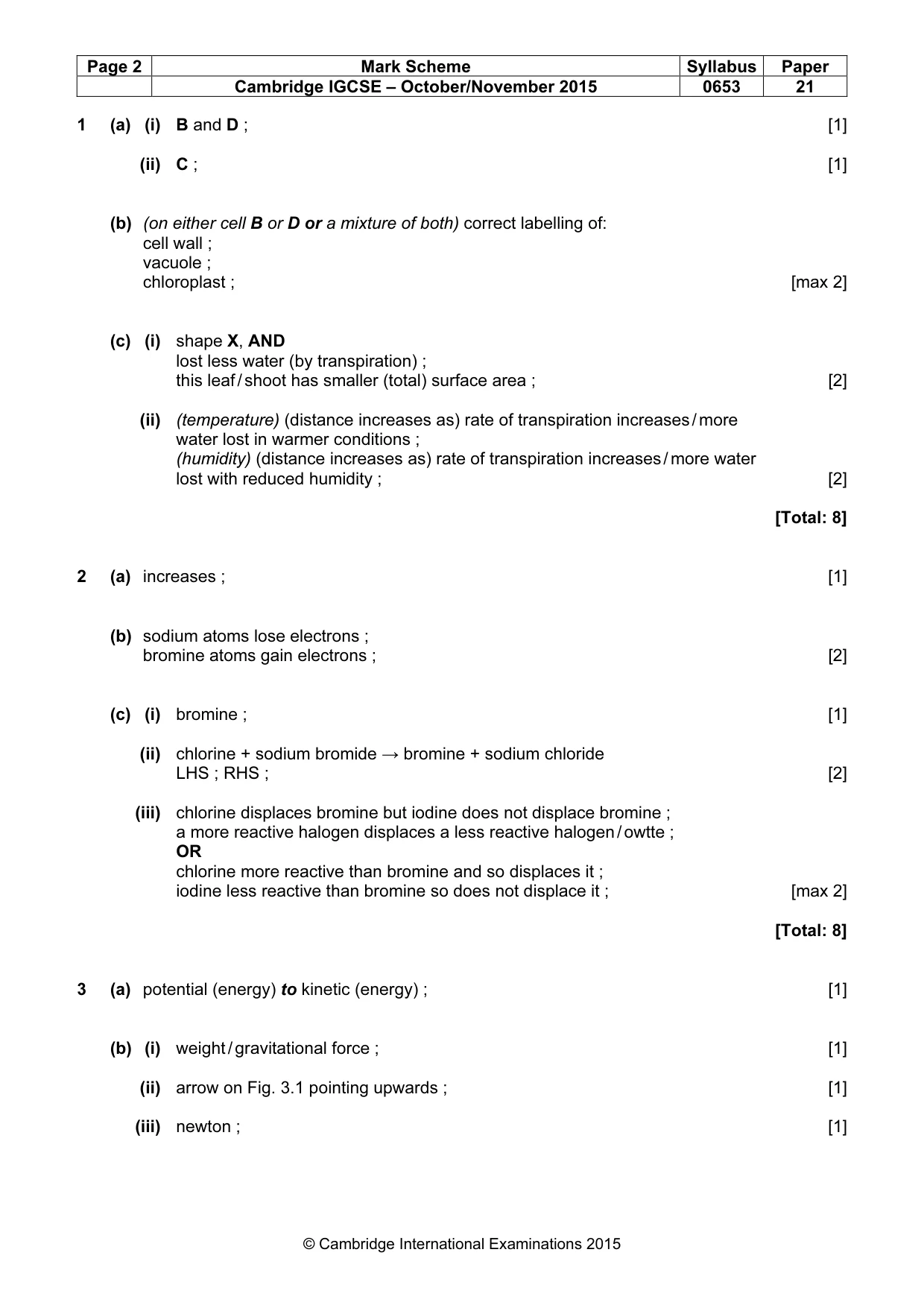
Mark scheme7 pages
Answers below. Sit the paper first if you are practising.
Paper as text
Question paper, page 1
This document consists of 23 printed pages and 1 blank page. DC (ST/FD) 103626/2 © UCLES 2015 [Turn over Cambridge International Examinations Cambridge International General Certificate of Secondary Education * 5 5 8 8 5 2 1 9 0 0 * COMBINED SCIENCE 0653/21 Paper 2 (Core) October/November 2015 1 hour 15 minutes Candidates answer on the Question Paper. No Additional Materials are required. READ THESE INSTRUCTIONS FIRST Write your Centre number, candidate number and name on all the work you hand in. Write in dark blue or black pen. You may use an HB pencil for any diagrams, graphs, tables or rough working. Do not use staples, paper clips, glue or correction fluid. DO NOT WRITE IN ANY BARCODES. Answer all questions. Electronic calculators may be used. You may lose marks if you do not show your working or if you do not use appropriate units. A copy of the Periodic Table is printed on page 24. At the end of the examination, fasten all your work securely together. The number of marks is given in brackets [ ] at the end of each question or part question.
Question paper, page 2
2 0653/21/O/N/15 © UCLES 2015 BLANK PAGE
Question paper, page 3
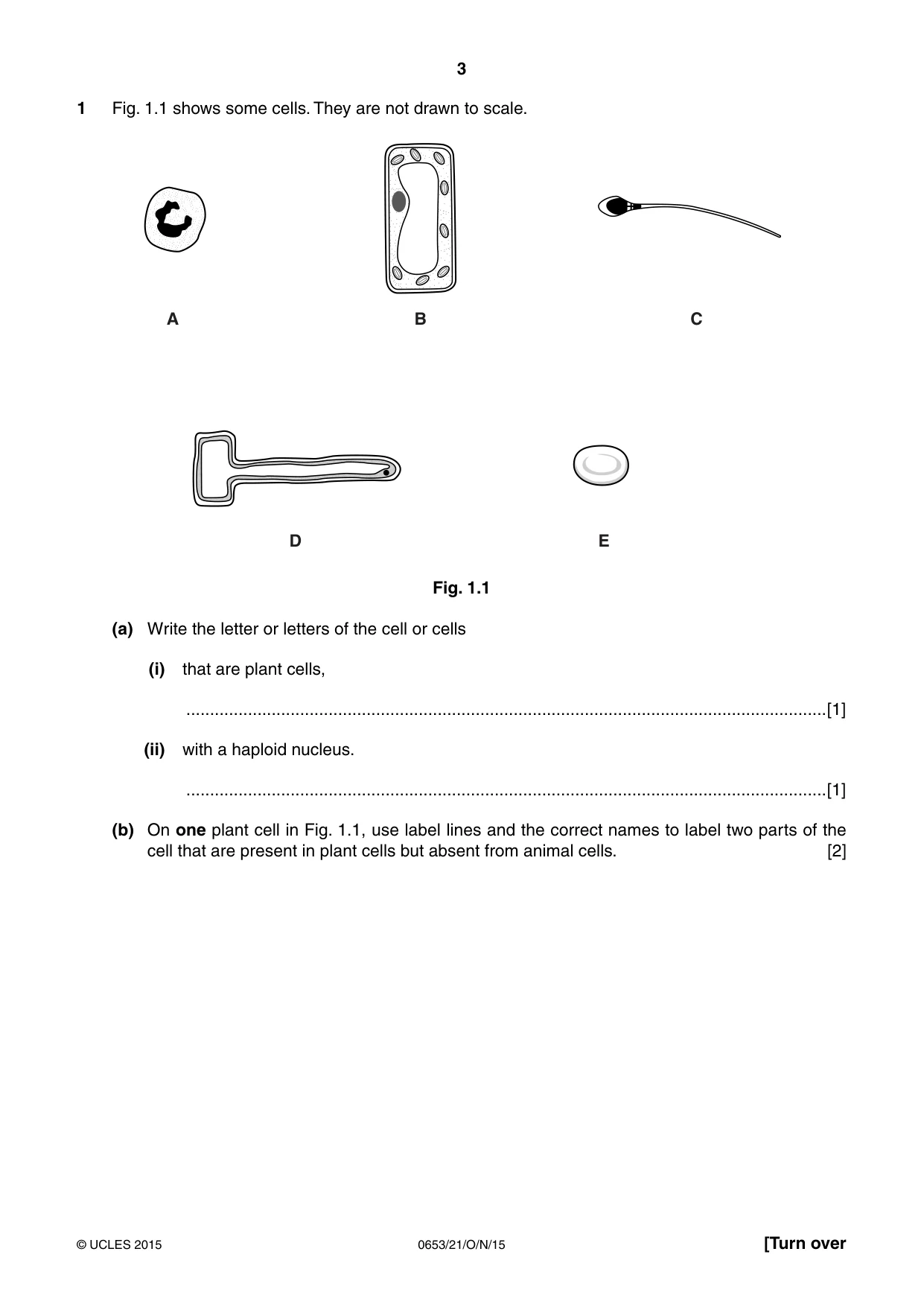
3 0653/21/O/N/15 © UCLES 2015 [Turn over 1 Fig. 1.1 shows some cells. They are not drawn to scale. A B D E C Fig. 1.1 (a) Write the letter or letters of the cell or cells (i) that are plant cells, …[1] (ii) with a haploid nucleus. …[1] (b) On one plant cell in Fig. 1.1, use label lines and the correct names to label two parts of the cell that are present in plant cells but absent from animal cells. [2]
Question paper, page 4
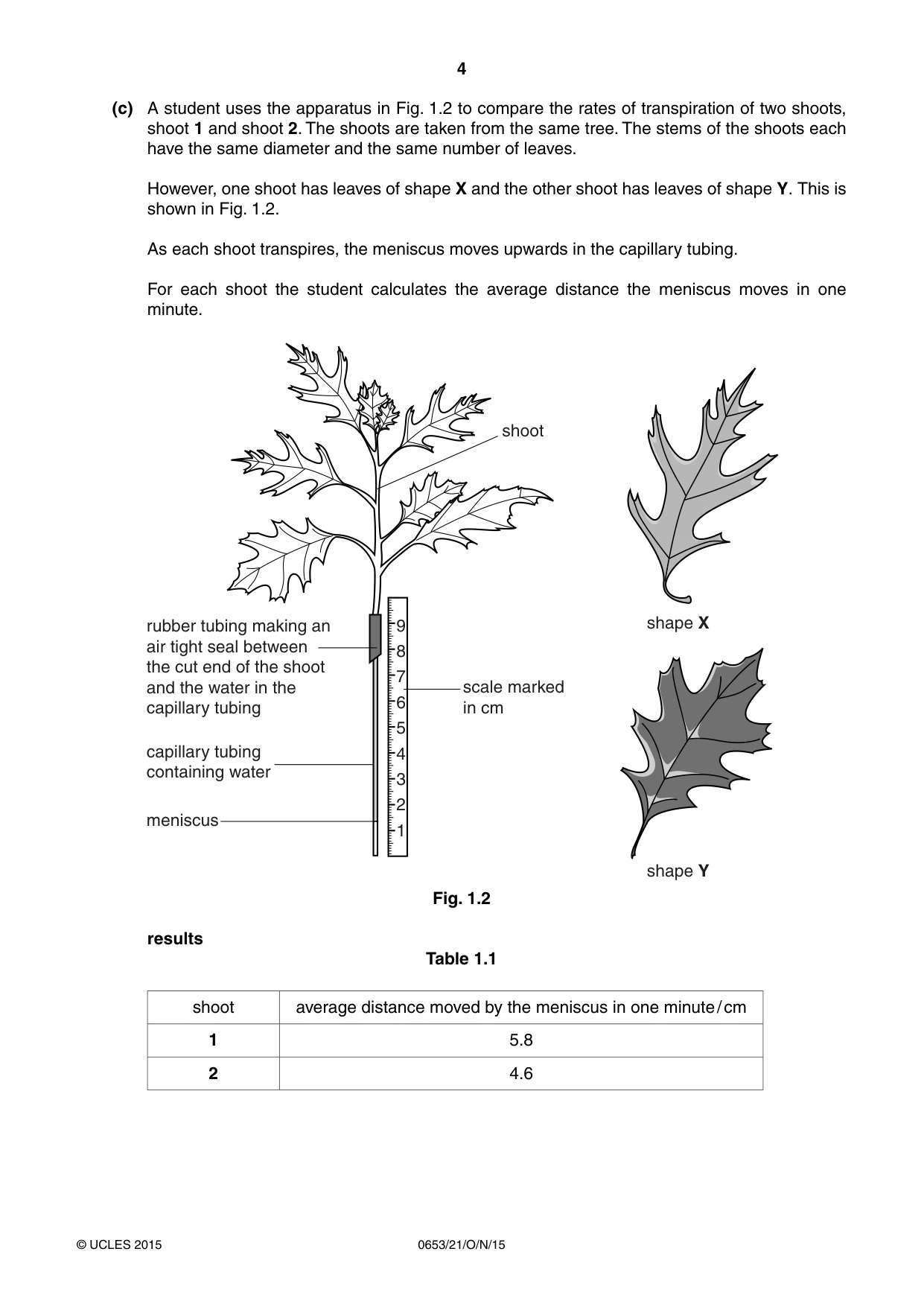
4 0653/21/O/N/15 © UCLES 2015 (c) A student uses the apparatus in Fig. 1.2 to compare the rates of transpiration of two shoots, shoot 1 and shoot 2. The shoots are taken from the same tree. The stems of the shoots each have the same diameter and the same number of leaves. However, one shoot has leaves of shape X and the other shoot has leaves of shape Y. This is shown in Fig. 1.2. As each shoot transpires, the meniscus moves upwards in the capillary tubing. For each shoot the student calculates the average distance the meniscus moves in one minute. 1 2 3 4 5 6 7 8 9 shape X shoot scale marked in cm rubber tubing making an air tight seal between the cut end of the shoot and the water in the capillary tubing capillary tubing containing water meniscus shape Y Fig. 1.2 results Table 1.1 shoot average distance moved by the meniscus in one minute / cm 1 5.8 2 4.6
Question paper, page 5
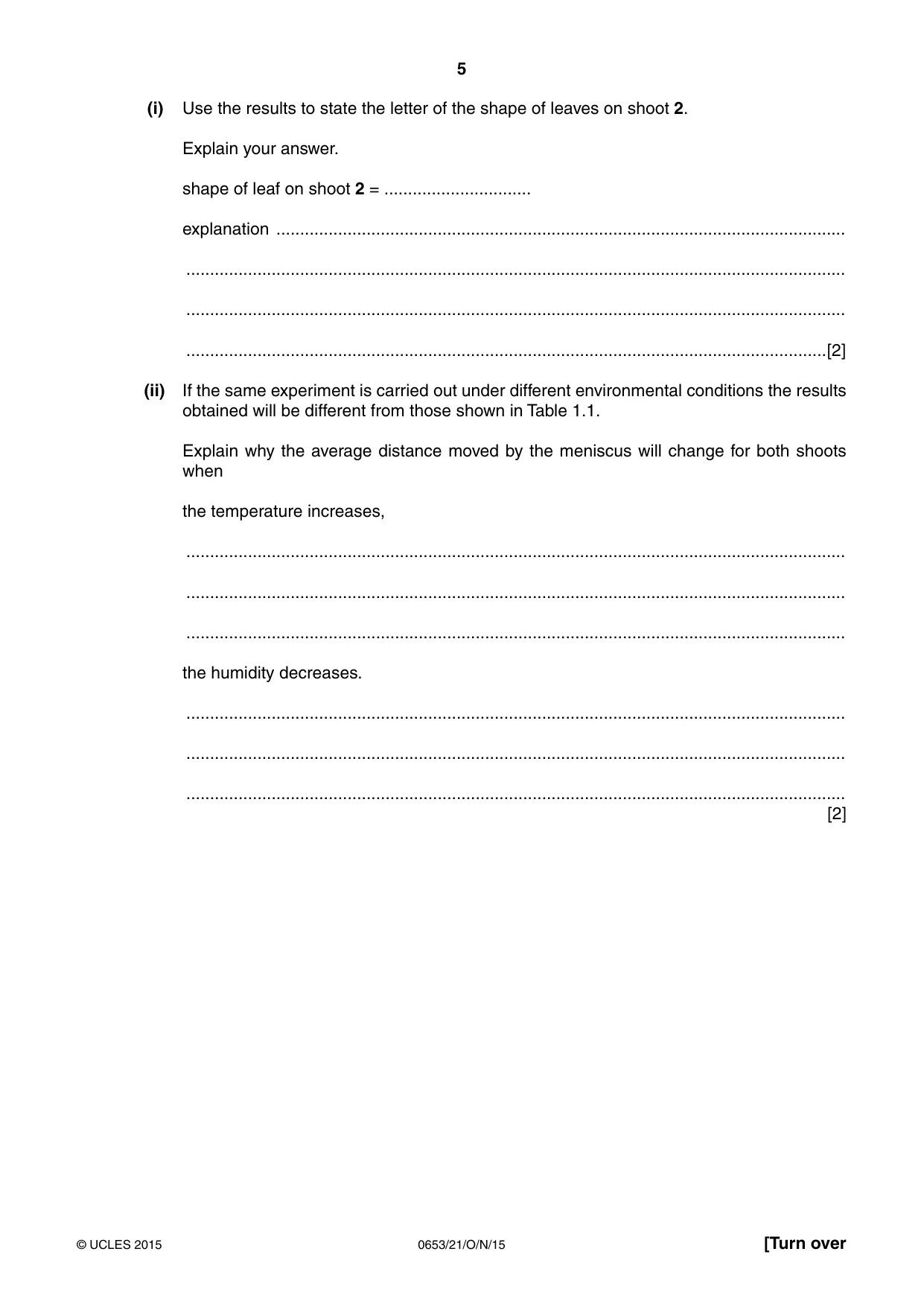
5 0653/21/O/N/15 © UCLES 2015 [Turn over (i) Use the results to state the letter of the shape of leaves on shoot 2. Explain your answer. shape of leaf on shoot 2 = … explanation … … … …[2] (ii) If the same experiment is carried out under different environmental conditions the results obtained will be different from those shown in Table 1.1. Explain why the average distance moved by the meniscus will change for both shoots when the temperature increases, … … … the humidity decreases. … … … [2]
Question paper, page 6
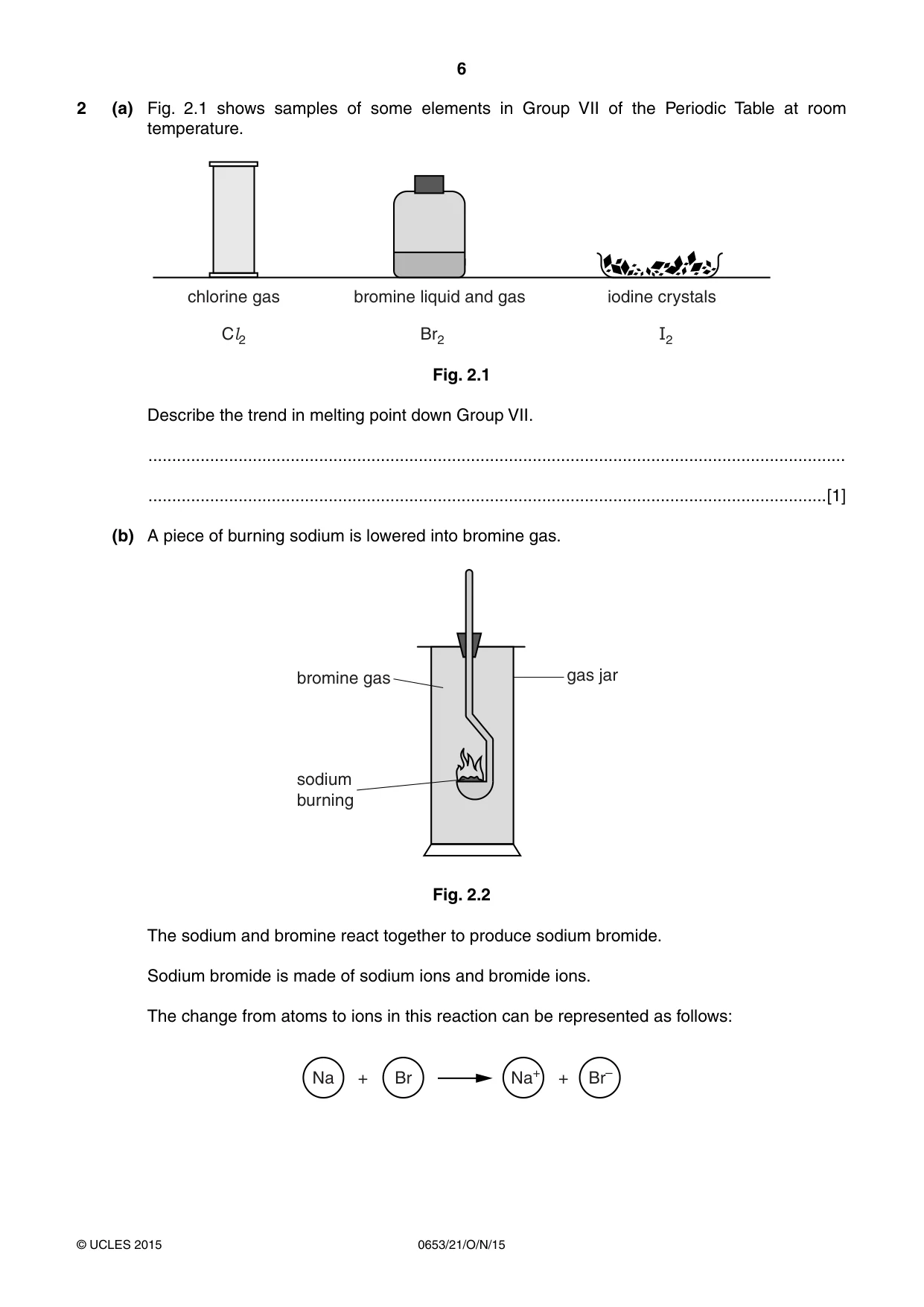
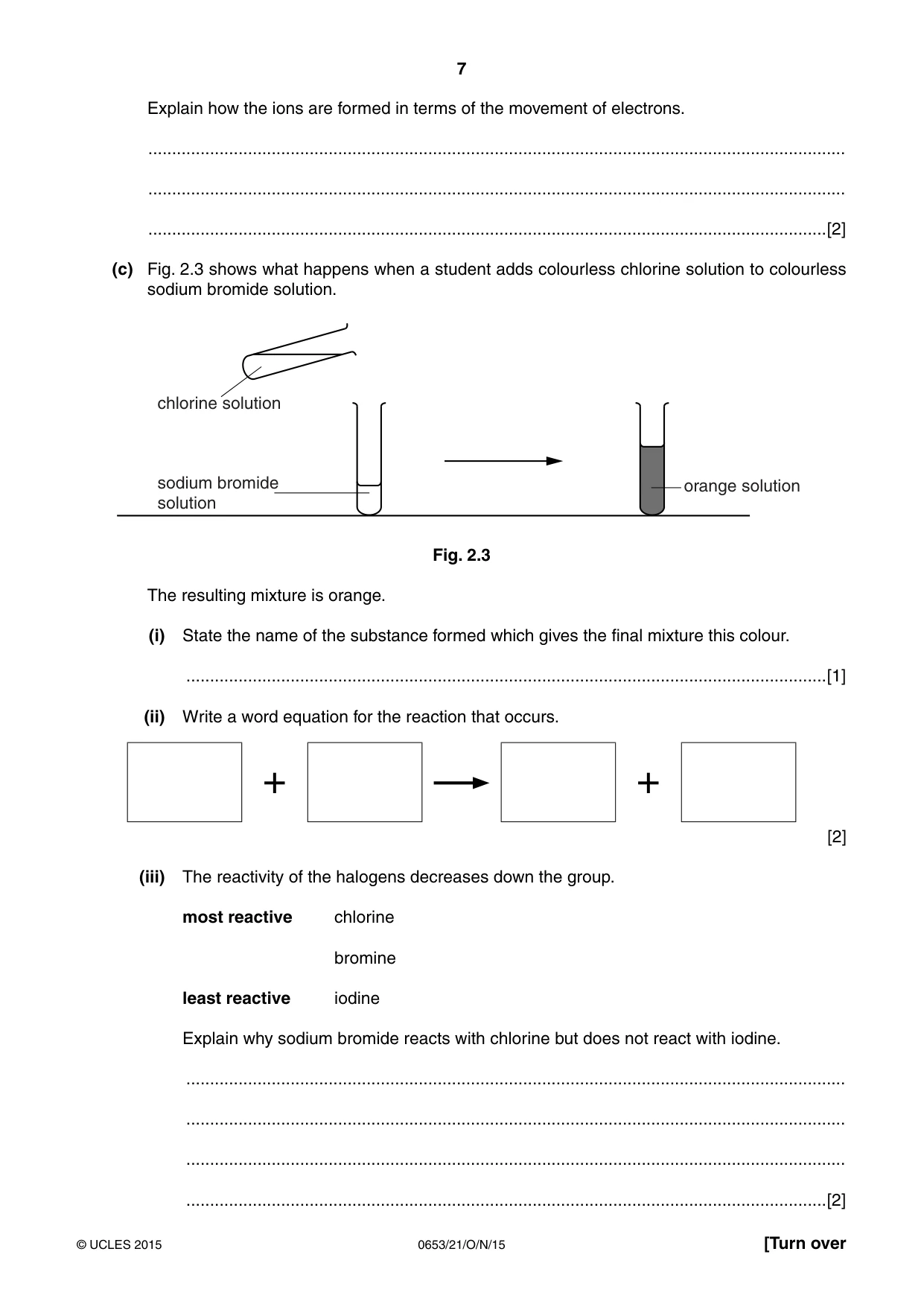
6 0653/21/O/N/15 © UCLES 2015 2 (a) Fig. 2.1 shows samples of some elements in Group VII of the Periodic Table at room temperature. chlorine gas Cl2 Br2 I2 bromine liquid and gas iodine crystals Fig. 2.1 Describe the trend in melting point down Group VII. … …[1] (b) A piece of burning sodium is lowered into bromine gas. bromine gas sodium burning gas jar Fig. 2.2 The sodium and bromine react together to produce sodium bromide. Sodium bromide is made of sodium ions and bromide ions. The change from atoms to ions in this reaction can be represented as follows: Na + + Br Br– Na+
Question paper, page 7
7 0653/21/O/N/15 © UCLES 2015 [Turn over Explain how the ions are formed in terms of the movement of electrons. … … …[2] (c) Fig. 2.3 shows what happens when a student adds colourless chlorine solution to colourless sodium bromide solution. chlorine solution orange solution sodium bromide solution Fig. 2.3 The resulting mixture is orange. (i) State the name of the substance formed which gives the final mixture this colour. …[1] (ii) Write a word equation for the reaction that occurs. + + [2] (iii) The reactivity of the halogens decreases down the group. most reactive chlorine bromine least reactive iodine Explain why sodium bromide reacts with chlorine but does not react with iodine. … … … …[2]
Question paper, page 8
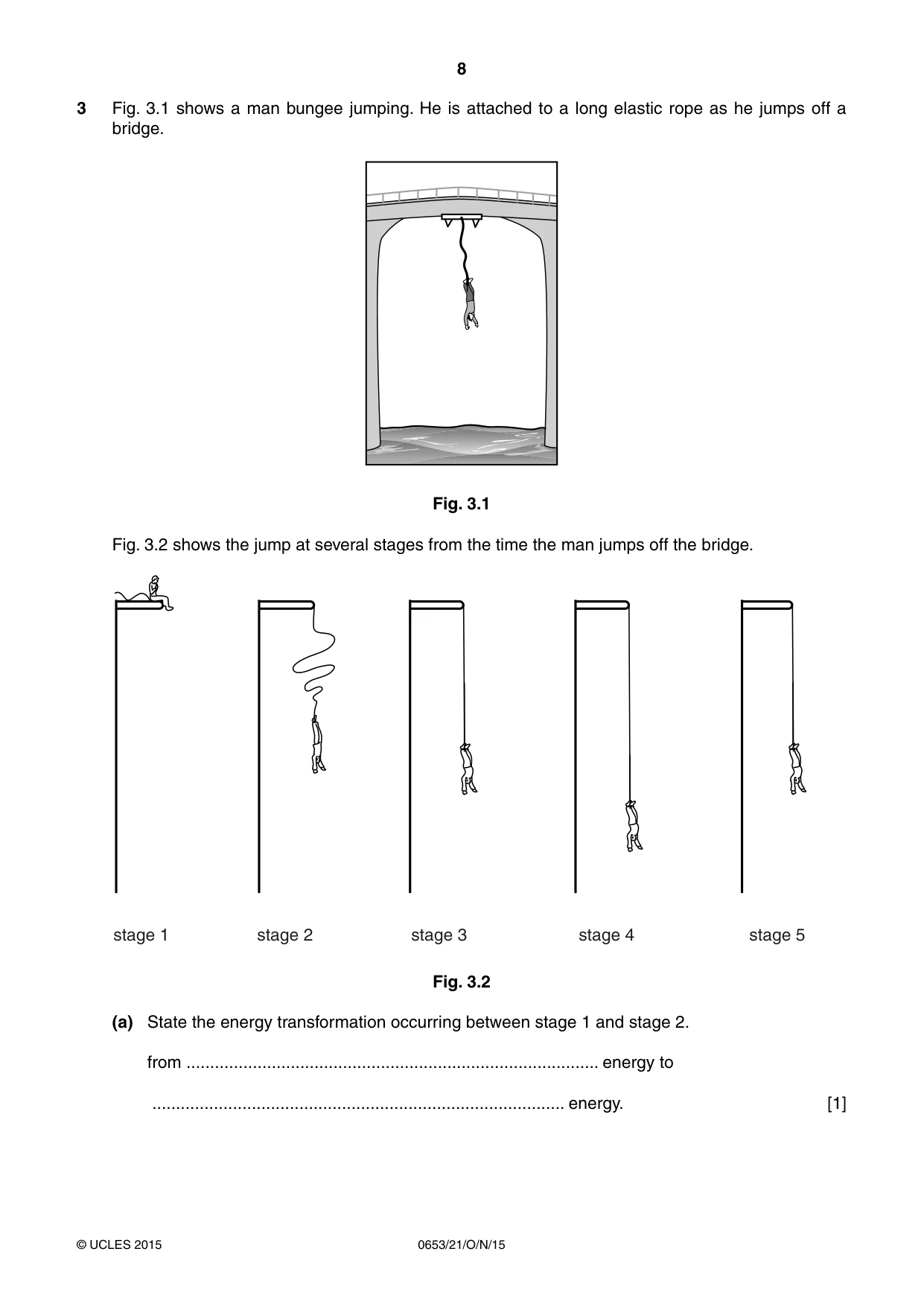
8 0653/21/O/N/15 © UCLES 2015 3 Fig. 3.1 shows a man bungee jumping. He is attached to a long elastic rope as he jumps off a bridge. Fig. 3.1 Fig. 3.2 shows the jump at several stages from the time the man jumps off the bridge. stage 1 stage 2 stage 3 stage 4 stage 5 Fig. 3.2 (a) State the energy transformation occurring between stage 1 and stage 2. from … energy to … energy. [1]
Question paper, page 9
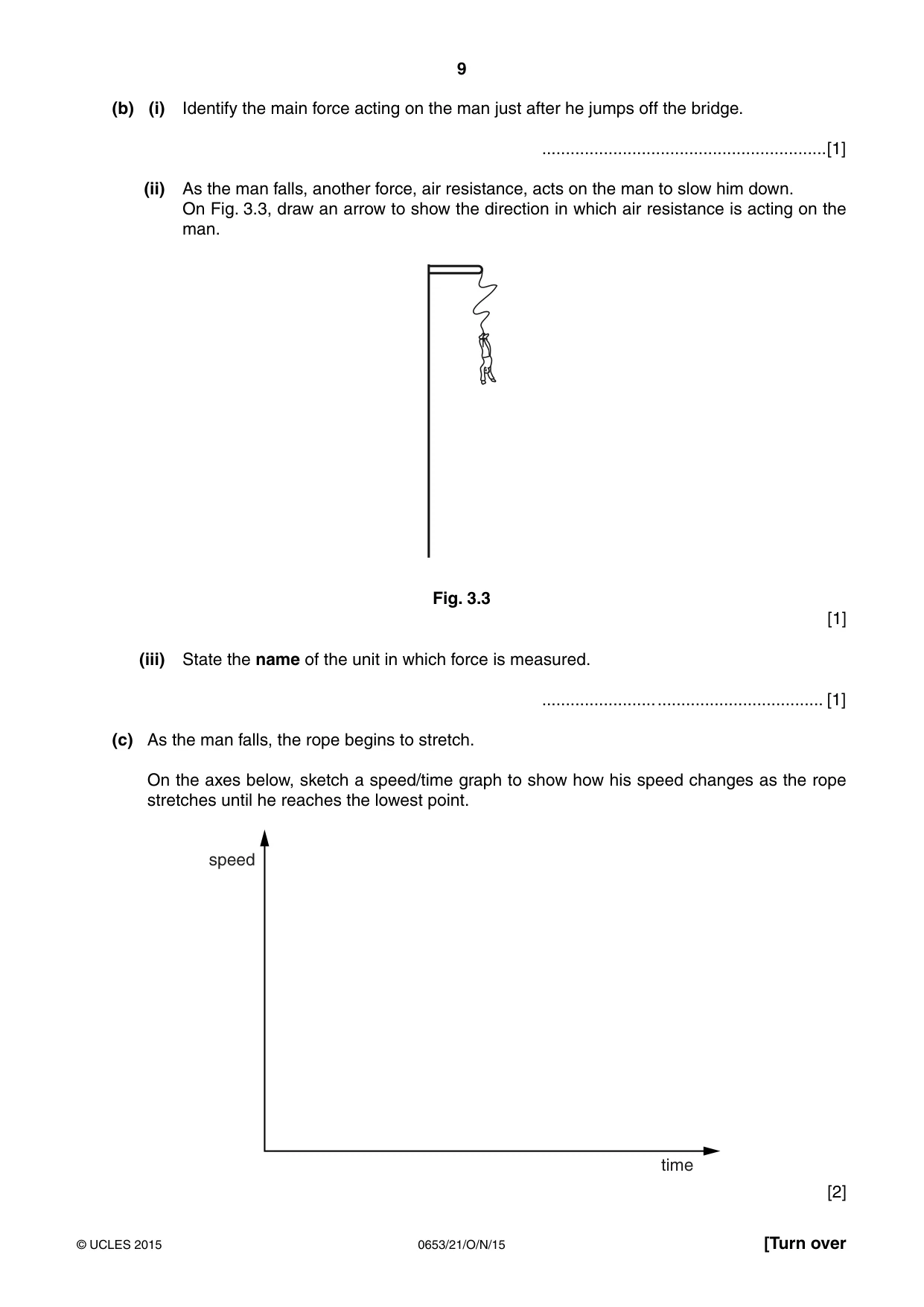
9 0653/21/O/N/15 © UCLES 2015 [Turn over (b) (i) Identify the main force acting on the man just after he jumps off the bridge. …[1] (ii) As the man falls, another force, air resistance, acts on the man to slow him down. On Fig. 3.3, draw an arrow to show the direction in which air resistance is acting on the man. Fig. 3.3 [1] (iii) State the name of the unit in which force is measured. … [1] (c) As the man falls, the rope begins to stretch. On the axes below, sketch a speed/time graph to show how his speed changes as the rope stretches until he reaches the lowest point. speed time [2]
Question paper, page 10
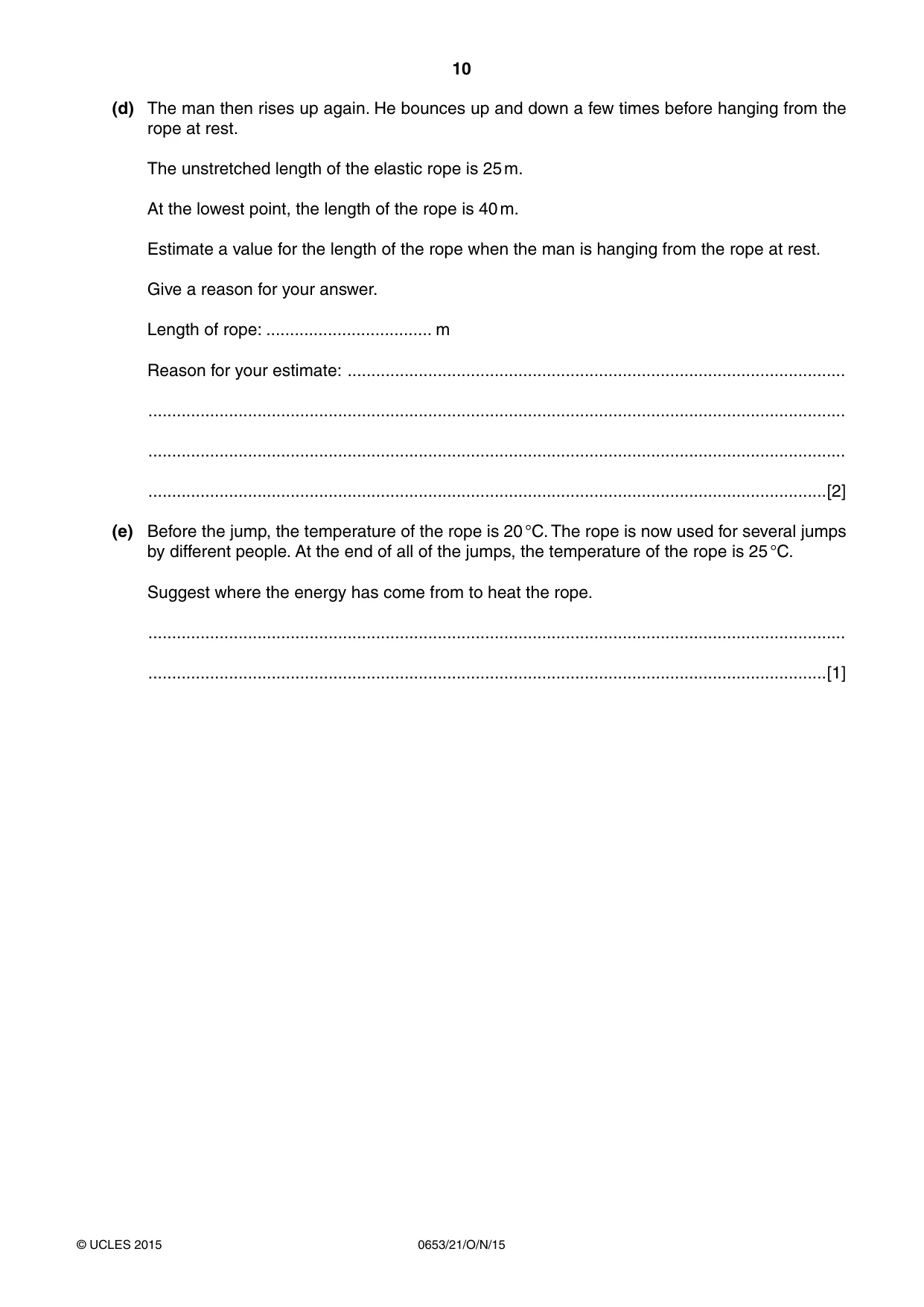
10 0653/21/O/N/15 © UCLES 2015 (d) The man then rises up again. He bounces up and down a few times before hanging from the rope at rest. The unstretched length of the elastic rope is 25 m. At the lowest point, the length of the rope is 40 m. Estimate a value for the length of the rope when the man is hanging from the rope at rest. Give a reason for your answer. Length of rope: … m Reason for your estimate: … … … …[2] (e) Before the jump, the temperature of the rope is 20 °C. The rope is now used for several jumps by different people. At the end of all of the jumps, the temperature of the rope is 25 °C. Suggest where the energy has come from to heat the rope. … …[1]
Question paper, page 11
11 0653/21/O/N/15 © UCLES 2015 [Turn over Please turn over for Question 4.
Question paper, page 12
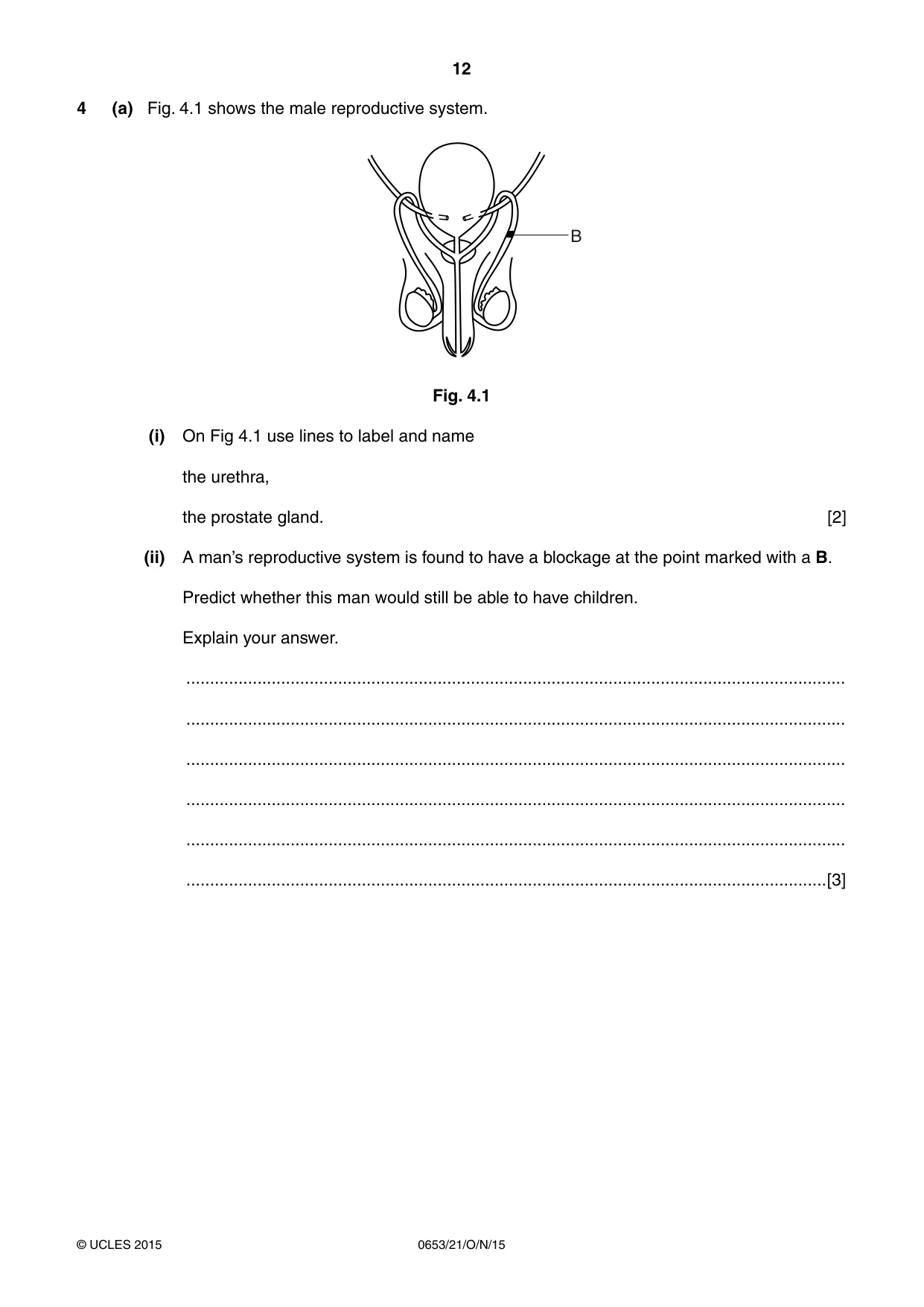
12 0653/21/O/N/15 © UCLES 2015 4 (a) Fig. 4.1 shows the male reproductive system. B Fig. 4.1 (i) On Fig 4.1 use lines to label and name the urethra, the prostate gland. [2] (ii) A man’s reproductive system is found to have a blockage at the point marked with a B. Predict whether this man would still be able to have children. Explain your answer. … … … … … …[3]
Question paper, page 13
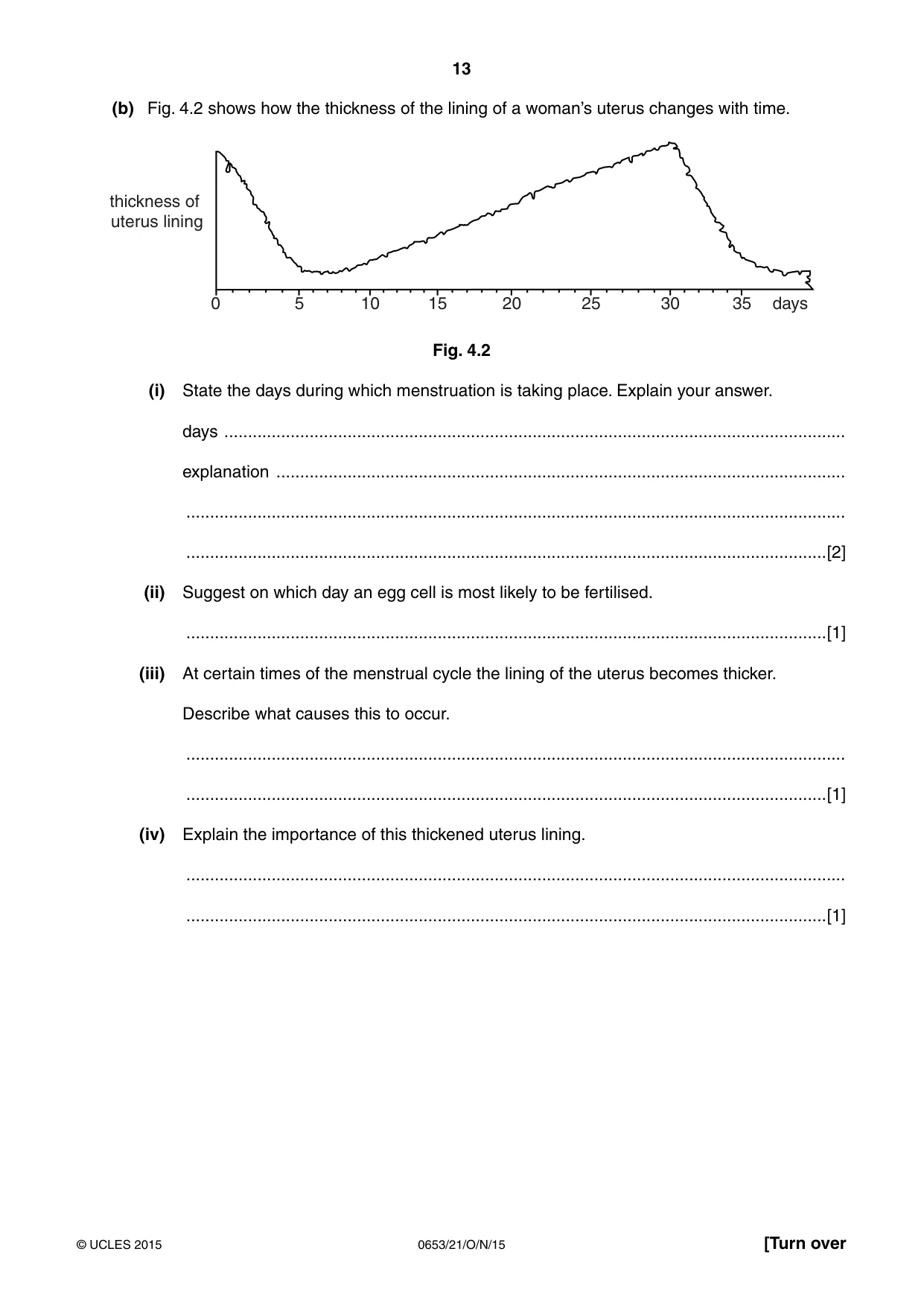
13 0653/21/O/N/15 © UCLES 2015 [Turn over (b) Fig. 4.2 shows how the thickness of the lining of a woman’s uterus changes with time. thickness of uterus lining days 0 5 10 15 20 25 30 35 Fig. 4.2 (i) State the days during which menstruation is taking place. Explain your answer. days … explanation … … …[2] (ii) Suggest on which day an egg cell is most likely to be fertilised. …[1] (iii) At certain times of the menstrual cycle the lining of the uterus becomes thicker. Describe what causes this to occur. … …[1] (iv) Explain the importance of this thickened uterus lining. … …[1]
Question paper, page 14
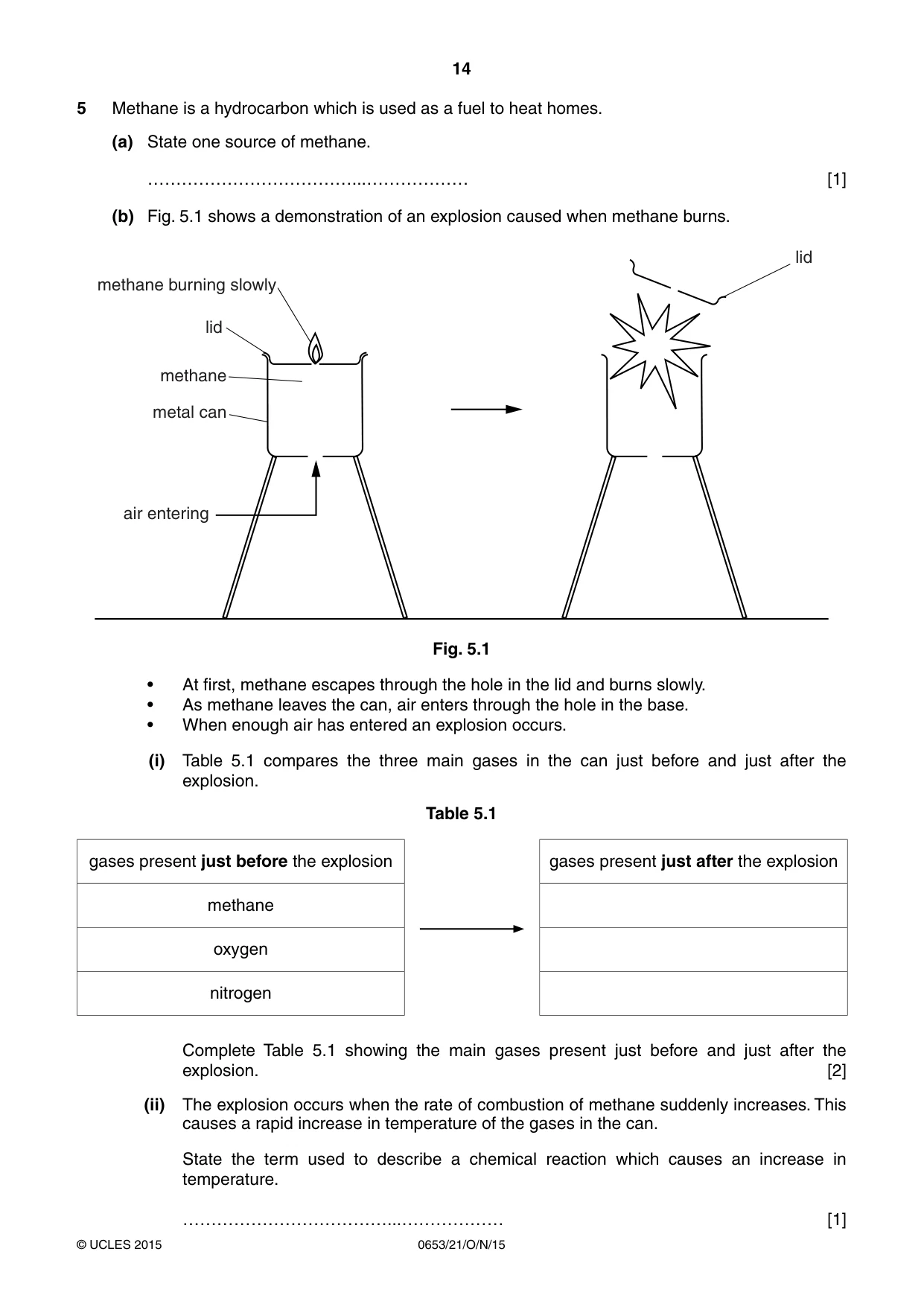
14 0653/21/O/N/15 © UCLES 2015 5 Methane is a hydrocarbon which is used as a fuel to heat homes. (a) State one source of methane. ………………………………...……………… [1] (b) Fig. 5.1 shows a demonstration of an explosion caused when methane burns. methane burning slowly lid lid methane metal can air entering Fig. 5.1 • At first, methane escapes through the hole in the lid and burns slowly. • As methane leaves the can, air enters through the hole in the base. • When enough air has entered an explosion occurs. (i) Table 5.1 compares the three main gases in the can just before and just after the explosion. Table 5.1 gases present just before the explosion gases present just after the explosion methane oxygen nitrogen Complete Table 5.1 showing the main gases present just before and just after the explosion. [2] (ii) The explosion occurs when the rate of combustion of methane suddenly increases. This causes a rapid increase in temperature of the gases in the can. State the term used to describe a chemical reaction which causes an increase in temperature. ………………………………...……………… [1]
Question paper, page 15
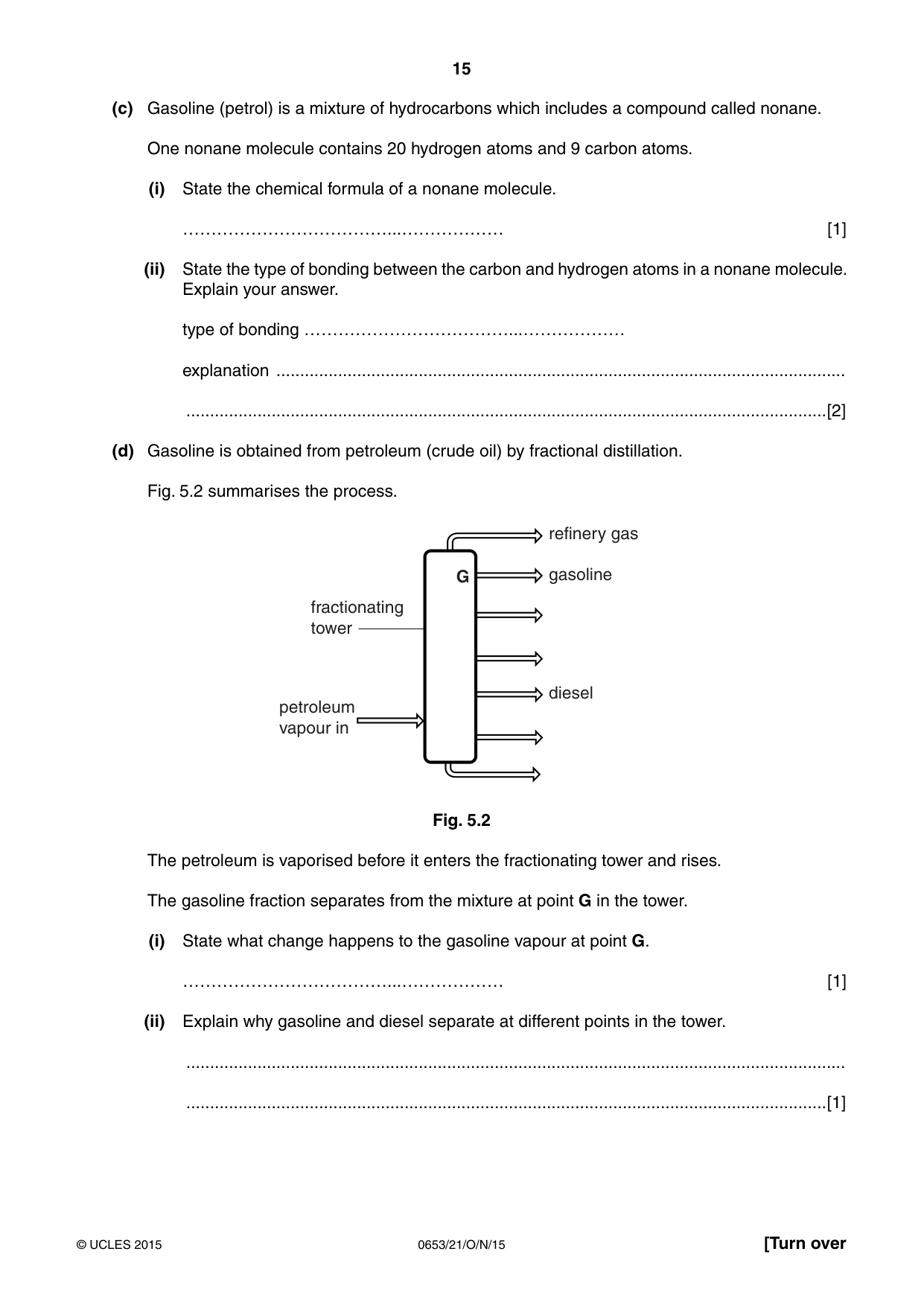
15 0653/21/O/N/15 © UCLES 2015 [Turn over (c) Gasoline (petrol) is a mixture of hydrocarbons which includes a compound called nonane. One nonane molecule contains 20 hydrogen atoms and 9 carbon atoms. (i) State the chemical formula of a nonane molecule. ………………………………...……………… [1] (ii) State the type of bonding between the carbon and hydrogen atoms in a nonane molecule. Explain your answer. type of bonding ………………………………...……………… explanation … …[2] (d) Gasoline is obtained from petroleum (crude oil) by fractional distillation. Fig. 5.2 summarises the process. fractionating tower petroleum vapour in refinery gas gasoline diesel * Fig. 5.2 The petroleum is vaporised before it enters the fractionating tower and rises. The gasoline fraction separates from the mixture at point G in the tower. (i) State what change happens to the gasoline vapour at point G. ………………………………...……………… [1] (ii) Explain why gasoline and diesel separate at different points in the tower. … …[1]
Question paper, page 16
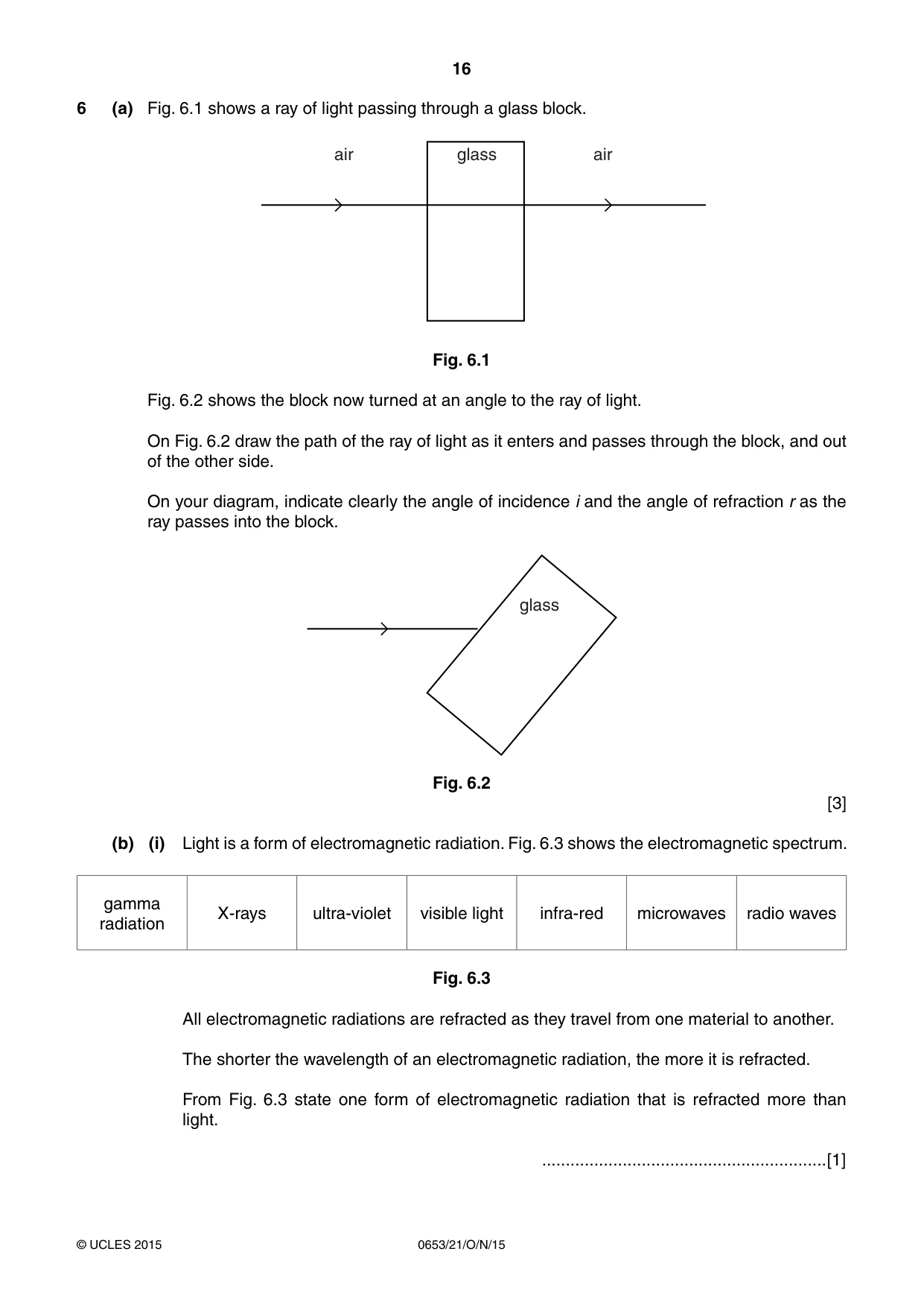
16 0653/21/O/N/15 © UCLES 2015 6 (a) Fig. 6.1 shows a ray of light passing through a glass block. air glass air Fig. 6.1 Fig. 6.2 shows the block now turned at an angle to the ray of light. On Fig. 6.2 draw the path of the ray of light as it enters and passes through the block, and out of the other side. On your diagram, indicate clearly the angle of incidence i and the angle of refraction r as the ray passes into the block. glass Fig. 6.2 [3] (b) (i) Light is a form of electromagnetic radiation. Fig. 6.3 shows the electromagnetic spectrum. gamma radiation X-rays ultra-violet visible light infra-red microwaves radio waves Fig. 6.3 All electromagnetic radiations are refracted as they travel from one material to another. The shorter the wavelength of an electromagnetic radiation, the more it is refracted. From Fig. 6.3 state one form of electromagnetic radiation that is refracted more than light. …[1]
Question paper, page 17
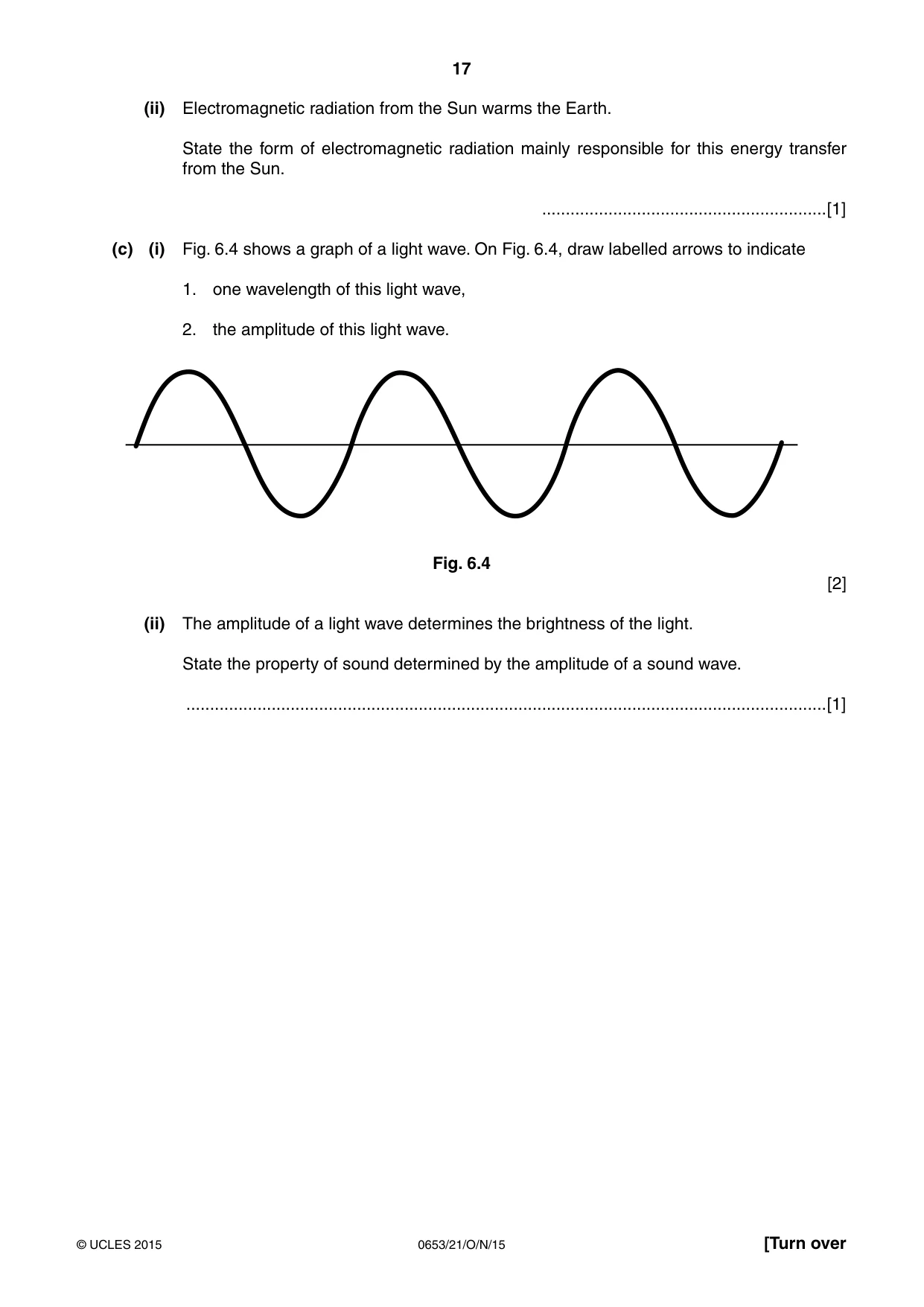
17 0653/21/O/N/15 © UCLES 2015 [Turn over (ii) Electromagnetic radiation from the Sun warms the Earth. State the form of electromagnetic radiation mainly responsible for this energy transfer from the Sun. …[1] (c) (i) Fig. 6.4 shows a graph of a light wave. On Fig. 6.4, draw labelled arrows to indicate 1. one wavelength of this light wave, 2. the amplitude of this light wave. Fig. 6.4 [2] (ii) The amplitude of a light wave determines the brightness of the light. State the property of sound determined by the amplitude of a sound wave. …[1]
Question paper, page 18
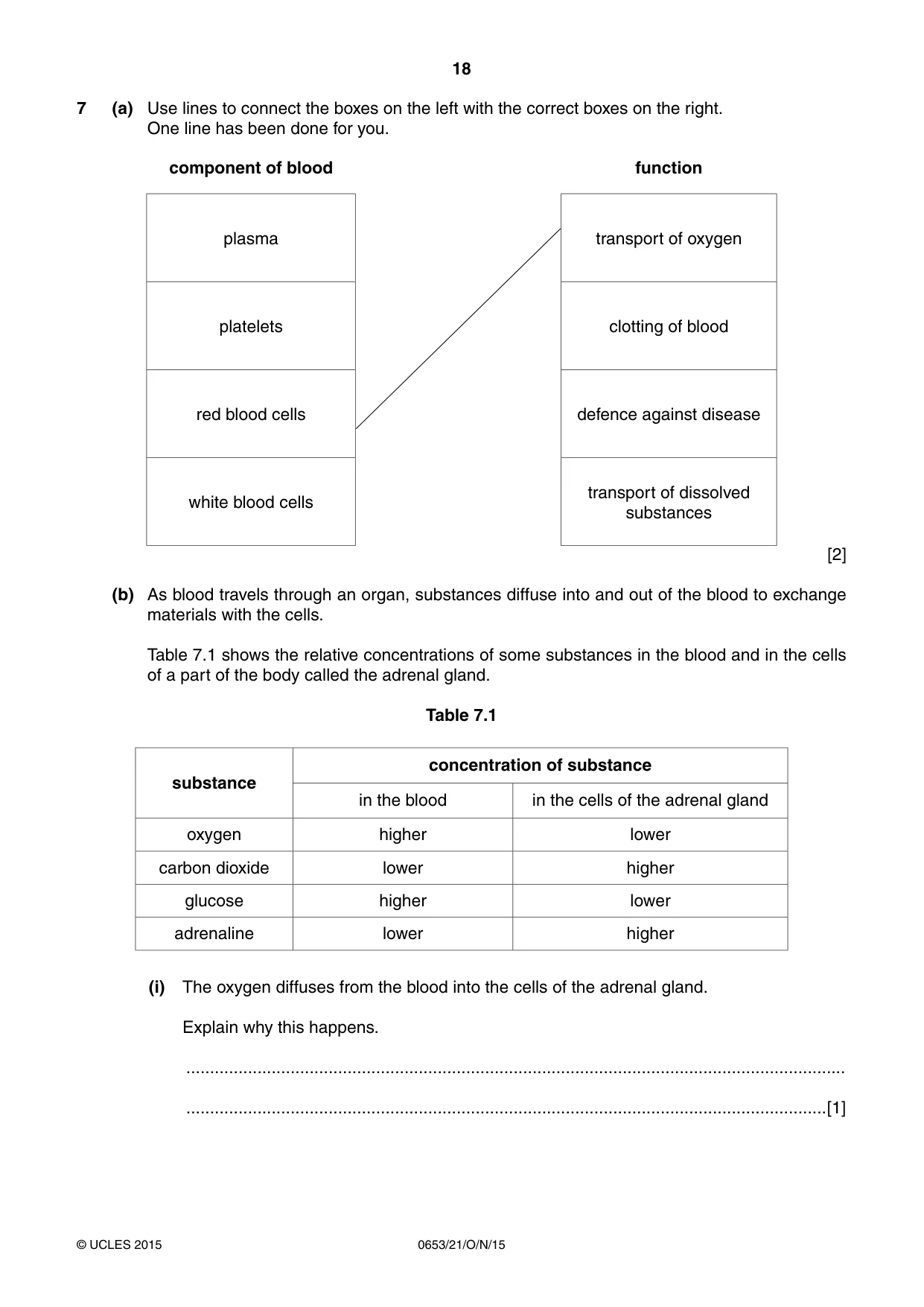
18 0653/21/O/N/15 © UCLES 2015 7 (a) Use lines to connect the boxes on the left with the correct boxes on the right. One line has been done for you. component of blood function plasma transport of oxygen platelets clotting of blood red blood cells defence against disease white blood cells transport of dissolved substances [2] (b) As blood travels through an organ, substances diffuse into and out of the blood to exchange materials with the cells. Table 7.1 shows the relative concentrations of some substances in the blood and in the cells of a part of the body called the adrenal gland. Table 7.1 substance concentration of substance in the blood in the cells of the adrenal gland oxygen higher lower carbon dioxide lower higher glucose higher lower adrenaline lower higher (i) The oxygen diffuses from the blood into the cells of the adrenal gland. Explain why this happens. … …[1]
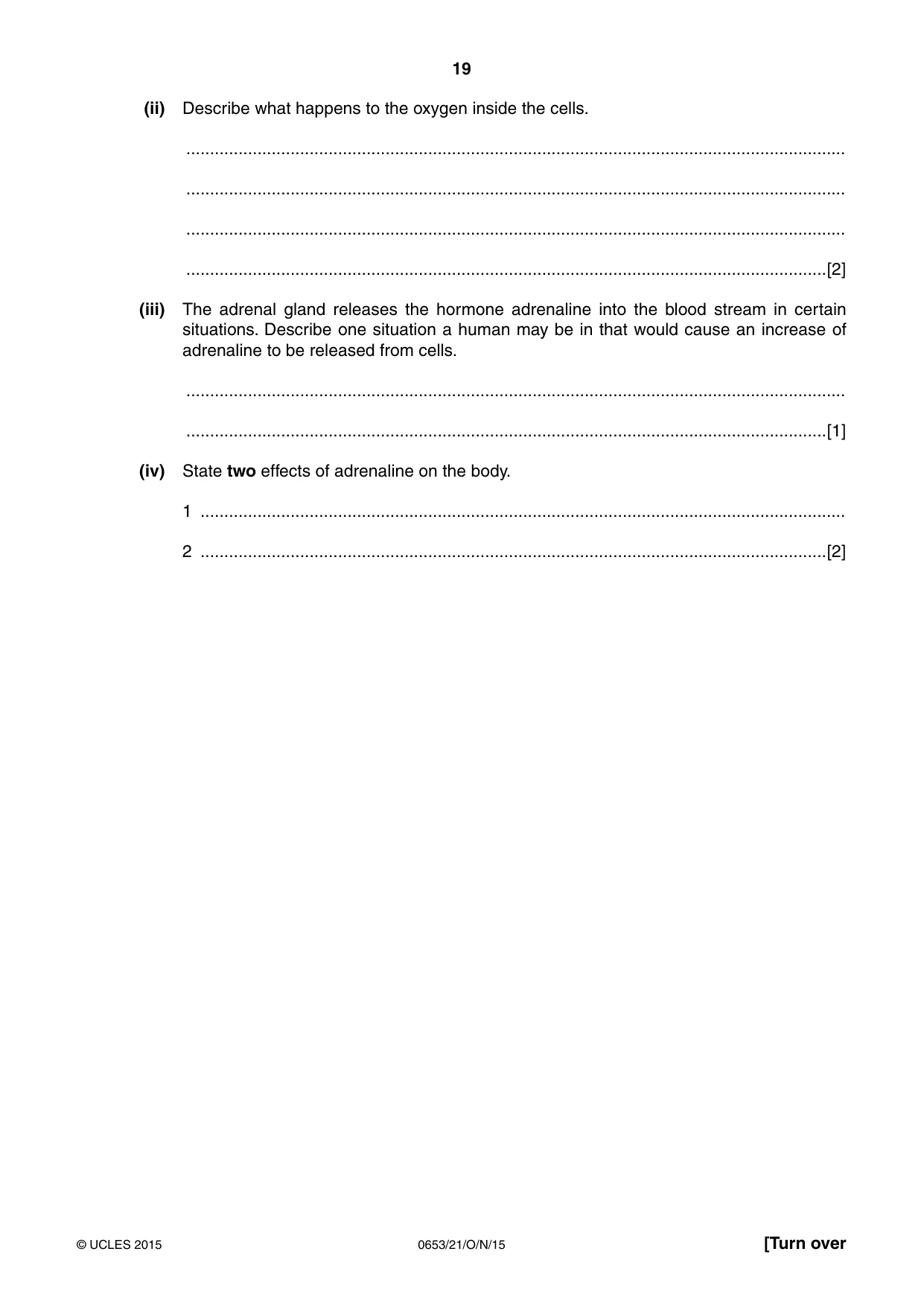
Question paper, page 19
19 0653/21/O/N/15 © UCLES 2015 [Turn over (ii) Describe what happens to the oxygen inside the cells. … … … …[2] (iii) The adrenal gland releases the hormone adrenaline into the blood stream in certain situations. Describe one situation a human may be in that would cause an increase of adrenaline to be released from cells. … …[1] (iv) State two effects of adrenaline on the body. 1 … 2 …[2]
Question paper, page 20
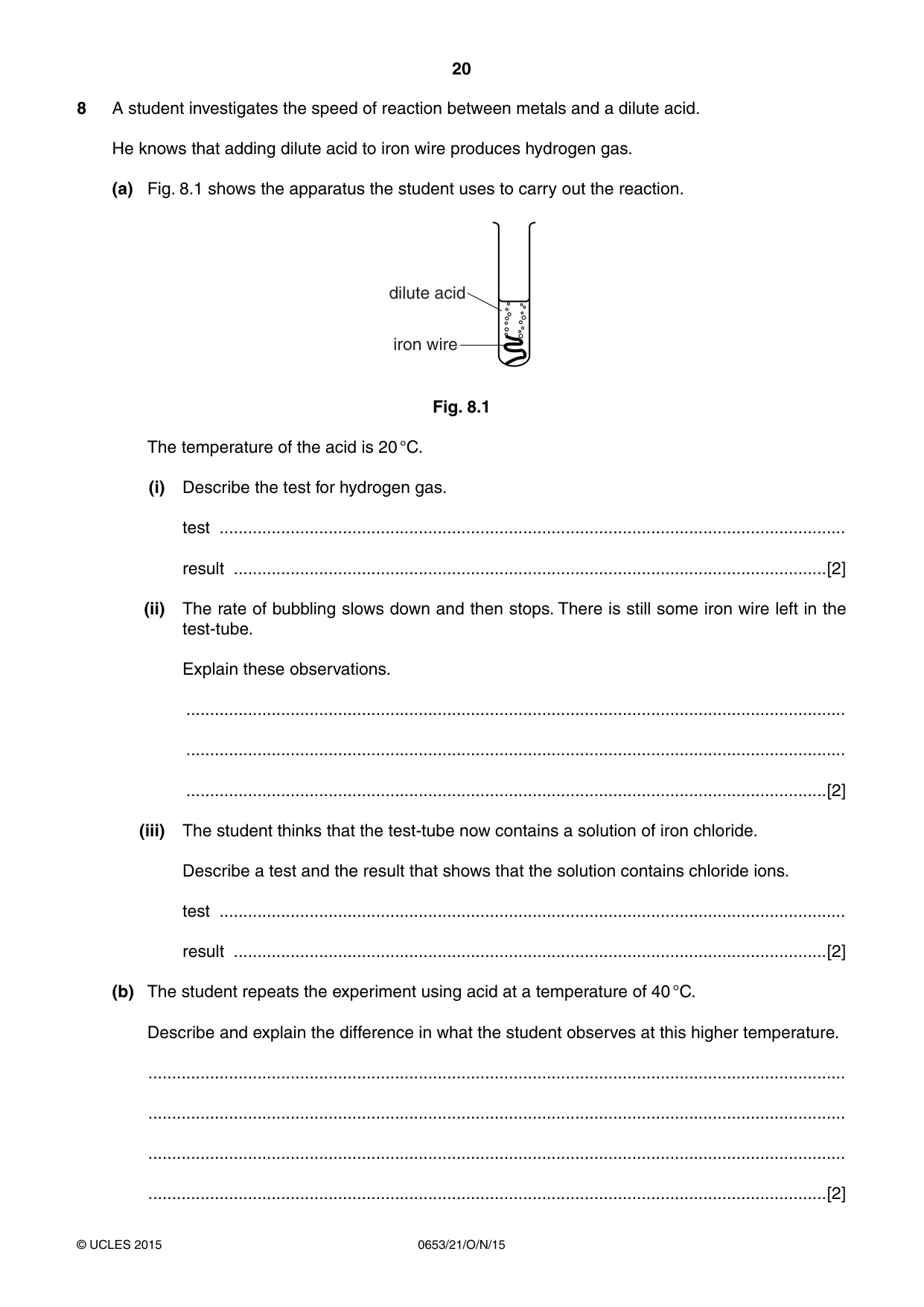
20 0653/21/O/N/15 © UCLES 2015 8 A student investigates the speed of reaction between metals and a dilute acid. He knows that adding dilute acid to iron wire produces hydrogen gas. (a) Fig. 8.1 shows the apparatus the student uses to carry out the reaction. dilute acid iron wire Fig. 8.1 The temperature of the acid is 20 °C. (i) Describe the test for hydrogen gas. test … result …[2] (ii) The rate of bubbling slows down and then stops. There is still some iron wire left in the test-tube. Explain these observations. … … …[2] (iii) The student thinks that the test-tube now contains a solution of iron chloride. Describe a test and the result that shows that the solution contains chloride ions. test … result …[2] (b) The student repeats the experiment using acid at a temperature of 40 °C. Describe and explain the difference in what the student observes at this higher temperature. … … … …[2]
Question paper, page 21
21 0653/21/O/N/15 © UCLES 2015 [Turn over (c) Describe and explain what the student notices when he uses copper wire instead of iron. … … … …[2]
Question paper, page 22
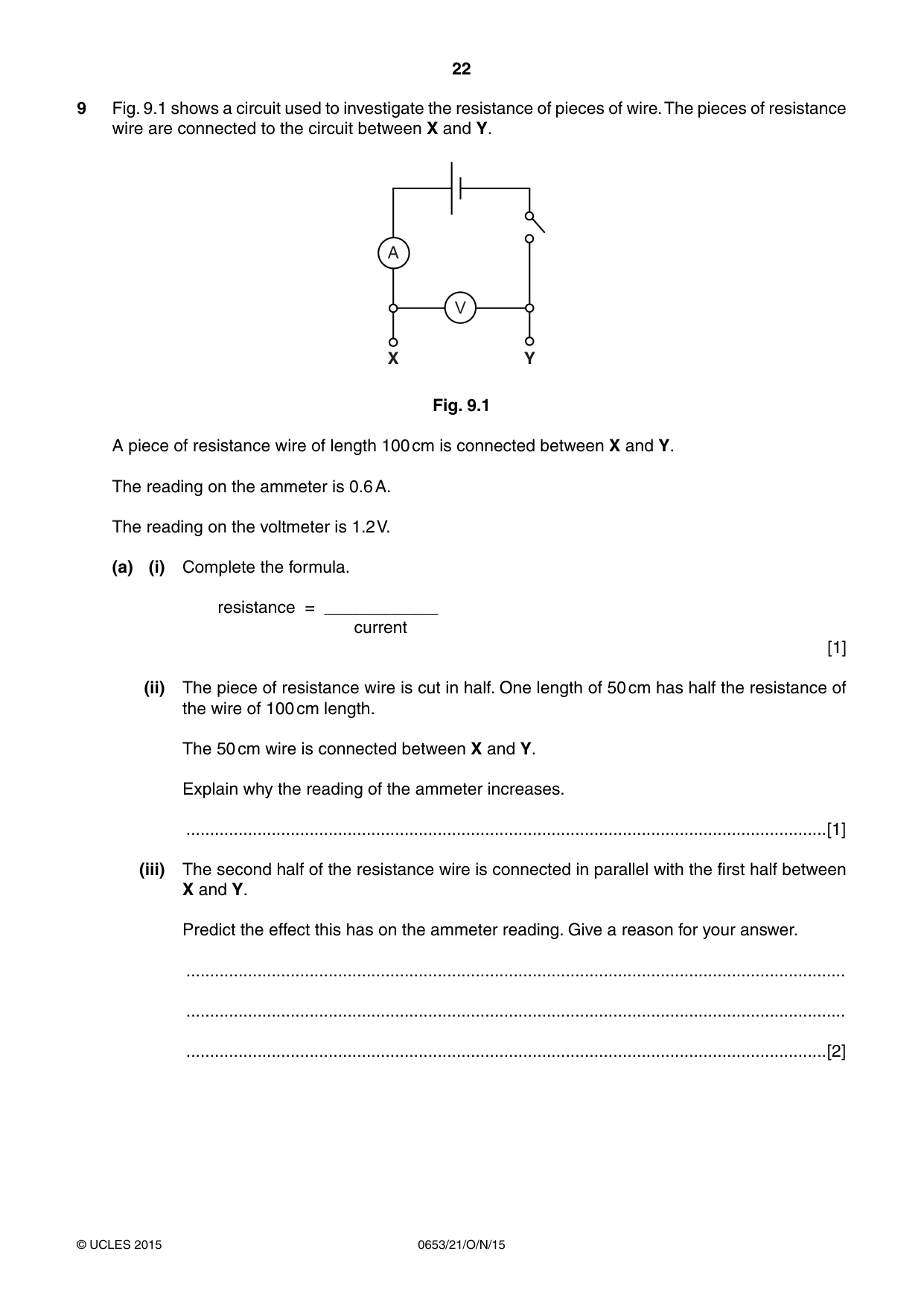
22 0653/21/O/N/15 © UCLES 2015 9 Fig. 9.1 shows a circuit used to investigate the resistance of pieces of wire. The pieces of resistance wire are connected to the circuit between X and Y. V A X Y Fig. 9.1 A piece of resistance wire of length 100 cm is connected between X and Y. The reading on the ammeter is 0.6 A. The reading on the voltmeter is 1.2 V. (a) (i) Complete the formula. resistance = ____________ current [1] (ii) The piece of resistance wire is cut in half. One length of 50 cm has half the resistance of the wire of 100 cm length. The 50 cm wire is connected between X and Y. Explain why the reading of the ammeter increases. …[1] (iii) The second half of the resistance wire is connected in parallel with the first half between X and Y. Predict the effect this has on the ammeter reading. Give a reason for your answer. … … …[2]
Question paper, page 23
23 0653/21/O/N/15 © UCLES 2015 (iv) 100 cm of the resistance wire has a resistance of 2Ω. Calculate the total resistance when four lengths of 100 cm each are connected in series. Show your working: resistance = …Ω [1] (b) The names of some circuit components are given in the left hand column. Some circuit symbols are given in the right hand column. Complete Table 9.1 to show the missing component name and symbols. One has been done for you. Table 9.1 circuit component symbol direct current source fuse fixed resistor [2] (c) Most of the stored chemical energy in the cell is changed to thermal energy in the wire. Some of this thermal energy is then transferred to the air surrounding the wire. (i) Name the method of thermal energy transfer by the heated air to the surroundings. …[1] (ii) Describe an experiment to show this method of thermal energy transfer. You may wish to draw a diagram. … … … …[2]
Question paper, page 24
24 0653/21/O/N/15 © UCLES 2015 Group The Periodic Table of the Elements 140 Ce Cerium 58 141 Pr Praseodymium 59 144 Nd Neodymium 60 Pm Promethium 61 150 Sm Samarium 62 152 Eu Europium 63 157 Gd Gadolinium 64 159 Tb Terbium 65 162 Dy Dysprosium 66 165 Ho Holmium 67 167 Er Erbium 68 169 Tm Thulium 69 173 Yb Ytterbium 70 175 Lu Lutetium 71 232 Th Thorium 90 Pa Protactinium 91 238 231 147 237 244 243 247 247 251 252 257 258 259 260 U Uranium 92 Np Neptunium 93 Pu Plutonium 94 Am Americium 95 Cm Curium 96 Bk Berkelium 97 Cf Californium 98 Es Einsteinium 99 Fm Fermium 100 Md Mendelevium 101 No Nobelium 102 Lr Lawrencium 103 1 H Hydrogen 1 7 Li Lithium 3 23 Na Sodium 11 24 Mg Magnesium 12 40 Ca Calcium 20 45 Sc Scandium 21 48 Ti Titanium 22 51 V Vanadium 23 52 Cr Chromium 24 55 Mn Manganese 25 56 Fe Iron 26 59 Co Cobalt 27 59 Ni Nickel 28 64 Cu Copper 29 65 Zn Zinc 30 70 Ga Gallium 31 27 Al Aluminium 13 11 B Boron 5 12 C Carbon 6 14 N Nitrogen 7 16 O Oxygen 8 19 F Fluorine 9 28 Si Silicon 14 31 P Phosphorus 15 32 S Sulfur 16 35.5 Cl Chlorine 17 40 Ar Argon 18 20 Ne Neon 10 4 He Helium 2 73 Ge Germanium 32 75 As Arsenic 33 79 Se Selenium 34 80 Br Bromine 35 84 Kr Krypton 36 39 K Potassium 19 88 Sr Strontium 38 89 Y Yttrium 39 91 Zr Zirconium 40 93 Nb Niobium 41 96 Mo Molybdenum 42 Tc Technetium 43 101 Ru Ruthenium 44 103 Rh Rhodium 45 106 Pd Palladium 46 108 Ag Silver 47 112 Cd Cadmium 48 115 In Indium 49 119 Sn Tin 50 122 Sb Antimony 51 128 Te Tellurium 52 127 I Iodine 53 131 Xe Xenon 54 137 Ba Barium 56 139 La Lanthanum 57 * 178 Hf Hafnium 72 181 Ta Tantalum 73 184 W Tungsten 74 186 Re Rhenium 75 190 Os Osmium 76 192 Ir Iridium 77 195 Pt Platinum 78 197 Au Gold 79 201 Hg Mercury 80 204 Tl Thallium 81 207 Pb Lead 82 209 209 210 222 Bi Bismuth 83 Po Polonium 84 At Astatine 85 Rn Radon 86 Fr Francium 87 227 Ac Actinium 89 † 9 Be Beryllium 4 I II III IV V VI VII 0 85 Rb Rubidium 37 133 Cs Caesium 55 226 223 Ra Radium 88 a X b a = relative atomic mass X = atomic symbol b = atomic (proton) number Key DATA SHEET * 58–71 Lanthanoid series † 90–103 Actinoid series The volume of one mole of any gas is 24dm3 at room temperature and pressure (r.t.p.). To avoid the issue of disclosure of answer-related information to candidates, all copyright acknowledgements are reproduced online in the Cambridge International Examinations Copyright Acknowledgements Booklet. This is produced for each series of examinations and is freely available to download at www.cie.org.uk after the live examination series.
Mark scheme, page 1
® IGCSE is the registered trademark of Cambridge International Examinations. CAMBRIDGE INTERNATIONAL EXAMINATIONS Cambridge International General Certificate of Secondary Education MARK SCHEME for the October/November 2015 series 0653 COMBINED SCIENCE 0653/21 Paper 2 (Core Theory), maximum raw mark 80 This mark scheme is published as an aid to teachers and candidates, to indicate the requirements of the examination. It shows the basis on which Examiners were instructed to award marks. It does not indicate the details of the discussions that took place at an Examiners’ meeting before marking began, which would have considered the acceptability of alternative answers. Mark schemes should be read in conjunction with the question paper and the Principal Examiner Report for Teachers. Cambridge will not enter into discussions about these mark schemes. Cambridge is publishing the mark schemes for the October/November 2015 series for most Cambridge IGCSE®, Cambridge International A and AS Level components and some Cambridge O Level components.
Mark scheme, page 2
Page 2 Mark Scheme Syllabus Paper Cambridge IGCSE – October/November 2015 0653 21 © Cambridge International Examinations 2015 1 (a) (i) B and D ; [1] (ii) C ; [1] (b) (on either cell B or D or a mixture of both) correct labelling of: cell wall ; vacuole ; chloroplast ; [max 2] (c) (i) shape X, AND lost less water (by transpiration) ; this leaf / shoot has smaller (total) surface area ; [2] (ii) (temperature) (distance increases as) rate of transpiration increases / more water lost in warmer conditions ; (humidity) (distance increases as) rate of transpiration increases / more water lost with reduced humidity ; [2] [Total: 8] 2 (a) increases ; [1] (b) sodium atoms lose electrons ; bromine atoms gain electrons ; [2] (c) (i) bromine ; [1] (ii) chlorine + sodium bromide → bromine + sodium chloride LHS ; RHS ; [2] (iii) chlorine displaces bromine but iodine does not displace bromine ; a more reactive halogen displaces a less reactive halogen / owtte ; OR chlorine more reactive than bromine and so displaces it ; iodine less reactive than bromine so does not displace it ; [max 2] [Total: 8] 3 (a) potential (energy) to kinetic (energy) ; [1] (b) (i) weight / gravitational force ; [1] (ii) arrow on Fig. 3.1 pointing upwards ; [1] (iii) newton ; [1]
Mark scheme, page 3
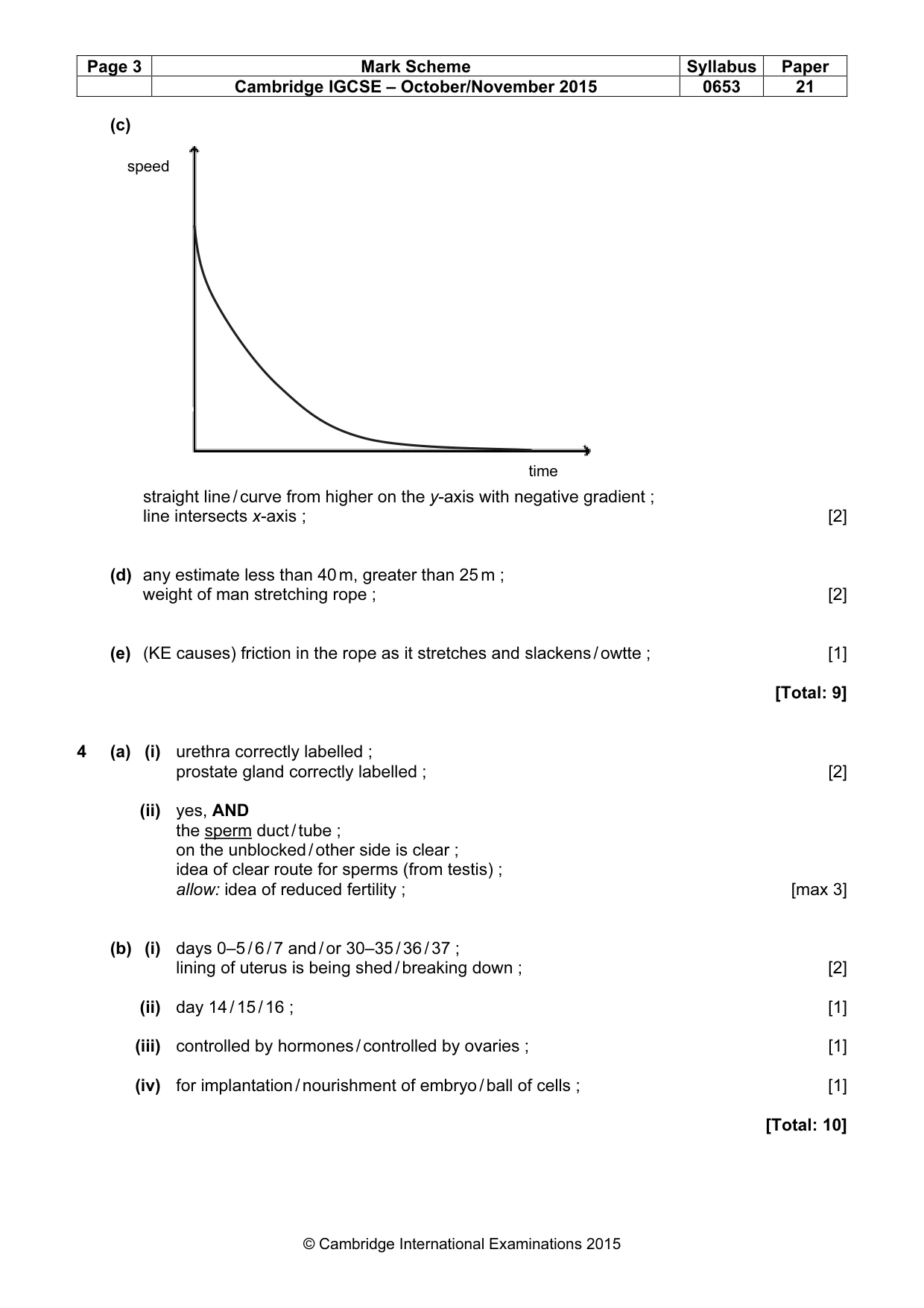
Page 3 Mark Scheme Syllabus Paper Cambridge IGCSE – October/November 2015 0653 21 © Cambridge International Examinations 2015 (c) straight line / curve from higher on the y-axis with negative gradient ; line intersects x-axis ; [2] (d) any estimate less than 40 m, greater than 25 m ; weight of man stretching rope ; [2] (e) (KE causes) friction in the rope as it stretches and slackens / owtte ; [1] [Total: 9] 4 (a) (i) urethra correctly labelled ; prostate gland correctly labelled ; [2] (ii) yes, AND the sperm duct / tube ; on the unblocked / other side is clear ; idea of clear route for sperms (from testis) ; allow: idea of reduced fertility ; [max 3] (b) (i) days 0–5 / 6 / 7 and / or 30–35 / 36 / 37 ; lining of uterus is being shed / breaking down ; [2] (ii) day 14 / 15 / 16 ; [1] (iii) controlled by hormones / controlled by ovaries ; [1] (iv) for implantation / nourishment of embryo / ball of cells ; [1] [Total: 10] speed time
Mark scheme, page 4
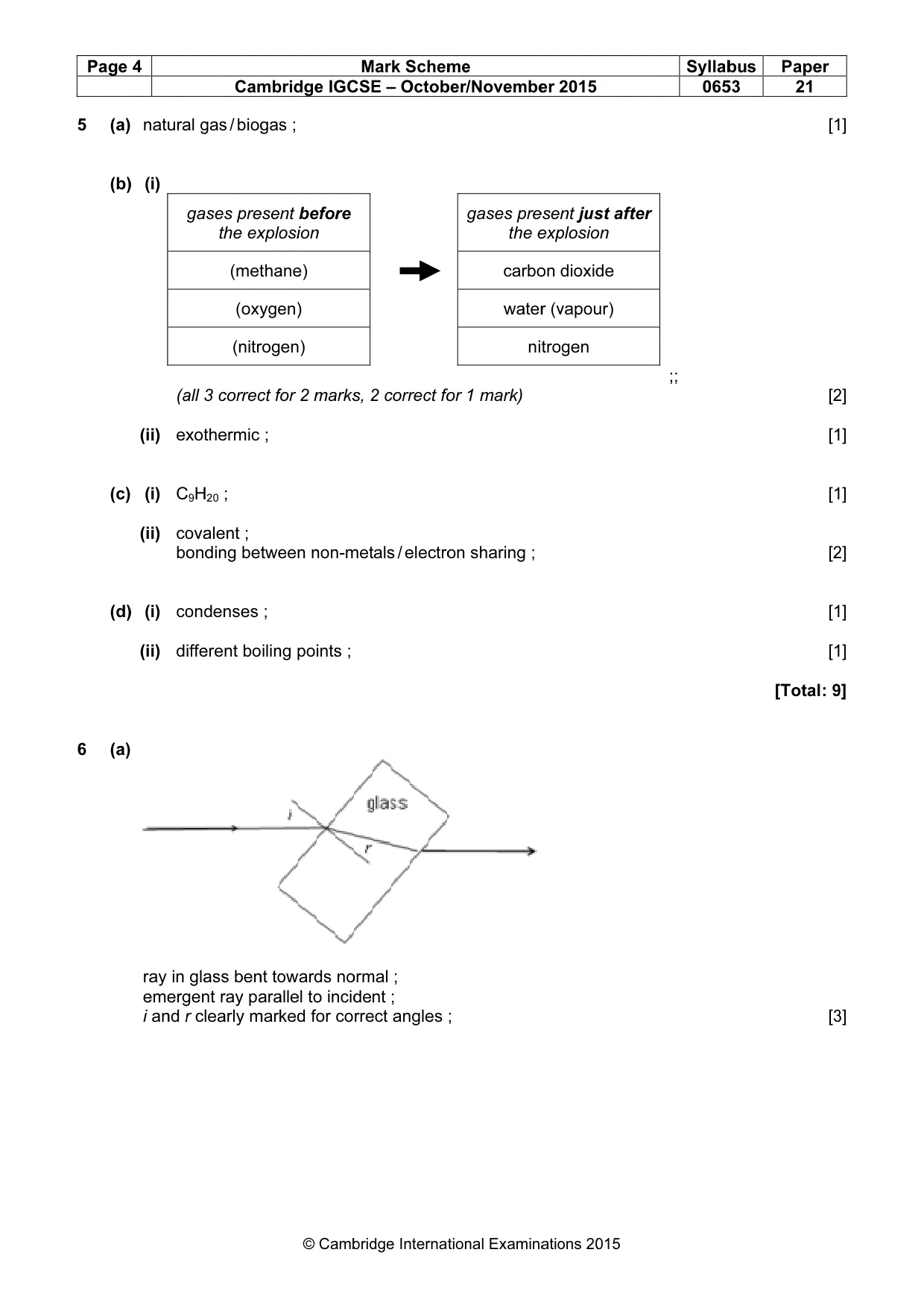
P 5 6 Pag ( ( ( ( ( ge (a) (b) (c) (d) (a) 4 n ) ( (i ( (i ) ( (i ra e i natu (i) i) (i) i) (i) i) ay eme an ura (a ex C co bo co d in erg nd r al g ga all 3 xot C9H ova ond ond iffe gla gen r cl gas se th 3 c the H20 ale din den ere ass nt r lea C s / b s p the (m (o (n corr erm ; ent ng nse nt s b ray arly Cam biog pre ex met oxy nitr rrec mic ; bet es bo ben y pa y m mb gas ese xplo tha yge rog ct f ; twe ; ilin nt to ara mark brid s ; nt osi ane en) en for een ng p ow alle ked dge © be ion e) ) ) 2 m n n poi ard el to d fo e IG Ca efor n ma non ints ds o in or GC amb re arks n-m s ; no ncid co M CSE brid s, 2 met orm den rre Mar E – dge 2 c tals mal nt ect k S – O e In corr s / e ; ; an Sch Oct nter rec elec gle hem ob rnat ct fo ctro es me ber/ tion for on ; e /No nal ga 1 m sh ove Ex se w ma har em xam s p th car wa rk) ing mbe mina pre e e rbo ater ni g ; er 2 atio ese exp on r (v tro 20 ons nt j plos dio vap oge 15 s 20 jus sio oxid pou en 015 st a on de ur) 5 aft ter ; S ;; Syl 0 llab 065 bu 53 s P [T Pa 2 Tot pe 21 tal er [1 [2 [1 [1 [2 [1 [1 : 9 [3 ] 2] ] ] 2] ] ] 9] 3]
Mark scheme, page 5
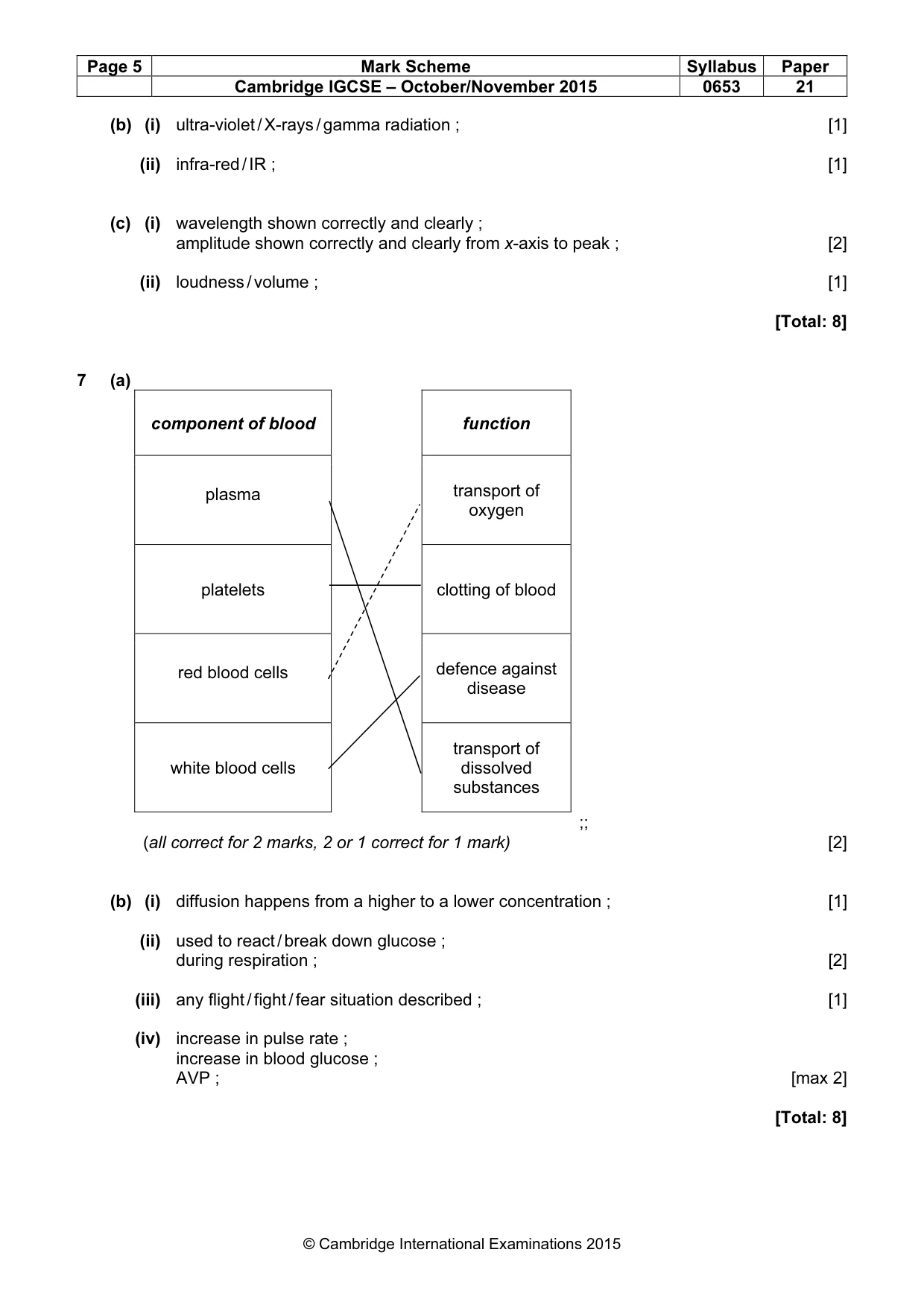
Page 5 Mark Scheme Syllabus Paper Cambridge IGCSE – October/November 2015 0653 21 © Cambridge International Examinations 2015 (b) (i) ultra-violet / X-rays / gamma radiation ; [1] (ii) infra-red / IR ; [1] (c) (i) wavelength shown correctly and clearly ; amplitude shown correctly and clearly from x-axis to peak ; [2] (ii) loudness / volume ; [1] [Total: 8] 7 (a) component of blood function plasma transport of oxygen platelets clotting of blood red blood cells defence against disease white blood cells transport of dissolved substances ;; (all correct for 2 marks, 2 or 1 correct for 1 mark) [2] (b) (i) diffusion happens from a higher to a lower concentration ; [1] (ii) used to react / break down glucose ; during respiration ; [2] (iii) any flight / fight / fear situation described ; [1] (iv) increase in pulse rate ; increase in blood glucose ; AVP ; [max 2] [Total: 8]
Mark scheme, page 6
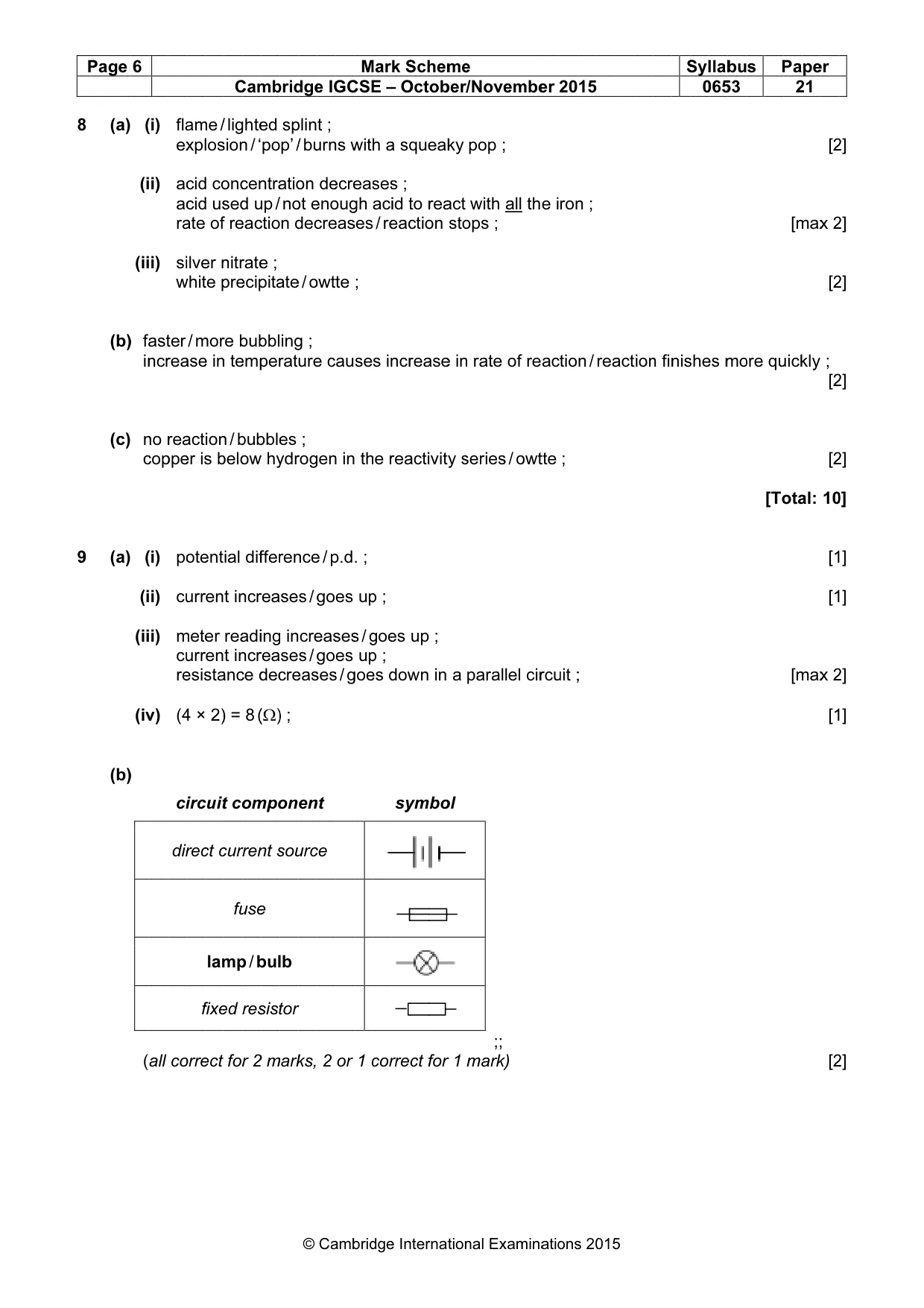
P 8 9 Pag ( ( ( ( ( ge (a) (b) (c) (a) (b) 6 ( (i (ii ) fa in n c ( (i (ii (iv ) ( (i) i) i) ast ncr no r cop (i) i) i) v) all fla ex ac ac ra si w ter rea rea ppe po cu m cu re (4 ci dir co am xpl cid cid ate ilve whit / m ase act er is ote urr mete urr esis 4 × irc rec f orre me / los d co d us of er n te p mor e in ion s b ent ren er ren sta 2) cuit ct c lam fixe ect C / lig sion onc sed f re nitr pre re b n te n / b belo ial t in rea t in anc ) = t co curr fu mp ed r for Cam ghte n / ‘ cen d u eac rate ecip bub emp bub ow dif ncr adi ncr ce d 8 ( om rren use p / b res r 2 mb ed po ntra up / ctio e ; pita bbl per bble w hy ffer rea ing rea dec (Ω) mpo nt s e bul sist 2 m brid sp p’ / atio / no n d ate ing rat es ydr ren se g in se cre ) ; on sou lb tor mark dge © plin / bu on ot e dec e / o g ; ure ; rog nce s / g cre s / g eas en urc r ks, e IG Ca t ; urn de eno cre owtt e c gen e / p go eas go ses nt ce 2 GC amb ns w ecre oug eas te au n in p.d es ses es s / g or M CSE brid with eas gh ses ; se th . ; up s / g up goe 1 c Mar E – dge h a ses aci / re s in he r p ; goe p ; es d cor k S – O e In a sq s ; id t eac ncr rea es dow sy rrec Sch Oct nter que to r ctio rea acti up wn ym ct f hem ob rnat eak rea on ase ivity ; in bo for me ber/ tion ky act sto e in y s a ol r 1 e /No nal po wi ops n ra ser pa ma ove Ex op ; ith s ; ate ies ral ;; ark) em xam ; all of s / o lel k) mbe mina th re owt cir er 2 atio e i ac tte rcu 20 ons ron tio ; uit ; 15 s 20 n ; n / ; 015 rea 5 action fin S nis Syl 0 she llab 065 es m bu 53 mo s ore P qu [To Pa 2 [m uick ota [m pe 21 max kly al: max er [2 x 2 [2 ; [2 [2 10 [1 [1 x 2 [1 [2 2] 2] 2] 2] 2] 0] ] ] 2] ] 2]
Mark scheme, page 7
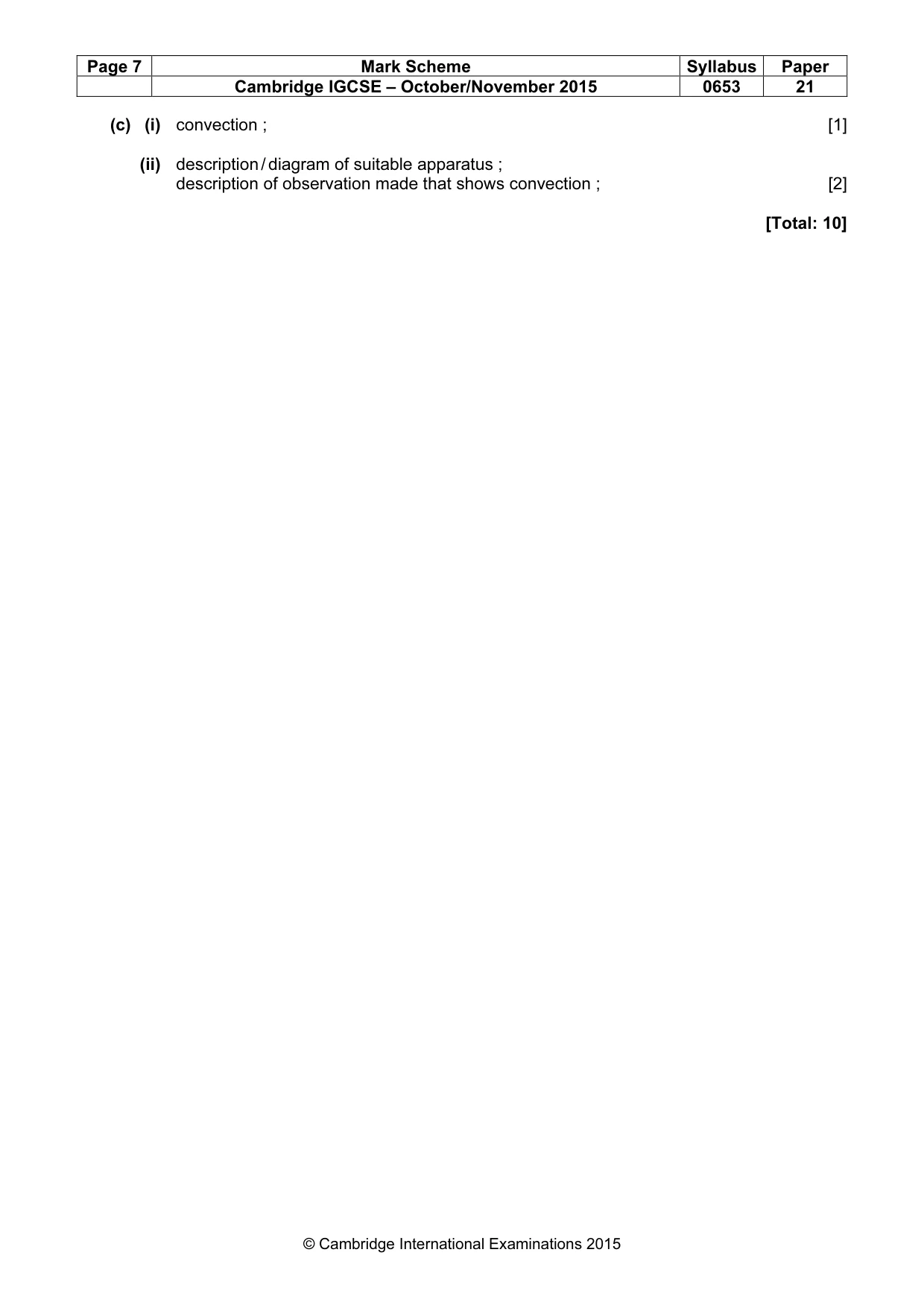
Page 7 Mark Scheme Syllabus Paper Cambridge IGCSE – October/November 2015 0653 21 © Cambridge International Examinations 2015 (c) (i) convection ; [1] (ii) description / diagram of suitable apparatus ; description of observation made that shows convection ; [2] [Total: 10]
What you needed in this session
Cambridge’s own grade thresholds for 2015 Oct/Nov, Paper 2 · Variant 1. A higher threshold means an easier paper — the bar moves with how the cohort did.