Cambridge IGCSE Science - Combined 0653 — 2013 May/June Paper 3 · Variant 2
0653/32/M/J/13 · 80 marks · ≈90 min
The question paper and its mark scheme, free to read here and free to download. This is Cambridge’s own paper, exactly as it was sat.
Question paper24 pages



Mark scheme6 pages
Answers below. Sit the paper first if you are practising.
Paper as text
Question paper, page 1
This document consists of 21 printed pages and 3 blank pages. IB13 06_0653_32/4RP © UCLES 2013 [Turn over *0215700912* UNIVERSITY OF CAMBRIDGE INTERNATIONAL EXAMINATIONS International General Certificate of Secondary Education COMBINED SCIENCE 0653/32 Paper 3 (Extended) May/June 2013 1 hour 15 minutes Candidates answer on the Question Paper. No Additional Materials are required. READ THESE INSTRUCTIONS FIRST Write your Centre number, candidate number and name on all the work you hand in. Write in dark blue or black pen. You may use a pencil for any diagrams or graphs. Do not use staples, paper clips, glue or correction fluid. DO NOT WRITE IN ANY BARCODES. Answer all questions. Electronic calculators may be used. You may lose marks if you do not show your working or if you do not use appropriate units. A copy of the Periodic Table is printed on page 24. At the end of the examination, fasten all your work securely together. The number of marks is given in brackets [ ] at the end of each question or part question. www.XtremePapers.com
Question paper, page 2
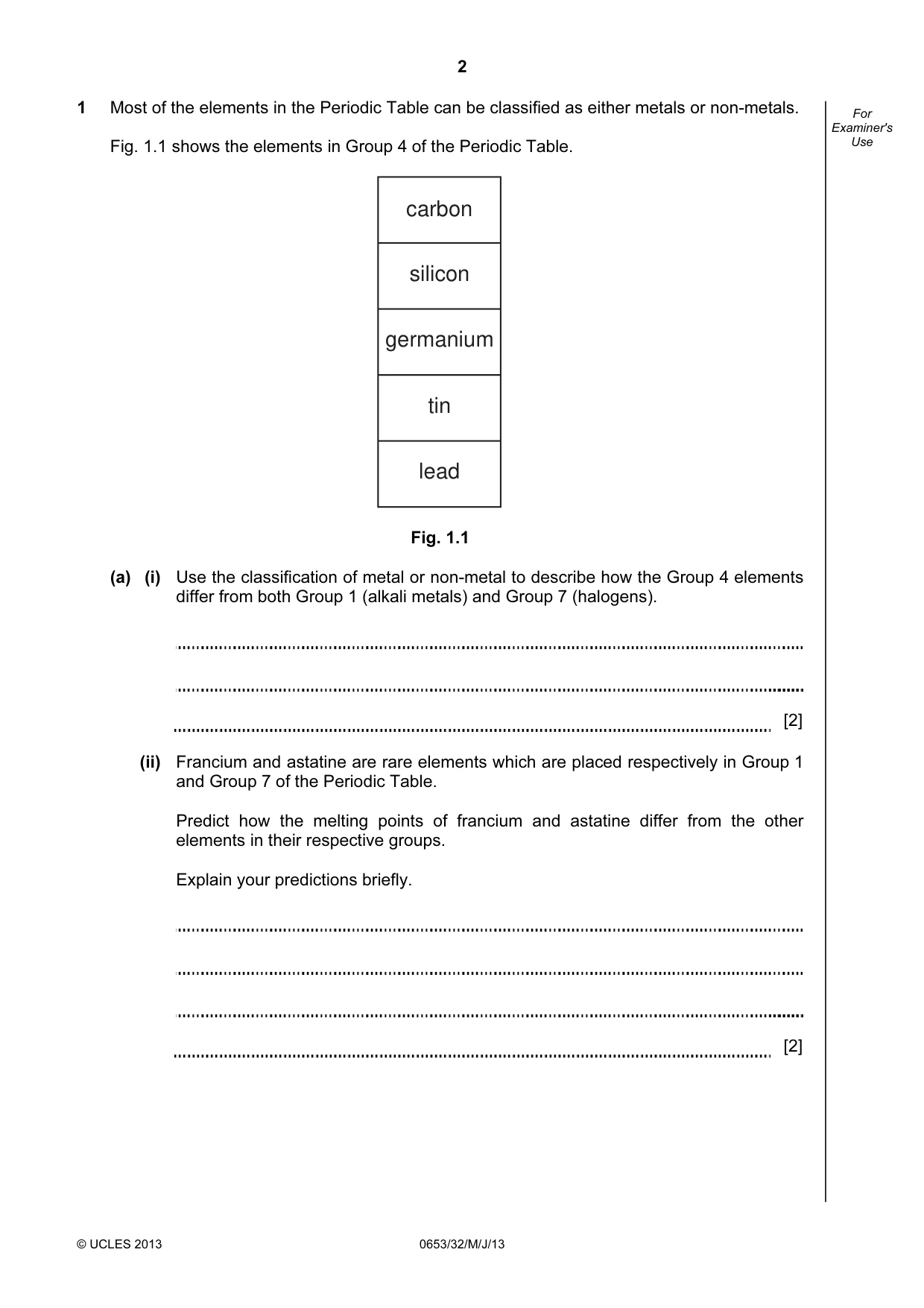
2 © UCLES 2013 0653/32/M/J/13 For Examiner's Use 1 Most of the elements in the Periodic Table can be classified as either metals or non-metals. Fig. 1.1 shows the elements in Group 4 of the Periodic Table. silicon germanium carbon tin lead Fig. 1.1 (a) (i) Use the classification of metal or non-metal to describe how the Group 4 elements differ from both Group 1 (alkali metals) and Group 7 (halogens). [2] (ii) Francium and astatine are rare elements which are placed respectively in Group 1 and Group 7 of the Periodic Table. Predict how the melting points of francium and astatine differ from the other elements in their respective groups. Explain your predictions briefly. [2]
Question paper, page 3
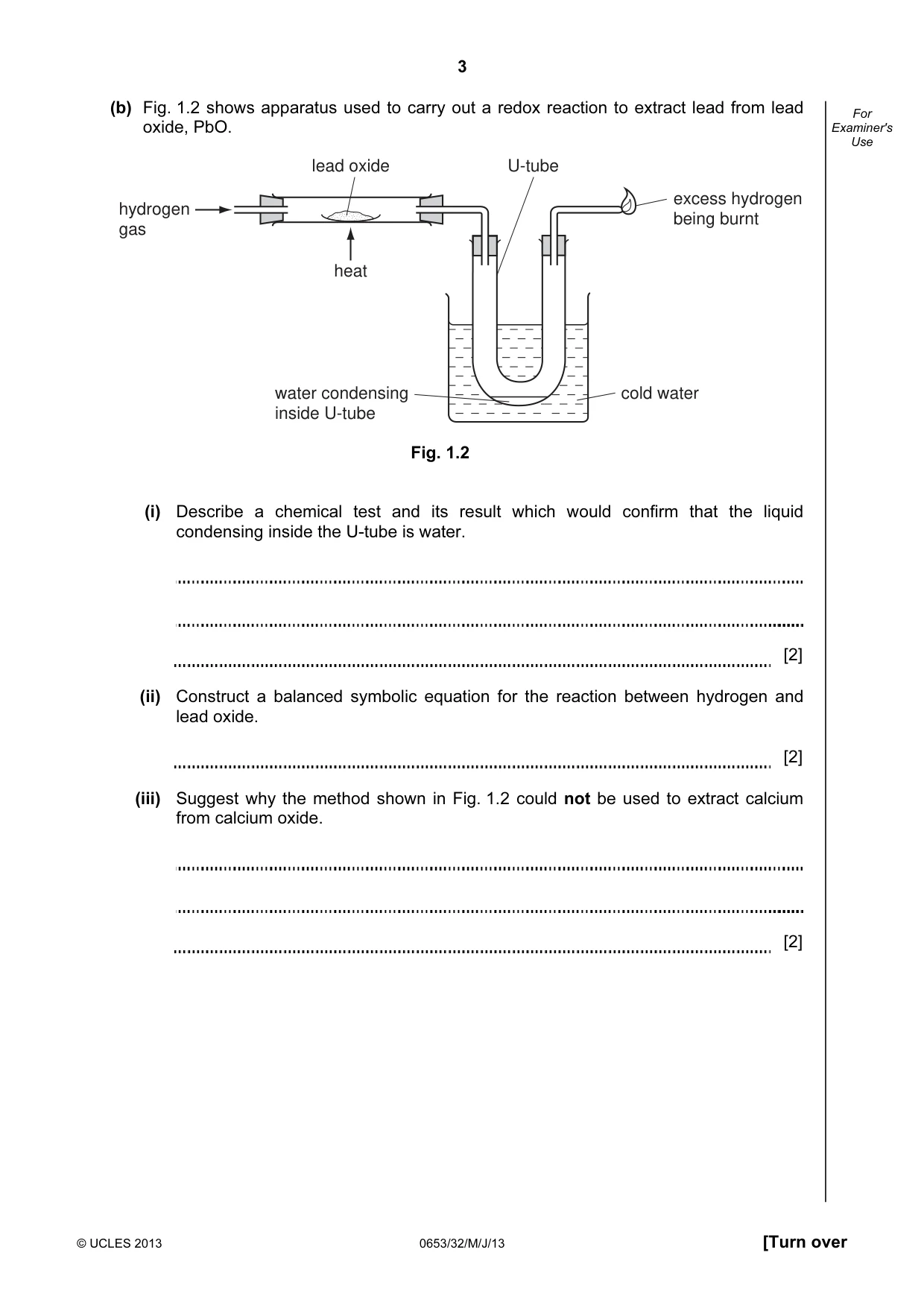
3 © UCLES 2013 0653/32/M/J/13 [Turn over For Examiner's Use (b) Fig. 1.2 shows apparatus used to carry out a redox reaction to extract lead from lead oxide, PbO. hydrogen gas heat lead oxide U-tube excess hydrogen being burnt cold water water condensing inside U-tube Fig. 1.2 (i) Describe a chemical test and its result which would confirm that the liquid condensing inside the U-tube is water. [2] (ii) Construct a balanced symbolic equation for the reaction between hydrogen and lead oxide. [2] (iii) Suggest why the method shown in Fig. 1.2 could not be used to extract calcium from calcium oxide. [2]
Question paper, page 4
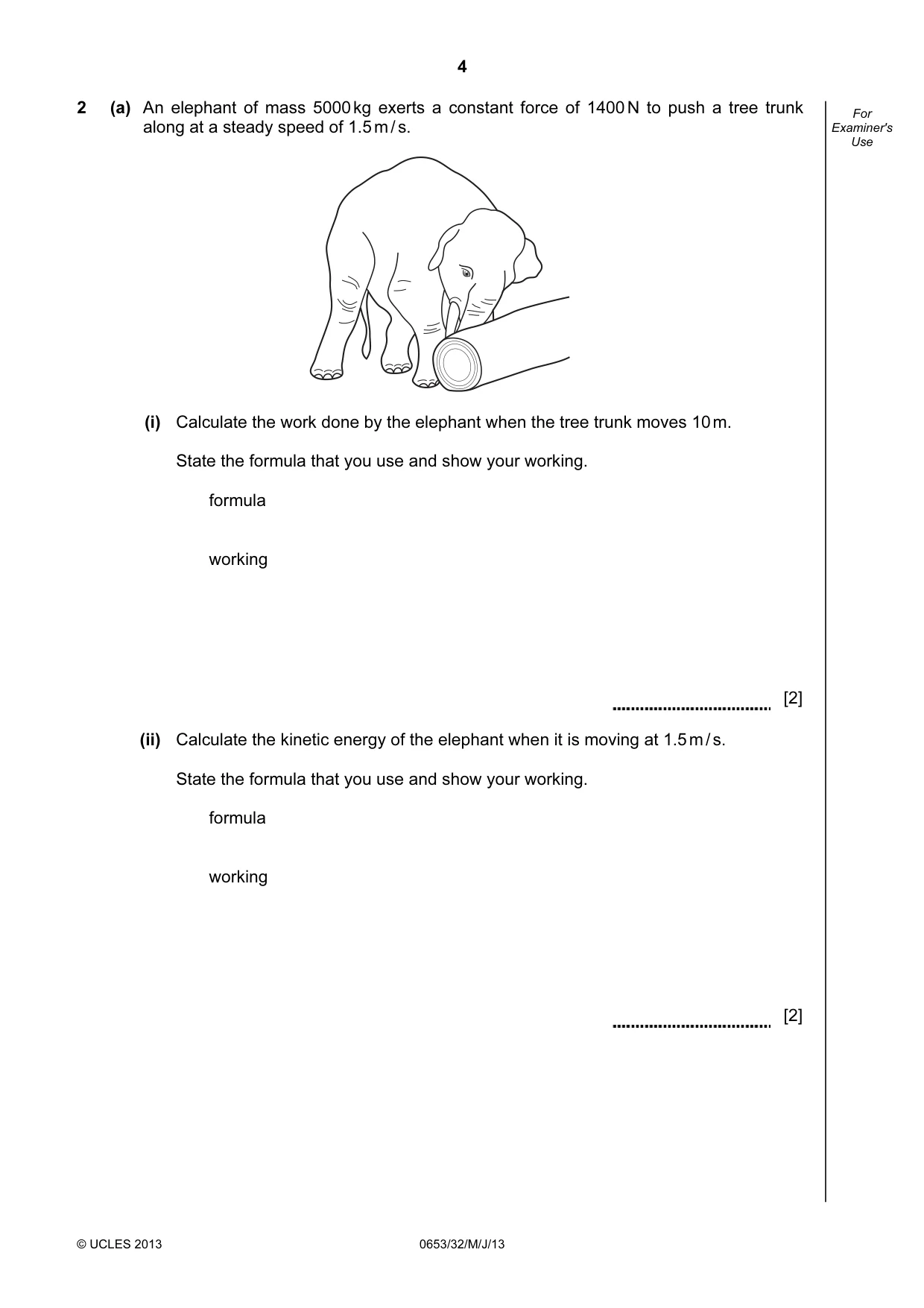
4 © UCLES 2013 0653/32/M/J/13 For Examiner's Use 2 (a) An elephant of mass 5000 kg exerts a constant force of 1400 N to push a tree trunk along at a steady speed of 1.5 m / s. (i) Calculate the work done by the elephant when the tree trunk moves 10 m. State the formula that you use and show your working. formula working [2] (ii) Calculate the kinetic energy of the elephant when it is moving at 1.5 m / s. State the formula that you use and show your working. formula working [2]
Question paper, page 5
5 © UCLES 2013 0653/32/M/J/13 [Turn over For Examiner's Use (b) The volume of the elephant is 5 m3. Its mass is 5000 kg. Calculate the density of the elephant. State the formula that you use and show your working. formula working [2] (c) An elephant can communicate with other elephants using infrasound. This is a very low frequency vibration which it is usually impossible for a human to hear. (i) Suggest a possible frequency for this vibration and explain why you chose your answer. frequency Hz explanation [2] (ii) State the meaning of the term frequency. [1] (iii) Other animals can communicate using ultrasound. Suggest how ultrasound differs from infrasound. [1]
Question paper, page 6
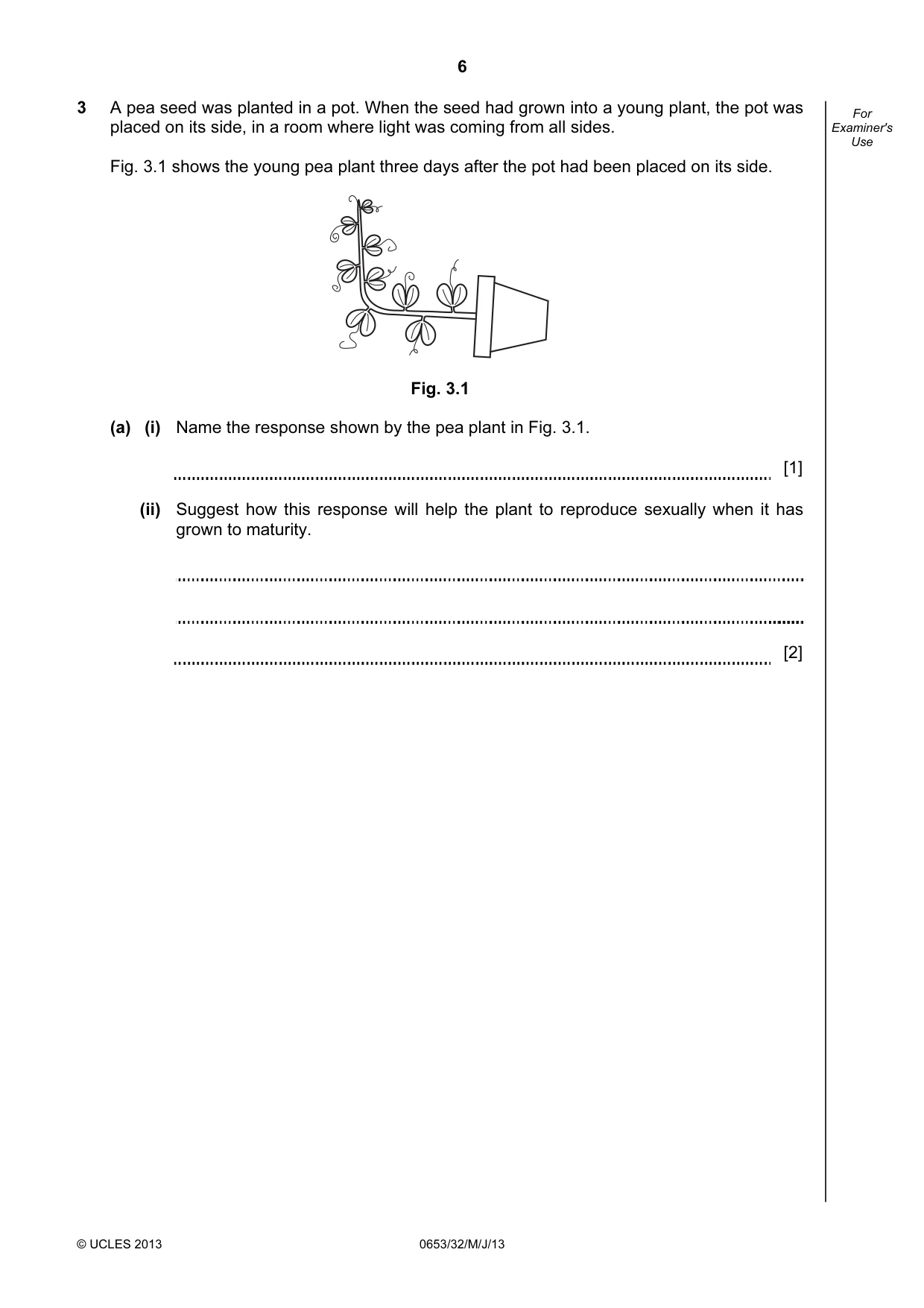
6 © UCLES 2013 0653/32/M/J/13 For Examiner's Use 3 A pea seed was planted in a pot. When the seed had grown into a young plant, the pot was placed on its side, in a room where light was coming from all sides. Fig. 3.1 shows the young pea plant three days after the pot had been placed on its side. Fig. 3.1 (a) (i) Name the response shown by the pea plant in Fig. 3.1. [1] (ii) Suggest how this response will help the plant to reproduce sexually when it has grown to maturity. [2]
Question paper, page 7
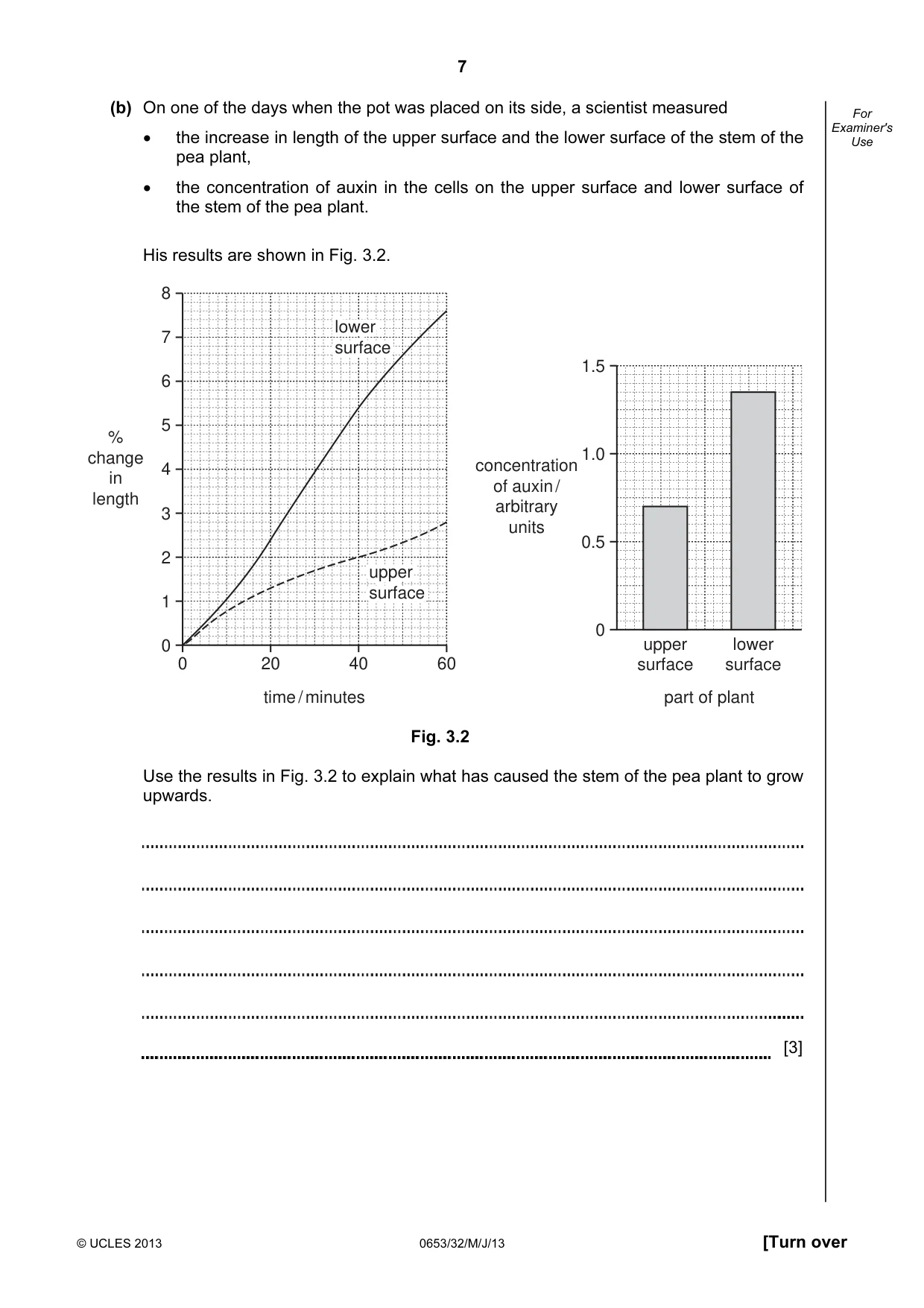
7 © UCLES 2013 0653/32/M/J/13 [Turn over For Examiner's Use (b) On one of the days when the pot was placed on its side, a scientist measured • the increase in length of the upper surface and the lower surface of the stem of the pea plant, • the concentration of auxin in the cells on the upper surface and lower surface of the stem of the pea plant. His results are shown in Fig. 3.2. 8 7 6 5 4 3 2 1 0 0 20 time / minutes 40 60 % change in length 1.5 1.0 0.5 0 upper surface part of plant lower surface concentration of auxin / arbitrary units lower lower surface surface upper upper surface surface lower surface upper surface Fig. 3.2 Use the results in Fig. 3.2 to explain what has caused the stem of the pea plant to grow upwards. [3]
Question paper, page 8
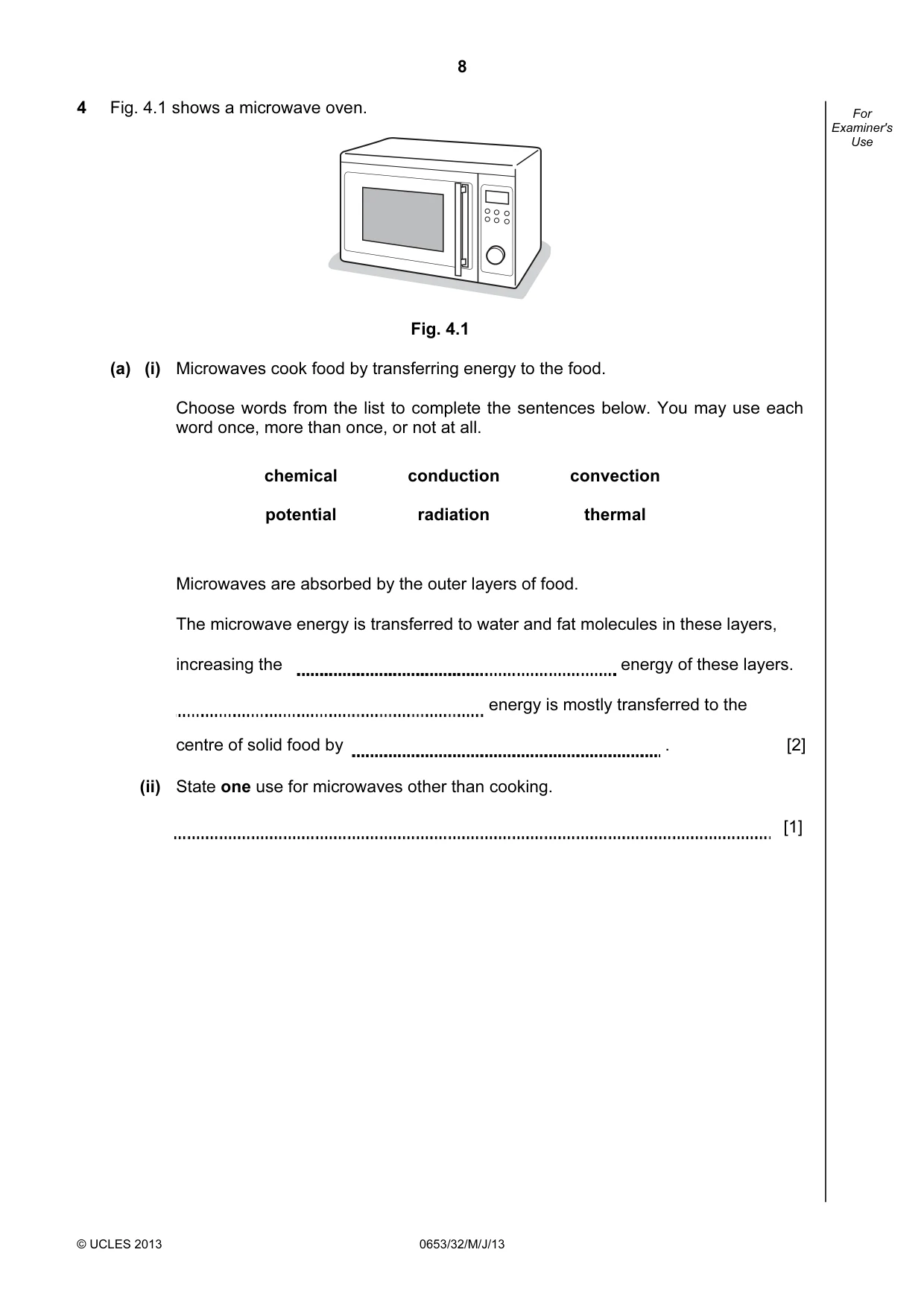
8 © UCLES 2013 0653/32/M/J/13 For Examiner's Use 4 Fig. 4.1 shows a microwave oven. Fig. 4.1 (a) (i) Microwaves cook food by transferring energy to the food. Choose words from the list to complete the sentences below. You may use each word once, more than once, or not at all. chemical conduction convection potential radiation thermal Microwaves are absorbed by the outer layers of food. The microwave energy is transferred to water and fat molecules in these layers, increasing the energy of these layers. energy is mostly transferred to the centre of solid food by . [2] (ii) State one use for microwaves other than cooking. [1]
Question paper, page 9
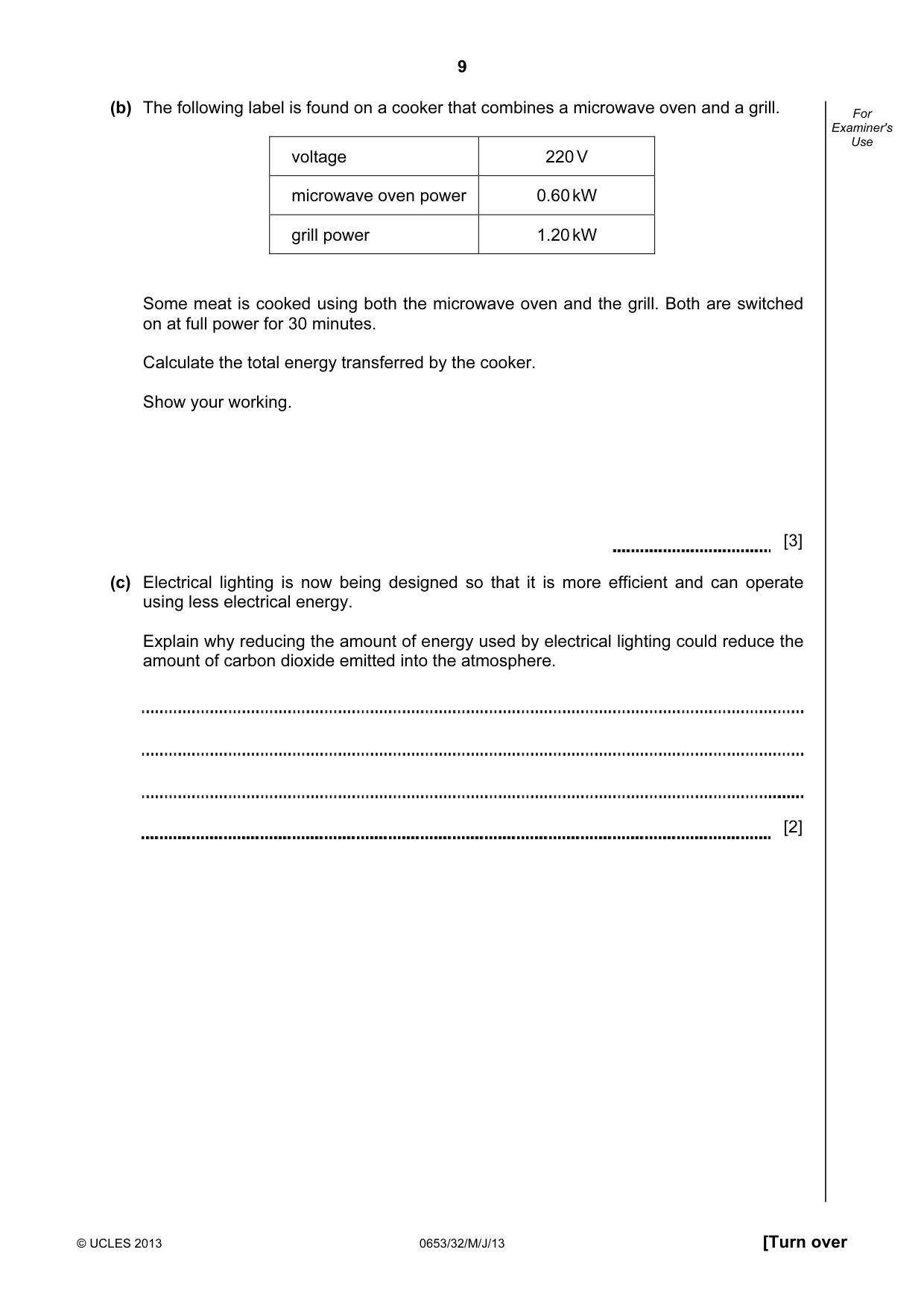
9 © UCLES 2013 0653/32/M/J/13 [Turn over For Examiner's Use (b) The following label is found on a cooker that combines a microwave oven and a grill. voltage 220 V microwave oven power 0.60 kW grill power 1.20 kW Some meat is cooked using both the microwave oven and the grill. Both are switched on at full power for 30 minutes. Calculate the total energy transferred by the cooker. Show your working. [3] (c) Electrical lighting is now being designed so that it is more efficient and can operate using less electrical energy. Explain why reducing the amount of energy used by electrical lighting could reduce the amount of carbon dioxide emitted into the atmosphere. [2]
Question paper, page 10
10 © UCLES 2013 0653/32/M/J/13 BLANK PAGE
Question paper, page 11
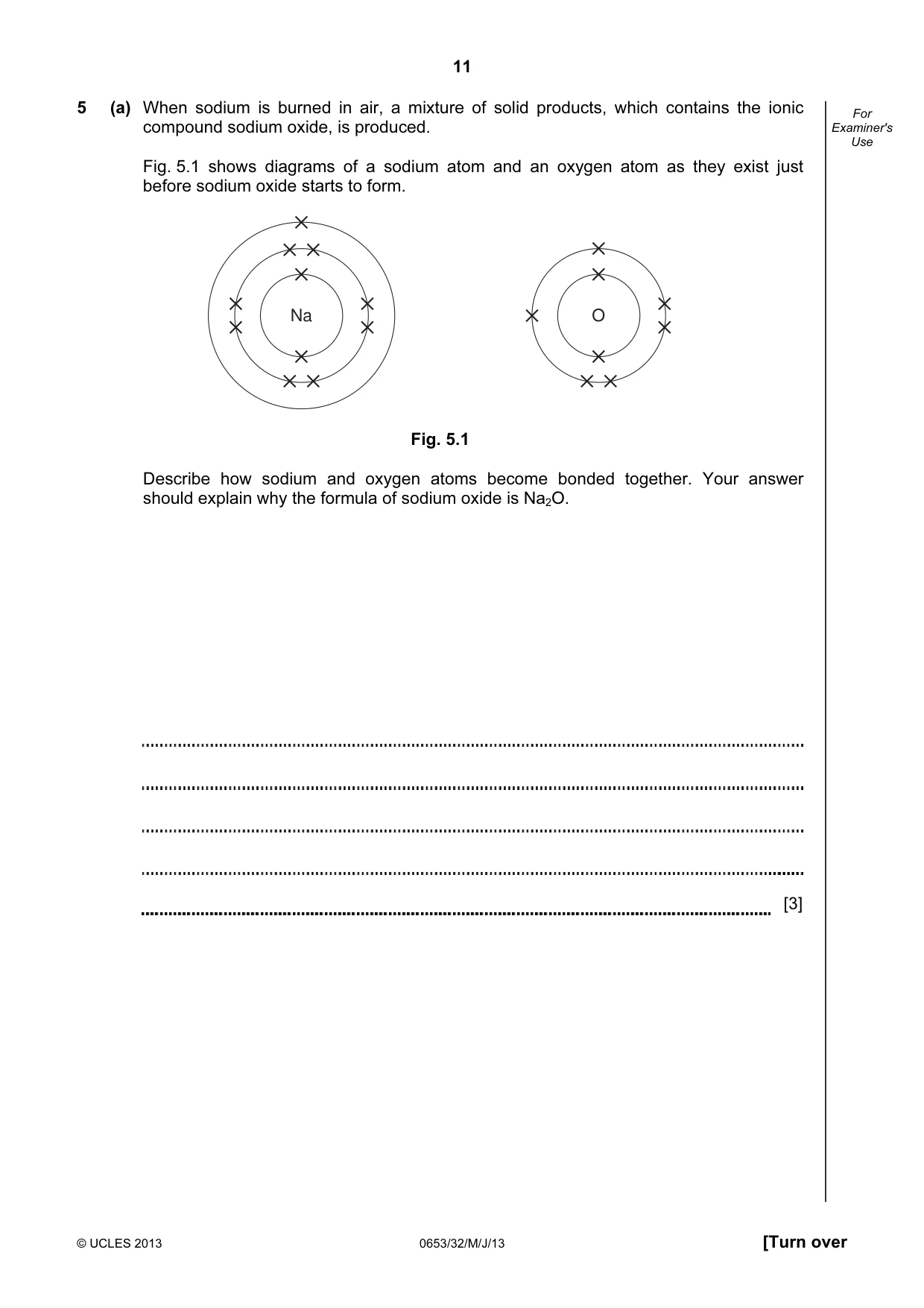
11 © UCLES 2013 0653/32/M/J/13 [Turn over For Examiner's Use 5 (a) When sodium is burned in air, a mixture of solid products, which contains the ionic compound sodium oxide, is produced. Fig. 5.1 shows diagrams of a sodium atom and an oxygen atom as they exist just before sodium oxide starts to form. Na O Fig. 5.1 Describe how sodium and oxygen atoms become bonded together. Your answer should explain why the formula of sodium oxide is Na2O. [3]
Question paper, page 12
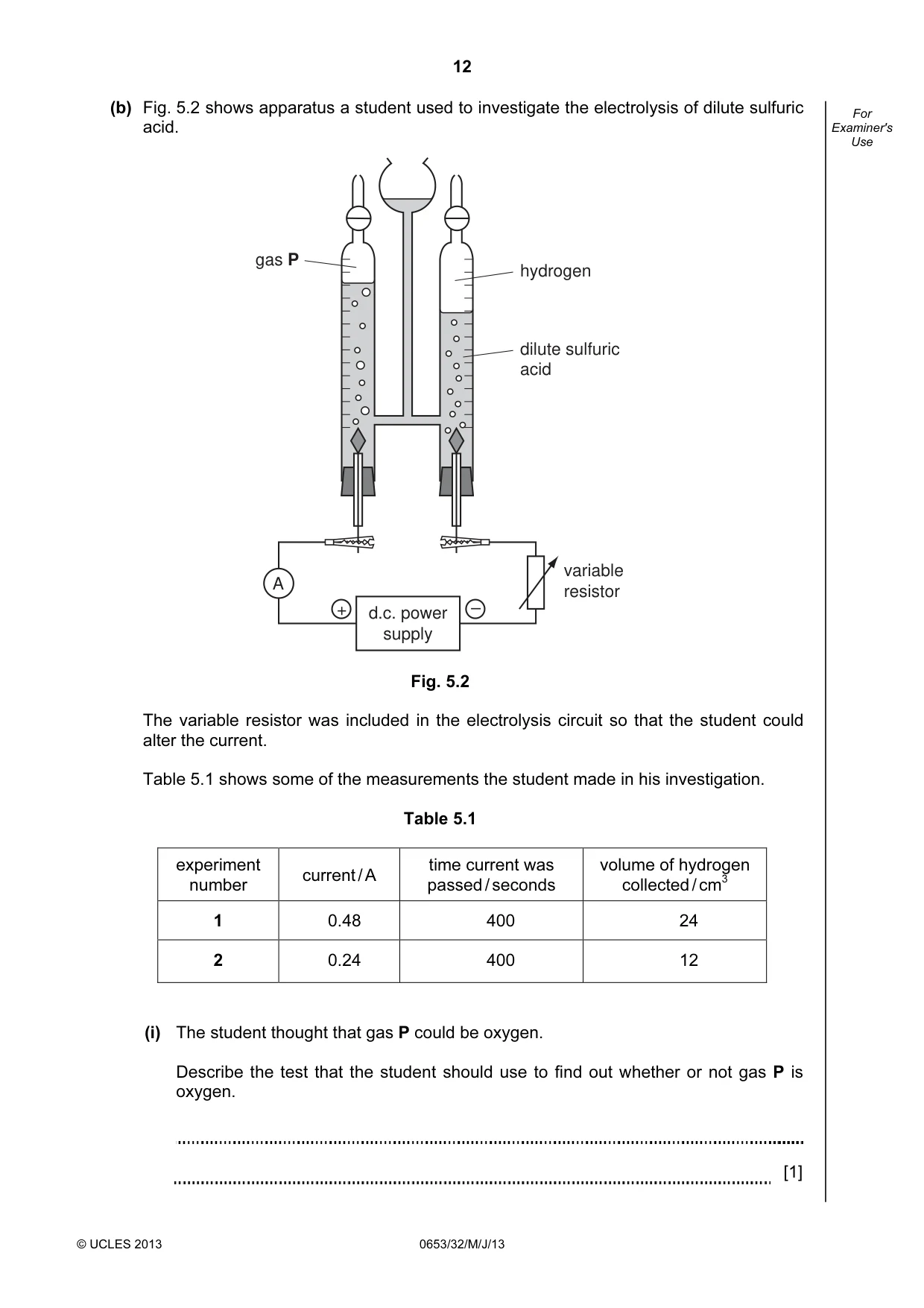
12 © UCLES 2013 0653/32/M/J/13 For Examiner's Use (b) Fig. 5.2 shows apparatus a student used to investigate the electrolysis of dilute sulfuric acid. gas P hydrogen dilute sulfuric acid A variable resistor d.c. power supply + – Fig. 5.2 The variable resistor was included in the electrolysis circuit so that the student could alter the current. Table 5.1 shows some of the measurements the student made in his investigation. Table 5.1 experiment number current / A time current was passed / seconds volume of hydrogen collected / cm3 1 0.48 400 24 2 0.24 400 12 (i) The student thought that gas P could be oxygen. Describe the test that the student should use to find out whether or not gas P is oxygen. [1]
Question paper, page 13
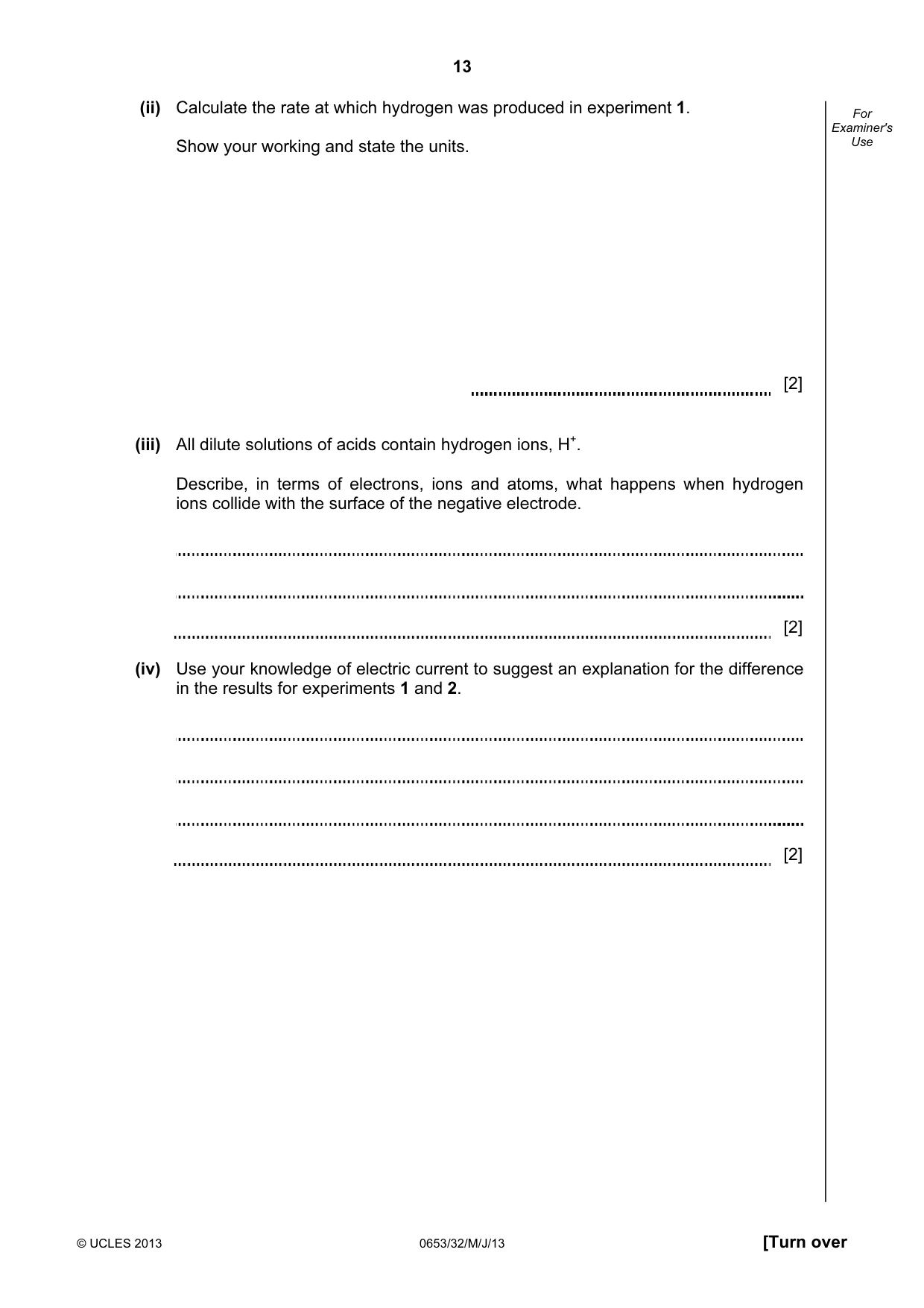
13 © UCLES 2013 0653/32/M/J/13 [Turn over For Examiner's Use (ii) Calculate the rate at which hydrogen was produced in experiment 1. Show your working and state the units. [2] (iii) All dilute solutions of acids contain hydrogen ions, H+. Describe, in terms of electrons, ions and atoms, what happens when hydrogen ions collide with the surface of the negative electrode. [2] (iv) Use your knowledge of electric current to suggest an explanation for the difference in the results for experiments 1 and 2. [2]
Question paper, page 14
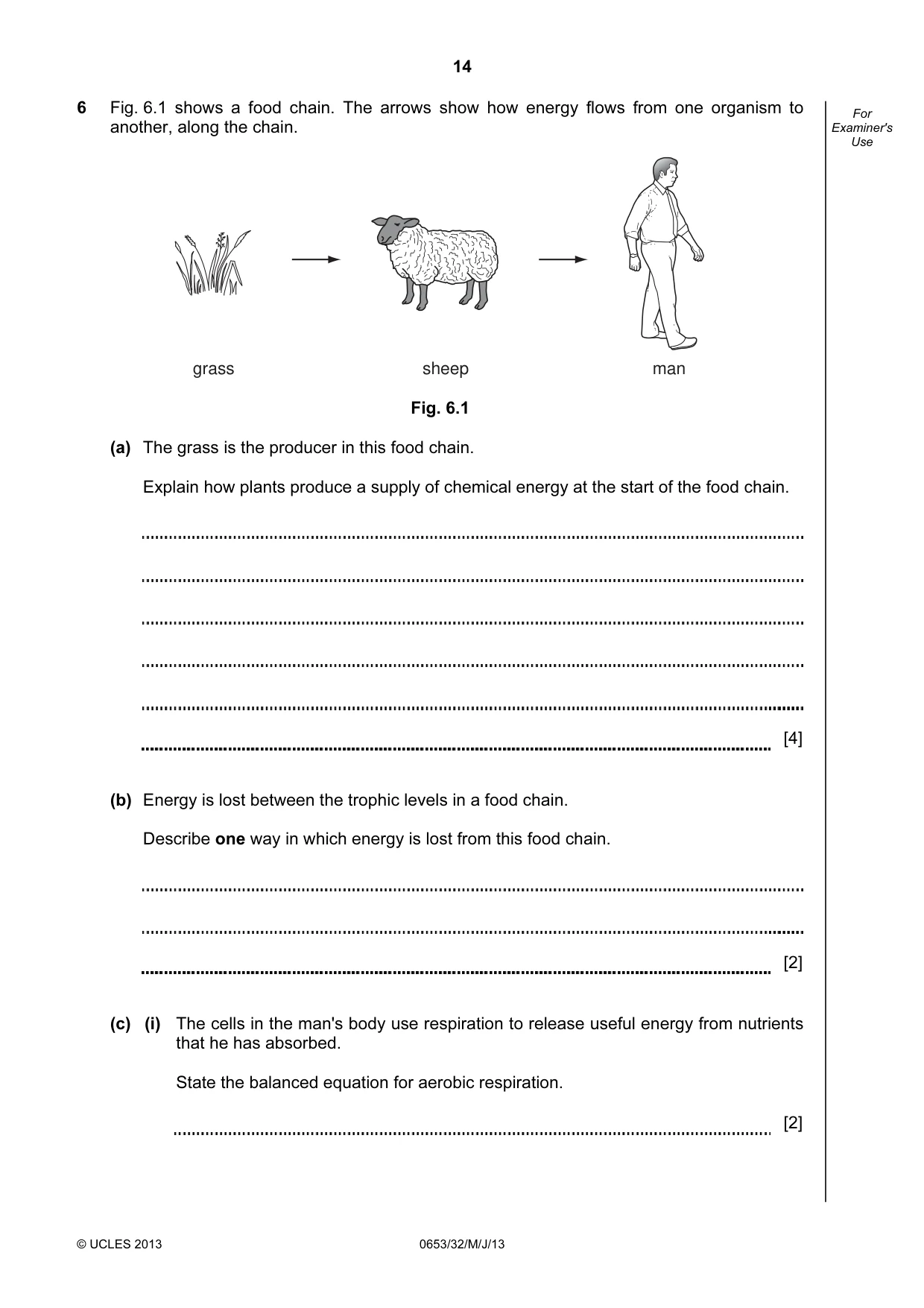
14 © UCLES 2013 0653/32/M/J/13 For Examiner's Use 6 Fig. 6.1 shows a food chain. The arrows show how energy flows from one organism to another, along the chain. man sheep grass Fig. 6.1 (a) The grass is the producer in this food chain. Explain how plants produce a supply of chemical energy at the start of the food chain. [4] (b) Energy is lost between the trophic levels in a food chain. Describe one way in which energy is lost from this food chain. [2] (c) (i) The cells in the man's body use respiration to release useful energy from nutrients that he has absorbed. State the balanced equation for aerobic respiration. [2]
Question paper, page 15
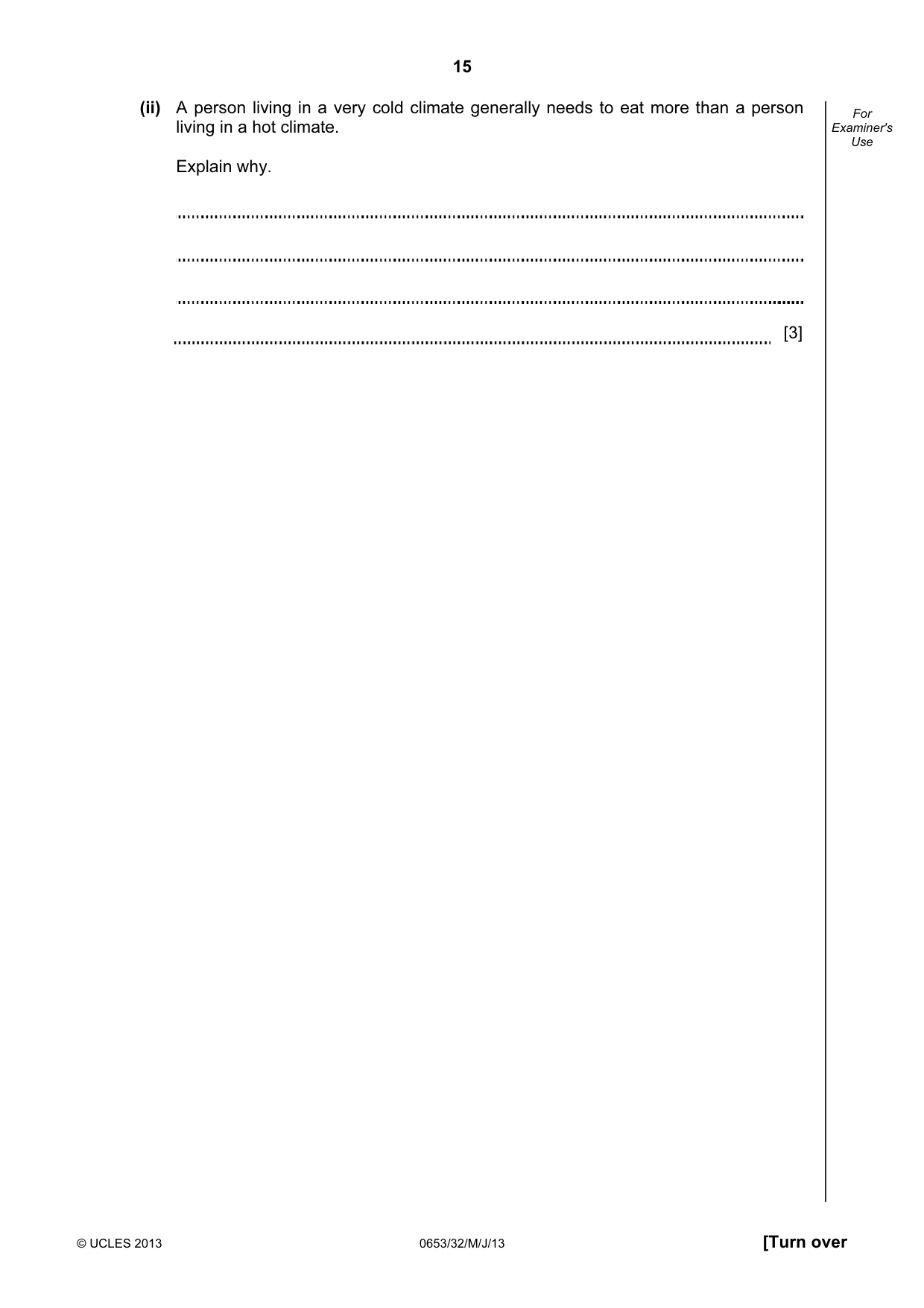
15 © UCLES 2013 0653/32/M/J/13 [Turn over For Examiner's Use (ii) A person living in a very cold climate generally needs to eat more than a person living in a hot climate. Explain why. [3]
Question paper, page 16
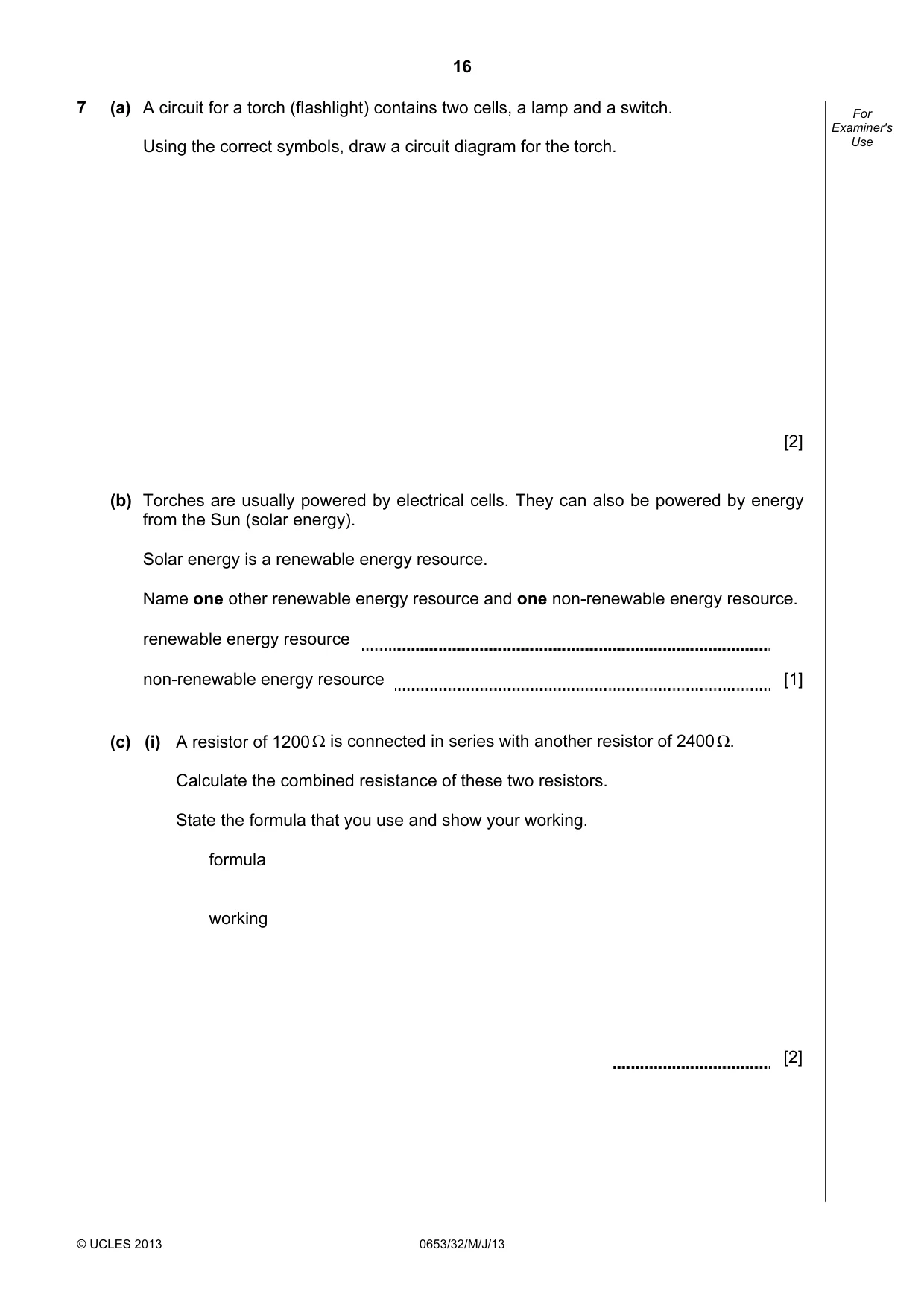
16 © UCLES 2013 0653/32/M/J/13 For Examiner's Use 7 (a) A circuit for a torch (flashlight) contains two cells, a lamp and a switch. Using the correct symbols, draw a circuit diagram for the torch. [2] (b) Torches are usually powered by electrical cells. They can also be powered by energy from the Sun (solar energy). Solar energy is a renewable energy resource. Name one other renewable energy resource and one non-renewable energy resource. renewable energy resource non-renewable energy resource [1] (c) (i) A resistor of 1200 Ω is connected in series with another resistor of 2400 Ω. Calculate the combined resistance of these two resistors. State the formula that you use and show your working. formula working [2]
Question paper, page 17
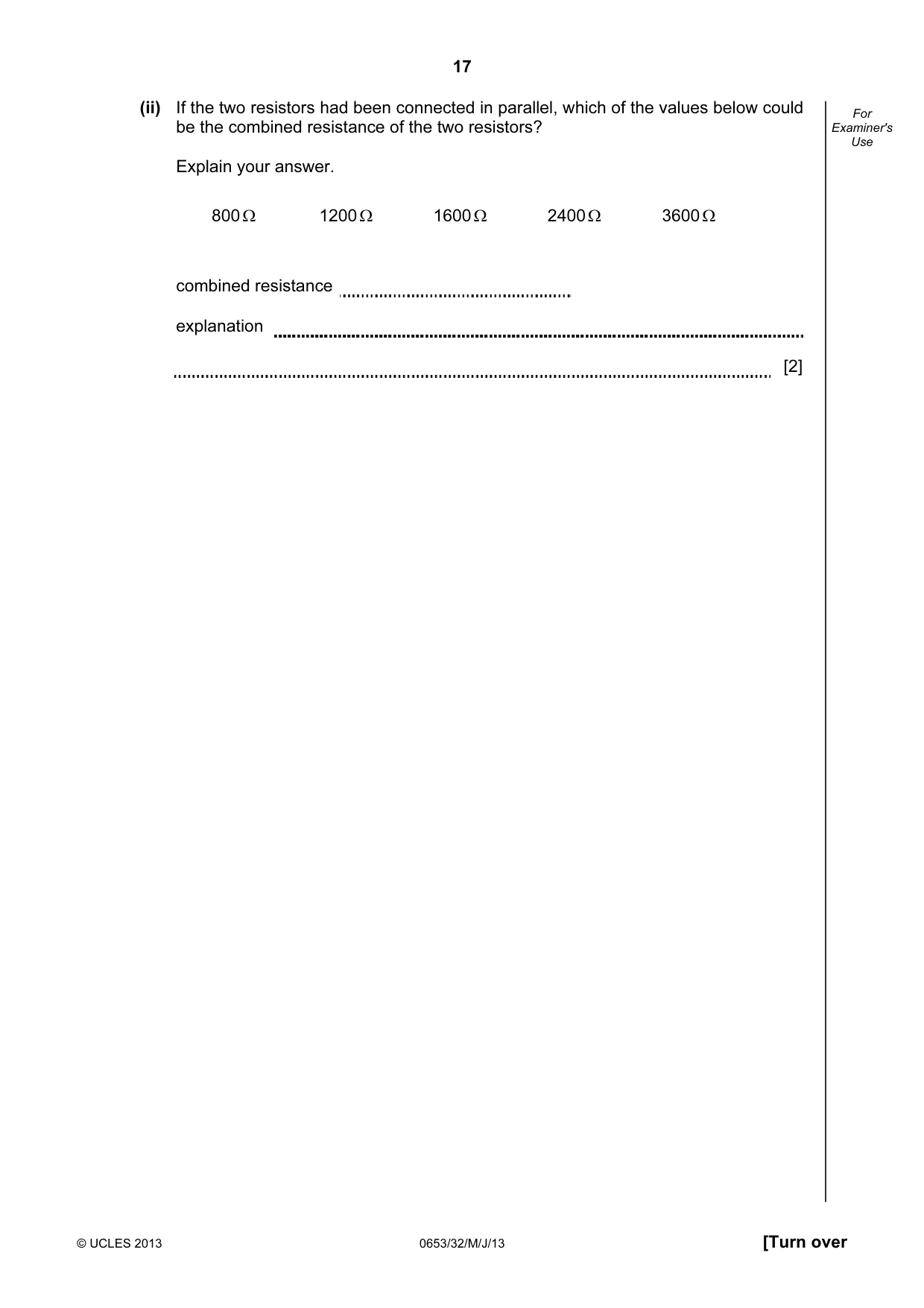
17 © UCLES 2013 0653/32/M/J/13 [Turn over For Examiner's Use (ii) If the two resistors had been connected in parallel, which of the values below could be the combined resistance of the two resistors? Explain your answer. 800 Ω 1200 Ω 1600 Ω 2400 Ω 3600 Ω combined resistance explanation [2]
Question paper, page 18
18 © UCLES 2013 0653/32/M/J/13 BLANK PAGE
Question paper, page 19
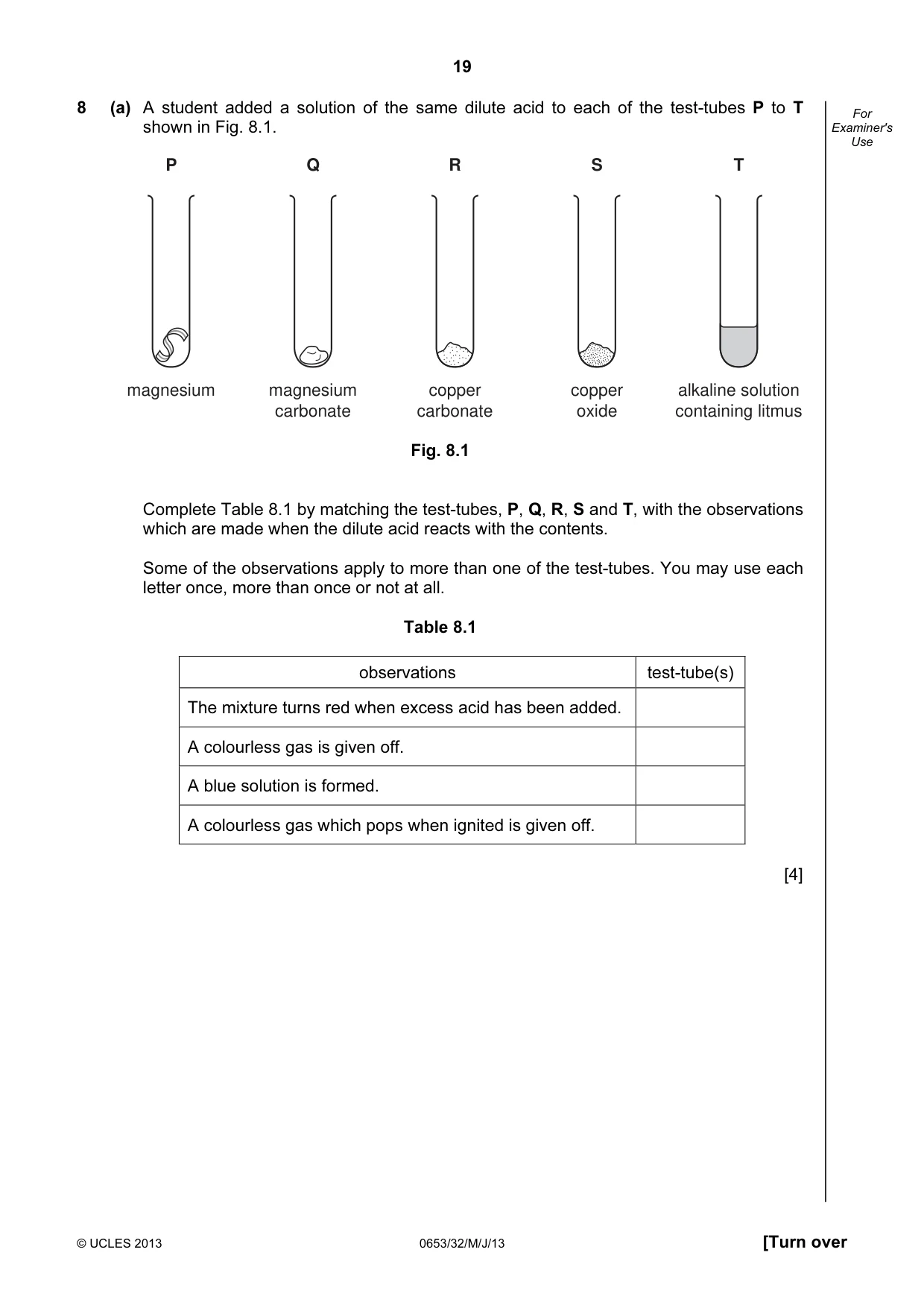
19 © UCLES 2013 0653/32/M/J/13 [Turn over For Examiner's Use 8 (a) A student added a solution of the same dilute acid to each of the test-tubes P to T shown in Fig. 8.1. P magnesium Q magnesium carbonate R copper carbonate S copper oxide T alkaline solution containing litmus Fig. 8.1 Complete Table 8.1 by matching the test-tubes, P, Q, R, S and T, with the observations which are made when the dilute acid reacts with the contents. Some of the observations apply to more than one of the test-tubes. You may use each letter once, more than once or not at all. Table 8.1 observations test-tube(s) The mixture turns red when excess acid has been added. A colourless gas is given off. A blue solution is formed. A colourless gas which pops when ignited is given off. [4]
Question paper, page 20
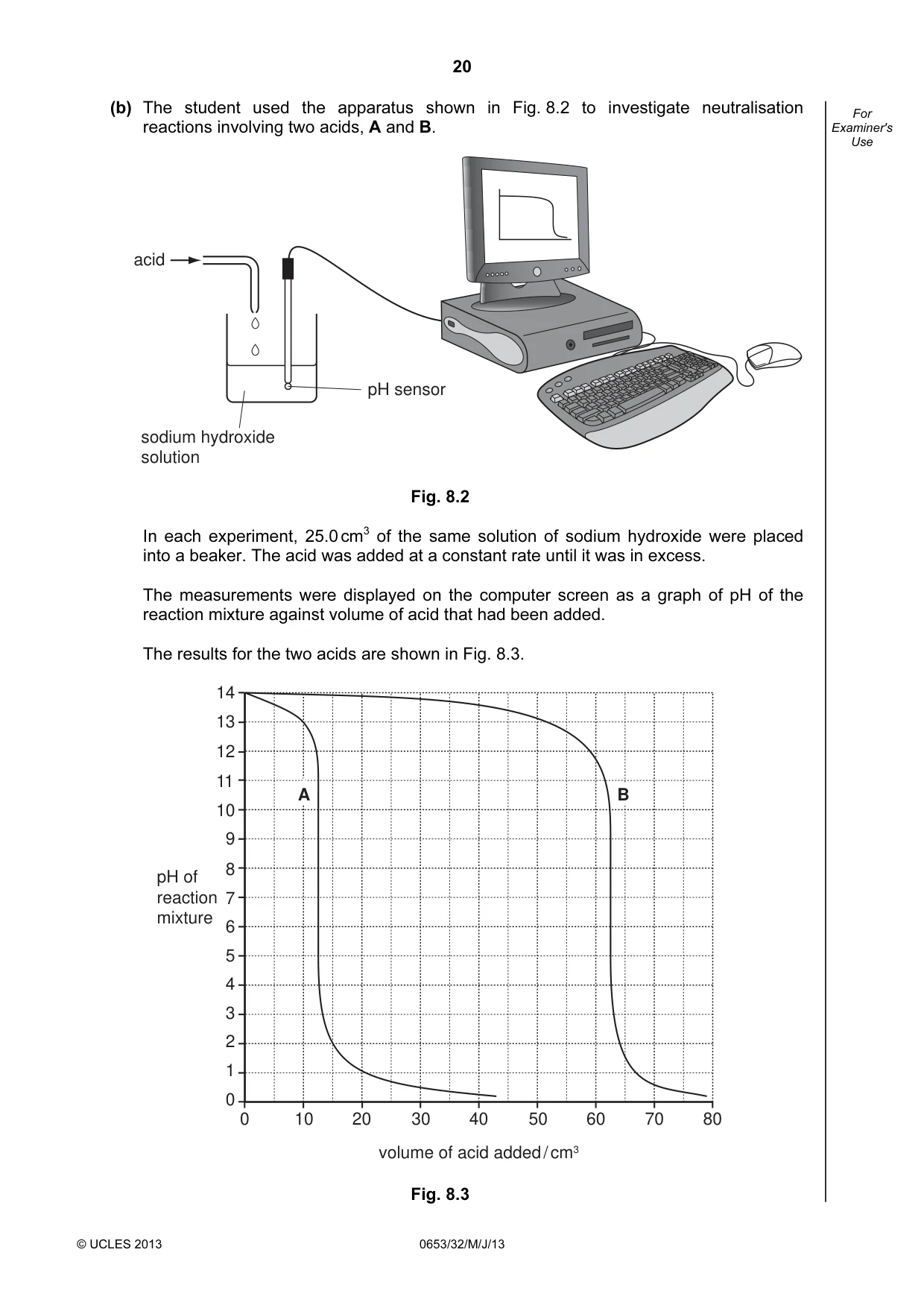
20 © UCLES 2013 0653/32/M/J/13 For Examiner's Use (b) The student used the apparatus shown in Fig. 8.2 to investigate neutralisation reactions involving two acids, A and B. sodium hydroxide solution pH sensor acid Fig. 8.2 In each experiment, 25.0 cm3 of the same solution of sodium hydroxide were placed into a beaker. The acid was added at a constant rate until it was in excess. The measurements were displayed on the computer screen as a graph of pH of the reaction mixture against volume of acid that had been added. The results for the two acids are shown in Fig. 8.3. 14 13 12 11 10 9 8 7 6 5 4 3 2 1 0 80 pH of reaction mixture 0 10 20 30 40 volume of acid added / cm3 50 60 70 A B Fig. 8.3
Question paper, page 21
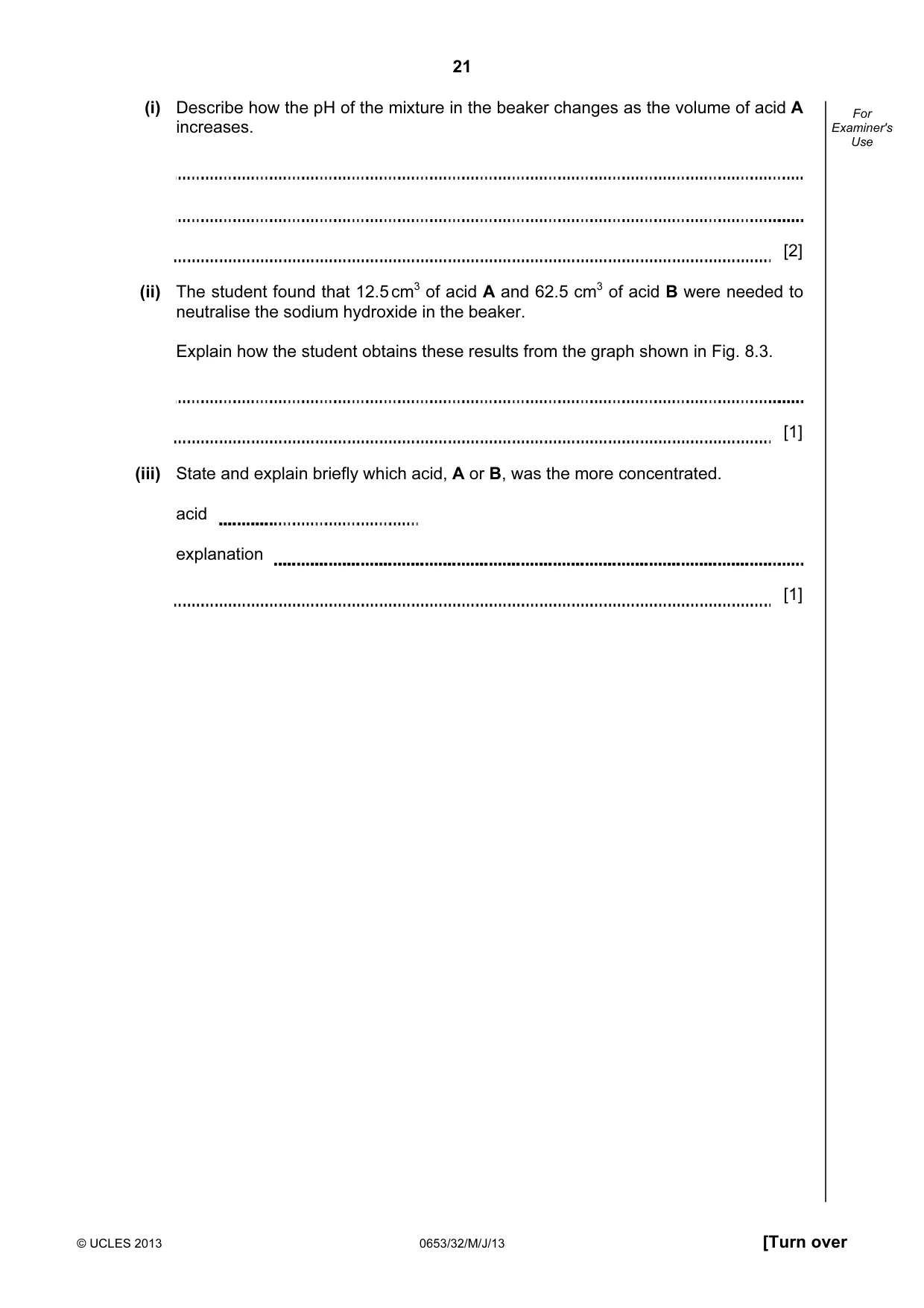
21 © UCLES 2013 0653/32/M/J/13 [Turn over For Examiner's Use (i) Describe how the pH of the mixture in the beaker changes as the volume of acid A increases. [2] (ii) The student found that 12.5 cm3 of acid A and 62.5 cm3 of acid B were needed to neutralise the sodium hydroxide in the beaker. Explain how the student obtains these results from the graph shown in Fig. 8.3. [1] (iii) State and explain briefly which acid, A or B, was the more concentrated. acid explanation [1]
Question paper, page 22
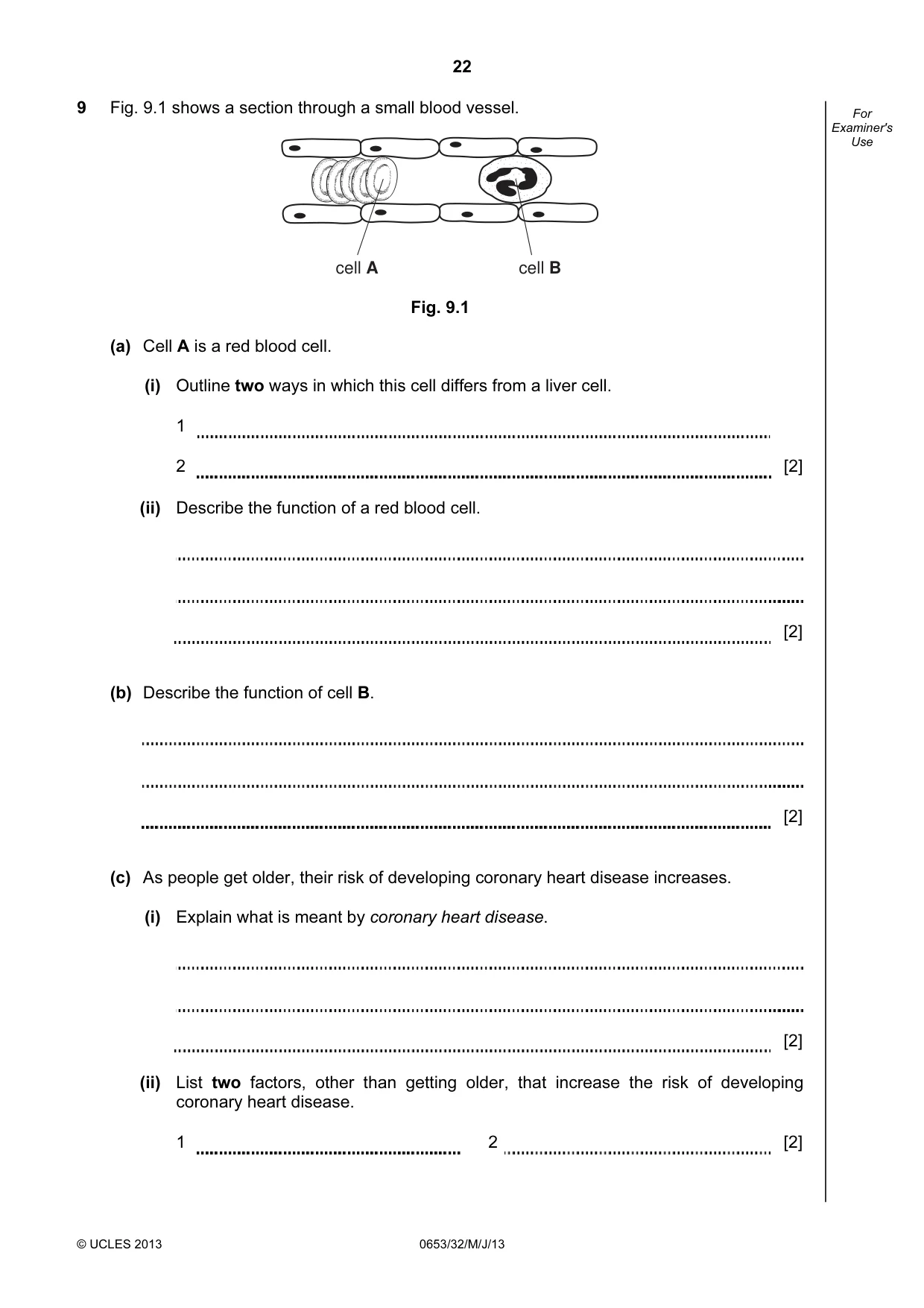
22 © UCLES 2013 0653/32/M/J/13 For Examiner's Use 9 Fig. 9.1 shows a section through a small blood vessel. cell A cell B Fig. 9.1 (a) Cell A is a red blood cell. (i) Outline two ways in which this cell differs from a liver cell. 1 2 [2] (ii) Describe the function of a red blood cell. [2] (b) Describe the function of cell B. [2] (c) As people get older, their risk of developing coronary heart disease increases. (i) Explain what is meant by coronary heart disease. [2] (ii) List two factors, other than getting older, that increase the risk of developing coronary heart disease. 1 2 [2]
Question paper, page 23
23 © UCLES 2013 0653/32/M/J/13 BLANK PAGE
Question paper, page 24
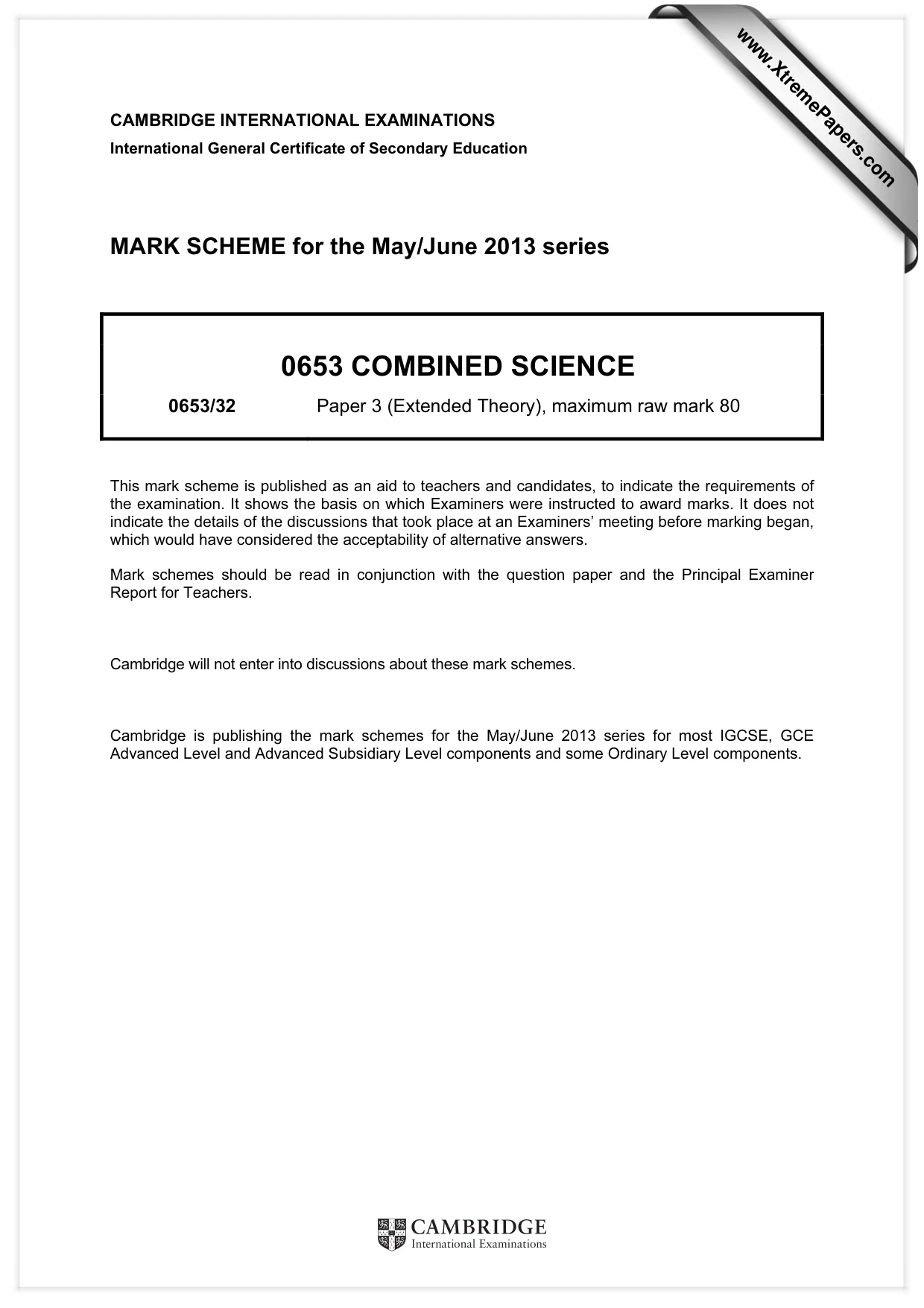
24 Permission to reproduce items where third-party owned material protected by copyright is included has been sought and cleared where possible. Every reasonable effort has been made by the publisher (UCLES) to trace copyright holders, but if any items requiring clearance have unwittingly been included, the publisher will be pleased to make amends at the earliest possible opportunity. University of Cambridge International Examinations is part of the Cambridge Assessment Group. Cambridge Assessment is the brand name of University of Cambridge Local Examinations Syndicate (UCLES), which is itself a department of the University of Cambridge. © UCLES 2013 0653/32/M/J/13 Group 140 Ce Cerium 58 141 Pr Praseodymium 59 144 Nd Neodymium 60 Pm Promethium 61 150 Sm Samarium 62 152 Eu Europium 63 157 Gd Gadolinium 64 159 Tb Terbium 65 162 Dy Dysprosium 66 165 Ho Holmium 67 167 Er Erbium 68 169 Tm Thulium 69 173 Yb Ytterbium 70 175 Lu Lutetium 71 232 Th Thorium 90 Pa Protactinium 91 238 U Uranium 92 Np Neptunium 93 Pu Plutonium 94 Am Americium 95 Cm Curium 96 Bk Berkelium 97 Cf Californium 98 Es Einsteinium 99 Fm Fermium 100 Md Mendelevium 101 No Nobelium 102 Lr Lawrencium 103 1 H Hydrogen 1 7 Li Lithium 3 23 Na Sodium 11 24 Mg Magnesium 12 40 Ca Calcium 20 45 Sc Scandium 21 48 Ti Titanium 22 51 V Vanadium 23 52 Cr Chromium 24 55 Mn Manganese 25 56 Fe Iron 26 59 Co Cobalt 27 59 Ni Nickel 28 64 Cu Copper 29 65 Zn Zinc 30 70 Ga Gallium 31 27 Al Aluminium 13 11 B Boron 5 12 C Carbon 6 14 N Nitrogen 7 16 O Oxygen 8 19 F Fluorine 9 28 Si Silicon 14 31 P Phosphorus 15 32 S Sulfur 16 35.5 Cl Chlorine 17 40 Ar Argon 18 20 Ne Neon 10 4 He Helium 2 73 Ge Germanium 32 75 As Arsenic 33 79 Se Selenium 34 80 Br Bromine 35 84 Kr Krypton 36 39 K Potassium 19 88 Sr Strontium 38 89 Y Yttrium 39 91 Zr Zirconium 40 93 Nb Niobium 41 96 Mo Molybdenum 42 Tc Technetium 43 101 Ru Ruthenium 44 103 Rh Rhodium 45 106 Pd Palladium 46 108 Ag Silver 47 112 Cd Cadmium 48 115 In Indium 49 119 Sn Tin 50 122 Sb Antimony 51 128 Te Tellurium 52 127 I Iodine 53 131 Xe Xenon 54 137 Ba Barium 56 139 La Lanthanum 57 * 178 Hf Hafnium 72 181 Ta Tantalum 73 184 W Tungsten 74 186 Re Rhenium 75 190 Os Osmium 76 192 Ir Iridium 77 195 Pt Platinum 78 197 Au Gold 79 201 Hg Mercury 80 204 Tl Thallium 81 207 Pb Lead 82 209 Bi Bismuth 83 Po Polonium 84 At Astatine 85 Rn Radon 86 Fr Francium 87 227 Ac Actinium 89 9 Be Beryllium 4 I II III IV V VI VII 0 85 Rb Rubidium 37 133 Cs Caesium 55 226 Ra Radium 88 The volume of one mole of any gas is 24 dm3 at room temperature and pressure (r.t.p.). a X b a = relative atomic mass X = atomic symbol b = proton (atomic) number Key *58-71 Lanthanoid series 90-103 Actinoid series DATA SHEET The Periodic Table of the Elements
Mark scheme, page 1
CAMBRIDGE INTERNATIONAL EXAMINATIONS International General Certificate of Secondary Education MARK SCHEME for the May/June 2013 series 0653 COMBINED SCIENCE 0653/32 Paper 3 (Extended Theory), maximum raw mark 80 This mark scheme is published as an aid to teachers and candidates, to indicate the requirements of the examination. It shows the basis on which Examiners were instructed to award marks. It does not indicate the details of the discussions that took place at an Examiners’ meeting before marking began, which would have considered the acceptability of alternative answers. Mark schemes should be read in conjunction with the question paper and the Principal Examiner Report for Teachers. Cambridge will not enter into discussions about these mark schemes. Cambridge is publishing the mark schemes for the May/June 2013 series for most IGCSE, GCE Advanced Level and Advanced Subsidiary Level components and some Ordinary Level components. www.XtremePapers.com
Mark scheme, page 2
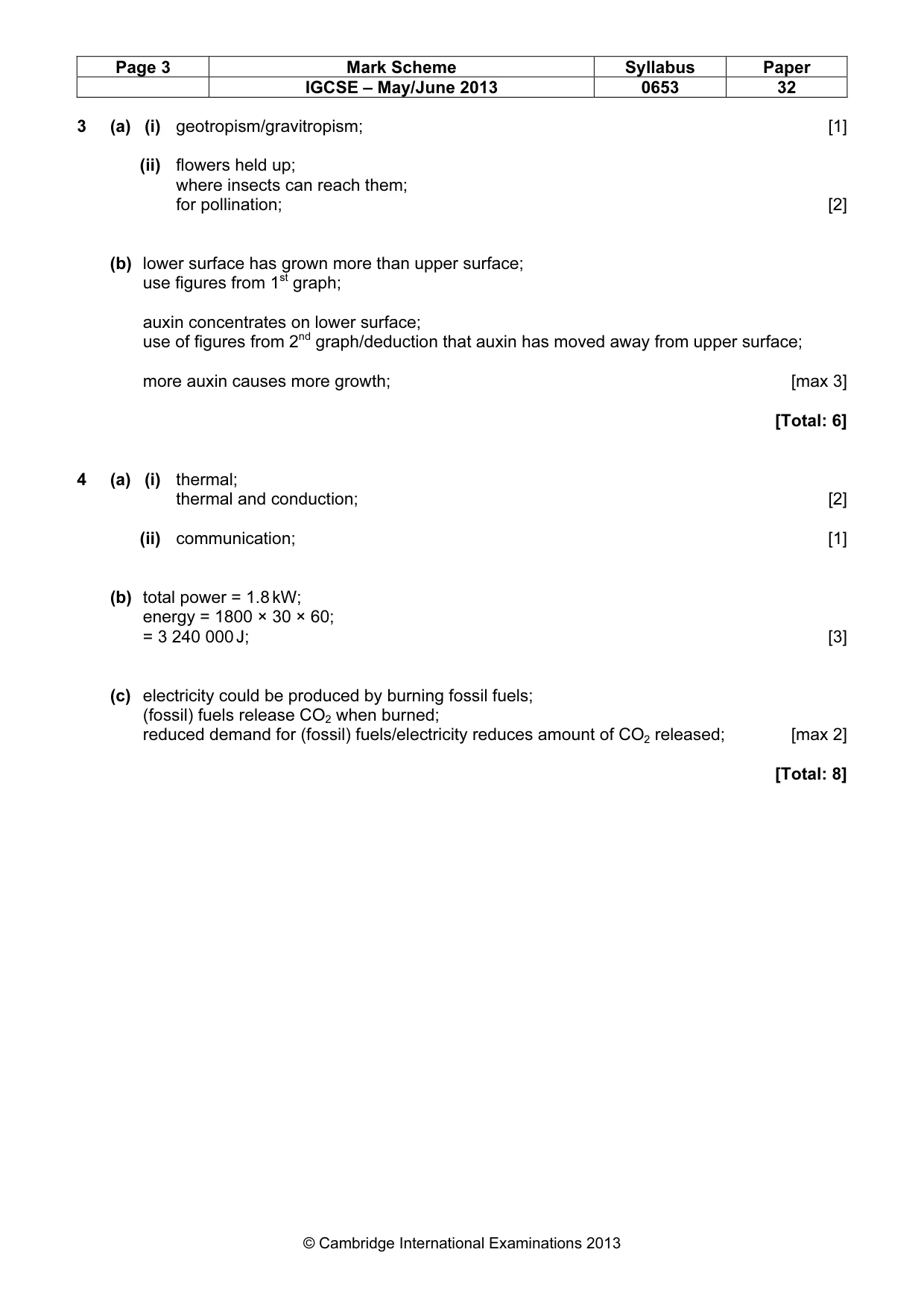
Page 2 Mark Scheme Syllabus Paper IGCSE – May/June 2013 0653 32 © Cambridge International Examinations 2013 1 (a) (i) Group 1 elements all metals and Group 7 elements all non-metals; Group 4 elements non-metals at top and metals at bottom/contain both types of element; [2] (ii) melting point decreases down Group 1 so francium has lowest m. pt; melting point increases down Group 7 so astatine has highest m. pt; [2] (b) (i) cobalt chloride paper; changes from blue to pink; OR anhydrous copper sulphate; changes from white to blue; [2] (ii) PbO + H2 → Pb + H2O;; [2] (iii) calcium has a high reactivity; calcium reactivity greater than hydrogen; calcium too strongly bonded to oxygen; [max 2] [Total: 10] 2 (a) (i) W = F × D; = 1400 × 10 = 14 000 J; [2] (ii) KE = ½ mv2; = ½ × 5000 × 1.5 × 1.5 = 5625 J; [2] (b) density = mass / volume; = 5000 / 5 = 1000 kg/m3; [2] (c) (i) below 20 Hz; human threshold is about 20 Hz; [2] (ii) number of vibrations per second; [1] (iii) sound waves with frequencies above human threshold/above 20 000 Hz; [1] [Total: 10]
Mark scheme, page 3
Page 3 Mark Scheme Syllabus Paper IGCSE – May/June 2013 0653 32 © Cambridge International Examinations 2013 3 (a) (i) geotropism/gravitropism; [1] (ii) flowers held up; where insects can reach them; for pollination; [2] (b) lower surface has grown more than upper surface; use figures from 1st graph; auxin concentrates on lower surface; use of figures from 2nd graph/deduction that auxin has moved away from upper surface; more auxin causes more growth; [max 3] [Total: 6] 4 (a) (i) thermal; thermal and conduction; [2] (ii) communication; [1] (b) total power = 1.8 kW; energy = 1800 × 30 × 60; = 3 240 000 J; [3] (c) electricity could be produced by burning fossil fuels; (fossil) fuels release CO2 when burned; reduced demand for (fossil) fuels/electricity reduces amount of CO2 released; [max 2] [Total: 8]
Mark scheme, page 4
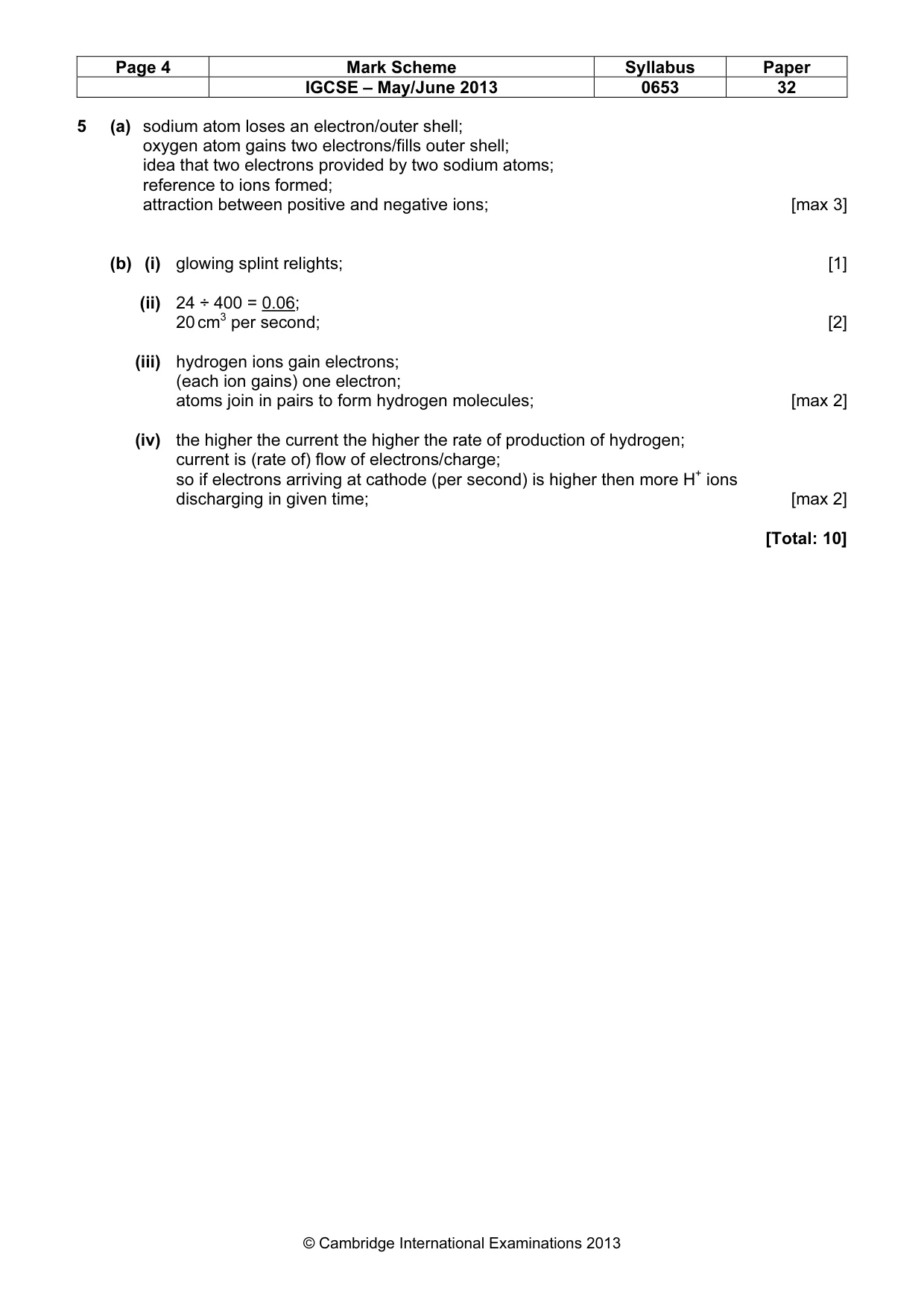
Page 4 Mark Scheme Syllabus Paper IGCSE – May/June 2013 0653 32 © Cambridge International Examinations 2013 5 (a) sodium atom loses an electron/outer shell; oxygen atom gains two electrons/fills outer shell; idea that two electrons provided by two sodium atoms; reference to ions formed; attraction between positive and negative ions; [max 3] (b) (i) glowing splint relights; [1] (ii) 24 ÷ 400 = 0.06; 20 cm3 per second; [2] (iii) hydrogen ions gain electrons; (each ion gains) one electron; atoms join in pairs to form hydrogen molecules; [max 2] (iv) the higher the current the higher the rate of production of hydrogen; current is (rate of) flow of electrons/charge; so if electrons arriving at cathode (per second) is higher then more H+ ions discharging in given time; [max 2] [Total: 10]
Mark scheme, page 5
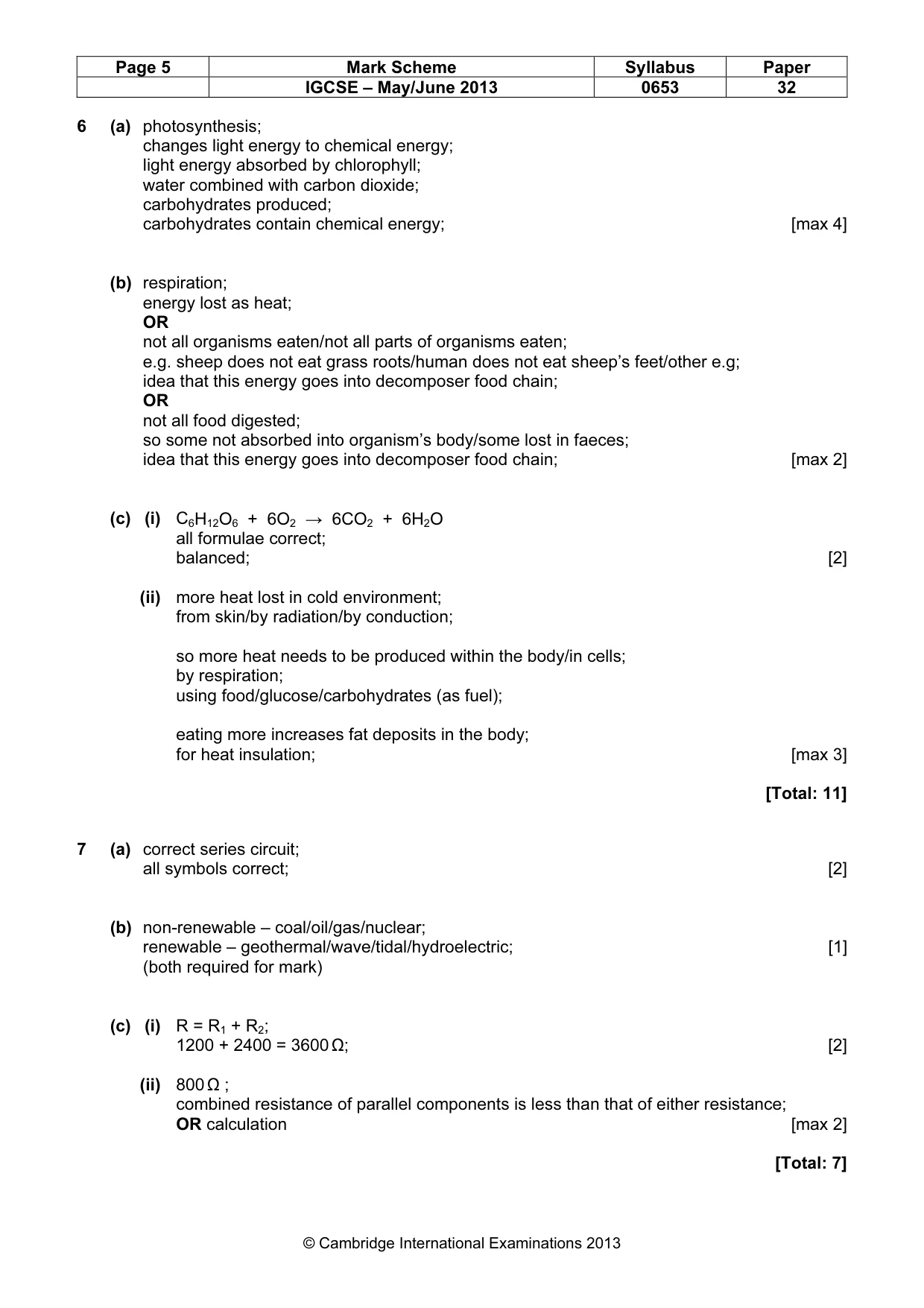
Page 5 Mark Scheme Syllabus Paper IGCSE – May/June 2013 0653 32 © Cambridge International Examinations 2013 6 (a) photosynthesis; changes light energy to chemical energy; light energy absorbed by chlorophyll; water combined with carbon dioxide; carbohydrates produced; carbohydrates contain chemical energy; [max 4] (b) respiration; energy lost as heat; OR not all organisms eaten/not all parts of organisms eaten; e.g. sheep does not eat grass roots/human does not eat sheep’s feet/other e.g; idea that this energy goes into decomposer food chain; OR not all food digested; so some not absorbed into organism’s body/some lost in faeces; idea that this energy goes into decomposer food chain; [max 2] (c) (i) C6H12O6 + 6O2 → 6CO2 + 6H2O all formulae correct; balanced; [2] (ii) more heat lost in cold environment; from skin/by radiation/by conduction; so more heat needs to be produced within the body/in cells; by respiration; using food/glucose/carbohydrates (as fuel); eating more increases fat deposits in the body; for heat insulation; [max 3] [Total: 11] 7 (a) correct series circuit; all symbols correct; [2] (b) non-renewable – coal/oil/gas/nuclear; renewable – geothermal/wave/tidal/hydroelectric; [1] (both required for mark) (c) (i) R = R1 + R2; 1200 + 2400 = 3600 Ω; [2] (ii) 800 Ω ; combined resistance of parallel components is less than that of either resistance; OR calculation [max 2] [Total: 7]
Mark scheme, page 6
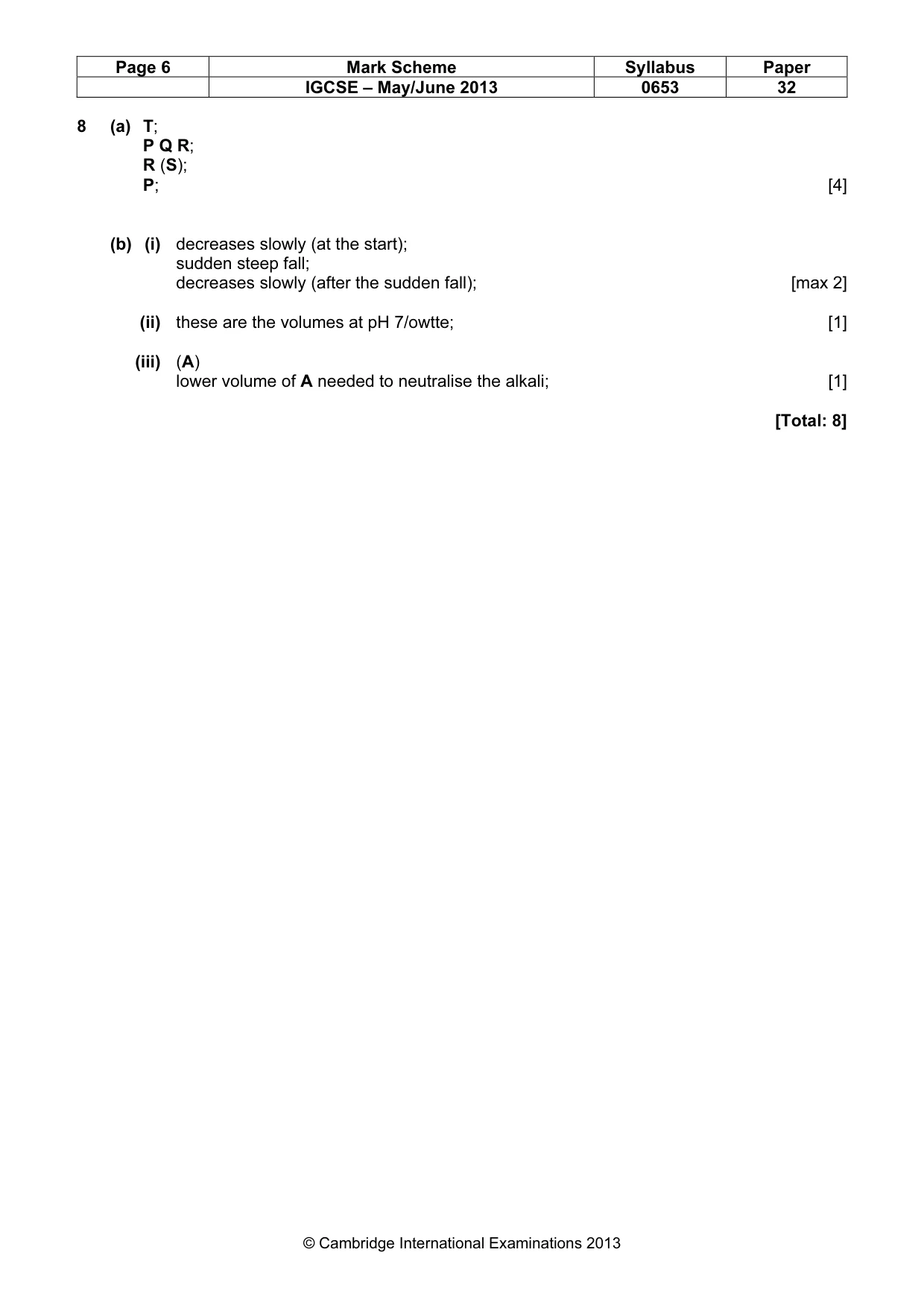
Page 6 Mark Scheme Syllabus Paper IGCSE – May/June 2013 0653 32 © Cambridge International Examinations 2013 8 (a) T; P Q R; R (S); P; [4] (b) (i) decreases slowly (at the start); sudden steep fall; decreases slowly (after the sudden fall); [max 2] (ii) these are the volumes at pH 7/owtte; [1] (iii) (A) lower volume of A needed to neutralise the alkali; [1] [Total: 8]
What you needed in this session
Cambridge’s own grade thresholds for 2013 May/June, Paper 3 · Variant 2. A higher threshold means an easier paper — the bar moves with how the cohort did.