Cambridge IGCSE Science - Combined 0653 — 2010 Oct/Nov Paper 6 · Variant 2
0653/62/O/N/10
The question paper and its mark scheme, free to read here and free to download. This is Cambridge’s own paper, exactly as it was sat.
Question paper24 pages



Mark scheme5 pages
Answers below. Sit the paper first if you are practising.
Paper as text
Question paper, page 1
This document consists of 20 printed pages and 4 blank pages. IB10 11_0653_62/7RP © UCLES 2010 [Turn over * 1396724750* For Examiner's Use 1 2 3 4 5 6 Total UNIVERSITY OF CAMBRIDGE INTERNATIONAL EXAMINATIONS International General Certificate of Secondary Education COMBINED SCIENCE 0653/62 Paper 6 Alternative to Practical October/November 2010 1 hour Candidates answer on the Question paper No Additional Materials are required. READ THESE INSTRUCTIONS FIRST Write your Centre number, candidate number and name on all the work you hand in. Write in dark blue or black pen. You may use a soft pencil for any diagrams, graphs, tables or rough working. Do not use staples, paper clips, highlighters, glue or correction fluid. DO NOT WRITE IN ANY BARCODES. Answer all questions. At the end of the examination, fasten all your work securely together. The number of marks is given in brackets [ ] at the end of each question or part question. www.XtremePapers.com
Question paper, page 2
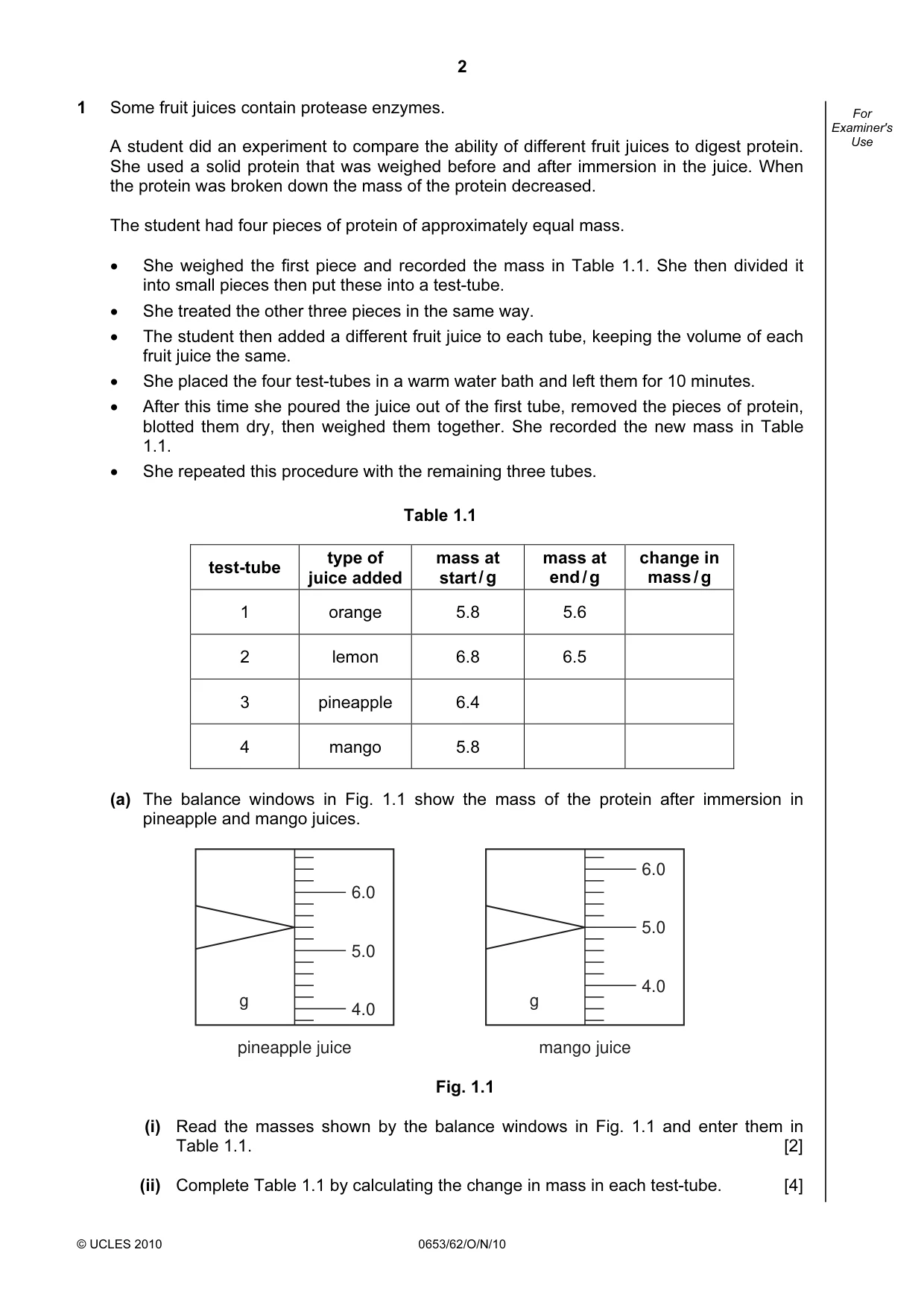
2 © UCLES 2010 0653/62/O/N/10 For Examiner's Use 1 Some fruit juices contain protease enzymes. A student did an experiment to compare the ability of different fruit juices to digest protein. She used a solid protein that was weighed before and after immersion in the juice. When the protein was broken down the mass of the protein decreased. The student had four pieces of protein of approximately equal mass. • She weighed the first piece and recorded the mass in Table 1.1. She then divided it into small pieces then put these into a test-tube. • She treated the other three pieces in the same way. • The student then added a different fruit juice to each tube, keeping the volume of each fruit juice the same. • She placed the four test-tubes in a warm water bath and left them for 10 minutes. • After this time she poured the juice out of the first tube, removed the pieces of protein, blotted them dry, then weighed them together. She recorded the new mass in Table 1.1. • She repeated this procedure with the remaining three tubes. Table 1.1 test-tube type of juice added mass at start / g mass at end / g change in mass / g 1 orange 5.8 5.6 2 lemon 6.8 6.5 3 pineapple 6.4 4 mango 5.8 (a) The balance windows in Fig. 1.1 show the mass of the protein after immersion in pineapple and mango juices. 6.0 5.0 4.0 pineapple juice g 6.0 5.0 4.0 mango juice g Fig. 1.1 (i) Read the masses shown by the balance windows in Fig. 1.1 and enter them in Table 1.1. [2] (ii) Complete Table 1.1 by calculating the change in mass in each test-tube. [4]
Question paper, page 3
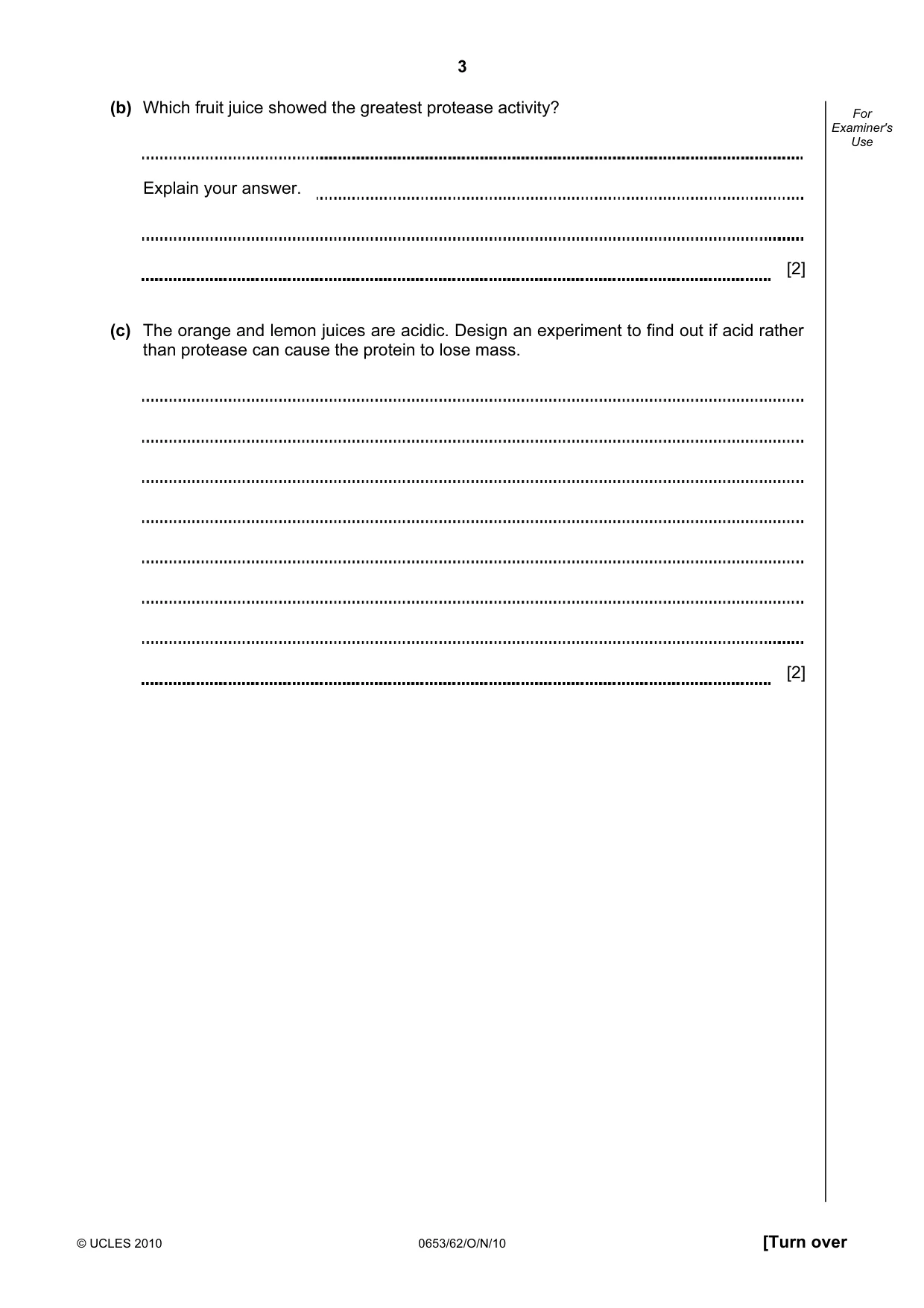
3 © UCLES 2010 0653/62/O/N/10 [Turn over For Examiner's Use (b) Which fruit juice showed the greatest protease activity? Explain your answer. [2] (c) The orange and lemon juices are acidic. Design an experiment to find out if acid rather than protease can cause the protein to lose mass. [2]
Question paper, page 4
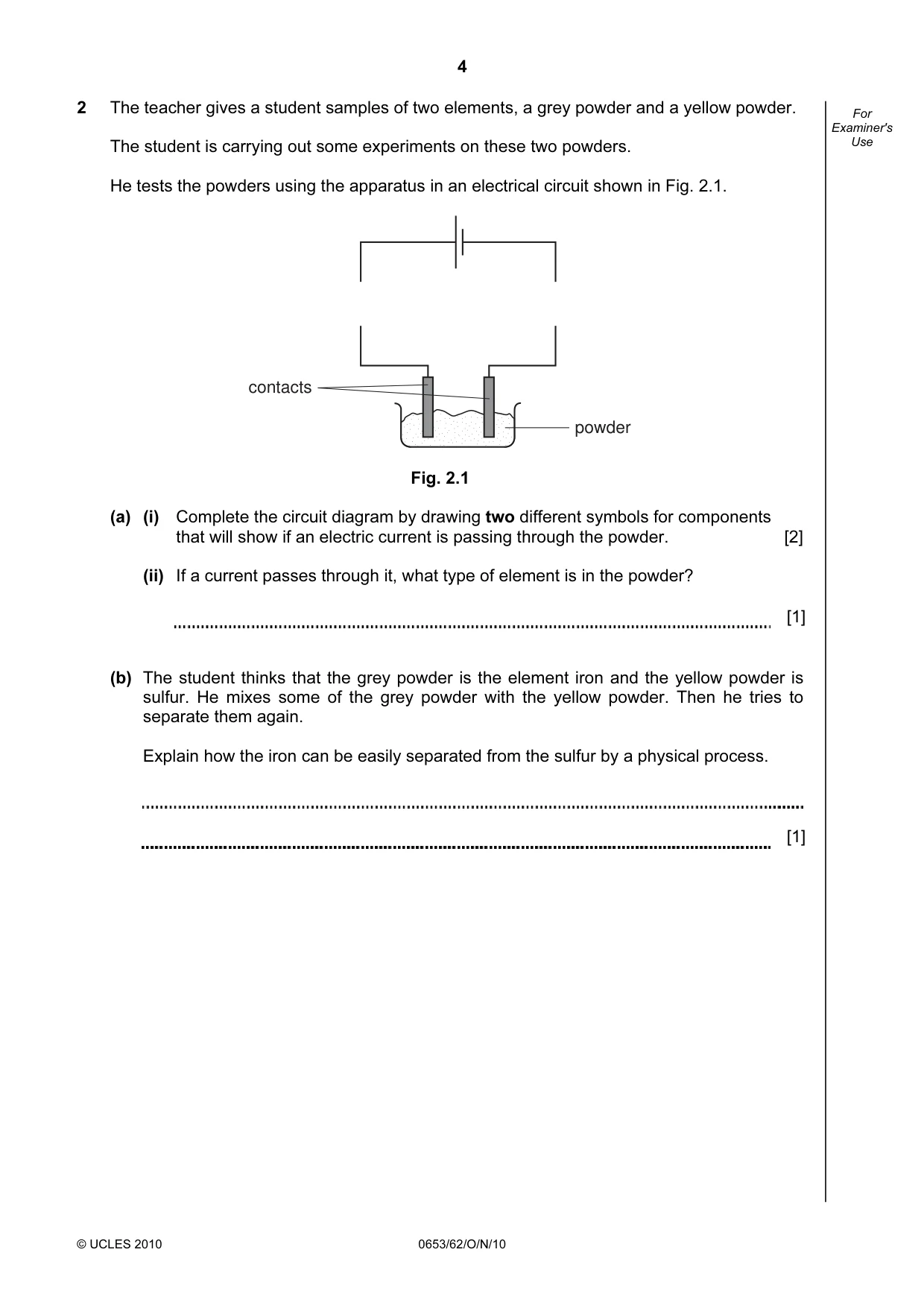
4 © UCLES 2010 0653/62/O/N/10 For Examiner's Use 2 The teacher gives a student samples of two elements, a grey powder and a yellow powder. The student is carrying out some experiments on these two powders. He tests the powders using the apparatus in an electrical circuit shown in Fig. 2.1. powder contacts Fig. 2.1 (a) (i) Complete the circuit diagram by drawing two different symbols for components that will show if an electric current is passing through the powder. [2] (ii) If a current passes through it, what type of element is in the powder? [1] (b) The student thinks that the grey powder is the element iron and the yellow powder is sulfur. He mixes some of the grey powder with the yellow powder. Then he tries to separate them again. Explain how the iron can be easily separated from the sulfur by a physical process. [1]
Question paper, page 5
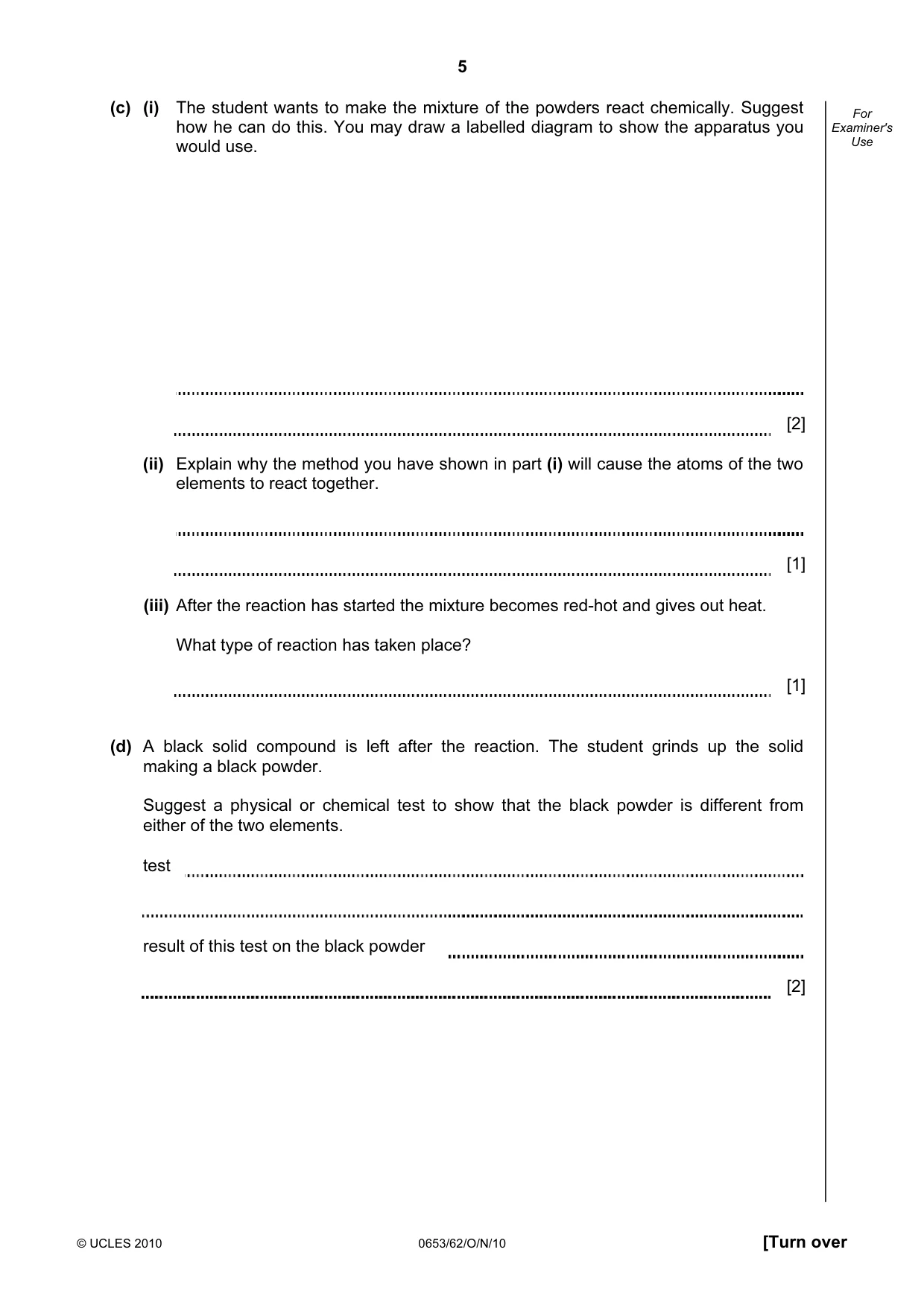
5 © UCLES 2010 0653/62/O/N/10 [Turn over For Examiner's Use (c) (i) The student wants to make the mixture of the powders react chemically. Suggest how he can do this. You may draw a labelled diagram to show the apparatus you would use. [2] (ii) Explain why the method you have shown in part (i) will cause the atoms of the two elements to react together. [1] (iii) After the reaction has started the mixture becomes red-hot and gives out heat. What type of reaction has taken place? [1] (d) A black solid compound is left after the reaction. The student grinds up the solid making a black powder. Suggest a physical or chemical test to show that the black powder is different from either of the two elements. test result of this test on the black powder [2]
Question paper, page 6
6 © UCLES 2010 0653/62/O/N/10 BLANK PAGE
Question paper, page 7
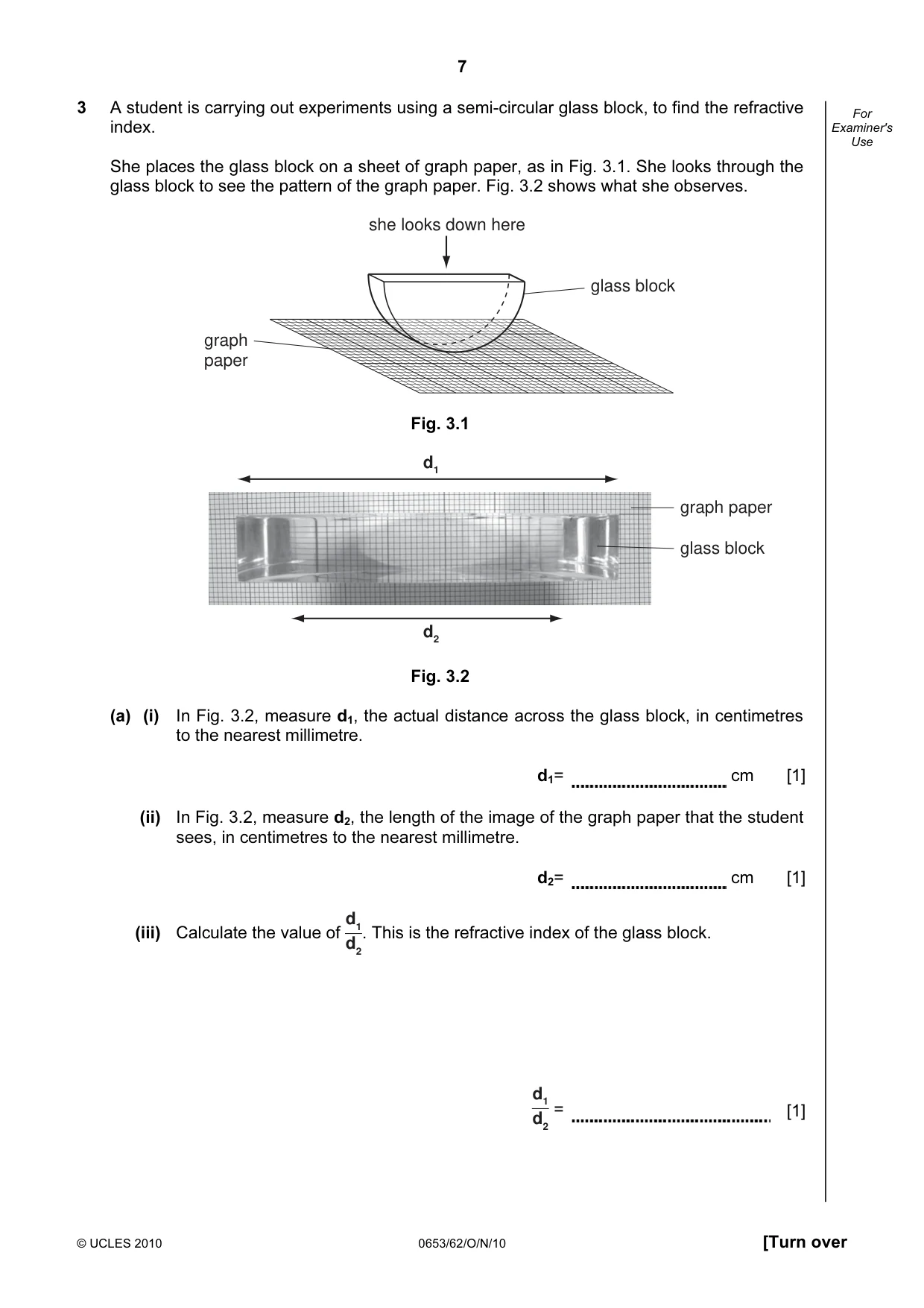
7 © UCLES 2010 0653/62/O/N/10 [Turn over For Examiner's Use 3 A student is carrying out experiments using a semi-circular glass block, to find the refractive index. She places the glass block on a sheet of graph paper, as in Fig. 3.1. She looks through the glass block to see the pattern of the graph paper. Fig. 3.2 shows what she observes. she looks down here glass block graph paper Fig. 3.1 d1 d2 graph paper glass block Fig. 3.2 (a) (i) In Fig. 3.2, measure d1, the actual distance across the glass block, in centimetres to the nearest millimetre. d1= cm [1] (ii) In Fig. 3.2, measure d2, the length of the image of the graph paper that the student sees, in centimetres to the nearest millimetre. d2= cm [1] (iii) Calculate the value of d1 d2 . This is the refractive index of the glass block. [1] d1 d2 =
Question paper, page 8
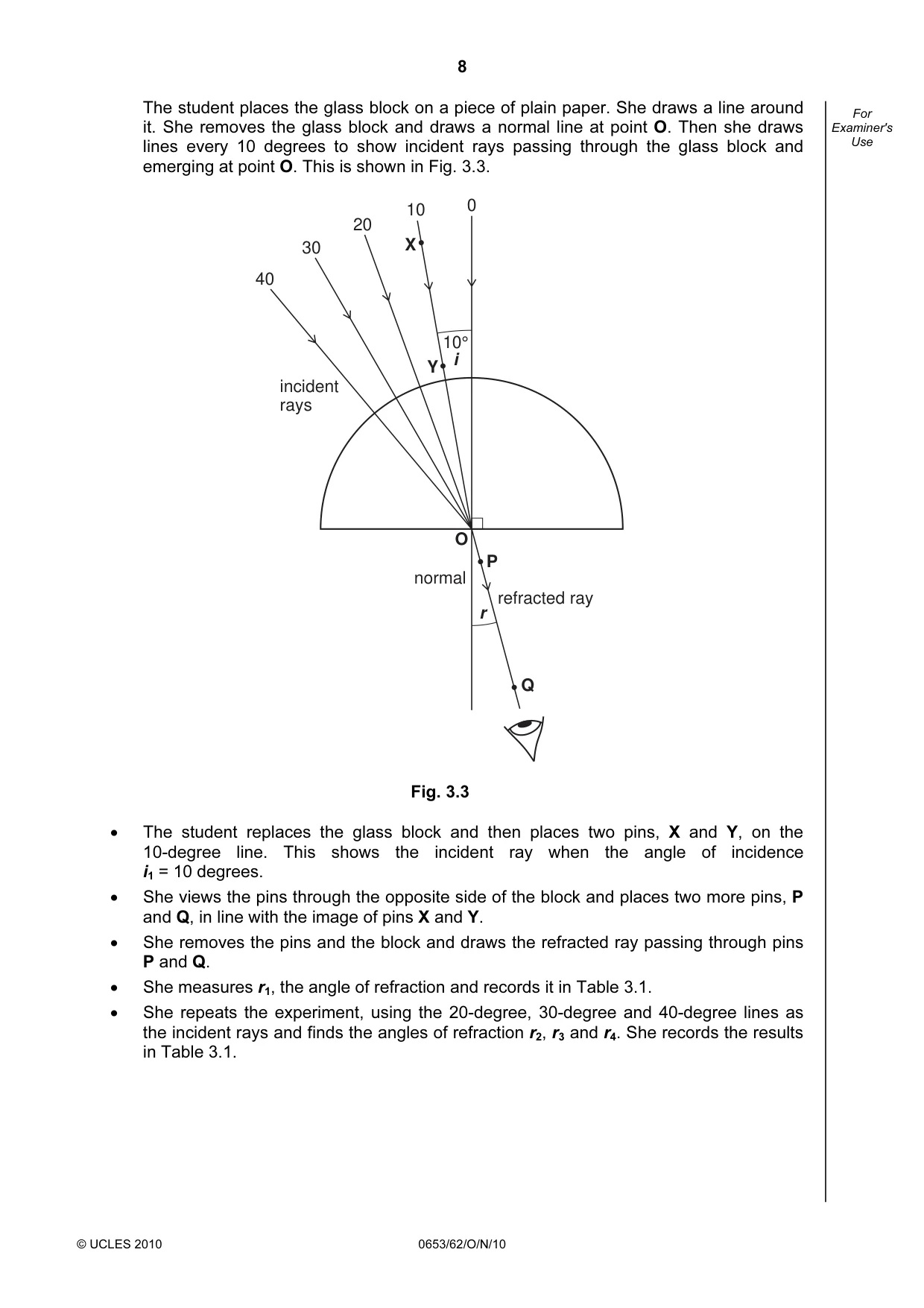
8 © UCLES 2010 0653/62/O/N/10 For Examiner's Use The student places the glass block on a piece of plain paper. She draws a line around it. She removes the glass block and draws a normal line at point O. Then she draws lines every 10 degrees to show incident rays passing through the glass block and emerging at point O. This is shown in Fig. 3.3. normal refracted ray 0 10 20 30 40 10° i r incident rays O P Q X Y Fig. 3.3 • The student replaces the glass block and then places two pins, X and Y, on the 10-degree line. This shows the incident ray when the angle of incidence i1 = 10 degrees. • She views the pins through the opposite side of the block and places two more pins, P and Q, in line with the image of pins X and Y. • She removes the pins and the block and draws the refracted ray passing through pins P and Q. • She measures r1, the angle of refraction and records it in Table 3.1. • She repeats the experiment, using the 20-degree, 30-degree and 40-degree lines as the incident rays and finds the angles of refraction r2, r3 and r4. She records the results in Table 3.1.
Question paper, page 9
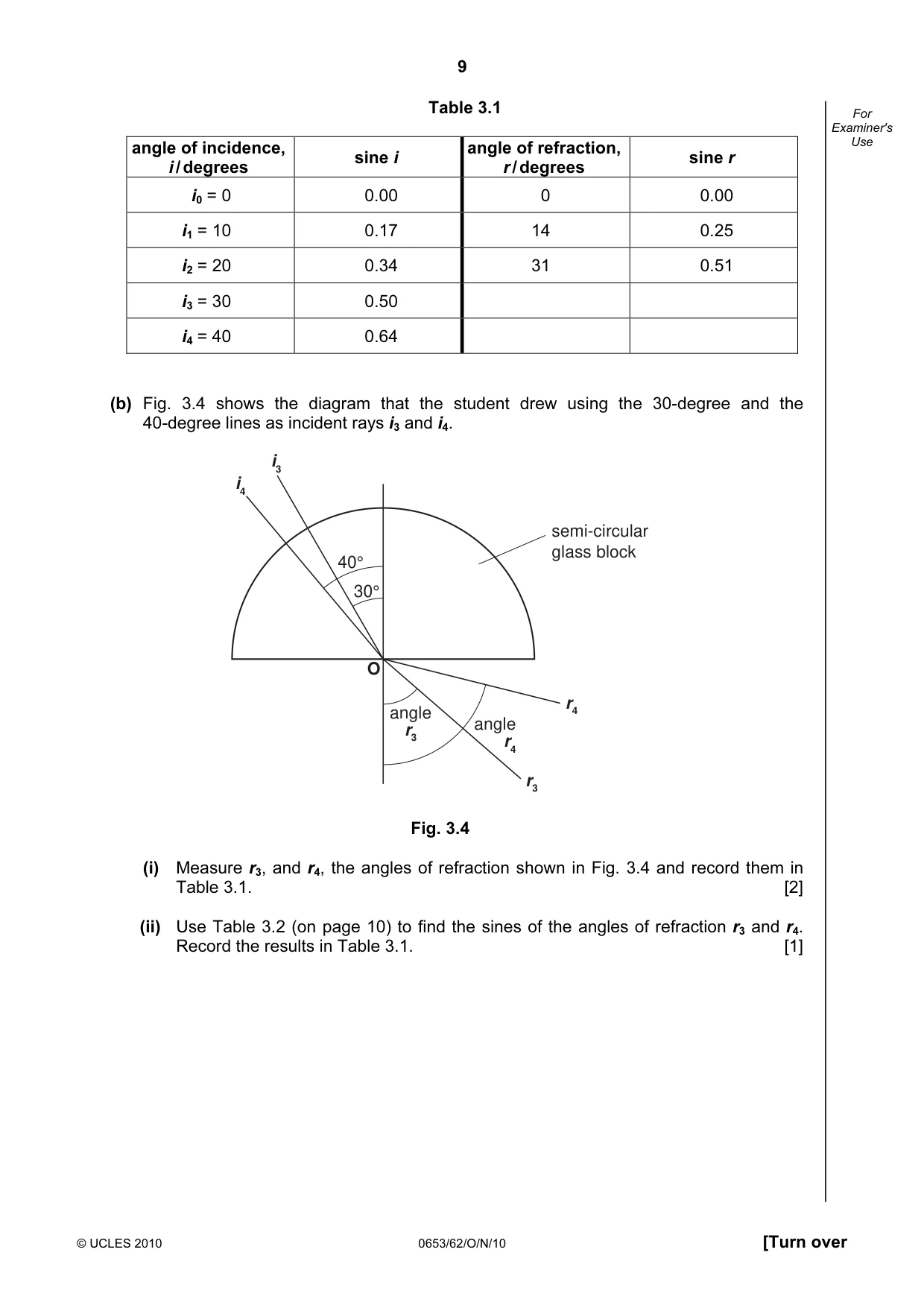
9 © UCLES 2010 0653/62/O/N/10 [Turn over For Examiner's Use Table 3.1 angle of incidence, i / degrees sine i angle of refraction, r / degrees sine r i0 = 0 0.00 0 0.00 i1 = 10 0.17 14 0.25 i2 = 20 0.34 31 0.51 i3 = 30 0.50 i4 = 40 0.64 (b) Fig. 3.4 shows the diagram that the student drew using the 30-degree and the 40-degree lines as incident rays i3 and i4. 30° 40° i3 i4 r4 r3 O angle r3 angle r4 semi-circular glass block Fig. 3.4 (i) Measure r3, and r4, the angles of refraction shown in Fig. 3.4 and record them in Table 3.1. [2] (ii) Use Table 3.2 (on page 10) to find the sines of the angles of refraction r3 and r4. Record the results in Table 3.1. [1]
Question paper, page 10
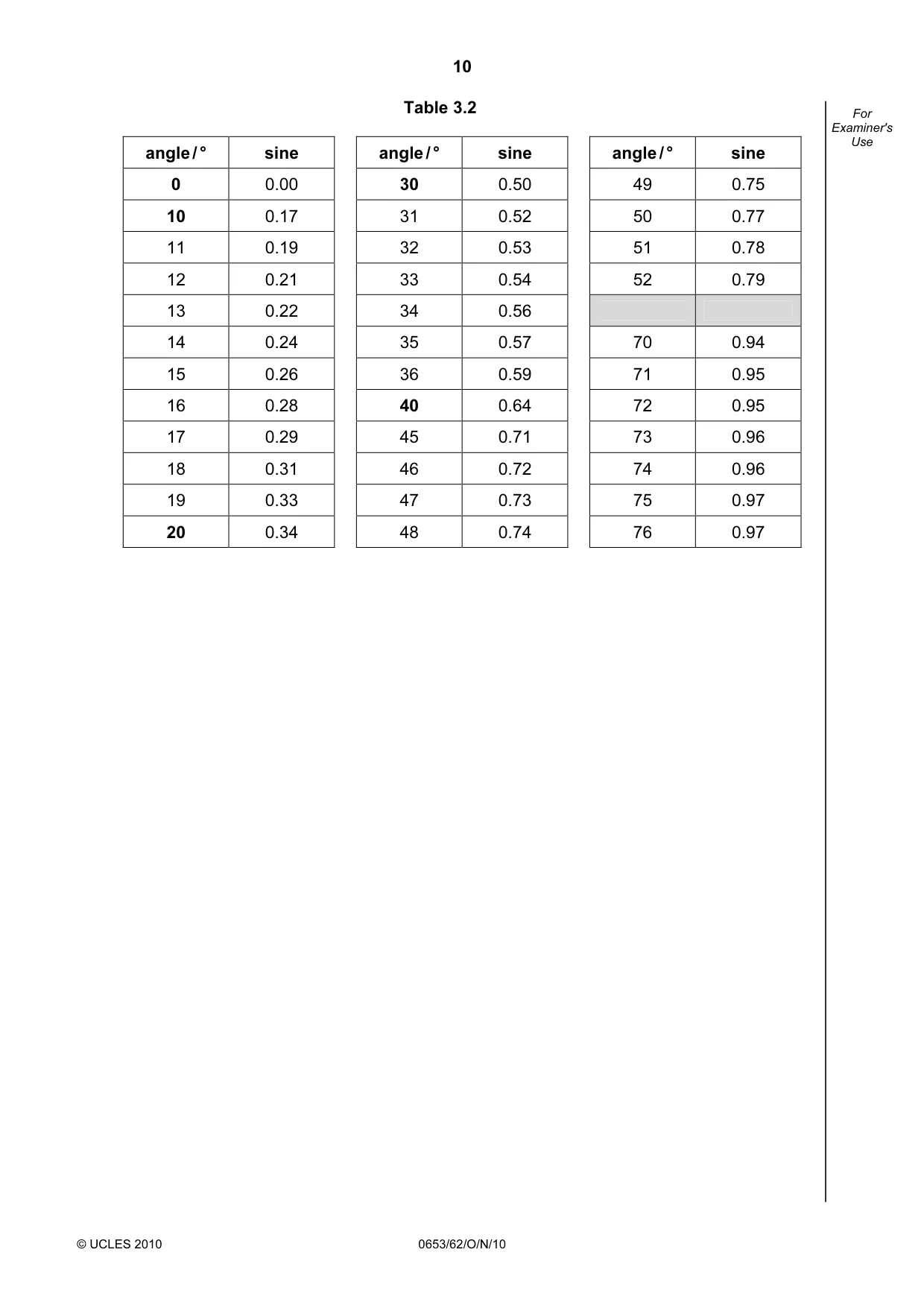
10 © UCLES 2010 0653/62/O/N/10 For Examiner's Use Table 3.2 angle / ° sine angle / ° sine angle / ° sine 0 0.00 30 0.50 49 0.75 10 0.17 31 0.52 50 0.77 11 0.19 32 0.53 51 0.78 12 0.21 33 0.54 52 0.79 13 0.22 34 0.56 14 0.24 35 0.57 70 0.94 15 0.26 36 0.59 71 0.95 16 0.28 40 0.64 72 0.95 17 0.29 45 0.71 73 0.96 18 0.31 46 0.72 74 0.96 19 0.33 47 0.73 75 0.97 20 0.34 48 0.74 76 0.97
Question paper, page 11
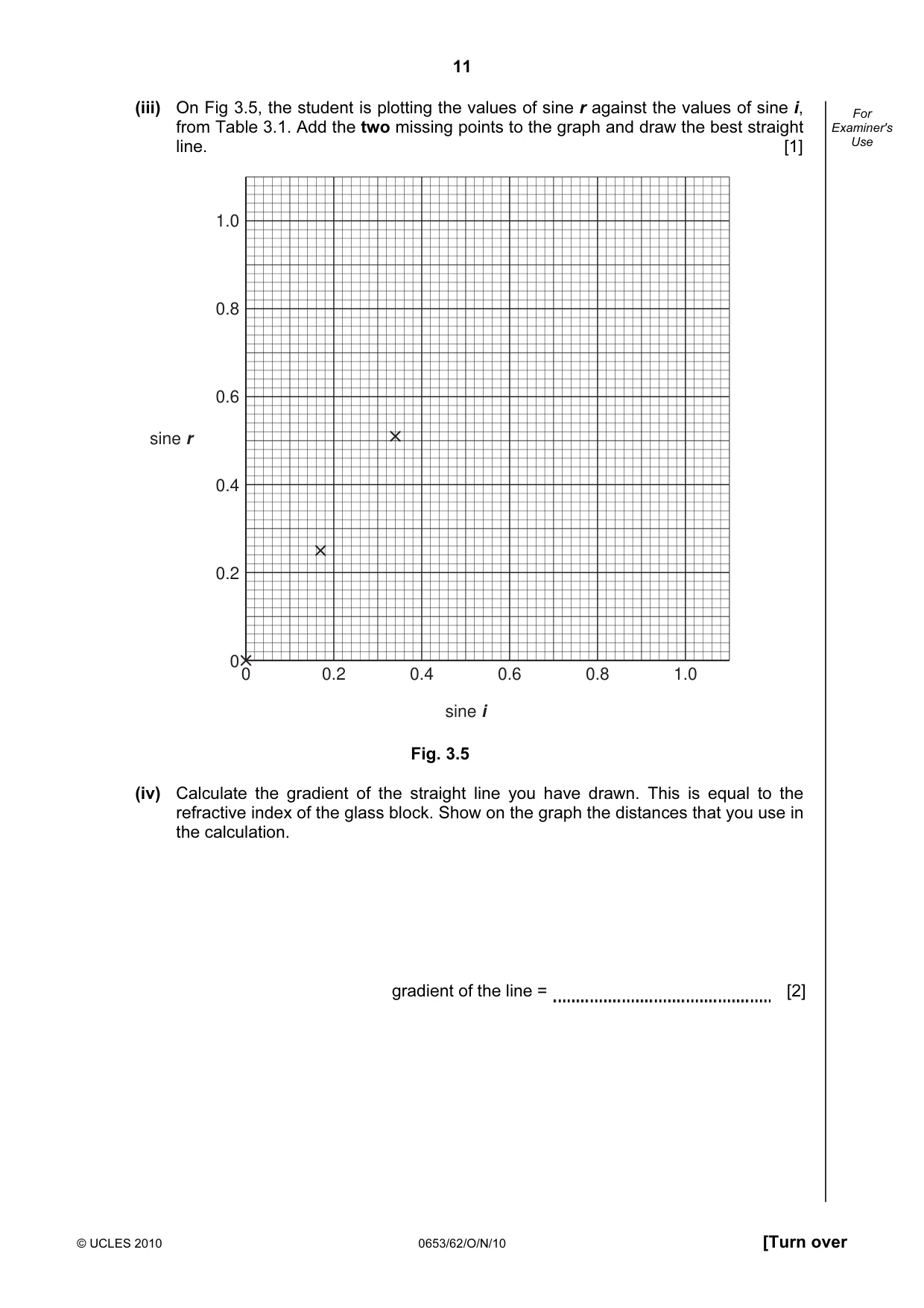
11 © UCLES 2010 0653/62/O/N/10 [Turn over For Examiner's Use (iii) On Fig 3.5, the student is plotting the values of sine r against the values of sine i, from Table 3.1. Add the two missing points to the graph and draw the best straight line. [1] 0 0.2 0.4 0.6 0.8 1.0 1.0 0.8 0.6 0.4 0.2 0 sine i sine r Fig. 3.5 (iv) Calculate the gradient of the straight line you have drawn. This is equal to the refractive index of the glass block. Show on the graph the distances that you use in the calculation. gradient of the line = [2]
Question paper, page 12
12 © UCLES 2010 0653/62/O/N/10 For Examiner's Use (c) The value of 2 1 d d calculated in part (a)(iii) is also equal to the refractive index of the glass block. Suggest which value, (a)(iii) or (b)(iv) is more accurate and give a reason for your choice. Value is more accurate because [1]
Question paper, page 13
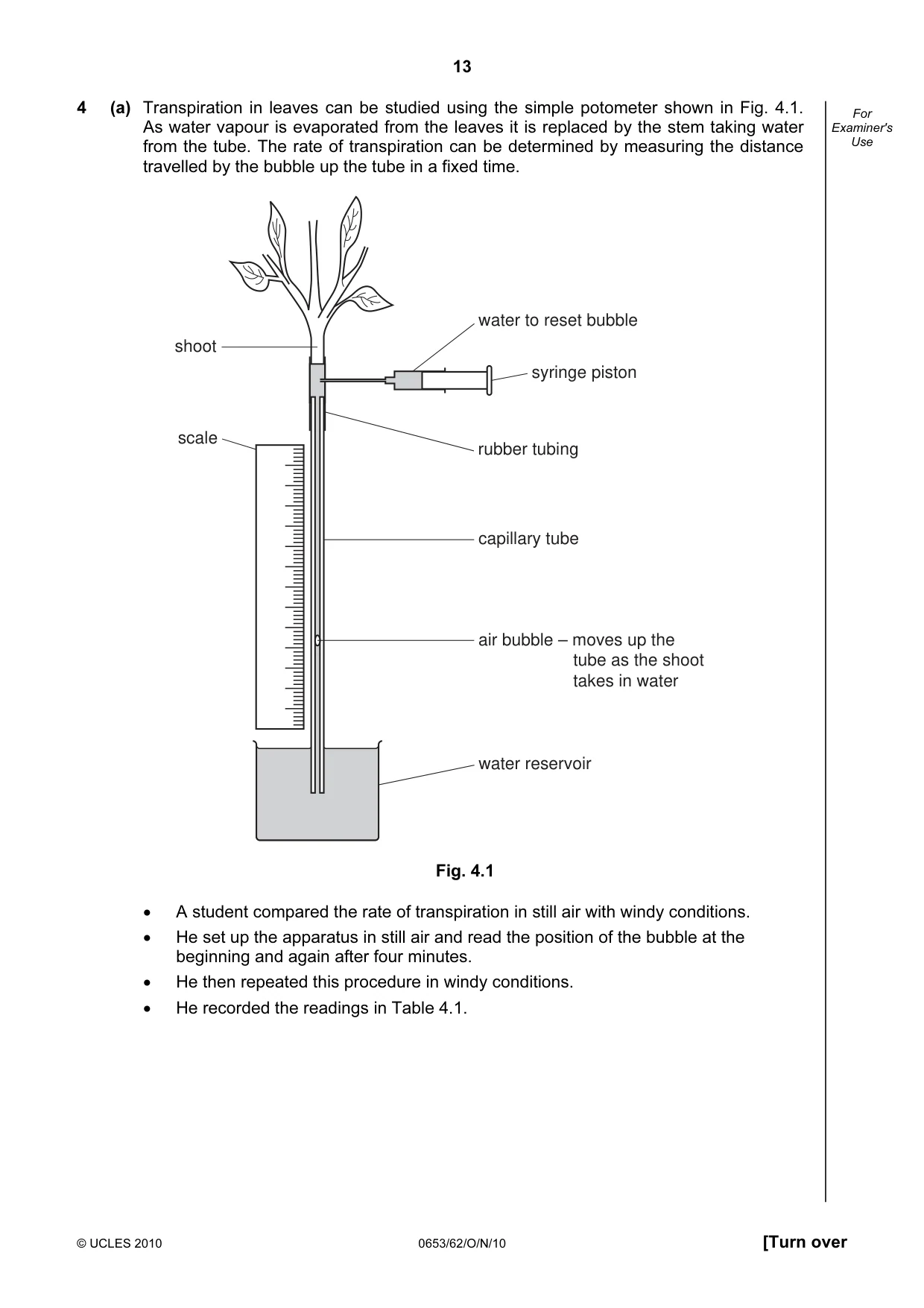
13 © UCLES 2010 0653/62/O/N/10 [Turn over For Examiner's Use 4 (a) Transpiration in leaves can be studied using the simple potometer shown in Fig. 4.1. As water vapour is evaporated from the leaves it is replaced by the stem taking water from the tube. The rate of transpiration can be determined by measuring the distance travelled by the bubble up the tube in a fixed time. scale water to reset bubble syringe piston rubber tubing capillary tube air bubble – moves up the tube as the shoot takes in water water reservoir shoot Fig. 4.1 • A student compared the rate of transpiration in still air with windy conditions. • He set up the apparatus in still air and read the position of the bubble at the beginning and again after four minutes. • He then repeated this procedure in windy conditions. • He recorded the readings in Table 4.1.
Question paper, page 14
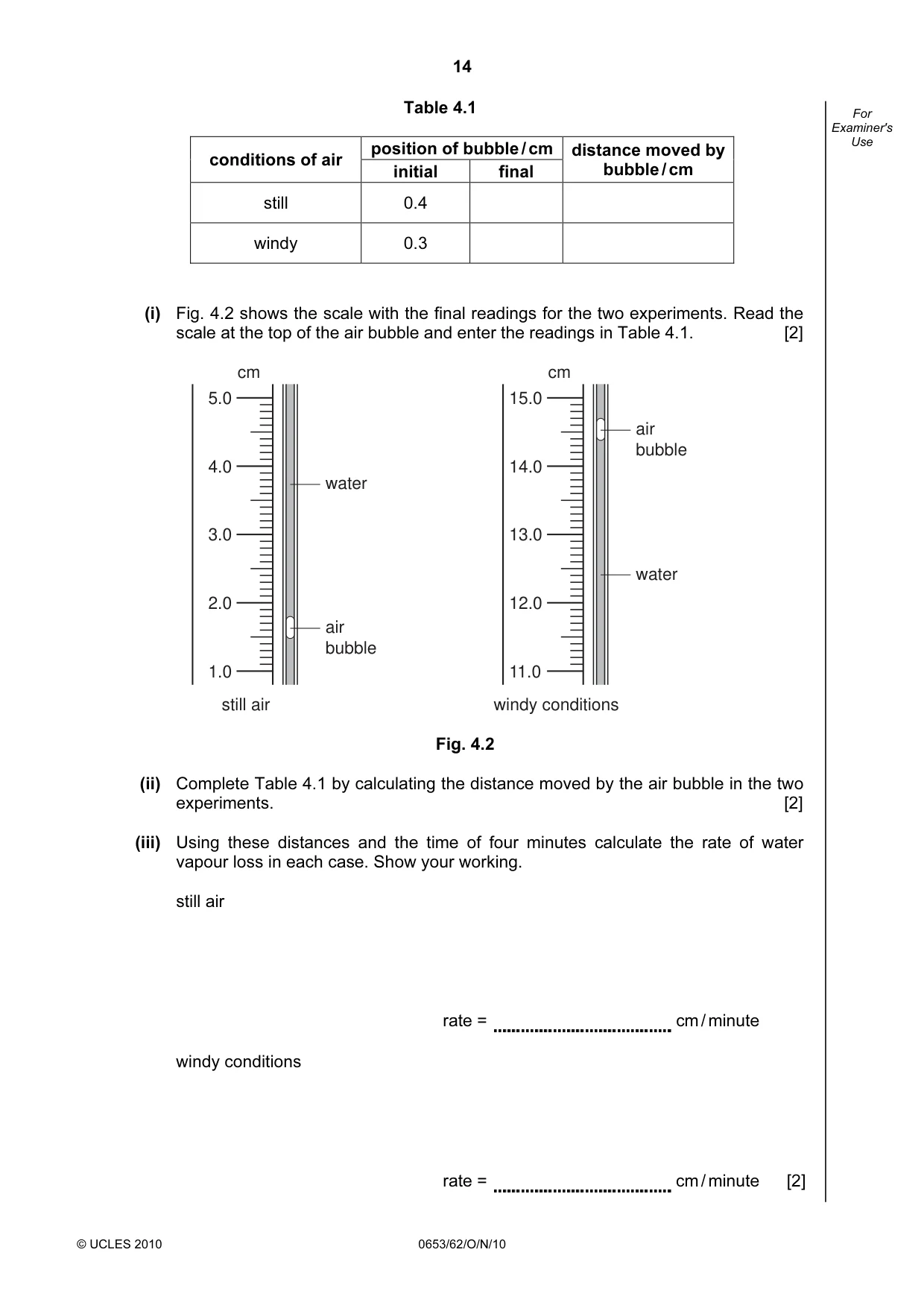
14 © UCLES 2010 0653/62/O/N/10 For Examiner's Use Table 4.1 position of bubble / cm conditions of air initial final distance moved by bubble / cm still 0.4 windy 0.3 (i) Fig. 4.2 shows the scale with the final readings for the two experiments. Read the scale at the top of the air bubble and enter the readings in Table 4.1. [2] 5.0 4.0 3.0 2.0 1.0 cm still air water air bubble 15.0 14.0 13.0 12.0 11.0 cm windy conditions water air bubble Fig. 4.2 (ii) Complete Table 4.1 by calculating the distance moved by the air bubble in the two experiments. [2] (iii) Using these distances and the time of four minutes calculate the rate of water vapour loss in each case. Show your working. still air rate = cm / minute windy conditions rate = cm / minute [2]
Question paper, page 15
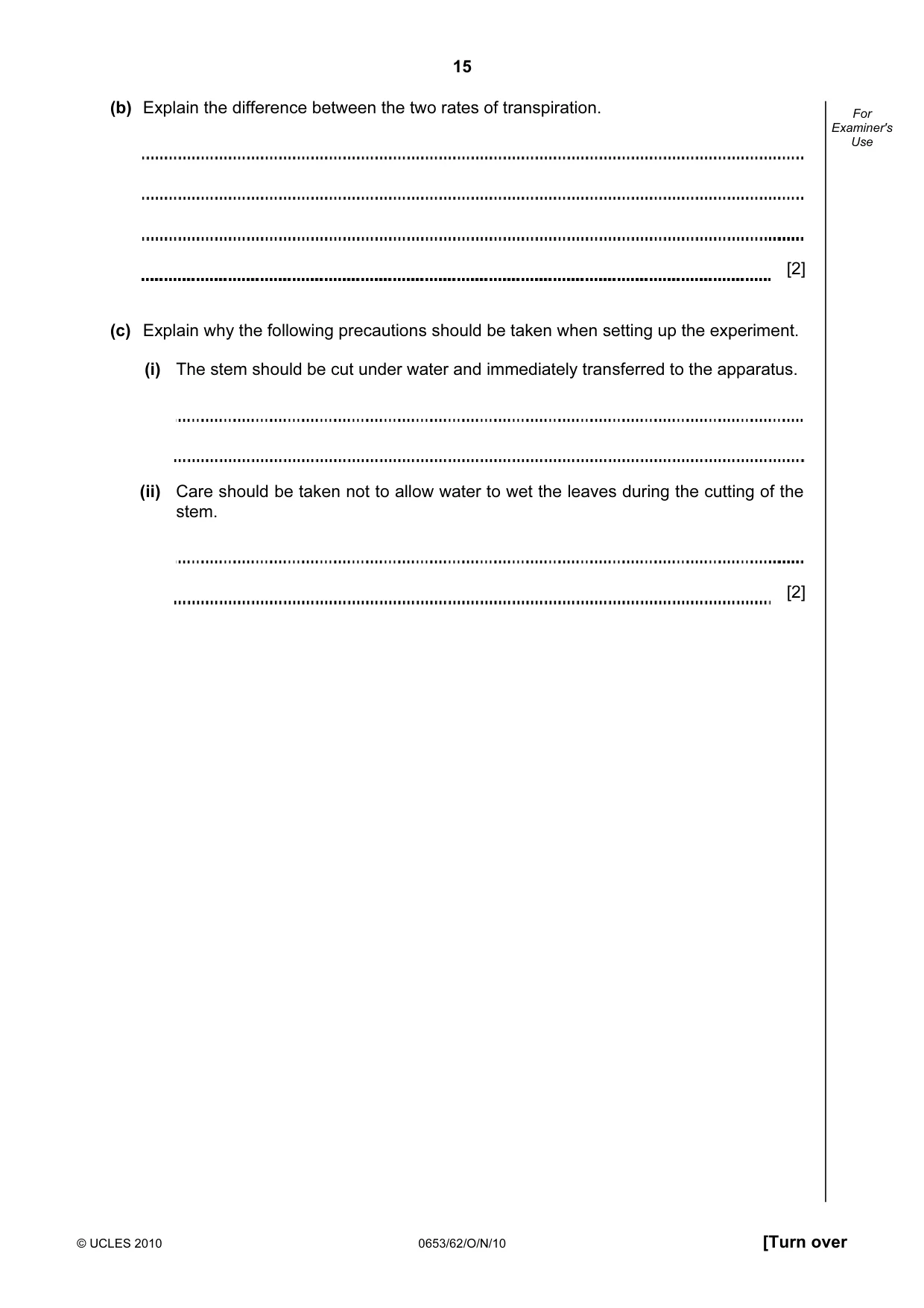
15 © UCLES 2010 0653/62/O/N/10 [Turn over For Examiner's Use (b) Explain the difference between the two rates of transpiration. [2] (c) Explain why the following precautions should be taken when setting up the experiment. (i) The stem should be cut under water and immediately transferred to the apparatus. (ii) Care should be taken not to allow water to wet the leaves during the cutting of the stem. [2]
Question paper, page 16
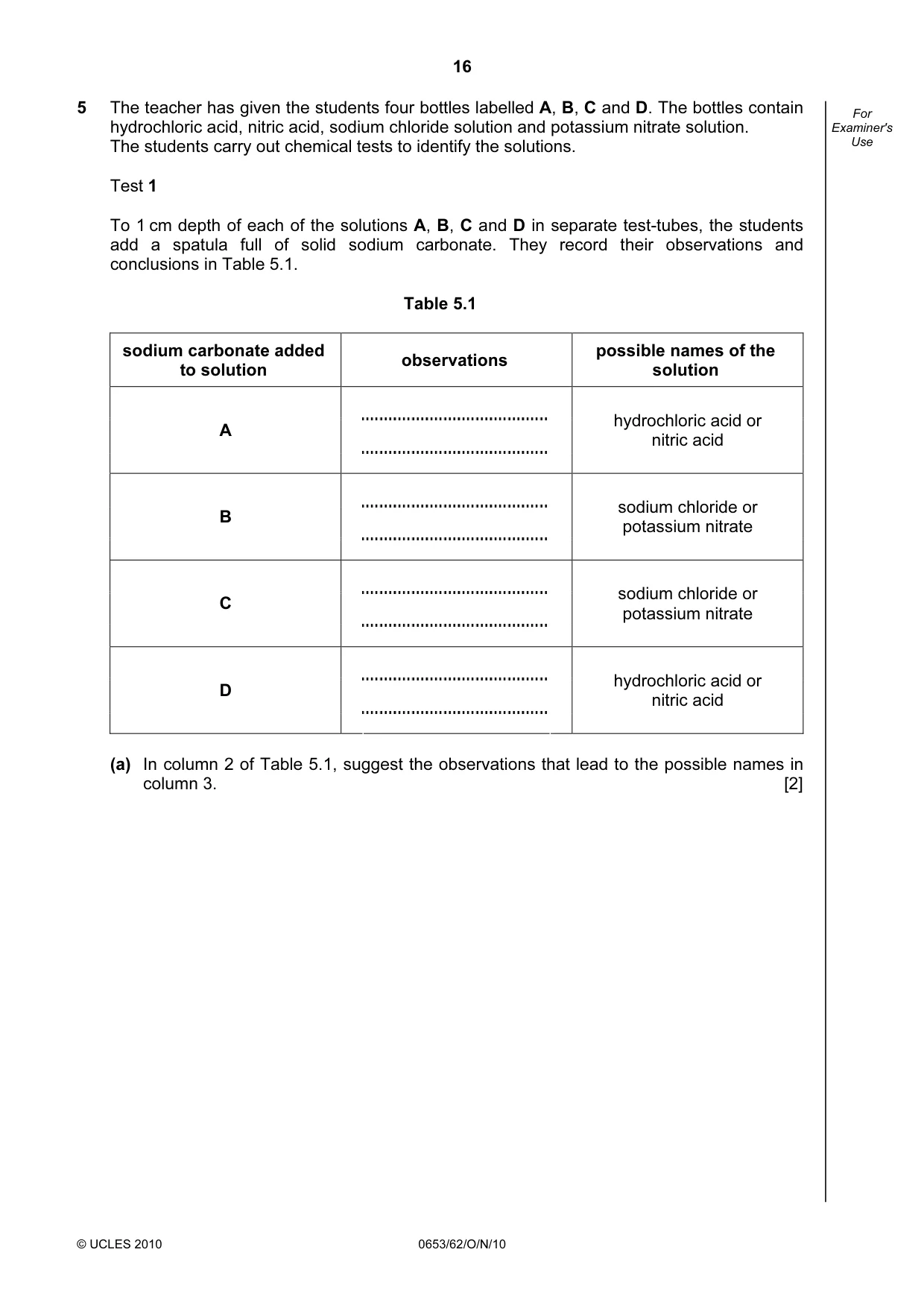
16 © UCLES 2010 0653/62/O/N/10 For Examiner's Use 5 The teacher has given the students four bottles labelled A, B, C and D. The bottles contain hydrochloric acid, nitric acid, sodium chloride solution and potassium nitrate solution. The students carry out chemical tests to identify the solutions. Test 1 To 1 cm depth of each of the solutions A, B, C and D in separate test-tubes, the students add a spatula full of solid sodium carbonate. They record their observations and conclusions in Table 5.1. Table 5.1 sodium carbonate added to solution observations possible names of the solution A hydrochloric acid or nitric acid B sodium chloride or potassium nitrate C sodium chloride or potassium nitrate D hydrochloric acid or nitric acid (a) In column 2 of Table 5.1, suggest the observations that lead to the possible names in column 3. [2]
Question paper, page 17
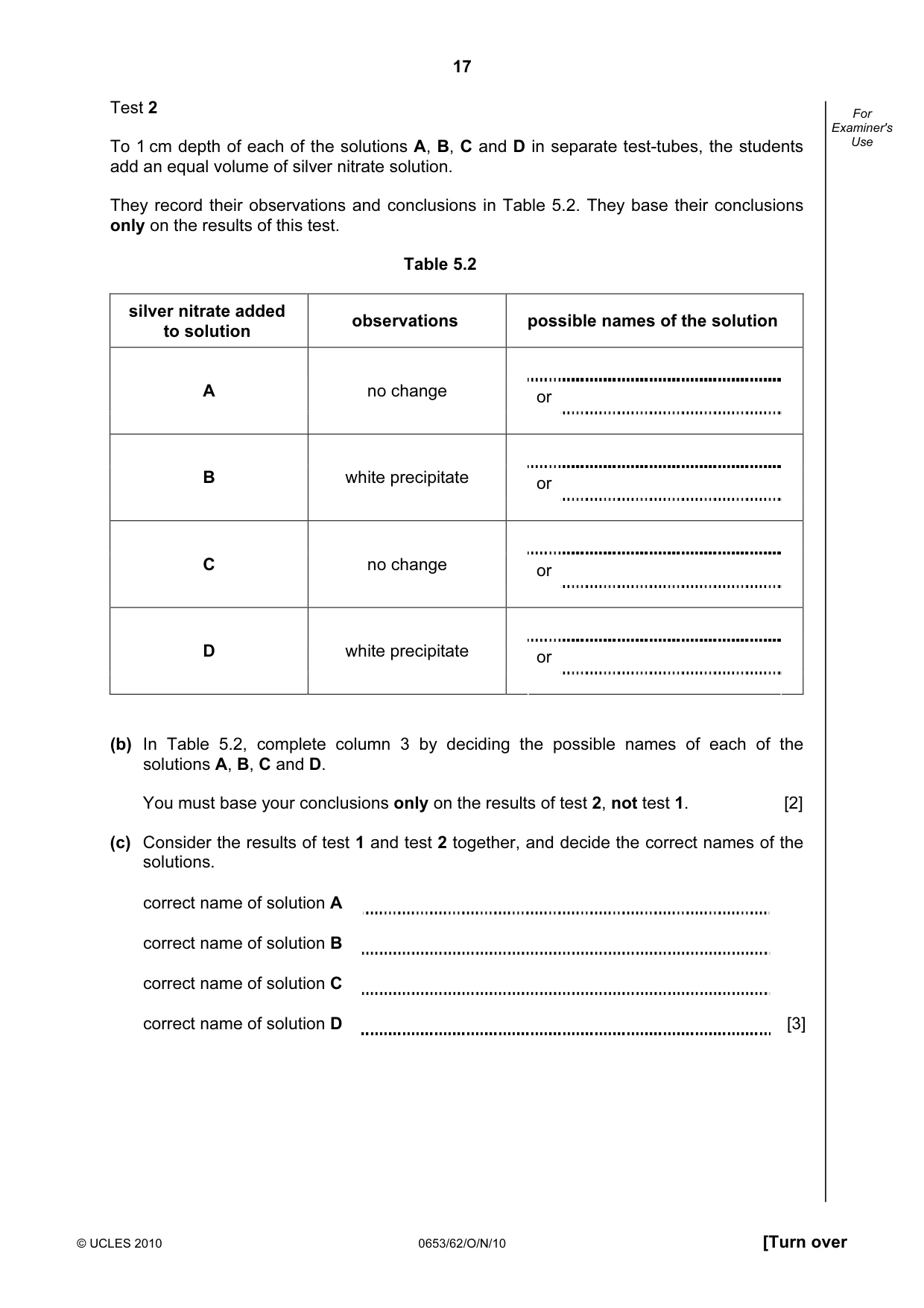
17 © UCLES 2010 0653/62/O/N/10 [Turn over For Examiner's Use Test 2 To 1 cm depth of each of the solutions A, B, C and D in separate test-tubes, the students add an equal volume of silver nitrate solution. They record their observations and conclusions in Table 5.2. They base their conclusions only on the results of this test. Table 5.2 silver nitrate added to solution observations possible names of the solution or A no change or B white precipitate or C no change or D white precipitate (b) In Table 5.2, complete column 3 by deciding the possible names of each of the solutions A, B, C and D. You must base your conclusions only on the results of test 2, not test 1. [2] (c) Consider the results of test 1 and test 2 together, and decide the correct names of the solutions. correct name of solution A correct name of solution B correct name of solution C correct name of solution D [3]
Question paper, page 18
18 © UCLES 2010 0653/62/O/N/10 For Examiner's Use (d) Describe a test that you could carry out to confirm the identity of the solution that you think is potassium nitrate. Give all necessary details and the results of the test. [3]
Question paper, page 19
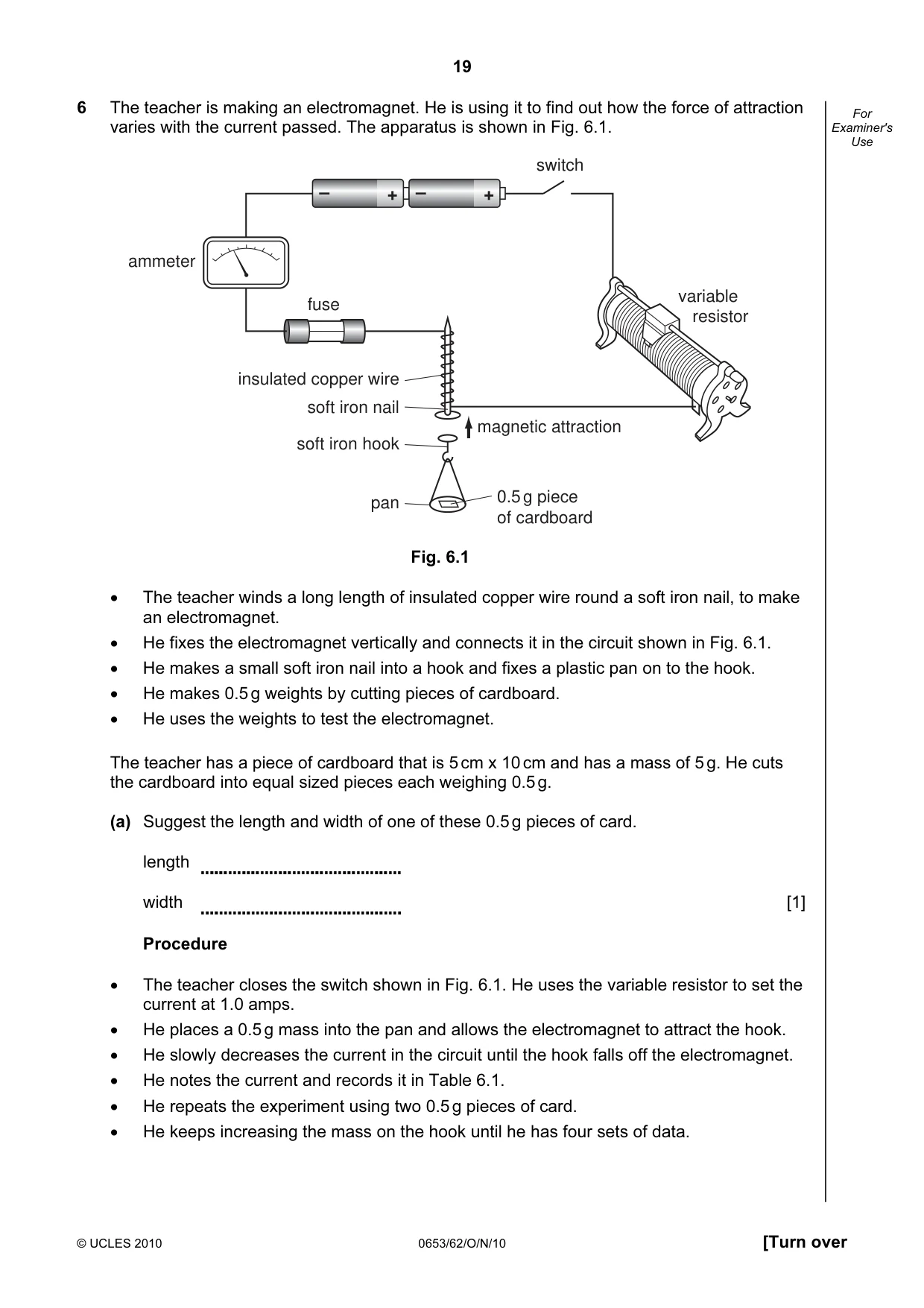
19 © UCLES 2010 0653/62/O/N/10 [Turn over For Examiner's Use 6 The teacher is making an electromagnet. He is using it to find out how the force of attraction varies with the current passed. The apparatus is shown in Fig. 6.1. + – + – fuse switch variable resistor insulated copper wire soft iron nail soft iron hook pan magnetic attraction 0.5 g piece of cardboard ammeter Fig. 6.1 • The teacher winds a long length of insulated copper wire round a soft iron nail, to make an electromagnet. • He fixes the electromagnet vertically and connects it in the circuit shown in Fig. 6.1. • He makes a small soft iron nail into a hook and fixes a plastic pan on to the hook. • He makes 0.5 g weights by cutting pieces of cardboard. • He uses the weights to test the electromagnet. The teacher has a piece of cardboard that is 5 cm x 10 cm and has a mass of 5 g. He cuts the cardboard into equal sized pieces each weighing 0.5 g. (a) Suggest the length and width of one of these 0.5 g pieces of card. length width [1] Procedure • The teacher closes the switch shown in Fig. 6.1. He uses the variable resistor to set the current at 1.0 amps. • He places a 0.5 g mass into the pan and allows the electromagnet to attract the hook. • He slowly decreases the current in the circuit until the hook falls off the electromagnet. • He notes the current and records it in Table 6.1. • He repeats the experiment using two 0.5 g pieces of card. • He keeps increasing the mass on the hook until he has four sets of data.
Question paper, page 20
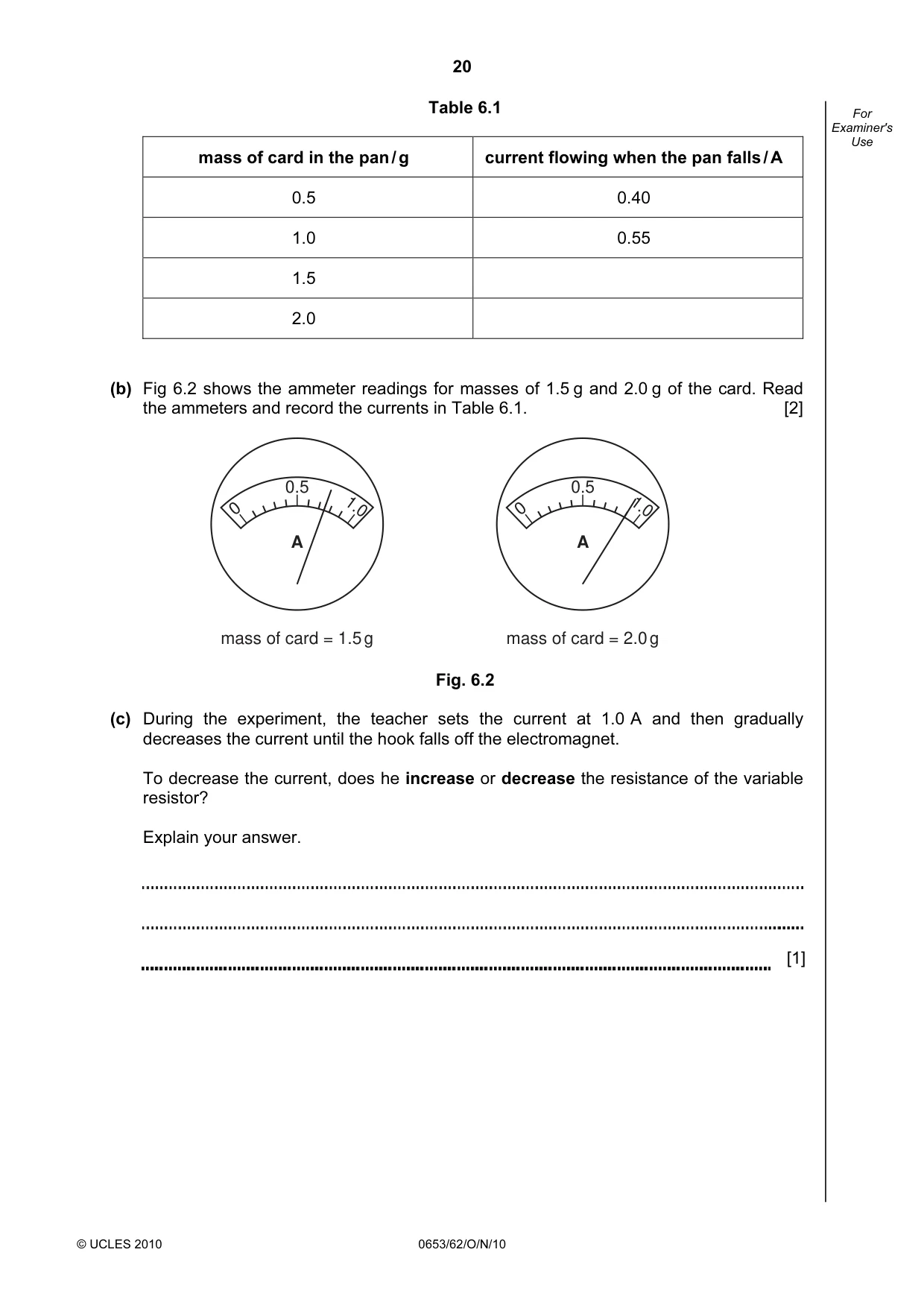
20 © UCLES 2010 0653/62/O/N/10 For Examiner's Use Table 6.1 mass of card in the pan / g current flowing when the pan falls / A 0.5 0.40 1.0 0.55 1.5 2.0 (b) Fig 6.2 shows the ammeter readings for masses of 1.5 g and 2.0 g of the card. Read the ammeters and record the currents in Table 6.1. [2] mass of card = 1.5 g mass of card = 2.0 g A 0.5 0 1.0 A 0.5 0 1.0 Fig. 6.2 (c) During the experiment, the teacher sets the current at 1.0 A and then gradually decreases the current until the hook falls off the electromagnet. To decrease the current, does he increase or decrease the resistance of the variable resistor? Explain your answer. [1]
Question paper, page 21
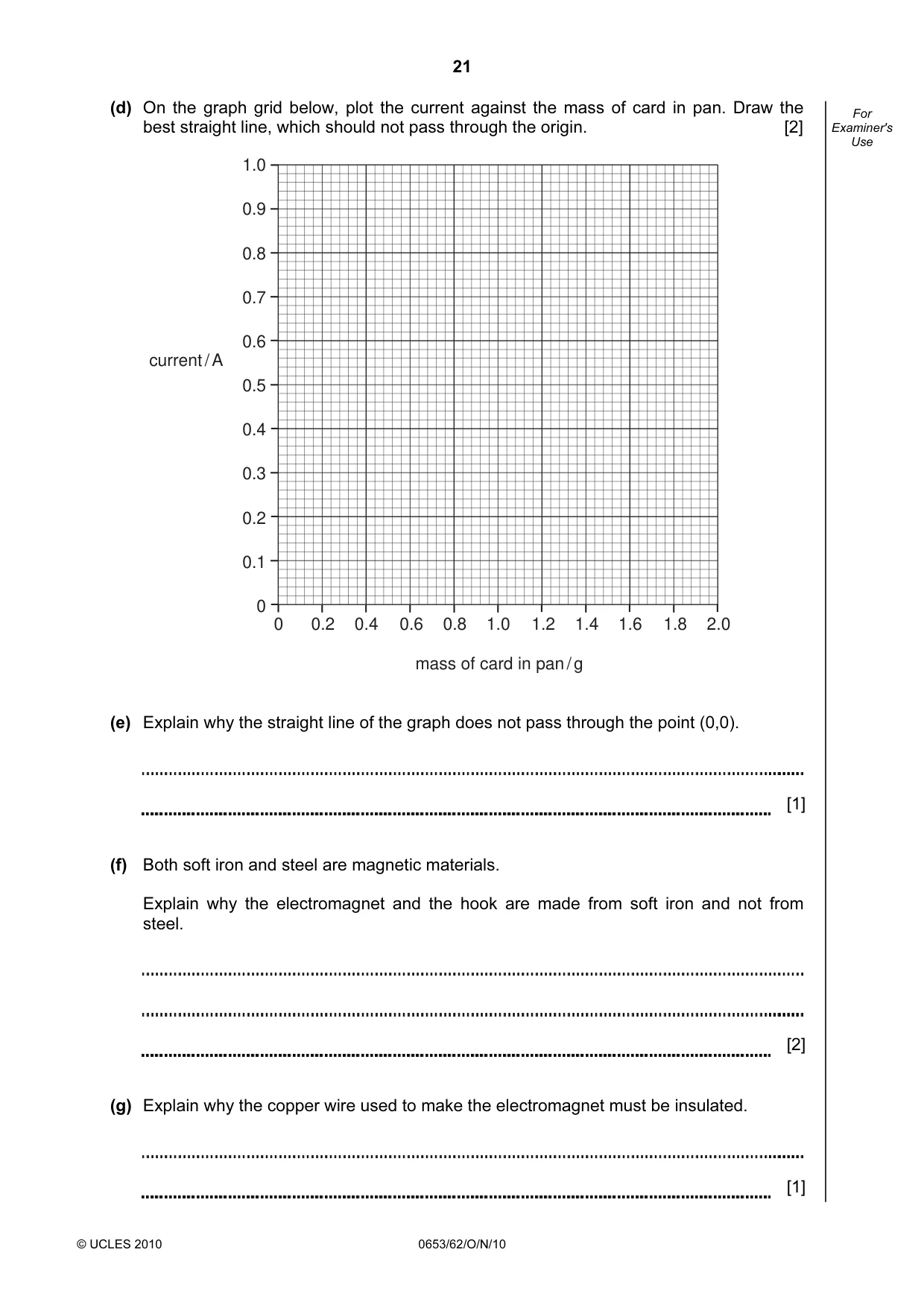
21 © UCLES 2010 0653/62/O/N/10 For Examiner's Use (d) On the graph grid below, plot the current against the mass of card in pan. Draw the best straight line, which should not pass through the origin. [2] current / A mass of card in pan / g 1.0 0.9 0.8 0.7 0.6 0.5 0.4 0.3 0.2 0.1 0 0 0.2 0.4 0.6 0.8 1.0 1.2 1.4 1.6 1.8 2.0 (e) Explain why the straight line of the graph does not pass through the point (0,0). [1] (f) Both soft iron and steel are magnetic materials. Explain why the electromagnet and the hook are made from soft iron and not from steel. [2] (g) Explain why the copper wire used to make the electromagnet must be insulated. [1]
Question paper, page 22
22 © UCLES 2010 0653/62/O/N/10 BLANK PAGE
Question paper, page 23
23 © UCLES 2010 0653/62/O/N/10 BLANK PAGE
Question paper, page 24
24 Permission to reproduce items where third-party owned material protected by copyright is included has been sought and cleared where possible. Every reasonable effort has been made by the publisher (UCLES) to trace copyright holders, but if any items requiring clearance have unwittingly been included, the publisher will be pleased to make amends at the earliest possible opportunity. University of Cambridge International Examinations is part of the Cambridge Assessment Group. Cambridge Assessment is the brand name of University of Cambridge Local Examinations Syndicate (UCLES), which is itself a department of the University of Cambridge. © UCLES 2010 0653/62/O/N/10 BLANK PAGE
Mark scheme, page 1
UNIVERSITY OF CAMBRIDGE INTERNATIONAL EXAMINATIONS International General Certificate of Secondary Education MARK SCHEME for the October/November 2010 question paper for the guidance of teachers 0653 COMBINED SCIENCE 0653/62 Paper 6 (Alternative to Practical), maximum raw mark 60 This mark scheme is published as an aid to teachers and candidates, to indicate the requirements of the examination. It shows the basis on which Examiners were instructed to award marks. It does not indicate the details of the discussions that took place at an Examiners’ meeting before marking began, which would have considered the acceptability of alternative answers. Mark schemes must be read in conjunction with the question papers and the report on the examination. • CIE will not enter into discussions or correspondence in connection with these mark schemes. CIE is publishing the mark schemes for the October/November 2010 question papers for most IGCSE, GCE Advanced Level and Advanced Subsidiary Level syllabuses and some Ordinary Level syllabuses. www.XtremePapers.com
Mark scheme, page 2
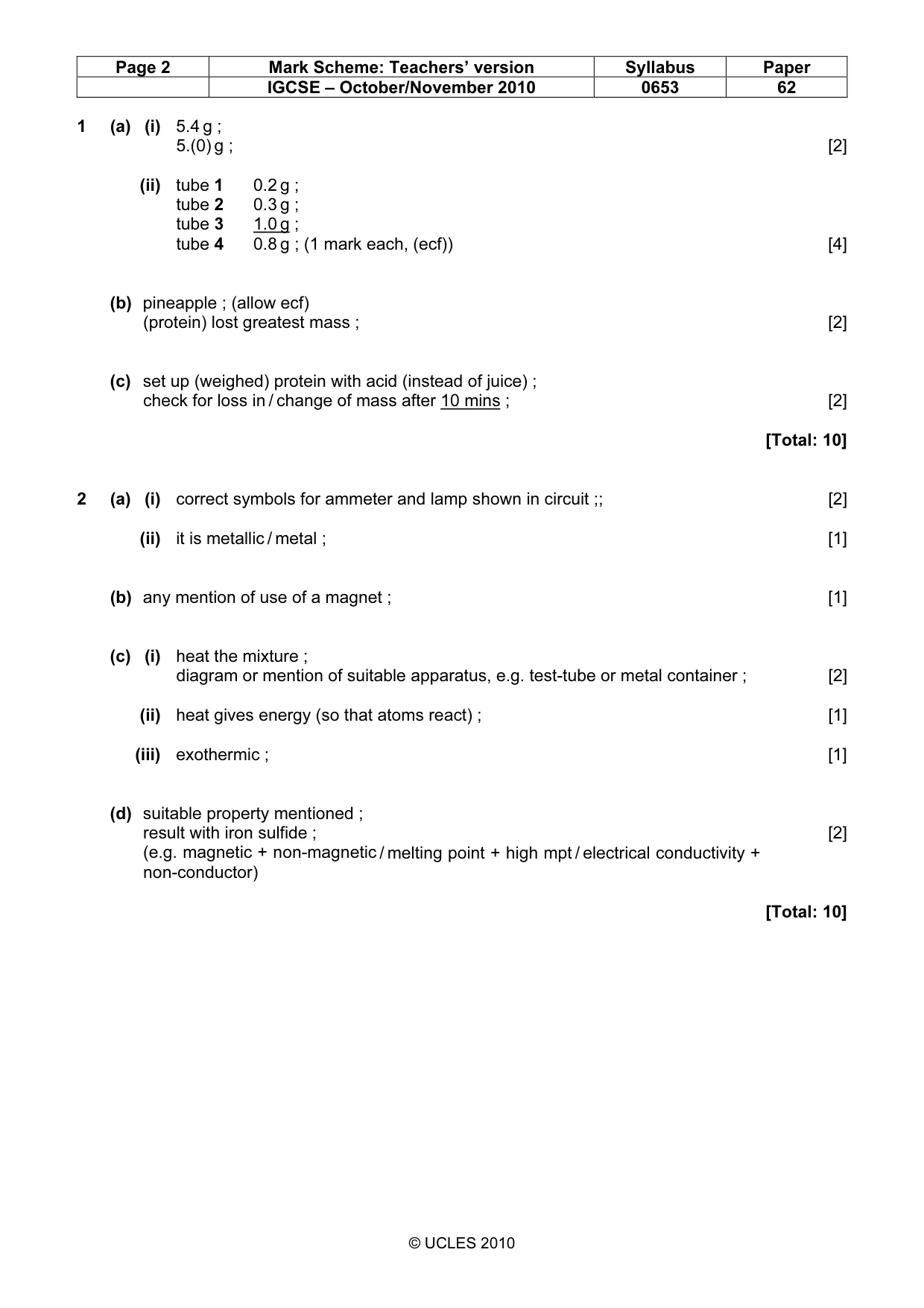
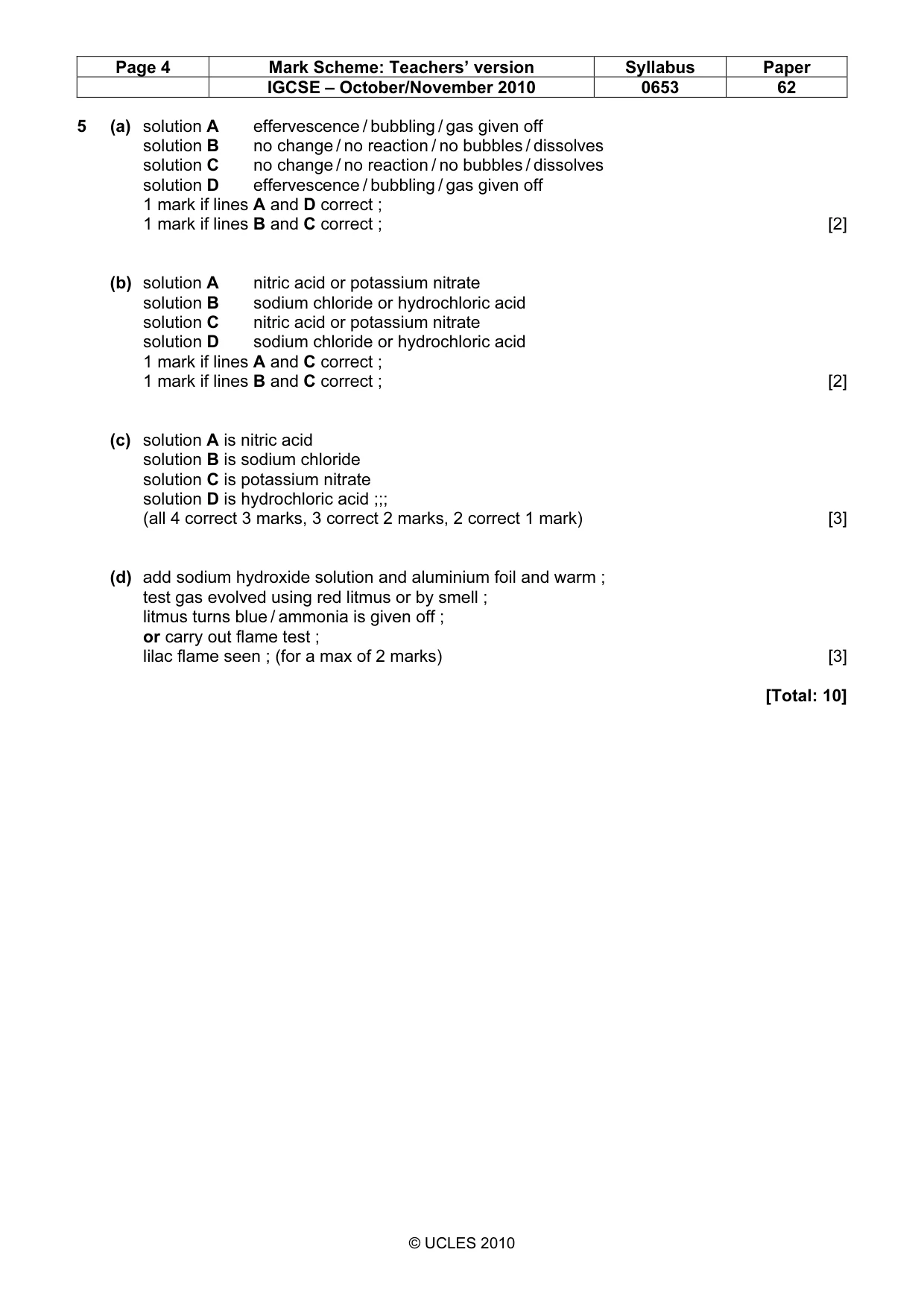
Page 2 Mark Scheme: Teachers’ version Syllabus Paper IGCSE – October/November 2010 0653 62 © UCLES 2010 1 (a) (i) 5.4 g ; 5.(0) g ; [2] (ii) tube 1 0.2 g ; tube 2 0.3 g ; tube 3 1.0 g ; tube 4 0.8 g ; (1 mark each, (ecf)) [4] (b) pineapple ; (allow ecf) (protein) lost greatest mass ; [2] (c) set up (weighed) protein with acid (instead of juice) ; check for loss in / change of mass after 10 mins ; [2] [Total: 10] 2 (a) (i) correct symbols for ammeter and lamp shown in circuit ;; [2] (ii) it is metallic / metal ; [1] (b) any mention of use of a magnet ; [1] (c) (i) heat the mixture ; diagram or mention of suitable apparatus, e.g. test-tube or metal container ; [2] (ii) heat gives energy (so that atoms react) ; [1] (iii) exothermic ; [1] (d) suitable property mentioned ; result with iron sulfide ; [2] (e.g. magnetic + non-magnetic / melting point + high mpt / electrical conductivity + non-conductor) [Total: 10]
Mark scheme, page 3
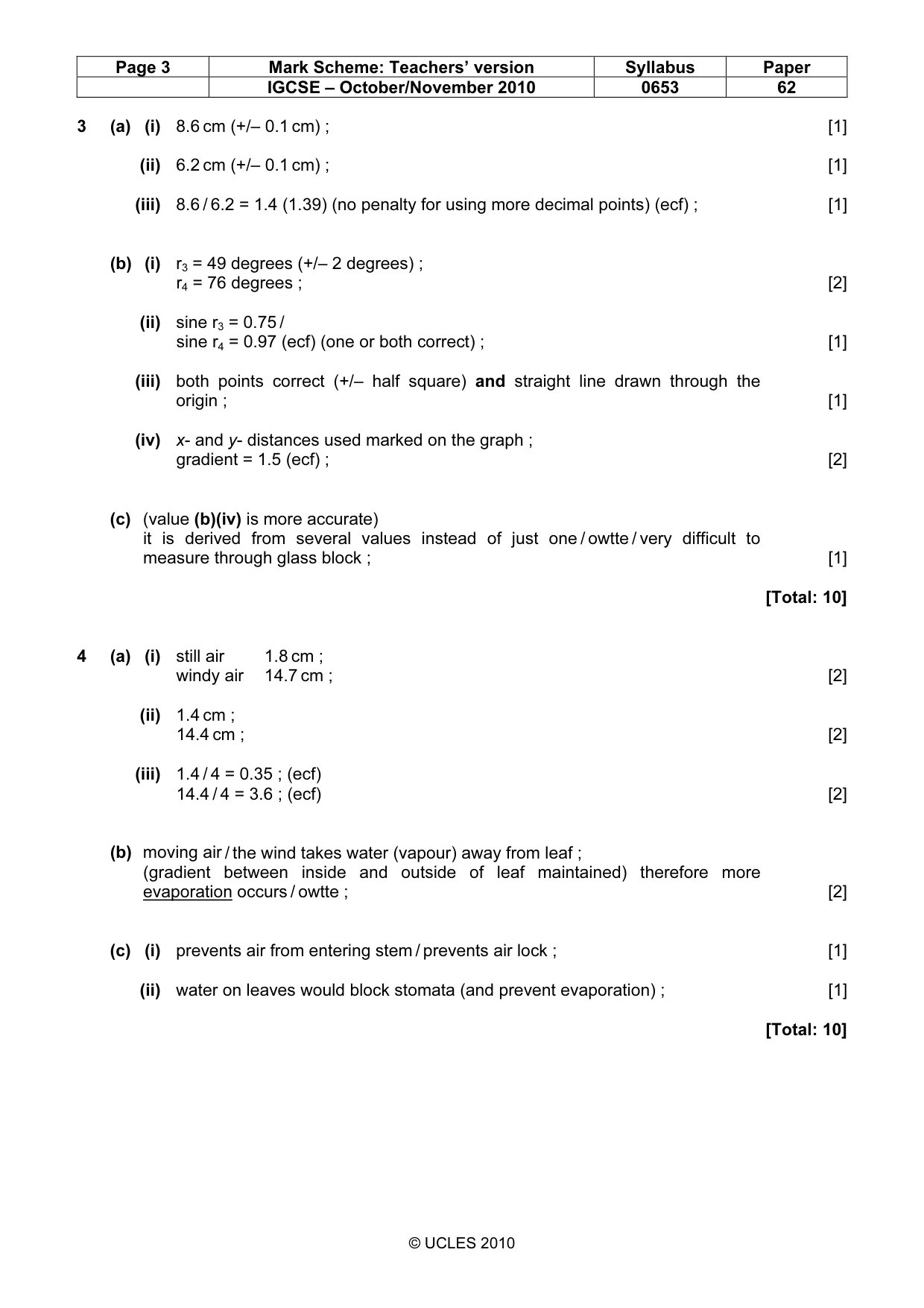
Page 3 Mark Scheme: Teachers’ version Syllabus Paper IGCSE – October/November 2010 0653 62 © UCLES 2010 3 (a) (i) 8.6 cm (+/– 0.1 cm) ; [1] (ii) 6.2 cm (+/– 0.1 cm) ; [1] (iii) 8.6 / 6.2 = 1.4 (1.39) (no penalty for using more decimal points) (ecf) ; [1] (b) (i) r3 = 49 degrees (+/– 2 degrees) ; r4 = 76 degrees ; [2] (ii) sine r3 = 0.75 / sine r4 = 0.97 (ecf) (one or both correct) ; [1] (iii) both points correct (+/– half square) and straight line drawn through the origin ; [1] (iv) x- and y- distances used marked on the graph ; gradient = 1.5 (ecf) ; [2] (c) (value (b)(iv) is more accurate) it is derived from several values instead of just one / owtte / very difficult to measure through glass block ; [1] [Total: 10] 4 (a) (i) still air 1.8 cm ; windy air 14.7 cm ; [2] (ii) 1.4 cm ; 14.4 cm ; [2] (iii) 1.4 / 4 = 0.35 ; (ecf) 14.4 / 4 = 3.6 ; (ecf) [2] (b) moving air / the wind takes water (vapour) away from leaf ; (gradient between inside and outside of leaf maintained) therefore more evaporation occurs / owtte ; [2] (c) (i) prevents air from entering stem / prevents air lock ; [1] (ii) water on leaves would block stomata (and prevent evaporation) ; [1] [Total: 10]
Mark scheme, page 4
Page 4 Mark Scheme: Teachers’ version Syllabus Paper IGCSE – October/November 2010 0653 62 © UCLES 2010 5 (a) solution A effervescence / bubbling / gas given off solution B no change / no reaction / no bubbles / dissolves solution C no change / no reaction / no bubbles / dissolves solution D effervescence / bubbling / gas given off 1 mark if lines A and D correct ; 1 mark if lines B and C correct ; [2] (b) solution A nitric acid or potassium nitrate solution B sodium chloride or hydrochloric acid solution C nitric acid or potassium nitrate solution D sodium chloride or hydrochloric acid 1 mark if lines A and C correct ; 1 mark if lines B and C correct ; [2] (c) solution A is nitric acid solution B is sodium chloride solution C is potassium nitrate solution D is hydrochloric acid ;;; (all 4 correct 3 marks, 3 correct 2 marks, 2 correct 1 mark) [3] (d) add sodium hydroxide solution and aluminium foil and warm ; test gas evolved using red litmus or by smell ; litmus turns blue / ammonia is given off ; or carry out flame test ; lilac flame seen ; (for a max of 2 marks) [3] [Total: 10]
Mark scheme, page 5
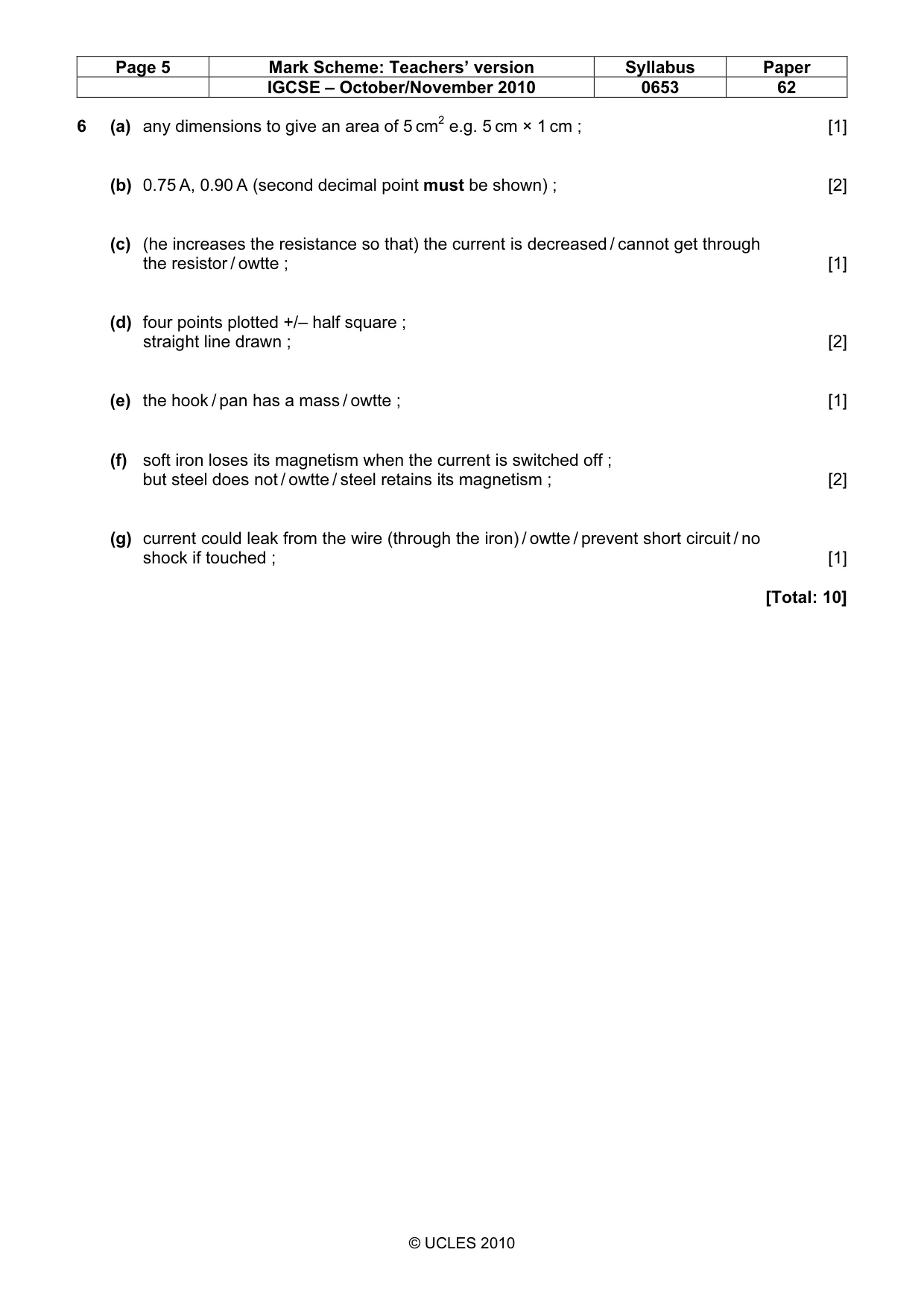
Page 5 Mark Scheme: Teachers’ version Syllabus Paper IGCSE – October/November 2010 0653 62 © UCLES 2010 6 (a) any dimensions to give an area of 5 cm2 e.g. 5 cm × 1 cm ; [1] (b) 0.75 A, 0.90 A (second decimal point must be shown) ; [2] (c) (he increases the resistance so that) the current is decreased / cannot get through the resistor / owtte ; [1] (d) four points plotted +/– half square ; straight line drawn ; [2] (e) the hook / pan has a mass / owtte ; [1] (f) soft iron loses its magnetism when the current is switched off ; but steel does not / owtte / steel retains its magnetism ; [2] (g) current could leak from the wire (through the iron) / owtte / prevent short circuit / no shock if touched ; [1] [Total: 10]