Cambridge IGCSE Science - Combined 0653 — 2010 Oct/Nov Paper 6 · Variant 1
0653/61/O/N/10
The question paper and its mark scheme, free to read here and free to download. This is Cambridge’s own paper, exactly as it was sat.
Question paper16 pages

Mark scheme4 pages
Answers below. Sit the paper first if you are practising.
Paper as text
Question paper, page 1
This document consists of 15 printed pages and 1 blank page. IB10 11_0653_61/5RP © UCLES 2010 [Turn over *7669423247* For Examiner's Use 1 2 3 4 5 6 Total UNIVERSITY OF CAMBRIDGE INTERNATIONAL EXAMINATIONS International General Certificate of Secondary Education COMBINED SCIENCE 0653/61 Paper 6 Alternative to Practical October/November 2010 1 hour Candidates answer on the Question paper. No Additional Materials are required. READ THESE INSTRUCTIONS FIRST Write your Centre number, candidate number and name on all the work you hand in. Write in dark blue or black pen. You may use a soft pencil for any diagrams, graphs, tables or rough working. Do not use staples, paper clips, highlighters, glue or correction fluid. DO NOT WRITE IN ANY BARCODES. Answer all questions. At the end of the examination, fasten all your work securely together. The number of marks is given in brackets [ ] at the end of each question or part question. www.XtremePapers.com
Question paper, page 2
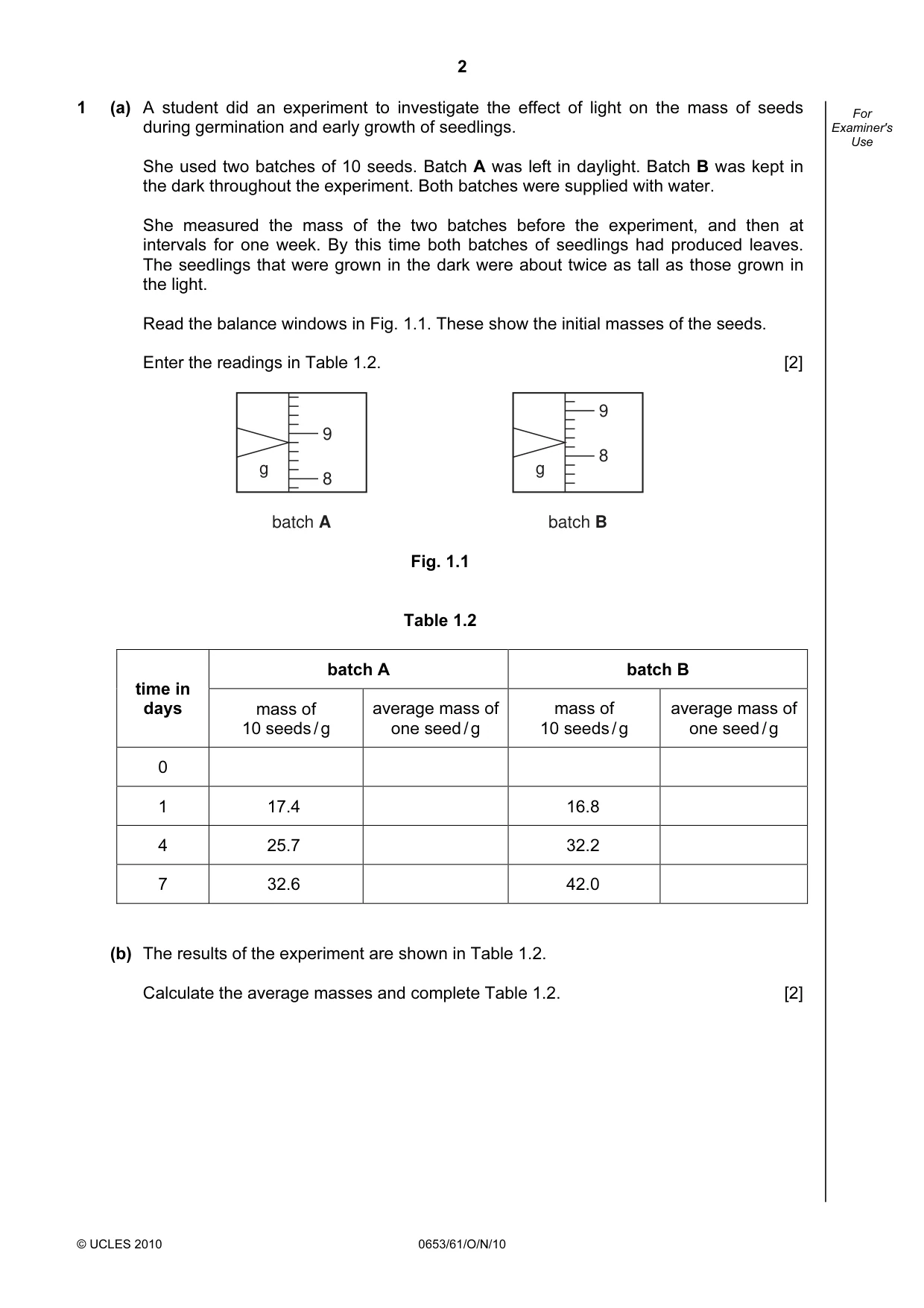
2 © UCLES 2010 0653/61/O/N/10 For Examiner's Use 1 (a) A student did an experiment to investigate the effect of light on the mass of seeds during germination and early growth of seedlings. She used two batches of 10 seeds. Batch A was left in daylight. Batch B was kept in the dark throughout the experiment. Both batches were supplied with water. She measured the mass of the two batches before the experiment, and then at intervals for one week. By this time both batches of seedlings had produced leaves. The seedlings that were grown in the dark were about twice as tall as those grown in the light. Read the balance windows in Fig. 1.1. These show the initial masses of the seeds. Enter the readings in Table 1.2. [2] batch A batch B 9 8 g 9 8 g Fig. 1.1 Table 1.2 batch A batch B time in days mass of 10 seeds / g average mass of one seed / g mass of 10 seeds / g average mass of one seed / g 0 1 17.4 16.8 4 25.7 32.2 7 32.6 42.0 (b) The results of the experiment are shown in Table 1.2. Calculate the average masses and complete Table 1.2. [2]
Question paper, page 3
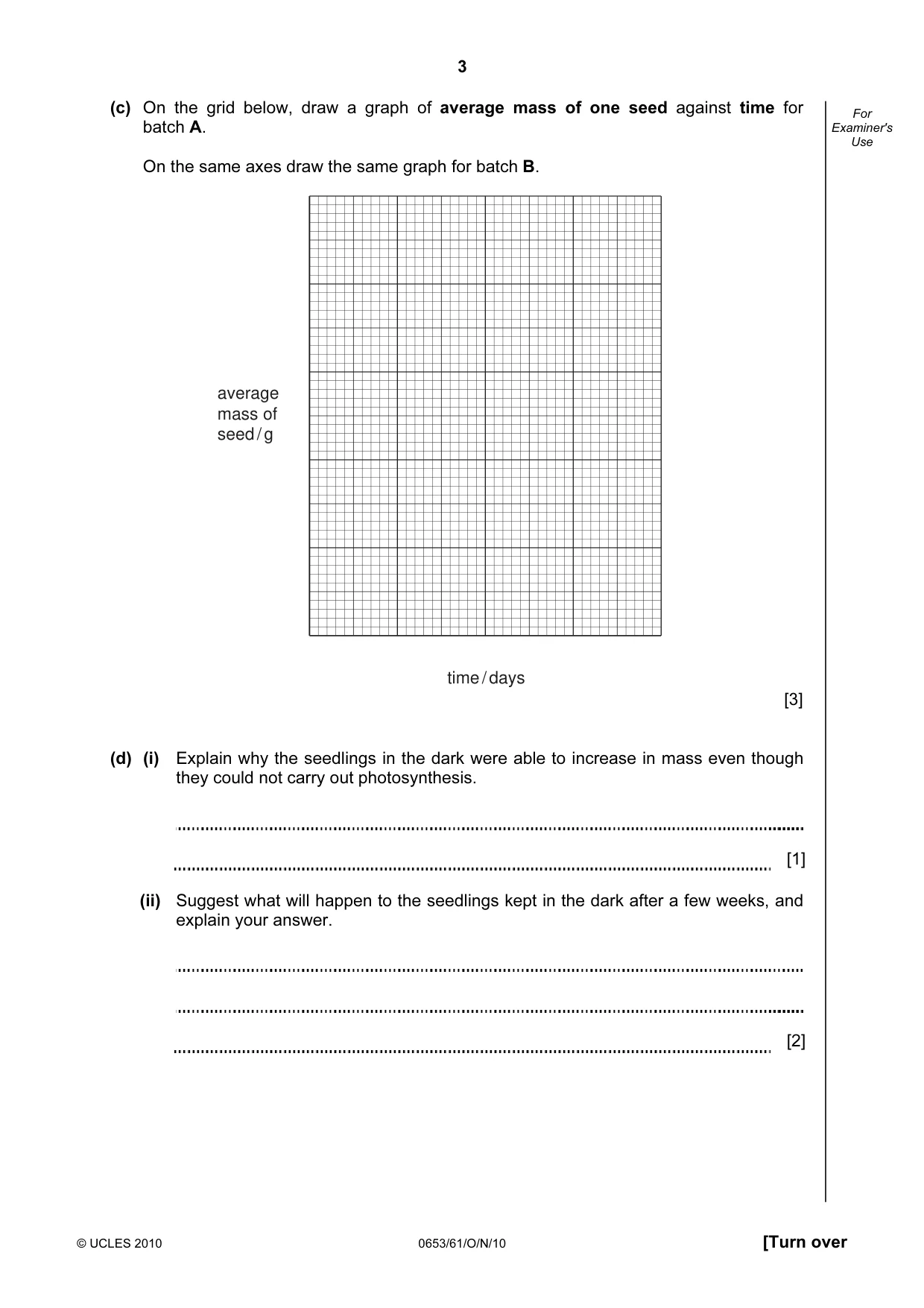
3 © UCLES 2010 0653/61/O/N/10 [Turn over For Examiner's Use (c) On the grid below, draw a graph of average mass of one seed against time for batch A. On the same axes draw the same graph for batch B. average mass of seed / g time / days [3] (d) (i) Explain why the seedlings in the dark were able to increase in mass even though they could not carry out photosynthesis. [1] (ii) Suggest what will happen to the seedlings kept in the dark after a few weeks, and explain your answer. [2]
Question paper, page 4
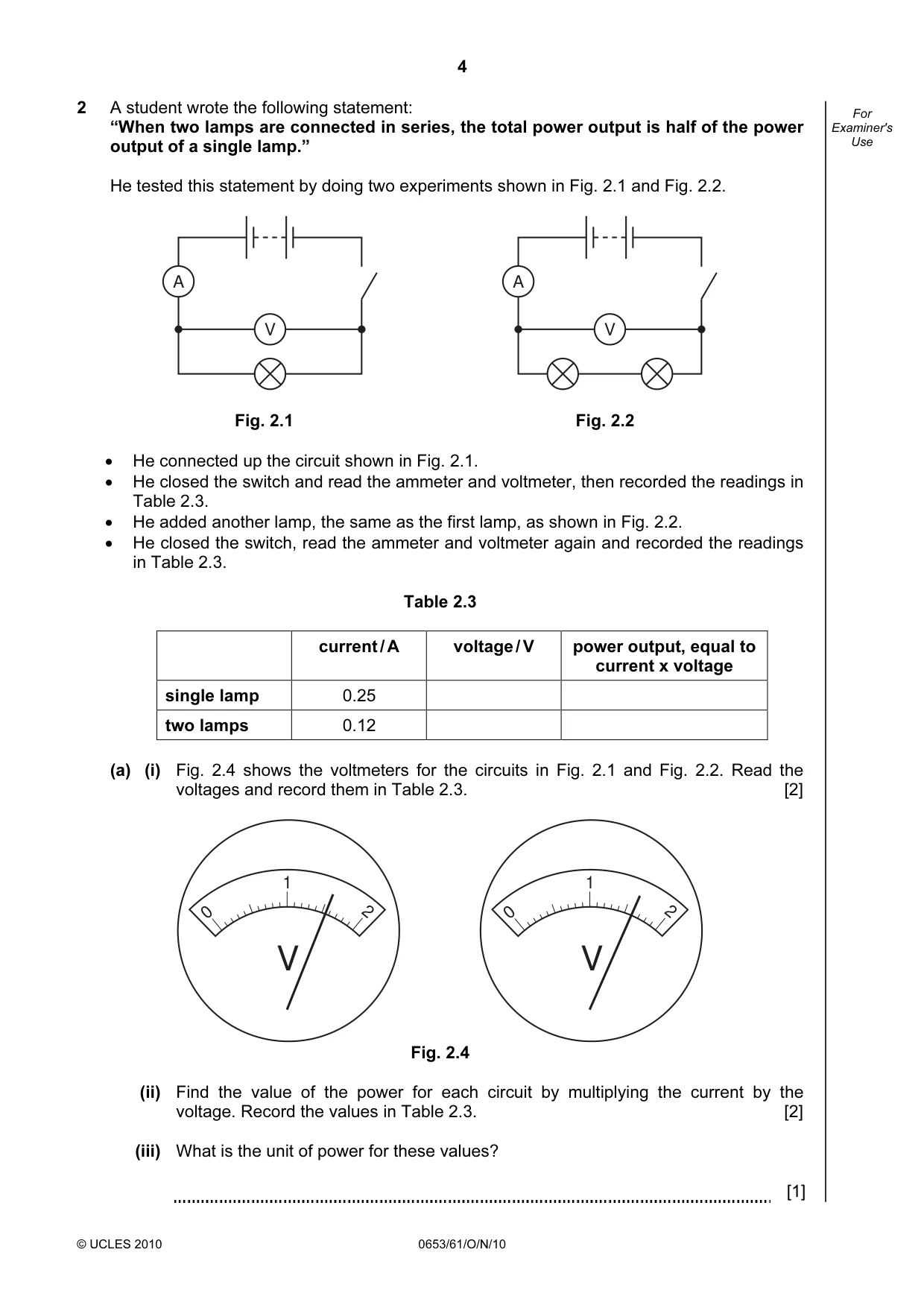
4 © UCLES 2010 0653/61/O/N/10 For Examiner's Use 2 A student wrote the following statement: “When two lamps are connected in series, the total power output is half of the power output of a single lamp.” He tested this statement by doing two experiments shown in Fig. 2.1 and Fig. 2.2. V A V A Fig. 2.1 Fig. 2.2 • He connected up the circuit shown in Fig. 2.1. • He closed the switch and read the ammeter and voltmeter, then recorded the readings in Table 2.3. • He added another lamp, the same as the first lamp, as shown in Fig. 2.2. • He closed the switch, read the ammeter and voltmeter again and recorded the readings in Table 2.3. Table 2.3 current / A voltage / V power output, equal to current x voltage single lamp 0.25 two lamps 0.12 (a) (i) Fig. 2.4 shows the voltmeters for the circuits in Fig. 2.1 and Fig. 2.2. Read the voltages and record them in Table 2.3. [2] 1 2 0 1 2 0 V V Fig. 2.4 (ii) Find the value of the power for each circuit by multiplying the current by the voltage. Record the values in Table 2.3. [2] (iii) What is the unit of power for these values? [1]
Question paper, page 5
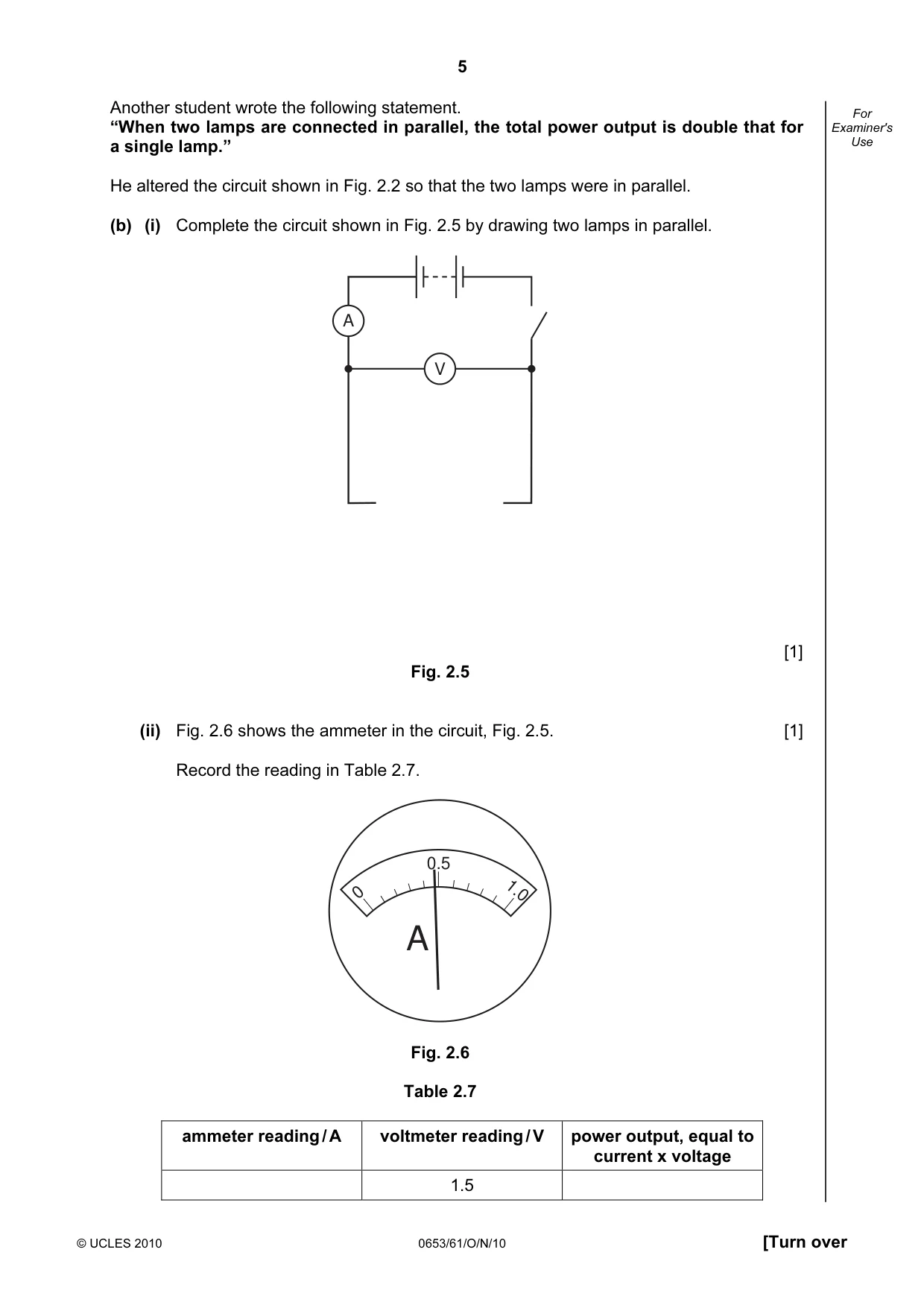
5 © UCLES 2010 0653/61/O/N/10 [Turn over For Examiner's Use Another student wrote the following statement. “When two lamps are connected in parallel, the total power output is double that for a single lamp.” He altered the circuit shown in Fig. 2.2 so that the two lamps were in parallel. (b) (i) Complete the circuit shown in Fig. 2.5 by drawing two lamps in parallel. V A [1] Fig. 2.5 (ii) Fig. 2.6 shows the ammeter in the circuit, Fig. 2.5. [1] Record the reading in Table 2.7. 0.5 1.0 0 A Fig. 2.6 Table 2.7 ammeter reading / A voltmeter reading / V power output, equal to current x voltage 1.5
Question paper, page 6
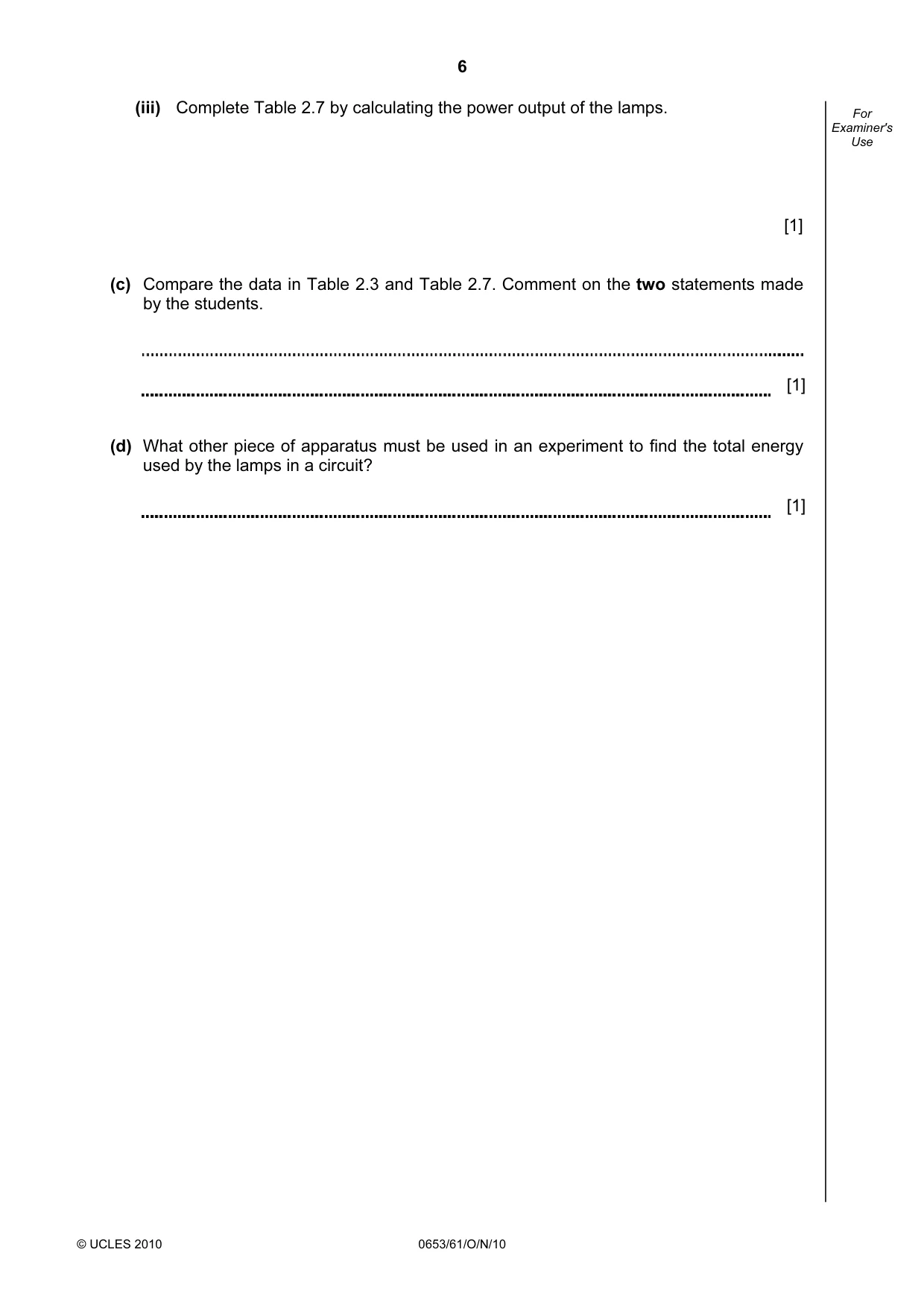
6 © UCLES 2010 0653/61/O/N/10 For Examiner's Use (iii) Complete Table 2.7 by calculating the power output of the lamps. [1] (c) Compare the data in Table 2.3 and Table 2.7. Comment on the two statements made by the students. [1] (d) What other piece of apparatus must be used in an experiment to find the total energy used by the lamps in a circuit? [1]
Question paper, page 7
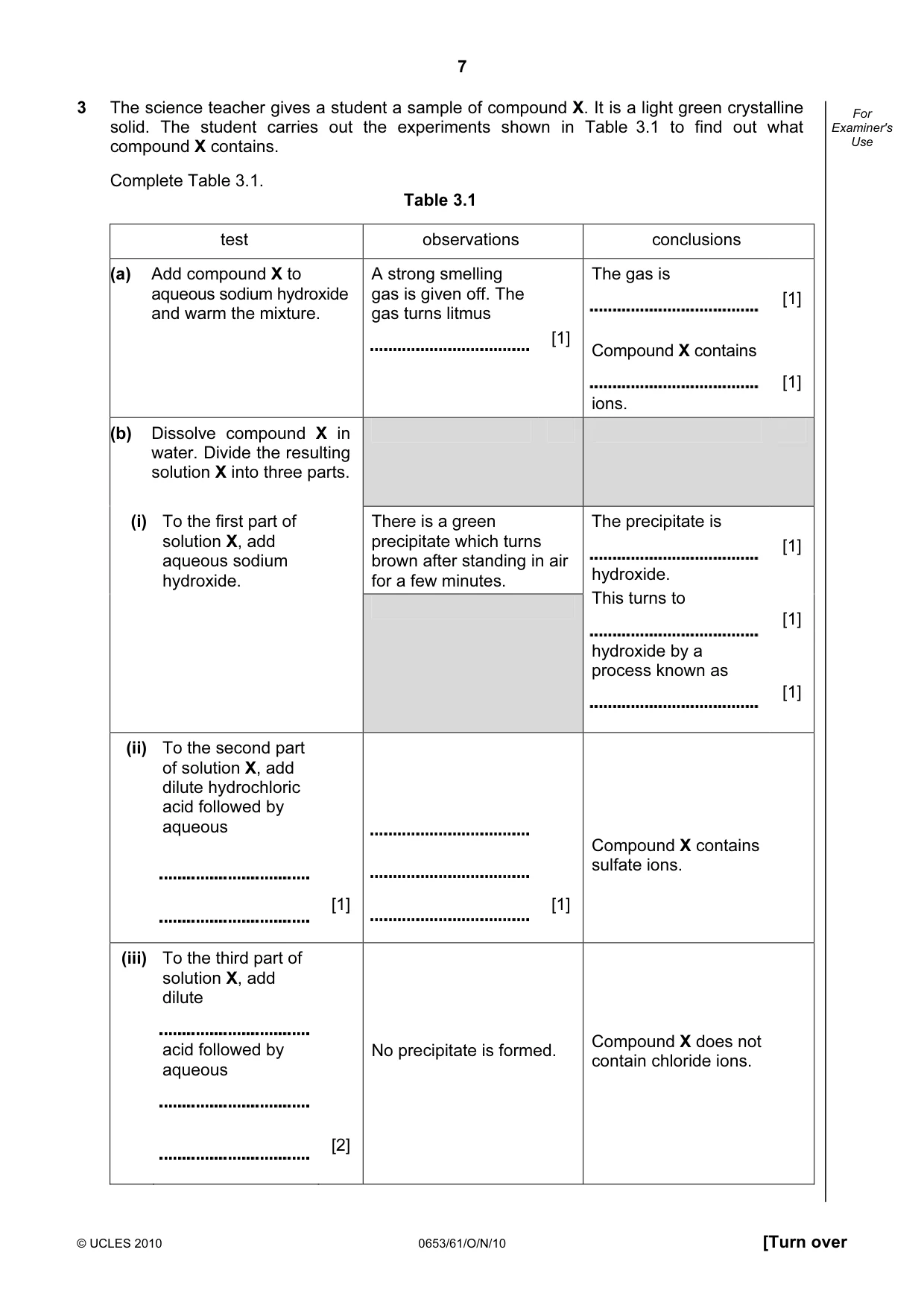
7 © UCLES 2010 0653/61/O/N/10 [Turn over For Examiner's Use 3 The science teacher gives a student a sample of compound X. It is a light green crystalline solid. The student carries out the experiments shown in Table 3.1 to find out what compound X contains. Complete Table 3.1. Table 3.1 test observations conclusions (a) Add compound X to aqueous sodium hydroxide and warm the mixture. A strong smelling gas is given off. The gas turns litmus [1] The gas is Compound X contains ions. [1] [1] (b) Dissolve compound X in water. Divide the resulting solution X into three parts. There is a green precipitate which turns brown after standing in air for a few minutes. (i) To the first part of solution X, add aqueous sodium hydroxide. The precipitate is hydroxide. This turns to hydroxide by a process known as [1] [1] [1] (ii) To the second part of solution X, add dilute hydrochloric acid followed by aqueous [1] [1] Compound X contains sulfate ions. (iii) To the third part of solution X, add dilute acid followed by aqueous [2] No precipitate is formed. Compound X does not contain chloride ions.
Question paper, page 8
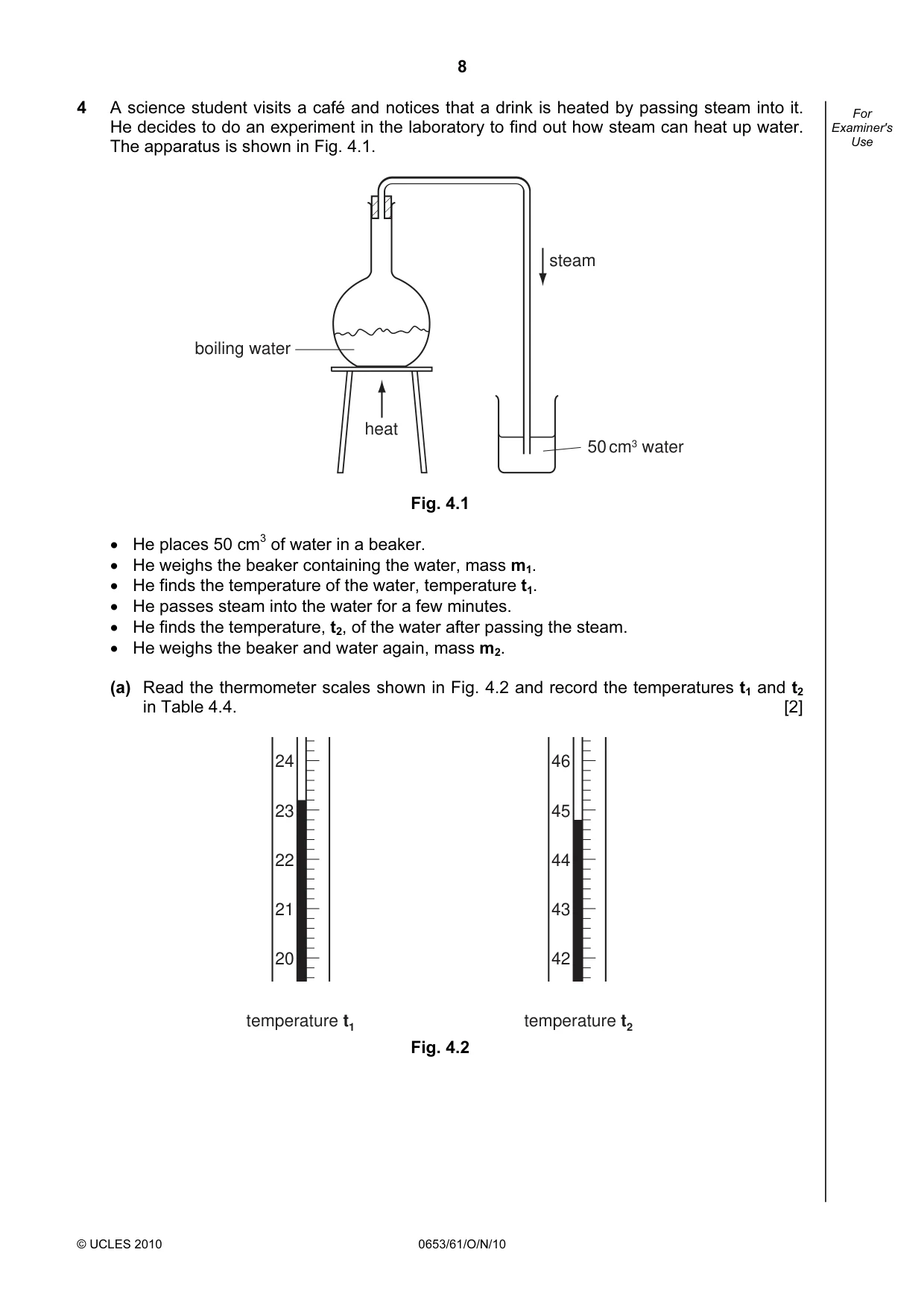
8 © UCLES 2010 0653/61/O/N/10 For Examiner's Use 4 A science student visits a café and notices that a drink is heated by passing steam into it. He decides to do an experiment in the laboratory to find out how steam can heat up water. The apparatus is shown in Fig. 4.1. heat 50 cm3 water steam boiling water Fig. 4.1 • He places 50 cm3 of water in a beaker. • He weighs the beaker containing the water, mass m1. • He finds the temperature of the water, temperature t1. • He passes steam into the water for a few minutes. • He finds the temperature, t2, of the water after passing the steam. • He weighs the beaker and water again, mass m2. (a) Read the thermometer scales shown in Fig. 4.2 and record the temperatures t1 and t2 in Table 4.4. [2] 24 23 22 21 20 46 45 44 43 42 temperature t1 temperature t2 Fig. 4.2
Question paper, page 9
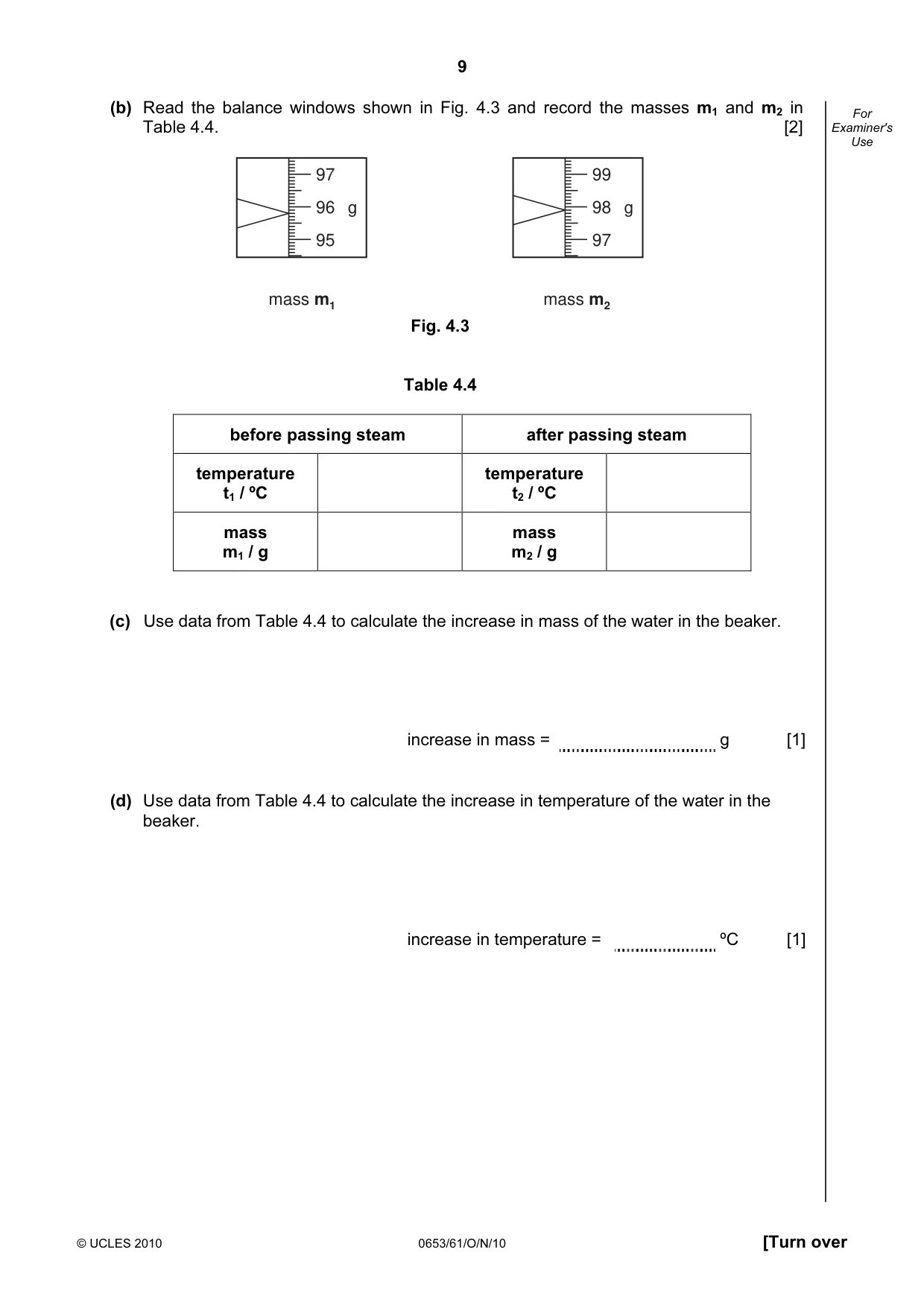
9 © UCLES 2010 0653/61/O/N/10 [Turn over For Examiner's Use (b) Read the balance windows shown in Fig. 4.3 and record the masses m1 and m2 in Table 4.4. [2] 97 96 95 g 99 98 97 g mass m1 mass m2 Fig. 4.3 Table 4.4 before passing steam after passing steam temperature t1 / ºC temperature t2 / ºC mass m1 / g mass m2 / g (c) Use data from Table 4.4 to calculate the increase in mass of the water in the beaker. increase in mass = g [1] (d) Use data from Table 4.4 to calculate the increase in temperature of the water in the beaker. increase in temperature = ºC [1]
Question paper, page 10
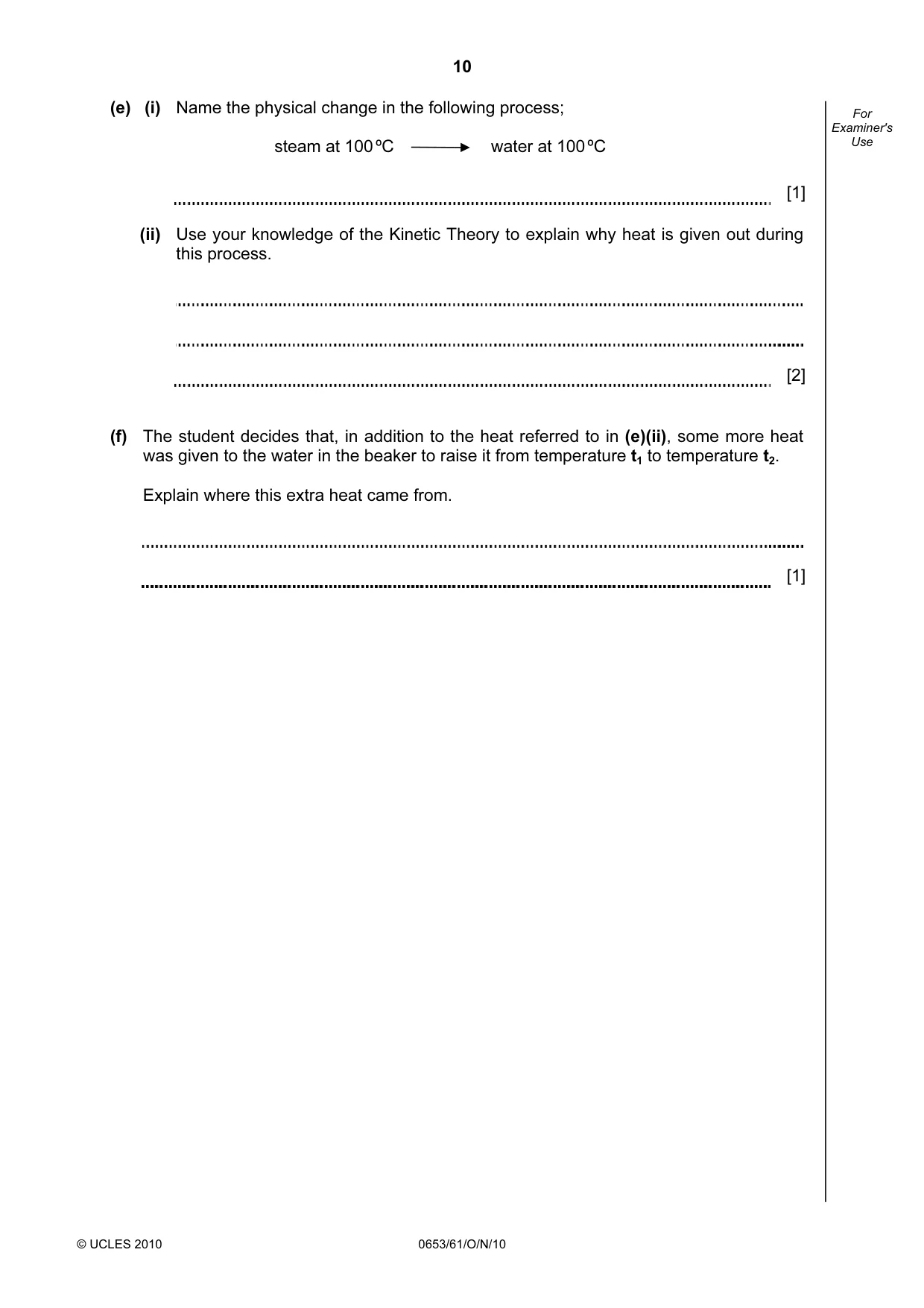
10 © UCLES 2010 0653/61/O/N/10 For Examiner's Use (e) (i) Name the physical change in the following process; steam at 100 ºC water at 100 ºC [1] (ii) Use your knowledge of the Kinetic Theory to explain why heat is given out during this process. [2] (f) The student decides that, in addition to the heat referred to in (e)(ii), some more heat was given to the water in the beaker to raise it from temperature t1 to temperature t2. Explain where this extra heat came from. [1]
Question paper, page 11
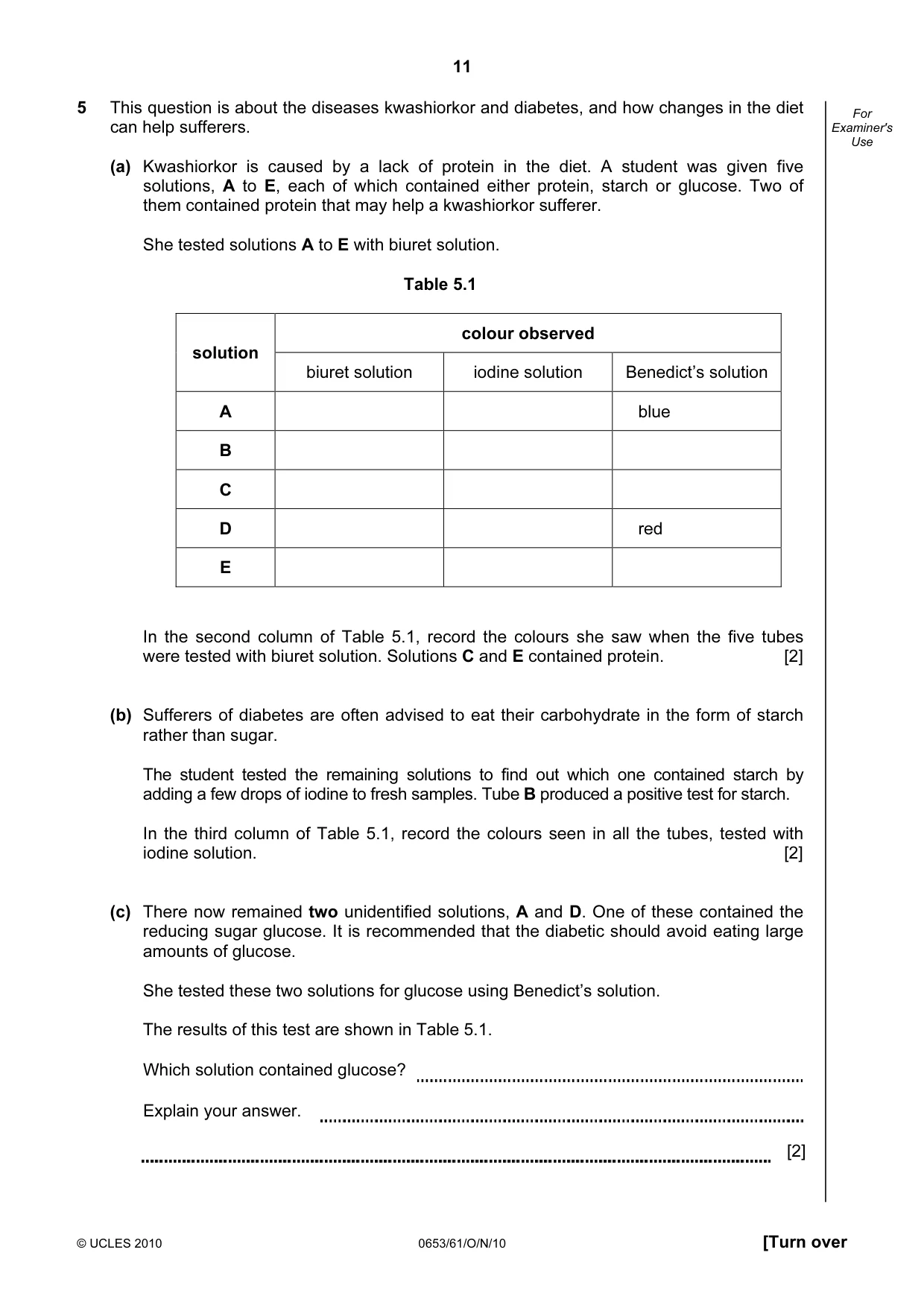
11 © UCLES 2010 0653/61/O/N/10 [Turn over For Examiner's Use 5 This question is about the diseases kwashiorkor and diabetes, and how changes in the diet can help sufferers. (a) Kwashiorkor is caused by a lack of protein in the diet. A student was given five solutions, A to E, each of which contained either protein, starch or glucose. Two of them contained protein that may help a kwashiorkor sufferer. She tested solutions A to E with biuret solution. Table 5.1 colour observed solution biuret solution iodine solution Benedict’s solution A blue B C D red E In the second column of Table 5.1, record the colours she saw when the five tubes were tested with biuret solution. Solutions C and E contained protein. [2] (b) Sufferers of diabetes are often advised to eat their carbohydrate in the form of starch rather than sugar. The student tested the remaining solutions to find out which one contained starch by adding a few drops of iodine to fresh samples. Tube B produced a positive test for starch. In the third column of Table 5.1, record the colours seen in all the tubes, tested with iodine solution. [2] (c) There now remained two unidentified solutions, A and D. One of these contained the reducing sugar glucose. It is recommended that the diabetic should avoid eating large amounts of glucose. She tested these two solutions for glucose using Benedict’s solution. The results of this test are shown in Table 5.1. Which solution contained glucose? Explain your answer. [2]
Question paper, page 12
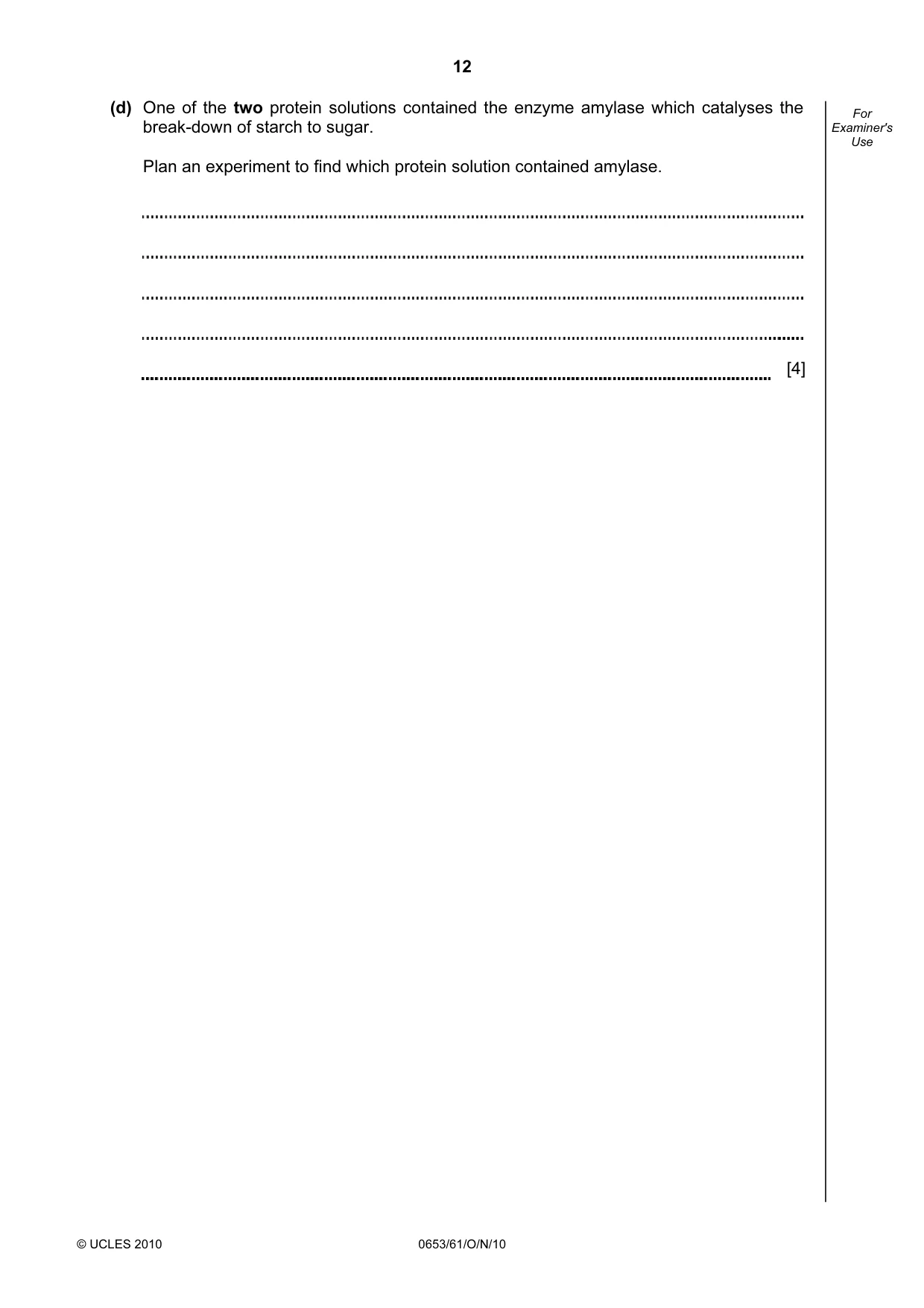
12 © UCLES 2010 0653/61/O/N/10 For Examiner's Use (d) One of the two protein solutions contained the enzyme amylase which catalyses the break-down of starch to sugar. Plan an experiment to find which protein solution contained amylase. [4]
Question paper, page 13
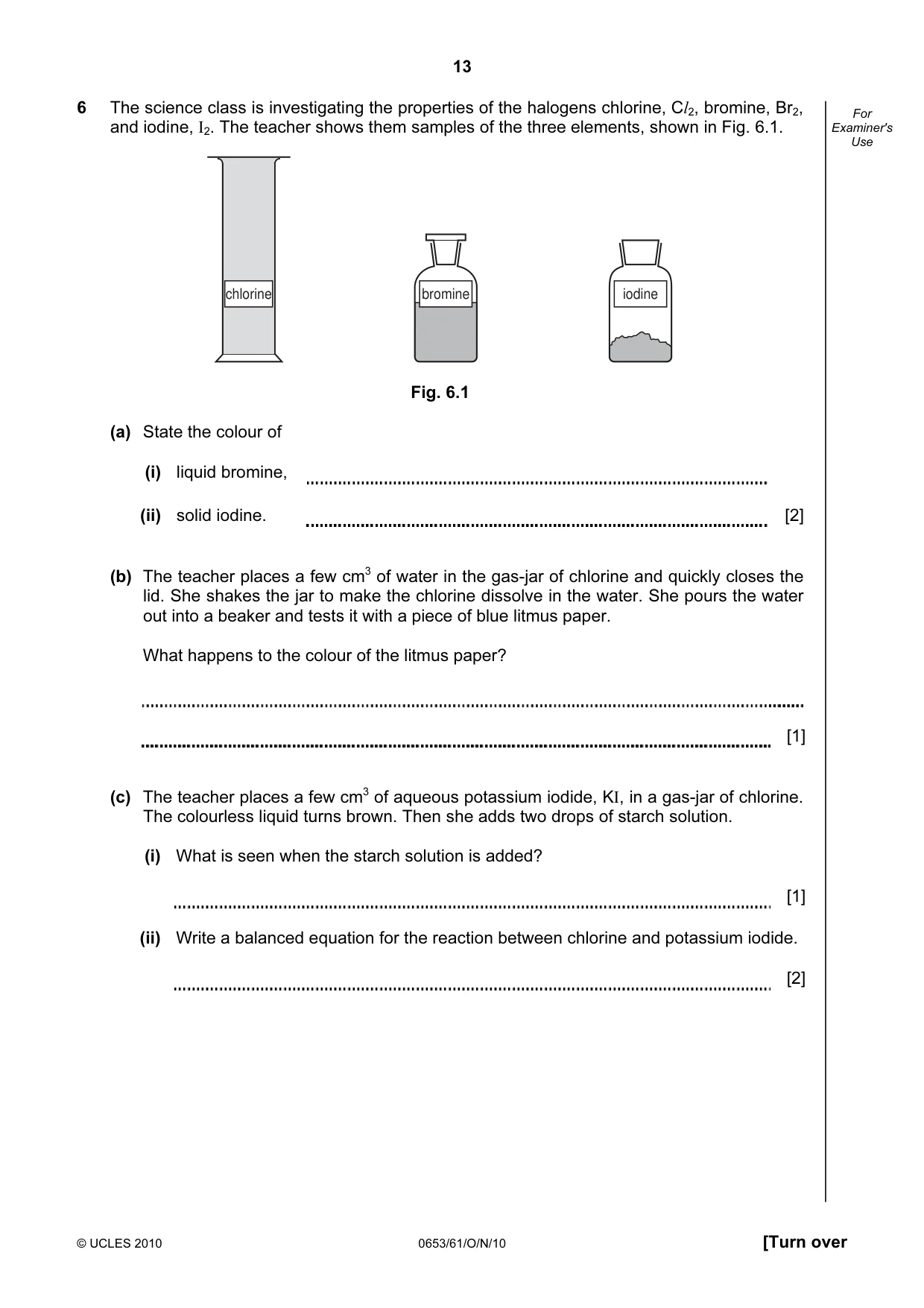
13 © UCLES 2010 0653/61/O/N/10 [Turn over For Examiner's Use 6 The science class is investigating the properties of the halogens chlorine, Cl2, bromine, Br2, and iodine, I2. The teacher shows them samples of the three elements, shown in Fig. 6.1. bromine chlorine iodine Fig. 6.1 (a) State the colour of (i) liquid bromine, (ii) solid iodine. [2] (b) The teacher places a few cm3 of water in the gas-jar of chlorine and quickly closes the lid. She shakes the jar to make the chlorine dissolve in the water. She pours the water out into a beaker and tests it with a piece of blue litmus paper. What happens to the colour of the litmus paper? [1] (c) The teacher places a few cm3 of aqueous potassium iodide, KI, in a gas-jar of chlorine. The colourless liquid turns brown. Then she adds two drops of starch solution. (i) What is seen when the starch solution is added? [1] (ii) Write a balanced equation for the reaction between chlorine and potassium iodide. [2]
Question paper, page 14
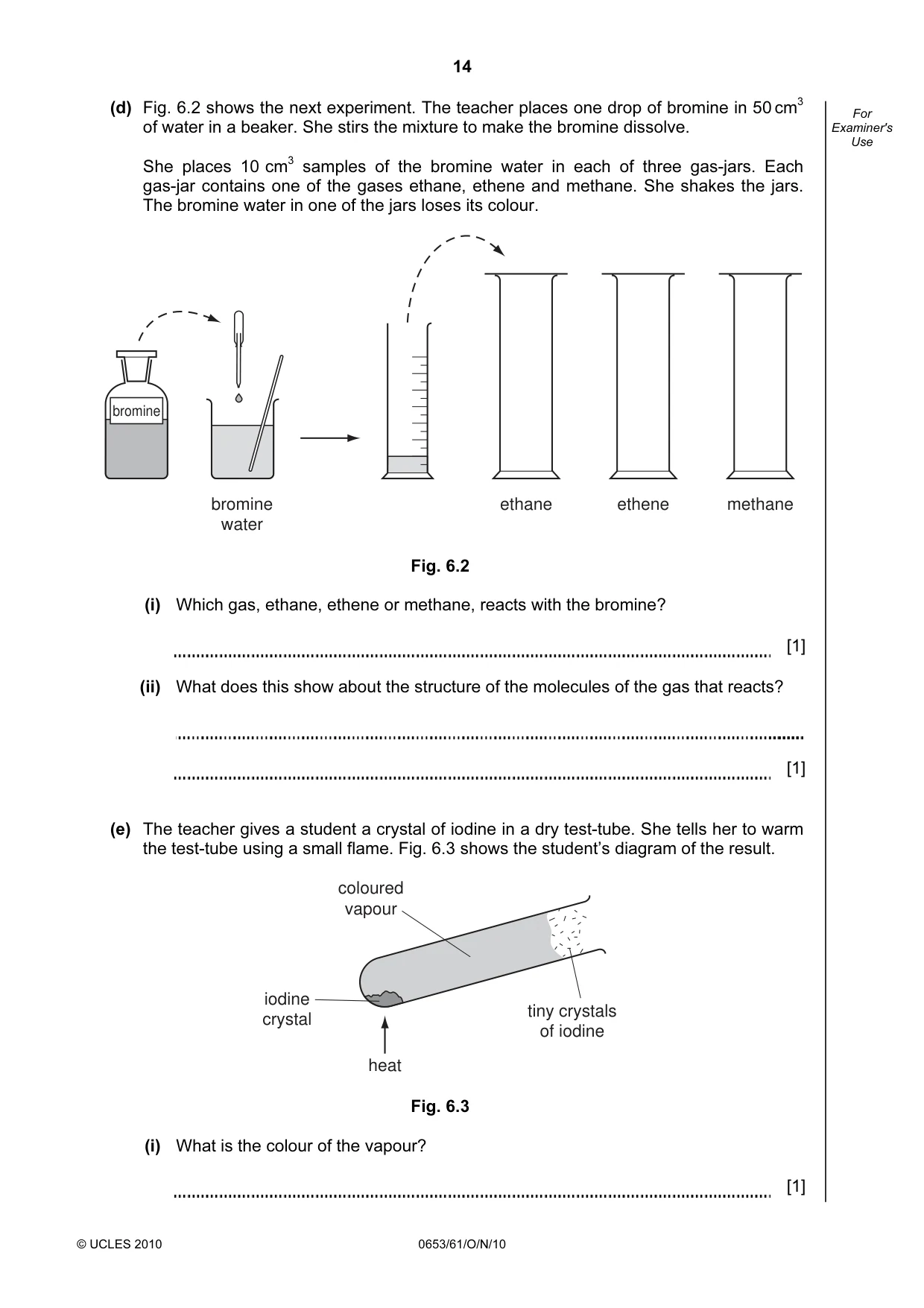
14 © UCLES 2010 0653/61/O/N/10 For Examiner's Use (d) Fig. 6.2 shows the next experiment. The teacher places one drop of bromine in 50 cm3 of water in a beaker. She stirs the mixture to make the bromine dissolve. She places 10 cm3 samples of the bromine water in each of three gas-jars. Each gas-jar contains one of the gases ethane, ethene and methane. She shakes the jars. The bromine water in one of the jars loses its colour. bromine ethane bromine water ethene methane Fig. 6.2 (i) Which gas, ethane, ethene or methane, reacts with the bromine? [1] (ii) What does this show about the structure of the molecules of the gas that reacts? [1] (e) The teacher gives a student a crystal of iodine in a dry test-tube. She tells her to warm the test-tube using a small flame. Fig. 6.3 shows the student’s diagram of the result. heat iodine crystal coloured vapour tiny crystals of iodine Fig. 6.3 (i) What is the colour of the vapour? [1]
Question paper, page 15
15 © UCLES 2010 0653/61/O/N/10 For Examiner's Use (ii) What name is given to the change from a vapour to a solid? [1]
Question paper, page 16
16 Permission to reproduce items where third-party owned material protected by copyright is included has been sought and cleared where possible. Every reasonable effort has been made by the publisher (UCLES) to trace copyright holders, but if any items requiring clearance have unwittingly been included, the publisher will be pleased to make amends at the earliest possible opportunity. University of Cambridge International Examinations is part of the Cambridge Assessment Group. Cambridge Assessment is the brand name of University of Cambridge Local Examinations Syndicate (UCLES), which is itself a department of the University of Cambridge. 0653/61/O/N/10 BLANK PAGE
Mark scheme, page 1
UNIVERSITY OF CAMBRIDGE INTERNATIONAL EXAMINATIONS International General Certificate of Secondary Education MARK SCHEME for the October/November 2010 question paper for the guidance of teachers 0653 COMBINED SCIENCE 0653/61 Paper 6 (Alternative to Practical), maximum raw mark 60 This mark scheme is published as an aid to teachers and candidates, to indicate the requirements of the examination. It shows the basis on which Examiners were instructed to award marks. It does not indicate the details of the discussions that took place at an Examiners’ meeting before marking began, which would have considered the acceptability of alternative answers. Mark schemes must be read in conjunction with the question papers and the report on the examination. • CIE will not enter into discussions or correspondence in connection with these mark schemes. CIE is publishing the mark schemes for the October/November 2010 question papers for most IGCSE, GCE Advanced Level and Advanced Subsidiary Level syllabuses and some Ordinary Level syllabuses. www.XtremePapers.com
Mark scheme, page 2
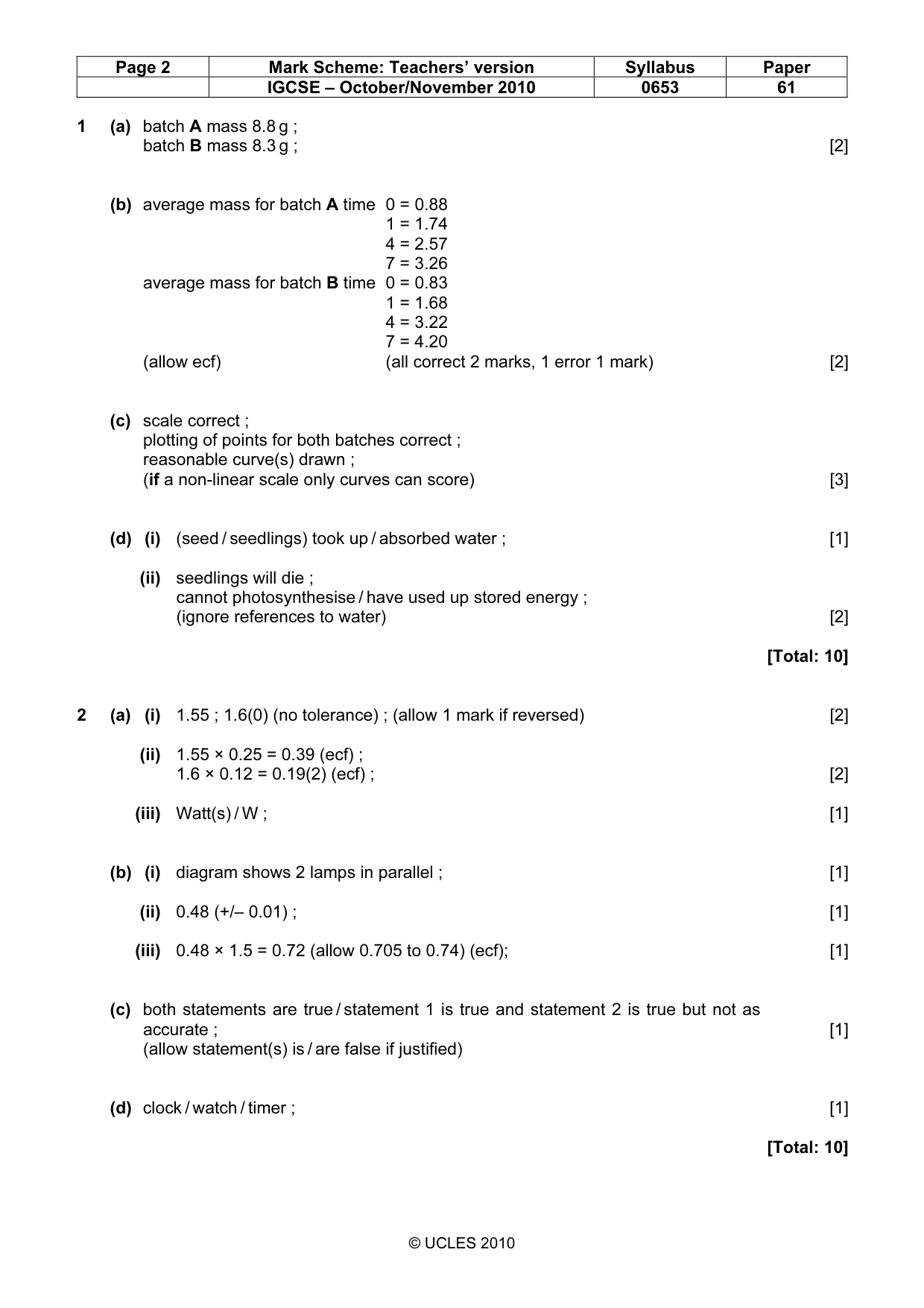
Page 2 Mark Scheme: Teachers’ version Syllabus Paper IGCSE – October/November 2010 0653 61 © UCLES 2010 1 (a) batch A mass 8.8 g ; batch B mass 8.3 g ; [2] (b) average mass for batch A time 0 = 0.88 1 = 1.74 4 = 2.57 7 = 3.26 average mass for batch B time 0 = 0.83 1 = 1.68 4 = 3.22 7 = 4.20 (allow ecf) (all correct 2 marks, 1 error 1 mark) [2] (c) scale correct ; plotting of points for both batches correct ; reasonable curve(s) drawn ; (if a non-linear scale only curves can score) [3] (d) (i) (seed / seedlings) took up / absorbed water ; [1] (ii) seedlings will die ; cannot photosynthesise / have used up stored energy ; (ignore references to water) [2] [Total: 10] 2 (a) (i) 1.55 ; 1.6(0) (no tolerance) ; (allow 1 mark if reversed) [2] (ii) 1.55 × 0.25 = 0.39 (ecf) ; 1.6 × 0.12 = 0.19(2) (ecf) ; [2] (iii) Watt(s) / W ; [1] (b) (i) diagram shows 2 lamps in parallel ; [1] (ii) 0.48 (+/– 0.01) ; [1] (iii) 0.48 × 1.5 = 0.72 (allow 0.705 to 0.74) (ecf); [1] (c) both statements are true / statement 1 is true and statement 2 is true but not as accurate ; [1] (allow statement(s) is / are false if justified) (d) clock / watch / timer ; [1] [Total: 10]
Mark scheme, page 3
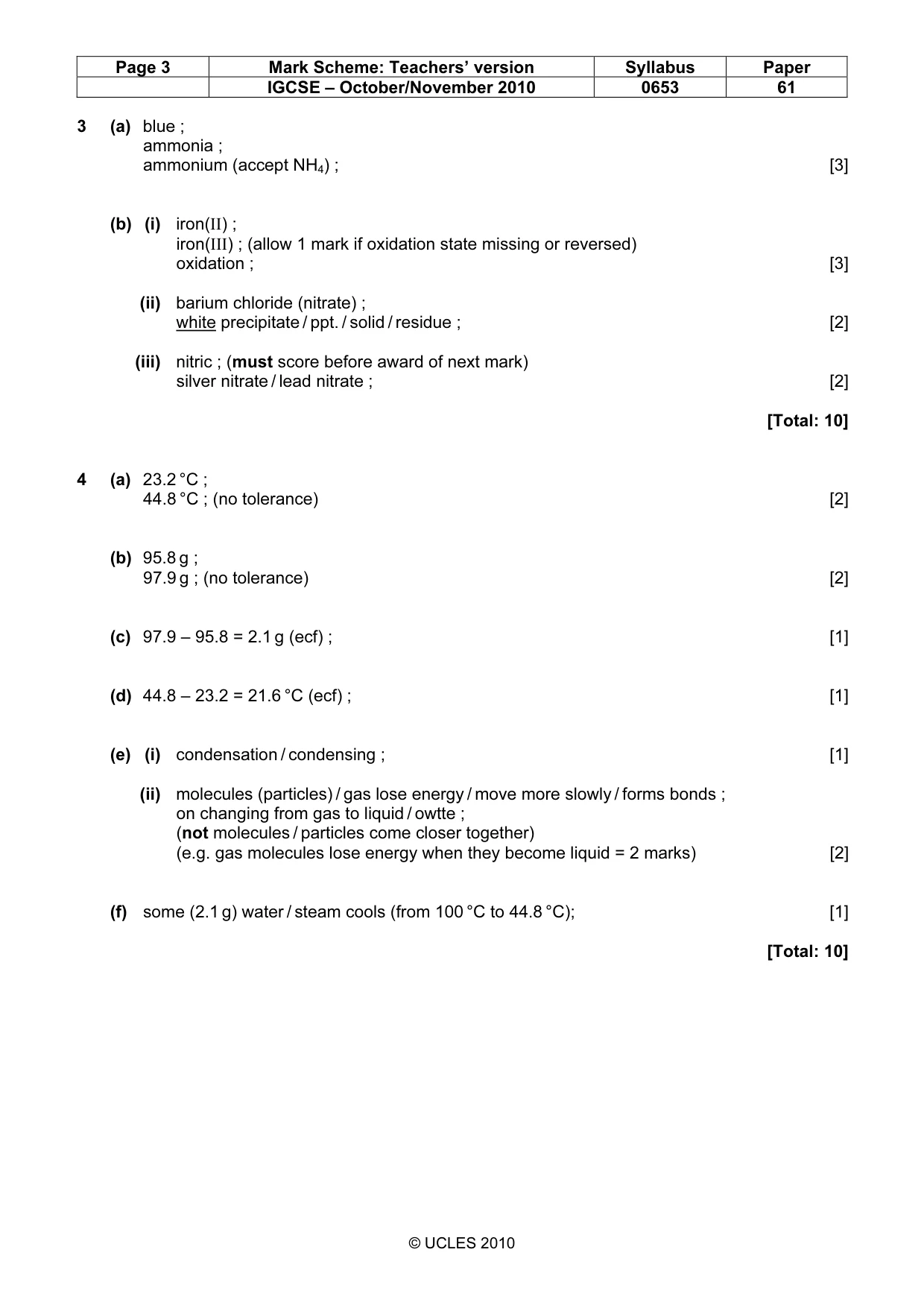
Page 3 Mark Scheme: Teachers’ version Syllabus Paper IGCSE – October/November 2010 0653 61 © UCLES 2010 3 (a) blue ; ammonia ; ammonium (accept NH4) ; [3] (b) (i) iron(II) ; iron(III) ; (allow 1 mark if oxidation state missing or reversed) oxidation ; [3] (ii) barium chloride (nitrate) ; white precipitate / ppt. / solid / residue ; [2] (iii) nitric ; (must score before award of next mark) silver nitrate / lead nitrate ; [2] [Total: 10] 4 (a) 23.2 °C ; 44.8 °C ; (no tolerance) [2] (b) 95.8 g ; 97.9 g ; (no tolerance) [2] (c) 97.9 – 95.8 = 2.1 g (ecf) ; [1] (d) 44.8 – 23.2 = 21.6 °C (ecf) ; [1] (e) (i) condensation / condensing ; [1] (ii) molecules (particles) / gas lose energy / move more slowly / forms bonds ; on changing from gas to liquid / owtte ; (not molecules / particles come closer together) (e.g. gas molecules lose energy when they become liquid = 2 marks) [2] (f) some (2.1 g) water / steam cools (from 100 °C to 44.8 °C); [1] [Total: 10]
Mark scheme, page 4
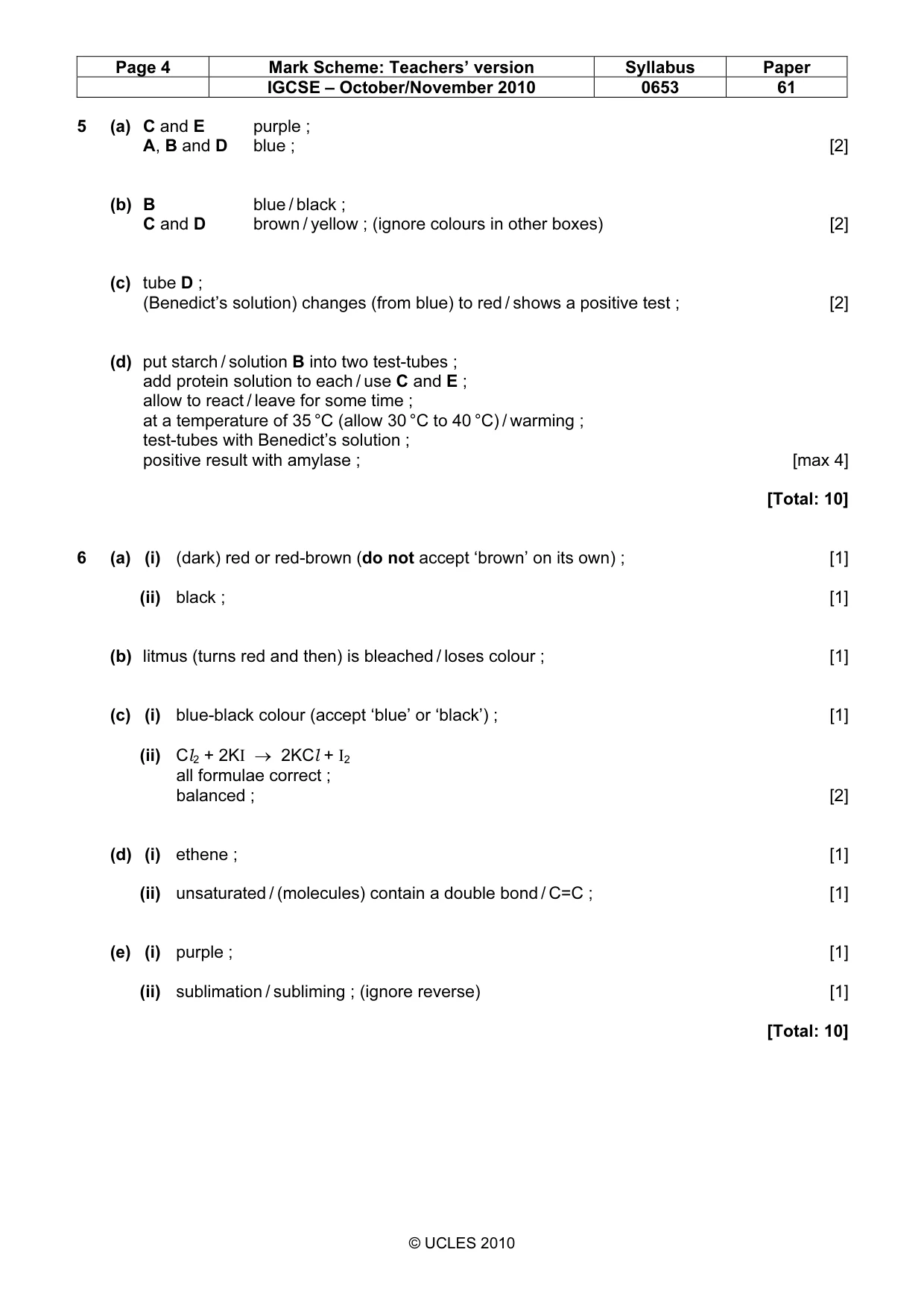
Page 4 Mark Scheme: Teachers’ version Syllabus Paper IGCSE – October/November 2010 0653 61 © UCLES 2010 5 (a) C and E purple ; A, B and D blue ; [2] (b) B blue / black ; C and D brown / yellow ; (ignore colours in other boxes) [2] (c) tube D ; (Benedict’s solution) changes (from blue) to red / shows a positive test ; [2] (d) put starch / solution B into two test-tubes ; add protein solution to each / use C and E ; allow to react / leave for some time ; at a temperature of 35 °C (allow 30 °C to 40 °C) / warming ; test-tubes with Benedict’s solution ; positive result with amylase ; [max 4] [Total: 10] 6 (a) (i) (dark) red or red-brown (do not accept ‘brown’ on its own) ; [1] (ii) black ; [1] (b) litmus (turns red and then) is bleached / loses colour ; [1] (c) (i) blue-black colour (accept ‘blue’ or ‘black’) ; [1] (ii) Cl2 + 2KI → 2KCl + I2 all formulae correct ; balanced ; [2] (d) (i) ethene ; [1] (ii) unsaturated / (molecules) contain a double bond / C=C ; [1] (e) (i) purple ; [1] (ii) sublimation / subliming ; (ignore reverse) [1] [Total: 10]