Cambridge IGCSE Science - Combined 0653 — 2025 Oct/Nov Paper 6 · Variant 2
0653/62/O/N/25 · 4 questions · 40 marks · 60 min
The question paper and its mark scheme, free to read here and free to download. This is Cambridge’s own paper, exactly as it was sat.
Question paper16 pages
Mark scheme10 pages
Answers below. Sit the paper first if you are practising.
Questions as text
Q1 · A student investigates the effect of light intensity on the rate of photosynthesis
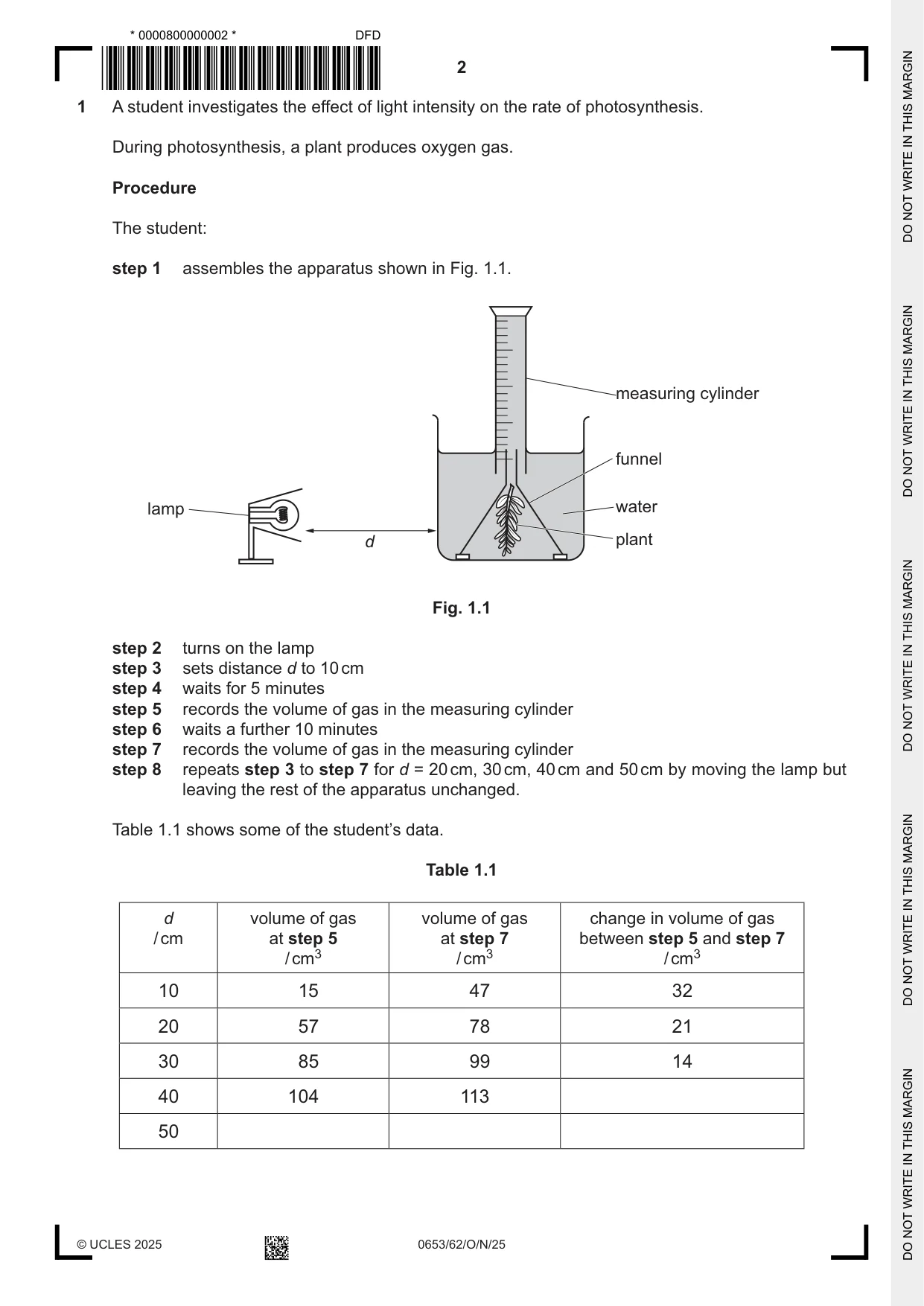
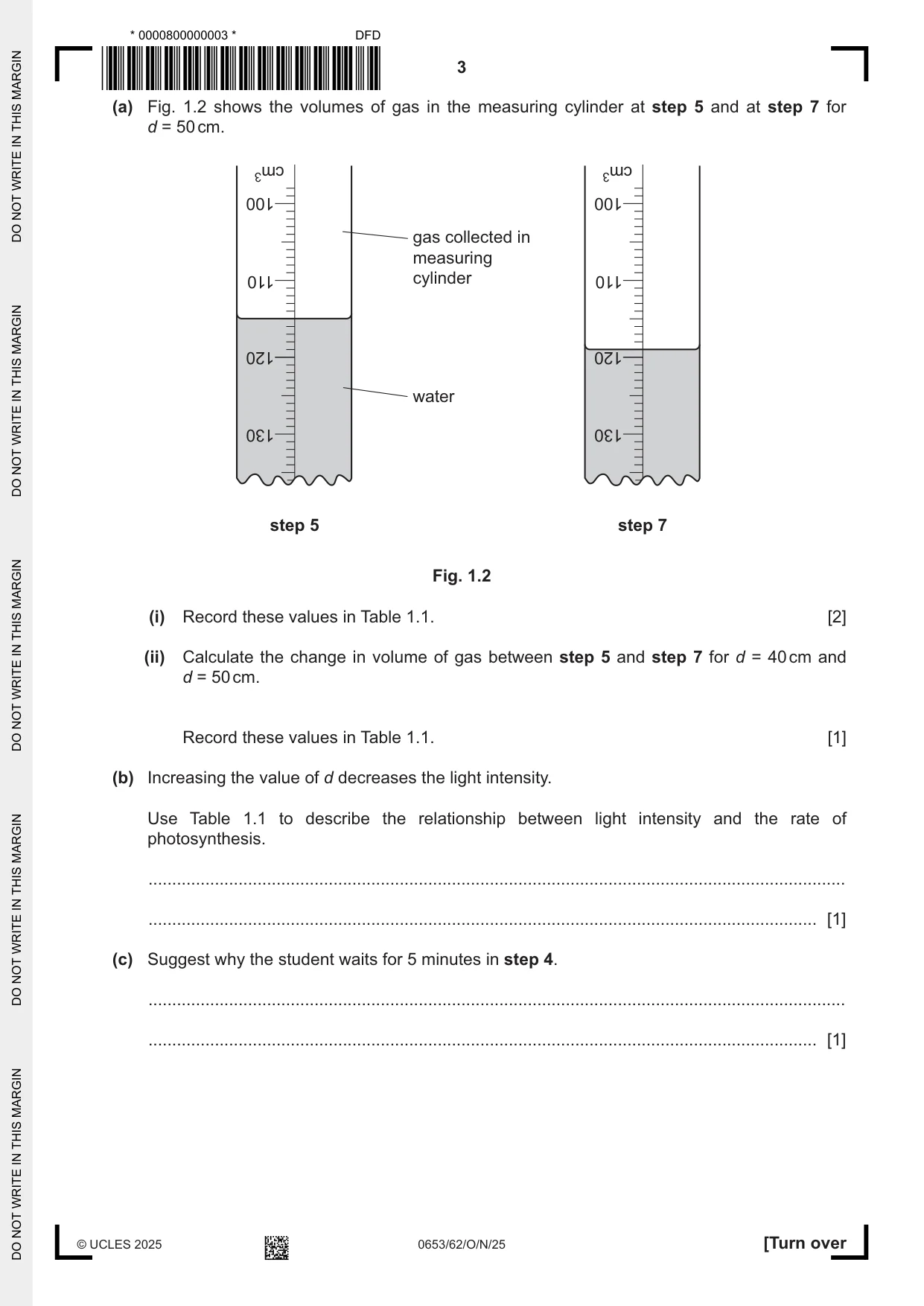
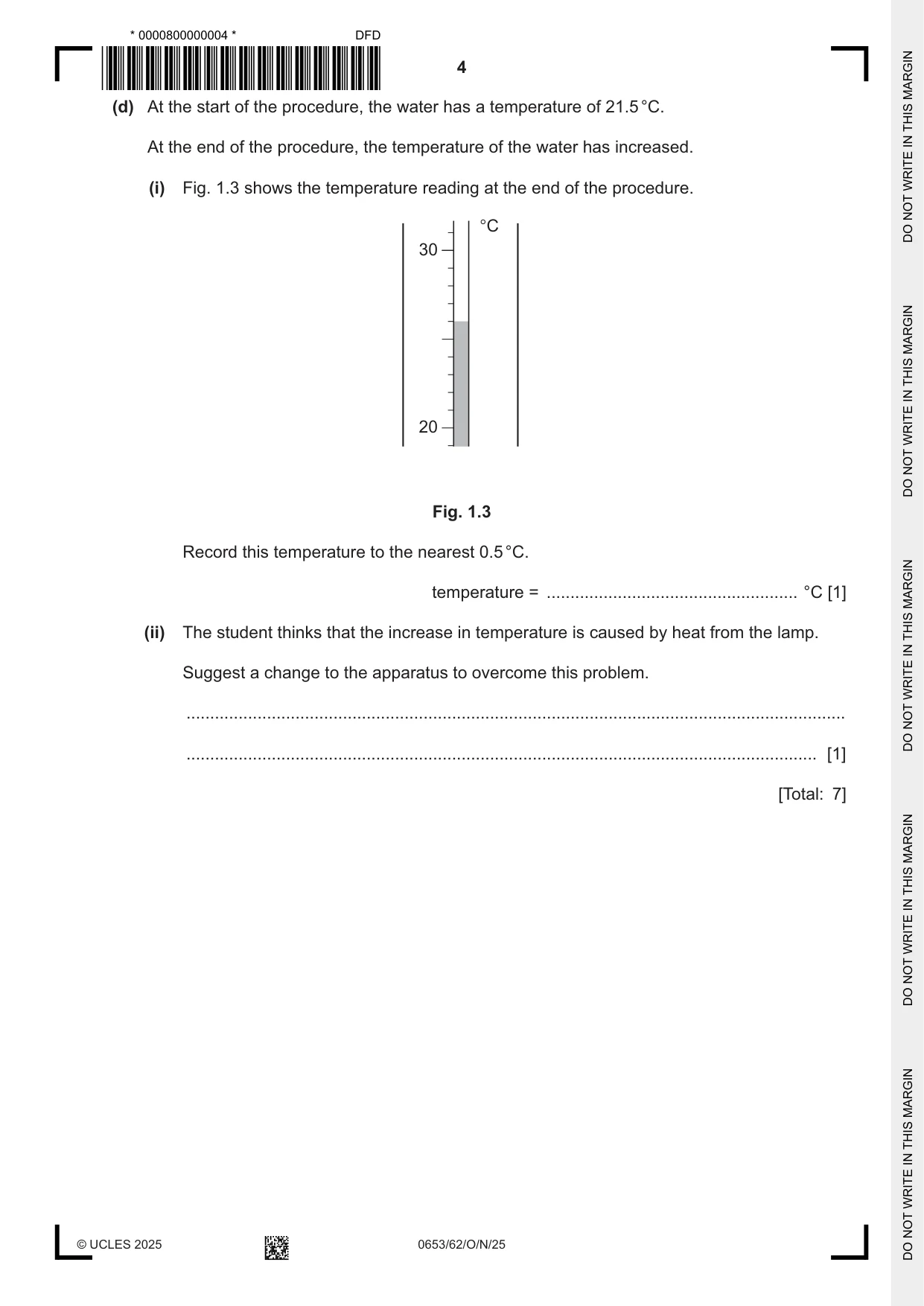
1 A student investigates the effect of light intensity on the rate of photosynthesis. During photosynthesis, a plant produces oxygen gas. Procedure The student: step 1 assembles the apparatus shown in Fig. 1.1. measuring cylinder funnel lamp water d plant Fig. 1.1 step 2 turns on the lamp step 3 sets distance d to 10 cm step 4 waits for 5 minutes step 5 records the volume of gas in the measuring cylinder step 6 waits a further 10 minutes step 7 records the volume of gas in the measuring cylinder step 8 repeats step 3 to step 7 for d = 20 cm, 30 cm, 40 cm and 50 cm by moving the lamp but leaving the rest of the apparatus unchanged. Table 1.1 shows some of the student’s data. Table 1.1 d volume of gas volume of gas change in volume of gas / cm at step 5 at step 7 between step 5 and step 7 / cm3 / cm3 / cm3 10 15 47 32 20 57 78 21 30 85 99 14 40 104 113 50 (a) Fig. 1.2 shows the volumes of gas in the measuring cylinder at step 5 and at step 7 for d = 50 cm. cm3 cm3 100 100 gas collected in measuring 110 cylinder 110 120 120 water 130 130 step 5 step 7 Fig. 1.2 (i) Record these values in Table 1.1. [2] (ii) Calculate the change in volume of gas between step 5 and step 7 for d = 40 cm and d = 50 cm. Record these values in Table 1.1. [1] (b) Increasing the value of d decreases the light intensity. Use Table 1.1 to describe the relationship between light intensity and the rate of photosynthesis. ................................................................................................................................................... ............................................................................................................................................. [1] (c) Suggest why the student waits for 5 minutes in step 4. ................................................................................................................................................... ............................................................................................................................................. [1] (d) At the start of the procedure, the water has a temperature of 21.5 °C. At the end of the procedure, the temperature of the water has increased. (i) Fig. 1.3 shows the temperature reading at the end of the procedure. °C 30 20 Fig. 1.3 Record this temperature to the nearest 0.5 °C. temperature = ..................................................... °C [1] (ii) The student thinks that the increase in temperature is caused by heat from the lamp. Suggest a change to the apparatus to overcome this problem. ........................................................................................................................................... ..................................................................................................................................... [1] [Total: 7]
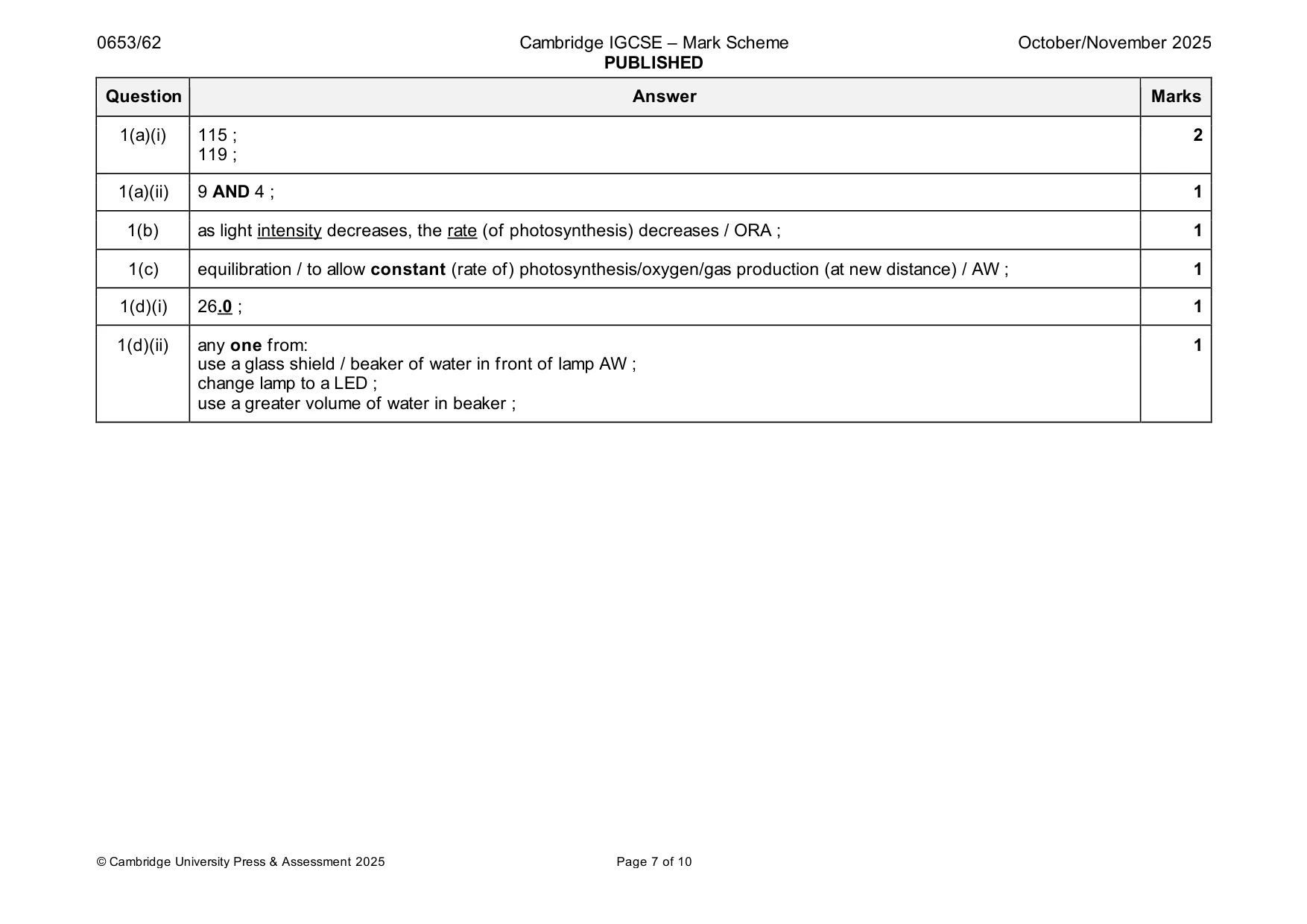
Mark scheme: Question Answer Marks 1(a)(i) 115 ; 2 119 ; 1(a)(ii) 9 AND 4 ; 1 1(b) as light intensity decreases, the rate (of photosynthesis) decreases / ORA ; 1 1(c) equilibration / to allow constant (rate of) photosynthesis/oxygen/gas production (at new distance) / AW ; 1 1(d)(i) 26.0 ; 1 1(d)(ii) any one from: 1 use a glass shield / beaker of water in front of lamp AW ; change lamp to a LED ; use a greater volume of water in beaker ;
Q2 · The leaves of plants may be different colours
2 The leaves of plants may be different colours. When a leaf transpires, it loses water, and the mass of the leaf decreases. A student states: The colour of a leaf affects the rate of water loss from the leaf. Plan an investigation to test this statement. You are provided with leaves of different colours that have been removed from the same type of plant. You may use any common laboratory apparatus in your plan. In your plan, include: • the apparatus you will use • a brief description of the method • what you will measure • which variables you will control • how you will process your results to form a conclusion. You may include a results table (you are not required to enter any data into the table). .......................................................................................................................................................... .......................................................................................................................................................... .......................................................................................................................................................... .......................................................................................................................................................... .......................................................................................................................................................... .......................................................................................................................................................... .......................................................................................................................................................... .......................................................................................................................................................... .......................................................................................................................................................... .......................................................................................................................................................... .......................................................................................................................................................... .......................................................................................................................................................... .......................................................................................................................................................... .......................................................................................................................................................... .......................................................................................................................................................... .......................................................................................................................................................... .................................................................................................................................................... [7]
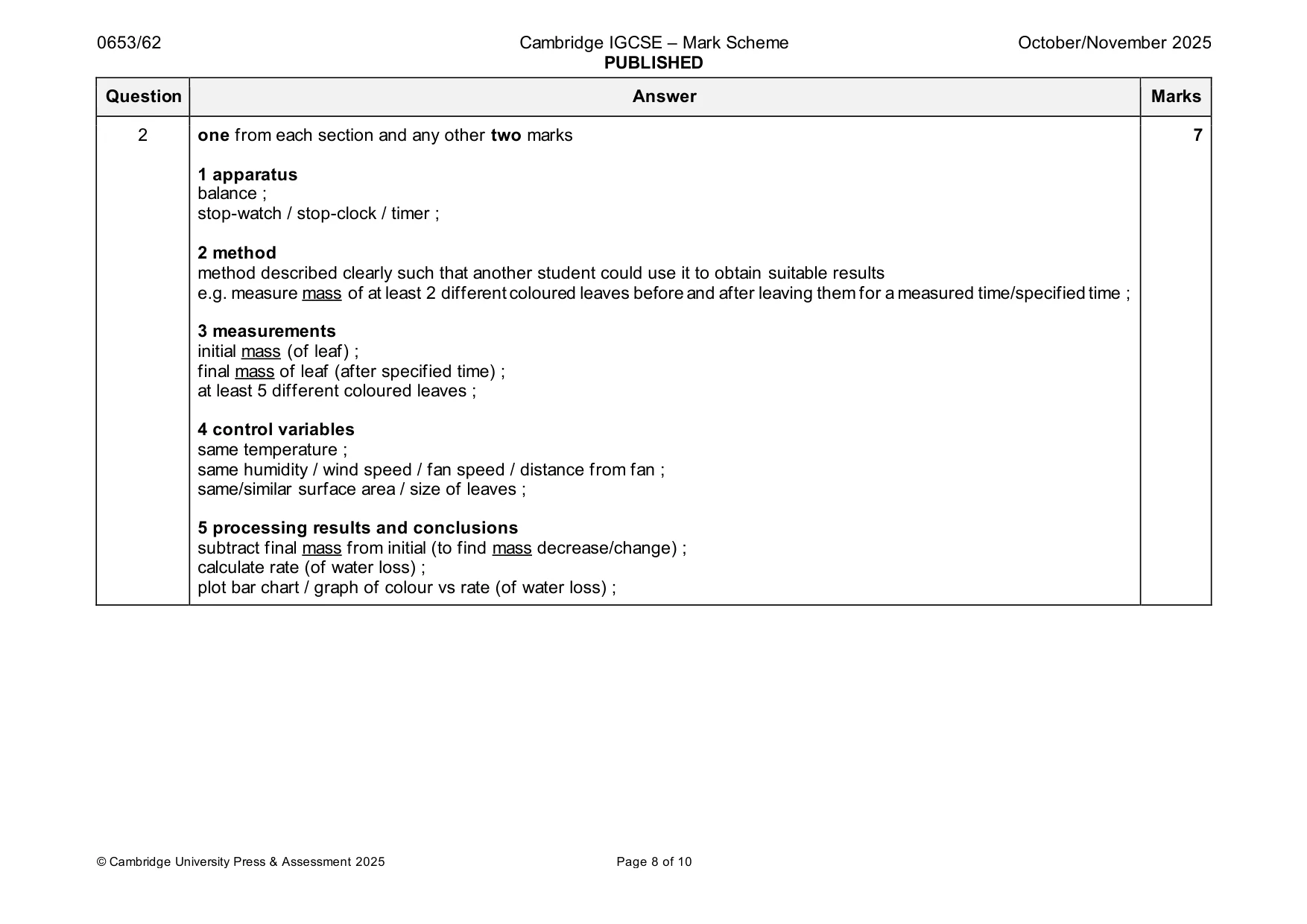
Mark scheme: 2 one from each section and any other two marks 7 1 apparatus balance ; stop-watch / stop-clock / timer ; 2 method method described clearly such that another student could use it to obtain suitable results e.g. measure mass of at least 2 different coloured leaves before and after leaving them for a measured time/specified time ; 3 measurements initial mass (of leaf) ; final mass of leaf (after specified time) ; at least 5 different coloured leaves ; 4 control variables same temperature ; same humidity / wind speed / fan speed / distance from fan ; same/similar surface area / size of leaves ; 5 processing results and conclusions subtract final mass from initial (to find mass decrease/change) ; calculate rate (of water loss) ; plot bar chart / graph of colour vs rate (of water loss) ;
Q3 · A student determines the percentage by mass of copper in copper oxide
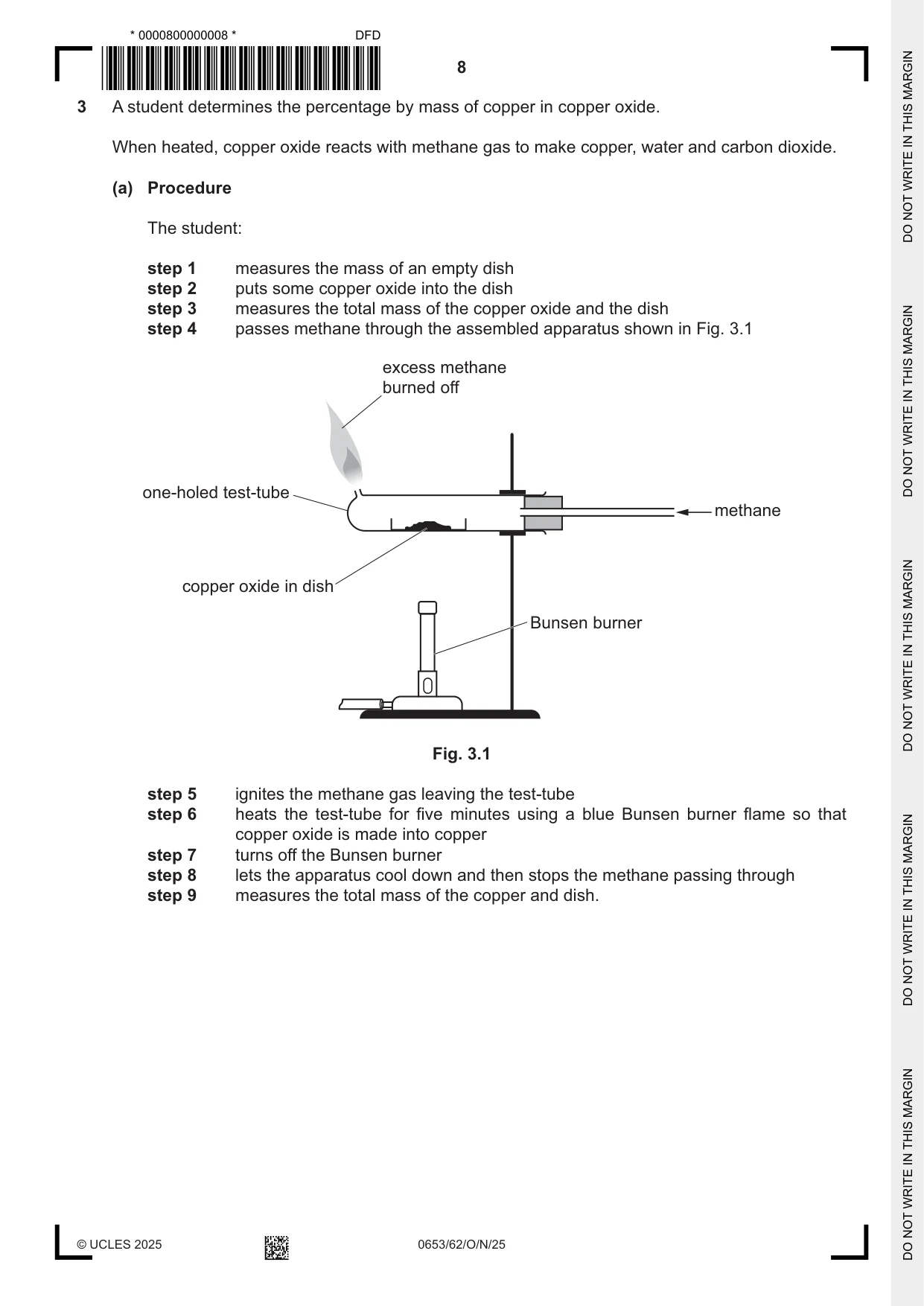
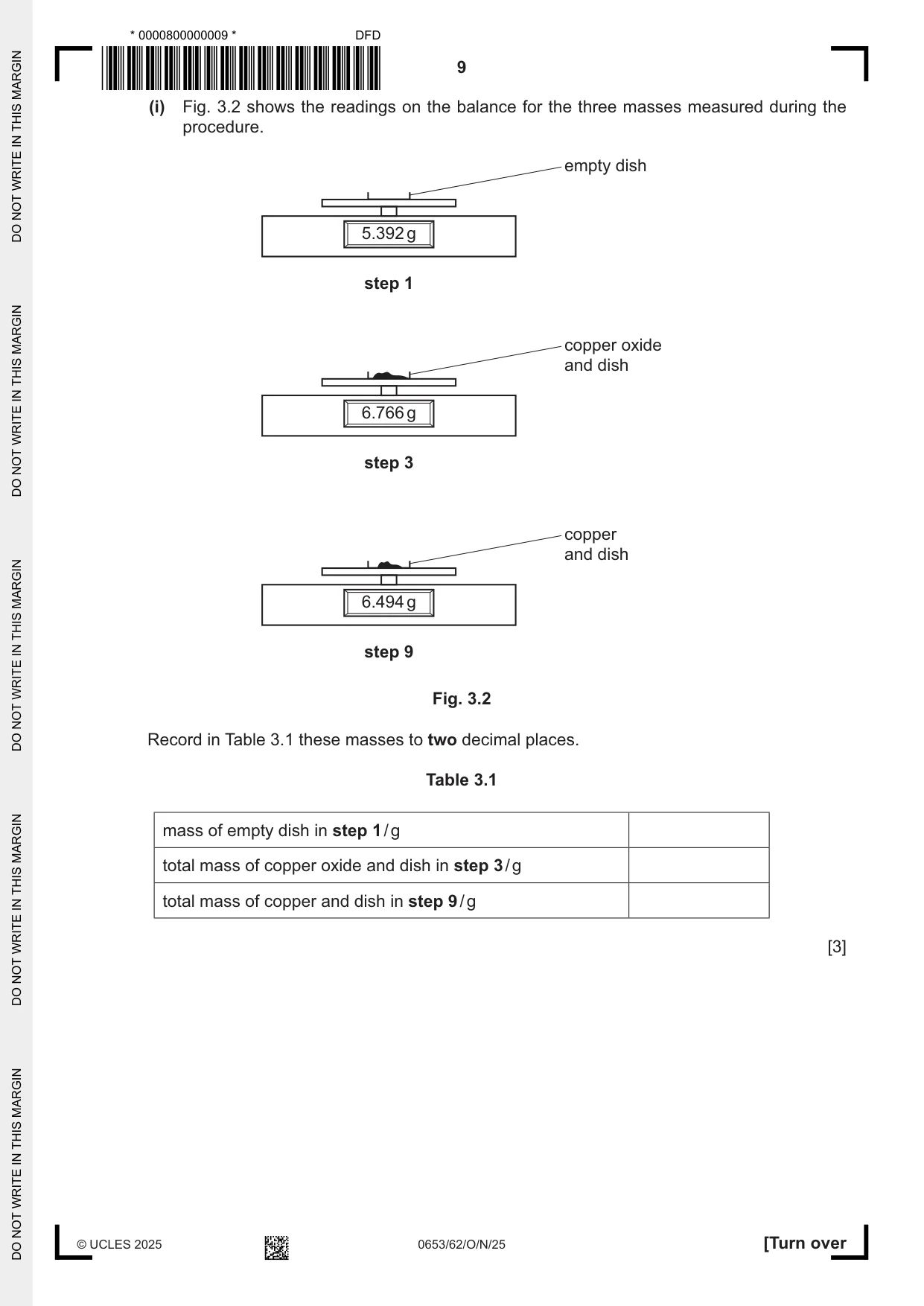
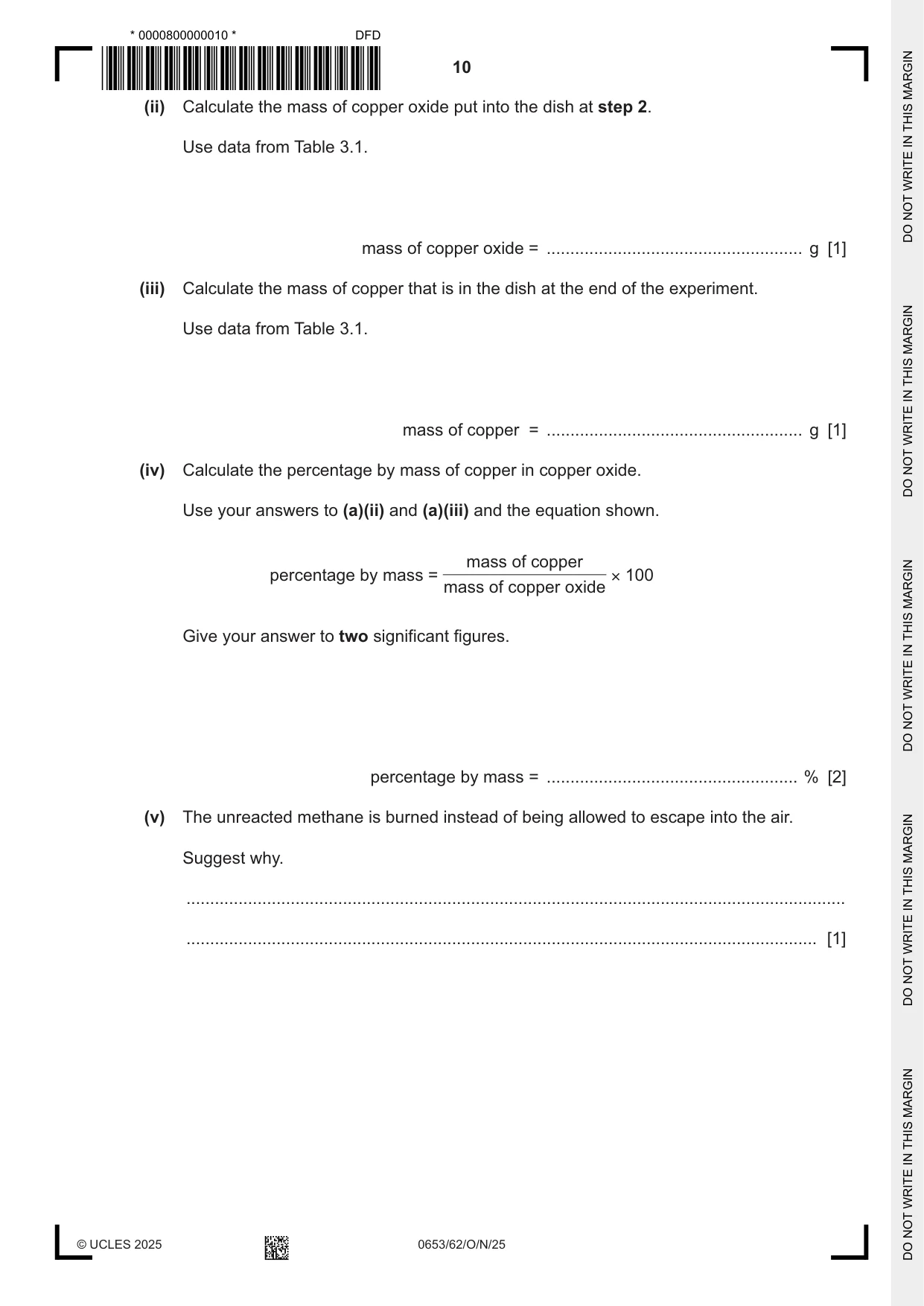
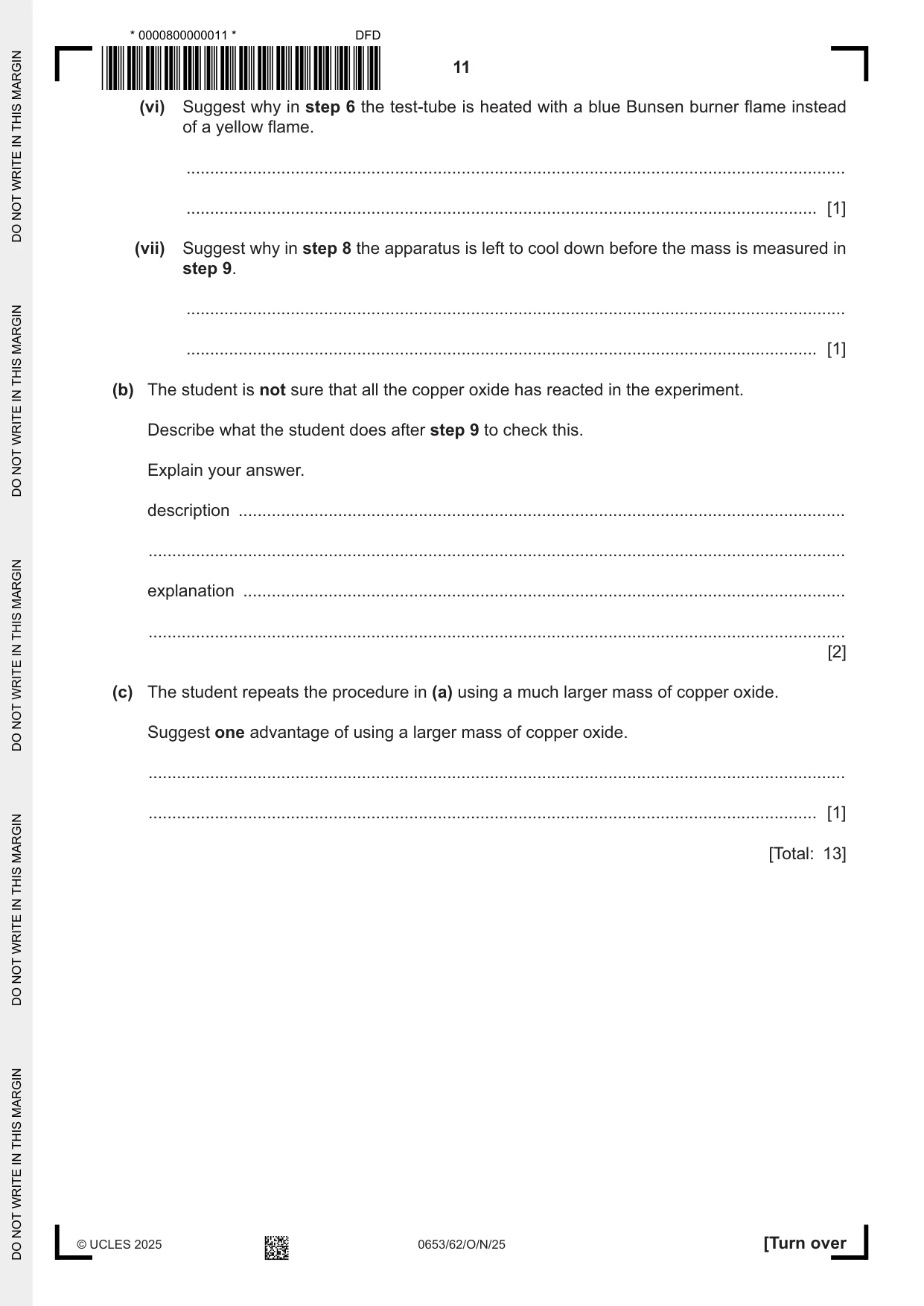
3 A student determines the percentage by mass of copper in copper oxide. When heated, copper oxide reacts with methane gas to make copper, water and carbon dioxide. (a) Procedure The student: step 1 measures the mass of an empty dish step 2 puts some copper oxide into the dish step 3 measures the total mass of the copper oxide and the dish step 4 passes methane through the assembled apparatus shown in Fig. 3.1 excess methane burned off one-holed test-tube methane copper oxide in dish Bunsen burner Fig. 3.1 step 5 ignites the methane gas leaving the test-tube step 6 heats the test-tube for five minutes using a blue Bunsen burner flame so that copper oxide is made into copper step 7 turns off the Bunsen burner step 8 lets the apparatus cool down and then stops the methane passing through step 9 measures the total mass of the copper and dish. (i) Fig. 3.2 shows the readings on the balance for the three masses measured during the procedure. empty dish 5.392 g step 1 copper oxide and dish 6.766 g step 3 copper and dish 6.494 g step 9 Fig. 3.2 Record in Table 3.1 these masses to two decimal places. Table 3.1 mass of empty dish in step 1 / g total mass of copper oxide and dish in step 3 / g total mass of copper and dish in step 9 / g [3] (ii) Calculate the mass of copper oxide put into the dish at step 2. Use data from Table 3.1. mass of copper oxide = ...................................................... g [1] (iii) Calculate the mass of copper that is in the dish at the end of the experiment. Use data from Table 3.1. mass of copper = ...................................................... g [1] (iv) Calculate the percentage by mass of copper in copper oxide. Use your answers to (a)(ii) and (a)(iii) and the equation shown. mass of copper percentage by mass = × 100 mass of copper oxide Give your answer to two significant figures. percentage by mass = ..................................................... % [2] (v) The unreacted methane is burned instead of being allowed to escape into the air. Suggest why. ........................................................................................................................................... ..................................................................................................................................... [1] (vi) Suggest why in step 6 the test-tube is heated with a blue Bunsen burner flame instead of a yellow flame. ........................................................................................................................................... ..................................................................................................................................... [1] (vii) Suggest why in step 8 the apparatus is left to cool down before the mass is measured in step 9. ........................................................................................................................................... ..................................................................................................................................... [1] (b) The student is not sure that all the copper oxide has reacted in the experiment. Describe what the student does after step 9 to check this. Explain your answer. description ................................................................................................................................ ................................................................................................................................................... explanation ............................................................................................................................... ................................................................................................................................................... [2] (c) The student repeats the procedure in (a) using a much larger mass of copper oxide. Suggest one advantage of using a larger mass of copper oxide. ................................................................................................................................................... ............................................................................................................................................. [1] [Total: 13]
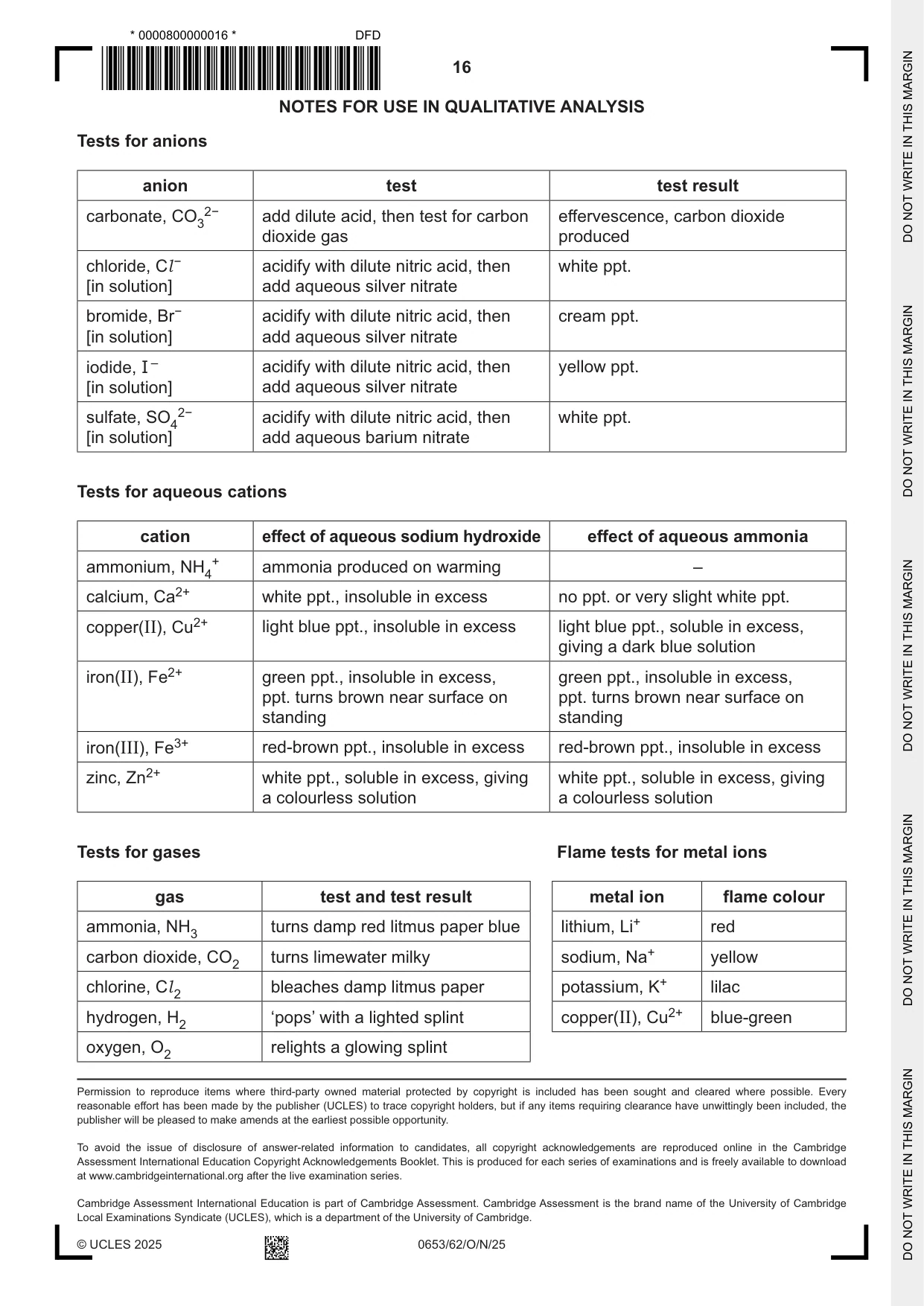
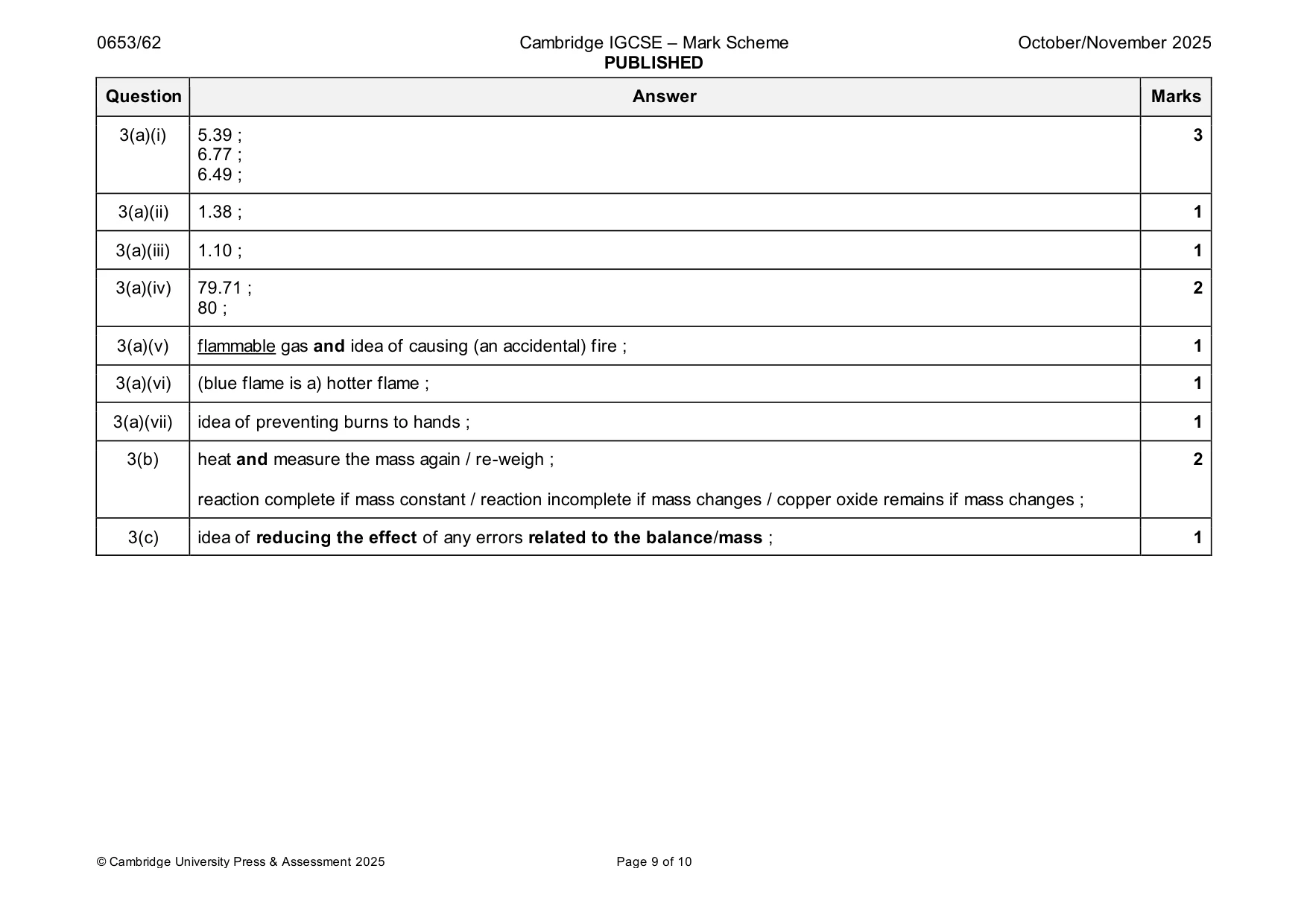
Mark scheme: 3(a)(i) 5.39 ; 3 6.77 ; 6.49 ; 3(a)(ii) 1.38 ; 1 3(a)(iii) 1.10 ; 1 3(a)(iv) 79.71 ; 2 80 ; 3(a)(v) flammable gas and idea of causing (an accidental) fire ; 1 3(a)(vi) (blue flame is a) hotter flame ; 1 3(a)(vii) idea of preventing burns to hands ; 1 3(b) heat and measure the mass again / re-weigh ; 2 reaction complete if mass constant / reaction incomplete if mass changes / copper oxide remains if mass changes ; 3(c) idea of reducing the effect of any errors related to the balance/mass ; 1
Q4 · A student determines the mass M of a metre rule using a balancing method
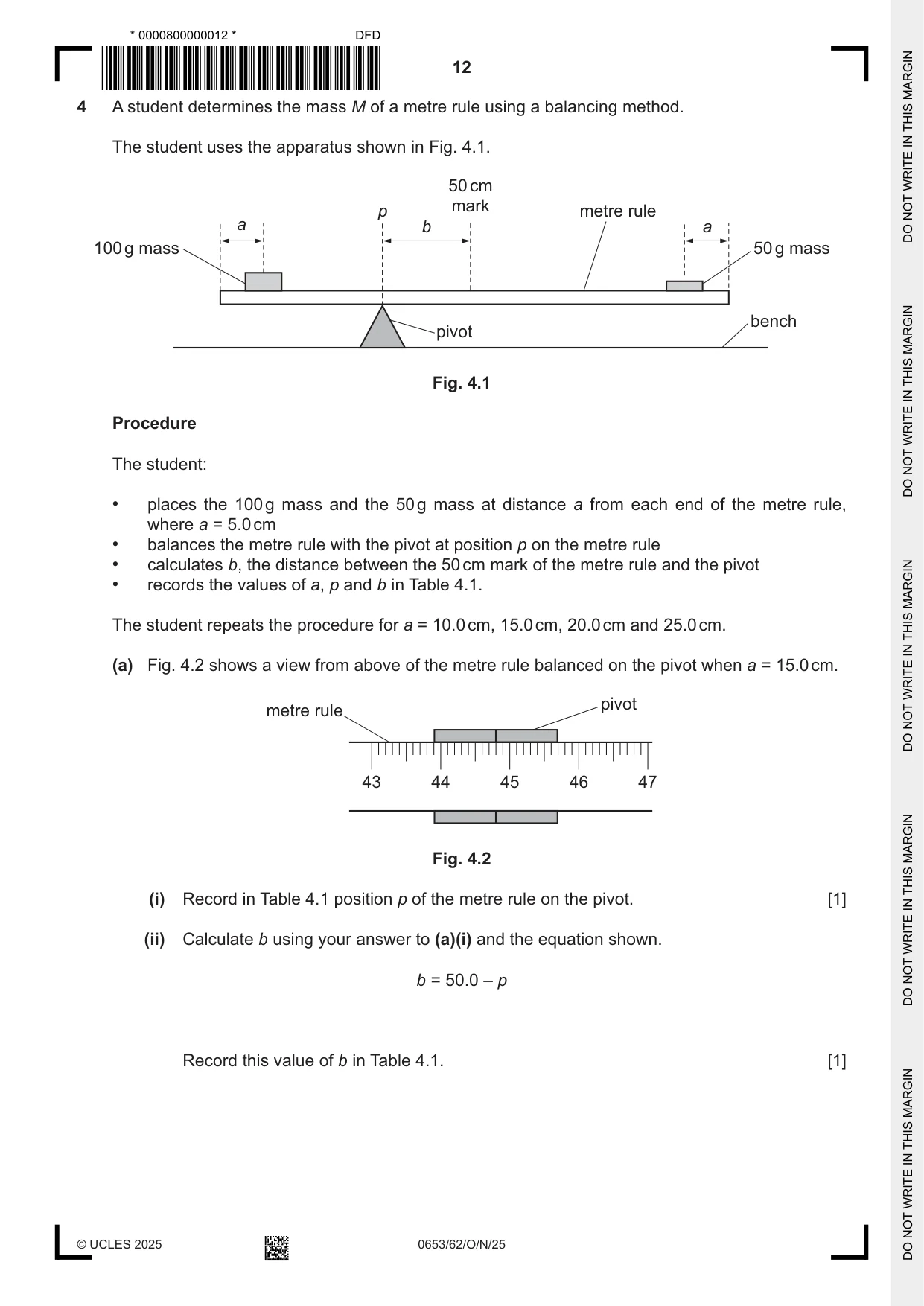
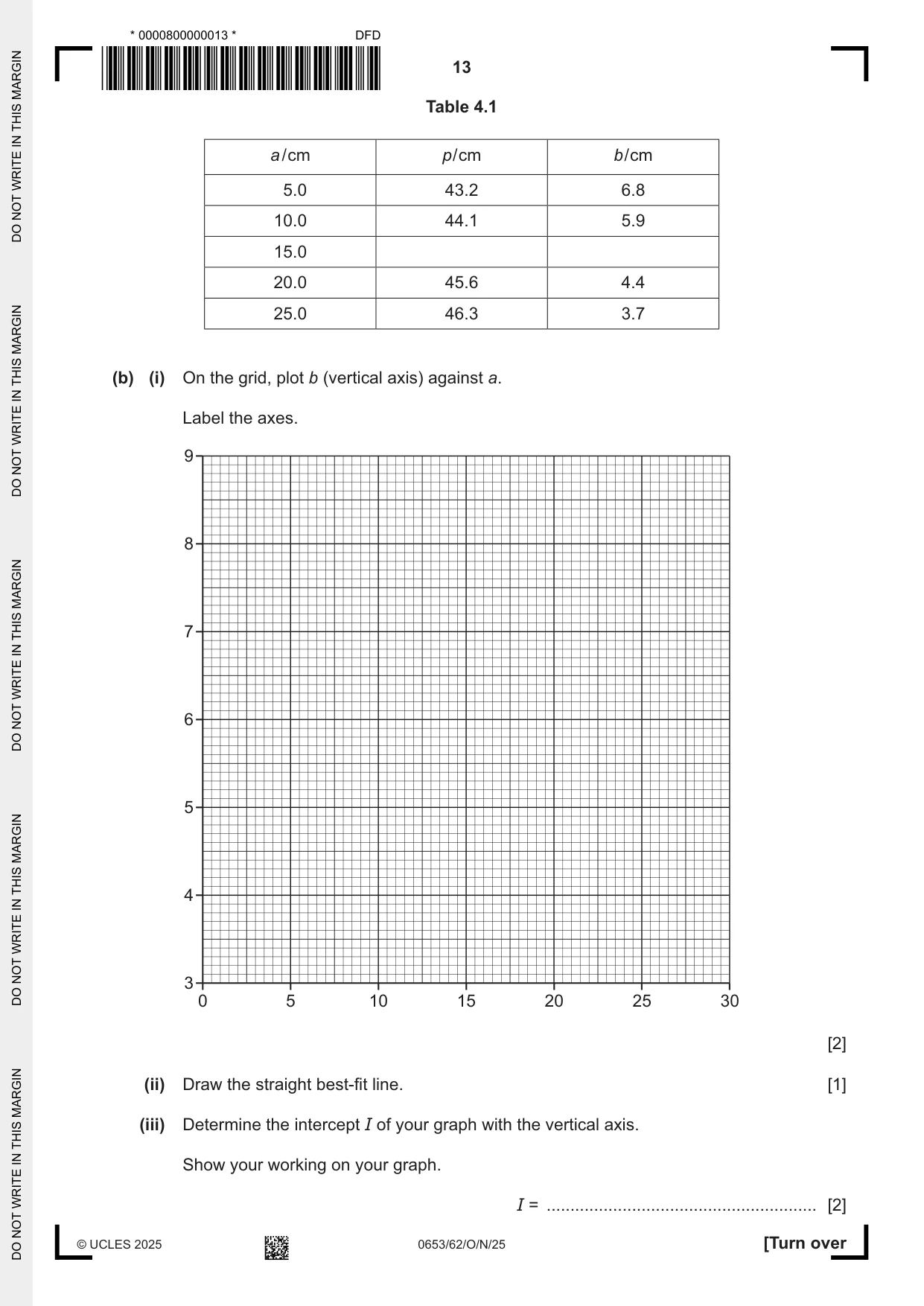
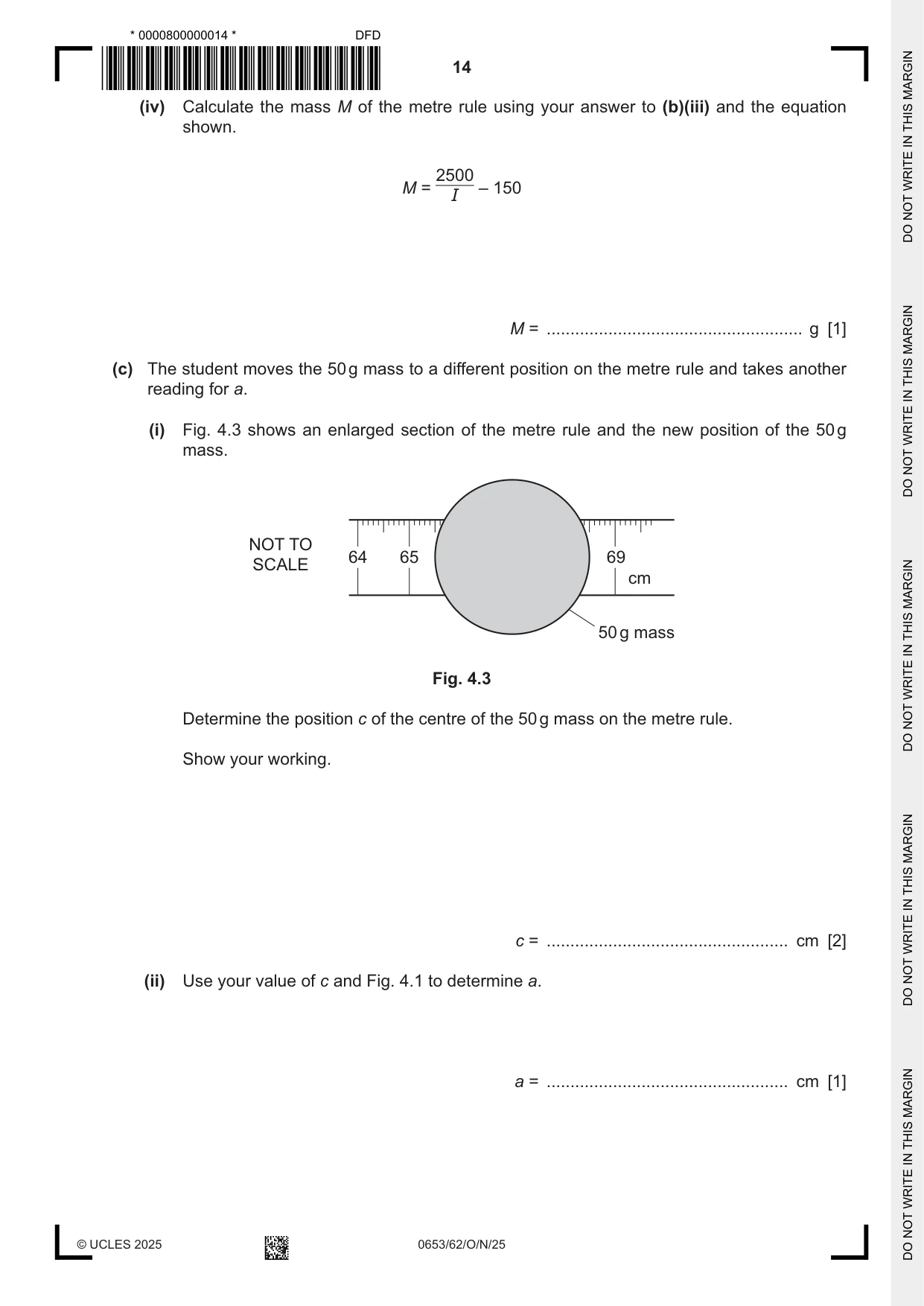
4 A student determines the mass M of a metre rule using a balancing method. The student uses the apparatus shown in Fig. 4.1. 50 cm mark p metre rule a b a 100 g mass 50 g mass bench pivot Fig. 4.1 Procedure The student: • places the 100 g mass and the 50 g mass at distance a from each end of the metre rule, where a = 5.0 cm • balances the metre rule with the pivot at position p on the metre rule • calculates b, the distance between the 50 cm mark of the metre rule and the pivot • records the values of a, p and b in Table 4.1. The student repeats the procedure for a = 10.0 cm, 15.0 cm, 20.0 cm and 25.0 cm. (a) Fig. 4.2 shows a view from above of the metre rule balanced on the pivot when a = 15.0 cm. pivot metre rule 43 44 45 46 47 Fig. 4.2 (i) Record in Table 4.1 position p of the metre rule on the pivot. [1] (ii) Calculate b using your answer to (a)(i) and the equation shown. b = 50.0 – p Record this value of b in Table 4.1. [1] Table 4.1 a / cm p / cm b / cm 5.0 43.2 6.8 10.0 44.1 5.9 15.0 20.0 45.6 4.4 25.0 46.3 3.7 (b) (i) On the grid, plot b (vertical axis) against a. Label the axes. 9 8 7 6 5 4 3 0 5 10 15 20 25 30 [2] (ii) Draw the straight best-fit line. [1] (iii) Determine the intercept I of your graph with the vertical axis. Show your working on your graph. I = ......................................................... [2] (iv) Calculate the mass M of the metre rule using your answer to (b)(iii) and the equation shown. 2500 M = – 150 I M = ...................................................... g [1] (c) The student moves the 50 g mass to a different position on the metre rule and takes another reading for a. (i) Fig. 4.3 shows an enlarged section of the metre rule and the new position of the 50 g mass. NOT TO 64 65 66 67 68 69 SCALE cm 50 g mass Fig. 4.3 Determine the position c of the centre of the 50 g mass on the metre rule. Show your working. c = ................................................... cm [2] (ii) Use your value of c and Fig. 4.1 to determine a. a = ................................................... cm [1]
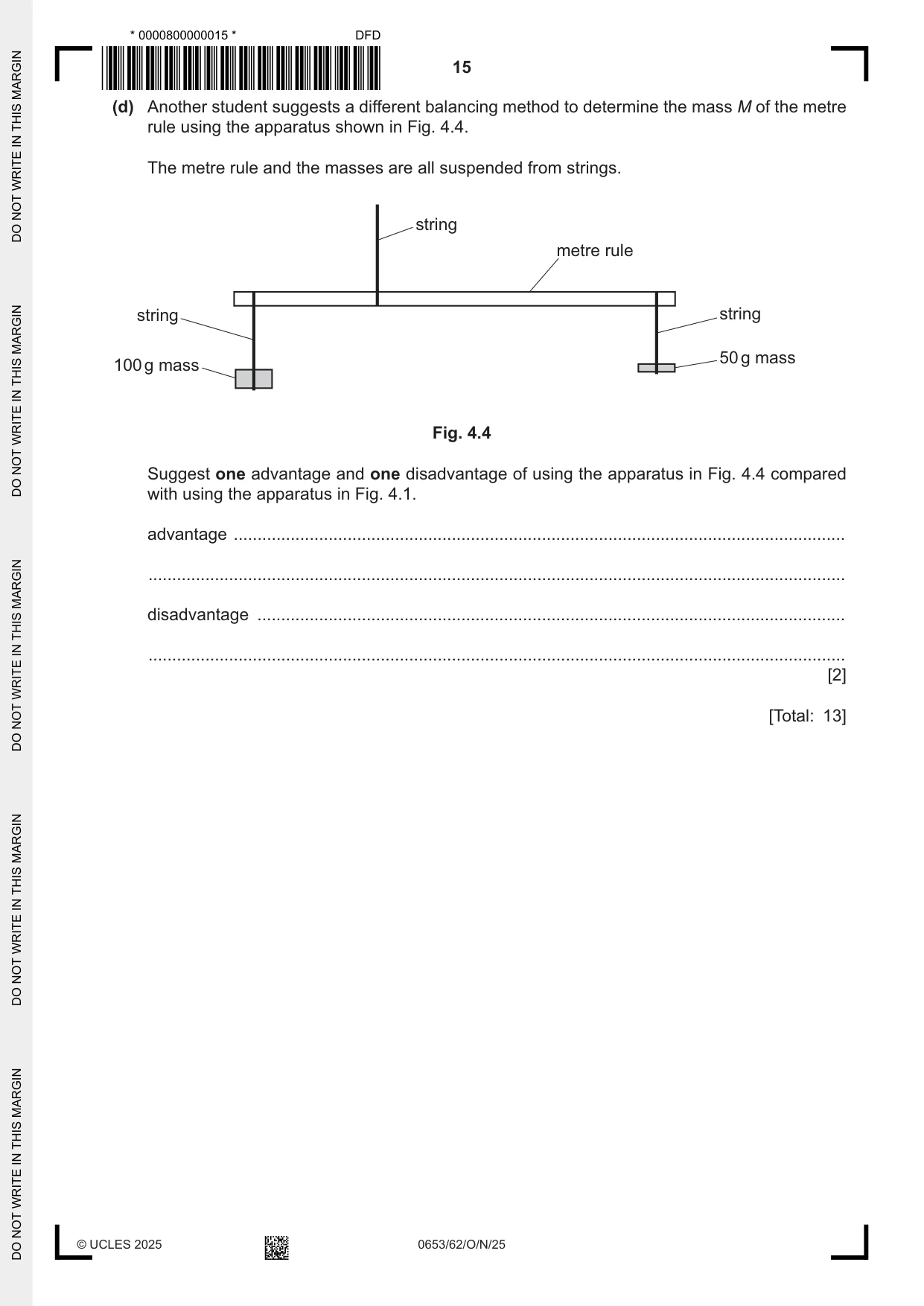
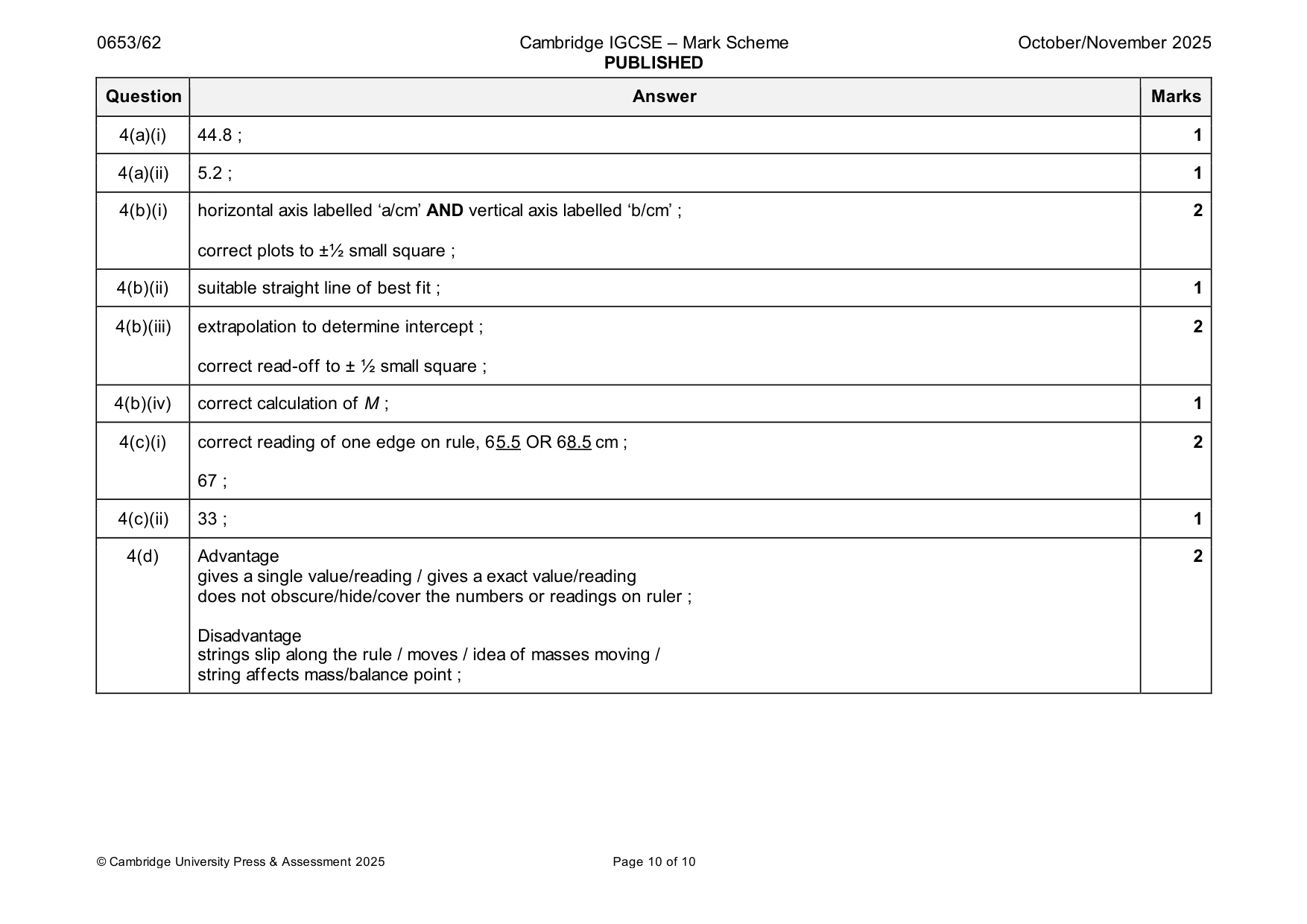
Mark scheme: 4(a)(i) 44.8 ; 1 4(a)(ii) 5.2 ; 1 4(b)(i) horizontal axis labelled ‘a/cm’ AND vertical axis labelled ‘b/cm’ ; 2 correct plots to ±½ small square ; 4(b)(ii) suitable straight line of best fit ; 1 4(b)(iii) extrapolation to determine intercept ; 2 correct read-off to ± ½ small square ; 4(b)(iv) correct calculation of M ; 1 4(c)(i) correct reading of one edge on rule, 65.5 OR 68.5 cm ; 2 67 ; 4(c)(ii) 33 ; 1 4(d) Advantage 2 gives a single value/reading / gives a exact value/reading does not obscure/hide/cover the numbers or readings on ruler ; Disadvantage strings slip along the rule / moves / idea of masses moving / string affects mass/balance point ;
What was in this paper
The subtopics covered by these 4 questions, and how many questions each got. Open one in a new tab to see every Cambridge question on it.
What you needed in this session
Cambridge’s own grade thresholds for 2025 Oct/Nov, Paper 6 · Variant 2. A higher threshold means an easier paper — the bar moves with how the cohort did.