Cambridge IGCSE Science - Combined 0653 — 2010 Oct/Nov Paper 3 · Variant 1
0653/31/O/N/10 · 80 marks · ≈90 min
The question paper and its mark scheme, free to read here and free to download. This is Cambridge’s own paper, exactly as it was sat.
Question paper20 pages

Mark scheme6 pages
Answers below. Sit the paper first if you are practising.
Paper as text
Question paper, page 1
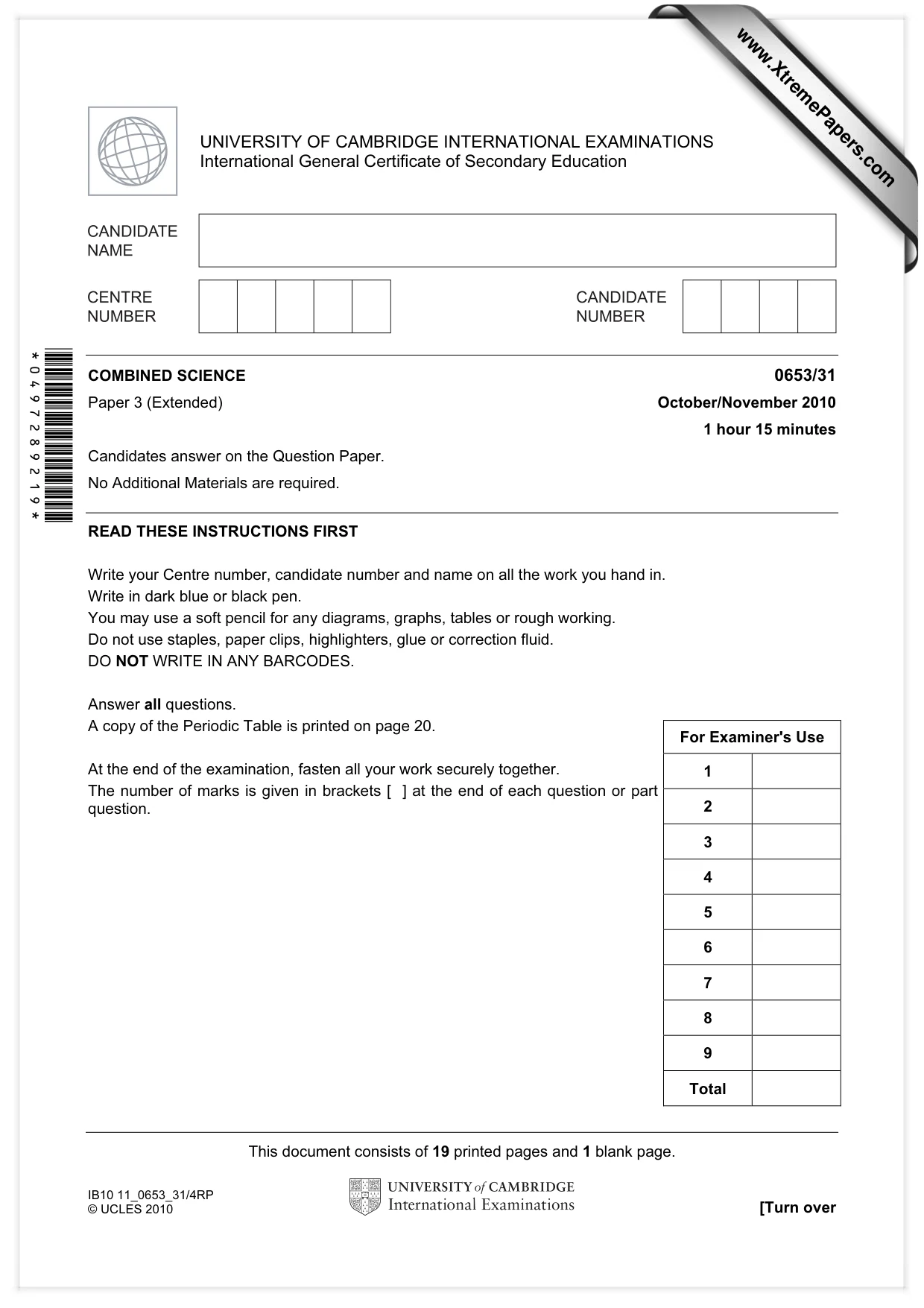
This document consists of 19 printed pages and 1 blank page. IB10 11_0653_31/4RP © UCLES 2010 [Turn over *0497289219* For Examiner's Use 1 2 3 4 5 6 7 8 9 Total UNIVERSITY OF CAMBRIDGE INTERNATIONAL EXAMINATIONS International General Certificate of Secondary Education COMBINED SCIENCE 0653/31 Paper 3 (Extended) October/November 2010 1 hour 15 minutes Candidates answer on the Question Paper. No Additional Materials are required. READ THESE INSTRUCTIONS FIRST Write your Centre number, candidate number and name on all the work you hand in. Write in dark blue or black pen. You may use a soft pencil for any diagrams, graphs, tables or rough working. Do not use staples, paper clips, highlighters, glue or correction fluid. DO NOT WRITE IN ANY BARCODES. Answer all questions. A copy of the Periodic Table is printed on page 20. At the end of the examination, fasten all your work securely together. The number of marks is given in brackets [ ] at the end of each question or part question. www.XtremePapers.com
Question paper, page 2
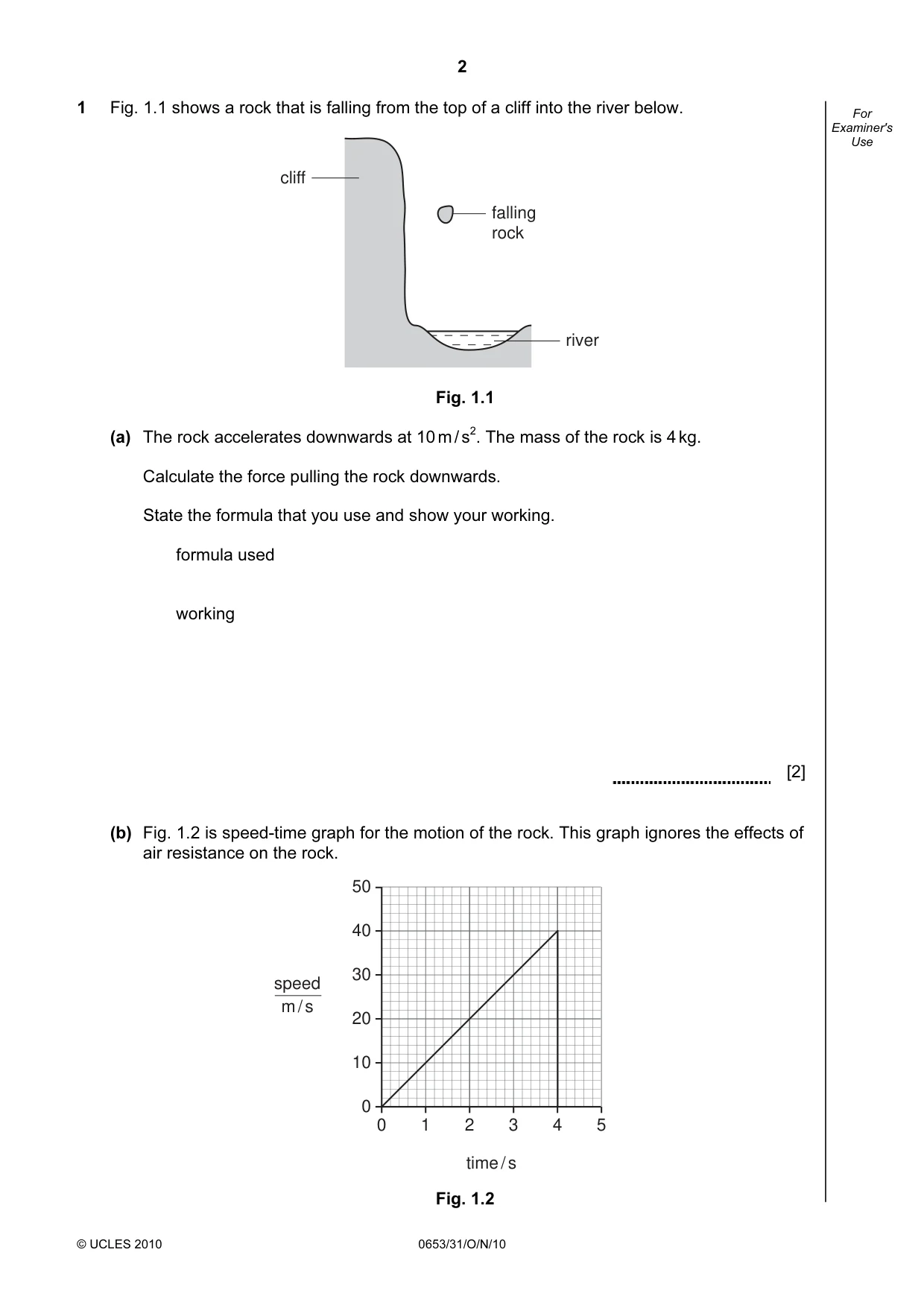
2 © UCLES 2010 0653/31/O/N/10 For Examiner's Use 1 Fig. 1.1 shows a rock that is falling from the top of a cliff into the river below. cliff river falling rock Fig. 1.1 (a) The rock accelerates downwards at 10 m / s2. The mass of the rock is 4 kg. Calculate the force pulling the rock downwards. State the formula that you use and show your working. formula used working [2] (b) Fig. 1.2 is speed-time graph for the motion of the rock. This graph ignores the effects of air resistance on the rock. 50 40 30 20 10 0 0 1 2 3 4 5 time / s speed m / s Fig. 1.2
Question paper, page 3
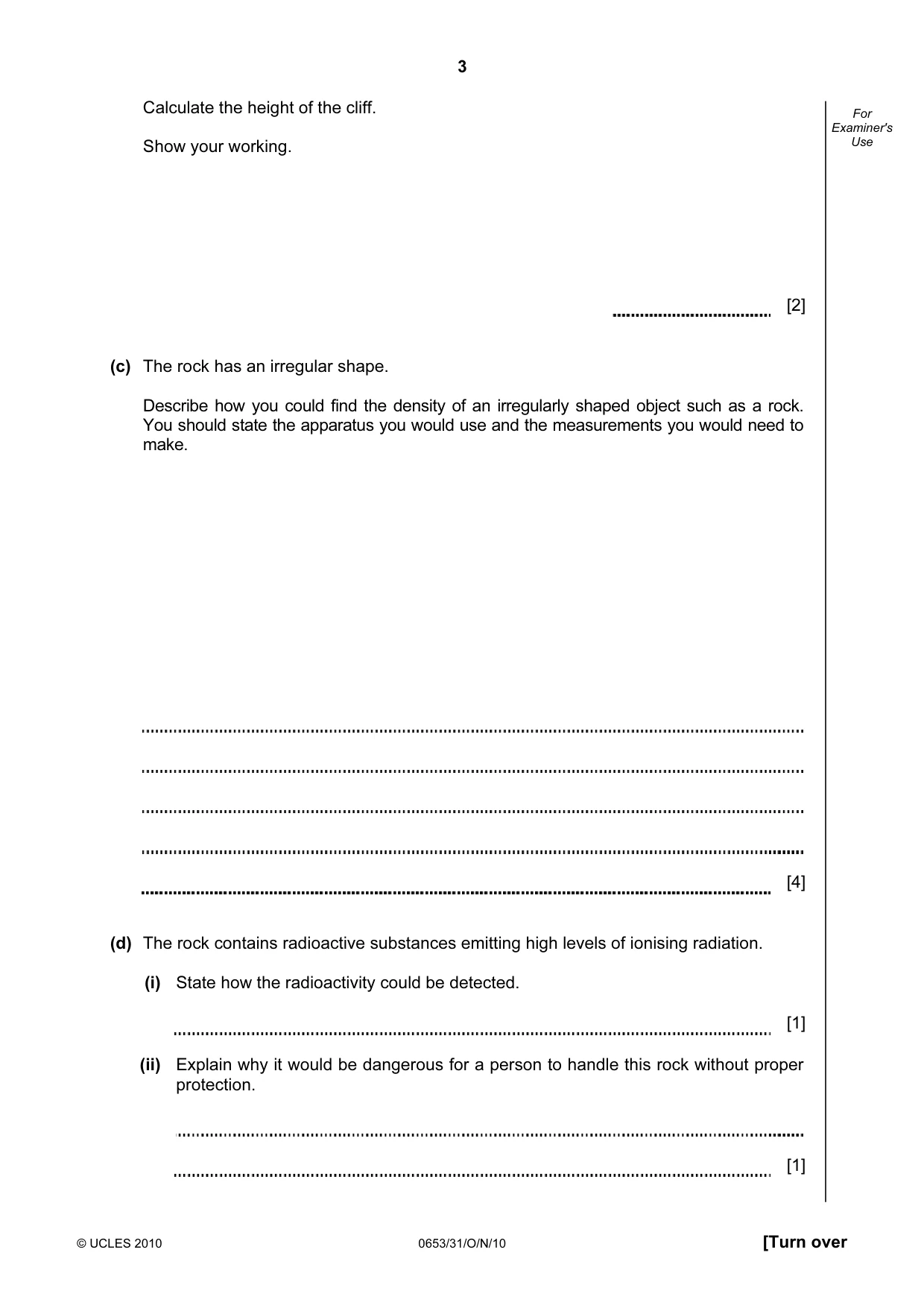
3 © UCLES 2010 0653/31/O/N/10 [Turn over For Examiner's Use Calculate the height of the cliff. Show your working. [2] (c) The rock has an irregular shape. Describe how you could find the density of an irregularly shaped object such as a rock. You should state the apparatus you would use and the measurements you would need to make. [4] (d) The rock contains radioactive substances emitting high levels of ionising radiation. (i) State how the radioactivity could be detected. [1] (ii) Explain why it would be dangerous for a person to handle this rock without proper protection. [1]
Question paper, page 4
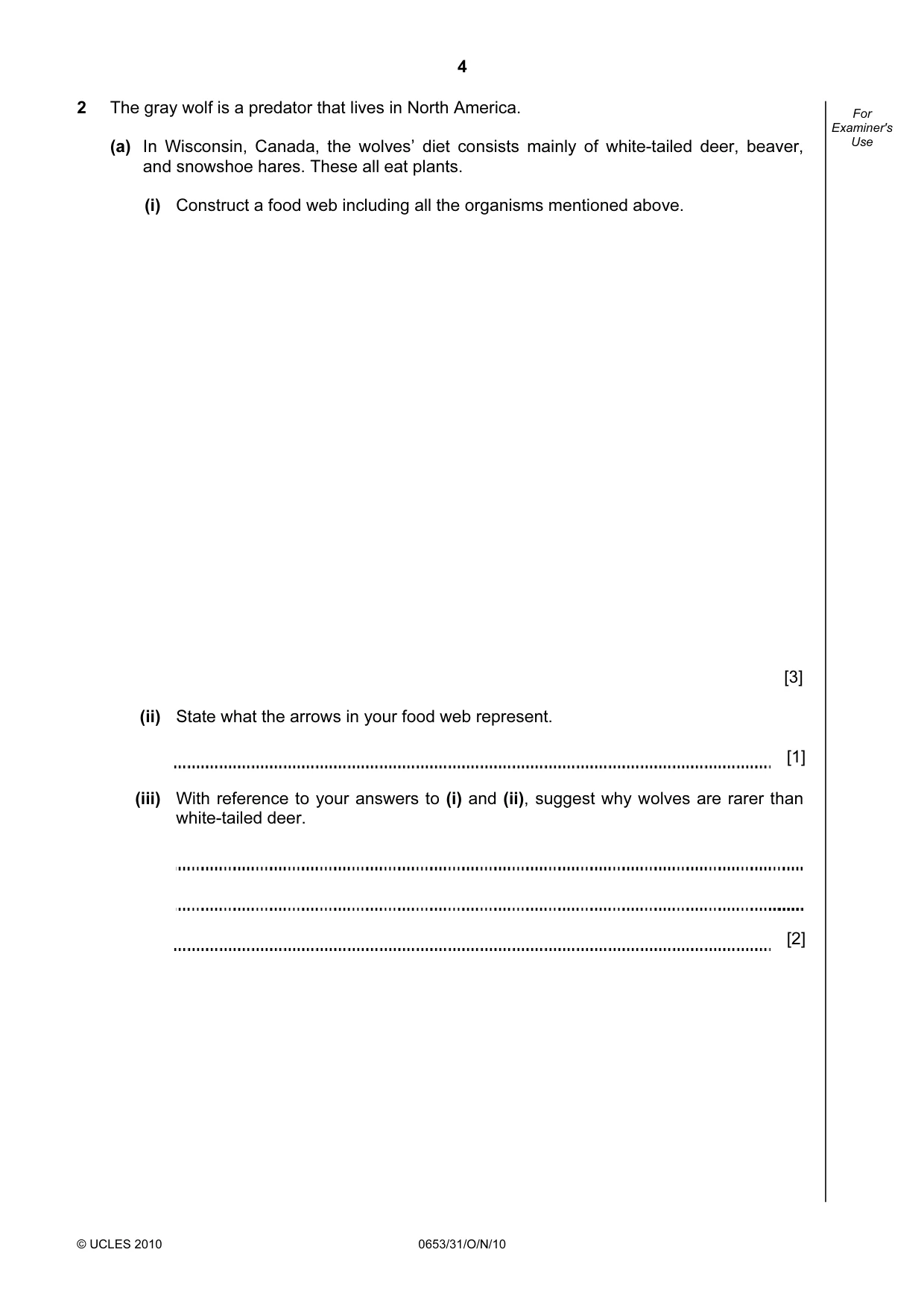
4 © UCLES 2010 0653/31/O/N/10 For Examiner's Use 2 The gray wolf is a predator that lives in North America. (a) In Wisconsin, Canada, the wolves’ diet consists mainly of white-tailed deer, beaver, and snowshoe hares. These all eat plants. (i) Construct a food web including all the organisms mentioned above. [3] (ii) State what the arrows in your food web represent. [1] (iii) With reference to your answers to (i) and (ii), suggest why wolves are rarer than white-tailed deer. [2]
Question paper, page 5
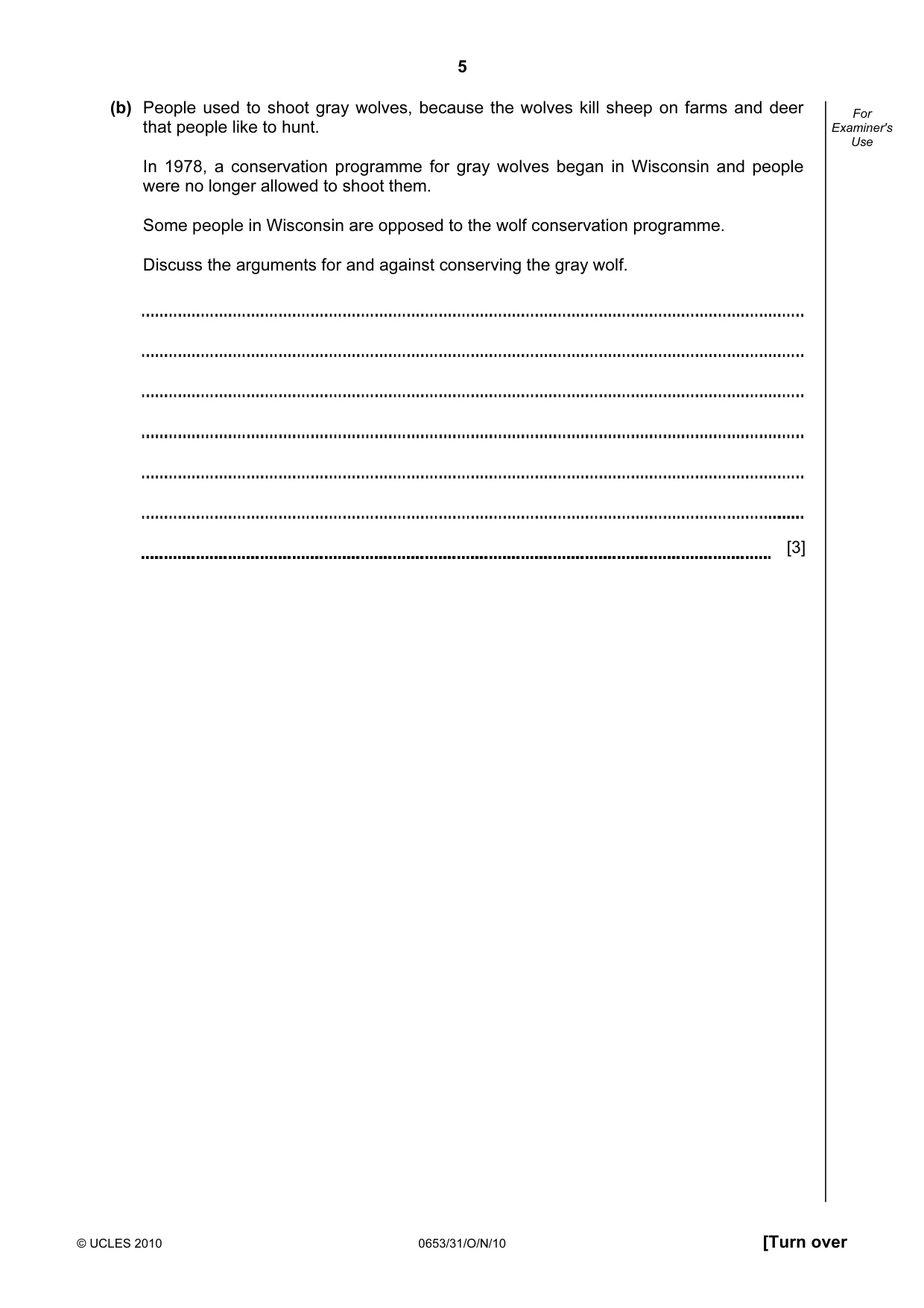
5 © UCLES 2010 0653/31/O/N/10 [Turn over For Examiner's Use (b) People used to shoot gray wolves, because the wolves kill sheep on farms and deer that people like to hunt. In 1978, a conservation programme for gray wolves began in Wisconsin and people were no longer allowed to shoot them. Some people in Wisconsin are opposed to the wolf conservation programme. Discuss the arguments for and against conserving the gray wolf. [3]
Question paper, page 6
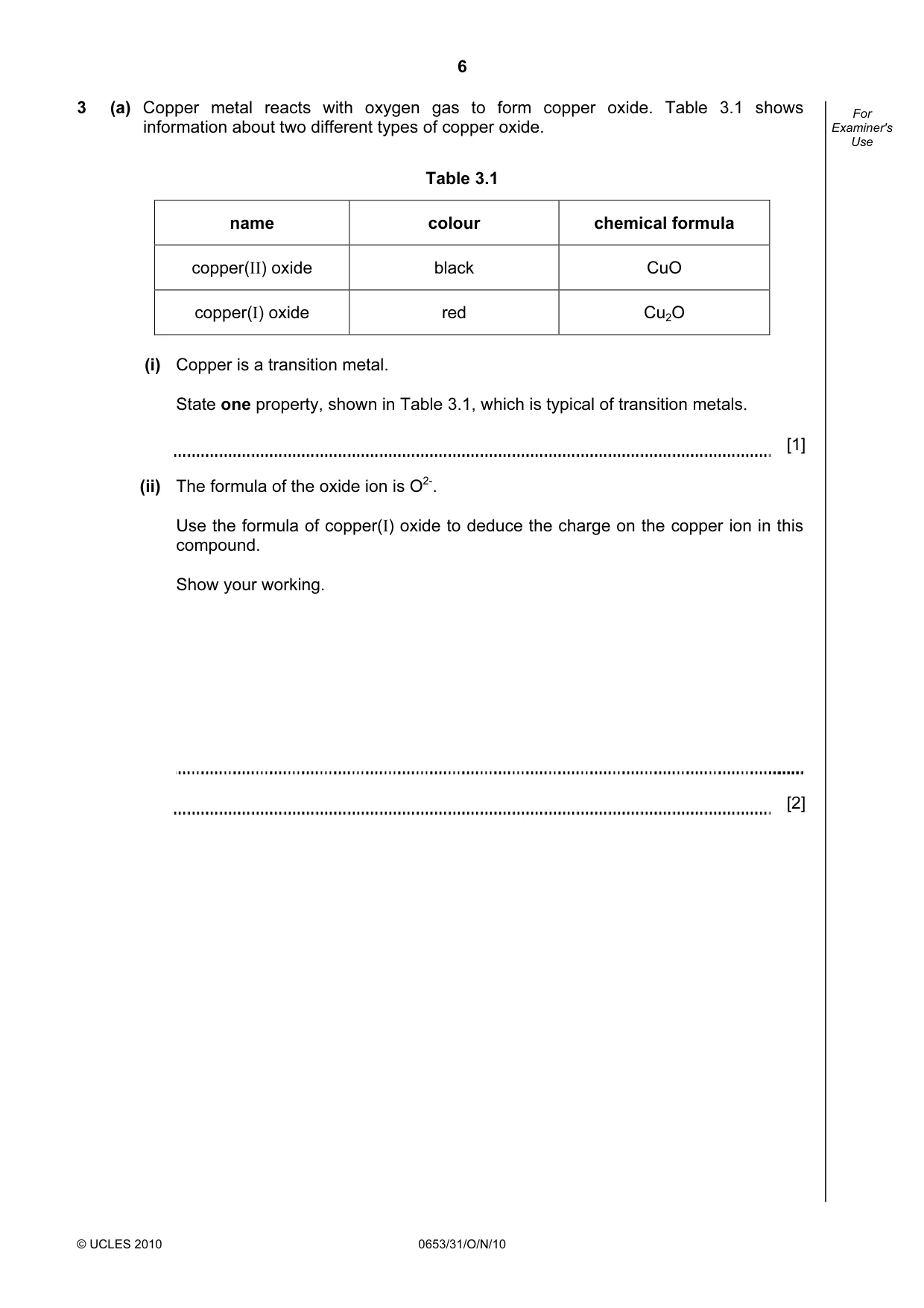
6 © UCLES 2010 0653/31/O/N/10 For Examiner's Use 3 (a) Copper metal reacts with oxygen gas to form copper oxide. Table 3.1 shows information about two different types of copper oxide. Table 3.1 name colour chemical formula copper(II) oxide black CuO copper(I) oxide red Cu2O (i) Copper is a transition metal. State one property, shown in Table 3.1, which is typical of transition metals. [1] (ii) The formula of the oxide ion is O2-. Use the formula of copper(I) oxide to deduce the charge on the copper ion in this compound. Show your working. [2]
Question paper, page 7
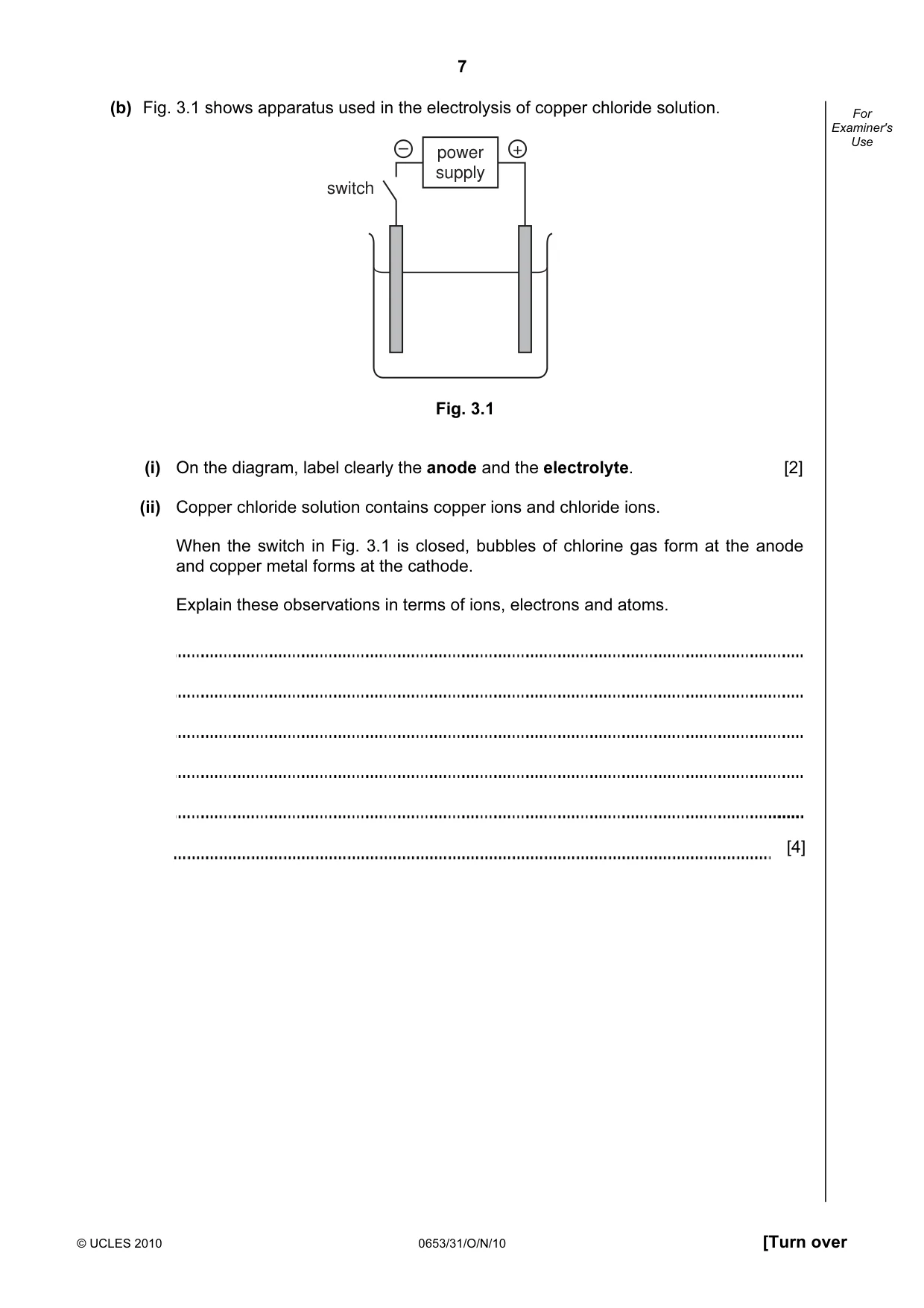
7 © UCLES 2010 0653/31/O/N/10 [Turn over For Examiner's Use (b) Fig. 3.1 shows apparatus used in the electrolysis of copper chloride solution. power supply – + switch Fig. 3.1 (i) On the diagram, label clearly the anode and the electrolyte. [2] (ii) Copper chloride solution contains copper ions and chloride ions. When the switch in Fig. 3.1 is closed, bubbles of chlorine gas form at the anode and copper metal forms at the cathode. Explain these observations in terms of ions, electrons and atoms. [4]
Question paper, page 8
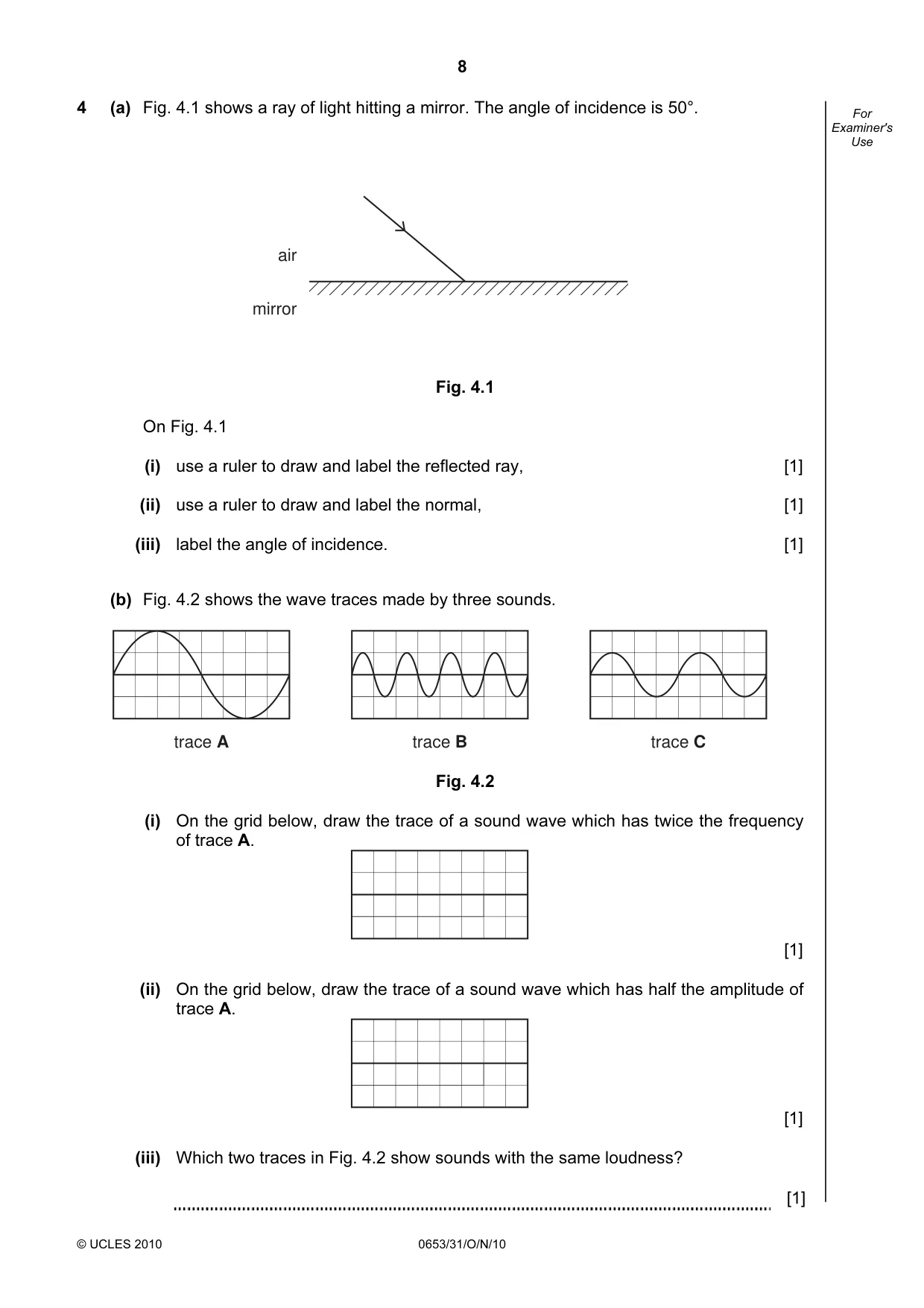
8 © UCLES 2010 0653/31/O/N/10 For Examiner's Use 4 (a) Fig. 4.1 shows a ray of light hitting a mirror. The angle of incidence is 50°. air mirror Fig. 4.1 On Fig. 4.1 (i) use a ruler to draw and label the reflected ray, [1] (ii) use a ruler to draw and label the normal, [1] (iii) label the angle of incidence. [1] (b) Fig. 4.2 shows the wave traces made by three sounds. trace B trace C trace A Fig. 4.2 (i) On the grid below, draw the trace of a sound wave which has twice the frequency of trace A. [1] (ii) On the grid below, draw the trace of a sound wave which has half the amplitude of trace A. [1] (iii) Which two traces in Fig. 4.2 show sounds with the same loudness? [1]
Question paper, page 9
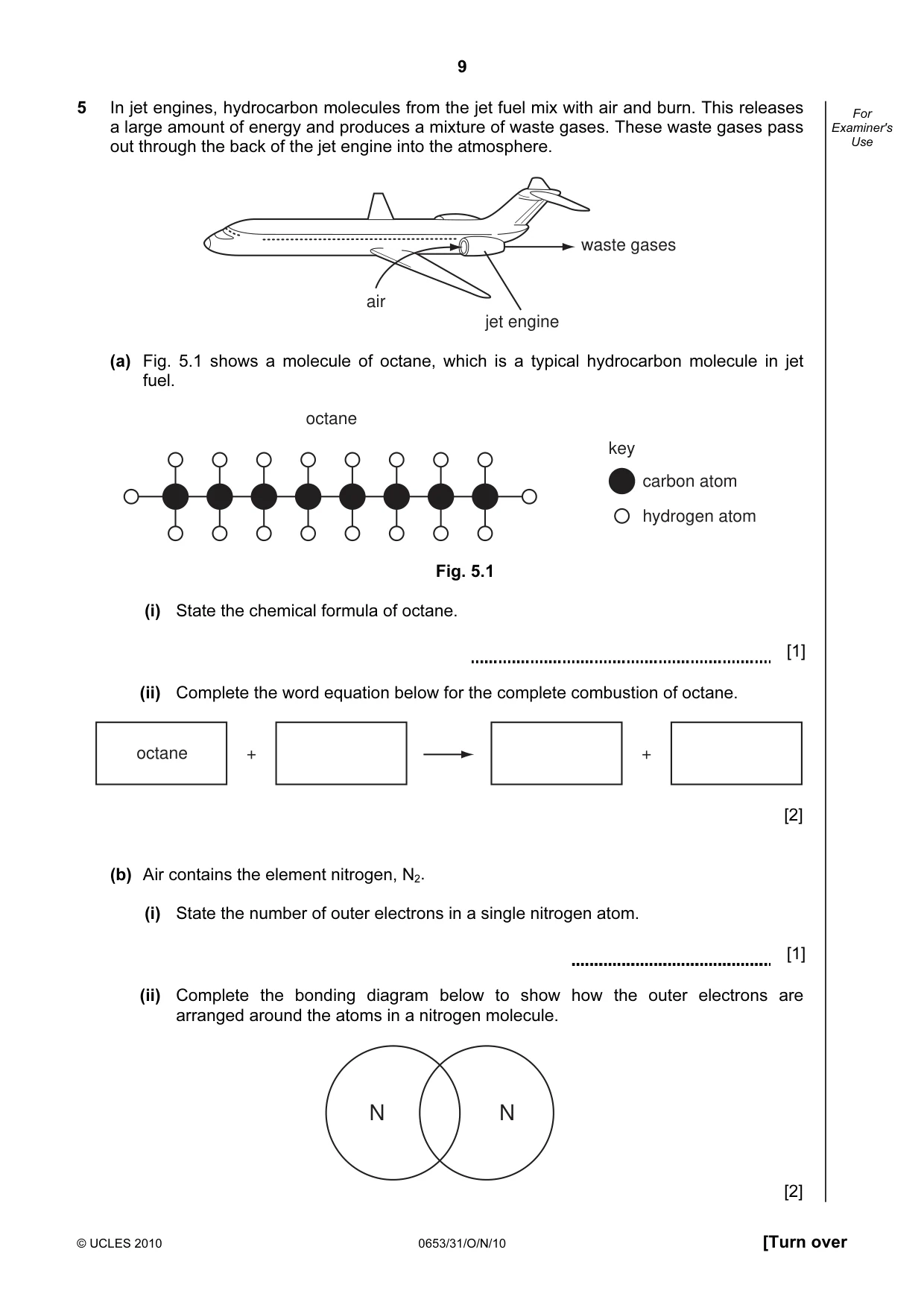
9 © UCLES 2010 0653/31/O/N/10 [Turn over For Examiner's Use 5 In jet engines, hydrocarbon molecules from the jet fuel mix with air and burn. This releases a large amount of energy and produces a mixture of waste gases. These waste gases pass out through the back of the jet engine into the atmosphere. jet engine air waste gases (a) Fig. 5.1 shows a molecule of octane, which is a typical hydrocarbon molecule in jet fuel. key carbon atom hydrogen atom octane Fig. 5.1 (i) State the chemical formula of octane. [1] (ii) Complete the word equation below for the complete combustion of octane. octane + + [2] (b) Air contains the element nitrogen, N2. (i) State the number of outer electrons in a single nitrogen atom. [1] (ii) Complete the bonding diagram below to show how the outer electrons are arranged around the atoms in a nitrogen molecule. N N [2]
Question paper, page 10
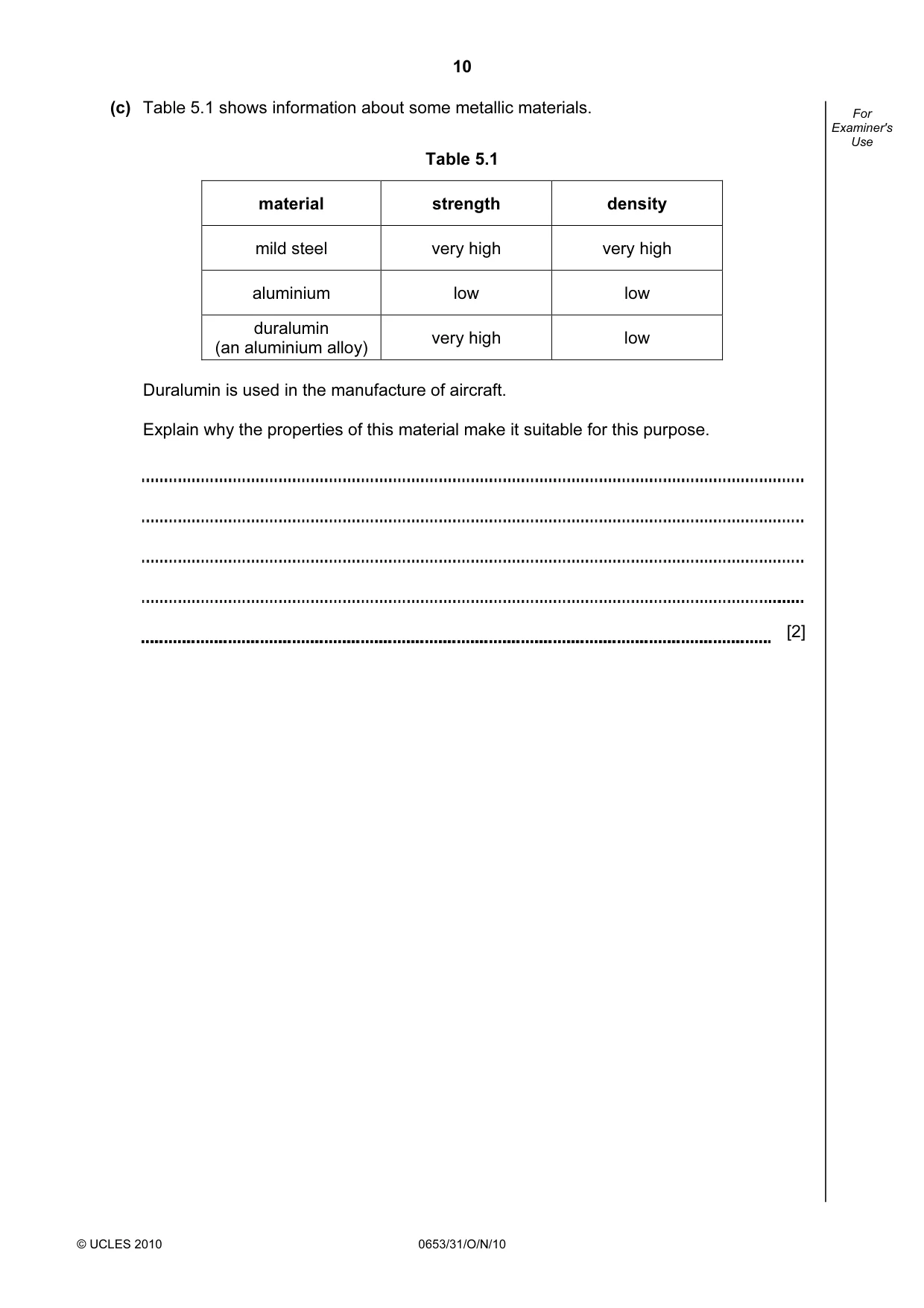
10 © UCLES 2010 0653/31/O/N/10 For Examiner's Use (c) Table 5.1 shows information about some metallic materials. Table 5.1 material strength density mild steel very high very high aluminium low low duralumin (an aluminium alloy) very high low Duralumin is used in the manufacture of aircraft. Explain why the properties of this material make it suitable for this purpose. [2]
Question paper, page 11
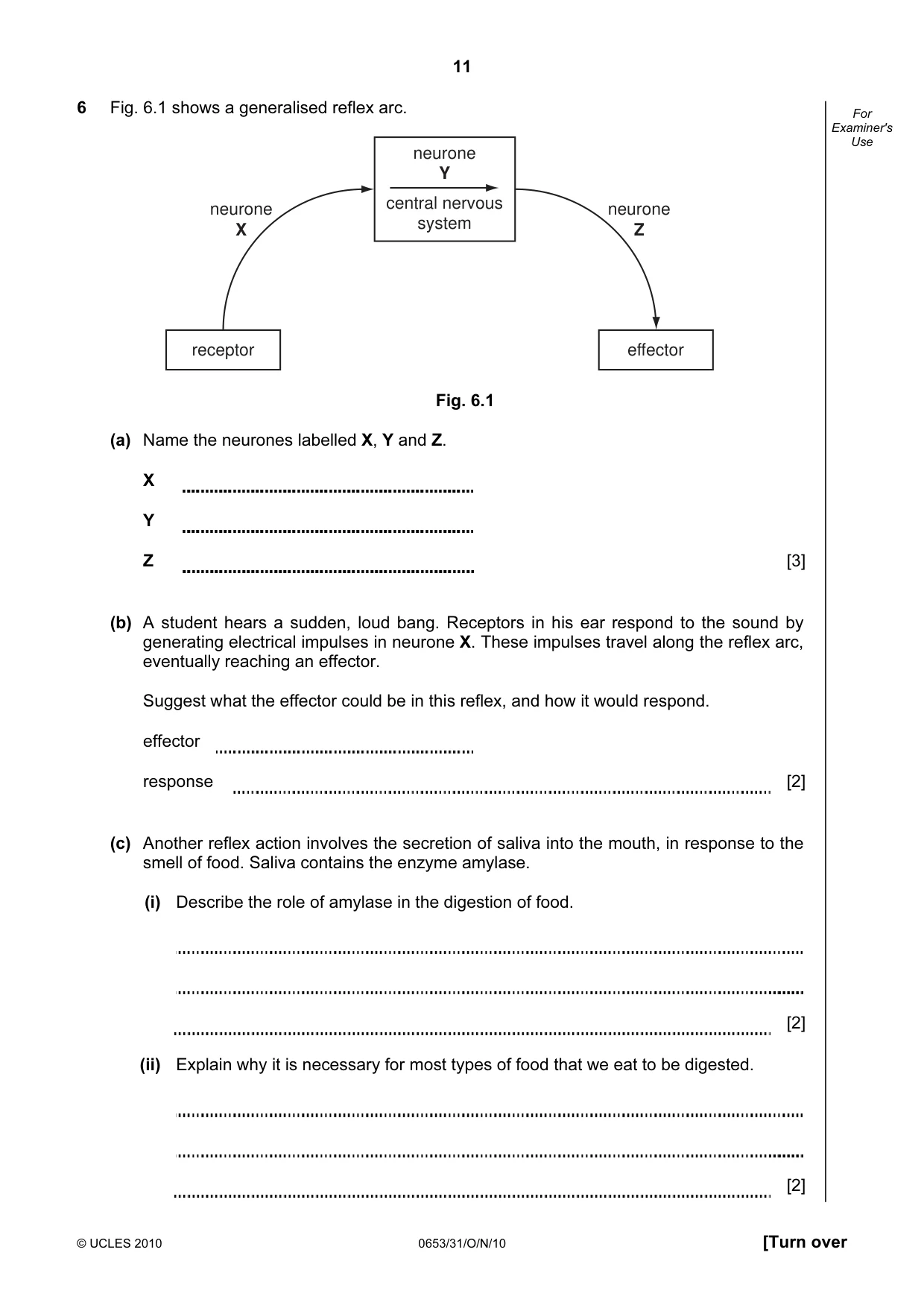
11 © UCLES 2010 0653/31/O/N/10 [Turn over For Examiner's Use 6 Fig. 6.1 shows a generalised reflex arc. neurone Y central nervous system neurone X neurone Z receptor effector Fig. 6.1 (a) Name the neurones labelled X, Y and Z. X Y Z [3] (b) A student hears a sudden, loud bang. Receptors in his ear respond to the sound by generating electrical impulses in neurone X. These impulses travel along the reflex arc, eventually reaching an effector. Suggest what the effector could be in this reflex, and how it would respond. effector response [2] (c) Another reflex action involves the secretion of saliva into the mouth, in response to the smell of food. Saliva contains the enzyme amylase. (i) Describe the role of amylase in the digestion of food. [2] (ii) Explain why it is necessary for most types of food that we eat to be digested. [2]
Question paper, page 12
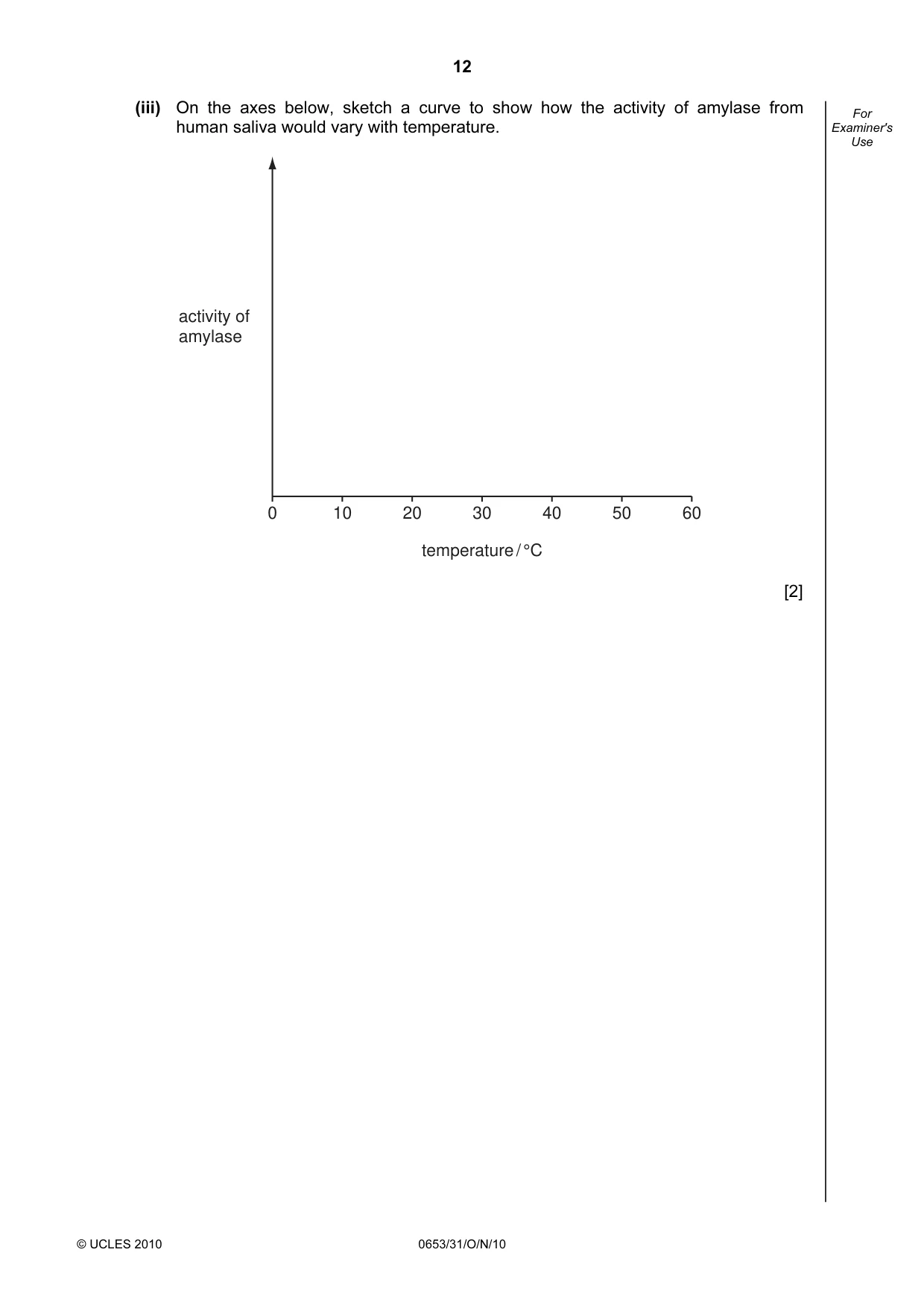
12 © UCLES 2010 0653/31/O/N/10 For Examiner's Use (iii) On the axes below, sketch a curve to show how the activity of amylase from human saliva would vary with temperature. 0 10 20 30 temperature / °C activity of amylase 40 50 60 [2]
Question paper, page 13
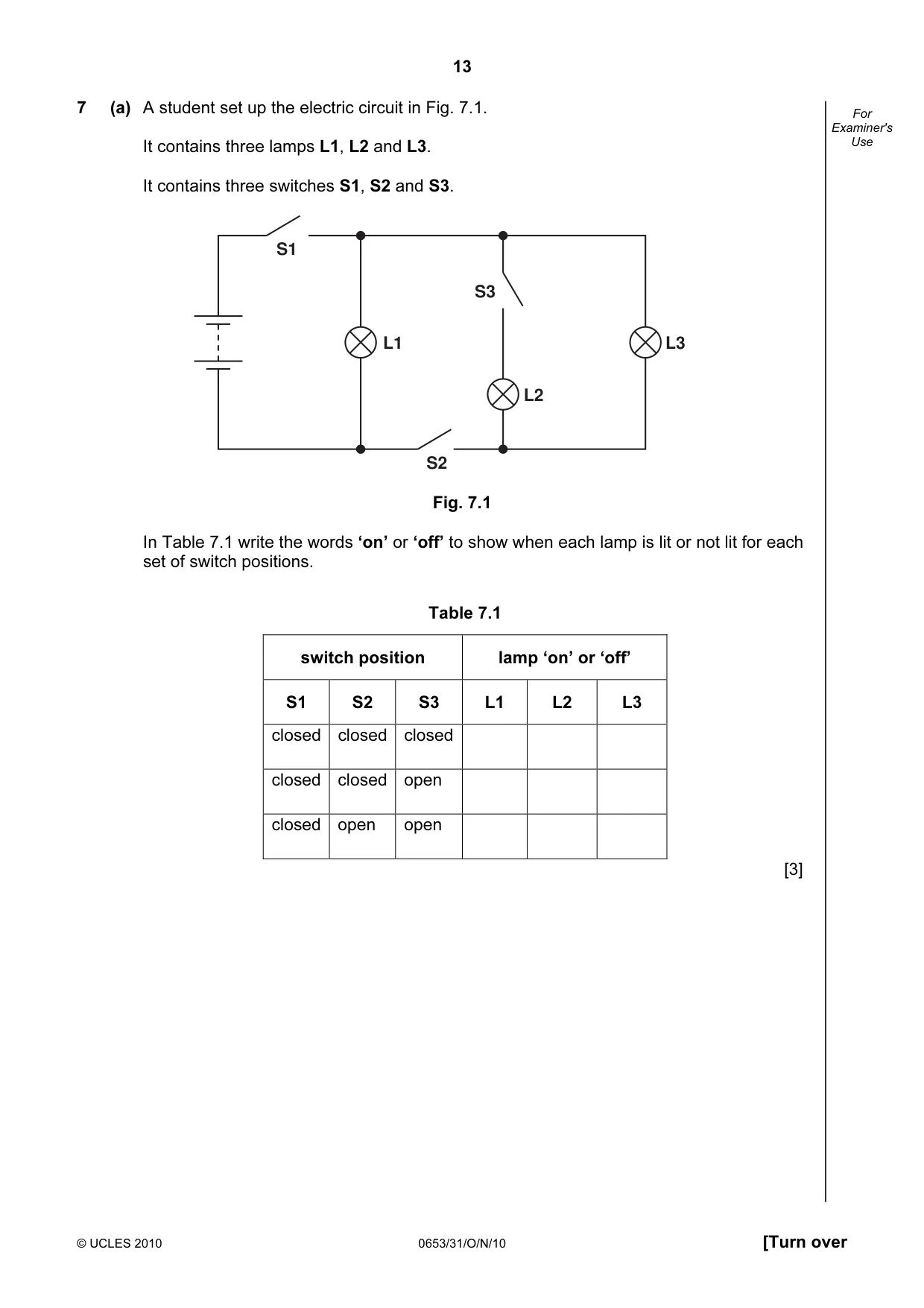
13 © UCLES 2010 0653/31/O/N/10 [Turn over For Examiner's Use 7 (a) A student set up the electric circuit in Fig. 7.1. It contains three lamps L1, L2 and L3. It contains three switches S1, S2 and S3. S1 S2 S3 L1 L2 L3 Fig. 7.1 In Table 7.1 write the words ‘on’ or ‘off’ to show when each lamp is lit or not lit for each set of switch positions. Table 7.1 switch position lamp ‘on’ or ‘off’ S1 S2 S3 L1 L2 L3 closed closed closed closed closed open closed open open [3]
Question paper, page 14
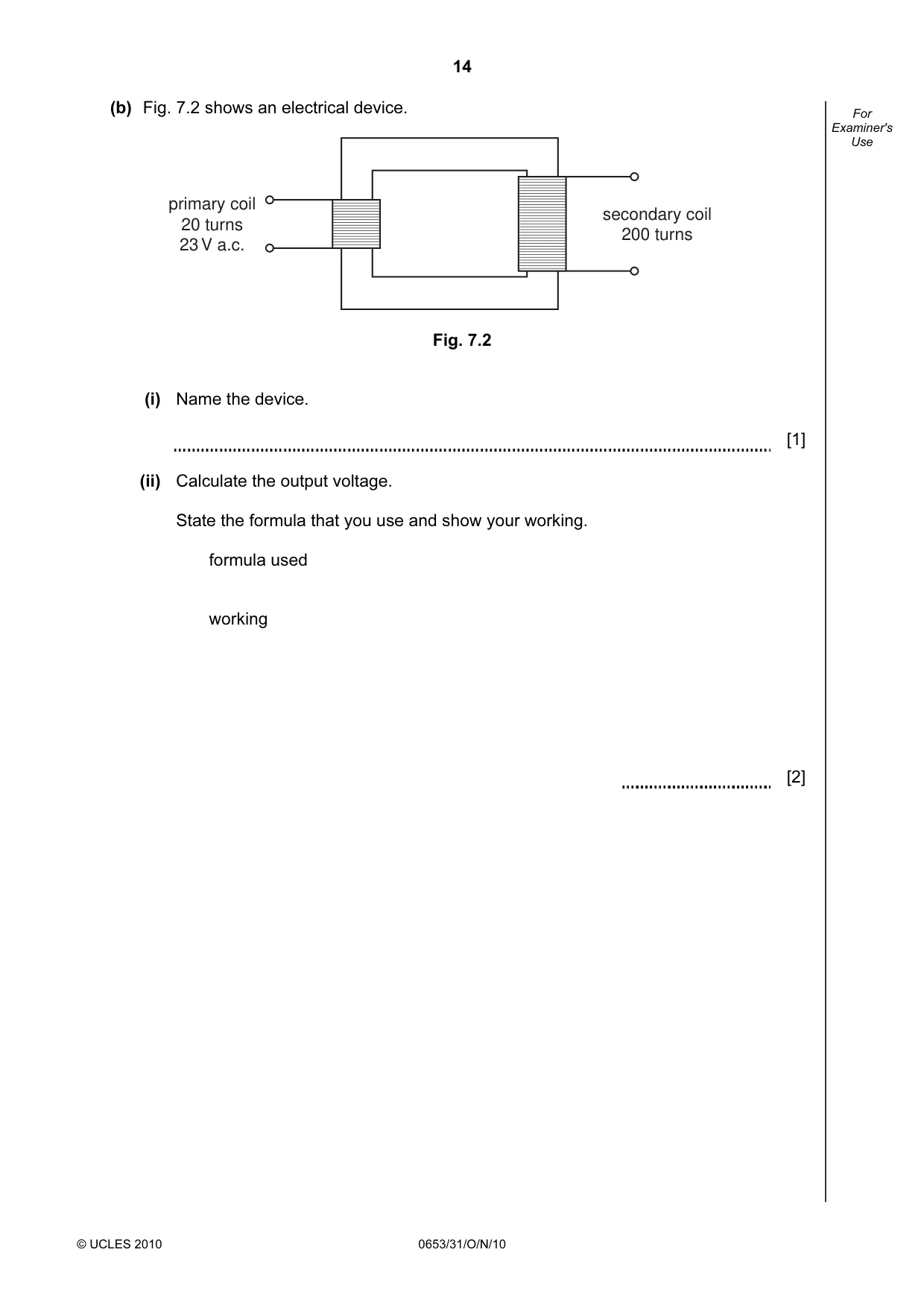
14 © UCLES 2010 0653/31/O/N/10 For Examiner's Use (b) Fig. 7.2 shows an electrical device. primary coil 20 turns 23 V a.c. secondary coil 200 turns Fig. 7.2 (i) Name the device. [1] (ii) Calculate the output voltage. State the formula that you use and show your working. formula used working [2]
Question paper, page 15
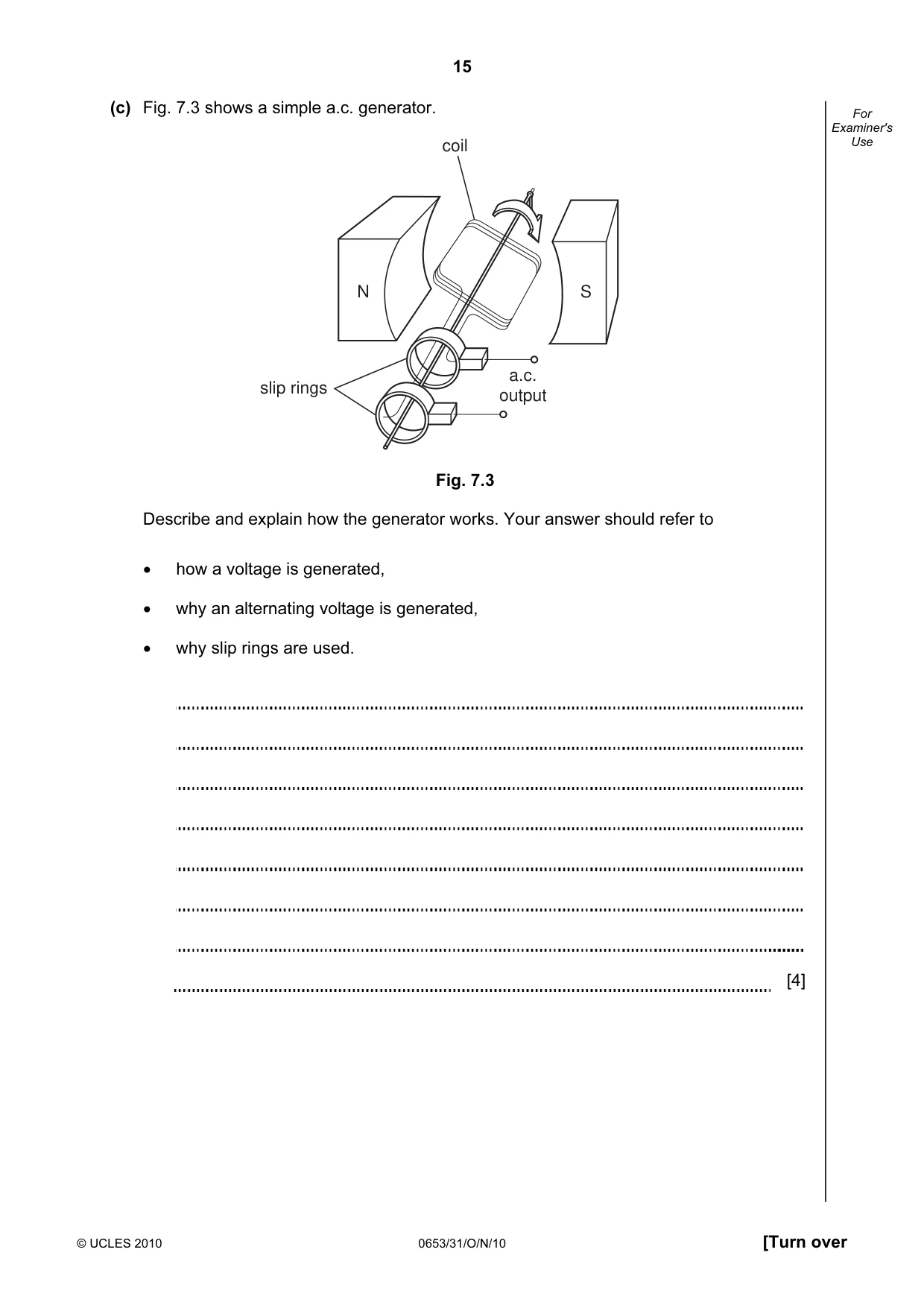
15 © UCLES 2010 0653/31/O/N/10 [Turn over For Examiner's Use (c) Fig. 7.3 shows a simple a.c. generator. N S a.c. output slip rings coil Fig. 7.3 Describe and explain how the generator works. Your answer should refer to • how a voltage is generated, • why an alternating voltage is generated, • why slip rings are used. [4]
Question paper, page 16
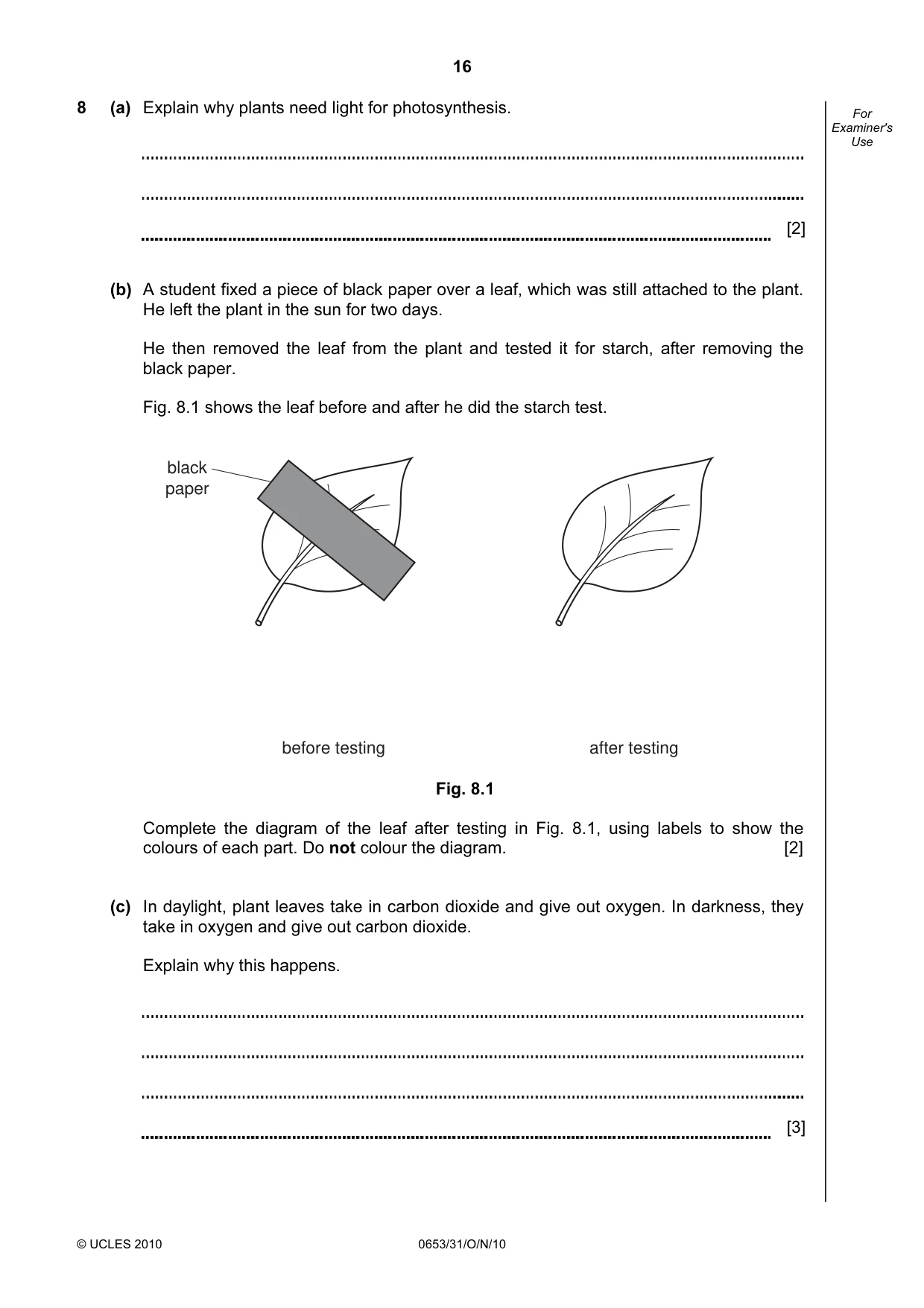
16 © UCLES 2010 0653/31/O/N/10 For Examiner's Use 8 (a) Explain why plants need light for photosynthesis. [2] (b) A student fixed a piece of black paper over a leaf, which was still attached to the plant. He left the plant in the sun for two days. He then removed the leaf from the plant and tested it for starch, after removing the black paper. Fig. 8.1 shows the leaf before and after he did the starch test. before testing after testing black paper Fig. 8.1 Complete the diagram of the leaf after testing in Fig. 8.1, using labels to show the colours of each part. Do not colour the diagram. [2] (c) In daylight, plant leaves take in carbon dioxide and give out oxygen. In darkness, they take in oxygen and give out carbon dioxide. Explain why this happens. [3]
Question paper, page 17
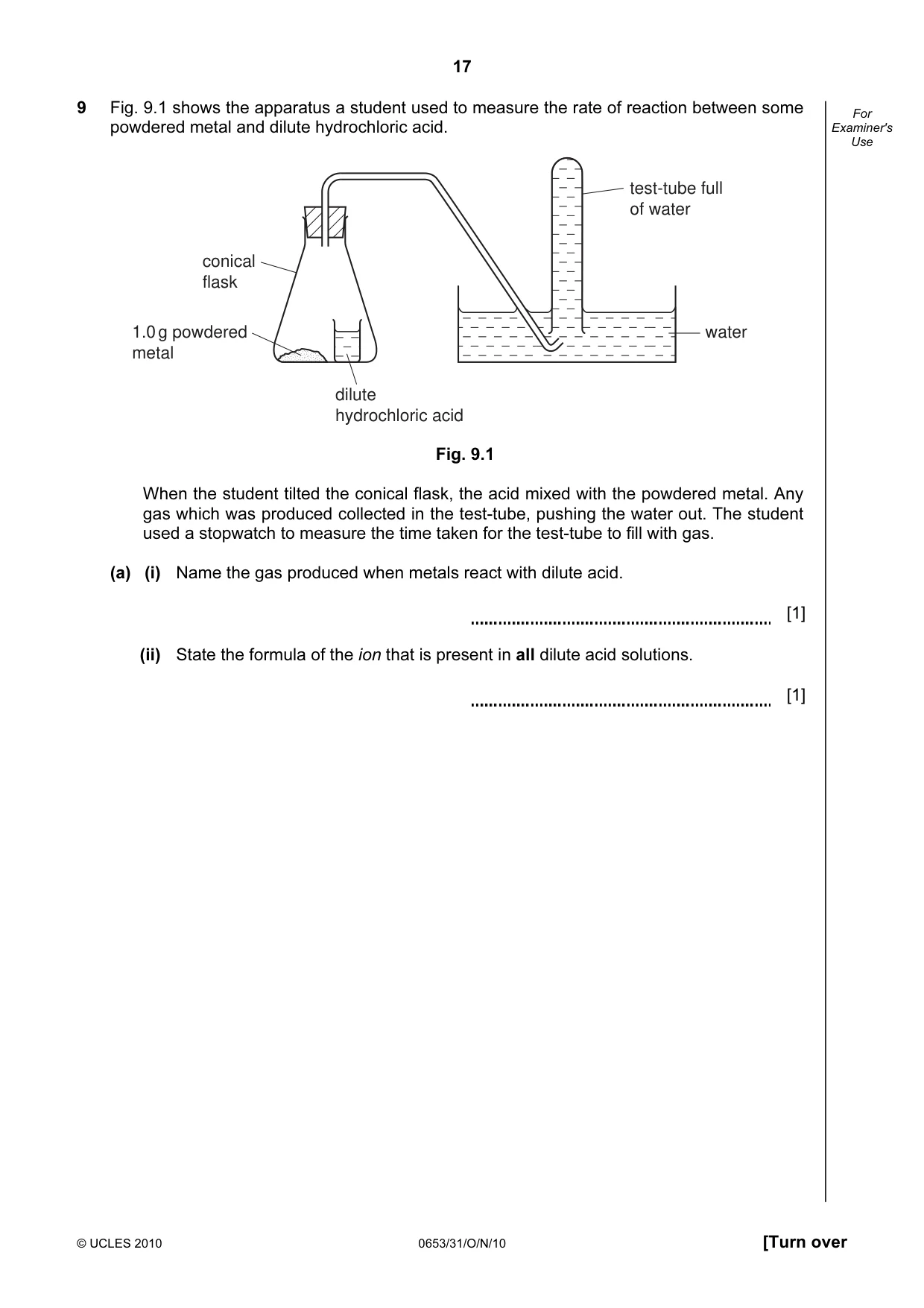
17 © UCLES 2010 0653/31/O/N/10 [Turn over For Examiner's Use 9 Fig. 9.1 shows the apparatus a student used to measure the rate of reaction between some powdered metal and dilute hydrochloric acid. test-tube full of water water dilute hydrochloric acid conical flask 1.0 g powdered metal Fig. 9.1 When the student tilted the conical flask, the acid mixed with the powdered metal. Any gas which was produced collected in the test-tube, pushing the water out. The student used a stopwatch to measure the time taken for the test-tube to fill with gas. (a) (i) Name the gas produced when metals react with dilute acid. [1] (ii) State the formula of the ion that is present in all dilute acid solutions. [1]
Question paper, page 18
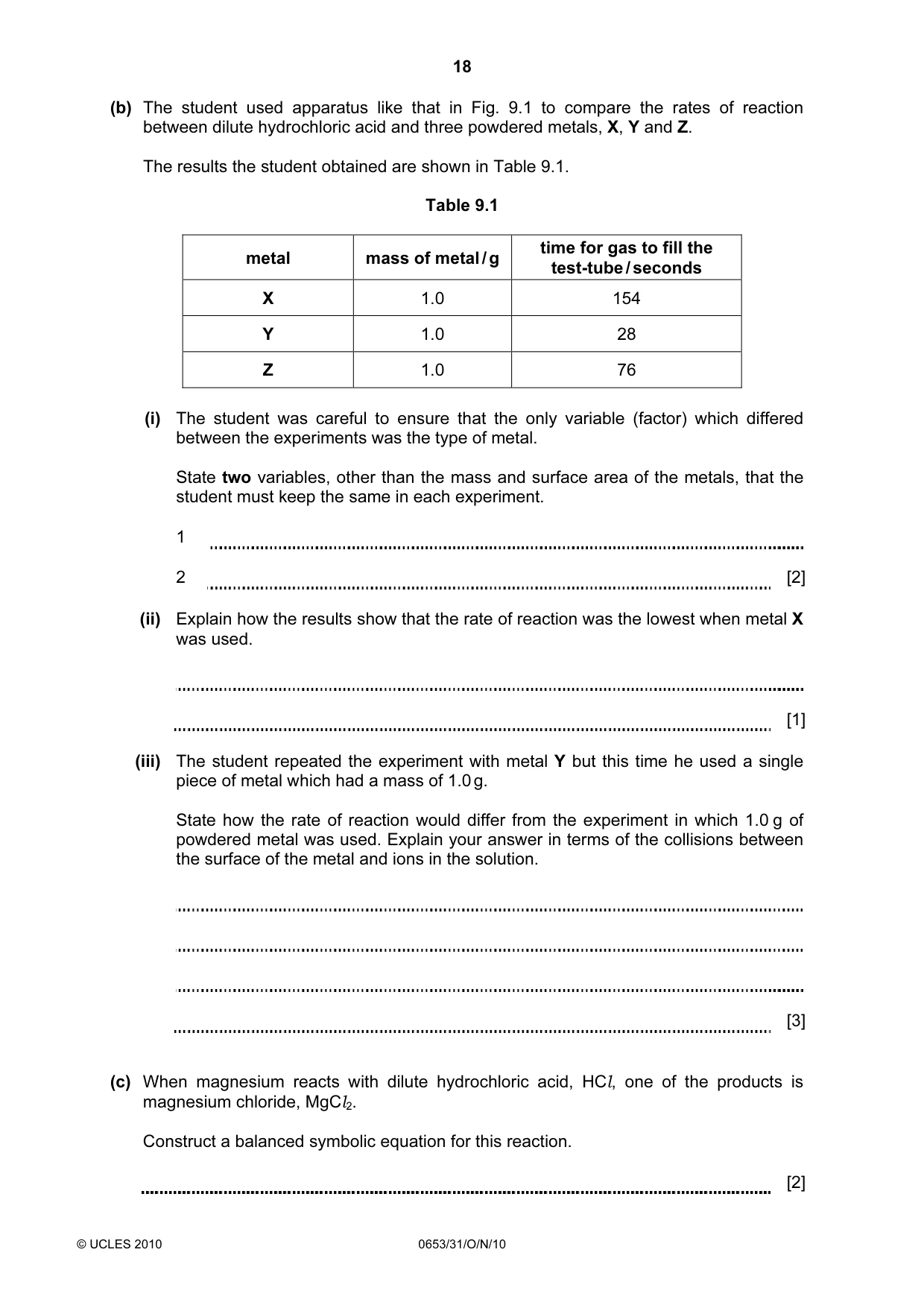
18 © UCLES 2010 0653/31/O/N/10 (b) The student used apparatus like that in Fig. 9.1 to compare the rates of reaction between dilute hydrochloric acid and three powdered metals, X, Y and Z. The results the student obtained are shown in Table 9.1. Table 9.1 metal mass of metal / g time for gas to fill the test-tube / seconds X 1.0 154 Y 1.0 28 Z 1.0 76 (i) The student was careful to ensure that the only variable (factor) which differed between the experiments was the type of metal. State two variables, other than the mass and surface area of the metals, that the student must keep the same in each experiment. 1 2 [2] (ii) Explain how the results show that the rate of reaction was the lowest when metal X was used. [1] (iii) The student repeated the experiment with metal Y but this time he used a single piece of metal which had a mass of 1.0 g. State how the rate of reaction would differ from the experiment in which 1.0 g of powdered metal was used. Explain your answer in terms of the collisions between the surface of the metal and ions in the solution. [3] (c) When magnesium reacts with dilute hydrochloric acid, HCl, one of the products is magnesium chloride, MgCl2. Construct a balanced symbolic equation for this reaction. [2]
Question paper, page 19
19 © UCLES 2010 0653/31/O/N/10 BLANK PAGE
Question paper, page 20
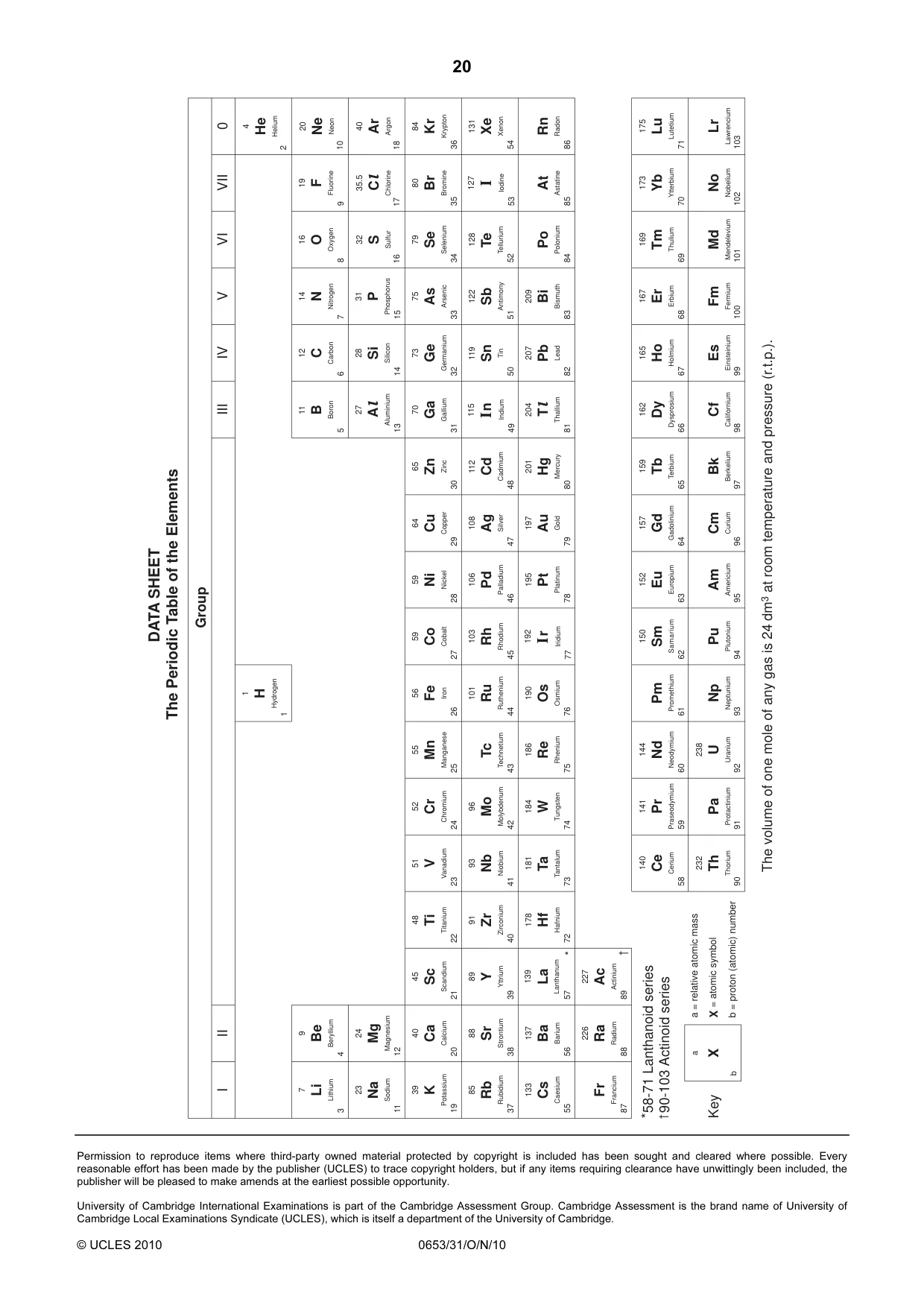
20 Permission to reproduce items where third-party owned material protected by copyright is included has been sought and cleared where possible. Every reasonable effort has been made by the publisher (UCLES) to trace copyright holders, but if any items requiring clearance have unwittingly been included, the publisher will be pleased to make amends at the earliest possible opportunity. University of Cambridge International Examinations is part of the Cambridge Assessment Group. Cambridge Assessment is the brand name of University of Cambridge Local Examinations Syndicate (UCLES), which is itself a department of the University of Cambridge. © UCLES 2010 0653/31/O/N/10 Group 140 Ce Cerium 58 141 Pr Praseodymium 59 144 Nd Neodymium 60 Pm Promethium 61 150 Sm Samarium 62 152 Eu Europium 63 157 Gd Gadolinium 64 159 Tb Terbium 65 162 Dy Dysprosium 66 165 Ho Holmium 67 167 Er Erbium 68 169 Tm Thulium 69 173 Yb Ytterbium 70 175 Lu Lutetium 71 232 Th Thorium 90 Pa Protactinium 91 238 U Uranium 92 Np Neptunium 93 Pu Plutonium 94 Am Americium 95 Cm Curium 96 Bk Berkelium 97 Cf Californium 98 Es Einsteinium 99 Fm Fermium 100 Md Mendelevium 101 No Nobelium 102 Lr Lawrencium 103 1 H Hydrogen 1 7 Li Lithium 3 23 Na Sodium 11 24 Mg Magnesium 12 40 Ca Calcium 20 45 Sc Scandium 21 48 Ti Titanium 22 51 V Vanadium 23 52 Cr Chromium 24 55 Mn Manganese 25 56 Fe Iron 26 59 Co Cobalt 27 59 Ni Nickel 28 64 Cu Copper 29 65 Zn Zinc 30 70 Ga Gallium 31 27 Al Aluminium 13 11 B Boron 5 12 C Carbon 6 14 N Nitrogen 7 16 O Oxygen 8 19 F Fluorine 9 28 Si Silicon 14 31 P Phosphorus 15 32 S Sulfur 16 35.5 Cl Chlorine 17 40 Ar Argon 18 20 Ne Neon 10 4 He Helium 2 73 Ge Germanium 32 75 As Arsenic 33 79 Se Selenium 34 80 Br Bromine 35 84 Kr Krypton 36 39 K Potassium 19 88 Sr Strontium 38 89 Y Yttrium 39 91 Zr Zirconium 40 93 Nb Niobium 41 96 Mo Molybdenum 42 Tc Technetium 43 101 Ru Ruthenium 44 103 Rh Rhodium 45 106 Pd Palladium 46 108 Ag Silver 47 112 Cd Cadmium 48 115 In Indium 49 119 Sn Tin 50 122 Sb Antimony 51 128 Te Tellurium 52 127 I Iodine 53 131 Xe Xenon 54 137 Ba Barium 56 139 La Lanthanum 57 * 178 Hf Hafnium 72 181 Ta Tantalum 73 184 W Tungsten 74 186 Re Rhenium 75 190 Os Osmium 76 192 Ir Iridium 77 195 Pt Platinum 78 197 Au Gold 79 201 Hg Mercury 80 204 Tl Thallium 81 207 Pb Lead 82 209 Bi Bismuth 83 Po Polonium 84 At Astatine 85 Rn Radon 86 Fr Francium 87 227 Ac Actinium 89 9 Be Beryllium 4 I II III IV V VI VII 0 85 Rb Rubidium 37 133 Cs Caesium 55 226 Ra Radium 88 The volume of one mole of any gas is 24 dm3 at room temperature and pressure (r.t.p.). a X b a = relative atomic mass X = atomic symbol b = proton (atomic) number Key *58-71 Lanthanoid series 90-103 Actinoid series DATA SHEET The Periodic Table of the Elements
Mark scheme, page 1
UNIVERSITY OF CAMBRIDGE INTERNATIONAL EXAMINATIONS International General Certificate of Secondary Education MARK SCHEME for the October/November 2010 question paper for the guidance of teachers 0653 COMBINED SCIENCE 0653/31 Paper 3 (Extended Theory), maximum raw mark 80 This mark scheme is published as an aid to teachers and candidates, to indicate the requirements of the examination. It shows the basis on which Examiners were instructed to award marks. It does not indicate the details of the discussions that took place at an Examiners’ meeting before marking began, which would have considered the acceptability of alternative answers. Mark schemes must be read in conjunction with the question papers and the report on the examination. • CIE will not enter into discussions or correspondence in connection with these mark schemes. CIE is publishing the mark schemes for the October/November 2010 question papers for most IGCSE, GCE Advanced Level and Advanced Subsidiary Level syllabuses and some Ordinary Level syllabuses. www.XtremePapers.com
Mark scheme, page 2
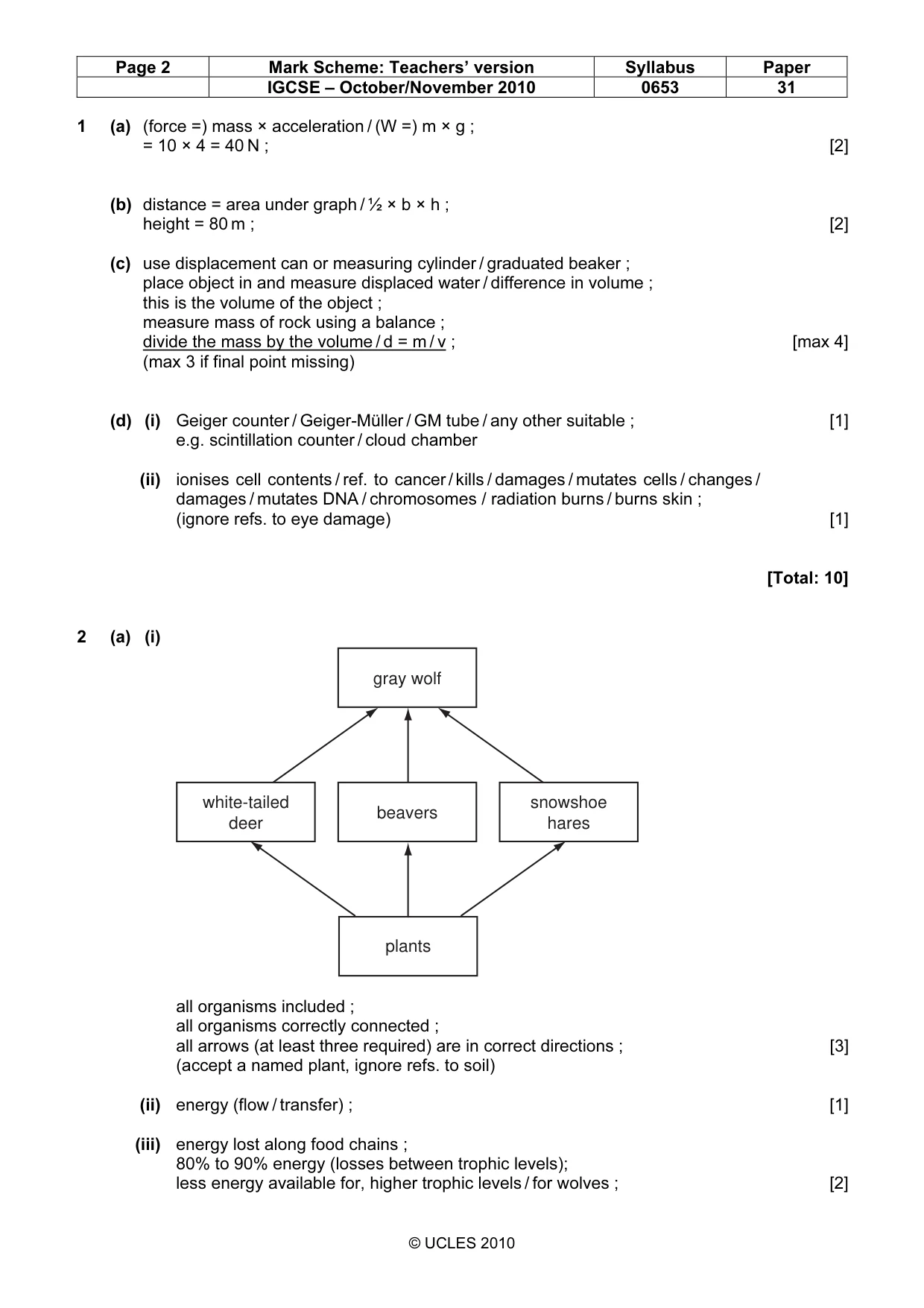
Page 2 Mark Scheme: Teachers’ version Syllabus Paper IGCSE – October/November 2010 0653 31 © UCLES 2010 1 (a) (force =) mass × acceleration / (W =) m × g ; = 10 × 4 = 40 N ; [2] (b) distance = area under graph / ½ × b × h ; height = 80 m ; [2] (c) use displacement can or measuring cylinder / graduated beaker ; place object in and measure displaced water / difference in volume ; this is the volume of the object ; measure mass of rock using a balance ; divide the mass by the volume / d = m / v ; [max 4] (max 3 if final point missing) (d) (i) Geiger counter / Geiger-Müller / GM tube / any other suitable ; [1] e.g. scintillation counter / cloud chamber (ii) ionises cell contents / ref. to cancer / kills / damages / mutates cells / changes / damages / mutates DNA / chromosomes / radiation burns / burns skin ; (ignore refs. to eye damage) [1] [Total: 10] 2 (a) (i) white-tailed deer beavers gray wolf snowshoe hares plants all organisms included ; all organisms correctly connected ; all arrows (at least three required) are in correct directions ; [3] (accept a named plant, ignore refs. to soil) (ii) energy (flow / transfer) ; [1] (iii) energy lost along food chains ; 80% to 90% energy (losses between trophic levels); less energy available for, higher trophic levels / for wolves ; [2]
Mark scheme, page 3
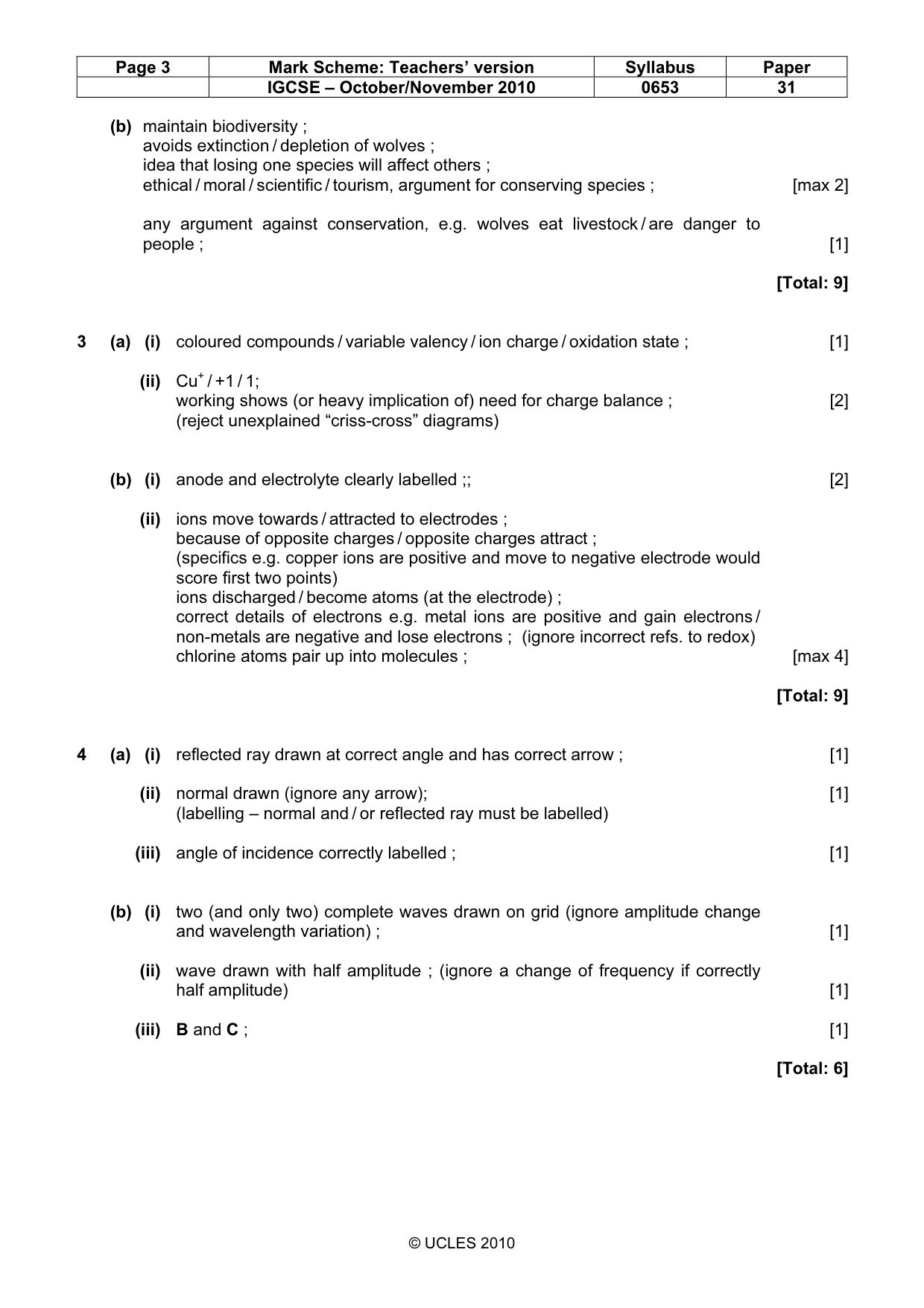
Page 3 Mark Scheme: Teachers’ version Syllabus Paper IGCSE – October/November 2010 0653 31 © UCLES 2010 (b) maintain biodiversity ; avoids extinction / depletion of wolves ; idea that losing one species will affect others ; ethical / moral / scientific / tourism, argument for conserving species ; [max 2] any argument against conservation, e.g. wolves eat livestock / are danger to people ; [1] [Total: 9] 3 (a) (i) coloured compounds / variable valency / ion charge / oxidation state ; [1] (ii) Cu+ / +1 / 1; working shows (or heavy implication of) need for charge balance ; [2] (reject unexplained “criss-cross” diagrams) (b) (i) anode and electrolyte clearly labelled ;; [2] (ii) ions move towards / attracted to electrodes ; because of opposite charges / opposite charges attract ; (specifics e.g. copper ions are positive and move to negative electrode would score first two points) ions discharged / become atoms (at the electrode) ; correct details of electrons e.g. metal ions are positive and gain electrons / non-metals are negative and lose electrons ; (ignore incorrect refs. to redox) chlorine atoms pair up into molecules ; [max 4] [Total: 9] 4 (a) (i) reflected ray drawn at correct angle and has correct arrow ; [1] (ii) normal drawn (ignore any arrow); [1] (labelling – normal and / or reflected ray must be labelled) (iii) angle of incidence correctly labelled ; [1] (b) (i) two (and only two) complete waves drawn on grid (ignore amplitude change and wavelength variation) ; [1] (ii) wave drawn with half amplitude ; (ignore a change of frequency if correctly half amplitude) [1] (iii) B and C ; [1] [Total: 6]
Mark scheme, page 4
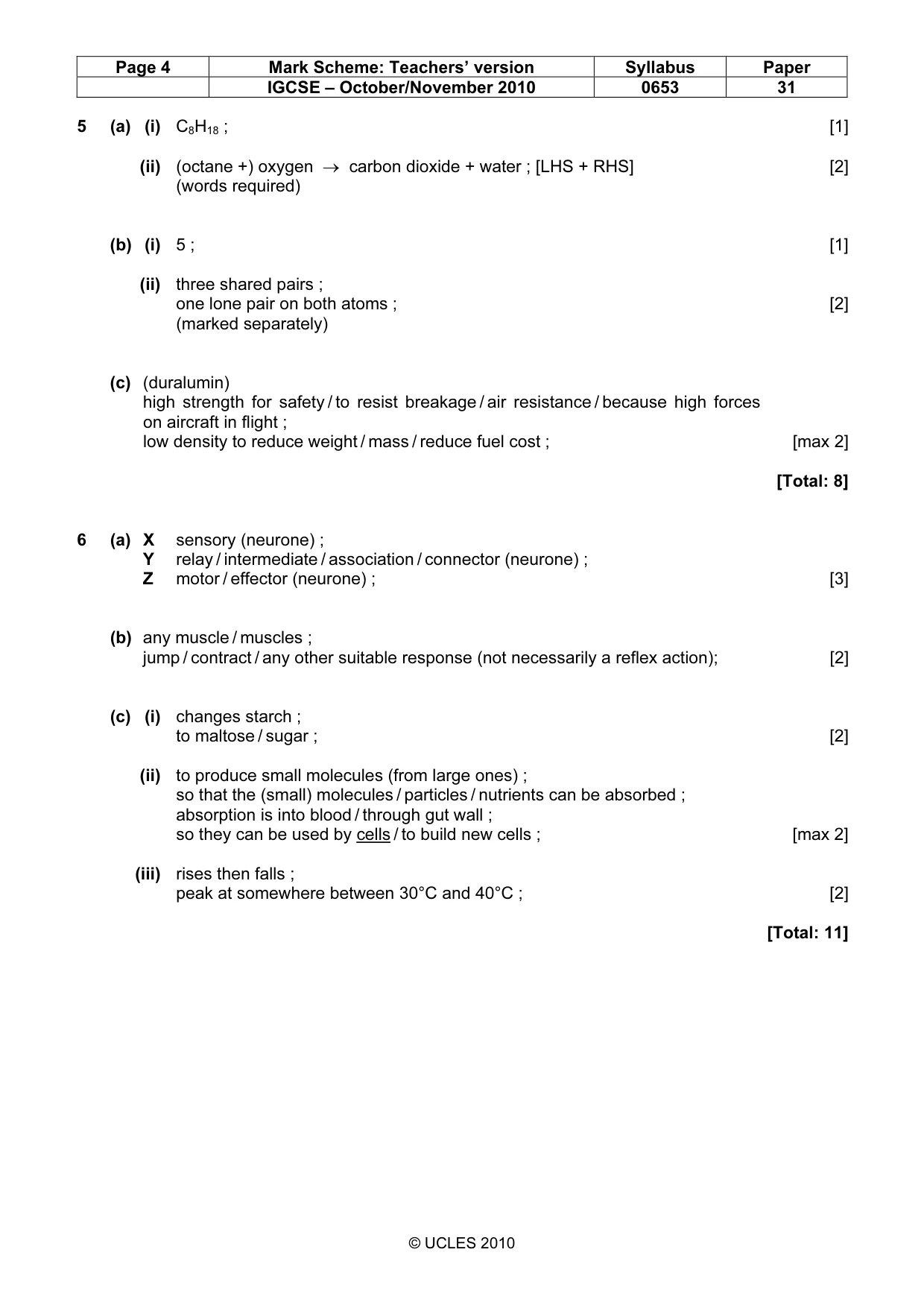
Page 4 Mark Scheme: Teachers’ version Syllabus Paper IGCSE – October/November 2010 0653 31 © UCLES 2010 5 (a) (i) C8H18 ; [1] (ii) (octane +) oxygen → carbon dioxide + water ; [LHS + RHS] [2] (words required) (b) (i) 5 ; [1] (ii) three shared pairs ; one lone pair on both atoms ; [2] (marked separately) (c) (duralumin) high strength for safety / to resist breakage / air resistance / because high forces on aircraft in flight ; low density to reduce weight / mass / reduce fuel cost ; [max 2] [Total: 8] 6 (a) X sensory (neurone) ; Y relay / intermediate / association / connector (neurone) ; Z motor / effector (neurone) ; [3] (b) any muscle / muscles ; jump / contract / any other suitable response (not necessarily a reflex action); [2] (c) (i) changes starch ; to maltose / sugar ; [2] (ii) to produce small molecules (from large ones) ; so that the (small) molecules / particles / nutrients can be absorbed ; absorption is into blood / through gut wall ; so they can be used by cells / to build new cells ; [max 2] (iii) rises then falls ; peak at somewhere between 30°C and 40°C ; [2] [Total: 11]
Mark scheme, page 5
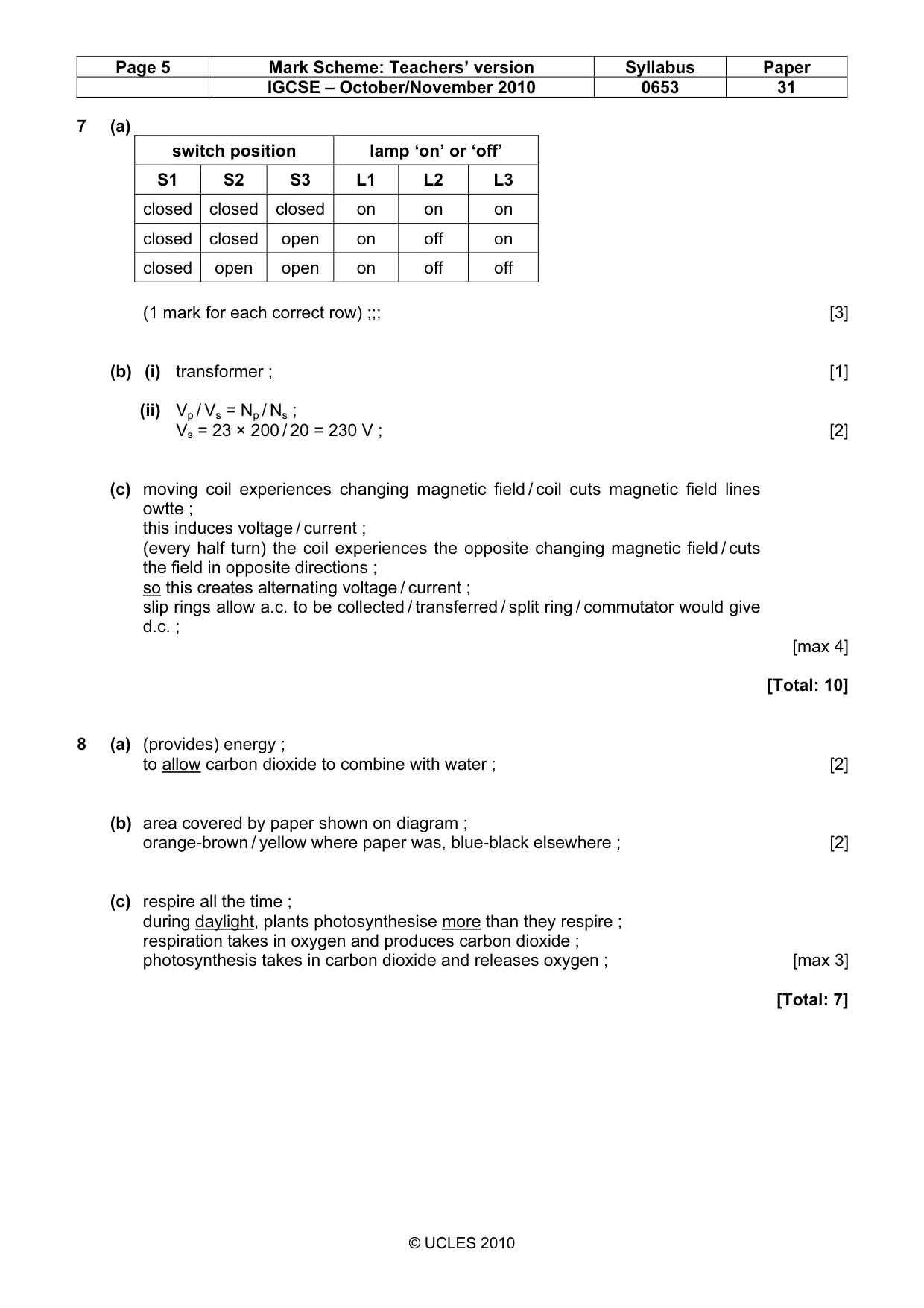
Page 5 Mark Scheme: Teachers’ version Syllabus Paper IGCSE – October/November 2010 0653 31 © UCLES 2010 7 (a) switch position lamp ‘on’ or ‘off’ S1 S2 S3 L1 L2 L3 closed closed closed on on on closed closed open on off on closed open open on off off (1 mark for each correct row) ;;; [3] (b) (i) transformer ; [1] (ii) Vp / Vs = Np / Ns ; Vs = 23 × 200 / 20 = 230 V ; [2] (c) moving coil experiences changing magnetic field / coil cuts magnetic field lines owtte ; this induces voltage / current ; (every half turn) the coil experiences the opposite changing magnetic field / cuts the field in opposite directions ; so this creates alternating voltage / current ; slip rings allow a.c. to be collected / transferred / split ring / commutator would give d.c. ; [max 4] [Total: 10] 8 (a) (provides) energy ; to allow carbon dioxide to combine with water ; [2] (b) area covered by paper shown on diagram ; orange-brown / yellow where paper was, blue-black elsewhere ; [2] (c) respire all the time ; during daylight, plants photosynthesise more than they respire ; respiration takes in oxygen and produces carbon dioxide ; photosynthesis takes in carbon dioxide and releases oxygen ; [max 3] [Total: 7]
Mark scheme, page 6
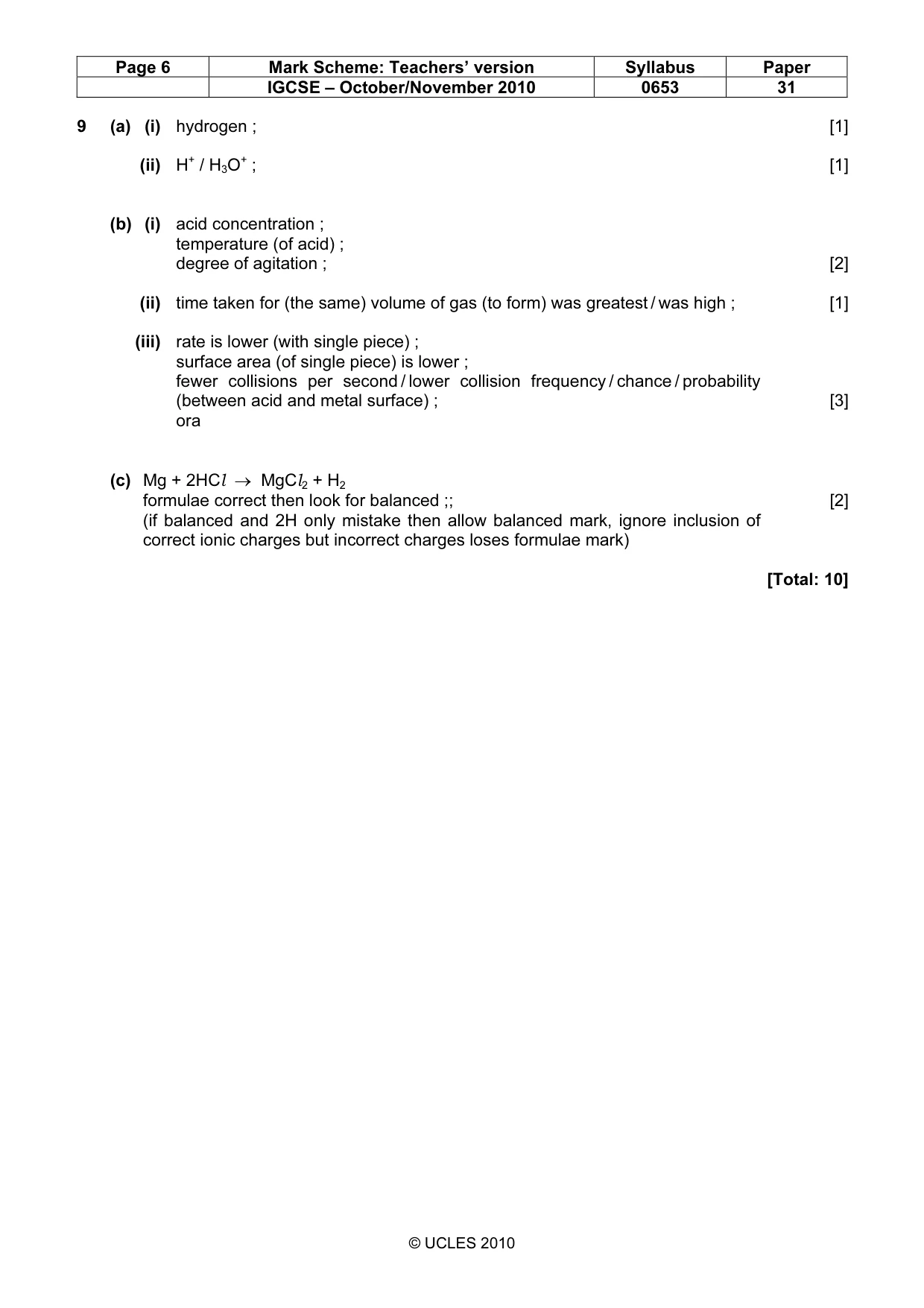
Page 6 Mark Scheme: Teachers’ version Syllabus Paper IGCSE – October/November 2010 0653 31 © UCLES 2010 9 (a) (i) hydrogen ; [1] (ii) H+ / H3O+ ; [1] (b) (i) acid concentration ; temperature (of acid) ; degree of agitation ; [2] (ii) time taken for (the same) volume of gas (to form) was greatest / was high ; [1] (iii) rate is lower (with single piece) ; surface area (of single piece) is lower ; fewer collisions per second / lower collision frequency / chance / probability (between acid and metal surface) ; [3] ora (c) Mg + 2HCl → MgCl2 + H2 formulae correct then look for balanced ;; [2] (if balanced and 2H only mistake then allow balanced mark, ignore inclusion of correct ionic charges but incorrect charges loses formulae mark) [Total: 10]
What you needed in this session
Cambridge’s own grade thresholds for 2010 Oct/Nov, Paper 3 · Variant 1. A higher threshold means an easier paper — the bar moves with how the cohort did.