Cambridge IGCSE Science - Combined 0653 — 2006 Oct/Nov Paper 2 · Variant 1
0653/21/O/N/06 · 80 marks · ≈90 min
The question paper and its mark scheme, free to read here and free to download. This is Cambridge’s own paper, exactly as it was sat.
Question paper20 pages


Mark scheme5 pages
Answers below. Sit the paper first if you are practising.
Paper as text
Question paper, page 1
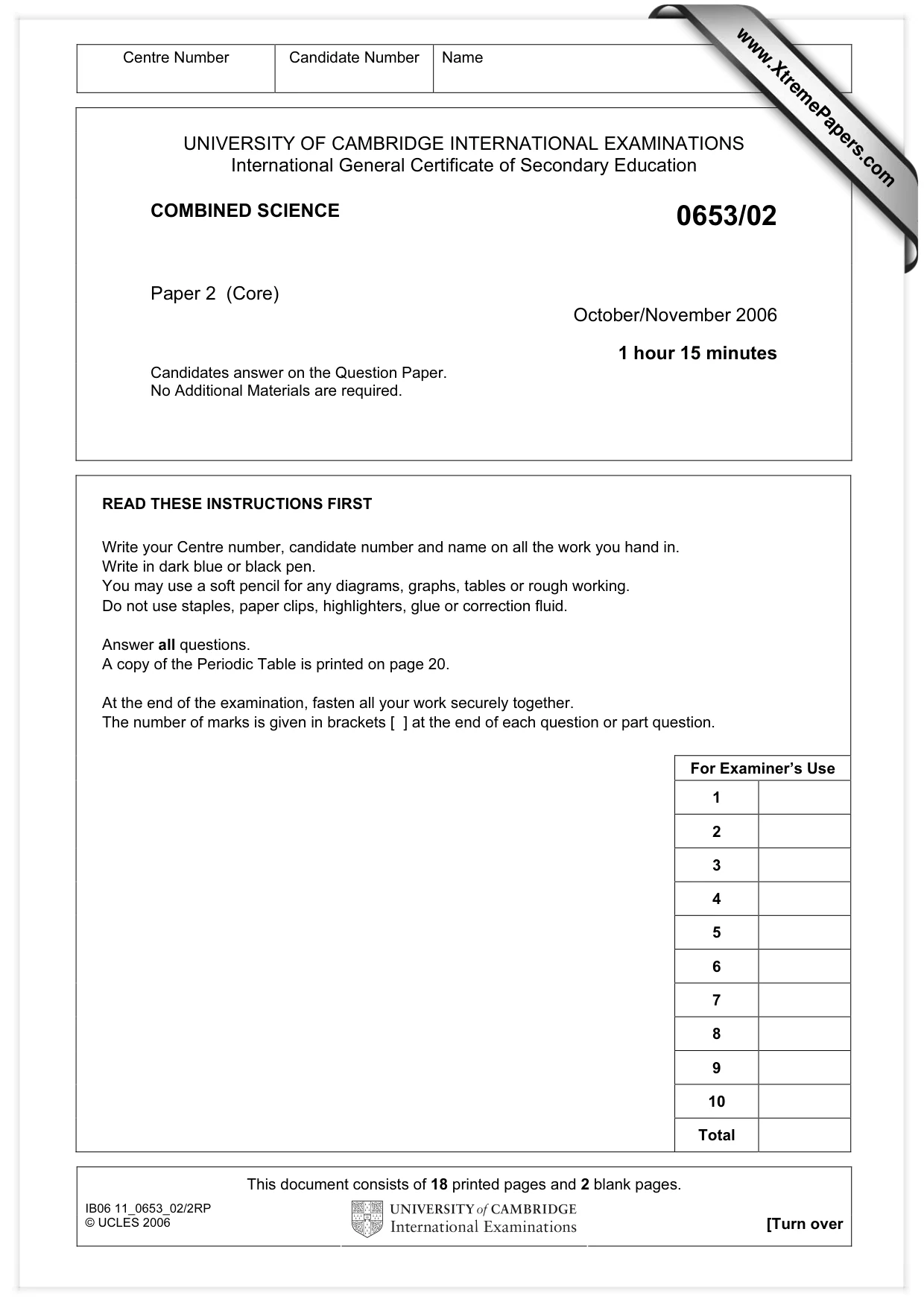
Centre Number Candidate Number Name UNIVERSITY OF CAMBRIDGE INTERNATIONAL EXAMINATIONS International General Certificate of Secondary Education COMBINED SCIENCE 0653/02 Paper 2 (Core) October/November 2006 1 hour 15 minutes Candidates answer on the Question Paper. No Additional Materials are required. READ THESE INSTRUCTIONS FIRST Write your Centre number, candidate number and name on all the work you hand in. Write in dark blue or black pen. You may use a soft pencil for any diagrams, graphs, tables or rough working. Do not use staples, paper clips, highlighters, glue or correction fluid. Answer all questions. A copy of the Periodic Table is printed on page 20. At the end of the examination, fasten all your work securely together. The number of marks is given in brackets [ ] at the end of each question or part question. For Examiner’s Use 1 2 3 4 5 6 7 8 9 10 Total This document consists of 18 printed pages and 2 blank pages. IB06 11_0653_02/2RP © UCLES 2006 [Turn over www.XtremePapers.com
Question paper, page 2
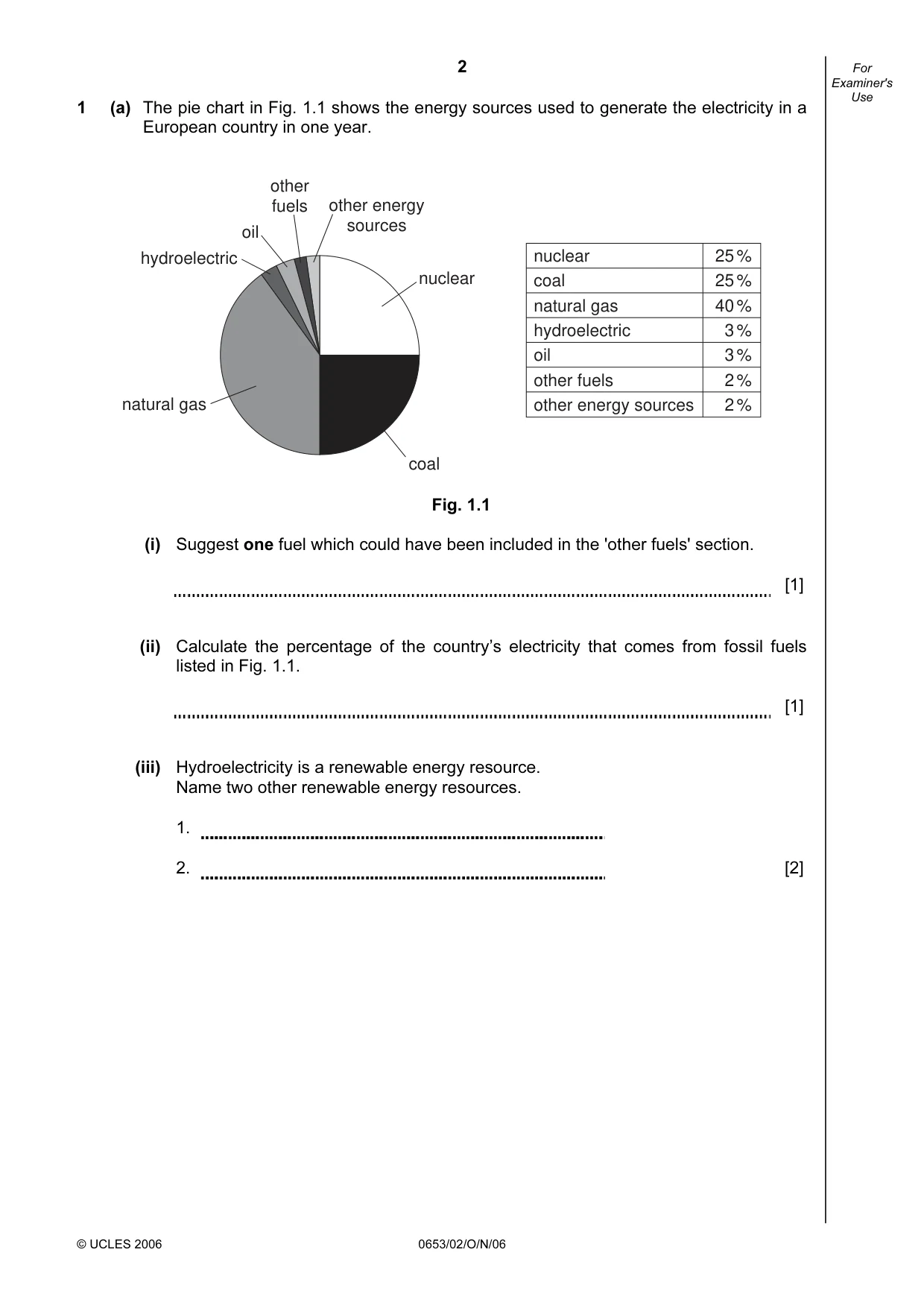
2 © UCLES 2006 0653/02/O/N/06 For Examiner's Use 1 (a) The pie chart in Fig. 1.1 shows the energy sources used to generate the electricity in a European country in one year. nuclear coal natural gas hydroelectric oil other fuels other energy sources 25 % 25 % 40 % 3 % 3 % 2 % 2 % hydroelectric oil other fuels other energy sources nuclear coal natural gas Fig. 1.1 (i) Suggest one fuel which could have been included in the 'other fuels' section. [1] (ii) Calculate the percentage of the country’s electricity that comes from fossil fuels listed in Fig. 1.1. [1] (iii) Hydroelectricity is a renewable energy resource. Name two other renewable energy resources. 1. 2. [2]
Question paper, page 3
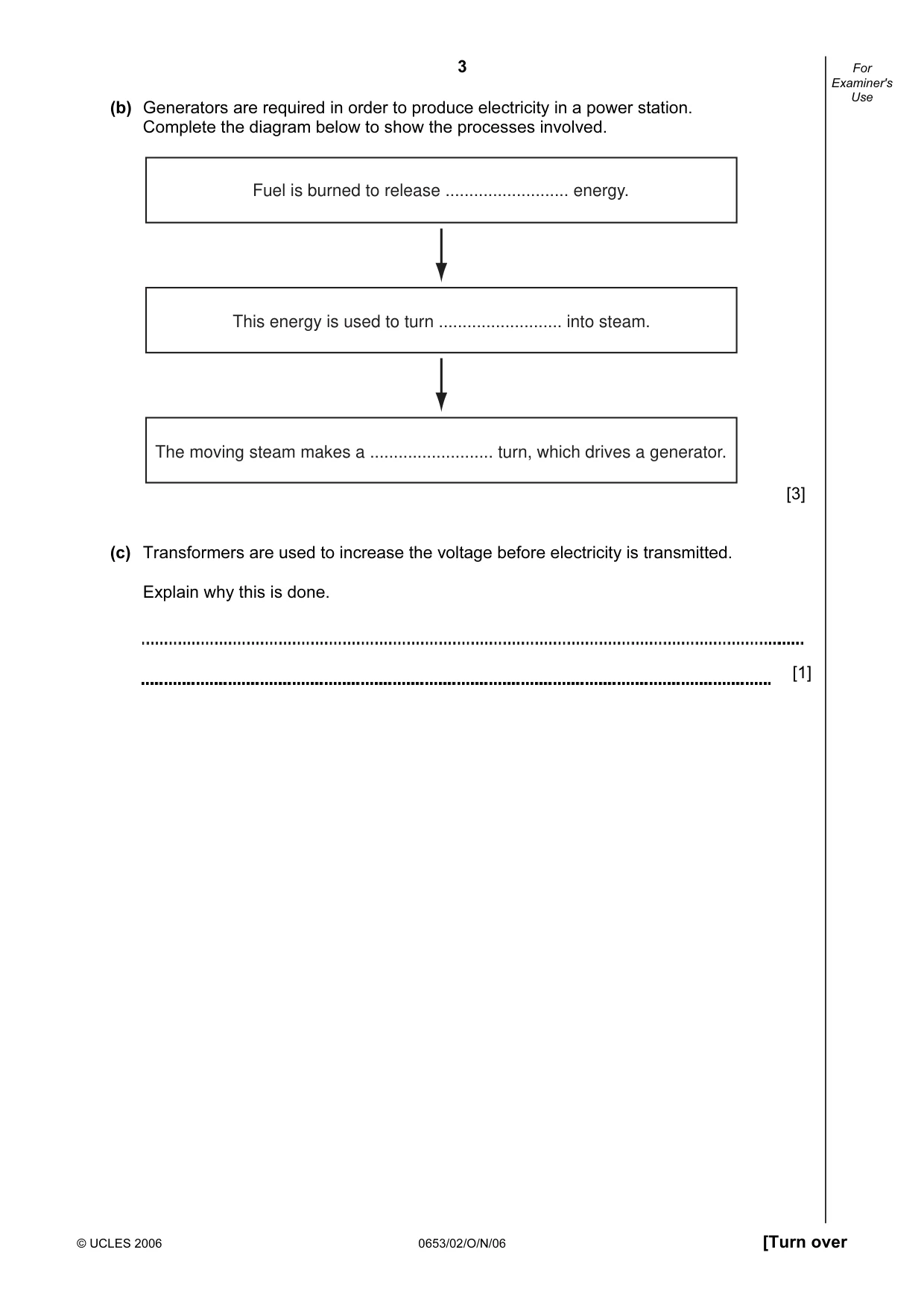
3 © UCLES 2006 0653/02/O/N/06 [Turn over For Examiner's Use (b) Generators are required in order to produce electricity in a power station. Complete the diagram below to show the processes involved. Fuel is burned to release … energy. This energy is used to turn … into steam. The moving steam makes a … turn, which drives a generator. [3] (c) Transformers are used to increase the voltage before electricity is transmitted. Explain why this is done. [1]
Question paper, page 4
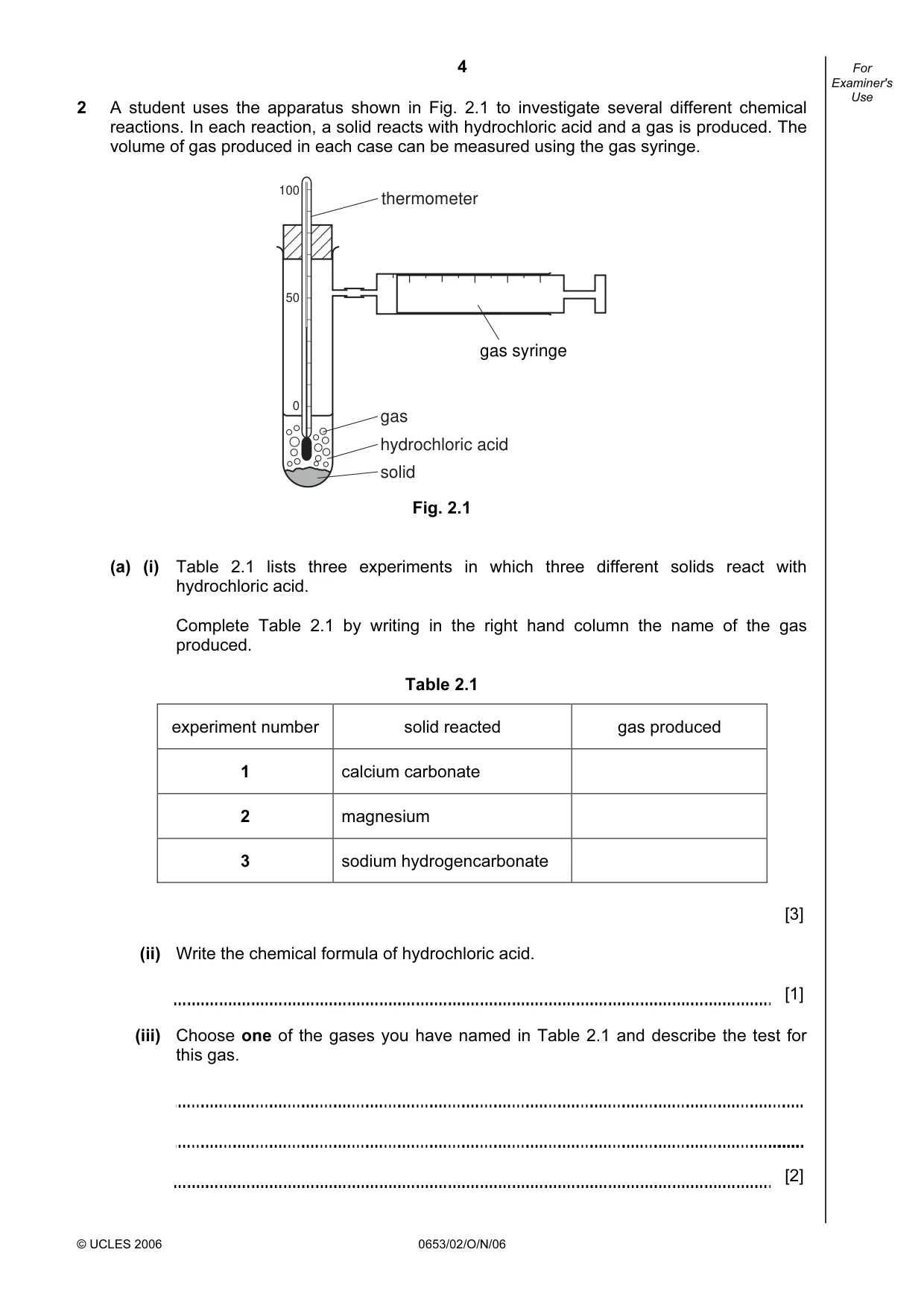
4 © UCLES 2006 0653/02/O/N/06 For Examiner's Use 2 A student uses the apparatus shown in Fig. 2.1 to investigate several different chemical reactions. In each reaction, a solid reacts with hydrochloric acid and a gas is produced. The volume of gas produced in each case can be measured using the gas syringe. gas syringe 100 50 0 thermometer gas hydrochloric acid solid Fig. 2.1 (a) (i) Table 2.1 lists three experiments in which three different solids react with hydrochloric acid. Complete Table 2.1 by writing in the right hand column the name of the gas produced. Table 2.1 experiment number solid reacted gas produced 1 calcium carbonate 2 magnesium 3 sodium hydrogencarbonate [3] (ii) Write the chemical formula of hydrochloric acid. [1] (iii) Choose one of the gases you have named in Table 2.1 and describe the test for this gas. [2]
Question paper, page 5
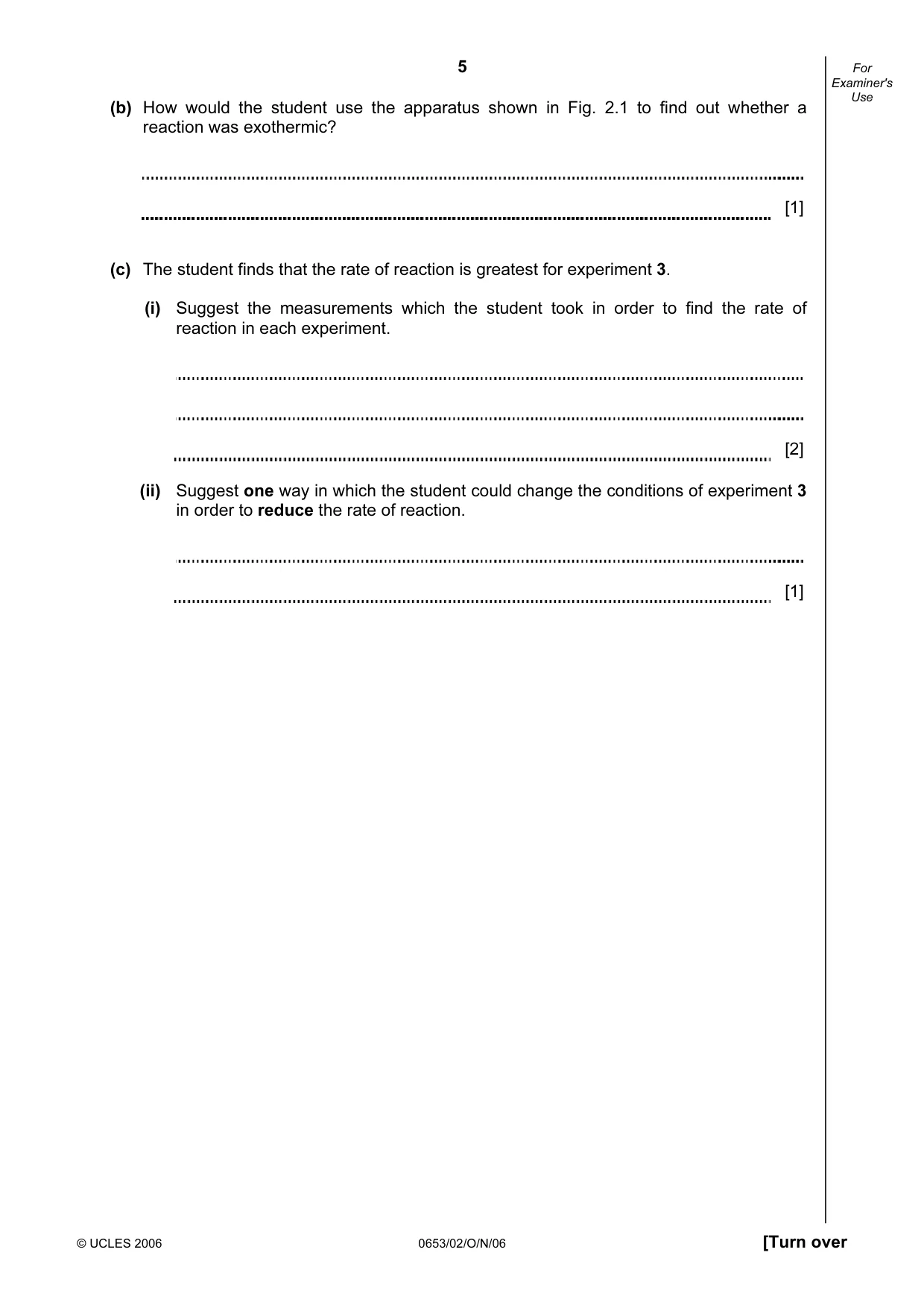
5 © UCLES 2006 0653/02/O/N/06 [Turn over For Examiner's Use (b) How would the student use the apparatus shown in Fig. 2.1 to find out whether a reaction was exothermic? [1] (c) The student finds that the rate of reaction is greatest for experiment 3. (i) Suggest the measurements which the student took in order to find the rate of reaction in each experiment. [2] (ii) Suggest one way in which the student could change the conditions of experiment 3 in order to reduce the rate of reaction. [1]
Question paper, page 6
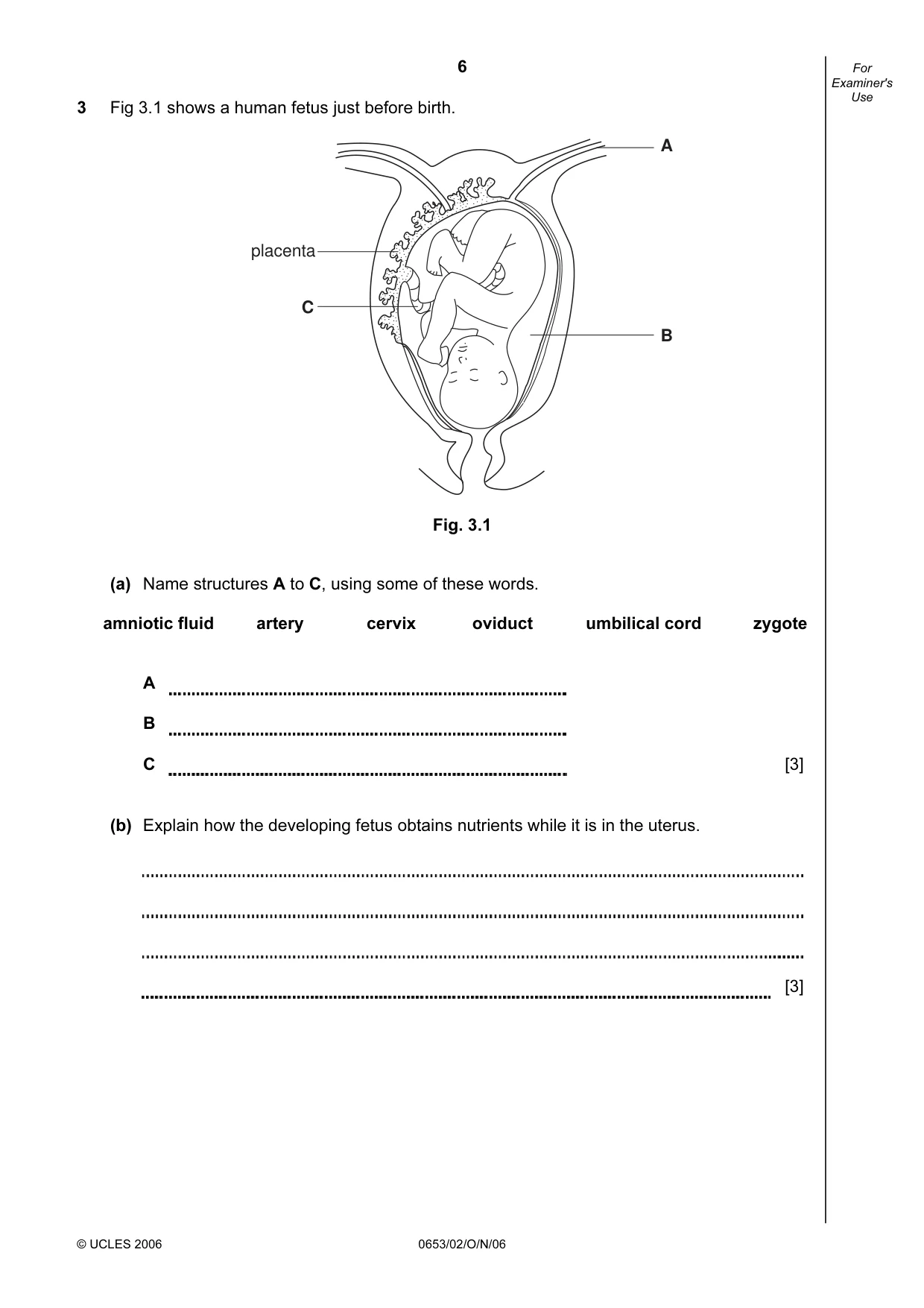
6 © UCLES 2006 0653/02/O/N/06 For Examiner's Use 3 Fig 3.1 shows a human fetus just before birth. placenta A B C Fig. 3.1 (a) Name structures A to C, using some of these words. amniotic fluid artery cervix oviduct umbilical cord zygote A B C [3] (b) Explain how the developing fetus obtains nutrients while it is in the uterus. [3]
Question paper, page 7
7 © UCLES 2006 0653/02/O/N/06 [Turn over For Examiner's Use (c) Outline what happens during the birth of the baby. [2] (d) If a mother has AIDS, there is a risk that her baby may be born with HIV and develop AIDS. Explain how this could happen. [2]
Question paper, page 8
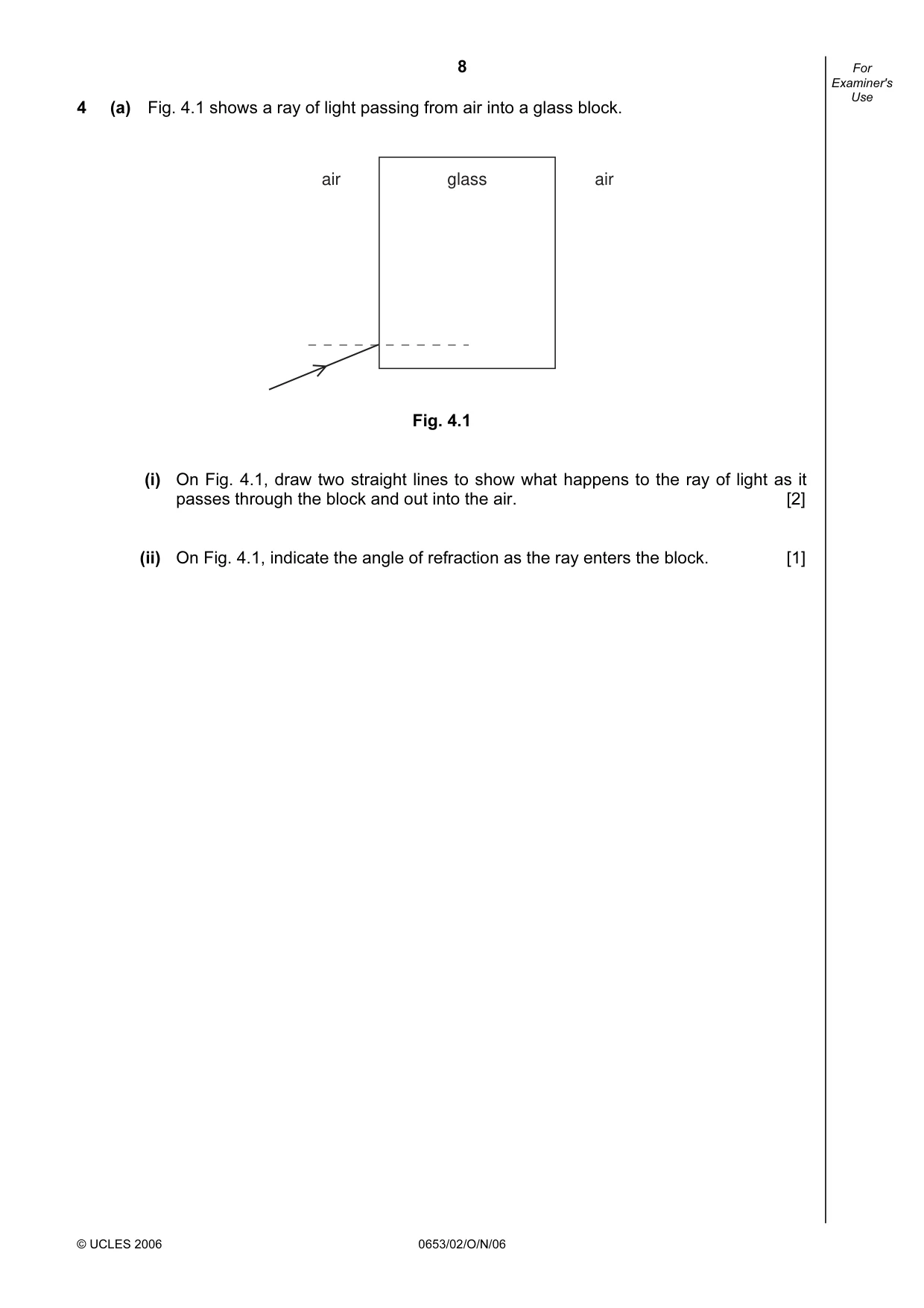
8 © UCLES 2006 0653/02/O/N/06 For Examiner's Use 4 (a) Fig. 4.1 shows a ray of light passing from air into a glass block. glass air air Fig. 4.1 (i) On Fig. 4.1, draw two straight lines to show what happens to the ray of light as it passes through the block and out into the air. [2] (ii) On Fig. 4.1, indicate the angle of refraction as the ray enters the block. [1]
Question paper, page 9
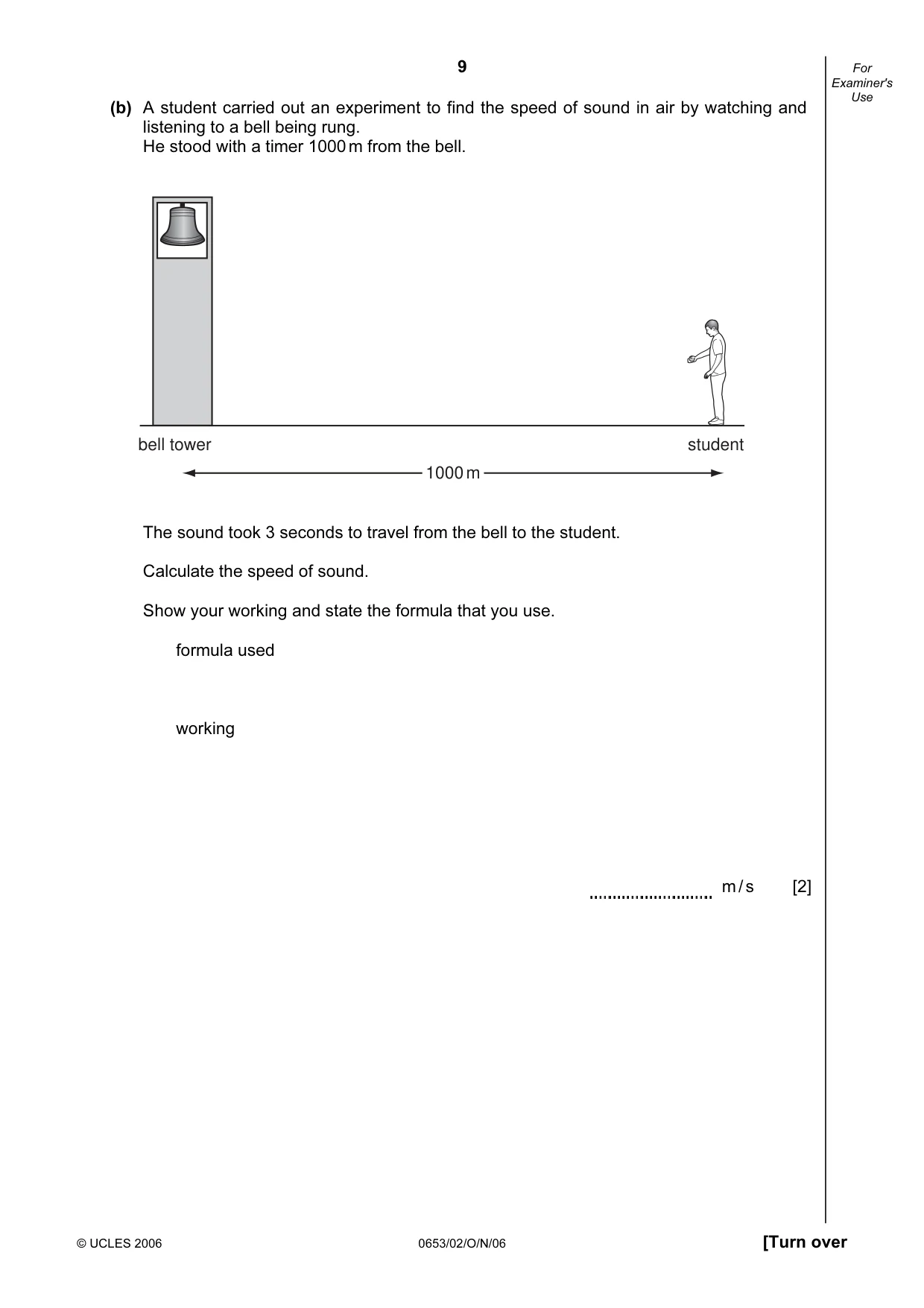
9 © UCLES 2006 0653/02/O/N/06 [Turn over For Examiner's Use (b) A student carried out an experiment to find the speed of sound in air by watching and listening to a bell being rung. He stood with a timer 1000 m from the bell. student bell tower 1000 m The sound took 3 seconds to travel from the bell to the student. Calculate the speed of sound. Show your working and state the formula that you use. formula used working m / s [2]
Question paper, page 10
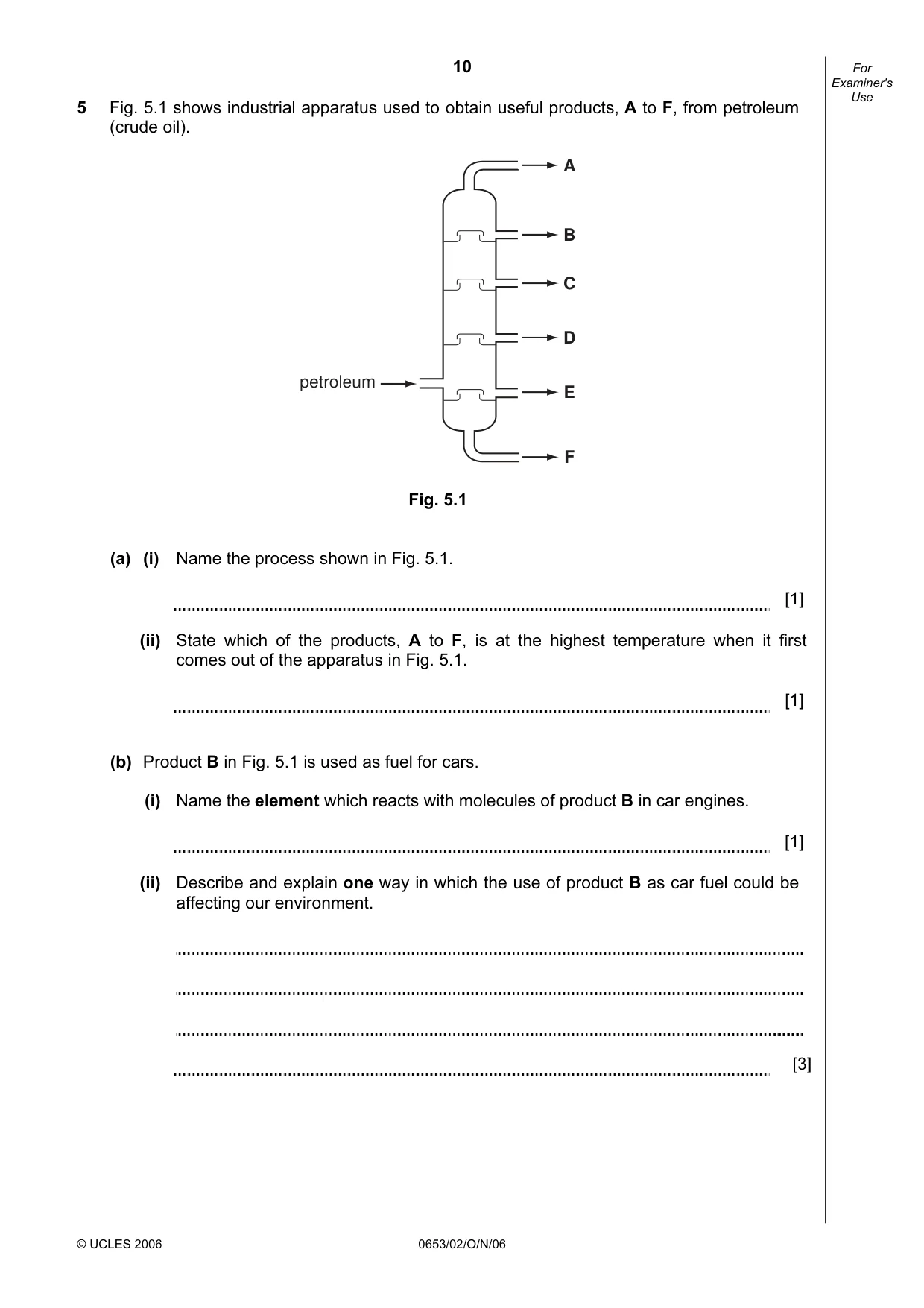
10 © UCLES 2006 0653/02/O/N/06 For Examiner's Use 5 Fig. 5.1 shows industrial apparatus used to obtain useful products, A to F, from petroleum (crude oil). petroleum A B C D E F Fig. 5.1 (a) (i) Name the process shown in Fig. 5.1. [1] (ii) State which of the products, A to F, is at the highest temperature when it first comes out of the apparatus in Fig. 5.1. [1] (b) Product B in Fig. 5.1 is used as fuel for cars. (i) Name the element which reacts with molecules of product B in car engines. [1] (ii) Describe and explain one way in which the use of product B as car fuel could be affecting our environment. [3]
Question paper, page 11
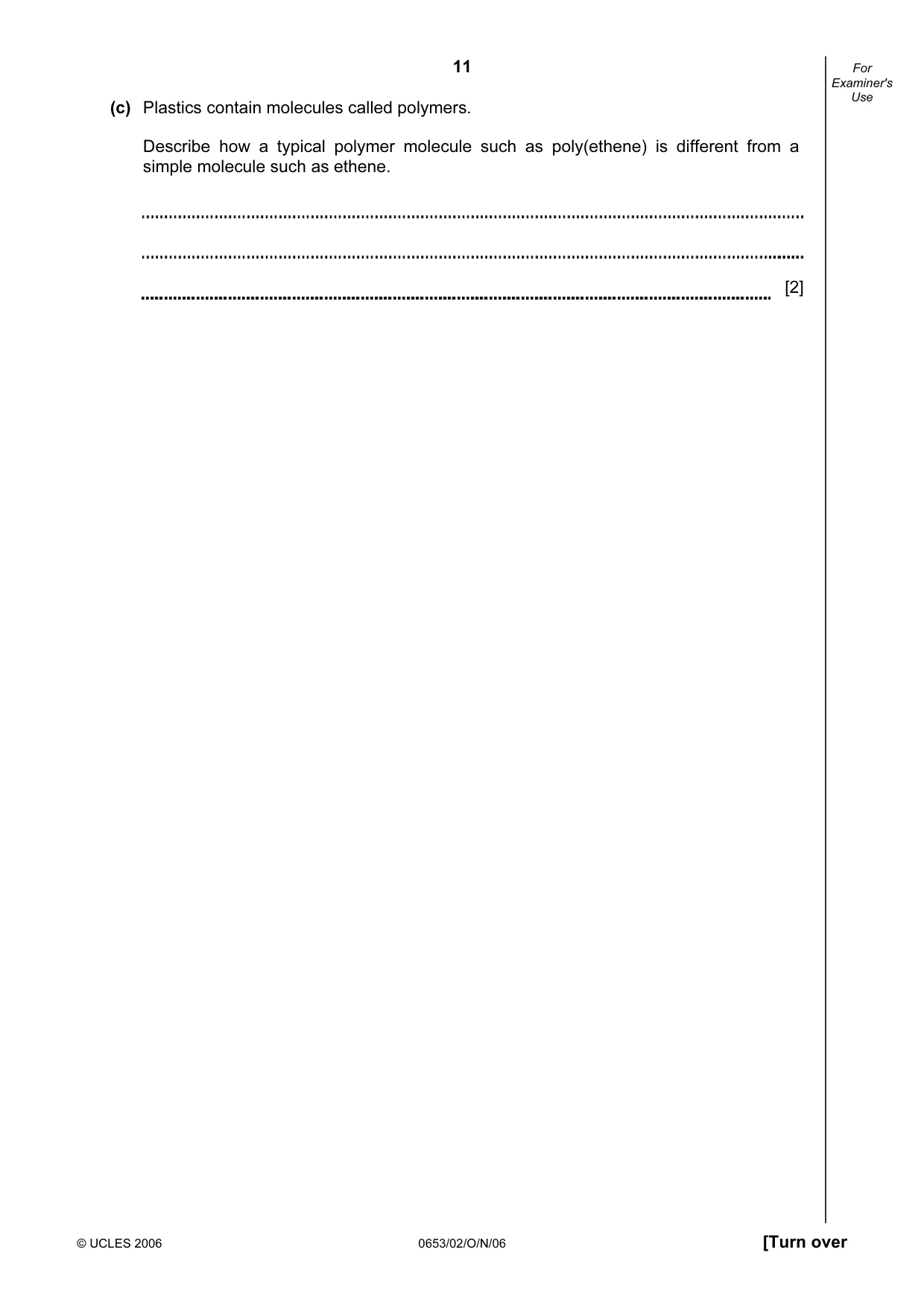
11 © UCLES 2006 0653/02/O/N/06 [Turn over For Examiner's Use (c) Plastics contain molecules called polymers. Describe how a typical polymer molecule such as poly(ethene) is different from a simple molecule such as ethene. [2]
Question paper, page 12
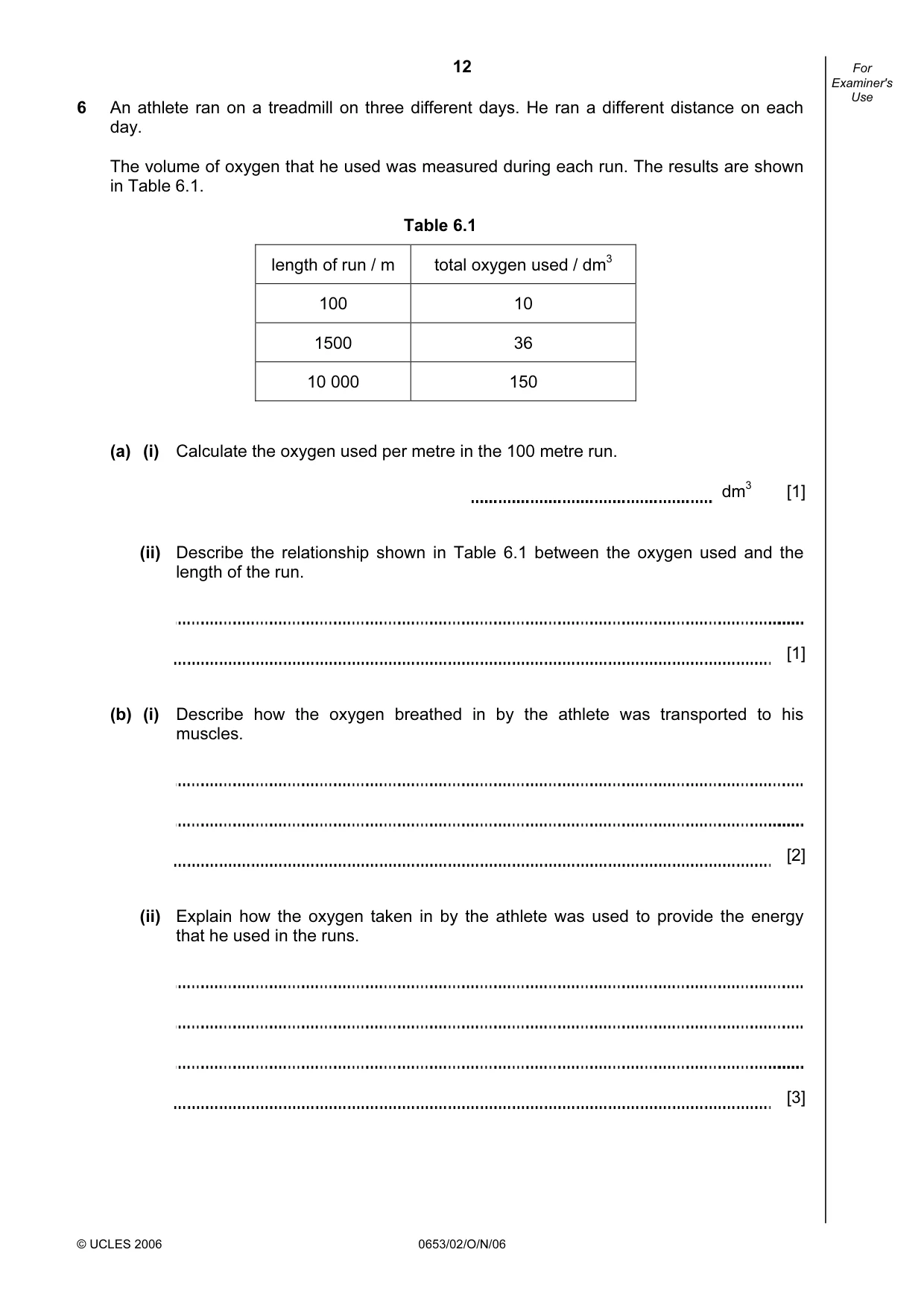
12 © UCLES 2006 0653/02/O/N/06 For Examiner's Use 6 An athlete ran on a treadmill on three different days. He ran a different distance on each day. The volume of oxygen that he used was measured during each run. The results are shown in Table 6.1. Table 6.1 length of run / m total oxygen used / dm3 100 10 1500 36 10 000 150 (a) (i) Calculate the oxygen used per metre in the 100 metre run. dm3 [1] (ii) Describe the relationship shown in Table 6.1 between the oxygen used and the length of the run. [1] (b) (i) Describe how the oxygen breathed in by the athlete was transported to his muscles. [2] (ii) Explain how the oxygen taken in by the athlete was used to provide the energy that he used in the runs. [3]
Question paper, page 13
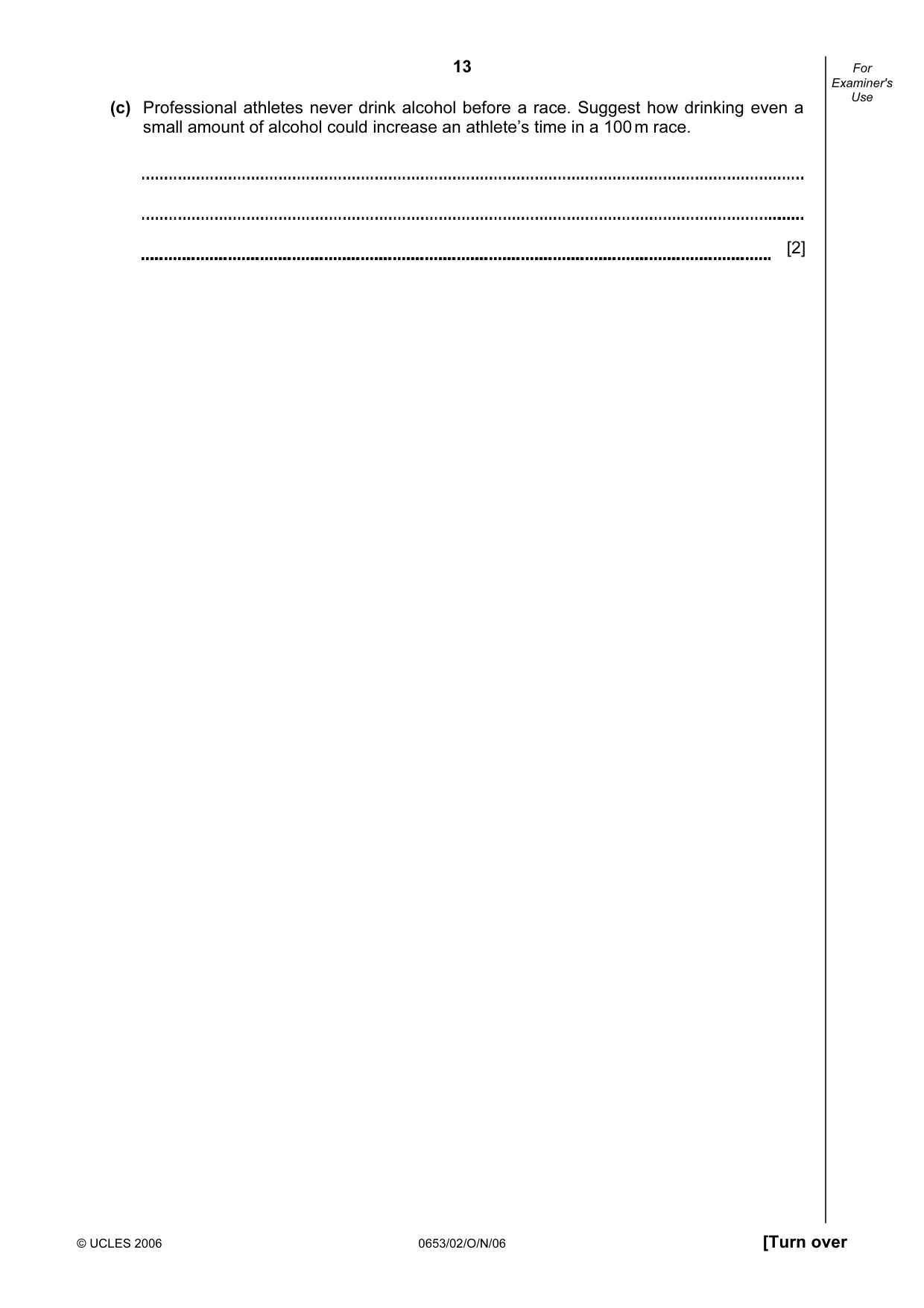
13 © UCLES 2006 0653/02/O/N/06 [Turn over For Examiner's Use (c) Professional athletes never drink alcohol before a race. Suggest how drinking even a small amount of alcohol could increase an athlete’s time in a 100 m race. [2]
Question paper, page 14
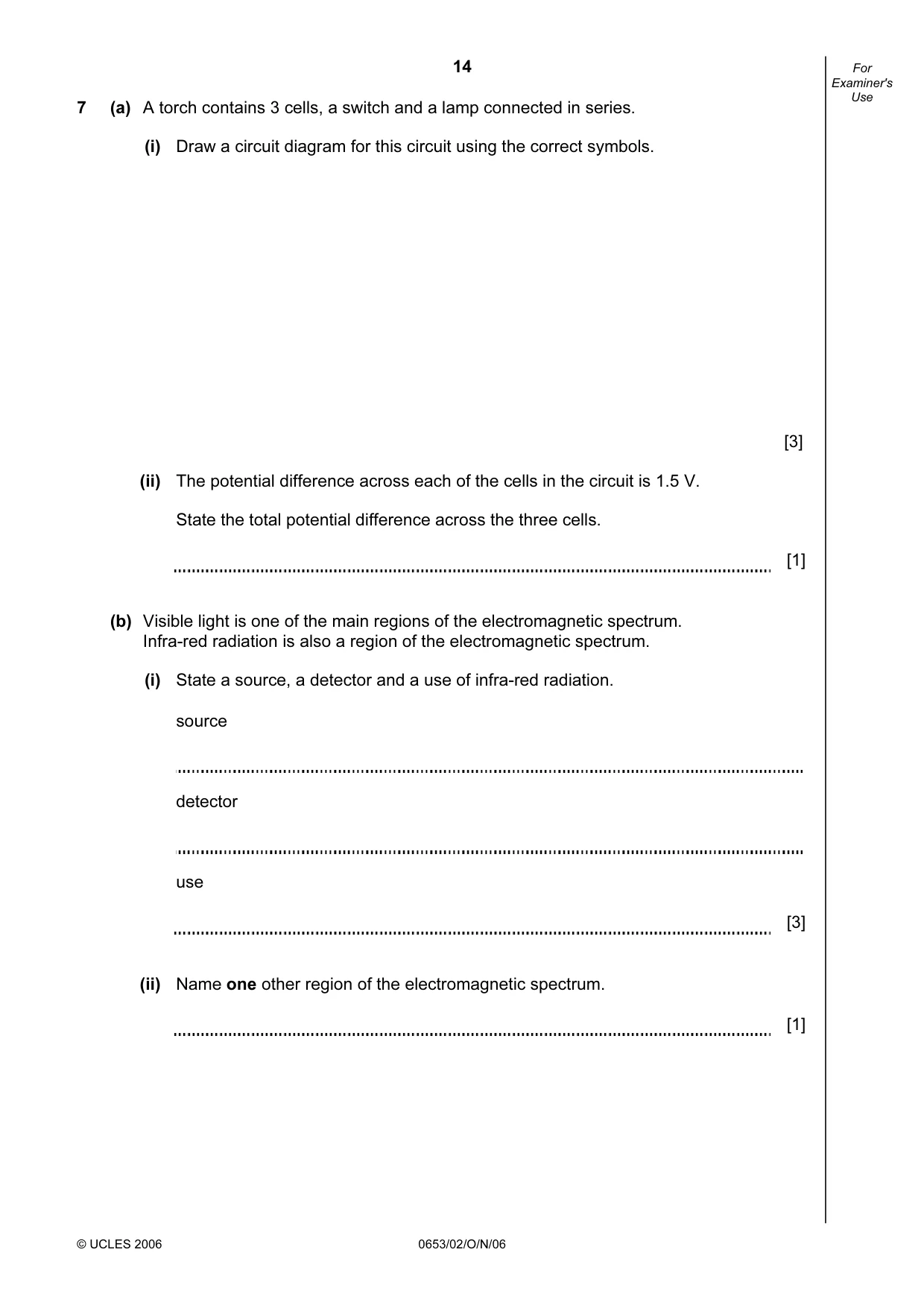
14 © UCLES 2006 0653/02/O/N/06 For Examiner's Use 7 (a) A torch contains 3 cells, a switch and a lamp connected in series. (i) Draw a circuit diagram for this circuit using the correct symbols. [3] (ii) The potential difference across each of the cells in the circuit is 1.5 V. State the total potential difference across the three cells. [1] (b) Visible light is one of the main regions of the electromagnetic spectrum. Infra-red radiation is also a region of the electromagnetic spectrum. (i) State a source, a detector and a use of infra-red radiation. source detector use [3] (ii) Name one other region of the electromagnetic spectrum. [1]
Question paper, page 15
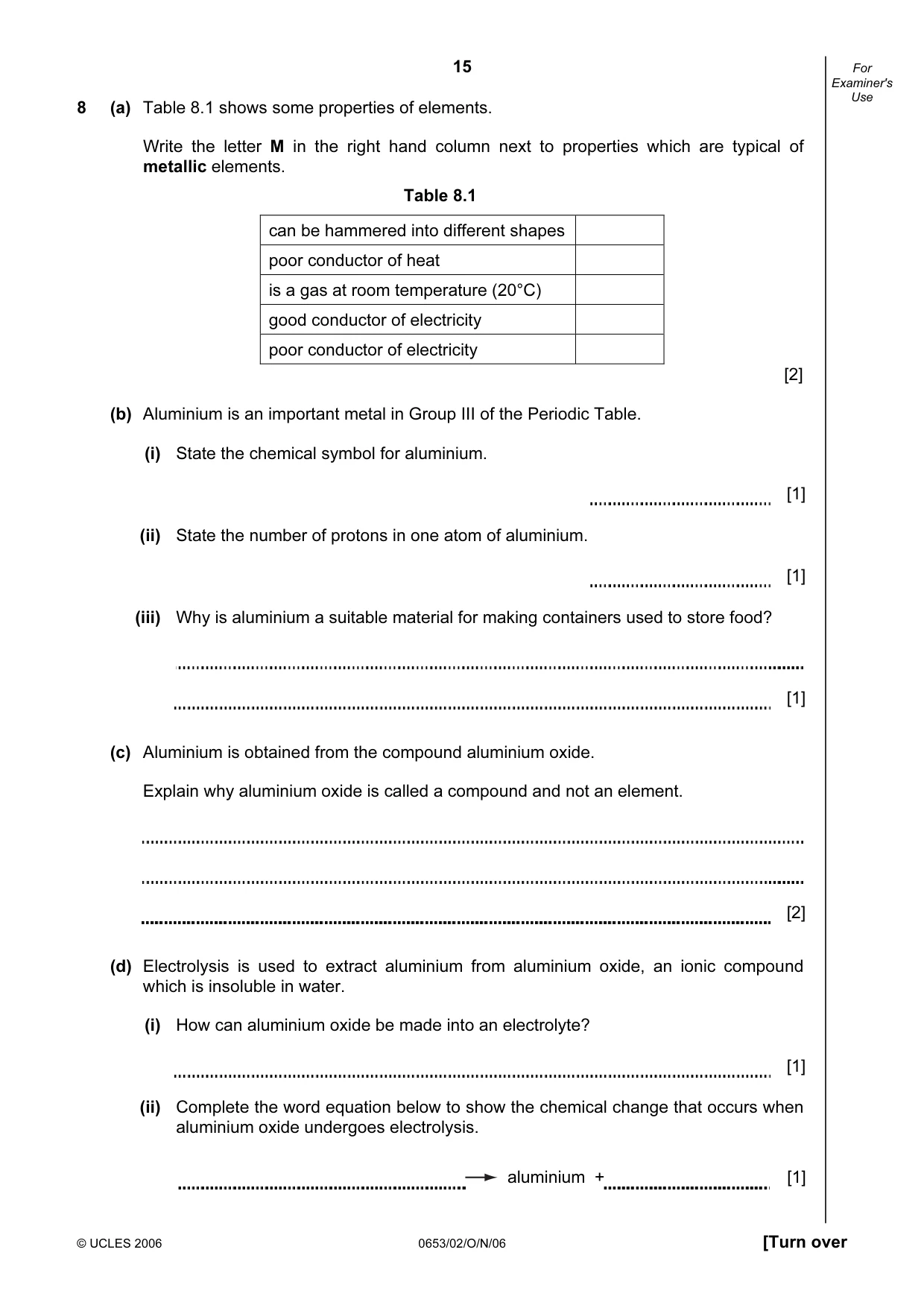
15 © UCLES 2006 0653/02/O/N/06 [Turn over For Examiner's Use 8 (a) Table 8.1 shows some properties of elements. Write the letter M in the right hand column next to properties which are typical of metallic elements. Table 8.1 can be hammered into different shapes poor conductor of heat is a gas at room temperature (20°C) good conductor of electricity poor conductor of electricity [2] (b) Aluminium is an important metal in Group III of the Periodic Table. (i) State the chemical symbol for aluminium. [1] (ii) State the number of protons in one atom of aluminium. [1] (iii) Why is aluminium a suitable material for making containers used to store food? [1] (c) Aluminium is obtained from the compound aluminium oxide. Explain why aluminium oxide is called a compound and not an element. [2] (d) Electrolysis is used to extract aluminium from aluminium oxide, an ionic compound which is insoluble in water. (i) How can aluminium oxide be made into an electrolyte? [1] (ii) Complete the word equation below to show the chemical change that occurs when aluminium oxide undergoes electrolysis. aluminium + [1]
Question paper, page 16
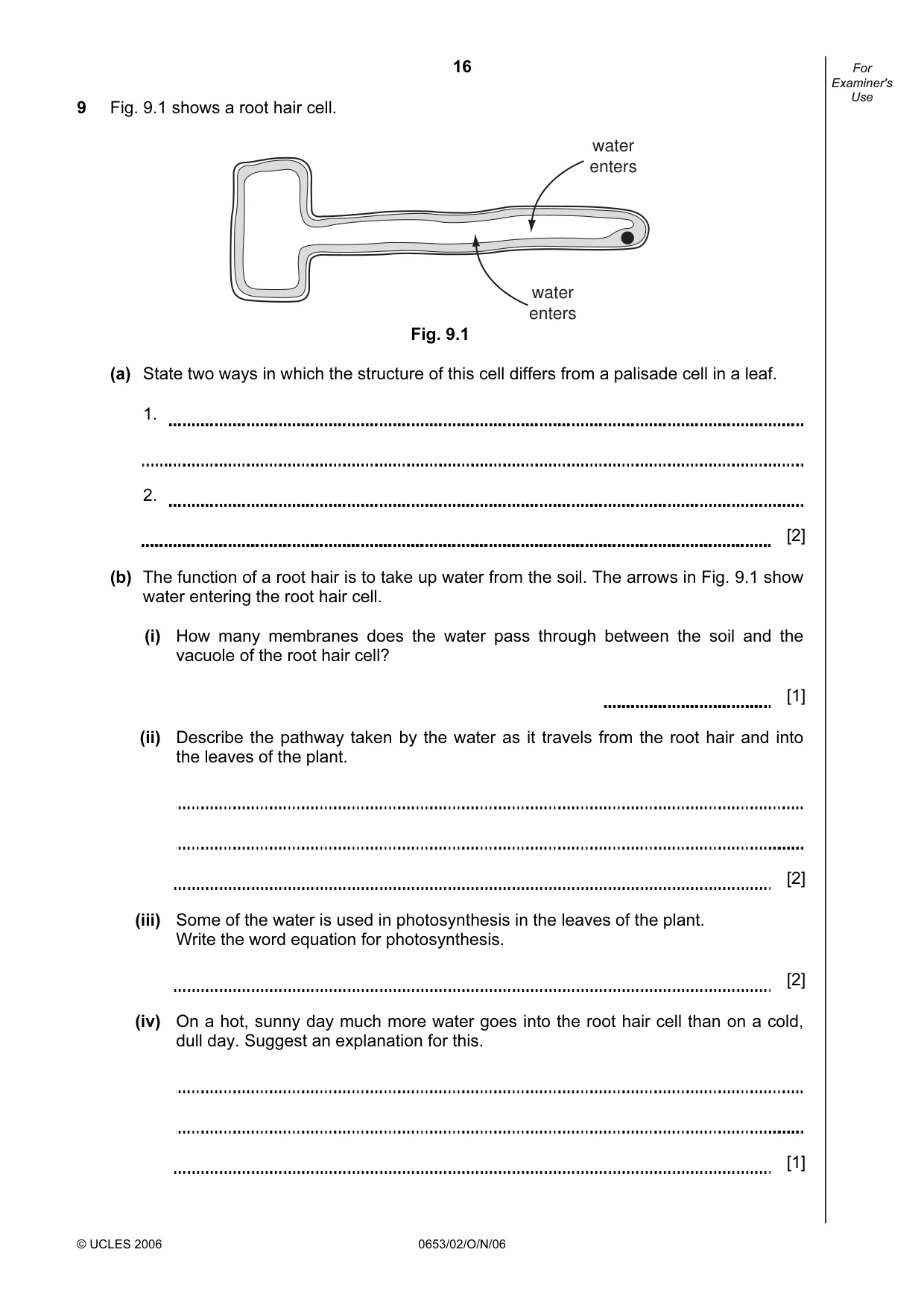
16 © UCLES 2006 0653/02/O/N/06 For Examiner's Use 9 Fig. 9.1 shows a root hair cell. water enters water enters Fig. 9.1 (a) State two ways in which the structure of this cell differs from a palisade cell in a leaf. 1. 2. [2] (b) The function of a root hair is to take up water from the soil. The arrows in Fig. 9.1 show water entering the root hair cell. (i) How many membranes does the water pass through between the soil and the vacuole of the root hair cell? [1] (ii) Describe the pathway taken by the water as it travels from the root hair and into the leaves of the plant. [2] (iii) Some of the water is used in photosynthesis in the leaves of the plant. Write the word equation for photosynthesis. [2] (iv) On a hot, sunny day much more water goes into the root hair cell than on a cold, dull day. Suggest an explanation for this. [1]
Question paper, page 17
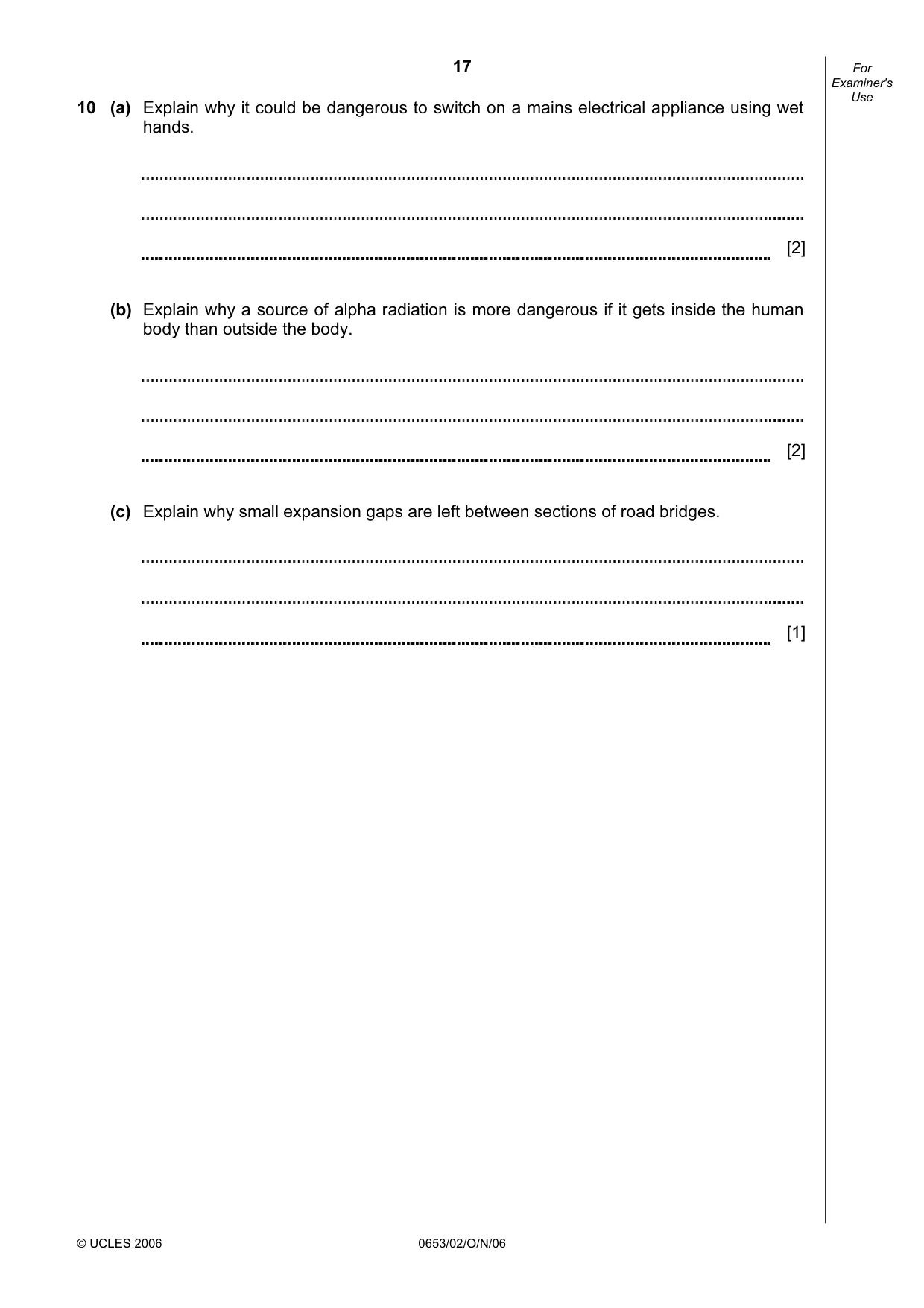
17 © UCLES 2006 0653/02/O/N/06 [Turn over For Examiner's Use 10 (a) Explain why it could be dangerous to switch on a mains electrical appliance using wet hands. [2] (b) Explain why a source of alpha radiation is more dangerous if it gets inside the human body than outside the body. [2] (c) Explain why small expansion gaps are left between sections of road bridges. [1]
Question paper, page 19
19 Permission to reproduce items where third-party owned material protected by copyright is included has been sought and cleared where possible. Every reasonable effort has been made by the publisher (UCLES) to trace copyright holders, but if any items requiring clearance have unwittingly been included, the publisher will be pleased to make amends at the earliest possible opportunity. University of Cambridge International Examinations is part of the Cambridge Assessment Group. Cambridge Assessment is the brand name of University of Cambridge Local Examinations Syndicate (UCLES), which is itself a department of the University of Cambridge. 0653/02/O/N/06 [Turn over BLANK PAGE
Question paper, page 20
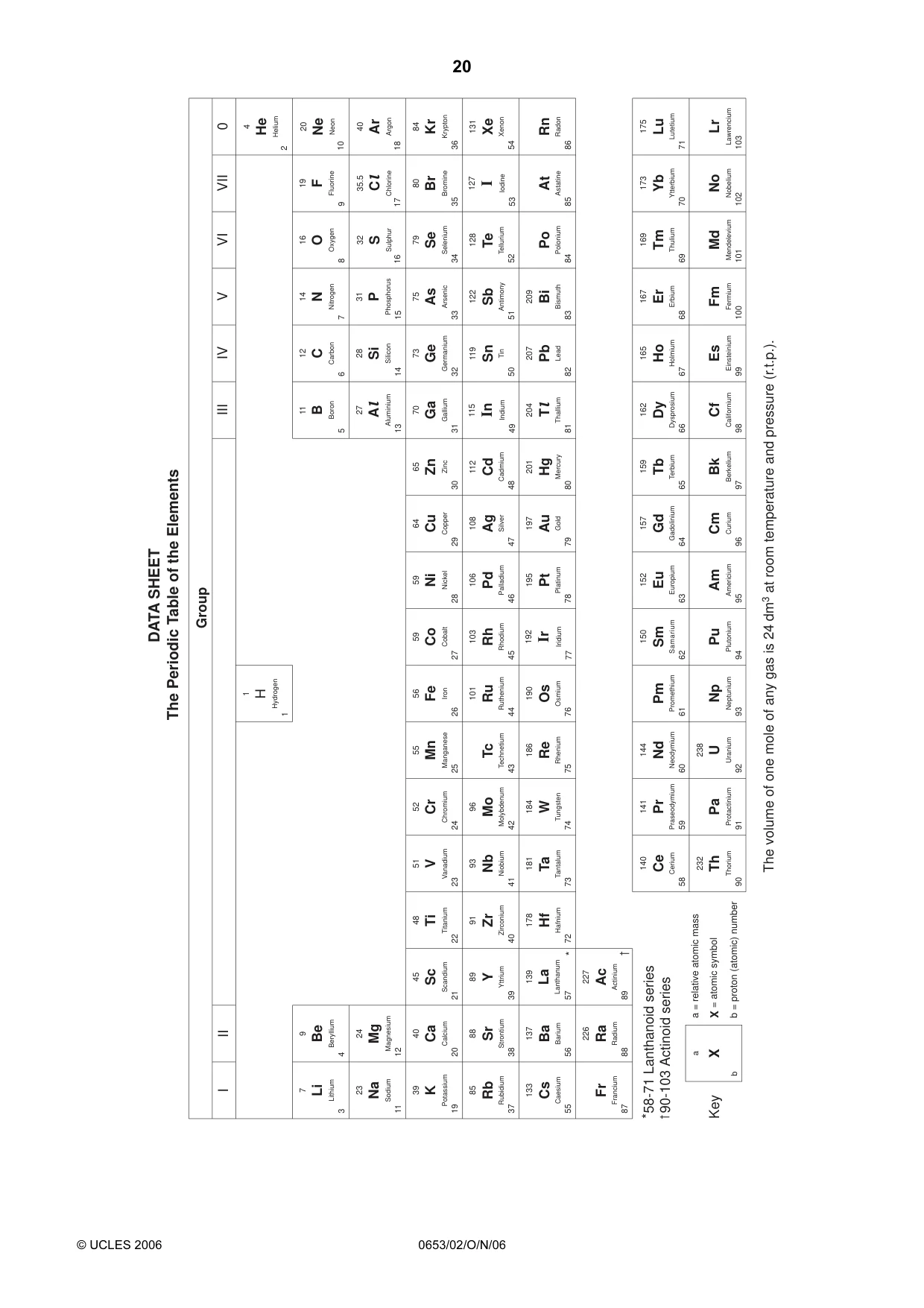
20 © UCLES 2006 0653/02/O/N/06 Group 140 Ce Cerium 58 141 Pr Praseodymium 59 144 Nd Neodymium 60 Pm Promethium 61 150 Sm Samarium 62 152 Eu Europium 63 157 Gd Gadolinium 64 159 Tb Terbium 65 162 Dy Dysprosium 66 165 Ho Holmium 67 167 Er Erbium 68 169 Tm Thulium 69 173 Yb Ytterbium 70 175 Lu Lutetium 71 232 Th Thorium 90 Pa Protactinium 91 238 U Uranium 92 Np Neptunium 93 Pu Plutonium 94 Am Americium 95 Cm Curium 96 Bk Berkelium 97 Cf Californium 98 Es Einsteinium 99 Fm Fermium 100 Md Mendelevium 101 No Nobelium 102 Lr Lawrencium 103 1 H Hydrogen 1 7 Li Lithium 3 23 Na Sodium 11 24 Mg Magnesium 12 40 Ca Calcium 20 45 Sc Scandium 21 48 Ti Titanium 22 51 V Vanadium 23 52 Cr Chromium 24 55 Mn Manganese 25 56 Fe Iron 26 59 Co Cobalt 27 59 Ni Nickel 28 64 Cu Copper 29 65 Zn Zinc 30 70 Ga Gallium 31 27 AAluminium 13 11 B Boron 5 12 C Carbon 6 14 N Nitrogen 7 16 O Oxygen 8 19 F Fluorine 9 28 Si Silicon 14 31 P Phosphorus 15 32 S Sulphur 16 35.5 CChlorine 17 40 Ar Argon 18 20 Ne Neon 10 4 He Helium 2 73 Ge Germanium 32 75 As Arsenic 33 79 Se Selenium 34 80 Br Bromine 35 84 Kr Krypton 36 39 K Potassium 19 88 Sr Strontium 38 89 Y Yttrium 39 91 Zr Zirconium 40 93 Nb Niobium 41 96 Mo Molybdenum 42 Tc Technetium 43 101 Ru Ruthenium 44 103 Rh Rhodium 45 106 Pd Palladium 46 108 Ag Silver 47 112 Cd Cadmium 48 115 In Indium 49 119 Sn Tin 50 122 Sb Antimony 51 128 Te Tellurium 52 127 I Iodine 53 131 Xe Xenon 54 137 Ba Barium 56 139 La Lanthanum 57 * 178 Hf Hafnium 72 181 Ta Tantalum 73 184 W Tungsten 74 186 Re Rhenium 75 190 Os Osmium 76 192 Ir Iridium 77 195 Pt Platinum 78 197 Au Gold 79 201 Hg Mercury 80 204 TThallium 81 207 Pb Lead 82 209 Bi Bismuth 83 Po Polonium 84 At Astatine 85 Rn Radon 86 Fr Francium 87 227 Ac Actinium 89 9 Be Beryllium 4 I II III IV V VI VII 0 85 Rb Rubidium 37 133 Cs Caesium 55 226 Ra Radium 88 The volume of one mole of any gas is 24 dm3 at room temperature and pressure (r.t.p.). a X b a = relative atomic mass X = atomic symbol b = proton (atomic) number Key *58-71 Lanthanoid series 90-103 Actinoid series DATA SHEET The Periodic Table of the Elements
Mark scheme, page 1
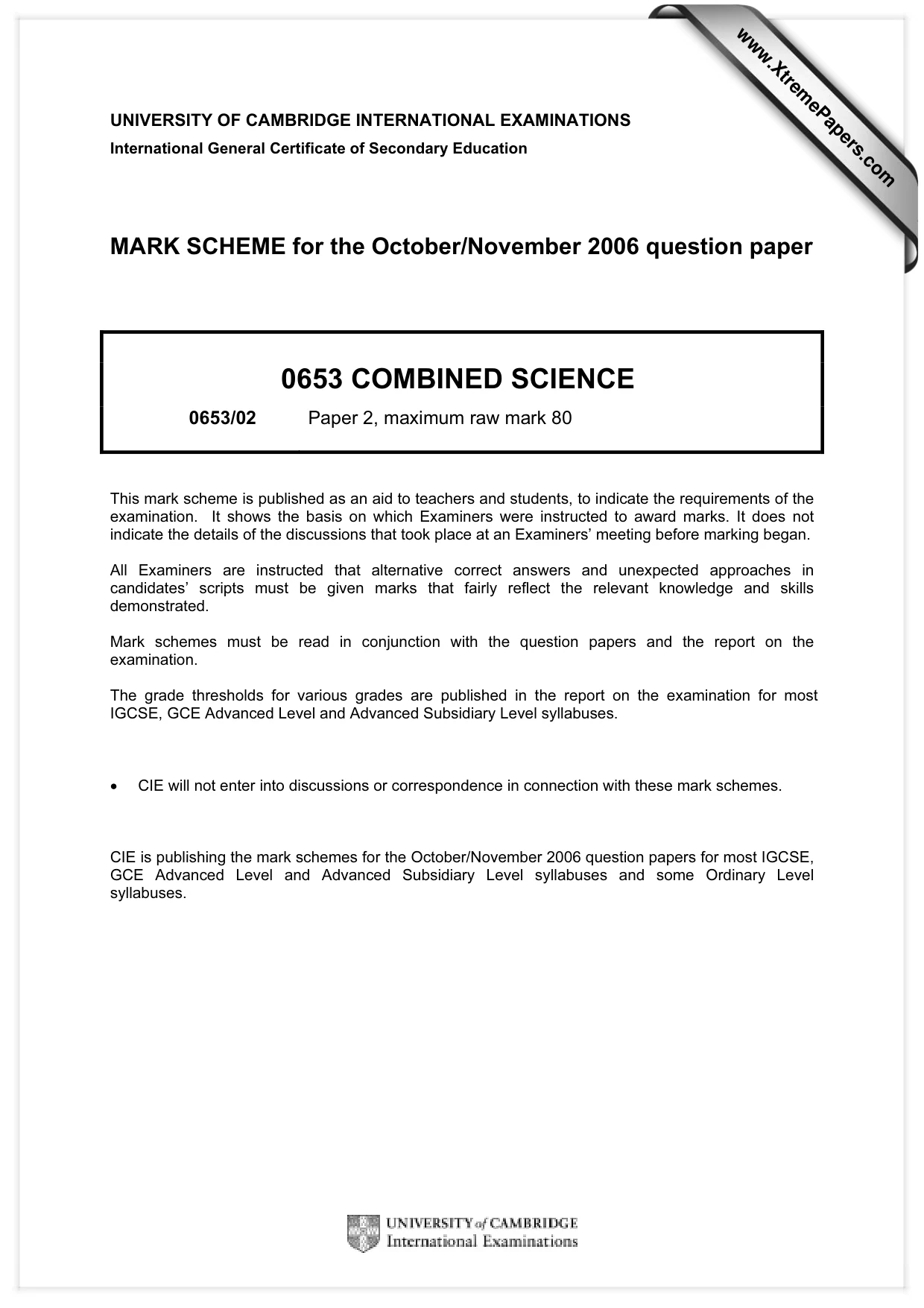
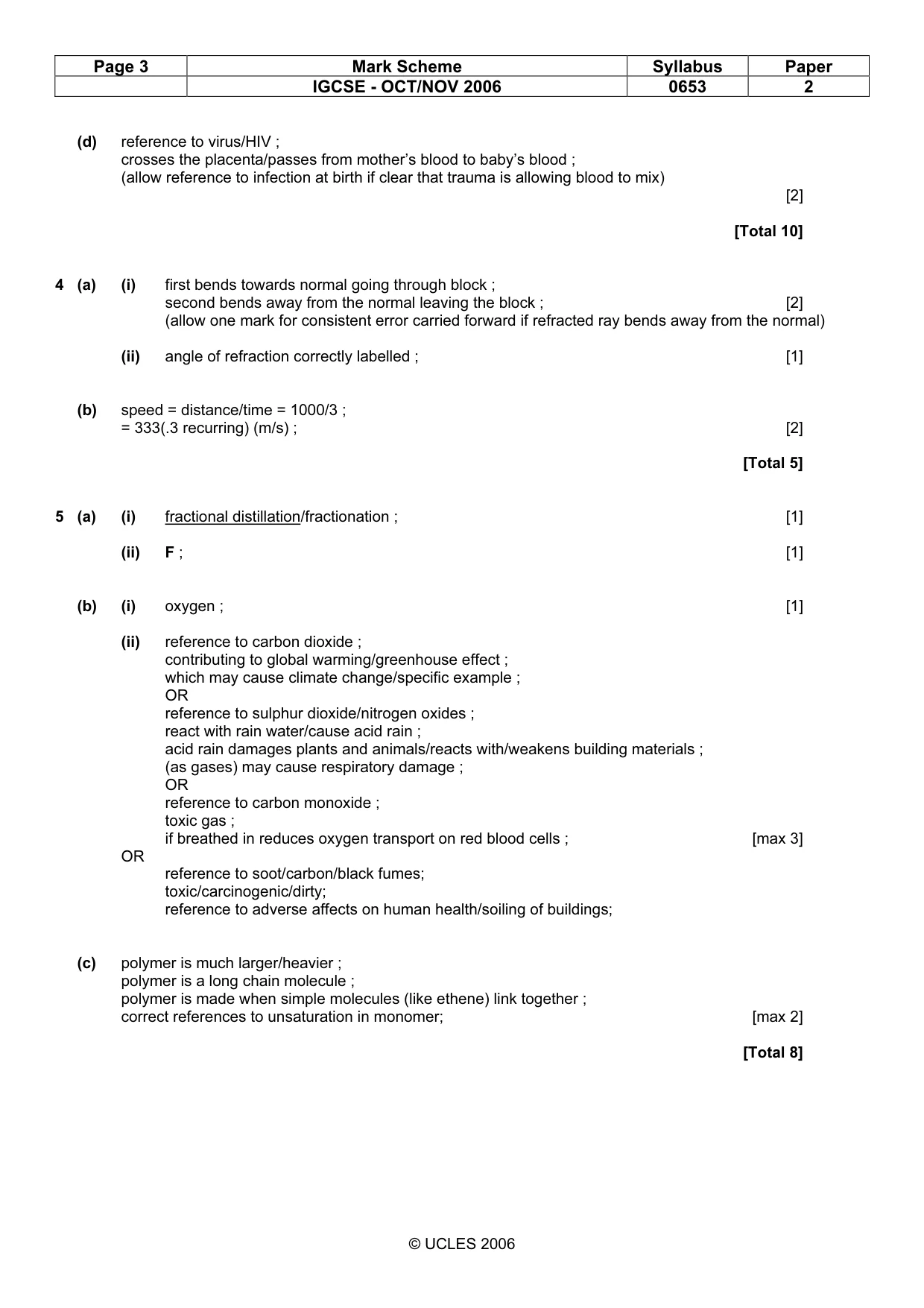
UNIVERSITY OF CAMBRIDGE INTERNATIONAL EXAMINATIONS International General Certificate of Secondary Education MARK SCHEME for the October/November 2006 question paper 0653 COMBINED SCIENCE 0653/02 Paper 2, maximum raw mark 80 This mark scheme is published as an aid to teachers and students, to indicate the requirements of the examination. It shows the basis on which Examiners were instructed to award marks. It does not indicate the details of the discussions that took place at an Examiners’ meeting before marking began. All Examiners are instructed that alternative correct answers and unexpected approaches in candidates’ scripts must be given marks that fairly reflect the relevant knowledge and skills demonstrated. Mark schemes must be read in conjunction with the question papers and the report on the examination. The grade thresholds for various grades are published in the report on the examination for most IGCSE, GCE Advanced Level and Advanced Subsidiary Level syllabuses. • CIE will not enter into discussions or correspondence in connection with these mark schemes. CIE is publishing the mark schemes for the October/November 2006 question papers for most IGCSE, GCE Advanced Level and Advanced Subsidiary Level syllabuses and some Ordinary Level syllabuses. www.XtremePapers.com
Mark scheme, page 2
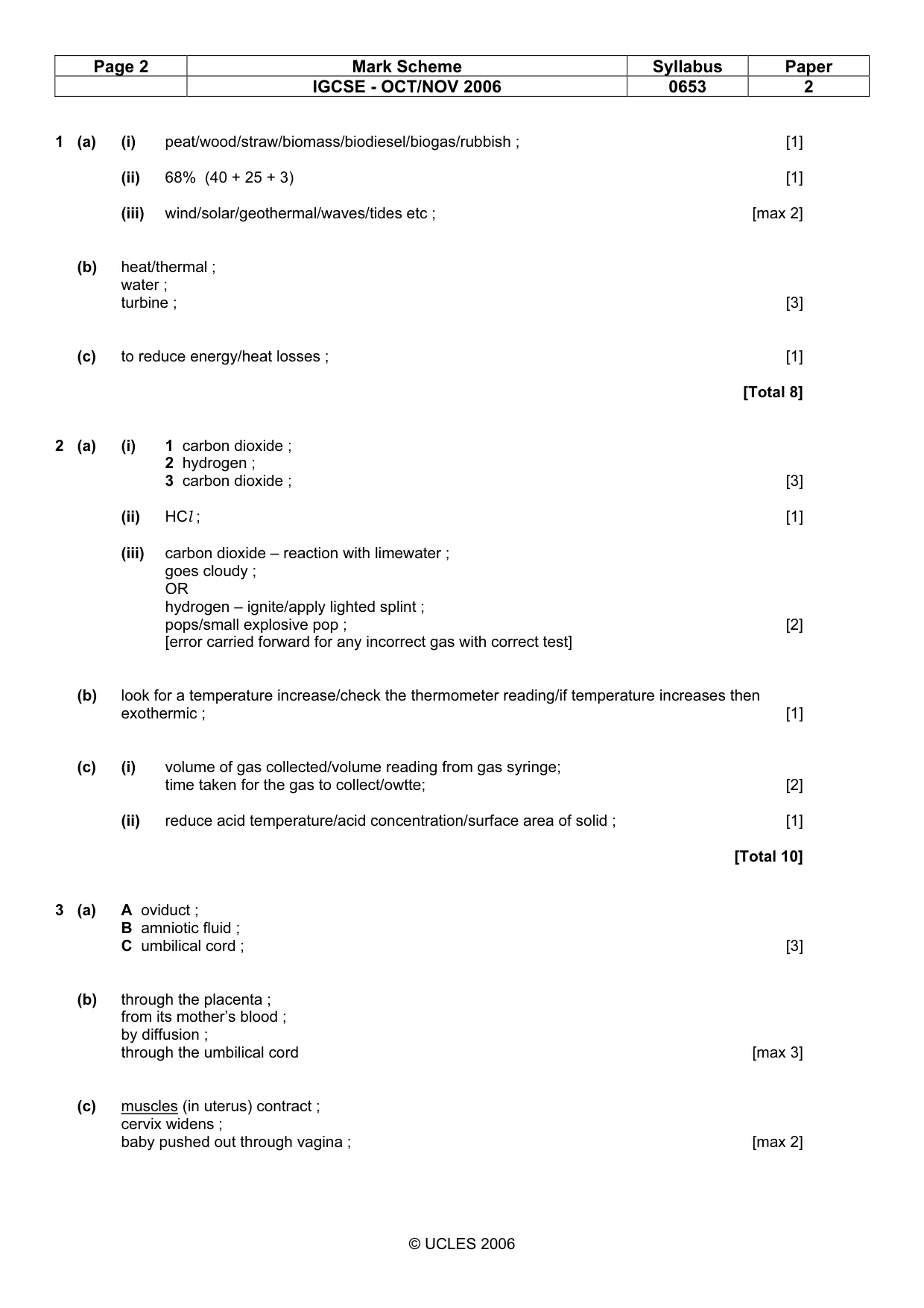
Page 2 Mark Scheme Syllabus Paper IGCSE - OCT/NOV 2006 0653 2 © UCLES 2006 1 (a) (i) peat/wood/straw/biomass/biodiesel/biogas/rubbish ; [1] (ii) 68% (40 + 25 + 3) [1] (iii) wind/solar/geothermal/waves/tides etc ; [max 2] (b) heat/thermal ; water ; turbine ; [3] (c) to reduce energy/heat losses ; [1] [Total 8] 2 (a) (i) 1 carbon dioxide ; 2 hydrogen ; 3 carbon dioxide ; [3] (ii) HCl ; [1] (iii) carbon dioxide – reaction with limewater ; goes cloudy ; OR hydrogen – ignite/apply lighted splint ; pops/small explosive pop ; [2] [error carried forward for any incorrect gas with correct test] (b) look for a temperature increase/check the thermometer reading/if temperature increases then exothermic ; [1] (c) (i) volume of gas collected/volume reading from gas syringe; time taken for the gas to collect/owtte; [2] (ii) reduce acid temperature/acid concentration/surface area of solid ; [1] [Total 10] 3 (a) A oviduct ; B amniotic fluid ; C umbilical cord ; [3] (b) through the placenta ; from its mother’s blood ; by diffusion ; through the umbilical cord [max 3] (c) muscles (in uterus) contract ; cervix widens ; baby pushed out through vagina ; [max 2]
Mark scheme, page 3
Page 3 Mark Scheme Syllabus Paper IGCSE - OCT/NOV 2006 0653 2 © UCLES 2006 (d) reference to virus/HIV ; crosses the placenta/passes from mother’s blood to baby’s blood ; (allow reference to infection at birth if clear that trauma is allowing blood to mix) [2] [Total 10] 4 (a) (i) first bends towards normal going through block ; second bends away from the normal leaving the block ; [2] (allow one mark for consistent error carried forward if refracted ray bends away from the normal) (ii) angle of refraction correctly labelled ; [1] (b) speed = distance/time = 1000/3 ; = 333(.3 recurring) (m/s) ; [2] [Total 5] 5 (a) (i) fractional distillation/fractionation ; [1] (ii) F ; [1] (b) (i) oxygen ; [1] (ii) reference to carbon dioxide ; contributing to global warming/greenhouse effect ; which may cause climate change/specific example ; OR reference to sulphur dioxide/nitrogen oxides ; react with rain water/cause acid rain ; acid rain damages plants and animals/reacts with/weakens building materials ; (as gases) may cause respiratory damage ; OR reference to carbon monoxide ; toxic gas ; if breathed in reduces oxygen transport on red blood cells ; [max 3] OR reference to soot/carbon/black fumes; toxic/carcinogenic/dirty; reference to adverse affects on human health/soiling of buildings; (c) polymer is much larger/heavier ; polymer is a long chain molecule ; polymer is made when simple molecules (like ethene) link together ; correct references to unsaturation in monomer; [max 2] [Total 8]
Mark scheme, page 4
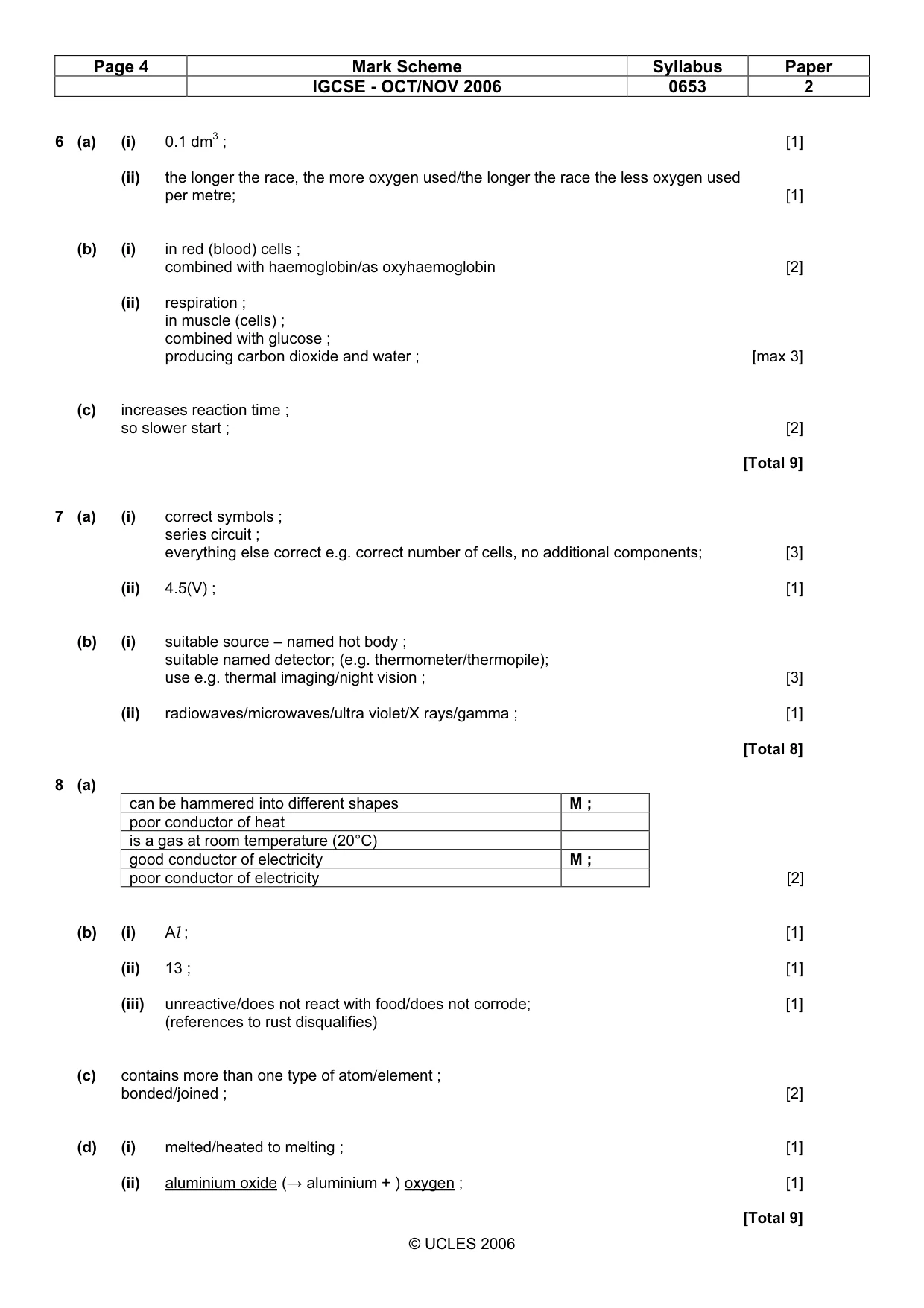
Page 4 Mark Scheme Syllabus Paper IGCSE - OCT/NOV 2006 0653 2 © UCLES 2006 6 (a) (i) 0.1 dm3 ; [1] (ii) the longer the race, the more oxygen used/the longer the race the less oxygen used per metre; [1] (b) (i) in red (blood) cells ; combined with haemoglobin/as oxyhaemoglobin [2] (ii) respiration ; in muscle (cells) ; combined with glucose ; producing carbon dioxide and water ; [max 3] (c) increases reaction time ; so slower start ; [2] [Total 9] 7 (a) (i) correct symbols ; series circuit ; everything else correct e.g. correct number of cells, no additional components; [3] (ii) 4.5(V) ; [1] (b) (i) suitable source – named hot body ; suitable named detector; (e.g. thermometer/thermopile); use e.g. thermal imaging/night vision ; [3] (ii) radiowaves/microwaves/ultra violet/X rays/gamma ; [1] [Total 8] 8 (a) can be hammered into different shapes M ; poor conductor of heat is a gas at room temperature (20°C) good conductor of electricity M ; poor conductor of electricity [2] (b) (i) Al ; [1] (ii) 13 ; [1] (iii) unreactive/does not react with food/does not corrode; [1] (references to rust disqualifies) (c) contains more than one type of atom/element ; bonded/joined ; [2] (d) (i) melted/heated to melting ; [1] (ii) aluminium oxide (→ aluminium + ) oxygen ; [1] [Total 9]
Mark scheme, page 5
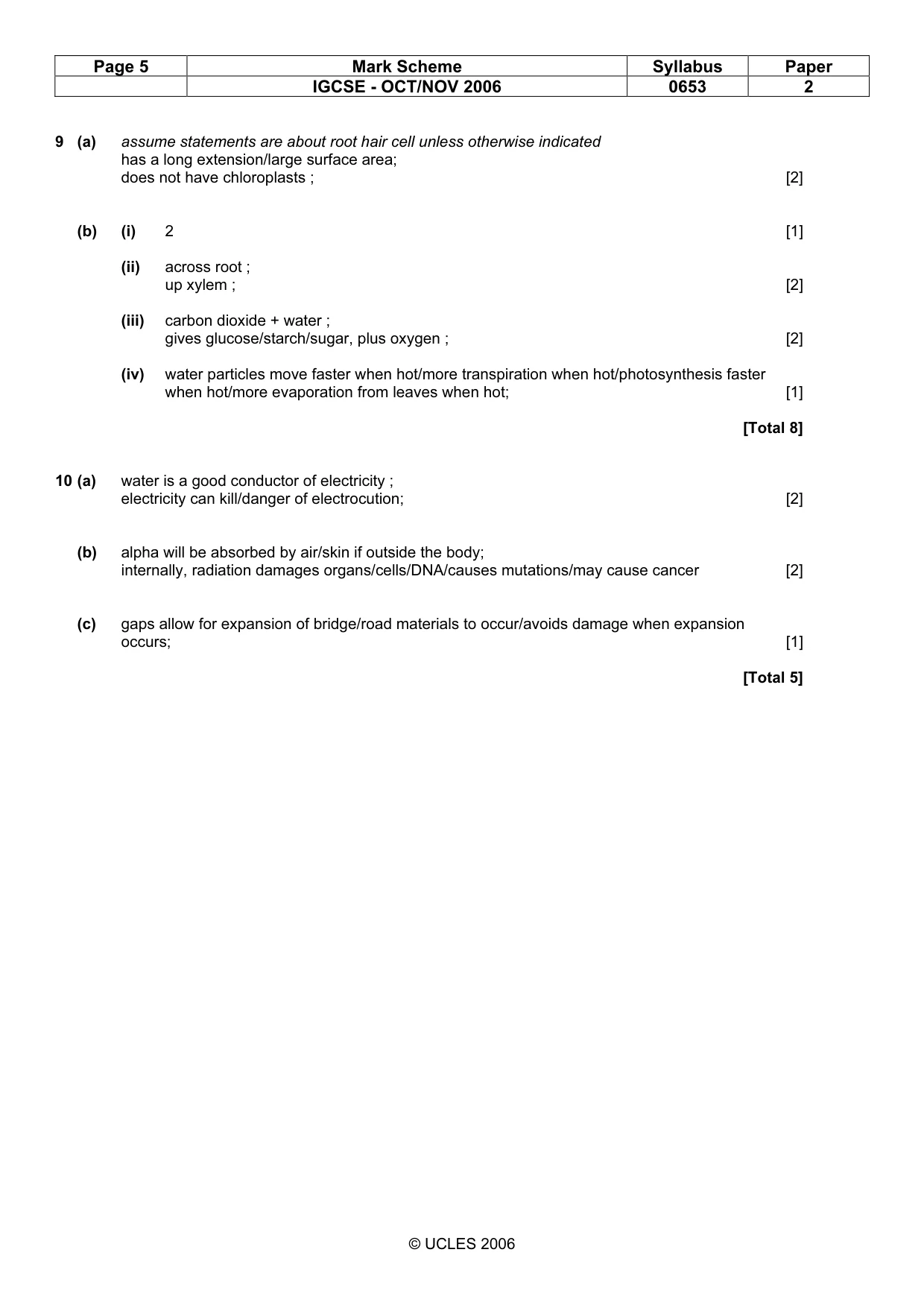
Page 5 Mark Scheme Syllabus Paper IGCSE - OCT/NOV 2006 0653 2 © UCLES 2006 9 (a) assume statements are about root hair cell unless otherwise indicated has a long extension/large surface area; does not have chloroplasts ; [2] (b) (i) 2 [1] (ii) across root ; up xylem ; [2] (iii) carbon dioxide + water ; gives glucose/starch/sugar, plus oxygen ; [2] (iv) water particles move faster when hot/more transpiration when hot/photosynthesis faster when hot/more evaporation from leaves when hot; [1] [Total 8] 10 (a) water is a good conductor of electricity ; electricity can kill/danger of electrocution; [2] (b) alpha will be absorbed by air/skin if outside the body; internally, radiation damages organs/cells/DNA/causes mutations/may cause cancer [2] (c) gaps allow for expansion of bridge/road materials to occur/avoids damage when expansion occurs; [1] [Total 5]
What you needed in this session
Cambridge’s own grade thresholds for 2006 Oct/Nov, Paper 2 · Variant 1. A higher threshold means an easier paper — the bar moves with how the cohort did.