Cambridge IGCSE Science - Combined 0653 — 2005 May/June Paper 2 · Variant 1
0653/21/M/J/05
The question paper and its mark scheme, free to read here and free to download. This is Cambridge’s own paper, exactly as it was sat.
Question paper20 pages
Mark scheme6 pages
Answers below. Sit the paper first if you are practising.
Paper as text
Question paper, page 1
Centre Number Candidate Number Name UNIVERSITY OF CAMBRIDGE INTERNATIONAL EXAMINATIONS International General Certificate of Secondary Education COMBINED SCIENCE 0653/02 Paper 2 May/June 2005 1 hour 15 minutes Candidates answer on the Question Paper. No Additional Materials are required. READ THESE INSTRUCTIONS FIRST Write your Centre number, candidate number and name on all the work you hand in. Write in dark blue or black pen in the spaces provided on the Question Paper. You may use a pencil for any diagrams, graphs, tables or rough working. Do not use staples, paper clips, highlighters, glue or correction fluid. Answer all questions. The number of marks is given in brackets [ ] at the end of each question or part question. A copy of the Periodic Table is printed on page 20. For Examiner’s Use 1 2 3 4 5 6 7 8 9 10 Total This document consists of 20 printed pages. IB05 06_0653_02/3RP UCLES 2005 [Turn over If you have been given a label, look at the details. If any details are incorrect or missing, please fill in your correct details in the space given at the top of this page. Stick your personal label here, if provided. www.XtremePapers.com
Question paper, page 2
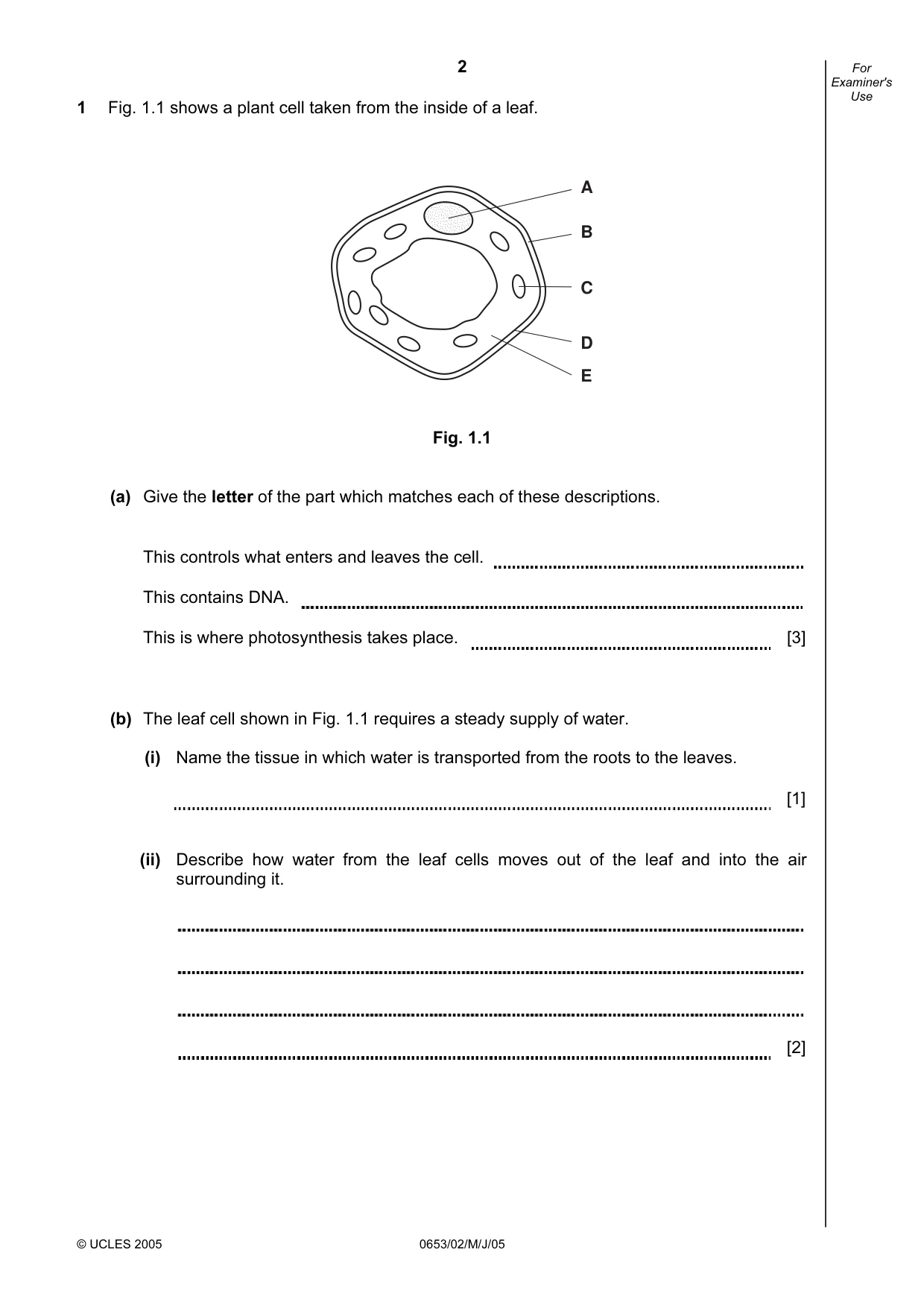
2 © UCLES 2005 0653/02/M/J/05 For Examiner's Use 1 Fig. 1.1 shows a plant cell taken from the inside of a leaf. A B C D E Fig. 1.1 (a) Give the letter of the part which matches each of these descriptions. This controls what enters and leaves the cell. This contains DNA. This is where photosynthesis takes place. [3] (b) The leaf cell shown in Fig. 1.1 requires a steady supply of water. (i) Name the tissue in which water is transported from the roots to the leaves. [1] (ii) Describe how water from the leaf cells moves out of the leaf and into the air surrounding it. [2]
Question paper, page 3
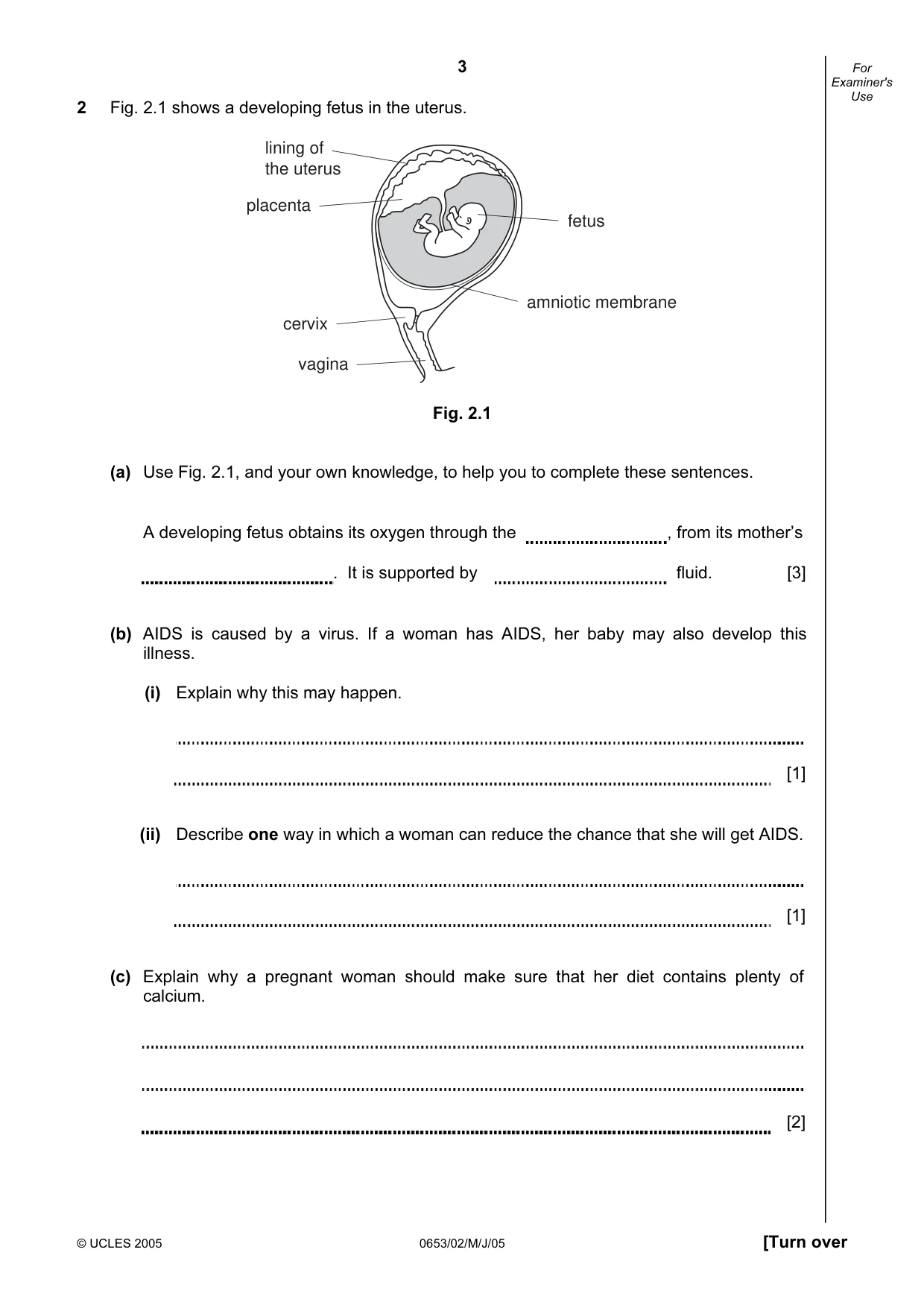
3 © UCLES 2005 0653/02/M/J/05 [Turn over For Examiner's Use 2 Fig. 2.1 shows a developing fetus in the uterus. fetus amniotic membrane placenta cervix vagina lining of the uterus Fig. 2.1 (a) Use Fig. 2.1, and your own knowledge, to help you to complete these sentences. A developing fetus obtains its oxygen through the , from its mother’s . It is supported by fluid. [3] (b) AIDS is caused by a virus. If a woman has AIDS, her baby may also develop this illness. (i) Explain why this may happen. [1] (ii) Describe one way in which a woman can reduce the chance that she will get AIDS. [1] (c) Explain why a pregnant woman should make sure that her diet contains plenty of calcium. [2]
Question paper, page 4
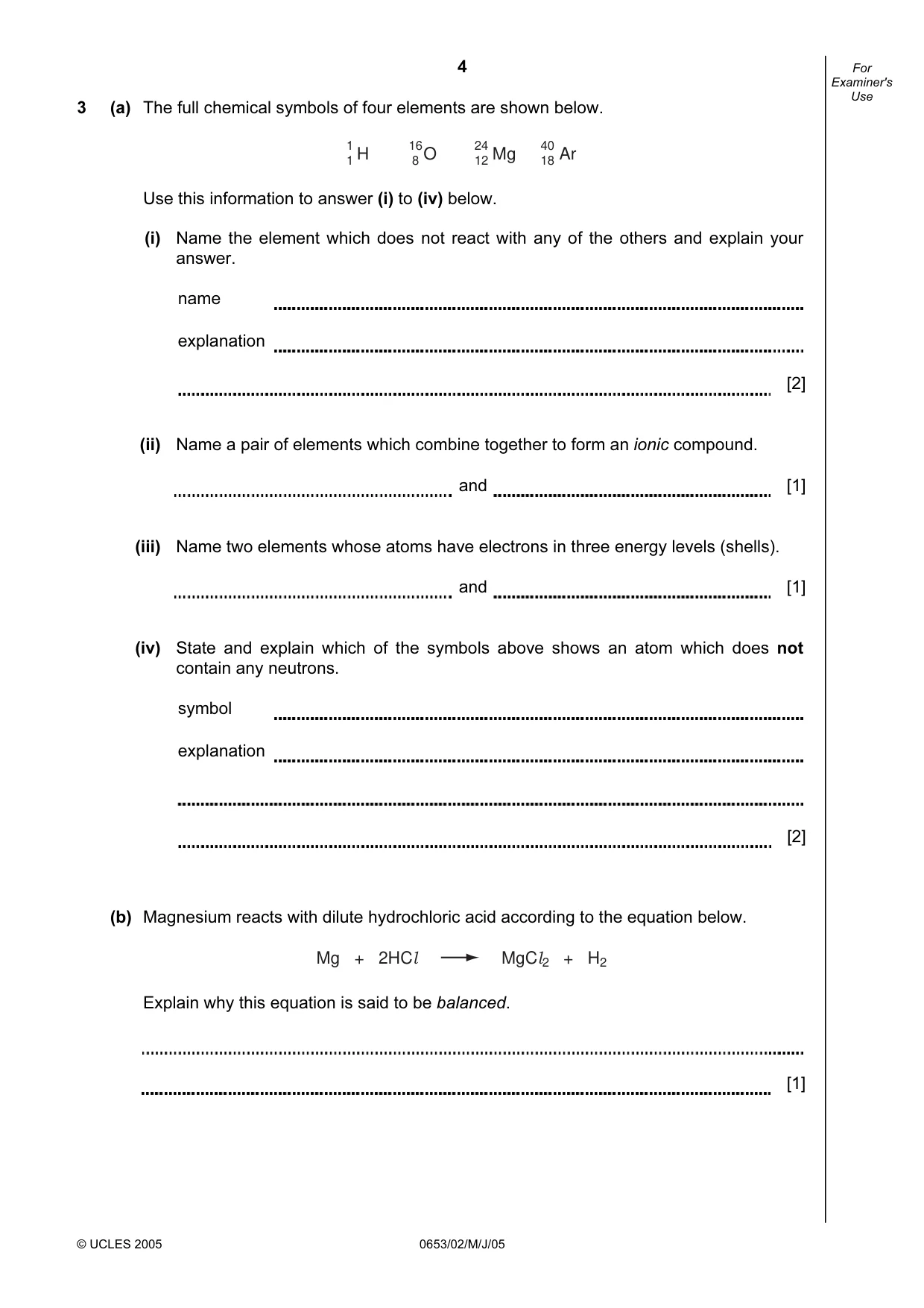
4 © UCLES 2005 0653/02/M/J/05 For Examiner's Use 3 (a) The full chemical symbols of four elements are shown below. H 1 1 O 16 8 Mg 24 12 Ar 40 18 Use this information to answer (i) to (iv) below. (i) Name the element which does not react with any of the others and explain your answer. name explanation [2] (ii) Name a pair of elements which combine together to form an ionic compound. and [1] (iii) Name two elements whose atoms have electrons in three energy levels (shells). and [1] (iv) State and explain which of the symbols above shows an atom which does not contain any neutrons. symbol explanation [2] (b) Magnesium reacts with dilute hydrochloric acid according to the equation below. Mg + 2HCl MgCl2 + H2 Explain why this equation is said to be balanced. [1]
Question paper, page 5
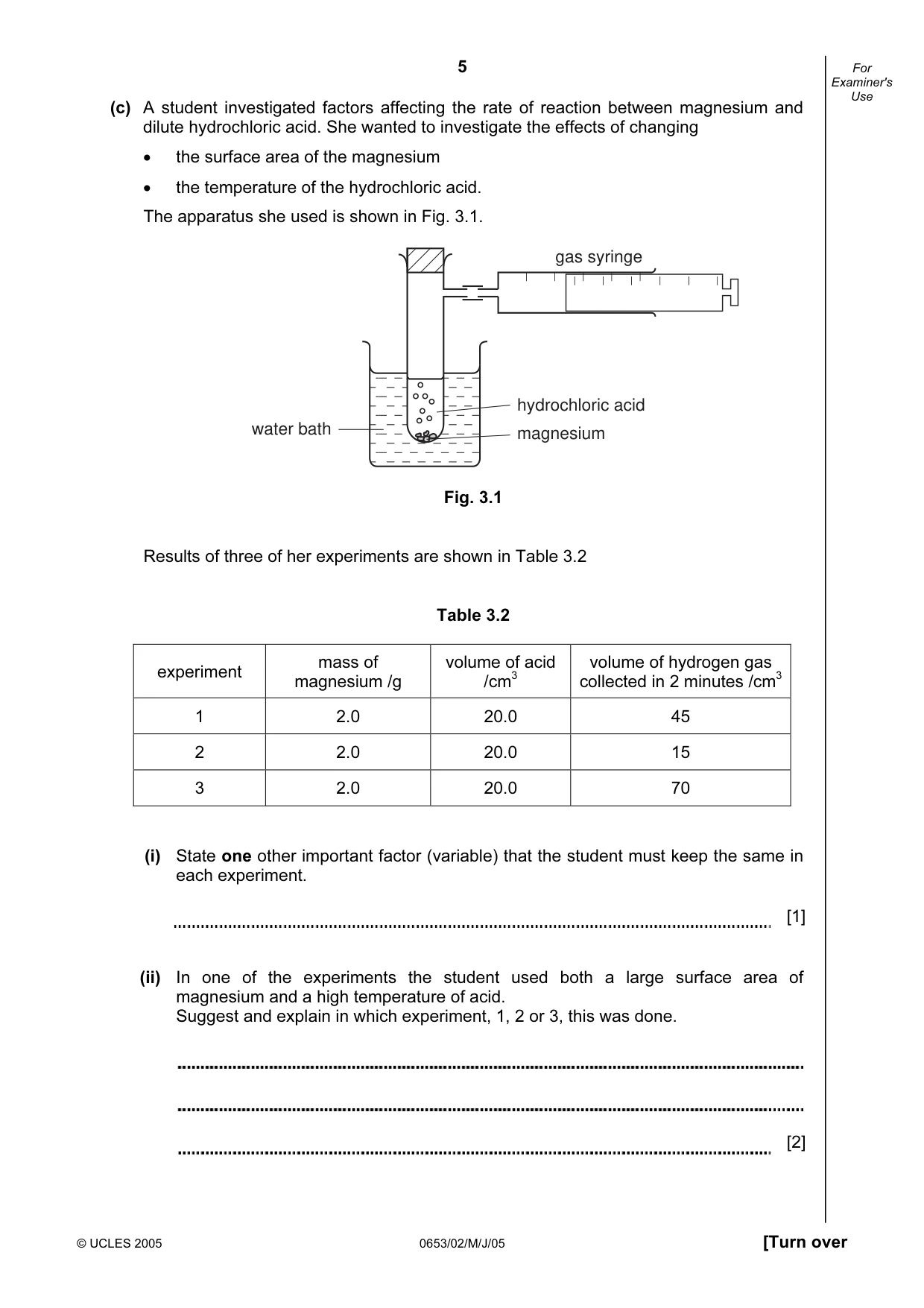
5 © UCLES 2005 0653/02/M/J/05 [Turn over For Examiner's Use (c) A student investigated factors affecting the rate of reaction between magnesium and dilute hydrochloric acid. She wanted to investigate the effects of changing • the surface area of the magnesium • the temperature of the hydrochloric acid. The apparatus she used is shown in Fig. 3.1. gas syringe hydrochloric acid magnesium water bath Fig. 3.1 Results of three of her experiments are shown in Table 3.2 Table 3.2 experiment mass of magnesium /g volume of acid /cm3 volume of hydrogen gas collected in 2 minutes /cm3 1 2.0 20.0 45 2 2.0 20.0 15 3 2.0 20.0 70 (i) State one other important factor (variable) that the student must keep the same in each experiment. [1] (ii) In one of the experiments the student used both a large surface area of magnesium and a high temperature of acid. Suggest and explain in which experiment, 1, 2 or 3, this was done. [2]
Question paper, page 6
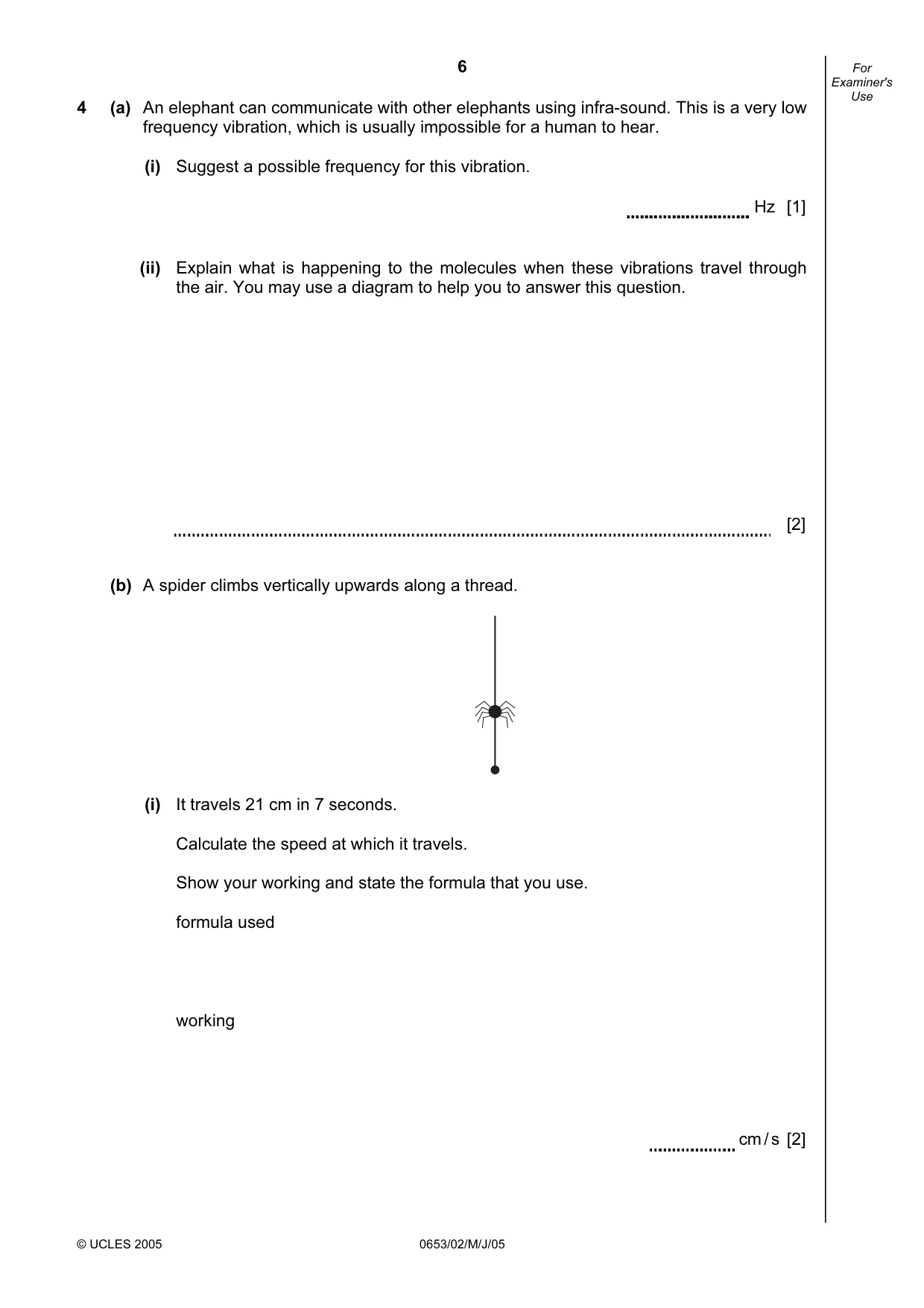
6 © UCLES 2005 0653/02/M/J/05 For Examiner's Use 4 (a) An elephant can communicate with other elephants using infra-sound. This is a very low frequency vibration, which is usually impossible for a human to hear. (i) Suggest a possible frequency for this vibration. Hz [1] (ii) Explain what is happening to the molecules when these vibrations travel through the air. You may use a diagram to help you to answer this question. [2] (b) A spider climbs vertically upwards along a thread. (i) It travels 21 cm in 7 seconds. Calculate the speed at which it travels. Show your working and state the formula that you use. formula used working cm / s [2]
Question paper, page 7
7 © UCLES 2005 0653/02/M/J/05 [Turn over For Examiner's Use (ii) The spider weighs 0.02N. Calculate the work done when it climbs 21 cm up the thread. Show your working and state the formula that you use. formula used working joules [3] (c) A polar bear is a large white furry mammal that lives on the Arctic ice. Suggest and explain one way in which the polar bear is adapted to reduce heat loss in this cold climate. [2]
Question paper, page 8
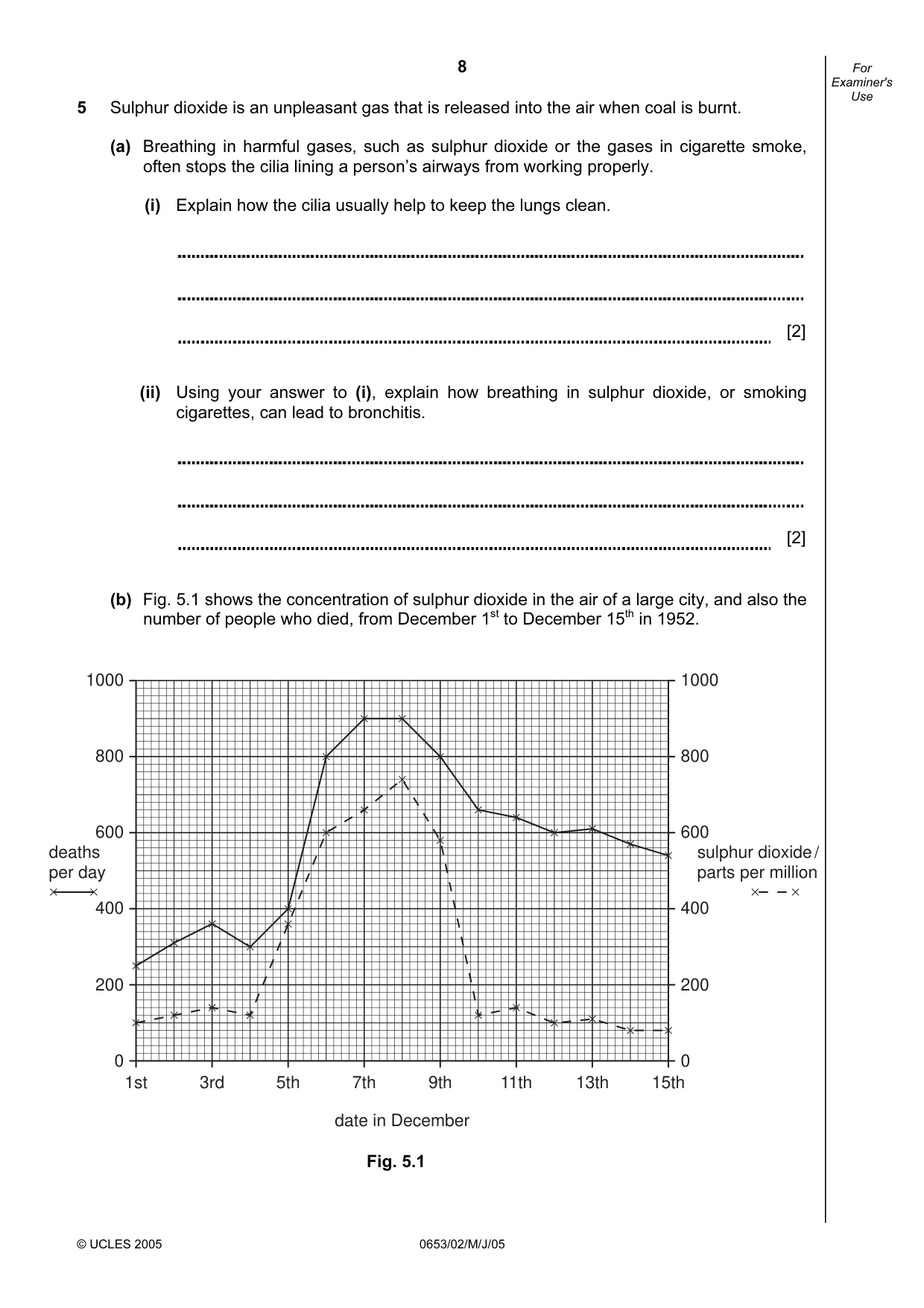
8 © UCLES 2005 0653/02/M/J/05 For Examiner's Use 5 Sulphur dioxide is an unpleasant gas that is released into the air when coal is burnt. (a) Breathing in harmful gases, such as sulphur dioxide or the gases in cigarette smoke, often stops the cilia lining a person’s airways from working properly. (i) Explain how the cilia usually help to keep the lungs clean. [2] (ii) Using your answer to (i), explain how breathing in sulphur dioxide, or smoking cigarettes, can lead to bronchitis. [2] (b) Fig. 5.1 shows the concentration of sulphur dioxide in the air of a large city, and also the number of people who died, from December 1st to December 15th in 1952. 1000 800 600 400 200 0 1000 800 600 400 200 0 1st 3rd 5th 7th 9th 11th 13th 15th deaths per day sulphur dioxide / parts per million date in December Fig. 5.1
Question paper, page 9
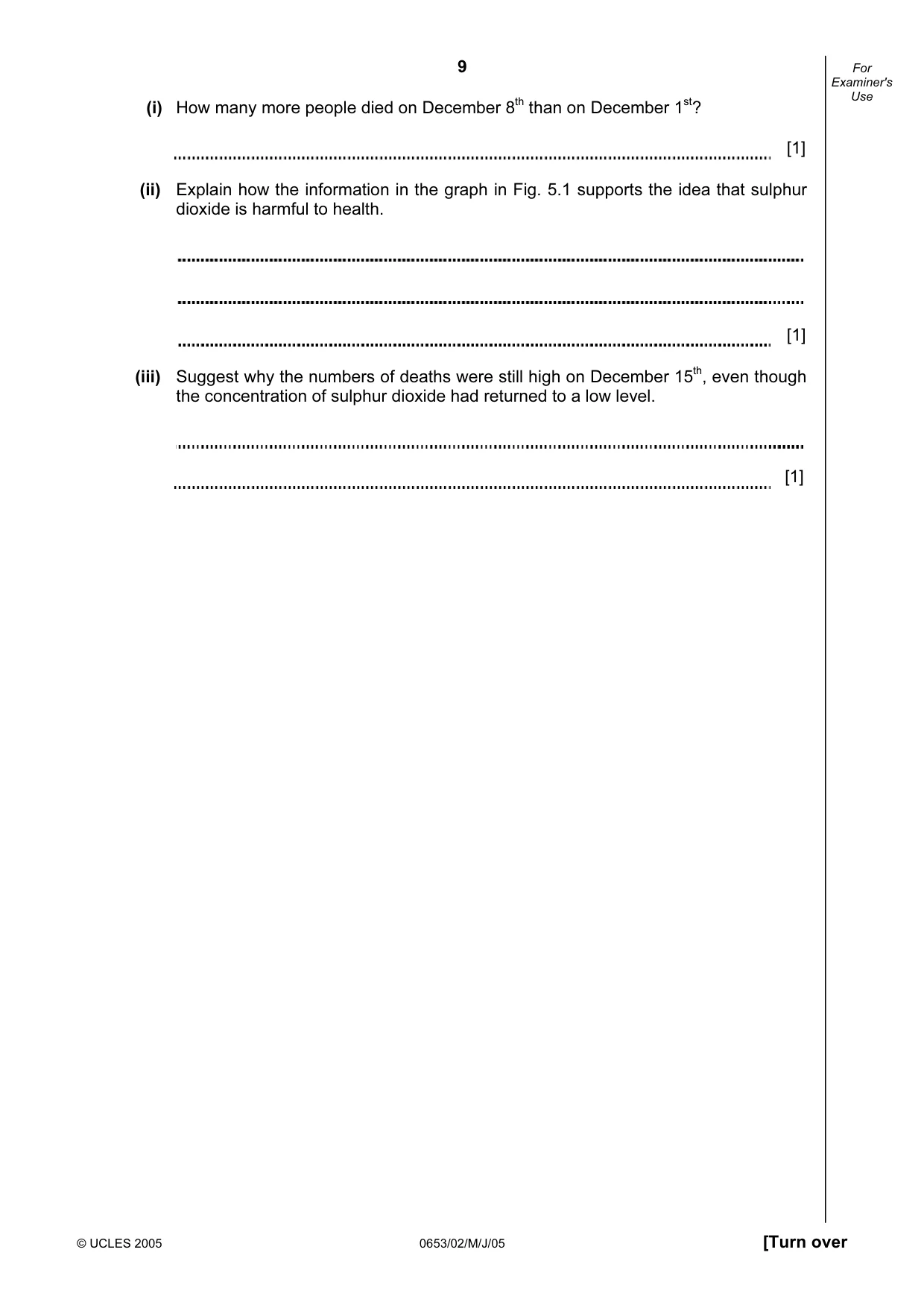
9 © UCLES 2005 0653/02/M/J/05 [Turn over For Examiner's Use (i) How many more people died on December 8th than on December 1st? [1] (ii) Explain how the information in the graph in Fig. 5.1 supports the idea that sulphur dioxide is harmful to health. [1] (iii) Suggest why the numbers of deaths were still high on December 15th, even though the concentration of sulphur dioxide had returned to a low level. [1]
Question paper, page 10
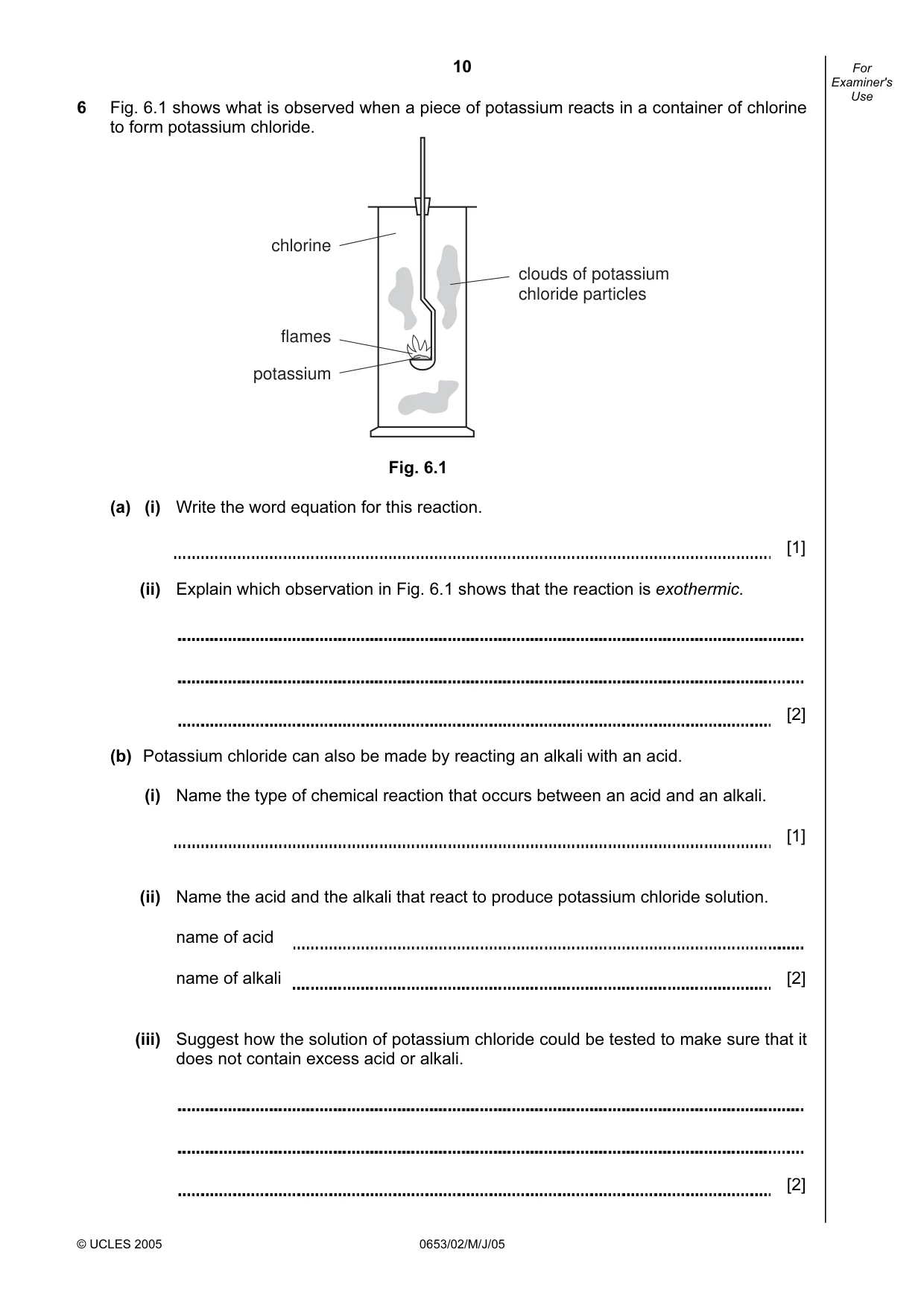
10 © UCLES 2005 0653/02/M/J/05 For Examiner's Use 6 Fig. 6.1 shows what is observed when a piece of potassium reacts in a container of chlorine to form potassium chloride. chlorine flames potassium clouds of potassium chloride particles Fig. 6.1 (a) (i) Write the word equation for this reaction. [1] (ii) Explain which observation in Fig. 6.1 shows that the reaction is exothermic. [2] (b) Potassium chloride can also be made by reacting an alkali with an acid. (i) Name the type of chemical reaction that occurs between an acid and an alkali. [1] (ii) Name the acid and the alkali that react to produce potassium chloride solution. name of acid name of alkali [2] (iii) Suggest how the solution of potassium chloride could be tested to make sure that it does not contain excess acid or alkali. [2]
Question paper, page 11
11 © UCLES 2005 0653/02/M/J/05 [Turn over For Examiner's Use (iv) Describe briefly how a sample of dry potassium chloride crystals could be obtained in a short time from potassium chloride solution. [2]
Question paper, page 12
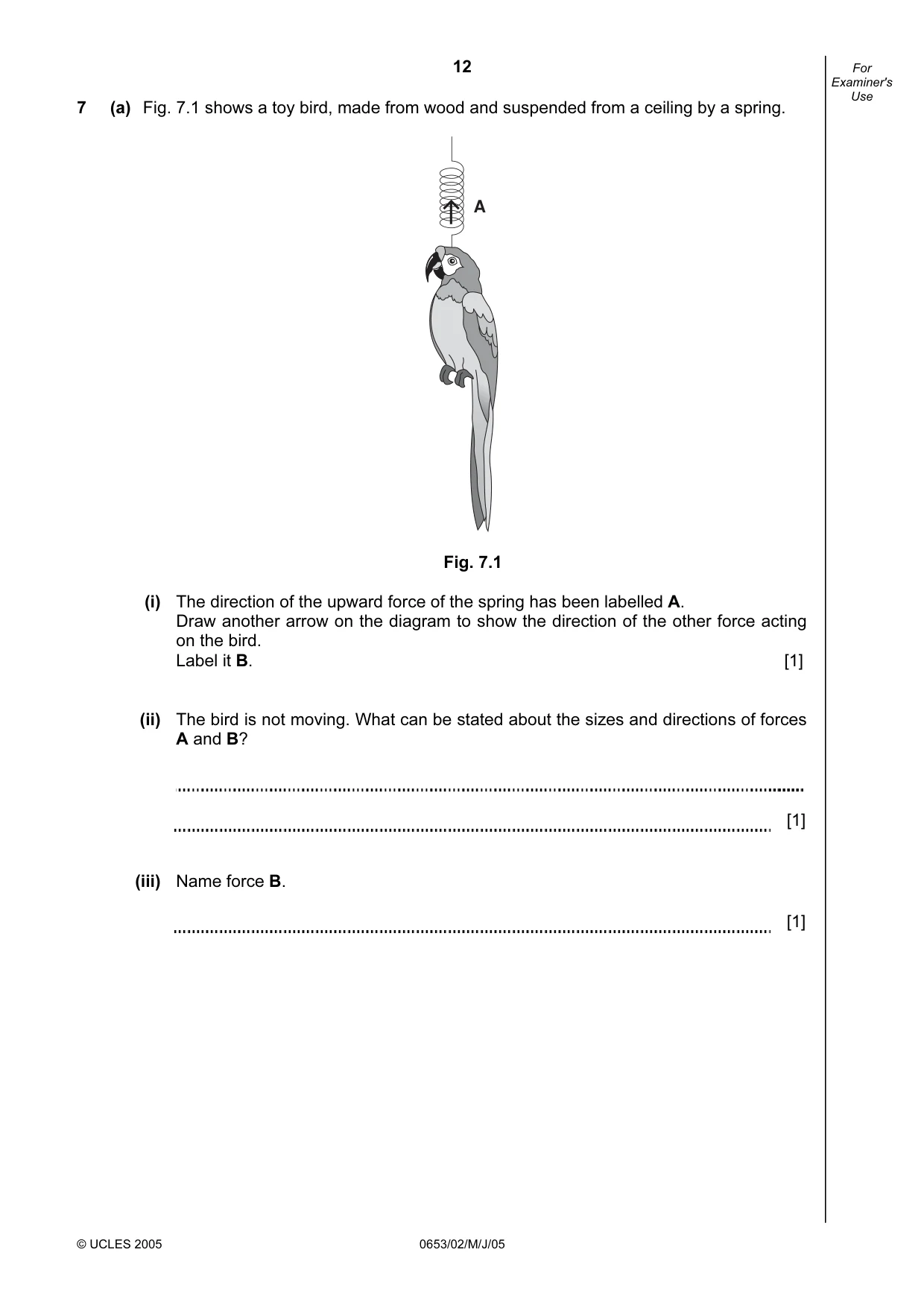
12 © UCLES 2005 0653/02/M/J/05 For Examiner's Use 7 (a) Fig. 7.1 shows a toy bird, made from wood and suspended from a ceiling by a spring. A Fig. 7.1 (i) The direction of the upward force of the spring has been labelled A. Draw another arrow on the diagram to show the direction of the other force acting on the bird. Label it B. [1] (ii) The bird is not moving. What can be stated about the sizes and directions of forces A and B? [1] (iii) Name force B. [1]
Question paper, page 13
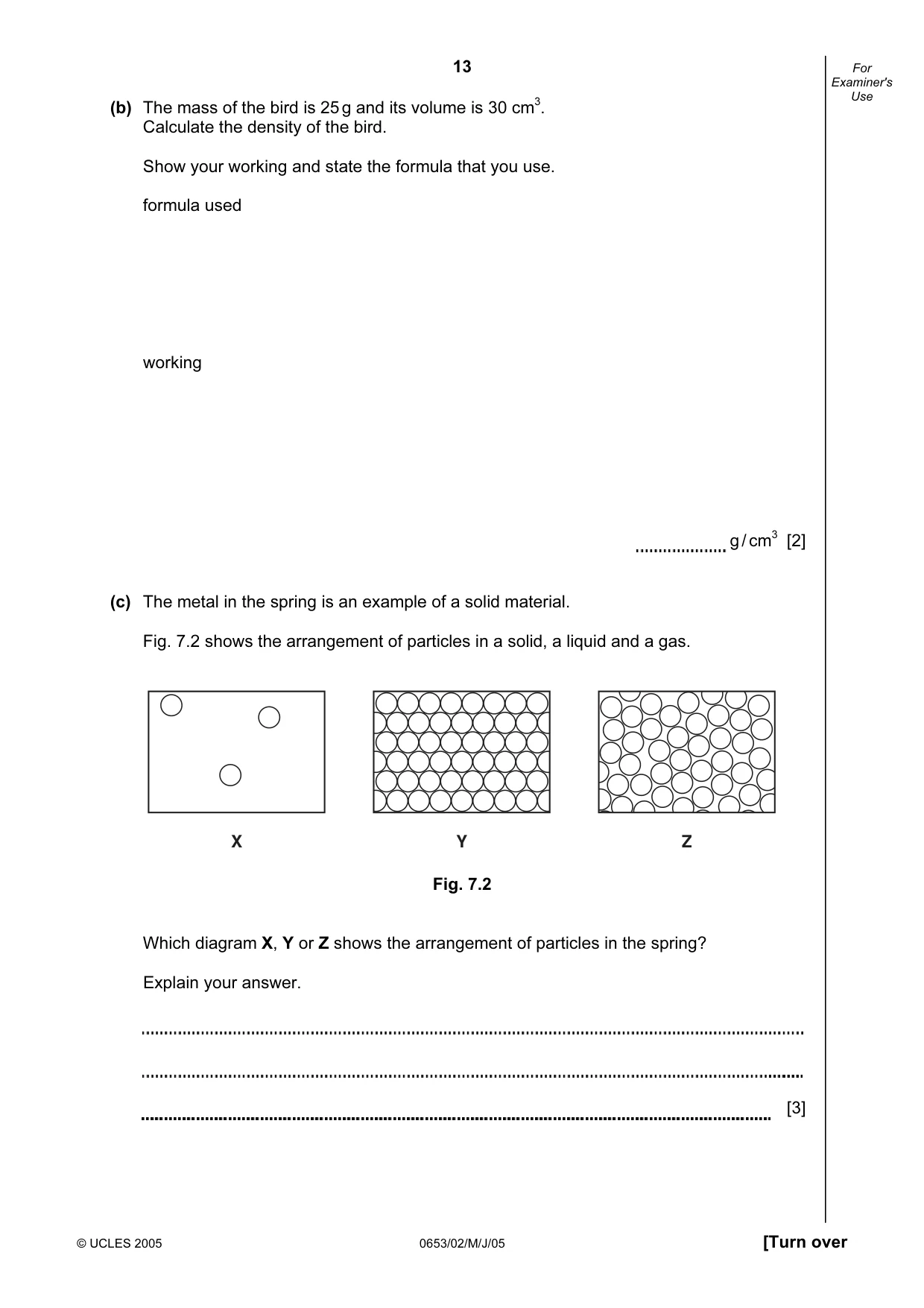
13 © UCLES 2005 0653/02/M/J/05 [Turn over For Examiner's Use (b) The mass of the bird is 25 g and its volume is 30 cm3. Calculate the density of the bird. Show your working and state the formula that you use. formula used working g / cm3 [2] (c) The metal in the spring is an example of a solid material. Fig. 7.2 shows the arrangement of particles in a solid, a liquid and a gas. X Y Z Fig. 7.2 Which diagram X, Y or Z shows the arrangement of particles in the spring? Explain your answer. [3]
Question paper, page 14
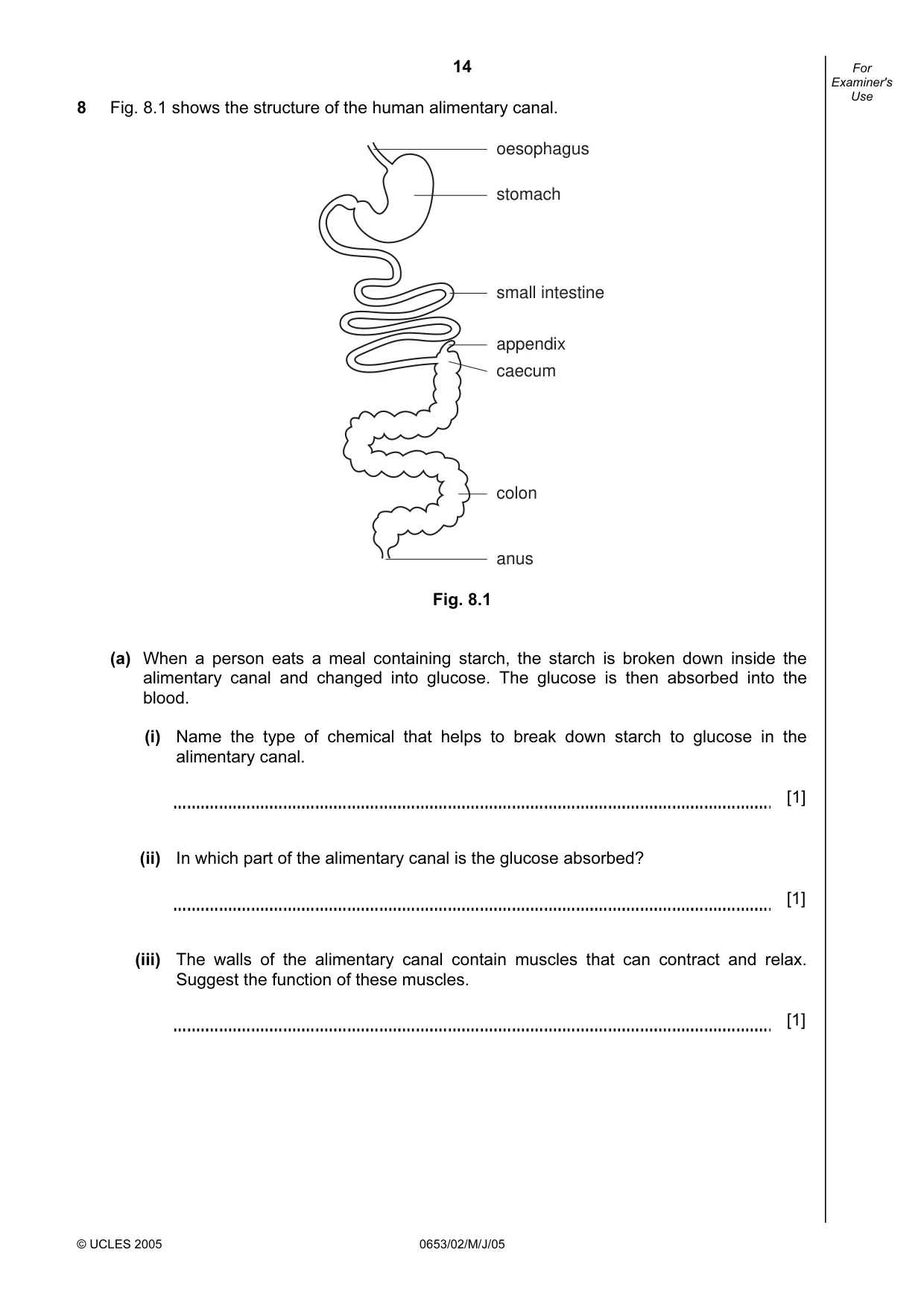
14 © UCLES 2005 0653/02/M/J/05 For Examiner's Use 8 Fig. 8.1 shows the structure of the human alimentary canal. stomach oesophagus small intestine appendix colon anus caecum Fig. 8.1 (a) When a person eats a meal containing starch, the starch is broken down inside the alimentary canal and changed into glucose. The glucose is then absorbed into the blood. (i) Name the type of chemical that helps to break down starch to glucose in the alimentary canal. [1] (ii) In which part of the alimentary canal is the glucose absorbed? [1] (iii) The walls of the alimentary canal contain muscles that can contract and relax. Suggest the function of these muscles. [1]
Question paper, page 15
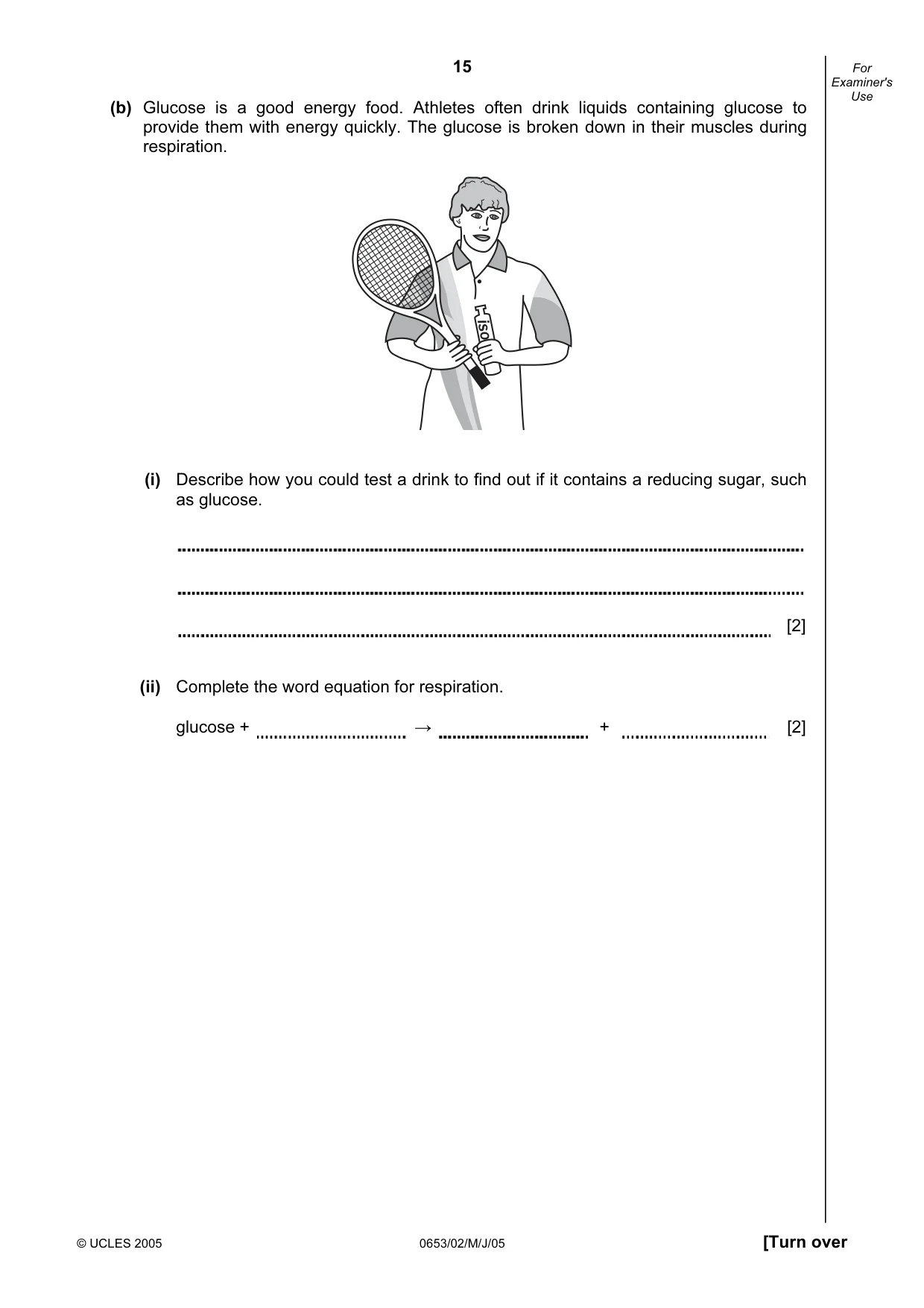
15 © UCLES 2005 0653/02/M/J/05 [Turn over For Examiner's Use (b) Glucose is a good energy food. Athletes often drink liquids containing glucose to provide them with energy quickly. The glucose is broken down in their muscles during respiration. iso (i) Describe how you could test a drink to find out if it contains a reducing sugar, such as glucose. [2] (ii) Complete the word equation for respiration. glucose + → + [2]
Question paper, page 16
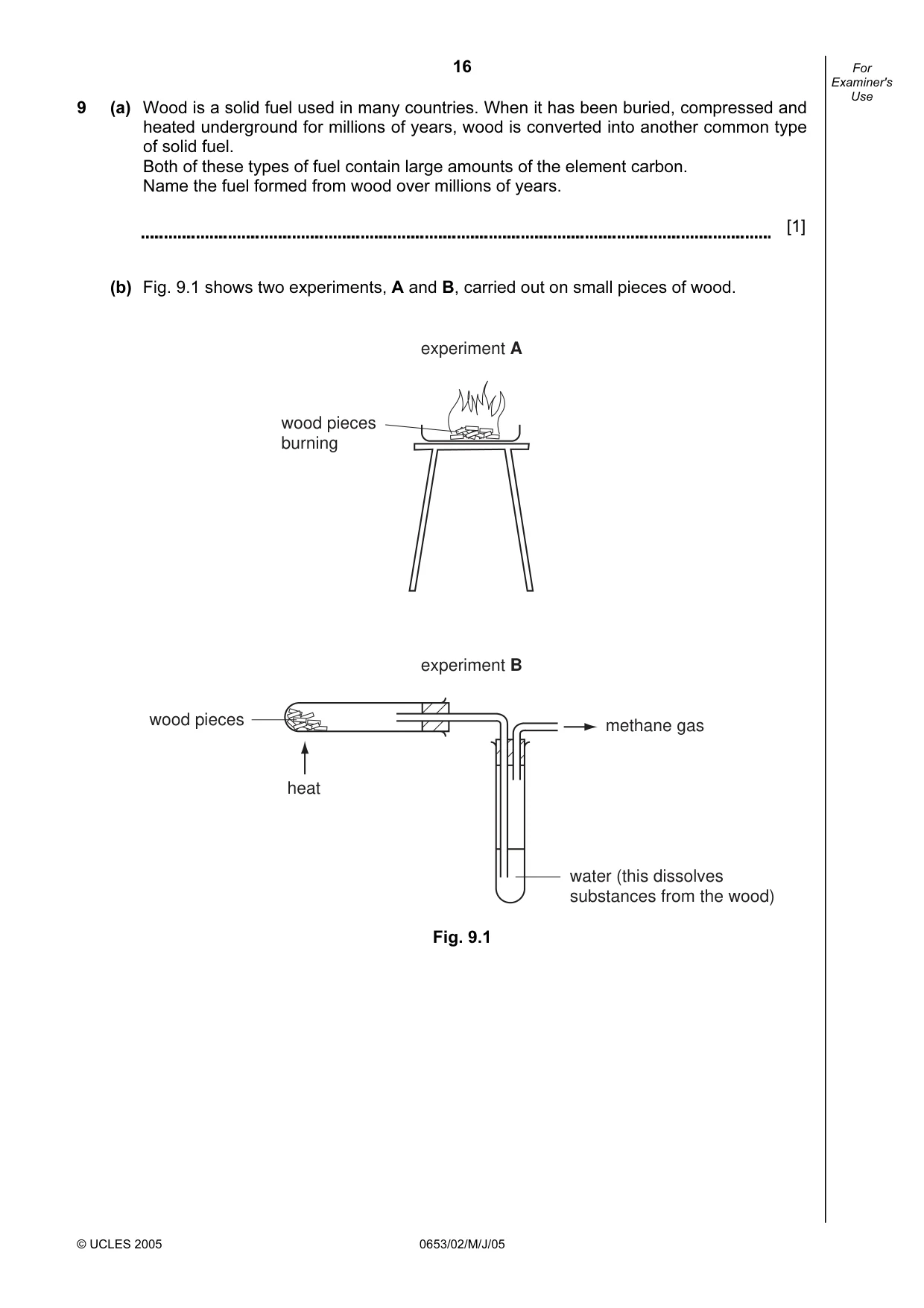
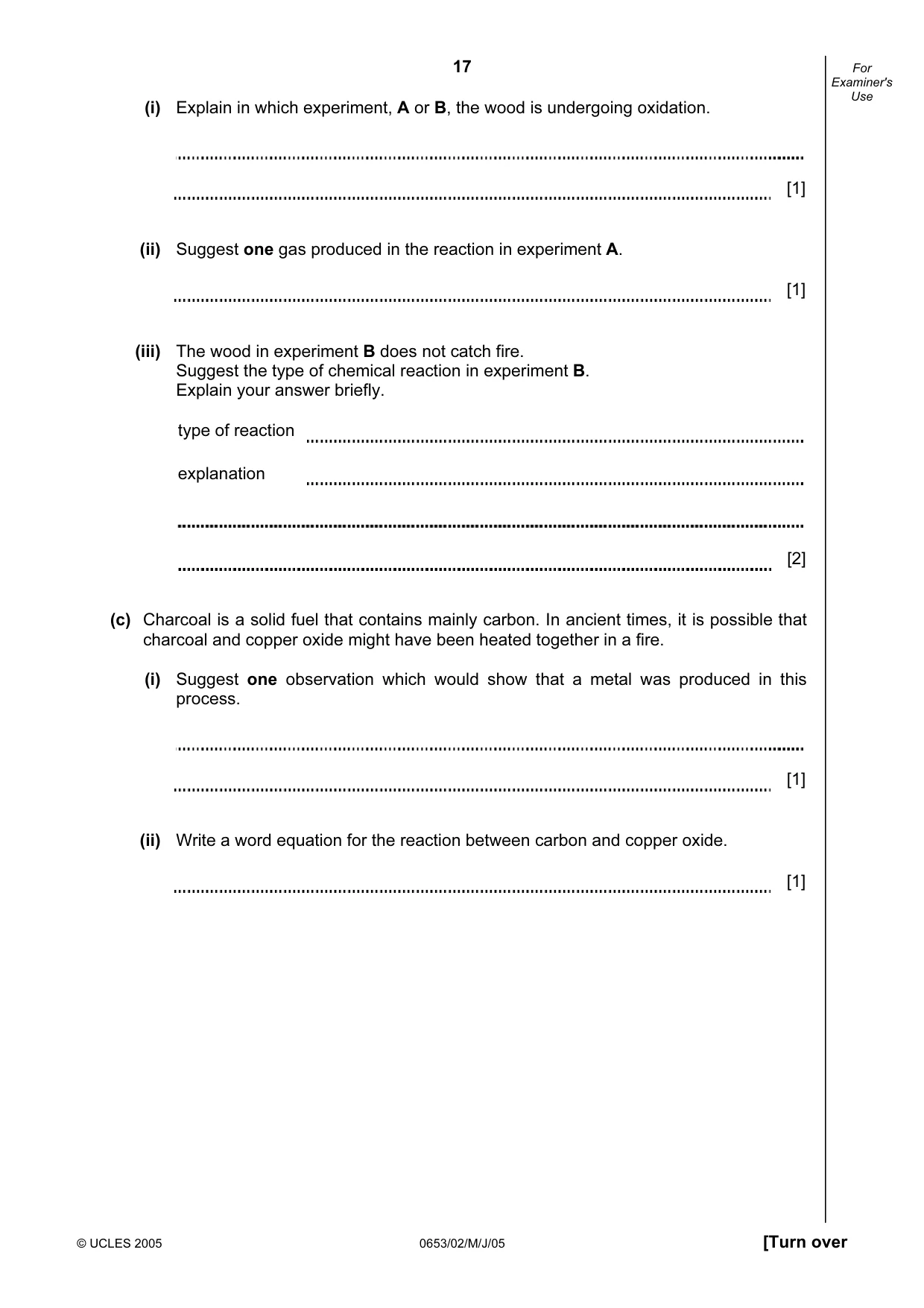
16 © UCLES 2005 0653/02/M/J/05 For Examiner's Use 9 (a) Wood is a solid fuel used in many countries. When it has been buried, compressed and heated underground for millions of years, wood is converted into another common type of solid fuel. Both of these types of fuel contain large amounts of the element carbon. Name the fuel formed from wood over millions of years. [1] (b) Fig. 9.1 shows two experiments, A and B, carried out on small pieces of wood. methane gas heat water (this dissolves substances from the wood) wood pieces wood pieces burning experiment B experiment A Fig. 9.1
Question paper, page 17
17 © UCLES 2005 0653/02/M/J/05 [Turn over For Examiner's Use (i) Explain in which experiment, A or B, the wood is undergoing oxidation. [1] (ii) Suggest one gas produced in the reaction in experiment A. [1] (iii) The wood in experiment B does not catch fire. Suggest the type of chemical reaction in experiment B. Explain your answer briefly. type of reaction explanation [2] (c) Charcoal is a solid fuel that contains mainly carbon. In ancient times, it is possible that charcoal and copper oxide might have been heated together in a fire. (i) Suggest one observation which would show that a metal was produced in this process. [1] (ii) Write a word equation for the reaction between carbon and copper oxide. [1]
Question paper, page 18
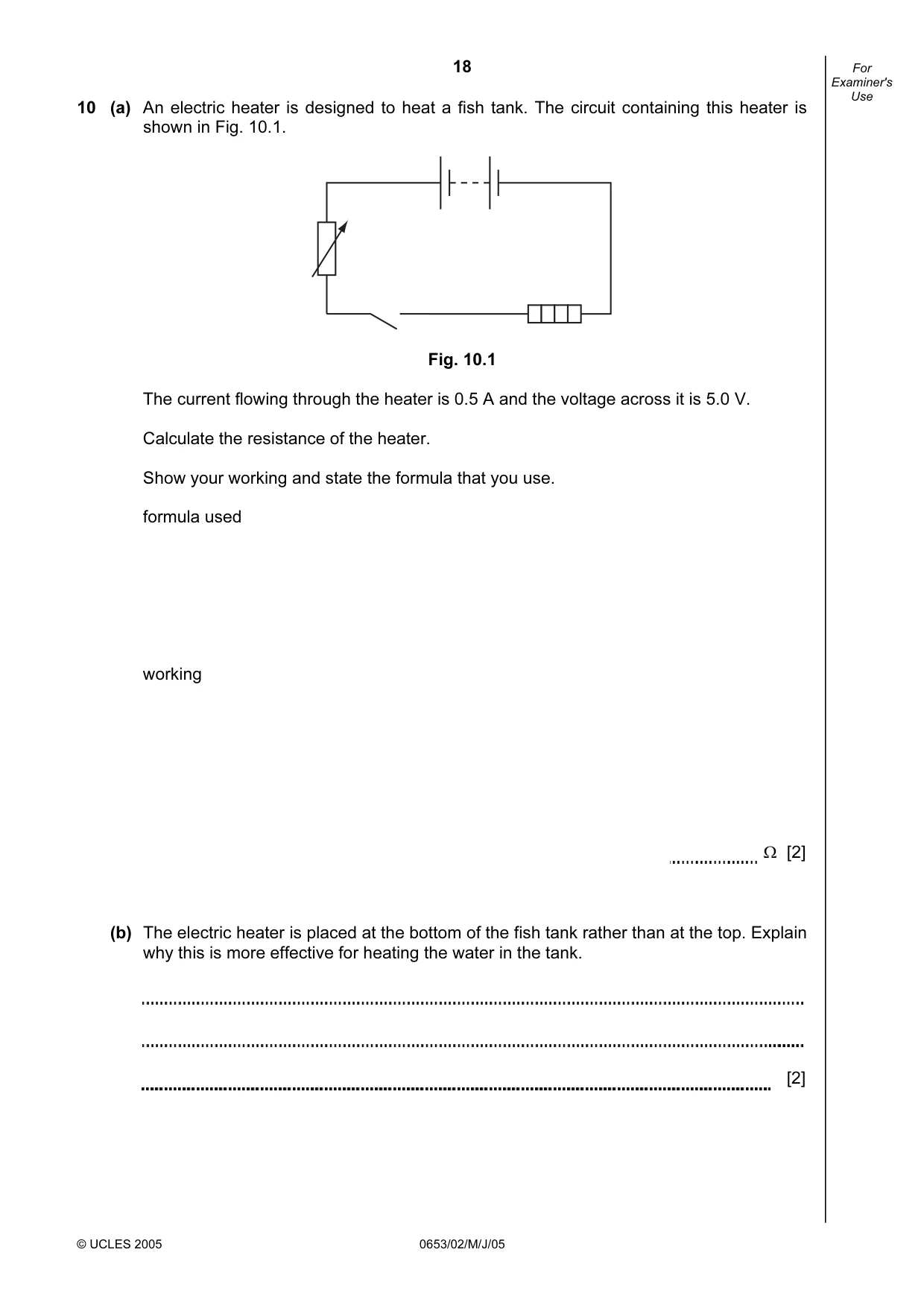
18 © UCLES 2005 0653/02/M/J/05 For Examiner's Use 10 (a) An electric heater is designed to heat a fish tank. The circuit containing this heater is shown in Fig. 10.1. Fig. 10.1 The current flowing through the heater is 0.5 A and the voltage across it is 5.0 V. Calculate the resistance of the heater. Show your working and state the formula that you use. formula used working Ω [2] (b) The electric heater is placed at the bottom of the fish tank rather than at the top. Explain why this is more effective for heating the water in the tank. [2]
Question paper, page 19
19 Permission to reproduce items where third-party owned material protected by copyright is included has been sought and cleared where possible. Every reasonable effort has been made by the publisher (UCLES) to trace copyright holders, but if any items requiring clearance have unwittingly been included, the publisher will be pleased to make amends at the earliest possible opportunity. University of Cambridge International Examinations is part of the University of Cambridge Local Examinations Syndicate (UCLES), which is itself a department of the University of Cambridge. © UCLES 2005 0653/02/M/J/05 For Examiner's Use (c) Choose words from the list below to complete the sentences. colour convection radio reflection refraction sound speed transverse Light waves form part of the electromagnetic spectrum. They travel as waves. They change when they move from water to air. This causes the light waves to change direction. This is called . Another example of waves which form part of the electromagnetic spectrum is waves. [4]
Question paper, page 20
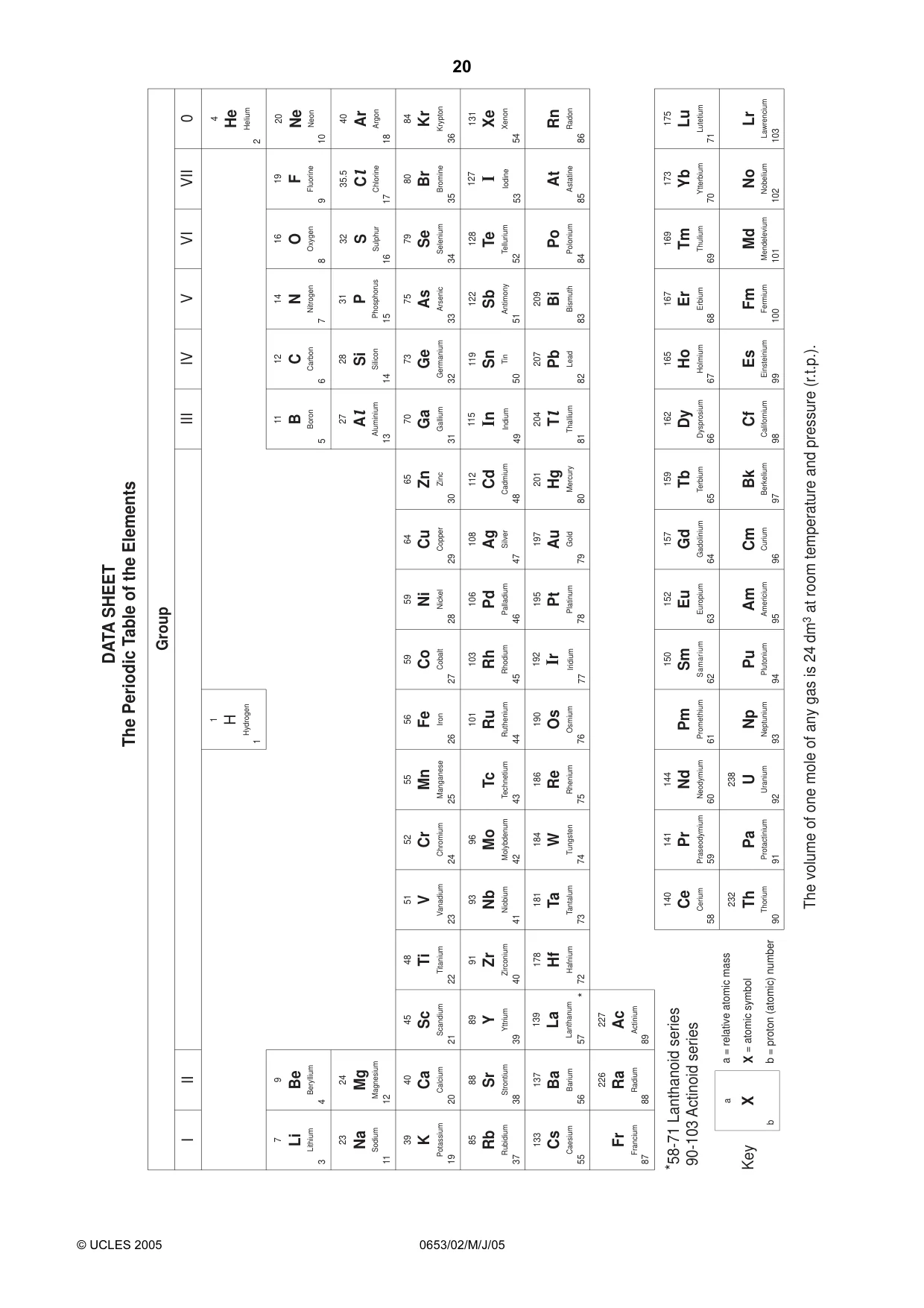
20 © UCLES 2005 0653/02/M/J/05 Group 140 Ce Cerium 58 141 Pr Praseodymium 59 144 Nd Neodymium 60 Pm Promethium 61 150 Sm Samarium 62 152 Eu Europium 63 157 Gd Gadolinium 64 159 Tb Terbium 65 162 Dy Dysprosium 66 165 Ho Holmium 67 167 Er Erbium 68 169 Tm Thulium 69 173 Yb Ytterbium 70 175 Lu Lutetium 71 232 Th Thorium 90 Pa Protactinium 91 238 U Uranium 92 Np Neptunium 93 Pu Plutonium 94 Am Americium 95 Cm Curium 96 Bk Berkelium 97 Cf Californium 98 Es Einsteinium 99 Fm Fermium 100 Md Mendelevium 101 No Nobelium 102 Lr Lawrencium 103 1 H Hydrogen 1 7 Li Lithium 3 23 Na Sodium 11 24 Mg Magnesium 12 40 Ca Calcium 20 45 Sc Scandium 21 48 Ti Titanium 22 51 V Vanadium 23 52 Cr Chromium 24 55 Mn Manganese 25 56 Fe Iron 26 59 Co Cobalt 27 59 Ni Nickel 28 64 Cu Copper 29 65 Zn Zinc 30 70 Ga Gallium 31 27 Al Aluminium 13 11 B Boron 5 12 C Carbon 6 14 N Nitrogen 7 16 O Oxygen 8 19 F Fluorine 9 28 Si Silicon 14 31 P Phosphorus 15 32 S Sulphur 16 35.5 Cl Chlorine 17 40 Ar Argon 18 20 Ne Neon 10 4 He Helium 2 73 Ge Germanium 32 75 As Arsenic 33 79 Se Selenium 34 80 Br Bromine 35 84 Kr Krypton 36 39 K Potassium 19 88 Sr Strontium 38 89 Y Yttrium 39 91 Zr Zirconium 40 93 Nb Niobium 41 96 Mo Molybdenum 42 Tc Technetium 43 101 Ru Ruthenium 44 103 Rh Rhodium 45 106 Pd Palladium 46 108 Ag Silver 47 112 Cd Cadmium 48 115 In Indium 49 119 Sn Tin 50 122 Sb Antimony 51 128 Te Tellurium 52 127 I Iodine 53 131 Xe Xenon 54 137 Ba Barium 56 139 La Lanthanum 57 * 178 Hf Hafnium 72 181 Ta Tantalum 73 184 W Tungsten 74 186 Re Rhenium 75 190 Os Osmium 76 192 Ir Iridium 77 195 Pt Platinum 78 197 Au Gold 79 201 Hg Mercury 80 204 Tl Thallium 81 207 Pb Lead 82 209 Bi Bismuth 83 Po Polonium 84 At Astatine 85 Rn Radon 86 Fr Francium 87 227 Ac Actinium 89 9 Be Beryllium 4 I II III IV V VI VII 0 85 Rb Rubidium 37 133 Cs Caesium 55 226 Ra Radium 88 The volume of one mole of any gas is 24 dm3 at room temperature and pressure (r.t.p.). a X b a = relative atomic mass X = atomic symbol b = proton (atomic) number Key *58-71 Lanthanoid series 90-103 Actinoid series DATA SHEET The Periodic Table of the Elements
Mark scheme, page 1
UNIVERSITY OF CAMBRIDGE INTERNATIONAL EXAMINATIONS International General Certificate of Secondary Education MARK SCHEME for the June 2005 question paper 0653 COMBINED SCIENCE 0653/02 Paper 2 (Core Theory), maximum raw mark 80 This mark scheme is published as an aid to teachers and students, to indicate the requirements of the examination. It shows the basis on which Examiners were initially instructed to award marks. It does not indicate the details of the discussions that took place at an Examiners’ meeting before marking began. Any substantial changes to the mark scheme that arose from these discussions will be recorded in the published Report on the Examination. All Examiners are instructed that alternative correct answers and unexpected approaches in candidates’ scripts must be given marks that fairly reflect the relevant knowledge and skills demonstrated. Mark schemes must be read in conjunction with the question papers and the Report on the Examination. • CIE will not enter into discussion or correspondence in connection with these mark schemes. CIE is publishing the mark schemes for the June 2005 question papers for most IGCSE and GCE Advanced Level and Advanced Subsidiary Level syllabuses and some Ordinary Level syllabuses. www.XtremePapers.com
Mark scheme, page 2
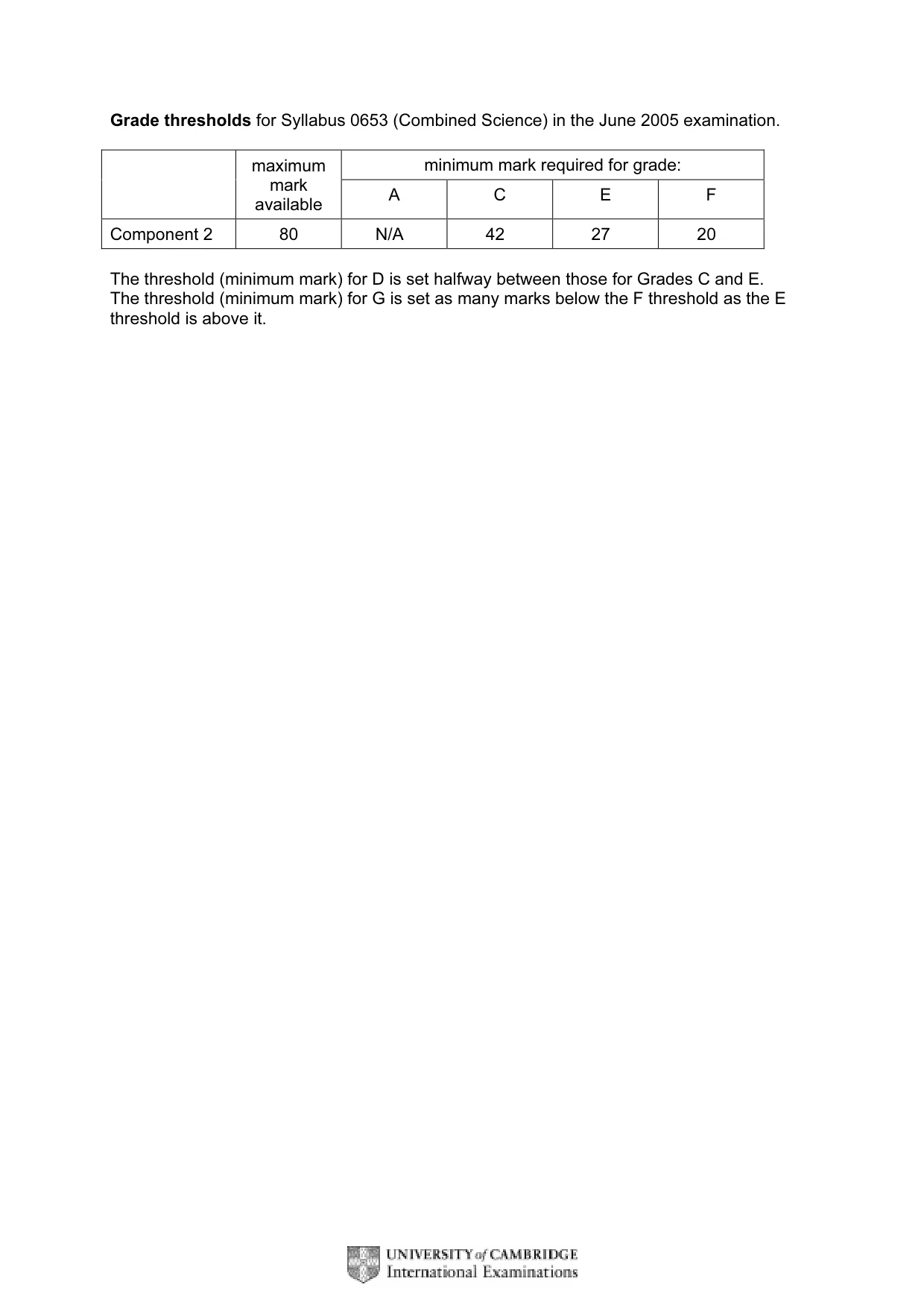
Grade thresholds for Syllabus 0653 (Combined Science) in the June 2005 examination. minimum mark required for grade: maximum mark available A C E F Component 2 80 N/A 42 27 20 The threshold (minimum mark) for D is set halfway between those for Grades C and E. The threshold (minimum mark) for G is set as many marks below the F threshold as the E threshold is above it.
Mark scheme, page 3
June 2005 IGCSE MARK SCHEME MAXIMUM MARK: 80 SYLLABUS/COMPONENT: 0653/02 COMBINED SCIENCE Paper 2 (Core Theory)
Mark scheme, page 4
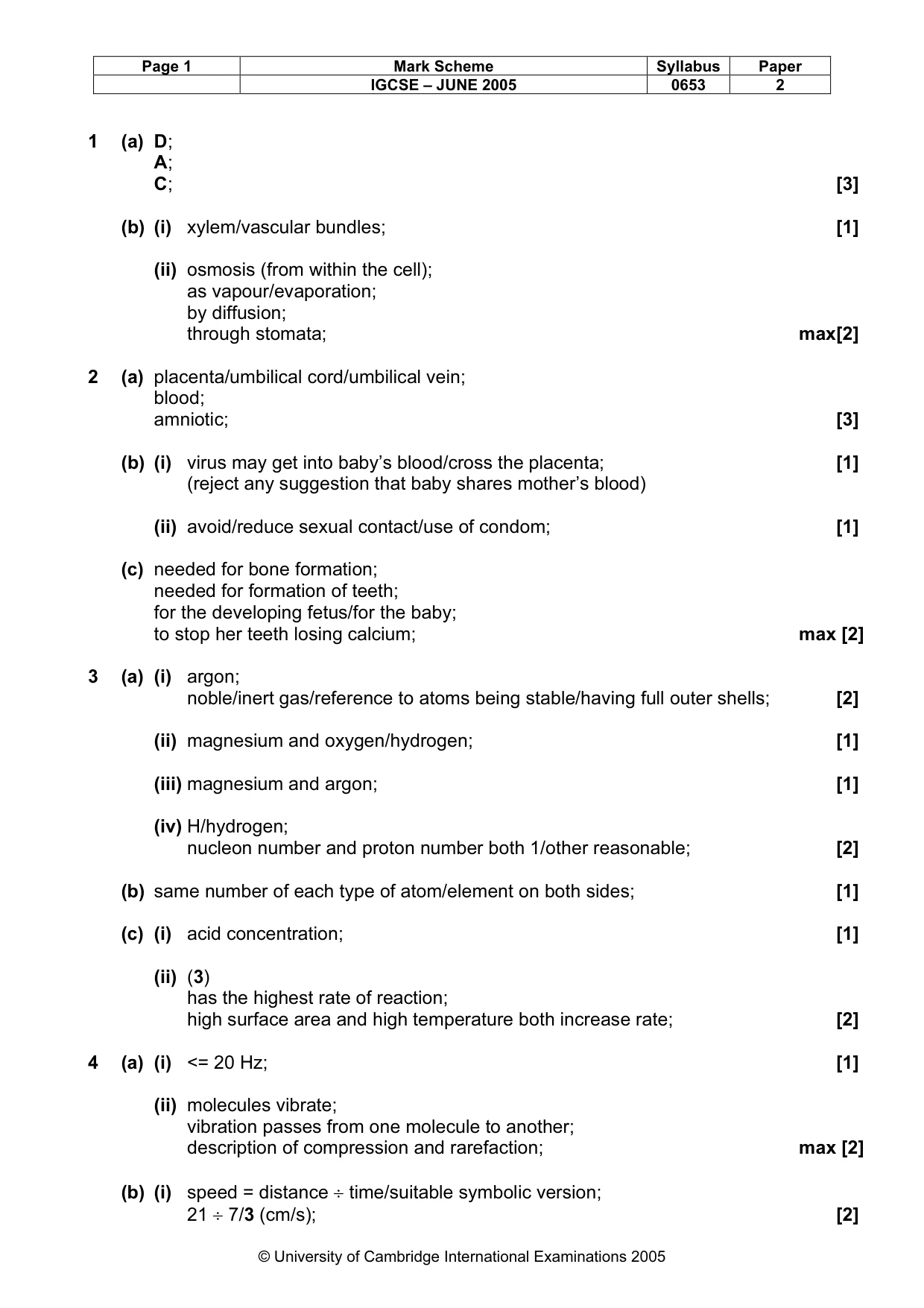
Page 1 Mark Scheme Syllabus Paper IGCSE – JUNE 2005 0653 2 © University of Cambridge International Examinations 2005 1 (a) D; A; C; [3] (b) (i) xylem/vascular bundles; [1] (ii) osmosis (from within the cell); as vapour/evaporation; by diffusion; through stomata; max[2] 2 (a) placenta/umbilical cord/umbilical vein; blood; amniotic; [3] (b) (i) virus may get into baby’s blood/cross the placenta; [1] (reject any suggestion that baby shares mother’s blood) (ii) avoid/reduce sexual contact/use of condom; [1] (c) needed for bone formation; needed for formation of teeth; for the developing fetus/for the baby; to stop her teeth losing calcium; max [2] 3 (a) (i) argon; noble/inert gas/reference to atoms being stable/having full outer shells; [2] (ii) magnesium and oxygen/hydrogen; [1] (iii) magnesium and argon; [1] (iv) H/hydrogen; nucleon number and proton number both 1/other reasonable; [2] (b) same number of each type of atom/element on both sides; [1] (c) (i) acid concentration; [1] (ii) (3) has the highest rate of reaction; high surface area and high temperature both increase rate; [2] 4 (a) (i) <= 20 Hz; [1] (ii) molecules vibrate; vibration passes from one molecule to another; description of compression and rarefaction; max [2] (b) (i) speed = distance ÷ time/suitable symbolic version; 21 ÷ 7/3 (cm/s); [2]
Mark scheme, page 5
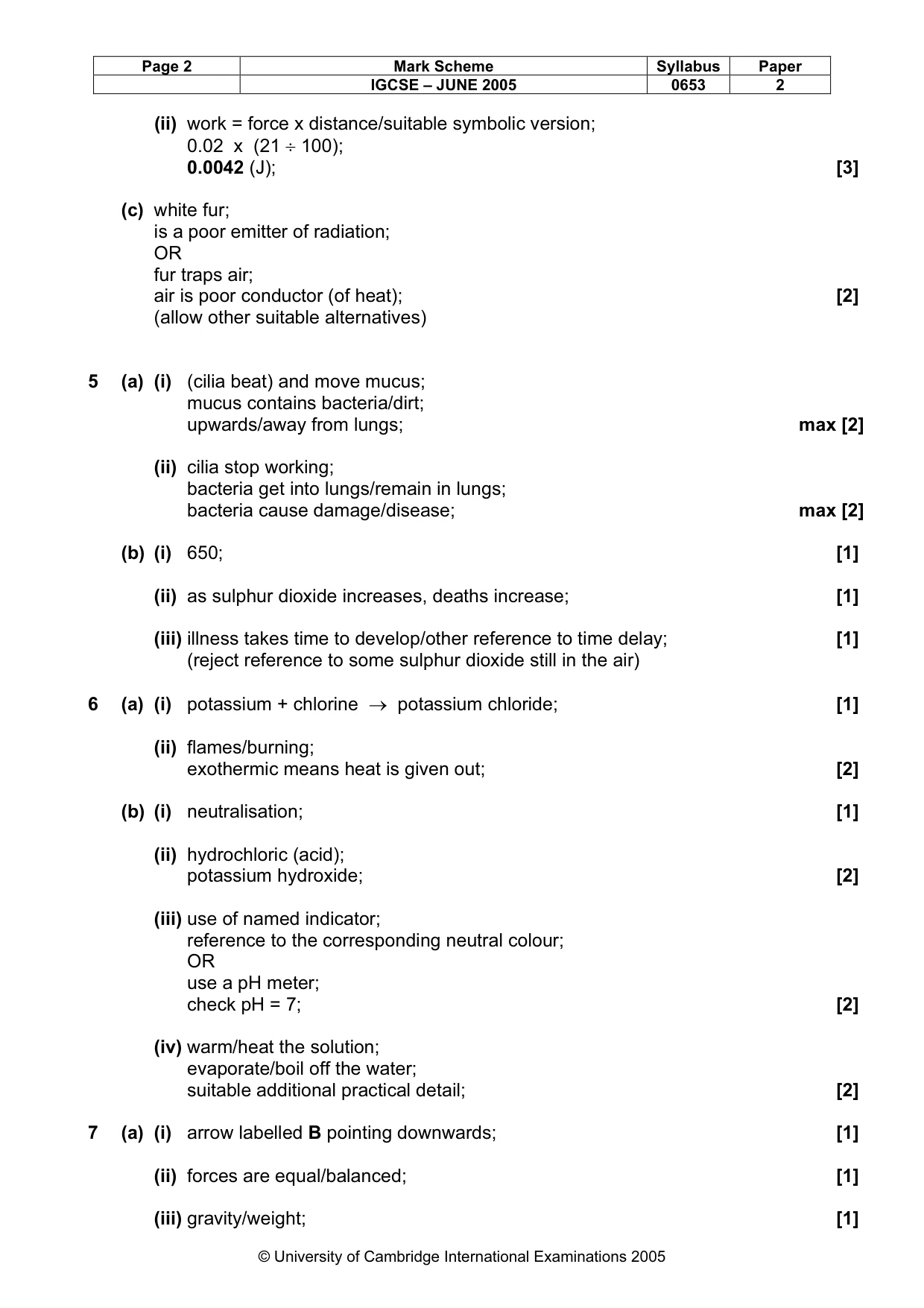
Page 2 Mark Scheme Syllabus Paper IGCSE – JUNE 2005 0653 2 © University of Cambridge International Examinations 2005 (ii) work = force x distance/suitable symbolic version; 0.02 x (21 ÷ 100); 0.0042 (J); [3] (c) white fur; is a poor emitter of radiation; OR fur traps air; air is poor conductor (of heat); [2] (allow other suitable alternatives) 5 (a) (i) (cilia beat) and move mucus; mucus contains bacteria/dirt; upwards/away from lungs; max [2] (ii) cilia stop working; bacteria get into lungs/remain in lungs; bacteria cause damage/disease; max [2] (b) (i) 650; [1] (ii) as sulphur dioxide increases, deaths increase; [1] (iii) illness takes time to develop/other reference to time delay; [1] (reject reference to some sulphur dioxide still in the air) 6 (a) (i) potassium + chlorine → potassium chloride; [1] (ii) flames/burning; exothermic means heat is given out; [2] (b) (i) neutralisation; [1] (ii) hydrochloric (acid); potassium hydroxide; [2] (iii) use of named indicator; reference to the corresponding neutral colour; OR use a pH meter; check pH = 7; [2] (iv) warm/heat the solution; evaporate/boil off the water; suitable additional practical detail; [2] 7 (a) (i) arrow labelled B pointing downwards; [1] (ii) forces are equal/balanced; [1] (iii) gravity/weight; [1]
Mark scheme, page 6
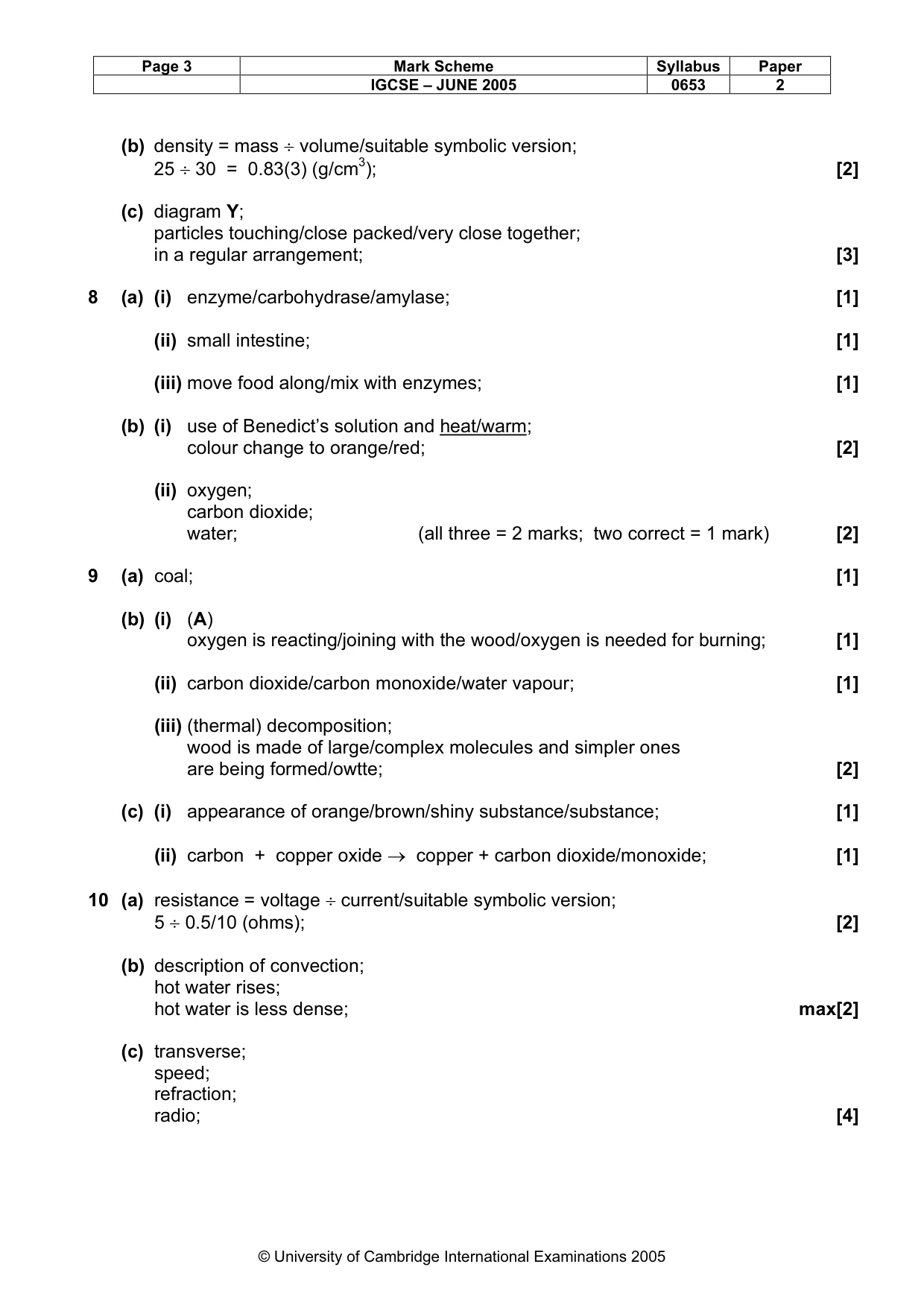
Page 3 Mark Scheme Syllabus Paper IGCSE – JUNE 2005 0653 2 © University of Cambridge International Examinations 2005 (b) density = mass ÷ volume/suitable symbolic version; 25 ÷ 30 = 0.83(3) (g/cm3); [2] (c) diagram Y; particles touching/close packed/very close together; in a regular arrangement; [3] 8 (a) (i) enzyme/carbohydrase/amylase; [1] (ii) small intestine; [1] (iii) move food along/mix with enzymes; [1] (b) (i) use of Benedict’s solution and heat/warm; colour change to orange/red; [2] (ii) oxygen; carbon dioxide; water; (all three = 2 marks; two correct = 1 mark) [2] 9 (a) coal; [1] (b) (i) (A) oxygen is reacting/joining with the wood/oxygen is needed for burning; [1] (ii) carbon dioxide/carbon monoxide/water vapour; [1] (iii) (thermal) decomposition; wood is made of large/complex molecules and simpler ones are being formed/owtte; [2] (c) (i) appearance of orange/brown/shiny substance/substance; [1] (ii) carbon + copper oxide → copper + carbon dioxide/monoxide; [1] 10 (a) resistance = voltage ÷ current/suitable symbolic version; 5 ÷ 0.5/10 (ohms); [2] (b) description of convection; hot water rises; hot water is less dense; max[2] (c) transverse; speed; refraction; radio; [4]