Cambridge IGCSE Science - Combined 0653 — 2004 Oct/Nov Paper 3 · Variant 1
0653/31/O/N/04
The question paper and its mark scheme, free to read here and free to download. This is Cambridge’s own paper, exactly as it was sat.
Question paper20 pages

Mark scheme9 pages
Answers below. Sit the paper first if you are practising.
Paper as text
Question paper, page 1
This document consists of 19 printed pages and 1 blank page. SP (CW/GR) S69258/3 © UCLES 2004 [Turn over UNIVERSITY OF CAMBRIDGE INTERNATIONAL EXAMINATIONS International General Certificate of Secondary Education COMBINED SCIENCE 0653/03 Paper 3 October/November 2004 1 hour 15 minutes Candidates answer on the Question Paper. No Additional Materials are required. READ THESE INSTRUCTIONS FIRST Write your Centre number, candidate number and name on all the work you hand in. Write in dark blue or black pen in the spaces provided on the Question Paper. You may use a soft pencil for any diagrams, graphs, tables or rough working. Do not use staples, paper clips, highlighters, glue or correction fluid. Answer all questions. The number of marks is given in brackets [ ] at the end of each question or part question. A copy of the Periodic Table is printed on page 20. Centre Number Candidate Number Name If you have been given a label, look at the details. If any details are incorrect or missing, please fill in your correct details in the space given at the top of this page. Stick your personal label here, if provided. For Examiner’s Use 1 2 3 4 5 6 7 8 9 Total www.XtremePapers.com
Question paper, page 2
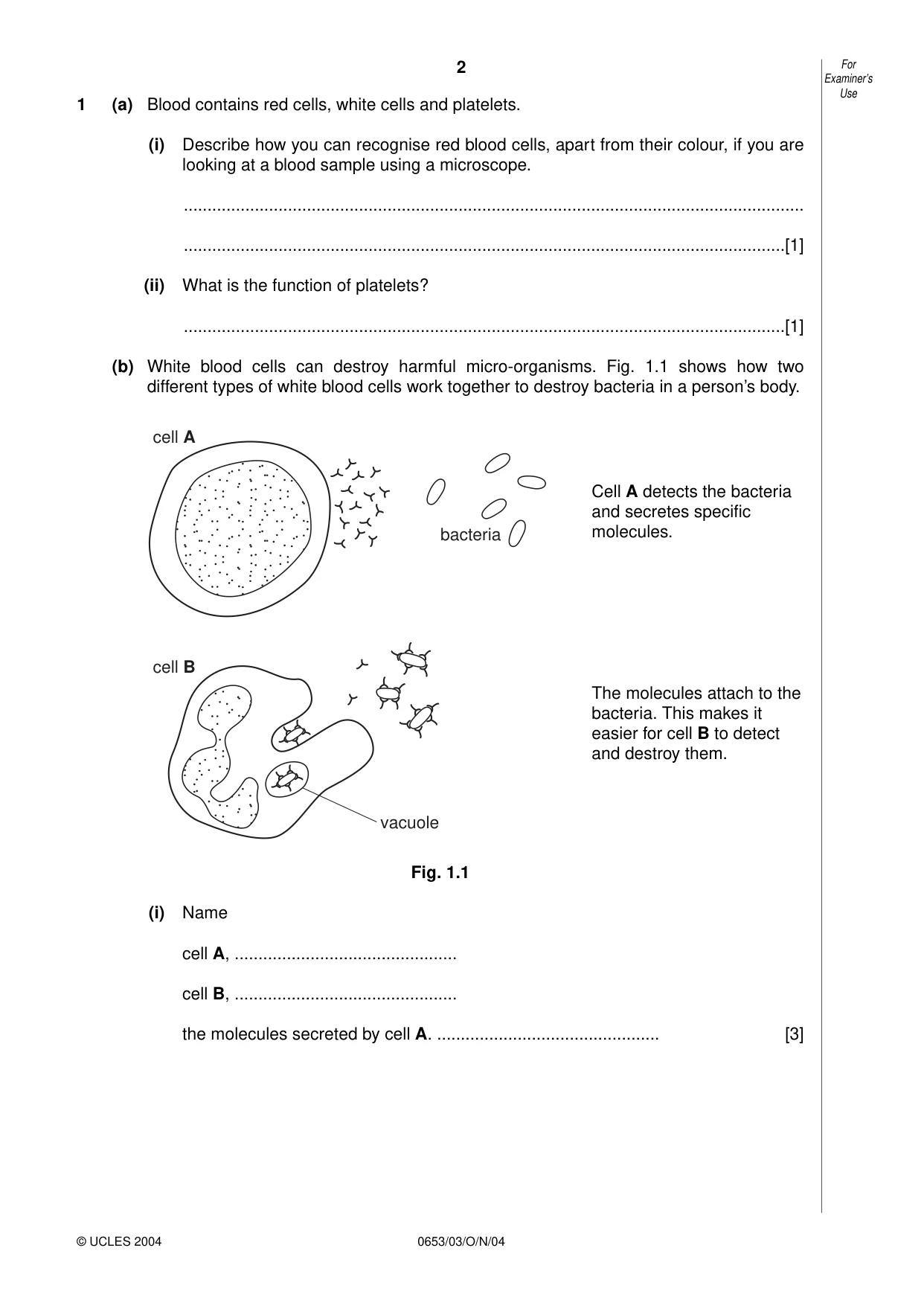
2 0653/03/O/N/04 1 (a) Blood contains red cells, white cells and platelets. (i) Describe how you can recognise red blood cells, apart from their colour, if you are looking at a blood sample using a microscope. … …[1] (ii) What is the function of platelets? …[1] (b) White blood cells can destroy harmful micro-organisms. Fig. 1.1 shows how two different types of white blood cells work together to destroy bacteria in a person’s body. Cell A detects the bacteria and secretes specific molecules. The molecules attach to the bacteria. This makes it easier for cell B to detect and destroy them. Fig. 1.1 (i) Name cell A, … cell B, … the molecules secreted by cell A. … [3] vacuole cell A cell B bacteria For Examiner’s Use © UCLES 2004
Question paper, page 3
3 0653/03/O/N/04 [Turn over (ii) The first time that a person is infected by a particular kind of bacterium he may become ill. However, if these bacteria get into the body a second time, the person will probably be immune to this illness. Explain how the person becomes immune. … … … …[2] (iii) Cell B secretes enzymes into the vacuole containing the bacteria. These include proteases. Suggest how proteases can help to destroy the bacteria. … … …[2] For Examiner’s Use © UCLES 2004
Question paper, page 4
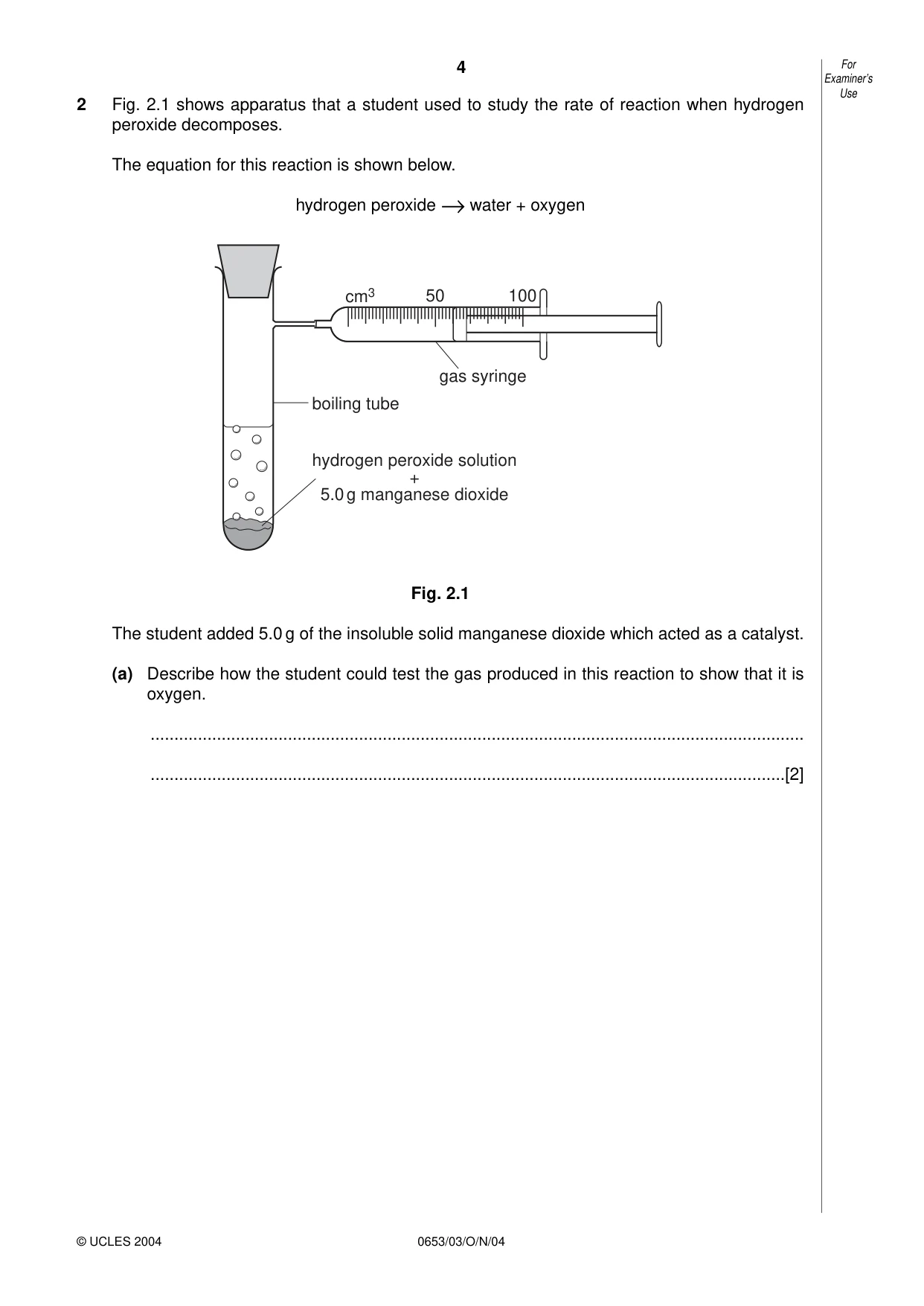
4 0653/03/O/N/04 2 Fig. 2.1 shows apparatus that a student used to study the rate of reaction when hydrogen peroxide decomposes. The equation for this reaction is shown below. hydrogen peroxide →water + oxygen Fig. 2.1 The student added 5.0 g of the insoluble solid manganese dioxide which acted as a catalyst. (a) Describe how the student could test the gas produced in this reaction to show that it is oxygen. … …[2] boiling tube gas syringe hydrogen peroxide solution + 5.0 g manganese dioxide 50 100 cm3 For Examiner’s Use © UCLES 2004
Question paper, page 5
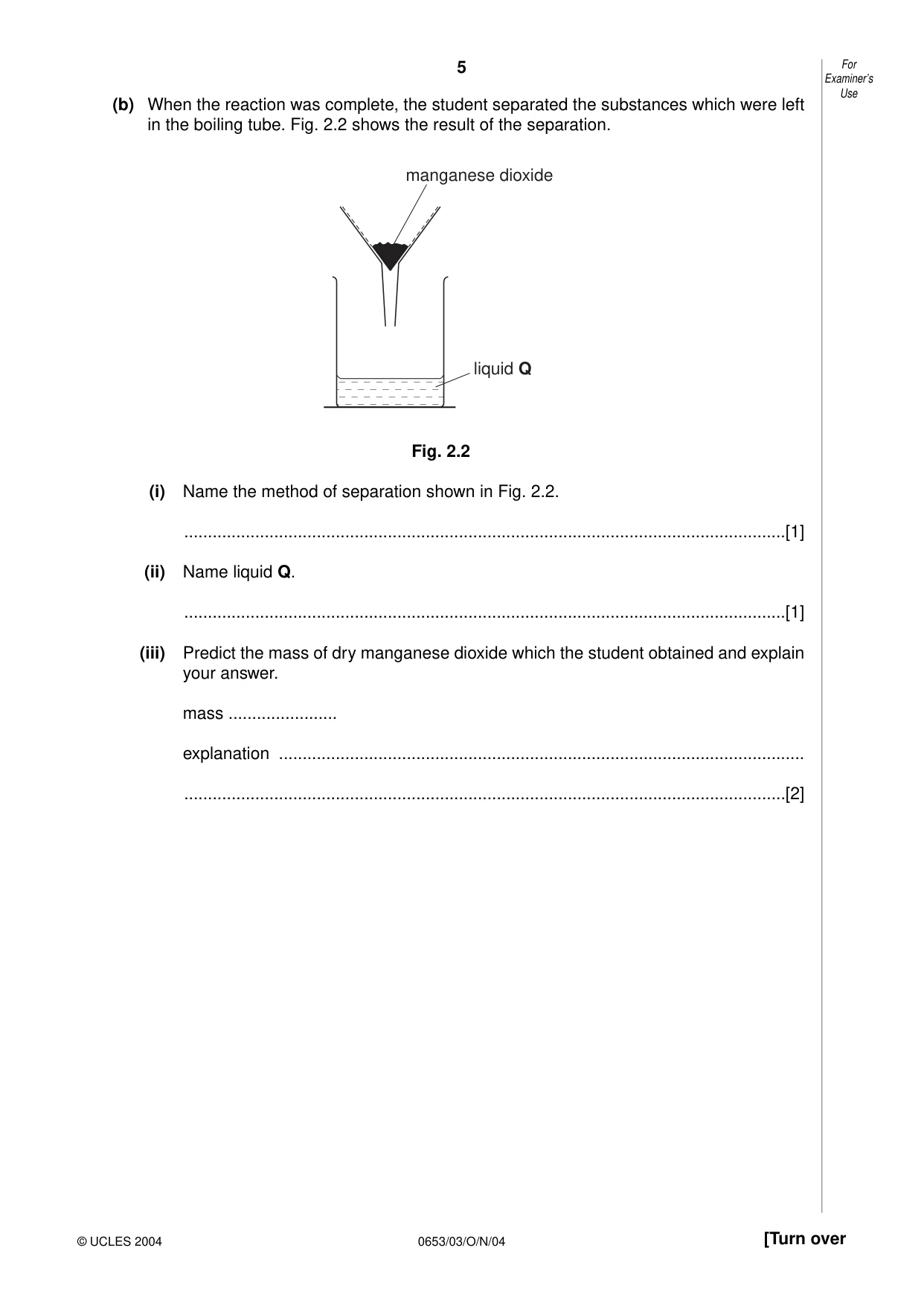
5 0653/03/O/N/04 [Turn over (b) When the reaction was complete, the student separated the substances which were left in the boiling tube. Fig. 2.2 shows the result of the separation. Fig. 2.2 (i) Name the method of separation shown in Fig. 2.2. …[1] (ii) Name liquid Q. …[1] (iii) Predict the mass of dry manganese dioxide which the student obtained and explain your answer. mass … explanation … …[2] manganese dioxide liquid Q For Examiner’s Use © UCLES 2004
Question paper, page 6
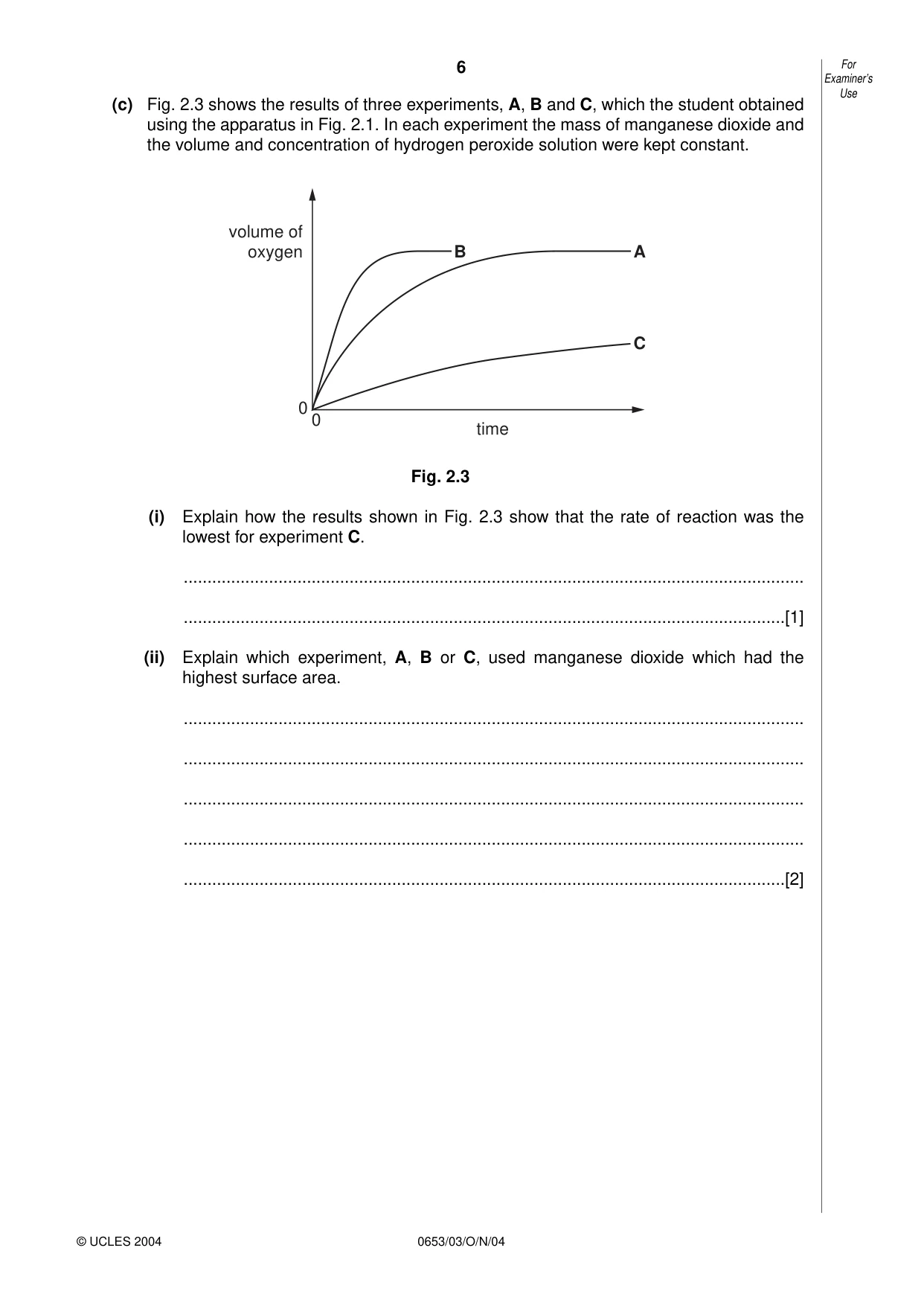
6 0653/03/O/N/04 (c) Fig. 2.3 shows the results of three experiments, A, B and C, which the student obtained using the apparatus in Fig. 2.1. In each experiment the mass of manganese dioxide and the volume and concentration of hydrogen peroxide solution were kept constant. Fig. 2.3 (i) Explain how the results shown in Fig. 2.3 show that the rate of reaction was the lowest for experiment C. … …[1] (ii) Explain which experiment, A, B or C, used manganese dioxide which had the highest surface area. … … … … …[2] B A C 0 0 volume of oxygen time For Examiner’s Use © UCLES 2004
Question paper, page 7
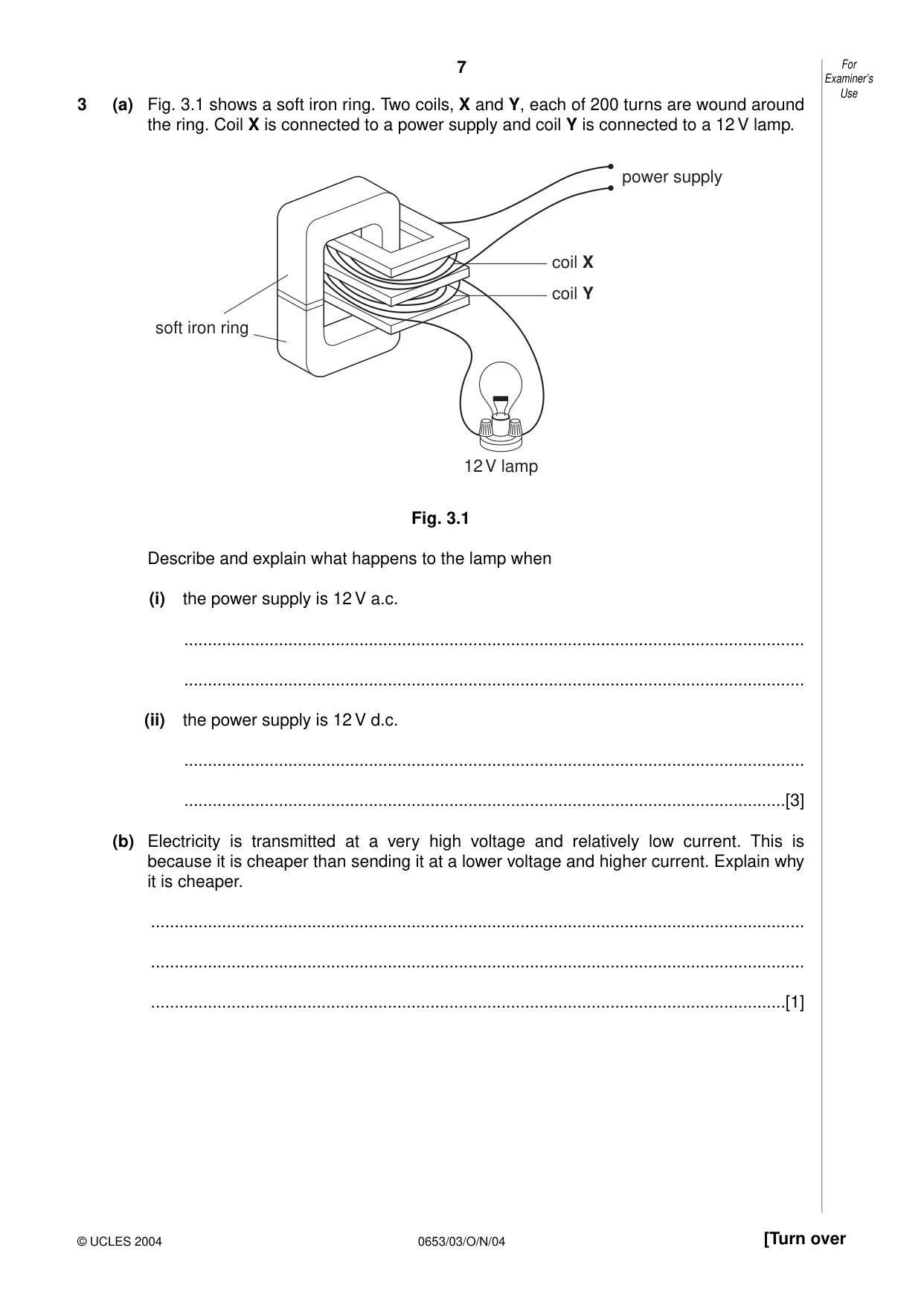
7 0653/03/O/N/04 [Turn over 3 (a) Fig. 3.1 shows a soft iron ring. Two coils, X and Y, each of 200 turns are wound around the ring. Coil X is connected to a power supply and coil Y is connected to a 12 V lamp. Fig. 3.1 Describe and explain what happens to the lamp when (i) the power supply is 12 V a.c. … … (ii) the power supply is 12 V d.c. … …[3] (b) Electricity is transmitted at a very high voltage and relatively low current. This is because it is cheaper than sending it at a lower voltage and higher current. Explain why it is cheaper. … … …[1] coil X power supply coil Y soft iron ring 12 V lamp For Examiner’s Use © UCLES 2004
Question paper, page 8
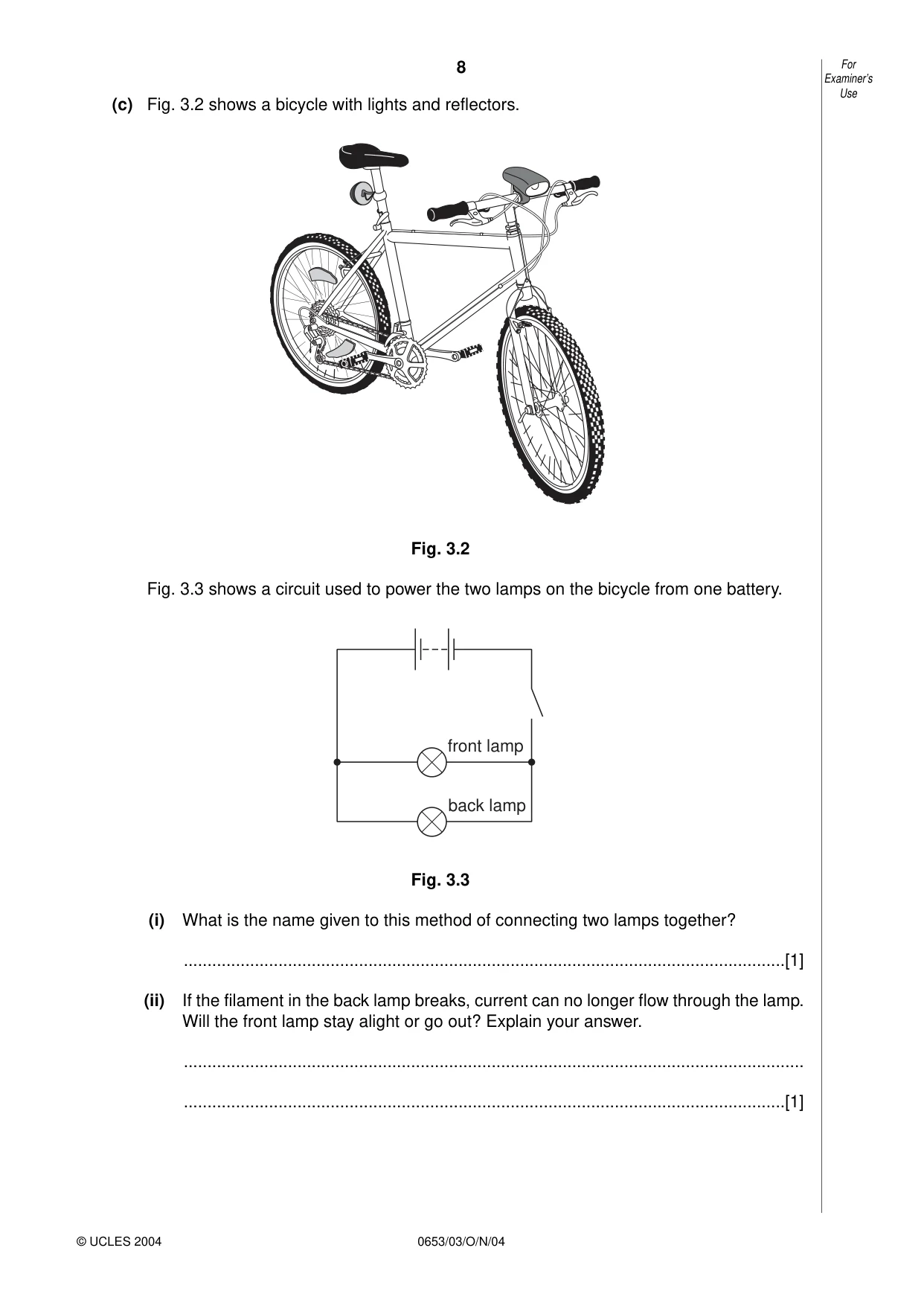
8 0653/03/O/N/04 (c) Fig. 3.2 shows a bicycle with lights and reflectors. Fig. 3.2 Fig. 3.3 shows a circuit used to power the two lamps on the bicycle from one battery. Fig. 3.3 (i) What is the name given to this method of connecting two lamps together? …[1] (ii) If the filament in the back lamp breaks, current can no longer flow through the lamp. Will the front lamp stay alight or go out? Explain your answer. … …[1] front lamp back lamp For Examiner’s Use © UCLES 2004
Question paper, page 9
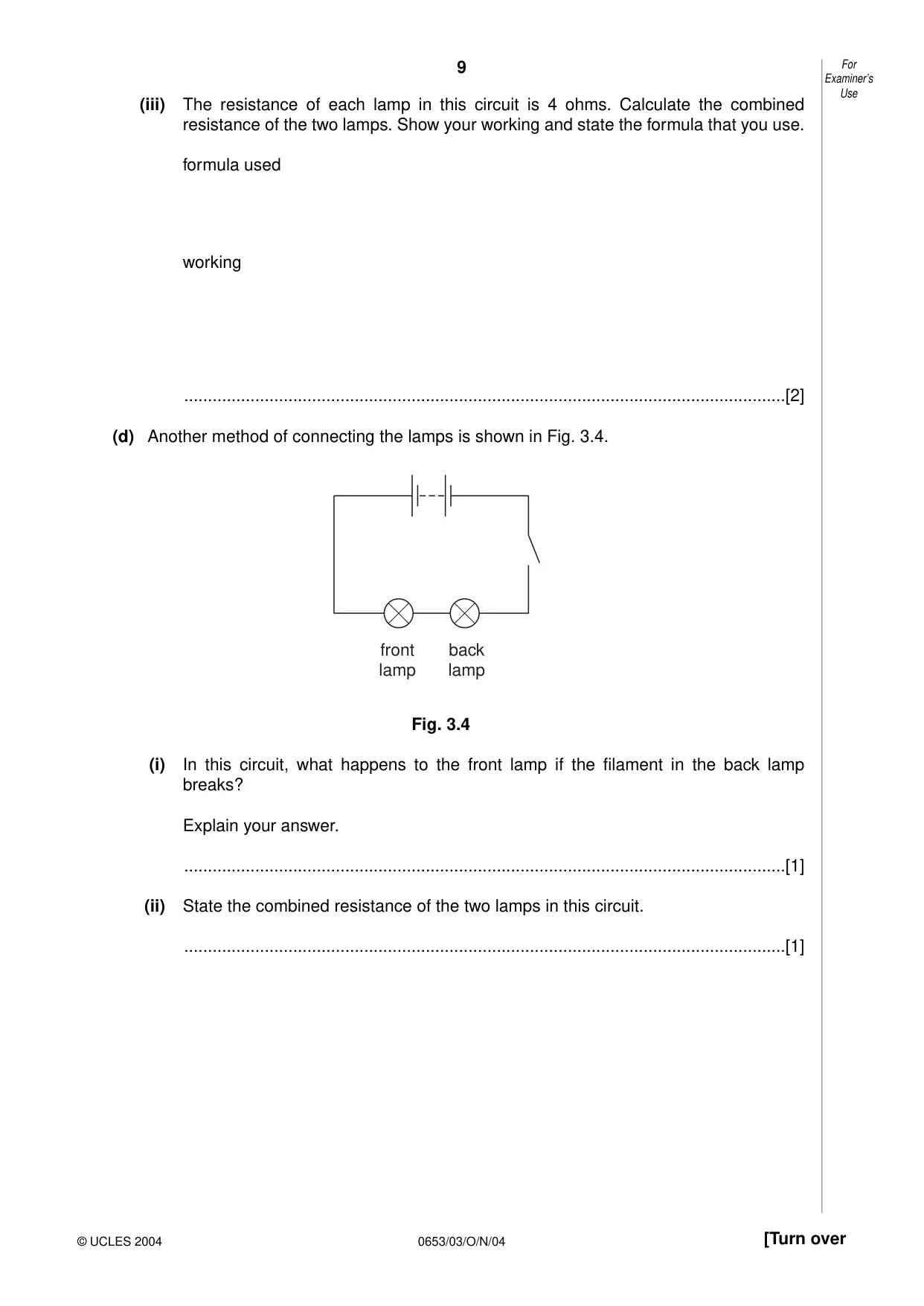
9 0653/03/O/N/04 [Turn over (iii) The resistance of each lamp in this circuit is 4 ohms. Calculate the combined resistance of the two lamps. Show your working and state the formula that you use. formula used working …[2] (d) Another method of connecting the lamps is shown in Fig. 3.4. Fig. 3.4 (i) In this circuit, what happens to the front lamp if the filament in the back lamp breaks? Explain your answer. …[1] (ii) State the combined resistance of the two lamps in this circuit. …[1] front lamp back lamp For Examiner’s Use © UCLES 2004
Question paper, page 10
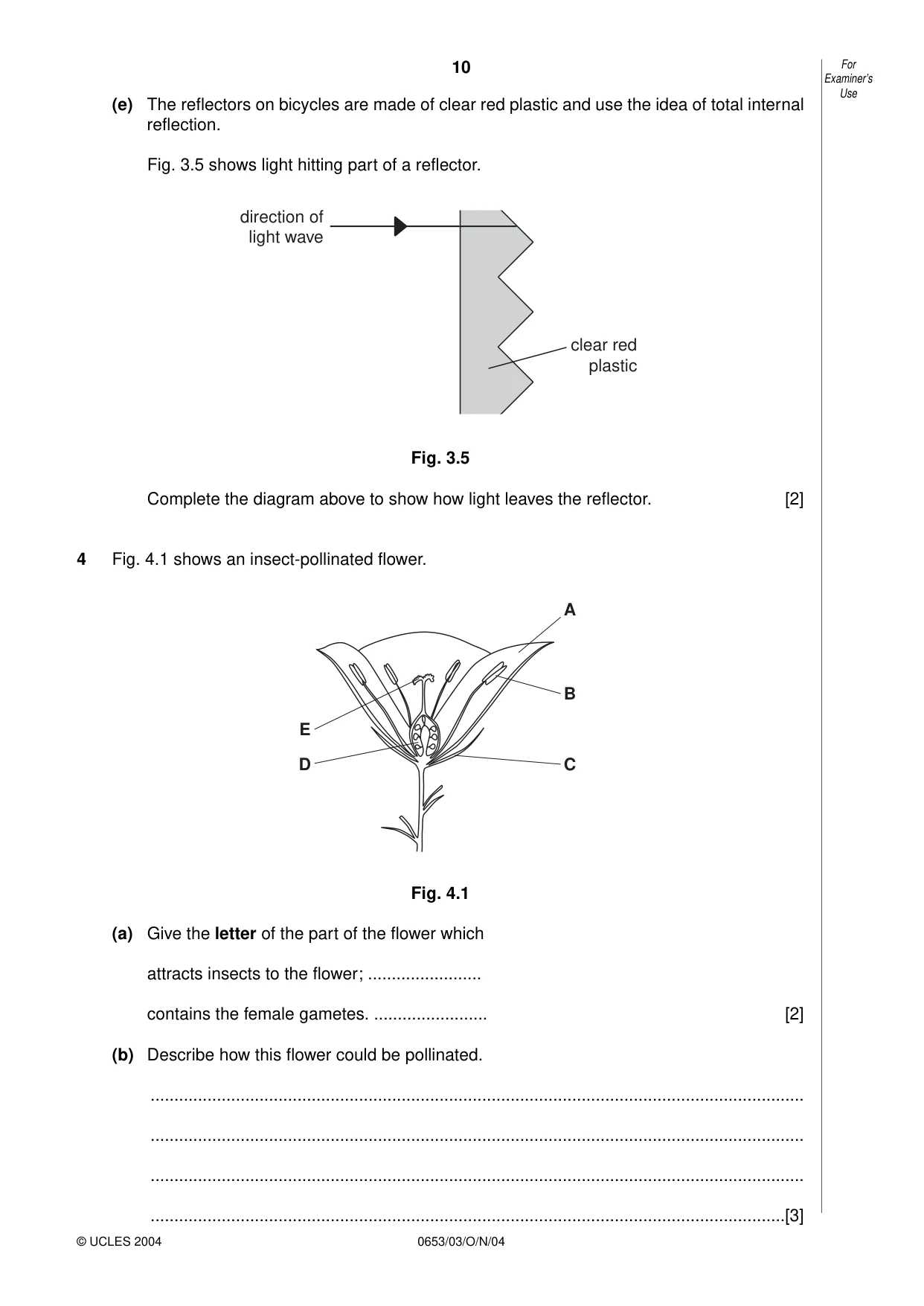
10 0653/03/O/N/04 (e) The reflectors on bicycles are made of clear red plastic and use the idea of total internal reflection. Fig. 3.5 shows light hitting part of a reflector. Fig. 3.5 Complete the diagram above to show how light leaves the reflector. [2] 4 Fig. 4.1 shows an insect-pollinated flower. Fig. 4.1 (a) Give the letter of the part of the flower which attracts insects to the flower; … contains the female gametes. … [2] (b) Describe how this flower could be pollinated. … … … …[3] A B C E D direction of light wave clear red plastic For Examiner’s Use © UCLES 2004
Question paper, page 11
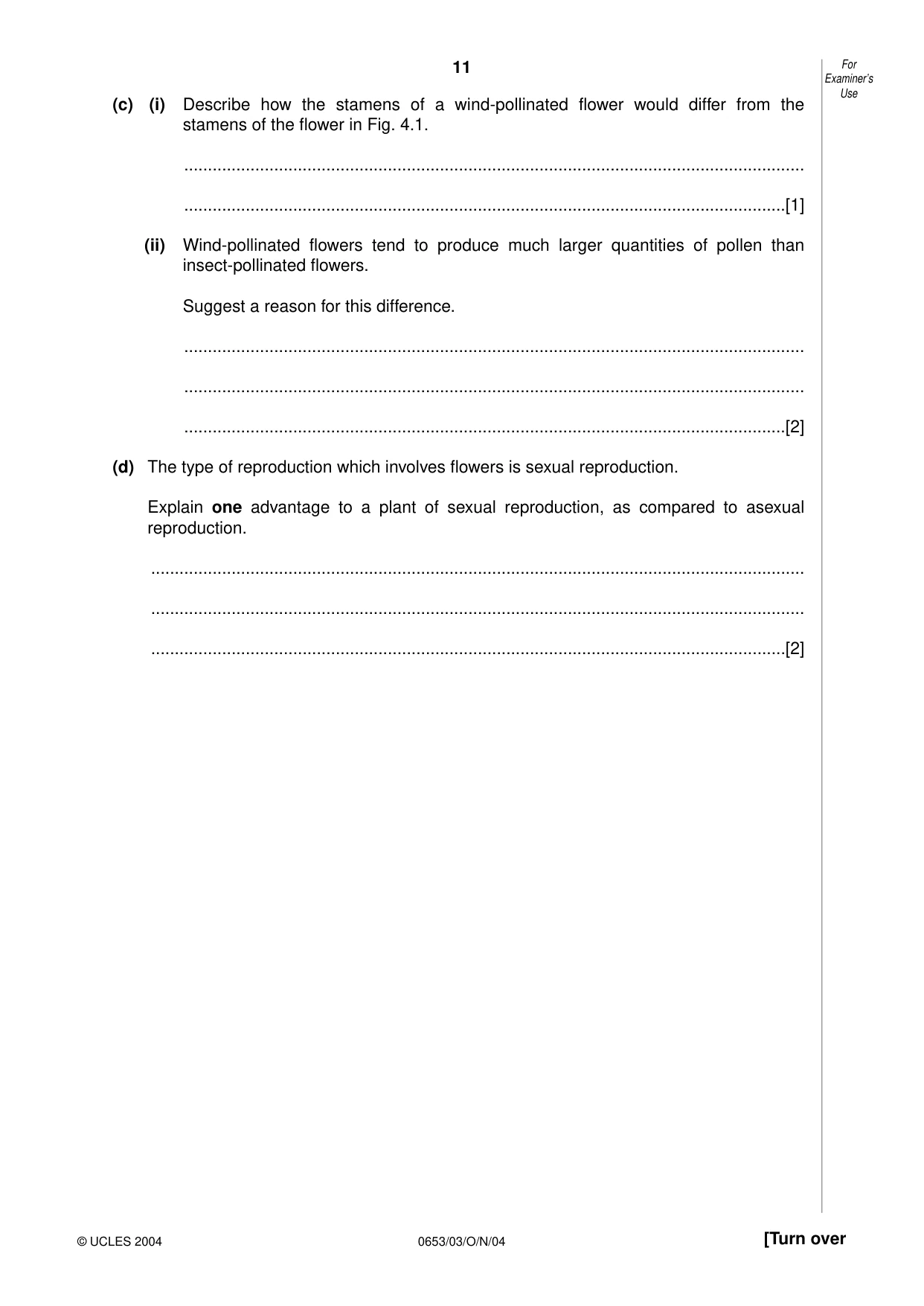
11 0653/03/O/N/04 [Turn over (c) (i) Describe how the stamens of a wind-pollinated flower would differ from the stamens of the flower in Fig. 4.1. … …[1] (ii) Wind-pollinated flowers tend to produce much larger quantities of pollen than insect-pollinated flowers. Suggest a reason for this difference. … … …[2] (d) The type of reproduction which involves flowers is sexual reproduction. Explain one advantage to a plant of sexual reproduction, as compared to asexual reproduction. … … …[2] For Examiner’s Use © UCLES 2004
Question paper, page 12
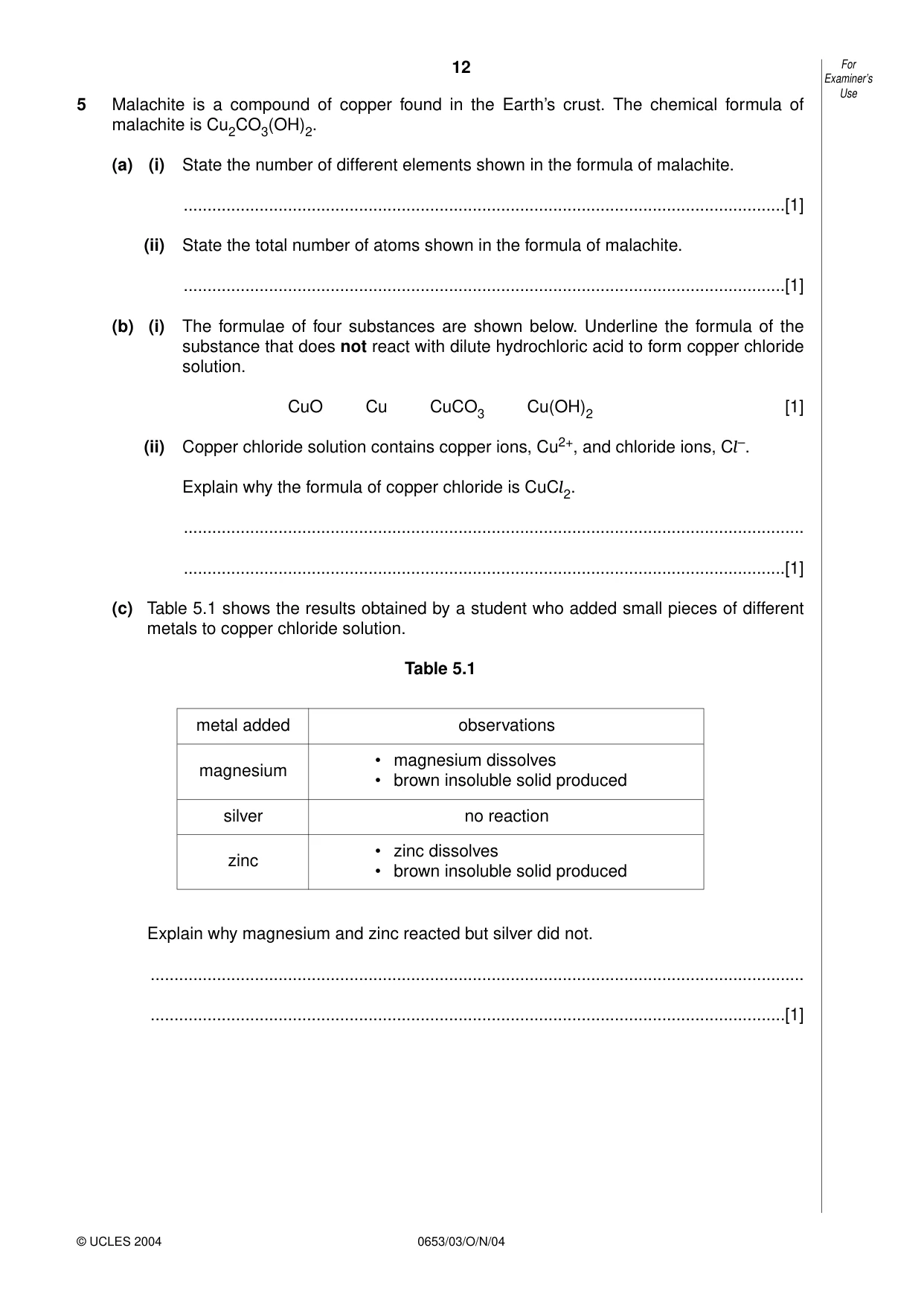
12 0653/03/O/N/04 5 Malachite is a compound of copper found in the Earth’s crust. The chemical formula of malachite is Cu2CO3(OH)2. (a) (i) State the number of different elements shown in the formula of malachite. …[1] (ii) State the total number of atoms shown in the formula of malachite. …[1] (b) (i) The formulae of four substances are shown below. Underline the formula of the substance that does not react with dilute hydrochloric acid to form copper chloride solution. CuO Cu CuCO3 Cu(OH)2 [1] (ii) Copper chloride solution contains copper ions, Cu2+, and chloride ions, Cl–. Explain why the formula of copper chloride is CuCl2. … …[1] (c) Table 5.1 shows the results obtained by a student who added small pieces of different metals to copper chloride solution. Table 5.1 Explain why magnesium and zinc reacted but silver did not. … …[1] For Examiner’s Use © UCLES 2004 metal added observations • magnesium dissolves magnesium • brown insoluble solid produced silver no reaction • zinc dissolves zinc • brown insoluble solid produced
Question paper, page 13
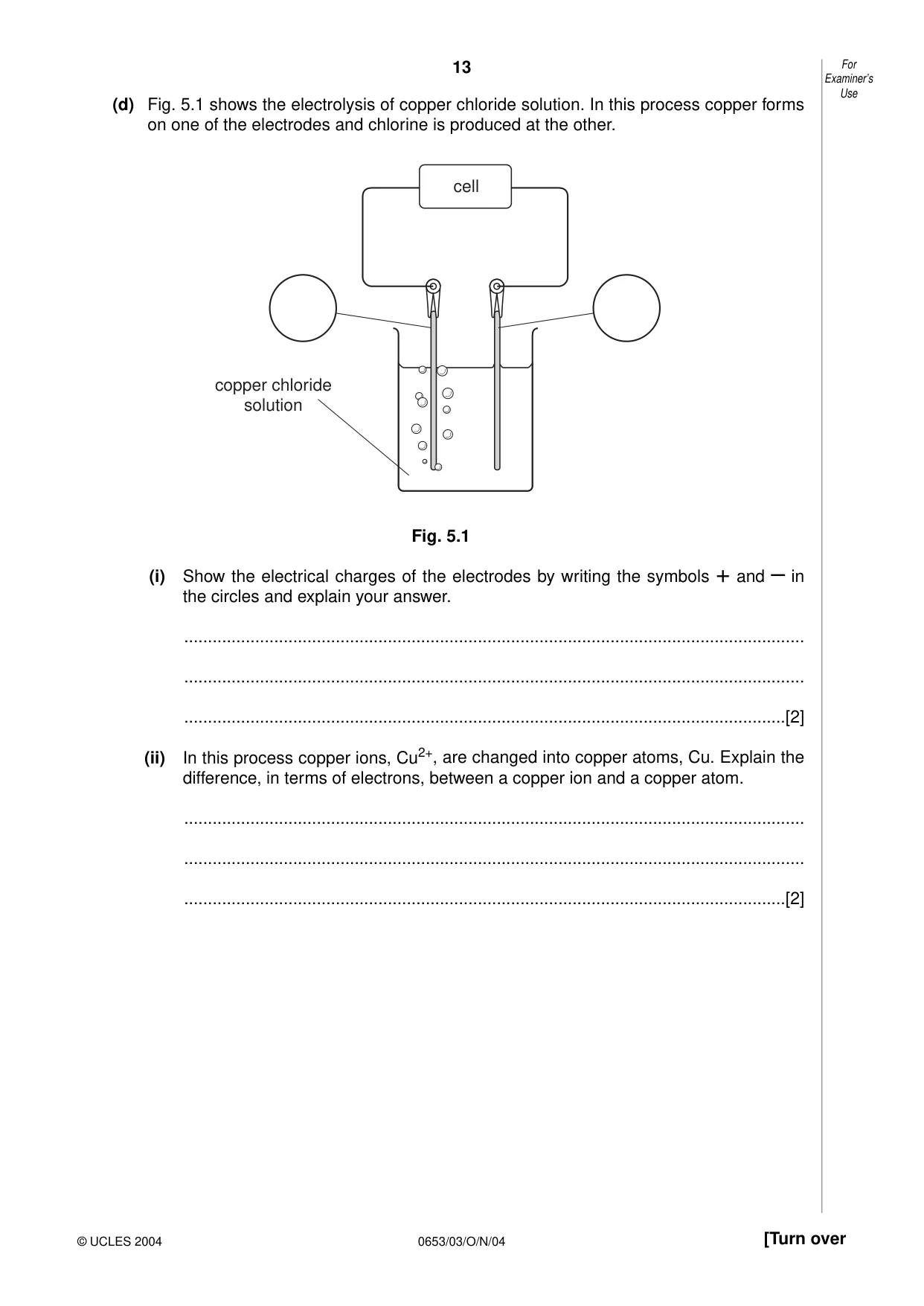
13 0653/03/O/N/04 [Turn over (d) Fig. 5.1 shows the electrolysis of copper chloride solution. In this process copper forms on one of the electrodes and chlorine is produced at the other. Fig. 5.1 (i) Show the electrical charges of the electrodes by writing the symbols + and – in the circles and explain your answer. … … …[2] (ii) In this process copper ions, Cu2+, are changed into copper atoms, Cu. Explain the difference, in terms of electrons, between a copper ion and a copper atom. … … …[2] cell copper chloride solution For Examiner’s Use © UCLES 2004
Question paper, page 14
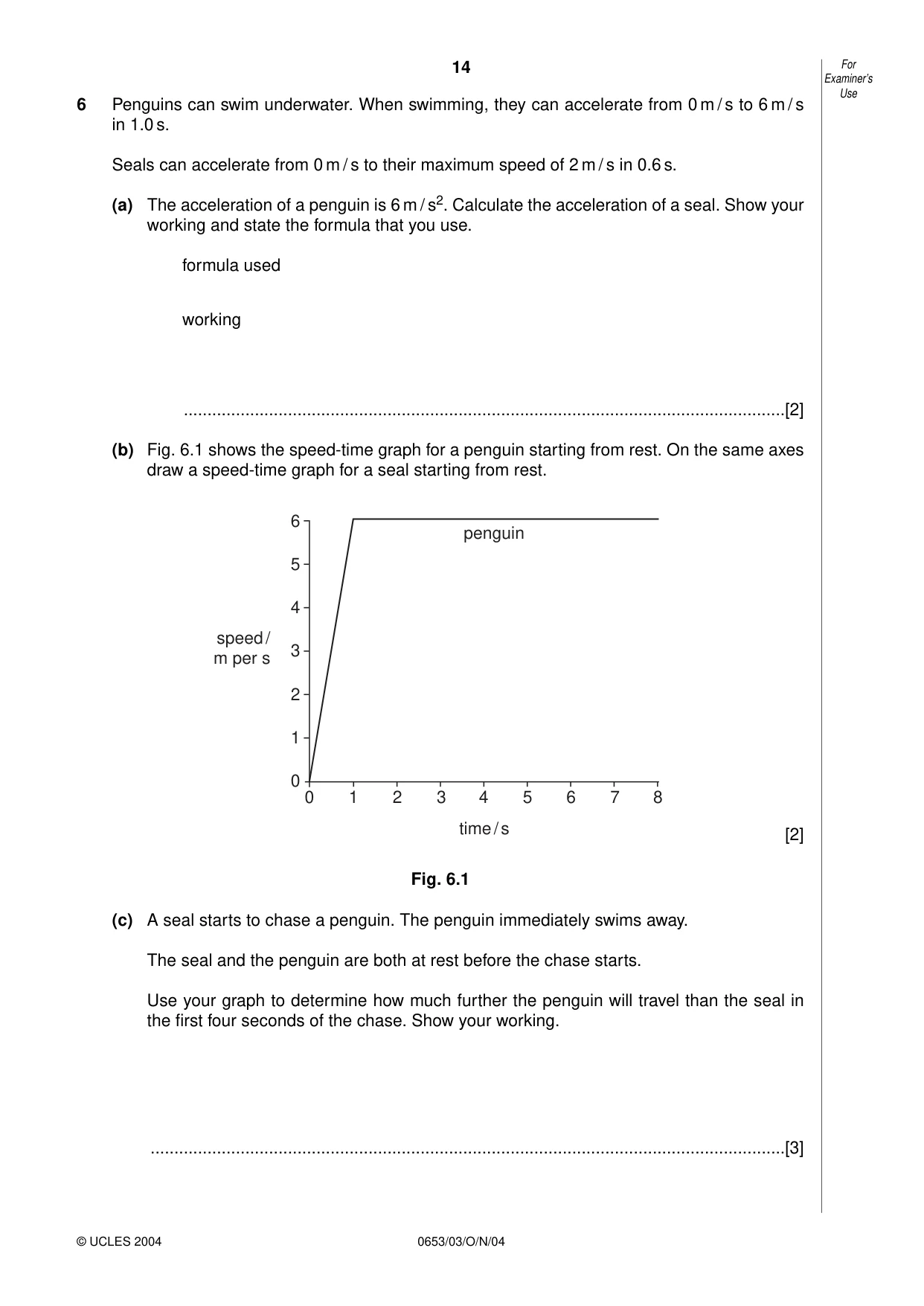
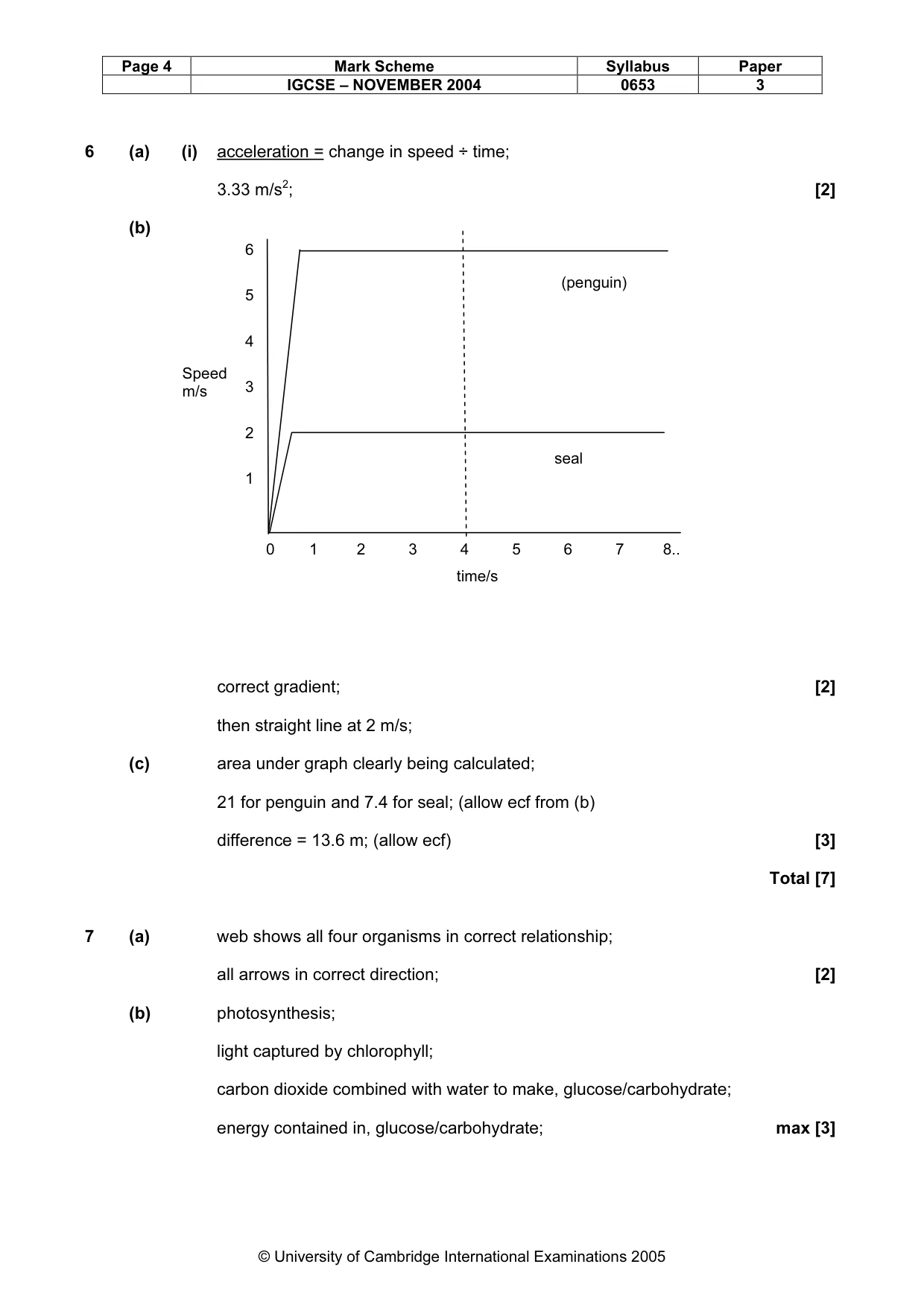
14 0653/03/O/N/04 6 Penguins can swim underwater. When swimming, they can accelerate from 0 m / s to 6 m / s in 1.0 s. Seals can accelerate from 0 m / s to their maximum speed of 2 m / s in 0.6 s. (a) The acceleration of a penguin is 6 m / s2. Calculate the acceleration of a seal. Show your working and state the formula that you use. formula used working …[2] (b) Fig. 6.1 shows the speed-time graph for a penguin starting from rest. On the same axes draw a speed-time graph for a seal starting from rest. [2] Fig. 6.1 (c) A seal starts to chase a penguin. The penguin immediately swims away. The seal and the penguin are both at rest before the chase starts. Use your graph to determine how much further the penguin will travel than the seal in the first four seconds of the chase. Show your working. …[3] penguin 6 5 4 3 2 1 0 0 1 2 3 4 5 6 7 8 speed / m per s time / s For Examiner’s Use © UCLES 2004
Question paper, page 15
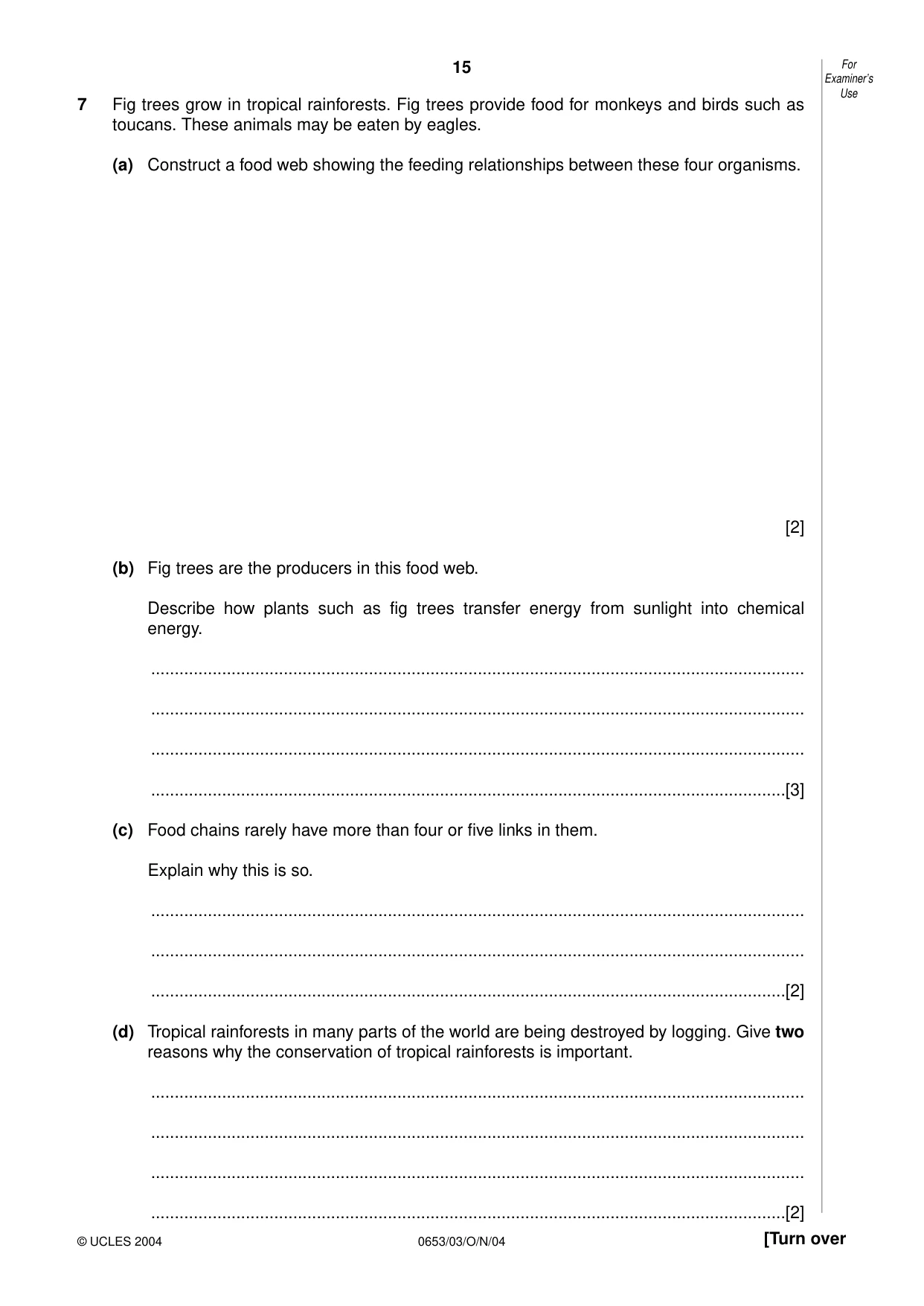
15 0653/03/O/N/04 [Turn over 7 Fig trees grow in tropical rainforests. Fig trees provide food for monkeys and birds such as toucans. These animals may be eaten by eagles. (a) Construct a food web showing the feeding relationships between these four organisms. [2] (b) Fig trees are the producers in this food web. Describe how plants such as fig trees transfer energy from sunlight into chemical energy. … … … …[3] (c) Food chains rarely have more than four or five links in them. Explain why this is so. … … …[2] (d) Tropical rainforests in many parts of the world are being destroyed by logging. Give two reasons why the conservation of tropical rainforests is important. … … … …[2] For Examiner’s Use © UCLES 2004
Question paper, page 16
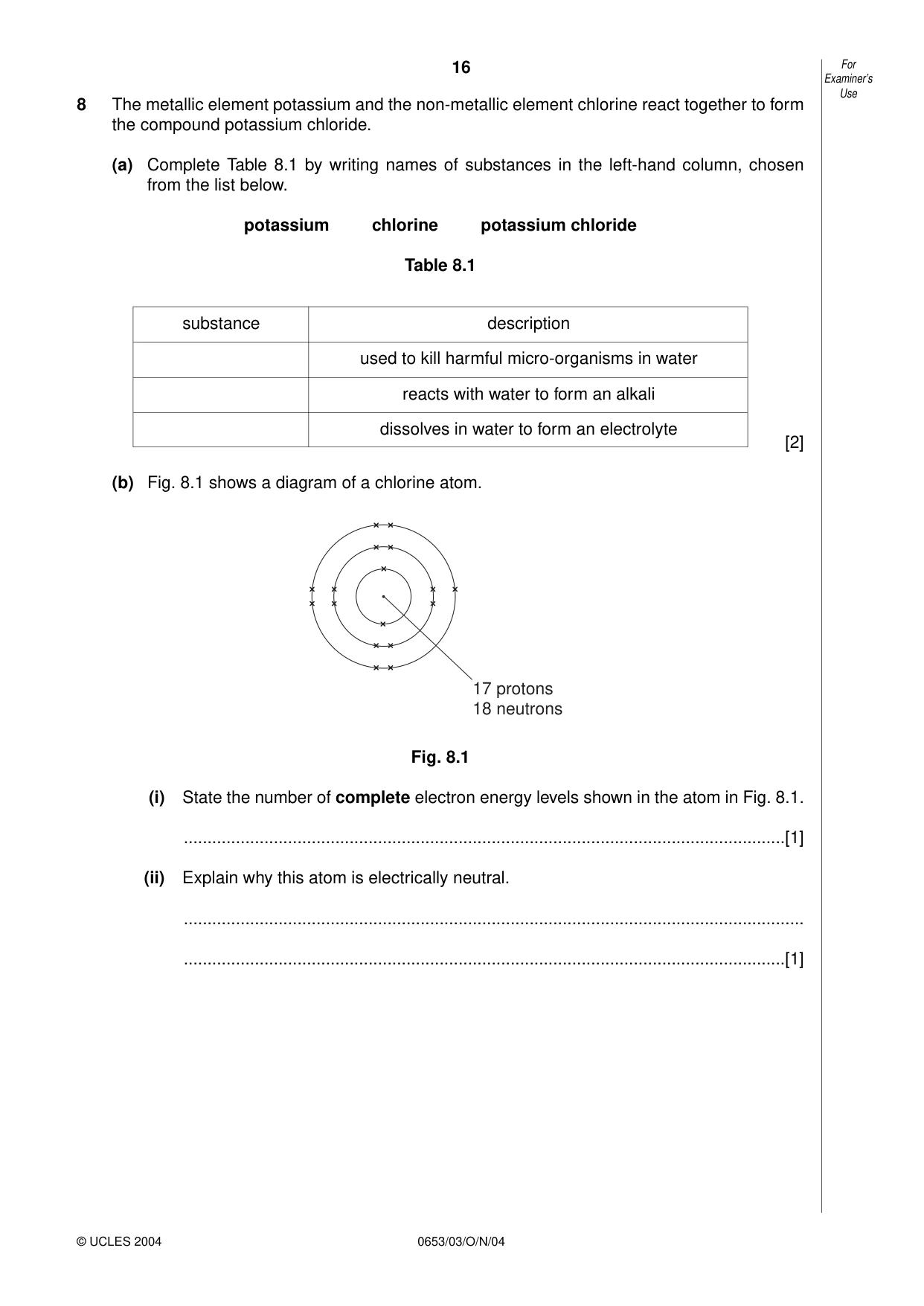
16 0653/03/O/N/04 8 The metallic element potassium and the non-metallic element chlorine react together to form the compound potassium chloride. (a) Complete Table 8.1 by writing names of substances in the left-hand column, chosen from the list below. potassium chlorine potassium chloride Table 8.1 [2] (b) Fig. 8.1 shows a diagram of a chlorine atom. Fig. 8.1 (i) State the number of complete electron energy levels shown in the atom in Fig. 8.1. …[1] (ii) Explain why this atom is electrically neutral. … …[1] 17 protons 18 neutrons For Examiner’s Use © UCLES 2004 substance description used to kill harmful micro-organisms in water reacts with water to form an alkali dissolves in water to form an electrolyte
Question paper, page 17
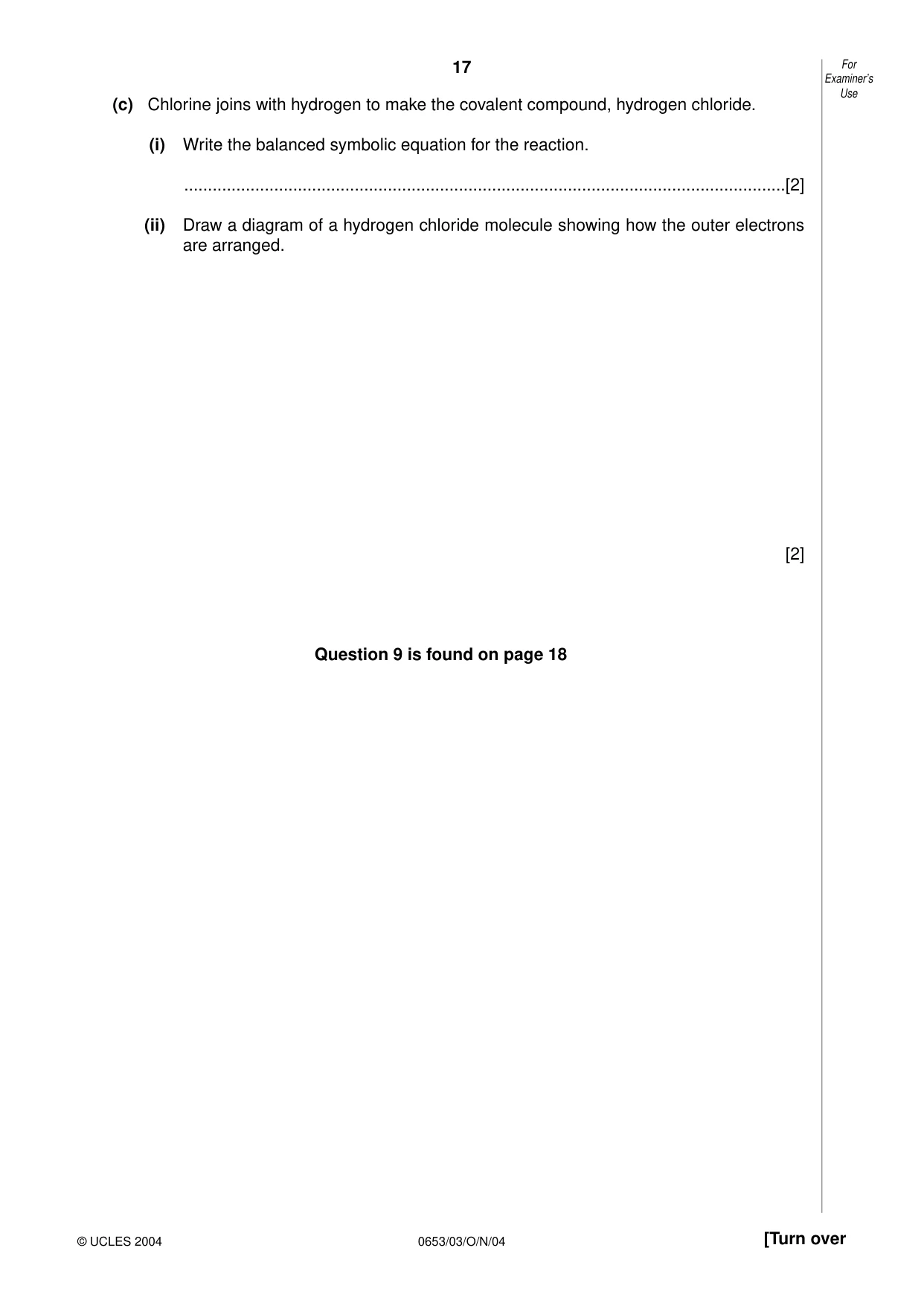
17 0653/03/O/N/04 [Turn over (c) Chlorine joins with hydrogen to make the covalent compound, hydrogen chloride. (i) Write the balanced symbolic equation for the reaction. …[2] (ii) Draw a diagram of a hydrogen chloride molecule showing how the outer electrons are arranged. [2] Question 9 is found on page 18 For Examiner’s Use © UCLES 2004
Question paper, page 18
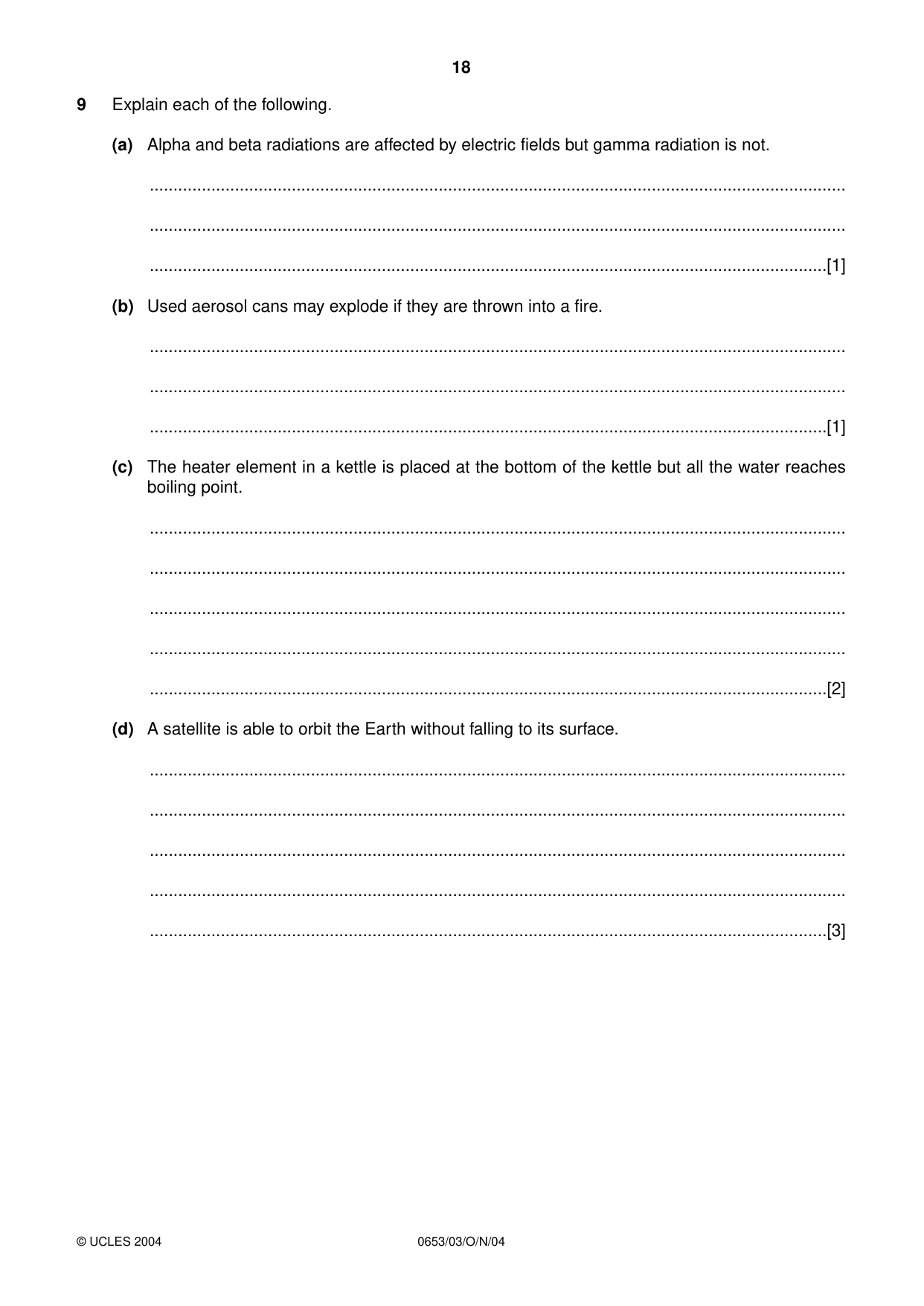
18 0653/03/O/N/04 9 Explain each of the following. (a) Alpha and beta radiations are affected by electric fields but gamma radiation is not. … … …[1] (b) Used aerosol cans may explode if they are thrown into a fire. … … …[1] (c) The heater element in a kettle is placed at the bottom of the kettle but all the water reaches boiling point. … … … … …[2] (d) A satellite is able to orbit the Earth without falling to its surface. … … … … …[3] © UCLES 2004
Question paper, page 19
19 0653/03/O/N/04 BLANK PAGE University of Cambridge International Examinations is part of the University of Cambridge Local Examinations Syndicate (UCLES), which is itself a department of the University of Cambridge.
Question paper, page 20
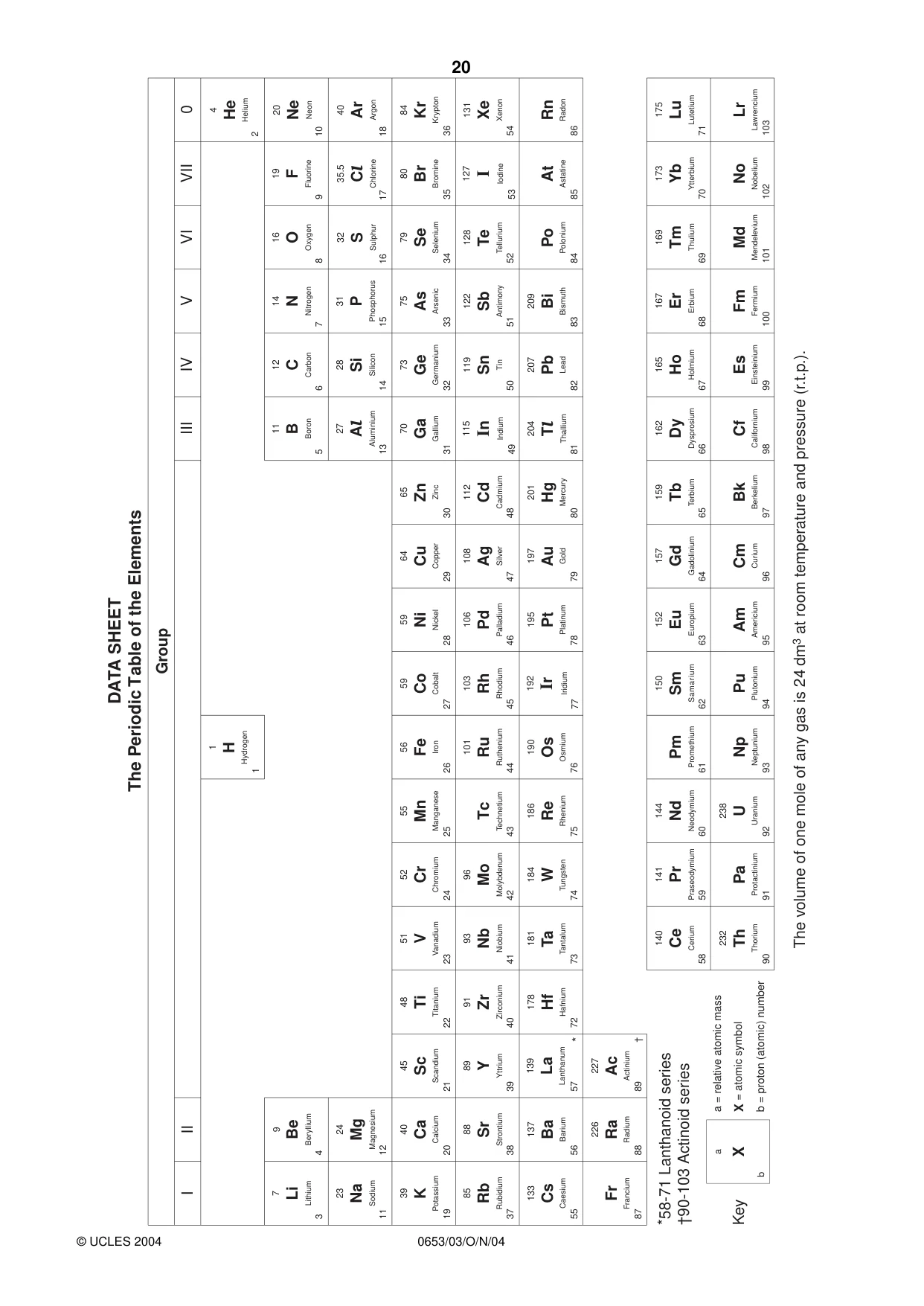
20 0653/03/O/N/04 © UCLES 2004 Group DATA SHEET The Periodic Table of the Elements 140 Ce Cerium 58 141 Pr Praseodymium 59 144 Nd Neodymium 60 Pm Promethium 61 150 Sm Samarium 62 152 Eu Europium 63 157 Gd Gadolinium 64 159 Tb Terbium 65 162 Dy Dysprosium 66 165 Ho Holmium 67 167 Er Erbium 68 169 Tm Thulium 69 173 Yb Ytterbium 70 175 Lu Lutetium 71 232 Th Thorium 90 Pa Protactinium 91 238 U Uranium 92 Np Neptunium 93 Pu Plutonium 94 Am Americium 95 Cm Curium 96 Bk Berkelium 97 Cf Californium 98 Es Einsteinium 99 Fm Fermium 100 Md Mendelevium 101 No Nobelium 102 Lr Lawrencium 103 1 H Hydrogen 1 7 Li Lithium 3 23 Na Sodium 11 24 Mg Magnesium 12 40 Ca Calcium 20 45 Sc Scandium 21 48 Ti Titanium 22 51 V Vanadium 23 52 Cr Chromium 24 55 Mn Manganese 25 56 Fe Iron 26 59 Co Cobalt 27 59 Ni Nickel 28 64 Cu Copper 29 65 Zn Zinc 30 70 Ga Gallium 31 27 Al Aluminium 13 11 B Boron 5 12 C Carbon 6 14 N Nitrogen 7 16 O Oxygen 8 19 F Fluorine 9 28 Si Silicon 14 31 P Phosphorus 15 32 S Sulphur 16 35.5 Cl Chlorine 17 40 Ar Argon 18 20 Ne Neon 10 4 He Helium 2 73 Ge Germanium 32 75 As Arsenic 33 79 Se Selenium 34 80 Br Bromine 35 84 Kr Krypton 36 39 K Potassium 19 88 Sr Strontium 38 89 Y Yttrium 39 91 Zr Zirconium 40 93 Nb Niobium 41 96 Mo Molybdenum 42 Tc Technetium 43 101 Ru Ruthenium 44 103 Rh Rhodium 45 106 Pd Palladium 46 108 Ag Silver 47 112 Cd Cadmium 48 115 In Indium 49 119 Sn Tin 50 122 Sb Antimony 51 128 Te Tellurium 52 127 I Iodine 53 131 Xe Xenon 54 137 Ba Barium 56 139 La Lanthanum 57 * 178 Hf Hafnium 72 181 Ta Tantalum 73 184 W Tungsten 74 186 Re Rhenium 75 190 Os Osmium 76 192 Ir Iridium 77 195 Pt Platinum 78 197 Au Gold 79 201 Hg Mercury 80 204 Tl Thallium 81 207 Pb Lead 82 209 Bi Bismuth 83 Po Polonium 84 At Astatine 85 Rn Radon 86 Fr Francium 87 227 Ac Actinium 89 † 9 Be Beryllium 4 I II III IV V VI VII 0 85 Rb Rubidium 37 133 Cs Caesium 55 226 Ra Radium 88 The volume of one mole of any gas is 24 dm3 at room temperature and pressure (r.t.p.). a X b a = relative atomic mass X = atomic symbol b = proton (atomic) number Key *58-71 Lanthanoid series †90-103 Actinoid series
Mark scheme, page 1
UNIVERSITY OF CAMBRIDGE INTERNATIONAL EXAMINATIONS International General Certificate of Secondary Education MARK SCHEME for the November 2004 question paper 0653 COMBINED SCIENCE 0653/03 Paper 3 (Extended Theory), maximum mark 80 This mark scheme is published as an aid to teachers and students, to indicate the requirements of the examination. It shows the basis on which Examiners were initially instructed to award marks. It does not indicate the details of the discussions that took place at an Examiners’ meeting before marking began. Any substantial changes to the mark scheme that arose from these discussions will be recorded in the published Report on the Examination. All Examiners are instructed that alternative correct answers and unexpected approaches in candidates’ scripts must be given marks that fairly reflect the relevant knowledge and skills demonstrated. Mark schemes must be read in conjunction with the question papers and the Report on the Examination. CIE will not enter into discussion or correspondence in connection with these mark schemes. CIE is publishing the mark schemes for the November 2004 question papers for most IGCSE and GCE Advanced Level syllabuses. www.XtremePapers.com
Mark scheme, page 2
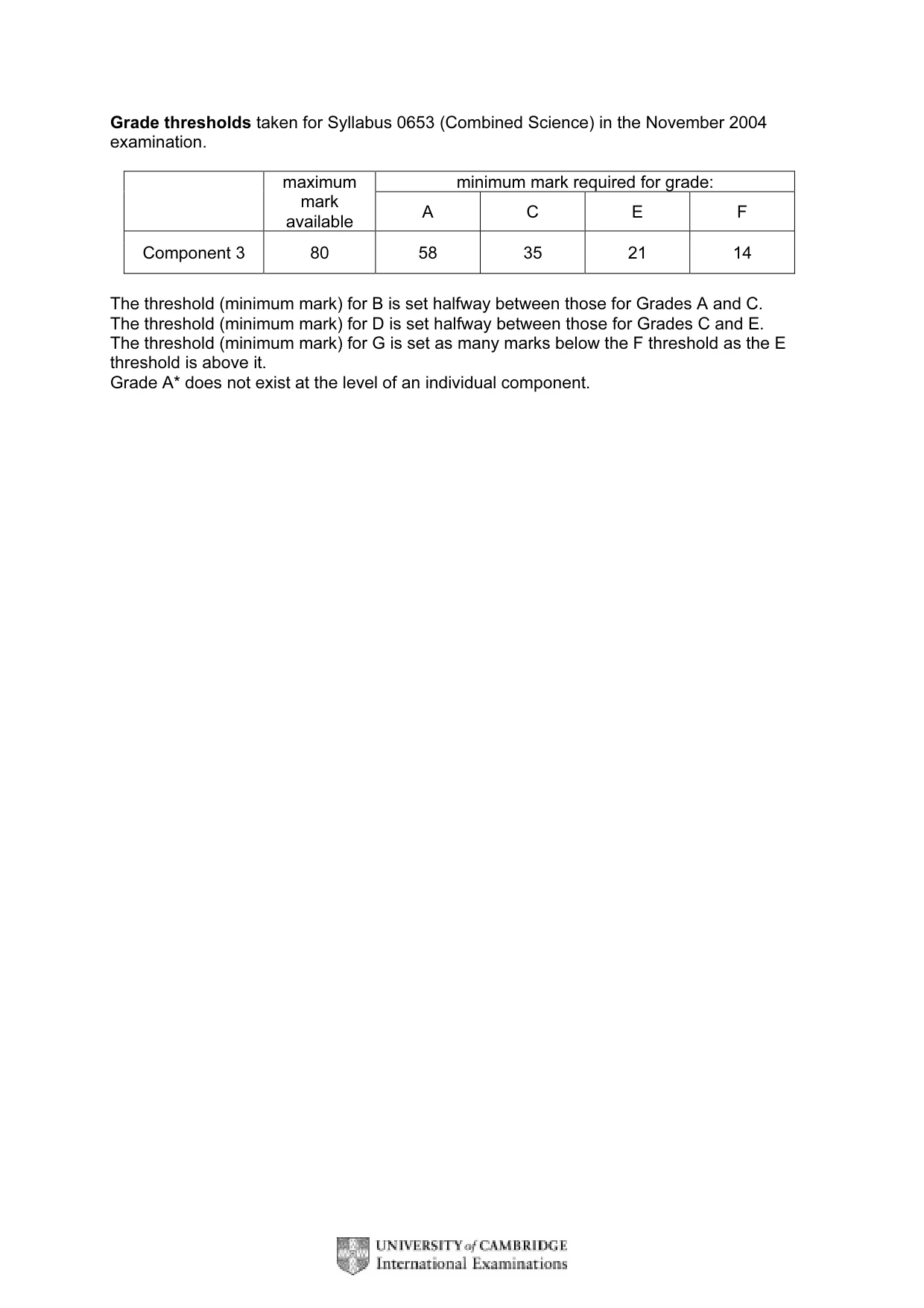
Grade thresholds taken for Syllabus 0653 (Combined Science) in the November 2004 examination. minimum mark required for grade: maximum mark available A C E F Component 3 80 58 35 21 14 The threshold (minimum mark) for B is set halfway between those for Grades A and C. The threshold (minimum mark) for D is set halfway between those for Grades C and E. The threshold (minimum mark) for G is set as many marks below the F threshold as the E threshold is above it. Grade A* does not exist at the level of an individual component.
Mark scheme, page 3
November 2004 INTERNATIONAL GCSE MARK SCHEME MAXIMUM MARK: 80 SYLLABUS/COMPONENT: 0653/03 COMBINED SCIENCE Paper 3 (Extended Theory)
Mark scheme, page 4
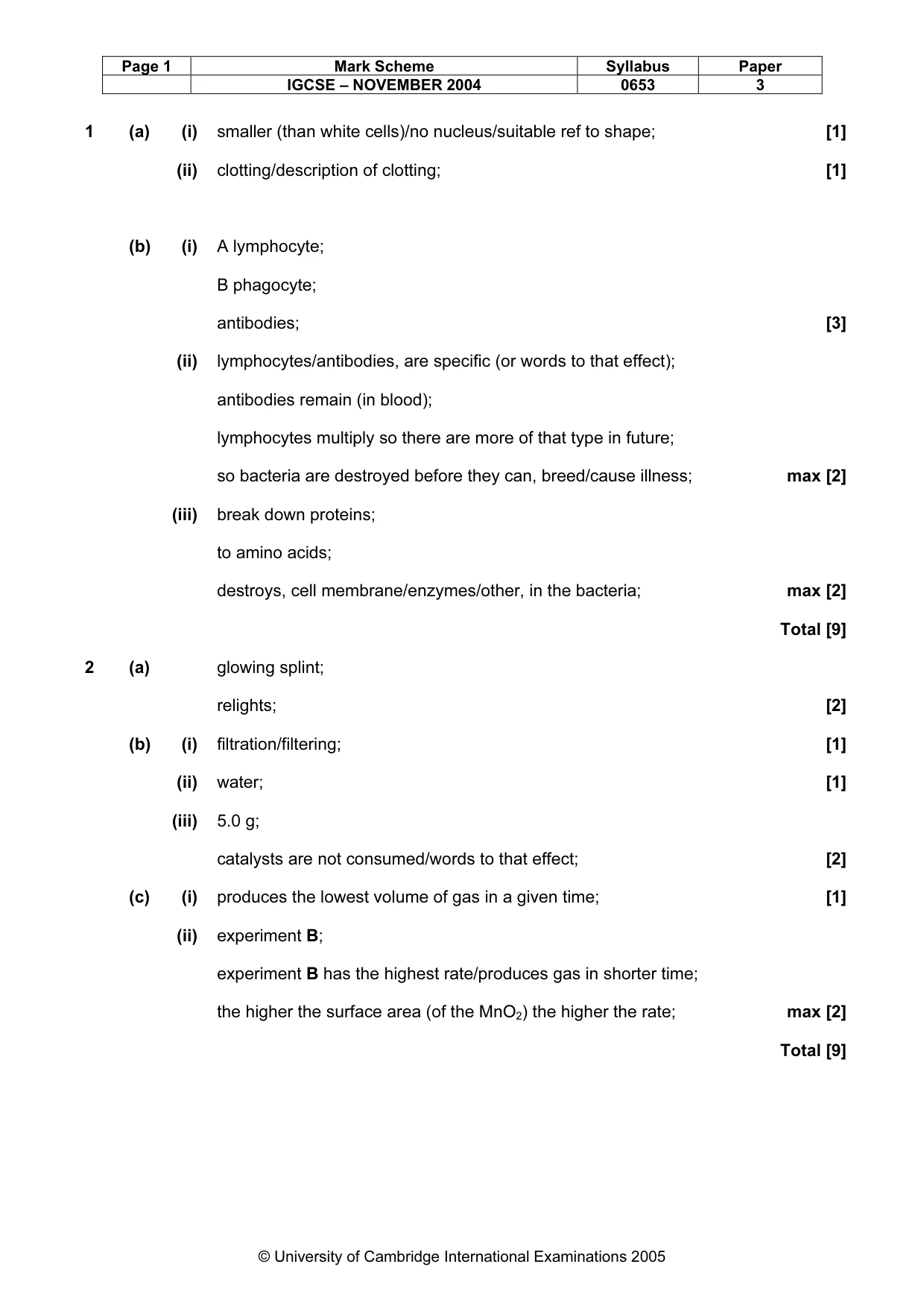
Page 1 Mark Scheme Syllabus Paper IGCSE – NOVEMBER 2004 0653 3 © University of Cambridge International Examinations 2005 1 (a) (i) smaller (than white cells)/no nucleus/suitable ref to shape; [1] (ii) clotting/description of clotting; [1] (b) (i) A lymphocyte; B phagocyte; antibodies; [3] (ii) lymphocytes/antibodies, are specific (or words to that effect); antibodies remain (in blood); lymphocytes multiply so there are more of that type in future; so bacteria are destroyed before they can, breed/cause illness; max [2] (iii) break down proteins; to amino acids; destroys, cell membrane/enzymes/other, in the bacteria; max [2] Total [9] 2 (a) glowing splint; relights; [2] (b) (i) filtration/filtering; [1] (ii) water; [1] (iii) 5.0 g; catalysts are not consumed/words to that effect; [2] (c) (i) produces the lowest volume of gas in a given time; [1] (ii) experiment B; experiment B has the highest rate/produces gas in shorter time; the higher the surface area (of the MnO2) the higher the rate; max [2] Total [9]
Mark scheme, page 5
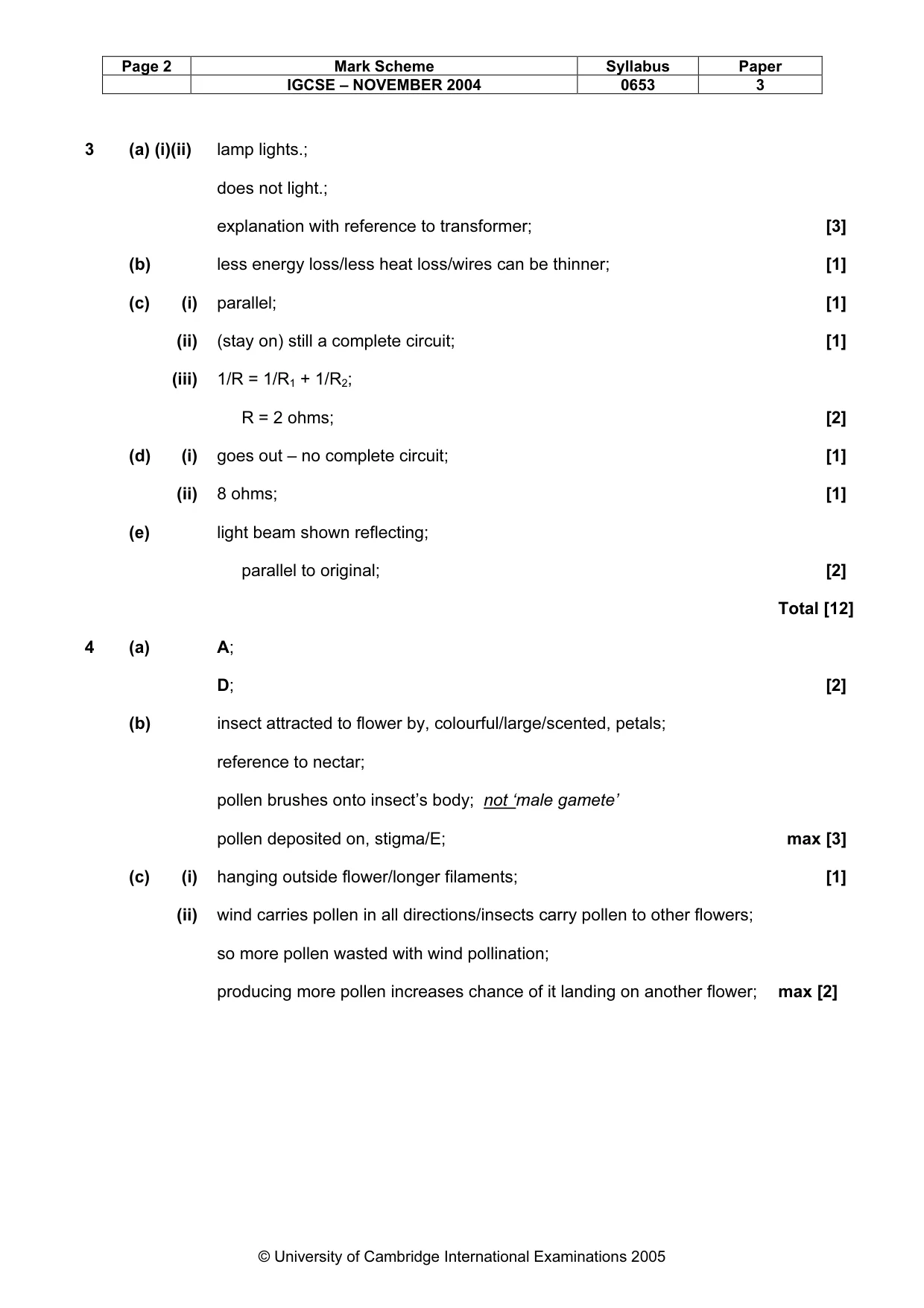
Page 2 Mark Scheme Syllabus Paper IGCSE – NOVEMBER 2004 0653 3 © University of Cambridge International Examinations 2005 3 (a) (i)(ii) lamp lights.; does not light.; explanation with reference to transformer; [3] (b) less energy loss/less heat loss/wires can be thinner; [1] (c) (i) parallel; [1] (ii) (stay on) still a complete circuit; [1] (iii) 1/R = 1/R1 + 1/R2; R = 2 ohms; [2] (d) (i) goes out – no complete circuit; [1] (ii) 8 ohms; [1] (e) light beam shown reflecting; parallel to original; [2] Total [12] 4 (a) A; D; [2] (b) insect attracted to flower by, colourful/large/scented, petals; reference to nectar; pollen brushes onto insect’s body; not ‘male gamete’ pollen deposited on, stigma/E; max [3] (c) (i) hanging outside flower/longer filaments; [1] (ii) wind carries pollen in all directions/insects carry pollen to other flowers; so more pollen wasted with wind pollination; producing more pollen increases chance of it landing on another flower; max [2]
Mark scheme, page 6
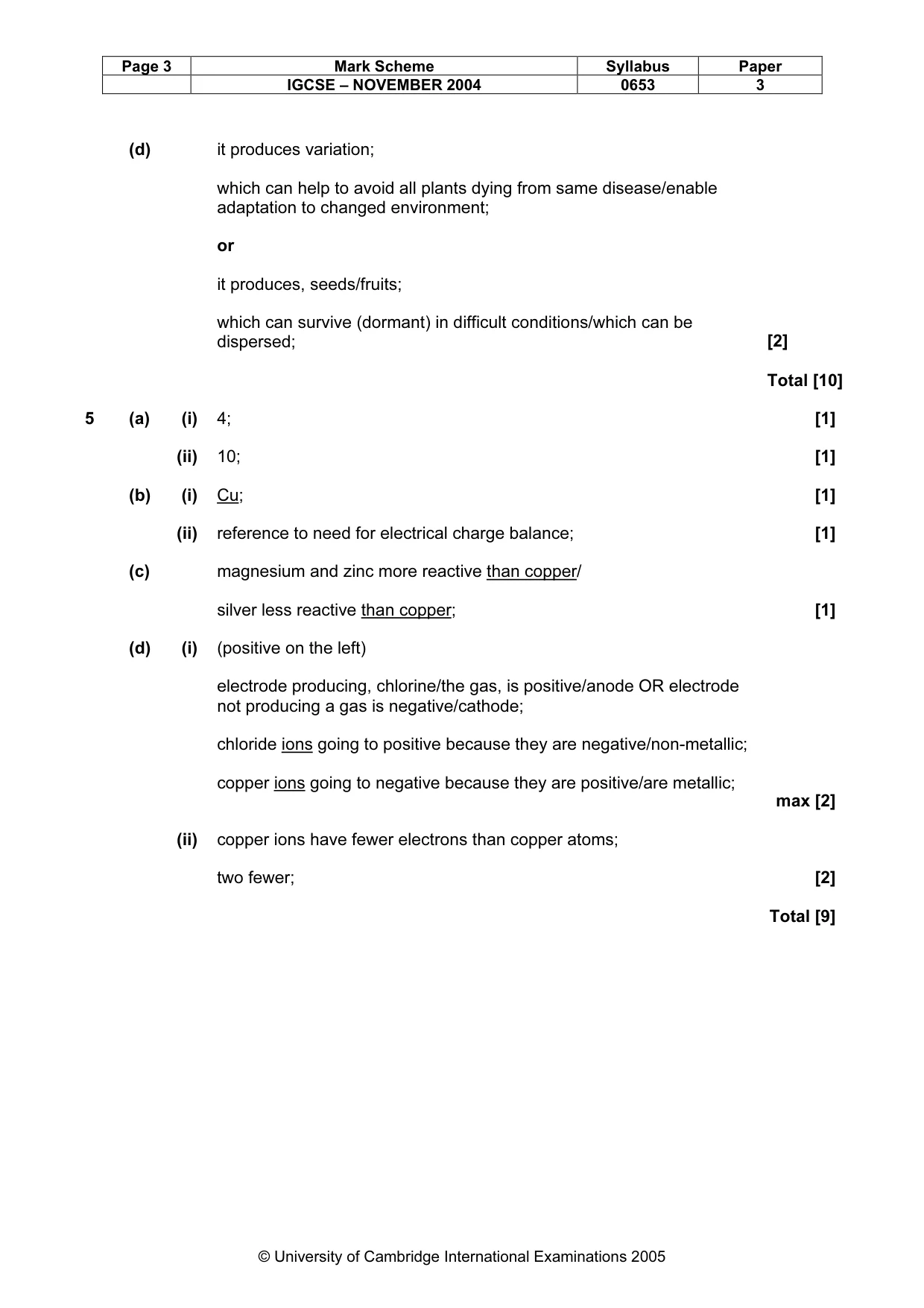
Page 3 Mark Scheme Syllabus Paper IGCSE – NOVEMBER 2004 0653 3 © University of Cambridge International Examinations 2005 (d) it produces variation; which can help to avoid all plants dying from same disease/enable adaptation to changed environment; or it produces, seeds/fruits; which can survive (dormant) in difficult conditions/which can be dispersed; [2] Total [10] 5 (a) (i) 4; [1] (ii) 10; [1] (b) (i) Cu; [1] (ii) reference to need for electrical charge balance; [1] (c) magnesium and zinc more reactive than copper/ silver less reactive than copper; [1] (d) (i) (positive on the left) electrode producing, chlorine/the gas, is positive/anode OR electrode not producing a gas is negative/cathode; chloride ions going to positive because they are negative/non-metallic; copper ions going to negative because they are positive/are metallic; max [2] (ii) copper ions have fewer electrons than copper atoms; two fewer; [2] Total [9]
Mark scheme, page 7
Page 4 Mark Scheme Syllabus Paper IGCSE – NOVEMBER 2004 0653 3 © University of Cambridge International Examinations 2005 6 (a) (i) acceleration = change in speed ÷ time; 3.33 m/s2; [2] (b) correct gradient; then straight line at 2 m/s; [2] (c) area under graph clearly being calculated; 21 for penguin and 7.4 for seal; (allow ecf from (b) difference = 13.6 m; (allow ecf) [3] Total [7] 7 (a) web shows all four organisms in correct relationship; all arrows in correct direction; [2] (b) photosynthesis; light captured by chlorophyll; carbon dioxide combined with water to make, glucose/carbohydrate; energy contained in, glucose/carbohydrate; max [3] 0 1 2 3 4 5 6 7 8.. time/s 6 5 4 3 2 1 Speed m/s (penguin) seal
Mark scheme, page 8
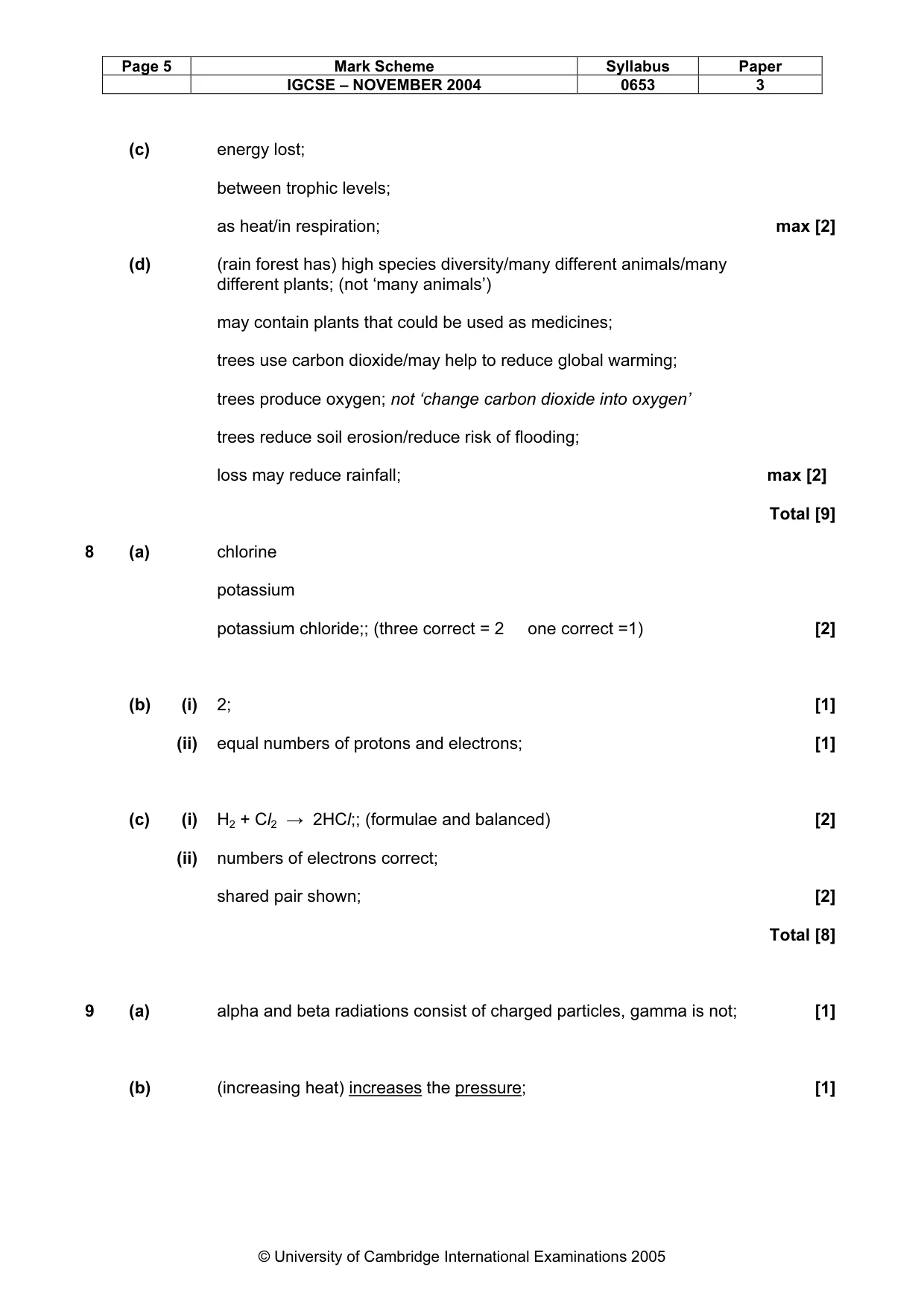
Page 5 Mark Scheme Syllabus Paper IGCSE – NOVEMBER 2004 0653 3 © University of Cambridge International Examinations 2005 (c) energy lost; between trophic levels; as heat/in respiration; max [2] (d) (rain forest has) high species diversity/many different animals/many different plants; (not ‘many animals’) may contain plants that could be used as medicines; trees use carbon dioxide/may help to reduce global warming; trees produce oxygen; not ‘change carbon dioxide into oxygen’ trees reduce soil erosion/reduce risk of flooding; loss may reduce rainfall; max [2] Total [9] 8 (a) chlorine potassium potassium chloride;; (three correct = 2 one correct =1) [2] (b) (i) 2; [1] (ii) equal numbers of protons and electrons; [1] (c) (i) H2 + Cl2 → 2HCl;; (formulae and balanced) [2] (ii) numbers of electrons correct; shared pair shown; [2] Total [8] 9 (a) alpha and beta radiations consist of charged particles, gamma is not; [1] (b) (increasing heat) increases the pressure; [1]
Mark scheme, page 9
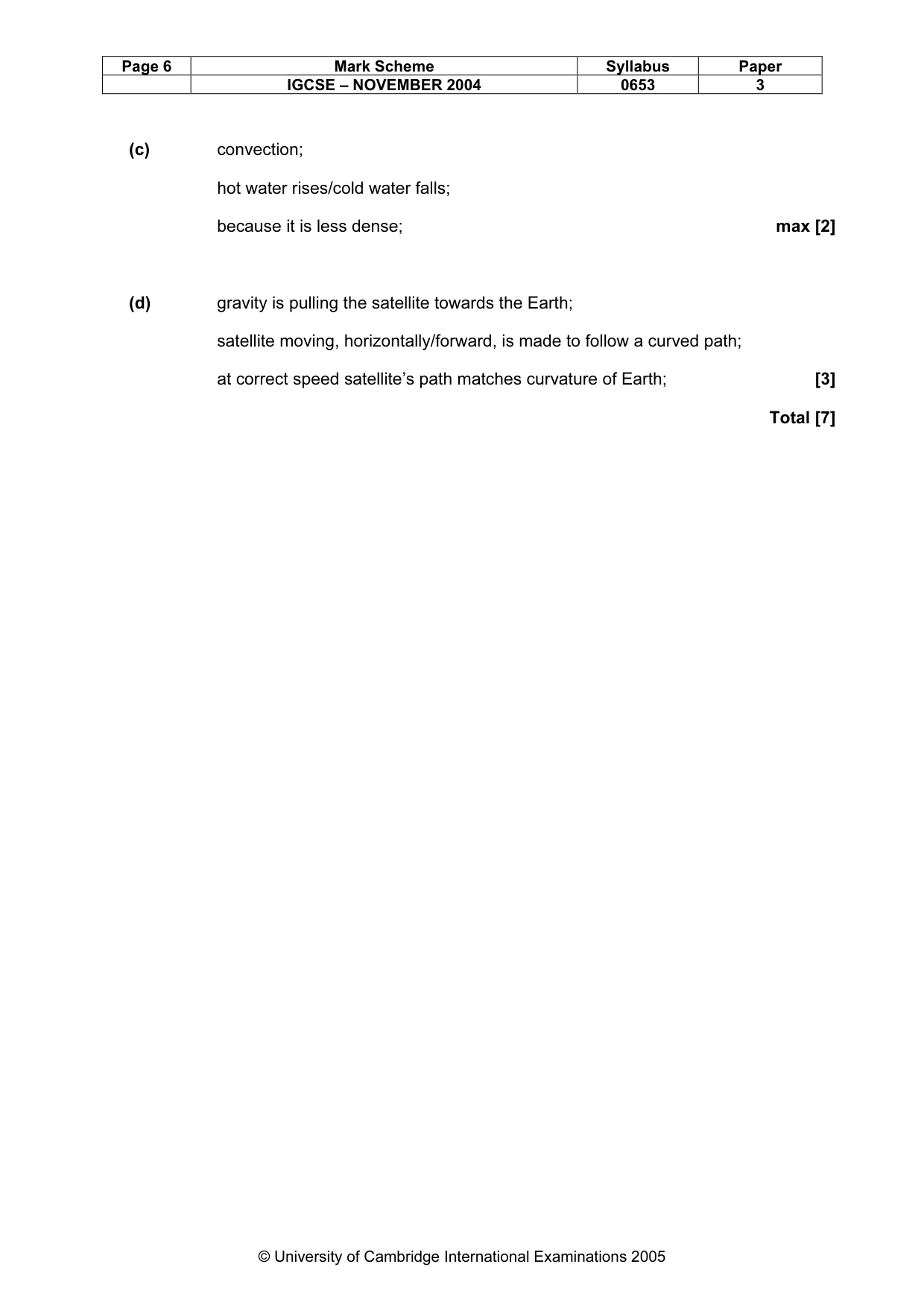
Page 6 Mark Scheme Syllabus Paper IGCSE – NOVEMBER 2004 0653 3 © University of Cambridge International Examinations 2005 (c) convection; hot water rises/cold water falls; because it is less dense; max [2] (d) gravity is pulling the satellite towards the Earth; satellite moving, horizontally/forward, is made to follow a curved path; at correct speed satellite’s path matches curvature of Earth; [3] Total [7]