Cambridge IGCSE Science - Combined 0653 — 2002 Oct/Nov Paper 3 · Variant 1
0653/31/O/N/02
The question paper and its mark scheme, free to read here and free to download. This is Cambridge’s own paper, exactly as it was sat.
Question paper16 pages

Mark scheme6 pages
Answers below. Sit the paper first if you are practising.
Paper as text
Question paper, page 1
TIME 1 hour 15 minutes INSTRUCTIONS TO CANDIDATES Write your name, Centre number and candidate number in the spaces at the top of this page. Answer all questions. Write your answers in the spaces provided on the question paper. INFORMATION FOR CANDIDATES The number of marks is given in brackets [ ] at the end of each question or part question. A copy of the Periodic Table is printed on page 16. International General Certificate of Secondary Education CAMBRIDGE INTERNATIONAL EXAMINATIONS COMBINED SCIENCE 0653/3 PAPER 3 OCTOBER/NOVEMBER SESSION 2002 1 hour 15 minutes Candidates answer on the question paper. No additional materials are required. This question paper consists of 15 printed pages and 1 blank page. SP (SM/KN) S28601/3 © CIE 2002 [Turn over Candidate Centre Number Number Candidate Name FOR EXAMINER’S USE 3 2 1 4 TOTAL 6 7 8 9 5 www.XtremePapers.com
Question paper, page 2
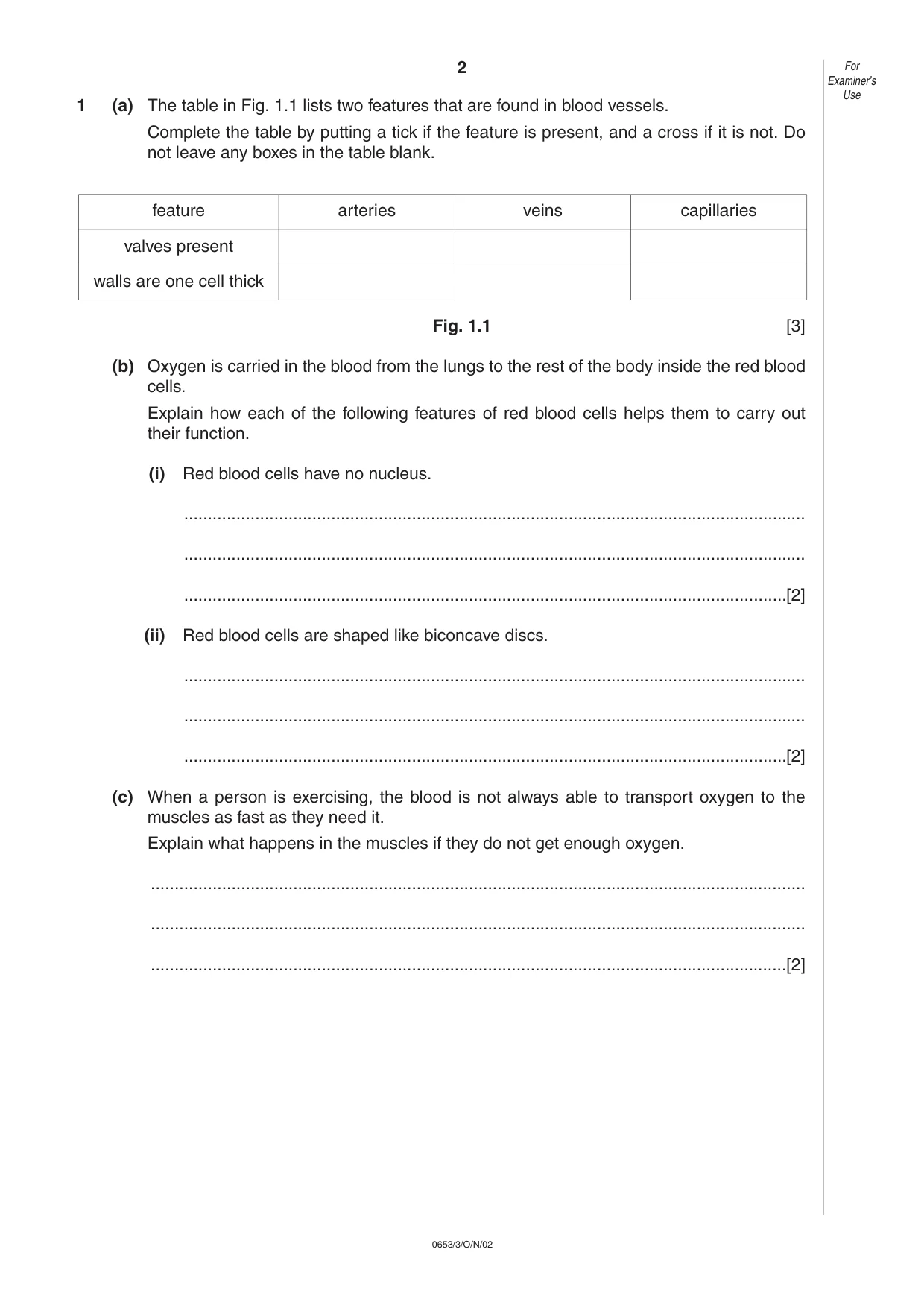
2 0653/3/O/N/02 1 (a) The table in Fig. 1.1 lists two features that are found in blood vessels. Complete the table by putting a tick if the feature is present, and a cross if it is not. Do not leave any boxes in the table blank. Fig. 1.1 [3] (b) Oxygen is carried in the blood from the lungs to the rest of the body inside the red blood cells. Explain how each of the following features of red blood cells helps them to carry out their function. (i) Red blood cells have no nucleus. … … …[2] (ii) Red blood cells are shaped like biconcave discs. … … …[2] (c) When a person is exercising, the blood is not always able to transport oxygen to the muscles as fast as they need it. Explain what happens in the muscles if they do not get enough oxygen. … … …[2] For Examiner’s Use feature valves present walls are one cell thick arteries veins capillaries
Question paper, page 3
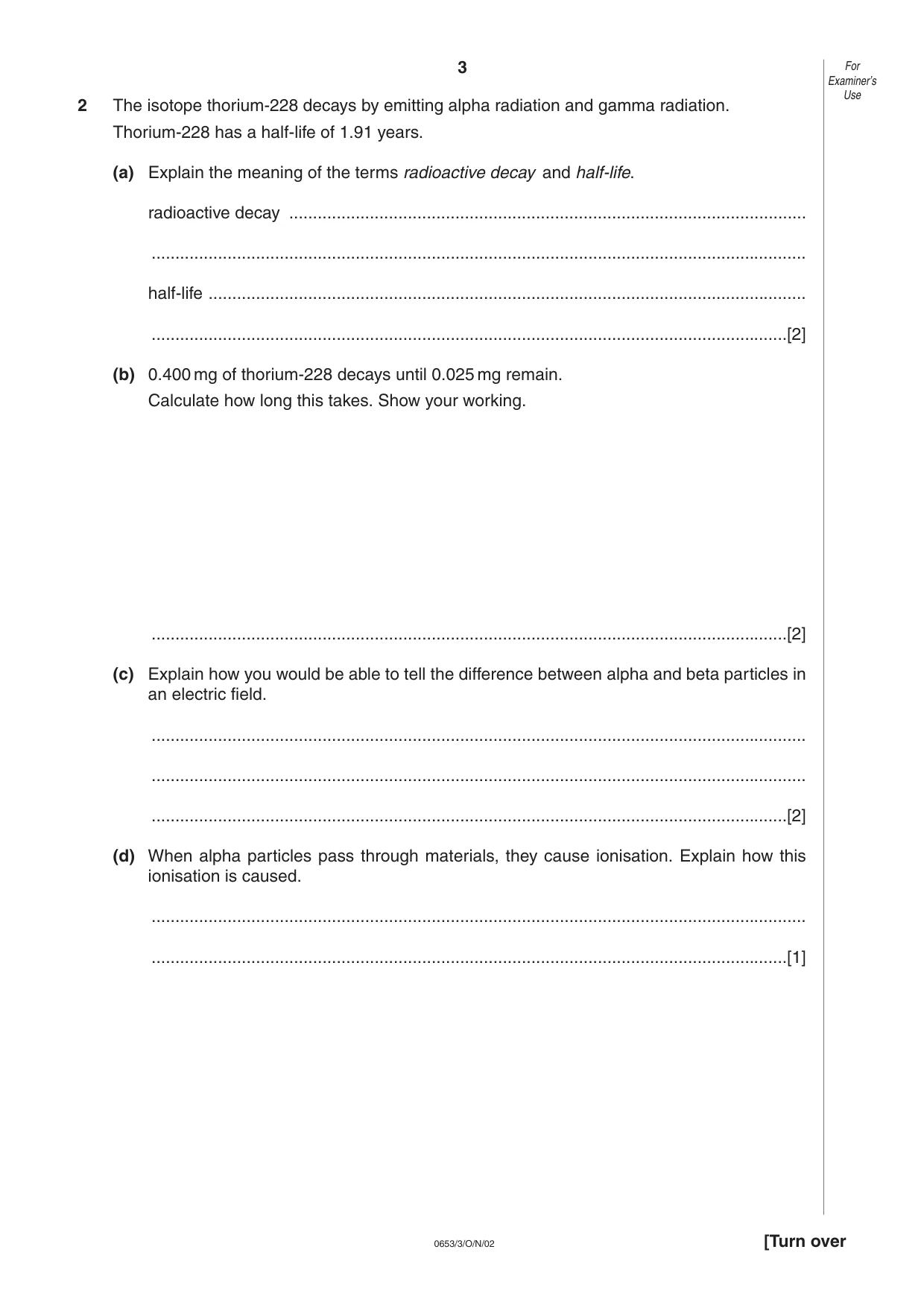
3 0653/3/O/N/02 [Turn over 2 The isotope thorium-228 decays by emitting alpha radiation and gamma radiation. Thorium-228 has a half-life of 1.91 years. (a) Explain the meaning of the terms radioactive decay and half-life. radioactive decay … … half-life … …[2] (b) 0.400 mg of thorium-228 decays until 0.025 mg remain. Calculate how long this takes. Show your working. …[2] (c) Explain how you would be able to tell the difference between alpha and beta particles in an electric field. … … …[2] (d) When alpha particles pass through materials, they cause ionisation. Explain how this ionisation is caused. … …[1] For Examiner’s Use
Question paper, page 4
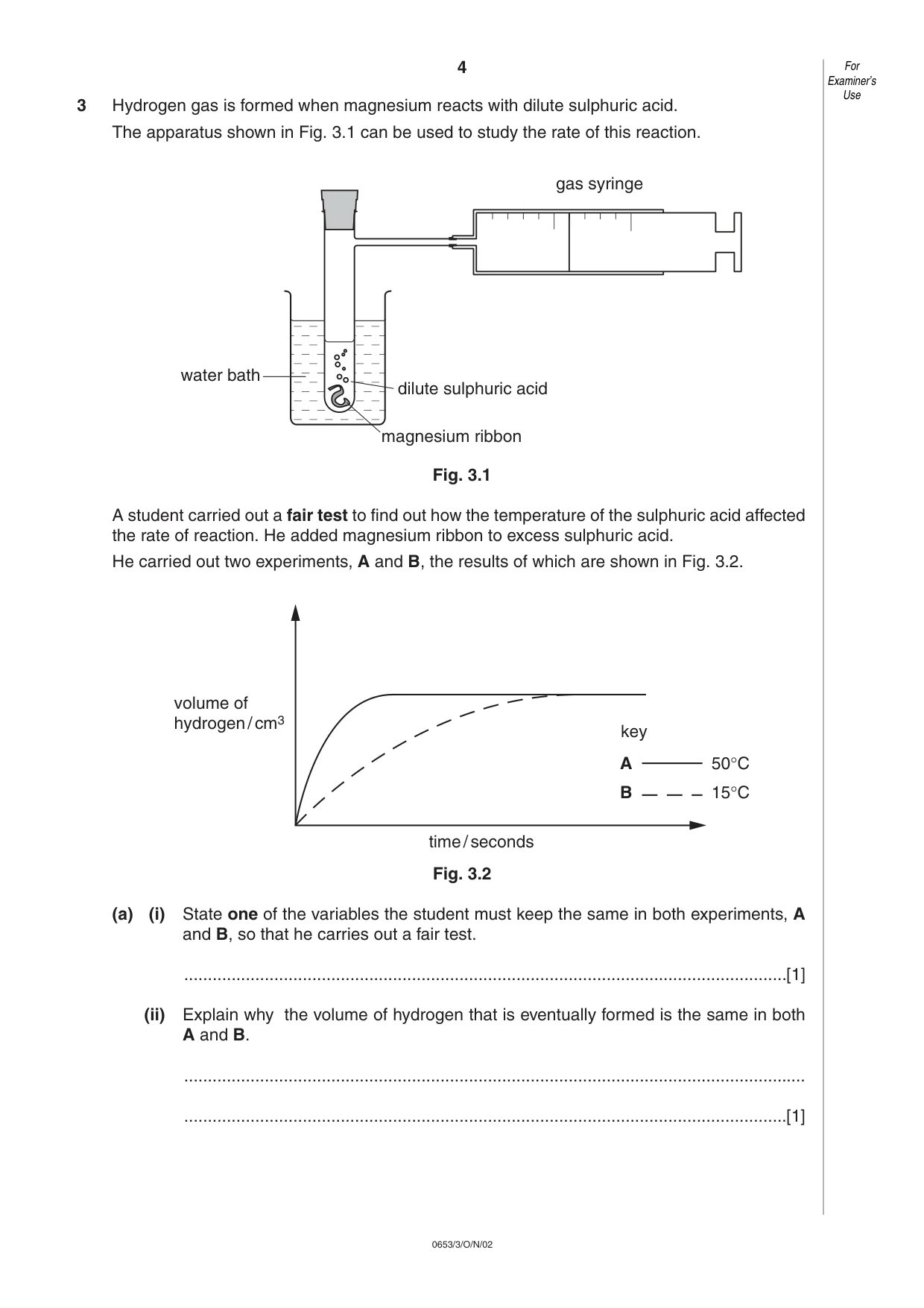
4 0653/3/O/N/02 3 Hydrogen gas is formed when magnesium reacts with dilute sulphuric acid. The apparatus shown in Fig. 3.1 can be used to study the rate of this reaction. Fig. 3.1 A student carried out a fair test to find out how the temperature of the sulphuric acid affected the rate of reaction. He added magnesium ribbon to excess sulphuric acid. He carried out two experiments, A and B, the results of which are shown in Fig. 3.2. Fig. 3.2 (a) (i) State one of the variables the student must keep the same in both experiments, A and B, so that he carries out a fair test. …[1] (ii) Explain why the volume of hydrogen that is eventually formed is the same in both A and B. … …[1] key A B 50°C 15°C time/seconds volume of hydrogen/cm3 gas syringe water bath dilute sulphuric acid magnesium ribbon For Examiner’s Use
Question paper, page 5
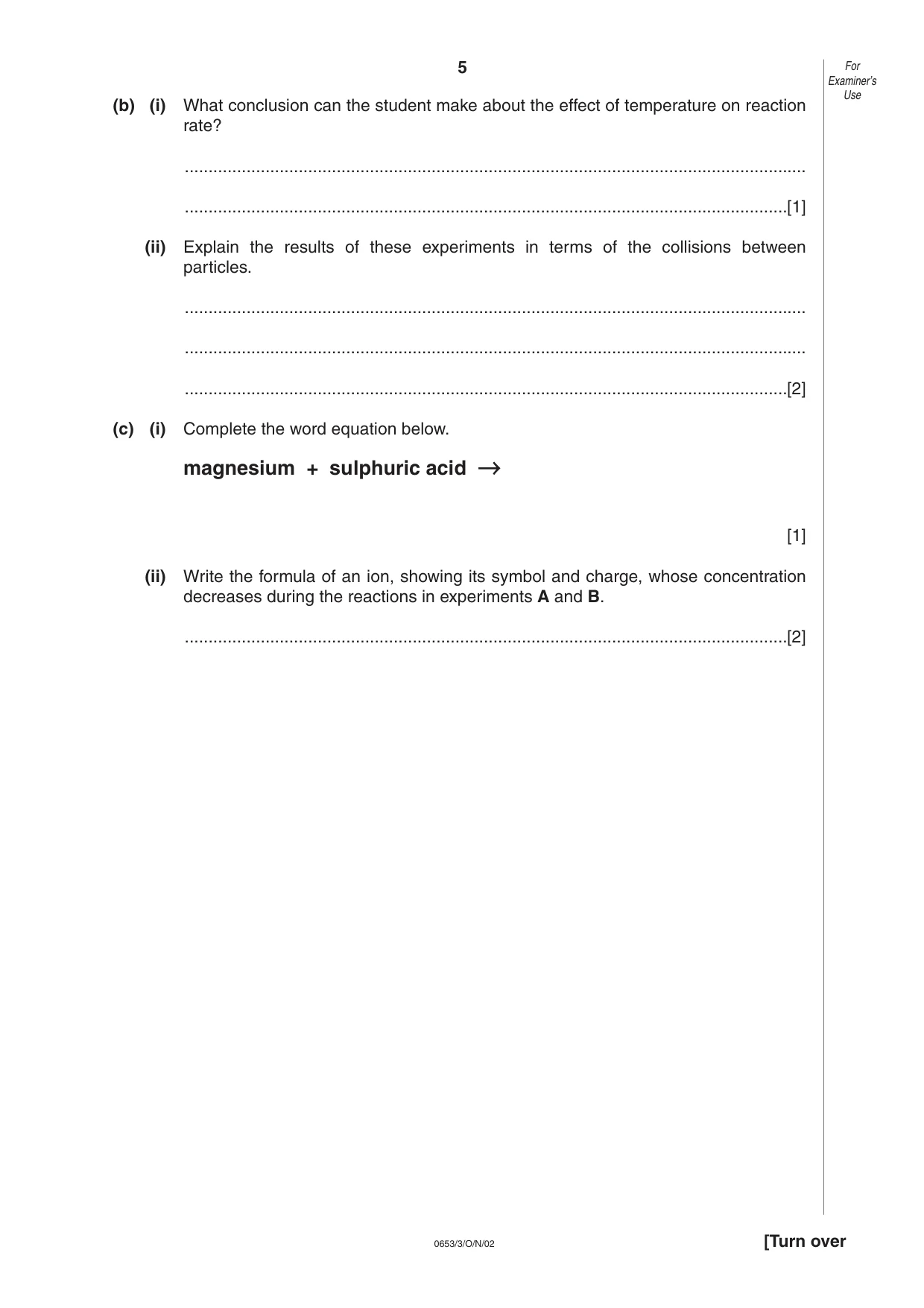
5 0653/3/O/N/02 [Turn over (b) (i) What conclusion can the student make about the effect of temperature on reaction rate? … …[1] (ii) Explain the results of these experiments in terms of the collisions between particles. … … …[2] (c) (i) Complete the word equation below. magnesium + sulphuric acid → [1] (ii) Write the formula of an ion, showing its symbol and charge, whose concentration decreases during the reactions in experiments A and B. …[2] For Examiner’s Use
Question paper, page 6
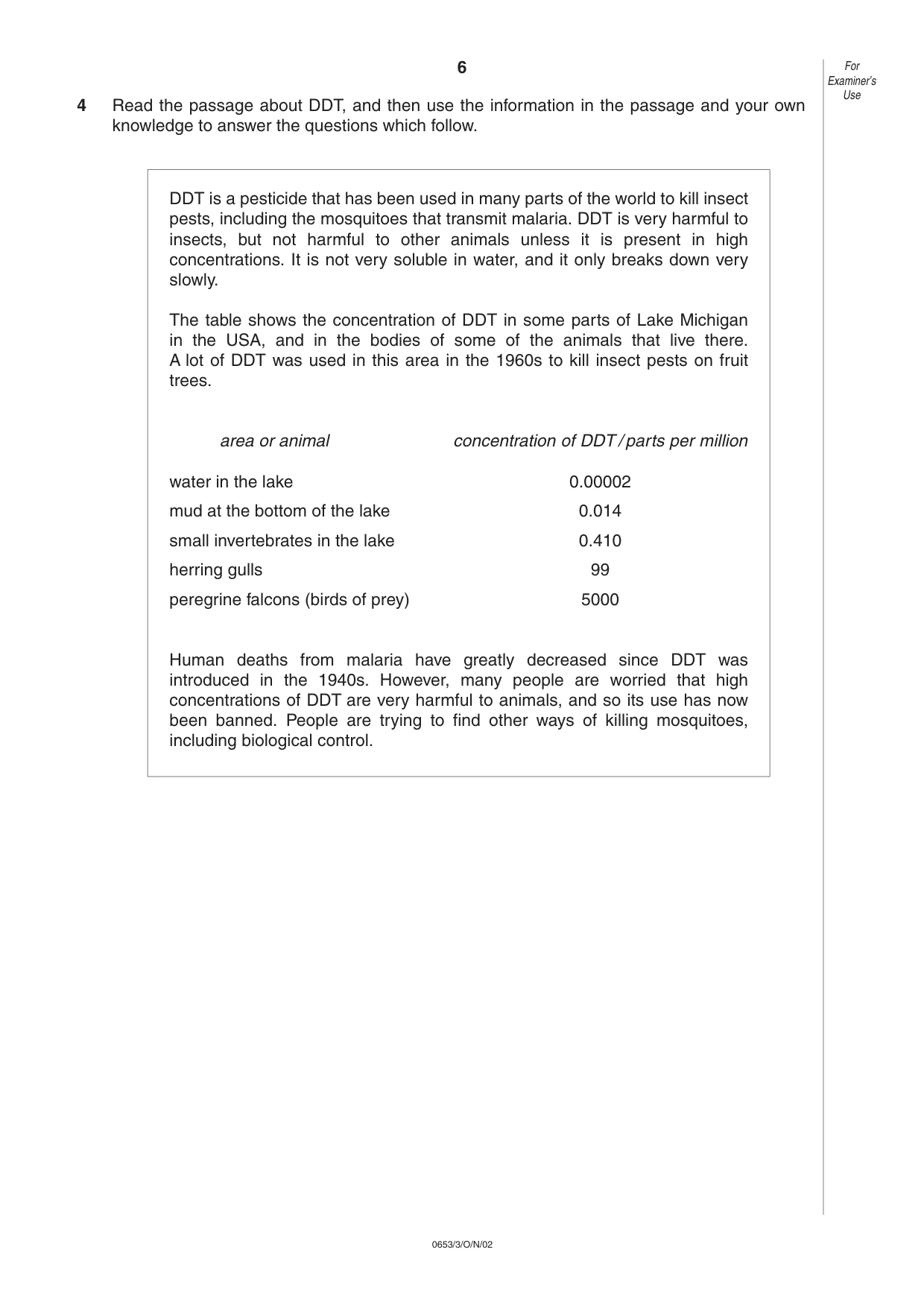
6 0653/3/O/N/02 4 Read the passage about DDT, and then use the information in the passage and your own knowledge to answer the questions which follow. DDT is a pesticide that has been used in many parts of the world to kill insect pests, including the mosquitoes that transmit malaria. DDT is very harmful to insects, but not harmful to other animals unless it is present in high concentrations. It is not very soluble in water, and it only breaks down very slowly. The table shows the concentration of DDT in some parts of Lake Michigan in the USA, and in the bodies of some of the animals that live there. A lot of DDT was used in this area in the 1960s to kill insect pests on fruit trees. area or animal concentration of DDT / parts per million water in the lake 0.00002 mud at the bottom of the lake 0.014 small invertebrates in the lake 0.410 herring gulls 99 peregrine falcons (birds of prey) 5000 Human deaths from malaria have greatly decreased since DDT was introduced in the 1940s. However, many people are worried that high concentrations of DDT are very harmful to animals, and so its use has now been banned. People are trying to find other ways of killing mosquitoes, including biological control. For Examiner’s Use
Question paper, page 7
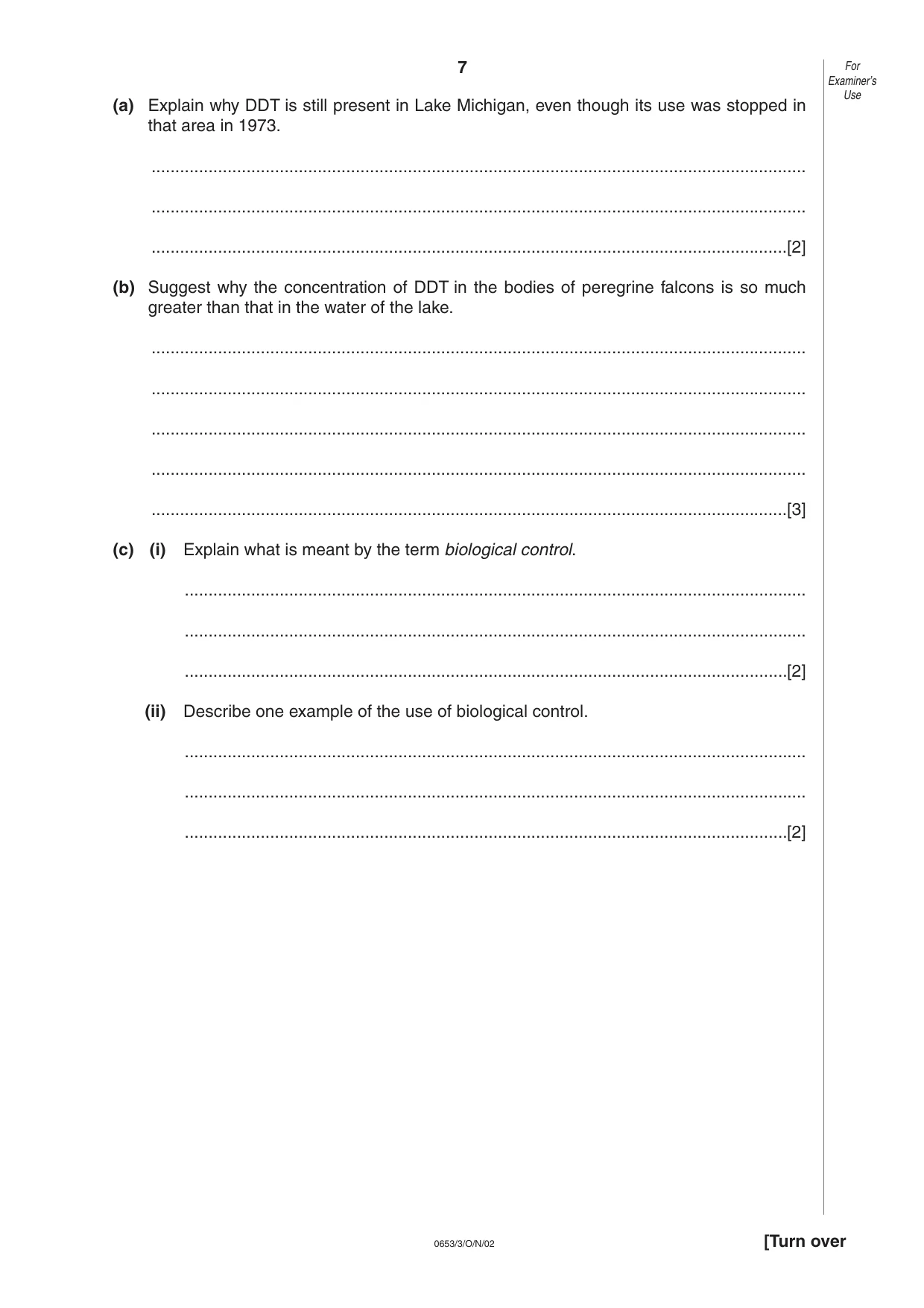
7 0653/3/O/N/02 [Turn over (a) Explain why DDT is still present in Lake Michigan, even though its use was stopped in that area in 1973. … … …[2] (b) Suggest why the concentration of DDT in the bodies of peregrine falcons is so much greater than that in the water of the lake. … … … … …[3] (c) (i) Explain what is meant by the term biological control. … … …[2] (ii) Describe one example of the use of biological control. … … …[2] For Examiner’s Use
Question paper, page 8
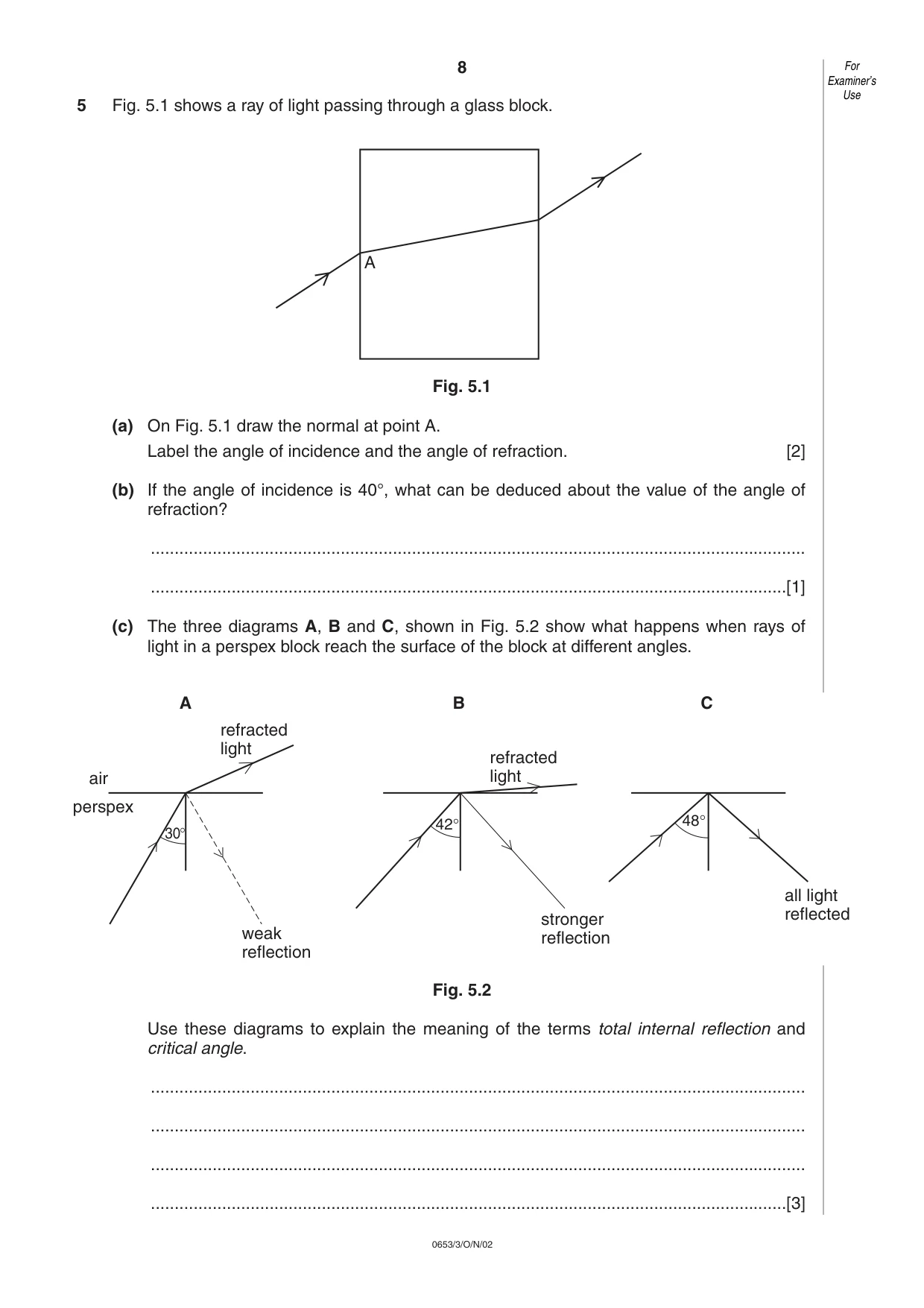
8 0653/3/O/N/02 5 Fig. 5.1 shows a ray of light passing through a glass block. Fig. 5.1 (a) On Fig. 5.1 draw the normal at point A. Label the angle of incidence and the angle of refraction. [2] (b) If the angle of incidence is 40°, what can be deduced about the value of the angle of refraction? … …[1] (c) The three diagrams A, B and C, shown in Fig. 5.2 show what happens when rays of light in a perspex block reach the surface of the block at different angles. Fig. 5.2 Use these diagrams to explain the meaning of the terms total internal reflection and critical angle. … … … …[3] A For Examiner’s Use 30° perspex air refracted light refracted light weak reflection stronger reflection all light reflected 42° 48° A B C
Question paper, page 9
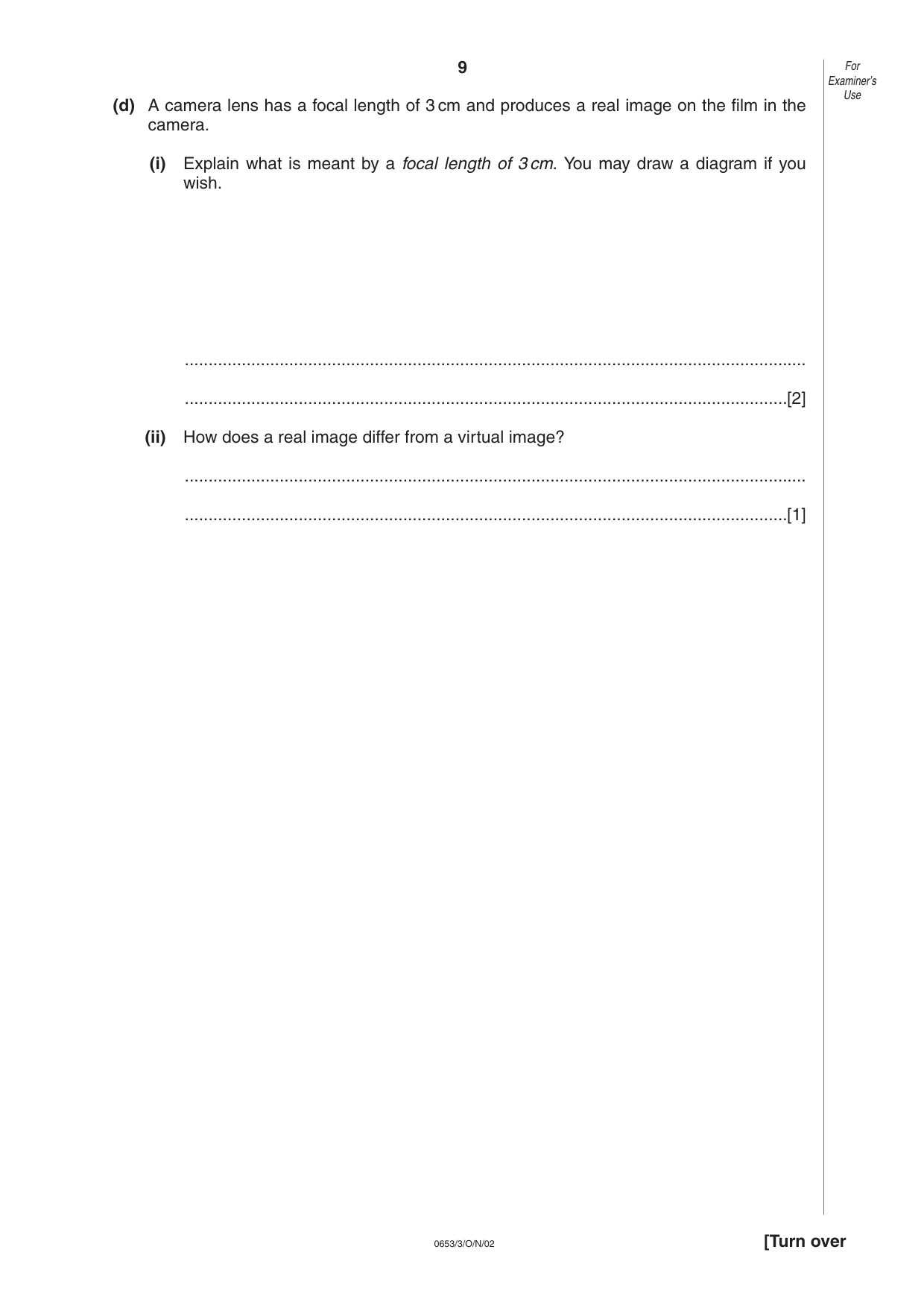
9 0653/3/O/N/02 [Turn over (d) A camera lens has a focal length of 3 cm and produces a real image on the film in the camera. (i) Explain what is meant by a focal length of 3 cm. You may draw a diagram if you wish. … …[2] (ii) How does a real image differ from a virtual image? … …[1] For Examiner’s Use
Question paper, page 10
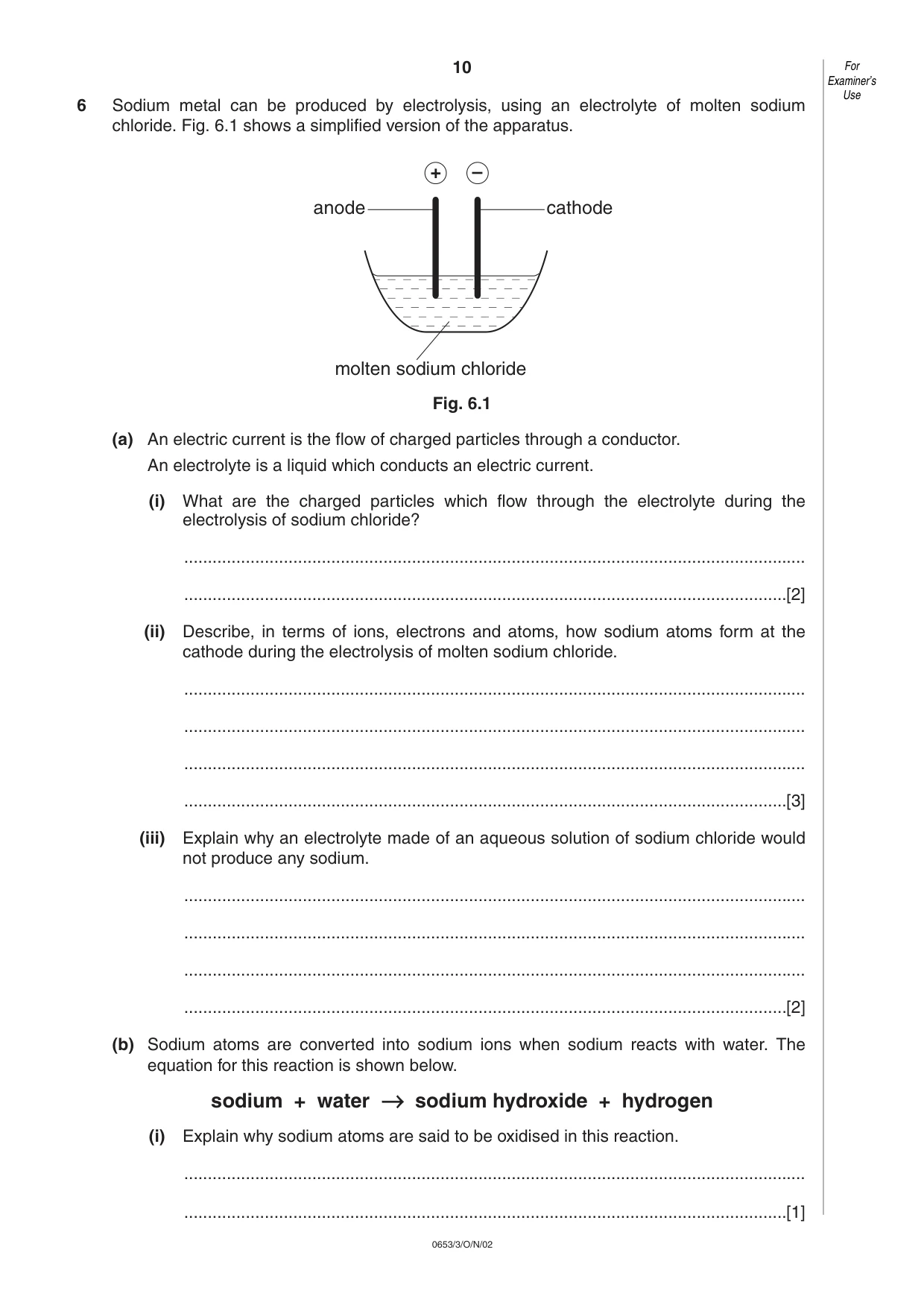
10 0653/3/O/N/02 6 Sodium metal can be produced by electrolysis, using an electrolyte of molten sodium chloride. Fig. 6.1 shows a simplified version of the apparatus. Fig. 6.1 (a) An electric current is the flow of charged particles through a conductor. An electrolyte is a liquid which conducts an electric current. (i) What are the charged particles which flow through the electrolyte during the electrolysis of sodium chloride? … …[2] (ii) Describe, in terms of ions, electrons and atoms, how sodium atoms form at the cathode during the electrolysis of molten sodium chloride. … … … …[3] (iii) Explain why an electrolyte made of an aqueous solution of sodium chloride would not produce any sodium. … … … …[2] (b) Sodium atoms are converted into sodium ions when sodium reacts with water. The equation for this reaction is shown below. sodium + water →sodium hydroxide + hydrogen (i) Explain why sodium atoms are said to be oxidised in this reaction. … …[1] + – anode cathode molten sodium chloride For Examiner’s Use
Question paper, page 11
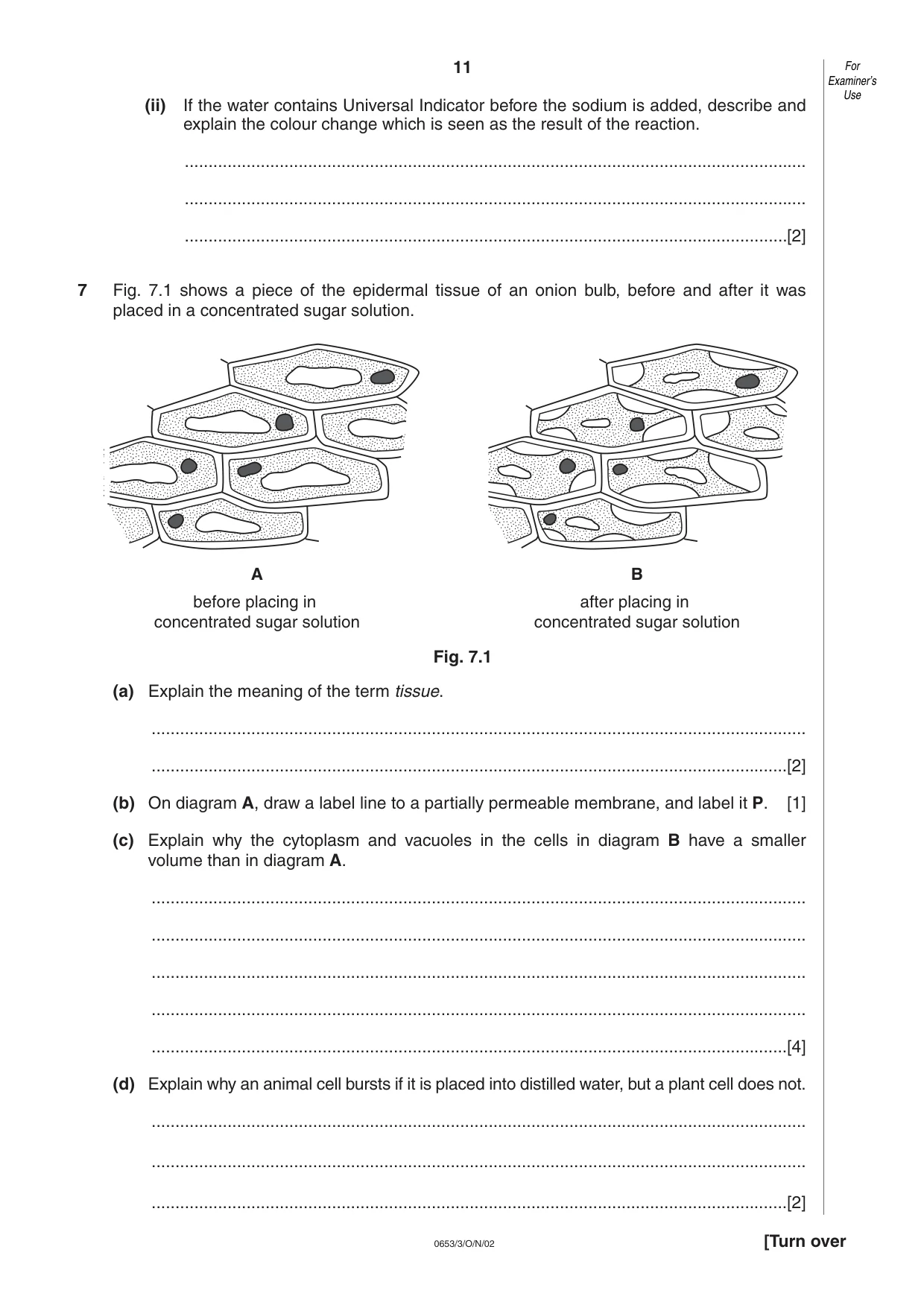
11 0653/3/O/N/02 [Turn over (ii) If the water contains Universal Indicator before the sodium is added, describe and explain the colour change which is seen as the result of the reaction. … … …[2] 7 Fig. 7.1 shows a piece of the epidermal tissue of an onion bulb, before and after it was placed in a concentrated sugar solution. Fig. 7.1 (a) Explain the meaning of the term tissue. … …[2] (b) On diagram A, draw a label line to a partially permeable membrane, and label it P. [1] (c) Explain why the cytoplasm and vacuoles in the cells in diagram B have a smaller volume than in diagram A. … … … … …[4] (d) Explain why an animal cell bursts if it is placed into distilled water, but a plant cell does not. … … …[2] A before placing in concentrated sugar solution B after placing in concentrated sugar solution For Examiner’s Use
Question paper, page 12
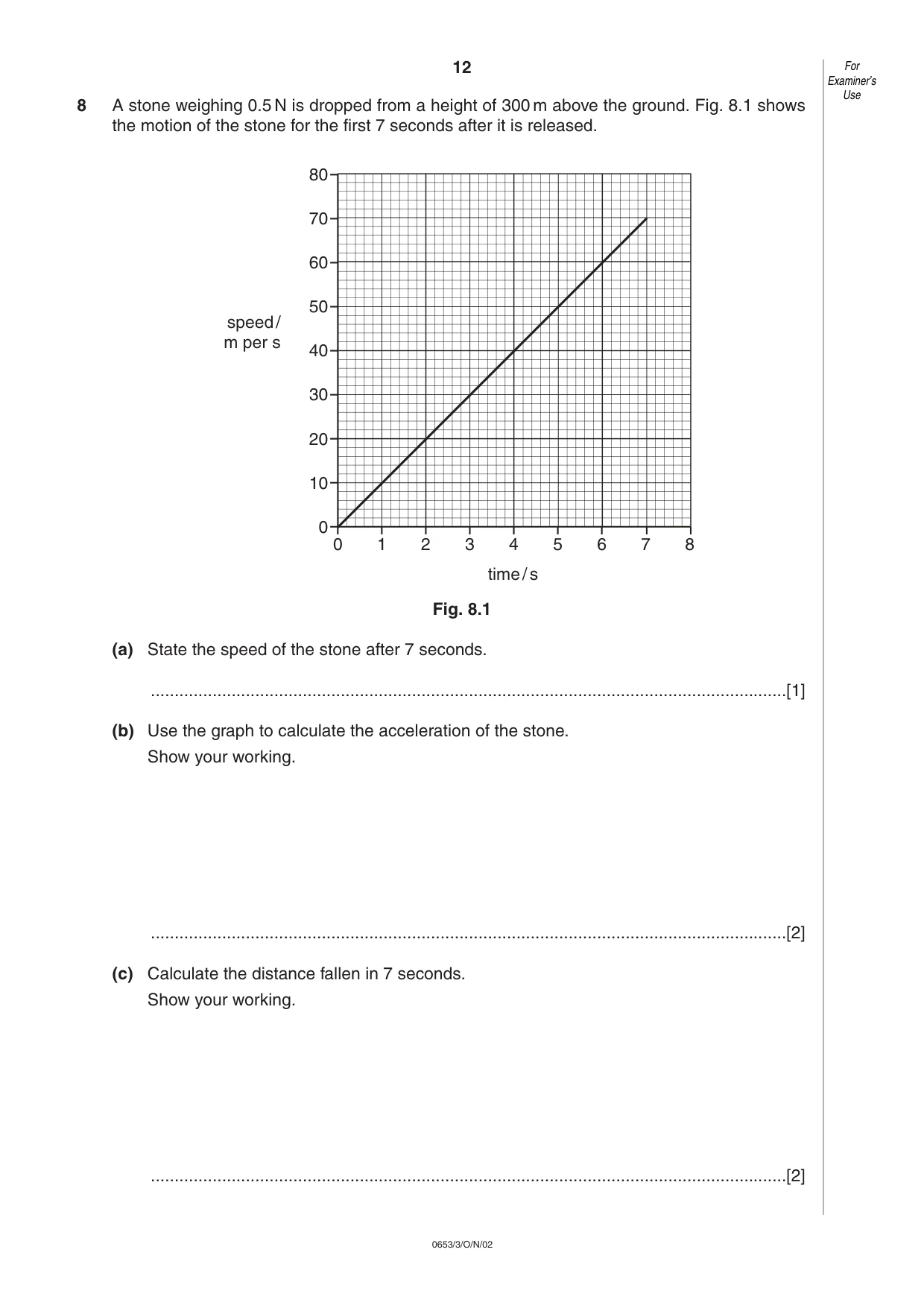
12 0653/3/O/N/02 8 A stone weighing 0.5 N is dropped from a height of 300 m above the ground. Fig. 8.1 shows the motion of the stone for the first 7 seconds after it is released. Fig. 8.1 (a) State the speed of the stone after 7 seconds. …[1] (b) Use the graph to calculate the acceleration of the stone. Show your working. …[2] (c) Calculate the distance fallen in 7 seconds. Show your working. …[2] 0 0 1 2 3 4 5 6 7 8 10 20 30 40 50 60 70 80 speed/ m per s time/s For Examiner’s Use
Question paper, page 13
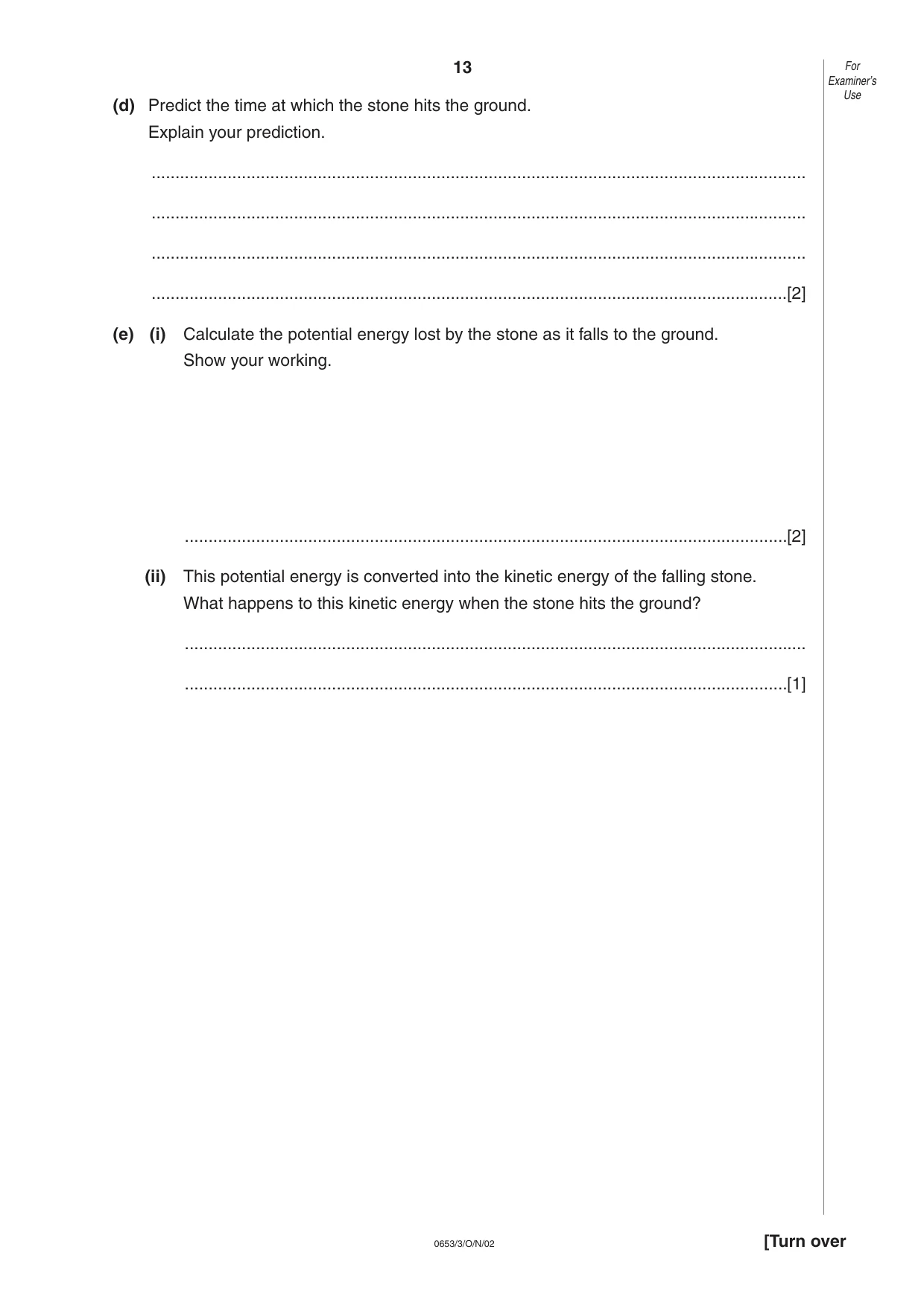
13 0653/3/O/N/02 [Turn over (d) Predict the time at which the stone hits the ground. Explain your prediction. … … … …[2] (e) (i) Calculate the potential energy lost by the stone as it falls to the ground. Show your working. …[2] (ii) This potential energy is converted into the kinetic energy of the falling stone. What happens to this kinetic energy when the stone hits the ground? … …[1] For Examiner’s Use
Question paper, page 14
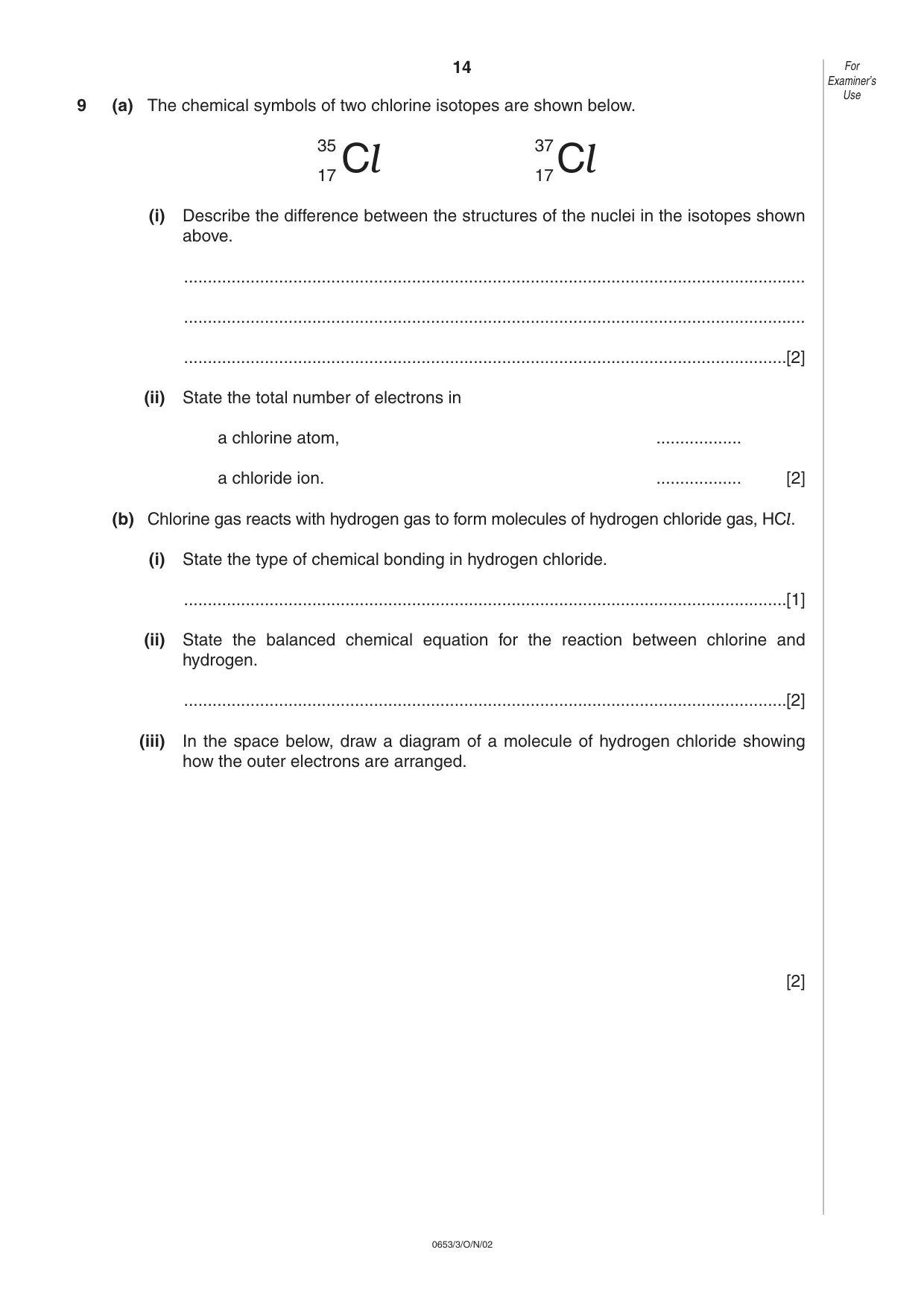
14 0653/3/O/N/02 9 (a) The chemical symbols of two chlorine isotopes are shown below. 35 37 Cl Cl 17 17 (i) Describe the difference between the structures of the nuclei in the isotopes shown above. … … …[2] (ii) State the total number of electrons in a chlorine atom, … a chloride ion. … [2] (b) Chlorine gas reacts with hydrogen gas to form molecules of hydrogen chloride gas, HCl. (i) State the type of chemical bonding in hydrogen chloride. …[1] (ii) State the balanced chemical equation for the reaction between chlorine and hydrogen. …[2] (iii) In the space below, draw a diagram of a molecule of hydrogen chloride showing how the outer electrons are arranged. [2] For Examiner’s Use
Question paper, page 16
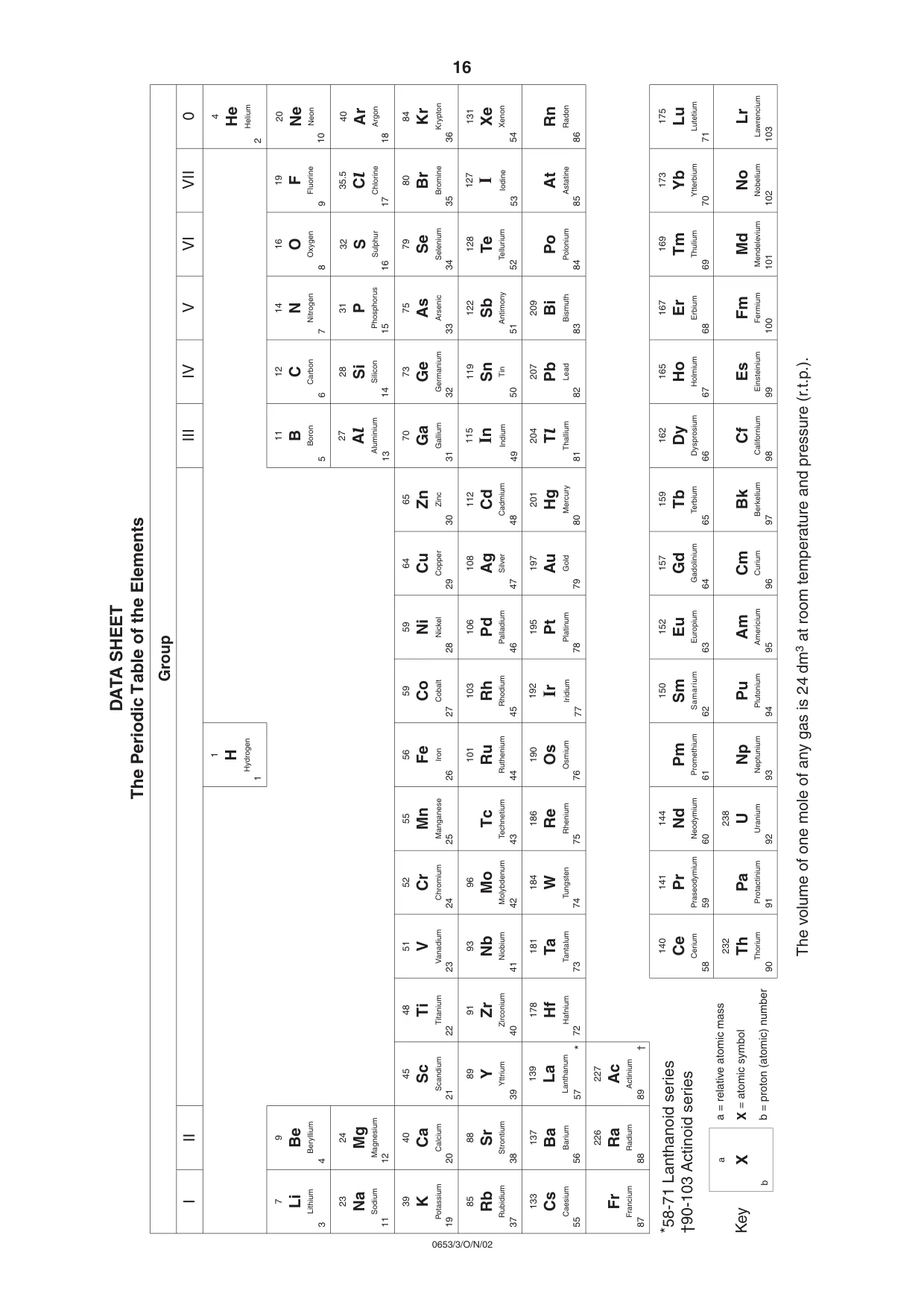
16 0653/3/O/N/02 Group DATA SHEET The Periodic Table of the Elements 140 Ce Cerium 58 141 Pr Praseodymium 59 144 Nd Neodymium 60 Pm Promethium 61 150 Sm Samarium 62 152 Eu Europium 63 157 Gd Gadolinium 64 159 Tb Terbium 65 162 Dy Dysprosium 66 165 Ho Holmium 67 167 Er Erbium 68 169 Tm Thulium 69 173 Yb Ytterbium 70 175 Lu Lutetium 71 232 Th Thorium 90 Pa Protactinium 91 238 U Uranium 92 Np Neptunium 93 Pu Plutonium 94 Am Americium 95 Cm Curium 96 Bk Berkelium 97 Cf Californium 98 Es Einsteinium 99 Fm Fermium 100 Md Mendelevium 101 No Nobelium 102 Lr Lawrencium 103 1 H Hydrogen 1 7 Li Lithium 3 23 Na Sodium 11 24 Mg Magnesium 12 40 Ca Calcium 20 45 Sc Scandium 21 48 Ti Titanium 22 51 V Vanadium 23 52 Cr Chromium 24 55 Mn Manganese 25 56 Fe Iron 26 59 Co Cobalt 27 59 Ni Nickel 28 64 Cu Copper 29 65 Zn Zinc 30 70 Ga Gallium 31 27 Al Aluminium 13 11 B Boron 5 12 C Carbon 6 14 N Nitrogen 7 16 O Oxygen 8 19 F Fluorine 9 28 Si Silicon 14 31 P Phosphorus 15 32 S Sulphur 16 35.5 Cl Chlorine 17 40 Ar Argon 18 20 Ne Neon 10 4 He Helium 2 73 Ge Germanium 32 75 As Arsenic 33 79 Se Selenium 34 80 Br Bromine 35 84 Kr Krypton 36 39 K Potassium 19 88 Sr Strontium 38 89 Y Yttrium 39 91 Zr Zirconium 40 93 Nb Niobium 41 96 Mo Molybdenum 42 Tc Technetium 43 101 Ru Ruthenium 44 103 Rh Rhodium 45 106 Pd Palladium 46 108 Ag Silver 47 112 Cd Cadmium 48 115 In Indium 49 119 Sn Tin 50 122 Sb Antimony 51 128 Te Tellurium 52 127 I Iodine 53 131 Xe Xenon 54 137 Ba Barium 56 139 La Lanthanum 57 * 178 Hf Hafnium 72 181 Ta Tantalum 73 184 W Tungsten 74 186 Re Rhenium 75 190 Os Osmium 76 192 Ir Iridium 77 195 Pt Platinum 78 197 Au Gold 79 201 Hg Mercury 80 204 Tl Thallium 81 207 Pb Lead 82 209 Bi Bismuth 83 Po Polonium 84 At Astatine 85 Rn Radon 86 Fr Francium 87 227 Ac Actinium 89 † 9 Be Beryllium 4 I II III IV V VI VII 0 85 Rb Rubidium 37 133 Cs Caesium 55 226 Ra Radium 88 The volume of one mole of any gas is 24 dm3 at room temperature and pressure (r.t.p.). a X b a = relative atomic mass X = atomic symbol b = proton (atomic) number Key *58-71 Lanthanoid series †90-103 Actinoid series
Mark scheme, page 1
CAMBRIDGE INTERNATIONAL EXAMINATIONS NOVEMBER 2002 INTERNATIONAL GCSE § Universrry of CAMBRIDGE Local Examinations Syndicate
Mark scheme, page 2
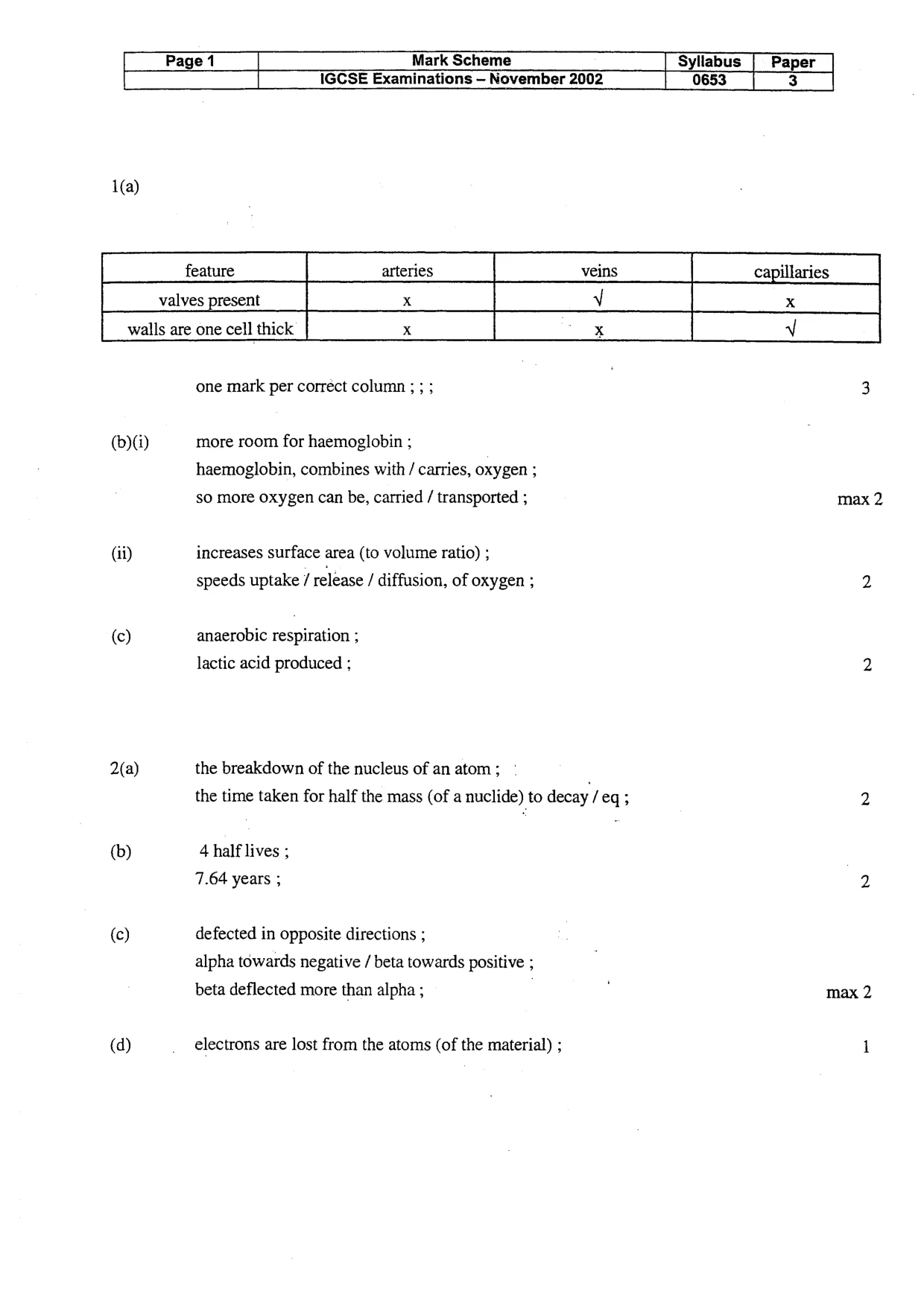
Page 1 Mark Scheme Syllabus Paper I IGCSE Examinations — November 2002 0653 3 1(a) feature arteries walls aeonecellthick | x | (by) (ii) () 2(a) (b) (c) (d) one mark per correct column ; ; ; more room for haemoglobin ; haemoglobin, combines with / carries, oxygen ; so more oxygen can be, carried / transported ; increases surface area (to volume ratio) ; speeds uptake / release / diffusion, of oxygen ; anaerobic respiration ; lactic acid produced ; the breakdown of the nucleus of an atom ; the time taken for half the mass (of a nuclide) to decay / eq ; 4 half lives ; 7.64 years ; defected in opposite directions ; alpha towards negative / beta towards positive ; beta deflected more than alpha ; electrons are lost from the atoms (of the material) ; max 2 max 2
Mark scheme, page 3
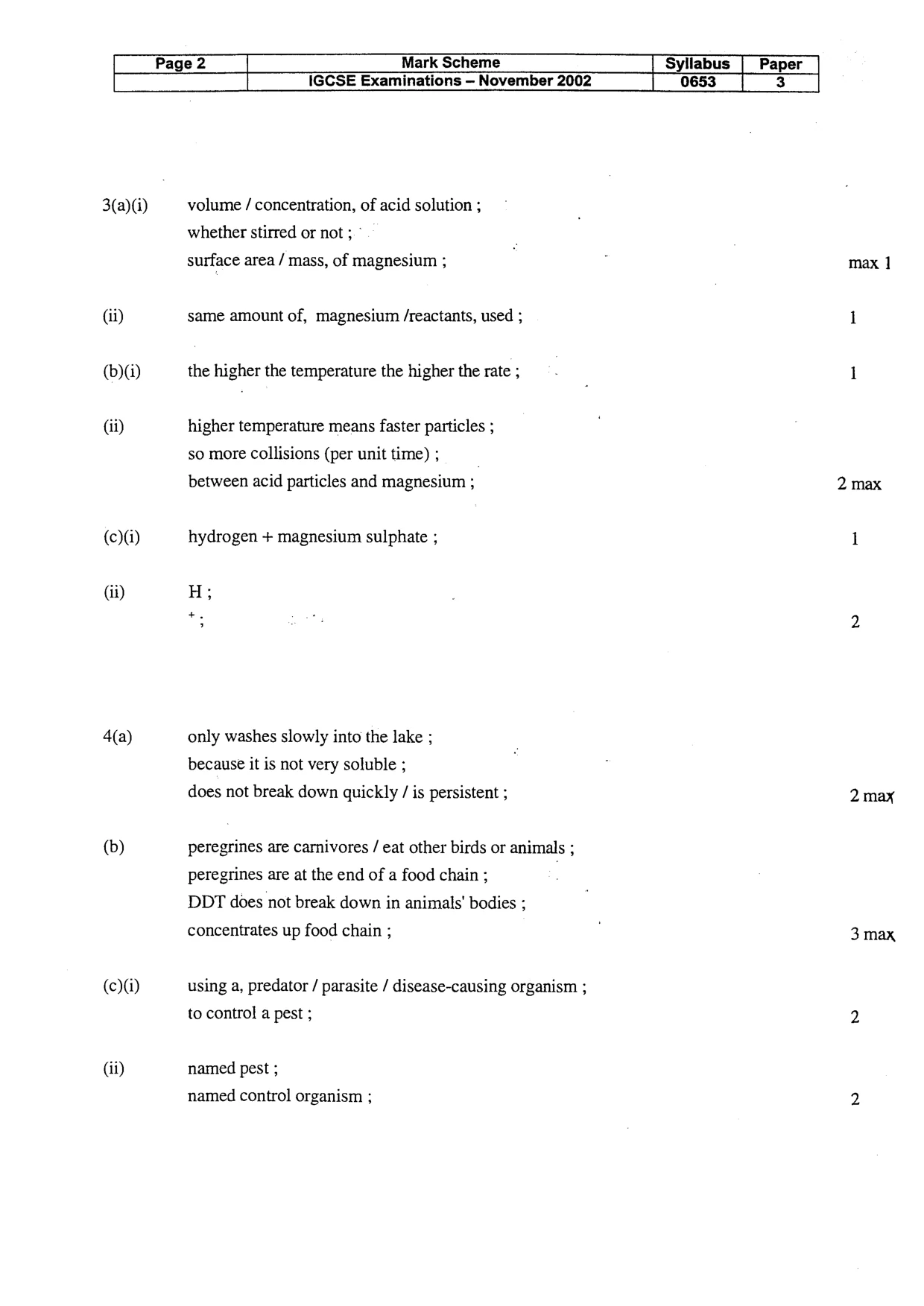
Page 2 I Mark Scheme [Syllabus | Paper | l IGCSE Examinations — November 2002 [0653 3 | 3(a)(i) volume / concentration, of acid solution ; whether stirred or not ; surface area / mass, of magnesium ; ; . max 1 (ii) same amount of, magnesium /reactants, used ; 1 (b)(i) the higher the temperature the higher the rate ; 1 (ii) higher temperature means faster particles ; so more collisions (per unit time) ; between acid particles and magnesium ; 2 max (c)(i) hydrogen + magnesium sulphate ; 1 Gi) H; . + : 2 4(a) only washes slowly into the lake ; because it is not very soluble ; does not break down quickly / is persistent ; 2max (b) peregrines are carnivores / eat other birds or animals ; peregrines are at the end of a food chain ; DDT does not break down in animals’ bodies ; concentrates up food chain ; . 3 max (c)(i) using a, predator / parasite / disease-causing organism ; to control a pest ; 2 (ii) named pest ; named control organism ; 2
Mark scheme, page 4
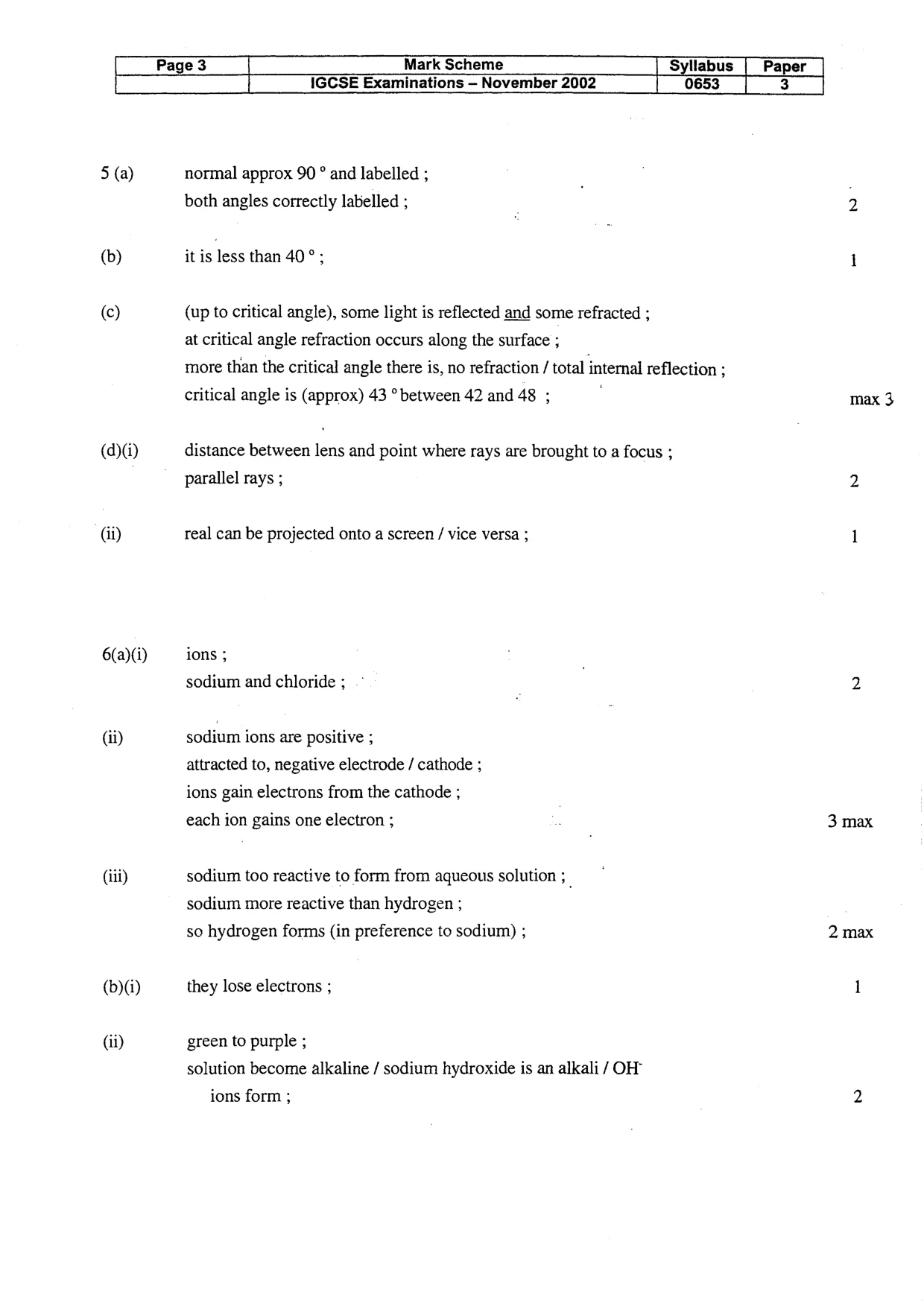
Page 3 | Mark Scheme Syllabus [Paper I IGCSE Examinations —- November 2002 0653 3 5 (a) (b) © (da) Gi) 6(a)(i) (i) (iii) (b)(i) (ii) normal approx 90 ° and labelled ; both angles correctly labelled ; it is less than 40° ; (up to critical angle), some light is reflected and some refracted ; at critical angle refraction occurs along the surface ; more than the critical angle there is, no refraction / total internal reflection ; critical angle is (approx) 43 ° between 42 and 48 ; distance between lens and point where rays are brought to a focus ; parallel rays ; real can be projected onto a screen / vice versa ; ions ; sodium and chloride ; sodium ions are positive ; attracted to, negative electrode / cathode ; ions gain electrons from the cathode ; each ion gains one electron ; sodium too reactive to form from aqueous solution ; . sodium more reactive than hydrogen ; so hydrogen forms (in preference to sodium) ; they lose electrons ; green to purple ; solution become alkaline / sodium hydroxide is an alkali / OH” ions form ; max 3 3 max 2 max
Mark scheme, page 5
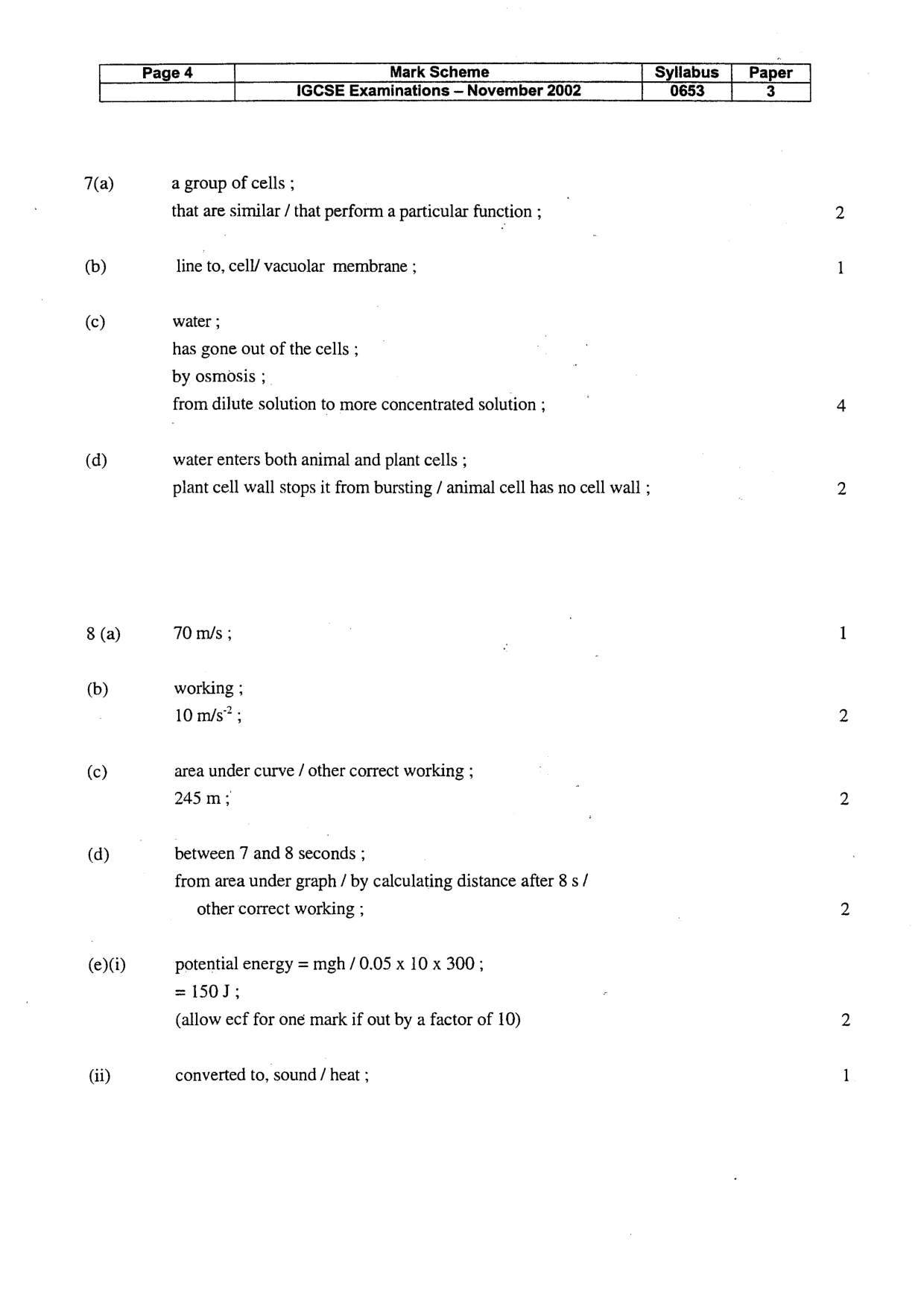
Page 4 | Mark Scheme Syllabus | Paper [ IGCSE Examinations — November 2002 0653, | 3 7a) a group of cells ; that are similar / that perform a particular function ; (b) line to, cell/ vacuolar membrane ; (c) water ; has gone out of the cells ; by osmosis ; from dilute solution to more concentrated solution ; (d) water enters both animal and plant cells ; plant cell wall stops it from bursting / animal cell has no cell wall ; 8 (a) 70 m/s ; (b) working ; 10 m/s”; (c) area under curve / other correct working ; 245 m; (d) between 7 and 8 seconds ; from area under graph / by calculating distance after 8 s / other correct working ; (ei) potential energy = mgh/ 0.05 x 10 x 300; =150J; (allow ecf for oné mark if out by a factor of 10) (ii) converted to, sound / heat ;
Mark scheme, page 6
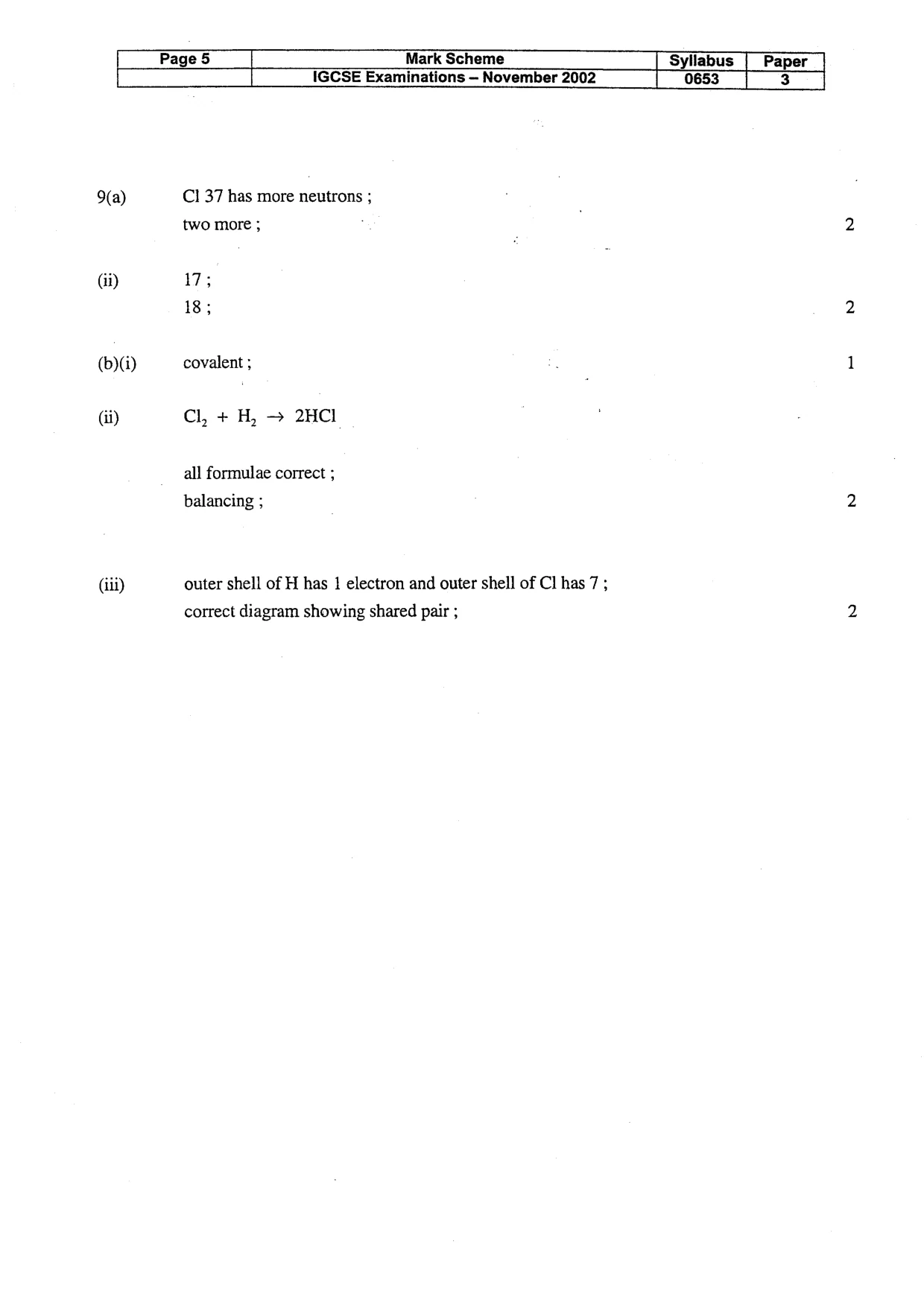
Page 5 Mark Scheme Syllabus IGCSE Examinations — November 2002 0653 I Paper 3 (a) ii) (bi) di) (iii) Cl 37 has more neutrons ; two more ; 17; 18; covalent ; Cl, + H, > 2HCI all formulae correct ; balancing ; outer shell of H has 1 electron and outer shell of Cl has 7 ; correct diagram showing shared pair ;