Cambridge IGCSE Science - Combined 0653 — 2002 Oct/Nov Paper 2 · Variant 1
0653/21/O/N/02
The question paper and its mark scheme, free to read here and free to download. This is Cambridge’s own paper, exactly as it was sat.
Question paper16 pages



Mark scheme4 pages
Answers below. Sit the paper first if you are practising.
Paper as text
Question paper, page 1
TIME 1 hour INSTRUCTIONS TO CANDIDATES Write your name, Centre number and candidate number in the spaces at the top of this page. Answer all questions. Write your answers in the spaces provided on the question paper. INFORMATION FOR CANDIDATES The number of marks is given in brackets [ ] at the end of each question or part question. A copy of the Periodic Table is printed on page 16. International General Certificate of Secondary Education CAMBRIDGE INTERNATIONAL EXAMINATIONS COMBINED SCIENCE 0653/2 PAPER 2 OCTOBER/NOVEMBER SESSION 2002 1 hour Candidates answer on the question paper. No additional materials are required. This question paper consists of 13 printed pages and 3 blank pages. SPA (NH/PW) S28595/5 © CIE 2002 [Turn over Candidate Centre Number Number Candidate Name FOR EXAMINER’S USE 1 2 3 4 5 TOTAL 7 6 9 8 www.XtremePapers.com
Question paper, page 2
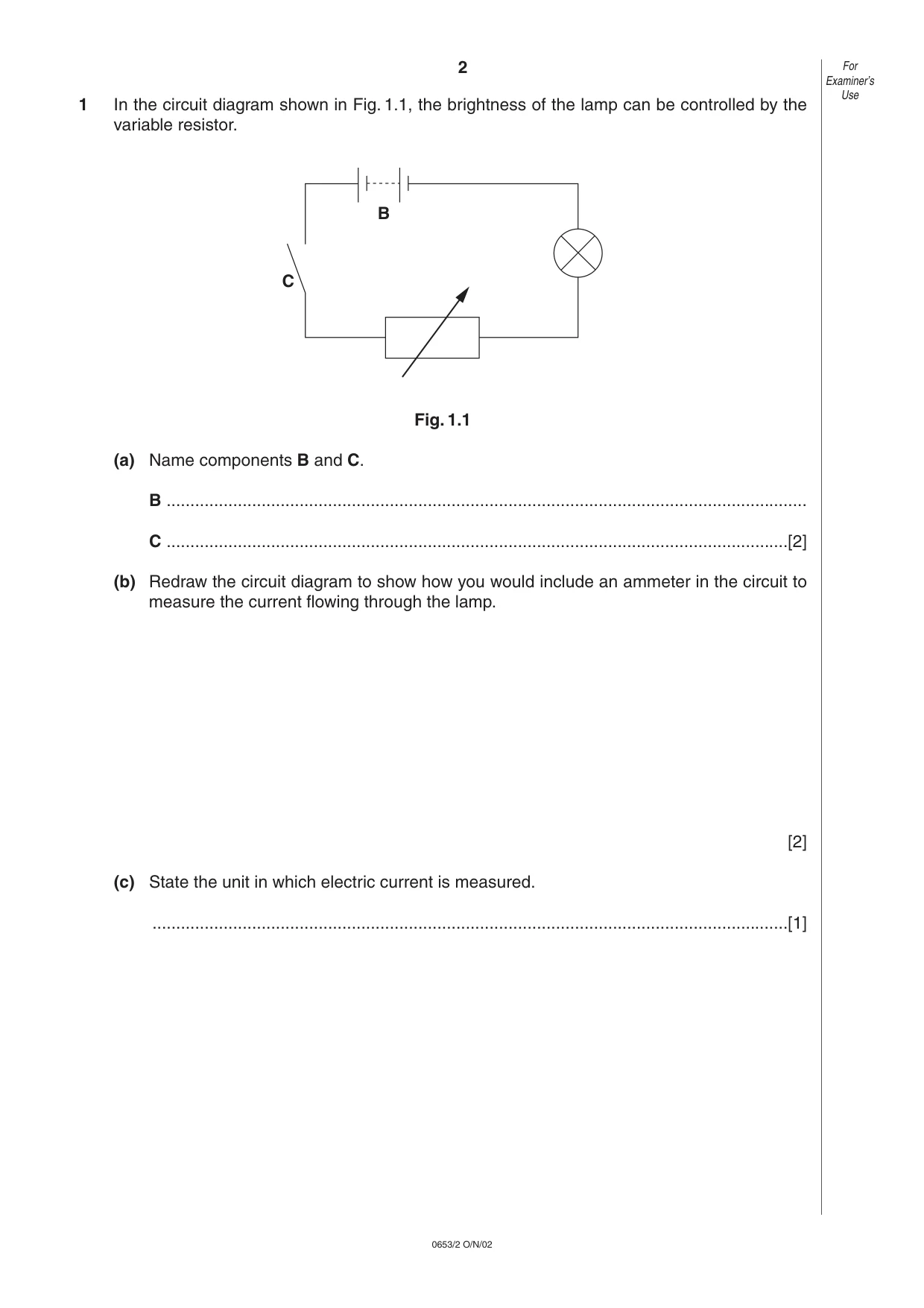
2 0653/2 O/N/02 1 In the circuit diagram shown in Fig. 1.1, the brightness of the lamp can be controlled by the variable resistor. Fig. 1.1 (a) Name components B and C. B … C …[2] (b) Redraw the circuit diagram to show how you would include an ammeter in the circuit to measure the current flowing through the lamp. [2] (c) State the unit in which electric current is measured. …[1] C B For Examiner’s Use
Question paper, page 3
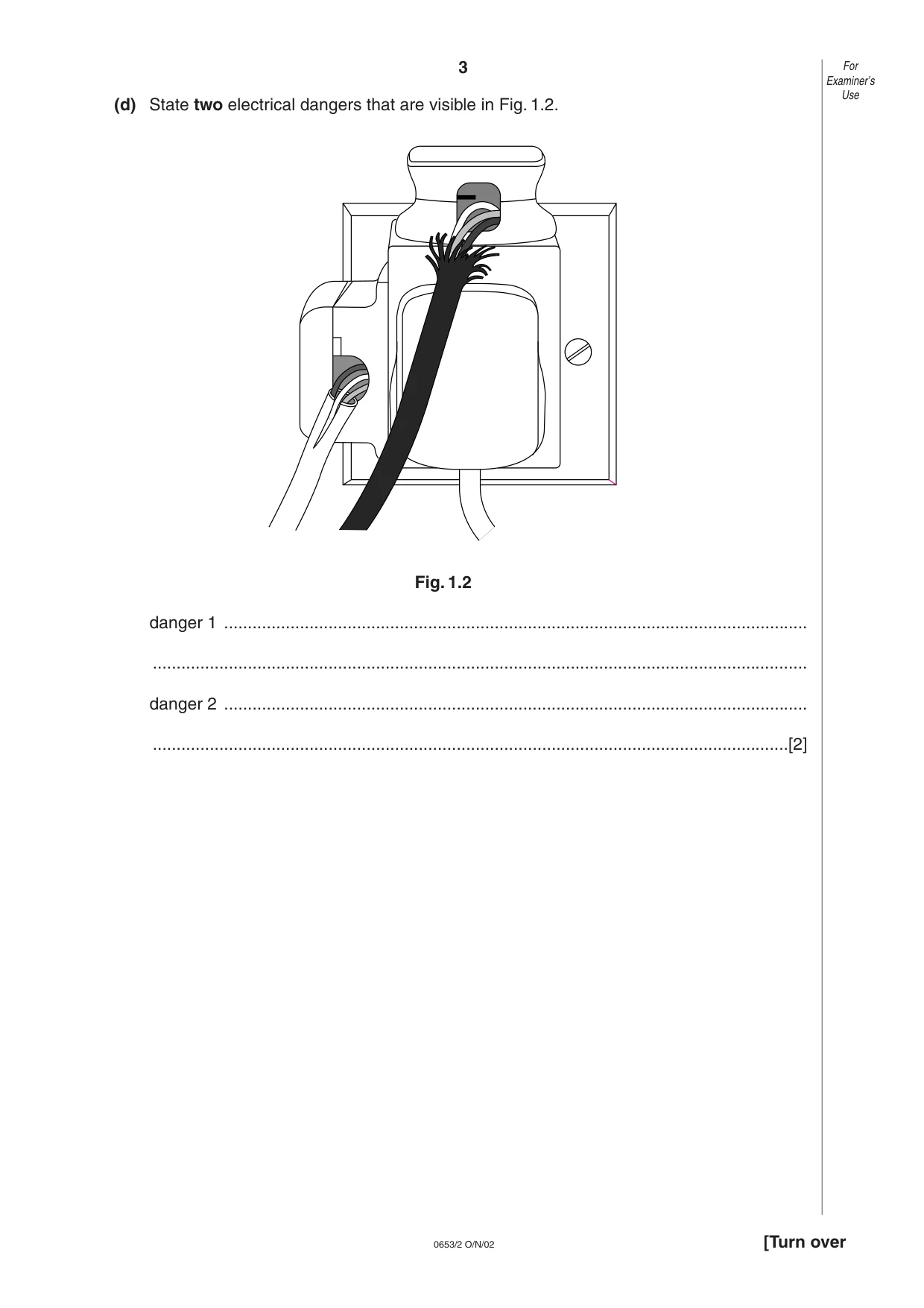
3 0653/2 O/N/02 [Turn over (d) State two electrical dangers that are visible in Fig. 1.2. Fig. 1.2 danger 1 … … danger 2 … …[2] For Examiner’s Use
Question paper, page 4
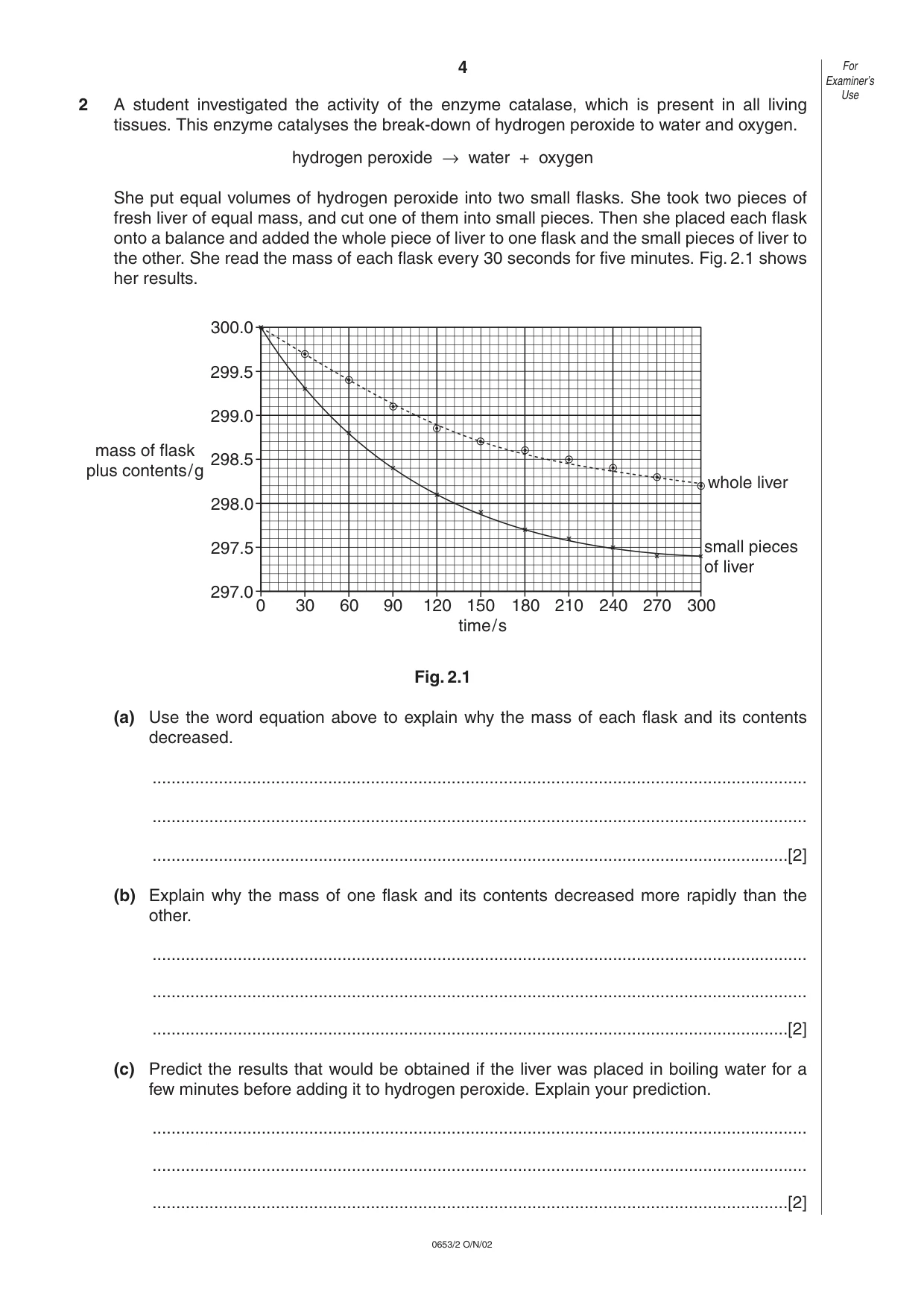
4 0653/2 O/N/02 2 A student investigated the activity of the enzyme catalase, which is present in all living tissues. This enzyme catalyses the break-down of hydrogen peroxide to water and oxygen. hydrogen peroxide →water + oxygen She put equal volumes of hydrogen peroxide into two small flasks. She took two pieces of fresh liver of equal mass, and cut one of them into small pieces. Then she placed each flask onto a balance and added the whole piece of liver to one flask and the small pieces of liver to the other. She read the mass of each flask every 30 seconds for five minutes. Fig. 2.1 shows her results. Fig. 2.1 (a) Use the word equation above to explain why the mass of each flask and its contents decreased. … … …[2] (b) Explain why the mass of one flask and its contents decreased more rapidly than the other. … … …[2] (c) Predict the results that would be obtained if the liver was placed in boiling water for a few minutes before adding it to hydrogen peroxide. Explain your prediction. … … …[2] 300.0 299.5 299.0 298.5 298.0 297.5 297.0 0 30 60 90 120 150 180 210 240 270 300 time/s mass of flask plus contents/g whole liver small pieces of liver For Examiner’s Use
Question paper, page 5
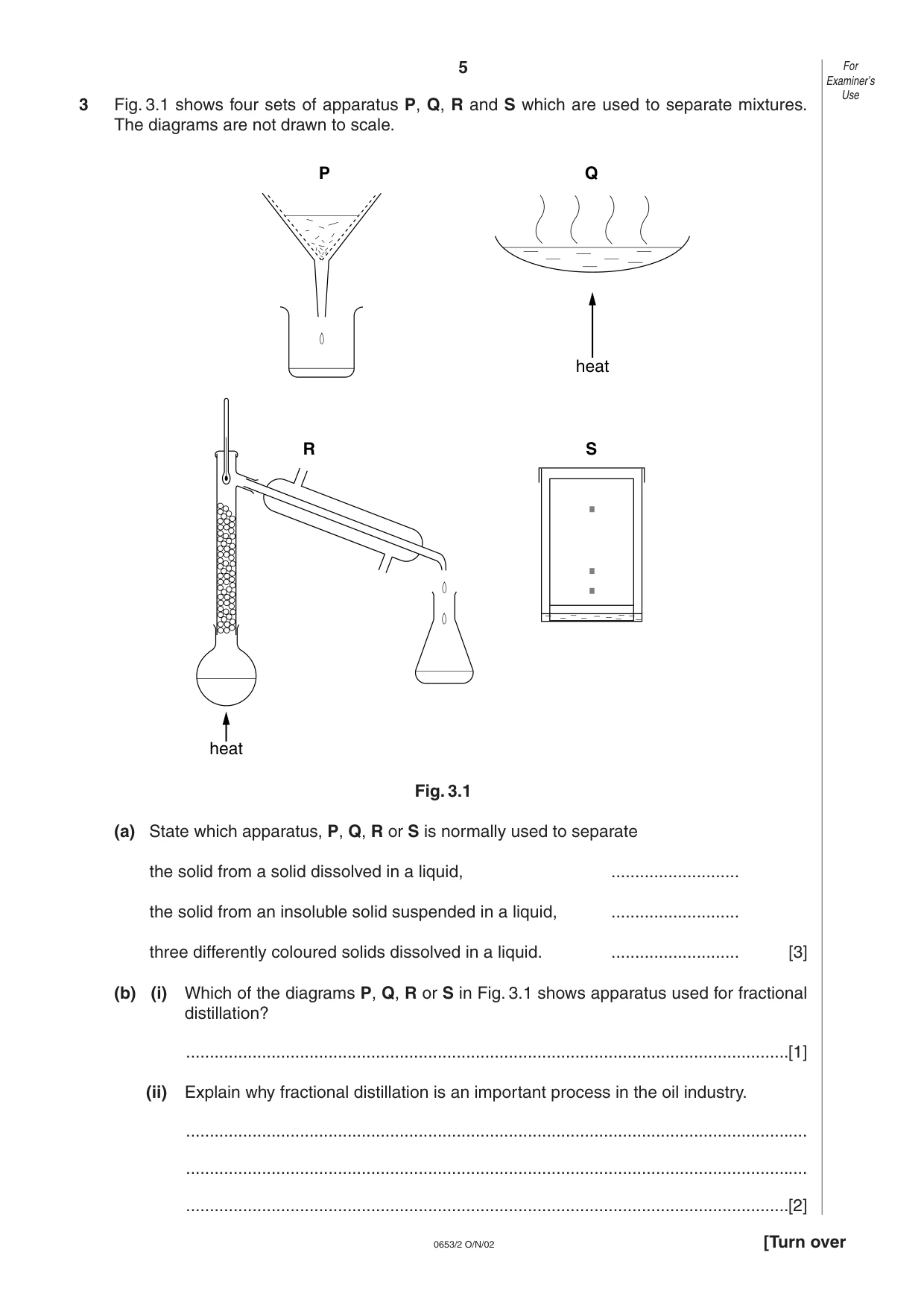
5 0653/2 O/N/02 [Turn over 3 Fig. 3.1 shows four sets of apparatus P, Q, R and S which are used to separate mixtures. The diagrams are not drawn to scale. Fig. 3.1 (a) State which apparatus, P, Q, R or S is normally used to separate the solid from a solid dissolved in a liquid, … the solid from an insoluble solid suspended in a liquid, … three differently coloured solids dissolved in a liquid. … [3] (b) (i) Which of the diagrams P, Q, R or S in Fig. 3.1 shows apparatus used for fractional distillation? …[1] (ii) Explain why fractional distillation is an important process in the oil industry. … … …[2] heat P Q R S heat For Examiner’s Use
Question paper, page 6
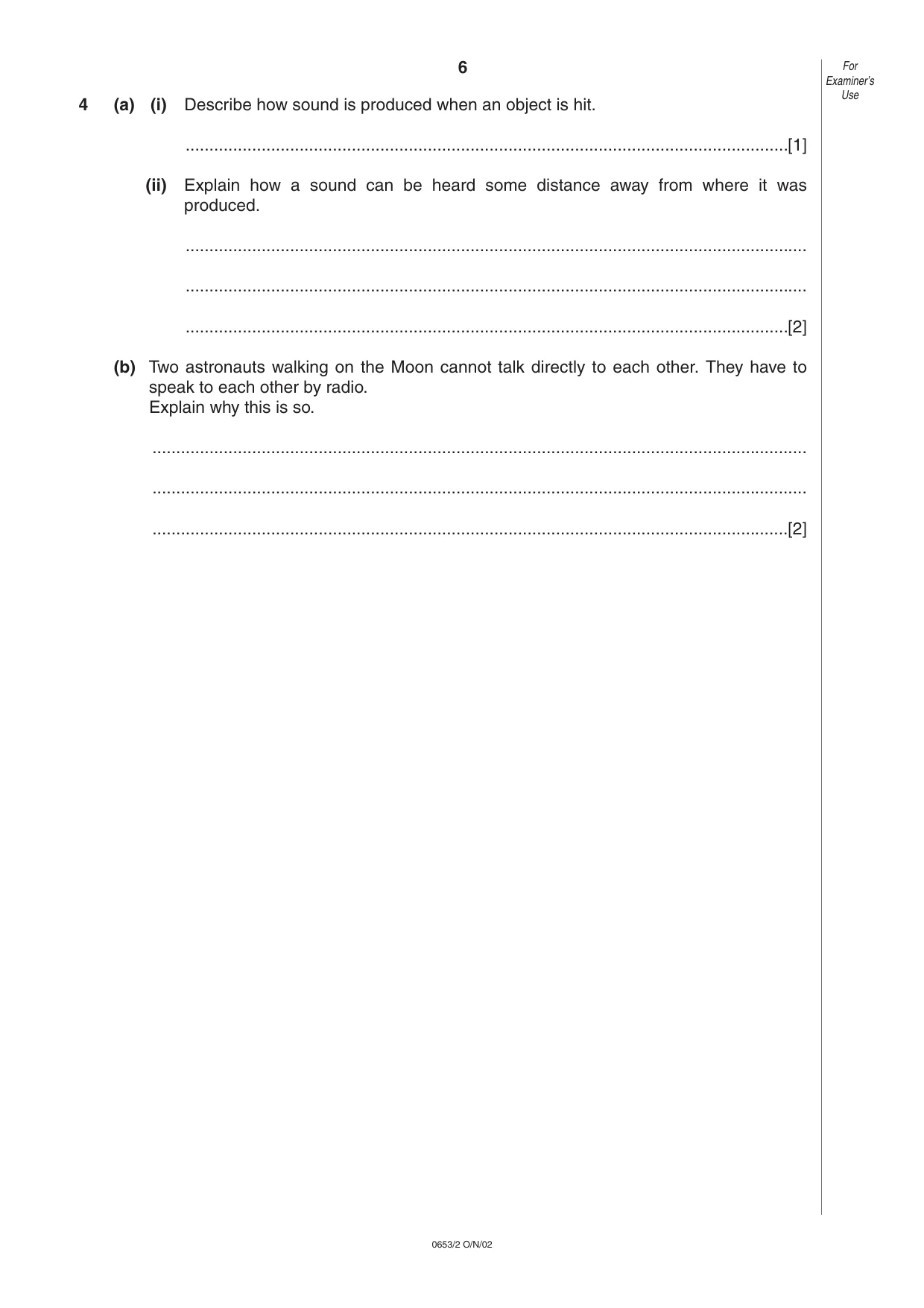
6 0653/2 O/N/02 4 (a) (i) Describe how sound is produced when an object is hit. …[1] (ii) Explain how a sound can be heard some distance away from where it was produced. … … …[2] (b) Two astronauts walking on the Moon cannot talk directly to each other. They have to speak to each other by radio. Explain why this is so. … … …[2] For Examiner’s Use
Question paper, page 7
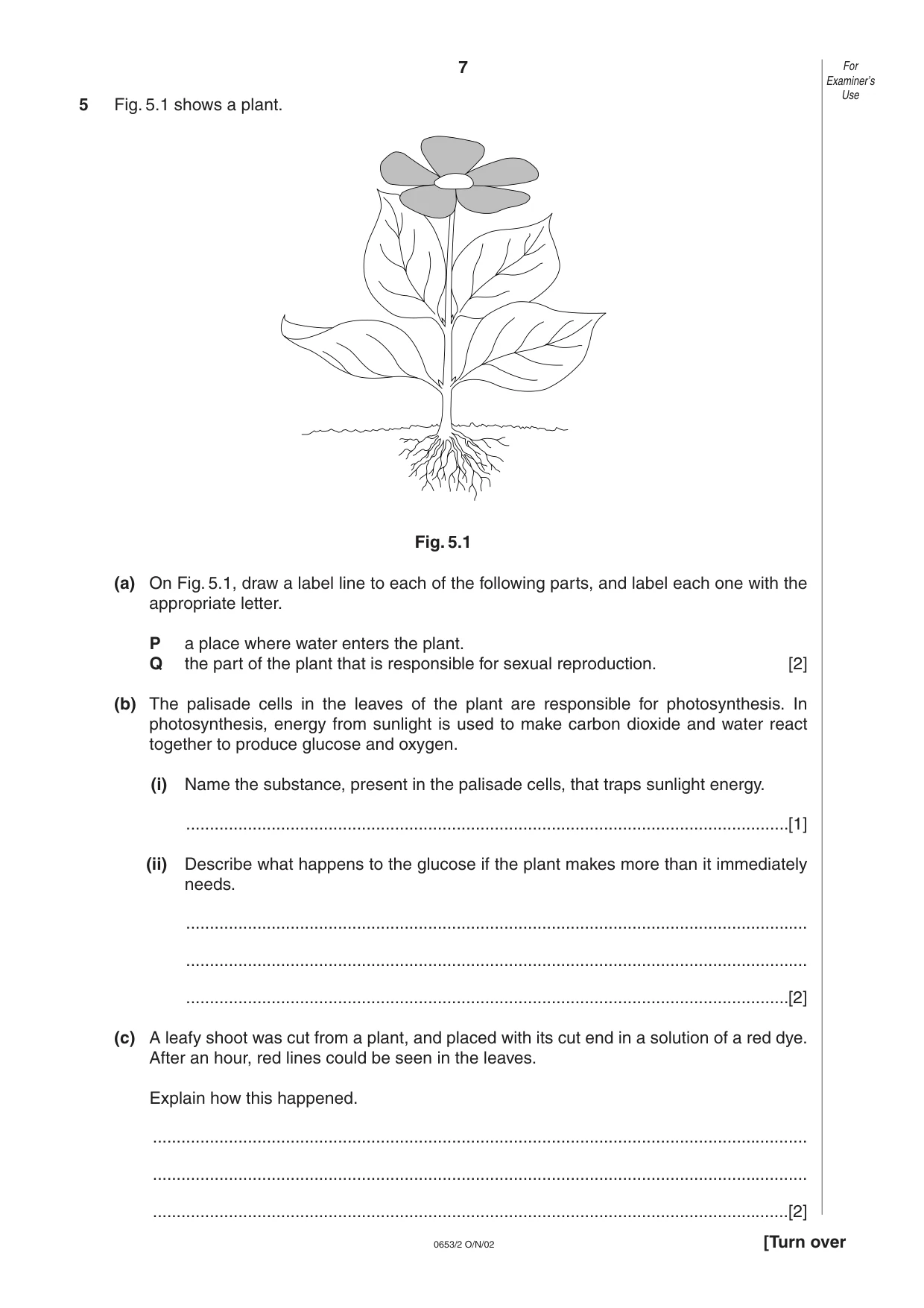
7 0653/2 O/N/02 [Turn over 5 Fig. 5.1 shows a plant. Fig. 5.1 (a) On Fig. 5.1, draw a label line to each of the following parts, and label each one with the appropriate letter. P a place where water enters the plant. Q the part of the plant that is responsible for sexual reproduction. [2] (b) The palisade cells in the leaves of the plant are responsible for photosynthesis. In photosynthesis, energy from sunlight is used to make carbon dioxide and water react together to produce glucose and oxygen. (i) Name the substance, present in the palisade cells, that traps sunlight energy. …[1] (ii) Describe what happens to the glucose if the plant makes more than it immediately needs. … … …[2] (c) A leafy shoot was cut from a plant, and placed with its cut end in a solution of a red dye. After an hour, red lines could be seen in the leaves. Explain how this happened. … … …[2] For Examiner’s Use
Question paper, page 8
8 0653/2 O/N/02 6 Poly(ethene) is a material used to make plastic articles. Poly(ethene) is made from the hydrocarbon ethene. (a) (i) Explain the meaning of the term hydrocarbon. … …[2] (ii) Explain why a molecule of poly(ethene) has a much higher mass than a molecule of ethene. … … …[2] (b) A student is heating a sample of poly(ethene) when it catches fire. She covers the burning poly(ethene) with a damp cloth. Explain why this action puts the fire out. … … …[2] For Examiner’s Use
Question paper, page 9
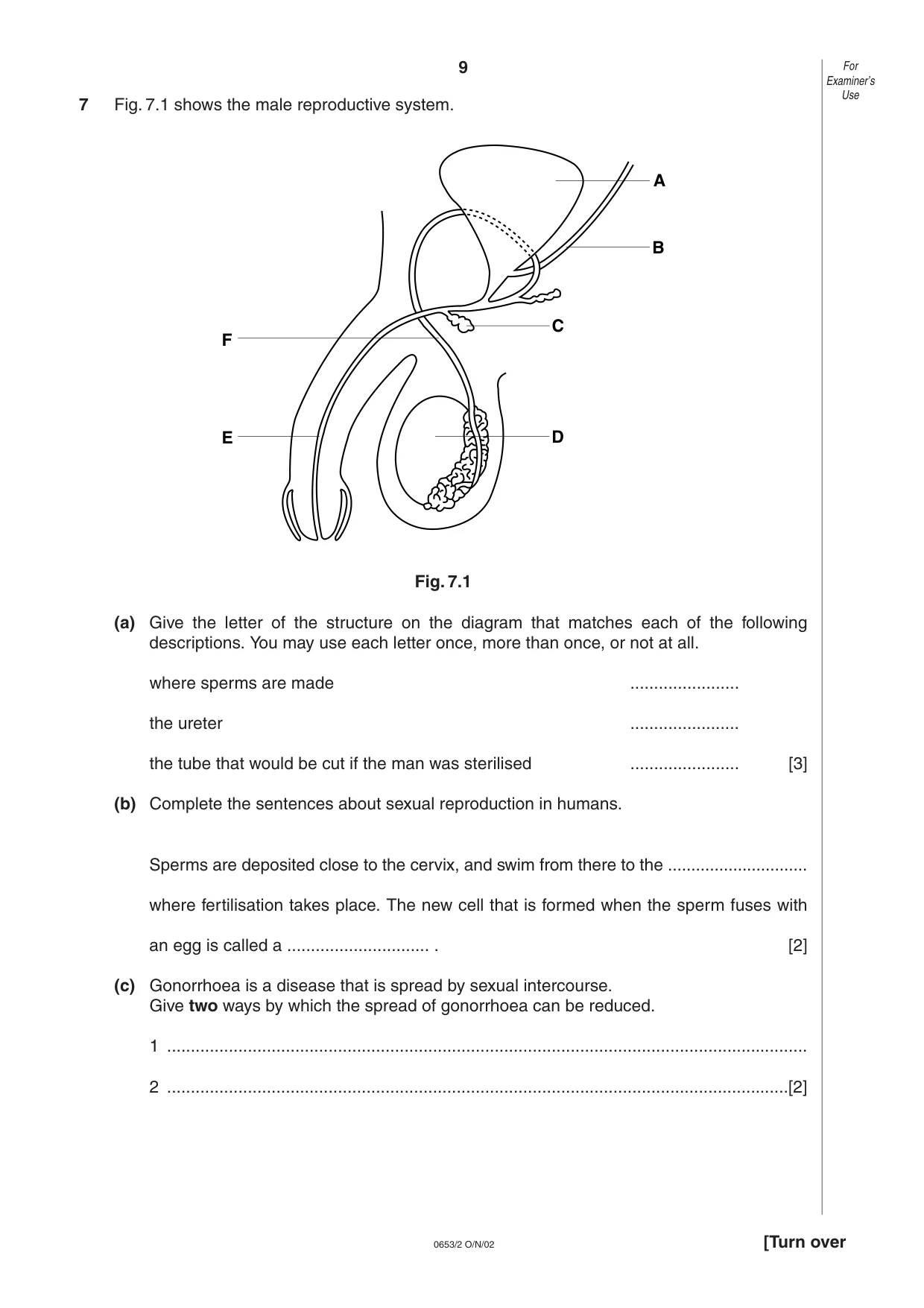
9 0653/2 O/N/02 [Turn over 7 Fig. 7.1 shows the male reproductive system. Fig. 7.1 (a) Give the letter of the structure on the diagram that matches each of the following descriptions. You may use each letter once, more than once, or not at all. where sperms are made … the ureter … the tube that would be cut if the man was sterilised … [3] (b) Complete the sentences about sexual reproduction in humans. Sperms are deposited close to the cervix, and swim from there to the … where fertilisation takes place. The new cell that is formed when the sperm fuses with an egg is called a … . [2] (c) Gonorrhoea is a disease that is spread by sexual intercourse. Give two ways by which the spread of gonorrhoea can be reduced. 1 … 2 …[2] A B C D E F For Examiner’s Use
Question paper, page 10
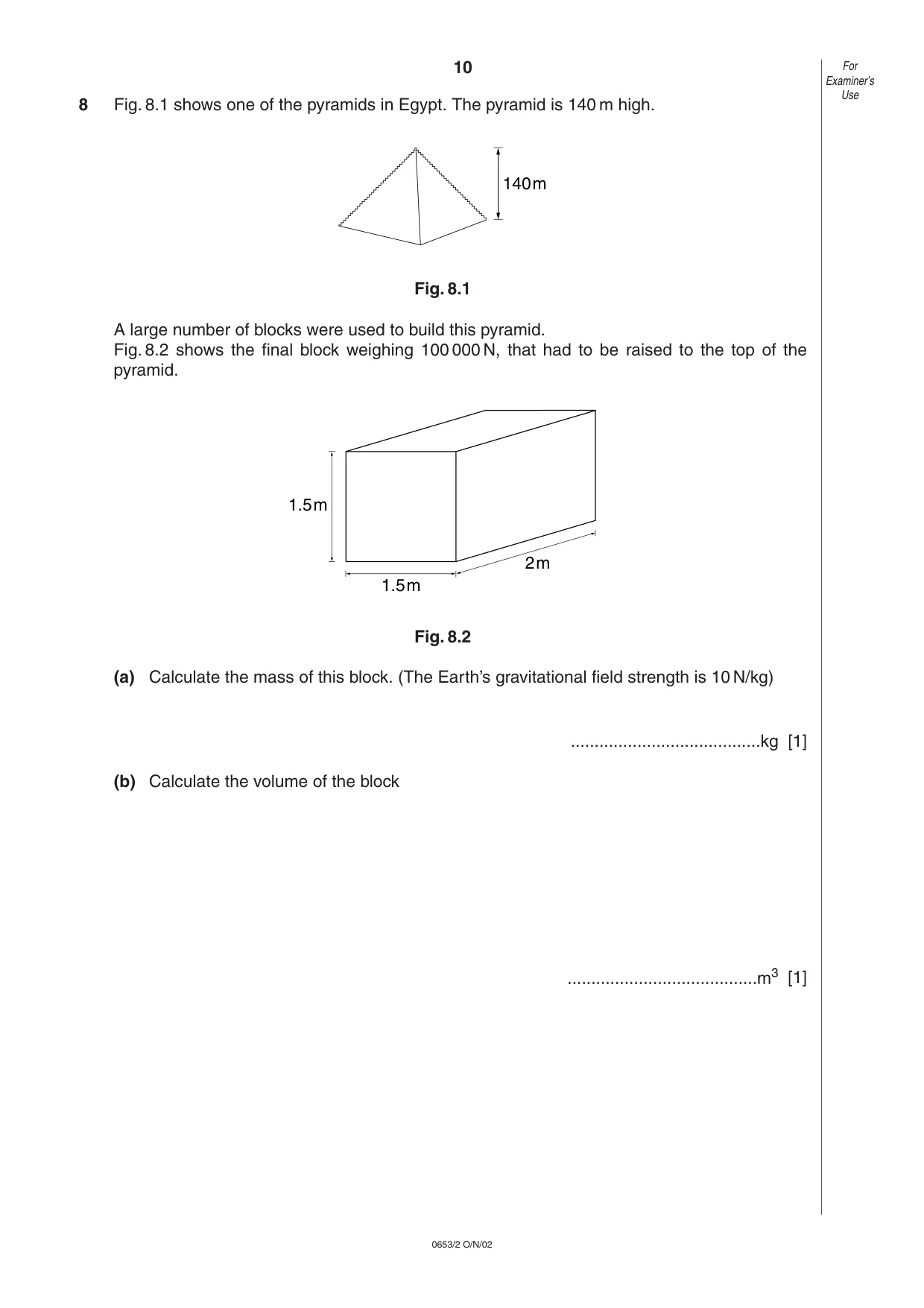
10 0653/2 O/N/02 8 Fig. 8.1 shows one of the pyramids in Egypt. The pyramid is 140 m high. Fig. 8.1 A large number of blocks were used to build this pyramid. Fig. 8.2 shows the final block weighing 100 000 N, that had to be raised to the top of the pyramid. Fig. 8.2 (a) Calculate the mass of this block. (The Earth’s gravitational field strength is 10 N/kg) …kg [1] (b) Calculate the volume of the block …m3 [1] 1.5m 1.5m 2m 140m For Examiner’s Use
Question paper, page 11
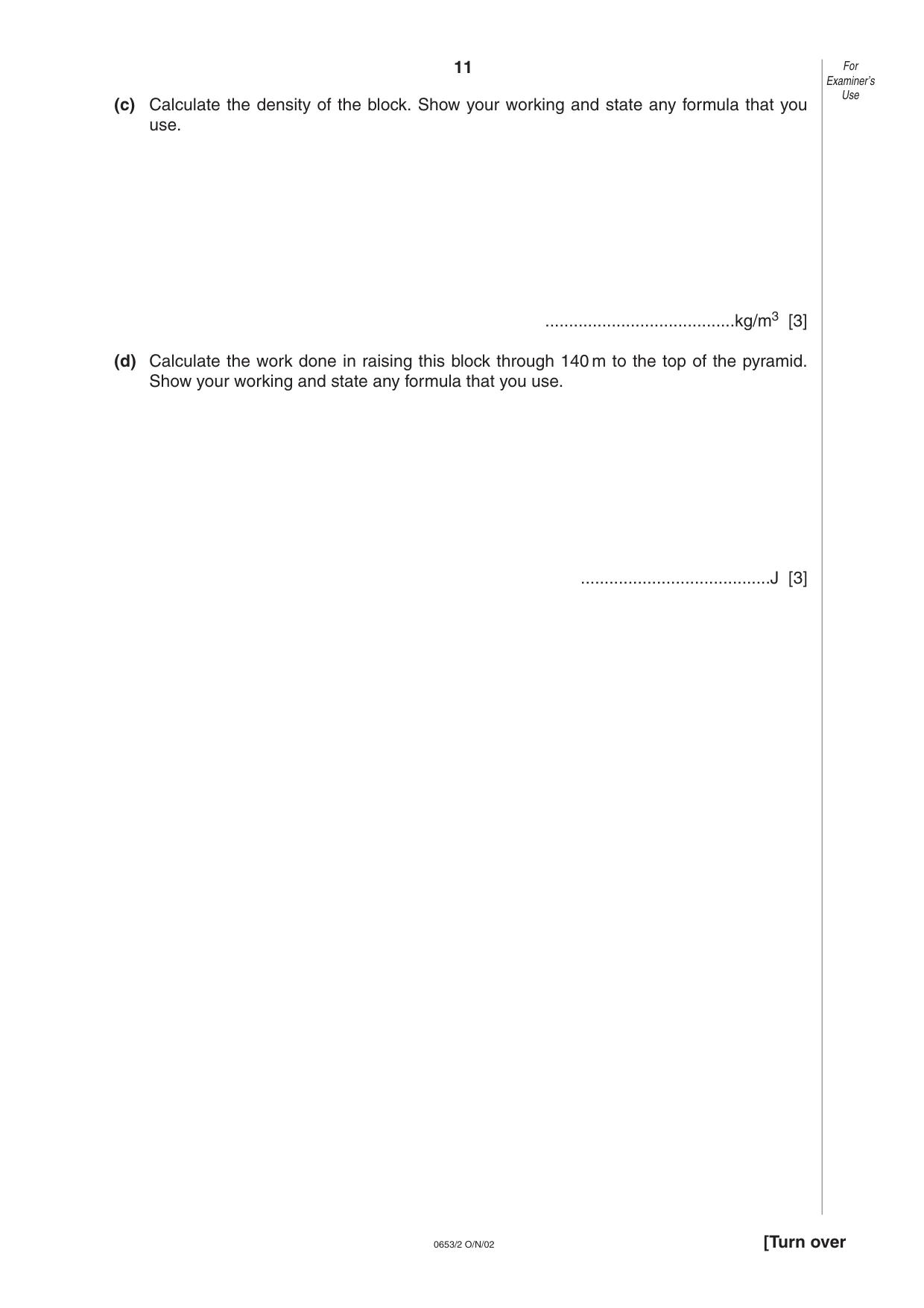
11 0653/2 O/N/02 [Turn over (c) Calculate the density of the block. Show your working and state any formula that you use. …kg/m3 [3] (d) Calculate the work done in raising this block through 140 m to the top of the pyramid. Show your working and state any formula that you use. …J [3] For Examiner’s Use
Question paper, page 12
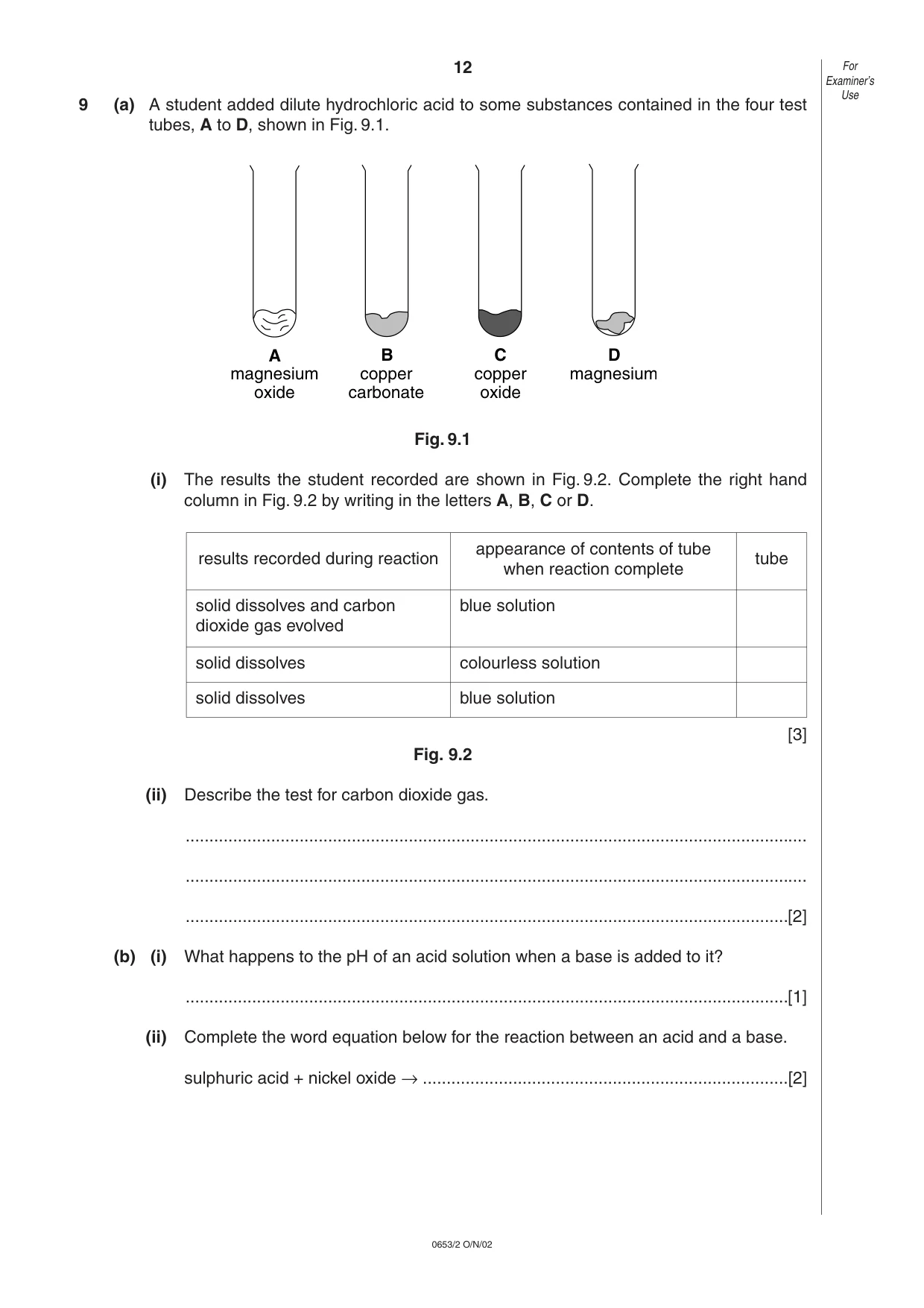
12 0653/2 O/N/02 9 (a) A student added dilute hydrochloric acid to some substances contained in the four test tubes, A to D, shown in Fig. 9.1. Fig. 9.1 (i) The results the student recorded are shown in Fig. 9.2. Complete the right hand column in Fig. 9.2 by writing in the letters A, B, C or D. [3] Fig. 9.2 (ii) Describe the test for carbon dioxide gas. … … …[2] (b) (i) What happens to the pH of an acid solution when a base is added to it? …[1] (ii) Complete the word equation below for the reaction between an acid and a base. sulphuric acid + nickel oxide →…[2] D A B C magnesium oxide copper carbonate copper oxide magnesium For Examiner’s Use results recorded during reaction solid dissolves and carbon dioxide gas evolved solid dissolves solid dissolves blue solution colourless solution blue solution appearance of contents of tube when reaction complete tube
Question paper, page 16
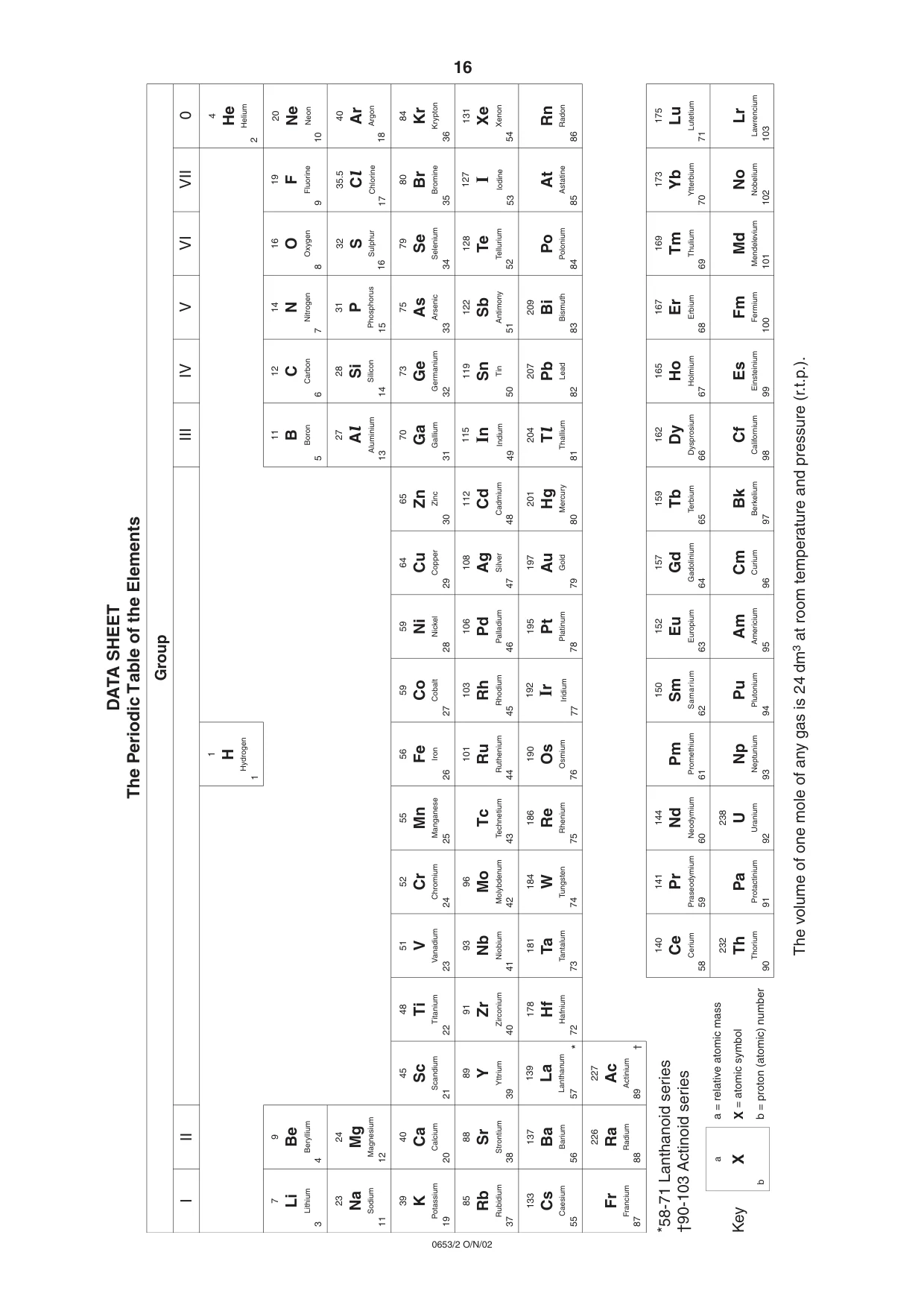
16 0653/2 O/N/02 Group DATA SHEET The Periodic Table of the Elements 140 Ce Cerium 58 141 Pr Praseodymium 59 144 Nd Neodymium 60 Pm Promethium 61 150 Sm Samarium 62 152 Eu Europium 63 157 Gd Gadolinium 64 159 Tb Terbium 65 162 Dy Dysprosium 66 165 Ho Holmium 67 167 Er Erbium 68 169 Tm Thulium 69 173 Yb Ytterbium 70 175 Lu Lutetium 71 232 Th Thorium 90 Pa Protactinium 91 238 U Uranium 92 Np Neptunium 93 Pu Plutonium 94 Am Americium 95 Cm Curium 96 Bk Berkelium 97 Cf Californium 98 Es Einsteinium 99 Fm Fermium 100 Md Mendelevium 101 No Nobelium 102 Lr Lawrencium 103 1 H Hydrogen 1 7 Li Lithium 3 23 Na Sodium 11 24 Mg Magnesium 12 40 Ca Calcium 20 45 Sc Scandium 21 48 Ti Titanium 22 51 V Vanadium 23 52 Cr Chromium 24 55 Mn Manganese 25 56 Fe Iron 26 59 Co Cobalt 27 59 Ni Nickel 28 64 Cu Copper 29 65 Zn Zinc 30 70 Ga Gallium 31 27 Al Aluminium 13 11 B Boron 5 12 C Carbon 6 14 N Nitrogen 7 16 O Oxygen 8 19 F Fluorine 9 28 Si Silicon 14 31 P Phosphorus 15 32 S Sulphur 16 35.5 Cl Chlorine 17 40 Ar Argon 18 20 Ne Neon 10 4 He Helium 2 73 Ge Germanium 32 75 As Arsenic 33 79 Se Selenium 34 80 Br Bromine 35 84 Kr Krypton 36 39 K Potassium 19 88 Sr Strontium 38 89 Y Yttrium 39 91 Zr Zirconium 40 93 Nb Niobium 41 96 Mo Molybdenum 42 Tc Technetium 43 101 Ru Ruthenium 44 103 Rh Rhodium 45 106 Pd Palladium 46 108 Ag Silver 47 112 Cd Cadmium 48 115 In Indium 49 119 Sn Tin 50 122 Sb Antimony 51 128 Te Tellurium 52 127 I Iodine 53 131 Xe Xenon 54 137 Ba Barium 56 139 La Lanthanum 57 * 178 Hf Hafnium 72 181 Ta Tantalum 73 184 W Tungsten 74 186 Re Rhenium 75 190 Os Osmium 76 192 Ir Iridium 77 195 Pt Platinum 78 197 Au Gold 79 201 Hg Mercury 80 204 Tl Thallium 81 207 Pb Lead 82 209 Bi Bismuth 83 Po Polonium 84 At Astatine 85 Rn Radon 86 Fr Francium 87 227 Ac Actinium 89 † 9 Be Beryllium 4 I II III IV V VI VII 0 85 Rb Rubidium 37 133 Cs Caesium 55 226 Ra Radium 88 The volume of one mole of any gas is 24 dm3 at room temperature and pressure (r.t.p.). a X b a = relative atomic mass X = atomic symbol b = proton (atomic) number Key *58-71 Lanthanoid series †90-103 Actinoid series
Mark scheme, page 1
CAMBRIDGE INTERNATIONAL EXAMINATIONS NOVEMBER 2002 INTERNATIONAL GCSE UNIVERSITY of CAMBRIDGE Local Examinations Syndicate
Mark scheme, page 2
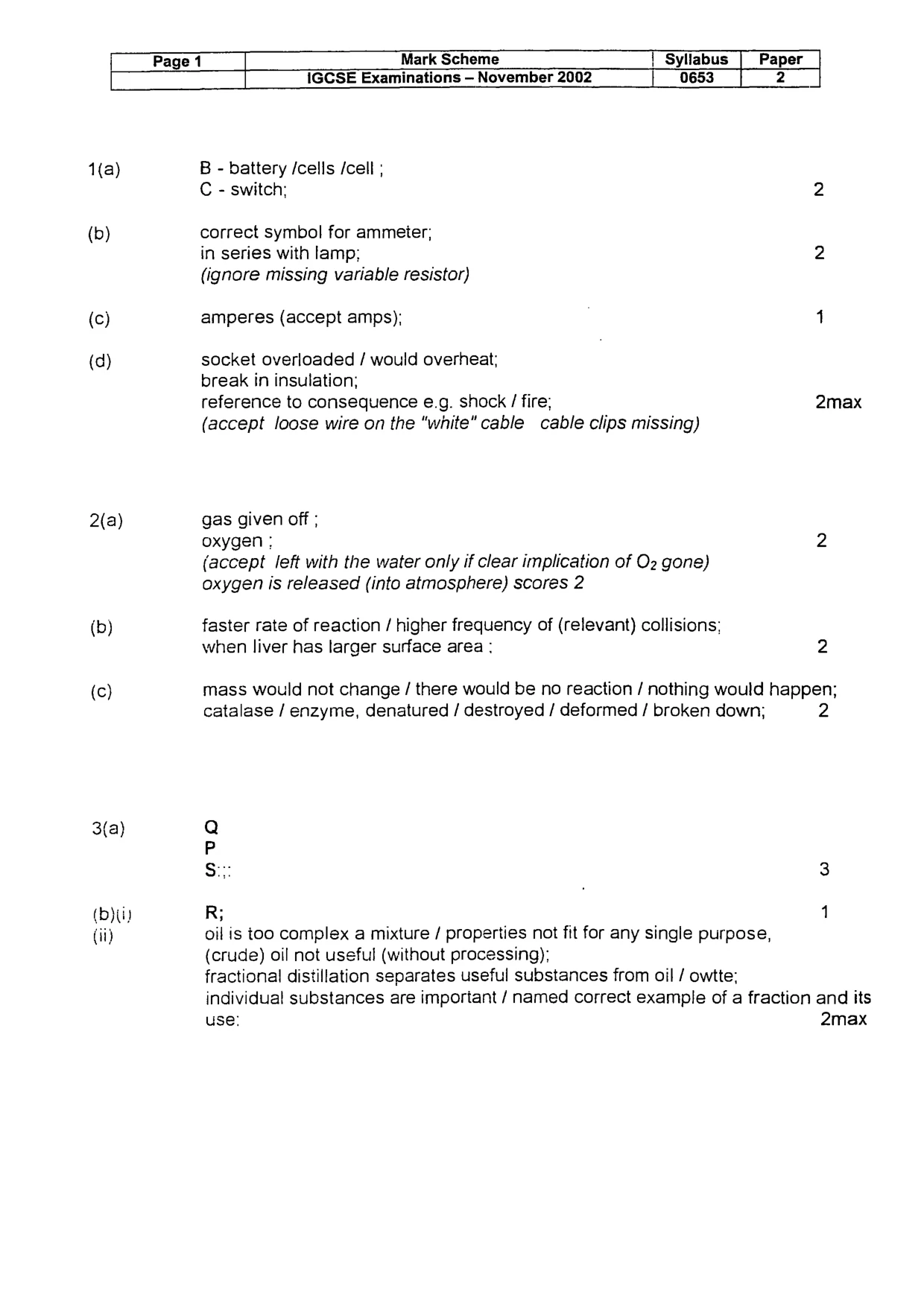
Page 1 Mark Scheme | Syllabus Paper 1 IGCSE Examinations —- November 2002 [__ 0653 2 | 1(a) (b) (c) (d) 2(a) (b) (c) (by) (ii) B - battery /cells /cell ; C - switch; 2 correct symbol for ammeter; in series with lamp; 2 (ignore missing variable resistor) amperes (accept amps); 1 socket overloaded / would overheat; break in insulation; reference to consequence e.g. shock / fire; 2max (accept loose wire on the "white" cable cable clips missing) gas given off ; oxygen ; 2 (accept left with the water only if clear implication of O2 gone) oxygen is released (into atmosphere) scores 2 faster rate of reaction / higher frequency of (relevant) collisions; when liver has larger surface area : 2 mass would not change / there would be no reaction / nothing would happen; catalase / enzyme, denatured / destroyed / deformed / broken down; 2 Q P Ss: 3 R; 41 oil is too complex a mixture / properties not fit for any single purpose, (crude) oil not useful (without processing): fractional distillation separates useful substances from oil / owtte; individua! substances are important / named correct example of a fraction and its use: 2max
Mark scheme, page 3
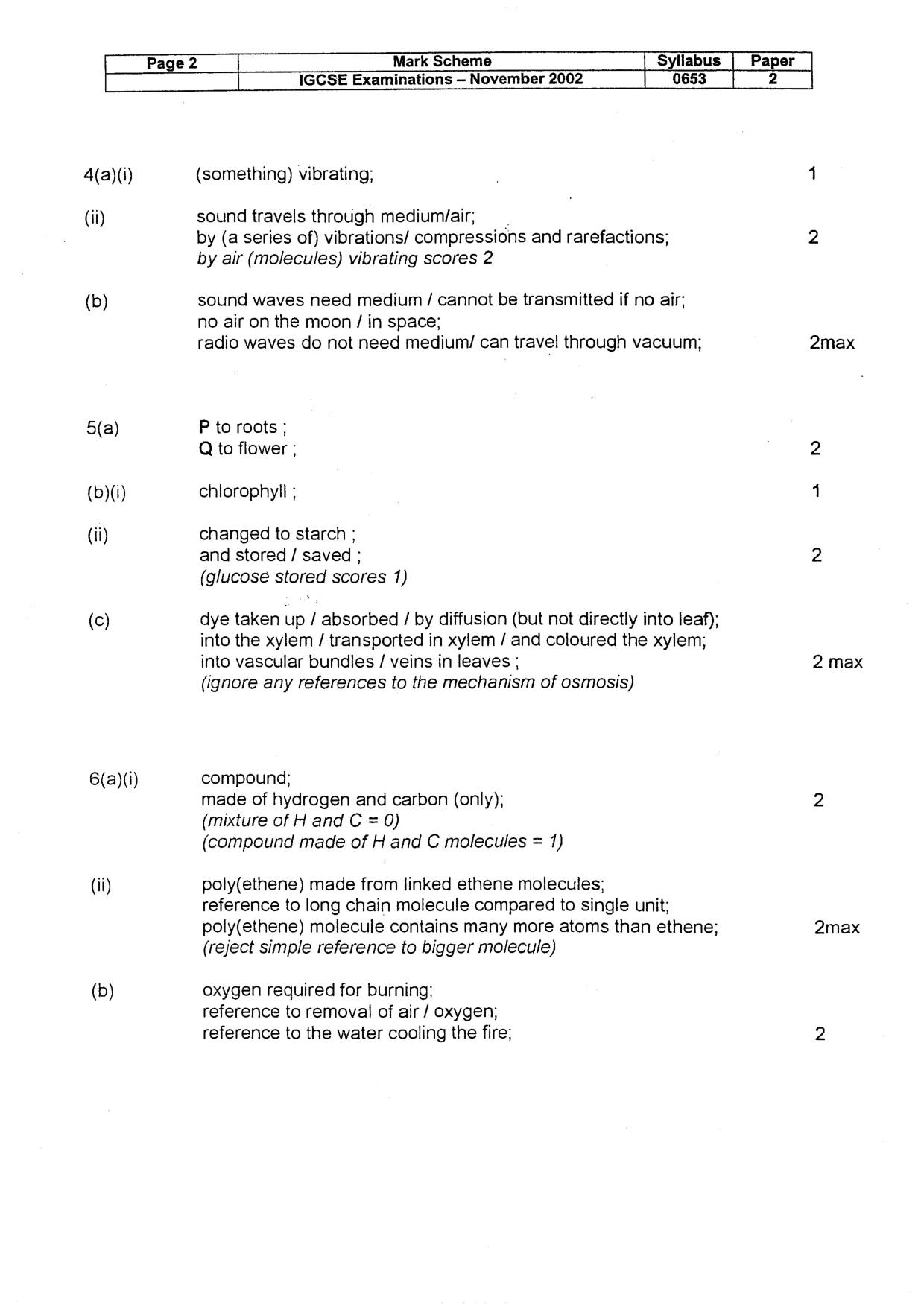
Page 2 Mark Scheme Syllabus IGCSE Examinations — November 2002 0653 Paper 2 (ii) (something) vibrating; sound travels through medium/air, by (a series of) vibrations/ compressions and rarefactions; by air (molecules) vibrating scores 2 sound waves need medium / cannot be transmitted if no air; no air on the moon / in space; radio waves do not need medium/ can travel through vacuum; P to roots ; Q to flower ; chlorophyll ; changed to starch ; and stored / saved ; (glucose stored scores 1) dye taken up / absorbed / by diffusion (but not directly into leaf); into the xylem / transported in xylem / and coloured the xylem; into vascular bundles / veins in leaves ; (ignore any references to the mechanism of osmosis) compound; made of hydrogen and carbon (only); (mixture of H and C = 0) (compound made of H and C molecules = 1) poly(ethene) made from linked ethene molecules; reference to long chain molecule compared to single unit; poly(ethene) molecule contains many more atoms than ethene; (reject simple reference to bigger molecule) oxygen required for burning; reference to removal of air / oxygen; reference to the water cooling the fire; 2max 2 max 2max
Mark scheme, page 4
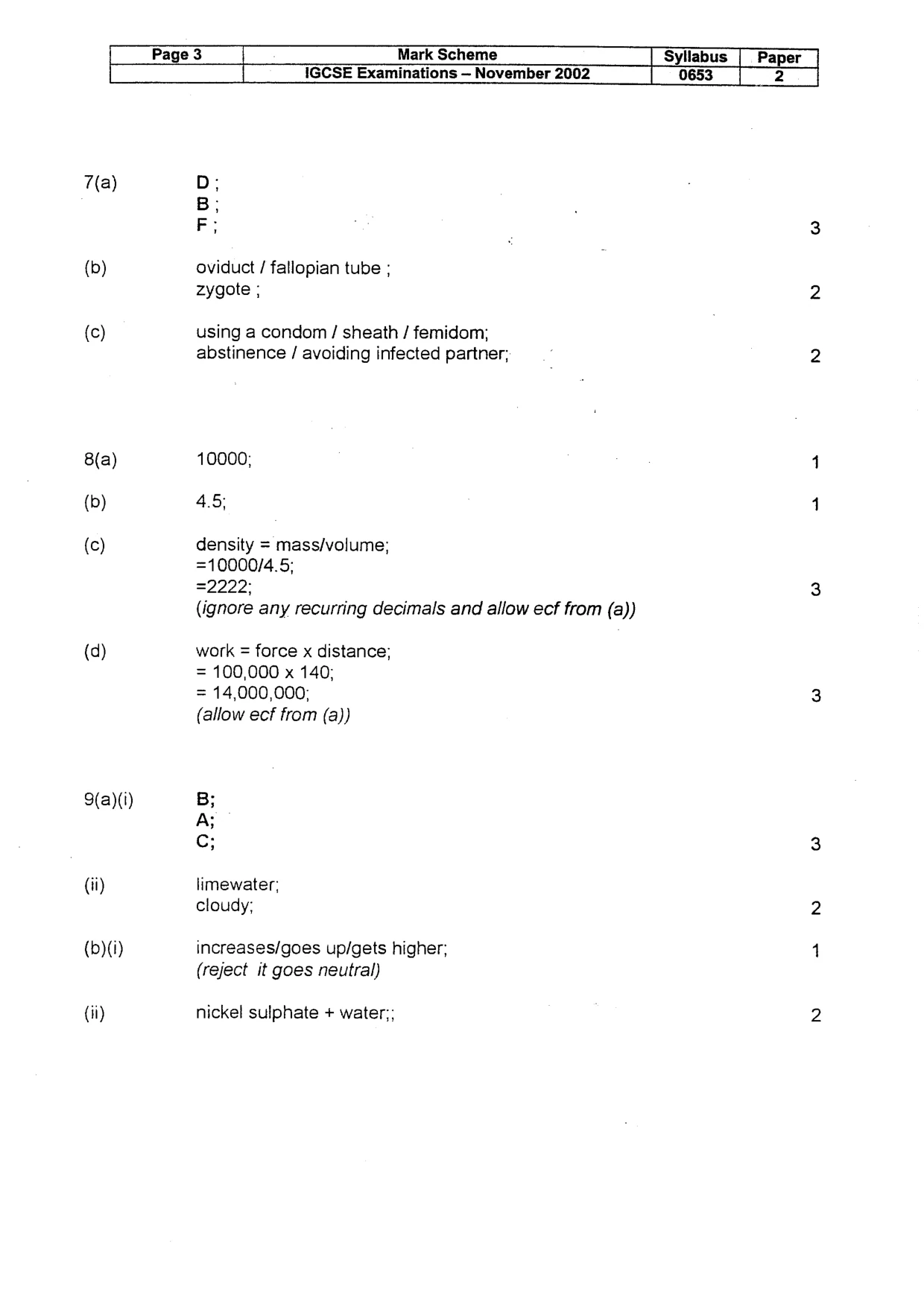
Page 3 Mark Scheme IGCSE Examinations — November 2002 7(a) (b) (c) (ii) (b)(i) (ii) D; B; F; oviduct / fallopian tube ; zygote ; using a condom / sheath / femidom; abstinence / avoiding infected partner; 10000; 4.5: density = mass/volume; =10000/4.5; =2222; (ignore any recurring decimals and allow ecf from (a)) work = force x distance; = 100,000 x 140; = 14,000,000; (allow ecf from (a)) limewater; cloudy; increases/goes up/gets higher; (reject it goes neutral) nickel sulphate + water;;