Cambridge IGCSE Science - Combined 0653 — 2002 Oct/Nov Paper 1 · Variant 1
0653/11/O/N/02
The question paper and its mark scheme, free to read here and free to download. This is Cambridge’s own paper, exactly as it was sat.
Question paper20 pages



Mark scheme
No mark scheme is in the library for this paper.
Paper as text
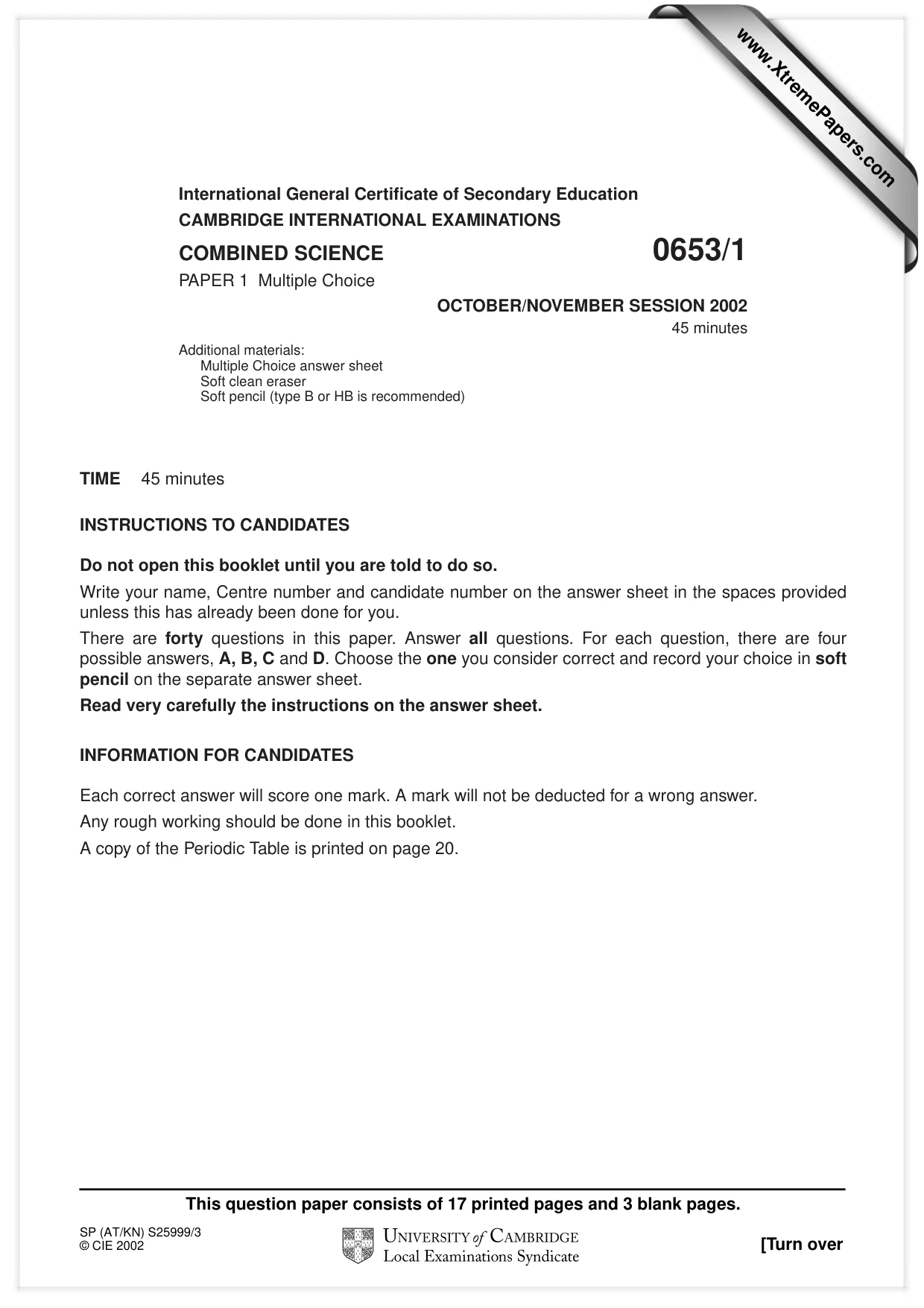
Question paper, page 1
TIME 45 minutes INSTRUCTIONS TO CANDIDATES Do not open this booklet until you are told to do so. Write your name, Centre number and candidate number on the answer sheet in the spaces provided unless this has already been done for you. There are forty questions in this paper. Answer all questions. For each question, there are four possible answers, A, B, C and D. Choose the one you consider correct and record your choice in soft pencil on the separate answer sheet. Read very carefully the instructions on the answer sheet. INFORMATION FOR CANDIDATES Each correct answer will score one mark. A mark will not be deducted for a wrong answer. Any rough working should be done in this booklet. A copy of the Periodic Table is printed on page 20. International General Certificate of Secondary Education CAMBRIDGE INTERNATIONAL EXAMINATIONS COMBINED SCIENCE 0653/1 PAPER 1 Multiple Choice OCTOBER/NOVEMBER SESSION 2002 45 minutes Additional materials: Multiple Choice answer sheet Soft clean eraser Soft pencil (type B or HB is recommended) This question paper consists of 17 printed pages and 3 blank pages. SP (AT/KN) S25999/3 © CIE 2002 [Turn over www.XtremePapers.com
Question paper, page 2
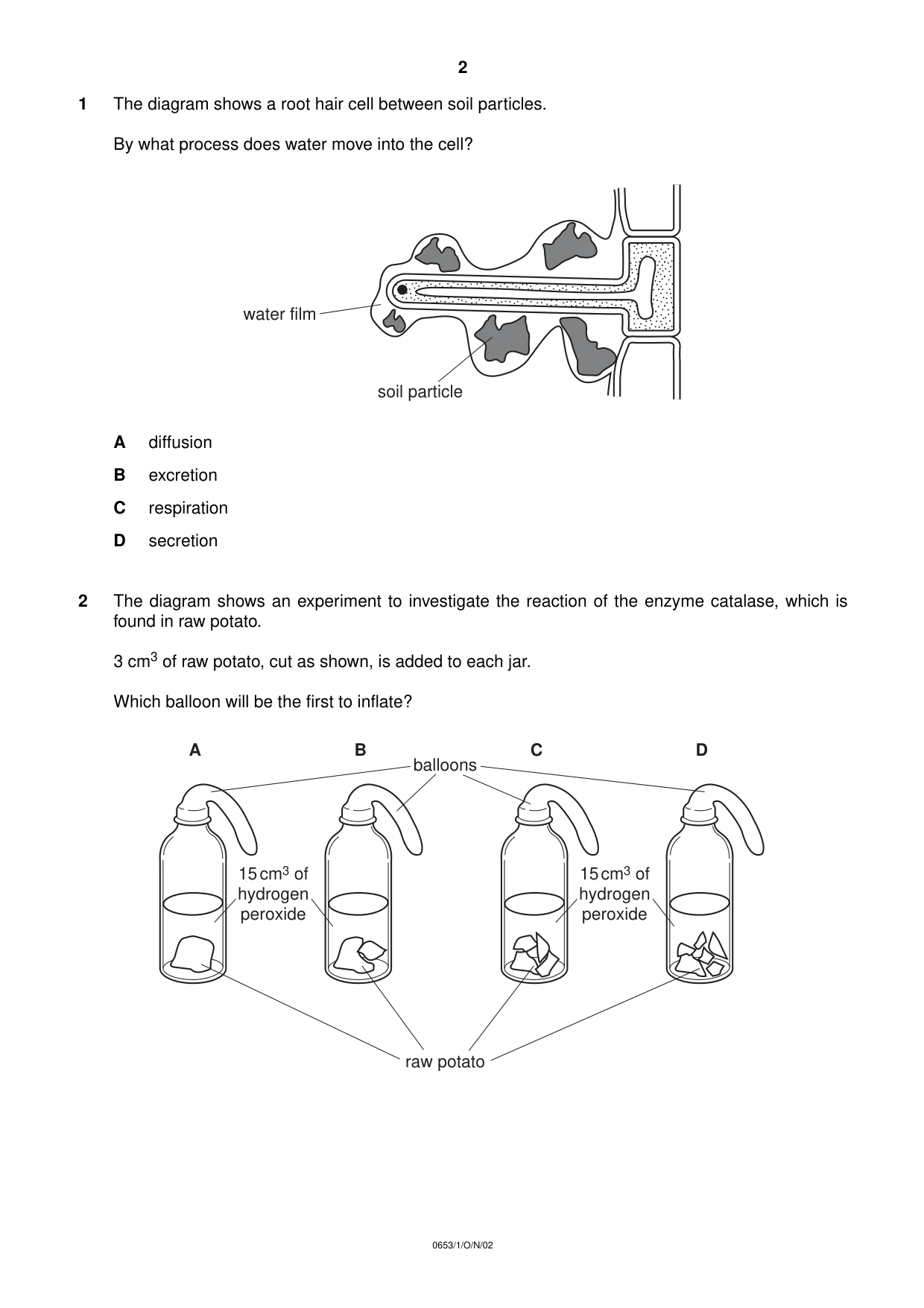
2 0653/1/O/N/02 1 The diagram shows a root hair cell between soil particles. By what process does water move into the cell? A diffusion B excretion C respiration D secretion 2 The diagram shows an experiment to investigate the reaction of the enzyme catalase, which is found in raw potato. 3 cm3 of raw potato, cut as shown, is added to each jar. Which balloon will be the first to inflate? A B 15 cm3 of hydrogen peroxide C D 15 cm3 of hydrogen peroxide raw potato balloons water film soil particle
Question paper, page 3
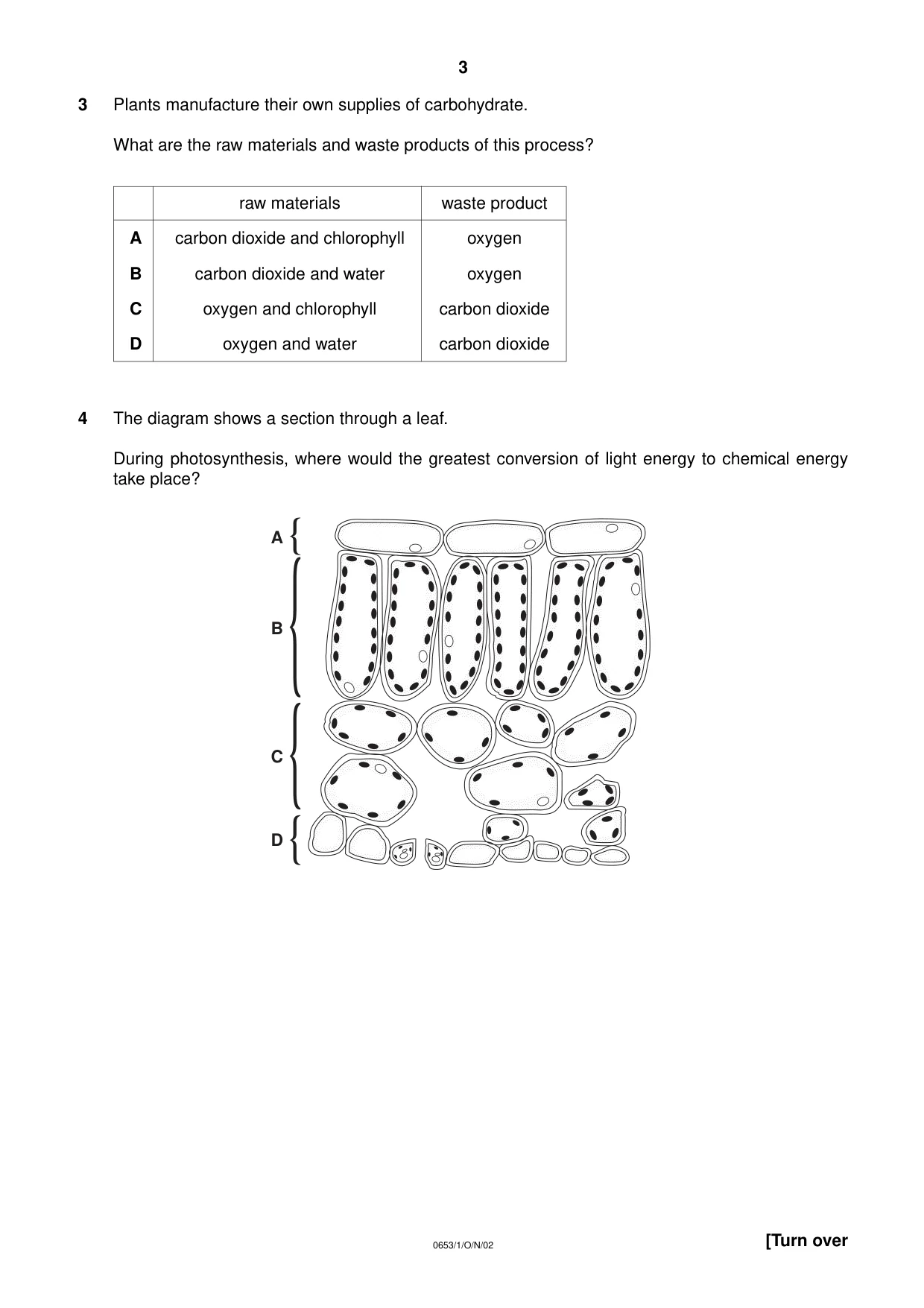
3 0653/1/O/N/02 [Turn over 3 Plants manufacture their own supplies of carbohydrate. What are the raw materials and waste products of this process? 4 The diagram shows a section through a leaf. During photosynthesis, where would the greatest conversion of light energy to chemical energy take place? A B C D raw materials waste product A carbon dioxide and chlorophyll oxygen B carbon dioxide and water oxygen C oxygen and chlorophyll carbon dioxide D oxygen and water carbon dioxide
Question paper, page 4
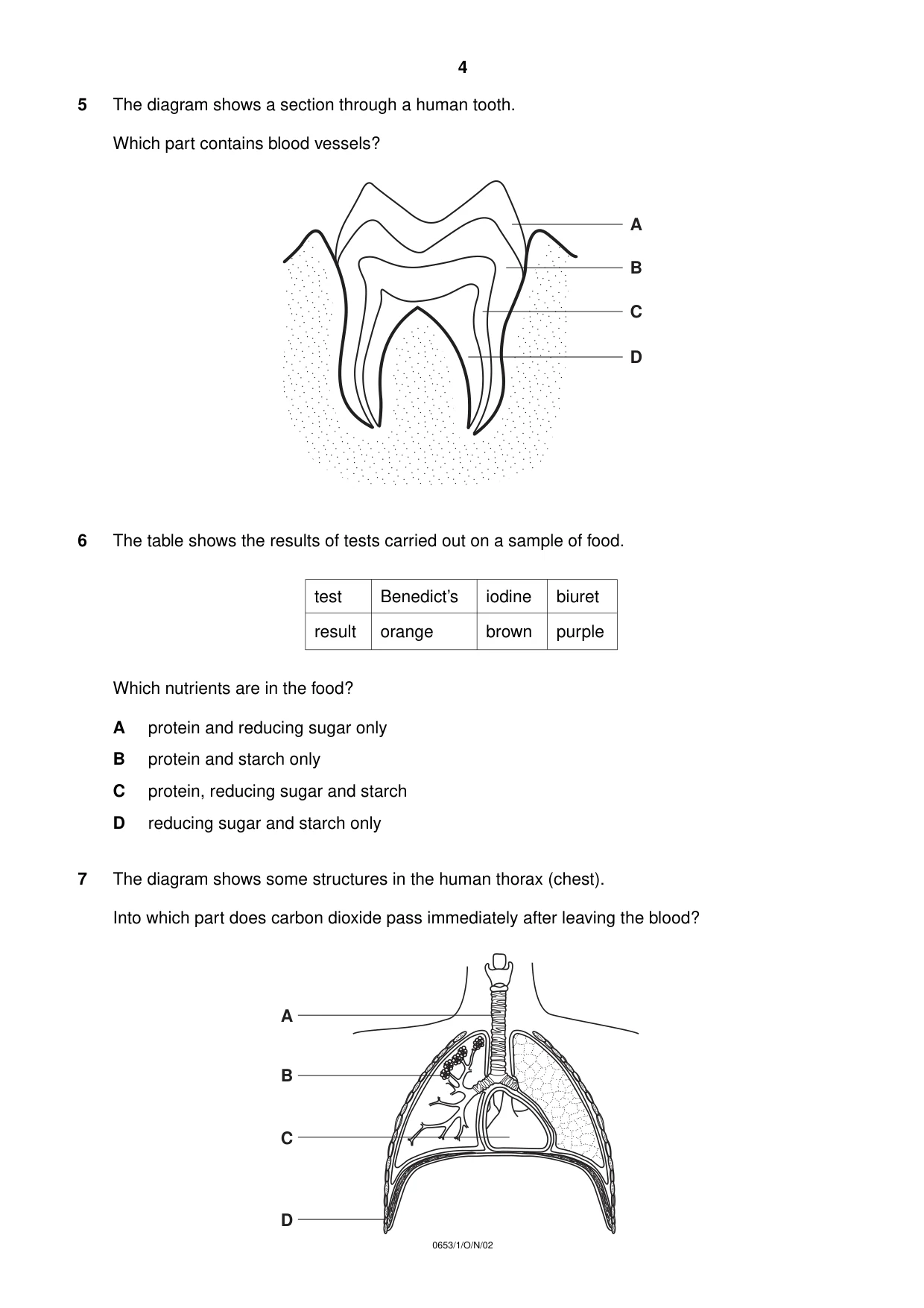
4 0653/1/O/N/02 5 The diagram shows a section through a human tooth. Which part contains blood vessels? 6 The table shows the results of tests carried out on a sample of food. Which nutrients are in the food? A protein and reducing sugar only B protein and starch only C protein, reducing sugar and starch D reducing sugar and starch only 7 The diagram shows some structures in the human thorax (chest). Into which part does carbon dioxide pass immediately after leaving the blood? A B C D A B C D test Benedict’s iodine biuret result orange brown purple
Question paper, page 5
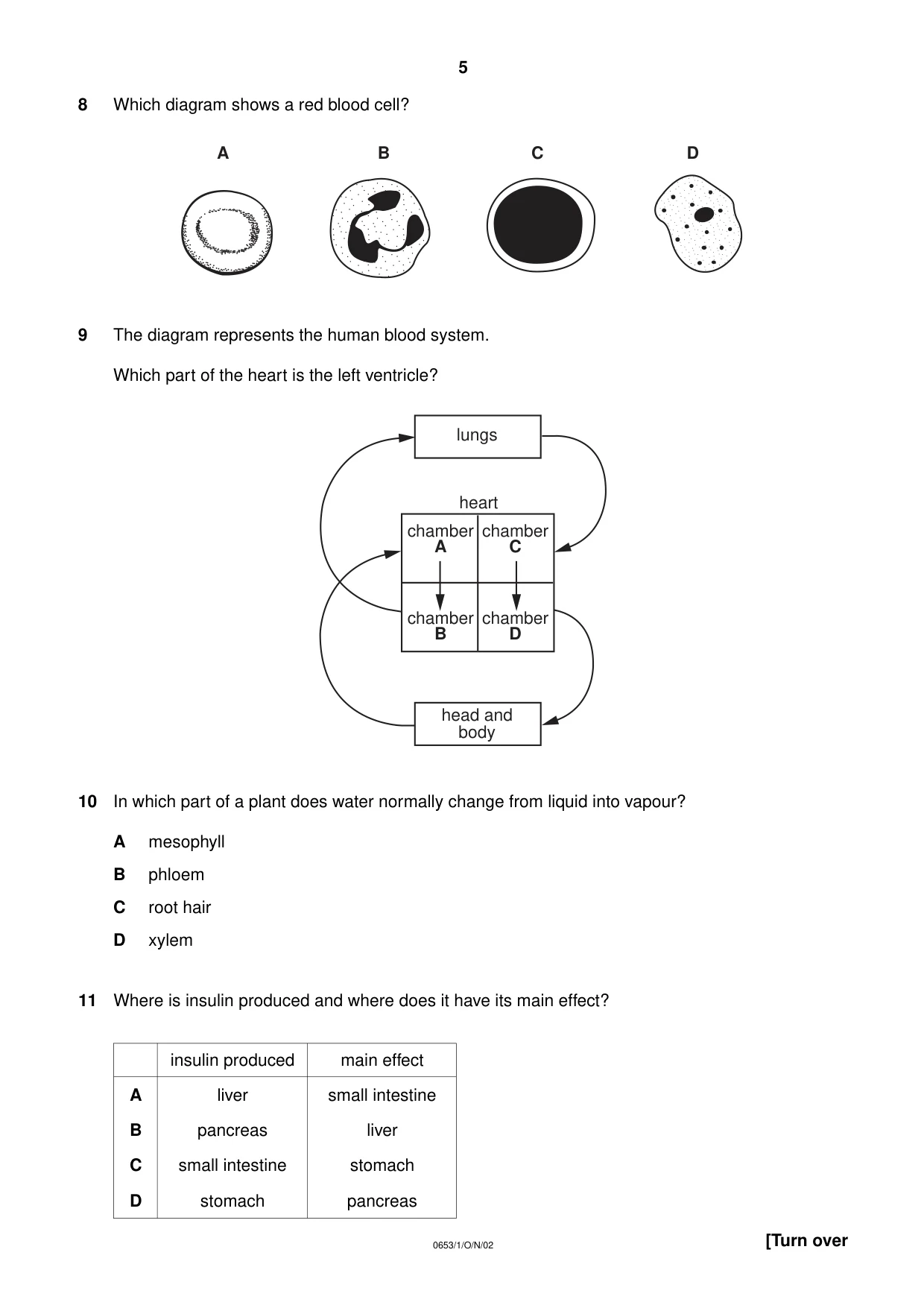
5 0653/1/O/N/02 [Turn over 8 Which diagram shows a red blood cell? 9 The diagram represents the human blood system. Which part of the heart is the left ventricle? 10 In which part of a plant does water normally change from liquid into vapour? A mesophyll B phloem C root hair D xylem 11 Where is insulin produced and where does it have its main effect? lungs head and body heart chamber A chamber C chamber B chamber D A B C D insulin produced main effect A liver small intestine B pancreas liver C small intestine stomach D stomach pancreas
Question paper, page 6
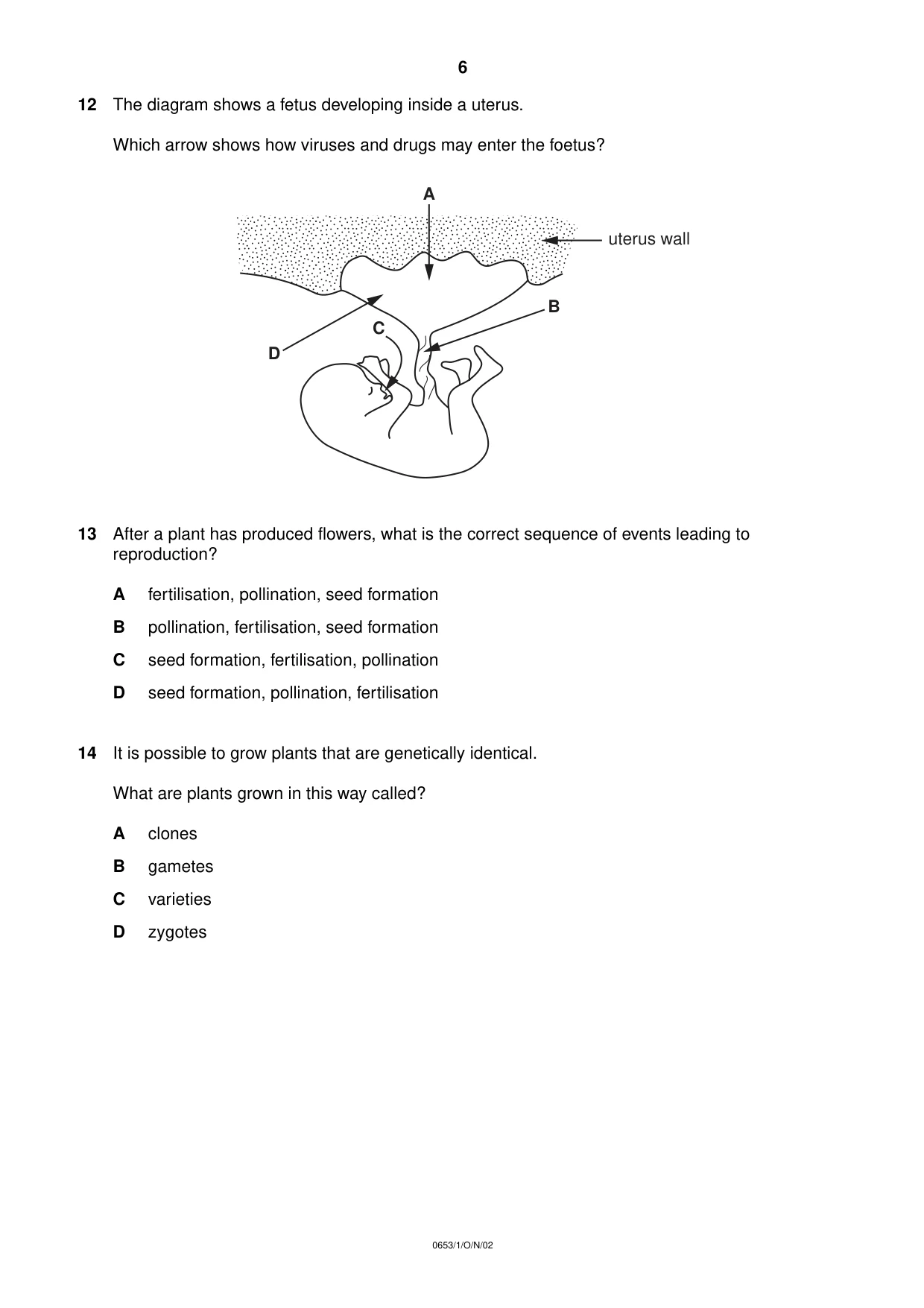
6 0653/1/O/N/02 12 The diagram shows a fetus developing inside a uterus. Which arrow shows how viruses and drugs may enter the foetus? 13 After a plant has produced flowers, what is the correct sequence of events leading to reproduction? A fertilisation, pollination, seed formation B pollination, fertilisation, seed formation C seed formation, fertilisation, pollination D seed formation, pollination, fertilisation 14 It is possible to grow plants that are genetically identical. What are plants grown in this way called? A clones B gametes C varieties D zygotes A D C B uterus wall
Question paper, page 7
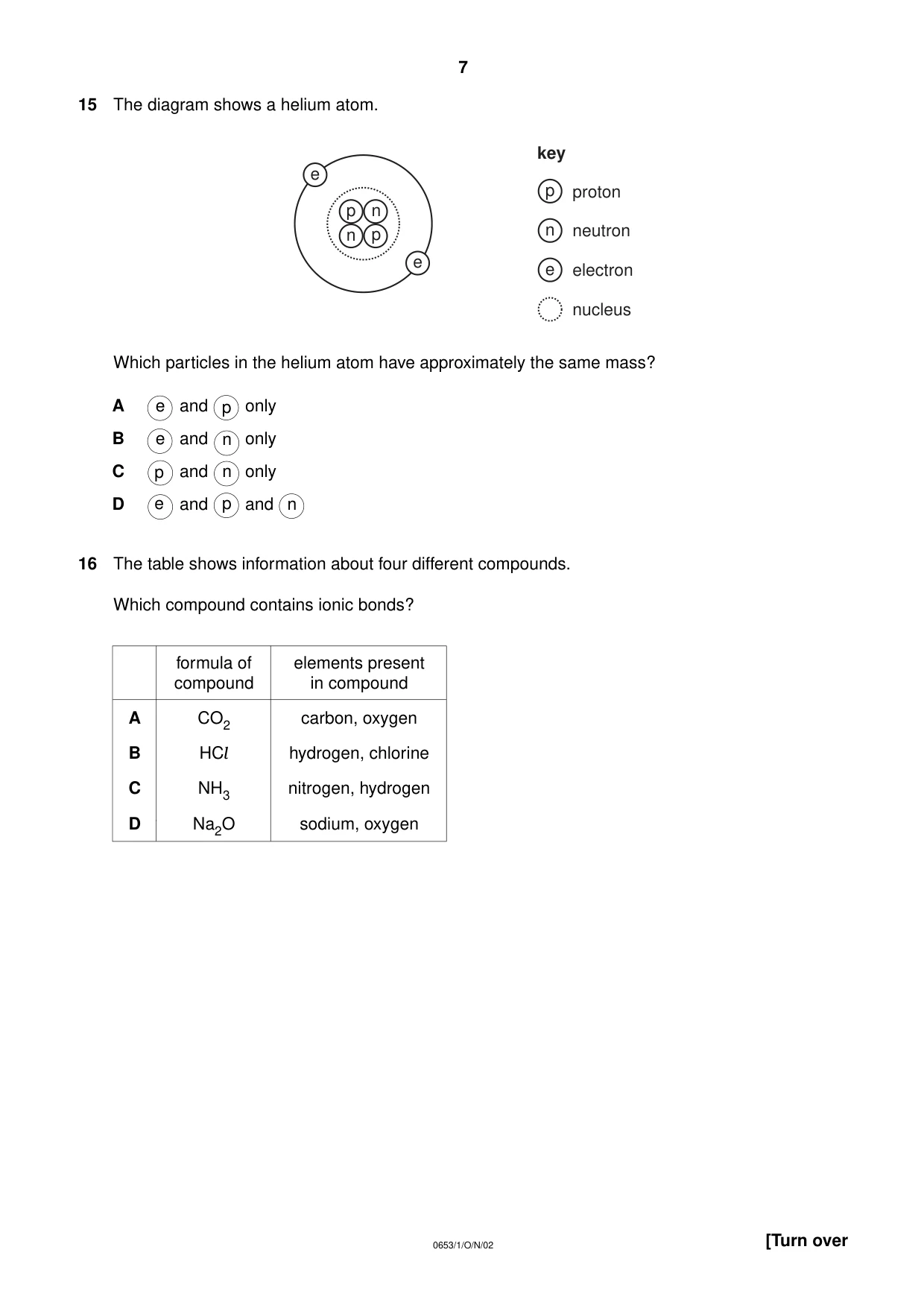
7 0653/1/O/N/02 [Turn over 15 The diagram shows a helium atom. Which particles in the helium atom have approximately the same mass? 16 The table shows information about four different compounds. Which compound contains ionic bonds? e e p p n n p key proton n neutron e electron nucleus formula of elements present compound in compound A CO2 carbon, oxygen B HCl hydrogen, chlorine C NH3 nitrogen, hydrogen D Na2O sodium, oxygen e e n n n e p p p A and only B and only C and only D and and
Question paper, page 8
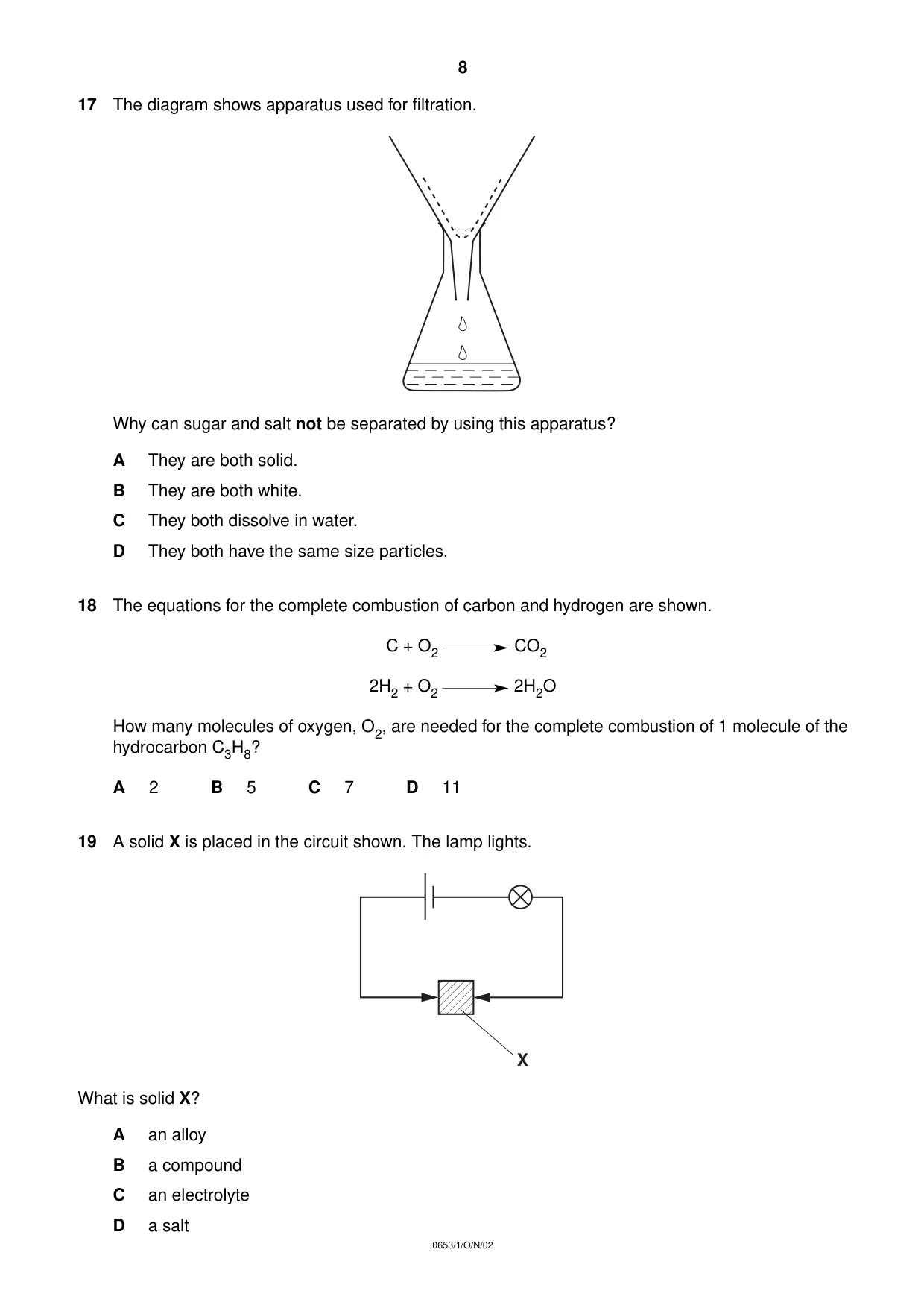
8 0653/1/O/N/02 17 The diagram shows apparatus used for filtration. Why can sugar and salt not be separated by using this apparatus? A They are both solid. B They are both white. C They both dissolve in water. D They both have the same size particles. 18 The equations for the complete combustion of carbon and hydrogen are shown. C + O2 CO2 2H2 + O2 2H2O How many molecules of oxygen, O2, are needed for the complete combustion of 1 molecule of the hydrocarbon C3H8? A 2 B 5 C 7 D 11 19 A solid X is placed in the circuit shown. The lamp lights. What is solid X? A an alloy B a compound C an electrolyte D a salt X
Question paper, page 9
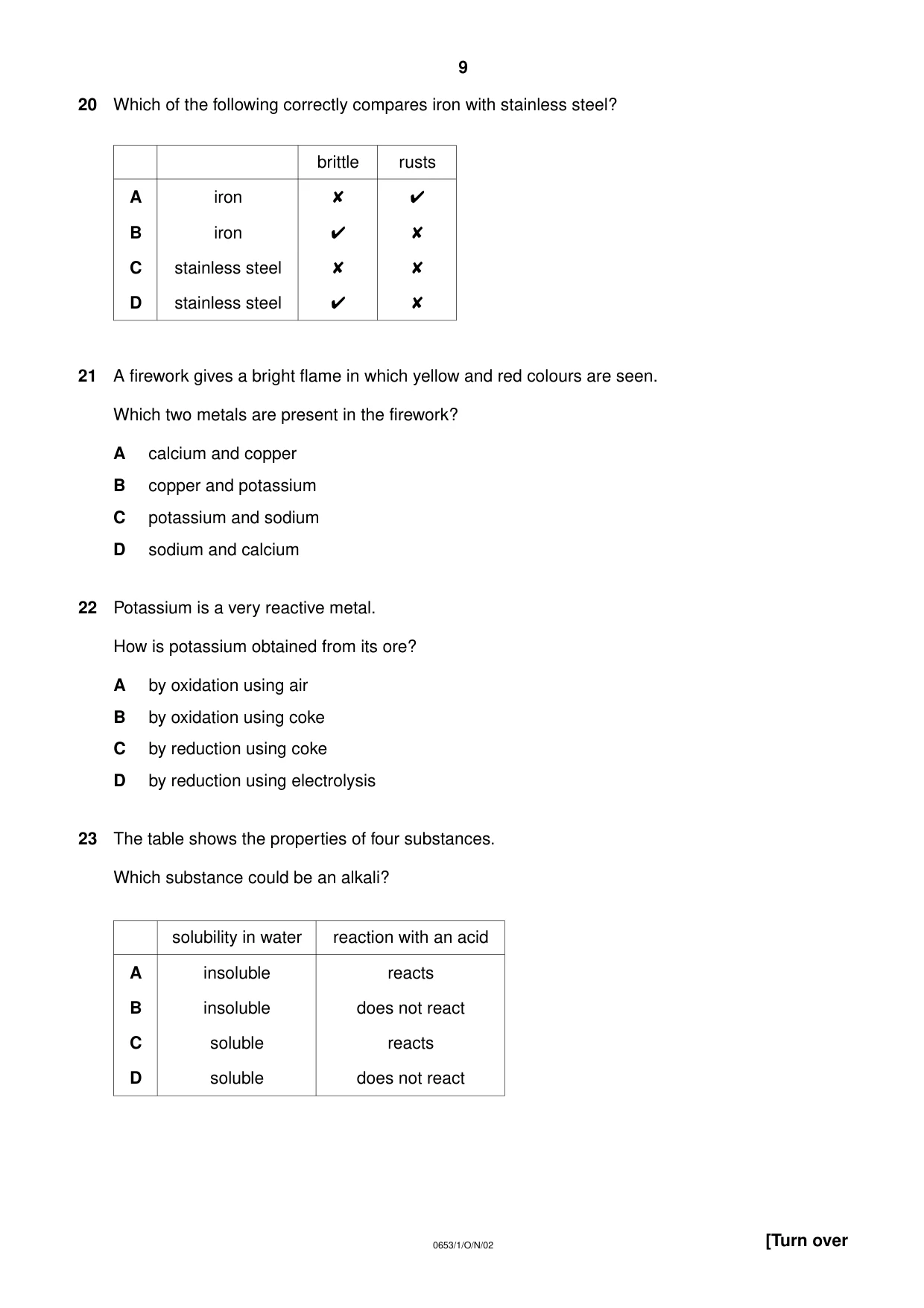
9 0653/1/O/N/02 [Turn over 20 Which of the following correctly compares iron with stainless steel? 21 A firework gives a bright flame in which yellow and red colours are seen. Which two metals are present in the firework? A calcium and copper B copper and potassium C potassium and sodium D sodium and calcium 22 Potassium is a very reactive metal. How is potassium obtained from its ore? A by oxidation using air B by oxidation using coke C by reduction using coke D by reduction using electrolysis 23 The table shows the properties of four substances. Which substance could be an alkali? brittle rusts A iron ✘ ✔ B iron ✔ ✘ C stainless steel ✘ ✘ D stainless steel ✔ ✘ solubility in water reaction with an acid A insoluble reacts B insoluble does not react C soluble reacts D soluble does not react
Question paper, page 10
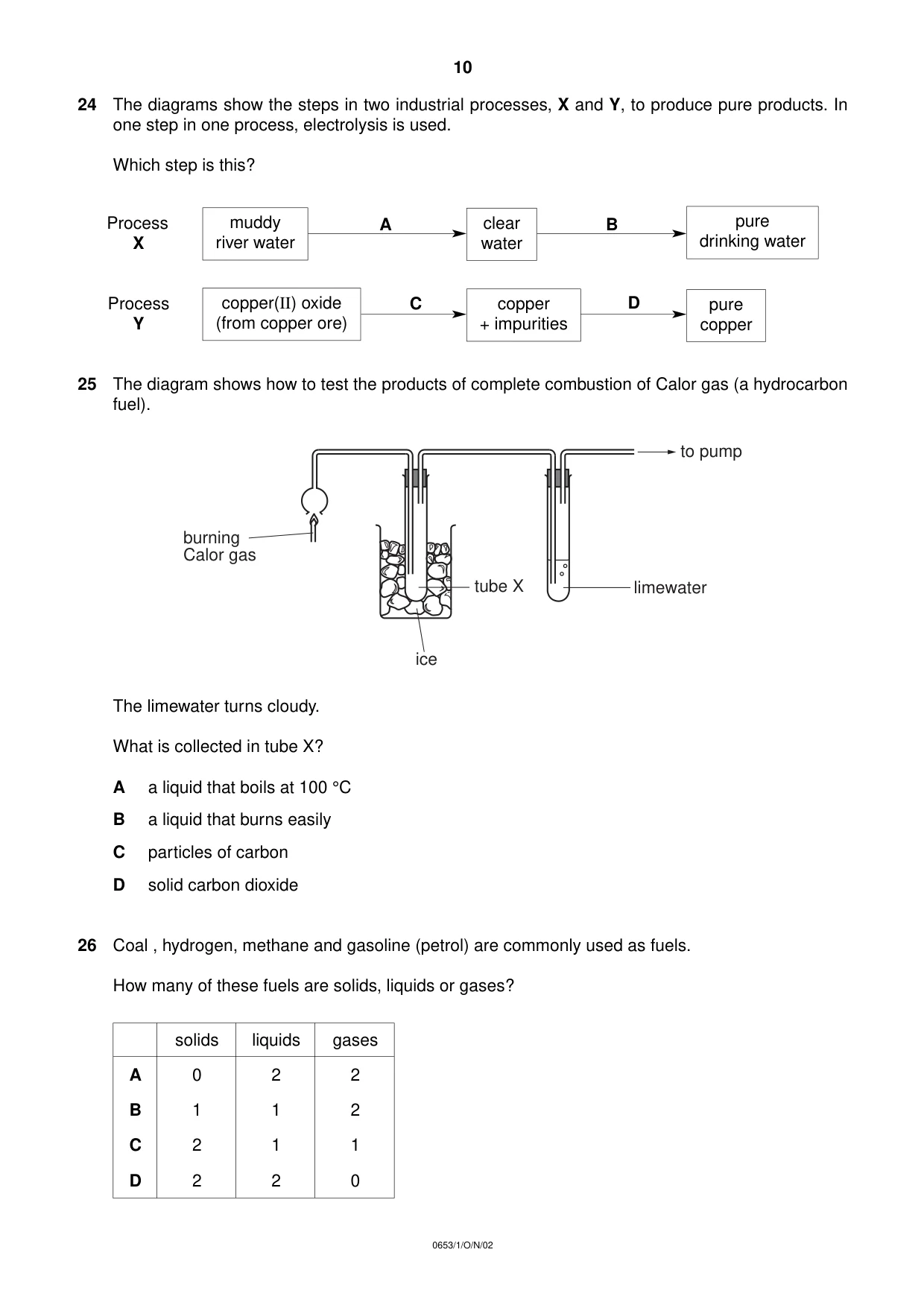
10 0653/1/O/N/02 24 The diagrams show the steps in two industrial processes, X and Y, to produce pure products. In one step in one process, electrolysis is used. Which step is this? 25 The diagram shows how to test the products of complete combustion of Calor gas (a hydrocarbon fuel). The limewater turns cloudy. What is collected in tube X? A a liquid that boils at 100 °C B a liquid that burns easily C particles of carbon D solid carbon dioxide 26 Coal , hydrogen, methane and gasoline (petrol) are commonly used as fuels. How many of these fuels are solids, liquids or gases? burning Calor gas ice tube X limewater to pump solids liquids gases A 0 2 2 B 1 1 2 C 2 1 1 D 2 2 0 Process X Process Y muddy river water copper(II) oxide (from copper ore) copper + impurities pure copper clear water pure drinking water A B C D
Question paper, page 11
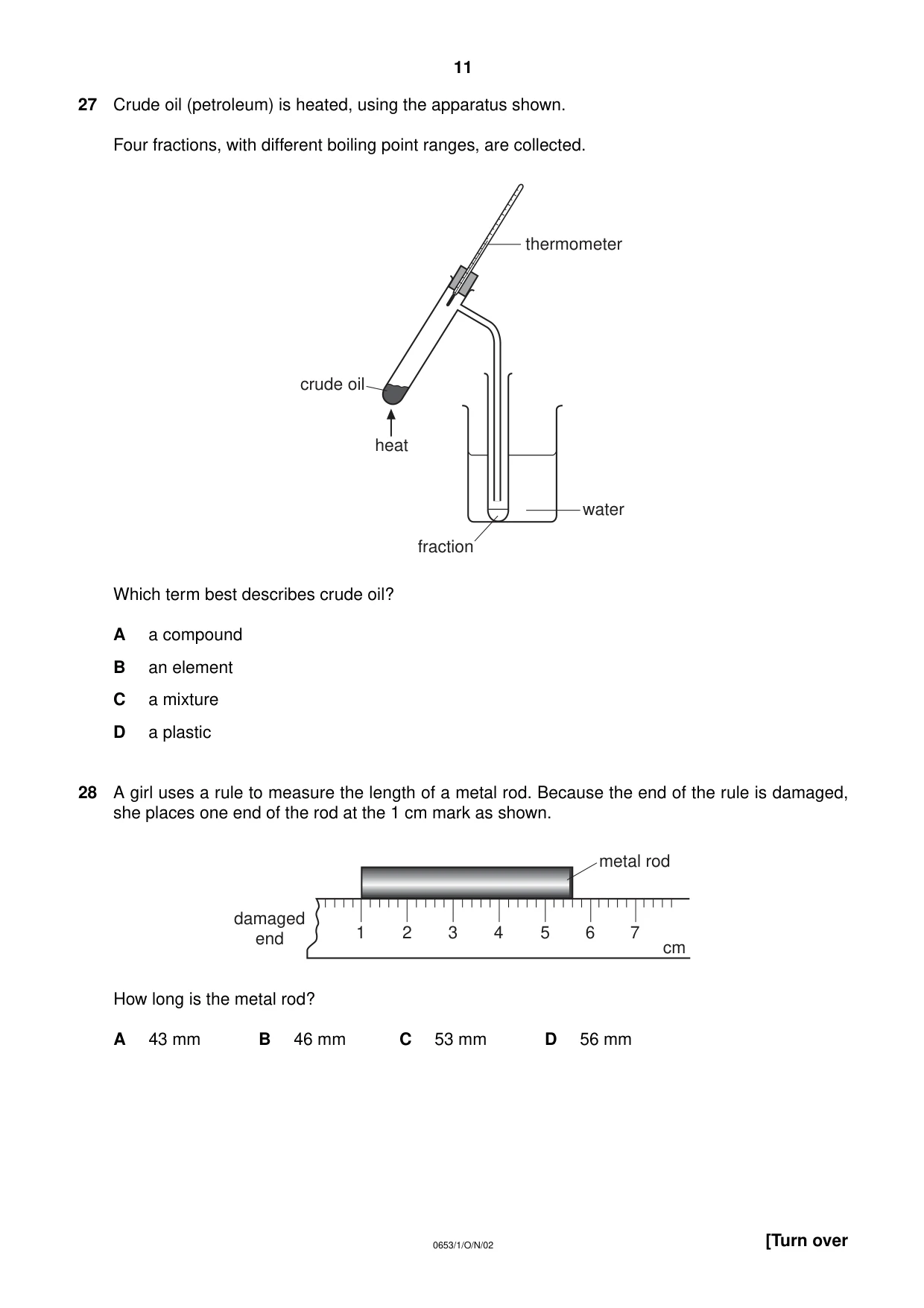
11 0653/1/O/N/02 [Turn over 27 Crude oil (petroleum) is heated, using the apparatus shown. Four fractions, with different boiling point ranges, are collected. Which term best describes crude oil? A a compound B an element C a mixture D a plastic 28 A girl uses a rule to measure the length of a metal rod. Because the end of the rule is damaged, she places one end of the rod at the 1 cm mark as shown. How long is the metal rod? A 43 mm B 46 mm C 53 mm D 56 mm 1 2 3 4 5 6 7 cm metal rod damaged end crude oil heat fraction water thermometer
Question paper, page 12
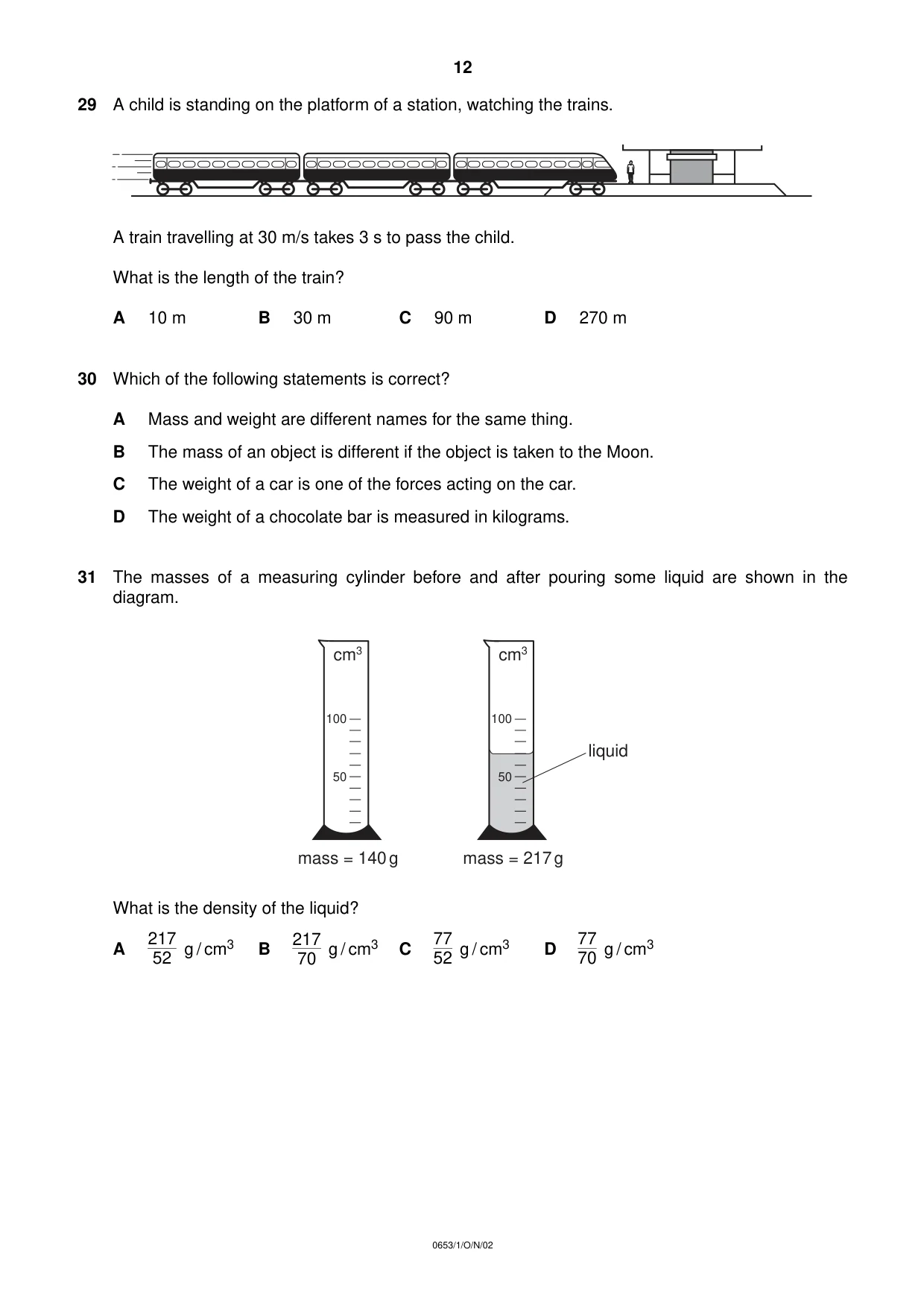
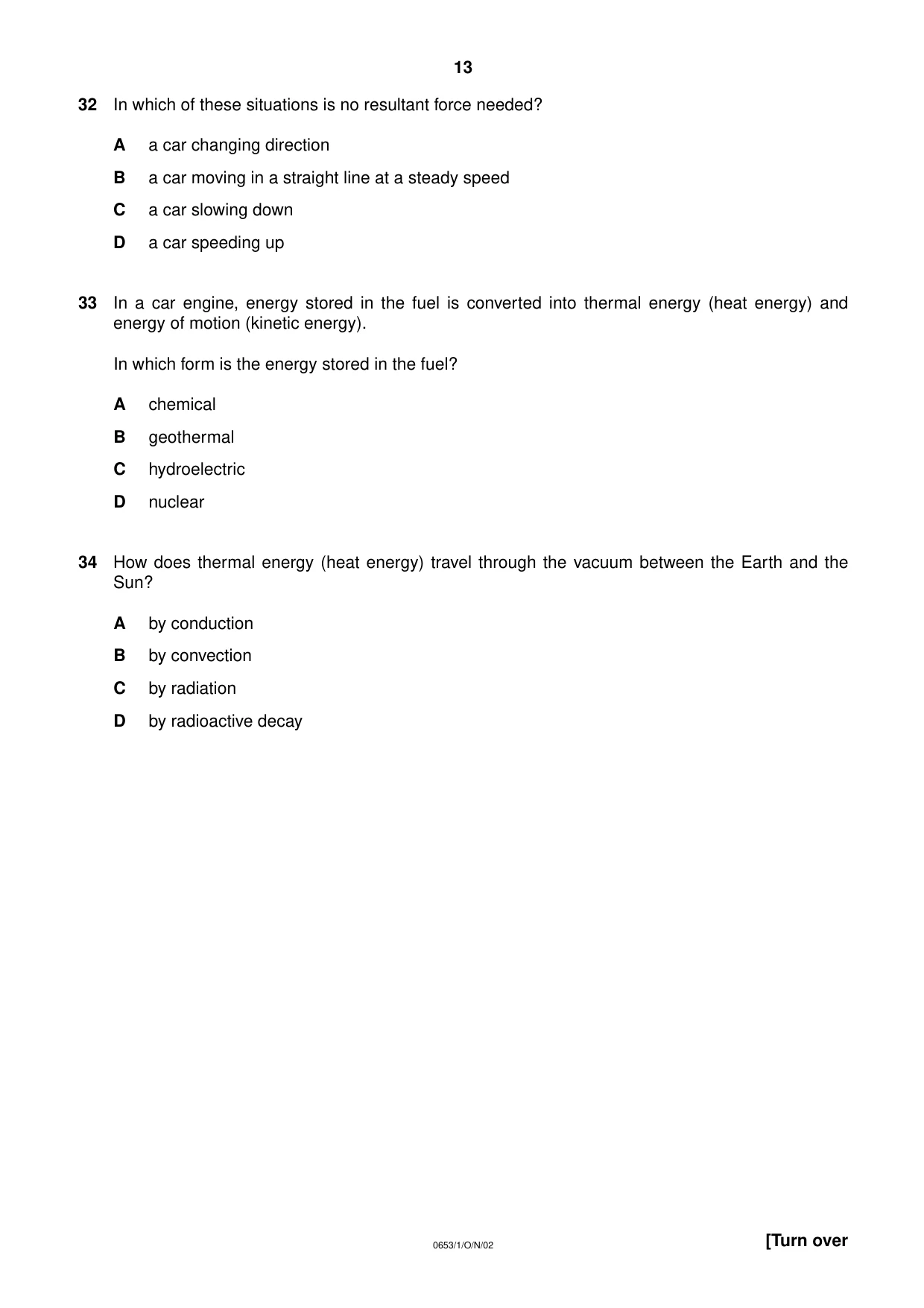
12 0653/1/O/N/02 29 A child is standing on the platform of a station, watching the trains. A train travelling at 30 m/s takes 3 s to pass the child. What is the length of the train? A 10 m B 30 m C 90 m D 270 m 30 Which of the following statements is correct? A Mass and weight are different names for the same thing. B The mass of an object is different if the object is taken to the Moon. C The weight of a car is one of the forces acting on the car. D The weight of a chocolate bar is measured in kilograms. 31 The masses of a measuring cylinder before and after pouring some liquid are shown in the diagram. What is the density of the liquid? A g / cm3 B g / cm3 C g / cm3 D g / cm3 cm3 50 100 mass = 140 g cm3 50 100 mass = 217 g liquid 217 52 217 70 77 52 77 70
Question paper, page 13
13 0653/1/O/N/02 [Turn over 32 In which of these situations is no resultant force needed? A a car changing direction B a car moving in a straight line at a steady speed C a car slowing down D a car speeding up 33 In a car engine, energy stored in the fuel is converted into thermal energy (heat energy) and energy of motion (kinetic energy). In which form is the energy stored in the fuel? A chemical B geothermal C hydroelectric D nuclear 34 How does thermal energy (heat energy) travel through the vacuum between the Earth and the Sun? A by conduction B by convection C by radiation D by radioactive decay
Question paper, page 14
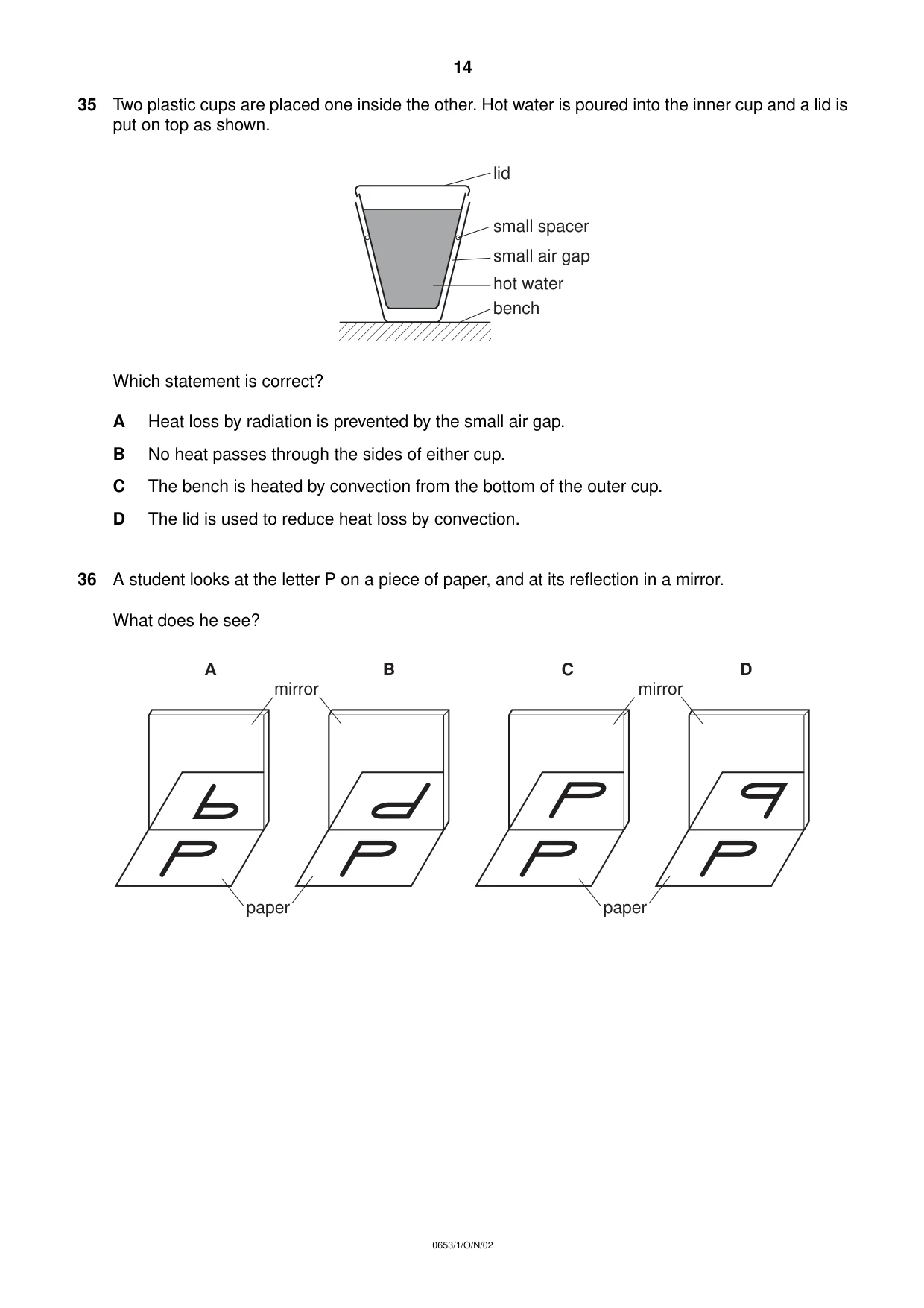
14 0653/1/O/N/02 35 Two plastic cups are placed one inside the other. Hot water is poured into the inner cup and a lid is put on top as shown. Which statement is correct? A Heat loss by radiation is prevented by the small air gap. B No heat passes through the sides of either cup. C The bench is heated by convection from the bottom of the outer cup. D The lid is used to reduce heat loss by convection. 36 A student looks at the letter P on a piece of paper, and at its reflection in a mirror. What does he see? A B C D mirror mirror paper paper bench hot water small air gap small spacer lid
Question paper, page 15
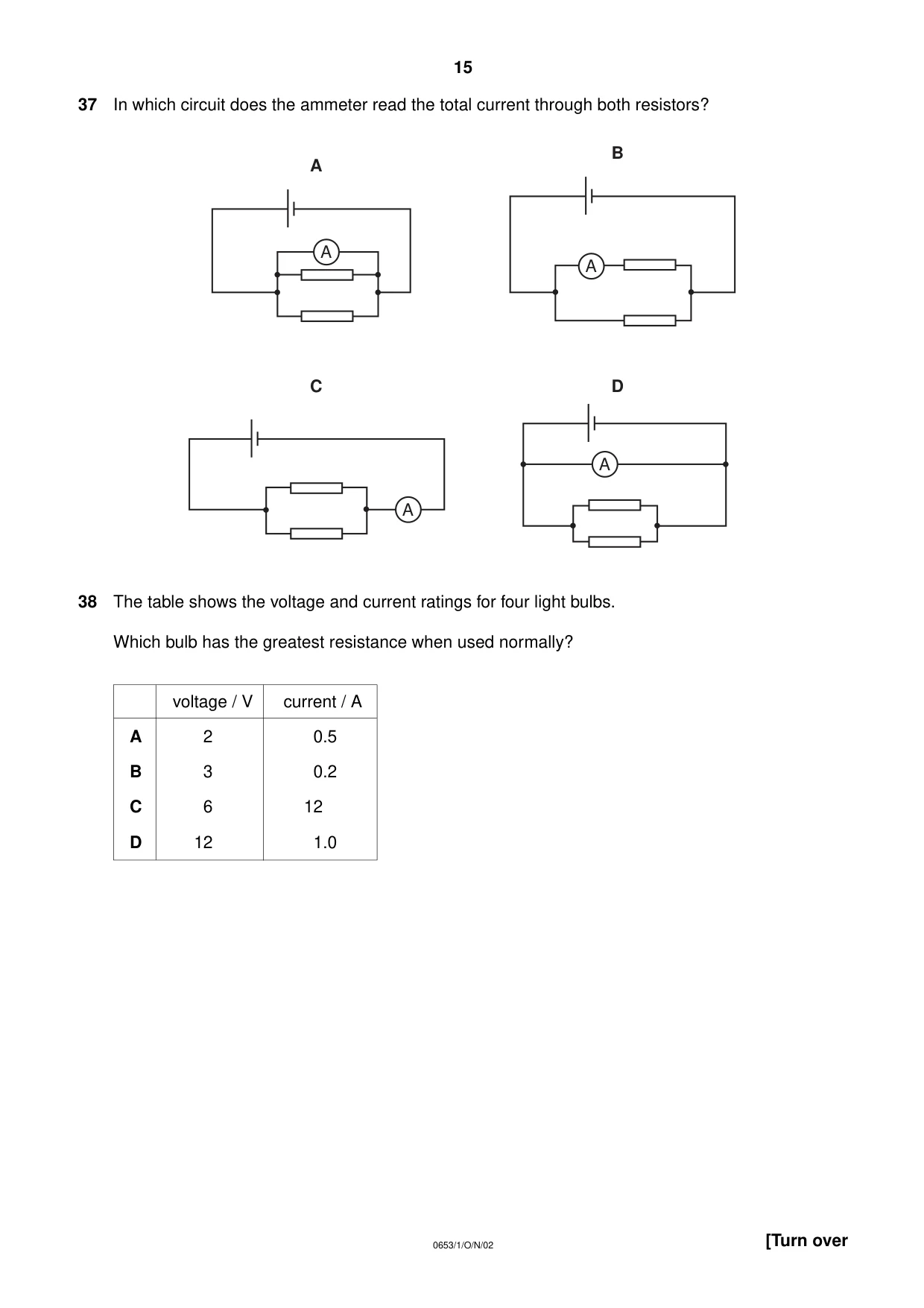
15 0653/1/O/N/02 [Turn over 37 In which circuit does the ammeter read the total current through both resistors? 38 The table shows the voltage and current ratings for four light bulbs. Which bulb has the greatest resistance when used normally? A A A C A B D A voltage / V current / A A 2 0.5 B 3 0.2 C 6 12 D 12 1.0
Question paper, page 16
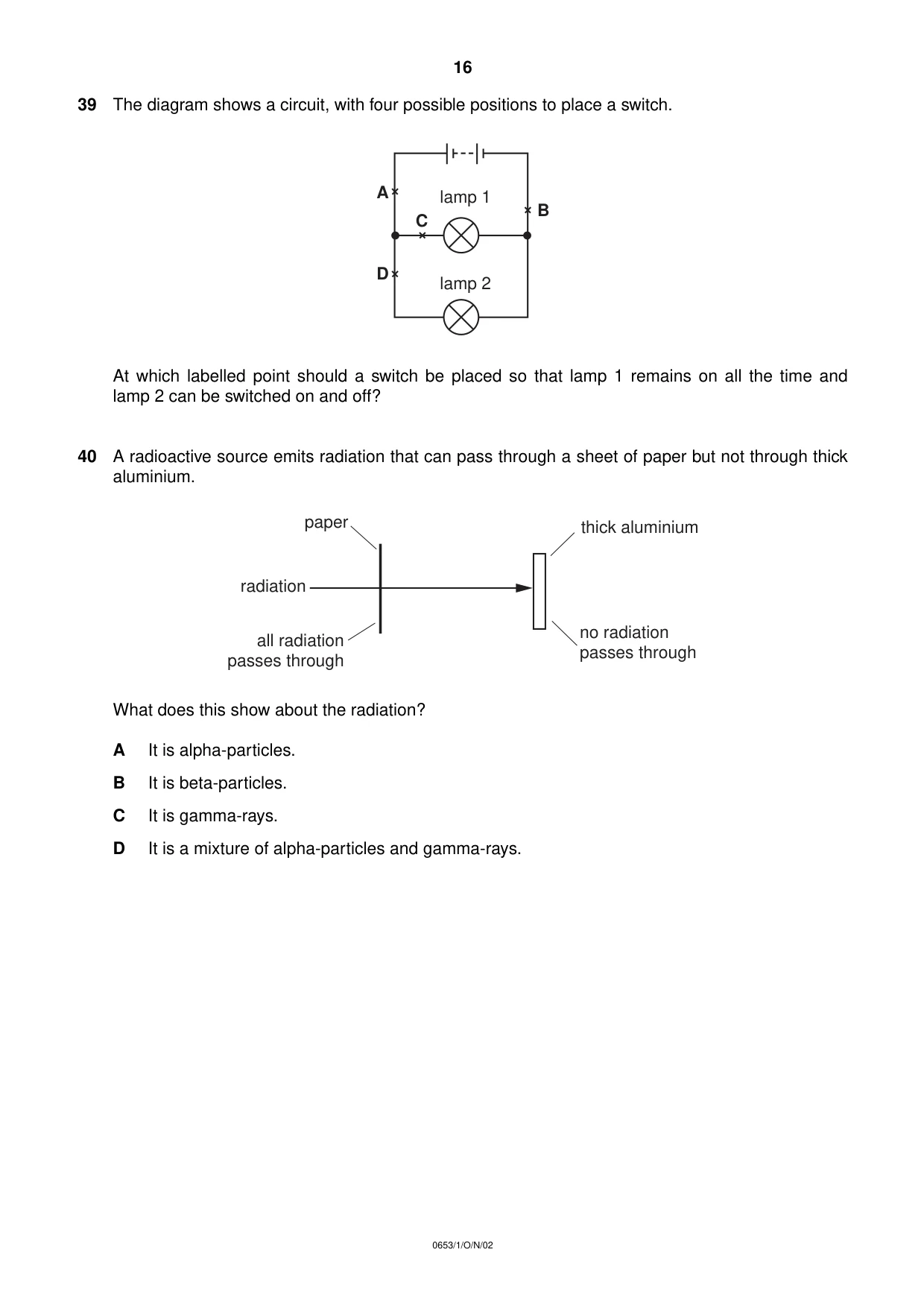
16 0653/1/O/N/02 39 The diagram shows a circuit, with four possible positions to place a switch. At which labelled point should a switch be placed so that lamp 1 remains on all the time and lamp 2 can be switched on and off? 40 A radioactive source emits radiation that can pass through a sheet of paper but not through thick aluminium. What does this show about the radiation? A It is alpha-particles. B It is beta-particles. C It is gamma-rays. D It is a mixture of alpha-particles and gamma-rays. radiation paper thick aluminium all radiation passes through no radiation passes through A D C B lamp 1 lamp 2
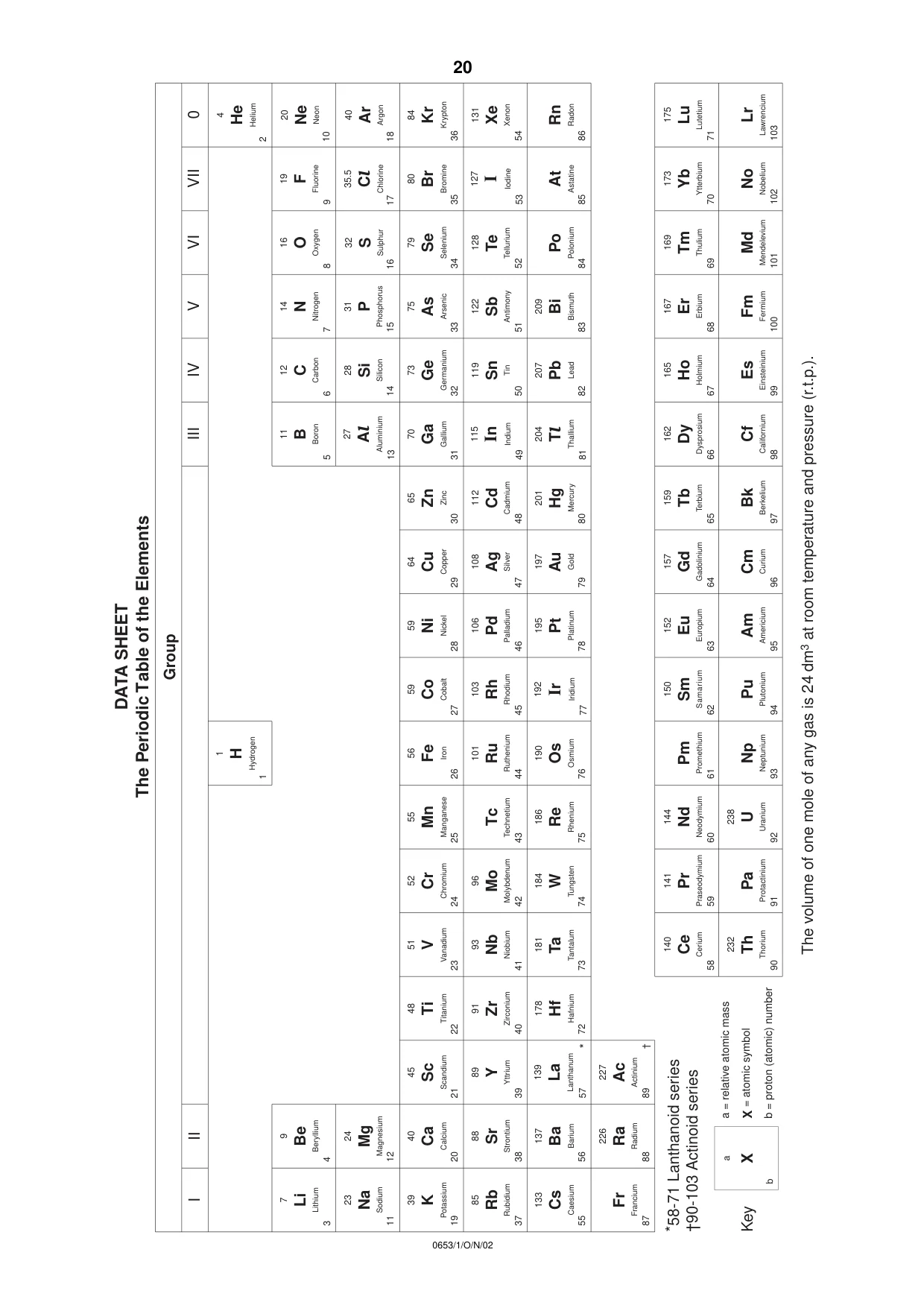
Question paper, page 20
20 0653/1/O/N/02 Group DATA SHEET The Periodic Table of the Elements 140 Ce Cerium 58 141 Pr Praseodymium 59 144 Nd Neodymium 60 Pm Promethium 61 150 Sm Samarium 62 152 Eu Europium 63 157 Gd Gadolinium 64 159 Tb Terbium 65 162 Dy Dysprosium 66 165 Ho Holmium 67 167 Er Erbium 68 169 Tm Thulium 69 173 Yb Ytterbium 70 175 Lu Lutetium 71 232 Th Thorium 90 Pa Protactinium 91 238 U Uranium 92 Np Neptunium 93 Pu Plutonium 94 Am Americium 95 Cm Curium 96 Bk Berkelium 97 Cf Californium 98 Es Einsteinium 99 Fm Fermium 100 Md Mendelevium 101 No Nobelium 102 Lr Lawrencium 103 1 H Hydrogen 1 7 Li Lithium 3 23 Na Sodium 11 24 Mg Magnesium 12 40 Ca Calcium 20 45 Sc Scandium 21 48 Ti Titanium 22 51 V Vanadium 23 52 Cr Chromium 24 55 Mn Manganese 25 56 Fe Iron 26 59 Co Cobalt 27 59 Ni Nickel 28 64 Cu Copper 29 65 Zn Zinc 30 70 Ga Gallium 31 27 Al Aluminium 13 11 B Boron 5 12 C Carbon 6 14 N Nitrogen 7 16 O Oxygen 8 19 F Fluorine 9 28 Si Silicon 14 31 P Phosphorus 15 32 S Sulphur 16 35.5 Cl Chlorine 17 40 Ar Argon 18 20 Ne Neon 10 4 He Helium 2 73 Ge Germanium 32 75 As Arsenic 33 79 Se Selenium 34 80 Br Bromine 35 84 Kr Krypton 36 39 K Potassium 19 88 Sr Strontium 38 89 Y Yttrium 39 91 Zr Zirconium 40 93 Nb Niobium 41 96 Mo Molybdenum 42 Tc Technetium 43 101 Ru Ruthenium 44 103 Rh Rhodium 45 106 Pd Palladium 46 108 Ag Silver 47 112 Cd Cadmium 48 115 In Indium 49 119 Sn Tin 50 122 Sb Antimony 51 128 Te Tellurium 52 127 I Iodine 53 131 Xe Xenon 54 137 Ba Barium 56 139 La Lanthanum 57 * 178 Hf Hafnium 72 181 Ta Tantalum 73 184 W Tungsten 74 186 Re Rhenium 75 190 Os Osmium 76 192 Ir Iridium 77 195 Pt Platinum 78 197 Au Gold 79 201 Hg Mercury 80 204 Tl Thallium 81 207 Pb Lead 82 209 Bi Bismuth 83 Po Polonium 84 At Astatine 85 Rn Radon 86 Fr Francium 87 227 Ac Actinium 89 † 9 Be Beryllium 4 I II III IV V VI VII 0 85 Rb Rubidium 37 133 Cs Caesium 55 226 Ra Radium 88 The volume of one mole of any gas is 24 dm3 at room temperature and pressure (r.t.p.). a X b a = relative atomic mass X = atomic symbol b = proton (atomic) number Key *58-71 Lanthanoid series †90-103 Actinoid series