Cambridge IGCSE Religious Studies 0490 — 2025 Oct/Nov Paper 1 · Variant 2
0490/12/O/N/25 · 80 marks · 105 min
The question paper and its mark scheme, free to read here and free to download. This is Cambridge’s own paper, exactly as it was sat.
Question paper8 pages



Mark scheme33 pages
Answers below. Sit the paper first if you are practising.
Paper as text
Question paper, page 1
Cambridge IGCSE™ 0490/12 October/November 2025 1 hour 45 minutes RELIGIOUS STUDIES Paper 1 Worship, Beliefs, Scriptures and Sacred Places You must answer on the enclosed answer booklet. You will need: Answer booklet (enclosed) INSTRUCTIONS • Answer four questions in total: You must answer from two sections. In each of your chosen sections, you must answer two questions. • Follow the instructions on the front cover of the answer booklet. If you need additional answer paper, ask the invigilator for a continuation booklet. INFORMATION • The total mark for this paper is 80. • The number of marks for each question or part question is shown in brackets [ ]. This document has 8 pages. Any blank pages are indicated. [Turn over 11_0490_12_2025_1.17 © UCLES 2025 *4428160757*
Question paper, page 2
Answer four questions in total. You must answer from two sections. Section A – Christianity If you have chosen this section, you must answer two questions. (a) 1 Name two forms of worship that might take place in a church. [2] (i) Outline the use of the chalice and the paten in Christian worship. [4] (ii) Explain why the Bible might be important for Christians during private worship. [6] (b) Discuss the significance of having statues in the church for different Christian traditions. You must refer to Christianity in your answer. Your response should consider different points of view when you evaluate the question. [8] (c) [Total: 20] (a) 2 Identify two things Christians believe happened after Jesus’ death. [2] (i) Describe the role of two important people in the life of Jesus. [4] (ii) Explain why belief in God as the Father is important for some Christians. [6] (b) Assess the importance of believing in the Trinity for different Christian traditions. You must refer to Christianity in your answer. Your response should consider different points of view when you evaluate the question. [8] (c) [Total: 20] (a) 3 Give two effects a pilgrimage might have on a Christian. [2] (i) Describe the Way of the Cross in Jerusalem. [4] (ii) Explain why Rome might be an important place for pilgrimage for some Christians. [6] (b) Evaluate whether overcoming physical challenges is the most important part of Christian pilgrimage. You must refer to Christianity in your answer. Your response should consider different points of view when you evaluate the question. [8] (c) [Total: 20] 11_0490_12_2025_1.17 © UCLES 2025 2
Question paper, page 3
Section B – Islam If you have chosen this section, you must answer two questions. (a) 4 Name any two Caliphs. [2] (i) Outline what sawm requires of Muslims. [4] (ii) Explain why the Prophet Muhammad (pbuh) was persecuted in Makkah. [6] (b) Discuss the significance of the restrictions on Muslim life given in the Qurʾan. You must refer to Islam in your answer. Your response should consider different points of view when you evaluate the question. [8] (c) [Total: 20] (a) 5 Name the place where stones are thrown during the Hajj, and state what they are thrown at. [2] (i) Outline the physical challenges that Hajj might involve for Muslims. [4] (ii) Explain the significance of the stand on the plain at ʿArafat. [6] (b) Assess whether wearing ihram is the most important part of Hajj for Muslims. You must refer to Islam in your answer. Your response should consider different points of view when you evaluate the question. [8] (c) [Total: 20] (a) 6 State what a mihrab is and what it is used for. [2] (i) Name two artefacts used in Muslim worship, and state what they are used for. [4] (ii) Explain why it is important for Muslims to treat the Qurʾan respectfully. [6] (b) Evaluate the importance of the mosque as a centre of the Muslim community. You must refer to Islam in your answer. Your response should consider different points of view when you evaluate the question. [8] (c) [Total: 20] [Turn over 11_0490_12_2025_1.17 © UCLES 2025 3
Question paper, page 4
Section C – Judaism If you have chosen this section, you must answer two questions. (a) 7 Give the name of the plaited bread, and state when it is eaten. [2] (i) Outline the symbolism of the tallit. [4] (ii) Explain why the ner tamid is an important feature of a synagogue. [6] (b) Evaluate different Jewish views about the importance of public worship. You must refer to Judaism in your answer. Your response should consider different points of view when you evaluate the question. [8] (c) [Total: 20] (a) 8 Give two ways that Jews might keep the memory of the Temple alive. [2] (i) Describe one of the sites of significance at Yad Vashem. [4] (ii) Explain why some Jews might choose to use ‘Shoah’ as a name for the Holocaust. [6] (b) Discuss whether pilgrimage is an important religious practice for Jews. You must refer to Judaism in your answer. Your response should consider different points of view when you evaluate the question. [8] (c) [Total: 20] (a) 9 Name one person Jews believe G-d made a covenant with, and state one of the promises given in that covenant. [2] (i) State four Jewish beliefs about the nature of G-d. [4] (ii) Explain why Jews might consider the Torah a revelation from G-d. [6] (b) Discuss whether the negative mitzvot are the most significant rules for Jewish life. You must refer to Judaism in your answer. Your response should consider different points of view when you evaluate the question. [8] (c) [Total: 20] 11_0490_12_2025_1.17 © UCLES 2025 4
Question paper, page 5
BLANK PAGE 11_0490_12_2025_1.17 © UCLES 2025 5
Question paper, page 6
BLANK PAGE 11_0490_12_2025_1.17 © UCLES 2025 6
Question paper, page 7
BLANK PAGE 11_0490_12_2025_1.17 © UCLES 2025 7
Question paper, page 8
BLANK PAGE Permission to reproduce items where third-party owned material protected by copyright is included has been sought and cleared where possible. Every reasonable effort has been made by the publisher (UCLES) to trace copyright holders, but if any items requiring clearance have unwittingly been included, the publisher will be pleased to make amends at the earliest possible opportunity. To avoid the issue of disclosure of answer-related information to candidates, all copyright acknowledgements are reproduced online in the Cambridge Assessment International Education Copyright Acknowledgements Booklet. This is produced for each series of examinations and is freely available to download at www.cambridgeinternational.org after the live examination series. Cambridge Assessment International Education is part of Cambridge Assessment. Cambridge Assessment is the brand name of the University of Cambridge Local Examinations Syndicate (UCLES), which is a department of the University of Cambridge. 11_0490_12_2025_1.17 © UCLES 2025 8
Mark scheme, page 1
This document consists of 33 printed pages. © Cambridge University Press & Assessment 2025 [Turn over Cambridge IGCSE™ RELIGIOUS STUDIES 0490/12 Paper 1 October/November 2025 MARK SCHEME Maximum Mark: 80 Published This mark scheme is published as an aid to teachers and candidates, to indicate the requirements of the examination. It shows the basis on which Examiners were instructed to award marks. It does not indicate the details of the discussions that took place at an Examiners’ meeting before marking began, which would have considered the acceptability of alternative answers. Mark schemes should be read in conjunction with the question paper and the Principal Examiner Report for Teachers. Cambridge International will not enter into discussions about these mark schemes. Cambridge International is publishing the mark schemes for the October/November 2025 series for most Cambridge IGCSE, Cambridge International A and AS Level components, and some Cambridge O Level components.
Mark scheme, page 2
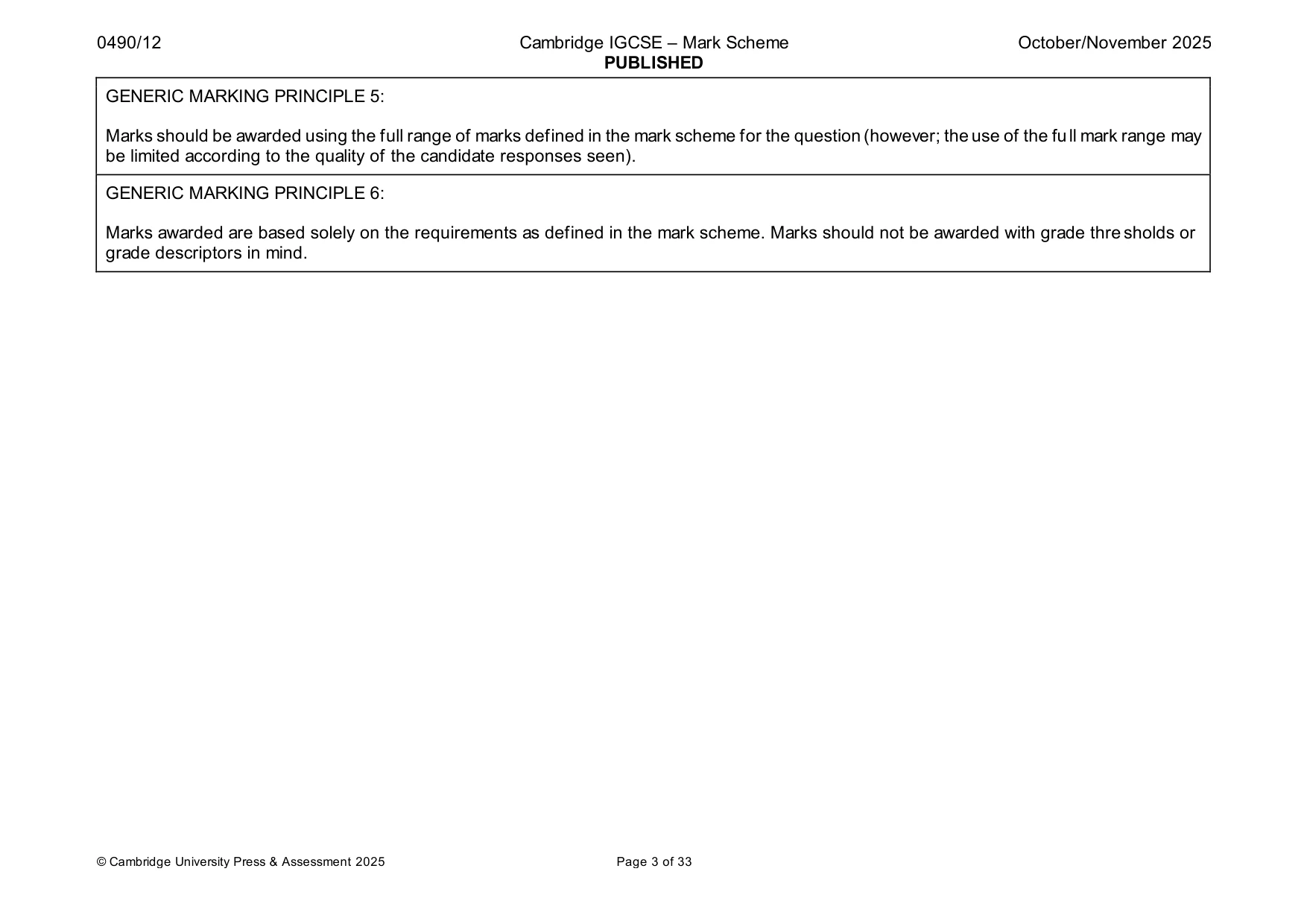
0490/12 Cambridge IGCSE – Mark Scheme PUBLISHED October/November 2025 © Cambridge University Press & Assessment 2025 Page 2 of 33 Generic Marking Principles These general marking principles must be applied by all examiners when marking candidate answers. They should be applied alon gside the specific content of the mark scheme or generic level descriptions for a question. Each question paper and mark scheme will also comply with these marking principles. GENERIC MARKING PRINCIPLE 1: Marks must be awarded in line with: • the specific content of the mark scheme or the generic level descriptors for the question • the specific skills defined in the mark scheme or in the generic level descriptors for the question • the standard of response required by a candidate as exemplified by the standardisation scripts. GENERIC MARKING PRINCIPLE 2: Marks awarded are always whole marks (not half marks, or other fractions). GENERIC MARKING PRINCIPLE 3: Marks must be awarded positively: • marks are awarded for correct/valid answers, as defined in the mark scheme. However, credit is given for valid answers which go beyond the scope of the syllabus and mark scheme, referring to your Team Leader as appropriate • marks are awarded when candidates clearly demonstrate what they know and can do • marks are not deducted for errors • marks are not deducted for omissions • answers should only be judged on the quality of spelling, punctuation and grammar when these features are specifically assessed by the question as indicated by the mark scheme. The meaning, however, should be unambiguous. GENERIC MARKING PRINCIPLE 4: Rules must be applied consistently, e.g. in situations where candidates have not followed instructions or in the application of generic level descriptors.
Mark scheme, page 3
0490/12 Cambridge IGCSE – Mark Scheme PUBLISHED October/November 2025 © Cambridge University Press & Assessment 2025 Page 3 of 33 GENERIC MARKING PRINCIPLE 5: Marks should be awarded using the full range of marks defined in the mark scheme for the question (however; the use of the full mark range may be limited according to the quality of the candidate responses seen). GENERIC MARKING PRINCIPLE 6: Marks awarded are based solely on the requirements as defined in the mark scheme. Marks should not be awarded with grade thre sholds or grade descriptors in mind.
Mark scheme, page 4
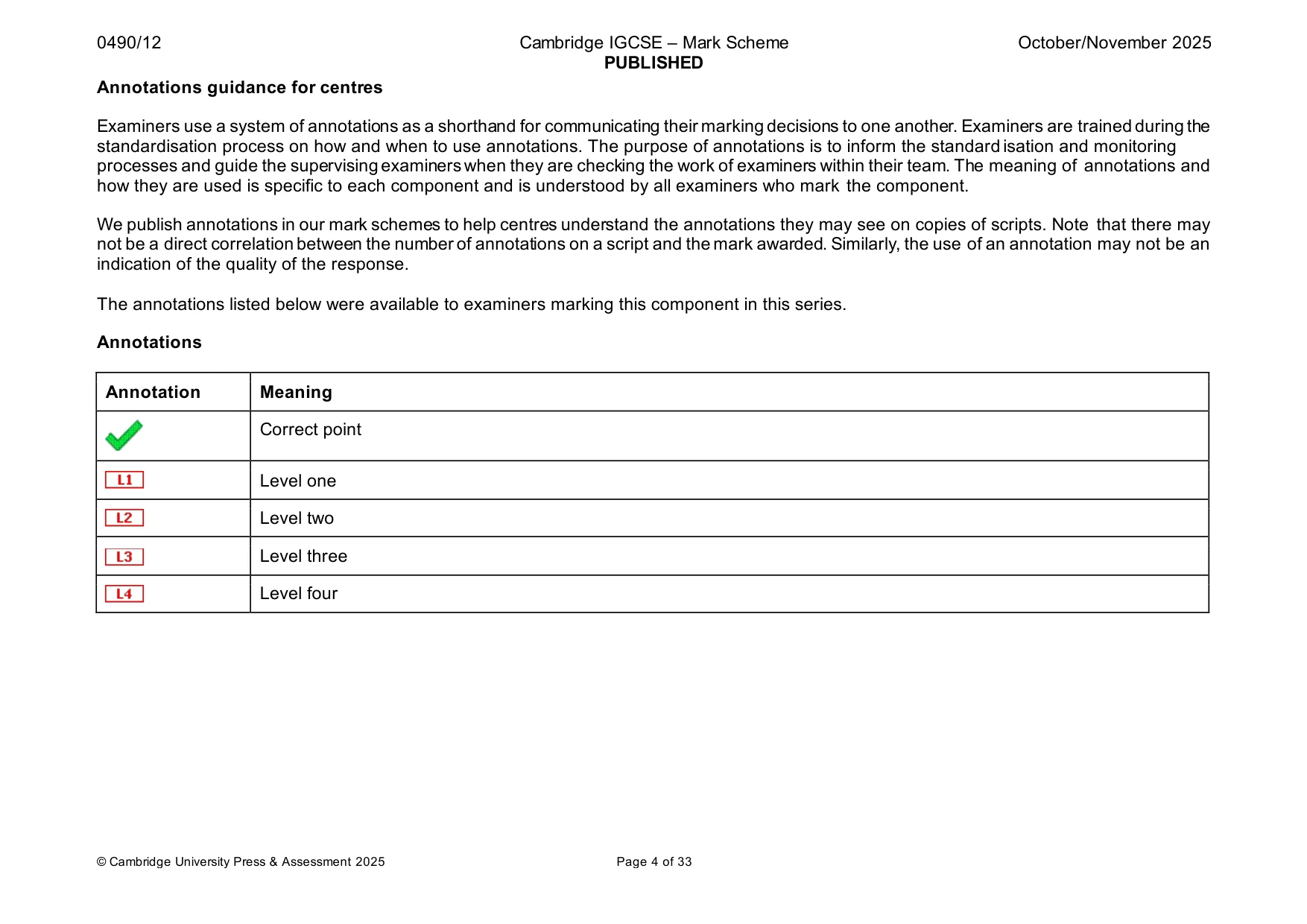
0490/12 Cambridge IGCSE – Mark Scheme PUBLISHED October/November 2025 © Cambridge University Press & Assessment 2025 Page 4 of 33 Annotations guidance for centres Examiners use a system of annotations as a shorthand for communicating their marking decisions to one another. Examiners are trained during the standardisation process on how and when to use annotations. The purpose of annotations is to inform the standard isation and monitoring processes and guide the supervising examiners when they are checking the work of examiners within their team. The meaning of annotations and how they are used is specific to each component and is understood by all examiners who mark the component. We publish annotations in our mark schemes to help centres understand the annotations they may see on copies of scripts. Note that there may not be a direct correlation between the number of annotations on a script and the mark awarded. Similarly, the use of an annotation may not be an indication of the quality of the response. The annotations listed below were available to examiners marking this component in this series. Annotations Annotation Meaning Correct point Level one Level two Level three Level four
Mark scheme, page 5
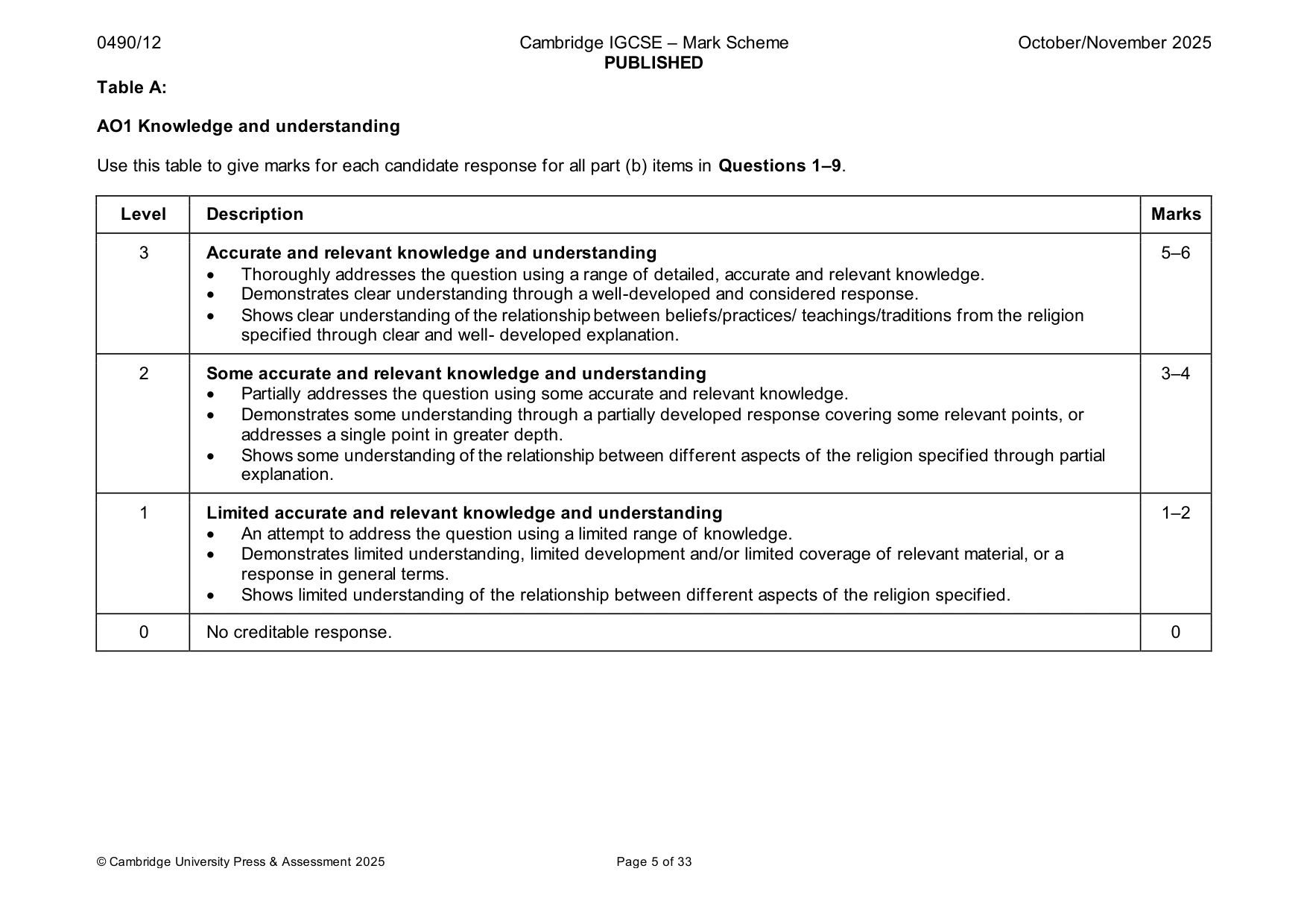
0490/12 Cambridge IGCSE – Mark Scheme PUBLISHED October/November 2025 © Cambridge University Press & Assessment 2025 Page 5 of 33 Table A: AO1 Knowledge and understanding Use this table to give marks for each candidate response for all part (b) items in Questions 1–9. Level Description Marks 3 Accurate and relevant knowledge and understanding • Thoroughly addresses the question using a range of detailed, accurate and relevant knowledge. • Demonstrates clear understanding through a well-developed and considered response. • Shows clear understanding of the relationship between beliefs/practices/ teachings/traditions from the religion specified through clear and well- developed explanation. 5–6 2 Some accurate and relevant knowledge and understanding • Partially addresses the question using some accurate and relevant knowledge. • Demonstrates some understanding through a partially developed response covering some relevant points, or addresses a single point in greater depth. • Shows some understanding of the relationship between different aspects of the religion specified through partial explanation. 3–4 1 Limited accurate and relevant knowledge and understanding • An attempt to address the question using a limited range of knowledge. • Demonstrates limited understanding, limited development and/or limited coverage of relevant material, or a response in general terms. • Shows limited understanding of the relationship between different aspects of the religion specified. 1–2 0 No creditable response. 0
Mark scheme, page 6
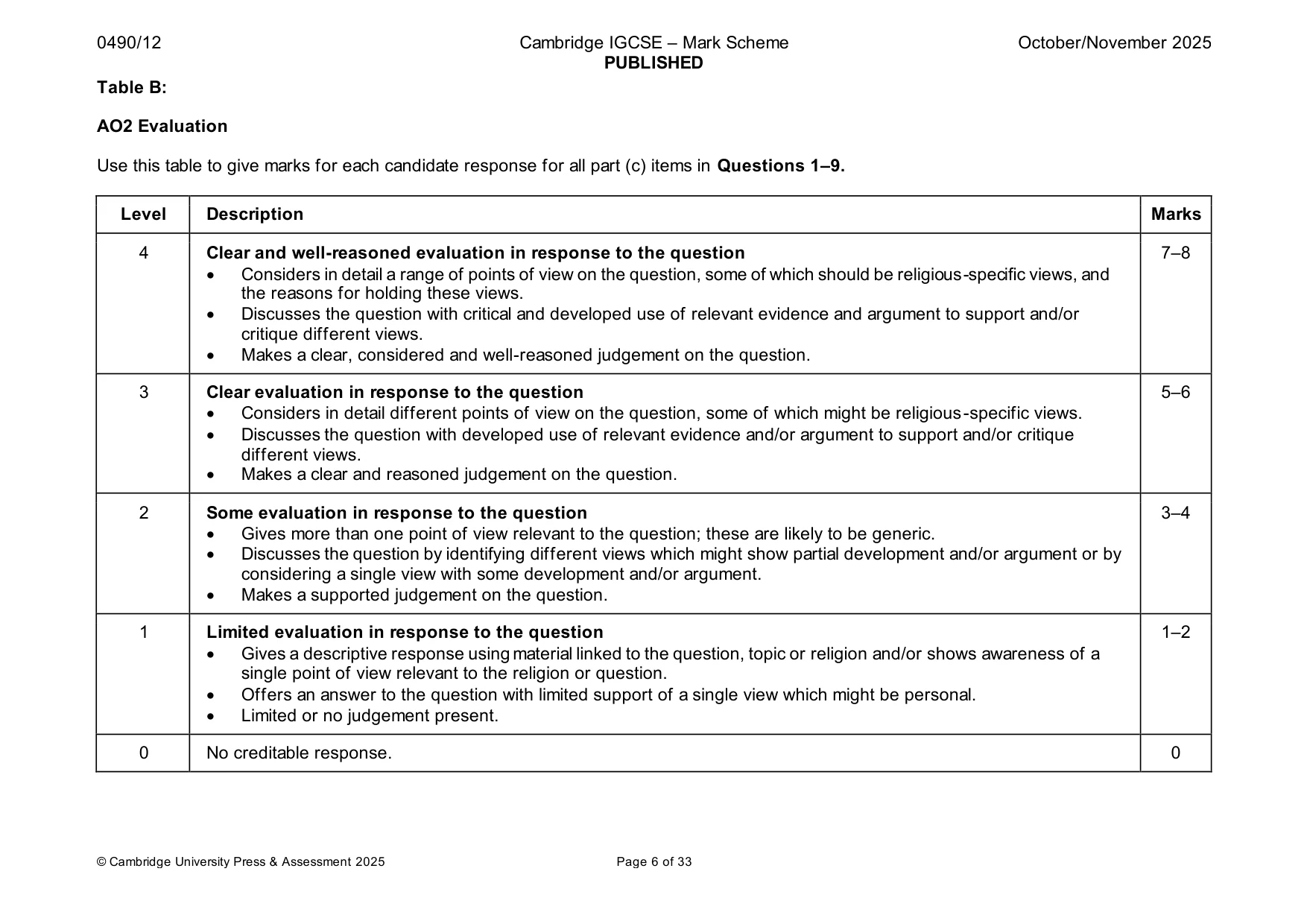
0490/12 Cambridge IGCSE – Mark Scheme PUBLISHED October/November 2025 © Cambridge University Press & Assessment 2025 Page 6 of 33 Table B: AO2 Evaluation Use this table to give marks for each candidate response for all part (c) items in Questions 1–9. Level Description Marks 4 Clear and well-reasoned evaluation in response to the question • Considers in detail a range of points of view on the question, some of which should be religious-specific views, and the reasons for holding these views. • Discusses the question with critical and developed use of relevant evidence and argument to support and/or critique different views. • Makes a clear, considered and well-reasoned judgement on the question. 7–8 3 Clear evaluation in response to the question • Considers in detail different points of view on the question, some of which might be religious-specific views. • Discusses the question with developed use of relevant evidence and/or argument to support and/or critique different views. • Makes a clear and reasoned judgement on the question. 5–6 2 Some evaluation in response to the question • Gives more than one point of view relevant to the question; these are likely to be generic. • Discusses the question by identifying different views which might show partial development and/or argument or by considering a single view with some development and/or argument. • Makes a supported judgement on the question. 3–4 1 Limited evaluation in response to the question • Gives a descriptive response using material linked to the question, topic or religion and/or shows awareness of a single point of view relevant to the religion or question. • Offers an answer to the question with limited support of a single view which might be personal. • Limited or no judgement present. 1–2 0 No creditable response. 0
Mark scheme, page 7
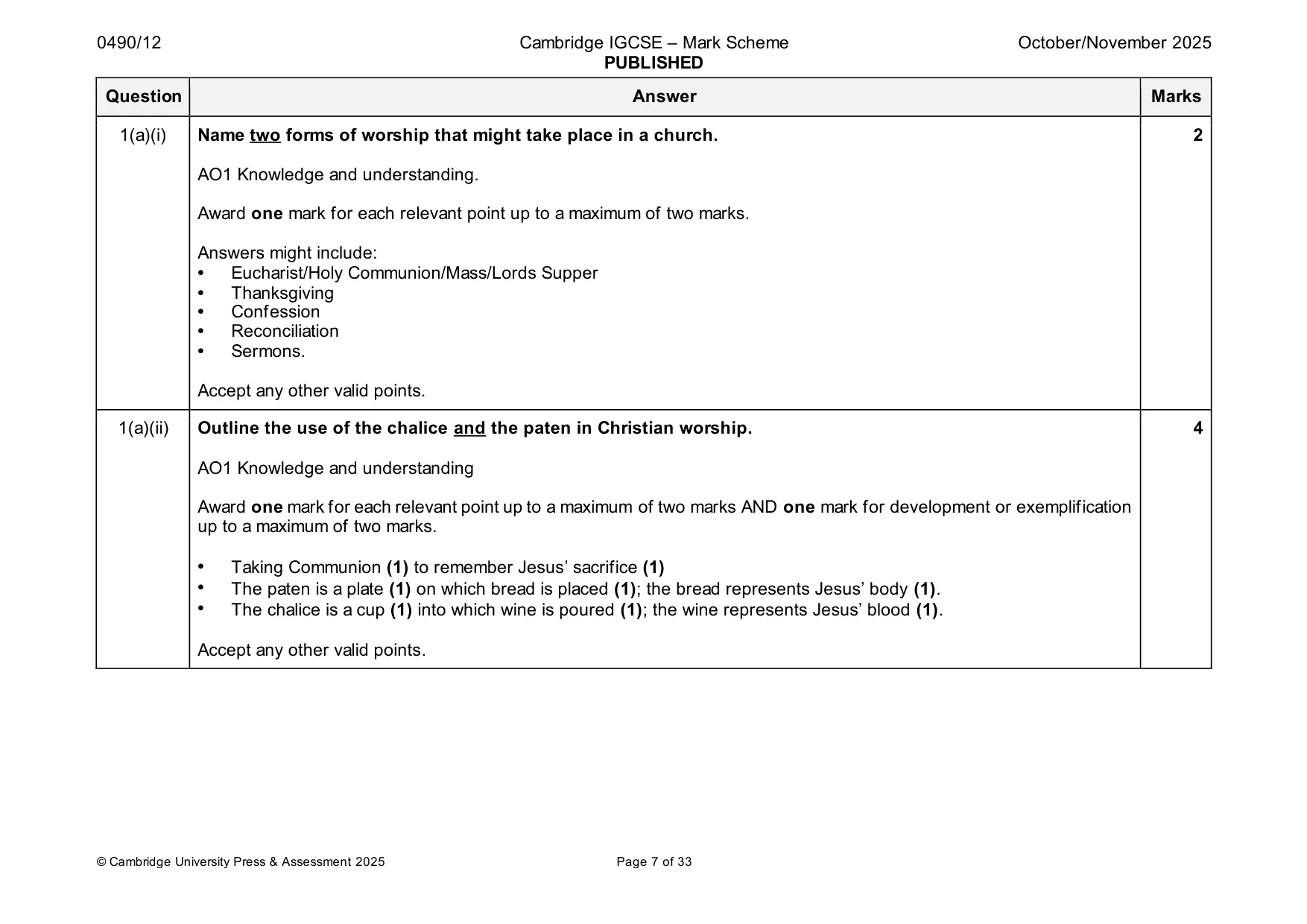
0490/12 Cambridge IGCSE – Mark Scheme PUBLISHED October/November 2025 © Cambridge University Press & Assessment 2025 Page 7 of 33 Question Answer Marks 1(a)(i) Name two forms of worship that might take place in a church. AO1 Knowledge and understanding. Award one mark for each relevant point up to a maximum of two marks. Answers might include: • Eucharist/Holy Communion/Mass/Lords Supper • Thanksgiving • Confession • Reconciliation • Sermons. Accept any other valid points. 2 1(a)(ii) Outline the use of the chalice and the paten in Christian worship. AO1 Knowledge and understanding Award one mark for each relevant point up to a maximum of two marks AND one mark for development or exemplification up to a maximum of two marks. • Taking Communion (1) to remember Jesus’ sacrifice (1) • The paten is a plate (1) on which bread is placed (1); the bread represents Jesus’ body (1). • The chalice is a cup (1) into which wine is poured (1); the wine represents Jesus’ blood (1). Accept any other valid points. 4
Mark scheme, page 8
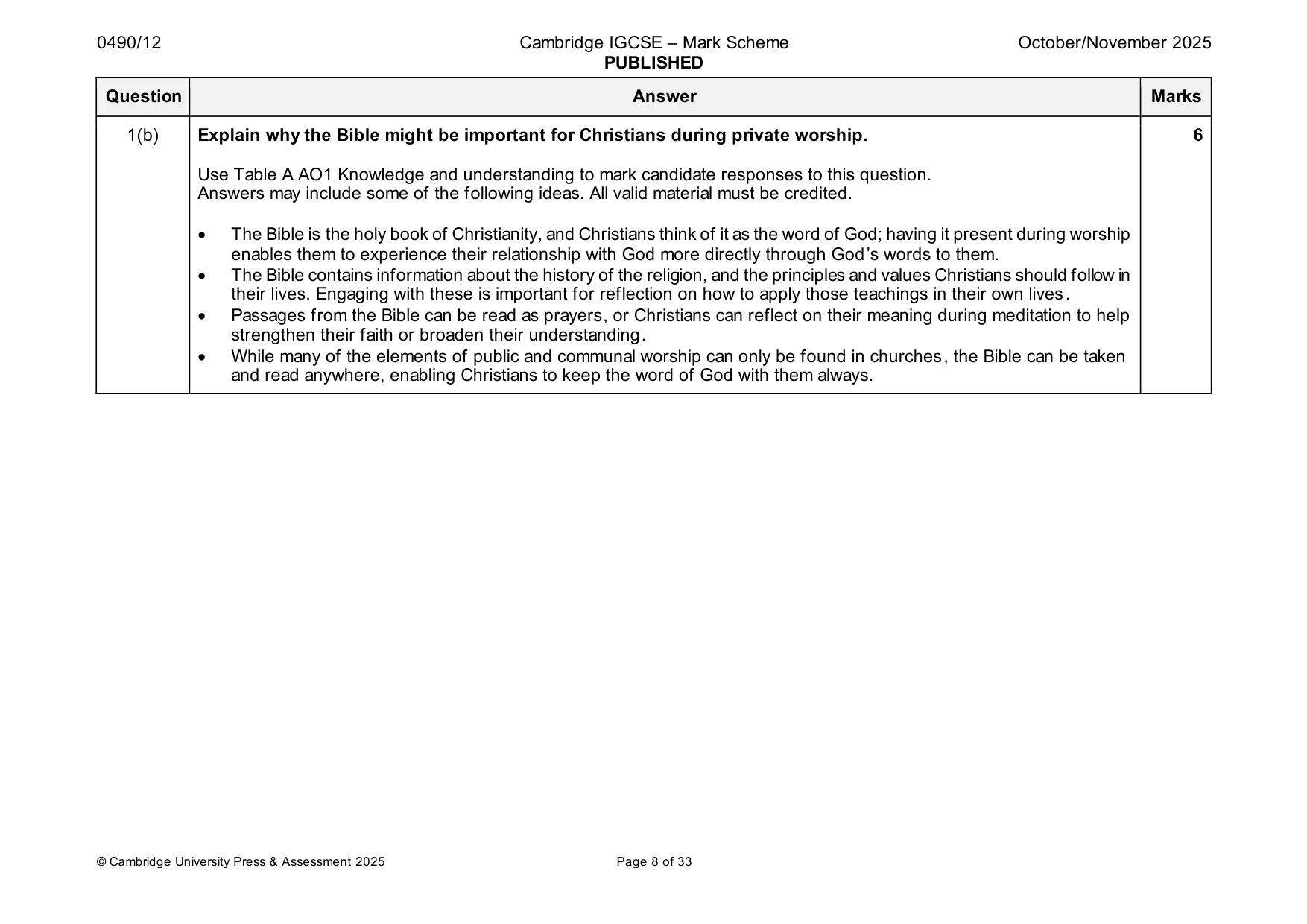
0490/12 Cambridge IGCSE – Mark Scheme PUBLISHED October/November 2025 © Cambridge University Press & Assessment 2025 Page 8 of 33 Question Answer Marks 1(b) Explain why the Bible might be important for Christians during private worship. Use Table A AO1 Knowledge and understanding to mark candidate responses to this question. Answers may include some of the following ideas. All valid material must be credited. • The Bible is the holy book of Christianity, and Christians think of it as the word of God; having it present during worship enables them to experience their relationship with God more directly through God’s words to them. • The Bible contains information about the history of the religion, and the principles and values Christians should follow in their lives. Engaging with these is important for reflection on how to apply those teachings in their own lives. • Passages from the Bible can be read as prayers, or Christians can reflect on their meaning during meditation to help strengthen their faith or broaden their understanding. • While many of the elements of public and communal worship can only be found in churches, the Bible can be taken and read anywhere, enabling Christians to keep the word of God with them always. 6
Mark scheme, page 9
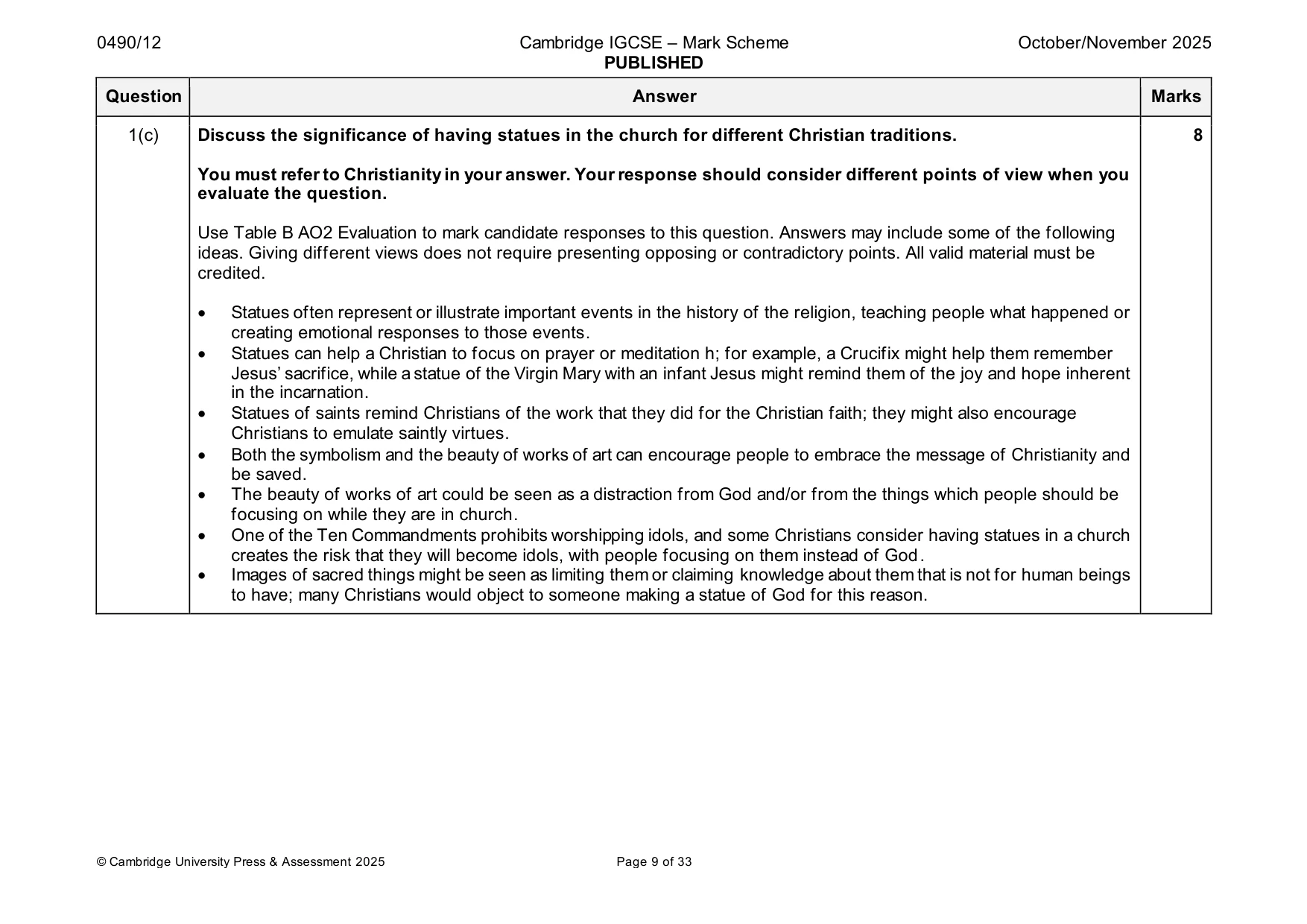
0490/12 Cambridge IGCSE – Mark Scheme PUBLISHED October/November 2025 © Cambridge University Press & Assessment 2025 Page 9 of 33 Question Answer Marks 1(c) Discuss the significance of having statues in the church for different Christian traditions. You must refer to Christianity in your answer. Your response should consider different points of view when you evaluate the question. Use Table B AO2 Evaluation to mark candidate responses to this question. Answers may include some of the following ideas. Giving different views does not require presenting opposing or contradictory points. All valid material must be credited. • Statues often represent or illustrate important events in the history of the religion, teaching people what happened or creating emotional responses to those events. • Statues can help a Christian to focus on prayer or meditation h; for example, a Crucifix might help them remember Jesus’ sacrifice, while a statue of the Virgin Mary with an infant Jesus might remind them of the joy and hope inherent in the incarnation. • Statues of saints remind Christians of the work that they did for the Christian faith; they might also encourage Christians to emulate saintly virtues. • Both the symbolism and the beauty of works of art can encourage people to embrace the message of Christianity and be saved. • The beauty of works of art could be seen as a distraction from God and/or from the things which people should be focusing on while they are in church. • One of the Ten Commandments prohibits worshipping idols, and some Christians consider having statues in a church creates the risk that they will become idols, with people focusing on them instead of God. • Images of sacred things might be seen as limiting them or claiming knowledge about them that is not for human beings to have; many Christians would object to someone making a statue of God for this reason. 8
Mark scheme, page 10
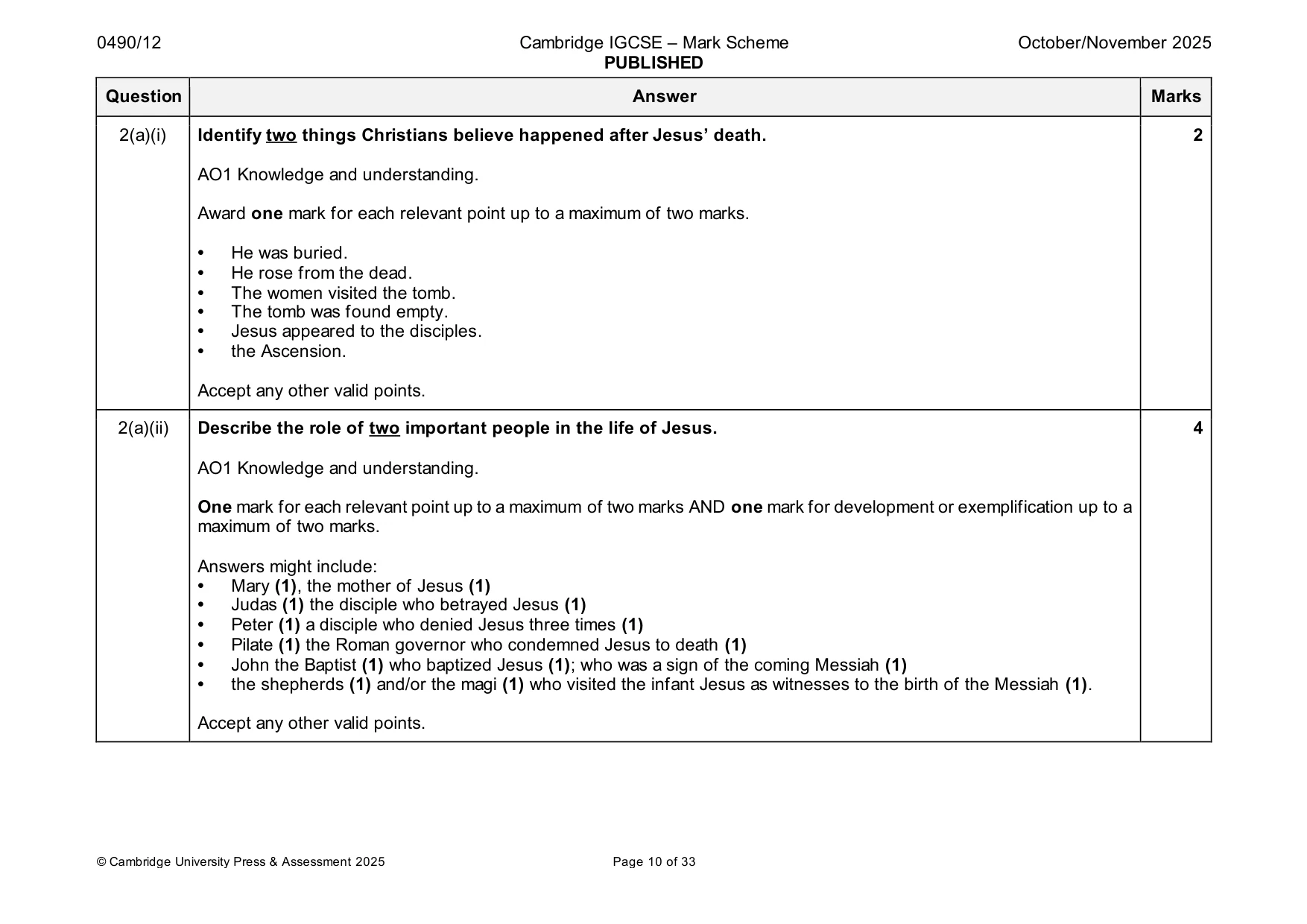
0490/12 Cambridge IGCSE – Mark Scheme PUBLISHED October/November 2025 © Cambridge University Press & Assessment 2025 Page 10 of 33 Question Answer Marks 2(a)(i) Identify two things Christians believe happened after Jesus’ death. AO1 Knowledge and understanding. Award one mark for each relevant point up to a maximum of two marks. • He was buried. • He rose from the dead. • The women visited the tomb. • The tomb was found empty. • Jesus appeared to the disciples. • the Ascension. Accept any other valid points. 2 2(a)(ii) Describe the role of two important people in the life of Jesus. AO1 Knowledge and understanding. One mark for each relevant point up to a maximum of two marks AND one mark for development or exemplification up to a maximum of two marks. Answers might include: • Mary (1), the mother of Jesus (1) • Judas (1) the disciple who betrayed Jesus (1) • Peter (1) a disciple who denied Jesus three times (1) • Pilate (1) the Roman governor who condemned Jesus to death (1) • John the Baptist (1) who baptized Jesus (1); who was a sign of the coming Messiah (1) • the shepherds (1) and/or the magi (1) who visited the infant Jesus as witnesses to the birth of the Messiah (1). Accept any other valid points. 4
Mark scheme, page 11
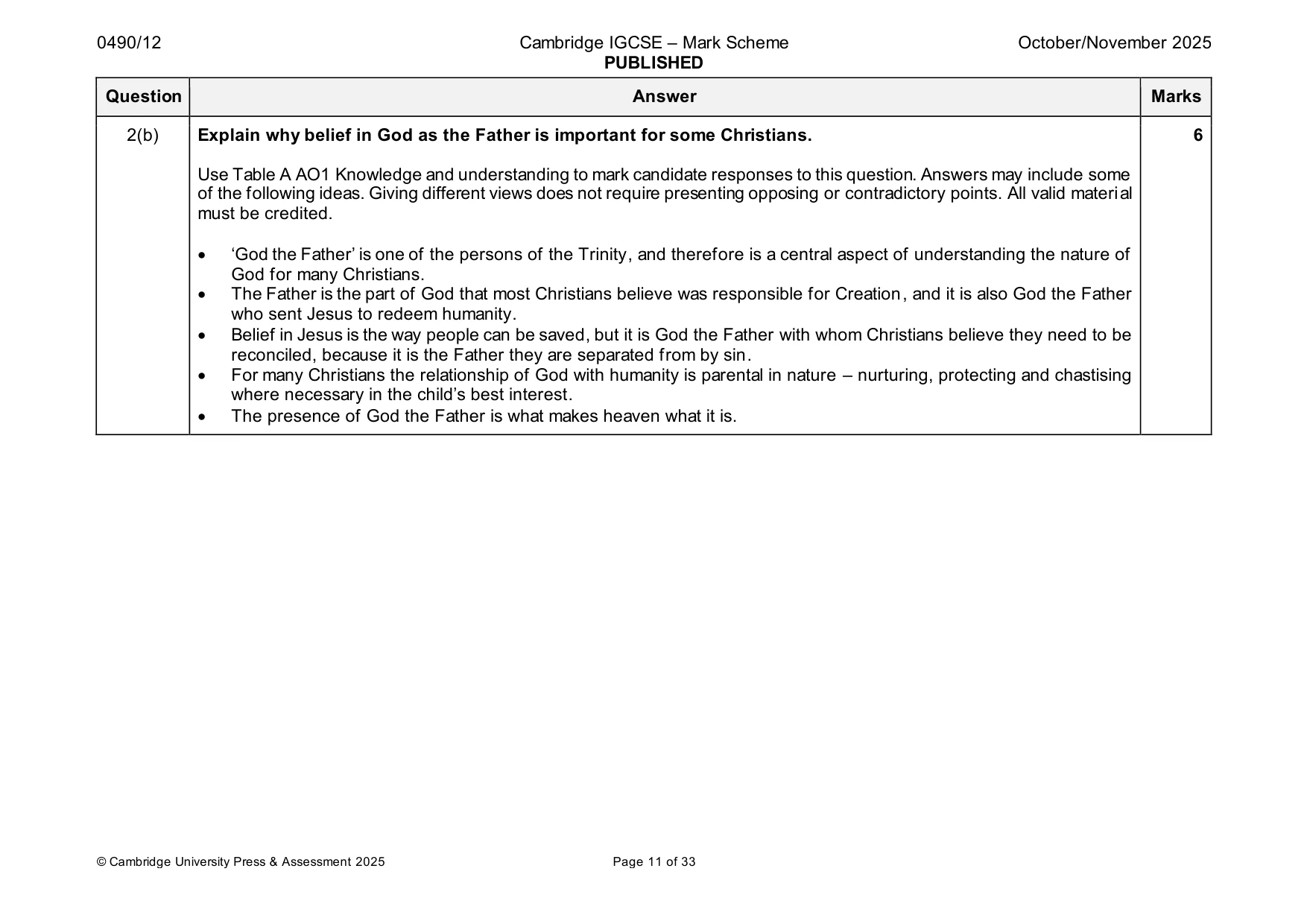
0490/12 Cambridge IGCSE – Mark Scheme PUBLISHED October/November 2025 © Cambridge University Press & Assessment 2025 Page 11 of 33 Question Answer Marks 2(b) Explain why belief in God as the Father is important for some Christians. Use Table A AO1 Knowledge and understanding to mark candidate responses to this question. Answers may include some of the following ideas. Giving different views does not require presenting opposing or contradictory points. All valid material must be credited. • ‘God the Father’ is one of the persons of the Trinity, and therefore is a central aspect of understanding the nature of God for many Christians. • The Father is the part of God that most Christians believe was responsible for Creation, and it is also God the Father who sent Jesus to redeem humanity. • Belief in Jesus is the way people can be saved, but it is God the Father with whom Christians believe they need to be reconciled, because it is the Father they are separated from by sin. • For many Christians the relationship of God with humanity is parental in nature – nurturing, protecting and chastising where necessary in the child’s best interest. • The presence of God the Father is what makes heaven what it is. 6
Mark scheme, page 12
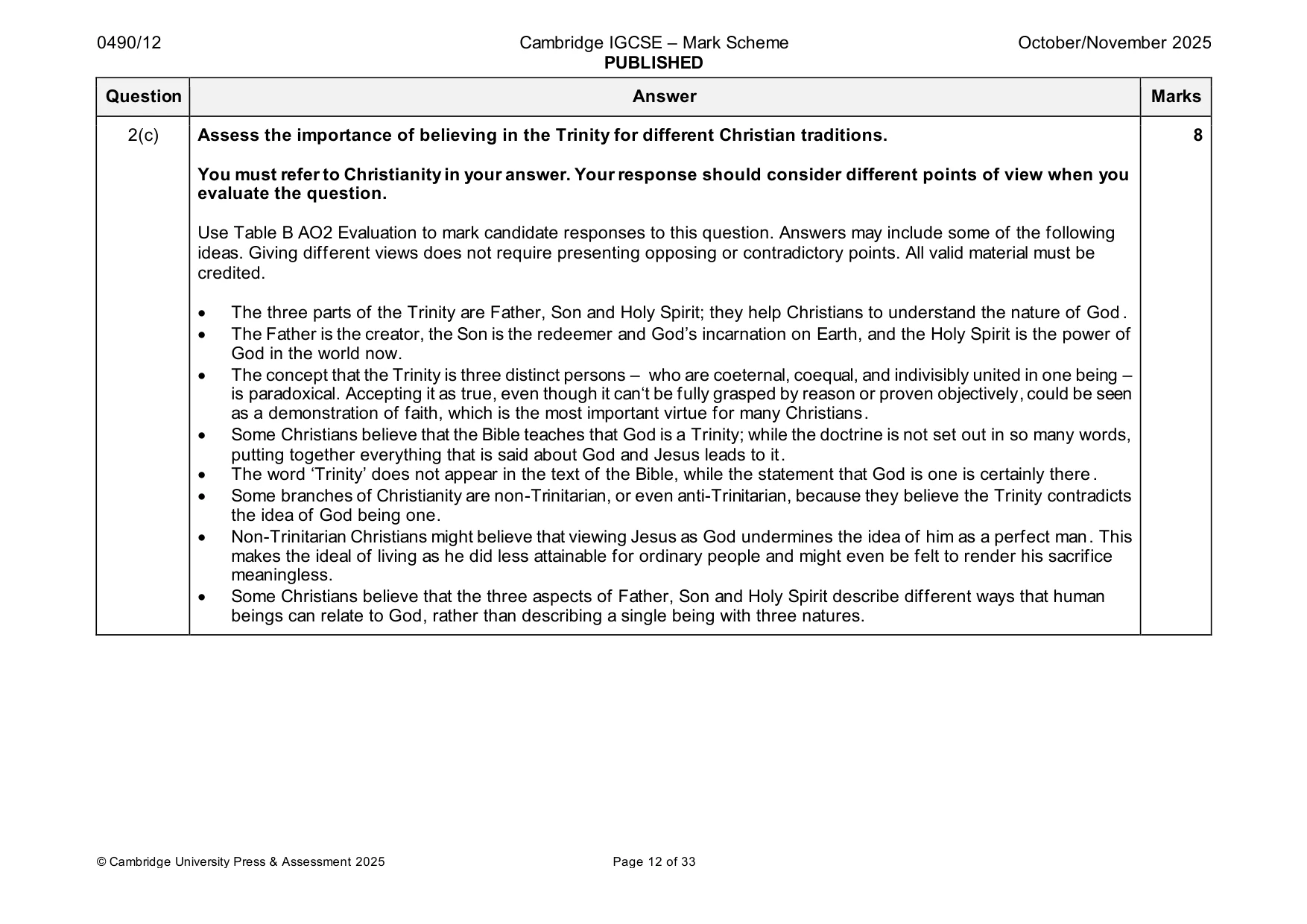
0490/12 Cambridge IGCSE – Mark Scheme PUBLISHED October/November 2025 © Cambridge University Press & Assessment 2025 Page 12 of 33 Question Answer Marks 2(c) Assess the importance of believing in the Trinity for different Christian traditions. You must refer to Christianity in your answer. Your response should consider different points of view when you evaluate the question. Use Table B AO2 Evaluation to mark candidate responses to this question. Answers may include some of the following ideas. Giving different views does not require presenting opposing or contradictory points. All valid material must be credited. • The three parts of the Trinity are Father, Son and Holy Spirit; they help Christians to understand the nature of God . • The Father is the creator, the Son is the redeemer and God’s incarnation on Earth, and the Holy Spirit is the power of God in the world now. • The concept that the Trinity is three distinct persons – who are coeternal, coequal, and indivisibly united in one being – is paradoxical. Accepting it as true, even though it can‘t be fully grasped by reason or proven objectively, could be seen as a demonstration of faith, which is the most important virtue for many Christians. • Some Christians believe that the Bible teaches that God is a Trinity; while the doctrine is not set out in so many words, putting together everything that is said about God and Jesus leads to it. • The word ‘Trinity’ does not appear in the text of the Bible, while the statement that God is one is certainly there. • Some branches of Christianity are non-Trinitarian, or even anti-Trinitarian, because they believe the Trinity contradicts the idea of God being one. • Non-Trinitarian Christians might believe that viewing Jesus as God undermines the idea of him as a perfect man. This makes the ideal of living as he did less attainable for ordinary people and might even be felt to render his sacrifice meaningless. • Some Christians believe that the three aspects of Father, Son and Holy Spirit describe different ways that human beings can relate to God, rather than describing a single being with three natures. 8
Mark scheme, page 13
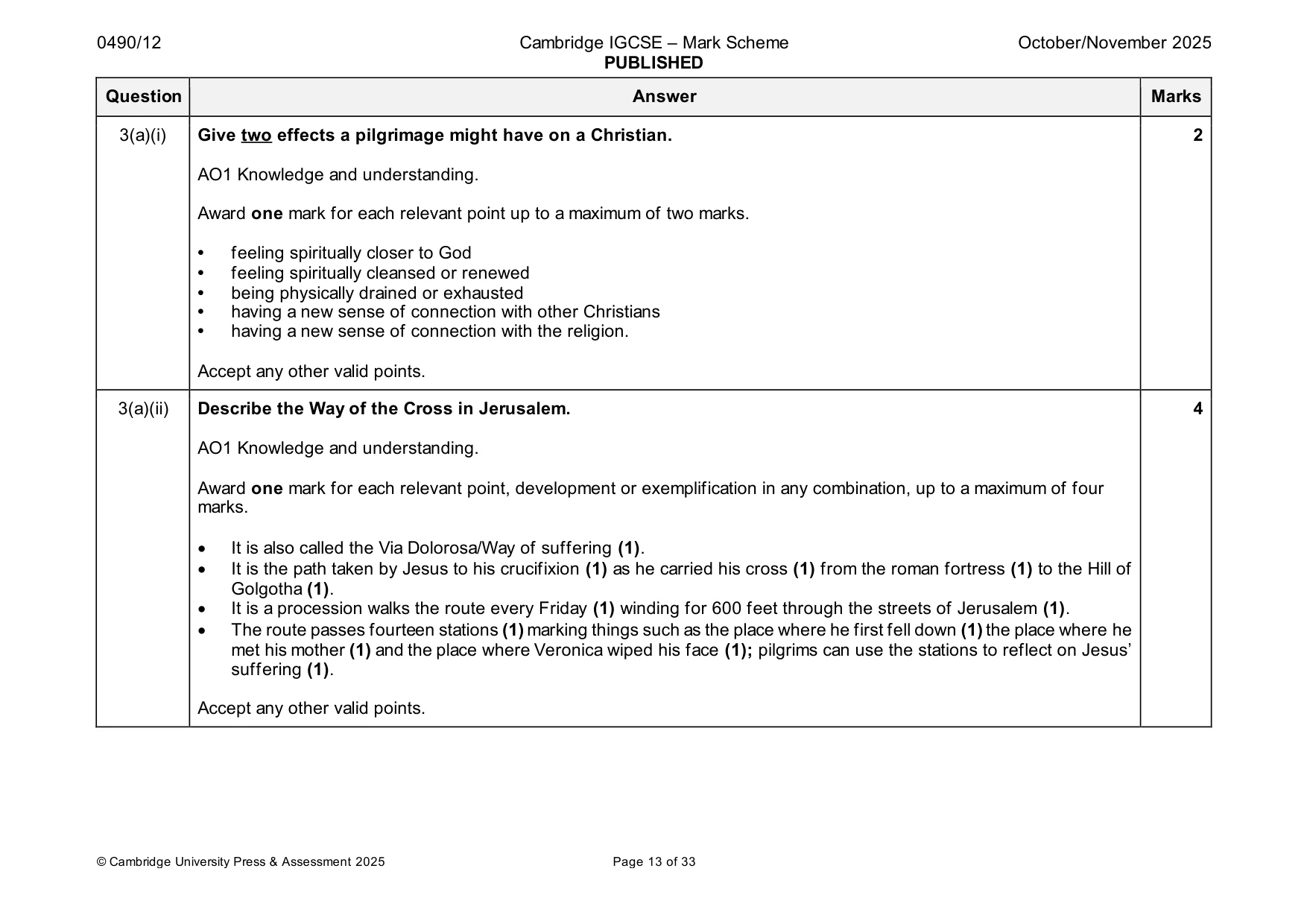
0490/12 Cambridge IGCSE – Mark Scheme PUBLISHED October/November 2025 © Cambridge University Press & Assessment 2025 Page 13 of 33 Question Answer Marks 3(a)(i) Give two effects a pilgrimage might have on a Christian. AO1 Knowledge and understanding. Award one mark for each relevant point up to a maximum of two marks. • feeling spiritually closer to God • feeling spiritually cleansed or renewed • being physically drained or exhausted • having a new sense of connection with other Christians • having a new sense of connection with the religion. Accept any other valid points. 2 3(a)(ii) Describe the Way of the Cross in Jerusalem. AO1 Knowledge and understanding. Award one mark for each relevant point, development or exemplification in any combination, up to a maximum of four marks. • It is also called the Via Dolorosa/Way of suffering (1). • It is the path taken by Jesus to his crucifixion (1) as he carried his cross (1) from the roman fortress (1) to the Hill of Golgotha (1). • It is a procession walks the route every Friday (1) winding for 600 feet through the streets of Jerusalem (1). • The route passes fourteen stations (1) marking things such as the place where he first fell down (1) the place where he met his mother (1) and the place where Veronica wiped his face (1); pilgrims can use the stations to reflect on Jesus’ suffering (1). Accept any other valid points. 4
Mark scheme, page 14
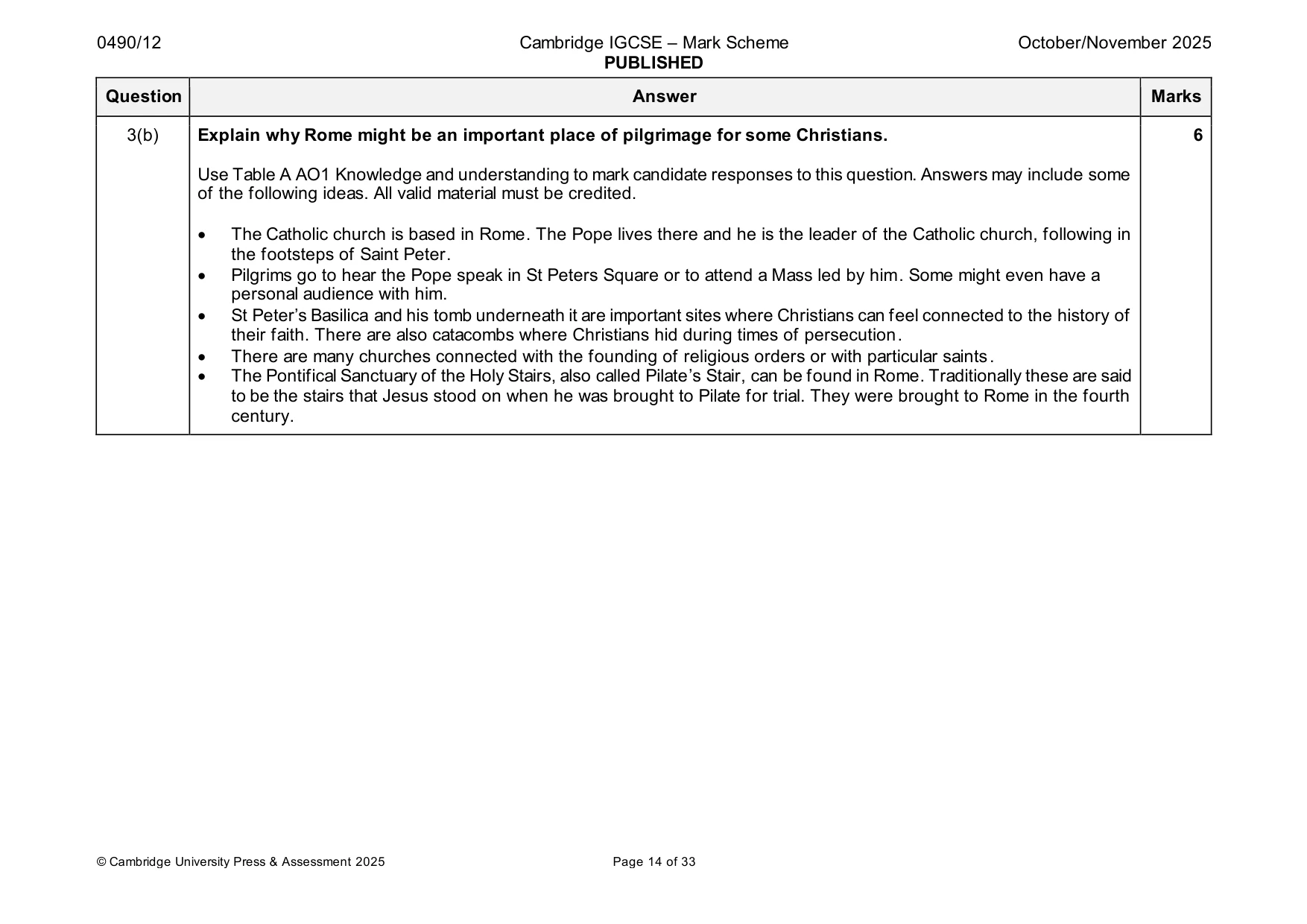
0490/12 Cambridge IGCSE – Mark Scheme PUBLISHED October/November 2025 © Cambridge University Press & Assessment 2025 Page 14 of 33 Question Answer Marks 3(b) Explain why Rome might be an important place of pilgrimage for some Christians. Use Table A AO1 Knowledge and understanding to mark candidate responses to this question. Answers may include some of the following ideas. All valid material must be credited. • The Catholic church is based in Rome. The Pope lives there and he is the leader of the Catholic church, following in the footsteps of Saint Peter. • Pilgrims go to hear the Pope speak in St Peters Square or to attend a Mass led by him. Some might even have a personal audience with him. • St Peter’s Basilica and his tomb underneath it are important sites where Christians can feel connected to the history of their faith. There are also catacombs where Christians hid during times of persecution. • There are many churches connected with the founding of religious orders or with particular saints. • The Pontifical Sanctuary of the Holy Stairs, also called Pilate’s Stair, can be found in Rome. Traditionally these are said to be the stairs that Jesus stood on when he was brought to Pilate for trial. They were brought to Rome in the fourth century. 6
Mark scheme, page 15
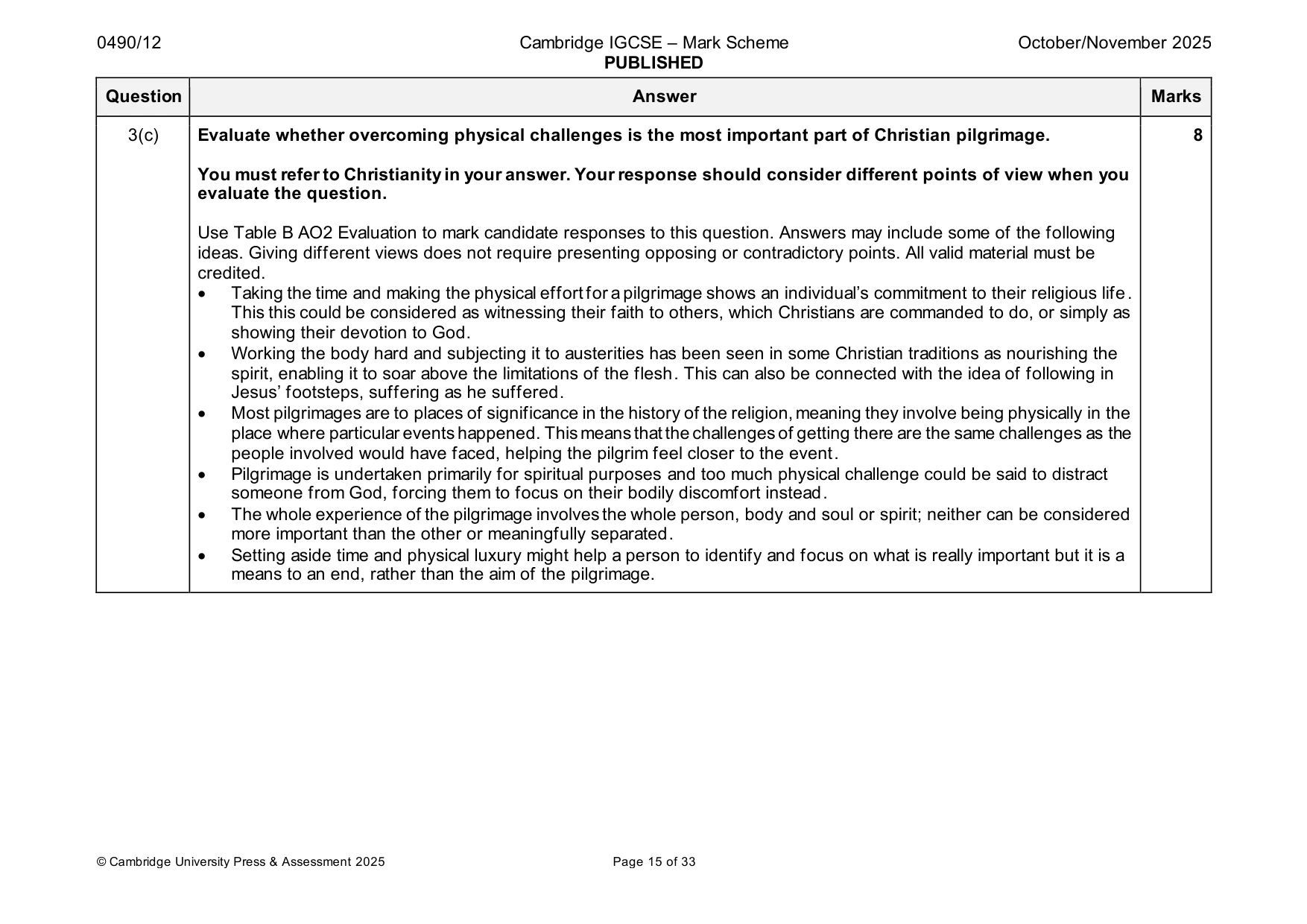
0490/12 Cambridge IGCSE – Mark Scheme PUBLISHED October/November 2025 © Cambridge University Press & Assessment 2025 Page 15 of 33 Question Answer Marks 3(c) Evaluate whether overcoming physical challenges is the most important part of Christian pilgrimage. You must refer to Christianity in your answer. Your response should consider different points of view when you evaluate the question. Use Table B AO2 Evaluation to mark candidate responses to this question. Answers may include some of the following ideas. Giving different views does not require presenting opposing or contradictory points. All valid material must be credited. • Taking the time and making the physical effort for a pilgrimage shows an individual’s commitment to their religious life. This this could be considered as witnessing their faith to others, which Christians are commanded to do, or simply as showing their devotion to God. • Working the body hard and subjecting it to austerities has been seen in some Christian traditions as nourishing the spirit, enabling it to soar above the limitations of the flesh. This can also be connected with the idea of following in Jesus’ footsteps, suffering as he suffered. • Most pilgrimages are to places of significance in the history of the religion, meaning they involve being physically in the place where particular events happened. This means that the challenges of getting there are the same challenges as the people involved would have faced, helping the pilgrim feel closer to the event. • Pilgrimage is undertaken primarily for spiritual purposes and too much physical challenge could be said to distract someone from God, forcing them to focus on their bodily discomfort instead. • The whole experience of the pilgrimage involves the whole person, body and soul or spirit; neither can be considered more important than the other or meaningfully separated. • Setting aside time and physical luxury might help a person to identify and focus on what is really important but it is a means to an end, rather than the aim of the pilgrimage. 8
Mark scheme, page 16
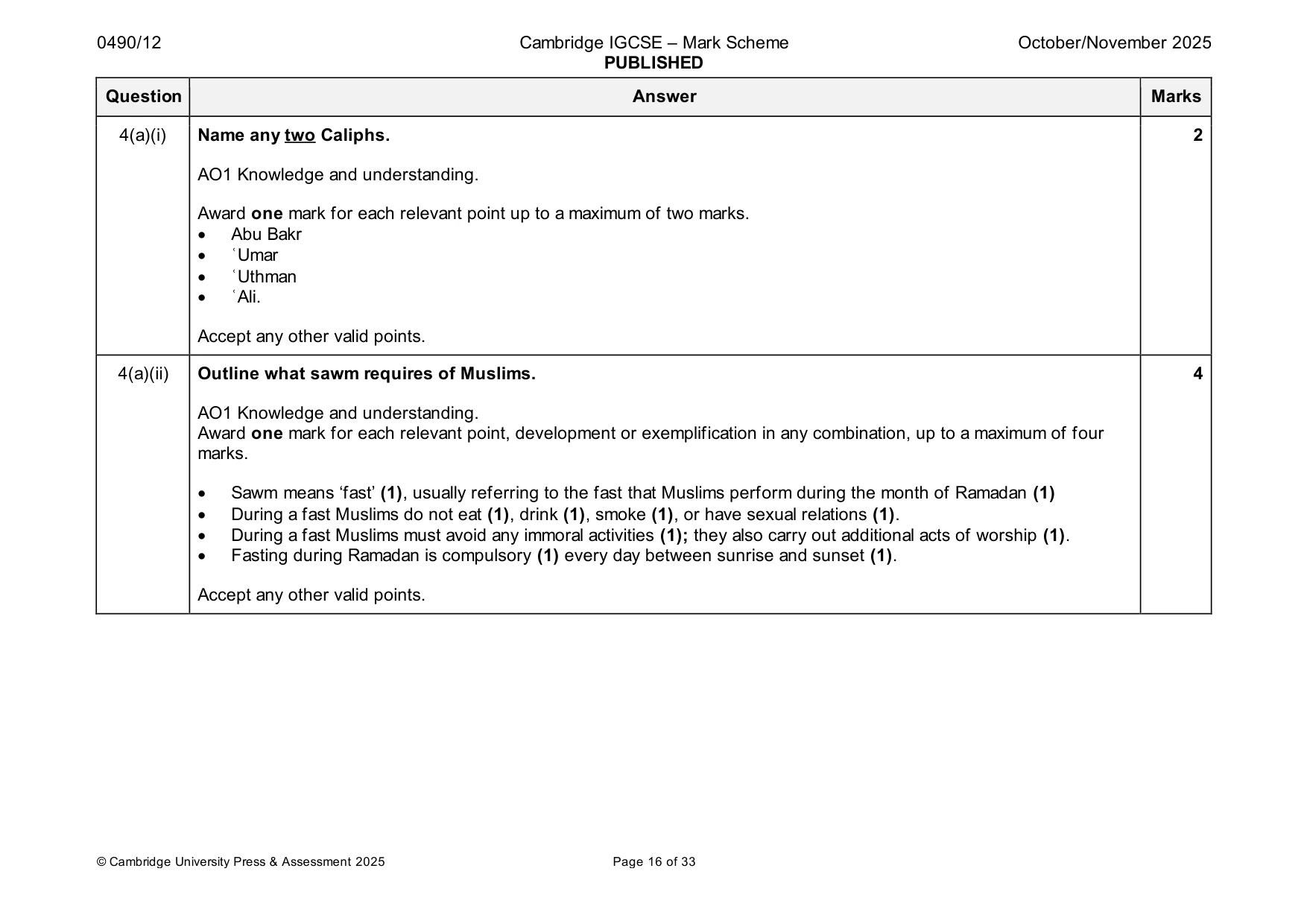
0490/12 Cambridge IGCSE – Mark Scheme PUBLISHED October/November 2025 © Cambridge University Press & Assessment 2025 Page 16 of 33 Question Answer Marks 4(a)(i) Name any two Caliphs. AO1 Knowledge and understanding. Award one mark for each relevant point up to a maximum of two marks. • Abu Bakr • ʿUmar • ʿUthman • ʿAli. Accept any other valid points. 2 4(a)(ii) Outline what sawm requires of Muslims. AO1 Knowledge and understanding. Award one mark for each relevant point, development or exemplification in any combination, up to a maximum of four marks. • Sawm means ‘fast’ (1), usually referring to the fast that Muslims perform during the month of Ramadan (1) • During a fast Muslims do not eat (1), drink (1), smoke (1), or have sexual relations (1). • During a fast Muslims must avoid any immoral activities (1); they also carry out additional acts of worship (1). • Fasting during Ramadan is compulsory (1) every day between sunrise and sunset (1). Accept any other valid points. 4
Mark scheme, page 17
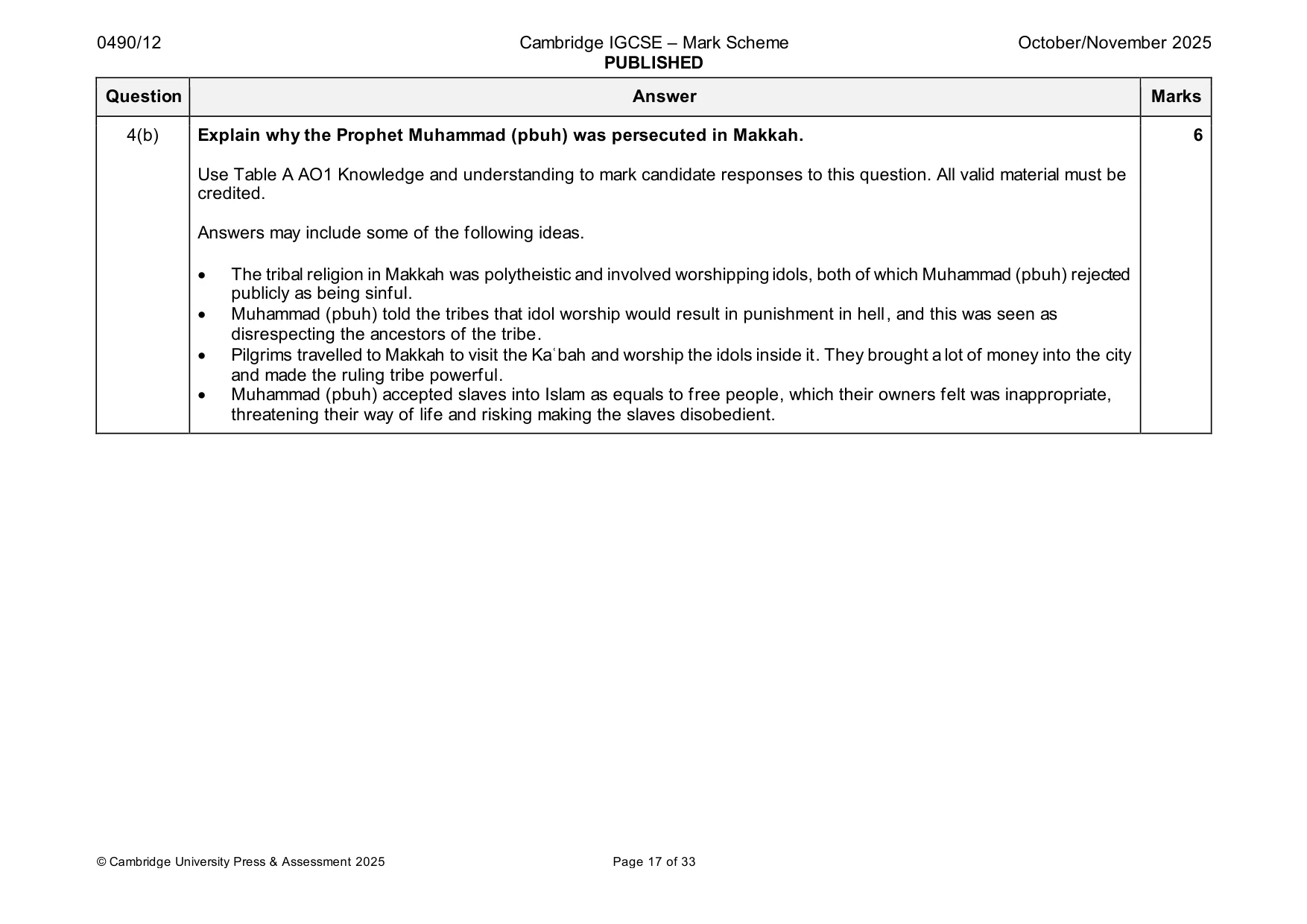
0490/12 Cambridge IGCSE – Mark Scheme PUBLISHED October/November 2025 © Cambridge University Press & Assessment 2025 Page 17 of 33 Question Answer Marks 4(b) Explain why the Prophet Muhammad (pbuh) was persecuted in Makkah. Use Table A AO1 Knowledge and understanding to mark candidate responses to this question. All valid material must be credited. Answers may include some of the following ideas. • The tribal religion in Makkah was polytheistic and involved worshipping idols, both of which Muhammad (pbuh) rejected publicly as being sinful. • Muhammad (pbuh) told the tribes that idol worship would result in punishment in hell, and this was seen as disrespecting the ancestors of the tribe. • Pilgrims travelled to Makkah to visit the Kaʿbah and worship the idols inside it. They brought a lot of money into the city and made the ruling tribe powerful. • Muhammad (pbuh) accepted slaves into Islam as equals to free people, which their owners felt was inappropriate, threatening their way of life and risking making the slaves disobedient. 6
Mark scheme, page 18
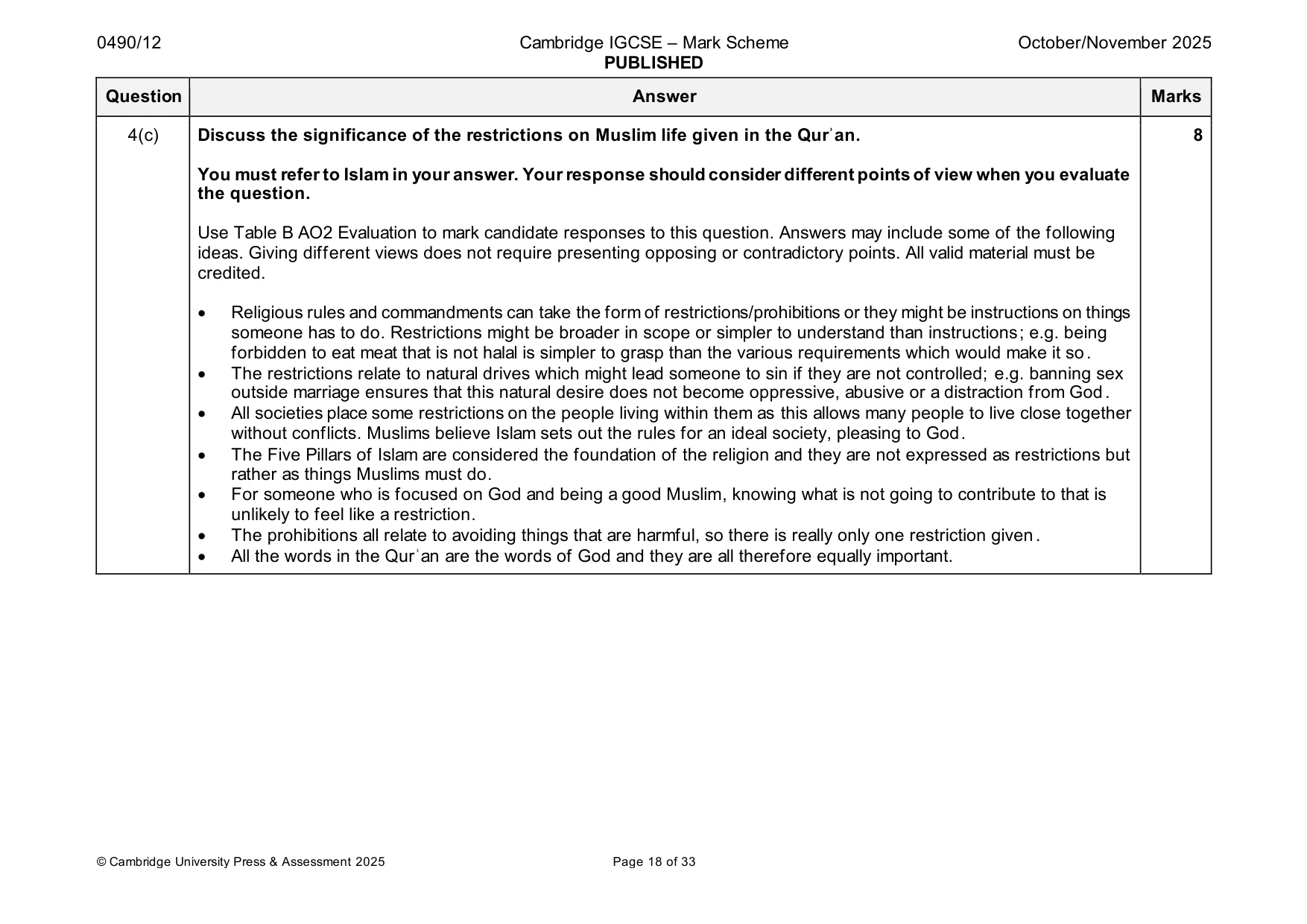
0490/12 Cambridge IGCSE – Mark Scheme PUBLISHED October/November 2025 © Cambridge University Press & Assessment 2025 Page 18 of 33 Question Answer Marks 4(c) Discuss the significance of the restrictions on Muslim life given in the Qurʾan. You must refer to Islam in your answer. Your response should consider different points of view when you evaluate the question. Use Table B AO2 Evaluation to mark candidate responses to this question. Answers may include some of the following ideas. Giving different views does not require presenting opposing or contradictory points. All valid material must be credited. • Religious rules and commandments can take the form of restrictions/prohibitions or they might be instructions on things someone has to do. Restrictions might be broader in scope or simpler to understand than instructions; e.g. being forbidden to eat meat that is not halal is simpler to grasp than the various requirements which would make it so. • The restrictions relate to natural drives which might lead someone to sin if they are not controlled; e.g. banning sex outside marriage ensures that this natural desire does not become oppressive, abusive or a distraction from God. • All societies place some restrictions on the people living within them as this allows many people to live close together without conflicts. Muslims believe Islam sets out the rules for an ideal society, pleasing to God. • The Five Pillars of Islam are considered the foundation of the religion and they are not expressed as restrictions but rather as things Muslims must do. • For someone who is focused on God and being a good Muslim, knowing what is not going to contribute to that is unlikely to feel like a restriction. • The prohibitions all relate to avoiding things that are harmful, so there is really only one restriction given. • All the words in the Qurʾan are the words of God and they are all therefore equally important. 8
Mark scheme, page 19
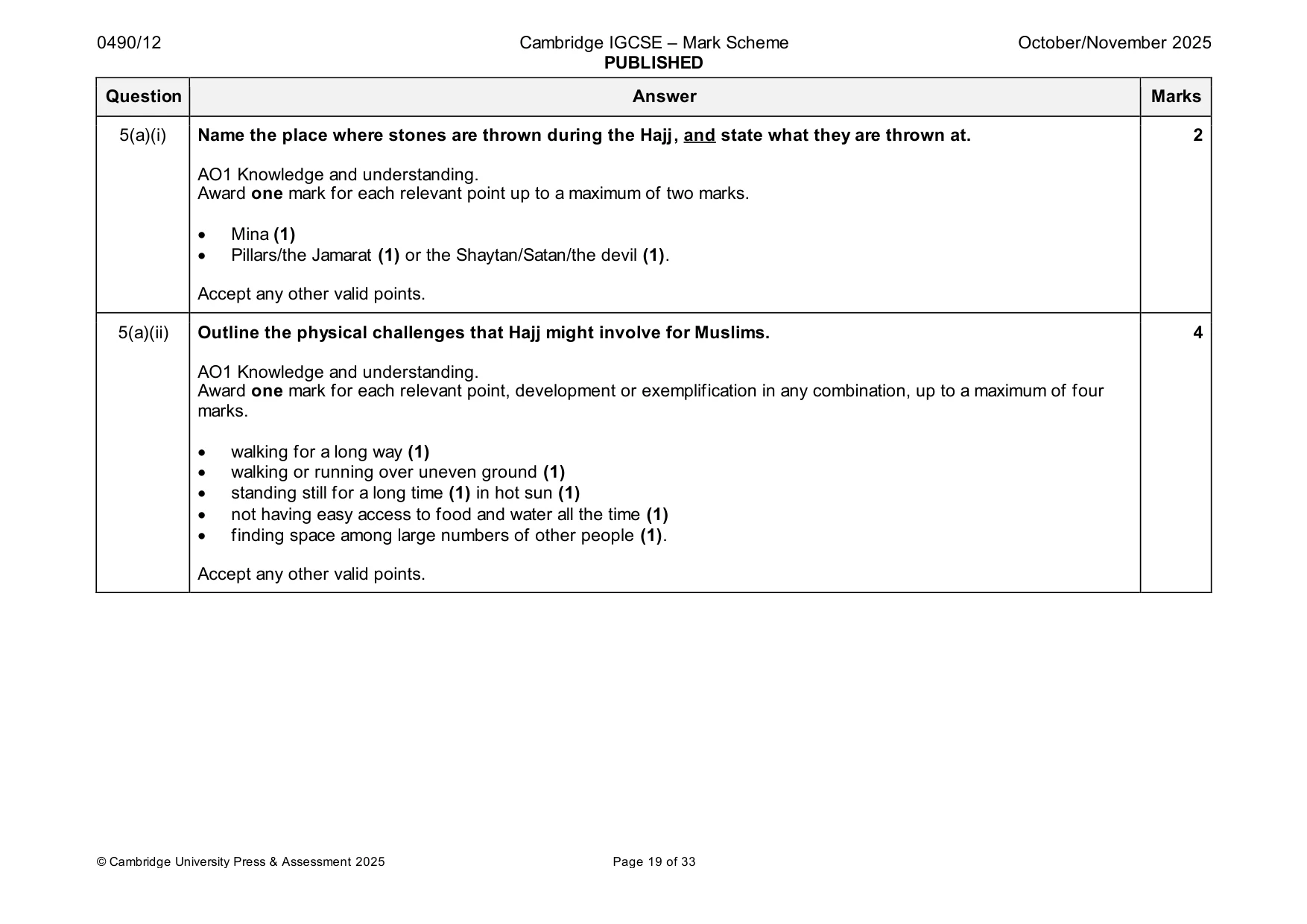
0490/12 Cambridge IGCSE – Mark Scheme PUBLISHED October/November 2025 © Cambridge University Press & Assessment 2025 Page 19 of 33 Question Answer Marks 5(a)(i) Name the place where stones are thrown during the Hajj, and state what they are thrown at. AO1 Knowledge and understanding. Award one mark for each relevant point up to a maximum of two marks. • Mina (1) • Pillars/the Jamarat (1) or the Shaytan/Satan/the devil (1). Accept any other valid points. 2 5(a)(ii) Outline the physical challenges that Hajj might involve for Muslims. AO1 Knowledge and understanding. Award one mark for each relevant point, development or exemplification in any combination, up to a maximum of four marks. • walking for a long way (1) • walking or running over uneven ground (1) • standing still for a long time (1) in hot sun (1) • not having easy access to food and water all the time (1) • finding space among large numbers of other people (1). Accept any other valid points. 4
Mark scheme, page 20
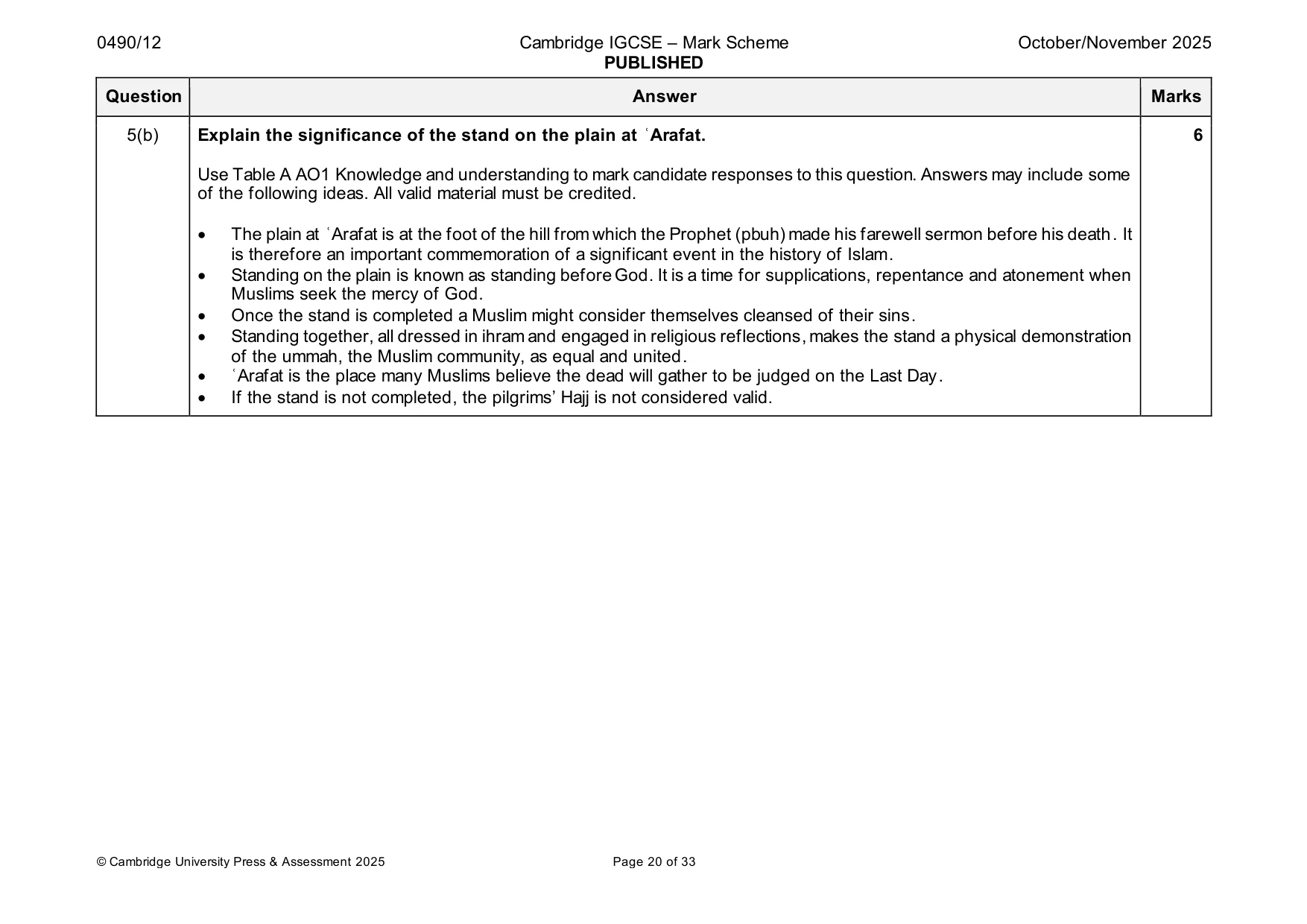
0490/12 Cambridge IGCSE – Mark Scheme PUBLISHED October/November 2025 © Cambridge University Press & Assessment 2025 Page 20 of 33 Question Answer Marks 5(b) Explain the significance of the stand on the plain at ʿArafat. Use Table A AO1 Knowledge and understanding to mark candidate responses to this question. Answers may include some of the following ideas. All valid material must be credited. • The plain at ʿArafat is at the foot of the hill from which the Prophet (pbuh) made his farewell sermon before his death. It is therefore an important commemoration of a significant event in the history of Islam. • Standing on the plain is known as standing before God. It is a time for supplications, repentance and atonement when Muslims seek the mercy of God. • Once the stand is completed a Muslim might consider themselves cleansed of their sins. • Standing together, all dressed in ihram and engaged in religious reflections, makes the stand a physical demonstration of the ummah, the Muslim community, as equal and united. • ʿArafat is the place many Muslims believe the dead will gather to be judged on the Last Day. • If the stand is not completed, the pilgrims’ Hajj is not considered valid. 6
Mark scheme, page 21
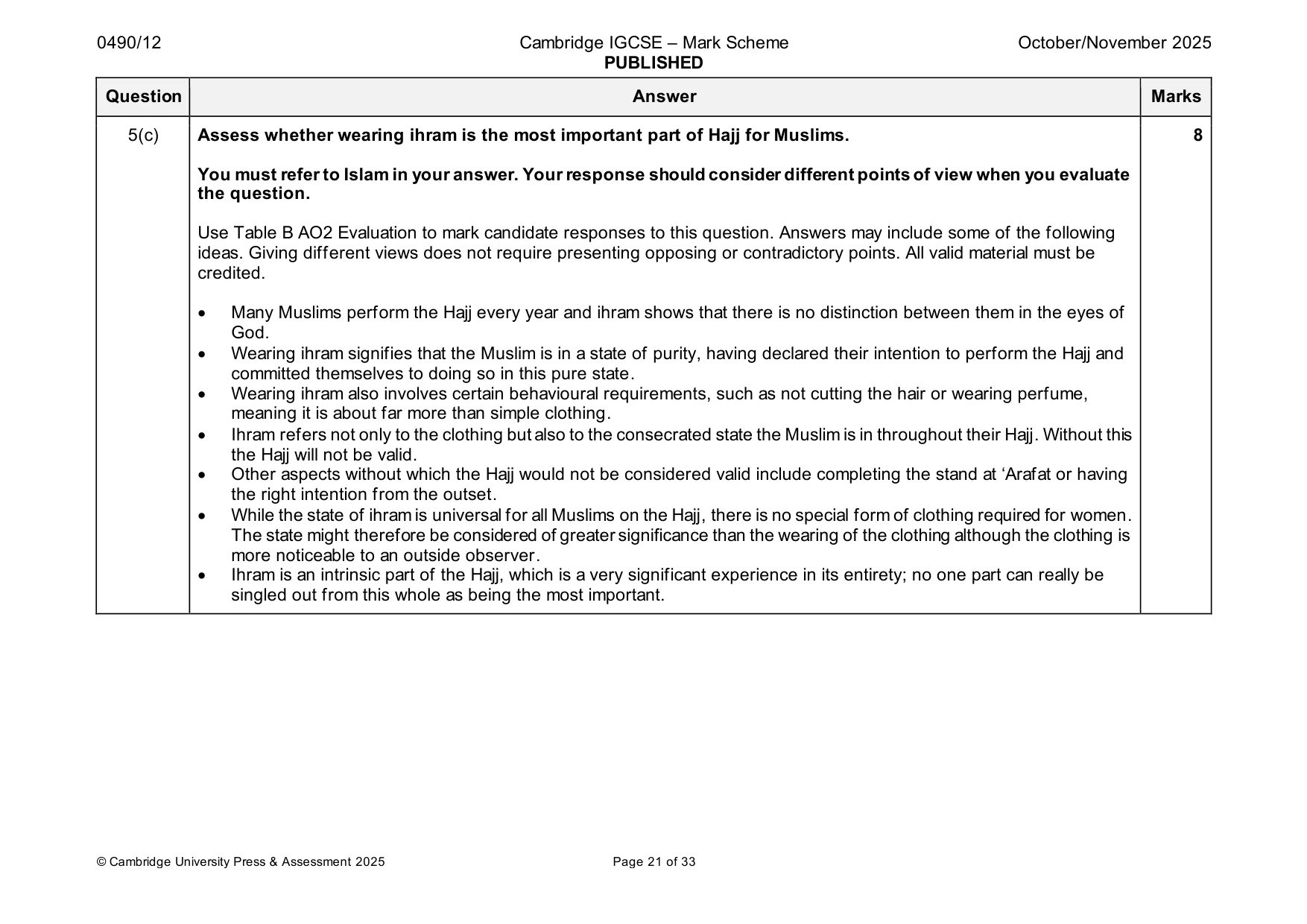
0490/12 Cambridge IGCSE – Mark Scheme PUBLISHED October/November 2025 © Cambridge University Press & Assessment 2025 Page 21 of 33 Question Answer Marks 5(c) Assess whether wearing ihram is the most important part of Hajj for Muslims. You must refer to Islam in your answer. Your response should consider different points of view when you evaluate the question. Use Table B AO2 Evaluation to mark candidate responses to this question. Answers may include some of the following ideas. Giving different views does not require presenting opposing or contradictory points. All valid material must be credited. • Many Muslims perform the Hajj every year and ihram shows that there is no distinction between them in the eyes of God. • Wearing ihram signifies that the Muslim is in a state of purity, having declared their intention to perform the Hajj and committed themselves to doing so in this pure state. • Wearing ihram also involves certain behavioural requirements, such as not cutting the hair or wearing perfume, meaning it is about far more than simple clothing. • Ihram refers not only to the clothing but also to the consecrated state the Muslim is in throughout their Hajj. Without this the Hajj will not be valid. • Other aspects without which the Hajj would not be considered valid include completing the stand at ‘Arafat or having the right intention from the outset. • While the state of ihram is universal for all Muslims on the Hajj, there is no special form of clothing required for women. The state might therefore be considered of greater significance than the wearing of the clothing although the clothing is more noticeable to an outside observer. • Ihram is an intrinsic part of the Hajj, which is a very significant experience in its entirety; no one part can really be singled out from this whole as being the most important. 8
Mark scheme, page 22
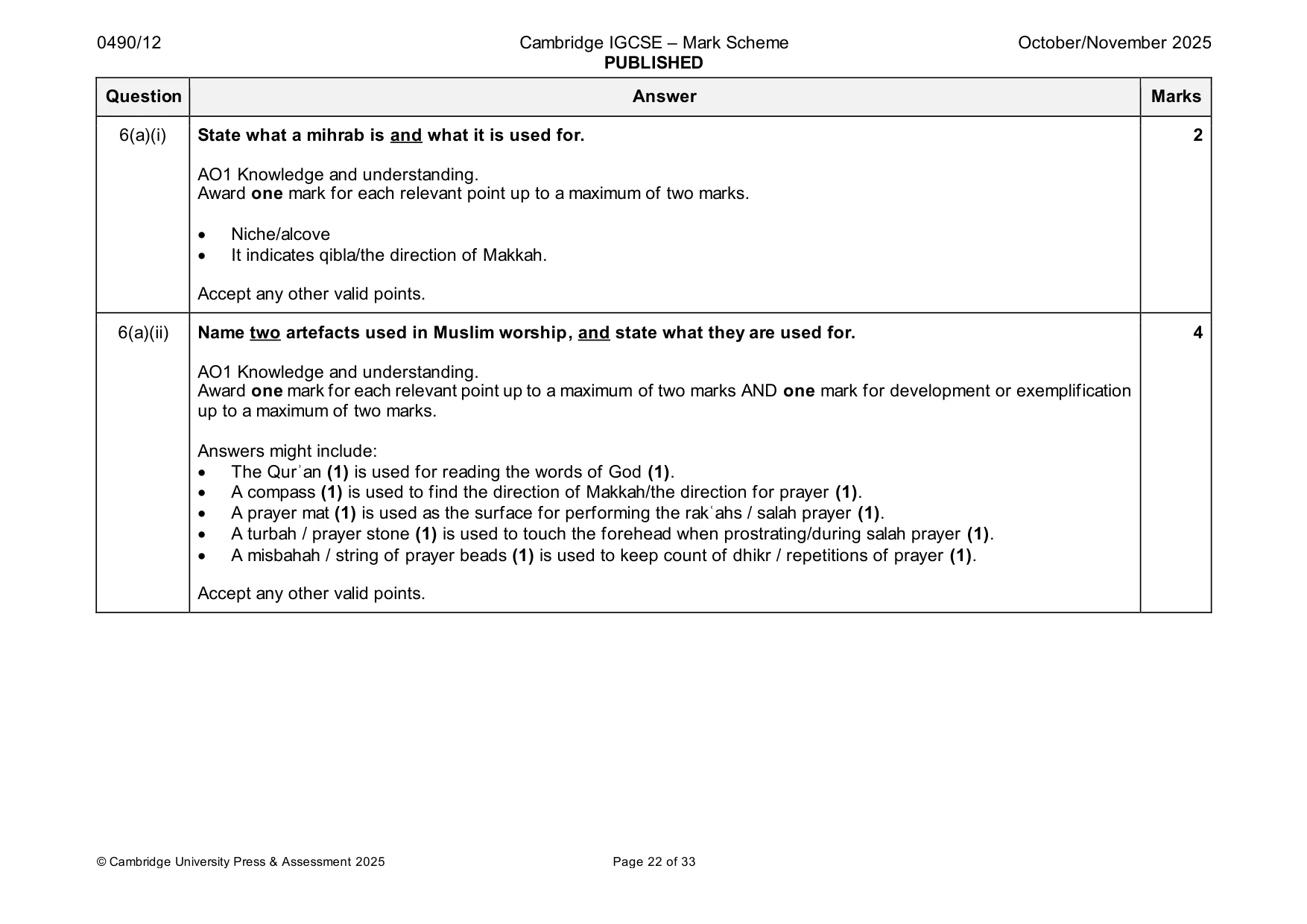
0490/12 Cambridge IGCSE – Mark Scheme PUBLISHED October/November 2025 © Cambridge University Press & Assessment 2025 Page 22 of 33 Question Answer Marks 6(a)(i) State what a mihrab is and what it is used for. AO1 Knowledge and understanding. Award one mark for each relevant point up to a maximum of two marks. • Niche/alcove • It indicates qibla/the direction of Makkah. Accept any other valid points. 2 6(a)(ii) Name two artefacts used in Muslim worship, and state what they are used for. AO1 Knowledge and understanding. Award one mark for each relevant point up to a maximum of two marks AND one mark for development or exemplification up to a maximum of two marks. Answers might include: • The Qurʾan (1) is used for reading the words of God (1). • A compass (1) is used to find the direction of Makkah/the direction for prayer (1). • A prayer mat (1) is used as the surface for performing the rakʿahs / salah prayer (1). • A turbah / prayer stone (1) is used to touch the forehead when prostrating/during salah prayer (1). • A misbahah / string of prayer beads (1) is used to keep count of dhikr / repetitions of prayer (1). Accept any other valid points. 4
Mark scheme, page 23
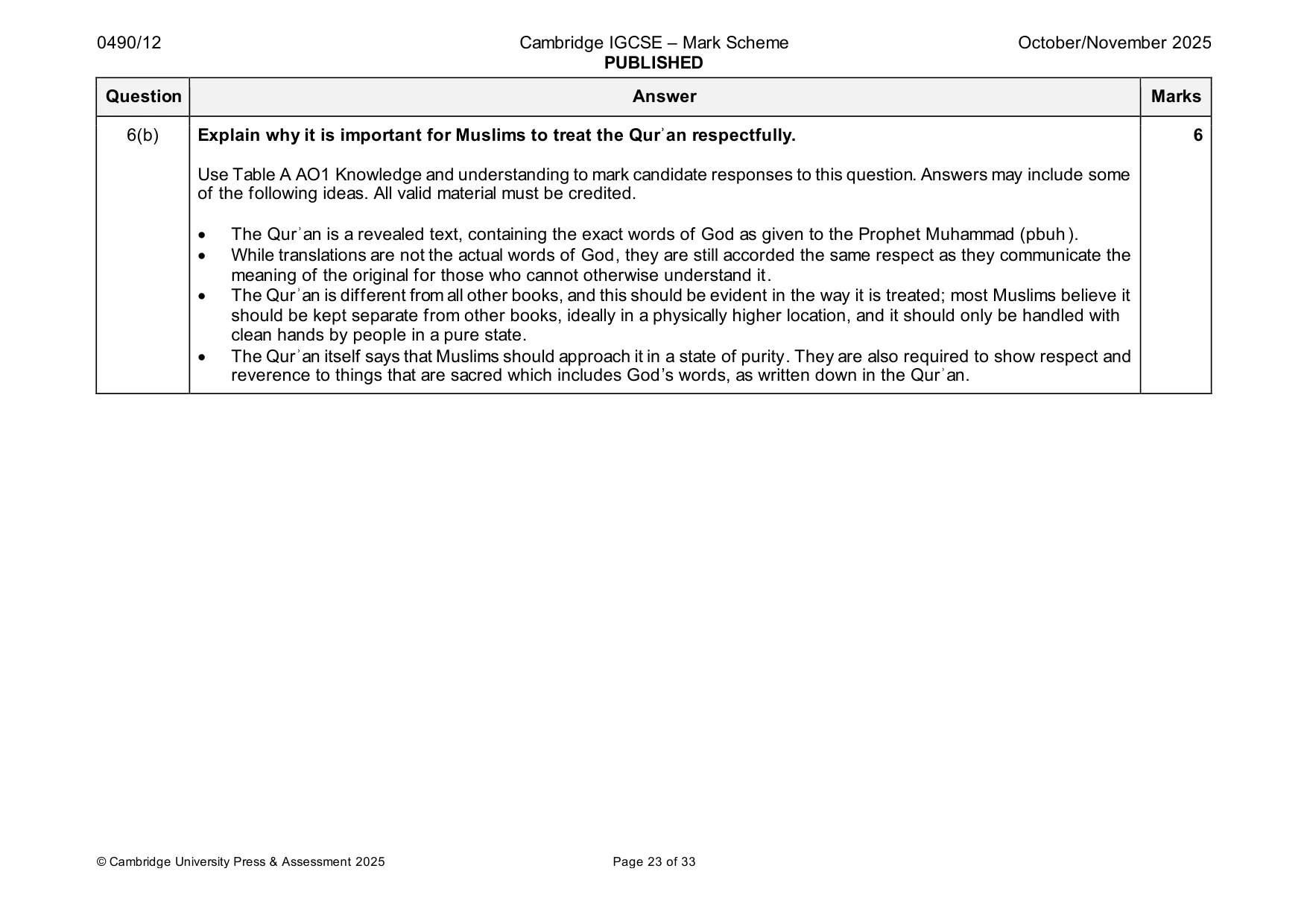
0490/12 Cambridge IGCSE – Mark Scheme PUBLISHED October/November 2025 © Cambridge University Press & Assessment 2025 Page 23 of 33 Question Answer Marks 6(b) Explain why it is important for Muslims to treat the Qurʾan respectfully. Use Table A AO1 Knowledge and understanding to mark candidate responses to this question. Answers may include some of the following ideas. All valid material must be credited. • The Qurʾan is a revealed text, containing the exact words of God as given to the Prophet Muhammad (pbuh). • While translations are not the actual words of God, they are still accorded the same respect as they communicate the meaning of the original for those who cannot otherwise understand it. • The Qurʾan is different from all other books, and this should be evident in the way it is treated; most Muslims believe it should be kept separate from other books, ideally in a physically higher location, and it should only be handled with clean hands by people in a pure state. • The Qurʾan itself says that Muslims should approach it in a state of purity. They are also required to show respect and reverence to things that are sacred which includes God’s words, as written down in the Qurʾan. 6
Mark scheme, page 24
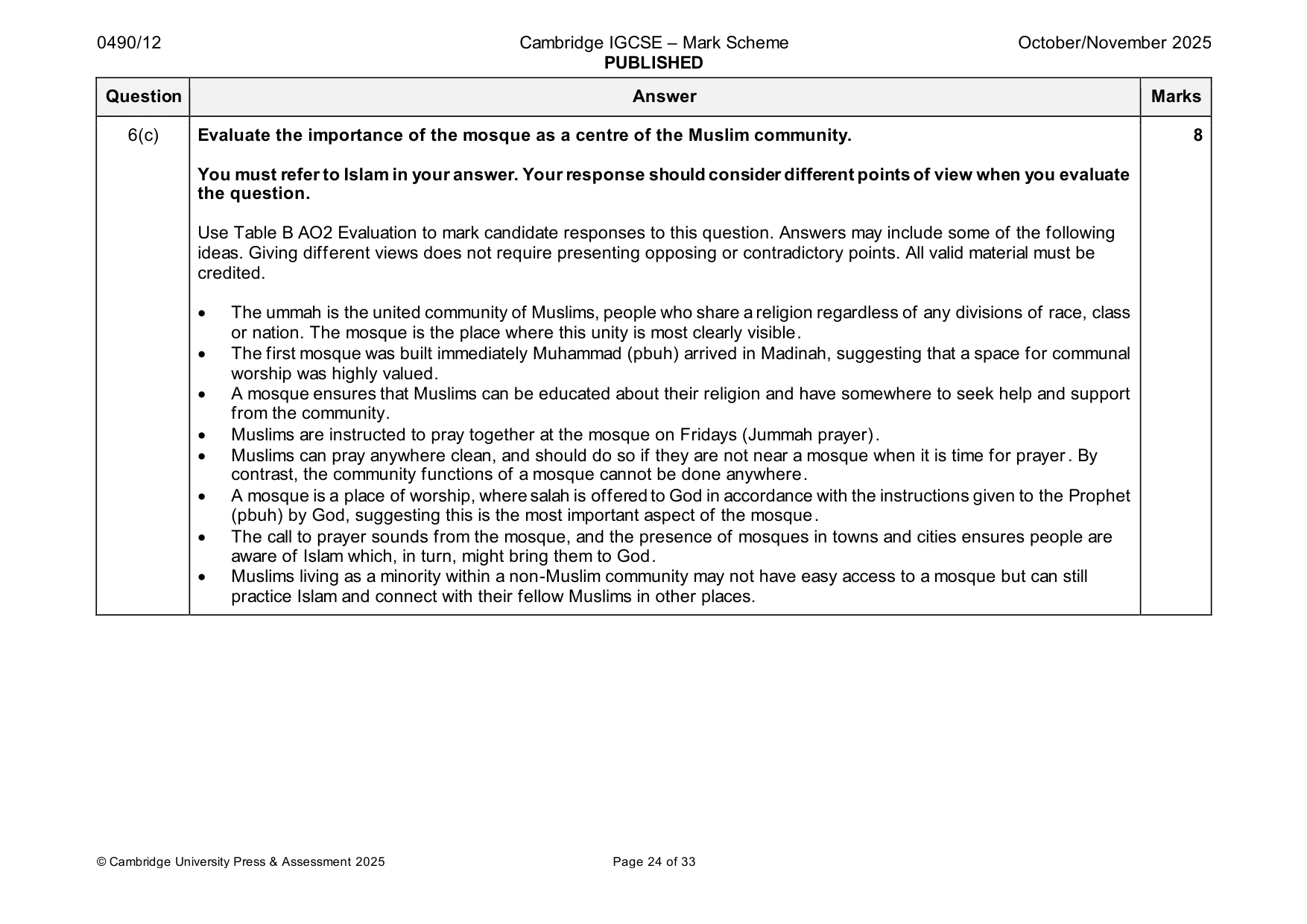
0490/12 Cambridge IGCSE – Mark Scheme PUBLISHED October/November 2025 © Cambridge University Press & Assessment 2025 Page 24 of 33 Question Answer Marks 6(c) Evaluate the importance of the mosque as a centre of the Muslim community. You must refer to Islam in your answer. Your response should consider different points of view when you evaluate the question. Use Table B AO2 Evaluation to mark candidate responses to this question. Answers may include some of the following ideas. Giving different views does not require presenting opposing or contradictory points. All valid material must be credited. • The ummah is the united community of Muslims, people who share a religion regardless of any divisions of race, class or nation. The mosque is the place where this unity is most clearly visible. • The first mosque was built immediately Muhammad (pbuh) arrived in Madinah, suggesting that a space for communal worship was highly valued. • A mosque ensures that Muslims can be educated about their religion and have somewhere to seek help and support from the community. • Muslims are instructed to pray together at the mosque on Fridays (Jummah prayer). • Muslims can pray anywhere clean, and should do so if they are not near a mosque when it is time for prayer. By contrast, the community functions of a mosque cannot be done anywhere. • A mosque is a place of worship, where salah is offered to God in accordance with the instructions given to the Prophet (pbuh) by God, suggesting this is the most important aspect of the mosque. • The call to prayer sounds from the mosque, and the presence of mosques in towns and cities ensures people are aware of Islam which, in turn, might bring them to God. • Muslims living as a minority within a non-Muslim community may not have easy access to a mosque but can still practice Islam and connect with their fellow Muslims in other places. 8
Mark scheme, page 25
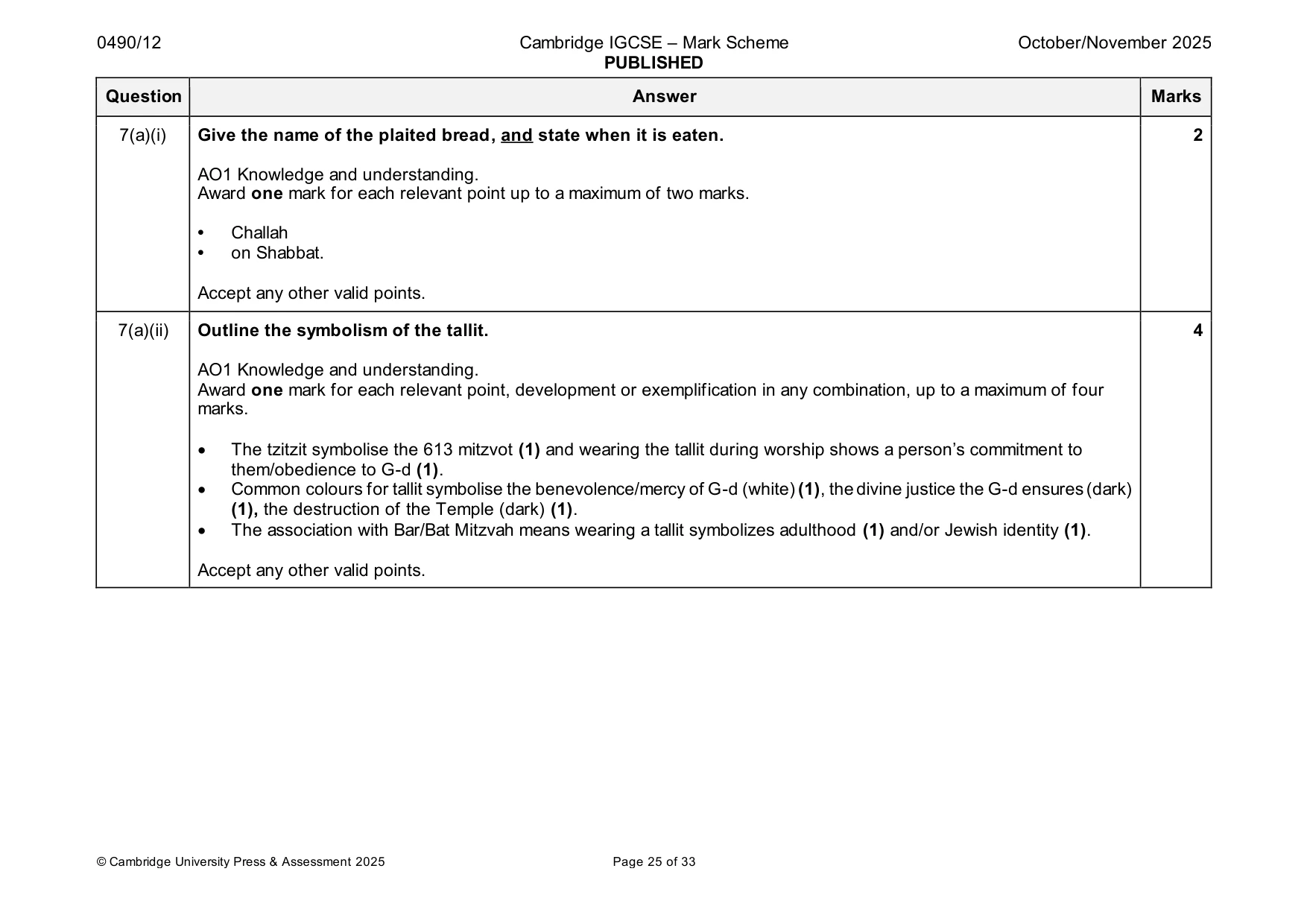
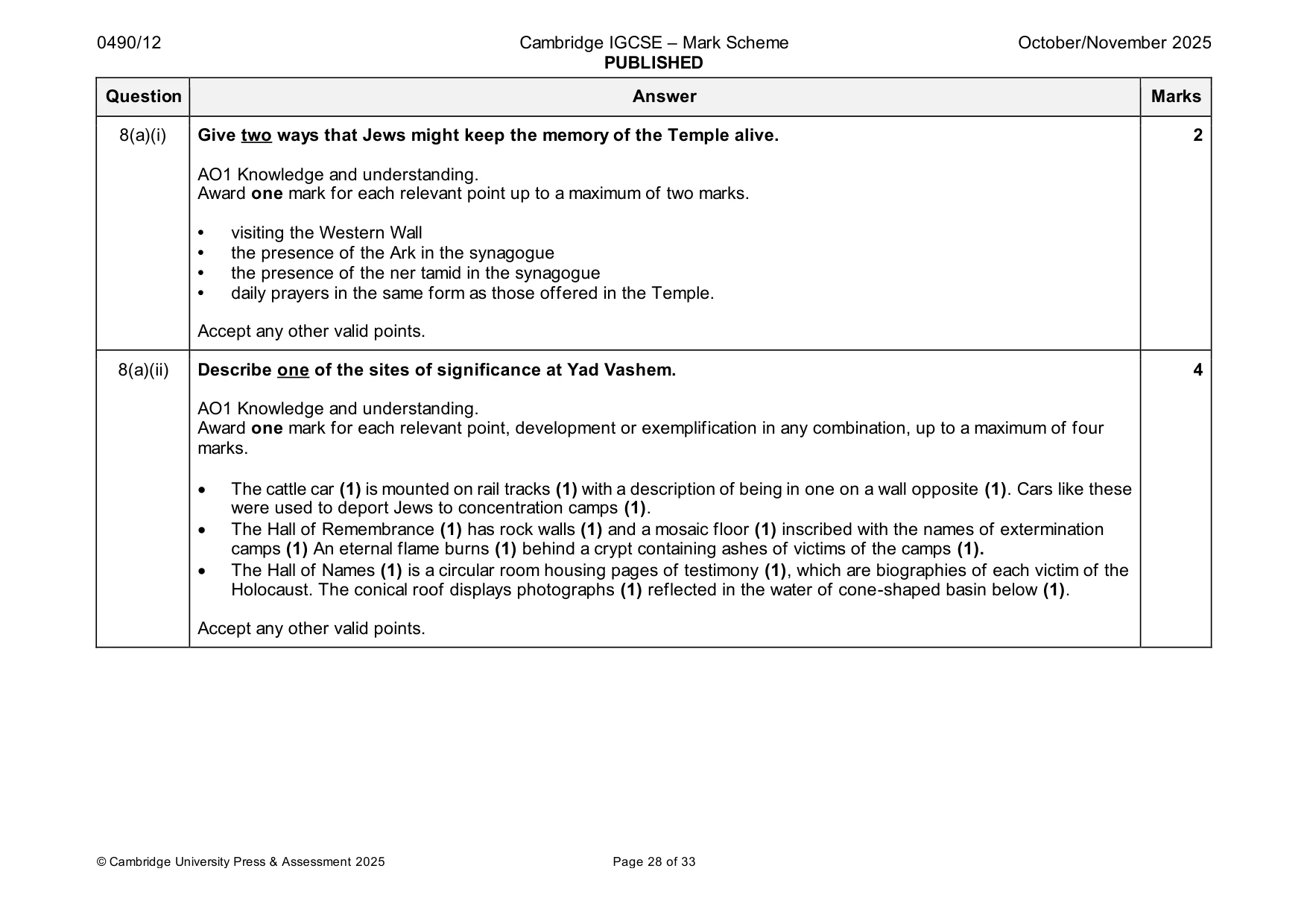
0490/12 Cambridge IGCSE – Mark Scheme PUBLISHED October/November 2025 © Cambridge University Press & Assessment 2025 Page 25 of 33 Question Answer Marks 7(a)(i) Give the name of the plaited bread, and state when it is eaten. AO1 Knowledge and understanding. Award one mark for each relevant point up to a maximum of two marks. • Challah • on Shabbat. Accept any other valid points. 2 7(a)(ii) Outline the symbolism of the tallit. AO1 Knowledge and understanding. Award one mark for each relevant point, development or exemplification in any combination, up to a maximum of four marks. • The tzitzit symbolise the 613 mitzvot (1) and wearing the tallit during worship shows a person’s commitment to them/obedience to G-d (1). • Common colours for tallit symbolise the benevolence/mercy of G-d (white) (1), the divine justice the G-d ensures (dark) (1), the destruction of the Temple (dark) (1). • The association with Bar/Bat Mitzvah means wearing a tallit symbolizes adulthood (1) and/or Jewish identity (1). Accept any other valid points. 4
Mark scheme, page 26
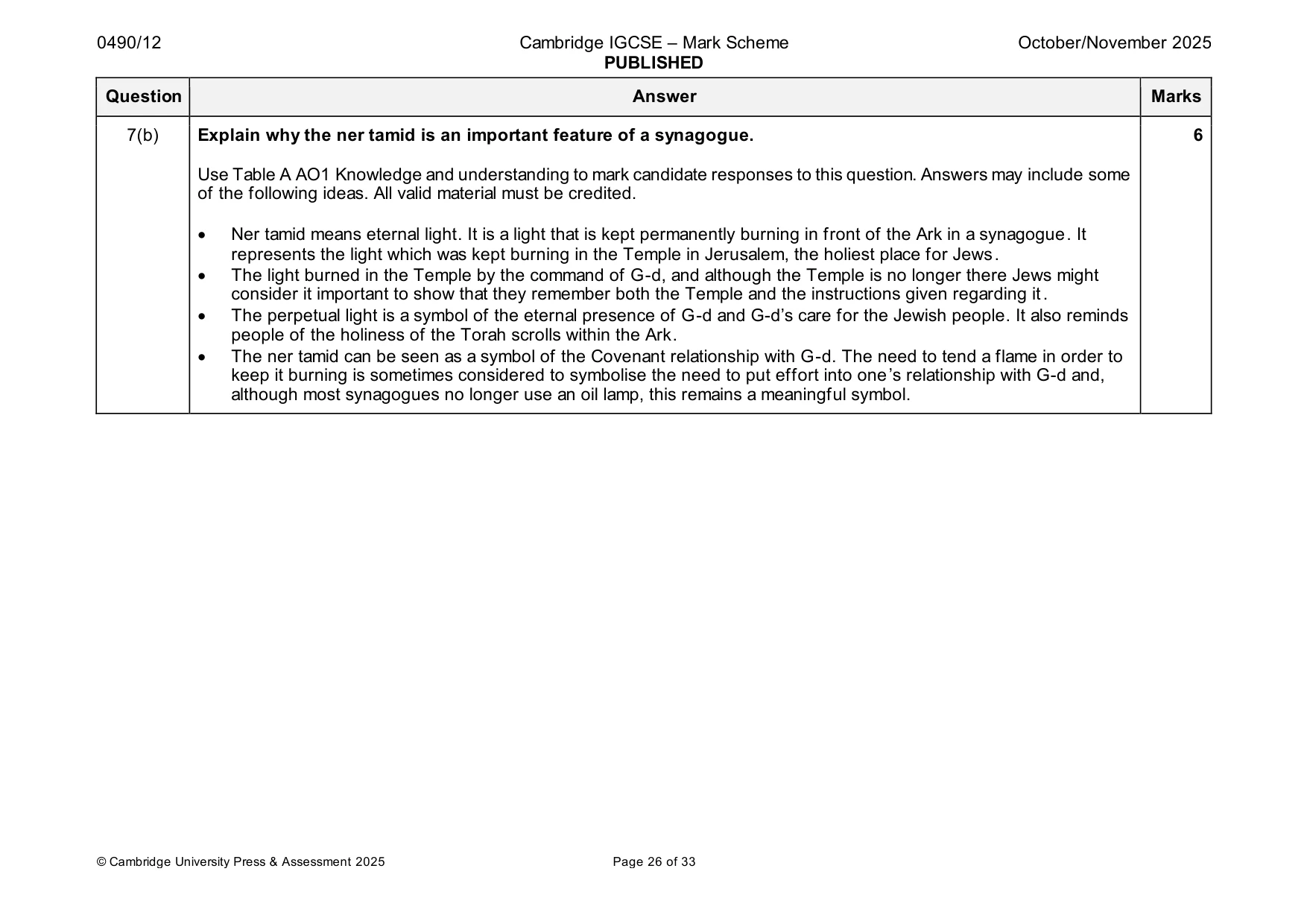
0490/12 Cambridge IGCSE – Mark Scheme PUBLISHED October/November 2025 © Cambridge University Press & Assessment 2025 Page 26 of 33 Question Answer Marks 7(b) Explain why the ner tamid is an important feature of a synagogue. Use Table A AO1 Knowledge and understanding to mark candidate responses to this question. Answers may include some of the following ideas. All valid material must be credited. • Ner tamid means eternal light. It is a light that is kept permanently burning in front of the Ark in a synagogue. It represents the light which was kept burning in the Temple in Jerusalem, the holiest place for Jews. • The light burned in the Temple by the command of G-d, and although the Temple is no longer there Jews might consider it important to show that they remember both the Temple and the instructions given regarding it. • The perpetual light is a symbol of the eternal presence of G-d and G-d’s care for the Jewish people. It also reminds people of the holiness of the Torah scrolls within the Ark. • The ner tamid can be seen as a symbol of the Covenant relationship with G-d. The need to tend a flame in order to keep it burning is sometimes considered to symbolise the need to put effort into one’s relationship with G-d and, although most synagogues no longer use an oil lamp, this remains a meaningful symbol. 6
Mark scheme, page 27
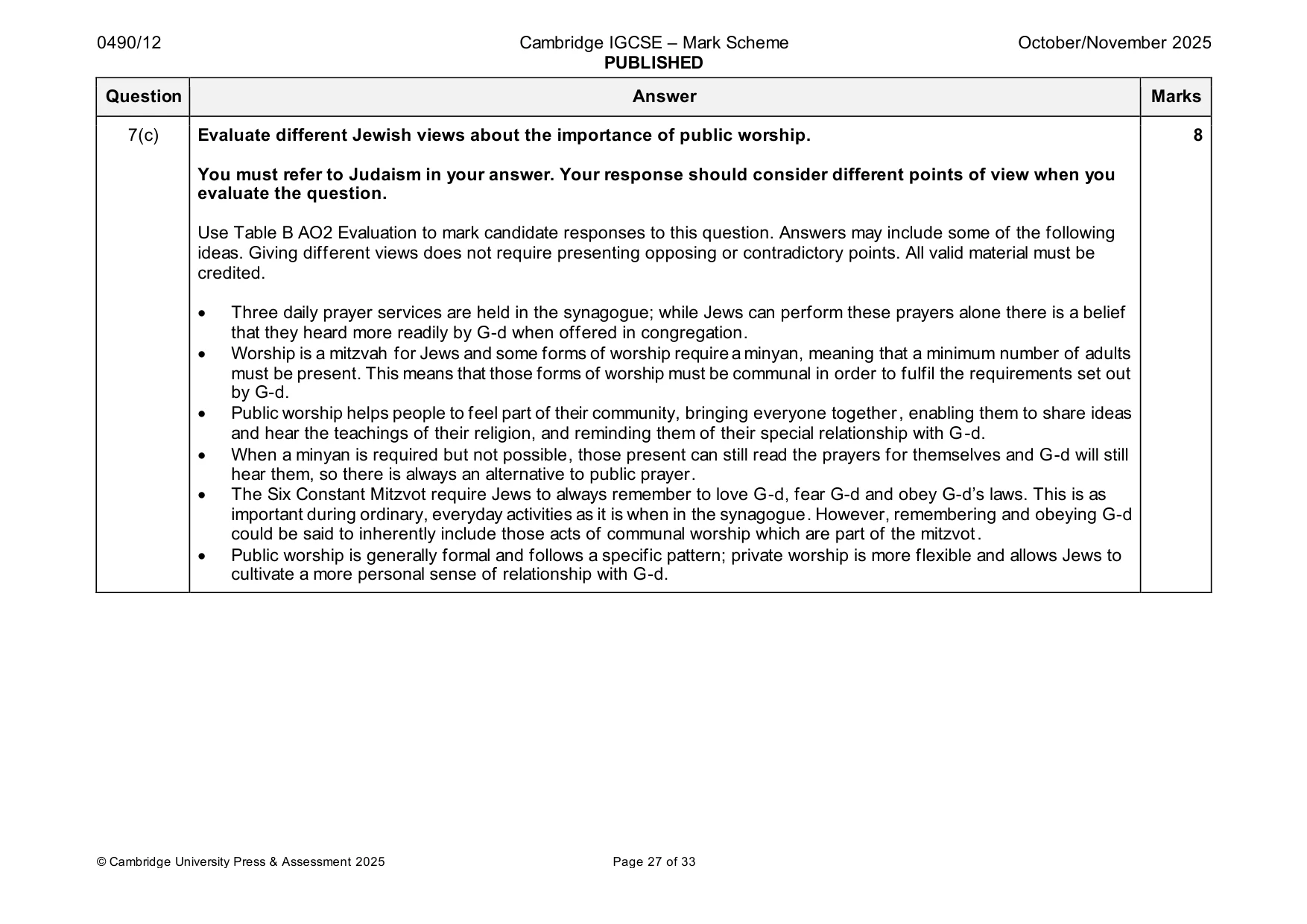
0490/12 Cambridge IGCSE – Mark Scheme PUBLISHED October/November 2025 © Cambridge University Press & Assessment 2025 Page 27 of 33 Question Answer Marks 7(c) Evaluate different Jewish views about the importance of public worship. You must refer to Judaism in your answer. Your response should consider different points of view when you evaluate the question. Use Table B AO2 Evaluation to mark candidate responses to this question. Answers may include some of the following ideas. Giving different views does not require presenting opposing or contradictory points. All valid material must be credited. • Three daily prayer services are held in the synagogue; while Jews can perform these prayers alone there is a belief that they heard more readily by G-d when offered in congregation. • Worship is a mitzvah for Jews and some forms of worship require a minyan, meaning that a minimum number of adults must be present. This means that those forms of worship must be communal in order to fulfil the requirements set out by G-d. • Public worship helps people to feel part of their community, bringing everyone together, enabling them to share ideas and hear the teachings of their religion, and reminding them of their special relationship with G-d. • When a minyan is required but not possible, those present can still read the prayers for themselves and G-d will still hear them, so there is always an alternative to public prayer. • The Six Constant Mitzvot require Jews to always remember to love G-d, fear G-d and obey G-d’s laws. This is as important during ordinary, everyday activities as it is when in the synagogue. However, remembering and obeying G-d could be said to inherently include those acts of communal worship which are part of the mitzvot. • Public worship is generally formal and follows a specific pattern; private worship is more flexible and allows Jews to cultivate a more personal sense of relationship with G-d. 8
Mark scheme, page 28
0490/12 Cambridge IGCSE – Mark Scheme PUBLISHED October/November 2025 © Cambridge University Press & Assessment 2025 Page 28 of 33 Question Answer Marks 8(a)(i) Give two ways that Jews might keep the memory of the Temple alive. AO1 Knowledge and understanding. Award one mark for each relevant point up to a maximum of two marks. • visiting the Western Wall • the presence of the Ark in the synagogue • the presence of the ner tamid in the synagogue • daily prayers in the same form as those offered in the Temple. Accept any other valid points. 2 8(a)(ii) Describe one of the sites of significance at Yad Vashem. AO1 Knowledge and understanding. Award one mark for each relevant point, development or exemplification in any combination, up to a maximum of four marks. • The cattle car (1) is mounted on rail tracks (1) with a description of being in one on a wall opposite (1). Cars like these were used to deport Jews to concentration camps (1). • The Hall of Remembrance (1) has rock walls (1) and a mosaic floor (1) inscribed with the names of extermination camps (1) An eternal flame burns (1) behind a crypt containing ashes of victims of the camps (1). • The Hall of Names (1) is a circular room housing pages of testimony (1), which are biographies of each victim of the Holocaust. The conical roof displays photographs (1) reflected in the water of cone-shaped basin below (1). Accept any other valid points. 4
Mark scheme, page 29
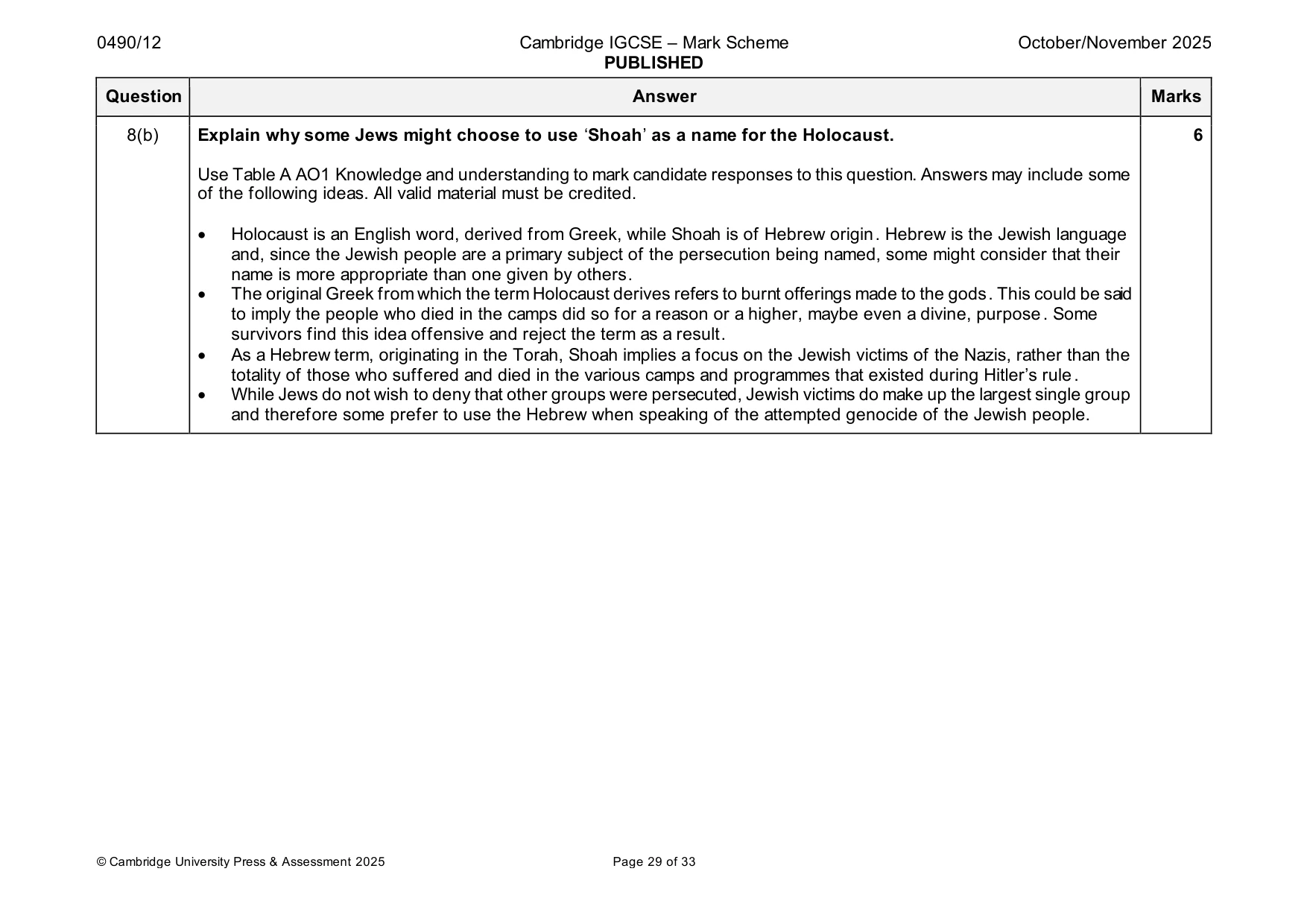
0490/12 Cambridge IGCSE – Mark Scheme PUBLISHED October/November 2025 © Cambridge University Press & Assessment 2025 Page 29 of 33 Question Answer Marks 8(b) Explain why some Jews might choose to use ‘Shoah’ as a name for the Holocaust. Use Table A AO1 Knowledge and understanding to mark candidate responses to this question. Answers may include some of the following ideas. All valid material must be credited. • Holocaust is an English word, derived from Greek, while Shoah is of Hebrew origin. Hebrew is the Jewish language and, since the Jewish people are a primary subject of the persecution being named, some might consider that their name is more appropriate than one given by others. • The original Greek from which the term Holocaust derives refers to burnt offerings made to the gods. This could be said to imply the people who died in the camps did so for a reason or a higher, maybe even a divine, purpose. Some survivors find this idea offensive and reject the term as a result. • As a Hebrew term, originating in the Torah, Shoah implies a focus on the Jewish victims of the Nazis, rather than the totality of those who suffered and died in the various camps and programmes that existed during Hitler’s rule. • While Jews do not wish to deny that other groups were persecuted, Jewish victims do make up the largest single group and therefore some prefer to use the Hebrew when speaking of the attempted genocide of the Jewish people. 6
Mark scheme, page 30
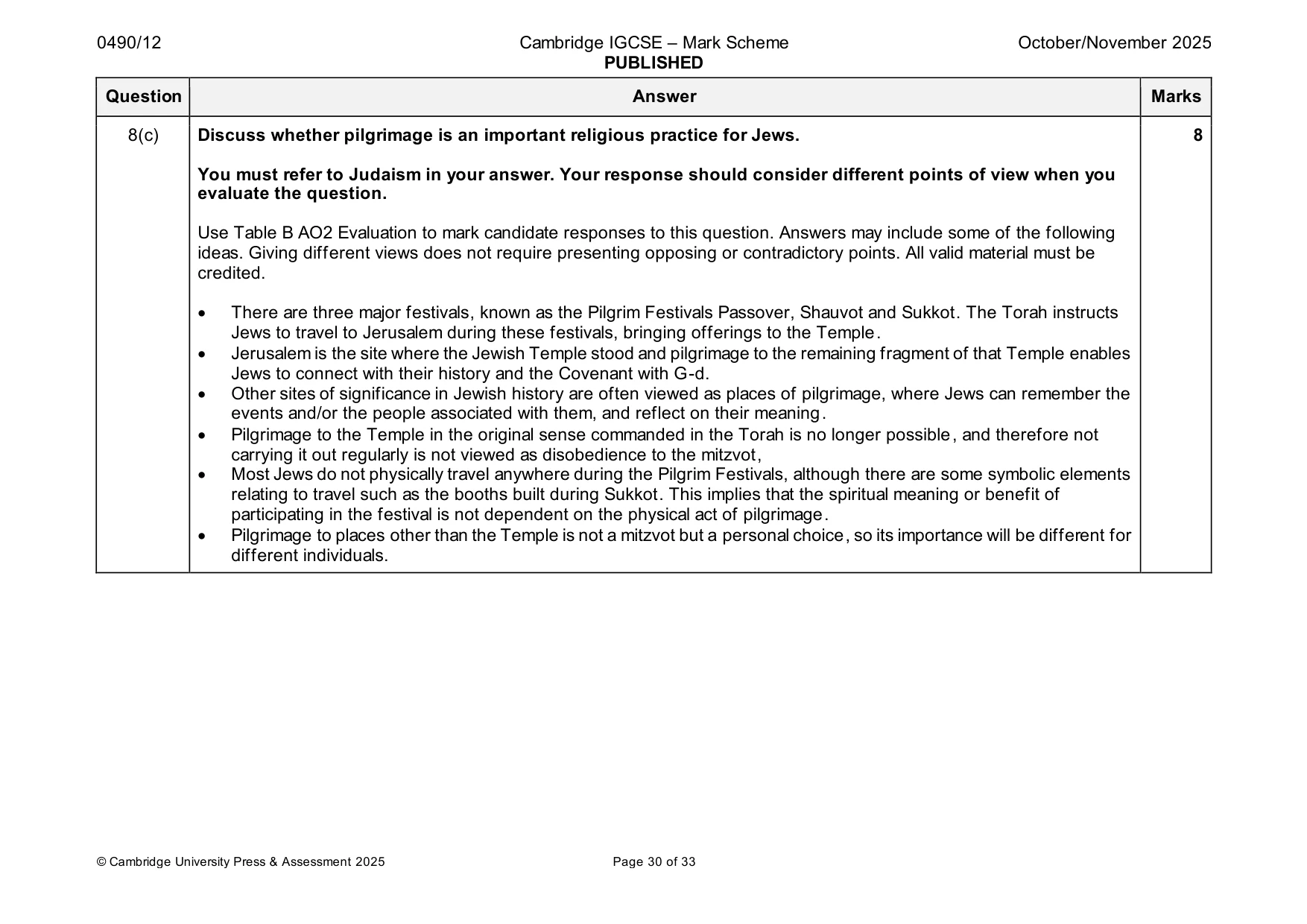
0490/12 Cambridge IGCSE – Mark Scheme PUBLISHED October/November 2025 © Cambridge University Press & Assessment 2025 Page 30 of 33 Question Answer Marks 8(c) Discuss whether pilgrimage is an important religious practice for Jews. You must refer to Judaism in your answer. Your response should consider different points of view when you evaluate the question. Use Table B AO2 Evaluation to mark candidate responses to this question. Answers may include some of the following ideas. Giving different views does not require presenting opposing or contradictory points. All valid material must be credited. • There are three major festivals, known as the Pilgrim Festivals Passover, Shauvot and Sukkot. The Torah instructs Jews to travel to Jerusalem during these festivals, bringing offerings to the Temple. • Jerusalem is the site where the Jewish Temple stood and pilgrimage to the remaining fragment of that Temple enables Jews to connect with their history and the Covenant with G-d. • Other sites of significance in Jewish history are often viewed as places of pilgrimage, where Jews can remember the events and/or the people associated with them, and reflect on their meaning. • Pilgrimage to the Temple in the original sense commanded in the Torah is no longer possible, and therefore not carrying it out regularly is not viewed as disobedience to the mitzvot, • Most Jews do not physically travel anywhere during the Pilgrim Festivals, although there are some symbolic elements relating to travel such as the booths built during Sukkot. This implies that the spiritual meaning or benefit of participating in the festival is not dependent on the physical act of pilgrimage. • Pilgrimage to places other than the Temple is not a mitzvot but a personal choice, so its importance will be different for different individuals. 8
Mark scheme, page 31
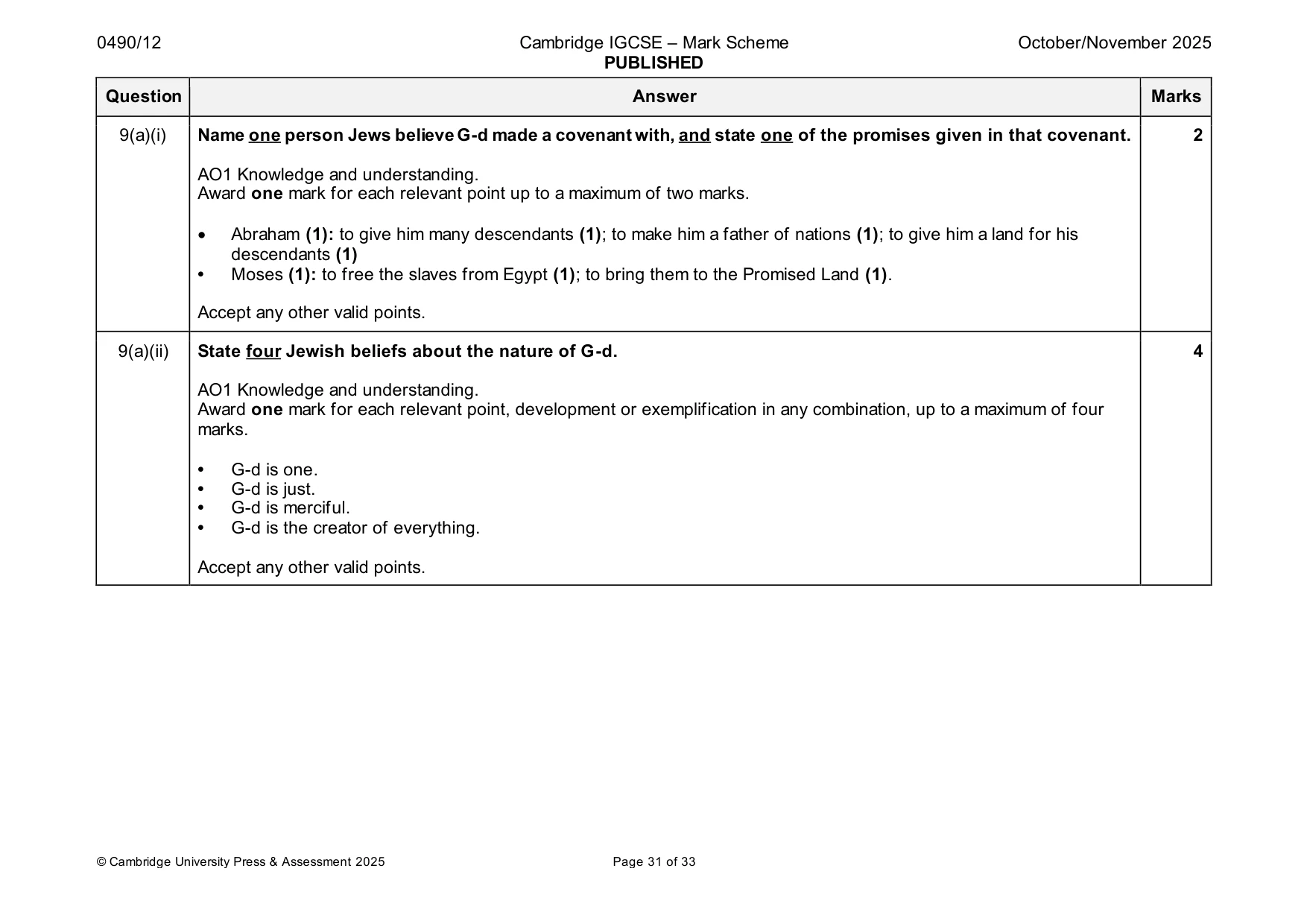
0490/12 Cambridge IGCSE – Mark Scheme PUBLISHED October/November 2025 © Cambridge University Press & Assessment 2025 Page 31 of 33 Question Answer Marks 9(a)(i) Name one person Jews believe G-d made a covenant with, and state one of the promises given in that covenant. AO1 Knowledge and understanding. Award one mark for each relevant point up to a maximum of two marks. • Abraham (1): to give him many descendants (1); to make him a father of nations (1); to give him a land for his descendants (1) • Moses (1): to free the slaves from Egypt (1); to bring them to the Promised Land (1). Accept any other valid points. 2 9(a)(ii) State four Jewish beliefs about the nature of G-d. AO1 Knowledge and understanding. Award one mark for each relevant point, development or exemplification in any combination, up to a maximum of four marks. • G-d is one. • G-d is just. • G-d is merciful. • G-d is the creator of everything. Accept any other valid points. 4
Mark scheme, page 32
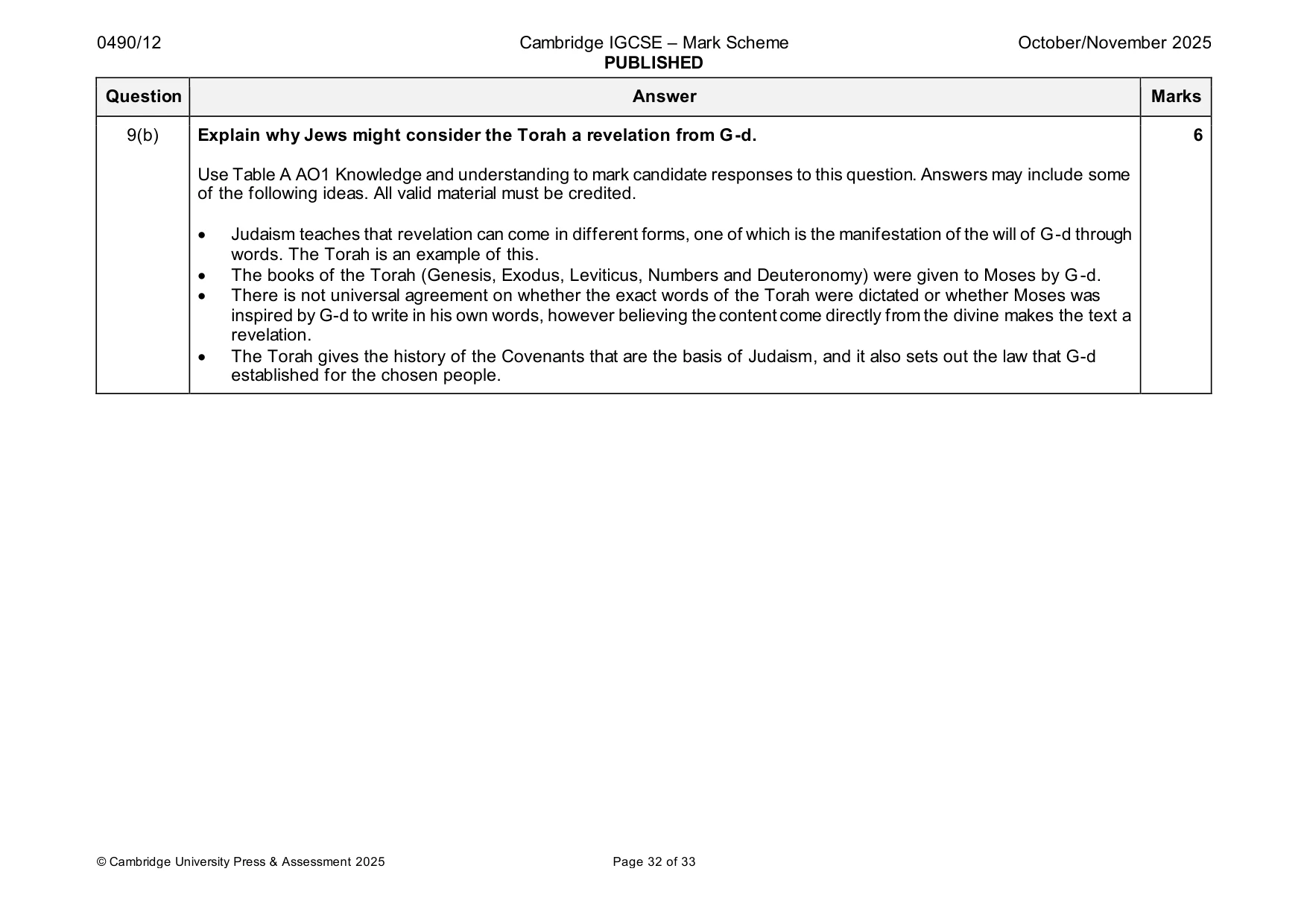
0490/12 Cambridge IGCSE – Mark Scheme PUBLISHED October/November 2025 © Cambridge University Press & Assessment 2025 Page 32 of 33 Question Answer Marks 9(b) Explain why Jews might consider the Torah a revelation from G-d. Use Table A AO1 Knowledge and understanding to mark candidate responses to this question. Answers may include some of the following ideas. All valid material must be credited. • Judaism teaches that revelation can come in different forms, one of which is the manifestation of the will of G-d through words. The Torah is an example of this. • The books of the Torah (Genesis, Exodus, Leviticus, Numbers and Deuteronomy) were given to Moses by G-d. • There is not universal agreement on whether the exact words of the Torah were dictated or whether Moses was inspired by G-d to write in his own words, however believing the content come directly from the divine makes the text a revelation. • The Torah gives the history of the Covenants that are the basis of Judaism, and it also sets out the law that G-d established for the chosen people. 6
Mark scheme, page 33
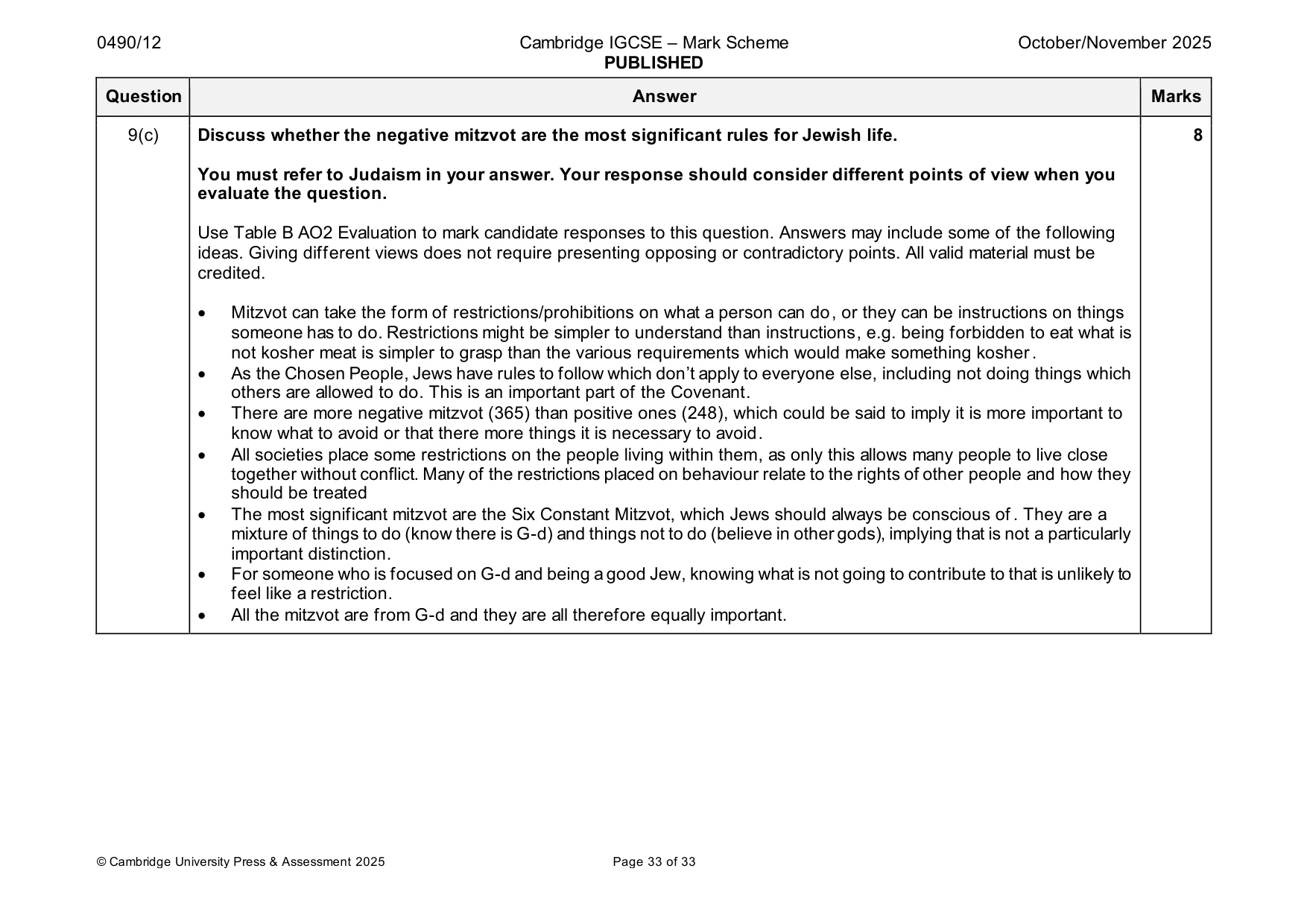
0490/12 Cambridge IGCSE – Mark Scheme PUBLISHED October/November 2025 © Cambridge University Press & Assessment 2025 Page 33 of 33 Question Answer Marks 9(c) Discuss whether the negative mitzvot are the most significant rules for Jewish life. You must refer to Judaism in your answer. Your response should consider different points of view when you evaluate the question. Use Table B AO2 Evaluation to mark candidate responses to this question. Answers may include some of the following ideas. Giving different views does not require presenting opposing or contradictory points. All valid material must be credited. • Mitzvot can take the form of restrictions/prohibitions on what a person can do, or they can be instructions on things someone has to do. Restrictions might be simpler to understand than instructions, e.g. being forbidden to eat what is not kosher meat is simpler to grasp than the various requirements which would make something kosher. • As the Chosen People, Jews have rules to follow which don’t apply to everyone else, including not doing things which others are allowed to do. This is an important part of the Covenant. • There are more negative mitzvot (365) than positive ones (248), which could be said to imply it is more important to know what to avoid or that there more things it is necessary to avoid. • All societies place some restrictions on the people living within them, as only this allows many people to live close together without conflict. Many of the restrictions placed on behaviour relate to the rights of other people and how they should be treated • The most significant mitzvot are the Six Constant Mitzvot, which Jews should always be conscious of . They are a mixture of things to do (know there is G-d) and things not to do (believe in other gods), implying that is not a particularly important distinction. • For someone who is focused on G-d and being a good Jew, knowing what is not going to contribute to that is unlikely to feel like a restriction. • All the mitzvot are from G-d and they are all therefore equally important. 8
What you needed in this session
Cambridge’s own grade thresholds for 2025 Oct/Nov, Paper 1 · Variant 2. A higher threshold means an easier paper — the bar moves with how the cohort did.