Cambridge IGCSE Religious Studies 0490 — 2024 Oct/Nov Paper 1 · Variant 2
0490/12/O/N/24 · 80 marks · ≈90 min
The question paper and its mark scheme, free to read here and free to download. This is Cambridge’s own paper, exactly as it was sat.
Question paper4 pages
Mark scheme24 pages
Answers below. Sit the paper first if you are practising.
Paper as text
Question paper, page 1
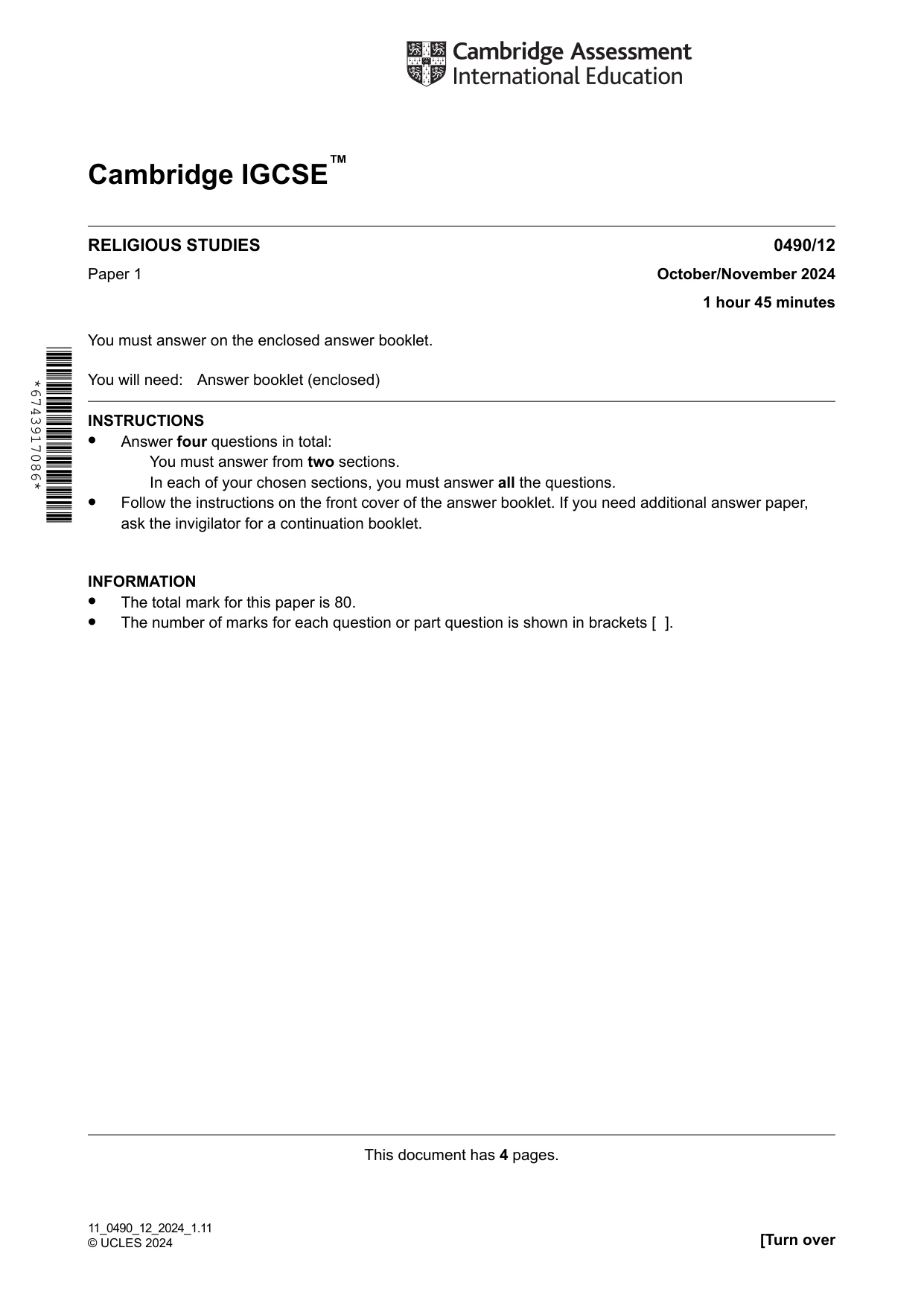
Cambridge IGCSE™ 0490/12 October/November 2024 1 hour 45 minutes RELIGIOUS STUDIES Paper 1 You must answer on the enclosed answer booklet. You will need: Answer booklet (enclosed) INSTRUCTIONS • Answer four questions in total: You must answer from two sections. In each of your chosen sections, you must answer all the questions. • Follow the instructions on the front cover of the answer booklet. If you need additional answer paper, ask the invigilator for a continuation booklet. INFORMATION • The total mark for this paper is 80. • The number of marks for each question or part question is shown in brackets [ ]. This document has 4 pages. [Turn over 11_0490_12_2024_1.11 © UCLES 2024 *6743917086*
Question paper, page 2
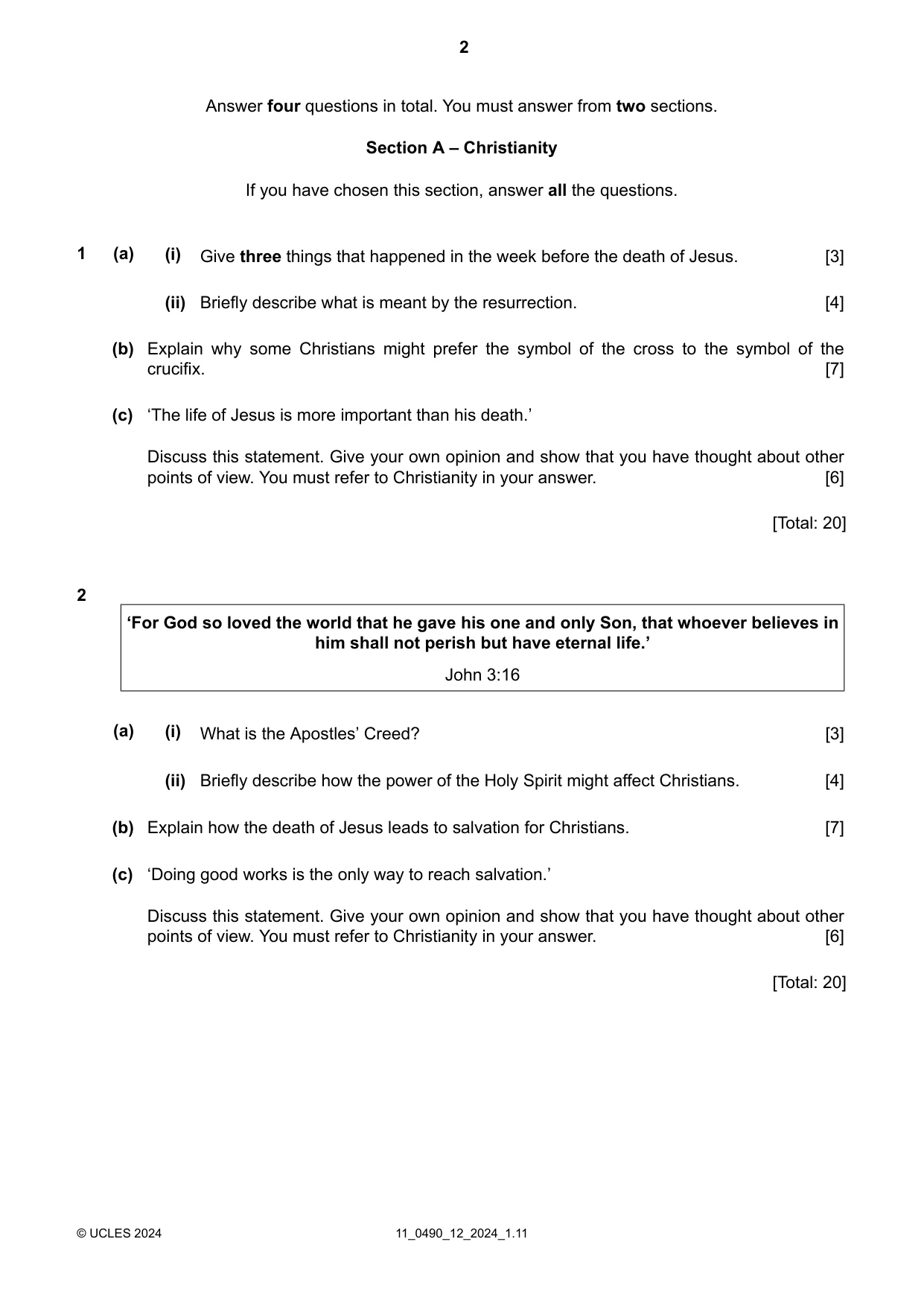
Answer four questions in total. You must answer from two sections. Section A – Christianity If you have chosen this section, answer all the questions. (a) 1 Give three things that happened in the week before the death of Jesus. [3] (i) Briefly describe what is meant by the resurrection. [4] (ii) Explain why some Christians might prefer the symbol of the cross to the symbol of the crucifix. [7] (b) ‘The life of Jesus is more important than his death.’ Discuss this statement. Give your own opinion and show that you have thought about other points of view. You must refer to Christianity in your answer. [6] (c) [Total: 20] 2 ‘For God so loved the world that he gave his one and only Son, that whoever believes in him shall not perish but have eternal life.’ John 3:16 (a) What is the Apostles’ Creed? [3] (i) Briefly describe how the power of the Holy Spirit might affect Christians. [4] (ii) Explain how the death of Jesus leads to salvation for Christians. [7] (b) ‘Doing good works is the only way to reach salvation.’ Discuss this statement. Give your own opinion and show that you have thought about other points of view. You must refer to Christianity in your answer. [6] (c) [Total: 20] 11_0490_12_2024_1.11 © UCLES 2024 2
Question paper, page 3
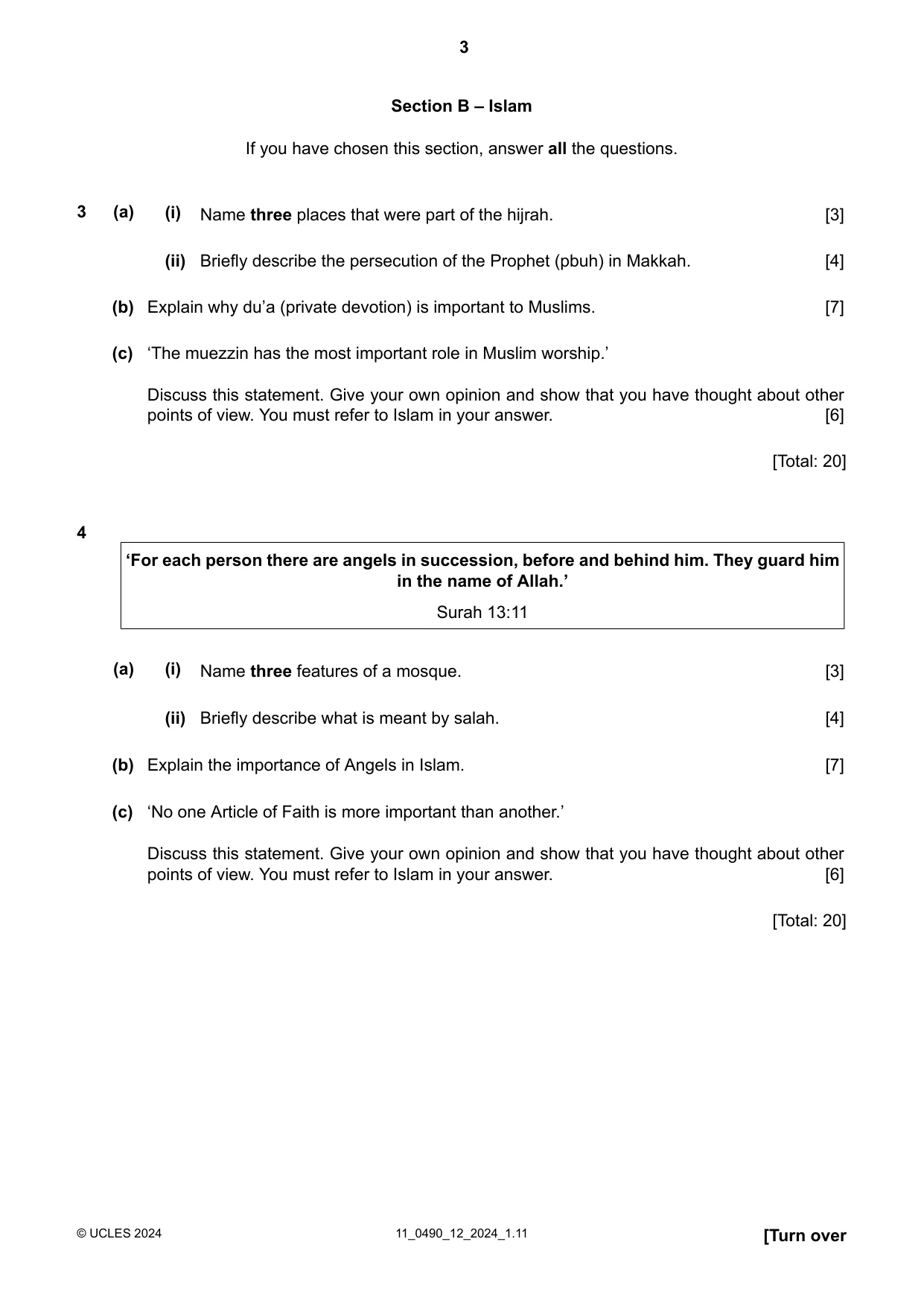
Section B – Islam If you have chosen this section, answer all the questions. (a) 3 Name three places that were part of the hijrah. [3] (i) Briefly describe the persecution of the Prophet (pbuh) in Makkah. [4] (ii) Explain why du’a (private devotion) is important to Muslims. [7] (b) ‘The muezzin has the most important role in Muslim worship.’ Discuss this statement. Give your own opinion and show that you have thought about other points of view. You must refer to Islam in your answer. [6] (c) [Total: 20] 4 ‘For each person there are angels in succession, before and behind him. They guard him in the name of Allah.’ Surah 13:11 (a) Name three features of a mosque. [3] (i) Briefly describe what is meant by salah. [4] (ii) Explain the importance of Angels in Islam. [7] (b) ‘No one Article of Faith is more important than another.’ Discuss this statement. Give your own opinion and show that you have thought about other points of view. You must refer to Islam in your answer. [6] (c) [Total: 20] [Turn over 11_0490_12_2024_1.11 © UCLES 2024 3
Question paper, page 4
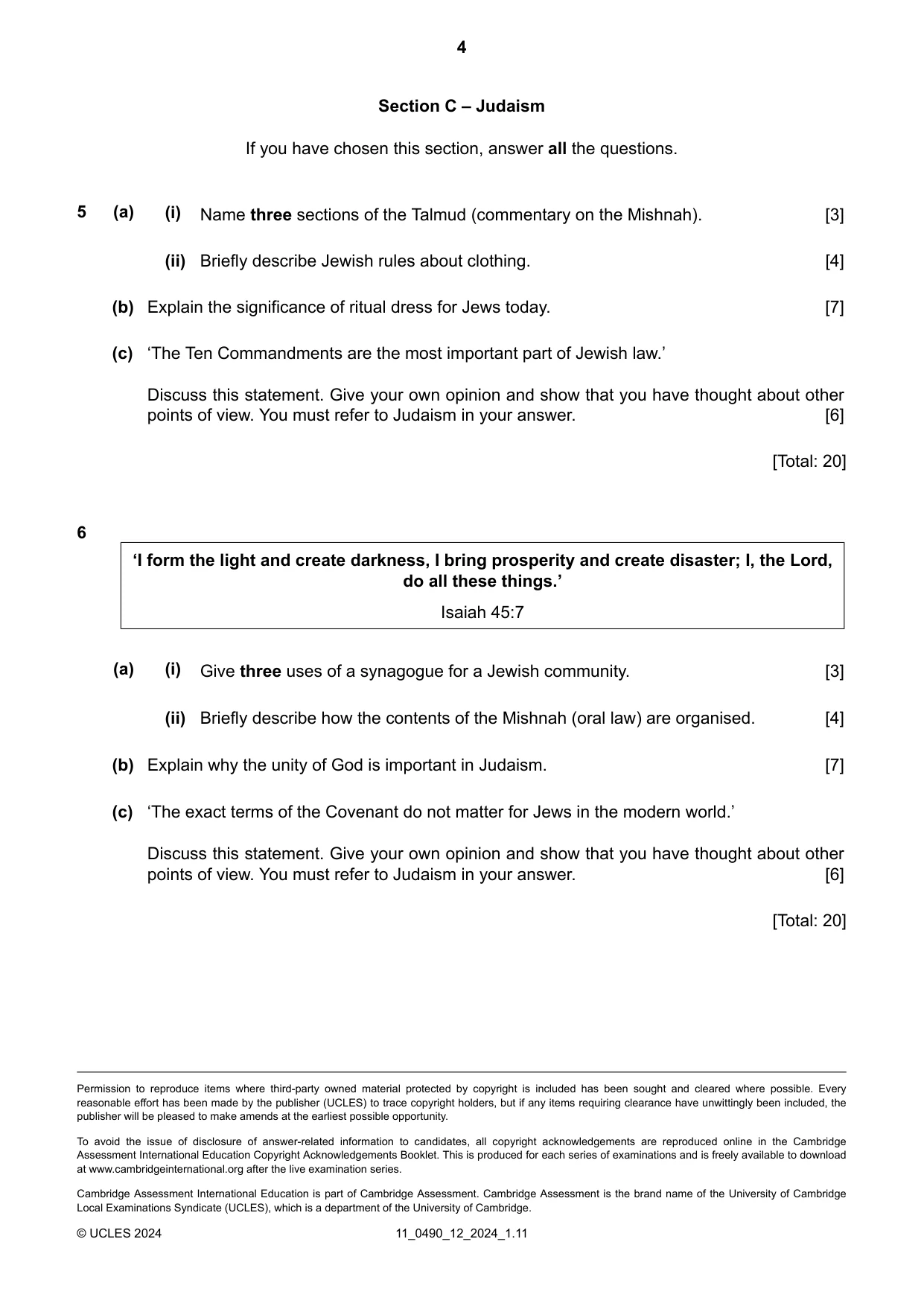
Section C – Judaism If you have chosen this section, answer all the questions. (a) 5 Name three sections of the Talmud (commentary on the Mishnah). [3] (i) Briefly describe Jewish rules about clothing. [4] (ii) Explain the significance of ritual dress for Jews today. [7] (b) ‘The Ten Commandments are the most important part of Jewish law.’ Discuss this statement. Give your own opinion and show that you have thought about other points of view. You must refer to Judaism in your answer. [6] (c) [Total: 20] 6 ‘I form the light and create darkness, I bring prosperity and create disaster; I, the Lord, do all these things.’ Isaiah 45:7 (a) Give three uses of a synagogue for a Jewish community. [3] (i) Briefly describe how the contents of the Mishnah (oral law) are organised. [4] (ii) Explain why the unity of God is important in Judaism. [7] (b) ‘The exact terms of the Covenant do not matter for Jews in the modern world.’ Discuss this statement. Give your own opinion and show that you have thought about other points of view. You must refer to Judaism in your answer. [6] (c) [Total: 20] Permission to reproduce items where third-party owned material protected by copyright is included has been sought and cleared where possible. Every reasonable effort has been made by the publisher (UCLES) to trace copyright holders, but if any items requiring clearance have unwittingly been included, the publisher will be pleased to make amends at the earliest possible opportunity. To avoid the issue of disclosure of answer-related information to candidates, all copyright acknowledgements are reproduced online in the Cambridge Assessment International Education Copyright Acknowledgements Booklet. This is produced for each series of examinations and is freely available to download at www.cambridgeinternational.org after the live examination series. Cambridge Assessment International Education is part of Cambridge Assessment. Cambridge Assessment is the brand name of the University of Cambridge Local Examinations Syndicate (UCLES), which is a department of the University of Cambridge. 11_0490_12_2024_1.11 © UCLES 2024 4
Mark scheme, page 1
This document consists of 24 printed pages. © Cambridge University Press & Assessment 2024 [Turn over Cambridge IGCSE™ RELIGIOUS STUDIES 0490/12 Paper 1 October/November 2024 MARK SCHEME Maximum Mark: 80 Published This mark scheme is published as an aid to teachers and candidates, to indicate the requirements of the examination. It shows the basis on which Examiners were instructed to award marks. It does not indicate the details of the discussions that took place at an Examiners’ meeting before marking began, which would have considered the acceptability of alternative answers. Mark schemes should be read in conjunction with the question paper and the Principal Examiner Report for Teachers. Cambridge International will not enter into discussions about these mark schemes. Cambridge International is publishing the mark schemes for the October/November 2024 series for most Cambridge IGCSE, Cambridge International A and AS Level components, and some Cambridge O Level components.
Mark scheme, page 2
0490/12 Cambridge IGCSE – Mark Scheme PUBLISHED October/November 2024 © Cambridge University Press & Assessment 2024 Page 2 of 24 Generic Marking Principles These general marking principles must be applied by all examiners when marking candidate answers. They should be applied alongside the specific content of the mark scheme or generic level descriptions for a question. Each question paper and mark scheme will also comply with these marking principles. GENERIC MARKING PRINCIPLE 1: Marks must be awarded in line with: • the specific content of the mark scheme or the generic level descriptors for the question • the specific skills defined in the mark scheme or in the generic level descriptors for the question • the standard of response required by a candidate as exemplified by the standardisation scripts. GENERIC MARKING PRINCIPLE 2: Marks awarded are always whole marks (not half marks, or other fractions). GENERIC MARKING PRINCIPLE 3: Marks must be awarded positively: • marks are awarded for correct/valid answers, as defined in the mark scheme. However, credit is given for valid answers which go beyond the scope of the syllabus and mark scheme, referring to your Team Leader as appropriate • marks are awarded when candidates clearly demonstrate what they know and can do • marks are not deducted for errors • marks are not deducted for omissions • answers should only be judged on the quality of spelling, punctuation and grammar when these features are specifically assessed by the question as indicated by the mark scheme. The meaning, however, should be unambiguous. GENERIC MARKING PRINCIPLE 4: Rules must be applied consistently, e.g. in situations where candidates have not followed instructions or in the application of generic level descriptors.
Mark scheme, page 3
0490/12 Cambridge IGCSE – Mark Scheme PUBLISHED October/November 2024 © Cambridge University Press & Assessment 2024 Page 3 of 24 GENERIC MARKING PRINCIPLE 5: Marks should be awarded using the full range of marks defined in the mark scheme for the question (however; the use of the full mark range may be limited according to the quality of the candidate responses seen). GENERIC MARKING PRINCIPLE 6: Marks awarded are based solely on the requirements as defined in the mark scheme. Marks should not be awarded with grade thresholds or grade descriptors in mind.
Mark scheme, page 4
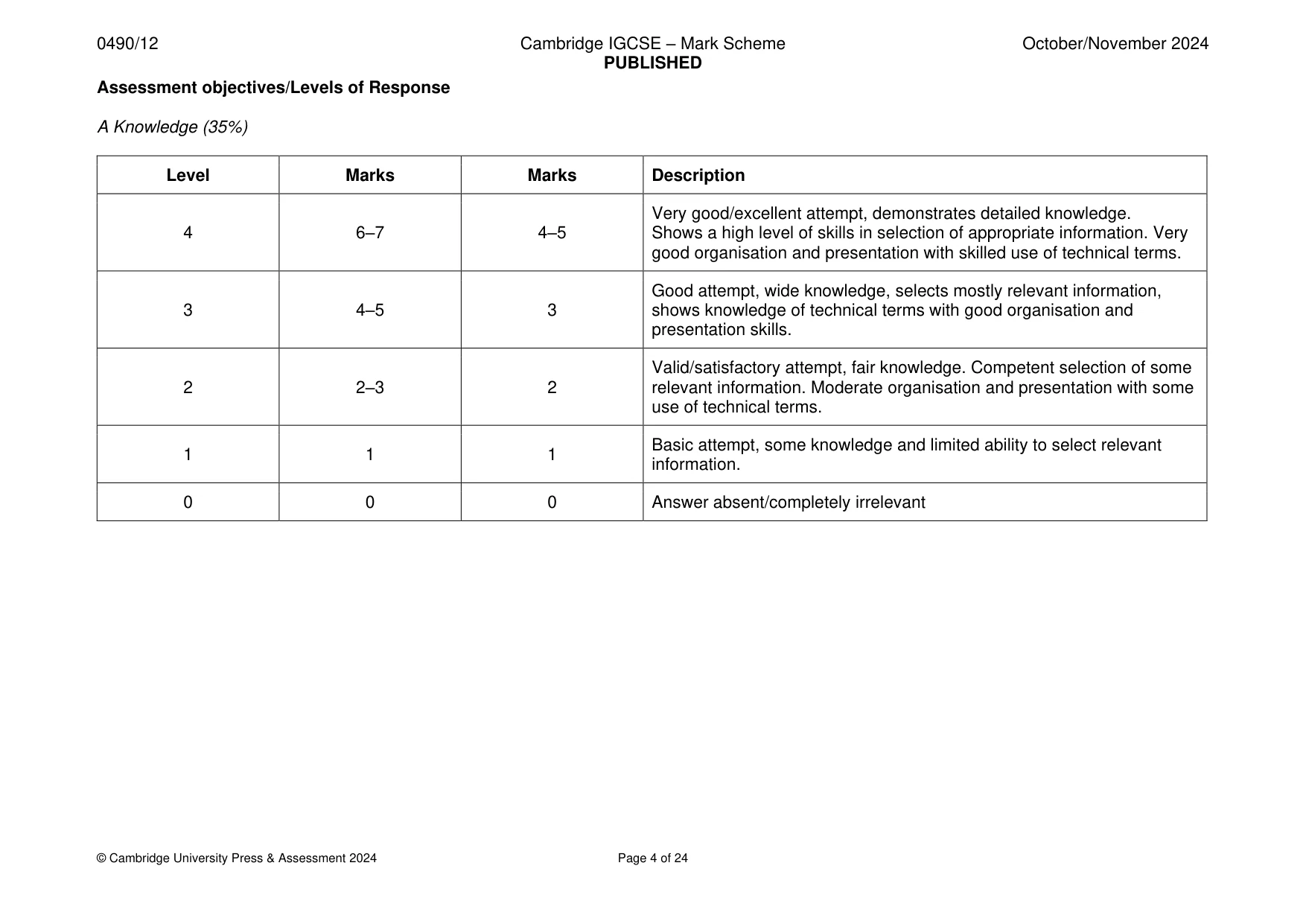
0490/12 Cambridge IGCSE – Mark Scheme PUBLISHED October/November 2024 © Cambridge University Press & Assessment 2024 Page 4 of 24 Assessment objectives/Levels of Response A Knowledge (35%) Level Marks Marks Description 4 6–7 4–5 Very good/excellent attempt, demonstrates detailed knowledge. Shows a high level of skills in selection of appropriate information. Very good organisation and presentation with skilled use of technical terms. 3 4–5 3 Good attempt, wide knowledge, selects mostly relevant information, shows knowledge of technical terms with good organisation and presentation skills. 2 2–3 2 Valid/satisfactory attempt, fair knowledge. Competent selection of some relevant information. Moderate organisation and presentation with some use of technical terms. 1 1 1 Basic attempt, some knowledge and limited ability to select relevant information. 0 0 0 Answer absent/completely irrelevant
Mark scheme, page 5
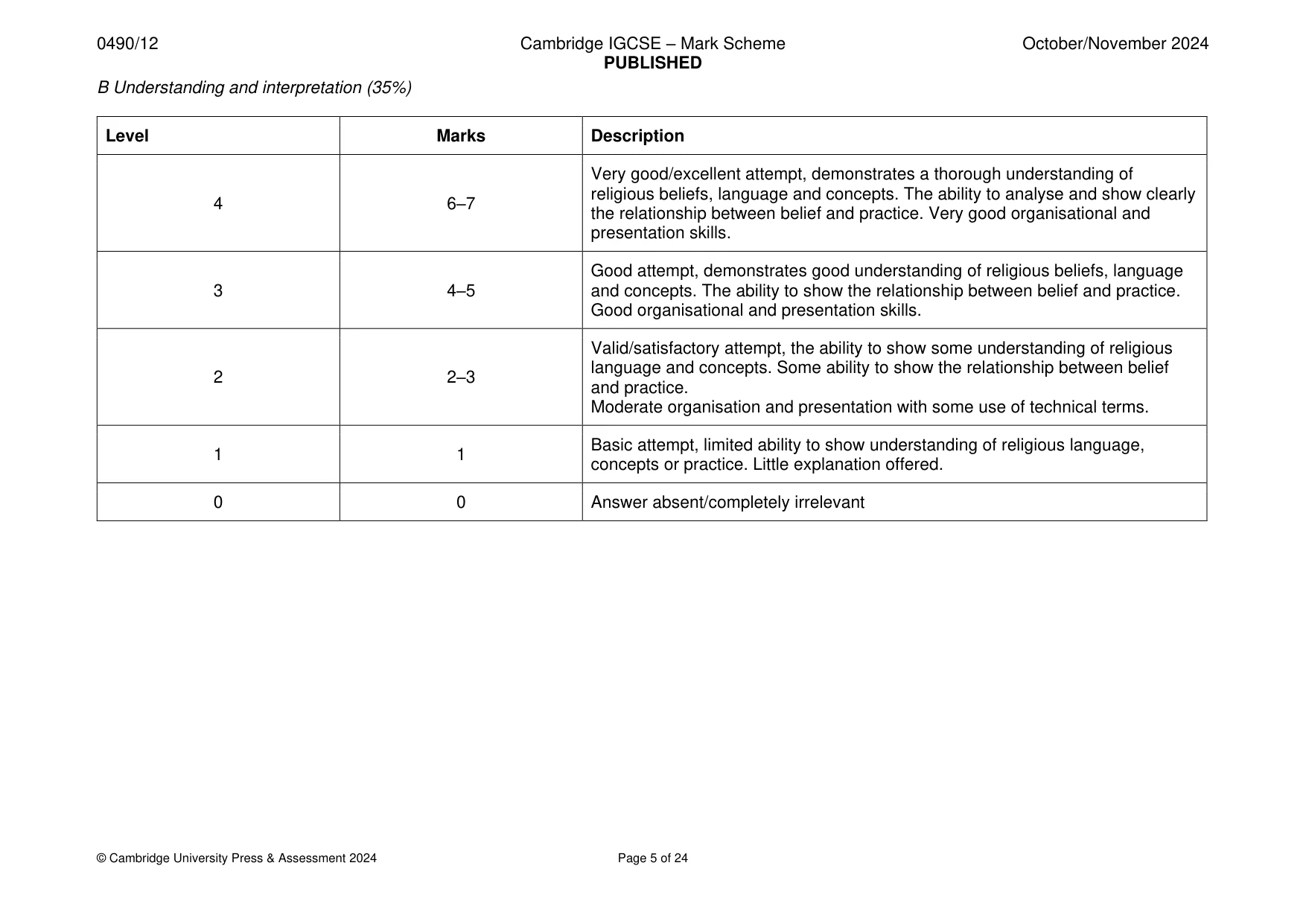
0490/12 Cambridge IGCSE – Mark Scheme PUBLISHED October/November 2024 © Cambridge University Press & Assessment 2024 Page 5 of 24 B Understanding and interpretation (35%) Level Marks Description 4 6–7 Very good/excellent attempt, demonstrates a thorough understanding of religious beliefs, language and concepts. The ability to analyse and show clearly the relationship between belief and practice. Very good organisational and presentation skills. 3 4–5 Good attempt, demonstrates good understanding of religious beliefs, language and concepts. The ability to show the relationship between belief and practice. Good organisational and presentation skills. 2 2–3 Valid/satisfactory attempt, the ability to show some understanding of religious language and concepts. Some ability to show the relationship between belief and practice. Moderate organisation and presentation with some use of technical terms. 1 1 Basic attempt, limited ability to show understanding of religious language, concepts or practice. Little explanation offered. 0 0 Answer absent/completely irrelevant
Mark scheme, page 6
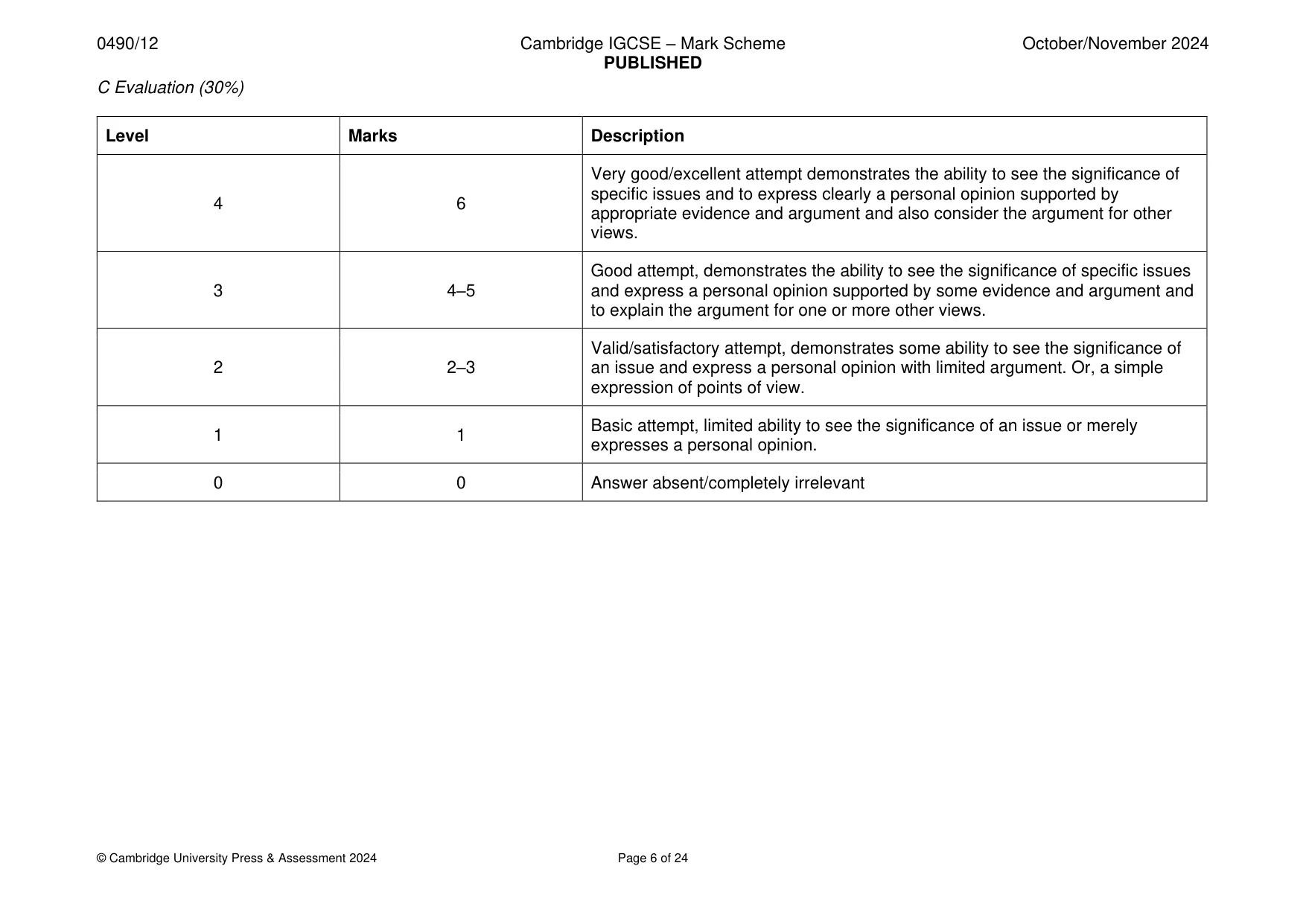
0490/12 Cambridge IGCSE – Mark Scheme PUBLISHED October/November 2024 © Cambridge University Press & Assessment 2024 Page 6 of 24 C Evaluation (30%) Level Marks Description 4 6 Very good/excellent attempt demonstrates the ability to see the significance of specific issues and to express clearly a personal opinion supported by appropriate evidence and argument and also consider the argument for other views. 3 4–5 Good attempt, demonstrates the ability to see the significance of specific issues and express a personal opinion supported by some evidence and argument and to explain the argument for one or more other views. 2 2–3 Valid/satisfactory attempt, demonstrates some ability to see the significance of an issue and express a personal opinion with limited argument. Or, a simple expression of points of view. 1 1 Basic attempt, limited ability to see the significance of an issue or merely expresses a personal opinion. 0 0 Answer absent/completely irrelevant
Mark scheme, page 7
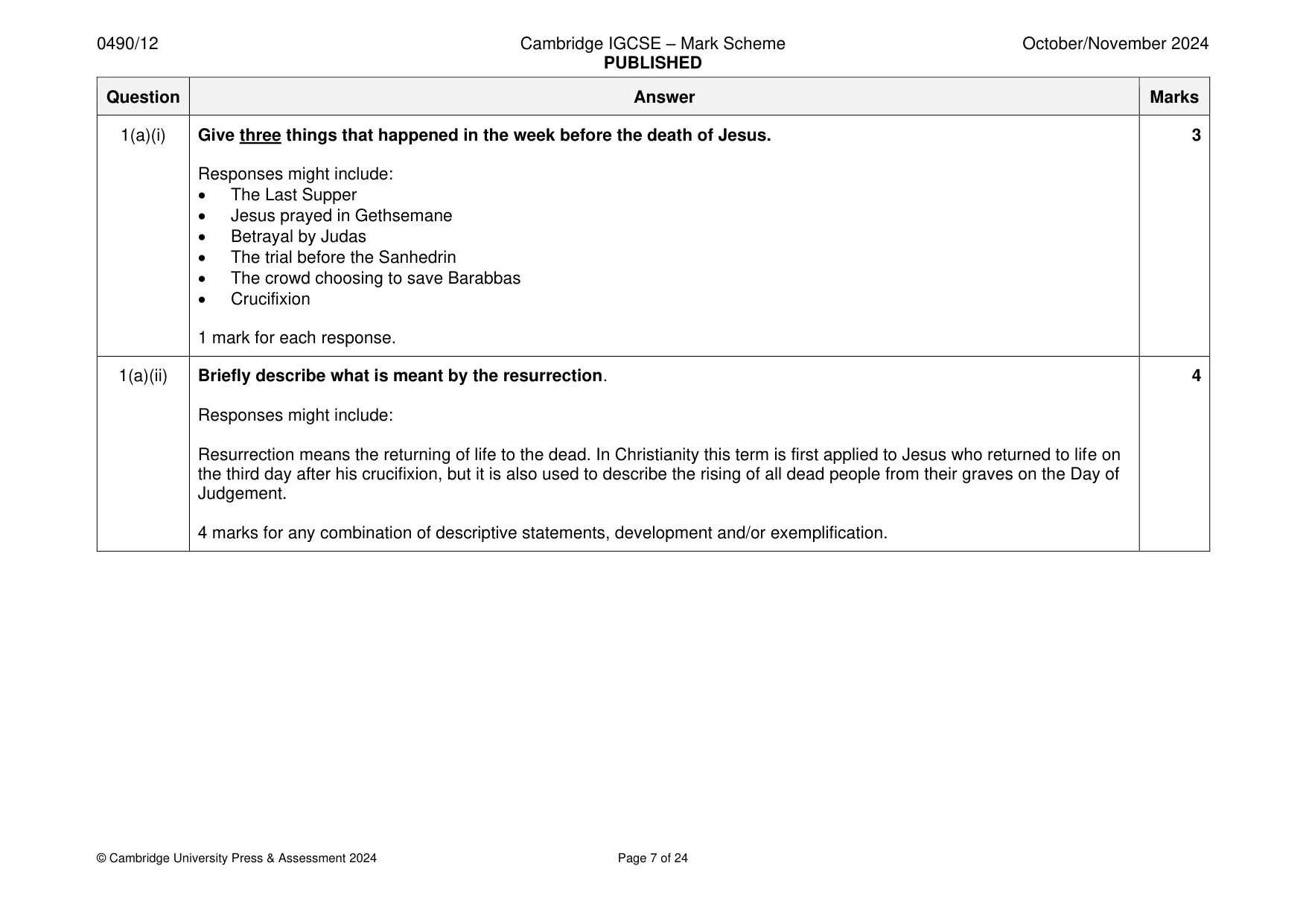
0490/12 Cambridge IGCSE – Mark Scheme PUBLISHED October/November 2024 © Cambridge University Press & Assessment 2024 Page 7 of 24 Question Answer Marks 1(a)(i) Give three things that happened in the week before the death of Jesus. Responses might include: • The Last Supper • Jesus prayed in Gethsemane • Betrayal by Judas • The trial before the Sanhedrin • The crowd choosing to save Barabbas • Crucifixion 1 mark for each response. 3 1(a)(ii) Briefly describe what is meant by the resurrection. Responses might include: Resurrection means the returning of life to the dead. In Christianity this term is first applied to Jesus who returned to life on the third day after his crucifixion, but it is also used to describe the rising of all dead people from their graves on the Day of Judgement. 4 marks for any combination of descriptive statements, development and/or exemplification. 4
Mark scheme, page 8
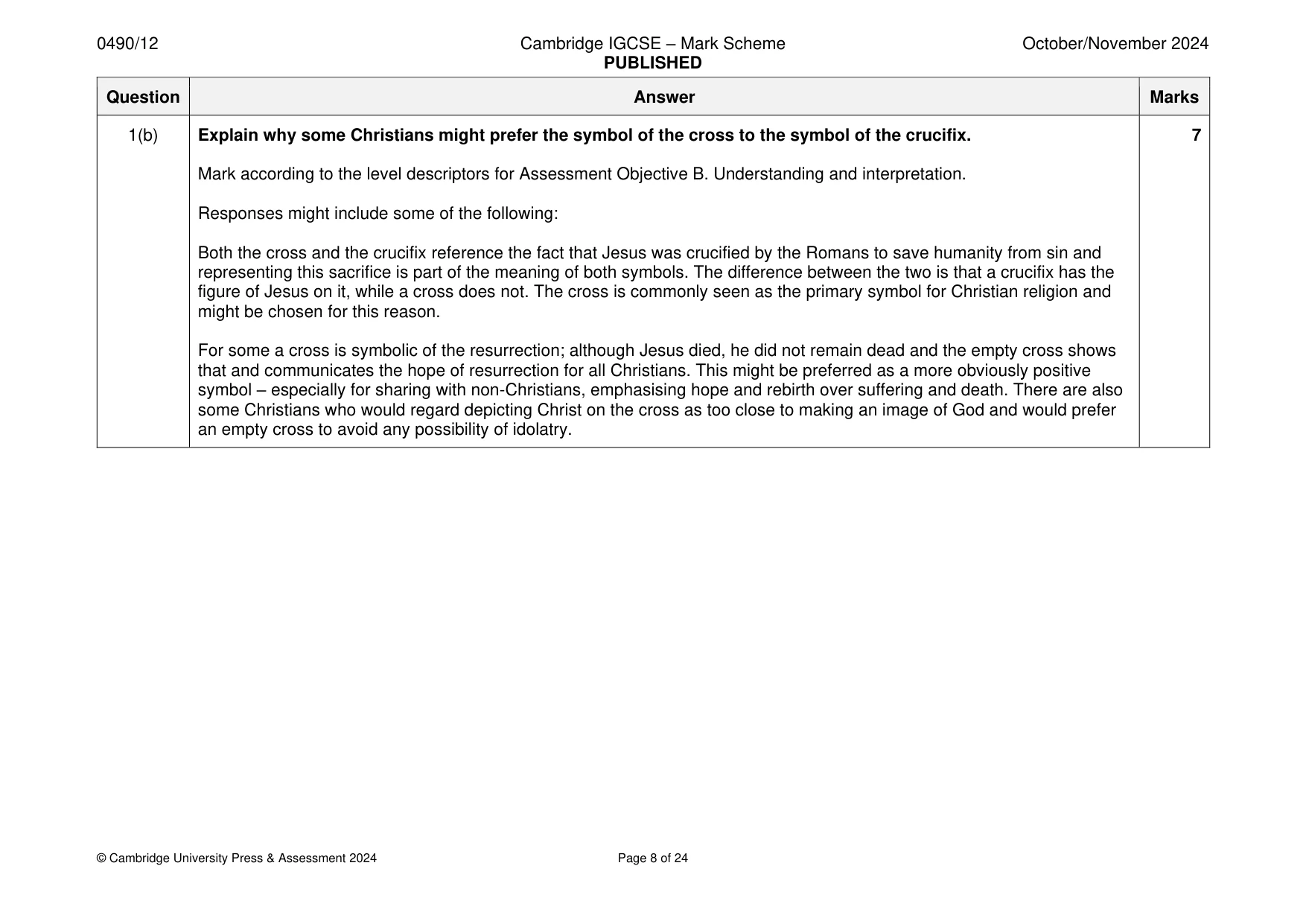
0490/12 Cambridge IGCSE – Mark Scheme PUBLISHED October/November 2024 © Cambridge University Press & Assessment 2024 Page 8 of 24 Question Answer Marks 1(b) Explain why some Christians might prefer the symbol of the cross to the symbol of the crucifix. Mark according to the level descriptors for Assessment Objective B. Understanding and interpretation. Responses might include some of the following: Both the cross and the crucifix reference the fact that Jesus was crucified by the Romans to save humanity from sin and representing this sacrifice is part of the meaning of both symbols. The difference between the two is that a crucifix has the figure of Jesus on it, while a cross does not. The cross is commonly seen as the primary symbol for Christian religion and might be chosen for this reason. For some a cross is symbolic of the resurrection; although Jesus died, he did not remain dead and the empty cross shows that and communicates the hope of resurrection for all Christians. This might be preferred as a more obviously positive symbol – especially for sharing with non-Christians, emphasising hope and rebirth over suffering and death. There are also some Christians who would regard depicting Christ on the cross as too close to making an image of God and would prefer an empty cross to avoid any possibility of idolatry. 7
Mark scheme, page 9
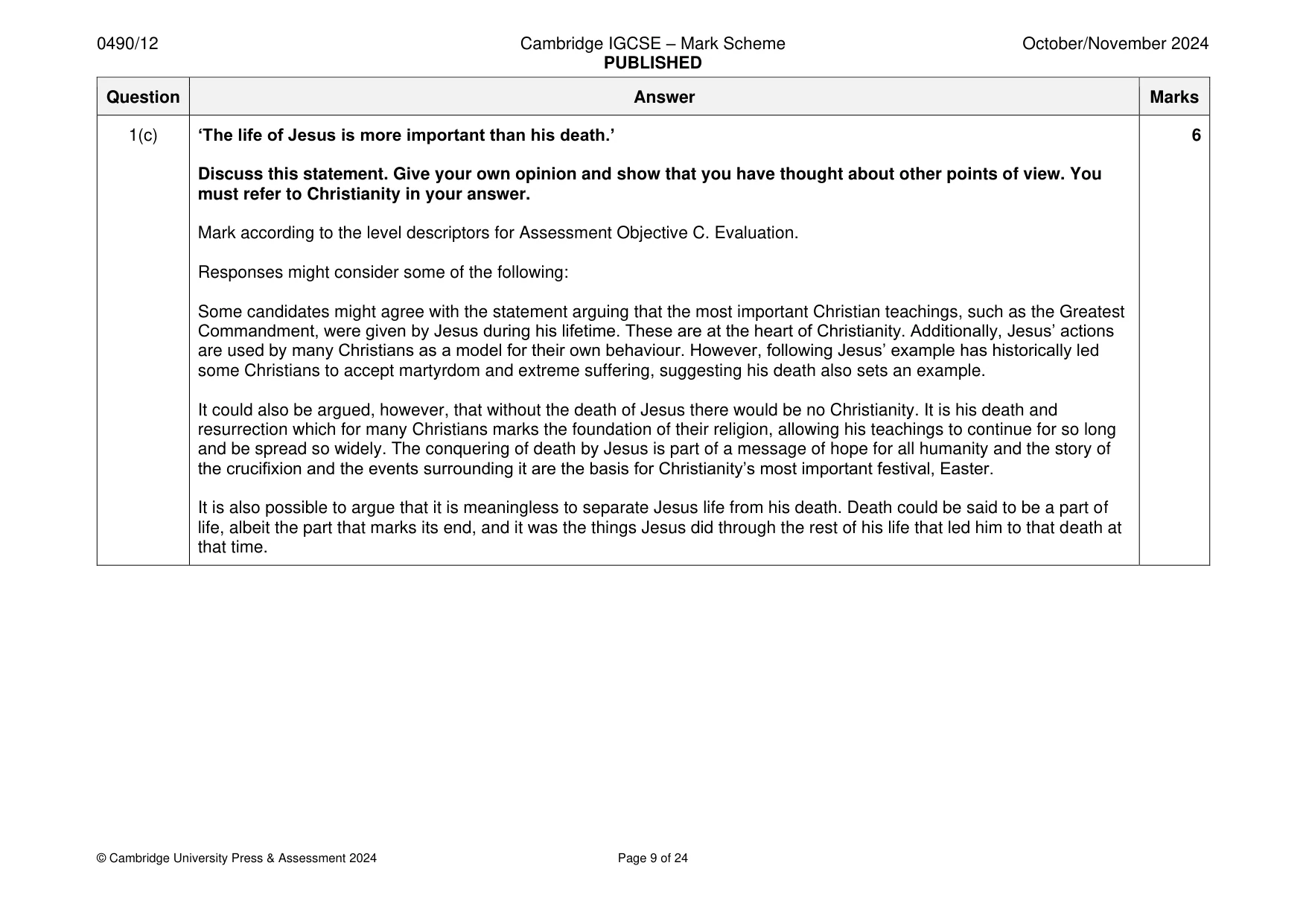
0490/12 Cambridge IGCSE – Mark Scheme PUBLISHED October/November 2024 © Cambridge University Press & Assessment 2024 Page 9 of 24 Question Answer Marks 1(c) ‘The life of Jesus is more important than his death.’ Discuss this statement. Give your own opinion and show that you have thought about other points of view. You must refer to Christianity in your answer. Mark according to the level descriptors for Assessment Objective C. Evaluation. Responses might consider some of the following: Some candidates might agree with the statement arguing that the most important Christian teachings, such as the Greatest Commandment, were given by Jesus during his lifetime. These are at the heart of Christianity. Additionally, Jesus’ actions are used by many Christians as a model for their own behaviour. However, following Jesus’ example has historically led some Christians to accept martyrdom and extreme suffering, suggesting his death also sets an example. It could also be argued, however, that without the death of Jesus there would be no Christianity. It is his death and resurrection which for many Christians marks the foundation of their religion, allowing his teachings to continue for so long and be spread so widely. The conquering of death by Jesus is part of a message of hope for all humanity and the story of the crucifixion and the events surrounding it are the basis for Christianity’s most important festival, Easter. It is also possible to argue that it is meaningless to separate Jesus life from his death. Death could be said to be a part of life, albeit the part that marks its end, and it was the things Jesus did through the rest of his life that led him to that death at that time. 6
Mark scheme, page 10
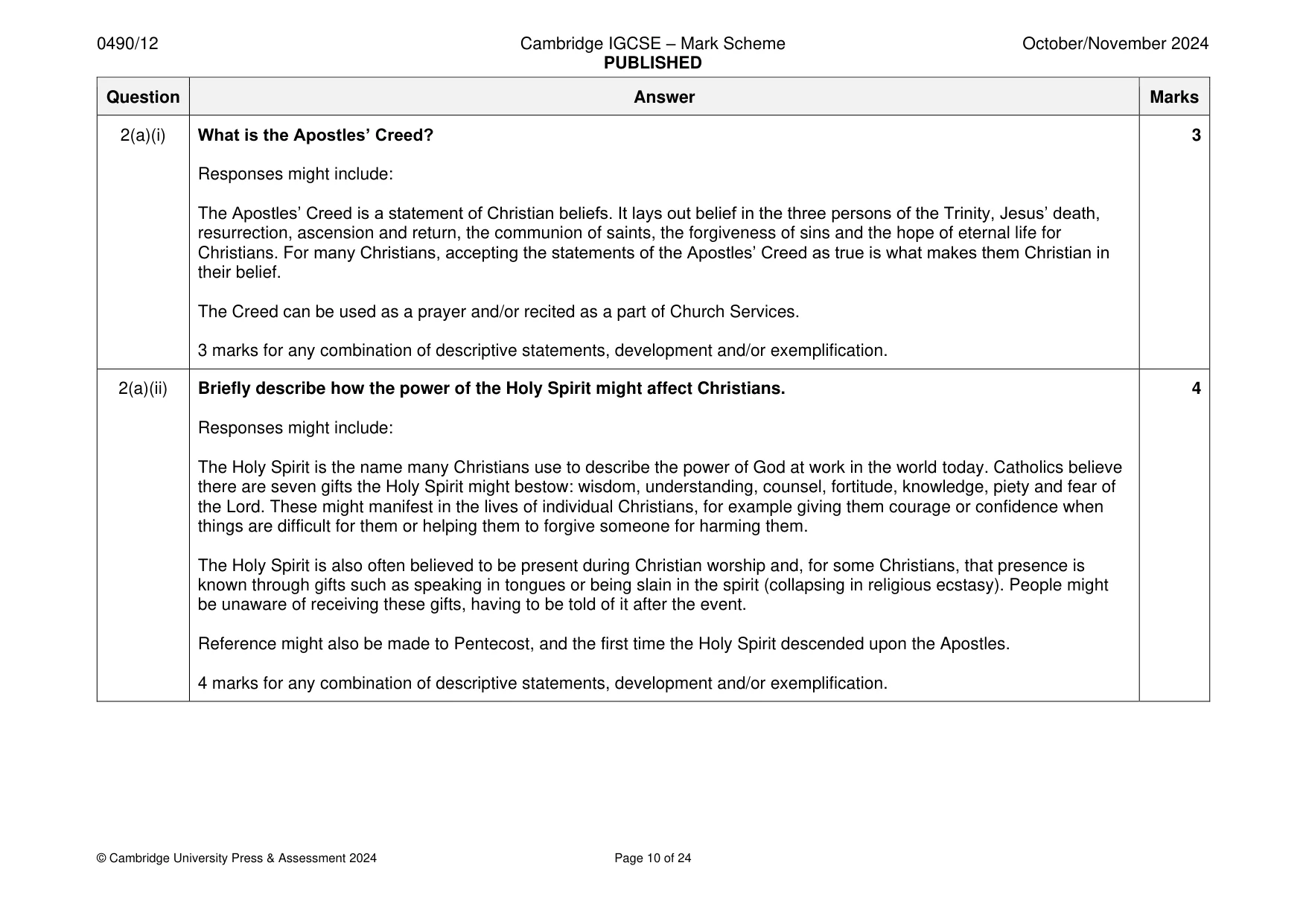
0490/12 Cambridge IGCSE – Mark Scheme PUBLISHED October/November 2024 © Cambridge University Press & Assessment 2024 Page 10 of 24 Question Answer Marks 2(a)(i) What is the Apostles’ Creed? Responses might include: The Apostles’ Creed is a statement of Christian beliefs. It lays out belief in the three persons of the Trinity, Jesus’ death, resurrection, ascension and return, the communion of saints, the forgiveness of sins and the hope of eternal life for Christians. For many Christians, accepting the statements of the Apostles’ Creed as true is what makes them Christian in their belief. The Creed can be used as a prayer and/or recited as a part of Church Services. 3 marks for any combination of descriptive statements, development and/or exemplification. 3 2(a)(ii) Briefly describe how the power of the Holy Spirit might affect Christians. Responses might include: The Holy Spirit is the name many Christians use to describe the power of God at work in the world today. Catholics believe there are seven gifts the Holy Spirit might bestow: wisdom, understanding, counsel, fortitude, knowledge, piety and fear of the Lord. These might manifest in the lives of individual Christians, for example giving them courage or confidence when things are difficult for them or helping them to forgive someone for harming them. The Holy Spirit is also often believed to be present during Christian worship and, for some Christians, that presence is known through gifts such as speaking in tongues or being slain in the spirit (collapsing in religious ecstasy). People might be unaware of receiving these gifts, having to be told of it after the event. Reference might also be made to Pentecost, and the first time the Holy Spirit descended upon the Apostles. 4 marks for any combination of descriptive statements, development and/or exemplification. 4
Mark scheme, page 11
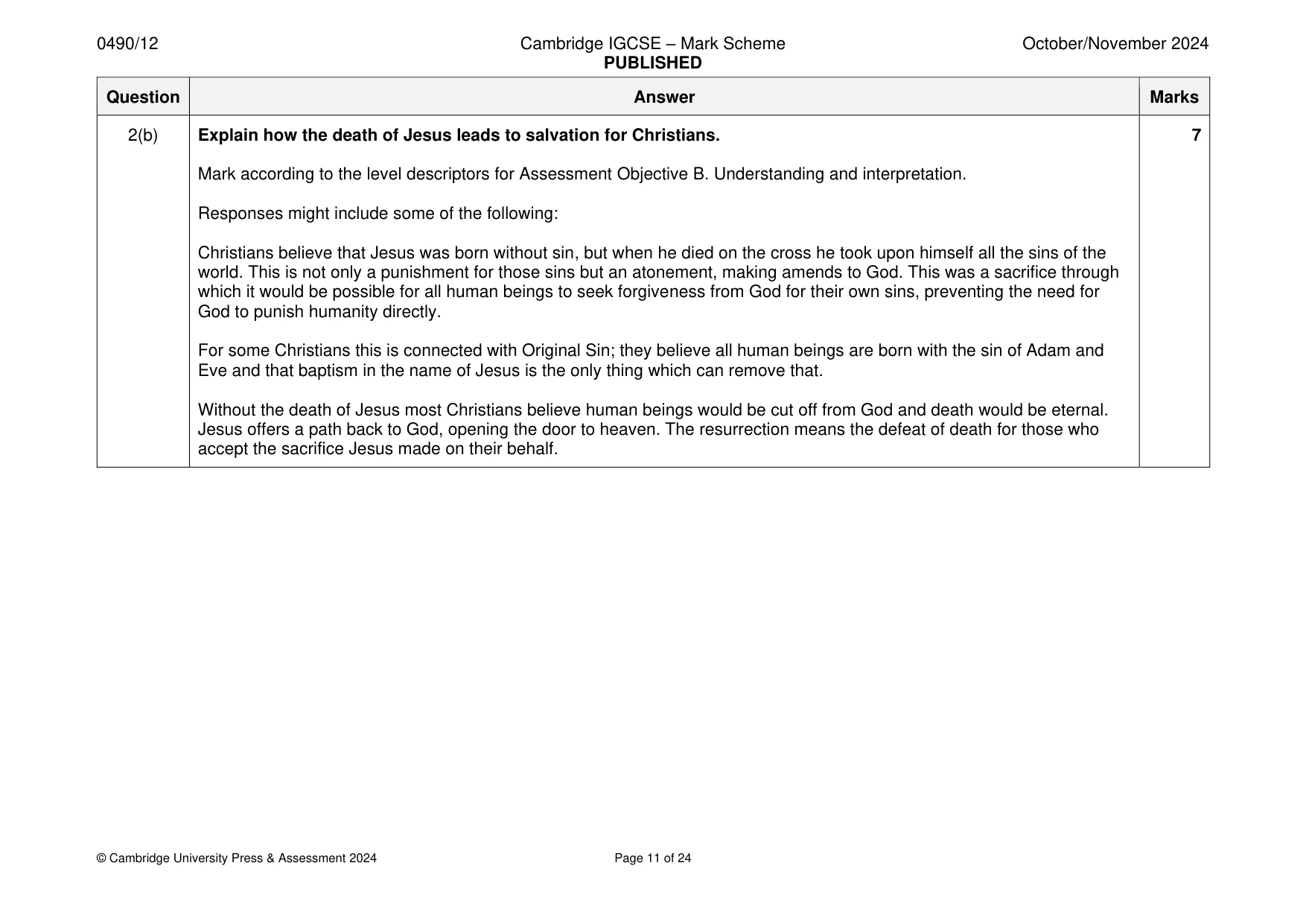
0490/12 Cambridge IGCSE – Mark Scheme PUBLISHED October/November 2024 © Cambridge University Press & Assessment 2024 Page 11 of 24 Question Answer Marks 2(b) Explain how the death of Jesus leads to salvation for Christians. Mark according to the level descriptors for Assessment Objective B. Understanding and interpretation. Responses might include some of the following: Christians believe that Jesus was born without sin, but when he died on the cross he took upon himself all the sins of the world. This is not only a punishment for those sins but an atonement, making amends to God. This was a sacrifice through which it would be possible for all human beings to seek forgiveness from God for their own sins, preventing the need for God to punish humanity directly. For some Christians this is connected with Original Sin; they believe all human beings are born with the sin of Adam and Eve and that baptism in the name of Jesus is the only thing which can remove that. Without the death of Jesus most Christians believe human beings would be cut off from God and death would be eternal. Jesus offers a path back to God, opening the door to heaven. The resurrection means the defeat of death for those who accept the sacrifice Jesus made on their behalf. 7
Mark scheme, page 12
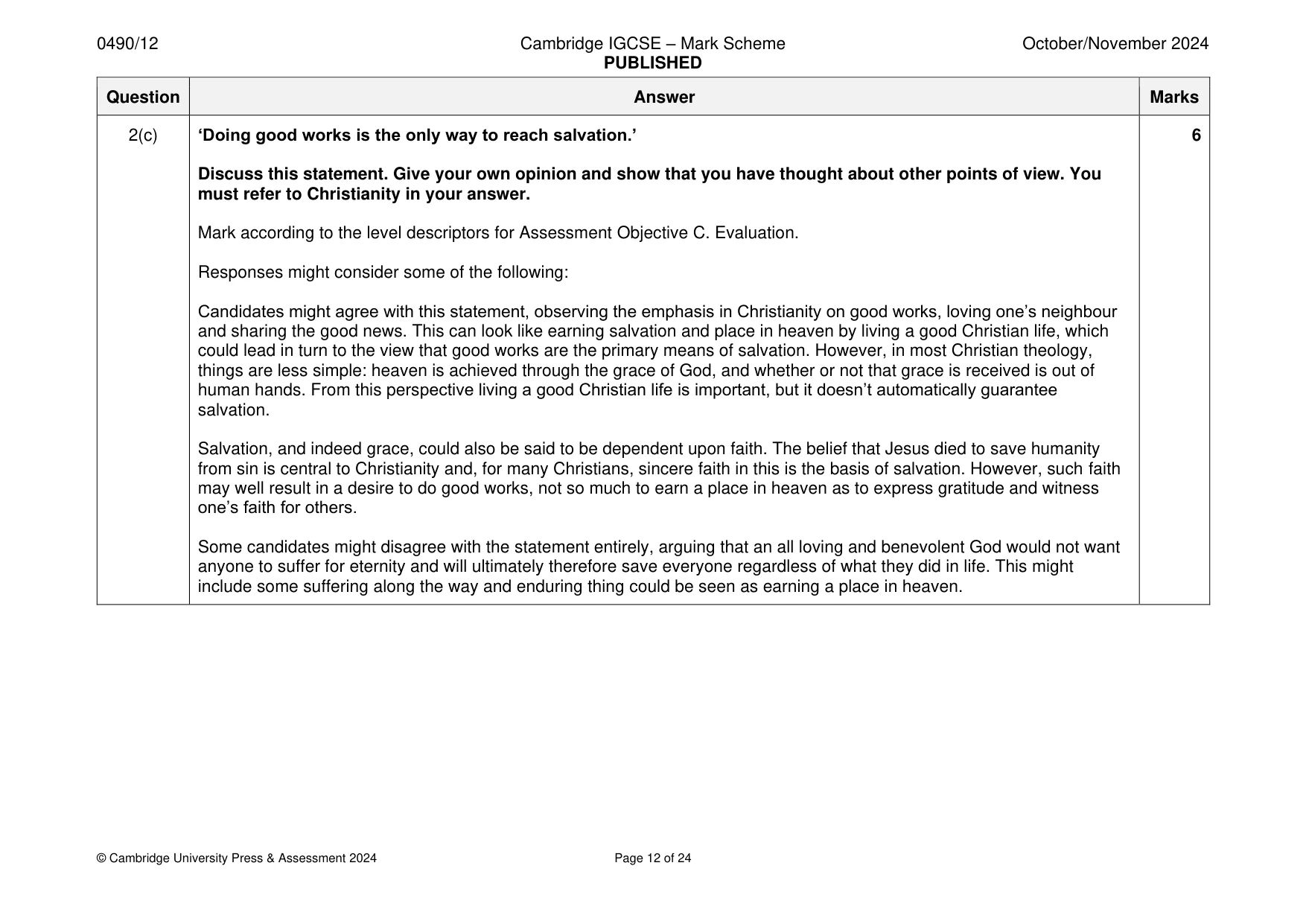
0490/12 Cambridge IGCSE – Mark Scheme PUBLISHED October/November 2024 © Cambridge University Press & Assessment 2024 Page 12 of 24 Question Answer Marks 2(c) ‘Doing good works is the only way to reach salvation.’ Discuss this statement. Give your own opinion and show that you have thought about other points of view. You must refer to Christianity in your answer. Mark according to the level descriptors for Assessment Objective C. Evaluation. Responses might consider some of the following: Candidates might agree with this statement, observing the emphasis in Christianity on good works, loving one’s neighbour and sharing the good news. This can look like earning salvation and place in heaven by living a good Christian life, which could lead in turn to the view that good works are the primary means of salvation. However, in most Christian theology, things are less simple: heaven is achieved through the grace of God, and whether or not that grace is received is out of human hands. From this perspective living a good Christian life is important, but it doesn’t automatically guarantee salvation. Salvation, and indeed grace, could also be said to be dependent upon faith. The belief that Jesus died to save humanity from sin is central to Christianity and, for many Christians, sincere faith in this is the basis of salvation. However, such faith may well result in a desire to do good works, not so much to earn a place in heaven as to express gratitude and witness one’s faith for others. Some candidates might disagree with the statement entirely, arguing that an all loving and benevolent God would not want anyone to suffer for eternity and will ultimately therefore save everyone regardless of what they did in life. This might include some suffering along the way and enduring thing could be seen as earning a place in heaven. 6
Mark scheme, page 13
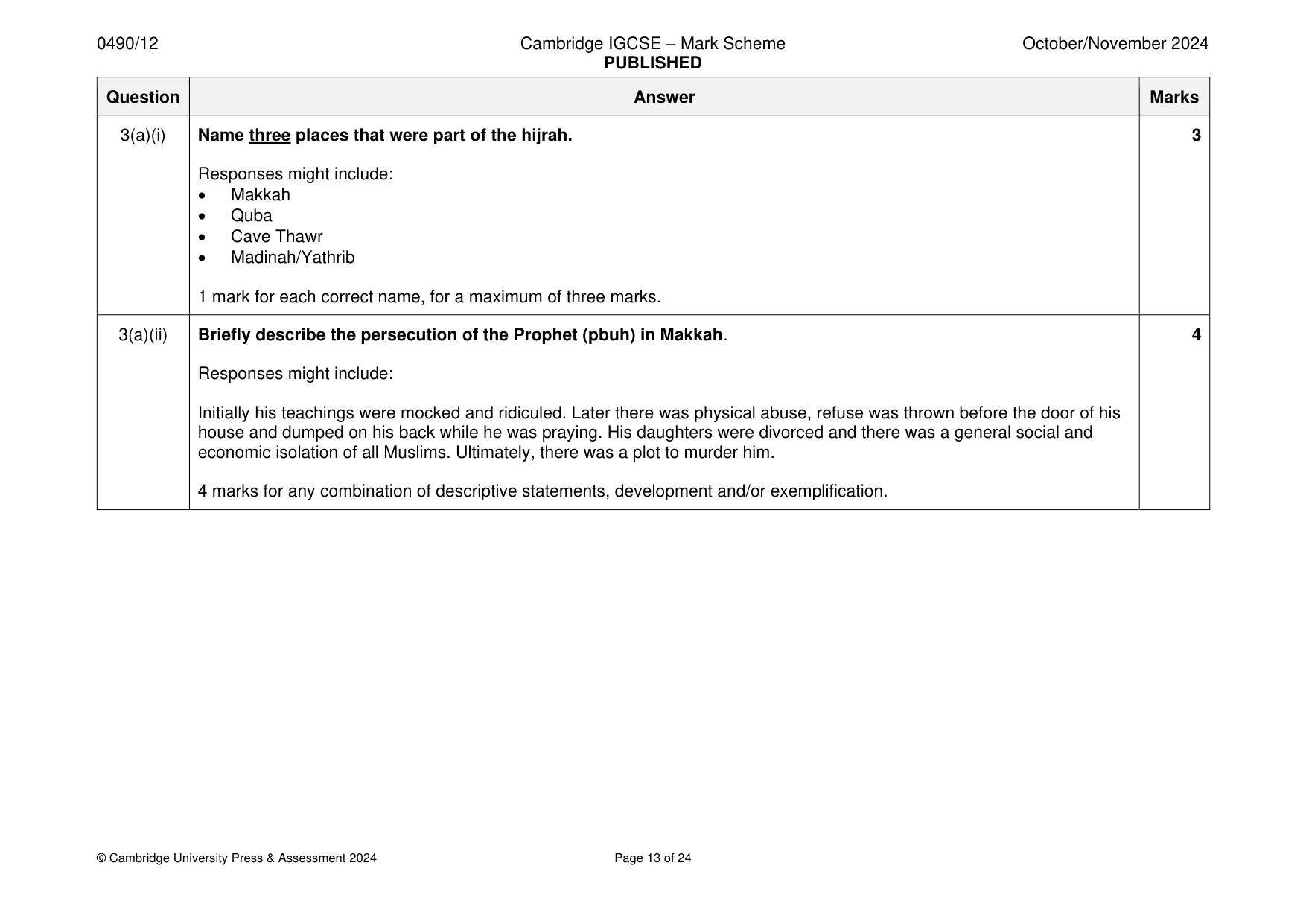
0490/12 Cambridge IGCSE – Mark Scheme PUBLISHED October/November 2024 © Cambridge University Press & Assessment 2024 Page 13 of 24 Question Answer Marks 3(a)(i) Name three places that were part of the hijrah. Responses might include: • Makkah • Quba • Cave Thawr • Madinah/Yathrib 1 mark for each correct name, for a maximum of three marks. 3 3(a)(ii) Briefly describe the persecution of the Prophet (pbuh) in Makkah. Responses might include: Initially his teachings were mocked and ridiculed. Later there was physical abuse, refuse was thrown before the door of his house and dumped on his back while he was praying. His daughters were divorced and there was a general social and economic isolation of all Muslims. Ultimately, there was a plot to murder him. 4 marks for any combination of descriptive statements, development and/or exemplification. 4
Mark scheme, page 14
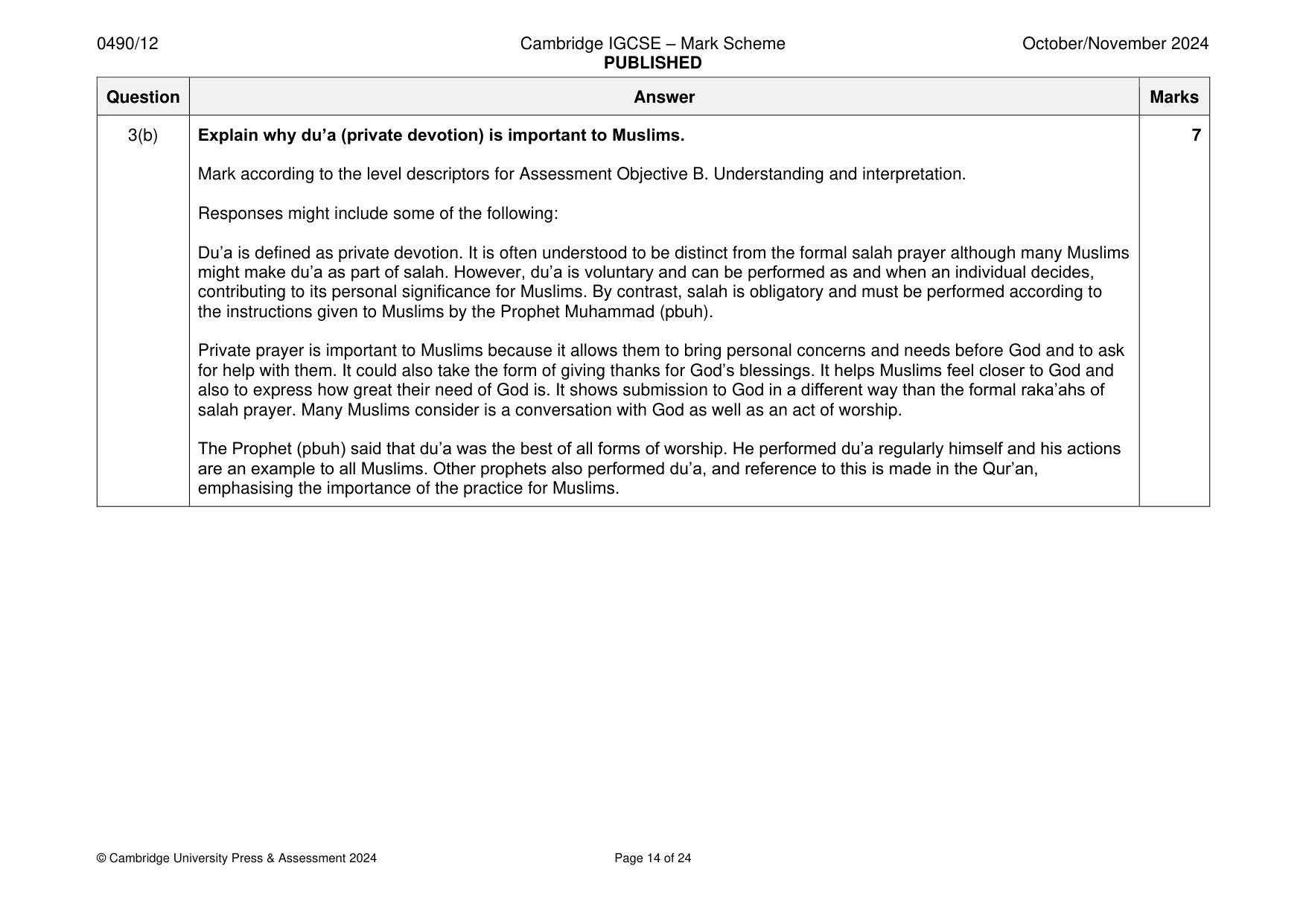
0490/12 Cambridge IGCSE – Mark Scheme PUBLISHED October/November 2024 © Cambridge University Press & Assessment 2024 Page 14 of 24 Question Answer Marks 3(b) Explain why du’a (private devotion) is important to Muslims. Mark according to the level descriptors for Assessment Objective B. Understanding and interpretation. Responses might include some of the following: Du’a is defined as private devotion. It is often understood to be distinct from the formal salah prayer although many Muslims might make du’a as part of salah. However, du’a is voluntary and can be performed as and when an individual decides, contributing to its personal significance for Muslims. By contrast, salah is obligatory and must be performed according to the instructions given to Muslims by the Prophet Muhammad (pbuh). Private prayer is important to Muslims because it allows them to bring personal concerns and needs before God and to ask for help with them. It could also take the form of giving thanks for God’s blessings. It helps Muslims feel closer to God and also to express how great their need of God is. It shows submission to God in a different way than the formal raka’ahs of salah prayer. Many Muslims consider is a conversation with God as well as an act of worship. The Prophet (pbuh) said that du’a was the best of all forms of worship. He performed du’a regularly himself and his actions are an example to all Muslims. Other prophets also performed du’a, and reference to this is made in the Qur’an, emphasising the importance of the practice for Muslims. 7
Mark scheme, page 15
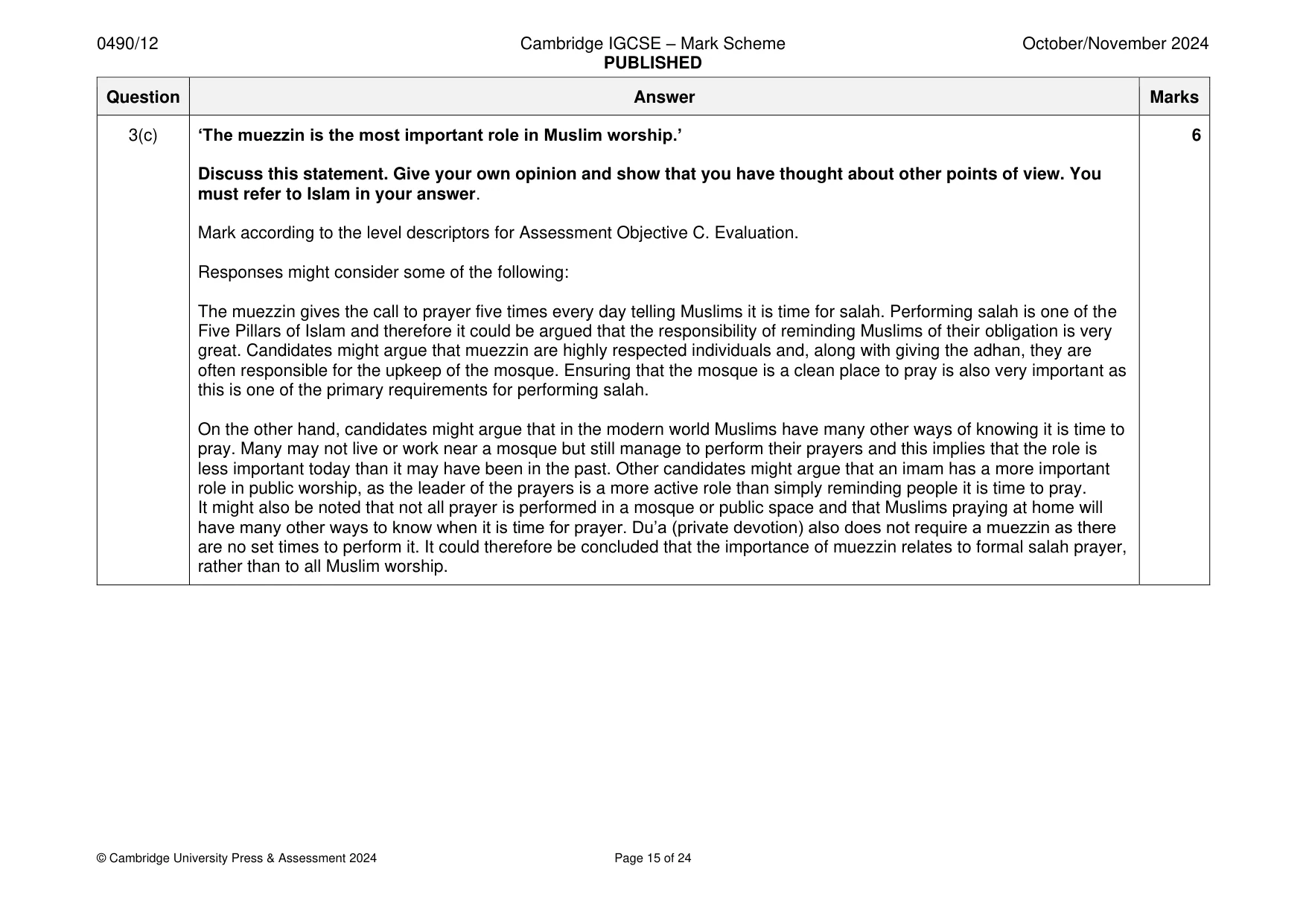
0490/12 Cambridge IGCSE – Mark Scheme PUBLISHED October/November 2024 © Cambridge University Press & Assessment 2024 Page 15 of 24 Question Answer Marks 3(c) ‘The muezzin is the most important role in Muslim worship.’ Discuss this statement. Give your own opinion and show that you have thought about other points of view. You must refer to Islam in your answer. Mark according to the level descriptors for Assessment Objective C. Evaluation. Responses might consider some of the following: The muezzin gives the call to prayer five times every day telling Muslims it is time for salah. Performing salah is one of the Five Pillars of Islam and therefore it could be argued that the responsibility of reminding Muslims of their obligation is very great. Candidates might argue that muezzin are highly respected individuals and, along with giving the adhan, they are often responsible for the upkeep of the mosque. Ensuring that the mosque is a clean place to pray is also very important as this is one of the primary requirements for performing salah. On the other hand, candidates might argue that in the modern world Muslims have many other ways of knowing it is time to pray. Many may not live or work near a mosque but still manage to perform their prayers and this implies that the role is less important today than it may have been in the past. Other candidates might argue that an imam has a more important role in public worship, as the leader of the prayers is a more active role than simply reminding people it is time to pray. It might also be noted that not all prayer is performed in a mosque or public space and that Muslims praying at home will have many other ways to know when it is time for prayer. Du’a (private devotion) also does not require a muezzin as there are no set times to perform it. It could therefore be concluded that the importance of muezzin relates to formal salah prayer, rather than to all Muslim worship. 6
Mark scheme, page 16
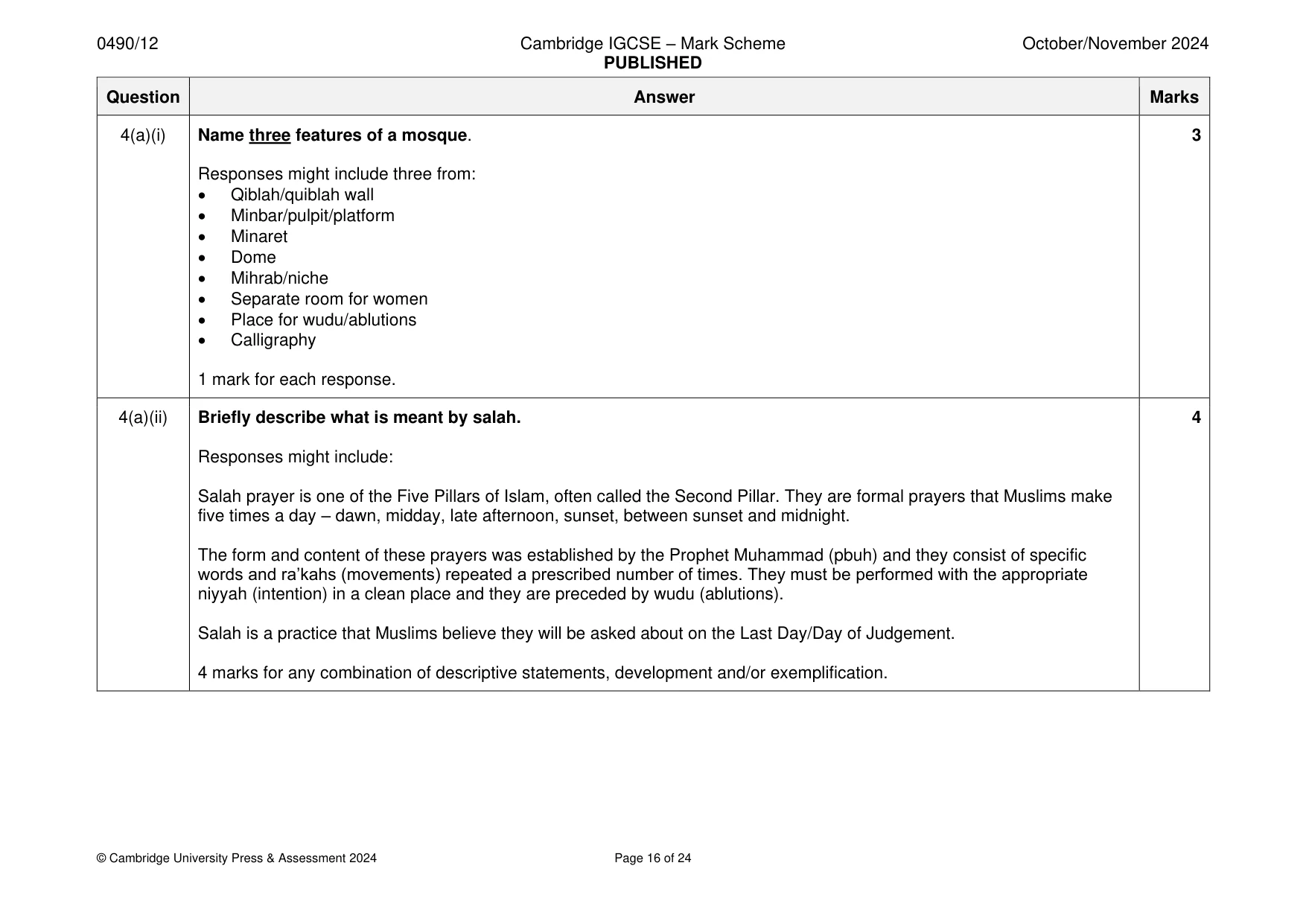
0490/12 Cambridge IGCSE – Mark Scheme PUBLISHED October/November 2024 © Cambridge University Press & Assessment 2024 Page 16 of 24 Question Answer Marks 4(a)(i) Name three features of a mosque. Responses might include three from: • Qiblah/quiblah wall • Minbar/pulpit/platform • Minaret • Dome • Mihrab/niche • Separate room for women • Place for wudu/ablutions • Calligraphy 1 mark for each response. 3 4(a)(ii) Briefly describe what is meant by salah. Responses might include: Salah prayer is one of the Five Pillars of Islam, often called the Second Pillar. They are formal prayers that Muslims make five times a day – dawn, midday, late afternoon, sunset, between sunset and midnight. The form and content of these prayers was established by the Prophet Muhammad (pbuh) and they consist of specific words and ra’kahs (movements) repeated a prescribed number of times. They must be performed with the appropriate niyyah (intention) in a clean place and they are preceded by wudu (ablutions). Salah is a practice that Muslims believe they will be asked about on the Last Day/Day of Judgement. 4 marks for any combination of descriptive statements, development and/or exemplification. 4
Mark scheme, page 17
0490/12 Cambridge IGCSE – Mark Scheme PUBLISHED October/November 2024 © Cambridge University Press & Assessment 2024 Page 17 of 24 Question Answer Marks 4(b) Explain the importance of Angels in Islam. Mark according to the level descriptors for Assessment Objective B. Understanding and interpretation. Responses might include some of the following: Belief in Angels is an Article of Faith in Islam and is therefore important. Angels are part of the unseen world, which human beings know about through revelations from God; belief in the unseen, or in what cannot be confirmed by the senses, is therefore an important sign of faith and if a person rejects the possibility of such belief they are also rejecting belief in God. Angels are mentioned many times in the Qur’an, which is the revealed word of God and so their existence cannot be doubted by a devout Muslim. They are generally believed to have been created before human beings and they have a different nature to humanity. They serve God in specific ways, including communicating with human beings: it was the Angel Jbra’il who brought the First Revelation to the Prophet (pbuh), thus laying the foundation for Islam, while Israf’il will blow the trumpet on the Last Day. There are also recording angels, also known as the Honourable Scribes or Noble Recorders, who write down the deeds of human beings with which each person will be confronted on the Day of Judgement. Other important beliefs also depend on the angels. If the existence of angels is rejected then it is impossible to believe in the books or the prophets who received them. 7
Mark scheme, page 18
0490/12 Cambridge IGCSE – Mark Scheme PUBLISHED October/November 2024 © Cambridge University Press & Assessment 2024 Page 18 of 24 Question Answer Marks 4(c) ‘No one Article of Faith is more important than another.’ Discuss this statement. Give your own opinion and show that you have thought about other points of view. You must refer to Islam in your answer. Mark according to the level descriptors for Assessment Objective C. Evaluation. The Articles of Faith include tawhid (oneness of God), risalah (propherts), akhirah (life after death), malaikah (angels) and kutub (books). Candidates might agree with the statement on the basis that Articles of Faith are required elements of a religion, not a list of things from which one can pick and choose. Being a Muslim means accepting the Articles of Faith as true and therefore no single one should be more important than any other. However, it could still be argued that for individual Muslims in the contexts of their individual lives one Article of Faith might seem more important at a particular moment than any of the others. For example, akhirah might seem less important to a young Muslim who feels death is a long way away than to an older person for whom it is close. It would also be possible to argue that a person might accept God and therefore consider themselves a Muslim before they are fully educated about Islam. That does not mean that the other Articles of Faith are not important over all but for that person the importance of tawhid was sufficiently overwhelming for them to want to declare their faith. 6
Mark scheme, page 19
0490/12 Cambridge IGCSE – Mark Scheme PUBLISHED October/November 2024 © Cambridge University Press & Assessment 2024 Page 19 of 24 Question Answer Marks 5(a)(i) Name three sections of the Talmud (commentary on the Mishnah). Responses might include: • Zera’im/Seeds • Mo’ed/Festival • Nashim/Women • Nezikin/Damages • Kodashim/Holy Things • Taharot/Purities 1 mark for each response. 3 5(a)(ii) Briefly describe Jewish rules about clothing. Responses might include: There are mitzvot about clothing to be worn during worship, such as the tallit (prayer shawl) which is described in detail in the Torah. There is a prohibition on clothing that mixes wool and linen, and on men wearing women’s clothes or vice versa. There is also an instruction to put fringes on the corners of a four-cornered garment, which results in Orthodox Jews wearing tzitzit or a tallit katan (small tallit) under everyday clothing. Traditionally, married women are expected to cover their hair in Orthodox traditions and might do so with a wig or a headscarf. The kippah/yarmulke (skull cap) is worn by most male Jews at the synagogue or during worship at home; in the modern world some women also wear kippah at these times. Many Jews wear the kippah at all times. 4 marks for any combination of descriptive statements, development and/or exemplification. 4
Mark scheme, page 20
0490/12 Cambridge IGCSE – Mark Scheme PUBLISHED October/November 2024 © Cambridge University Press & Assessment 2024 Page 20 of 24 Question Answer Marks 5(b) Explain the significance of ritual dress for Jews today. Mark according to the level descriptors for Assessment Objective B. Understanding and interpretation. Responses might include some of the following: The most recognisable ritual garments are the tallit and the tefillin. The tallit is important because its appearance and usage are set out in the mitzvot. Wearing it is a sign that the person has had their Bar Mitzvah and can form part of the minyan when one is required. Tefillin are important because they fulfil the instructions given in the Shema to bind the words of the prayer onto the hands and the head. Both the tallit and tefillin are worn in obedience to instructions given by God. For most Jews tefillin are worn only for weekday morning prayers; they are not used on shabbat or during major festivals. Other aspects of ritual dress come from traditional practices rather than being explicitly set out in the mitzvot, but that does not make them less important. Maintaining traditions helps people feel in touch with the whole history of their religion and their people and wearing ritual garments can give a sense of unity when one is surrounded by others doing the same. The kippah/yarmulka (skull cap) worn by many Jews can be considered an item of ritual dress, although its use is not set out by the mitzvot. It is generally considered to indicate respect and fear of God and a recognition of God’s eternal presence. 7
Mark scheme, page 21
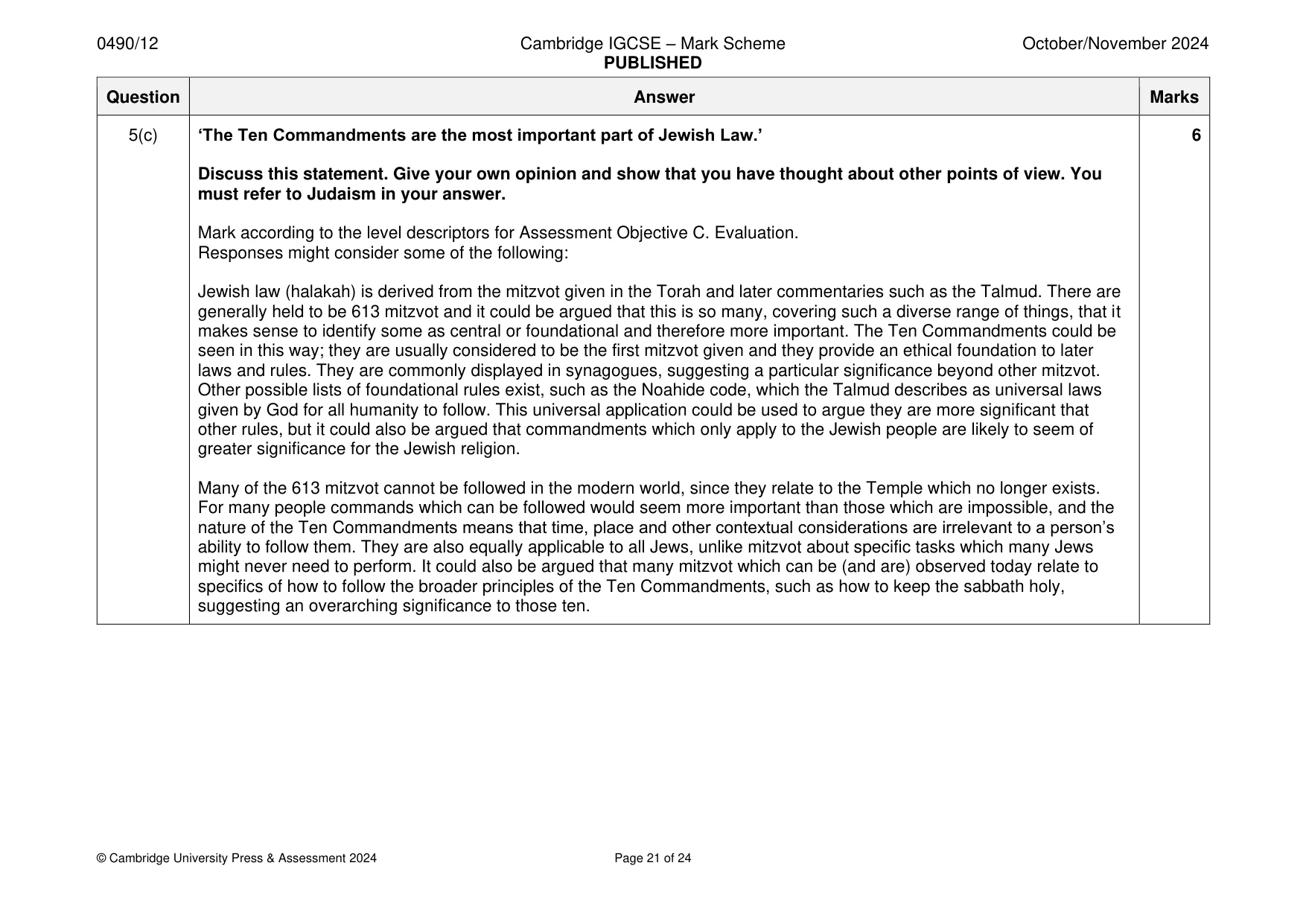
0490/12 Cambridge IGCSE – Mark Scheme PUBLISHED October/November 2024 © Cambridge University Press & Assessment 2024 Page 21 of 24 Question Answer Marks 5(c) ‘The Ten Commandments are the most important part of Jewish Law.’ Discuss this statement. Give your own opinion and show that you have thought about other points of view. You must refer to Judaism in your answer. Mark according to the level descriptors for Assessment Objective C. Evaluation. Responses might consider some of the following: Jewish law (halakah) is derived from the mitzvot given in the Torah and later commentaries such as the Talmud. There are generally held to be 613 mitzvot and it could be argued that this is so many, covering such a diverse range of things, that it makes sense to identify some as central or foundational and therefore more important. The Ten Commandments could be seen in this way; they are usually considered to be the first mitzvot given and they provide an ethical foundation to later laws and rules. They are commonly displayed in synagogues, suggesting a particular significance beyond other mitzvot. Other possible lists of foundational rules exist, such as the Noahide code, which the Talmud describes as universal laws given by God for all humanity to follow. This universal application could be used to argue they are more significant that other rules, but it could also be argued that commandments which only apply to the Jewish people are likely to seem of greater significance for the Jewish religion. Many of the 613 mitzvot cannot be followed in the modern world, since they relate to the Temple which no longer exists. For many people commands which can be followed would seem more important than those which are impossible, and the nature of the Ten Commandments means that time, place and other contextual considerations are irrelevant to a person’s ability to follow them. They are also equally applicable to all Jews, unlike mitzvot about specific tasks which many Jews might never need to perform. It could also be argued that many mitzvot which can be (and are) observed today relate to specifics of how to follow the broader principles of the Ten Commandments, such as how to keep the sabbath holy, suggesting an overarching significance to those ten. 6
Mark scheme, page 22
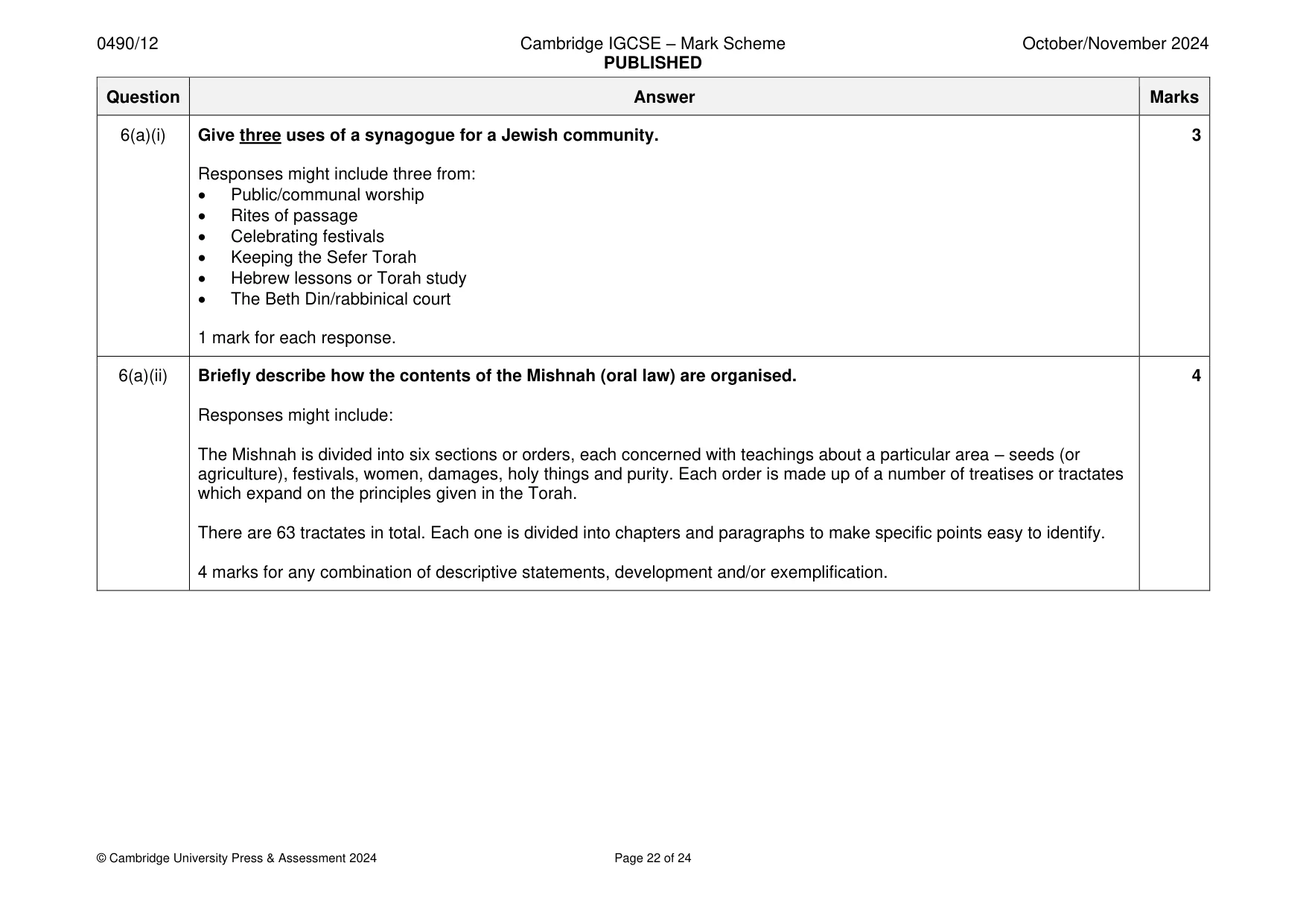
0490/12 Cambridge IGCSE – Mark Scheme PUBLISHED October/November 2024 © Cambridge University Press & Assessment 2024 Page 22 of 24 Question Answer Marks 6(a)(i) Give three uses of a synagogue for a Jewish community. Responses might include three from: • Public/communal worship • Rites of passage • Celebrating festivals • Keeping the Sefer Torah • Hebrew lessons or Torah study • The Beth Din/rabbinical court 1 mark for each response. 3 6(a)(ii) Briefly describe how the contents of the Mishnah (oral law) are organised. Responses might include: The Mishnah is divided into six sections or orders, each concerned with teachings about a particular area – seeds (or agriculture), festivals, women, damages, holy things and purity. Each order is made up of a number of treatises or tractates which expand on the principles given in the Torah. There are 63 tractates in total. Each one is divided into chapters and paragraphs to make specific points easy to identify. 4 marks for any combination of descriptive statements, development and/or exemplification. 4
Mark scheme, page 23
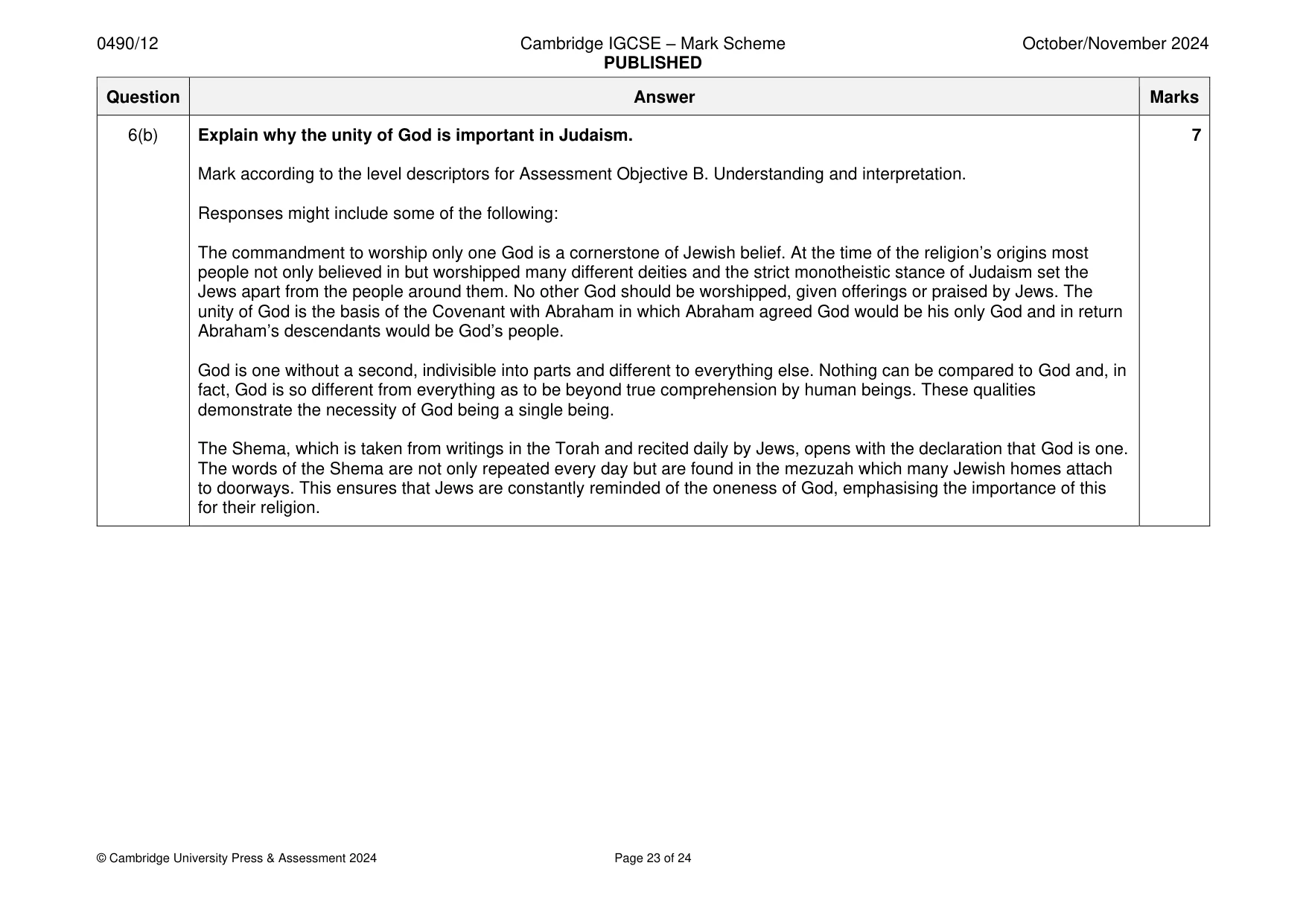
0490/12 Cambridge IGCSE – Mark Scheme PUBLISHED October/November 2024 © Cambridge University Press & Assessment 2024 Page 23 of 24 Question Answer Marks 6(b) Explain why the unity of God is important in Judaism. Mark according to the level descriptors for Assessment Objective B. Understanding and interpretation. Responses might include some of the following: The commandment to worship only one God is a cornerstone of Jewish belief. At the time of the religion’s origins most people not only believed in but worshipped many different deities and the strict monotheistic stance of Judaism set the Jews apart from the people around them. No other God should be worshipped, given offerings or praised by Jews. The unity of God is the basis of the Covenant with Abraham in which Abraham agreed God would be his only God and in return Abraham’s descendants would be God’s people. God is one without a second, indivisible into parts and different to everything else. Nothing can be compared to God and, in fact, God is so different from everything as to be beyond true comprehension by human beings. These qualities demonstrate the necessity of God being a single being. The Shema, which is taken from writings in the Torah and recited daily by Jews, opens with the declaration that God is one. The words of the Shema are not only repeated every day but are found in the mezuzah which many Jewish homes attach to doorways. This ensures that Jews are constantly reminded of the oneness of God, emphasising the importance of this for their religion. 7
Mark scheme, page 24
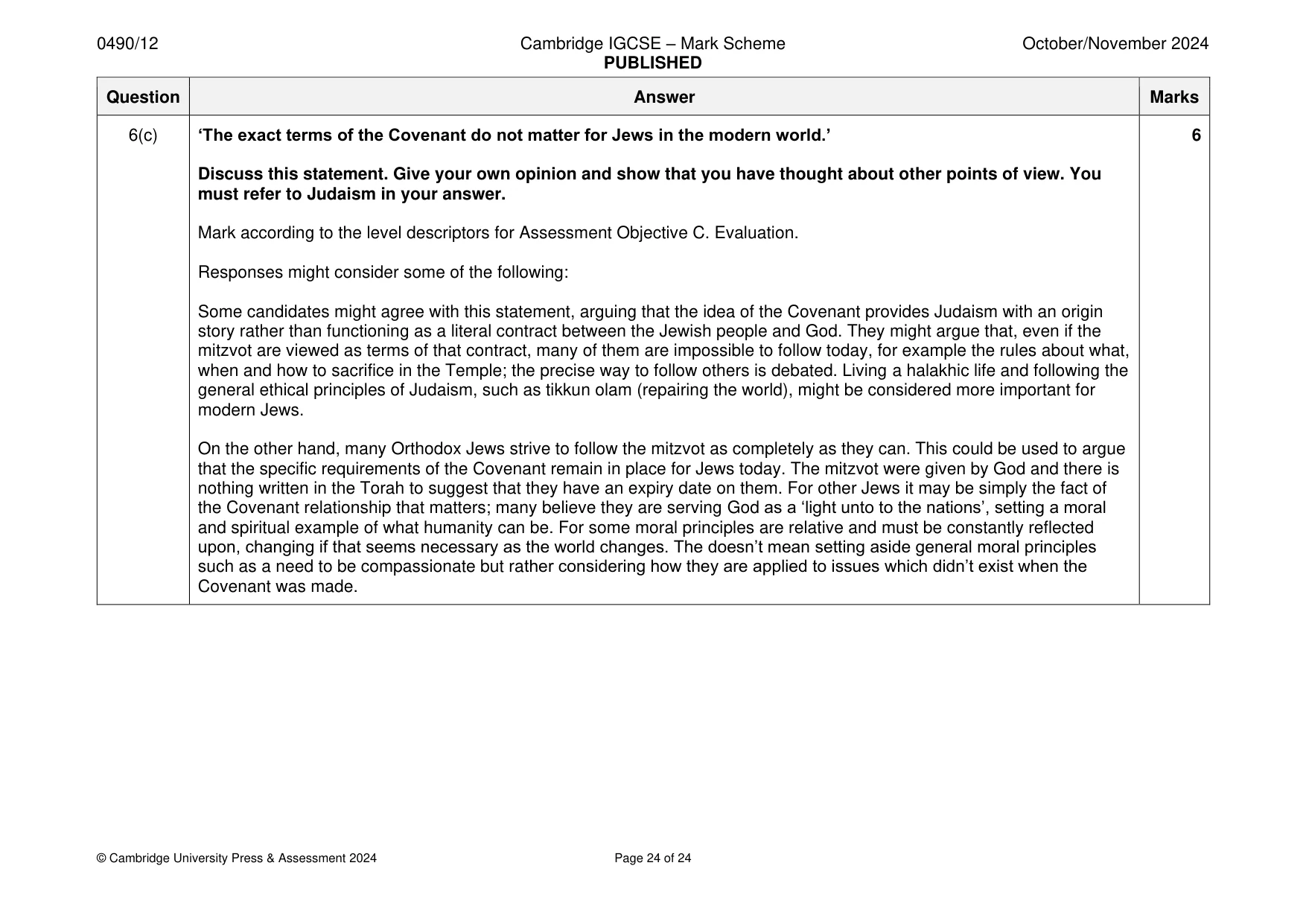
0490/12 Cambridge IGCSE – Mark Scheme PUBLISHED October/November 2024 © Cambridge University Press & Assessment 2024 Page 24 of 24 Question Answer Marks 6(c) ‘The exact terms of the Covenant do not matter for Jews in the modern world.’ Discuss this statement. Give your own opinion and show that you have thought about other points of view. You must refer to Judaism in your answer. Mark according to the level descriptors for Assessment Objective C. Evaluation. Responses might consider some of the following: Some candidates might agree with this statement, arguing that the idea of the Covenant provides Judaism with an origin story rather than functioning as a literal contract between the Jewish people and God. They might argue that, even if the mitzvot are viewed as terms of that contract, many of them are impossible to follow today, for example the rules about what, when and how to sacrifice in the Temple; the precise way to follow others is debated. Living a halakhic life and following the general ethical principles of Judaism, such as tikkun olam (repairing the world), might be considered more important for modern Jews. On the other hand, many Orthodox Jews strive to follow the mitzvot as completely as they can. This could be used to argue that the specific requirements of the Covenant remain in place for Jews today. The mitzvot were given by God and there is nothing written in the Torah to suggest that they have an expiry date on them. For other Jews it may be simply the fact of the Covenant relationship that matters; many believe they are serving God as a ‘light unto to the nations’, setting a moral and spiritual example of what humanity can be. For some moral principles are relative and must be constantly reflected upon, changing if that seems necessary as the world changes. The doesn’t mean setting aside general moral principles such as a need to be compassionate but rather considering how they are applied to issues which didn’t exist when the Covenant was made. 6
What you needed in this session
Cambridge’s own grade thresholds for 2024 Oct/Nov, Paper 1 · Variant 2. A higher threshold means an easier paper — the bar moves with how the cohort did.