Cambridge IGCSE Religious Studies 0490 — 2023 Oct/Nov Paper 1 · Variant 2
0490/12/O/N/23 · 80 marks · ≈90 min
The question paper and its mark scheme, free to read here and free to download. This is Cambridge’s own paper, exactly as it was sat.
Question paper4 pages
Mark scheme16 pages
Answers below. Sit the paper first if you are practising.
Paper as text
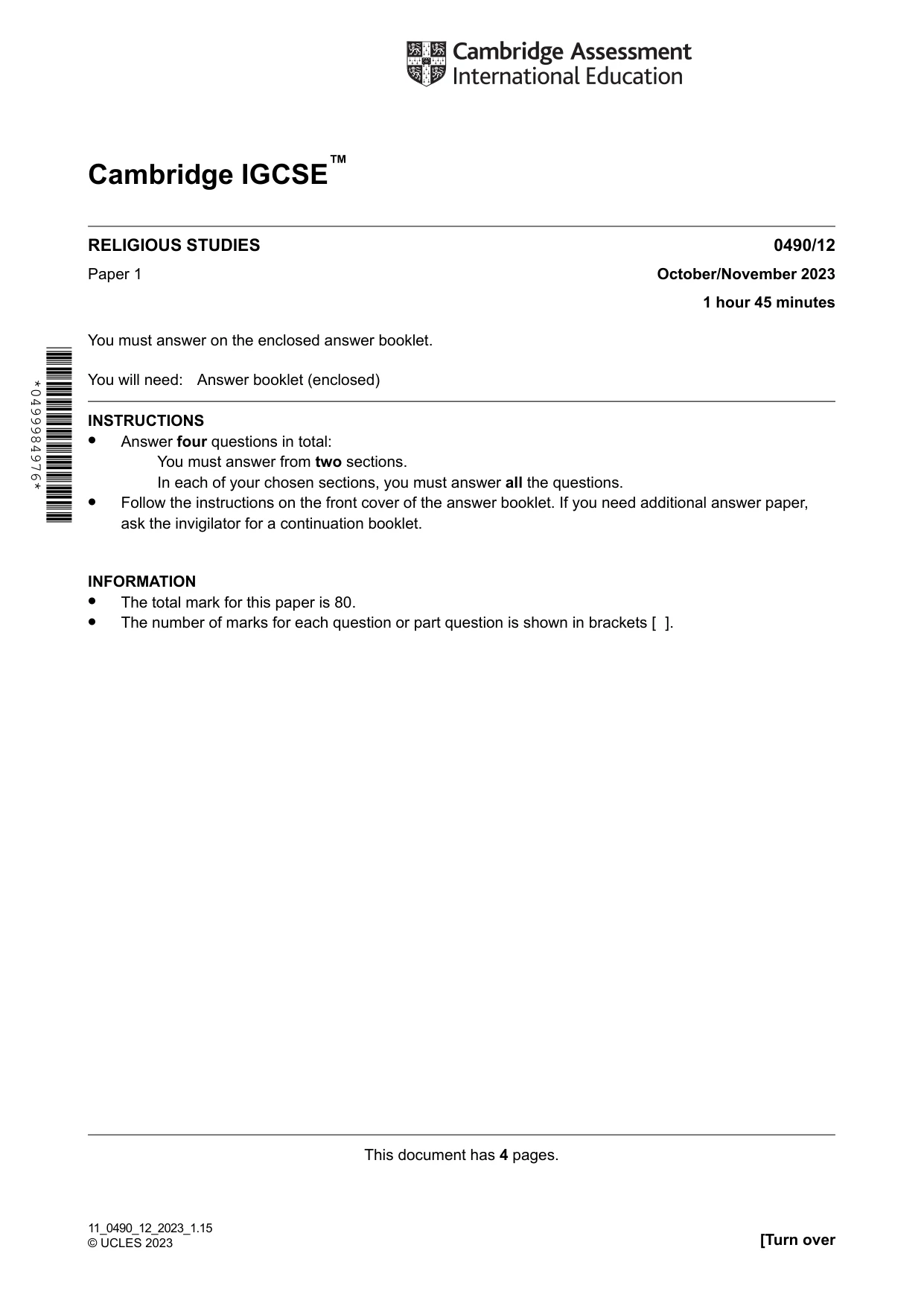
Question paper, page 1
Cambridge IGCSE™ 0490/12 October/November 2023 1 hour 45 minutes RELIGIOUS STUDIES Paper 1 You must answer on the enclosed answer booklet. You will need: Answer booklet (enclosed) INSTRUCTIONS • Answer four questions in total: You must answer from two sections. In each of your chosen sections, you must answer all the questions. • Follow the instructions on the front cover of the answer booklet. If you need additional answer paper, ask the invigilator for a continuation booklet. INFORMATION • The total mark for this paper is 80. • The number of marks for each question or part question is shown in brackets [ ]. This document has 4 pages. [Turn over 11_0490_12_2023_1.15 © UCLES 2023 *0499984976*
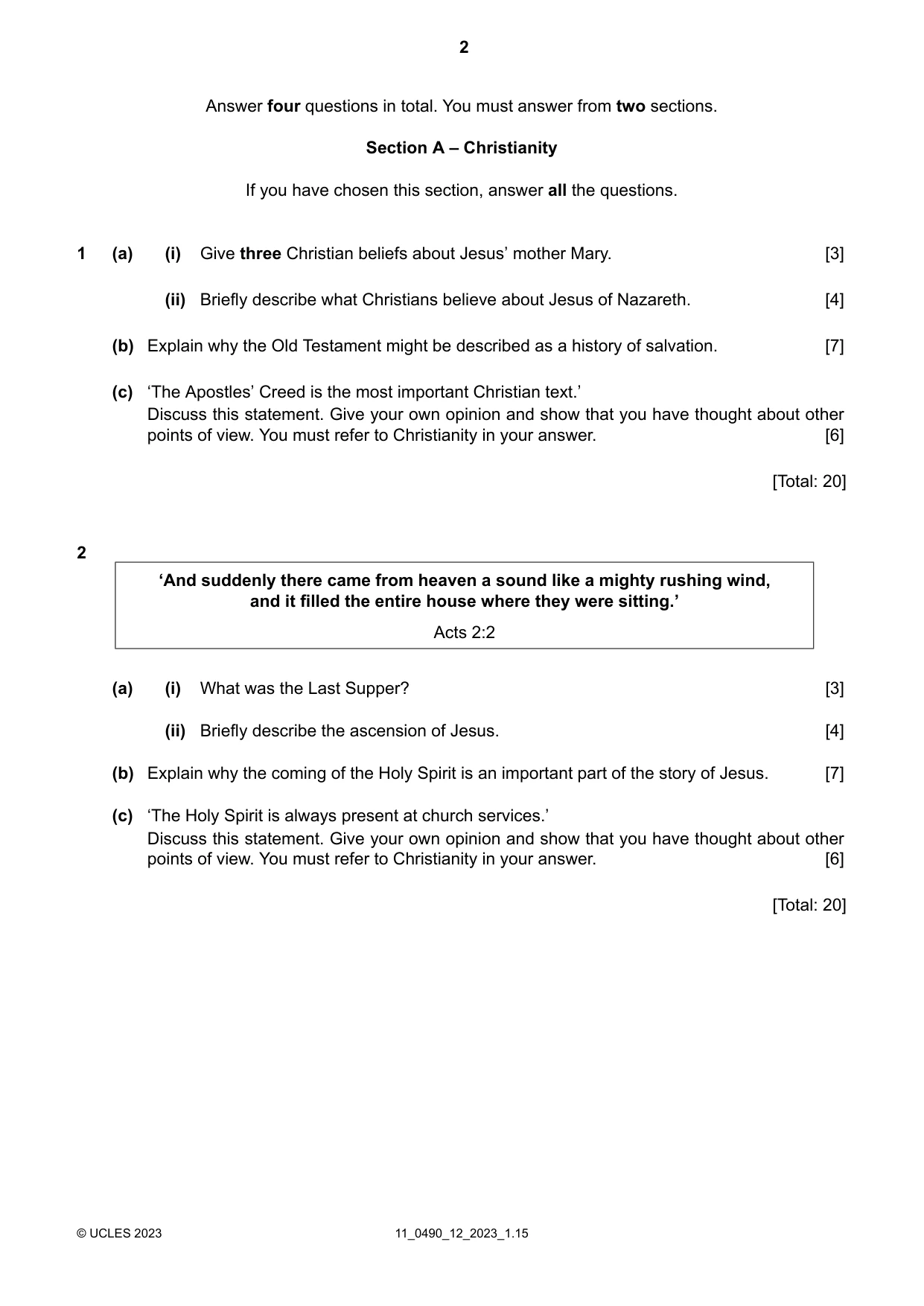
Question paper, page 2
Answer four questions in total. You must answer from two sections. Section A – Christianity If you have chosen this section, answer all the questions. Give three Christian beliefs about Jesus’ mother Mary. [3] (i) (a) 1 Briefly describe what Christians believe about Jesus of Nazareth. [4] (ii) Explain why the Old Testament might be described as a history of salvation. [7] (b) ‘The Apostles’ Creed is the most important Christian text.’ Discuss this statement. Give your own opinion and show that you have thought about other points of view. You must refer to Christianity in your answer. [6] (c) [Total: 20] 2 ‘And suddenly there came from heaven a sound like a mighty rushing wind, and it filled the entire house where they were sitting.’ Acts 2:2 What was the Last Supper? [3] (i) (a) Briefly describe the ascension of Jesus. [4] (ii) Explain why the coming of the Holy Spirit is an important part of the story of Jesus. [7] (b) ‘The Holy Spirit is always present at church services.’ Discuss this statement. Give your own opinion and show that you have thought about other points of view. You must refer to Christianity in your answer. [6] (c) [Total: 20] 11_0490_12_2023_1.15 © UCLES 2023 2
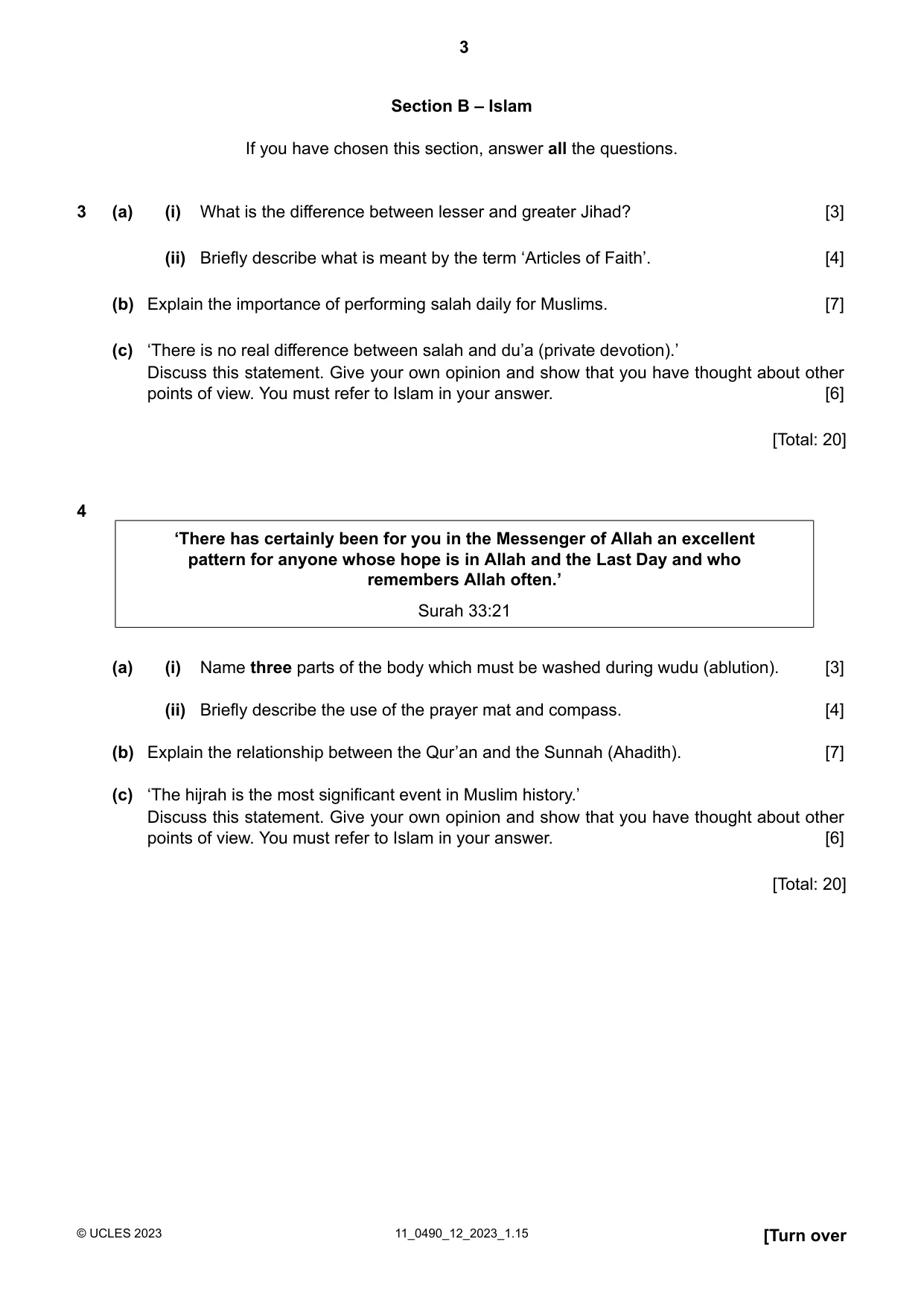
Question paper, page 3
Section B – Islam If you have chosen this section, answer all the questions. What is the difference between lesser and greater Jihad? [3] (i) (a) 3 Briefly describe what is meant by the term ‘Articles of Faith’. [4] (ii) Explain the importance of performing salah daily for Muslims. [7] (b) ‘There is no real difference between salah and du’a (private devotion).’ Discuss this statement. Give your own opinion and show that you have thought about other points of view. You must refer to Islam in your answer. [6] (c) [Total: 20] 4 ‘There has certainly been for you in the Messenger of Allah an excellent pattern for anyone whose hope is in Allah and the Last Day and who remembers Allah often.’ Surah 33:21 Name three parts of the body which must be washed during wudu (ablution). [3] (i) (a) Briefly describe the use of the prayer mat and compass. [4] (ii) Explain the relationship between the Qur’an and the Sunnah (Ahadith). [7] (b) ‘The hijrah is the most significant event in Muslim history.’ Discuss this statement. Give your own opinion and show that you have thought about other points of view. You must refer to Islam in your answer. [6] (c) [Total: 20] [Turn over 11_0490_12_2023_1.15 © UCLES 2023 3
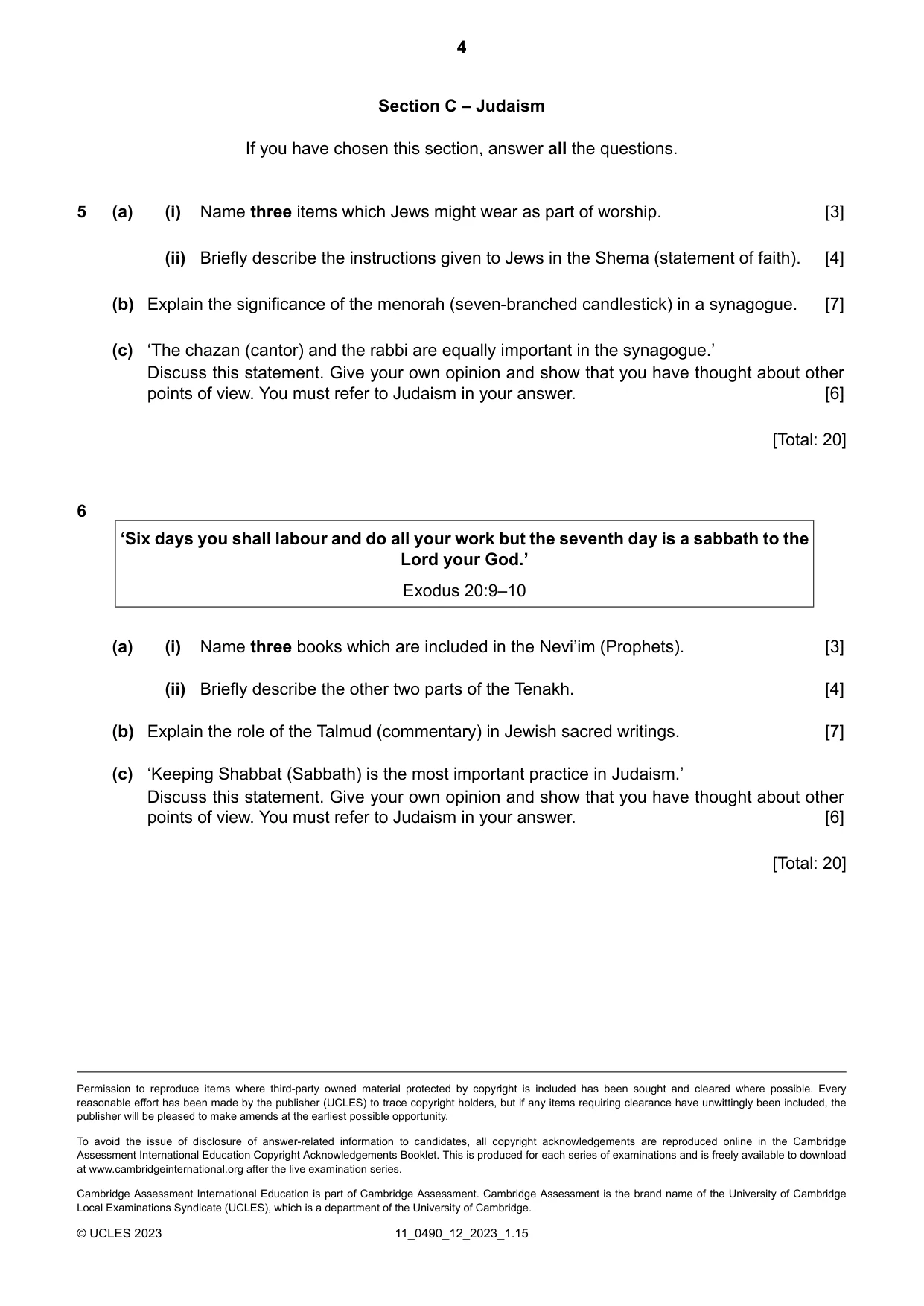
Question paper, page 4
Section C – Judaism If you have chosen this section, answer all the questions. Name three items which Jews might wear as part of worship. [3] (i) (a) 5 Briefly describe the instructions given to Jews in the Shema (statement of faith). [4] (ii) Explain the significance of the menorah (seven-branched candlestick) in a synagogue. [7] (b) ‘The chazan (cantor) and the rabbi are equally important in the synagogue.’ Discuss this statement. Give your own opinion and show that you have thought about other points of view. You must refer to Judaism in your answer. [6] (c) [Total: 20] 6 ‘Six days you shall labour and do all your work but the seventh day is a sabbath to the Lord your God.’ Exodus 20:9–10 Name three books which are included in the Nevi’im (Prophets). [3] (i) (a) Briefly describe the other two parts of the Tenakh. [4] (ii) Explain the role of the Talmud (commentary) in Jewish sacred writings. [7] (b) ‘Keeping Shabbat (Sabbath) is the most important practice in Judaism.’ Discuss this statement. Give your own opinion and show that you have thought about other points of view. You must refer to Judaism in your answer. [6] (c) [Total: 20] Permission to reproduce items where third-party owned material protected by copyright is included has been sought and cleared where possible. Every reasonable effort has been made by the publisher (UCLES) to trace copyright holders, but if any items requiring clearance have unwittingly been included, the publisher will be pleased to make amends at the earliest possible opportunity. To avoid the issue of disclosure of answer-related information to candidates, all copyright acknowledgements are reproduced online in the Cambridge Assessment International Education Copyright Acknowledgements Booklet. This is produced for each series of examinations and is freely available to download at www.cambridgeinternational.org after the live examination series. Cambridge Assessment International Education is part of Cambridge Assessment. Cambridge Assessment is the brand name of the University of Cambridge Local Examinations Syndicate (UCLES), which is a department of the University of Cambridge. 11_0490_12_2023_1.15 © UCLES 2023 4
Mark scheme, page 1
This document consists of 16 printed pages. © UCLES 2023 [Turn over Cambridge IGCSE™ RELIGIOUS STUDIES 0490/12 Paper 1 October/November 2023 MARK SCHEME Maximum Mark: 80 Published This mark scheme is published as an aid to teachers and candidates, to indicate the requirements of the examination. It shows the basis on which Examiners were instructed to award marks. It does not indicate the details of the discussions that took place at an Examiners’ meeting before marking began, which would have considered the acceptability of alternative answers. Mark schemes should be read in conjunction with the question paper and the Principal Examiner Report for Teachers. Cambridge International will not enter into discussions about these mark schemes. Cambridge International is publishing the mark schemes for the October/November 2023 series for most Cambridge IGCSE, Cambridge International A and AS Level components, and some Cambridge O Level components.
Mark scheme, page 2
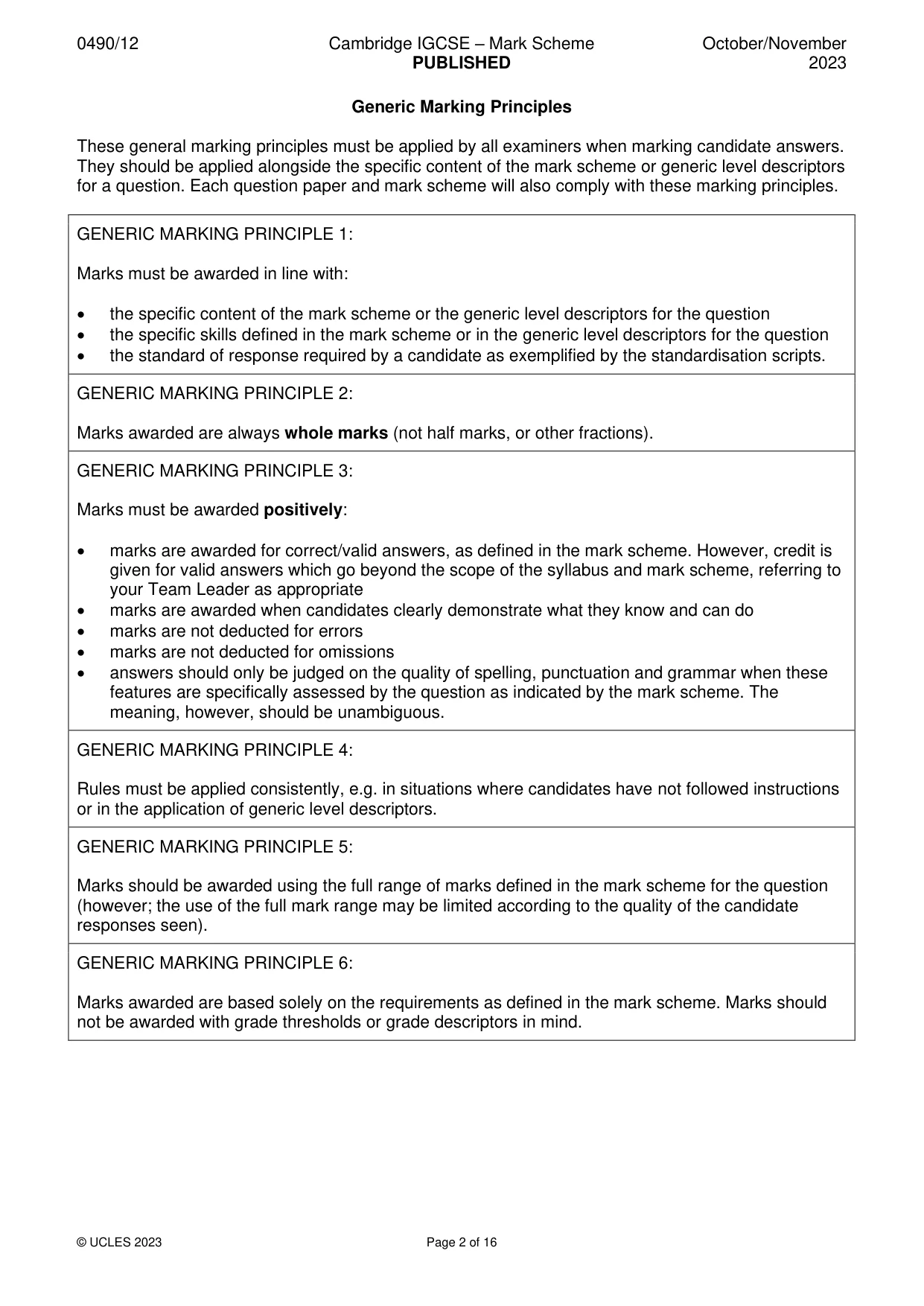
0490/12 Cambridge IGCSE – Mark Scheme PUBLISHED October/November 2023 © UCLES 2023 Page 2 of 16 Generic Marking Principles These general marking principles must be applied by all examiners when marking candidate answers. They should be applied alongside the specific content of the mark scheme or generic level descriptors for a question. Each question paper and mark scheme will also comply with these marking principles. GENERIC MARKING PRINCIPLE 1: Marks must be awarded in line with: • the specific content of the mark scheme or the generic level descriptors for the question • the specific skills defined in the mark scheme or in the generic level descriptors for the question • the standard of response required by a candidate as exemplified by the standardisation scripts. GENERIC MARKING PRINCIPLE 2: Marks awarded are always whole marks (not half marks, or other fractions). GENERIC MARKING PRINCIPLE 3: Marks must be awarded positively: • marks are awarded for correct/valid answers, as defined in the mark scheme. However, credit is given for valid answers which go beyond the scope of the syllabus and mark scheme, referring to your Team Leader as appropriate • marks are awarded when candidates clearly demonstrate what they know and can do • marks are not deducted for errors • marks are not deducted for omissions • answers should only be judged on the quality of spelling, punctuation and grammar when these features are specifically assessed by the question as indicated by the mark scheme. The meaning, however, should be unambiguous. GENERIC MARKING PRINCIPLE 4: Rules must be applied consistently, e.g. in situations where candidates have not followed instructions or in the application of generic level descriptors. GENERIC MARKING PRINCIPLE 5: Marks should be awarded using the full range of marks defined in the mark scheme for the question (however; the use of the full mark range may be limited according to the quality of the candidate responses seen). GENERIC MARKING PRINCIPLE 6: Marks awarded are based solely on the requirements as defined in the mark scheme. Marks should not be awarded with grade thresholds or grade descriptors in mind.
Mark scheme, page 3
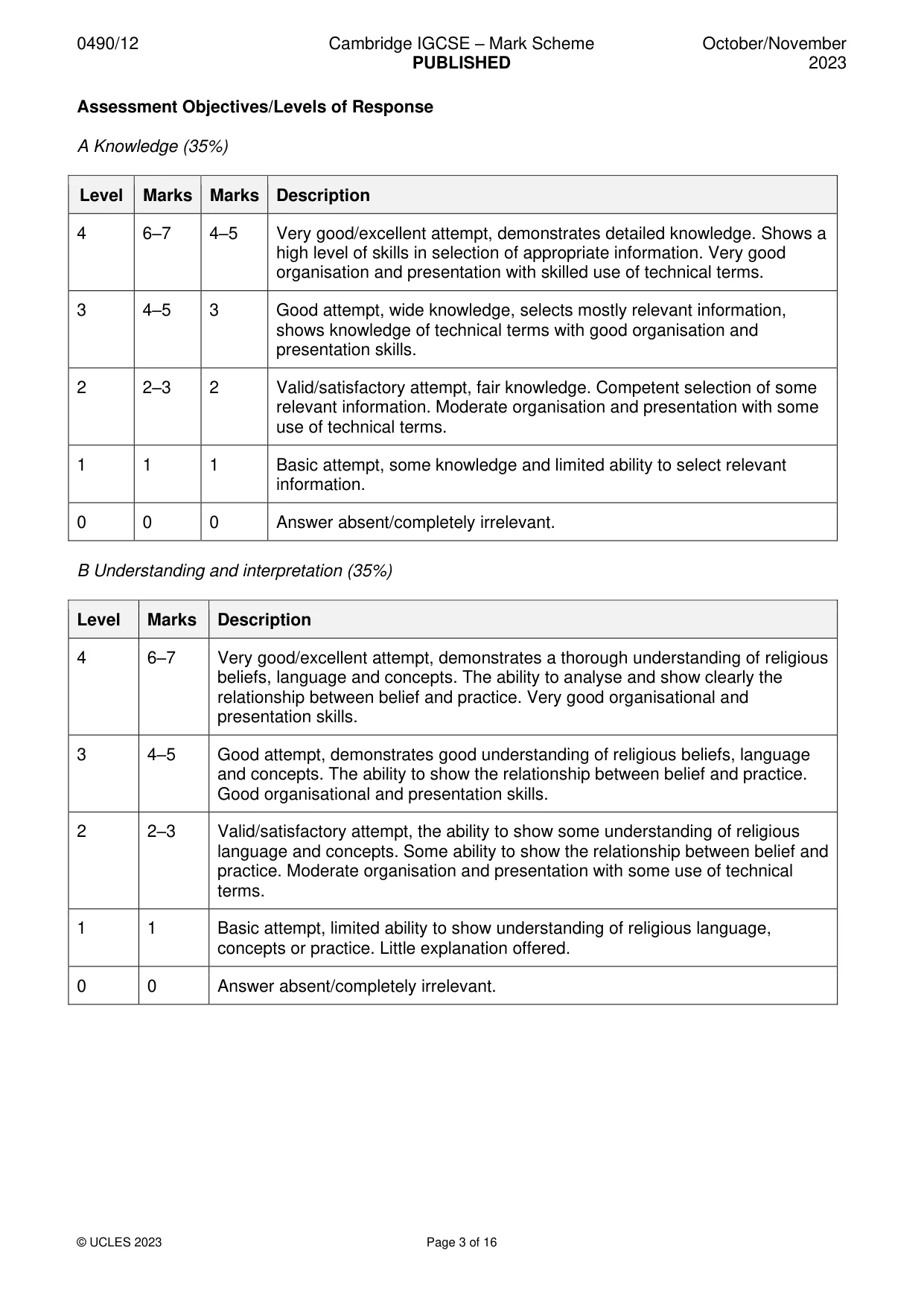
0490/12 Cambridge IGCSE – Mark Scheme PUBLISHED October/November 2023 © UCLES 2023 Page 3 of 16 Assessment Objectives/Levels of Response A Knowledge (35%) Level Marks Marks Description 4 6–7 4–5 Very good/excellent attempt, demonstrates detailed knowledge. Shows a high level of skills in selection of appropriate information. Very good organisation and presentation with skilled use of technical terms. 3 4–5 3 Good attempt, wide knowledge, selects mostly relevant information, shows knowledge of technical terms with good organisation and presentation skills. 2 2–3 2 Valid/satisfactory attempt, fair knowledge. Competent selection of some relevant information. Moderate organisation and presentation with some use of technical terms. 1 1 1 Basic attempt, some knowledge and limited ability to select relevant information. 0 0 0 Answer absent/completely irrelevant. B Understanding and interpretation (35%) Level Marks Description 4 6–7 Very good/excellent attempt, demonstrates a thorough understanding of religious beliefs, language and concepts. The ability to analyse and show clearly the relationship between belief and practice. Very good organisational and presentation skills. 3 4–5 Good attempt, demonstrates good understanding of religious beliefs, language and concepts. The ability to show the relationship between belief and practice. Good organisational and presentation skills. 2 2–3 Valid/satisfactory attempt, the ability to show some understanding of religious language and concepts. Some ability to show the relationship between belief and practice. Moderate organisation and presentation with some use of technical terms. 1 1 Basic attempt, limited ability to show understanding of religious language, concepts or practice. Little explanation offered. 0 0 Answer absent/completely irrelevant.
Mark scheme, page 4
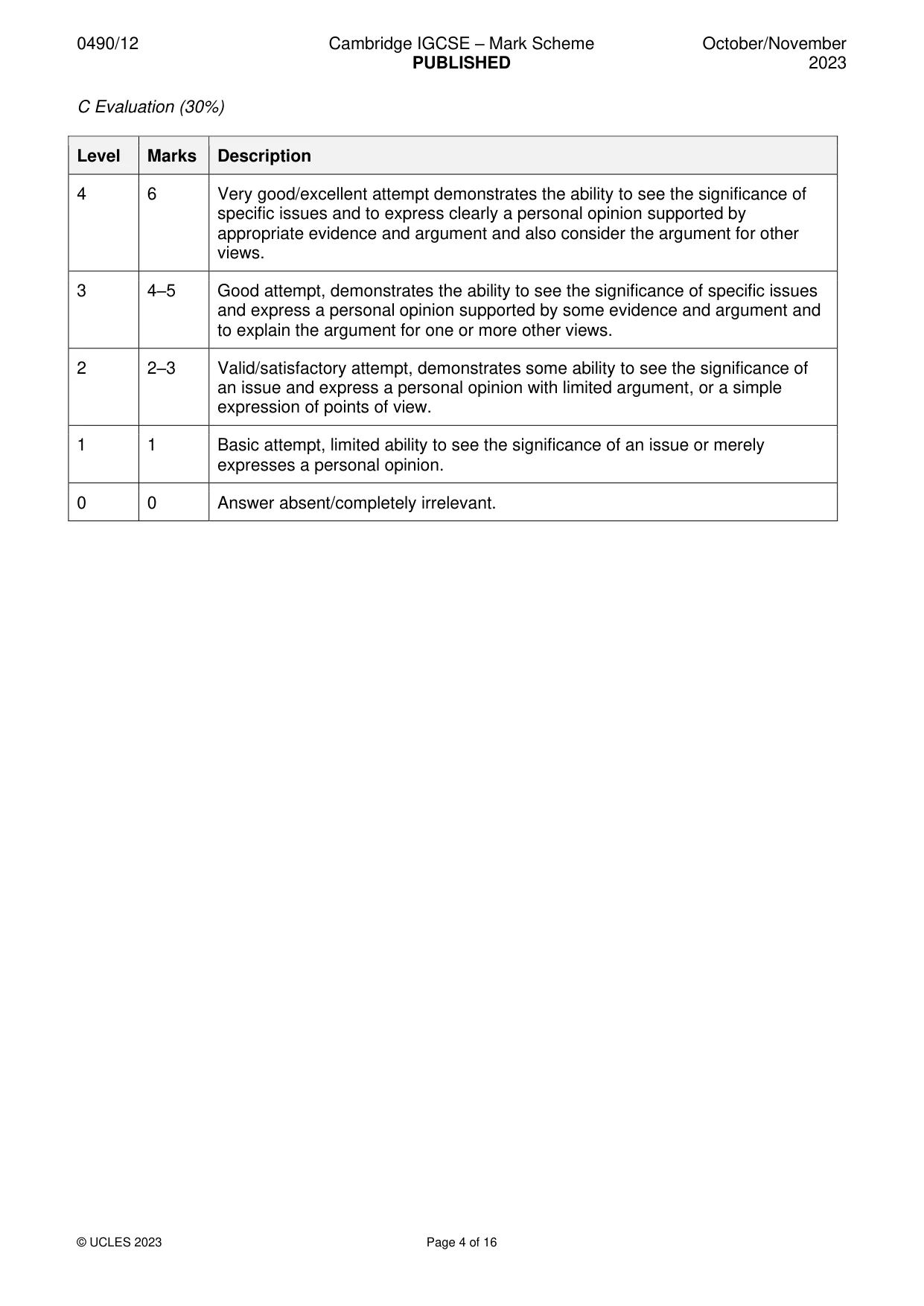
0490/12 Cambridge IGCSE – Mark Scheme PUBLISHED October/November 2023 © UCLES 2023 Page 4 of 16 C Evaluation (30%) Level Marks Description 4 6 Very good/excellent attempt demonstrates the ability to see the significance of specific issues and to express clearly a personal opinion supported by appropriate evidence and argument and also consider the argument for other views. 3 4–5 Good attempt, demonstrates the ability to see the significance of specific issues and express a personal opinion supported by some evidence and argument and to explain the argument for one or more other views. 2 2–3 Valid/satisfactory attempt, demonstrates some ability to see the significance of an issue and express a personal opinion with limited argument, or a simple expression of points of view. 1 1 Basic attempt, limited ability to see the significance of an issue or merely expresses a personal opinion. 0 0 Answer absent/completely irrelevant.
Mark scheme, page 5
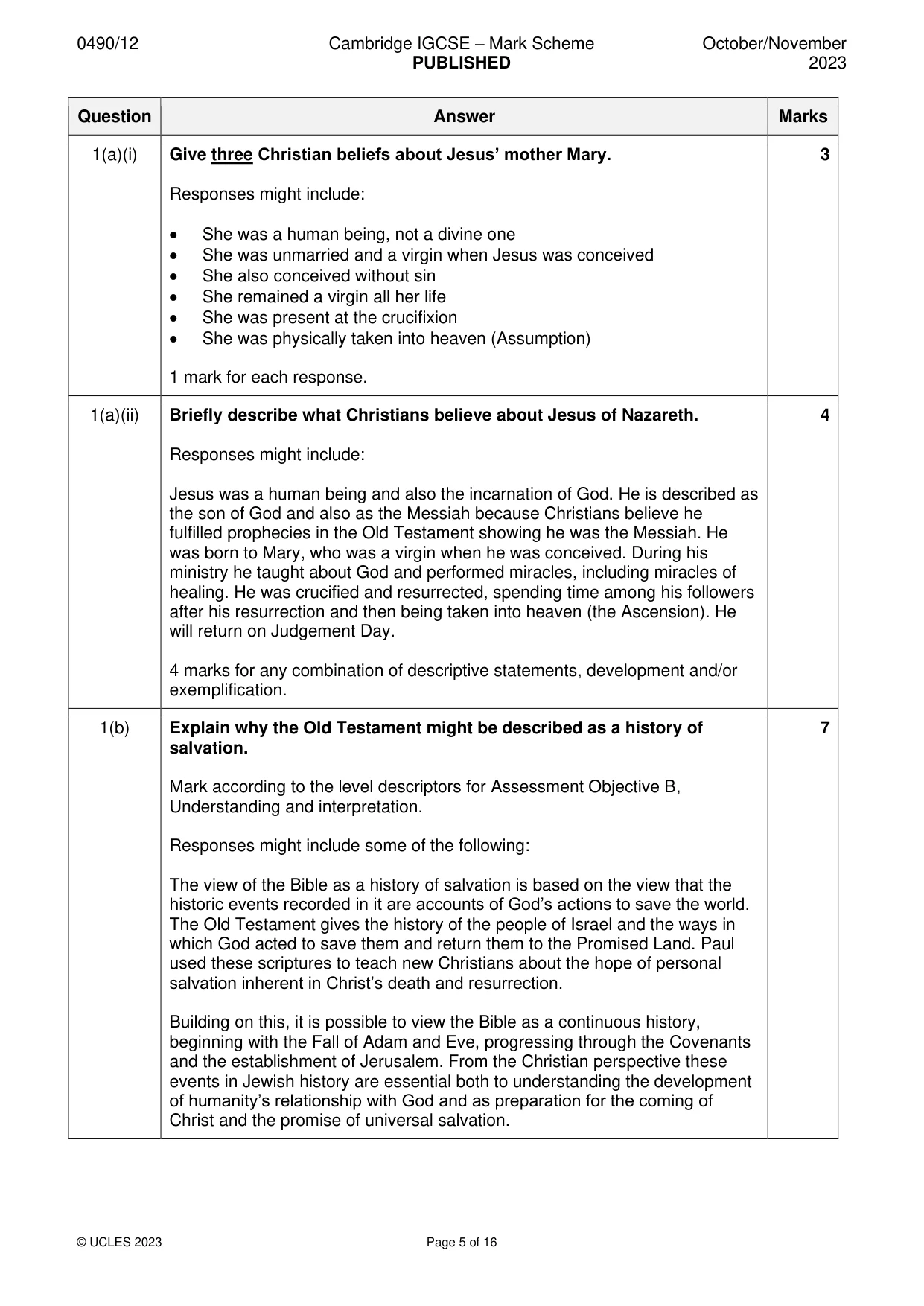
0490/12 Cambridge IGCSE – Mark Scheme PUBLISHED October/November 2023 © UCLES 2023 Page 5 of 16 Question Answer Marks 1(a)(i) Give three Christian beliefs about Jesus’ mother Mary. Responses might include: • She was a human being, not a divine one • She was unmarried and a virgin when Jesus was conceived • She also conceived without sin • She remained a virgin all her life • She was present at the crucifixion • She was physically taken into heaven (Assumption) 1 mark for each response. 3 1(a)(ii) Briefly describe what Christians believe about Jesus of Nazareth. Responses might include: Jesus was a human being and also the incarnation of God. He is described as the son of God and also as the Messiah because Christians believe he fulfilled prophecies in the Old Testament showing he was the Messiah. He was born to Mary, who was a virgin when he was conceived. During his ministry he taught about God and performed miracles, including miracles of healing. He was crucified and resurrected, spending time among his followers after his resurrection and then being taken into heaven (the Ascension). He will return on Judgement Day. 4 marks for any combination of descriptive statements, development and/or exemplification. 4 1(b) Explain why the Old Testament might be described as a history of salvation. Mark according to the level descriptors for Assessment Objective B, Understanding and interpretation. Responses might include some of the following: The view of the Bible as a history of salvation is based on the view that the historic events recorded in it are accounts of God’s actions to save the world. The Old Testament gives the history of the people of Israel and the ways in which God acted to save them and return them to the Promised Land. Paul used these scriptures to teach new Christians about the hope of personal salvation inherent in Christ’s death and resurrection. Building on this, it is possible to view the Bible as a continuous history, beginning with the Fall of Adam and Eve, progressing through the Covenants and the establishment of Jerusalem. From the Christian perspective these events in Jewish history are essential both to understanding the development of humanity’s relationship with God and as preparation for the coming of Christ and the promise of universal salvation. 7
Mark scheme, page 6
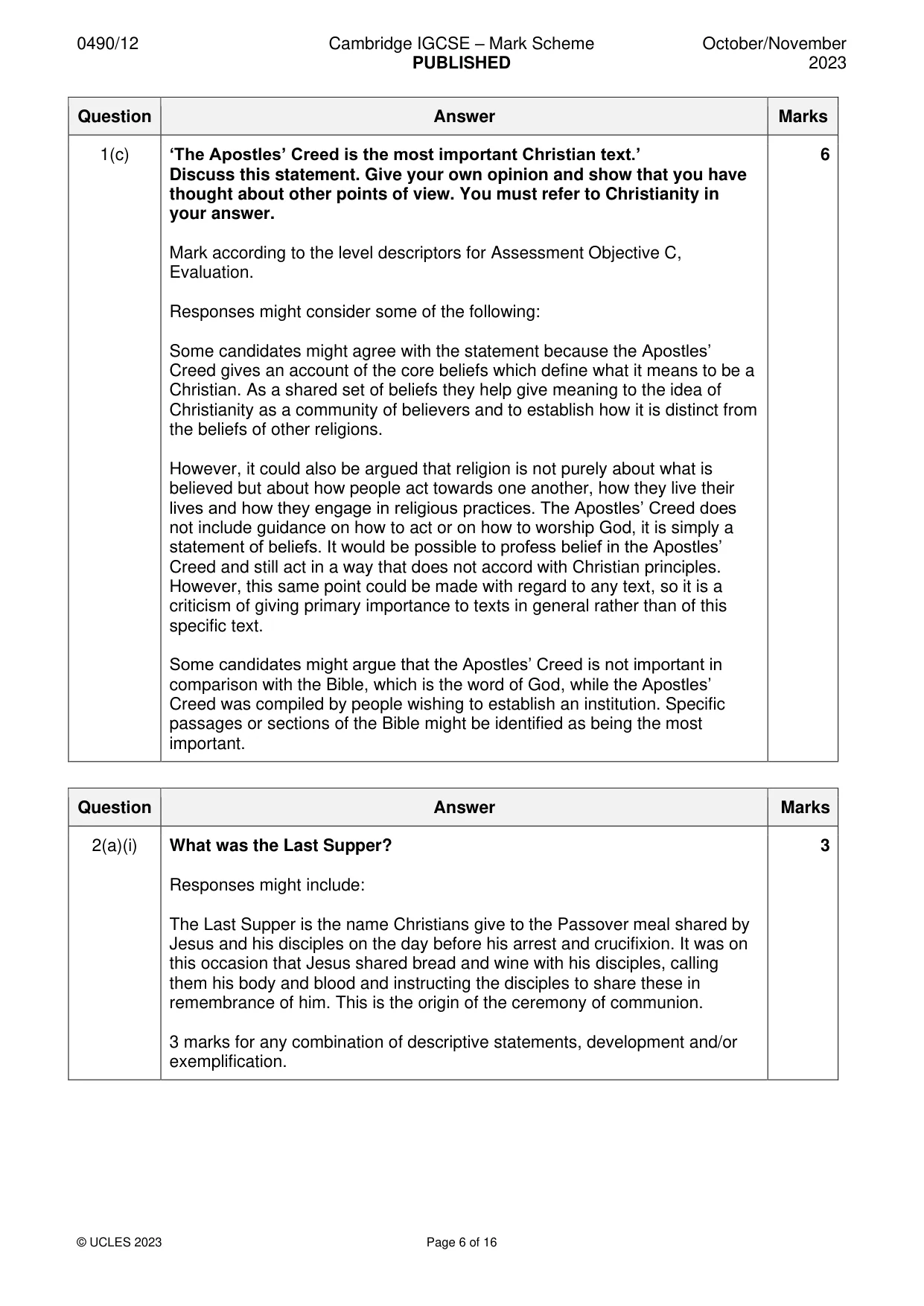
0490/12 Cambridge IGCSE – Mark Scheme PUBLISHED October/November 2023 © UCLES 2023 Page 6 of 16 Question Answer Marks 1(c) ‘The Apostles’ Creed is the most important Christian text.’ Discuss this statement. Give your own opinion and show that you have thought about other points of view. You must refer to Christianity in your answer. Mark according to the level descriptors for Assessment Objective C, Evaluation. Responses might consider some of the following: Some candidates might agree with the statement because the Apostles’ Creed gives an account of the core beliefs which define what it means to be a Christian. As a shared set of beliefs they help give meaning to the idea of Christianity as a community of believers and to establish how it is distinct from the beliefs of other religions. However, it could also be argued that religion is not purely about what is believed but about how people act towards one another, how they live their lives and how they engage in religious practices. The Apostles’ Creed does not include guidance on how to act or on how to worship God, it is simply a statement of beliefs. It would be possible to profess belief in the Apostles’ Creed and still act in a way that does not accord with Christian principles. However, this same point could be made with regard to any text, so it is a criticism of giving primary importance to texts in general rather than of this specific text. Some candidates might argue that the Apostles’ Creed is not important in comparison with the Bible, which is the word of God, while the Apostles’ Creed was compiled by people wishing to establish an institution. Specific passages or sections of the Bible might be identified as being the most important. 6 Question Answer Marks 2(a)(i) What was the Last Supper? Responses might include: The Last Supper is the name Christians give to the Passover meal shared by Jesus and his disciples on the day before his arrest and crucifixion. It was on this occasion that Jesus shared bread and wine with his disciples, calling them his body and blood and instructing the disciples to share these in remembrance of him. This is the origin of the ceremony of communion. 3 marks for any combination of descriptive statements, development and/or exemplification. 3
Mark scheme, page 7
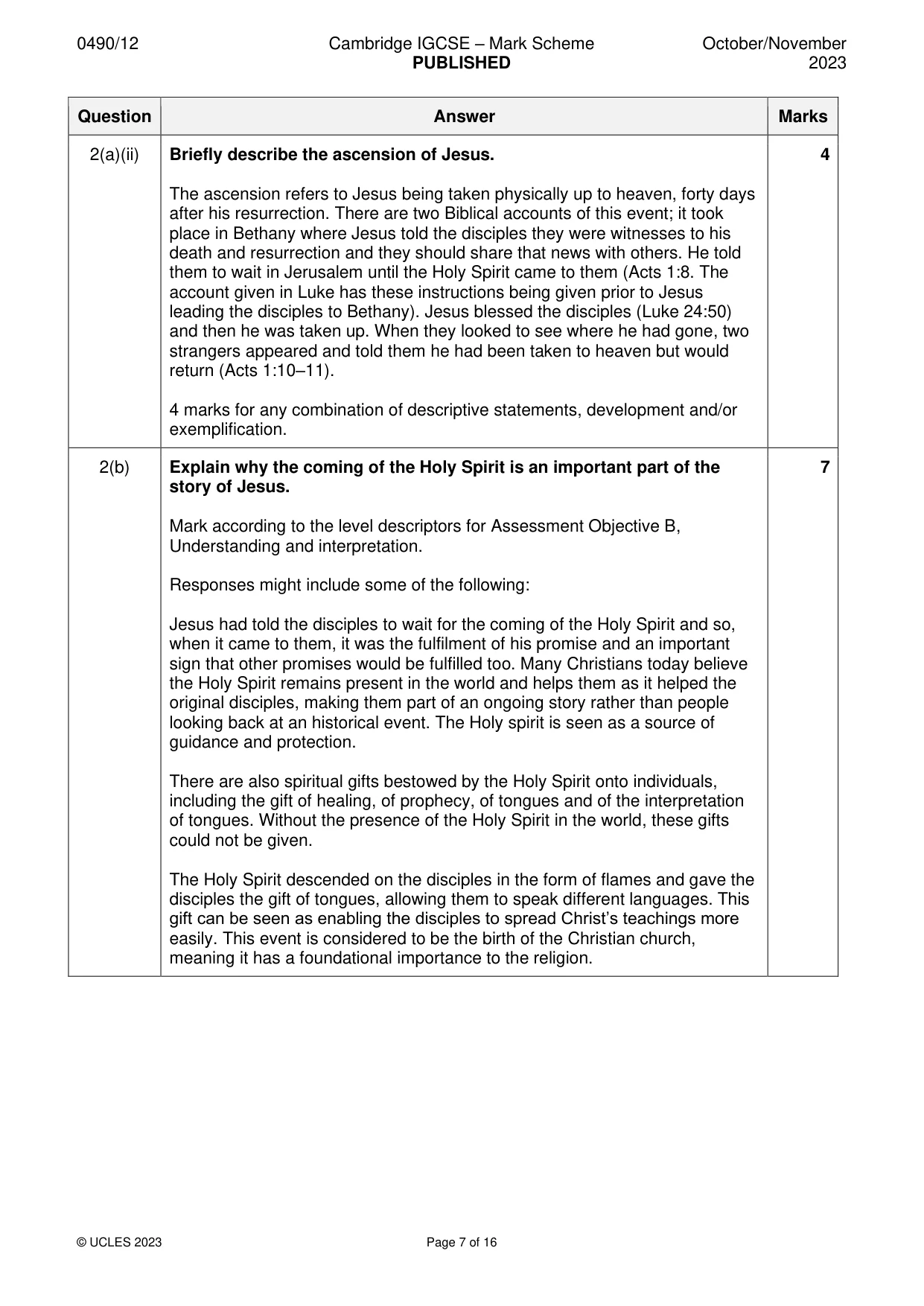
0490/12 Cambridge IGCSE – Mark Scheme PUBLISHED October/November 2023 © UCLES 2023 Page 7 of 16 Question Answer Marks 2(a)(ii) Briefly describe the ascension of Jesus. The ascension refers to Jesus being taken physically up to heaven, forty days after his resurrection. There are two Biblical accounts of this event; it took place in Bethany where Jesus told the disciples they were witnesses to his death and resurrection and they should share that news with others. He told them to wait in Jerusalem until the Holy Spirit came to them (Acts 1:8. The account given in Luke has these instructions being given prior to Jesus leading the disciples to Bethany). Jesus blessed the disciples (Luke 24:50) and then he was taken up. When they looked to see where he had gone, two strangers appeared and told them he had been taken to heaven but would return (Acts 1:10–11). 4 marks for any combination of descriptive statements, development and/or exemplification. 4 2(b) Explain why the coming of the Holy Spirit is an important part of the story of Jesus. Mark according to the level descriptors for Assessment Objective B, Understanding and interpretation. Responses might include some of the following: Jesus had told the disciples to wait for the coming of the Holy Spirit and so, when it came to them, it was the fulfilment of his promise and an important sign that other promises would be fulfilled too. Many Christians today believe the Holy Spirit remains present in the world and helps them as it helped the original disciples, making them part of an ongoing story rather than people looking back at an historical event. The Holy spirit is seen as a source of guidance and protection. There are also spiritual gifts bestowed by the Holy Spirit onto individuals, including the gift of healing, of prophecy, of tongues and of the interpretation of tongues. Without the presence of the Holy Spirit in the world, these gifts could not be given. The Holy Spirit descended on the disciples in the form of flames and gave the disciples the gift of tongues, allowing them to speak different languages. This gift can be seen as enabling the disciples to spread Christ’s teachings more easily. This event is considered to be the birth of the Christian church, meaning it has a foundational importance to the religion. 7
Mark scheme, page 8
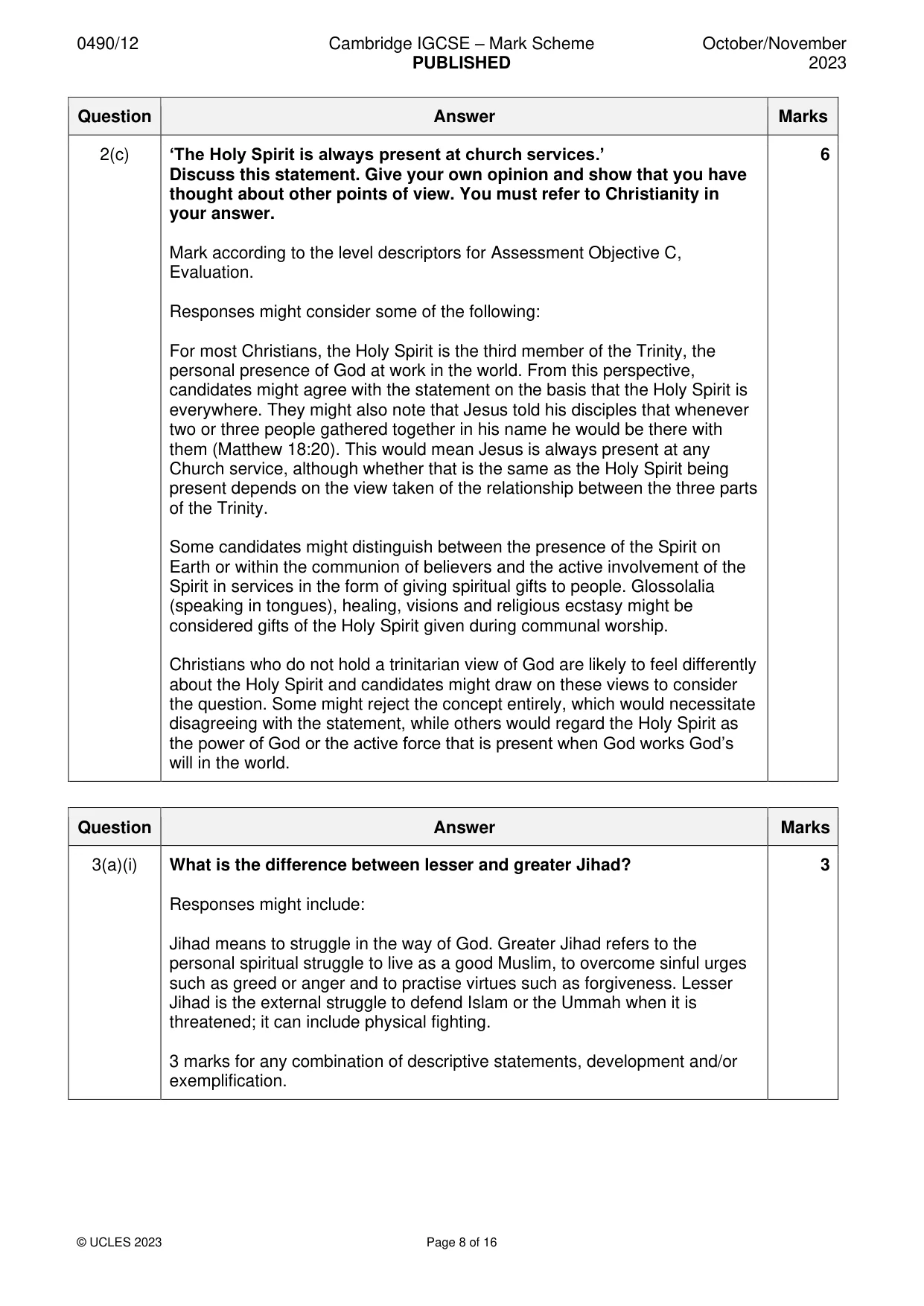
0490/12 Cambridge IGCSE – Mark Scheme PUBLISHED October/November 2023 © UCLES 2023 Page 8 of 16 Question Answer Marks 2(c) ‘The Holy Spirit is always present at church services.’ Discuss this statement. Give your own opinion and show that you have thought about other points of view. You must refer to Christianity in your answer. Mark according to the level descriptors for Assessment Objective C, Evaluation. Responses might consider some of the following: For most Christians, the Holy Spirit is the third member of the Trinity, the personal presence of God at work in the world. From this perspective, candidates might agree with the statement on the basis that the Holy Spirit is everywhere. They might also note that Jesus told his disciples that whenever two or three people gathered together in his name he would be there with them (Matthew 18:20). This would mean Jesus is always present at any Church service, although whether that is the same as the Holy Spirit being present depends on the view taken of the relationship between the three parts of the Trinity. Some candidates might distinguish between the presence of the Spirit on Earth or within the communion of believers and the active involvement of the Spirit in services in the form of giving spiritual gifts to people. Glossolalia (speaking in tongues), healing, visions and religious ecstasy might be considered gifts of the Holy Spirit given during communal worship. Christians who do not hold a trinitarian view of God are likely to feel differently about the Holy Spirit and candidates might draw on these views to consider the question. Some might reject the concept entirely, which would necessitate disagreeing with the statement, while others would regard the Holy Spirit as the power of God or the active force that is present when God works God’s will in the world. 6 Question Answer Marks 3(a)(i) What is the difference between lesser and greater Jihad? Responses might include: Jihad means to struggle in the way of God. Greater Jihad refers to the personal spiritual struggle to live as a good Muslim, to overcome sinful urges such as greed or anger and to practise virtues such as forgiveness. Lesser Jihad is the external struggle to defend Islam or the Ummah when it is threatened; it can include physical fighting. 3 marks for any combination of descriptive statements, development and/or exemplification. 3
Mark scheme, page 9
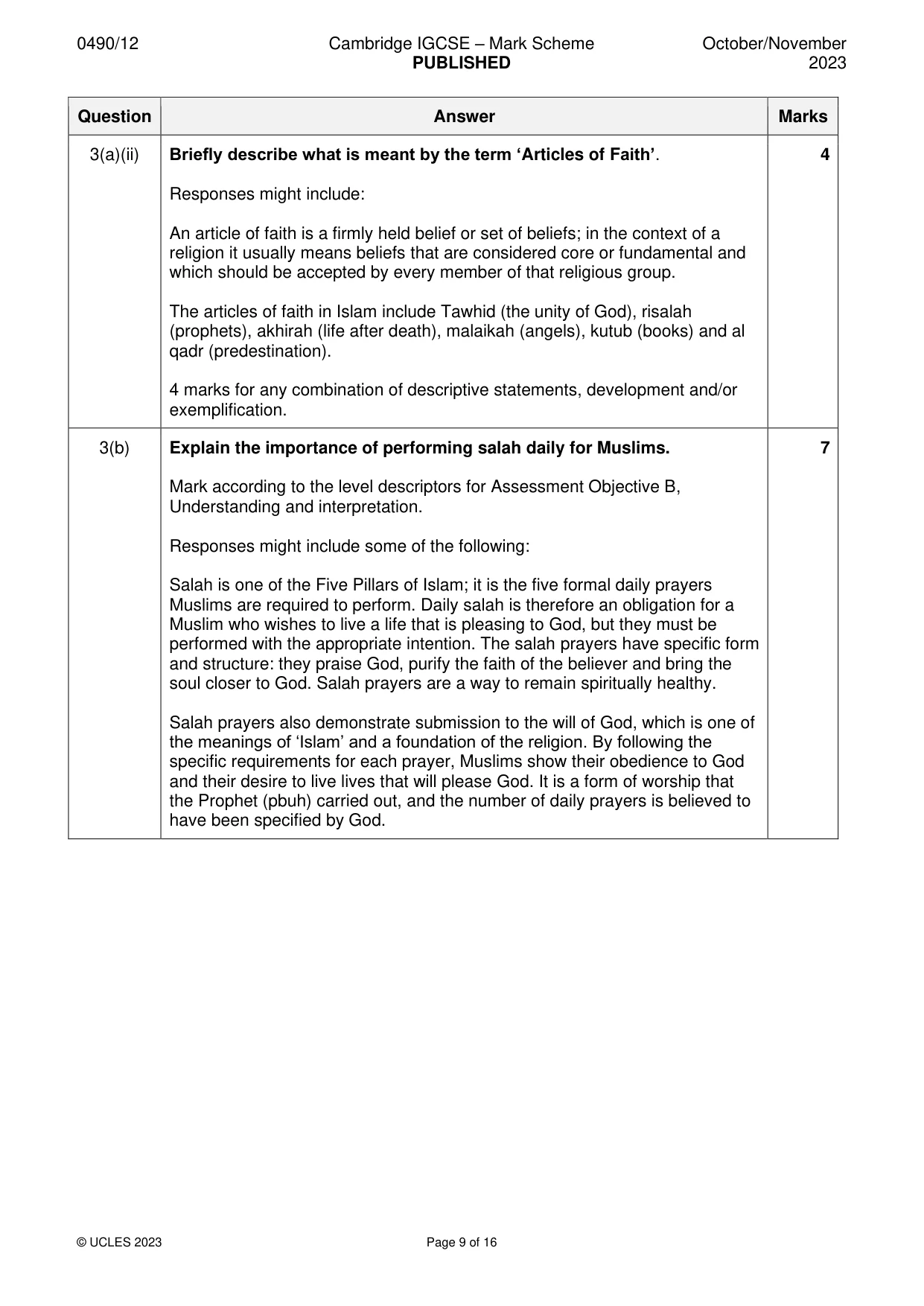
0490/12 Cambridge IGCSE – Mark Scheme PUBLISHED October/November 2023 © UCLES 2023 Page 9 of 16 Question Answer Marks 3(a)(ii) Briefly describe what is meant by the term ‘Articles of Faith’. Responses might include: An article of faith is a firmly held belief or set of beliefs; in the context of a religion it usually means beliefs that are considered core or fundamental and which should be accepted by every member of that religious group. The articles of faith in Islam include Tawhid (the unity of God), risalah (prophets), akhirah (life after death), malaikah (angels), kutub (books) and al qadr (predestination). 4 marks for any combination of descriptive statements, development and/or exemplification. 4 3(b) Explain the importance of performing salah daily for Muslims. Mark according to the level descriptors for Assessment Objective B, Understanding and interpretation. Responses might include some of the following: Salah is one of the Five Pillars of Islam; it is the five formal daily prayers Muslims are required to perform. Daily salah is therefore an obligation for a Muslim who wishes to live a life that is pleasing to God, but they must be performed with the appropriate intention. The salah prayers have specific form and structure: they praise God, purify the faith of the believer and bring the soul closer to God. Salah prayers are a way to remain spiritually healthy. Salah prayers also demonstrate submission to the will of God, which is one of the meanings of ‘Islam’ and a foundation of the religion. By following the specific requirements for each prayer, Muslims show their obedience to God and their desire to live lives that will please God. It is a form of worship that the Prophet (pbuh) carried out, and the number of daily prayers is believed to have been specified by God. 7
Mark scheme, page 10
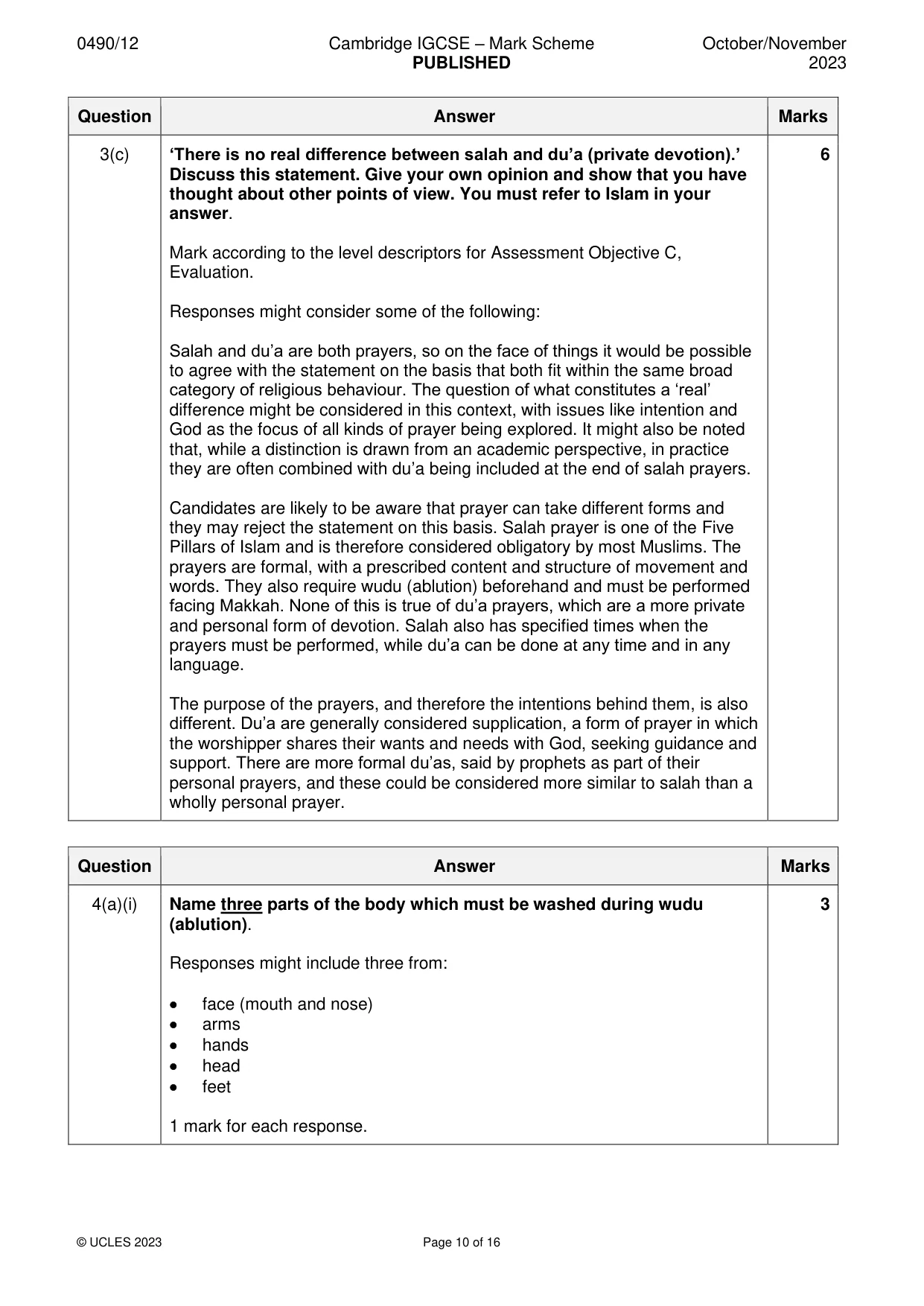
0490/12 Cambridge IGCSE – Mark Scheme PUBLISHED October/November 2023 © UCLES 2023 Page 10 of 16 Question Answer Marks 3(c) ‘There is no real difference between salah and du’a (private devotion).’ Discuss this statement. Give your own opinion and show that you have thought about other points of view. You must refer to Islam in your answer. Mark according to the level descriptors for Assessment Objective C, Evaluation. Responses might consider some of the following: Salah and du’a are both prayers, so on the face of things it would be possible to agree with the statement on the basis that both fit within the same broad category of religious behaviour. The question of what constitutes a ‘real’ difference might be considered in this context, with issues like intention and God as the focus of all kinds of prayer being explored. It might also be noted that, while a distinction is drawn from an academic perspective, in practice they are often combined with du’a being included at the end of salah prayers. Candidates are likely to be aware that prayer can take different forms and they may reject the statement on this basis. Salah prayer is one of the Five Pillars of Islam and is therefore considered obligatory by most Muslims. The prayers are formal, with a prescribed content and structure of movement and words. They also require wudu (ablution) beforehand and must be performed facing Makkah. None of this is true of du’a prayers, which are a more private and personal form of devotion. Salah also has specified times when the prayers must be performed, while du’a can be done at any time and in any language. The purpose of the prayers, and therefore the intentions behind them, is also different. Du’a are generally considered supplication, a form of prayer in which the worshipper shares their wants and needs with God, seeking guidance and support. There are more formal du’as, said by prophets as part of their personal prayers, and these could be considered more similar to salah than a wholly personal prayer. 6 Question Answer Marks 4(a)(i) Name three parts of the body which must be washed during wudu (ablution). Responses might include three from: • face (mouth and nose) • arms • hands • head • feet 1 mark for each response. 3
Mark scheme, page 11
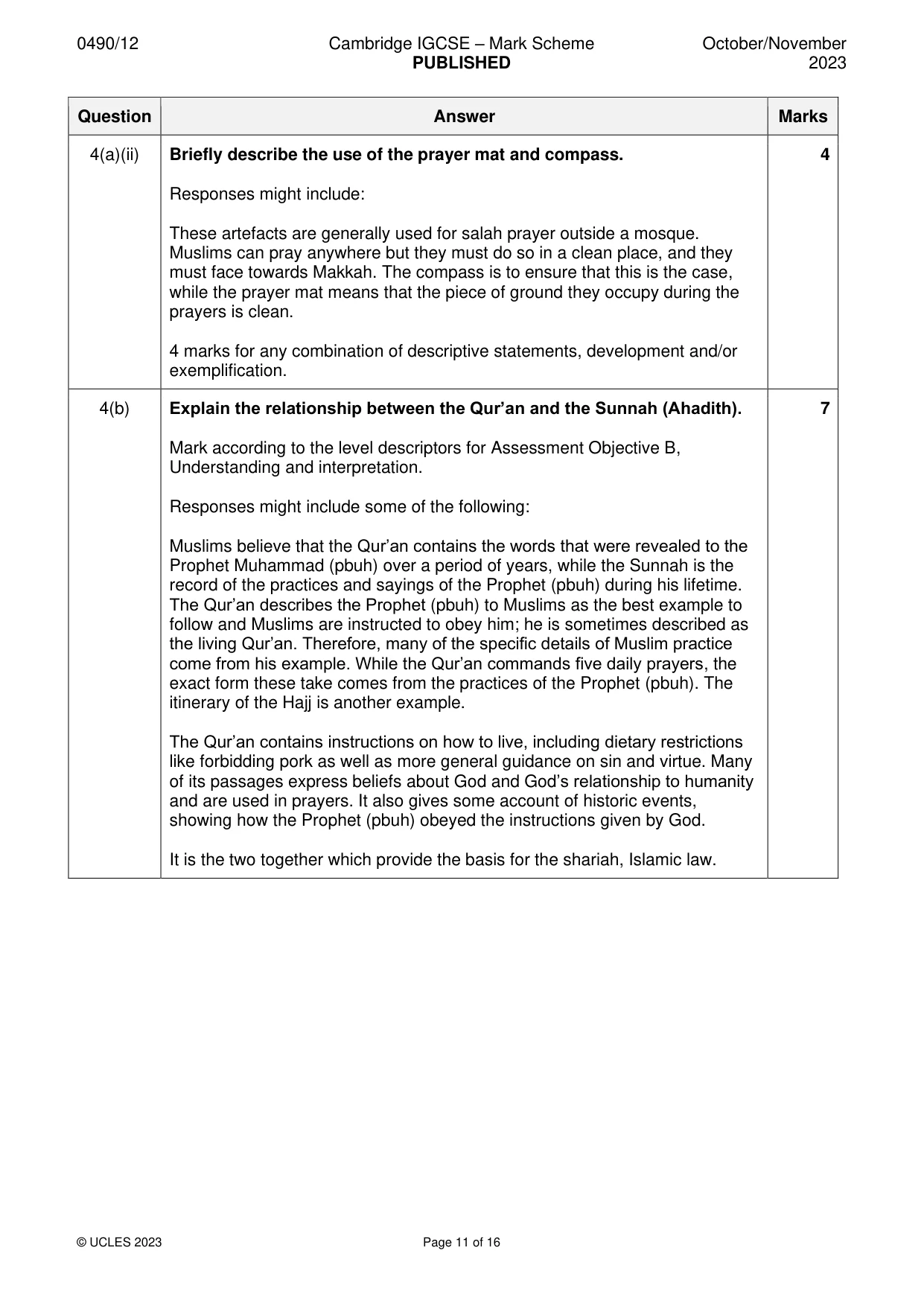
0490/12 Cambridge IGCSE – Mark Scheme PUBLISHED October/November 2023 © UCLES 2023 Page 11 of 16 Question Answer Marks 4(a)(ii) Briefly describe the use of the prayer mat and compass. Responses might include: These artefacts are generally used for salah prayer outside a mosque. Muslims can pray anywhere but they must do so in a clean place, and they must face towards Makkah. The compass is to ensure that this is the case, while the prayer mat means that the piece of ground they occupy during the prayers is clean. 4 marks for any combination of descriptive statements, development and/or exemplification. 4 4(b) Explain the relationship between the Qur’an and the Sunnah (Ahadith). Mark according to the level descriptors for Assessment Objective B, Understanding and interpretation. Responses might include some of the following: Muslims believe that the Qur’an contains the words that were revealed to the Prophet Muhammad (pbuh) over a period of years, while the Sunnah is the record of the practices and sayings of the Prophet (pbuh) during his lifetime. The Qur’an describes the Prophet (pbuh) to Muslims as the best example to follow and Muslims are instructed to obey him; he is sometimes described as the living Qur’an. Therefore, many of the specific details of Muslim practice come from his example. While the Qur’an commands five daily prayers, the exact form these take comes from the practices of the Prophet (pbuh). The itinerary of the Hajj is another example. The Qur’an contains instructions on how to live, including dietary restrictions like forbidding pork as well as more general guidance on sin and virtue. Many of its passages express beliefs about God and God’s relationship to humanity and are used in prayers. It also gives some account of historic events, showing how the Prophet (pbuh) obeyed the instructions given by God. It is the two together which provide the basis for the shariah, Islamic law. 7
Mark scheme, page 12
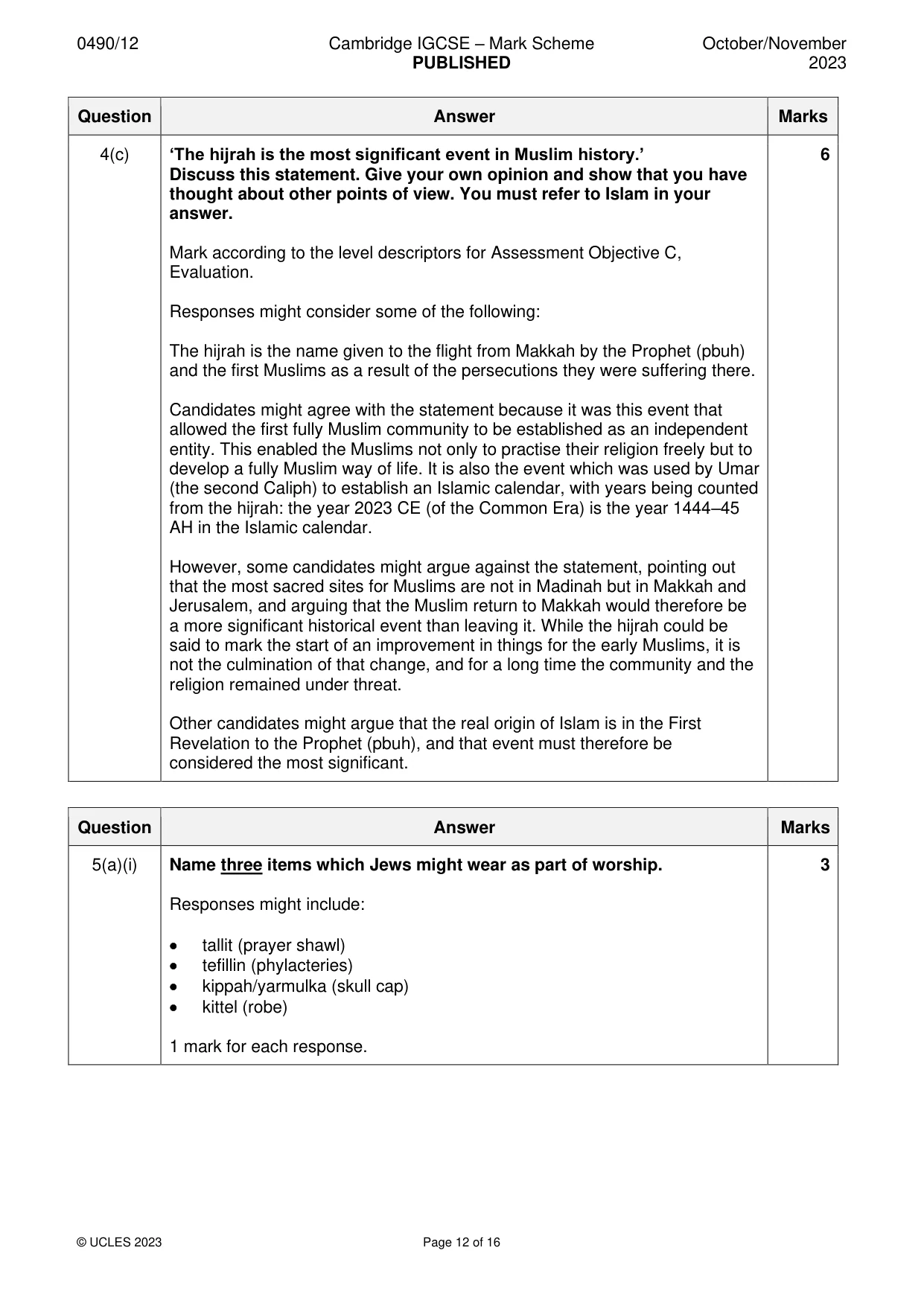
0490/12 Cambridge IGCSE – Mark Scheme PUBLISHED October/November 2023 © UCLES 2023 Page 12 of 16 Question Answer Marks 4(c) ‘The hijrah is the most significant event in Muslim history.’ Discuss this statement. Give your own opinion and show that you have thought about other points of view. You must refer to Islam in your answer. Mark according to the level descriptors for Assessment Objective C, Evaluation. Responses might consider some of the following: The hijrah is the name given to the flight from Makkah by the Prophet (pbuh) and the first Muslims as a result of the persecutions they were suffering there. Candidates might agree with the statement because it was this event that allowed the first fully Muslim community to be established as an independent entity. This enabled the Muslims not only to practise their religion freely but to develop a fully Muslim way of life. It is also the event which was used by Umar (the second Caliph) to establish an Islamic calendar, with years being counted from the hijrah: the year 2023 CE (of the Common Era) is the year 1444–45 AH in the Islamic calendar. However, some candidates might argue against the statement, pointing out that the most sacred sites for Muslims are not in Madinah but in Makkah and Jerusalem, and arguing that the Muslim return to Makkah would therefore be a more significant historical event than leaving it. While the hijrah could be said to mark the start of an improvement in things for the early Muslims, it is not the culmination of that change, and for a long time the community and the religion remained under threat. Other candidates might argue that the real origin of Islam is in the First Revelation to the Prophet (pbuh), and that event must therefore be considered the most significant. 6 Question Answer Marks 5(a)(i) Name three items which Jews might wear as part of worship. Responses might include: • tallit (prayer shawl) • tefillin (phylacteries) • kippah/yarmulka (skull cap) • kittel (robe) 1 mark for each response. 3
Mark scheme, page 13
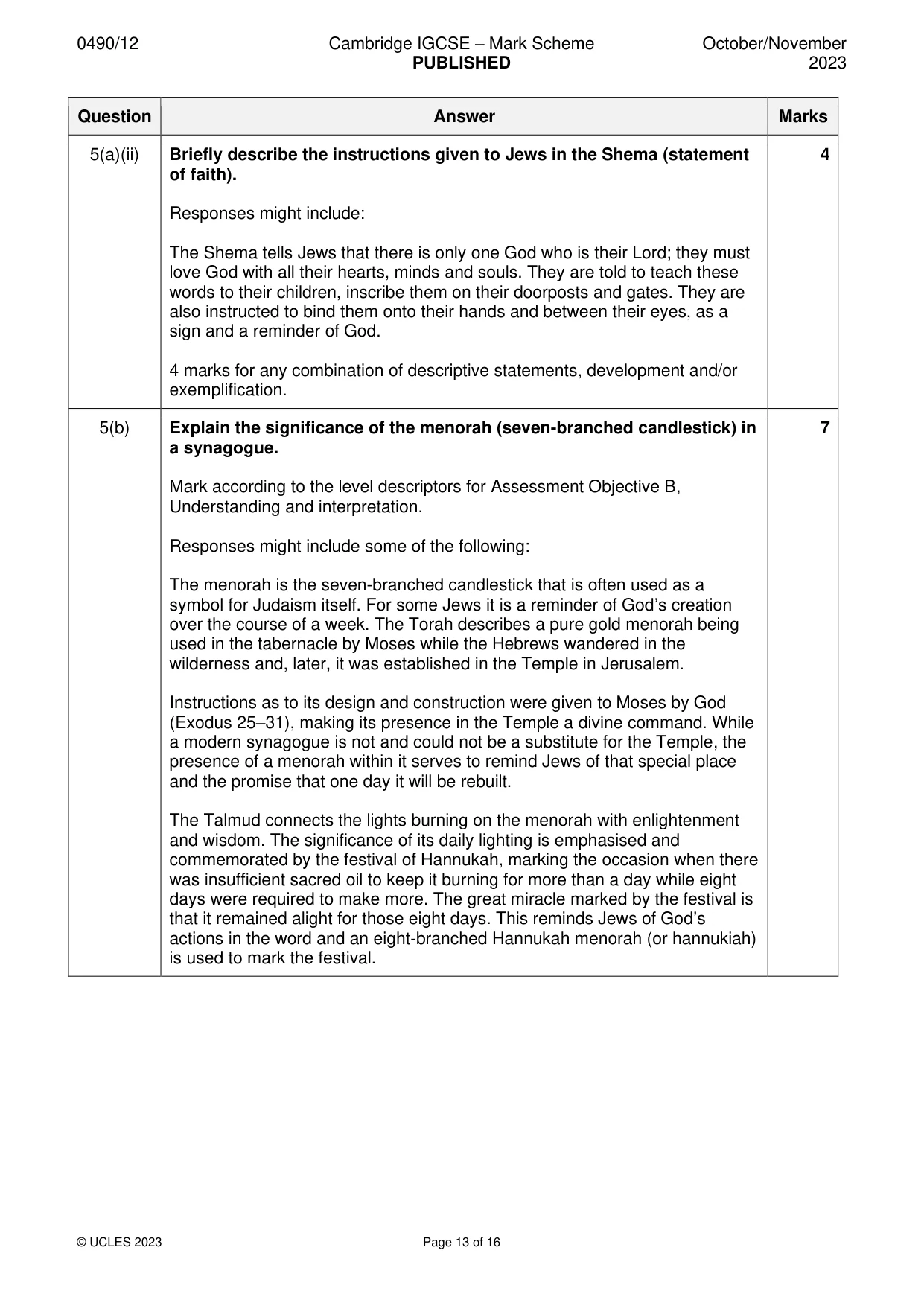
0490/12 Cambridge IGCSE – Mark Scheme PUBLISHED October/November 2023 © UCLES 2023 Page 13 of 16 Question Answer Marks 5(a)(ii) Briefly describe the instructions given to Jews in the Shema (statement of faith). Responses might include: The Shema tells Jews that there is only one God who is their Lord; they must love God with all their hearts, minds and souls. They are told to teach these words to their children, inscribe them on their doorposts and gates. They are also instructed to bind them onto their hands and between their eyes, as a sign and a reminder of God. 4 marks for any combination of descriptive statements, development and/or exemplification. 4 5(b) Explain the significance of the menorah (seven-branched candlestick) in a synagogue. Mark according to the level descriptors for Assessment Objective B, Understanding and interpretation. Responses might include some of the following: The menorah is the seven-branched candlestick that is often used as a symbol for Judaism itself. For some Jews it is a reminder of God’s creation over the course of a week. The Torah describes a pure gold menorah being used in the tabernacle by Moses while the Hebrews wandered in the wilderness and, later, it was established in the Temple in Jerusalem. Instructions as to its design and construction were given to Moses by God (Exodus 25–31), making its presence in the Temple a divine command. While a modern synagogue is not and could not be a substitute for the Temple, the presence of a menorah within it serves to remind Jews of that special place and the promise that one day it will be rebuilt. The Talmud connects the lights burning on the menorah with enlightenment and wisdom. The significance of its daily lighting is emphasised and commemorated by the festival of Hannukah, marking the occasion when there was insufficient sacred oil to keep it burning for more than a day while eight days were required to make more. The great miracle marked by the festival is that it remained alight for those eight days. This reminds Jews of God’s actions in the word and an eight-branched Hannukah menorah (or hannukiah) is used to mark the festival. 7
Mark scheme, page 14
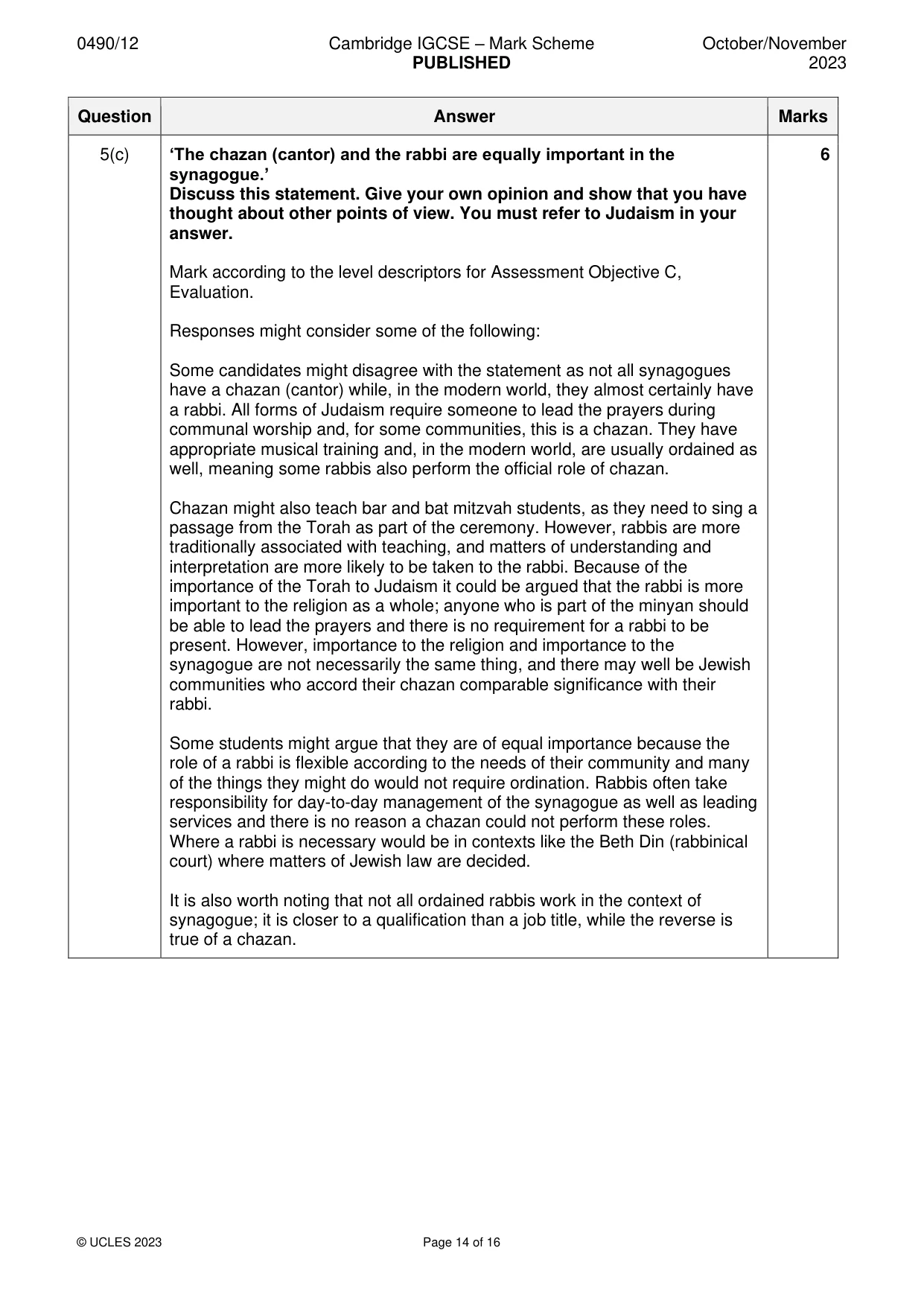
0490/12 Cambridge IGCSE – Mark Scheme PUBLISHED October/November 2023 © UCLES 2023 Page 14 of 16 Question Answer Marks 5(c) ‘The chazan (cantor) and the rabbi are equally important in the synagogue.’ Discuss this statement. Give your own opinion and show that you have thought about other points of view. You must refer to Judaism in your answer. Mark according to the level descriptors for Assessment Objective C, Evaluation. Responses might consider some of the following: Some candidates might disagree with the statement as not all synagogues have a chazan (cantor) while, in the modern world, they almost certainly have a rabbi. All forms of Judaism require someone to lead the prayers during communal worship and, for some communities, this is a chazan. They have appropriate musical training and, in the modern world, are usually ordained as well, meaning some rabbis also perform the official role of chazan. Chazan might also teach bar and bat mitzvah students, as they need to sing a passage from the Torah as part of the ceremony. However, rabbis are more traditionally associated with teaching, and matters of understanding and interpretation are more likely to be taken to the rabbi. Because of the importance of the Torah to Judaism it could be argued that the rabbi is more important to the religion as a whole; anyone who is part of the minyan should be able to lead the prayers and there is no requirement for a rabbi to be present. However, importance to the religion and importance to the synagogue are not necessarily the same thing, and there may well be Jewish communities who accord their chazan comparable significance with their rabbi. Some students might argue that they are of equal importance because the role of a rabbi is flexible according to the needs of their community and many of the things they might do would not require ordination. Rabbis often take responsibility for day-to-day management of the synagogue as well as leading services and there is no reason a chazan could not perform these roles. Where a rabbi is necessary would be in contexts like the Beth Din (rabbinical court) where matters of Jewish law are decided. It is also worth noting that not all ordained rabbis work in the context of synagogue; it is closer to a qualification than a job title, while the reverse is true of a chazan. 6
Mark scheme, page 15
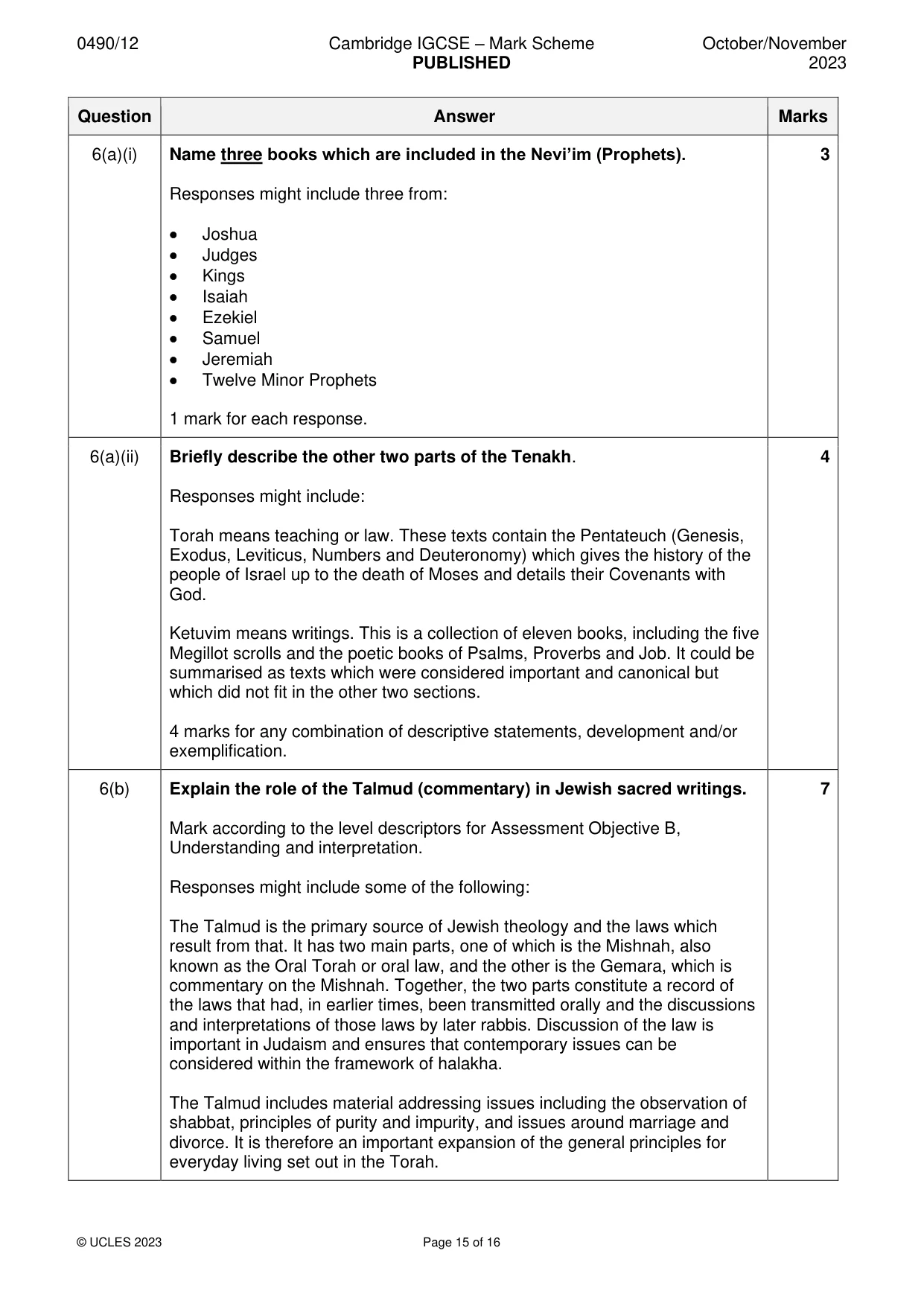
0490/12 Cambridge IGCSE – Mark Scheme PUBLISHED October/November 2023 © UCLES 2023 Page 15 of 16 Question Answer Marks 6(a)(i) Name three books which are included in the Nevi’im (Prophets). Responses might include three from: • Joshua • Judges • Kings • Isaiah • Ezekiel • Samuel • Jeremiah • Twelve Minor Prophets 1 mark for each response. 3 6(a)(ii) Briefly describe the other two parts of the Tenakh. Responses might include: Torah means teaching or law. These texts contain the Pentateuch (Genesis, Exodus, Leviticus, Numbers and Deuteronomy) which gives the history of the people of Israel up to the death of Moses and details their Covenants with God. Ketuvim means writings. This is a collection of eleven books, including the five Megillot scrolls and the poetic books of Psalms, Proverbs and Job. It could be summarised as texts which were considered important and canonical but which did not fit in the other two sections. 4 marks for any combination of descriptive statements, development and/or exemplification. 4 6(b) Explain the role of the Talmud (commentary) in Jewish sacred writings. Mark according to the level descriptors for Assessment Objective B, Understanding and interpretation. Responses might include some of the following: The Talmud is the primary source of Jewish theology and the laws which result from that. It has two main parts, one of which is the Mishnah, also known as the Oral Torah or oral law, and the other is the Gemara, which is commentary on the Mishnah. Together, the two parts constitute a record of the laws that had, in earlier times, been transmitted orally and the discussions and interpretations of those laws by later rabbis. Discussion of the law is important in Judaism and ensures that contemporary issues can be considered within the framework of halakha. The Talmud includes material addressing issues including the observation of shabbat, principles of purity and impurity, and issues around marriage and divorce. It is therefore an important expansion of the general principles for everyday living set out in the Torah. 7
Mark scheme, page 16
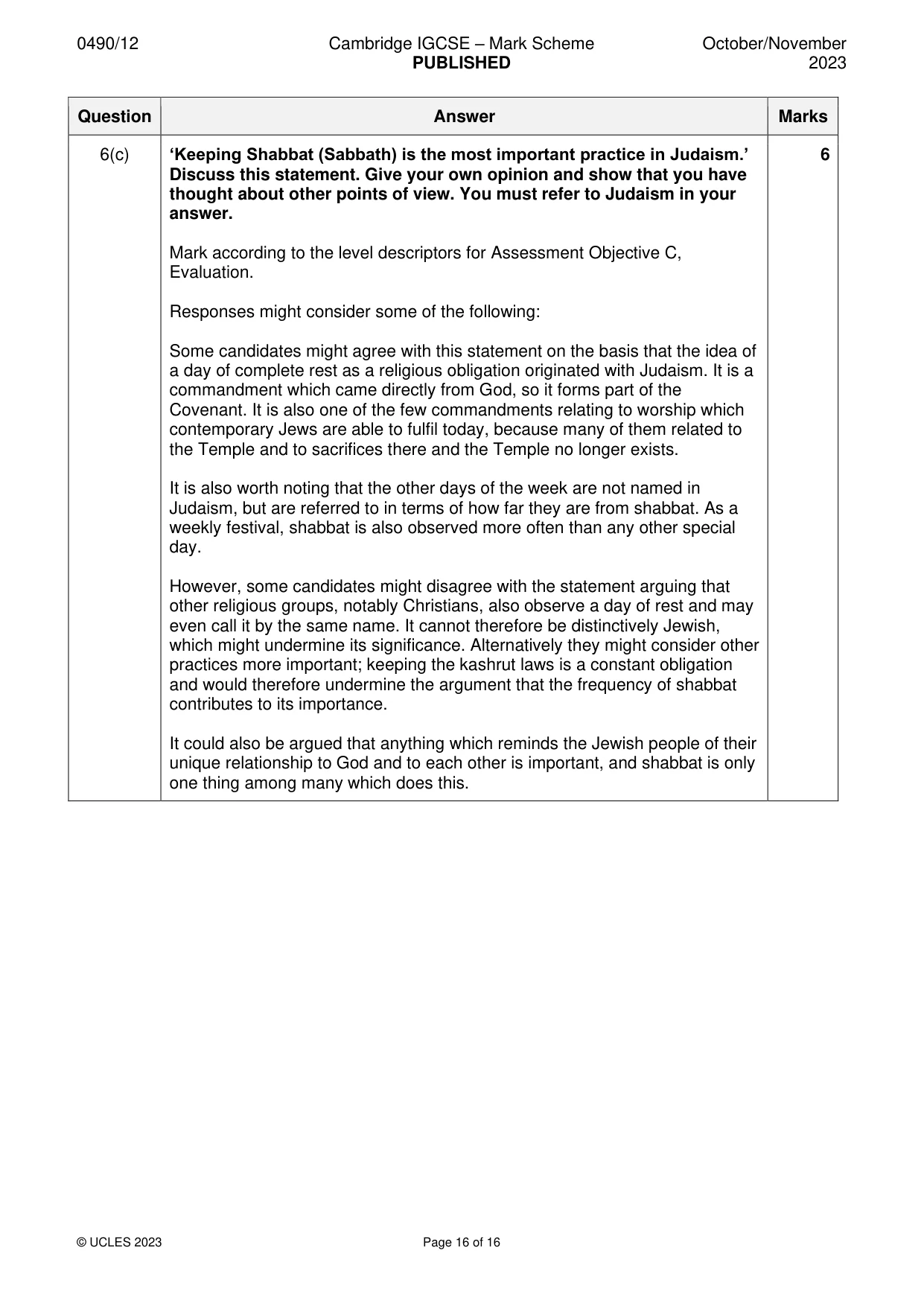
0490/12 Cambridge IGCSE – Mark Scheme PUBLISHED October/November 2023 © UCLES 2023 Page 16 of 16 Question Answer Marks 6(c) ‘Keeping Shabbat (Sabbath) is the most important practice in Judaism.’ Discuss this statement. Give your own opinion and show that you have thought about other points of view. You must refer to Judaism in your answer. Mark according to the level descriptors for Assessment Objective C, Evaluation. Responses might consider some of the following: Some candidates might agree with this statement on the basis that the idea of a day of complete rest as a religious obligation originated with Judaism. It is a commandment which came directly from God, so it forms part of the Covenant. It is also one of the few commandments relating to worship which contemporary Jews are able to fulfil today, because many of them related to the Temple and to sacrifices there and the Temple no longer exists. It is also worth noting that the other days of the week are not named in Judaism, but are referred to in terms of how far they are from shabbat. As a weekly festival, shabbat is also observed more often than any other special day. However, some candidates might disagree with the statement arguing that other religious groups, notably Christians, also observe a day of rest and may even call it by the same name. It cannot therefore be distinctively Jewish, which might undermine its significance. Alternatively they might consider other practices more important; keeping the kashrut laws is a constant obligation and would therefore undermine the argument that the frequency of shabbat contributes to its importance. It could also be argued that anything which reminds the Jewish people of their unique relationship to God and to each other is important, and shabbat is only one thing among many which does this. 6
What you needed in this session
Cambridge’s own grade thresholds for 2023 Oct/Nov, Paper 1 · Variant 2. A higher threshold means an easier paper — the bar moves with how the cohort did.