Cambridge IGCSE Religious Studies 0490 — 2021 Oct/Nov Paper 1 · Variant 2
0490/12/O/N/21 · 80 marks · ≈90 min
The question paper and its mark scheme, free to read here and free to download. This is Cambridge’s own paper, exactly as it was sat.
Question paper8 pages




Mark scheme16 pages
Answers below. Sit the paper first if you are practising.
Paper as text
Question paper, page 1
Cambridge IGCSE™ 0490/12 October/November 2021 1 hour 45 minutes RELIGIOUS STUDIES Paper 1 You must answer on the enclosed answer booklet. You will need: Answer booklet (enclosed) INSTRUCTIONS • Answer four questions in total: You must answer from two sections. In each of your chosen sections, you must answer all the questions. • Follow the instructions on the front cover of the answer booklet. If you need additional answer paper, ask the invigilator for a continuation booklet. INFORMATION • The total mark for this paper is 80. • The number of marks for each question or part question is shown in brackets [ ]. This document has 8 pages. Any blank pages are indicated. [Turn over 11_0490_12_2021_1.12 © UCLES 2021 *7537534879*
Question paper, page 2
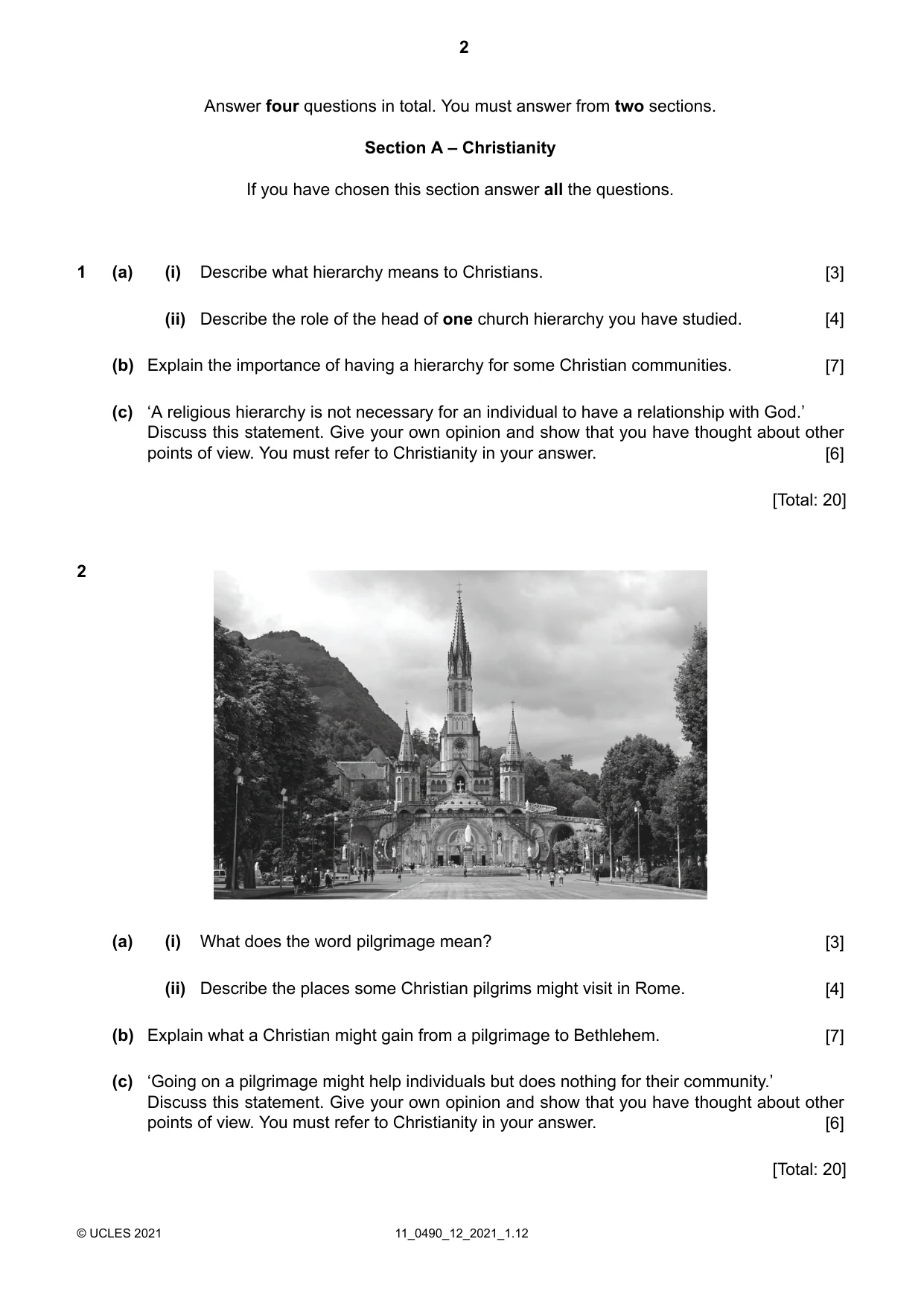
Answer four questions in total. You must answer from two sections. Section A – Christianity If you have chosen this section answer all the questions. Describe what hierarchy means to Christians. [3] (i) (a) 1 Describe the role of the head of one church hierarchy you have studied. [4] (ii) Explain the importance of having a hierarchy for some Christian communities. [7] (b) ‘A religious hierarchy is not necessary for an individual to have a relationship with God.’ Discuss this statement. Give your own opinion and show that you have thought about other points of view. You must refer to Christianity in your answer. [6] (c) [Total: 20] 2 What does the word pilgrimage mean? [3] (i) (a) Describe the places some Christian pilgrims might visit in Rome. [4] (ii) Explain what a Christian might gain from a pilgrimage to Bethlehem. [7] (b) ‘Going on a pilgrimage might help individuals but does nothing for their community.’ Discuss this statement. Give your own opinion and show that you have thought about other points of view. You must refer to Christianity in your answer. [6] (c) [Total: 20] 11_0490_12_2021_1.12 © UCLES 2021 2
Question paper, page 3
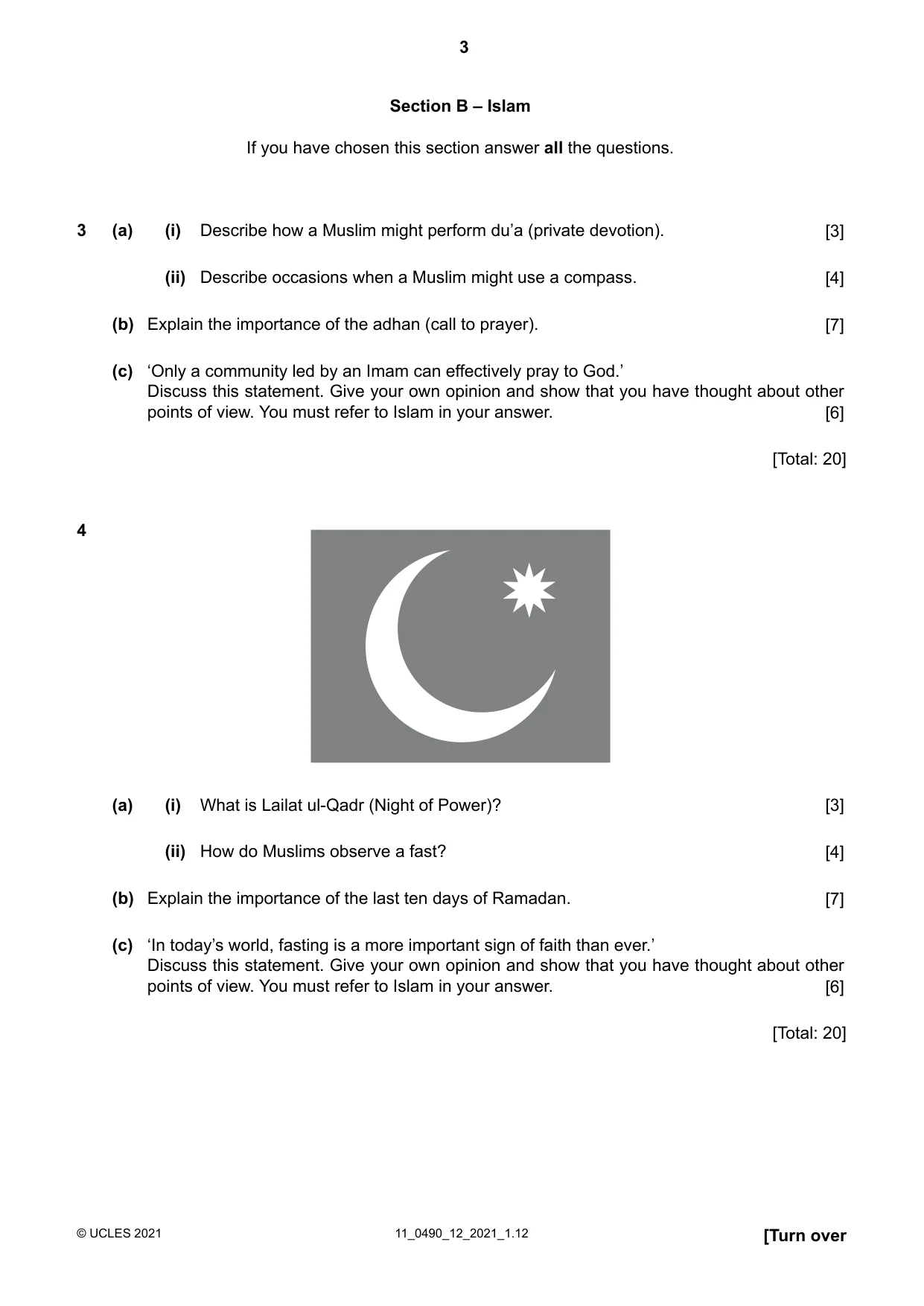
Section B – Islam If you have chosen this section answer all the questions. Describe how a Muslim might perform du’a (private devotion). [3] (i) (a) 3 Describe occasions when a Muslim might use a compass. [4] (ii) Explain the importance of the adhan (call to prayer). [7] (b) ‘Only a community led by an Imam can effectively pray to God.’ Discuss this statement. Give your own opinion and show that you have thought about other points of view. You must refer to Islam in your answer. [6] (c) [Total: 20] 4 What is Lailat ul-Qadr (Night of Power)? [3] (i) (a) How do Muslims observe a fast? [4] (ii) Explain the importance of the last ten days of Ramadan. [7] (b) ‘In today’s world, fasting is a more important sign of faith than ever.’ Discuss this statement. Give your own opinion and show that you have thought about other points of view. You must refer to Islam in your answer. [6] (c) [Total: 20] [Turn over 11_0490_12_2021_1.12 © UCLES 2021 3
Question paper, page 4
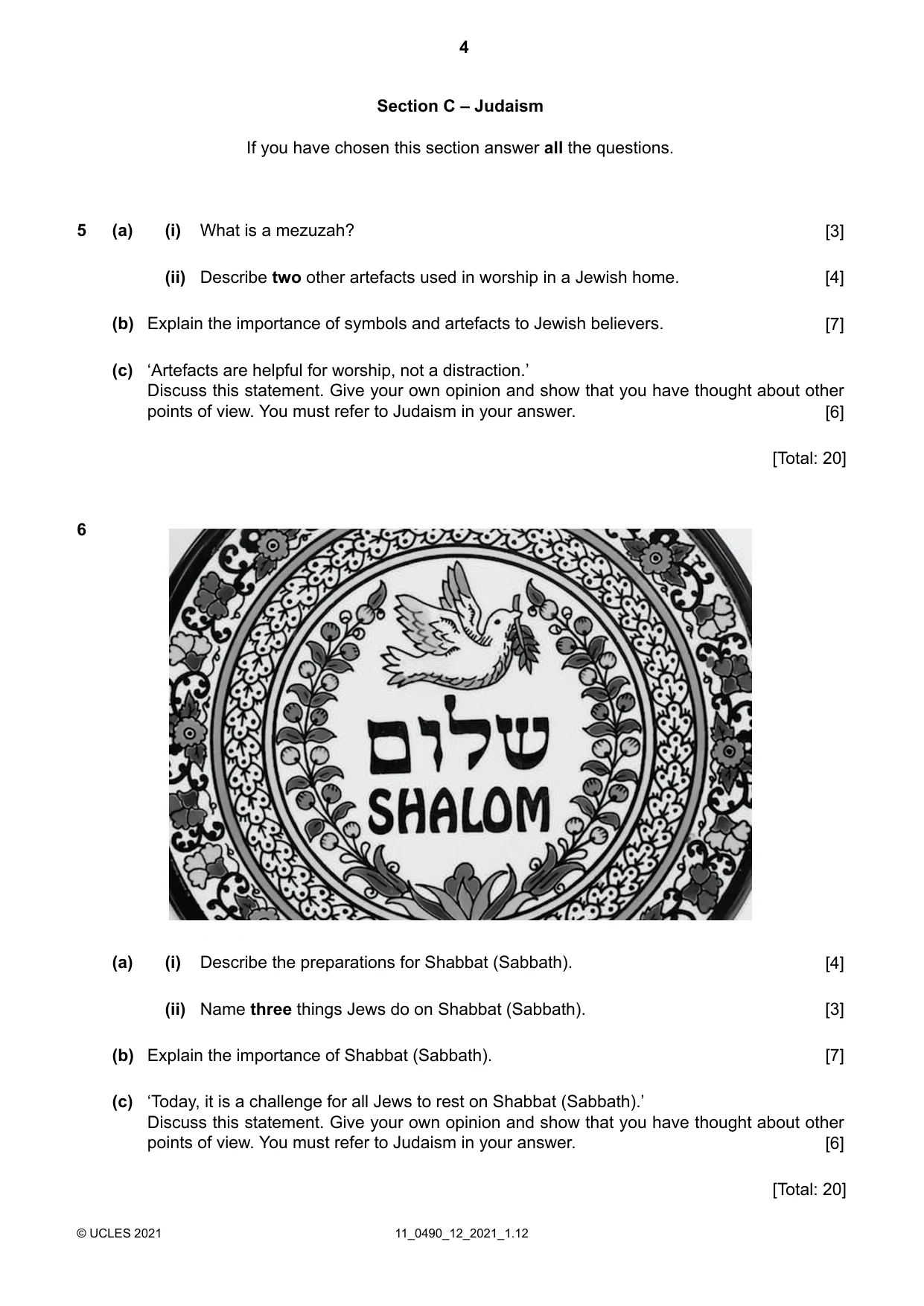
Section C – Judaism If you have chosen this section answer all the questions. What is a mezuzah? [3] (i) (a) 5 Describe two other artefacts used in worship in a Jewish home. [4] (ii) Explain the importance of symbols and artefacts to Jewish believers. [7] (b) ‘Artefacts are helpful for worship, not a distraction.’ Discuss this statement. Give your own opinion and show that you have thought about other points of view. You must refer to Judaism in your answer. [6] (c) [Total: 20] 6 Describe the preparations for Shabbat (Sabbath). [4] (i) (a) Name three things Jews do on Shabbat (Sabbath). [3] (ii) Explain the importance of Shabbat (Sabbath). [7] (b) ‘Today, it is a challenge for all Jews to rest on Shabbat (Sabbath).’ Discuss this statement. Give your own opinion and show that you have thought about other points of view. You must refer to Judaism in your answer. [6] (c) [Total: 20] 11_0490_12_2021_1.12 © UCLES 2021 4
Question paper, page 5
BLANK PAGE 11_0490_12_2021_1.12 © UCLES 2021 5
Question paper, page 6
BLANK PAGE 11_0490_12_2021_1.12 © UCLES 2021 6
Question paper, page 7
BLANK PAGE 11_0490_12_2021_1.12 © UCLES 2021 7
Question paper, page 8
BLANK PAGE Permission to reproduce items where third-party owned material protected by copyright is included has been sought and cleared where possible. Every reasonable effort has been made by the publisher (UCLES) to trace copyright holders, but if any items requiring clearance have unwittingly been included, the publisher will be pleased to make amends at the earliest possible opportunity. To avoid the issue of disclosure of answer-related information to candidates, all copyright acknowledgements are reproduced online in the Cambridge Assessment International Education Copyright Acknowledgements Booklet. This is produced for each series of examinations and is freely available to download at www.cambridgeinternational.org after the live examination series. Cambridge Assessment International Education is part of the Cambridge Assessment Group. Cambridge Assessment is the brand name of the University of Cambridge Local Examinations Syndicate (UCLES), which itself is a department of the University of Cambridge. 11_0490_12_2021_1.12 © UCLES 2021 8
Mark scheme, page 1
This document consists of 16 printed pages. © UCLES 2021 [Turn over Cambridge IGCSE™ RELIGIOUS STUDIES 0490/12 Paper 1 October/November 2021 MARK SCHEME Maximum Mark: 80 Published This mark scheme is published as an aid to teachers and candidates, to indicate the requirements of the examination. It shows the basis on which Examiners were instructed to award marks. It does not indicate the details of the discussions that took place at an Examiners’ meeting before marking began, which would have considered the acceptability of alternative answers. Mark schemes should be read in conjunction with the question paper and the Principal Examiner Report for Teachers. Cambridge International will not enter into discussions about these mark schemes. Cambridge International is publishing the mark schemes for the October/November 2021 series for most Cambridge IGCSE™, Cambridge International A and AS Level components and some Cambridge O Level components.
Mark scheme, page 2
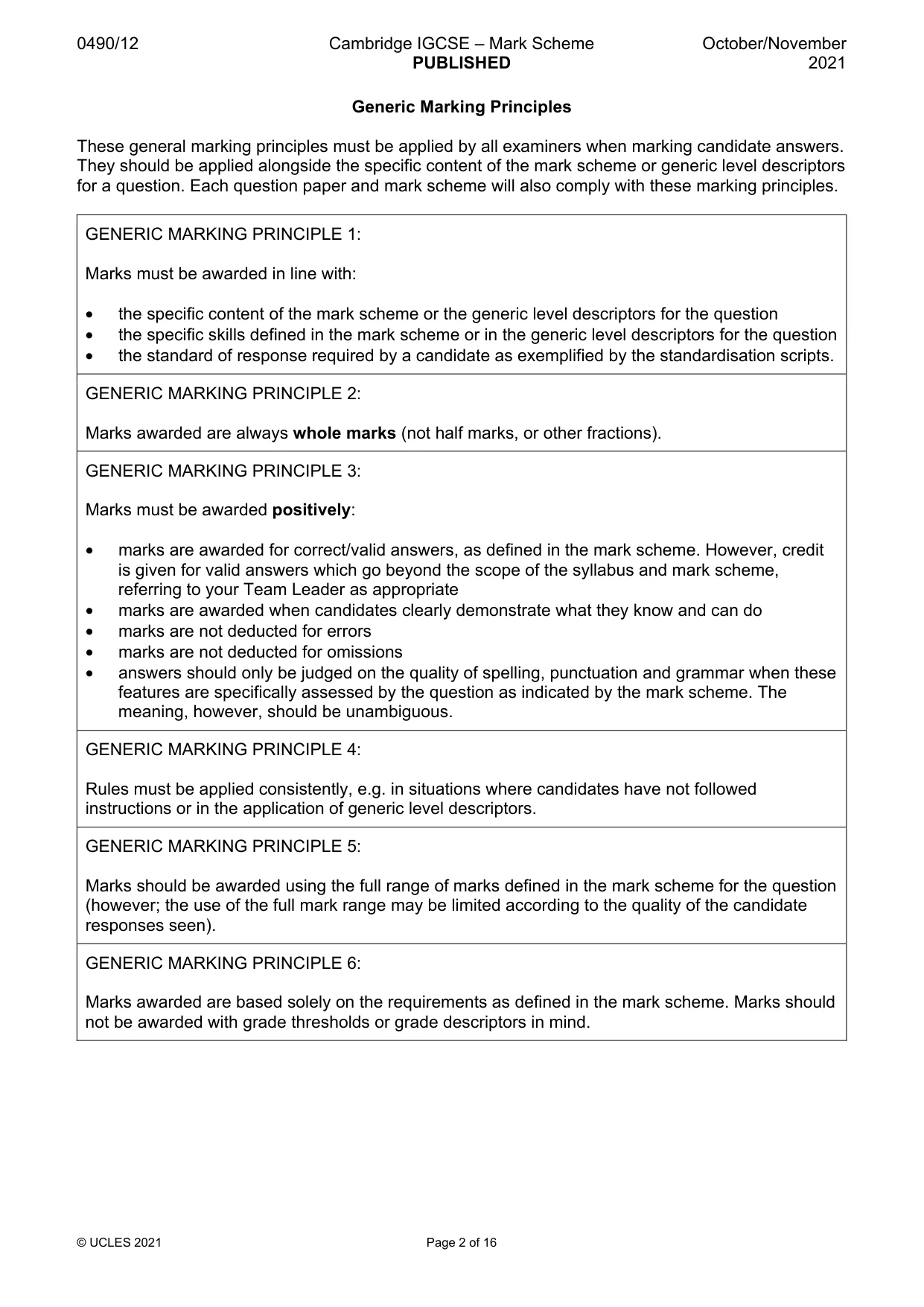
0490/12 Cambridge IGCSE – Mark Scheme PUBLISHED October/November 2021 © UCLES 2021 Page 2 of 16 Generic Marking Principles These general marking principles must be applied by all examiners when marking candidate answers. They should be applied alongside the specific content of the mark scheme or generic level descriptors for a question. Each question paper and mark scheme will also comply with these marking principles. GENERIC MARKING PRINCIPLE 1: Marks must be awarded in line with: • the specific content of the mark scheme or the generic level descriptors for the question • the specific skills defined in the mark scheme or in the generic level descriptors for the question • the standard of response required by a candidate as exemplified by the standardisation scripts. GENERIC MARKING PRINCIPLE 2: Marks awarded are always whole marks (not half marks, or other fractions). GENERIC MARKING PRINCIPLE 3: Marks must be awarded positively: • marks are awarded for correct/valid answers, as defined in the mark scheme. However, credit is given for valid answers which go beyond the scope of the syllabus and mark scheme, referring to your Team Leader as appropriate • marks are awarded when candidates clearly demonstrate what they know and can do • marks are not deducted for errors • marks are not deducted for omissions • answers should only be judged on the quality of spelling, punctuation and grammar when these features are specifically assessed by the question as indicated by the mark scheme. The meaning, however, should be unambiguous. GENERIC MARKING PRINCIPLE 4: Rules must be applied consistently, e.g. in situations where candidates have not followed instructions or in the application of generic level descriptors. GENERIC MARKING PRINCIPLE 5: Marks should be awarded using the full range of marks defined in the mark scheme for the question (however; the use of the full mark range may be limited according to the quality of the candidate responses seen). GENERIC MARKING PRINCIPLE 6: Marks awarded are based solely on the requirements as defined in the mark scheme. Marks should not be awarded with grade thresholds or grade descriptors in mind.
Mark scheme, page 3
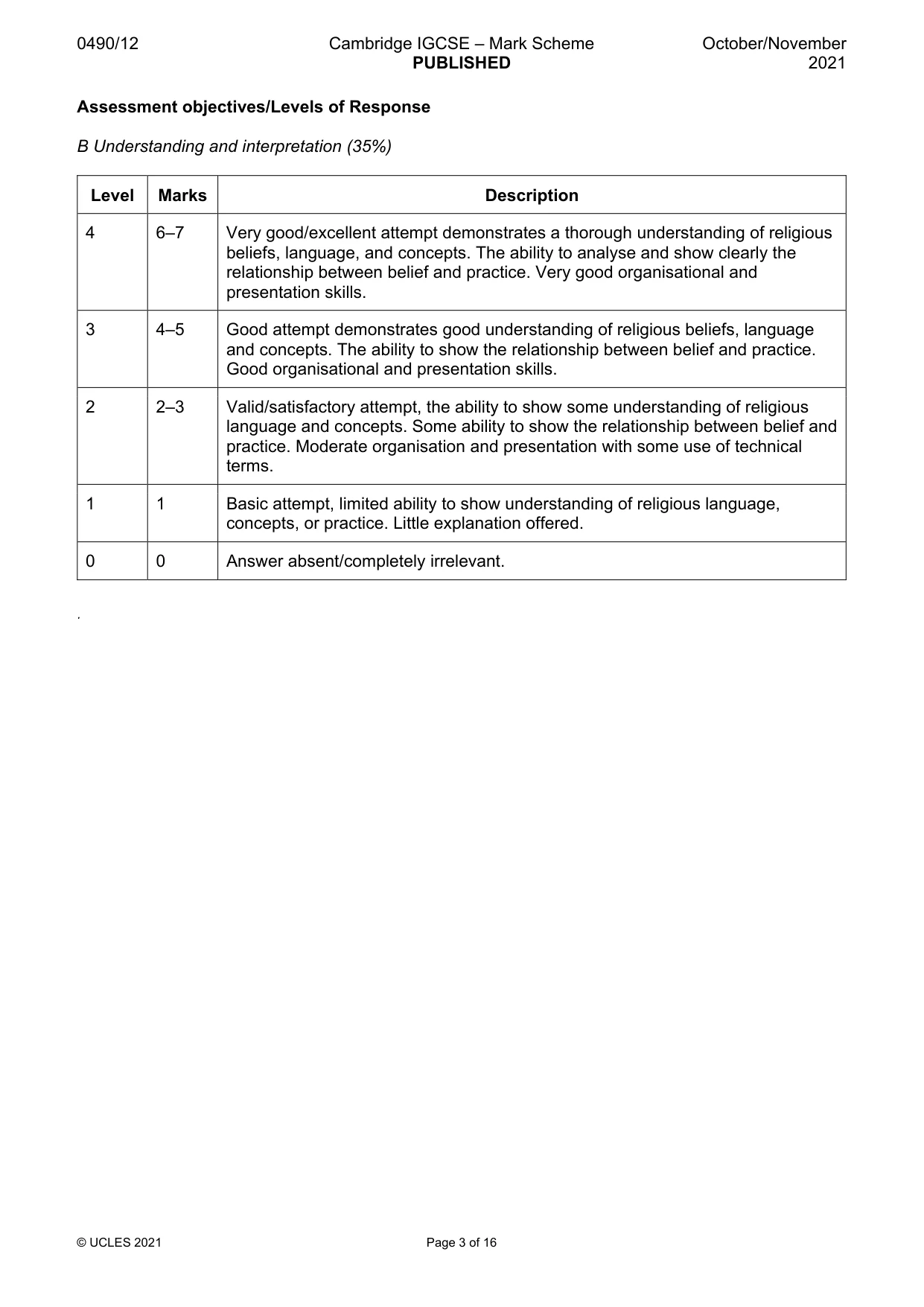
0490/12 Cambridge IGCSE – Mark Scheme PUBLISHED October/November 2021 © UCLES 2021 Page 3 of 16 Assessment objectives/Levels of Response B Understanding and interpretation (35%) Level Marks Description 4 6–7 Very good/excellent attempt demonstrates a thorough understanding of religious beliefs, language, and concepts. The ability to analyse and show clearly the relationship between belief and practice. Very good organisational and presentation skills. 3 4–5 Good attempt demonstrates good understanding of religious beliefs, language and concepts. The ability to show the relationship between belief and practice. Good organisational and presentation skills. 2 2–3 Valid/satisfactory attempt, the ability to show some understanding of religious language and concepts. Some ability to show the relationship between belief and practice. Moderate organisation and presentation with some use of technical terms. 1 1 Basic attempt, limited ability to show understanding of religious language, concepts, or practice. Little explanation offered. 0 0 Answer absent/completely irrelevant.
Mark scheme, page 4
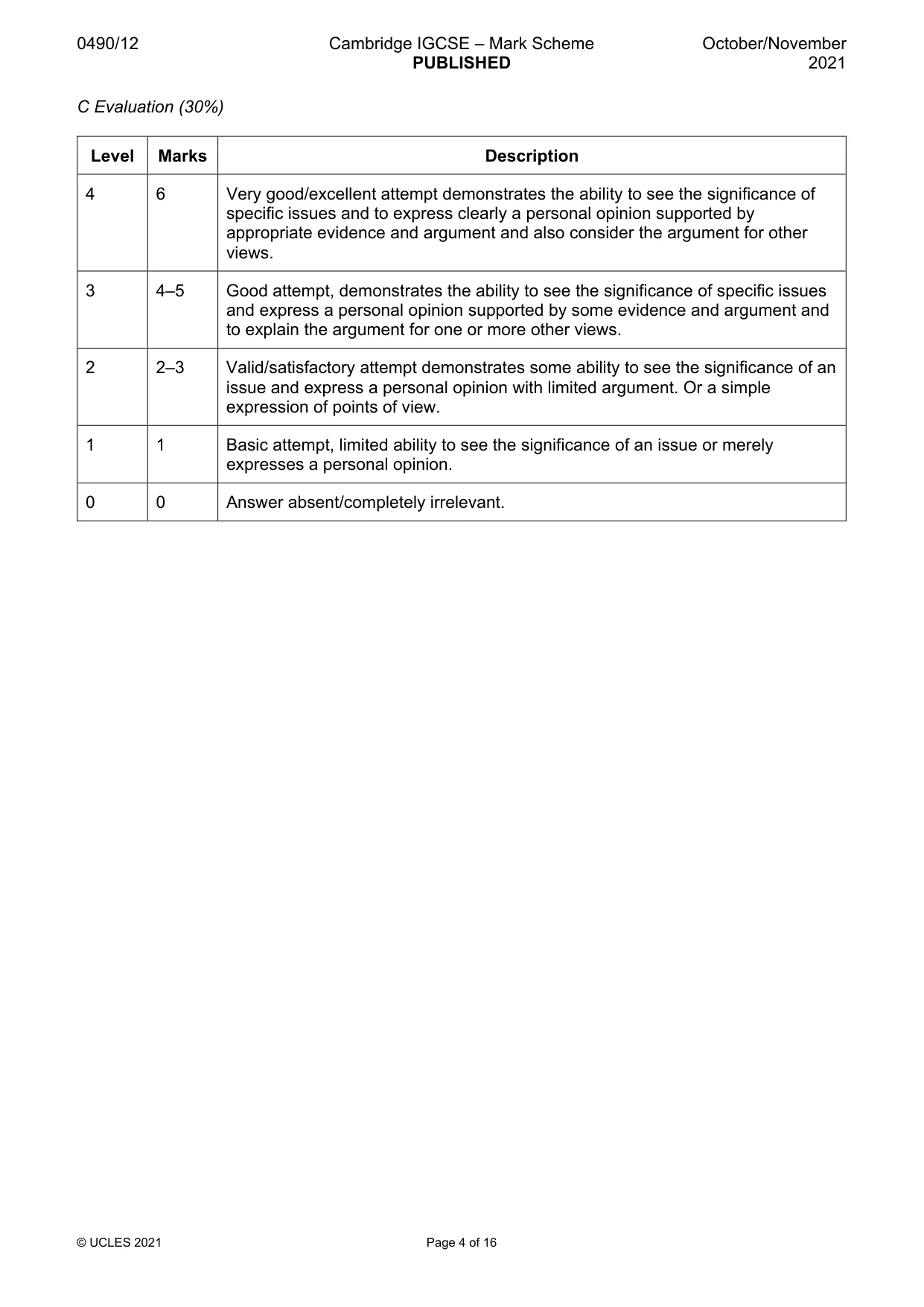
0490/12 Cambridge IGCSE – Mark Scheme PUBLISHED October/November 2021 © UCLES 2021 Page 4 of 16 C Evaluation (30%) Level Marks Description 4 6 Very good/excellent attempt demonstrates the ability to see the significance of specific issues and to express clearly a personal opinion supported by appropriate evidence and argument and also consider the argument for other views. 3 4–5 Good attempt, demonstrates the ability to see the significance of specific issues and express a personal opinion supported by some evidence and argument and to explain the argument for one or more other views. 2 2–3 Valid/satisfactory attempt demonstrates some ability to see the significance of an issue and express a personal opinion with limited argument. Or a simple expression of points of view. 1 1 Basic attempt, limited ability to see the significance of an issue or merely expresses a personal opinion. 0 0 Answer absent/completely irrelevant.
Mark scheme, page 5
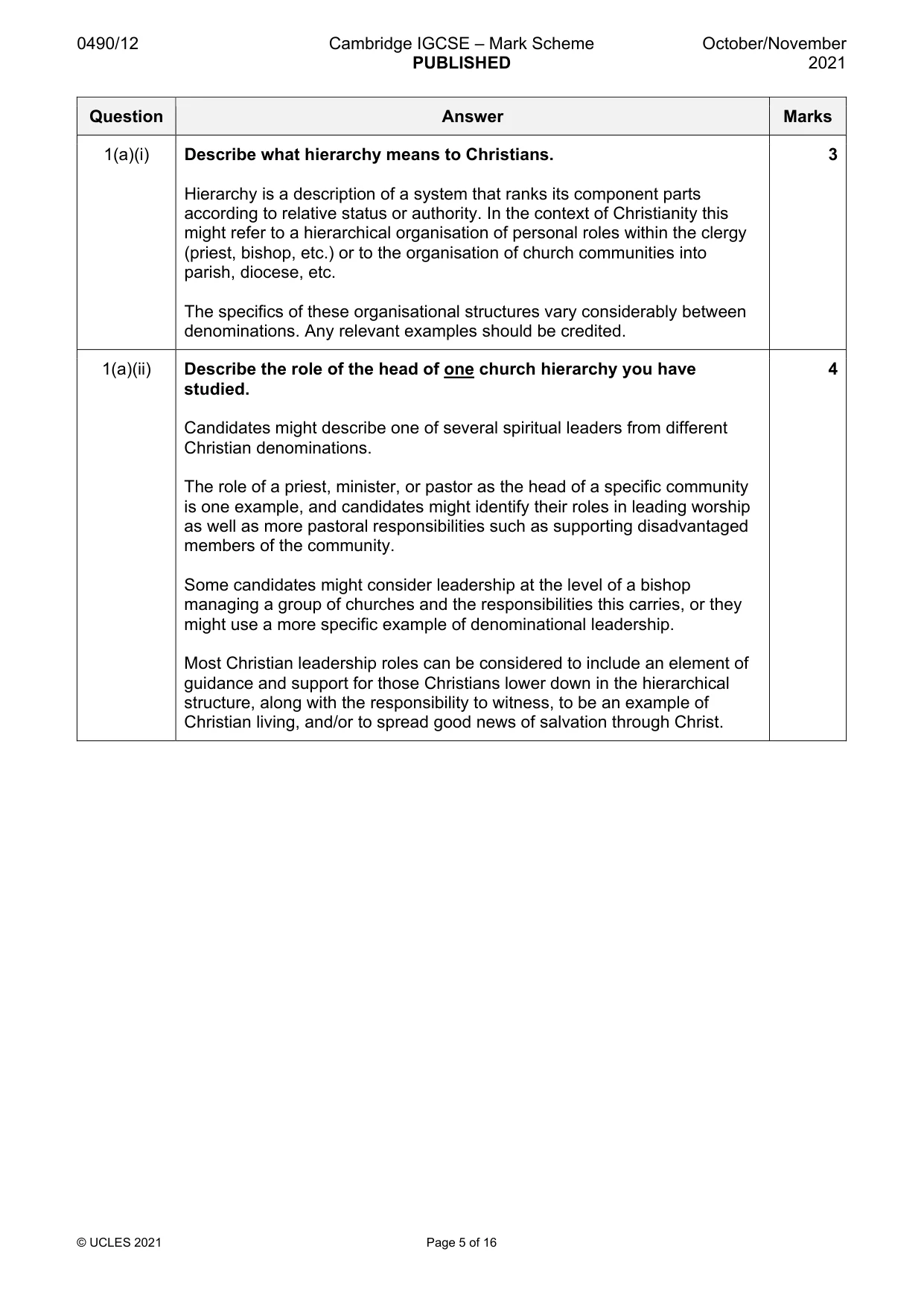
0490/12 Cambridge IGCSE – Mark Scheme PUBLISHED October/November 2021 © UCLES 2021 Page 5 of 16 Question Answer Marks 1(a)(i) Describe what hierarchy means to Christians. Hierarchy is a description of a system that ranks its component parts according to relative status or authority. In the context of Christianity this might refer to a hierarchical organisation of personal roles within the clergy (priest, bishop, etc.) or to the organisation of church communities into parish, diocese, etc. The specifics of these organisational structures vary considerably between denominations. Any relevant examples should be credited. 3 1(a)(ii) Describe the role of the head of one church hierarchy you have studied. Candidates might describe one of several spiritual leaders from different Christian denominations. The role of a priest, minister, or pastor as the head of a specific community is one example, and candidates might identify their roles in leading worship as well as more pastoral responsibilities such as supporting disadvantaged members of the community. Some candidates might consider leadership at the level of a bishop managing a group of churches and the responsibilities this carries, or they might use a more specific example of denominational leadership. Most Christian leadership roles can be considered to include an element of guidance and support for those Christians lower down in the hierarchical structure, along with the responsibility to witness, to be an example of Christian living, and/or to spread good news of salvation through Christ. 4
Mark scheme, page 6
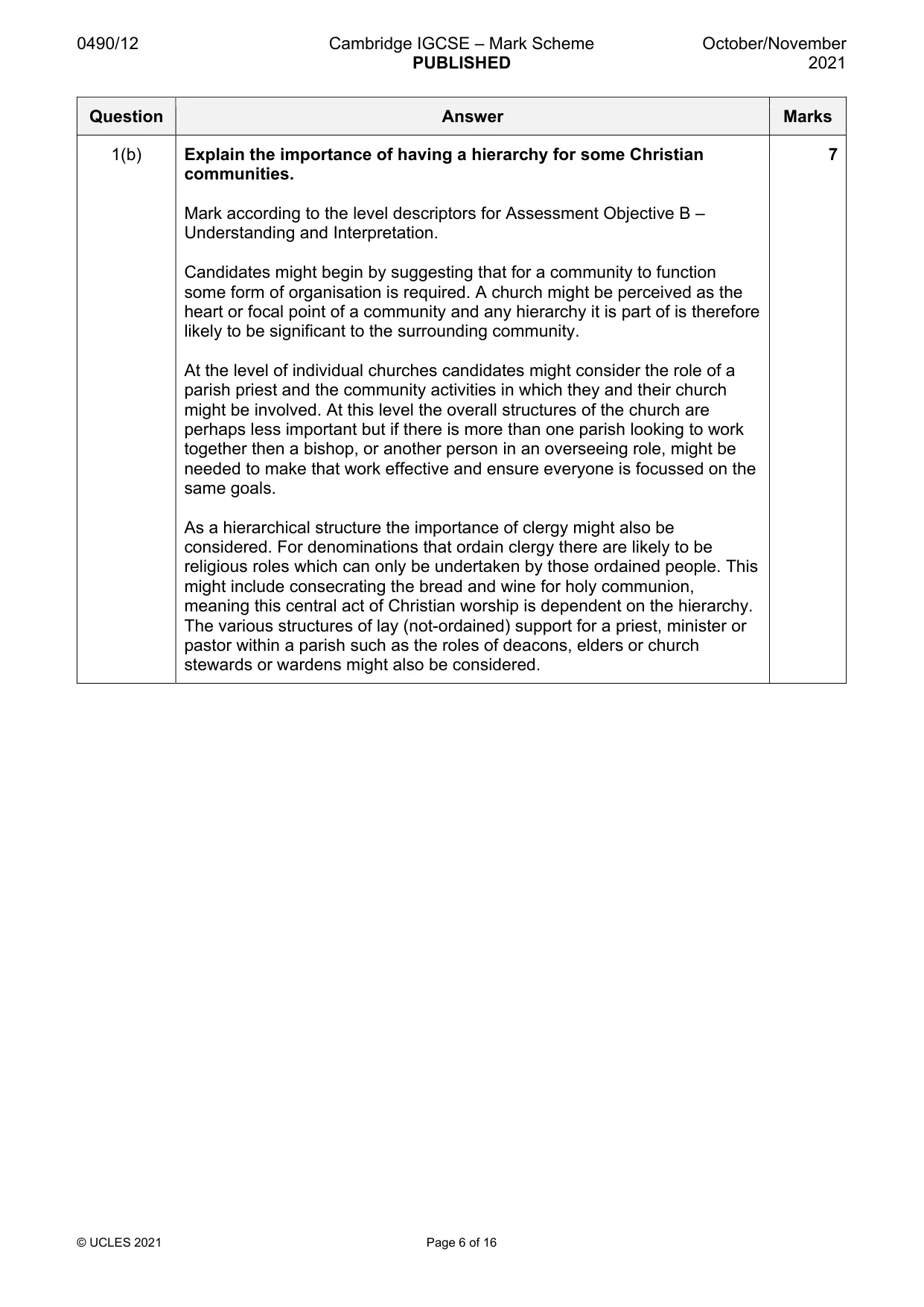
0490/12 Cambridge IGCSE – Mark Scheme PUBLISHED October/November 2021 © UCLES 2021 Page 6 of 16 Question Answer Marks 1(b) Explain the importance of having a hierarchy for some Christian communities. Mark according to the level descriptors for Assessment Objective B – Understanding and Interpretation. Candidates might begin by suggesting that for a community to function some form of organisation is required. A church might be perceived as the heart or focal point of a community and any hierarchy it is part of is therefore likely to be significant to the surrounding community. At the level of individual churches candidates might consider the role of a parish priest and the community activities in which they and their church might be involved. At this level the overall structures of the church are perhaps less important but if there is more than one parish looking to work together then a bishop, or another person in an overseeing role, might be needed to make that work effective and ensure everyone is focussed on the same goals. As a hierarchical structure the importance of clergy might also be considered. For denominations that ordain clergy there are likely to be religious roles which can only be undertaken by those ordained people. This might include consecrating the bread and wine for holy communion, meaning this central act of Christian worship is dependent on the hierarchy. The various structures of lay (not-ordained) support for a priest, minister or pastor within a parish such as the roles of deacons, elders or church stewards or wardens might also be considered. 7
Mark scheme, page 7
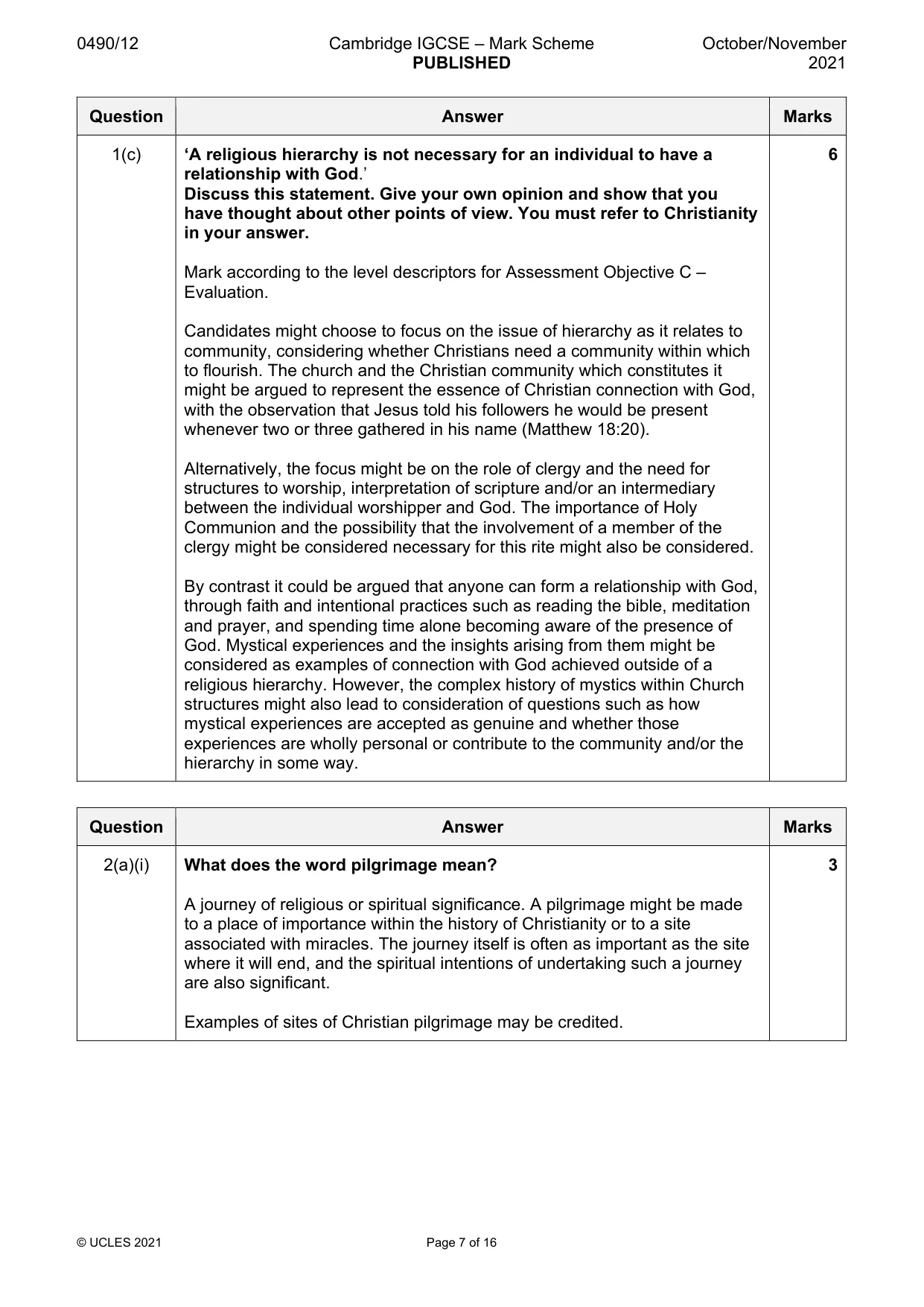
0490/12 Cambridge IGCSE – Mark Scheme PUBLISHED October/November 2021 © UCLES 2021 Page 7 of 16 Question Answer Marks 1(c) ‘A religious hierarchy is not necessary for an individual to have a relationship with God.’ Discuss this statement. Give your own opinion and show that you have thought about other points of view. You must refer to Christianity in your answer. Mark according to the level descriptors for Assessment Objective C – Evaluation. Candidates might choose to focus on the issue of hierarchy as it relates to community, considering whether Christians need a community within which to flourish. The church and the Christian community which constitutes it might be argued to represent the essence of Christian connection with God, with the observation that Jesus told his followers he would be present whenever two or three gathered in his name (Matthew 18:20). Alternatively, the focus might be on the role of clergy and the need for structures to worship, interpretation of scripture and/or an intermediary between the individual worshipper and God. The importance of Holy Communion and the possibility that the involvement of a member of the clergy might be considered necessary for this rite might also be considered. By contrast it could be argued that anyone can form a relationship with God, through faith and intentional practices such as reading the bible, meditation and prayer, and spending time alone becoming aware of the presence of God. Mystical experiences and the insights arising from them might be considered as examples of connection with God achieved outside of a religious hierarchy. However, the complex history of mystics within Church structures might also lead to consideration of questions such as how mystical experiences are accepted as genuine and whether those experiences are wholly personal or contribute to the community and/or the hierarchy in some way. 6 Question Answer Marks 2(a)(i) What does the word pilgrimage mean? A journey of religious or spiritual significance. A pilgrimage might be made to a place of importance within the history of Christianity or to a site associated with miracles. The journey itself is often as important as the site where it will end, and the spiritual intentions of undertaking such a journey are also significant. Examples of sites of Christian pilgrimage may be credited. 3
Mark scheme, page 8
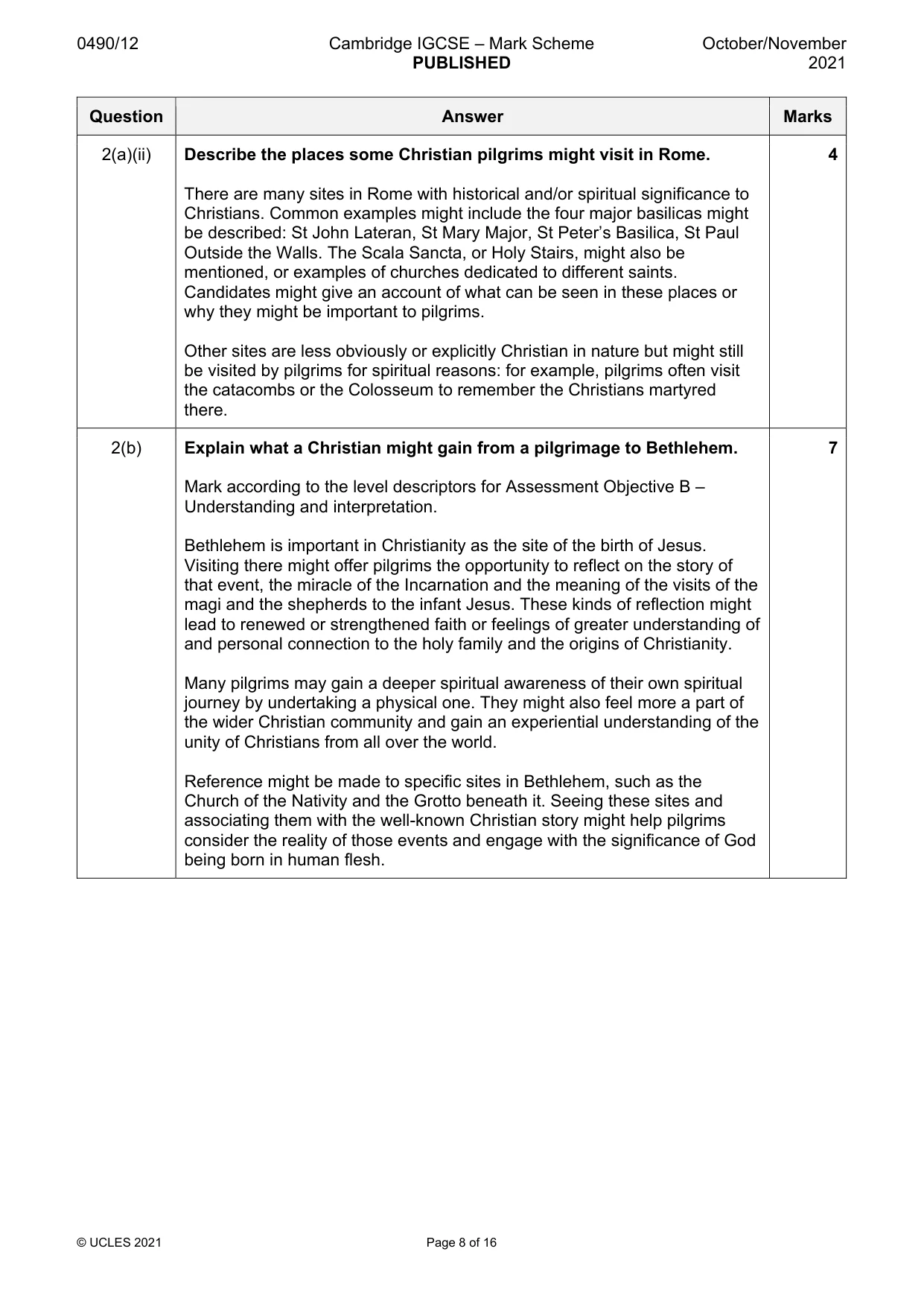
0490/12 Cambridge IGCSE – Mark Scheme PUBLISHED October/November 2021 © UCLES 2021 Page 8 of 16 Question Answer Marks 2(a)(ii) Describe the places some Christian pilgrims might visit in Rome. There are many sites in Rome with historical and/or spiritual significance to Christians. Common examples might include the four major basilicas might be described: St John Lateran, St Mary Major, St Peter’s Basilica, St Paul Outside the Walls. The Scala Sancta, or Holy Stairs, might also be mentioned, or examples of churches dedicated to different saints. Candidates might give an account of what can be seen in these places or why they might be important to pilgrims. Other sites are less obviously or explicitly Christian in nature but might still be visited by pilgrims for spiritual reasons: for example, pilgrims often visit the catacombs or the Colosseum to remember the Christians martyred there. 4 2(b) Explain what a Christian might gain from a pilgrimage to Bethlehem. Mark according to the level descriptors for Assessment Objective B – Understanding and interpretation. Bethlehem is important in Christianity as the site of the birth of Jesus. Visiting there might offer pilgrims the opportunity to reflect on the story of that event, the miracle of the Incarnation and the meaning of the visits of the magi and the shepherds to the infant Jesus. These kinds of reflection might lead to renewed or strengthened faith or feelings of greater understanding of and personal connection to the holy family and the origins of Christianity. Many pilgrims may gain a deeper spiritual awareness of their own spiritual journey by undertaking a physical one. They might also feel more a part of the wider Christian community and gain an experiential understanding of the unity of Christians from all over the world. Reference might be made to specific sites in Bethlehem, such as the Church of the Nativity and the Grotto beneath it. Seeing these sites and associating them with the well-known Christian story might help pilgrims consider the reality of those events and engage with the significance of God being born in human flesh. 7
Mark scheme, page 9
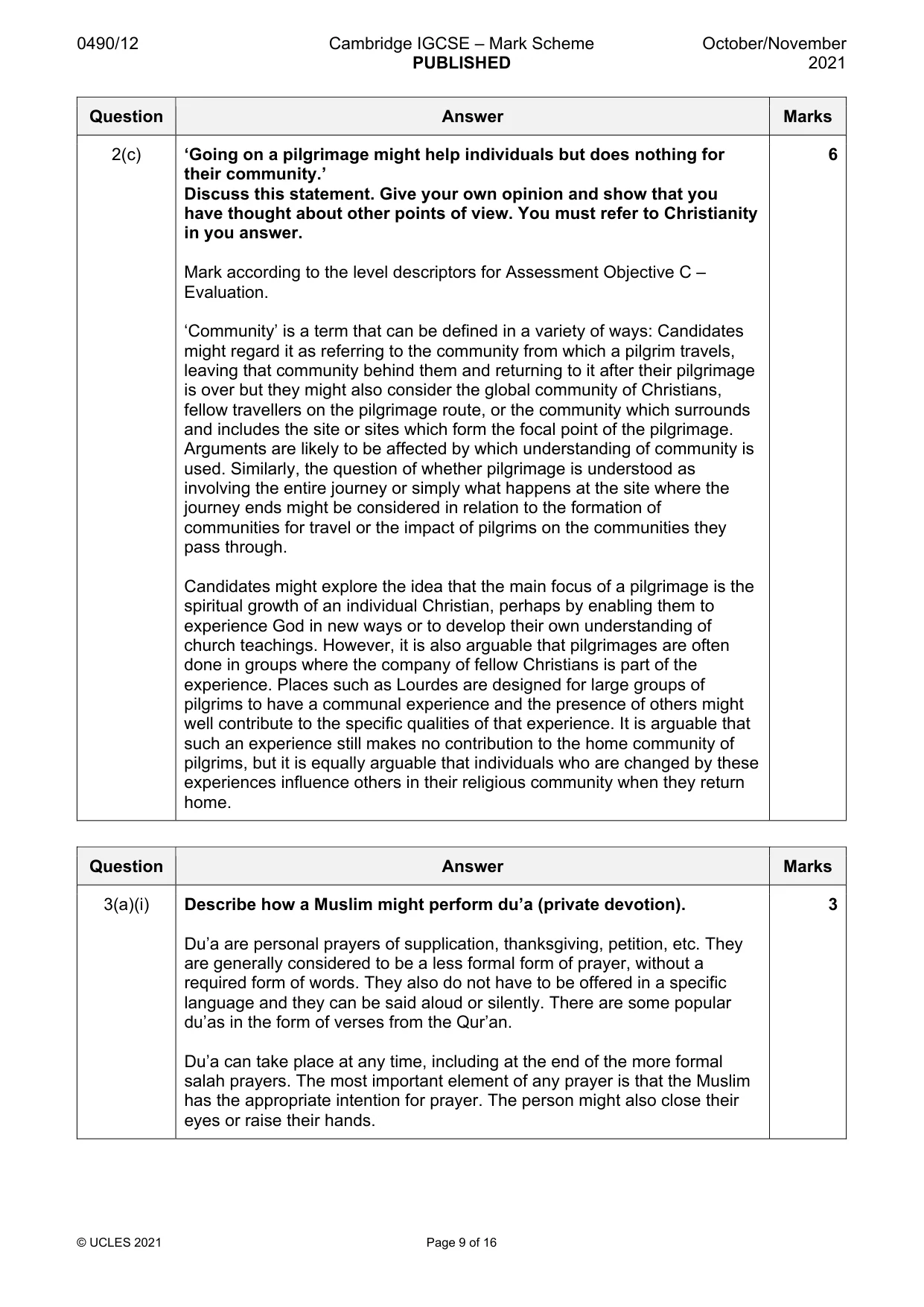
0490/12 Cambridge IGCSE – Mark Scheme PUBLISHED October/November 2021 © UCLES 2021 Page 9 of 16 Question Answer Marks 2(c) ‘Going on a pilgrimage might help individuals but does nothing for their community.’ Discuss this statement. Give your own opinion and show that you have thought about other points of view. You must refer to Christianity in you answer. Mark according to the level descriptors for Assessment Objective C – Evaluation. ‘Community’ is a term that can be defined in a variety of ways: Candidates might regard it as referring to the community from which a pilgrim travels, leaving that community behind them and returning to it after their pilgrimage is over but they might also consider the global community of Christians, fellow travellers on the pilgrimage route, or the community which surrounds and includes the site or sites which form the focal point of the pilgrimage. Arguments are likely to be affected by which understanding of community is used. Similarly, the question of whether pilgrimage is understood as involving the entire journey or simply what happens at the site where the journey ends might be considered in relation to the formation of communities for travel or the impact of pilgrims on the communities they pass through. Candidates might explore the idea that the main focus of a pilgrimage is the spiritual growth of an individual Christian, perhaps by enabling them to experience God in new ways or to develop their own understanding of church teachings. However, it is also arguable that pilgrimages are often done in groups where the company of fellow Christians is part of the experience. Places such as Lourdes are designed for large groups of pilgrims to have a communal experience and the presence of others might well contribute to the specific qualities of that experience. It is arguable that such an experience still makes no contribution to the home community of pilgrims, but it is equally arguable that individuals who are changed by these experiences influence others in their religious community when they return home. 6 Question Answer Marks 3(a)(i) Describe how a Muslim might perform du’a (private devotion). Du’a are personal prayers of supplication, thanksgiving, petition, etc. They are generally considered to be a less formal form of prayer, without a required form of words. They also do not have to be offered in a specific language and they can be said aloud or silently. There are some popular du’as in the form of verses from the Qur’an. Du’a can take place at any time, including at the end of the more formal salah prayers. The most important element of any prayer is that the Muslim has the appropriate intention for prayer. The person might also close their eyes or raise their hands. 3
Mark scheme, page 10
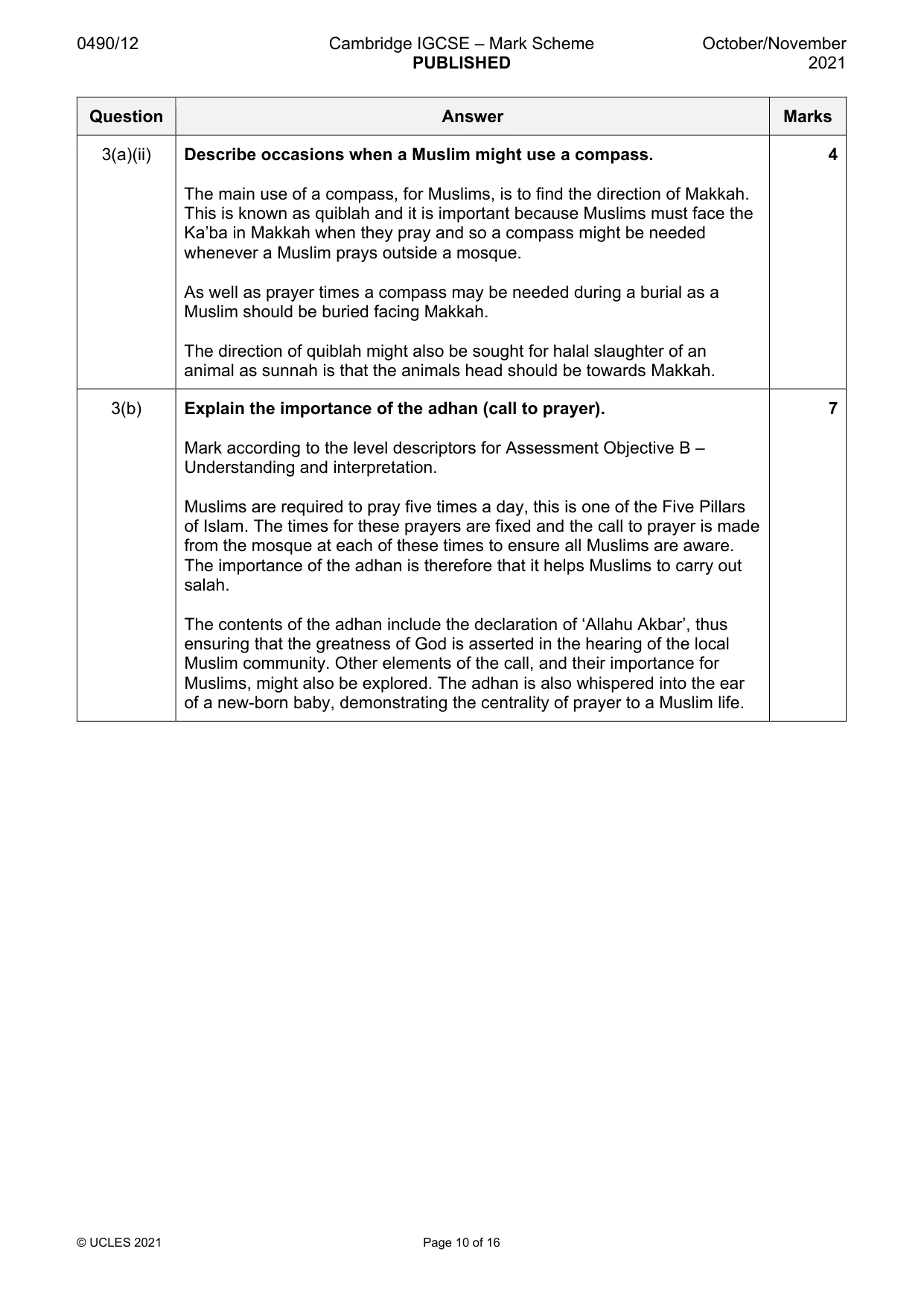
0490/12 Cambridge IGCSE – Mark Scheme PUBLISHED October/November 2021 © UCLES 2021 Page 10 of 16 Question Answer Marks 3(a)(ii) Describe occasions when a Muslim might use a compass. The main use of a compass, for Muslims, is to find the direction of Makkah. This is known as quiblah and it is important because Muslims must face the Ka’ba in Makkah when they pray and so a compass might be needed whenever a Muslim prays outside a mosque. As well as prayer times a compass may be needed during a burial as a Muslim should be buried facing Makkah. The direction of quiblah might also be sought for halal slaughter of an animal as sunnah is that the animals head should be towards Makkah. 4 3(b) Explain the importance of the adhan (call to prayer). Mark according to the level descriptors for Assessment Objective B – Understanding and interpretation. Muslims are required to pray five times a day, this is one of the Five Pillars of Islam. The times for these prayers are fixed and the call to prayer is made from the mosque at each of these times to ensure all Muslims are aware. The importance of the adhan is therefore that it helps Muslims to carry out salah. The contents of the adhan include the declaration of ‘Allahu Akbar’, thus ensuring that the greatness of God is asserted in the hearing of the local Muslim community. Other elements of the call, and their importance for Muslims, might also be explored. The adhan is also whispered into the ear of a new-born baby, demonstrating the centrality of prayer to a Muslim life. 7
Mark scheme, page 11
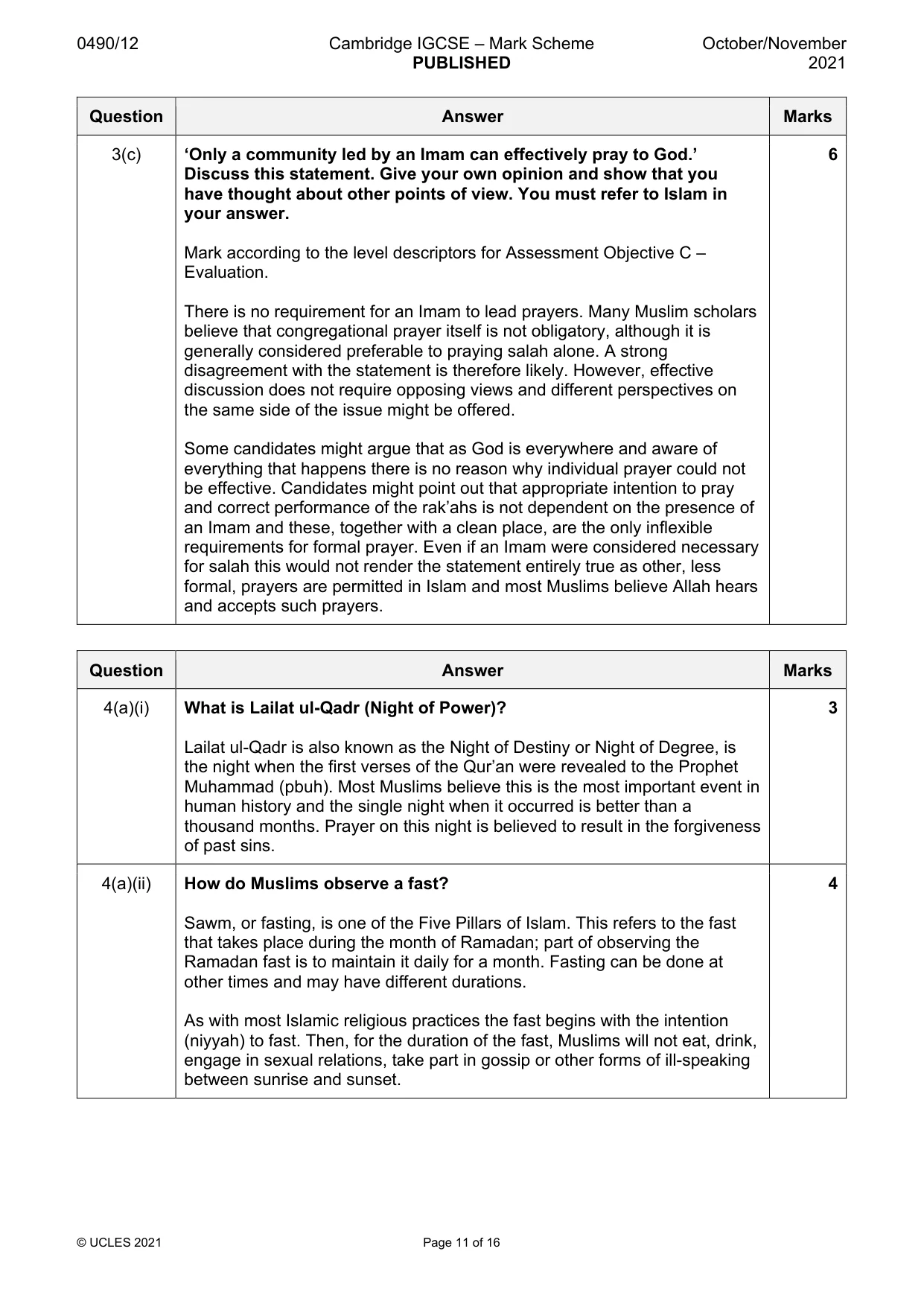
0490/12 Cambridge IGCSE – Mark Scheme PUBLISHED October/November 2021 © UCLES 2021 Page 11 of 16 Question Answer Marks 3(c) ‘Only a community led by an Imam can effectively pray to God.’ Discuss this statement. Give your own opinion and show that you have thought about other points of view. You must refer to Islam in your answer. Mark according to the level descriptors for Assessment Objective C – Evaluation. There is no requirement for an Imam to lead prayers. Many Muslim scholars believe that congregational prayer itself is not obligatory, although it is generally considered preferable to praying salah alone. A strong disagreement with the statement is therefore likely. However, effective discussion does not require opposing views and different perspectives on the same side of the issue might be offered. Some candidates might argue that as God is everywhere and aware of everything that happens there is no reason why individual prayer could not be effective. Candidates might point out that appropriate intention to pray and correct performance of the rak’ahs is not dependent on the presence of an Imam and these, together with a clean place, are the only inflexible requirements for formal prayer. Even if an Imam were considered necessary for salah this would not render the statement entirely true as other, less formal, prayers are permitted in Islam and most Muslims believe Allah hears and accepts such prayers. 6 Question Answer Marks 4(a)(i) What is Lailat ul-Qadr (Night of Power)? Lailat ul-Qadr is also known as the Night of Destiny or Night of Degree, is the night when the first verses of the Qur’an were revealed to the Prophet Muhammad (pbuh). Most Muslims believe this is the most important event in human history and the single night when it occurred is better than a thousand months. Prayer on this night is believed to result in the forgiveness of past sins. 3 4(a)(ii) How do Muslims observe a fast? Sawm, or fasting, is one of the Five Pillars of Islam. This refers to the fast that takes place during the month of Ramadan; part of observing the Ramadan fast is to maintain it daily for a month. Fasting can be done at other times and may have different durations. As with most Islamic religious practices the fast begins with the intention (niyyah) to fast. Then, for the duration of the fast, Muslims will not eat, drink, engage in sexual relations, take part in gossip or other forms of ill-speaking between sunrise and sunset. 4
Mark scheme, page 12
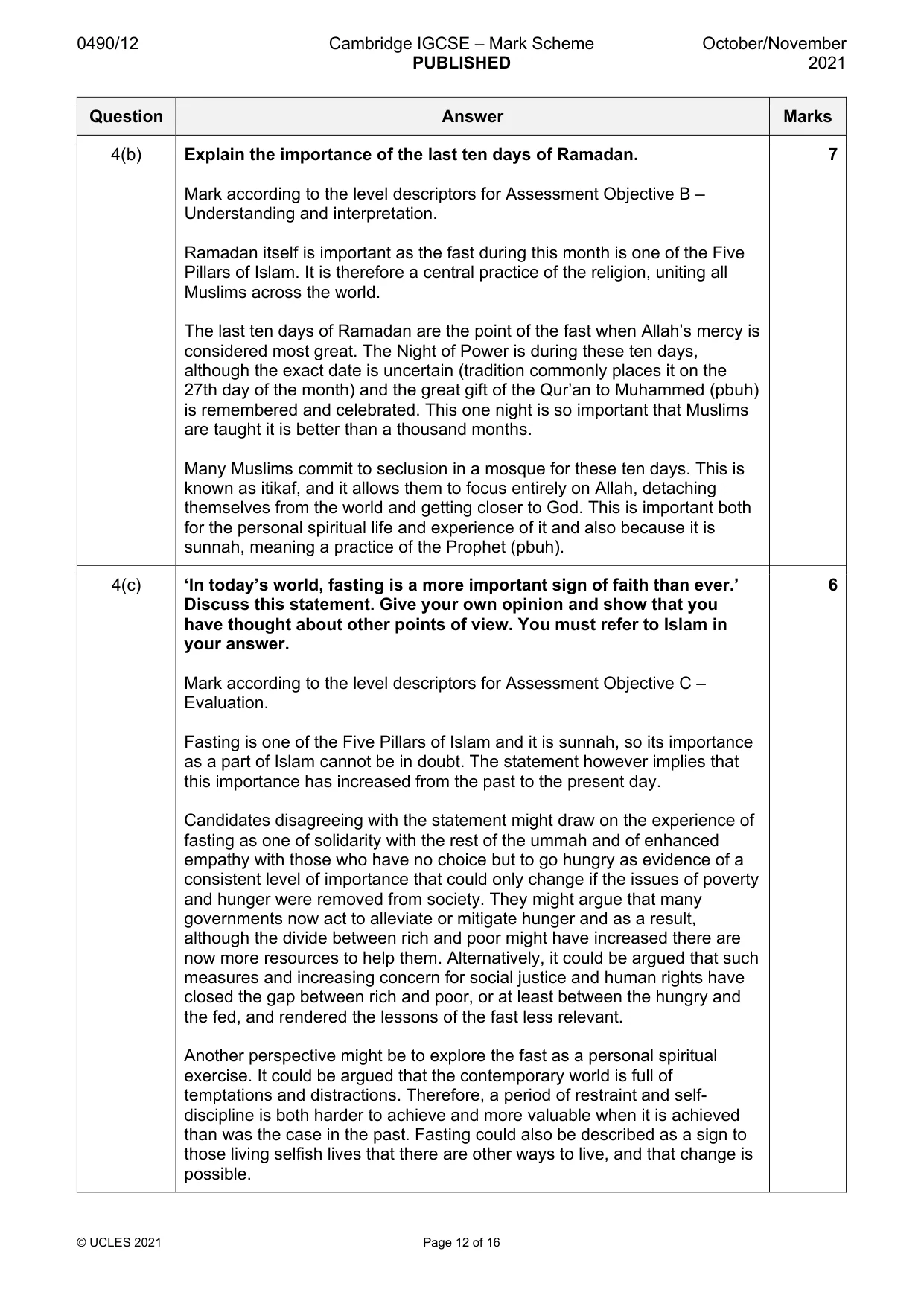
0490/12 Cambridge IGCSE – Mark Scheme PUBLISHED October/November 2021 © UCLES 2021 Page 12 of 16 Question Answer Marks 4(b) Explain the importance of the last ten days of Ramadan. Mark according to the level descriptors for Assessment Objective B – Understanding and interpretation. Ramadan itself is important as the fast during this month is one of the Five Pillars of Islam. It is therefore a central practice of the religion, uniting all Muslims across the world. The last ten days of Ramadan are the point of the fast when Allah’s mercy is considered most great. The Night of Power is during these ten days, although the exact date is uncertain (tradition commonly places it on the 27th day of the month) and the great gift of the Qur’an to Muhammed (pbuh) is remembered and celebrated. This one night is so important that Muslims are taught it is better than a thousand months. Many Muslims commit to seclusion in a mosque for these ten days. This is known as itikaf, and it allows them to focus entirely on Allah, detaching themselves from the world and getting closer to God. This is important both for the personal spiritual life and experience of it and also because it is sunnah, meaning a practice of the Prophet (pbuh). 7 4(c) ‘In today’s world, fasting is a more important sign of faith than ever.’ Discuss this statement. Give your own opinion and show that you have thought about other points of view. You must refer to Islam in your answer. Mark according to the level descriptors for Assessment Objective C – Evaluation. Fasting is one of the Five Pillars of Islam and it is sunnah, so its importance as a part of Islam cannot be in doubt. The statement however implies that this importance has increased from the past to the present day. Candidates disagreeing with the statement might draw on the experience of fasting as one of solidarity with the rest of the ummah and of enhanced empathy with those who have no choice but to go hungry as evidence of a consistent level of importance that could only change if the issues of poverty and hunger were removed from society. They might argue that many governments now act to alleviate or mitigate hunger and as a result, although the divide between rich and poor might have increased there are now more resources to help them. Alternatively, it could be argued that such measures and increasing concern for social justice and human rights have closed the gap between rich and poor, or at least between the hungry and the fed, and rendered the lessons of the fast less relevant. Another perspective might be to explore the fast as a personal spiritual exercise. It could be argued that the contemporary world is full of temptations and distractions. Therefore, a period of restraint and self- discipline is both harder to achieve and more valuable when it is achieved than was the case in the past. Fasting could also be described as a sign to those living selfish lives that there are other ways to live, and that change is possible. 6
Mark scheme, page 13
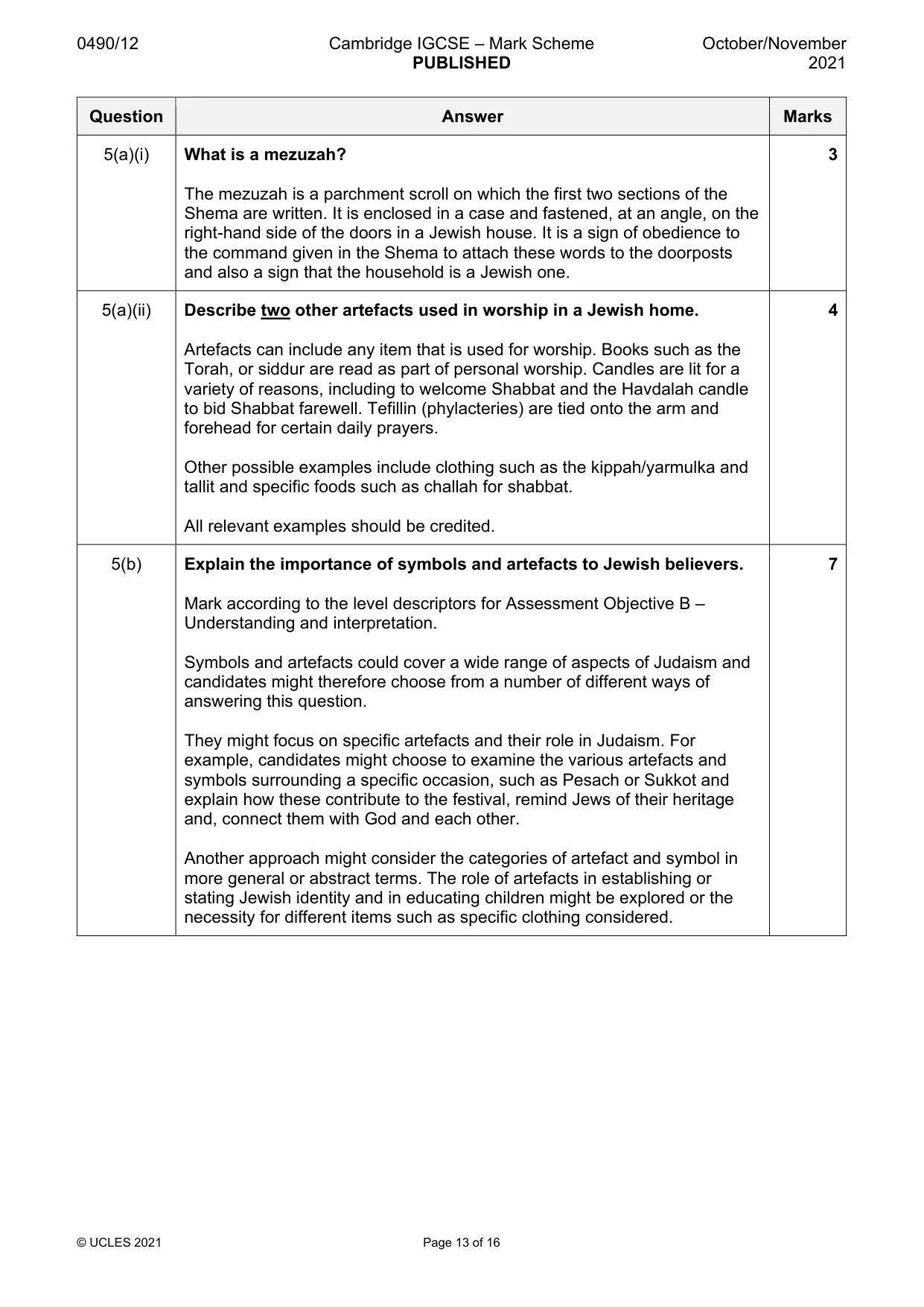
0490/12 Cambridge IGCSE – Mark Scheme PUBLISHED October/November 2021 © UCLES 2021 Page 13 of 16 Question Answer Marks 5(a)(i) What is a mezuzah? The mezuzah is a parchment scroll on which the first two sections of the Shema are written. It is enclosed in a case and fastened, at an angle, on the right-hand side of the doors in a Jewish house. It is a sign of obedience to the command given in the Shema to attach these words to the doorposts and also a sign that the household is a Jewish one. 3 5(a)(ii) Describe two other artefacts used in worship in a Jewish home. Artefacts can include any item that is used for worship. Books such as the Torah, or siddur are read as part of personal worship. Candles are lit for a variety of reasons, including to welcome Shabbat and the Havdalah candle to bid Shabbat farewell. Tefillin (phylacteries) are tied onto the arm and forehead for certain daily prayers. Other possible examples include clothing such as the kippah/yarmulka and tallit and specific foods such as challah for shabbat. All relevant examples should be credited. 4 5(b) Explain the importance of symbols and artefacts to Jewish believers. Mark according to the level descriptors for Assessment Objective B – Understanding and interpretation. Symbols and artefacts could cover a wide range of aspects of Judaism and candidates might therefore choose from a number of different ways of answering this question. They might focus on specific artefacts and their role in Judaism. For example, candidates might choose to examine the various artefacts and symbols surrounding a specific occasion, such as Pesach or Sukkot and explain how these contribute to the festival, remind Jews of their heritage and, connect them with God and each other. Another approach might consider the categories of artefact and symbol in more general or abstract terms. The role of artefacts in establishing or stating Jewish identity and in educating children might be explored or the necessity for different items such as specific clothing considered. 7
Mark scheme, page 14
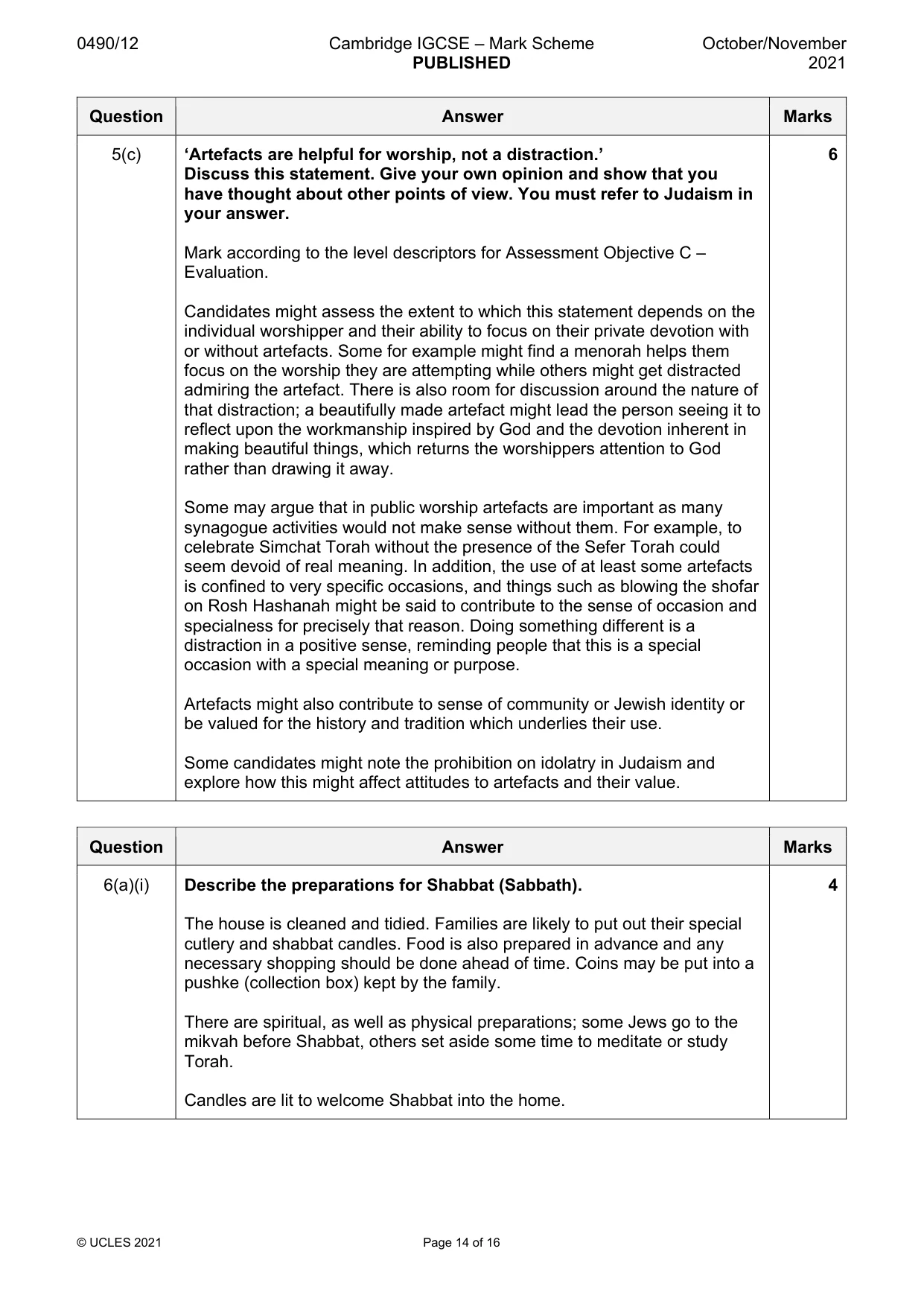
0490/12 Cambridge IGCSE – Mark Scheme PUBLISHED October/November 2021 © UCLES 2021 Page 14 of 16 Question Answer Marks 5(c) ‘Artefacts are helpful for worship, not a distraction.’ Discuss this statement. Give your own opinion and show that you have thought about other points of view. You must refer to Judaism in your answer. Mark according to the level descriptors for Assessment Objective C – Evaluation. Candidates might assess the extent to which this statement depends on the individual worshipper and their ability to focus on their private devotion with or without artefacts. Some for example might find a menorah helps them focus on the worship they are attempting while others might get distracted admiring the artefact. There is also room for discussion around the nature of that distraction; a beautifully made artefact might lead the person seeing it to reflect upon the workmanship inspired by God and the devotion inherent in making beautiful things, which returns the worshippers attention to God rather than drawing it away. Some may argue that in public worship artefacts are important as many synagogue activities would not make sense without them. For example, to celebrate Simchat Torah without the presence of the Sefer Torah could seem devoid of real meaning. In addition, the use of at least some artefacts is confined to very specific occasions, and things such as blowing the shofar on Rosh Hashanah might be said to contribute to the sense of occasion and specialness for precisely that reason. Doing something different is a distraction in a positive sense, reminding people that this is a special occasion with a special meaning or purpose. Artefacts might also contribute to sense of community or Jewish identity or be valued for the history and tradition which underlies their use. Some candidates might note the prohibition on idolatry in Judaism and explore how this might affect attitudes to artefacts and their value. 6 Question Answer Marks 6(a)(i) Describe the preparations for Shabbat (Sabbath). The house is cleaned and tidied. Families are likely to put out their special cutlery and shabbat candles. Food is also prepared in advance and any necessary shopping should be done ahead of time. Coins may be put into a pushke (collection box) kept by the family. There are spiritual, as well as physical preparations; some Jews go to the mikvah before Shabbat, others set aside some time to meditate or study Torah. Candles are lit to welcome Shabbat into the home. 4
Mark scheme, page 15
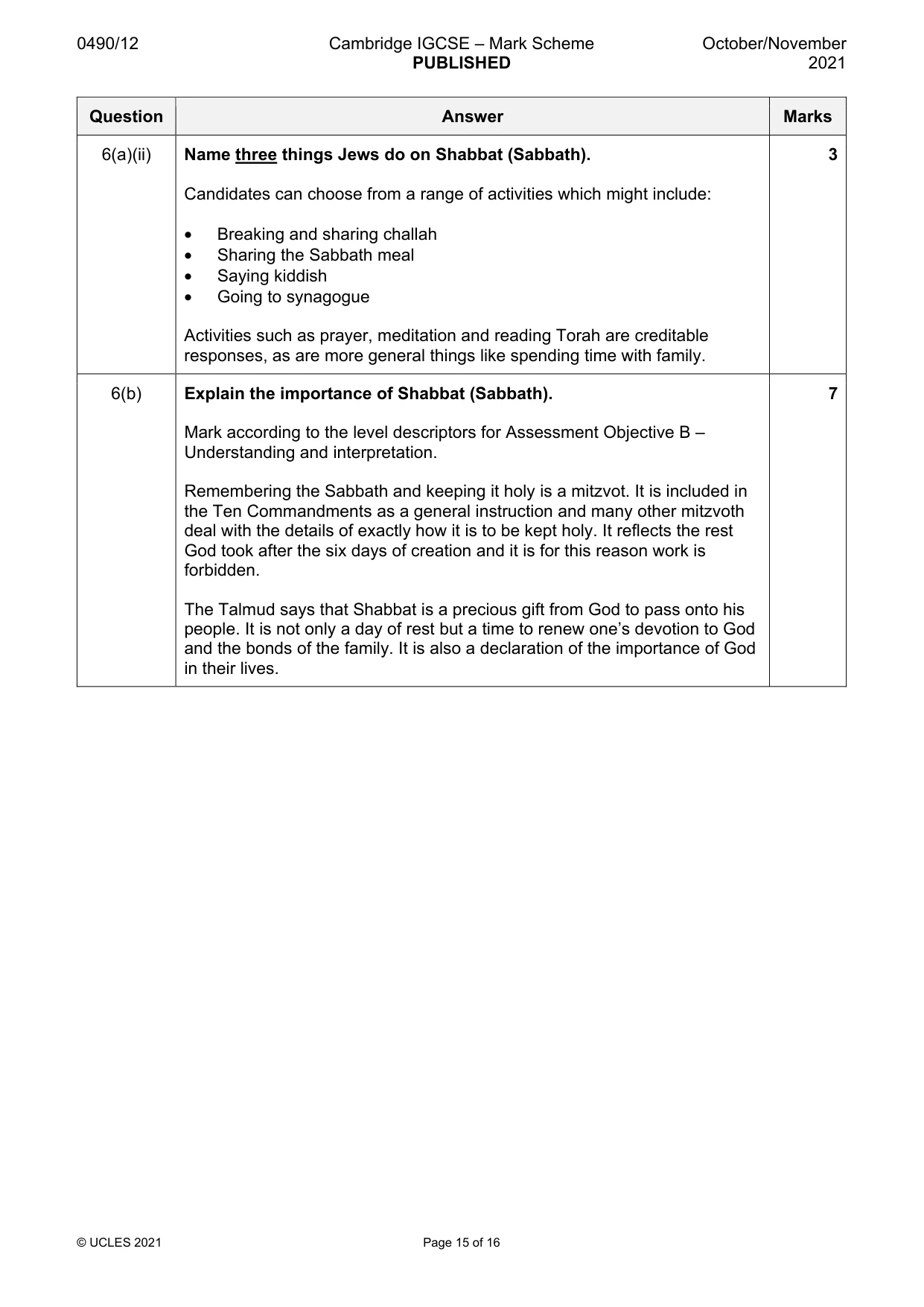
0490/12 Cambridge IGCSE – Mark Scheme PUBLISHED October/November 2021 © UCLES 2021 Page 15 of 16 Question Answer Marks 6(a)(ii) Name three things Jews do on Shabbat (Sabbath). Candidates can choose from a range of activities which might include: • Breaking and sharing challah • Sharing the Sabbath meal • Saying kiddish • Going to synagogue Activities such as prayer, meditation and reading Torah are creditable responses, as are more general things like spending time with family. 3 6(b) Explain the importance of Shabbat (Sabbath). Mark according to the level descriptors for Assessment Objective B – Understanding and interpretation. Remembering the Sabbath and keeping it holy is a mitzvot. It is included in the Ten Commandments as a general instruction and many other mitzvoth deal with the details of exactly how it is to be kept holy. It reflects the rest God took after the six days of creation and it is for this reason work is forbidden. The Talmud says that Shabbat is a precious gift from God to pass onto his people. It is not only a day of rest but a time to renew one’s devotion to God and the bonds of the family. It is also a declaration of the importance of God in their lives. 7
Mark scheme, page 16
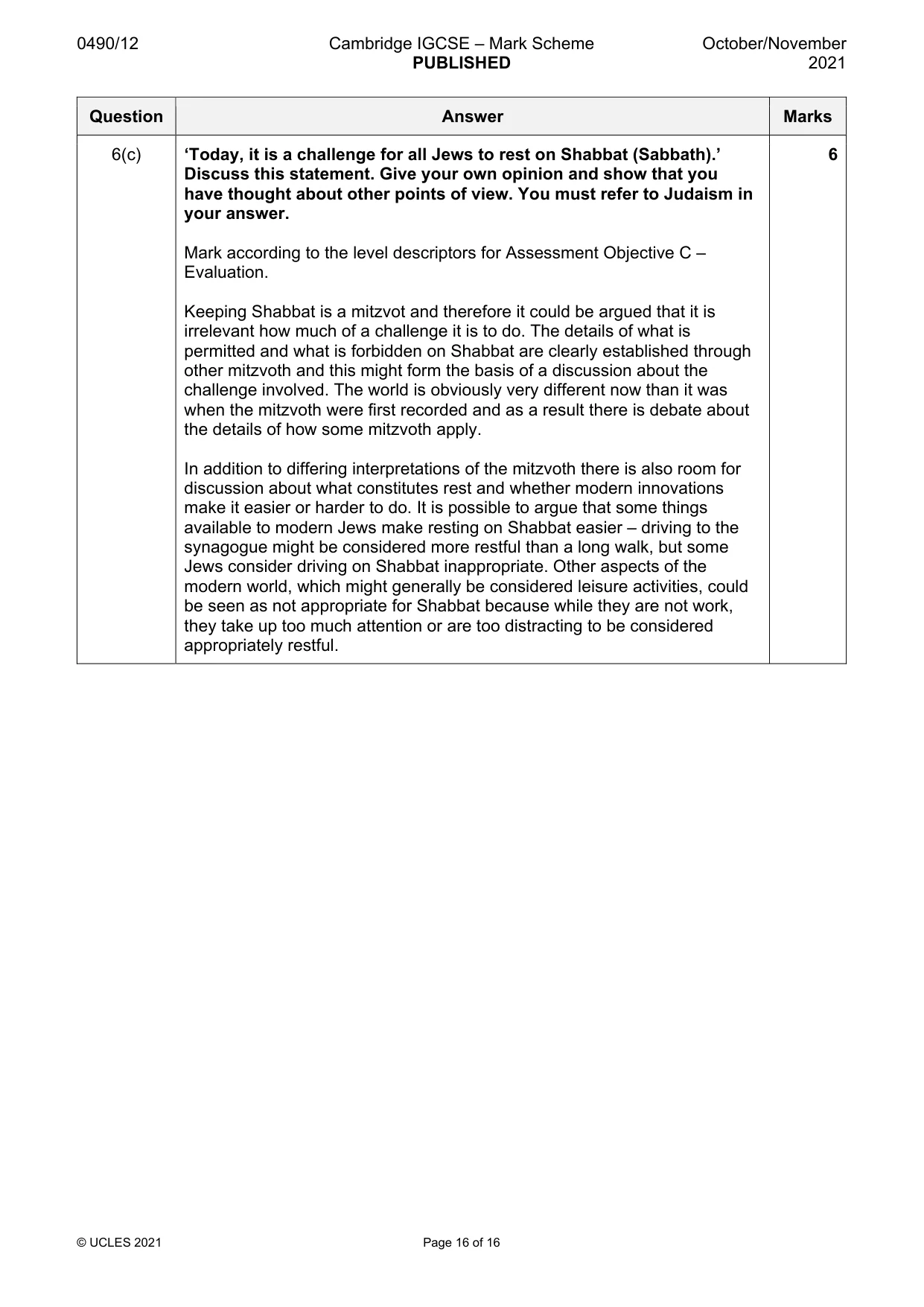
0490/12 Cambridge IGCSE – Mark Scheme PUBLISHED October/November 2021 © UCLES 2021 Page 16 of 16 Question Answer Marks 6(c) ‘Today, it is a challenge for all Jews to rest on Shabbat (Sabbath).’ Discuss this statement. Give your own opinion and show that you have thought about other points of view. You must refer to Judaism in your answer. Mark according to the level descriptors for Assessment Objective C – Evaluation. Keeping Shabbat is a mitzvot and therefore it could be argued that it is irrelevant how much of a challenge it is to do. The details of what is permitted and what is forbidden on Shabbat are clearly established through other mitzvoth and this might form the basis of a discussion about the challenge involved. The world is obviously very different now than it was when the mitzvoth were first recorded and as a result there is debate about the details of how some mitzvoth apply. In addition to differing interpretations of the mitzvoth there is also room for discussion about what constitutes rest and whether modern innovations make it easier or harder to do. It is possible to argue that some things available to modern Jews make resting on Shabbat easier – driving to the synagogue might be considered more restful than a long walk, but some Jews consider driving on Shabbat inappropriate. Other aspects of the modern world, which might generally be considered leisure activities, could be seen as not appropriate for Shabbat because while they are not work, they take up too much attention or are too distracting to be considered appropriately restful. 6
What you needed in this session
Cambridge’s own grade thresholds for 2021 Oct/Nov, Paper 1 · Variant 2. A higher threshold means an easier paper — the bar moves with how the cohort did.