Cambridge IGCSE Religious Studies 0490 — 2015 Oct/Nov Paper 2 · Variant 2
0490/22/O/N/15 · 80 marks · ≈90 min
The question paper and its mark scheme, free to read here and free to download. This is Cambridge’s own paper, exactly as it was sat.
Question paper4 pages
Mark scheme17 pages
Answers below. Sit the paper first if you are practising.
Paper as text
Question paper, page 1
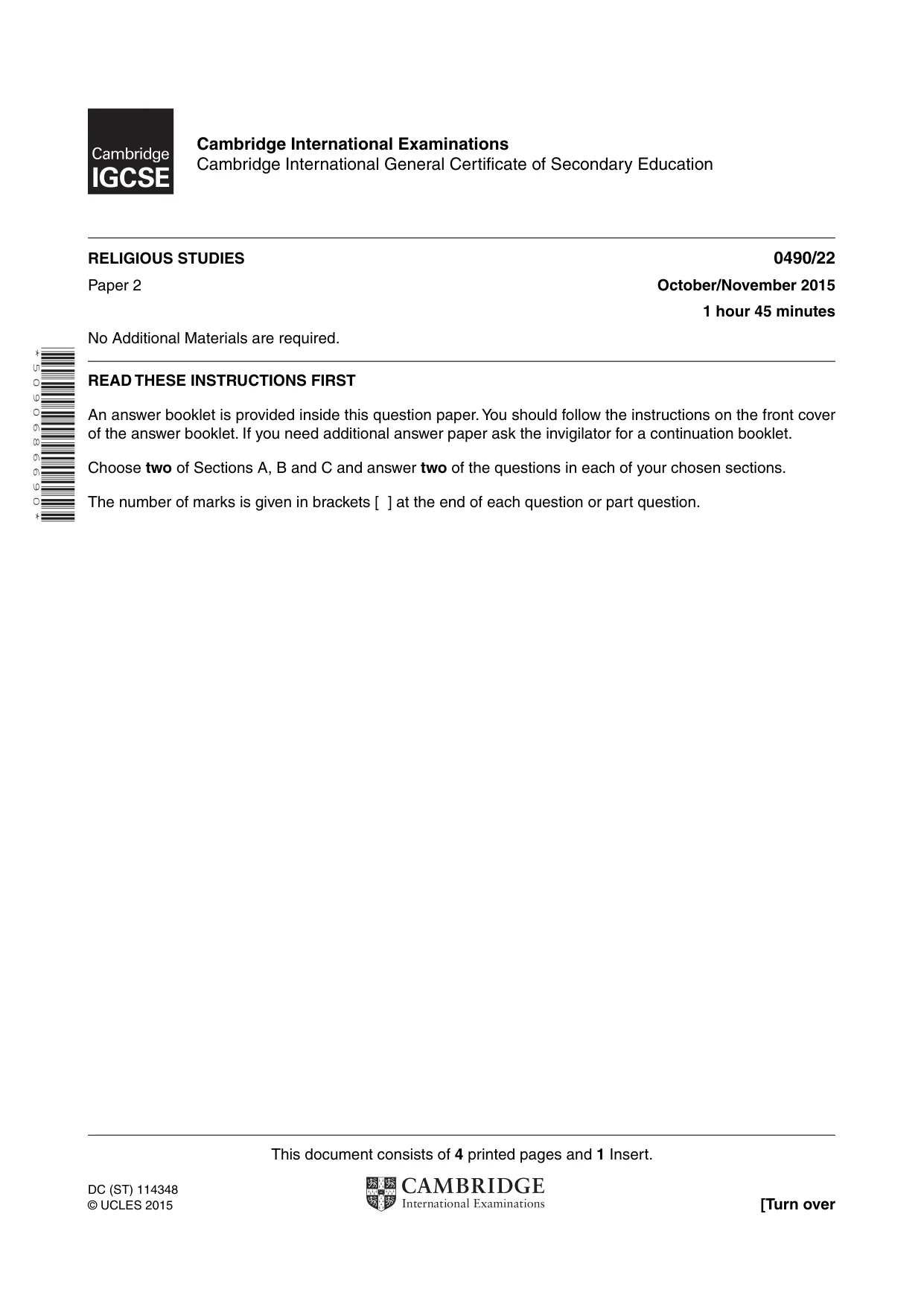
This document consists of 4 printed pages and 1 Insert. DC (ST) 114348 © UCLES 2015 [Turn over Cambridge International Examinations Cambridge International General Certificate of Secondary Education * 5 0 9 0 6 8 6 6 9 0 * RELIGIOUS STUDIES 0490/22 Paper 2 October/November 2015 1 hour 45 minutes No Additional Materials are required. READ THESE INSTRUCTIONS FIRST An answer booklet is provided inside this question paper. You should follow the instructions on the front cover of the answer booklet. If you need additional answer paper ask the invigilator for a continuation booklet. Choose two of Sections A, B and C and answer two of the questions in each of your chosen sections. The number of marks is given in brackets [ ] at the end of each question or part question.
Question paper, page 2
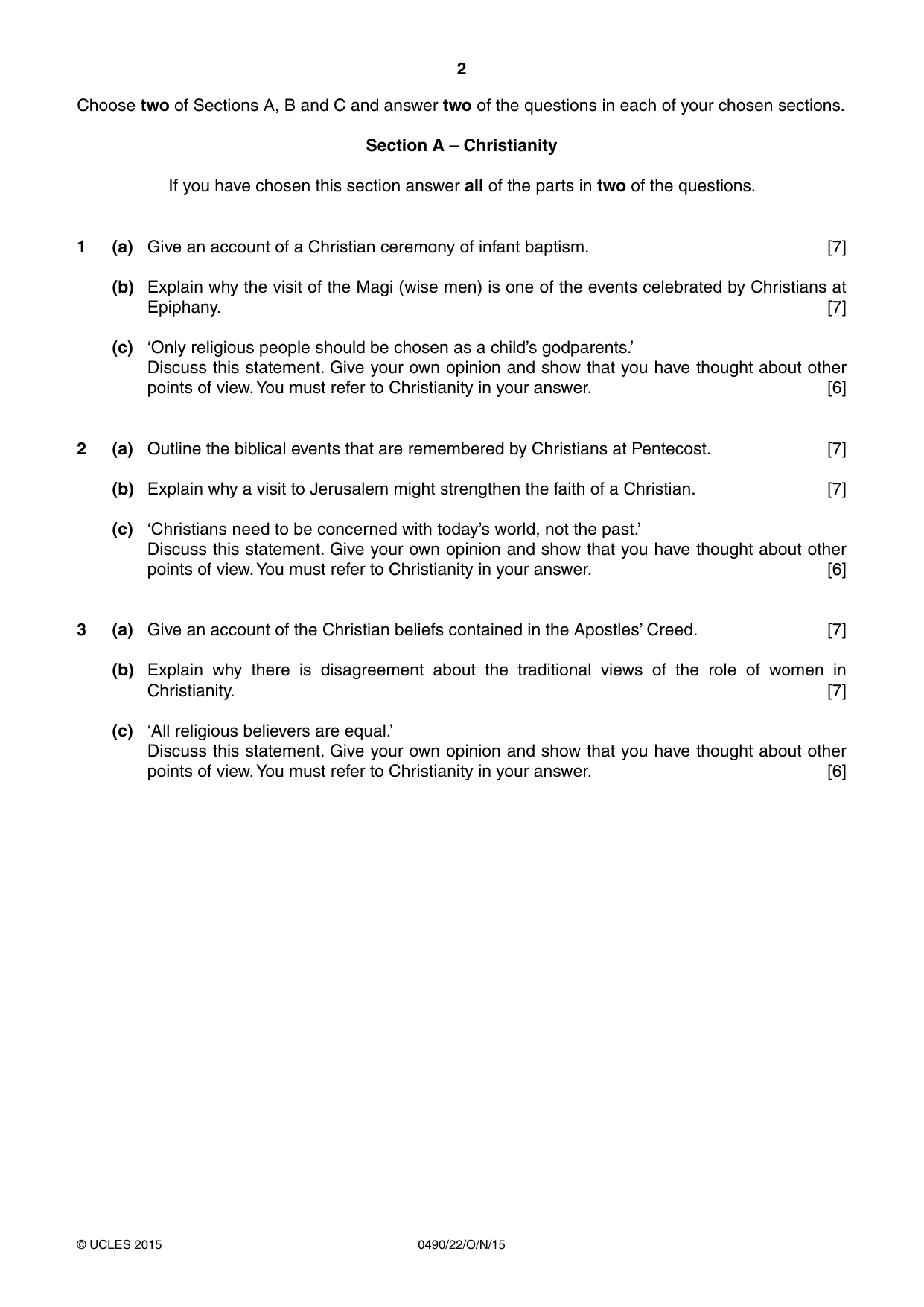
2 0490/22/O/N/15 © UCLES 2015 Choose two of Sections A, B and C and answer two of the questions in each of your chosen sections. Section A – Christianity If you have chosen this section answer all of the parts in two of the questions. 1 (a) Give an account of a Christian ceremony of infant baptism. [7] (b) Explain why the visit of the Magi (wise men) is one of the events celebrated by Christians at Epiphany. [7] (c) ‘Only religious people should be chosen as a child’s godparents.’ Discuss this statement. Give your own opinion and show that you have thought about other points of view. You must refer to Christianity in your answer. [6] 2 (a) Outline the biblical events that are remembered by Christians at Pentecost. [7] (b) Explain why a visit to Jerusalem might strengthen the faith of a Christian. [7] (c) ‘Christians need to be concerned with today’s world, not the past.’ Discuss this statement. Give your own opinion and show that you have thought about other points of view. You must refer to Christianity in your answer. [6] 3 (a) Give an account of the Christian beliefs contained in the Apostles’ Creed. [7] (b) Explain why there is disagreement about the traditional views of the role of women in Christianity. [7] (c) ‘All religious believers are equal.’ Discuss this statement. Give your own opinion and show that you have thought about other points of view. You must refer to Christianity in your answer. [6]
Question paper, page 3
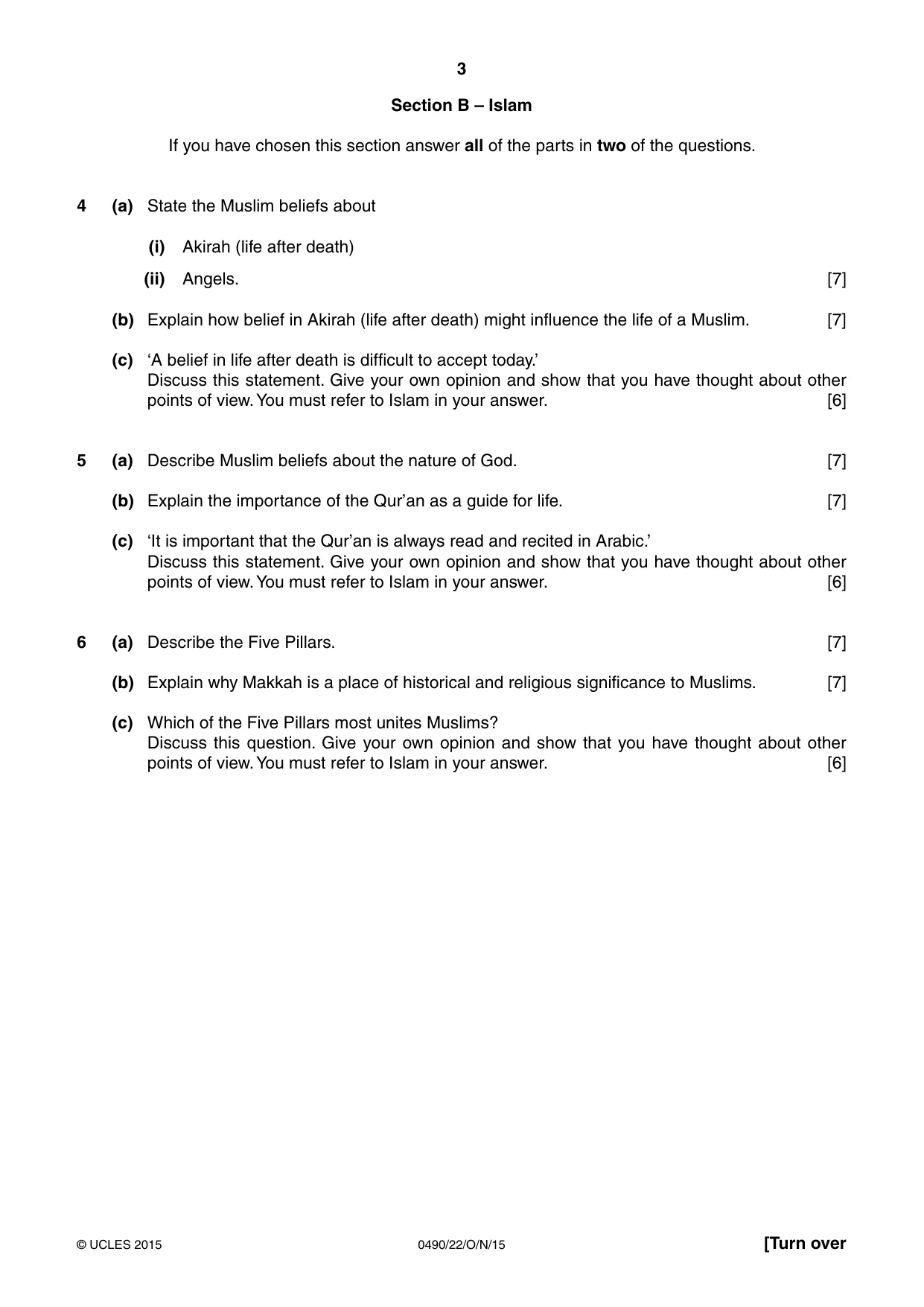
3 0490/22/O/N/15 © UCLES 2015 [Turn over Section B – Islam If you have chosen this section answer all of the parts in two of the questions. 4 (a) State the Muslim beliefs about (i) Akirah (life after death) (ii) Angels. [7] (b) Explain how belief in Akirah (life after death) might influence the life of a Muslim. [7] (c) ‘A belief in life after death is difficult to accept today.’ Discuss this statement. Give your own opinion and show that you have thought about other points of view. You must refer to Islam in your answer. [6] 5 (a) Describe Muslim beliefs about the nature of God. [7] (b) Explain the importance of the Qur’an as a guide for life. [7] (c) ‘It is important that the Qur’an is always read and recited in Arabic.’ Discuss this statement. Give your own opinion and show that you have thought about other points of view. You must refer to Islam in your answer. [6] 6 (a) Describe the Five Pillars. [7] (b) Explain why Makkah is a place of historical and religious significance to Muslims. [7] (c) Which of the Five Pillars most unites Muslims? Discuss this question. Give your own opinion and show that you have thought about other points of view. You must refer to Islam in your answer. [6]
Question paper, page 4
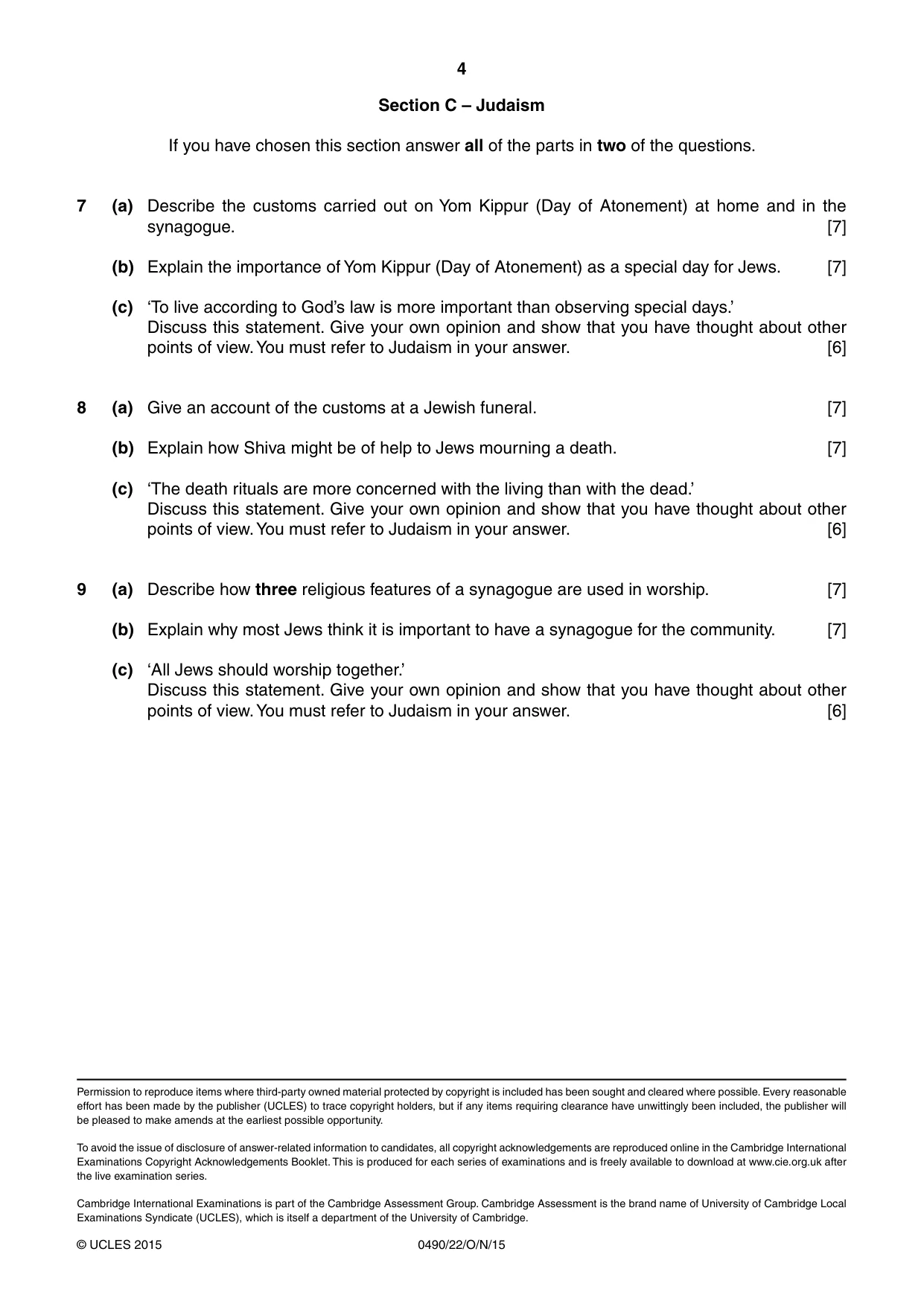
4 0490/22/O/N/15 © UCLES 2015 Section C – Judaism If you have chosen this section answer all of the parts in two of the questions. 7 (a) Describe the customs carried out on Yom Kippur (Day of Atonement) at home and in the synagogue. [7] (b) Explain the importance of Yom Kippur (Day of Atonement) as a special day for Jews. [7] (c) ‘To live according to God’s law is more important than observing special days.’ Discuss this statement. Give your own opinion and show that you have thought about other points of view. You must refer to Judaism in your answer. [6] 8 (a) Give an account of the customs at a Jewish funeral. [7] (b) Explain how Shiva might be of help to Jews mourning a death. [7] (c) ‘The death rituals are more concerned with the living than with the dead.’ Discuss this statement. Give your own opinion and show that you have thought about other points of view. You must refer to Judaism in your answer. [6] 9 (a) Describe how three religious features of a synagogue are used in worship. [7] (b) Explain why most Jews think it is important to have a synagogue for the community. [7] (c) ‘All Jews should worship together.’ Discuss this statement. Give your own opinion and show that you have thought about other points of view. You must refer to Judaism in your answer. [6] Permission to reproduce items where third-party owned material protected by copyright is included has been sought and cleared where possible. Every reasonable effort has been made by the publisher (UCLES) to trace copyright holders, but if any items requiring clearance have unwittingly been included, the publisher will be pleased to make amends at the earliest possible opportunity. To avoid the issue of disclosure of answer-related information to candidates, all copyright acknowledgements are reproduced online in the Cambridge International Examinations Copyright Acknowledgements Booklet. This is produced for each series of examinations and is freely available to download at www.cie.org.uk after the live examination series. Cambridge International Examinations is part of the Cambridge Assessment Group. Cambridge Assessment is the brand name of University of Cambridge Local Examinations Syndicate (UCLES), which is itself a department of the University of Cambridge.
Mark scheme, page 1
® IGCSE is the registered trademark of Cambridge International Examinations. CAMBRIDGE INTERNATIONAL EXAMINATIONS Cambridge International General Certificate of Secondary Education MARK SCHEME for the October/November 2015 series 0490 RELIGIOUS STUDIES 0490/22 Paper 2, maximum raw mark 80 This mark scheme is published as an aid to teachers and candidates, to indicate the requirements of the examination. It shows the basis on which Examiners were instructed to award marks. It does not indicate the details of the discussions that took place at an Examiners’ meeting before marking began, which would have considered the acceptability of alternative answers. Mark schemes should be read in conjunction with the question paper and the Principal Examiner Report for Teachers. Cambridge will not enter into discussions about these mark schemes. Cambridge is publishing the mark schemes for the October/November 2015 series for most Cambridge IGCSE®, Cambridge International A and AS Level components and some Cambridge O Level components.
Mark scheme, page 2
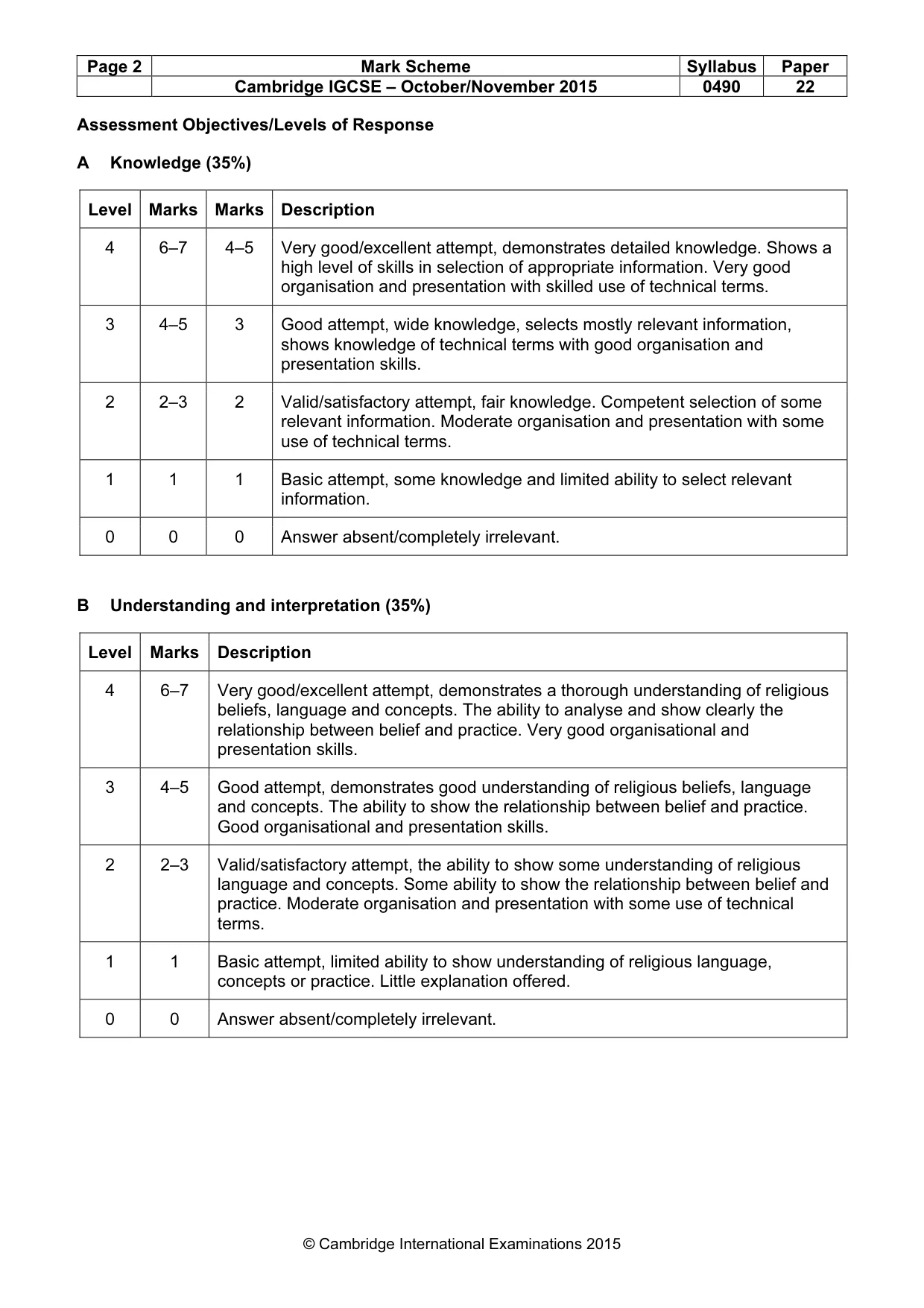
Page 2 Mark Scheme Syllabus Paper Cambridge IGCSE – October/November 2015 0490 22 © Cambridge International Examinations 2015 Assessment Objectives/Levels of Response A Knowledge (35%) Level Marks Marks Description 4 6–7 4–5 Very good/excellent attempt, demonstrates detailed knowledge. Shows a high level of skills in selection of appropriate information. Very good organisation and presentation with skilled use of technical terms. 3 4–5 3 Good attempt, wide knowledge, selects mostly relevant information, shows knowledge of technical terms with good organisation and presentation skills. 2 2–3 2 Valid/satisfactory attempt, fair knowledge. Competent selection of some relevant information. Moderate organisation and presentation with some use of technical terms. 1 1 1 Basic attempt, some knowledge and limited ability to select relevant information. 0 0 0 Answer absent/completely irrelevant. B Understanding and interpretation (35%) Level Marks Description 4 6–7 Very good/excellent attempt, demonstrates a thorough understanding of religious beliefs, language and concepts. The ability to analyse and show clearly the relationship between belief and practice. Very good organisational and presentation skills. 3 4–5 Good attempt, demonstrates good understanding of religious beliefs, language and concepts. The ability to show the relationship between belief and practice. Good organisational and presentation skills. 2 2–3 Valid/satisfactory attempt, the ability to show some understanding of religious language and concepts. Some ability to show the relationship between belief and practice. Moderate organisation and presentation with some use of technical terms. 1 1 Basic attempt, limited ability to show understanding of religious language, concepts or practice. Little explanation offered. 0 0 Answer absent/completely irrelevant.
Mark scheme, page 3
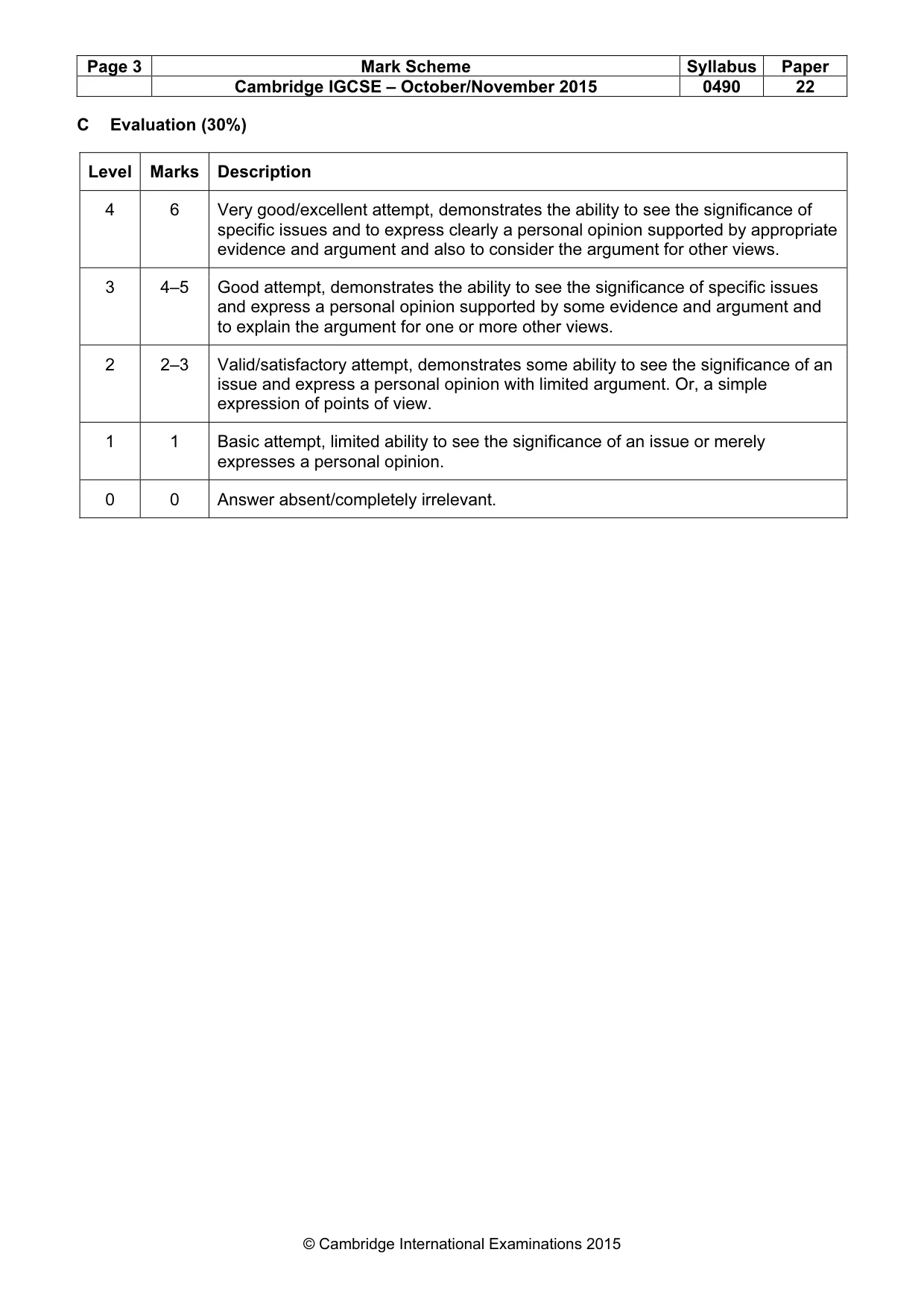
Page 3 Mark Scheme Syllabus Paper Cambridge IGCSE – October/November 2015 0490 22 © Cambridge International Examinations 2015 C Evaluation (30%) Level Marks Description 4 6 Very good/excellent attempt, demonstrates the ability to see the significance of specific issues and to express clearly a personal opinion supported by appropriate evidence and argument and also to consider the argument for other views. 3 4–5 Good attempt, demonstrates the ability to see the significance of specific issues and express a personal opinion supported by some evidence and argument and to explain the argument for one or more other views. 2 2–3 Valid/satisfactory attempt, demonstrates some ability to see the significance of an issue and express a personal opinion with limited argument. Or, a simple expression of points of view. 1 1 Basic attempt, limited ability to see the significance of an issue or merely expresses a personal opinion. 0 0 Answer absent/completely irrelevant.
Mark scheme, page 4
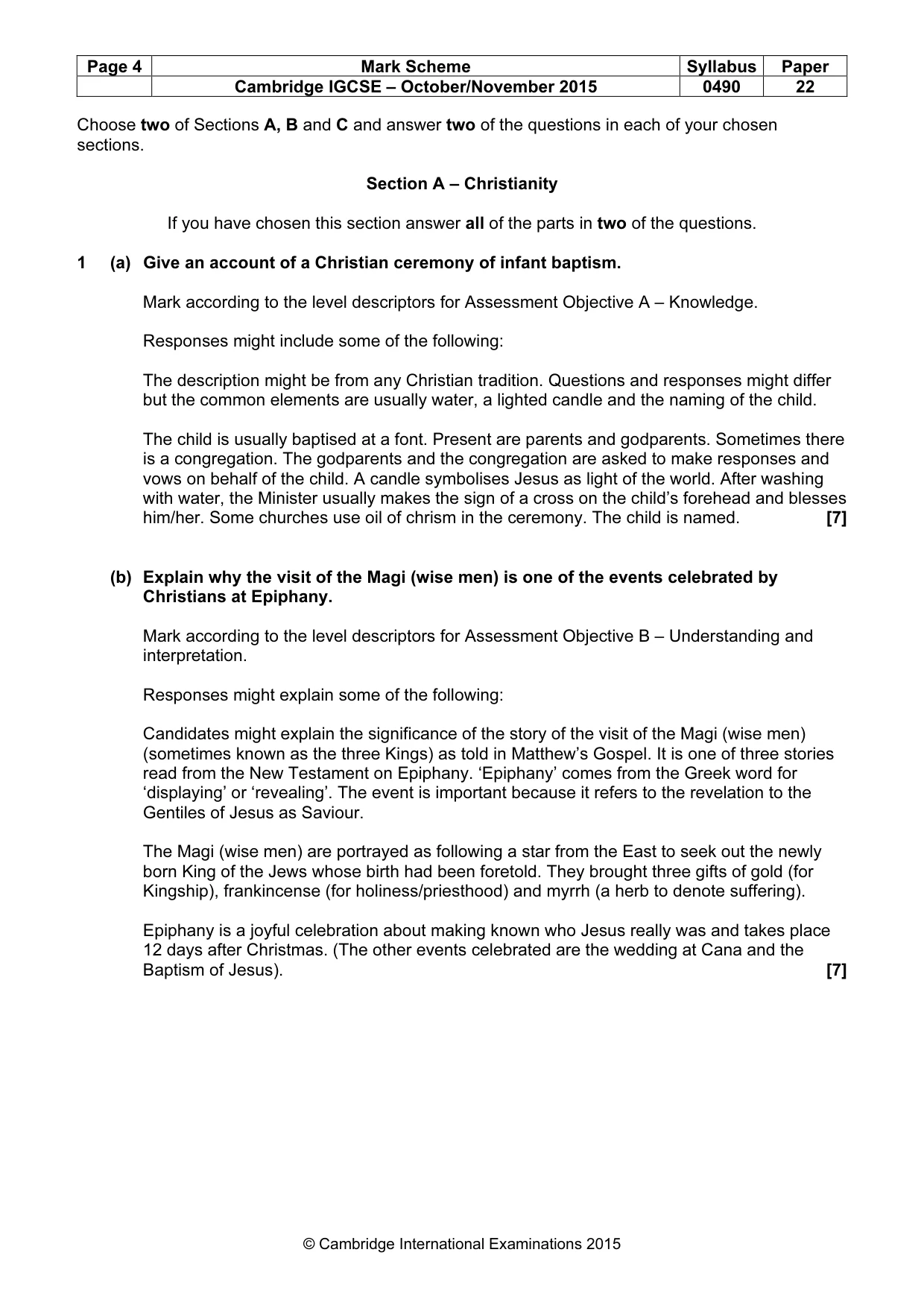
Page 4 Mark Scheme Syllabus Paper Cambridge IGCSE – October/November 2015 0490 22 © Cambridge International Examinations 2015 Choose two of Sections A, B and C and answer two of the questions in each of your chosen sections. Section A – Christianity If you have chosen this section answer all of the parts in two of the questions. 1 (a) Give an account of a Christian ceremony of infant baptism. Mark according to the level descriptors for Assessment Objective A – Knowledge. Responses might include some of the following: The description might be from any Christian tradition. Questions and responses might differ but the common elements are usually water, a lighted candle and the naming of the child. The child is usually baptised at a font. Present are parents and godparents. Sometimes there is a congregation. The godparents and the congregation are asked to make responses and vows on behalf of the child. A candle symbolises Jesus as light of the world. After washing with water, the Minister usually makes the sign of a cross on the child’s forehead and blesses him/her. Some churches use oil of chrism in the ceremony. The child is named. [7] (b) Explain why the visit of the Magi (wise men) is one of the events celebrated by Christians at Epiphany. Mark according to the level descriptors for Assessment Objective B – Understanding and interpretation. Responses might explain some of the following: Candidates might explain the significance of the story of the visit of the Magi (wise men) (sometimes known as the three Kings) as told in Matthew’s Gospel. It is one of three stories read from the New Testament on Epiphany. ‘Epiphany’ comes from the Greek word for ‘displaying’ or ‘revealing’. The event is important because it refers to the revelation to the Gentiles of Jesus as Saviour. The Magi (wise men) are portrayed as following a star from the East to seek out the newly born King of the Jews whose birth had been foretold. They brought three gifts of gold (for Kingship), frankincense (for holiness/priesthood) and myrrh (a herb to denote suffering). Epiphany is a joyful celebration about making known who Jesus really was and takes place 12 days after Christmas. (The other events celebrated are the wedding at Cana and the Baptism of Jesus). [7]
Mark scheme, page 5
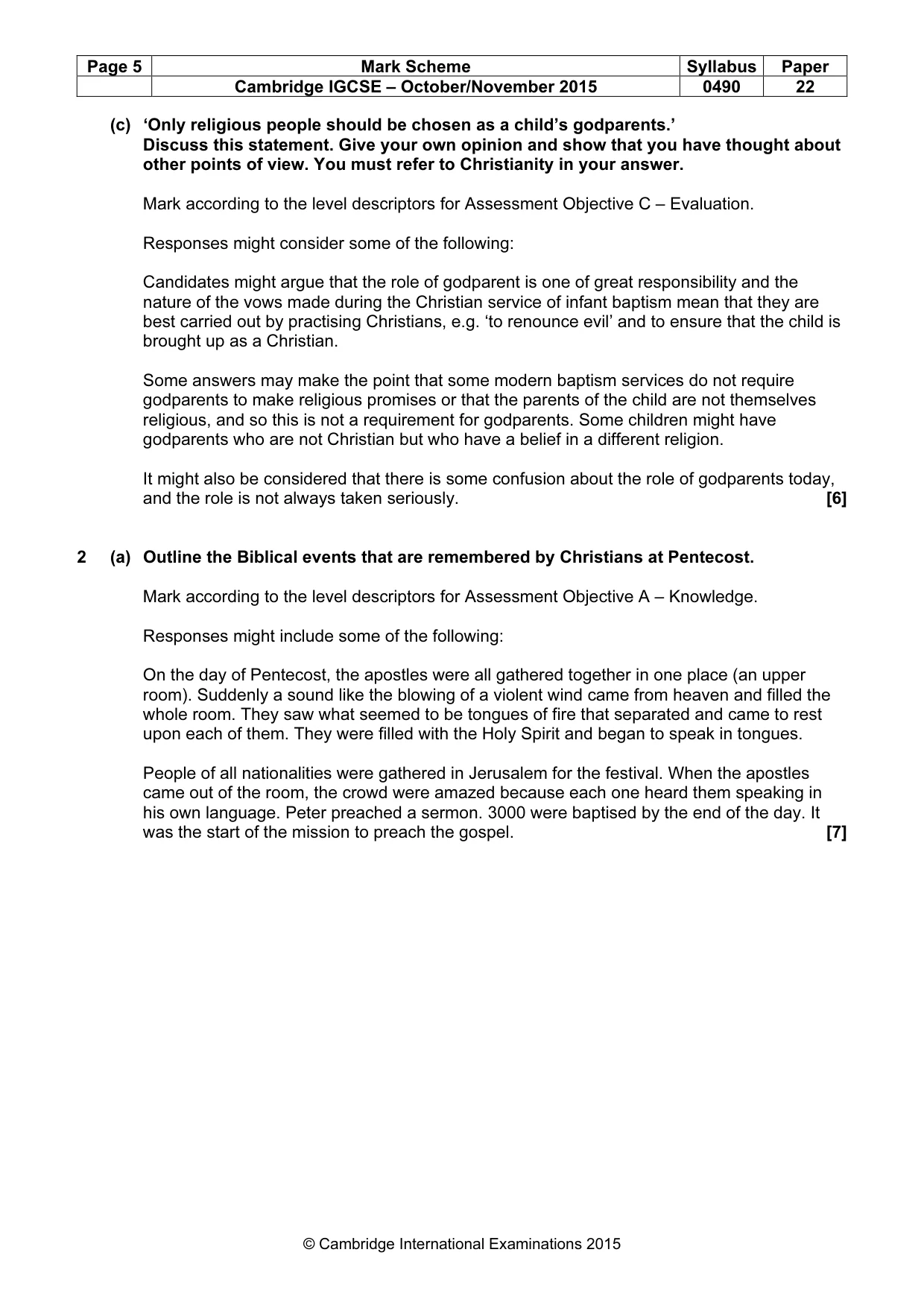
Page 5 Mark Scheme Syllabus Paper Cambridge IGCSE – October/November 2015 0490 22 © Cambridge International Examinations 2015 (c) ‘Only religious people should be chosen as a child’s godparents.’ Discuss this statement. Give your own opinion and show that you have thought about other points of view. You must refer to Christianity in your answer. Mark according to the level descriptors for Assessment Objective C – Evaluation. Responses might consider some of the following: Candidates might argue that the role of godparent is one of great responsibility and the nature of the vows made during the Christian service of infant baptism mean that they are best carried out by practising Christians, e.g. ‘to renounce evil’ and to ensure that the child is brought up as a Christian. Some answers may make the point that some modern baptism services do not require godparents to make religious promises or that the parents of the child are not themselves religious, and so this is not a requirement for godparents. Some children might have godparents who are not Christian but who have a belief in a different religion. It might also be considered that there is some confusion about the role of godparents today, and the role is not always taken seriously. [6] 2 (a) Outline the Biblical events that are remembered by Christians at Pentecost. Mark according to the level descriptors for Assessment Objective A – Knowledge. Responses might include some of the following: On the day of Pentecost, the apostles were all gathered together in one place (an upper room). Suddenly a sound like the blowing of a violent wind came from heaven and filled the whole room. They saw what seemed to be tongues of fire that separated and came to rest upon each of them. They were filled with the Holy Spirit and began to speak in tongues. People of all nationalities were gathered in Jerusalem for the festival. When the apostles came out of the room, the crowd were amazed because each one heard them speaking in his own language. Peter preached a sermon. 3000 were baptised by the end of the day. It was the start of the mission to preach the gospel. [7]
Mark scheme, page 6
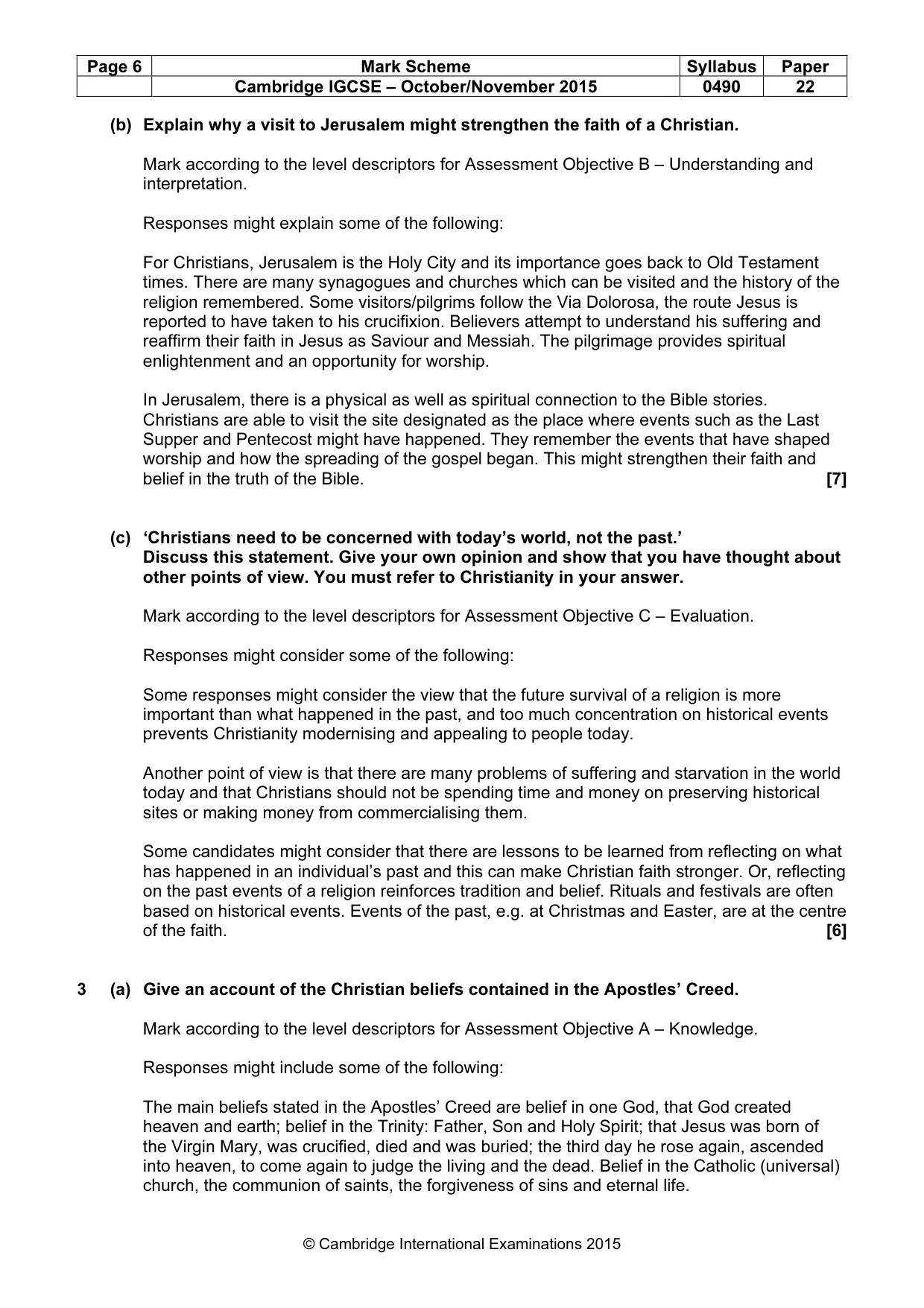
Page 6 Mark Scheme Syllabus Paper Cambridge IGCSE – October/November 2015 0490 22 © Cambridge International Examinations 2015 (b) Explain why a visit to Jerusalem might strengthen the faith of a Christian. Mark according to the level descriptors for Assessment Objective B – Understanding and interpretation. Responses might explain some of the following: For Christians, Jerusalem is the Holy City and its importance goes back to Old Testament times. There are many synagogues and churches which can be visited and the history of the religion remembered. Some visitors/pilgrims follow the Via Dolorosa, the route Jesus is reported to have taken to his crucifixion. Believers attempt to understand his suffering and reaffirm their faith in Jesus as Saviour and Messiah. The pilgrimage provides spiritual enlightenment and an opportunity for worship. In Jerusalem, there is a physical as well as spiritual connection to the Bible stories. Christians are able to visit the site designated as the place where events such as the Last Supper and Pentecost might have happened. They remember the events that have shaped worship and how the spreading of the gospel began. This might strengthen their faith and belief in the truth of the Bible. [7] (c) ‘Christians need to be concerned with today’s world, not the past.’ Discuss this statement. Give your own opinion and show that you have thought about other points of view. You must refer to Christianity in your answer. Mark according to the level descriptors for Assessment Objective C – Evaluation. Responses might consider some of the following: Some responses might consider the view that the future survival of a religion is more important than what happened in the past, and too much concentration on historical events prevents Christianity modernising and appealing to people today. Another point of view is that there are many problems of suffering and starvation in the world today and that Christians should not be spending time and money on preserving historical sites or making money from commercialising them. Some candidates might consider that there are lessons to be learned from reflecting on what has happened in an individual’s past and this can make Christian faith stronger. Or, reflecting on the past events of a religion reinforces tradition and belief. Rituals and festivals are often based on historical events. Events of the past, e.g. at Christmas and Easter, are at the centre of the faith. [6] 3 (a) Give an account of the Christian beliefs contained in the Apostles’ Creed. Mark according to the level descriptors for Assessment Objective A – Knowledge. Responses might include some of the following: The main beliefs stated in the Apostles’ Creed are belief in one God, that God created heaven and earth; belief in the Trinity: Father, Son and Holy Spirit; that Jesus was born of the Virgin Mary, was crucified, died and was buried; the third day he rose again, ascended into heaven, to come again to judge the living and the dead. Belief in the Catholic (universal) church, the communion of saints, the forgiveness of sins and eternal life.
Mark scheme, page 7
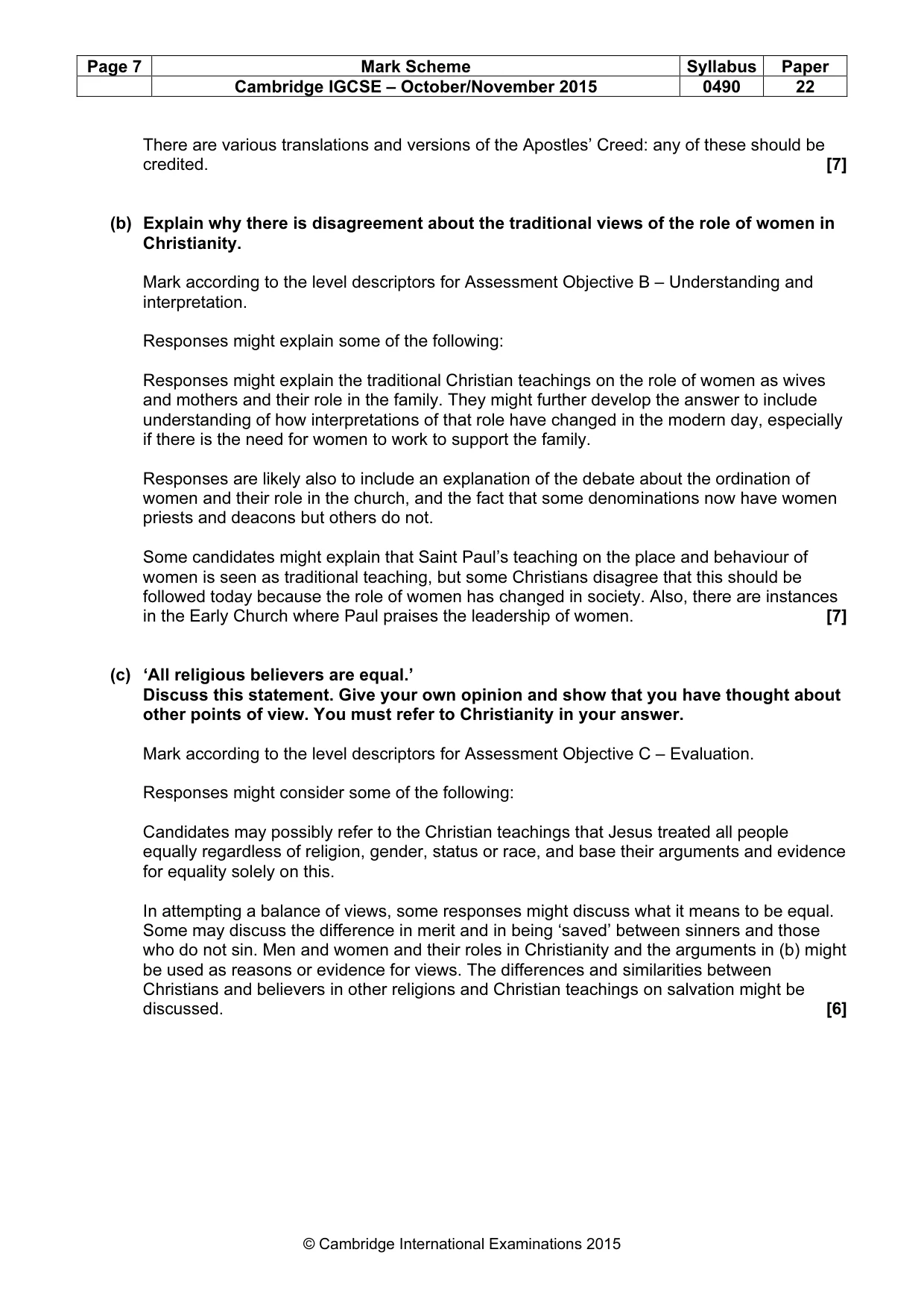
Page 7 Mark Scheme Syllabus Paper Cambridge IGCSE – October/November 2015 0490 22 © Cambridge International Examinations 2015 There are various translations and versions of the Apostles’ Creed: any of these should be credited. [7] (b) Explain why there is disagreement about the traditional views of the role of women in Christianity. Mark according to the level descriptors for Assessment Objective B – Understanding and interpretation. Responses might explain some of the following: Responses might explain the traditional Christian teachings on the role of women as wives and mothers and their role in the family. They might further develop the answer to include understanding of how interpretations of that role have changed in the modern day, especially if there is the need for women to work to support the family. Responses are likely also to include an explanation of the debate about the ordination of women and their role in the church, and the fact that some denominations now have women priests and deacons but others do not. Some candidates might explain that Saint Paul’s teaching on the place and behaviour of women is seen as traditional teaching, but some Christians disagree that this should be followed today because the role of women has changed in society. Also, there are instances in the Early Church where Paul praises the leadership of women. [7] (c) ‘All religious believers are equal.’ Discuss this statement. Give your own opinion and show that you have thought about other points of view. You must refer to Christianity in your answer. Mark according to the level descriptors for Assessment Objective C – Evaluation. Responses might consider some of the following: Candidates may possibly refer to the Christian teachings that Jesus treated all people equally regardless of religion, gender, status or race, and base their arguments and evidence for equality solely on this. In attempting a balance of views, some responses might discuss what it means to be equal. Some may discuss the difference in merit and in being ‘saved’ between sinners and those who do not sin. Men and women and their roles in Christianity and the arguments in (b) might be used as reasons or evidence for views. The differences and similarities between Christians and believers in other religions and Christian teachings on salvation might be discussed. [6]
Mark scheme, page 8
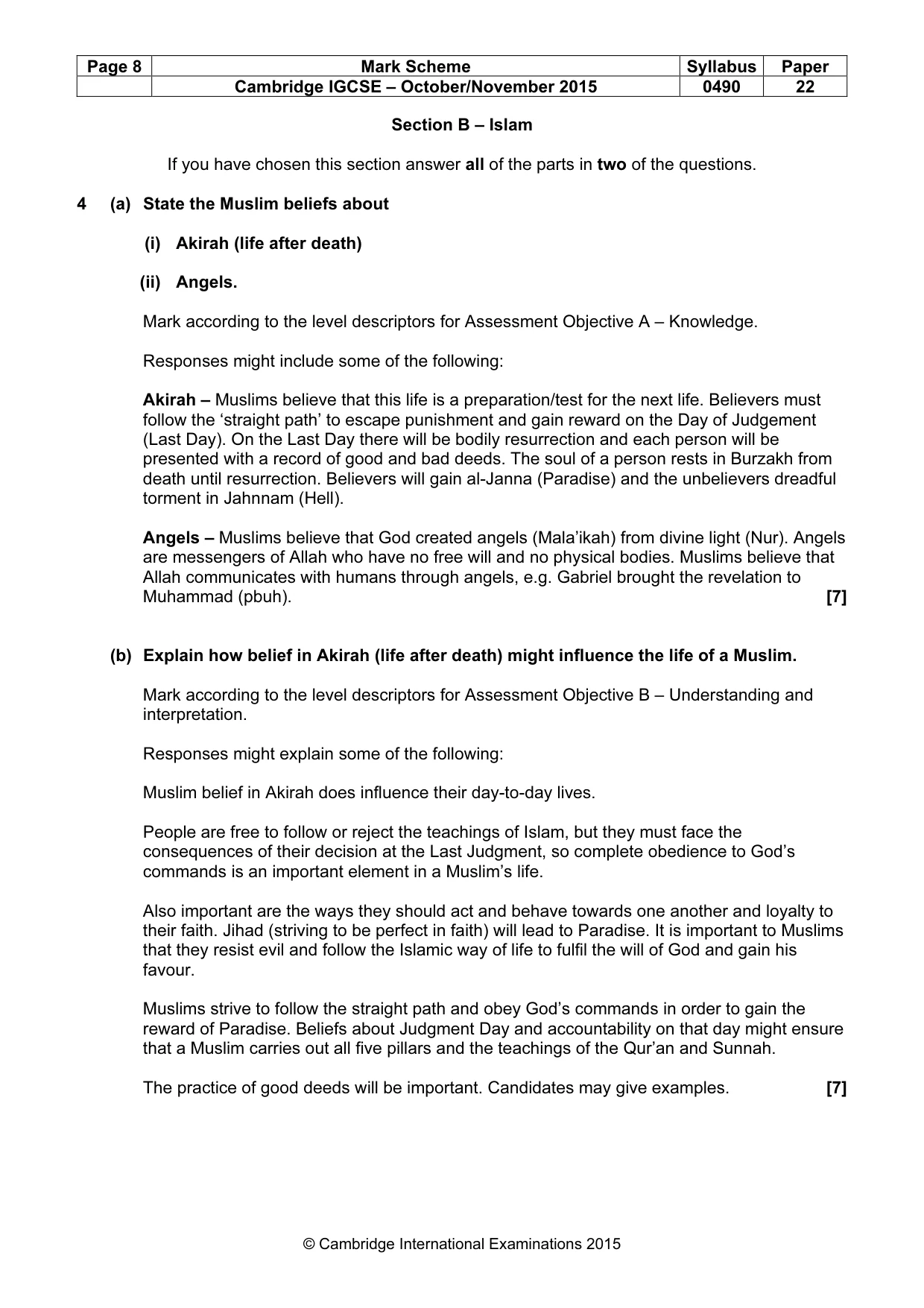
Page 8 Mark Scheme Syllabus Paper Cambridge IGCSE – October/November 2015 0490 22 © Cambridge International Examinations 2015 Section B – Islam If you have chosen this section answer all of the parts in two of the questions. 4 (a) State the Muslim beliefs about (i) Akirah (life after death) (ii) Angels. Mark according to the level descriptors for Assessment Objective A – Knowledge. Responses might include some of the following: Akirah – Muslims believe that this life is a preparation/test for the next life. Believers must follow the ‘straight path’ to escape punishment and gain reward on the Day of Judgement (Last Day). On the Last Day there will be bodily resurrection and each person will be presented with a record of good and bad deeds. The soul of a person rests in Burzakh from death until resurrection. Believers will gain al-Janna (Paradise) and the unbelievers dreadful torment in Jahnnam (Hell). Angels – Muslims believe that God created angels (Mala’ikah) from divine light (Nur). Angels are messengers of Allah who have no free will and no physical bodies. Muslims believe that Allah communicates with humans through angels, e.g. Gabriel brought the revelation to Muhammad (pbuh). [7] (b) Explain how belief in Akirah (life after death) might influence the life of a Muslim. Mark according to the level descriptors for Assessment Objective B – Understanding and interpretation. Responses might explain some of the following: Muslim belief in Akirah does influence their day-to-day lives. People are free to follow or reject the teachings of Islam, but they must face the consequences of their decision at the Last Judgment, so complete obedience to God’s commands is an important element in a Muslim’s life. Also important are the ways they should act and behave towards one another and loyalty to their faith. Jihad (striving to be perfect in faith) will lead to Paradise. It is important to Muslims that they resist evil and follow the Islamic way of life to fulfil the will of God and gain his favour. Muslims strive to follow the straight path and obey God’s commands in order to gain the reward of Paradise. Beliefs about Judgment Day and accountability on that day might ensure that a Muslim carries out all five pillars and the teachings of the Qur’an and Sunnah. The practice of good deeds will be important. Candidates may give examples. [7]
Mark scheme, page 9
Page 9 Mark Scheme Syllabus Paper Cambridge IGCSE – October/November 2015 0490 22 © Cambridge International Examinations 2015 (c) ‘A belief in life after death is difficult to accept today.’ Discuss this statement. Give your own opinion and show that you have thought about other points of view. You must refer to Islam in your answer. Mark according to the level descriptors for Assessment Objective C – Evaluation. Responses might consider some of the following: Most candidates are likely to argue that for believers (Muslims) belief in life after death is as important today as at any other time. It is an essential part of the religion and it influences morals and the way a Muslim conducts their life. Some may argue that belief in the Last Day and accountability before God resulting in reward or punishment are essential to faith; the afterlife is beyond human imagination. Examples of literal belief might be given, e.g. the Jihadist belief in Paradise as a reward for martyrdom. An alternative view might be that scientific and medical advances and increased knowledge today support the argument that religious concepts of physical life after death/Paradise are impossible to believe. Some responses might evaluate whether this damages faith or whether it is possible to still be a devout Muslim. [6] 5 (a) Describe Muslim beliefs about the nature of God. Mark according to the level descriptors for Assessment Objective A – Knowledge. Responses might include some of the following: Muslims do not attempt to describe God; they know that God exists through his manifestations and through his divine attributes as told by his messengers. Some of the attributes of God are that he is the sole creator, designer of the universe and master of all. He is infinite and eternal with no beginning and no end. He is all powerful and omnipotent. He is most merciful, most gracious; his mercy extends to all. He is absolute, dependent on nothing but everything is dependent on him. He is Sovereign and ruler of the universe and he sustains all his creation. The principle of Tawhid, the oneness and unity of God, is very important to Muslims and shirk, assigning partners to God, is an unforgiveable sin. No one is worthy of worship but him. The Qur’an has ninety-nine names for God. [7]
Mark scheme, page 10
Page 10 Mark Scheme Syllabus Paper Cambridge IGCSE – October/November 2015 0490 22 © Cambridge International Examinations 2015 (b) Explain the importance of the Qur’an as a guide for life. Mark according to the level descriptors for Assessment Objective B – Understanding and interpretation. Responses might explain some of the following: The Qur’an is the revealed word of God, unchanged and uncorrupted. It is the final revelation and a complete code of life and God has promised to preserve it. The Qur’an contains God’s commands, the Five Pillars, teachings on which the religion is based, the example of the life of Muhammad and the history of the religion. It is a complete book of guidance for Muslims; it covers all aspects of human life. Muslims find the Qur’an relevant and consistent with modern knowledge, ideas and scientific theories. It provides knowledge, learning and understanding as well as spiritual enlightenment. Verses from the Qur’an not only instruct but inspire Muslims. They believe that they should submit to God in response to his message, and the Qur’an shows them how to walk the straight path that will lead to peace in this life and reward in the hereafter. The Qur’an provides answers for a Muslim when he or she needs advice on how to follow the straight path. If they approach the Qur’an prayerfully, they will find a solution or principle from which an answer can be deduced. The Qur’an also gives comfort in times of hardship. Shari’ah law is based upon the Qur’an and it is used in the governing of some Muslim countries. [7] (c) ‘It is important that the Qur’an is always read and recited in Arabic.’ Discuss this statement. Give your own opinion and show that you have thought about other points of view. You must refer to Islam in your answer. Mark according to the level descriptors for Assessment Objective C – Evaluation. Responses might consider some of the following: Discussion in support of the statement might explore the view that reciting/reading the Qur’an in Arabic is not a habit or a ritual but is considered a religious experience. Arabic is the language in which the Qur’an was revealed: the pure Arabic of the revelation is preserved. Arabic is also the first language of many Muslims and it is also the language of worship. Many believe that changes and mistakes might be made in any translation from the original language, so there is a danger of disobeying or misunderstanding God’s word. A version translated into another language is not the Qur’an. However, the Qur’an should be read with heart, soul, mind and body and Muslims are expected to reflect on its teachings. For some Muslims, for whom Arabic is not the first language, a translation of the text is helpful. Some versions have, for example, Arabic and English side by side on the page and do not lessen the dignity of the holy book. [6]
Mark scheme, page 11
Page 11 Mark Scheme Syllabus Paper Cambridge IGCSE – October/November 2015 0490 22 © Cambridge International Examinations 2015 6 (a) Describe the Five Pillars. Mark according to the level descriptors for Assessment Objective A – Knowledge. Responses might include some of the following: The Five Pillars are five basic duties which all Muslims should perform as part of their submission to the will of God. (The Five Pillars are said to support the faith of Islam as pillars support a house.) Shahadah – Declaration of faith. There is no God but Allah and Muhammad (pbuh) is the messenger of Allah. Salah – Compulsory prayers five times a day: Fajr, Zuhr, Asr, Maghrib, ‘Isha. Sawm – Fasting in the month of Ramadan, during the hours of daylight. No food or drink, no sexual intercourse. It is a time of prayer and good deeds. Zakah – Purification of wealth by the payment of annual welfare tax/charity, calculated at 2.5% of surplus income. Hajj – Pilgrimage to Makkah, during the month of Dhul-Hijjah. To be observed at least once in a lifetime by all Muslims who are physically and financially able to make the journey. [7] (b) Explain why Makkah is a place of historical and religious significance to Muslims. Mark according to the level descriptors for Assessment Objective B – Understanding and interpretation. Responses might explain some of the following: Makkah was the birthplace of Muhammad (pbuh) and where he first began preaching Islam. In Pre-Islamic times it was a place of pilgrimage and it has connections with Adam and Abraham. Makkah is important because it is the situation of the Ka’ba, the holiest shrine in Islam. Muslims face the Ka’ba when they pray and are buried with their head facing towards the Ka’ba. The Ka’ba is thought to have been built by Abraham and Ismail, with help from an angel. Muslims believe it stands on the point where God began creating the earth. The Hajj begins in Makkah with the Tawaf of the Ka’ba: the hills of Safa and Marwah are within Makkah and the well of Zamzam – all are important steps in the Hajj. [7]
Mark scheme, page 12
Page 12 Mark Scheme Syllabus Paper Cambridge IGCSE – October/November 2015 0490 22 © Cambridge International Examinations 2015 (c) Which of the Five Pillars most unites Muslims? Discuss this question. Give your own opinion and show that you have thought about other points of view. You must refer to Islam in your answer. Mark according to the level descriptors for Assessment Objective C – Evaluation. Responses might consider some of the following: Candidates might put forward an argument for one or other of the Pillars as being a strong uniting force for all Muslims. Example: Observing Ramadan strengthens the Ummah because it teaches Muslims what it is like to go without food and this encourages them to be generous to the poor. Fasting encourages individual self-discipline and teaches a person not to be greedy or selfish, and this has a good impact on family and on global relationships. During Ramadan, Muslims unite as a community in acts of worship, especially in the last 10 days and on the Night of Power. However, the Five Pillars are believed to support the religion of Islam as pillars support a house. They are important individually but are also interdependent and should be considered as a whole. [6]
Mark scheme, page 13
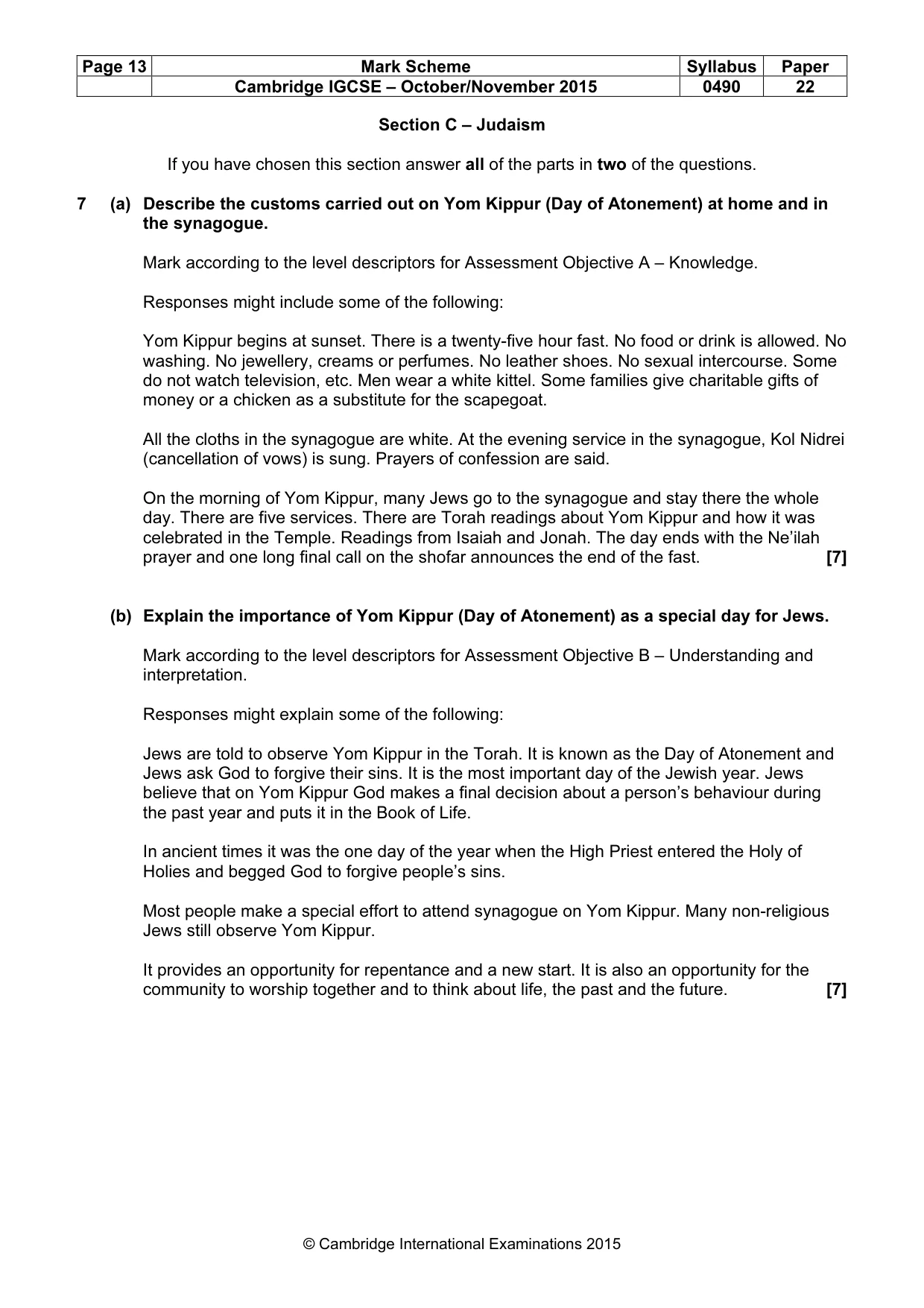
Page 13 Mark Scheme Syllabus Paper Cambridge IGCSE – October/November 2015 0490 22 © Cambridge International Examinations 2015 Section C – Judaism If you have chosen this section answer all of the parts in two of the questions. 7 (a) Describe the customs carried out on Yom Kippur (Day of Atonement) at home and in the synagogue. Mark according to the level descriptors for Assessment Objective A – Knowledge. Responses might include some of the following: Yom Kippur begins at sunset. There is a twenty-five hour fast. No food or drink is allowed. No washing. No jewellery, creams or perfumes. No leather shoes. No sexual intercourse. Some do not watch television, etc. Men wear a white kittel. Some families give charitable gifts of money or a chicken as a substitute for the scapegoat. All the cloths in the synagogue are white. At the evening service in the synagogue, Kol Nidrei (cancellation of vows) is sung. Prayers of confession are said. On the morning of Yom Kippur, many Jews go to the synagogue and stay there the whole day. There are five services. There are Torah readings about Yom Kippur and how it was celebrated in the Temple. Readings from Isaiah and Jonah. The day ends with the Ne’ilah prayer and one long final call on the shofar announces the end of the fast. [7] (b) Explain the importance of Yom Kippur (Day of Atonement) as a special day for Jews. Mark according to the level descriptors for Assessment Objective B – Understanding and interpretation. Responses might explain some of the following: Jews are told to observe Yom Kippur in the Torah. It is known as the Day of Atonement and Jews ask God to forgive their sins. It is the most important day of the Jewish year. Jews believe that on Yom Kippur God makes a final decision about a person’s behaviour during the past year and puts it in the Book of Life. In ancient times it was the one day of the year when the High Priest entered the Holy of Holies and begged God to forgive people’s sins. Most people make a special effort to attend synagogue on Yom Kippur. Many non-religious Jews still observe Yom Kippur. It provides an opportunity for repentance and a new start. It is also an opportunity for the community to worship together and to think about life, the past and the future. [7]
Mark scheme, page 14
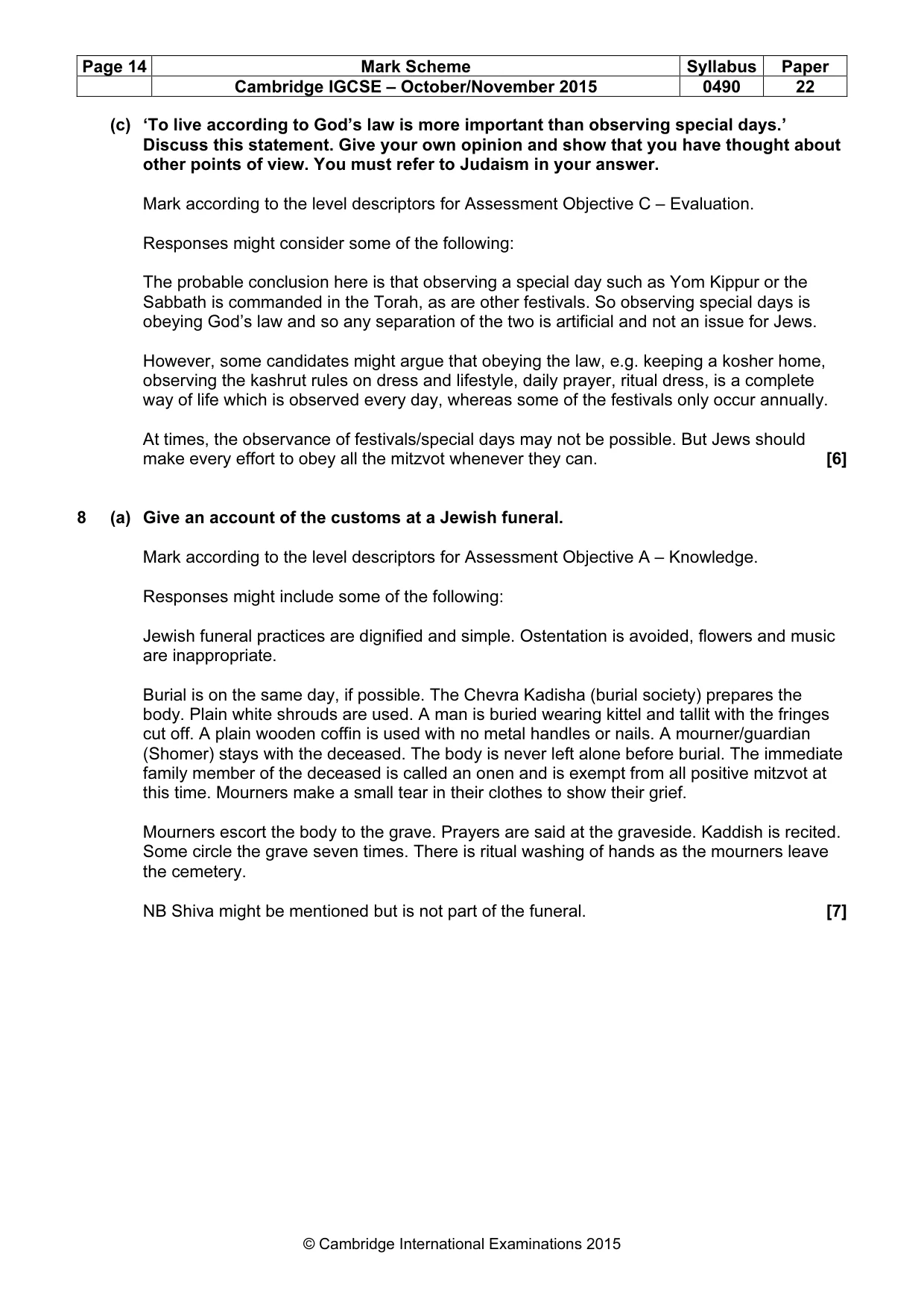
Page 14 Mark Scheme Syllabus Paper Cambridge IGCSE – October/November 2015 0490 22 © Cambridge International Examinations 2015 (c) ‘To live according to God’s law is more important than observing special days.’ Discuss this statement. Give your own opinion and show that you have thought about other points of view. You must refer to Judaism in your answer. Mark according to the level descriptors for Assessment Objective C – Evaluation. Responses might consider some of the following: The probable conclusion here is that observing a special day such as Yom Kippur or the Sabbath is commanded in the Torah, as are other festivals. So observing special days is obeying God’s law and so any separation of the two is artificial and not an issue for Jews. However, some candidates might argue that obeying the law, e.g. keeping a kosher home, observing the kashrut rules on dress and lifestyle, daily prayer, ritual dress, is a complete way of life which is observed every day, whereas some of the festivals only occur annually. At times, the observance of festivals/special days may not be possible. But Jews should make every effort to obey all the mitzvot whenever they can. [6] 8 (a) Give an account of the customs at a Jewish funeral. Mark according to the level descriptors for Assessment Objective A – Knowledge. Responses might include some of the following: Jewish funeral practices are dignified and simple. Ostentation is avoided, flowers and music are inappropriate. Burial is on the same day, if possible. The Chevra Kadisha (burial society) prepares the body. Plain white shrouds are used. A man is buried wearing kittel and tallit with the fringes cut off. A plain wooden coffin is used with no metal handles or nails. A mourner/guardian (Shomer) stays with the deceased. The body is never left alone before burial. The immediate family member of the deceased is called an onen and is exempt from all positive mitzvot at this time. Mourners make a small tear in their clothes to show their grief. Mourners escort the body to the grave. Prayers are said at the graveside. Kaddish is recited. Some circle the grave seven times. There is ritual washing of hands as the mourners leave the cemetery. NB Shiva might be mentioned but is not part of the funeral. [7]
Mark scheme, page 15
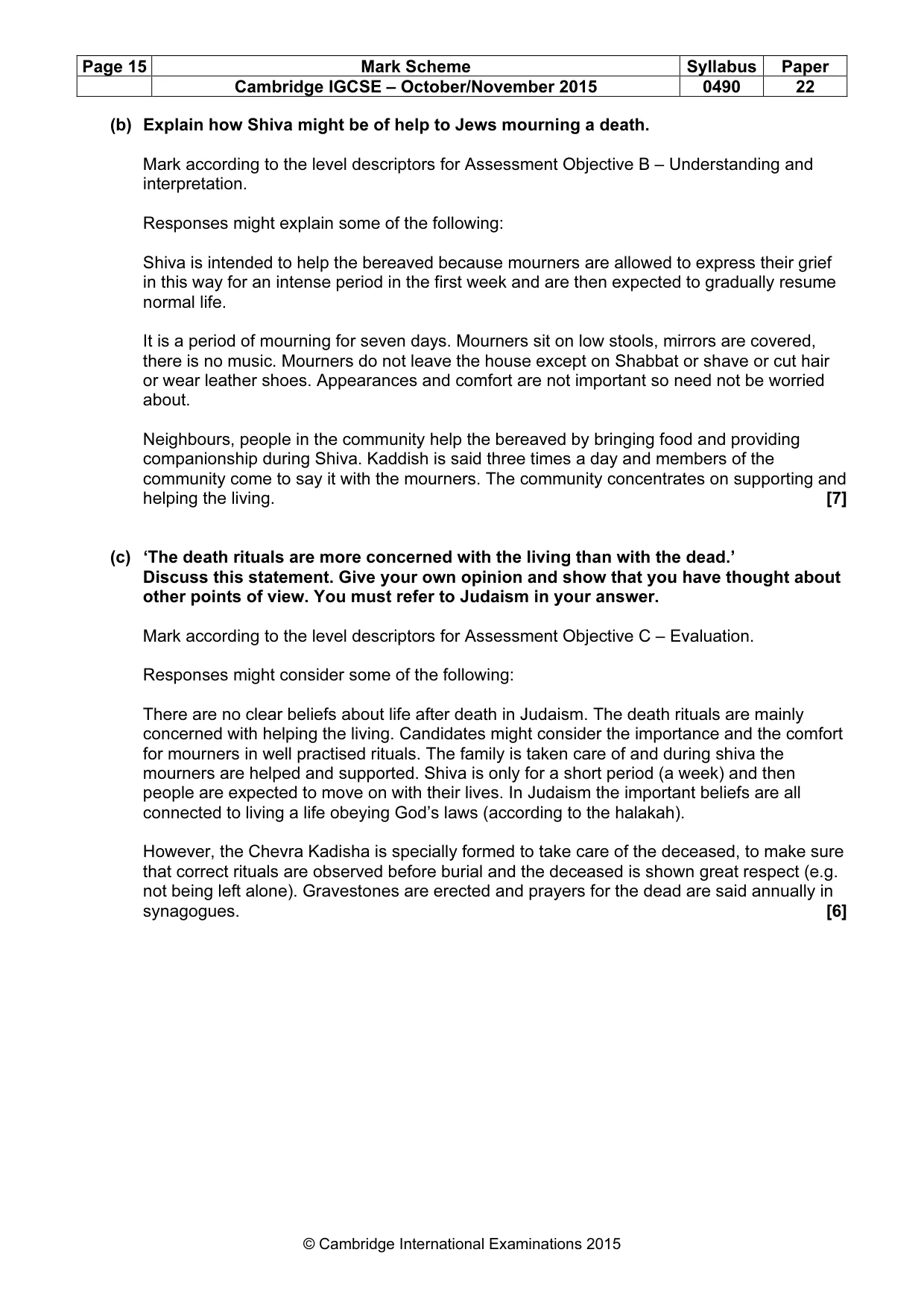
Page 15 Mark Scheme Syllabus Paper Cambridge IGCSE – October/November 2015 0490 22 © Cambridge International Examinations 2015 (b) Explain how Shiva might be of help to Jews mourning a death. Mark according to the level descriptors for Assessment Objective B – Understanding and interpretation. Responses might explain some of the following: Shiva is intended to help the bereaved because mourners are allowed to express their grief in this way for an intense period in the first week and are then expected to gradually resume normal life. It is a period of mourning for seven days. Mourners sit on low stools, mirrors are covered, there is no music. Mourners do not leave the house except on Shabbat or shave or cut hair or wear leather shoes. Appearances and comfort are not important so need not be worried about. Neighbours, people in the community help the bereaved by bringing food and providing companionship during Shiva. Kaddish is said three times a day and members of the community come to say it with the mourners. The community concentrates on supporting and helping the living. [7] (c) ‘The death rituals are more concerned with the living than with the dead.’ Discuss this statement. Give your own opinion and show that you have thought about other points of view. You must refer to Judaism in your answer. Mark according to the level descriptors for Assessment Objective C – Evaluation. Responses might consider some of the following: There are no clear beliefs about life after death in Judaism. The death rituals are mainly concerned with helping the living. Candidates might consider the importance and the comfort for mourners in well practised rituals. The family is taken care of and during shiva the mourners are helped and supported. Shiva is only for a short period (a week) and then people are expected to move on with their lives. In Judaism the important beliefs are all connected to living a life obeying God’s laws (according to the halakah). However, the Chevra Kadisha is specially formed to take care of the deceased, to make sure that correct rituals are observed before burial and the deceased is shown great respect (e.g. not being left alone). Gravestones are erected and prayers for the dead are said annually in synagogues. [6]
Mark scheme, page 16
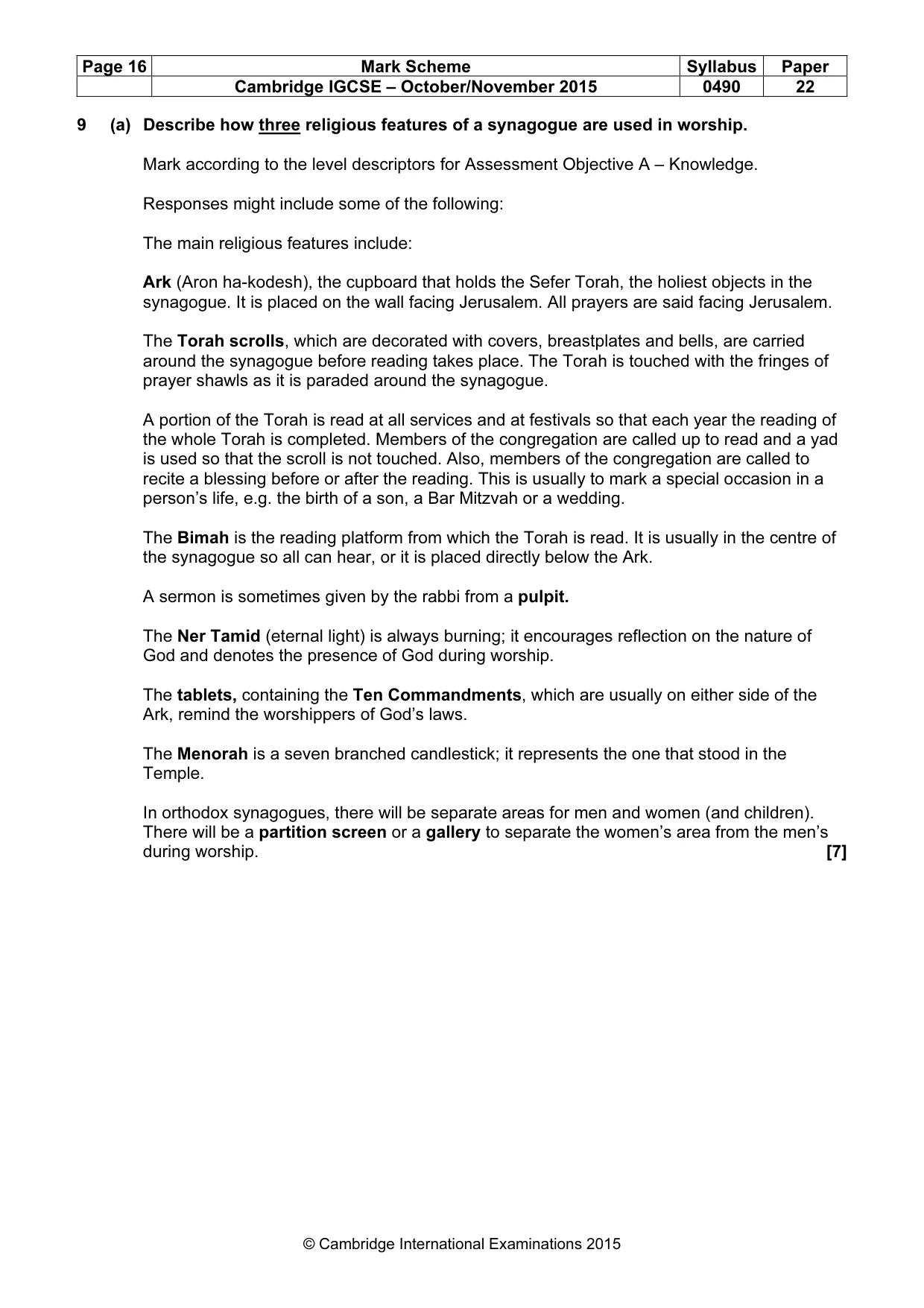
Page 16 Mark Scheme Syllabus Paper Cambridge IGCSE – October/November 2015 0490 22 © Cambridge International Examinations 2015 9 (a) Describe how three religious features of a synagogue are used in worship. Mark according to the level descriptors for Assessment Objective A – Knowledge. Responses might include some of the following: The main religious features include: Ark (Aron ha-kodesh), the cupboard that holds the Sefer Torah, the holiest objects in the synagogue. It is placed on the wall facing Jerusalem. All prayers are said facing Jerusalem. The Torah scrolls, which are decorated with covers, breastplates and bells, are carried around the synagogue before reading takes place. The Torah is touched with the fringes of prayer shawls as it is paraded around the synagogue. A portion of the Torah is read at all services and at festivals so that each year the reading of the whole Torah is completed. Members of the congregation are called up to read and a yad is used so that the scroll is not touched. Also, members of the congregation are called to recite a blessing before or after the reading. This is usually to mark a special occasion in a person’s life, e.g. the birth of a son, a Bar Mitzvah or a wedding. The Bimah is the reading platform from which the Torah is read. It is usually in the centre of the synagogue so all can hear, or it is placed directly below the Ark. A sermon is sometimes given by the rabbi from a pulpit. The Ner Tamid (eternal light) is always burning; it encourages reflection on the nature of God and denotes the presence of God during worship. The tablets, containing the Ten Commandments, which are usually on either side of the Ark, remind the worshippers of God’s laws. The Menorah is a seven branched candlestick; it represents the one that stood in the Temple. In orthodox synagogues, there will be separate areas for men and women (and children). There will be a partition screen or a gallery to separate the women’s area from the men’s during worship. [7]
Mark scheme, page 17
Page 17 Mark Scheme Syllabus Paper Cambridge IGCSE – October/November 2015 0490 22 © Cambridge International Examinations 2015 (b) Explain why most Jews think it is important to have a synagogue for the community. Mark according to the level descriptors for Assessment Objective B – Understanding and interpretation. Responses might explain some of the following: The synagogue has many community functions as well as being a place for worship. It brings the community together and strengthens it. The synagogue reinforces Jewish religious and social life. As well as daily services and festivals, there are Torah readings and rites of passage occur. Learning takes place; it gives people the opportunity to study Torah – children are taught Hebrew, Bar Mitzvah classes are held. There are community rooms for functions, meetings and hospitality to travellers. Many Jews believe the synagogue should be built within walking distance for most of the community to enable the Sabbath Law to be observed. The existence of a synagogue ensures that all Jews are part of a tight knit community and makes it easier for Jews to obey the commands in the Torah. The Rabbi and the Beth Din offer advice and rulings on disputes and kashrut. Most synagogues have a mikveh, which enables purity laws to be observed. [7] (c) ‘All Jews should worship together.’ Discuss this statement. Give your own opinion and show that you have thought about other points of view. You must refer to Judaism in your answer. Mark according to the level descriptors for Assessment Objective C – Evaluation. Responses might consider some of the following: An exploration of different points of view might assess the importance to orthodox Jews of the custom of the separation of men and women during synagogue worship. Also that the different branches of Judaism have differences in the way they worship and conduct synagogue services, and, for example, that orthodox Jews would not consider more liberal forms of worship to be appropriate or lawful. Other views might be that in liberal Judaism men and women do worship together and there are women Rabbis. Also in the home all members of a family worship and observe festivals together. Some of the common elements of worship might be shared and often are. Candidates might conclude that there is a common cause in worship, and differences in practice may occur but should not be important. [6]
What you needed in this session
Cambridge’s own grade thresholds for 2015 Oct/Nov, Paper 2 · Variant 2. A higher threshold means an easier paper — the bar moves with how the cohort did.