Cambridge IGCSE Religious Studies 0490 — 2015 Oct/Nov Paper 1 · Variant 3
0490/13/O/N/15 · 80 marks · ≈90 min
The question paper and its mark scheme, free to read here and free to download. This is Cambridge’s own paper, exactly as it was sat.
Question paper4 pages
Mark scheme12 pages
Answers below. Sit the paper first if you are practising.
Paper as text
Question paper, page 1
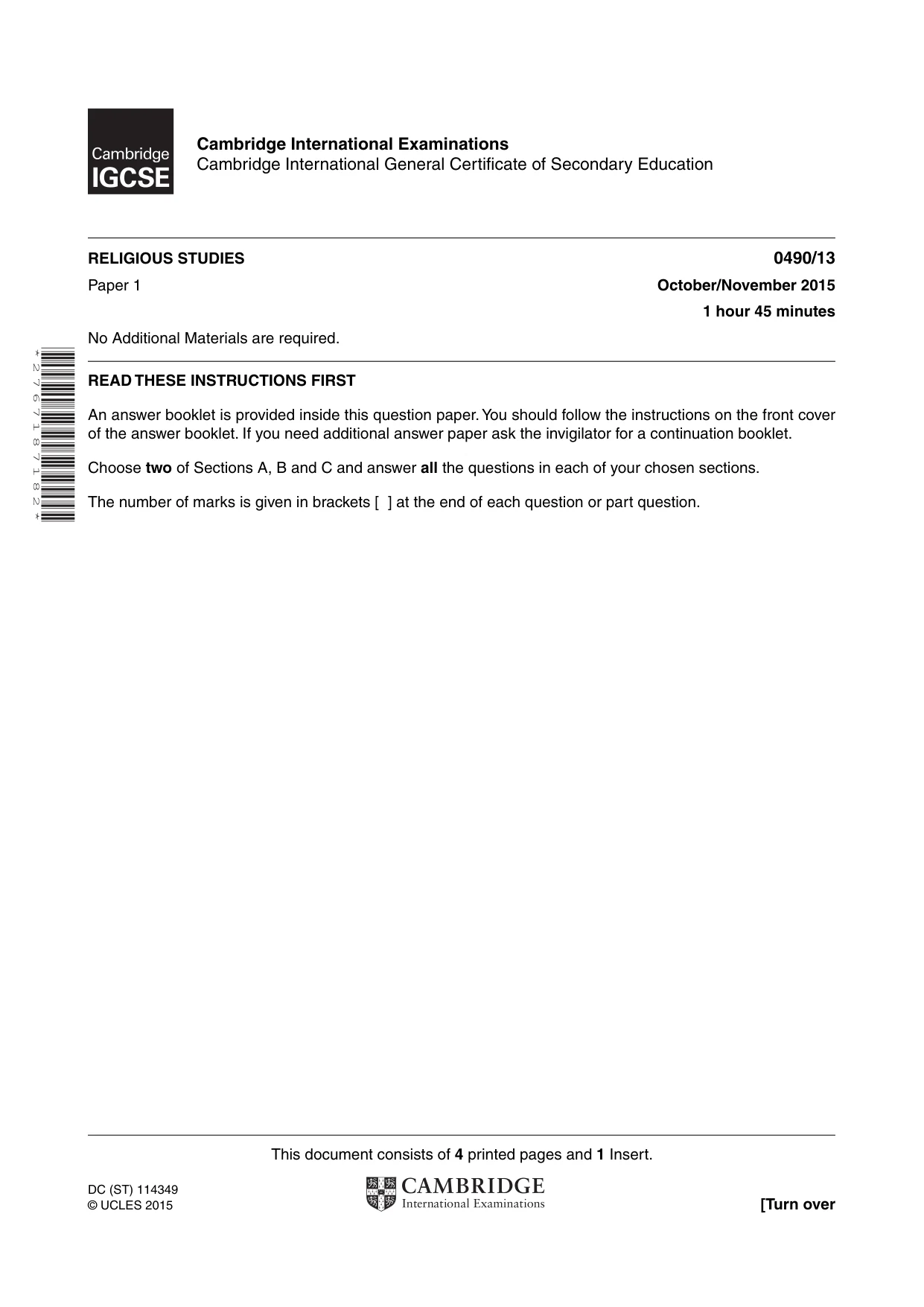
This document consists of 4 printed pages and 1 Insert. DC (ST) 114349 © UCLES 2015 [Turn over Cambridge International Examinations Cambridge International General Certificate of Secondary Education * 2 7 6 7 1 8 7 1 8 2 * RELIGIOUS STUDIES 0490/13 Paper 1 October/November 2015 1 hour 45 minutes No Additional Materials are required. READ THESE INSTRUCTIONS FIRST An answer booklet is provided inside this question paper. You should follow the instructions on the front cover of the answer booklet. If you need additional answer paper ask the invigilator for a continuation booklet. Choose two of Sections A, B and C and answer all the questions in each of your chosen sections. The number of marks is given in brackets [ ] at the end of each question or part question.
Question paper, page 2
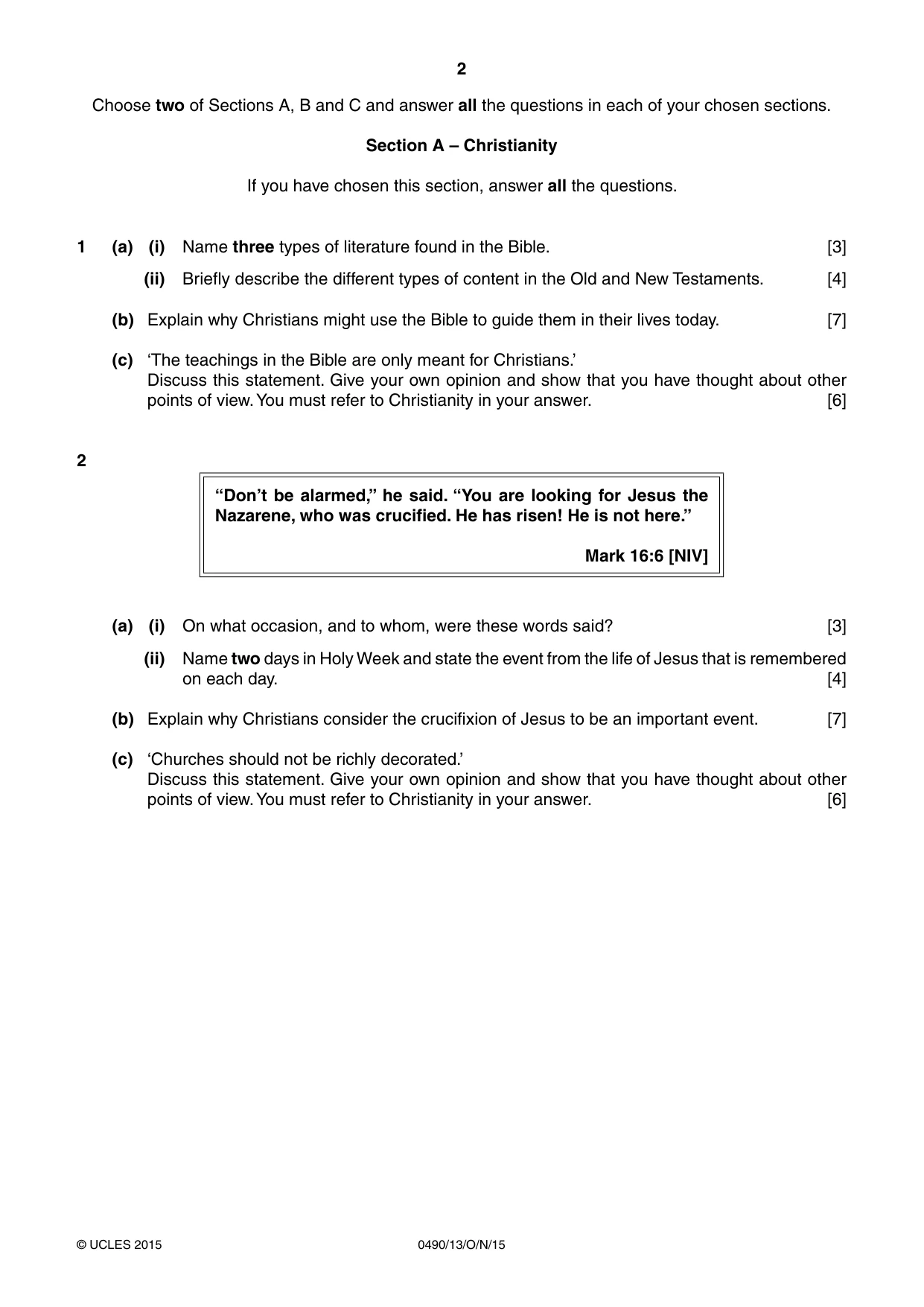
2 0490/13/O/N/15 © UCLES 2015 Choose two of Sections A, B and C and answer all the questions in each of your chosen sections. Section A – Christianity If you have chosen this section, answer all the questions. 1 (a) (i) Name three types of literature found in the Bible. [3] (ii) Briefly describe the different types of content in the Old and New Testaments. [4] (b) Explain why Christians might use the Bible to guide them in their lives today. [7] (c) ‘The teachings in the Bible are only meant for Christians.’ Discuss this statement. Give your own opinion and show that you have thought about other points of view. You must refer to Christianity in your answer. [6] 2 “Don’t be alarmed,” he said. “You are looking for Jesus the Nazarene, who was crucified. He has risen! He is not here.” Mark 16:6 [NIV] (a) (i) On what occasion, and to whom, were these words said? [3] (ii) Name two days in Holy Week and state the event from the life of Jesus that is remembered on each day. [4] (b) Explain why Christians consider the crucifixion of Jesus to be an important event. [7] (c) ‘Churches should not be richly decorated.’ Discuss this statement. Give your own opinion and show that you have thought about other points of view. You must refer to Christianity in your answer. [6]
Question paper, page 3
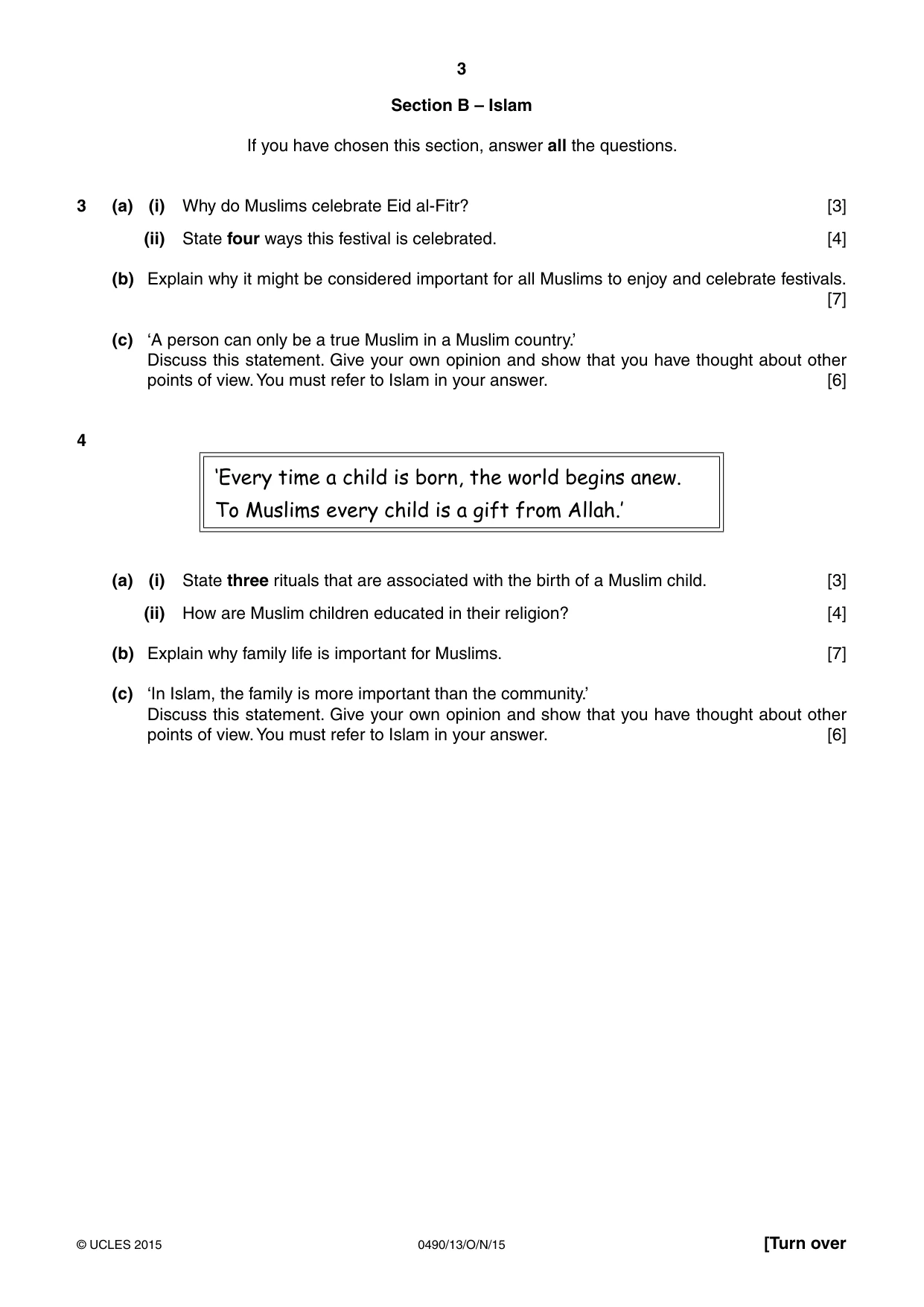
3 0490/13/O/N/15 © UCLES 2015 [Turn over Section B – Islam If you have chosen this section, answer all the questions. 3 (a) (i) Why do Muslims celebrate Eid al-Fitr? [3] (ii) State four ways this festival is celebrated. [4] (b) Explain why it might be considered important for all Muslims to enjoy and celebrate festivals. [7] (c) ‘A person can only be a true Muslim in a Muslim country.’ Discuss this statement. Give your own opinion and show that you have thought about other points of view. You must refer to Islam in your answer. [6] 4 ‘Every time a child is born, the world begins anew. To Muslims every child is a gift from Allah.‛ (a) (i) State three rituals that are associated with the birth of a Muslim child. [3] (ii) How are Muslim children educated in their religion? [4] (b) Explain why family life is important for Muslims. [7] (c) ‘In Islam, the family is more important than the community.’ Discuss this statement. Give your own opinion and show that you have thought about other points of view. You must refer to Islam in your answer. [6]
Question paper, page 4
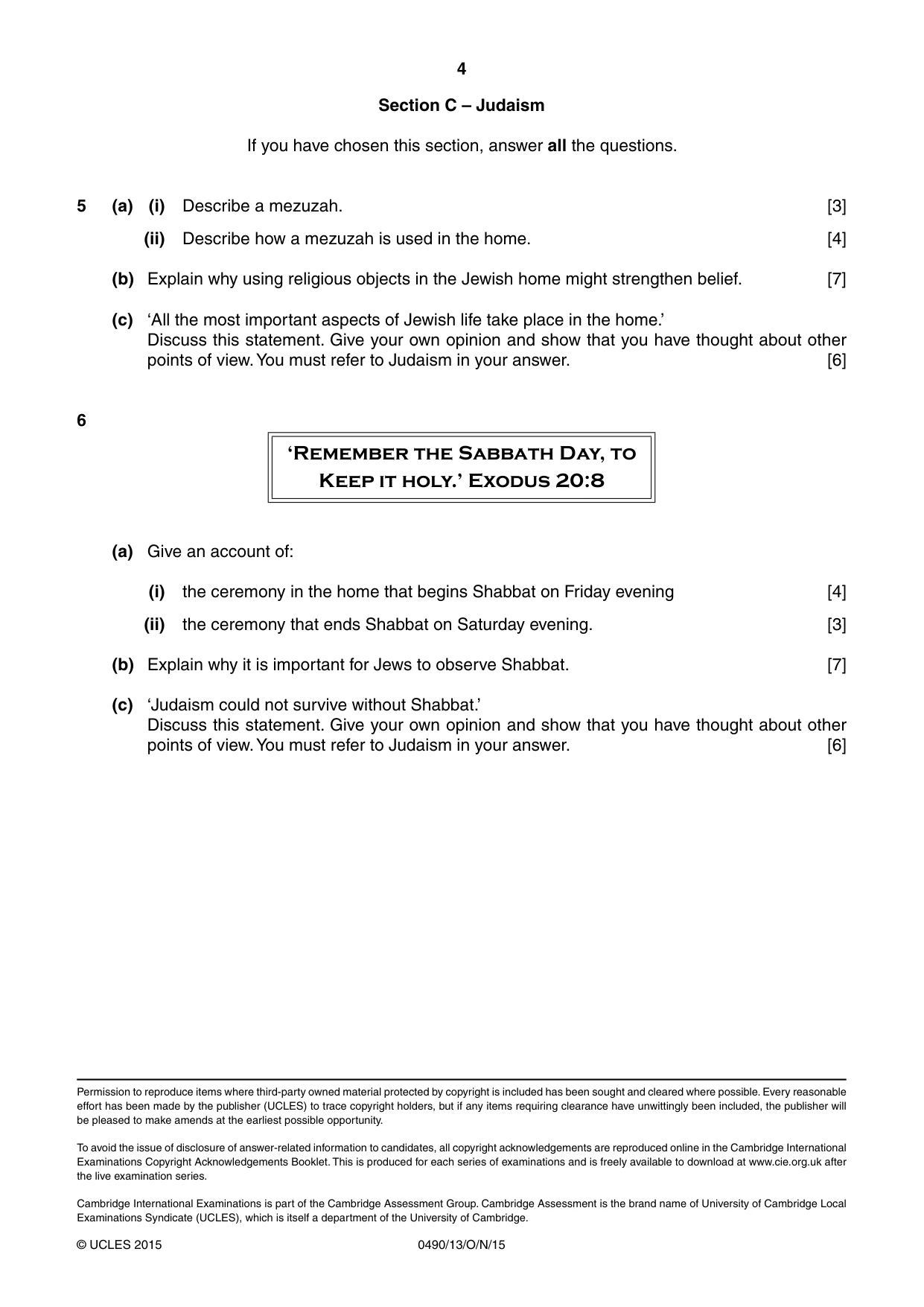
4 0490/13/O/N/15 © UCLES 2015 Section C – Judaism If you have chosen this section, answer all the questions. 5 (a) (i) Describe a mezuzah. [3] (ii) Describe how a mezuzah is used in the home. [4] (b) Explain why using religious objects in the Jewish home might strengthen belief. [7] (c) ‘All the most important aspects of Jewish life take place in the home.’ Discuss this statement. Give your own opinion and show that you have thought about other points of view. You must refer to Judaism in your answer. [6] 6 ‘Remember the Sabbath Day, to Keep it holy.’ Exodus 20:8 (a) Give an account of: (i) the ceremony in the home that begins Shabbat on Friday evening [4] (ii) the ceremony that ends Shabbat on Saturday evening. [3] (b) Explain why it is important for Jews to observe Shabbat. [7] (c) ‘Judaism could not survive without Shabbat.’ Discuss this statement. Give your own opinion and show that you have thought about other points of view. You must refer to Judaism in your answer. [6] Permission to reproduce items where third-party owned material protected by copyright is included has been sought and cleared where possible. Every reasonable effort has been made by the publisher (UCLES) to trace copyright holders, but if any items requiring clearance have unwittingly been included, the publisher will be pleased to make amends at the earliest possible opportunity. To avoid the issue of disclosure of answer-related information to candidates, all copyright acknowledgements are reproduced online in the Cambridge International Examinations Copyright Acknowledgements Booklet. This is produced for each series of examinations and is freely available to download at www.cie.org.uk after the live examination series. Cambridge International Examinations is part of the Cambridge Assessment Group. Cambridge Assessment is the brand name of University of Cambridge Local Examinations Syndicate (UCLES), which is itself a department of the University of Cambridge.
Mark scheme, page 1
® IGCSE is the registered trademark of Cambridge International Examinations. CAMBRIDGE INTERNATIONAL EXAMINATIONS Cambridge International General Certificate of Secondary Education MARK SCHEME for the October/November 2015 series 0490 RELIGIOUS STUDIES 0490/13 Paper 1, maximum raw mark 80 This mark scheme is published as an aid to teachers and candidates, to indicate the requirements of the examination. It shows the basis on which Examiners were instructed to award marks. It does not indicate the details of the discussions that took place at an Examiners’ meeting before marking began, which would have considered the acceptability of alternative answers. Mark schemes should be read in conjunction with the question paper and the Principal Examiner Report for Teachers. Cambridge will not enter into discussions about these mark schemes. Cambridge is publishing the mark schemes for the October/November 2015 series for most Cambridge IGCSE®, Cambridge International A and AS Level components and some Cambridge O Level components.
Mark scheme, page 2
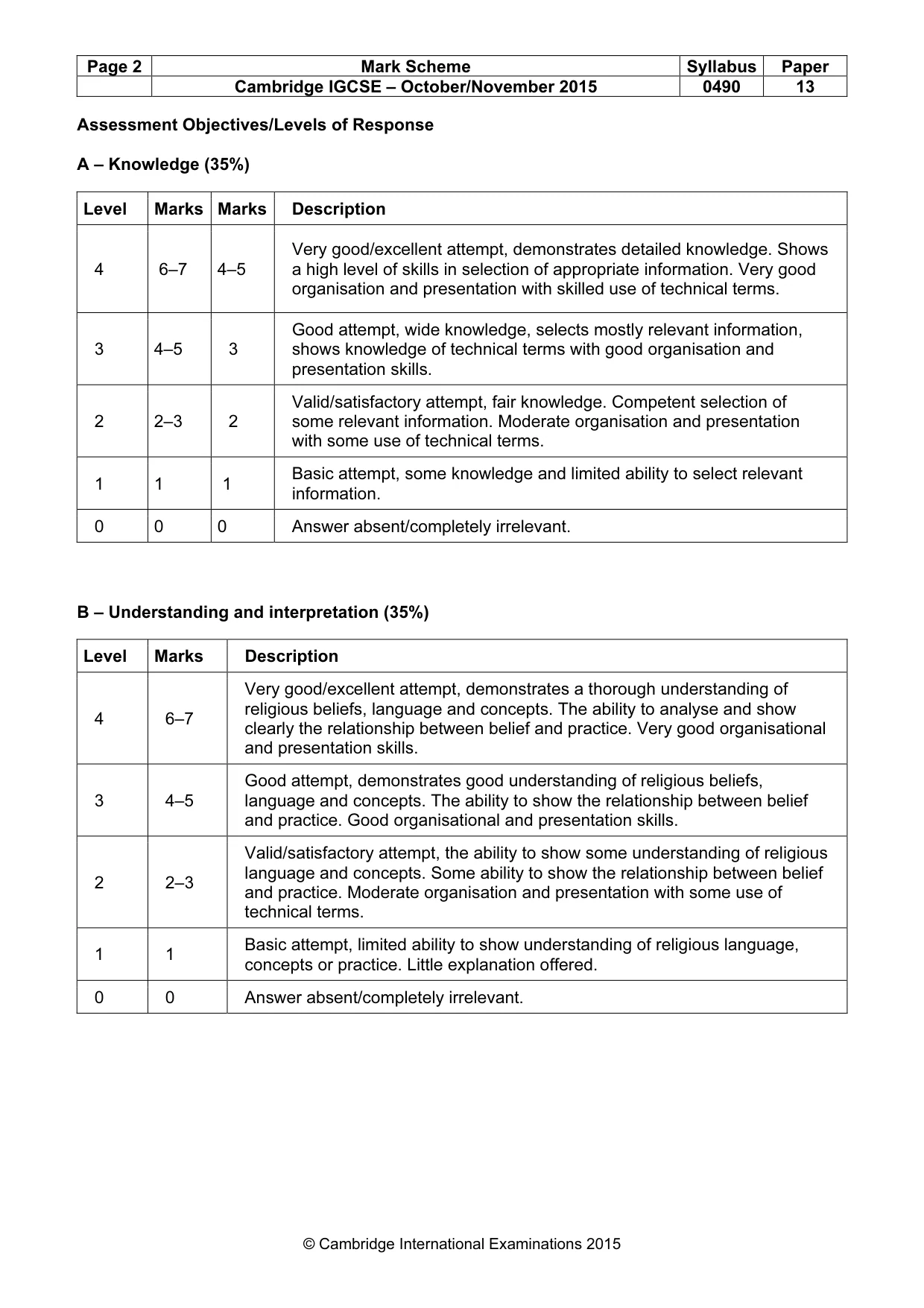
Page 2 Mark Scheme Syllabus Paper Cambridge IGCSE – October/November 2015 0490 13 © Cambridge International Examinations 2015 Assessment Objectives/Levels of Response A – Knowledge (35%) Level Marks Marks Description 4 6–7 4–5 Very good/excellent attempt, demonstrates detailed knowledge. Shows a high level of skills in selection of appropriate information. Very good organisation and presentation with skilled use of technical terms. 3 4–5 3 Good attempt, wide knowledge, selects mostly relevant information, shows knowledge of technical terms with good organisation and presentation skills. 2 2–3 2 Valid/satisfactory attempt, fair knowledge. Competent selection of some relevant information. Moderate organisation and presentation with some use of technical terms. 1 1 1 Basic attempt, some knowledge and limited ability to select relevant information. 0 0 0 Answer absent/completely irrelevant. B – Understanding and interpretation (35%) Level Marks Description 4 6–7 Very good/excellent attempt, demonstrates a thorough understanding of religious beliefs, language and concepts. The ability to analyse and show clearly the relationship between belief and practice. Very good organisational and presentation skills. 3 4–5 Good attempt, demonstrates good understanding of religious beliefs, language and concepts. The ability to show the relationship between belief and practice. Good organisational and presentation skills. 2 2–3 Valid/satisfactory attempt, the ability to show some understanding of religious language and concepts. Some ability to show the relationship between belief and practice. Moderate organisation and presentation with some use of technical terms. 1 1 Basic attempt, limited ability to show understanding of religious language, concepts or practice. Little explanation offered. 0 0 Answer absent/completely irrelevant.
Mark scheme, page 3
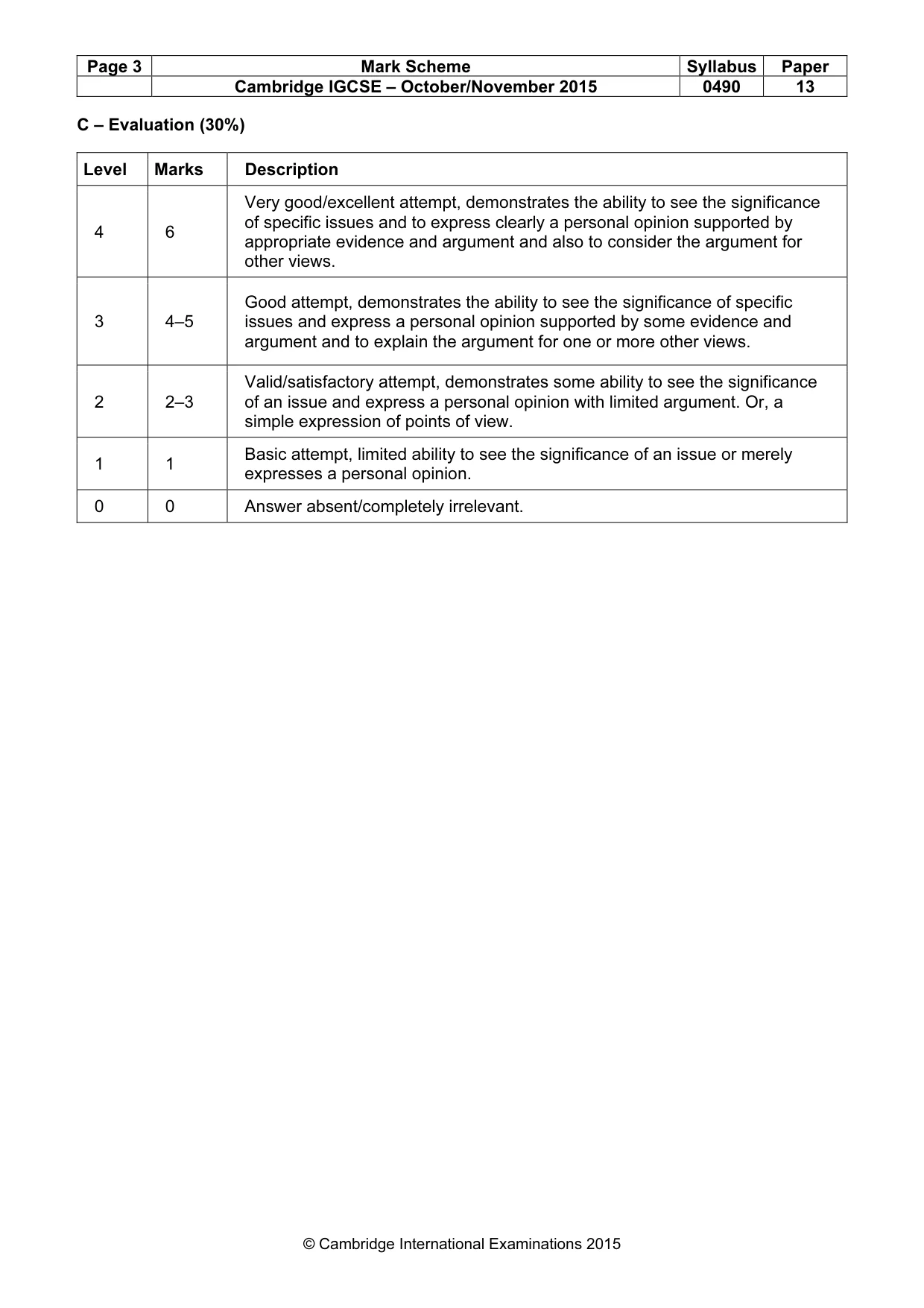
Page 3 Mark Scheme Syllabus Paper Cambridge IGCSE – October/November 2015 0490 13 © Cambridge International Examinations 2015 C – Evaluation (30%) Level Marks Description 4 6 Very good/excellent attempt, demonstrates the ability to see the significance of specific issues and to express clearly a personal opinion supported by appropriate evidence and argument and also to consider the argument for other views. 3 4–5 Good attempt, demonstrates the ability to see the significance of specific issues and express a personal opinion supported by some evidence and argument and to explain the argument for one or more other views. 2 2–3 Valid/satisfactory attempt, demonstrates some ability to see the significance of an issue and express a personal opinion with limited argument. Or, a simple expression of points of view. 1 1 Basic attempt, limited ability to see the significance of an issue or merely expresses a personal opinion. 0 0 Answer absent/completely irrelevant.
Mark scheme, page 4
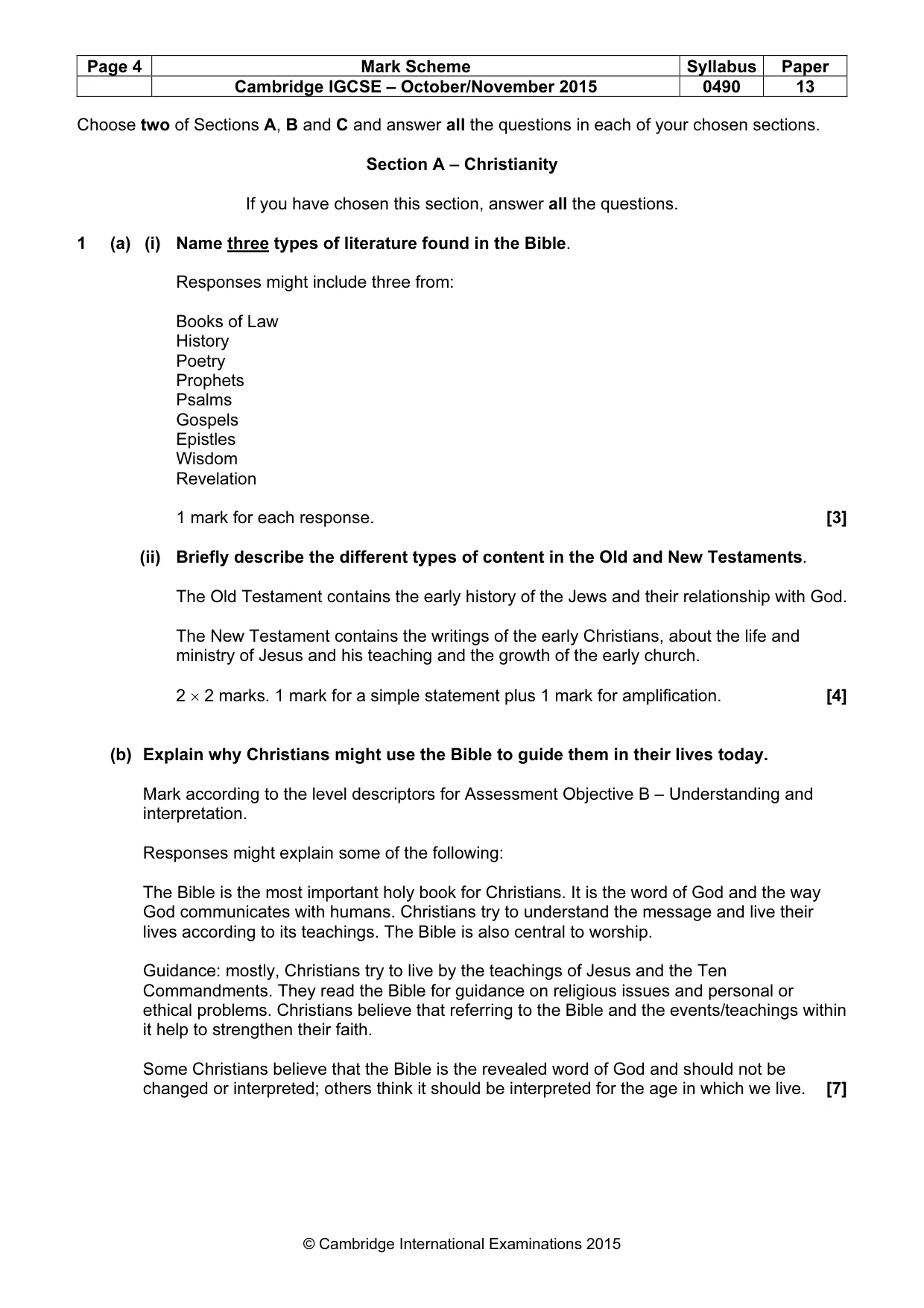
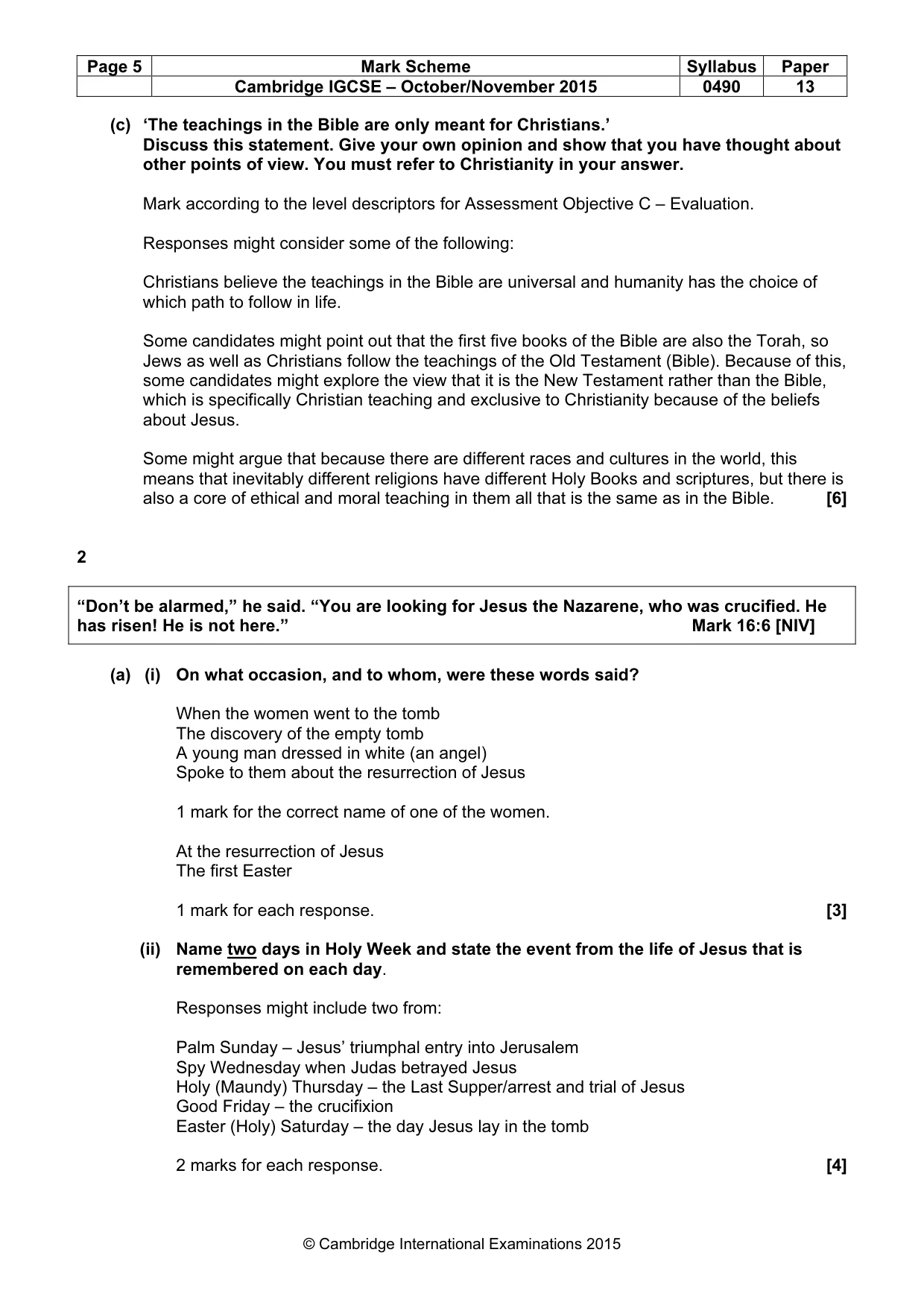
Page 4 Mark Scheme Syllabus Paper Cambridge IGCSE – October/November 2015 0490 13 © Cambridge International Examinations 2015 Choose two of Sections A, B and C and answer all the questions in each of your chosen sections. Section A – Christianity If you have chosen this section, answer all the questions. 1 (a) (i) Name three types of literature found in the Bible. Responses might include three from: Books of Law History Poetry Prophets Psalms Gospels Epistles Wisdom Revelation 1 mark for each response. [3] (ii) Briefly describe the different types of content in the Old and New Testaments. The Old Testament contains the early history of the Jews and their relationship with God. The New Testament contains the writings of the early Christians, about the life and ministry of Jesus and his teaching and the growth of the early church. 2 × 2 marks. 1 mark for a simple statement plus 1 mark for amplification. [4] (b) Explain why Christians might use the Bible to guide them in their lives today. Mark according to the level descriptors for Assessment Objective B – Understanding and interpretation. Responses might explain some of the following: The Bible is the most important holy book for Christians. It is the word of God and the way God communicates with humans. Christians try to understand the message and live their lives according to its teachings. The Bible is also central to worship. Guidance: mostly, Christians try to live by the teachings of Jesus and the Ten Commandments. They read the Bible for guidance on religious issues and personal or ethical problems. Christians believe that referring to the Bible and the events/teachings within it help to strengthen their faith. Some Christians believe that the Bible is the revealed word of God and should not be changed or interpreted; others think it should be interpreted for the age in which we live. [7]
Mark scheme, page 5
Page 5 Mark Scheme Syllabus Paper Cambridge IGCSE – October/November 2015 0490 13 © Cambridge International Examinations 2015 (c) ‘The teachings in the Bible are only meant for Christians.’ Discuss this statement. Give your own opinion and show that you have thought about other points of view. You must refer to Christianity in your answer. Mark according to the level descriptors for Assessment Objective C – Evaluation. Responses might consider some of the following: Christians believe the teachings in the Bible are universal and humanity has the choice of which path to follow in life. Some candidates might point out that the first five books of the Bible are also the Torah, so Jews as well as Christians follow the teachings of the Old Testament (Bible). Because of this, some candidates might explore the view that it is the New Testament rather than the Bible, which is specifically Christian teaching and exclusive to Christianity because of the beliefs about Jesus. Some might argue that because there are different races and cultures in the world, this means that inevitably different religions have different Holy Books and scriptures, but there is also a core of ethical and moral teaching in them all that is the same as in the Bible. [6] 2 “Don’t be alarmed,” he said. “You are looking for Jesus the Nazarene, who was crucified. He has risen! He is not here.” Mark 16:6 [NIV] (a) (i) On what occasion, and to whom, were these words said? When the women went to the tomb The discovery of the empty tomb A young man dressed in white (an angel) Spoke to them about the resurrection of Jesus 1 mark for the correct name of one of the women. At the resurrection of Jesus The first Easter 1 mark for each response. [3] (ii) Name two days in Holy Week and state the event from the life of Jesus that is remembered on each day. Responses might include two from: Palm Sunday – Jesus’ triumphal entry into Jerusalem Spy Wednesday when Judas betrayed Jesus Holy (Maundy) Thursday – the Last Supper/arrest and trial of Jesus Good Friday – the crucifixion Easter (Holy) Saturday – the day Jesus lay in the tomb 2 marks for each response. [4]
Mark scheme, page 6
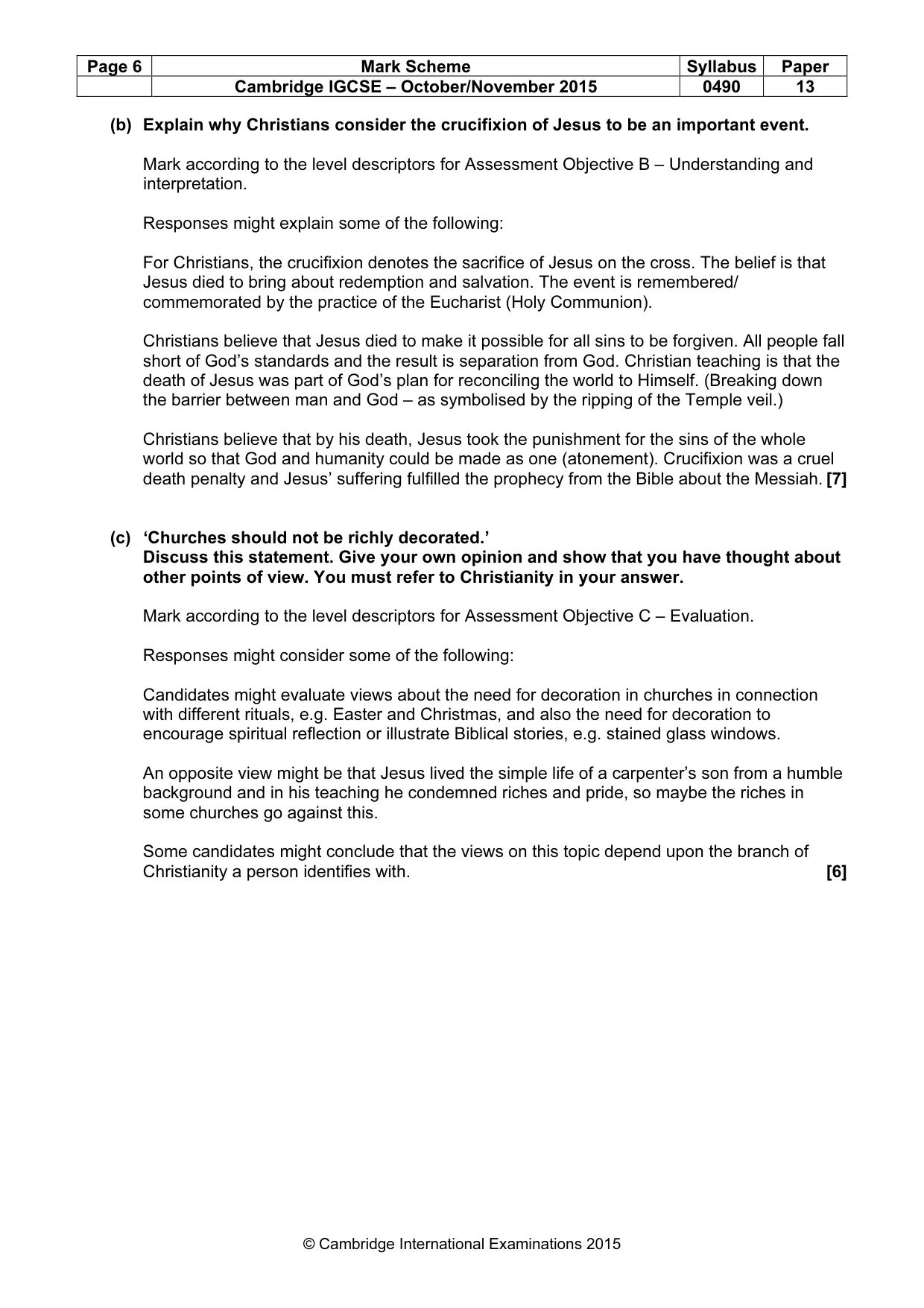
Page 6 Mark Scheme Syllabus Paper Cambridge IGCSE – October/November 2015 0490 13 © Cambridge International Examinations 2015 (b) Explain why Christians consider the crucifixion of Jesus to be an important event. Mark according to the level descriptors for Assessment Objective B – Understanding and interpretation. Responses might explain some of the following: For Christians, the crucifixion denotes the sacrifice of Jesus on the cross. The belief is that Jesus died to bring about redemption and salvation. The event is remembered/ commemorated by the practice of the Eucharist (Holy Communion). Christians believe that Jesus died to make it possible for all sins to be forgiven. All people fall short of God’s standards and the result is separation from God. Christian teaching is that the death of Jesus was part of God’s plan for reconciling the world to Himself. (Breaking down the barrier between man and God – as symbolised by the ripping of the Temple veil.) Christians believe that by his death, Jesus took the punishment for the sins of the whole world so that God and humanity could be made as one (atonement). Crucifixion was a cruel death penalty and Jesus’ suffering fulfilled the prophecy from the Bible about the Messiah. [7] (c) ‘Churches should not be richly decorated.’ Discuss this statement. Give your own opinion and show that you have thought about other points of view. You must refer to Christianity in your answer. Mark according to the level descriptors for Assessment Objective C – Evaluation. Responses might consider some of the following: Candidates might evaluate views about the need for decoration in churches in connection with different rituals, e.g. Easter and Christmas, and also the need for decoration to encourage spiritual reflection or illustrate Biblical stories, e.g. stained glass windows. An opposite view might be that Jesus lived the simple life of a carpenter’s son from a humble background and in his teaching he condemned riches and pride, so maybe the riches in some churches go against this. Some candidates might conclude that the views on this topic depend upon the branch of Christianity a person identifies with. [6]
Mark scheme, page 7
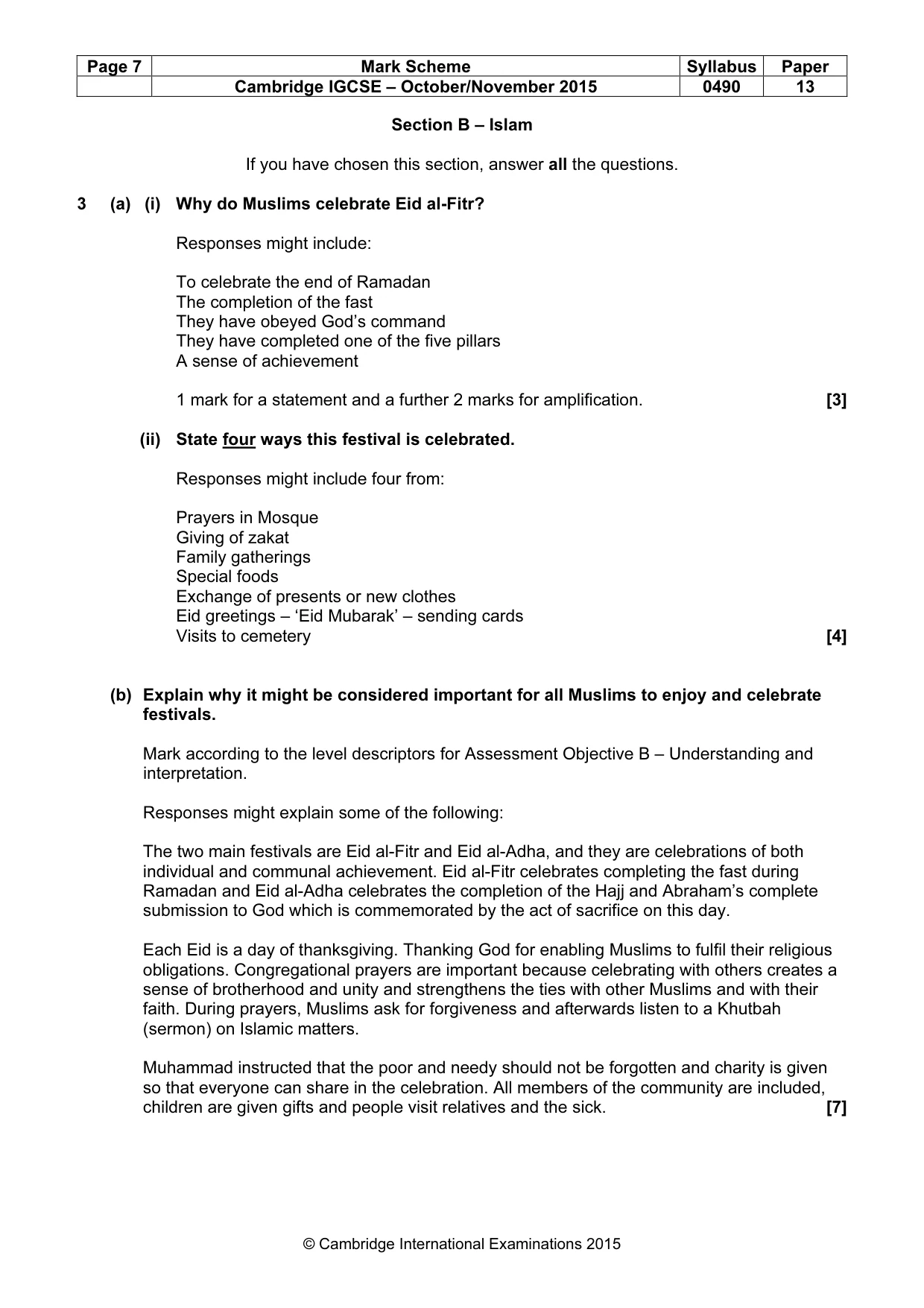
Page 7 Mark Scheme Syllabus Paper Cambridge IGCSE – October/November 2015 0490 13 © Cambridge International Examinations 2015 Section B – Islam If you have chosen this section, answer all the questions. 3 (a) (i) Why do Muslims celebrate Eid al-Fitr? Responses might include: To celebrate the end of Ramadan The completion of the fast They have obeyed God’s command They have completed one of the five pillars A sense of achievement 1 mark for a statement and a further 2 marks for amplification. [3] (ii) State four ways this festival is celebrated. Responses might include four from: Prayers in Mosque Giving of zakat Family gatherings Special foods Exchange of presents or new clothes Eid greetings – ‘Eid Mubarak’ – sending cards Visits to cemetery [4] (b) Explain why it might be considered important for all Muslims to enjoy and celebrate festivals. Mark according to the level descriptors for Assessment Objective B – Understanding and interpretation. Responses might explain some of the following: The two main festivals are Eid al-Fitr and Eid al-Adha, and they are celebrations of both individual and communal achievement. Eid al-Fitr celebrates completing the fast during Ramadan and Eid al-Adha celebrates the completion of the Hajj and Abraham’s complete submission to God which is commemorated by the act of sacrifice on this day. Each Eid is a day of thanksgiving. Thanking God for enabling Muslims to fulfil their religious obligations. Congregational prayers are important because celebrating with others creates a sense of brotherhood and unity and strengthens the ties with other Muslims and with their faith. During prayers, Muslims ask for forgiveness and afterwards listen to a Khutbah (sermon) on Islamic matters. Muhammad instructed that the poor and needy should not be forgotten and charity is given so that everyone can share in the celebration. All members of the community are included, children are given gifts and people visit relatives and the sick. [7]
Mark scheme, page 8
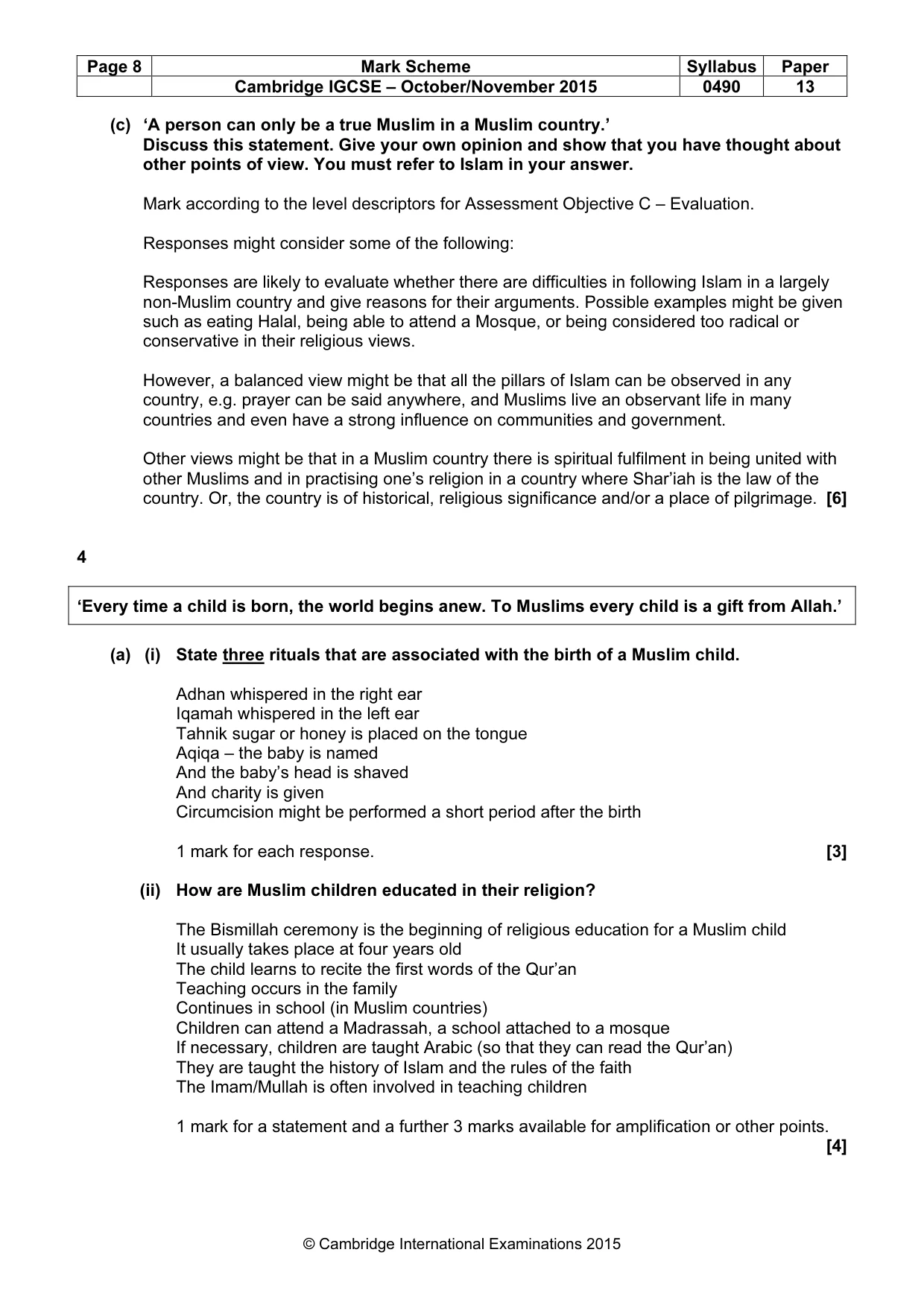
Page 8 Mark Scheme Syllabus Paper Cambridge IGCSE – October/November 2015 0490 13 © Cambridge International Examinations 2015 (c) ‘A person can only be a true Muslim in a Muslim country.’ Discuss this statement. Give your own opinion and show that you have thought about other points of view. You must refer to Islam in your answer. Mark according to the level descriptors for Assessment Objective C – Evaluation. Responses might consider some of the following: Responses are likely to evaluate whether there are difficulties in following Islam in a largely non-Muslim country and give reasons for their arguments. Possible examples might be given such as eating Halal, being able to attend a Mosque, or being considered too radical or conservative in their religious views. However, a balanced view might be that all the pillars of Islam can be observed in any country, e.g. prayer can be said anywhere, and Muslims live an observant life in many countries and even have a strong influence on communities and government. Other views might be that in a Muslim country there is spiritual fulfilment in being united with other Muslims and in practising one’s religion in a country where Shar’iah is the law of the country. Or, the country is of historical, religious significance and/or a place of pilgrimage. [6] 4 ‘Every time a child is born, the world begins anew. To Muslims every child is a gift from Allah.’ (a) (i) State three rituals that are associated with the birth of a Muslim child. Adhan whispered in the right ear Iqamah whispered in the left ear Tahnik sugar or honey is placed on the tongue Aqiqa – the baby is named And the baby’s head is shaved And charity is given Circumcision might be performed a short period after the birth 1 mark for each response. [3] (ii) How are Muslim children educated in their religion? The Bismillah ceremony is the beginning of religious education for a Muslim child It usually takes place at four years old The child learns to recite the first words of the Qur’an Teaching occurs in the family Continues in school (in Muslim countries) Children can attend a Madrassah, a school attached to a mosque If necessary, children are taught Arabic (so that they can read the Qur’an) They are taught the history of Islam and the rules of the faith The Imam/Mullah is often involved in teaching children 1 mark for a statement and a further 3 marks available for amplification or other points. [4]
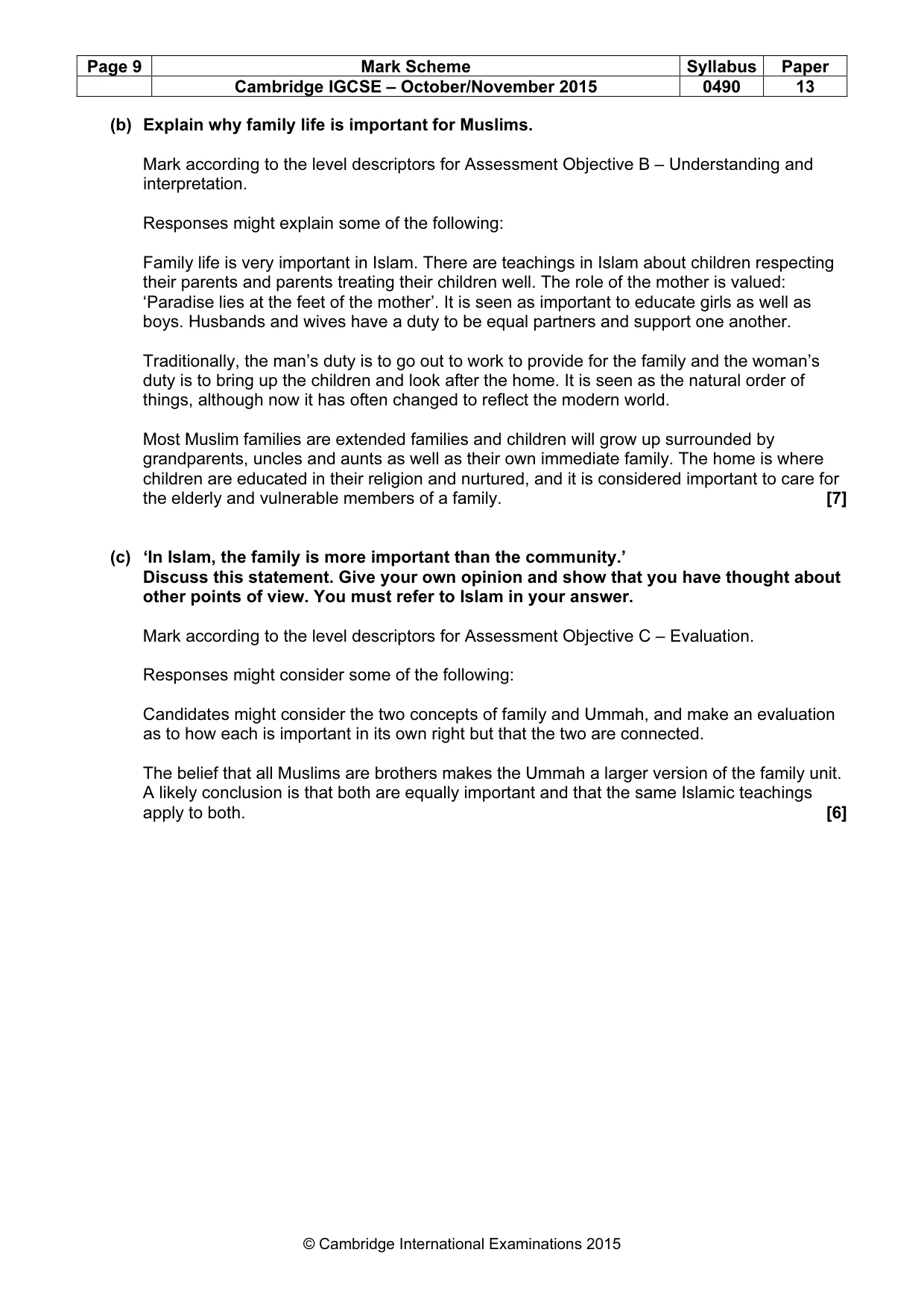
Mark scheme, page 9
Page 9 Mark Scheme Syllabus Paper Cambridge IGCSE – October/November 2015 0490 13 © Cambridge International Examinations 2015 (b) Explain why family life is important for Muslims. Mark according to the level descriptors for Assessment Objective B – Understanding and interpretation. Responses might explain some of the following: Family life is very important in Islam. There are teachings in Islam about children respecting their parents and parents treating their children well. The role of the mother is valued: ‘Paradise lies at the feet of the mother’. It is seen as important to educate girls as well as boys. Husbands and wives have a duty to be equal partners and support one another. Traditionally, the man’s duty is to go out to work to provide for the family and the woman’s duty is to bring up the children and look after the home. It is seen as the natural order of things, although now it has often changed to reflect the modern world. Most Muslim families are extended families and children will grow up surrounded by grandparents, uncles and aunts as well as their own immediate family. The home is where children are educated in their religion and nurtured, and it is considered important to care for the elderly and vulnerable members of a family. [7] (c) ‘In Islam, the family is more important than the community.’ Discuss this statement. Give your own opinion and show that you have thought about other points of view. You must refer to Islam in your answer. Mark according to the level descriptors for Assessment Objective C – Evaluation. Responses might consider some of the following: Candidates might consider the two concepts of family and Ummah, and make an evaluation as to how each is important in its own right but that the two are connected. The belief that all Muslims are brothers makes the Ummah a larger version of the family unit. A likely conclusion is that both are equally important and that the same Islamic teachings apply to both. [6]
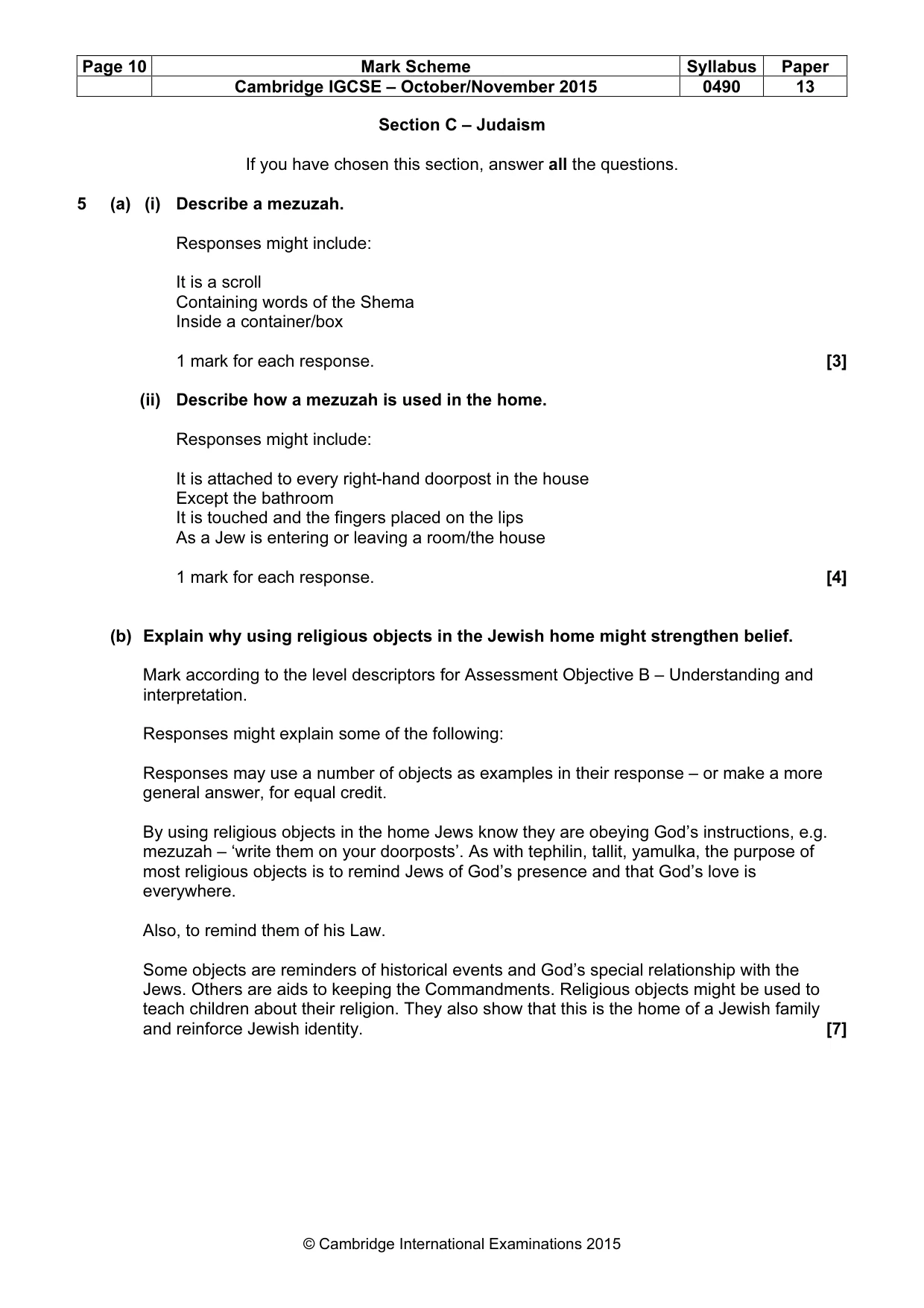
Mark scheme, page 10
Page 10 Mark Scheme Syllabus Paper Cambridge IGCSE – October/November 2015 0490 13 © Cambridge International Examinations 2015 Section C – Judaism If you have chosen this section, answer all the questions. 5 (a) (i) Describe a mezuzah. Responses might include: It is a scroll Containing words of the Shema Inside a container/box 1 mark for each response. [3] (ii) Describe how a mezuzah is used in the home. Responses might include: It is attached to every right-hand doorpost in the house Except the bathroom It is touched and the fingers placed on the lips As a Jew is entering or leaving a room/the house 1 mark for each response. [4] (b) Explain why using religious objects in the Jewish home might strengthen belief. Mark according to the level descriptors for Assessment Objective B – Understanding and interpretation. Responses might explain some of the following: Responses may use a number of objects as examples in their response – or make a more general answer, for equal credit. By using religious objects in the home Jews know they are obeying God’s instructions, e.g. mezuzah – ‘write them on your doorposts’. As with tephilin, tallit, yamulka, the purpose of most religious objects is to remind Jews of God’s presence and that God’s love is everywhere. Also, to remind them of his Law. Some objects are reminders of historical events and God’s special relationship with the Jews. Others are aids to keeping the Commandments. Religious objects might be used to teach children about their religion. They also show that this is the home of a Jewish family and reinforce Jewish identity. [7]
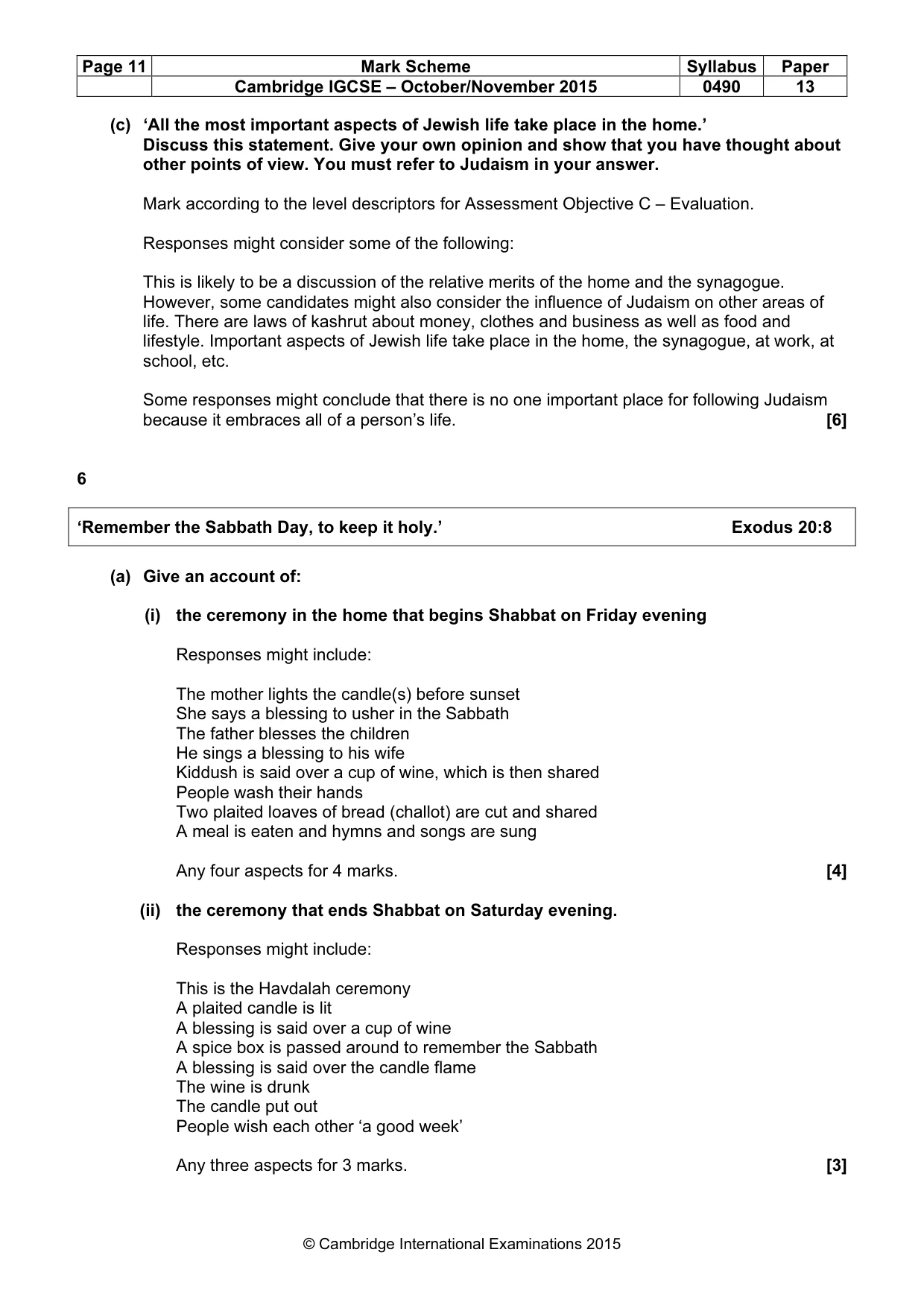
Mark scheme, page 11
Page 11 Mark Scheme Syllabus Paper Cambridge IGCSE – October/November 2015 0490 13 © Cambridge International Examinations 2015 (c) ‘All the most important aspects of Jewish life take place in the home.’ Discuss this statement. Give your own opinion and show that you have thought about other points of view. You must refer to Judaism in your answer. Mark according to the level descriptors for Assessment Objective C – Evaluation. Responses might consider some of the following: This is likely to be a discussion of the relative merits of the home and the synagogue. However, some candidates might also consider the influence of Judaism on other areas of life. There are laws of kashrut about money, clothes and business as well as food and lifestyle. Important aspects of Jewish life take place in the home, the synagogue, at work, at school, etc. Some responses might conclude that there is no one important place for following Judaism because it embraces all of a person’s life. [6] 6 ‘Remember the Sabbath Day, to keep it holy.’ Exodus 20:8 (a) Give an account of: (i) the ceremony in the home that begins Shabbat on Friday evening Responses might include: The mother lights the candle(s) before sunset She says a blessing to usher in the Sabbath The father blesses the children He sings a blessing to his wife Kiddush is said over a cup of wine, which is then shared People wash their hands Two plaited loaves of bread (challot) are cut and shared A meal is eaten and hymns and songs are sung Any four aspects for 4 marks. [4] (ii) the ceremony that ends Shabbat on Saturday evening. Responses might include: This is the Havdalah ceremony A plaited candle is lit A blessing is said over a cup of wine A spice box is passed around to remember the Sabbath A blessing is said over the candle flame The wine is drunk The candle put out People wish each other ‘a good week’ Any three aspects for 3 marks. [3]
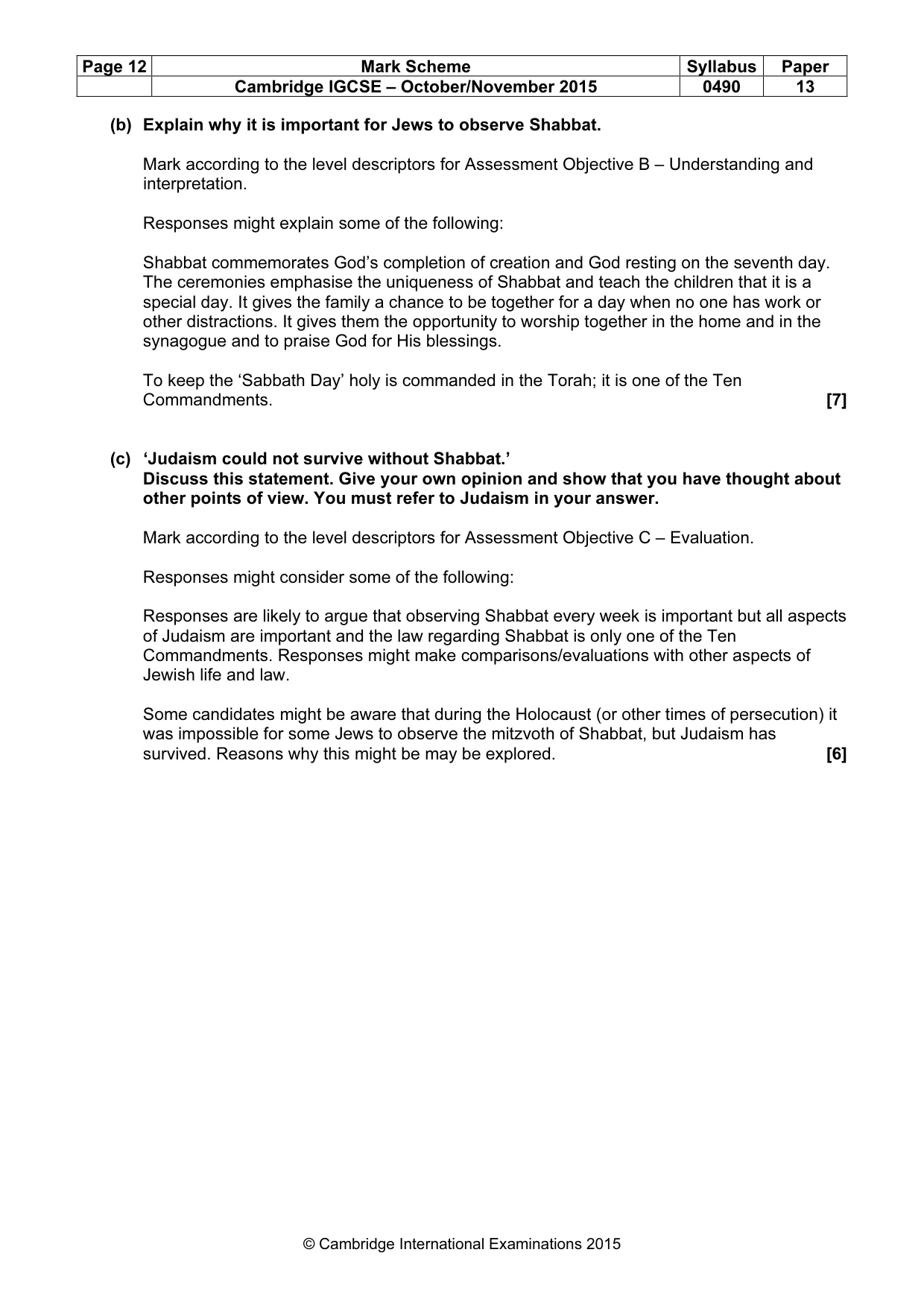
Mark scheme, page 12
Page 12 Mark Scheme Syllabus Paper Cambridge IGCSE – October/November 2015 0490 13 © Cambridge International Examinations 2015 (b) Explain why it is important for Jews to observe Shabbat. Mark according to the level descriptors for Assessment Objective B – Understanding and interpretation. Responses might explain some of the following: Shabbat commemorates God’s completion of creation and God resting on the seventh day. The ceremonies emphasise the uniqueness of Shabbat and teach the children that it is a special day. It gives the family a chance to be together for a day when no one has work or other distractions. It gives them the opportunity to worship together in the home and in the synagogue and to praise God for His blessings. To keep the ‘Sabbath Day’ holy is commanded in the Torah; it is one of the Ten Commandments. [7] (c) ‘Judaism could not survive without Shabbat.’ Discuss this statement. Give your own opinion and show that you have thought about other points of view. You must refer to Judaism in your answer. Mark according to the level descriptors for Assessment Objective C – Evaluation. Responses might consider some of the following: Responses are likely to argue that observing Shabbat every week is important but all aspects of Judaism are important and the law regarding Shabbat is only one of the Ten Commandments. Responses might make comparisons/evaluations with other aspects of Jewish life and law. Some candidates might be aware that during the Holocaust (or other times of persecution) it was impossible for some Jews to observe the mitzvoth of Shabbat, but Judaism has survived. Reasons why this might be may be explored. [6]
What you needed in this session
Cambridge’s own grade thresholds for 2015 Oct/Nov, Paper 1 · Variant 3. A higher threshold means an easier paper — the bar moves with how the cohort did.