Cambridge IGCSE Religious Studies 0490 — 2014 Oct/Nov Paper 2 · Variant 3
0490/23/O/N/14 · 80 marks · ≈90 min
The question paper and its mark scheme, free to read here and free to download. This is Cambridge’s own paper, exactly as it was sat.
Question paper4 pages
Mark scheme17 pages
Answers below. Sit the paper first if you are practising.
Paper as text
Question paper, page 1
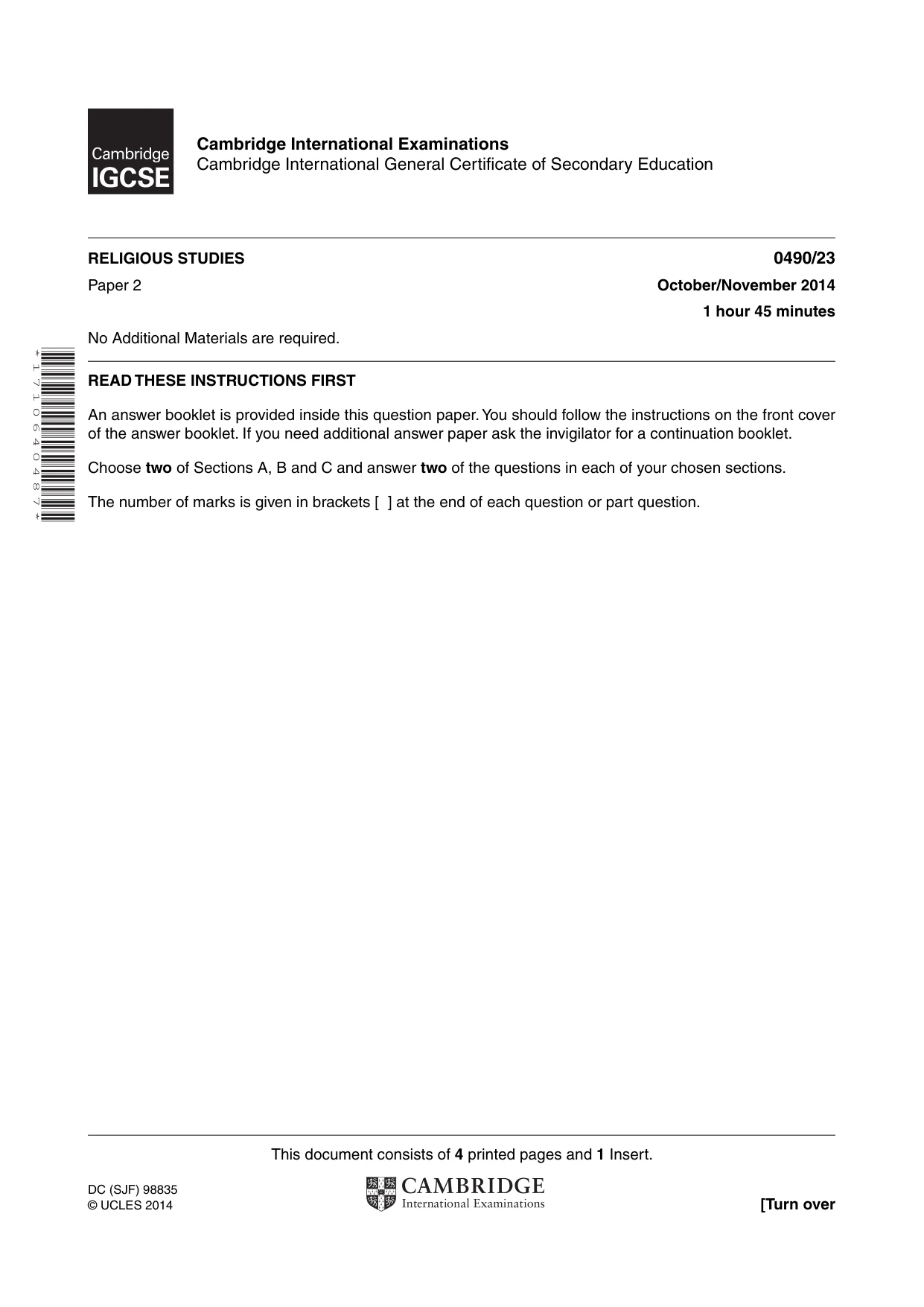
This document consists of 4 printed pages and 1 Insert. DC (SJF) 98835 © UCLES 2014 [Turn over Cambridge International Examinations Cambridge International General Certificate of Secondary Education * 1 7 1 0 6 4 0 4 8 7 * RELIGIOUS STUDIES 0490/23 Paper 2 October/November 2014 1 hour 45 minutes No Additional Materials are required. READ THESE INSTRUCTIONS FIRST An answer booklet is provided inside this question paper. You should follow the instructions on the front cover of the answer booklet. If you need additional answer paper ask the invigilator for a continuation booklet. Choose two of Sections A, B and C and answer two of the questions in each of your chosen sections. The number of marks is given in brackets [ ] at the end of each question or part question.
Question paper, page 2
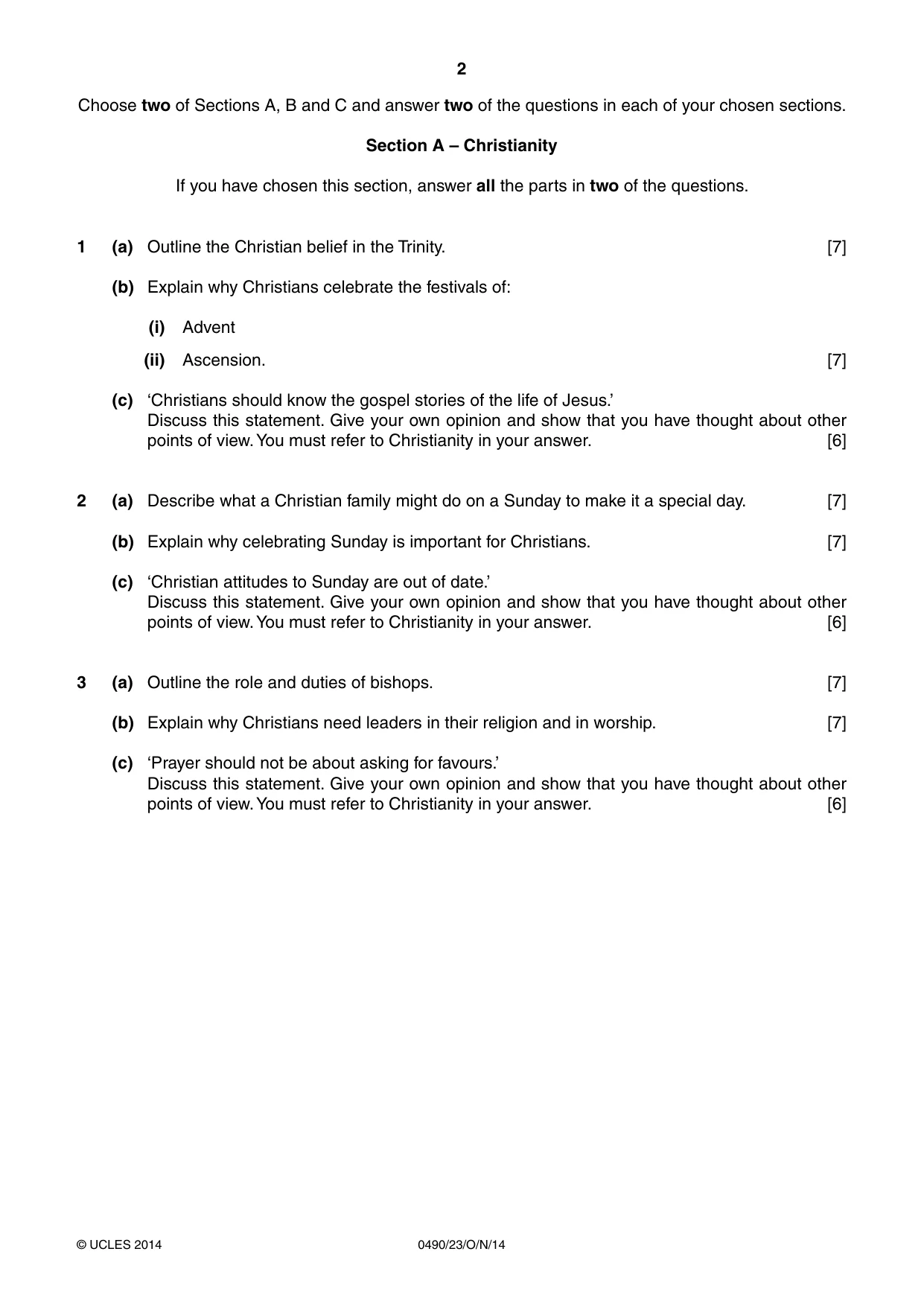
2 0490/23/O/N/14 © UCLES 2014 Choose two of Sections A, B and C and answer two of the questions in each of your chosen sections. Section A – Christianity If you have chosen this section, answer all the parts in two of the questions. 1 (a) Outline the Christian belief in the Trinity. [7] (b) Explain why Christians celebrate the festivals of: (i) Advent (ii) Ascension. [7] (c) ‘Christians should know the gospel stories of the life of Jesus.’ Discuss this statement. Give your own opinion and show that you have thought about other points of view. You must refer to Christianity in your answer. [6] 2 (a) Describe what a Christian family might do on a Sunday to make it a special day. [7] (b) Explain why celebrating Sunday is important for Christians. [7] (c) ‘Christian attitudes to Sunday are out of date.’ Discuss this statement. Give your own opinion and show that you have thought about other points of view. You must refer to Christianity in your answer. [6] 3 (a) Outline the role and duties of bishops. [7] (b) Explain why Christians need leaders in their religion and in worship. [7] (c) ‘Prayer should not be about asking for favours.’ Discuss this statement. Give your own opinion and show that you have thought about other points of view. You must refer to Christianity in your answer. [6]
Question paper, page 3
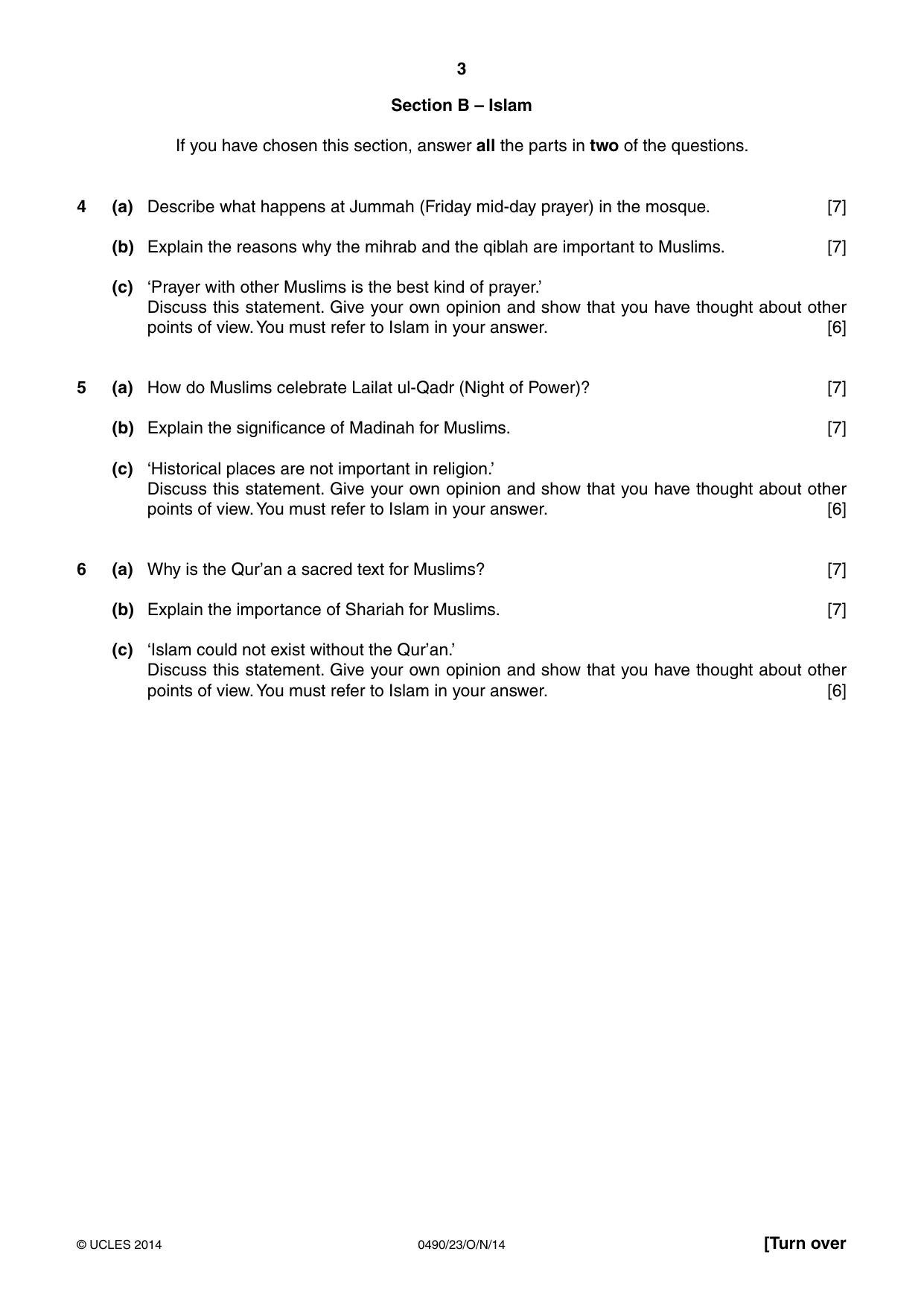
3 0490/23/O/N/14 © UCLES 2014 [Turn over Section B – Islam If you have chosen this section, answer all the parts in two of the questions. 4 (a) Describe what happens at Jummah (Friday mid-day prayer) in the mosque. [7] (b) Explain the reasons why the mihrab and the qiblah are important to Muslims. [7] (c) ‘Prayer with other Muslims is the best kind of prayer.’ Discuss this statement. Give your own opinion and show that you have thought about other points of view. You must refer to Islam in your answer. [6] 5 (a) How do Muslims celebrate Lailat ul-Qadr (Night of Power)? [7] (b) Explain the significance of Madinah for Muslims. [7] (c) ‘Historical places are not important in religion.’ Discuss this statement. Give your own opinion and show that you have thought about other points of view. You must refer to Islam in your answer. [6] 6 (a) Why is the Qur’an a sacred text for Muslims? [7] (b) Explain the importance of Shariah for Muslims. [7] (c) ‘Islam could not exist without the Qur’an.’ Discuss this statement. Give your own opinion and show that you have thought about other points of view. You must refer to Islam in your answer. [6]
Question paper, page 4
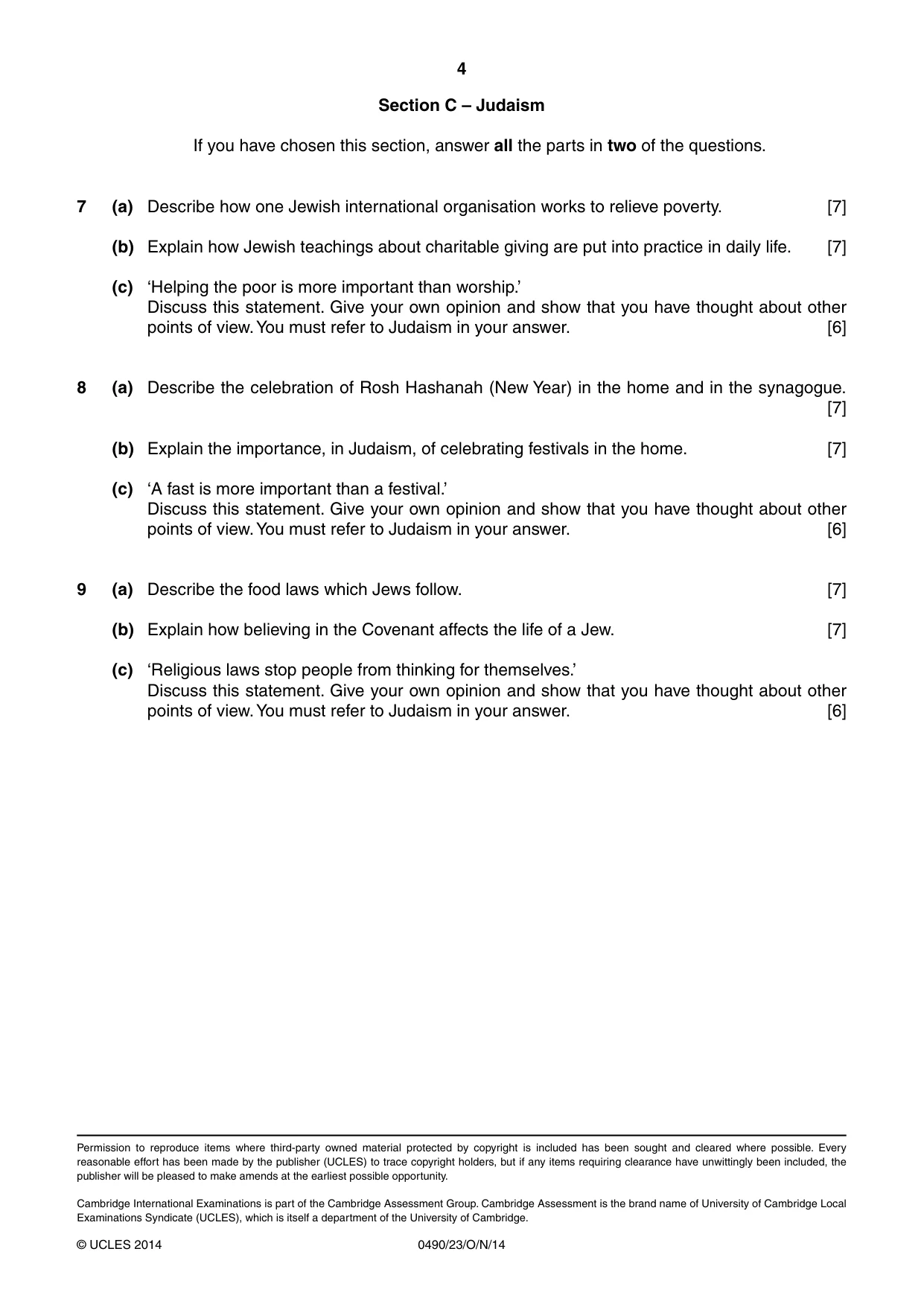
4 0490/23/O/N/14 © UCLES 2014 Section C – Judaism If you have chosen this section, answer all the parts in two of the questions. 7 (a) Describe how one Jewish international organisation works to relieve poverty. [7] (b) Explain how Jewish teachings about charitable giving are put into practice in daily life. [7] (c) ‘Helping the poor is more important than worship.’ Discuss this statement. Give your own opinion and show that you have thought about other points of view. You must refer to Judaism in your answer. [6] 8 (a) Describe the celebration of Rosh Hashanah (New Year) in the home and in the synagogue. [7] (b) Explain the importance, in Judaism, of celebrating festivals in the home. [7] (c) ‘A fast is more important than a festival.’ Discuss this statement. Give your own opinion and show that you have thought about other points of view. You must refer to Judaism in your answer. [6] 9 (a) Describe the food laws which Jews follow. [7] (b) Explain how believing in the Covenant affects the life of a Jew. [7] (c) ‘Religious laws stop people from thinking for themselves.’ Discuss this statement. Give your own opinion and show that you have thought about other points of view. You must refer to Judaism in your answer. [6] Permission to reproduce items where third-party owned material protected by copyright is included has been sought and cleared where possible. Every reasonable effort has been made by the publisher (UCLES) to trace copyright holders, but if any items requiring clearance have unwittingly been included, the publisher will be pleased to make amends at the earliest possible opportunity. Cambridge International Examinations is part of the Cambridge Assessment Group. Cambridge Assessment is the brand name of University of Cambridge Local Examinations Syndicate (UCLES), which is itself a department of the University of Cambridge.
Mark scheme, page 1
® IGCSE is the registered trademark of Cambridge International Examinations. CAMBRIDGE INTERNATIONAL EXAMINATIONS Cambridge International General Certificate of Secondary Education MARK SCHEME for the October/November 2014 series 0490 RELIGIOUS STUDIES 0490/23 Paper 2 (Paper 2), maximum raw mark 75 This mark scheme is published as an aid to teachers and candidates, to indicate the requirements of the examination. It shows the basis on which Examiners were instructed to award marks. It does not indicate the details of the discussions that took place at an Examiners’ meeting before marking began, which would have considered the acceptability of alternative answers. Mark schemes should be read in conjunction with the question paper and the Principal Examiner Report for Teachers. Cambridge will not enter into discussions about these mark schemes. Cambridge is publishing the mark schemes for the October/November 2014 series for most Cambridge IGCSE®, Cambridge International A and AS Level components and some Cambridge O Level components.
Mark scheme, page 2
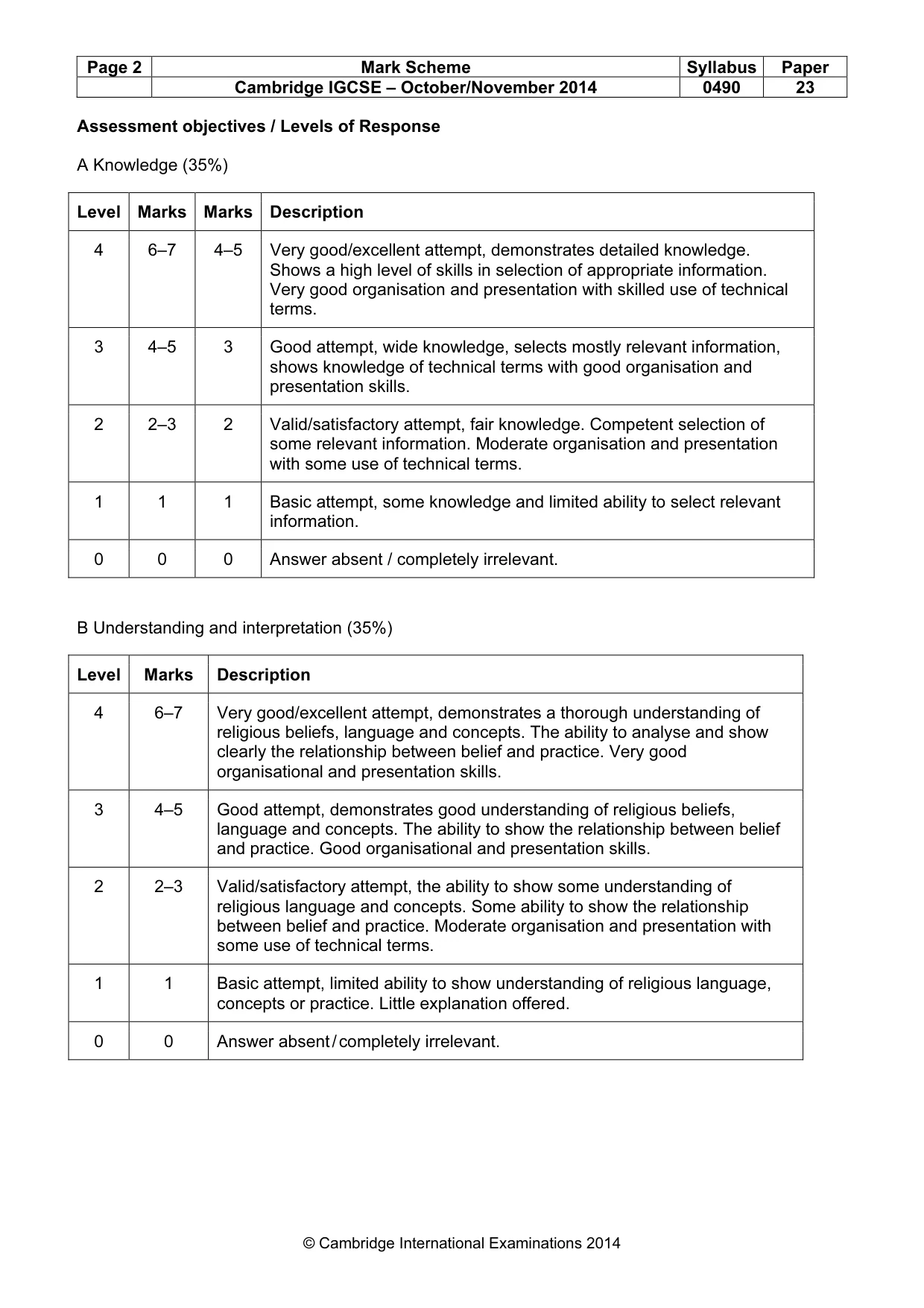
Page 2 Mark Scheme Syllabus Paper Cambridge IGCSE – October/November 2014 0490 23 © Cambridge International Examinations 2014 Assessment objectives / Levels of Response A Knowledge (35%) Level Marks Marks Description 4 6–7 4–5 Very good/excellent attempt, demonstrates detailed knowledge. Shows a high level of skills in selection of appropriate information. Very good organisation and presentation with skilled use of technical terms. 3 4–5 3 Good attempt, wide knowledge, selects mostly relevant information, shows knowledge of technical terms with good organisation and presentation skills. 2 2–3 2 Valid/satisfactory attempt, fair knowledge. Competent selection of some relevant information. Moderate organisation and presentation with some use of technical terms. 1 1 1 Basic attempt, some knowledge and limited ability to select relevant information. 0 0 0 Answer absent / completely irrelevant. B Understanding and interpretation (35%) Level Marks Description 4 6–7 Very good/excellent attempt, demonstrates a thorough understanding of religious beliefs, language and concepts. The ability to analyse and show clearly the relationship between belief and practice. Very good organisational and presentation skills. 3 4–5 Good attempt, demonstrates good understanding of religious beliefs, language and concepts. The ability to show the relationship between belief and practice. Good organisational and presentation skills. 2 2–3 Valid/satisfactory attempt, the ability to show some understanding of religious language and concepts. Some ability to show the relationship between belief and practice. Moderate organisation and presentation with some use of technical terms. 1 1 Basic attempt, limited ability to show understanding of religious language, concepts or practice. Little explanation offered. 0 0 Answer absent / completely irrelevant.
Mark scheme, page 3
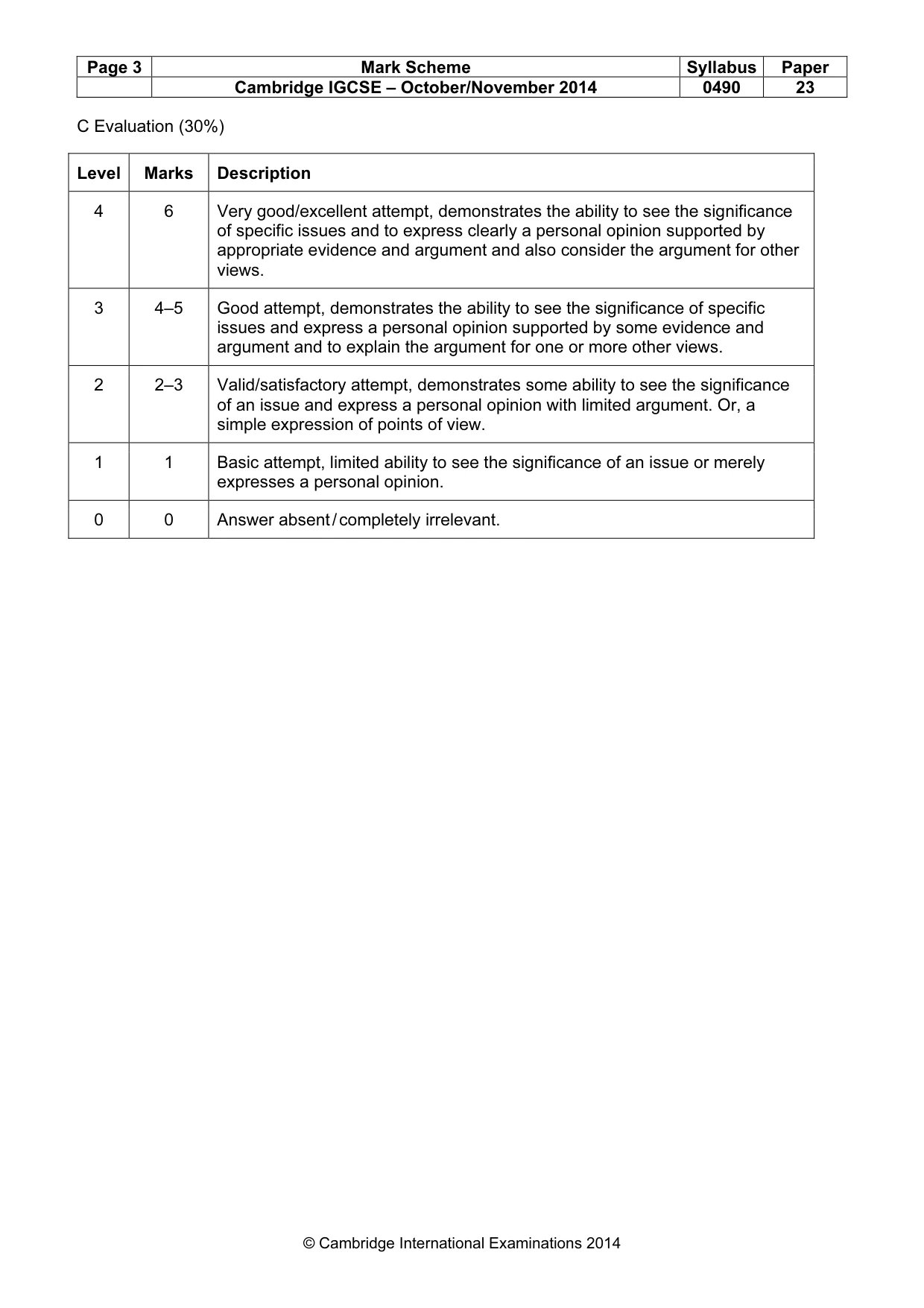
Page 3 Mark Scheme Syllabus Paper Cambridge IGCSE – October/November 2014 0490 23 © Cambridge International Examinations 2014 C Evaluation (30%) Level Marks Description 4 6 Very good/excellent attempt, demonstrates the ability to see the significance of specific issues and to express clearly a personal opinion supported by appropriate evidence and argument and also consider the argument for other views. 3 4–5 Good attempt, demonstrates the ability to see the significance of specific issues and express a personal opinion supported by some evidence and argument and to explain the argument for one or more other views. 2 2–3 Valid/satisfactory attempt, demonstrates some ability to see the significance of an issue and express a personal opinion with limited argument. Or, a simple expression of points of view. 1 1 Basic attempt, limited ability to see the significance of an issue or merely expresses a personal opinion. 0 0 Answer absent / completely irrelevant.
Mark scheme, page 4
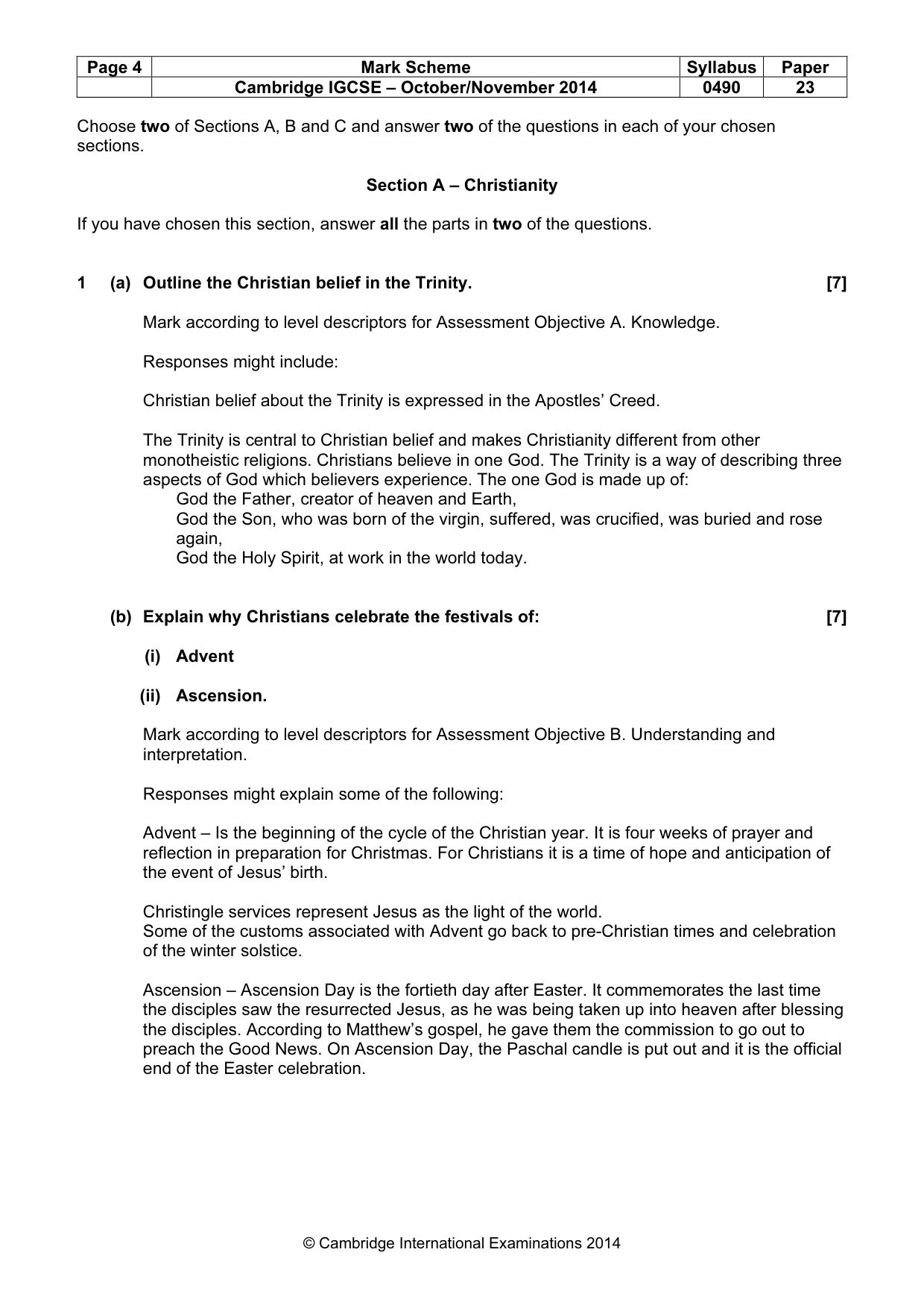
Page 4 Mark Scheme Syllabus Paper Cambridge IGCSE – October/November 2014 0490 23 © Cambridge International Examinations 2014 Choose two of Sections A, B and C and answer two of the questions in each of your chosen sections. Section A – Christianity If you have chosen this section, answer all the parts in two of the questions. 1 (a) Outline the Christian belief in the Trinity. [7] Mark according to level descriptors for Assessment Objective A. Knowledge. Responses might include: Christian belief about the Trinity is expressed in the Apostles’ Creed. The Trinity is central to Christian belief and makes Christianity different from other monotheistic religions. Christians believe in one God. The Trinity is a way of describing three aspects of God which believers experience. The one God is made up of: God the Father, creator of heaven and Earth, God the Son, who was born of the virgin, suffered, was crucified, was buried and rose again, God the Holy Spirit, at work in the world today. (b) Explain why Christians celebrate the festivals of: [7] (i) Advent (ii) Ascension. Mark according to level descriptors for Assessment Objective B. Understanding and interpretation. Responses might explain some of the following: Advent – Is the beginning of the cycle of the Christian year. It is four weeks of prayer and reflection in preparation for Christmas. For Christians it is a time of hope and anticipation of the event of Jesus’ birth. Christingle services represent Jesus as the light of the world. Some of the customs associated with Advent go back to pre-Christian times and celebration of the winter solstice. Ascension – Ascension Day is the fortieth day after Easter. It commemorates the last time the disciples saw the resurrected Jesus, as he was being taken up into heaven after blessing the disciples. According to Matthew’s gospel, he gave them the commission to go out to preach the Good News. On Ascension Day, the Paschal candle is put out and it is the official end of the Easter celebration.
Mark scheme, page 5
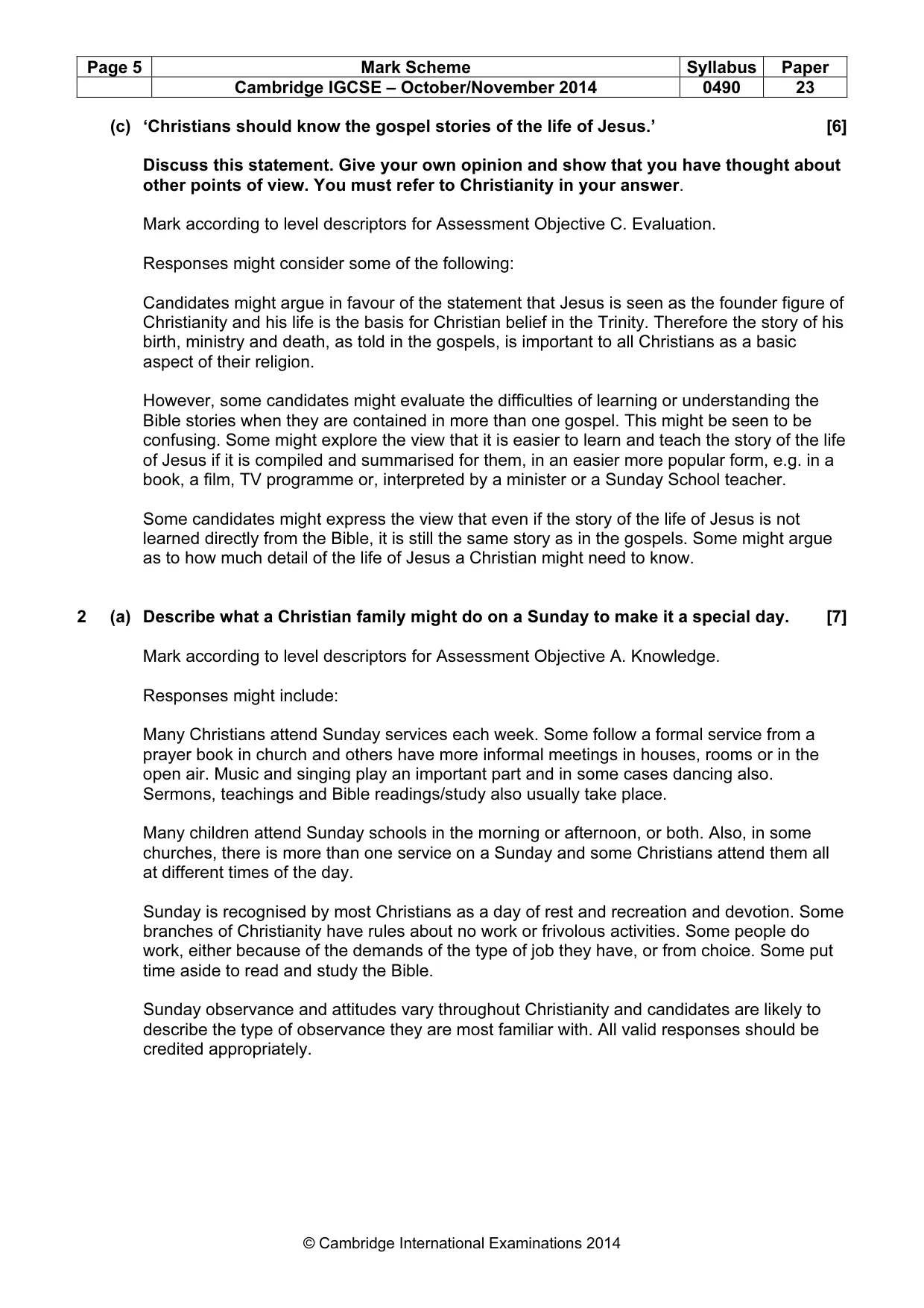
Page 5 Mark Scheme Syllabus Paper Cambridge IGCSE – October/November 2014 0490 23 © Cambridge International Examinations 2014 (c) ‘Christians should know the gospel stories of the life of Jesus.’ [6] Discuss this statement. Give your own opinion and show that you have thought about other points of view. You must refer to Christianity in your answer. Mark according to level descriptors for Assessment Objective C. Evaluation. Responses might consider some of the following: Candidates might argue in favour of the statement that Jesus is seen as the founder figure of Christianity and his life is the basis for Christian belief in the Trinity. Therefore the story of his birth, ministry and death, as told in the gospels, is important to all Christians as a basic aspect of their religion. However, some candidates might evaluate the difficulties of learning or understanding the Bible stories when they are contained in more than one gospel. This might be seen to be confusing. Some might explore the view that it is easier to learn and teach the story of the life of Jesus if it is compiled and summarised for them, in an easier more popular form, e.g. in a book, a film, TV programme or, interpreted by a minister or a Sunday School teacher. Some candidates might express the view that even if the story of the life of Jesus is not learned directly from the Bible, it is still the same story as in the gospels. Some might argue as to how much detail of the life of Jesus a Christian might need to know. 2 (a) Describe what a Christian family might do on a Sunday to make it a special day. [7] Mark according to level descriptors for Assessment Objective A. Knowledge. Responses might include: Many Christians attend Sunday services each week. Some follow a formal service from a prayer book in church and others have more informal meetings in houses, rooms or in the open air. Music and singing play an important part and in some cases dancing also. Sermons, teachings and Bible readings/study also usually take place. Many children attend Sunday schools in the morning or afternoon, or both. Also, in some churches, there is more than one service on a Sunday and some Christians attend them all at different times of the day. Sunday is recognised by most Christians as a day of rest and recreation and devotion. Some branches of Christianity have rules about no work or frivolous activities. Some people do work, either because of the demands of the type of job they have, or from choice. Some put time aside to read and study the Bible. Sunday observance and attitudes vary throughout Christianity and candidates are likely to describe the type of observance they are most familiar with. All valid responses should be credited appropriately.
Mark scheme, page 6
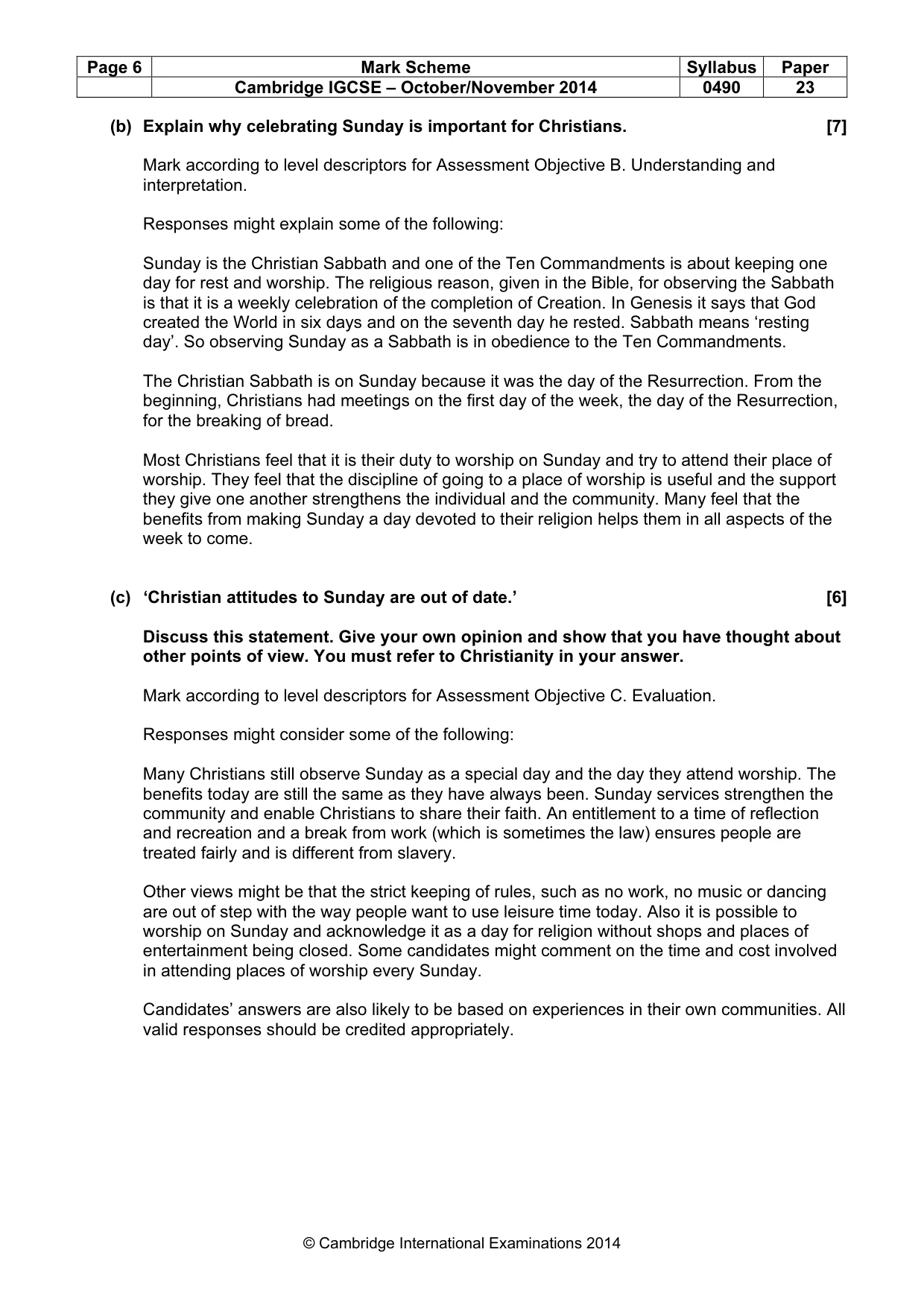
Page 6 Mark Scheme Syllabus Paper Cambridge IGCSE – October/November 2014 0490 23 © Cambridge International Examinations 2014 (b) Explain why celebrating Sunday is important for Christians. [7] Mark according to level descriptors for Assessment Objective B. Understanding and interpretation. Responses might explain some of the following: Sunday is the Christian Sabbath and one of the Ten Commandments is about keeping one day for rest and worship. The religious reason, given in the Bible, for observing the Sabbath is that it is a weekly celebration of the completion of Creation. In Genesis it says that God created the World in six days and on the seventh day he rested. Sabbath means ‘resting day’. So observing Sunday as a Sabbath is in obedience to the Ten Commandments. The Christian Sabbath is on Sunday because it was the day of the Resurrection. From the beginning, Christians had meetings on the first day of the week, the day of the Resurrection, for the breaking of bread. Most Christians feel that it is their duty to worship on Sunday and try to attend their place of worship. They feel that the discipline of going to a place of worship is useful and the support they give one another strengthens the individual and the community. Many feel that the benefits from making Sunday a day devoted to their religion helps them in all aspects of the week to come. (c) ‘Christian attitudes to Sunday are out of date.’ [6] Discuss this statement. Give your own opinion and show that you have thought about other points of view. You must refer to Christianity in your answer. Mark according to level descriptors for Assessment Objective C. Evaluation. Responses might consider some of the following: Many Christians still observe Sunday as a special day and the day they attend worship. The benefits today are still the same as they have always been. Sunday services strengthen the community and enable Christians to share their faith. An entitlement to a time of reflection and recreation and a break from work (which is sometimes the law) ensures people are treated fairly and is different from slavery. Other views might be that the strict keeping of rules, such as no work, no music or dancing are out of step with the way people want to use leisure time today. Also it is possible to worship on Sunday and acknowledge it as a day for religion without shops and places of entertainment being closed. Some candidates might comment on the time and cost involved in attending places of worship every Sunday. Candidates’ answers are also likely to be based on experiences in their own communities. All valid responses should be credited appropriately.
Mark scheme, page 7
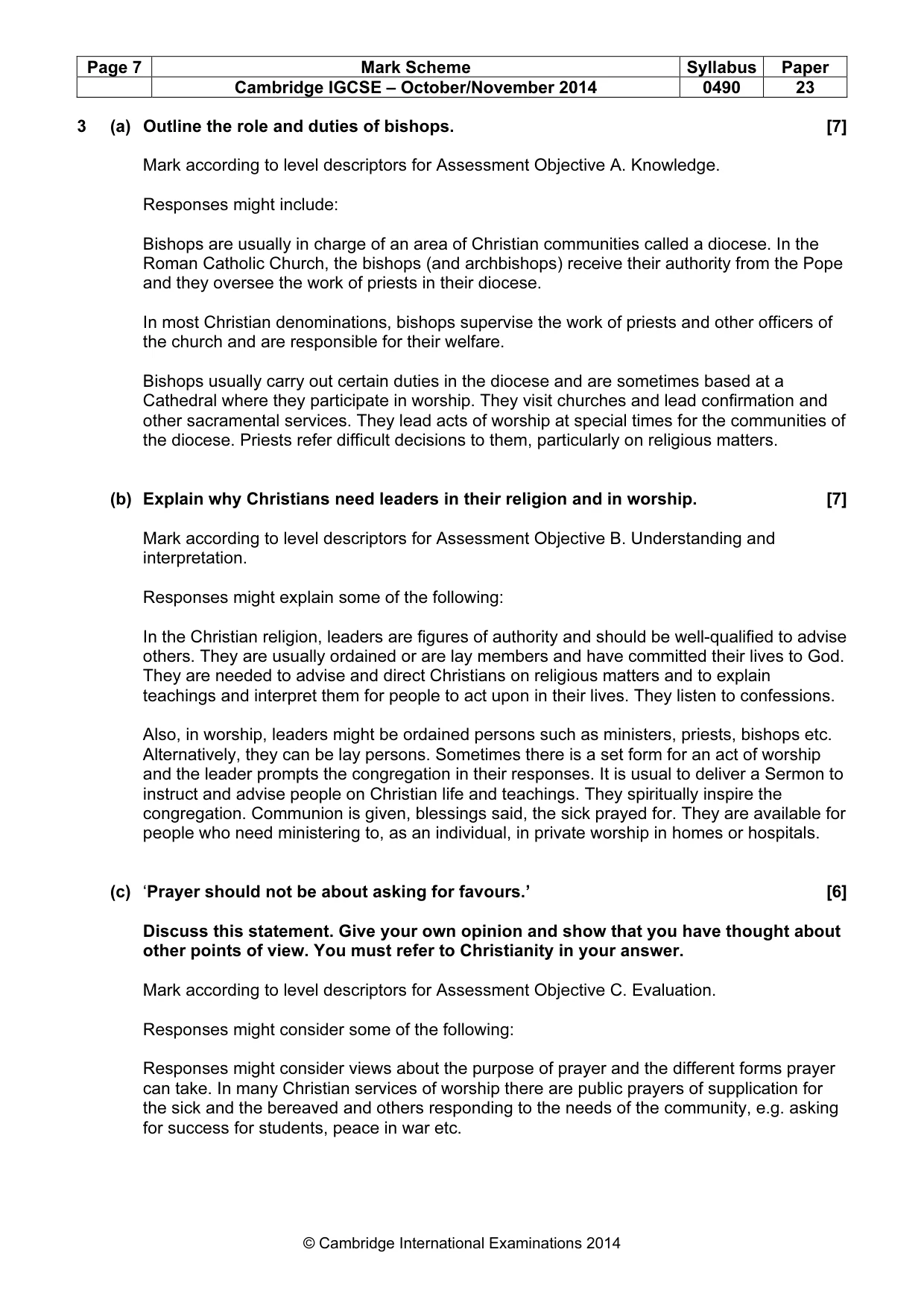
Page 7 Mark Scheme Syllabus Paper Cambridge IGCSE – October/November 2014 0490 23 © Cambridge International Examinations 2014 3 (a) Outline the role and duties of bishops. [7] Mark according to level descriptors for Assessment Objective A. Knowledge. Responses might include: Bishops are usually in charge of an area of Christian communities called a diocese. In the Roman Catholic Church, the bishops (and archbishops) receive their authority from the Pope and they oversee the work of priests in their diocese. In most Christian denominations, bishops supervise the work of priests and other officers of the church and are responsible for their welfare. Bishops usually carry out certain duties in the diocese and are sometimes based at a Cathedral where they participate in worship. They visit churches and lead confirmation and other sacramental services. They lead acts of worship at special times for the communities of the diocese. Priests refer difficult decisions to them, particularly on religious matters. (b) Explain why Christians need leaders in their religion and in worship. [7] Mark according to level descriptors for Assessment Objective B. Understanding and interpretation. Responses might explain some of the following: In the Christian religion, leaders are figures of authority and should be well-qualified to advise others. They are usually ordained or are lay members and have committed their lives to God. They are needed to advise and direct Christians on religious matters and to explain teachings and interpret them for people to act upon in their lives. They listen to confessions. Also, in worship, leaders might be ordained persons such as ministers, priests, bishops etc. Alternatively, they can be lay persons. Sometimes there is a set form for an act of worship and the leader prompts the congregation in their responses. It is usual to deliver a Sermon to instruct and advise people on Christian life and teachings. They spiritually inspire the congregation. Communion is given, blessings said, the sick prayed for. They are available for people who need ministering to, as an individual, in private worship in homes or hospitals. (c) ‘Prayer should not be about asking for favours.’ [6] Discuss this statement. Give your own opinion and show that you have thought about other points of view. You must refer to Christianity in your answer. Mark according to level descriptors for Assessment Objective C. Evaluation. Responses might consider some of the following: Responses might consider views about the purpose of prayer and the different forms prayer can take. In many Christian services of worship there are public prayers of supplication for the sick and the bereaved and others responding to the needs of the community, e.g. asking for success for students, peace in war etc.
Mark scheme, page 8
Page 8 Mark Scheme Syllabus Paper Cambridge IGCSE – October/November 2014 0490 23 © Cambridge International Examinations 2014 Candidates are also likely to consider the individual, private prayer and personal prayers of believers, asking for comfort or help in difficult times or even the strength to deal with situations. Candidates’ evaluations might be based upon the general/personal motive for prayer and whether prayer is genuine, either for oneself or for others.
Mark scheme, page 9
Page 9 Mark Scheme Syllabus Paper Cambridge IGCSE – October/November 2014 0490 23 © Cambridge International Examinations 2014 Section B – Islam If you have chosen this section, answer all the parts in two of the questions. 4 (a) Describe what happens at Jummah (Friday mid-day prayer) in the mosque. [7] Mark according to level descriptors for Assessment Objective A. Knowledge. Responses might include: Salat-ul-Jummah are prayers that take place once a week on Friday. Friday is Yaum ul –Juma’t, the day of Assembly, and many Muslims make a special effort to attend the midday prayers at the mosque. The Friday congregational prayers at the mosque should be attended by every male Muslim who is able to do so. Women, because of their other duties, are exempt from attending. The usual preparations for prayer are made. The prayers are led by the Imam who knows the Qur’an and is respected. At the start and end of the formal prayers there is time for optional prayers. The Imam delivers the khutbah, a sermon, which is read in the language of the community with and introduction and a conclusion in Arabic. This may be on interpreting the teaching of the Qur’an or on another matter which is of interest to the community. The Imam leads two rak’ah fard (compulsory prayers) instead of the usual four. After the prayers there is usually time for discussion of religious matters or topical events in the community. (b) Explain the reasons why the mihrab and the qiblah are important to Muslims. [7] Mark according to level descriptors for Assessment Objective B. Understanding and interpretation. Responses might explain some of the following: In the mosque, the mihrab is a niche on the wall which shows that this is the qiblah wall. The iblah wall indicates the direction of the Ka’ba in Makkah, so the mihrab and qiblah are important because they indicate the direction of the Ka’bah and Muslims face the Ka’bah when praying. The Ka’bah is thought to be the oldest place of worship in the world. Muslims believe that it was built by Adam and restored by Abraham with the help of Ishmael. Muhammad (pbuh) had a revelation that the true qiblah was Makkah and not Jerusalem. When praying at home, Muslims have a picture or text from the Qur’an on a wall to indicate the qiblah, so they know which way to face when saying their prayers. Muslims also use a compass when travelling so they can locate the direction of the Ka’bah.
Mark scheme, page 10
Page 10 Mark Scheme Syllabus Paper Cambridge IGCSE – October/November 2014 0490 23 © Cambridge International Examinations 2014 (c) ‘Prayer with other Muslims is the best kind of prayer.’ [6] Discuss this statement. Give your own opinion and show that you have thought about other points of view. You must refer to Islam in your answer. Mark according to level descriptors for Assessment Objective C. Evaluation. Responses might consider some of the following: Candidates might quote the injuncton for all male Muslims to attend the mosque for Friday prayers. The Prophet stressed the importance of congregational prayer. However, although Salah must be performed five times each day, it can be done anywhere as long as the believer has the correct intention, makes appropriate preparation and faces the Ka’bah. Often Muslims do have to pray alone. Some women do not attend worship in the mosque and it is not a requirement. Women are exempt because of their duties as mothers and wives; however, if praying at home, women usually pray together. Travellers often have to observe prayer times alone in cars, on buses, trains and planes. Some candidates might consider the advantages of congregational prayers as good reasons for regular attendance at the mosque. It strengthens the community, encourages Muslims to care for and help one another, helps in understanding the Qur’an and advice can be obtained. Other, special times at the mosque, such as Id prayers or during Ramadan are also have spiritual and community benefits. A conclusion might be that all prayer should be sincere. 5 (a) How do Muslims celebrate Lailat ul-Qadr (Night of Power)? [7] Mark according to level descriptors for Assessment Objective A. Knowledge. Responses might include: Lailat ul-Qadr (Night of Power) marks the occasion of the first revelation of the Qur’an to Muhammad (pbuh) by the angel Jibril. It takes place during the last ten nights of Ramadan. The timing of it is often uncertain but it is thought to be the 27th of Ramadan and so some male Muslims stay in the mosque for the last ten days of Ramadan (known as i’tikaf), praying and reading the Qur’an. During Lailat ul-Qadr, many Muslims stay up all night praying and reciting the Qur’an, asking for Allah’s mercy and forgiveness. It is believed there will be many blessings for their prayers on this night.
Mark scheme, page 11
Page 11 Mark Scheme Syllabus Paper Cambridge IGCSE – October/November 2014 0490 23 © Cambridge International Examinations 2014 (b) Explain the significance of Madinah for Muslims. [7] Mark according to level descriptors for Assessment Objective B. Understanding and interpretation. Responses might explain some of the following: Madinah played an important role in the growth of Islam. The Prophet migrated to Madinah when his life was in danger in Makkah. Madinah was then called Yathrib and Muhammad (pbuh) was invited to be the ruler to help to settle disputes between the Arab and Jewish tribes. When the Prophet migrated, Yathrib became Madinah and the year of the Hijrah 622 became 1 AH, the beginning of the Muslim calendar. The Muslims who migrated were refugees and they had left everything behind in Makkah. The people of Madinah shared their homes and belongings with the new arrivals. The Prophet was a wise ruler and Islam flourished in Madinah and religious tolerance of Jews and Christians was also in evidence. The Prophet received many important revelations in Madinah and the first mosque was built. Many pilgrims visit the Prophet’s mosque in Madinah during Hajj. (c) ‘Historical places are not important in religion.’ [6] Discuss this statement. Give your own opinion and show that you have thought about other points of view. You must refer to Islam in your answer. Mark according to level descriptors for Assessment Objective C. Evaluation. Responses might consider some of the following: Responses might consider the relative importance of historical places to their understanding of the history and nature of Islam. Candidates are likely to evaluate the importance of places such as Makkah and Madinah in terms of the story of the revelation and development of Islam. Some candidates might link their answer to the places visited on Hajj and the connection with prophets Adam and Ibrahim, as well as Muhammad. Other views might be that religious events or truth do not necessarily depend on accurate historical or geographical knowledge but on belief.
Mark scheme, page 12
Page 12 Mark Scheme Syllabus Paper Cambridge IGCSE – October/November 2014 0490 23 © Cambridge International Examinations 2014 6 (a) Why is the Qur’an a sacred text for Muslims? [7] Mark according to level descriptors for Assessment Objective A. Knowledge. Responses might include: Muslims believe that the Holy Qur’an is the revealed word of God, unchanged and uncorrupted. They believe that other revealed scriptures, given to prophets before Muhammad (pbuh), were changed and corrupted over time. Muhammad (pbuh) was the vehicle by which the revelation was transmitted. Unlike other scriptures, revealed through Prophets, it was not for a particular people at a particular time. The Qur’an is a universal message for eternity, which has perfected the original religion, revealed from the beginning of time. The Qur’an is the final revelation and a complete code of life for Muslims. It provides infallible guidance. As it is from God, it gives information not known to humans. God has promised to preserve it for eternity. (b) Explain the importance of Shariah for Muslims. [7] Mark according to level descriptors for Assessment Objective B. Understanding and interpretation. Responses might explain some of the following: The Shariah is the code of law for Islamic living. It determines the rightness (halal) or wrongness (haram) of any action. Shariah means the ‘straight path’ that Muslims must follow. The two main sources for Shariah are the Qur’an and the Sunnah. It gives the criteria for judging all behaviour, conduct and relationships with other individuals and with society, as a whole. A Muslim’s whole life is governed by Shariah. In Muslim countries the justice system is based upon Shariah. (c) ‘Islam could not exist without the Qur’an.’ [6] Discuss this statement. Give your own opinion and show that you have thought about other points of view. You must refer to Islam in your answer. Mark according to level descriptors for Assessment Objective C. Evaluation. Responses might consider some of the following: Some candidates might argue that if Islam is the religion from the beginning of time, then it did exist before the Qur’an was revealed. The scriptures revealed to Jews and Christians were part of the same message brought by prophets such as Ibrahim and Moses and Isa.
Mark scheme, page 13
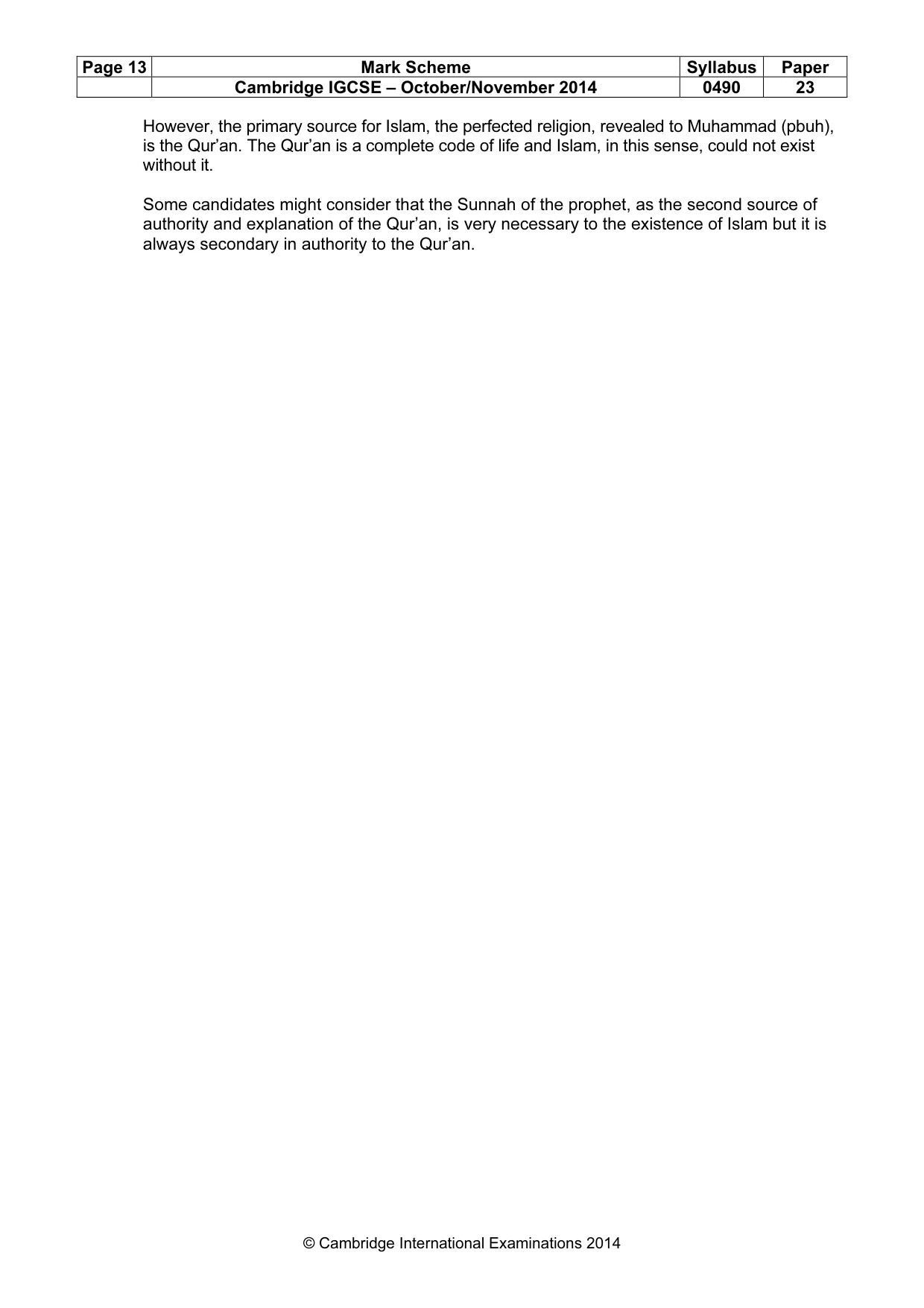
Page 13 Mark Scheme Syllabus Paper Cambridge IGCSE – October/November 2014 0490 23 © Cambridge International Examinations 2014 However, the primary source for Islam, the perfected religion, revealed to Muhammad (pbuh), is the Qur’an. The Qur’an is a complete code of life and Islam, in this sense, could not exist without it. Some candidates might consider that the Sunnah of the prophet, as the second source of authority and explanation of the Qur’an, is very necessary to the existence of Islam but it is always secondary in authority to the Qur’an.
Mark scheme, page 14
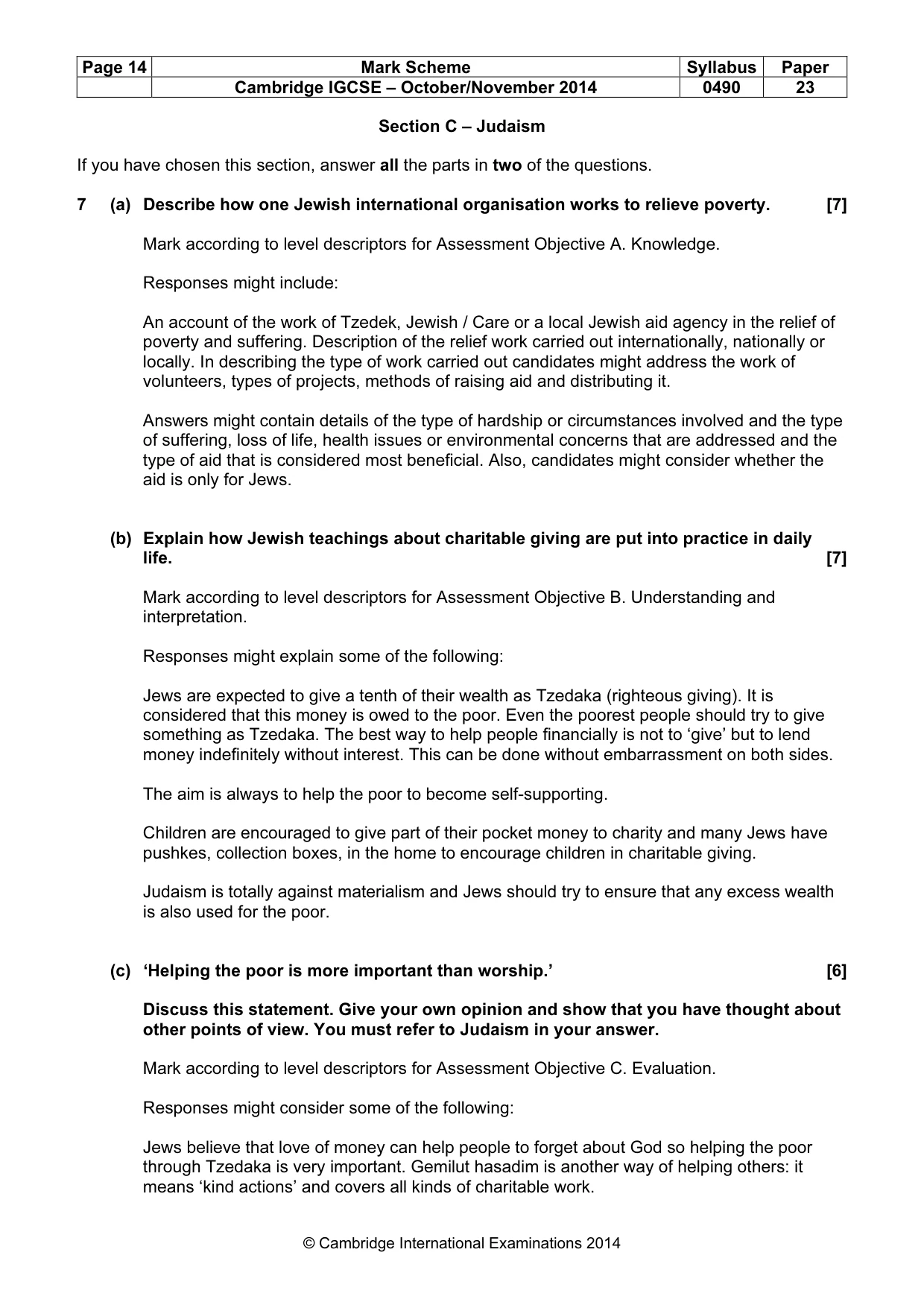
Page 14 Mark Scheme Syllabus Paper Cambridge IGCSE – October/November 2014 0490 23 © Cambridge International Examinations 2014 Section C – Judaism If you have chosen this section, answer all the parts in two of the questions. 7 (a) Describe how one Jewish international organisation works to relieve poverty. [7] Mark according to level descriptors for Assessment Objective A. Knowledge. Responses might include: An account of the work of Tzedek, Jewish / Care or a local Jewish aid agency in the relief of poverty and suffering. Description of the relief work carried out internationally, nationally or locally. In describing the type of work carried out candidates might address the work of volunteers, types of projects, methods of raising aid and distributing it. Answers might contain details of the type of hardship or circumstances involved and the type of suffering, loss of life, health issues or environmental concerns that are addressed and the type of aid that is considered most beneficial. Also, candidates might consider whether the aid is only for Jews. (b) Explain how Jewish teachings about charitable giving are put into practice in daily life. [7] Mark according to level descriptors for Assessment Objective B. Understanding and interpretation. Responses might explain some of the following: Jews are expected to give a tenth of their wealth as Tzedaka (righteous giving). It is considered that this money is owed to the poor. Even the poorest people should try to give something as Tzedaka. The best way to help people financially is not to ‘give’ but to lend money indefinitely without interest. This can be done without embarrassment on both sides. The aim is always to help the poor to become self-supporting. Children are encouraged to give part of their pocket money to charity and many Jews have pushkes, collection boxes, in the home to encourage children in charitable giving. Judaism is totally against materialism and Jews should try to ensure that any excess wealth is also used for the poor. (c) ‘Helping the poor is more important than worship.’ [6] Discuss this statement. Give your own opinion and show that you have thought about other points of view. You must refer to Judaism in your answer. Mark according to level descriptors for Assessment Objective C. Evaluation. Responses might consider some of the following: Jews believe that love of money can help people to forget about God so helping the poor through Tzedaka is very important. Gemilut hasadim is another way of helping others: it means ‘kind actions’ and covers all kinds of charitable work.
Mark scheme, page 15
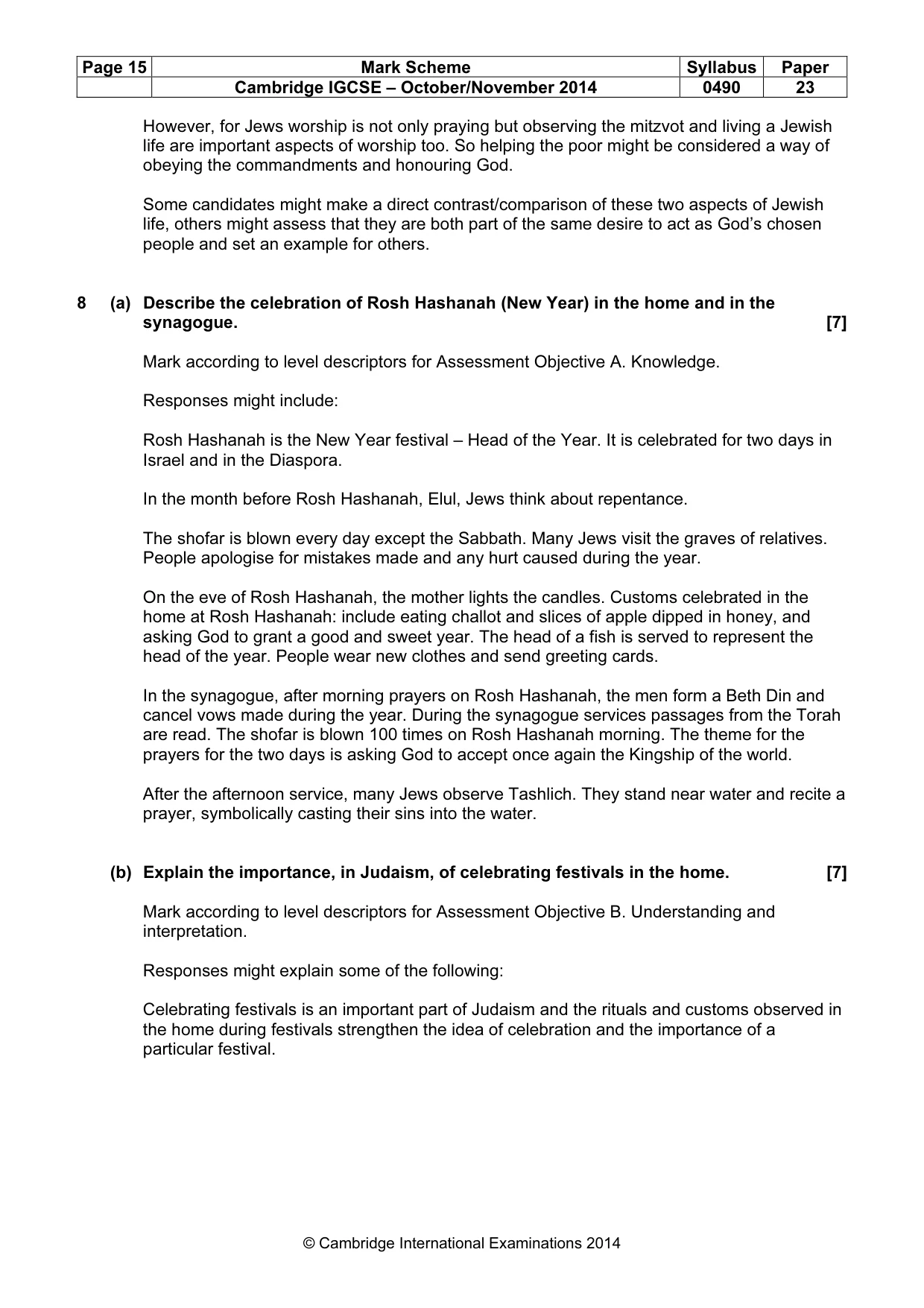
Page 15 Mark Scheme Syllabus Paper Cambridge IGCSE – October/November 2014 0490 23 © Cambridge International Examinations 2014 However, for Jews worship is not only praying but observing the mitzvot and living a Jewish life are important aspects of worship too. So helping the poor might be considered a way of obeying the commandments and honouring God. Some candidates might make a direct contrast/comparison of these two aspects of Jewish life, others might assess that they are both part of the same desire to act as God’s chosen people and set an example for others. 8 (a) Describe the celebration of Rosh Hashanah (New Year) in the home and in the synagogue. [7] Mark according to level descriptors for Assessment Objective A. Knowledge. Responses might include: Rosh Hashanah is the New Year festival – Head of the Year. It is celebrated for two days in Israel and in the Diaspora. In the month before Rosh Hashanah, Elul, Jews think about repentance. The shofar is blown every day except the Sabbath. Many Jews visit the graves of relatives. People apologise for mistakes made and any hurt caused during the year. On the eve of Rosh Hashanah, the mother lights the candles. Customs celebrated in the home at Rosh Hashanah: include eating challot and slices of apple dipped in honey, and asking God to grant a good and sweet year. The head of a fish is served to represent the head of the year. People wear new clothes and send greeting cards. In the synagogue, after morning prayers on Rosh Hashanah, the men form a Beth Din and cancel vows made during the year. During the synagogue services passages from the Torah are read. The shofar is blown 100 times on Rosh Hashanah morning. The theme for the prayers for the two days is asking God to accept once again the Kingship of the world. After the afternoon service, many Jews observe Tashlich. They stand near water and recite a prayer, symbolically casting their sins into the water. (b) Explain the importance, in Judaism, of celebrating festivals in the home. [7] Mark according to level descriptors for Assessment Objective B. Understanding and interpretation. Responses might explain some of the following: Celebrating festivals is an important part of Judaism and the rituals and customs observed in the home during festivals strengthen the idea of celebration and the importance of a particular festival.
Mark scheme, page 16
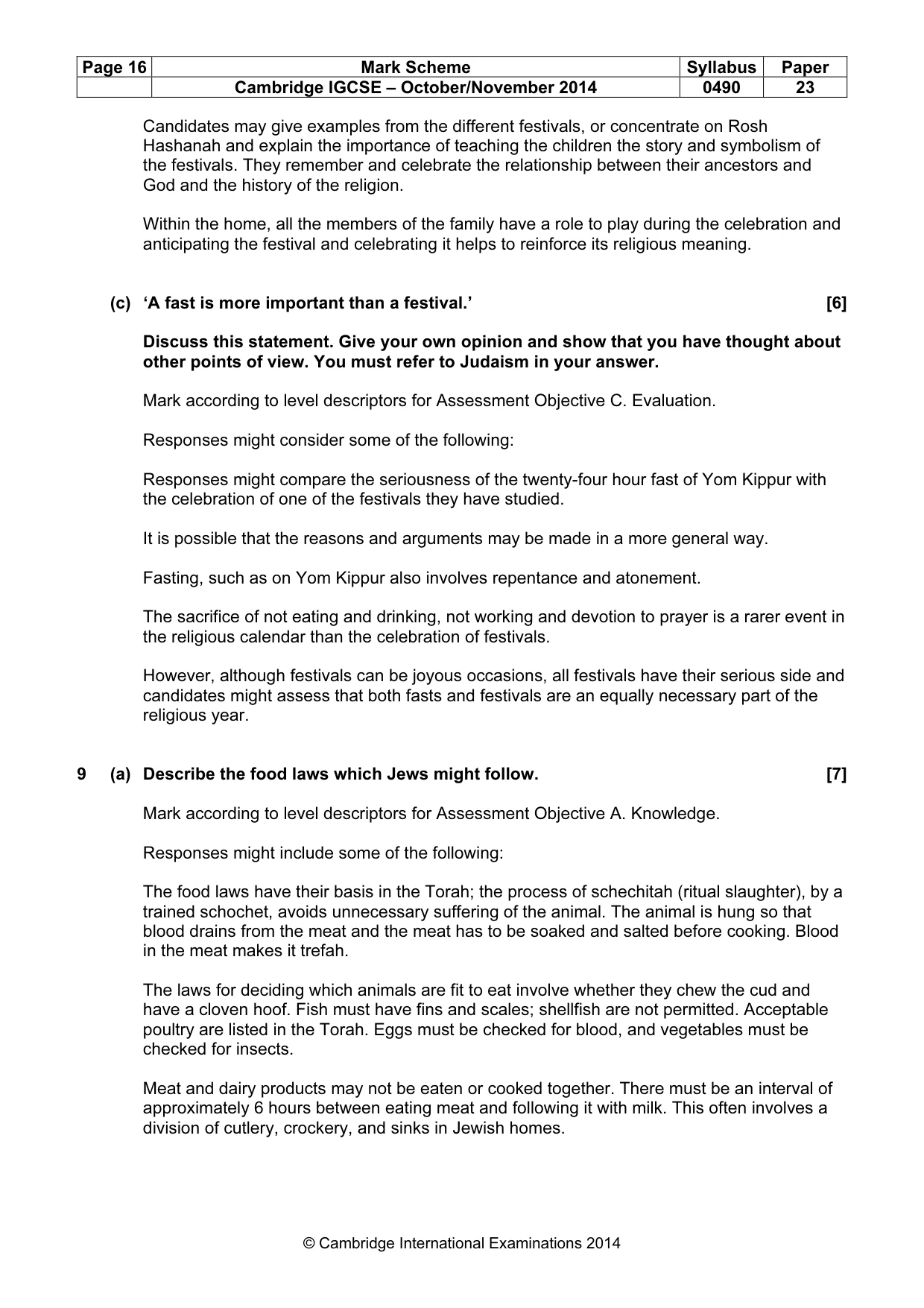
Page 16 Mark Scheme Syllabus Paper Cambridge IGCSE – October/November 2014 0490 23 © Cambridge International Examinations 2014 Candidates may give examples from the different festivals, or concentrate on Rosh Hashanah and explain the importance of teaching the children the story and symbolism of the festivals. They remember and celebrate the relationship between their ancestors and God and the history of the religion. Within the home, all the members of the family have a role to play during the celebration and anticipating the festival and celebrating it helps to reinforce its religious meaning. (c) ‘A fast is more important than a festival.’ [6] Discuss this statement. Give your own opinion and show that you have thought about other points of view. You must refer to Judaism in your answer. Mark according to level descriptors for Assessment Objective C. Evaluation. Responses might consider some of the following: Responses might compare the seriousness of the twenty-four hour fast of Yom Kippur with the celebration of one of the festivals they have studied. It is possible that the reasons and arguments may be made in a more general way. Fasting, such as on Yom Kippur also involves repentance and atonement. The sacrifice of not eating and drinking, not working and devotion to prayer is a rarer event in the religious calendar than the celebration of festivals. However, although festivals can be joyous occasions, all festivals have their serious side and candidates might assess that both fasts and festivals are an equally necessary part of the religious year. 9 (a) Describe the food laws which Jews might follow. [7] Mark according to level descriptors for Assessment Objective A. Knowledge. Responses might include some of the following: The food laws have their basis in the Torah; the process of schechitah (ritual slaughter), by a trained schochet, avoids unnecessary suffering of the animal. The animal is hung so that blood drains from the meat and the meat has to be soaked and salted before cooking. Blood in the meat makes it trefah. The laws for deciding which animals are fit to eat involve whether they chew the cud and have a cloven hoof. Fish must have fins and scales; shellfish are not permitted. Acceptable poultry are listed in the Torah. Eggs must be checked for blood, and vegetables must be checked for insects. Meat and dairy products may not be eaten or cooked together. There must be an interval of approximately 6 hours between eating meat and following it with milk. This often involves a division of cutlery, crockery, and sinks in Jewish homes.
Mark scheme, page 17
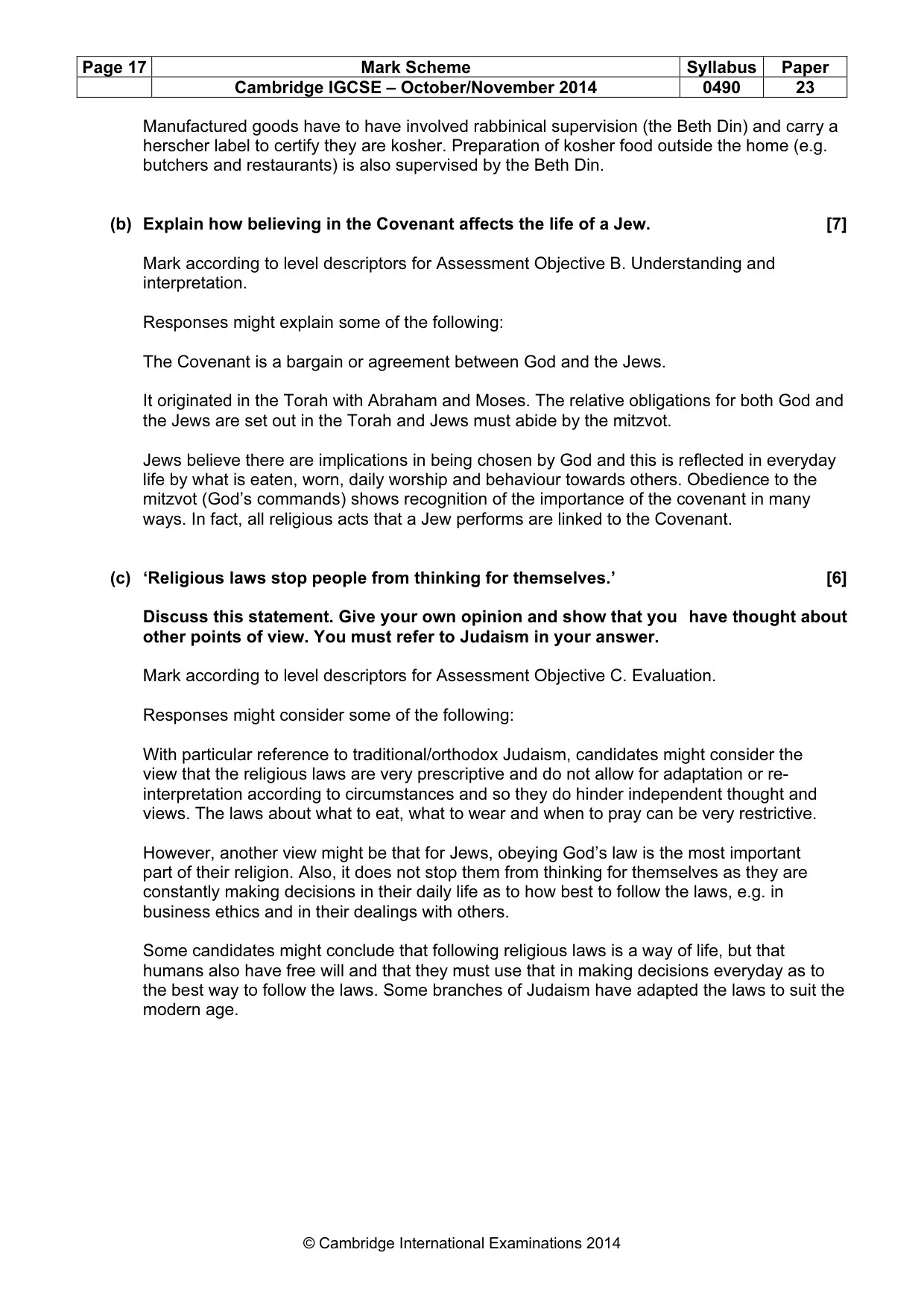
Page 17 Mark Scheme Syllabus Paper Cambridge IGCSE – October/November 2014 0490 23 © Cambridge International Examinations 2014 Manufactured goods have to have involved rabbinical supervision (the Beth Din) and carry a herscher label to certify they are kosher. Preparation of kosher food outside the home (e.g. butchers and restaurants) is also supervised by the Beth Din. (b) Explain how believing in the Covenant affects the life of a Jew. [7] Mark according to level descriptors for Assessment Objective B. Understanding and interpretation. Responses might explain some of the following: The Covenant is a bargain or agreement between God and the Jews. It originated in the Torah with Abraham and Moses. The relative obligations for both God and the Jews are set out in the Torah and Jews must abide by the mitzvot. Jews believe there are implications in being chosen by God and this is reflected in everyday life by what is eaten, worn, daily worship and behaviour towards others. Obedience to the mitzvot (God’s commands) shows recognition of the importance of the covenant in many ways. In fact, all religious acts that a Jew performs are linked to the Covenant. (c) ‘Religious laws stop people from thinking for themselves.’ [6] Discuss this statement. Give your own opinion and show that you have thought about other points of view. You must refer to Judaism in your answer. Mark according to level descriptors for Assessment Objective C. Evaluation. Responses might consider some of the following: With particular reference to traditional/orthodox Judaism, candidates might consider the view that the religious laws are very prescriptive and do not allow for adaptation or re- interpretation according to circumstances and so they do hinder independent thought and views. The laws about what to eat, what to wear and when to pray can be very restrictive. However, another view might be that for Jews, obeying God’s law is the most important part of their religion. Also, it does not stop them from thinking for themselves as they are constantly making decisions in their daily life as to how best to follow the laws, e.g. in business ethics and in their dealings with others. Some candidates might conclude that following religious laws is a way of life, but that humans also have free will and that they must use that in making decisions everyday as to the best way to follow the laws. Some branches of Judaism have adapted the laws to suit the modern age.
What you needed in this session
Cambridge’s own grade thresholds for 2014 Oct/Nov, Paper 2 · Variant 3. A higher threshold means an easier paper — the bar moves with how the cohort did.