Cambridge IGCSE Religious Studies 0490 — 2014 Oct/Nov Paper 1 · Variant 3
0490/13/O/N/14 · 80 marks · ≈90 min
The question paper and its mark scheme, free to read here and free to download. This is Cambridge’s own paper, exactly as it was sat.
Question paper4 pages
Mark scheme14 pages
Answers below. Sit the paper first if you are practising.
Paper as text
Question paper, page 1
This document consists of 4 printed pages and 1 Insert. DC (SJF) 98833 © UCLES 2014 [Turn over Cambridge International Examinations Cambridge International General Certificate of Secondary Education * 0 2 3 2 0 1 3 4 2 7 * RELIGIOUS STUDIES 0490/13 Paper 1 October/November 2014 1 hour 45 minutes No Additional Materials are required. READ THESE INSTRUCTIONS FIRST An answer booklet is provided inside this question paper. You should follow the instructions on the front cover of the answer booklet. If you need additional answer paper ask the invigilator for a continuation booklet. Choose two of Sections A, B and C and answer all the questions in each of your chosen sections. The number of marks is given in brackets [ ] at the end of each question or part question.
Question paper, page 2
2 0490/13/O/N/14 © UCLES 2014 Choose two of Sections A, B and C and answer all of the questions in each of your chosen sections. Section A – Christianity If you have chosen this section, answer all the questions. 1 (a) (i) What makes Bethlehem a place of pilgrimage for Christians? [4] (ii) Name three other places of Christian pilgrimage. [3] (b) Explain why Christians believe that Jesus had to suffer. [7] (c) ‘Easter is a more important festival than Christmas.’ Discuss this statement. Give your own opinion and show that you have thought about other points of view. You must refer to Christianity in your answer. [6] 2 Suzy and Wesley invite you to the celebration of their wedding on Saturday 12th April 2014 1.00 p.m. at The United Christian Mission Tlotlo. (a) (i) What role does the Priest/Minister have in a Christian marriage ceremony? [3] (ii) What vows do the couple usually make to each other? [4] (b) Explain why a couple make vows in a Christian marriage ceremony. [7] (c) ‘Christian teachings on married life are out of date.’ Discuss this statement. Give your own opinion and show that you have thought about other points of view. You must refer to Christianity in your answer. [6]
Question paper, page 3
3 0490/13/O/N/14 © UCLES 2014 [Turn over Section B – Islam If you have chosen this section, answer all the questions. 3 (a) (i) Describe what happens when a sacrifice is carried out at Id al-Adha. [3] (ii) Describe the event that is remembered during this sacrifice. [4] (b) Explain the importance of the Muslim belief in Risalah (Prophets). [7] (c) ‘Muslims make too many personal sacrifices for their religion.’ Discuss this statement. Give your own opinion and show that you have thought about other points of view. You must refer to Islam in your answer. [6] 4 ‘A Muslim was accepted as an astronaut on an American Space programme. The mission was launched during Ramadan. He could have been excused from fasting because he was a traveller. He decided, however, to show his obedience to God by fasting in Space.’ (a) (i) Describe three rules of Sawm. [3] (ii) What happens during the last ten days of Ramadan? [4] (b) Explain the ways in which Sawm and Zakah strengthen the ummah. [7] (c) ‘It is difficult for rich people to be religious.’ Discuss this statement. Give your own opinion and show that you have thought about other points of view. You must refer to Islam in your answer. [6]
Question paper, page 4
4 0490/13/O/N/14 © UCLES 2014 Section C – Judaism If you have chosen this section, answer all the questions. 5 (a) (i) What is the purpose of a ketubah at a Jewish marriage ceremony? [3] (ii) Describe four other features of a Jewish marriage ceremony. [4] (b) Explain why marriage to a Jewish partner is important to some Jews. [7] (c) ‘Strongly held religious beliefs can cause difficulties in a marriage.’ Discuss this statement. Give your own opinion and show that you have thought about other points of view. You must refer to Judaism in your answer. [6] 6 ‘These commandments that I give you today are to be upon your hearts. Impress them on your children. Talk about them when you sit at home and when you walk along the road, when you lie down and when you get up.’ Deuteronomy 6:6–7 (a) Give a description of each of these items, used in daily prayer. (i) tefillin (phylacteries) [3] (ii) tallit (prayer shawl) [2] (iii) yarmulka /kippah (skull cap) [2] (b) Explain how Jews show that the commands in the Shema are central in their lives. [7] (c) ‘All religious practices should involve children.’ Discuss this statement. Give your own opinion and show that you have thought about other points of view. You must refer to Judaism in your answer. [6] Permission to reproduce items where third-party owned material protected by copyright is included has been sought and cleared where possible. Every reasonable effort has been made by the publisher (UCLES) to trace copyright holders, but if any items requiring clearance have unwittingly been included, the publisher will be pleased to make amends at the earliest possible opportunity. Cambridge International Examinations is part of the Cambridge Assessment Group. Cambridge Assessment is the brand name of University of Cambridge Local Examinations Syndicate (UCLES), which is itself a department of the University of Cambridge.
Mark scheme, page 1
® IGCSE is the registered trademark of Cambridge International Examinations. CAMBRIDGE INTERNATIONAL EXAMINATIONS Cambridge International General Certificate of Secondary Education MARK SCHEME for the October/November 2014 series 0490 RELIGIOUS STUDIES 0490/13 Paper 1, maximum raw mark 102 This mark scheme is published as an aid to teachers and candidates, to indicate the requirements of the examination. It shows the basis on which Examiners were instructed to award marks. It does not indicate the details of the discussions that took place at an Examiners’ meeting before marking began, which would have considered the acceptability of alternative answers. Mark schemes should be read in conjunction with the question paper and the Principal Examiner Report for Teachers. Cambridge will not enter into discussions about these mark schemes. Cambridge is publishing the mark schemes for the October/November 2014 series for most Cambridge IGCSE®, Cambridge International A and AS Level components and some Cambridge O Level components.
Mark scheme, page 2
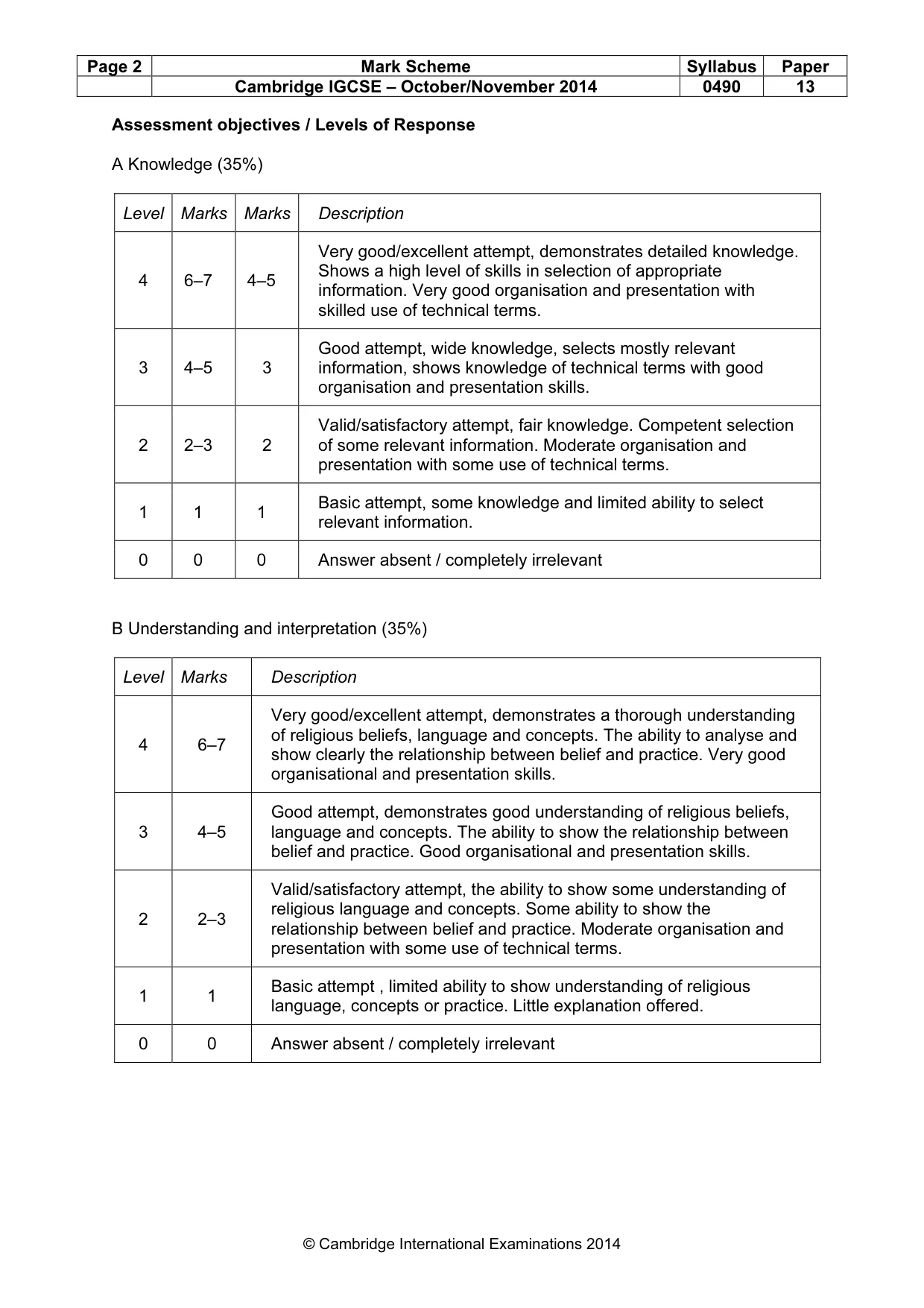
Page 2 Mark Scheme Syllabus Paper Cambridge IGCSE – October/November 2014 0490 13 © Cambridge International Examinations 2014 Assessment objectives / Levels of Response A Knowledge (35%) Level Marks Marks Description 4 6–7 4–5 Very good/excellent attempt, demonstrates detailed knowledge. Shows a high level of skills in selection of appropriate information. Very good organisation and presentation with skilled use of technical terms. 3 4–5 3 Good attempt, wide knowledge, selects mostly relevant information, shows knowledge of technical terms with good organisation and presentation skills. 2 2–3 2 Valid/satisfactory attempt, fair knowledge. Competent selection of some relevant information. Moderate organisation and presentation with some use of technical terms. 1 1 1 Basic attempt, some knowledge and limited ability to select relevant information. 0 0 0 Answer absent / completely irrelevant B Understanding and interpretation (35%) Level Marks Description 4 6–7 Very good/excellent attempt, demonstrates a thorough understanding of religious beliefs, language and concepts. The ability to analyse and show clearly the relationship between belief and practice. Very good organisational and presentation skills. 3 4–5 Good attempt, demonstrates good understanding of religious beliefs, language and concepts. The ability to show the relationship between belief and practice. Good organisational and presentation skills. 2 2–3 Valid/satisfactory attempt, the ability to show some understanding of religious language and concepts. Some ability to show the relationship between belief and practice. Moderate organisation and presentation with some use of technical terms. 1 1 Basic attempt , limited ability to show understanding of religious language, concepts or practice. Little explanation offered. 0 0 Answer absent / completely irrelevant
Mark scheme, page 3
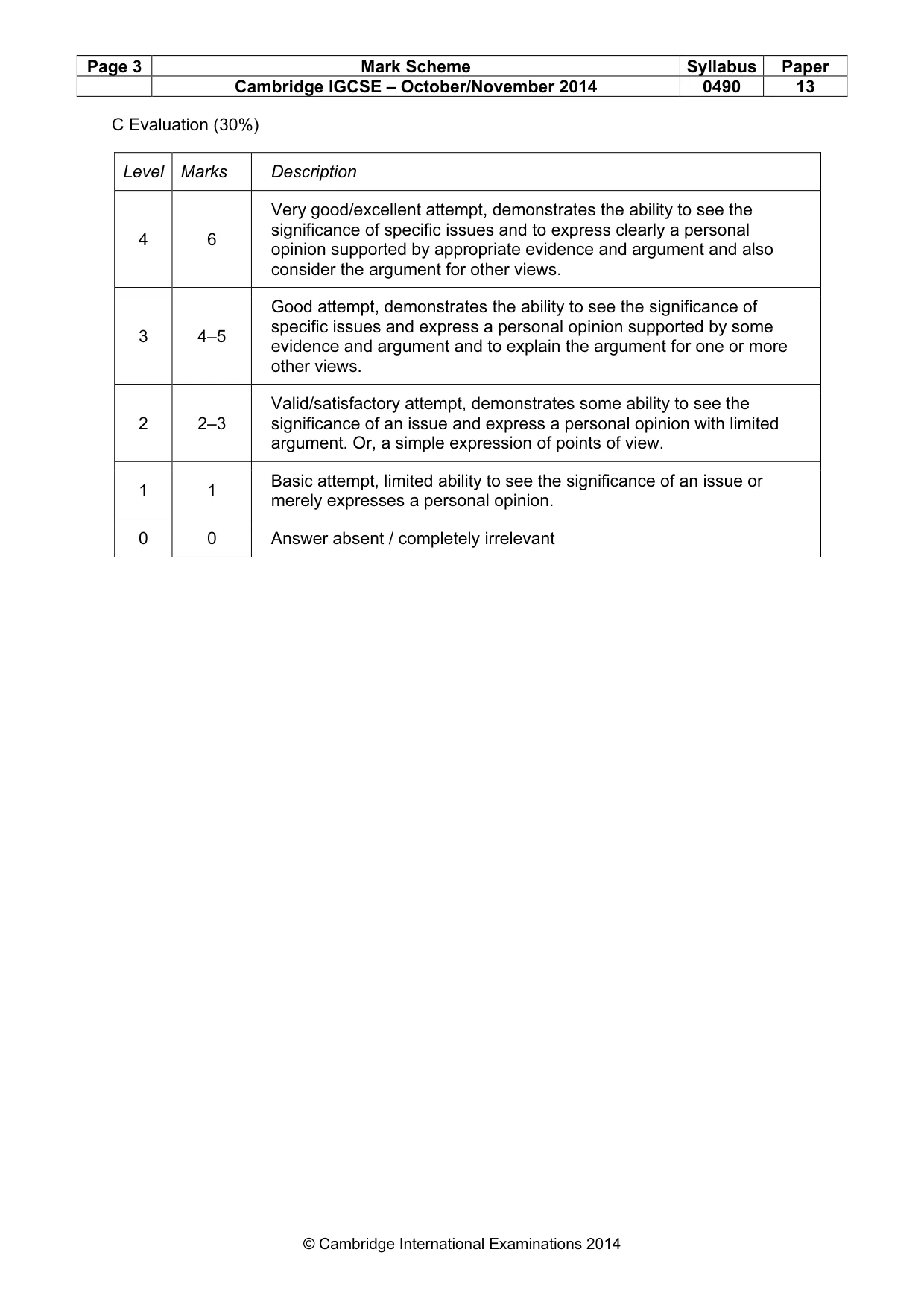
Page 3 Mark Scheme Syllabus Paper Cambridge IGCSE – October/November 2014 0490 13 © Cambridge International Examinations 2014 C Evaluation (30%) Level Marks Description 4 6 Very good/excellent attempt, demonstrates the ability to see the significance of specific issues and to express clearly a personal opinion supported by appropriate evidence and argument and also consider the argument for other views. 3 4–5 Good attempt, demonstrates the ability to see the significance of specific issues and express a personal opinion supported by some evidence and argument and to explain the argument for one or more other views. 2 2–3 Valid/satisfactory attempt, demonstrates some ability to see the significance of an issue and express a personal opinion with limited argument. Or, a simple expression of points of view. 1 1 Basic attempt, limited ability to see the significance of an issue or merely expresses a personal opinion. 0 0 Answer absent / completely irrelevant
Mark scheme, page 4
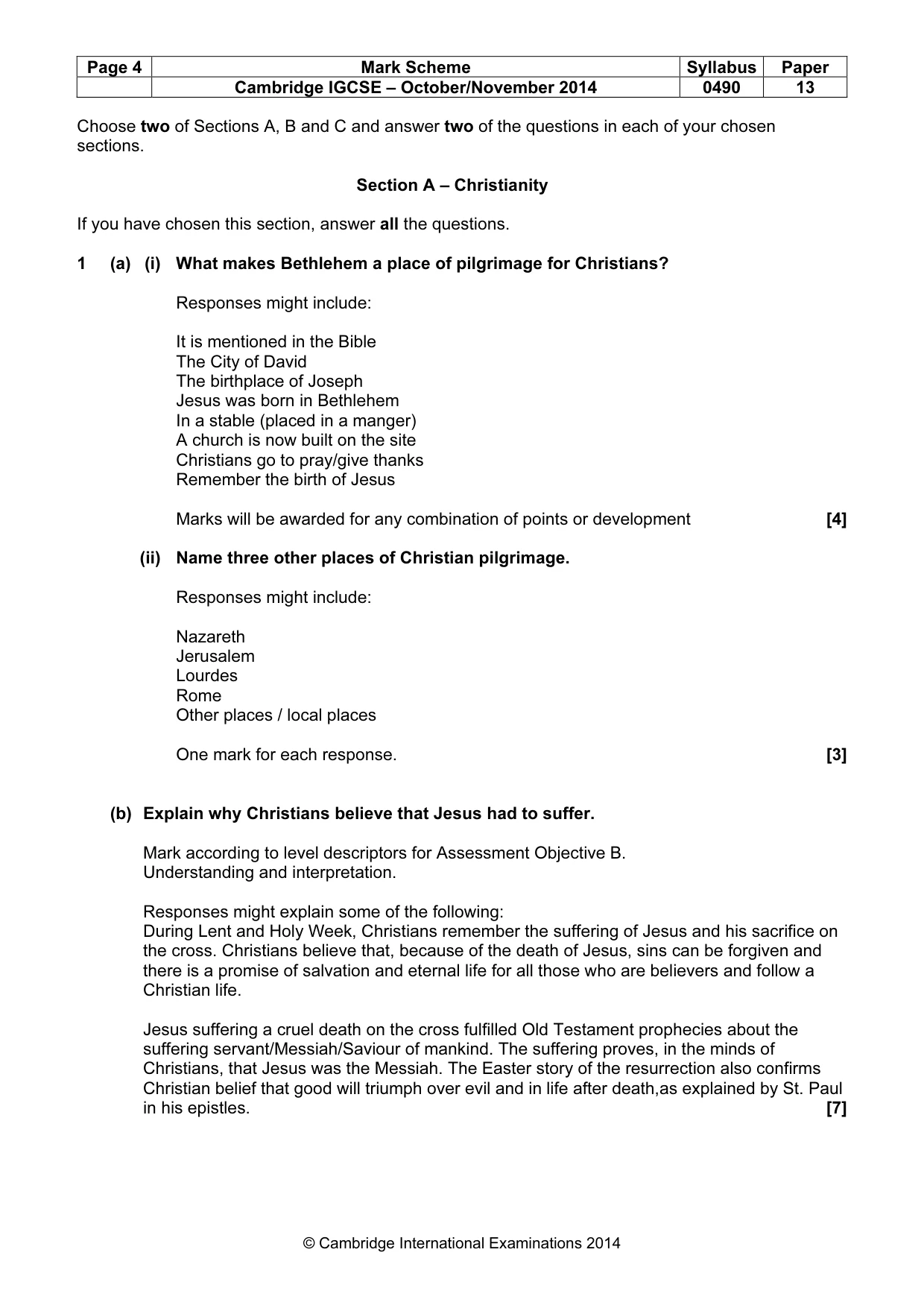
Page 4 Mark Scheme Syllabus Paper Cambridge IGCSE – October/November 2014 0490 13 © Cambridge International Examinations 2014 Choose two of Sections A, B and C and answer two of the questions in each of your chosen sections. Section A – Christianity If you have chosen this section, answer all the questions. 1 (a) (i) What makes Bethlehem a place of pilgrimage for Christians? Responses might include: It is mentioned in the Bible The City of David The birthplace of Joseph Jesus was born in Bethlehem In a stable (placed in a manger) A church is now built on the site Christians go to pray/give thanks Remember the birth of Jesus Marks will be awarded for any combination of points or development [4] (ii) Name three other places of Christian pilgrimage. Responses might include: Nazareth Jerusalem Lourdes Rome Other places / local places One mark for each response. [3] (b) Explain why Christians believe that Jesus had to suffer. Mark according to level descriptors for Assessment Objective B. Understanding and interpretation. Responses might explain some of the following: During Lent and Holy Week, Christians remember the suffering of Jesus and his sacrifice on the cross. Christians believe that, because of the death of Jesus, sins can be forgiven and there is a promise of salvation and eternal life for all those who are believers and follow a Christian life. Jesus suffering a cruel death on the cross fulfilled Old Testament prophecies about the suffering servant/Messiah/Saviour of mankind. The suffering proves, in the minds of Christians, that Jesus was the Messiah. The Easter story of the resurrection also confirms Christian belief that good will triumph over evil and in life after death,as explained by St. Paul in his epistles. [7]
Mark scheme, page 5
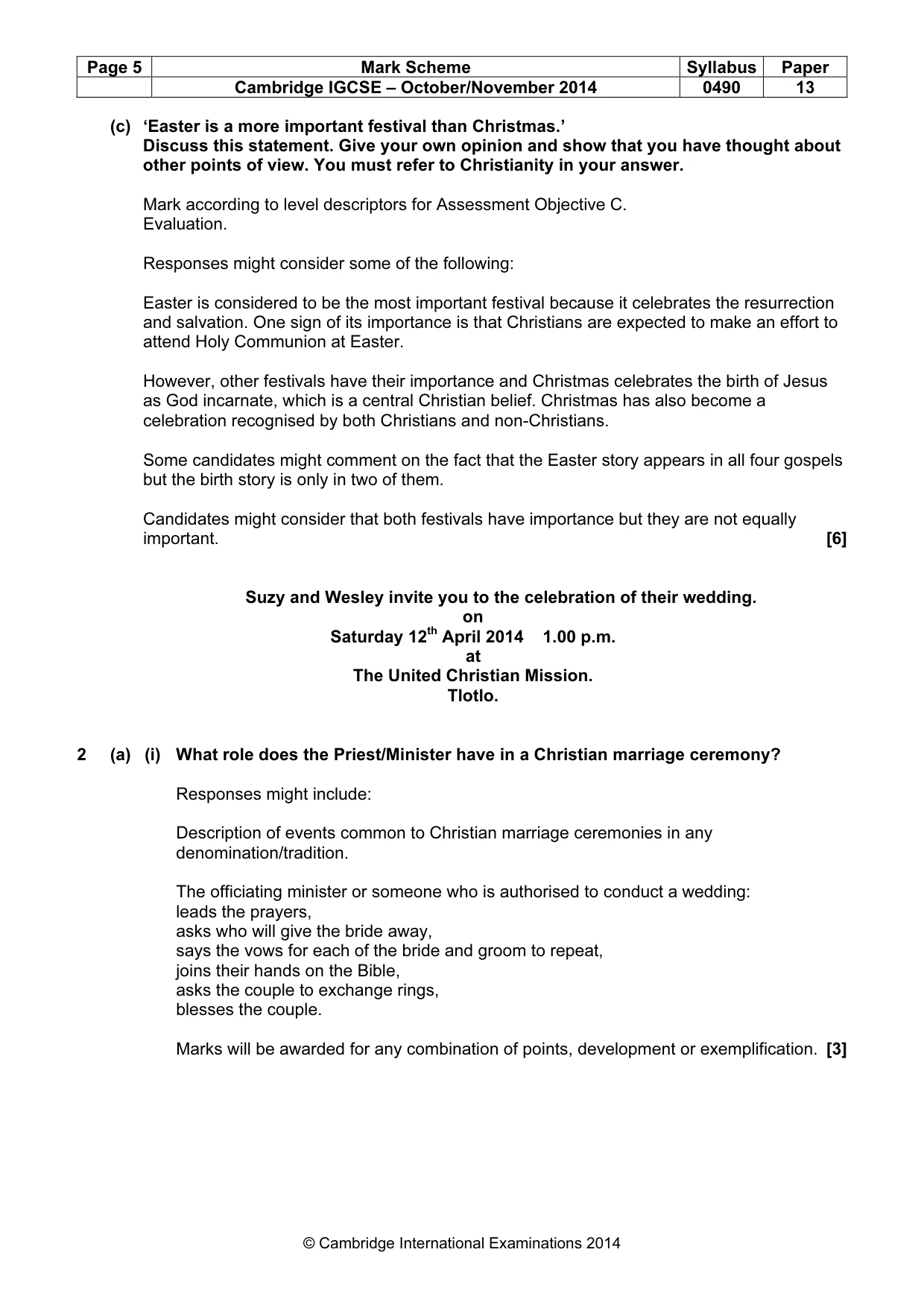
Page 5 Mark Scheme Syllabus Paper Cambridge IGCSE – October/November 2014 0490 13 © Cambridge International Examinations 2014 (c) ‘Easter is a more important festival than Christmas.’ Discuss this statement. Give your own opinion and show that you have thought about other points of view. You must refer to Christianity in your answer. Mark according to level descriptors for Assessment Objective C. Evaluation. Responses might consider some of the following: Easter is considered to be the most important festival because it celebrates the resurrection and salvation. One sign of its importance is that Christians are expected to make an effort to attend Holy Communion at Easter. However, other festivals have their importance and Christmas celebrates the birth of Jesus as God incarnate, which is a central Christian belief. Christmas has also become a celebration recognised by both Christians and non-Christians. Some candidates might comment on the fact that the Easter story appears in all four gospels but the birth story is only in two of them. Candidates might consider that both festivals have importance but they are not equally important. [6] Suzy and Wesley invite you to the celebration of their wedding. on Saturday 12th April 2014 1.00 p.m. at The United Christian Mission. Tlotlo. 2 (a) (i) What role does the Priest/Minister have in a Christian marriage ceremony? Responses might include: Description of events common to Christian marriage ceremonies in any denomination/tradition. The officiating minister or someone who is authorised to conduct a wedding: leads the prayers, asks who will give the bride away, says the vows for each of the bride and groom to repeat, joins their hands on the Bible, asks the couple to exchange rings, blesses the couple. Marks will be awarded for any combination of points, development or exemplification. [3]
Mark scheme, page 6
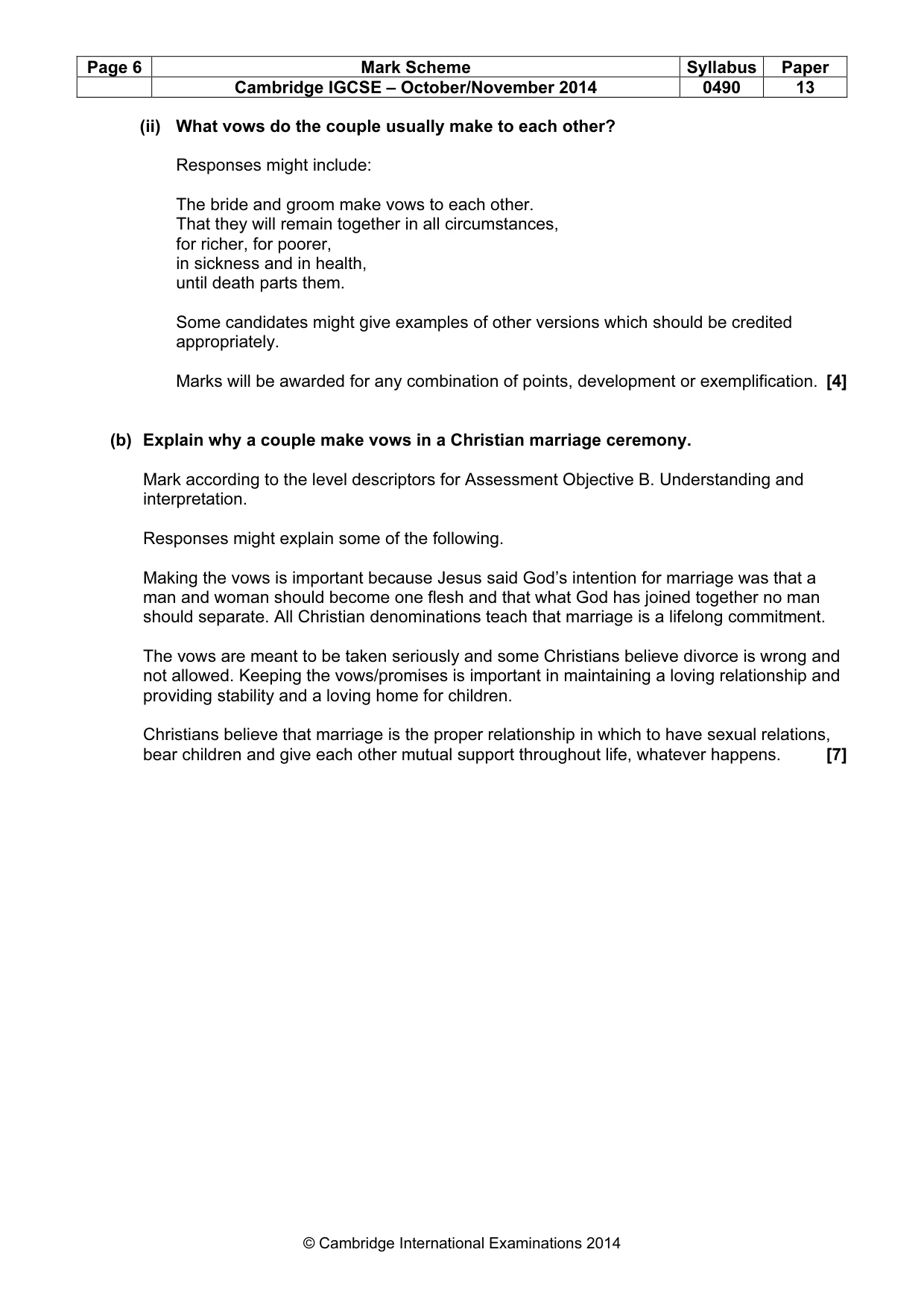
Page 6 Mark Scheme Syllabus Paper Cambridge IGCSE – October/November 2014 0490 13 © Cambridge International Examinations 2014 (ii) What vows do the couple usually make to each other? Responses might include: The bride and groom make vows to each other. That they will remain together in all circumstances, for richer, for poorer, in sickness and in health, until death parts them. Some candidates might give examples of other versions which should be credited appropriately. Marks will be awarded for any combination of points, development or exemplification. [4] (b) Explain why a couple make vows in a Christian marriage ceremony. Mark according to the level descriptors for Assessment Objective B. Understanding and interpretation. Responses might explain some of the following. Making the vows is important because Jesus said God’s intention for marriage was that a man and woman should become one flesh and that what God has joined together no man should separate. All Christian denominations teach that marriage is a lifelong commitment. The vows are meant to be taken seriously and some Christians believe divorce is wrong and not allowed. Keeping the vows/promises is important in maintaining a loving relationship and providing stability and a loving home for children. Christians believe that marriage is the proper relationship in which to have sexual relations, bear children and give each other mutual support throughout life, whatever happens. [7]
Mark scheme, page 7
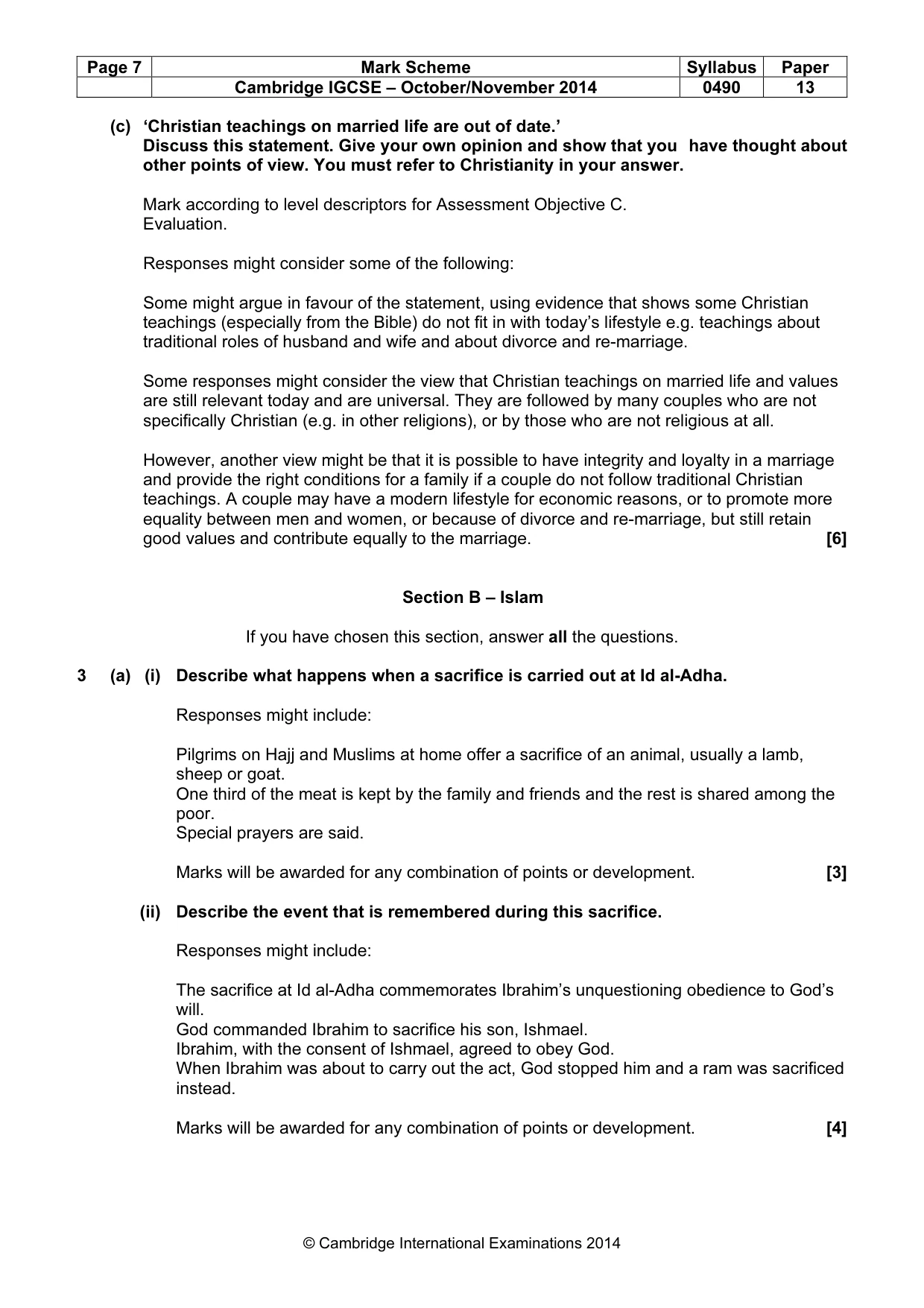
Page 7 Mark Scheme Syllabus Paper Cambridge IGCSE – October/November 2014 0490 13 © Cambridge International Examinations 2014 (c) ‘Christian teachings on married life are out of date.’ Discuss this statement. Give your own opinion and show that you have thought about other points of view. You must refer to Christianity in your answer. Mark according to level descriptors for Assessment Objective C. Evaluation. Responses might consider some of the following: Some might argue in favour of the statement, using evidence that shows some Christian teachings (especially from the Bible) do not fit in with today’s lifestyle e.g. teachings about traditional roles of husband and wife and about divorce and re-marriage. Some responses might consider the view that Christian teachings on married life and values are still relevant today and are universal. They are followed by many couples who are not specifically Christian (e.g. in other religions), or by those who are not religious at all. However, another view might be that it is possible to have integrity and loyalty in a marriage and provide the right conditions for a family if a couple do not follow traditional Christian teachings. A couple may have a modern lifestyle for economic reasons, or to promote more equality between men and women, or because of divorce and re-marriage, but still retain good values and contribute equally to the marriage. [6] Section B – Islam If you have chosen this section, answer all the questions. 3 (a) (i) Describe what happens when a sacrifice is carried out at Id al-Adha. Responses might include: Pilgrims on Hajj and Muslims at home offer a sacrifice of an animal, usually a lamb, sheep or goat. One third of the meat is kept by the family and friends and the rest is shared among the poor. Special prayers are said. Marks will be awarded for any combination of points or development. [3] (ii) Describe the event that is remembered during this sacrifice. Responses might include: The sacrifice at Id al-Adha commemorates Ibrahim’s unquestioning obedience to God’s will. God commanded Ibrahim to sacrifice his son, Ishmael. Ibrahim, with the consent of Ishmael, agreed to obey God. When Ibrahim was about to carry out the act, God stopped him and a ram was sacrificed instead. Marks will be awarded for any combination of points or development. [4]
Mark scheme, page 8
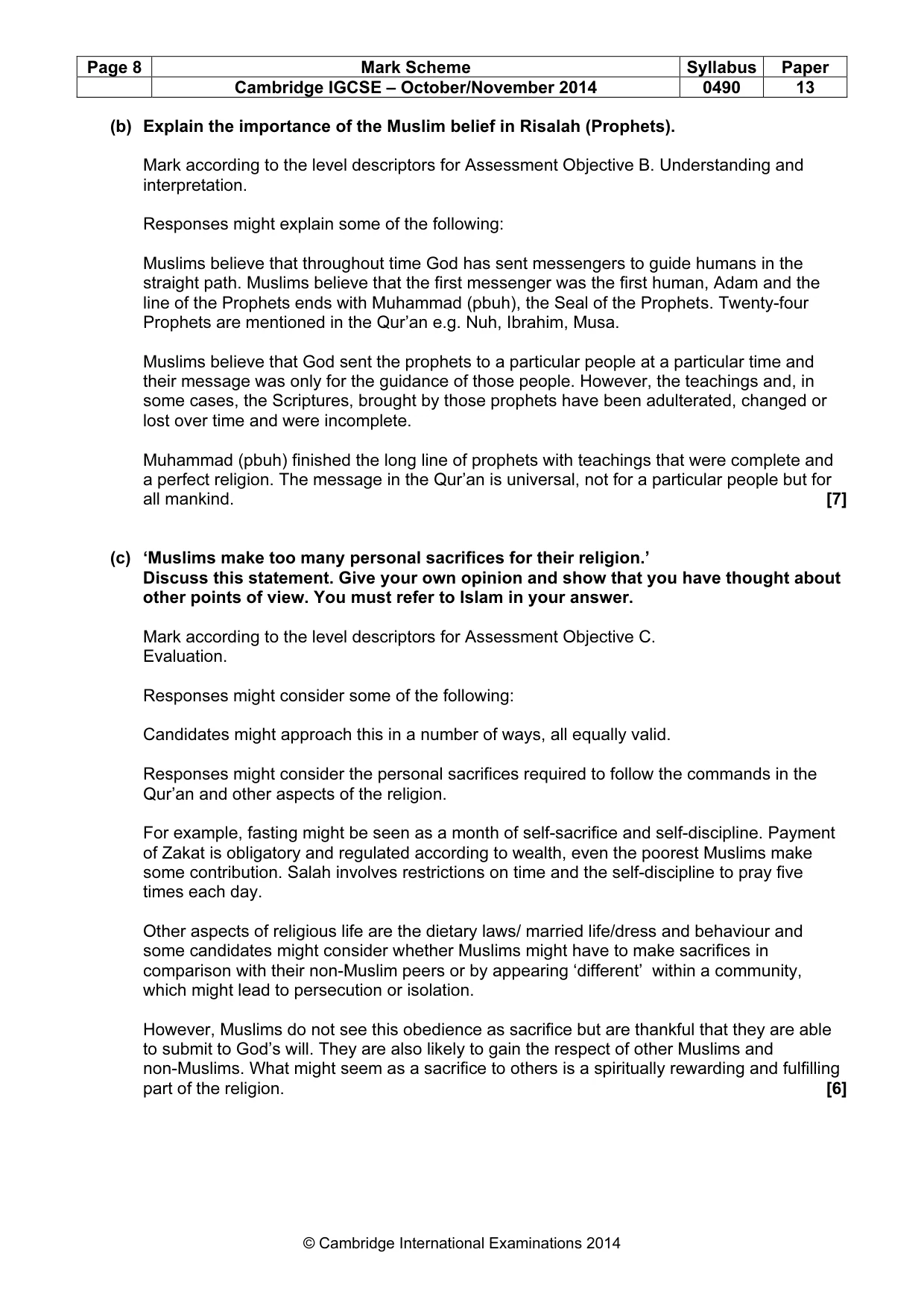
Page 8 Mark Scheme Syllabus Paper Cambridge IGCSE – October/November 2014 0490 13 © Cambridge International Examinations 2014 (b) Explain the importance of the Muslim belief in Risalah (Prophets). Mark according to the level descriptors for Assessment Objective B. Understanding and interpretation. Responses might explain some of the following: Muslims believe that throughout time God has sent messengers to guide humans in the straight path. Muslims believe that the first messenger was the first human, Adam and the line of the Prophets ends with Muhammad (pbuh), the Seal of the Prophets. Twenty-four Prophets are mentioned in the Qur’an e.g. Nuh, Ibrahim, Musa. Muslims believe that God sent the prophets to a particular people at a particular time and their message was only for the guidance of those people. However, the teachings and, in some cases, the Scriptures, brought by those prophets have been adulterated, changed or lost over time and were incomplete. Muhammad (pbuh) finished the long line of prophets with teachings that were complete and a perfect religion. The message in the Qur’an is universal, not for a particular people but for all mankind. [7] (c) ‘Muslims make too many personal sacrifices for their religion.’ Discuss this statement. Give your own opinion and show that you have thought about other points of view. You must refer to Islam in your answer. Mark according to the level descriptors for Assessment Objective C. Evaluation. Responses might consider some of the following: Candidates might approach this in a number of ways, all equally valid. Responses might consider the personal sacrifices required to follow the commands in the Qur’an and other aspects of the religion. For example, fasting might be seen as a month of self-sacrifice and self-discipline. Payment of Zakat is obligatory and regulated according to wealth, even the poorest Muslims make some contribution. Salah involves restrictions on time and the self-discipline to pray five times each day. Other aspects of religious life are the dietary laws/ married life/dress and behaviour and some candidates might consider whether Muslims might have to make sacrifices in comparison with their non-Muslim peers or by appearing ‘different’ within a community, which might lead to persecution or isolation. However, Muslims do not see this obedience as sacrifice but are thankful that they are able to submit to God’s will. They are also likely to gain the respect of other Muslims and non-Muslims. What might seem as a sacrifice to others is a spiritually rewarding and fulfilling part of the religion. [6]
Mark scheme, page 9
Page 9 Mark Scheme Syllabus Paper Cambridge IGCSE – October/November 2014 0490 13 © Cambridge International Examinations 2014 ‘A Muslim was accepted as an astronaut on an American Space programme. The mission was launched during Ramadan. He could have been excused from fasting because he was a traveller. He decided, however, to show his obedience to God by fasting in Space.’ 4 (a) (i) Describe three rules of Sawm. Responses might include: Fasting is compulsory for all Muslims, for thirty days, during Ramadan. Muslims should not eat or drink during daylight hours (dawn to dusk) Also, they must not indulge in sexual activity or smoke, not commit evil act / they should do good acts not talk maliciously or immodestly. Exemptions may be mentioned. One mark for each response. [3] (ii) What happens during the last ten days of Ramadan? Towards the end of the month some men spend the last 10 days in the mosque. They are in retreat, giving up worldly occupations. On the Night of Power (Laiylat al Qadr), when Muhammad (pbuh) received the Qur’an, Prayers (for forgiveness) are said all night. Marks will be awarded for any combination of points or development. [4] (b) Explain the ways in which Sawm and Zakah strengthen the ummah. Mark according to the level descriptors for Assessment Objective B. Understanding and interpretation. Responses might explain some of the following: All Muslims observe Sawm and pay Zakah. Fasting takes place for the whole month of Ramadan and Zakah is usually paid, annually, at the end of Ramadan. They are obeying Allah’s commands. These are two of the Five Pillars of Islam and obligatory. All Muslims share a sense of fulfilment and spiritual reward when carrying out Allah’s wishes. Fasting during Ramadan strengthens the ummah because it teaches Muslims what it is go without food and this encourages them to be generous to the poor. Muslims are brought together each day at the breaking of the fast, iftar, they share a meal with friends and relatives and the needy. Muslim men meet and pray in congregation in the Mosque during the last ten days of Ramadan. Zakah is calculated on the wealth of all those with the means to give and is distributed to the poor and deserving (usually during Id al-Fitr). It unifies Muslims and brings blessings on both the one who gives and the one who receives. [7]
Mark scheme, page 10
Page 10 Mark Scheme Syllabus Paper Cambridge IGCSE – October/November 2014 0490 13 © Cambridge International Examinations 2014 (c) ‘It is difficult for rich people to be religious.’ Discuss this statement. Give your own opinion and show that you have thought about other points of view. You must refer to Islam in your answer. Mark according to level descriptors for Assessment Objective C. Evaluation. Responses might consider some of the following: Some candidates might consider the view that wealth and lifestyle are not important considerations for Muslims. Religious duties, such as the Five Pillars, are not a matter of choice for Muslims, they are commanded by God in the Qur’an and so they are compulsory. Muslims do not question this because the Qur’an is the unchanging word of Allah. Some responses might consider that the purpose of the Five Pillars and the teachings of the Qur’an, as well as the example of the Prophet, is to show that all are equal in the eyes of God. Some candidates might express an opinion about the difficulty of the self-discipline needed for Muslims to give up their usual lifestyle and carry out their religious duties. Some might comment that it might appear easier for rich people to go on Hajj and give Zakah than for poorer people. [6] Section C – Judaism If you have chosen this section, answer all the questions. 5 (a) (i) What is the purpose of a ketubah at a Jewish marriage ceremony? Responses might include: It is the marriage contract between the groom and the bride. It is signed by two male witnesses. Sometimes, the bride and groom sign it as well It is read out at the ceremony to remind the couple of their promises. Marks will be awarded for any combination of points or development. [3] (ii) Describe four other features of a Jewish marriage ceremony. Responses might include: Marriage can take place anywhere, as long as the couple marry under a chuppah. It can be on any day of the week except the Sabbath, Usually the bride will visit the Mikveh before the wedding. A Rabbi (or Chazan) says two blessings, One blessing over a cup of wine and the marriage blessing. The groom puts a ring on the bride’s finger. The Rabbi says seven blessings. After the ceremony the bridegroom breaks a glass with his heel. The bride and groom are given a short break for ‘private togetherness.’ Marks will be awarded for any combination of points or development. [4]
Mark scheme, page 11
Page 11 Mark Scheme Syllabus Paper Cambridge IGCSE – October/November 2014 0490 13 © Cambridge International Examinations 2014 (b) Explain why marriage to a Jewish partner is important to some Jews. Mark according to the level descriptors for Assessment Objective B. Understanding and interpretation. Marriage to a Jewish partner is considered to be important because some Jews believe that marrying someone outside the religion weakens it. It is considered to be important to have children within a marriage to maintain the strength and traditions of the religion. In Orthodox Judaism, the children are only Jewish if the mother is Jewish so the children of a mixed marriage would not be considered Jewish. Some candidates might explain that in Progressive Judaism either parent can pass on Jewish identity to a child. Jewish family life is important because it is in the home where children learn many of the customs e.g. dietary rules and festivals e.g. Pesach. The children are taught by their parents, as instructed in the Torah, until at the age of twelve or thirteen the children take on responsibility for their religion. [7] (c) ‘Strongly held religious beliefs can cause difficulties in a marriage.’ Discuss this statement. Give your own opinion and show that you have thought about other points of view. You must refer to Judaism in your answer. Mark according to the level descriptors for Assessment Objective C. Evaluation. Responses might consider some of the following: Candidates might consider that strongly held religious views can cause difficulties within a marriage if both partners do not share the same convictions and do not wish to follow all religious practices to the same extent, even if they are of the same religion. Especially, in Judaism, if one partner is more traditional (orthodox) than the other, this might particularly apply because many of the mitzvot concern the home, diet, dress, the role of women and family life. Other views might be that arranging marriages so that people are compatible in their beliefs often happens in Judaism and so married couples know what type of lifestyle they will lead. Some might consider the advantages to a couple of compromising on strongly held beliefs because they love and respect one another. Candidates might offer examples for their arguments. [6]
Mark scheme, page 12
Page 12 Mark Scheme Syllabus Paper Cambridge IGCSE – October/November 2014 0490 13 © Cambridge International Examinations 2014 ‘These commandments that I give you today are to be upon your hearts. Impress them on your children. Talk about them when you sit at home and when you walk along the road, when you lie down and when you get up.’ Deuteronomy 6:6–7 6 (a) Give a description of each of these items, used in daily prayer: (i) tefillin (phylacteries) Responses might include: Tefillin are two small leather boxes with straps, (shel yad and shel rosh). They are bound on the arm and forehead There are words from Torah( Deuteronomy and Numbers) inside the boxes. Marks will be awarded for any combination of points or development. [3] (ii) tallit (prayer shawl) Responses might include: The prayer shawl is worn over the shoulders and the head A smaller tallit is worn all the time, under clothes, by Orthodox Jews Tallits have fringes (as commanded in the Torah). Marks will be awarded for any combination of points or development. [2] (iii) yarmulka/kippah (skull cap) Responses might include: The yarmulka is a small round cap worn at all times by male Orthodox Jews They are worn during prayer and on religious occasions by others It can be made of any material and it can be embroidered. Marks will be awarded for any combination of points or development [2]
Mark scheme, page 13
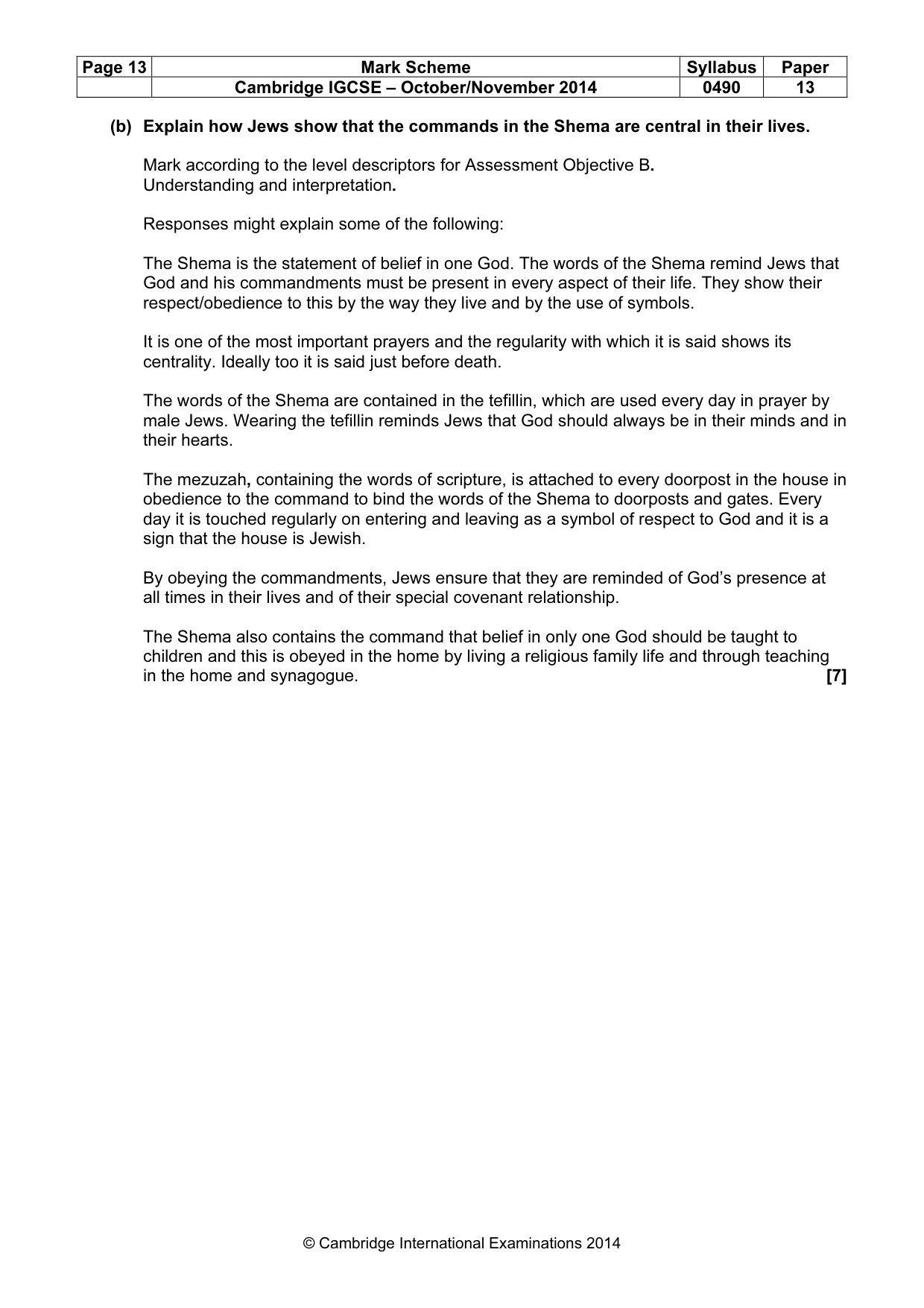
Page 13 Mark Scheme Syllabus Paper Cambridge IGCSE – October/November 2014 0490 13 © Cambridge International Examinations 2014 (b) Explain how Jews show that the commands in the Shema are central in their lives. Mark according to the level descriptors for Assessment Objective B. Understanding and interpretation. Responses might explain some of the following: The Shema is the statement of belief in one God. The words of the Shema remind Jews that God and his commandments must be present in every aspect of their life. They show their respect/obedience to this by the way they live and by the use of symbols. It is one of the most important prayers and the regularity with which it is said shows its centrality. Ideally too it is said just before death. The words of the Shema are contained in the tefillin, which are used every day in prayer by male Jews. Wearing the tefillin reminds Jews that God should always be in their minds and in their hearts. The mezuzah, containing the words of scripture, is attached to every doorpost in the house in obedience to the command to bind the words of the Shema to doorposts and gates. Every day it is touched regularly on entering and leaving as a symbol of respect to God and it is a sign that the house is Jewish. By obeying the commandments, Jews ensure that they are reminded of God’s presence at all times in their lives and of their special covenant relationship. The Shema also contains the command that belief in only one God should be taught to children and this is obeyed in the home by living a religious family life and through teaching in the home and synagogue. [7]
Mark scheme, page 14
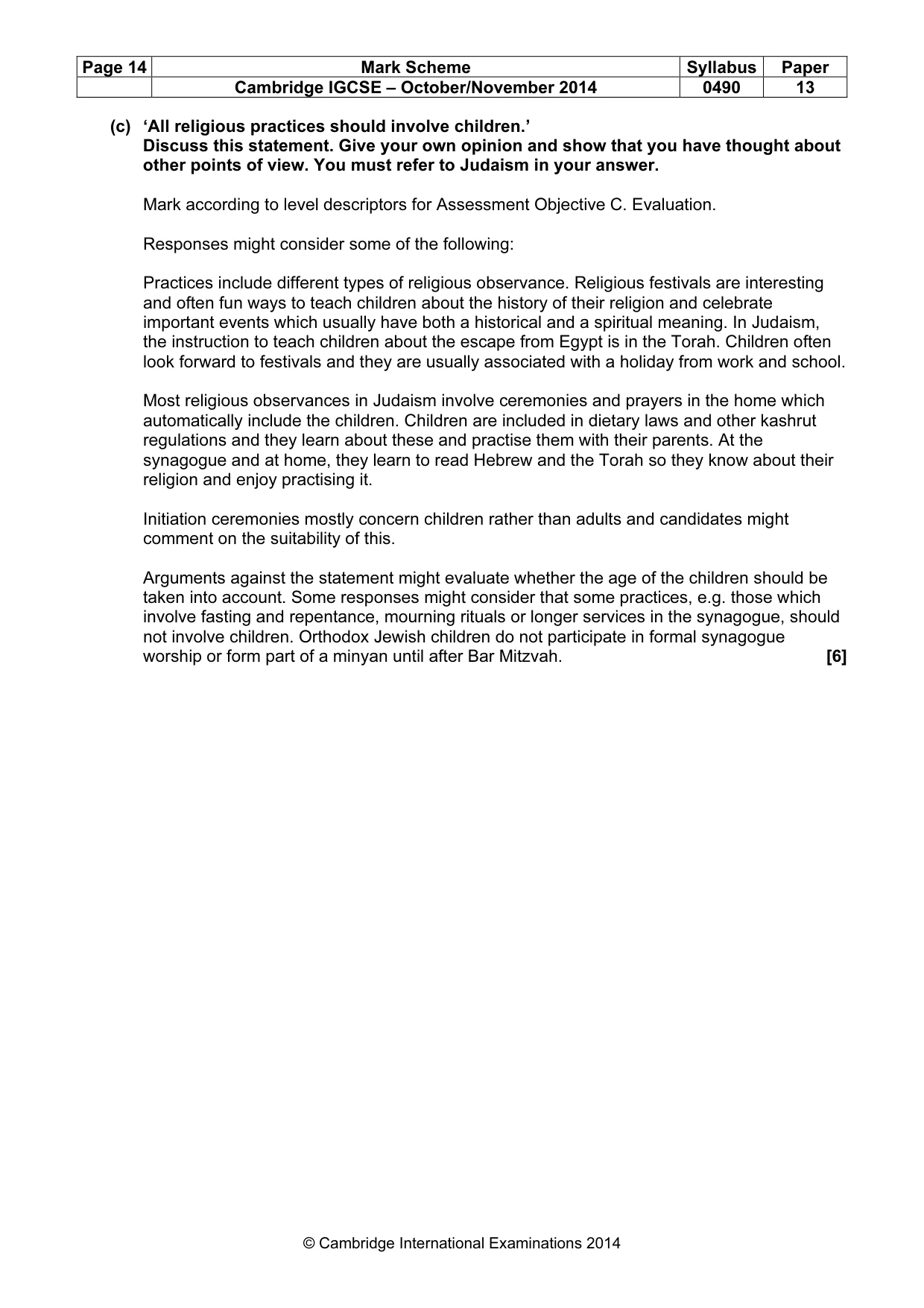
Page 14 Mark Scheme Syllabus Paper Cambridge IGCSE – October/November 2014 0490 13 © Cambridge International Examinations 2014 (c) ‘All religious practices should involve children.’ Discuss this statement. Give your own opinion and show that you have thought about other points of view. You must refer to Judaism in your answer. Mark according to level descriptors for Assessment Objective C. Evaluation. Responses might consider some of the following: Practices include different types of religious observance. Religious festivals are interesting and often fun ways to teach children about the history of their religion and celebrate important events which usually have both a historical and a spiritual meaning. In Judaism, the instruction to teach children about the escape from Egypt is in the Torah. Children often look forward to festivals and they are usually associated with a holiday from work and school. Most religious observances in Judaism involve ceremonies and prayers in the home which automatically include the children. Children are included in dietary laws and other kashrut regulations and they learn about these and practise them with their parents. At the synagogue and at home, they learn to read Hebrew and the Torah so they know about their religion and enjoy practising it. Initiation ceremonies mostly concern children rather than adults and candidates might comment on the suitability of this. Arguments against the statement might evaluate whether the age of the children should be taken into account. Some responses might consider that some practices, e.g. those which involve fasting and repentance, mourning rituals or longer services in the synagogue, should not involve children. Orthodox Jewish children do not participate in formal synagogue worship or form part of a minyan until after Bar Mitzvah. [6]
What you needed in this session
Cambridge’s own grade thresholds for 2014 Oct/Nov, Paper 1 · Variant 3. A higher threshold means an easier paper — the bar moves with how the cohort did.