Cambridge IGCSE Portuguese - Foreign Language 0540 — 2017 May/June Paper 2 · Variant 1
0540/21/M/J/17 · 45 marks · ≈51 min
The question paper and its mark scheme, free to read here and free to download. This is Cambridge’s own paper, exactly as it was sat.
Question paper16 pages



Mark scheme13 pages
Answers below. Sit the paper first if you are practising.
Paper as text
Question paper, page 1
This document consists of 13 printed pages and 3 blank pages. DC (ST/FC) 131696/5 © UCLES 2017 [Turn over Cambridge International Examinations Cambridge International General Certificate of Secondary Education * 5 5 0 1 5 1 8 4 9 0 * PORTUGUESE 0540/02 Paper 2 Reading May/June 2017 1 hour Candidates answer on the Question Paper. No Additional Materials are required. READ THESE INSTRUCTIONS FIRST Write your Centre number, candidate number and name in the spaces at the top of this page. Write in dark blue or black pen. Do not use staples, paper clips, glue or correction fluid. DO NOT WRITE IN ANY BARCODES. Answer all questions. The number of marks is given in brackets [ ] at the end of each question or part question.
Question paper, page 2
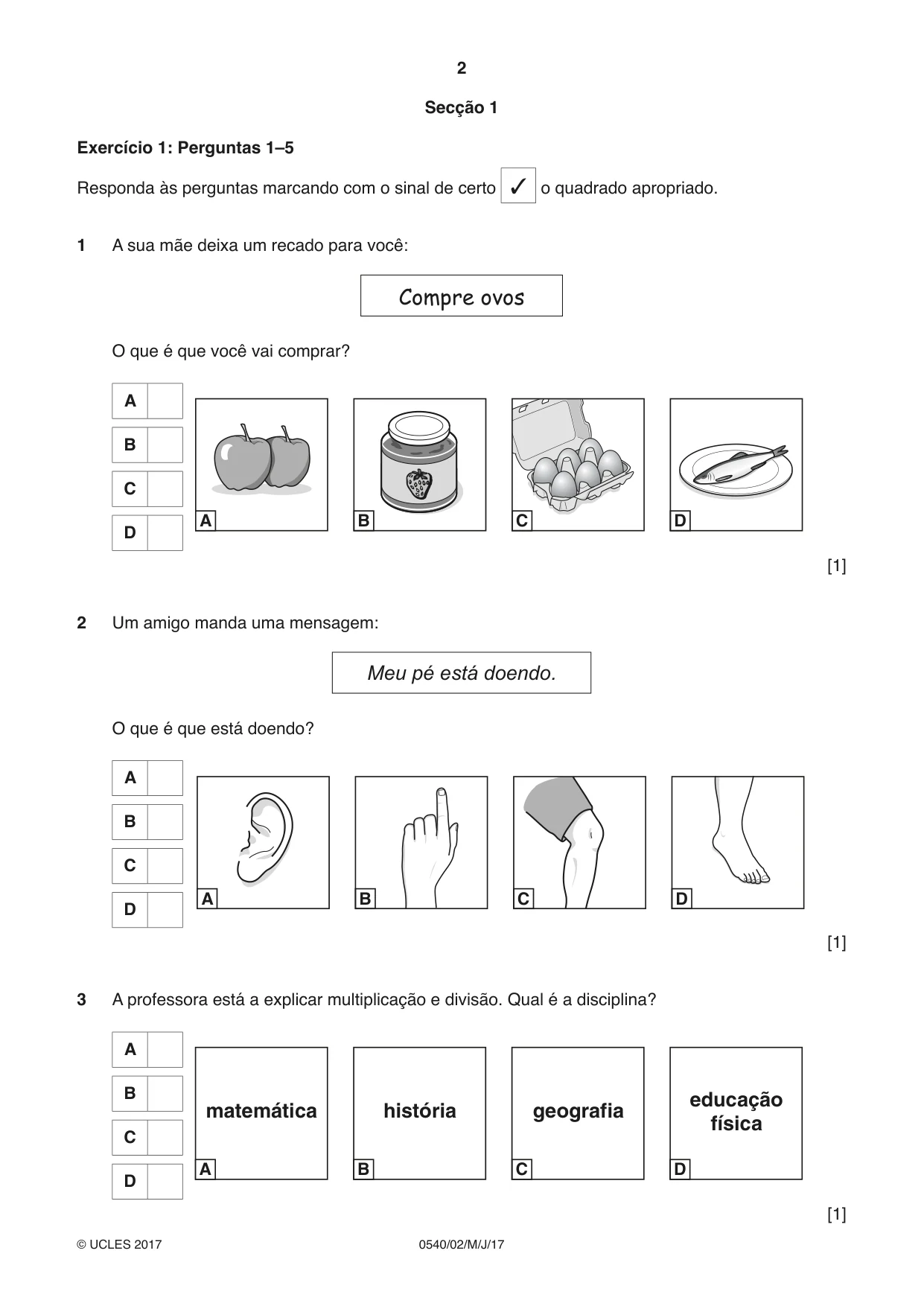
2 0540/02/M/J/17 © UCLES 2017 Secção 1 Exercício 1: Perguntas 1–5 Responda às perguntas marcando com o sinal de certo ✓ o quadrado apropriado. 1 A sua mãe deixa um recado para você: Compre ovos O que é que você vai comprar? A A B C D B C D [1] 2 Um amigo manda uma mensagem: Meu pé está doendo. O que é que está doendo? A A B C D B C D [1] 3 A professora está a explicar multiplicação e divisão. Qual é a disciplina? A matemática história geografia educação física A B C D B C D [1]
Question paper, page 3
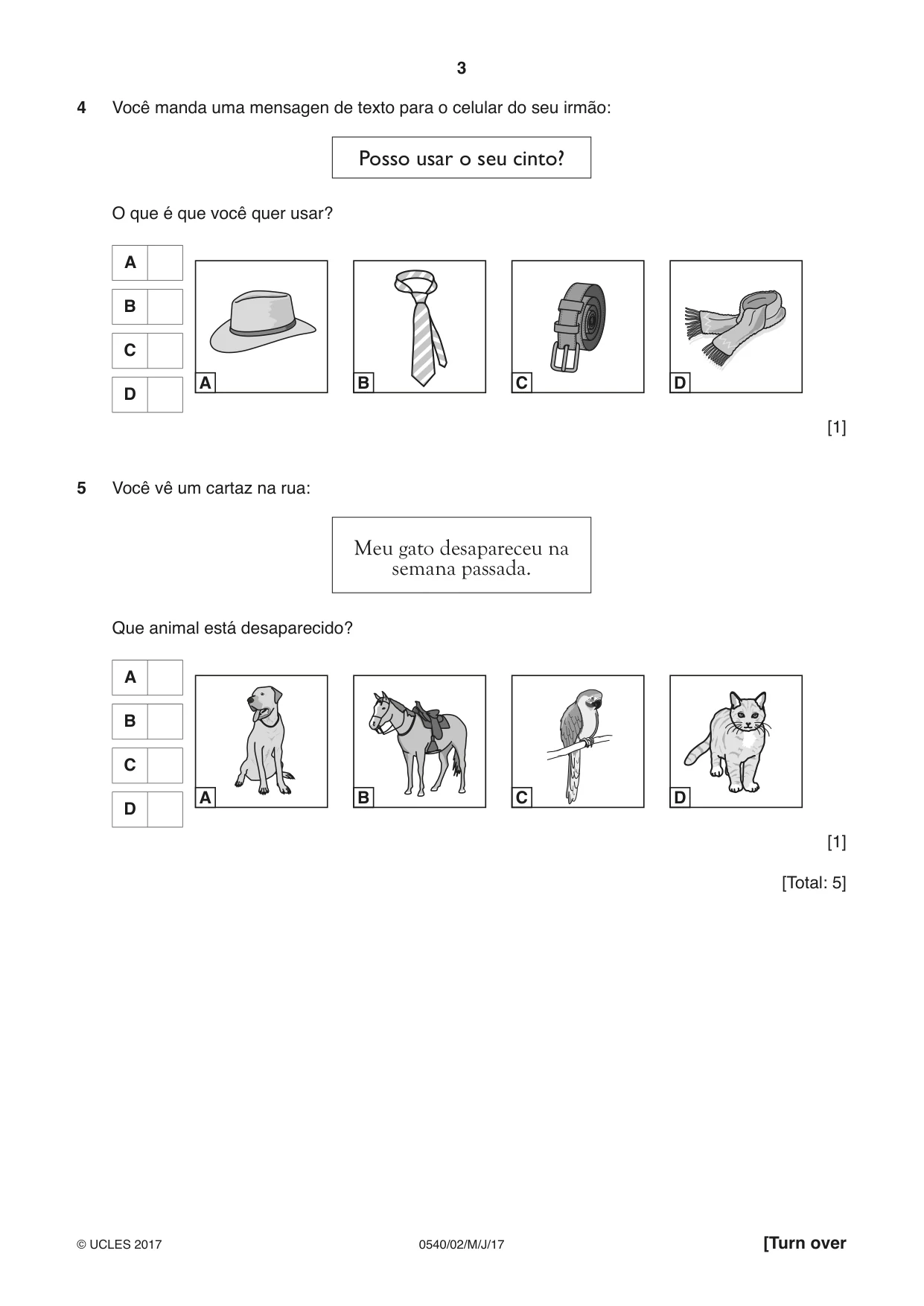
3 0540/02/M/J/17 © UCLES 2017 [Turn over 4 Você manda uma mensagen de texto para o celular do seu irmão: Posso usar o seu cinto? O que é que você quer usar? A A B C D B C D [1] 5 Você vê um cartaz na rua: Meu gato desapareceu na semana passada. Que animal está desaparecido? A A B C D B C D [1] [Total: 5]
Question paper, page 4
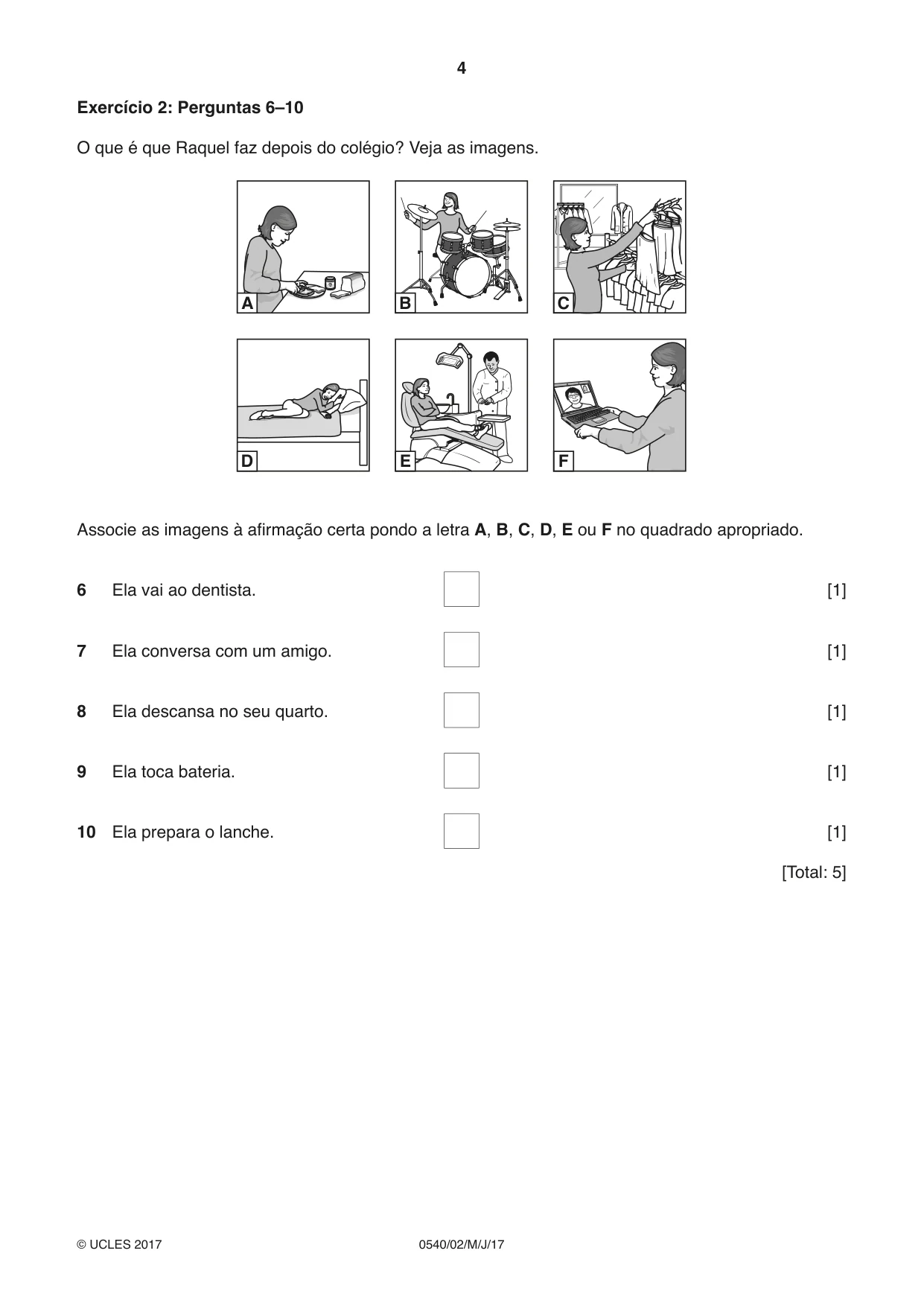
4 0540/02/M/J/17 © UCLES 2017 Exercício 2: Perguntas 6–10 O que é que Raquel faz depois do colégio? Veja as imagens. A B C D E F Associe as imagens à afirmação certa pondo a letra A, B, C, D, E ou F no quadrado apropriado. 6 Ela vai ao dentista. [1] 7 Ela conversa com um amigo. [1] 8 Ela descansa no seu quarto. [1] 9 Ela toca bateria. [1] 10 Ela prepara o lanche. [1] [Total: 5]
Question paper, page 5
5 0540/02/M/J/17 © UCLES 2017 [Turn over BLANK PAGE
Question paper, page 6
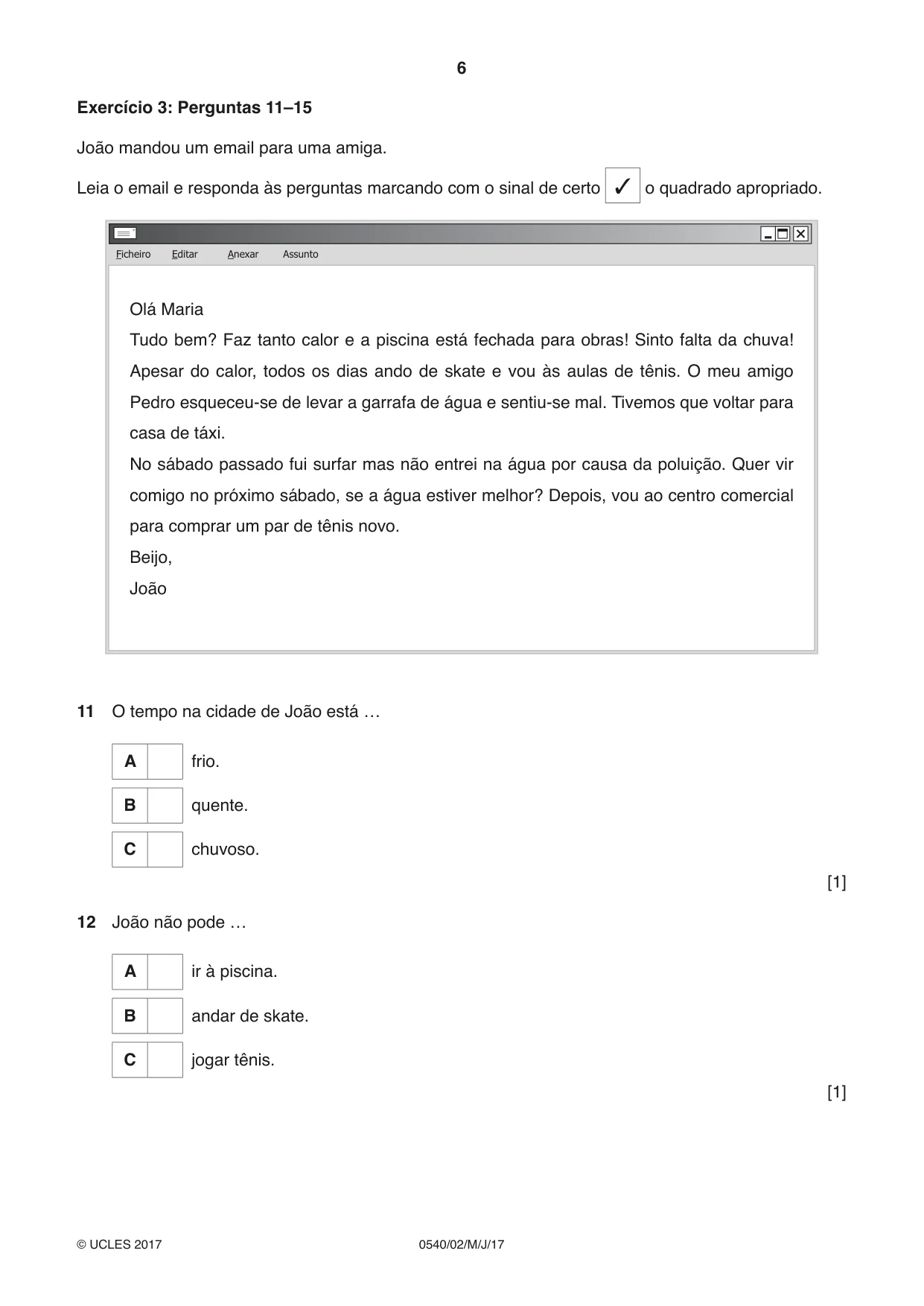
6 0540/02/M/J/17 © UCLES 2017 Exercício 3: Perguntas 11–15 João mandou um email para uma amiga. Leia o email e responda às perguntas marcando com o sinal de certo ✓ o quadrado apropriado. Ficheiro Editar Anexar Assunto Olá Maria Tudo bem? Faz tanto calor e a piscina está fechada para obras! Sinto falta da chuva! Apesar do calor, todos os dias ando de skate e vou às aulas de tênis. O meu amigo Pedro esqueceu-se de levar a garrafa de água e sentiu-se mal. Tivemos que voltar para casa de táxi. No sábado passado fui surfar mas não entrei na água por causa da poluição. Quer vir comigo no próximo sábado, se a água estiver melhor? Depois, vou ao centro comercial para comprar um par de tênis novo. Beijo, João 11 O tempo na cidade de João está … A frio. B quente. C chuvoso. [1] 12 João não pode … A ir à piscina. B andar de skate. C jogar tênis. [1]
Question paper, page 7
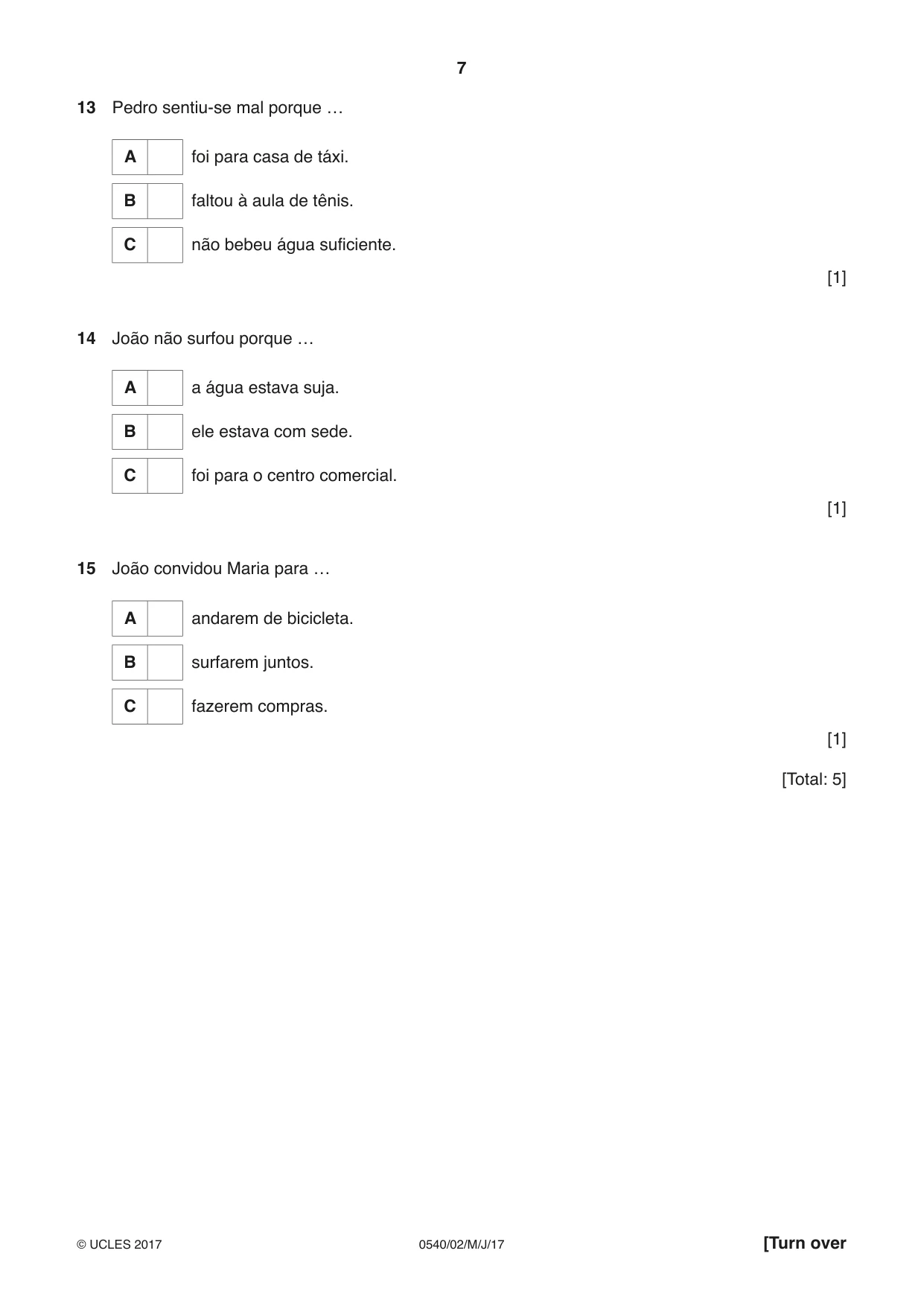
7 0540/02/M/J/17 © UCLES 2017 [Turn over 13 Pedro sentiu-se mal porque … A foi para casa de táxi. B faltou à aula de tênis. C não bebeu água suficiente. [1] 14 João não surfou porque … A a água estava suja. B ele estava com sede. C foi para o centro comercial. [1] 15 João convidou Maria para … A andarem de bicicleta. B surfarem juntos. C fazerem compras. [1] [Total: 5]
Question paper, page 8
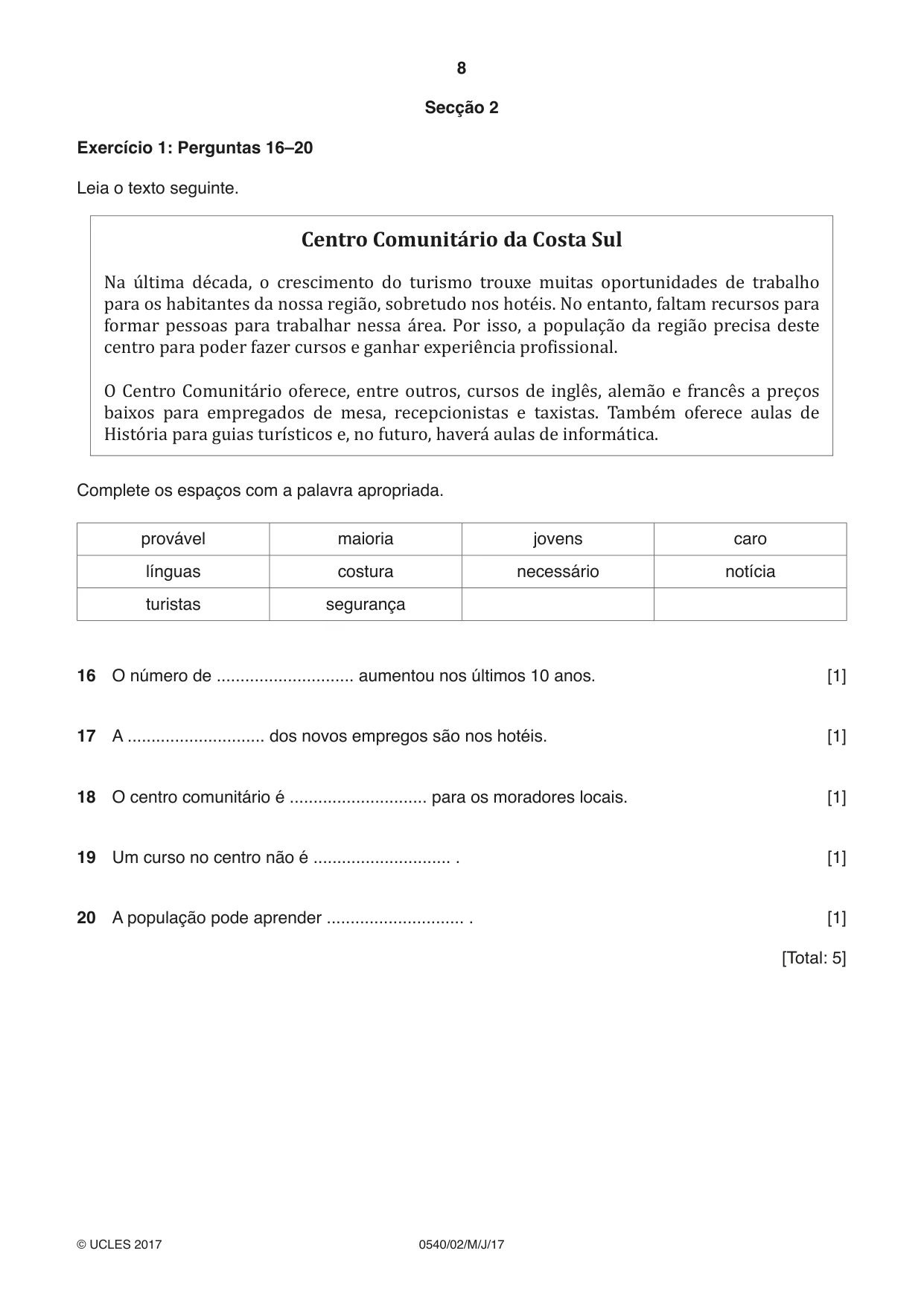
8 0540/02/M/J/17 © UCLES 2017 Secção 2 Exercício 1: Perguntas 16–20 Leia o texto seguinte. Centro Comunitário da Costa Sul Na última década, o crescimento do turismo trouxe muitas oportunidades de trabalho para os habitantes da nossa região, sobretudo nos hotéis. No entanto, faltam recursos para formar pessoas para trabalhar nessa área. Por isso, a população da região precisa deste centro para poder fazer cursos e ganhar experiência profissional. O Centro Comunitário oferece, entre outros, cursos de inglês, alemão e francês a preços baixos para empregados de mesa, recepcionistas e taxistas. Também oferece aulas de História para guias turísticos e, no futuro, haverá aulas de informática. Complete os espaços com a palavra apropriada. provável maioria jovens caro línguas costura necessário notícia turistas segurança 16 O número de … aumentou nos últimos 10 anos. [1] 17 A … dos novos empregos são nos hotéis. [1] 18 O centro comunitário é … para os moradores locais. [1] 19 Um curso no centro não é … . [1] 20 A população pode aprender … . [1] [Total: 5]
Question paper, page 9
9 0540/02/M/J/17 © UCLES 2017 [Turn over BLANK PAGE
Question paper, page 10
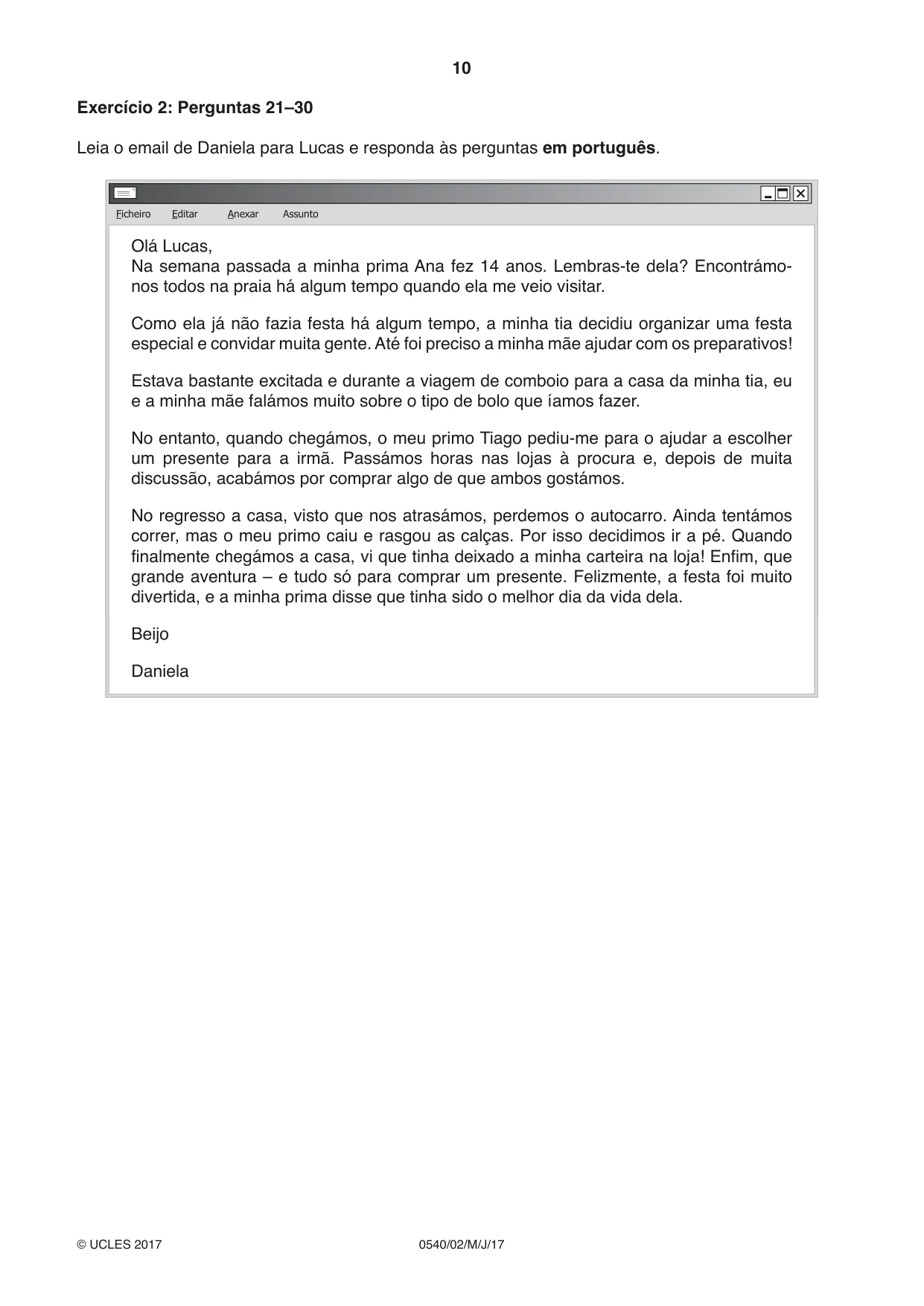
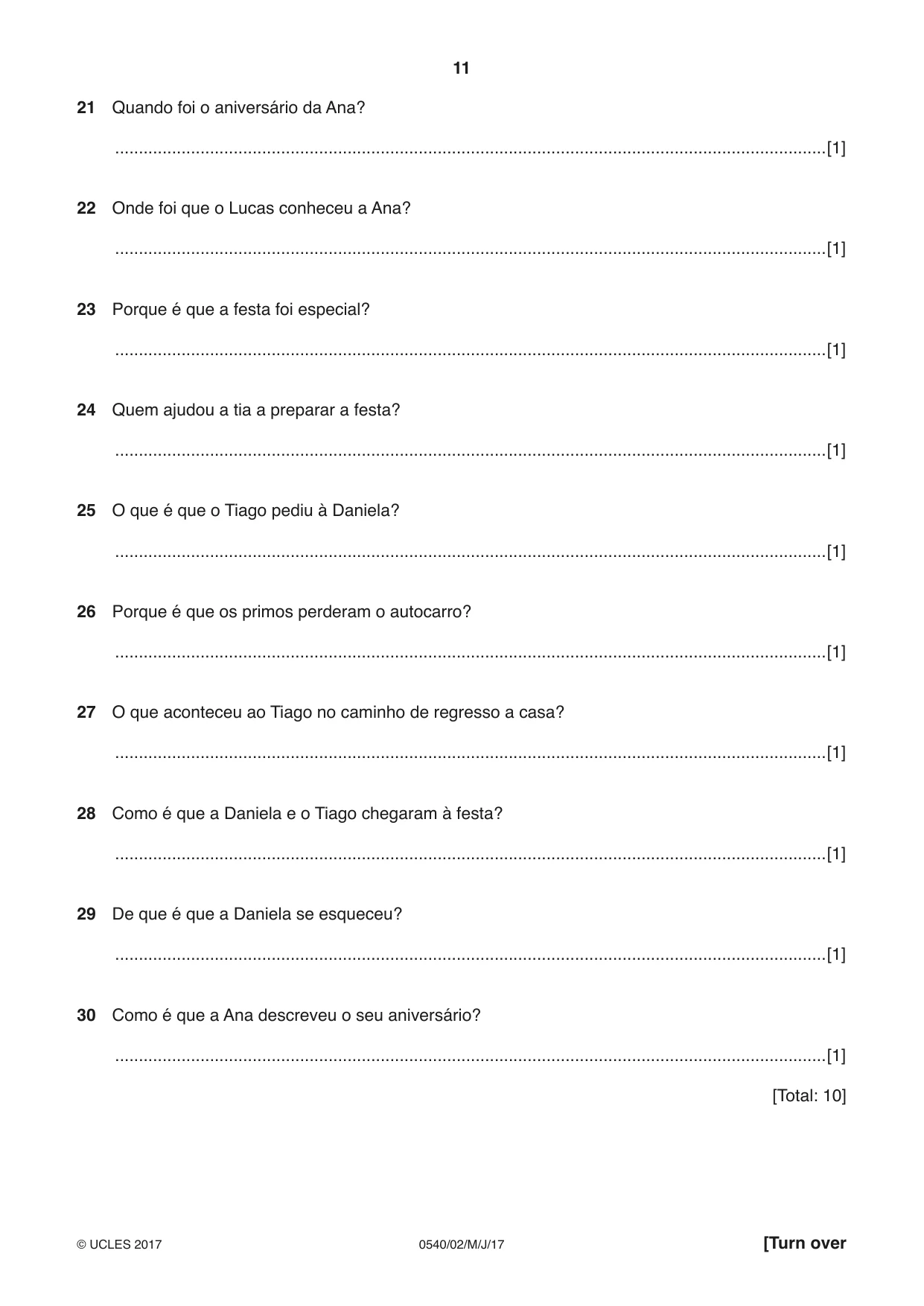
10 0540/02/M/J/17 © UCLES 2017 Exercício 2: Perguntas 21–30 Leia o email de Daniela para Lucas e responda às perguntas em português. Ficheiro Editar Anexar Assunto Olá Lucas, Na semana passada a minha prima Ana fez 14 anos. Lembras-te dela? Encontrámo- nos todos na praia há algum tempo quando ela me veio visitar. Como ela já não fazia festa há algum tempo, a minha tia decidiu organizar uma festa especial e convidar muita gente. Até foi preciso a minha mãe ajudar com os preparativos! Estava bastante excitada e durante a viagem de comboio para a casa da minha tia, eu e a minha mãe falámos muito sobre o tipo de bolo que íamos fazer. No entanto, quando chegámos, o meu primo Tiago pediu-me para o ajudar a escolher um presente para a irmã. Passámos horas nas lojas à procura e, depois de muita discussão, acabámos por comprar algo de que ambos gostámos. No regresso a casa, visto que nos atrasámos, perdemos o autocarro. Ainda tentámos correr, mas o meu primo caiu e rasgou as calças. Por isso decidimos ir a pé. Quando finalmente chegámos a casa, vi que tinha deixado a minha carteira na loja! Enfim, que grande aventura – e tudo só para comprar um presente. Felizmente, a festa foi muito divertida, e a minha prima disse que tinha sido o melhor dia da vida dela. Beijo Daniela
Question paper, page 11
11 0540/02/M/J/17 © UCLES 2017 [Turn over 21 Quando foi o aniversário da Ana? …[1] 22 Onde foi que o Lucas conheceu a Ana? …[1] 23 Porque é que a festa foi especial? …[1] 24 Quem ajudou a tia a preparar a festa? …[1] 25 O que é que o Tiago pediu à Daniela? …[1] 26 Porque é que os primos perderam o autocarro? …[1] 27 O que aconteceu ao Tiago no caminho de regresso a casa? …[1] 28 Como é que a Daniela e o Tiago chegaram à festa? …[1] 29 De que é que a Daniela se esqueceu? …[1] 30 Como é que a Ana descreveu o seu aniversário? …[1] [Total: 10]
Question paper, page 12
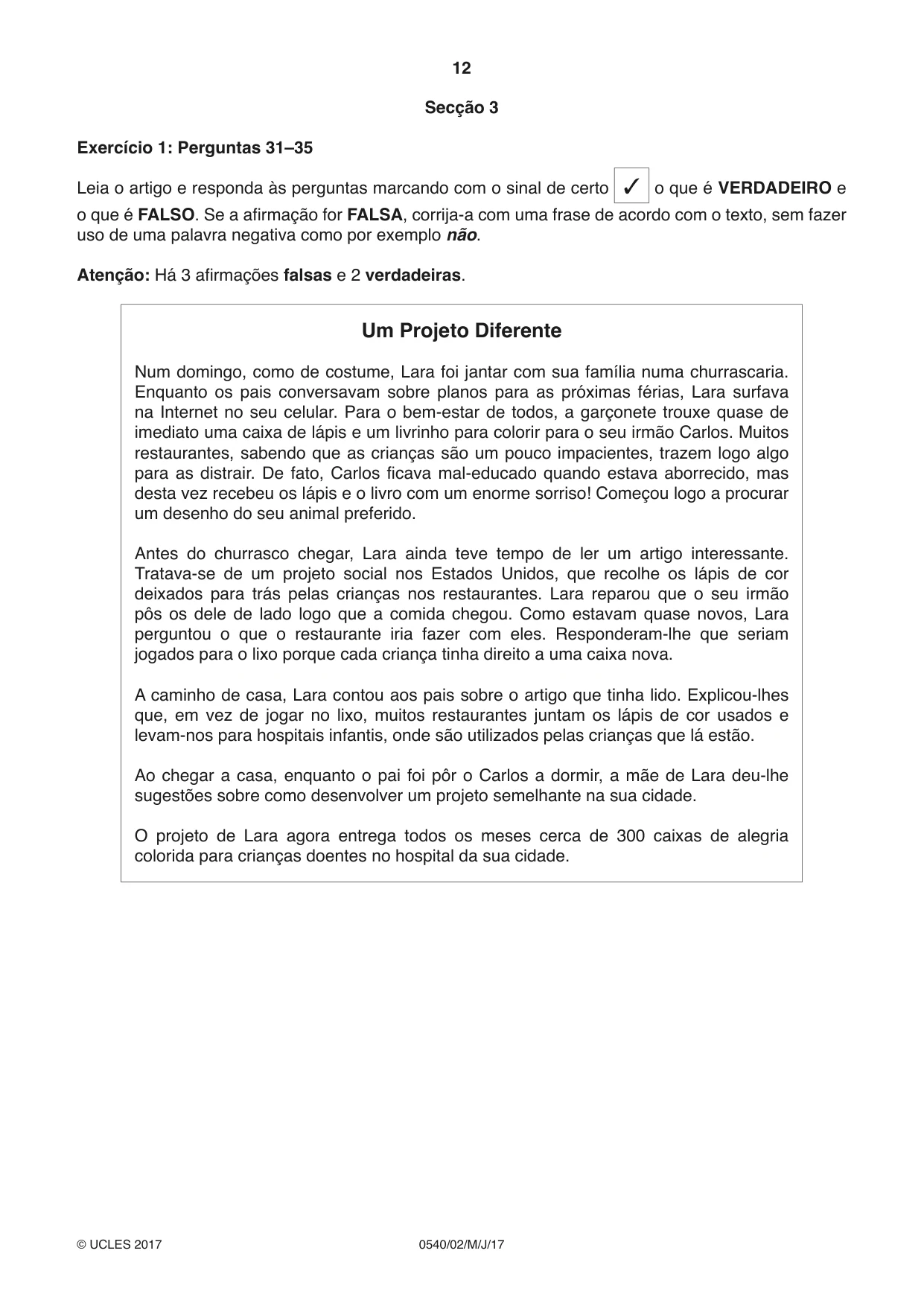
12 0540/02/M/J/17 © UCLES 2017 Secção 3 Exercício 1: Perguntas 31–35 Leia o artigo e responda às perguntas marcando com o sinal de certo ✓ o que é VERDADEIRO e o que é FALSO. Se a afirmação for FALSA, corrija-a com uma frase de acordo com o texto, sem fazer uso de uma palavra negativa como por exemplo não. Atenção: Há 3 afirmações falsas e 2 verdadeiras. Um Projeto Diferente Num domingo, como de costume, Lara foi jantar com sua família numa churrascaria. Enquanto os pais conversavam sobre planos para as próximas férias, Lara surfava na Internet no seu celular. Para o bem-estar de todos, a garçonete trouxe quase de imediato uma caixa de lápis e um livrinho para colorir para o seu irmão Carlos. Muitos restaurantes, sabendo que as crianças são um pouco impacientes, trazem logo algo para as distrair. De fato, Carlos ficava mal-educado quando estava aborrecido, mas desta vez recebeu os lápis e o livro com um enorme sorriso! Começou logo a procurar um desenho do seu animal preferido. Antes do churrasco chegar, Lara ainda teve tempo de ler um artigo interessante. Tratava-se de um projeto social nos Estados Unidos, que recolhe os lápis de cor deixados para trás pelas crianças nos restaurantes. Lara reparou que o seu irmão pôs os dele de lado logo que a comida chegou. Como estavam quase novos, Lara perguntou o que o restaurante iria fazer com eles. Responderam-lhe que seriam jogados para o lixo porque cada criança tinha direito a uma caixa nova. A caminho de casa, Lara contou aos pais sobre o artigo que tinha lido. Explicou-lhes que, em vez de jogar no lixo, muitos restaurantes juntam os lápis de cor usados e levam-nos para hospitais infantis, onde são utilizados pelas crianças que lá estão. Ao chegar a casa, enquanto o pai foi pôr o Carlos a dormir, a mãe de Lara deu-lhe sugestões sobre como desenvolver um projeto semelhante na sua cidade. O projeto de Lara agora entrega todos os meses cerca de 300 caixas de alegria colorida para crianças doentes no hospital da sua cidade.
Question paper, page 13
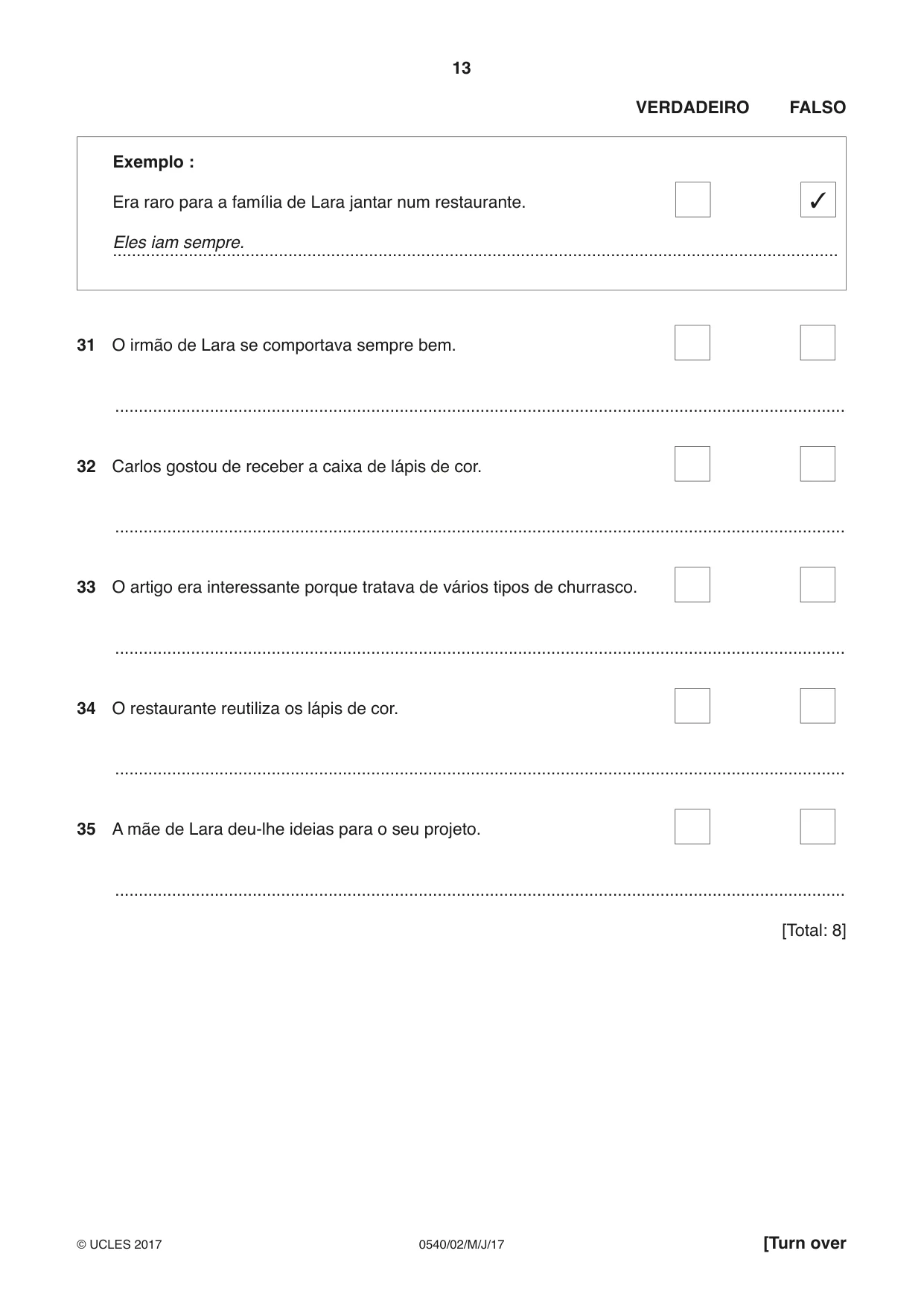
13 0540/02/M/J/17 © UCLES 2017 [Turn over VERDADEIRO FALSO Exemplo : Era raro para a família de Lara jantar num restaurante. ✓ Eles iam sempre. … 31 O irmão de Lara se comportava sempre bem. … 32 Carlos gostou de receber a caixa de lápis de cor. … 33 O artigo era interessante porque tratava de vários tipos de churrasco. … 34 O restaurante reutiliza os lápis de cor. … 35 A mãe de Lara deu-lhe ideias para o seu projeto. … [Total: 8]
Question paper, page 14
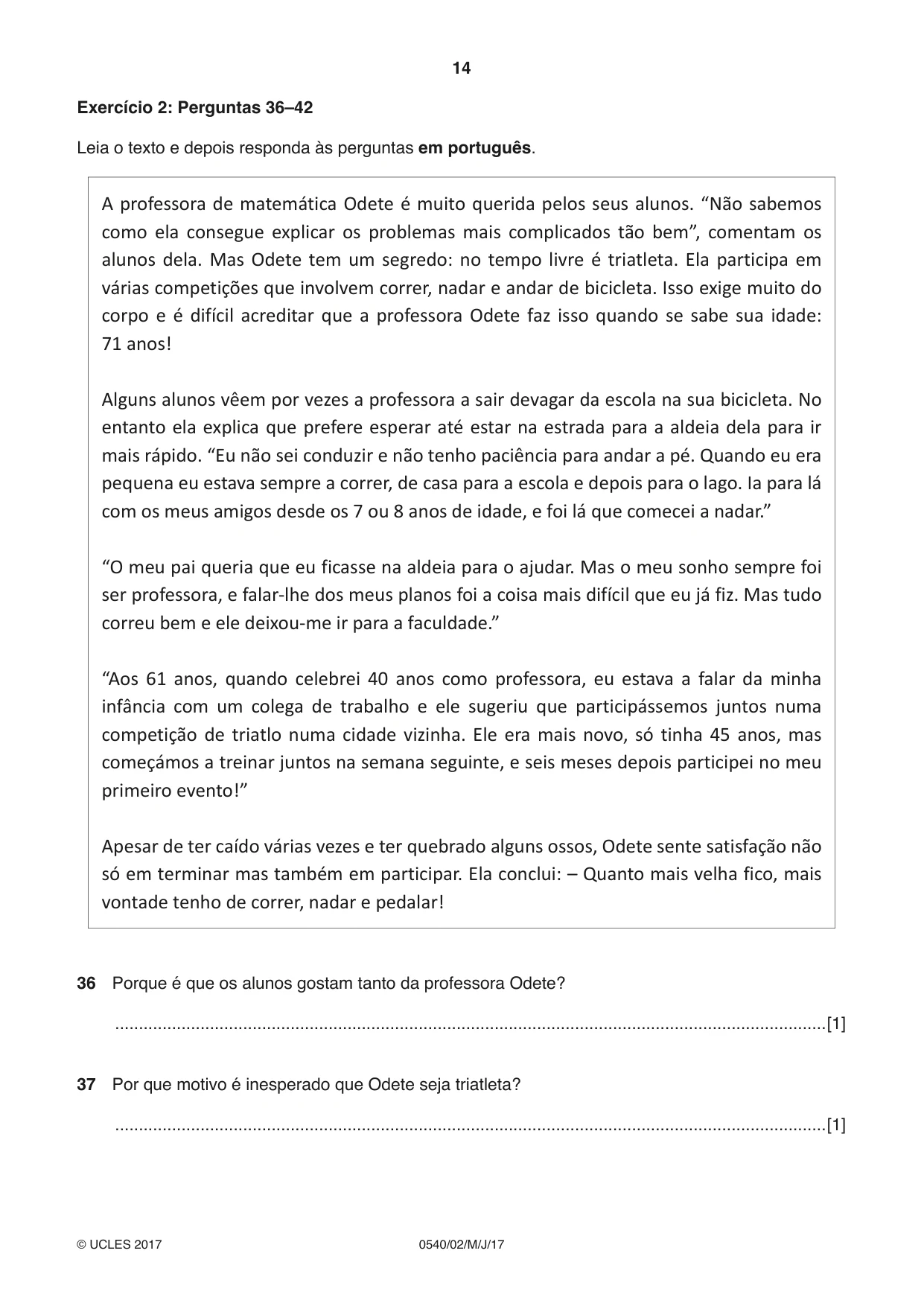
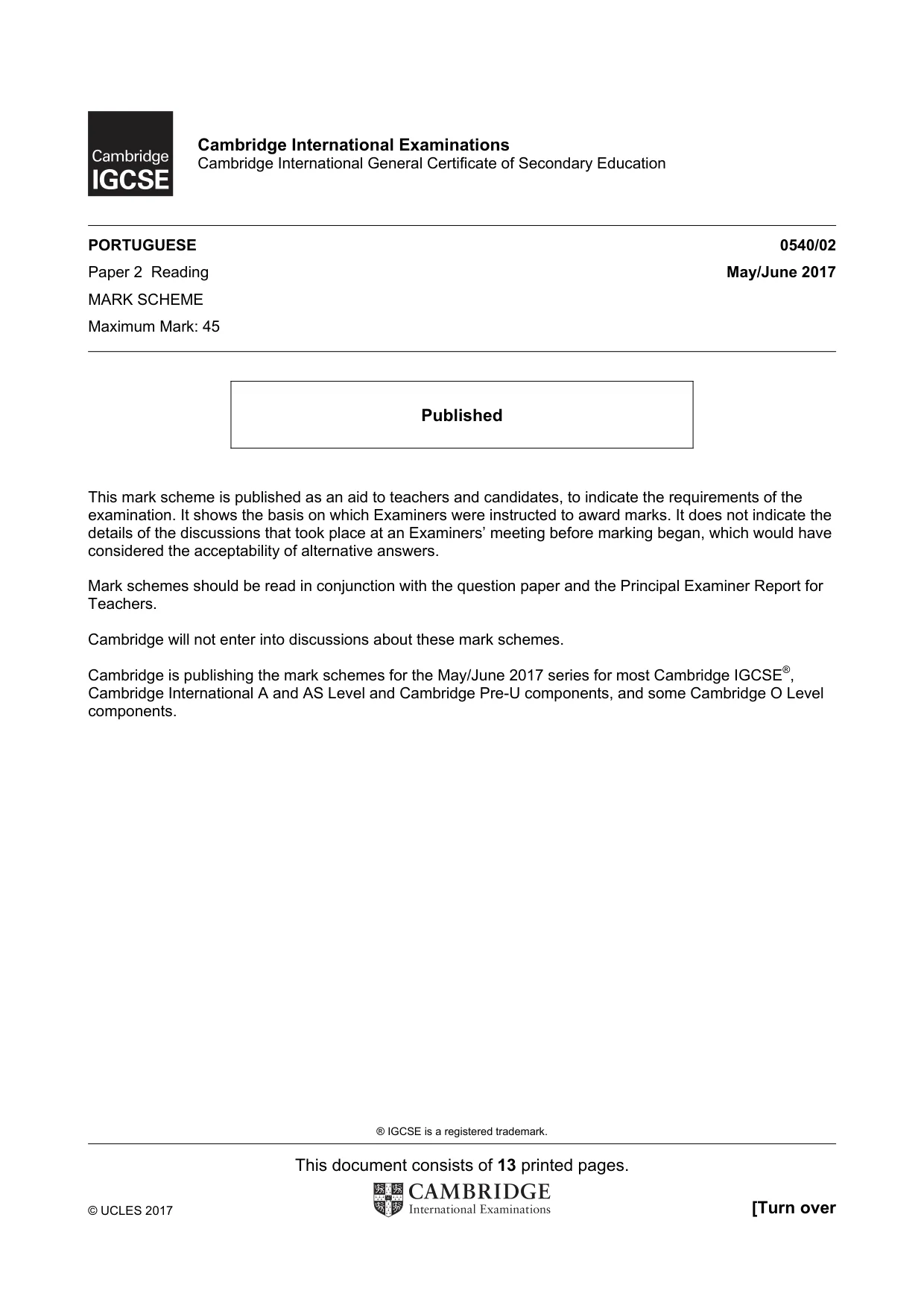
14 0540/02/M/J/17 © UCLES 2017 Exercício 2: Perguntas 36–42 Leia o texto e depois responda às perguntas em português. A professora de matemática Odete é muito querida pelos seus alunos. “Não sabemos como ela consegue explicar os problemas mais complicados tão bem”, comentam os alunos dela. Mas Odete tem um segredo: no tempo livre é triatleta. Ela participa em várias competições que involvem correr, nadar e andar de bicicleta. Isso exige muito do corpo e é difícil acreditar que a professora Odete faz isso quando se sabe sua idade: 71 anos! Alguns alunos vêem por vezes a professora a sair devagar da escola na sua bicicleta. No entanto ela explica que prefere esperar até estar na estrada para a aldeia dela para ir mais rápido. “Eu não sei conduzir e não tenho paciência para andar a pé. Quando eu era pequena eu estava sempre a correr, de casa para a escola e depois para o lago. Ia para lá com os meus amigos desde os 7 ou 8 anos de idade, e foi lá que comecei a nadar.” “O meu pai queria que eu ficasse na aldeia para o ajudar. Mas o meu sonho sempre foi ser professora, e falar-lhe dos meus planos foi a coisa mais difícil que eu já fiz. Mas tudo correu bem e ele deixou-me ir para a faculdade.” “Aos 61 anos, quando celebrei 40 anos como professora, eu estava a falar da minha infância com um colega de trabalho e ele sugeriu que participássemos juntos numa competição de triatlo numa cidade vizinha. Ele era mais novo, só tinha 45 anos, mas começámos a treinar juntos na semana seguinte, e seis meses depois participei no meu primeiro evento!” Apesar de ter caído várias vezes e ter quebrado alguns ossos, Odete sente satisfação não só em terminar mas também em participar. Ela conclui: – Quanto mais velha fico, mais vontade tenho de correr, nadar e pedalar! 36 Porque é que os alunos gostam tanto da professora Odete? …[1] 37 Por que motivo é inesperado que Odete seja triatleta? …[1]
Question paper, page 15
15 0540/02/M/J/17 © UCLES 2017 38 Dê uma razão pela qual Odete prefere andar de bicicleta. …[1] 39 Onde aprendeu Odete a nadar? …[1] 40 Segundo Odete, qual foi o primeiro grande desafio da sua vida? …[1] 41 Com que idade Odete começou a competir em triatlos? …[1] 42 Para Odete, qual a sensação ao concluir uma competição? …[1] [Total: 7]
Question paper, page 16
16 0540/02/M/J/17 © UCLES 2017 Permission to reproduce items where third-party owned material protected by copyright is included has been sought and cleared where possible. Every reasonable effort has been made by the publisher (UCLES) to trace copyright holders, but if any items requiring clearance have unwittingly been included, the publisher will be pleased to make amends at the earliest possible opportunity. To avoid the issue of disclosure of answer-related information to candidates, all copyright acknowledgements are reproduced online in the Cambridge International Examinations Copyright Acknowledgements Booklet. This is produced for each series of examinations and is freely available to download at www.cie.org.uk after the live examination series. Cambridge International Examinations is part of the Cambridge Assessment Group. Cambridge Assessment is the brand name of University of Cambridge Local Examinations Syndicate (UCLES), which is itself a department of the University of Cambridge. BLANK PAGE
Mark scheme, page 1
® IGCSE is a registered trademark. This document consists of 13 printed pages. © UCLES 2017 [Turn over Cambridge International Examinations Cambridge International General Certificate of Secondary Education PORTUGUESE 0540/02 Paper 2 Reading May/June 2017 MARK SCHEME Maximum Mark: 45 Published This mark scheme is published as an aid to teachers and candidates, to indicate the requirements of the examination. It shows the basis on which Examiners were instructed to award marks. It does not indicate the details of the discussions that took place at an Examiners’ meeting before marking began, which would have considered the acceptability of alternative answers. Mark schemes should be read in conjunction with the question paper and the Principal Examiner Report for Teachers. Cambridge will not enter into discussions about these mark schemes. Cambridge is publishing the mark schemes for the May/June 2017 series for most Cambridge IGCSE®, Cambridge International A and AS Level and Cambridge Pre-U components, and some Cambridge O Level components.
Mark scheme, page 2
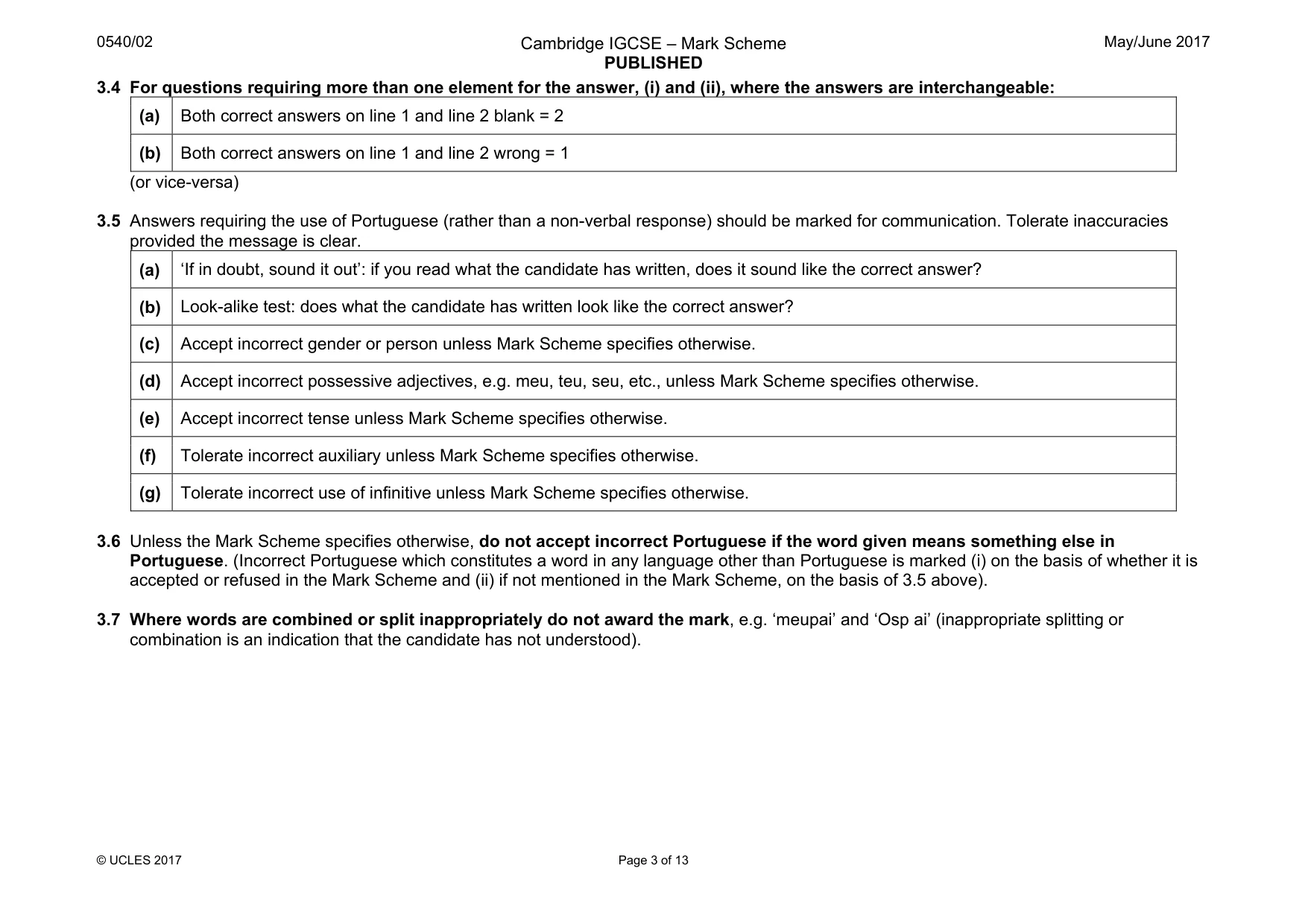
0540/02 Cambridge IGCSE – Mark Scheme PUBLISHED May/June 2017 © UCLES 2017 Page 2 of 13 1 The Standardisation process 2 General Marking Notes 3 General Marking Principles 3.1 It is not possible to list all acceptable alternatives in the Detailed Mark Scheme provided in Section 4. You will need to consider all alternative answers and unexpected approaches in candidates’ scripts, make a decision on whether they communicate the required elements, in consultation with your Team Leader if necessary (or with your Product Manager if you are a single Examiner), and award marks accordingly. The following marking principles underpin the detailed instructions provided in Section 4 of the Mark Scheme. Where a decision is taken to deviate from these principles for a particular question, this will be specified in the Mark Scheme. Often the general principles will have to be weighed up against each other, e.g. the answer might pass the look-alike test (3.5(b)), but if the candidate has produced an answer that is another word in the target language they will not score (3.6). 3.2 Crossing out: (a) If a candidate changes his/her mind over an answer and crosses out an attempt, award a mark if the final attempt is correct. (b) If a candidate crosses out an answer to a whole question but makes no second attempt at it, mark the crossed out work. 3.3 More than the stipulated number of boxes ticked/crossed by the candidate: (a) If more than one attempt is visible, but the candidate has clearly indicated which attempt is his/her final answer (e.g. by crossing out other attempts or by annotating the script in some way), mark in the usual way. (b) If two attempts are visible (e.g. two boxes ticked instead of the 1 box stipulated), and neither has been crossed out/discounted by the candidate, no mark can be awarded. (c) Where candidates must tick a number of boxes (e.g. tick the 6 true statements) and tick too many, apply the following rule: deduct the number of ‘extra’ answers indicated by the candidate from their number of correct answers. The remaining number is the mark awarded, e.g. the candidate is asked to tick 6 statements, but ticks 8. 5 of the ticks are correctly placed, but 2 are ‘extras’ (8 ticks placed by candidate minus 6 ticks required by rubric = 2 ‘extras’). Therefore the candidate is awarded a mark of 3. (d) Answers in pen do not take precedence over answers in pencil, e.g. if a candidate is asked to tick 1 box and ticks two, one in pen and the other in pencil, the mark cannot be awarded unless there is explicit indication from the candidate as to which is his/her final answer.
Mark scheme, page 3
0540/02 Cambridge IGCSE – Mark Scheme PUBLISHED May/June 2017 © UCLES 2017 Page 3 of 13 3.4 For questions requiring more than one element for the answer, (i) and (ii), where the answers are interchangeable: (a) Both correct answers on line 1 and line 2 blank = 2 (b) Both correct answers on line 1 and line 2 wrong = 1 (or vice-versa) 3.5 Answers requiring the use of Portuguese (rather than a non-verbal response) should be marked for communication. Tolerate inaccuracies provided the message is clear. (a) ‘If in doubt, sound it out’: if you read what the candidate has written, does it sound like the correct answer? (b) Look-alike test: does what the candidate has written look like the correct answer? (c) Accept incorrect gender or person unless Mark Scheme specifies otherwise. (d) Accept incorrect possessive adjectives, e.g. meu, teu, seu, etc., unless Mark Scheme specifies otherwise. (e) Accept incorrect tense unless Mark Scheme specifies otherwise. (f) Tolerate incorrect auxiliary unless Mark Scheme specifies otherwise. (g) Tolerate incorrect use of infinitive unless Mark Scheme specifies otherwise. 3.6 Unless the Mark Scheme specifies otherwise, do not accept incorrect Portuguese if the word given means something else in Portuguese. (Incorrect Portuguese which constitutes a word in any language other than Portuguese is marked (i) on the basis of whether it is accepted or refused in the Mark Scheme and (ii) if not mentioned in the Mark Scheme, on the basis of 3.5 above). 3.7 Where words are combined or split inappropriately do not award the mark, e.g. ‘meupai’ and ‘Osp ai’ (inappropriate splitting or combination is an indication that the candidate has not understood).
Mark scheme, page 4
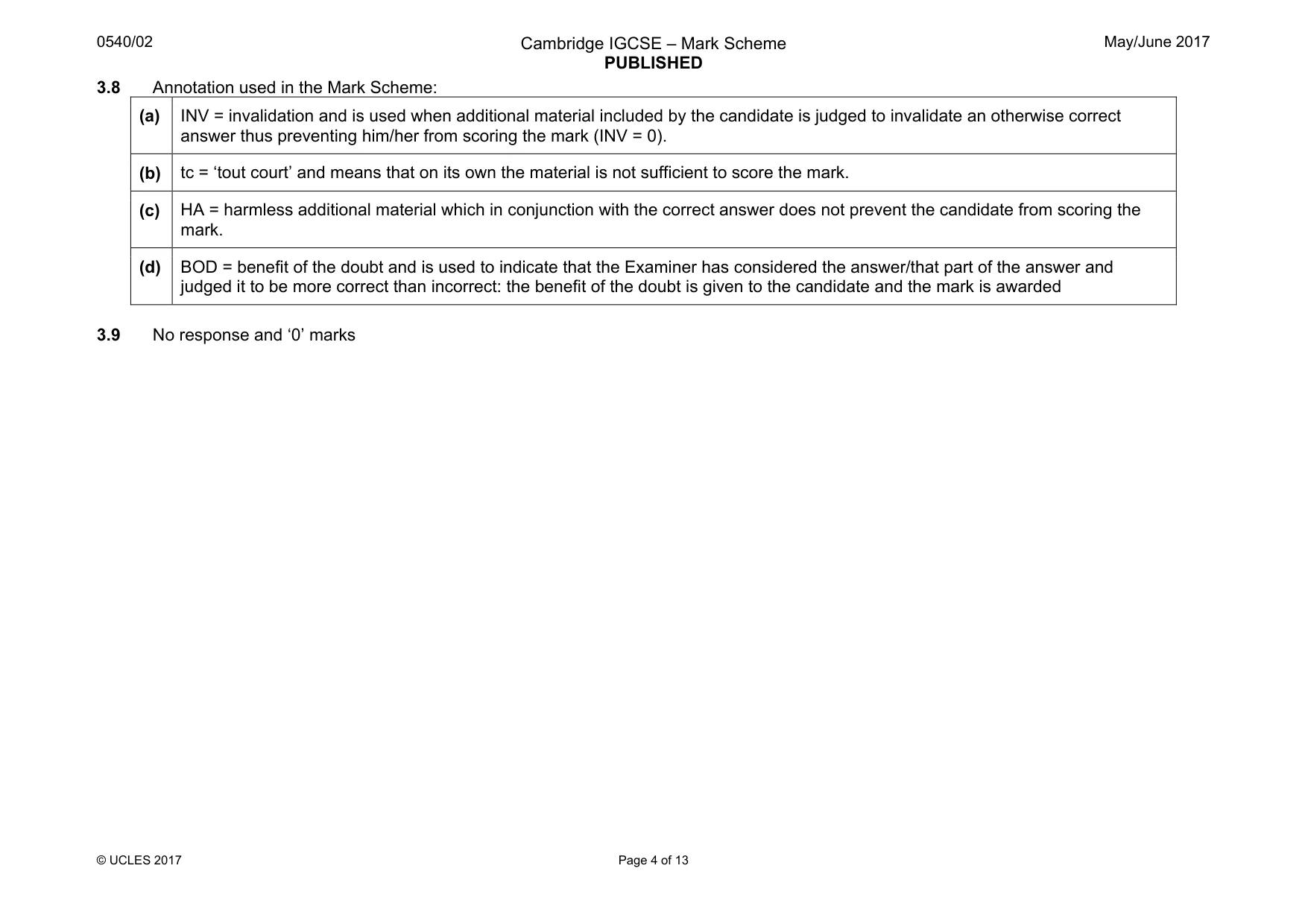
0540/02 Cambridge IGCSE – Mark Scheme PUBLISHED May/June 2017 © UCLES 2017 Page 4 of 13 3.8 Annotation used in the Mark Scheme: (a) INV = invalidation and is used when additional material included by the candidate is judged to invalidate an otherwise correct answer thus preventing him/her from scoring the mark (INV = 0). (b) tc = ‘tout court’ and means that on its own the material is not sufficient to score the mark. (c) HA = harmless additional material which in conjunction with the correct answer does not prevent the candidate from scoring the mark. (d) BOD = benefit of the doubt and is used to indicate that the Examiner has considered the answer/that part of the answer and judged it to be more correct than incorrect: the benefit of the doubt is given to the candidate and the mark is awarded 3.9 No response and ‘0’ marks
Mark scheme, page 5
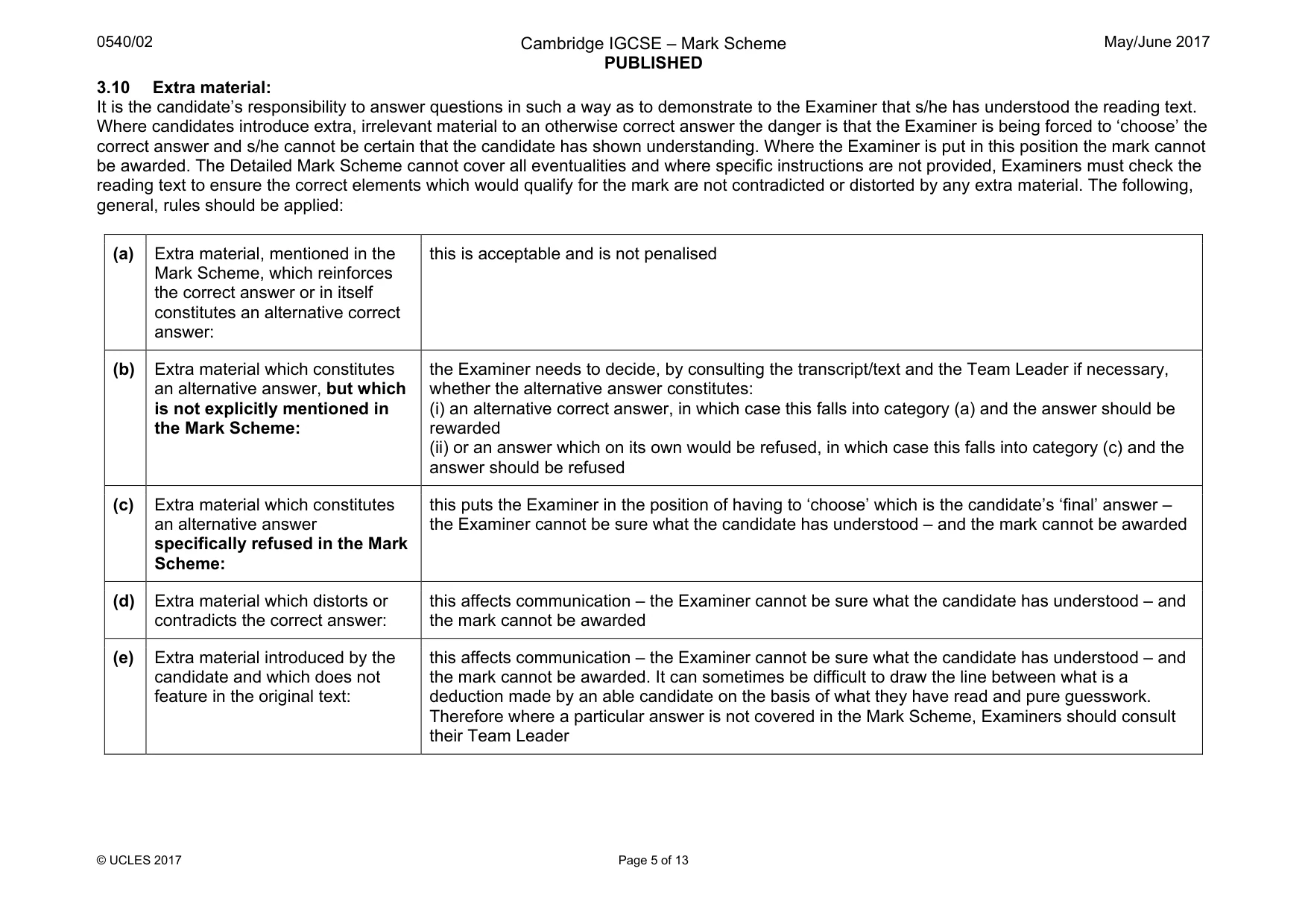
0540/02 Cambridge IGCSE – Mark Scheme PUBLISHED May/June 2017 © UCLES 2017 Page 5 of 13 3.10 Extra material: It is the candidate’s responsibility to answer questions in such a way as to demonstrate to the Examiner that s/he has understood the reading text. Where candidates introduce extra, irrelevant material to an otherwise correct answer the danger is that the Examiner is being forced to ‘choose’ the correct answer and s/he cannot be certain that the candidate has shown understanding. Where the Examiner is put in this position the mark cannot be awarded. The Detailed Mark Scheme cannot cover all eventualities and where specific instructions are not provided, Examiners must check the reading text to ensure the correct elements which would qualify for the mark are not contradicted or distorted by any extra material. The following, general, rules should be applied: (a) Extra material, mentioned in the Mark Scheme, which reinforces the correct answer or in itself constitutes an alternative correct answer: this is acceptable and is not penalised (b) Extra material which constitutes an alternative answer, but which is not explicitly mentioned in the Mark Scheme: the Examiner needs to decide, by consulting the transcript/text and the Team Leader if necessary, whether the alternative answer constitutes: (i) an alternative correct answer, in which case this falls into category (a) and the answer should be rewarded (ii) or an answer which on its own would be refused, in which case this falls into category (c) and the answer should be refused (c) Extra material which constitutes an alternative answer specifically refused in the Mark Scheme: this puts the Examiner in the position of having to ‘choose’ which is the candidate’s ‘final’ answer – the Examiner cannot be sure what the candidate has understood – and the mark cannot be awarded (d) Extra material which distorts or contradicts the correct answer: this affects communication – the Examiner cannot be sure what the candidate has understood – and the mark cannot be awarded (e) Extra material introduced by the candidate and which does not feature in the original text: this affects communication – the Examiner cannot be sure what the candidate has understood – and the mark cannot be awarded. It can sometimes be difficult to draw the line between what is a deduction made by an able candidate on the basis of what they have read and pure guesswork. Therefore where a particular answer is not covered in the Mark Scheme, Examiners should consult their Team Leader
Mark scheme, page 6
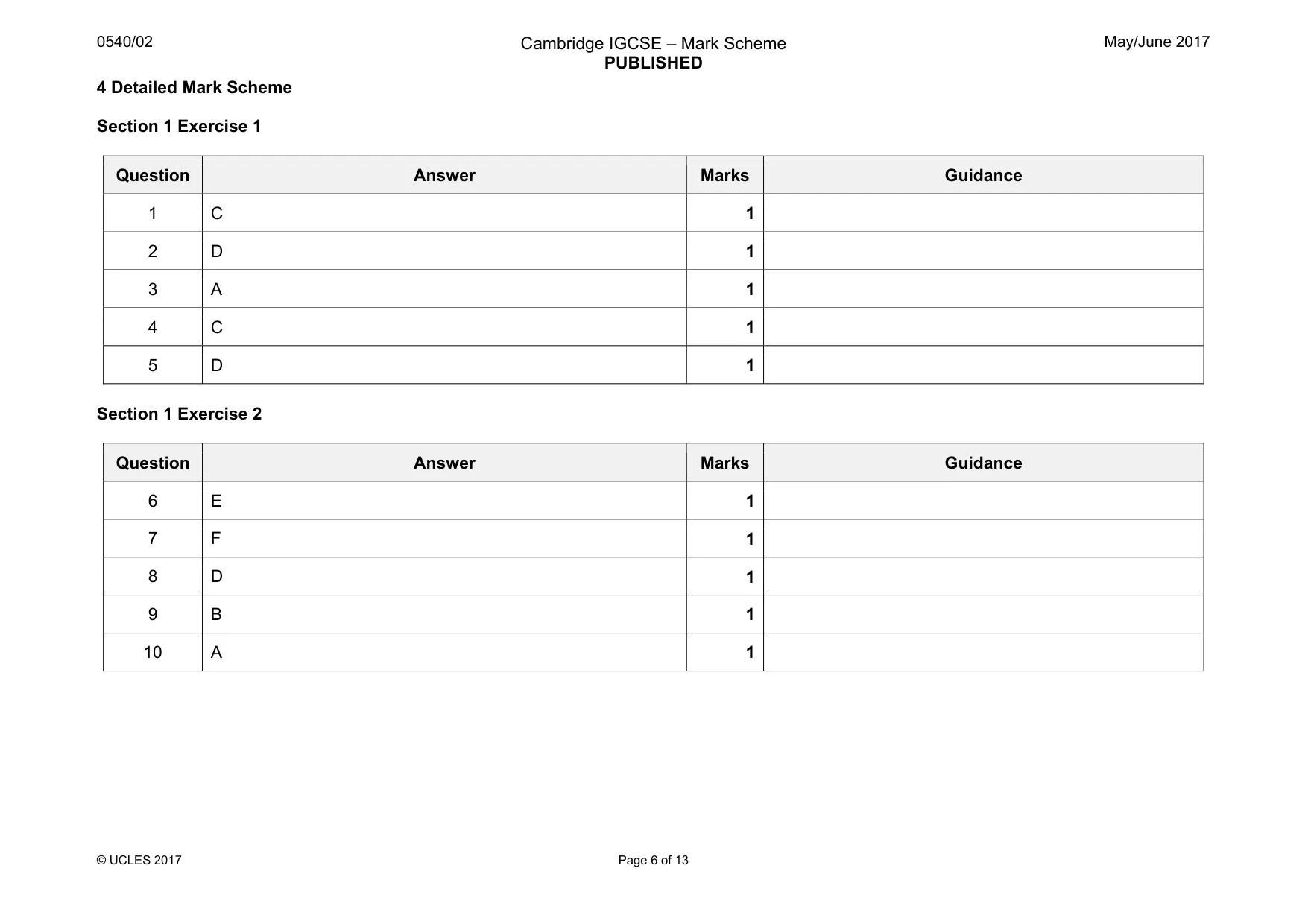
0540/02 Cambridge IGCSE – Mark Scheme PUBLISHED May/June 2017 © UCLES 2017 Page 6 of 13 4 Detailed Mark Scheme Section 1 Exercise 1 Question Answer Marks Guidance 1 C 1 2 D 1 3 A 1 4 C 1 5 D 1 Section 1 Exercise 2 Question Answer Marks Guidance 6 E 1 7 F 1 8 D 1 9 B 1 10 A 1
Mark scheme, page 7
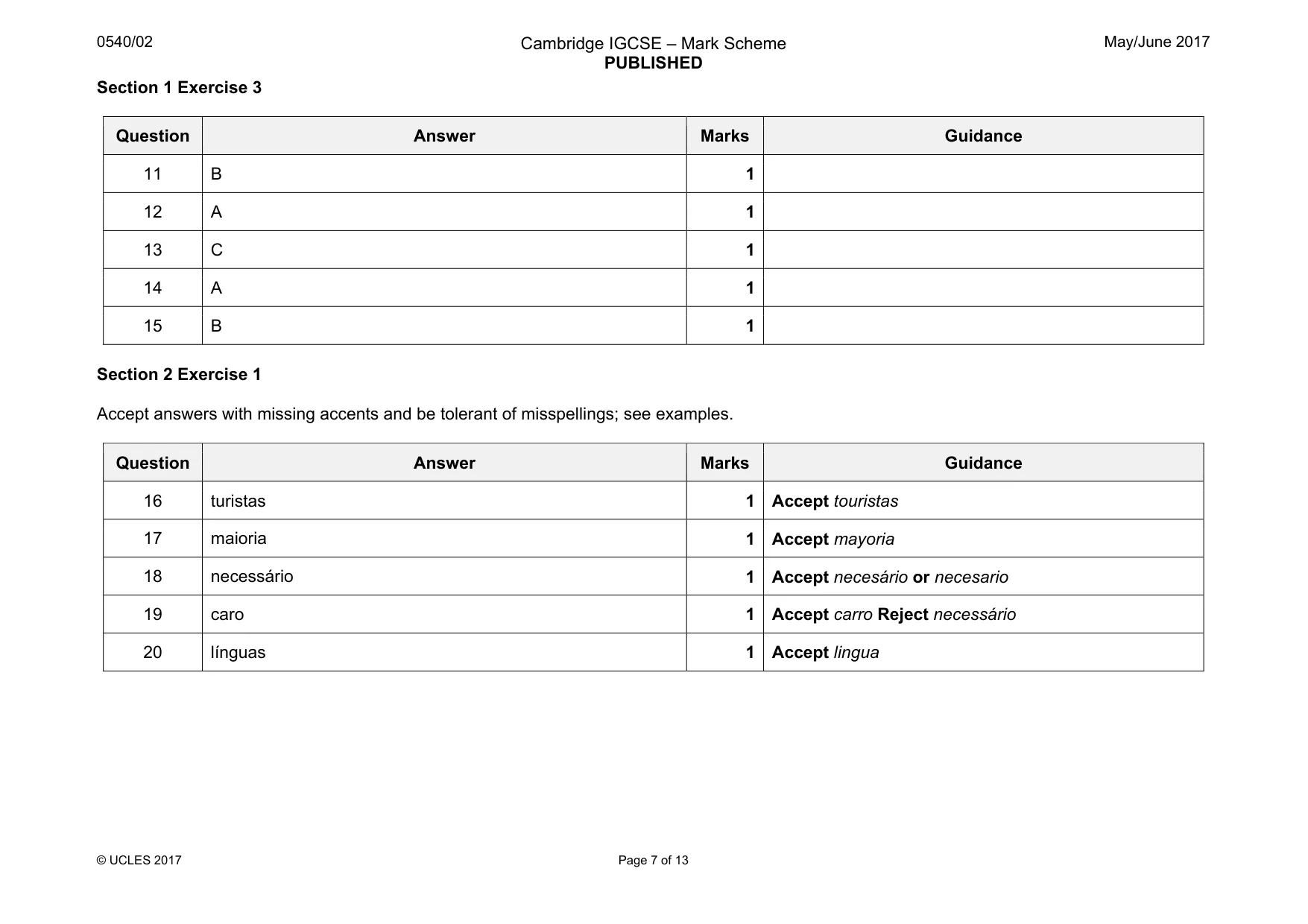
0540/02 Cambridge IGCSE – Mark Scheme PUBLISHED May/June 2017 © UCLES 2017 Page 7 of 13 Section 1 Exercise 3 Question Answer Marks Guidance 11 B 1 12 A 1 13 C 1 14 A 1 15 B 1 Section 2 Exercise 1 Accept answers with missing accents and be tolerant of misspellings; see examples. Question Answer Marks Guidance 16 turistas 1 Accept touristas 17 maioria 1 Accept mayoria 18 necessário 1 Accept necesário or necesario 19 caro 1 Accept carro Reject necessário 20 línguas 1 Accept lingua
Mark scheme, page 8
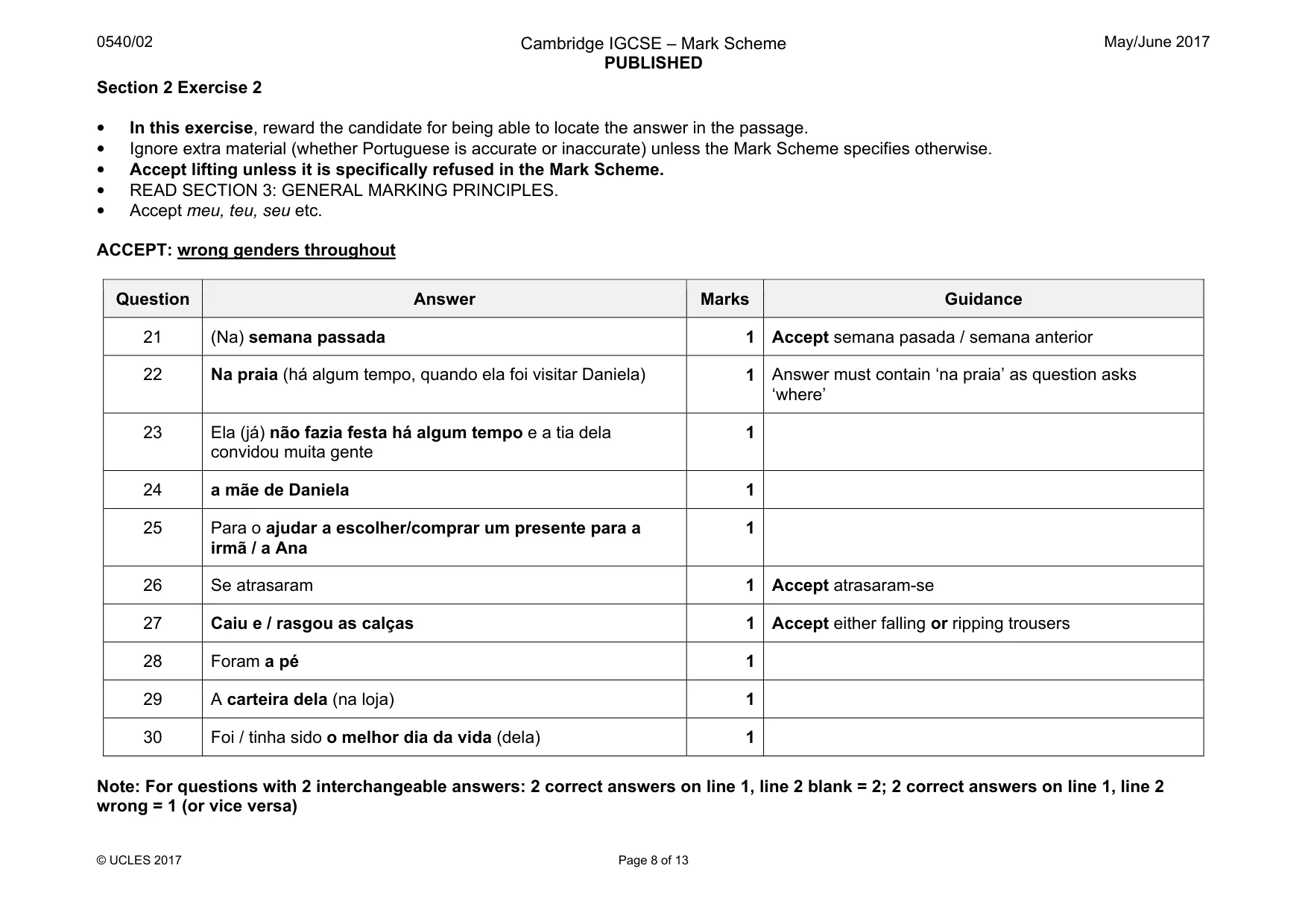
0540/02 Cambridge IGCSE – Mark Scheme PUBLISHED May/June 2017 © UCLES 2017 Page 8 of 13 Section 2 Exercise 2 • In this exercise, reward the candidate for being able to locate the answer in the passage. • Ignore extra material (whether Portuguese is accurate or inaccurate) unless the Mark Scheme specifies otherwise. • Accept lifting unless it is specifically refused in the Mark Scheme. • READ SECTION 3: GENERAL MARKING PRINCIPLES. • Accept meu, teu, seu etc. ACCEPT: wrong genders throughout Question Answer Marks Guidance 21 (Na) semana passada 1 Accept semana pasada / semana anterior 22 Na praia (há algum tempo, quando ela foi visitar Daniela) 1 Answer must contain ‘na praia’ as question asks ‘where’ 23 Ela (já) não fazia festa há algum tempo e a tia dela convidou muita gente 1 24 a mãe de Daniela 1 25 Para o ajudar a escolher/comprar um presente para a irmã / a Ana 1 26 Se atrasaram 1 Accept atrasaram-se 27 Caiu e / rasgou as calças 1 Accept either falling or ripping trousers 28 Foram a pé 1 29 A carteira dela (na loja) 1 30 Foi / tinha sido o melhor dia da vida (dela) 1 Note: For questions with 2 interchangeable answers: 2 correct answers on line 1, line 2 blank = 2; 2 correct answers on line 1, line 2 wrong = 1 (or vice versa)
Mark scheme, page 9
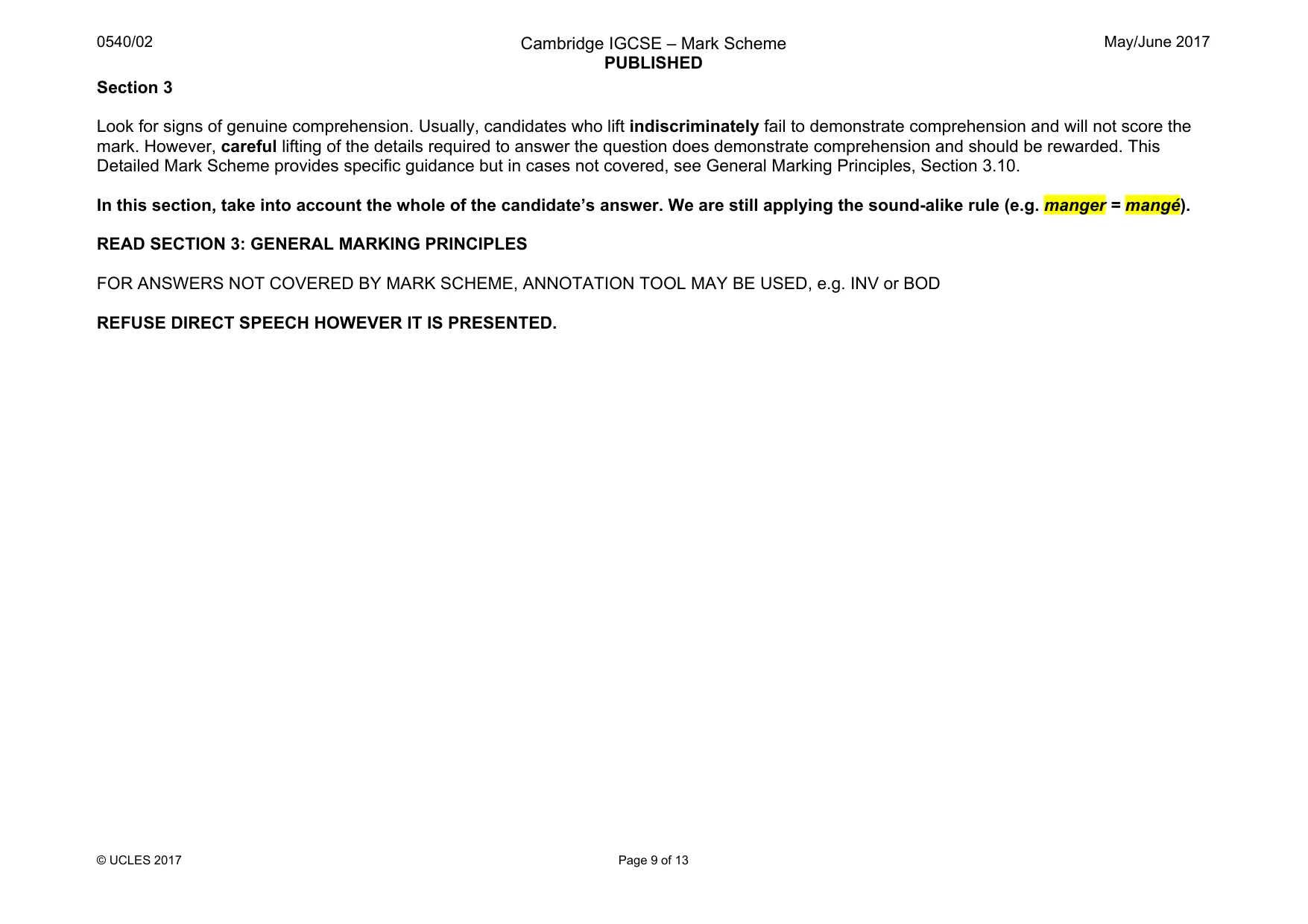
0540/02 Cambridge IGCSE – Mark Scheme PUBLISHED May/June 2017 © UCLES 2017 Page 9 of 13 Section 3 Look for signs of genuine comprehension. Usually, candidates who lift indiscriminately fail to demonstrate comprehension and will not score the mark. However, careful lifting of the details required to answer the question does demonstrate comprehension and should be rewarded. This Detailed Mark Scheme provides specific guidance but in cases not covered, see General Marking Principles, Section 3.10. In this section, take into account the whole of the candidate’s answer. We are still applying the sound-alike rule (e.g. manger = mangé). READ SECTION 3: GENERAL MARKING PRINCIPLES FOR ANSWERS NOT COVERED BY MARK SCHEME, ANNOTATION TOOL MAY BE USED, e.g. INV or BOD REFUSE DIRECT SPEECH HOWEVER IT IS PRESENTED.
Mark scheme, page 10
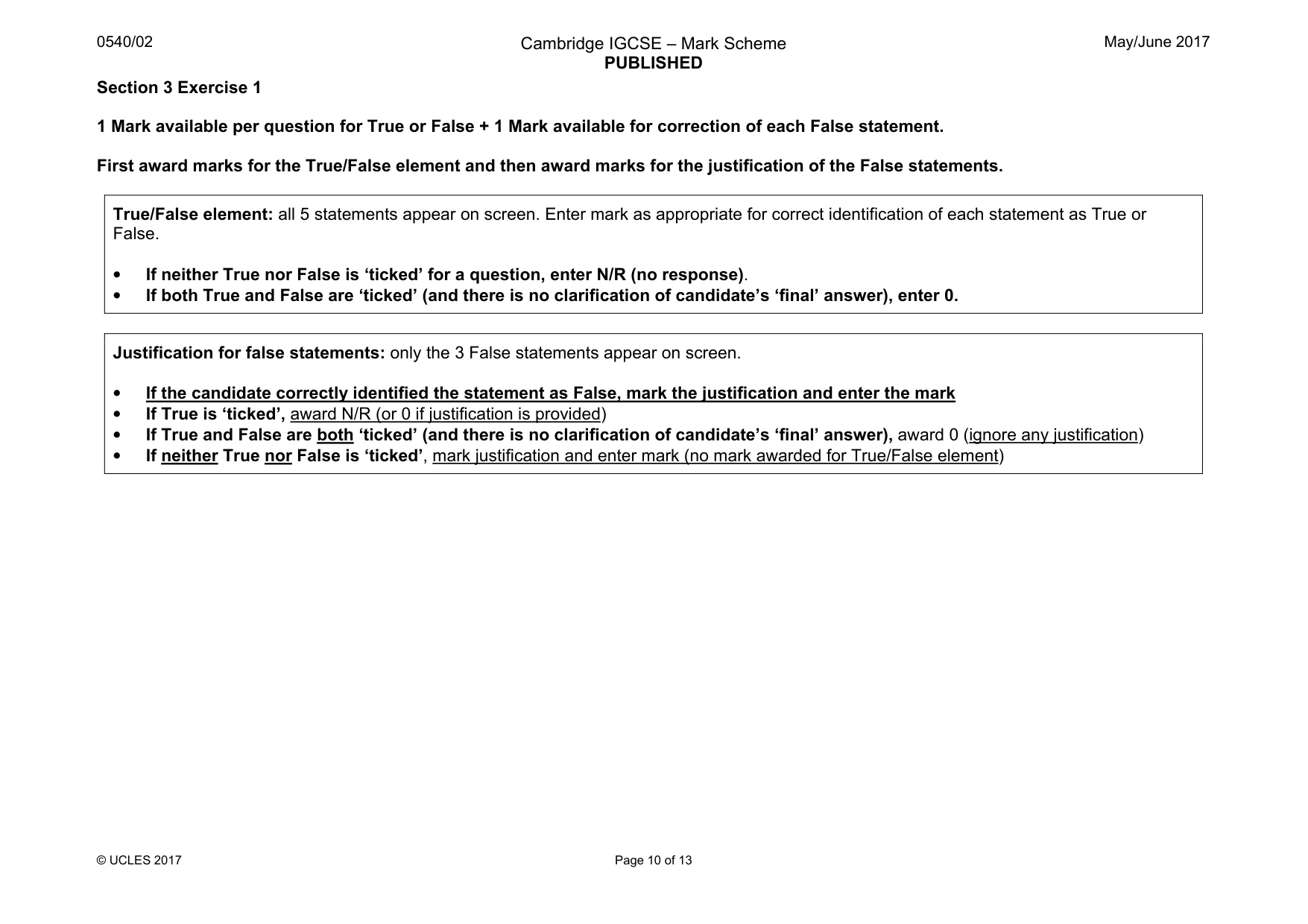
0540/02 Cambridge IGCSE – Mark Scheme PUBLISHED May/June 2017 © UCLES 2017 Page 10 of 13 Section 3 Exercise 1 1 Mark available per question for True or False + 1 Mark available for correction of each False statement. First award marks for the True/False element and then award marks for the justification of the False statements. True/False element: all 5 statements appear on screen. Enter mark as appropriate for correct identification of each statement as True or False. • If neither True nor False is ‘ticked’ for a question, enter N/R (no response). • If both True and False are ‘ticked’ (and there is no clarification of candidate’s ‘final’ answer), enter 0. Justification for false statements: only the 3 False statements appear on screen. • If the candidate correctly identified the statement as False, mark the justification and enter the mark • If True is ‘ticked’, award N/R (or 0 if justification is provided) • If True and False are both ‘ticked’ (and there is no clarification of candidate’s ‘final’ answer), award 0 (ignore any justification) • If neither True nor False is ‘ticked’, mark justification and enter mark (no mark awarded for True/False element)
Mark scheme, page 11
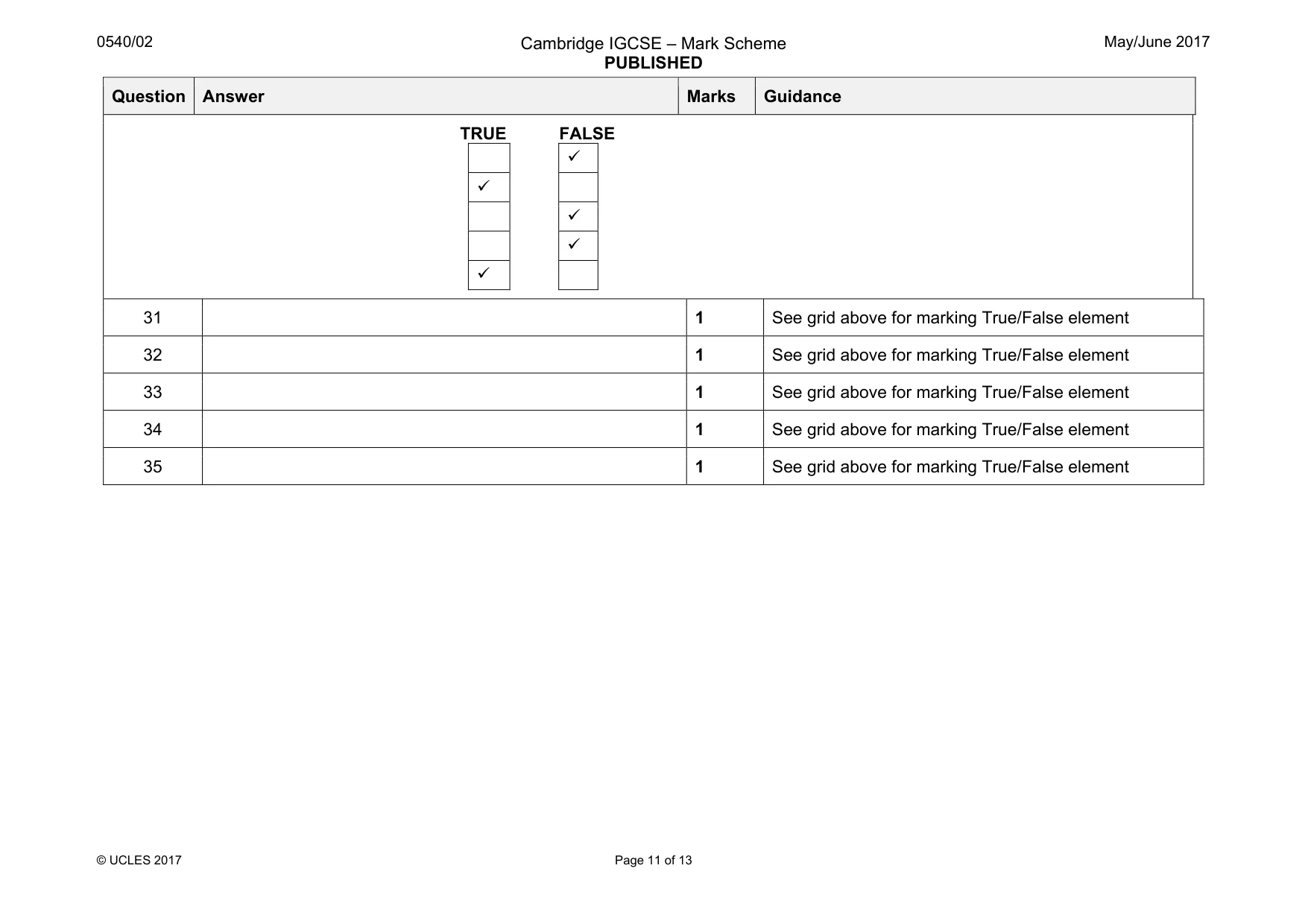
0540/02 Cambridge IGCSE – Mark Scheme PUBLISHED May/June 2017 © UCLES 2017 Page 11 of 13 Question Answer Marks Guidance TRUE FALSE 9 9 9 9 9 31 1 See grid above for marking True/False element 32 1 See grid above for marking True/False element 33 1 See grid above for marking True/False element 34 1 See grid above for marking True/False element 35 1 See grid above for marking True/False element
Mark scheme, page 12
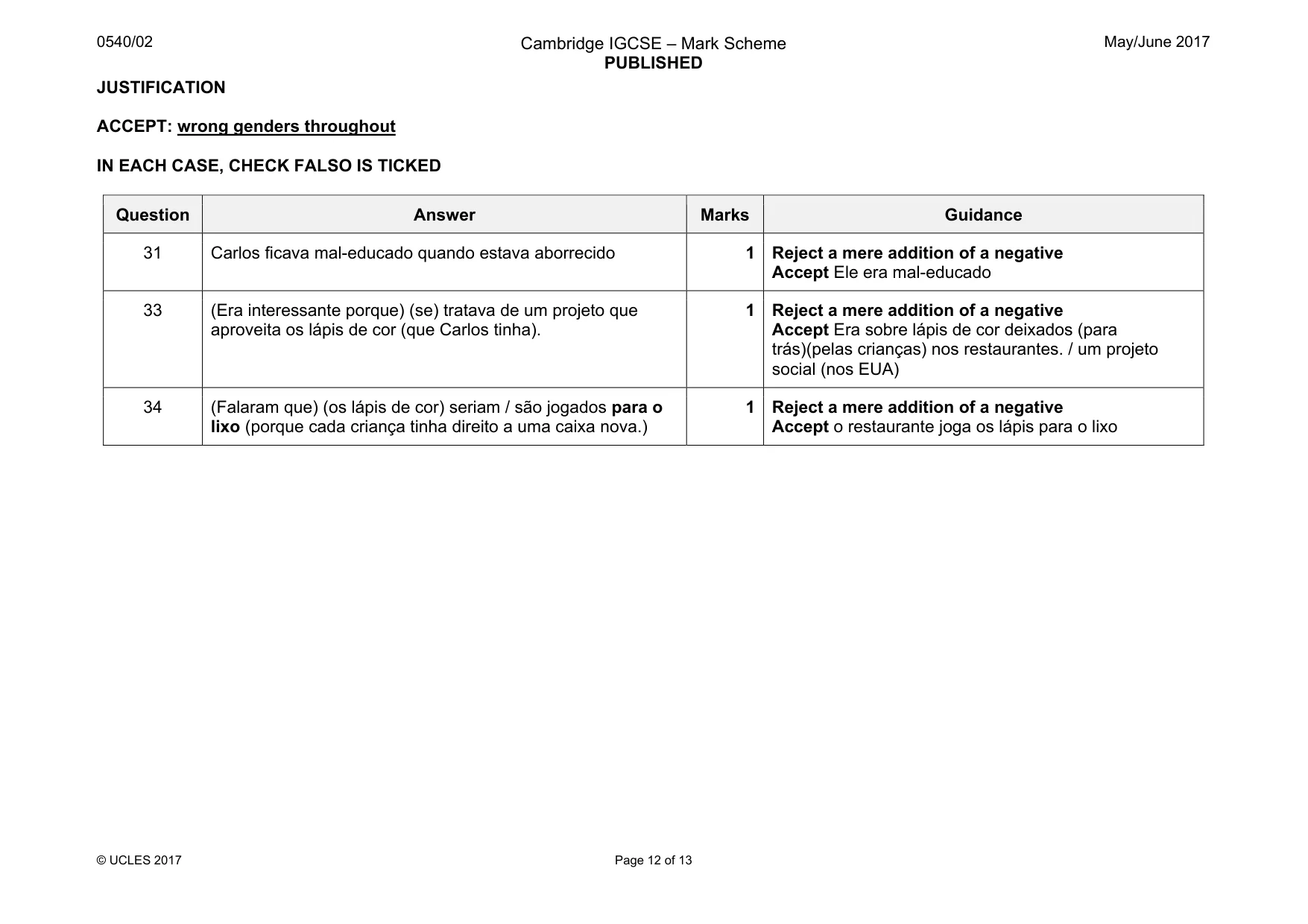
0540/02 Cambridge IGCSE – Mark Scheme PUBLISHED May/June 2017 © UCLES 2017 Page 12 of 13 JUSTIFICATION ACCEPT: wrong genders throughout IN EACH CASE, CHECK FALSO IS TICKED Question Answer Marks Guidance 31 Carlos ficava mal-educado quando estava aborrecido 1 Reject a mere addition of a negative Accept Ele era mal-educado 33 (Era interessante porque) (se) tratava de um projeto que aproveita os lápis de cor (que Carlos tinha). 1 Reject a mere addition of a negative Accept Era sobre lápis de cor deixados (para trás)(pelas crianças) nos restaurantes. / um projeto social (nos EUA) 34 (Falaram que) (os lápis de cor) seriam / são jogados para o lixo (porque cada criança tinha direito a uma caixa nova.) 1 Reject a mere addition of a negative Accept o restaurante joga os lápis para o lixo
Mark scheme, page 13
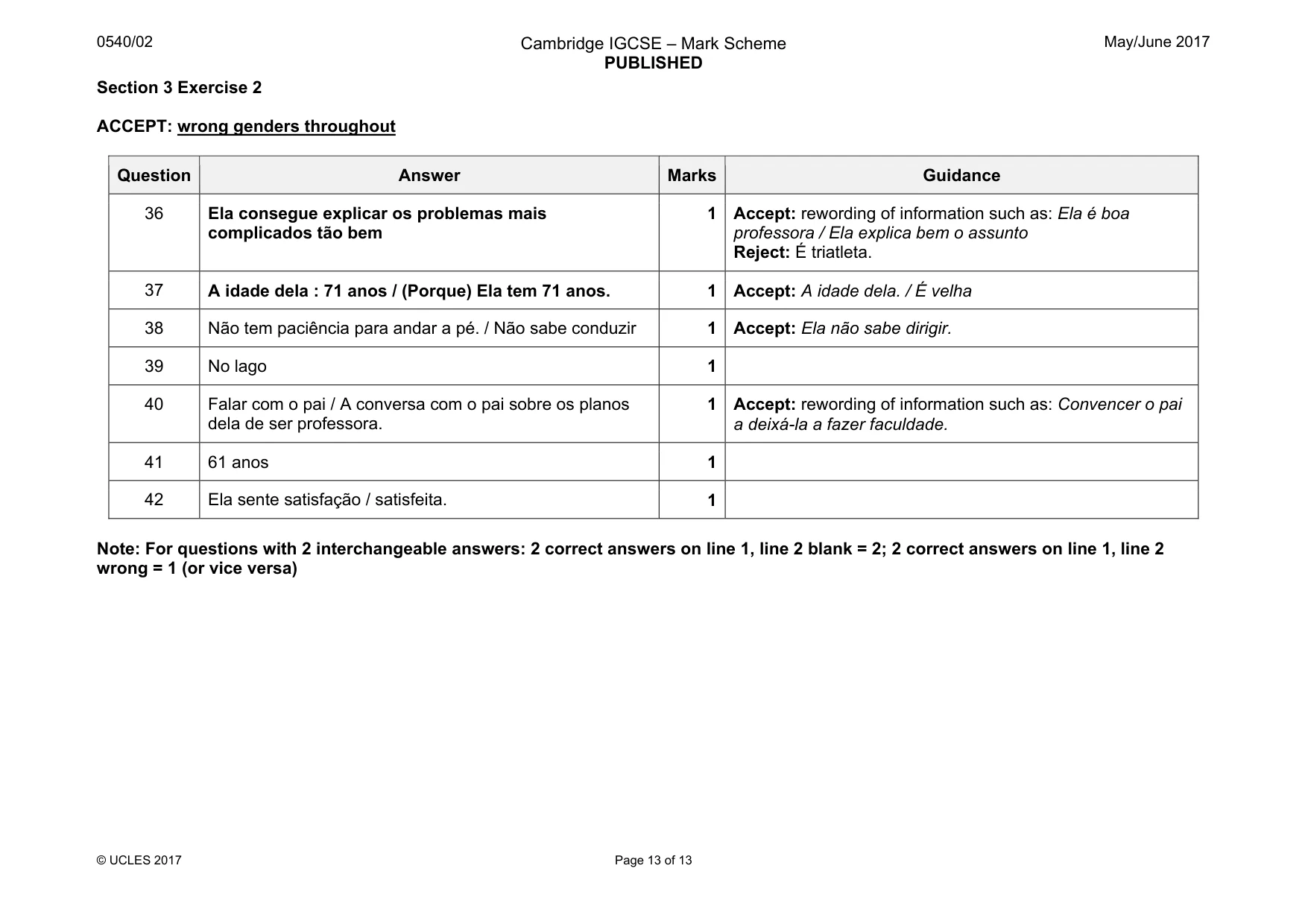
0540/02 Cambridge IGCSE – Mark Scheme PUBLISHED May/June 2017 © UCLES 2017 Page 13 of 13 Section 3 Exercise 2 ACCEPT: wrong genders throughout Question Answer Marks Guidance 36 Ela consegue explicar os problemas mais complicados tão bem 1 Accept: rewording of information such as: Ela é boa professora / Ela explica bem o assunto Reject: É triatleta. 37 A idade dela : 71 anos / (Porque) Ela tem 71 anos. 1 Accept: A idade dela. / É velha 38 Não tem paciência para andar a pé. / Não sabe conduzir 1 Accept: Ela não sabe dirigir. 39 No lago 1 40 Falar com o pai / A conversa com o pai sobre os planos dela de ser professora. 1 Accept: rewording of information such as: Convencer o pai a deixá-la a fazer faculdade. 41 61 anos 1 42 Ela sente satisfação / satisfeita. 1 Note: For questions with 2 interchangeable answers: 2 correct answers on line 1, line 2 blank = 2; 2 correct answers on line 1, line 2 wrong = 1 (or vice versa)
What you needed in this session
Cambridge’s own grade thresholds for 2017 May/June, Paper 2 · Variant 1. A higher threshold means an easier paper — the bar moves with how the cohort did.