Cambridge IGCSE Portuguese - Foreign Language 0540 — 2012 May/June Paper 2 · Variant 1
0540/21/M/J/12 · 65 marks · ≈73 min
The question paper and its mark scheme, free to read here and free to download. This is Cambridge’s own paper, exactly as it was sat.
Question paper20 pages





Mark scheme13 pages
Answers below. Sit the paper first if you are practising.
Paper as text
Question paper, page 1
This document consists of 16 printed pages and 4 blank pages. DC (SJF/SW) 52499/3 © UCLES 2012 [Turn over UNIVERSITY OF CAMBRIDGE INTERNATIONAL EXAMINATIONS International General Certificate of Secondary Education * 7 5 2 4 8 2 4 4 4 2 * PORTUGUESE 0540/02 Paper 2 Reading and Directed Writing May/June 2012 1 hour 30 minutes Candidates answer on the Question Paper. No Additional Materials are required. READ THESE INSTRUCTIONS FIRST Write your Centre number, candidate number and name on all the work you hand in. Write in dark blue or black pen. Do not use staples, paper clips, highlighters, glue or correction fluid. DO NOT WRITE IN ANY BARCODES. Answer all questions in Section 1, Section 2 and Section 3. At the end of the examination, fasten all your work securely together. The number of marks is given in brackets [ ] at the end of each question or part question. For Examiner’s Use Section 1 Section 2 Section 3 Total www.XtremePapers.com
Question paper, page 2
2 0540/02/M/J/12 © UCLES 2012 BLANK PAGE
Question paper, page 3
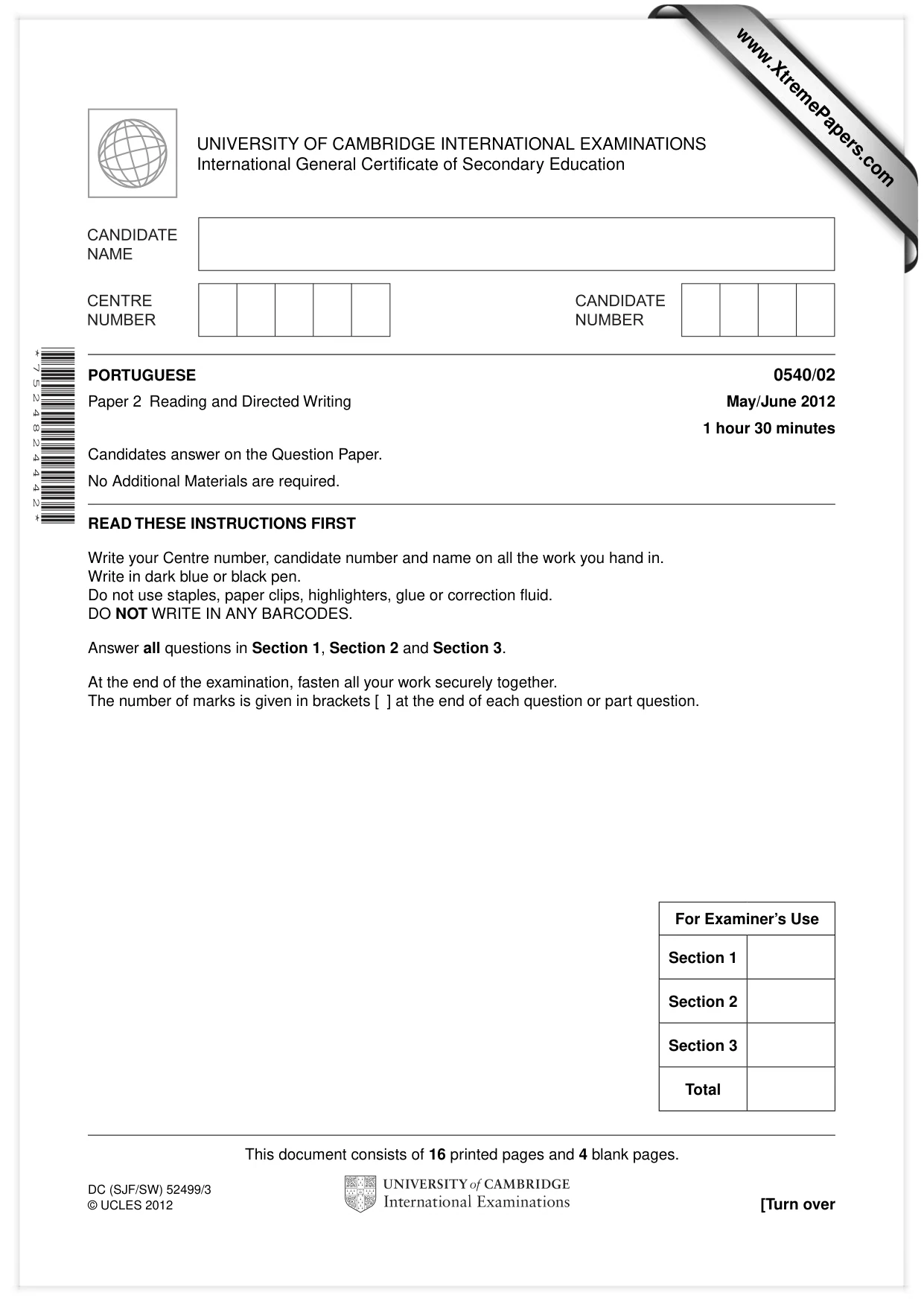
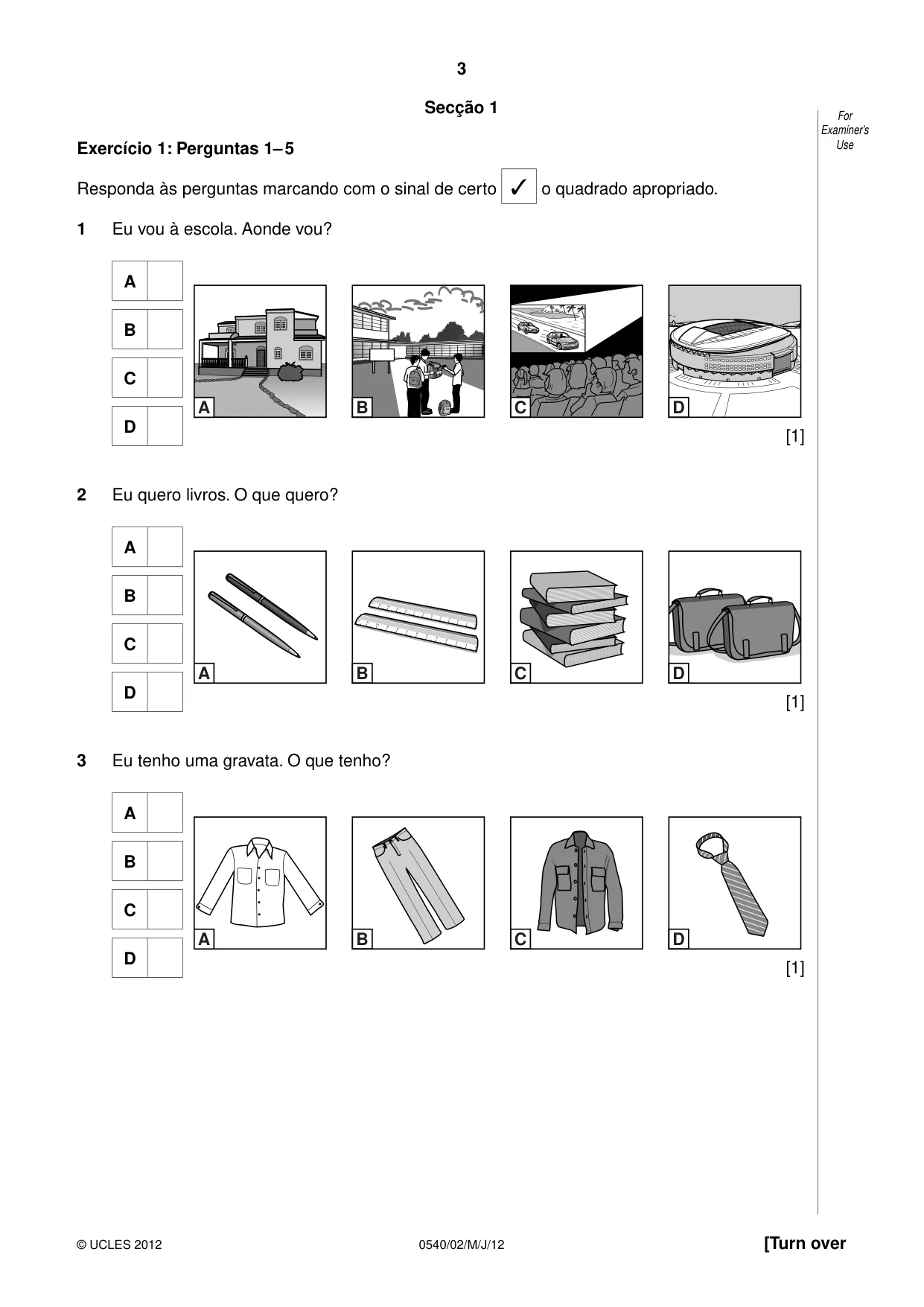
3 0540/02/M/J/12 © UCLES 2012 [Turn over For Examiner’s Use Secção 1 Exercício 1: Perguntas 1– 5 Responda às perguntas marcando com o sinal de certo ✓ o quadrado apropriado. 1 Eu vou à escola. Aonde vou? A A B C D [1] B C D 2 Eu quero livros. O que quero? A A B C D [1] B C D 3 Eu tenho uma gravata. O que tenho? A A B C D [1] B C D
Question paper, page 4
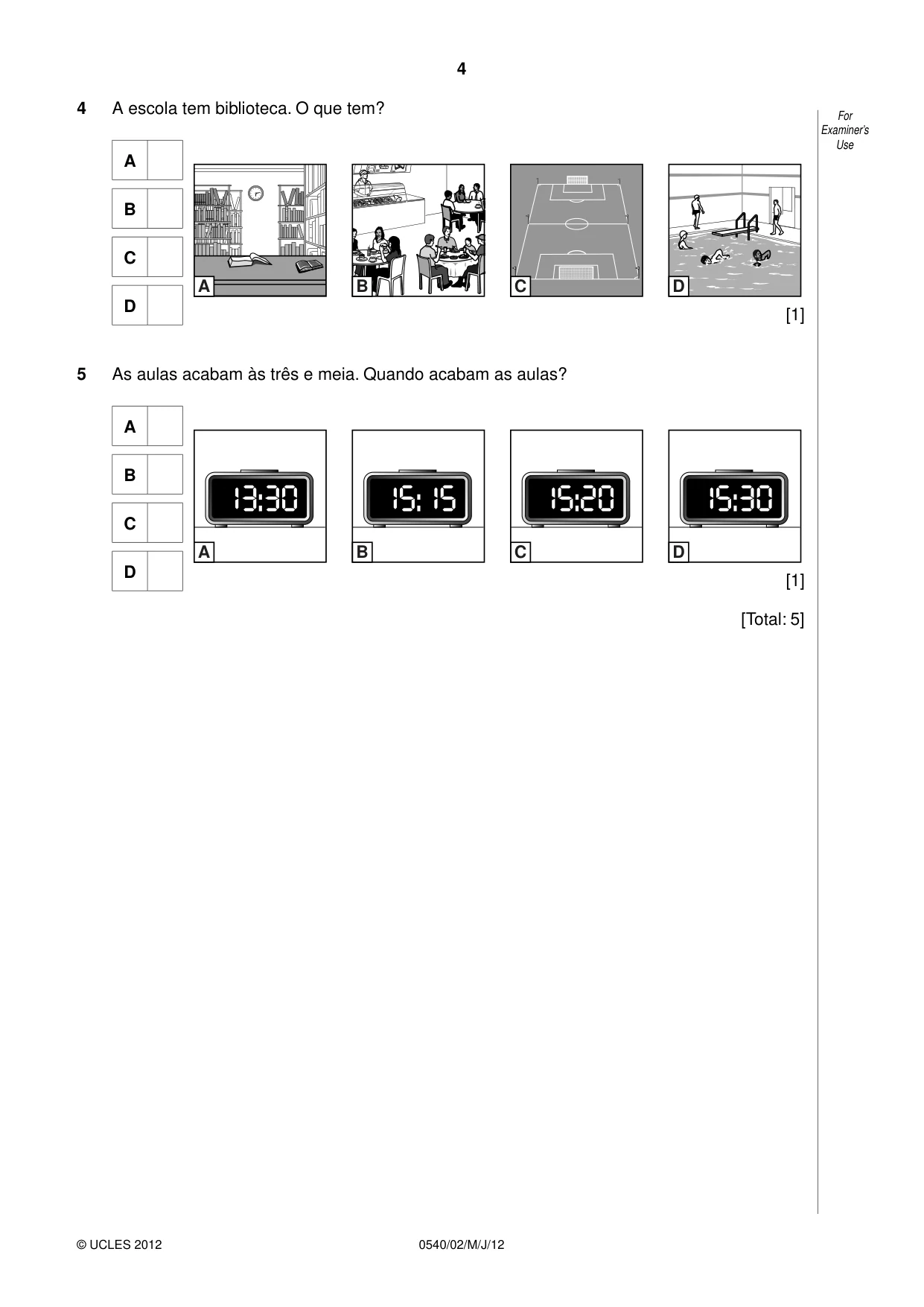
4 0540/02/M/J/12 © UCLES 2012 For Examiner’s Use 4 A escola tem biblioteca. O que tem? A A B C D [1] B C D 5 As aulas acabam às três e meia. Quando acabam as aulas? A A B C D [1] B C D [Total: 5]
Question paper, page 5
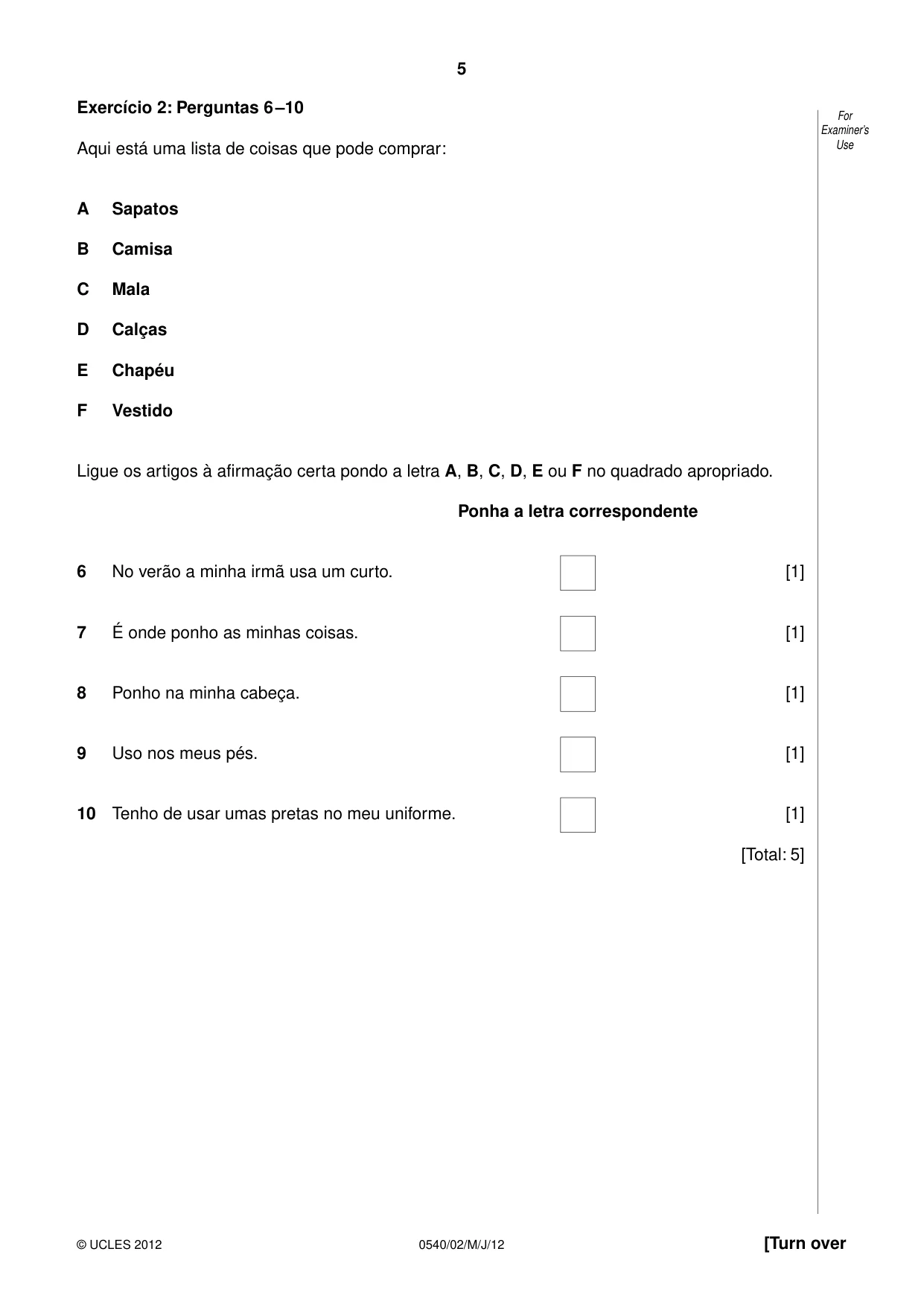
5 0540/02/M/J/12 © UCLES 2012 [Turn over For Examiner’s Use Exercício 2: Perguntas 6 –10 Aqui está uma lista de coisas que pode comprar: A Sapatos B Camisa C Mala D Calças E Chapéu F Vestido Ligue os artigos à afirmação certa pondo a letra A, B, C, D, E ou F no quadrado apropriado. Ponha a letra correspondente 6 No verão a minha irmã usa um curto. [1] 7 É onde ponho as minhas coisas. [1] 8 Ponho na minha cabeça. [1] 9 Uso nos meus pés. [1] 10 Tenho de usar umas pretas no meu uniforme. [1] [Total: 5]
Question paper, page 6
6 0540/02/M/J/12 © UCLES 2012 For Examiner’s Use Exercício 3: Perguntas 11–15 Leia o texto com cuidado. FÉRIAS EM MOÇAMBIQUE Maria, Passo as minhas férias de verão em Maputo. Vou para lá todos os anos com os meus pais e irmão. Estou quase sempre a nadar no mar. Há dias que até almoço no café lá da praia e depois de duas horas, volto para o mar. Faz sempre muito calor. À noite dou uma volta a pé com os meus pais. Às vezes vou à discoteca com os meus amigos. Tenho umas férias fantásticas! Um abraço, Bruno Marque com o sinal de certo ✓ o quadrado apropriado. 11 O Bruno está em Maputo para ... A trabalhar. B conhecer um lugar novo. C fazer férias. [1] 12 Ele vai ... A com a família. B com amigos. C sozinho. [1]
Question paper, page 7
7 0540/02/M/J/12 © UCLES 2012 [Turn over For Examiner’s Use 13 Ele passa os dias ... A na cidade. B na água. C a visitar museus. [1] 14 O tempo durante as férias está ... A bastante quente. B quase sempre chuvoso. C fresco de manhã. [1] 15 Ao fim do dia ... A anda de carro. B passeia com a família. C vai ao cinema. [1] [Total: 5]
Question paper, page 8
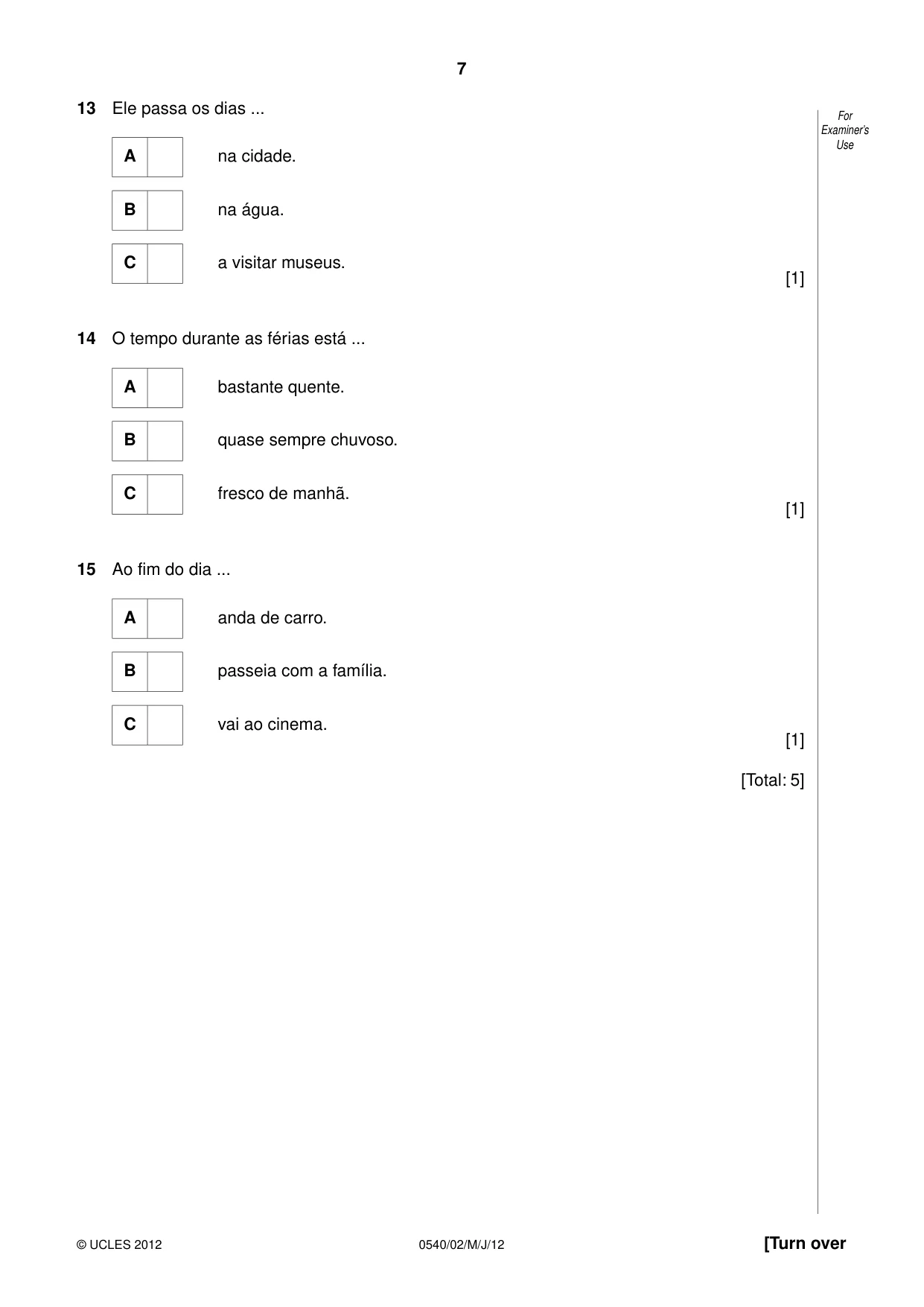
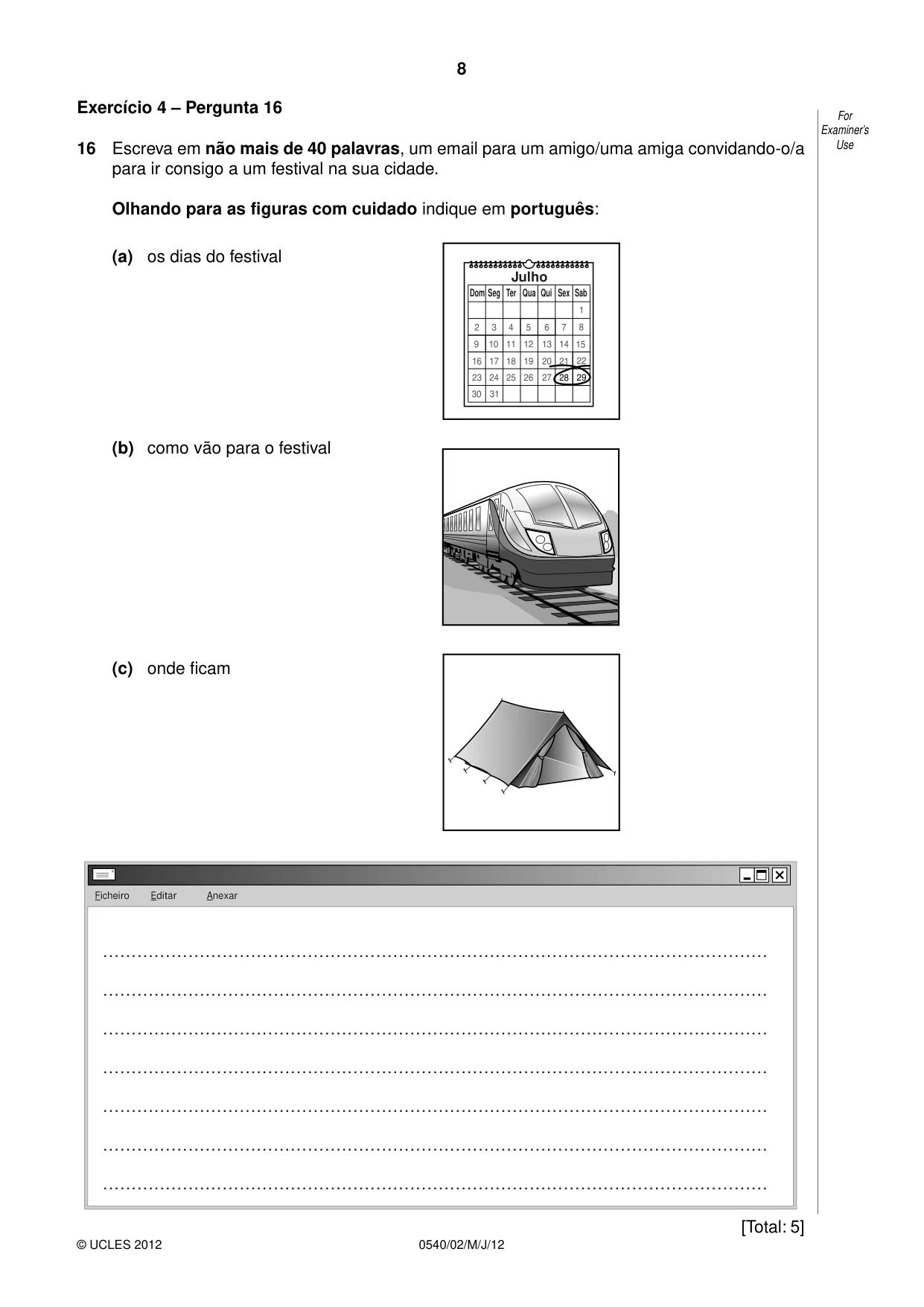
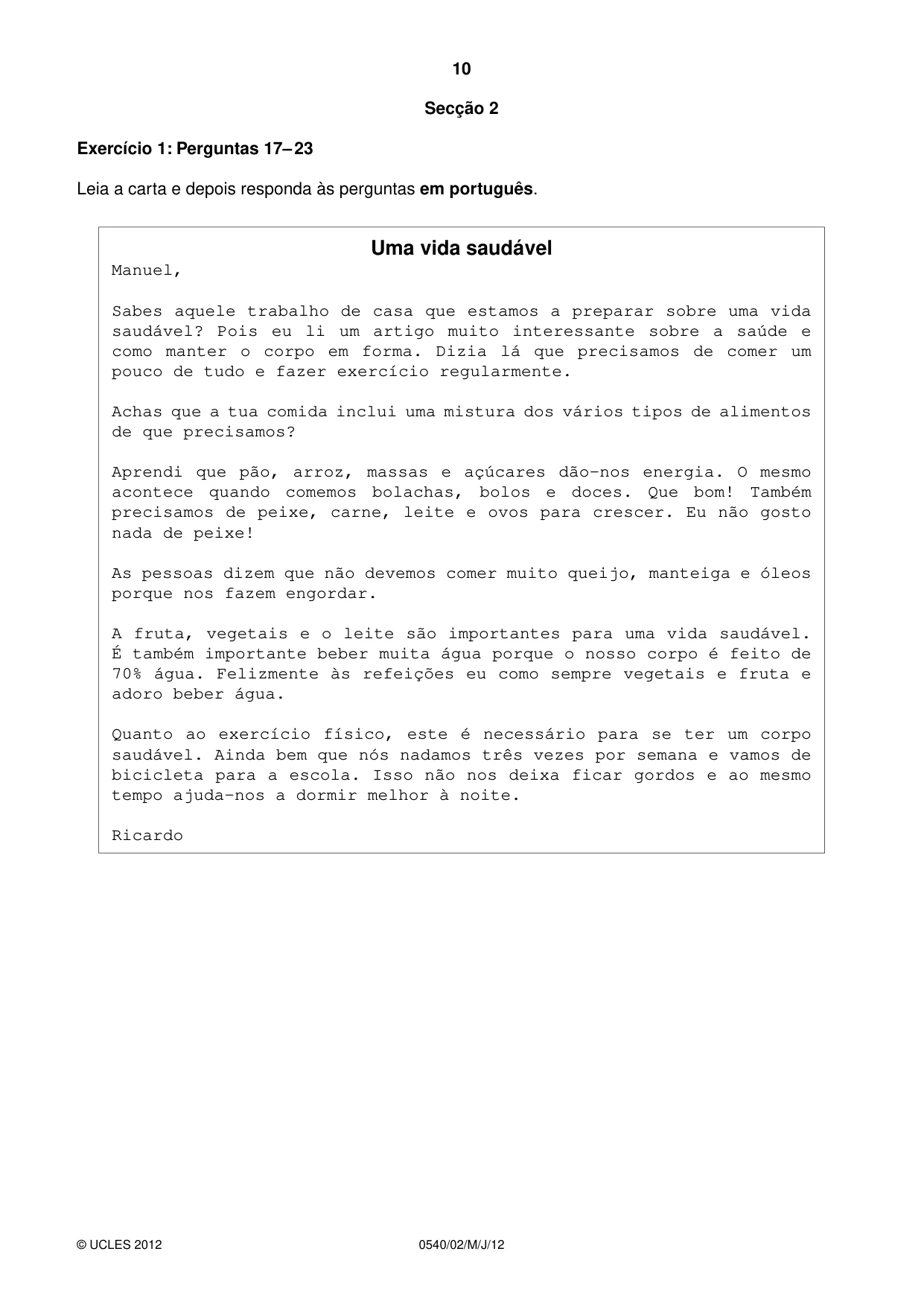
8 0540/02/M/J/12 © UCLES 2012 For Examiner’s Use Exercício 4 – Pergunta 16 16 Escreva em não mais de 40 palavras, um email para um amigo/uma amiga convidando-o/a para ir consigo a um festival na sua cidade. Olhando para as figuras com cuidado indique em português: (a) os dias do festival Dom Seg Ter Qua Qui Julho Sex Sab (b) como vão para o festival (c) onde ficam Ficheiro Editar Anexar ……………………………………………………………………………………………………… ……………………………………………………………………………………………………… ……………………………………………………………………………………………………… ……………………………………………………………………………………………………… ……………………………………………………………………………………………………… ……………………………………………………………………………………………………… ……………………………………………………………………………………………………… [Total: 5]
Question paper, page 9
9 0540/02/M/J/12 © UCLES 2012 [Turn over VIRE PARA A SECÇÃO 2
Question paper, page 10
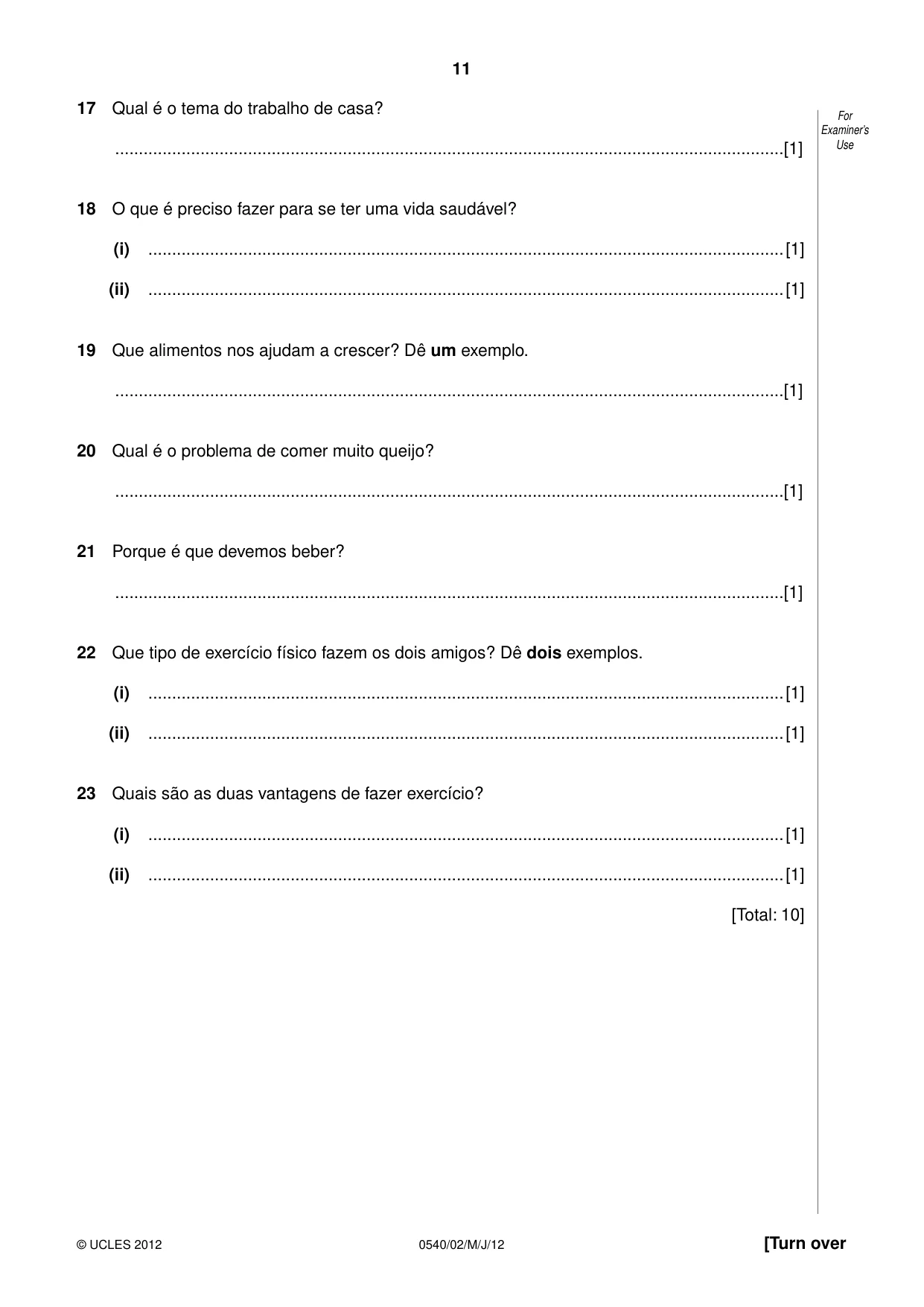
10 0540/02/M/J/12 © UCLES 2012 Secção 2 Exercício 1: Perguntas 17– 23 Leia a carta e depois responda às perguntas em português. Uma vida saudável Manuel, Sabes aquele trabalho de casa que estamos a preparar sobre uma vida saudável? Pois eu li um artigo muito interessante sobre a saúde e como manter o corpo em forma. Dizia lá que precisamos de comer um pouco de tudo e fazer exercício regularmente. Achas que a tua comida inclui uma mistura dos vários tipos de alimentos de que precisamos? Aprendi que pão, arroz, massas e açúcares dão-nos energia. O mesmo acontece quando comemos bolachas, bolos e doces. Que bom! Também precisamos de peixe, carne, leite e ovos para crescer. Eu não gosto nada de peixe! As pessoas dizem que não devemos comer muito queijo, manteiga e óleos porque nos fazem engordar. A fruta, vegetais e o leite são importantes para uma vida saudável. É também importante beber muita água porque o nosso corpo é feito de 70% água. Felizmente às refeições eu como sempre vegetais e fruta e adoro beber água. Quanto ao exercício físico, este é necessário para se ter um corpo saudável. Ainda bem que nós nadamos três vezes por semana e vamos de bicicleta para a escola. Isso não nos deixa ficar gordos e ao mesmo tempo ajuda-nos a dormir melhor à noite. Ricardo
Question paper, page 11
11 0540/02/M/J/12 © UCLES 2012 [Turn over For Examiner’s Use 17 Qual é o tema do trabalho de casa? …[1] 18 O que é preciso fazer para se ter uma vida saudável? (i) …[1] (ii) …[1] 19 Que alimentos nos ajudam a crescer? Dê um exemplo. …[1] 20 Qual é o problema de comer muito queijo? …[1] 21 Porque é que devemos beber? …[1] 22 Que tipo de exercício físico fazem os dois amigos? Dê dois exemplos. (i) …[1] (ii) …[1] 23 Quais são as duas vantagens de fazer exercício? (i) …[1] (ii) …[1] [Total: 10]
Question paper, page 12
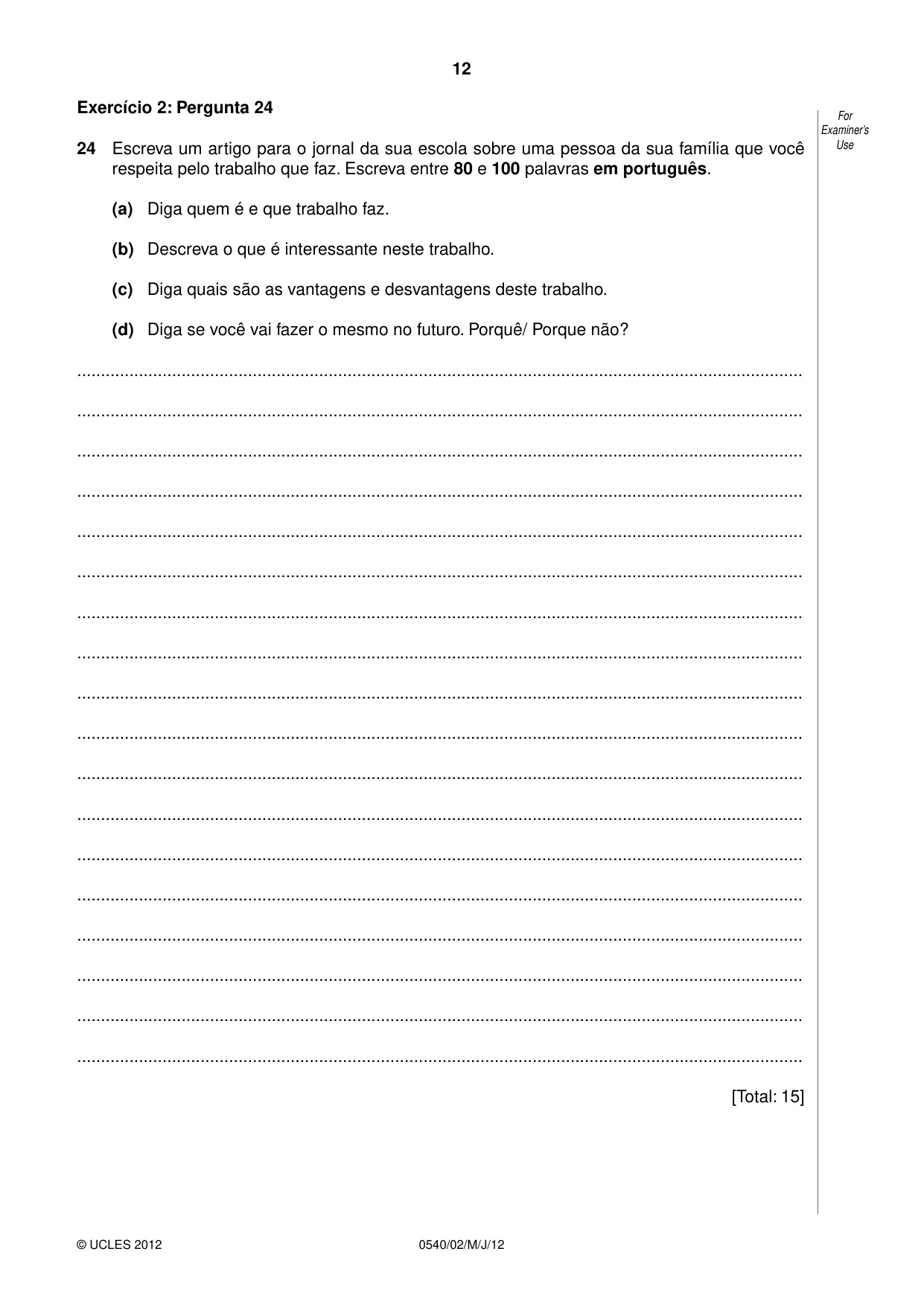
12 0540/02/M/J/12 © UCLES 2012 For Examiner’s Use Exercício 2: Pergunta 24 24 Escreva um artigo para o jornal da sua escola sobre uma pessoa da sua família que você respeita pelo trabalho que faz. Escreva entre 80 e 100 palavras em português. (a) Diga quem é e que trabalho faz. (b) Descreva o que é interessante neste trabalho. (c) Diga quais são as vantagens e desvantagens deste trabalho. (d) Diga se você vai fazer o mesmo no futuro. Porquê/ Porque não? … … … … … … … … … … … … … … … … … … [Total: 15]
Question paper, page 13
13 0540/02/M/J/12 © UCLES 2012 [Turn over VIRE PARA A SECÇÃO 3
Question paper, page 14
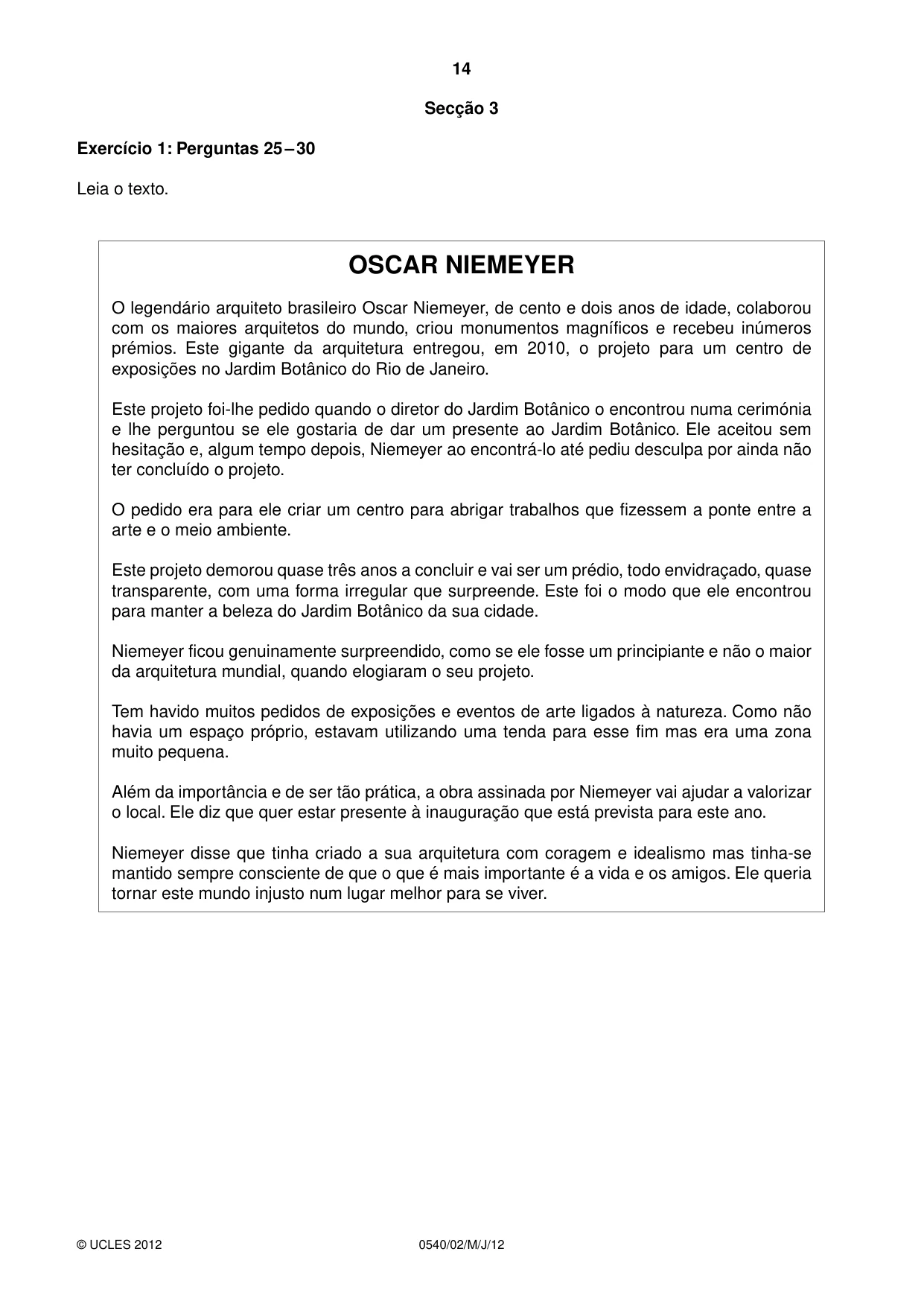
14 0540/02/M/J/12 © UCLES 2012 Secção 3 Exercício 1: Perguntas 25 – 30 Leia o texto. OSCAR NIEMEYER O legendário arquiteto brasileiro Oscar Niemeyer, de cento e dois anos de idade, colaborou com os maiores arquitetos do mundo, criou monumentos magníficos e recebeu inúmeros prémios. Este gigante da arquitetura entregou, em 2010, o projeto para um centro de exposições no Jardim Botânico do Rio de Janeiro. Este projeto foi-lhe pedido quando o diretor do Jardim Botânico o encontrou numa cerimónia e lhe perguntou se ele gostaria de dar um presente ao Jardim Botânico. Ele aceitou sem hesitação e, algum tempo depois, Niemeyer ao encontrá-lo até pediu desculpa por ainda não ter concluído o projeto. O pedido era para ele criar um centro para abrigar trabalhos que fizessem a ponte entre a arte e o meio ambiente. Este projeto demorou quase três anos a concluir e vai ser um prédio, todo envidraçado, quase transparente, com uma forma irregular que surpreende. Este foi o modo que ele encontrou para manter a beleza do Jardim Botânico da sua cidade. Niemeyer ficou genuinamente surpreendido, como se ele fosse um principiante e não o maior da arquitetura mundial, quando elogiaram o seu projeto. Tem havido muitos pedidos de exposições e eventos de arte ligados à natureza. Como não havia um espaço próprio, estavam utilizando uma tenda para esse fim mas era uma zona muito pequena. Além da importância e de ser tão prática, a obra assinada por Niemeyer vai ajudar a valorizar o local. Ele diz que quer estar presente à inauguração que está prevista para este ano. Niemeyer disse que tinha criado a sua arquitetura com coragem e idealismo mas tinha-se mantido sempre consciente de que o que é mais importante é a vida e os amigos. Ele queria tornar este mundo injusto num lugar melhor para se viver.
Question paper, page 15
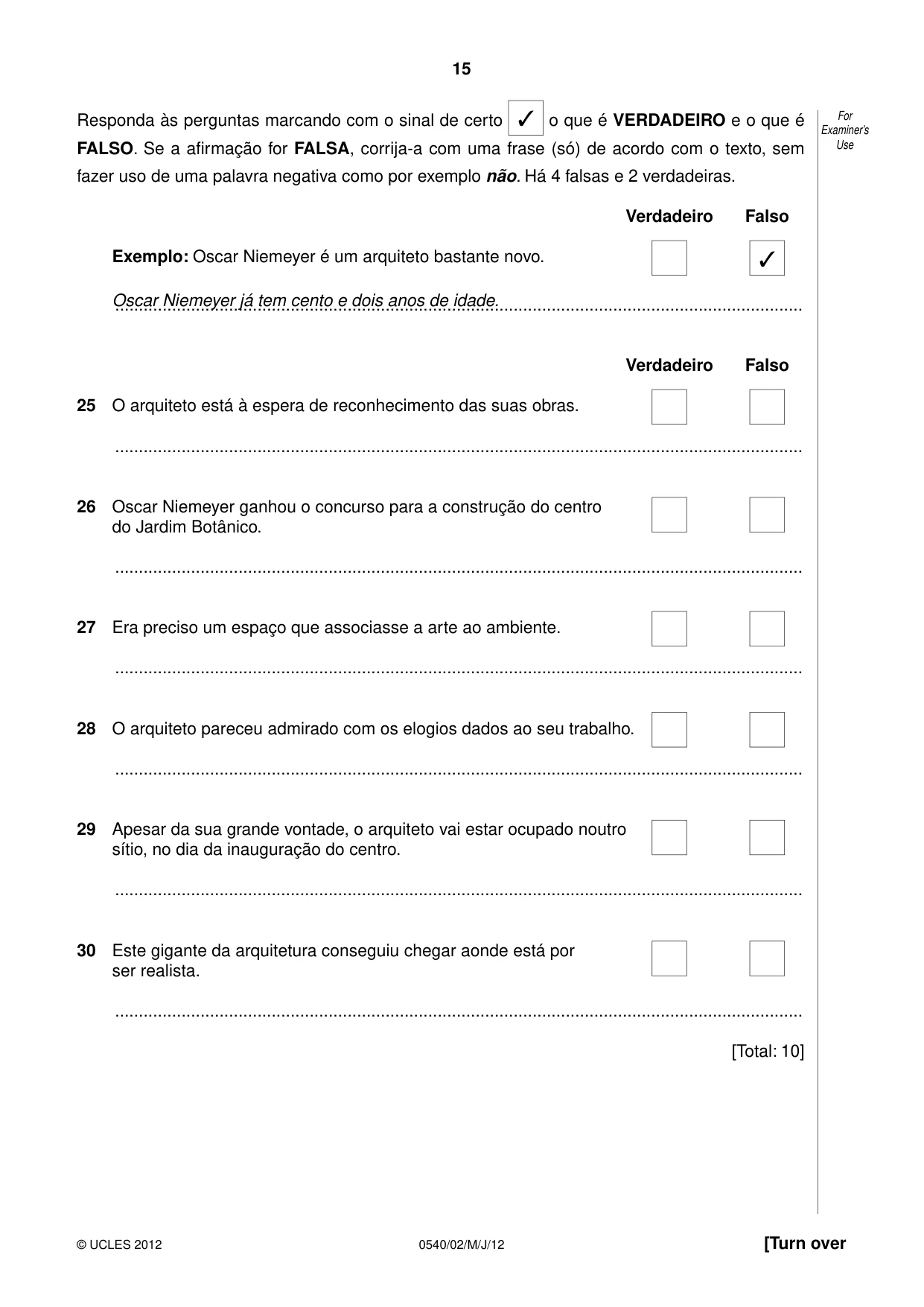
15 0540/02/M/J/12 © UCLES 2012 [Turn over For Examiner’s Use Responda às perguntas marcando com o sinal de certo ✓ o que é VERDADEIRO e o que é FALSO. Se a afirmação for FALSA, corrija-a com uma frase (só) de acordo com o texto, sem fazer uso de uma palavra negativa como por exemplo não. Há 4 falsas e 2 verdadeiras. Verdadeiro Falso Exemplo: Oscar Niemeyer é um arquiteto bastante novo. ✓ Oscar Niemeyer já tem cento e dois anos de idade. … Verdadeiro Falso 25 O arquiteto está à espera de reconhecimento das suas obras. … 26 Oscar Niemeyer ganhou o concurso para a construção do centro do Jardim Botânico. … 27 Era preciso um espaço que associasse a arte ao ambiente. … 28 O arquiteto pareceu admirado com os elogios dados ao seu trabalho. … 29 Apesar da sua grande vontade, o arquiteto vai estar ocupado noutro sítio, no dia da inauguração do centro. … 30 Este gigante da arquitetura conseguiu chegar aonde está por ser realista. … [Total: 10]
Question paper, page 16
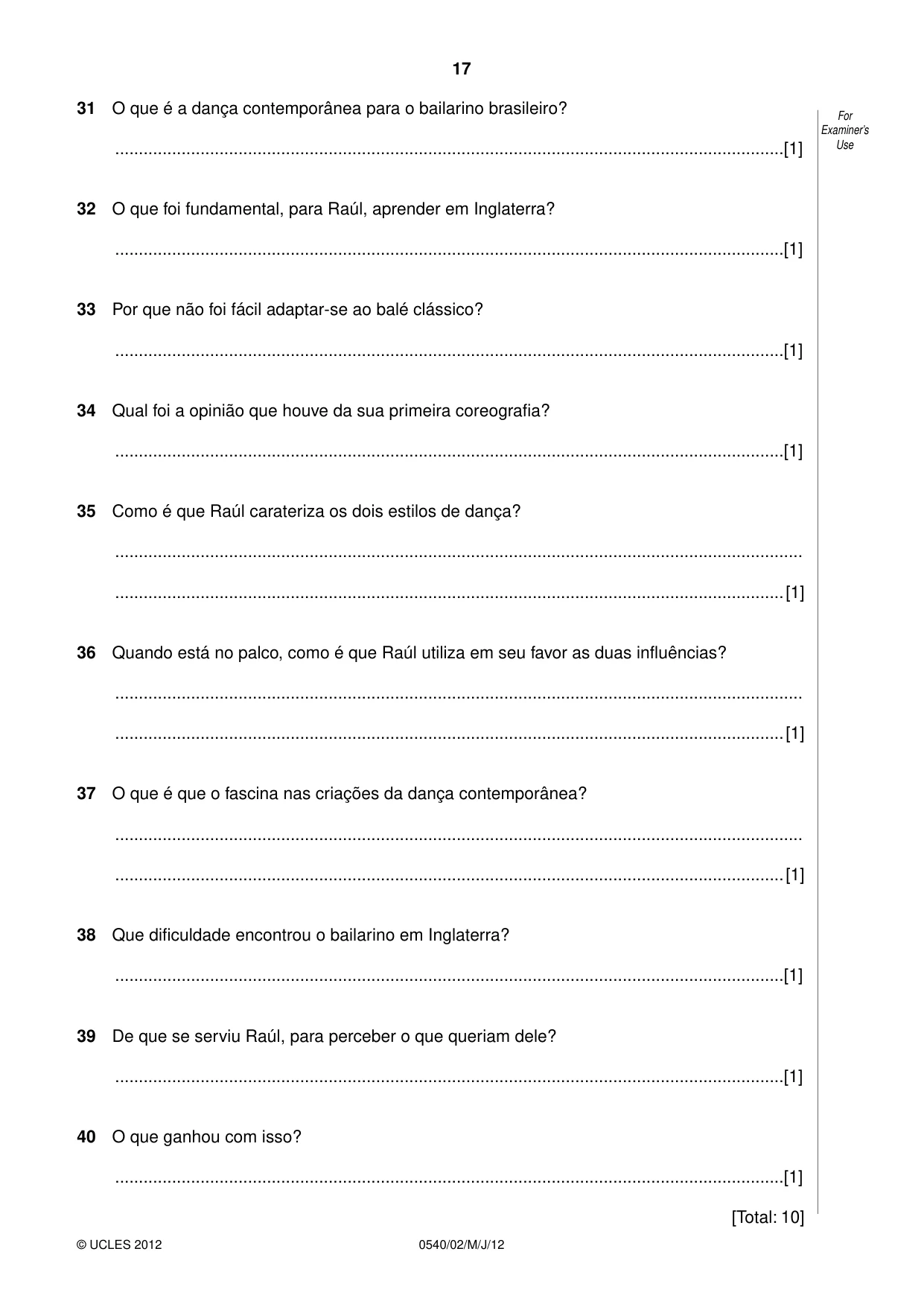
16 0540/02/M/J/12 © UCLES 2012 Exercício 2: Perguntas 31– 40 Leia o texto e depois responda às perguntas em português. DESCOBERTA DE UM NOVO MOVIMENTO Raúl, um bailarino e coreógrafo brasileiro define a dança contemporânea como a busca de um movimento novo. Com forte influência da dança e música popular brasileira, o bailarino terminou sua formação acadêmica na Inglaterra, onde teve a oportunidade de absorver diferentes estilos coreográficos e técnicas de dança, especialmente a do clássico. Este jovem conta que não é fácil equilibrar duas influências tão opostas quanto o clássico e o samba. Diz ele que não veio sambar na Europa, mas não nega que o samba está no seu corpo e nos seus pés e que a sua energia acaba por guiá-lo em qualquer movimento que faz seja dentro da estrutura clássica, jazz ou contemporânea. Raúl diz que não foi fácil ajustar-se à rigidez do balé* clássico e que quando chegou para estudar, deu tudo o que tinha e criou a sua primeira coreografia com base na capoeira. A professora disse- -lhe que estava tudo muito bem mas que era demasiado louco para ela. Isso chocou-o. A partir daí aprendeu a valorizar o balé clássico, que é o que lhe dá base e consistência a tudo que faz como bailarino e coreógrafo. A sua dança baseia-se no clássico mas é o samba que lhe dá energia. No palco a expressão, força, garra e emoção são fundamentais. A técnica é importante mas não é suficiente, pois impressiona mas não emociona. É do samba que Raúl extrai tudo isso, onde busca energia e inspiração, pois é essa música que desperta as suas emoções, e faz a sua adrenalina correr mais rápido no seu corpo. Nas suas coreografias tenta harmonizar o quente do Brasil e o frio da Europa e gosta de trabalhar com bailarinos estrangeiros porque estes trazem outras experiências e esse resultado inesperado é o lado excitante do processo criativo da dança contemporânea. Como Raúl teve dificuldade com a língua e para sobreviver na companhia inglesa onde dança, foi obrigado a desenvolver a capacidade de observação pois só dispunha da linguagem corporal para entender o que queriam dele. Esta constante observação veio enriquecendo-o muito como coreógrafo e bailarino. *balé = ballet
Question paper, page 17
17 0540/02/M/J/12 © UCLES 2012 For Examiner’s Use 31 O que é a dança contemporânea para o bailarino brasileiro? …[1] 32 O que foi fundamental, para Raúl, aprender em Inglaterra? …[1] 33 Por que não foi fácil adaptar-se ao balé clássico? …[1] 34 Qual foi a opinião que houve da sua primeira coreografia? …[1] 35 Como é que Raúl carateriza os dois estilos de dança? … …[1] 36 Quando está no palco, como é que Raúl utiliza em seu favor as duas influências? … …[1] 37 O que é que o fascina nas criações da dança contemporânea? … …[1] 38 Que dificuldade encontrou o bailarino em Inglaterra? …[1] 39 De que se serviu Raúl, para perceber o que queriam dele? …[1] 40 O que ganhou com isso? …[1] [Total: 10]
Question paper, page 18
18 0540/02/M/J/12 © UCLES 2012 BLANK PAGE
Question paper, page 19
19 0540/02/M/J/12 © UCLES 2012 BLANK PAGE
Question paper, page 20
20 0540/02/M/J/12 © UCLES 2012 Copyright Acknowledgements: Section 3 Exercise 1 © Carlos Albuquerque; http://oglobo.globo.com/cultura/mat/2010/09/03/aos-102-anos-arquiteto-oscar-niemeyer-assina-projeto-de-um- centro-de-exposicoes-para-jardim-botanico-917558276.asp; 5 September 2010. Section 3 Exercise 2 © Luis Fernandez; Dança Contemporânea; www.brasilnet.co.uk; 2001. Permission to reproduce items where third-party owned material protected by copyright is included has been sought and cleared where possible. Every reasonable effort has been made by the publisher (UCLES) to trace copyright holders, but if any items requiring clearance have unwittingly been included, the publisher will be pleased to make amends at the earliest possible opportunity. University of Cambridge International Examinations is part of the Cambridge Assessment Group. Cambridge Assessment is the brand name of University of Cambridge Local Examinations Syndicate (UCLES), which is itself a department of the University of Cambridge. BLANK PAGE
Mark scheme, page 1
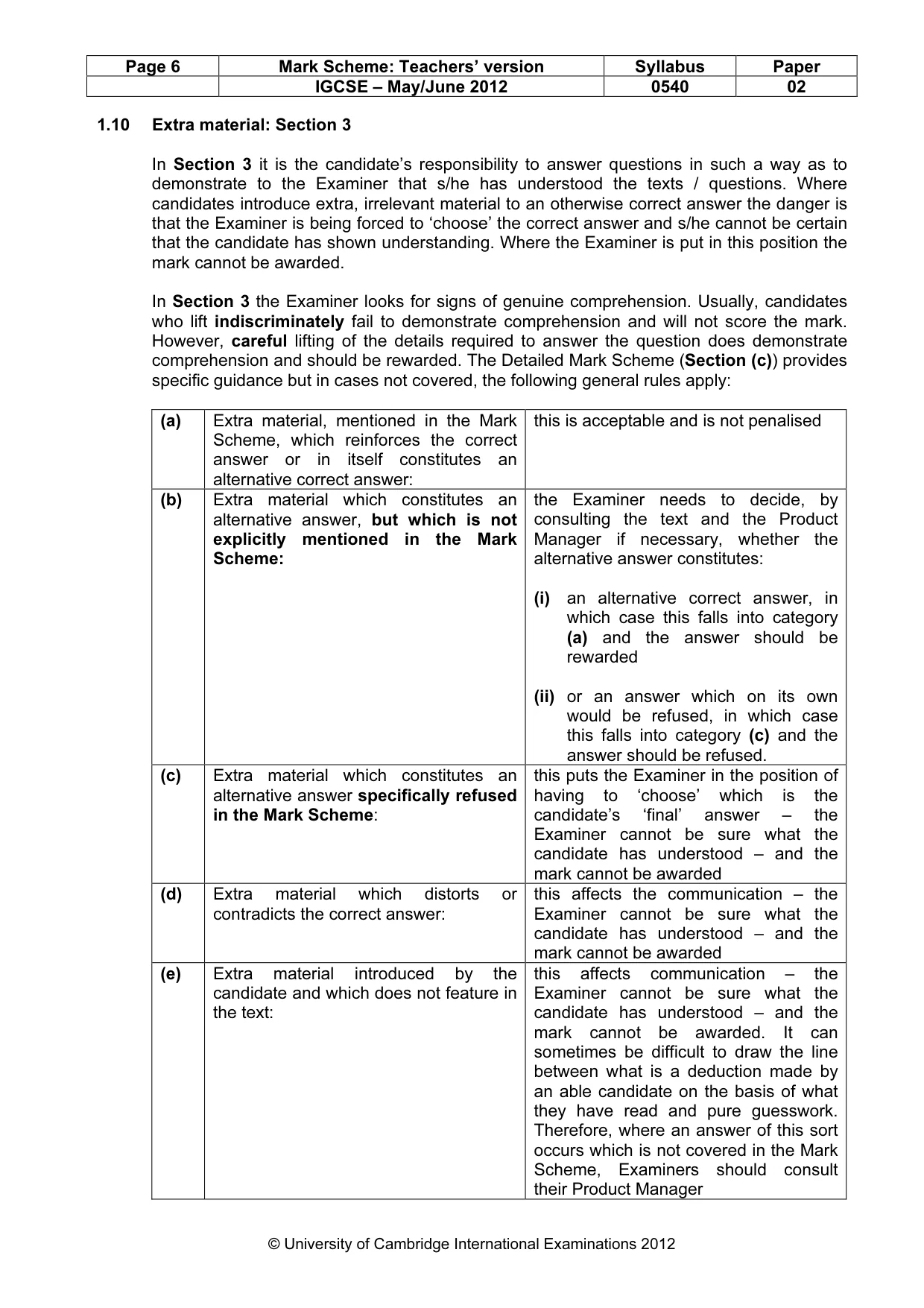
UNIVERSITY OF CAMBRIDGE INTERNATIONAL EXAMINATIONS International General Certificate of Secondary Education MARK SCHEME for the May/June 2012 question paper for the guidance of teachers 0540 PORTUGUESE (FOREIGN LANGUAGE) 0540/02 Paper 1 (Reading and Directed Writing), maximum raw mark 65 This mark scheme is published as an aid to teachers and candidates, to indicate the requirements of the examination. It shows the basis on which Examiners were instructed to award marks. It does not indicate the details of the discussions that took place at an Examiners’ meeting before marking began, which would have considered the acceptability of alternative answers. Mark schemes must be read in conjunction with the question papers and the report on the examination. • Cambridge will not enter into discussions or correspondence in connection with these mark schemes. Cambridge is publishing the mark schemes for the May/June 2012 question papers for most IGCSE, GCE Advanced Level and Advanced Subsidiary Level syllabuses and some Ordinary Level syllabuses. www.XtremePapers.com
Mark scheme, page 2
Page 2 Mark Scheme: Teachers’ version Syllabus Paper IGCSE – May/June 2012 0540 02 © University of Cambridge International Examinations 2012 The following structure should be adopted for IGCSE Foreign Language Reading & Directed Writing Mark Schemes to ensure that Examiners across languages follow a common approach in cases where the nature of the language makes it appropriate. Section 1 General Marking Principles contains the underlying principles that inform the decisions taken by Senior Examiners (including Single Examiners) when they prepare the Detailed Mark Scheme. These principles also provide Assistant Examiners with a set of ‘rules’ to apply when making decisions on answers not covered by the Detailed Mark Scheme, for which they have to use their judgement. Section 2 contains the session-specific Detailed Mark Scheme.
Mark scheme, page 3
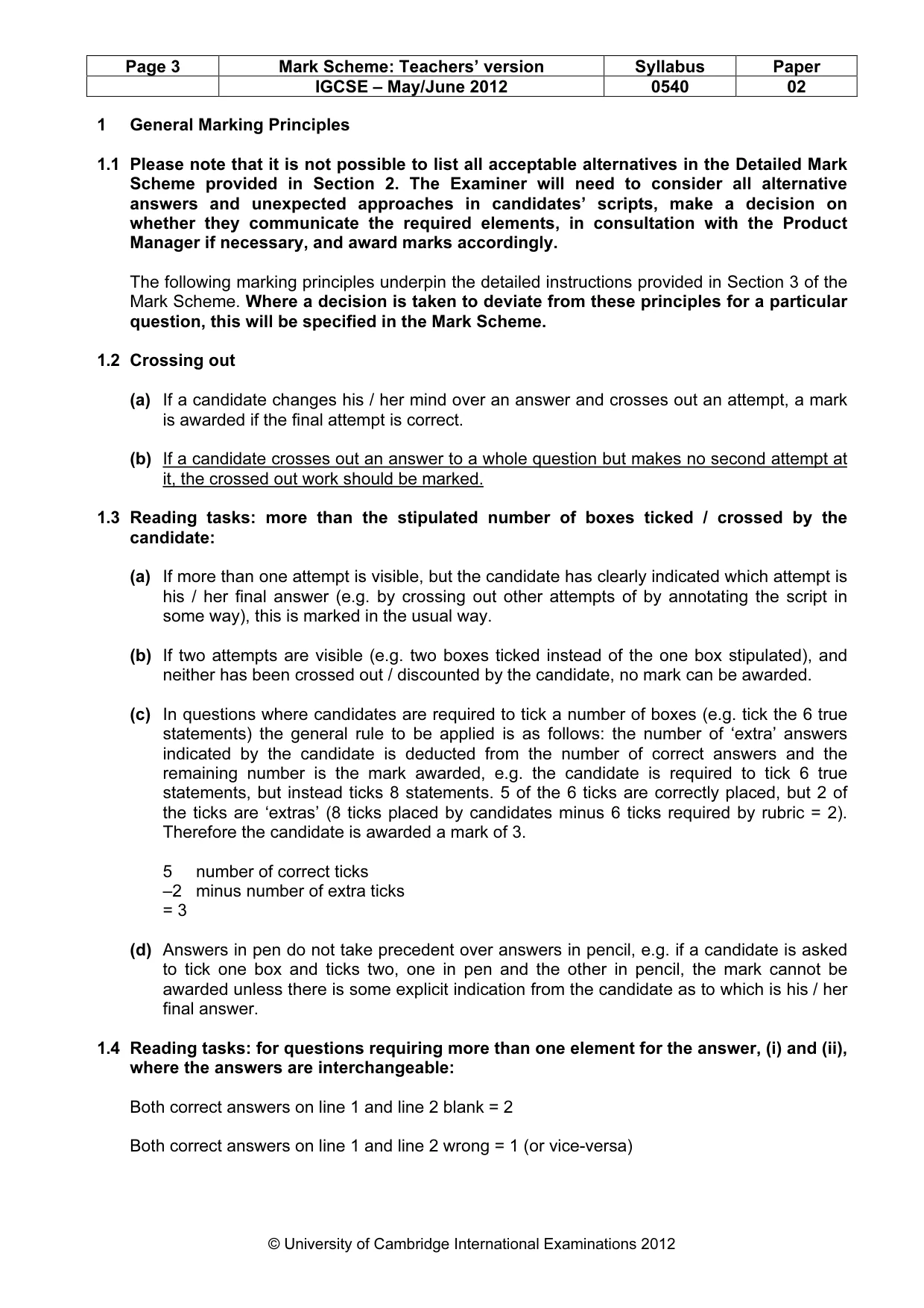
Page 3 Mark Scheme: Teachers’ version Syllabus Paper IGCSE – May/June 2012 0540 02 © University of Cambridge International Examinations 2012 1 General Marking Principles 1.1 Please note that it is not possible to list all acceptable alternatives in the Detailed Mark Scheme provided in Section 2. The Examiner will need to consider all alternative answers and unexpected approaches in candidates’ scripts, make a decision on whether they communicate the required elements, in consultation with the Product Manager if necessary, and award marks accordingly. The following marking principles underpin the detailed instructions provided in Section 3 of the Mark Scheme. Where a decision is taken to deviate from these principles for a particular question, this will be specified in the Mark Scheme. 1.2 Crossing out (a) If a candidate changes his / her mind over an answer and crosses out an attempt, a mark is awarded if the final attempt is correct. (b) If a candidate crosses out an answer to a whole question but makes no second attempt at it, the crossed out work should be marked. 1.3 Reading tasks: more than the stipulated number of boxes ticked / crossed by the candidate: (a) If more than one attempt is visible, but the candidate has clearly indicated which attempt is his / her final answer (e.g. by crossing out other attempts of by annotating the script in some way), this is marked in the usual way. (b) If two attempts are visible (e.g. two boxes ticked instead of the one box stipulated), and neither has been crossed out / discounted by the candidate, no mark can be awarded. (c) In questions where candidates are required to tick a number of boxes (e.g. tick the 6 true statements) the general rule to be applied is as follows: the number of ‘extra’ answers indicated by the candidate is deducted from the number of correct answers and the remaining number is the mark awarded, e.g. the candidate is required to tick 6 true statements, but instead ticks 8 statements. 5 of the 6 ticks are correctly placed, but 2 of the ticks are ‘extras’ (8 ticks placed by candidates minus 6 ticks required by rubric = 2). Therefore the candidate is awarded a mark of 3. 5 number of correct ticks –2 minus number of extra ticks = 3 (d) Answers in pen do not take precedent over answers in pencil, e.g. if a candidate is asked to tick one box and ticks two, one in pen and the other in pencil, the mark cannot be awarded unless there is some explicit indication from the candidate as to which is his / her final answer. 1.4 Reading tasks: for questions requiring more than one element for the answer, (i) and (ii), where the answers are interchangeable: Both correct answers on line 1 and line 2 blank = 2 Both correct answers on line 1 and line 2 wrong = 1 (or vice-versa)
Mark scheme, page 4
Page 4 Mark Scheme: Teachers’ version Syllabus Paper IGCSE – May/June 2012 0540 02 © University of Cambridge International Examinations 2012 1.5 Reading tasks: answers requiring the use of Portuguese (rather than a non-verbal response) should be marked for communication. Tolerate inaccuracies provided the message is clear. (a) ‘If in doubt, sound it out’: if you read what the candidate has written, does it sound like the correct answer? (b) Look-alike test: does what the candidate has written look like the correct answer? (c) Accept incorrect gender or person unless Mark Scheme specifies otherwise. (d) Accept incorrect possessive adjectives e.g. meu, teu, seu etc, unless Mark Scheme specifies otherwise (in general, Section 2 accept, Section 3 consult Mark Scheme carefully). 1.6 Unless the Mark Scheme specifies otherwise, do not accept incorrect Portuguese if the word given means something else in Portuguese. (Incorrect Portuguese which constitutes a word in any language other than Portuguese is marked (i) on the basis of whether it is accepted or refused in the Mark Scheme and (ii) if not mentioned in the Mark Scheme, on the basis of 1.5 above). 1.7 Annotation used in the Mark Scheme: (a) INV = Invalidation and is used when additional material included by the candidate is judged to invalidate an otherwise correct answer thus preventing him / her from scoring the mark (INV = 0). (b) tc = ‘tout court’ and means that on its own the material is not sufficient to score the mark. (c) HA = harmless additional material which in conjunction with the correct answer does not prevent the candidate from scoring the mark. (d) BOD = Benefit of the Doubt and is used to indicate material considered by the Examiner and judged to be more correct than incorrect: the benefit of the doubt is given to the candidate and the mark is awarded. 1.8 No response and ‘0’ marks There is a NR (NO response) option in scoris. Award NR (No Response): • If there is nothing written at all in the answer space or • If there is only a comment which does not in any way relate to the question being asked (e.g. ‘can’t do’ or ‘don’t know’) or • If there is only a mark which isn’t an attempt at the question (e.g. a dash, a question mark). Award 0: • If there is any attempt that earns no credit. This could, for example, include the candidate copying all or some of the question, or any working that does not earn any marks, whether crossed out or not.
Mark scheme, page 5
Page 5 Mark Scheme: Teachers’ version Syllabus Paper IGCSE – May/June 2012 0540 02 © University of Cambridge International Examinations 2012 1.9 Extra material: Section 2, Exercise 1 In Section 2, Exercise 1, the candidate is rewarded for being able to locate the answer in the passage. Do not worry about lifting unless this would cause the message to be seriously distorted (in general, incorrect possessives should not be judged to cause distortion: see 1.5(d)) – in which case a lift will be specifically rejected in the Mark Scheme. Ignore extra material given in an answer providing that it does not invalidate an answer.
Mark scheme, page 6
Page 6 Mark Scheme: Teachers’ version Syllabus Paper IGCSE – May/June 2012 0540 02 © University of Cambridge International Examinations 2012 1.10 Extra material: Section 3 In Section 3 it is the candidate’s responsibility to answer questions in such a way as to demonstrate to the Examiner that s/he has understood the texts / questions. Where candidates introduce extra, irrelevant material to an otherwise correct answer the danger is that the Examiner is being forced to ‘choose’ the correct answer and s/he cannot be certain that the candidate has shown understanding. Where the Examiner is put in this position the mark cannot be awarded. In Section 3 the Examiner looks for signs of genuine comprehension. Usually, candidates who lift indiscriminately fail to demonstrate comprehension and will not score the mark. However, careful lifting of the details required to answer the question does demonstrate comprehension and should be rewarded. The Detailed Mark Scheme (Section (c)) provides specific guidance but in cases not covered, the following general rules apply: (a) Extra material, mentioned in the Mark Scheme, which reinforces the correct answer or in itself constitutes an alternative correct answer: this is acceptable and is not penalised (b) Extra material which constitutes an alternative answer, but which is not explicitly mentioned in the Mark Scheme: the Examiner needs to decide, by consulting the text and the Product Manager if necessary, whether the alternative answer constitutes: (i) an alternative correct answer, in which case this falls into category (a) and the answer should be rewarded (ii) or an answer which on its own would be refused, in which case this falls into category (c) and the answer should be refused. (c) Extra material which constitutes an alternative answer specifically refused in the Mark Scheme: this puts the Examiner in the position of having to ‘choose’ which is the candidate’s ‘final’ answer – the Examiner cannot be sure what the candidate has understood – and the mark cannot be awarded (d) Extra material which distorts or contradicts the correct answer: this affects the communication – the Examiner cannot be sure what the candidate has understood – and the mark cannot be awarded (e) Extra material introduced by the candidate and which does not feature in the text: this affects communication – the Examiner cannot be sure what the candidate has understood – and the mark cannot be awarded. It can sometimes be difficult to draw the line between what is a deduction made by an able candidate on the basis of what they have read and pure guesswork. Therefore, where an answer of this sort occurs which is not covered in the Mark Scheme, Examiners should consult their Product Manager
Mark scheme, page 7
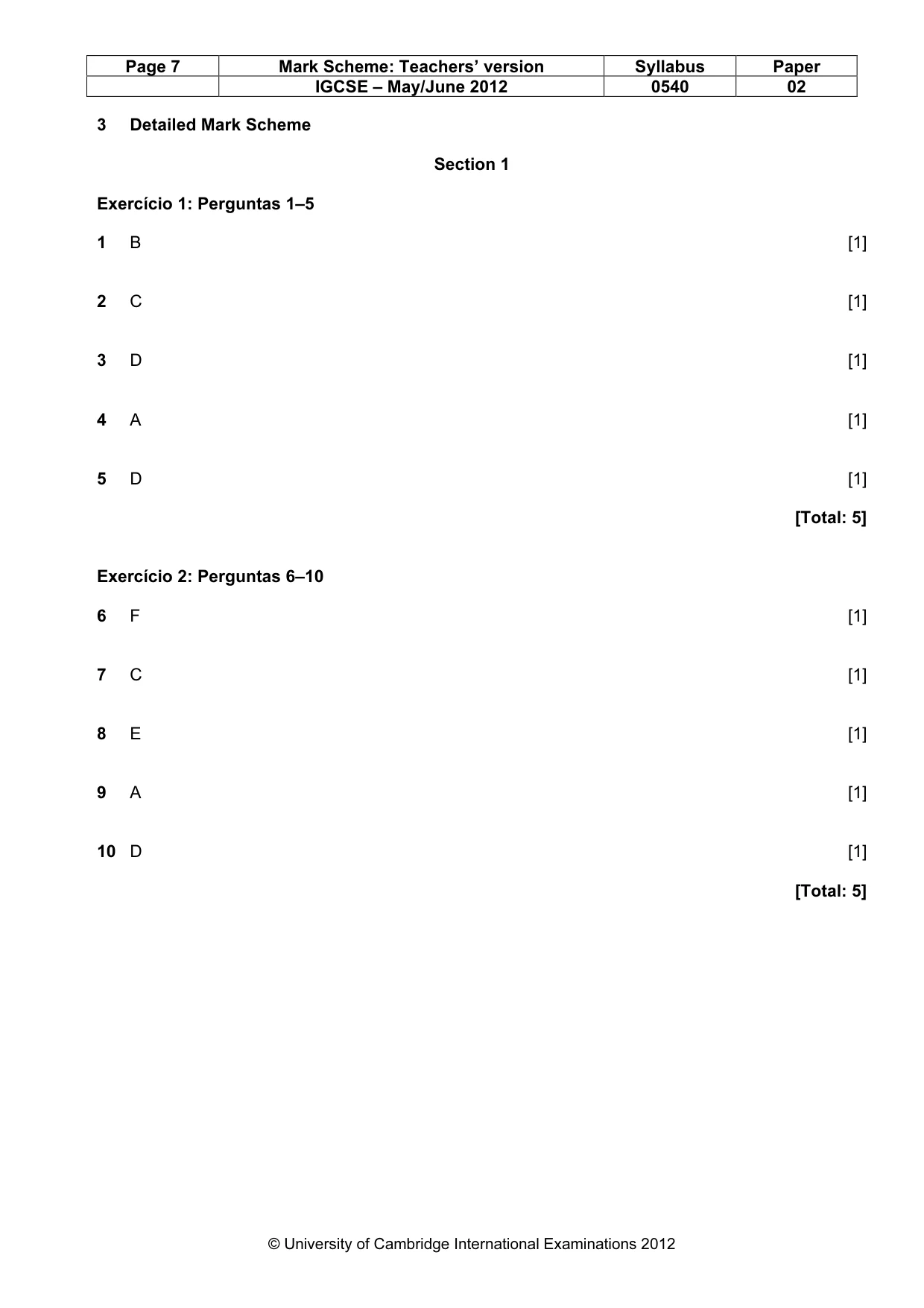
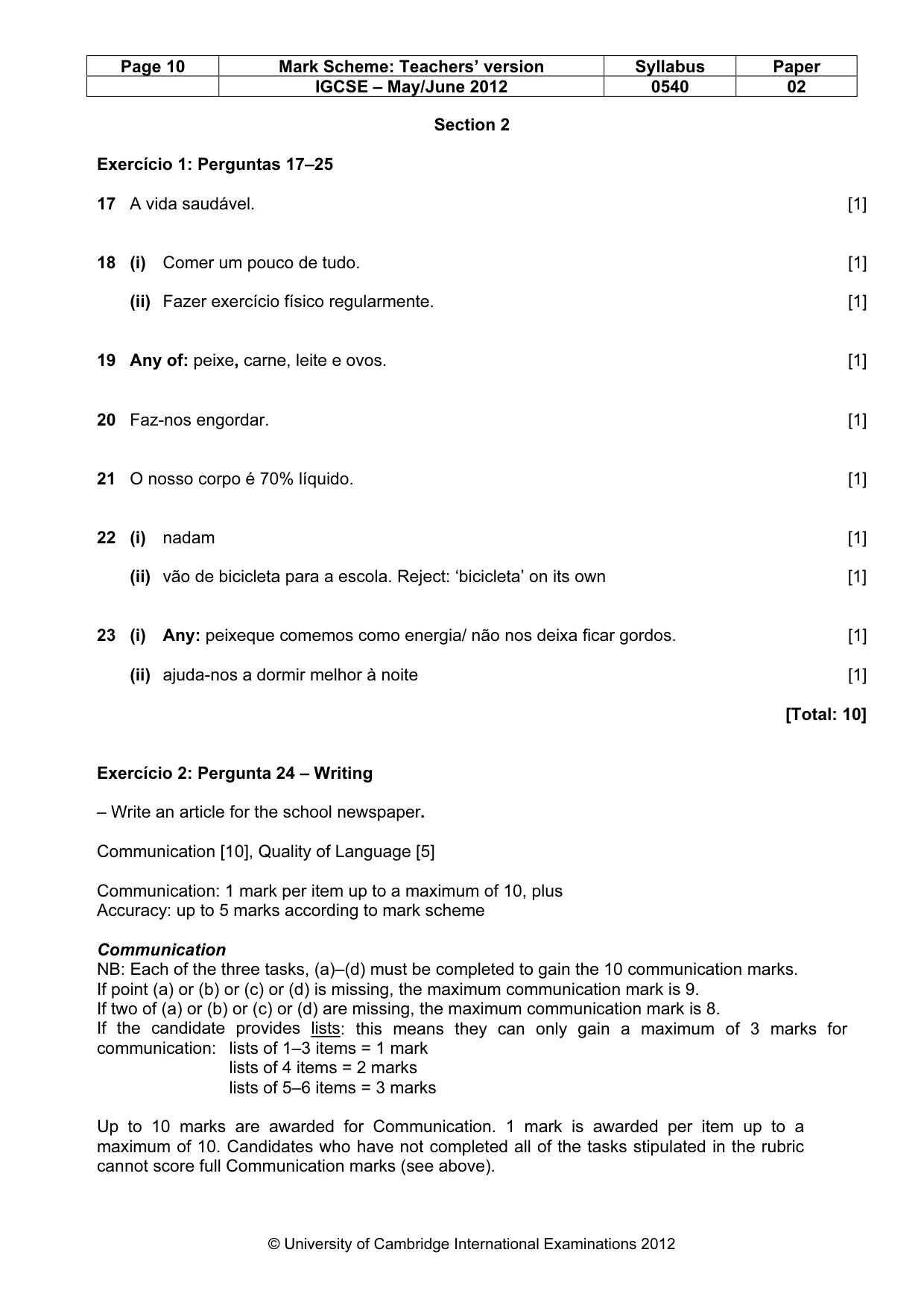
Page 7 Mark Scheme: Teachers’ version Syllabus Paper IGCSE – May/June 2012 0540 02 © University of Cambridge International Examinations 2012 3 Detailed Mark Scheme Section 1 Exercício 1: Perguntas 1–5 1 B [1] 2 C [1] 3 D [1] 4 A [1] 5 D [1] [Total: 5] Exercício 2: Perguntas 6–10 6 F [1] 7 C [1] 8 E [1] 9 A [1] 10 D [1] [Total: 5]
Mark scheme, page 8
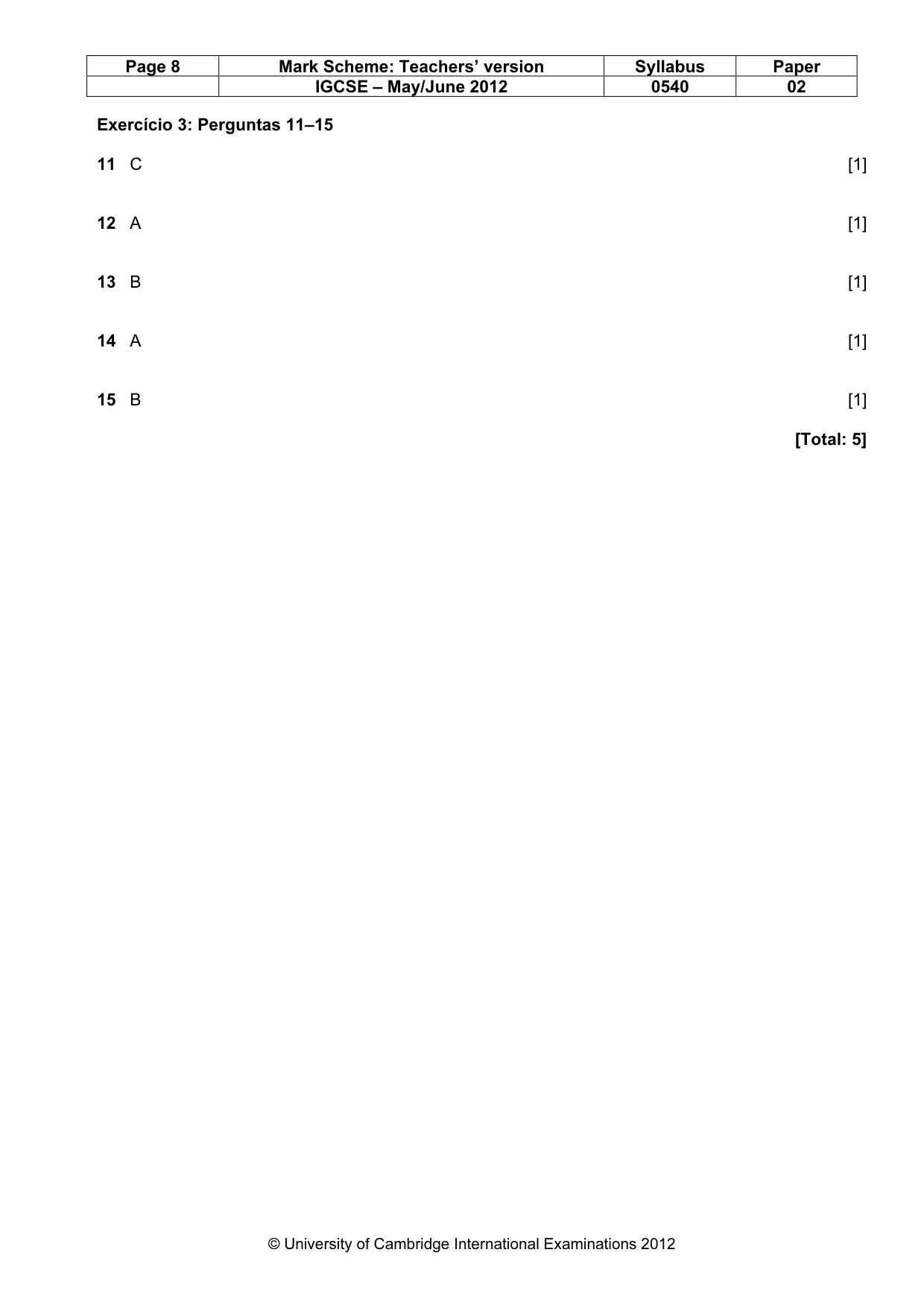
Page 8 Mark Scheme: Teachers’ version Syllabus Paper IGCSE – May/June 2012 0540 02 © University of Cambridge International Examinations 2012 Exercício 3: Perguntas 11–15 11 C [1] 12 A [1] 13 B [1] 14 A [1] 15 B [1] [Total: 5]
Mark scheme, page 9
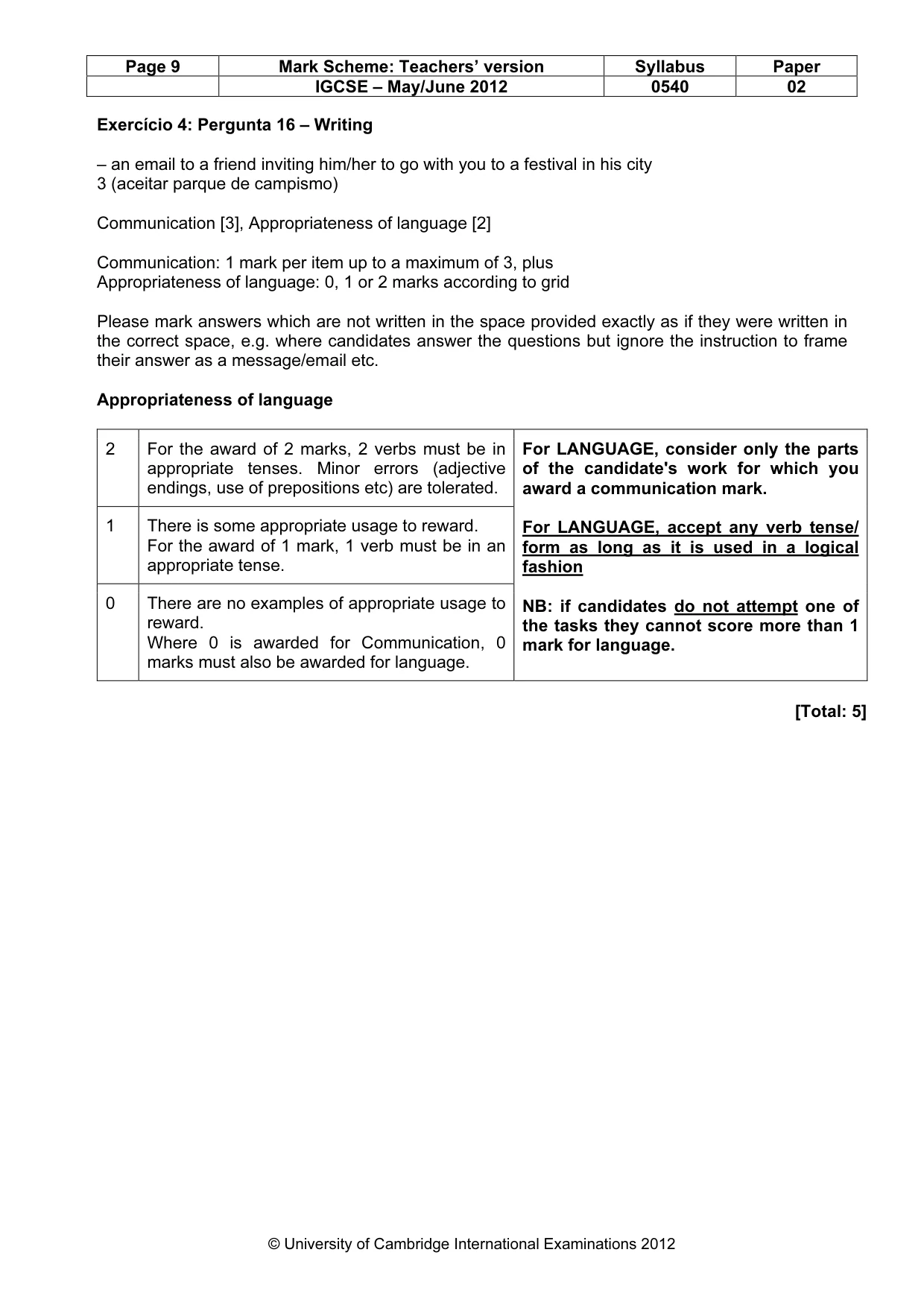
Page 9 Mark Scheme: Teachers’ version Syllabus Paper IGCSE – May/June 2012 0540 02 © University of Cambridge International Examinations 2012 Exercício 4: Pergunta 16 – Writing – an email to a friend inviting him/her to go with you to a festival in his city 3 (aceitar parque de campismo) Communication [3], Appropriateness of language [2] Communication: 1 mark per item up to a maximum of 3, plus Appropriateness of language: 0, 1 or 2 marks according to grid Please mark answers which are not written in the space provided exactly as if they were written in the correct space, e.g. where candidates answer the questions but ignore the instruction to frame their answer as a message/email etc. Appropriateness of language 2 For the award of 2 marks, 2 verbs must be in appropriate tenses. Minor errors (adjective endings, use of prepositions etc) are tolerated. 1 There is some appropriate usage to reward. For the award of 1 mark, 1 verb must be in an appropriate tense. 0 There are no examples of appropriate usage to reward. Where 0 is awarded for Communication, 0 marks must also be awarded for language. For LANGUAGE, consider only the parts of the candidate's work for which you award a communication mark. For LANGUAGE, accept any verb tense/ form as long as it is used in a logical fashion NB: if candidates do not attempt one of the tasks they cannot score more than 1 mark for language. [Total: 5]
Mark scheme, page 10
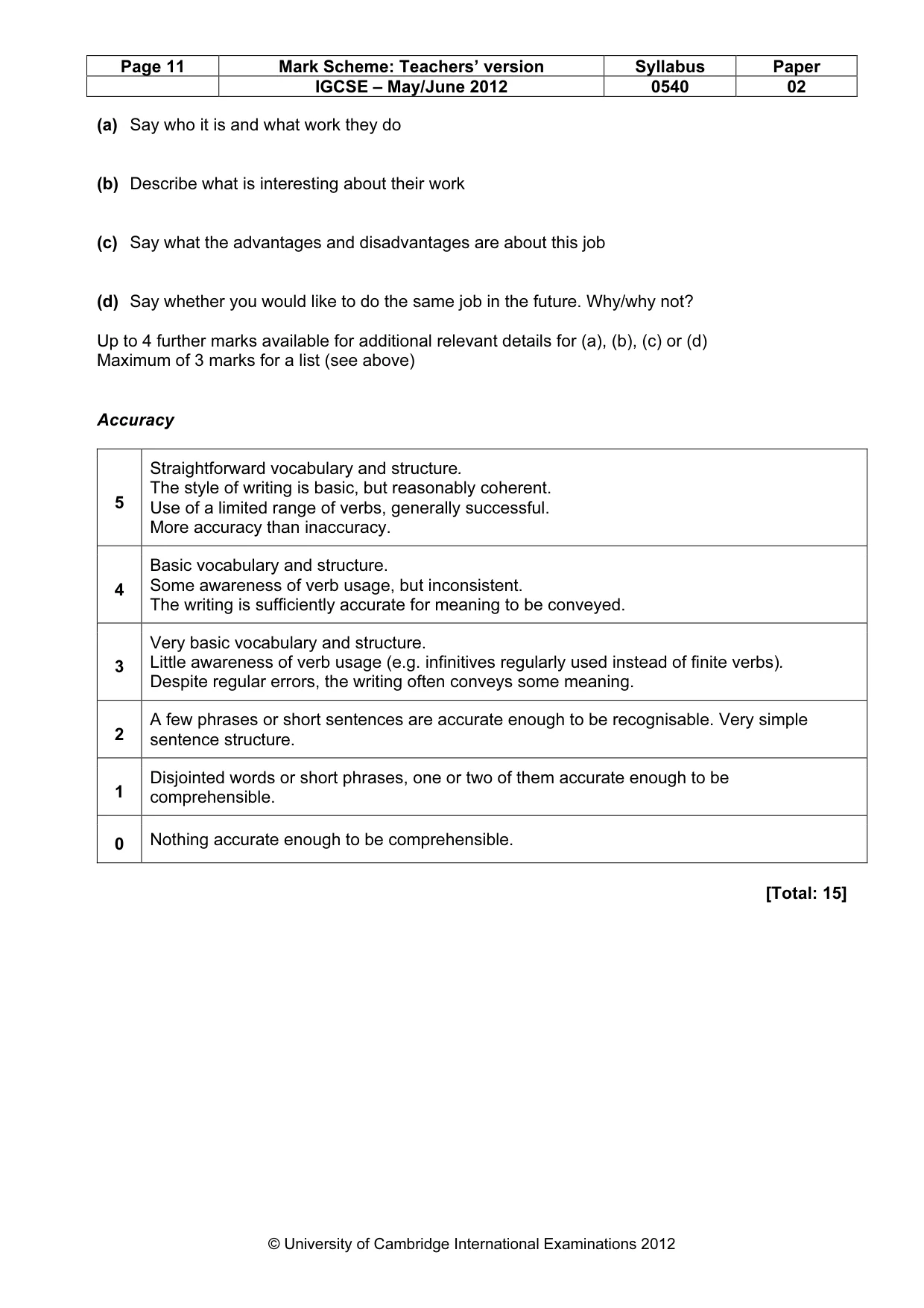
Page 10 Mark Scheme: Teachers’ version Syllabus Paper IGCSE – May/June 2012 0540 02 © University of Cambridge International Examinations 2012 Section 2 Exercício 1: Perguntas 17–25 17 A vida saudável. [1] 18 (i) Comer um pouco de tudo. [1] (ii) Fazer exercício físico regularmente. [1] 19 Any of: peixe, carne, leite e ovos. [1] 20 Faz-nos engordar. [1] 21 O nosso corpo é 70% líquido. [1] 22 (i) nadam [1] (ii) vão de bicicleta para a escola. Reject: ‘bicicleta’ on its own [1] 23 (i) Any: peixeque comemos como energia/ não nos deixa ficar gordos. [1] (ii) ajuda-nos a dormir melhor à noite [1] [Total: 10] Exercício 2: Pergunta 24 – Writing – Write an article for the school newspaper. Communication [10], Quality of Language [5] Communication: 1 mark per item up to a maximum of 10, plus Accuracy: up to 5 marks according to mark scheme Communication NB: Each of the three tasks, (a)–(d) must be completed to gain the 10 communication marks. If point (a) or (b) or (c) or (d) is missing, the maximum communication mark is 9. If two of (a) or (b) or (c) or (d) are missing, the maximum communication mark is 8. If the candidate provides lists: this means they can only gain a maximum of 3 marks for communication: lists of 1–3 items = 1 mark lists of 4 items = 2 marks lists of 5–6 items = 3 marks Up to 10 marks are awarded for Communication. 1 mark is awarded per item up to a maximum of 10. Candidates who have not completed all of the tasks stipulated in the rubric cannot score full Communication marks (see above).
Mark scheme, page 11
Page 11 Mark Scheme: Teachers’ version Syllabus Paper IGCSE – May/June 2012 0540 02 © University of Cambridge International Examinations 2012 (a) Say who it is and what work they do (b) Describe what is interesting about their work (c) Say what the advantages and disadvantages are about this job (d) Say whether you would like to do the same job in the future. Why/why not? Up to 4 further marks available for additional relevant details for (a), (b), (c) or (d) Maximum of 3 marks for a list (see above) Accuracy 5 Straightforward vocabulary and structure. The style of writing is basic, but reasonably coherent. Use of a limited range of verbs, generally successful. More accuracy than inaccuracy. 4 Basic vocabulary and structure. Some awareness of verb usage, but inconsistent. The writing is sufficiently accurate for meaning to be conveyed. 3 Very basic vocabulary and structure. Little awareness of verb usage (e.g. infinitives regularly used instead of finite verbs). Despite regular errors, the writing often conveys some meaning. 2 A few phrases or short sentences are accurate enough to be recognisable. Very simple sentence structure. 1 Disjointed words or short phrases, one or two of them accurate enough to be comprehensible. 0 Nothing accurate enough to be comprehensible. [Total: 15]
Mark scheme, page 12
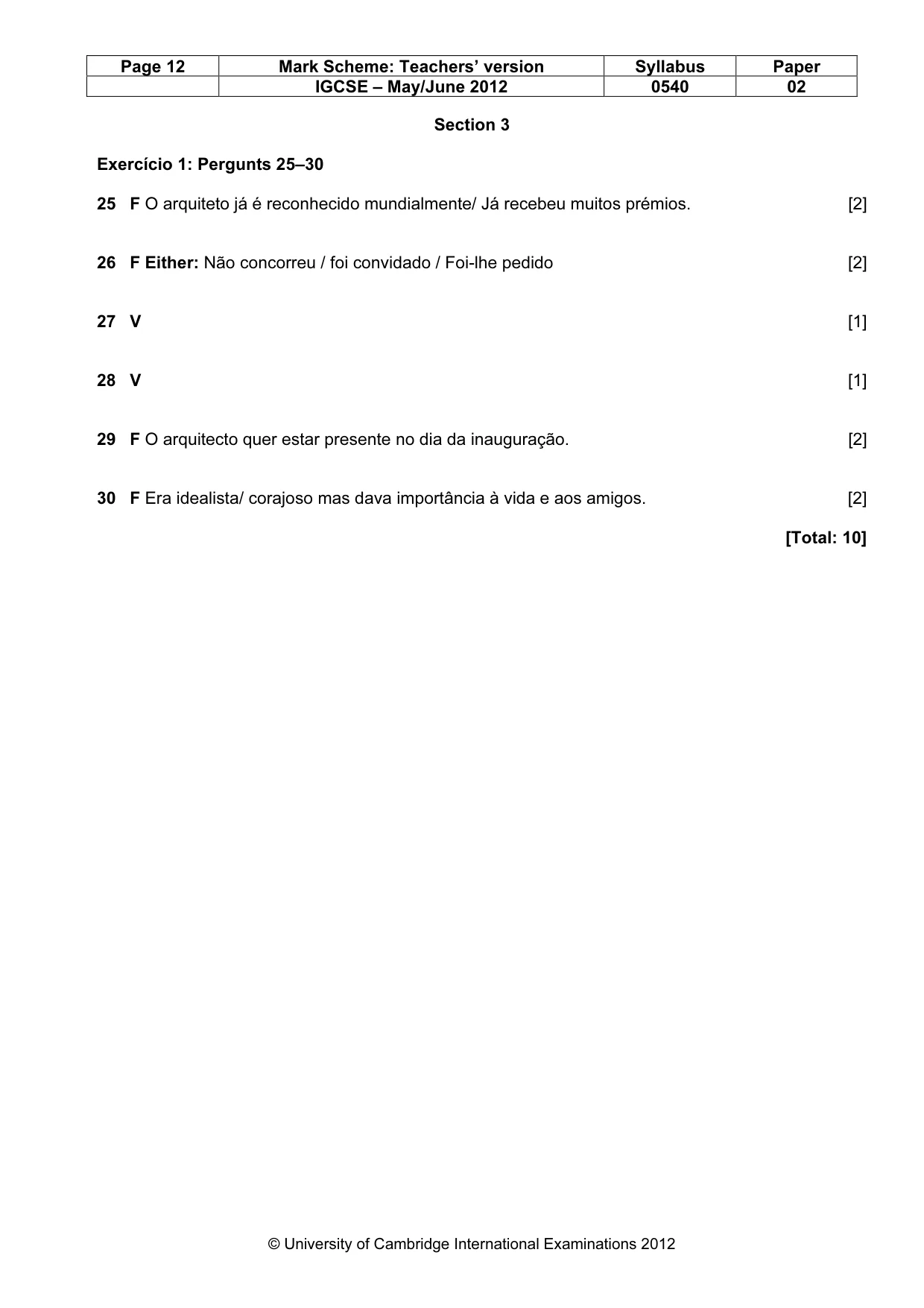
Page 12 Mark Scheme: Teachers’ version Syllabus Paper IGCSE – May/June 2012 0540 02 © University of Cambridge International Examinations 2012 Section 3 Exercício 1: Pergunts 25–30 25 F O arquiteto já é reconhecido mundialmente/ Já recebeu muitos prémios. [2] 26 F Either: Não concorreu / foi convidado / Foi-lhe pedido [2] 27 V [1] 28 V [1] 29 F O arquitecto quer estar presente no dia da inauguração. [2] 30 F Era idealista/ corajoso mas dava importância à vida e aos amigos. [2] [Total: 10]
Mark scheme, page 13
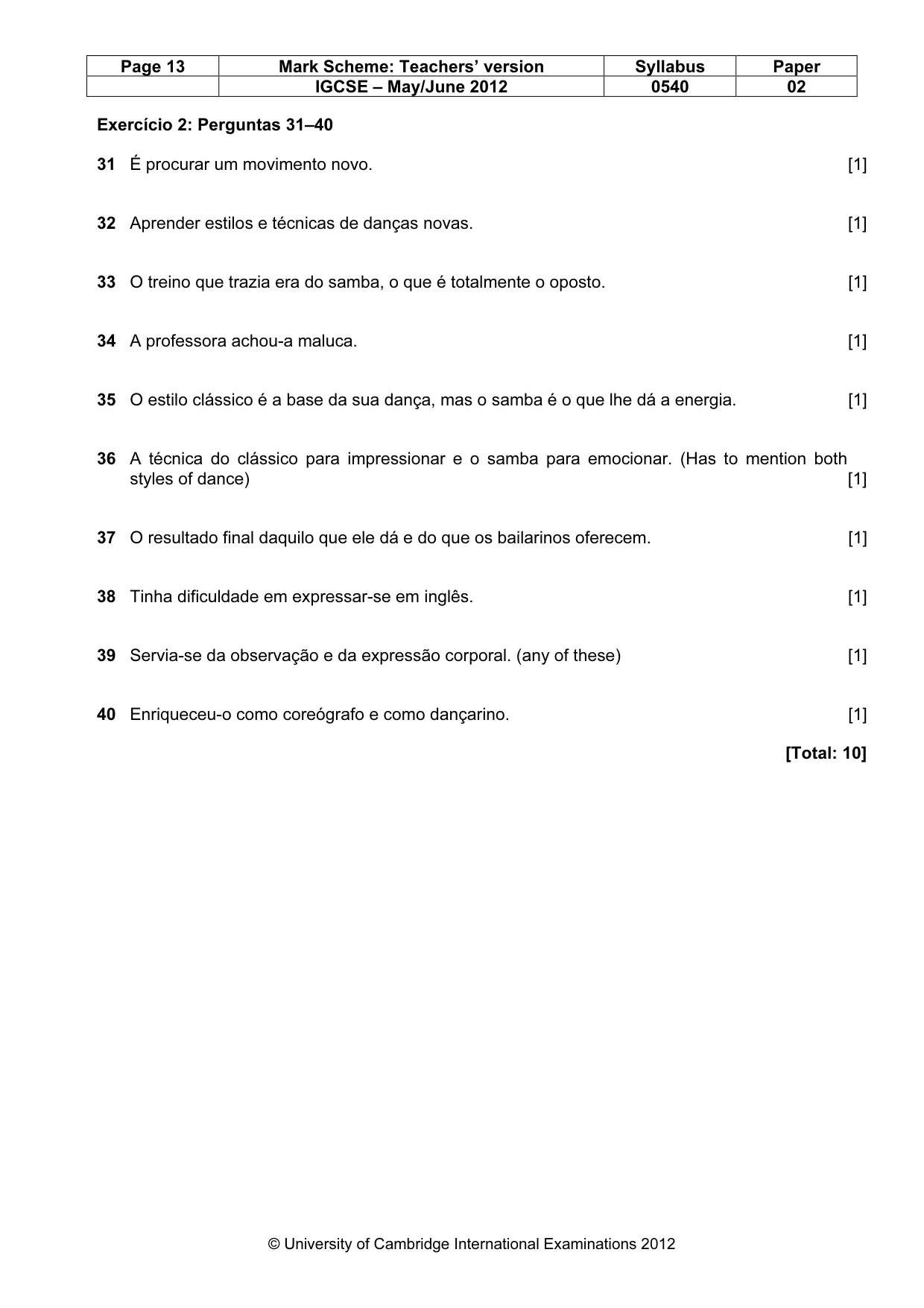
Page 13 Mark Scheme: Teachers’ version Syllabus Paper IGCSE – May/June 2012 0540 02 © University of Cambridge International Examinations 2012 Exercício 2: Perguntas 31–40 31 É procurar um movimento novo. [1] 32 Aprender estilos e técnicas de danças novas. [1] 33 O treino que trazia era do samba, o que é totalmente o oposto. [1] 34 A professora achou-a maluca. [1] 35 O estilo clássico é a base da sua dança, mas o samba é o que lhe dá a energia. [1] 36 A técnica do clássico para impressionar e o samba para emocionar. (Has to mention both styles of dance) [1] 37 O resultado final daquilo que ele dá e do que os bailarinos oferecem. [1] 38 Tinha dificuldade em expressar-se em inglês. [1] 39 Servia-se da observação e da expressão corporal. (any of these) [1] 40 Enriqueceu-o como coreógrafo e como dançarino. [1] [Total: 10]
What you needed in this session
Cambridge’s own grade thresholds for 2012 May/June, Paper 2 · Variant 1. A higher threshold means an easier paper — the bar moves with how the cohort did.