Cambridge IGCSE Portuguese - Foreign Language 0540 — 2014 May/June Paper 2 · Variant 1
0540/21/M/J/14 · 65 marks · ≈73 min
The question paper and its mark scheme, free to read here and free to download. This is Cambridge’s own paper, exactly as it was sat.
Question paper20 pages





Mark scheme12 pages
Answers below. Sit the paper first if you are practising.
Paper as text
Question paper, page 1
Cambridge International Examinations Cambridge International General Certificate of Secondary Education * 5 6 8 4 5 1 8 8 3 0 * PORTUGUESE 0540/02 Paper 2 Reading and Directed Writing May/June 2014 1 hour 30 minutes Candidates answer on the Question Paper. No Additional Materials are required. READ THESE INSTRUCTIONS FIRST Write your Centre number, candidate number and name on all the work you hand in. Write in dark blue or black pen. Do not use staples, paper clips, glue or correction fluid. DO NOT WRITE IN ANY BARCODES. Answer all questions in Section 1, Section 2 and Section 3. At the end of the examination, fasten all your work securely together. The number of marks is given in brackets [ ] at the end of each question or part question. For Examiner’s Use Section 1 Section 2 Section 3 Total This document consists of 16 printed pages and 4 blank pages. DC (CW/SW) 81752/2 © UCLES 2014 [Turn over PAPA CAMBRIDGE
Question paper, page 2
2 0540/02/M/J/14 © UCLES 2014 BLANK PAGE
Question paper, page 3
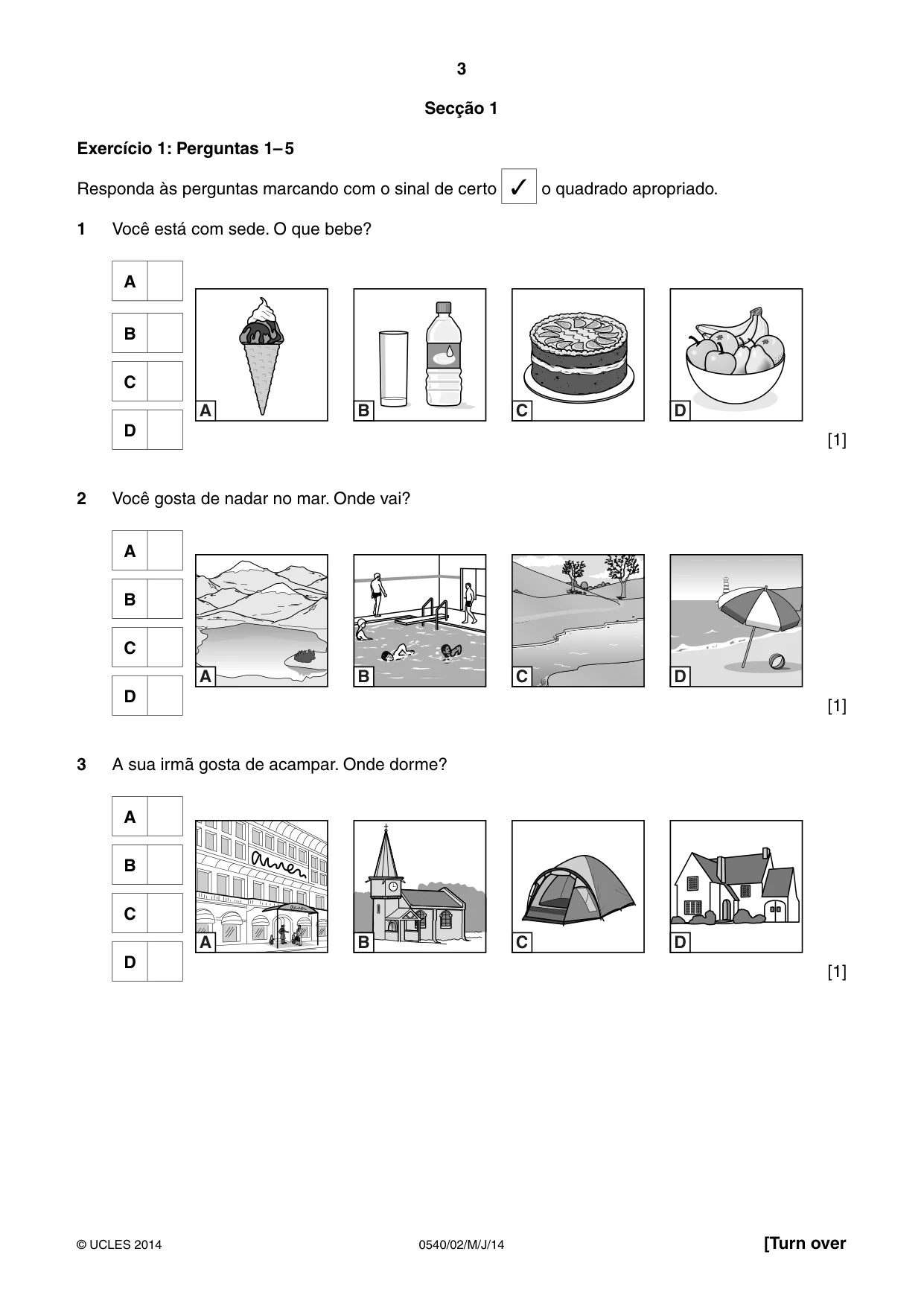
3 0540/02/M/J/14 © UCLES 2014 [Turn over Secção 1 Exercício 1: Perguntas 1– 5 Responda às perguntas marcando com o sinal de certo ✓ o quadrado apropriado. 1 Você está com sede. O que bebe? A A B C D [1] B C D 2 Você gosta de nadar no mar. Onde vai? A A B C D [1] B C D 3 A sua irmã gosta de acampar. Onde dorme? A A B C D [1] B C D
Question paper, page 4
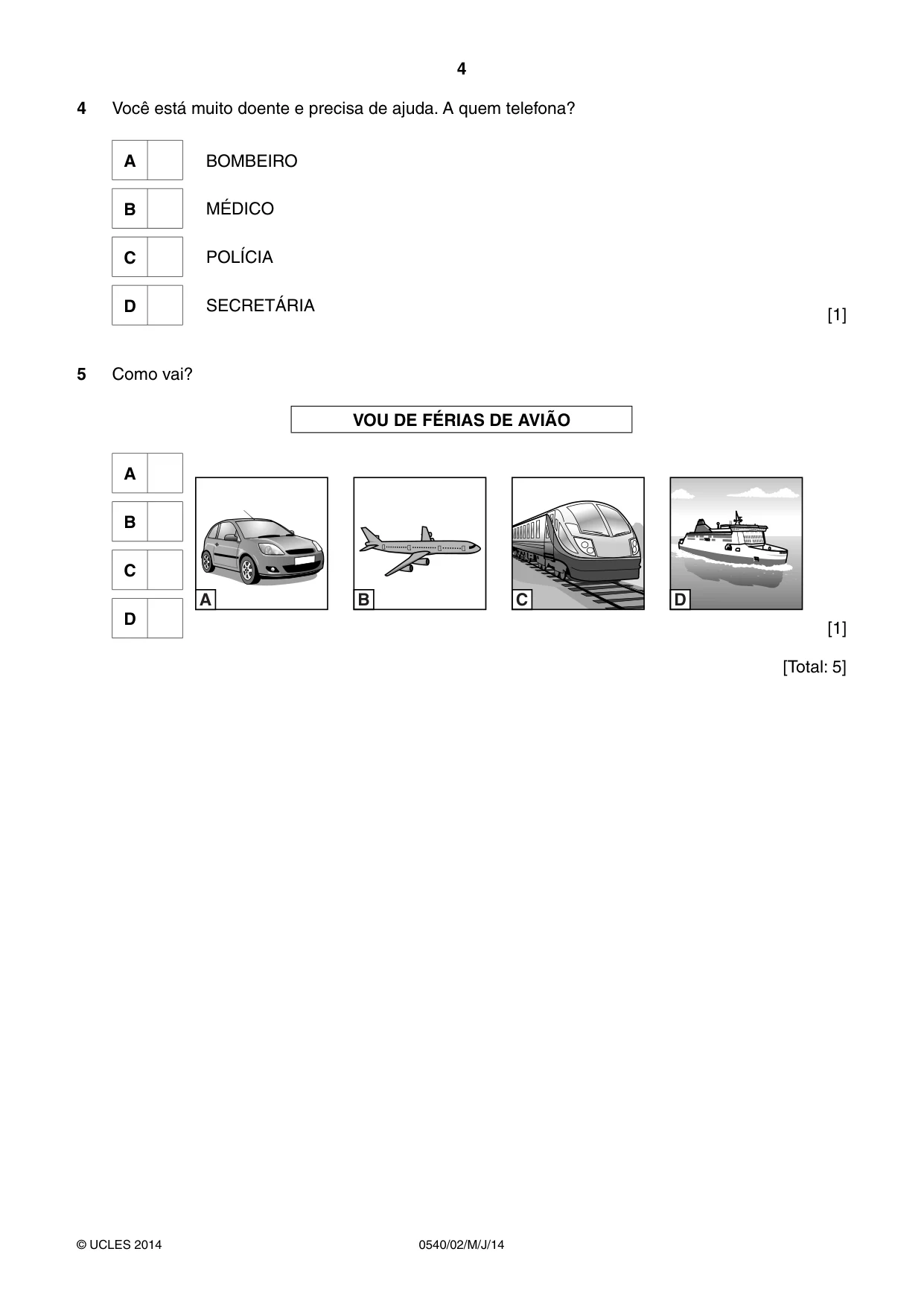
4 0540/02/M/J/14 © UCLES 2014 4 Você está muito doente e precisa de ajuda. A quem telefona? A [1] B C D 5 Como vai? VOU DE FÉRIAS DE AVIÃO A A B C D [1] B C D [Total: 5] BOMBEIRO MÉDICO POLÍCIA SECRETÁRIA
Question paper, page 5
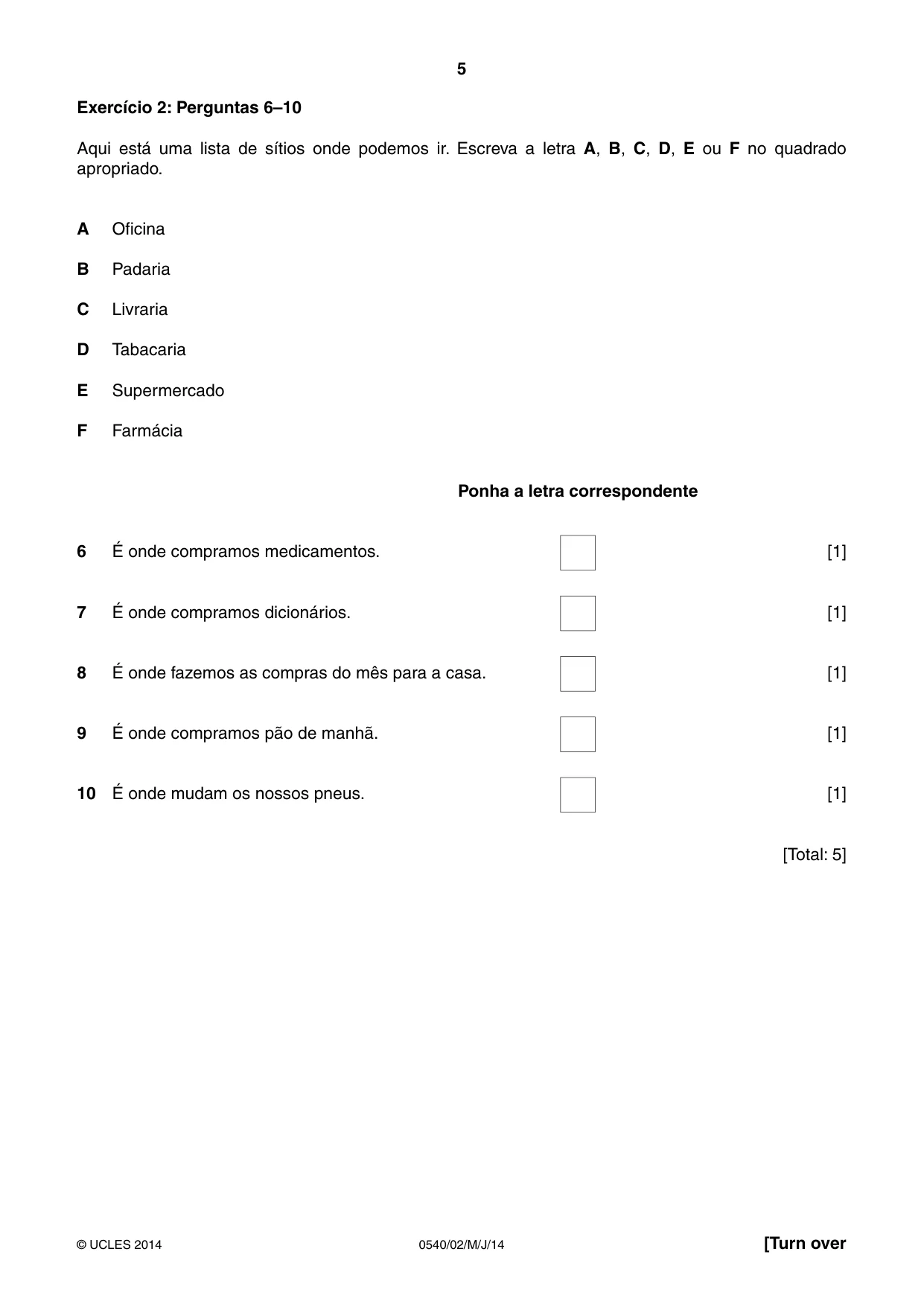
5 0540/02/M/J/14 © UCLES 2014 [Turn over Exercício 2: Perguntas 6–10 Aqui está uma lista de sítios onde podemos ir. Escreva a letra A, B, C, D, E ou F no quadrado apropriado. A Oficina B Padaria C Livraria D Tabacaria E Supermercado F Farmácia Ponha a letra correspondente 6 É onde compramos medicamentos. [1] 7 É onde compramos dicionários. [1] 8 É onde fazemos as compras do mês para a casa. [1] 9 É onde compramos pão de manhã. [1] 10 É onde mudam os nossos pneus. [1] [Total: 5]
Question paper, page 6
6 0540/02/M/J/14 © UCLES 2014 Exercício 3: Perguntas 11–15 Leia o texto com cuidado. O Rui é moçambicano de Nampula. Tem 17 anos e começa a trabalhar às cinco da manhã. Ele limpa o café dos pais todos os dias, exceto às segundas-feiras. É um trabalho difícil, especialmente durante as férias porque os amigos ficam na discoteca até tarde e ele não. Às sete vai para a escola. À tarde, quando a escola termina, ele também lava os carros dos vizinhos. Ele gosta deste trabalho porque faz exercício e com o dinheiro que ganha pode fazer férias no estrangeiro. Marque com o sinal de certo ✓ o quadrado apropriado. 11 O Rui vai para o trabalho às … A 05:00. B 15:00. C 17:00. [1] 12 Ele trabalha … A todos os dias. B só às segundas-feiras. C de terça-feira a domingo. [1]
Question paper, page 7
7 0540/02/M/J/14 © UCLES 2014 [Turn over 13 Ele tem aulas … A só de manhã. B de manhã e à tarde. C só à tarde. [1] 14 O Rui trabalha porque … A gosta de carros. B gosta de ajudar. C gosta de fazer exercício. [1] 15 Com o dinheiro que ganha ele … A faz férias em Moçambique. B vai de férias para outro país. C quer comprar um carro. [1] [Total: 5]
Question paper, page 8
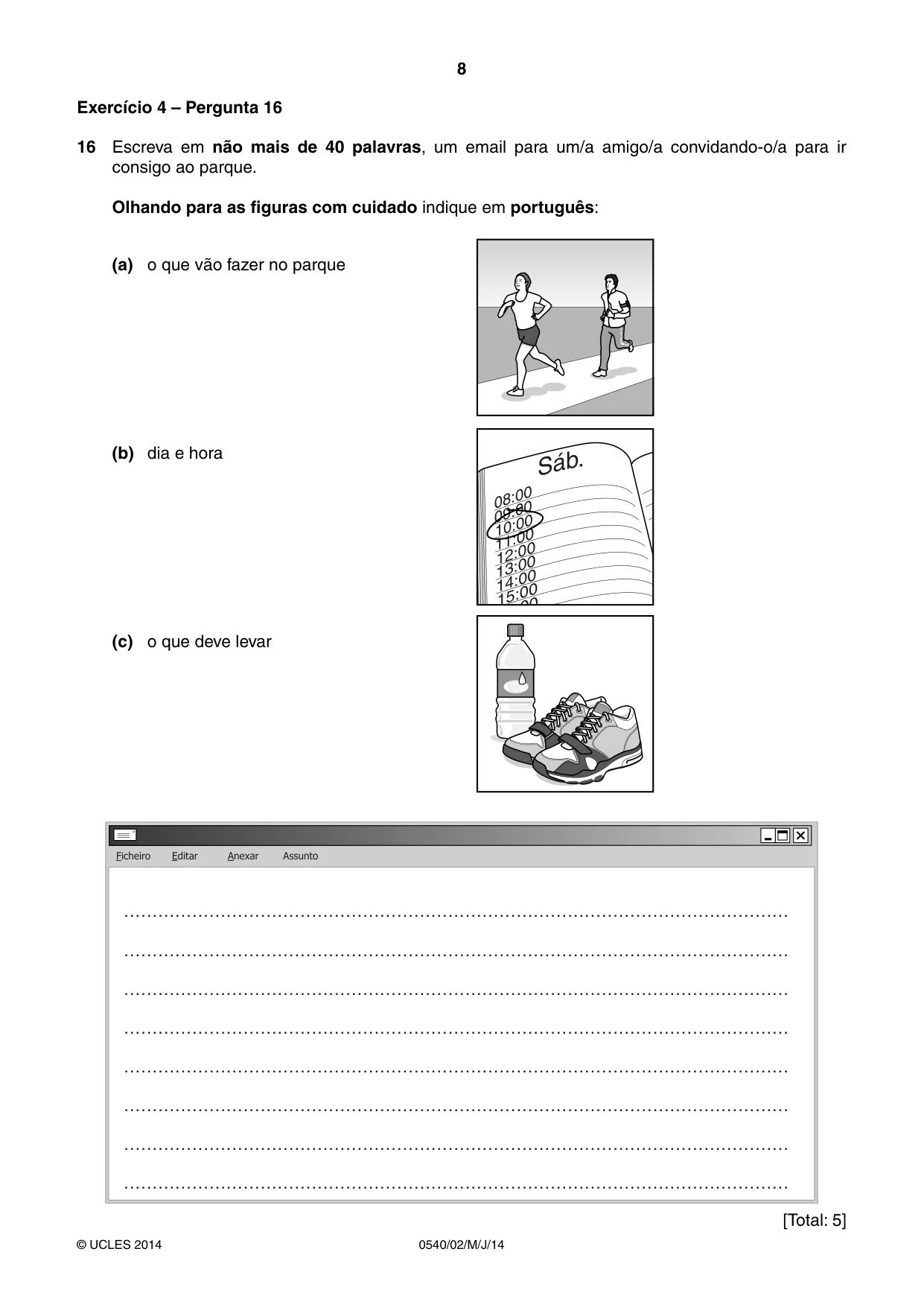
8 0540/02/M/J/14 © UCLES 2014 Exercício 4 – Pergunta 16 16 Escreva em não mais de 40 palavras, um email para um/a amigo/a convidando-o/a para ir consigo ao parque. Olhando para as figuras com cuidado indique em português: (a) o que vão fazer no parque (b) dia e hora 10:00 11:00 12:00 13:00 14:00 15:00 6 00 09:00 08:00 Sá b. (c) o que deve levar Ficheiro Editar Anexar Assunto ……………………………………………………………………………………………………… ……………………………………………………………………………………………………… ……………………………………………………………………………………………………… ……………………………………………………………………………………………………… ……………………………………………………………………………………………………… ……………………………………………………………………………………………………… ……………………………………………………………………………………………………… ……………………………………………………………………………………………………… [Total: 5]
Question paper, page 9
9 0540/02/M/J/14 © UCLES 2014 [Turn over VIRE PARA A SECÇÃO 2
Question paper, page 10
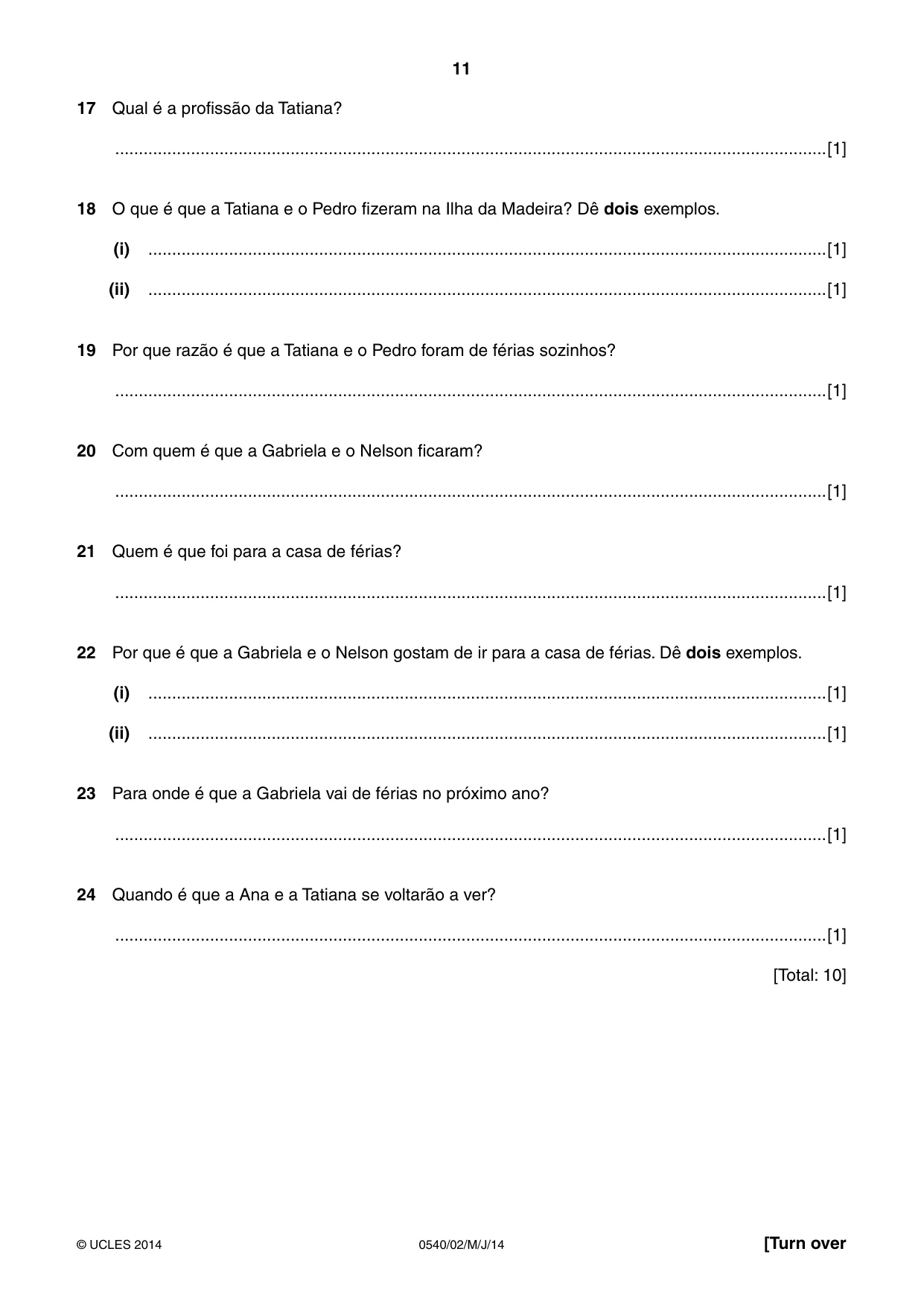
10 0540/02/M/J/14 © UCLES 2014 Secção 2 Exercício 1: Perguntas 17– 24 Leia a carta e depois responda às perguntas em português. FÉRIAS Querida Ana, Já estou de volta ao trabalho. É verdade! As férias já acabaram e estou preparando tudo para mais um ano dando aulas. Os alunos ainda estão de férias, por isso a escola está mais calma. Este ano, eu e meu marido Pedro passamos uma semana na Ilha da Madeira sem nossos filhos. A paisagem lá é maravilhosa! Visitamos vários jardins, mercados e também alguns museus muito interessantes. Adoramos a comida e a vida noturna. Quando Gabriela e Nelson estiverem livres, vamos voltar lá com eles. Desta vez, não vieram conosco, porque estavam estudando para os exames finais. Passaram essa semana com os pais de Pedro. Quando regressamos, fomos todos para nossa casa de férias. Gabriela e Nelson gostam muito de ficar lá, porque podem estar com seus amigos e também passam o dia na praia e na piscina. E você, como está? Gabriela anda muito feliz dizendo a todos seus amigos que no próximo ano vai visitar você no Rio! Mas este ano é sua vez. Espero você em dezembro para o Natal. Vai ser bom ver você de novo. Beijo, Tatiana
Question paper, page 11
11 0540/02/M/J/14 © UCLES 2014 [Turn over 17 Qual é a profissão da Tatiana? …[1] 18 O que é que a Tatiana e o Pedro fizeram na Ilha da Madeira? Dê dois exemplos. (i) …[1] (ii) …[1] 19 Por que razão é que a Tatiana e o Pedro foram de férias sozinhos? …[1] 20 Com quem é que a Gabriela e o Nelson ficaram? …[1] 21 Quem é que foi para a casa de férias? …[1] 22 Por que é que a Gabriela e o Nelson gostam de ir para a casa de férias. Dê dois exemplos. (i) …[1] (ii) …[1] 23 Para onde é que a Gabriela vai de férias no próximo ano? …[1] 24 Quando é que a Ana e a Tatiana se voltarão a ver? …[1] [Total: 10]
Question paper, page 12
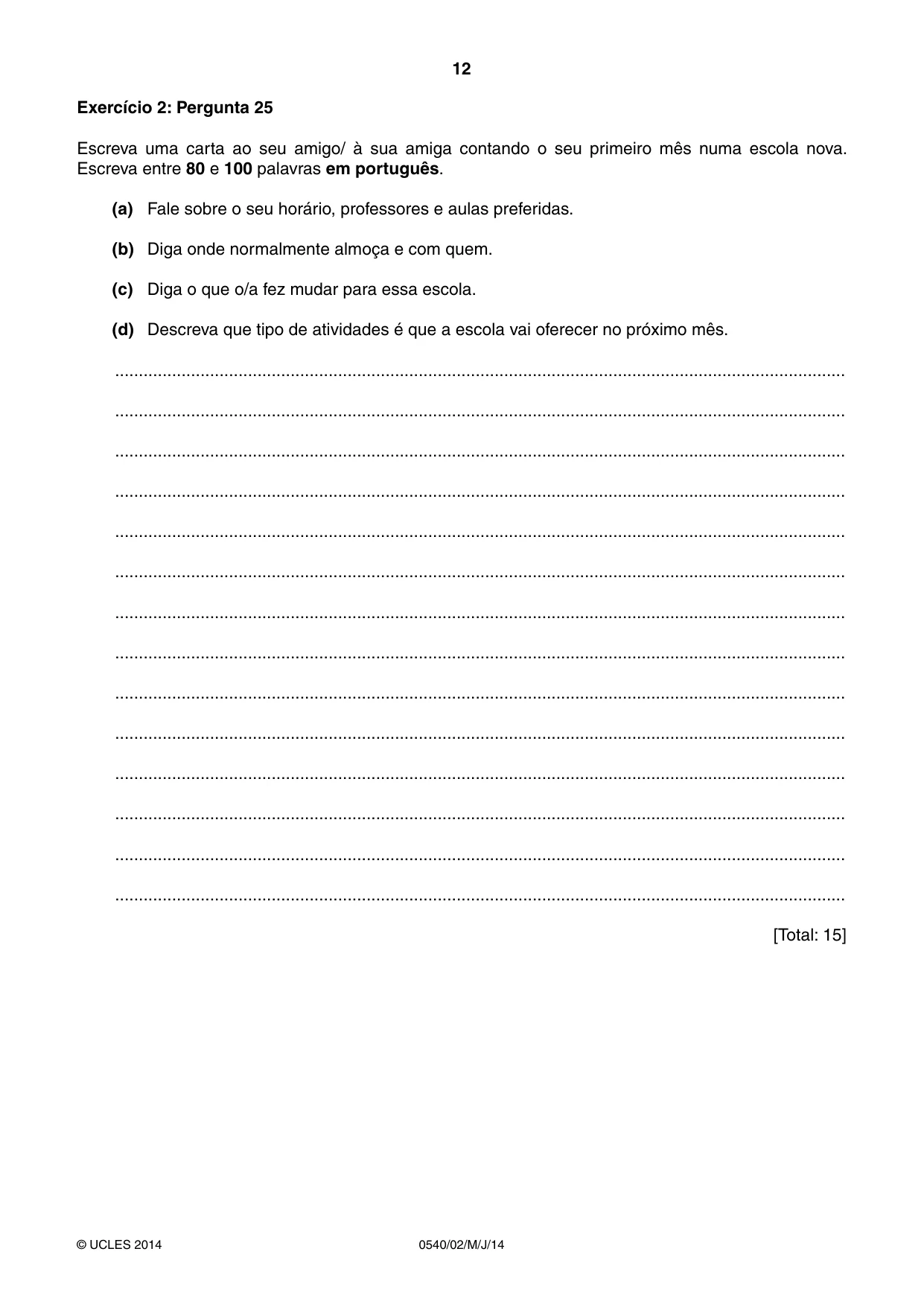
12 0540/02/M/J/14 © UCLES 2014 Exercício 2: Pergunta 25 Escreva uma carta ao seu amigo/ à sua amiga contando o seu primeiro mês numa escola nova. Escreva entre 80 e 100 palavras em português. (a) Fale sobre o seu horário, professores e aulas preferidas. (b) Diga onde normalmente almoça e com quem. (c) Diga o que o/a fez mudar para essa escola. (d) Descreva que tipo de atividades é que a escola vai oferecer no próximo mês. … … … … … … … … … … … … … … [Total: 15]
Question paper, page 13
13 0540/02/M/J/14 © UCLES 2014 [Turn over VIRE PARA A SECÇÃO 3
Question paper, page 14
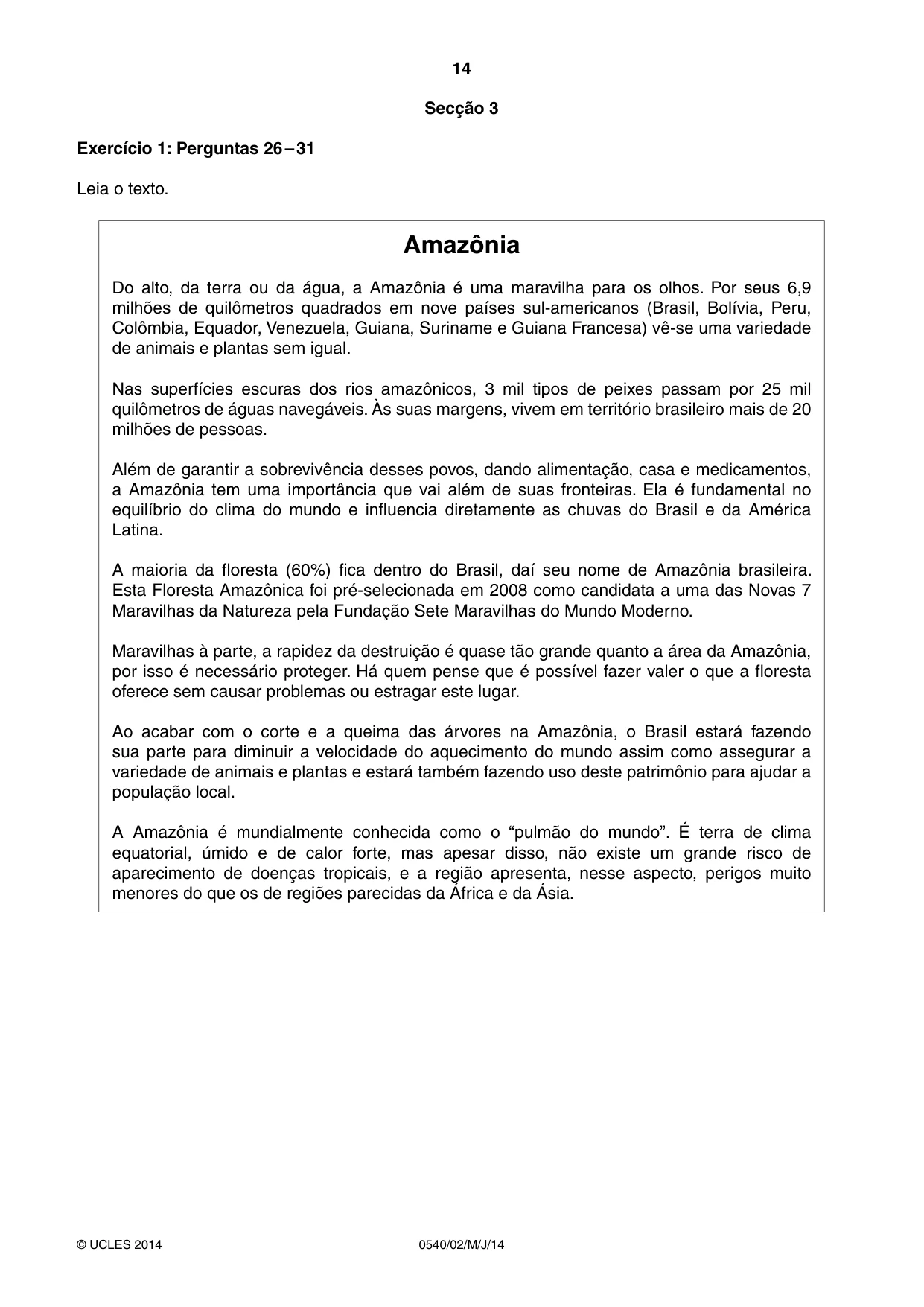
14 0540/02/M/J/14 © UCLES 2014 Secção 3 Exercício 1: Perguntas 26 – 31 Leia o texto. Amazônia Do alto, da terra ou da água, a Amazônia é uma maravilha para os olhos. Por seus 6,9 milhões de quilômetros quadrados em nove países sul-americanos (Brasil, Bolívia, Peru, Colômbia, Equador, Venezuela, Guiana, Suriname e Guiana Francesa) vê-se uma variedade de animais e plantas sem igual. Nas superfícies escuras dos rios amazônicos, 3 mil tipos de peixes passam por 25 mil quilômetros de águas navegáveis. Às suas margens, vivem em território brasileiro mais de 20 milhões de pessoas. Além de garantir a sobrevivência desses povos, dando alimentação, casa e medicamentos, a Amazônia tem uma importância que vai além de suas fronteiras. Ela é fundamental no equilíbrio do clima do mundo e influencia diretamente as chuvas do Brasil e da América Latina. A maioria da floresta (60%) fica dentro do Brasil, daí seu nome de Amazônia brasileira. Esta Floresta Amazônica foi pré-selecionada em 2008 como candidata a uma das Novas 7 Maravilhas da Natureza pela Fundação Sete Maravilhas do Mundo Moderno. Maravilhas à parte, a rapidez da destruição é quase tão grande quanto a área da Amazônia, por isso é necessário proteger. Há quem pense que é possível fazer valer o que a floresta oferece sem causar problemas ou estragar este lugar. Ao acabar com o corte e a queima das árvores na Amazônia, o Brasil estará fazendo sua parte para diminuir a velocidade do aquecimento do mundo assim como assegurar a variedade de animais e plantas e estará também fazendo uso deste patrimônio para ajudar a população local. A Amazônia é mundialmente conhecida como o “pulmão do mundo”. É terra de clima equatorial, úmido e de calor forte, mas apesar disso, não existe um grande risco de aparecimento de doenças tropicais, e a região apresenta, nesse aspecto, perigos muito menores do que os de regiões parecidas da África e da Ásia.
Question paper, page 15
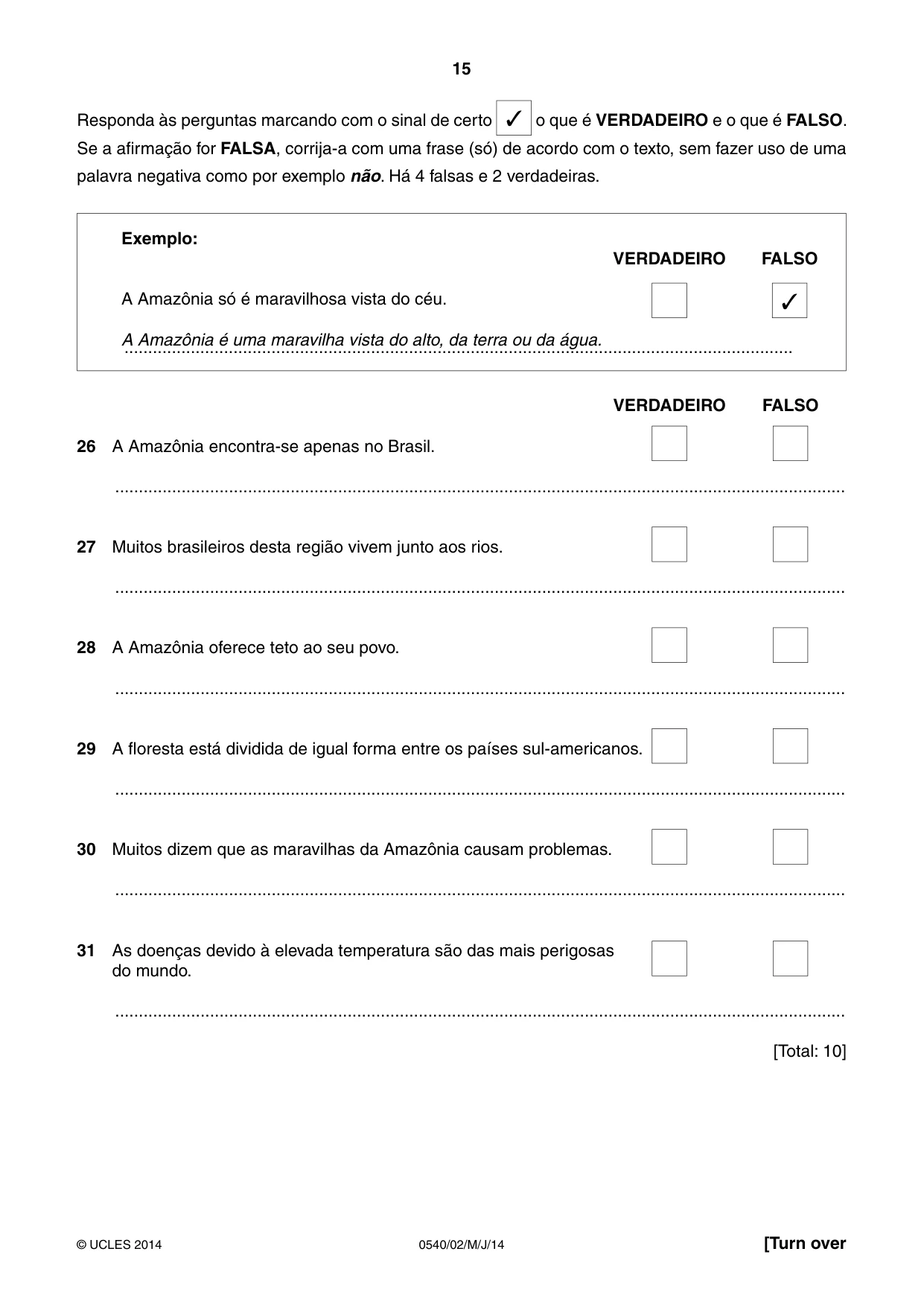
15 0540/02/M/J/14 © UCLES 2014 [Turn over Responda às perguntas marcando com o sinal de certo ✓ o que é VERDADEIRO e o que é FALSO. Se a afirmação for FALSA, corrija-a com uma frase (só) de acordo com o texto, sem fazer uso de uma palavra negativa como por exemplo não. Há 4 falsas e 2 verdadeiras. Exemplo: VERDADEIRO FALSO A Amazônia só é maravilhosa vista do céu. ✓ A Amazônia é uma maravilha vista do alto, da terra ou da água. … VERDADEIRO FALSO 26 A Amazônia encontra-se apenas no Brasil. … 27 Muitos brasileiros desta região vivem junto aos rios. … 28 A Amazônia oferece teto ao seu povo. … 29 A floresta está dividida de igual forma entre os países sul-americanos. … 30 Muitos dizem que as maravilhas da Amazônia causam problemas. … 31 As doenças devido à elevada temperatura são das mais perigosas do mundo. … [Total: 10]
Question paper, page 16
16 0540/02/M/J/14 © UCLES 2014 Exercício 2: Perguntas 32 – 39 Leia o texto e depois responda às perguntas em português. MUDAR DE VIDA Se tu pensas que as escolhas que fazes na adolescência, em termos de carreira, são para a vida inteira, enganas-te. Dizem que “não muda quem quer, muda quem pode”. Mas tudo depende da pessoa. Todos nós sabemos que há falta de emprego, os salários são baixos e o custo de vida é cada vez mais alto. Se há quem mude de vida por necessidade, há também quem o faça para se sentir bem consigo. Foi o caso da Ana Rodrigues, de 28 anos, que disse adeus a um grande ritmo de trabalho na área da publicidade e organização de festas para dedicar-se à prática e ensino do descanso do corpo. A garagem de sua casa, numa zona calma de Cascais, foi adaptada para esse fim. Lá ela mostra às pessoas que as cores claras e o cheiro de velas convidam a relaxar, a ouvir o som do silêncio, a prestar atenção aos movimentos da respiração. Trabalhava, no mínimo, doze horas por dia e até gostava muito do que fazia, mas não tinha tempo para nada. A Ana passou dois meses no Sul da Índia, a aprender tudo sobre como o corpo descansa, a nossa forma de estar, técnicas e práticas. “Ganhei um novo conhecimento do corpo, a necessidade de dormir bem, comer a horas. Senti que precisava de estar mais comigo e com os outros”, disse. A mudança obrigou-a a pensar melhor nas despesas familiares e agora faz listas para tudo! Mesmo assim, sente-se bem com a sua decisão, que contou com a ajuda do marido. Este tipo de decisão de mudar em nome da realização pessoal nem sempre é fácil, porque há sempre um risco, principalmente se já se tem um trabalho confortável e sem preocupações de sobrevivência e segurança, mas o bem estar da pessoa também tem o seu peso.
Question paper, page 17
17 0540/02/M/J/14 © UCLES 2014 32 Dê uma razão por que, segundo o texto, não é fácil trocar de emprego hoje em dia. …[1] 33 Que tipo de profissão é que a Ana tinha? …[1] 34 Onde é que a Ana ensina? …[1] 35 Dê dois exemplos do que ela ensina nas suas aulas. (i) …[1] (ii) …[1] 36 O que influenciou a Ana a deixar o seu antigo emprego? …[1] 37 O que é que a Ana foi fazer ao Sul da Índia? Dê dois exemplos. (i) …[1] (ii) …[1] 38 Com um novo trabalho, o que foi preciso mudar na vida da Ana? …[1] 39 O que é que se pode perder com este tipo de mudança? …[1] [Total: 10]
Question paper, page 18
18 0540/02/M/J/14 © UCLES 2014 BLANK PAGE
Question paper, page 19
19 0540/02/M/J/14 © UCLES 2014 BLANK PAGE
Question paper, page 20
20 0540/02/M/J/14 © UCLES 2014 BLANK PAGE Permission to reproduce items where third-party owned material protected by copyright is included has been sought and cleared where possible. Every reasonable effort has been made by the publisher (UCLES) to trace copyright holders, but if any items requiring clearance have unwittingly been included, the publisher will be pleased to make amends at the earliest possible opportunity. Cambridge International Examinations is part of the Cambridge Assessment Group. Cambridge Assessment is the brand name of University of Cambridge Local Examinations Syndicate (UCLES), which is itself a department of the University of Cambridge.
Mark scheme, page 1
CAMBRIDGE INTERNATIONAL EXAMINATIONS International General Certificate of Secondary Education MARK SCHEME for the May/June 2014 series 0540 PORTUGESE (FOREIGN LANGUAGE) 0540/02 Paper 2 (Reading and Directed Reading), maximum raw mark 65 This mark scheme is published as an aid to teachers and candidates, to indicate the requirements of the examination. It shows the basis on which Examiners were instructed to award marks. It does not indicate the details of the discussions that took place at an Examiners’ meeting before marking began, which would have considered the acceptability of alternative answers. Mark schemes should be read in conjunction with the question paper and the Principal Examiner Report for Teachers. Cambridge will not enter into discussions about these mark schemes. Cambridge is publishing the mark schemes for the May/June 2014 series for most IGCSE, GCE Advanced Level and Advanced Subsidiary Level components and some Ordinary Level components. PAPA CAMBRIDGE
Mark scheme, page 2
Page 2 Mark Scheme Syllabus Paper IGCSE – May/June 2014 0540 02 © Cambridge International Examinations 2014 1 General Marking Principles 1.1 Please note that it is not possible to list all acceptable alternatives in the Detailed Mark Scheme provided in Section 2. The Examiner will need to consider all alternative answers and unexpected approaches in candidates’ scripts, make a decision on whether they communicate the required elements, in consultation with the Product Manager if necessary, and award marks accordingly. The following marking principles underpin the detailed instructions provided in Section 2 of the Mark Scheme. Where a decision is taken to deviate from these principles for a particular question, this will be specified in the Mark Scheme. 1.2 Crossing out (a) If a candidate changes his / her mind over an answer and crosses out an attempt, a mark is awarded if the final attempt is correct. (b) If a candidate crosses out an answer to a whole question but makes no second attempt at it, the crossed out work should be marked. 1.3 Reading tasks: more than the stipulated number of boxes ticked / crossed by the candidate: (a) If more than one attempt is visible, but the candidate has clearly indicated which attempt is his / her final answer (e.g. by crossing out other attempts by annotating the script in some way), this is marked in the usual way. (b) If two attempts are visible (e.g. two boxes ticked instead of the one box stipulated), and neither has been crossed out / discounted by the candidate, no mark can be awarded. (c) In questions where candidates are required to tick a number of boxes (e.g. tick the 6 true statements) the general rule to be applied is as follows: the number of ‘extra’ answers indicated by the candidate is deducted from the number of correct answers and the remaining number is the mark awarded, e.g. the candidate is required to tick 6 true statements, but instead ticks 8 statements. 5 of the 6 ticks are correctly placed, but 2 of the ticks are ‘extras’ (8 ticks placed by candidates minus 6 ticks required by rubric = 2). Therefore the candidate is awarded a mark of 3. 5 number of correct ticks –2 minus number of extra ticks = 3 (d) Answers in pen do not take precedent over answers in pencil, e.g. if a candidate is asked to tick one box and ticks two, one in pen and the other in pencil, the mark cannot be awarded unless there is some explicit indication from the candidate as to which is his / her final answer.
Mark scheme, page 3
Page 3 Mark Scheme Syllabus Paper IGCSE – May/June 2014 0540 02 © Cambridge International Examinations 2014 1.4 Reading tasks: for questions requiring more than one element for the answer, (i) and (ii), where the answers are interchangeable: Both correct answers on line 1 and line 2 blank = 2 Both correct answers on line 1 and line 2 wrong = 1 (or vice-versa) 1.5 Reading tasks: answers requiring the use of Portuguese (rather than a non-verbal response) should be marked for communication. Tolerate inaccuracies provided the message is clear. (a) ‘If in doubt, sound it out’: if you read what the candidate has written, does it sound like the correct answer? (b) Look-alike test: does what the candidate has written look like the correct answer? (c) Accept incorrect gender or person unless Mark Scheme specifies otherwise. (d) Accept incorrect possessive adjectives e.g. meu, teu, seu etc., unless Mark Scheme specifies otherwise (in general, Section 2 accept, Section 3 consult Mark Scheme carefully). 1.6 Unless the Mark Scheme specifies otherwise, do not accept incorrect Portuguese if the word given means something else in Portuguese. (Incorrect Portuguese which constitutes a word in any language other than Portuguese is marked (i) on the basis of whether it is accepted or refused in the Mark Scheme and (ii) if not mentioned in the Mark Scheme, on the basis of 1.5 above). 1.7 Annotation used in the Mark Scheme: (a) INV = Invalidation and is used when additional material included by the candidate is judged to invalidate an otherwise correct answer thus preventing him / her from scoring the mark (INV = 0). (b) tc = ‘tout court’ and means that on its own the material is not sufficient to score the mark. (c) HA = harmless additional material which in conjunction with the correct answer does not prevent the candidate from scoring the mark. (d) BOD = Benefit of the Doubt and is used to indicate material considered by the Examiner and judged to be more correct than incorrect: the benefit of the doubt is given to the candidate and the mark is awarded. 1.8 No response and ‘0’ marks There is a NR (NO response) option in scoris. Award NR (No Response): • If there is nothing written at all in the answer space or • If there is only a comment which does not in any way relate to the question being asked (e.g. ‘can’t do’ or ‘don’t know’) or • If there is only a mark which isn’t an attempt at the question (e.g. a dash, a question mark).
Mark scheme, page 4
Page 4 Mark Scheme Syllabus Paper IGCSE – May/June 2014 0540 02 © Cambridge International Examinations 2014 Award 0: • If there is any attempt that earns no credit. This could, for example, include the candidate copying all or some of the question, or any working that does not earn any marks, whether crossed out or not. 1.9 Extra material: Section 2, Exercise 1 In Section 2, Exercise 1, the candidate is rewarded for being able to locate the answer in the passage. Do not worry about lifting unless this would cause the message to be seriously distorted (in general, incorrect possessives should not be judged to cause distortion: see 1.5(d)) – in which case a lift will be specifically rejected in the Mark Scheme. Ignore extra material given in an answer providing that it does not invalidate an answer. 1.10 Extra material: Section 3 In Section 3 it is the candidate’s responsibility to answer questions in such a way as to demonstrate to the Examiner that s/he has understood the texts / questions. Where candidates introduce extra, irrelevant material to an otherwise correct answer the danger is that the Examiner is being forced to ‘choose’ the correct answer and s/he cannot be certain that the candidate has shown understanding. Where the Examiner is put in this position the mark cannot be awarded. In Section 3 the Examiner looks for signs of genuine comprehension. Usually, candidates who lift indiscriminately fail to demonstrate comprehension and will not score the mark. However, careful lifting of the details required to answer the question does demonstrate comprehension and should be rewarded. The Detailed Mark Scheme (Section 2) provides specific guidance but in cases not covered, the following general rules apply: (a) Extra material, mentioned in the Mark Scheme, which reinforces the correct answer or in itself constitutes an alternative correct answer: this is acceptable and is not penalised (b) Extra material which constitutes an alternative answer, but which is not explicitly mentioned in the Mark Scheme: the Examiner needs to decide, by consulting the text and the Product Manager if necessary, whether the alternative answer constitutes: (i) an alternative correct answer, in which case this falls into category (a) and the answer should be rewarded (ii) or an answer which on its own would be refused, in which case this falls into category (c) and the answer should be refused. (c) Extra material which constitutes an alternative answer specifically refused in the Mark Scheme: this puts the Examiner in the position of having to ‘choose’ which is the candidate’s ‘final’ answer – the Examiner cannot be sure what the candidate has understood – and the mark cannot be awarded
Mark scheme, page 5
Page 5 Mark Scheme Syllabus Paper IGCSE – May/June 2014 0540 02 © Cambridge International Examinations 2014 (d) Extra material which distorts or contradicts the correct answer: this affects the communication – the Examiner cannot be sure what the candidate has understood – and the mark cannot be awarded (e) Extra material introduced by the candidate and which does not feature in the text: this affects communication – the Examiner cannot be sure what the candidate has understood – and the mark cannot be awarded. It can sometimes be difficult to draw the line between what is a deduction made by an able candidate on the basis of what they have read and pure guesswork. Therefore, where an answer of this sort occurs which is not covered in the Mark Scheme, Examiners should consult their Product Manager
Mark scheme, page 6
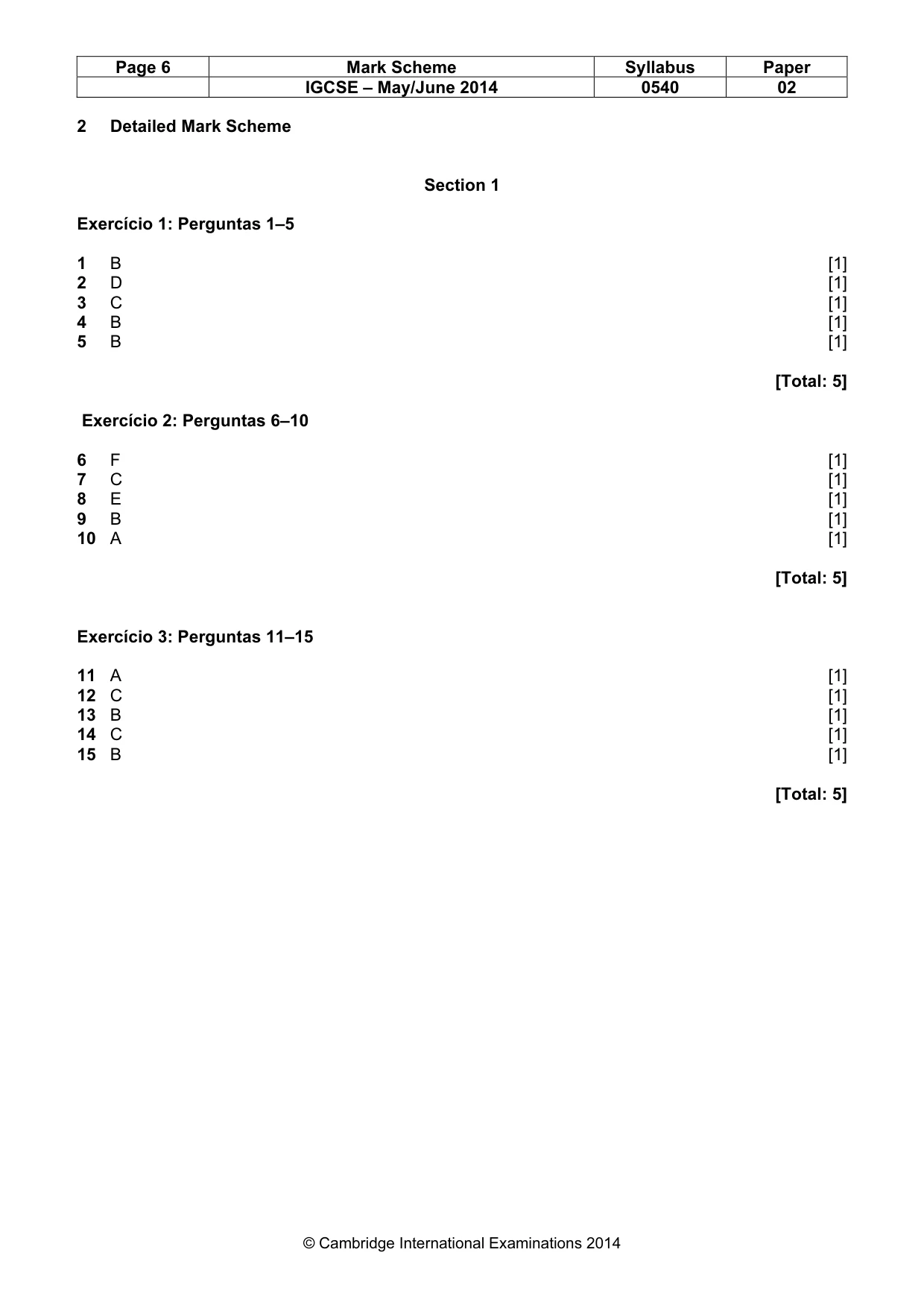
Page 6 Mark Scheme Syllabus Paper IGCSE – May/June 2014 0540 02 © Cambridge International Examinations 2014 2 Detailed Mark Scheme Section 1 Exercício 1: Perguntas 1–5 1 B [1] 2 D [1] 3 C [1] 4 B [1] 5 B [1] [Total: 5] Exercício 2: Perguntas 6–10 6 F [1] 7 C [1] 8 E [1] 9 B [1] 10 A [1] [Total: 5] Exercício 3: Perguntas 11–15 11 A [1] 12 C [1] 13 B [1] 14 C [1] 15 B [1] [Total: 5]
Mark scheme, page 7
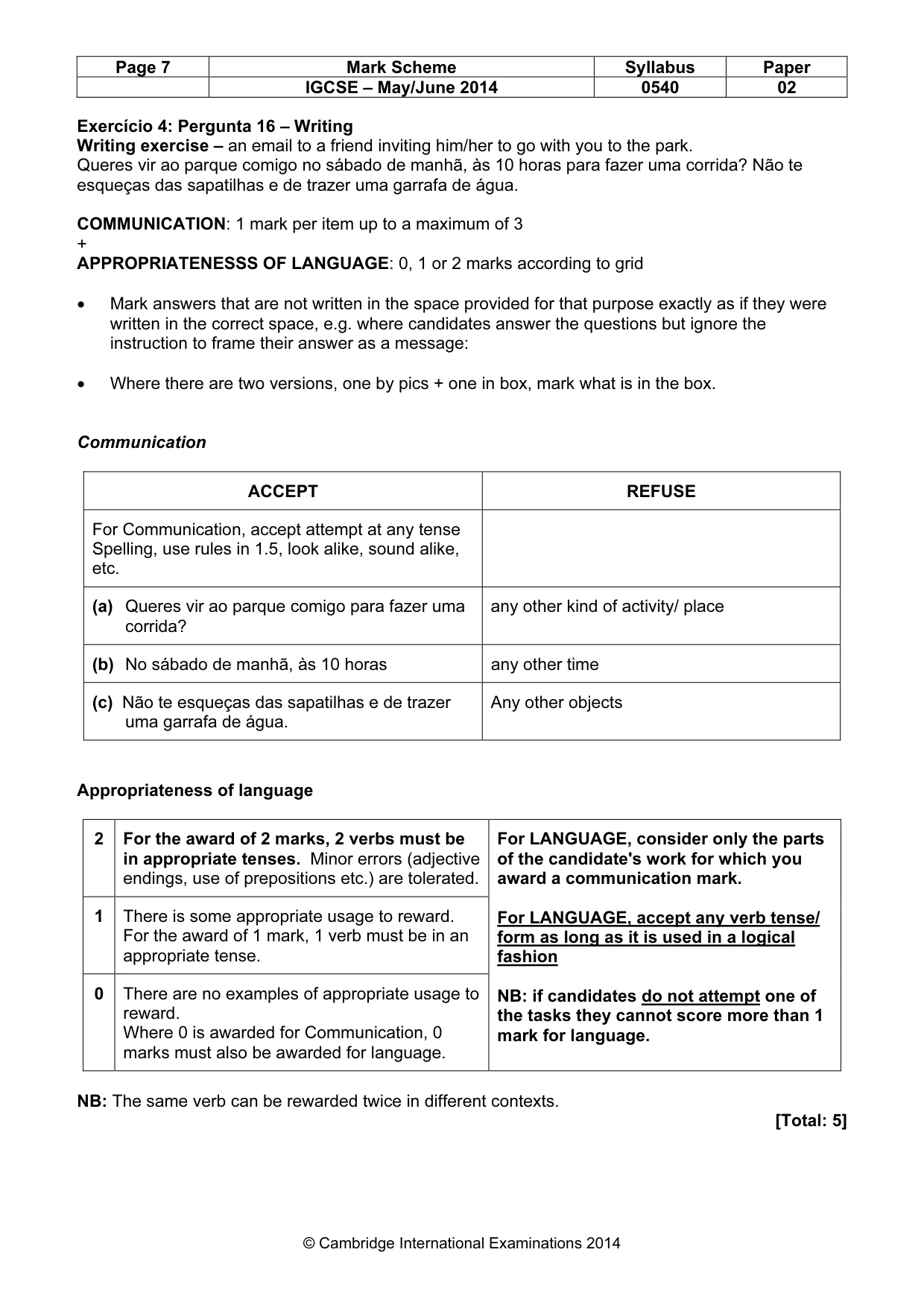
Page 7 Mark Scheme Syllabus Paper IGCSE – May/June 2014 0540 02 © Cambridge International Examinations 2014 Exercício 4: Pergunta 16 – Writing Writing exercise – an email to a friend inviting him/her to go with you to the park. Queres vir ao parque comigo no sábado de manhã, às 10 horas para fazer uma corrida? Não te esqueças das sapatilhas e de trazer uma garrafa de água. COMMUNICATION: 1 mark per item up to a maximum of 3 + APPROPRIATENESSS OF LANGUAGE: 0, 1 or 2 marks according to grid • Mark answers that are not written in the space provided for that purpose exactly as if they were written in the correct space, e.g. where candidates answer the questions but ignore the instruction to frame their answer as a message: • Where there are two versions, one by pics + one in box, mark what is in the box. Communication ACCEPT REFUSE For Communication, accept attempt at any tense Spelling, use rules in 1.5, look alike, sound alike, etc. (a) Queres vir ao parque comigo para fazer uma corrida? any other kind of activity/ place (b) No sábado de manhã, às 10 horas any other time (c) Não te esqueças das sapatilhas e de trazer uma garrafa de água. Any other objects Appropriateness of language 2 For the award of 2 marks, 2 verbs must be in appropriate tenses. Minor errors (adjective endings, use of prepositions etc.) are tolerated. For LANGUAGE, consider only the parts of the candidate's work for which you award a communication mark. For LANGUAGE, accept any verb tense/ form as long as it is used in a logical fashion NB: if candidates do not attempt one of the tasks they cannot score more than 1 mark for language. 1 There is some appropriate usage to reward. For the award of 1 mark, 1 verb must be in an appropriate tense. 0 There are no examples of appropriate usage to reward. Where 0 is awarded for Communication, 0 marks must also be awarded for language. NB: The same verb can be rewarded twice in different contexts. [Total: 5]
Mark scheme, page 8
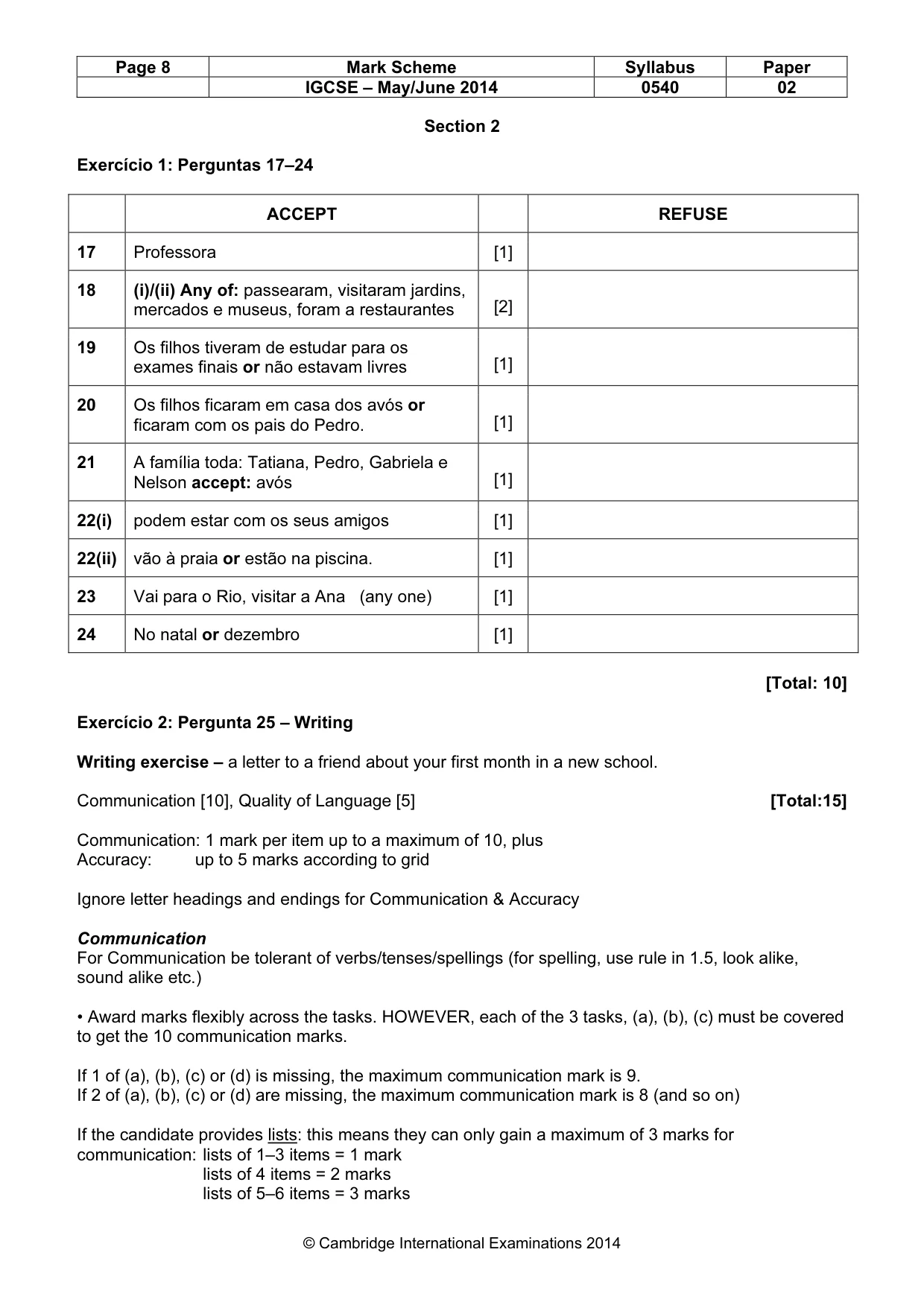
Page 8 Mark Scheme Syllabus Paper IGCSE – May/June 2014 0540 02 © Cambridge International Examinations 2014 Section 2 Exercício 1: Perguntas 17–24 ACCEPT REFUSE 17 Professora [1] 18 (i)/(ii) Any of: passearam, visitaram jardins, mercados e museus, foram a restaurantes [2] 19 Os filhos tiveram de estudar para os exames finais or não estavam livres [1] 20 Os filhos ficaram em casa dos avós or ficaram com os pais do Pedro. [1] 21 A família toda: Tatiana, Pedro, Gabriela e Nelson accept: avós [1] 22(i) podem estar com os seus amigos [1] 22(ii) vão à praia or estão na piscina. [1] 23 Vai para o Rio, visitar a Ana (any one) [1] 24 No natal or dezembro [1] [Total: 10] Exercício 2: Pergunta 25 – Writing Writing exercise – a letter to a friend about your first month in a new school. Communication [10], Quality of Language [5] [Total:15] Communication: 1 mark per item up to a maximum of 10, plus Accuracy: up to 5 marks according to grid Ignore letter headings and endings for Communication & Accuracy Communication For Communication be tolerant of verbs/tenses/spellings (for spelling, use rule in 1.5, look alike, sound alike etc.) • Award marks flexibly across the tasks. HOWEVER, each of the 3 tasks, (a), (b), (c) must be covered to get the 10 communication marks. If 1 of (a), (b), (c) or (d) is missing, the maximum communication mark is 9. If 2 of (a), (b), (c) or (d) are missing, the maximum communication mark is 8 (and so on) If the candidate provides lists: this means they can only gain a maximum of 3 marks for communication: lists of 1–3 items = 1 mark lists of 4 items = 2 marks lists of 5–6 items = 3 marks
Mark scheme, page 9
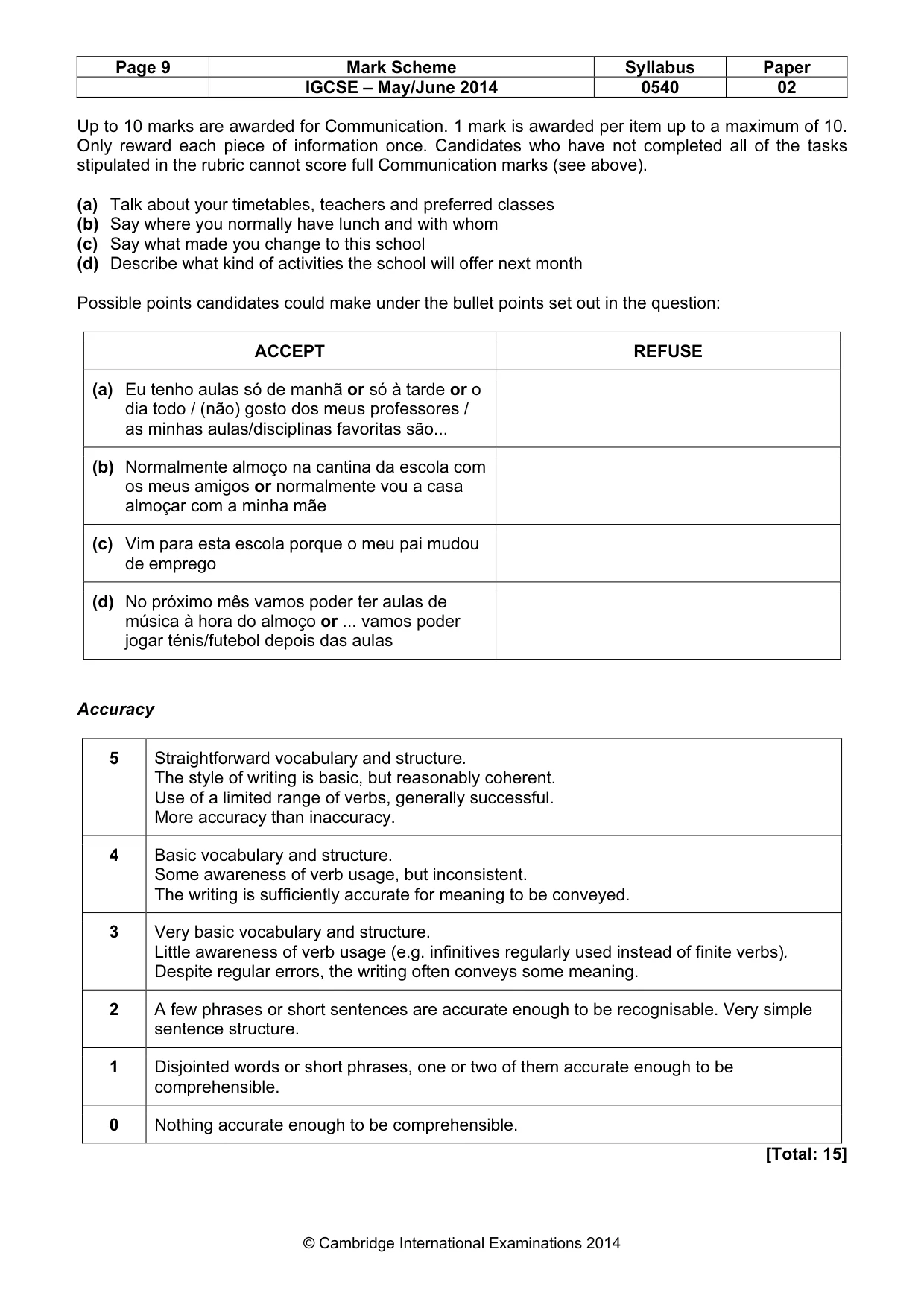
Page 9 Mark Scheme Syllabus Paper IGCSE – May/June 2014 0540 02 © Cambridge International Examinations 2014 Up to 10 marks are awarded for Communication. 1 mark is awarded per item up to a maximum of 10. Only reward each piece of information once. Candidates who have not completed all of the tasks stipulated in the rubric cannot score full Communication marks (see above). (a) Talk about your timetables, teachers and preferred classes (b) Say where you normally have lunch and with whom (c) Say what made you change to this school (d) Describe what kind of activities the school will offer next month Possible points candidates could make under the bullet points set out in the question: ACCEPT REFUSE (a) Eu tenho aulas só de manhã or só à tarde or o dia todo / (não) gosto dos meus professores / as minhas aulas/disciplinas favoritas são... (b) Normalmente almoço na cantina da escola com os meus amigos or normalmente vou a casa almoçar com a minha mãe (c) Vim para esta escola porque o meu pai mudou de emprego (d) No próximo mês vamos poder ter aulas de música à hora do almoço or ... vamos poder jogar ténis/futebol depois das aulas Accuracy 5 Straightforward vocabulary and structure. The style of writing is basic, but reasonably coherent. Use of a limited range of verbs, generally successful. More accuracy than inaccuracy. 4 Basic vocabulary and structure. Some awareness of verb usage, but inconsistent. The writing is sufficiently accurate for meaning to be conveyed. 3 Very basic vocabulary and structure. Little awareness of verb usage (e.g. infinitives regularly used instead of finite verbs). Despite regular errors, the writing often conveys some meaning. 2 A few phrases or short sentences are accurate enough to be recognisable. Very simple sentence structure. 1 Disjointed words or short phrases, one or two of them accurate enough to be comprehensible. 0 Nothing accurate enough to be comprehensible. [Total: 15]
Mark scheme, page 10
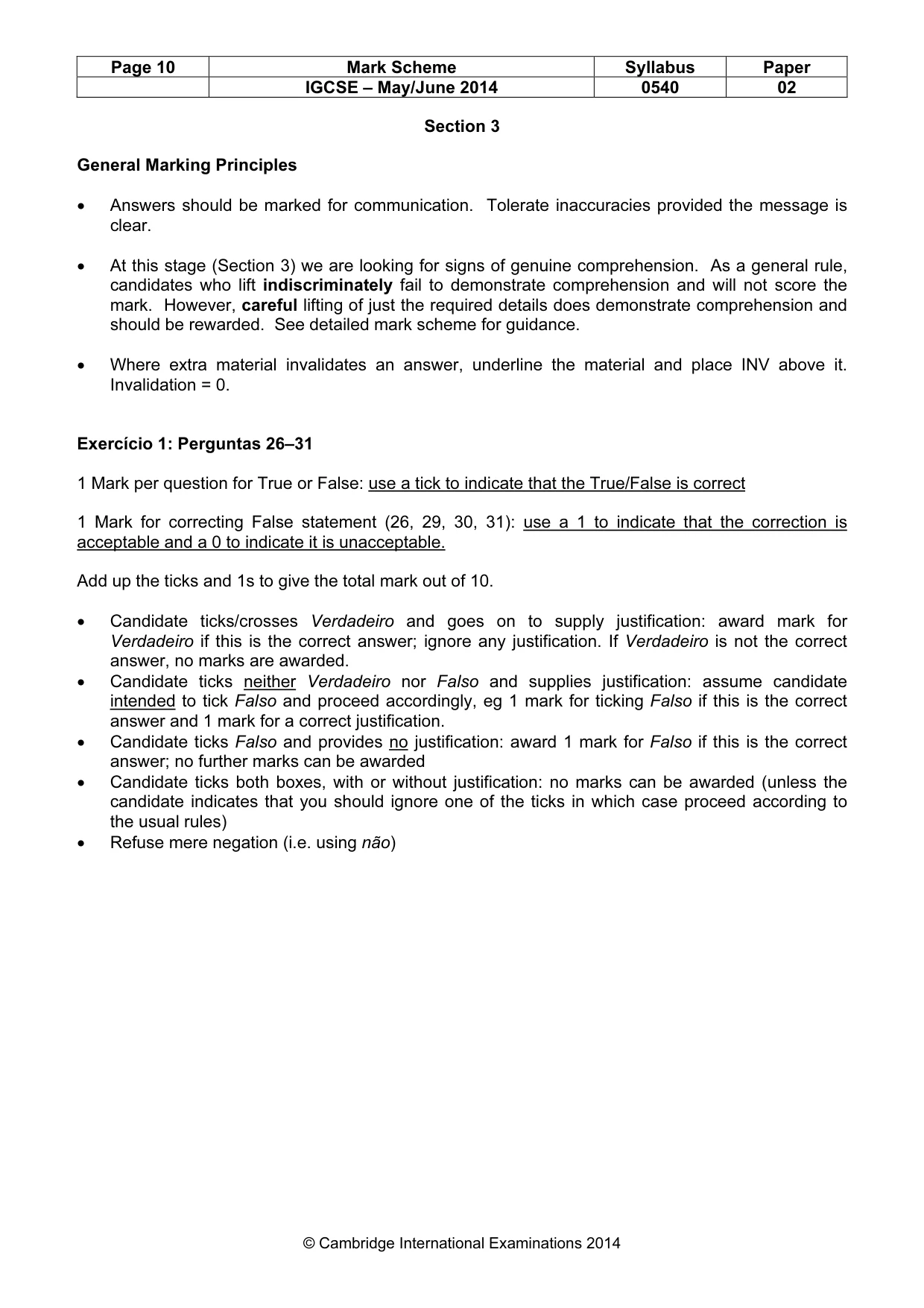
Page 10 Mark Scheme Syllabus Paper IGCSE – May/June 2014 0540 02 © Cambridge International Examinations 2014 Section 3 General Marking Principles • Answers should be marked for communication. Tolerate inaccuracies provided the message is clear. • At this stage (Section 3) we are looking for signs of genuine comprehension. As a general rule, candidates who lift indiscriminately fail to demonstrate comprehension and will not score the mark. However, careful lifting of just the required details does demonstrate comprehension and should be rewarded. See detailed mark scheme for guidance. • Where extra material invalidates an answer, underline the material and place INV above it. Invalidation = 0. Exercício 1: Perguntas 26–31 1 Mark per question for True or False: use a tick to indicate that the True/False is correct 1 Mark for correcting False statement (26, 29, 30, 31): use a 1 to indicate that the correction is acceptable and a 0 to indicate it is unacceptable. Add up the ticks and 1s to give the total mark out of 10. • Candidate ticks/crosses Verdadeiro and goes on to supply justification: award mark for Verdadeiro if this is the correct answer; ignore any justification. If Verdadeiro is not the correct answer, no marks are awarded. • Candidate ticks neither Verdadeiro nor Falso and supplies justification: assume candidate intended to tick Falso and proceed accordingly, eg 1 mark for ticking Falso if this is the correct answer and 1 mark for a correct justification. • Candidate ticks Falso and provides no justification: award 1 mark for Falso if this is the correct answer; no further marks can be awarded • Candidate ticks both boxes, with or without justification: no marks can be awarded (unless the candidate indicates that you should ignore one of the ticks in which case proceed according to the usual rules) • Refuse mere negation (i.e. using não)
Mark scheme, page 11
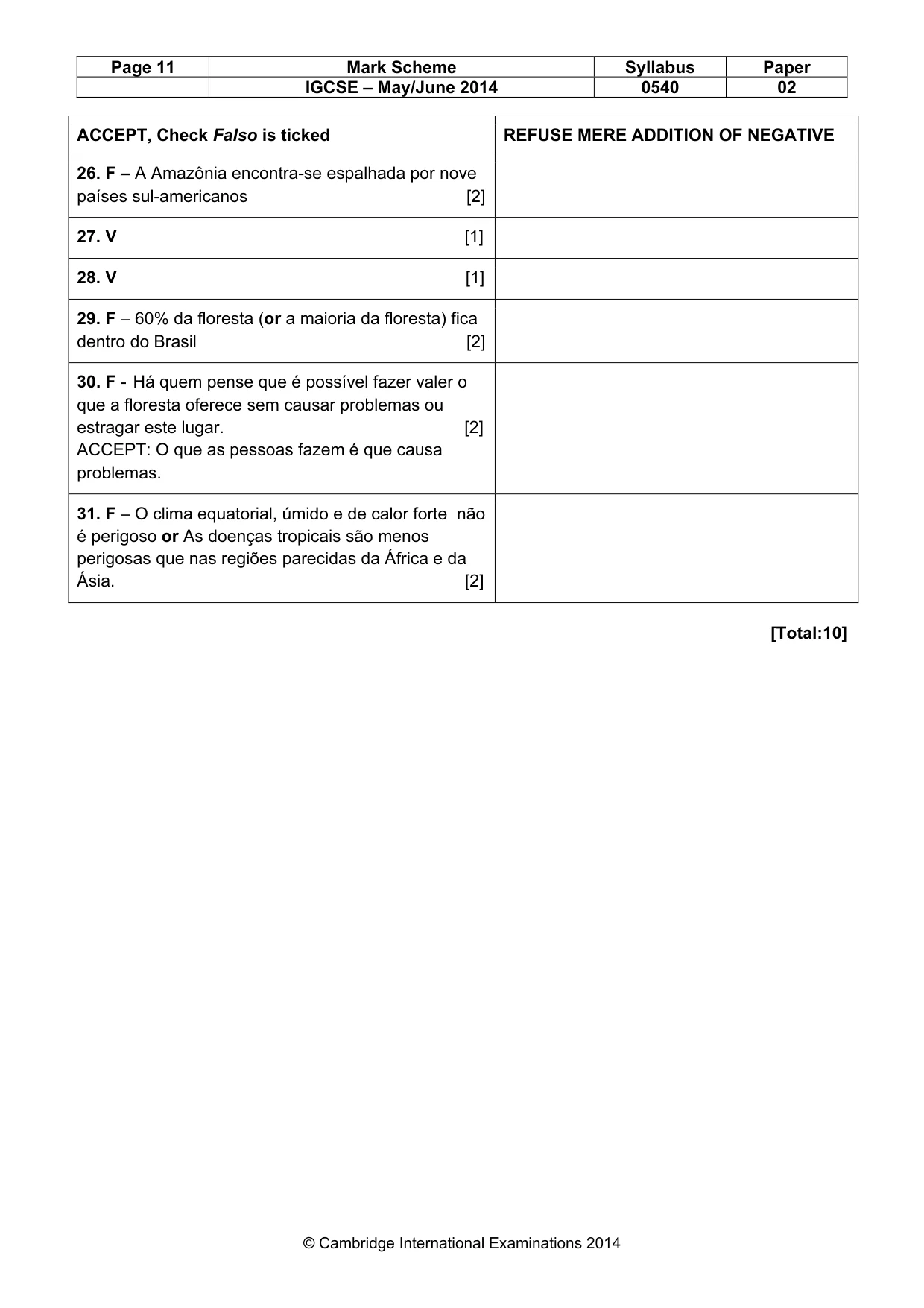
Page 11 Mark Scheme Syllabus Paper IGCSE – May/June 2014 0540 02 © Cambridge International Examinations 2014 ACCEPT, Check Falso is ticked REFUSE MERE ADDITION OF NEGATIVE 26. F – A Amazônia encontra-se espalhada por nove países sul-americanos [2] 27. V [1] 28. V [1] 29. F – 60% da floresta (or a maioria da floresta) fica dentro do Brasil [2] 30. F - Há quem pense que é possível fazer valer o que a floresta oferece sem causar problemas ou estragar este lugar. [2] ACCEPT: O que as pessoas fazem é que causa problemas. 31. F – O clima equatorial, úmido e de calor forte não é perigoso or As doenças tropicais são menos perigosas que nas regiões parecidas da África e da Ásia. [2] [Total:10]
Mark scheme, page 12
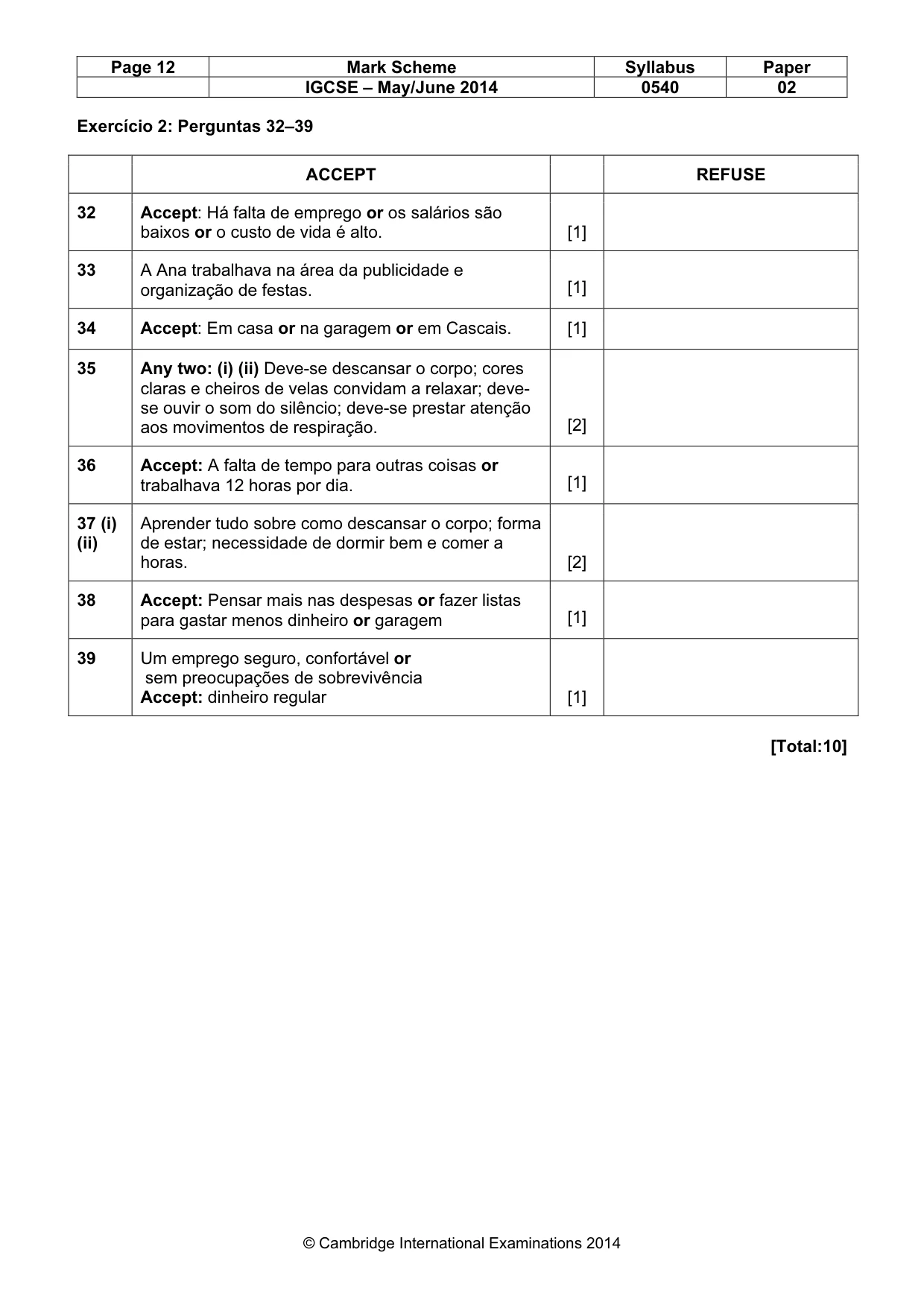
Page 12 Mark Scheme Syllabus Paper IGCSE – May/June 2014 0540 02 © Cambridge International Examinations 2014 Exercício 2: Perguntas 32–39 ACCEPT REFUSE 32 Accept: Há falta de emprego or os salários são baixos or o custo de vida é alto. [1] 33 A Ana trabalhava na área da publicidade e organização de festas. [1] 34 Accept: Em casa or na garagem or em Cascais. [1] 35 Any two: (i) (ii) Deve-se descansar o corpo; cores claras e cheiros de velas convidam a relaxar; deve- se ouvir o som do silêncio; deve-se prestar atenção aos movimentos de respiração. [2] 36 Accept: A falta de tempo para outras coisas or trabalhava 12 horas por dia. [1] 37 (i) (ii) Aprender tudo sobre como descansar o corpo; forma de estar; necessidade de dormir bem e comer a horas. [2] 38 Accept: Pensar mais nas despesas or fazer listas para gastar menos dinheiro or garagem [1] 39 Um emprego seguro, confortável or sem preocupações de sobrevivência Accept: dinheiro regular [1] [Total:10]
What you needed in this session
Cambridge’s own grade thresholds for 2014 May/June, Paper 2 · Variant 1. A higher threshold means an easier paper — the bar moves with how the cohort did.