Cambridge IGCSE Portuguese - Foreign Language 0540 — 2011 May/June Paper 2 · Variant 1
0540/21/M/J/11 · 65 marks · ≈73 min
The question paper and its mark scheme, free to read here and free to download. This is Cambridge’s own paper, exactly as it was sat.
Question paper20 pages






Mark scheme12 pages
Answers below. Sit the paper first if you are practising.
Paper as text
Question paper, page 1
This document consists of 14 printed pages and 6 blank pages. DC (CW/SW) 36309/5 © UCLES 2011 [Turn over UNIVERSITY OF CAMBRIDGE INTERNATIONAL EXAMINATIONS International General Certificate of Secondary Education * 9 0 2 6 1 1 4 8 0 9 * PORTUGUESE 0540/02 Paper 2 Reading and Directed Writing May/June 2011 1 hour 30 minutes Candidates answer on the Question Paper. No Additional Materials are required. READ THESE INSTRUCTIONS FIRST Write your Centre number, candidate number and name on all the work you hand in. Write in dark blue or black pen. Do not use staples, paper clips, highlighters, glue or correction fluid. DO NOT WRITE IN ANY BARCODES. Answer all questions in Section 1, Section 2 and Section 3. At the end of the examination, fasten all your work securely together. The number of marks is given in brackets [ ] at the end of each question or part question. For Examiner’s Use Section 1 Section 2 Section 3 Total www.XtremePapers.com
Question paper, page 2
2 0540/02/M/J/11 © UCLES 2011 BLANK PAGE
Question paper, page 3
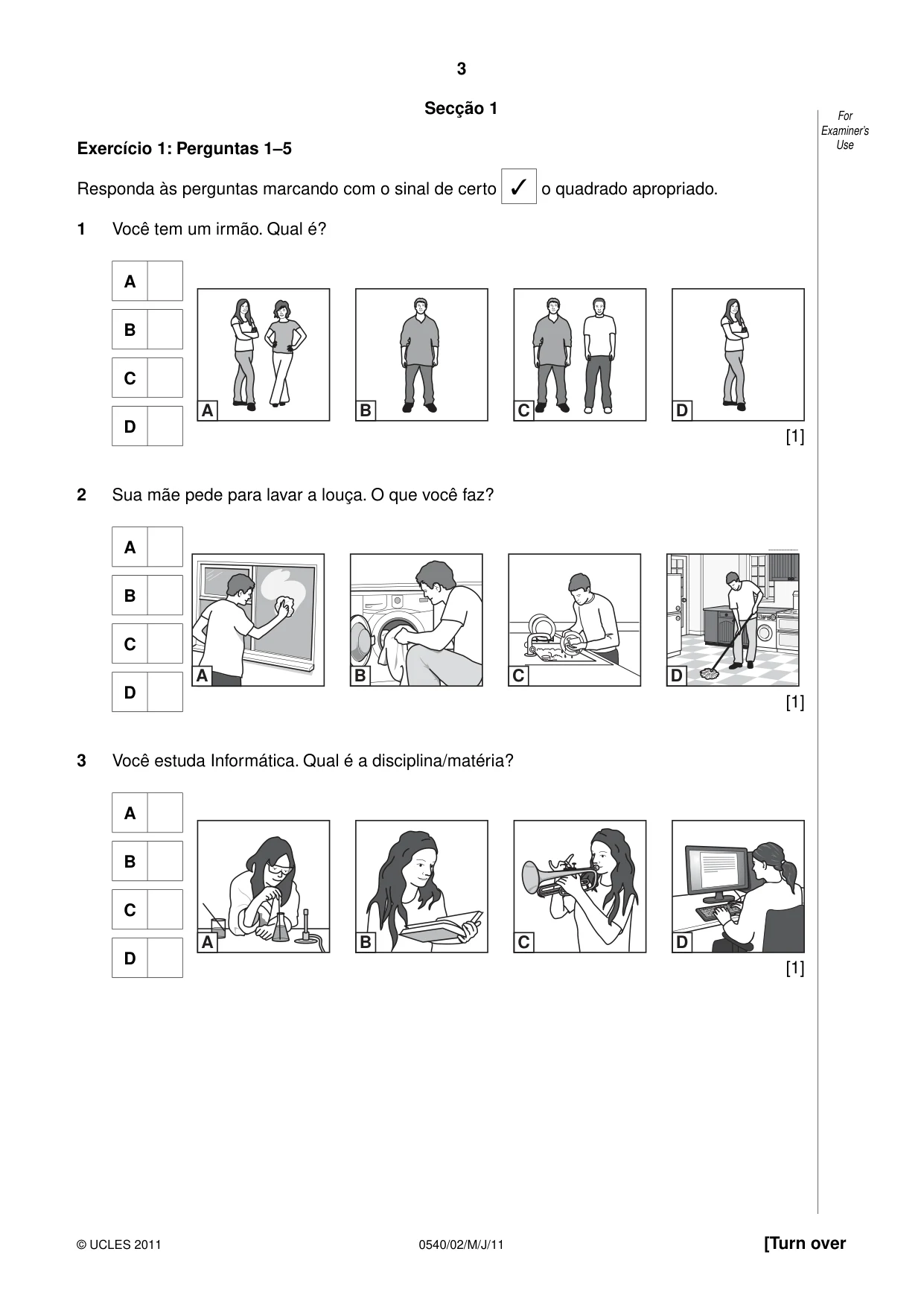
3 0540/02/M/J/11 © UCLES 2011 [Turn over For Examiner’s Use Secção 1 Exercício 1: Perguntas 1–5 Responda às perguntas marcando com o sinal de certo ✓ o quadrado apropriado. 1 Você tem um irmão. Qual é? A A B C D [1] B C D 2 Sua mãe pede para lavar a louça. O que você faz? A A B C D [1] B C D 3 Você estuda Informática. Qual é a disciplina/matéria? A A B C D [1] B C D
Question paper, page 4
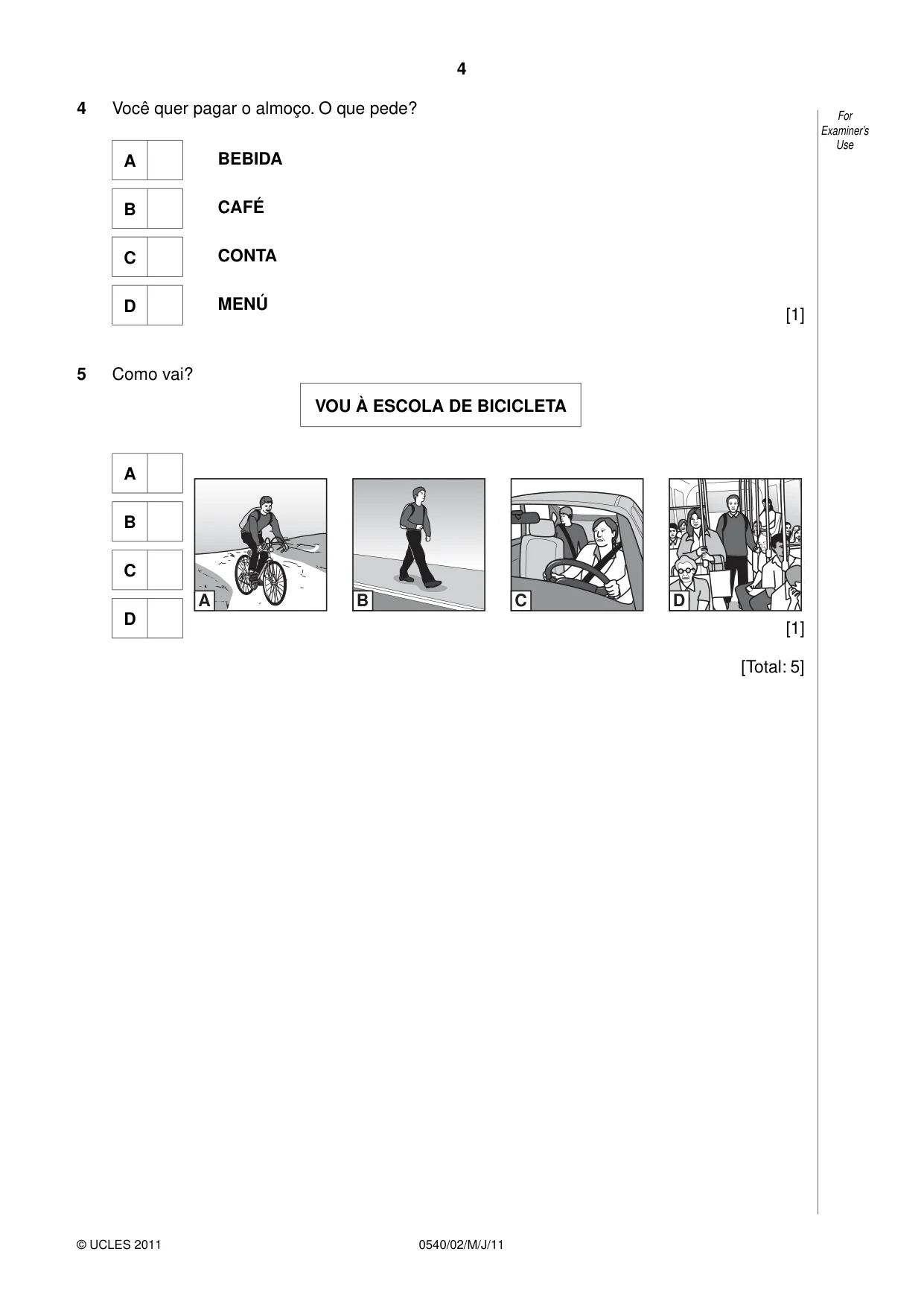
4 0540/02/M/J/11 © UCLES 2011 For Examiner’s Use 4 Você quer pagar o almoço. O que pede? A BEBIDA B CAFÉ C CONTA D MENÚ [1] 5 Como vai? VOU À ESCOLA DE BICICLETA A A B C D [1] B C D [Total: 5]
Question paper, page 5
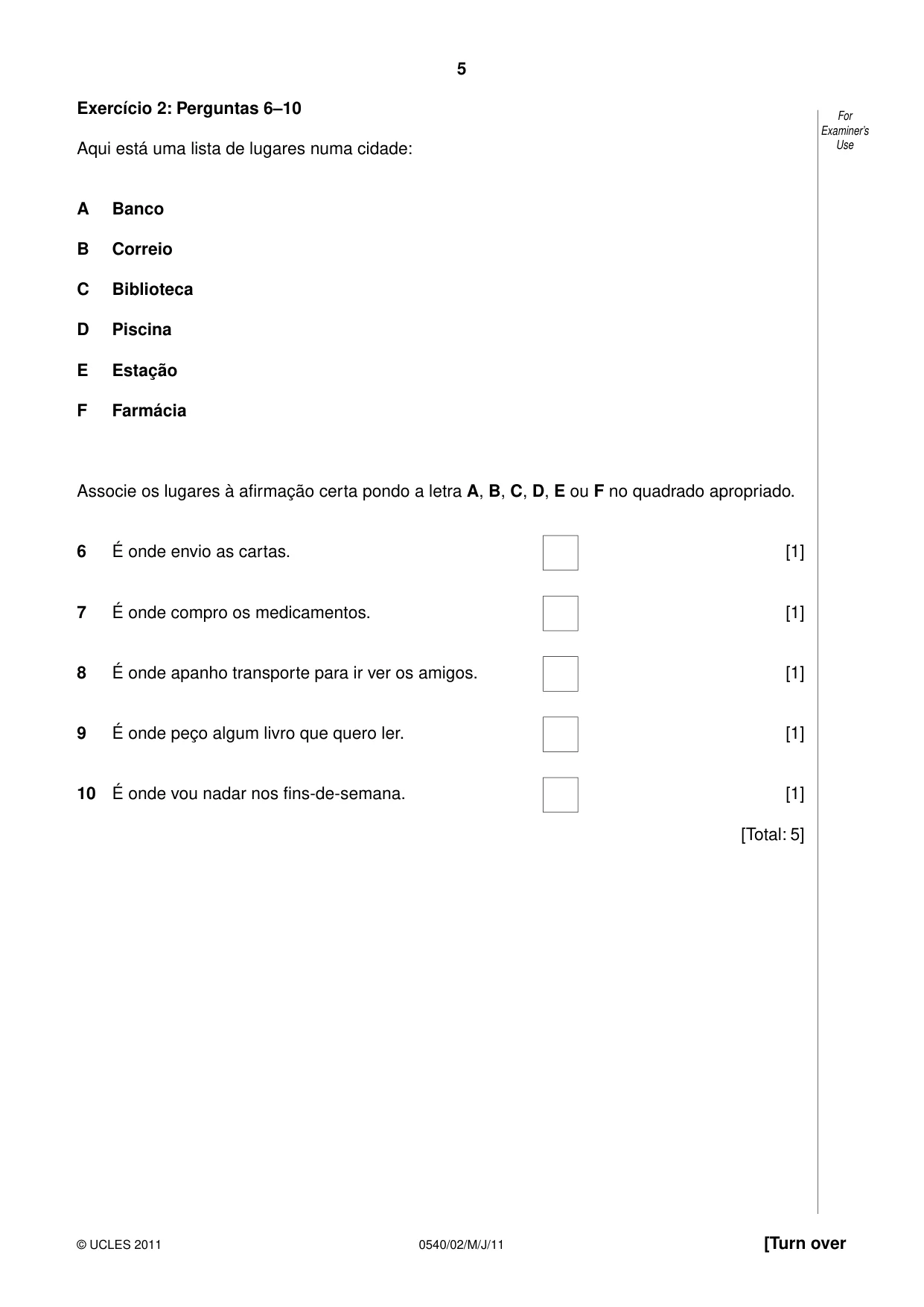
5 0540/02/M/J/11 © UCLES 2011 [Turn over For Examiner’s Use Exercício 2: Perguntas 6–10 Aqui está uma lista de lugares numa cidade: A Banco B Correio C Biblioteca D Piscina E Estação F Farmácia Associe os lugares à afirmação certa pondo a letra A, B, C, D, E ou F no quadrado apropriado. 6 É onde envio as cartas. [1] 7 É onde compro os medicamentos. [1] 8 É onde apanho transporte para ir ver os amigos. [1] 9 É onde peço algum livro que quero ler. [1] 10 É onde vou nadar nos fins-de-semana. [1] [Total: 5]
Question paper, page 6
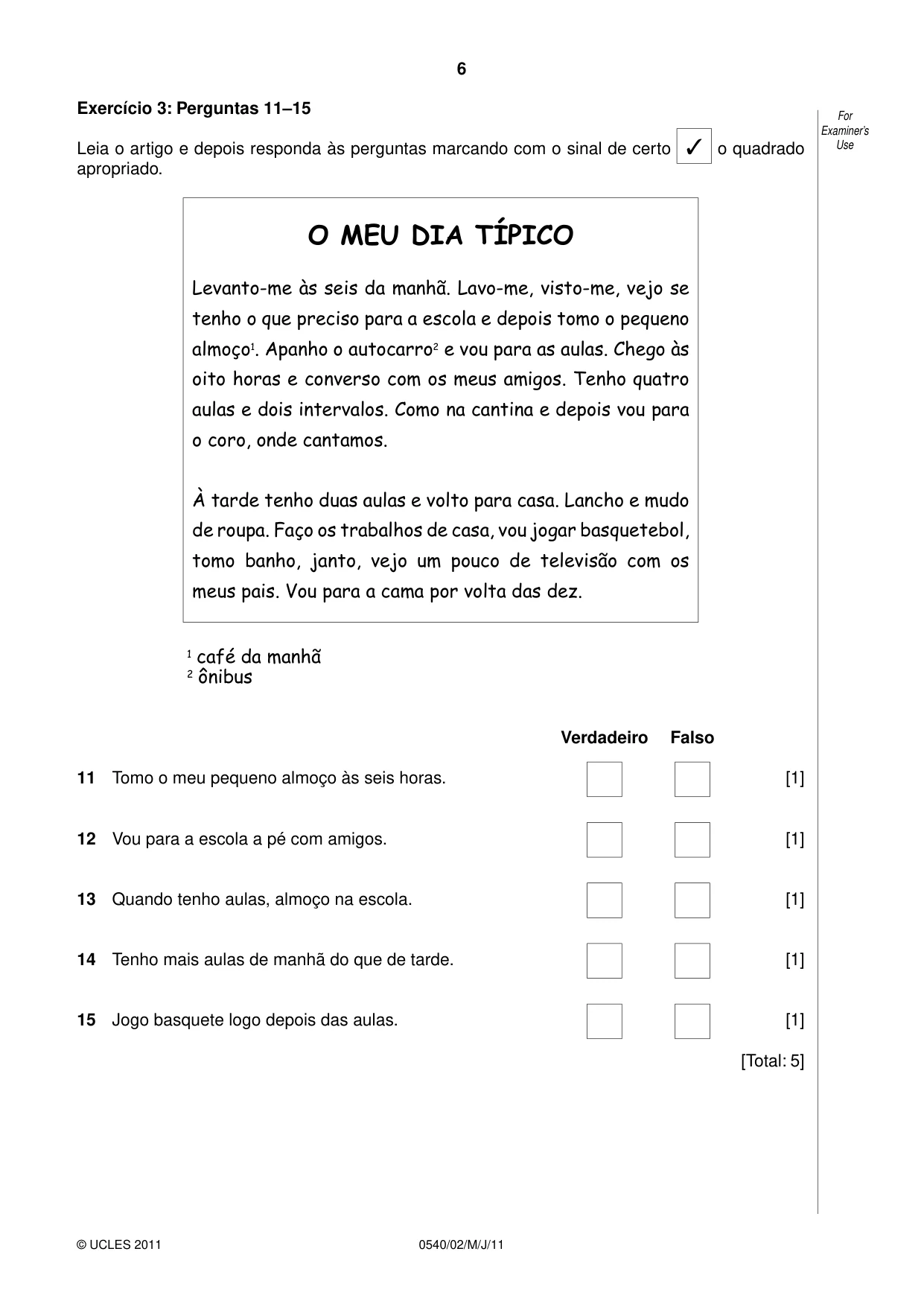
6 0540/02/M/J/11 © UCLES 2011 For Examiner’s Use Exercício 3: Perguntas 11–15 Leia o artigo e depois responda às perguntas marcando com o sinal de certo ✓ o quadrado apropriado. O MEU DIA TÍPICO Levanto-me às seis da manhã. Lavo-me, visto-me, vejo se tenho o que preciso para a escola e depois tomo o pequeno almoço1. Apanho o autocarro2 e vou para as aulas. Chego às oito horas e converso com os meus amigos. Tenho quatro aulas e dois intervalos. Como na cantina e depois vou para o coro, onde cantamos. À tarde tenho duas aulas e volto para casa. Lancho e mudo de roupa. Faço os trabalhos de casa, vou jogar basquetebol, tomo banho, janto, vejo um pouco de televisão com os meus pais. Vou para a cama por volta das dez. 1 café da manhã 2 ônibus Verdadeiro Falso 11 Tomo o meu pequeno almoço às seis horas. [1] 12 Vou para a escola a pé com amigos. [1] 13 Quando tenho aulas, almoço na escola. [1] 14 Tenho mais aulas de manhã do que de tarde. [1] 15 Jogo basquete logo depois das aulas. [1] [Total: 5]
Question paper, page 7
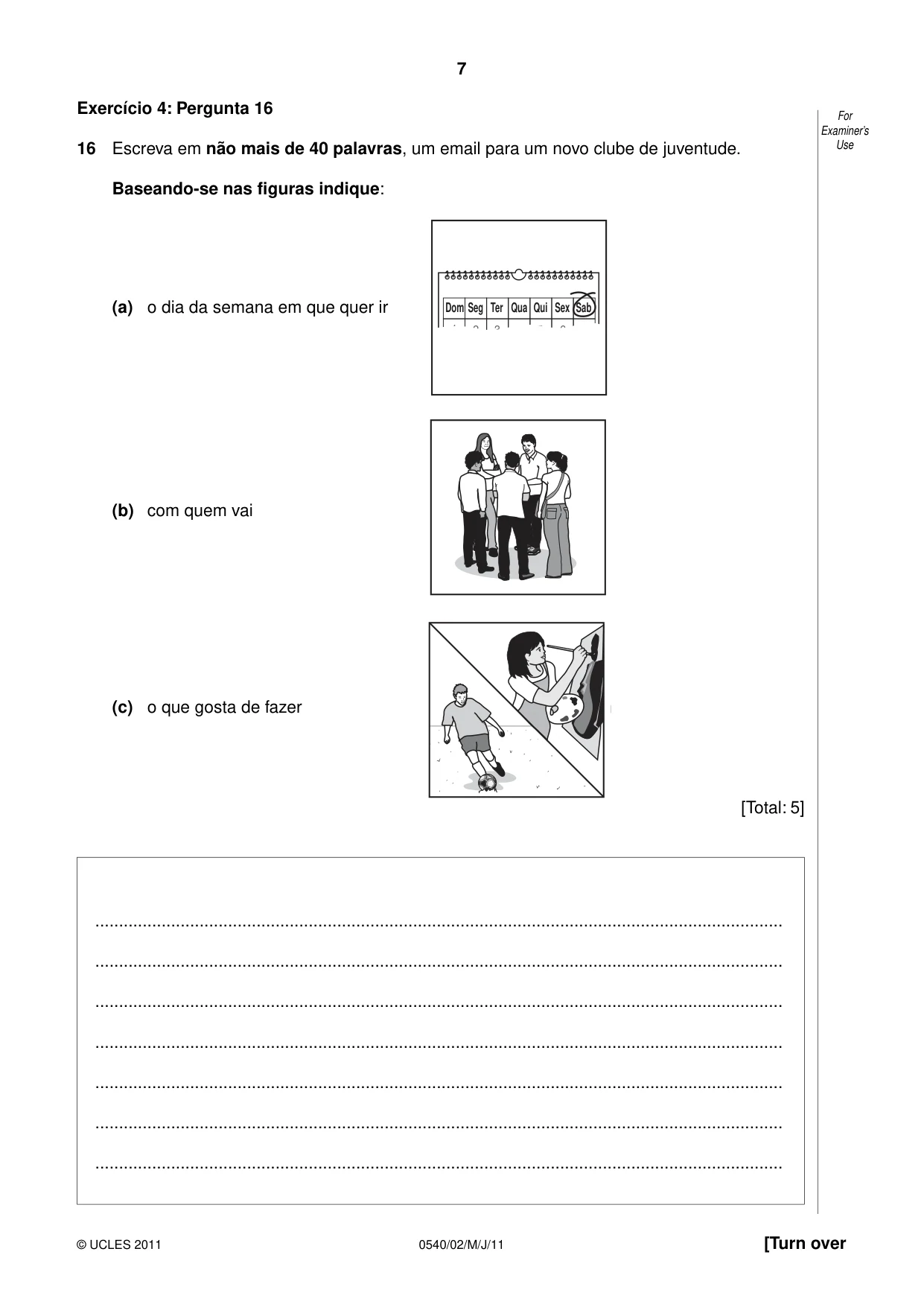
7 0540/02/M/J/11 © UCLES 2011 [Turn over For Examiner’s Use Exercício 4: Pergunta 16 16 Escreva em não mais de 40 palavras, um email para um novo clube de juventude. Baseando-se nas figuras indique: (a) o dia da semana em que quer ir Dom Seg Ter Qua Qui Sex Sab (b) com quem vai (c) o que gosta de fazer [Total: 5] … … … … … … …
Question paper, page 8
8 0540/02/M/J/11 © UCLES 2011 For Examiner’s Use Secção 2 Exercício 1: Perguntas 17–25 Leia o artigo e depois responda às perguntas em português. OS SANTOS POPULARES Em Junho por todo o Portugal e em muitas partes do Brasil, celebram-se três grandes santos populares: Santo António, S. João e S. Pedro. Estes três santos são celebrados de modo parecido. Os dois primeiros santos têm fama de arranjar casamentos e há muitas lendas associadas a eles. As celebrações começam sempre na noite anterior e continuam até bem tarde. Há festas e música nas ruas, dança-se e há muita alegria. Em Lisboa, Santo António é celebrado de uma forma muito especial. Tudo se passa no bairro onde o santo nasceu. Este lugar antigo e histórico recebe muitos visitantes. Os seus moradores aproveitam o mais pequeno espaço para receber os turistas prontos a pagar uma quantia excessiva por um simples jantar de sardinhas assadas e vinho. O momento mais importante da noite são as Marchas Populares. Também no Porto e no Brasil, se comemora o S. João em grande. No Nordeste do Brasil as festas duram todo o mês de Junho. Campina Grande diz ter o maior S. João do mundo. 17 Segundo o texto o que acontece em Junho? …[1] 18 Mencione um dos santos que ajuda os namorados. …[1] 19 Quando começam as celebrações? …[1] 20 Mencione dois dos modos como as pessoas festejam os santos. (i) …[1] (ii) …[1] 21 Em que parte de Lisboa acontecem estas celebrações? …[1]
Question paper, page 9
9 0540/02/M/J/11 © UCLES 2011 [Turn over For Examiner’s Use 22 O que é que os residentes da zona fazem quando há estas festas? …[1] 23 O que comem os visitantes? …[1] 24 Em Lisboa, o que é que os turistas gostam mais de ver nesta noite? …[1] 25 O que pensam os brasileiros de Campina Grande, sobre o S. João? …[1] [Total: 10]
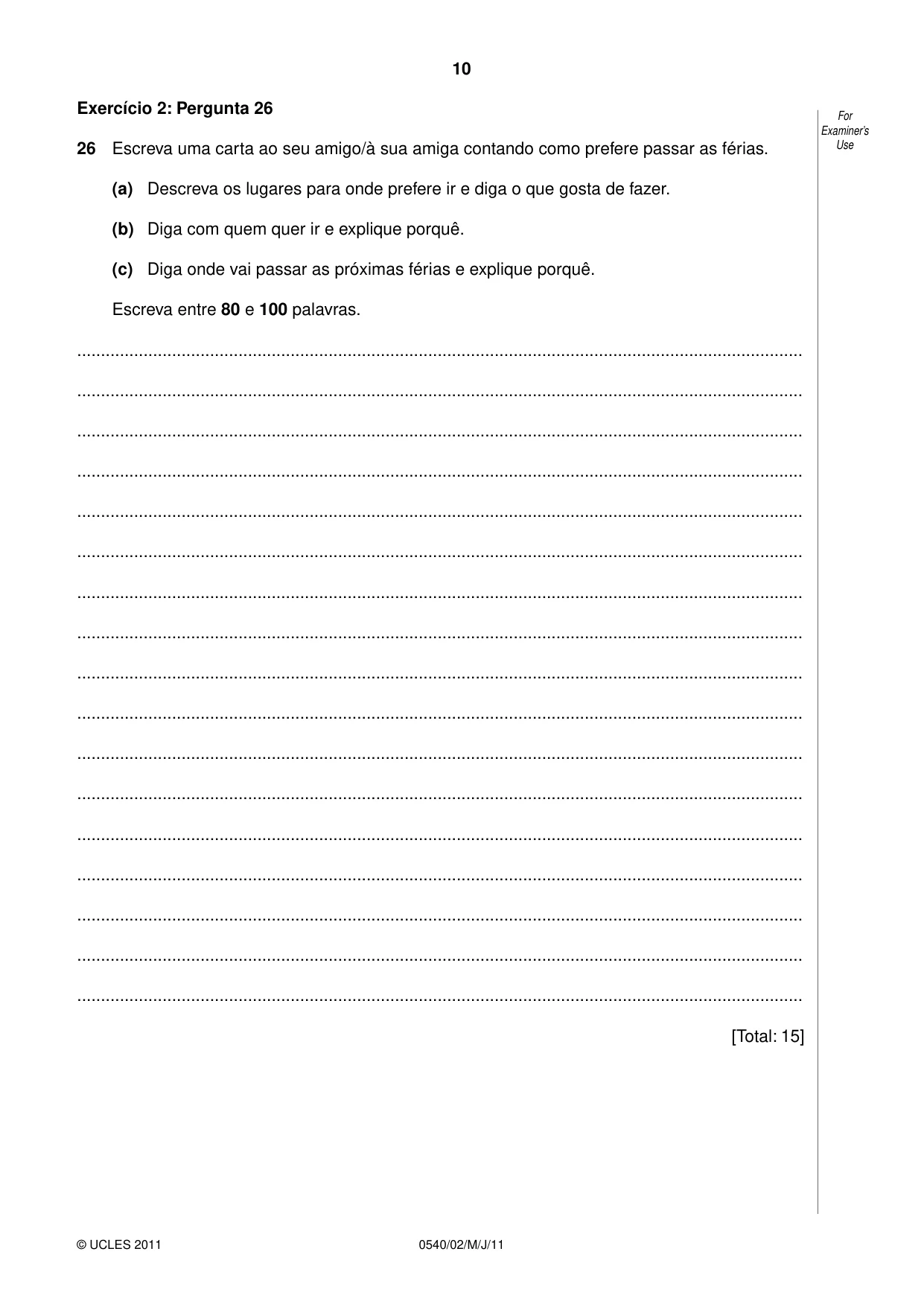
Question paper, page 10
10 0540/02/M/J/11 © UCLES 2011 For Examiner’s Use Exercício 2: Pergunta 26 26 Escreva uma carta ao seu amigo/à sua amiga contando como prefere passar as férias. (a) Descreva os lugares para onde prefere ir e diga o que gosta de fazer. (b) Diga com quem quer ir e explique porquê. (c) Diga onde vai passar as próximas férias e explique porquê. Escreva entre 80 e 100 palavras. … … … … … … … … … … … … … … … … … [Total: 15]
Question paper, page 11
11 0540/02/M/J/11 © UCLES 2011 [Turn over BLANK PAGE VIRE PARA A SECÇÃO 3
Question paper, page 12
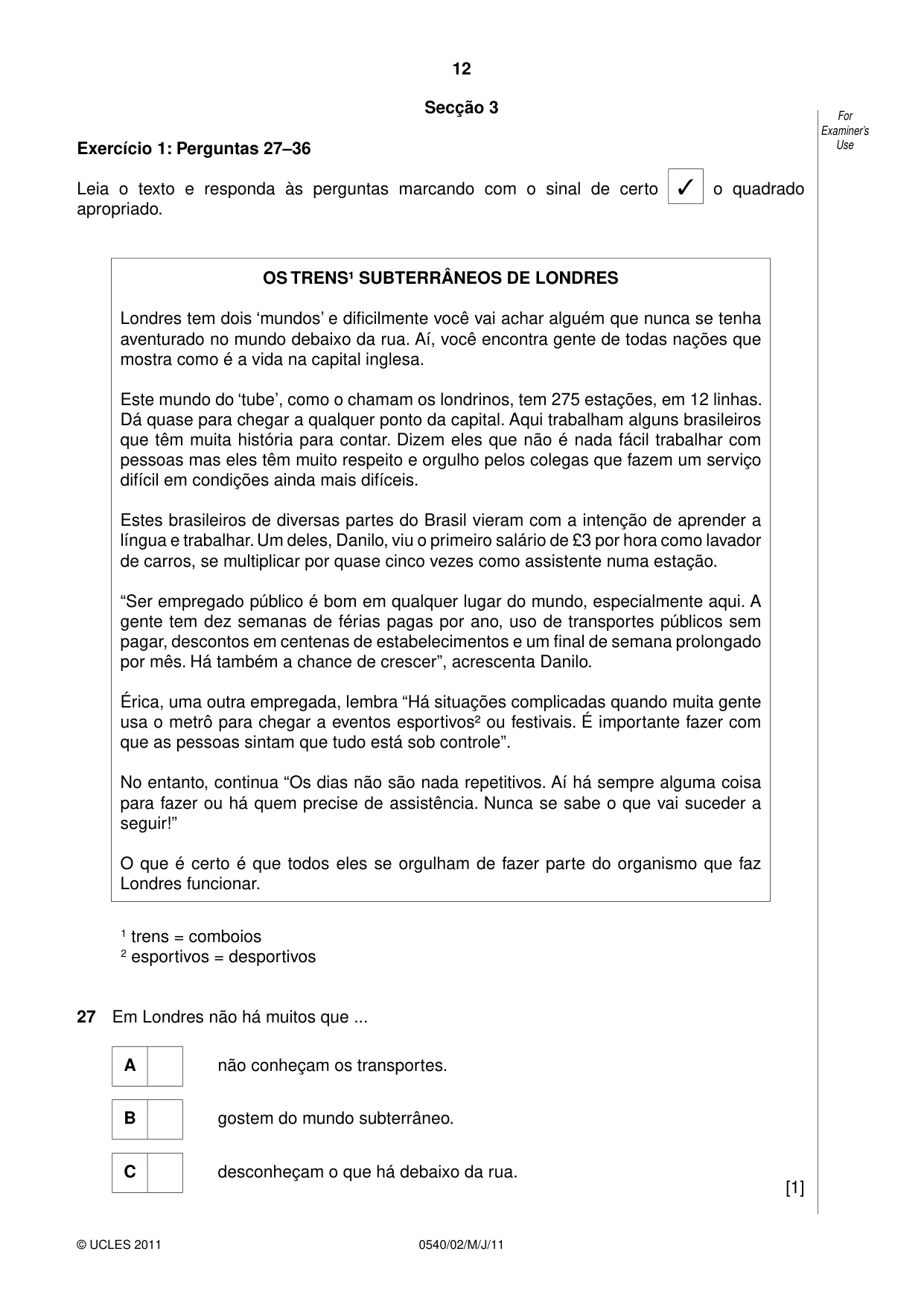
12 0540/02/M/J/11 © UCLES 2011 For Examiner’s Use Secção 3 Exercício 1: Perguntas 27–36 Leia o texto e responda às perguntas marcando com o sinal de certo ✓ o quadrado apropriado. OS TRENS¹ SUBTERRÂNEOS DE LONDRES Londres tem dois ‘mundos’ e dificilmente você vai achar alguém que nunca se tenha aventurado no mundo debaixo da rua. Aí, você encontra gente de todas nações que mostra como é a vida na capital inglesa. Este mundo do ‘tube’, como o chamam os londrinos, tem 275 estações, em 12 linhas. Dá quase para chegar a qualquer ponto da capital. Aqui trabalham alguns brasileiros que têm muita história para contar. Dizem eles que não é nada fácil trabalhar com pessoas mas eles têm muito respeito e orgulho pelos colegas que fazem um serviço difícil em condições ainda mais difíceis. Estes brasileiros de diversas partes do Brasil vieram com a intenção de aprender a língua e trabalhar. Um deles, Danilo, viu o primeiro salário de £3 por hora como lavador de carros, se multiplicar por quase cinco vezes como assistente numa estação. “Ser empregado público é bom em qualquer lugar do mundo, especialmente aqui. A gente tem dez semanas de férias pagas por ano, uso de transportes públicos sem pagar, descontos em centenas de estabelecimentos e um final de semana prolongado por mês. Há também a chance de crescer”, acrescenta Danilo. Érica, uma outra empregada, lembra “Há situações complicadas quando muita gente usa o metrô para chegar a eventos esportivos² ou festivais. É importante fazer com que as pessoas sintam que tudo está sob controle”. No entanto, continua “Os dias não são nada repetitivos. Aí há sempre alguma coisa para fazer ou há quem precise de assistência. Nunca se sabe o que vai suceder a seguir!” O que é certo é que todos eles se orgulham de fazer parte do organismo que faz Londres funcionar. 1 trens = comboios 2 esportivos = desportivos 27 Em Londres não há muitos que ... A não conheçam os transportes. B gostem do mundo subterrâneo. C desconheçam o que há debaixo da rua. [1]
Question paper, page 13
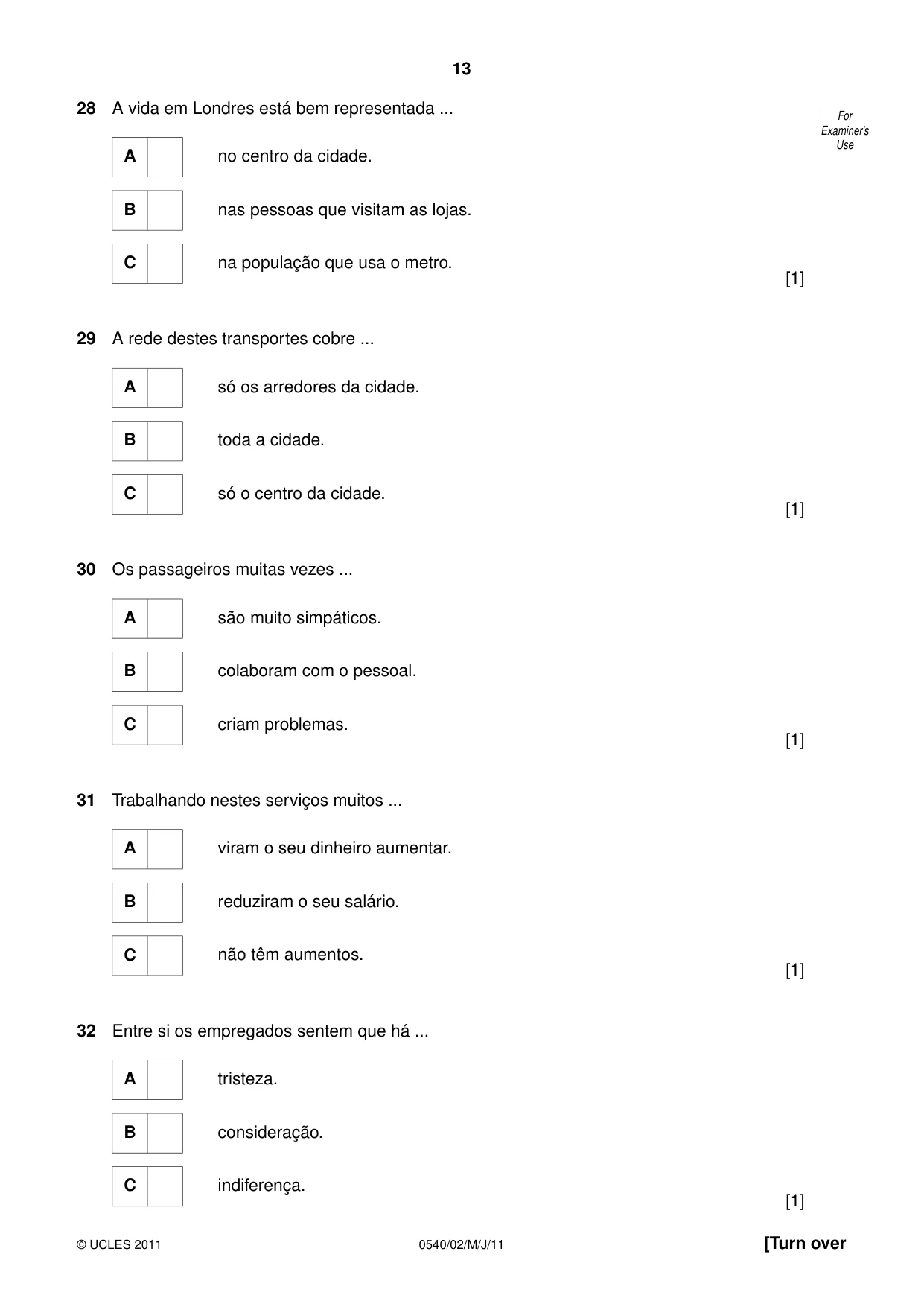
13 0540/02/M/J/11 © UCLES 2011 [Turn over For Examiner’s Use 28 A vida em Londres está bem representada ... A no centro da cidade. B nas pessoas que visitam as lojas. C na população que usa o metro. [1] 29 A rede destes transportes cobre ... A só os arredores da cidade. B toda a cidade. C só o centro da cidade. [1] 30 Os passageiros muitas vezes ... A são muito simpáticos. B colaboram com o pessoal. C criam problemas. [1] 31 Trabalhando nestes serviços muitos ... A viram o seu dinheiro aumentar. B reduziram o seu salário. C não têm aumentos. [1] 32 Entre si os empregados sentem que há ... A tristeza. B consideração. C indiferença. [1]
Question paper, page 14
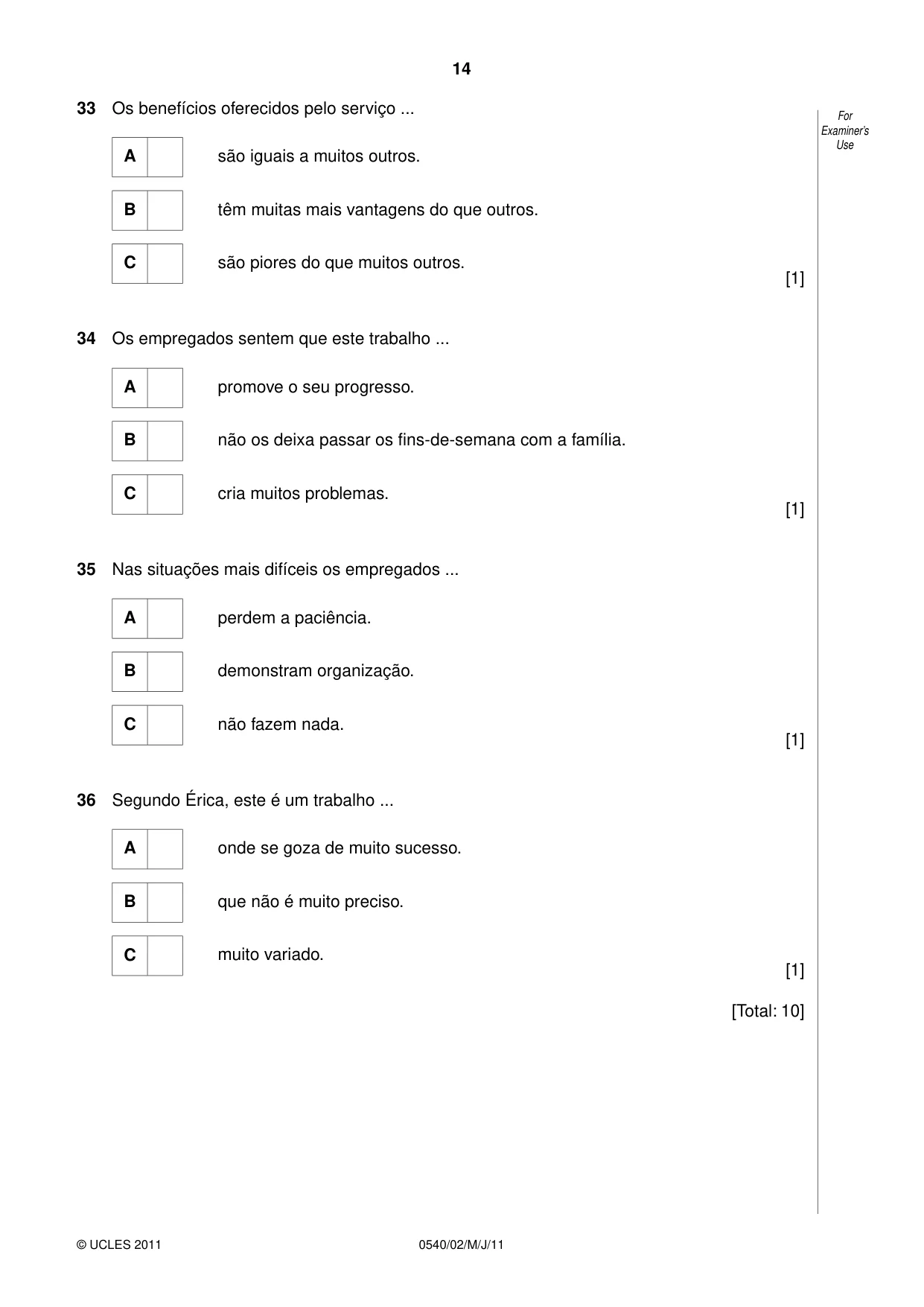
14 0540/02/M/J/11 © UCLES 2011 For Examiner’s Use 33 Os benefícios oferecidos pelo serviço ... A são iguais a muitos outros. B têm muitas mais vantagens do que outros. C são piores do que muitos outros. [1] 34 Os empregados sentem que este trabalho ... A promove o seu progresso. B não os deixa passar os fins-de-semana com a família. C cria muitos problemas. [1] 35 Nas situações mais difíceis os empregados ... A perdem a paciência. B demonstram organização. C não fazem nada. [1] 36 Segundo Érica, este é um trabalho ... A onde se goza de muito sucesso. B que não é muito preciso. C muito variado. [1] [Total: 10]
Question paper, page 15
15 0540/02/M/J/11 © UCLES 2011 [Turn over BLANK PAGE VIRE PARA O EXERCÍCIO 2
Question paper, page 16
16 0540/02/M/J/11 © UCLES 2011 For Examiner’s Use Exercício 2: Perguntas 37–44 Leia o texto e depois responda às perguntas em português. FÉRIAS ESPECTACULARES PARA TODOS Um amigo meu falou-me nas actividades que teve nas férias de Verão, organizadas pela Câmara Municipal da área onde vive, sob o tema “Direitos Humanos”. Tudo organizado em conjunto com a escola, pais e outras organizações juvenis. Houve campos de férias para as crianças de famílias mais necessitadas e para promover o crescimento dessas crianças e a sua inclusão na sociedade. Tiveram dias na praia e na piscina, passeios, jogos, desporto1, internet, culinária, ciência e muitas outras actividades. Estas actividades ajudaram os jovens a serem activos, criativos e a melhorarem-se como pessoas e cidadãos enquanto se divertiam e aprendiam. Todas as crianças, mesmo com necessidades especiais e deficiências motoras, estavam em equipas mistas que permitiam o convívio de todos. As crianças com necessidades tiveram acompanhamento individualizado por parte de formadores de educação especial e de instrutores com formação especializada. Na área do ambiente, fizeram caminhadas, limpeza e conversaram com as pessoas sobre a importância dos cuidados com o ambiente. Quanto ao desporto praticaram diversas tipos em vários espaços desportivos2. Na praia, consoante as possibilidades de cada um, fizeram jogos tradicionais e de equipa, capoeira3, ténis, surf, natação adaptada às suas capacidades e outras actividades aquáticas. Todas as crianças também aprenderam a tocar a guitarra clássica e o cavaquinho4, entraram no mundo do teatro, da magia e da moda, coisas que nunca sonhariam fazer se não tivesse havido este programa. A biblioteca motivou a leitura, a hora do conto e o ciclo de cinema. Na Informática aprenderam o processamento do texto e ainda houve espaço para a brincadeira e divertimento na internet. Foram umas férias espectaculares para todos! 1 desporto = esporte 2 desportivos = esportivos 3 capoeira = jogo brasileiro que combina dança e luta 4 cavaquinho = instrumento musical
Question paper, page 17
17 0540/02/M/J/11 © UCLES 2011 For Examiner’s Use 37 Qual foi o tema da conversa entre os amigos? …[1] 38 O que é que os campos de férias promoveram? Mencione duas coisas. … …[2] 39 Para além de se divertirem, o que é que os jovens aprenderam, segundo parágrafo 2? Dê um exemplo. …[1] 40 As crianças com dificuldades foram ajudadas. Mencione dois modos como isso foi possível. (i) …[1] (ii) …[1] 41 Qual foi a contribuição dos jovens na preservação do ambiente? Dê um exemplo. …[1] 42 Como é que todos puderam participar nos desportos na praia? …[1] 43 Sem este convívio, como poderiam estes jovens fazer actividades parecidas? …[1] 44 O que é que puderam fazer os jovens na classe de Informatica? Mencione uma actividade. …[1] [Total: 10]
Question paper, page 18
18 0540/02/M/J/11 © UCLES 2011 BLANK PAGE
Question paper, page 19
19 0540/02/M/J/11 © UCLES 2011 BLANK PAGE
Question paper, page 20
20 0540/02/M/J/11 © UCLES 2011 BLANK PAGE Copyright Acknowledgements: Section 3 Exercise 1 © adapted – Dayane Garcia; Mind the Gap! Real – Revista com contecido; No. 82, October 2009; www.revistareal.com. Section 3 Exercise 2 © adapted – Seixal; No. 510; 4 September 2009; www.cm-seixal.pt. Permission to reproduce items where third-party owned material protected by copyright is included has been sought and cleared where possible. Every reasonable effort has been made by the publisher (UCLES) to trace copyright holders, but if any items requiring clearance have unwittingly been included, the publisher will be pleased to make amends at the earliest possible opportunity. University of Cambridge International Examinations is part of the Cambridge Assessment Group. Cambridge Assessment is the brand name of University of Cambridge Local Examinations Syndicate (UCLES), which is itself a department of the University of Cambridge.
Mark scheme, page 1
UNIVERSITY OF CAMBRIDGE INTERNATIONAL EXAMINATIONS International General Certificate of Secondary Education MARK SCHEME for the May/June 2011 question paper for the guidance of teachers 0540 PORTUGUESE (FOREIGN LANGUAGE) 0540/02 Paper 2 (Reading and Directed Writing), maximum raw mark 65 This mark scheme is published as an aid to teachers and candidates, to indicate the requirements of the examination. It shows the basis on which Examiners were instructed to award marks. It does not indicate the details of the discussions that took place at an Examiners’ meeting before marking began, which would have considered the acceptability of alternative answers. Mark schemes must be read in conjunction with the question papers and the report on the examination. • Cambridge will not enter into discussions or correspondence in connection with these mark schemes. Cambridge is publishing the mark schemes for the May/June 2011 question papers for most IGCSE, GCE Advanced Level and Advanced Subsidiary Level syllabuses and some Ordinary Level syllabuses. www.XtremePapers.com
Mark scheme, page 2
Page 2 Mark Scheme: Teachers’ version Syllabus Paper IGCSE – May/June 2011 0540 02 © University of Cambridge International Examinations 2011 The following structure should be adopted for IGCSE Foreign Language Reading & Directed Writing Mark Schemes to ensure that Examiners across languages follow a common approach in cases where the nature of the language makes it appropriate. Section 1 General Marking Principles contains the underlying principles that inform the decisions taken by Senior Examiners (including Single Examiners) when they prepare the Detailed Mark Scheme. These principles also provide Assistant Examiners with a set of ‘rules’ to apply when making decisions on answers not covered by the Detailed Mark Scheme, for which they have to use their judgement. Section 2 contains the session-specific Detailed Mark Scheme.
Mark scheme, page 3
Page 3 Mark Scheme: Teachers’ version Syllabus Paper IGCSE – May/June 2011 0540 02 © University of Cambridge International Examinations 2011 1 General Marking Principles 1.1 Please note that it is not possible to list all acceptable alternatives in the Detailed Mark Scheme provided in Section 2. The Examiner will need to consider all alternative answers and unexpected approaches in candidates’ scripts, make a decision on whether they communicate the required elements, in consultation with the Product Manager if necessary, and award marks accordingly. The following marking principles underpin the detailed instructions provided in Section 3 of the Mark Scheme. Where a decision is taken to deviate from these principles for a particular question, this will be specified in the Mark Scheme. 1.2 Crossing out (a) If a candidate changes his / her mind over an answer and crosses out an attempt, a mark is awarded if the final attempt is correct. (b) If a candidate crosses out an answer to a whole question but makes no second attempt at it, the crossed out work should be marked. 1.3 Reading tasks: more than the stipulated number of boxes ticked / crossed by the candidate: (a) If more than one attempt is visible, but the candidate has clearly indicated which attempt is his / her final answer (e.g. by crossing out other attempts of by annotating the script in some way), this is marked in the usual way. (b) If two attempts are visible (e.g. two boxes ticked instead of the one box stipulated), and neither has been crossed out / discounted by the candidate, no mark can be awarded. (c) In questions where candidates are required to tick a number of boxes (e.g. tick the 6 true statements) the general rule to be applied is as follows: the number of ‘extra’ answers indicated by the candidate is deducted from the number of correct answers and the remaining number is the mark awarded, e.g. the candidate is required to tick 6 true statements, but instead ticks 8 statements. 5 of the 6 ticks are correctly placed, but 2 of the ticks are ‘extras’ (8 ticks placed by candidates minus 6 ticks required by rubric = 2). Therefore the candidate is awarded a mark of 3. 5 number of correct ticks –2 minus number of extra ticks = 3 (d) Answers in pen do not take precedent over answers in pencil, e.g. if a candidate is asked to tick one box and ticks two, one in pen and the other in pencil, the mark cannot be awarded unless there is some explicit indication from the candidate as to which is his / her final answer. 1.4 Reading tasks: for questions requiring more than one element for the answer, (i) and (ii), where the answers are interchangeable: Both correct answers on line 1 and line 2 blank = 2 Both correct answers on line 1 and line 2 wrong = 1 (or vice-versa)
Mark scheme, page 4
Page 4 Mark Scheme: Teachers’ version Syllabus Paper IGCSE – May/June 2011 0540 02 © University of Cambridge International Examinations 2011 1.5 Reading tasks: answers requiring the use of Portuguese (rather than a non-verbal response) should be marked for communication. Tolerate inaccuracies provided the message is clear. (a) ‘If in doubt, sound it out’: if you read what the candidate has written, does it sound like the correct answer? (b) Look-alike test: does what the candidate has written look like the correct answer? (c) Accept incorrect gender or person unless Mark Scheme specifies otherwise. (d) Accept incorrect possessive adjectives e.g. meu, teu, seu etc, unless Mark Scheme specifies otherwise (in general, Section 2 accept, Section 3 consult Mark Scheme carefully). 1.6 Unless the Mark Scheme specifies otherwise, do not accept incorrect Portuguese if the word given means something else in Portuguese. (Incorrect Portuguese which constitutes a word in any language other than Portuguese is marked (i) on the basis of whether it is accepted or refused in the Mark Scheme and (ii) if not mentioned in the Mark Scheme, on the basis of 1.5 above). 1.7 Annotation used in the Mark Scheme: (a) INV = Invalidation and is used when additional material included by the candidate is judged to invalidate an otherwise correct answer thus preventing him / her from scoring the mark (INV = 0). (b) tc = ‘tout court’ and means that on its own the material is not sufficient to score the mark. (c) HA = harmless additional material which in conjunction with the correct answer does not prevent the candidate from scoring the mark. (d) BOD = Benefit of the Doubt and is used to indicate material considered by the Examiner and judged to be more correct than incorrect: the benefit of the doubt is given to the candidate and the mark is awarded. 1.8 No response and ‘0’ marks There is a NR (NO response) option in scoris. Award NR (No Response): • If there is nothing written at all in the answer space or • If there is only a comment which does not in any way relate to the question being asked (e.g. ‘can’t do’ or ‘don’t know’) or • If there is only a mark which isn’t an attempt at the question (e.g. a dash, a question mark). Award 0: • If there is any attempt that earns no credit. This could, for example, include the candidate copying all or some of the question, or any working that does not earn any marks, whether crossed out or not.
Mark scheme, page 5
Page 5 Mark Scheme: Teachers’ version Syllabus Paper IGCSE – May/June 2011 0540 02 © University of Cambridge International Examinations 2011 1.9 Extra material: Section 2, Exercise 1 In Section 2, Exercise 1, the candidate is rewarded for being able to locate the answer in the passage. Do not worry about lifting unless this would cause the message to be seriously distorted (in general, incorrect possessives should not be judged to cause distortion: see 1.5(d)) – in which case a lift will be specifically rejected in the Mark Scheme. Ignore extra material given in an answer providing that it does not invalidate an answer.
Mark scheme, page 6
Page 6 Mark Scheme: Teachers’ version Syllabus Paper IGCSE – May/June 2011 0540 02 © University of Cambridge International Examinations 2011 1.10 Extra material: Section 3 In Section 3 it is the candidate’s responsibility to answer questions in such a way as to demonstrate to the Examiner that s/he has understood the texts / questions. Where candidates introduce extra, irrelevant material to an otherwise correct answer the danger is that the Examiner is being forced to ‘choose’ the correct answer and s/he cannot be certain that the candidate has shown understanding. Where the Examiner is put in this position the mark cannot be awarded. In Section 3 the Examiner looks for signs of genuine comprehension. Usually, candidates who lift indiscriminately fail to demonstrate comprehension and will not score the mark. However, careful lifting of the details required to answer the question does demonstrate comprehension and should be rewarded. The Detailed Mark Scheme (Section (c)) provides specific guidance but in cases not covered, the following general rules apply: (a) Extra material, mentioned in the Mark Scheme, which reinforces the correct answer or in itself constitutes an alternative correct answer: this is acceptable and is not penalised (b) Extra material which constitutes an alternative answer, but which is not explicitly mentioned in the Mark Scheme: the Examiner needs to decide, by consulting the text and the Product Manager if necessary, whether the alternative answer constitutes: (i) an alternative correct answer, in which case this falls into category (a) and the answer should be rewarded (ii) or an answer which on its own would be refused, in which case this falls into category (c) and the answer should be refused. (c) Extra material which constitutes an alternative answer specifically refused in the Mark Scheme: this puts the Examiner in the position of having to ‘choose’ which is the candidate’s ‘final’ answer – the Examiner cannot be sure what the candidate has understood – and the mark cannot be awarded (d) Extra material which distorts or contradicts the correct answer: this affects the communication – the Examiner cannot be sure what the candidate has understood – and the mark cannot be awarded (e) Extra material introduced by the candidate and which does not feature in the text: this affects communication – the Examiner cannot be sure what the candidate has understood – and the mark cannot be awarded. It can sometimes be difficult to draw the line between what is a deduction made by an able candidate on the basis of what they have read and pure guesswork. Therefore, where an answer of this sort occurs which is not covered in the Mark Scheme, Examiners should consult their Product Manager
Mark scheme, page 7
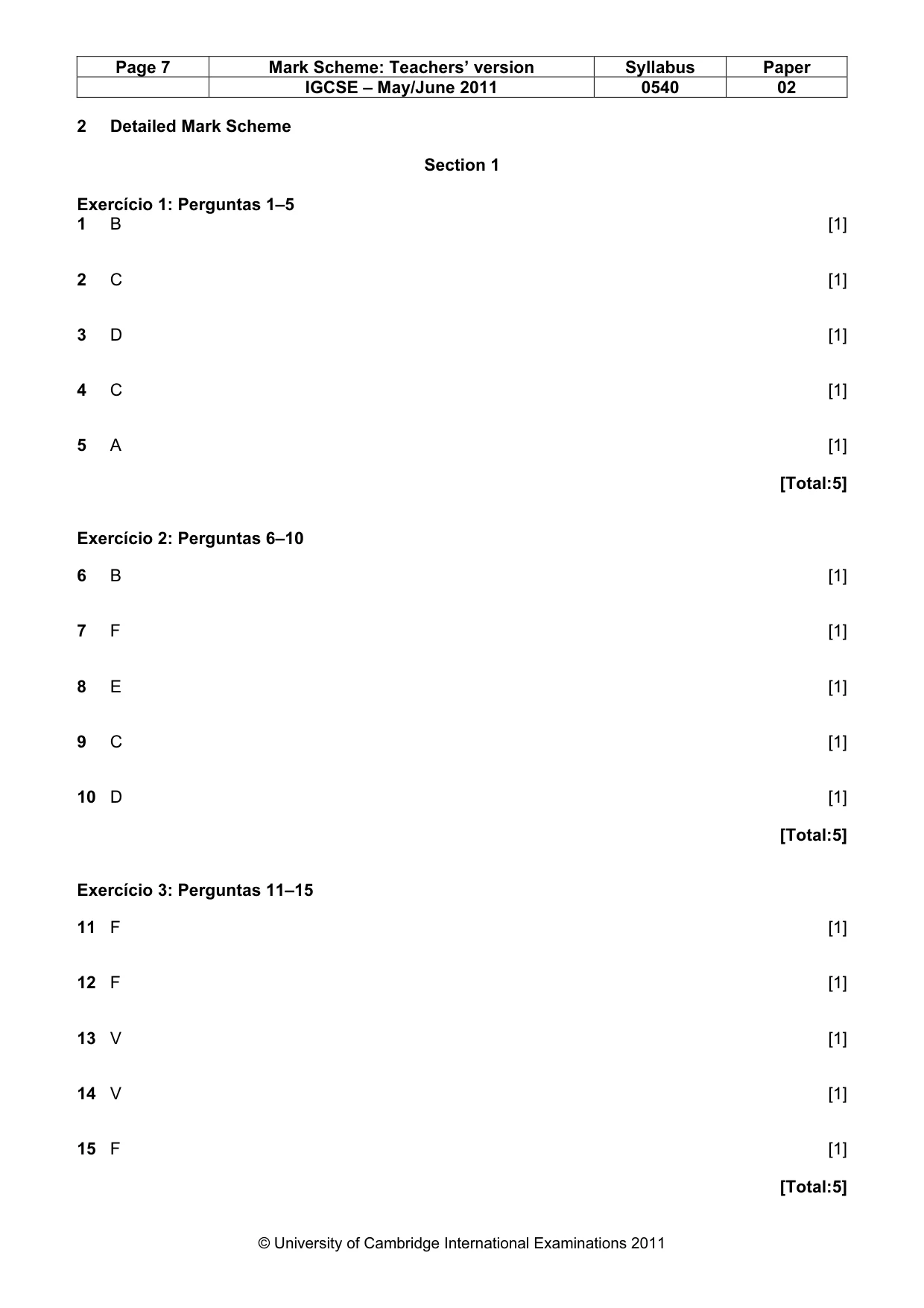
Page 7 Mark Scheme: Teachers’ version Syllabus Paper IGCSE – May/June 2011 0540 02 © University of Cambridge International Examinations 2011 2 Detailed Mark Scheme Section 1 Exercício 1: Perguntas 1–5 1 B [1] 2 C [1] 3 D [1] 4 C [1] 5 A [1] [Total:5] Exercício 2: Perguntas 6–10 6 B [1] 7 F [1] 8 E [1] 9 C [1] 10 D [1] [Total:5] Exercício 3: Perguntas 11–15 11 F [1] 12 F [1] 13 V [1] 14 V [1] 15 F [1] [Total:5]
Mark scheme, page 8
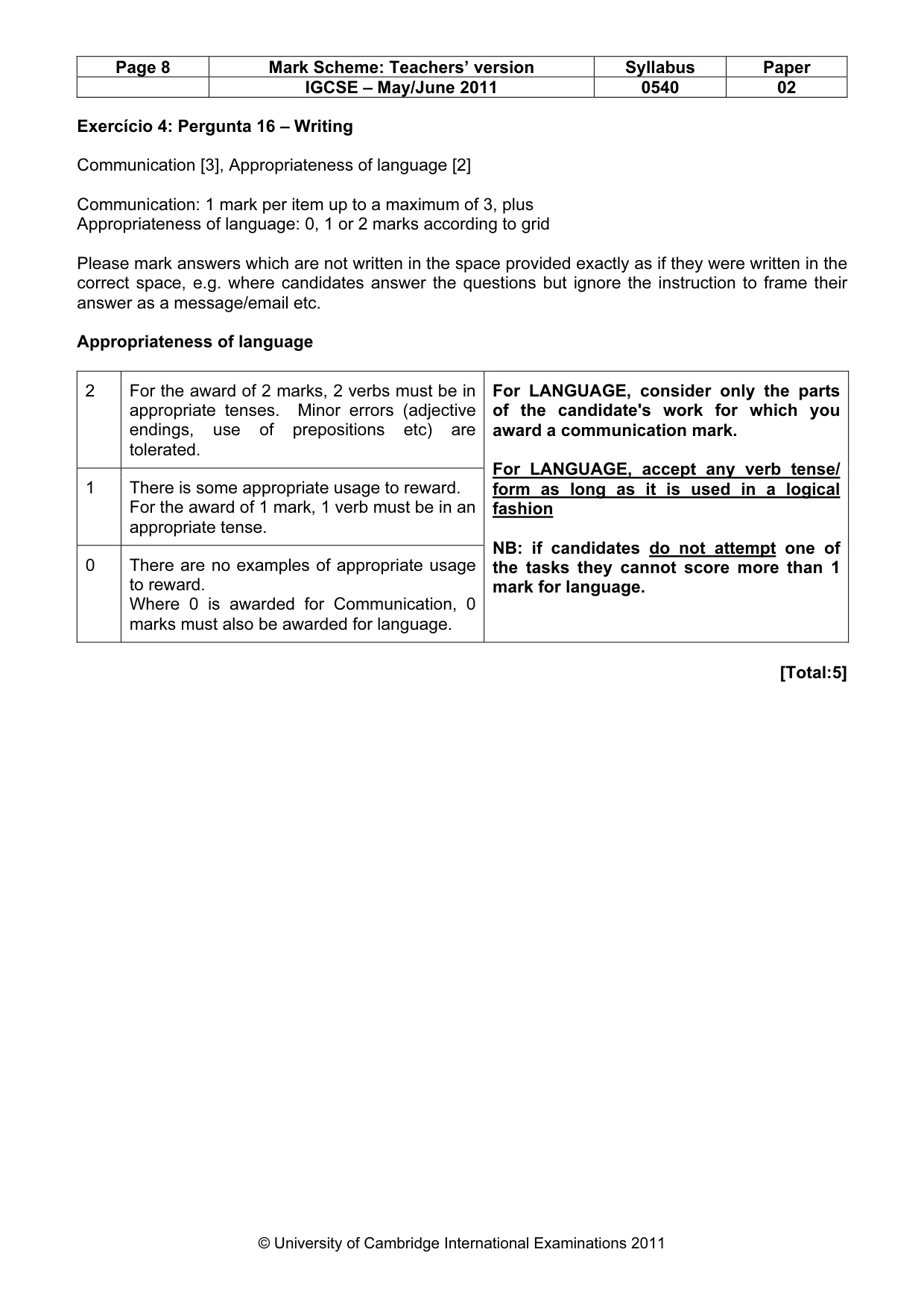
Page 8 Mark Scheme: Teachers’ version Syllabus Paper IGCSE – May/June 2011 0540 02 © University of Cambridge International Examinations 2011 Exercício 4: Pergunta 16 – Writing Communication [3], Appropriateness of language [2] Communication: 1 mark per item up to a maximum of 3, plus Appropriateness of language: 0, 1 or 2 marks according to grid Please mark answers which are not written in the space provided exactly as if they were written in the correct space, e.g. where candidates answer the questions but ignore the instruction to frame their answer as a message/email etc. Appropriateness of language 2 For the award of 2 marks, 2 verbs must be in appropriate tenses. Minor errors (adjective endings, use of prepositions etc) are tolerated. 1 There is some appropriate usage to reward. For the award of 1 mark, 1 verb must be in an appropriate tense. 0 There are no examples of appropriate usage to reward. Where 0 is awarded for Communication, 0 marks must also be awarded for language. For LANGUAGE, consider only the parts of the candidate's work for which you award a communication mark. For LANGUAGE, accept any verb tense/ form as long as it is used in a logical fashion NB: if candidates do not attempt one of the tasks they cannot score more than 1 mark for language. [Total:5]
Mark scheme, page 9
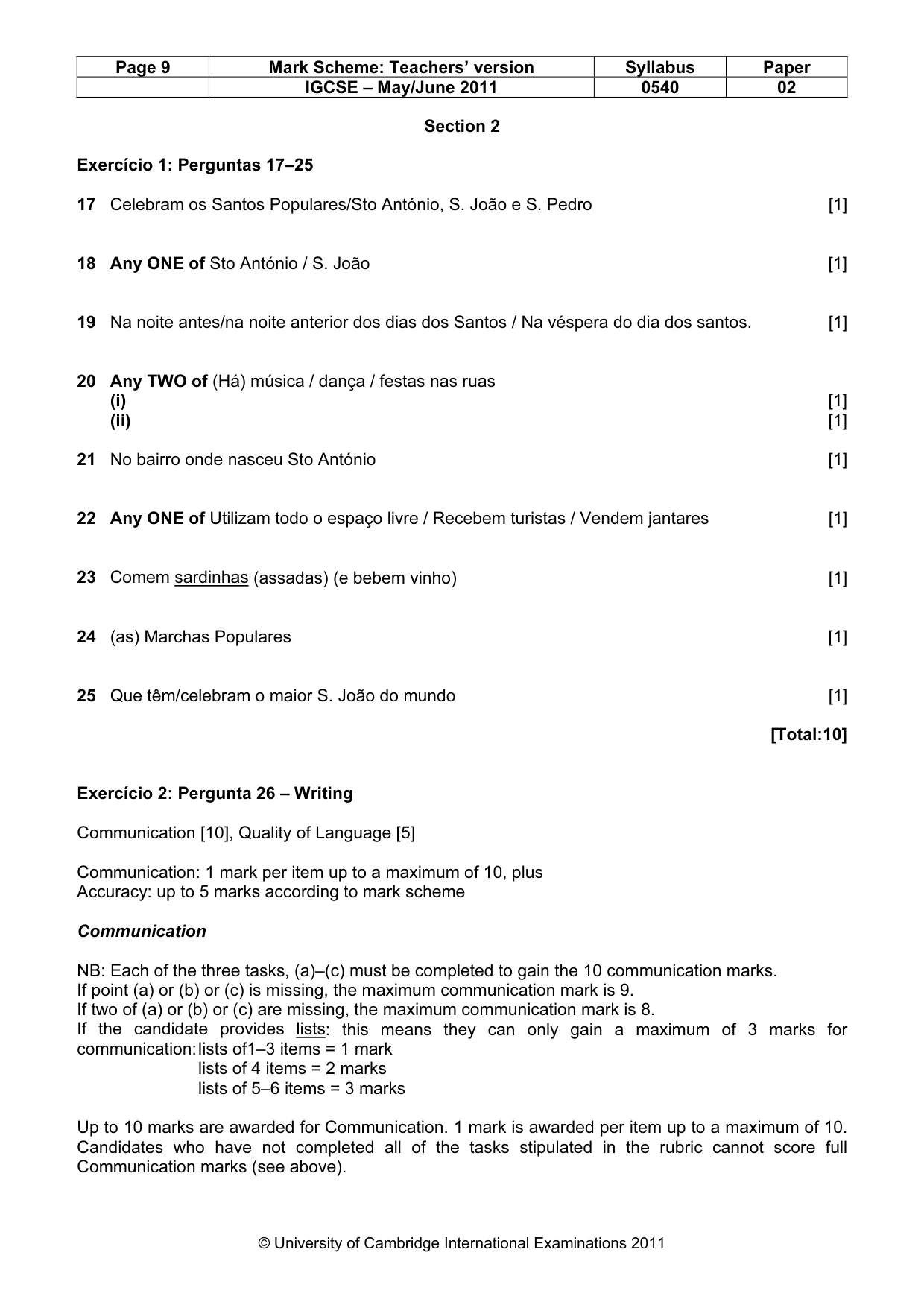
Page 9 Mark Scheme: Teachers’ version Syllabus Paper IGCSE – May/June 2011 0540 02 © University of Cambridge International Examinations 2011 Section 2 Exercício 1: Perguntas 17–25 17 Celebram os Santos Populares/Sto António, S. João e S. Pedro [1] 18 Any ONE of Sto António / S. João [1] 19 Na noite antes/na noite anterior dos dias dos Santos / Na véspera do dia dos santos. [1] 20 Any TWO of (Há) música / dança / festas nas ruas (i) [1] (ii) [1] 21 No bairro onde nasceu Sto António [1] 22 Any ONE of Utilizam todo o espaço livre / Recebem turistas / Vendem jantares [1] 23 Comem sardinhas (assadas) (e bebem vinho) [1] 24 (as) Marchas Populares [1] 25 Que têm/celebram o maior S. João do mundo [1] [Total:10] Exercício 2: Pergunta 26 – Writing Communication [10], Quality of Language [5] Communication: 1 mark per item up to a maximum of 10, plus Accuracy: up to 5 marks according to mark scheme Communication NB: Each of the three tasks, (a)–(c) must be completed to gain the 10 communication marks. If point (a) or (b) or (c) is missing, the maximum communication mark is 9. If two of (a) or (b) or (c) are missing, the maximum communication mark is 8. If the candidate provides lists: this means they can only gain a maximum of 3 marks for communication: lists of1–3 items = 1 mark lists of 4 items = 2 marks lists of 5–6 items = 3 marks Up to 10 marks are awarded for Communication. 1 mark is awarded per item up to a maximum of 10. Candidates who have not completed all of the tasks stipulated in the rubric cannot score full Communication marks (see above).
Mark scheme, page 10
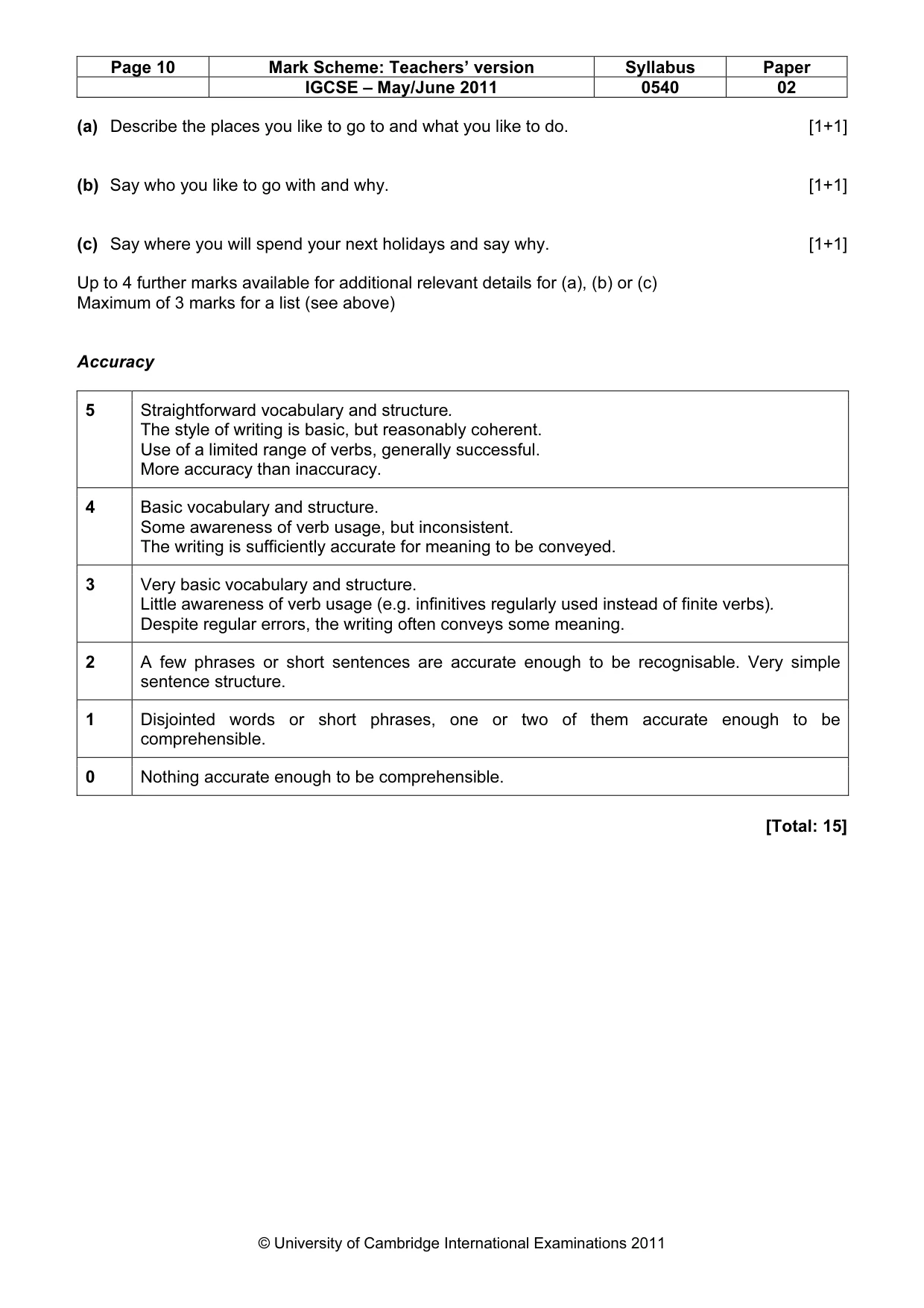
Page 10 Mark Scheme: Teachers’ version Syllabus Paper IGCSE – May/June 2011 0540 02 © University of Cambridge International Examinations 2011 (a) Describe the places you like to go to and what you like to do. [1+1] (b) Say who you like to go with and why. [1+1] (c) Say where you will spend your next holidays and say why. [1+1] Up to 4 further marks available for additional relevant details for (a), (b) or (c) Maximum of 3 marks for a list (see above) Accuracy 5 Straightforward vocabulary and structure. The style of writing is basic, but reasonably coherent. Use of a limited range of verbs, generally successful. More accuracy than inaccuracy. 4 Basic vocabulary and structure. Some awareness of verb usage, but inconsistent. The writing is sufficiently accurate for meaning to be conveyed. 3 Very basic vocabulary and structure. Little awareness of verb usage (e.g. infinitives regularly used instead of finite verbs). Despite regular errors, the writing often conveys some meaning. 2 A few phrases or short sentences are accurate enough to be recognisable. Very simple sentence structure. 1 Disjointed words or short phrases, one or two of them accurate enough to be comprehensible. 0 Nothing accurate enough to be comprehensible. [Total: 15]
Mark scheme, page 11
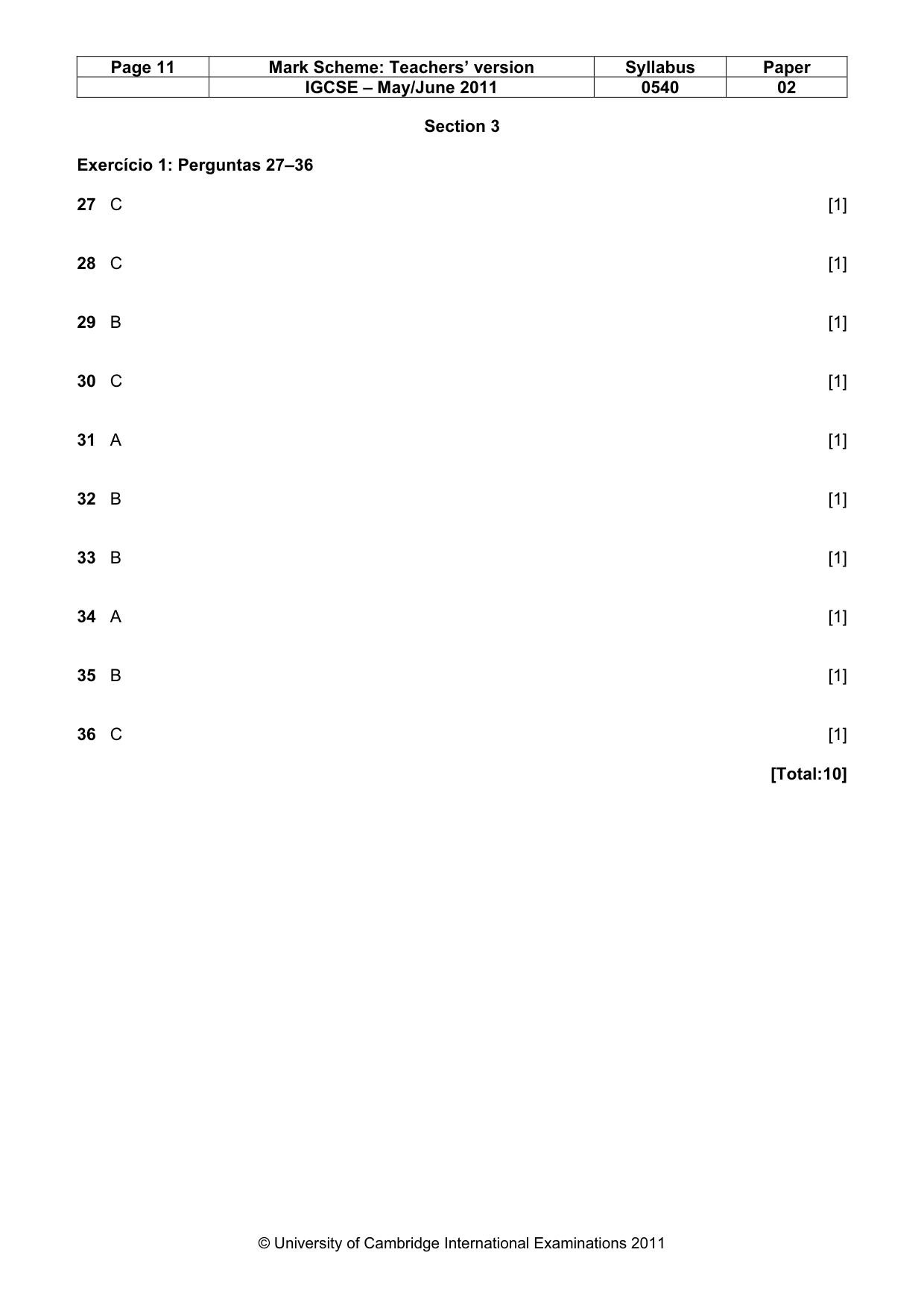
Page 11 Mark Scheme: Teachers’ version Syllabus Paper IGCSE – May/June 2011 0540 02 © University of Cambridge International Examinations 2011 Section 3 Exercício 1: Perguntas 27–36 27 C [1] 28 C [1] 29 B [1] 30 C [1] 31 A [1] 32 B [1] 33 B [1] 34 A [1] 35 B [1] 36 C [1] [Total:10]
Mark scheme, page 12
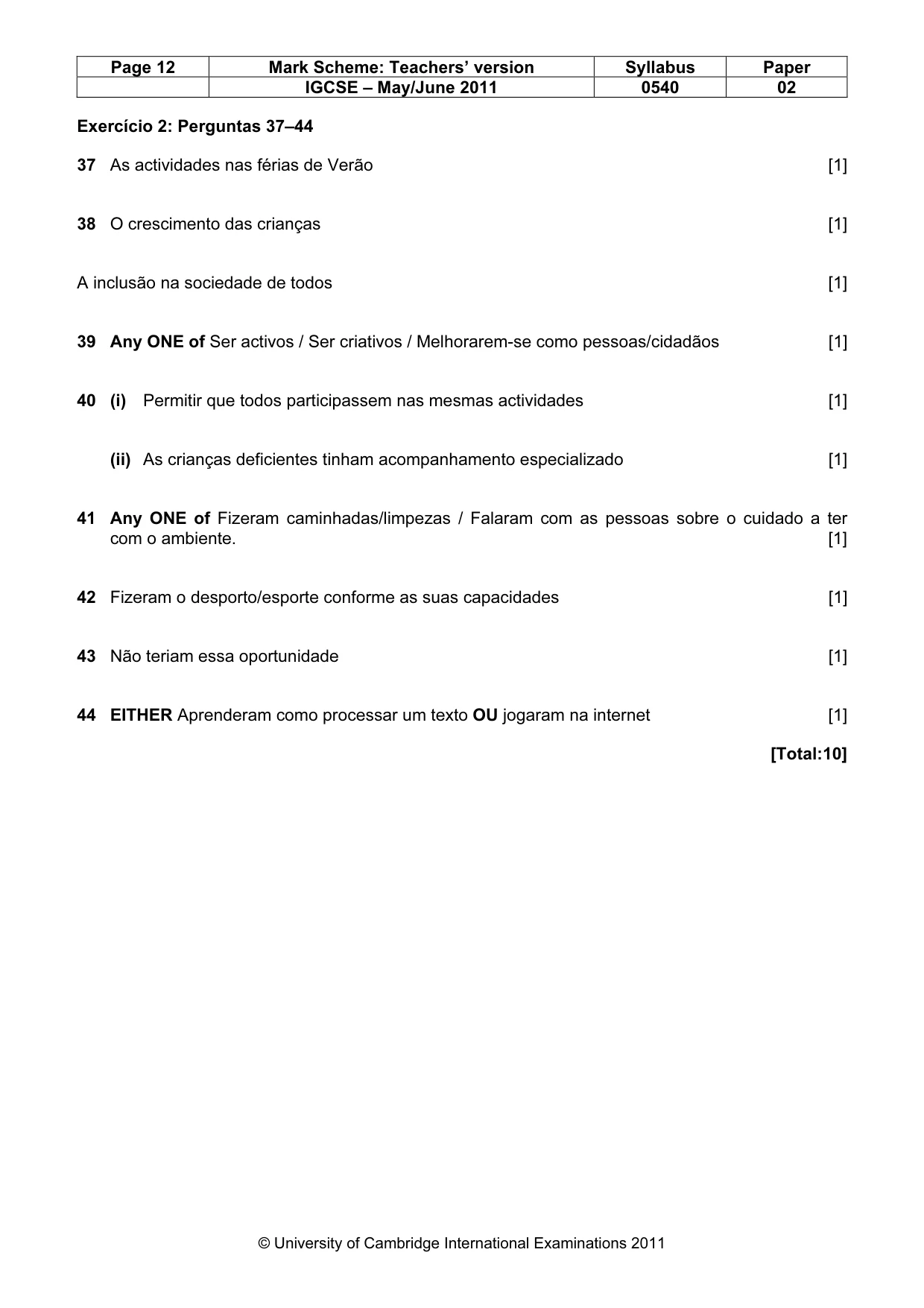
Page 12 Mark Scheme: Teachers’ version Syllabus Paper IGCSE – May/June 2011 0540 02 © University of Cambridge International Examinations 2011 Exercício 2: Perguntas 37–44 37 As actividades nas férias de Verão [1] 38 O crescimento das crianças [1] A inclusão na sociedade de todos [1] 39 Any ONE of Ser activos / Ser criativos / Melhorarem-se como pessoas/cidadãos [1] 40 (i) Permitir que todos participassem nas mesmas actividades [1] (ii) As crianças deficientes tinham acompanhamento especializado [1] 41 Any ONE of Fizeram caminhadas/limpezas / Falaram com as pessoas sobre o cuidado a ter com o ambiente. [1] 42 Fizeram o desporto/esporte conforme as suas capacidades [1] 43 Não teriam essa oportunidade [1] 44 EITHER Aprenderam como processar um texto OU jogaram na internet [1] [Total:10]
What you needed in this session
Cambridge’s own grade thresholds for 2011 May/June, Paper 2 · Variant 1. A higher threshold means an easier paper — the bar moves with how the cohort did.